BY: R.AKIL CHE ANAND
FORCE & PRESSURE
(SCIENCE LESSON-1)
FORCE
 A push or pull on a object is called force.
FACTORS ON WHICH THE FORCE
DEPENDS
 It depends on the direction of the force.
 Magnitude of force also it depends.
THRUST
 Force acting on a body perpendicular to the
surface is known as thrust.
 It depends on the area it acts.
 SI unit: Newton.
PRESSURE
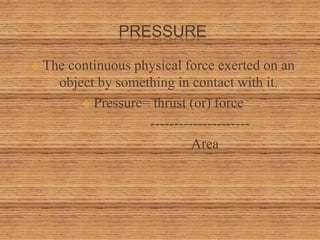
 The continuous physical force exerted on an
object by something in contact with it.
 Pressure= thrust (or) force
---------------------
Area
INCREASING PRESSURE
The effect of pressure can be increased by
increasing the thrust or. Decreasing in area of the
surface of the body experiencing the thrust
PRESSURE EXERTED BY AIR-
ATMOSPHEREIC
The amount of force or weight of
the atmospheric air that acts downwards on unit of
surface area of the surface of the earth is known
as atmospheric pressure.
PRESSURE EXERTED BY AIR-
ATMOSPHEREIC DETAILS
 This pressure is measured by the instrument called barometer.
This instrument was found by Torricelli.
 1atmosphereic pressure =1 atm =pressure exerted by the mercury
column of height 76cm in the barometer= 1.01X 10 POWER 5
Nm square.
 In the SI system 1 atm= 1,00,000 Pascal.
 SI unit of atmospheric pressure is Nm power to the -2
or a Pascal.
FORCE IN LIQUIDS
BUOYANT FORCE OF LIQUID:
 An upward force is exerted by water on a
floating or a partly submerged body.
 This upward force is called buoyant force.
 The phenomenon is known as “buoyancy”.
 This force is not only exerted by liquids, but also
by gases.
 Liquids and gases together are called fluids.
FORCE IN LIQUIDS
PRESSURE EXERTED BY LIQUIDS
 It does not have a definite shape.
 The force acting on unit area of the surface, on which the
liquid is placed is called the static pressure of liquid.
 Liquids exert a pressure not only the base of their
container/vessel, but also on its side walls.
 The pressure exerted by a liquid depends upon the depth.
 Manometer is the instrument used to measure the
difference in the liquid pressure.
PASCAL’S LAW
The pressure applied at any point of the liquid at
rest, in a closed system, will be distributed
equally through all regions of the liquids.
APPLICATION ON PASCAL’S LAW
 In a automobile service station, the vehicles are
lifted upward using the hydraulic crane lift.
 The automobi1e brake system.
 The hydraulic press is used to make the
compressed bundles of cotton or cloth so as to
occupy less space.
FORCE AND PRESSURE.pptx

FORCE AND PRESSURE.pptx

  • 1.
    BY: R.AKIL CHEANAND FORCE & PRESSURE (SCIENCE LESSON-1)
  • 2.
    FORCE  A pushor pull on a object is called force.
  • 3.
    FACTORS ON WHICHTHE FORCE DEPENDS  It depends on the direction of the force.  Magnitude of force also it depends.
  • 4.
    THRUST  Force actingon a body perpendicular to the surface is known as thrust.  It depends on the area it acts.  SI unit: Newton.
  • 5.
    PRESSURE  The continuousphysical force exerted on an object by something in contact with it.  Pressure= thrust (or) force --------------------- Area
  • 6.
    INCREASING PRESSURE The effectof pressure can be increased by increasing the thrust or. Decreasing in area of the surface of the body experiencing the thrust
  • 7.
    PRESSURE EXERTED BYAIR- ATMOSPHEREIC The amount of force or weight of the atmospheric air that acts downwards on unit of surface area of the surface of the earth is known as atmospheric pressure.
  • 8.
    PRESSURE EXERTED BYAIR- ATMOSPHEREIC DETAILS  This pressure is measured by the instrument called barometer. This instrument was found by Torricelli.  1atmosphereic pressure =1 atm =pressure exerted by the mercury column of height 76cm in the barometer= 1.01X 10 POWER 5 Nm square.  In the SI system 1 atm= 1,00,000 Pascal.  SI unit of atmospheric pressure is Nm power to the -2 or a Pascal.
  • 9.
    FORCE IN LIQUIDS BUOYANTFORCE OF LIQUID:  An upward force is exerted by water on a floating or a partly submerged body.  This upward force is called buoyant force.  The phenomenon is known as “buoyancy”.  This force is not only exerted by liquids, but also by gases.  Liquids and gases together are called fluids.
  • 10.
    FORCE IN LIQUIDS PRESSUREEXERTED BY LIQUIDS  It does not have a definite shape.  The force acting on unit area of the surface, on which the liquid is placed is called the static pressure of liquid.  Liquids exert a pressure not only the base of their container/vessel, but also on its side walls.  The pressure exerted by a liquid depends upon the depth.  Manometer is the instrument used to measure the difference in the liquid pressure.
  • 11.
    PASCAL’S LAW The pressureapplied at any point of the liquid at rest, in a closed system, will be distributed equally through all regions of the liquids.
  • 12.
    APPLICATION ON PASCAL’SLAW  In a automobile service station, the vehicles are lifted upward using the hydraulic crane lift.  The automobi1e brake system.  The hydraulic press is used to make the compressed bundles of cotton or cloth so as to occupy less space.