Introduction
♦Name: Asif Iqbal
♦Topic: Foot Printing (Ethically)
♦Department: CS & IT
♦ University of Malakand, Pakistan
Date: 11.05.20161
Ethical Hacking
 It is Legal
 Permission is obtained from the target
 Part of an overall security program
 Independent computer security Professionals
breaking into the computer systems.
 Neither damage the target systems nor steal
information.
 Evaluate target systems security and report back
to owners about the vulnerabilities found.
2
Ethical Hackers
 Completely trustworthy.
 Strong programming and computer networking
skills.
 Learn about the system and trying to find its
weaknesses.
 Continuous updating of their knowledge on
computer and network security is required.
 Techniques of Criminal hackers-Detection-
Prevention.
 They should have more patience.
3
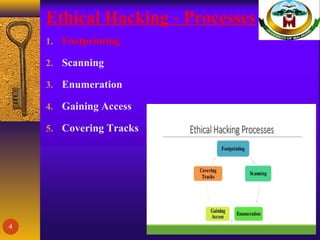
Ethical Hacking - Processes
1. Footprinting
2. Scanning
3. Enumeration
4. Gaining Access
5. Covering Tracks
4
Footprinting
 Footprinting = Process of collecting information about an
organization, its network, its IP address ranges and the
people who use them
 Footprinting is conducted through social engineering and
by researching information
from printed resources
From online resources
5
Ethically
 Footprinting is the first and most convenient way that
hackers use to gather information about computer systems
and the companies they belong to. The purpose of
footprinting is to learn as much as you can about a system,
its remote access capabilities, its ports and services, and
the aspects of its security.
 Footprinting can reveal system vulnerabilities and improve
the ease with which they can be exploited
6
Types of Footprinting
♦ Passive
♦ Active
Passive: In passive Footprinting the
attacker never makes any contact with the
system.
Google Search
Who is Queries
DNS Lookup
Social Networking Sites7
Types of Footprinting
Active: Monitoring the System/Network.
Download all the available contents for
offline analysis.
E-mail Tracking
Server Verification
People Search
Ping
Tracer Rout
8
Why is Footprinting necessary
 Companies/Businesses must do Footprinting to see what
and where their vulnerabilities are so they can address
them and make changes in the business policy.
 Footprinting for a non-computer based company is almost
more important to address than a computer based
company.
 The main reason for this would be the fact that hackers
will certainly try, what they think to be, a non computer
educated company first.
 This is why a business owner must invest in his or her
Information Technology department so he can be proactive
and not reactive.
9
How to Fight Footprinting
 1. Place offline any information that has the potential to
identify and compromise your organization’s security such
as access to business plans, formulas, and proprietary
documents.
 2. Determine the level of information that is necessary for
the public about your organization and make only that
piece available on the network.
 3. Visit your organization on the Web to determine current
insecurities and the attributes for protection.
 4. Run a ping sweep on your organizational network to see
results.
 5. Familiarize yourself with the American Registry for
Internet Numbers (ARIN) to determine network blocks.10
Any Question
11

Footprintig(Haching)

  • 1.
    Introduction ♦Name: Asif Iqbal ♦Topic:Foot Printing (Ethically) ♦Department: CS & IT ♦ University of Malakand, Pakistan Date: 11.05.20161
  • 2.
    Ethical Hacking  Itis Legal  Permission is obtained from the target  Part of an overall security program  Independent computer security Professionals breaking into the computer systems.  Neither damage the target systems nor steal information.  Evaluate target systems security and report back to owners about the vulnerabilities found. 2
  • 3.
    Ethical Hackers  Completelytrustworthy.  Strong programming and computer networking skills.  Learn about the system and trying to find its weaknesses.  Continuous updating of their knowledge on computer and network security is required.  Techniques of Criminal hackers-Detection- Prevention.  They should have more patience. 3
  • 4.
    Ethical Hacking -Processes 1. Footprinting 2. Scanning 3. Enumeration 4. Gaining Access 5. Covering Tracks 4
  • 5.
    Footprinting  Footprinting =Process of collecting information about an organization, its network, its IP address ranges and the people who use them  Footprinting is conducted through social engineering and by researching information from printed resources From online resources 5
  • 6.
    Ethically  Footprinting isthe first and most convenient way that hackers use to gather information about computer systems and the companies they belong to. The purpose of footprinting is to learn as much as you can about a system, its remote access capabilities, its ports and services, and the aspects of its security.  Footprinting can reveal system vulnerabilities and improve the ease with which they can be exploited 6
  • 7.
    Types of Footprinting ♦Passive ♦ Active Passive: In passive Footprinting the attacker never makes any contact with the system. Google Search Who is Queries DNS Lookup Social Networking Sites7
  • 8.
    Types of Footprinting Active:Monitoring the System/Network. Download all the available contents for offline analysis. E-mail Tracking Server Verification People Search Ping Tracer Rout 8
  • 9.
    Why is Footprintingnecessary  Companies/Businesses must do Footprinting to see what and where their vulnerabilities are so they can address them and make changes in the business policy.  Footprinting for a non-computer based company is almost more important to address than a computer based company.  The main reason for this would be the fact that hackers will certainly try, what they think to be, a non computer educated company first.  This is why a business owner must invest in his or her Information Technology department so he can be proactive and not reactive. 9
  • 10.
    How to FightFootprinting  1. Place offline any information that has the potential to identify and compromise your organization’s security such as access to business plans, formulas, and proprietary documents.  2. Determine the level of information that is necessary for the public about your organization and make only that piece available on the network.  3. Visit your organization on the Web to determine current insecurities and the attributes for protection.  4. Run a ping sweep on your organizational network to see results.  5. Familiarize yourself with the American Registry for Internet Numbers (ARIN) to determine network blocks.10
  • 11.