Jacob C. Duncombe
FOOT SPA
What is foot spa?
 The word “spa” generally refers to health,
beauty and personal care treatment.
 The foot spa is a great way to help you
pumper your self after a stress-filled day as it
improves the process of reflexology, which
can benefits your entire body.
Tools for Foots Spa and their
uses
1.One medium basin- use to put your water for
soaking and rinsing .
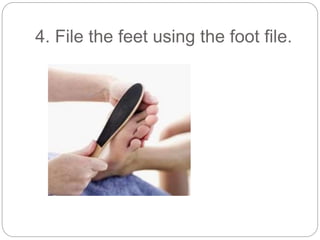
2. Foot file
 Use to remove calluses and smooth the skin of
the feet.
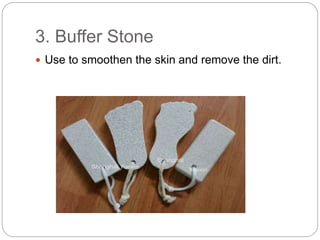
3. Buffer Stone
 Use to smoothen the skin and remove the dirt.
4. Foot Brush
 An implement typically consisting of bristles
fastened into a handle, use an scrubbing,
polishing, grooming or applying a liquid.
5. Foot Lotion
 Is a liquid that you use to clean improve or protect
your skin or hair.
6. Foot Scrub
 Use to remove dirty or stains by hard rubbing.
7. Two Hand Towel
 Use for dying and or wiping.
PROCEDURES
1. Wash feet thoroughly.
2. Soak in a lukewarm water
3. Remove the feet from the solution
and rub with the foot scrub.
4. File the feet using the foot file.
5. Wash feet twice until water is
clear.
6. Apply foot lotion then massage
A foot spa relieves stress.
 Probably the most notable benefit you receive by
using a foot spa is a stress reduction, since this
device can increase blood circulation. This not
only helps you feel more energize and full of life,
but can also give you sometimes to sit and
relaxes after a long day.
A foot spa can help with health
problems.
 A foot spa can also help with health problems
such as arthritis, insomnia and acid indigestion.
This device helps with arthritis when you add
seaweed, which can reduce pain. In turn,
indulging in a foot spa treatment in the afternoon
or evening can help you get a goodnight’s sleep.
History of Hair the Ancient
Civilizations
 Egypt
 Egyptian hairstyles very much depended on the
wealth, age and social group the individual
circulated in. Both men and women would have
shoulder-length hair or hair cut short to the nape
or even clean shaven heads.
 Greece
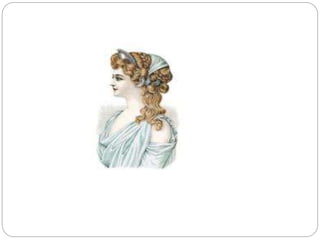
To contrast from the Egyptians, classical Greece
hairstyles where pulled back into a chignon style
and was grown much longer.
Many styles involved braiding the hair and fixing it
to the head and decorating with flowers,
headbands, ribbons and pieces of metal. Blondes
were very rare and therefore many women tried
dying their hair blonde and also red.
 Rome
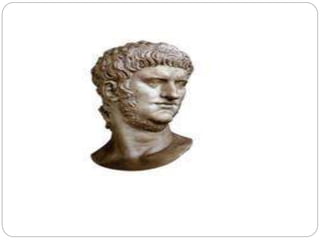
Simple hairstyles would consist for women
wearing their hair down and confining it from the
face by using a band circling the head. Young
girls wore a simple bun at the base of the neck.
However, in the reign of the Emperor Augustus
simple hairstyles changed and detailed hairstyles
came into fashion.
 In Ancient Rome hairstyles became an
expression of a person’s identity as much as it is
today and again the style determined the persons
wealth, status, gender and age. For women, their
hair indicated how attractive and wealthy she
was.
 The East
In the Vedic period (1700-1100BCE) they
arranged that Indians should shave the whole
head, leaving a lock of hair at the back or at the
side, similar to young Egyptians, allowing "God to
pull people into heaven" .This kind of hair cut was
limited to people with high social positions over
time, whilst women were to use head pieces with
gems and jewels in the forehead.
 The Greek culture changed all this as Buddha
was shown with curly hair in the style of a bun,
atop his head. In the period between 320 - 550
women’s hair was generally cut short and they
would use longer hair to create a style, if their hair
was tied it was in a bun to the side of their head
or near the nape of her neck.
 China
Chinese hairstyles vary depending on the age of the
woman and her marital status and the reason for their
hair being extremely long was because it was
considered disrespectful to cut hair because it was
inherited from their parents. Girls (and unmarried
women) would usually wear their hair long and
braided as for unmarried women. For married women
this is reversed as their hair is tied up.
 Japan
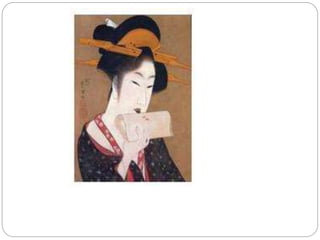
 In Japan women’s hairstyles where quite different from
Chinese styles. In the 7th Century noble women wore their
hair tight to their head with a sickle-shaped ponytail at the
back (kepatsu). However, after this period and up until
1345 fashion dictated that women should wear their hair
long and unbound as a sign of beauty. In the Edo Period
(1603-1868), women took on much more elaborate styles,
in particular they would wear a variety of different buns,
decorated with hairsticks, ribbons, flowers and combs.
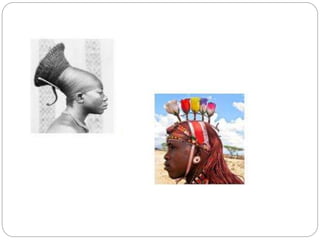
 Africa
 In Africa there where many tribes and with that
plenty of different customs. Masai warriors would
spend hours braiding each other’s hair. They die
their hair red with a natural hair pigment found in
volcanic regions which is mixed with animal fat to
create a paint texture.
 America
Native Indians to America were divided in
hairstyles like many African tribes. Tribes close to
the East Coasts would shave most of their hair
apart from a ridge of hair along the crown. Many
warriors shaved their heads except for a fringe of
hair around the head(known as tonsure), a single
lock of hair on the crown of their head(scalplock)
 The Western World
 The 5th century right up to the 15th century,
known at the ’middle ages’ or the ’medieval’
period, had a strong Catholic alliance. Germanic
tribes (from Germany) settled in England after it
was invaded and abandoned by Roman troops in
the 5th Century AD
 The Germanics made new customs, that
separated them from the Roman Empire as their
hair held great significance like the Indian and
African tribes. Military leaders would tie their hair
in a knot atop their head to appear more
intimidating to enemies as it symbolised authority,
to lose ones hair would to bring shame on the
individual.
The Anatomy of Hair
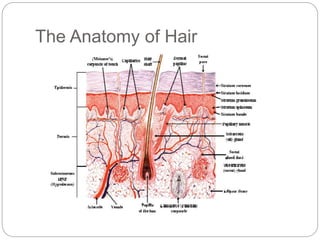
Parts of the Hair:
 Three main regions: root, shaft, and tip
 Root: The part that was growing in the
follicle. This is the widest part of the hair
 Shaft: The middle of the length of the hair (from
the root to the tip). This is where the hair tapers
 Tip: The end of the hair farthest away from the
root. The hair is narrowest at the tip
 Three major layers to the hair:
 From the outside in: cuticle, cortex, and the
medulla (think "middle)
 Cuticle: The outermost layer of the hair. It is made of
keratin. The cuticle is really a series of overlapping
scales - very resistant to chemical decomposition
Cortex: The intervening layer of the hair (i.e., between
the cuticle and the medulla). It is made of spindle
shaped cell and pigment granules (these give color to
the hair).
 Medulla (from the Latin for "marrow"): The
innermost layer of the hair. It is made of cells that
form a shaft through the middle of the hair.
 Growth Stages of the Hair:
 3 major growth stages: anagen, catagen, telogen
 Anagen Stage: The active growth phase of the hair follicle.
 Catagen Stage: The transition period between growth and rest. Hair
continues to grow, but at a decreasing rate. The root bulb looks
elongated from being pushed out of the follicle.
 Telogen: The rest period for the follicle. The current hair is shed and no
new growth takes place for a period of time.
What Is the Biological Importance of
Human Hair?
Hair Protects Against UV Rays and
Debris
 The hair on our heads protects our abnormally large
brains (in relation to other mammals) from the
harmful effects of the sun's ultraviolet (UV) rays.
While some believe that the hair shaft acts like fiber
optics, thereby facilitating the passage of UV light,
the natural snags in hair diffuse the harmful rays. In
addition, our eyebrows protect our eyes from UV
light and deflect debris.
 Hair Helps Us Detect Harmful Substances
• Because hair retains concentrations of heavy metals (lead,
mercury, arsenic and the like), it can be used when testing
for these harmful metals in the human body. The
concentration of these substances in human hair is, in fact,
ten times more than that found in the urine or blood.

 Hair Protects Against Excessive Heat
• Hair helps to keep the head cool. Human hair on
the scalp provides shade from the sun. The low
density of Afro-hair, for instance, along with its
coiled structure, helps to circulate air around the
scalp while shutting out ambient heat.

Hair Insulates Our Bodies
• In cold weather, hair helps to prevent a drop in
body temperature. Because we are literally
covered in hair, the skin has an easier time
retaining heat when temperatures drop. Millions
of hairs act as insulators by trapping body heat
and keeping it close to the skin.

Hair Helps Us Maintain Equilibrium
• Hair cells are instrumental in helping us keep our
sense of equilibrium (orientation with respect to
gravity). When our bodies accelerate, decelerate,
spin or fall, sensory hair cells are prompted by a
sequence of events within the ear to release
transmitter chemicals, which in turn stimulate
sensory neurons to give us our orientation.
Thank you

Foot spa

  • 1.
  • 2.
    What is footspa?  The word “spa” generally refers to health, beauty and personal care treatment.  The foot spa is a great way to help you pumper your self after a stress-filled day as it improves the process of reflexology, which can benefits your entire body.
  • 3.
    Tools for FootsSpa and their uses 1.One medium basin- use to put your water for soaking and rinsing .
  • 4.
    2. Foot file Use to remove calluses and smooth the skin of the feet.
  • 5.
    3. Buffer Stone Use to smoothen the skin and remove the dirt.
  • 6.
    4. Foot Brush An implement typically consisting of bristles fastened into a handle, use an scrubbing, polishing, grooming or applying a liquid.
  • 7.
    5. Foot Lotion Is a liquid that you use to clean improve or protect your skin or hair.
  • 8.
    6. Foot Scrub Use to remove dirty or stains by hard rubbing.
  • 9.
    7. Two HandTowel  Use for dying and or wiping.
  • 10.
  • 11.
    2. Soak ina lukewarm water
  • 12.
    3. Remove thefeet from the solution and rub with the foot scrub.
  • 13.
    4. File thefeet using the foot file.
  • 14.
    5. Wash feettwice until water is clear.
  • 15.
    6. Apply footlotion then massage
  • 16.
    A foot sparelieves stress.  Probably the most notable benefit you receive by using a foot spa is a stress reduction, since this device can increase blood circulation. This not only helps you feel more energize and full of life, but can also give you sometimes to sit and relaxes after a long day.
  • 17.
    A foot spacan help with health problems.  A foot spa can also help with health problems such as arthritis, insomnia and acid indigestion. This device helps with arthritis when you add seaweed, which can reduce pain. In turn, indulging in a foot spa treatment in the afternoon or evening can help you get a goodnight’s sleep.
  • 18.
    History of Hairthe Ancient Civilizations  Egypt  Egyptian hairstyles very much depended on the wealth, age and social group the individual circulated in. Both men and women would have shoulder-length hair or hair cut short to the nape or even clean shaven heads.
  • 20.
     Greece To contrastfrom the Egyptians, classical Greece hairstyles where pulled back into a chignon style and was grown much longer. Many styles involved braiding the hair and fixing it to the head and decorating with flowers, headbands, ribbons and pieces of metal. Blondes were very rare and therefore many women tried dying their hair blonde and also red.
  • 22.
     Rome Simple hairstyleswould consist for women wearing their hair down and confining it from the face by using a band circling the head. Young girls wore a simple bun at the base of the neck. However, in the reign of the Emperor Augustus simple hairstyles changed and detailed hairstyles came into fashion.
  • 23.
     In AncientRome hairstyles became an expression of a person’s identity as much as it is today and again the style determined the persons wealth, status, gender and age. For women, their hair indicated how attractive and wealthy she was.
  • 25.
     The East Inthe Vedic period (1700-1100BCE) they arranged that Indians should shave the whole head, leaving a lock of hair at the back or at the side, similar to young Egyptians, allowing "God to pull people into heaven" .This kind of hair cut was limited to people with high social positions over time, whilst women were to use head pieces with gems and jewels in the forehead.
  • 26.
     The Greekculture changed all this as Buddha was shown with curly hair in the style of a bun, atop his head. In the period between 320 - 550 women’s hair was generally cut short and they would use longer hair to create a style, if their hair was tied it was in a bun to the side of their head or near the nape of her neck.
  • 28.
     China Chinese hairstylesvary depending on the age of the woman and her marital status and the reason for their hair being extremely long was because it was considered disrespectful to cut hair because it was inherited from their parents. Girls (and unmarried women) would usually wear their hair long and braided as for unmarried women. For married women this is reversed as their hair is tied up.
  • 30.
     Japan  InJapan women’s hairstyles where quite different from Chinese styles. In the 7th Century noble women wore their hair tight to their head with a sickle-shaped ponytail at the back (kepatsu). However, after this period and up until 1345 fashion dictated that women should wear their hair long and unbound as a sign of beauty. In the Edo Period (1603-1868), women took on much more elaborate styles, in particular they would wear a variety of different buns, decorated with hairsticks, ribbons, flowers and combs.
  • 32.
     Africa  InAfrica there where many tribes and with that plenty of different customs. Masai warriors would spend hours braiding each other’s hair. They die their hair red with a natural hair pigment found in volcanic regions which is mixed with animal fat to create a paint texture.
  • 34.
     America Native Indiansto America were divided in hairstyles like many African tribes. Tribes close to the East Coasts would shave most of their hair apart from a ridge of hair along the crown. Many warriors shaved their heads except for a fringe of hair around the head(known as tonsure), a single lock of hair on the crown of their head(scalplock)
  • 36.
     The WesternWorld  The 5th century right up to the 15th century, known at the ’middle ages’ or the ’medieval’ period, had a strong Catholic alliance. Germanic tribes (from Germany) settled in England after it was invaded and abandoned by Roman troops in the 5th Century AD
  • 37.
     The Germanicsmade new customs, that separated them from the Roman Empire as their hair held great significance like the Indian and African tribes. Military leaders would tie their hair in a knot atop their head to appear more intimidating to enemies as it symbolised authority, to lose ones hair would to bring shame on the individual.
  • 39.
  • 40.
    Parts of theHair:  Three main regions: root, shaft, and tip  Root: The part that was growing in the follicle. This is the widest part of the hair  Shaft: The middle of the length of the hair (from the root to the tip). This is where the hair tapers  Tip: The end of the hair farthest away from the root. The hair is narrowest at the tip
  • 41.
     Three majorlayers to the hair:  From the outside in: cuticle, cortex, and the medulla (think "middle)
  • 43.
     Cuticle: Theoutermost layer of the hair. It is made of keratin. The cuticle is really a series of overlapping scales - very resistant to chemical decomposition Cortex: The intervening layer of the hair (i.e., between the cuticle and the medulla). It is made of spindle shaped cell and pigment granules (these give color to the hair).  Medulla (from the Latin for "marrow"): The innermost layer of the hair. It is made of cells that form a shaft through the middle of the hair.
  • 44.
     Growth Stagesof the Hair:  3 major growth stages: anagen, catagen, telogen  Anagen Stage: The active growth phase of the hair follicle.  Catagen Stage: The transition period between growth and rest. Hair continues to grow, but at a decreasing rate. The root bulb looks elongated from being pushed out of the follicle.  Telogen: The rest period for the follicle. The current hair is shed and no new growth takes place for a period of time.
  • 45.
    What Is theBiological Importance of Human Hair? Hair Protects Against UV Rays and Debris  The hair on our heads protects our abnormally large brains (in relation to other mammals) from the harmful effects of the sun's ultraviolet (UV) rays. While some believe that the hair shaft acts like fiber optics, thereby facilitating the passage of UV light, the natural snags in hair diffuse the harmful rays. In addition, our eyebrows protect our eyes from UV light and deflect debris.
  • 46.
     Hair HelpsUs Detect Harmful Substances • Because hair retains concentrations of heavy metals (lead, mercury, arsenic and the like), it can be used when testing for these harmful metals in the human body. The concentration of these substances in human hair is, in fact, ten times more than that found in the urine or blood. 
  • 47.
     Hair ProtectsAgainst Excessive Heat • Hair helps to keep the head cool. Human hair on the scalp provides shade from the sun. The low density of Afro-hair, for instance, along with its coiled structure, helps to circulate air around the scalp while shutting out ambient heat. 
  • 48.
    Hair Insulates OurBodies • In cold weather, hair helps to prevent a drop in body temperature. Because we are literally covered in hair, the skin has an easier time retaining heat when temperatures drop. Millions of hairs act as insulators by trapping body heat and keeping it close to the skin. 
  • 49.
    Hair Helps UsMaintain Equilibrium • Hair cells are instrumental in helping us keep our sense of equilibrium (orientation with respect to gravity). When our bodies accelerate, decelerate, spin or fall, sensory hair cells are prompted by a sequence of events within the ear to release transmitter chemicals, which in turn stimulate sensory neurons to give us our orientation.
  • 50.