HISTORY OF THE FOOD
SERVICE INDUSTRY
After the lesson, the student should be able to:
1. Discuss the history of the restaurant Industry;
2. Describe the development of the restaurant industry;
3. Identify the places that have important contributions to the
rise of the restaurant industry; and
4. Cite the names of famous people who influence the restaurant
industry.
Objectives:
 Main purpose of eating was to nourish the body &
soul.
 Rarely dined out.
 Enjoyed the social aspect of dining.
 Often got together for banquets.
 Lesche: Private clubs that offered food to members
 Phatnai: Establishments that catered to travelers &
traders &visiting diplomats.
Ancient Greece
Food catering establishment which may be described as
restaurant were known since the 12th century in Hangzhou, a
cultural, political and economic center during China’s Song
Dynasty.
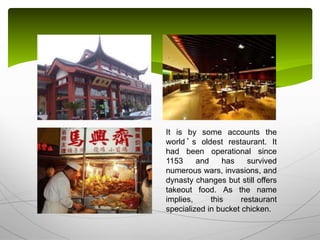
Ma Yu Ching’s Bucket Chicken House, was established in
Kaifeng, China, in 1153 AD, and still serving up meals today.
Hangzhou’s restaurants blossomed into an industry catering to
locals as well. Restaurants catered to different styles of cuisine,
price buckets, and religious requirements.
Middle Ages
It is by some accounts the
world ’ s oldest restaurant. It
had been operational since
1153 and has survived
numerous wars, invasions, and
dynasty changes but still offers
takeout food. As the name
implies, this restaurant
specialized in bucket chicken.
In the West, even when inns and taverns were known for
antiquity, these were establishments aimed at travelers, and in
general locals would rarely eat there. Restaurants, as businesses
dedicated to the serving of food, and where specific dishes are
ordered by the guest and generally prepared according to this
order emerged only in the 18th century.
The Sobrino de Botin in Madrid, Spain is the oldest
restaurant in existence today. It was opened in 1725.
RENAISSANCE- French
Revolution
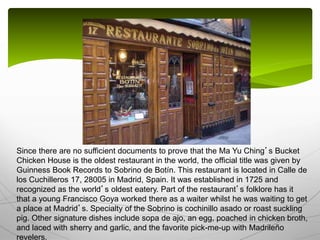
Since there are no sufficient documents to prove that the Ma Yu Ching’s Bucket
Chicken House is the oldest restaurant in the world, the official title was given by
Guinness Book Records to Sobrino de Botín. This restaurant is located in Calle de
los Cuchilleros 17, 28005 in Madrid, Spain. It was established in 1725 and
recognized as the world’s oldest eatery. Part of the restaurant’s folklore has it
that a young Francisco Goya worked there as a waiter whilst he was waiting to get
a place at Madrid’s. Specialty of the Sobrino is cochinillo asado or roast suckling
pig. Other signature dishes include sopa de ajo, an egg, poached in chicken broth,
and laced with sherry and garlic, and the favorite pick-me-up with Madrileño
revelers.
The term restaurant (from the French restaurer) first appeared
in the 16th century, meaning “a food which restores” and referred
specifically to a rich highly flavored soup. It was first applied to an eating
establishment at around 1765 founded by a Parisian soup-seller named
Boulanger.
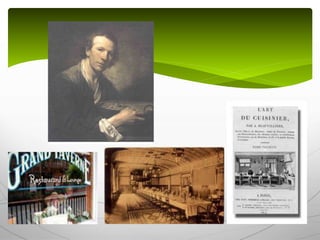
The first restaurant in the form that became standard
(customers sitting down with individual portions at individual tables,
selecting food from menus, during fixed opening hours) was the Grand
Taverne de Londres (the Great Tavern of London), founded in Paris in
1782 by a man named Antoine Beauvilliers, a leading culinary writer and
gastronomic authority who achieved a reputation as a successful
restaurateur and later wrote what became a standard cook book L’ Art
du cuisiner.
HISTORY
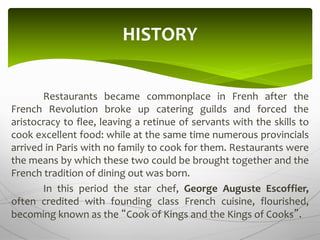
Restaurants became commonplace in Frenh after the
French Revolution broke up catering guilds and forced the
aristocracy to flee, leaving a retinue of servants with the skills to
cook excellent food: while at the same time numerous provincials
arrived in Paris with no family to cook for them. Restaurants were
the means by which these two could be brought together and the
French tradition of dining out was born.
In this period the star chef, George Auguste Escoffier,
often credited with founding class French cuisine, flourished,
becoming known as the “Cook of Kings and the Kings of Cooks”.
HISTORY
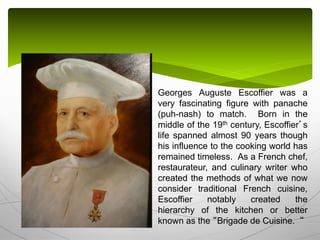
Georges Auguste Escoffier was a
very fascinating figure with panache
(puh-nash) to match. Born in the
middle of the 19th century, Escoffier’s
life spanned almost 90 years though
his influence to the cooking world has
remained timeless. As a French chef,
restaurateur, and culinary writer who
created the methods of what we now
consider traditional French cuisine,
Escoffier notably created the
hierarchy of the kitchen or better
known as the “Brigade de Cuisine. “
George Auguste Escofier, was a french chef, restauratuer
and culinary writer who popularized and updated traditional
French cooking methods.
He is a near-legendary figure among chefs and gourmets,
and was one of the most important leaders in the development
of modern French cuisine. Much of Escoffier’s technique was
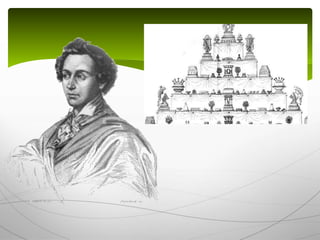
based on that of Antoine Careme, the founder of French Grande
Cuisine, but Escoffier’s contributions to cooking was to elevate it
to the status of a respected profession, and to introduce
discipline and sobriety where the brigade system, with each
section run by a chef de partie.
PERSONALITY
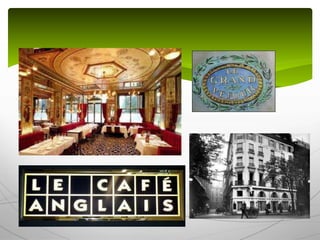
1. La Grand Vefour (1869) still in the business in the 20th Century
2. Café Anglais
Restaurant then spread rapidly across the world, with the first in
the United States (Jullien’s Restarator) opening in Boston in 1794.
The modern formal style of dining, where customers are given a
plate with the food already arranged on it, is known as Service a la
russe, as it is said it have been introduced by French by the
Russian Prince Kurakin in the 1810s, from where it spread rapidly
to England and beyond.
FINE DINING RESTAURANT
Cafeteria
In 1891, the YMCA of Kansas City, established what food
industry historians consider the first cafeteria.
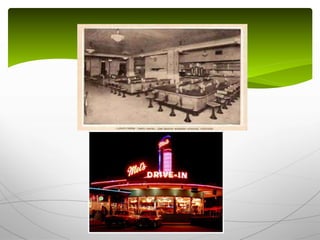
Drive-in Restaurant (Car Park Restaurant)
The “drive-in restaurant” concept, where patrons are
served food in their vehicles dates back to pre-World War II. The
concept reached its height of popularity in the early 1950’s. The
first drive-in restaurant opened in Glendale, California in 1936.
CAFETERIA / DRIVE-IN RESTAURANT
Raymond Albert Kroc was the pioneer of the fast food
industry with his worldwide McDonald’s enterprise (1954). An
American entrepreneur, famous for significantly expanding the
McDonald’s Corporation from 1955. He did not actually found
the restaurant chain itself, however it was started by Richard
and Maurince (Mac) McDonald in 1940. Dubbed the as
Hamburger King, Kroc was included in the TIME MAGAZINE 100
list of the world’s most influential builders and titans of industry
and amassed a $500 million fortune during his lifetime. Kroc was
of Czech ancestry and was survived by his 3rd wife, Joan B. Kroc.
FAST FOOD
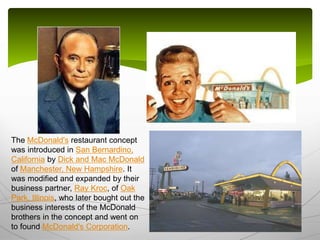
The McDonald's restaurant concept
was introduced in San Bernardino,
California by Dick and Mac McDonald
of Manchester, New Hampshire. It
was modified and expanded by their
business partner, Ray Kroc, of Oak
Park, Illinois, who later bought out the
business interests of the McDonald
brothers in the concept and went on
to found McDonald's Corporation.
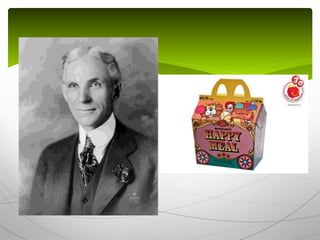
The founder and builder of McDonald’s Corporation,
proved himself an industrial pioneer no less capable than Henry
Ford. He revolutionized the American restaurant by imposing
discipline on production of hamburgers, French fries, and milk
shakes.
In 1977, the first McDonald’s Happy Meal was regionally
tested in St. Louis. The first nationwide Happy Meal was served
in 1979, part of a promotion called “Circus Wagon”. It cost one
dollar and contained either a McDoodler stencil, a puzzle book, a
McWrist wallet, an ID bracelet or McDonald land or
cheeseburger, 12 oz of soft drink, a small order of French fries
and
FAST FOOD
Cookie Sampler”; i.e., a small portion of cookies.
A Happy Meal is a meal specially tailored for children, sold
at the fastfood chain McDonald’s since June 1979. A toy is
typically included with the food, both of which are usually in a
small box or paper bag with the McDonald’s logo.
FAST FOOD
 Karihan- food stall at the back of public
market which serves Kari-kari(an
elaborate stew)
 Carenderia
 Panciteria- establishments that serves
Pancit
Foodservice Industry in the
Philippines
 Max’s Restaurant
 Cabalen
 Kamayan
 Aristocrat
 Bario Fiesta
Pioneer restaurants in the
Philippines
THE FOODSERVICE INDUSTRY
 Foodservice is defined as providing fully
prepared food for immediate
consumption on or off premises.
 Foodservice establishment refers to an
operation that stores, prepares, serves,
and vends food for human
consumption.
Foodservice defined
1.Commercial Foodservice- refers to those
operating with the aim of earning profit.
2. Institutional Foodservice- operates
foodservice establishments within their
institutional boundaries,
3. Noncommercial Foodservice- operates
primarily for the convenience or welfare of
those served rather than primarily for profit.
CLASSIFICATION OF FOOD
SERVICE OPERATION
TYPES OF FOODSERVICE
ESTABLISHMENTS
Fast food restaurants or quick service
restaurants is consist of diverse operation
facilities whose slogan is “quick food”. These
establishments are those that serve food for
which there is little or no waiting.
FAST FOOD RESTAURANT
A table service establishment is
one in which customers are
seated and served at tables.
TABLE SERVICE RESTUARANT
An ethnic foodservice operation
is one that specializes in food
associated with a particular
culture.
Ethnic Restaurant
Specialty restaurants feature a
particular kind of food that are
usually themed related.
Specialty Restaurants
 A is one with a good selection of menu items
offered. This establishment emphasizes high
quality of food, expertly prepared and
professionally served. Such Restaurants are
typically among the most formal and most
expensive.
Fine Dining Restaurant
 Many theme restaurants are a combination of
sophisticated specialty and several other
types of restaurants. They generally serve a
limited menu but aim to wow the guest by a
total experience.
Theme Restaurant
 A cafeteria is a foodservice establishment that
permits the customer to see the food
available and to make selections from among
those displayed. Cafeterias impose a greater
degree of self-service on their customers than
most other establishments.
Cafeteria
 Catering is preparing and serving food to
group of people gathered for a specific
purpose, such as meeting or a wedding.
Catering
 A takeout is an operation that prepares food
for consumption off premises.
Takeout
TYPES OF FOODSERVICE
ARRANGEMENTS
 Servers normally take customer’s orders
selected from menus or their equivalent, then
deliver the food to the customers seated at
their tables.
Table Service
1. American service- food is dished into
individual plates and served to guests.
2. Russian Service- dishes are served from a
platter into a diner’s plate by a waiter.
3. French service- an elaborate style of service
where dishes are cooked tableside.
Forms of table service:
 Customers are served across a level surface
called a counter.
Counter Service
 Customers are situated away from a normal dining
area, typically in a hotel room.
Room Service
 Customers select food from an array of
displayed items; then carry the items, with or
without a tray, to some location in the
establishment to consume them.
Self Service
Takeout or Delivery Service

Foodserviceupload

  • 1.
    HISTORY OF THEFOOD SERVICE INDUSTRY
  • 2.
    After the lesson,the student should be able to: 1. Discuss the history of the restaurant Industry; 2. Describe the development of the restaurant industry; 3. Identify the places that have important contributions to the rise of the restaurant industry; and 4. Cite the names of famous people who influence the restaurant industry. Objectives:
  • 3.
     Main purposeof eating was to nourish the body & soul.  Rarely dined out.  Enjoyed the social aspect of dining.  Often got together for banquets.  Lesche: Private clubs that offered food to members  Phatnai: Establishments that catered to travelers & traders &visiting diplomats. Ancient Greece
  • 4.
    Food catering establishmentwhich may be described as restaurant were known since the 12th century in Hangzhou, a cultural, political and economic center during China’s Song Dynasty. Ma Yu Ching’s Bucket Chicken House, was established in Kaifeng, China, in 1153 AD, and still serving up meals today. Hangzhou’s restaurants blossomed into an industry catering to locals as well. Restaurants catered to different styles of cuisine, price buckets, and religious requirements. Middle Ages
  • 5.
    It is bysome accounts the world ’ s oldest restaurant. It had been operational since 1153 and has survived numerous wars, invasions, and dynasty changes but still offers takeout food. As the name implies, this restaurant specialized in bucket chicken.
  • 6.
    In the West,even when inns and taverns were known for antiquity, these were establishments aimed at travelers, and in general locals would rarely eat there. Restaurants, as businesses dedicated to the serving of food, and where specific dishes are ordered by the guest and generally prepared according to this order emerged only in the 18th century. The Sobrino de Botin in Madrid, Spain is the oldest restaurant in existence today. It was opened in 1725. RENAISSANCE- French Revolution
  • 7.
    Since there areno sufficient documents to prove that the Ma Yu Ching’s Bucket Chicken House is the oldest restaurant in the world, the official title was given by Guinness Book Records to Sobrino de Botín. This restaurant is located in Calle de los Cuchilleros 17, 28005 in Madrid, Spain. It was established in 1725 and recognized as the world’s oldest eatery. Part of the restaurant’s folklore has it that a young Francisco Goya worked there as a waiter whilst he was waiting to get a place at Madrid’s. Specialty of the Sobrino is cochinillo asado or roast suckling pig. Other signature dishes include sopa de ajo, an egg, poached in chicken broth, and laced with sherry and garlic, and the favorite pick-me-up with Madrileño revelers.
  • 8.
    The term restaurant(from the French restaurer) first appeared in the 16th century, meaning “a food which restores” and referred specifically to a rich highly flavored soup. It was first applied to an eating establishment at around 1765 founded by a Parisian soup-seller named Boulanger. The first restaurant in the form that became standard (customers sitting down with individual portions at individual tables, selecting food from menus, during fixed opening hours) was the Grand Taverne de Londres (the Great Tavern of London), founded in Paris in 1782 by a man named Antoine Beauvilliers, a leading culinary writer and gastronomic authority who achieved a reputation as a successful restaurateur and later wrote what became a standard cook book L’ Art du cuisiner. HISTORY
  • 10.
    Restaurants became commonplacein Frenh after the French Revolution broke up catering guilds and forced the aristocracy to flee, leaving a retinue of servants with the skills to cook excellent food: while at the same time numerous provincials arrived in Paris with no family to cook for them. Restaurants were the means by which these two could be brought together and the French tradition of dining out was born. In this period the star chef, George Auguste Escoffier, often credited with founding class French cuisine, flourished, becoming known as the “Cook of Kings and the Kings of Cooks”. HISTORY
  • 11.
    Georges Auguste Escoffierwas a very fascinating figure with panache (puh-nash) to match. Born in the middle of the 19th century, Escoffier’s life spanned almost 90 years though his influence to the cooking world has remained timeless. As a French chef, restaurateur, and culinary writer who created the methods of what we now consider traditional French cuisine, Escoffier notably created the hierarchy of the kitchen or better known as the “Brigade de Cuisine. “
  • 12.
    George Auguste Escofier,was a french chef, restauratuer and culinary writer who popularized and updated traditional French cooking methods. He is a near-legendary figure among chefs and gourmets, and was one of the most important leaders in the development of modern French cuisine. Much of Escoffier’s technique was based on that of Antoine Careme, the founder of French Grande Cuisine, but Escoffier’s contributions to cooking was to elevate it to the status of a respected profession, and to introduce discipline and sobriety where the brigade system, with each section run by a chef de partie. PERSONALITY
  • 14.
    1. La GrandVefour (1869) still in the business in the 20th Century 2. Café Anglais Restaurant then spread rapidly across the world, with the first in the United States (Jullien’s Restarator) opening in Boston in 1794. The modern formal style of dining, where customers are given a plate with the food already arranged on it, is known as Service a la russe, as it is said it have been introduced by French by the Russian Prince Kurakin in the 1810s, from where it spread rapidly to England and beyond. FINE DINING RESTAURANT
  • 16.
    Cafeteria In 1891, theYMCA of Kansas City, established what food industry historians consider the first cafeteria. Drive-in Restaurant (Car Park Restaurant) The “drive-in restaurant” concept, where patrons are served food in their vehicles dates back to pre-World War II. The concept reached its height of popularity in the early 1950’s. The first drive-in restaurant opened in Glendale, California in 1936. CAFETERIA / DRIVE-IN RESTAURANT
  • 18.
    Raymond Albert Krocwas the pioneer of the fast food industry with his worldwide McDonald’s enterprise (1954). An American entrepreneur, famous for significantly expanding the McDonald’s Corporation from 1955. He did not actually found the restaurant chain itself, however it was started by Richard and Maurince (Mac) McDonald in 1940. Dubbed the as Hamburger King, Kroc was included in the TIME MAGAZINE 100 list of the world’s most influential builders and titans of industry and amassed a $500 million fortune during his lifetime. Kroc was of Czech ancestry and was survived by his 3rd wife, Joan B. Kroc. FAST FOOD
  • 19.
    The McDonald's restaurantconcept was introduced in San Bernardino, California by Dick and Mac McDonald of Manchester, New Hampshire. It was modified and expanded by their business partner, Ray Kroc, of Oak Park, Illinois, who later bought out the business interests of the McDonald brothers in the concept and went on to found McDonald's Corporation.
  • 20.
    The founder andbuilder of McDonald’s Corporation, proved himself an industrial pioneer no less capable than Henry Ford. He revolutionized the American restaurant by imposing discipline on production of hamburgers, French fries, and milk shakes. In 1977, the first McDonald’s Happy Meal was regionally tested in St. Louis. The first nationwide Happy Meal was served in 1979, part of a promotion called “Circus Wagon”. It cost one dollar and contained either a McDoodler stencil, a puzzle book, a McWrist wallet, an ID bracelet or McDonald land or cheeseburger, 12 oz of soft drink, a small order of French fries and FAST FOOD
  • 22.
    Cookie Sampler”; i.e.,a small portion of cookies. A Happy Meal is a meal specially tailored for children, sold at the fastfood chain McDonald’s since June 1979. A toy is typically included with the food, both of which are usually in a small box or paper bag with the McDonald’s logo. FAST FOOD
  • 23.
     Karihan- foodstall at the back of public market which serves Kari-kari(an elaborate stew)  Carenderia  Panciteria- establishments that serves Pancit Foodservice Industry in the Philippines
  • 24.
     Max’s Restaurant Cabalen  Kamayan  Aristocrat  Bario Fiesta Pioneer restaurants in the Philippines
  • 25.
  • 26.
     Foodservice isdefined as providing fully prepared food for immediate consumption on or off premises.  Foodservice establishment refers to an operation that stores, prepares, serves, and vends food for human consumption. Foodservice defined
  • 27.
    1.Commercial Foodservice- refersto those operating with the aim of earning profit. 2. Institutional Foodservice- operates foodservice establishments within their institutional boundaries, 3. Noncommercial Foodservice- operates primarily for the convenience or welfare of those served rather than primarily for profit. CLASSIFICATION OF FOOD SERVICE OPERATION
  • 28.
  • 29.
    Fast food restaurantsor quick service restaurants is consist of diverse operation facilities whose slogan is “quick food”. These establishments are those that serve food for which there is little or no waiting. FAST FOOD RESTAURANT
  • 30.
    A table serviceestablishment is one in which customers are seated and served at tables. TABLE SERVICE RESTUARANT
  • 31.
    An ethnic foodserviceoperation is one that specializes in food associated with a particular culture. Ethnic Restaurant
  • 32.
    Specialty restaurants featurea particular kind of food that are usually themed related. Specialty Restaurants
  • 33.
     A isone with a good selection of menu items offered. This establishment emphasizes high quality of food, expertly prepared and professionally served. Such Restaurants are typically among the most formal and most expensive. Fine Dining Restaurant
  • 34.
     Many themerestaurants are a combination of sophisticated specialty and several other types of restaurants. They generally serve a limited menu but aim to wow the guest by a total experience. Theme Restaurant
  • 35.
     A cafeteriais a foodservice establishment that permits the customer to see the food available and to make selections from among those displayed. Cafeterias impose a greater degree of self-service on their customers than most other establishments. Cafeteria
  • 36.
     Catering ispreparing and serving food to group of people gathered for a specific purpose, such as meeting or a wedding. Catering
  • 37.
     A takeoutis an operation that prepares food for consumption off premises. Takeout
  • 38.
  • 39.
     Servers normallytake customer’s orders selected from menus or their equivalent, then deliver the food to the customers seated at their tables. Table Service
  • 40.
    1. American service-food is dished into individual plates and served to guests. 2. Russian Service- dishes are served from a platter into a diner’s plate by a waiter. 3. French service- an elaborate style of service where dishes are cooked tableside. Forms of table service:
  • 41.
     Customers areserved across a level surface called a counter. Counter Service
  • 42.
     Customers aresituated away from a normal dining area, typically in a hotel room. Room Service
  • 43.
     Customers selectfood from an array of displayed items; then carry the items, with or without a tray, to some location in the establishment to consume them. Self Service
  • 44.