Overview of Food
Service IndustryPritur2 Team 2014
HRM Department, CIHTM
De La Salle Lipa
Food Service
• It is the art and science of planning,
preparing, cooking and serving of quality
meals in quantities far greater than those
of the usual family meals.
• GOAL: service of quality meals to a
satisfied clientele at a reasonable cost.
Food Service cont’d
• OBJECTIVES:
– Profit – commercial restaurants, hotel dinning rooms,
fast food centers, coffee shops, carinderias and other
food service establishments
– Non-Profit – industrial, educational and health care
institutions
• TWO CLASSES OF FOOD SERVICE (Acc. To service offered)
– Service – offers waiter service to customers
– Self- service – emphasizes service by the customer
themselves
• Conventional – food is prepared and served
under one roof. This system is typical in small
foodservice operations.
• Commissary – also known as “Central
Production Kitchen” where there is a large
central production area with centralized
purchasing and delivering of foods to satellite
units located in separate, remote areas for final
preparation.
• Ready prepared – The system is either cook/chill
or cook/freeze. Foods are prepared on the
premises, then chilled or frozen and stored for
future use or at a later time.
• Assembly/Serve – no off-premises food
production. Fully prepared foods are purchased
and require only storage, final assembling, heating
and serving. often the system uses “single use”
disposable tableware, thus eliminating
dishwashing unit.
• The history of foodservice is closely
associated with travel. Throughout history,
merchants have traveled extensively to trade
with another nations or tribes.
• There were also the religious pilgrimages to
places of worship. Invariably, in the different
places of destination, food and lodging
have been provided to the travelers.
• The term restaurant began in 1765 in Paris,
France.
• The soup vendor merchandised the soup as
“le restaurant divin” – the divine restorative,
coming from the Latin word resturare,
meaning ‘to restore.’
• This gave us the word restaurant – a place to
restore one’s health.
• Canterbury Inn – provided food for monks
and pilgrims who came to the abbey to
worship.
• Royal Households of England – numerous
guest (150-200) were received daily;
foodservice became necessity.
• Northumberland Household Book – first
known record book of scientific food cost
accounting which compiled the records of
expenses of the Royal Households
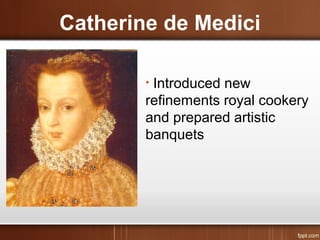
Catherine de Medici
• Introduced new
refinements royal cookery
and prepared artistic
banquets
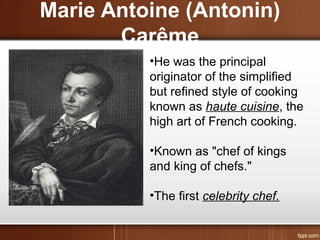
Marie Antoine (Antonin)
Carême
•He was the principal
originator of the simplified
but refined style of cooking
known as haute cuisine, the
high art of French cooking.
•Known as "chef of kings
and king of chefs."
•The first celebrity chef.
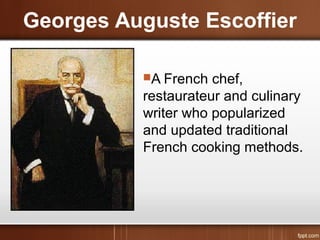
Georges Auguste Escoffier
A French chef,
restaurateur and culinary
writer who popularized
and updated traditional
French cooking methods.
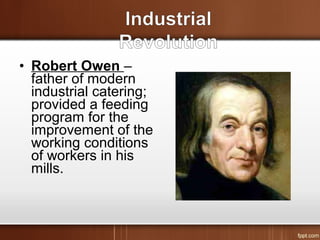
• Robert Owen –
father of modern
industrial catering;
provided a feeding
program for the
improvement of the
working conditions
of workers in his
mills.
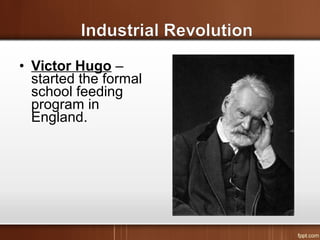
• Victor Hugo –
started the formal
school feeding
program in
England.
• Florence Nightingale – first hospital
dietician; pioneered in hospital foodservice
during Crimean war.
• Alexis Soyer – a noted chef who helped
Nightingale in the establishment of a
hospital diet kitchen.
16th
Century: Opportunities to Travel Increased,
so did the Commercial Food Service
• USA Coffee Houses were established
• 1765 –First restaurant in Paris France was
opened by a Frenchman named Boulanger.
• 20th century – commercial foodservice has
become highly favored over other types of
foodservice.
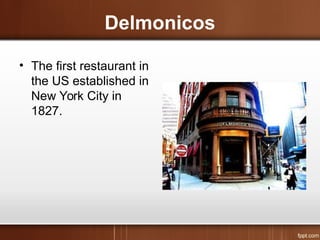
Delmonicos
• The first restaurant in
the US established in
New York City in
1827.
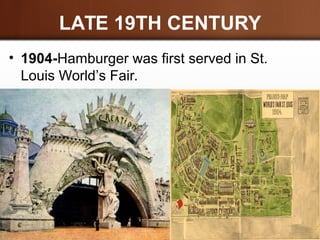
LATE 19TH CENTURY
• 1904-Hamburger was first served in St.
Louis World’s Fair.
LATE 19TH CENTURY
• 1925 - Clarence Birdseye developed
method of freezing.
• 1970’s - Mcdonald’s, Wendy’s, Burger King,
Kentucky Fried Chicken.
History of
Restaurants in the
Philippines
• In the Philippines, foodservice estimated as
early as the time of the barangay system.
The datu had to feed his people including
the slaves or alipin. Hence, it required the
service of food in great quantities.
• Chinese were the forerunners of the developmental
rudiments of the commercial type of foodservice.
• 982 AD – earliest recorded date of Chinese-
Philippine trade.
• Through Chinese peddlers, the Filipinos came to
know of varieties in dinning pleasures.
• Natives set up eating places usually at the back of
public market where portions of kari-kari (an
elaborate stew) could be readily bought.
• Karihan came to be known and the Spaniards
later called it as carinderia.
• 1906 – Americans introduced the concept
of cafeteria which started with the public
school feeding program which attempts to
the remedy of the poor nutrition of children.
• University Foodservice at the University of
the Philippines (UP) is an example of
school that adapted the American concept
of cafeteria.
• Dr. Presentacion T. Perez
– chairman of the Dept. of Home Economics,
College of Educ. At UP in 1937.
– allotted a small space in a classroom to be
used as laboratory for food courses, which
was the beginning of the University
Foodservice at UP.
• The birth of other types of foodservice such
as the commercial fast food centers, in-
plant feedings, dinning rooms in health
care institution which picked up the
concept of self service.
• Irma P. Florentine – laid the foundations
for modern dietetics in the Philippines in
hospital foodservice.
Restaurants that have endured
the test of time in past decades
Aristocrat
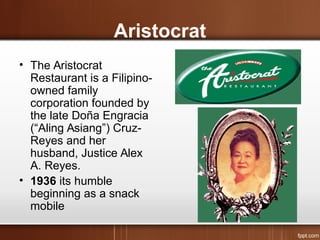
• The Aristocrat
Restaurant is a Filipino-
owned family
corporation founded by
the late Doña Engracia
(“Aling Asiang”) Cruz-
Reyes and her
husband, Justice Alex
A. Reyes.
• 1936 its humble
beginning as a snack
mobile
Max’s Restaurant
• It is well known for its tender, juicy and
crispy fried chicken since liberation time.
• 1945
– Max’s was started by Maximo Gimenez.
• 1998
– It started its franchising.
Barrio Fiesta Restaurant
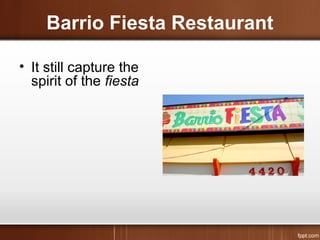
• It still capture the
spirit of the fiesta
• Kamayan –Filipino restaurant that made eating
with the hands fashionable way back in 1977.
• Cabalen – meaning town mate features
Pampanga’s dishes since the early 1980’s.
 Cocktail lounges/ bars are Bistro Remedios,
Larry’s Bar, Gene Bistro and Bistro Lorenzo
 Refreshments parlors to name a few, include the
Dairy Queen, Magnolia kiosk and little Quiapo.
 Carinderia type of foodservice include Ambrosia,
Andok’s and Baliwag’s.
• In recent years, local and international fast food
chains have been added to the census of foodservice
capturing a significant portion of the Filipino clientele.
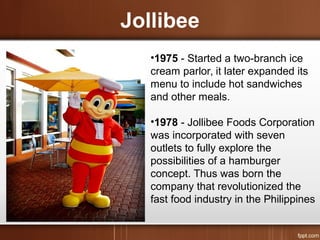
Jollibee
•1975 - Started a two-branch ice
cream parlor, it later expanded its
menu to include hot sandwiches
and other meals.
•1978 - Jollibee Foods Corporation
was incorporated with seven
outlets to fully explore the
possibilities of a hamburger
concept. Thus was born the
company that revolutionized the
fast food industry in the Philippines
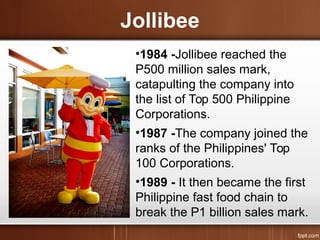
Jollibee
•1984 -Jollibee reached the
P500 million sales mark,
catapulting the company into
the list of Top 500 Philippine
Corporations.
•1987 -The company joined the
ranks of the Philippines' Top
100 Corporations.
•1989 - It then became the first
Philippine fast food chain to
break the P1 billion sales mark.
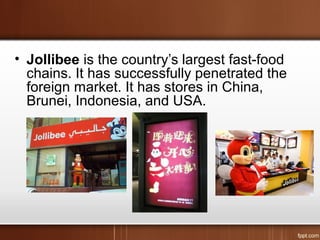
• Jollibee is the country’s largest fast-food
chains. It has successfully penetrated the
foreign market. It has stores in China,
Brunei, Indonesia, and USA.
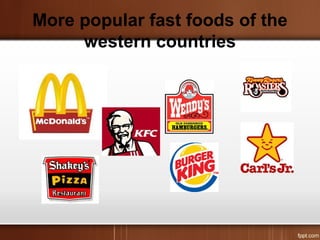
More popular fast foods of the
western countries
Reason for the increased in
demand of food service
1. Increased discretionary income
2. Smaller families
3. Changing lifestyles
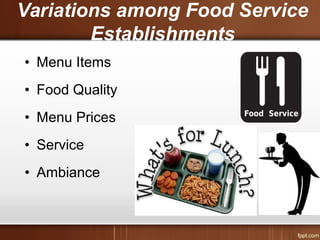
Variations among Food Service
Establishments
• Menu Items
• Food Quality
• Menu Prices
• Service
• Ambiance
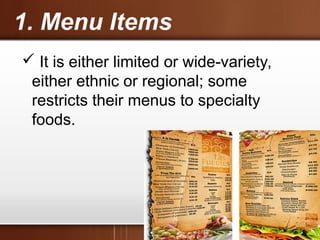
1. Menu Items
 It is either limited or wide-variety,
either ethnic or regional; some
restricts their menus to specialty
foods.
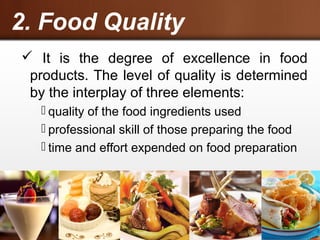
2. Food Quality
 It is the degree of excellence in food
products. The level of quality is determined
by the interplay of three elements:
 quality of the food ingredients used
 professional skill of those preparing the food
 time and effort expended on food preparation
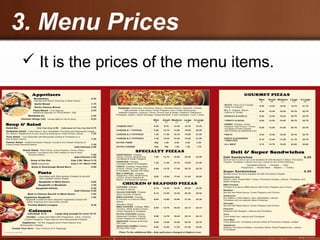
3. Menu Prices
 It is the prices of the menu items.
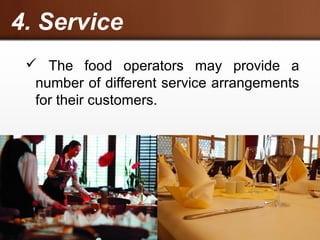
4. Service
 The food operators may provide a
number of different service arrangements
for their customers.
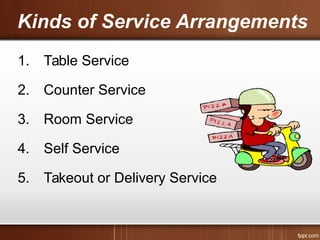
Kinds of Service Arrangements
1. Table Service
2. Counter Service
3. Room Service
4. Self Service
5. Takeout or Delivery Service
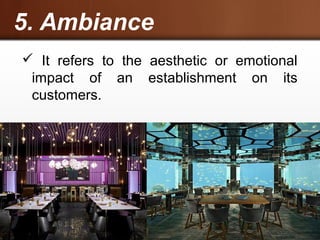
5. Ambiance
 It refers to the aesthetic or emotional
impact of an establishment on its
customers.

overview food_beverage_industry

  • 1.
    Overview of Food ServiceIndustryPritur2 Team 2014 HRM Department, CIHTM De La Salle Lipa
  • 2.
    Food Service • Itis the art and science of planning, preparing, cooking and serving of quality meals in quantities far greater than those of the usual family meals. • GOAL: service of quality meals to a satisfied clientele at a reasonable cost.
  • 3.
    Food Service cont’d •OBJECTIVES: – Profit – commercial restaurants, hotel dinning rooms, fast food centers, coffee shops, carinderias and other food service establishments – Non-Profit – industrial, educational and health care institutions • TWO CLASSES OF FOOD SERVICE (Acc. To service offered) – Service – offers waiter service to customers – Self- service – emphasizes service by the customer themselves
  • 4.
    • Conventional –food is prepared and served under one roof. This system is typical in small foodservice operations. • Commissary – also known as “Central Production Kitchen” where there is a large central production area with centralized purchasing and delivering of foods to satellite units located in separate, remote areas for final preparation.
  • 5.
    • Ready prepared– The system is either cook/chill or cook/freeze. Foods are prepared on the premises, then chilled or frozen and stored for future use or at a later time. • Assembly/Serve – no off-premises food production. Fully prepared foods are purchased and require only storage, final assembling, heating and serving. often the system uses “single use” disposable tableware, thus eliminating dishwashing unit.
  • 6.
    • The historyof foodservice is closely associated with travel. Throughout history, merchants have traveled extensively to trade with another nations or tribes. • There were also the religious pilgrimages to places of worship. Invariably, in the different places of destination, food and lodging have been provided to the travelers.
  • 7.
    • The termrestaurant began in 1765 in Paris, France. • The soup vendor merchandised the soup as “le restaurant divin” – the divine restorative, coming from the Latin word resturare, meaning ‘to restore.’ • This gave us the word restaurant – a place to restore one’s health.
  • 8.
    • Canterbury Inn– provided food for monks and pilgrims who came to the abbey to worship. • Royal Households of England – numerous guest (150-200) were received daily; foodservice became necessity. • Northumberland Household Book – first known record book of scientific food cost accounting which compiled the records of expenses of the Royal Households
  • 9.
    Catherine de Medici •Introduced new refinements royal cookery and prepared artistic banquets
  • 10.
    Marie Antoine (Antonin) Carême •Hewas the principal originator of the simplified but refined style of cooking known as haute cuisine, the high art of French cooking. •Known as "chef of kings and king of chefs." •The first celebrity chef.
  • 11.
    Georges Auguste Escoffier AFrench chef, restaurateur and culinary writer who popularized and updated traditional French cooking methods.
  • 12.
    • Robert Owen– father of modern industrial catering; provided a feeding program for the improvement of the working conditions of workers in his mills.
  • 13.
    • Victor Hugo– started the formal school feeding program in England.
  • 14.
    • Florence Nightingale– first hospital dietician; pioneered in hospital foodservice during Crimean war. • Alexis Soyer – a noted chef who helped Nightingale in the establishment of a hospital diet kitchen.
  • 15.
    16th Century: Opportunities toTravel Increased, so did the Commercial Food Service • USA Coffee Houses were established • 1765 –First restaurant in Paris France was opened by a Frenchman named Boulanger. • 20th century – commercial foodservice has become highly favored over other types of foodservice.
  • 16.
    Delmonicos • The firstrestaurant in the US established in New York City in 1827.
  • 17.
    LATE 19TH CENTURY •1904-Hamburger was first served in St. Louis World’s Fair.
  • 18.
    LATE 19TH CENTURY •1925 - Clarence Birdseye developed method of freezing. • 1970’s - Mcdonald’s, Wendy’s, Burger King, Kentucky Fried Chicken.
  • 19.
  • 20.
    • In thePhilippines, foodservice estimated as early as the time of the barangay system. The datu had to feed his people including the slaves or alipin. Hence, it required the service of food in great quantities.
  • 21.
    • Chinese werethe forerunners of the developmental rudiments of the commercial type of foodservice. • 982 AD – earliest recorded date of Chinese- Philippine trade. • Through Chinese peddlers, the Filipinos came to know of varieties in dinning pleasures.
  • 22.
    • Natives setup eating places usually at the back of public market where portions of kari-kari (an elaborate stew) could be readily bought. • Karihan came to be known and the Spaniards later called it as carinderia.
  • 23.
    • 1906 –Americans introduced the concept of cafeteria which started with the public school feeding program which attempts to the remedy of the poor nutrition of children. • University Foodservice at the University of the Philippines (UP) is an example of school that adapted the American concept of cafeteria.
  • 24.
    • Dr. PresentacionT. Perez – chairman of the Dept. of Home Economics, College of Educ. At UP in 1937. – allotted a small space in a classroom to be used as laboratory for food courses, which was the beginning of the University Foodservice at UP.
  • 25.
    • The birthof other types of foodservice such as the commercial fast food centers, in- plant feedings, dinning rooms in health care institution which picked up the concept of self service. • Irma P. Florentine – laid the foundations for modern dietetics in the Philippines in hospital foodservice.
  • 26.
    Restaurants that haveendured the test of time in past decades
  • 27.
    Aristocrat • The Aristocrat Restaurantis a Filipino- owned family corporation founded by the late Doña Engracia (“Aling Asiang”) Cruz- Reyes and her husband, Justice Alex A. Reyes. • 1936 its humble beginning as a snack mobile
  • 28.
    Max’s Restaurant • Itis well known for its tender, juicy and crispy fried chicken since liberation time. • 1945 – Max’s was started by Maximo Gimenez. • 1998 – It started its franchising.
  • 29.
    Barrio Fiesta Restaurant •It still capture the spirit of the fiesta
  • 30.
    • Kamayan –Filipinorestaurant that made eating with the hands fashionable way back in 1977. • Cabalen – meaning town mate features Pampanga’s dishes since the early 1980’s.  Cocktail lounges/ bars are Bistro Remedios, Larry’s Bar, Gene Bistro and Bistro Lorenzo
  • 31.
     Refreshments parlorsto name a few, include the Dairy Queen, Magnolia kiosk and little Quiapo.  Carinderia type of foodservice include Ambrosia, Andok’s and Baliwag’s. • In recent years, local and international fast food chains have been added to the census of foodservice capturing a significant portion of the Filipino clientele.
  • 32.
    Jollibee •1975 - Starteda two-branch ice cream parlor, it later expanded its menu to include hot sandwiches and other meals. •1978 - Jollibee Foods Corporation was incorporated with seven outlets to fully explore the possibilities of a hamburger concept. Thus was born the company that revolutionized the fast food industry in the Philippines
  • 33.
    Jollibee •1984 -Jollibee reachedthe P500 million sales mark, catapulting the company into the list of Top 500 Philippine Corporations. •1987 -The company joined the ranks of the Philippines' Top 100 Corporations. •1989 - It then became the first Philippine fast food chain to break the P1 billion sales mark.
  • 34.
    • Jollibee isthe country’s largest fast-food chains. It has successfully penetrated the foreign market. It has stores in China, Brunei, Indonesia, and USA.
  • 35.
    More popular fastfoods of the western countries
  • 36.
    Reason for theincreased in demand of food service 1. Increased discretionary income 2. Smaller families 3. Changing lifestyles
  • 37.
    Variations among FoodService Establishments • Menu Items • Food Quality • Menu Prices • Service • Ambiance
  • 38.
    1. Menu Items It is either limited or wide-variety, either ethnic or regional; some restricts their menus to specialty foods.
  • 39.
    2. Food Quality It is the degree of excellence in food products. The level of quality is determined by the interplay of three elements:  quality of the food ingredients used  professional skill of those preparing the food  time and effort expended on food preparation
  • 40.
    3. Menu Prices It is the prices of the menu items.
  • 41.
    4. Service  Thefood operators may provide a number of different service arrangements for their customers.
  • 42.
    Kinds of ServiceArrangements 1. Table Service 2. Counter Service 3. Room Service 4. Self Service 5. Takeout or Delivery Service
  • 43.
    5. Ambiance  Itrefers to the aesthetic or emotional impact of an establishment on its customers.