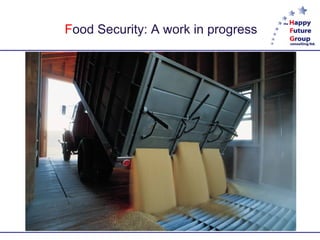

F ood Security: A work in progress
F rom the beginning already… Food security was the reason behind: Agriculture Domestication of “farm” animals Purpose: More control of resources Less vulnerability to natural fluctuations Is still the same today
M any challenges ahead From 6 billion people to feed in 2000 to 9 billion in 2050. According to the FAO: 1 billion people hungry in 2009 (that’s 15% of population). Objective stated by the FAO: eliminate hunger in 2025.
B eing interdependent to be independent Agriculture has evolved from local to global. Globalization of markets: what happens somewhere else affects you, too -> Isolation will not work. Trade is the way to prosperity -> you need something to trade! Knowledge/education is the tool. Political will is the catalyst.
F ood security strategies Depending on the specific local situation and on the objectives, various strategies (and combinations of) are possible: Self-sufficiency Imports Trade agreements “ Outsourcing” Participation in or purchase of food companies Subsidies Levies
A  few examples After WWII: European Economic Community developed its agricultural plan: Very (too?) successful Currently in the works: “ Black Sea Wheat Pool”: Russia-Ukraine-Kazakhstan “ Rice Cartel” in ASEAN region
C harting the needs Listing the products needs, objective is balanced diet Carbohydrates (grains) Protein (legumes, animal products) Fats (vegetal, animal) Analyzing the causes of the shortage Mapping the development areas
F uture demographics Of the country in question Of other countries in the region Of potential partner countries How will it look like in 5, 10, 20, 50 years from now?
W hat is at stake? Beyond just feeding people, it brings: No social unrest Basis for economic expansion Political stability Ever heard of a prosperous nation that is continuously hungry?
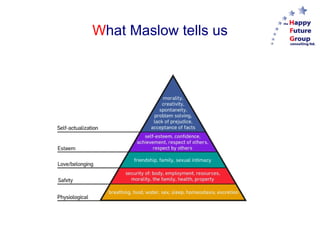
W hat Maslow tells us
S trategic Productions Ranking them in 3 categories: Absolute necessity Highly important “ Accessory”/Substitute Destination: Feeding people Feeding animals Industrial use (biofuels, packaging, plastics, etc) Now set the priorities!
R eview of Production Possibilities Ground/Water/Climate Type/quality Location Surface Possibilities Potential Limitations Action needed Regional Development
R esources needed Land/water Financial Labor Equipment Support activities Research Education Technical support
M arket Infrastructure Current conditions Ideal future set up Action & Development Plan
F ood security & Sustainability Can we produce to get 9 billion people on a balanced diet? Can we produce to get 9 billion people on a Western diet? What the answers to these questions will mean for production and distribution system? The right diet. Location of production and markets. Intensification vs. efficiency. Discussion
F ood security & Ownership of food Who will own and control food supplies in the future? Countries? Corporations? Farmers? Investors? Retailers? Land owners? Seeds/genetic material suppliers? Discussion
A  need for clear leadership Setting the vision Developing the plan Executing the actions Gathering the energies: involvement and commitment of all. Hands-on management. Lots of communication.
I nitiating the plan SWOT Analysis. List all Strengths, Weaknesses, Opportunities and Threats. Capitalizing on strengths. Reducing (eliminating?) the weaknesses. Transform the opportunities into success stories. Protect and eliminate threats.
C ommunicating about food security The Why The What The How The How Much The When To whom
L ast but not least In order to develop food production, the people involved must be able to make a decent living from it. Money is a powerful motivator.
F or more on this topic and how we can help Website: www.hfgfoodfuturist.com Email: info@happyfuturegroup.com
 

Food Security: A Work in Progress

  • 1.
    F ood Security:A work in progress
  • 2.
    F rom thebeginning already… Food security was the reason behind: Agriculture Domestication of “farm” animals Purpose: More control of resources Less vulnerability to natural fluctuations Is still the same today
  • 3.
    M any challengesahead From 6 billion people to feed in 2000 to 9 billion in 2050. According to the FAO: 1 billion people hungry in 2009 (that’s 15% of population). Objective stated by the FAO: eliminate hunger in 2025.
  • 4.
    B eing interdependentto be independent Agriculture has evolved from local to global. Globalization of markets: what happens somewhere else affects you, too -> Isolation will not work. Trade is the way to prosperity -> you need something to trade! Knowledge/education is the tool. Political will is the catalyst.
  • 5.
    F ood securitystrategies Depending on the specific local situation and on the objectives, various strategies (and combinations of) are possible: Self-sufficiency Imports Trade agreements “ Outsourcing” Participation in or purchase of food companies Subsidies Levies
  • 6.
    A fewexamples After WWII: European Economic Community developed its agricultural plan: Very (too?) successful Currently in the works: “ Black Sea Wheat Pool”: Russia-Ukraine-Kazakhstan “ Rice Cartel” in ASEAN region
  • 7.
    C harting theneeds Listing the products needs, objective is balanced diet Carbohydrates (grains) Protein (legumes, animal products) Fats (vegetal, animal) Analyzing the causes of the shortage Mapping the development areas
  • 8.
    F uture demographicsOf the country in question Of other countries in the region Of potential partner countries How will it look like in 5, 10, 20, 50 years from now?
  • 9.
    W hat isat stake? Beyond just feeding people, it brings: No social unrest Basis for economic expansion Political stability Ever heard of a prosperous nation that is continuously hungry?
  • 10.
    W hat Maslowtells us
  • 11.
    S trategic ProductionsRanking them in 3 categories: Absolute necessity Highly important “ Accessory”/Substitute Destination: Feeding people Feeding animals Industrial use (biofuels, packaging, plastics, etc) Now set the priorities!
  • 12.
    R eview ofProduction Possibilities Ground/Water/Climate Type/quality Location Surface Possibilities Potential Limitations Action needed Regional Development
  • 13.
    R esources neededLand/water Financial Labor Equipment Support activities Research Education Technical support
  • 14.
    M arket InfrastructureCurrent conditions Ideal future set up Action & Development Plan
  • 15.
    F ood security& Sustainability Can we produce to get 9 billion people on a balanced diet? Can we produce to get 9 billion people on a Western diet? What the answers to these questions will mean for production and distribution system? The right diet. Location of production and markets. Intensification vs. efficiency. Discussion
  • 16.
    F ood security& Ownership of food Who will own and control food supplies in the future? Countries? Corporations? Farmers? Investors? Retailers? Land owners? Seeds/genetic material suppliers? Discussion
  • 17.
    A needfor clear leadership Setting the vision Developing the plan Executing the actions Gathering the energies: involvement and commitment of all. Hands-on management. Lots of communication.
  • 18.
    I nitiating theplan SWOT Analysis. List all Strengths, Weaknesses, Opportunities and Threats. Capitalizing on strengths. Reducing (eliminating?) the weaknesses. Transform the opportunities into success stories. Protect and eliminate threats.
  • 19.
    C ommunicating aboutfood security The Why The What The How The How Much The When To whom
  • 20.
    L ast butnot least In order to develop food production, the people involved must be able to make a decent living from it. Money is a powerful motivator.
  • 21.
    F or moreon this topic and how we can help Website: www.hfgfoodfuturist.com Email: info@happyfuturegroup.com
  • 22.