Anti-Slavery International
Founded in 1839, we are committed to
eliminating all forms of slavery by:
• campaigning forits eradication,
• supporting local organisations’ initiatives to
release and rehabilitate people,
• pressing forimplementation of laws against
this abuse.
What is modern slavery?
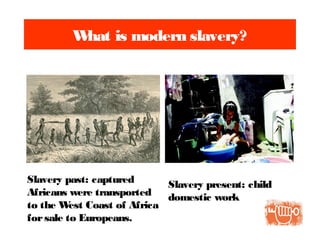
Slavery present: child
domestic work
Slavery past: captured
Africans were transported
to the West Coast of Africa
forsale to Europeans.
Slavery and international law
• The Slavery Convention, 1926
“Slavery is the status orcondition of a person overwhom any orall of
the powers attaching to the right of ownership are exercised.”
• Universal Declaration of Human Rights, 1948
“No one shall be held in slavery orservitude; slavery and the slave
trade shall be prohibited in all theirforms.”
• Supplementary Convention on the Abolition of
Slavery, The Slave Trade, and Institutions and
Practices Similarto Slavery, 1956
“Debt bondage, serfdom, forced marriage and the delivery of a child
forthe exploitation of that child are all slavery like practices and
require criminalisation and abolishment.”
Some characteristics of slavery
• forcedto work-- through mental orphysical
threat;
• ownedorcontrolledby an 'employer', usually
through mental orphysical abuse or
threatened abuse;
• dehumanised, treated as a commodity or
bought and sold as 'property';
• physically constrainedorhas restrictions
placed on his/herfreedomof movement.
Forms of slavery today
• Forced labour
• Human trafficking
• Bonded labour
• Some worst forms of child labour
• Descent-based slavery
Forced Labour
• “Allworkorservicewhichis exactedfromany
personunderthemenaceof anypenaltyfor
whichthesaidpersonhas not offeredhimself
voluntarily” The Forced LabourConvention 1930
(ILO Convention No.29)
• 12.3 million people are victims of
forced labourworldwide.
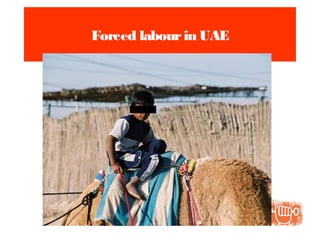
Forced labourin UAE
Legal definition of trafficking
• Trafficking in persons shall mean the recruitment,
transportation, transfer, harbouring or receipt of
person, by means of the threat of the use of force or other
forms of coercion, of abduction, of fraud, of deception,
of the abuse of power or a position of vulnerability or of
giving or receiving payments or benefits to achieve the
consent of a person having control over another person, for
the purpose of exploitation. Exploitation shall include, at
minimum, the exploitation of the prostitution of others or
other forms of sexual exploitation, forced labour or
services, slavery or practices similar to slavery or
servitude or the removal of organs. Article 3 (a) of the
Protocol to Prevent, Suppress and Punish Trafficking
in Persons, Especially Women and Children,
supplementing the United Nations Convention against
Transnational Organised Crime (November
2000)Trafficking Protocol
Bonded Labour
• A person becomes a bonded labourer
when theirlabouris demanded as a
means of repayment fora loan.
• They loose control of workconditions
and theirdebt becomes inflated.
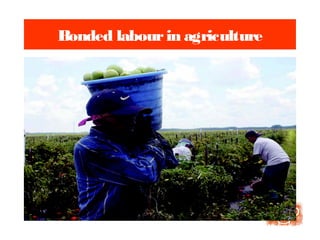
Bonded labourin agriculture
Unconditional worst forms of Child
Labour
• Article 32 of the UN Convention on the Rights of the
Child (1989)
“State parties recognise the right of the child to be protected from
economic exploitation and from performing any workthat is likely to
be hazardous orto interfere with the child’s education orto be harmful
to the child’s health orphysical, mental, spiritual, moral orsocial
development.”
• 8.4 million children
• Forced and bonded labour 5.7 m
• Prostitution and pornography 1.8 m
• Child soldiers 0.3 m
• Otherillicit activity (drug smuggling) 0.6 m
• * Trafficked children 1.2 m
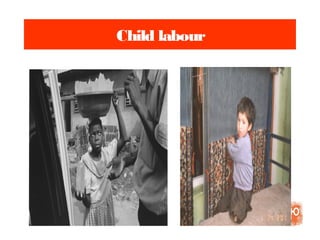
Child labour
Descent-based Slavery
• People are born into slavery orare
compelled to workforothers because
of theircaste orethnic group.
• People are literally owned by others.

Anti slavery

  • 1.
    Anti-Slavery International Founded in1839, we are committed to eliminating all forms of slavery by: • campaigning forits eradication, • supporting local organisations’ initiatives to release and rehabilitate people, • pressing forimplementation of laws against this abuse.
  • 2.
    What is modernslavery? Slavery present: child domestic work Slavery past: captured Africans were transported to the West Coast of Africa forsale to Europeans.
  • 3.
    Slavery and internationallaw • The Slavery Convention, 1926 “Slavery is the status orcondition of a person overwhom any orall of the powers attaching to the right of ownership are exercised.” • Universal Declaration of Human Rights, 1948 “No one shall be held in slavery orservitude; slavery and the slave trade shall be prohibited in all theirforms.” • Supplementary Convention on the Abolition of Slavery, The Slave Trade, and Institutions and Practices Similarto Slavery, 1956 “Debt bondage, serfdom, forced marriage and the delivery of a child forthe exploitation of that child are all slavery like practices and require criminalisation and abolishment.”
  • 4.
    Some characteristics ofslavery • forcedto work-- through mental orphysical threat; • ownedorcontrolledby an 'employer', usually through mental orphysical abuse or threatened abuse; • dehumanised, treated as a commodity or bought and sold as 'property'; • physically constrainedorhas restrictions placed on his/herfreedomof movement.
  • 5.
    Forms of slaverytoday • Forced labour • Human trafficking • Bonded labour • Some worst forms of child labour • Descent-based slavery
  • 6.
    Forced Labour • “Allworkorservicewhichisexactedfromany personunderthemenaceof anypenaltyfor whichthesaidpersonhas not offeredhimself voluntarily” The Forced LabourConvention 1930 (ILO Convention No.29) • 12.3 million people are victims of forced labourworldwide.
  • 7.
  • 8.
    Legal definition oftrafficking • Trafficking in persons shall mean the recruitment, transportation, transfer, harbouring or receipt of person, by means of the threat of the use of force or other forms of coercion, of abduction, of fraud, of deception, of the abuse of power or a position of vulnerability or of giving or receiving payments or benefits to achieve the consent of a person having control over another person, for the purpose of exploitation. Exploitation shall include, at minimum, the exploitation of the prostitution of others or other forms of sexual exploitation, forced labour or services, slavery or practices similar to slavery or servitude or the removal of organs. Article 3 (a) of the Protocol to Prevent, Suppress and Punish Trafficking in Persons, Especially Women and Children, supplementing the United Nations Convention against Transnational Organised Crime (November 2000)Trafficking Protocol
  • 9.
    Bonded Labour • Aperson becomes a bonded labourer when theirlabouris demanded as a means of repayment fora loan. • They loose control of workconditions and theirdebt becomes inflated.
  • 10.
  • 11.
    Unconditional worst formsof Child Labour • Article 32 of the UN Convention on the Rights of the Child (1989) “State parties recognise the right of the child to be protected from economic exploitation and from performing any workthat is likely to be hazardous orto interfere with the child’s education orto be harmful to the child’s health orphysical, mental, spiritual, moral orsocial development.” • 8.4 million children • Forced and bonded labour 5.7 m • Prostitution and pornography 1.8 m • Child soldiers 0.3 m • Otherillicit activity (drug smuggling) 0.6 m • * Trafficked children 1.2 m
  • 12.
  • 13.
    Descent-based Slavery • Peopleare born into slavery orare compelled to workforothers because of theircaste orethnic group. • People are literally owned by others.

Editor's Notes

  • #2 Anti-Slavery International works with partner organisations around the world to collect information on the issues central to our work. The organisation then publishes this information and works through international bodies in order to protect those exploited by these practices. Anti-Slavery International works to inform, educate and advocate for change, in relation to slavery issues around the world. This includes through campaigning, lobbying, education, the media, publications and our reference library. We engage with a range of audiences including young people, the public, the media and policy makers. Anti-Slavery International’s Campaigns Network is primarily a letter writing network where thousands of activists receive our free Action Briefings and campaigns updates several times a year.
  • #3 When we mention slavery, most people’s initial thoughts are of the Transatlantic Slave Trade or the Maafa, a Kiswahili word meaning the great disaster. This was a very specific type of slavery with plenty of legacies. Britain passed the Abolition of the Slave Trade Act in 1807, which made trading in enslaved people illegal and slavery was abolished in all parts of the world by the end of the 19th Century.
  • #4 Slavery continues to exist today despite the fact that it is banned in most of the countries where it is practised. It is prohibited by the Universal Declaration of Human Rights and other UN Conventions. Slavery is defined in international law, e.g. in some of the treaties I mentioned that we campaigned for and were involved in drafting, such as the 1926 Slavery Convention which defines slavery as “the status or condition of a person over whom any or all the powers attaching to the right of ownership are exercised”. and the 1956 Supplementary Convention on the Abolition of Slavery, the Slave Trade and Institutions and Practices Similar to Slavery. Article 4, Universal Declaration of Human Rights “No one shall be held in slavery or servitude; slavery and the slave trade shall be prohibited in all forms” Supplementary Convention states that debt bondage, serfdom, forced marriage and the delivery of a child to another person for the exploitation of that child are all slavery like practices and require criminalisation and aboloshment In 1930, the ILO presented its Forced Labour Convention (no 29) which defined forced labour as “all work or service which is exacted from any person under the menance of any penalty and for which the saidILO Convention 182; The unconditional worst forms of child labour defined as slavery, trafficking, debt bondage and forms of forced labour; forced recruitment for use in armed conflicts; prostitution and pornography and illicit activities
  • #5 By looking at these laws we can draw out common characteristics that distinguish slavery from other human rights violations. A slave may be: forced to work -- through mental or physical threat; owned or controlled by an 'employer', usually through mental or physical abuse or threatened abuse; dehumanised, treated as a commodity or bought and sold as 'property'; physically constrained or has restrictions placed on his/her freedom of movement. One or several of these characteristics may be present in a case of slavery.
  • #6 Different forms of slavery occur in the modern world and Anti-Slavery International works against a range of these abuses. First of all, Bonded labour affects millions of people around the world. People become bonded labourers by taking or being tricked into taking a loan for as little as the cost of medicine for a sick child. To repay the debt, they are forced to work long hours, without rest days. They receive basic food and shelter as 'payment' for their work, but may never pay off the loan, which can be passed down through several generations. One example of this is whole families bonded into agricultural work in Nepal. Forced labour affects people who are illegally recruited by governments, companies or private individuals, and forced to work - usually under threat of violence or other penalties. The Burmese government is notorious for perpetrating this kind of abuse. The unconditional worst forms of child labour are defined in ILO Convention No. 182 as slavery, trafficking, debt bondage and other forms of forced labour; forced recruitment for use in armed conflict; prostitution, pornography and other illicit activities.These practices affect millions of children around the world. An example here would be children, forced to work in dangerous factories, producing carpets or silk, without being able to leave, in parts of India. Commercial sexual exploitation of children falls under these unconditional worst forms of child labour. Children are exploited for their commercial value through prostitution, trafficking and pornography. Anti-Slavery International is a member of the ECPAT Coalition which works specifically against these abuses (see www.ecpat.org.uk for more information). Descent based slavery involves people being enslaved on the basis of caste or ethnicity. They may be inherited, given as gifts or sometimes bought and sold from their homes. This still occurs in countries such as Niger and Mauritania in West Africa. Early and forced marriage affects women and girls who are married without choice and are forced into lives of servitude often accompanied by physical violence. Girls are forced to marry in a number of regions, including parts of Africa and South Asia. Human trafficking – see next slide.
  • #7 affects people who are illegally recruited by individuals, governments or political parties and forced to work -- usually under threat of violence or other penalties.
  • #8 Irshad was just four years old when he was abducted and taken from his home in Bangladesh to Dubai in the UAE, by a friend of his father. He was given to a ‘master’ to be trained as a camel jockey. Irshad would be woken at 4.00am and taken to the racetrack at dawn. He was tied to a camel which was over two metres tall and could reach speeds of up to 60km per hour. Irshad says he was given very little food or water in order to keep his weight down. He was consequently highly malnourished and underweight. Irshad’s parents searched for him and eventually his father tracked him down in Dubai. However, the man who had abducted Irshad also claimed to be his father and the camel master handed them both over to the police. Although the police did discover the true identity of Irshad’s father, and the other man was jailed, Irshad’s father’s visa expired and he was deported to Bangladesh without his son. Irshad continued to work as a camel jockey, sustaining several injuries. In October 2002, after three years as a camel jockey, Irshad was identified by a visiting Bangladeshi government official. He was subsequently rescued and repatriated by the Bangladeshi Consulate with the help of the Bangladesh National Women Lawyers’ Association (BNWLA) in November 2002. After a few weeks, Irshad’s parents were traced and he was reunited with his family.
  • #11 Ricardo was offered the chance to take up well-paid work in the US and left Mexico to pick tomatoes on a farm in Florida. The contractor explained that they would have to work to pay back the money they owed for the expenses of arranging travel and employment. The work was backbreaking, a normal day lasted from 5.00am until 7.00pm. They ate badly and had to drink polluted water. Ricardo was paid $80, but immediately the contractor charged him $40 towards his debt, $30 for rent, electricity, water and food, and he was left with only $10. As this system of payment continued, the workers’ debts increased and it seemed the contractor would never let them leave. One of his co-workers tried to escape, but was caught. The contractor beat him and threatened to kill him if he attempted another escape. ‘This is when I realised that it was really slavery.’ Ricardo managed to escape during a supervised trip to buy food. He helped police to investigate the trafficker, which confirmed that workers were being enslaved on tomato farms. But most of the trafficked workers were treated as illegal immigrants and immediately forced to leave the country. The Mexican community contributes some US$82.1 billion a year to US gross domestic product and nearly US$9 billion was sent back to Mexico by Mexican nationals or persons of Mexican origin in 2001 alone. These figures do not take into account the irregular migration of Mexicans to the US. There are few opportunities for regular migration into less skilled jobs in the USA so many migrants try to cross the border illegally in search of work. Between 1998 and 2001, more than 1,500 migrants died while trying to cross the border. Some 1.5 million migrants each year are arrested on the US-Mexican border and forced to return home. Others may make it into the US only to find themselves compelled to work as forced labourers or in situations of severe exploitation. On average an undocumented Mexican migrant worker in the United States will find a job within two weeks of arriving. And Mexican migrants earn around nine times as much in the US as they did in their last job in Mexico.
  • #12 Across the world, children are involved in a wide range of work. In towns and cities they beg, work in bars, restaurants or as domestics in other people’s homes. In factories they make products such as matches, fireworks or glassware. In brick kilns, children are often forced to work with their families to repay money loaned by their employer. Although we read in the media mainly about children working in factories, the vast majority of children (70 per cent) work in agriculture, fishing, hunting and forestry, with or without their families. Here children are at risk from work that is too heavy for their young bodies and from chemicals that can damage their health. Increasingly, children are also bought and sold within and across national borders. They are trafficked for prostitution, for begging and for work on construction sites, plantations and in domestic service. The vulnerability of these children is even greater when they arrive in another country. Often they do not have contact with their families and are at the mercy of their employers
  • #13 Pelagy, young girl “When I was eight I was trafficked from Benin in a lorry to Libreville in Gabon. My sister was transported there by boat when she was six. We were taken to the same family to serve as domestics. While the family’s children went to school, we had to work long hours cooking, cleaning and washing. We were also forced to work for our master in the market. If we did not sell our daily quota, we were beaten and tied up. Although I tried to live with this abuse, when I saw my little sister being beaten, I couldn’t take it any longer, so we managed to escape.”