DIMENSIONS OF FOODSECURITY
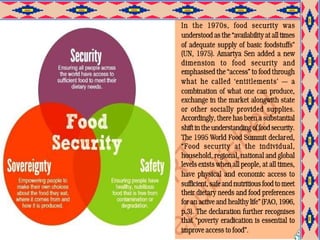
a) AVAILABILITY of food means food
production within the country, food imports
and the previous years stock stored in govt.
granaries.
b) ACCESSIBILITY means food is within reach
of every person.
c) AFFORDABILITY implies that an individual
has enough money to buy sufficient, safe and
nutritious to meet ones dietary needs.
4.
OVERVIEW
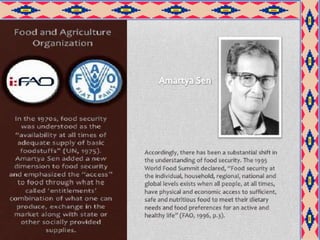
Food security meansavailability, accessibility
and affordability of food to all people at all
times. The poor households are more
vulnerable to food insecurity whenever there
is a problem of production or distribution of
food crops. Food security depends on the
Public Distribution System (PDS) and
government vigilance and action at times,
when this security is threatened.
6.
Food
Security
Necessity OfFood Security
Food security is needed in a country to ensure food at all times. It is
needed to ensure that no person in a country dies of hunger.
Effect of Natural Calamity on Food Security
Most of the time, the poorest section of society might be food insecure.
But persons above the poverty line might also be food insecure when the
country faces a national disaster/calamity like earthquake, drought, flood,
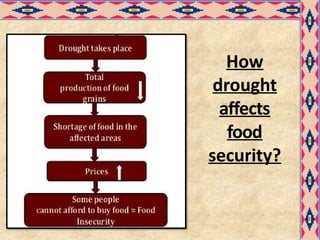
tsunami, widespread failure of crops causing famine, etc.- The total
production of food grains decreases due to a natural calamity. It creates a
shortage of food in the affected areas. The price of the food products goes
up due to this shortage. At high prices, some people cannot afford to buy
food. If such calamity happens in a very wide area or is stretched over a
longer time period, it may cause a situation of starvation. Massive
starvation might take a turn of famine. Thus, natural calamity affects food
security adversely.
7.
Food Security isensured in a
country
only if :-
Enough food is available for all the persons.
All persons have the capacity to buy
food of acceptable quality.
There is no barrier on access to food.
8.
What is food
security?
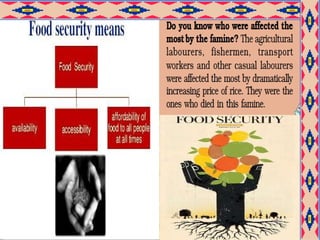
Foodsecurity has the following dimensions
(a) availability of food means food production within the
country, food imports and the previous years stock stored
in government granaries.
(b) accessibility means food is within reach of every person.
(c) affordability implies that an individual has enough
money to buy sufficient, safe and nutritious food to meet
one’s dietary needs.
Food security is ensured in a country only if
(1) enough food is available for all the persons
(2) all persons have the capacity to buy food of
acceptable quality
(3) there is no barrier on access to food.
9.
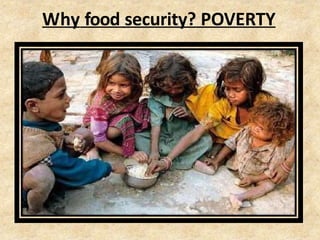
Why food
security?
Duringnatural calamity such as drought, production
of food grains get decreased, creating a shortage of
food in the affected areas. The prices get increased due
to shortage of food. People cannot afford to buy food
and if such a calamity happens in a very wide spread
area or is stretched over a longer time period, it might
cause a situation of starvation. Massive starvation
might take a turn into a famine. A Famine is
characterised by widespread deaths due to starvation
and epidemics caused by forced use of contaminated
water or decaying food and loss of body resistance due
to weakening from starvation.
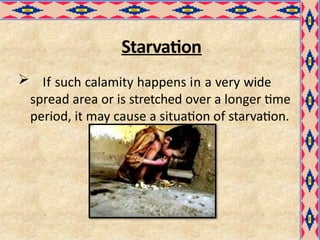
Starvation
If suchcalamity happens in a very wide
spread area or is stretched over a longer time
period, it may cause a situation of starvation.
12.
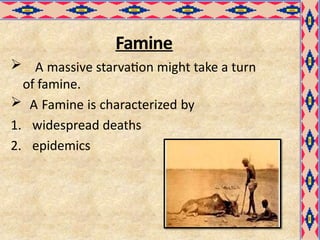
Famine
A massivestarvation might take a turn
of famine.
A Famine is characterized by
1. widespread deaths
2. epidemics
13.
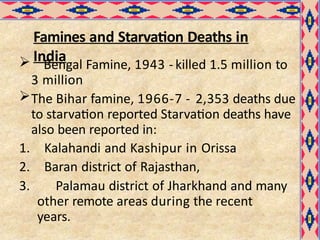
Famines and StarvationDeaths in
India
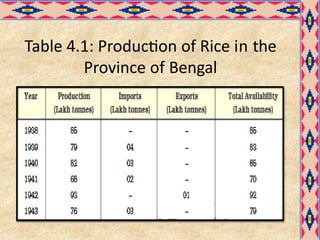
Bengal Famine, 1943 - killed 1.5 million to
3 million
The Bihar famine, 1966-7 - 2,353 deaths due
to starvation reported Starvation deaths have
also been reported in:
1. Kalahandi and Kashipur in Orissa
2. Baran district of Rajasthan,
3. Palamau district of Jharkhand and many
other remote areas during the recent
years.
Who are food-
insecure?
In India, a large section of people suffers from food and nutrition
insecurity. People having little or no land, traditional artisans,
providers of traditional services, petty self-employed workers and
destitute including beggars are the worst affected groups. In the
urban areas, the food-insecure families are those who are generally
employed in ill-paid occupations and the casual labour market.
These workers are largely engaged in seasonal activities and are paid
very low wages.
The social composition along with the inability to buy food also plays
a role in food insecurity. People of SC, ST and OBC communities who
have either poor land-base or very low land productivity are prone
to food insecurity. People affected by natural disasters, who migrate
to other areas in search of work, are among the most food-insecure
people. A large proportion of pregnant and nursing mothers and
children under the age of 5 years constitute an important segment of
the food insecure population.
19.
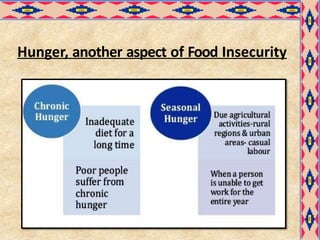
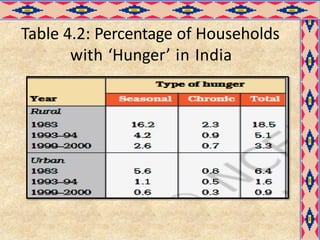
Another aspectof food insecurity is hunger, which is
not just an expression of poverty, it brings about
poverty. Hunger has chronic and seasonal dimensions.
Chronic hunger is a consequence of diets persistently
inadequate in terms of quantity and/or quality.
Seasonal hunger is related to cycles of food growing
and harvesting.
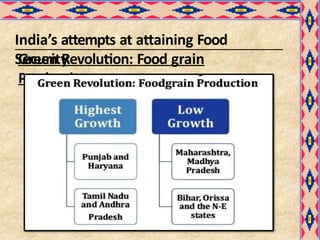
Since Independence, India has been aiming at self-
sufficiency in food grains. After Independence, Indian
policymakers adopted all measures to achieve self-
sufficiency in food grains. In the field of agriculture,
India adopted a new strategy, which resulted in the
‘Green Revolution’.
Food Security in
India
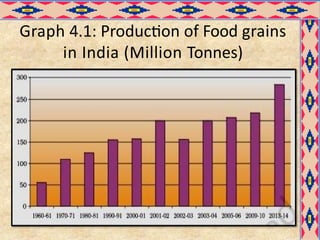
Sincethe Green Revolution, the country has
avoided famine even during adverse weather
conditions. India has become self-sufficient in
food grains during the last 30 years because of a
variety of crops grown all over the country. The
availability of food grains has been ensured with
a carefully designed food security system by the
government.
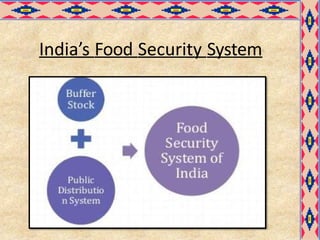
This system has two components:
(a) buffer stock,
(b) public distribution system.
What is Buffer
stock?
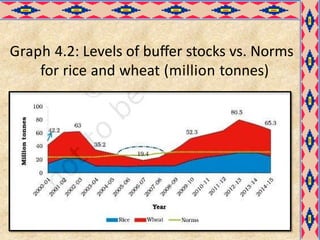
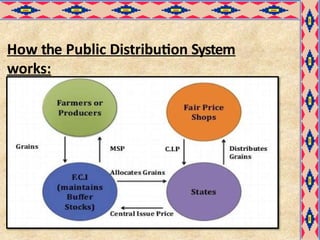
Buffer Stock is the stock of food grains, namely wheat
and rice, procured by the government through the
Food Corporation of India (FCI). The stock of wheat and
rice are purchased by the FCI from the farmers where
there is surplus production. The farmers are paid a pre
announced price for their crops, called Minimum
Support Price (MSP). Every year, the MSP is declared by
the government before the sowing season to provide
incentives to farmers for raising the production of
these crops. Buffer Stock is created to distribute food
grains in the deficit areas and among the poorer
section of the society at a price lower than the market
price also known as Issue Price.
24.
What is thePublic
Distribution
System?
FCI distributes the food procured from the farmer
through government-regulated ration shops. It is
called the Public Distribution System (PDS). Ration
shops also, known as Fair Price Shops, keep stock of
food grains, sugar, and kerosene for cooking. Rationing
in India was introduced during the 1940s against the
backdrop of the Bengal famine. In the mid- 1970s,
three important.
food intervention programmes were introduced:
1. Public Distribution System (PDS) for food grains
2. Integrated Child Development Services (ICDS) a
3. Food-for-Work (FFW).
25.
Current Status ofPublic
the Distribution System
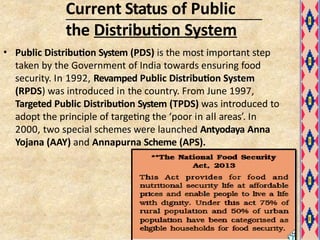
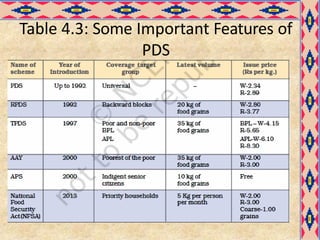
• Public Distribution System (PDS) is the most important step
taken by the Government of India towards ensuring food
security. In 1992, Revamped Public Distribution System
(RPDS) was introduced in the country. From June 1997,
Targeted Public Distribution System (TPDS) was introduced to
adopt the principle of targeting the ‘poor in all areas’. In
2000, two special schemes were launched Antyodaya Anna
Yojana (AAY) and Annapurna Scheme (APS).
Graph 4.2: Levelsof buffer stocks vs. Norms
for rice and wheat (million tonnes)
28.
Role of cooperativesin food
security
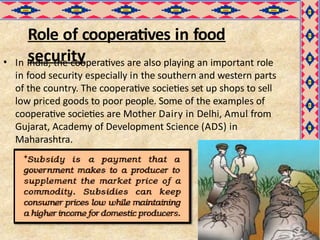
• In India, the cooperatives are also playing an important role
in food security especially in the southern and western parts
of the country. The cooperative societies set up shops to sell
low priced goods to poor people. Some of the examples of
cooperative societies are Mother Dairy in Delhi, Amul from
Gujarat, Academy of Development Science (ADS) in
Maharashtra.