Introduction                         Scenario                              Standard                            Conclusion


                 Making Heterogeneous Ontologies
               Interoperable Through Standardisation
                 A Meta Ontology Language to be Standardised for
                Ontology Integration and Interoperability (OntoIOp)
                                           AEGIS Conference


                            Christoph Lange1,2 , Till Mossakowski1,3,4 ,
                                Christian Galinski5 , Oliver Kutz1,3
       1   University of Bremen, Germany        2 Computer Science, Jacobs University Bremen, Germany
      3 SFB/TR 8 “Spatial cognition”, University of Bremen, Germany            4 DFKI GmbH, Bremen, Germany
                 5 International Information Centre for Terminology (Infoterm), Vienna, Austria


                                                 2011-11-30
 Lange et al. (U. Bremen/Infoterm)   Making Heterogeneous Ontologies Interoperable Through Standardisation   2011-11-30     1
Introduction                         Scenario                              Standard                            Conclusion


Background: The OASIS EU project


         OASIS = Open architecture for Accessible
         Services Integration and Standardisation
         Goal: an innovative reference architecture
         (based on ontologies and semantic
         services) that allows plug and play and
         cost-effective interconnection of existing
         and new services in all domains required
         for the independent and autonomous
         living of the elderly and enhancing their
         Quality of Life
 http://www.oasis-project.eu

 Lange et al. (U. Bremen/Infoterm)   Making Heterogeneous Ontologies Interoperable Through Standardisation   2011-11-30     2
Introduction                         Scenario                              Standard                            Conclusion


Interoperable Assistive Technology
          Assistive technology increasingly relies on communication
                   among users,
                   between users and their devices, and
                   among these devices.
          Making such ICT accessible and inclusive is costly or even
          impossible
          We aim at more interoperable
                   devices,
                   services accessing these devices, and
                   content delivered by these services
          . . . at the levels of
                   data and metadata
                   data models and data modelling methods
                   metamodels as well as a meta ontology language
 Lange et al. (U. Bremen/Infoterm)   Making Heterogeneous Ontologies Interoperable Through Standardisation   2011-11-30     3
Introduction                                         Scenario                                 Standard                                 Conclusion


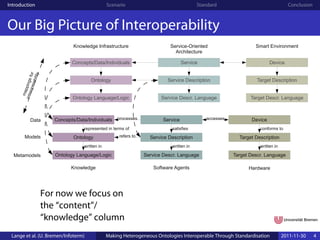
Our Big Picture of Interoperability
                                    Knowledge Infrastructure                     Service-Oriented                     Smart Environment
                                                                                   Architecture

                                   Concepts/Data/Individuals                            Service                         Target (Device)
                                                                                                                            Device
              rabil r
                   ity
                  fo


                                           Ontology                            Service Description                     Target Description
     inte ppings
         rope
       ma


                                   Ontology Language/Logic                   Service Descr. Language                Target Descr. Language


             Data           Concepts/Data/Individuals    processes            Service             accesses      Target (Device)
                                                                                                                    Device
                                        represented in terms of                  satisfies                              conforms to
        Models                      Ontology              refers to     Service Description                    Target Description
                                        written in                               written in                             written in

  Metamodels                Ontology Language/Logic                   Service Descr. Language                Target Descr. Language

                                   Knowledge                              Software Agents                          Hardware


                         For now we focus on
                         the “content”/
                         “knowledge” column
 Lange et al. (U. Bremen/Infoterm)                   Making Heterogeneous Ontologies Interoperable Through Standardisation           2011-11-30     4
Introduction                         Scenario                              Standard                            Conclusion


An Ambient Assisted Living (AAL) Use Case
 Scenario
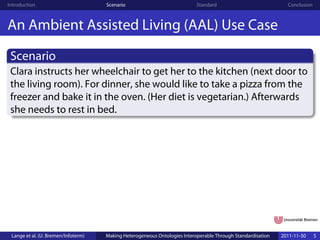
 Clara instructs her wheelchair to get her to the kitchen (next door to
 the living room). For dinner, she would like to take a pizza from the
 freezer and bake it in the oven. (Her diet is vegetarian.) Afterwards
 she needs to rest in bed.


 Lange et al. (U. Bremen/Infoterm)   Making Heterogeneous Ontologies Interoperable Through Standardisation   2011-11-30     5
Introduction                         Scenario                              Standard                            Conclusion


An Ambient Assisted Living (AAL) Use Case
 Scenario
 Clara instructs her wheelchair to get her to the kitchen (next door
 to the living room). For dinner, she would like to take a pizza from
 the freezer and bake it in the oven. (Her diet is vegetarian.)
 Afterwards she needs to rest in bed.
          Existing AAL ontologies (e.g. OpenAAL, http://openaal.org)
          cover the core of these concepts:


 Lange et al. (U. Bremen/Infoterm)   Making Heterogeneous Ontologies Interoperable Through Standardisation   2011-11-30     5
Introduction                         Scenario                              Standard                            Conclusion


An Ambient Assisted Living (AAL) Use Case
 Scenario
 Clara instructs her wheelchair to get her to the kitchen (next door
 to the living room). For dinner, she would like to take a pizza from
 the freezer and bake it in the oven. (Her diet is vegetarian.)
 Afterwards she needs to rest in bed.

          Existing AAL ontologies (e.g. OpenAAL, http://openaal.org)
          cover the core of these concepts:
                   . . . but not all required concepts
                   e.g. food ingredients ⇒ need other ontologies/modules
                   even need to tap into the Web of Data (product data, geodata)


 Lange et al. (U. Bremen/Infoterm)   Making Heterogeneous Ontologies Interoperable Through Standardisation   2011-11-30     5
Introduction                         Scenario                              Standard                            Conclusion


An Ambient Assisted Living (AAL) Use Case
 Scenario
 Clara instructs her wheelchair to get her to the kitchen (next door
 to the living room). For dinner, she would like to take a pizza from
 the freezer and bake it in the oven. (Her diet is vegetarian.)
 Afterwards she needs to rest in bed.

          Existing AAL ontologies (e.g. OpenAAL, http://openaal.org)
          cover the core of these concepts:
                   . . . but not all required concepts
                   e.g. food ingredients ⇒ need other ontologies/modules
                   even need to tap into the Web of Data (product data, geodata)
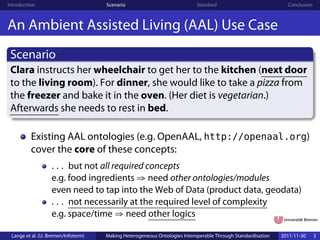
                   . . . not necessarily at the required level of complexity
                   e.g. space/time ⇒ need other logics

 Lange et al. (U. Bremen/Infoterm)   Making Heterogeneous Ontologies Interoperable Through Standardisation   2011-11-30     5
Introduction                         Scenario                              Standard                            Conclusion


What do Devices Need to Know?

 Some of the devices involved:
    kitchen light switch
         freezer (aware of its contents)
         wheelchair (with navigation)
 Different Services and Devices need to understand different
 aspects of the real world at different levels of complexity.

Quote from the “Hitchhiker”
“Suddenly [the door] slid open. ‘Thank you,’
it said, ‘for making a simple door very
happy.’”

 Lange et al. (U. Bremen/Infoterm)   Making Heterogeneous Ontologies Interoperable Through Standardisation   2011-11-30     6
Introduction                         Scenario                              Standard                            Conclusion


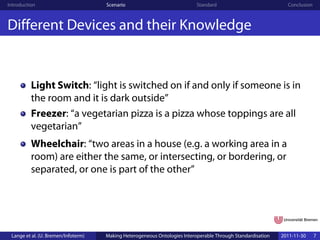
Different Devices and their Knowledge


          Light Switch: “light is switched on if and only if someone is in
          the room and it is dark outside”
          Freezer: “a vegetarian pizza is a pizza whose toppings are all
          vegetarian”
          Wheelchair: “two areas in a house (e.g. a working area in a
          room) are either the same, or intersecting, or bordering, or
          separated, or one is part of the other”


 Lange et al. (U. Bremen/Infoterm)   Making Heterogeneous Ontologies Interoperable Through Standardisation   2011-11-30     7
Introduction                         Scenario                              Standard                            Conclusion


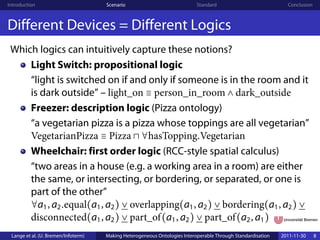
Different Devices = Different Logics
 Which logics can intuitively capture these notions?
     Light Switch: propositional logic
     “light is switched on if and only if someone is in the room and it
     is dark outside” – light_on ≡ person_in_room ∧ dark_outside
     Freezer: description logic (Pizza ontology)
     “a vegetarian pizza is a pizza whose toppings are all vegetarian”
     VegetarianPizza ≡ Pizza ∀hasTopping.Vegetarian
     Wheelchair: first order logic (RCC-style spatial calculus)
     “two areas in a house (e.g. a working area in a room) are either
     the same, or intersecting, or bordering, or separated, or one is
     part of the other”
     ∀a1 , a2 .equal(a1 , a2 ) ∨ overlapping(a1 , a2 ) ∨ bordering(a1 , a2 ) ∨
     disconnected(a1 , a2 ) ∨ part_of(a1 , a2 ) ∨ part_of(a2 , a1 )
 Lange et al. (U. Bremen/Infoterm)   Making Heterogeneous Ontologies Interoperable Through Standardisation   2011-11-30     8
Introduction                         Scenario                              Standard                            Conclusion


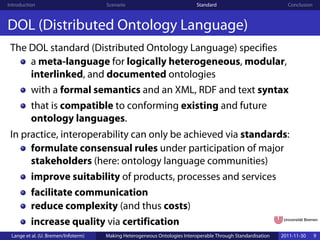
DOL (Distributed Ontology Language)
 The DOL standard (Distributed Ontology Language) specifies
     a meta-language for logically heterogeneous, modular,
     interlinked, and documented ontologies
     with a formal semantics and an XML, RDF and text syntax
     that is compatible to conforming existing and future
     ontology languages.
 In practice, interoperability can only be achieved via standards:
      formulate consensual rules under participation of major
      stakeholders (here: ontology language communities)
      improve suitability of products, processes and services
      facilitate communication
      reduce complexity (and thus costs)
      increase quality via certification
 Lange et al. (U. Bremen/Infoterm)   Making Heterogeneous Ontologies Interoperable Through Standardisation   2011-11-30     9
Introduction                         Scenario                              Standard                            Conclusion


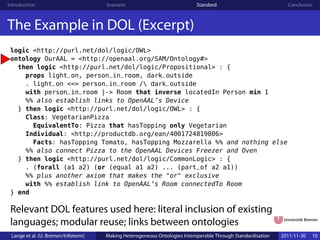
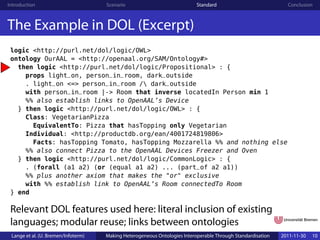
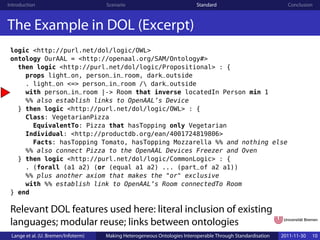
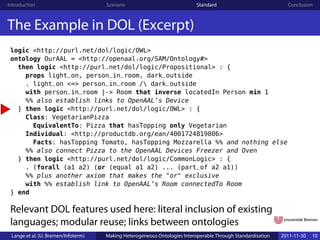
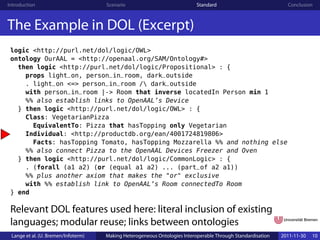
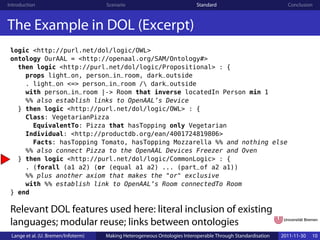
The Example in DOL (Excerpt)
 logic <http://purl.net/dol/logic/OWL>
 ontology OurAAL = <http://openaal.org/SAM/Ontology#>
   then logic <http://purl.net/dol/logic/Propositional> : {
     props light_on, person_in_room, dark_outside
     . light_on <=> person_in_room / dark_outside
     with person_in_room |-> Room that inverse locatedIn Person min 1
     %% also establish links to OpenAAL’s Device
   } then logic <http://purl.net/dol/logic/OWL> : {
     Class: VegetarianPizza
       EquivalentTo: Pizza that hasTopping only Vegetarian
     Individual: <http://productdb.org/ean/4001724819806>
       Facts: hasTopping Tomato, hasTopping Mozzarella %% and nothing else
     %% also connect Pizza to the OpenAAL Devices Freezer and Oven
   } then logic <http://purl.net/dol/logic/CommonLogic> : {
     . (forall (a1 a2) (or (equal a1 a2) ... (part_of a2 a1))
     %% plus another axiom that makes the "or" exclusive
     with %% establish link to OpenAAL’s Room connectedTo Room
 } end

 Relevant DOL features used here: literal inclusion of existing
 languages; modular reuse; links between ontologies
 Lange et al. (U. Bremen/Infoterm)   Making Heterogeneous Ontologies Interoperable Through Standardisation   2011-11-30   10
Introduction                         Scenario                              Standard                            Conclusion


The Example in DOL (Excerpt)
 logic <http://purl.net/dol/logic/OWL>
 ontology OurAAL = <http://openaal.org/SAM/Ontology#>
   then logic <http://purl.net/dol/logic/Propositional> : {
     props light_on, person_in_room, dark_outside
     . light_on <=> person_in_room / dark_outside
     with person_in_room |-> Room that inverse locatedIn Person min 1
     %% also establish links to OpenAAL’s Device
   } then logic <http://purl.net/dol/logic/OWL> : {
     Class: VegetarianPizza
       EquivalentTo: Pizza that hasTopping only Vegetarian
     Individual: <http://productdb.org/ean/4001724819806>
       Facts: hasTopping Tomato, hasTopping Mozzarella %% and nothing else
     %% also connect Pizza to the OpenAAL Devices Freezer and Oven
   } then logic <http://purl.net/dol/logic/CommonLogic> : {
     . (forall (a1 a2) (or (equal a1 a2) ... (part_of a2 a1))
     %% plus another axiom that makes the "or" exclusive
     with %% establish link to OpenAAL’s Room connectedTo Room
 } end

 Relevant DOL features used here: literal inclusion of existing
 languages; modular reuse; links between ontologies
 Lange et al. (U. Bremen/Infoterm)   Making Heterogeneous Ontologies Interoperable Through Standardisation   2011-11-30   10
Introduction                         Scenario                              Standard                            Conclusion


The Example in DOL (Excerpt)
 logic <http://purl.net/dol/logic/OWL>
 ontology OurAAL = <http://openaal.org/SAM/Ontology#>
   then logic <http://purl.net/dol/logic/Propositional> : {
     props light_on, person_in_room, dark_outside
     . light_on <=> person_in_room / dark_outside
     with person_in_room |-> Room that inverse locatedIn Person min 1
     %% also establish links to OpenAAL’s Device
   } then logic <http://purl.net/dol/logic/OWL> : {
     Class: VegetarianPizza
       EquivalentTo: Pizza that hasTopping only Vegetarian
     Individual: <http://productdb.org/ean/4001724819806>
       Facts: hasTopping Tomato, hasTopping Mozzarella %% and nothing else
     %% also connect Pizza to the OpenAAL Devices Freezer and Oven
   } then logic <http://purl.net/dol/logic/CommonLogic> : {
     . (forall (a1 a2) (or (equal a1 a2) ... (part_of a2 a1))
     %% plus another axiom that makes the "or" exclusive
     with %% establish link to OpenAAL’s Room connectedTo Room
 } end

 Relevant DOL features used here: literal inclusion of existing
 languages; modular reuse; links between ontologies
 Lange et al. (U. Bremen/Infoterm)   Making Heterogeneous Ontologies Interoperable Through Standardisation   2011-11-30   10
Introduction                         Scenario                              Standard                            Conclusion


The Example in DOL (Excerpt)
 logic <http://purl.net/dol/logic/OWL>
 ontology OurAAL = <http://openaal.org/SAM/Ontology#>
   then logic <http://purl.net/dol/logic/Propositional> : {
     props light_on, person_in_room, dark_outside
     . light_on <=> person_in_room / dark_outside
     with person_in_room |-> Room that inverse locatedIn Person min 1
     %% also establish links to OpenAAL’s Device
   } then logic <http://purl.net/dol/logic/OWL> : {
     Class: VegetarianPizza
       EquivalentTo: Pizza that hasTopping only Vegetarian
     Individual: <http://productdb.org/ean/4001724819806>
       Facts: hasTopping Tomato, hasTopping Mozzarella %% and nothing else
     %% also connect Pizza to the OpenAAL Devices Freezer and Oven
   } then logic <http://purl.net/dol/logic/CommonLogic> : {
     . (forall (a1 a2) (or (equal a1 a2) ... (part_of a2 a1))
     %% plus another axiom that makes the "or" exclusive
     with %% establish link to OpenAAL’s Room connectedTo Room
 } end

 Relevant DOL features used here: literal inclusion of existing
 languages; modular reuse; links between ontologies
 Lange et al. (U. Bremen/Infoterm)   Making Heterogeneous Ontologies Interoperable Through Standardisation   2011-11-30   10
Introduction                         Scenario                              Standard                            Conclusion


The Example in DOL (Excerpt)
 logic <http://purl.net/dol/logic/OWL>
 ontology OurAAL = <http://openaal.org/SAM/Ontology#>
   then logic <http://purl.net/dol/logic/Propositional> : {
     props light_on, person_in_room, dark_outside
     . light_on <=> person_in_room / dark_outside
     with person_in_room |-> Room that inverse locatedIn Person min 1
     %% also establish links to OpenAAL’s Device
   } then logic <http://purl.net/dol/logic/OWL> : {
     Class: VegetarianPizza
       EquivalentTo: Pizza that hasTopping only Vegetarian
     Individual: <http://productdb.org/ean/4001724819806>
       Facts: hasTopping Tomato, hasTopping Mozzarella %% and nothing else
     %% also connect Pizza to the OpenAAL Devices Freezer and Oven
   } then logic <http://purl.net/dol/logic/CommonLogic> : {
     . (forall (a1 a2) (or (equal a1 a2) ... (part_of a2 a1))
     %% plus another axiom that makes the "or" exclusive
     with %% establish link to OpenAAL’s Room connectedTo Room
 } end

 Relevant DOL features used here: literal inclusion of existing
 languages; modular reuse; links between ontologies
 Lange et al. (U. Bremen/Infoterm)   Making Heterogeneous Ontologies Interoperable Through Standardisation   2011-11-30   10
Introduction                         Scenario                              Standard                            Conclusion


The Example in DOL (Excerpt)
 logic <http://purl.net/dol/logic/OWL>
 ontology OurAAL = <http://openaal.org/SAM/Ontology#>
   then logic <http://purl.net/dol/logic/Propositional> : {
     props light_on, person_in_room, dark_outside
     . light_on <=> person_in_room / dark_outside
     with person_in_room |-> Room that inverse locatedIn Person min 1
     %% also establish links to OpenAAL’s Device
   } then logic <http://purl.net/dol/logic/OWL> : {
     Class: VegetarianPizza
       EquivalentTo: Pizza that hasTopping only Vegetarian
     Individual: <http://productdb.org/ean/4001724819806>
       Facts: hasTopping Tomato, hasTopping Mozzarella %% and nothing else
     %% also connect Pizza to the OpenAAL Devices Freezer and Oven
   } then logic <http://purl.net/dol/logic/CommonLogic> : {
     . (forall (a1 a2) (or (equal a1 a2) ... (part_of a2 a1))
     %% plus another axiom that makes the "or" exclusive
     with %% establish link to OpenAAL’s Room connectedTo Room
 } end

 Relevant DOL features used here: literal inclusion of existing
 languages; modular reuse; links between ontologies
 Lange et al. (U. Bremen/Infoterm)   Making Heterogeneous Ontologies Interoperable Through Standardisation   2011-11-30   10
Introduction                         Scenario                              Standard                            Conclusion


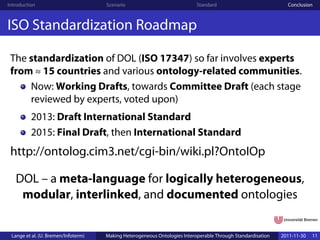
ISO Standardization Roadmap

 The standardization of DOL (ISO 17347) so far involves experts
 from ≈ 15 countries and various ontology-related communities.
     Now: Working Drafts, towards Committee Draft (each stage
     reviewed by experts, voted upon)
          2013: Draft International Standard
          2015: Final Draft, then International Standard
 http://ontolog.cim3.net/cgi-bin/wiki.pl?OntoIOp

   DOL – a meta-language for logically heterogeneous,
    modular, interlinked, and documented ontologies


 Lange et al. (U. Bremen/Infoterm)   Making Heterogeneous Ontologies Interoperable Through Standardisation   2011-11-30   11

Making Heterogeneous Ontologies Interoperable Through Standardisation

  • 1.
    Introduction Scenario Standard Conclusion Making Heterogeneous Ontologies Interoperable Through Standardisation A Meta Ontology Language to be Standardised for Ontology Integration and Interoperability (OntoIOp) AEGIS Conference Christoph Lange1,2 , Till Mossakowski1,3,4 , Christian Galinski5 , Oliver Kutz1,3 1 University of Bremen, Germany 2 Computer Science, Jacobs University Bremen, Germany 3 SFB/TR 8 “Spatial cognition”, University of Bremen, Germany 4 DFKI GmbH, Bremen, Germany 5 International Information Centre for Terminology (Infoterm), Vienna, Austria 2011-11-30 Lange et al. (U. Bremen/Infoterm) Making Heterogeneous Ontologies Interoperable Through Standardisation 2011-11-30 1
  • 2.
    Introduction Scenario Standard Conclusion Background: The OASIS EU project OASIS = Open architecture for Accessible Services Integration and Standardisation Goal: an innovative reference architecture (based on ontologies and semantic services) that allows plug and play and cost-effective interconnection of existing and new services in all domains required for the independent and autonomous living of the elderly and enhancing their Quality of Life http://www.oasis-project.eu Lange et al. (U. Bremen/Infoterm) Making Heterogeneous Ontologies Interoperable Through Standardisation 2011-11-30 2
  • 3.
    Introduction Scenario Standard Conclusion Interoperable Assistive Technology Assistive technology increasingly relies on communication among users, between users and their devices, and among these devices. Making such ICT accessible and inclusive is costly or even impossible We aim at more interoperable devices, services accessing these devices, and content delivered by these services . . . at the levels of data and metadata data models and data modelling methods metamodels as well as a meta ontology language Lange et al. (U. Bremen/Infoterm) Making Heterogeneous Ontologies Interoperable Through Standardisation 2011-11-30 3
  • 4.
    Introduction Scenario Standard Conclusion Our Big Picture of Interoperability Knowledge Infrastructure Service-Oriented Smart Environment Architecture Concepts/Data/Individuals Service Target (Device) Device rabil r ity fo Ontology Service Description Target Description inte ppings rope ma Ontology Language/Logic Service Descr. Language Target Descr. Language Data Concepts/Data/Individuals processes Service accesses Target (Device) Device represented in terms of satisfies conforms to Models Ontology refers to Service Description Target Description written in written in written in Metamodels Ontology Language/Logic Service Descr. Language Target Descr. Language Knowledge Software Agents Hardware For now we focus on the “content”/ “knowledge” column Lange et al. (U. Bremen/Infoterm) Making Heterogeneous Ontologies Interoperable Through Standardisation 2011-11-30 4
  • 5.
    Introduction Scenario Standard Conclusion An Ambient Assisted Living (AAL) Use Case Scenario Clara instructs her wheelchair to get her to the kitchen (next door to the living room). For dinner, she would like to take a pizza from the freezer and bake it in the oven. (Her diet is vegetarian.) Afterwards she needs to rest in bed. Lange et al. (U. Bremen/Infoterm) Making Heterogeneous Ontologies Interoperable Through Standardisation 2011-11-30 5
  • 6.
    Introduction Scenario Standard Conclusion An Ambient Assisted Living (AAL) Use Case Scenario Clara instructs her wheelchair to get her to the kitchen (next door to the living room). For dinner, she would like to take a pizza from the freezer and bake it in the oven. (Her diet is vegetarian.) Afterwards she needs to rest in bed. Existing AAL ontologies (e.g. OpenAAL, http://openaal.org) cover the core of these concepts: Lange et al. (U. Bremen/Infoterm) Making Heterogeneous Ontologies Interoperable Through Standardisation 2011-11-30 5
  • 7.
    Introduction Scenario Standard Conclusion An Ambient Assisted Living (AAL) Use Case Scenario Clara instructs her wheelchair to get her to the kitchen (next door to the living room). For dinner, she would like to take a pizza from the freezer and bake it in the oven. (Her diet is vegetarian.) Afterwards she needs to rest in bed. Existing AAL ontologies (e.g. OpenAAL, http://openaal.org) cover the core of these concepts: . . . but not all required concepts e.g. food ingredients ⇒ need other ontologies/modules even need to tap into the Web of Data (product data, geodata) Lange et al. (U. Bremen/Infoterm) Making Heterogeneous Ontologies Interoperable Through Standardisation 2011-11-30 5
  • 8.
    Introduction Scenario Standard Conclusion An Ambient Assisted Living (AAL) Use Case Scenario Clara instructs her wheelchair to get her to the kitchen (next door to the living room). For dinner, she would like to take a pizza from the freezer and bake it in the oven. (Her diet is vegetarian.) Afterwards she needs to rest in bed. Existing AAL ontologies (e.g. OpenAAL, http://openaal.org) cover the core of these concepts: . . . but not all required concepts e.g. food ingredients ⇒ need other ontologies/modules even need to tap into the Web of Data (product data, geodata) . . . not necessarily at the required level of complexity e.g. space/time ⇒ need other logics Lange et al. (U. Bremen/Infoterm) Making Heterogeneous Ontologies Interoperable Through Standardisation 2011-11-30 5
  • 9.
    Introduction Scenario Standard Conclusion What do Devices Need to Know? Some of the devices involved: kitchen light switch freezer (aware of its contents) wheelchair (with navigation) Different Services and Devices need to understand different aspects of the real world at different levels of complexity. Quote from the “Hitchhiker” “Suddenly [the door] slid open. ‘Thank you,’ it said, ‘for making a simple door very happy.’” Lange et al. (U. Bremen/Infoterm) Making Heterogeneous Ontologies Interoperable Through Standardisation 2011-11-30 6
  • 10.
    Introduction Scenario Standard Conclusion Different Devices and their Knowledge Light Switch: “light is switched on if and only if someone is in the room and it is dark outside” Freezer: “a vegetarian pizza is a pizza whose toppings are all vegetarian” Wheelchair: “two areas in a house (e.g. a working area in a room) are either the same, or intersecting, or bordering, or separated, or one is part of the other” Lange et al. (U. Bremen/Infoterm) Making Heterogeneous Ontologies Interoperable Through Standardisation 2011-11-30 7
  • 11.
    Introduction Scenario Standard Conclusion Different Devices = Different Logics Which logics can intuitively capture these notions? Light Switch: propositional logic “light is switched on if and only if someone is in the room and it is dark outside” – light_on ≡ person_in_room ∧ dark_outside Freezer: description logic (Pizza ontology) “a vegetarian pizza is a pizza whose toppings are all vegetarian” VegetarianPizza ≡ Pizza ∀hasTopping.Vegetarian Wheelchair: first order logic (RCC-style spatial calculus) “two areas in a house (e.g. a working area in a room) are either the same, or intersecting, or bordering, or separated, or one is part of the other” ∀a1 , a2 .equal(a1 , a2 ) ∨ overlapping(a1 , a2 ) ∨ bordering(a1 , a2 ) ∨ disconnected(a1 , a2 ) ∨ part_of(a1 , a2 ) ∨ part_of(a2 , a1 ) Lange et al. (U. Bremen/Infoterm) Making Heterogeneous Ontologies Interoperable Through Standardisation 2011-11-30 8
  • 12.
    Introduction Scenario Standard Conclusion DOL (Distributed Ontology Language) The DOL standard (Distributed Ontology Language) specifies a meta-language for logically heterogeneous, modular, interlinked, and documented ontologies with a formal semantics and an XML, RDF and text syntax that is compatible to conforming existing and future ontology languages. In practice, interoperability can only be achieved via standards: formulate consensual rules under participation of major stakeholders (here: ontology language communities) improve suitability of products, processes and services facilitate communication reduce complexity (and thus costs) increase quality via certification Lange et al. (U. Bremen/Infoterm) Making Heterogeneous Ontologies Interoperable Through Standardisation 2011-11-30 9
  • 13.
    Introduction Scenario Standard Conclusion The Example in DOL (Excerpt) logic <http://purl.net/dol/logic/OWL> ontology OurAAL = <http://openaal.org/SAM/Ontology#> then logic <http://purl.net/dol/logic/Propositional> : { props light_on, person_in_room, dark_outside . light_on <=> person_in_room / dark_outside with person_in_room |-> Room that inverse locatedIn Person min 1 %% also establish links to OpenAAL’s Device } then logic <http://purl.net/dol/logic/OWL> : { Class: VegetarianPizza EquivalentTo: Pizza that hasTopping only Vegetarian Individual: <http://productdb.org/ean/4001724819806> Facts: hasTopping Tomato, hasTopping Mozzarella %% and nothing else %% also connect Pizza to the OpenAAL Devices Freezer and Oven } then logic <http://purl.net/dol/logic/CommonLogic> : { . (forall (a1 a2) (or (equal a1 a2) ... (part_of a2 a1)) %% plus another axiom that makes the "or" exclusive with %% establish link to OpenAAL’s Room connectedTo Room } end Relevant DOL features used here: literal inclusion of existing languages; modular reuse; links between ontologies Lange et al. (U. Bremen/Infoterm) Making Heterogeneous Ontologies Interoperable Through Standardisation 2011-11-30 10
  • 14.
    Introduction Scenario Standard Conclusion The Example in DOL (Excerpt) logic <http://purl.net/dol/logic/OWL> ontology OurAAL = <http://openaal.org/SAM/Ontology#> then logic <http://purl.net/dol/logic/Propositional> : { props light_on, person_in_room, dark_outside . light_on <=> person_in_room / dark_outside with person_in_room |-> Room that inverse locatedIn Person min 1 %% also establish links to OpenAAL’s Device } then logic <http://purl.net/dol/logic/OWL> : { Class: VegetarianPizza EquivalentTo: Pizza that hasTopping only Vegetarian Individual: <http://productdb.org/ean/4001724819806> Facts: hasTopping Tomato, hasTopping Mozzarella %% and nothing else %% also connect Pizza to the OpenAAL Devices Freezer and Oven } then logic <http://purl.net/dol/logic/CommonLogic> : { . (forall (a1 a2) (or (equal a1 a2) ... (part_of a2 a1)) %% plus another axiom that makes the "or" exclusive with %% establish link to OpenAAL’s Room connectedTo Room } end Relevant DOL features used here: literal inclusion of existing languages; modular reuse; links between ontologies Lange et al. (U. Bremen/Infoterm) Making Heterogeneous Ontologies Interoperable Through Standardisation 2011-11-30 10
  • 15.
    Introduction Scenario Standard Conclusion The Example in DOL (Excerpt) logic <http://purl.net/dol/logic/OWL> ontology OurAAL = <http://openaal.org/SAM/Ontology#> then logic <http://purl.net/dol/logic/Propositional> : { props light_on, person_in_room, dark_outside . light_on <=> person_in_room / dark_outside with person_in_room |-> Room that inverse locatedIn Person min 1 %% also establish links to OpenAAL’s Device } then logic <http://purl.net/dol/logic/OWL> : { Class: VegetarianPizza EquivalentTo: Pizza that hasTopping only Vegetarian Individual: <http://productdb.org/ean/4001724819806> Facts: hasTopping Tomato, hasTopping Mozzarella %% and nothing else %% also connect Pizza to the OpenAAL Devices Freezer and Oven } then logic <http://purl.net/dol/logic/CommonLogic> : { . (forall (a1 a2) (or (equal a1 a2) ... (part_of a2 a1)) %% plus another axiom that makes the "or" exclusive with %% establish link to OpenAAL’s Room connectedTo Room } end Relevant DOL features used here: literal inclusion of existing languages; modular reuse; links between ontologies Lange et al. (U. Bremen/Infoterm) Making Heterogeneous Ontologies Interoperable Through Standardisation 2011-11-30 10
  • 16.
    Introduction Scenario Standard Conclusion The Example in DOL (Excerpt) logic <http://purl.net/dol/logic/OWL> ontology OurAAL = <http://openaal.org/SAM/Ontology#> then logic <http://purl.net/dol/logic/Propositional> : { props light_on, person_in_room, dark_outside . light_on <=> person_in_room / dark_outside with person_in_room |-> Room that inverse locatedIn Person min 1 %% also establish links to OpenAAL’s Device } then logic <http://purl.net/dol/logic/OWL> : { Class: VegetarianPizza EquivalentTo: Pizza that hasTopping only Vegetarian Individual: <http://productdb.org/ean/4001724819806> Facts: hasTopping Tomato, hasTopping Mozzarella %% and nothing else %% also connect Pizza to the OpenAAL Devices Freezer and Oven } then logic <http://purl.net/dol/logic/CommonLogic> : { . (forall (a1 a2) (or (equal a1 a2) ... (part_of a2 a1)) %% plus another axiom that makes the "or" exclusive with %% establish link to OpenAAL’s Room connectedTo Room } end Relevant DOL features used here: literal inclusion of existing languages; modular reuse; links between ontologies Lange et al. (U. Bremen/Infoterm) Making Heterogeneous Ontologies Interoperable Through Standardisation 2011-11-30 10
  • 17.
    Introduction Scenario Standard Conclusion The Example in DOL (Excerpt) logic <http://purl.net/dol/logic/OWL> ontology OurAAL = <http://openaal.org/SAM/Ontology#> then logic <http://purl.net/dol/logic/Propositional> : { props light_on, person_in_room, dark_outside . light_on <=> person_in_room / dark_outside with person_in_room |-> Room that inverse locatedIn Person min 1 %% also establish links to OpenAAL’s Device } then logic <http://purl.net/dol/logic/OWL> : { Class: VegetarianPizza EquivalentTo: Pizza that hasTopping only Vegetarian Individual: <http://productdb.org/ean/4001724819806> Facts: hasTopping Tomato, hasTopping Mozzarella %% and nothing else %% also connect Pizza to the OpenAAL Devices Freezer and Oven } then logic <http://purl.net/dol/logic/CommonLogic> : { . (forall (a1 a2) (or (equal a1 a2) ... (part_of a2 a1)) %% plus another axiom that makes the "or" exclusive with %% establish link to OpenAAL’s Room connectedTo Room } end Relevant DOL features used here: literal inclusion of existing languages; modular reuse; links between ontologies Lange et al. (U. Bremen/Infoterm) Making Heterogeneous Ontologies Interoperable Through Standardisation 2011-11-30 10
  • 18.
    Introduction Scenario Standard Conclusion The Example in DOL (Excerpt) logic <http://purl.net/dol/logic/OWL> ontology OurAAL = <http://openaal.org/SAM/Ontology#> then logic <http://purl.net/dol/logic/Propositional> : { props light_on, person_in_room, dark_outside . light_on <=> person_in_room / dark_outside with person_in_room |-> Room that inverse locatedIn Person min 1 %% also establish links to OpenAAL’s Device } then logic <http://purl.net/dol/logic/OWL> : { Class: VegetarianPizza EquivalentTo: Pizza that hasTopping only Vegetarian Individual: <http://productdb.org/ean/4001724819806> Facts: hasTopping Tomato, hasTopping Mozzarella %% and nothing else %% also connect Pizza to the OpenAAL Devices Freezer and Oven } then logic <http://purl.net/dol/logic/CommonLogic> : { . (forall (a1 a2) (or (equal a1 a2) ... (part_of a2 a1)) %% plus another axiom that makes the "or" exclusive with %% establish link to OpenAAL’s Room connectedTo Room } end Relevant DOL features used here: literal inclusion of existing languages; modular reuse; links between ontologies Lange et al. (U. Bremen/Infoterm) Making Heterogeneous Ontologies Interoperable Through Standardisation 2011-11-30 10
  • 19.
    Introduction Scenario Standard Conclusion ISO Standardization Roadmap The standardization of DOL (ISO 17347) so far involves experts from ≈ 15 countries and various ontology-related communities. Now: Working Drafts, towards Committee Draft (each stage reviewed by experts, voted upon) 2013: Draft International Standard 2015: Final Draft, then International Standard http://ontolog.cim3.net/cgi-bin/wiki.pl?OntoIOp DOL – a meta-language for logically heterogeneous, modular, interlinked, and documented ontologies Lange et al. (U. Bremen/Infoterm) Making Heterogeneous Ontologies Interoperable Through Standardisation 2011-11-30 11