Introduction                    TNTBase                    Refactoring                    Lifecycle                 Conclusion


       Previewing OWL Changes and Refactorings
             Using a Flexible XML Database
                   Ontology Repositories and Editors @ ESWC 2010


                        Christoph Lange and Vyacheslav Zholudev

                                          Jacobs University, Bremen, Germany
                             KWARC – Knowledge Adaptation and Reasoning for Content


                                                   May 31, 2010


Lange/Zholudev (Jacobs U.)         Previewing OWL Changes and Refactorings Using a Flexible XML Database   May 31, 2010   1/13
Introduction                 TNTBase                    Refactoring                    Lifecycle                 Conclusion


Ontology Refactoring and Change Management


 Definition (Change Management for Ontologies)
 ‘‘the process of performing the changes as well as [. . . ] the process
 of coping with the consequences of changes’’ (Klein 2004)

 Definition (Refactoring [in Software Engineering])
 ‘‘a disciplined technique for restructuring an existing body of code,
 altering its internal structure without changing its external
 behavior’’ (Fowler)


Lange/Zholudev (Jacobs U.)      Previewing OWL Changes and Refactorings Using a Flexible XML Database   May 31, 2010   2/13
Introduction                 TNTBase                    Refactoring                    Lifecycle                 Conclusion


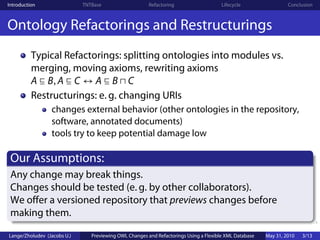
Ontology Refactorings and Restructurings
          Typical Refactorings: splitting ontologies into modules vs.
          merging, moving axioms, rewriting axioms
          A B, A C ↔ A B C
          Restructurings: e. g. changing URIs
                 changes external behavior (other ontologies in the repository,
                 software, annotated documents)
                 tools try to keep potential damage low

 Our Assumptions:
 Any change may break things.
 Changes should be tested (e. g. by other collaborators).
 We offer a versioned repository that previews changes before
 making them.

Lange/Zholudev (Jacobs U.)      Previewing OWL Changes and Refactorings Using a Flexible XML Database   May 31, 2010   3/13
Introduction                 TNTBase                    Refactoring                    Lifecycle                 Conclusion


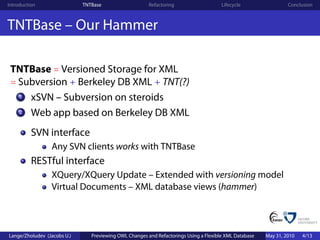
TNTBase – Our Hammer

 TNTBase = Versioned Storage for XML
 = Subversion + Berkeley DB XML + TNT(?)
   1 xSVN – Subversion on steroids
   2 Web app based on Berkeley DB XML
          SVN interface
                 Any SVN clients works with TNTBase
          RESTful interface
                 XQuery/XQuery Update – Extended with versioning model
                 Virtual Documents – XML database views (hammer)


Lange/Zholudev (Jacobs U.)      Previewing OWL Changes and Refactorings Using a Flexible XML Database   May 31, 2010   4/13
Introduction                 TNTBase                    Refactoring                    Lifecycle                 Conclusion


Virtual Documents: Editable XML Views


          VDoc Specification defines VDocs:
                 Mixture of static XML elements and XQueries
                 XQueries can reside separately, can be overriden
                 Parameters for XQueries
          Queryable
          Editable
          Materializable

               VDocs – means to refactor ontologies


Lange/Zholudev (Jacobs U.)      Previewing OWL Changes and Refactorings Using a Flexible XML Database   May 31, 2010   5/13
Introduction                 TNTBase                    Refactoring                    Lifecycle                 Conclusion


Factoring out a Submodule
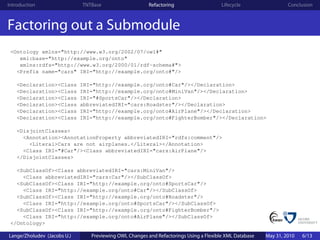
 <Ontology xmlns="http://www.w3.org/2002/07/owl#"
    xml:base="http://example.org/onto"
    xmlns:rdfs="http://www.w3.org/2000/01/rdf-schema#">
   <Prefix name="cars" IRI="http://example.org/onto#"/>

   <Declaration><Class       IRI="http://example.org/onto#Car"/></Declaration>
   <Declaration><Class       IRI="http://example.org/onto#MiniVan"/></Declaration>
   <Declaration><Class       IRI="#SportsCar"/></Declaration>
   <Declaration><Class       abbreviatedIRI="cars:Roadster"/></Declaration>
   <Declaration><Class       IRI="http://example.org/onto#AirPlane"/></Declaration>
   <Declaration><Class       IRI="http://example.org/onto#FighterBomber"/></Declaration>

   <DisjointClasses>
     <Annotation><AnnotationProperty abbreviatedIRI="rdfs:comment"/>
       <Literal>Cars are not airplanes.</Literal></Annotation>
     <Class IRI="#Car"/><Class abbreviatedIRI="cars:AirPlane"/>
   </DisjointClasses>

   <SubClassOf><Class abbreviatedIRI="cars:MiniVan"/>
     <Class abbreviatedIRI="cars:Car"/></SubClassOf>
   <SubClassOf><Class IRI="http://example.org/onto#SportsCar"/>
     <Class IRI="http://example.org/onto#Car"/></SubClassOf>
   <SubClassOf><Class IRI="http://example.org/onto#Roadster"/>
     <Class IRI="http://example.org/onto#SportsCar"/></SubClassOf>
   <SubClassOf><Class IRI="http://example.org/onto#FighterBomber"/>
     <Class IRI="http://example.org/onto#AirPlane"/></SubClassOf>
 </Ontology>

Lange/Zholudev (Jacobs U.)      Previewing OWL Changes and Refactorings Using a Flexible XML Database   May 31, 2010   6/13
Introduction                 TNTBase                    Refactoring                    Lifecycle                 Conclusion


Factoring out a Submodule
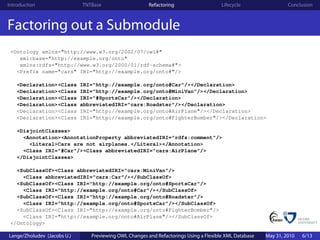
 <Ontology xmlns="http://www.w3.org/2002/07/owl#"
    xml:base="http://example.org/onto"
    xmlns:rdfs="http://www.w3.org/2000/01/rdf-schema#">
   <Prefix name="cars" IRI="http://example.org/onto#"/>

   <Declaration><Class       IRI="http://example.org/onto#Car"/></Declaration>
   <Declaration><Class       IRI="http://example.org/onto#MiniVan"/></Declaration>
   <Declaration><Class       IRI="#SportsCar"/></Declaration>
   <Declaration><Class       abbreviatedIRI="cars:Roadster"/></Declaration>
   <Declaration><Class       IRI="http://example.org/onto#AirPlane"/></Declaration>
   <Declaration><Class       IRI="http://example.org/onto#FighterBomber"/></Declaration>

   <DisjointClasses>
     <Annotation><AnnotationProperty abbreviatedIRI="rdfs:comment"/>
       <Literal>Cars are not airplanes.</Literal></Annotation>
     <Class IRI="#Car"/><Class abbreviatedIRI="cars:AirPlane"/>
   </DisjointClasses>

   <SubClassOf><Class abbreviatedIRI="cars:MiniVan"/>
     <Class abbreviatedIRI="cars:Car"/></SubClassOf>
   <SubClassOf><Class IRI="http://example.org/onto#SportsCar"/>
     <Class IRI="http://example.org/onto#Car"/></SubClassOf>
   <SubClassOf><Class IRI="http://example.org/onto#Roadster"/>
     <Class IRI="http://example.org/onto#SportsCar"/></SubClassOf>
   <SubClassOf><Class IRI="http://example.org/onto#FighterBomber"/>
     <Class IRI="http://example.org/onto#AirPlane"/></SubClassOf>
 </Ontology>

Lange/Zholudev (Jacobs U.)      Previewing OWL Changes and Refactorings Using a Flexible XML Database   May 31, 2010   6/13
Introduction                 TNTBase                    Refactoring                    Lifecycle                 Conclusion


Factoring out a Submodule
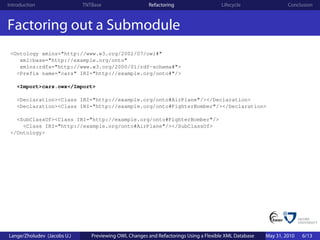
 <Ontology xmlns="http://www.w3.org/2002/07/owl#"
    xml:base="http://example.org/onto"
    xmlns:rdfs="http://www.w3.org/2000/01/rdf-schema#">
   <Prefix name="cars" IRI="http://example.org/onto#"/>

   <Import>cars.owx</Import>

   <Declaration><Class IRI="http://example.org/onto#AirPlane"/></Declaration>
   <Declaration><Class IRI="http://example.org/onto#FighterBomber"/></Declaration>

   <SubClassOf><Class IRI="http://example.org/onto#FighterBomber"/>
     <Class IRI="http://example.org/onto#AirPlane"/></SubClassOf>
 </Ontology>


Lange/Zholudev (Jacobs U.)      Previewing OWL Changes and Refactorings Using a Flexible XML Database   May 31, 2010   6/13
Introduction                 TNTBase                    Refactoring                    Lifecycle                 Conclusion


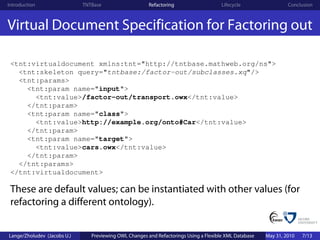
Virtual Document Specification for Factoring out

 <tnt:virtualdocument xmlns:tnt="http://tntbase.mathweb.org/ns">
   <tnt:skeleton query="tntbase:/factor-out/subclasses.xq"/>
   <tnt:params>
     <tnt:param name="input">
       <tnt:value>/factor-out/transport.owx</tnt:value>
     </tnt:param>
     <tnt:param name="class">
       <tnt:value>http://example.org/onto#Car</tnt:value>
     </tnt:param>
     <tnt:param name="target">
       <tnt:value>cars.owx</tnt:value>
     </tnt:param>
   </tnt:params>
 </tnt:virtualdocument>

 These are default values; can be instantiated with other values (for
 refactoring a different ontology).


Lange/Zholudev (Jacobs U.)      Previewing OWL Changes and Refactorings Using a Flexible XML Database   May 31, 2010   7/13
Introduction                 TNTBase                    Refactoring                    Lifecycle                 Conclusion


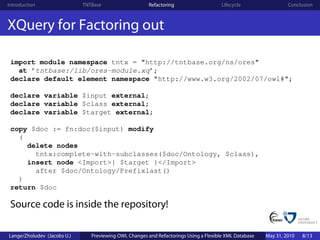
XQuery for Factoring out

 import module namespace tntx = "http://tntbase.org/ns/ores"
   at ’tntbase:/lib/ores-module.xq’;
 declare default element namespace "http://www.w3.org/2002/07/owl#";

 declare variable $input external;
 declare variable $class external;
 declare variable $target external;

 copy $doc := fn:doc($input) modify
   (
     delete nodes
       tntx:complete-with-subclasses($doc/Ontology, $class),
     insert node <Import>{ $target }</Import>
       after $doc/Ontology/Prefixlast()
   )
 return $doc

 Source code is inside the repository!

Lange/Zholudev (Jacobs U.)      Previewing OWL Changes and Refactorings Using a Flexible XML Database   May 31, 2010   8/13
Introduction                 TNTBase                    Refactoring                    Lifecycle                 Conclusion


The Underlying Library
 declare function tntx:complete-with-subclasses($onto as element(),
   $class as xs:string) as element()* {
   (: for all tntx:subclasses, return tntx:axioms-for-class :)
 };

 declare function tntx:axioms-for-class($onto as element(), $class as xs:anyURI) as element()* {
   (: Declaration, SubClassOf, EquivalentClasses, DisjointClasses, ... :)
 };

 declare function tntx:subclasses($onto as element(), $class as xs:anyURI) as xs:anyURI* {
   for $subclass in
     $onto/SubClassOf[tntx:expandIRIOf(Class[2]) eq $class]/Class[1]/tntx:expandIRIOf(.)
   return ($subclass, tntx:subclasses($onto, $subclass))
 };

 declare function tntx:expandIRIOf($parent as element()) as xs:anyURI {
     if ($parent/@IRI)
     then tntx:resolveIRIAgainstBase($parent/@IRI)
     else if ($parent/@abbreviatedIRI)
     then tntx:expandAbbreviatedIRI($parent/@abbreviatedIRI)
     else (: throw error :)
 };


          Key functionality: IRI expansion, equality of OWL expressions
          Source code is inside the repository!
Lange/Zholudev (Jacobs U.)      Previewing OWL Changes and Refactorings Using a Flexible XML Database   May 31, 2010   9/13
Introduction                 TNTBase                    Refactoring                    Lifecycle                 Conclusion


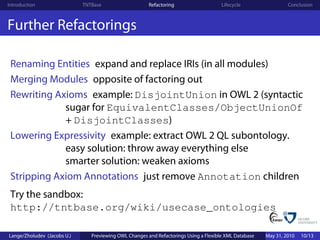
Further Refactorings

 Renaming Entities expand and replace IRIs (in all modules)
 Merging Modules opposite of factoring out
 Rewriting Axioms example: DisjointUnion in OWL 2 (syntactic
             sugar for EquivalentClasses/ObjectUnionOf
             + DisjointClasses)
 Lowering Expressivity example: extract OWL 2 QL subontology.
             easy solution: throw away everything else
             smarter solution: weaken axioms
 Stripping Axiom Annotations just remove Annotation children
 Try the sandbox:
 http://tntbase.org/wiki/usecase_ontologies

Lange/Zholudev (Jacobs U.)      Previewing OWL Changes and Refactorings Using a Flexible XML Database   May 31, 2010   10/13
Introduction                 TNTBase                    Refactoring                    Lifecycle                 Conclusion


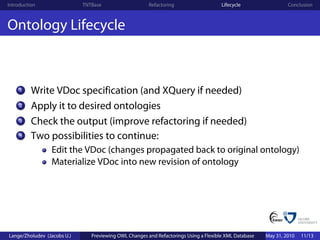
Ontology Lifecycle


     1    Write VDoc specification (and XQuery if needed)
     2    Apply it to desired ontologies
     3    Check the output (improve refactoring if needed)
     4    Two possibilities to continue:
                 Edit the VDoc (changes propagated back to original ontology)
                 Materialize VDoc into new revision of ontology


Lange/Zholudev (Jacobs U.)      Previewing OWL Changes and Refactorings Using a Flexible XML Database   May 31, 2010   11/13
Introduction                 TNTBase                    Refactoring                    Lifecycle                 Conclusion


Towards Practical Applications


          TNTBase scales well
                 so far tested with different documents → AI Mashup Challenge,
                 ESWC Demo Session
                 starting to use it as a BioPortal backend
          TNTBase as a storage backend for Protégé or NeOn Toolkit
          Use OWL Diff to optimize storage of revision history
          TNTBase as a frontend application: human-readable rendering
          of interactive semantic documents → ESWC Demo Session


Lange/Zholudev (Jacobs U.)      Previewing OWL Changes and Refactorings Using a Flexible XML Database   May 31, 2010   12/13
Introduction                 TNTBase                    Refactoring                    Lifecycle                 Conclusion


Conclusion


          TNTBase safely implements ontology refactorings as views.
          Thanks to XQuery Update and our utility functions, TNTBase
          processes ontologies ‘‘semantically’’
          TNTBase enables agile collaborative refactoring.
 Try the sandbox:
 http://tntbase.org/wiki/usecase_ontologies


Lange/Zholudev (Jacobs U.)      Previewing OWL Changes and Refactorings Using a Flexible XML Database   May 31, 2010   13/13

Previewing OWL Changes and Refactorings Using a Flexible XML Database

  • 1.
    Introduction TNTBase Refactoring Lifecycle Conclusion Previewing OWL Changes and Refactorings Using a Flexible XML Database Ontology Repositories and Editors @ ESWC 2010 Christoph Lange and Vyacheslav Zholudev Jacobs University, Bremen, Germany KWARC – Knowledge Adaptation and Reasoning for Content May 31, 2010 Lange/Zholudev (Jacobs U.) Previewing OWL Changes and Refactorings Using a Flexible XML Database May 31, 2010 1/13
  • 2.
    Introduction TNTBase Refactoring Lifecycle Conclusion Ontology Refactoring and Change Management Definition (Change Management for Ontologies) ‘‘the process of performing the changes as well as [. . . ] the process of coping with the consequences of changes’’ (Klein 2004) Definition (Refactoring [in Software Engineering]) ‘‘a disciplined technique for restructuring an existing body of code, altering its internal structure without changing its external behavior’’ (Fowler) Lange/Zholudev (Jacobs U.) Previewing OWL Changes and Refactorings Using a Flexible XML Database May 31, 2010 2/13
  • 3.
    Introduction TNTBase Refactoring Lifecycle Conclusion Ontology Refactorings and Restructurings Typical Refactorings: splitting ontologies into modules vs. merging, moving axioms, rewriting axioms A B, A C ↔ A B C Restructurings: e. g. changing URIs changes external behavior (other ontologies in the repository, software, annotated documents) tools try to keep potential damage low Our Assumptions: Any change may break things. Changes should be tested (e. g. by other collaborators). We offer a versioned repository that previews changes before making them. Lange/Zholudev (Jacobs U.) Previewing OWL Changes and Refactorings Using a Flexible XML Database May 31, 2010 3/13
  • 4.
    Introduction TNTBase Refactoring Lifecycle Conclusion TNTBase – Our Hammer TNTBase = Versioned Storage for XML = Subversion + Berkeley DB XML + TNT(?) 1 xSVN – Subversion on steroids 2 Web app based on Berkeley DB XML SVN interface Any SVN clients works with TNTBase RESTful interface XQuery/XQuery Update – Extended with versioning model Virtual Documents – XML database views (hammer) Lange/Zholudev (Jacobs U.) Previewing OWL Changes and Refactorings Using a Flexible XML Database May 31, 2010 4/13
  • 5.
    Introduction TNTBase Refactoring Lifecycle Conclusion Virtual Documents: Editable XML Views VDoc Specification defines VDocs: Mixture of static XML elements and XQueries XQueries can reside separately, can be overriden Parameters for XQueries Queryable Editable Materializable VDocs – means to refactor ontologies Lange/Zholudev (Jacobs U.) Previewing OWL Changes and Refactorings Using a Flexible XML Database May 31, 2010 5/13
  • 6.
    Introduction TNTBase Refactoring Lifecycle Conclusion Factoring out a Submodule <Ontology xmlns="http://www.w3.org/2002/07/owl#" xml:base="http://example.org/onto" xmlns:rdfs="http://www.w3.org/2000/01/rdf-schema#"> <Prefix name="cars" IRI="http://example.org/onto#"/> <Declaration><Class IRI="http://example.org/onto#Car"/></Declaration> <Declaration><Class IRI="http://example.org/onto#MiniVan"/></Declaration> <Declaration><Class IRI="#SportsCar"/></Declaration> <Declaration><Class abbreviatedIRI="cars:Roadster"/></Declaration> <Declaration><Class IRI="http://example.org/onto#AirPlane"/></Declaration> <Declaration><Class IRI="http://example.org/onto#FighterBomber"/></Declaration> <DisjointClasses> <Annotation><AnnotationProperty abbreviatedIRI="rdfs:comment"/> <Literal>Cars are not airplanes.</Literal></Annotation> <Class IRI="#Car"/><Class abbreviatedIRI="cars:AirPlane"/> </DisjointClasses> <SubClassOf><Class abbreviatedIRI="cars:MiniVan"/> <Class abbreviatedIRI="cars:Car"/></SubClassOf> <SubClassOf><Class IRI="http://example.org/onto#SportsCar"/> <Class IRI="http://example.org/onto#Car"/></SubClassOf> <SubClassOf><Class IRI="http://example.org/onto#Roadster"/> <Class IRI="http://example.org/onto#SportsCar"/></SubClassOf> <SubClassOf><Class IRI="http://example.org/onto#FighterBomber"/> <Class IRI="http://example.org/onto#AirPlane"/></SubClassOf> </Ontology> Lange/Zholudev (Jacobs U.) Previewing OWL Changes and Refactorings Using a Flexible XML Database May 31, 2010 6/13
  • 7.
    Introduction TNTBase Refactoring Lifecycle Conclusion Factoring out a Submodule <Ontology xmlns="http://www.w3.org/2002/07/owl#" xml:base="http://example.org/onto" xmlns:rdfs="http://www.w3.org/2000/01/rdf-schema#"> <Prefix name="cars" IRI="http://example.org/onto#"/> <Declaration><Class IRI="http://example.org/onto#Car"/></Declaration> <Declaration><Class IRI="http://example.org/onto#MiniVan"/></Declaration> <Declaration><Class IRI="#SportsCar"/></Declaration> <Declaration><Class abbreviatedIRI="cars:Roadster"/></Declaration> <Declaration><Class IRI="http://example.org/onto#AirPlane"/></Declaration> <Declaration><Class IRI="http://example.org/onto#FighterBomber"/></Declaration> <DisjointClasses> <Annotation><AnnotationProperty abbreviatedIRI="rdfs:comment"/> <Literal>Cars are not airplanes.</Literal></Annotation> <Class IRI="#Car"/><Class abbreviatedIRI="cars:AirPlane"/> </DisjointClasses> <SubClassOf><Class abbreviatedIRI="cars:MiniVan"/> <Class abbreviatedIRI="cars:Car"/></SubClassOf> <SubClassOf><Class IRI="http://example.org/onto#SportsCar"/> <Class IRI="http://example.org/onto#Car"/></SubClassOf> <SubClassOf><Class IRI="http://example.org/onto#Roadster"/> <Class IRI="http://example.org/onto#SportsCar"/></SubClassOf> <SubClassOf><Class IRI="http://example.org/onto#FighterBomber"/> <Class IRI="http://example.org/onto#AirPlane"/></SubClassOf> </Ontology> Lange/Zholudev (Jacobs U.) Previewing OWL Changes and Refactorings Using a Flexible XML Database May 31, 2010 6/13
  • 8.
    Introduction TNTBase Refactoring Lifecycle Conclusion Factoring out a Submodule <Ontology xmlns="http://www.w3.org/2002/07/owl#" xml:base="http://example.org/onto" xmlns:rdfs="http://www.w3.org/2000/01/rdf-schema#"> <Prefix name="cars" IRI="http://example.org/onto#"/> <Import>cars.owx</Import> <Declaration><Class IRI="http://example.org/onto#AirPlane"/></Declaration> <Declaration><Class IRI="http://example.org/onto#FighterBomber"/></Declaration> <SubClassOf><Class IRI="http://example.org/onto#FighterBomber"/> <Class IRI="http://example.org/onto#AirPlane"/></SubClassOf> </Ontology> Lange/Zholudev (Jacobs U.) Previewing OWL Changes and Refactorings Using a Flexible XML Database May 31, 2010 6/13
  • 9.
    Introduction TNTBase Refactoring Lifecycle Conclusion Virtual Document Specification for Factoring out <tnt:virtualdocument xmlns:tnt="http://tntbase.mathweb.org/ns"> <tnt:skeleton query="tntbase:/factor-out/subclasses.xq"/> <tnt:params> <tnt:param name="input"> <tnt:value>/factor-out/transport.owx</tnt:value> </tnt:param> <tnt:param name="class"> <tnt:value>http://example.org/onto#Car</tnt:value> </tnt:param> <tnt:param name="target"> <tnt:value>cars.owx</tnt:value> </tnt:param> </tnt:params> </tnt:virtualdocument> These are default values; can be instantiated with other values (for refactoring a different ontology). Lange/Zholudev (Jacobs U.) Previewing OWL Changes and Refactorings Using a Flexible XML Database May 31, 2010 7/13
  • 10.
    Introduction TNTBase Refactoring Lifecycle Conclusion XQuery for Factoring out import module namespace tntx = "http://tntbase.org/ns/ores" at ’tntbase:/lib/ores-module.xq’; declare default element namespace "http://www.w3.org/2002/07/owl#"; declare variable $input external; declare variable $class external; declare variable $target external; copy $doc := fn:doc($input) modify ( delete nodes tntx:complete-with-subclasses($doc/Ontology, $class), insert node <Import>{ $target }</Import> after $doc/Ontology/Prefixlast() ) return $doc Source code is inside the repository! Lange/Zholudev (Jacobs U.) Previewing OWL Changes and Refactorings Using a Flexible XML Database May 31, 2010 8/13
  • 11.
    Introduction TNTBase Refactoring Lifecycle Conclusion The Underlying Library declare function tntx:complete-with-subclasses($onto as element(), $class as xs:string) as element()* { (: for all tntx:subclasses, return tntx:axioms-for-class :) }; declare function tntx:axioms-for-class($onto as element(), $class as xs:anyURI) as element()* { (: Declaration, SubClassOf, EquivalentClasses, DisjointClasses, ... :) }; declare function tntx:subclasses($onto as element(), $class as xs:anyURI) as xs:anyURI* { for $subclass in $onto/SubClassOf[tntx:expandIRIOf(Class[2]) eq $class]/Class[1]/tntx:expandIRIOf(.) return ($subclass, tntx:subclasses($onto, $subclass)) }; declare function tntx:expandIRIOf($parent as element()) as xs:anyURI { if ($parent/@IRI) then tntx:resolveIRIAgainstBase($parent/@IRI) else if ($parent/@abbreviatedIRI) then tntx:expandAbbreviatedIRI($parent/@abbreviatedIRI) else (: throw error :) }; Key functionality: IRI expansion, equality of OWL expressions Source code is inside the repository! Lange/Zholudev (Jacobs U.) Previewing OWL Changes and Refactorings Using a Flexible XML Database May 31, 2010 9/13
  • 12.
    Introduction TNTBase Refactoring Lifecycle Conclusion Further Refactorings Renaming Entities expand and replace IRIs (in all modules) Merging Modules opposite of factoring out Rewriting Axioms example: DisjointUnion in OWL 2 (syntactic sugar for EquivalentClasses/ObjectUnionOf + DisjointClasses) Lowering Expressivity example: extract OWL 2 QL subontology. easy solution: throw away everything else smarter solution: weaken axioms Stripping Axiom Annotations just remove Annotation children Try the sandbox: http://tntbase.org/wiki/usecase_ontologies Lange/Zholudev (Jacobs U.) Previewing OWL Changes and Refactorings Using a Flexible XML Database May 31, 2010 10/13
  • 13.
    Introduction TNTBase Refactoring Lifecycle Conclusion Ontology Lifecycle 1 Write VDoc specification (and XQuery if needed) 2 Apply it to desired ontologies 3 Check the output (improve refactoring if needed) 4 Two possibilities to continue: Edit the VDoc (changes propagated back to original ontology) Materialize VDoc into new revision of ontology Lange/Zholudev (Jacobs U.) Previewing OWL Changes and Refactorings Using a Flexible XML Database May 31, 2010 11/13
  • 14.
    Introduction TNTBase Refactoring Lifecycle Conclusion Towards Practical Applications TNTBase scales well so far tested with different documents → AI Mashup Challenge, ESWC Demo Session starting to use it as a BioPortal backend TNTBase as a storage backend for Protégé or NeOn Toolkit Use OWL Diff to optimize storage of revision history TNTBase as a frontend application: human-readable rendering of interactive semantic documents → ESWC Demo Session Lange/Zholudev (Jacobs U.) Previewing OWL Changes and Refactorings Using a Flexible XML Database May 31, 2010 12/13
  • 15.
    Introduction TNTBase Refactoring Lifecycle Conclusion Conclusion TNTBase safely implements ontology refactorings as views. Thanks to XQuery Update and our utility functions, TNTBase processes ontologies ‘‘semantically’’ TNTBase enables agile collaborative refactoring. Try the sandbox: http://tntbase.org/wiki/usecase_ontologies Lange/Zholudev (Jacobs U.) Previewing OWL Changes and Refactorings Using a Flexible XML Database May 31, 2010 13/13