Download as PDF, PPTX

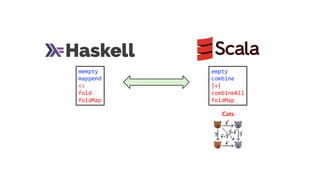
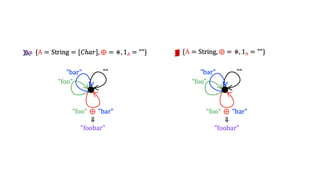
![> mempty::String
""
> "foo" <> mempty
"foo"
> mempty <> "bar"
"bar"
> "foo" <> "bar"
"foobar"
> mempty <> mempty::String
""
> fold ([]::[String])
""
> fold ["foo", "bar", "baz"]
"foobarbaz”
> foldMap (s -> fmap toUpper s) ["foo", "bar", "baz"]
"FOOBARBAZ"
> val empty = Monoid[String].empty
val empty: String = ""
> "foo" |+| empty
val res1: String = foo
> empty |+| "bar"
val res2: String = bar
> "foo" |+| "bar"
val res3: String = foobar
> empty |+| empty
val res4: String = ""
> List.empty[String].combineAll
val res5: String = ""
> List("foo", "bar", "baz").combineAll
val res6: String = foobarbaz
> List("foo", "bar", "baz").foldMap(_.toUpperCase)
val res7: String = FOOBARBAZ
> import cats.implicits.*
> import cats.syntax.*
> import cats.Monoid](https://image.slidesharecdn.com/folding-cheat-sheet-8-241013160859-c2fa9ffb/85/Folding-Cheat-Sheet-8-eighth-in-a-series-7-320.jpg)
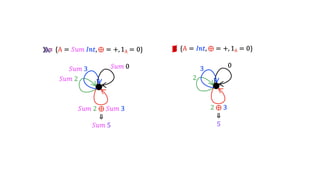
![> getSum (mempty::Sum Int)
0
> getSum (Sum 2 <> mempty)
2
> getSum (mempty <> Sum 3)
3
> getSum (Sum 2 <> Sum 3)
5
> getSum (mempty <> mempty::Sum Int)
0
> getSum (fold ([]::[Sum Int]))
0
> getSum (fold (fmap Sum [1, 2, 3, 4]))
10
> getSum (foldMap Sum [1, 2, 3, 4])
10
newtype Sum a = Sum {getSum :: a}
> val empty = Monoid[Int].empty
val empty: Int = 0
> 2 |+| empty
val res1: Int = 2
> empty |+| 3
val res2: Int = 3
> 2 |+| 3
val res3: Int = 5
> empty |+| empty
val res4: Int = 0
> List.empty[Int].combineAll
val res5: Int = 0
> List(1, 2, 3, 4).combineAll
val res6: Int = 10
> List(1, 2, 3, 4).foldMap(_ + 10)
val res7: Int = 50
> import cats.implicits.*
> import cats.syntax.*
> import cats.Monoid](https://image.slidesharecdn.com/folding-cheat-sheet-8-241013160859-c2fa9ffb/85/Folding-Cheat-Sheet-8-eighth-in-a-series-9-320.jpg)
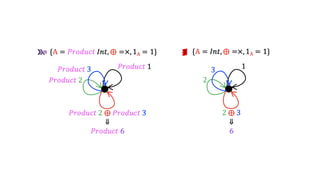
![> getProduct (mempty::Product Int)
1
> getProduct (Product 2 <> mempty)
2
> getProduct (mempty <> Product 3)
3
> getProduct (Product 2 <> Product 3)
6
> getProduct (mempty <> mempty::Product Int)
1
> getProduct (fold ([]::[Product Int]))
1
> getProduct (fold (fmap Product [1, 2, 3, 4]))
24
> getProduct (foldMap Product [1, 2, 3, 4])
24
newtype Product a = Product {getProduct :: a}
> given Monoid[Int] =
Monoid.instance(emptyValue = 1, cmb = _ * _)
> val empty = Monoid[Int].empty
val empty: Int = 1
> 2 |+| empty
val res1: Int = 2
> empty |+| 3
val res2: Int = 3
> 2 |+| 3
val res3: Int = 6
> empty |+| empty
val res4: Int = 1
> List.empty[Int].combineAll
val res5: Int = 1
> List(1, 2, 3, 4).combineAll
val res6: Int = 24
> List(1, 2, 3, 4).foldMap(_ + 10)
val res7: Int = 24024
> import cats.implicits.catsSyntaxSemigroup
> import cats.syntax.foldable.*
> import cats.Monoid](https://image.slidesharecdn.com/folding-cheat-sheet-8-241013160859-c2fa9ffb/85/Folding-Cheat-Sheet-8-eighth-in-a-series-11-320.jpg)
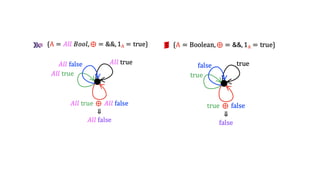
![> getAll (mempty::All)
True
> getAll (All True <> mempty)
True
> getAll (All False <> mempty)
False
> getAll (mempty <> All True)
True
> getAll (mempty <> All False)
False
> getAll (mempty <> mempty::All)
True
> getAll (All False <> All False)
False
newtype All = All {getAll :: Bool}
> given Monoid[Boolean] =
Monoid.instance(emptyValue = true, cmb = _ && _)
> val empty = Monoid[Boolean].empty
val empty: Boolean = true
> true |+| empty
val res1: Boolean = true
> false |+| empty
val res2: Boolean = false
> empty |+| true
val res3: Boolean = true
> empty |+| false
val res4: Boolean = false
> empty |+| empty
val res5: Boolean = true
> false |+| false
val res6: Boolean = false
> import cats.implicits.*
> import cats.syntax.*
> import cats.Monoid](https://image.slidesharecdn.com/folding-cheat-sheet-8-241013160859-c2fa9ffb/85/Folding-Cheat-Sheet-8-eighth-in-a-series-13-320.jpg)
![> getAll (fold ([]::[All]))
True
> getAll (fold (fmap All [True, True, True]))
True
> getAll (fold (fmap All [True, False, True]))
False
> getAll (foldMap All [True, True, True])
True
> getAll (foldMap All [True, True, False])
False
> List.empty[Boolean].combineAll
val res7: Boolean = true
> List(true, true, true).combineAll
val res8: Boolean = true
> List(true, false, true).combineAll
val res9: Boolean = false
> List(false, false, false).foldMap(!_)
val res10: Boolean = true
> List(false, true, false).foldMap(!_)
val res11: Boolean = false](https://image.slidesharecdn.com/folding-cheat-sheet-8-241013160859-c2fa9ffb/85/Folding-Cheat-Sheet-8-eighth-in-a-series-14-320.jpg)
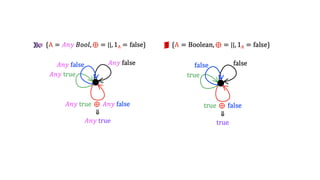
![> getAny (mempty::Any)
False
> getAny (Any True <> mempty)
True
> getAny (Any False <> mempty)
False
> getAny (mempty <> Any True)
True
> getAny (mempty <> Any False)
False
> getAny (mempty <> mempty:: Any)
False
> getAny (Any True <> Any True)
True
newtype Any = Any {getAny :: Bool}
> given Monoid[Boolean] =
Monoid.instance(emptyValue = false, cmb = _ || _)
> val empty = Monoid[Boolean].empty
val empty: Boolean = false
> true |+| empty
val res1: Boolean = true
> false |+| empty
val res2: Boolean = false
> empty |+| true
val res3: Boolean = true
> empty |+| false
val res4: Boolean = false
> empty |+| empty
val res5: Boolean = false
> true |+| true
val res6: Boolean = true
> import cats.implicits.*
> import cats.syntax.*
> import cats.Monoid](https://image.slidesharecdn.com/folding-cheat-sheet-8-241013160859-c2fa9ffb/85/Folding-Cheat-Sheet-8-eighth-in-a-series-16-320.jpg)
![> getAny (fold ([]::[Any]))
False
> getAny (fold (fmap Any [False, True, False]))
True
> getAny (fold (fmap Any [False, False, False]))
False
> getAny (foldMap Any [False, True, False])
True
> getAny (foldMap Any [False, False, False])
False
> List.empty[Boolean].combineAll
val res7: Boolean = false
> List(false, true, false).combineAll
val res8: Boolean = true
> List(false, false, false).combineAll
val res9: Boolean = false
> List(true, false, true).foldMap(!_)
val res10: Boolean = true
> List(true, true, true).foldMap(!_)
val res11: Boolean = false](https://image.slidesharecdn.com/folding-cheat-sheet-8-241013160859-c2fa9ffb/85/Folding-Cheat-Sheet-8-eighth-in-a-series-17-320.jpg)
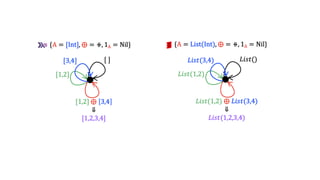
![> mempty::[Int]
[]
> [1,2] <> mempty
[1,2]
> mempty <> [3,4]
[3,4]
> [1,2] <> [3,4]
[1,2,3,4]
> mempty <> mempty::[Int]
[]
> fold (mempty::[[Int]])
[]
> fold [[1,2],[3,4,5],[6]]
[1,2,3,4,5,6]
> foldMap tail [[1,2],[3,4,5],[6]]
[2,4,5]
> val empty = Monoid[List[Int]].empty
val empty: List[Int] = List()
> List(1,2) |+| empty
val res1: List[Int] = List(1, 2)
> empty |+| List(3,4)
val res2: List[Int] = List(3, 4)
> List(1,2) |+| List(3,4)
val res3: List[Int] = List(1, 2, 3, 4)
> empty |+| empty
val res4: List[Int] = List()
> List.empty[List[Int]].combineAll
val res5: List[Int] = List()
> List(List(1,2),List(3,4,5),List(6)).combineAll
val res6: List[Int] = List (1, 2, 3, 4, 5, 6)
> List(List(1,2),List(3,4,5),List(6)).foldMap(_.tail)
val res7: List[Int] = List(2, 4, 5)
> import cats.implicits.*
> import cats.syntax.*
> import cats.Monoid](https://image.slidesharecdn.com/folding-cheat-sheet-8-241013160859-c2fa9ffb/85/Folding-Cheat-Sheet-8-eighth-in-a-series-19-320.jpg)
![instance Semigroup a => Semigroup (Maybe a) where
Nothing <> b = b
a <> Nothing = a
Just a <> Just b = Just (a <> b)
instance Semigroup a => Monoid (Maybe a) where
mempty = Nothing
class OptionMonoid[A]
(implicit A: Semigroup[A]) extends Monoid[Option[A]] {
def empty: Option[A] = None
def combine(x: Option[A], y: Option[A]): Option[A] =
x match {
case None => y
case Some(a) =>
y match {
case None => x
case Some(b) => Some(A.combine(a, b)) } } }](https://image.slidesharecdn.com/folding-cheat-sheet-8-241013160859-c2fa9ffb/85/Folding-Cheat-Sheet-8-eighth-in-a-series-20-320.jpg)
![> mempty :: Maybe (Sum Int)
Nothing
> Just (Sum 2) <> Just (Sum 3)
Just (Sum {getSum = 5})
> Just (Sum 2) <> mempty
Just (Sum {getSum = 2})
> mempty <> Just (Sum 3)
Just (Sum {getSum = 3})
>(mempty :: Maybe (Sum Int)) <> mempty
Nothing
> fold ([]::[Maybe (Sum Int)])
Nothing
> fold [Just (Sum 1), Nothing, Just (Sum 2), Nothing, Just (Sum 3), Just (Sum 4)]
Just (Sum {getSum = 10})
> fold (fmap (x -> fmap Sum x) [Just 1, Nothing, Just 2, Nothing, Just 3, Just 4])
Just (Sum {getSum = 10})
> foldMap (x -> fmap Sum x) [Just 1, Nothing, Just 2, Nothing, Just 3, Just 4]
Just (Sum {getSum = 10})](https://image.slidesharecdn.com/folding-cheat-sheet-8-241013160859-c2fa9ffb/85/Folding-Cheat-Sheet-8-eighth-in-a-series-21-320.jpg)
![> val empty = Monoid[Option[Int]].empty
val empty: Option[Int] = None
> 2.some |+| 3.some
val res1: Option[Int] = Some(5)
> 2.some |+| empty
val res2: Option[Int] = Some(2)
> empty |+| 3.some
val res3: Option[Int] = Some(3)
> empty |+| empty
val res4: Option[Int] = None
> List.empty[Option[Int]].combineAll
val res5: Option[Int] = None
> List(1.some, none, 2.some, none, 3.some, 4.some).combineAll
val res6: Option[Int] = Some(10)
> List(1.some, none, 2.some, none, 3.some, 4.some).foldMap(_.map(_ * 10))
val res7: Option[Int] = Some(100)
> import cats.implicits.*
> import cats.syntax.*
> import cats.Monoid](https://image.slidesharecdn.com/folding-cheat-sheet-8-241013160859-c2fa9ffb/85/Folding-Cheat-Sheet-8-eighth-in-a-series-22-320.jpg)
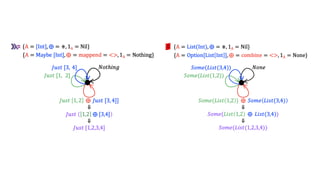
![> mempty :: Maybe [Int]
Nothing
> Just [1,2] <> Just [3,4]
Just [1,2,3,4]
> Just [1,2] <> mempty
Just [1,2]
> mempty <> Just [3,4]
Just [3,4]
>(mempty :: Maybe [Int]) <> mempty
Nothing
> fold ([]::[Maybe [Int]])
Nothing
> fold [Just [1,2], Nothing, Just [3,4,5], Nothing, Just [6]]
Just [1,2,3,4,5,6]
> foldMap (x -> fmap tail x) [Just [1,2], Nothing, Just [3,4,5], Nothing, Just [6]]
Just [2,4,5]](https://image.slidesharecdn.com/folding-cheat-sheet-8-241013160859-c2fa9ffb/85/Folding-Cheat-Sheet-8-eighth-in-a-series-24-320.jpg)
![> val empty = Monoid[Option[List[Int]]].empty
val empty: Option[List[Int]] = None
> List(1,2).some |+| List(3,4).some
val res1: Option[List[Int]] = Some(List(1,2,3,4))
> List(1,2).some |+| empty
val res2: Option[List[Int]] = Some(List(1,2))
> empty |+| List(3,4).some
val res3: Option[List[Int]] = Some(List(3,4))
> empty |+| empty
val res4: Option[List[Int]] = None
> List.empty[Option[List[Int]]].combineAll
val res5: Option[List[Int]] = None
> List(List(1,2).some , none, List(3,4,5).some, none, List(6).some).combineAll
val res6: Option[List[Int]] = Some(List(1,2,3,4,5,6))
> List(List(1,2).some , none, List(3,4,5).some, none, List(6).some).foldMap(_.map(_.tail))
val res7: Option[List[Int]] = Some(List(2,4,5))
> import cats.implicits.*
> import cats.syntax.*
> import cats.Monoid](https://image.slidesharecdn.com/folding-cheat-sheet-8-241013160859-c2fa9ffb/85/Folding-Cheat-Sheet-8-eighth-in-a-series-25-320.jpg)
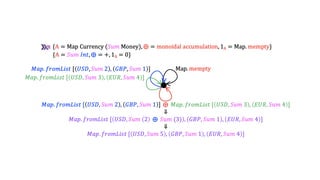
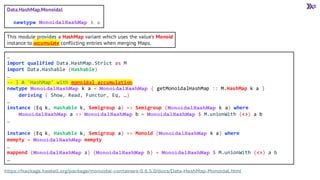
![> {-# LANGUAGE DeriveGeneric #-}
> import Data.HashMap.Monoidal (MonoidalHashMap)
> import qualified Data.HashMap.Monoidal as MonoidalHashMap
> data Currency = EUR | USD | GBP deriving (Eq, Ord, Enum, Show, Generic)
> type Money = Int
> instance Hashable Currency
> type Account = MonoidalHashMap Currency Money
> account1 = MonoidalHashMap.fromList [(USD, 10), (GBP, 5), (EUR, 1)]
> account2 = MonoidalHashMap.fromList [(GBP, 2)]
> account3 = MonoidalHashMap.fromList [(USD, 3), (EUR, 5)]
> mempty :: MonoidalHashMap Currency (Sum Money)
MonoidalHashMap {getMonoidalHashMap = fromList []}
> fmap getSum ((fmap Sum account1) <> mempty)
MonoidalHashMap {getMonoidalHashMap = fromList [(EUR,1),(GBP,5),(USD,10)]}
> fmap getSum ((fmap Sum account1) <> (fmap Sum account2))
MonoidalHashMap {getMonoidalHashMap = fromList [(EUR,1),(GBP,7),(USD,10)]}
> (fmap getSum (fold (fmap (fmap Sum) [account1, account2, account3])))
MonoidalHashMap {getMonoidalHashMap = fromList [(EUR,6),(GBP,7),(USD,13)]}
> (fmap getSum (foldMap (fmap Sum) [account1, account2, account3]))
MonoidalHashMap {getMonoidalHashMap = fromList [(EUR,6),(GBP,7),(USD,13)]}](https://image.slidesharecdn.com/folding-cheat-sheet-8-241013160859-c2fa9ffb/85/Folding-Cheat-Sheet-8-eighth-in-a-series-28-320.jpg)
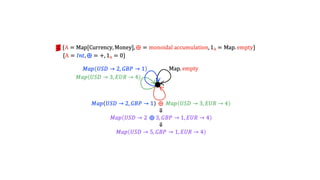
 extends Monoid[Map[K, V]] {
def empty: Map[K, V] = Map.empty
def combine(xs: Map[K, V], ys: Map[K, V]): Map[K, V] =
if (xs.size <= ys.size) {
xs.foldLeft(ys) { case (my, (k, x)) =>
my.updated(k, Semigroup.maybeCombine(x, my.get(k)))
}
} else {
ys.foldLeft(xs) { case (mx, (k, y)) =>
mx.updated(k, Semigroup.maybeCombine(mx.get(k), y))
}
}
override def combineAll(xss: IterableOnce[Map[K, V]]): Map[K, V] = …
…
abstract class SemigroupFunctions[S[T] <: Semigroup[T]] {
…
def maybeCombine[@sp(Int, Long, Float, Double) A](ox: Option[A], y: A)(implicit ev: S[A]): A = ox match {
case Some(x) => ev.combine(x, y)
case None => y
}
def maybeCombine[@sp(Int, Long, Float, Double) A](x: A, oy: Option[A])(implicit ev: S[A]): A = oy match {
case Some(y) => ev.combine(x, y)
case None => x
}
…
Cats
https://typelevel.org/cats/api/cats/kernel/instances/MapMonoid.html](https://image.slidesharecdn.com/folding-cheat-sheet-8-241013160859-c2fa9ffb/85/Folding-Cheat-Sheet-8-eighth-in-a-series-30-320.jpg)
![> enum Currency { case EUR, USD, GBP }
> type Money = Int
> type Account = Map[Currency, Money]
> object Account { def apply(amounts: (Currency, Money)*): Account = amounts.toMap }
> val empty = Monoid[Account].empty
val empty: Account = Map()
> val account1 = Account(USD -> 10, GBP -> 5, EUR -> 1)
val account1: Account = Map(USD -> 10, GBP -> 5, EUR -> 1)
> val account2 = Account(GBP -> 2)
val account2: Account = Map(GBP -> 2)
> val account3 = Account(USD -> 3, EUR -> 5)
val account3: Account = Map(USD -> 3, EUR -> 5)
> account1 |+| empty
val res1: Account = Map(USD -> 10, GBP -> 5, EUR -> 1)
> account1 |+| account2
val res2: Account = Map(USD -> 10, GBP -> 7, EUR -> 1)
> List(account1, account2, account3).combineAll
val res3: Map[Currency, Money] = Map(GBP -> 7, USD -> 13, EUR -> 6)
> List(account1, account2, account3).foldMap(_.transform{ case (k,v) => v * 10 })
val res4: Map[Currency, Int] = Map(GBP -> 70, USD -> 130, EUR -> 60)](https://image.slidesharecdn.com/folding-cheat-sheet-8-241013160859-c2fa9ffb/85/Folding-Cheat-Sheet-8-eighth-in-a-series-31-320.jpg)
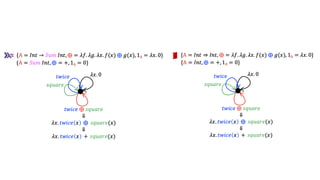
![> val empty = Monoid[Endo[Int]].empty
val empty: cats.Endo[Int] = …
> def increment(n: Int): Int = n + 1
> def twice(n: Int): Int = 2 * n
> def square(n: Int): Int = n * n
> empty(33)
val res0: Int = 0
> (increment |+| empty)(5)
val res1: Int = 6
> (empty |+| twice)(5)
val res2: Int = 10
> (increment |+| twice)(5)
val res3: Int = 16
> (empty |+| empty)(5)
val res4: Int = 0
> List.empty[Endo[Int]].combineAll.apply(5)
val res5: Int = 0
> List(increment,twice,square).combineAll.apply(5)
val res6: Int = 41
> increment n = n + 1
> twice n = 2 * n
> square n = n * n
> getSum ((mempty :: Int -> Sum Int) 33)
0
> getSum ((increment <> mempty) 5)
6
> getSum ((mempty <> twice) 5)
10
> getSum ((increment <> twice) 5)
16
> getSum ((mempty <> (mempty::Int -> Sum Int)) 5)
0
> getSum (fold ([]::[Int -> Sum Int]) 5)
0
> getSum (fold [increment, twice, square ] 5)
41
newtype Sum a = Sum {getSum :: a}
> import cats.implicits.*
> import cats.syntax.*
> import cats.Monoid
instance Num a => Monoid (Sum a)
instance Monoid b => Monoid (a -> b)
type Endo[A] = A => A
> import cats.Endo](https://image.slidesharecdn.com/folding-cheat-sheet-8-241013160859-c2fa9ffb/85/Folding-Cheat-Sheet-8-eighth-in-a-series-33-320.jpg)
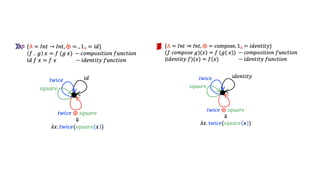
![> given endoMonoid: Monoid[Int => Int] =
MonoidK[Endo].algebra[Int]
> def increment(n: Int): Int = n + 1
> def twice(n: Int): Int = 2 * n
> def square(n: Int): Int = n * n
> empty(33)
val res0: Int = 33
> (increment |+| twice)(5)
val res1: Int = 11
> (endoMonoid.empty |+| twice)(5)
val res2: Int = 10
> (increment |+| endoMonoid.empty)(5)
val res3: Int = 6
> (endoMonoid.empty |+| endoMonoid.empty)(5)
val res4: Int = 5
> List.empty[Int => Int].combineAll.apply(5)
val res5: Int = 5
> List(increment,twice,square).combineAll.apply(5)
val res6: Int = 51
> increment n = n + 1
> twice n = 2 * n
> square n = n * n
> appEndo (mempty::Endo Int) 33
33
> appEndo ((Endo increment) <> (Endo twice)) 5
11
> appEndo (mempty <> (Endo twice)) 5
10
> appEndo (Endo increment <> mempty) 5
6
> appEndo (mempty <> (mempty::Endo Int)) 5
5
> appEndo (fold (fmap Endo [increment,twice,square]))5
51
> appEndo (foldMap Endo [increment,twice,square]) 5
51
import cats.implicits.catsSyntaxSemigroup
import cats.syntax.foldable.*
import cats.{Monoid,MonoidK}
type Endo :: * -> *
newtype Endo a = Endo {appEndo :: a -> a}
…
instance Monoid (Endo a)
instance Semigroup (Endo a)
type Endo[A] = A=>A
import cats.Endo](https://image.slidesharecdn.com/folding-cheat-sheet-8-241013160859-c2fa9ffb/85/Folding-Cheat-Sheet-8-eighth-in-a-series-35-320.jpg)
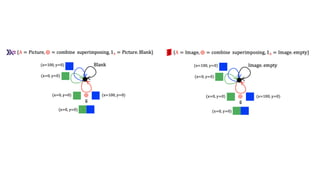
![import Graphics.Gloss
main :: IO ()
main = display window white rgbcmyRectangle
squareImage = rectangleSolid (fromIntegral 100) (fromIntegral 100)
[redSquare, greenSquare, blueSquare, cyanSquare, magentaSquare, yellowSquare] =
fmap ((colour, index) -> translate (-100 * (2-index) - 50) 0 (color colour squareImage))
(zip [red, green, blue, cyan, magenta, yellow] [0..])
rgbRectangle = redSquare <> greenSquare <> blueSquare
rgbcmyRectangle = fold [rgbRectangle, cyanSquare, magentaSquare, yellowSquare]
window = InWindow "RGBCMY Squares" (600, 100) (0,0)](https://image.slidesharecdn.com/folding-cheat-sheet-8-241013160859-c2fa9ffb/85/Folding-Cheat-Sheet-8-eighth-in-a-series-37-320.jpg)
![import cats.Monoid
import cats.effect.unsafe.implicits.global
import cats.implicits.*
import doodle.core.*
import doodle.image.*
import doodle.image.syntax.*
import doodle.image.syntax.all.*
import doodle.image.syntax.core.*
import doodle.java2d.*
@main
def main(): Unit =
val squareImage = Image.square(100)
val List(redSquare, greenSquare, blueSquare, cyanSquare, magentaSquare, yellowSquare) =
List(Color.red, Color.green, Color.blue, Color.cyan, Color.magenta, Color.yellow)
.zipWithIndex.map((color, index) => squareImage.at(index * 100, 0).fillColor(color))
given Monoid[Image] = Monoid.instance[Image](Image.empty, _ on _)
val rgbRectangle: Image = redSquare |+| greenSquare |+| blueSquare
val rgbcmyRectangle: Image = List(rgbRectangle, cyanSquare, magentaSquare, yellowSquare).combineAll
rgbcmyRectangle.drawWithFrame(Frame.default.withTitle("RGBCMY Squares"))](https://image.slidesharecdn.com/folding-cheat-sheet-8-241013160859-c2fa9ffb/85/Folding-Cheat-Sheet-8-eighth-in-a-series-38-320.jpg)

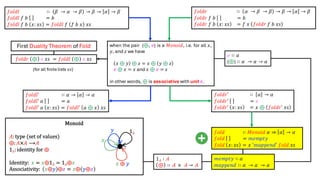
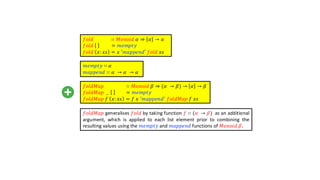
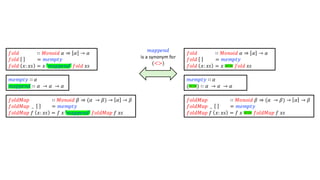
The document discusses various operations related to folding lists and monoids in functional programming, focusing on functions like foldr, foldl, and foldmap. It details the implementation of monoids for different data types, such as integers and booleans, explaining how these operations can be combined and utilized in functional contexts. The document includes examples and definitions related to the use of the Cats library in Scala for handling monoidal structures.


![Using either foldLeft or foldRight to concatenate the elements of list[T] usi...](https://cdn.slidesharecdn.com/ss_thumbnails/usingeitherfoldleftorfoldrighttoconcatenatetheelementsoflistmonoidtusingthemonoidszeroanditsbinaryop-170723143056-thumbnail.jpg?width=640&height=640&fit=bounds)


