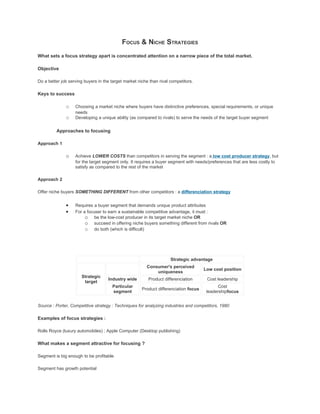
FOCUS & NICHE STRATEGIES
What sets a focus strategy apart is concentrated attention on a narrow piece of the total market.

Objective

Do a better job serving buyers in the target market niche than rival competitors.

Keys to success

              o    Choosing a market niche where buyers have distinctive preferences, special requirements, or unique
                   needs
              o    Developing a unique ability (as compared to rivals) to serve the needs of the target buyer segment


         Approaches to focusing

Approach 1

              o    Achieve LOWER COSTS than competitors in serving the segment : a low cost producer strategy, but
                   for the target segment only. It requires a buyer segment with needs/preferences that are less costly to
                   satisfy as compared to the rest of the market

Approach 2

Offer niche buyers SOMETHING DIFFERENT from other competitors : a differenciation strategy


              •    Requires a buyer segment that demands unique product attributes
              •    For a focuser to earn a sustainable competitive advantage, it must :
                        o be the low-cost producer in its target market niche OR
                        o succeed in offering niche buyers something different from rivals OR
                        o do both (which is difficult)


                                                                     Strategic advantage
                                                        Consumer's perceived
                                                                                      Low cost position
                                                            uniqueness
                      Strategic
                                    Industry wide        Product differenciation       Cost leadership
                       target
                                      Particular                                            Cost
                                                      Product differenciation focus
                                      segment                                          leadershipfocus


Source : Porter, Competitive strategy : Techniques for analyzing industries and competitors, 1980

Examples of focus strategies :

Rolls Royce (luxury automobiles) ; Apple Computer (Desktop publishing)

What makes a segment attractive for focusing ?

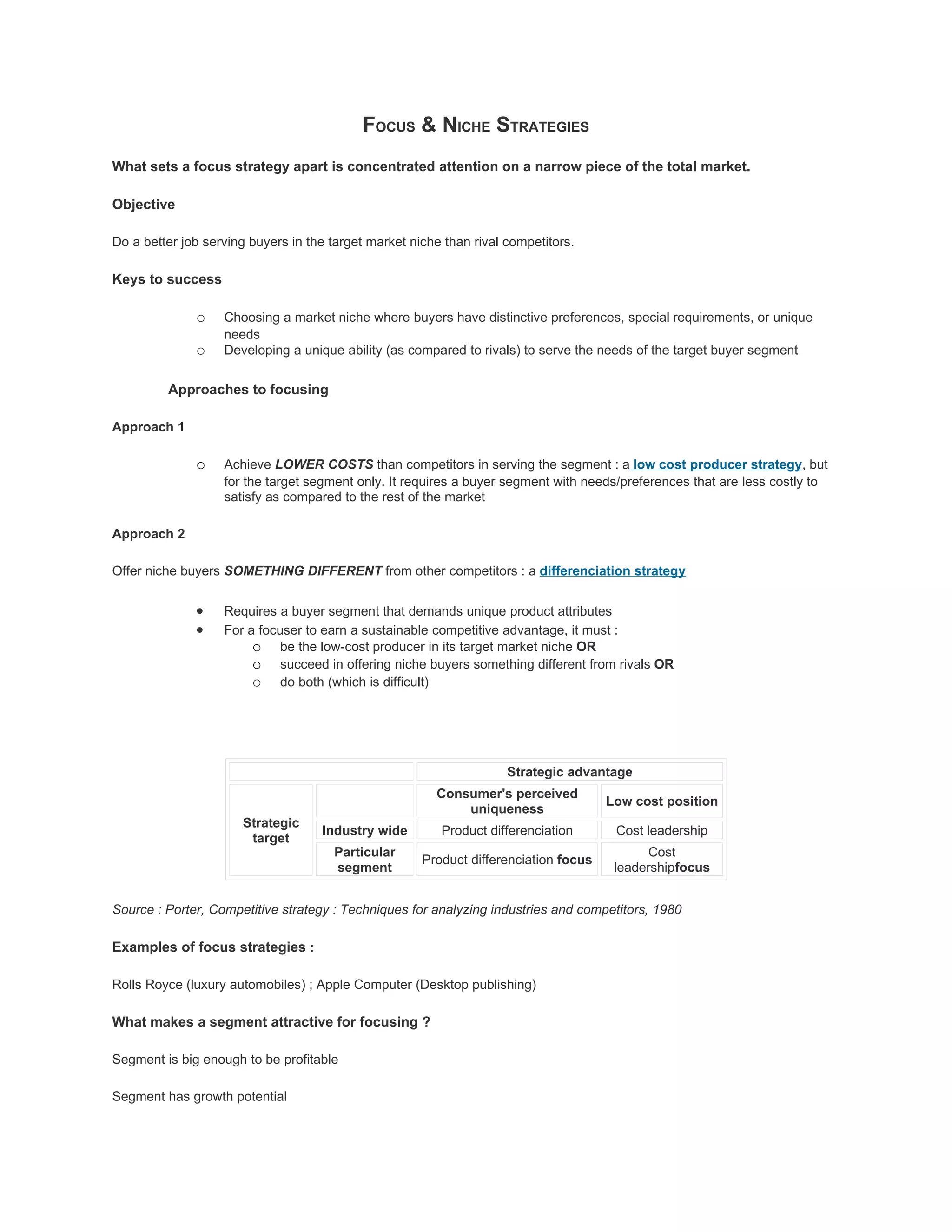
Segment is big enough to be profitable

Segment has growth potential
Segment is not crucial to the success of major competitors

Focusing firm has the skills and resources to serve the segment effectively

Focuser can defend itself against challengers via the customer goodwill it has built up and its superior ability to serve buyers
in the segment

Competitive strategy principle :

The competitive power of a focus strategy is greatest when :

The industry has fast-growing segments that are big enough to be profitable but small enough to be of secondary interest to
large competitors

No other rivals are concentrating on the segment

Buyers in the segment require specialized expertise or customized product attributes

The competitive strengths of a focus strategy

A focuser's specialized ability to serve the target market niche builds a defense against competitive forces (See : Porter 5
forces : rival competitors, buyers, suppliers, potential entrants, substitutes)

Situations where a focus strategy works best

When it is costly or difficult for multi-segment rivals to serve the specialized needs of the target market niche

When no other rivals are concentrating on the same target segment

When a firm's resources do not permit it to go after a wider portion of the market

When the industry has many different segments, creating more focusing opportunities and allowing a focuser to pick out an
attractive segment suited to its strengths and capabilities

The risks of a focus strategy

Broad-line, multi-segment competitors may find effective ways to match the focused firm in serving the narrow target market

The niche buyer's preferences and needs may drift more and more towards the product attributes desired by the market as a
whole

The segment may become so appealing that it is soon crowded with eager, aggressive rivals, causing segment profits to be
split too many ways.


Sources :

Strategic Management, Raphael Amit, Professor at Wharton University of Pennsylvania, US


Strategy formulation and complementation : Tasks of the General Manager, by Arthur A. Thompson, Jr & A.J.
Strickland III, 1992

Competitive Advantage, Michael E. Porter, 1985
Competitive Strategy, Michael E. Porter (1980) and Thompson & Strickland (1992)


Gaining and Soustaining Competitive Advantage, Jay. B. Barney, Addison-Wesley, 1997


Contemporary Strategic Analysis, Robert M. Grant, 3th edition, Blackwell, 1998

Focus & niche strategies

  • 1.
    FOCUS & NICHESTRATEGIES What sets a focus strategy apart is concentrated attention on a narrow piece of the total market. Objective Do a better job serving buyers in the target market niche than rival competitors. Keys to success o Choosing a market niche where buyers have distinctive preferences, special requirements, or unique needs o Developing a unique ability (as compared to rivals) to serve the needs of the target buyer segment Approaches to focusing Approach 1 o Achieve LOWER COSTS than competitors in serving the segment : a low cost producer strategy, but for the target segment only. It requires a buyer segment with needs/preferences that are less costly to satisfy as compared to the rest of the market Approach 2 Offer niche buyers SOMETHING DIFFERENT from other competitors : a differenciation strategy • Requires a buyer segment that demands unique product attributes • For a focuser to earn a sustainable competitive advantage, it must : o be the low-cost producer in its target market niche OR o succeed in offering niche buyers something different from rivals OR o do both (which is difficult) Strategic advantage Consumer's perceived Low cost position uniqueness Strategic Industry wide Product differenciation Cost leadership target Particular Cost Product differenciation focus segment leadershipfocus Source : Porter, Competitive strategy : Techniques for analyzing industries and competitors, 1980 Examples of focus strategies : Rolls Royce (luxury automobiles) ; Apple Computer (Desktop publishing) What makes a segment attractive for focusing ? Segment is big enough to be profitable Segment has growth potential
  • 2.
    Segment is notcrucial to the success of major competitors Focusing firm has the skills and resources to serve the segment effectively Focuser can defend itself against challengers via the customer goodwill it has built up and its superior ability to serve buyers in the segment Competitive strategy principle : The competitive power of a focus strategy is greatest when : The industry has fast-growing segments that are big enough to be profitable but small enough to be of secondary interest to large competitors No other rivals are concentrating on the segment Buyers in the segment require specialized expertise or customized product attributes The competitive strengths of a focus strategy A focuser's specialized ability to serve the target market niche builds a defense against competitive forces (See : Porter 5 forces : rival competitors, buyers, suppliers, potential entrants, substitutes) Situations where a focus strategy works best When it is costly or difficult for multi-segment rivals to serve the specialized needs of the target market niche When no other rivals are concentrating on the same target segment When a firm's resources do not permit it to go after a wider portion of the market When the industry has many different segments, creating more focusing opportunities and allowing a focuser to pick out an attractive segment suited to its strengths and capabilities The risks of a focus strategy Broad-line, multi-segment competitors may find effective ways to match the focused firm in serving the narrow target market The niche buyer's preferences and needs may drift more and more towards the product attributes desired by the market as a whole The segment may become so appealing that it is soon crowded with eager, aggressive rivals, causing segment profits to be split too many ways. Sources : Strategic Management, Raphael Amit, Professor at Wharton University of Pennsylvania, US Strategy formulation and complementation : Tasks of the General Manager, by Arthur A. Thompson, Jr & A.J. Strickland III, 1992 Competitive Advantage, Michael E. Porter, 1985
  • 3.
    Competitive Strategy, MichaelE. Porter (1980) and Thompson & Strickland (1992) Gaining and Soustaining Competitive Advantage, Jay. B. Barney, Addison-Wesley, 1997 Contemporary Strategic Analysis, Robert M. Grant, 3th edition, Blackwell, 1998