TAVIFOP INSUFICIENCIA MITRALDENERVACIÓN RENAL
NOVEDADES EN CARDIOPATIA ESTRUCTURAL
José María Hernández
Hospital Universitario Virgen de la Victoria.Málaga
TAVIFOP INSUFICIENCIA MITRALDENERVACIÓN RENALDENERVACIÓN RENAL
TAVIFOP INSUFICIENCIA MITRALDENERVACIÓN RENAL
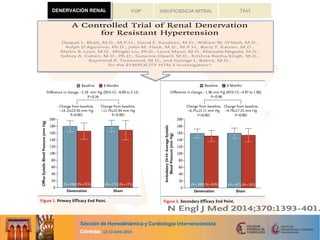
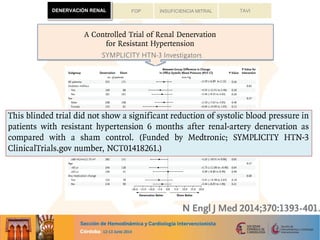
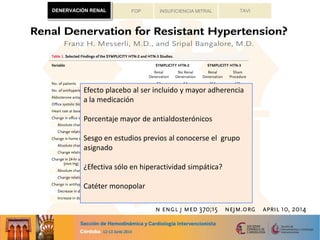
Efecto placebo al ser incluido y mayor adherencia
a la medicación
Porcentaje mayor de antialdosterónicos
Sesgo en estudios previos al conocerse el grupo
asignado
¿Efectiva sólo en hiperactividad simpática?
Catéter monopolar
DENERVACIÓN RENAL
TAVIFOP INSUFICIENCIA MITRALDENERVACIÓN RENAL FOP
TAVIFOP INSUFICIENCIA MITRALDENERVACIÓN RENAL INSUFIENCIA MITRAL
TAVIFOP INSUFICIENCIA MITRALDENERVACIÓN RENAL
Final Results of the EVEREST
Controlled Trial of Percutane
Reduction of Mitral Reg
Ted Feldman, MD, FACC, F
on behalf of the EVEREST II I
ACC 2014
Washington, DC
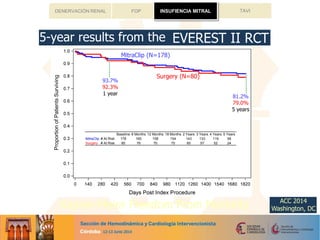
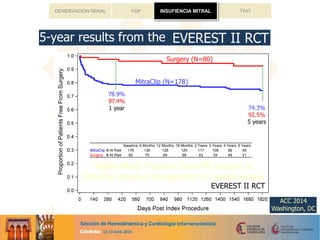
Kaplan-Meier Freedom From Mortality
EVEREST II RCT
Baseline 6 Months 12 Months 18 Months 2 Years 3 Years 4 Years 5 Years
MitraClip # At Risk 178 165 158 154 143 133 119 58
Surgery # At Risk 80 76 70 70 65 57 52 24
93.7%
92.3%
1 year
81.2%
79.0%
5 years
MitraClip (N=178)
Surgery (N=80)
PML04247 Rev. A
Kaplan-Meier Freedom From Mortality
EVEREST II RCT
MitraClip (N=178)
INSUFIENCIA MITRAL
TAVIFOP INSUFICIENCIA MITRALDENERVACIÓN RENAL
Baseline 6 Months 12 Months 18 Months 2 Years 3 Years 4 Years 5 Years
MitraClip # At Risk 178 136 128 125 117 109 98 45
Surgery # At Risk 80 75 69 68 63 54 49 21
78.9%
97.4%
1 year 74.3%
92.5%
5 years
MitraClip (N=178)
Surgery (N=80)
Kaplan-Meier Freedom From MV Surgery in
MitraClip Group or Re-operation in Surgery Group
EVEREST II RCT
PML04247 Rev. A
78.9%
97.4%
1 year 74.3%
92.5%
5 years
MitraClip (N=178)
Surgery (N=80)
Kaplan-Meier Freedom From MV Surgery in
MitraClip Group or Re-operation in Surgery Group
Final Results of the EVEREST
Controlled Trial of Percutane
Reduction of Mitral Reg
Ted Feldman, MD, FACC, F
on behalf of the EVEREST II I
ACC 2014
Washington, DC
INSUFIENCIA MITRAL
TAVIFOP INSUFICIENCIA MITRALDENERVACIÓN RENAL
Final Results of the EVEREST
Controlled Trial of Percutane
Reduction of Mitral Reg
Ted Feldman, MD, FACC, F
on behalf of the EVEREST II I
ACC 2014
Washington, DC
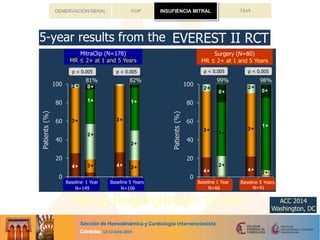
Mitral Regurgitation Grade
EVEREST II RCT All Treated Patients (N=258)
MitraClip (N=178)
2+
4+
3+
2+
1+
2+
0+0+
2+
4+
3+
Surgery (N=80)
2+
4+
3+
3+ 3+
2+
2+
1+1+
4+
3+
81% 82%
Baseline 1 Year
0+
Baseline 1 Year
99% 98%
1+
N=149
Baseline 5 Years
N=106
p < 0.005 p < 0.005 p < 0.005 p < 0.005
N=66
Baseline 5 Years
N=41
N = survivors with paired data; p-values for descriptive purposes only PML04247 Rev. AMitral Regurgitation Grade
EVEREST II RCT All Treated Patients (N=258)
MitraClip (N=178) Surgery (N=80)
INSUFIENCIA MITRAL
TAVIFOP INSUFICIENCIA MITRALDENERVACIÓN RENAL
Final Results of the EVEREST
Controlled Trial of Percutane
Reduction of Mitral Reg
Ted Feldman, MD, FACC, F
on behalf of the EVEREST II I
ACC 2014
Washington, DC
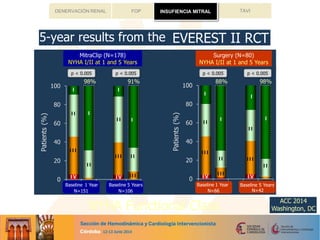
NYHA Functional Class
EVEREST II RCT All Treated Patients (N=258)
MitraClip (N=178)
NYHA I/II at 1 and 5 Years
I I
I V
I I I
I I I
I I
I I
I
I
I I
I V
I I I
Surgery (N=80)
NYHA I/II at 1 and 5 Years
I I
I V
I I I
I I I
I I
I I
I
I
I I
I V
I I I
98% 91% 88% 98%
I I
I I
p < 0.005 p < 0.005 p < 0.005 p < 0.005
Baseline 1 Year
N=151
Baseline 5 Years
N=106
Baseline 1 Year
N=66
Baseline 5 Years
N=42
N = survivors with paired data; p-values for descriptive purposes only PML04247 Rev. ANYHA Functional Class
EVEREST II RCT All Treated Patients (N=258)
MitraClip (N=178) Surgery (N=80)
INSUFIENCIA MITRAL
TAVIFOP INSUFICIENCIA MITRALDENERVACIÓN RENAL INSUFIENCIA MITRAL
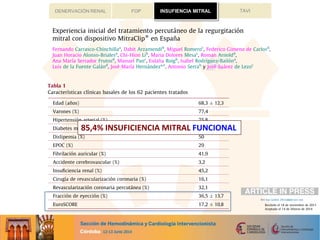
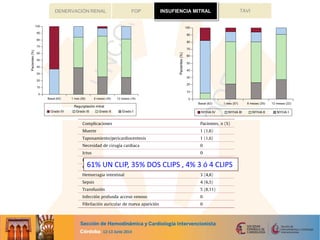
85,4% INSUFICIENCIA MITRAL FUNCIONAL
TAVIFOP INSUFICIENCIA MITRALDENERVACIÓN RENAL INSUFIENCIA MITRAL
61% UN CLIP, 35% DOS CLIPS , 4% 3 ó 4 CLIPS
TAVIFOP INSUFICIENCIA MITRALDENERVACIÓN RENAL TAVI
TAVIFOP INSUFICIENCIA MITRALDENERVACIÓN RENAL
...........................................................................................................................................................
...........................................................................................................................................................
sPapoutsis,Steffen Schneider,Armin W elz,and Friedrich W .Mohr,for the
utive Board
y, Medical Clinic I,Kerckhoff Heart and Thorax Center, University of Giessen, Benekestrasse. 2-8, Bad Nauheim 61231,Germany
sed 5 August 2013;accepted 22 August 2013
Aorticstenosisisafrequent valvular diseaseespeciallyinelderlypatients.Catheter-basedvalveimplantationhasemerged
asavaluabletreatment approachfor thesepatientsbeingeither at veryhighriskfor conventional surgeryor evendeemed
inoperable.TheGermanAorticValveRegistry(GARY) providesdataonconventional andcatheter-based aorticproce-
dureson an all-comersbasis.
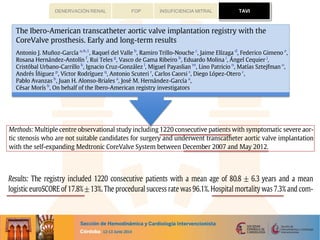
A total of13860consecutivepatientsundergoingrepair for aorticvalvedisease[conventional surgeryandtransvascular
(TV) or transapical (TA) catheter-basedtechniques] havebeenenrolledinthisregistryduring2011andbaseline,proced-
ural,andoutcomedatahavebeenacquired.Theregistrysummarizestheresultsof6523conventional aorticvalverepla-
cementswithout (AVR)and3464withconcomitant coronarybypasssurgery(AVR+ CABG)aswellas2695TVAVIand
1181 TA interventions(TA AVI).Patientsundergoingcatheter-based techniquesweresignificantly older andhadhigher
risk profiles.Thestrokeratewaslow inall groupswith1.3%(AVR),1.9%(AVR+ CABG),1.7%(TVAVI),and 2.3%(TA
AVI).Thein-hospital mortality was2.1%(AVR) and4.5%(AVR+ CABG) for patientsundergoingconventional surgery,
and 5.1%(TVAVI) and AVI 7.7%(TA AVI).
Thein-hospital outcomeresultsof thisregistryshow that conventional surgery yieldsexcellent resultsinall risk groups
and that catheter-based aortic valve replacements is an alternative to conventional surgery in high risk and elderly
patients.
------------------------------------------------------------------------------------------------------------------------------------
Aortic stenosis † Surgery † Catheter-based valvereplacement † GARY
.....................................................................................................................................................................................
.....................................................................................................................................................................................
CLIN ICAL RESEARCH
The German Aortic Valve Registry
(GARY): in-hospital outcome
Christian W . Hamm*, Helge Mo¨llmann, David Holzhey, Andreas Beckmann,
Christof Veit, Hans-Reiner Figulla, J. Cremer, Karl-Heinz Kuck, Ru¨diger Lange,
Ralf Zahn, Stefan Sack, Gerhard Schuler, Thomas W alther, Friedhelm Beyersdorf,
Michael Bo¨hm, Gerd Heusch, Anne-Kathrin Funkat, Thomas Meinertz, Till Neumann,
KonstantinosPapoutsis, Steffen Schneider, Armin W elz, and Friedrich W . Mohr, for the
GARY-Executive Board
Department of Cardiology, Medical Clinic I, Kerckhoff Heart and Thorax Center, University of Giessen, Benekestrasse. 2-8, Bad Nauheim 61231, Germany
Received 24 May2013; revised 5 August 2013; accepted 22 August 2013
Back gr ound Aorticstenosisisafrequent valvular diseaseespeciallyinelderlypatients.Catheter-basedvalveimplantationhasemerged
asavaluabletreatment approachfor thesepatientsbeingeither at veryhighrisk for conventional surgeryor evendeemed
inoperable.TheGerman Aortic ValveRegistry (GARY) providesdataonconventional and catheter-based aortic proce-
dureson an all-comers basis.
Met hods and
r esult s
A total of 13 860consecutive patientsundergoingrepair for aortic valvedisease[conventional surgery and transvascular
(TV) or transapical (TA) catheter-based techniques] havebeenenrolledinthisregistryduring2011andbaseline,proced-
ural,and outcomedatahavebeen acquired.Theregistry summarizestheresultsof 6523 conventional aortic valverepla-
cementswithout (AVR) and3464withconcomitant coronarybypasssurgery(AVR+ CABG) aswell as2695TVAVIand
1181 TA interventions(TA AVI). Patientsundergoingcatheter-based techniquesweresignificantly older and had higher
risk profiles. The strokeratewaslow in all groupswith 1.3%(AVR), 1.9%(AVR+ CABG), 1.7%(TVAVI), and 2.3%(TA
AVI).Thein-hospital mortality was2.1%(AVR) and 4.5%(AVR+ CABG) for patientsundergoingconventional surgery,
and 5.1%(TVAVI) and AVI 7.7%(TA AVI).
Conclusion The in-hospital outcome resultsof thisregistry show that conventional surgery yieldsexcellent resultsin all risk groups
and that catheter-based aortic valve replacements is an alternative to conventional surgery in high risk and elderly
patients.
-----------------------------------------------------------------------------------------------------------------------------------------------------------
Keywor ds Aortic stenosis † Surgery † Catheter-based valve replacement † GARY
Introduction
Aortic stenosis is the most frequent type of valvular heart disease
in the Western Countries and presents mostly in an advanced age
as a calcific form. The prognosis is poor once the patient becomes
symptomatic. Surgical valve replacement isthe established standard
management, which alleviates symptoms and improves survival.1
Valvuloplasty of the stenosed valve hasbeen over many yearsapal-
liative option for the short term for highly selected, inoperable
patients. Recently, catheter-based valve implantations have
become an alternative for selected, particularly elderly
patients.2–4
Smaller, randomized studies confirmed acceptable
outcomesinhighriskandinoperablepatients5,6
for thetransvascu-
lar (TV) as well asthe transapical (TA) approach when compared
European Heart Journal
doi:10.1093/eurheartj/eht381
atBibliotecaVirtualdelSistemaSanitarioPúblicodeAndalucÃ-aonMarch17,2014http://eurheartj.oxfordjournals.org/Downloadedfrom
TAVI
CLINICAL RESEEuropeanHeart Journal
doi:10.1093/eurheartj/eht381
European Heart Journal Advance Access published September 10, 2013
TAVIFOP INSUFICIENCIA MITRALDENERVACIÓN RENAL
.....................................................................................................................................................................................
.....................................................................................................................................................................................
The German Aortic Valve Registry
(GARY): in-hospital outcome
Christian W . Hamm*, Helge Mo¨llmann, David Holzhey, AndreasBeckmann,
Christof Veit, Hans-Reiner Figulla, J. Cremer, Karl-Heinz Kuck, Ru¨diger Lange,
Ralf Zahn, Stefan Sack, Gerhard Schuler, ThomasW alther, Friedhelm Beyersdorf,
Michael Bo¨hm, Gerd Heusch, Anne-Kathrin Funkat, ThomasMeinertz, Till Neumann,
KonstantinosPapoutsis,Steffen Schneider,Armin W elz,and Friedrich W .Mohr,for the
GARY-Executive Board
Department of Cardiology, Medical Clinic I, Kerckhoff Heart and Thorax Center, University of Giessen, Benekestrasse. 2-8, Bad Nauheim 61231,Germany
Received24 May2013;revised 5 August 2013;accepted 22 August 2013
Background Aorticstenosisisafrequent valvular diseaseespeciallyinelderlypatients.Catheter-basedvalveimplantationhasemerged
asavaluabletreatment approachfor thesepatientsbeingeither at veryhighriskfor conventional surgeryor evendeemed
inoperable.TheGermanAorticValveRegistry(GARY) providesdataonconventional andcatheter-based aorticproce-
dureson an all-comersbasis.
Met hods and
result s
A total of13860consecutivepatientsundergoingrepair for aorticvalvedisease[conventional surgeryandtransvascular
(TV) or transapical (TA) catheter-based techniques] havebeenenrolledinthisregistryduring2011andbaseline,proced-
ural,andoutcomedatahavebeenacquired.Theregistrysummarizestheresultsof 6523conventional aorticvalverepla-
cementswithout (AVR) and3464withconcomitant coronarybypasssurgery(AVR+ CABG) aswellas2695TVAVIand
1181TA interventions(TA AVI).Patientsundergoingcatheter-based techniquesweresignificantly older and had higher
risk profiles.Thestrokeratewaslow inall groupswith 1.3%(AVR),1.9%(AVR+ CABG),1.7%(TVAVI),and 2.3%(TA
AVI).Thein-hospital mortality was2.1%(AVR) and4.5%(AVR+ CABG) for patientsundergoingconventional surgery,
and 5.1%(TVAVI) and AVI 7.7%(TA AVI).
Conclusion Thein-hospital outcomeresultsof thisregistry show that conventional surgery yieldsexcellent resultsin all risk groups
and that catheter-based aortic valve replacements is an alternative to conventional surgery in high risk and elderly
patients.
-----------------------------------------------------------------------------------------------------------------------------------------------------------
Keywords Aortic stenosis † Surgery † Catheter-based valvereplacement † GARY
Introduction
Aortic stenosis is the most frequent type of valvular heart disease
in the Western Countries and presents mostly in an advanced age
Valvuloplasty of the stenosed valvehasbeen over many yearsapal-
liative option for the short term for highly selected, inoperable
patients. Recently, catheter-based valve implantations have
become an alternative for selected, particularly elderly
European Heart Journal
doi:10.1093/eurheartj/eht381
atBibliotecaVirtualdelSistemaSanitarioPúblicodeAndalucÃ-aonMarch17,2014http://eurheartj.oxfordjournals.org/Downloadedfrom
TAVI
CLINICAL RESEAEuropeanHeart Journal
doi:10.1093/eurheartj/eht381
European Heart Journal Advance Access published September 10, 2013
TAVIFOP INSUFICIENCIA MITRALDENERVACIÓN RENAL TAVI
TAVIFOP INSUFICIENCIA MITRALDENERVACIÓN RENAL
.....................................................................................................................................................................................
.....................................................................................................................................................................................
CLIN ICA L RESA RCH
TAVI
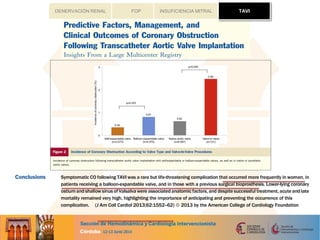
Advanced chronic kidney disease in pat ient s
undergoing t ranscat het er aort ic valve
implant at ion: insight s on clinical out comes and
prognost ic markersfrom a large cohort of pat ient s
Ricar do A llende1†, John G. W ebb2, A nt onio J. Munoz-Gar cia3, Pet er de Jaeger e4,
Cor r ado T am bur ino5, A nt onio E. Dager 6, A sim Cheem a7, Vicenc¸ Ser r a8,
Ignacio A m at -Sant os9, Jam es L. Velianou10, Mar co Bar bant i2, Danny Dvir 2,
Juan H . A lonso-Br iales3, Rut ger -Jan N uis4, Elham ula Faqir i 4, Sebast iano Im m e5,
Luis Miguel Benit ez6, A ngela Mar ia Cucalon6, H at im A l Lawat i7,
Br uno Gar cia del Blanco8, Javier Lopez9, Madhu K. N at ar ajan10,
Rober t DeLar ochellie`r e1, Mar ina U r ena1, H enr ique B. Ribeir o1, Er ic Dum ont 1,
Luis N om bela-Fr anco 1†, and Josep Rode´s-Cabau1*
1
Quebec Heart and LungInstitute, Laval University, Quebec city,QC,Canada; 2
St Paul’sHospital,University of British Columbia, Vancouver,BC,Canada; 3
Hospital Universitario Virgen de
la Victoria, Malaga, Spain; 4
Thoraxcenter-Erasmus MC, Rotterdam, The Netherlands; 5
Ferrarotto Hospital, University of Catania, Catania, Italy; 6
Angiografia de Occidente S.A., Cali,
Colombia; 7
St-Michael’sHospital, Toronto, ON, Canada; 8
Hospital General Universitari Vall d’Hebron, Barcelona, Spain; 9
Hospital Clinico Universitario de Valladolid, Valladolid, Spain;
and 10
Hamilton General Hospital, Hamilton, ON, Canada
Received 11 August 2013; revised 9 February 2014; accepted 3 April 2014
A im Theaimofthisstudywasto determinetheeffectsofadvancedchronickidneydisease(CKD) onearlyandlateoutcomesafter
transcatheter aortic valve implantation (TAVI), and to evaluate the predictive factorsof poorer outcomesin such patients.
M et hods
and r esult s
This was a multicentre study including a total of 2075 consecutive patients who had undergone TAVI. Patients were
grouped according the estimated glomerular filtration rate as follows: CKD stage 1-2 (≥ 60 mL/min/1.73 m2
;
n ¼ 950), stage 3 (30–59 mL/min/1.73 m2
; n ¼ 924), stage 4 (15–29 mL/min/1.73 m2
; n ¼ 134) and stage 5 (, 15 mL/
min/1.73 m2
or dialysis; n ¼ 67). Clinical outcomes were evaluated at 30-days and at follow-up (median of 15 [6–29]
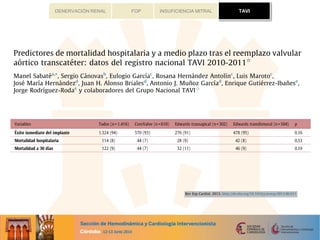
months) and defined according to the VARC criteria. Advanced CKD (stage 4–5) was an independent predictor of
30-day major/life-thr eatening bleeding (P¼ 0.001) and mortality (P¼ 0.027), and late overall, cardiovascular and non-
cardiovascular mortality (P, 0.01 for all).Pre-existingatrial fibrillation (HR:2.29,95%CI:1.47–3.58,P¼ 0.001) and dia-
lysistherapy (HR: 1.86, 95%CI: 1.17–2.97, P¼ 0.009) were the predictorsof mortality in advanced CKD patients, with a
mortality rate ashigh as71%at 1-year follow-up in those patientswith these 2 factors. Advanced CKD patientswho had
survived at 1-year follow-up exhibited both asignificant improvement in NYHA class(P, 0.001) and no deterioration in
valve hemodynamics (P¼ NSfor changes in mean gradient and valve area over time).
Conclusions Advanced CKD wasassociated withahigher rateof earlyand latemortalityand bleedingeventsfollowingTAVI,withAFand
dialysistherapydeterminingahigher risk inthesepatients.Themortality rateof patientswith both factorswasunacceptably
high and thisshould be taken into account in the clinical decision-makingprocessin thischallenginggroup of patients.
- - - - - - - - - - - - - - - - - - - - - - - - - - - - - - - - - - - - - - - - - - - - - - - - - - - - - - - - - - - - - - - - - - - - - - - - - - - - - - - - - - - - - - - - - - - - - - - - - - - - - - - - - - - - - - - - - - - - - - - - - - - - - - - - - - - - - - - - - - - - - - - - - - - - - - - - - - -
K eyw o r ds Chronic kidney disease † Dialysis † Transcatheter aortic valve implantation † Atrial fibrillation
* Corresponding author. Tel: + 1 4186568711, Fax:+ 1 4186564544, Email: josep.rodes@criucpq.ulaval.ca
†
R.A. and L.N.-F. have equally contributed to this work.
Published on behalf of the European Society of Cardiology. All rights reserved. & The Author 2014. For permissions please email: journals.per missions@oup.com.
European Heart Journal
doi:10.1093/eurheartj/ehu175
atBibliotecaVirtualdelSistemaSanitarioPúblicodeAndalucÃ-aonJune4,2014http://eurheartj.oxfordjournals.org/Downloadedfrom
...........................................................................................................................................................
...........................................................................................................................................................
arochellie`re1, Marina Urena1, Henrique B. Ribeiro1, Eric Dumont1,
la-Franco1†
, and Josep Rode´s-Cabau1*
stitute,Laval University,Quebeccity,QC,Canada;2
St Paul’sHospital,UniversityofBritishColumbia,Vancouver,BC,Canada;3
Hospital Universitario Virgende
Thoraxcenter-Erasmus MC, Rotterdam, The Netherlands;5
Ferrarotto Hospital,University of Catania, Catania, Italy; 6
Angiografiade Occidente S.A., Cali,
ospital, Toronto, ON,Canada; 8
Hospital General Universitari Vall d’Hebron, Barcelona, Spain; 9
Hospital Clinico Universitario deValladolid, Valladolid, Spain;
ospital, Hamilton, ON, Canada
evised 9 February2014;accepted 3 April 2014
Theaimofthisstudywastodeterminetheeffectsofadvancedchronickidneydisease(CKD)onearlyandlateoutcomesafter
transcatheter aorticvalveimplantation(TAVI),andto evaluatethepredictivefactorsof poorer outcomesinsuchpatients.
This was a multicentre study including a total of 2075 consecutive patients who had undergone TAVI. Patients were
grouped according the estimated glomerular filtration rate as follows: CKD stage 1-2 (≥ 60 mL/min/1.73 m2
;
n ¼ 950), stage 3 (30–59 mL/min/1.73 m2
; n¼ 924), stage 4 (15–29 mL/min/1.73 m2
;n¼ 134) and stage 5 (, 15 mL/
min/1.73 m2
or dialysis; n ¼ 67). Clinical outcomes were evaluated at 30-daysand at follow-up (median of 15 [6–29]
months) and defined according to the VARC criteria. Advanced CKD (stage 4–5) was an independent predictor of
30-day major/life-threateningbleeding(P¼ 0.001) and mortality (P¼ 0.027), and late overall, cardiovascular and non-
cardiovascular mortality(P, 0.01for all).Pre-existingatrial fibrillation(HR:2.29,95%CI:1.47–3.58,P¼ 0.001) anddia-
lysistherapy(HR:1.86,95%CI:1.17–2.97,P¼ 0.009) werethepredictorsofmortalityinadvanced CKD patients,witha
mortality rateashighas71%at 1-year follow-upinthosepatientswiththese2factors.Advanced CKD patientswho had
survivedat 1-year follow-upexhibited bothasignificant improvement inNYHA class(P, 0.001) andno deteriorationin
valve hemodynamics (P¼ NSfor changesin mean gradient and valveareaover time).
AdvancedCKD wasassociatedwithahigher rateofearlyandlatemortalityandbleedingeventsfollowingTAVI,withAFand
dialysistherapydeterminingahigher riskinthesepatients.Themortalityrateofpatientswithbothfactorswasunacceptably
highand thisshould betaken into account in theclinical decision-makingprocessin thischallenginggroup of patients.
CLINICAL REuropean Heart Journal
doi:10.1093/eurheartj/ehu175
European Heart Journal Advance Access published May 5, 2014
CLINICAL REEuropeanHeart Journal
doi:10.1093/eurheartj/ehu175
European Heart Journal Advance Access published May 5, 2014
TAVI
TAVIFOP INSUFICIENCIA MITRALDENERVACIÓN RENAL TAVI
TAVIFOP INSUFICIENCIA MITRALDENERVACIÓN RENAL
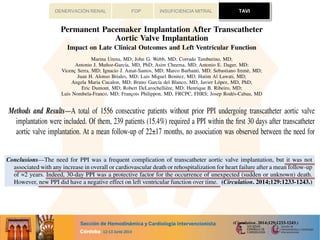
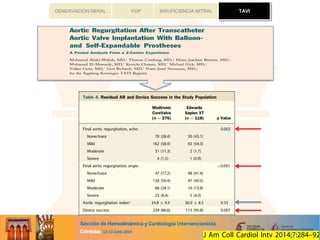
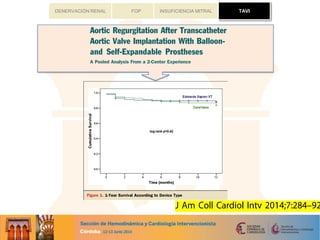
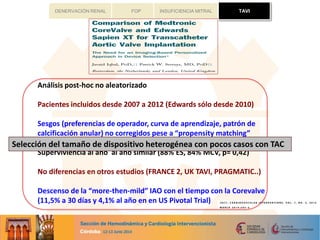
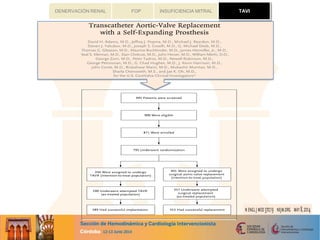
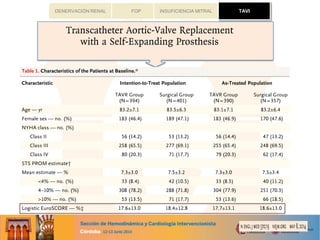
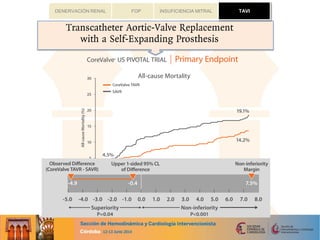
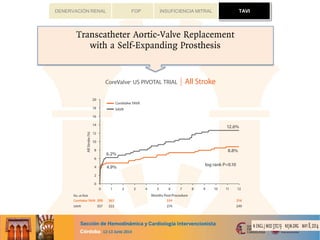
Análisis post-hoc no aleatorizado
Pacientes incluidos desde 2007 a 2012 (Edwards sólo desde 2010)
Sesgos (preferencias de operador, curva de aprendizaje, patrón de
calcificación anular) no corregidos pese a “propensity matching”
Superviviencia al año al año similar (88% ES, 84% MCV, p= 0,42)
No diferencias en otros estudios (FRANCE 2, UK TAVI, PRAGMATIC..)
Descenso de la “more-then-mild” IAO con el tiempo con la Corevalve
(11,5% a 30 días y 4,1% al año en en US Pivotal Trial)
TAVI
Selección del tamaño de dispositivo heterogénea con pocos casos con TAC
TAVIFOP INSUFICIENCIA MITRALDENERVACIÓN RENAL TAVI
TAVIFOP INSUFICIENCIA MITRALDENERVACIÓN RENAL
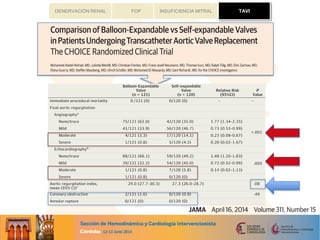
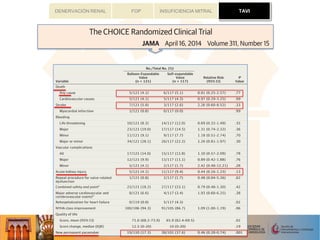
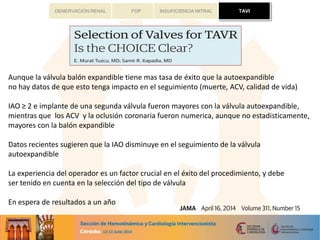
Aunque la válvula balón expandible tiene mas tasa de éxito que la autoexpandible
no hay datos de que esto tenga impacto en el seguimiento (muerte, ACV, calidad de vida)
IAO ≥ 2 e implante de una segunda válvula fueron mayores con la válvula autoexpandible,
mientras que los ACV y la oclusión coronaria fueron numerica, aunque no estadisticamente,
mayores con la balón expandible
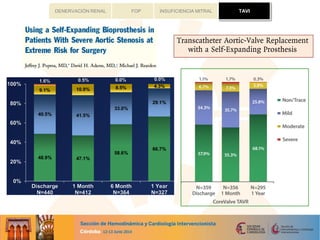
Datos recientes sugieren que la IAO disminuye en el seguimiento de la válvula
autoexpandible
La experiencia del operador es un factor crucial en el éxito del procedimiento, y debe
ser tenido en cuenta en la selección del tipo de válvula
En espera de resultados a un año
TAVI
TAVIFOP INSUFICIENCIA MITRALDENERVACIÓN RENAL TAVI
TAVIFOP INSUFICIENCIA MITRALDENERVACIÓN RENAL
6Extreme Risk Study | Iliofemoral PivotalPopma JACC 2014 March 19 (epub ahead of print)
On behalf of the US CoreValve Investigators
Paravalvular Regurgitation
23Extreme Risk Study | Iliofemoral PivotalTCT 2013 LBCT (JACC 2014)
TAVI
TAVIFOP INSUFICIENCIA MITRALDENERVACIÓN RENAL TAVI
TAVIFOP INSUFICIENCIA MITRALDENERVACIÓN RENAL
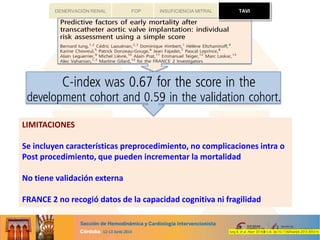
LIMITACIONES
Se incluyen características preprocedimiento, no complicaciones intra o
Post procedimiento, que pueden incrementar la mortalidad
No tiene validación externa
FRANCE 2 no recogió datos de la capacidad cognitiva ni fragilidad
TAVI
TAVIFOP INSUFICIENCIA MITRALDENERVACIÓN RENAL
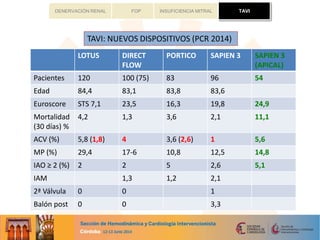
LOTUS DIRECT
FLOW
PORTICO SAPIEN 3 SAPIEN 3
(APICAL)
Pacientes 120 100 (75) 83 96 54
Edad 84,4 83,1 83,8 83,6
Euroscore STS 7,1 23,5 16,3 19,8 24,9
Mortalidad
(30 días) %
4,2 1,3 3,6 2,1 11,1
ACV (%) 5,8 (1,8) 4 3,6 (2,6) 1 5,6
MP (%) 29,4 17-6 10,8 12,5 14,8
IAO ≥ 2 (%) 2 2 5 2,6 5,1
IAM 1,3 1,2 2,1
2ª Válvula 0 0 1
Balón post 0 0 3,3
TAVI: NUEVOS DISPOSITIVOS (PCR 2014)
TAVI
TAVIFOP INSUFICIENCIA MITRALDENERVACIÓN RENAL
¡ MUCHAS GRACIAS !

Cardiopatía Estructural. - Dr. José María Hernández

  • 1.
    TAVIFOP INSUFICIENCIA MITRALDENERVACIÓNRENAL NOVEDADES EN CARDIOPATIA ESTRUCTURAL José María Hernández Hospital Universitario Virgen de la Victoria.Málaga
  • 2.
  • 3.
  • 4.
    TAVIFOP INSUFICIENCIA MITRALDENERVACIÓNRENAL Efecto placebo al ser incluido y mayor adherencia a la medicación Porcentaje mayor de antialdosterónicos Sesgo en estudios previos al conocerse el grupo asignado ¿Efectiva sólo en hiperactividad simpática? Catéter monopolar DENERVACIÓN RENAL
  • 5.
  • 6.
  • 7.
    TAVIFOP INSUFICIENCIA MITRALDENERVACIÓNRENAL Final Results of the EVEREST Controlled Trial of Percutane Reduction of Mitral Reg Ted Feldman, MD, FACC, F on behalf of the EVEREST II I ACC 2014 Washington, DC Kaplan-Meier Freedom From Mortality EVEREST II RCT Baseline 6 Months 12 Months 18 Months 2 Years 3 Years 4 Years 5 Years MitraClip # At Risk 178 165 158 154 143 133 119 58 Surgery # At Risk 80 76 70 70 65 57 52 24 93.7% 92.3% 1 year 81.2% 79.0% 5 years MitraClip (N=178) Surgery (N=80) PML04247 Rev. A Kaplan-Meier Freedom From Mortality EVEREST II RCT MitraClip (N=178) INSUFIENCIA MITRAL
  • 8.
    TAVIFOP INSUFICIENCIA MITRALDENERVACIÓNRENAL Baseline 6 Months 12 Months 18 Months 2 Years 3 Years 4 Years 5 Years MitraClip # At Risk 178 136 128 125 117 109 98 45 Surgery # At Risk 80 75 69 68 63 54 49 21 78.9% 97.4% 1 year 74.3% 92.5% 5 years MitraClip (N=178) Surgery (N=80) Kaplan-Meier Freedom From MV Surgery in MitraClip Group or Re-operation in Surgery Group EVEREST II RCT PML04247 Rev. A 78.9% 97.4% 1 year 74.3% 92.5% 5 years MitraClip (N=178) Surgery (N=80) Kaplan-Meier Freedom From MV Surgery in MitraClip Group or Re-operation in Surgery Group Final Results of the EVEREST Controlled Trial of Percutane Reduction of Mitral Reg Ted Feldman, MD, FACC, F on behalf of the EVEREST II I ACC 2014 Washington, DC INSUFIENCIA MITRAL
  • 9.
    TAVIFOP INSUFICIENCIA MITRALDENERVACIÓNRENAL Final Results of the EVEREST Controlled Trial of Percutane Reduction of Mitral Reg Ted Feldman, MD, FACC, F on behalf of the EVEREST II I ACC 2014 Washington, DC Mitral Regurgitation Grade EVEREST II RCT All Treated Patients (N=258) MitraClip (N=178) 2+ 4+ 3+ 2+ 1+ 2+ 0+0+ 2+ 4+ 3+ Surgery (N=80) 2+ 4+ 3+ 3+ 3+ 2+ 2+ 1+1+ 4+ 3+ 81% 82% Baseline 1 Year 0+ Baseline 1 Year 99% 98% 1+ N=149 Baseline 5 Years N=106 p < 0.005 p < 0.005 p < 0.005 p < 0.005 N=66 Baseline 5 Years N=41 N = survivors with paired data; p-values for descriptive purposes only PML04247 Rev. AMitral Regurgitation Grade EVEREST II RCT All Treated Patients (N=258) MitraClip (N=178) Surgery (N=80) INSUFIENCIA MITRAL
  • 10.
    TAVIFOP INSUFICIENCIA MITRALDENERVACIÓNRENAL Final Results of the EVEREST Controlled Trial of Percutane Reduction of Mitral Reg Ted Feldman, MD, FACC, F on behalf of the EVEREST II I ACC 2014 Washington, DC NYHA Functional Class EVEREST II RCT All Treated Patients (N=258) MitraClip (N=178) NYHA I/II at 1 and 5 Years I I I V I I I I I I I I I I I I I I I V I I I Surgery (N=80) NYHA I/II at 1 and 5 Years I I I V I I I I I I I I I I I I I I I V I I I 98% 91% 88% 98% I I I I p < 0.005 p < 0.005 p < 0.005 p < 0.005 Baseline 1 Year N=151 Baseline 5 Years N=106 Baseline 1 Year N=66 Baseline 5 Years N=42 N = survivors with paired data; p-values for descriptive purposes only PML04247 Rev. ANYHA Functional Class EVEREST II RCT All Treated Patients (N=258) MitraClip (N=178) Surgery (N=80) INSUFIENCIA MITRAL
  • 11.
    TAVIFOP INSUFICIENCIA MITRALDENERVACIÓNRENAL INSUFIENCIA MITRAL 85,4% INSUFICIENCIA MITRAL FUNCIONAL
  • 12.
    TAVIFOP INSUFICIENCIA MITRALDENERVACIÓNRENAL INSUFIENCIA MITRAL 61% UN CLIP, 35% DOS CLIPS , 4% 3 ó 4 CLIPS
  • 13.
  • 14.
  • 15.
    TAVIFOP INSUFICIENCIA MITRALDENERVACIÓNRENAL ........................................................................................................................................................... ........................................................................................................................................................... sPapoutsis,Steffen Schneider,Armin W elz,and Friedrich W .Mohr,for the utive Board y, Medical Clinic I,Kerckhoff Heart and Thorax Center, University of Giessen, Benekestrasse. 2-8, Bad Nauheim 61231,Germany sed 5 August 2013;accepted 22 August 2013 Aorticstenosisisafrequent valvular diseaseespeciallyinelderlypatients.Catheter-basedvalveimplantationhasemerged asavaluabletreatment approachfor thesepatientsbeingeither at veryhighriskfor conventional surgeryor evendeemed inoperable.TheGermanAorticValveRegistry(GARY) providesdataonconventional andcatheter-based aorticproce- dureson an all-comersbasis. A total of13860consecutivepatientsundergoingrepair for aorticvalvedisease[conventional surgeryandtransvascular (TV) or transapical (TA) catheter-basedtechniques] havebeenenrolledinthisregistryduring2011andbaseline,proced- ural,andoutcomedatahavebeenacquired.Theregistrysummarizestheresultsof6523conventional aorticvalverepla- cementswithout (AVR)and3464withconcomitant coronarybypasssurgery(AVR+ CABG)aswellas2695TVAVIand 1181 TA interventions(TA AVI).Patientsundergoingcatheter-based techniquesweresignificantly older andhadhigher risk profiles.Thestrokeratewaslow inall groupswith1.3%(AVR),1.9%(AVR+ CABG),1.7%(TVAVI),and 2.3%(TA AVI).Thein-hospital mortality was2.1%(AVR) and4.5%(AVR+ CABG) for patientsundergoingconventional surgery, and 5.1%(TVAVI) and AVI 7.7%(TA AVI). Thein-hospital outcomeresultsof thisregistryshow that conventional surgery yieldsexcellent resultsinall risk groups and that catheter-based aortic valve replacements is an alternative to conventional surgery in high risk and elderly patients. ------------------------------------------------------------------------------------------------------------------------------------ Aortic stenosis † Surgery † Catheter-based valvereplacement † GARY ..................................................................................................................................................................................... ..................................................................................................................................................................................... CLIN ICAL RESEARCH The German Aortic Valve Registry (GARY): in-hospital outcome Christian W . Hamm*, Helge Mo¨llmann, David Holzhey, Andreas Beckmann, Christof Veit, Hans-Reiner Figulla, J. Cremer, Karl-Heinz Kuck, Ru¨diger Lange, Ralf Zahn, Stefan Sack, Gerhard Schuler, Thomas W alther, Friedhelm Beyersdorf, Michael Bo¨hm, Gerd Heusch, Anne-Kathrin Funkat, Thomas Meinertz, Till Neumann, KonstantinosPapoutsis, Steffen Schneider, Armin W elz, and Friedrich W . Mohr, for the GARY-Executive Board Department of Cardiology, Medical Clinic I, Kerckhoff Heart and Thorax Center, University of Giessen, Benekestrasse. 2-8, Bad Nauheim 61231, Germany Received 24 May2013; revised 5 August 2013; accepted 22 August 2013 Back gr ound Aorticstenosisisafrequent valvular diseaseespeciallyinelderlypatients.Catheter-basedvalveimplantationhasemerged asavaluabletreatment approachfor thesepatientsbeingeither at veryhighrisk for conventional surgeryor evendeemed inoperable.TheGerman Aortic ValveRegistry (GARY) providesdataonconventional and catheter-based aortic proce- dureson an all-comers basis. Met hods and r esult s A total of 13 860consecutive patientsundergoingrepair for aortic valvedisease[conventional surgery and transvascular (TV) or transapical (TA) catheter-based techniques] havebeenenrolledinthisregistryduring2011andbaseline,proced- ural,and outcomedatahavebeen acquired.Theregistry summarizestheresultsof 6523 conventional aortic valverepla- cementswithout (AVR) and3464withconcomitant coronarybypasssurgery(AVR+ CABG) aswell as2695TVAVIand 1181 TA interventions(TA AVI). Patientsundergoingcatheter-based techniquesweresignificantly older and had higher risk profiles. The strokeratewaslow in all groupswith 1.3%(AVR), 1.9%(AVR+ CABG), 1.7%(TVAVI), and 2.3%(TA AVI).Thein-hospital mortality was2.1%(AVR) and 4.5%(AVR+ CABG) for patientsundergoingconventional surgery, and 5.1%(TVAVI) and AVI 7.7%(TA AVI). Conclusion The in-hospital outcome resultsof thisregistry show that conventional surgery yieldsexcellent resultsin all risk groups and that catheter-based aortic valve replacements is an alternative to conventional surgery in high risk and elderly patients. ----------------------------------------------------------------------------------------------------------------------------------------------------------- Keywor ds Aortic stenosis † Surgery † Catheter-based valve replacement † GARY Introduction Aortic stenosis is the most frequent type of valvular heart disease in the Western Countries and presents mostly in an advanced age as a calcific form. The prognosis is poor once the patient becomes symptomatic. Surgical valve replacement isthe established standard management, which alleviates symptoms and improves survival.1 Valvuloplasty of the stenosed valve hasbeen over many yearsapal- liative option for the short term for highly selected, inoperable patients. Recently, catheter-based valve implantations have become an alternative for selected, particularly elderly patients.2–4 Smaller, randomized studies confirmed acceptable outcomesinhighriskandinoperablepatients5,6 for thetransvascu- lar (TV) as well asthe transapical (TA) approach when compared European Heart Journal doi:10.1093/eurheartj/eht381 atBibliotecaVirtualdelSistemaSanitarioPúblicodeAndalucÃ-aonMarch17,2014http://eurheartj.oxfordjournals.org/Downloadedfrom TAVI CLINICAL RESEEuropeanHeart Journal doi:10.1093/eurheartj/eht381 European Heart Journal Advance Access published September 10, 2013
  • 16.
    TAVIFOP INSUFICIENCIA MITRALDENERVACIÓNRENAL ..................................................................................................................................................................................... ..................................................................................................................................................................................... The German Aortic Valve Registry (GARY): in-hospital outcome Christian W . Hamm*, Helge Mo¨llmann, David Holzhey, AndreasBeckmann, Christof Veit, Hans-Reiner Figulla, J. Cremer, Karl-Heinz Kuck, Ru¨diger Lange, Ralf Zahn, Stefan Sack, Gerhard Schuler, ThomasW alther, Friedhelm Beyersdorf, Michael Bo¨hm, Gerd Heusch, Anne-Kathrin Funkat, ThomasMeinertz, Till Neumann, KonstantinosPapoutsis,Steffen Schneider,Armin W elz,and Friedrich W .Mohr,for the GARY-Executive Board Department of Cardiology, Medical Clinic I, Kerckhoff Heart and Thorax Center, University of Giessen, Benekestrasse. 2-8, Bad Nauheim 61231,Germany Received24 May2013;revised 5 August 2013;accepted 22 August 2013 Background Aorticstenosisisafrequent valvular diseaseespeciallyinelderlypatients.Catheter-basedvalveimplantationhasemerged asavaluabletreatment approachfor thesepatientsbeingeither at veryhighriskfor conventional surgeryor evendeemed inoperable.TheGermanAorticValveRegistry(GARY) providesdataonconventional andcatheter-based aorticproce- dureson an all-comersbasis. Met hods and result s A total of13860consecutivepatientsundergoingrepair for aorticvalvedisease[conventional surgeryandtransvascular (TV) or transapical (TA) catheter-based techniques] havebeenenrolledinthisregistryduring2011andbaseline,proced- ural,andoutcomedatahavebeenacquired.Theregistrysummarizestheresultsof 6523conventional aorticvalverepla- cementswithout (AVR) and3464withconcomitant coronarybypasssurgery(AVR+ CABG) aswellas2695TVAVIand 1181TA interventions(TA AVI).Patientsundergoingcatheter-based techniquesweresignificantly older and had higher risk profiles.Thestrokeratewaslow inall groupswith 1.3%(AVR),1.9%(AVR+ CABG),1.7%(TVAVI),and 2.3%(TA AVI).Thein-hospital mortality was2.1%(AVR) and4.5%(AVR+ CABG) for patientsundergoingconventional surgery, and 5.1%(TVAVI) and AVI 7.7%(TA AVI). Conclusion Thein-hospital outcomeresultsof thisregistry show that conventional surgery yieldsexcellent resultsin all risk groups and that catheter-based aortic valve replacements is an alternative to conventional surgery in high risk and elderly patients. ----------------------------------------------------------------------------------------------------------------------------------------------------------- Keywords Aortic stenosis † Surgery † Catheter-based valvereplacement † GARY Introduction Aortic stenosis is the most frequent type of valvular heart disease in the Western Countries and presents mostly in an advanced age Valvuloplasty of the stenosed valvehasbeen over many yearsapal- liative option for the short term for highly selected, inoperable patients. Recently, catheter-based valve implantations have become an alternative for selected, particularly elderly European Heart Journal doi:10.1093/eurheartj/eht381 atBibliotecaVirtualdelSistemaSanitarioPúblicodeAndalucÃ-aonMarch17,2014http://eurheartj.oxfordjournals.org/Downloadedfrom TAVI CLINICAL RESEAEuropeanHeart Journal doi:10.1093/eurheartj/eht381 European Heart Journal Advance Access published September 10, 2013
  • 17.
  • 18.
    TAVIFOP INSUFICIENCIA MITRALDENERVACIÓNRENAL ..................................................................................................................................................................................... ..................................................................................................................................................................................... CLIN ICA L RESA RCH TAVI Advanced chronic kidney disease in pat ient s undergoing t ranscat het er aort ic valve implant at ion: insight s on clinical out comes and prognost ic markersfrom a large cohort of pat ient s Ricar do A llende1†, John G. W ebb2, A nt onio J. Munoz-Gar cia3, Pet er de Jaeger e4, Cor r ado T am bur ino5, A nt onio E. Dager 6, A sim Cheem a7, Vicenc¸ Ser r a8, Ignacio A m at -Sant os9, Jam es L. Velianou10, Mar co Bar bant i2, Danny Dvir 2, Juan H . A lonso-Br iales3, Rut ger -Jan N uis4, Elham ula Faqir i 4, Sebast iano Im m e5, Luis Miguel Benit ez6, A ngela Mar ia Cucalon6, H at im A l Lawat i7, Br uno Gar cia del Blanco8, Javier Lopez9, Madhu K. N at ar ajan10, Rober t DeLar ochellie`r e1, Mar ina U r ena1, H enr ique B. Ribeir o1, Er ic Dum ont 1, Luis N om bela-Fr anco 1†, and Josep Rode´s-Cabau1* 1 Quebec Heart and LungInstitute, Laval University, Quebec city,QC,Canada; 2 St Paul’sHospital,University of British Columbia, Vancouver,BC,Canada; 3 Hospital Universitario Virgen de la Victoria, Malaga, Spain; 4 Thoraxcenter-Erasmus MC, Rotterdam, The Netherlands; 5 Ferrarotto Hospital, University of Catania, Catania, Italy; 6 Angiografia de Occidente S.A., Cali, Colombia; 7 St-Michael’sHospital, Toronto, ON, Canada; 8 Hospital General Universitari Vall d’Hebron, Barcelona, Spain; 9 Hospital Clinico Universitario de Valladolid, Valladolid, Spain; and 10 Hamilton General Hospital, Hamilton, ON, Canada Received 11 August 2013; revised 9 February 2014; accepted 3 April 2014 A im Theaimofthisstudywasto determinetheeffectsofadvancedchronickidneydisease(CKD) onearlyandlateoutcomesafter transcatheter aortic valve implantation (TAVI), and to evaluate the predictive factorsof poorer outcomesin such patients. M et hods and r esult s This was a multicentre study including a total of 2075 consecutive patients who had undergone TAVI. Patients were grouped according the estimated glomerular filtration rate as follows: CKD stage 1-2 (≥ 60 mL/min/1.73 m2 ; n ¼ 950), stage 3 (30–59 mL/min/1.73 m2 ; n ¼ 924), stage 4 (15–29 mL/min/1.73 m2 ; n ¼ 134) and stage 5 (, 15 mL/ min/1.73 m2 or dialysis; n ¼ 67). Clinical outcomes were evaluated at 30-days and at follow-up (median of 15 [6–29] months) and defined according to the VARC criteria. Advanced CKD (stage 4–5) was an independent predictor of 30-day major/life-thr eatening bleeding (P¼ 0.001) and mortality (P¼ 0.027), and late overall, cardiovascular and non- cardiovascular mortality (P, 0.01 for all).Pre-existingatrial fibrillation (HR:2.29,95%CI:1.47–3.58,P¼ 0.001) and dia- lysistherapy (HR: 1.86, 95%CI: 1.17–2.97, P¼ 0.009) were the predictorsof mortality in advanced CKD patients, with a mortality rate ashigh as71%at 1-year follow-up in those patientswith these 2 factors. Advanced CKD patientswho had survived at 1-year follow-up exhibited both asignificant improvement in NYHA class(P, 0.001) and no deterioration in valve hemodynamics (P¼ NSfor changes in mean gradient and valve area over time). Conclusions Advanced CKD wasassociated withahigher rateof earlyand latemortalityand bleedingeventsfollowingTAVI,withAFand dialysistherapydeterminingahigher risk inthesepatients.Themortality rateof patientswith both factorswasunacceptably high and thisshould be taken into account in the clinical decision-makingprocessin thischallenginggroup of patients. - - - - - - - - - - - - - - - - - - - - - - - - - - - - - - - - - - - - - - - - - - - - - - - - - - - - - - - - - - - - - - - - - - - - - - - - - - - - - - - - - - - - - - - - - - - - - - - - - - - - - - - - - - - - - - - - - - - - - - - - - - - - - - - - - - - - - - - - - - - - - - - - - - - - - - - - - - - K eyw o r ds Chronic kidney disease † Dialysis † Transcatheter aortic valve implantation † Atrial fibrillation * Corresponding author. Tel: + 1 4186568711, Fax:+ 1 4186564544, Email: josep.rodes@criucpq.ulaval.ca † R.A. and L.N.-F. have equally contributed to this work. Published on behalf of the European Society of Cardiology. All rights reserved. & The Author 2014. For permissions please email: journals.per missions@oup.com. European Heart Journal doi:10.1093/eurheartj/ehu175 atBibliotecaVirtualdelSistemaSanitarioPúblicodeAndalucÃ-aonJune4,2014http://eurheartj.oxfordjournals.org/Downloadedfrom ........................................................................................................................................................... ........................................................................................................................................................... arochellie`re1, Marina Urena1, Henrique B. Ribeiro1, Eric Dumont1, la-Franco1† , and Josep Rode´s-Cabau1* stitute,Laval University,Quebeccity,QC,Canada;2 St Paul’sHospital,UniversityofBritishColumbia,Vancouver,BC,Canada;3 Hospital Universitario Virgende Thoraxcenter-Erasmus MC, Rotterdam, The Netherlands;5 Ferrarotto Hospital,University of Catania, Catania, Italy; 6 Angiografiade Occidente S.A., Cali, ospital, Toronto, ON,Canada; 8 Hospital General Universitari Vall d’Hebron, Barcelona, Spain; 9 Hospital Clinico Universitario deValladolid, Valladolid, Spain; ospital, Hamilton, ON, Canada evised 9 February2014;accepted 3 April 2014 Theaimofthisstudywastodeterminetheeffectsofadvancedchronickidneydisease(CKD)onearlyandlateoutcomesafter transcatheter aorticvalveimplantation(TAVI),andto evaluatethepredictivefactorsof poorer outcomesinsuchpatients. This was a multicentre study including a total of 2075 consecutive patients who had undergone TAVI. Patients were grouped according the estimated glomerular filtration rate as follows: CKD stage 1-2 (≥ 60 mL/min/1.73 m2 ; n ¼ 950), stage 3 (30–59 mL/min/1.73 m2 ; n¼ 924), stage 4 (15–29 mL/min/1.73 m2 ;n¼ 134) and stage 5 (, 15 mL/ min/1.73 m2 or dialysis; n ¼ 67). Clinical outcomes were evaluated at 30-daysand at follow-up (median of 15 [6–29] months) and defined according to the VARC criteria. Advanced CKD (stage 4–5) was an independent predictor of 30-day major/life-threateningbleeding(P¼ 0.001) and mortality (P¼ 0.027), and late overall, cardiovascular and non- cardiovascular mortality(P, 0.01for all).Pre-existingatrial fibrillation(HR:2.29,95%CI:1.47–3.58,P¼ 0.001) anddia- lysistherapy(HR:1.86,95%CI:1.17–2.97,P¼ 0.009) werethepredictorsofmortalityinadvanced CKD patients,witha mortality rateashighas71%at 1-year follow-upinthosepatientswiththese2factors.Advanced CKD patientswho had survivedat 1-year follow-upexhibited bothasignificant improvement inNYHA class(P, 0.001) andno deteriorationin valve hemodynamics (P¼ NSfor changesin mean gradient and valveareaover time). AdvancedCKD wasassociatedwithahigher rateofearlyandlatemortalityandbleedingeventsfollowingTAVI,withAFand dialysistherapydeterminingahigher riskinthesepatients.Themortalityrateofpatientswithbothfactorswasunacceptably highand thisshould betaken into account in theclinical decision-makingprocessin thischallenginggroup of patients. CLINICAL REuropean Heart Journal doi:10.1093/eurheartj/ehu175 European Heart Journal Advance Access published May 5, 2014 CLINICAL REEuropeanHeart Journal doi:10.1093/eurheartj/ehu175 European Heart Journal Advance Access published May 5, 2014 TAVI
  • 19.
  • 20.
  • 21.
    TAVIFOP INSUFICIENCIA MITRALDENERVACIÓNRENAL Análisis post-hoc no aleatorizado Pacientes incluidos desde 2007 a 2012 (Edwards sólo desde 2010) Sesgos (preferencias de operador, curva de aprendizaje, patrón de calcificación anular) no corregidos pese a “propensity matching” Superviviencia al año al año similar (88% ES, 84% MCV, p= 0,42) No diferencias en otros estudios (FRANCE 2, UK TAVI, PRAGMATIC..) Descenso de la “more-then-mild” IAO con el tiempo con la Corevalve (11,5% a 30 días y 4,1% al año en en US Pivotal Trial) TAVI Selección del tamaño de dispositivo heterogénea con pocos casos con TAC
  • 22.
  • 23.
  • 24.
    TAVIFOP INSUFICIENCIA MITRALDENERVACIÓNRENAL Aunque la válvula balón expandible tiene mas tasa de éxito que la autoexpandible no hay datos de que esto tenga impacto en el seguimiento (muerte, ACV, calidad de vida) IAO ≥ 2 e implante de una segunda válvula fueron mayores con la válvula autoexpandible, mientras que los ACV y la oclusión coronaria fueron numerica, aunque no estadisticamente, mayores con la balón expandible Datos recientes sugieren que la IAO disminuye en el seguimiento de la válvula autoexpandible La experiencia del operador es un factor crucial en el éxito del procedimiento, y debe ser tenido en cuenta en la selección del tipo de válvula En espera de resultados a un año TAVI
  • 25.
  • 26.
  • 27.
  • 28.
  • 29.
  • 30.
    TAVIFOP INSUFICIENCIA MITRALDENERVACIÓNRENAL 6Extreme Risk Study | Iliofemoral PivotalPopma JACC 2014 March 19 (epub ahead of print) On behalf of the US CoreValve Investigators Paravalvular Regurgitation 23Extreme Risk Study | Iliofemoral PivotalTCT 2013 LBCT (JACC 2014) TAVI
  • 31.
  • 32.
  • 33.
  • 34.
    TAVIFOP INSUFICIENCIA MITRALDENERVACIÓNRENAL LIMITACIONES Se incluyen características preprocedimiento, no complicaciones intra o Post procedimiento, que pueden incrementar la mortalidad No tiene validación externa FRANCE 2 no recogió datos de la capacidad cognitiva ni fragilidad TAVI
  • 35.
    TAVIFOP INSUFICIENCIA MITRALDENERVACIÓNRENAL LOTUS DIRECT FLOW PORTICO SAPIEN 3 SAPIEN 3 (APICAL) Pacientes 120 100 (75) 83 96 54 Edad 84,4 83,1 83,8 83,6 Euroscore STS 7,1 23,5 16,3 19,8 24,9 Mortalidad (30 días) % 4,2 1,3 3,6 2,1 11,1 ACV (%) 5,8 (1,8) 4 3,6 (2,6) 1 5,6 MP (%) 29,4 17-6 10,8 12,5 14,8 IAO ≥ 2 (%) 2 2 5 2,6 5,1 IAM 1,3 1,2 2,1 2ª Válvula 0 0 1 Balón post 0 0 3,3 TAVI: NUEVOS DISPOSITIVOS (PCR 2014) TAVI
  • 36.