INTRODUCTION
Soaps are sodium or potassium salts of higher fatty acids like stearic,
palmitic and oleic acids can be either saturated or unsaturated. They
contain a long hydrocarbon chain of about10-20 carbon with one
carboxylic acid group as the functional group.
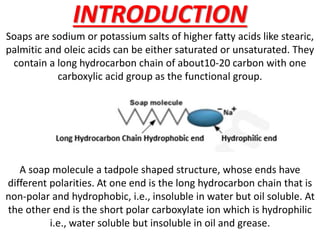
A soap molecule a tadpole shaped structure, whose ends have
different polarities. At one end is the long hydrocarbon chain that is
non-polar and hydrophobic, i.e., insoluble in water but oil soluble. At
the other end is the short polar carboxylate ion which is hydrophilic
i.e., water soluble but insoluble in oil and grease.
When soap is shaken with water it becomes a soap solution that is
colloidal in nature. Agitating it tends to concentrate the solution on the
surface and causes foaming. This helps the soap molecules make a
unimolecular film on the surface of water and to penetrate the fabric.
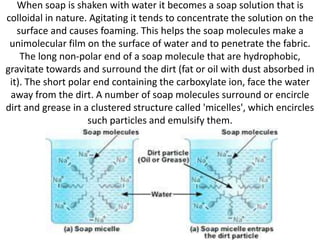
The long non-polar end of a soap molecule that are hydrophobic,
gravitate towards and surround the dirt (fat or oil with dust absorbed in
it). The short polar end containing the carboxylate ion, face the water
away from the dirt. A number of soap molecules surround or encircle
dirt and grease in a clustered structure called 'micelles', which encircles
such particles and emulsify them.
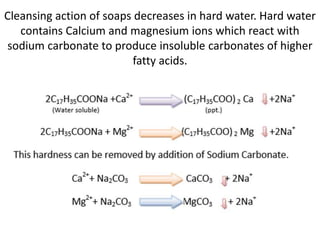
Cleansing action of soaps decreases in hard water. Hard water
contains Calcium and magnesium ions which react with
sodium carbonate to produce insoluble carbonates of higher
fatty acids.
• Aim:
To compare the foaming capacities of five different
commercial soaps.
Apparatus:
5 test tubes, 5 conical flasks (100 ml), test tube stand,
Bunsen burner and stop watch.
Materials Required:
5 different samples of soap and distilled water
Theory:
The foaming capacity of a soap sample depends upon the
nature of soap and its concentration. This can be
compared for various samples of soaps by taking the same
concentration of solution and shaking them.
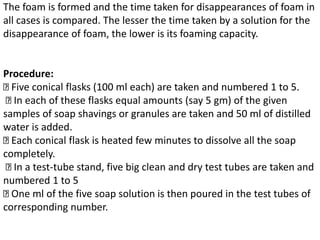
The foam is formed and the time taken for disappearances of foam in
all cases is compared. The lesser the time taken by a solution for the
disappearance of foam, the lower is its foaming capacity.
Procedure:
Five conical flasks (100 ml each) are taken and numbered 1 to 5.
In each of these flasks equal amounts (say 5 gm) of the given
samples of soap shavings or granules are taken and 50 ml of distilled
water is added.
Each conical flask is heated few minutes to dissolve all the soap
completely.
In a test-tube stand, five big clean and dry test tubes are taken and
numbered 1 to 5
One ml of the five soap solution is then poured in the test tubes of
corresponding number.
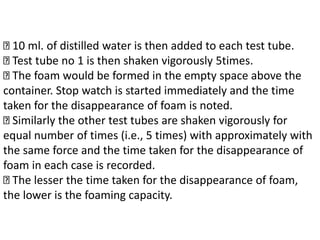
10 ml. of distilled water is then added to each test tube.
Test tube no 1 is then shaken vigorously 5times.
The foam would be formed in the empty space above the
container. Stop watch is started immediately and the time
taken for the disappearance of foam is noted.
Similarly the other test tubes are shaken vigorously for
equal number of times (i.e., 5 times) with approximately with
the same force and the time taken for the disappearance of
foam in each case is recorded.
The lesser the time taken for the disappearance of foam,
the lower is the foaming capacity.
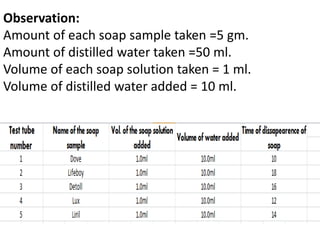
Observation:
Amount of each soap sample taken =5 gm.
Amount of distilled water taken =50 ml.
Volume of each soap solution taken = 1 ml.
Volume of distilled water added = 10 ml.
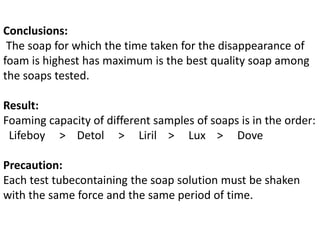
Conclusions:
The soap for which the time taken for the disappearance of
foam is highest has maximum is the best quality soap among
the soaps tested.
Result:
Foaming capacity of different samples of soaps is in the order:
Lifeboy > Detol > Liril > Lux > Dove
Precaution:
Each test tubecontaining the soap solution must be shaken
with the same force and the same period of time.
Foaming capacity of different soaps

Foaming capacity of different soaps

  • 1.
    INTRODUCTION Soaps are sodiumor potassium salts of higher fatty acids like stearic, palmitic and oleic acids can be either saturated or unsaturated. They contain a long hydrocarbon chain of about10-20 carbon with one carboxylic acid group as the functional group. A soap molecule a tadpole shaped structure, whose ends have different polarities. At one end is the long hydrocarbon chain that is non-polar and hydrophobic, i.e., insoluble in water but oil soluble. At the other end is the short polar carboxylate ion which is hydrophilic i.e., water soluble but insoluble in oil and grease.
  • 2.
    When soap isshaken with water it becomes a soap solution that is colloidal in nature. Agitating it tends to concentrate the solution on the surface and causes foaming. This helps the soap molecules make a unimolecular film on the surface of water and to penetrate the fabric. The long non-polar end of a soap molecule that are hydrophobic, gravitate towards and surround the dirt (fat or oil with dust absorbed in it). The short polar end containing the carboxylate ion, face the water away from the dirt. A number of soap molecules surround or encircle dirt and grease in a clustered structure called 'micelles', which encircles such particles and emulsify them.
  • 3.
    Cleansing action ofsoaps decreases in hard water. Hard water contains Calcium and magnesium ions which react with sodium carbonate to produce insoluble carbonates of higher fatty acids.
  • 4.
    • Aim: To comparethe foaming capacities of five different commercial soaps. Apparatus: 5 test tubes, 5 conical flasks (100 ml), test tube stand, Bunsen burner and stop watch. Materials Required: 5 different samples of soap and distilled water Theory: The foaming capacity of a soap sample depends upon the nature of soap and its concentration. This can be compared for various samples of soaps by taking the same concentration of solution and shaking them.
  • 5.
    The foam isformed and the time taken for disappearances of foam in all cases is compared. The lesser the time taken by a solution for the disappearance of foam, the lower is its foaming capacity. Procedure: Five conical flasks (100 ml each) are taken and numbered 1 to 5. In each of these flasks equal amounts (say 5 gm) of the given samples of soap shavings or granules are taken and 50 ml of distilled water is added. Each conical flask is heated few minutes to dissolve all the soap completely. In a test-tube stand, five big clean and dry test tubes are taken and numbered 1 to 5 One ml of the five soap solution is then poured in the test tubes of corresponding number.
  • 6.
    10 ml. ofdistilled water is then added to each test tube. Test tube no 1 is then shaken vigorously 5times. The foam would be formed in the empty space above the container. Stop watch is started immediately and the time taken for the disappearance of foam is noted. Similarly the other test tubes are shaken vigorously for equal number of times (i.e., 5 times) with approximately with the same force and the time taken for the disappearance of foam in each case is recorded. The lesser the time taken for the disappearance of foam, the lower is the foaming capacity.
  • 7.
    Observation: Amount of eachsoap sample taken =5 gm. Amount of distilled water taken =50 ml. Volume of each soap solution taken = 1 ml. Volume of distilled water added = 10 ml.
  • 8.
    Conclusions: The soap forwhich the time taken for the disappearance of foam is highest has maximum is the best quality soap among the soaps tested. Result: Foaming capacity of different samples of soaps is in the order: Lifeboy > Detol > Liril > Lux > Dove Precaution: Each test tubecontaining the soap solution must be shaken with the same force and the same period of time.