FUTURE OF PUBLISHING
ACC Liverpool, Room 12, Tuesday 15 April, 17.35–18.30
Panel:
Aharon Oren, Editor-in-Chief of International Journal of Systematic and
Evolutionary Microbiology
Paul Hoskisson, Chair of the SGM Communications Committee
Jodi Lindsay, Editor for Microbiology
Gavin Thomas, member of SGM Communications Committee and Editor for
Microbiology
Leighton Chipperfield, Head of Publishing at SGM
Event Chair: Colin Harwood, Chair of the SGM Publishing Committee
Follow live tweets from the session and join the discussion using the hashtag
#SGMFoP
THE PEER REVIEW PROCESS
Aharon Oren
Editor-in-Chief, International Journal of
Systematic and Evolutionary Microbiology
Professor of Microbial Ecology, Department
of Plant and Environmental Sciences, The
Institute of Life Sciences, the Hebrew
University of Jerusalem, Israel
The two goals of any editor:
1. To help the authors to get their work published
2. To maintain (an if possible, improve) the quality of
the journal
• Why should you publish?
(there can be little doubt here !)
• Where should you publish?
Not an easy question – some important points for
consideration:
- Impact factor
- Readership
- General – specialized journal
- Open access
Author
prepares
manuscript
(Read the instructions!!)
Editorial office
– first check;
selects editor
Editor checks
the paper
Paper is checked
by two or more
reviewers
Acceptance
Revision
To production
staff
• Single-blind : Reviewers’ names are hidden from
the authors (the traditional method, by far the
most common type).
• Double blind : The identities of the authors are
concealed from the reviewers and vice versa.
• Open : The author and reviewer are made known
to each other. This model promotes open, honest
reviewing; however, open review may leads to
reviewers withholding criticism for fear of
damaging their reputation within the community.
Peer review models
An example of ‘open peer review’:
• Post-publication peer review: Papers are reviewed after
online publication, reviewers’ comments and decisions and
revised manuscripts are published alongside the article.
E.g. F1000Research papers are submitted, go through an in-
house pre-publication check for ‘suitability, quality, readability,
and for any ethical concerns’, then published online within days
of being submitted. Papers are then open to being reviewed by
anyone - anonymous or not.
• Portable peer review: A model allowing the transfer of reviews
from one journal to another when a paper is rejected in the first
– usually to a related journal or journals within the same
publisher.
New models of peer review
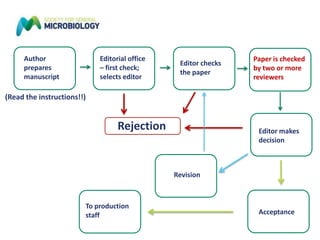
Author
prepares
manuscript
(Read the instructions!!)
Editorial office
– first check;
selects editor
Editor checks
the paper
Paper is checked
by two or more
reviewers
Acceptance
Revision
To production
staff
Editor makes
decision
Rejection
Author
prepares
manuscript
(Read the instructions!!)
Editorial office
– first check;
selects editor
Editor checks
the paper
Paper is checked
by two or more
reviewers
Acceptance
Revision
To production
staff
Editor makes
decision
Rejection
Revision
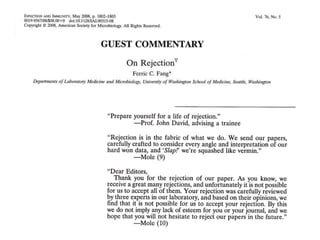
How NOT to deal with editors
From an e-mail exchange with the authors of a rejected paper – March 2013:
…
…
Author
prepares
manuscript
(Read the instructions!!)
Editorial office
– first check;
selects editor
Editor checks
the paper
Paper is checked
by two or more
reviewers
Acceptance
Editor makes
decision
Rejection
Revision
Acceptance
To production
staff
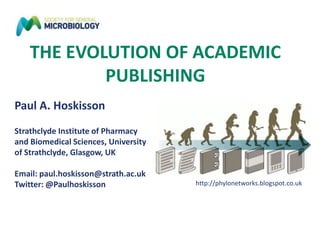
THE EVOLUTION OF ACADEMIC
PUBLISHING
http://phylonetworks.blogspot.co.uk
Paul A. Hoskisson
Strathclyde Institute of Pharmacy
and Biomedical Sciences, University
of Strathclyde, Glasgow, UK
Email: paul.hoskisson@strath.ac.uk
Twitter: @Paulhoskisson
Is your finger on the pulse?
Traditional ‘hard copy’
journal article
Is your finger on the pulse?
Traditional ‘hard copy’
journal article
The conversation is everywhere…
• Traditional journals have been around for a long time – Phil.
Trans. Royal Soc. 1664
• Late 1990s – Online availability
• Early 2000s – Online submission & Publication
– Online only journals, Open Access..
• Subscription & Author pays, Author pays
• Late 2000s – Smart phones, Tablets and Apps
• Rise of Twitter, Facebook, blogs etc
• 2014 and beyond - ???
– Post-REF 2014
Multi-platforms – same content
• People read papers in different ways
Multi-platforms – same content
• People read papers in different ways
Multi-platforms – same content
• People read papers in different ways
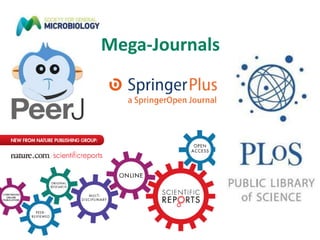
Mega-Journals
Flexible formats…
• People no longer only ‘talk’ about science in the coffee
room or at conferences….
• Pre-prints – arxiv.org, BioRxiv, Nature Precedings, PeerJ
• Post-publication review
– Formal – PLoS, PeerJ
– Informal – Trial by Twitter - #Arseniclife
– Twitter Journal Clubs
• Blog about your research, or if you’re lucky somebody else
might
Measuring research outputs –
publication driven!
• Citations
• What else?
Measuring research outputs
• Citations
• What else?
Measuring research outputs
• Citations
• What else?
Where next?
• Predicting the future is difficult
Where next?
• Predicting the future is difficult
• Funders need to accept new metrics over IF and
traditional citations
• A good paper is a good paper…
– Article level metrics will become more important
– Web 2.0, Semantic Web
– Open Access, Open Data – JMM Case Reports, PLoS,
PeerJ, Nature Scientific Data, Figshare
• We as scientists have the chance to drive the
evolution of publishing and make it work for
us!
• We need to be brave!
• Impact can be more than citations – JMM
Case Reports
Final thought…
“I know you have published over 100
articles, but my question was ‘Have
you ever made a contribution to the
literature?’”
A PUBLISHER PERSPECTIVE
Leighton Chipperfield
Head of Publishing, SGM
@leightonc
l.chipperfield@sgm.ac.uk
Where are we today?
• Digital processes
• Open Access options
• Online and print publication
• Impact Factors as key metric
• Truly global community of
authors & readers
Source: http://onebigphoto.com
Where are we going?
Source: universetoday.com
Source:
http://www.business2community.com/trend
s-news/attend-the-web-3-0-conference-
042658
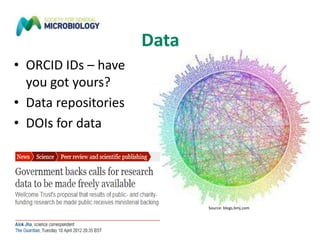
Data
• ORCID IDs – have
you got yours?
• Data repositories
• DOIs for data
Source: blogs.bmj.com
Semantic publishing: what’s in it for me?
• Deeper search as a reader
• Increased discoverability as an author
Source: http://www.ploscompbiol.org/article/info%3Adoi%2F10.1371%2Fjournal.pcbi.1000361
Access
• SGM supports sustainable open access
• All papers freely available 12 months after
publication (24 months for IJSEM)
• – free access for UK taxpayers
• – access for developing countries
• – Preprint server policy in
development
Communicating research, measuring
impact
• Linking with social media tools to promote &
share your work
• Linking with reference management tools
• AltMetrics
Source: altmetric.com
Source: colwiz.com
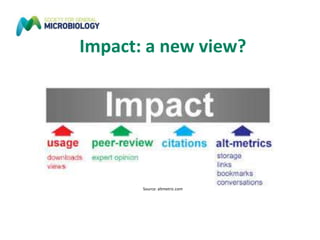
Impact: a new view?
Source: altmetric.com
We are moving from publishing to
truly managing knowledge.
Q & A

Future of Publishing - a session on innovations in academic journal publishing from the Society for General Microbiology

  • 1.
    FUTURE OF PUBLISHING ACCLiverpool, Room 12, Tuesday 15 April, 17.35–18.30 Panel: Aharon Oren, Editor-in-Chief of International Journal of Systematic and Evolutionary Microbiology Paul Hoskisson, Chair of the SGM Communications Committee Jodi Lindsay, Editor for Microbiology Gavin Thomas, member of SGM Communications Committee and Editor for Microbiology Leighton Chipperfield, Head of Publishing at SGM Event Chair: Colin Harwood, Chair of the SGM Publishing Committee Follow live tweets from the session and join the discussion using the hashtag #SGMFoP
  • 2.
    THE PEER REVIEWPROCESS Aharon Oren Editor-in-Chief, International Journal of Systematic and Evolutionary Microbiology Professor of Microbial Ecology, Department of Plant and Environmental Sciences, The Institute of Life Sciences, the Hebrew University of Jerusalem, Israel
  • 3.
    The two goalsof any editor: 1. To help the authors to get their work published 2. To maintain (an if possible, improve) the quality of the journal
  • 4.
    • Why shouldyou publish? (there can be little doubt here !) • Where should you publish? Not an easy question – some important points for consideration: - Impact factor - Readership - General – specialized journal - Open access
  • 5.
    Author prepares manuscript (Read the instructions!!) Editorialoffice – first check; selects editor Editor checks the paper Paper is checked by two or more reviewers Acceptance Revision To production staff
  • 6.
    • Single-blind :Reviewers’ names are hidden from the authors (the traditional method, by far the most common type). • Double blind : The identities of the authors are concealed from the reviewers and vice versa. • Open : The author and reviewer are made known to each other. This model promotes open, honest reviewing; however, open review may leads to reviewers withholding criticism for fear of damaging their reputation within the community. Peer review models
  • 7.
    An example of‘open peer review’:
  • 8.
    • Post-publication peerreview: Papers are reviewed after online publication, reviewers’ comments and decisions and revised manuscripts are published alongside the article. E.g. F1000Research papers are submitted, go through an in- house pre-publication check for ‘suitability, quality, readability, and for any ethical concerns’, then published online within days of being submitted. Papers are then open to being reviewed by anyone - anonymous or not. • Portable peer review: A model allowing the transfer of reviews from one journal to another when a paper is rejected in the first – usually to a related journal or journals within the same publisher. New models of peer review
  • 9.
    Author prepares manuscript (Read the instructions!!) Editorialoffice – first check; selects editor Editor checks the paper Paper is checked by two or more reviewers Acceptance Revision To production staff Editor makes decision Rejection
  • 11.
    Author prepares manuscript (Read the instructions!!) Editorialoffice – first check; selects editor Editor checks the paper Paper is checked by two or more reviewers Acceptance Revision To production staff Editor makes decision Rejection Revision
  • 12.
    How NOT todeal with editors From an e-mail exchange with the authors of a rejected paper – March 2013: … …
  • 13.
    Author prepares manuscript (Read the instructions!!) Editorialoffice – first check; selects editor Editor checks the paper Paper is checked by two or more reviewers Acceptance Editor makes decision Rejection Revision Acceptance To production staff
  • 14.
    THE EVOLUTION OFACADEMIC PUBLISHING http://phylonetworks.blogspot.co.uk Paul A. Hoskisson Strathclyde Institute of Pharmacy and Biomedical Sciences, University of Strathclyde, Glasgow, UK Email: paul.hoskisson@strath.ac.uk Twitter: @Paulhoskisson
  • 15.
    Is your fingeron the pulse? Traditional ‘hard copy’ journal article
  • 16.
    Is your fingeron the pulse? Traditional ‘hard copy’ journal article
  • 17.
    The conversation iseverywhere… • Traditional journals have been around for a long time – Phil. Trans. Royal Soc. 1664 • Late 1990s – Online availability • Early 2000s – Online submission & Publication – Online only journals, Open Access.. • Subscription & Author pays, Author pays • Late 2000s – Smart phones, Tablets and Apps • Rise of Twitter, Facebook, blogs etc • 2014 and beyond - ??? – Post-REF 2014
  • 18.
    Multi-platforms – samecontent • People read papers in different ways
  • 19.
    Multi-platforms – samecontent • People read papers in different ways
  • 20.
    Multi-platforms – samecontent • People read papers in different ways
  • 21.
  • 22.
    Flexible formats… • Peopleno longer only ‘talk’ about science in the coffee room or at conferences…. • Pre-prints – arxiv.org, BioRxiv, Nature Precedings, PeerJ • Post-publication review – Formal – PLoS, PeerJ – Informal – Trial by Twitter - #Arseniclife – Twitter Journal Clubs • Blog about your research, or if you’re lucky somebody else might
  • 23.
    Measuring research outputs– publication driven! • Citations • What else?
  • 24.
    Measuring research outputs •Citations • What else?
  • 25.
    Measuring research outputs •Citations • What else?
  • 26.
    Where next? • Predictingthe future is difficult
  • 27.
    Where next? • Predictingthe future is difficult • Funders need to accept new metrics over IF and traditional citations • A good paper is a good paper… – Article level metrics will become more important – Web 2.0, Semantic Web – Open Access, Open Data – JMM Case Reports, PLoS, PeerJ, Nature Scientific Data, Figshare
  • 28.
    • We asscientists have the chance to drive the evolution of publishing and make it work for us! • We need to be brave! • Impact can be more than citations – JMM Case Reports
  • 29.
    Final thought… “I knowyou have published over 100 articles, but my question was ‘Have you ever made a contribution to the literature?’”
  • 30.
    A PUBLISHER PERSPECTIVE LeightonChipperfield Head of Publishing, SGM @leightonc l.chipperfield@sgm.ac.uk
  • 31.
    Where are wetoday? • Digital processes • Open Access options • Online and print publication • Impact Factors as key metric • Truly global community of authors & readers Source: http://onebigphoto.com
  • 32.
    Where are wegoing? Source: universetoday.com Source: http://www.business2community.com/trend s-news/attend-the-web-3-0-conference- 042658
  • 33.
    Data • ORCID IDs– have you got yours? • Data repositories • DOIs for data Source: blogs.bmj.com
  • 34.
    Semantic publishing: what’sin it for me? • Deeper search as a reader • Increased discoverability as an author Source: http://www.ploscompbiol.org/article/info%3Adoi%2F10.1371%2Fjournal.pcbi.1000361
  • 35.
    Access • SGM supportssustainable open access • All papers freely available 12 months after publication (24 months for IJSEM) • – free access for UK taxpayers • – access for developing countries • – Preprint server policy in development
  • 36.
    Communicating research, measuring impact •Linking with social media tools to promote & share your work • Linking with reference management tools • AltMetrics Source: altmetric.com Source: colwiz.com
  • 37.
    Impact: a newview? Source: altmetric.com
  • 38.
    We are movingfrom publishing to truly managing knowledge.
  • 39.

Editor's Notes

  • #33 Source: universetoday.com