Korea Advanced Institute of Science and Technolgoy

http://autoidlab.kaist.ac.kr

Auto-ID Lab KAIST (Korea)
• Research Activities of Auto-ID Lab,
KAIST(Korea)
• EPC Network on Cloud and Big Data
Analytics
• EPC Sensor Network, IoT Open Platform
• Internet of Things(IoT) Connectivity
• EPC Security and Privacy Technology
• RFID/IoT Business Model
• Auto-ID Lab KAIST research team consists
of 6 professors and more than 50
researchers
D

Director
Prof. Kim, Daeyoung
kimd@kaist.ac.kr

Professor
Prof. Kim, Kwang-Jo
kkj@kaist.ac.kr

Associate Director
Research Prof. Kim, Seonghoon
shkim08@kaist.ac.kr

Professor
Prof. Rho, Jae-Jeung
jjrho@kaist.ac.kr

Professor
Prof. Lee, Sang-gug
sglee@ee.kaist.ac.kr

Associate Director
Prof. Moon, Junghoon
moonj@snu.ac.kr

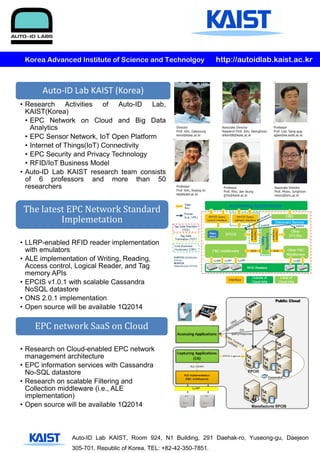
The latest EPC Network Standard
Implemetation
• LLRP-enabled RFID reader implementation
with emulators
• ALE implementation of Writing, Reading,
Access control, Logical Reader, and Tag
memory APIs
• EPCIS v1.0.1 with scalable Cassandra
NoSQL datastore
• ONS 2.0.1 implementation
• Open source will be available 1Q2014

EPC network SaaS on Cloud
• Research on Cloud-enabled EPC network
management architecture
• EPC information services with Cassandra
No-SQL datastore
• Research on scalable Filtering and
Collection middleware (i.e., ALE
implementation)
• Open source will be available 1Q2014

Auto-ID Lab KAIST, Room 924, N1 Building, 291 Daehak-ro, Yuseong-gu, Daejeon
305-701, Republic of Korea, TEL: +82-42-350-7851.
Korea Advanced Institute of Science and Technolgoy

http://autoidlab.kaist.ac.kr

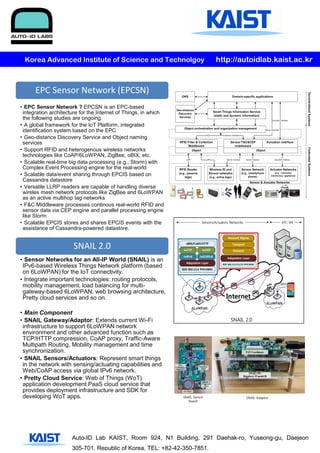
EPC Sensor Network (EPCSN)
• EPC Sensor Network ? EPCSN is an EPC-based
integration architecture for the Internet of Things, in which
the following studies are ongoing.
• A global framework for the IoT Platform, integrated
identification system based on the EPC
• Geo-distance Discovery Service and Object naming
services
• Support RFID and heterogenous wireless networks
technologies like CoAP/6LoWPAN, ZigBee, oBIX, etc.
• Scalable real-time big data processing (e.g., Storm) with
Complex Event Processing engine for the real-world
• Scalable data/event sharing through EPCIS based on
Cassandra datastore
• Versatile LLRP readers are capable of handling diverse
wireles mesh network protocols like ZigBee and 6LoWPAN
as an active multihop tag networks
• F&C Middleware processes continous real-world RFID and
sensor data via CEP engine and parallel processing engine
like Storm
• Scalable EPCIS stores and shares EPCIS events with the
assistance of Cassandra-powered datastore.

Sensors/Actuators Networks

EPC-SN

Network Mgmts

SNAIL 2.0
• Sensor Networks for an All-IP World (SNAIL) is an
IPv6-based Wireless Things Network platform (based
on 6LoWPAN) for the IoT connectivity.
• Integrate important technologies: routing protocols,
mobility management, load balancing for multigateway-based 6LoWPAN, web browsing architecture,
Pretty cloud services and so on.

oBIX/CoAP/HTTP
lwTCP

lwUDP

lwIPv6

lwICMPv6

Adaptation Layer

Adaptation Layer
Transport

Network
Adaptation Layer
IEEE 802.15.3/11/15 PHY/MAC

IEEE 802.15.4 PHY/MAC

WiFi

Internet
6LoWPAN

• Main Component
• SNAIL Gateway/Adaptor: Extends current Wi-Fi
infrastructure to support 6LoWPAN network
environment and other advanced function such as
TCP/HTTP compression, CoAP proxy, Traffic-Aware
Multipath Routing, Mobility management and time
synchronization.
• SNAIL Sensors/Actuators: Represent smart things
in the network with sensing/actuating capabilities and
Web/CoAP access via global IPv6 network.
• Pretty Cloud Service: Web of Things (WoT)
application development PaaS cloud service that
provides deployment infrastructure and SDK for
developing WoT apps.

6LoWPAN

SNAIL 2.0

SNAIL Sensor
Board

SNAIL Adaptor

Auto-ID Lab KAIST, Room 924, N1 Building, 291 Daehak-ro, Yuseong-gu, Daejeon
305-701, Republic of Korea, TEL: +82-42-350-7851.

Flyer auto id_lab_kaist_2014

  • 1.
    Korea Advanced Instituteof Science and Technolgoy http://autoidlab.kaist.ac.kr Auto-ID Lab KAIST (Korea) • Research Activities of Auto-ID Lab, KAIST(Korea) • EPC Network on Cloud and Big Data Analytics • EPC Sensor Network, IoT Open Platform • Internet of Things(IoT) Connectivity • EPC Security and Privacy Technology • RFID/IoT Business Model • Auto-ID Lab KAIST research team consists of 6 professors and more than 50 researchers D Director Prof. Kim, Daeyoung kimd@kaist.ac.kr Professor Prof. Kim, Kwang-Jo kkj@kaist.ac.kr Associate Director Research Prof. Kim, Seonghoon shkim08@kaist.ac.kr Professor Prof. Rho, Jae-Jeung jjrho@kaist.ac.kr Professor Prof. Lee, Sang-gug sglee@ee.kaist.ac.kr Associate Director Prof. Moon, Junghoon moonj@snu.ac.kr The latest EPC Network Standard Implemetation • LLRP-enabled RFID reader implementation with emulators • ALE implementation of Writing, Reading, Access control, Logical Reader, and Tag memory APIs • EPCIS v1.0.1 with scalable Cassandra NoSQL datastore • ONS 2.0.1 implementation • Open source will be available 1Q2014 EPC network SaaS on Cloud • Research on Cloud-enabled EPC network management architecture • EPC information services with Cassandra No-SQL datastore • Research on scalable Filtering and Collection middleware (i.e., ALE implementation) • Open source will be available 1Q2014 Auto-ID Lab KAIST, Room 924, N1 Building, 291 Daehak-ro, Yuseong-gu, Daejeon 305-701, Republic of Korea, TEL: +82-42-350-7851.
  • 2.
    Korea Advanced Instituteof Science and Technolgoy http://autoidlab.kaist.ac.kr EPC Sensor Network (EPCSN) • EPC Sensor Network ? EPCSN is an EPC-based integration architecture for the Internet of Things, in which the following studies are ongoing. • A global framework for the IoT Platform, integrated identification system based on the EPC • Geo-distance Discovery Service and Object naming services • Support RFID and heterogenous wireless networks technologies like CoAP/6LoWPAN, ZigBee, oBIX, etc. • Scalable real-time big data processing (e.g., Storm) with Complex Event Processing engine for the real-world • Scalable data/event sharing through EPCIS based on Cassandra datastore • Versatile LLRP readers are capable of handling diverse wireles mesh network protocols like ZigBee and 6LoWPAN as an active multihop tag networks • F&C Middleware processes continous real-world RFID and sensor data via CEP engine and parallel processing engine like Storm • Scalable EPCIS stores and shares EPCIS events with the assistance of Cassandra-powered datastore. Sensors/Actuators Networks EPC-SN Network Mgmts SNAIL 2.0 • Sensor Networks for an All-IP World (SNAIL) is an IPv6-based Wireless Things Network platform (based on 6LoWPAN) for the IoT connectivity. • Integrate important technologies: routing protocols, mobility management, load balancing for multigateway-based 6LoWPAN, web browsing architecture, Pretty cloud services and so on. oBIX/CoAP/HTTP lwTCP lwUDP lwIPv6 lwICMPv6 Adaptation Layer Adaptation Layer Transport Network Adaptation Layer IEEE 802.15.3/11/15 PHY/MAC IEEE 802.15.4 PHY/MAC WiFi Internet 6LoWPAN • Main Component • SNAIL Gateway/Adaptor: Extends current Wi-Fi infrastructure to support 6LoWPAN network environment and other advanced function such as TCP/HTTP compression, CoAP proxy, Traffic-Aware Multipath Routing, Mobility management and time synchronization. • SNAIL Sensors/Actuators: Represent smart things in the network with sensing/actuating capabilities and Web/CoAP access via global IPv6 network. • Pretty Cloud Service: Web of Things (WoT) application development PaaS cloud service that provides deployment infrastructure and SDK for developing WoT apps. 6LoWPAN SNAIL 2.0 SNAIL Sensor Board SNAIL Adaptor Auto-ID Lab KAIST, Room 924, N1 Building, 291 Daehak-ro, Yuseong-gu, Daejeon 305-701, Republic of Korea, TEL: +82-42-350-7851.