Flipping Heck! How can we engage
students in the lecture experience?
Joanne Smailes, Northumbria University
Anna Heyman, Research Assistant
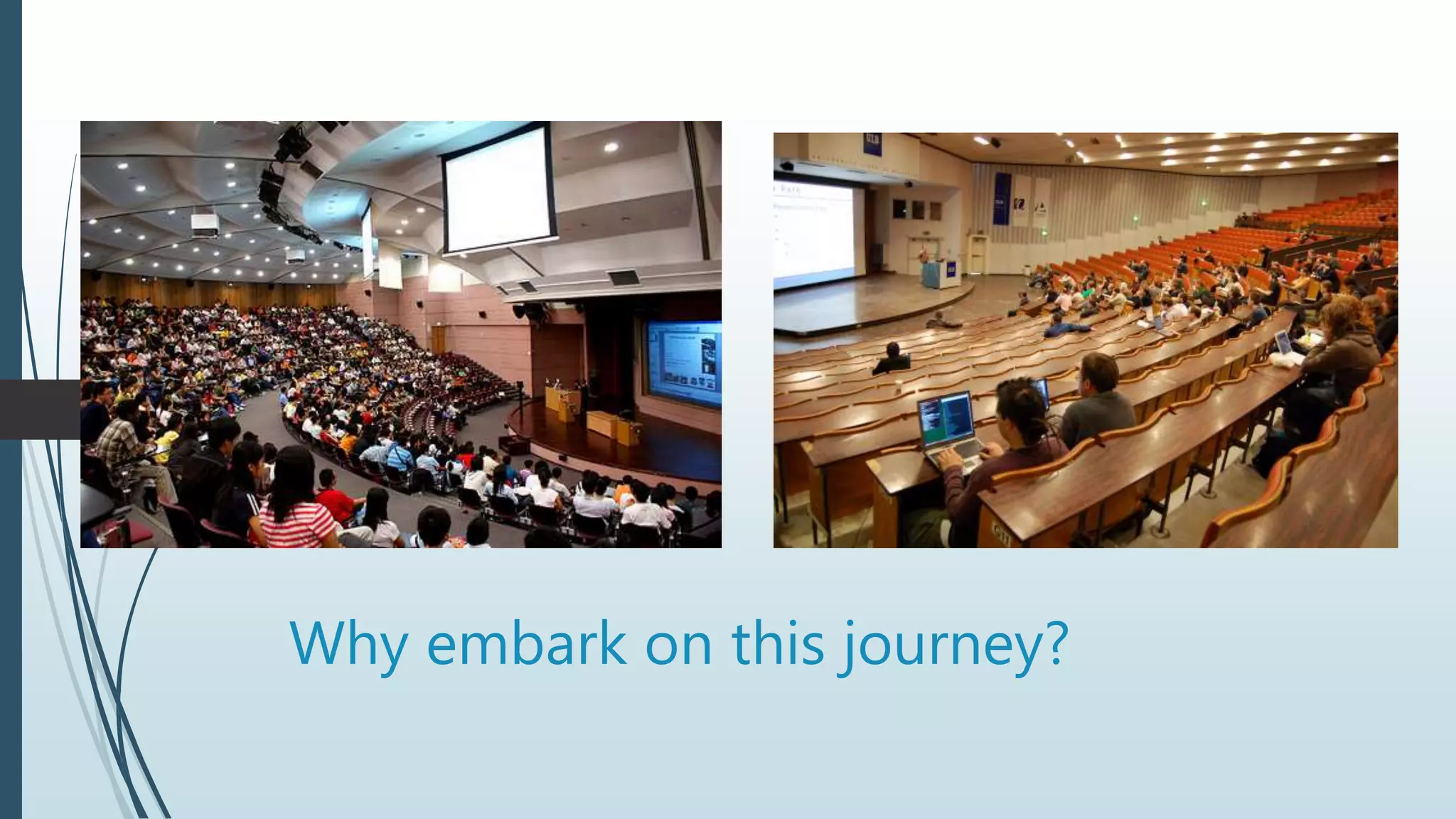
Why embark on this journey?
Most current trend for increasing
engagement…
Flipped Classroom
Stemmed from US secondary Education (mid 1990s)
Simplest form…Classroom contact used for what was traditionally homework,
“Homework” becomes accessing more didactic activities usually done in
classroom e.g. reading, watching videos etc.
Definition with HE environments (Bishop and Verleger, 2013)
Out of Class – Activity must include some form of computer-based instruction.
In class – focus on STUDENT complete(d)/(ing) tasks.
Flipped Classroom Advantages (Literature)
 Removes passive learning
 Student satisfaction increased
 Promotes student empowerment and engagement
 Aligns with competencies and protocols within the workplace
 Improved performance
 Allows contact time to be used for higher order cognitive abilities
References: (Albert & Beatty, 2014; Bishop & Verleger, 2013; Chappell, 2015; Ferreri &
O'Connor, 2013; Huang & Lin, 2017; McLaughlin et al., 2013 O'Flaherty & Phillips,
2015; Rufatto et al., 2016)
Our Model – Business Analysis for Decision Making
 Wealth of existing resources on VLE
 Lecture Recordings
 Additional videos
 Additional PowerPoint Instructions
 Mock Exam Questions – main basis for workshops
 Five per topic (6 topics covered) aligned whenever possible with specialism
 Delivery Model
 1 hour lecture: 300+ students – delivered by same staff member throughout
 2 hour computer workshop: 20ish students - delivered by a team of 7-10 staff
 Assessment
 Preparatory work (using spreadsheets)
 “Fill in the blank” examination
Module Learning Outcomes
1. Understand a variety of
introductory statistical
techniques and their
application to the analysis
and interpretation of
business data for a variety of
organisational applications.
LECTURES: “Fill in
Blanks”
2. Understand and
demonstrate the role of
spreadsheet modelling as
an aid to decision making;
through the selection of
models and techniques to
assist in the solution of
business problems.
WORKSHOPS: “Prep work”
Action Research…
Reaching end of second cycle
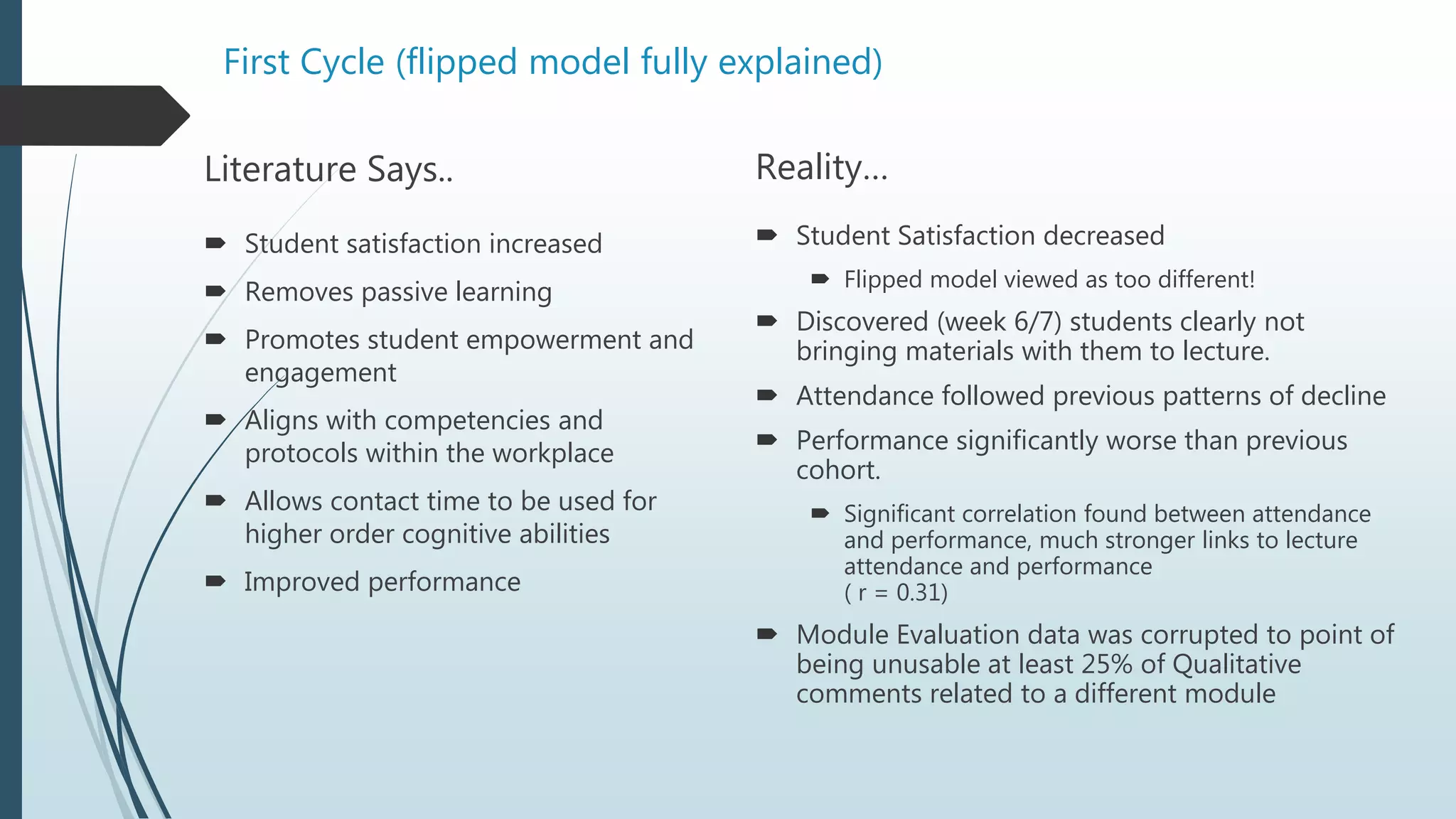
First Cycle (flipped model fully explained)
Literature Says..
 Student satisfaction increased
 Removes passive learning
 Promotes student empowerment and
engagement
 Aligns with competencies and
protocols within the workplace
 Allows contact time to be used for
higher order cognitive abilities
 Improved performance
Reality…
 Student Satisfaction decreased
 Flipped model viewed as too different!
 Discovered (week 6/7) students clearly not
bringing materials with them to lecture.
 Attendance followed previous patterns of decline
 Performance significantly worse than previous
cohort.
 Significant correlation found between attendance
and performance, much stronger links to lecture
attendance and performance
( r = 0.31)
 Module Evaluation data was corrupted to point of
being unusable at least 25% of Qualitative
comments related to a different module
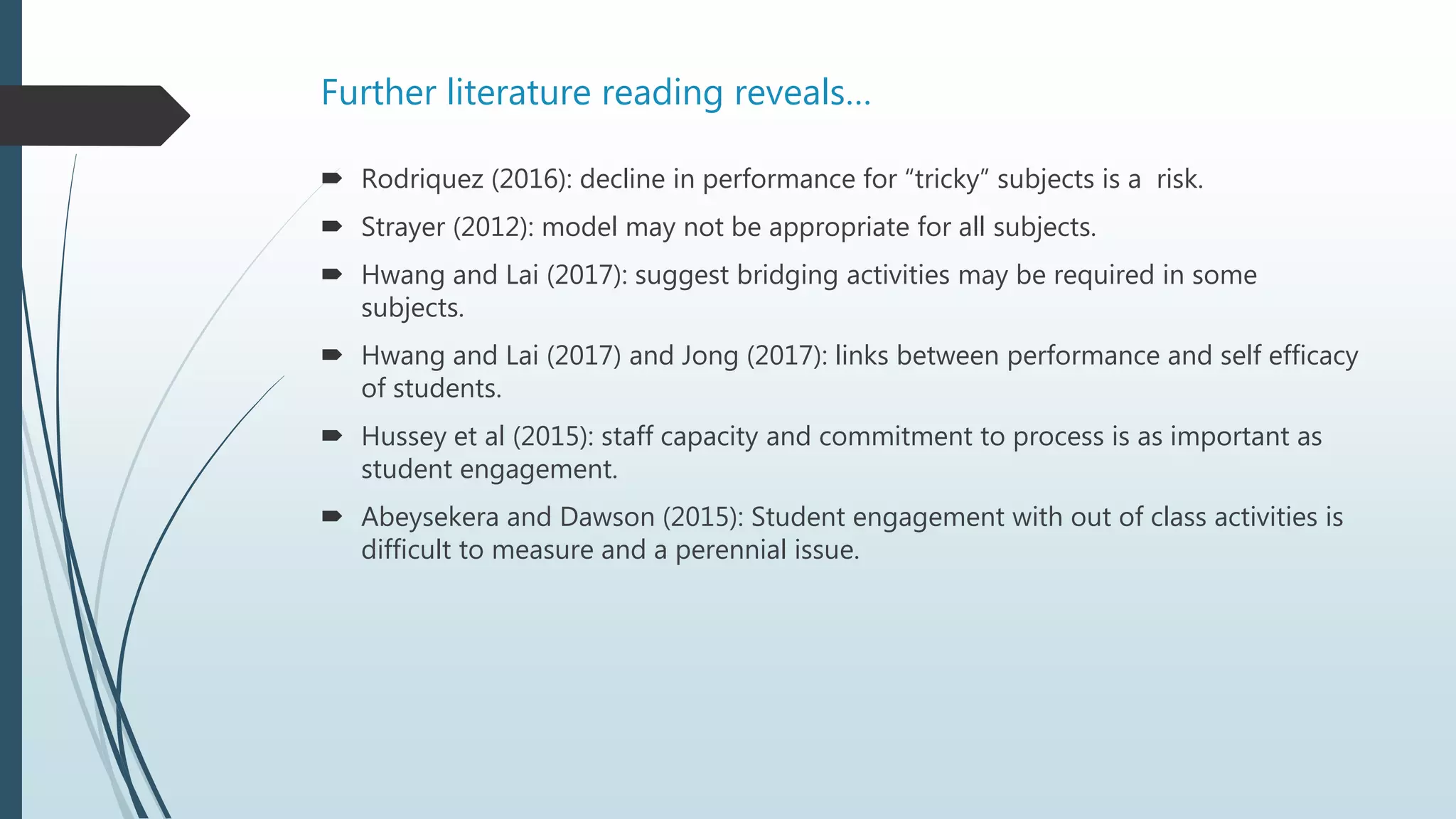
Further literature reading reveals…
 Rodriquez (2016): decline in performance for “tricky” subjects is a risk.
 Strayer (2012): model may not be appropriate for all subjects.
 Hwang and Lai (2017): suggest bridging activities may be required in some
subjects.
 Hwang and Lai (2017) and Jong (2017): links between performance and self efficacy
of students.
 Hussey et al (2015): staff capacity and commitment to process is as important as
student engagement.
 Abeysekera and Dawson (2015): Student engagement with out of class activities is
difficult to measure and a perennial issue.
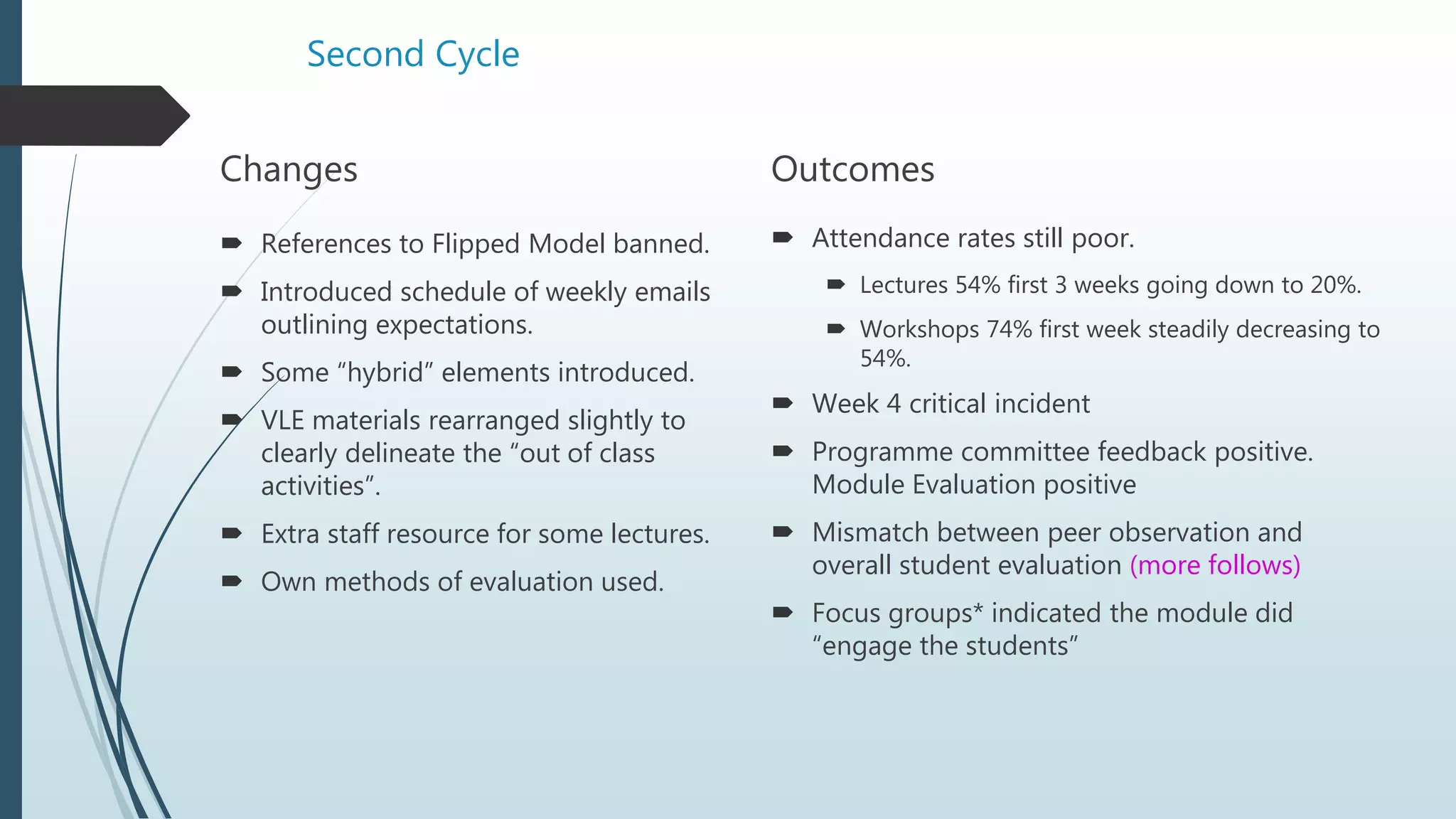
Second Cycle
Changes
 References to Flipped Model banned.
 Introduced schedule of weekly emails
outlining expectations.
 Some “hybrid” elements introduced.
 VLE materials rearranged slightly to
clearly delineate the “out of class
activities”.
 Extra staff resource for some lectures.
 Own methods of evaluation used.
Outcomes
 Attendance rates still poor.
 Lectures 54% first 3 weeks going down to 20%.
 Workshops 74% first week steadily decreasing to
54%.
 Week 4 critical incident
 Programme committee feedback positive.
Module Evaluation positive
 Mismatch between peer observation and
overall student evaluation (more follows)
 Focus groups* indicated the module did
“engage the students”
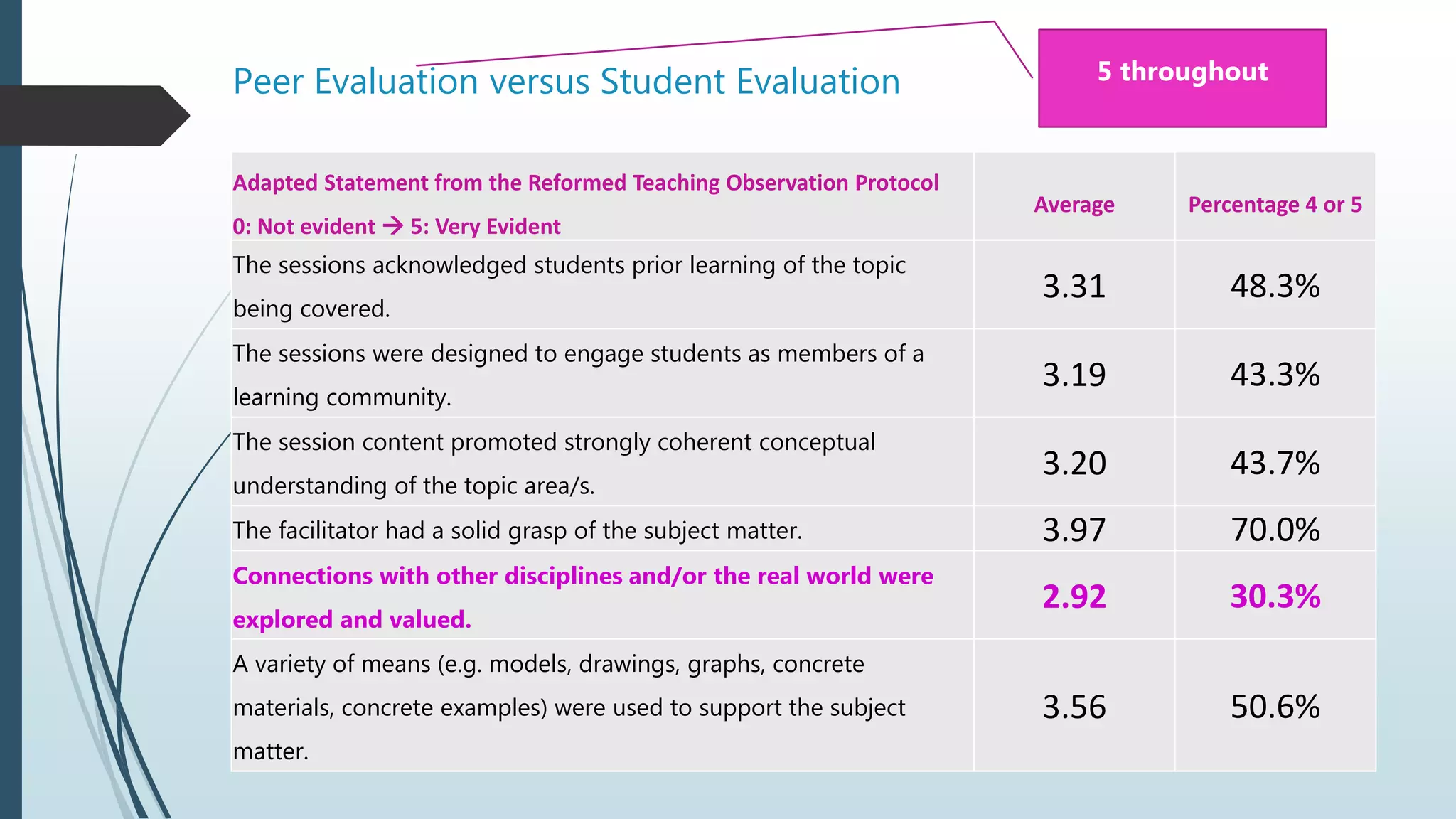
Peer Evaluation versus Student Evaluation
Adapted Statement from the Reformed Teaching Observation Protocol
0: Not evident  5: Very Evident
Average Percentage 4 or 5
The sessions acknowledged students prior learning of the topic
being covered.
3.31 48.3%
The sessions were designed to engage students as members of a
learning community.
3.19 43.3%
The session content promoted strongly coherent conceptual
understanding of the topic area/s.
3.20 43.7%
The facilitator had a solid grasp of the subject matter. 3.97 70.0%
Connections with other disciplines and/or the real world were
explored and valued.
2.92 30.3%
A variety of means (e.g. models, drawings, graphs, concrete
materials, concrete examples) were used to support the subject
matter.
3.56 50.6%
5 throughout
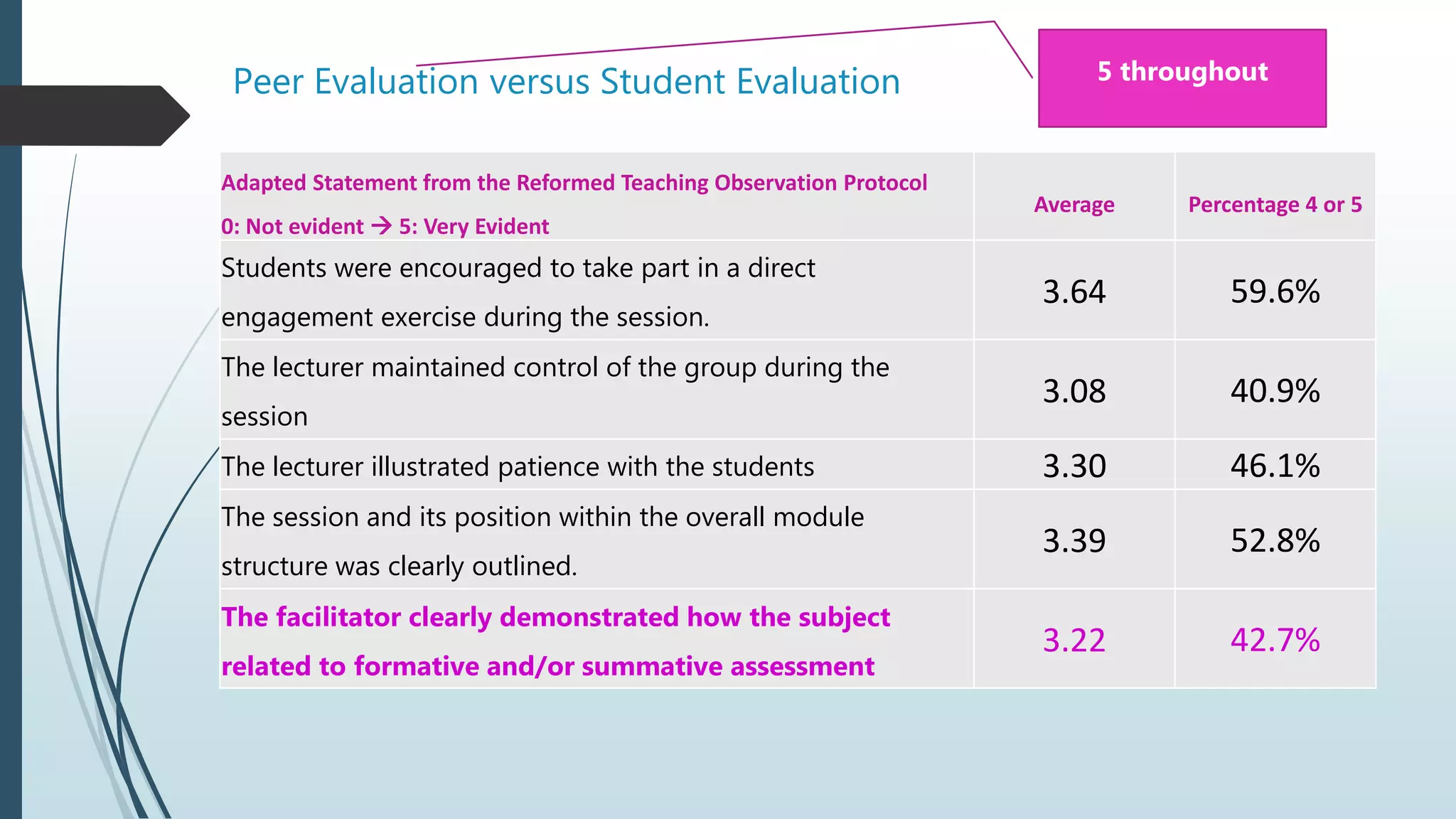
Peer Evaluation versus Student Evaluation
Adapted Statement from the Reformed Teaching Observation Protocol
0: Not evident  5: Very Evident
Average Percentage 4 or 5
Students were encouraged to take part in a direct
engagement exercise during the session.
3.64 59.6%
The lecturer maintained control of the group during the
session
3.08 40.9%
The lecturer illustrated patience with the students 3.30 46.1%
The session and its position within the overall module
structure was clearly outlined.
3.39 52.8%
The facilitator clearly demonstrated how the subject
related to formative and/or summative assessment
3.22 42.7%
5 throughout
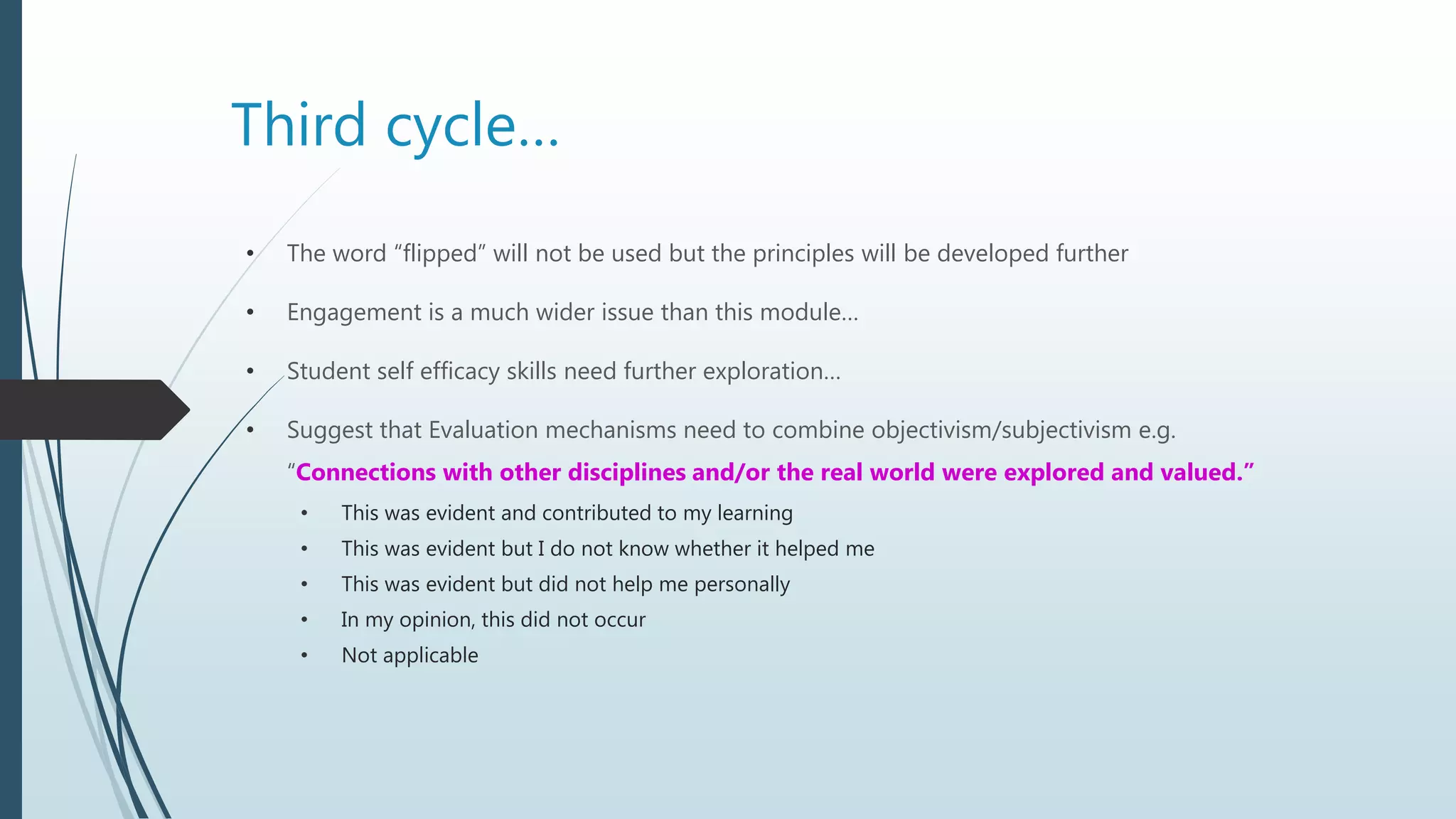
Third cycle…
• The word “flipped” will not be used but the principles will be developed further
• Engagement is a much wider issue than this module…
• Student self efficacy skills need further exploration…
• Suggest that Evaluation mechanisms need to combine objectivism/subjectivism e.g.
“Connections with other disciplines and/or the real world were explored and valued.”
• This was evident and contributed to my learning
• This was evident but I do not know whether it helped me
• This was evident but did not help me personally
• In my opinion, this did not occur
• Not applicable
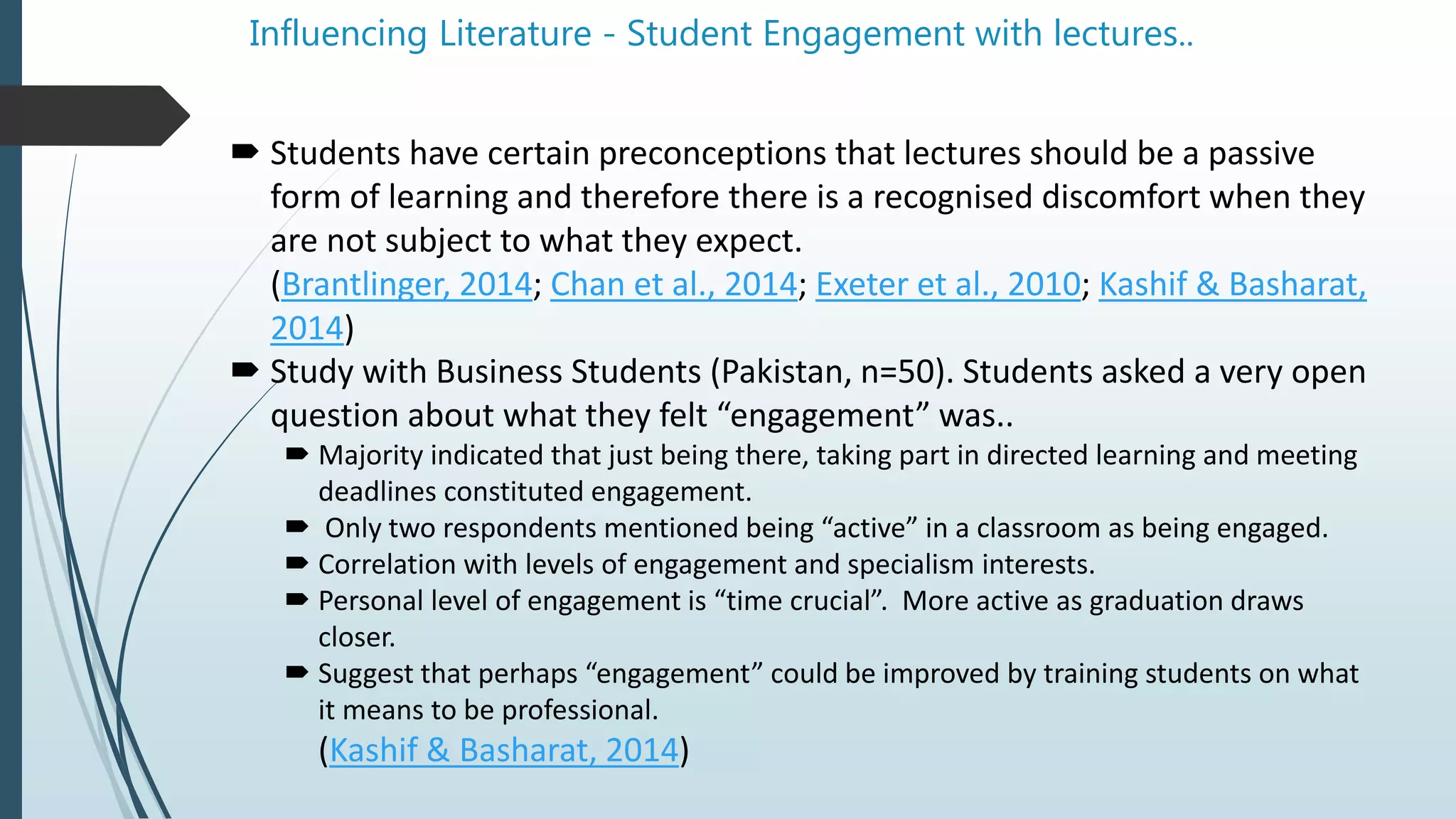
Influencing Literature - Student Engagement with lectures..
 Students have certain preconceptions that lectures should be a passive
form of learning and therefore there is a recognised discomfort when they
are not subject to what they expect.
(Brantlinger, 2014; Chan et al., 2014; Exeter et al., 2010; Kashif & Basharat,
2014)
 Study with Business Students (Pakistan, n=50). Students asked a very open
question about what they felt “engagement” was..
 Majority indicated that just being there, taking part in directed learning and meeting
deadlines constituted engagement.
 Only two respondents mentioned being “active” in a classroom as being engaged.
 Correlation with levels of engagement and specialism interests.
 Personal level of engagement is “time crucial”. More active as graduation draws
closer.
 Suggest that perhaps “engagement” could be improved by training students on what
it means to be professional.
(Kashif & Basharat, 2014)

Flipping heck! how can we engage students in the lecture experience?

  • 1.
    Flipping Heck! Howcan we engage students in the lecture experience? Joanne Smailes, Northumbria University Anna Heyman, Research Assistant
  • 2.
    Why embark onthis journey?
  • 3.
    Most current trendfor increasing engagement… Flipped Classroom Stemmed from US secondary Education (mid 1990s) Simplest form…Classroom contact used for what was traditionally homework, “Homework” becomes accessing more didactic activities usually done in classroom e.g. reading, watching videos etc. Definition with HE environments (Bishop and Verleger, 2013) Out of Class – Activity must include some form of computer-based instruction. In class – focus on STUDENT complete(d)/(ing) tasks.
  • 4.
    Flipped Classroom Advantages(Literature)  Removes passive learning  Student satisfaction increased  Promotes student empowerment and engagement  Aligns with competencies and protocols within the workplace  Improved performance  Allows contact time to be used for higher order cognitive abilities References: (Albert & Beatty, 2014; Bishop & Verleger, 2013; Chappell, 2015; Ferreri & O'Connor, 2013; Huang & Lin, 2017; McLaughlin et al., 2013 O'Flaherty & Phillips, 2015; Rufatto et al., 2016)
  • 5.
    Our Model –Business Analysis for Decision Making  Wealth of existing resources on VLE  Lecture Recordings  Additional videos  Additional PowerPoint Instructions  Mock Exam Questions – main basis for workshops  Five per topic (6 topics covered) aligned whenever possible with specialism  Delivery Model  1 hour lecture: 300+ students – delivered by same staff member throughout  2 hour computer workshop: 20ish students - delivered by a team of 7-10 staff  Assessment  Preparatory work (using spreadsheets)  “Fill in the blank” examination Module Learning Outcomes 1. Understand a variety of introductory statistical techniques and their application to the analysis and interpretation of business data for a variety of organisational applications. LECTURES: “Fill in Blanks” 2. Understand and demonstrate the role of spreadsheet modelling as an aid to decision making; through the selection of models and techniques to assist in the solution of business problems. WORKSHOPS: “Prep work”
  • 6.
  • 7.
    First Cycle (flippedmodel fully explained) Literature Says..  Student satisfaction increased  Removes passive learning  Promotes student empowerment and engagement  Aligns with competencies and protocols within the workplace  Allows contact time to be used for higher order cognitive abilities  Improved performance Reality…  Student Satisfaction decreased  Flipped model viewed as too different!  Discovered (week 6/7) students clearly not bringing materials with them to lecture.  Attendance followed previous patterns of decline  Performance significantly worse than previous cohort.  Significant correlation found between attendance and performance, much stronger links to lecture attendance and performance ( r = 0.31)  Module Evaluation data was corrupted to point of being unusable at least 25% of Qualitative comments related to a different module
  • 8.
    Further literature readingreveals…  Rodriquez (2016): decline in performance for “tricky” subjects is a risk.  Strayer (2012): model may not be appropriate for all subjects.  Hwang and Lai (2017): suggest bridging activities may be required in some subjects.  Hwang and Lai (2017) and Jong (2017): links between performance and self efficacy of students.  Hussey et al (2015): staff capacity and commitment to process is as important as student engagement.  Abeysekera and Dawson (2015): Student engagement with out of class activities is difficult to measure and a perennial issue.
  • 9.
    Second Cycle Changes  Referencesto Flipped Model banned.  Introduced schedule of weekly emails outlining expectations.  Some “hybrid” elements introduced.  VLE materials rearranged slightly to clearly delineate the “out of class activities”.  Extra staff resource for some lectures.  Own methods of evaluation used. Outcomes  Attendance rates still poor.  Lectures 54% first 3 weeks going down to 20%.  Workshops 74% first week steadily decreasing to 54%.  Week 4 critical incident  Programme committee feedback positive. Module Evaluation positive  Mismatch between peer observation and overall student evaluation (more follows)  Focus groups* indicated the module did “engage the students”
  • 10.
    Peer Evaluation versusStudent Evaluation Adapted Statement from the Reformed Teaching Observation Protocol 0: Not evident  5: Very Evident Average Percentage 4 or 5 The sessions acknowledged students prior learning of the topic being covered. 3.31 48.3% The sessions were designed to engage students as members of a learning community. 3.19 43.3% The session content promoted strongly coherent conceptual understanding of the topic area/s. 3.20 43.7% The facilitator had a solid grasp of the subject matter. 3.97 70.0% Connections with other disciplines and/or the real world were explored and valued. 2.92 30.3% A variety of means (e.g. models, drawings, graphs, concrete materials, concrete examples) were used to support the subject matter. 3.56 50.6% 5 throughout
  • 11.
    Peer Evaluation versusStudent Evaluation Adapted Statement from the Reformed Teaching Observation Protocol 0: Not evident  5: Very Evident Average Percentage 4 or 5 Students were encouraged to take part in a direct engagement exercise during the session. 3.64 59.6% The lecturer maintained control of the group during the session 3.08 40.9% The lecturer illustrated patience with the students 3.30 46.1% The session and its position within the overall module structure was clearly outlined. 3.39 52.8% The facilitator clearly demonstrated how the subject related to formative and/or summative assessment 3.22 42.7% 5 throughout
  • 12.
    Third cycle… • Theword “flipped” will not be used but the principles will be developed further • Engagement is a much wider issue than this module… • Student self efficacy skills need further exploration… • Suggest that Evaluation mechanisms need to combine objectivism/subjectivism e.g. “Connections with other disciplines and/or the real world were explored and valued.” • This was evident and contributed to my learning • This was evident but I do not know whether it helped me • This was evident but did not help me personally • In my opinion, this did not occur • Not applicable
  • 13.
    Influencing Literature -Student Engagement with lectures..  Students have certain preconceptions that lectures should be a passive form of learning and therefore there is a recognised discomfort when they are not subject to what they expect. (Brantlinger, 2014; Chan et al., 2014; Exeter et al., 2010; Kashif & Basharat, 2014)  Study with Business Students (Pakistan, n=50). Students asked a very open question about what they felt “engagement” was..  Majority indicated that just being there, taking part in directed learning and meeting deadlines constituted engagement.  Only two respondents mentioned being “active” in a classroom as being engaged.  Correlation with levels of engagement and specialism interests.  Personal level of engagement is “time crucial”. More active as graduation draws closer.  Suggest that perhaps “engagement” could be improved by training students on what it means to be professional. (Kashif & Basharat, 2014)