By Ooi Jiayun
• Teacher’s name: Ooi Jiayun
• Subject & Topic: Year 4 Mathematics
Topic 2 Fractions
• Time allocation: 60 minutes
• Out of classroom (home/lab), in classroom
• First time flipping classroom
What a Flipped Classroom Model does:
1. Students watch lectures at home at their own pace,
communicating with peers and teachers via online.
2. Teacher spend class time working directly with students
to provide hands-on instruction and support.
STEP 1:
CREATING AN ONLINE INSTRUCTIONAL VIDEO
(AT HOME). STUDENTS WATCH AND STUDY
LECTURES AT HOME BEFORE GOING TO
SCHOOL.
STEP 2:
DEVELOP LEARNING ACTIVITIES TO FILL UP THE
CLASS TIME. THESE LEARNING ACTIVITIES ARE
CREATED TO SUSTAIN STUDENTS’ MOTIVATION,
ENCOURAGE CRITICAL THOUGHT AND
PROMOTE SOCIAL INTERACTION AMONG
STUDENTS. TEACHER WORKS AS A
FACILITATOR,
Structure of
Flipped
Classroom Project
Targeted
Individuals
Place Timing
(minutes)
Online Instructions Students Home 15
Activity learning Students School 45
Materials Needed:
1. Ipad/ computer/ Chromebooks
2. Internet access
3. Paper/ pencil
4. Fraction Walls/ Cuisenaire Rods
5. Group Learning Worksheets/ team boards
RECOGNITION:
As activities are held, teacher goes around and check
on students’ progress. If students need help, teacher
can explain so that students can understand better.
Students who understand the concept and steps
thoroughly are rewarded with a token (stickers) as
encouragement. Teacher always give words of
encouragement to student who do well.
Vision:
• Create new opportunities to engage students to
learn through technology
• Able to influence students’ learning environments
in fundamental way
Academic Goals:
90% of 4B class students are
able to express equivalent
fractions for proper fractions.
Flipped Classroom Project Priorities:
• At home: Educational Technology (Online
Instructions)
• At school: Activity Learning (Collaborative Group
Learning, Problem Based-Learning etc.)
AT HOME:
Students will access to this Storify
https://storify.com/jiayun90/mathematics-year-4. They will read
and learn about equivalent fractions through slides which
are posted on Storify. To acquire more knowledge, students
can watch some videos posted on Storify.
Before the class next day, students need to complete
worksheets on Padlet. They need to post their answers on
Padlet. Classmates are welcomed to comment on their
peers’ answers. Answers will be discussed tomorrow.
AT SCHOOL:
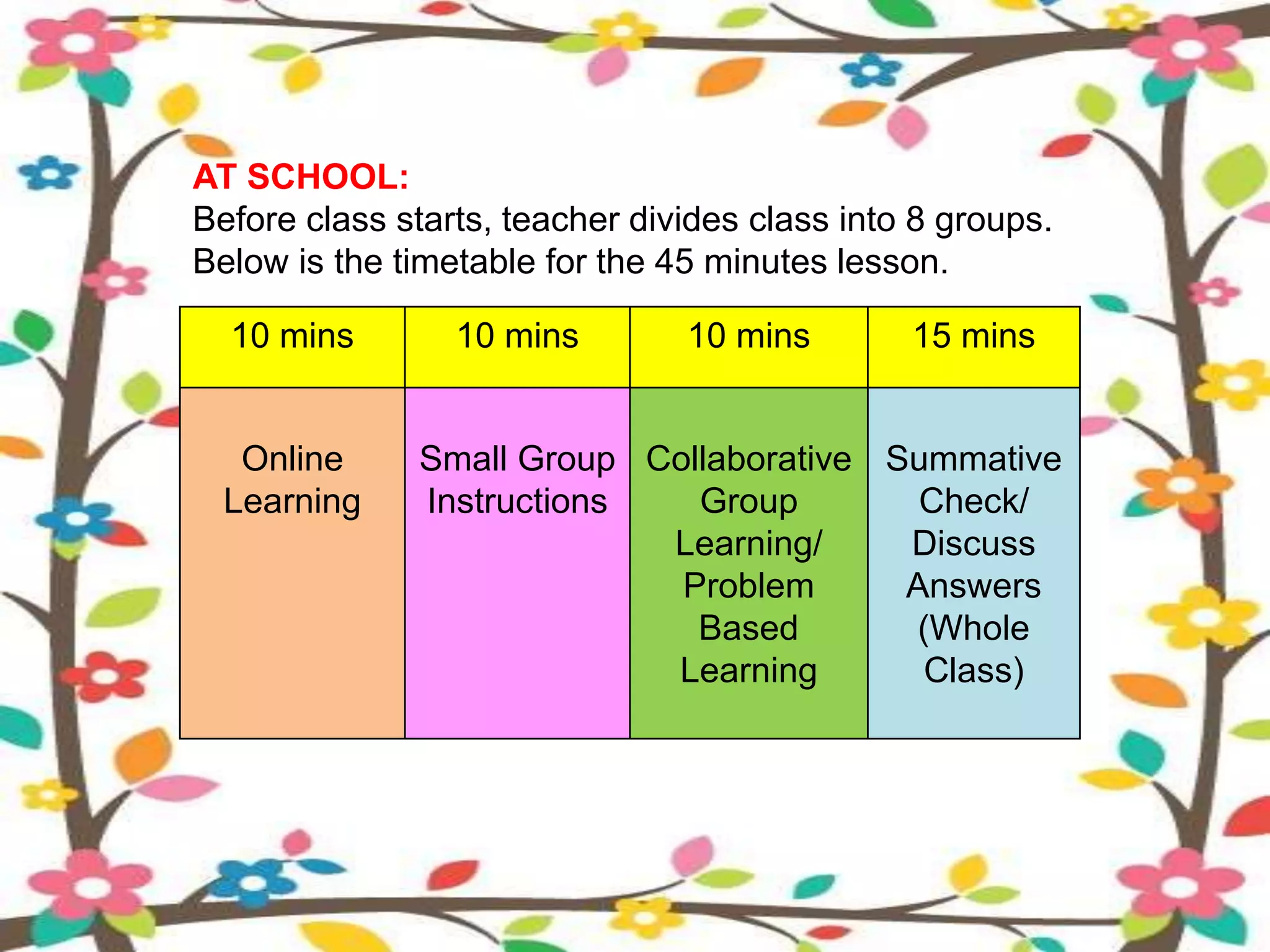
Before class starts, teacher divides class into 8 groups.
Below is the timetable for the 45 minutes lesson.
10 mins 10 mins 10 mins 15 mins
Online
Learning
Small Group
Instructions
Collaborative
Group
Learning/
Problem
Based
Learning
Summative
Check/
Discuss
Answers
(Whole
Class)
Online Learning
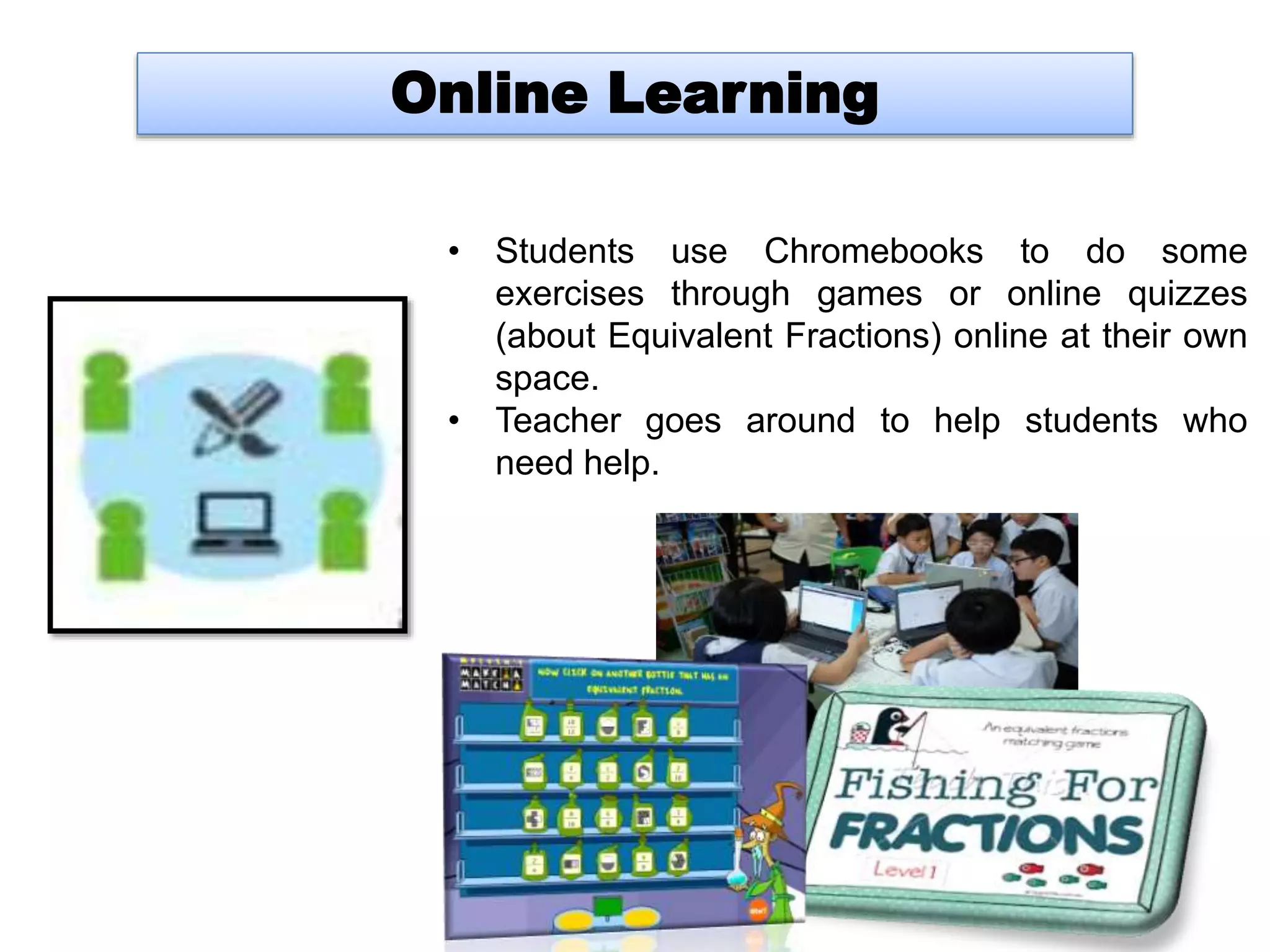
• Students use Chromebooks to do some
exercises through games or online quizzes
(about Equivalent Fractions) online at their own
space.
• Teacher goes around to help students who
need help.
Examples of online games and digital notes
Online Learning
Small Group Instructions
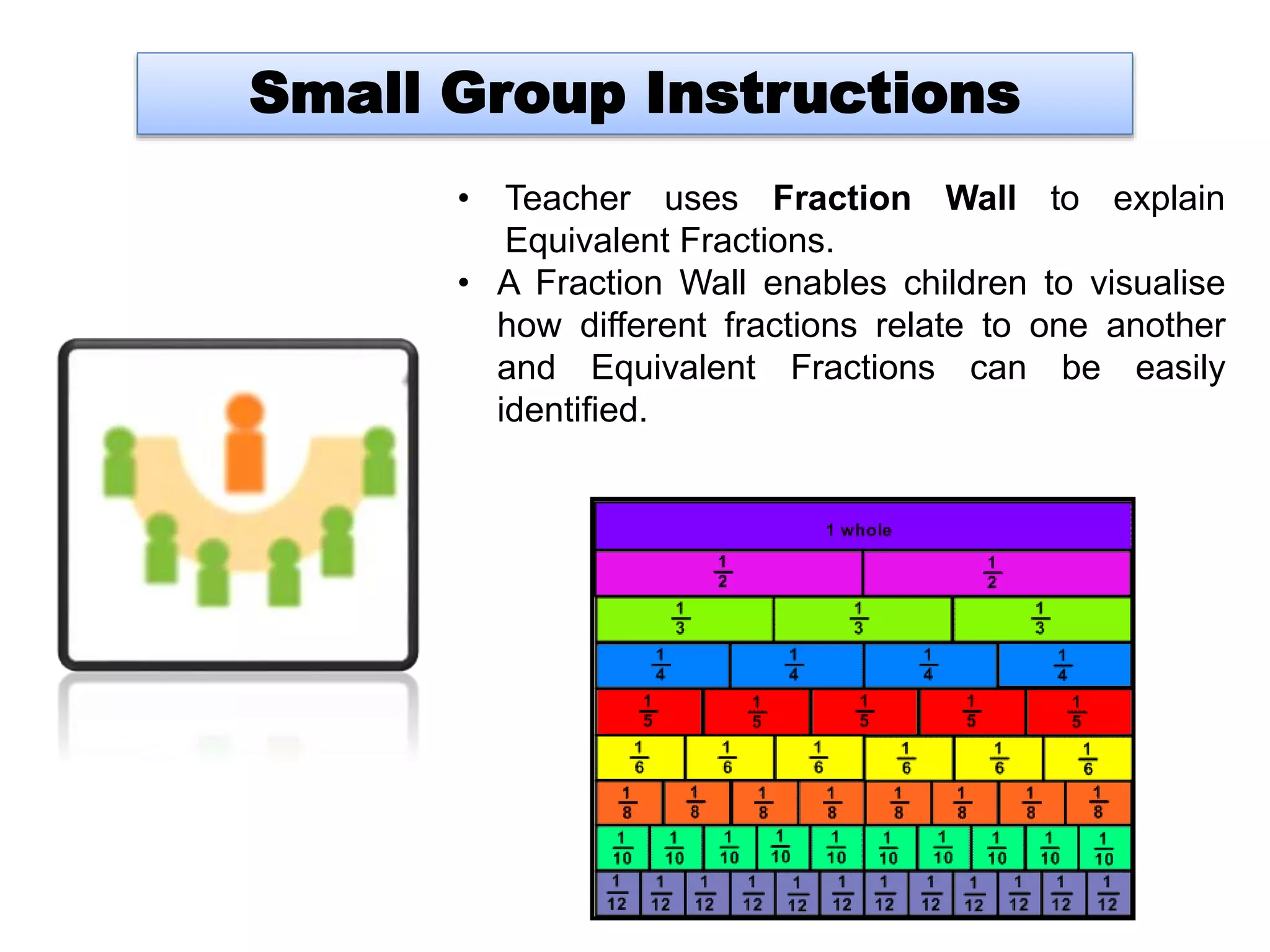
• Teacher uses Fraction Wall to explain
Equivalent Fractions.
• A Fraction Wall enables children to visualise
how different fractions relate to one another
and Equivalent Fractions can be easily
identified.
• Teacher also uses Cuisenaire Rods to
explain Equivalent Fractions.
• Cuisenaire Rods enables children to visualise
how different fractions relate to one another
and Equivalent Fractions can be easily
identified through hands-on.
• Teacher asks questions. Students need to find
the equivalent fractions using these two aids.
• Teacher goes around and gives aid to
students who need help.
Small Group Instructions
Collaborative Group
Learning/Problem Based Learning
PIZZA FRACTION FUN
1. Show the students the Pizza Problem . Give
them time to think of their own answer and discuss
their ideas together. Hopefully they will figure out
that it depends on which pizza slices each person
takes. It’s possible that 4 pieces of pizza might be
the same amount as 3 pieces if the 4 pieces are
smaller. This particular pizza is not cut into equal
pieces.
PIZZA FRACTION FUN
2. Give each group a set of pizzas in all fraction
sizes and the Pizza Fraction Placemat (the whole
divided into twelfths) page 3 until page 8. Display
the Equivalent Fractions problems on page 9. As
you display each problem, ask the students who
have those pieces to create the problem on the
Pizza Placemat. For example, the first problem
involves fourths and eighths. The students with the
fourths would place 1/4 on their team boards and
the students with the eighths would add enough
1/8 pieces to create an equivalent fraction.
Everyone on the team should record the answer on
their own worksheet.
Collaborative Group
Learning/Problem Based Learning
PIZZA FRACTION FUN
Teacher can get the resources from here:
http://mcssta13fractions.weebly.com/uploads/2/2/1/0/
22104466/pizzafractionfun.pdf
Collaborative Group
Learning/Problem Based Learning
• During this activity, teacher goes around to help
students who need help.
Summative Check/ Discuss
Answers
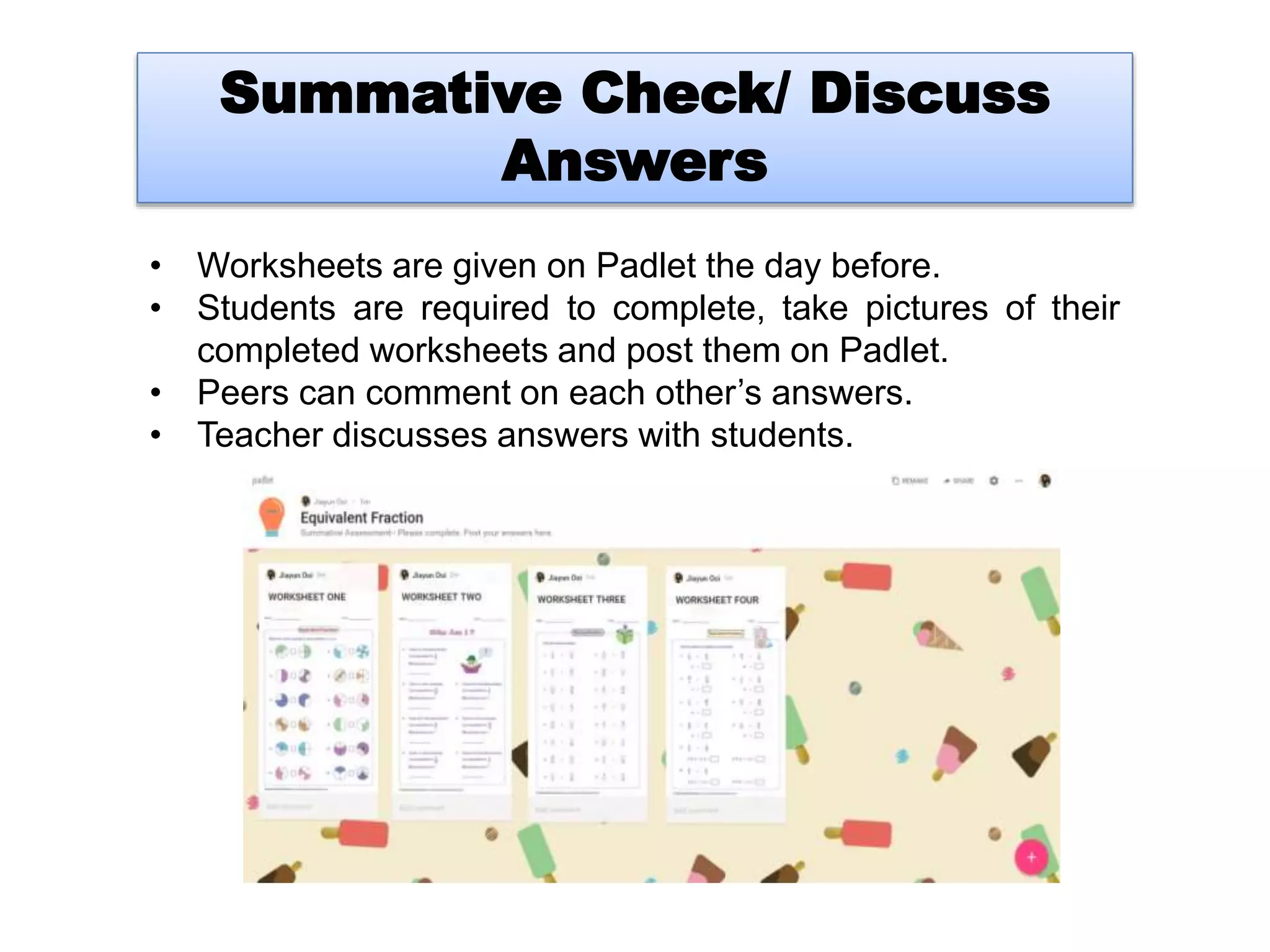
• Worksheets are given on Padlet the day before.
• Students are required to complete, take pictures of their
completed worksheets and post them on Padlet.
• Peers can comment on each other’s answers.
• Teacher discusses answers with students.
Check and Reflect
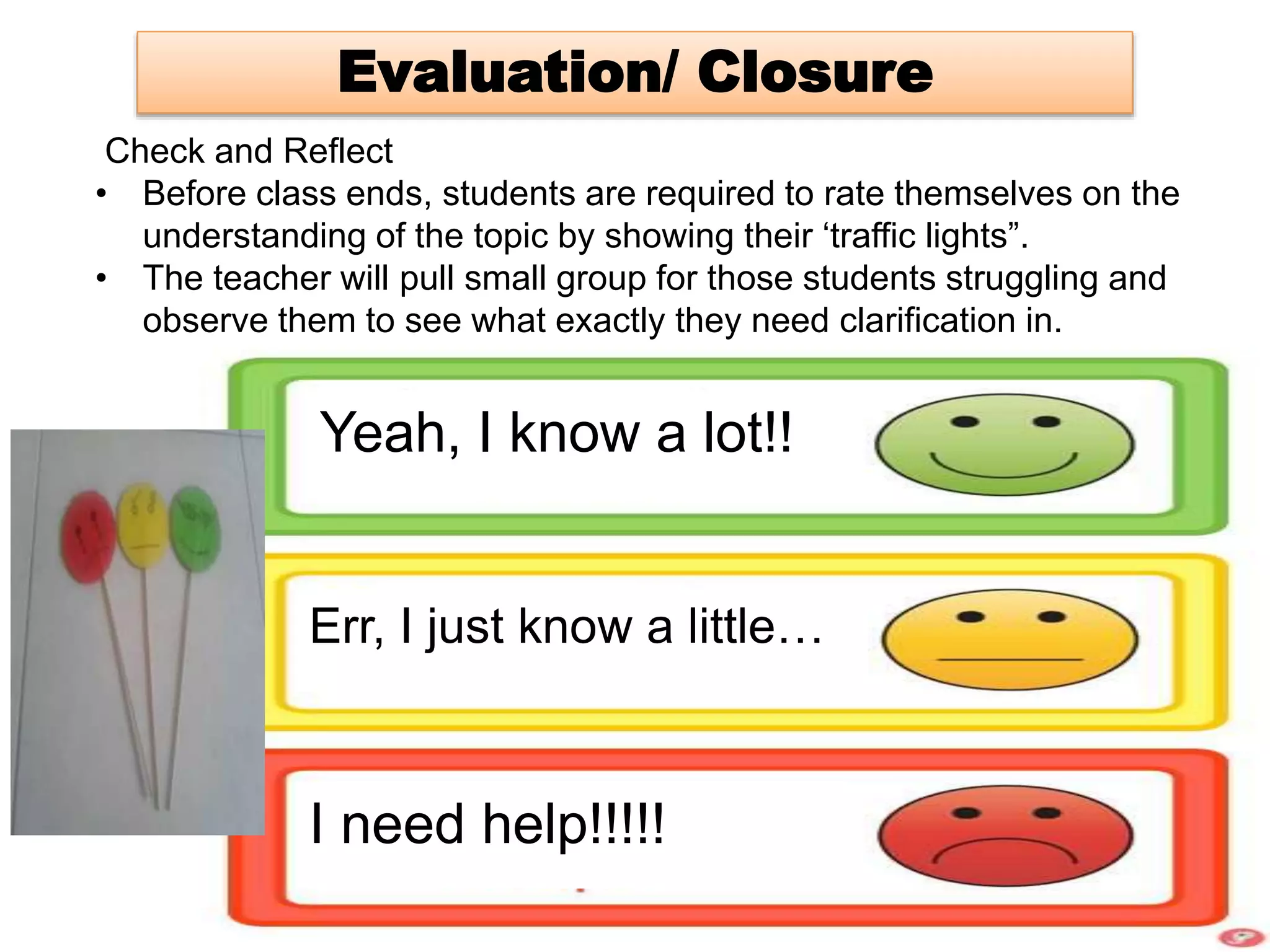
• Before class ends, students are required to rate themselves on the
understanding of the topic by showing their ‘traffic lights”.
• The teacher will pull small group for those students struggling and
observe them to see what exactly they need clarification in.
Yeah, I know a lot!!
Err, I just know a little…
I need help!!!!!
Evaluation/ Closure

Flipped classroom [autosaved]1

  • 1.
  • 3.
    • Teacher’s name:Ooi Jiayun • Subject & Topic: Year 4 Mathematics Topic 2 Fractions • Time allocation: 60 minutes • Out of classroom (home/lab), in classroom • First time flipping classroom
  • 5.
    What a FlippedClassroom Model does: 1. Students watch lectures at home at their own pace, communicating with peers and teachers via online. 2. Teacher spend class time working directly with students to provide hands-on instruction and support.
  • 6.
    STEP 1: CREATING ANONLINE INSTRUCTIONAL VIDEO (AT HOME). STUDENTS WATCH AND STUDY LECTURES AT HOME BEFORE GOING TO SCHOOL. STEP 2: DEVELOP LEARNING ACTIVITIES TO FILL UP THE CLASS TIME. THESE LEARNING ACTIVITIES ARE CREATED TO SUSTAIN STUDENTS’ MOTIVATION, ENCOURAGE CRITICAL THOUGHT AND PROMOTE SOCIAL INTERACTION AMONG STUDENTS. TEACHER WORKS AS A FACILITATOR,
  • 7.
    Structure of Flipped Classroom Project Targeted Individuals PlaceTiming (minutes) Online Instructions Students Home 15 Activity learning Students School 45 Materials Needed: 1. Ipad/ computer/ Chromebooks 2. Internet access 3. Paper/ pencil 4. Fraction Walls/ Cuisenaire Rods 5. Group Learning Worksheets/ team boards
  • 8.
    RECOGNITION: As activities areheld, teacher goes around and check on students’ progress. If students need help, teacher can explain so that students can understand better. Students who understand the concept and steps thoroughly are rewarded with a token (stickers) as encouragement. Teacher always give words of encouragement to student who do well.
  • 11.
    Vision: • Create newopportunities to engage students to learn through technology • Able to influence students’ learning environments in fundamental way Academic Goals: 90% of 4B class students are able to express equivalent fractions for proper fractions. Flipped Classroom Project Priorities: • At home: Educational Technology (Online Instructions) • At school: Activity Learning (Collaborative Group Learning, Problem Based-Learning etc.)
  • 13.
    AT HOME: Students willaccess to this Storify https://storify.com/jiayun90/mathematics-year-4. They will read and learn about equivalent fractions through slides which are posted on Storify. To acquire more knowledge, students can watch some videos posted on Storify. Before the class next day, students need to complete worksheets on Padlet. They need to post their answers on Padlet. Classmates are welcomed to comment on their peers’ answers. Answers will be discussed tomorrow.
  • 14.
    AT SCHOOL: Before classstarts, teacher divides class into 8 groups. Below is the timetable for the 45 minutes lesson. 10 mins 10 mins 10 mins 15 mins Online Learning Small Group Instructions Collaborative Group Learning/ Problem Based Learning Summative Check/ Discuss Answers (Whole Class)
  • 15.
    Online Learning • Studentsuse Chromebooks to do some exercises through games or online quizzes (about Equivalent Fractions) online at their own space. • Teacher goes around to help students who need help.
  • 16.
    Examples of onlinegames and digital notes Online Learning
  • 17.
    Small Group Instructions •Teacher uses Fraction Wall to explain Equivalent Fractions. • A Fraction Wall enables children to visualise how different fractions relate to one another and Equivalent Fractions can be easily identified.
  • 18.
    • Teacher alsouses Cuisenaire Rods to explain Equivalent Fractions. • Cuisenaire Rods enables children to visualise how different fractions relate to one another and Equivalent Fractions can be easily identified through hands-on. • Teacher asks questions. Students need to find the equivalent fractions using these two aids. • Teacher goes around and gives aid to students who need help. Small Group Instructions
  • 19.
    Collaborative Group Learning/Problem BasedLearning PIZZA FRACTION FUN 1. Show the students the Pizza Problem . Give them time to think of their own answer and discuss their ideas together. Hopefully they will figure out that it depends on which pizza slices each person takes. It’s possible that 4 pieces of pizza might be the same amount as 3 pieces if the 4 pieces are smaller. This particular pizza is not cut into equal pieces.
  • 20.
    PIZZA FRACTION FUN 2.Give each group a set of pizzas in all fraction sizes and the Pizza Fraction Placemat (the whole divided into twelfths) page 3 until page 8. Display the Equivalent Fractions problems on page 9. As you display each problem, ask the students who have those pieces to create the problem on the Pizza Placemat. For example, the first problem involves fourths and eighths. The students with the fourths would place 1/4 on their team boards and the students with the eighths would add enough 1/8 pieces to create an equivalent fraction. Everyone on the team should record the answer on their own worksheet. Collaborative Group Learning/Problem Based Learning
  • 21.
    PIZZA FRACTION FUN Teachercan get the resources from here: http://mcssta13fractions.weebly.com/uploads/2/2/1/0/ 22104466/pizzafractionfun.pdf Collaborative Group Learning/Problem Based Learning • During this activity, teacher goes around to help students who need help.
  • 22.
    Summative Check/ Discuss Answers •Worksheets are given on Padlet the day before. • Students are required to complete, take pictures of their completed worksheets and post them on Padlet. • Peers can comment on each other’s answers. • Teacher discusses answers with students.
  • 23.
    Check and Reflect •Before class ends, students are required to rate themselves on the understanding of the topic by showing their ‘traffic lights”. • The teacher will pull small group for those students struggling and observe them to see what exactly they need clarification in. Yeah, I know a lot!! Err, I just know a little… I need help!!!!! Evaluation/ Closure