Raft: A Consensus Algorithm
for Replicated Logs
The authors attributed the RAFT slides to Diego Ongaro and John Ousterhout
The following slides are an edited version of slides by professors Michael Freedman, Kyle
Jamieson, and Wyatt Lloyd taught in Princeton’s COS418 course (CC license).
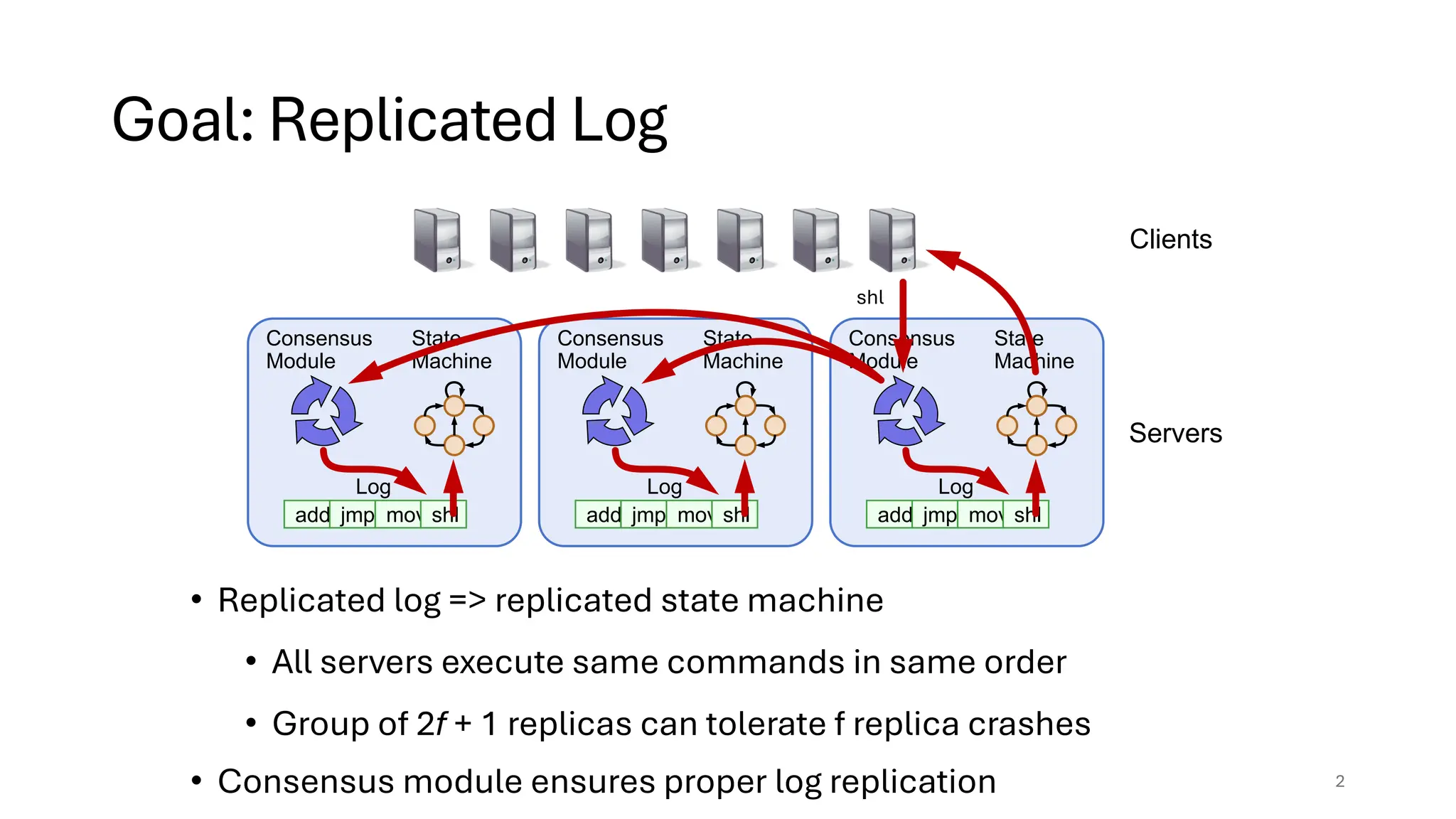
• Replicated log => replicated state machine
• All servers execute same commands in same order
• Group of 2f + 1 replicas can tolerate f replica crashes
• Consensus module ensures proper log replication
Goal: Replicated Log
add jmp mov shl
Log
Consensus
Module
State
Machine
add jmp mov shl
Log
Consensus
Module
State
Machine
add jmp mov shl
Log
Consensus
Module
State
Machine
Servers
Clients
shl
2
Consensus
Definition:
• A general agreement about something
• An idea or opinion that is shared by all the people in a group
Where do we use consensus?
• What is the order of operations
• Which operations are fully executed (committed) and not
• Who are the members of the group
• Who are the leaders of the group
1. Leader election
2. Normal operation (basic log replication)
3. Safety and consistency after leader changes
4. Neutralizing old leaders
5. Client interactions
6. Reconfiguration
Raft Overview
4
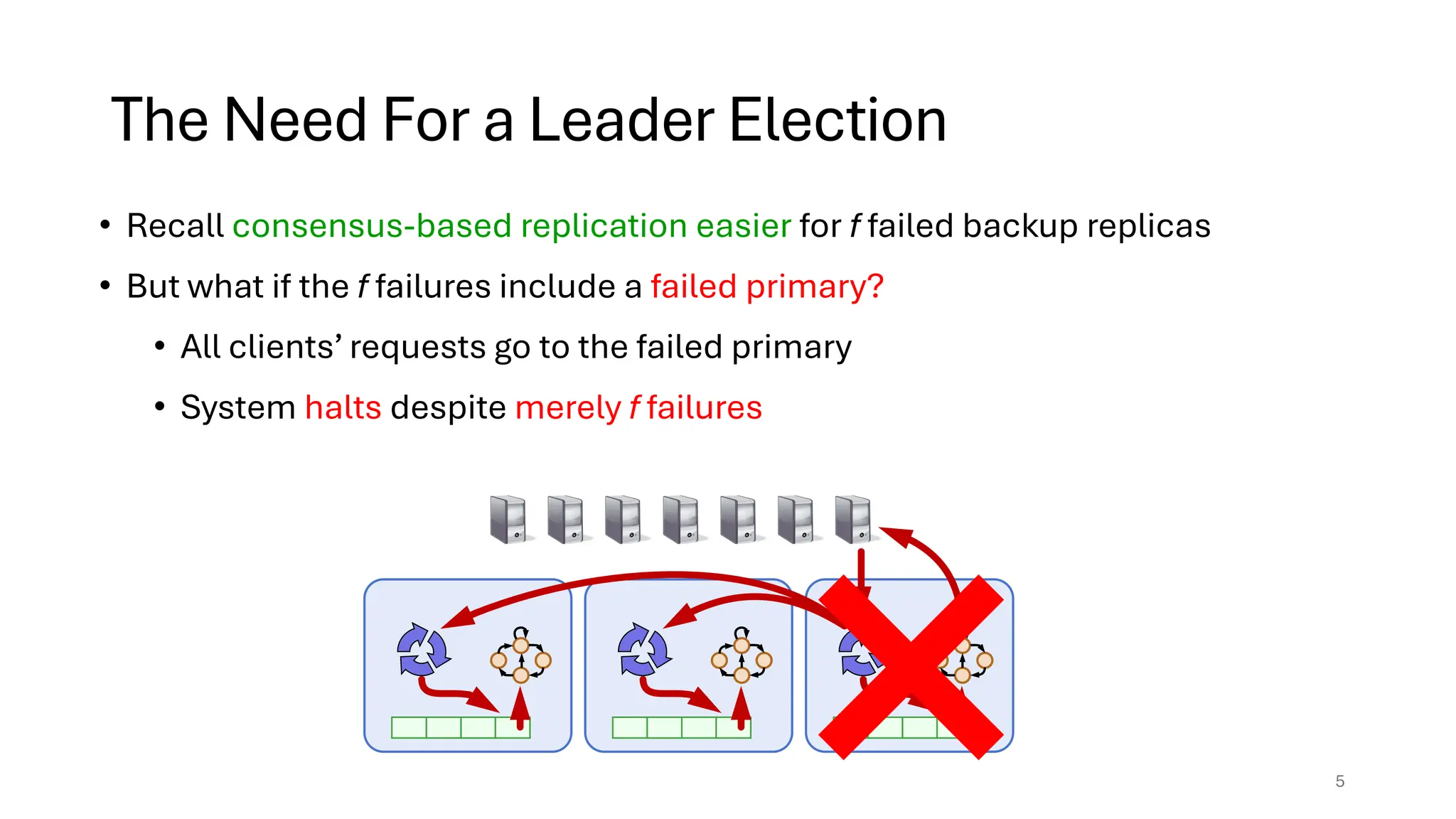
The Need For a Leader Election
• Recall consensus-based replication easier for f failed backup replicas
• But what if the f failures include a failed primary?
• All clients’ requests go to the failed primary
• System halts despite merely f failures
5
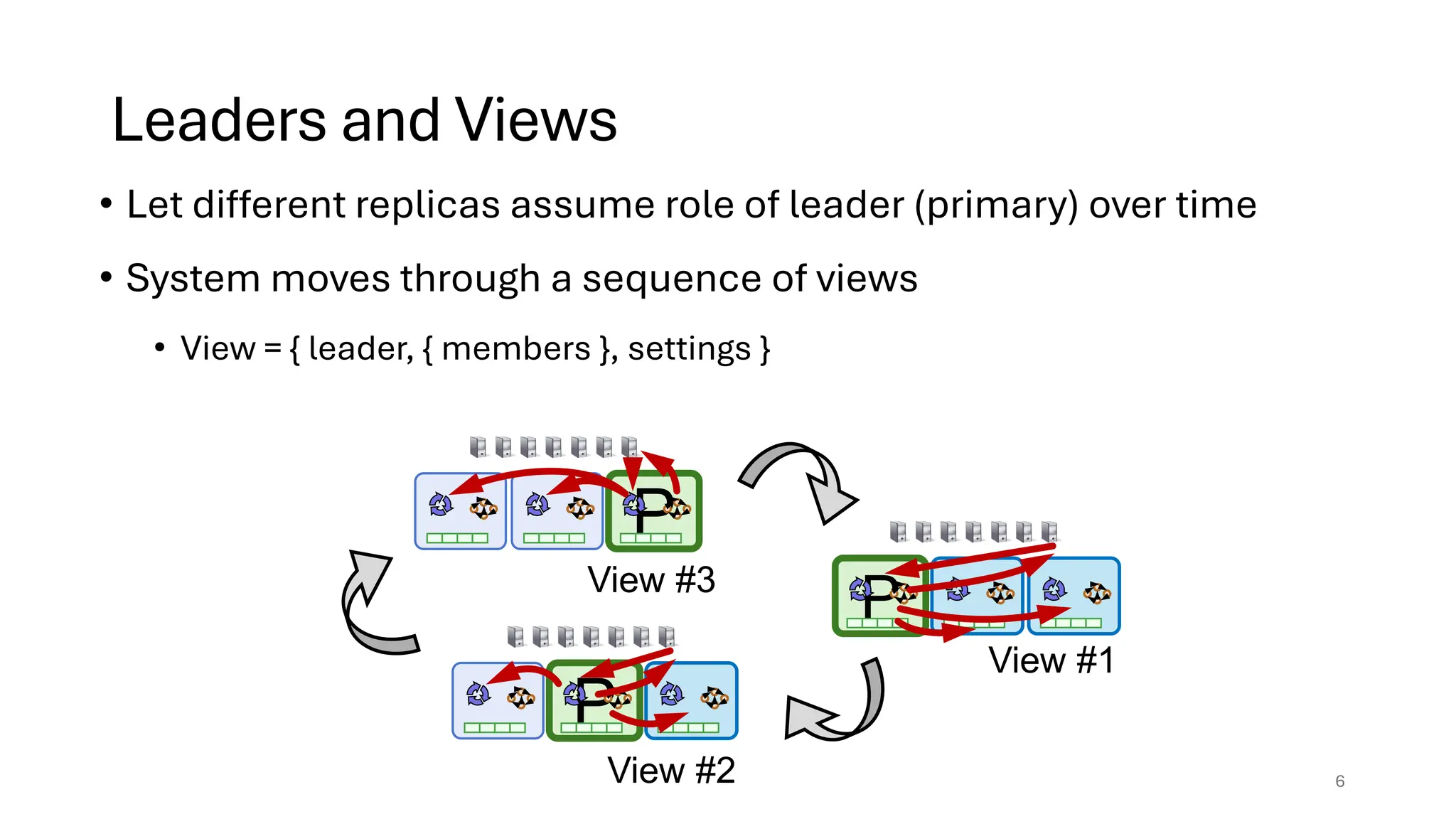
Leaders and Views
• Let different replicas assume role of leader (primary) over time
• System moves through a sequence of views
• View = { leader, { members }, settings }
6
P
P
P
View #1
View #2
View #3
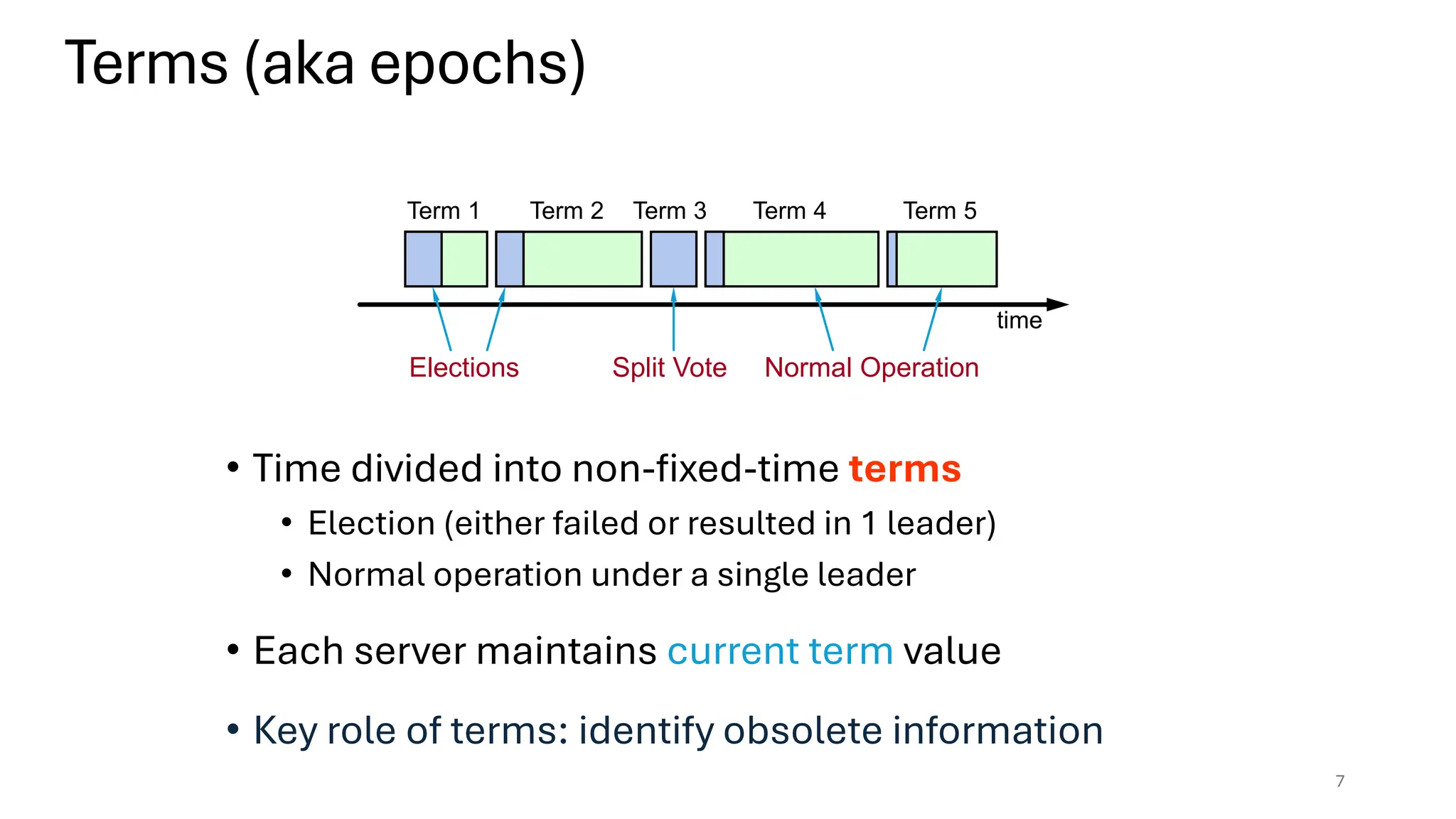
• Time divided into non-fixed-time terms
• Election (either failed or resulted in 1 leader)
• Normal operation under a single leader
• Each server maintains current term value
• Key role of terms: identify obsolete information
Term 1 Term 2 Term 3 Term 4 Term 5
time
Elections Normal Operation
Split Vote
Terms (aka epochs)
7
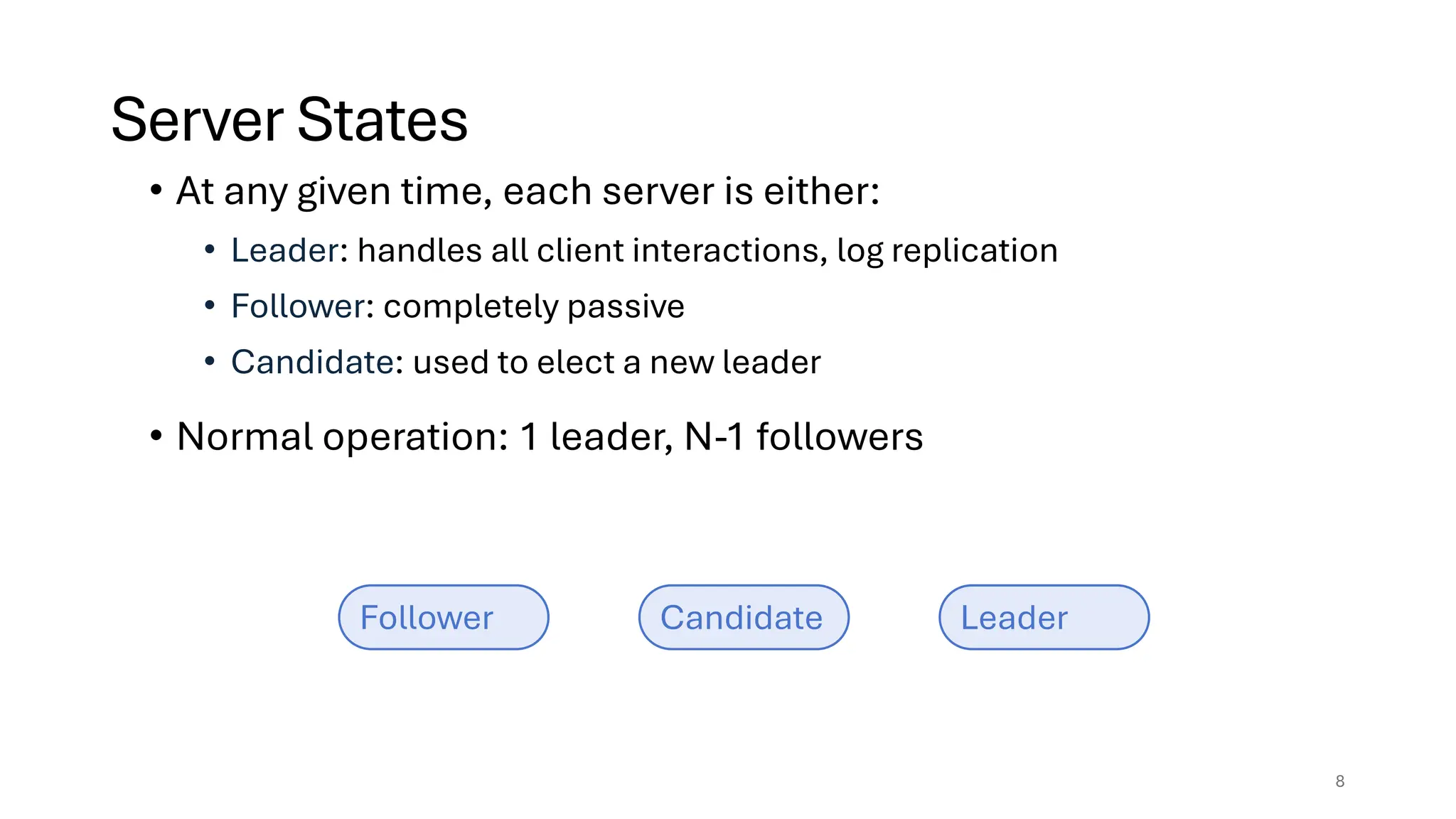
• At any given time, each server is either:
• Leader: handles all client interactions, log replication
• Follower: completely passive
• Candidate: used to elect a new leader
• Normal operation: 1 leader, N-1 followers
Follower Candidate Leader
Server States
8
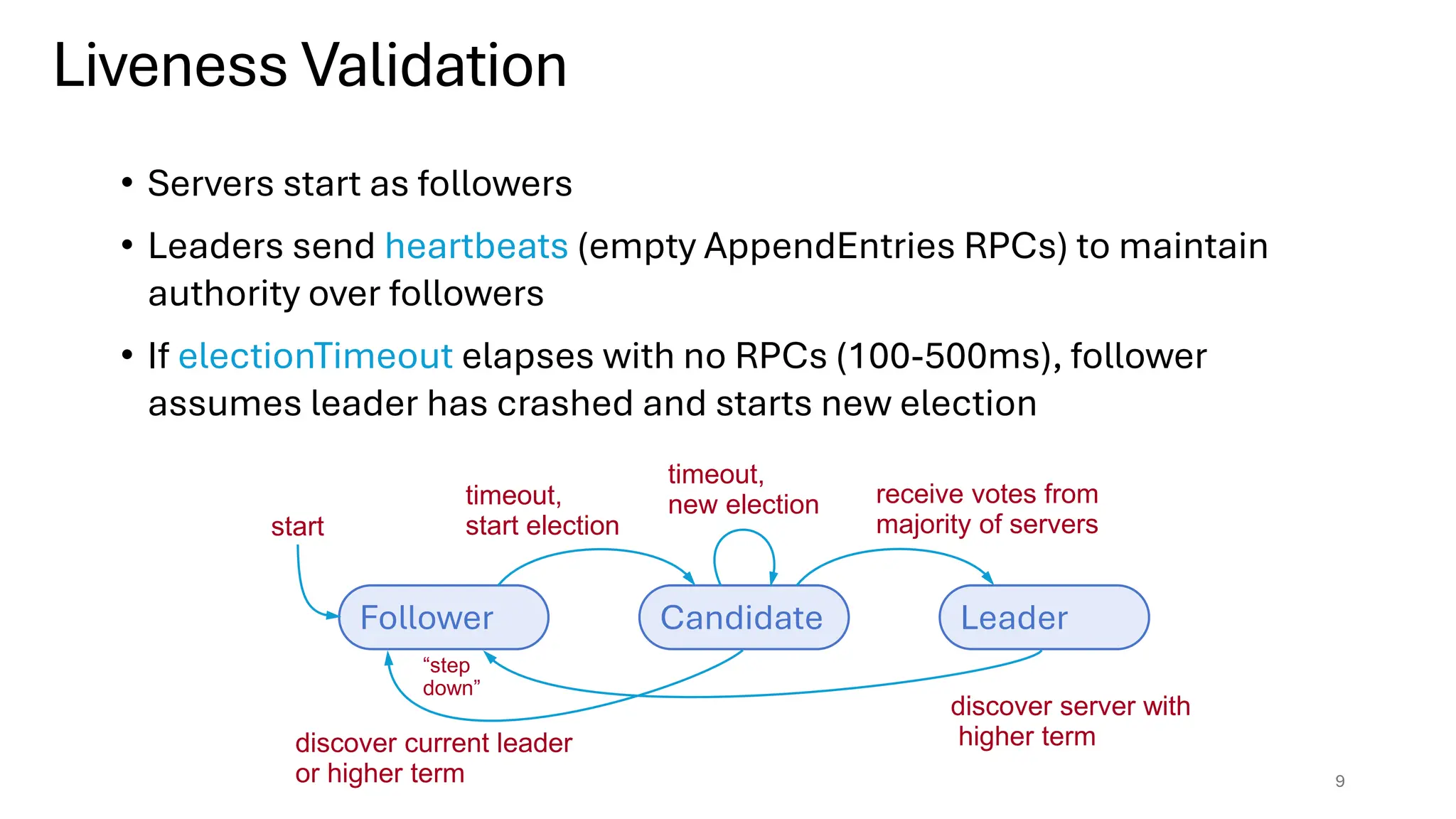
• Servers start as followers
• Leaders send heartbeats (empty AppendEntries RPCs) to maintain
authority over followers
• If electionTimeout elapses with no RPCs (100-500ms), follower
assumes leader has crashed and starts new election
Follower Candidate Leader
start
timeout,
start election
receive votes from
majority of servers
timeout,
new election
discover server with
higher term
discover current leader
or higher term
“step
down”
Liveness Validation
9
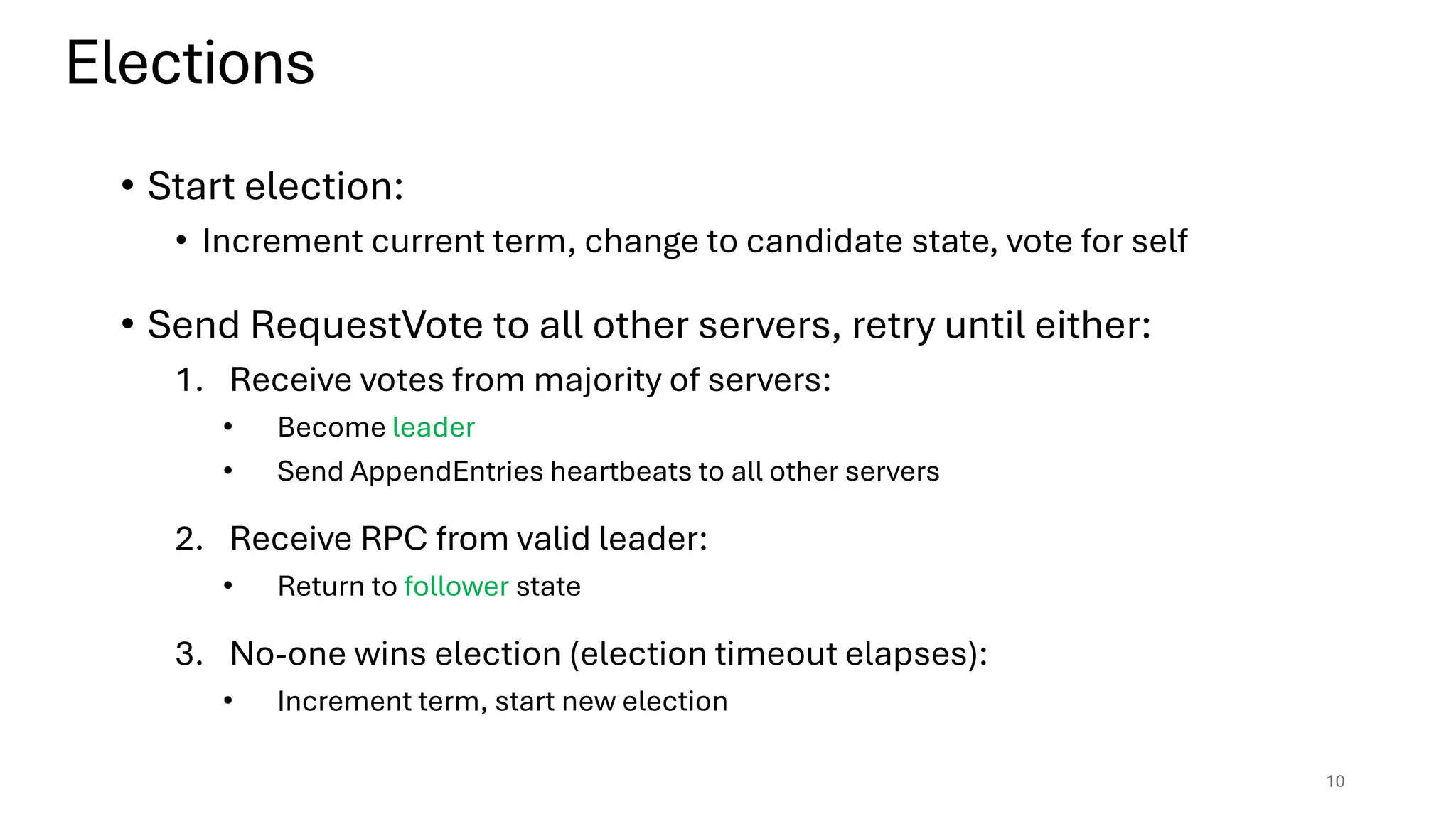
• Start election:
• Increment current term, change to candidate state, vote for self
• Send RequestVote to all other servers, retry until either:
1. Receive votes from majority of servers:
• Become leader
• Send AppendEntries heartbeats to all other servers
2. Receive RPC from valid leader:
• Return to follower state
3. No-one wins election (election timeout elapses):
• Increment term, start new election
Elections
10
• Safety: allow at most one winner per term
• Each server votes only once per term (persists on disk)
• Two different candidates can’t get majorities in same term
• Liveness: some candidate eventually wins
• Each choose election timeouts randomly in [T, 2T]
• One usually initiates and wins election before others start
• Works well if T >> network RTT
Servers
Voted for
candidate A
B can’t also
get majority
Elections
11
Elections
12
• Liveness: some candidate eventually wins
– Each choose election timeouts randomly in [T, 2T]
– One usually initiates and wins election before others start
– Works well if T >> network RTT
Technique used throughout
distributed systems:
Desynchronizes behavior
without centralized
coordination!
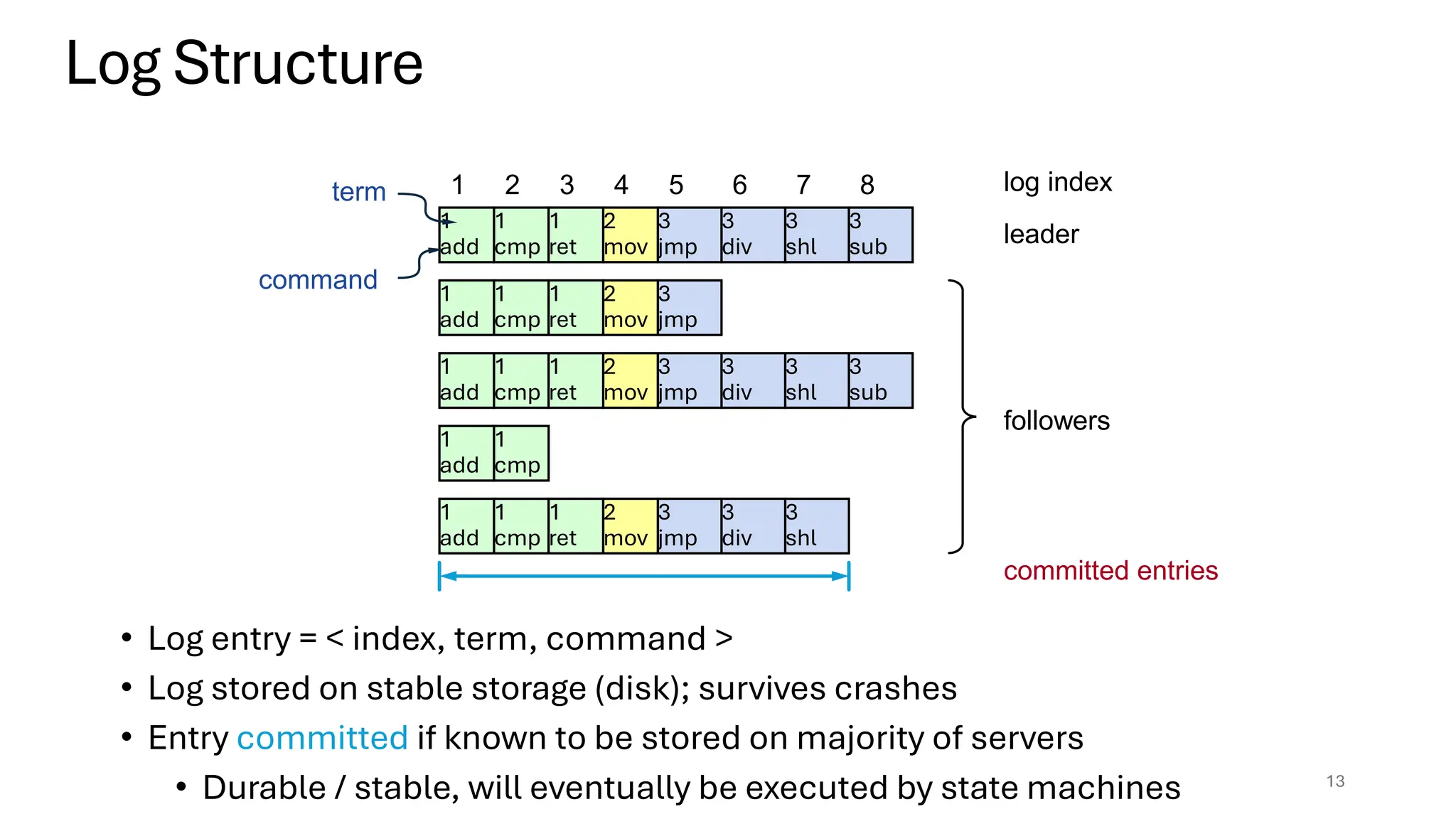
• Log entry = < index, term, command >
• Log stored on stable storage (disk); survives crashes
• Entry committed if known to be stored on majority of servers
• Durable / stable, will eventually be executed by state machines
1
add
1 2 3 4 5 6 7 8
3
jmp
1
cmp
1
ret
2
mov
3
div
3
shl
3
sub
1
add
3
jmp
1
cmp
1
ret
2
mov
1
add
3
jmp
1
cmp
1
ret
2
mov
3
div
3
shl
3
sub
1
add
1
cmp
1
add
3
jmp
1
cmp
1
ret
2
mov
3
div
3
shl
leader
log index
followers
committed entries
term
command
13
Log Structure
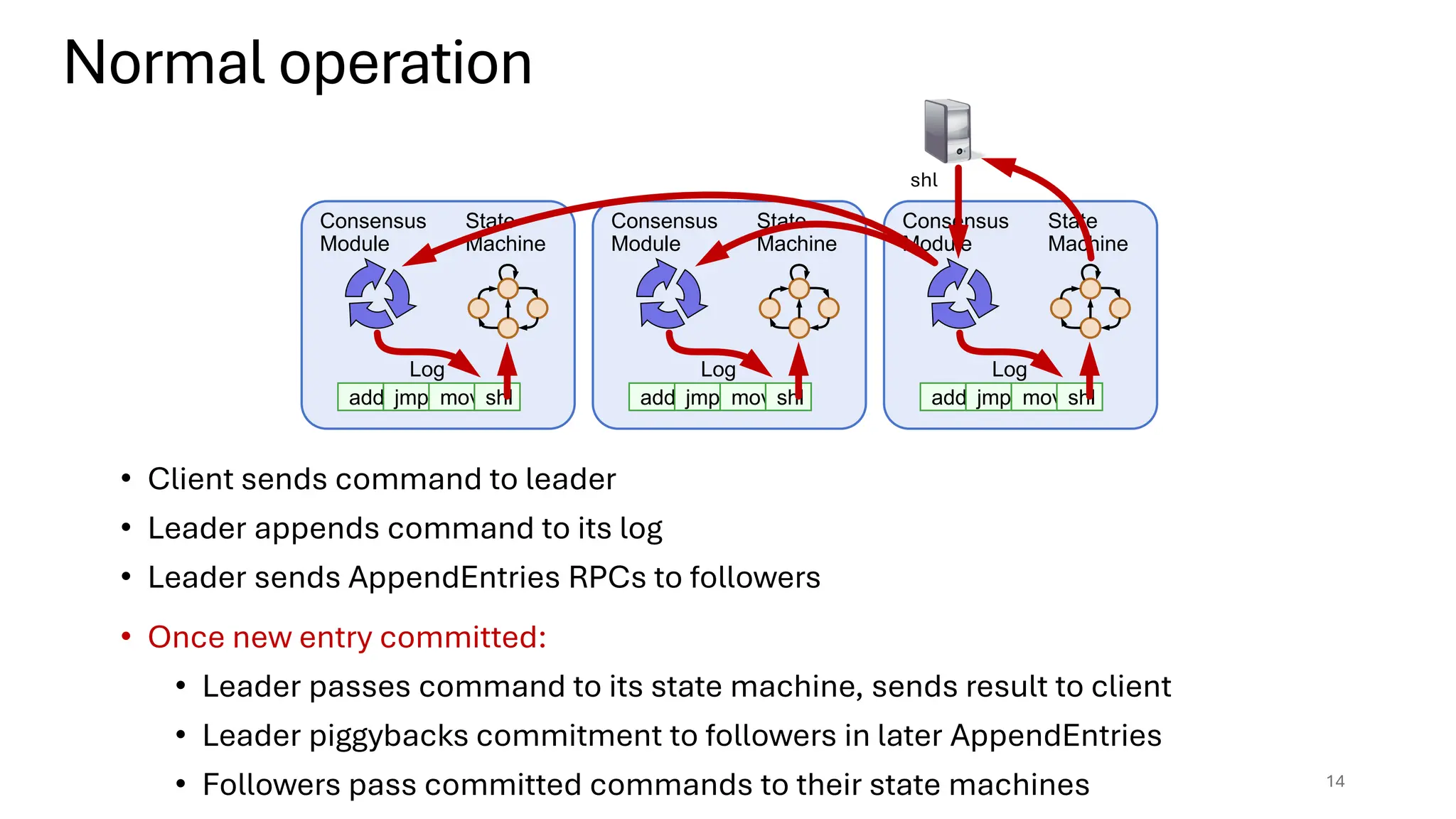
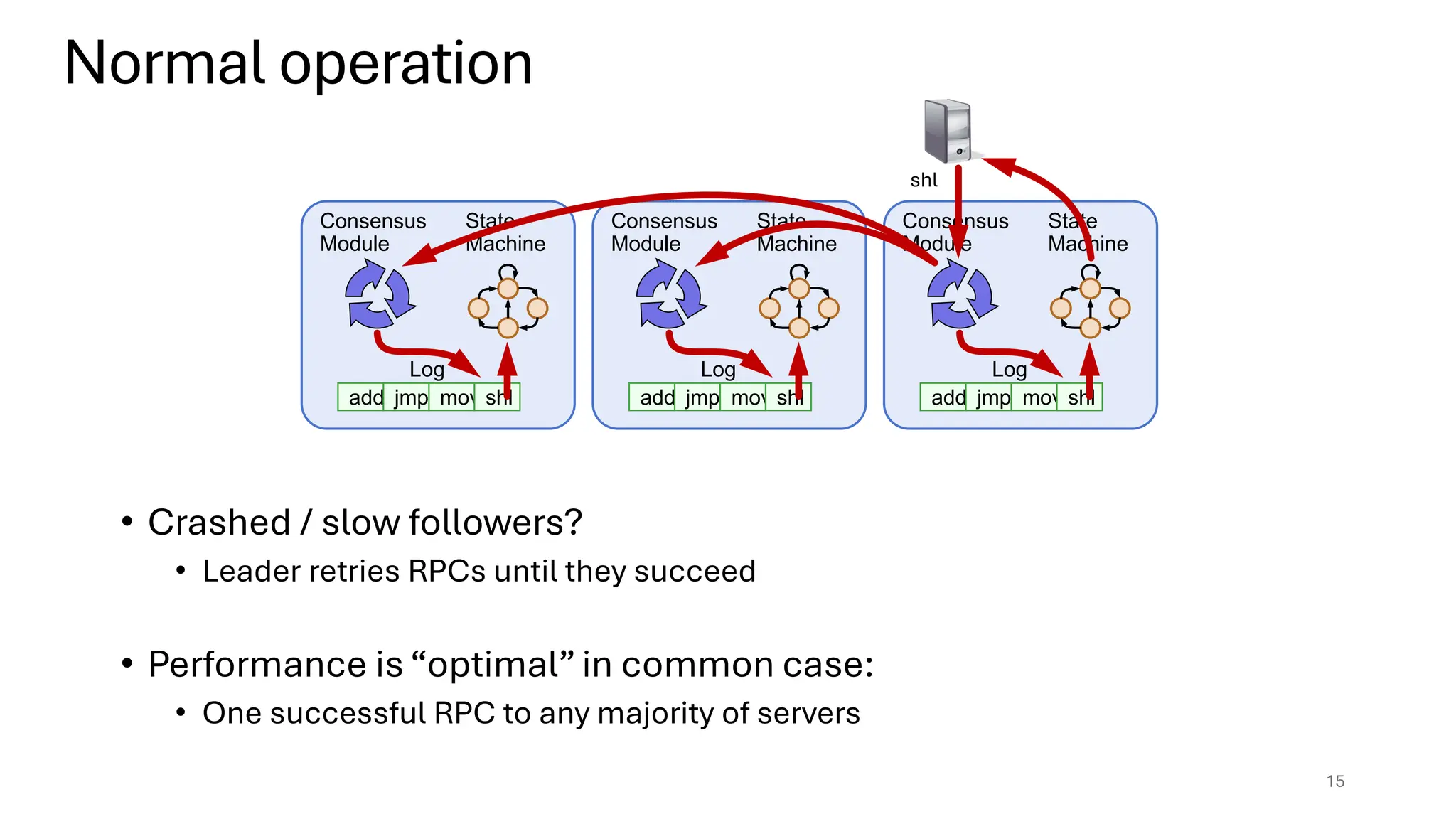
• Client sends command to leader
• Leader appends command to its log
• Leader sends AppendEntries RPCs to followers
• Once new entry committed:
• Leader passes command to its state machine, sends result to client
• Leader piggybacks commitment to followers in later AppendEntries
• Followers pass committed commands to their state machines 14
Normal operation
add jmp mov shl
Log
Consensus
Module
State
Machine
add jmp mov shl
Log
Consensus
Module
State
Machine
add jmp mov shl
Log
Consensus
Module
State
Machine
shl
• Crashed / slow followers?
• Leader retries RPCs until they succeed
• Performance is “optimal”in common case:
• One successful RPC to any majority of servers
15
Normal operation
add jmp mov shl
Log
Consensus
Module
State
Machine
add jmp mov shl
Log
Consensus
Module
State
Machine
add jmp mov shl
Log
Consensus
Module
State
Machine
shl
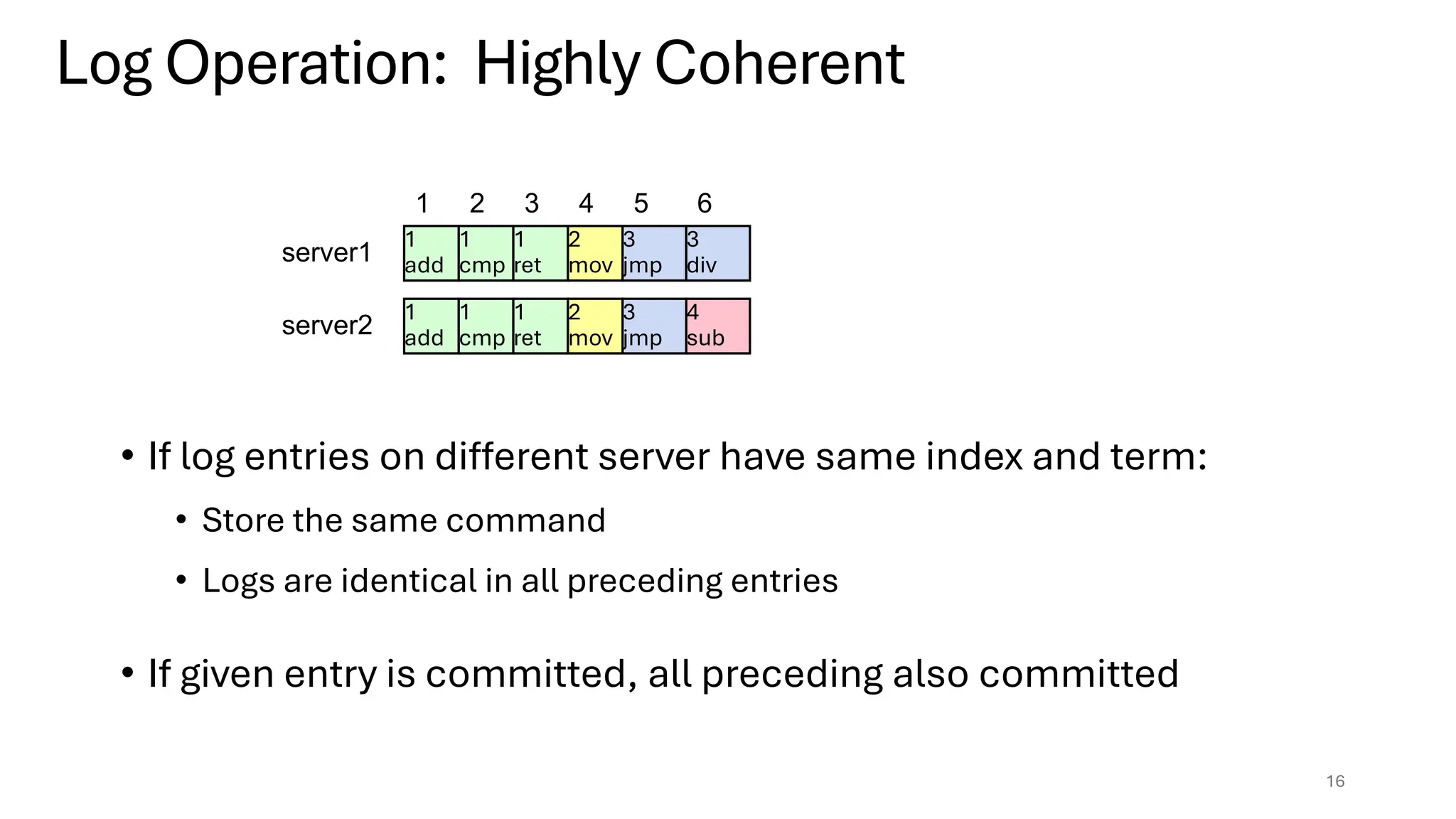
• If log entries on different server have same index and term:
• Store the same command
• Logs are identical in all preceding entries
• If given entry is committed, all preceding also committed
16
Log Operation: Highly Coherent
1
add
1 2 3 4 5 6
3
jmp
1
cmp
1
ret
2
mov
3
div
4
sub
1
add
3
jmp
1
cmp
1
ret
2
mov
server1
server2
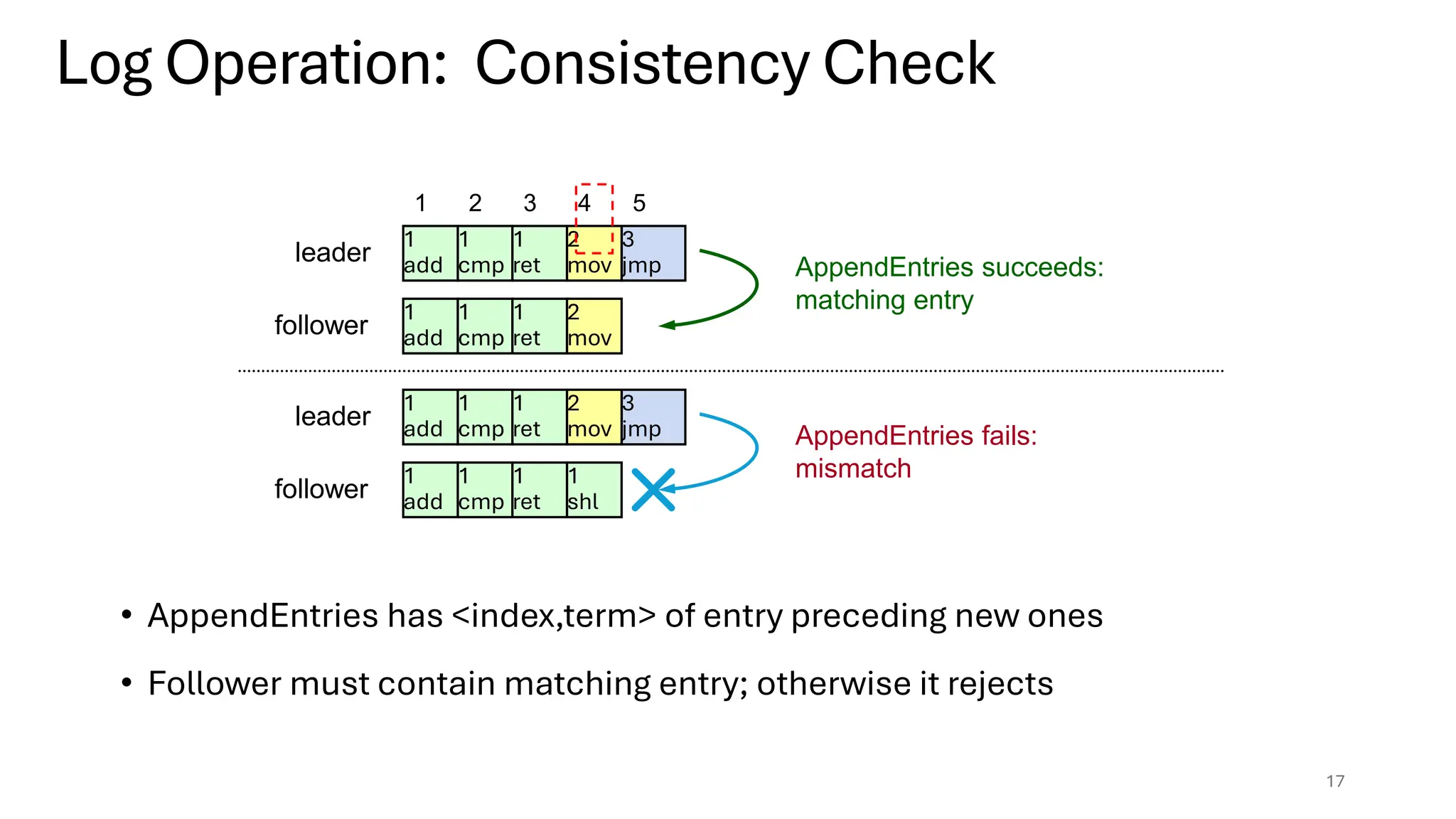
• AppendEntries has <index,term> of entry preceding new ones
• Follower must contain matching entry; otherwise it rejects
17
Log Operation: Consistency Check
1
add
3
jmp
1
cmp
1
ret
2
mov
1
add
1
cmp
1
ret
2
mov
leader
follower
1 2 3 4 5
1
add
3
jmp
1
cmp
1
ret
2
mov
1
add
1
cmp
1
ret
1
shl
leader
follower
AppendEntries succeeds:
matching entry
AppendEntries fails:
mismatch
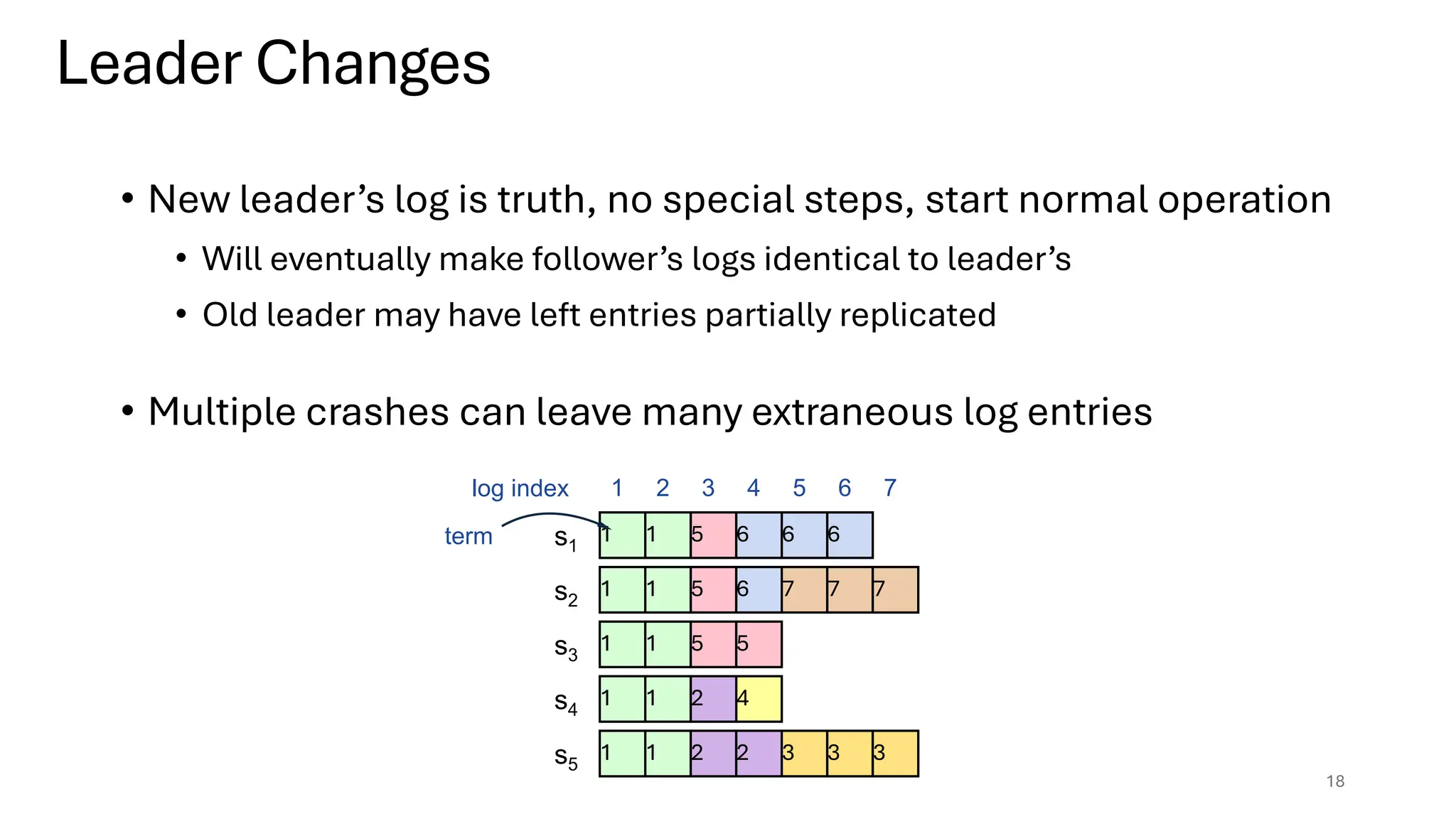
• New leader’s log is truth, no special steps, start normal operation
• Will eventually make follower’s logs identical to leader’s
• Old leader may have left entries partially replicated
• Multiple crashes can leave many extraneous log entries
1 2 3 4 5 6 7
log index
1 1
1 1
5
5
6 6 6
6
1 1 5 5
1 4
1
1 1
7 7
2 2 3 3 3
2
7
term s1
s2
s3
s4
s5
18
Leader Changes
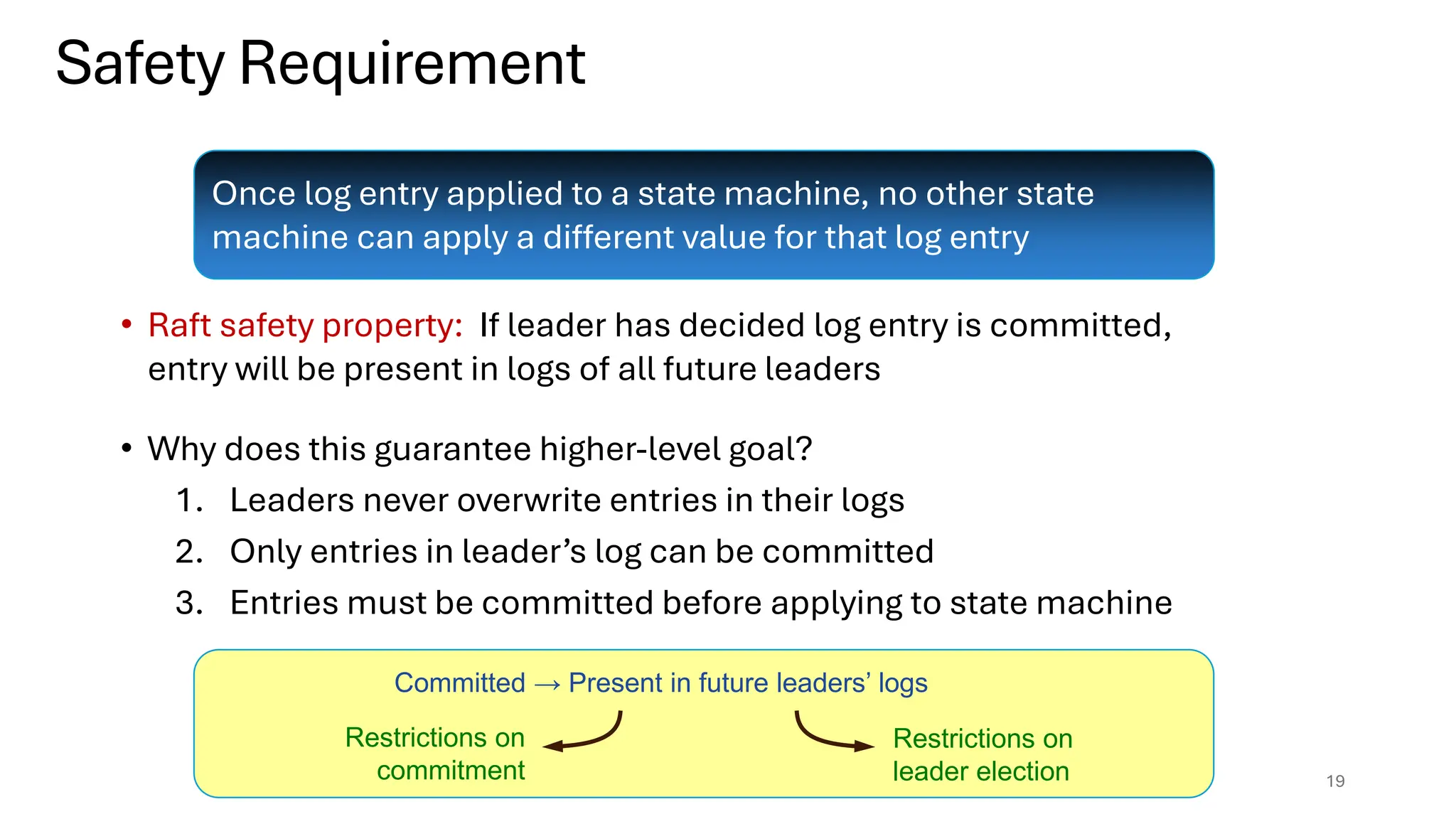
• Raft safety property: If leader has decided log entry is committed,
entry will be present in logs of all future leaders
• Why does this guarantee higher-level goal?
1. Leaders never overwrite entries in their logs
2. Only entries in leader’s log can be committed
3. Entries must be committed before applying to state machine
Committed → Present in future leaders’ logs
Restrictions on
commitment
Restrictions on
leader election 19
Safety Requirement
Once log entry applied to a state machine, no other state
machine can apply a different value for that log entry
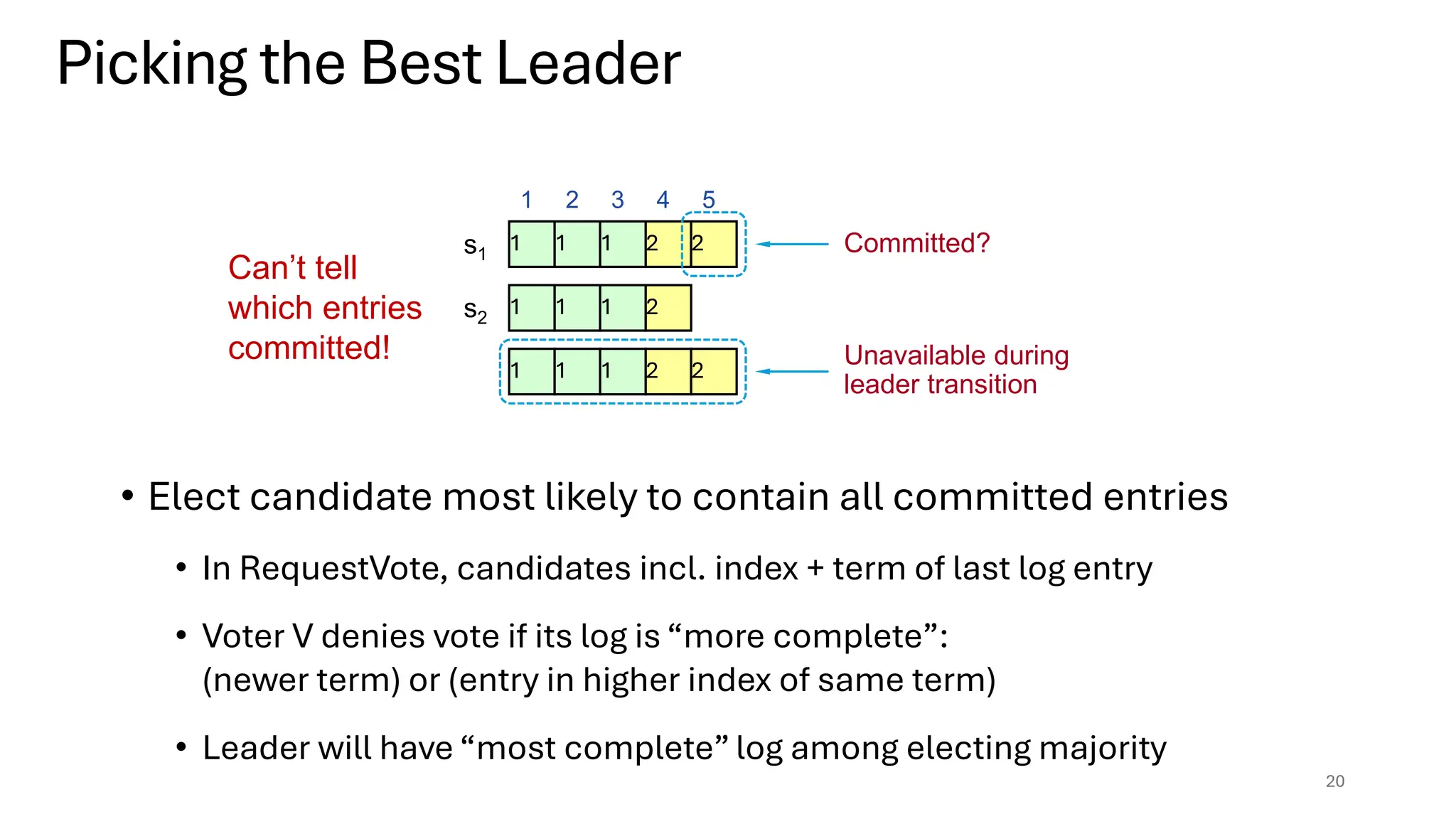
• Elect candidate most likely to contain all committed entries
• In RequestVote, candidates incl. index + term of last log entry
• Voter V denies vote if its log is “more complete”:
(newer term) or (entry in higher index of same term)
• Leader will have “most complete” log among electing majority
20
Picking the Best Leader
1 2
1 1 2
1 2 3 4 5
1 2
1 1
1 2
1 1 2
Unavailable during
leader transition
Committed?
Can’t tell
which entries
committed!
s1
s2
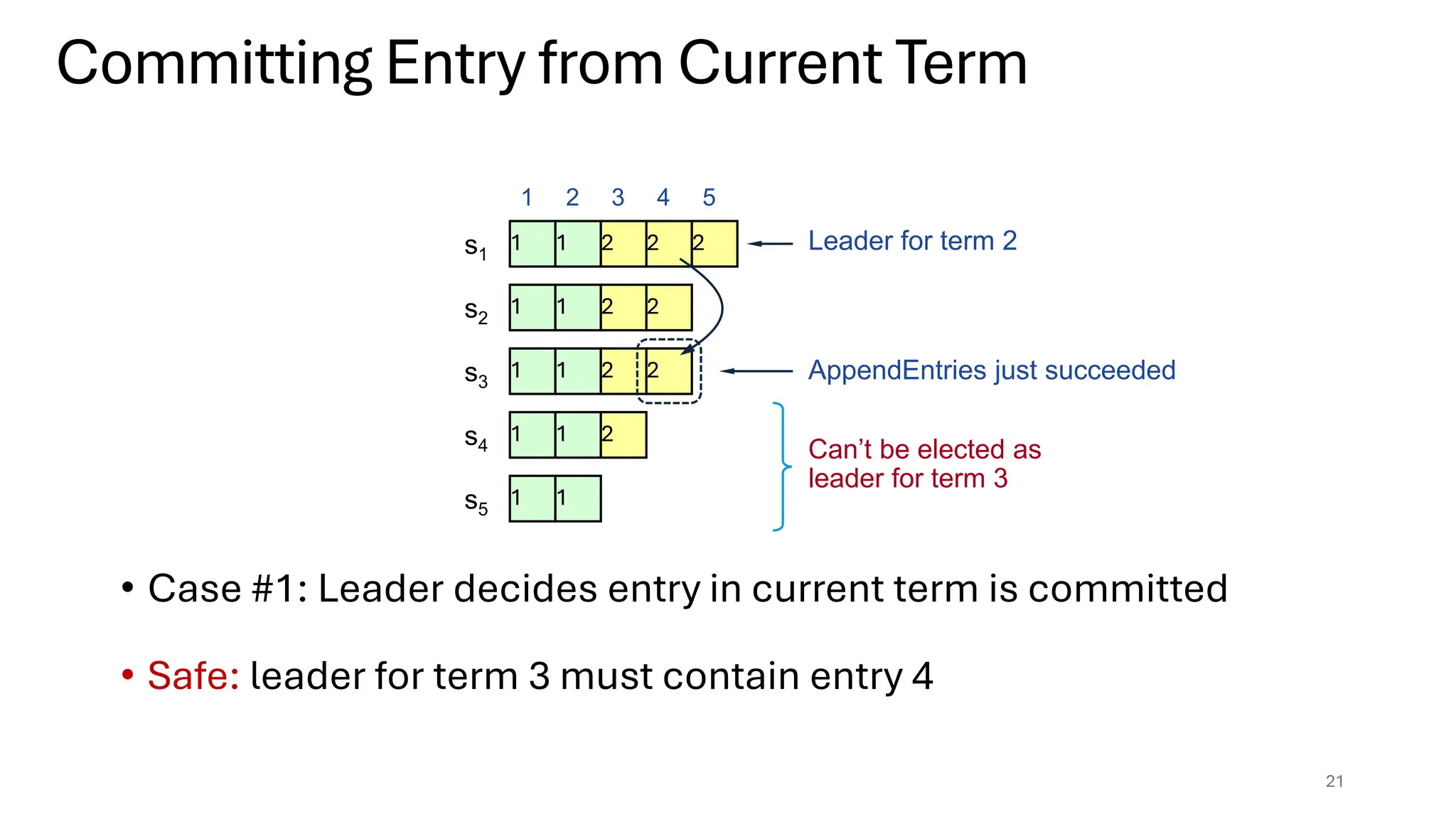
• Case #1: Leader decides entry in current term is committed
• Safe: leader for term 3 must contain entry 4
21
Committing Entry from Current Term
1 2 3 4 5
1 1
1 1
1 1
1
2
1
1 1
s1
s2
s3
s4
s5
2
2
2
2
2
2
2
Can’t be elected as
leader for term 3
AppendEntries just succeeded
Leader for term 2
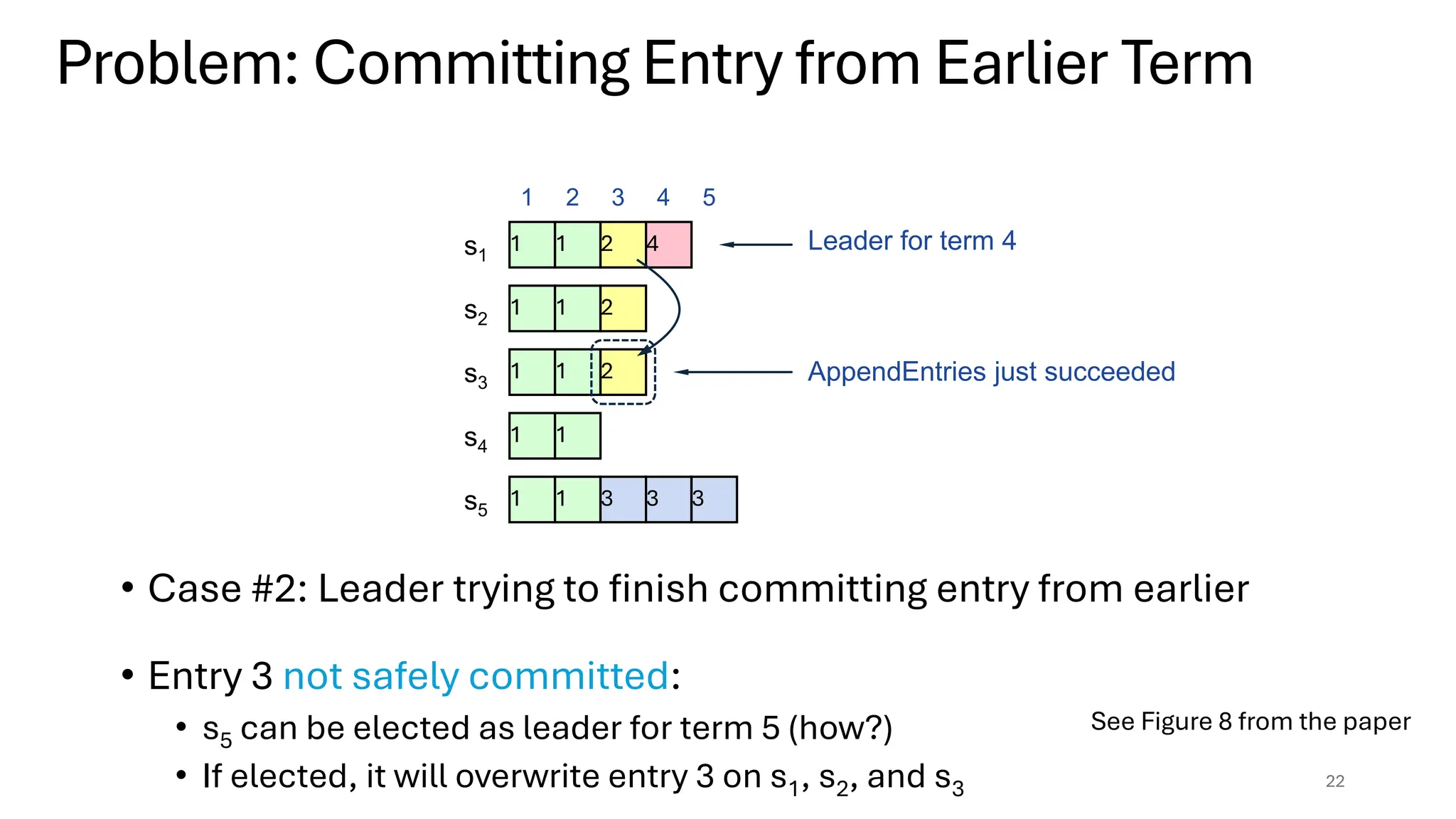
• Case #2: Leader trying to finish committing entry from earlier
• Entry 3 not safely committed:
• s5 can be elected as leader for term 5 (how?)
• If elected, it will overwrite entry 3 on s1, s2, and s3 22
Problem: Committing Entry from Earlier Term
1 2 3 4 5
1 1
1 1
1 1
1
2
1
1 1
s1
s2
s3
s4
s5
2
2
3
4
3
AppendEntries just succeeded
Leader for term 4
3
See Figure 8 from the paper
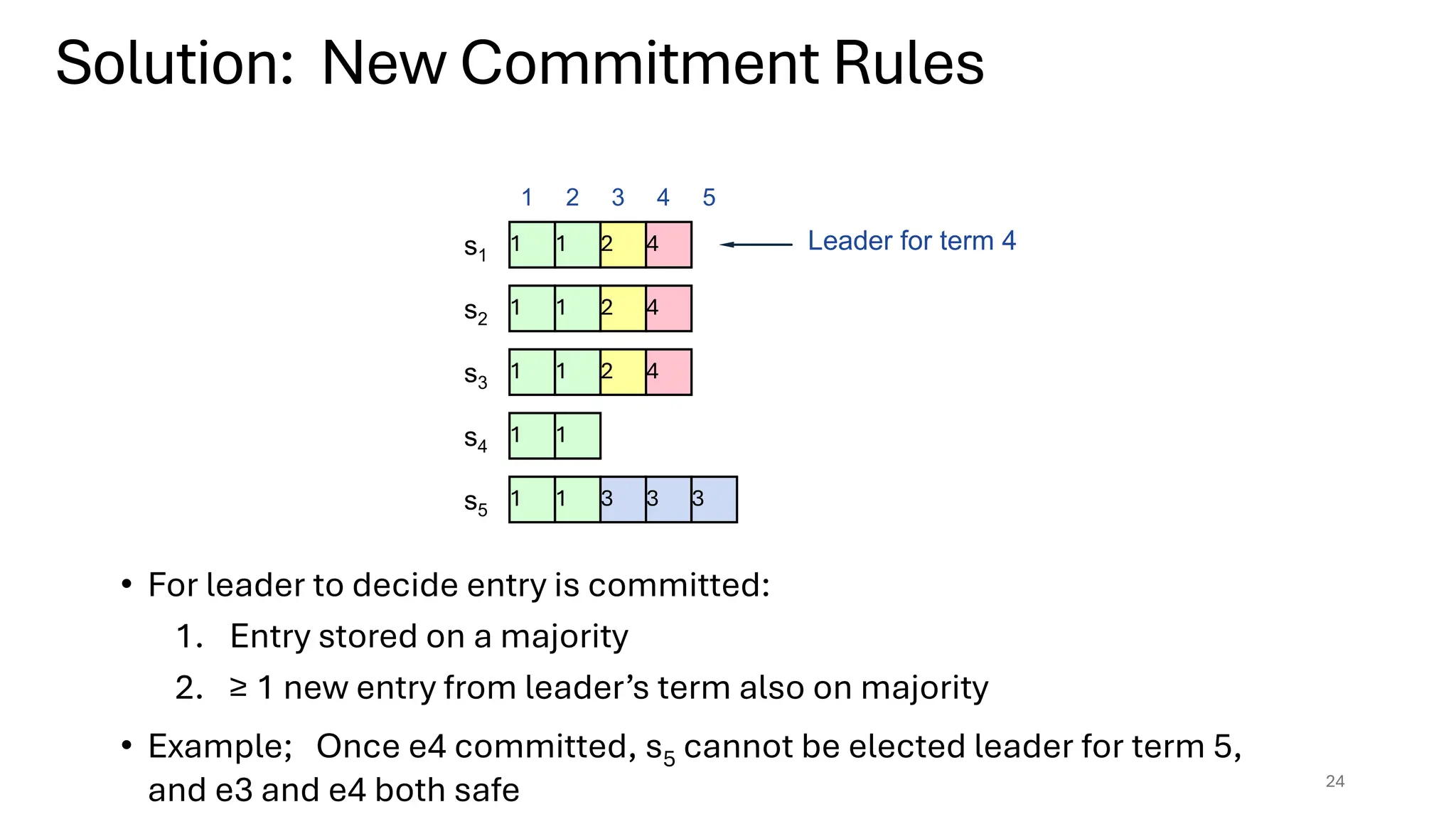
• For leader to decide entry is committed:
1. Entry stored on a majority
2. ≥ 1 new entry from leader’s term also on majority
• Example; Once e4 committed, s5 cannot be elected leader for term 5,
and e3 and e4 both safe 24
Solution: New Commitment Rules
1 2 3 4 5
1 1
1 1
1 1
1
2
1
1 1
s1
s2
s3
s4
s5
2
2
3
4
3
4
4
3
Leader for term 4
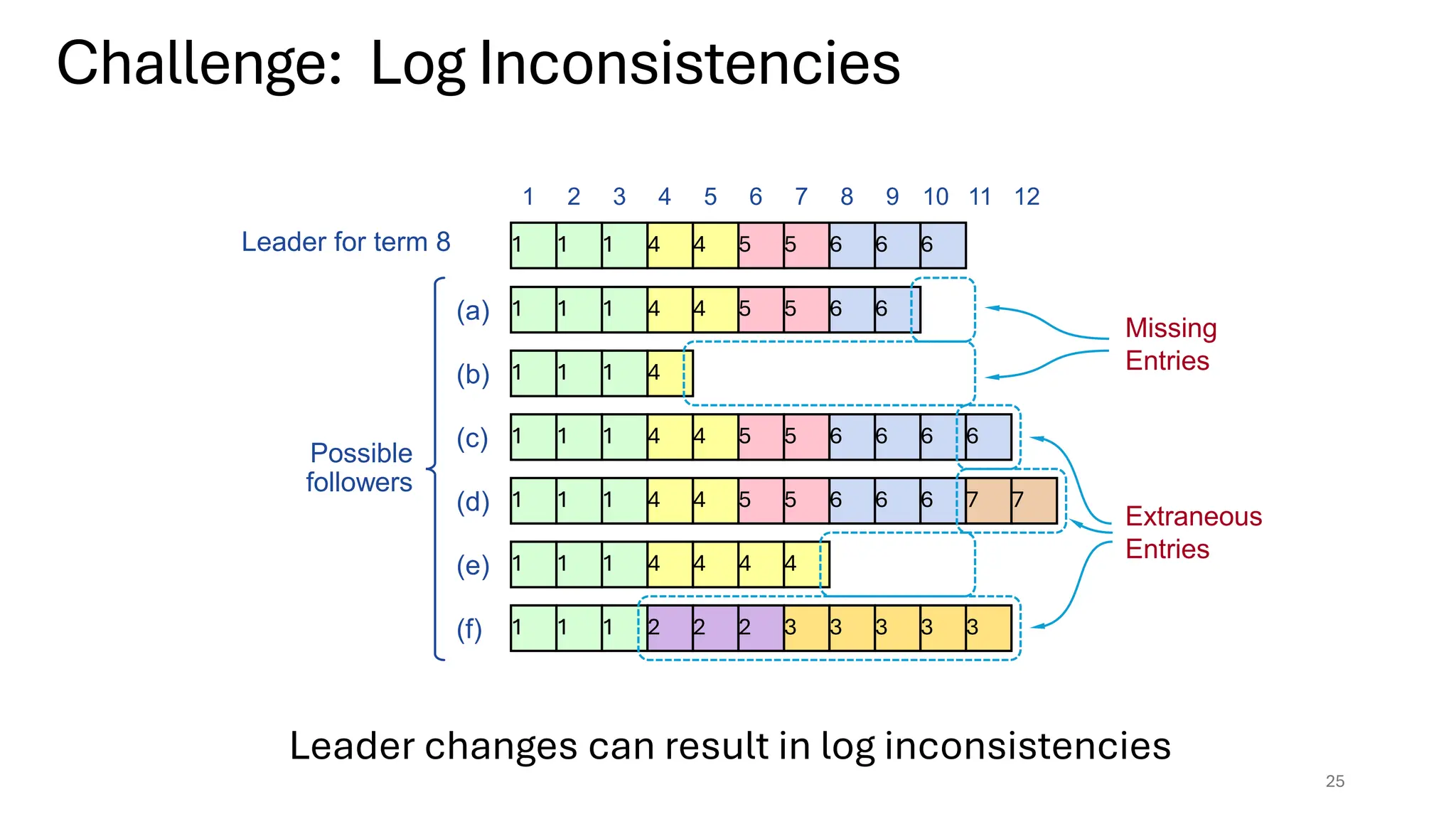
Leader changes can result in log inconsistencies
25
Challenge: Log Inconsistencies
1 4
1 1 4 5 5 6 6 6
Leader for term 8
1 4
1 1 4 5 5 6 6
1 4
1 1
1 4
1 1 4 5 5 6 6 6 6
1 4
1 1 4 5 5 6 6 6
1 4
1 1 4
1 1 1
Possible
followers
4 4
7 7
2 2 3
3 3 3 3
2
(a)
(b)
(c)
(d)
(e)
(f)
Missing
Entries
Extraneous
Entries
1 2 3 4 5 6 7 8 9 10 11 12
Repairing Follower Logs
1 4
1 1 4 5 5 6 6 6
Leader for term 7
1 2 3 4 5 6 7 8 9 10 11 12
1 4
1 1
1 1 1
Followers
2 2 3
3 3 3 3
2
(a)
(b)
nextIndex
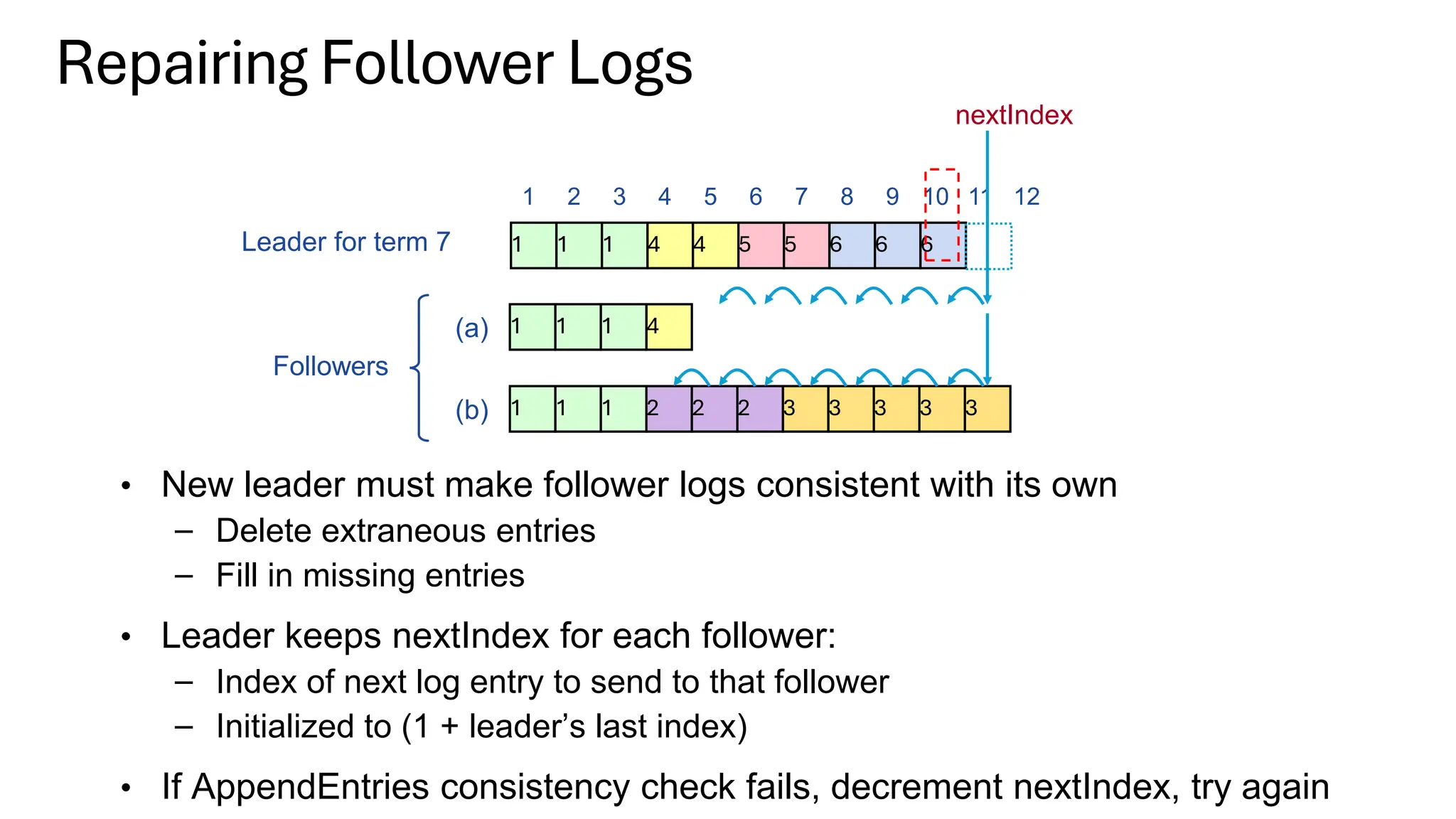
• New leader must make follower logs consistent with its own
– Delete extraneous entries
– Fill in missing entries
• Leader keeps nextIndex for each follower:
– Index of next log entry to send to that follower
– Initialized to (1 + leader’s last index)
• If AppendEntries consistency check fails, decrement nextIndex, try again
Repairing Follower Logs
1 4
1 1 4 5 5 6 6 6
Leader for term 7
1 2 3 4 5 6 7 8 9 10 11 12
1 4
1 1
1 1 1
Before repair 2 2 3
3 3 3 3
2
(a)
(f)
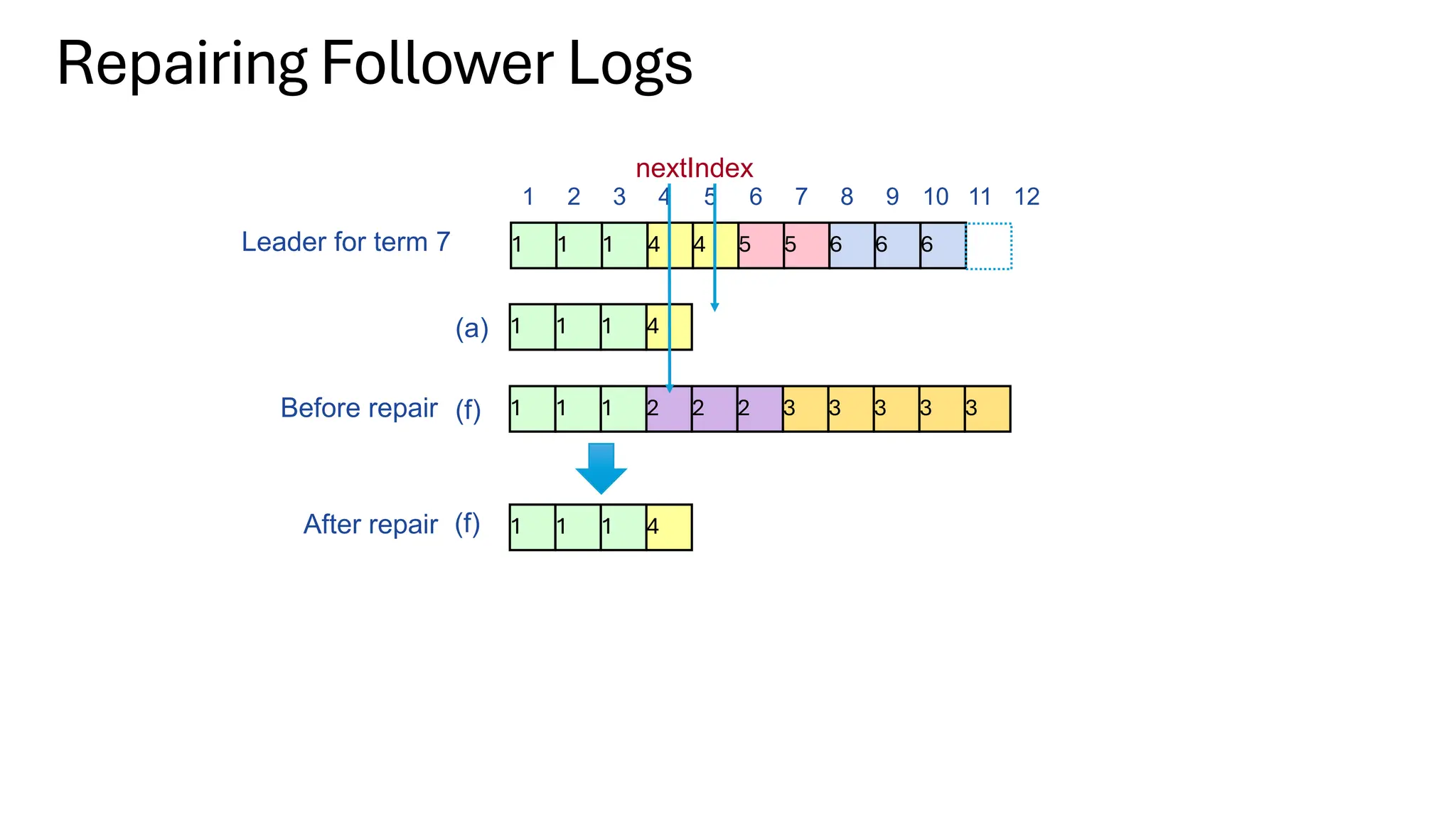
1 1 1 4
(f)
nextIndex
After repair
• Leader temporarily disconnected
→ other servers elect new leader
→ old leader reconnected
→ old leader attempts to commit log entries
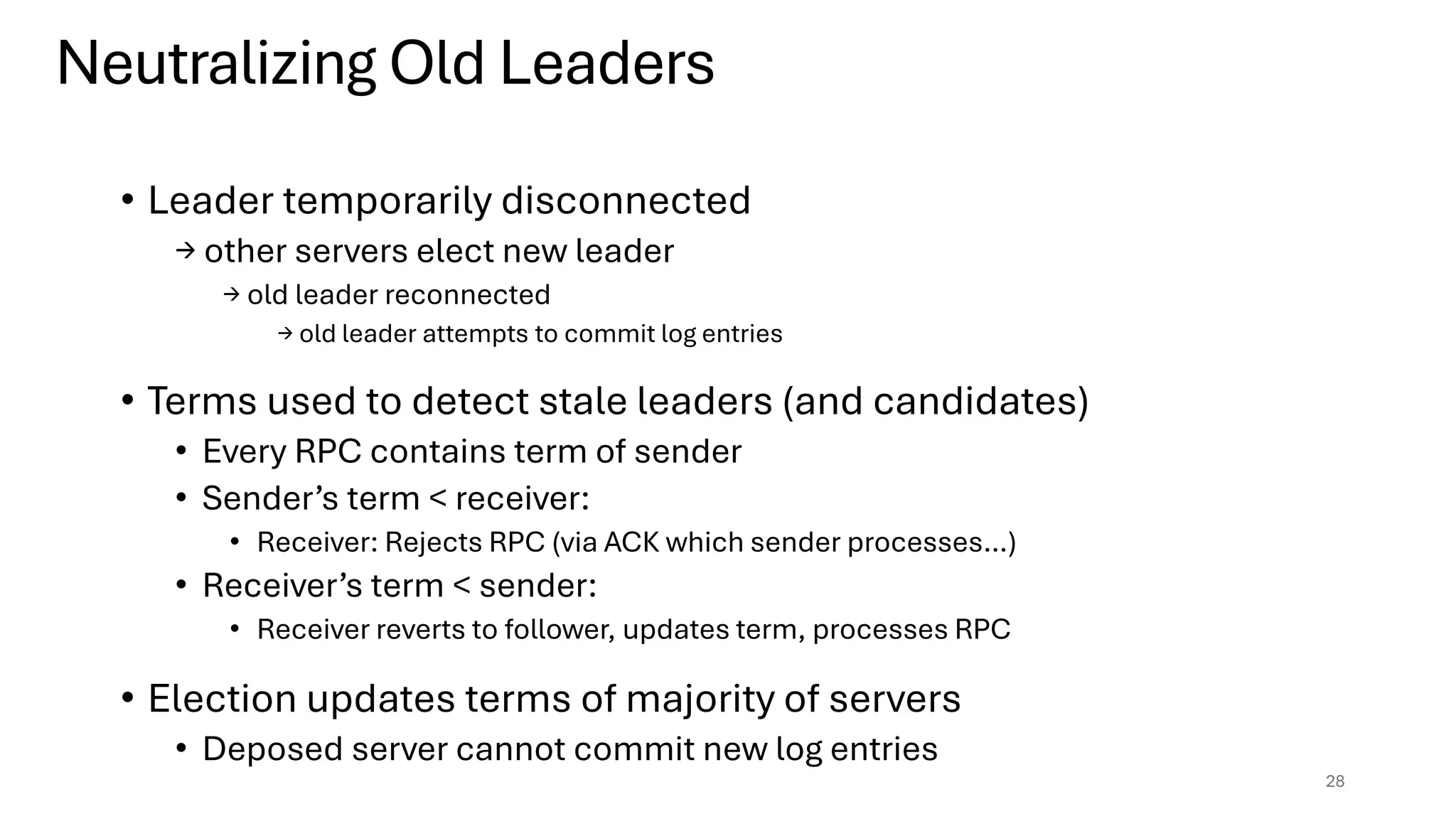
• Terms used to detect stale leaders (and candidates)
• Every RPC contains term of sender
• Sender’s term < receiver:
• Receiver: Rejects RPC (via ACK which sender processes…)
• Receiver’s term < sender:
• Receiver reverts to follower, updates term, processes RPC
• Election updates terms of majority of servers
• Deposed server cannot commit new log entries
28
Neutralizing Old Leaders
• Send commands to leader
• If leader unknown, contact any server, which redirects client to leader
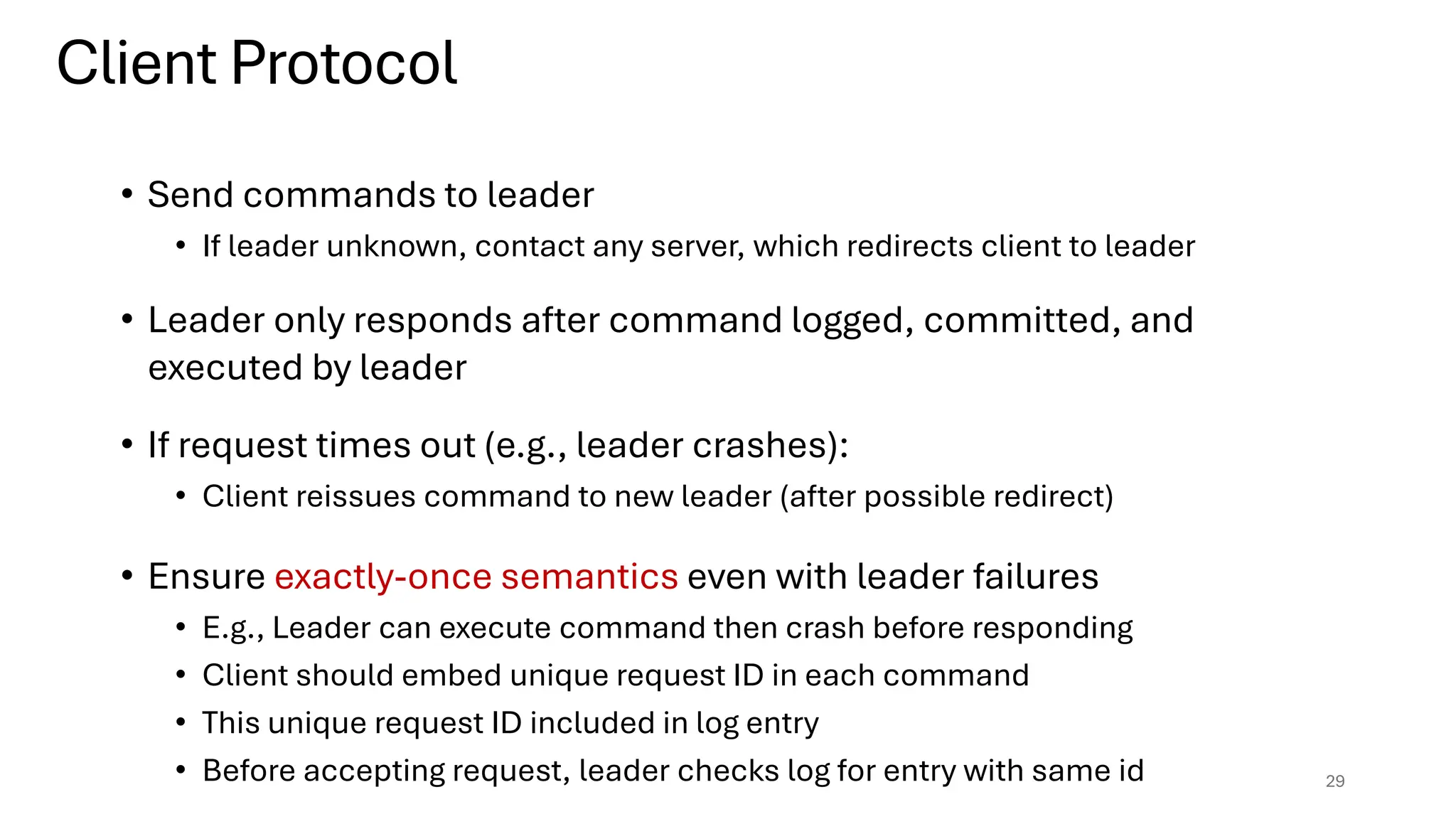
• Leader only responds after command logged, committed, and
executed by leader
• If request times out (e.g., leader crashes):
• Client reissues command to new leader (after possible redirect)
• Ensure exactly-once semantics even with leader failures
• E.g., Leader can execute command then crash before responding
• Client should embed unique request ID in each command
• This unique request ID included in log entry
• Before accepting request, leader checks log for entry with same id 29
Client Protocol
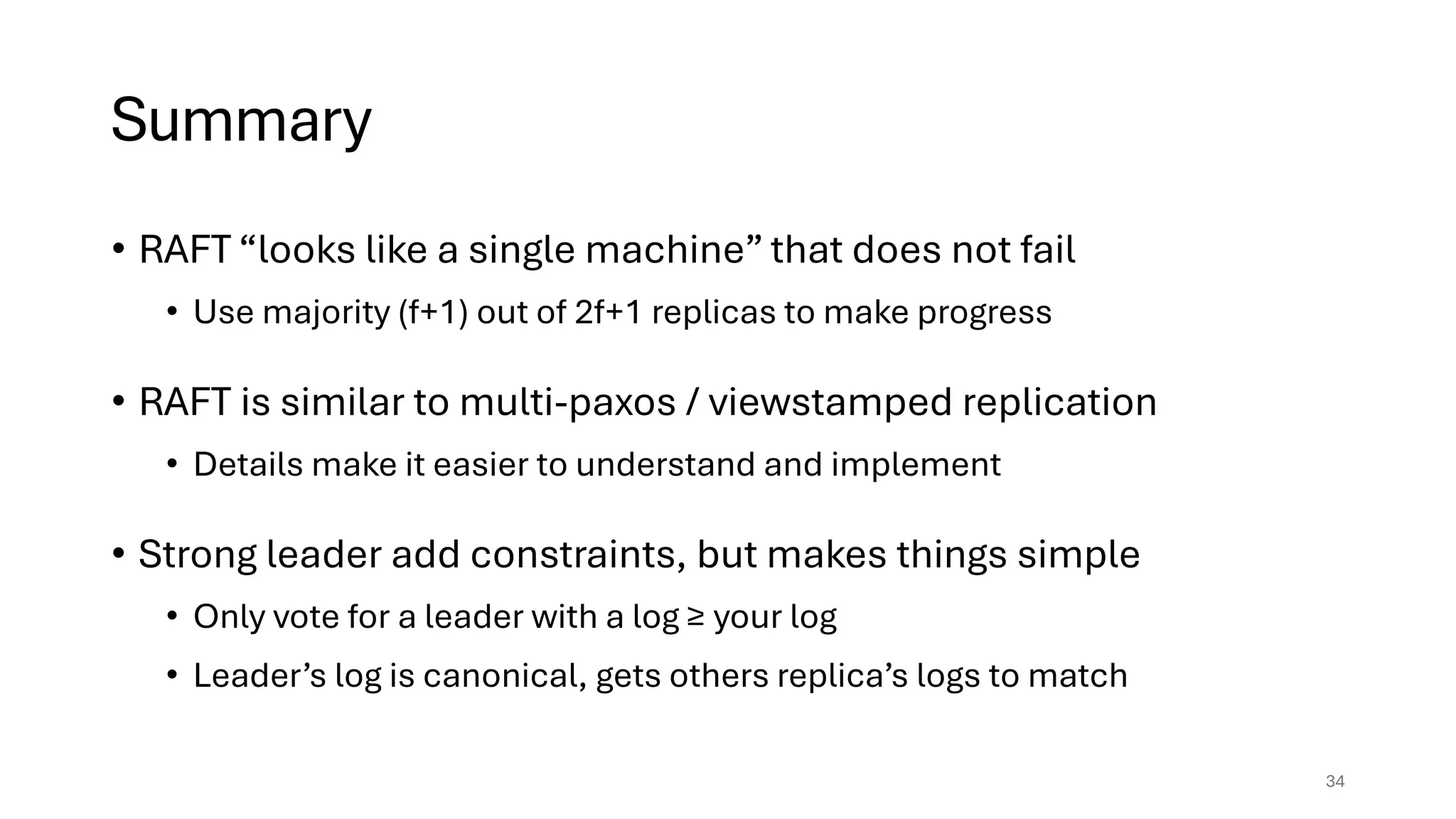
• RAFT “looks like a single machine” that does not fail
• Use majority (f+1) out of 2f+1 replicas to make progress
• RAFT is similar to multi-paxos / viewstamped replication
• Details make it easier to understand and implement
• Strong leader add constraints, but makes things simple
• Only vote for a leader with a log ≥ your log
• Leader’s log is canonical, gets others replica’s logs to match
34
Summary
35

Raftconsensusalgorithmforreplication.pdf

  • 1.
    Raft: A ConsensusAlgorithm for Replicated Logs The authors attributed the RAFT slides to Diego Ongaro and John Ousterhout The following slides are an edited version of slides by professors Michael Freedman, Kyle Jamieson, and Wyatt Lloyd taught in Princeton’s COS418 course (CC license).
  • 2.
    • Replicated log=> replicated state machine • All servers execute same commands in same order • Group of 2f + 1 replicas can tolerate f replica crashes • Consensus module ensures proper log replication Goal: Replicated Log add jmp mov shl Log Consensus Module State Machine add jmp mov shl Log Consensus Module State Machine add jmp mov shl Log Consensus Module State Machine Servers Clients shl 2
  • 3.
    Consensus Definition: • A generalagreement about something • An idea or opinion that is shared by all the people in a group Where do we use consensus? • What is the order of operations • Which operations are fully executed (committed) and not • Who are the members of the group • Who are the leaders of the group
  • 4.
    1. Leader election 2.Normal operation (basic log replication) 3. Safety and consistency after leader changes 4. Neutralizing old leaders 5. Client interactions 6. Reconfiguration Raft Overview 4
  • 5.
    The Need Fora Leader Election • Recall consensus-based replication easier for f failed backup replicas • But what if the f failures include a failed primary? • All clients’ requests go to the failed primary • System halts despite merely f failures 5
  • 6.
    Leaders and Views •Let different replicas assume role of leader (primary) over time • System moves through a sequence of views • View = { leader, { members }, settings } 6 P P P View #1 View #2 View #3
  • 7.
    • Time dividedinto non-fixed-time terms • Election (either failed or resulted in 1 leader) • Normal operation under a single leader • Each server maintains current term value • Key role of terms: identify obsolete information Term 1 Term 2 Term 3 Term 4 Term 5 time Elections Normal Operation Split Vote Terms (aka epochs) 7
  • 8.
    • At anygiven time, each server is either: • Leader: handles all client interactions, log replication • Follower: completely passive • Candidate: used to elect a new leader • Normal operation: 1 leader, N-1 followers Follower Candidate Leader Server States 8
  • 9.
    • Servers startas followers • Leaders send heartbeats (empty AppendEntries RPCs) to maintain authority over followers • If electionTimeout elapses with no RPCs (100-500ms), follower assumes leader has crashed and starts new election Follower Candidate Leader start timeout, start election receive votes from majority of servers timeout, new election discover server with higher term discover current leader or higher term “step down” Liveness Validation 9
  • 10.
    • Start election: •Increment current term, change to candidate state, vote for self • Send RequestVote to all other servers, retry until either: 1. Receive votes from majority of servers: • Become leader • Send AppendEntries heartbeats to all other servers 2. Receive RPC from valid leader: • Return to follower state 3. No-one wins election (election timeout elapses): • Increment term, start new election Elections 10
  • 11.
    • Safety: allowat most one winner per term • Each server votes only once per term (persists on disk) • Two different candidates can’t get majorities in same term • Liveness: some candidate eventually wins • Each choose election timeouts randomly in [T, 2T] • One usually initiates and wins election before others start • Works well if T >> network RTT Servers Voted for candidate A B can’t also get majority Elections 11
  • 12.
    Elections 12 • Liveness: somecandidate eventually wins – Each choose election timeouts randomly in [T, 2T] – One usually initiates and wins election before others start – Works well if T >> network RTT Technique used throughout distributed systems: Desynchronizes behavior without centralized coordination!
  • 13.
    • Log entry= < index, term, command > • Log stored on stable storage (disk); survives crashes • Entry committed if known to be stored on majority of servers • Durable / stable, will eventually be executed by state machines 1 add 1 2 3 4 5 6 7 8 3 jmp 1 cmp 1 ret 2 mov 3 div 3 shl 3 sub 1 add 3 jmp 1 cmp 1 ret 2 mov 1 add 3 jmp 1 cmp 1 ret 2 mov 3 div 3 shl 3 sub 1 add 1 cmp 1 add 3 jmp 1 cmp 1 ret 2 mov 3 div 3 shl leader log index followers committed entries term command 13 Log Structure
  • 14.
    • Client sendscommand to leader • Leader appends command to its log • Leader sends AppendEntries RPCs to followers • Once new entry committed: • Leader passes command to its state machine, sends result to client • Leader piggybacks commitment to followers in later AppendEntries • Followers pass committed commands to their state machines 14 Normal operation add jmp mov shl Log Consensus Module State Machine add jmp mov shl Log Consensus Module State Machine add jmp mov shl Log Consensus Module State Machine shl
  • 15.
    • Crashed /slow followers? • Leader retries RPCs until they succeed • Performance is “optimal”in common case: • One successful RPC to any majority of servers 15 Normal operation add jmp mov shl Log Consensus Module State Machine add jmp mov shl Log Consensus Module State Machine add jmp mov shl Log Consensus Module State Machine shl
  • 16.
    • If logentries on different server have same index and term: • Store the same command • Logs are identical in all preceding entries • If given entry is committed, all preceding also committed 16 Log Operation: Highly Coherent 1 add 1 2 3 4 5 6 3 jmp 1 cmp 1 ret 2 mov 3 div 4 sub 1 add 3 jmp 1 cmp 1 ret 2 mov server1 server2
  • 17.
    • AppendEntries has<index,term> of entry preceding new ones • Follower must contain matching entry; otherwise it rejects 17 Log Operation: Consistency Check 1 add 3 jmp 1 cmp 1 ret 2 mov 1 add 1 cmp 1 ret 2 mov leader follower 1 2 3 4 5 1 add 3 jmp 1 cmp 1 ret 2 mov 1 add 1 cmp 1 ret 1 shl leader follower AppendEntries succeeds: matching entry AppendEntries fails: mismatch
  • 18.
    • New leader’slog is truth, no special steps, start normal operation • Will eventually make follower’s logs identical to leader’s • Old leader may have left entries partially replicated • Multiple crashes can leave many extraneous log entries 1 2 3 4 5 6 7 log index 1 1 1 1 5 5 6 6 6 6 1 1 5 5 1 4 1 1 1 7 7 2 2 3 3 3 2 7 term s1 s2 s3 s4 s5 18 Leader Changes
  • 19.
    • Raft safetyproperty: If leader has decided log entry is committed, entry will be present in logs of all future leaders • Why does this guarantee higher-level goal? 1. Leaders never overwrite entries in their logs 2. Only entries in leader’s log can be committed 3. Entries must be committed before applying to state machine Committed → Present in future leaders’ logs Restrictions on commitment Restrictions on leader election 19 Safety Requirement Once log entry applied to a state machine, no other state machine can apply a different value for that log entry
  • 20.
    • Elect candidatemost likely to contain all committed entries • In RequestVote, candidates incl. index + term of last log entry • Voter V denies vote if its log is “more complete”: (newer term) or (entry in higher index of same term) • Leader will have “most complete” log among electing majority 20 Picking the Best Leader 1 2 1 1 2 1 2 3 4 5 1 2 1 1 1 2 1 1 2 Unavailable during leader transition Committed? Can’t tell which entries committed! s1 s2
  • 21.
    • Case #1:Leader decides entry in current term is committed • Safe: leader for term 3 must contain entry 4 21 Committing Entry from Current Term 1 2 3 4 5 1 1 1 1 1 1 1 2 1 1 1 s1 s2 s3 s4 s5 2 2 2 2 2 2 2 Can’t be elected as leader for term 3 AppendEntries just succeeded Leader for term 2
  • 22.
    • Case #2:Leader trying to finish committing entry from earlier • Entry 3 not safely committed: • s5 can be elected as leader for term 5 (how?) • If elected, it will overwrite entry 3 on s1, s2, and s3 22 Problem: Committing Entry from Earlier Term 1 2 3 4 5 1 1 1 1 1 1 1 2 1 1 1 s1 s2 s3 s4 s5 2 2 3 4 3 AppendEntries just succeeded Leader for term 4 3 See Figure 8 from the paper
  • 23.
    • For leaderto decide entry is committed: 1. Entry stored on a majority 2. ≥ 1 new entry from leader’s term also on majority • Example; Once e4 committed, s5 cannot be elected leader for term 5, and e3 and e4 both safe 24 Solution: New Commitment Rules 1 2 3 4 5 1 1 1 1 1 1 1 2 1 1 1 s1 s2 s3 s4 s5 2 2 3 4 3 4 4 3 Leader for term 4
  • 24.
    Leader changes canresult in log inconsistencies 25 Challenge: Log Inconsistencies 1 4 1 1 4 5 5 6 6 6 Leader for term 8 1 4 1 1 4 5 5 6 6 1 4 1 1 1 4 1 1 4 5 5 6 6 6 6 1 4 1 1 4 5 5 6 6 6 1 4 1 1 4 1 1 1 Possible followers 4 4 7 7 2 2 3 3 3 3 3 2 (a) (b) (c) (d) (e) (f) Missing Entries Extraneous Entries 1 2 3 4 5 6 7 8 9 10 11 12
  • 25.
    Repairing Follower Logs 14 1 1 4 5 5 6 6 6 Leader for term 7 1 2 3 4 5 6 7 8 9 10 11 12 1 4 1 1 1 1 1 Followers 2 2 3 3 3 3 3 2 (a) (b) nextIndex • New leader must make follower logs consistent with its own – Delete extraneous entries – Fill in missing entries • Leader keeps nextIndex for each follower: – Index of next log entry to send to that follower – Initialized to (1 + leader’s last index) • If AppendEntries consistency check fails, decrement nextIndex, try again
  • 26.
    Repairing Follower Logs 14 1 1 4 5 5 6 6 6 Leader for term 7 1 2 3 4 5 6 7 8 9 10 11 12 1 4 1 1 1 1 1 Before repair 2 2 3 3 3 3 3 2 (a) (f) 1 1 1 4 (f) nextIndex After repair
  • 27.
    • Leader temporarilydisconnected → other servers elect new leader → old leader reconnected → old leader attempts to commit log entries • Terms used to detect stale leaders (and candidates) • Every RPC contains term of sender • Sender’s term < receiver: • Receiver: Rejects RPC (via ACK which sender processes…) • Receiver’s term < sender: • Receiver reverts to follower, updates term, processes RPC • Election updates terms of majority of servers • Deposed server cannot commit new log entries 28 Neutralizing Old Leaders
  • 28.
    • Send commandsto leader • If leader unknown, contact any server, which redirects client to leader • Leader only responds after command logged, committed, and executed by leader • If request times out (e.g., leader crashes): • Client reissues command to new leader (after possible redirect) • Ensure exactly-once semantics even with leader failures • E.g., Leader can execute command then crash before responding • Client should embed unique request ID in each command • This unique request ID included in log entry • Before accepting request, leader checks log for entry with same id 29 Client Protocol
  • 29.
    • RAFT “lookslike a single machine” that does not fail • Use majority (f+1) out of 2f+1 replicas to make progress • RAFT is similar to multi-paxos / viewstamped replication • Details make it easier to understand and implement • Strong leader add constraints, but makes things simple • Only vote for a leader with a log ≥ your log • Leader’s log is canonical, gets others replica’s logs to match 34 Summary
  • 30.