© CGI Group Inc. CONFIDENTIAL 
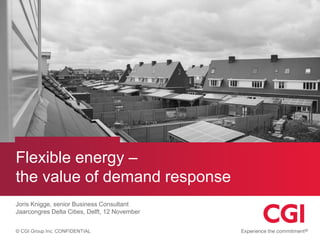
Flexible energy – the value of demand response 
Joris Knigge, senior Business Consultant 
Jaarcongres Delta Cities, Delft, 12 November
Content 
•Developments & Challenges 
•Paradigm shift in the energy value chain 
•Customer participation & Demand response 
•Jouw Energie Moment 
•Results 
•Lessons learned & discussion 
2
Developments 
3 
2020 
Reliability 
Competitiveness 
Sustainability 
1990 
2010 
2000 
Customer Governance Shareholder 
•Electrification of energy demand, energy savings 
•Increase of intermittent distributed renewable energy recourses 
•Changing customer demands
Challenges 
4 
•Incorporation distributed renewable energy into existing infrastructure, maintaining affordability and reliability 
•Facilitate new entrants and customer demands 
•Manage uncertainties and avoid investment stranded assets 
Total investment needs in the electricity and gas sector 2010-20: over 1 trillion EUR 
Power generation ~ 500 bn 
Distribution ~ 400 bn 
Transmission ~ 200 bn 
RES ~ 310 – 370 bn 
Source: EC communication on Energy Infrastructure priorities for 2020 and beyond, 17.11.2011 based on PRIMES calculations 
Transmission and distribution ~ 600 bn
Paradigm Shift in the energy value chain 
5 
Generation 
Transport 
Distribution 
Supply 
Consumption 
Customer 
participation 
EV Supply & Charging 
Generation 
Transport 
Wind 
Energy generation 
PV Energy generation 
Energy Storage 
Distribution
Energy system is based on principle production follows demand 
Flexibiliteit is nodig! 
Technische oplossingen (opslag) 
Klantzijde particpatie 
6
The quest for flexibility 
•Technical solutions to increase flexibility of the system 
•Involve demand-side of the system to increase flexibility of the system 
7
Involvement customer in energy chain can serve several business & societal goals 
•Increase market power of customer 
•Economic development in energy sector: new entrants, increase innovation, market liquidity 
•Incorporation of intermittent renewable energy recourses requires flexibility – customer can provide flexibility in energy use 
8
Customer participation & demand response 
•Customer involvement in energy is very low (energy = commodity) 
•Changing consumption pattern only occurs when changing determinants (values, attitudes, norms, morals, perceived control) 
•Develop service which focusses on customers needs ! 
9
From delivering kWh towards supplying energy service 
•Service development providing customers: 
•Increased commitment 
•Understandable insight in own consumption and production 
•Real time feed back on behavioural effects 
•Provide customer control and choice 
10
Smart Meter 
Real time production and consumption data is taken from the smart meter 
11 
Smart appliances 
In home display and management system switches appliances on preferred times and moments: according to tariffs or solar panel production 
Electric Vehicle Electric vehicles can be charged by own solar production 
IT platform on district level CeMS 
An IT platform supports monitoring and data communication from and to individual households, sensors substation capacity and interfaces with weather forecasts, wholesale markets and back-offices energy retailers 
Solar panels 
Solar panels produce electricity for households and feed into the network
12
13
Results 
14 
•Peak demand is reduced by ~40%, compared with average EU household profile 
•91% of particpating households want more “control” on their energy consumption 
•95% of participating households is convinced service “jouw energie moment” results in value for them 
•~50% of participating households say they use their smart appliance more flexible – according to preferences
Next Steps?? 
15
CGI provided solution (CeMS) together with knowledge & expertise 
•CGI designed, developed, realised and operates the IT data communication platform Central Energy Management System 
•CGI delivered knowledge & expertise on workings of the market processes within the electricity sector 
•CGI was responsible for system integration between various partners and suppliers to the consortium 
•In home energy management systems 
•Smart meter data systems 
•Weather forecast services (Meteo Consult) 
•Day Ahead electricity market (APX-ENDEX) 
•Sensor- and monitoring on sub station of local distribution grid 
•Billing & invoicing systems at back-offices of two competing energy retailers 
16
Lessons Learned 
17 
•Development of products requires system integration – Important: protocols, open standards 
•Involve customer at first phases of service product development
Discussion 
18

Flexible energy: the value of demand response

  • 1.
    © CGI GroupInc. CONFIDENTIAL Flexible energy – the value of demand response Joris Knigge, senior Business Consultant Jaarcongres Delta Cities, Delft, 12 November
  • 2.
    Content •Developments &Challenges •Paradigm shift in the energy value chain •Customer participation & Demand response •Jouw Energie Moment •Results •Lessons learned & discussion 2
  • 3.
    Developments 3 2020 Reliability Competitiveness Sustainability 1990 2010 2000 Customer Governance Shareholder •Electrification of energy demand, energy savings •Increase of intermittent distributed renewable energy recourses •Changing customer demands
  • 4.
    Challenges 4 •Incorporationdistributed renewable energy into existing infrastructure, maintaining affordability and reliability •Facilitate new entrants and customer demands •Manage uncertainties and avoid investment stranded assets Total investment needs in the electricity and gas sector 2010-20: over 1 trillion EUR Power generation ~ 500 bn Distribution ~ 400 bn Transmission ~ 200 bn RES ~ 310 – 370 bn Source: EC communication on Energy Infrastructure priorities for 2020 and beyond, 17.11.2011 based on PRIMES calculations Transmission and distribution ~ 600 bn
  • 5.
    Paradigm Shift inthe energy value chain 5 Generation Transport Distribution Supply Consumption Customer participation EV Supply & Charging Generation Transport Wind Energy generation PV Energy generation Energy Storage Distribution
  • 6.
    Energy system isbased on principle production follows demand Flexibiliteit is nodig! Technische oplossingen (opslag) Klantzijde particpatie 6
  • 7.
    The quest forflexibility •Technical solutions to increase flexibility of the system •Involve demand-side of the system to increase flexibility of the system 7
  • 8.
    Involvement customer inenergy chain can serve several business & societal goals •Increase market power of customer •Economic development in energy sector: new entrants, increase innovation, market liquidity •Incorporation of intermittent renewable energy recourses requires flexibility – customer can provide flexibility in energy use 8
  • 9.
    Customer participation &demand response •Customer involvement in energy is very low (energy = commodity) •Changing consumption pattern only occurs when changing determinants (values, attitudes, norms, morals, perceived control) •Develop service which focusses on customers needs ! 9
  • 10.
    From delivering kWhtowards supplying energy service •Service development providing customers: •Increased commitment •Understandable insight in own consumption and production •Real time feed back on behavioural effects •Provide customer control and choice 10
  • 11.
    Smart Meter Realtime production and consumption data is taken from the smart meter 11 Smart appliances In home display and management system switches appliances on preferred times and moments: according to tariffs or solar panel production Electric Vehicle Electric vehicles can be charged by own solar production IT platform on district level CeMS An IT platform supports monitoring and data communication from and to individual households, sensors substation capacity and interfaces with weather forecasts, wholesale markets and back-offices energy retailers Solar panels Solar panels produce electricity for households and feed into the network
  • 12.
  • 13.
  • 14.
    Results 14 •Peakdemand is reduced by ~40%, compared with average EU household profile •91% of particpating households want more “control” on their energy consumption •95% of participating households is convinced service “jouw energie moment” results in value for them •~50% of participating households say they use their smart appliance more flexible – according to preferences
  • 15.
  • 16.
    CGI provided solution(CeMS) together with knowledge & expertise •CGI designed, developed, realised and operates the IT data communication platform Central Energy Management System •CGI delivered knowledge & expertise on workings of the market processes within the electricity sector •CGI was responsible for system integration between various partners and suppliers to the consortium •In home energy management systems •Smart meter data systems •Weather forecast services (Meteo Consult) •Day Ahead electricity market (APX-ENDEX) •Sensor- and monitoring on sub station of local distribution grid •Billing & invoicing systems at back-offices of two competing energy retailers 16
  • 17.
    Lessons Learned 17 •Development of products requires system integration – Important: protocols, open standards •Involve customer at first phases of service product development
  • 18.