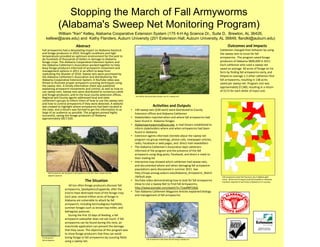
Stopping the March of Fall Armyworms
                  (Alabama's Sweep Net Monitoring Program)
           William "Ken" Kelley, Alabama Cooperative Extension System (175 4-H Ag Science Dr., Suite D, Brewton, AL 36426,
    kellewi@aces.edu) and Kathy Flanders, Auburn University (201 Extension Hall, Auburn University, AL 36849, flandkl@auburn.edu)
                                       Abstract                                                                                                                 Outcomes and Impacts
Fall armyworms had a devastating impact on Alabama livestock                                                                                             Cattlemen changed their behavior by using 
and forage producers in 2010. Drought conditions and high                                                                                                the sweep nets to scout for fall 
temperatures provided an optimum environment for the pest to                                                                                             armyworms.  The program saved forage 
do hundreds of thousands of dollars in damage to Alabama 
forage crops. The Alabama Cooperative Extension System and                                                                                               producers of Alabama $800,000 in 2011. 
the Alabama Cattlemen’s Association worked together to help                                                                                              Each cattleman who used a sweep net 
keep forage producers informed of armyworm movement and                                                                                                  saved an average  60 acres of forage on his 
management options in 2011 in an effort to keep from                                                                                                     farm by finding fall armyworms early, and 
replicating the disaster of 2010. Sweep nets were purchased by 
the Alabama Cattlemen’s Association and distributed by the                                                                                               helped an average 1.3 other cattlemen find 
Alabama Cooperative Extension System. A YouTube video was                                                                                                fall armyworms, resulting in 138 acres 
filmed to illustrate proper armyworm scouting techniques using                                                                                           saved per sweep net. Program cost was 
the sweep nets. A timely information sheet was published                                                                                                 approximately $7,000, resulting in a return 
explaining armyworm movements and control, as well as how to 
use sweep nets. Sweep nets were distributed to numerous cattle                                                                                           of $115 for each dollar of input cost.
and forage producers, and to the local county extension offices.                         Ken Kelley demonstrates proper use of a sweep net.
Regional and County agents addressed local and state 
cattlemen’s groups to inform them of how to use the sweep nets 
and how to control armyworms if they were detected. A website 
was created to highlight where armyworms had been located in                                                Activities and Outputs
the state, and a listserv was formed to get the information to as                     • 140 sweep nets ($30 each) were distributed to County 
large of an audience as possible. The program proved highly                             Extension offices and Alabama Cattlemen
successful, saving the forage producers of Alabama 
approximately $817,920.                                                               • Stakeholders reported when and where fall armyworms had 
                                                                                        been found in  Alabama forages
                                                                                      • Alabamaarmyworms@aces.edu e‐mail listserv established to 
                                                                                        inform stakeholders where and when armyworms had been 
                                                                                        found in Alabama
                                                                                      • Extension agents informed clientele about the sweep net 
                                                                                        program via group meetings, phone calls, newspaper articles, 
                                                                                        radio, Facebook or web pages, and  direct mail newsletters
                                                                                      • The Alabama Cattlemen’s Association kept cattlemen 
                                                                                        informed of the program and the presence of the fall 
                                                                                        armyworm using blog posts, Facebook, and direct e‐mails to 
                                                                                        their mailing list
                                                                                      • Interactive map showed which cattlemen had sweep nets, 
                                                                                        and documented where and when damaging fall armyworm 
                                                                                        populations were discovered in summer 2011. See 
      Fall armyworms ate the grass in the pasture on the left, then moved into the      http://maps.acesag.auburn.edu/Alabama_Armyworm_Watch
      adjacent pasture.
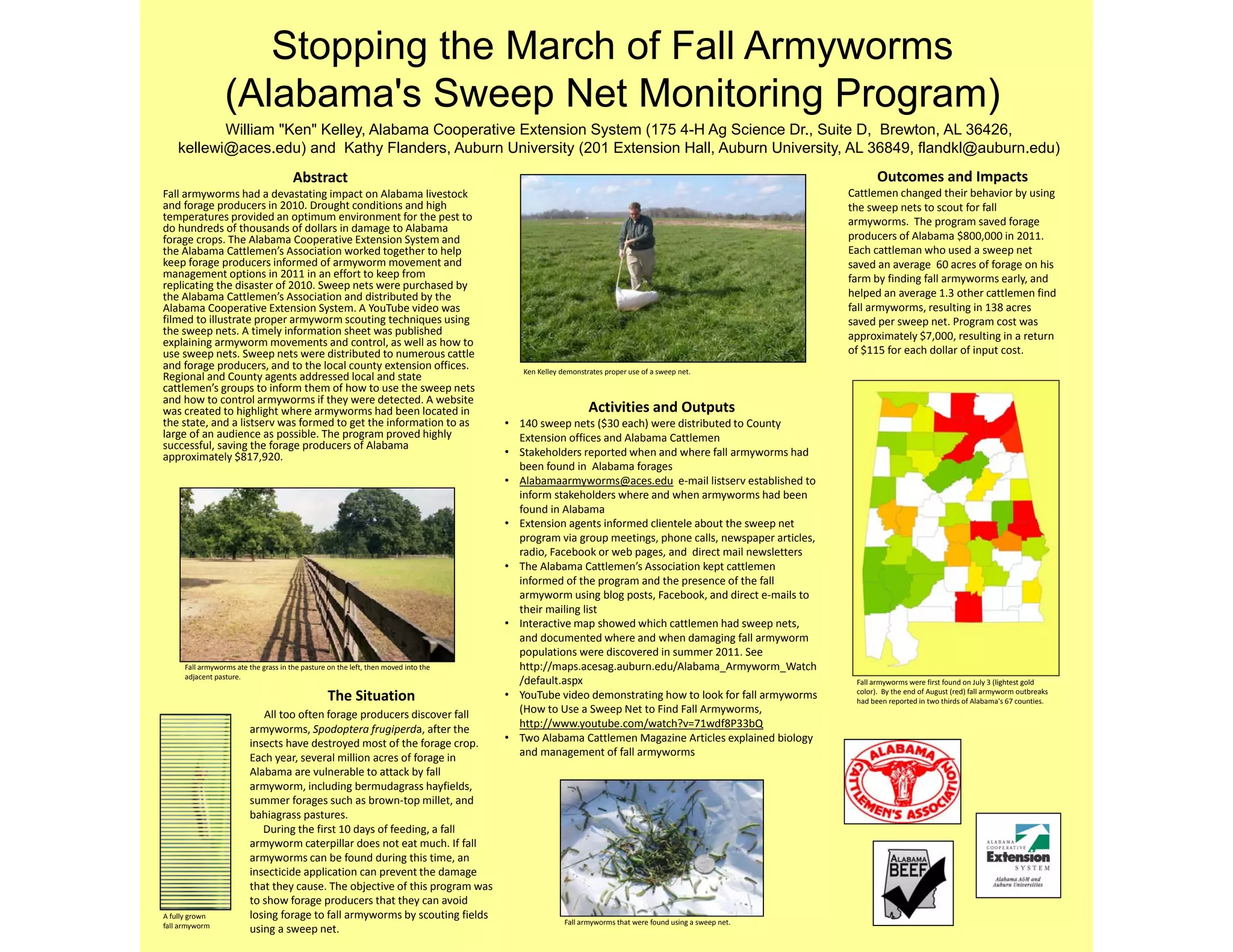
                                                                                        /default.aspx                                                     Fall armyworms were first found on July 3 (lightest gold 
                                                                                                                                                          color).  By the end of August (red) fall armyworm outbreaks 
                                                  The Situation                       • YouTube video demonstrating how to look for fall armyworms        had been reported in two thirds of Alabama's 67 counties.
                             All too often forage producers discover fall               (How to Use a Sweep Net to Find Fall Armyworms, 
                          armyworms, Spodoptera frugiperda, after the                   http://www.youtube.com/watch?v=71wdf8P33bQ
                          insects have destroyed most of the forage crop.             • Two Alabama Cattlemen Magazine Articles explained biology 
                          Each year, several million acres of forage in                 and management of fall armyworms
                          Alabama are vulnerable to attack by fall 
                          armyworm, including bermudagrass hayfields, 
                          summer forages such as brown‐top millet, and 
                          bahiagrass pastures.  
                             During the first 10 days of feeding, a fall 
                          armyworm caterpillar does not eat much. If fall 
                          armyworms can be found during this time, an 
                          insecticide application can prevent the damage 
                          that they cause. The objective of this program was 
                          to show forage producers that they can avoid 
A fully grown             losing forage to fall armyworms by scouting fields 
fall armyworm                                                                                        Fall armyworms that were found using a sweep net.
                          using a sweep net.

Flanders faw poster for aacaas

  • 1.
    Stopping the Marchof Fall Armyworms (Alabama's Sweep Net Monitoring Program) William "Ken" Kelley, Alabama Cooperative Extension System (175 4-H Ag Science Dr., Suite D, Brewton, AL 36426, kellewi@aces.edu) and Kathy Flanders, Auburn University (201 Extension Hall, Auburn University, AL 36849, flandkl@auburn.edu) Abstract Outcomes and Impacts Fall armyworms had a devastating impact on Alabama livestock  Cattlemen changed their behavior by using  and forage producers in 2010. Drought conditions and high  the sweep nets to scout for fall  temperatures provided an optimum environment for the pest to  armyworms.  The program saved forage  do hundreds of thousands of dollars in damage to Alabama  forage crops. The Alabama Cooperative Extension System and  producers of Alabama $800,000 in 2011.  the Alabama Cattlemen’s Association worked together to help  Each cattleman who used a sweep net  keep forage producers informed of armyworm movement and  saved an average  60 acres of forage on his  management options in 2011 in an effort to keep from  farm by finding fall armyworms early, and  replicating the disaster of 2010. Sweep nets were purchased by  the Alabama Cattlemen’s Association and distributed by the  helped an average 1.3 other cattlemen find  Alabama Cooperative Extension System. A YouTube video was  fall armyworms, resulting in 138 acres  filmed to illustrate proper armyworm scouting techniques using  saved per sweep net. Program cost was  the sweep nets. A timely information sheet was published  approximately $7,000, resulting in a return  explaining armyworm movements and control, as well as how to  use sweep nets. Sweep nets were distributed to numerous cattle  of $115 for each dollar of input cost. and forage producers, and to the local county extension offices.  Ken Kelley demonstrates proper use of a sweep net. Regional and County agents addressed local and state  cattlemen’s groups to inform them of how to use the sweep nets  and how to control armyworms if they were detected. A website  was created to highlight where armyworms had been located in  Activities and Outputs the state, and a listserv was formed to get the information to as  • 140 sweep nets ($30 each) were distributed to County  large of an audience as possible. The program proved highly  Extension offices and Alabama Cattlemen successful, saving the forage producers of Alabama  approximately $817,920.   • Stakeholders reported when and where fall armyworms had  been found in  Alabama forages • Alabamaarmyworms@aces.edu e‐mail listserv established to  inform stakeholders where and when armyworms had been  found in Alabama • Extension agents informed clientele about the sweep net  program via group meetings, phone calls, newspaper articles,  radio, Facebook or web pages, and  direct mail newsletters • The Alabama Cattlemen’s Association kept cattlemen  informed of the program and the presence of the fall  armyworm using blog posts, Facebook, and direct e‐mails to  their mailing list • Interactive map showed which cattlemen had sweep nets,  and documented where and when damaging fall armyworm  populations were discovered in summer 2011. See  Fall armyworms ate the grass in the pasture on the left, then moved into the  http://maps.acesag.auburn.edu/Alabama_Armyworm_Watch adjacent pasture. /default.aspx Fall armyworms were first found on July 3 (lightest gold  color).  By the end of August (red) fall armyworm outbreaks  The Situation   • YouTube video demonstrating how to look for fall armyworms  had been reported in two thirds of Alabama's 67 counties. All too often forage producers discover fall  (How to Use a Sweep Net to Find Fall Armyworms,  armyworms, Spodoptera frugiperda, after the  http://www.youtube.com/watch?v=71wdf8P33bQ insects have destroyed most of the forage crop.  • Two Alabama Cattlemen Magazine Articles explained biology  Each year, several million acres of forage in  and management of fall armyworms Alabama are vulnerable to attack by fall  armyworm, including bermudagrass hayfields,  summer forages such as brown‐top millet, and  bahiagrass pastures.   During the first 10 days of feeding, a fall  armyworm caterpillar does not eat much. If fall  armyworms can be found during this time, an  insecticide application can prevent the damage  that they cause. The objective of this program was  to show forage producers that they can avoid  A fully grown  losing forage to fall armyworms by scouting fields  fall armyworm Fall armyworms that were found using a sweep net. using a sweep net.