CHASING SYMPATRIC SPECIATION
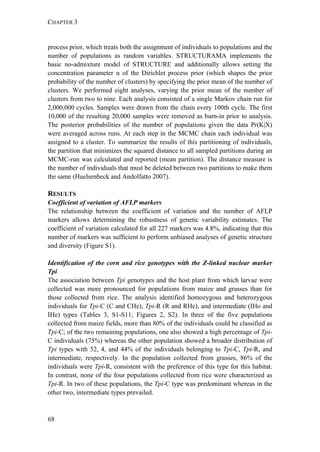
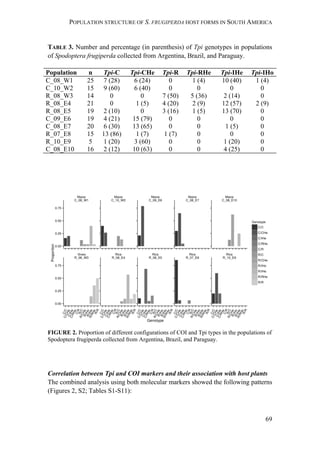
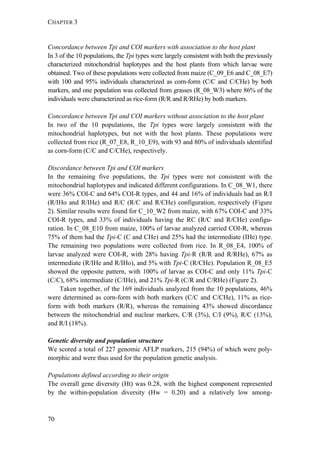
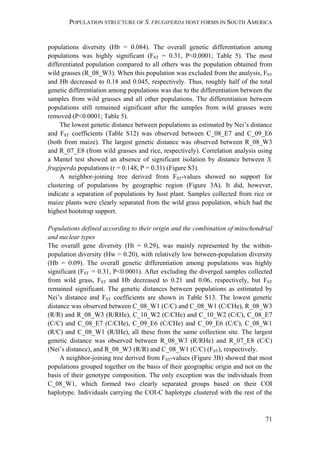
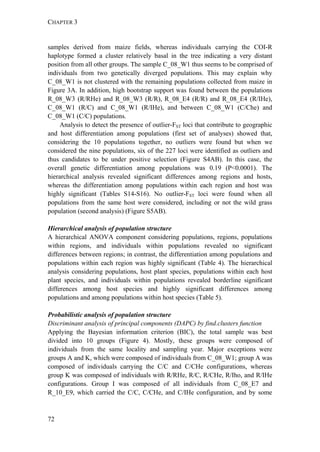
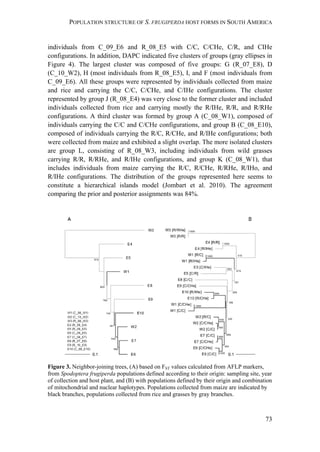
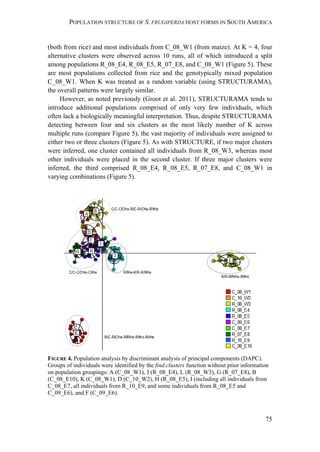
THE RELATIVE IMPORTANCE AND GENETIC BASIS
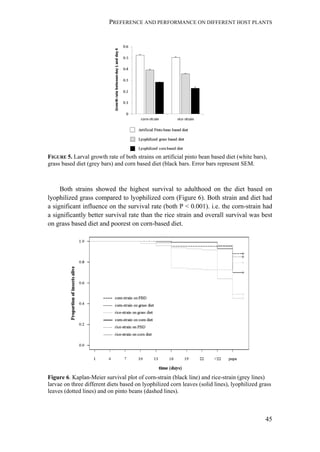
OF PREZYGOTIC ISOLATION BARRIERS IN
DIVERGING POPULATIONS OF
SPODOPTERA FRUGIPERDA
SABINE HÄNNIGER
CHASINGSYMPATRICSPECIATION-PrezygoticisolationbarriersinSpodopterafrugiperdaSABINEHÄNNIGER
CHASING SYMPATRIC SPECIATION
THE RELATIVE IMPORTANCE AND GENETIC BASIS OF
PREZYGOTIC ISOLATION BARRIERS IN DIVERGING
POPULATIONS OF SPODOPTERA FRUGIPERDA
‘Every scientific statement is provisional. […]. How can anyone trust
scientists? If new evidence comes along, they change their minds.’
Terry Pratchett et al., The Science of Discworld: Judgement Day, 2005
S. Hänniger, 2015. Chasing sympatric speciation - The relative importance and
genetic basis of prezygotic isolation barriers in diverging populations of
Spodoptera frugiperda
PhD thesis, University of Amsterdam, The Netherlands
ISBN: 978 94 91407 21 5
Cover design: Sabine Hänniger
Lay-out: Sabine Hänniger, with assistance of Jan Bruin
CHASING SYMPATRIC SPECIATION
THE RELATIVE IMPORTANCE AND GENETIC BASIS OF
PREZYGOTIC ISOLATION BARRIERS IN DIVERGING
POPULATIONS OF SPODOPTERA FRUGIPERDA
ACADEMISCH PROEFSCHRIFT
ter verkrijging van de graad van doctor
aan de Universiteit van Amsterdam
op gezag van de Rector Magnificus
prof. dr. D.C. van den Boom
ten overstaan van een door het College voor Promoties ingestelde
commissie, in het openbaar te verdedigen in de Agnietenkapel
op dinsdag 06 oktober 2015, te 10.00 uur
door
SABINE HÄNNIGER
geboren te Heiligenstadt, Duitsland
Promotores prof. dr. S.B.J. Menken 1
prof. dr. D.G. Heckel 2
Co-promotor dr. A.T. Groot 1,2
Overige leden prof. dr. A.M. de Roos 1
prof. dr. P.H. van Tienderen 1
prof. dr. P.C. de Ruiter 1
dr. E. d’Alençon 3, 4
dr. R.A. Hut 5
dr. G. Schöfl 6
Faculteit der Natuurwetenschappen, Wiskunde en Informatica
1
Institute for Biodiversity and Ecosystem Dynamics, University of Amsterdam,
The Netherlands
2
Max Planck Institute for Chemical Ecology, Jena, Germany
3
UM2 - UMR 1333 DGIMI, Université Montpellier 2, Montpellier, France
4
INRA - UMR 1333 DGIMI, Université Montpellier 2, Montpellier, France
5
Chronobiology Research Unit, University of Groningen, The Netherlands
6
DKMS Life Science Lab, Dresden, German
TABLE OF CONTENTS
Summary 7
Samenvatting 9
1 General introduction 11
Section 1 Strain-specific host plant differentiation (or not?) 31
2 No strain-specific differences in preference and
performance of Spodoptera frugiperda on typical host
plants
33
3 Population structure of Spodoptera frugiperda maize
and rice host forms in South America: are they host
strains?
57
Section 2 Strain-specific differentiation of sexual
communication
95
4 Pheromonal divergence between two strains of
Spodoptera frugiperda
97
5 Geographic variation in sexual attraction of
Spodoptera frugiperda corn- and rice-strain males to
pheromone lures
121
Section 3 Strain-specific allochronic differentiation in daily
rhythm
147
6 Genetic basis of prezygotic isolation in the fall
armyworm
149
7 Annotation of circadian clock genes in the genome of
Spodoptera frugiperda
181
8 Evolution of reproductive isolation of
Spodoptera frugiperda
189
9 General discussion 207
Contributions of authors 224
Acknowledgements 226
Curriculum vitae 229
‘I love deadlines. I love the whooshing noise they make as they go by.’
Douglas Adams, The Salmon of Doubt, 2002
7
SUMMARY
Speciation occurs when gene flow between groups of individuals of one species is
reduced to such an extent that the genetic differences that have accumulated over
time cause reproductive isolation. The most obvious cause of gene flow reduction
occurs in allopatry, i.e. when populations become geographically isolated, but gene
flow can also be reduced in sympatry, for example when individuals within a
population start feeding on different types of food. Differentiation in feeding habits
has been found in some herbivorous insects that develop on different host plants,
and in cichlid fishes that feed on different types of prey. However, it is unlikely that
one factor can cause a strong enough reduction in gene flow to cause reproductive
isolation. More likely a number of factors, such as food choice and mate choice,
interact to cause reproductive isolation. Determining which factors contribute to
sympatric speciation, and the level and extent of their interaction, is the current
challenge to understand under which circumstances and how sympatric speciation
can occur.
This thesis investigates the mechanisms underlying three prezygotic isolation
barriers between the corn- and the rice-strains of the noctuid moth Spodoptera
frugiperda to determine possible interactions between these isolation barriers and
their relative importance for sympatric speciation.
First, we investigated the role of host plant differentiation as isolation barrier
between the two strains. Chapter 2 summarizes studies addressing strain
differences in host utilization, i.e. oviposition preference, larval host acceptance,
larval choice, larval performance, pupal weight and total fecundity. Only
oviposition preference showed some consistent differences between the two strains
in the different experiments that were conducted. Chapter 3 describes a population-
genetic analysis with S. frugiperda populations collected from corn fields, rice
fields and wild grasses at eight locations in Argentina, Brazil and Paraguay. This
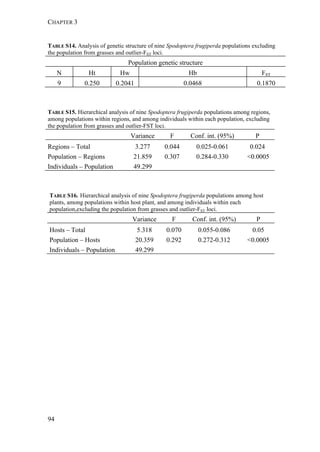
analysis shows that, although there is some host-associated genetic structure, host
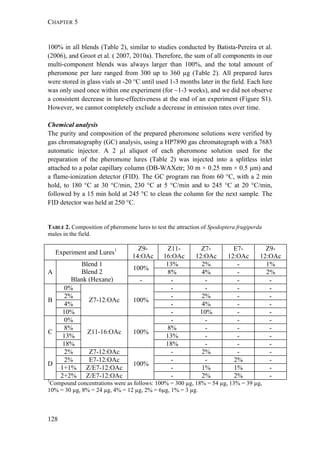
plant differentiation alone cannot explain the total genetic variance and thus other,
additional factors must maintain the genetic differentiation. Consequently, we
suggest calling these strains ‘host forms’ instead of ‘host strains’.
Second, I focused on differentiation in sexual communication between the two
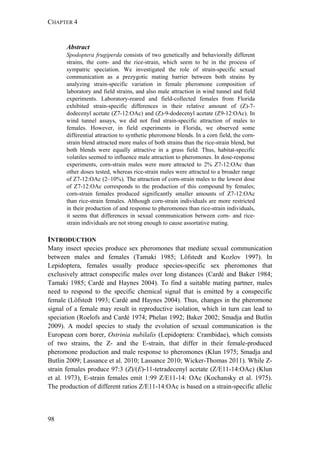
strains. Chapter 4 investigates the pheromonal divergence patterns of S. frugiperda
strains in Florida, specifically whether the strain-specific pheromone blends cause
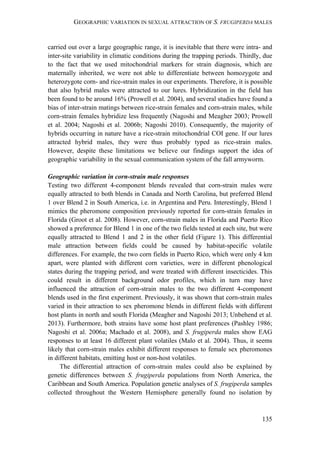
strain-specific male responses. Males do not show strain-specific attraction in
Florida. However, males did show a strain-specific difference in the attraction to the
critical pheromone component Z7-12:OAc. Also, the different habitats influenced
the male response, suggesting an interaction between host plant and sex pheromone
volatiles. In Chapter 5 we disentangled strain-specific variation from geographic
SUMMARY
8
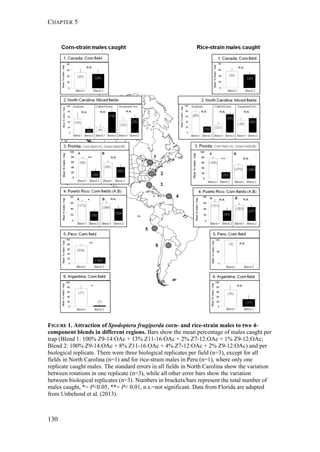
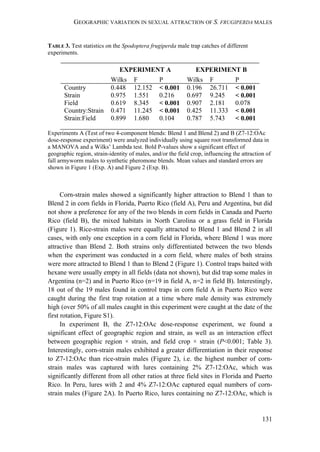
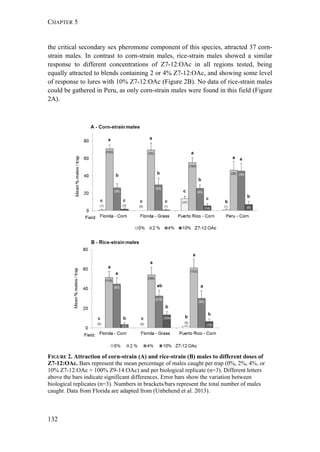
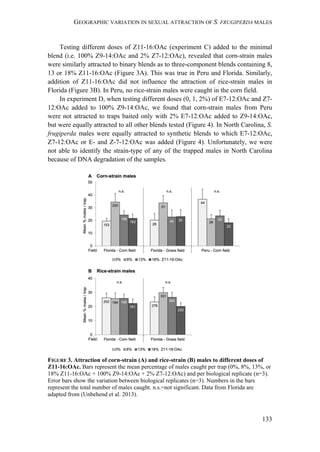
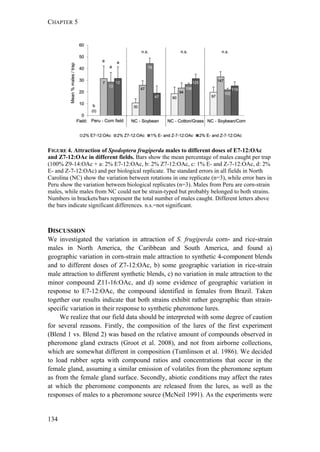
variation in male attraction of S. frugiperda by comparing male attraction in
Canada, North Carolina, Florida, Puerto Rico, Peru and Argentina. We found that
the response of corn-strain males varies between geographic regions, whereas rice-
strain males did not show geographic variation in their response. Additionally, we
found habitat to have an effect on the attraction of males to strain-specific lures,
suggesting an interaction of host plant volatiles and sex-pheromones in the
attraction of males in S. frugiperda.
The third and most consistent prezygotic isolation barrier between the two
strains is allochronic differentiation, i.e. the strains differ in the daily timing of their
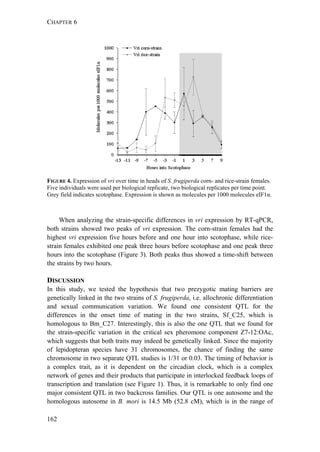
sexual activities. In Chapter 6, we determined the genetic basis of this barrier, in
combination with the pheromonal divergence, through quantitative trait locus
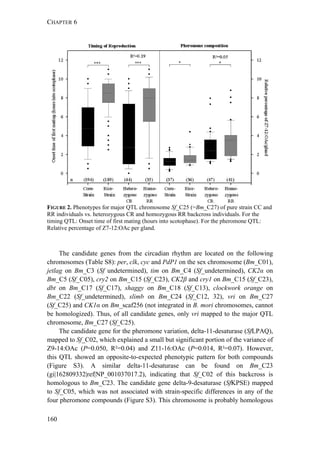
(QTL) analysis. We found one major QTL for the circadian differentiation,
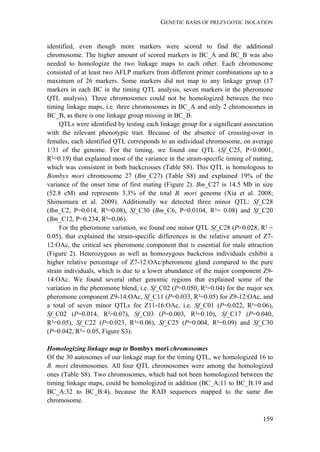
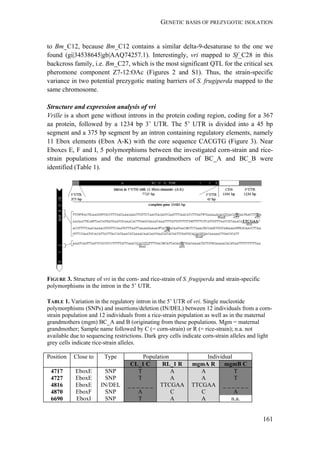
explaining 19% of the variance between the strains. The circadian clock gene vrille
maps to this locus, which is thus the major candidate gene underlying this circadian
differentiation. Interestingly, the differentiation of the critical sex pheromone
component (Z7-12:OAc) maps to the genomic locus, suggesting a genetic linkage
between pheromonal divergence and allochronic differentiation. Chapter 7
describes the annotation of nine genes in the corn-strain variant of the S. frugiperda
genome project, which are involved in circadian rhythm. We successfully
elucidated the exon-intron structure of these clock genes. Five of the nine genes are
located on more than one scaffold, so that the annotation of these genes
significantly contributed to the S. frugiperda genome assembly.
Finally, the relative importance and possible interactions between the three
prezygotic isolation barriers between the two strains in S. frugiperda are discussed.
The prezygotic timing of reproductive activity and the postzygotic hybrid sterility
found in daughters of matings between rice-strain mothers and corn-strain fathers
most likely make the strongest contribution to reproductive isolation. In addition,
we propose that the corn-strain is the derived strain and the rice-strain the ancestral
strain, because the rice-strain is genetically more diverse, shows a broader response
to pheromone blends and is more likely to be found on host plants different from
the ‘typical’ small grasses. In Chapter 9, I discuss the evolutionary potential of the
different isolation barriers between the two strains of S. frugiperda and I propose an
interaction between all prezygotic mating barriers which facilitate the divergence of
the two strains, with allochronic differentiation being the driving force in these
interactions. In conclusion, by investigating the different prezygotic isolation
barriers between two sympatrically occurring strains of S. frugiperda in detail, I
have determined their strengths and possible interactions, which has given
important insights in the mechanisms underlying and facilitating the process of
sympatric speciation.
9
SAMENVATTING
Soortvorming vindt plaats als genetische uitwisseling tussen groepen van individuen
van een soort zodanig gereduceerd wordt dat de genetische verschillen die in de loop
van de tijd geaccumuleerd zijn leiden tot reproductieve isolatie. De duidelijkste
oorzaak van een vermindering van genetische uitwisseling is als populaties door geo-
grafische barrières worden gescheiden, dus allopatrische soortvorming. Echter, gene-
tische uitwisseling tussen individuen kan ook verminderen zonder geografische bar-
rière, in sympatrie, bijvoorbeeld als individuen binnen een populatie van verschillende
voedselbronnen gaan eten. Differentiatie in voedingsgedrag is bijvoorbeeld gevonden
in herbivore insecten, die zich op verschillende waardplanten kunnen ontwikkelen, en
in cichlide vissen die verschillende prooien eten. Het is niet erg waarschijnlijk dat één
specifieke factor een zodanige reductie in genetische uitwisseling kan veroorzaken dat
reproductieve isolatie ontstaat. Waarschijnlijk zorgen meerdere factoren, zoals
voedingsgedrag en paringsgedrag, samen en in interactie met elkaar voor een
zodanige reductie in genetische uitwisseling dat reproductieve isolatie ontstaat.
Bepalen welke factoren tot sympatrische soortvorming kunnen leiden, en hoe deze
factoren interacteren, is de huidige uitdaging om te begrijpen wanneer en onder welke
omstandigheden sympatrische soortvorming kan plaatsvinden.
Dit proefschrift beschrijft de mechanismen van drie prezygotische isolatiebarrières
in het rijst- en mais-ras van de nachtvlinder Spodoptera frugiperda om hun onderlinge
interacties en bijdrage aan sympatrische soortvorming te bepalen. Allereerst wordt de rol
van waardplantdifferentiatie als isolatiebarrière tussen de twee rassen onderzocht.
Hoofdstuk 2 geeft een samenvatting van de verschillen tussen de twee rasssen in het
gebruik van voedselplanten, met name ovipositievoorkeur van de volwassen vrouwtjes,
de acceptatie van verschillende planten door de rupsen, de keuze van rupsen voor
bepaalde planten en de vruchtbaarheid van de twee rassen op de verschillende planten.
Alleen ovipositievoorkeur van de vrouwtjes bleek consistent te verschillen tussen de
twee rassen in de verschillende experimentten die werden uitgevoerd. Hoofdstuk 3
beschrijft een populatie-genetisch onderzoek aan S. frugiperda populaties verzameld
van maisvelden, rijstvelden en wilde grassen van acht locaties in Argentinie, Brazilie en
Paraguay. Deze analyse laat zien dat waardplantdifferentiatie alleen niet de genetische
variatiepatronen tussen de twee rassen kan verklaren en dat derhalve andere factoren de
genetische differentiatie handhaven. Daarom stellen wij voor om deze rassen niet
(gastheer)rassen te noemen, zoals tot nog toe gebruikelijk was, maar (gastheer)vormen.
In het tweede deel van dit proefschrift analyseer ik de differentiatie in seksuele
communicatie tussen de twee rassen. Hoofdstuk 4 onderzoekt of de seksferomoon-
verschillen tussen de twee rassen in Florida tot ras-specifieke responsen van de
mannetjes leiden. Dit blijkt niet het geval te zijn, hoewel we wel ras-specifieke
verschillen in aantrekking tot een belangrijke feromooncomponent (Z7-12:OAc)
SAMENVATTING
10
vonden. Habitat bleek ook de mannelijke respons te beïnvloeden, wat een interactie
tussen planten- en seksferomoonstoffen suggereert. In hoofdstuk 5 ontrafelen we
ras-specifieke van geografische variatie in de seksuele aantrekking van mannetjes
door dezelfde experimenten te doen in Canada, North Carolina, Florida, Puerto Rico,
Peru en Argentinië. Uit deze studie blijkt dat de respons van maisras-mannetjes
verschilt tussen gebieden, terwijl de rijstras-mannetjes geen geografische variatie
vertonen. Ook hier vonden we dat de habitat een effect heeft op de aantrekking van
mannetjes tot de ras-specifieke lokstoffen; dit suggereert een interactie tussen
planten- en seksferomoonstoffen in de aantrekking van mannetjes in S. frugiperda.
De derde en meest consistente prezygotische isolatiebarrière tussen de twee ras-
sen is allochrone differentiatie, d.w.z. de rassen verschillen in de dagelijkse timing
van hun seksuele activiteit. Hoofdstuk 6 beschrijft de genetische analyse van deze
isolatiebarrière, in combinatie met de feromoondifferentiatie, door quantitative trait
locus (QTL) analyse. De voornaamste QTL verklaarde een significant deel (19%)
van de variantie in circadiane verschuivingen tussen de rassen. Het circadiane klok-
gen vrille bevindt zich op dit locus, wat daarmee het belangrijkste kandidaatgen is
dat aan de circadiane rasverschillen ten grondslag ligt. Interessant genoeg vonden
we dat het rasverschil in een van de kritieke seksferomooncomponenten zich ook op
deze genomische locatie bevindt, wat suggereert dat feromoondifferentiatie en allo-
chrone differentiatie genetisch gekoppeld zijn. Hoofdstuk 7 beschrijft de annotatie
van negen genen in het maisras van S. frugiperda, die betrokken zijn bij het circadi-
ane ritme. We hebben de exon-intronstructuur van deze genen opgehelderd. Vijf
van de negen genen zijn over meerdere scaffolds verspreid, waardoor hun annotatie
belangrijk heeft bijgedragen tot de assemblage van het S. frugiperda genoom.
In het laatste deel van dit proefschrift worden de relatieve bijdrage en moge-
lijke interacties tussen de drie prezygotische reproductieve isolatiebarrières behan-
deld. De prezygotische timing van seksuele activiteiten en de postzygotische hy-
bridde steriliteit in dochters van paringen tussen rijstvrouwtjes en maismannetjes
zijn waarschijnlijk de belangrijkste bijdragen aan reproductieve isolatie tussen de
rassen van S. frugiperda. Bovendien is het rijstras waarschijnlijk het oorspronke-
lijke ras en het maisras het afgeleide ras, omdat het rijstras genetisch diverser is, een
bredere feromoonrespons laat zien en vaker voorkomt op andere waardplanten dan
de ‘typische’ kleine grassen. In hoofdstuk 9 bespreek ik de evolutionaire potentie
van de verschillende isolatiebarrières tussen de twee rassen van S. frugiperda en stel
ik een interactiemodel voor tussen de verschillende prezygotische barrières die de
divergentie van de twee rassen faciliteren, waarin allochrone differentiatie de drij-
vende kracht is in deze interacties. Samenvattend heeft dit promotie-onderzoek ver-
schillende prezygotische isolatiebarrières tussen twee sympatrisch voorkomende
rassen van S. frugiperda in detail bestudeerd, hun mogelijke interacties in kaart
gebracht, en daarmee belangrijke inzichten verschaft in de mechanismen die sympa-
trische soortvorming mogelijk maken.
1
GENERAL INTRODUCTION
CHAPTER 1
12
SPECIATION IN SYMPATRY
‘…whilst this planet has gone cycling on […], from so simple a
beginning endless forms most beautiful and most wonderful have
been, and are being, evolved.’
Charles Darwin, On the Origin of Species, 1859
When Darwin introduced the idea of speciation in his famous book On the origin of
species (1859), his theory included the evolution of species in sympatry as well as
in allopatry. Sympatric speciation is the evolution of new species from an ancestral
species without geographic isolation, whereas allopatric speciation is facilitated by
geographical boundaries separating populations. Today it is widely accepted that
also without spatial separation of populations gene flow may become limited
between groups of individuals and allow reproductive isolation to evolve (recent
studies include e.g. Nanda and Singh 2012; Nosil and Feder 2012; Strasburg et al.
2012; Boomsma and Nash 2014; Castiglia 2014; Scordato et al. 2014; Aboagye-
Antwi et al. 2015). However, for over a century sympatric speciation was widely
rejected and has been referred to as the ‘ugly duckling’ of evolutionary theory,
which only in the past few decades grew up to be a ‘swan’ (Via 2001). Why has this
theory been so controversial for so long? Ernst Mayr’s decade-long wholehearted
battle for the acceptance of allopatry as universal mechanism of speciation, and his
influential opinion was instrumental in the rejection of sympatric speciation
(Berlocher and Feder 2002). Ernst Mayr was convinced that gene flow is
unavoidable between populations that are not spatially separated, and populations
cannot genetically differentiate in the face of gene flow (Mayr 1947). Additionally,
empiric evidence for speciation in sympatry was rare. One prominent example had
already been discovered in the 1860s: Benjamin Walsh had observed that in the
apple maggot fly (Rhagoletis pomonella) host-races had formed by shifting from
native hawthorn (Crataegus spp.) to introduced domesticated apple (Malus pumila).
Based on this observation, he proposed that phytophagous insect species may
evolve in sympatry by shifting and adapting to new host plants (Walsh 1864, 1867).
In the debate initiated by Mayr almost a century later, Mayr’s former student Guy
L. Bush picked up Walsh’s studies from the 1860s and re-introduced Rhagoletis
pomonella as potential case of sympatric speciation (Bush 1969). In 1988, Bush’s
concept of sympatric speciation in Rhagoletis was substantiated by the confirmation
of genetic differentiation between the two host-races (Feder et al. 1988; McPheron
et al. 1988). The host-shift of Rhagoletis pomonella has since become a role model
for speciation in sympatry in phytophagous insects and subject to extensive research
into the mechanisms involved in the shift (e.g. Feder et al. 1994; Nojima et al. 2003;
Olsson et al. 2006). Today, many additional examples of diverging sympatric
populations are known and investigated, for example the pea aphid (Acyrthosiphon
GENERAL INTRODUCTION
13
pisum) (Via 1999; Via et al. 2000), the Goldenrod ball-gall fly (Eurosta solidaginis)
(Abrahamson and Weis 1997) and cichlid fishes (Cichlidae) (Schliewen et al. 1994;
Danley et al. 2000; Wilson et al. 2000).
The extensive debate of the past decades forged a better picture of the
circumstances favorable for sympatric speciation, especially when mediated by a
host-shift. Among these circumstances are a broad sympatric overlap of host
patches, limitation of gene flow by differing habitat choice and a genetic basis for
habitat choice (Via 2001). Additionally, multiple selective forces rather than one
single force seem to be necessary to drive speciation in sympatry (Rice and Hostert
1993; Via 2001).
Despite a better understanding of possible mechanisms that may cause
sympatric speciation that was accumulated over the past decades (Smadja and
Butlin 2011), quite a few questions still remain: Does sympatric speciation depend
on specific starting criteria and can these criteria be generalized? Can the sequence
in which different reproductive isolation barriers evolve in sympatry be predicted
and is this comparable to the sequence of events in allopatric speciation? How
rapidly must reproductive isolation evolve for speciation in sympatry to occur (Via
2001)? To answer these questions it is important to identify the causes and
consequences of reduced gene flow in species where reproductive isolation has not
yet been completed, i.e. in diverging races with different modes of reproductive
isolation, which are partially isolated in the present rather than investigating fully
isolated species (Berlocher and Feder 2002; Drés and Mallet 2002; Via 2002; Via
and West 2008).
The fall armyworm Spodoptera frugiperda is one of the invaluable case studies
with two diverging strains in sympatry. The two strains are hypothesized to
currently be in an incipient stage of sympatric speciation and exhibit three major
potential isolation barriers: differential host plant usage, differential sexual
communication and differentiation in daily rhythms (Groot et al. 2010). Thus, these
strains constitute an ideal model system to study a) incipient sympatric speciation
and b) the contributions and interactions of different isolation barriers to speciation
in sympatry.
THE MODEL SYSTEM AND AIM OF THIS THESIS
This thesis aims to investigate the relative importance of the different potential
prezygotic isolation barriers for the divergence of the two strains of S. frugiperda in
sympatry, by identifying the molecular differences underlying these isolation
barriers, so that possible interactions between the isolation barriers can be
determined. Identifying the mechanisms underlying prezygotic isolation barriers in
two sympatrically occurring strains of a species will give important insight in the
first steps of sympatric speciation.
CHAPTER 1
14
Biology of Spodoptera frugiperda
Spodoptera frugiperda (Lepidoptera: Noctuidae) is a noctuid moth inhabiting in
North- and South America (Sparks 1979). As a generalist, its larvae feed on a huge
variety of plants. Exactly how many different plants are fed upon by S. frugiperda
larvae is unknown, but plants of 80 different species in 23 plant families have been
described so far (Luginbill 1928; Pashley 1988). Among the host plants are many
important crop plants, such as rice (Oryza sativa), corn (Zea mays), sorghum
(Sorghum bicolor) (all Poaceae) and cotton (Gossypium hirsutum, Malvaceae).
Life cycle
Dependent on the climate, S. frugiperda populations may occur the whole year in
warm climate, overwinter as pupae in mild winters (Sparks 1979) or die in the cold
season and repopulate an area in the next warm season through migration (Nagoshi
et al. 2008b, 2012). One life cycle is completed in 4-13 weeks, depending on the
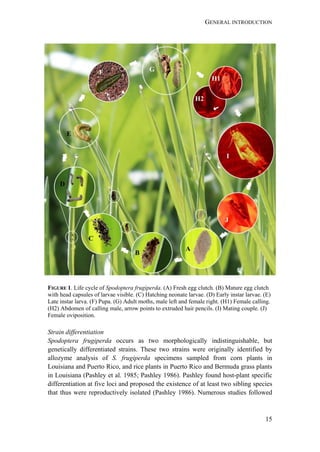
temperature (Sparks 1979; Andrews 1988) and can be summarized as follows. Eggs
are usually laid in clutches of up to hundreds of eggs which are multilayered and
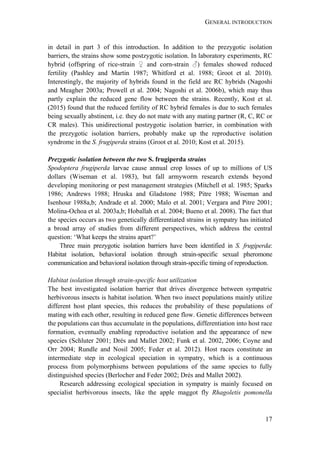
can be covered with scales (Meagher et al. 2011) (Figure 1A). In fertilized eggs, the
head capsule of the developing larva becomes visible within 2-4 days after
oviposition and the eggs appear black (Figure 1B). Neonate larvae hatch from the
eggs approximately 1 day later (Figure 1C). Larvae develop on their host plants
during six instars, growing continuously and shedding their cuticle between instars
(Figure 1D, E). Sixth instars dig 1-3 inches deep into the soil, where they pupate
(Figure 1F). The adults eclose underground after 1-5 weeks and then leave the soil
to unfold their wings (Figure 1G). The adult moths are usually not reproductively
active before the second night of their adulthood. Then, females sit as high as
possible on a host plant, extrude their pheromone glands and emit a sex pheromone
attractive to males (female calling, Figure 1H1). Males are attracted from a long
range and in close range show a specific male calling behavior: They extrude hair
pencils from their abdomen, perform wing fanning and attempt to mate with the
female by bending the abdomen towards her (Figure 1H2). Several males can
approach one female, and both females and males mate with one partner per night.
With whom the female mates is probably mediated by close-range communication
via a male pheromone (Birch et al. 1990). Once mated, the copulation can extend
over several hours (Sparks 1979; Schöfl et al. 2009) (Figure 1I). Females can mate
with different partners in consecutive nights, and eggs may be fertilized by sperm of
several males (Meagher and Nagoshi 2010). The female oviposits for the first time
in the night following the first successful copulation (thus at the earliest in the 3rd
night of adulthood) and eggs are placed on host plants as well as on non-host plants
and even man-made objects like car tires or window panes (R.L. Meagher, pers.
comm.). This wide distribution of eggs may be important for larval dispersal, but
could also be a strategy of predator and parasitoid avoidance (Meagher et al. 2011).
GENERAL INTRODUCTION
15
Strain differentiation
Spodoptera frugiperda occurs as two morphologically indistinguishable, but
genetically differentiated strains. These two strains were originally identified by
allozyme analysis of S. frugiperda specimens sampled from corn plants in
Louisiana and Puerto Rico, and rice plants in Puerto Rico and Bermuda grass plants
in Louisiana (Pashley et al. 1985; Pashley 1986). Pashley found host-plant specific
differentiation at five loci and proposed the existence of at least two sibling species
that thus were reproductively isolated (Pashley 1986). Numerous studies followed
FIGURE 1. Life cycle of Spodoptera frugiperda. (A) Fresh egg clutch. (B) Mature egg clutch
with head capsules of larvae visible. (C) Hatching neonate larvae. (D) Early instar larvae. (E)
Late instar larva. (F) Pupa. (G) Adult moths, male left and female right. (H1) Female calling.
(H2) Abdomen of calling male, arrow points to extruded hair pencils. (I) Mating couple. (J)
Female oviposition.
CHAPTER 1
16
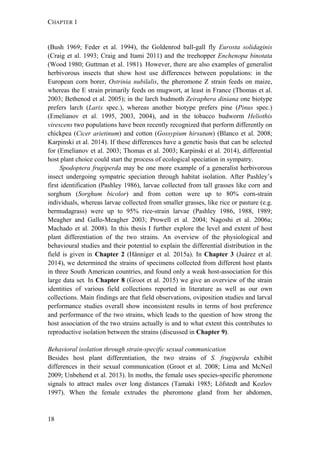
these findings and identified a variety of additional molecular markers that show
strain-specific differentiation (summarized in Table 1).
TABLE 1. Summary of studies that identified strain-specific molecular markers or using these
markers to further elucidate the strain-differentiation.
Genomic DNA: esterase allozymes Pashley 1986
Mitochondrial DNA: cytochrome oxidase
1 (CO1) and NADH dehydrogenase 1
(ND1)
Pashley 1989, Pashley and Ke 1992, Lu and
Adang 1996, Levy et al. 2002, Meagher and
Gallo-Meagher 2003, Nagoshi et al. 2006,
Lewter et al. 2006, Lewter et al. 2007,
Machado et al. 2008, Juárez et al. 2012,
Dumas et al. 2015a
Genomic DNA: FR tandem repeat
sequence (present in rice-strain, absent in
corn-strain)
Lu et al. 1994, Nagoshi and Meagher 2003,
Nagoshi et al. 2008a
Genomic DNA: Amplified fragment
length polymorphisms (AFLP)
McMichael and Prowell 1999, Busato et al.
2004, Prowell et al. 2004, Clark et al. 2007,
Martinelli et al 2007, Juárez et al. 2014
Genomic DNA: Triose phosphate
isomerase (tpi)
Nagoshi 2010, Juárez et al. 2014
Genomic DNA: Microsatellite markers Dumas et al. 2015b
Currently, differences in the mitochondrial cytochrome oxidase 1 (CO1) gene
are mainly used to discriminate the two strains, as this is a comparably fast and
inexpensive method: a 600 bp amplicon of the gene is digested with SacI and MspI
restriction enzymes. The corn-strain amplicon has only the MspI restriction site,
whereas Sac1 digests only the rice-strain amplicon. As mitochondria are maternally
transmitted, hybrids can only be identified by additionally using a diagnostic
nuclear marker, e.g. the triose phosphate isomerase gene (tpi) (Nagoshi 2010). With
a combined analysis of mitochondrial and nuclear markers, up to 16% inter-strain
hybrids have been detected in field populations (Nagoshi and Meagher 2003a;
Prowell et al. 2004; Nagoshi et al. 2006b; Machado et al. 2008). While these high
rates of hybridization suggest incipient rather than completed speciation, recent
studies based on microsatellite markers and CO1 sequences indicate that the two
strains are actually ‘good’ species (Dumas et al. 2015a,b). However, for the sake of
consistency with the majority of fall armyworm publications, I will use strains
throughout my thesis.
Besides molecular differences, the strains show differentiation in their host
utilization (Pashley et al. 1985; Pashley 1986, 1988, 1989; Meagher and Gallo-
Meagher 2003; Prowell et al. 2004; Nagoshi et al. 2006a; Machado et al. 2008),
composition of female sex pheromone (Groot et al. 2008; Lima and McNeil 2009;
Unbehend et al. 2013) and timing of reproductive activity (Pashley et al. 1992;
Schöfl et al. 2009). These three prezygotic isolation differences will be introduced
GENERAL INTRODUCTION
17
in detail in part 3 of this introduction. In addition to the prezygotic isolation
barriers, the strains show some postzygotic isolation. In laboratory experiments, RC
hybrid (offspring of rice-strain ♀ and corn-strain ♂) females showed reduced
fertility (Pashley and Martin 1987; Whitford et al. 1988; Groot et al. 2010).
Interestingly, the majority of hybrids found in the field are RC hybrids (Nagoshi
and Meagher 2003a; Prowell et al. 2004; Nagoshi et al. 2006b), which may thus
partly explain the reduced gene flow between the strains. Recently, Kost et al.
(2015) found that the reduced fertility of RC hybrid females is due to such females
being sexually abstinent, i.e. they do not mate with any mating partner (R, C, RC or
CR males). This unidirectional postzygotic isolation barrier, in combination with
the prezygotic isolation barriers, probably make up the reproductive isolation
syndrome in the S. frugiperda strains (Groot et al. 2010; Kost et al. 2015).
Prezygotic isolation between the two S. frugiperda strains
Spodoptera frugiperda larvae cause annual crop losses of up to millions of US
dollars (Wiseman et al. 1983), but fall armyworm research extends beyond
developing monitoring or pest management strategies (Mitchell et al. 1985; Sparks
1986; Andrews 1988; Hruska and Gladstone 1988; Pitre 1988; Wiseman and
Isenhour 1988a,b; Andrade et al. 2000; Malo et al. 2001; Vergara and Pitre 2001;
Molina-Ochoa et al. 2003a,b; Hoballah et al. 2004; Bueno et al. 2008). The fact that
the species occurs as two genetically differentiated strains in sympatry has initiated
a broad array of studies from different perspectives, which address the central
question: ‘What keeps the strains apart?’
Three main prezygotic isolation barriers have been identified in S. frugiperda:
Habitat isolation, behavioral isolation through strain-specific sexual pheromone
communication and behavioral isolation through strain-specific timing of reproduction.
Habitat isolation through strain-specific host utilization
The best investigated isolation barrier that drives divergence between sympatric
herbivorous insects is habitat isolation. When two insect populations mainly utilize
different host plant species, this reduces the probability of these populations of
mating with each other, resulting in reduced gene flow. Genetic differences between
the populations can thus accumulate in the populations, differentiation into host race
formation, eventually enabling reproductive isolation and the appearance of new
species (Schluter 2001; Drés and Mallet 2002; Funk et al. 2002, 2006; Coyne and
Orr 2004; Rundle and Nosil 2005; Feder et al. 2012). Host races constitute an
intermediate step in ecological speciation in sympatry, which is a continuous
process from polymorphisms between populations of the same species to fully
distinguished species (Berlocher and Feder 2002; Drés and Mallet 2002).
Research addressing ecological speciation in sympatry is mainly focused on
specialist herbivorous insects, like the apple maggot fly Rhagoletis pomonella
CHAPTER 1
18
(Bush 1969; Feder et al. 1994), the Goldenrod ball-gall fly Eurosta solidaginis
(Craig et al. 1993; Craig and Itami 2011) and the treehopper Enchenopa binotata
(Wood 1980; Guttman et al. 1981). However, there are also examples of generalist
herbivorous insects that show host use differences between populations: in the
European corn borer, Ostrinia nubilalis, the pheromone Z strain feeds on maize,
whereas the E strain primarily feeds on mugwort, at least in France (Thomas et al.
2003; Bethenod et al. 2005); in the larch budmoth Zeiraphera diniana one biotype
prefers larch (Larix spec.), whereas another biotype prefers pine (Pinus spec.)
(Emelianov et al. 1995, 2003, 2004), and in the tobacco budworm Heliothis
virescens two populations have been recently recognized that perform differently on
chickpea (Cicer arietinum) and cotton (Gossypium hirsutum) (Blanco et al. 2008;
Karpinski et al. 2014). If these differences have a genetic basis that can be selected
for (Emelianov et al. 2003; Thomas et al. 2003; Karpinski et al. 2014), differential
host plant choice could start the process of ecological speciation in sympatry.
Spodoptera frugiperda may be one more example of a generalist herbivorous
insect undergoing sympatric speciation through habitat isolation. After Pashley’s
first identification (Pashley 1986), larvae collected from tall grasses like corn and
sorghum (Sorghum bicolor) and from cotton were up to 80% corn-strain
individuals, whereas larvae collected from smaller grasses, like rice or pasture (e.g.
bermudagrass) were up to 95% rice-strain larvae (Pashley 1986, 1988, 1989;
Meagher and Gallo-Meagher 2003; Prowell et al. 2004; Nagoshi et al. 2006a;
Machado et al. 2008). In this thesis I further explore the level and extent of host
plant differentiation of the two strains. An overview of the physiological and
behavioural studies and their potential to explain the differential distribution in the
field is given in Chapter 2 (Hänniger et al. 2015a). In Chapter 3 (Juárez et al.
2014), we determined the strains of specimens collected from different host plants
in three South American countries, and found only a weak host-association for this
large data set. In Chapter 8 (Groot et al. 2015) we give an overview of the strain
identities of various field collections reported in literature as well as our own
collections. Main findings are that field observations, oviposition studies and larval
performance studies overall show inconsistent results in terms of host preference
and performance of the two strains, which leads to the question of how strong the
host association of the two strains actually is and to what extent this contributes to
reproductive isolation between the strains (discussed in Chapter 9).
Behavioral isolation through strain-specific sexual communication
Besides host plant differentiation, the two strains of S. frugiperda exhibit
differences in their sexual communication (Groot et al. 2008; Lima and McNeil
2009; Unbehend et al. 2013). In moths, the female uses species-specific pheromone
signals to attract males over long distances (Tamaki 1985; Löfstedt and Kozlov
1997). When the female extrudes the pheromone gland from her abdomen,
GENERAL INTRODUCTION
19
pheromone is emitted (Tamaki 1985; Percy-Cunningham and MacDonald 1987).
Males detect the female sex pheromone with their very sensitive antennae and in
response start flying towards the female, following the pheromone signal (Baker et
al. 1985; Mafraneto and Cardé 1994). At close range, males exhibit a typical male
courtship behavior by extruding hairpencils from their abdomen and wing fanning
(Tamaki 1985; Birch et al. 1990; Lassance and Löfstedt 2009). If both partners are
attracted to each other, copulation will ensue.
The female sex pheromone is species-specific and thus usually only attracts
conspecific mating partners (Tamaki 1985; Löfstedt and Kozlov 1997). This
specificity is realized by the combination of specific pheromone components as well
as a species-specific ratio of these components (Tamaki 1985; Jurenka 2004). A
component of a sex pheromone in one blend of one species can be used in a lower
concentration by a different species, e.g. the major compound in S. frugiperda
pheromone, (Z)-9-tetradecenyl acetate (Tumlinson et al. 1986) is present in lower
amounts in the pheromone of S. litura (Sun et al. 2002) without causing cross
attraction. Some components may also repel closely related species to avoid
attraction of co-occurring heterospecific males (Vickers and Baker 1997; Groot et
al. 2006; Eizaguirre et al. 2007). As moths usually have a very short reproductive
phase (generally < 2 weeks), it is essential to have a reliable sexual communication
system that ensures mating success. If changes occur in either the female sender of a
pheromone signal or the male receiver, this may initiate reproductive isolation
(Löfstedt 1993; Cardé and Haynes 2004).
The most prominent example of behavioral isolation through differences in
sexual communication in Lepidoptera is the European corn borer, O. nubilalis, with
two pheromone strains, E and Z (Smadja and Butlin 2009; Wicker-Thomas 2011;
Lassance et al. 2013). In the Z-strain, females produce a 3:97 ratio of (E)-11-
tetradecenyl acetate to (Z)-11-tetradecenyl acetate, whereas E-strain females
produce a pheromone ratio of 99/1 (E):(Z)-11-tetradecenyl acetate (Klun et al.
1973; Kochansky et al. 1975). The opposite pheromone ratio found in E- and Z-
strain females is caused by the fatty acyl reductase pgFAR gene product (Lassance
et al. 2010). As for male response, the Z-strain males have a narrow response-range,
flying only towards a blend with a 3:97 ratio, whereas some E-strain males also
respond to intermediate E/Z ratios and can even be attracted to a Z-strain female
(Roelofs et al. 1987; Glover et al. 1990). Consequently, mainly hybrids between E-
males and Z-females are found in the field (Liebherr and Roelofs 1975). Hybrid
males respond to a broad range of E/Z-ratios, and rarely to the E-strain females
(Roelofs et al. 1987; Glover et al. 1990). For the male response, a resp locus on the
sex chromosome has been identified (Roelofs et al. 1987; Dopman et al. 2004), as
well autosomal and sex-linked loci affecting the antennal response (Roelofs et al.
1987; Olsson et al. 2010). Thus, sexual communication constitutes a strong isolation
barrier in O. nubilalis, which appears to undergo sympatric speciation through
CHAPTER 1
20
sexual communication differentiation, and may already be sibling species (Cardé et
al. 1978; Malausa et al. 2007; Lassance et al. 2010).
In S. frugiperda, at least two behaviorally active components constitute the
female sex pheromone: the major sex pheromone component (Z)-9-tetradecenyl
acetate (Z9-14:OAc) and the critical secondary sex pheromone component (Z)-7-
dodecenyl acetate (Z7-12:OAc) that makes up only a few percent of the pheromone
(Tumlinson et al. 1986). Interestingly, corn-strain females consistently exhibited
lower relative amounts of Z7-12:OAc than rice-strain females in laboratory as well
as field populations (Groot et al. 2008; Lima and McNeil 2009). We determined
whether the different pheromone blends of the corn-strain and rice-strain females
are differentially attractive to males from the same strain, in wind tunnel assays as
well as in male trapping experiments (Chapter 4, Unbehend et al. 2013). We also
determined whether sex pheromone differences as well as differences in the male
response differ between geographic regions (Chapter 5, Unbehend et al. 2014). In
addition, we conducted quantitative trait locus (QTL) analysis to determine the
genetic basis of the pheromonal differences between the two strain (Chapter 6,
Hänniger et al. 2015b).
Behavioral isolation through strain-specific timing of reproduction
The most pronounced difference between the two strains of S. frugiperda is their
timing of reproductive activity at night (Pashley et al. 1992; Schöfl et al. 2009).
Pashley et al. (1992) observed 16 pure strain matings and found the corn-strain to
mate in the first six hours of the scotophase, whereas the rice-strain started to mate
after the sixth hour into the scotophase. Repeating the experiment with a much
larger sample size (320-400 matings), Schöfl et al. (2009) confirmed that the corn-
strain mates significantly earlier than the rice-strain. If populations of the same
species are (reproductively) active in different time-windows at night, this could
constitute reproductive isolation and thus may drive speciation in sympatry.
Allochronic speciation in insects has been suggested for crickets (Alexander and
Bigelow 1960; Danley et al. 2007; Fergus et al. 2011; Fergus and Shaw 2013) as
well as fruit flies (Tauber et al. 2003; Prabhakaran and Sheeba 2012) and
mosquitoes (Rund et al. 2012). Such temporal differences may be seasonal (e.g.
Laupala) or within a day (e.g. Anopheles gambiae), both narrow the possible time
windows for mating between individuals with different time windows. Surprisingly
little is known about the genetic changes underlying these timing differences
(reviewed in Groot 2014). Candidate genes that could underlie changes in daily
rhythms are genes involved in the circadian clock. The circadian clock is a complex
network of genes and their products, which enhance and suppress each other in a
rhythmic manner, and which are entrained by environmental cues, such as light,
temperature and/or tides. These molecular networks and their evolution have been
subject of extensive research since the 1960s (Aschoff 1960; Pittendrigh 1960,
GENERAL INTRODUCTION
21
1961, 1993) and we are now beginning to understand how these molecules interact
and have evolved to form biological clocks in the different kingdoms of life (e.g.
Hardin 2005, 2011; Zhan et al. 2011; Hermann et al. 2013).
Insect circadian clocks have been extensively studied in Drosophila
melanogaster and also in the Monarch butterfly, Danaus plexippus (Zhan et al.
2011). In D. plexippus, as in Drosophila (Hardin 2005), proteins (written in upper
case letters, e.g. CLOCK) and genes (in italicized lower case letters, e.g. cycle) form
two interlocked feedback loops, connected by their mutual usage of CLOCK (CLK)
and CYCLE (CYC). In the main feedback loop, the transcription of period (per),
timeless (tim) and cryptochrome 2 (cry2) is promoted by a heterodimer of CLK and
CYC binding to E-box elements in the promoter of these genes. PER, TIM and
CRY2 proteins co-locate and enter the nucleus together, where CRY2 inhibits the
CLK:CYC mediated transcription, including its own transcription. Light-
entrainment of this feedback loop is facilitated by the blue-light receptor
CRYPTOCHROME 1 (CRY1) promoting TIM degradation. SUPERNUMERARY
LIMBS (SLIMB) and JETLAG (JET) signal the degradation of PER and TIM,
proteins involved in CRY2 degradation have not yet been identified. Kinases (e.g.
CASEIN KINASE II (CKII) and DOUBLE-TIME (DBT)) and phosphatases (e.g.
PROTEIN PHOSPHATASE 2A (PP2A)) are involved in the post-translational
modification of PER and TIM (Zhan et al. 2011). In Drosophila, PER instead of
CRY2 inhibits the CLK:CYC promoted transcription and only one cryptochrome,
homologous to CRY1, is present (Hardin 2005). When in Drosophila PER is
degraded with the onset of the photophase, CLK:CYC dimers are freed to promote
the transcription of per, tim and cry2 and restart the main feedback loop.
Additionally, the CLK:CYC dimers promote the transcription of vrille (vri) and
PAR-domain protein 1 (pdp1), starting the second feedback loop (Hardin 2005). In
D. plexippus, like in Drosophila, vri inhibits clk transcription by binding to a V/P-
Box in the clock promoter. Pdp1 counteracts vri by promoting clk transcription
(Cyran et al. 2003; Hardin 2005; Zhan et al. 2011).
Spodoptera frugiperda is an ideal model organism to investigate a) the genetic
basis of allochronic differentiation and b) the influence of allochronic
differentiation as isolation barrier between the two strains. In Chapter 6 we present
the results of a QTL analysis addressing the strain-specific timing of reproductive
activity. We also show strain-specific expression differences and sequence
polymorphisms of the major candidate gene, vrille. In Chapter 7 we summarize the
results of the annotation of clock genes in the genome of the corn-strain variant of
S. frugiperda.
In Chapter 9, I discuss the main findings of this thesis. First, I discuss the
potential of the different isolation barriers to facilitate reproductive isolation
between the two strains of S. frugiperda. Secondly, I discuss possible interactions of
the isolation barriers and their potential to drive the reproductive isolation between
CHAPTER 1
22
the strains. I propose an interaction of all prezygotic mating barriers to facilitate the
divergence of the two strains, with allochronic differentiation being the strongest
force in these interactions.
In conclusion, by determining the level and extent of the different prezygotic
isolation barriers that exist between the two strains of Spodoptera frugiperda, I have
furthered our understanding of the mechanisms underlying the divergence between
the strains. This example of incipient sympatric speciation can contribute to a better
understanding of speciation in the face of gene flow.
REFERENCES
ABOAGYE-ANTWI, F., N. ALHAFEZ, G. D. WEEDALL, J. BROTHWOOD, S. KANDOLA, D. PATON,
A. FOFANA, L. OLOHAN, M. P. BETANCOURTH, N. E. EKECHUKWU, R. BAESHEN, S. F.
TRAORE, A. DIABATE, F. TRIPET. 2015. Experimental swap of Anopheles gambiae’s
assortative mating preferences demonstrates key role of X-chromosome divergence
island in incipient sympatric speciation. PLoS Genetics 11.
ABRAHAMSON, W. G. AND A. E. WEIS. 1997. Evolutionary ecology across three trophic levels.
Goldenrods, gallmakers, and natural enemies. Monographs in Population Biology 29:i-
xiii, 1-456.
ALEXANDER, R. D. AND R. S. BIGELOW. 1960. Allochronic speciation in field crickets, and a
new species, Acheta veletis. Evolution 14:334-346.
ANDRADE, R., C. RODRIGUEZ, A. C. OEHLSCHLAGER. 2000. Optimization of a pheromone lure
for Spodoptera frugiperda (Smith) in Central America. Journal of the Brazilian
Chemical Society 11:609-613.
ANDREWS, K. L. 1988. Latin American research on Spodoptera frugiperda (Lepidoptera,
Noctuidae). Florida Entomologist 71:630-653.
ASCHOFF, J. 1960. Exogenous and endogenous components in circadian rhythms. Cold
Spring Harbor Symposia on Quantitative Biology 25:11-28.
BAKER, T. C., M. A. WILLIS, K. F. HAYNES, P. L. PHELAN. 1985. A pulsed cloud of sex-
pheromone elicits upwind flight in male moths. Physiological Entomology 10:257-265.
BERLOCHER, S. H. AND J. L. FEDER. 2002. Sympatric speciation in phytophagous insects:
Moving beyond controversy? Annual Review of Entomology 47:773-815.
BETHENOD, M. T., Y. THOMAS, F. ROUSSET, B. FREROT, L. PELOZUELO, G. GENESTIER, D.
BOURGUET. 2005. Genetic isolation between two sympatric host plant races of the
European corn borer, Ostrinia nubilalis Hubner. II: assortative mating and host-plant
preferences for oviposition. Heredity 94:264-270.
BIRCH, M. C., G. M. POPPY, T. C. BAKER. 1990. Scents and eversible scent structures of male
moths. Annual Review of Entomology 35:25-58.
BLANCO, C. A., A. P. TERAN-VARGAS, C. A. ABEL, M. PORTILLA, M. G. ROJAS, J. A.
MORALES-RAMOS, G. L. SNODGRASS. 2008. Plant host effect on the development of
Heliothis virescens F. (Lepidoptera: Noctuidae). Environmental Entomology 37:1538-
1547.
BOOMSMA, J. J. AND D. R. NASH. 2014. Evolution: Sympatric speciation the eusocial way.
Current Biology 24:R798-R800.
BUENO, R., T. R. CARNEIRO, D. PRATISSOLI, A. D. BUENO, O. A. FERNANDES. 2008. Biology
and thermal requirements of Telenomus remus reared on fall armyworm Spodoptera
frugiperda eggs. Ciencia Rural 38:1-6.
BUSATO, G. R., A. D. GRÜTZMACHER, A. C. DE OLIVEIRA, E. A. VIEIRA, P. D. ZIMMER, M. M.
KOPP, J. D. BANDEIRA, T. R. MAGALHAES. 2004. Analysis of the molecular structure and
diversity of Spodoptera frugiperda (JE smith) (Lepidoptera: Noctuidae) populations
GENERAL INTRODUCTION
23
associated to the corn and rice crops in Rio Grande do Sul State, Brazil. Neotropical
Entomology 33:709-716.
BUSH, G. L. 1969. Sympatric host race formation and speciation in frugivorous flies of the
genus Rhagoletis (Diptera, Tephritidae). Evolution 23:237-&.
CARDÉ, R. T., W. L. ROELOFS, R. G. HARRISON, A. T. VAWTER, P. F. BRUSSARD, A. MUTUURA,
E. MUNROE. 1978. European corn borer: pheromone polymorphism or sibling species.
Science 199:555-556.
CARDÉ, R. T. AND K. F. HAYNES. 2004. Structure of the pheromone communication channel
in moths. Cambridge Univ Press, 32 Avenue of the Americas, New York, Ny 10013-
2473 USA.
CASTIGLIA, R. 2014. Sympatric sister species in rodents are more chromosomally
differentiated than allopatric ones: implications for the role of chromosomal
rearrangements in speciation. Mammal Review 44:1-4.
CLARK, P. L., J. MOLINA-OCHOA, S. MARTINELLI, S. R. SKODA, D. J. ISENHOUR, D. J. LEE, J. T.
KRUMM, J. E. FOSTER. 2007. Population variation of the fall armyworm, Spodoptera
frugiperda, in the Western Hemisphere. Journal of Insect Science 7:10.
COYNE, J. A. AND H. A. ORR. 2004. Speciation. Sinauer Associates, Inc., Sunderland.
CRAIG, T. P., J. K. ITAMI, W. G. ABRAHAMSON, J. D. HORNER. 1993. Behavioral evidence for
host-race formation in Eurosta solidaginis. Evolution 47:1696-1710.
CRAIG, T. P. AND J. K. ITAMI. 2011. Divergence of Eurosta solidaginis in response to host
plant variation and natural enemies. Evolution 65:802-817.
CYRAN, S. A., A. M. BUCHSBAUM, K. L. REDDY, M. C. LIN, N. R. J. GLOSSOP, P. E. HARDIN,
M. W. YOUNG, R. V. STORTI, J. BLAU. 2003. vrille, Pdp1, and dClock form a second
feedback loop in the Drosophila circadian clock. Cell 112:329-341.
DANLEY, P. D., J. A. MARKERT, M. E. ARNEGARD, T. D. KOCHER. 2000. Divergence with gene
flow in the rock-dwelling cichlids of Lake Malawi. Evolution 54:1725-1737.
DANLEY, P. D., T. N. DECARVALHO, D. J. FERGUS, K. L. SHAW. 2007. Reproductive
asynchrony and the divergence of Hawaiian crickets. Ethology 113:1125-1132.
DARWIN, C. 1859. The origin of species by means of natural selection, or the preservation of
favoured races in the struggle for life. Murray, London.
DOPMAN, E. B., S. M. BOGDANOWICZ, R. G. HARRISON. 2004. Genetic mapping of sexual
isolation between E and Z pheromone strains of the European corn borer (Ostrinia
nubilalis). Genetics 167:301-309.
DRÉS, M. AND J. MALLET. 2002. Host races in plant-feeding insects and their importance in
sympatric speciation. Philosophical transactions of the Royal Society of London. Series
B, Biological sciences 357:471-492.
DUMAS, P., J. BARBUT, B. LE RU, J.-F. SILVAIN, A.-L. CLAMENS, E. D’ALENCON, G. J.
KERGOAT. 2015a. Phylogenetic molecular species delimitations unravel potential new
species in the pest genus Spodoptera Guenée, 1852 (Lepidoptera, Noctuidae). Plos One
10:e0122407.
DUMAS, P., F. LEGEAI, C. LEMAITRE, E. SCAON, M. ORSUCCI, K. LABADIE, S. GIMENEZ, A. L.
CLAMENS, H. HENRI, F. VAVRE, J. M. AURY, P. FOURNIER, G. J. KERGOAT, E.
D’ALENCON. 2015b. Spodoptera frugiperda (Lepidoptera: Noctuidae) host-plant
variants: two host strains or two distinct species? Genetica.
EIZAGUIRRE, M., R. ALBAJES, C. LOPEZ, A. SANS, C. GEMENO. 2007. Inhibition of pheromone
response in Sesamia nonagrioides by the pheromone of the sympatric corn borer,
Ostrinia nubilalis. Pest Management Science 63:608-614.
EMELIANOV, I., J. MALLET, W. BALTENSWEILER. 1995. Genetic differentiation in Zeiraphera
diniana (Lepidoptera, Tortricidae, the larch budmoth) – polymorphism, host races or
sibling species. Heredity 75:416-424.
CHAPTER 1
24
EMELIANOV, I., F. SIMPSON, P. NARANG, J. MALLET. 2003. Host choice promotes reproductive
isolation between host races of the larch budmoth Zeiraphera diniana. Journal of
Evolutionary Biology 16:208-218.
EMELIANOV, I., F. MAREC, J. MALLET. 2004. Genomic evidence for divergence with gene
flow in host races of the larch budmoth. Proceedings of the Royal Society B 271:97-105.
FEDER, J. L., C. A. CHILCOTE, G. L. BUSH. 1988. Genetic differentiation between sympatric
host races of the apple maggot fly Rhagoletis pomonella. Nature 336:61-64.
FEDER, J. L., S. B. OPP, B. WLAZLO, K. REYNOLDS, W. GO, S. SPISAK. 1994. Host fidelity is an
effective premating barrier between sympatric races of the apple maggot fly.
Proceedings of the National Academy of Sciences of the United States of America
91:7990-7994.
FEDER, J. L., S. P. EGAN, A. A. FORBES. 2012. Ecological adaptation and speciation: The
evolutionary significance of habitat avoidance as a postzygotic reproductive barrier to
gene flow. International Journal of Ecology:1-15.
FERGUS, D. J., T. N. DECARVALHO, K. L. SHAW. 2011. Genetically regulated temporal
variation of novel courtship elements in the Hawaiian cricket genus Laupala. Behavior
Genetics 41:607-614.
FERGUS, D. J. AND K. L. SHAW. 2013. Circadian rhythms and period expression in the
Hawaiian cricket genus Laupala. Behavior Genetics 43:241-253.
FUNK, D. J., K. E. FILCHAK, J. L. FEDER. 2002. Herbivorous insects: model systems for the
comparative study of speciation ecology. Genetica 116:251-267.
FUNK, D. J., P. NOSIL, W. J. ETGES. 2006. Ecological divergence exhibits consistently positive
associations with reproductive isolation across disparate taxa. Proceedings of the
National Academy of Sciences of the United States of America 103:3209-3213.
GLOVER, T., M. CAMPBELL, P. ROBBINS, W. ROELOFS. 1990. Sex-linked control of sex
pheromone behavioral responses in European corn borer moths (Ostrinia nubilalis)
confirmed with tpi marker gene. Archives of Insect Biochemistry and Physiology 15:67-
77.
GROOT, A. T., J. L. HOROVITZ, J. HAMILTON, R. G. SANTANGELO, C. SCHAL, F. GOULD. 2006.
Experimental evidence for interspecific directional selection on moth pheromone
communication. Proceedings of the National Academy of Sciences 103:5858-5863.
GROOT, A. T., M. MARR, G. SCHÖFL, S. LORENZ, A. SVATOS, D. G. HECKEL. 2008. Host strain
specific sex pheromone variation in Spodoptera frugiperda. Frontiers in Zoology 5.
GROOT, A. T., M. MARR, D. G. HECKEL, G. SCHÖFL. 2010. The roles and interactions of
reproductive isolation mechanisms in fall armyworm (Lepidoptera: Noctuidae) host
strains. Ecological Entomology 35:105-118.
GROOT, A. T. 2014. Circadian rhythms of sexual activities in moths: a review. Frontiers in
Ecology and Evolution 2.
GROOT, A. T., M. UNBEHEND, S. HÄNNIGER, M. L. JUÁREZ, S. KOST, D. G. HECKEL. 2015.
Evolution of reproductive isolation of Spodoptera frugiperda in J. D. Allison, and R. T.
Cardé, eds. Pheromone Communication in Moths: Evolution, Behavior and Application.
UC Press Oakland, CA. (in press).
GUTTMAN, S. I., T. K. WOOD, A. A. KARLIN. 1981. Genetic differentiation along host plant
lines in the sympatric Enchenopa binotata complex (Homoptera: Membracidae).
Evolution 35:205-217.
HÄNNIGER, S., D. G. HECKEL, A. T. GROOT. 2015a. No strain-specific differences in
preference and performance of Spodoptera frugiperda on typical host plants.
(submitted).
HÄNNIGER, S., M. UNBEHEND, G. SCHÖFL, S. GEBAUER-JUNG, H. VOGEL, D. G. HECKEL, A. T.
GROOT. 2015b. Genetic basis of prezygotic isolation in the fall armyworm. (submitted).
GENERAL INTRODUCTION
25
HARDIN, P. E. 2005. The circadian timekeeping system of Drosophila. Current Biology
15:R714-R722.
HARDIN, P. E. 2011. Molecular genetic analysis of circadian timekeeping in Drosophila.
Advances in Genetics 74:141-173.
HERMANN, C., R. SACCON, P. R. SENTHILAN, L. DOMNIK, H. DIRCKSEN, T. YOSHII, C.
HELFRICH-FORSTER. 2013. The circadian clock network in the brain of different
Drosophila species. Journal of Comparative Neurology 521:367-388.
HOBALLAH, M. E., T. DEGEN, D. BERGVINSON, A. SAVIDAN, C. TAMO, T. C. J. TURLINGS. 2004.
Occurrence and direct control potential of parasitoids and predators of the fall
armyworm (Lepidoptera: Noctuidae) on maize in the subtropical lowlands of Mexico.
Agricultural and Forest Entomology 6:83-88.
HRUSKA, A. J. AND S. M. GLADSTONE. 1988. Effect of period and level of infestation of the
fall armyworm, Spodoptera frugiperda, on irrigated maize yield. Florida Entomologist
71:249-254.
JUÁREZ, M. L., M. G. MURUA, M. G. GARCIA, M. ONTIVERO, M. T. VERA, J. C. VILARDI, A. T.
GROOT, A. P. CASTAGNARO, G. GASTAMINZA, E. WILLINK. 2012. Host association of
Spodoptera frugiperda (Lepidoptera: Noctuidae) corn and rice strains in Argentina,
Brazil, and Paraguay. Journal of Economic Entomology 105:573-582.
JUÁREZ, M. L., G. SCHÖFL, M. VERA, J. VILARDI, M. MURUA, E. WILLINK, S. HÄNNIGER, D. G.
HECKEL, A. T. GROOT. 2014. Population structure of Spodoptera frugiperda maize and
rice host forms in South America: are they host strains? Entomologia Experimentalis et
Applicata.
JURENKA, R. A. 2004. Insect pheromone biosynthesis. Pp. 97-131 in S. Schulz, ed. Chemistry
of Pheromones and Other Semiochemicals I. Springer-Verlag Berlin, Berlin.
KARPINSKI, A., S. HÄNNIGER, G. SCHÖFL, D. HECKEL, A. GROOT. 2014. Host plant
specialization in the generalist moth Heliothis virescens and the role of egg imprinting.
Evolutionary Ecology:1-19.
KLUN, J. A., O. L. CHAPMAN, K. C. MATTES, WOJTKOWS.PW, M. BEROZA, P. E. SONNET. 1973.
Insect sex pheromones – minor amount of opposite geometrical isomer critical to
attraction. Science 181:661-663.
KOCHANSKY, J., R. T. CARDÉ, J. LIEBHERR, W. L. ROELOFS. 1975. Sex pheromone of the
European corn borer Ostrinia nubilalis Lepidoptera: Pyralidae in New York USA.
Journal of Chemical Ecology 1:225-231.
KOST, S., D. G. HECKEL, A. T. GROOT. 2015. A Z-linked sterility locus causes sexual
abstinence in hybrid females and facilitates speciation in Spodoptera frugiperda. (in
preparation).
LASSANCE, J.-M., A. T. GROOT, M. A. LIENARD, B. ANTONY, C. BORGWARDT, F. ANDERSSON,
E. HEDENSTROM, D. G. HECKEL, C. LÖFSTEDT. 2010. Allelic variation in a fatty-acyl
reductase gene causes divergence in moth sex pheromones. Nature 466:486-U487.
LASSANCE, J. M. AND C. LÖFSTEDT. 2009. Concerted evolution of male and female display
traits in the European corn borer, Ostrinia nubilalis. BMC Biology 7.
LASSANCE, J. M., M. A. LIENARD, B. ANTONY, S. QIAN, T. FUJII, J. TABATA, Y. ISHIKAWA, C.
LÖFSTEDT. 2013. Functional consequences of sequence variation in the pheromone
biosynthetic gene pgFAR for Ostrinia moths. Proceedings of the National Academy of
Sciences of the United States of America 110:3967-3972.
LEVY, H. C., A. GARCIA-MARUNIAK, J. E. MARUNIAK. 2002. Strain identification of
Spodoptera frugiperda (Lepidoptera: Noctuidae) insects and cell line: PCR-RFLP of
cytochrome oxidase C subunit I gene. Florida Entomologist 85:186-190.
LEWTER, J. A., A. L. SZALANSKI, R. N. NAGOSHI, R. L. MEAGHER, C. B. OWENS, R. G.
LUTTRELL. 2006. Genetic variation within and between strains of the fall armyworm,
Spodoptera frugiperda (Lepidoptera: Noctuidae). Florida Entomologist 89:63-68.
CHAPTER 1
26
LEWTER, J. A. AND A. L. SZALANSKI. 2007. Molecular identification of the fall armyworm,
Spodoptera frugiperda (JE Smith) (Lepidoptera: Noctuidae) using PCR-RFLP. Journal
of Agricultural and Urban Entomology 24:51-57.
LIEBHERR, J. AND W. ROELOFS. 1975. Laboratory hybridization and mating period studies
using two pheromone strains of Ostrinia nubilalis. Annals of the Entomological Society
of America 68:305-309.
LIMA, E. R. AND J. N. MCNEIL. 2009. Female sex pheromones in the host races and hybrids of
the fall armyworm, Spodoptera frugiperda (Lepidoptera: Noctuidae). Chemoecology
19:29-36.
LÖFSTEDT, C. 1993. Moth pheromone genetics and evolution. Philosophical Transactions of
the Royal Society of London, Series B: Biological Sciences 340:167-177.
LÖFSTEDT, C. AND M. KOZLOV. 1997. A phylogenetic analysis of pheromone communication
in primitive moths. Pp. 473-489 in R. T. Carde and A. K. Minks, eds. Insect Pheromone
Research: New Directions. Chapman & Hall Inc, New York.
LU, Y. J., G. D. KOCHERT, D. J. ISENHOUR, M. J. ADANG. 1994. Molecular characterization of
a strain-specific repeated DNA sequence in the fall armyworm Spodoptera frugiperda
(Lepidoptera: Noctuidae). Insect Molecular Biology 3:123-130.
LU, Y. J. AND M. J. ADANG. 1996. Distinguishing fall armyworm (Lepidoptera: Noctuidae)
strains using a diagnostic mitochondrial DNA marker. Florida Entomologist 79:48-55.
LUGINBILL, P. 1928. The fall army worm. U S Dept Agric Tech Bull 34:1-92.
MACHADO, V., M. WUNDER, V. D. BALDISSERA, J. V. OLIVEIRA, L. M. FIUZA, R. N. NAGOSHI.
2008. Molecular characterization of host strains of Spodoptera frugiperda (Lepidoptera:
Noctuidae) in Southern Brazil. Annals of the Entomological Society of America
101:619-626.
MAFRANETO, A. AND R. T. CARDÉ. 1994. Fine-scale structure of pheromone plumes
modulates upwind orientation of flying moths. Nature 369:142-144.
MALAUSA, T., A. DALECKY, S. PONSARD, P. AUDIOT, R. STREIFF, Y. CHAVAL, D. BOURGUET.
2007. Genetic structure and gene flow in French populations of two Ostrinia taxa: host
races or sibling species? Molecular Ecology 16:4210-4222.
MALO, E. A., L. CRUZ-LOPEZ, J. VALLE-MORA, A. VIRGEN, J. A. SANCHEZ, J. C. ROJAS. 2001.
Evaluation of commercial pheromone lures and traps for monitoring male fall
armyworm (Lepidoptera: Noctuidae) in the coastal region of Chiapas, Mexico. Florida
Entomologist 84:659-664.
MARTINELLI, S., P. L. CLARK, M. I. ZUCCHI, M. C. SILVA-FILHO, J. E. FOSTER, C. OMOTO.
2007. Genetic structure and molecular variability of Spodoptera frugiperda
(Lepidoptera: Noctuidae) collected in maize and cotton fields in Brazil. Bulletin of
Entomological Research 97:225-231.
MAYR, E. 1947. Ecological factors in speciation. Evolution 1:263-288.
MCMICHAEL, M. AND D. P. PROWELL. 1999. Differences in amplified fragment-length
polymorphisms in fall armyworm (Lepidoptera: Noctuidae) host strains. Annals of the
Entomological Society of America 92:175-181.
MCPHERON, B. A., D. C. SMITH, S. H. BERLOCHER. 1988. Genetic differences between host
races of Rhagoletis pomonella. Nature 336:64-66.
MEAGHER, R. L. AND M. GALLO-MEAGHER. 2003. Identifying host strains of fall armyworm
(Lepidoptera: Noctuidae) in Florida using mitochondrial markers. Florida Entomologist
86:450-455.
MEAGHER, R. L. AND R. N. NAGOSHI. 2010. Identification of fall armyworm (Lepidoptera:
Noctuidae) host strains based on male-derived spermatophores. Florida Entomologist
93:191-197.
MEAGHER, R. L., R. N. NAGOSHI, C. J. STUHL. 2011. Oviposition choice of two fall armyworm
(Lepidoptera: Noctuidae) host strains. Journal of Insect Behavior 24:337-347.
GENERAL INTRODUCTION
27
MITCHELL, E. R., J. H. TUMLINSON, J. N. MCNEIL. 1985. Field evaluation of commercial
pheromone formulations and traps using a more effective sex pheromone blend for the
fall armyworm (Lepidoptera, Noctuidae). Journal of Economic Entomology 78:1364-
1369.
MOLINA-OCHOA, J., J. E. CARPENTER, E. A. HEINRICHS, J. E. FOSTER. 2003a. Parasitoids and
parasites of Spodoptera frugiperda (Lepidoptera: Noctuidae) in the Americas and
Caribbean Basin: An inventory. Florida Entomologist 86:254-289.
MOLINA-OCHOA, J., R. LEZAMA-GUTIERREZ, M. GONZALEZ-RAMIREZ, M. LOPEZ-EDWARDS,
M. A. RODRIGUEZ-VEGA, F. ARCEO-PALACIOS. 2003b. Pathogens and parasitic
nematodes associated with populations of fall armyworm (Lepidoptera: Noctuidae)
larvae in Mexico. Florida Entomologist 86:244-253.
NAGOSHI, R. N. AND R. MEAGHER. 2003a. Fall armyworm FR sequences map to sex
chromosomes and their distribution in the wild indicate limitations in interstrain mating.
Insect Molecular Biology 12:453-458.
NAGOSHI, R. N. AND R. L. MEAGHER. 2003b. FR tandem-repeat sequence in fall armyworm
(Lepidoptera: Noctuidae) host strains. Annals of the Entomological Society of America
96:329-335.
NAGOSHI, R. N., R. L. MEAGHER, J. J. ADAMCZYK, S. K. BRAMAN, R. L. BRANDENBURG, G.
NUESSLY. 2006a. New restriction fragment length polymorphisms in the cytochrome
oxidase I gene facilitate host strain identification of fall armyworm (Lepidoptera:
Noctuidae) populations in the southeastern United States. Journal of Economic
Entomology 99:671-677.
NAGOSHI, R. N., R. L. MEAGHER, G. NUESSLY, D. G. HALL. 2006b. Effects of fall armyworm
(Lepidoptera: Noctuidae) interstrain mating in wild populations. Environmental
Entomology 35:561-568.
NAGOSHI, R. N., J. S. ARMSTRONG, P. SILVIE, R. L. MEAGHER. 2008a. Structure and
distribution of a strain-biased tandem repeat element in fall armyworm (Lepidoptera:
Noctuidae) populations in Florida, Texas, and Brazil. Annals of the Entomological
Society of America 101:1112-1120.
NAGOSHI, R. N., R. L. MEAGHER, K. FLANDERS, J. GORE, R. JACKSON, J. LOPEZ, J. S.
ARMSTRONG, G. D. BUNTIN, C. SANSONE, B. R. LEONARD. 2008b. Using haplotypes to
monitor the migration of fall armyworm (Lepidoptera: Noctuidae) corn-strain
populations from Texas and Florida. Journal of Economic Entomology 101:742-749.
NAGOSHI, R. N. 2010. The fall armyworm triose phosphate isomerase (Tpi) gene as a marker
of strain identity and interstrain mating. Annals of the Entomological Society of
America 103:283-292.
NAGOSHI, R. N., R. L. MEAGHER, M. HAY-ROE. 2012. Inferring the annual migration patterns
of fall armyworm (Lepidoptera: Noctuidae) in the United States from mitochondrial
haplotypes. Ecology and Evolution 2:1458-1467.
NANDA, P. AND B. N. SINGH. 2012. Behavioural reproductive isolation and speciation in
Drosophila. Journal of biosciences 37:359-374.
NOJIMA, S., C. LINN, W. ROELOFS. 2003. Identification of host fruit volatiles from flowering
dogwood (Cornus florida) attractive to dogwood-origin Rhagoletis pomonella flies.
Journal of Chemical Ecology 29:2347-2357.
NOSIL, P. AND J. L. FEDER. 2012. Genomic divergence during speciation: causes and
consequences. Philosophical Transactions of the Royal Society B-Biological Sciences
367:332-342.
OLSSON, S. B., C. E. LINN, JR., A. MICHEL, H. R. DAMBROSKI, S. H. BERLOCHER, J. L. FEDER,
W. L. ROELOFS. 2006. Receptor expression and sympatric speciation: unique olfactory
receptor neuron responses in F1 hybrid Rhagoletis populations. Journal of Experimental
Biology 209:3729-3741.
CHAPTER 1
28
OLSSON, S. B., S. KESEVAN, A. T. GROOT, T. DEKKER, D. G. HECKEL, B. S. HANSSON. 2010.
Ostrinia revisited: Evidence for sex linkage in European corn borer Ostrinia nubilalis
(Hubner) pheromone reception. BMC Evolutionary Biology 10.
PASHLEY, D. P., S. J. JOHNSON, A. N. SPARKS. 1985. Genetic population structure of migratory
moths: The fall armyworm (Lepidoptera, Noctuidae). Annals of the Entomological
Society of America 78:756-762.
PASHLEY, D. P. 1986. Host-associated genetic differentiation in fall armyworm (Lepidoptera,
Noctuidae) – a sibling species complex. Annals of the Entomological Society of
America 79:898-904.
PASHLEY, D. P. AND J. A. MARTIN. 1987. Reproductive incompatibility between host strains
of the fall armyworm (Lepidoptera, Noctuidae). Annals of the Entomological Society of
America 80:731-733.
PASHLEY, D. P. 1988. Current status of fall armyworm host strains. Florida Entomologist
71:227-234.
PASHLEY, D. P. 1989. Host-associated differentiation in armyworms (Lepidoptera:
Noctuidae): An allozymic and mitochondrial DNA perspective. Pp. 12. Electrophoretic
studies on agricultural pests, Systematics Association. Clarendon, Oxford.
PASHLEY, D. P., A. M. HAMMOND, T. N. HARDY. 1992. Reproductive isolating mechanisms in
fall armyworm host strains (Lepidoptera, Noctuidae). Annals of the Entomological
Society of America 85:400-405.
PASHLEY, D. P. AND L. D. KE. 1992. Sequence evolution in mitochondrial ribosomal and ND1
genes in Lepidoptera – implications for phylogenetic analyses. Molecular Biology and
Evolution 9:1061-1075.
PERCY-CUNNINGHAM, J. E. AND J. A. MACDONALD. 1987. Biology and ultrastructure of sex
pheromone-producing glands. Academic Press, Orlando, San Diego etc.
PITRE, H. N. 1988. Relationship of fall armyworm (Lepidoptera, Noctuidae) from Florida,
Honduras, Jamaica, and Mississippi – susceptibility to insecticides with reference to
migration. Florida Entomologist 71:56-61.
PITTENDRIGH, C. S. 1960. Circadian rhythms and the circadian organization of living systems.
Cold Spring Harbor Symposia on Quantitative Biology 25:159-184.
PITTENDRIGH, C. S. 1961. On temporal organization in living systems. Harvey Lectures:93-
125.
PITTENDRIGH, C. S. 1993. Temporal organization: Reflections of a darwinian clock-watcher.
Annual Review of Physiology 55:16-54.
PRABHAKARAN, P. M. AND V. SHEEBA. 2012. Sympatric Drosophilid species melanogaster
and ananassae differ in temporal patterns of activity. Journal of Biological Rhythms
27:365-376.
PROWELL, D. P., M. MCMICHAEL, J. F. SILVAIN. 2004. Multilocus genetic analysis of host use,
introgression, and speciation in host strains of fall armyworm (Lepidoptera: Noctuidae).
Annals of the Entomological Society of America 97:1034-1044.
RICE, W. R. AND E. E. HOSTERT. 1993. Laboratory experiments on speciation – what have we
learned in 40 years. Evolution 47:1637-1653.
ROELOFS, W., T. GLOVER, X. H. TANG, I. SRENG, P. ROBBINS, C. ECKENRODE, C. LÖFSTEDT, B.
S. HANSSON, B. O. BENGTSSON. 1987. Sex-pheromone production and perception in
European corn borer moths is determined by both autosomal and sex-linked genes.
Proceedings of the National Academy of Sciences of the United States of America
84:7585-7589.
RUND, S. S., S. J. LEE, B. R. BUSH, G. E. DUFFIELD. 2012. Strain- and sex-specific differences
in daily flight activity and the circadian clock of Anopheles gambiae mosquitoes.
Journal of Insect Physiology 58:1609-1619.
RUNDLE, H. D. AND P. NOSIL. 2005. Ecological speciation. Ecology Letters 8:336-352.
GENERAL INTRODUCTION
29
SCHLIEWEN, U. K., D. TAUTZ, S. PAABO. 1994. Sympatric speciation suggested by monophyly
of crater lake cichlids. Nature 368:629-632.
SCHLUTER, D. 2001. Ecology and the origin of species. Trends in Ecology & Evolution
16:372-380.
SCHÖFL, G., D. G. HECKEL, A. T. GROOT. 2009. Time-shifted reproductive behaviours among
fall armyworm (Noctuidae: Spodoptera frugiperda) host strains: evidence for differing
modes of inheritance. Journal of Evolutionary Biology 22:1447-1459.
SCORDATO, E. S. C., L. B. SYMES, T. C. MENDELSON, R. J. SAFRAN. 2014. The role of ecology
in speciation by sexual selection: A systematic empirical review. Journal of Heredity
105:782-794.
SMADJA, C. AND R. K. BUTLIN. 2009. On the scent of speciation: the chemosensory system
and its role in premating isolation. Heredity 102:77-97.
SMADJA, C. M. AND R. K. BUTLIN. 2011. A framework for comparing processes of speciation
in the presence of gene flow. Molecular Ecology 20:5123-5140.
SPARKS, A. N. 1979. Review of the biology of the fall armyworm (Lepidoptera, Noctuidae).
Florida Entomologist 62:82-87.
SPARKS, A. N. 1986. Fall armyworm (Lepidoptera, Noctuidae) – potential for area-wide
management. Florida Entomologist 69:603-614.
STRASBURG, J. L., N. A. SHERMAN, K. M. WRIGHT, L. C. MOYLE, J. H. WILLIS, L. H.
RIESEBERG. 2012. What can patterns of differentiation across plant genomes tell us
about adaptation and speciation? Philosophical Transactions of the Royal Society B-
Biological Sciences 367:364-373.
SUN, F., Y.-Y. HU, J.-W. DU. 2002. The sex pheromone communication system of Spodoptera
litura (Fabricius). Acta Entomologica Sinica 45:404-407.
TAMAKI, Y. 1985. Sex pheromones. Pp. 145-191 in G. A. Kerkut, and L. I. Gilbert, eds.
Comprehensive insect physiology, biochemistry and pharmacology. Volume 9.
Behaviour. Pergamon Press, Oxford, New York etc.
TAUBER, E., H. ROE, R. COSTA, J. M. HENNESSY, C. P. KYRIACOU. 2003. Temporal mating
isolation driven by a behavioral gene in Drosophila. Current Biology 13:140-145.
THOMAS, Y., M. T. BETHENOD, L. PELOZUELO, B. FREROT, D. BOURGUET. 2003. Genetic
isolation between two sympatric host-plant races of the European corn borer, Ostrinia
nubilalis Hubner. I. sex pheromone, moth emergence timing, and parasitism. Evolution
57:261-273.
TUMLINSON, J. H., E. R. MITCHELL, P. E. A. TEAL, R. R. HEATH, L. J. MENGELKOCH. 1986. Sex
pheromone of fall armyworm, Spodoptera frugiperda (J.E. Smith) – identification of
components critical to attraction in the field. Journal of Chemical Ecology 12:1909-
1926.
UNBEHEND, M., S. HÄNNIGER, R. L. MEAGHER, D. G. HECKEL, A. T. GROOT. 2013.
Pheromonal divergence between two strains of Spodoptera frugiperda. Journal of
Chemical Ecology 39:364-376.
UNBEHEND, M., S. HÄNNIGER, G. M. VASQUEZ, M. L. JUAREZ, D. REISIG, J. N. MCNEIL, R. L.
MEAGHER, D. A. JENKINS, D. G. HECKEL, A. T. GROOT. 2014. Geographic variation in
sexual attraction of Spodoptera frugiperda corn- and rice-strain males to pheromone
lures. Plos One 9.
VERGARA, O. R. AND H. N. PITRE. 2001. Planting date, weed management, and insecticide
application for control of lepidopterous pests in intercropped sorghum and maize in
southern Honduras. Tropical Agriculture 78:182-189.
VIA, S. 1999. Reproductive isolation between sympatric races of pea aphids. I. Gene flow
restriction and habitat choice. Evolution 53:1446-1457.
CHAPTER 1
30
VIA, S., A. C. BOUCK, S. SKILLMAN. 2000. Reproductive isolation between divergent races of
pea aphids on two hosts. II. Selection against migrants and hybrids in the parental
environments. Evolution 54:1626-1637.
VIA, S. 2001. Sympatric speciation in animals: the ugly duckling grows up. Trends in
Ecology & Evolution 16:381-390.
VIA, S. 2002. The ecological genetics of speciation. American Naturalist 159:S1-S7.
VIA, S. AND J. WEST. 2008. The genetic mosaic suggests a new role for hitchhiking in
ecological speciation. Molecular Ecology Notes 17:4334-4345.
VICKERS, N. J. AND T. C. BAKER. 1997. Chemical communication in heliothine moths.7.
Correlation between diminished responses to point source plumes and single filaments
similarly tainted with a behavioral antagonist. Journal of Comparative Physiology A-
Sensory Neural and Behavioral Physiology 180:523-536.
WALSH, B. D. 1864. On phytophagic varieties and phytophagic species. Proceedings
Entomological Society of Philadelphia iii:pp. 403-430.
WALSH, B. D. 1867. The apple-worm and the apple maggot. Journal of Horticulture 2:338–
343.
WHITFORD, F., S. S. QUISENBERRY, T. J. RILEY, J. W. LEE. 1988. Oviposition preference,
mating compatibility, and development of two fall armyworm strains. Florida
Entomologist 71:234-243.
WICKER-THOMAS, C. 2011. Evolution of insect pheromones and their role in reproductive
isolation and speciation. Annales De La Societe Entomologique De France 47:55-62.
WILSON, A. B., K. NOACK-KUNNMANN, A. MEYER. 2000. Incipient speciation in sympatric
Nicaraguan crater lake cichlid fishes: sexual selection versus ecological diversification.
Proceedings of the Royal Society B-Biological Sciences 267:2133-2141.
WISEMAN, B. R., F. M. DAVIS, W. P. WILLIAMS. 1983. Fall armyworm – larval density and
movement as an indication of nonpreference in resistant corn. Protection Ecology 5:135-
141.
WISEMAN, B. R. AND D. J. ISENHOUR. 1988a. The effects of pre bioassay treatment of resistant
and susceptible corn silks on the development of the corn earworm and fall armyworm.
Journal of Agricultural Entomology 5:247-252.
WISEMAN, B. R. AND D. J. ISENHOUR. 1988b. Feeding responses of fall armyworm larvae on
excised green and yellow whorl tissue of resistant and susceptible corn. Florida
Entomologist 71:243-249.
WOOD, T. K. 1980. Divergence in the Enchenopa binotata complex (Homoptera:
Membracidae) effected by host plant adaptation. Evolution 34:147-160.
ZHAN, S., C. MERLIN, J. L. BOORE, S. M. REPPERT. 2011. The monarch butterfly genome
yields insights into long-distance migration. Cell 147:1171-1185.
SECTION 1
STRAIN-SPECIFIC HOST PLANT
DIFFERENTIATION (OR NOT?)
‘Negative results are just what I want.
They’re just as valuable to me as positive results.
I can never find the thing that does the job best
until I find the ones that don’t.’
Thomas A. Edison
2
NO STRAIN-SPECIFIC DIFFERENCES IN
PREFERENCE AND PERFORMANCE OF
SPODOPTERA FRUGIPERDA ON TYPICAL
HOST PLANTS
Sabine Hänniger1
, David G. Heckel1
& Astrid T. Groot1,2
1
Max Planck Institute for Chemical Ecology, Entomology, Hans-Knöll-Str. 8,
07745 Jena, Germany; 2
Institute for Biodiversity and Ecosystem Dynamics,
University of Amsterdam, Science Park 904, 1098 XH Amsterdam, the Netherlands
Submitted to Evolutionary Ecology
CHAPTER 2
34
Abstract
Spodoptera frugiperda is a generalist moth species occurring as two separate
strains. The strains are generally referred to as host strains, as they were
originally identified on different host plants, i.e. the corn strain on tall grasses
and the rice-strain on small grasses. Yet field observations, oviposition studies
and larval performance studies overall show inconsistent results, which
induces the question of how strong the host association of the two strains is.
This study investigated oviposition preference and larval preference and
performance in various bioassays and aims to determine within-strain host
differentiation and between-strain host differentiation in our results and
previous studies. The results are very variable between different published
studies and show no consistent pattern. We conclude that the currently
available data suggests only a weak involvement of host-differentiation in the
divergence of the two S. frugiperda strains.
INTRODUCTION
For herbivorous insects, their host plant is not only a food source, but also provides
protection from predators and pathogens, as well as mating sites. Therefore, a
differentiation in host plant usage between populations of one species does not only
affect nutrition and traits connected to it. Habitat isolation can reduce gene flow
between populations when it reduces the probability to mate between populations.
With reduced gene flow, genetic differences can accumulate, which can facilitate
the formation of host races and reproductive isolation, and can thus lead to the
differentiation into new species (Schluter 2001; Drés and Mallet 2002; Funk et al.
2002, 2006; Coyne and Orr 2004; Rundle and Nosil 2005; Feder et al. 2012). This
ecological speciation in sympatry is hypothesized as a continuous process from
polymorphisms between populations to species, and the existence of host races as
intermediate state supports this hypothesis (Berlocher and Feder 2002; Drés and
Mallet 2002).
Specialist herbivorous insects with a narrow range of host plants, like e.g. the
apple maggot fly Rhagoletis pomonella (Bush 1969; Feder et al. 1994), the
Goldenrod ball-gall fly Eurosta solidaginis (Craig et al. 1993; Craig and Itami
2011) and the treehopper Enchenopa binotata (Wood 1980; Guttman et al. 1981)
are the main focus of research addressing ecological speciation in sympatry.
However, many examples also show host usage differences between populations of
generalists. For example, the European corn borer Ostrinia nubilalis is a generalist
that consists of two pheromone strains, the E-strain and the Z-strain, but in Northern
France the E-strain is feeding primarily on mugwort whereas the Z-strain is feeding
on maize (Thomas et al. 2003; Bethenod et al. 2005). Also the two biotypes of the
larch budmoth Zeiraphera diniana show differences in pheromones as well as host
preference, with one biotype preferring larch (Larix spp.) and the other preferring
pine (Pinus spp.) (Emelianov et al. 1995, 2003, 2004). Recently, host usage differ-
ences have also been shown for two laboratory strains of the generalist tobacco
PREFERENCE AND PERFORMANCE ON DIFFERENT HOST PLANTS
35
budworm Heliothis virescens (Blanco et al. 2008; Karpinski et al. 2014), and a QTL
analysis revealed a genetic basis of the difference in larval performance on different
host plants. Such differences could be the start of host specialization.
The noctuid moth S. frugiperda occurs as two different host strains and is
potentially an ideal model organism to study the mechanisms underlying habitat
isolation and ecological speciation in sympatry. The two morphologically
indistinguishable strains, the so-called corn-strain and the so-called rice-strain, are
found in sympatry in the Americas. The strains can be discriminated by a number of
molecular markers in the nuclear and mitochondrial DNA (Pashley 1989; Lu et al.
1992, 1994; Lu and Adang 1996; McMichael and Prowell 1999; Levy et al. 2002;
Nagoshi and Meagher 2003a,b; Busato et al. 2004; Nagoshi et al. 2006; Clark et al.
2007; Martinelli et al. 2007; Belay et al. 2012). Besides genetic differences, the two
strains show phenotypic differentiation, and the focus of this study is the host plant
associated variation between the two strains (Pashley et al. 1985; Pashley 1986).
Typically, larval collections from tall grasses like corn (Zea mays) and sorghum
(Sorghum bicolor) and from cotton (Gossypium hirsutum) consist of up to 80%
corn-strain individuals and only 20% rice-strain individuals, whereas up to 95% of
larvae collected from smaller grasses, like rice (Oryza sativa) or pasture (e.g.
bermudagrass, Cynodon dactylon) are rice-strain larvae (Pashley 1986, 1988a,
1989; Meagher and Gallo-Meagher 2003; Prowell et al. 2004; Nagoshi et al. 2006;
Machado et al. 2008; Juárez et al. 2014). However, some field collections show
different patterns. For example, males caught in a cotton field in Mississippi were
mostly identified as rice-strain, whereas males and larvae collected from sorghum
fields in Texas and Florida revealed more rice-strain individuals than corn-strain
individuals (Nagoshi et al. 2006). Also in Argentina, Paraguay, and Brazil, larvae
collected from rice plants mostly consisted of corn-strain individuals, whereas
larvae collected from sorghum plants consisted exclusively of rice-strain individuals
(Juárez et al. 2014). Thus, host plant adaptation of the two strains may not be as
strict as previously thought.
Different mechanisms could underlie the distributional differences of the two
strains observed in the field. Generally, host use biases may be due to different time
points in insect/plant-interaction, i.e. by a) preference for oviposition sites in adult
females, b) larvae that accept or do not accept the host they emerge on, c)
differences in larval development and viability on different hosts, d) larval
preference for different hosts, or through a combination of these preferences and
performances. For the two S. frugiperda strains, behavioral differences in host use
remains unclear, even though many assays have been conducted to investigate
oviposition preferences of S. frugiperda, as well as the influence of host plants on
development and viability of larvae (see Table 1). For example, Whitford et al.
(1988) found that the corn-strain preferred to oviposit on corn and sorghum
compared to bermudagrass, whereas the rice-strain preferred bermudagrass over
CHAPTER 2
36
corn or sorghum in one of two conducted assays. Similarly, Meagher et al. (2011)
found a preference of the rice-strain for pasture grass (Cynodon nlemfuensis) over
corn in two oviposition assay, but the corn-strain did not show a preference for
either plant. Many more studies have addressed larval performance differences on
different host plants, but have found inconsistent results (e.g. Pashley 1988b;
Meagher et al. 2004; Groot et al. 2010). Together, the inconsistent findings in field
observations, oviposition studies and larval performance studies induce the question
of how strong the host association of the two strains is.
In this study, we aimed to assess oviposition preference and larval preference
and performance of the two strains of S. frugiperda. We conducted a number of
bioassays, following the sequence of insect/plant-interaction events in nature: after
females choose a plant as oviposition site (i. oviposition preference), larvae hatch
and accept or do not accept the host plant (ii. larval host acceptance). When
accepting and feeding on the host, larval development and viability may be
influenced by the host plant (iii. larval performance). At different life stages, the
larva can choose to move to a different plant (iv. larval preference). The ultimate
aim of these assays was to verify or falsify the following two hypotheses: I. There is
host-plant differentiation within the two strains, and II. There is a difference in
performance and/or preference between the two strains. If both hypotheses are
correct, host plant differentiation may underlie the strain differentiation in
S. frugiperda.
MATERIALS AND METHODS
Insects and rearing
The bioassays in this study were conducted using three laboratory corn- and rice-
strain populations. The oldest population originated from larval collections in
Florida in 2003 and 2004. For the corn-strain, >100 corn-strain larvae were
collected from sweet corn fields in Miami-Dade County (25°38’42”, 80°27’18”) in
2004. This population is referred to as JS3C. More than 200 rice-strain larvae were
collected from different Cynodon pasture grasses at the Range Cattle REC near Ona
(27°23’50”, 81°56’40”) in 2003 to establish the rice-strain population, referred to as
OnaR. These populations were reared for 10 (corn-strain) and 21 (rice-strain)
generations in mass culture at the USDA-ARS in Gainesville before shipment to the
Max Planck Institute for Chemical Ecology in Jena, Germany (MPICE) in 2007.
Larvae of these populations were used after 37 and 48 generations at MPICE,
respectively.
The second population originated from larval collections of >120 individuals
by Carlos A. Blanco in Mississippi in August 2008. Corn-strain larvae were
collected from a corn field in Stoneville (+33°15’8.59”, -90°31’59.765”) and will
be referred to as MSC. Rice-strain larvae were collected from a grass field in
Raymond (+32°9’51.883”, -90°13’29.406”) and are referred to as MSR. After
PREFERENCE AND PERFORMANCE ON DIFFERENT HOST PLANTS
37
collection, larvae were shipped to MPICE and reared on artificial diet. Larvae of
these populations were used after 8 and 7 generations at MPICE, respectively.
The youngest population originated from field collections of 300 specimens in
April 2010. Corn-strain larvae were collected in a corn field in the Everglades
Research and Education Centre in Belle Glade, Florida (+26°40’7.20”,
−80°37’57.63”) and are referred to as FLC. Rice-strain larvae were collected in a
pasture field at the Graham Dairy Farm in Moore Haven, Florida (+26°53’3.04”,
−81°7’21.17”) and are referred to as FLR. All larvae were shipped to MPICE and
reared on artificial diet in the laboratory since then. Larvae of these populations
were used after two generations at MPICE. Upon arrival at the MPICE, all
individuals were screened for strain-specific COI markers (Nagoshi et al. 2006), and
separated accordingly into strain-specific colonies. All populations were reared in
incubators with reversed light:dark (L:D) cycle and 14:10 L:D photoperiod at 26 °C
and 70% RH. Adults were fed with a 10% honey-water solution and random single-
pair-matings were set up to maintain the populations and minimize inbreeding.
Larvae were fed on artificial diet based on pinto beans (PBD).
Plants
Seeds of sweetcorn hybrid SWEET G 90 (Zea mays) were obtained from Syngenta
Seeds, Inc. (Boise, Idaho) and seeds of bermudagrass (Cynodon dactylon) were
obtained from B&T World Seeds (Paguignan, France). Both plant species were
cultivated in the greenhouse under L:D 14:10, 19 °C (night) – 24 °C (day) and 50-
60% RH in 1-l pots. One corn plant was planted per pot, whereas for the
bermudagrass enough grass plants were planted to gain a dense coverage of grass
foliage in the pot (~50 plants per pot).
Bioassays
i) Oviposition preference
Female preference for oviposition sites was investigated in three different bioassays,
presenting 1) plant leaf parts, 2) whole plants and 3) whole plants with and without
gauze to mated females as potential oviposition sites.
Experiment 1: To determine oviposition preference in many females simultane-
ously, we first used leaf parts of corn and grass plants. 40 Single pair matings per
strain were set up in plastic boxes (28 × 20 cm, Savelock). For the corn-strain
matings, individuals from the JS3C population were used, whereas for the rice-strain
matings the OnaR population was used. All matings were set up simultaneously in a
walk-in climate chamber (L:D 14:10, 26 °C, 65% RH). Insects were provided with a
10% honey solution on a cotton ball. Boxes were covered with gauze and leaf parts of
freshly cut corn and grass were placed in randomly chosen opposite corners on the
gauze and covered with a moist paper towel. Leaf parts were renewed daily. Males
and females were kept in the boxes and egg masses were counted daily for 4 days.
CHAPTER 2
38
Experiment 2: To test oviposition preference using whole plants, 8 single pair
matings per strain (FLC and FLR) were set up in mesh wire cages (60 × 60 × 60
cm) and provided with 10% honey solution. Additionally, one corn plant in a one
liter pot and a one liter pot with grass plants were placed randomly in opposite
corners of the cage. The set-ups were placed in a walk-in climate chamber (L:D
14:10, 24 °C, 55% RH). Egg masses were counted every day for 4 days in total.
Experiments 3: To investigate whether volatile cues of the plant are more
important than tactile cues for stimulating oviposition, we repeated the above
experiment, but covered the plants with gauze in 6 cages per strain and left the
plants uncovered in additional 6 cages per strain. The gauze was sturdy, so it did not
bend the plants, and the holes in the mesh were 1 mm2
to allow insects to perceive
plant volatiles. The experiment was performed in the same way as above, however
this time with individuals from the FLC and FLR populations in their 4th
laboratory
generation.
All statistical analyses were conducted using R Studio (RStudio 2012). The
oviposition assays were analyzed individually and as a combination of experiment
1-3, using GLM with quasibinominal error structure.
ii) Larval host acceptance
As in nature, larvae are rarely in choice situations between plants, but can choose to
start or not start feeding on the plant that they emerged on, we conducted two types
of host acceptance assays: 4) larvae could move to and feed on leaf parts in a no-
choice situation and 5) larvae were placed directly on the leaf part and feeding
commencement was observed (Figure 1b.).
Experiment 4, where larvae needed to move to a leaf part, was conducted in
small arenas (Petri dishes (Ø 9 cm, GBO, Frickenhausen, Germany)) or large arenas
(plastic boxes (28 × 20 cm, Savelock)). Moist filter paper or paper towel were
placed in the arenas and renewed prior to every assay for every new larva. Plants
were always cut fresh for every assay and every new larva, and immediately placed
in the arena. The tested corn-strain larvae originated from the MSC population and
the rice-strain larvae from the MSR population and were of comparable size, 2nd
to
early 3rd
instar. Larvae that were about to molt were excluded from the experiment.
Such larvae can be recognized by typically having a darker skin and showing less or
no movement until molting. A corn leaf part or some grass leaf parts, representing
the approximate biomass of the corn leaf, on one side of each arena. The larva was
placed in the center of the arena, i.e. 3.5 cm away from the plant in small arenas or
13 cm from the plant in large arenas. In the larger arenas, a directed movement
towards the plant was more easily observable. Larvae were observed continuously
for 30 minutes. In small arenas, four larvae were observed simultaneously by one
observer. In the large arenas, two observers continuously observed 10 larvae
PREFERENCE AND PERFORMANCE ON DIFFERENT HOST PLANTS
39
simultaneously. Since early instar larvae are rather small and several insects were
observed at a time, a green gut content that was visible in the translucent larvae was
also used as an indication for larval feeding on a plant in the larger arenas.
FIGURE 1. Setup of different bioassays. a. Oviposition preference with whole potted plants
without gauze. b. Larval host acceptance. c. Larval host preference in large arena. d. Larval
host preference in small arena.
Experiment 5, where larvae were placed directly on the plant, was carried out
in small arenas. Fresh cut leaf material of corn or grass plants was placed in the
middle of the arena on moist filter paper, 2nd
to early 3rd
instar were placed on the
leaf parts and the time taken until feeding commencement was noted. Four larvae in
individual arenas were observed simultaneously.
CHAPTER 2
40
The variation within the strains was analyzed with Chi-squared tests. The
between-strain variation was analyzed using a binominal comparison of
proportions. The variation of the time taken to start feeding was analyzed using
ANOVA on log-transformed data.
iii) Larval performance
Experiment 6: To determine whether different host plants have a different effect on
the viability and the development of S. frugiperda larvae, we investigated larval
performance of both strains on different plant-based diets. These diets were used,
because plant parts dry out very quickly and need to be renewed every day, which
causes a high larval death rate, and whole plants need a large amount of space,
especially when testing >100 larvae per strain on each plant species.
The plant-based diets were based on lyophilized plant material. For these diets,
corn plants and bermudagrass plants were grown in the greenhouse (L:D 14:10, 19 °C
(night) – 24 °C (day), 50-60% RH), freshly harvested without roots and directly cut
into pieces of ~10 cm length, immediately frozen at -80 °C in a chest freezer and
lyophilized (Gefriertrocknungsanlage ALPHA 2-4 LD, CHRIST®, Germany). The
lyophilized and dry plant material was powdered, after which 168 g plant powder,
2,200 ml water, 35 g agar, vitamins, tetracycline, sorbic acid and methyl paraben
were mixed to produce the plant-tissue based diets (Blanco et al. 2008). The Pinto
bean diet (PBD) that we generally use for our rearing was used as the control. All
diets were irradiated for 1 h with UV light to kill microorganisms. Cubes of each
diet, measuring ~2 cm3
, were placed in small (5 oz.) plastic cups. Eggs from both
the FLC and FLR populations were collected and larvae were reared on Pinto bean
diet until 2nd
instar. 315 larvae of each strain were weighed and evenly distributed
among the different diets, one larva per cup. Larvae were weighed every 3rd
day
until pupation, and pupae were weighed within a day after pupation. The date of
eclosion was recorded, and adults were weighed within a day after eclosion. Also,
larval and pupal death was documented. The growth rate between day 1 and day 4
of the experiment, i.e. after the larvae were placed on the plant-based diet, was
calculated:
10 	 4 10 	 1 / 3	 		.
This period was chosen, as some individuals had already pupated when the
weight was measured at day 7. The differences between growth rates were analyzed
using ANOVA. The survival rate was analyzed using Cox’s proportional hazard and
a parametric model.
iv) Larval host preference
Experiment 7: To investigate whether larvae prefer the host plant that they perform
on best, we conducted choice assays in small or large arenas, described above for
PREFERENCE AND PERFORMANCE ON DIFFERENT HOST PLANTS
41
the acceptance assays with movement (experiment 4). To examine a host
preference, the larvae were presented with a choice between a corn leaf part and
grass leaf parts, resembling the biomass of the corn leaf part. The different leaf parts
were placed on opposite sides of each arena, i.e. ~7 cm apart, 3.5 cm away from the
larva in small arenas or ~26 cm apart, 13 cm from the larva in large arenas. The
tested larvae originated from the MSC and MSR population and were of
comparable size, 2nd
to early 3rd
instar. As in the acceptance assays, larvae that were
about to molt were excluded. Larvae were observed continuously for 30 minutes, as
described in the acceptance assays above.
RESULTS
i) Oviposition preference
When females were offered leaf parts on gauze for oviposition (experiment 1,
Figure 2a), only 9 of 40 (22.5%) of the tested corn-strain females laid eggs, and
only 15 of 40 (37.5%) of the rice-strain females laid eggs. The corn-strain females
oviposited on average 1.11 (± 0.48 SEM) egg clutches per female under the gauze
under the corn leaf parts, compared to only 0.11 (± 0.11 SEM) egg clutches under
the gauze under the grass leaf parts, whereas 2.56 (± 0.77 SEM) eggs were laid on
the cage surfaces. Comparably, the rice-strain females only laid 0.53 (± 0.21 SEM)
egg clutches under corn leaf parts, 0.67 (± 0.29 SEM) under grass leaf parts and 5.8
(± 1.04 SEM) on other surfaces of the cage. Thus, the majority of females of both
strains did not lay eggs on gauze under the leaves. There was no significant
difference between the corn- and rice-strain females in their oviposition behaviour
in this first experiment.
When females were offered whole plants in planting pots for oviposition
(experiment 2, Figure 2b), all females of both strains laid eggs, and all but one corn-
strain female laid at least part of her egg masses on plants. On average, corn-strain
females laid 1.5 (± 0.65 SEM) egg masses on corn plants, compared to 5 (± 1.78
SEM) egg masses on grass, and 1.75 (±0.49 SEM) egg clutches on the cage
surfaces. Similarly, rice-strain females laid an average of 1.25 (± 0.56 SEM) egg
masses on corn plants, 3.38 (± 0.71 SEM) egg clutches on grass plants, and 0.5 (±
0.38 SEM) egg clutches on the cage surfaces (Figure 2b). Thus, both strains laid
most eggs on the grass plants. However, there were no significant differences
between the strains or between plants.
When the same populations were tested one generation later in the same setup
(experiment 3, Figure 2c), only 50% of the corn-strain females laid eggs, whereas
83% of the rice-strain females laid eggs. The corn-strain females laid on average
3.67 (± 3.67 SEM) egg clutches on corn plants, 1.33 (± 0.88 SEM) egg clutches on
grass plants and none on the cage. In contrast, the rice-strain oviposited only 0.40 (±
0.40 SEM) egg clutches on corn, but 6.40 (± 2.50 SEM) egg clutches on grass and
1.6 (± 1.17 SEM) egg clutches on the cage surfaces. Thus, the corn-strain laid most
CHAPTER 2
42
of the eggs on corn, whereas the rice-strain laid most eggs on grass. However, none
of the differences were significant, probably due to low sample size.
FIGURE 2. Oviposition choice (mean + SEM) of corn-strain and rice-strain female adults on a
corn and grass plant parts, b+c whole corn plants and grass plants and d corn and grass plants
covered in gauze. Figures show average number of egg masses laid per female on different
plants per strain. n = number of females laying eggs. GLM with binomial error structure.
When plants were covered with gauze to determine the importance of tactile
cues (experiment 3, Figure 2d), only 30% percent of the corn-strain females
oviposited, whereas 100% of the rice-strain females laid eggs. The corn-strain
females that did oviposit, laid an average of 1.50 (± 0.5 SEM) egg clutches on the
cage walls and no eggs on either plant. In contrast, the rice-strain females laid on
PREFERENCE AND PERFORMANCE ON DIFFERENT HOST PLANTS
43
average 0.83 (± 0.40 SEM) egg clutches on the corn plant, 0.5 (± 0.22 SEM) egg
clutches on the grass plant and 1.17 (± 0.60 SEM) on the cage surfaces. Thus,
oviposition was generally lower in cages with covered plants compared to the cages
with uncovered plants (Figure 2d). Also, whereas both strains laid more eggs on
their typical host plant in cages without gauze, both strains laid few egg masses,
preferably on the cage, when the plants were covered with gauze.
A combined GLM analysis of oviposition experiments 1-3 (with leaf parts and
with whole plants without gauze) shows that the strains chose different oviposition
sites in each experiment and that there was no clear strain-specific choice for either
plant.
ii) Larval host acceptance
In the acceptance assays where larvae needed to move towards a leaf part in small
arenas, no significant differences were observed between the two strains and
between the plant parts tested (Figure 3a, b): 50% of the corn-strain larvae fed on
corn whereas 30% of the rice-strain larvae fed on corn, within 30 min. When
offered grass leaf parts, 30% of the tested corn-strain larvae started feeding,
compared to 50% of the rice-strain larvae. In the large arenas, we found no
difference of host plant acceptance between the two strains either (Figure 3c, d):
35% of the corn-strain larvae and 40% of the rice-strain larvae fed on corn leaf parts
within 30 minutes. On the grass plant parts, 40% of the corn-strain larvae and 35%
of the rice-strain larvae started feeding within 30 min (Figure 3b). When larvae
were directly placed on the leaf parts, more corn-strain than rice-strain larvae started
feeding on either plant leaf parts (Figure 3e, f): On the corn plant, 64% of the corn-
strain larvae started feeding compared to 47% of the rice-strain larvae. On the grass
plant, 75% of the corn-strain larvae and 50% of the rice-strain larvae started to feed.
Thus, the two strains did not differ significantly from each other in this host
acceptance assay.
Larvae that did start feeding within 5 minutes, did so significantly later on the
corn-plant than on the rice plant in both strains (Figure 4) (P < 0.001), with no
difference between the two strains.
iii) Larval performance
Larvae of both strains showed significantly different growth rates when placed on
the three different diets (Figure 5): on artificial pinto bean diet both larval strains
grew fastest and on the lyophilized corn diet both larval strains grew slowest
(Figure 5, P < 0.001). The corn-strain grew faster than the rice-strain on each diet,
including the control diet (P < 0.001). There was no significant interaction effect
between strain and diet, thus the differences between the strains on the different
diets were due to the corn-strain generally performing better in this experiment.
CHAPTER 2
44
FIGURE 3. Larval host acceptance of corn-strain and rice-strain larvae. a-d No-choice assays
with plant parts in small arenas (a+b; a corn plants, b grass plants) and big arenas (c+d; c
corn plants, d grass plants). Figures show percentage of individuals moving to and feeding on
the plant within 30 min vs. percentage of non- feeders. Within-strain variance: Chi-squared
test. n.s. >0.05. Between-strain-variance: binominal comparison of proportions.
n=individuals tested. e+f Food acceptance assays (e corn-plant, f grass plant). Figures show
percentage of individuals starting to feed within 5 min vs. percentage of non-feeders. Within-
strain variance: Chi-squared test, * P<0.05. Between-strain-variance: binominal comparison
of proportions. n=number of individuals tested.
FIGURE 4. Food acceptance (mean + SEM) of corn-strain and rice-strain larvae on corn plant
parts and grass plant parts. Figures show seconds taken till feeding starts. n= individuals
feeding. Different letters indicate above the bars indicate significant differences (P<0.01).
PREFERENCE AND PERFORMANCE ON DIFFERENT HOST PLANTS
45
FIGURE 5. Larval growth rate of both strains on artificial pinto bean based diet (white bars),
grass based diet (grey bars) and corn based diet (black bars. Error bars represent SEM.
Both strains showed the highest survival to adulthood on the diet based on
lyophilized grass compared to lyophilized corn (Figure 6). Both strain and diet had
a significant influence on the survival rate (both P < 0.001). i.e. the corn-strain had
a significantly better survival rate than the rice strain and overall survival was best
on grass based diet and poorest on corn-based diet.
Figure 6. Kaplan-Meier survival plot of corn-strain (black line) and rice-strain (grey lines)
larvae on three different diets based on lyophilized corn leaves (solid lines), lyophilized grass
leaves (dotted lines) and on pinto beans (dashed lines).
CHAPTER 2
46
iv) Larval preference
When larvae were given a choice between corn and grass leaf parts in small arenas,
more individuals of both strains chose the corn leaf part (Figure 7a). All corn-strain
larvae responded and 67% chose corn leaf parts, whereas 33% chose grass leaf
parts. Of the rice-strain larvae, 87% responded, of which 69% chose corn leaf parts
and 41% chose grass leaf parts. As these differences were not significant, the strains
did thus not differ in their preference. In large arenas, 58% of the corn-strain larvae
responded, of which 30% chose corn and 70% chose grass, whereas 50% of the
rice-strain larvae responded, of which 25% chose corn and 74% chose grass (Figure
7b). Thus, the strains did not differ significantly in their preference in this assay
either.
FIGURE 7. Larval preference (left) and response rate (right) of corn-strain and rice-strain
larvae. Choice assays with plant parts in A small and B large arenas. Within-strain variation:
Chi-squared test, significance levels: *P < 0.05. Between-strain variance: binominal
comparison of proportions. n= individuals responding.
DISCUSSION
The main objective of this study was to identify the level and extent of host plant
differentiation in the two strains of S. frugiperda to test the following two
hypotheses: I. There is host-plant differentiation within the two strains, and II.
There is host-plant differentiation between the two strains.
As we neither found an oviposition preference, nor a difference in larval
performance or preference and results of other studies are not consistent either (see
Table 1), it seems that host plant differentiation is not strongly developed in these
two strains.
PREFERENCE AND PERFORMANCE ON DIFFERENT HOST PLANTS
47
i) Oviposition preference
If S. frugiperda females of the two strains would choose different oviposition sites,
this could cause a differential distribution of the two strains in the field, even if
larvae would not perform differently on the different hosts. However, we found no
significant differences in oviposition preference within or between the two strains.
Even though our sample sizes were small, the same populations in the same setup
showed variable results between experiments, so that a larger sample size would
probably not have yielded different results. Whitford et al. (1988) also found
different results for different experiments in the same study. In one experiment,
corn-strain females preferred corn and sorghum as oviposition sites, whereas rice-
strain females preferred bermudagrass, and the strains differed significantly from
each other. However, in the second experiment, the two strains did not exhibit a
difference (Whitford et al. 1988). Meagher et al. (2011) did consistently find that
the rice-strain chose pasture grass over corn plants, whereas the corn-strain did not
show a preference. However, if only rice-strain females show an oviposition
preference, whereas corn-strain females do not, oviposition preference seems to
play only a minor role, if any, in the host association of the two strains of S.
frugiperda. In conclusion, only one of two experiments in the study of Whitford et
al. (1988) verifies both hypothesis I (within-strain differentiation) and hypothesis II
(between-strain differentiation), thus host plant differentiation between the two
strains due to oviposition preference cannot be concluded from the available data.
Tactile cues do seem to play an important role as oviposition cues in S.
frugiperda, because we found a generally much lower oviposition when we had
covered the plants with gauze, to eliminate tactile cues, compared to when plants
were uncovered. Similarly, Rojas et al. (2003) found that S. frugiperda females
showed a strong preference for grooved or pitted surfaces over smooth surfaces,
although the females did not prefer surfaces with host plant leaf extracts over
control surfaces and were even repelled by high doses of extract. Thus, tactile cues
rather than volatile cues seem to be involved in oviposition choice, at least at short
distances.
ii) Larval host acceptance
If oviposition does not play a role in determining the distribution of the two strains
in the field, the host acceptance of the larvae may contribute to host differentiation.
In our experiments 4 and 5, corn-strain larvae showed a higher acceptance of the
grass plant, i.e. the untypical host, and also accepted the grass plant faster than the
corn plant, but only when directly placed on the leaf parts. When the larvae had to
move to leaf parts in no-choice situations, the corn-strain did not show a differential
acceptance of either plant. The rice-strain larvae accepted the grass plant
significantly faster than the corn plant when directly placed on the leaf parts, but did
not show a higher acceptance of either host in the other assays. Thus, one of three
CHAPTER 2
48
assays addressing larval acceptance showed a difference within both strains (but the
corn-strain favoured the ‘wrong’ host), verifying hypothesis I (within-strain
differentiation). However, none of the larval host acceptance assays revealed a
significant difference between the strains, so hypothesis II cannot be verified. Thus,
we cannot conclude that larval host acceptance underlies the differential distribution
of the two strains in the field. We are not aware of other studies testing S.
frugiperda host acceptance.
iii) Larval performance
Since eggs of both strains are laid on the same plants and larvae do not differ in
their host acceptance, the differential distribution of the two strains may be caused
by a difference of larval development or viability on the different hosts. Both strains
were heavier when reared on the grass plant diet and there was no difference
between the strains beyond an overall higher weight of the corn-strain on all
different diets. Both strains also performed better on a typical rice-strain host plant,
and there was no difference between the strains. Thus, it cannot be concluded from
our results that a differential larval performance on different plants underlies the
observed host association in the field. Other studies have found contradictory results
(see Table 1): some did find a difference between the strains (Pashley 1988b;
Whitford et al. 1988; Pashley et al. 1995; Meagher et al. 2004), whereas others did
not (Groot et al. 2010; Meagher and Nagoshi 2012). Larval developmental time,
pupal weight and survival rates also differ widely between studies. Some studies
show within-strain variation favouring the ‘typical’ host of the strains, i.e. corn or
sorghum plants for the corn-strain and rice or different pasture grasses for the rice-
strain (Pashley 1988b; Whitford et al. 1988; Pashley et al. 1995; Meagher and
Nagoshi 2012), whereas other studies show between-strain variation in these
developmental traits (Pashley 1988b; Whitford et al. 1988; Pashley et al. 1995;
Veenstra et al. 1995; Meagher et al. 2004; Groot et al. 2010; Meagher and Nagoshi
2012). In summary, none of the studies, including our own, verifies both hypothesis
I and II for larval performance, so that larval performance differences between the
two strains of S. frugiperda strains cannot be concluded.
iv) Larval host preference
If neither oviposition preference, nor larval host acceptance or larval performance
are likely to underlie a host association of S. frugiperda, the differential distribution
of the strains in the field could still be caused by strain-specific larval choice for a
particular host. In this study, larvae were tested in choice situations between leaf
parts of corn plants and bermudagrass in two different arenas. In the larger arena,
rice-strain larvae showed a preference for bermudagrass, their typical host, whereas
the corn-strain did not prefer either plant. Though not significant, also more corn-
strain larvae chose to feed on the bermudagrass. Thus, there was no difference
PREFERENCE AND PERFORMANCE ON DIFFERENT HOST PLANTS
49
between the strains. In the smaller arenas, more larvae of both strains chose the corn
leaf part, but the difference was not significant. There was also no difference
between the strains. Our experiments cannot verify Hypothesis I (within-strain
variation) or Hypothesis II (between-strain variation). Thus, a larval preference is
also unlikely to be involved in the host association of S. frugiperda. We are not
aware of other studies testing larval preference between typical corn-strain host
plants and typical rice-strain host plants.
The existence of two distinct S. frugiperda strains is unquestioned, as proven
by many studies identifying two distinct strains based on molecular markers (e.g.
Nagoshi et al. 2006, 2008, 2012a,b; Nagoshi 2010; Kergoat et al. 2012; Juárez et al.
2014). The question thus remains what separates the two strains, if not their host
association, and prevents them from forming one panmictic population. There are
two additional potential isolation barriers: differences in the composition of the
female sex pheromone (Groot et al. 2008; Unbehend et al. 2013a,b; Hänniger et al.
2015) and allochronic separation of mating activity at night (Pashley et al. 1992;
Schöfl et al. 2009, 2011; Hänniger et al. 2015). Host plants could act together with
pheromonal divergence and/or allochronic separation to form isolation mechanisms
that are not addressed in our bioassays or in the referenced studies. For example, it
is possible that different host plant volatiles enhance the attraction of males to the
pheromone composition of one or both strains, as described for example for
Grapholita molesta (Varela et al. 2011). If corn plant volatiles would enhance the
attraction of males to corn-strain females, and females would prefer corn plants as
oviposition sites, this would facilitate a bias of mated corn-strain females in corn
fields and could possibly lead to oviposition bias without an oviposition site
preference. Another possibility of how host plants could interact with an isolation
barrier is the synchrony of rhythms between different plants and the different
strains. The volatile emission of flowers as well as leaves shows circadian rhythms
in plants (e.g. Loughrin et al. 1991, 1994; Staudt et al. 1997). A possible scenario
would be that corn plants emit certain attractive volatiles earlier in the night than
pasture grasses and are thus attracting the early active corn-strain, whereas the
grasses attract the later active rice-strain. This may not be the case when the plants
are in close vicinity to each other in bioassays, as their volatiles may be mixed too
much. Also, tactile cues may be more important at close range than volatile cues, as
our experiment (with gauze covered plants) and Rojas et al. (2003) suggest.
Summary of studies on host plant preference and performance of the two strains
of S. frugiperda
Table 1 summarizes all published studies that address host plant use of the two S.
frugiperda strains to verify or falsify our two main hypotheses: I. There is host-
plant differentiation within the two strains, and II. There is a host-plant differentia-
CHAPTER 2
50
PREFERENCE AND PERFORMANCE ON DIFFERENT HOST PLANTS
51
tion between the two strains. Grey rows summarize experiments of this study. ‘C’
indicates preference for or better performance on host plants typical for the corn-
strain (e.g. corn, sorghum), ‘R’ indicates preference for or better performance for
host plants typical for rice-strain (e.g. rice, pasture grasses), ‘+’ indicates
verification, ‘–’ indicates falsification, n.a. = not available due to experimental
design or missing statistical analysis. Only the oviposition preference study by
Whitford et al. (1988) shows both levels of host plant differentiation.
In conclusion, the inconclusive results of this and other studies suggest that
host plants only have a minor influence, probably in interaction with other isolation
barriers, on the divergence of the two S. frugiperda strains. Possibly, as already
indicated by Juárez et al. (2014), the strains should be called host forms instead of
host strains.
Acknowledgements
This research was funded by the Deutsche Forschungsgemeinschaft (P.S.GR
362721) and the Max-Planck-Gesellschaft. We would like to thank the student
helpers David Neunemann and Steffen Reifarth for support with the bioassays and
Grit Kunert for help with the statistical analyses.
REFERENCES
BELAY, D. K., P. L. CLARK, S. R. SKODA, D. J. ISENHOUR, J. MOLINA-OCHOA, C. GIANNI, J. E.
FOSTER. 2012. Spatial genetic variation among Spodoptera frugiperda (Lepidoptera:
Noctuidae) sampled from the United States, Puerto Rico, Panama, and Argentina.
Annals of the Entomological Society of America 105:359-367.
BERLOCHER, S. H. AND J. L. FEDER. 2002. Sympatric speciation in phytophagous insects:
Moving beyond controversy? Annual Review of Entomology 47:773-815.
BETHENOD, M. T., Y. THOMAS, F. ROUSSET, B. FREROT, L. PELOZUELO, G. GENESTIER, D.
BOURGUET. 2005. Genetic isolation between two sympatric host plant races of the
European corn borer, Ostrinia nubilalis Hubner. II: assortative mating and host-plant
preferences for oviposition. Heredity 94:264-270.
BLANCO, C. A., A. P. TERAN-VARGAS, C. A. ABEL, M. PORTILLA, M. G. ROJAS, J. A.
MORALES-RAMOS, G. L. SNODGRASS. 2008. Plant host effect on the development of
Heliothis virescens F. (Lepidoptera: Noctuidae). Environmental Entomology 37:1538-
1547.
BUSATO, G. R., A. D. GRÜTZMACHER, A. C. DE OLIVEIRA, E. A. VIEIRA, P. D. ZIMMER, M. M.
KOPP, J. D. BANDEIRA, T. R. MAGALHAES. 2004. Analysis of the molecular structure and
diversity of Spodoptera frugiperda (JE smith) (Lepidoptera: Noctuidae) populations
associated to the corn and rice crops in Rio Grande do Sul State, Brazil. Neotropical
Entomology 33:709-716.
BUSH, G. L. 1969. Sympatric host race formation and speciation in frugivorous flies of the
genus Rhagoletis (Diptera, Tephritidae). Evolution 23:237-&.
CLARK, P. L., J. MOLINA-OCHOA, S. MARTINELLI, S. R. SKODA, D. J. ISENHOUR, D. J. LEE, J. T.
KRUMM, J. E. FOSTER. 2007. Population variation of the fall armyworm, Spodoptera
frugiperda, in the Western Hemisphere. Journal of Insect Science 7:10.
COYNE, J. A. AND H. A. ORR. 2004. Speciation. Sinauer Associates, Inc., Sunderland.
CHAPTER 2
52
CRAIG, T. P., J. K. ITAMI, W. G. ABRAHAMSON, J. D. HORNER. 1993. Behavioral evidence for
host-race formation in Eurosta solidaginis. Evolution 47:1696-1710.
CRAIG, T. P. AND J. K. ITAMI. 2011. Divergence of Eurosta solidaginis in response to host
plant variation and natural enemies. Evolution 65:802-817.
DRÉS, M. AND J. MALLET. 2002. Host races in plant-feeding insects and their importance in
sympatric speciation. Philosophical transactions of the Royal Society of London. Series
B, Biological sciences 357:471-492.
EMELIANOV, I., J. MALLET, W. BALTENSWEILER. 1995. Genetic differentiation in Zeiraphera
diniana (Lepidoptera, Tortricidae, the larch budmoth) – polymorphism, host races or
sibling species. Heredity 75:416-424.
EMELIANOV, I., F. SIMPSON, P. NARANG, J. MALLET. 2003. Host choice promotes reproductive
isolation between host races of the larch budmoth Zeiraphera diniana. Journal of
Evolutionary Biology 16:208-218.
EMELIANOV, I., F. MAREC, J. MALLET. 2004. Genomic evidence for divergence with gene
flow in host races of the larch budmoth. Proceedings of the Royal Society B 271:97-105.
FEDER, J. L., S. B. OPP, B. WLAZLO, K. REYNOLDS, W. GO, S. SPISAK. 1994. Host fidelity is an
effective premating barrier between sympatric races of the apple maggot fly.
Proceedings of the National Academy of Sciences of the United States of America
91:7990-7994.
FEDER, J. L., S. P. EGAN, A. A. FORBES. 2012. Ecological adaptation and speciation: The
evolutionary significance of habitat avoidance as a postzygotic reproductive barrier to
gene flow. International Journal of Ecology:1-15.
FUNK, D. J., K. E. FILCHAK, J. L. FEDER. 2002. Herbivorous insects: model systems for the
comparative study of speciation ecology. Genetica 116:251-267.
FUNK, D. J., P. NOSIL, W. J. ETGES. 2006. Ecological divergence exhibits consistently positive
associations with reproductive isolation across disparate taxa. Proceedings of the
National Academy of Sciences of the United States of America 103:3209-3213.
GROOT, A. T., M. MARR, G. SCHÖFL, S. LORENZ, A. SVATOS, D. G. HECKEL. 2008. Host strain
specific sex pheromone variation in Spodoptera frugiperda. Frontiers in Zoology 5.
GROOT, A. T., M. MARR, D. G. HECKEL, G. SCHÖFL. 2010. The roles and interactions of
reproductive isolation mechanisms in fall armyworm (Lepidoptera: Noctuidae) host
strains. Ecological Entomology 35:105-118.
GUTTMAN, S. I., T. K. WOOD, A. A. KARLIN. 1981. Genetic differentiation along host plant
lines in the sympatric Enchenopa binotata complex (Homoptera: Membracidae).
Evolution 35:205-217.
HÄNNIGER, S., M. UNBEHEND, G. SCHÖFL, S. GEBAUER-JUNG, H. VOGEL, D. G. HECKEL, A. T.
GROOT. 2015. Genetic basis of prezygotic isolation in the fall armyworm. (submitted).
JUÁREZ, M. L., G. SCHÖFL, M. VERA, J. VILARDI, M. MURUA, E. WILLINK, S. HÄNNIGER, D. G.
HECKEL, A. T. GROOT. 2014. Population structure of Spodoptera frugiperda maize and
rice host forms in South America: are they host strains? Entomologia Experimentalis et
Applicata.
KARPINSKI, A., S. HÄNNIGER, G. SCHÖFL, D. HECKEL, A. GROOT. 2014. Host plant
specialization in the generalist moth Heliothis virescens and the role of egg imprinting.
Evolutionary Ecology:1-19.
KERGOAT, G. J., D. P. PROWELL, B. P. LE RU, A. MITCHELL, P. DUMAS, A. L. CLAMENS, F. L.
CONDAMINE, J. F. SILVAIN. 2012. Disentangling dispersal, vicariance and adaptive
radiation patterns: a case study using armyworms in the pest genus Spodoptera
(Lepidoptera: Noctuidae). Molecular Phylogenetics and Evolution 65:855-870.
LEVY, H. C., A. GARCIA-MARUNIAK, J. E. MARUNIAK. 2002. Strain identification of
Spodoptera frugiperda (Lepidoptera: Noctuidae) insects and cell line: PCR-RFLP of
cytochrome oxidase C subunit I gene. Florida Entomologist 85:186-190.
PREFERENCE AND PERFORMANCE ON DIFFERENT HOST PLANTS
53
LOUGHRIN, J. H., T. R. HAMILTONKEMP, R. A. ANDERSEN, D. F. HILDEBRAND. 1991. Circadian
rhythm of volatile emission from flowers of Nicotiana sylvestris and N. suaveolens.
Physiologia Plantarum 83:492-496.
LOUGHRIN, J. H., A. MANUKIAN, R. R. HEATH, T. C. J. TURLINGS, J. H. TUMLINSON. 1994.
Diurnal cycle of emission of induced volatile terpenoids herbivore-injured cotton plants.
Proceedings of the National Academy of Sciences of the United States of America
91:11836-11840.
LU, Y. J., M. J. ADANG, D. J. ISENHOUR, G. D. KOCHERT. 1992. RFLP analysis of genetic
variation in North American populations of the fall armyworm moth Spodoptera
frugiperda (Lepidoptera: Noctuidae). Molecular Ecology 1:199-207.
LU, Y. J., G. D. KOCHERT, D. J. ISENHOUR, M. J. ADANG. 1994. Molecular characterization of
a strain-specific repeated DNA sequence in the fall armyworm Spodoptera frugiperda
(Lepidoptera: Noctuidae). Insect Molecular Biology 3:123-130.
LU, Y. J. AND M. J. ADANG. 1996. Distinguishing fall armyworm (Lepidoptera: Noctuidae)
strains using a diagnostic mitochondrial DNA marker. Florida Entomologist 79:48-55.
MACHADO, V., M. WUNDER, V. D. BALDISSERA, J. V. OLIVEIRA, L. M. FIUZA, R. N. NAGOSHI.
2008. Molecular characterization of host strains of Spodoptera frugiperda (Lepidoptera:
Noctuidae) in Southern Brazil. Annals of the Entomological Society of America
101:619-626.
MARTINELLI, S., P. L. CLARK, M. I. ZUCCHI, M. C. SILVA-FILHO, J. E. FOSTER, C. OMOTO.
2007. Genetic structure and molecular variability of Spodoptera frugiperda
(Lepidoptera: Noctuidae) collected in maize and cotton fields in Brazil. Bulletin of
Entomological Research 97:225-231.
MCMICHAEL, M. AND D. P. PROWELL. 1999. Differences in amplified fragment-length
polymorphisms in fall armyworm (Lepidoptera: Noctuidae) host strains. Annals of the
Entomological Society of America 92:175-181.
MEAGHER, R. L. AND M. GALLO-MEAGHER. 2003. Identifying host strains of fall armyworm
(Lepidoptera: Noctuidae) in Florida using mitochondrial markers. Florida Entomologist
86:450-455.
MEAGHER, R. L., R. N. NAGOSHI, C. STUHL, E. R. MITCHELL. 2004. Larval development of fall
armyworm (Lepidoptera: Noctuidae) on different cover crop plants. Florida
Entomologist 87:454-460.
MEAGHER, R. L., R. N. NAGOSHI, C. J. STUHL. 2011. Oviposition choice of two fall armyworm
(Lepidoptera: Noctuidae) host strains. Journal of Insect Behavior 24:337-347.
MEAGHER, R. L. AND R. N. NAGOSHI. 2012. Differential feeding of fall armyworm
(Lepidoptera: Noctuidae) host strains on meridic and natural diets. Annals of the
Entomological Society of America 105:462-470.
NAGOSHI, R. N. AND R. MEAGHER. 2003a. Fall armyworm FR sequences map to sex
chromosomes and their distribution in the wild indicate limitations in interstrain mating.
Insect Molecular Biology 12:453-458.
NAGOSHI, R. N. AND R. L. MEAGHER. 2003b. FR tandem-repeat sequence in fall armyworm
(Lepidoptera: Noctuidae) host strains. Annals of the Entomological Society of America
96:329-335.
NAGOSHI, R. N., R. L. MEAGHER, J. J. ADAMCZYK, S. K. BRAMAN, R. L. BRANDENBURG, G.
NUESSLY. 2006. New restriction fragment length polymorphisms in the cytochrome
oxidase I gene facilitate host strain identification of fall armyworm (Lepidoptera:
Noctuidae) populations in the southeastern United States. Journal of Economic
Entomology 99:671-677.
NAGOSHI, R. N., R. L. MEAGHER, K. FLANDERS, J. GORE, R. JACKSON, J. LOPEZ, J. S.
ARMSTRONG, G. D. BUNTIN, C. SANSONE, B. R. LEONARD. 2008. Using haplotypes to
CHAPTER 2
54
monitor the migration of fall armyworm (Lepidoptera: Noctuidae) corn-strain
populations from Texas and Florida. Journal of Economic Entomology 101:742-749.
NAGOSHI, R. N. 2010. The fall armyworm triose phosphate isomerase (Tpi) gene as a marker
of strain identity and interstrain mating. Annals of the Entomological Society of
America 103:283-292.
NAGOSHI, R. N., M. GABRIELA MURUA, M. HAY-ROE, M. LAURA JUAREZ, E. WILLINK, R. L.
MEAGHER. 2012a. Genetic characterization of fall armyworm (Lepidoptera: Noctuidae)
host strains in Argentina. Journal of Economic Entomology 105:418-428.
NAGOSHI, R. N., R. L. MEAGHER, M. HAY-ROE. 2012b. Inferring the annual migration patterns
of fall armyworm (Lepidoptera: Noctuidae) in the United States from mitochondrial
haplotypes. Ecology and Evolution 2:1458-1467.
PASHLEY, D. P., S. J. JOHNSON, A. N. SPARKS. 1985. Genetic population structure of migratory
moths: The fall armyworm (Lepidoptera, Noctuidae). Annals of the Entomological
Society of America 78:756-762.
PASHLEY, D. P. 1986. Host-associated genetic differentiation in fall armyworm (Lepidoptera,
Noctuidae) – a sibling species complex. Annals of the Entomological Society of
America 79:898-904.
PASHLEY, D. P. 1988a. Current status of fall armyworm host strains. Florida Entomologist
71:227-234.
PASHLEY, D. P. 1988b. Quantitative genetics, development and physiological adaptation in
host strains of fall armyworm. Evolution 42:93-102.
PASHLEY, D. P. 1989. Host-associated differentiation in armyworms (Lepidoptera:
Noctuidae): An allozymic and mitochondrial DNA perspective. Pp. 12. Electrophoretic
studies on agricultural pests, Systematics Association. Clarendon, Oxford.
PASHLEY, D. P., A. M. HAMMOND, T. N. HARDY. 1992. Reproductive isolating mechanisms in
fall armyworm host strains (Lepidoptera, Noctuidae). Annals of the Entomological
Society of America 85:400-405.
PASHLEY, D. P., T. N. HARDY, A. M. HAMMOND. 1995. Host effects on developmental and
reproductive traits in fall armyworm strains (Lepidoptera, Noctuidae). Annals of the
Entomological Society of America 88:748-755.
PROWELL, D. P., M. MCMICHAEL, J. F. SILVAIN. 2004. Multilocus genetic analysis of host use,
introgression, and speciation in host strains of fall armyworm (Lepidoptera: Noctuidae).
Annals of the Entomological Society of America 97:1034-1044.
ROJAS, J. C., A. VIRGEN, L. CRUZ-LOPEZ. 2003. Chemical and tactile cues influencing
oviposition of a generalist moth, Spodoptera frugiperda (Lepidoptera: Noctuidae).
Environmental Entomology 32:1386-1392.
RSTUDIO. 2012. RStudio: Integrated development environment for R, Boston, MA.
RUNDLE, H. D. AND P. NOSIL. 2005. Ecological speciation. Ecology Letters 8:336-352.
SCHLUTER, D. 2001. Ecology and the origin of species. Trends in Ecology & Evolution
16:372-380.
SCHÖFL, G., D. G. HECKEL, A. T. GROOT. 2009. Time-shifted reproductive behaviours among
fall armyworm (Noctuidae: Spodoptera frugiperda) host strains: evidence for differing
modes of inheritance. Journal of Evolutionary Biology 22:1447-1459.
SCHÖFL, G., A. DILL, D. G. HECKEL, A. T. GROOT. 2011. Allochronic separation versus mate
choice: Nonrandom patterns of mating between fall armyworm host strains. American
Naturalist 177:470-485.
STAUDT, M., N. BERTIN, U. HANSEN, G. SEUFERT, P. CICCIOLI, P. FOSTER, B. FRENZEL, J. L.
FUGIT. 1997. Seasonal and diurnal patterns of monoterpene emissions from Pinus pinea
(L.) under field conditions. Atmospheric Environment 31:145-156.
THOMAS, Y., M. T. BETHENOD, L. PELOZUELO, B. FREROT, D. BOURGUET. 2003. Genetic
isolation between two sympatric host-plant races of the European corn borer, Ostrinia
PREFERENCE AND PERFORMANCE ON DIFFERENT HOST PLANTS
55
nubilalis Hubner. I. sex pheromone, moth emergence timing, and parasitism. Evolution
57:261-273.
UNBEHEND, M., S. HÄNNIGER, D. G. HECKEL, A. T. GROOT. 2013a. Genetic basis of strain-
specific female pheromone differences in Spodoptera frugiperda (Lepidoptera:
Noctuidae). prepared manuscript.
UNBEHEND, M., S. HÄNNIGER, R. L. MEAGHER, D. G. HECKEL, A. T. GROOT. 2013b.
Pheromonal divergence between two strains of Spodoptera frugiperda. Journal of
Chemical Ecology 39:364-376.
VARELA, N., J. AVILLA, S. ANTON, C. GEMENO. 2011. Synergism of pheromone and host-plant
volatile blends in the attraction of Grapholita molesta males. Entomologia
Experimentalis et Applicata 141:114-122.
VEENSTRA, K. H., D. P. PASHLEY, J. A. OTTEA. 1995. Host-plant adaptation in fall armyworm
host strains: comparison of food consumption, utilization, and detoxication enzyme
activities. Annals of the Entomological Society of America 88:80-91.
WHITFORD, F., S. S. QUISENBERRY, T. J. RILEY, J. W. LEE. 1988. Oviposition preference,
mating compatibility, and development of two fall armyworm strains. Florida
Entomologist 71:234-243.
WOOD, T. K. 1980. Divergence in the Enchenopa binotata complex (Homoptera:
Membracidae) effected by host plant adaptation. Evolution 34:147-160.
3
POPULATION STRUCTURE OF SPODOPTERA
FRUGIPERDA MAIZE AND RICE HOST FORMS
IN SOUTH AMERICA:
ARE THEY HOST STRAINS?
M.L. Juárez 1,2*
, G. Schöfl3
, M.T. Vera1,2
, J.C. Vilardi2,4
, M.G.
Murúa2,5
, E. Willink5
, S. Hänniger6
, D.G. Heckel6
& A.T. Groot6,7
1
Cátedra de Terapéutica Vegetal, Facultad de Agronomía y Zootecnia, Universidad
Nacional de Tucumán, Florentino Ameghino s/n (4000), Tucumán, Argentina,
2
Consejo Nacional de Investigaciones Científicas y Técnicas (CONICET), CCT-
Tucumán, Tucumán (4000), Argentina, 3
Department of Cell- and Molecular
Biology, Leibniz Institute for Natural Product Research and Infection Biology,
Beutenbergstr, 11a, 07745 Jena, Germany, 4
Lab. Genética de Poblaciones Aplicada,
Depto. Ecología, Genética y Evolución, Facultad de Ciencias Exactas y Naturales,
Universidad de Buenos Aires – IEGEBA (CONICET), Intendente Güiraldes 2160
(C1428EGA), Buenos Aires, Argentina, 5
Sección Zoología Agrícola, Estación
Experimental Agroindustrial Obispo Colombres, Las Talitas (T4104AUD),
Tucumán, Argentina, 6
Department of Entomology, Max Planck Institute for
Chemical Ecology, Hans-Knöll Strasse 8, 07745 Jena, Germany, and 7
Institute for
Biodiversity and Ecosystem Dynamics, University of Amsterdam, Science Park
904, 1098 XH Amsterdam, The Netherlands
Entomologia Experimentalis et Applicata 152(3): 182-199 (2014)
CHAPTER 3
58
Abstract
Determining which factors contribute to the formation and maintenance of
genetic divergence and to evaluate their relative importance as a cause of
biological differentiation is among the major challenges in evolutionary
biology. In Spodoptera frugiperda (Smith) (Lepidoptera: Noctuidae) two host
strains have been recognized in the 1980s: the corn-strain prefers maize,
sorghum, and cotton, whereas the rice-strain prefers rice and wild grasses.
However, it is not clear to what extent these so-called ‘strains’, which have
also been called ‘host races’ or even ‘sibling species’, are really associated
with host plants. Due to the indeterminate evolutionary status, we will use the
term ‘host forms’ (sensu Funk). Here, we characterized populations collected
from maize, rice, and wild grasses from three countries in South America.
Using two mitochondrial cytochrome oxidase I (mtCOI) markers and 10
polymorphisms in the triose phosphate isomerase (Tpi) gene, we found
various patterns of host association. Two hundred twenty-seven nuclear
amplified fragment length polymorphisms (AFLPs) markers revealed
significant genetic differentiation among populations, which was generally
correlated to the host from which the larvae were collected. Using a
multivariate discriminant analysis and a Bayesian clustering approach, we
found that individuals could be grouped into 2-5 genetically distinct clusters,
depending on the method. Together, our results indicate that although host-
associated differentiation is present in this species, it does not account for all
observable genetic variation and other factors must be maintaining genetic
differentiation between these forms. Therefore, the term ‘host strains’ should
be abandoned and ‘host forms’ should be used instead for S. frugiperda.
INTRODUCTION
Phytophagous insect species often show a population-specific preference for only a
few host plant species. This choice and adaptation to a reduced number of host
plants may cause reproductive isolation in which the final outcome can be the
formation of new species (Walsh 1867; Bush 1969; Schluter 2001; Funk et al. 2006;
Feder et al. 2012). One intermediate stage between polymorphic populations and
full species along the speciation process is host races. According to Drés and Mallet
(2002), host races can be defined as genetically differentiated sympatric populations
that are incompletely reproductively isolated with an appreciable rate of gene flow;
they exhibit host fidelity by the use of different host taxa in the wild, display a
correlation between host choice and mate choice, and have higher fitness on natal
than alternative hosts (Drés and Mallet 2002). After this definition, several papers
have been published reporting the existence of host races in many insect species
with few clear examples in which their existence has been recognized; e.g., the
apple maggot fly Rhagoletis pomonella (Walsh) (Walsh 1864; Bush 1969; Feder et
al. 1994, 2012), the larch budmoth Zeiraphera diniana (Guenée) (Emelianov et al.
1995; Drés and Mallet 2002), and the leaf beetle Neochlamisus bebbianae (Brown)
(Funk 1998, 2012). Recently, Funk (2012) stated that this number is relatively low
POPULATION STRUCTURE OF S. FRUGIPERDA HOST FORMS IN SOUTH AMERICA
59
because the evidence in many biological systems is still inconclusive given the
extensive amount of work required to determine whether a certain organism meets
the defined criteria. In this sense, Funk emphasizes that it is necessary to introduce
terms aimed at describing different kinds of biological variation in entities in which
the existence of host-associated differentiation has been proven but its evolutionary
status has not yet been determined. One such term is ‘host form’ which consists of
‘a group of individuals or populations exhibiting host-associated biological
variation in which the kind of variation has not yet been diagnosed’ (Funk 2012).
Determining which factors contribute to the formation and maintenance of genetic
divergence to evaluate their relative importance as a cause of biological
differentiation is among the major challenges in evolutionary biology (Feder et al.
1988; Berlocher and Feder 2002; Egan et al. 2008).
The noctuid moth Spodoptera frugiperda (Smith) (Lepidoptera: Noctuidae)
exemplifies this problem. This species seems to be under a process of ecological
divergence in sympatry due to host-associated differentiation, as two so-called ‘host
strains’ have been recognized in the 1980s, which are morphologically
indistinguishable but show some genetic differentiation in association with different
host plants (Pashley et al. 1985; Pashley 1986). Larvae of the so-called corn-strain
(C) infest maize (Zea mays L.), sorghum [Sorghum bicolor (L.) Moench subsp.
bicolor], and cotton (Gossypium hirsutum L.) and have been associated to large
grasses, whereas larvae of the so-called rice-strain (R) are found mostly on small
grasses as rice (Oryza sativa L.) and wild grasses, such as Johnson grass [Sorghum
halepense (L.) Pers.] and Bermuda grass [Cynodon dactylon (L.)] (Pashley 1986,
1988a). Although the term ‘strain’ or even ‘race’ and ‘sibling species’ have been
widely used in the literature on this species (Pashley 1986, 1988a; Pashley and
Martin 1987; Whitford et al. 1988; Pashley et al. 1995; Drés and Mallet 2002;
Prowell et al. 2004; Schöfl et al. 2009, 2011; Meagher et al. 2011), here we will
follow Funk (2012) due to the yet indeterminate evolutionary status and use the
term ‘host form’ instead of ‘host strain’. These two host forms exhibit some degree
of reproductive isolation, including (1) ecological isolation caused by differential
use of host plants (Pashley 1986, 1988a; Prowell et al. 2004), larval performance
differences (Pencoe and Martin 1981; Pashley 1988b; Whitford et al. 1988; Pashley
et al. 1995), and oviposition preference (Whitford et al. 1988; Meagher et al. 2011);
(2) temporal isolation caused by temporal partitioning of nocturnal mating activities
(Pashley et al. 1992; Schöfl et al. 2009); (3) female-mediated differential mating
preferences (Schöfl et al. 2011); and (4) potential sexual isolation caused by
differences in the composition of female sex pheromones (Groot et al. 2008; Lima
and McNeil 2009) and directionally biased incompatibility and low viability in
hybrids (Pashley and Martin 1987; Whitford et al. 1988; Groot et al. 2010).
The two host forms of S. frugiperda can be identified by a number of genetic
markers. These markers include differences in mtDNA sequences identified in the
CHAPTER 3
60
cytochrome oxidase I (COI), and NADH dehydrogenase (ND1) genes (Pashley
1989; Lu and Adang 1996; Levy et al. 2002; Nagoshi et al. 2006a), as well as
nuclear DNA differences, including restriction length fragment polymorphisms
(RFLPs) (Lu et al. 1992), amplified fragment length polymorphisms (AFLPs)
(McMichael and Prowell 1999; Busato et al. 2004; Clark et al. 2007; Martinelli et
al. 2007; Belay et al. 2012), polymorphisms in tandem-repeat sequences (FRs) (Lu
et al. 1994; Nagoshi and Meagher 2003a,b), and 10 polymorphisms in the sex-
linked triose phosphate isomerase gene (Tpi) (Nagoshi 2010). Although restriction
site polymorphisms in COI have been widely accepted to be the most suitable to
characterize populations and assess host association with their respective plants,
recently 10 SNPs in the Tpi gene have been proposed to be more consistent than
COI for these purposes (Nagoshi 2012).
Irrespective of the markers, the studies described above on this species show
that host association is not always absolute, ca. 80% of individuals collected from
maize habitats belong to the corn-form, whereas ca. 85-90% of larvae collected
from rice habitats belong to the rice-form. In South American populations there
seem to be some differences, as we recently found no consistent pattern of host
association between the two forms and their respective host plants when using two
restriction site polymorphisms in COI (Juárez et al. 2012). The combined use of
mitochondrial and nuclear markers which have different inheritance mechanisms
allows inferring the rates and directionality of hybridization. In using this
combination, about 16% of field-collected samples from Louisiana, Florida (both
USA), Puerto Rico, Guadeloupe, and French Guiana (Prowell et al. 2004) were
found to be potential hybrids due to discordance for at least one marker (mtDNA,
esterase, and AFLP), with both types of hybrids (RC and CR; first letter always
referring to the female) equally frequent, mostly in maize habitats. Similar findings
were found with Colombian populations using COI gene and FR-sequence
(Saldamando and Velez-Arango 2010). Others found mainly RC-hybrids (Nagoshi
and Meagher 2003a; Nagoshi et al. 2006b; Nagoshi 2012). Most of the work
published using molecular markers has been used to identify both forms and assess
their host specificity, but provide little information about the genetic diversity and
population structure of S. frugiperda, with a few exceptions (McMichael and
Prowell 1999; Busato et al. 2004; Clark et al. 2007; Belay et al. 2012).
Thus, even though the two host forms of the fall armyworm have been
considered as host races or even as sibling species, it is not clear whether these
forms are associated with specific host plants along the entire range of their
distribution or whether there is a constant level of genetic differentiation between
populations from different host plants. Therefore, in this study we characterized
populations of S. frugiperda in the southern limit of its distribution obtained from
different hosts, to determine whether these host forms can be considered host races.
To do so, we analyzed the combination of two genetic markers that are generally
POPULATION STRUCTURE OF S. FRUGIPERDA HOST FORMS IN SOUTH AMERICA
61
used to distinguish the two strains (mtCOI and Tpi genes) and we studied the
genetic structure among the various populations using 227 AFLP markers.
MATERIALS AND METHODS
Insect collection
Fall armyworm larvae were collected from three hosts at six localities from
Argentina, one from Brazil, and two from Paraguay (Figure 1). The sampling
design aimed at sampling two regions: the eastern region comprising Northeast
Argentina, Paraguay, and Southern Brazil, and the western region comprising
Northwest Argentina. Within these two regions, one of the characteristic hosts of
each form was chosen. In the eastern region, larvae were collected from maize and
rice. These two crops are widely cultivated next to each other in extensive areas. In
the western region, rice is not cultivated and for this reason the alternative hosts
sampled for the rice-form were Bermuda grass and Guinea grass [Panicum
maximum (Jacq)], that grow spontaneously in the surroundings of maize plantations.
Collections took place during November (spring) to February (summer) from 2007
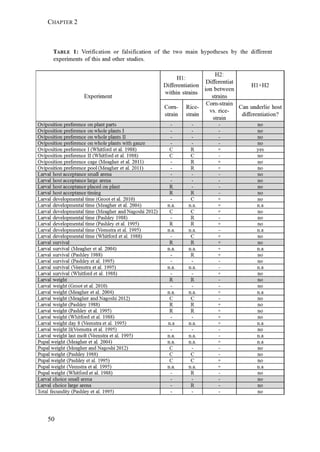
to 2010. Each population was assigned a code denoting the host plant of each form
(i.e., C for maize and R for rice or wild grasses), the year of collection, and the
region, as detailed in Table 1.
FIGURE 1. Spodoptera frugiperda sampling sites in Argentina, Brazil, and Paraguay.
In a given field, approximately 30 sites with 10 plants each were sampled
randomly. To avoid any homogenization effect, at least 250 larvae were collected
(one per plant) and placed individually in glass tubes (12 cm high, 1.5 cm diameter)
CHAPTER 3
62
with leaves of the host plant. Larvae were taken to the laboratory and reared in
chambers at 27 ± 2 °C, 70-75% r.h., and L14:D10 photoperiod until adult
emergence. Late instars and adults were examined to confirm that all individuals
were fall armyworm based on diagnostic taxonomic characters. Populations from
each sampled host in each locality were maintained separately and 200 adults were
used from each population to establish laboratory colonies. In separate mating cages
(30 cm high, 10-cm-diameter cylindrical polyethylene-terephthalate cages with
nylon mesh cloth) 4-5 females of <24 h old and 4-5 males were introduced. We had
in total about 20 mating cages per population. The cages contained pieces of paper
that allowed females to rest and to lay eggs. Food was provided via a cotton plug
saturated with a 1:1 (vol:vol) mixture of honey and water, which was renewed every
day. Cages were checked daily for oviposition and adult mortality. To minimize
loss of genetic variability, once females started to lay egg masses, approximately 15
egg masses from each cage were collected and deposited in glass tubes (12 cm high,
TABLE 1. Collection sites, years, and host plants of Spodoptera frugiperda
Region Country Site Longi-
tude
Lati-
tude
Host
plant
Year Population
code
West Argentina La Cocha 65°34’4
7.04”W
27°46’2
5.38”S
Maize 2008 C_08_W1
Argentina Los Pereyra 64°53’3
6.9”W
26°55’0
9.0”S
Maize 2010 C_10_W2
Argentina Benjamín
Aráoz
64°48’2
6.79”W
26°33’2
8.64”S
Grass 2008 R_08_W3
East Argentina Berón de
Astrada
57°29’5
3.90”W
27°28’3
5.01”S
Rice 2008 R_08_E4
Paraguay San Cosme y
Damián
56°27’4
6.1”W
27°16’4
3.8”S
Rice 2008 R_08_E5
Paraguay Capitán
Miranda
55°47’1
2.4”W
27°12’0
2.5”S
Maize 2009 C_09_E6
Argentina Santo Tomé 56°04’2
6.8”W
28°34’5
8.3”S
Maize 2008 C_08_E7
Argentina Santo Tomé 56°08’4
7.1”W
28°22’1
2.9”S
Rice 2007 R_07_E8
Argentina Mercedes 57º52’4
2.4”W
29º10’2
3.1”S
Rice 2010 R_10_E9
Brazil Santa María 53°43’0
5.2”W
29°43’1
0.4”S
Maize 2008 C_08_E10
Population code: first letter denotes the host plant the larvae were collected from (C for
maize, R for rice and wild grasses); number refers to year of collection; second letter denotes
the geographic location of population (eastern or western); the number behind it is the
population number. Bermuda grass and Guinea grass are referred to as grass.
POPULATION STRUCTURE OF S. FRUGIPERDA HOST FORMS IN SOUTH AMERICA
63
1.5 cm diameter). Once emerged, 15 neonate larvae from each of the egg masses
were placed individually in glass tubes with artificial diet (Osores et al. 1982) which
was renewed every 2-3 days. As larvae pupated, they were placed in cylindrical
cages until adult emergence. On average, 200 adults were used again to initiate a
new generation. After establishing a colony from each population and host, larvae
from the second generation were stored at -20 °C until DNA extraction.
DNA extraction and identification by COI markers
Total DNA was extracted using a modification of Black & DuTeau (1997) CTAB
(hexadecyltri- methylammonium bromide) method. Buffer and running conditions
were performed according to Sambrook et al. (1989). All samples were
characterized using two mtCOI markers by amplifying a 600-bp fragment and
digesting separately with MspI (producing 510- and 90-bp fragments in the corn-
form) and SacI (producing 450- and 150-bp fragments in the rice-form) (Juárez et
al. 2012). Populations were considered to belong to one of the two host forms if the
frequency of the corresponding haplotype was above 80%. If the frequency was
between 0.8 and 0.2, we characterized the population as a mixture of haplotypes
(Juárez et al. 2012).
Characterization of fall armyworm host form by Tpi polymorphisms
Identification of two haplotypes of the fall armyworm was performed using the 10
polymorphic nucleotide sites (SNPs) located in the Z-linked Tpi gene as described
by Nagoshi (2010). Primers Tpi-282F (5-GGTGAAATCTCCCCTGCTATG-3) and
Tpi-850gR (5-AATTTTATTACCTGCTGTGG-3) (Nagoshi 2010) were synthe-
sized by Metabion (Martinsried, Germany). PCR amplicons from genomic DNA,
generated using these primers, were sequenced from both ends using the same
primers in separate reactions. Sequencing was performed at the Entomology
Department of the Max Planck Institute for Chemical Ecology (Jena, Germany).
The DNA sequences were aligned and compared using the program Geneious Pro
5.4.3 (Biomatters, Auckland, New Zealand) (Drummond et al. 2011).
As previously described, each of the 10 sites has a specific nucleotide
associated with each host form, making it possible to obtain a consensus sequence
for the corn-form (Tpi-C) and the rice-form (Tpi-R). We followed the criterion
proposed by Nagoshi (2010), in which at least seven of the 10 sites must match to
the consensus Tpi-C or Tpi-R sequence in order to identify an individual as corn- or
rice-form, respectively. Nagoshi (2010) defined all other configurations of the 10
sites as intermediate, Tpi-int. Due to sex-linkage, all females carry only one Tpi
allele and can be classified in this way. However, males carry two Tpi alleles, and
therefore can be homozygous or heterozygous. Nagoshi (2010) classified
homozygous males in the same manner as females, but only classified heterozygous
males if both of their Tpi alleles were of the same strain category, e.g., Tpi-C or Tpi-
CHAPTER 3
64
R with three or fewer double peaks indicating heterozygous SNPs. Tpi-C/Tpi-R
heterozygotes were not distinguished from Tpi-C/Tpi-int, Tpi-R/Tpi-int, or Tpi-
int/Tpi-int heterozygotes, and none of these heterozygotes were included in the
analysis of Nagoshi (2010). Here, we scored all 10 of the polymorphic SNPs,
because we sequenced all amplicons from both ends, and so we distinguished
among genotypic classes in the following way. C, R, and IHo refer to individuals
hemizygous (females) or homozygous (males) for a Tpi-C, Tpi-R, or Tpi-int
sequence, respectively; i.e., with no double peaks in the sequencing chromatogram.
CHe and RHe refer to individuals heterozygous for two different Tpi-C or Tpi-R
sequences, respectively; i.e., showing double peaks at one, two, or three sites, but
matching the consensus Tpi-C or Tpi-R sequences at the other sites. IHe
(heterozygous intermediates) include all other heterozygous classes. Our analysis
included all these classes.
To consider the possibility of hybridization, we denote the COI and Tpi types
of individuals by a configuration code in which the first letter represents the COI
haplotype (C or R) and the rest represents the Tpi type as defined above. For
example, the configuration C/RHo has a COI haplotype of C, and is hemizygous or
homozygous for Tpi-R.
Genome-wide random nuclear markers
AFLP markers were developed following Vos et al. (1995) with some
modifications. Genomic DNA (200 ng) was digested with restriction enzymes,
EcoRI (5U) and MseI (3U) in a 12.5-µl reaction mix. EcoRI adapter (5 pmol µl-1
)
and MseI adapter (50 pmol µl-1
) were ligated to generate template DNA for the
amplification of DNA fragments by PCR. The adapters had the following
sequences: EcoRI adapter: 5’-CTCGTAGACTGCGTACC, 5’-AATTGGTACGCA
GTCTAC, and MseI adapter: 5’-GACGATGAGTCCTGAG, 5’-TACTCAGGACT
CAT) (Metabion). After the pre-amplification step, the selective amplifications
were conducted using 11 primer combinations (Table 2).
TABLE 2. AFLP primer combinations used to find 227 genetic markers in Spodoptera
Primer combinations
Mse EcoR Mse EcoR
AAG AAG700/ACG800 CGA ACC700/ACT800
AAG ACC700/ACT800 ACA TAC700/GTA800
ACA AAG700/ACG800 CAT AAG700/ACG800
ACA ACC700/ACT800 CAT ACC700/ACT800
ACG ACC700/ACT800 CTT ACC700/ACT800
CGA AAG700/ACG800
POPULATION STRUCTURE OF S. FRUGIPERDA HOST FORMS IN SOUTH AMERICA
65
Two 96-well gels were used for each primer combination, where the samples of
one population were equally divided among the two gels, as well as within the gels.
Twelve individuals were represented on both plates. In this way, we included a total
of 177 individuals in the analysis. For visualization in the polyacrylamide gel, all
EcoRI primers were labeled with an infrared dye (IRD) of 700 or 800 nm. AFLP
fragments were separated based on size with a Li-Cor 4300 DNA analyzer that
simultaneously detects infrared DNA fragments of 700 and 800 nm. The samples
were run on a 6.5% polyacrylamide gel and loaded into 96 wells with a Hamilton
syringe (Hamilton, Reno, NV, USA). A labeled standard (Li-Cor STR marker, 50-
700 bp) was loaded in the first and last well of each gel (1-100). We scored the gels
using image analysis software AFLP-Quantar Pro 1.0 (KeyGene Products,
Wageningen, The Netherlands). AFLP markers were identified by scoring the
presence (1, indicating the dominant homozygote or the heterozygote) or absence
(0, indicating the recessive homozygote) of the bands for every selective primer
combination in each gel. The repeated 12 individuals were used to indicate the same
markers on both gels. Only those markers that were scored consistently on both gels
were used for subsequent analysis.
Genetic diversity and genetic structure
To assess whether the available loci allow for an acceptable precision for genetic
analyses, the software BOOTSIE (https://code.google.com/p/bootsie/) was used to
calculate the coefficient of variation for genetic distances across 100 bootstrap
samples for a decreasing number of loci. Population genetic parameters were
estimated based on the AFLP markers using the program AFLPsurv 1.0 (Vekemans
2002). We used two criteria to define populations and assign individuals to each
population: (1) 10 populations were defined depending on their origin (i.e., based
on sampling site, year of collection, and host plant from which the larvae were
collected), and (2) 21 populations were defined depending on their origin (as above)
and the combination of mitochondrial (COI) and nuclear (Tpi genes) genotypes
obtained with both markers. To estimate allele frequencies, a Bayesian method with
non-uniform prior distribution (Zhivotovsky 1999) was used. The parameters of
genetic diversity and population genetic structure estimated were: total gene
diversity (Ht), average gene diversity within populations (Hw), average gene
diversity among populations (Hb), and Wright’s FST. Parameters were estimated
using the approach of Lynch & Milligan (1994) and assuming Hardy-Weinberg
equilibrium. Pairwise Wright’s fixation indices (FST) and pairwise Nei’s distances
were used to estimate the genetic differentiation and distance between populations.
To test the significance level of genetic differentiation among populations, a
permutation test using 2,000 replications was performed. Based on pairwise FST
values, a phenogram representing genetic differentiation between populations was
reconstructed using the bionj neighbor-joining algorithm (Gascuel 1997) and
CHAPTER 3
66
visualized using the R package APE (Paradis et al. 2004). To infer bootstrap
confidence on tree nodes, Neighbor and Consense procedures from the PHYLIP
software ver. 3.6 were used (Felsenstein 2005). Consensus was obtained using the
‘Majority rule’ option, from 1,000 matrices of pairwise FST generated by AFLPsurv.
Nodes are considered well supported if they occur in at least 500 (50%) bootstrap
tree reconstructions.
The significance of the correlation between geographic distance and genetic
distance matrices was estimated using the Mantel test implemented in the R
package ADE4 (Chessel et al. 2004). The P-value for the Mantel coefficient r was
obtained after performing 2,000 permutations.
To determine the presence of outlier-FST loci, we performed two sets of
analyses using the software MCHEZA (Antao and Beaumont 2011) with 50,000
simulations. The first set of analyses was made to detect outliers that contribute to
geographic and host differentiation among all populations. For that, first we
considered the 10 populations defined by their origin and then we considered nine
populations excluding the population from grasses. The second set of analyses was
made to detect outliers that contribute to differentiation between hosts only (i.e.,
excluding geographic differentiation). For that, first we pooled all 10 populations
from the same host (maize or rice/grass) and then we pooled the nine populations
without the grass population (i.e., maize or rice). Once all outlier loci were
identified, we estimated the population genetic parameters from only neutral loci
using the program AFLP-SURV 1.0 and performed the same two hierarchical
analysis of variance (ANOVA) components (see above).
Hierarchical analysis of population structure
We performed two hierarchical ANOVA components (Wright 1978) using the
HIERFSTAT package (Goudet 2006) from the statistical software R (R Develop-
ment Core Team, 2012). In the first analysis, the estimation of hierarchical variance
components considered four levels: populations (defined by their origin as shown in
Table 1), regions (western and eastern), populations within each region, and
individuals within each population. In the second analysis, the hierarchical
components considered populations (defined by their origin as shown in Table 1),
host plant species (maize, rice, and wild grasses), populations within each host plant
species, and individuals within each population. Thus, in the first case the highest
hierarchical level tested was the geographic distance, whereas in the second case
this level was represented by the host plant from which individuals were collected.
Probabilistic analysis of population structure
To identify the level of clustering of genetically related individuals we applied two
approaches: an exploratory multivariate method and a model-based Bayesian
method.
POPULATION STRUCTURE OF S. FRUGIPERDA HOST FORMS IN SOUTH AMERICA
67
Discriminant analysis of principal components (DAPC)
DAPC (Jombart et al. 2010) combines the multivariate principal component analysis
(PCA) with a discriminant analysis (DA) and makes no assumptions about Hardy-
Weinberg equilibrium or linkage disequilibrium. The analysis was performed using
the R package ADEGENET (Jombart 2008). The clustering of individuals was
determined without prior information on population groupings using the function
‘find.clusters’, which runs successive K-means clustering with increasing number of
clusters (k) to achieve the optimal number of groups (Jombart et al. 2010). The
optimal number was based on the minimum value of the Bayesian information
criterion (BIC). The association of individuals in clusters and the correspondence
between clusters and their original populations was shown by means of a scatter plot
of individuals on the first two components of the DAPC, where the grouping factor
was defined by the clusters recognized by ‘find.clusters’. Each individual was
identified by a color key of the sampling population. This scatter plot was obtained
with the function ‘s.class’ of the package ADE4 of R (Dray and Dufour 2007). The
reliability of the results was corroborated by comparing the a priori assignment with
the a posteriori assignment of each individual.
Bayesian clustering analysis
Bayesian approaches to genotypic clustering of individuals typically use explicit
population genetic models to sort individuals into clusters such that deviations from
equilibrium within clusters are minimized. We estimated the number of clusters and
the assignment of individuals into clusters without prior information on population
groupings using the methods implemented in the programs STRUCTURE 2.3.1
(Pritchard et al. 2000; Falush et al. 2003) and STRUCTURAMA (Huelsenbeck and
Andolfatto 2007).
Using STRUCTURE, the most likely number of clusters is estimated by
determining the change in the marginal likelihood of the data Pr (X|K) when the
number of clusters (K) is fixed to different values (K = 1, 2,..., 10). We used an
ancestry model that allowed for admixture and correlated allele frequencies between
populations. Under this model, individuals are fractionally assigned to clusters
using a membership coefficient. We ran eight replicate Markov chains with a burn-
in period of 200,000 iterations followed by a sampling period of 800,000 iterations
for each K. We also used the ΔK method of Evanno et al. (2005) to detect the
amount of structuring beyond which a further subdivision does not substantially
improve the fit of the admixture model.
An individual was assigned to the cluster for which it had the highest average
membership coefficient across runs, after ‘label switching’ heterogeneity had been
accounted for using the software CLUMPP (v. 1.1.1) (Jakobsson and Rosenberg 2007).
Using STRUCTURAMA, the number of clusters and the assignment of
individuals to clusters were estimated simultaneously by applying a Dirichlet
CHAPTER 3
68
process prior, which treats both the assignment of individuals to populations and the
number of populations as random variables. STRUCTURAMA implements the
basic no-admixture model of STRUCTURE and additionally allows setting the
concentration parameter α of the Dirichlet process prior (which shapes the prior
probability of the number of clusters) by specifying the prior mean of the number of
clusters. We performed eight analyses, varying the prior mean of the number of
clusters from two to nine. Each analysis consisted of a single Markov chain run for
2,000,000 cycles. Samples were drawn from the chain every 100th cycle. The first
10,000 of the resulting 20,000 samples were removed as burn-in prior to analysis.
The posterior probabilities of the number of populations given the data Pr(K|X)
were averaged across runs. At each step in the MCMC chain each individual was
assigned to a cluster. To summarize the results of this partitioning of individuals,
the partition that minimizes the squared distance to all sampled partitions during an
MCMC-run was calculated and reported (mean partition). The distance measure is
the number of individuals that must be deleted between two partitions to make them
the same (Huelsenbeck and Andolfatto 2007).
RESULTS
Coefficient of variation of AFLP markers
The relationship between the coefficient of variation and the number of AFLP
markers allows determining the robustness of genetic variability estimates. The
coefficient of variation calculated for all 227 markers was 4.8%, indicating that this
number of markers was sufficient to perform unbiased analyses of genetic structure
and diversity (Figure S1).
Identification of the corn and rice genotypes with the Z-linked nuclear marker
Tpi
The association between Tpi genotypes and the host plant from which larvae were
collected was more pronounced for populations from maize and grasses than for
those collected from rice. The analysis identified homozygous and heterozygous
individuals for Tpi-C (C and CHe), Tpi-R (R and RHe), and intermediate (IHo and
IHe) types (Tables 3, S1-S11; Figures 2, S2). In three of the five populations
collected from maize fields, more than 80% of the individuals could be classified as
Tpi-C; of the two remaining populations, one also showed a high percentage of Tpi-
C individuals (75%) whereas the other population showed a broader distribution of
Tpi types with 52, 4, and 44% of the individuals belonging to Tpi-C, Tpi-R, and
intermediate, respectively. In the population collected from grasses, 86% of the
individuals were Tpi-R, consistent with the preference of this type for this habitat.
In contrast, none of the four populations collected from rice were characterized as
Tpi-R. In two of these populations, the Tpi-C type was predominant whereas in the
other two, intermediate types prevailed.
POPULATION STRUCTURE OF S. FRUGIPERDA HOST FORMS IN SOUTH AMERICA
69
TABLE 3. Number and percentage (in parenthesis) of Tpi genotypes in populations
of Spodoptera frugiperda collected from Argentina, Brazil, and Paraguay.
Population n Tpi-C Tpi-CHe Tpi-R Tpi-RHe Tpi-IHe Tpi-IHo
C_08_W1 25 7 (28) 6 (24) 0 1 (4) 10 (40) 1 (4)
C_10_W2 15 9 (60) 6 (40) 0 0 0 0
R_08_W3 14 0 0 7 (50) 5 (36) 2 (14) 0
R_08_E4 21 0 1 (5) 4 (20) 2 (9) 12 (57) 2 (9)
R_08_E5 19 2 (10) 0 3 (16) 1 (5) 13 (70) 0
C_09_E6 19 4 (21) 15 (79) 0 0 0 0
C_08_E7 20 6 (30) 13 (65) 0 0 1 (5) 0
R_07_E8 15 13 (86) 1 (7) 1 (7) 0 0 0
R_10_E9 5 1 (20) 3 (60) 0 0 1 (20) 0
C_08_E10 16 2 (12) 10 (63) 0 0 4 (25) 0
FIGURE 2. Proportion of different configurations of COI and Tpi types in the populations of
Spodoptera frugiperda collected from Argentina, Brazil, and Paraguay.
Correlation between Tpi and COI markers and their association with host plants
The combined analysis using both molecular markers showed the following patterns
(Figures 2, S2; Tables S1-S11):
CHAPTER 3
70
Concordance between Tpi and COI markers with association to the host plant
In 3 of the 10 populations, the Tpi types were largely consistent with both the previously
characterized mitochondrial haplotypes and the host plants from which larvae were
obtained. Two of these populations were collected from maize (C_09_E6 and C_08_E7)
with 100 and 95% individuals characterized as corn-form (C/C and C/CHe) by both
markers, and one population was collected from grasses (R_08_W3) where 86% of the
individuals were characterized as rice-form (R/R and R/RHe) by both markers.
Concordance between Tpi and COI markers without association to the host plant
In two of the 10 populations, the Tpi types were largely consistent with the
mitochondrial haplotypes, but not with the host plants. These populations were
collected from rice (R_07_E8, R_10_E9), with 93 and 80% of individuals identified
as corn-form (C/C and C/CHe), respectively.
Discordance between Tpi and COI markers
In the remaining five populations, the Tpi types were not consistent with the
mitochondrial haplotypes and indicated different configurations. In C_08_W1, there
were 36% COI-C and 64% COI-R types, and 44 and 16% of individuals had an R/I
(R/IHo and R/IHe) and R/C (R/C and R/CHe) configuration, respectively (Figure
2). Similar results were found for C_10_W2 from maize, with 67% COI-C and 33%
COI-R types, and 33% of individuals having the RC (R/C and R/CHe) configu-
ration. In C_08_E10 from maize, 100% of larvae analyzed carried COI-R, whereas
75% of them had the Tpi-C (C and CHe) and 25% had the intermediate (IHe) type.
The remaining two populations were collected from rice. In R_08_E4, 100% of
larvae analyzed were COI-R, with 28% having Tpi-R (R/R and R/RHe), 67% as
intermediate (R/IHe and R/IHo), and 5% with Tpi-C (R/CHe). Population R_08_E5
showed the opposite pattern, with 100% of larvae as COI-C and only 11% Tpi-C
(C/C), 68% intermediate (C/IHe), and 21% Tpi-R (C/R and C/RHe) (Figure 2).
Taken together, of the 169 individuals analyzed from the 10 populations, 46%
were determined as corn-form with both markers (C/C and C/CHe), 11% as rice-
form with both markers (R/R), whereas the remaining 43% showed discordance
between the mitochondrial and nuclear markers, C/R (3%), C/I (9%), R/C (13%),
and R/I (18%).
Genetic diversity and population structure
We scored a total of 227 genomic AFLP markers, 215 (94%) of which were poly-
morphic and were thus used for the population genetic analysis.
Populations defined according to their origin
The overall gene diversity (Ht) was 0.28, with the highest component represented
by the within-population diversity (Hw = 0.20) and a relatively low among-
POPULATION STRUCTURE OF S. FRUGIPERDA HOST FORMS IN SOUTH AMERICA
71
populations diversity (Hb = 0.084). The overall genetic differentiation among
populations was highly significant (FST = 0.31, P<0.0001; Table 5). The most
differentiated population compared to all others was the population obtained from
wild grasses (R_08_W3). When this population was excluded from the analysis, FST
and Hb decreased to 0.18 and 0.045, respectively. Thus, roughly half of the total
genetic differentiation among populations was due to the differentiation between the
samples from wild grasses and all other populations. The differentiation between
populations still remained significant after the samples from wild grasses were
removed (P<0.0001; Table 5).
The lowest genetic distance between populations as estimated by Nei’s distance
and FST coefficients (Table S12) was observed between C_08_E7 and C_09_E6
(both from maize). The largest genetic distance was observed between R_08_W3
and R_07_E8 (from wild grasses and rice, respectively). Correlation analysis using
a Mantel test showed an absence of significant isolation by distance between S.
frugiperda populations (r = 0.148, P = 0.31) (Figure S3).
A neighbor-joining tree derived from FST-values showed no support for
clustering of populations by geographic region (Figure 3A). It did, however,
indicate a separation of populations by host plant. Samples collected from rice or
maize plants were clearly separated from the wild grass population, which had the
highest bootstrap support.
Populations defined according to their origin and the combination of mitochondrial
and nuclear types
The overall gene diversity (Ht = 0.29), was mainly represented by the within-
population diversity (Hw = 0.20), with relatively low between-population diversity
(Hb = 0.09). The overall genetic differentiation among populations was highly
significant (FST = 0.31, P<0.0001). After excluding the diverged samples collected
from wild grass, FST and Hb decreased to 0.21 and 0.06, respectively, but FST
remained significant. The genetic distances between populations as estimated by
Nei’s distance and FST coefficients are shown in Table S13. The lowest genetic
distance was observed between C_08_W1 (C/C) and C_08_W1 (C/CHe), R_08_W3
(R/R) and R_08_W3 (R/RHe), C_10_W2 (C/CHe) and C_10_W2 (C/C), C_08_E7
(C/C) and C_08_E7 (C/CHe), C_09_E6 (C/CHe) and C_09_E6 (C/C), C_08_W1
(R/C) and C_08_W1 (R/IHe), all these from the same collection site. The largest
genetic distance was observed between R_08_W3 (R/RHe) and R_07_E8 (C/C)
(Nei’s distance), and R_08_W3 (R/R) and C_08_W1 (C/C) (FST), respectively.
A neighbor-joining tree derived from FST-values (Figure 3B) showed that most
populations grouped together on the basis of their geographic origin and not on the
basis of their genotype composition. The only exception was the individuals from
C_08_W1, which formed two clearly separated groups based on their COI
haplotype. Individuals carrying the COI-C haplotype clustered with the rest of the
CHAPTER 3
72
samples derived from maize fields, whereas individuals carrying the COI-R
haplotype formed a cluster relatively basal in the tree indicating a very distant
position from all other groups. The sample C_08_W1 thus seems to be comprised of
individuals from two genetically diverged populations. This may explain why
C_08_W1 is not clustered with the remaining populations collected from maize in
Figure 3A. In addition, high bootstrap support was found between the populations
R_08_W3 (R/RHe) and R_08_W3 (R/R), R_08_E4 (R/R) and R_08_E4 (R/IHe),
C_08_W1 (R/C) and C_08_W1 (R/IHe), and between C_08_W1 (C/Che) and
C_08_W1 (C/C) populations.
Analysis to detect the presence of outlier-FST loci that contribute to geographic
and host differentiation among populations (first set of analyses) showed that,
considering the 10 populations together, no outliers were found but when we
considered the nine populations, six of the 227 loci were identified as outliers and
thus candidates to be under positive selection (Figure S4AB). In this case, the
overall genetic differentiation among populations was 0.19 (P<0.0001). The
hierarchical analysis revealed significant differences among regions and hosts,
whereas the differentiation among populations within each region and host was
highly significant (Tables S14-S16). No outlier-FST loci were found when all
populations from the same host were considered, including or not the wild grass
population (second analysis) (Figure S5AB).
Hierarchical analysis of population structure
A hierarchical ANOVA component considering populations, regions, populations
within regions, and individuals within populations revealed no significant
differences between regions; in contrast, the differentiation among populations and
populations within each region was highly significant (Table 4). The hierarchical
analysis considering populations, host plant species, populations within each host
plant species, and individuals within populations revealed borderline significant
differences among host species and highly significant differences among
populations and among populations within host species (Table 5).
Probabilistic analysis of population structure
Discriminant analysis of principal components (DAPC) by find.clusters function
Applying the Bayesian information criterion (BIC), the total sample was best
divided into 10 groups (Figure 4). Mostly, these groups were composed of
individuals from the same locality and sampling year. Major exceptions were
groups A and K, which were composed of individuals from C_08_W1; group A was
composed of individuals carrying the C/C and C/CHe configurations, whereas
group K was composed of individuals with R/RHe, R/C, R/CHe, R/Iho, and R/IHe
configurations. Group I was composed of all individuals from C_08_E7 and
R_10_E9, which carried the C/C, C/CHe, and C/IHe configuration, and by some
POPULATION STRUCTURE OF S. FRUGIPERDA HOST FORMS IN SOUTH AMERICA
73
individuals from C_09_E6 and R_08_E5 with C/C, C/CHe, C/R, and CIHe
configurations. In addition, DAPC indicated five clusters of groups (gray ellipses in
Figure 4). The largest cluster was composed of five groups: G (R_07_E8), D
(C_10_W2), H (most individuals from R_08_E5), I, and F (most individuals from
C_09_E6). All these groups were represented by individuals collected from maize
and rice and carrying the C/C, C/CHe, and C/IHe configurations. The cluster
represented by group J (R_08_E4) was very close to the former cluster and included
individuals collected from rice and carrying mostly the R/IHe, R/R, and R/RHe
configurations. A third cluster was formed by group A (C_08_W1), composed of
individuals carrying the C/C and C/CHe configurations, and group B (C_08_E10),
composed of individuals carrying the R/C, R/CHe, and R/IHe configurations; both
were collected from maize and exhibited a slight overlap. The more isolated clusters
are group L, consisting of R_08_W3, including individuals from wild grasses
carrying R/R, R/RHe, and R/IHe configurations, and group K (C_08_W1), that
includes individuals from maize carrying the R/C, R/CHe, R/RHe, R/IHo, and
R/IHe configurations. The distribution of the groups represented here seems to
constitute a hierarchical islands model (Jombart et al. 2010). The agreement
comparing the prior and posterior assignments was 84%.
Figure 3. Neighbor-joining trees, (A) based on FST values calculated from AFLP markers,
from Spodoptera frugiperda populations defined according to their origin: sampling site, year
of collection and host plant, and (B) with populations defined by their origin and combination
of mitochondrial and nuclear haplotypes. Populations collected from maize are indicated by
black branches, populations collected from rice and grasses by gray branches.
CHAPTER 3
74
TABLE 4. Hierarchical analysis of Spodoptera frugiperda populations among populations,
among regions, among populations within regions, and among individuals within each
population.
Variance F 95% confidence
interval
P
Populations – total 33.707 0.416 0.387-0.445 <0.0005
Regions – total 1.040 0.013 -0.005-0.031 0.46
Populations – regions 32.667 0.408 0.381-0.437 <0.0005
Individuals – populations 47.384
‘Regions’ denotes eastern (incl. R_08_E4, R_08_E5, C_09_E6, C_08_E7, R_07_E8,
R_10_E9, C_08_E10) or western (incl. C_08_W1, C_10_W2, R_08_W3) geographic
location of populations (see also Table 1).
TABLE 5. Hierarchical analysis of Spodoptera frugiperda populations among populations,
among host plants, among populations within host plant, and among individuals within each
population.
Variance F 95% confidence
interval
P
Populations – total 39.663 0.456 0.426-0.487 <0.0005
Hosts – total 1.808.641 0.208 0.172-0.244 0.041
Populations – hosts 21.577 0.313 0.287-0.344 0.001
Individuals – populations 47.384
‘Hosts’ denotes the plant species from which populations were sampled: maize (incl.
C_08_W1, C_10_W2, C_09_E6, C_08_E7, C_08_E10), rice (incl. R_08_E4, R_08_E5,
R_07_E8, R_10_E9), and grasses (incl. R_08_W3) (see also Table 1).
Bayesian analysis
The Bayesian inference of structural patterns among the individuals gave no
consistent results. The minimal number of genetic clusters necessary to explain the
data as suggested by Evanno’s ΔK was 2 (Figure S6). The posterior probability of
the number of clusters derived from STRUCTURAMA was highest at K = 4
(Figure S6). Average log-likelihoods across 10 replicate STRUCTURE runs
showed no marked plateau before K = 8 [Figure S6; empirical evidence suggests
that a biologically meaningful number of K may be indicated by a declining rate of
increase in Pr(X|K) as K increases, rather than by the absolute maximum likelihood
(Pritchard et al. 2000; Evanno et al. 2005). Figure 5 presents the assignments of
individuals to different clusters by both programs for K≤4. With K≥4, assignments
became increasingly inconsistent across replicate runs and hence difficult to
interpret and summarize. At K = 2, R_08_W3 (from wild grasses) consistently
formed one cluster, whereas all other samples were joined in a second cluster
(Figure 5). At K = 3, a third cluster was split off, comprising R_08_E4, R_08_E5
POPULATION STRUCTURE OF S. FRUGIPERDA HOST FORMS IN SOUTH AMERICA
75
(both from rice) and most individuals from C_08_W1 (from maize). At K = 4, four
alternative clusters were observed across 10 runs, all of which introduced a split
among populations R_08_E4, R_08_E5, R_07_E8, and C_08_W1 (Figure 5). These
are most populations collected from rice and the genotypically mixed population
C_08_W1. When K was treated as a random variable (using STRUCTURAMA),
the overall patterns were largely similar.
However, as noted previously (Groot et al. 2011), STRUCTURAMA tends to
introduce additional populations comprised of only very few individuals, which
often lack a biologically meaningful interpretation. Thus, despite STRUCTURAMA
detecting between four and six clusters as the most likely number of K across
multiple runs (compare Figure 5), the vast majority of individuals were assigned to
either two or three clusters (Figure 5). As with STRUCTURE, if two major clusters
were inferred, one cluster contained all individuals from R_08_W3, whereas most
other individuals were placed in the second cluster. If three major clusters were
inferred, the third comprised R_08_E4, R_08_E5, R_07_E8, and C_08_W1 in
varying combinations (Figure 5).
FIGURE 4. Population analysis by discriminant analysis of principal components (DAPC).
Groups of individuals were identified by the find.clusters function without prior information
on population groupings: A (C_08_W1), J (R_08_E4), L (R_08_W3), G (R_07_E8), B
(C_08_E10), K (C_08_W1), D (C_10_W2), H (R_08_E5), I (including all individuals from
C_08_E7, all individuals from R_10_E9, and some individuals from R_08_E5 and
C_09_E6), and F (C_09_E6).
CHAPTER 3
76
FIGURE 5. Estimated population structure of Spodoptera frugiperda populations. The analysis
with STRUCTURE was performed under an admixture model with the number of clusters
(K) fixed to different values (K = 2, 3, and 4). The analysis with STRUCTURAMA was
performed under a no-admixture model where the assignment of individuals to populations
and the number of populations as random variables (rv).
DISCUSSION
The present study aimed to determine whether S. frugiperda is under a process of
speciation through host associated differentiation, to support or reject the existence
of host races. We characterized different South-American populations with the Z-
linked nuclear marker Tpi and 227 nuclear AFLP markers to complement a study by
Juárez et al. (2012) that used two restriction site polymorphisms in the mtDNA
COI. In this study, we found a different pattern of association between the host
species from which the populations were sampled and the two molecular markers,
COI and Tpi, and highly significant genetic variability, with strong genetic
differentiation of some populations.
POPULATION STRUCTURE OF S. FRUGIPERDA HOST FORMS IN SOUTH AMERICA
77
Population characterization and the association with host plants
Populations collected from maize and wild grasses mostly showed the expected Tpi
genotypes. This result is in agreement with Nagoshi (2012), who found that this
marker is an accurate indicator and therefore should be considered as the most
appropriate marker developed so far to assign host form identity. However, the
combined analysis of Tpi and COI revealed that only two out of the five populations
collected from maize were characterized as belonging to the corn-form (i.e., Tpi and
COI correlated). The other three showed various combinations of the corn-, rice-, or
intermediate forms of the markers, indicating some sort of hybridization. Because
the individuals we sequenced come from the second generation of laboratory-
maintained colonies founded by field-collected individuals, we cannot determine
how much of this hybridization occurred in the field, and how much is due to
crossing in the laboratory of different, non-hybrid forms collected from the same
field. However, the large difference in COI haplotype frequencies and Tpi allele
frequencies in three of the populations indicates that some hybridization must be
occurring in the field, because these frequency differences cannot have arisen
within two generations. In any event, this means that Tpi marker alone is not
sufficient to characterize the populations as it is unable by itself to provide
information on possible mixed genomes. Populations collected from rice revealed
an unexpected situation. None of the populations were characterized by both
markers as rice-form, and two populations (R_07_E8 and R_10_E9) were
genetically identified as corn-form (both by COI and Tpi).
The high frequency of corn-form individuals in rice plants is unexpected; this
result is unaffected by the fact that the analyzed individuals come from the second
generation of a field collection. Previous studies found that corn-form individuals
seemed restricted to their host plant (Lu and Adang 1996; Nagoshi and Meagher
2003a, 2004; Velez-Arango et al. 2008) and this could be attributed to the low
levels of toxic cyanogenic compounds found in this plant compared to wild grasses
(Hay-Roe et al. 2011). It could be argued that rice is also less toxic than wild
grasses and hence this host can be exploited by corn-form individuals which lack
the capacity to cope with high levels of these toxic compounds (Hay-Roe et al.
2011). The remaining samples derived from two populations collected from rice
were composed mostly of individuals bearing intermediate Tpi types. In one of
these populations the haplotype COI-R was predominant, whereas in the other the
haplotype COI-C prevailed. This revealed a more complex pattern and the presence
of individuals with mixed genomes. In the populations we sampled overall, rice
occurs as a host in which the pure rice-form of S. frugiperda was almost absent and
in which pure corn-form individuals and individuals with mixed genomes can
develop.
CHAPTER 3
78
Genetic variability and population structure
We found a high genetic diversity between the sampled populations, which could be
clustered into 2-5 genetically distinct groupings. This poses the question of what
maintains this genetic differentiation: geographical distance, host fidelity, or strain
identity, and how they are related. The highest amount of diversity was found
among individuals and the correlation analysis confirmed no genetic isolation by
geographic distance between S. frugiperda populations, which is in agreement with
Martinelli et al. (2007), Clark et al. (2007), and Belay et al. (2012). The ANOVA
components revealed no differences between eastern and western regions and
showed a marginally significant differentiation between host plants. In the
neighbor-joining trees based on FST-values, populations grouped together mainly
based on their geographic origin and not on their haplotype composition or region
(Figure 3B). To a lesser extent, there was also an association based on the host.
There were, however, two main exceptions. One was R_08_W3, collected from
wild grass, which never grouped with any population collected from rice and
appeared in a separate branch showing that the least amount of gene flow is
between this population and the rest of populations. The other was C_08_W1,
where individuals formed two clearly separated groups; one included those
individuals bearing the COI-R haplotype and the other those bearing the COI-C
haplotype irrespective of their Tpi. The same pattern was observed with the DAPC
and Bayesian clustering methods. It can be assumed that COI-R individuals from
the C_08_W1 population were recent immigrants. In this region (Western
Argentina) rice is not cultivated and hence, the migrant individuals possibly have
derived from the surrounding grasses (C_08_W1 and R_08_W3 are only 160 km
apart). However, the neighbor-joining analysis and the DAPC failed to merge these
individuals, revealing the need of more sampling to determine whether wild grasses
act as a reservoir of pure rice individuals or even of other genetically isolated
populations. DAPC grouped the individuals mostly based on the site and year of
sampling. Additionally, the groups with C-mitochondrial haplotype tended to
cluster, whereas most of the groups with the R-mitochondrial haplotype were more
isolated. STRUCTURE and STRUCTURAMA also showed that the populations
collected from maize clustered and were homogeneous. Similar to the DAPC
analysis, populations collected from rice formed three distinct groups, showing
indicating a much higher level of heterogeneity. The outlier analysis showed that
they did not contribute significantly to the geographical and host differences and
their removal did not alter the conclusions compared to the analysis that included
the total number of loci.
A possible cause of bias in our study was the introduction of the populations
into the laboratory, which might have caused changes in the distribution of allele
frequencies. To minimize this problem, we maximized the number of adults from
which we started the colonies and sampled an equal number of larvae from egg
POPULATION STRUCTURE OF S. FRUGIPERDA HOST FORMS IN SOUTH AMERICA
79
masses and mating cages to reduce any skew in reproductive success. In addition, if
we consider that the mtCOI is maternally transmitted and does not recombine, a
significant change in allele frequencies is not expected within two generations of
laboratory rearing. The Tpi marker is sex-linked and may recombine only in males,
but, due to the close linkage between SNPs, a significant number of intermediate
patterns by recombination in only one or two generations is highly unlikely.
Therefore, we assume that the Tpi frequencies have also not changed significantly
during two generations in the laboratory. The other aspect of sampling second-
generation laboratory populations is a loss of information about the naturally-
occurring frequency of hybrids. From samples with large discrepancies in
frequencies of mitochondrial and nuclear markers, we can infer that some
hybridization is occurring in the field, but we cannot estimate its frequency. Our
study and the work done by Nagoshi (2012) infer hybridization values greater than
40% with individuals from the laboratory, whereas the hybridization rates found by
Prowell et al. (2004) are near 16%. As the study of Prowell et al. (2004) is based on
field-collected samples, hybridization rates of 16% are likely to be an accurate
estimation.
Evolutionary and ecological implications
Our results provide additional information for understanding the population
structure and the host-associated differentiation in the two host forms of S.
frugiperda. In this study, the utility of the host as indicator of population identity
was variable as shown by the different molecular markers. The genotypes identified
by Tpi revealed high frequency of populations matching their respective hosts, and
the AFLP analysis showed that populations collected from the same host tended to
be more associated, but this was not confirmed by the mtCOI markers. In addition,
the majority of individuals from populations collected from rice were more
heterogeneous than individuals collected from maize.
The near absence of pure rice-form populations on rice is interesting, given that
previous reports indicate that this form is predominant in ca. 85-90% of the
collections from rice or wild grasses and only in ca. 20% of the collections from
maize (Lu and Adang 1996; McMichael and Prowell 1999; Nagoshi and Meagher
2003a,; Machado et al. 2008; Velez-Arango et al. 2008). Most studies on the rice-
form have focused on its association with wild grasses. These findings, together
with the physiological and biological evidence from laboratory studies showing the
capacity of both strains to develop equally well on maize and rice plants (Pashley et
al. 1995; Meagher et al. 2004; Groot et al. 2010), suggest that host plants do not
exert the same selective pressure towards differential host use. It also suggests that
other factors are relevant in the process of host shift. For example, Pashley et al.
(1995) reported that over 2 years of sampling, S. frugiperda larval mortality caused
by parasites and pathogens was higher in pasture than in maize fields, suggesting
CHAPTER 3
80
that the maize habitat may constitute a more protected environment compared to
rice habitats. The unexpected high frequency of corn individuals in rice raises doubt
whether host-driven selection can still create population divergence even when host
fidelity is weak.
The high genetic variability that we found within and among populations may
have arisen from new genotypic combinations, providing a high capacity to adapt to
changes in agricultural environments with an evolutionary potential (Domingues
2011). Another possible explanation is that divergent genotypes are not of recent
origin and they existed and still exist on native grasses (grass-form) and some
simply expanded their host ranges into maize and rice with the domestication and
introduction of these crops in America. In some areas of the distribution of S.
frugiperda, this has resulted in Tpi and COI haplotype patterns that correlate with
host plant, but in other places these markers do not show a consistent pattern. The
greater homogeneity found in the populations collected from maize, and the greater
heterogeneity found in the populations collected from rice, suggests that the rice-
form is the ancestral type.
Conclusions
Reiterating the definition of host races (Drés and Mallet 2002), our study sheds light
on whether the two forms of S. frugiperda can be considered host races. The two
forms use different host taxa in the wild, at least to some extent; the two forms
consist of a number of individuals that exhibit host fidelity; the two forms coexist in
sympatry in at least part of their distribution range; and they are genetically
differentiated at more than one locus. However, we found that the two forms are not
always more genetically differentiated from populations on another host in
sympatry than from some geographically distant populations on the same host. Our
study did not examine whether the two forms display a correlation between host
choice and mate choice, but we did find that they undergo gene flow at an
appreciable rate. Previous studies have shown the two forms do not have higher
fitness on natal than on alternative hosts, or more accurately, inconsistent results
were found across studies (Pashley 1988b; Whitford et al. 1988; Pashley et al. 1995;
Meagher et al. 2004; Stuhl et al. 2008; Groot et al. 2010). However, hybrid
incompatibility has been shown for RC hybrid females, which mate at much lower
rates and few matings result in fertile egg clutches (Pashley and Martin 1987;
Whitford et al. 1988; Groot et al. 2010). Overall, we have insufficient information
to conclude that the two forms are true host races, and thus ‘host form’ (Funk 2012)
is the appropriate terminology at this stage of our knowledge. Our results indicate
that although host-associated differentiation is confirmed as one of the diverging
mechanisms, this species is composed of genetically distinct entities that are most
likely diverging due to (additional) factors other than host specialization.
POPULATION STRUCTURE OF S. FRUGIPERDA HOST FORMS IN SOUTH AMERICA
81
Acknowledgements
We are grateful to Sofía Torres, Carmen Urueña, and Alejandro Vera at EEAOC for
their collaborations in sampling and technical support. We also thank Antje
Schmaltz, Susanne Donnerhacke, and Melanie Unbehend in the Department of
Entomology, MPICE, for their technical support and assistance in the lab. We are
grateful to Fernando Navarro (Facultad de Ciencias Naturales e Instituto Miguel
Lillo, Universidad Nacional de Tucumán) for the taxonomic identification of S.
frugiperda larvae. This research was partly funded by the National Science
Foundation (award IOS-1052238) and by the Max-Planck-Gesellschaft.
REFERENCES
ANTAO, T. AND M. A. BEAUMONT. 2011. Mcheza: a workbench to detect selection using
dominant markers. Bioinformatics 27:1717-1718.
BELAY, D. K., P. L. CLARK, S. R. SKODA, D. J. ISENHOUR, J. MOLINA-OCHOA, C. GIANNI, J. E.
FOSTER. 2012. Spatial genetic variation among Spodoptera frugiperda (Lepidoptera:
Noctuidae) sampled from the United States, Puerto Rico, Panama, and Argentina.
Annals of the Entomological Society of America 105:359-367.
BERLOCHER, S. H. AND J. L. FEDER. 2002. Sympatric speciation in phytophagous insects:
Moving beyond controversy? Annual Review of Entomology 47:773-815.
BUSATO, G. R., A. D. GRÜTZMACHER, A. C. DE OLIVEIRA, E. A. VIEIRA, P. D. ZIMMER, M. M.
KOPP, J. D. BANDEIRA, T. R. MAGALHAES. 2004. Analysis of the molecular structure and
diversity of Spodoptera frugiperda (JE smith) (Lepidoptera: Noctuidae) populations
associated to the corn and rice crops in Rio Grande do Sul State, Brazil. Neotropical
Entomology 33:709-716.
BUSH, G. L. 1969. Sympatric host race formation and speciation in frugivorous flies of the
genus Rhagoletis (Diptera, Tephritidae). Evolution 23:237-&.
CHESSEL, D., A. DUFOUR, J. THIOULOUSE. 2004. The ade4 package-I-one-table methods. R
News 4:5-10.
CLARK, P. L., J. MOLINA-OCHOA, S. MARTINELLI, S. R. SKODA, D. J. ISENHOUR, D. J. LEE, J. T.
KRUMM, J. E. FOSTER. 2007. Population variation of the fall armyworm, Spodoptera
frugiperda, in the Western Hemisphere. Journal of Insect Science 7:10.
DOMINGUES, F. A. 2011. Heliothis virescens (Lepidoptera: Noctuidae) populational genetic
variation in Brazil inferred by microsatellite markers. University of São Paulo.
University of São Paulo, Piracicaba, Brazil.
DRAY, S. AND A. B. DUFOUR. 2007. The ade4 package: Implementing the duality diagram for
ecologists. Journal of Statistical Software 22:1-20.
DRÉS, M. AND J. MALLET. 2002. Host races in plant-feeding insects and their importance in
sympatric speciation. Philosophical transactions of the Royal Society of London. Series
B, Biological sciences 357:471-492.
DRUMMOND, A. J., B. ASHTON, S. BUXTON, M. CHEUNG, A. COOPER, C. DURAN, M. FIELD, J.
HELED, M. KEARSE, S. MARKOWITZ, R. MOIR, S. STONES-HAVAS, S. STURROCK, T.
THIERER, A. WILSON. 2011. Geneious v5.4.
EGAN, S. P., P. NOSIL, D. J. FUNK. 2008. Selection and genomic differentiation during
ecological speciation: Isolating the contributions of host association via a comparative
genome scan of Neochlamisus bebbianae leaf beetles. Evolution 62:1162-1181.
EMELIANOV, I., J. MALLET, W. BALTENSWEILER. 1995. Genetic differentiation in Zeiraphera
diniana (Lepidoptera, Tortricidae, the larch budmoth) – polymorphism, host races or
sibling species. Heredity 75:416-424.
CHAPTER 3
82
EVANNO, G., S. REGNAUT, J. GOUDET. 2005. Detecting the number of clusters of individuals
using the software STRUCTURE: a simulation study. Molecular Ecology 14:2611-
2620.
FALUSH, D., M. STEPHENS, J. K. PRITCHARD. 2003. Inference of population structure using
multilocus genotype data: Linked loci and correlated allele frequencies. Genetics
164:1567-1587.
FEDER, J. L., C. A. CHILCOTE, G. L. BUSH. 1988. Genetic differentiation between sympatric
host races of the apple maggot fly Rhagoletis pomonella. Nature 336:61-64.
FEDER, J. L., S. B. OPP, B. WLAZLO, K. REYNOLDS, W. GO, S. SPISAK. 1994. Host fidelity is an
effective premating barrier between sympatric races of the apple maggot fly.
Proceedings of the National Academy of Sciences of the United States of America
91:7990-7994.
FEDER, J. L., S. P. EGAN, A. A. FORBES. 2012. Ecological adaptation and speciation: The
evolutionary significance of habitat avoidance as a postzygotic reproductive barrier to
gene flow. International Journal of Ecology:1-15.
FELSENSTEIN, J. 2005. PHYLIP (Phylogeny Inference Package) version 3.6. Felsenstein J,
Department of Genome Sciences, University of Washington, Seattle, WA, USA.
FUNK, D. J. 1998. Isolating a role for natural selection in speciation: Host adaptation and
sexual isolation in Neochlamisus bebbianae leaf beetles. Evolution 52:1744-1759.
FUNK, D. J., P. NOSIL, W. J. ETGES. 2006. Ecological divergence exhibits consistently positive
associations with reproductive isolation across disparate taxa. Proceedings of the
National Academy of Sciences of the United States of America 103:3209-3213.
FUNK, D. J. 2012. Of 'host forms' and host races: Terminological issues in ecological
speciation. International Journal of Ecology:1-8.
GASCUEL, O. 1997. BIONJ: An improved version of the NJ algorithm based on a simple
model of sequence data. Molecular Biology and Evolution 14:685-695.
GOUDET, J. 2006. Estimation and tests of hierarchical F-statistics. R package
GROOT, A. T., M. MARR, G. SCHÖFL, S. LORENZ, A. SVATOS, D. G. HECKEL. 2008. Host strain
specific sex pheromone variation in Spodoptera frugiperda. Frontiers in Zoology 5.
GROOT, A. T., M. MARR, D. G. HECKEL, G. SCHÖFL. 2010. The roles and interactions of
reproductive isolation mechanisms in fall armyworm (Lepidoptera: Noctuidae) host
strains. Ecological Entomology 35:105-118.
GROOT, A. T., A. CLASSEN, O. INGLIS, C. A. BLANCO, J. LOPEZ, JR., A. T. VARGAS, C. SCHAL,
D. G. HECKEL, G. SCHOEFL. 2011. Genetic differentiation across North America in the
generalist moth Heliothis virescens and the specialist H. subflexa. Molecular Ecology
20:2676-2692.
HAY-ROE, M. M., R. L. MEAGHER, R. N. NAGOSHI. 2011. Effects of cyanogenic plants on
fitness in two host strains of the fall armyworm (Spodoptera frugiperda). Journal of
Chemical Ecology 37:1314-1322.
HUELSENBECK, J. P. AND P. ANDOLFATTO. 2007. Inference of population structure under a
Dirichlet process model. Genetics 175:1787-1802.
JAKOBSSON, M. AND N. A. ROSENBERG. 2007. CLUMPP: a cluster matching and permutation
program for dealing with label switching and multimodality in analysis of population
structure. Bioinformatics 23:1801-1806.
JOMBART, T. 2008. adegenet: a R package for the multivariate analysis of genetic markers.
Bioinformatics 24:1403-1405.
JOMBART, T., S. DEVILLARD, F. BALLOUX. 2010. Discriminant analysis of principal
components: a new method for the analysis of genetically structured populations. BMC
Genetics 11.
JUÁREZ, M. L., M. G. MURUA, M. G. GARCIA, M. ONTIVERO, M. T. VERA, J. C. VILARDI, A. T.
GROOT, A. P. CASTAGNARO, G. GASTAMINZA, E. WILLINK. 2012. Host association of
POPULATION STRUCTURE OF S. FRUGIPERDA HOST FORMS IN SOUTH AMERICA
83
Spodoptera frugiperda (Lepidoptera: Noctuidae) corn and rice strains in Argentina,
Brazil, and Paraguay. Journal of Economic Entomology 105:573-582.
LEVY, H. C., A. GARCIA-MARUNIAK, J. E. MARUNIAK. 2002. Strain identification of
Spodoptera frugiperda (Lepidoptera: Noctuidae) insects and cell line: PCR-RFLP of
cytochrome oxidase C subunit I gene. Florida Entomologist 85:186-190.
LIMA, E. R. AND J. N. MCNEIL. 2009. Female sex pheromones in the host races and hybrids of
the fall armyworm, Spodoptera frugiperda (Lepidoptera: Noctuidae). Chemoecology
19:29-36.
LU, Y. J., M. J. ADANG, D. J. ISENHOUR, G. D. KOCHERT. 1992. RFLP analysis of genetic
variation in North American populations of the fall armyworm moth Spodoptera
frugiperda (Lepidoptera: Noctuidae). Molecular Ecology 1:199-207.
LU, Y. J., G. D. KOCHERT, D. J. ISENHOUR, M. J. ADANG. 1994. Molecular characterization of
a strain-specific repeated DNA sequence in the fall armyworm Spodoptera frugiperda
(Lepidoptera: Noctuidae). Insect Molecular Biology 3:123-130.
LU, Y. J. AND M. J. ADANG. 1996. Distinguishing fall armyworm (Lepidoptera: Noctuidae)
strains using a diagnostic mitochondrial DNA marker. Florida Entomologist 79:48-55.
LYNCH, M. AND B. G. MILLIGAN. 1994. Analysis of population genetic structure with RAPD
markers. Molecular Ecology 3:91-99.
MACHADO, V., M. WUNDER, V. D. BALDISSERA, J. V. OLIVEIRA, L. M. FIUZA, R. N. NAGOSHI.
2008. Molecular characterization of host strains of Spodoptera frugiperda (Lepidoptera:
Noctuidae) in Southern Brazil. Annals of the Entomological Society of America
101:619-626.
MARTINELLI, S., P. L. CLARK, M. I. ZUCCHI, M. C. SILVA-FILHO, J. E. FOSTER, C. OMOTO.
2007. Genetic structure and molecular variability of Spodoptera frugiperda
(Lepidoptera: Noctuidae) collected in maize and cotton fields in Brazil. Bulletin of
Entomological Research 97:225-231.
MCMICHAEL, M. AND D. P. PROWELL. 1999. Differences in amplified fragment-length
polymorphisms in fall armyworm (Lepidoptera: Noctuidae) host strains. Annals of the
Entomological Society of America 92:175-181.
MEAGHER, R. L., R. N. NAGOSHI, C. STUHL, E. R. MITCHELL. 2004. Larval development of fall
armyworm (Lepidoptera: Noctuidae) on different cover crop plants. Florida
Entomologist 87:454-460.
MEAGHER, R. L., R. N. NAGOSHI, C. J. STUHL. 2011. Oviposition choice of two fall armyworm
(Lepidoptera: Noctuidae) host strains. Journal of Insect Behavior 24:337-347.
NAGOSHI, R. N. AND R. MEAGHER. 2003a. Fall armyworm FR sequences map to sex
chromosomes and their distribution in the wild indicate limitations in interstrain mating.
Insect Molecular Biology 12:453-458.
NAGOSHI, R. N. AND R. L. MEAGHER. 2003b. FR tandem-repeat sequence in fall armyworm
(Lepidoptera: Noctuidae) host strains. Annals of the Entomological Society of America
96:329-335.
NAGOSHI, R. N. AND R. L. MEAGHER. 2004. Behavior and distribution of the two fall
armyworm host strains in Florida. Florida Entomologist 87:440-449.
NAGOSHI, R. N., R. L. MEAGHER, J. J. ADAMCZYK, S. K. BRAMAN, R. L. BRANDENBURG, G.
NUESSLY. 2006a. New restriction fragment length polymorphisms in the cytochrome
oxidase I gene facilitate host strain identification of fall armyworm (Lepidoptera:
Noctuidae) populations in the southeastern United States. Journal of Economic
Entomology 99:671-677.
NAGOSHI, R. N., R. L. MEAGHER, G. NUESSLY, D. G. HALL. 2006b. Effects of fall armyworm
(Lepidoptera: Noctuidae) interstrain mating in wild populations. Environmental
Entomology 35:561-568.
CHAPTER 3
84
NAGOSHI, R. N. 2010. The fall armyworm triose phosphate isomerase (Tpi) gene as a marker
of strain identity and interstrain mating. Annals of the Entomological Society of
America 103:283-292.
NAGOSHI, R. N. 2012. Improvements in the identification of strains facilitate population
studies of fall armyworm subgroups. Annals of the Entomological Society of America
105:351-358.
OSORES, V., E. WILLINK, M. COSTILLA. 1982. Cria de Diatraea saccharalis F. en laboratorio.
Boletin de la Estacion Experimental Agroindustrial Obispo Colombres, Tucuman 139:1-
10.
PARADIS, E., J. CLAUDE, K. STRIMMER. 2004. APE: Analyses of phylogenetics and evolution
in R language. Bioinformatics 20:289-290.
PASHLEY, D. P., S. J. JOHNSON, A. N. SPARKS. 1985. Genetic population structure of migratory
moths: The fall armyworm (Lepidoptera, Noctuidae). Annals of the Entomological
Society of America 78:756-762.
PASHLEY, D. P. 1986. Host-associated genetic differentiation in fall armyworm (Lepidoptera,
Noctuidae) – a sibling species complex. Annals of the Entomological Society of
America 79:898-904.
PASHLEY, D. P. AND J. A. MARTIN. 1987. Reproductive incompatibility between host strains
of the fall armyworm (Lepidoptera, Noctuidae). Annals of the Entomological Society of
America 80:731-733.
PASHLEY, D. P. 1988a. Current status of fall armyworm host strains. Florida Entomologist
71:227-234.
PASHLEY, D. P. 1988b. Quantitative genetics, development and physiological adaptation in
host strains of fall armyworm. Evolution 42:93-102.
PASHLEY, D. P. 1989. Host-associated differentiation in armyworms (Lepidoptera:
Noctuidae): An allozymic and mitochondrial DNA perspective. Pp. 12. Electrophoretic
studies on agricultural pests, Systematics Association. Clarendon, Oxford.
PASHLEY, D. P., A. M. HAMMOND, T. N. HARDY. 1992. Reproductive isolating mechanisms in
fall armyworm host strains (Lepidoptera, Noctuidae). Annals of the Entomological
Society of America 85:400-405.
PASHLEY, D. P., T. N. HARDY, A. M. HAMMOND. 1995. Host effects on developmental and
reproductive traits in fall armyworm strains (Lepidoptera, Noctuidae). Annals of the
Entomological Society of America 88:748-755.
PENCOE, N. L. AND P. B. MARTIN. 1981. Development and reproduction of fall armyworms
(Lepidoptera, Noctuidae) on several wild grasses. Environmental Entomology 10:999-
1002.
PRITCHARD, J. K., M. STEPHENS, P. DONNELLY. 2000. Inference of population structure using
multilocus genotype data. Genetics 155:945-959.
PROWELL, D. P., M. MCMICHAEL, J. F. SILVAIN. 2004. Multilocus genetic analysis of host use,
introgression, and speciation in host strains of fall armyworm (Lepidoptera: Noctuidae).
Annals of the Entomological Society of America 97:1034-1044.
SALDAMANDO, C. I. AND A. M. VELEZ-ARANGO. 2010. Host plant association and genetic
differentiation of corn and rice strains of Spodoptera frugiperda smith (Lepidoptera:
Noctuidae) in Colombia. Neotropical Entomology 39:921-929.
SAMBROOK, J., E. F. FRITSCH, T. MANIATIS. 1989. Molecular cloning: A Laboratory Manual
Second Edition vols. 1 2 and 3.
SCHLUTER, D. 2001. Ecology and the origin of species. Trends in Ecology & Evolution
16:372-380.
SCHÖFL, G., D. G. HECKEL, A. T. GROOT. 2009. Time-shifted reproductive behaviours among
fall armyworm (Noctuidae: Spodoptera frugiperda) host strains: evidence for differing
modes of inheritance. Journal of Evolutionary Biology 22:1447-1459.
POPULATION STRUCTURE OF S. FRUGIPERDA HOST FORMS IN SOUTH AMERICA
85
SCHÖFL, G., A. DILL, D. G. HECKEL, A. T. GROOT. 2011. Allochronic separation versus mate
choice: Nonrandom patterns of mating between fall armyworm host strains. American
Naturalist 177:470-485.
STUHL, C. J., R. L. MEAGHER, R. N. NAGOSHI. 2008. Genetic variation in neonate behavior of
fall armyworm (Lepidoptera: Noctuidae). Florida Entomologist 91:151-158.
VEKEMANS, X. 2002. AFLP-SURV. Distributed by the author. Laboratoire de G'en'etique et
Ecologie V'eg'etale, Univer- sit'e Libre de Bruxelles, Brussels, Belgium.
VELEZ-ARANGO, A. M., R. E. ARANGO I, D. VILLANUEVA M, E. AGUILERA G, C. I.
SALDAMANDO B. 2008. Identification of Spodoptera frugiperda biotypes (Lepidoptera:
Noctuidae) through using mitochondrial and nuclear markers. Revista Colombiana De
Entomologia 34:145-150.
VOS, P., R. HOGERS, M. BLEEKER, M. REIJANS, T. VANDELEE, M. HORNES, A. FRIJTERS, J. POT,
J. PELEMAN, M. KUIPER, M. ZABEAU. 1995. AFLP – A new technique for DNA-
fingerprinting. Nucleic Acids Research 23:4407-4414.
WALSH, B. D. 1864. On phytophagic varieties and phytophagic species. Proceedings
Entomological Society of Philadelphia iii:pp. 403-430.
WALSH, B. D. 1867. The apple-worm and the apple maggot. Journal of Horticulture 2:338–
343.
WHITFORD, F., S. S. QUISENBERRY, T. J. RILEY, J. W. LEE. 1988. Oviposition preference,
mating compatibility, and development of two fall armyworm strains. Florida
Entomologist 71:234-243.
WRIGHT, S. 1978. Evolution and the genetics of populations Vol 4 Variability within and
among natural populations.
ZHIVOTOVSKY, L. A. 1999. Estimating population structure in diploids with multilocus
dominant DNA markers. Molecular Ecology 8:907-913.
SUPPLEMENTARY MATERIAL
FIGURE S1. The coefficient of variation of Spodoptera frugiperda AFLP markers with 100
bootstrap replicates. The horizontal dashed line indicates a coefficient of variation of 5%.
CHAPTER 3
86
FIGURE S2. Count of different configurations of COI and Tpi types in populations of
Spodoptera frugiperda collected from maize, rice, and grasses in Argentina, Brazil, and
Paraguay.
FIGURE S3. Isolation by distance for Spodoptera frugiperda populations collected from
Argentina, Brazil, and Paraguay.
POPULATION STRUCTURE OF S. FRUGIPERDA HOST FORMS IN SOUTH AMERICA
87
FIGURE S4. (A) FST / HE plot showing neutral loci, loci candidate for balancing selection, and
loci candidate for positive selection derived from 10 populations defined by their origin. (B)
FST / HE plot showing neutral loci, loci candidate for balancing selection, and loci candidate
for positive selection derived from nine populations defined by their origin and (excluding
the population from grasses).
FIGURE S5. (A) FST / HE plot showing neutral loci, loci candidate for balancing selection, and
loci candidate for positive selection derived from all populations from the same host (maize
or rice/grass). (B) FST / HE plot showing neutral loci, loci candidate for balancing selection,
and loci candidate for positive selection derived from nine populations from the same host
without the grass population (maize or rice).
CHAPTER 3
88
FIGURE S6. Estimates of the most likely number of Spodoptera frugiperda populations. Black
squares show the marginal log likelihoods of the data Pr (X|K) when the number of clusters
(K) is fixed to different values. The grey squares denote ΔK, an ad hoc indicator of the
uppermost hierarchical level of structure detected, based on the rate of change in Pr (X|K)
between successive K values. The grey bar denotes the posterior probability distributions Pr
(K|X) for the number of populations where K is treated as a random variable.
TABLE S1. Proportion of different configurations of COI haplotypes and Tpi genotypes in
populations of Spodoptera frugiperda collected from Argentina, Brazil, and Paraguay.
Population N
COI-CTpi-C
COI-CTpi-CHe
COI-CTpi-R
COI-CTpi-RHe
COI-CTpi-IHe
COI-RTpi-R
COI-RTpi-RHe
COI-RTpi-C
COI-RTpi-CHe
COI-RTpi-IHe
COI-RTpi-IHo
C_08_W1 25 4 5 0 0 0 0 1 3 1 10 1
C_10_W2 15 6 4 0 0 0 0 0 3 2 0 0
R_08_W3 14 0 0 0 0 0 7 5 0 0 2 0
R_08_E4 21 0 0 0 0 0 4 2 0 1 12 2
R_08_E5 19 2 0 3 1 13 0 0 0 0 0 0
C_09_E6 19 4 15 0 0 0 0 0 0 0 0 0
C_08_E7 20 6 13 0 0 1 0 0 0 0 0 0
R_07_E8 15 13 1 1 0 0 0 0 0 0 0 0
R_10_E9 5 1 3 0 0 1 0 0 0 0 0 0
C_08_E10 16 0 0 0 0 0 0 0 2 10 4 0
POPULATION STRUCTURE OF S. FRUGIPERDA HOST FORMS IN SOUTH AMERICA
89
TABLE S2-10. The orange color denotes the nucleotide corresponding to the corn genotype
sequence; the blue color denotes the nucleotide corresponding to the rice genotype sequence;
the green color indicates the nucleotide for the intermediate genotype. The purple color
denotes a different nucleotide for the corn- and rice-form sequences. The intermediate
genotype represents individuals where the SNPs from the two genotypes (corn and rice) were
in similar proportions or individuals where the same SNPs presented two alternative
nucleotides. In addition, it shows information on mitochondrial haplotype (COI) and host
plants from which the individuals were collected. C, R, and IHo refer to individuals
hemizygous (females) or homozygous (males) for a Tpi-C, Tpi-R, or Tpi-int sequence
respectively. CHe and RHe refer to individuals heterozygous for two different Tpi-C or Tpi-R
sequences respectively. IHe (heterozygous intermediates) include all other heterozygous
classes.
TABLE S2. Polymorphic nucleotide sites (SNPs) located in the Tpi gene region present in
population C_08_W1.
TABLE S3. Polymorphic nucleotide sites (SNPs) located in the Tpi gene region present in
population C_10_W2.
Samples / SNP 74 95 173 174 184 185 253 352 355 377 COI TPI Host
AA10 T T G(A) A C T T C T C corn CHe corn
AA1 T T A T C T T C T C corn corn corn
AA2 T T A T C T T C T C corn corn corn
AA3 T T A T C T T C T C corn corn corn
AA4 T T A T C T T C T C corn corn corn
AA5 T T G/A A/T C(T) T T C T C corn CHe corn
AA6 T T G/A A/G C/T T T C/G T C/A corn CHe corn
AA7 T T G(A) A C T T C T C corn CHe corn
AA9 T T G/A A/G C/T T/C(A) T C T C corn CHe corn
AA110 C C C A C/T T T T C T rice IHe corn
AA114 C C G/A A T A(T) C T C T rice IHe corn
AA19 C/T C/T C/A A(T) C(T) T(C) T(G) T C/T T rice IHe corn
AA23 T T A T C T T C T C rice corn corn
AA26 C/T C/T C/A A/T C/T T T(A) T/C C/T T/C rice IHe corn
AA28 T T A T C T T C T C rice corn corn
AA116 C C C A C/T T T T C T rice IHe corn
AA117 C(T) C G/A A(T) T(C) A(T) C T C T rice RHe corn
AA18 T T A T C T T C T C rice corn corn
AA30 C/T C/T A/C A/T C(T) T T C/T C/T C/T rice IHe corn
AA32 T/C T A T C(T) T T/G C/G T C rice CHe corn
AA44 C C C A C/T T T T C T rice IHe corn
AA47 C C C A C(T) T(C) T T C T rice IHo corn
AA20 C/T C/T C/A A/T C/T T(A) T(A) T(C) C(T) T(C) rice IHe corn
AA22 C/T T/C A/C A/T C(T) T(C) T C/T T/C C/T rice IHe corn
AA21 T/C C/T A(G) T C/T T T(G) C T C rice IHe corn
Samples / SNP 74 95 173 174 184 185 253 352 355 377 COI TPI Host
III11 T T A T C T T C T C corn corn corn
III14 T T A T C T T/C C T C corn CHe corn
III16 T T A T C T T C T C corn corn corn
III18 T T A T C T T C T C corn corn corn
III25 T T A/G A/T C T(A) T C T C corn CHe corn
III3 T T(G) A T(A) C/T T T(A) C T C corn CHe corn
III4 T T A T C T T C T C corn corn corn
III6 T T A T C T T C T C corn corn corn
III7 T T A/G A/T C T T C T/G C corn CHe corn
III21 T T A T C(T) T T C T C corn corn corn
III10 T T A T C T T C T C rice corn corn
III17 T T A/G A/T C T T(G) C T(G) C rice CHe corn
III19 T T A T C T T C T C rice corn corn
III27 T T A/G A/T C T T C T C rice CHe corn
III9 T T A T C T T C T C rice corn corn
CHAPTER 3
90
TABLE S4. Polymorphic nucleotide sites (SNPs) located in the Tpi gene region present in
population R_08_W3.
TABLE S5. Polymorphic nucleotide sites (SNPs) located in the Tpi gene region present in
population R_08_E4.
TABLE S6. Polymorphic nucleotide sites (SNPs) located in the Tpi gene region present in
population R_08_E5.
Samples / SNP 74 95 173 174 184 185 253 352 355 377 COI TPI Host
T12 C C G A T C C T C T rice rice grasses
T15 C C G A T C C T C T rice rice grasses
T17 C C A/G A T C/T C(G) T C T rice RHe grasses
T18 C C G A T C C T C T rice rice grasses
T19 C C G A T C C T C T rice rice grasses
T21 C C G A T C C T C T rice rice grasses
T22 C(T) C G/A A T C/T C(G) T C T rice RHe grasses
T23 C(T) C(G) G(A) A T C/T C T C T rice RHe grasses
T25 C C G/A A T C C T C T rice RHe grasses
T4 C C G A T C C T C T rice rice grasses
T6 A - G/A A(T) C T T T C T rice IHe grasses
T7 C C G(A) A T C(T) C T C T rice rice grasses
T8 C T G/A A(T) C T T T C T rice IHe grasses
T9 C C(G) G/A A T C/T C T C(T) T rice RHe grasses
Samples / SNP 74 95 173 174 184 185 253 352 355 377 COI TPI Host
MM10 C C(A) G(A) A(G) T C(T) C T/C C T/C rice RHe rice
MM112 C C G A T A C C T T rice rice rice
MM16 C/T T G/A A(T) T/C C/T T C C(T) T(C) rice IHe rice
MM17 C(T) T G(A) A(T) T(C) C/T T(A) C C(T) T(C) rice IHe rice
MM1 C T G/A A(G) T(C) C(T) T(G) C C T(C) rice IHe rice
MM4 T T A T(A) C/T T T C T C rice CHe rice
MM9 C T(C,A) G/A A(G) T(C) C T(C,G) C/G C T rice IHe rice
MM8 C C G A T C C T C T rice rice rice
MM95 C T G A T C T C C - rice rice rice
MM31 C(T) T G/A A T(C) C/T T(A) C T C rice IHe rice
MM40 C(T) C(T) G/A A(T) T A(T) C C T T rice IHe rice
MM46 C(T) T G/A A(T) T(C) C/T T(A) C C T/C rice IHe rice
MM38 C/T T G/A A/T T/C C/T T(G) C C(T) T/C rice IHe rice
MM3 C(T) T(C,A) A/G A/T T/C C/T T(C,G) C C T(C) rice IHe rice
MM20 C/T T A/G A/T T/C T(C) T/G C T/C T/C rice IHe rice
MM27 T T A A T C T T C T rice IHo rice
MM30 T T A A T C T T C T rice IHo rice
MM2 C/T T G/A A/T T/C C/T T C C/T T/C rice IHe rice
MM15 T/C T/A A/G A T C T/A T C T rice RHe rice
MM18 C(T) T G/A A T(C) C/T T(A) C C T/C rice IHe rice
MM22 T T A A T(C,G) C T T C T rice rice rice
Samples / SNP 74 95 173 174 184 185 253 352 355 377 COI TPI Host
PA10 T/C T/C A(G) T/A C/T C/T T/C C(G) T C/T corn IHe rice
PA11 T/C T/C A(G) T/A C/T T/C T/C C T C(T) corn IHe rice
PA16 T T A T C T T C T C corn corn rice
PA115 C C G A T C C T C T corn riCe rice
PA127 C C G A T C C T C T corn riCe rice
PA136 T T A T C T T C T C corn corn rice
PA137 T(C) T G A(G) T C C T C T corn riCe rice
PA6 T/C T/C A(G) T/A C/T C/T T/C C T C(T) corn IHe rice
PA7 T/C T/C A T/A C/T T/C T(C) C T C corn IHe rice
PA9 C C G A C/T T(C) C T C T corn RHe rice
PA17 T/C T/C A T/A C/T T/C T(C) C T C(T) corn IHe rice
PA19 T/C T/C A(G) T/A C/T T(C,A) T(C) C T C corn IHe rice
PA12 C/T T/C A/G T(A) T/C C/T C/T C(G) T/C C/T corn IHe rice
PA143 T T(C) A/G G/A T C/T C(A,T) T C T corn IHe rice
PA14 C/T C/T G/A A(T) T(C) C(T) C(T) G C T(C) corn IHe rice
PA57 C/T C/T A/G A/T T/C C/T C/T C/G C C/T corn IHe rice
PA1 C/T T/C - - T(C) C/T T/C T(C) T C corn IHe rice
PA3 C/T T/C/A G(A) A/G T(C) C/T C (T,A) T C T corn IHe rice
PA4 T/C T/C A/G A/T C/T C/T T/C C(G) T(C) C/T corn IHe rice
POPULATION STRUCTURE OF S. FRUGIPERDA HOST FORMS IN SOUTH AMERICA
91
TABLE S7. Polymorphic nucleotide sites (SNPs) located in the Tpi gene region present in
population C_09_E6.
TABLE S8. Polymorphic nucleotide sites (SNPs) located in the Tpi gene region present in
population C_08_E7.
TABLE S9. Polymorphic nucleotide sites (SNPs) located in the Tpi gene region present in
population R_07_E8.
Samples / SNP 74 95 173 174 184 185 253 352 355 377 COI TPI Host
PM116 T T(G) A T C/T T T C T C corn CHe: corn
PM11 T T A/G A/T C T T C T C corn CHe: corn
PM12 T T A T C T T C T C corn corn corn
PM14 T T A T C(T) T T/C C T C corn CHe: corn
PM15 T T A T C T T C T C corn corn corn
PM16 T T A T C T T/C C T C corn CHe: corn
PM17 T T G/A A/T C(T) T T C T C corn CHe: corn
PM181 T T A(G) T/A C T T C T C corn CHe: corn
PM224 T T A T C T T C T C corn corn corn
PM20 T T A/G A/T C T T C T C corn CHe: corn
PM216 T T G/A A/T C T T C(G) T C corn CHe: corn
PM21 T T A/G A/T C/T T T C T C corn CHe: corn
PM25 T T A/G A/T C T C/T C T C corn CHe: corn
PM27 T T A T C T T C T C corn corn corn
PM29 T T G/A A/T C(T) T T C T C corn CHe: corn
PM6 T T G/A A/T C/T T T C T C corn CHe: corn
PM7 T T A/G A/T C(T) T C/T C T C corn CHe: corn
PM9 T T A T C(T) T T/C C T C corn CHe: corn
PM26 T T G/A A(T) C(T) T T C T C corn CHe: corn
Samples / SNP 74 95 173 174 184 185 253 352 355 377 COI TPI Host
JJ103 T T A T C T T C T C corn corn corn
JJ10 T T A/G T/A C T T C T C corn CHe: corn
JJ12 T T A T C T T C T C corn corn corn
JJ13 T T(C) A/G A/T C/T T(C) T C T C corn CHe: corn
JJ14 T T G(A) A C T T C T C corn CHe: corn
JJ15 T T A T C T T C T C corn corn corn
JJ17 T T G/A A(T) C T T C T C corn CHe: corn
JJ20 T T A T C T T C T C corn corn corn
JJ1 T T A T C T T C T C corn corn corn
JJ22 T T A/G A/T C(T) T T C T C corn CHe: corn
JJ26 T T A/G T/A C T T C T C corn CHe: corn
JJ2 T T G(A) A C T T C T C corn CHe: corn
JJ33 T T A/G T/A C(T) T T C T C corn CHe: corn
JJ3 T T A/G A/T C T T C T C corn CHe: corn
JJ4 T T A/G A/T C T T C T C corn CHe: corn
JJ39 T T G/A A(T) T/C T T C T/G C corn IHe corn
JJ44 T T A/G A/T C T T C T C corn CHe: corn
JJ5 T T G(A) A C T T C T C corn CHe: corn
JJ7 T T A T C T T C T C corn corn corn
JJ8 T T A/G A/T C(T) T T C T C corn CHe: corn
Samples / SNP 74 95 173 174 184 185 253 352 355 377 COI TPI Host
C11 T T A T C T T C T C corn corn rice
C12 T T A T C T T C T C corn corn rice
C13 T T A T C T T C T C corn corn rice
C15 T T A T C T T C T C corn corn rice
C17 T T A T C T T C T C corn corn rice
C20 T T A T C T T C T C corn corn rice
C1 T T A T C T T C T C corn corn rice
C21 T T A(T,G) T(A) C/T T(C,G) T C T C corn CHe: rice
C22 T T A T C T T C T C corn corn rice
C23 T T A T C T T C T C corn corn rice
C24 T T A T C T T C T C corn corn rice
C2 T T A T C T T C T C corn corn rice
C3 C C G A C T C T C T corn rice rice
C5 T T A T C T T C T C corn corn rice
C6 T T A T C T T C T C corn corn rice
CHAPTER 3
92
TABLE S10. Polymorphic nucleotide sites (SNPs) located in the Tpi gene region present in
population R_10_E9.
TABLE S11. Polymorphic nucleotide sites (SNPs) located in the Tpi gene region present in
population C_08_E10.
The orange color denotes the nucleotide corresponding to the corn haplotype sequence; the
blue color denotes the nucleotide corresponding to the rice haplotype sequence; the green
color indicates the nucleotide for the intermediate haplotype. The purple color denotes a
different nucleotide for the corn and rice strains sequences. The intermediate haplotype
represents individuals where the SNPs from the two haplotypes (corn and rice) were in
similar proportions or individuals where the same SNPs presented two alternative
nucleotides. In addition, it shows information on mitochondrial haplotype (COI) and host
plants from which the individuals were collected. CHe, corn heterozygote. RHe, rice
heterozygote. IHe, intermediate heterozygote. IHo, intermediate homozygote.
TABLE S12. Matrix of genetic distance between populations of Spodoptera frugiperda
defined according the sampling site, year of collection, and host plant estimated by pairwise
Wright’s indices FST (upper diagonal) and pairwise Nei’s genetic distance (below diagonal).
Populations C_08_W1 C_10_
W2
R_08_
W3
R_07_
E8
C_08_
E7
R_08_
E4
R_10_
E9
R_08_
E5
C_09_
E6
C_08_
E10
C_08_W1 ------ 0.1408 0.5551 0.1971 0.135 0.1651 0.2036 0.1459 0.1256 0.1653
C_10_W2 0.0468 ------- 0.5789 0.2185 0.0822 0.2139 0.1703 0.1756 0.0751 0.1137
R_08_W3 0.3303 0.325 ------ 0.6284 0.5861 0.5567 0.6152 0.5561 0.586 0.5707
R_07_E8 0.0691 0.0716 0.4022 ------- 0.2036 0.2755 0.2653 0.2437 0.1836 0.2254
C_08_E7 0.0435 0.0225 0.3266 0.0638 ------- 0.1984 0.1706 0.1556 0.0673 0.1287
R_08_E4 0.0559 0.0704 0.2861 0.097 0.0624 ------- 0.2879 0.1897 0.2265 0.2467
R_10_E9 0.0699 0.0505 0.3605 0.0881 0.0495 0.1003 ------ 0.2395 0.1797 0.1995
R_08_E5 0.0522 0.0594 0.3171 0.0887 0.0499 0.0643 0.084 ------- 0.1689 0.1741
C_09_E6 0.0406 0.0207 0.3333 0.0568 0.018 0.0755 0.0536 0.0561 ------- 0.1202
C_08_E10 0.0568 0.0331 0.3114 0.0745 0.0373 0.0852 0.0615 0.0586 0.035 -------
Samples / SNP 74 95 173 174 184 185 253 352 355 377 COI TPI Host
ZZ24 T T A T C T T C T C corn corn rice
ZZ25 T T G/A A/T C/T T T C T C corn CHe: rice
ZZ33 T(C) T G/A T/G C/T T T C T C corn CHe: rice
ZZ37 T/C T A/G A(G,T) C/T T(C) T C T C corn IHe rice
ZZ28 C/T T(C) A A/T C/T T(C) T C T C corn CHe: rice
Samples / SNP 74 95 173 174 184 185 253 352 355 377 COI TPI Host
BM11 T T A T(A) C/T T(A) T C T C rice CHe: corn
BM13 T T/C A/T G/T C/T T G/T C/G G/T C/G rice IHe corn
BM14 T T A G(A) C/T T T C T C rice CHe: corn
BM17 T T A/G A/T T(A) C(T) G(A) C T C rice IHe corn
BM20 T T A T(A) C/T T T C T C rice CHe: corn
BM21 T T A/G A/T C T T C T C rice CHe: corn
BM2 C/T C/T A/G G/T T C/T G/C C G C rice IHe corn
BM3 T T(G) A/G G/T C/T T T C T C rice CHe: corn
BM4 T/C T/C A/G A,G,T C/T T/A G/T C/G T(G) C rice IHe corn
BM6 T T(C) A/G A/T C T(A) T(G) C/G T C rice CHe: corn
BM8 T T A T C T T C T C rice corn corn
BM9 T/C T A T(G,A) C/T T T C T C rice CHe: corn
BM32 T T A/G A/T C T T C T C rice CHe: corn
BM33 T T A/G A(T) C T T C T C rice CHe: corn
BM27 T T A/G A(T) C T T C T C rice CHe: corn
BM1 T T A T C T T C T C rice corn corn
POPULATION STRUCTURE OF S. FRUGIPERDA HOST FORMS IN SOUTH AMERICA
93
TABLES13.MatrixofgeneticdistancebetweenpopulationsofSpodopterafrugiperdadefinedbysiteandyearofsamplingand
combinationofnuclearandmitochondrialhaplotype(COI/TPI)estimatedbypairwiseWright’sindicesFST(upperdiagonal)and
pairwiseNei’sgeneticdistance(belowdiagonal).
CHAPTER 3
94
TABLE S14. Analysis of genetic structure of nine Spodoptera frugiperda populations excluding
the population from grasses and outlier-FST loci.
Population genetic structure
N Ht Hw Hb FST
9 0.250 0.2041 0.0468 0.1870
TABLE S15. Hierarchical analysis of nine Spodoptera frugiperda populations among regions,
among populations within regions, and among individuals within each population, excluding
the population from grasses and outlier-FST loci.
Variance F Conf. int. (95%) P
Regions – Total 3.277 0.044 0.025-0.061 0.024
Population – Regions 21.859 0.307 0.284-0.330 <0.0005
Individuals – Population 49.299
TABLE S16. Hierarchical analysis of nine Spodoptera frugiperda populations among host
plants, among populations within host plant, and among individuals within each
population,excluding the population from grasses and outlier-FST loci.
Variance F Conf. int. (95%) P
Hosts – Total 5.318 0.070 0.055-0.086 0.05
Population – Hosts 20.359 0.292 0.272-0.312 <0.0005
Individuals – Population 49.299
SECTION 2
STRAIN-SPECIFIC DIFFERENTIATION
OF SEXUAL COMMUNICATION
‘The entire universe has been neatly divided into things to
(a) mate with, (b) eat, (c) run away from,
and (d) rocks.’
Terry Pratchett, Equal Rites
4
PHEROMONAL DIVERGENCE BETWEEN TWO
STRAINS OF SPODOPTERA FRUGIPERDA
Melanie Unbehend1
, Sabine Hänniger1
, Robert L. Meagher2
,
David G. Heckel1
& Astrid T. Groot1,3
1
Department of Entomology, Max Planck Institute for Chemical Ecology, Hans-
Knoell-Str. 8, 07745 Jena, Germany; 2
USDA-ARS, CMAVE, 1700 SW 23rd Dr.,
Gainesville, 32608 FL, USA; 3
Institute for Biodiversity and Ecosystem Dynamics,
University of Amsterdam, Science Park 904, 1098 XH Amsterdam, the Netherlands
Journal of Chemical Ecology 39: 364-376 (2013)
CHAPTER 4
98
Abstract
Spodoptera frugiperda consists of two genetically and behaviorally different
strains, the corn- and the rice-strain, which seem to be in the process of
sympatric speciation. We investigated the role of strain-specific sexual
communication as a prezygotic mating barrier between both strains by
analyzing strain-specific variation in female pheromone composition of
laboratory and field strains, and also male attraction in wind tunnel and field
experiments. Laboratory-reared and field-collected females from Florida
exhibited strain-specific differences in their relative amount of (Z)-7-
dodecenyl acetate (Z7-12:OAc) and (Z)-9-dodecenyl acetate (Z9-12:OAc). In
wind tunnel assays, we did not find strain-specific attraction of males to
females. However, in field experiments in Florida, we observed some
differential attraction to synthetic pheromone blends. In a corn field, the corn-
strain blend attracted more males of both strains than the rice-strain blend, but
both blends were equally attractive in a grass field. Thus, habitat-specific
volatiles seemed to influence male attraction to pheromones. In dose-response
experiments, corn-strain males were more attracted to 2% Z7-12:OAc than
other doses tested, whereas rice-strain males were attracted to a broader range
of Z7-12:OAc (2–10%). The attraction of corn-strain males to the lowest dose
of Z7-12:OAc corresponds to the production of this compound by females;
corn-strain females produced significantly smaller amounts of Z7-12:OAc
than rice-strain females. Although corn-strain individuals are more restricted
in their production of and response to pheromones than rice-strain individuals,
it seems that differences in sexual communication between corn- and rice-
strain individuals are not strong enough to cause assortative mating.
INTRODUCTION
Many insect species produce sex pheromones that mediate sexual communication
between males and females (Tamaki 1985; Löfstedt and Kozlov 1997). In
Lepidoptera, females usually produce species-specific sex pheromones that
exclusively attract conspecific males over long distances (Cardé and Baker 1984;
Tamaki 1985; Cardé and Haynes 2004). To find a suitable mating partner, males
need to respond to the specific chemical signal that is emitted by a conspecific
female (Löfstedt 1993; Cardé and Haynes 2004). Thus, changes in the pheromone
signal of a female may result in reproductive isolation, which in turn can lead to
speciation (Roelofs and Cardé 1974; Phelan 1992; Baker 2002; Smadja and Butlin
2009). A model species to study the evolution of sexual communication is the
European corn borer, Ostrinia nubilalis (Lepidoptera: Crambidae), which consists
of two strains, the Z- and the E-strain, that differ in their female-produced
pheromone production and male response to pheromones (Klun 1975; Smadja and
Butlin 2009; Lassance et al. 2010; Lassance 2010; Wicker-Thomas 2011). While Z-
strain females produce 97:3 (Z)/(E)-11-tetradecenyl acetate (Z/E11-14:OAc) (Klun
et al. 1973), E-strain females emit 1:99 Z/E11-14: OAc (Kochansky et al. 1975).
The production of different ratios Z/E11-14:OAc is based on a strain-specific allelic
PHEROMONAL DIVERGENCE BETWEEN TWO STRAINS OF S. FRUGIPERDA
99
variation in a fatty-acyl reductase gene (pgFAR), which causes different substrate
specificities of the enzyme and, thus, different female pheromones (Lassance et al.
2010). Males of both strains are specifically attracted to females of their own strain,
although E-strain males have a broader response to pheromones than Z-strain males
(Lassance 2010). The two O. nubilalis strains seem to be sibling species, which
mate assortatively, and exhibit low hybridization rates in the field due to strain-
specific sexual communication (Lassance 2010).
Similar to the European corn borer, the fall armyworm, Spodoptera frugiperda
(J.E. Smith) (Lepidoptera: Noctuidae), is an ideal model organism to study
speciation because it also consists of two distinct strains, the corn- and the rice-
strains (Pashley 1986). Corn-strain individuals mainly occur in habitats that contain
large grasses like corn and sorghum, whereas the rice-strain inhabits areas consist of
small grasses like rice, bermuda grass, or turf grass (Pashley 1986, 1989; Lu and
Adang 1996; Levy et al. 2002; Nagoshi et al. 2006, 2007; Machado et al. 2008).
However, in most fields, both kinds of strains can be found in different proportions,
and habitats containing only one strain are rare (Pashley 1989; Meagher and Gallo-
Meagher 2003; Nagoshi et al. 2006, 2007). Although both strains are morphologi-
cally indistinguishable from each other, they exhibit several genetic differences in
the mitochondrial cytochrome oxidase I (COI) and NADH dehydrogenase (ND1)
genes (Pashley 1989; Pashley and Ke 1992; Lu and Adang 1996; Levy et al. 2002;
Meagher and Gallo-Meagher 2003; Prowell et al. 2004; Nagoshi et al. 2006;
Machado et al. 2008), esterase allozyme loci (Pashley 1986), amplified fragment
length polymorphisms (AFLP) loci (McMichael and Prowell 1999; Busato et al.
2004; Prowell et al. 2004; Clark et al. 2007; Martinelli et al. 2007; Juárez et al.
2012), the copy number and organization of the fall armyworm rice-strain sequence
(FR) (Lu et al. 1994; Nagoshi and Meagher 2003), and in their triose phosphate
isomerase (TPI) gene (Nagoshi 2010). Furthermore, both strains differ in their
timing of mating in the scotophase; corn-strain individuals call, mate, and oviposit
approximately 3 hr earlier than rice-strain individuals (Pashley et al. 1992; Schöfl et
al. 2009).
The pheromone composition of S. frugiperda females has been studied several
times at different geographic regions (Tumlinson et al. 1986; Descoins et al. 1988;
Batista-Pereira et al. 2006; Groot et al. 2008; Lima and McNeil 2009). However,
most studies have focused on the general composition of the female sex pheromone,
irrespective of the female strain. The first pheromone component identified in S.
frugiperda females was the major component, (Z)-9-tetradecenyl acetate (Z9-
14:OAc) (Sekul and Sparks 1967). Analyses of female pheromone glands and
volatiles have shown that females from Florida emit ratios of 4.9:3.1:1.7:3.5:86.9 of
dodecyl acetate (12:OAc), (Z)-7- dodecenyl acetate (Z7-12:OAc), 11-dodecenyl
acetate (11-12:OAc), (Z)-11-hexadecenyl acetate (Z11-16:OAc), and Z9-14:OAc
(Tumlinson et al. 1986). In addition to the major pheromone component, Z9-
CHAPTER 4
100
14:OAc, the critical secondary sex pheromone component, Z7-12:OAc, is important
to attract S. frugiperda males in North and South America (Tumlinson et al. 1986;
Andrade et al. 2000; Batista-Pereira et al. 2006). Because Z9-14:OAc and Z7-
12:OAc are biologically active for male attraction they will be referred to as
‘pheromone components’, according to the definition of Tamaki (1985). The
importance of Z11-16:OAc, Z9-12:OAc and other minor compounds in attraction of
males is not yet understood (Jones and Sparks 1979; Tumlinson et al. 1986;
Andrade et al. 2000; Fleischer et al. 2005; Batista-Pereira et al. 2006), so these will
be referred to as ‘pheromone compounds’.
Two independent studies have investigated strain-specific differences in the
pheromone composition of females (Groot et al. 2008; Lima and McNeil 2009).
Each study found that females of both strains produce strain-specific relative
amounts of different pheromone compounds (Groot et al. 2008; Lima and McNeil
2009). However, the strain-specific pheromone variation differed between the two
studies. We found that corn-strain females from Florida exhibited significantly
higher relative amounts of Z11-16:OAc, and lower relative amounts of Z7-12:OAc
and (Z)-9-dodecenyl acetate (Z9-12:OAc) than rice-strain females (Groot et al.
2008). In contrast, Lima and McNeil (2009) found that corn-strain females from
Louisiana produced significantly larger relative amounts of Z9-14:OAc and lower
relative amounts of Z7-12:OAc and Z11-16:OAc compared to rice-strain females.
The differing results of these studies suggest that geographic variation might
influence the strain-specific pheromone composition of S. frugiperda females.
Considering all genetic, as well as behavioral (e.g., host plant choice, timing of
reproduction, female pheromone) strain-specific differences, it seems that the two
strains of S. frugiperda are in the process of sympatric speciation (Groot et al.
2010). Sympatric speciation requires the evolution of reproductive isolation
mechanisms to reduce recombination between groups of individuals, as well as the
coexistence of newly formed groups within the same area (Coyne and Orr 2004).
Strain-specific pheromone differences of corn- and rice-strain females could act as a
reproductive isolation barrier if males show differential attraction to the different
pheromone blends. The aim of our study was to examine the importance of sexual
communication as a prezygotic mating barrier between the two strains of S.
frugiperda. We determined a) whether lab- and field-collected corn- and rice-strain
females differed in their pheromone composition, and b) the biological relevance of
strain-specific female sex pheromone differences on male mate choice in wind
tunnel assays and pheromone attraction experiments in the field.
MATERIALS AND METHODS
Spodoptera frugiperda populations
We conducted experiments with two different populations of each host-strain from
Florida. The so-called laboratory populations, i.e. corn-strain (JSC3) and rice-strain
PHEROMONAL DIVERGENCE BETWEEN TWO STRAINS OF S. FRUGIPERDA
101
(OnaR), originated from 100 to 200 larvae collected by RLM in Florida. JSC3
individuals were collected from corn plants near Homestead, Miami-Dade County
in 2004, and OnaR larvae were collected from pasture grasses at the Range Cattle
Research and Education Center, Ona, Hardee County in 2003. Populations were
reared on artificial pinto bean diet for 2–3 yr in a mass culture at USDA,
Gainesville, Florida, after which specimens of both strains were sent to the MPICE
in 2006 to establish a colony. All individuals were screened for strain-specific
cytochrome oxidase subunit I (COI) markers to confirm strain-identity, and reared
for another 3 yr on artificial pinto bean diet. Since these two populations have been
reared up to 6 yr under laboratory conditions, they will be referred to as the
laboratory populations in all experiments.
The so-called field population of both strains descended from around 300 larval
specimens collected in 2010 in Florida. Corn-strain larvae (FLC) were collected
from a corn field at the Everglades Research and Education Center, Belle Glade,
Palm Beach County (+26°40’7.20”, −80°37’57.63”), and rice-strain individuals
(FLR) from a grass field at the Graham Farm in Moore Haven, Glades County
(+26°53’3.04”, −81°7’21.17”). All larvae were shipped to the MPICE, and reared
until adulthood on artificial pinto bean diet. Adults were screened for strain-specific
COI markers to establish strain-specific colonies. Experiments with these
populations were conducted after the colony was established (2nd laboratory
generation); these populations will be referred to as field populations in all
experiments.
All insects were reared in climate chambers on a reversed light:dark (L:D)
cycle, and a 14:10 L:D photoperiod at 26 °C and 70% RH. Adults were fed with a
10% honey-water solution, and random single-pair-matings were performed to
avoid inbreeding and maintain both populations. Although we collected all insects
from different locations in Florida, we do not assume genetic differences between
populations because S. frugiperda is a highly migratory species (Sparks 1979), that
overwinters in Florida (Luginbill 1928), suggesting high gene flow among
populations. Furthermore, genetic analyses of corn-strain haplotypes in different
habitats indicated a genetically homogenous corn-strain population in Florida
(Nagoshi and Meagher 2008).
Pheromone extractions
To determine strain-specific differences in the pheromone composition, and
consistency of these differences between laboratory and field populations,
pheromone extractions of the field population were compared to the pheromone
extractions done previously and reported in Groot et al. (2008). Pheromone
extractions of the field populations were performed in summer 2010 with newly
collected corn-strain (FLC, 2nd generation) and rice-strain (FLR, 2nd generation)
field populations from Florida. Pheromone glands of 2–4 d-old corn-strain and rice-
CHAPTER 4
102
strain virgin females were extracted during the scotophase according to strain-
specific female calling times (corn-strain: 2-4 h, rice-strain: 5-7 h). Pheromone
glands were excised from the female abdomen and placed singly into a glass vial
containing 50 μl hexane and 125 ng pentadecane as internal standard. After
extraction for 30 min, the gland was removed from the vial and the extract was
stored at −20 °C until gas chromatographic analysis (see below).
Chemical analysis
Gas chromatography (GC) was performed using an HP7890 GC with a 7683
automatic injector, which injected 2–4 μl of each sample into a splitless inlet
attached to a high resolution polar capillary column (DB-WAXetr (extended
temperature range); 30 m × 0.25 mm × 0.5 μm), using a flame-ionization detector
(FID) at 250 °C. The GC was programmed from 60 °C with a 2 min hold to 180 °C
at 30 °C/min, 230 °C at 5 °C/min, and finally, to 245 °C at 20 °C/min with a 15 min
hold. Pheromone extracts of females were reduced from 50 μl to 2 μl under a gentle
stream of nitrogen. The reduced 2 μl extract and 2 μl octane were transferred into a
50 μl vial within a crimp capped glass vial and injected into the GC. An internal
standard containing four pheromone compounds of S. frugiperda (Z9-14:OAc, Z11-
16:OAc, Z7-12:OAc, Z9-12:OAc) was injected into the GC each day before the first
samples were analyzed to confirm retention times.
Preparation of lures
Synthetic pheromone lures were prepared to test attraction of S. frugiperda males.
The four pheromone compounds identified from S. frugiperda females (Z9-14:OAc,
Z11-16:OAc, Z7-12:OAc, Z9-12:OAc) were purchased from Pherobank (Wagenin-
gen, the Netherlands) to prepare lures (Table 1). Each pheromone lure consisted of a
red rubber septum (Thomas Scientific, Swedesboro, NJ, USA) that was loaded with
100 μl of hexane containing 300 μg of the major component Z9-14:OAc (100%)
plus different amounts of minor compounds (0–18%) relative to 300 μg Z9-14:OAc
(Table 1). Before use, rubber septa were soaked in hexane over night and air dried
for 1 d. Pheromone solutions for the four different experiments were prepared
according to Table 1.
To test the quality and quantity of the synthetic pheromone blends, 2 μl of each
solution were analyzed by GC; the relative percentages of all lure compounds were
confirmed by peak area integration, and lures were stored at −20 °C until use. Heath
et al. (1986) showed that release rates of C12-C14 acetates (Z9-14:OAc, Z7-
12:OAc, Z9-12:OAc) are similar to loading percentages of these compounds on
rubber septa; however, the results of Tumlinson et al. (1990) suggest that the release
rates of Z11-16:OAc from our lures might have been lower than the loaded
percentages.
PHEROMONAL DIVERGENCE BETWEEN TWO STRAINS OF S. FRUGIPERDA
103
TABLE 1. Field experiments to test the attraction of Spodoptera frugiperda males.
ExperimentA) Strain-specific
blends1
B) Z7-12:OAc
dose-response1
C) Z11-16:OAc
dose-response2
D) Z9-12:OAc
dose-response2
Pheromone
blends
Corn-strain blend:
2% Z7-12:OAc
13% Z11-16:OAc
1% Z9-12:OAc
0% Z7-12:OAc 0% Z11-16:OAc 0% Z9-12:OAc
Rice-strain blend:
4% Z7-12:OAc
8% Z11-16:OAc
2% Z9-12:OAc
2% Z7-12:OAc 8% Z11-16:OAc 1% Z9-12:OAc
Hexane 4% Z7-12:OAc 13% Z11-16:OAc 2% Z9-12:OAc
10% Z7-12:OAc 18% Z11-16:OAc 4% Z9-12:OAc
Field Corn field, Belle Glade, FL Corn field, Hague, FL
Grass field, Moore Haven, FL Peanut/grass field,
Williston, FL
1
All septa contained 300 µg Z9-14:OAc, which was set to 100%.
2
All septa contained 300 µg (100%) Z9-14:OAc and 6 µg (2%) Z7-12:OAc
Other pheromone concentrations were as follows: 18% = 54 µg, 13% = 39 µg, 10% = 30 µg,
8% = 24 µg, 4% = 12 µg, 1% = 3 µg.
Wind tunnel experiments
To assess strain-specific attraction of S. frugiperda males in the wind tunnel,
experiments were performed in November 2009 in the laboratory of Prof. Manfred
Ayasse at the Institute of Experimental Ecology, University of Ulm, Germany.
Strain-specific attraction of S. frugiperda males was tested in a wind tunnel
(200×75×75 cm) at 23 °C, 30 cm/s airflow, and 23% RH. To adapt males to the low
humidity, we placed all males, which were located in round plastic tubes covered
with gauze, for about 1 h in the wind tunnel before the experiments started.
Attraction of males was tested with choice experiments because in nature both kinds
of strains can occur within one habitat and, thus, females might be located close to
each other during calling. Choice experiments were conducted with the laboratory
corn-strain (JS3C, 38th generation) and rice-strain (OnaR, 49th generation). Single
2-5-d-old, virgin males and females were placed in round plastic tubes (9.5 cm, 3.5
cm diam) that were closed with gauze at both ends. One plastic tube containing a
male was mounted on a stand 30 cm high, and placed downwind in the middle of
the wind tunnel. After the gauze was removed, each male was able to fly upwind,
and given a choice between corn-strain and rice-strain females; three females of
each strain were housed separately in round plastic tubes (9.5 cm, 3.5 cm diam) on
stands above each other at 30 cm, 45 cm, and 60 cm height. We used 3 females to
increase the chance that at least 1 of the females would call. The stands holding
females of each strain were positioned upwind 26 cm apart.
CHAPTER 4
104
We examined the response of males on 5 consecutive nights; 18 males per
night (9 corn-strain males and 9 rice-strain males) were tested repeatedly, so that
every male was tested up to five times per night. After testing males one night, they
were excluded from the experiment, and another subset of 18 males was tested in
the following night. All males that were completely inactive for 4 min were
excluded from a trial. Each active male was allowed 5 min to start upwind flight
before exclusion from a trial. Active males that started upwind flight were observed
until they contacted the source (i.e., one of the female tubes), and displayed
courtship behavior. Various male behaviors (e.g., activity status, presence/absence
zigzag flight, source contact, courtship) were recorded for 2–9 h within scotophase.
Field experiments
To assess strain-specific attraction of S. frugiperda males in the field, four different
male trapping experiments were performed using: (A) strain-specific blends, (B) a
range of Z7-12:OAc dosages, (C) a range of Z11-16:OAc dosages, and (D) a range
of Z9-12:OAc dosages (Table 1). Plastic green-yellow-white Unitraps (Pherobank,
Wageningen) were baited with synthetic pheromone lures, and attached to a
bamboo stick 1–2 m above the ground; traps were at least 15 m apart, as well as
from field borders. All traps contained a Vaportape II insecticide strip (Hercon
Environmental, Emigsville, PA, USA) to kill males after they were trapped. These
males were stored at -20 °C for strain-identification at a later stage (see below). All
experiments were conducted using a complete randomized block design with 3
biological replicates per field. Traps were rotated and emptied every 2–3 d. Field
experiments were conducted at the following sites in Florida: 1) a corn field at the
Everglades Research and Education Center in Belle Glade (+26°40’7.20”,
−80°37’57.63”) (experiments A and B); 2) a grass field at the Graham Farm in
Moore Haven (+26°53’3.04”, −81°7’21.17”) (experiments A, B and C); 3) a corn
field in Hague (+29°47’7.40”, −82°25’3.66”) (experiments C and D); and 4) in a
peanut/pasture field in Williston (+29°20’ 28.72”, −82°34’18.88”) (experiment D).
DNA extractions
To determine the strain identity of all trapped males, one third of the thorax of each
trapped male was homogenized in 500 μl TES buffer (100 mM
tris(hydroxymethyl)aminomethane hydrochloride pH 8, 10 M ethylene-diamine-
tetraacetic acid, 2% sodiumdodecylsulfate), and 2.5 μl proteinase K and incubated
at 55 °C overnight. Cetyltrimethyl-ammonium bromide (80 μl, 10% CTAB) and
170 μl 5 M sodium chloride were added to each sample followed by an incubation
time of 10 min at 65 °C. After addition of 750 μl chloroform-isoamyl alcohol (24:1)
and 30 min incubation on ice, the sample was centrifuged for 10 min at 10,000 rpm
at 4 °C. Approximately 650 μl of the upper phase, together with 650 μl 100%
isopropanol, were transferred into a new tube, and incubated on ice for 1 h. The
PHEROMONAL DIVERGENCE BETWEEN TWO STRAINS OF S. FRUGIPERDA
105
mixture was centrifuged for 45 min at 13,000 rpm at 4 °C, and the resulting DNA
pellet was washed with 500 μl 70% ethanol, and centrifuged for 10 min at 13,000
rpm at 4 °C. The extracted DNA was dissolved in 50 μl TE buffer, and stored at 4
°C until PCR amplification. All chemicals and buffers used for DNA extractions
were purchased from Carl Roth GmbH & Co. (Karlsruhe, Germany).
Strain identification
To determine the strain-identity of each individual, strain-specific polymorphisms at
the mitochondrial cytochrome oxidase I (COI) gene, as described by Nagoshi et al.
(2006), were used. PCR amplifications were conducted using 1 μl DNA, 11.92 μl
dH2O, 2 μl 10x Taq buffer, 3 μl 10 mM primer mix, 2 μl 2 mM dNTPs, and 0.08 μl
Taq polymerase (Metabion, Martinsried, Germany). CO1-58 (5’-GGAATTTGAGC
AGGAATAG-TAGG-3’) was used as forward primer, and JM77 (5’-ATCACCTC
CWCCTGCAGGATC-3’) as reverse primer (Nagoshi et al. 2006). The thermo
cycler was programmed for 2 min incubation time at 94 °C, followed by 35 cycles
of 45 s at 94 °C, 45 s at 56 °C, 60 s at 72 °C, and a final elongation at 72 °C for 10
min. The generated amplification products were further digested for 2 h at 37 °C
with MspI and SacI (New England Biolabs, Ipswich, MA, USA). For this digestion,
4 μl PCR product were mixed with 0.6 μl NEB buffer 4, 1 μl H2O and 0.4 μl MspI
(MspI digest) as well as 0.6 μl NEB buffer 1, 0.06 μl 100x BSA, 0.94 μl H2O, and
0.4 μl SacI (SacI digest). Each digest was mixed with 3 μl loading dye, and 4.5 μl of
this mix were loaded on a 1% agarose gel, and run at 110 V for 45 min. MspI digestion
proved corn-strain identity, whereas SacI digestion detected rice-strain individuals.
Statistical and graphical analysis
Statistical analysis was performed with R 2.11.1 (R Development Core Team 2007).
Female pheromone data were log transformed to stabilize the variance, and
analyzed using a multivariate analysis of variance (MANOVA) and a generalized
linear model (GLM). A graphical illustration of the female pheromone production
was generated with SigmaPlot 8.0 (Figure 1). The attraction experiments in the
wind tunnel were analyzed using a Pearson’s Chi-square test and a GLM. The at-
traction experiments in the field were analyzed with a GLM using a Poisson distri-
bution. If a treatment caught no moths, it was removed from the analysis. The qua-
si-Poisson distribution was used whenever the residual deviance of the data was lar-
ger than the residual degrees of freedom (over-dispersion). Graphical illustrations of
the wind tunnel and field experiments were made with Microsoft Office Excel 2007.
RESULTS
Strain-specific variation in the pheromone blend
In this study, we compared the pheromone composition of a field population with
previous data from our laboratory population (Groot et al. 2008). Corn- and rice-
CHAPTER 4
106
strain females of the laboratory and field populations from Florida showed
consistent strain-specific differences in their amount of Z7-12:OAc and Z9-12:OAc
(Figure 1). Rice-strain females of both the laboratory, and field populations
produced significantly higher relative amounts of Z7-12:OAc and Z9-12:OAc
compared to corn-strain females of both populations (Figure 1). As for Z11-
16:OAc, laboratory corn-strain females exhibited significantly higher relative
amounts of Z11-16:OAc compared to laboratory rice-strain females (Figure 1).
Such a difference was not found in the field populations (Figure 1). The relative
amount of the major sex pheromone component Z9-14:OAc was not significantly
different between corn- and rice-strain females in either population (P=0.918,
Figure 1).
FIGURE 1. Pheromone composition of Spodoptera frugiperda corn-strain and rice-strain
virgin females from laboratory and field populations originated from Florida. The sum of all
components adds to 100%. Different letters above the bars indicate significant differences.
Pheromone data of laboratory populations refer to Groot et al., 2008. n= sample size.
Population-specific variation in the pheromone blend
In addition to strain-specific pheromone differences, we also found differences
between laboratory and field corn-strain females, as well as between laboratory and
field rice-strain females for all four pheromone components (P<0.001 for Z9-
14:OAc and Z7-12:OAc, P=0.009 for Z11-16:OAc, P=0.043 for Z9-12:OAc, Figure
1). Corn-strain females of the field population produced lower relative amounts of
Z7-12:OAc than corn-strain females of the laboratory population (Figure 1).
PHEROMONAL DIVERGENCE BETWEEN TWO STRAINS OF S. FRUGIPERDA
107
Similarly, field rice-strain females produced lower relative amounts of Z7-12:OAc
than laboratory rice-strain females (Figure 1). Corn-strain females of field and
laboratory populations exhibited similar relative amounts of Z9-12:OAc, whereas
rice-strain field females had significantly less Z9-12:OAc than laboratory rice-strain
females (Figure 1). Field and laboratory rice-strain females produced similar
relative amounts of Z11-16:OAc, whereas corn-strain laboratory females contained
higher relative Z11-16:OAc amounts than corn-strain field females (Figure 1). The
relative amount of the major component Z9-14:OAc was significantly lower in
laboratory corn- and rice-strain females than in field corn-and rice-strain females
(Figure 1).
Male attraction to females in the wind tunnel
Corn- as well as rice-strain males showed no strain-specific attraction in wind
tunnel choice assays (Chi-square test: P=0.421, Figure 2a). No significant strain-,
choice- or strain × choice-effect was observed (Figure 2a). Although males were
flown multiple times per night, we could not detect any effect of flight experience
on the male choice. Of all tested corn- and rice-strain males, 29–44% were inactive
and did not respond to any of the six presented females upwind (Figure 2a). Most of
the inactive males showed no response during the whole night (i.e., in all trials of
one experiment), and generally males did not become inactive when tested multiple
times per experiment. All active males that reached a source did fly within the odor
plume, and did not reach a female just by chance. None of the tested males showed
only zigzag flight behavior without afterwards contacting a tube containing females.
Active males of both strains were attracted to strain-specific females (18–22%), to
females of the other strain (16–27%), as well as females of both strains (22%,
Figure 2a). We observed that most males responded to every female that was
currently calling, irrespective of the female strain.
Around 80% of the active males of both strains were attracted to calling corn-
strain females at the beginning of the scotophase, and to calling rice-strain females
at the end of the scotophase (Figure 2b).
Male attraction to synthetic lures in the field
In the field, the strain-specific blends tested in experiment (A) revealed differential
attraction to the corn- and rice-strain blend between habitats, but equal attraction to
both blends within habitats (Figure 3). Males of both strains were significantly more
attracted towards the synthetic corn-strain lure than to the synthetic rice-strain lure
in the corn field (Figure 3a). However, both strains were equally attracted towards
corn- and rice-strain lures within the grass field (Figure 3b).
CHAPTER 4
108
FIGURE 2. Attraction of Spodoptera frugiperda corn-strain and rice-strain males to calling
females in a wind tunnel. a Data represent the sum of all males that showed source contact,
and male calling within five experiments performed on five consecutive nights. n.s. not
significant. b Data represent the sum of all active males that showed source contact and male
calling within five experiments in the early scotophase (2–5 h), and four experiments at the
end of the night (6–8 h). Different letters above the bars indicate significant differences.
Experiment (B), the dose–response experiment to Z7-12:OAc, evidenced
strain-specific responses of corn- and rice-strain males within both kinds of habitats
(Figure 4). Corn-strain males in corn and grass habitats were significantly more
attracted to 2% Z7-12:OAc than to traps baited with 4 or 10% Z7-12:OAc (Figure
4). Rice-strain males were attracted equally to traps with lures containing 2 and 4%
Z7-12:OAc and were even attracted to 10% of this component within both fields
(Figure 4). Males of both strains were attracted only towards lures containing Z9-
14:OAc when Z7-12:OAc was added (Figure 4).
PHEROMONAL DIVERGENCE BETWEEN TWO STRAINS OF S. FRUGIPERDA
109
FIGURE 3. Attraction of Spodoptera frugiperda corn-strain and rice-strain males to strain-
specific synthetic pheromone lures in a corn field (a) and in a grass field (b) in Florida.
Different letters above the bars indicate significant differences. n = sample size.
The male response towards different doses of Z11-16:OAc (experiment C) was
equal between both strains and both corn and grass habitats. Corn-strain males were
similarly attracted to binary blends (100% Z9-14:OAc and 2% Z7-12:OAc; ncorn
field=153, ngrass field=28) as to three-component blends containing 8% Z11-16:OAc
(ncorn field=220, ngrass field=51), 13% Z11-16:OAc (ncorn field=188, ngrass field=40),
or 18% Z11-16:OAc (ncorn field=162, ngrass field=30).
Although not statistically significant, corn-strain males seemed to be more
attracted to the three-component blend containing 8% Z11-16:OAc in both fields.
Similar to the response of corn-strain males, rice-strain males did not differentiate
between binary blends (ncorn field=202, ngrass field=276) and three-component blends
containing different doses of Z11-16:OAc (8%: ncorn field=194, ngrass field=331;
13%: ncorn field=198, ngrass field=360; or 18%: ncorn field=161, ngrass field=252).
CHAPTER 4
110
FIGURE 4. Attraction of Spodoptera frugiperda corn-strain and rice-strain males towards
different doses (0%, 2%, 4%, 10%) of Z7-12:OAc added to 100% Z9-14:OAc in a corn field
(a), and in a grass field (b), in Florida. Different letters above the bars indicate significant
differences. n=sample size
In both corn and grass habitats, the addition of 1, 2, or 4% of Z9-12:OAc to the
binary blend (experiment D) did not significantly increase trap catches compared to
the binary blend. Corn-strain males responded similarly to binary blends (ncorn
field=96, ngrass field=54) as to three-component blends containing either 1% Z9-
12:OAc (ncorn field=139, ngrass field=60), 2% Z9-12:OAc (ncorn field=111, ngrass
field=59) or 4% Z9-12:OAc (ncorn field=111, ngrass field=70). Like the corn-strain,
rice-strain males were equally attracted to binary blends (ncorn field=84, ngrass
field=207) as to three-component blends containing different doses of Z9-12:OAc
(1%: ncorn field=116, ngrass field=196; 2%: ncorn field=73, ngrass field=187; or 4%: ncorn
field=72, ngrass field=243). Within the corn field, males of both strains showed a
slight, but not significant, increase in attraction when 1% Z9-12:OAc was added to
the binary blend.
PHEROMONAL DIVERGENCE BETWEEN TWO STRAINS OF S. FRUGIPERDA
111
DISCUSSION
In this study, we assessed the importance of sex pheromone differences between the
two strains of S. frugiperda for differential male attraction, in order to estimate the
role of sexual communication as a prezygotic mating barrier between both strains.
We found: a) consistent pheromone variation between corn- and rice-strain females;
but also b) significant pheromone variation between laboratory and field
populations within the strains; c) no differential attraction of males in wind tunnel
experiments; and d) some differential attraction of males to synthetic lures in the
field. Although experiments were conducted with insect colonies that have been
reared many years under laboratory conditions, we do not assume that laboratory
breeding influenced their reproductive behavior because the same colonies were
used by Schöfl et al. (2009) who found similar strain-specific timing differences in
the reproduction as found previously (Pashley and Ke 1992).
a) Consistent pheromone variation between strains
Our finding that rice-strain females collected from the field contain higher relative
amounts of Z7-12:OAc and Z9-12:OAc than corn-strain females from the field
confirms our previous results when we analyzed laboratory populations also
originating from Florida (Groot et al. 2008). Since our field collections were from
2009, and the laboratory populations originated from field-collected larvae in 2003,
this indicates that the strain-specific pheromone differences of S. frugiperda females
are not an artifact that may have developed during laboratory rearing. Nevertheless,
our findings contrast with those of Lima and McNeil (2009), who found that corn-
strain females exhibited larger relative amounts of Z9-14:Ac, as well as lower
relative amounts of Z7-12:OAc and Z11-16:OAc, compared to rice-strain females
(Lima and McNeil 2009). Most likely, the different findings are due to the fact that
females from different geographic regions were used. We extracted laboratory and
field females originating from Florida, whereas Lima and McNeil (2009) used
females from Louisiana.
The pheromone differences of females from Florida and Louisiana could be
related to different corn-strain specific mitochondrial COI haplotype profiles
existing in the Florida and Louisiana populations (Nagoshi et al. 2008). The
different haplotype profiles reflect the migration of corn-strain individuals through
North America in two migration routes: an Eastern route from Florida northwards to
Georgia and along the Atlantic coast, and a Western route from Texas
northeastwards to Louisiana, Mississippi, Alabama, and into the Ohio Valley to the
northeast (Nagoshi and Meagher 2008; Nagoshi et al. 2008). If haplotype profile
and migration differences influence female pheromone composition, then
pheromones of females from regions of the Eastern migration route should be
similar to each other but different from pheromones of females from the Western
migration route and vice versa. To disentangle geographic from strain-specific
CHAPTER 4
112
variation, further pheromone studies from different geographic regions will be
necessary.
The critical secondary sex pheromone component, Z7-12:OAc, showed similar
strain-specific variation between corn- and rice-strain females from Florida and
Louisiana (Groot et al. 2008; Lima and McNeil 2009). In different geographic
regions, S. frugiperda males are attracted to the binary blends containing Z7-
12:OAc and Z9-14:OAc (Andrade et al. 2000; Fleischer et al. 2005; Batista-Pereira
et al. 2006). This consistent attraction of males, together with the geographically
independent strain-specific variation in Z7-12:OAc in females, indicates that the
critical component Z7-12:OAc is under stabilizing selection. In contrast, variation
in Z11-16:OAc and Z9-12:OAc, both in the female glands (Groot et al., 2008; Lima
and McNeil, 2009) and in the male response (see part d), indicates that Z11-16:OAc
and Z9-12:OAc are under much less stabilizing selection.
b) Pheromone variation within strains
The fact that we found population-specific pheromone differences between our
laboratory and field females implies that either differences were present before
individuals were bred in laboratory, or that differences developed in the course of
laboratory rearing. We do not assume population-specific pheromone differences
per se based on the same origin of both populations in Florida. Laboratory rearing
may influence the pheromone composition of S. frugiperda females to some degree,
although strain-specific pheromone variation is preserved. The higher probability of
inbreeding, genetic drift, founder effects, and bottlenecks, as well as the loss of
long-range mate search and inter-specific interactions, could result in a reduction of
selection pressures acting on laboratory bred populations, which could cause an
alteration of the pheromone composition of laboratory-bred females (Miller and
Roelofs 1980; Haynes and Hunt 1990). Examples of such changes have been found
in Argyrotaenia velutinana (Miller and Roelofs 1980), Agrotis segetum (Löfstedt et
al. 1985), and Trichoplusia ni (Haynes and Hunt 1990). Long lasting laboratory
pure-strain matings of S. frugiperda likewise could have changed the pheromone
composition in the females in our case, resulting in an increase of all minor
components in at least one of both laboratory strains compared to field females (see
Figure 1). Based on a proposed pheromone biosynthesis pathway of S. frugiperda, a
single-gene mutation in a fatty acyl reductase (FAR) would be sufficient to reduce
the amount of the major pheromone component Z9-14:OAc, which would in turn
lead to an increase in the amount of the minor compounds Z11-16:OAc, Z7-
12:OAc, and Z9-12:OAc (Groot et al., 2008).
c) No differential attraction of males in wind tunnel experiments
Wind tunnel experiments showed that males of both strains were attracted mainly to
corn-strain females at the beginning of the night and to rice-strain females at the end
PHEROMONAL DIVERGENCE BETWEEN TWO STRAINS OF S. FRUGIPERDA
113
of the night, which corresponds to the strain-specific female calling times of S.
frugiperda (Pashley et al. 1992; Schöfl et al. 2009). Although we found no strain-
specific male attraction to females of their own strain in wind tunnel choice assays,
Lima and McNeil (2009) reported an experiment that showed that S. frugiperda
males of both strains exhibited ‘different responses to an array of concentrations
and blends in the wind tunnel’ (McNeil et al. unpublished data). These data imply
that S. frugiperda males are able to show differential responses to pheromone
blends in the wind tunnel and, thus, other factors might have influenced the male
response in our experiments. It is known that lepidopteran males show differential
attraction behavior in the wind tunnel depending on host plant volatiles (Landolt et
al. 1994; Deng et al. 2004; Yang et al. 2004), their age (Rojas 1999), the pheromone
dosage of the source and the ambient temperature (Charlton et al. 1993), chemical
noise and wind turbulences (Liu and Haynes 1993), as well as the wind speed, flight
altitude, and ground pattern (Foster and Howard 1999). We observed that S.
frugiperda males were highly sensitive to slight changes in the wind tunnel
parameters (e.g., temperature, wind speed), and stopped their response to any
stimulus when environmental conditions were inadequate. Due to the construction
of the wind tunnel, it was not possible to obtain higher percentages than 23%
relative humidity in the wind tunnel, which might explain why more than one third
of all males were inactive and did not respond to any of the presented females. Most
likely, males may have shown differential attraction in the wind tunnel if we had
optimal environmental conditions and shifted the calling times of the females, so
that corn- and rice-strain females would have called simultaneously.
d) Some differential attraction of males in the field
In a corn field, we found that corn- and rice-strain males preferred the synthetic
corn-strain blend over the synthetic rice-strain blend. Such a preference was not
found when the same blends were tested in a grass field. The presence of response
to strain-specific lures could be explained by synergistic effects of specific corn
field volatiles. For many lepidopteran species, it has been shown that the presence
of host plant volatiles can synergize the male orientation towards female sex
pheromones (Landolt et al. 1994; Landolt and Phillips 1997; Ochieng et al. 2002;
Deng et al. 2004; Reddy and Guerrero 2004; Yang et al. 2004). Although syner-
gistic plant volatile effects have not been described for S. frugiperda, adult moths
can perceive at least 16 different host plant volatiles, and males show greater EAG
responses to plant odors than females (Malo et al. 2004). Thus, host plant volatiles
may enhance the attraction of both strains towards the corn-strain blend in a corn
field.
Plant semiochemicals and non-host green leaf volatiles also can have an
inhibitory effect on insect behavior by repelling them from certain hosts, thus
providing proper host-selection (Reddy and Guerrero 2004). In Spodoptera
CHAPTER 4
114
littoralis, a closely related species, plant terpenes can antagonize the pheromone
signal in a reversible way and are able to reduce the firing response of pheromone
receptor neurons that respond to the major pheromone component (Z)-9-(E)-11-
tetradecadienyl acetate (Party et al. 2009). If plant volatiles are able to modulate
pheromone perception in S. frugiperda, grass volatiles could reduce the ability of
males to quantify doses of pheromone and differentiate between blends, which
could explain why both strains did not differentiate between the synthetic corn- and
rice-strain blend in a grass field.
The fact that we found no strain-specific attraction to the four-component
blends suggests either that males of both strains have a similar response range and
are not differentiated in this respect, or that the blends that we tested were not
strain-specific enough. Even though we and Lima and McNeil (2009) found that
Z7-12:OAc is present in significantly lower amounts in corn-strain females than in
rice-strain females, variation in the other two compounds Z9-12:OAc and Z11-
16:OAc is not consistent between the strains and is variable within the strains. This
may have confounded a possible strain-specificity of our so-called corn-strain and
rice-strain pheromone blend. That such a confounding factor may have occurred
seems to be confirmed by our dose-response experiment, varying the dose of the
critical pheromone component Z7-12:OAc.
Corn-strain males were significantly more attracted when 2% of Z7-12:OAc
was added to the major component compared to 4 and 10%, whereas rice-strain
males showed a much wider response range, from 2 to 10% of Z7-12:OAc. These
differences in response are in accordance with the strain-specific female pheromone
production, as corn-strain females produce smaller relative amounts of Z7-12:OAc
than rice-strain females. These results suggest that S. frugiperda males from Florida
are adapted to the strain-specific Z7-12:OAc differences in the females. The fact
that corn-strain males differentiated between 2 and 4% Z7-12:OAc in our dose–
response experiments shows that males were able to detect minor differences of 2%
between the tested synthetic lures. This in turn suggests that males similarly
detected the differences between our strain-specific corn- and rice-strain blends that
also differed in their amount of Z7-12:OAc by 2%. Furthermore, we found that no
males of either strain were attracted when Z7-12:OAc was absent (0%), which
confirmed previous findings of Tumlinson et al. (1986) that this secondary
component is necessary for male attraction to the major pheromone component, Z9-
14:OAc.
Similar to previous field experiments conducted in Florida and Brazil
(Tumlinson et al. 1986) Batista-Pereira et al., 2006), our Z11-16:OAc dose–
response experiments showed that the addition of Z11-16:OAc to binary blends
containing Z9-14:OAc and Z7-12:OAc did not increase capture rates compared to
binary blends. This male response is in accordance with the female pheromone
production, because Floridian field females of both strains do not differ in their
PHEROMONAL DIVERGENCE BETWEEN TWO STRAINS OF S. FRUGIPERDA
115
relative amount of Z11-16:OAc. Nevertheless, the amount of Z11-16:OAc in female
pheromone glands (Groot et al. 2008; Lima and McNeil 2009), as well as male
attraction to this compound, differs between different geographic regions
(Tumlinson et al. 1986; Andrade et al. 2000; Fleischer et al. 2005; Batista-Pereira et
al. 2006). Field trapping experiments in Costa Rica showed that addition of Z11-
16:OAc did marginally increase capture rates of binary blends (Andrade et al.
2000), and even doubled the attraction of males in Pennsylvania when Z11-16:OAc,
together with Z9-12:OAc, was added to the binary blend (Fleischer et al. 2005). In
contrast, EAG studies of laboratory S. frugiperda males from Mexico showed that
males respond electrophysiologically to Z9-14:OAc, Z7-12:OAc, and Z9-12:OAc,
but not to Z11-16:OAc (Malo et al. 2004).
We found no strain-specific attraction of males towards different doses of Z9-
12:OAc, which is in contrast to the strain-specific Z9-12:OAc differences that we
found between Floridian corn- and rice-strain females. However, males of both
strains showed similar attraction in both fields to binary blends (Z9-14:OAc, Z7-
12:OAc), but differential attraction between fields to four-component blends
containing Z9-12:OAc. This differential attraction may be due to the addition of Z9-
12:OAc. Furthermore, field experiments in Florida and Costa Rica showed that
traps baited only with Z9-12:OAc were attractive for S. frugiperda males (Jones and
Sparks 1979; Andrade et al. 2000), and addition of Z9-12:OAc and Z11-16:OAc to
binary blends doubled the attraction of males in Pennsylvania (Fleischer et al.,
2005). If the amount/presence of Z9-12:OAc and Z11-16:OAc is unimportant for
male attraction, results of the test of strain-specific blends should be similar to
results of our Z7-12:OAc dose–response experiment where we tested 2 and 4% Z7-
12:OAc, because strain-specific blends differed in their amount of Z7-12:OAc
(corn-strain blend: 2%, rice-strain blend: 4%), Z9-12:OAc and Z11-16:OAc.
However, when testing the strain-specific blend we found differences between
habitats, whereas the Z7-12:OAc dose response experiment showed similar results
between habitats. Thus, we cannot exclude the biological relevance of Z9-12:OAc
or Z11-16:OAc for male attraction and/or synergistic effects of these compounds in
combination with other pheromone components or plant volatiles, which could
influence male attraction in the field.
In summary, overall, we found some consistent strain-specific differences in
the sexual communication system of S. frugiperda. Laboratory and field females
showed strain-specific pheromone differences in their relative amount of Z7-
12:OAc and Z9-12:OAc. Although males were not attracted to females of their own
strain in wind tunnel assays, which was most likely due to differential calling times
of the females, we observed some differential attraction of males in the field. In a
corn field, both corn- and rice-strain males were more attracted to our synthetic
corn-strain blend than our synthetic rice-strain blend, whereas these blends were
similarly attractive in a grass field. Furthermore, males of both strains showed
CHAPTER 4
116
strain-specific responses towards the critical component Z7-12:OAc. While corn-
strain males were mainly attracted to 2% Z7-12:OAc, rice-strain males were
attracted to 2% up to 10% of this component. Together, these data suggest that
strain-specific differences in sexual communication alone are marginal and
probably not sufficient to cause assortative attraction.
Acknowledgements
This research was funded by the Deutsche Forschungsgemeinschaft (P.S.GR
362721) and the Max-Planck-Gesellschaft. We thank Prof. Manfred Ayasse from
the Institute of Experimental Ecology at the University of Ulm in Germany for his
help with the wind tunnel experiments. Special thanks to Gregg Nuessly from the
Everglades Research and Education Center in Belle Glade and to Tommy Toms,
Manager of the Graham Farms in Moore Haven, which supported the male trapping
experiments in Florida. We thank Antje Schmaltz and Katja Müller (MPICE, Jena,
GER) for their assistance in strain-typing trapped males, and Amy Rowley (USDA,
Gainesville, FL) for assistance in the field experiments.
REFERENCES
ANDRADE, R., C. RODRIGUEZ, A. C. OEHLSCHLAGER. 2000. Optimization of a pheromone lure
for Spodoptera frugiperda (Smith) in Central America. Journal of the Brazilian
Chemical Society 11:609-613.
BAKER, T. C. 2002. Mechanism for saltational shifts in pheromone communication systems.
Proceedings of the National Academy of Sciences of the United States of America
99:13368-13370.
BATISTA-PEREIRA, L. G., K. STEIN, A. F. DE PAULA, J. A. MOREIRA, I. CRUZ, M. D.
FIGUEIREDO, J. PERRI, A. G. CORREA. 2006. Isolation, identification, synthesis, and field
evaluation of the sex pheromone of the Brazilian population of Spodoptera frugiperda.
Journal of Chemical Ecology 32:1085-1099.
BUSATO, G. R., A. D. GRÜTZMACHER, A. C. DE OLIVEIRA, E. A. VIEIRA, P. D. ZIMMER, M. M.
KOPP, J. D. BANDEIRA, T. R. MAGALHAES. 2004. Analysis of the molecular structure and
diversity of Spodoptera frugiperda (JE smith) (Lepidoptera: Noctuidae) populations
associated to the corn and rice crops in Rio Grande do Sul State, Brazil. Neotropical
Entomology 33:709-716.
CARDÉ, R. T. AND T. C. BAKER. 1984. Sexual communication with pheromones. Chapman &
Hall, London & New York.
CARDÉ, R. T. AND K. F. HAYNES. 2004. Structure of the pheromone communication channel
in moths. Cambridge Univ Press, 32 Avenue of the Americas, New York, Ny 10013-
2473 USA.
CHARLTON, R. E., H. KANNO, R. D. COLLINS, R. T. CARDÉ. 1993. Influence of pheromone
concentration and ambient temperature on flight of the gypsy moth, Lymantria Dispar
(L), in a sustained flight wind tunnel. Physiological Entomology 18:349-362.
CLARK, P. L., J. MOLINA-OCHOA, S. MARTINELLI, S. R. SKODA, D. J. ISENHOUR, D. J. LEE, J. T.
KRUMM, J. E. FOSTER. 2007. Population variation of the fall armyworm, Spodoptera
frugiperda, in the Western Hemisphere. Journal of Insect Science 7:10.
COYNE, J. A. AND H. A. ORR. 2004. Speciation. Sinauer Associates, Inc., Sunderland.
PHEROMONAL DIVERGENCE BETWEEN TWO STRAINS OF S. FRUGIPERDA
117
DENG, J. Y., H. Y. WEI, Y. P. HUANG, J. W. DU. 2004. Enhancement of attraction to sex
pheromones of Spodoptera exigua by volatile compounds produced by host plants.
Journal of Chemical Ecology 30:2037-2045.
DESCOINS, C., J. F. SILVAIN, B. LALANNECASSOU, H. CHERON. 1988. Monitoring of crop pests
by sexual trapping of males in the French West Indies and Guyana. Agriculture
Ecosystems & Environment 21:53-65.
FLEISCHER, S. J., C. L. HARDING, P. E. BLOM, J. WHITE, J. GREHAN. 2005. Spodoptera
frugiperda pheromone lures to avoid nontarget captures of Leucania phragmatidicola.
Journal of Economic Entomology 98:66-71.
FOSTER, S. P. AND A. J. HOWARD. 1999. The effects of source dosage, flight altitude, wind
speed, and ground pattern on the sex pheromone-mediated flight manoeuvres of male
lightbrown apple moth, Epiphyas postvittana (Walker). New Zealand Journal of
Zoology 26:97-104.
GROOT, A. T., M. MARR, G. SCHÖFL, S. LORENZ, A. SVATOS, D. G. HECKEL. 2008. Host strain
specific sex pheromone variation in Spodoptera frugiperda. Frontiers in Zoology 5.
GROOT, A. T., M. MARR, D. G. HECKEL, G. SCHÖFL. 2010. The roles and interactions of
reproductive isolation mechanisms in fall armyworm (Lepidoptera: Noctuidae) host
strains. Ecological Entomology 35:105-118.
HAYNES, K. F. AND R. E. HUNT. 1990. Interpopulational variation in emitted pheromone blend
of cabbage looper moth, Trichoplusia ni. Journal of Chemical Ecology 16:509-519.
JONES, R. L. AND A. N. SPARKS. 1979. (Z)-9-tetradecen-1-ol acetate – A secondary sex
pheromone of the fall armyworm, Spodoptera frugiperda (J.E. Smith) (Lepidoptera,
Noctuidae). Journal of Chemical Ecology 5:721-725.
JUÁREZ, M. L., M. G. MURUA, M. G. GARCIA, M. ONTIVERO, M. T. VERA, J. C. VILARDI, A. T.
GROOT, A. P. CASTAGNARO, G. GASTAMINZA, E. WILLINK. 2012. Host association of
Spodoptera frugiperda (Lepidoptera: Noctuidae) corn and rice strains in Argentina,
Brazil, and Paraguay. Journal of Economic Entomology 105:573-582.
KLUN, J. A., O. L. CHAPMAN, K. C. MATTES, WOJTKOWS.PW, M. BEROZA, P. E. SONNET. 1973.
Insect sex pheromones – minor amount of opposite geometrical isomer critical to
attraction. Science 181:661-663.
KLUN, J. A. 1975. Insect sex pheromones – intraspecific pheromonal variability of Ostrinia
nubilalis Lepidoptera: Pyralidae in North America and Europe. Environmental
Entomology 4:891-894.
KOCHANSKY, J., R. T. CARDÉ, J. LIEBHERR, W. L. ROELOFS. 1975. Sex pheromone of the
European corn borer Ostrinia nubilalis Lepidoptera: Pyralidae in New York USA.
Journal of Chemical Ecology 1:225-231.
LANDOLT, P. J., R. R. HEATH, J. G. MILLAR, K. M. DAVISHERNANDEZ, B. D. DUEBEN, K. E.
WARD. 1994. Effects of host plant, Gossypium hirsutum L, on sexual attraction of
cabbage looper moths, Trichoplusia-Ni (Hubner) (Lepidoptera: Noctuidae). Journal of
Chemical Ecology 20:2959-2974.
LANDOLT, P. J. AND T. W. PHILLIPS. 1997. Host plant influences on sex pheromone behavior
of phytophagous insects. Annual Review of Entomology 42:371-391.
LASSANCE, J.-M., A. T. GROOT, M. A. LIENARD, B. ANTONY, C. BORGWARDT, F. ANDERSSON,
E. HEDENSTROM, D. G. HECKEL, C. LÖFSTEDT. 2010. Allelic variation in a fatty-acyl
reductase gene causes divergence in moth sex pheromones. Nature 466:486-U487.
LASSANCE, J. M. 2010. Journey in the Ostrinia world: From pest to model in chemical
ecology. Journal of Chemical Ecology 36:1155-1169.
LEVY, H. C., A. GARCIA-MARUNIAK, J. E. MARUNIAK. 2002. Strain identification of
Spodoptera frugiperda (Lepidoptera: Noctuidae) insects and cell line: PCR-RFLP of
cytochrome oxidase C subunit I gene. Florida Entomologist 85:186-190.
CHAPTER 4
118
LIMA, E. R. AND J. N. MCNEIL. 2009. Female sex pheromones in the host races and hybrids of
the fall armyworm, Spodoptera frugiperda (Lepidoptera: Noctuidae). Chemoecology
19:29-36.
LIU, Y. B. AND K. F. HAYNES. 1993. Impact of (Z)-7-dodecenol and turbulence on
pheromone-mediated flight maneuvers of male Trichoplusia ni. Physiological
Entomology 18:363-371.
LÖFSTEDT, C., B. S. LANNE, J. LOFQVIST, M. APPELGREN, G. BERGSTROM. 1985. Individual
variation in the pheromone of the turnip moth, Agrotis segetum. Journal of Chemical
Ecology 11:1181-1196.
LÖFSTEDT, C. 1993. Moth pheromone genetics and evolution. Philosophical Transactions of
the Royal Society of London, Series B: Biological Sciences 340:167-177.
LÖFSTEDT, C. AND M. KOZLOV. 1997. A phylogenetic analysis of pheromone communication
in primitive moths. Pp. 473-489 in R. T. Carde, and A. K. Minks, eds. Insect Pheromone
Research: New Directions. Chapman & Hall Inc, New York.
LU, Y. J., G. D. KOCHERT, D. J. ISENHOUR, M. J. ADANG. 1994. Molecular characterization of
a strain-specific repeated DNA sequence in the fall armyworm Spodoptera frugiperda
(Lepidoptera: Noctuidae). Insect Molecular Biology 3:123-130.
LU, Y. J. AND M. J. ADANG. 1996. Distinguishing fall armyworm (Lepidoptera: Noctuidae)
strains using a diagnostic mitochondrial DNA marker. Florida Entomologist 79:48-55.
LUGINBILL, P. 1928. The fall army worm. U S Dept Agric Tech Bull 34:1-92.
MACHADO, V., M. WUNDER, V. D. BALDISSERA, J. V. OLIVEIRA, L. M. FIUZA, R. N. NAGOSHI.
2008. Molecular characterization of host strains of Spodoptera frugiperda (Lepidoptera:
Noctuidae) in Southern Brazil. Annals of the Entomological Society of America
101:619-626.
MALO, E. A., V. R. CASTREJON-GOMEZ, L. CRUZ-LOPEZ, J. C. ROJAS. 2004. Antennal sensilla
and electrophysiological response of male and female Spodoptera frugiperda
(Lepidoptera: Noctuidae) to conspecific sex pheromone and plant odors. Annals of the
Entomological Society of America 97:1273-1284.
MARTINELLI, S., P. L. CLARK, M. I. ZUCCHI, M. C. SILVA-FILHO, J. E. FOSTER, C. OMOTO.
2007. Genetic structure and molecular variability of Spodoptera frugiperda
(Lepidoptera: Noctuidae) collected in maize and cotton fields in Brazil. Bulletin of
Entomological Research 97:225-231.
MCMICHAEL, M. AND D. P. PROWELL. 1999. Differences in amplified fragment-length
polymorphisms in fall armyworm (Lepidoptera: Noctuidae) host strains. Annals of the
Entomological Society of America 92:175-181.
MEAGHER, R. L. AND M. GALLO-MEAGHER. 2003. Identifying host strains of fall armyworm
(Lepidoptera: Noctuidae) in Florida using mitochondrial markers. Florida Entomologist
86:450-455.
MILLER, J. R. AND W. L. ROELOFS. 1980. Individual variation in sex-pheromone component
ratios in two populations of the redbanded leafroller moth, Argyrotaenia velutinana
Lepidoptera, Tortricidae. Environmental Entomology 9:359-363.
NAGOSHI, R. N. AND R. L. MEAGHER. 2003. FR tandem-repeat sequence in fall armyworm
(Lepidoptera: Noctuidae) host strains. Annals of the Entomological Society of America
96:329-335.
NAGOSHI, R. N., R. L. MEAGHER, J. J. ADAMCZYK, S. K. BRAMAN, R. L. BRANDENBURG, G.
NUESSLY. 2006. New restriction fragment length polymorphisms in the cytochrome
oxidase I gene facilitate host strain identification of fall armyworm (Lepidoptera:
Noctuidae) populations in the southeastern United States. Journal of Economic
Entomology 99:671-677.
PHEROMONAL DIVERGENCE BETWEEN TWO STRAINS OF S. FRUGIPERDA
119
NAGOSHI, R. N., P. SILVIE, R. L. MEAGHER, J. LOPEZ, V. MACHADOS. 2007. Identification and
comparison of fall armyworm (Lepidoptera: Noctuidae) host strains in Brazil, Texas,
and Florida. Annals of the Entomological Society of America 100:394-402.
NAGOSHI, R. N. AND R. L. MEAGHER. 2008. Review of fall armyworm (Lepidoptera:
Noctuidae) genetic complexity and migration. Florida Entomologist 91.
NAGOSHI, R. N., R. L. MEAGHER, K. FLANDERS, J. GORE, R. JACKSON, J. LOPEZ, J. S.
ARMSTRONG, G. D. BUNTIN, C. SANSONE, B. R. LEONARD. 2008. Using haplotypes to
monitor the migration of fall armyworm (Lepidoptera: Noctuidae) corn-strain
populations from Texas and Florida. Journal of Economic Entomology 101:742-749.
NAGOSHI, R. N. 2010. The fall armyworm triose phosphate isomerase (Tpi) gene as a marker
of strain identity and interstrain mating. Annals of the Entomological Society of
America 103:283-292.
OCHIENG, S. A., K. C. PARK, T. C. BAKER. 2002. Host plant volatiles synergize responses of
sex pheromone-specific olfactory receptor neurons in male Helicoverpa zea. Journal of
Comparative Physiology a-Neuroethology Sensory Neural and Behavioral Physiology
188:325-333.
PARTY, V., C. HANOT, I. SAID, D. ROCHAT, M. RENOU. 2009. Plant terpenes affect intensity
and temporal parameters of pheromone detection in a moth. Chemical Senses 34:763-
774.
PASHLEY, D. P. 1986. Host-associated genetic differentiation in fall armyworm (Lepidoptera,
Noctuidae) – a sibling species complex. Annals of the Entomological Society of
America 79:898-904.
PASHLEY, D. P. 1989. Host-associated differentiation in armyworms (Lepidoptera:
Noctuidae): An allozymic and mitochondrial DNA perspective. Pp. 12. Electrophoretic
studies on agricultural pests, Systematics Association. Clarendon, Oxford.
PASHLEY, D. P., A. M. HAMMOND, T. N. HARDY. 1992. Reproductive isolating mechanisms in
fall armyworm host strains (Lepidoptera, Noctuidae). Annals of the Entomological
Society of America 85:400-405.
PASHLEY, D. P. AND L. D. KE. 1992. Sequence evolution in mitochondrial ribosomal and ND1
genes in Lepidoptera – implications for phylogenetic analyses. Molecular Biology and
Evolution 9:1061-1075.
PHELAN, P. L. 1992. Evolution of sex pheromones and the role of asymmetric tracking.
Chapman & Hall, New York & London.
PROWELL, D. P., M. MCMICHAEL, J. F. SILVAIN. 2004. Multilocus genetic analysis of host use,
introgression, and speciation in host strains of fall armyworm (Lepidoptera: Noctuidae).
Annals of the Entomological Society of America 97:1034-1044.
R DEVELOPMENT CORE TEAM. 2007. R: A language and environment for statistical
computing. R Foundation for Statistical Computing, Vienna, Austria
REDDY, G. V. P. AND A. GUERRERO. 2004. Interactions of insect pheromones and plant
semiochemicals. Trends in Plant Science 9:253-261.
ROELOFS, W. L. AND R. T. CARDÉ. 1974. Sex pheromones in the reproductive isolation of
lepidopterous species.
ROJAS, J. C. 1999. Influence of age, sex and mating status, egg load, prior exposure to mates,
and time of day on host-finding behavior of Mamestra brassicae (Lepidoptera:
Noctuidae). Environmental Entomology 28:155-162.
SCHÖFL, G., D. G. HECKEL, A. T. GROOT. 2009. Time-shifted reproductive behaviours among
fall armyworm (Noctuidae: Spodoptera frugiperda) host strains: evidence for differing
modes of inheritance. Journal of Evolutionary Biology 22:1447-1459.
SEKUL, A. A. AND A. N. SPARKS. 1967. Sex pheromone of the fall armyworm moth: isolation,
identification and synthesis. 60:1270–1272.
CHAPTER 4
120
SMADJA, C. AND R. K. BUTLIN. 2009. On the scent of speciation: the chemosensory system
and its role in premating isolation. Heredity 102:77-97.
SPARKS, A. N. 1979. Review of the biology of the fall armyworm (Lepidoptera, Noctuidae).
Florida Entomologist 62:82-87.
TAMAKI, Y. 1985. Sex pheromones. Pp. 145-191 in G. A. Kerkut, and L. I. Gilbert, eds.
Comprehensive insect physiology, biochemistry and pharmacology. Volume 9.
Behaviour. Pergamon Press, Oxford, New York etc.
TUMLINSON, J. H., E. R. MITCHELL, P. E. A. TEAL, R. R. HEATH, L. J. MENGELKOCH. 1986. Sex
pheromone of fall armyworm, Spodoptera frugiperda (J.E. Smith) – identification of
components critical to attraction in the field. Journal of Chemical Ecology 12:1909-
1926.
WICKER-THOMAS, C. 2011. Evolution of insect pheromones and their role in reproductive
isolation and speciation. Annales De La Societe Entomologique De France 47:55-62.
YANG, Z. H., M. BENGTSSON, P. WITZGALL. 2004. Host plant volatiles synergize response to
sex pheromone in codling moth, Cydia pomonella. Journal of Chemical Ecology
30:619-629.
5
GEOGRAPHIC VARIATION IN SEXUAL
ATTRACTION OF SPODOPTERA FRUGIPERDA
CORN- AND RICE-STRAIN MALES TO
PHEROMONE LURES
Melanie Unbehend1
, Sabine Hänniger1
, Gissella M. Vásquez2
,
María Laura Juárez3
, Dominic Reisig4
, Jeremy N. McNeil5
,
Robert L. Meagher6
, David A. Jenkins7
, David G. Heckel1
&
Astrid T. Groot1,8
1
Department of Entomology, Max Planck Institute for Chemical Ecology (MPICE),
Hans-Knoell-Str. 8, 07745 Jena, Germany; 2
Department of Entomology, North
Carolina State University, Raleigh, 27695 NC, USA; 3
Sección Zoología Agrícola,
Estación Experimental Agroindustrial Obispo Colombres, Las Talitas
(T4104AUD), Tucumán, Argentina; 4
North Carolina State University, Vernon
James Research & Extension Center, 207 Research Station Road, Plymouth, 27962
NC, USA; 5
University of Western Ontario, Department of Biology, Biological &
Geological Sciences Building, London, Ontario, N6A 5B7 Canada; 6
USDA-ARS,
CMAVE, 1700 SW 23rd Dr., Gainesville, 32608 FL, USA; 7
Tropical Agriculture
Research Station, 2200 Pedro A. Campos Ave., Suite 201, Mayaguez, 00680 Puerto
Rico; 8
Institute for Biodiversity and Ecosystem Dynamics, University of
Amsterdam, Science Park 904, 1098 XH Amsterdam, the Netherlands
PLOS ONE 9(2): e89255 (2014)
CHAPTER 5
122
Abstract
The corn- and rice-strains of Spodoptera frugiperda exhibit several genetic
and behavioral differences and appear to be undergoing ecological speciation
in sympatry. Previous studies reported conflicting results when investigating
male attraction to pheromone lures in different regions, but this could have
been due to inter-strain and/or geographic differences. Therefore, we
investigated whether corn- and rice-strain males differed in their response to
different synthetic pheromone blends in different regions in North America,
the Caribbean and South America. All trapped males were strain-typed by two
strain-specific mitochondrial DNA markers. In the first experiment, we found
a nearly similar response of corn- and rice-strain males to two different 4-
component blends, resembling the corn- and rice-strain female blend we
previously described from females in Florida. This response showed some
geographic variation in fields in Canada, North Carolina, Florida, Puerto Rico,
and South America (Peru, Argentina). In dose-response experiments with the
critical secondary sex pheromone component (Z)-7-dodecenyl acetate (Z7-
12:OAc), we found some strain-specific differences in male attraction. While
the response to Z7-12:OAc varied geographically in the corn-strain, rice-strain
males showed almost no variation. We also found that the minor compound
(Z)-11-hexadecenyl acetate (Z11-16:OAc) did not increase attraction of both
strains in Florida and of corn-strain males in Peru. In a fourth experiment,
where we added the stereo-isomer of the critical sex pheromone component,
(E)-7-dodecenyl acetate, to the major pheromone component (Z)-9-
tetradecenyl acetate (Z9-14:OAc), we found that this compound was attractive
to males in North Carolina, but not to males in Peru. Overall, our results
suggest that both strains show rather geographic than strain-specific
differences in their response to pheromone lures, and that regional sexual
communication differences might cause geographic differentiation between
populations.
INTRODUCTION
Geographic variation in the sexual communication signals of animals is a widespread
phenomenon, being reported in frogs (Ryan et al. 1996; Bernal et al. 2005; Pröhl et al.
2006), birds (Slabbekoorn and Smith 2002; Tack et al. 2005; Podos and Warren
2007), fish (Gonzalez-Zuarth et al. 2011) and insects (Ackerman 1989; Miller et al.
1997; Zhu et al. 2009). This variation can be the result of isolation by distance, with a
positive correlation between genetic dissimilarity and geographic distance (Balaban
1988; MacDougall-Shackleton and MacDougall-Shackleton 2001; Lampert et al.
2003), but this is not always the case (Seppä and Laurila 1999; Leblois et al. 2000;
Kaefer et al. 2012). Furthermore, mating signals can be influenced by environmental
factors such as temperature (Delisle and Royer 1994; Olvido et al. 2010; Roeser-
Mueller et al. 2010; Green et al. 2012), humidity (Kumar and Saxena 1986; Royer and
McNeil 1991, 1993), photoperiod length (Delisle and McNeil 1987; Gemeno and
Haynes 2001), host plant volatiles (Landolt and Phillips 1997; Reddy and Guerrero
2004) or interspecific olfactory cues (Groot et al. 2010b) that vary geographically.
GEOGRAPHIC VARIATION IN SEXUAL ATTRACTION OF S. FRUGIPERDA MALES
123
Geographic variation in sexual communication systems has been reported in
several lepidopteran species (Toth et al. 1992; McElfresh and Millar 1999; Wu et al.
1999; Gemeno et al. 2000; Kawazu et al. 2005; Groot et al. 2009) and is of interest
because changes in the sex pheromone signal and/or response to sex pheromones
could result in reproductive isolation and subsequently may lead to speciation
(Roelofs and Cardé 1974; Phelan 1992; Baker 2002; Smadja and Butlin 2009).
Furthermore, geographically varying sexual communication is of interest for pest
management, as many lepidopteran insects are pest species which are commonly
monitored, disrupted or killed via pheromone-mediated methods (Cardé and Minks
1995; El-Sayed et al. 2009; Witzgall et al. 2010).
The fall armyworm, Spodoptera frugiperda (J.E. Smith) (Lepidoptera:
Noctuidae), consists of two genetically and behaviorally distinct strains, the corn-
and rice-strain, occurring sympatrically throughout North- and South America
(Pashley 1986). Both strains appear to be undergoing ecological speciation in
sympatry and reveal several possible prezygotic isolation barriers (Groot et al.
2010c). These include differential host plant choice (Pashley 1986, 1989; Lu and
Adang 1996; Nagoshi et al. 2006a; Machado et al. 2008), strain-specific mating
times in the scotophase (Pashley et al. 1992; Schöfl et al. 2009), as well as
differences in the female sex pheromone composition (Groot et al. 2008; Lima and
McNeil 2009; Unbehend et al. 2013). Among these prezygotic mating barriers, the
strain-specific timing of reproduction seems to be the most important one that
differentiates both strains, as host plant preference is not as clear cut as previously
thought (Nagoshi et al. 2006a, 2007; Groot et al. 2010c; Juárez et al. 2012), and no
strain-specific mating based on sex pheromone differences could be shown so far
(Pashley et al. 1992; Meagher and Nagoshi 2013; Unbehend et al. 2013).
Additionally, a postzygotic mating barrier, i.e. reduced fertility of RC (rice-strain ♀
× corn-strain ♂) hybrid females, contributes to the divergence of the two strains and
separates them in nature (Groot et al. 2010c). Besides being an excellent model to
study the evolution of reproductive isolation (Groot et al. 2010c), S. frugiperda is a
serious pest species that feeds on a large variety of agricultural crops (Pashley
1988), and can cause annual damages of up to ~300 million dollars in the United
States (Sparks 1986).
The sex pheromone of S. frugiperda was identified by Tumlinson et al. 1986)
to consists of (Z)-9-tetradecenyl acetate (Z9-14:OAc) as the major sex pheromone
component, and (Z)-7-dodecenyl acetate (Z7-12:OAc) as critical secondary sex
pheromone component. A number of other minor compounds like (Z)-11-
hexadecenyl acetate (Z11-16:OAc) and (Z)-9-dodecenyl acetate (Z9-12:OAc) have
also been identified from the gland (Tumlinson et al. 1986; Groot et al. 2008; Lima
and McNeil 2009), but with unclear behavioral function so far (Unbehend et al.
2013). Analysis of sex pheromone gland extracts from females collected in Florida
showed that corn-strain females contained significantly lower relative amounts of
CHAPTER 5
124
Z7-12:OAc and Z9-12:OAc than rice-strain females (Groot et al. 2008; Unbehend et
al. 2013). However, different male trapping experiments conducted in Louisiana
and Florida showed no consistent attraction of males to females of their own strain
(Pashley et al. 1992; Meagher and Nagoshi 2013; Unbehend et al. 2013), which
suggests that differences in the female pheromone are not sufficient to cause
assortative mating in the field.
There is evidence that there are geographic differences in this species in the
female sex pheromone blend (Tumlinson et al. 1986; Batista-Pereira et al. 2006;
Groot et al. 2008; Lima and McNeil 2009), as well as in the male response (Jones
and Sparks 1979; Mitchell et al. 1985; Tumlinson et al. 1986; Andrade et al. 2000;
Fleischer et al. 2005; Batista-Pereira et al. 2006; Unbehend et al. 2013). For
example, while females from Brazil (Batista-Pereira et al. 2006) produce (E)-7-
dodecenyl acetate (E7-12:OAc), those from Florida, Louisiana or French Guyana do
not (Descoins et al. 1988; Groot et al. 2008; Lima and McNeil 2009). In addition,
studies on females originating from Florida and Louisiana provide evidence of
geographic variation in the production of sex pheromone by females of both strains
(Groot et al. 2008; Lima and McNeil 2009; Unbehend et al. 2013). Numerous
studies have shown that the number of males caught varies with the pheromone
blend used. For example, while the minor compound Z11-16:OAc did not affect
male attraction in Florida and Brazil (Tumlinson et al. 1986; Batista-Pereira et al.
2006; Unbehend et al. 2013), it did marginally increase capture rates in Costa Rica
(Andrade et al. 2000), and addition of Z11-16:OAc and Z9-12:OAc to binary blends
(of Z9-14:OAc and Z7-12:OAc) almost doubled the attraction of males in
Pennsylvania (Fleischer et al. 2005). However, most of these studies did not
determine the strain identity of the males captured. Consequently, the variation in
male attraction observed in these studies could either be due to strain-specific
and/or due to geographic differences.
To disentangle strain-specific variation from geographic variation in male
response, we investigated the response of corn- and rice-strain males to different
synthetic pheromone blends in six different countries in North America, the
Caribbean and South America. We tested (A) two synthetic 4-component blends
(Blend 1 and 2) in different fields in Canada, North Carolina, Florida, Puerto Rico,
Peru and Argentina; (B) different doses of Z7-12:OAc in Florida, Puerto Rico and
Peru; (C) different doses of Z11-16:OAc in Florida and Peru; and (D) different
doses of E7-12:OAc and Z7-12:OAc in Peru and North Carolina. We found that
corn- and rice-strain males showed some variation in their response to different
synthetic pheromone blends in different geographic regions. Overall, our results
suggest that there is less strain-specific than geographic variation in male response
and that regional sexual communication differences might cause geographic
differentiation between populations.
GEOGRAPHIC VARIATION IN SEXUAL ATTRACTION OF S. FRUGIPERDA MALES
125
MATERIALS AND METHODS
Ethics statement
The examined species is neither endangered nor protected. Trapping experiments in
Canada, North Carolina and Peru were conducted at experimental research stations
of the University of Western Ontario, the North Carolina State University, and the
Universidad Nacional Agraria La Molina, with permission of the local university
members/experimenters (Table 1). Trapping experiments in Florida were conducted
at a) the Everglades Research and Education Center of the University of Florida in
Belle Glade with permission of Gregg S. Nuessly, b) a private field in Hague with
permission obtained by RLM, and c) private fields at the Graham Farm in Moore
Haven with permission of the farm manager Tommy Toms (Table 1). Field
experiments in Puerto Rico were conducted at field sites of the seed companies
Monsanto and 3rd
Millenium Genetics with permission of the company employees
Wilson Rivera González and Jose Santiago, respectively. In Argentina, experiments
were conducted in a private field with permission obtained by MLJ (Table 1).
Male trapping experiments
To test whether a certain synthetic pheromone blend is equally attractive for corn-
and rice-strain males in different geographic regions, four different trapping
experiments were conducted in six different regions in North America, the
Caribbean and South America (Table 1). For experiment (A), we prepared two
synthetic 4-component blends (Blend 1 and 2) based on strain-specific pheromone
differences found in laboratory females from Florida by Groot et al. (2008). Both
blends consisted of 100% Z9-14:OAc, but with different percentages of Z11-
16:OAc, Z7-12:OAc and Z9-12:OAc (Table 2), as described by Unbehend et al.
(Unbehend et al. 2013). Both blends were tested in Canada, the United States
(North Carolina and Florida), Puerto Rico, Peru and Argentina (Table 1).
To evaluate the relative importance of Z7-12:OAc for male attraction in
Florida, Puerto Rico and Peru (experiment B), different percentages of Z7-12:OAc
(0, 2, 4, 10%) were added to the major sex pheromone component Z9-14:OAc alone
(Table 2). The percentages used were chosen to examine whether Z7-12:OAc is
necessary for male attraction in all regions and fields (0%, lures baited only with
Z9-14:OAc), to test whether males can distinguish between 2 and 4% Z7-12:OAc,
which is the difference that we found between corn- and rice-strain females (Groot
et al. 2008), and to investigate a possible repellent effect of high dosages of Z7-
12:OAc (10%).
To assess whether Z11-16:OAc would affect male attraction, we conducted
experiment (C), in which different amounts of Z11-16:OAc (0, 8, 13, 18%) were
added to a ‘minimal blend’, consisting of 100% Z9-14:OAc and 2% Z7-12:OAc
(Table 2). The ‘minimal blend’ (0% Z11-16:OAc) was used as control, while 8 and
13% Z11-16:OAc reflect the percentages found in rice- and corn-strain females
CHAPTER 5
126
from Florida, respectively (Groot et al. 2008). To test possible repellent effects,
18% was used as the highest concentration. Experiment C was conducted in Florida
and Peru.
TABLE 1. Spodoptera frugiperda trapping experiments conducted in North America, the
Caribbean and South America.
Country
Location&
Coordinates
Field
Experiment1
Experimenter
Date
Canada Ontario +43°4’26.08”,
-81°20’21.81”
Corn A JMN
Sept.
2011
North
Carolina
Plymouth +35°50’46.19”,
-76°39’46.24”
Soybean
A, D DR
Sept.
2011
+35°51’01.93”,
-76°39’11.28”
Cotton;
Grass
+35°51’48.80”,
-76°39’33.61”
Soybean;
Corn
Florida2
Belle
Glade
+26°40’7.20”,
-80°37’57.63” Corn A
Corn B
A, B MU, SH
April-
May
2010
Hague +29°47’7.40”,
-82°25’3.66”
C RLM
Sept.
2011
Moore
Haven
+26°53’3.04”,
-81°7’21.17” Grass A, B, C MU, SH
April-
May
2010
Puerto
Rico
Santa
Isabel
+17°59’0.93”,
-66°23’29.88”
+17°57’30.65”,
-66°23’32.43”
Corn A A
MU,SH,
ATG,DAJ
April
2010Corn B A, B
Peru Lima -12°4’51.56”,
-76°57’9.14”
Corn A, B, C, D GV May-
July
2011
Argentina El
Molino
-27°20’11.1”,
-65°41’25.8”
Corn A MLJ Dec.
2010-
Jan.
2011
1
Experiments: A) Test of strain-specific blends, B) Z7-12:OAc dose-response, C) Z11-
16:OAc dose-response, D) Importance of E7-12:OAc.
2
Data adapted from Unbehend et al. 2013.
GEOGRAPHIC VARIATION IN SEXUAL ATTRACTION OF S. FRUGIPERDA MALES
127
To test the importance of the isomers Z7-12:OAc and E7-12:OAc in North and
South America (experiment D), we added different doses of E7-12:OAc and Z7-
12:OAc (0, 1, 2%) to 100% Z9-14:OAc (Table 2). The ‘minimal blend’ (2% Z7-
12:OAc + 100% Z9-14:OAc) was used as control, and as an equivalent we prepared
an E-blend with 2% E7-12:OAc and 100% Z9-14:OAc. To investigate a possible
interaction effect of both isomers together, 1% as well as 2% of E- and Z7-12:OAc
were added to 100% Z9-14:OAc. The fourth experiment (Exp. D) was carried out in
North Carolina and Peru.
We were not able to conduct all four experiments in all countries, due to
technical limitations (i.e. limited time availability of collaborators, limited access to
infested field sites and variability of moth population densities). All data from
trapping experiments in Florida were published previously (Unbehend et al. 2013)
and were included in this study for comparison. In all experiments, the synthetic
pheromone lures were placed in plastic green-yellow-white Unitraps (Pherobank,
Wageningen, the Netherlands), which contained a Vaportape II insecticide strip
(Hercon Environmental, Emigsville, PA, USA) to kill the males captured. At each
site, traps were hung just above the crop canopy (1-2 m above the ground
depending on crop phenology), spaced 15 m apart and at least 15 m from the edge
of the field using a complete randomized block design. There were three replicates
per treatment per field (n=3), except for experiments conducted in North Carolina,
where each replicate was conducted in a different field (Table 1). Traps were
rotated and emptied three or four times, depending on the number of treatments
(Exp. A: n=3; Exp. B-D: n=4), and traps were rotated every 1-6 days, depending on
the population density in the field. The males captured were stored at -20 °C until
strain-identification in the laboratory (see below).
Preparation of pheromone lures
All pheromone compounds used to prepare lures were bought from Pherobank
(Wageningen, the Netherlands), and had a purity of >99%. Red rubber septa
(Thomas Scientific, Swedesboro, NJ, USA) were soaked in hexane for 24 hours and
air dried before they were loaded with 100 µl hexane containing 300 µg of the
major pheromone component, Z9-14:OAc, plus different amounts (relative to 300
µg Z9-14:OAc) of the minor compounds Z11-16:OAc, Z7-12:OAc, Z9-12:OAc,
and E7-12:OAc (Table 2). To avoid variable loading of our multi-component lures,
all components of one specific lure were mixed together in hexane, formulated into
one blend, and checked on the gas chromatograph before they were loaded onto a
septum. All lures within one experiment were prepared using one master solution to
avoid variation between replicates. The loaded relative amounts of each minor
pheromone component reflected the relative amounts present in the female
pheromone gland (Groot et al. 2008). To avoid variation in attraction due to
differential amounts of the major component, the amount of Z9-14:OAc was set to
CHAPTER 5
128
100% in all blends (Table 2), similar to studies conducted by Batista-Pereira et al.
(2006), and Groot et al. ( 2007, 2010a). Therefore, the sum of all components in our
multi-component blends was always larger than 100%, and the total amount of
pheromone per lure ranged from 300 up to 360 µg (Table 2). All prepared lures
were stored in glass vials at -20 °C until used 1-3 months later in the field. Each lure
was only used once within one experiment (for ~1-3 weeks), and we did not observe
a consistent decrease in lure-effectiveness at the end of an experiment (Figure S1).
However, we cannot completely exclude a decrease in emission rates over time.
Chemical analysis
The purity and composition of the prepared pheromone solutions were verified by
gas chromatography (GC) analysis, using a HP7890 gas chromatograph with a 7683
automatic injector. A 2 µl aliquot of each pheromone solution used for the
preparation of the pheromone lures (Table 2) was injected into a splitless inlet
attached to a polar capillary column (DB-WAXetr; 30 m × 0.25 mm × 0.5 μm) and
a flame-ionization detector (FID). The GC program ran from 60 °C, with a 2 min
hold, to 180 °C at 30 °C/min, 230 °C at 5 °C/min and to 245 °C at 20 °C/min,
followed by a 15 min hold at 245 °C to clean the column for the next sample. The
FID detector was held at 250 °C.
TABLE 2. Composition of pheromone lures to test the attraction of Spodoptera frugiperda
males in the field.
Experiment and Lures1 Z9-
14:OAc
Z11-
16:OAc
Z7-
12:OAc
E7-
12:OAc
Z9-
12:OAc
A
Blend 1
Blend 2
Blank (Hexane)
100%
13% 2% - 1%
8% 4% - 2%
- - - - -
B
0%
Z7-12:OAc 100%
- - - -
2% - 2% - -
4% - 4% - -
10% - 10% - -
C
0%
Z11-16:OAc 100%
- - - -
8% 8% - - -
13% 13% - - -
18% 18% - - -
D
2% Z7-12:OAc
100%
- 2% - -
2% E7-12:OAc - - 2% -
1+1% Z/E7-12:OAc - 1% 1% -
2+2% Z/E7-12:OAc - 2% 2% -
1
Compound concentrations were as follows: 100% = 300 µg, 18% = 54 µg, 13% = 39 µg,
10% = 30 µg, 8% = 24 µg, 4% = 12 µg, 2% = 6µg, 1% = 3 µg.
GEOGRAPHIC VARIATION IN SEXUAL ATTRACTION OF S. FRUGIPERDA MALES
129
Strain identification
The strain identity of all trapped males was determined via two strain-specific
markers, i.e. MspI- and SacI-digest of the mitochondrial COI gene, which are
known to be diagnostic for strain-identification of the two fall armyworm strains in
North and South America (Meagher and Gallo-Meagher 2003; Nagoshi et al. 2006a,
2007). DNA of all males captured was extracted as described by Unbehend et al.
(Unbehend et al. 2013) using CTAB (Cetyltrimethylammonium bromide) and
isopropanol for DNA precipitation. The extracted DNA was tested at MPICE for
strain-specific polymorphisms at the mitochondrial COI gene by amplification and
strain-specific digestion (Nagoshi et al. 2006a; Unbehend et al. 2013). The
amplified part of the COI gene was digested with MspI as well as SacI and analyzed
electrophoretically on a 1% agarose gel (Unbehend et al. 2013). MspI digestion
detected corn-strain individuals, whereas SacI digestion proved rice-strain identity
(Nagoshi et al. 2006a).
Statistical analysis
Data of each field site of one experiment (Exp. A-D) were analyzed separately,
using a generalized linear model (GLM) with a Poisson distribution, or a quasi-
Poisson distribution if the residual deviance of the data was larger than the residual
degrees of freedom (over-dispersion), using the R software 2.11.1 (R Development
Core Team 2007). To assess whether there was any effect of geographic location,
field crop, and/or any strain-specific effect that influenced male attraction, data of
experiment A and B were additionally analyzed with a multivariate analysis of
variance (MANOVA) and a Wilks Lambda test. Untransformed data were used for
all GLM analyses, while data were square root transformed for the MANOVA.
Treatments that did not catch any moths within any rotation in any of the three
biological replicates per field were excluded from the statistical analysis (e.g. blanks
in Experiment A). Whenever a certain blend attracted one or more males in at least
one trap within one biological replicate, possible zero catches of the other biological
replicates were included in the analysis. In all graphs, we averaged the number of
males of all rotations of one treatment, calculated one percentage value for each of
the 3 biological replicates, and plotted the mean percentage of males per trap (i.e.
the average of the 3 biological replicates). In the statistical analysis, only raw data
(no means or percentages) were used.
RESULTS
Overall, the field tests showed that S. frugiperda males of both strains exhibited
some geographic variation in their attraction to two different synthetic 4-
component-blends (Blends 1 and 2) in North America, the Caribbean and South
America (Figure 1). We found a significant effect of geographic region, field crop,
and an interaction effect between geographic region × strain (P<0.001, Table 3).
CHAPTER 5
130
FIGURE 1. Attraction of Spodoptera frugiperda corn- and rice-strain males to two 4-
component blends in different regions. Bars show the mean percentage of males caught per
trap (Blend 1: 100% Z9-14:OAc + 13% Z11-16:OAc + 2% Z7-12:OAc + 1% Z9-12:OAc;
Blend 2: 100% Z9-14:OAc + 8% Z11-16:OAc + 4% Z7-12:OAc + 2% Z9-12:OAc) and per
biological replicate. There were three biological replicates per field (n=3), except for all
fields in North Carolina (n=1) and for rice-strain males in Peru (n=1), where only one
replicate caught males. The standard errors in all fields in North Carolina show the variation
between rotations in one replicate (n=3), while all other error bars show the variation
between biological replicates (n=3). Numbers in brackets/bars represent the total number of
males caught, *= P<0.05, **= P< 0.01, n.s.=not significant. Data from Florida are adapted
from Unbehend et al. (2013).
GEOGRAPHIC VARIATION IN SEXUAL ATTRACTION OF S. FRUGIPERDA MALES
131
TABLE 3. Test statistics on the Spodoptera frugiperda male trap catches of different
experiments.
EXPERIMENT A EXPERIMENT B
Wilks F P Wilks F P
Country 0.448 12.152 < 0.001 0.196 26.711 < 0.001
Strain 0.975 1.551 0.216 0.697 9.245 < 0.001
Field 0.619 8.345 < 0.001 0.907 2.181 0.078
Country:Strain 0.471 11.245 < 0.001 0.425 11.333 < 0.001
Strain:Field 0.899 1.680 0.104 0.787 5.743 < 0.001
Experiments A (Test of two 4-component blends: Blend 1 and Blend 2) and B (Z7-12:OAc
dose-response experiment) were analyzed individually using square root transformed data in
a MANOVA and a Wilks’ Lambda test. Bold P-values show a significant effect of
geographic region, strain-identity of males, and/or the field crop, influencing the attraction of
fall armyworm males to synthetic pheromone blends. Mean values and standard errors are
shown in Figure 1 (Exp. A) and Figure 2 (Exp. B).
Corn-strain males showed a significantly higher attraction to Blend 1 than to
Blend 2 in corn fields in Florida, Puerto Rico (field A), Peru and Argentina, but did
not show a preference for any of the two blends in corn fields in Canada and Puerto
Rico (field B), the mixed habitats in North Carolina or a grass field in Florida
(Figure 1). Rice-strain males were equally attracted to Blend 1 and Blend 2 in all
cases, with only one exception in a corn field in Florida, where Blend 1 was more
attractive than Blend 2. Both strains only differentiated between the two blends
when the experiment was conducted in a corn field, where males of both strains
were more attracted to Blend 1 than to Blend 2 (Figure 1). Control traps baited with
hexane were usually empty in all fields (data not shown), but did trap some males in
Argentina (n=2) and in Puerto Rico (n=19 in field A, n=2 in field B). Interestingly,
18 out of the 19 males found in control traps in corn field A in Puerto Rico were
caught during the first trap rotation at a time where male density was extremely
high (over 50% of all males caught in this experiment were caught at the date of the
first rotation, Figure S1).
In experiment B, the Z7-12:OAc dose-response experiment, we found a
significant effect of geographic region and strain, as well as an interaction effect
between geographic region × strain, and field crop × strain (P<0.001; Table 3).
Interestingly, corn-strain males exhibited a greater differentiation in their response
to Z7-12:OAc than rice-strain males (Figure 2), i.e. the highest number of corn-
strain males was captured with lures containing 2% Z7-12:OAc, which was
significantly different from all other ratios at three field sites in Florida and Puerto
Rico. In Peru, lures with 2 and 4% Z7-12:OAc captured equal numbers of corn-
strain males (Figure 2A). In Puerto Rico, lures containing no Z7-12:OAc, which is
CHAPTER 5
132
the critical secondary sex pheromone component of this species, attracted 37 corn-
strain males. In contrast to corn-strain males, rice-strain males showed a similar
response to different concentrations of Z7-12:OAc in all regions tested, being
equally attracted to blends containing 2 or 4% Z7-12:OAc, and showing some level
of response to lures with 10% Z7-12:OAc (Figure 2B). No data of rice-strain males
could be gathered in Peru, as only corn-strain males were found in this field (Figure
2A).
FIGURE 2. Attraction of corn-strain (A) and rice-strain (B) males to different doses of
Z7-12:OAc. Bars represent the mean percentage of males caught per trap (0%, 2%, 4%, or
10% Z7-12:OAc + 100% Z9-14:OAc) and per biological replicate (n=3). Different letters
above the bars indicate significant differences. Error bars show the variation between
biological replicates (n=3). Numbers in brackets/bars represent the total number of males
caught. Data from Florida are adapted from (Unbehend et al. 2013).
GEOGRAPHIC VARIATION IN SEXUAL ATTRACTION OF S. FRUGIPERDA MALES
133
Testing different doses of Z11-16:OAc (experiment C) added to the minimal
blend (i.e. 100% Z9-14:OAc and 2% Z7-12:OAc), revealed that corn-strain males
were similarly attracted to binary blends as to three-component blends containing 8,
13 or 18% Z11-16:OAc (Figure 3A). This was true in Peru and Florida. Similarly,
addition of Z11-16:OAc did not influence the attraction of rice-strain males in
Florida (Figure 3B). In Peru, no rice-strain males were caught in the corn field.
In experiment D, when testing different doses (0, 1, 2%) of E7-12:OAc and Z7-
12:OAc added to 100% Z9-14:OAc, we found that corn-strain males from Peru
were not attracted to traps baited only with 2% E7-12:OAc added to Z9-14:OAc,
but were equally attracted to all other blends tested (Figure 4). In North Carolina, S.
frugiperda males were equally attracted to synthetic blends to which E7-12:OAc,
Z7-12:OAc or E- and Z-7-12:OAc was added (Figure 4). Unfortunately, we were
not able to identify the strain-type of any of the trapped males in North Carolina
because of DNA degradation of the samples.
FIGURE 3. Attraction of corn-strain (A) and rice-strain (B) males to different doses of
Z11-16:OAc. Bars represent the mean percentage of males caught per trap (0%, 8%, 13%, or
18% Z11-16:OAc + 100% Z9-14:OAc + 2% Z7-12:OAc) and per biological replicate (n=3).
Error bars show the variation between biological replicates (n=3). Numbers in the bars
represent the total number of males caught. n.s.=not significant. Data from Florida are
adapted from (Unbehend et al. 2013).
CHAPTER 5
134
FIGURE 4. Attraction of Spodoptera frugiperda males to different doses of E7-12:OAc
and Z7-12:OAc in different fields. Bars show the mean percentage of males caught per trap
(100% Z9-14:OAc + a: 2% E7-12:OAc, b: 2% Z7-12:OAc, c: 1% E- and Z-7-12:OAc, d: 2%
E- and Z-7-12:OAc) and per biological replicate. The standard errors in all fields in North
Carolina (NC) show the variation between rotations in one replicate (n=3), while error bars in
Peru show the variation between biological replicates (n=3). Males from Peru are corn-strain
males, while males from NC could not be strain-typed but probably belonged to both strains.
Numbers in brackets/bars represent the total number of males caught. Different letters above
the bars indicate significant differences. n.s.=not significant.
DISCUSSION
We investigated the variation in attraction of S. frugiperda corn- and rice-strain
males in North America, the Caribbean and South America, and found a)
geographic variation in corn-strain male attraction to synthetic 4-component blends
and to different doses of Z7-12:OAc, b) some geographic variation in rice-strain
male attraction to different synthetic blends, c) no variation in male attraction to the
minor compound Z11-16:OAc, and d) some evidence of geographic variation in
response to E7-12:OAc, the compound identified in females from Brazil. Taken
together our results indicate that both strains exhibit rather geographic than strain-
specific variation in their response to synthetic pheromone lures.
We realize that our field data should be interpreted with some degree of caution
for several reasons. Firstly, the composition of the lures of the first experiment
(Blend 1 vs. Blend 2) was based on the relative amount of compounds observed in
pheromone gland extracts (Groot et al. 2008), and not from airborne collections,
which are somewhat different in composition (Tumlinson et al. 1986). We decided
to load rubber septa with compound ratios and concentrations that occur in the
female gland, assuming a similar emission of volatiles from the pheromone septum
as from the female gland surface. Secondly, abiotic conditions may affect the rates
at which the pheromone components are released from the lures, as well as the
responses of males to a pheromone source (McNeil 1991). As the experiments were
GEOGRAPHIC VARIATION IN SEXUAL ATTRACTION OF S. FRUGIPERDA MALES
135
carried out over a large geographic range, it is inevitable that there were intra- and
inter-site variability in climatic conditions during the trapping periods. Thirdly, due
to the fact that we used mitochondrial markers for strain diagnosis, which are
maternally inherited, we were not able to differentiate between homozygote and
heterozygote corn- and rice-strain males in our experiments. Therefore, it is possible
that also hybrid males were attracted to our lures. Hybridization in the field has
been found to be around 16% (Prowell et al. 2004), and several studies have found a
bias of inter-strain matings between rice-strain females and corn-strain males, while
corn-strain females hybridize less frequently (Nagoshi and Meagher 2003; Prowell
et al. 2004; Nagoshi et al. 2006b; Nagoshi 2010). Consequently, the majority of
hybrids occurring in nature have a rice-strain mitochondrial COI gene. If our lures
attracted hybrid males, they were thus probably typed as rice-strain males.
However, despite these limitations we believe our findings support the idea of
geographic variability in the sexual communication system of the fall armyworm.
Geographic variation in corn-strain male responses
Testing two different 4-component blends revealed that corn-strain males were
equally attracted to both blends in Canada and North Carolina, but preferred Blend
1 over Blend 2 in South America, i.e. in Argentina and Peru. Interestingly, Blend 1
mimics the pheromone composition previously reported for corn-strain females in
Florida (Groot et al. 2008). However, corn-strain males in Florida and Puerto Rico
showed a preference for Blend 1 in one of the two fields tested at each site, but were
equally attracted to Blend 1 and 2 in the other field (Figure 1). This differential
male attraction between fields could be caused by habitat-specific volatile
differences. For example, the two corn fields in Puerto Rico, which were only 4 km
apart, were planted with different corn varieties, were in different phenological
states during the trapping period, and were treated with different insecticides. This
could result in different background odor profiles, which in turn may have
influenced the attraction of corn-strain males to the two different 4-component
blends used in the first experiment. Previously, it was shown that corn-strain males
varied in their attraction to sex pheromone blends in different fields with different
host plants in north and south Florida (Meagher and Nagoshi 2013; Unbehend et al.
2013). Furthermore, both strains have some host plant preferences (Pashley 1986;
Nagoshi et al. 2006a; Machado et al. 2008), and S. frugiperda males show EAG
responses to at least 16 different plant volatiles (Malo et al. 2004). Thus, it seems
likely that corn-strain males exhibit different responses to female sex pheromones
in different habitats, emitting host or non-host volatiles.
The differential attraction of corn-strain males could also be explained by
genetic differences between S. frugiperda populations from North America, the
Caribbean and South America. Population genetic analyses of S. frugiperda samples
collected throughout the Western Hemisphere generally found no isolation by
CHAPTER 5
136
distance between populations from different regions (Clark et al. 2007; Martinelli et
al. 2007; Belay et al. 2012), which indicates no geographically restricted gene flow
probably due to the high migratory ability of S. frugiperda (Luginbill 1928; Sparks
1979). However, these analyses did not take into account strain-specific
differences and in several cases the strain-type of captured individuals was
unknown (Clark et al. 2007; Belay et al. 2012). Genetic studies on populations
from Arkansas and Florida showed significant genetic variation among
populations, both within and between the two strains (Lewter et al. 2006).
Furthermore, corn-strain individuals exhibit different mitochondrial haplotype
profiles between populations from a) Florida, Puerto Rico, Georgia and b) Texas,
Brazil, Mississippi, Alabama, Louisiana (Nagoshi et al. 2007, 2008a,b, 2010).
Thus, genetic differences could play a role in differential attraction of corn-strain
males to synthetic blends in different regions.
Besides different host plant volatiles or genetic differences, the responses of
corn-strain males could have been influenced by geographically varying
environmental factors like temperature or humidity, which are known to influence
sexual communication in insects (McNeil 1991). In a previous wind tunnel study,
we observed that males of both strains were highly sensitive to changes in
temperature or humidity and stopped their response to calling females whenever
humidity or temperature was low (Unbehend et al. 2013). Thus, it is possible that
males may respond differently to pheromone blends in regions with dry and cold
climate compared to (sub) tropical climate zones.
In addition to variation in response to two synthetic 4-component blends, corn-
strain males also exhibited significant geographic differences in their attraction to
different doses of Z7-12:OAc. In Florida and Puerto Rico, corn-strain males were
more attracted to the 2% dose than to other doses tested, but were equally attracted
to 2 and 4% Z7-12:OAc in Peru (Figure 2). Furthermore, some corn-strain males
from Puerto Rico were attracted to Z9-14:OAc alone, even though Z7-12:OAc has
been considered an essential secondary sex pheromone component, without which
males are not attracted (Tumlinson et al. 1986; Unbehend et al. 2013). The fact that
the response of corn-strain males to Z7-12:OAc varied between regions suggests
that females may also vary in their relative amount of Z7-12:OAc across different
regions. Although previous data indicated that the production of Z7-12:OAc is
under strong stabilizing selection (Unbehend et al. 2013), in light of the data
presented here, selection pressures may be different in different regions.
Geographic variation in rice-strain male responses
In general, rice-strain males were equally attracted to Blend 1 and Blend 2 in
different fields in North America, the Caribbean and South America (Figure 1).
Although the response of rice-strain males was significantly different to the one of
corn-strain males in a corn field in Puerto Rico and Argentina, the attraction of both
GEOGRAPHIC VARIATION IN SEXUAL ATTRACTION OF S. FRUGIPERDA MALES
137
strains looks relatively similar in the first experiment. The results of our statistical
analysis should be handled with care, as factors like time-dependent density
changes within a population, differences between replicates, as well as
seasonal/regional differences caused a considerable variation in trap catches (Figure
S1). Overall, the results of our first experiment show that both strains respond
similarly to the two different 4-components blends that we tested, but exhibit some
geographic variation in their response.
Interestingly, rice-strain males from Florida and Puerto Rico showed a broader
response spectrum to different doses of Z7-12:OAc compared to corn-strain males
(Figure 2). This small but significant strain-specific difference is likely to be
important, because Z7-12:OAc is the critical secondary sex pheromone component
which is usually crucial for male attraction (Tumlinson et al. 1986; Unbehend et al.
2013). However, it is possible that the broader response spectrum of rice-strain
males is due to attraction of hybrid males, if hybrids prefer more extreme blend
ratios than the parental pure strains. This should be tested further, although we do
not assume that the response of rice-strain males is masked by the presence of
hybrid males, because hybridization frequency in nature is relatively low [70]. In
conclusion, the results of our experiments suggest that both strains exhibit rather
geographic than strain-specific differences in their response, although the response
of rice-strain males seems to be broader than that of corn-strain males.
Male attraction to the minor compound Z11-16:OAc
Testing the importance of Z11-16:OAc for male attraction showed that corn-strain
males from Peru were equally attracted to blends with and without different doses
of Z11-16:OAc, similar to the response of corn- and rice-strain males in Florida
(Unbehend et al. 2013). In general, addition of Z11-16:OAc to Z9-14:OAc and Z7-
12:OAc did also not decrease male attraction in Florida, Peru, Costa Rica and
Pennsylvania (Tumlinson et al. 1986; Andrade et al. 2000; Fleischer et al. 2005;
Unbehend et al. 2013). These data suggest that Z11-16:OAc is not an essential
component for S. frugiperda male attraction, which is supported by the observation
that S. frugiperda males from Mexico did not respond electrophysiologically to
Z11-16:OAc (Malo et al. 2004).
Geographic variation in male attraction to E7-12:OAc
So far, the E-isomer of the critical secondary sex pheromone component Z7-
12:OAc has only been found in S. frugiperda females from Brazil, and males from
this region responded electrophysiologically to E7-12:OAc and exhibited a higher
attraction to binary blends (Z9-14:OAc and Z7-12:OAc) when E7-12:OAc was
added (Batista-Pereira et al. 2006). In our trapping experiments, we found that corn-
strain males from Peru were not attracted to traps baited only with E7-12:OAc and
Z9-14:OAc, but were similarly attracted to all other blends that contained Z7-
CHAPTER 5
138
12:OAc (Figure 4). Thus, corn-strain males from Peru appear to distinguish
between both isomers and need Z7-12:OAc, but not E7-12:OAc, for attraction. This
result contrasts our findings in North Carolina, where males did not differentiate
between these two isomers. However, while in Peru males captured were corn-strain
individuals, males caught in North Carolina could not be strain-typed due to DNA
degradation, but probably belonged to both strains. Hence, we currently cannot
exclude the possibility that corn- and rice-strain males show differential strain-
specific attraction to E- and Z-7-12:OAc. Different isomers of a pheromone
component are usually critical for attraction of males and can even lead to
speciation, as shown in the two pheromone strains of Ostrinia nubilalis (Hübner)
(Lassance 2010). Taken together, geographic variation in response to E7-12:OAc
seems to exist, but additional experiments are required to evaluate the importance of
E7-12:OAc for both strains in different regions.
Implication for pest management
As the fall armyworm is a serious agricultural pest, an efficient monitoring system
for both strains in different habitats and regions would be helpful to detect
infestations early and start pest control. To avoid high costs, monitoring via
pheromone baited traps requires an effective ‘minimal’ synthetic lure that equally
attracts both strains in all habitats and regions. The results of our study showed that
only Z9-14:OAc and Z7-12:OAc are usually required to attract S. frugiperda in the
field, and although both strain exhibit some strain-specific responses towards
different doses of Z7-12:OAc, their response ranges also overlap (Figure 2). More
precisely, both strains responded equally well to 2% Z7-12:OAc and therefore, we
recommend a monitoring blend consisting of 100% Z9-14:OAc (300 μg) and 2%
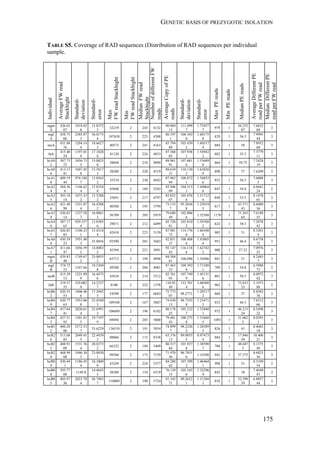
Z7-12:OAc (6 μg).
Conclusions
Corn- and rice-strain males exhibited some similarities in their attraction to the
different blends that we tested, although corn-strain males showed more
differentiation in their response than rice-strain males. We found some geographic
variation in attraction of corn- and rice-strain males to two synthetic 4- component
blends. In contrast, rice-strain males, but not corn-strain males, showed almost no
geographic variation in their attraction to different doses of Z7-12:OAc in different
regions. One aspect that merits further attention is the possibility that habitat-
specific volatiles influence the male response to pheromone blends in different
fields. Furthermore, the minor compound Z11-16:OAc does not seem to affect
attraction of S. frugiperda males, while region-specific differences in the attraction
seem to occur to the compound that has only been identified from female glands in
Brazil, E7-12:OAc. Overall, the data show some geographic variation in the
response of S. frugiperda males to pheromone blends. If this variation coincides
GEOGRAPHIC VARIATION IN SEXUAL ATTRACTION OF S. FRUGIPERDA MALES
139
with geographic variation in the female pheromone composition, then geographic
differentiation between populations could occur.
Acknowledgements
This research was partly funded by the German Science Foundation (grant number
GR3627/2-1), the National Science Foundation (award IOS-1052238 and NSF-
DEB-1025217), and the Max-Planck-Gesellschaft We thank Wilson Rivera
González from Monsanto and Jose Santiago from 3rd
Millenium Genetics for their
help with the male trapping experiments conducted in Santa Isabel in Puerto Rico,
and Sofía Torres, Carmen Urueña, and Alejandro Vera at EEAOC for their help
with the trapping experiment in Tucumán, Argentina. Thanks to Gregg Nuessly
from the Everglades Research and Education Center in Belle Glade and to Tommy
Toms, manager of the Graham Farms in Moore Haven, for their support with the
trapping experiments in Florida. We thank Raul Blas, Jorge Tobaru, German
Arellano, Antonio Oblitas, Daniela Gálvez, and Jose Meléndez from Universidad
Nacional Agraria La Molina (UNALM), and José Galarza from Servicio Nacional
de Sanidad Agraria (SENASA), for their assistance with male trapping experiments
and DNA extractions conducted on UNALM campus in Peru. Special thanks to
Antje Schmaltz, Susanne Neumann, Katja Müller, Sarah Behr, Simone Söltl,
Maximilian Hemmerling, and Susanne Donnerhacke for their assistance in strain-
typing trapped males at the MPICE in Jena, Germany.
REFERENCES
ACKERMAN, J. D. 1989. Geographic and seasonal variation in fragrance choices and
preferences of male Euglossine bees. Biotropica 21:340-347.
ANDRADE, R., C. RODRIGUEZ, A. C. OEHLSCHLAGER. 2000. Optimization of a pheromone lure
for Spodoptera frugiperda (Smith) in Central America. Journal of the Brazilian
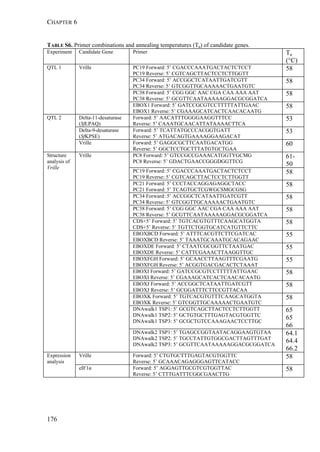
Chemical Society 11:609-613.
BAKER, T. C. 2002. Mechanism for saltational shifts in pheromone communication systems.
Proceedings of the National Academy of Sciences of the United States of America
99:13368-13370.
BALABAN, E. 1988. Cultural and genetic variation in swamp sparrows (Melospiza georgiana)
1. Song variation, genetic variation, and their relationship. Behaviour 105:250-291.
BATISTA-PEREIRA, L. G., K. STEIN, A. F. DE PAULA, J. A. MOREIRA, I. CRUZ, M. D.
FIGUEIREDO, J. PERRI, A. G. CORREA. 2006. Isolation, identification, synthesis, and field
evaluation of the sex pheromone of the Brazilian population of Spodoptera frugiperda.
Journal of Chemical Ecology 32:1085-1099.
BELAY, D. K., P. L. CLARK, S. R. SKODA, D. J. ISENHOUR, J. MOLINA-OCHOA, C. GIANNI, J. E.
FOSTER. 2012. Spatial genetic variation among Spodoptera frugiperda (Lepidoptera:
Noctuidae) sampled from the United States, Puerto Rico, Panama, and Argentina.
Annals of the Entomological Society of America 105:359-367.
BERNAL, X. E., C. GUARNIZO, H. LUDDECKE. 2005. Geographic variation in advertisement call
and genetic structure of Colostethus palmatus (Anura, Dendrobatidae) from the
Colombian Andes. Herpetologica 61:395-408.
CHAPTER 5
140
CARDÉ, R. T. AND A. K. MINKS. 1995. Control of moth pests by mating disruption – successes
and constraints Annual Review of Entomology 40:559-585.
CLARK, P. L., J. MOLINA-OCHOA, S. MARTINELLI, S. R. SKODA, D. J. ISENHOUR, D. J. LEE, J. T.
KRUMM, J. E. FOSTER. 2007. Population variation of the fall armyworm, Spodoptera
frugiperda, in the Western Hemisphere. Journal of Insect Science 7:10.
DELISLE, J. AND J. N. MCNEIL. 1987. The combined effect of photoperiod and temperature on
the calling behavior of the true armyworm, Pseudaletia unipuncta. Physiological
Entomology 12:157-164.
DELISLE, J. AND L. ROYER. 1994. Changes in pheromone titer of oblique-banded leafroller,
Choristoneura rosaceana, virgin females as a function of time of day, age, and
temperature. Journal of Chemical Ecology 20:45-69.
DESCOINS, C., J. F. SILVAIN, B. LALANNECASSOU, H. CHERON. 1988. Monitoring of crop pests
by sexual trapping of males in the French West Indies and Guyana. Agriculture
Ecosystems & Environment 21:53-65.
EL-SAYED, A. M., D. M. SUCKLING, J. A. BYERS, E. B. JANG, C. H. WEARING. 2009. Potential
of ‘lure and kill’ in long-term pest management and eradication of invasive species.
Journal of Economic Entomology 102:815-835.
FLEISCHER, S. J., C. L. HARDING, P. E. BLOM, J. WHITE, J. GREHAN. 2005. Spodoptera
frugiperda pheromone lures to avoid nontarget captures of Leucania phragmatidicola.
Journal of Economic Entomology 98:66-71.
GEMENO, C., A. F. LUTFALLAH, K. F. HAYNES. 2000. Pheromone blend variation and cross-
attraction among populations of the black cutworm moth (Lepidoptera: Noctuidae).
Annals of the Entomological Society of America 93:1322-1328.
GEMENO, C. AND K. F. HAYNES. 2001. Impact of photoperiod on the sexual behavior of the
black cutworm moth (Lepidoptera: Noctuidae). Environmental Entomology 30:189-195.
GONZALEZ-ZUARTH, C. A., A. VALLARINO, C. MACIAS GARCIA. 2011. Female responsiveness
underlies the evolution of geographic variation in male courtship between allopatric
populations of the fish Girardinichthys multiradiatus. Evolutionary Ecology 25:831-
843.
GREEN, J. P., C. ROSE, J. FIELD. 2012. The role of climatic factors in the expression of an
intrasexual signal in the paper wasp Polistes dominulus. Ethology 118:766-774.
GROOT, A. T., R. G. SANTANGELO, E. RICCI, C. BROWNIE, F. GOULD. 2007. Differential
attraction of Heliothis subflexa males to synthetic pheromone lures in eastern US and
western Mexico. Journal of Chemical Ecology 33:353-368.
GROOT, A. T., M. MARR, G. SCHÖFL, S. LORENZ, A. SVATOS, D. G. HECKEL. 2008. Host strain
specific sex pheromone variation in Spodoptera frugiperda. Frontiers in Zoology 5.
GROOT, A. T., O. INGLIS, S. BOWDRIDGE, R. G. SANTANGELO, C. BLANCO, J. D. LOPEZ, A. T.
VARGAS, F. GOULD, C. SCHAL. 2009. Geographic and temporal variation in moth
chemical communication. Evolution 63:1987-2003.
GROOT, A. T., C. A. BLANCO, A. CLASSEN, O. INGLIS, R. G. SANTANGELO, J. LOPEZ, D. G.
HECKEL, C. SCHAL. 2010a. Variation in Sexual Communication of the Tobacco
Budworm, Heliothis virescens. Southwestern Entomologist 35:367-372.
GROOT, A. T., A. CLASSEN, H. STAUDACHER, C. SCHAL, D. G. HECKEL. 2010b. Phenotypic
plasticity in sexual communication signal of a noctuid moth. Journal of Evolutionary
Biology 23:2731-2738.
GROOT, A. T., M. MARR, D. G. HECKEL, G. SCHÖFL. 2010c. The roles and interactions of
reproductive isolation mechanisms in fall armyworm (Lepidoptera: Noctuidae) host
strains. Ecological Entomology 35:105-118.
JONES, R. L. AND A. N. SPARKS. 1979. (Z)-9-tetradecen-1-ol acetate – A secondary sex
pheromone of the fall armyworm, Spodoptera frugiperda (J.E. Smith) (Lepidoptera,
Noctuidae). Journal of Chemical Ecology 5:721-725.
GEOGRAPHIC VARIATION IN SEXUAL ATTRACTION OF S. FRUGIPERDA MALES
141
JUÁREZ, M. L., M. G. MURUA, M. G. GARCIA, M. ONTIVERO, M. T. VERA, J. C. VILARDI, A. T.
GROOT, A. P. CASTAGNARO, G. GASTAMINZA, E. WILLINK. 2012. Host association of
Spodoptera frugiperda (Lepidoptera: Noctuidae) corn and rice strains in Argentina,
Brazil, and Paraguay. Journal of Economic Entomology 105:573-582.
KAEFER, I. L., B. M. TSUJI-NISHIKIDO, A. P. LIMA. 2012. Beyond the river: underlying
determinants of population acoustic signal variability in Amazonian direct-developing
Allobates (Anura: Dendrobatoidea). Acta Ethologica 15:187-194.
KAWAZU, K., Y. SUZUKI, Y. YOSHIYASU, E. B. CASTILLON, H. ONO, P. T. VUONG, F. K.
HUANG, T. ADATI, T. FUKUMO, S. TATSUKI. 2005. Attraction of Chaphalocrocis
medinalis (Lepidoptera: Crambidae) males in Southeast Asia to female sex pheromone
traps: Field tests in southernmost China, northern Vietnam and southern Philippines
with three synthetic pheromone blends regarding geographic variations. Applied
Entomology and Zoology 40:483-488.
KUMAR, H. AND K. N. SAXENA. 1986. Certain environmental factors influencing the acoustic
communication in the sexual behavior of the leafhopper Amrasca devastans (Distant)
(Homoptera: Cicadellidae). Applied Entomology and Zoology 21:55-62.
LAMPERT, K. P., A. S. RAND, U. G. MUELLER, M. J. RYAN. 2003. Fine-scale genetic pattern
and evidence for sex-biased dispersal in the tungara frog, Physalaemus pustulosus.
Molecular Ecology 12:3325-3334.
LANDOLT, P. J. AND T. W. PHILLIPS. 1997. Host plant influences on sex pheromone behavior
of phytophagous insects. Annual Review of Entomology 42:371-391.
LASSANCE, J. M. 2010. Journey in the Ostrinia world: From pest to model in chemical
ecology. Journal of Chemical Ecology 36:1155-1169.
LEBLOIS, R., F. ROUSSET, D. TIKEL, C. MORITZ, A. ESTOUP. 2000. Absence of evidence for
isolation by distance in an expanding cane toad (Bufo marinus) population: an
individual-based analysis of microsatellite genotypes. Molecular Ecology 9:1905-1909.
LEWTER, J. A., A. L. SZALANSKI, R. N. NAGOSHI, R. L. MEAGHER, C. B. OWENS, R. G.
LUTTRELL. 2006. Genetic variation within and between strains of the fall armyworm,
Spodoptera frugiperda (Lepidoptera: Noctuidae). Florida Entomologist 89:63-68.
LIMA, E. R. AND J. N. MCNEIL. 2009. Female sex pheromones in the host races and hybrids of
the fall armyworm, Spodoptera frugiperda (Lepidoptera: Noctuidae). Chemoecology
19:29-36.
LU, Y. J. AND M. J. ADANG. 1996. Distinguishing fall armyworm (Lepidoptera: Noctuidae)
strains using a diagnostic mitochondrial DNA marker. Florida Entomologist 79:48-55.
LUGINBILL, P. 1928. The fall army worm. U S Dept Agric Tech Bull 34:1-92.
MACDOUGALL-SHACKLETON, E. A. AND S. A. MACDOUGALL-SHACKLETON. 2001. Cultural
and genetic evolution in mountain white-crowned sparrows: Song dialects are associated
with population structure. Evolution 55:2568-2575.
MACHADO, V., M. WUNDER, V. D. BALDISSERA, J. V. OLIVEIRA, L. M. FIUZA, R. N. NAGOSHI.
2008. Molecular characterization of host strains of Spodoptera frugiperda (Lepidoptera:
Noctuidae) in Southern Brazil. Annals of the Entomological Society of America
101:619-626.
MALO, E. A., V. R. CASTREJON-GOMEZ, L. CRUZ-LOPEZ, J. C. ROJAS. 2004. Antennal sensilla
and electrophysiological response of male and female Spodoptera frugiperda
(Lepidoptera: Noctuidae) to conspecific sex pheromone and plant odors. Annals of the
Entomological Society of America 97:1273-1284.
MARTINELLI, S., P. L. CLARK, M. I. ZUCCHI, M. C. SILVA-FILHO, J. E. FOSTER, C. OMOTO.
2007. Genetic structure and molecular variability of Spodoptera frugiperda
(Lepidoptera: Noctuidae) collected in maize and cotton fields in Brazil. Bulletin of
Entomological Research 97:225-231.
CHAPTER 5
142
MCELFRESH, J. S. AND J. G. MILLAR. 1999. Geographic variation in sex pheromone blend of
Hemileuca electra from Southern California. Journal of Chemical Ecology 25:2505-
2525.
MCNEIL, J. N. 1991. Behavioral ecology of pheromone-mediated communication in moths
and its importance in the use of pheromone traps. Annual Review of Entomology
36:407-430.
MEAGHER, R. L. AND M. GALLO-MEAGHER. 2003. Identifying host strains of fall armyworm
(Lepidoptera: Noctuidae) in Florida using mitochondrial markers. Florida Entomologist
86:450-455.
MEAGHER, R. L. AND R. N. NAGOSHI. 2013. Attraction of fall armyworm males (Lepidoptera:
Noctuidae) to host strain females. Environmental Entomology 42:751-757.
MILLER, D. R., K. E. GIBSON, K. F. RAFFA, S. J. SEYBOLD, S. A. TEALE, D. L. WOOD. 1997.
Geographic variation in response of pine engraver, Ips pini, and associated species to
pheromone, Lanierone. Journal of Chemical Ecology 23:2013-2031.
MITCHELL, E. R., J. H. TUMLINSON, J. N. MCNEIL. 1985. Field evaluation of commercial
pheromone formulations and traps using a more effective sex pheromone blend for the
fall armyworm (Lepidoptera, Noctuidae). Journal of Economic Entomology 78:1364-
1369.
NAGOSHI, R. N. AND R. MEAGHER. 2003. Fall armyworm FR sequences map to sex
chromosomes and their distribution in the wild indicate limitations in interstrain mating.
Insect Molecular Biology 12:453-458.
NAGOSHI, R. N., R. L. MEAGHER, J. J. ADAMCZYK, S. K. BRAMAN, R. L. BRANDENBURG, G.
NUESSLY. 2006a. New restriction fragment length polymorphisms in the cytochrome
oxidase I gene facilitate host strain identification of fall armyworm (Lepidoptera:
Noctuidae) populations in the southeastern United States. Journal of Economic
Entomology 99:671-677.
NAGOSHI, R. N., R. L. MEAGHER, G. NUESSLY, D. G. HALL. 2006b. Effects of fall armyworm
(Lepidoptera: Noctuidae) interstrain mating in wild populations. Environmental
Entomology 35:561-568.
NAGOSHI, R. N., P. SILVIE, R. L. MEAGHER, J. LOPEZ, V. MACHADOS. 2007. Identification and
comparison of fall armyworm (Lepidoptera: Noctuidae) host strains in Brazil, Texas,
and Florida. Annals of the Entomological Society of America 100:394-402.
NAGOSHI, R. N., J. S. ARMSTRONG, P. SILVIE, R. L. MEAGHER. 2008a. Structure and
distribution of a strain-biased tandem repeat element in fall armyworm (Lepidoptera:
Noctuidae) populations in Florida, Texas, and Brazil. Annals of the Entomological
Society of America 101:1112-1120.
NAGOSHI, R. N., R. L. MEAGHER, K. FLANDERS, J. GORE, R. JACKSON, J. LOPEZ, J. S.
ARMSTRONG, G. D. BUNTIN, C. SANSONE, B. R. LEONARD. 2008b. Using haplotypes to
monitor the migration of fall armyworm (Lepidoptera: Noctuidae) corn-strain
populations from Texas and Florida. Journal of Economic Entomology 101:742-749.
NAGOSHI, R. N. 2010. The fall armyworm triose phosphate isomerase (Tpi) gene as a marker
of strain identity and interstrain mating. Annals of the Entomological Society of
America 103:283-292.
NAGOSHI, R. N., R. L. MEAGHER, D. A. JENKINS. 2010. Puerto Rico fall armyworm has only
limited interactions with those from Brazil or Texas but could have substantial
exchanges with Florida populations. Journal of Economic Entomology 103:360-367.
OLVIDO, A. E., P. R. FERNANDES, T. A. MOUSSEAU. 2010. Relative effects of juvenile and
adult environmental factors on mate attraction and recognition in the cricket,
Allonemobius socius. Journal of Insect Science 10:1-17.
GEOGRAPHIC VARIATION IN SEXUAL ATTRACTION OF S. FRUGIPERDA MALES
143
PASHLEY, D. P. 1986. Host-associated genetic differentiation in fall armyworm (Lepidoptera,
Noctuidae) – a sibling species complex. Annals of the Entomological Society of
America 79:898-904.
PASHLEY, D. P. 1988. Current status of fall armyworm host strains. Florida Entomologist
71:227-234.
PASHLEY, D. P. 1989. Host-associated differentiation in armyworms (Lepidoptera:
Noctuidae): An allozymic and mitochondrial DNA perspective. Pp. 12. Electrophoretic
studies on agricultural pests, Systematics Association. Clarendon, Oxford.
PASHLEY, D. P., A. M. HAMMOND, T. N. HARDY. 1992. Reproductive isolating mechanisms in
fall armyworm host strains (Lepidoptera, Noctuidae). Annals of the Entomological
Society of America 85:400-405.
PHELAN, P. L. 1992. Evolution of sex pheromones and the role of asymmetric tracking.
Chapman & Hall, New York & London.
PODOS, J. AND P. S. WARREN. 2007. The evolution of geographic variation in bird song. Pp.
403-458 in H. J. Brockmann, T. J. Roper, M. Naguib, K. E. WynneEdwards, C. Barnard,
and J. Mitani, eds. Advances in the Study of Behavior, Vol 37.
PRÖHL, H., R. A. KOSHY, U. MUELLER, A. S. RAND, M. J. RYAN. 2006. Geographic variation
of genetic and behavioral traits in northern and southern tungara frogs. Evolution
60:1669-1679.
PROWELL, D. P., M. MCMICHAEL, J. F. SILVAIN. 2004. Multilocus genetic analysis of host use,
introgression, and speciation in host strains of fall armyworm (Lepidoptera: Noctuidae).
Annals of the Entomological Society of America 97:1034-1044.
R DEVELOPMENT CORE TEAM. 2007. R: A language and environment for statistical
computing. R Foundation for Statistical Computing, Vienna, Austria
REDDY, G. V. P. AND A. GUERRERO. 2004. Interactions of insect pheromones and plant
semiochemicals. Trends in Plant Science 9:253-261.
ROELOFS, W. L. AND R. T. CARDÉ. 1974. Sex pheromones in the reproductive isolation of
lepidopterous species.
ROESER-MUELLER, K., E. STROHM, M. KALTENPOTH. 2010. Larval rearing temperature
influences amount and composition of the marking pheromone of the male beewolf,
Philanthus triangulum. Journal of Insect Science 10.
ROYER, L. AND J. N. MCNEIL. 1991. Changes in calling behavior and mating success in the
European corn borer (Ostrinia nubilalis), caused by relative humidity. Entomologia
Experimentalis et Applicata 61:131-138.
ROYER, L. AND J. N. MCNEIL. 1993. Effect of relative humidity conditions on responsiveness
of European corn borer (Ostrinia nubilalis) males to female sex pheromone in a wind
tunnel. Journal of Chemical Ecology 19:61-69.
RYAN, M. J., A. S. RAND, L. A. WEIGT. 1996. Allozyme and advertisement call variation in
the tungara frog, Physalaemus pustulosus. Evolution 50:2435-2453.
SCHÖFL, G., D. G. HECKEL, A. T. GROOT. 2009. Time-shifted reproductive behaviours among
fall armyworm (Noctuidae: Spodoptera frugiperda) host strains: evidence for differing
modes of inheritance. Journal of Evolutionary Biology 22:1447-1459.
SEPPÄ, P. AND A. LAURILA. 1999. Genetic structure of island populations of the anurans Rana
temporaria and Bufo bufo. Heredity 82:309-317.
SLABBEKOORN, H. AND T. B. SMITH. 2002. Bird song, ecology and speciation. Philosophical
Transactions of the Royal Society of London Series B-Biological Sciences 357:493-503.
SMADJA, C. AND R. K. BUTLIN. 2009. On the scent of speciation: the chemosensory system
and its role in premating isolation. Heredity 102:77-97.
SPARKS, A. N. 1979. Review of the biology of the fall armyworm (Lepidoptera, Noctuidae).
Florida Entomologist 62:82-87.
CHAPTER 5
144
SPARKS, A. N. 1986. Fall armyworm (Lepidoptera, Noctuidae) – potential for area-wide
management. Florida Entomologist 69:603-614.
TACK, E. J., D. A. PUTLAND, T. E. ROBSON, A. W. GOLDIZEN. 2005. Geographic variation in
vocalisations of Satin Bowerbirds, Ptilonorynchus violaceus, in south-eastern
Queensland. Emu 105:27-31.
TOTH, M., C. LÖFSTEDT, B. W. BLAIR, T. CABELLO, A. I. FARAG, B. S. HANSSON, B. G.
KOVALEV, S. MAINI, E. A. NESTEROV, I. PAJOR, A. P. SAZONOV, I. V. SHAMSHEV, M.
SUBCHEV, G. SZOCS. 1992. Attraction of male turnip moths Agrotis segetum
(Lepidoptera, Noctuidae) to sex pheromone components and their mixtures at 11 sites in
Europe, Asia, and Africa. Journal of Chemical Ecology 18:1337-1347.
TUMLINSON, J. H., E. R. MITCHELL, P. E. A. TEAL, R. R. HEATH, L. J. MENGELKOCH. 1986. Sex
pheromone of fall armyworm, Spodoptera frugiperda (J.E. Smith) – identification of
components critical to attraction in the field. Journal of Chemical Ecology 12:1909-
1926.
UNBEHEND, M., S. HÄNNIGER, R. L. MEAGHER, D. G. HECKEL, A. T. GROOT. 2013.
Pheromonal divergence between two strains of Spodoptera frugiperda. Journal of
Chemical Ecology 39:364-376.
WITZGALL, P., P. KIRSCH, A. CORK. 2010. Sex pheromones and their impact on pest
management. Journal of Chemical Ecology 36:80-100.
WU, W. Q., C. B. COTTRELL, B. S. HANSSON, C. LÖFSTEDT. 1999. Comparative study of
pheromone production and response in Swedish and Zimbabwean populations of turnip
moth, Agrotis segetum. Journal of Chemical Ecology 25:177-196.
ZHU, J., S. POLAVARAPU, K.-C. PARK, C. GARVEY, D. MAHR, S. NOJIMA, W. ROELOFS, T.
BAKER. 2009. Reidentification of pheromone composition of Sparganothis sulfureana
(Clemens) and evidence of geographic variation in male responses from two US states.
Journal of Asia-Pacific Entomology 12:247-252.
GEOGRAPHIC VARIATION IN SEXUAL ATTRACTION OF S. FRUGIPERDA MALES
145
SUPPLEMENTARY MATERIAL
FIGURE S1. Variation in trap catches of Spodoptera frugiperda males in different fields
and regions. Graphs show the total number of corn- and rice-strain males that were caught
with Blend 1 (100% Z9-14:OAc + 13% Z11-16:OAc + 2% Z7-12:OAc + 1% Z9-12:OAc) in
different regions in the first experiment (Figure 1). All traps were rotated three times and all
replicates were conducted in the same field, except for North Carolina, where each replicate
was conducted in a different field (replicate 1: soybean field, replicate 2: cotton and grass
field, replicate 3: soybean and corn field).
SECTION 3
STRAIN-SPECIFIC ALLOCHRONIC
DIFFERENTIATION
‘An experiment is a question which Science poses to Nature,
and a measurement is the recording of Nature’s answer.’
Max Planck
6
GENETIC BASIS OF PREZYGOTIC ISOLATION
IN THE FALL ARMYWORM
Sabine Hänniger1†
, Melanie Unbehend,1†
Gerhard Schöfl2
, Steffi
Gebauer-Jung1
, Heiko Vogel1
, David G. Heckel1
& Astrid T.
Groot1,3
1
Max Planck Institute for Chemical Ecology, Entomology, Hans-Knöll-Str. 8, 07745
Jena, Germany; 2
DKMS Life Science Lab, Fiedlerstr. 34, 01307 Dresden, Germany;
3
Institute for Biodiversity and Ecosystem Dynamics, University of Amsterdam,
Science Park 904, 1098 XH Amsterdam, the Netherlands
† Shared first authorship, both authors contributed equally
CHAPTER 6
150
Abstract
The two host strains of the fall armyworm Spodoptera frugiperda (Noctuidae)
seem to be in the process of ecological speciation in sympatry. The strains
exhibit allochronic differentiation in their mating time and also differ in female
sex pheromone composition, which together seem to act as isolation barriers
driving divergence between the strains. We conducted two QTL analyses
addressing these two isolation barriers. We identified one major QTL for the
allochronic divergence of mating, which to our knowledge is the first time that
a genomic location is identified that underlies differentiation in circadian
timing of mating activity in two strains in the process of speciation. We
identified the homologous chromosome in Bombyx mori, on which the clock
gene vrille is located, which thus became our major candidate gene. In S.
frugiperda, vrille showed strain-specific polymorphisms and circadian
expression differences corresponding to the phenotypic differences in mating
time. Interestingly, another QTL that affects the production of the critical sex
pheromone component Z7-12:OAc, maps to the same chromosome as the
timing QTL. Our results suggest that allochronic differentiation and sex
pheromonal divergence are genetically linked, which could facilitate the
evolution of prezygotic isolation in S. frugiperda.
INTRODUCTION
In the past 150 years, evolutionary biologists have attempted to understand how new
species can evolve and how this process creates the rich biodiversity found on earth.
The formation of new species requires some sort of limitation of gene flow between
populations, finally resulting in reproductive isolation (Coyne and Orr 2004).
Physical barriers separating populations may lead to allopatric speciation, while
ecological isolation in terms of habitat or behavioral isolation can cause speciation
in sympatry (Coyne and Orr 2004; Smadja and Butlin 2011; Boughman 2013; Butlin
et al. 2014). Studying the genetic basis of strong, but incomplete, reproductive
isolation barriers between closely related species, or even better within species
between differentiating populations, can help to reveal the initial steps causing
speciation and to identify genes driving divergence.
An ideal model organism to study speciation and the evolution of reproductive
isolation is the noctuid moth Spodoptera frugiperda (Lepidoptera: Noctuidae), as it
consists of two morphologically identical, but behaviorally and genetically different
strains (Pashley 1986). These so-called corn- and rice-strains seem to be in the
process of ecological speciation in sympatry (Groot et al. 2010). Although the
hybridization rate is up to 16% in the field (Prowell et al. 2004), the two strains do
not merge into one panmictic population, which is probably prevented by different
isolation barriers (Pashley et al. 1992; Groot et al. 2010). So far, three possible
prezygotic mating barriers have been described in this species: a) differential host
plant choice (Pashley 1986; Meagher and Gallo-Meagher 2003; Nagoshi et al. 2006,
2007; Machado et al. 2008), b) strain-specific timing of mating in the night (Pashley
et al. 1992; Schöfl et al. 2009), and c) female sex pheromone differences (Groot et
al. 2008; Lima and McNeil 2009; Unbehend et al. 2013). Recent studies showed that
GENETIC BASIS OF PREZYGOTIC ISOLATION
151
host preference in the field is not as specific as previously thought (Juárez et al.
2012, 2014; Groot et al. 2015). Also, studies on inter-strain differences in host plant
utilization are not consistent in their results (Pashley 1988; Whitford et al. 1988;
Pashley et al. 1995; Meagher et al. 2004). For example, rice-strain larvae have been
found to develop faster and grow significantly larger when fed on corn than do corn-
strain larvae (Meagher et al. 2004), while other studies show that the corn-strain
outperforms the rice-strain on corn plants (Pashley 1988; Whitford et al. 1988;
Pashley et al. 1995). Additionally, numerous bioassays in our lab, including larval
performance and choice assays and oviposition choice assays, failed to show any
difference between the strains (Hänniger, unpubl.). Therefore, habitat isolation
seems to be a weak prezygotic mating barrier. Allochronic divergence and sex pher-
omone differentiation are each incomplete mating barriers, but may interact to form
a behavioral isolation barrier that promotes strain separation (Groot et al. 2010,
2015). Here, we test this hypothesis by assessing the genetic basis of both traits.
Allochronic divergence seems to be a major barrier separating the two S.
frugiperda strains, as both strains consistently differ in their timing of reproductive
activity at night (Pashley et al. 1992; Schöfl et al. 2009). The corn-strain calls, mates
and oviposits approximately three hours earlier than the rice-strain, with only a
small overlapping time-window between the two (Pashley et al. 1992; Schöfl et al.
2009). Allochronic speciation has been suggested for several insect species, e.g.
crickets (Danley et al. 2007; Fergus and Shaw 2013), fruit flies (Tauber et al. 2003;
Prabhakaran and Sheeba 2012) and mosquitoes (Rund et al. 2012). However,
surprisingly little research has been conducted on the importance and exact genetic
changes underlying temporal speciation (reviewed in Groot 2014). It is likely that
changes in biological clocks are involved in temporal differentiation between closely
related species, and in timing of reproductive activity in S. frugiperda. Biological
clocks can be described as a network of genes and gene products that enhance and
suppress each other in a rhythmic manner, entrained by environmental factors like
light, temperature or tides (Hardin 2005; Kaiser et al. 2011). Within insects, the
clock gene network is best described in the fruit fly Drosophila melanogaster, where
the network consists of two interlocked feedback loops (Cyran et al. 2003; Hardin
2005): one feedback loop involving the genes vrille (vri), PAR-domain protein 1
(PDP1), clock (clk) and cycle (cyc); a second feedback loop involving period (per),
timeless (tim), clk and cyc (Figure 1). In addition, kinases phosphorylate clock
proteins (e.g. phosphorylation of PER by DOUBLETIME (DBT) and CASEIN
KINASE 2 α (CK2α)) and facilitate their accumulation (Hardin 2005), while
cryptochrome 1 (cry1) functions as circadian photoreceptor. Most of these genes are
also present in Lepidoptera (Zhu et al. 2005; Trang et al. 2006; Yuan et al. 2007;
Zhu et al. 2009), and are thus good candidate genes that may underlie the timing
differences between the corn- and the rice-strain. Additionally, a second
cryptochrome, cryptochrome 2 (cry2), is present in Lepidoptera and is able to
repress CLK:CYC mediated transcription (Zhu et al. 2005; Yuan et al. 2007).
CHAPTER 6
152
FIGURE 1. Two feedback loops that define the circadian rhythm in Drosophila. Adapted from
Cyran et al. (2003), Hardin (2005).
In addition to allochronic differentiation, differences in sexual communication
have been found between the two strains of S. frugiperda (Groot et al. 2008; Lima
and McNeil 2009; Unbehend et al. 2013). Behavioral isolation via sexual
communication differences is known from several insect orders, such as Diptera
(e.g. Drosophila) and Lepidoptera (e.g. Ostrinia) (Smadja and Butlin 2009; Wicker-
Thomas 2011). A, a reliable sexual communication system between females and
males is essential for the mating success and fitness of a species. Therefore, changes
in the sender (female) and receiver (male) of a pheromone signal can have
tremendous fitness effects and drive prezygotic isolation (Löfstedt 1993; Cardé and
Haynes 2004).
The sex pheromone of S. frugiperda consists of at least two behaviorally active
components, the major pheromone component (Z)-9-tetradecenyl acetate (Z9-
14:OAc), and the critical minor component (Z)-7-dodecenyl acetate (Z7-12:OAc)
(Tumlinson et al. 1986). Other pheromone compounds have also been identified
from the female gland, e.g. (Z)-11-hexadecenyl acetate (Z11-16:OAc) and (Z)-9-
dodecenyl acetate (Z9-12:OAc), but their behavioral function is unclear (Unbehend
et al. 2013). Pheromone extractions of laboratory and field populations showed that
corn-strain females consistently exhibited lower relative amounts of Z7-12:OAc
than rice-strain females (Groot et al. 2008; Lima and McNeil 2009; Unbehend et al.
2013). Interestingly, field studies in Florida suggest that males have adapted to the
strain-specific amount of Z7-12:OAc in females, which could promote isolation
between both strains (Unbehend et al. 2013). Based on a proposed pheromone
biosynthesis pathway of S. frugiperda (Groot et al. 2008), different candidate genes,
e.g. delta-9- or delta-11-desaturases, could influence the pheromone differences
between corn- and rice-strain females.
GENETIC BASIS OF PREZYGOTIC ISOLATION
153
In this study, we determined the genetic basis of the two most promising
potential prezygotic mating barriers, i.e. allochronic differentiation and sexual
communication variation, in the two strains of S. frugiperda. We conducted
quantitative trait locus (QTL) analyses for both isolation mechanisms, we mapped
different candidate genes to the QTLs involved in the differential timing of
reproduction and in the production of different pheromone components, and we
assessed strain-specific differences in the structure and expression of the candidate
gene vri, key to the allochronic differentiation between the two strains.
MATRIALS AND METHODS
Insects
We conducted two QTL analyses with two laboratory corn- and rice-strain
populations. Details about the populations are given in the supplementary materials
and summarized below. Individuals used for the timing QTL analysis descended
from Florida and were also used by Schöfl et al. (2009). We refer to these
populations as CL1 and RL1 (Table S1). Since these two populations died after six
years of laboratory rearing, we established new laboratory populations for the
pheromone QTL analysis, originating from Florida (rice-strain) and Puerto Rico
(corn-strain) We refer to these populations as CL2 and RL2 (Table S1). We
confirmed genetic similarity between the corn-strain populations from Florida (CL1)
and Puerto Rico (CL2) by determining the mitochondrial haplotype profile of 47
Florida and 43 Puerto Rico individuals (Table S2; Nagoshi et al. 2007). All
populations were reared in climate chambers with reversed light:dark (L:D) cycle
and 14:10 L:D photoperiod at 26 °C and 70% RH. Adults were fed with a 10%
honey-water solution and random single-pair-matings were set up to maintain the
populations and minimize inbreeding.
Generation of backcrosses
For the two QTL analyses, we generated female-informative backcrosses (Table S3).
Single pair matings between pure corn- and rice-strain individuals were performed
to obtain F1 hybrid females, which were then backcrossed to pure rice-strain males
to produce different backcross families (Table S3). Two backcross families (BCs)
were used for the timing QTL analysis (BC_A: RCxR, BC_B: CRxR), while one BC
(BC_C: CRxR) was used for the pheromone QTL analysis (the first two letters of a
backcross refer to the mother, the last letter to the father). The two rice-strain fathers
used to generate both backcrosses for the timing QTL were kin.
Phenotyping of backcrosses
To determine the phenotype for the timing QTL analysis, we observed the mating
behavior of a) pure strain individuals in intra-strain (CxC, RxR) and inter-strain
matings (CxR, RxC), b) hybrid females backcrossed to pure strain males (CRxC,
CRxR, RCxC, RCxR), and c) female backcross offspring crossed to pure strain
CHAPTER 6
154
males (CR-RxC, CR-RxR, RC-RxC, RC-RxR). The observations of mating
behavior, i.e. copulation, were performed as described by (Schöfl et al. 2009) and
are summarized here. One to four day old virgin females and males were set up in
single pairs in clear plastic cups (16 oz.) and provided with 10% honey solution. All
matings were set up simultaneously and placed in a walk-in climate chamber (26 °C,
70% RH, L:D 14:10) two hours before scotophase. In total, 320 to 400 couples were
observed throughout the scotophase and one hour into photophase (in total 11
hours), with a 30 min interval, i.e. each couple was observed once every 30 min. All
pairs were observed for three consecutive nights starting at the first day of the
mating. The onset time of the first mating, on whichever night it occurred, was the
phenotype for the timing QTL analysis. After observation, all individuals were
frozen at -80 °C for further genetic analysis.
For the pheromone QTL analysis, pheromone glands were extracted from 2-3
day-old virgin pure strain females (C, R), hybrids (CR, RC), and backcross females
(CR-R), as described in detail in Unbehend et al. (2013) and in the supplementary
data and summarized here. The pheromone glands were extracted in the scotophase
at the strain-specific peaks of calling times, i.e. 4-5 h into scotophase for corn-strain
females, 6-7 h into scotophase for the rice-strain females. For the hybrid females, we
used the approximate times of the mothers, i.e. 3.5-5.5 h into scotophase for the CR
hybrids, 5-6 h into scotophase for the RC hybrids, and 4-7 h into scotophase for the
CR-R backcross females. Gas chromatography analysis was performed using a
HP7890 gas chromatograph with a polar capillary column (DB-WAXetr (extended
temperature range); 30 m × 0.25 mm × 0.5 μm) and a flame-ionization detector.
Female pheromone compounds were identified by comparing retention times with
synthetic standards of Z9-14:OAc, Z7-12:OAc, Z11-16:OAc, and Z9-12:OAc
(Pherobank, Wageningen, the Netherlands). After pheromone extraction, all females
were stored at -20 °C for further analysis.
DNA extraction and AFLP marker analysis
All DNA extractions were performed as described in Unbehend et al. (2013), using
Cetyltrimethylammonium bromide and isopropanol for DNA precipitation. For the
timing QTL analysis, DNA of 90 randomly chosen backcross females (44x RC-R,
46x CR-R) covering the full range of the timing phenotype (i.e. early maters to late
maters) as well as of their parents and grandparents were used to generate AFLP
markers. For the pheromone QTL analysis, we selected 88 females covering the full
range of relative amount of Z7-12:OAc (lowest to highest amount) in the female
glands, as this is significantly different between the two strains (Unbehend et al.
2013): We chose 36 females with low amounts of Z7-12:OAc (1-2%), 16 females
with medium amounts (~2.5%), and 36 females with high amounts of Z7-12:OAc (>
3.5%), as well as their parents and grandparents.
After DNA extraction, AFLP markers were generated and analyzed as described
in Groot et al. (2009), detailed in the supplementary material and summarized here:
GENETIC BASIS OF PREZYGOTIC ISOLATION
155
200 ng DNA of each sample was digested with EcoRI and MseI (New England
Biolabs, Ipswich, MA, USA), and EcoRI- and MseI-adapters were ligated to the
fragments which were then preamplified (Wilding et al. 2001). The preamplified
DNA was selectively amplified with different EcoRI- and MseI-primer combinations
(Table S4). The generated AFLP fragments were analyzed scored with AFLP-
Quantar Pro 1.0 (KeyGene, Wageningen, the Netherlands).
Genetic map construction and QTL analyses
After scoring of at least 300 AFLP markers per backcross (Table S4), we constructed a
linkage map for each QTL analysis with MapMaker 3.0 (www.broadinstitute.org/
ftp/distribution/software/mapmaker3/). Markers were clustered into linkage groups
(LG) using a LOD of 4.5 (timing QTL analysis) and a LOD of 6.5 (pheromone QTL
analysis). In each QTL analysis, 30 LGs were identified that refer to the 30 autosomes
in a backcross family, as there is no crossing over in female Lepidoptera (Heckel
1993). The chromosome names (chromosome 1 to 30) were chosen arbitrarily for each
QTL analysis, so that the same numbers in the different linkage maps are not
necessarily homologous. For the timing QTL analysis, markers present in both
backcrosses (Table S4) were used to homologize the chromosomes of these
backcrosses. To identify candidate QTL, each chromosome was tested for a significant
difference in the phenotype (timing QTL: onset time of first mating, pheromone QTL:
female pheromone composition) between the homo- and heterozygous backcross
females. The two backcrosses for the timing QTL were combined for analysis, to
increase the sample size and thus the possibility to detect QTL. For this combination,
markers of both backcrosses were set such that all ‘present’ markers originated from
the corn-strain grandparent. We also show the results of QTL analyses for each BC
individually (Table S8), but focus on the results of the combined analysis. Statistical
analysis was performed with R 2.5.0 (R Development Core Team, 2007) and SAS
(SAS institute, Cary, NC, USA, 2002-2008). We conducted a two-sided t-test and a
GLM to assess how much of the variance is explained by the different QTLs (R²
value). The female pheromone data were log transformed to stabilize the variance.
Chromosomes with a significant correlation (P < 0.05) were considered a QTL. For
the timing QTL we additionally used a t-test based marker regression as implemented
in R/qtl (Broman et al. 2003). A LOD score derived from the t-statistics provides
evidence for a QTL (Broman et al. 2003). Permutation tests using 10,000 permutations
empirically established significance thresholds for LOD scores (Figure S1). For the
pheromone QTL, the same analysis did not yield any QTL chromosomes above the
significance level. We performed power simulations for the timing QTL with 10,000
simulation replicates for backcross sizes of 50, 85 and 100 progeny to estimate the
power to detect QTL with the observed effect sizes (Figure S2). The probability to
detect our major timing QTL was 0.58 with the given setup, thus it could easily have
been missed. Therefore we also describe the pheromone QTL, even though they were
not above the significance thresholds established by permutation tests.
CHAPTER 6
156
Homologizing linkage maps to Bombyx mori chromosomes
To identify candidate genes in the QTL regions, the linkage map of the timing QTL
analysis was homologized to the reference genome of B. mori, using restriction site
associated DNA (RAD) analysis (see Baxter et al (2011) and Groot et al. (2013). DNA
of parents, female grandparents and 11 backcross individuals per backcross family was
barcoded, pooled, sheared and amplified, following the procedure described in Groot
et al. (2013). The pool was paired-end sequenced by FASTERIS (Geneva,
Switzerland) with a HiSeq Illumina sequencer, resulting in 76 million reads. The reads
were separated by barcodes into pools per individual and filtered for quality
(q10=99%). On average, there were 5-10 different paired-end reads per forward read
(Table S5). Forward sequences were transformed to binary segregation patterns
obtained with the AFLP markers in the backcross individuals using RAD tools (Baxter
et al. 2011). All sequences matching an AFLP segregation pattern were pooled across
the individuals, after which the paired-end sequences were retrieved, resulting in 30
FASTA files (one file per chromosome). Each group was assembled using CLC
Genomics Workbench (CLC bio version 5.0.1; www.clcbio.com). Sequences were
trimmed for length and quality with standard settings (nucleotide mismatch cost = 2;
in/del cost = 2; length fraction = 0.35; similarity = 0.9; when bases conflicted, the base
with highest frequency was chosen) and assembled de novo.
Resulting contigs from the paired-end RAD sequences were blasted per
chromosome in SilkDB (www.silkdb.org) and KAIKObase (http://sgp.dna.affrc.
go.jp/ KAIKObase) using BLASTX and TBLASTX. Homology between S.
frugiperda chromosomes and B. mori chromosomes was confirmed when (in
hierarchical order) a) contigs from both BC_A and BC_B produced significant blast
hits to the same Bm chromosome and/or b) different contigs of the same Sf
chromosome produced significant blast hits to the same Bm chromosome and/or c)
in cases where multiple Bm chromosomes hit contigs of one Sf chromosome, the hit
with the lowest e-value was chosen. Hence, if contigs from both backcrosses
produced significant hits from one Sf chromosome to the same Bm chromosome, this
was evaluated as most powerful, while one contig from one backcross producing a
highly significant hit to one Bm chromosome, but also significant hits to other
chromosomes, this was evaluated as least powerful. Table S8 summarizes the results
of this homologizing procedure and shows the e-value of the best blast result of all
contigs of one Sf chromosome to one Bm chromosome at the intersection of these
chromosomes. For the pheromone QTL, we only constructed a genetic map using
AFLP markers, after which we mapped the candidate gene vri, located on the major
timing QTL, as well as both candidate genes that could explain the pheromone
variation, delta-9-desaturase and delta-11-desaturase.
Candidate genes
As for the timing QTL, all QTL chromosomes were homologized to the B. mori
chromosomes, we assessed the location of candidate genes involved in the circadian
GENETIC BASIS OF PREZYGOTIC ISOLATION
157
rhythm (Figure 1), using KAIKObase (http://sgp.dna.affrc.go.jp/KAIKObase). The
position of vri on the timing QTL chromosome Sf_C25 (Bm_C27) was verified by
mapping it via single nucleotide polymorphisms (SNPs) to the generated QTL map.
Initially, eight backcross individuals were used and the pattern of SNPs in the
coding sequence, that were present in both backcrosses, were compared to the
pattern of the AFLP markers. This was sufficient, as no linkage group other than
Sf_C25 had the same AFLP segregation pattern in these 8 individuals. The position
of vri was later also verified when sequencing the full CDS of vri in 17 BC
individuals and comparing SNPs in these individuals to AFLP segregation patterns.
In the pheromone QTL analysis, the two candidate genes delta-11-desaturase
(SfLPAQ) and delta-9-desaturase (SfKPSE), as well as vri, were mapped onto the
genetic map using SNPs as well, for which 24 backcross individuals were used.
Based on insect ESTs and genomic sequences (vri: gb|AY526608.1,
gb|AY576272.1, gb|AADK01019845.1; SfKPSE: gb|DY793393.1, gb|DV079258.1;
SfLPAQ: gb|FP368185.1, gb|FP366982.1), primers were designed for mapping
(Table S6). To identify segregating SNPs in the candidate genes, PCR
amplifications were conducted (Table S7) with the grandparents, parents, and 8 to
24 backcross females of all three backcross families. The generated amplification
products were mixed with 3µl loading dye and ran on a 1.5% agarose gel at 120 V
for 2 h. The obtained bands were cut from the gel and extracted with a QIAGEN gel
extraction kit (QIAGEN, Hilden, Germany). After gel extraction, all products were
sequenced using Sanger-sequencing according to methods described in Vogel et al.
(2011), and analyzed with Sequencher 4.10.1 (Gene Codes Corporation, Ann Arbor,
MI, USA).
Structure analysis of vri
To assess strain-specific structure differences in vri, the sequence of the gene was
established stepwise, using degenerate primers and DNA Walking SpeedUp™ Kit II
(SEEGENE, Eschborn, Germany). This elucidated the coding sequence and ~1 kbp
of the 5’ untranslated region and the promoter region. Subsequently, thanks to the
Whole Genome Sequencing project supported by the Fall Armyworm International
Public Consortium (The FAW-IPC, in prep.), the S. frugiperda genome for both
strains (http://www6.inra.fr/lepidodb/SfruDB) became available as well as an in-
house RNAseq database of larval guts. With these tools (as detailed in the
supplementary material) the full length of vri could be obtained, including a large
intron with 11 Ebox elements in the 5’ UTR. The regions surrounding the Ebox
elements was then amplified and sequenced in 12 corn-strain and 12 rice-strain
individuals from the CL1 and RL1 populations, respectively.
Expression analysis
To determine strain-specific expression differences in the candidate gene vri that
mapped onto the major QTL (Bm_C27), we conducted reverse transcription-
CHAPTER 6
158
quantitative real-time PCR (RT-qPCR) experiments with mRNA from heads of
female and male S. frugiperda of both strains (CL1 and RL1; Table S1). For 24 h,
every two hours 10 females of both strains were transferred from the rearing cups to
a 10-ml Falcon tube, immediately frozen in liquid nitrogen and kept at -80 °C. RNA
was isolated from two pools of five heads, providing two biological replicates per
strain per time point. RNA extraction, cDNA synthesis and qRT-PCR reaction were
conducted, as described in Groot et al. (2013) and summarized here. Heads were
ground with mortar and pistil in liquid nitrogen, RNA was isolated using TRIsure
(Bioline, Luckenwalde, Germany) and the RNA pellet was dissolved in 90 μl
nuclease free water (Ambion, LIFE TECHNOLOGIES, Darmstadt, Germany).
DNase was digested by adding 10 μl 10x Turbo DNase buffer and 1 μl Turbo DNase
(Ambion, LIFE TECHNOLOGIES, Darmstadt, Germany) to the 90 μl sample and
incubating for 30 min at 37˚C. The RNA samples were contaminated with dark
pigments from the eyes. We found the 10x Turbo DNase buffer to be capable of
precipitating these pigments. Thus, an additional precipitation step was conducted as
followed: 10 μl 10x Turbo DNase buffer was added to the 101 μl samples and
samples were vortexed until pigments were dissolved and again incubated for 30
min at 37˚C. Then samples were centrifuged for 20 min at high speed (16000 g) and
the supernatant was transferred to a new tube. This step was repeated followed by a
cleanup with RNeasy MinElute Cleanup-Kit (QIAGEN, Hilden, Germany). cDNA
was synthesized from 1000 ng RNA using Verso cDNA synthesis kit (Thermo
Fisher Scientific, Schwerte, Germany). RT-qPCRs were conducted with 5 ng cDNA
per reaction, 3 technical replicates on each plate, using ABsolute Blue QPCR SYBR
Green Mix (Thermo Fisher Scientific, Schwerte, Germany) and a Bio-Rad CFX
machine (Bio-Rad Laboratories GmbH, München, Germany). The reaction ran 15
min at 95 °C, 40 cycles of 15 s at 95 °C, 30 s at 58 °C, 30 s at 72 °C followed by 10
s at 95 °C and a melt curve 55-95 °C with an increment of 0.5 °C. Three potential
reference genes, eukaryotic translation initiation factor 1α (eIF1α), eukaryotic
translation initiation factor 4α (eIF4α) and ribosomal protein subunit 18 (RPS18),
were tested on a subset of 10 samples pooled over both biological replicates (both
strains; time points 1, 3, 5, 7 and 9 hours into scotophase) to identify the gene that is
most stable over time. eIF1α was the gene with the least variation between the
samples and was thus chosen as the reference gene for this study and amplified for
all samples (see Table S6 for all primers and Table S7 for detailed protocol).
Relative expression levels were calculated as copy numbers per 1000 copies eIF1α.
RESULTS
QTL analyses
In the timing QTL analysis, a total of 465 (in BC family A) and 514 (in BC family
B) informative AFLP markers were used to identify the 30 S. frugiperda autosomes,
while 303 markers (BC_C) were scored to construct a genetic map for the
pheromone QTL analysis (Table S4). In BC_B only 29 chromosomes could be
GENETIC BASIS OF PREZYGOTIC ISOLATION
159
identified, even though more markers were scored to find the additional
chromosome. The higher amount of scored markers in BC_A and BC_B was also
needed to homologize the two linkage maps to each other. Each chromosome
consisted of at least two AFLP markers from different primer combinations up to a
maximum of 26 markers. Some markers did not map to any linkage group (17
markers in each BC in the timing QTL analysis, seven markers in the pheromone
QTL analysis). Three chromosomes could not be homologized between the two
timing linkage maps, i.e. three chromosomes in BC_A and only 2 chromosomes in
BC_B, as there is one linkage group missing in BC_B.
QTLs were identified by testing each linkage group for a significant association
with the relevant phenotypic trait. Because of the absence of crossing-over in
females, each identified QTL corresponds to an individual chromosome, on average
1/31 of the genome. For the timing, we found one QTL (Sf_C25, P<0.0001,
R²=0.19) that explained most of the variance in the strain-specific timing of mating,
which was consistent in both backcrosses (Table S8). This QTL is homologous to
Bombyx mori chromosome 27 (Bm_C27) (Table S8) and explained 19% of the
variance of the onset time of first mating (Figure 2). Bm_C27 is 14.5 Mb in size
(52.8 cM) and represents 3.3% of the total B. mori genome (Xia et al. 2008;
Shimomura et al. 2009). Additionally we detected three minor QTL: Sf_C28
(Bm_C2, P=0.014, R²=0.08), Sf_C30 (Bm_C6, P=0.0104, R²= 0.08) and Sf_C20
(Bm_C12, P=0.234, R²=0.06).
For the pheromone variation, we found one minor QTL Sf_C28 (P=0.028, R² =
0.05), that explained the strain-specific differences in the relative amount of Z7-
12:OAc, the critical sex pheromone component that is essential for male attraction
(Figure 2). Heterozygous as well as homozygous backcross individuals exhibit a
higher relative percentage of Z7-12:OAc/pheromone gland compared to the pure
strain individuals, which is due to a lower abundance of the major component Z9-
14:OAc. We found several other genomic regions that explained some of the
variation in the pheromone blend, i.e. Sf_C02 (P=0.050, R²=0.04) for the major sex
pheromone component Z9-14:OAc, Sf_C11 (P=0.033, R²=0.05) for Z9-12:OAc, and
a total of seven minor QTLs for Z11-16:OAc, i.e. Sf_C01 (P=0.022, R²=0.06),
Sf_C02 (P=0.014, R²=0.07), Sf_C03 (P=0.003, R²=0.10), Sf_C17 (P=0.040,
R²=0.05), Sf_C22 (P=0.023, R²=0.06), Sf_C25 (P=0.004, R²=0.09) and Sf_C30
(P=0.042, R²= 0.05, Figure S3).
Homologizing linkage map to Bombyx mori chromosomes
Of the 30 autosomes of our linkage map for the timing QTL, we homologized 16 to
B. mori chromosomes. All four QTL chromosomes were among the homologized
ones (Table S8). Two chromosomes, which had not been homologized between the
timing linkage maps, could be homologized in addition (BC_A:11 to BC_B:19 and
BC_A:32 to BC_B:4), because the RAD sequences mapped to the same Bm
chromosome.
CHAPTER 6
160
FIGURE 2. Phenotypes for major QTL chromosome Sf_C25 (=Bm_C27) of pure strain CC and
RR individuals vs. heterozygous CR and homozygous RR backcross individuals. For the
timing QTL: Onset time of first mating (hours into scotophase). For the pheromone QTL:
Relative percentage of Z7-12:OAc per gland.
The candidate genes from the circadian rhythm are located on the following
chromosomes (Table S8): per, clk, cyc and PdP1 on the sex chromosome (Bm_C01),
jetlag on Bm_C3 (Sf undetermined), tim on Bm_C4 (Sf_undetermined), CK2α on
Bm_C5 (Sf_C05), cry2 on Bm_C15 (Sf_C23), CK2β and cry1 on Bm_C15 (Sf_C23),
dbt on Bm_C17 (Sf_C17), shaggy on Bm_C18 (Sf_C13), clockwork orange on
Bm_C22 (Sf_undetermined), slimb on Bm_C24 (Sf_C12, 32), vri on Bm_C27
(Sf_C25) and CK1α on Bm_scaf256 (not integrated in B. mori chromosomes, cannot
be homologized). Thus, of all candidate genes, only vri mapped to the major QTL
chromosome, Bm_C27 (Sf_C25).
The candidate gene for the pheromone variation, delta-11-desaturase (SfLPAQ),
mapped to Sf_C02, which explained a small but significant portion of the variance of
Z9-14:OAc (P=0.050, R²=0.04) and Z11-16:OAc (P=0.014, R²=0.07). However,
this QTL showed an opposite-to-expected phenotypic pattern for both compounds
(Figure S3). A similar delta-11-desaturase can be found on Bm_C23
(gi|162809332|ref|NP_001037017.2), indicating that Sf_C02 of this backcross is
homologous to Bm_C23. The candidate gene delta-9-desaturase (SfKPSE) mapped
to Sf_C05, which was not associated with strain-specific differences in any of the
four pheromone compounds (Figure S3). This chromosome is probably homologous
GENETIC BASIS OF PREZYGOTIC ISOLATION
161
to Bm_C12, because Bm_C12 contains a similar delta-9-desaturase to the one we
found (gi|34538645|gb|AAQ74257.1). Interestingly, vri mapped to Sf_C28 in this
backcross family, i.e. Bm_C27, which is the most significant QTL for the critical sex
pheromone component Z7-12:OAc (Figures 2 and S1). Thus, the strain-specific
variance in two potential prezygotic mating barriers of S. frugiperda mapped to the
same chromosome.
Structure and expression analysis of vri
Vrille is a short gene without introns in the protein coding region, coding for a 367
aa protein, followed by a 1234 bp 3’ UTR. The 5’ UTR is divided into a 45 bp
segment and a 375 bp segment by an intron containing regulatory elements, namely
11 Ebox elements (Ebox A-K) with the core sequence CACGTG (Figure 3). Near
Eboxes E, F and I, 5 polymorphisms between the investigated corn-strain and rice-
strain populations and the maternal grandmothers of BC_A and BC_B were
identified (Table 1).
FIGURE 3. Structure of vri in the corn- and rice-strain of S. frugiperda and strain-specific
polymorphisms in the intron in the 5’ UTR.
TABLE 1. Variation in the regulatory intron in the 5’ UTR of vri. Single nucleotide
polymorphisms (SNPs) and insertions/deletion (IN/DEL) between 12 individuals from a corn-
strain population and 12 individuals from a rice-strain population as well as in the maternal
grandmothers (mgm) BC_A and B (originating from these populations. Mgm = maternal
grandmother; Sample name followed by C (= corn-strain) or R (= rice-strain); n.a. not
available due to sequencing restrictions. Dark grey cells indicate corn-strain alleles and light
grey cells indicate rice-strain alleles.
Position Close to Type Population Individual
CL_1 C RL_1 R mgmA R mgmB C
4717 EboxE SNP T A A T
4727 EboxE SNP T A A T
4816 EboxE IN/DEL _ _ _ _ _ _ TTCGAA TTCGAA _ _ _ _ _ _
4870 EboxF SNP A C C A
6690 EboxI SNP T A A n.a.
CHAPTER 6
162
FIGURE 4. Expression of vri over time in heads of S. frugiperda corn- and rice-strain females.
Five individuals were used per biological replicate, two biological replicates per time point.
Grey field indicates scotophase. Expression is shown as molecules per 1000 molecules eIF1α.
When analyzing the strain-specific differences in vri expression by RT-qPCR,
both strains showed two peaks of vri expression. The corn-strain females had the
highest vri expression five hours before and one hour into scotophase, while rice-
strain females exhibited one peak three hours before scotophase and one peak three
hours into the scotophase (Figure 3). Both peaks thus showed a time-shift between
the strains by two hours.
DISCUSSION
In this study, we tested the hypothesis that two prezygotic mating barriers are
genetically linked in the two strains of S. frugiperda, i.e. allochronic differentiation
and sexual communication variation. We found one consistent QTL for the
differences in the onset time of mating in the two strains, Sf_C25, which is
homologous to Bm_C27. Interestingly, this is also the one QTL that we found for
the strain-specific variation in the critical sex pheromone component Z7-12:OAc,
which suggests that both traits may indeed be genetically linked. Since the majority
of lepidopteran species have 31 chromosomes, the chance of finding the same
chromosome in two separate QTL studies is 1/31 or 0.03. The timing of behavior is
a complex trait, as it is dependent on the circadian clock, which is a complex
network of genes and their products that participate in interlocked feedback loops of
transcription and translation (see Figure 1). Thus, it is remarkable to only find one
major consistent QTL in two backcross families. Our QTL is one autosome and the
homologous autosome in B. mori is 14.5 Mb (52.8 cM), which is in the range of
GENETIC BASIS OF PREZYGOTIC ISOLATION
163
other QTL studies (Gleason and Ritchie 2004; Moehring and Mackay 2004; Shaw et
al. 2007; Gleason et al. 2009). Within this region, multiple clock related genes could
be located. However, in B. mori only one candidate clock gene is known to be
located on this chromosome, namely vri. All other known clock genes map to
different chromosomes in B. mori (see also Table S8).
A limitation of our indirect mapping approach is the different number of auto-
somes in B. mori (28) and S. frugiperda (30). As we could not homologize all chro-
mosomes between the species, we were not able to determine which chromosomes
are fused in B. mori compared to S. frugiperda. We would expect two Bm chromo-
somes to be fused such that two Sf chromosomes would be homologous to one fused
Bm chromosome. However, as the position of vrille is confirmed on our major Sf
QTL chromosome, a second Sf chromosome homologous to Bm_C27 would not
affect this result. Also, all minor QTL chromosomes have a confident homologue in
B. mori and none of these contain known clock genes. If a second Sf chromosome
would map to the same Bm chromosome, this would not lead to a clock gene on the
QTL chromosome but would rather mean one more Sf chromosome without a
known clock gene. Nevertheless, translocations of genes between the two species
cannot be ruled out completely, but the synteny between B. mori and S. frugiperda is
highly conserved, which makes B. mori an ideal reference genome for S. frugiperda
(d’Alencon et al. 2010). The high synteny thus also supports our conclusion that
vrille is the only clock gene located on a QTL chromosome in S. frugiperda.
Within the network of the circadian clock genes in insects, vri is a powerful
player (e.g. in fire ants (Ingram et al. 2012), pea aphids (Cortes et al. 2010) and bean
bugs (Ikeno et al. 2008)) and best described in Drosophila (Blau and Young 1999;
Cyran et al. 2003; Glossop et al. 2003; Hardin 2005). VRI inhibits clk transcription,
and since a dimer of CLK and CYC promotes many E-Box promoted genes, clk
inhibition represses transcription of the core clock genes. Consequently, vri mutants
have altered behavioral rhythms (Blau and Young 1999). Hence, in S. frugiperda a
strain-specific difference in vri expression may cause a strain-specific expression
difference in other clock genes, leading to a timing difference in behavior. Our
qPCR results indicate that vri expression is indeed time-shifted between the strains
in females, correlating with the behavioral time shift: expression in the corn-strain is
two hours earlier than in the rice strain. The differences between the peaks of
behavioral activity, i.e. onset time of mating, are approximately three hours (Schöfl
et al. 2009). Since we extracted RNA every two hours, it is not possible to determine
whether the qPCR peaks differed by three hours as well. Also, since the variation
between the replicates was high, these experiments need to be confirmed to verify
our findings. However, together with vri’s location on the major QTL chromosome,
the expression difference strongly suggests its involvement in the allochronic
differentiation in the two strains of S. frugiperda.
In a search for sequence differences in vri that might account for the timing
difference, we have obtained the full sequence consisting of the coding region (1101
CHAPTER 6
164
bp), the 3’ UTR (1234 bp), a split 5’ UTR (45 and 375 bp) and an intron in the 5’
UTR (7725 bp), including 11 Ebox elements. Within the regulatory intron in close
vicinity to Ebox elements, we identified 5 polymorphisms between a corn-strain and
a rice-strain population from Florida, five of which were also found in the parental
generation of the backcross families for the timing QTL. Since the binding
specificity of basic helix-loop-helix transcription factors like CLK and CYC is
influenced by the genomic region surrounding the Ebox binding site (Gordan et al.
2013), a less efficient binding of a transcription factor to the active vri Ebox
element(s) in e.g. the rice-strain could facilitate a later expression of vri. Alterna-
tively, a cis-regulatory element regulating this gene could be situated on the same
chromosome in a more distant region that we did not yet sequence. Mutations in cis-
regulatory elements generally cause expression differences (Wittkopp et al. 2008b,
a) and are hypothesized to be key elements of evolutionary changes (Wray 2007). A
more distant cis-acting regulatory element could also influence genes involved in the
production of the critical pheromone component Z7-12:OAc.
All other known clock genes did not map to any QTL (see Table S8) in the two
timing backcross families. The involvement of the sex chromosome in the timing
differentiation between the two strains can be excluded based on the fact that the
reciprocal F1 hybrids (CR and RC) did not differ in their onset time of mating
(Figure S4; Schöfl et al. 2009), which thus excludes per, clk, cyc and PdP1 that are
located on the sex chromosome.
In the strain-specific pheromone differences, we found several genomic regions
on 9 different chromosomes to explain at least some of the variance between the two
strains (Figure S3). Interestingly, for three pheromone compounds, i.e. Z9-14:OAc,
Z7-12:OAc and Z9-12:OAc, we found the involvement of one QTL each, whereas a
total of seven different QTLs were significantly correlated with the amount of Z11-
16:OAc. This suggests that Z11-16:OAc is not under strong stabilizing selection,
compared to Z9-14:OAc, Z7-12:OAc and Z9-12:OAc, which is confirmed by dose-
response experiments showing that this compound is not required for male attraction
(Unbehend et al. 2013).
Mapping the candidate desaturases to our generated S. frugiperda map, we
found that the delta-11-desaturase SfLPAQ mapped to QTL chromosome 2 (Sf_C02,
homologous to Bm_C23), involved in the production of Z9-14:OAc and Z11-
16:OAc. Thus, strain-specific differences in this desaturase (SfLPAQ) could at least
partly explain that corn-strain females produce higher relative amounts of Z11-
16:OAc and lower percentages of Z9-14:OAc than rice-strain females. Because Z11-
16:OAc and Z9-14:OAc are biosynthetically linked, overproduction of one compo-
nent consequently leads to the reduction of the other component (Groot et al. 2008).
In contrast to delta-11-desaturase SfLPAQ, the delta-9-desaturase (SfKPSE) did not
map to a QTL, i.e. to chromosome 5 (Sf_C05, homologous to Bm_C12). Thus,
sequence variation within the delta-9-desaturase SfKPSE can be ruled out to be
involved in strain-specific differences in any of the four pheromone components.
GENETIC BASIS OF PREZYGOTIC ISOLATION
165
Our most interesting finding is that vri mapped to pheromone QTL chromosome
28 (Sf_C28, homologous to Bm_C27), affecting the production of the critical minor
component Z7-12:OAc, which is essential for male attraction (Tumlinson et al.
1986; Unbehend et al. 2013). Thus, genes involved in strain-specific Z7-12:OAc
production and in strain-specific timing of mating in the night are located on the
same chromosome. This suggests that these two prezygotic mating barriers may be
genetically linked and/or influenced by the same set of genes or regulatory elements.
If strain-specific differences in a cis-regulatory element do exist and influence vri
expression, it is possible that the same regulatory element also influences another
gene, responsible for differential production of Z7-12:OAc in females. A number of
different enzymes could be responsible for the production of Z7-12:OAc, i.e.
desaturases, chain-shortening enzymes, reductases and acetyl transferases (Groot et
al. 2008). Fine-scale mapping and further genetic analysis will be necessary to
evaluate which genes are responsible for the strain-specific production of Z7-
12:OAc and whether and how this is related to strain-specific timing of mating
activity.
In summary, we identified one major QTL chromosome for the timing
difference in mating between the two S. frugiperda strains. The clock gene vrille
(vri) is located on this QTL chromosome and thus the major candidate for the strain-
specific timing differences. Strain-specific expression differences of vri, resembling
the phenotypic timing differences, as well as strain-specific polymorphisms in the
regulatory region of vri support the hypothesis that vri plays a role in the timing
differentiation of these two strains. Interestingly, we found the same QTL involved
in the differential pheromone composition of corn- and rice-strain females, namely
the production of the critical secondary sex pheromone component Z7-12:OAc.
Together, our results indicate that the two prezygotic mating barriers, i.e. allochronic
separation and sexual communication, may be genetically linked, which could
facilitate the evolution of prezygotic isolation in S. frugiperda.
Acknowledgements
This research was funded by the Deutsche Foschungsgemeinschaft (P.S.GR362721),
the National Science Foundation (award IOS-1052238), and the Max-Planck-
Gesellschaft. We thank Domenica Schnabelrauch, Susanne Donnerhacke and Antje
Schmaltz for their support in molecular analyses; Steffen Reifarth and Johannes
Fleischmann for their support with insect observations, Simon Baxter for donating
RAD P1 adapters and for help with RAD sequencing, Rob Meagher, Carlos Blanco
and Laura Juárez for insects and DNA samples.
REFERENCES
BAXTER, S. W., J. W. DAVEY, J. S. JOHNSTON, A. M. SHELTON, D. G. HECKEL, C. D. JIGGINS, M.
L. BLAXTER. 2011. Linkage mapping and comparative genomics using next-generation
RAD sequencing of a non-model organism. Plos One 6:11.
CHAPTER 6
166
BLAU, J. AND M. W. YOUNG. 1999. Cycling vrille expression is required for a functional
Drosophila clock. Cell 99:661-671.
BOUGHMAN, J. W. 2013. Ecological speciation: Selection and the origin of species. Current
Zoology 59:1-7.
BROMAN, K. W., H. WU, S. SEN, G. A. CHURCHILL. 2003. R/qtl: QTL mapping in experimental
crosses. Bioinformatics 19:889-890.
BUTLIN, R. K., M. SAURA, G. CHARRIER, B. JACKSON, C. ANDRE, A. CABALLERO, J. A. COYNE,
J. GALINDO, J. W. GRAHAME, J. HOLLANDER, P. KEMPPAINEN, M. MARTINEZ-FERNANDEZ,
M. PANOVA, H. QUESADA, K. JOHANNESSON, E. ROLAN-ALVAREZ. 2014. Parallel
evolution of local adaptation and reproductive isolation in the face of gene flow.
Evolution 68:935-949.
CARDÉ, R. T. AND K. F. HAYNES. 2004. Structure of the pheromone communication channel in
moths. Cambridge Univ Press, 32 Avenue of the Americas, New York, Ny 10013-2473
USA.
CORTES, T., B. ORTIZ-RIVAS, D. MARTINEZ-TORRES. 2010. Identification and characterization
of circadian clock genes in the pea aphid Acyrthosiphon pisum. Insect Molecular Biology
19:123-139.
COYNE, J. A. AND H. A. ORR. 2004. Speciation. Sinauer Associates, Inc., Sunderland.
CYRAN, S. A., A. M. BUCHSBAUM, K. L. REDDY, M. C. LIN, N. R. J. GLOSSOP, P. E. HARDIN, M.
W. YOUNG, R. V. STORTI, J. BLAU. 2003. vrille, Pdp1, and dClock form a second
feedback loop in the Drosophila circadian clock. Cell 112:329-341.
D’ALENCON, E., H. SEZUTSU, F. LEGEAI, E. PERMAL, S. BERNARD-SAMAIN, S. GIMENEZ, C.
GAGNEUR, F. COUSSERANS, M. SHIMOMURA, A. BRUN-BARALE, T. FLUTRE, A. COULOUX,
P. EAST, K. GORDON, K. MITA, H. QUESNEVILLE, P. FOURNIER, R. FEYEREISEN. 2010.
Extensive synteny conservation of holocentric chromosomes in Lepidoptera despite high
rates of local genome rearrangements. Proceedings of the National Academy of Sciences
of the United States of America 107:7680-7685.
DANLEY, P. D., T. N. DECARVALHO, D. J. FERGUS, K. L. SHAW. 2007. Reproductive
asynchrony and the divergence of Hawaiian crickets. Ethology 113:1125-1132.
FERGUS, D. J. AND K. L. SHAW. 2013. Circadian rhythms and period expression in the
Hawaiian cricket genus Laupala. Behavior Genetics 43:241-253.
GLOSSOP, N. R. J., J. H. HOUL, H. ZHENG, F. S. NG, S. M. DUDEK, P. E. HARDIN. 2003. VRILLE
feeds back to control circadian transcription of Clock in the Drosophila circadian
oscillator. Neuron 37:249-261.
GROOT, A. T., M. MARR, G. SCHÖFL, S. LORENZ, A. SVATOS, D. G. HECKEL. 2008. Host strain
specific sex pheromone variation in Spodoptera frugiperda. Frontiers in Zoology 5.
GROOT, A. T., M. L. ESTOCK, J. L. HOROVITZ, J. HAMILTON, R. G. SANTANGELO, C. SCHAL, F.
GOULD. 2009. QTL analysis of sex pheromone blend differences between two closely
related moths: Insights into divergence in biosynthetic pathways. Insect Biochemistry
and Molecular Biology 39:568-577.
GROOT, A. T., M. MARR, D. G. HECKEL, G. SCHÖFL. 2010. The roles and interactions of
reproductive isolation mechanisms in fall armyworm (Lepidoptera: Noctuidae) host
strains. Ecological Entomology 35:105-118.
GROOT, A. T., H. STAUDACHER, A. BARTHEL, O. INGLIS, G. SCHÖFL, R. G. SANTANGELO, S.
GEBAUER-JUNG, H. VOGEL, J. EMERSON, C. SCHAL, D. G. HECKEL, F. GOULD. 2013. One
quantitative trait locus for intra- and interspecific variation in a sex pheromone.
Molecular Ecology 22:1065-1080.
GROOT, A. T. 2014. Circadian rhythms of sexual activities in moths: a review. Frontiers in
Ecology and Evolution 2.
GROOT, A. T., M. UNBEHEND, S. HÄNNIGER, M. L. JUÁREZ, S. KOST, D. G. HECKEL. 2015.
Evolution of reproductive isolation of Spodoptera frugiperda in J. D. Allison, and R. T.
Cardé, eds. Pheromone Communication in Moths: Evolution, Behavior and Application.
UC Press Oakland, CA. (in press).
GENETIC BASIS OF PREZYGOTIC ISOLATION
167
HARDIN, P. E. 2005. The circadian timekeeping system of Drosophila. Current Biology
15:R714-R722.
HECKEL, D. G. 1993. Comparative genetic linkage mapping in insects. Annual Review of
Entomology 38:381-408.
IKENO, T., H. NUMATA, S. G. GOTO. 2008. Molecular characterization of the circadian clock
genes in the bean bug, Riptortus pedestris, and their expression patterns under long- and
short-day conditions. Gene 419:56-61.
INGRAM, K. K., A. KUTOWOI, Y. WURM, D. SHOEMAKER, R. MEIER, G. BLOCH. 2012. The
molecular clockwork of the fire ant Solenopsis invicta. Plos One 7:1-11.
JUÁREZ, M. L., M. G. MURUA, M. G. GARCIA, M. ONTIVERO, M. T. VERA, J. C. VILARDI, A. T.
GROOT, A. P. CASTAGNARO, G. GASTAMINZA, E. WILLINK. 2012. Host association of
Spodoptera frugiperda (Lepidoptera: Noctuidae) corn and rice strains in Argentina,
Brazil, and Paraguay. Journal of Economic Entomology 105:573-582.
JUÁREZ, M. L., G. SCHÖFL, M. VERA, J. VILARDI, M. MURUA, E. WILLINK, S. HÄNNIGER, D. G.
HECKEL, A. T. GROOT. 2014. Population structure of Spodoptera frugiperda maize and
rice host forms in South America: are they host strains? Entomologia Experimentalis et
Applicata.
KAISER, T. S., D. NEUMANN, D. G. HECKEL. 2011. Timing the tides: Genetic control of diurnal
and lunar emergence times is correlated in the marine midge Clunio marinus. BMC
Genetics 12.
LIMA, E. R. AND J. N. MCNEIL. 2009. Female sex pheromones in the host races and hybrids of
the fall armyworm, Spodoptera frugiperda (Lepidoptera: Noctuidae). Chemoecology
19:29-36.
LÖFSTEDT, C. 1993. Moth pheromone genetics and evolution. Philosophical Transactions of
the Royal Society of London, Series B: Biological Sciences 340:167-177.
MACHADO, V., M. WUNDER, V. D. BALDISSERA, J. V. OLIVEIRA, L. M. FIUZA, R. N. NAGOSHI.
2008. Molecular characterization of host strains of Spodoptera frugiperda (Lepidoptera:
Noctuidae) in Southern Brazil. Annals of the Entomological Society of America
101:619-626.
MEAGHER, R. L. AND M. GALLO-MEAGHER. 2003. Identifying host strains of fall armyworm
(Lepidoptera: Noctuidae) in Florida using mitochondrial markers. Florida Entomologist
86:450-455.
MEAGHER, R. L., R. N. NAGOSHI, C. STUHL, E. R. MITCHELL. 2004. Larval development of fall
armyworm (Lepidoptera: Noctuidae) on different cover crop plants. Florida
Entomologist 87:454-460.
NAGOSHI, R. N., R. L. MEAGHER, J. J. ADAMCZYK, S. K. BRAMAN, R. L. BRANDENBURG, G.
NUESSLY. 2006. New restriction fragment length polymorphisms in the cytochrome
oxidase I gene facilitate host strain identification of fall armyworm (Lepidoptera:
Noctuidae) populations in the southeastern United States. Journal of Economic
Entomology 99:671-677.
NAGOSHI, R. N., P. SILVIE, R. L. MEAGHER, J. LOPEZ, V. MACHADOS. 2007. Identification and
comparison of fall armyworm (Lepidoptera: Noctuidae) host strains in Brazil, Texas, and
Florida. Annals of the Entomological Society of America 100:394-402.
PASHLEY, D. P. 1986. Host-associated genetic differentiation in fall armyworm (Lepidoptera,
Noctuidae) – a sibling species complex. Annals of the Entomological Society of America
79:898-904.
PASHLEY, D. P. 1988. Quantitative genetics, development and physiological adaptation in host
strains of fall armyworm. Evolution 42:93-102.
PASHLEY, D. P., A. M. HAMMOND, T. N. HARDY. 1992. Reproductive isolating mechanisms in
fall armyworm host strains (Lepidoptera, Noctuidae). Annals of the Entomological
Society of America 85:400-405.
CHAPTER 6
168
PASHLEY, D. P., T. N. HARDY, A. M. HAMMOND. 1995. Host effects on developmental and
reproductive traits in fall armyworm strains (Lepidoptera, Noctuidae). Annals of the
Entomological Society of America 88:748-755.
PRABHAKARAN, P. M. AND V. SHEEBA. 2012. Sympatric Drosophilid species melanogaster and
ananassae differ in temporal patterns of activity. Journal of Biological Rhythms 27:365-
376.
PROWELL, D. P., M. MCMICHAEL, J. F. SILVAIN. 2004. Multilocus genetic analysis of host use,
introgression, and speciation in host strains of fall armyworm (Lepidoptera: Noctuidae).
Annals of the Entomological Society of America 97:1034-1044.
RUND, S. S., S. J. LEE, B. R. BUSH, G. E. DUFFIELD. 2012. Strain- and sex-specific differences
in daily flight activity and the circadian clock of Anopheles gambiae mosquitoes. Journal
of Insect Physiology 58:1609-1619.
SCHÖFL, G., D. G. HECKEL, A. T. GROOT. 2009. Time-shifted reproductive behaviours among
fall armyworm (Noctuidae: Spodoptera frugiperda) host strains: evidence for differing
modes of inheritance. Journal of Evolutionary Biology 22:1447-1459.
SHIMOMURA, M., H. MINAMI, Y. SUETSUGU, H. OHYANAGI, C. SATOH, B. ANTONIO, Y.
NAGAMURA, K. KADONO-OKUDA, H. KAJIWARA, H. SEZUTSU, J. NAGARAJU, M. R.
GOLDSMITH, Q. Y. XIA, K. YAMAMOTO, K. MITA. 2009. KAIKObase: An integrated
silkworm genome database and data mining tool. BMC Genomics 10:8.
SMADJA, C. AND R. K. BUTLIN. 2009. On the scent of speciation: the chemosensory system and
its role in premating isolation. Heredity 102:77-97.
SMADJA, C. M. AND R. K. BUTLIN. 2011. A framework for comparing processes of speciation
in the presence of gene flow. Molecular Ecology 20:5123-5140.
TAUBER, E., H. ROE, R. COSTA, J. M. HENNESSY, C. P. KYRIACOU. 2003. Temporal mating
isolation driven by a behavioral gene in Drosophila. Current Biology 13:140-145.
TRANG, L. T. D., H. SEHADOVA, N. ICHIHARA, S. IWAI, K. MITA, M. TAKEDA. 2006. Casein
kinases I of the silkworm, Bombyx mori: Their possible roles in circadian timing and
developmental determination. Journal of Biological Rhythms 21:335-349.
TUMLINSON, J. H., E. R. MITCHELL, P. E. A. TEAL, R. R. HEATH, L. J. MENGELKOCH. 1986. Sex
pheromone of fall armyworm, Spodoptera frugiperda (J.E. Smith) – identification of
components critical to attraction in the field. Journal of Chemical Ecology 12:1909-1926.
UNBEHEND, M., S. HÄNNIGER, R. L. MEAGHER, D. G. HECKEL, A. T. GROOT. 2013. Pheromonal
divergence between two strains of Spodoptera frugiperda. Journal of Chemical Ecology
39:364-376.
VOGEL, H., B. ALTINCICEK, G. GLOCKNER, A. VILCINSKAS. 2011. A comprehensive
transcriptome and immune-gene repertoire of the lepidopteran model host Galleria
mellonella. BMC Genomics 12:19.
WHITFORD, F., S. S. QUISENBERRY, T. J. RILEY, J. W. LEE. 1988. Oviposition preference,
mating compatibility, and development of two fall armyworm strains. Florida
Entomologist 71:234-243.
WICKER-THOMAS, C. 2011. Evolution of insect pheromones and their role in reproductive
isolation and speciation. Annales De La Societe Entomologique De France 47:55-62.
WILDING, C. S., R. K. BUTLIN, J. GRAHAME. 2001. Differential gene exchange between
parapatric morphs of Littorina saxatilis detected using AFLP markers. Journal of
Evolutionary Biology 14:611-619.
XIA, Q. Y., J. WANG, Z. Y. ZHOU, R. Q. LI, W. FAN, D. J. CHENG, T. C. CHENG, J. J. QIN, J.
DUAN, H. F. XU, Q. B. LI, N. LI, M. W. WANG, F. Y. DAI, C. LIU, Y. LIN, P. ZHAO, H. J.
ZHANG, S. P. LIU, X. F. ZHA, C. F. LI, A. C. ZHAO, M. H. PAN, G. Q. PAN, Y. H. SHEN, Z.
H. GAO, Z. L. WANG, G. H. WANG, Z. L. WU, Y. HOU, C. L. CHAI, Q. Y. YU, N. J. HE, Z.
ZHANG, S. G. LI, H. M. YANG, C. LU, J. WANG, Z. H. XIANG, K. MITA, M. KASAHARA, Y.
NAKATANI, K. YAMAMOTO, H. ABE, B. AHSAN, T. DAI-MON, K. DOI, T. FUJII, H.
FUJIWARA, A. FUJIYAMA, R. FUTAHASHI, S. I. HASHIMOTO, J. ISHIBASHI, M. IWAMI, K.
KADONO-OKUDA, H. KANAMORI, H. KATAOKA, S. KATSUMA, S. KAWAOKA, H.
GENETIC BASIS OF PREZYGOTIC ISOLATION
169
KAWASAKI, Y. KOHARA, T. KOZAKI, R. M. KUROSHU, S. KUWAZAKI, K. MATSUSHIMA, H.
MINAMI, Y. NAGAYASU, T. NAKAGAWA, J. NARUKAWA, J. NOHATA, K. OHISHI, Y. ONO,
M. OSANAI-FUTAHASHI, K. H. OZAKI, W. QU, L. ROLLER, S. SASAKI, T. SASAKI, A. SEINO,
M. SHIMOMURA, M. SHIMOMURA, T. SHIN-I, T. SHINODA, T. SHIOTSUKI, Y. SUETSUGU, S.
SUGANO, M. SUWA, Y. SUZUKI, S. H. TAKIYA, T. TAMURA, H. TANAKA, Y. TANAKA, K.
TOUHARA, T. YAMADA, M. YAMAKAWA, N. YAMANAKA, H. YOSHIKAWA, Y. S. ZHONG, T.
SHIMA-DA, S. MORISHITA AND C. INT SILKWORM GENOME. 2008. The genome of a
lepidopteran model insect, the silkworm Bombyx mori. Insect Biochemistry and
Molecular Biology 38:1036-1045.
YUAN, Q., D. METTERVILLE, A. D. BRISCOE, S. M. REPPERT. 2007. Insect cryptochromes: gene
duplication and loss define diverse ways to construct insect circadian clocks. Molecular
Biology and Evolution 24:948-955.
ZHU, H., Q. YUAN, A. D. BRISCOE, O. FROY, A. CASSELMAN, S. M. REPPERT. 2005. The two
CRYs of the butterfly. Current Biology 15:R953-954.
ZHU, H., R. J. GEGEAR, A. CASSELMAN, S. KANGINAKUDRU, S. M. REPPERT. 2009. Defining
behavioral and molecular differences between summer and migratory monarch
butterflies. BMC Biology 7:14.
SUPPORTING INFORMATION
Detailed methods
Insects
Individuals used for the timing QTL analysis descended from > 200 rice-strain
larvae and > 100 corn-strain larvae, collected from different fields in Florida in 2003
and 2004, respectively (Table S1). These populations were reared for 10 (corn-
strain) and 21 (rice-strain) generations in mass culture at the USDA-ARS in
Gainesville, FL, before shipment to MPICE in 2007. These populations were also
used by (Schöfl et al. 2009). We refer to these populations as CL1 and RL1 (Table
S1). Unfortunately, these two populations died after six years of laboratory rearing.
Therefore, we established new laboratory populations for the pheromone QTL
analysis, starting with ~300 larvae collected in Florida (rice-strain) and Puerto Rico
(corn-strain) in 2010 (Table S1), which were shipped directly to MPICE, where all
adults were screened for strain-specific COI markers (Nagoshi et al. 2006), and
separated accordingly into strain-specific colonies. We refer to these populations as
CL2 and RL2 (Table S1). We confirmed genetic similarity between the corn-strain
populations from Florida (CL1) and Puerto Rico (CL2) by determining the
mitochondrial haplotype profile of 47 Florida and 43 Puerto Rico individuals (Table
S2, Nagoshi et al. (2007)). All populations were reared in climate chambers with
reversed light:dark (L:D) cycle and 14:10 L:D photoperiod at 26 °C and 70% RH.
Adults were fed with a 10% honey-water solution and random single-pair-matings
were set up to maintain the populations and minimize inbreeding.
CHAPTER 6
170
Phenotyping of pheromone QTL backcrosses
For the pheromone QTL analysis, pheromone glands were extracted from 2-3 day-
old virgin pure strain females (C, R), hybrids (CR, RC), and backcross females (CR-
R), as described in detail in Unbehend et al. (2013). The pheromone glands were
extracted in the scotophase at the strain-specific peaks of calling times, i.e. 4-5 h
into scotophase for corn-strain females, 6-7 h into scotophase for the rice-strain
females. For the hybrid females, we used the approximate times of the mothers, i.e.
3.5-5.5 h into scotophase for the CR hybrids, 5-6 h into scotophase for the RC
hybrids, and 4-7 h into scotophase for the CR-R backcross females. Pheromone
glands were excised from the female abdomen and singly placed into a glass vial
containing 50 μl hexane and 125 ng pentadecane as internal standard. After an
extraction time of 30 min, the gland was removed from the vial and the extract was
stored at -20 °C until gas chromatography analysis. Gas chromatography analysis
was performed according to methods and using equipment used in (Unbehend et al.
2013), using a HP7890 gas chromatograph with a polar capillary column (DB-
WAXetr (extended temperature range); 30 m × 0.25 mm × 0.5 μm) and a flame-
ionization detector. Female pheromone extracts were reduced from 50 µl to 2 µl
(with a nitrogen stream), and the reduced extracts were injected singly into the gas
chromatograph. Female pheromone compounds were identified by comparing
retention times with synthetic standards of Z9-14:OAc, Z7-12:OAc, Z11-16:OAc,
and Z9-12:OAc (Pherobank, Wageningen, the Netherlands). After pheromone
extraction, all females were stored at -20 °C for further analysis.
DNA extraction and AFLP marker analysis
After DNA extraction, AFLP markers were generated as described in Groot et al.
(2009): 200 ng DNA of each sample was digested with EcoRI and MseI (New
England Biolabs, Ipswich, MA, USA), and EcoRI- and MseI-adapters were ligated
to the fragments which were then preamplified (Wilding et al. 2001). The
preamplified DNA was selectively amplified with different EcoRI- and MseI-primer
combinations (Table S4). The generated AFLP fragments were analyzed on a 6.5%
polyacrylamide gel using a LI-COR 4300 DNA analyzer (LI-COR Biosciences,
Lincoln, NE, USA). AFLP gels were scored with AFLP-Quantar Pro 1.0 (KeyGene,
Wageningen, the Netherlands). To identify corn-strain specific markers, we scored
markers that were present in the corn-strain grandparent (C grandmother or
grandfather), the hybrid mother (RC or CR), and half of the offspring females
(heterozygote females), but absent in the rice-strain grandparent (R), the backcross
male (R), and the homozygote backcross (CR-R and RC-R) females. For
identification of rice-strain specific markers, we scored markers present in the rice-
strain grandparent, the hybrid mother and the homozygote offspring females, but
absent in the corn-strain grandparent, the father and the heterozygote backcross
females. All markers were converted to the same phase by inverting the
absence/presence patterns of all rice-strain specific markers.
GENETIC BASIS OF PREZYGOTIC ISOLATION
171
Structure analysis of vrille
First degenerate primers based on insect ESTs and genomic sequences
(gb|AY526608.1, gb|AY576272.1, gb|AADK01019845.1) were used to obtain
partial sequences. After obtaining the sequences, primers were designed to sequence
further. The DNA Walking SpeedUp™ Kit II (SEEGENE, Eschborn, Germany) was
used to obtain the sequence upstream of the coding sequence (see Table S6 for all
primers used). To determine exon/intron structure, the coding region was sequenced
from cDNA. Subsequently, parts of the gene were sequenced in 88 different samples
(including backcross individuals and corn- and rice-strain individuals from different
regions; Table S1), using Sanger-sequencing and Sequencher 4.10.1 for analysis. All
obtained sequences from the coding region and ~1kbp upstream are available on
GenBank (accession numbers KM675483-658).
TABLE S1. Collection information of Spodoptera frugiperda populations used for the different
experiments.
Experiment Strain Population Origin Field Date Name
Timing QTL Corn Florida Homestead Corn 2004 CL1
Rice Florida Ona Grass 2003 RL1
Pheromone
QTL
Corn Puerto
Rico
Santa Isabel Corn 2010 CL2
Rice Florida Moore
Haven
Grass 2010 RL2
Haplotyping Corn Florida Belle Glade Corn 2010 CL3
Structure
analysis of
Vrille
Corn Argentina Los Pereyra Corn 2010 CF1
Argentina Santo Tomé Corn 2008 CF2
Florida Homestead Corn 2004 CL1
Puerto
Rico
Santa Isabel Corn 2010 CL2
Rice Argentina Benjamín
Aráoz
Grass 2008 RF1
Argentina Berón de
Astrada
Rice 2008 RF2
Paraguay San Cosme
y Damián
Rice 2008 RF3
Texas College
Station
Corn 2010 CF3
Florida Ona Grass 2003 RL1
Florida Moore
Haven
Grass 2010 RL2
Corn
&
Rice
Florida Hague Corn 2011 Pheromone
trapping
Argentina La Cocha Corn 2008 CF4
Expression
analysis
Corn Florida Homestead Corn 2004 CL1
Rice Florida Ona Grass 2003 RL1
CHAPTER 6
172
With the full length mRNA acquired from the RNAseq database and blasted
against the genome, the full sequence of vri was obtained, including a large
regulatory intron in the 5’ UTR. The corn-strain genome was not complete in this
region, thus two BAC clones (AUA0AAA25YL06FM1, AUA0AAA20YH15RM1)
spanning the region were obtained from the Centre National de Ressources
Génomiques Végétales (CNRGV, Toulouse, France) and shotgun sequenced using
Sanger sequencing and Sequencher for analysis. Based on an alignment of the rice-
strain genome from SfruDB and the BAC clone sequences, additional parts of the
regulatory intron were sequenced in 12 corn-strain and 12 rice-strain individuals
from the CL_1 and RL_1 populations as well as the parental and F1 generations of
the timing QTL backcross families.
TABLE S2. Mitochondrial haplotype profiles of Spodoptera frugiperda corn-strain individuals
from Florida and Puerto Rico.
Population
Origin
Tested
Individuals
Sample
Size
Nucleotide1
Haplotype
subgroup2
Site 1164 Site 1287
Florida3
Males 26 Guanosine Guanosine CS-h4
Females 21 Guanosine Guanosine CS-h4
Puerto Rico4
Males 19 Guanosine Guanosine CS-h4
Females 24 Guanosine Guanosine CS-h4
1
Determination of the mitochondrial Cytochrome oxidase I (COI) haplotype profiles was
conducted as described by Nagoshi et al. (2007). After PCR amplification, a part of the COI
gene was sequenced at the MPICE (Vogel et al., 2011), and screened for corn-strain specific
polymorphisms at the sites 1164 and 1287 (Nagoshi et al., 2007).
2
The corn-strain haplotype subgroup 4 (CS-h4) is typical for populations from Florida and
Puerto Rico (Nagoshi et al., 2007; Nagoshi et al., 2010).
3
Laboratory population CL3 (Table S1)
4
Laboratory population CL2 (Table S1)
TABLE S3. Generation of female-informative backcross families for QTL analyzes.
Analysis Backcross
Family
Female
Strain*
Male
Strain*
Generated
Offspring
Timing
QTL
A Rice (33) Corn (22) F1 hybrid (RC)
RC hybrid (1) Rice (34) Backcross (RC-R)
B Corn (22) Rice (33) F1 hybrid (CR)
CR hybrid (1) Rice (34) Backcross (CR-R)
Pheromone
QTL
C Corn (6) Rice (5) F1 hybrids (CR)
CR hybrid (1) Rice (6) Backcross (CR-R)
*
Number in brackets show the generation time of the laboratory populations (Table S1) used
for the crosses.
GENETIC BASIS OF PREZYGOTIC ISOLATION
173
TABLE S4. AFLP markers (Number of informative AFLP-makers scored per primer
combination in the three different backcross families (BC) A-C.)
Primer1
Number of AFLP-markers
MseI EcoRI Timing QTL
BC A
Timing QTL
BC B
Pheromone QTL
BC C
AAG AAG 21 18 16
ACC 9 5 12
ACG 14 11 18
ACT 6 8 10
CGA 6 7 -
CGC 4 5 -
ACA AAG 19 17 14
ACC 8 11 13
ACG 7 8 13
ACT 14 16 14
CGA 11 11 10
CGC 11 13 13
ACC AAC 7 10 -
ACA 6 9 -
ACG AAG 6 9 17
ACC 5 3 9
ACG 5 2 13
ACT 4 5 9
CGA 7 7 -
CGC 4 3 -
ACT AGA 7 20 -
AGC 6 8 -
AGG AAG 15 10 -
ACC 10 11 -
ACG 3 2 14
ACT 7 6 15
AGG - - 13
CGA 5 5 -
CGC 4 2 -
CAA AGG 2 4 -
ATG 5 9 -
CAC CAT 7 15 -
TAC 6 9 -
CAG GTA 3 3 -
TCT 3 3 -
CAT AAG 6 10 12
ACC 9 11 -
ACG 5 6 7
ACT 6 3 -
CGA 9 12 11
CGC 6 3 4
CCA ACA 5 11 -
TTA - 3 -
CCC GTA 6 7 -
TTA 5 5 -
CCG AGC 7 6 -
CHAPTER 6
174
TAC 3 8 -
CCT AGA 4 4 -
AGG 2 2 -
CGA AAG 13 8 11
ACC 1 8 8
ACG 9 6 10
ACT 11 9 5
CGA 11 5 -
CGC 3 3 -
CTC AAC 12 12 -
CAT 6 10 -
CTG AAG 7 9 -
ACC 13 15 -
ACG 6 7 12
ACT 3 2 -
CGA 4 5 -
CGC 1 3 -
CTT AGG 13 15 -
ATG 22 21 -
Total markers 4652
5142
303
1
All primers have a core sequence (MseI- primer: 5’-GATGAGTCCTGAGTAA; EcoRI-
primer: 5’-GACTGCGTACCAATTC) plus three selective bases at the end (according to the
table).
2
Of all markers scored in the timing QTL analysis, 294 markers were present in both
backcross families A and B.
GENETIC BASIS OF PREZYGOTIC ISOLATION
175
TABLE S5. Coverage of RAD sequences (Distribution of RAD sequences per individual
sample.
Individual
AverageFWread
Stackhight
Standard-
deviation
Standard-
error
Max
FWreadStackhight
Min
FWreadStackhight
MedianFWread
Stackhight
NumberofdifferentFW
reads
AverageCopyofPE
reads
Standard-
deviation
Standard-
error
MaxPEreads
MinPEreads
MedianPEreads
AverageDifferentPE
readperFWread
MedianDifferentPE
readperFWread
mgm
A
426.63
07
1018.02
8
15.8372
5
32219 2 243 4132
90.004
13
111.499
7
1.73457
7
979 1
56.252
87
7.6832
04
3
mgf
A
458.75
66
2385.87
3
36.0175
4
107630 2 225 4388
86.197
1
106.103
6
1.60175
8
829 1 56.5
7.9995
44
3
moA
431.88
76
1204.14
4
18.6627
3
40573 2 241 4163
85.794
89
103.439
2
1.60317
9
884 1 58
7.8952
68
3
faA
415.40
24
1197.01
9
17.1828
8
41120 2 224 4853
87.568
05
107.938
1
1.54942
2
882 1 55.5
7.3779
11
3
bcA0
2
387.73
72
1056.73
5
15.0823
6
38044 2 210 4909
88.961
91
107.681
6
1.53689
8
864 1 59.75
7.2428
19
3
bcA0
8
413.13
41
1047.45
8
15.5817
3
38200 2 228 4519
88.639
31
110.130
2
1.63826
9
898 1 57 7.6289 3
bcA1
8
409.19
44
974.188
7
13.8563
2
35374 2 230 4943
87.963
94
108.872
1
1.54853
6
855 1 58.5
7.6008
5
3
bcA2
4
364.36
6
1146.62
4
15.8354
8
45840 2 189 5243
83.946
09
104.315
1
1.44064
6
847 1 54.8
6.6641
24
2
bcA2
5
393.18
14
1075.53
2
15.5288
2
35691 2 217 4797
83.852
07
105.076
6
1.51712
4
849 1 53.5
8.1478
01
3
bcA2
6
421.48
99
1251.07
4
16.4288
2
40588 2 195 5799
73.133
7
95.2036
8
1.25019
3
817 1
43.571
43
8.6080
36
3
bcA3
9
436.83
14
1237.58
7
16.0861
3
56709 2 205 5919
79.680
49
102.006
6
1.32588 1170 1
51.363
64
7.6188
55
3
bcA4
0
387.17
65
929.557
4
13.8585
6
29871 2 212 4499
85.720
81
103.810
2
1.54768
2
824 1 58.5
7.2878
42
3
bcA5
7
426.85
83
1106.23
1
15.4314
4
42410 2 223 5139
87.981
72
114.776
6
1.60108
4
905 1 51
8.5201
4
3
bcA6
0
450.59
23
1951.40
3
25.8856 92590 2 201 5683
82.851
37
108.408
6
1.43805
4
951 1 46.4
8.6758
75
3
bcA7
1
411.66
47
1056.59
2
14.8083
2
45594 2 221 5091
92.147
43
116.118
6
1.62742
2
900 1 57.25
7.0976
23
3
mgm
B
439.83
48
1749.67
2
25.0055
2
65713 2 190 4896
84.304
61
108.096 1.54486 881 1 51
8.2485
7
3
mgf
B
374.72
53
1247.66
19.5304
8
49200 2 204 4081
87.463
33
109.392
8
1.71240
1
789 1 54.8
6.5988
73
2
moB
415.39
13
1221.09
9
16.4473
6
43634 2 214 5512
82.761
93
107.749
9
1.45131
6
881 1 50.5
8.0972
42
3
faB
319.57
55
529.082
9
14.2527
7
8100 2 222 1378
110.92
49
133.781
4
3.60388
6
962 1
73.833
33
5.1973
88
2
bcB6
2
420.55
53
1406.46
6
17.2045
5
54590 2 177 6683
72.773
07
98.2771
1.20217
2
860 1 37
8.4382
76
3
bcB4
9
420.77
63
1953.06
8
25.4548
3
109348 2 167 5887
74.830
13
94.7355
8
1.23471
3
853 1 46.5
7.6512
66
3
bcB4
7
457.84
41
2020.61
4
25.6991
5
106689 2 196 6182
80.178
25
105.232
7
1.33840
1
972 1
46.213
24
8.5498
22
3
bcB4
3
427.51
93
1501.81
5
19.7197
9
69494 2 205 5800
79.481
43
100.275
8
1.31668
5
1093 1
51.062
5
8.0393
1
3
bcB3
2
460.20
86
2572.53
7
33.6229 136510 2 191 5854
74.899
7
98.2326
2
1.28389
5
826 1 41
8.4062
18
3
bcB2
6
513.68
85
2049.41
5
22.4439
3
98066 2 115 8338
63.376
13
89.0055
5
0.97473
4
884 1
17.846
59
10.406
21
3
bcB2
5
408.91
09
1531.76
4
20.8273
2
66322 2 189 5409
80.317
84
101.927
8
1.38590
7
780 1
48.687
5
8.1375
49
3
bcB2
0
468.99
08
1946.30
5
23.0030
1
99304 2 173 7159
71.970
56
96.7931
6
1.14398 941 1 37.375
8.6921
36
3
bcB0
9
430.44
1
1186.45
4
16.1800
9
43249 2 224 5377
84.280
62
107.399
2
1.46464
1
998 1 51
8.3109
54
3
bcB0
8
393.77
08
1149.8
14.4643
3
38380 2 154 6319
76.139
15
105.165
6
1.32296
9
843 1 38
7.4649
47
2
bcB0
5
403.97
36
2023.70
4
26.7483
7
110009 2 190 5724
81.343
71
99.2652
1
1.31204
1
810 1
52.598
39
6.8857
44
3
CHAPTER 6
176
TABLE S6. Primer combinations and annealing temperatures (Ta) of candidate genes.
Experiment Candidate Gene Primer Ta
(°C)
QTL 1 Vrille PC19 Forward: 5’ CGACCCAAATGACTACTCTCCT
PC19 Reverse: 5’ CGTCAGCTTACTCCTCTTGGTT
58
PC34 Forward: 5’ ACCGGCTCATAATTGATCGTT
PC34 Reverse: 5’ GTCGGTTGCAAAAACTGAATGTC
58
PC38 Forward: 5’ CGG GGC AAC CGA CAA AAA AAT
PC38 Reverse: 5’ GCGTTCAATAAAAAGGACGCGGATCA
58
EBOX1 Forward: 5’ GATCCGCGTCCTTTTTATTGAAC
EBOX1 Reverse: 5’ CGAAAGCATCACTCAACACAATG
58
QTL 2 Delta-11-desaturase
(SfLPAQ)
Forward: 5’ AACATTTGGGGAAGGTTTCC
Reverse: 5’ CAAATGCAACATTATAAAACTTCA
53
Delta-9-desaturase
(SfKPSE)
Forward: 5’ TCATTATGCCCACGGTGATT
Reverse: 5’ ATGACAGTGAAAAGGAAGACAT
53
Vrille Forward: 5’ GAGGCGCTTCAATGACATGG
Reverse: 5’ GGCTCCTGCTTTATGTGCTGAA
60
Structure
analysis of
Vrille
Vrille PC8 Forward: 5’ GTCCGCCGAAACATGGTYGCMG
PC8 Reverse: 5’ GDACTGAACCGGGDGGTTCG
61-
50
PC19 Forward: 5’ CGACCCAAATGACTACTCTCCT
PC19 Reverse: 5’ CGTCAGCTTACTCCTCTTGGTT
58
PC21 Forward: 5’ CCCTACCAGGAGAGGCTACC
PC21 Forward: 5’ TCAGTGCTCGWGCSMGCGSG
58
PC34 Forward: 5’ ACCGGCTCATAATTGATCGTT
PC34 Reverse: 5’ GTCGGTTGCAAAAACTGAATGTC
58
PC38 Forward: 5’ CGG GGC AAC CGA CAA AAA AAT
PC38 Reverse: 5’ GCGTTCAATAAAAAGGACGCGGATCA
58
CDS+5’ Forward: 5’ TGTCACGTGTTTCAAGCATGGTA
CDS+5’ Reverse: 5’ TGTTCTGGTGCATCATGTTCTTC
58
EBOXBCD Forward: 5’ ATTTCACGTTCTTCGATCAC
EBOXBCD Reverse: 5’ TAAATGCAAATGCACAGAAC
55
EBOXDE Forward: 5’ CTAATCGCGGTTCTAATGAC
EBOXDE Reverse: 5’ CATTCGAAACTTAAGGTTGC
55
EBOXFGH Forward: 5’ GCAACCTTAAGTTTCGAATG
EBOXFGH Reverse: 5’ ACGGTGACGACACTCTAAAT
55
EBOXI Forward: 5’ GATCCGCGTCCTTTTTATTGAAC
EBOXI Reverse: 5’ CGAAAGCATCACTCAACACAATG
58
EBOXJ Forward: 5’ ACCGGCTCATAATTGATCGTT
EBOXJ Reverse: 5’ GCGGATTTCTTCCGTTACAA
58
EBOXK Forward: 5’ TGTCACGTGTTTCAAGCATGGTA
EBOXK Reverse: 5’ GTCGGTTGCAAAAACTGAATGTC
58
DNAwalk1 TSP1: 5’ GCGTCAGCTTACTCCTCTTGGTT
DNAwalk1 TSP2: 5’ GCTGTGCTTTGAGTACGTGGTTC
DNAwalk1 TSP3: 5’ GCGCTGTCCAAAGAACTCCTTGC
65
65
66
DNAwalk2 TSP1: 5’ TGAGCCGGTAATACAGGAAGTGTAA
DNAwalk2 TSP2: 5’ TGCCTATTGTGGCGACTTAGTTTGAT
DNAwalk2 TSP3: 5’ GCGTTCAATAAAAAGGACGCGGATCA
64.1
64.4
66.2
Expression
analysis
Vrille Forward: 5’ CTGTGCTTTGAGTACGTGGTTC
Reverse: 5’ GCAAACAGAGGGAGTTCATACC
58
eIF1α Forward: 5’ AGGAGTTGCGTCGTGGTTAC
Reverse: 5’ CTTTGATTTCGGCGAACTTG
58
GENETIC BASIS OF PREZYGOTIC ISOLATION
177
TABLE S7. PCR conditions of different experiments.
Experiment Candidate
Gene
PCR components1
PCR program
QTL 1 Vrille 1 µl
11.92 µl
2 µl
2 µl
3 µl
0.08 µl
DNA
dH2O
10x Taq buffer
2 mM dNTPs
10 mM primer mix2
Taq polymerase
2 min
45 s
35x 45 s
60 s
10 min
94 °C
94 °C
Ta
2
72 °C
72 °C
QTL 2 Delta-11-
desaturase
Delta-9-
desaturase
Vrille
1 µl
11.92 µl
2 µl
2 µl
3 µl
0.08 µl
DNA
dH2O
10x Taq buffer
2 mM dNTPs
10 mM primer mix2
Taq polymerase
2 min
45 s
35x 45 s
60 s
10 min
94 °C
94 °C
Ta
2
72 °C
72 °C
Structure
analysis of
Vrille
Vrille 1 µl
11.92 µl
2 µl
2 µl
3 µl
0.08 µl
DNA
dH2O
10x Taq buffer
2 mM dNTPs
10 mM primer mix2
Taq polymerase
2 min
45 s
35x 45 s
90 s
10 min
94 °C
94 °C
Ta
2
72 °C
72 °C
Vrille
(touchdown
PCR for
degenerate
primers)
1 µl
11.92 µl
2 µl
2 µl
3 µl
0.08 µl
DNA
dH2O
10x Taq buffer
2 mM dNTPs
10 mM primer mix2
Taq polymerase
3 min
30 s
28x 30 s
60 s
30 s
23x 30 s
60 s
94 °C
94 °C
Ta
2
*
(decrease by
0.7)
72 °C
94 °C
Lowest Ta
2
72 °C
Expression
analysis
Vrille
eIF1α
1 µl
10 µl
1 µl
1 µl
12 µl
cDNA
dH2O
10 mM primer fw
10 mM primer rv
SYBR Mix3
10 min
30 s
40x 60 s
60 s
60 s
30s
30s
90 °C
95 °C
58 °C
72 °C
95 °C
58 °C
95 °C
1
Taq polymerase, dNTPs, buffer and primers were purchased from Metabion, Martinsried,
Germany
2
Primers and corresponding annealing temperatures (Ta) can be found in Table S6
3
ABsolute Blue QPCR SYBR Green Mix from Thermo Fisher Scientific, Schwerte, Germany
CHAPTER 6
178
TABLE S8. Overview homologized chromosomes, QTL values and mapping genes of timing
QTL (E-values of blast hits are given in intersection of Bm and Sf chromosomes. Dark fields
indicate successfully homologized chromosomes based on e-values in dark fields.)
1.E-05
3.E-12
3.E-09
8.E-26
2.E-27
5.E-12
7.E-10
2.E-07
Sf_C1
C23
1.E-06
6.E-12
2.E-10
7.E-20
Sf_C4
C2
2.E-01
0,37
1.E-01
2.E-22
Sf_C6
C6
4.E-62
8.E-02
3.E-20
4.E-05
4.E-05
8.E-58
7.E-19
Sf_C9
C9
0.044
0.9999
1.E-11
6.E-59
2.E-57
4.E-09
0,13
Sf_C10
C11
3.E-14
2.E-02
5.E-46
5.E-91
Sf_C12
C13
6.E-11
5.E-03
8.E-03
6.E-14
2.E-02
8.E-14
Sf_C15
C1
0.0014
0.2517
3.E-01
3.E-01
4.E-01
6.E-14
6.E-14
3.E-22
0,37
0,3
9.E-11
Sf_C16
C3
7.E-02
Sf_C18
C30
0.0076
0.1819
1.E-01
7.E-24
Sf_C19
C25
1.E-06
Sf_C24
C24
7.E-02
2.E-33
9.E-07
7.E-02
6.E-19
Sf_C29
C28
1.E-05
2.E-13
Sf_C31
C15
5.E-06
1.E-05
1.E-05
5.E-11
1.E-10
5.E-11
5.E-11
1.E-10
Sf_C22
0.0352
0.1088
5.E-09
5.E-09
Sf_C28
C29
0.014
0.077
0.033
0.12
4.E-62
1.E-25
1.E-25
2.E-02
2.E-02
2.E-02
3.E-02
2.E-04
1.E-25
1.E-25
3.E-09
2.E-11
Sf_C5
C5
1.E-18
3.E-04
3.E-03
Sf_C30
C10
0.01
0.082
0.008
0.165
1.E-15
2.E-19
1.E-08
3.E-24
Sf_C14
C16
2.E-02
6.E-14
4.E-18
8.E-19
Sf_C21
C22
1.E-12
2.E-10
4.E-03
1.E-32
2.E-03
6.E-04
2.E-05
3.E-07
3.E-07
1.E-19
2.E-03
Sf_C20
C21
0.023
0.065
4.E-02
4.E-02
1.E-13
2.E-13
2.E-13
Sf_C3
C18
2.E-16
5.E-14
1.E-14
1.E-02
2.E-40
Sf_C23
C7
4.E-02
2.E-17
5.E-11
3.E-09
Sf_C17
C20
7.E-38
4.E-11
Sf_C13
C14
2.E-05
8.E-38
8.E-03
1.E-17
1.E-02
4.E-19
4.E-11
Sf_C8
C8
1.E-02
7.E-17
8.E-02
1.E-02
1.E-03
6.E-77
1.E-25
8.E-14
6.E-02
8.E-02
4.E-02
Sf_C26
C12
6.E-02
2.E-21
2.E-15
8.E-02
1.E-14
1.E-14
Sf_C2
C17
4.E-19
5.E-08
3.E-02
Sf_C25
C27
1E-04
0.191
7E-04
0.279
0.021
0.129
4E-16
Sf_C11
3.E-02
1.E-08
C19
4.E-11
3.E-10
6.E-04
2.E-14
Sf_C32
2.E-02
1.E-20
3.E-18
5.E-28
2.E-20
4.E-36
2.E-42
3.E-41
5.E-12
1.E-18
2.E-19
C4
BC
A
B
A
B
A
B
A
B
A
B
A
B
A
B
A
B
A
B
A
B
A
B
A
B
A
B
A
B
A
B
A
B
A
B
A
B
A
B
A
B
A
B
A
B
A
B
A
B
A
B
A
B
A
B
A
B
A
B
A
B
P
R²
P
R²
P
R²
Mapping
GOI
Noconfidenthomologuein
B.mori
BCA
Confidenthomologuein
B.mori
Bm_C23
Bm_C26
unknown
BCA+B
BCB
Bm_C8
Bm_C9
Bm_C13
Bm_C16
Bm_C20
Bm_C22
Bm_C27
Bm_C28
Bm_C24
Bm_C3
Bm_C4
Bm_C7
Bm_C15
Bm_C17
Bm_C18
Bm_C19
Bm_C21
Bm_C25
QTLresults
QTLresults
Bm_C1
Bm_C2
Bm_C5
Bm_C6
Bm_C10
Bm_C11
Bm_C12
Bm_C14
cwo
QTLresults
tim
vri
slimb
lark,jetlag
cry2,CK2β
cry1,dbt
sgg
clk,cyc,per,PdP1
CK2α
GENETIC BASIS OF PREZYGOTIC ISOLATION
179
FIGURE S1. LOD scores for all linkage groups in the combined analysis of the two timing
backcross families, empirically determined by 10,000 permutations. 0.05 and 0.10
significance thresholds are represented by dashed lines.
FIGURE S2. Power analysis for backcross families with 50 (black line), 85 (timing QTL, dark
grey line) and 100 (black line) progeny, respectively. The probability of detecting a QTL is
plotted as a function of the fraction of phenotypic variance explained by the QTL.
CHAPTER 6
180
FIGURE S3. All QTL found in pheromone QTL analysis (The effect of different
chromosomes on the relative amount of A) Z9-14:OAc, B) Z7-12:OAc, C) Z9-12:OAc and
D) Z11-16:OAc in pheromone glands of heterozygous (CR, black bars) and homozygous
(RR, grey bars) S. frugiperda backcross individuals (BC C).)
FIGURE S4. Mating time in S. frugiperda hybrids. Onset time of first mating in S. frugiperda
hybrid females. The reciprocal crosses (CR= corn-strain mother, rice-strain father; RC= rice-
strain mother, corn-strain father) do not show differences in mating time. This excludes the
involvement of the sex chromosome in the timing differentiation.
7
ANNOTATION OF CIRCADIAN CLOCK GENES
IN THE GENOME OF
SPODOPTERA FRUGIPERDA
S. Hänniger1*
, P. Dumas2*
, D.G. Heckel1
& A.T. Groot1,2
1
Department of Entomology, Max Planck Institute for Chemical Ecology, Hans-
Knöll Strasse 8, 07745 Jena, Germany; 2
Institute for Biodiversity and Ecosystem
Dynamics, University of Amsterdam, Science Park 904, 1098 XH Amsterdam, The
Netherlands
*Shared first authorship, both authors contributed equally
Part of The Spodoptera frugiperda Whole Genome Sequencing Project.
The Fall armyworm International Public Consortium (FAW-IPC) (in prep.)
http://www6.inra.fr/lepidodb/SfruDB
CHAPTER 7
182
INTRODUCTION
All life on earth is subject to rhythmical changes of light and temperature as day and
night alternate in a rhythm of roughly 24 hours. Consequently, organisms have
evolved reliable internal clocks that are entrained by changing external factors like
light and temperature. These circadian clocks (from Latin circa = approximately,
dia = day) enable them to predict these changes and ‘schedule’ physiological as
well as behavioral processes in beneficial time windows, e.g. to avoid heat stress.
Hence, circadian clocks are involved in almost all physiological and behavioral
processes in animals such as mating, feeding and cell-division (Dunlap 1999;
Wijnen and Young 2006). They are composed of genes and their protein products
that form interlocked transcriptional/translational feedback loops, which repeat a
feedback cycle every approximately 24 hours (Edery 2000). Key genes involved in
the circadian clock are well characterized in a number of model organisms and are
conserved within kingdoms and particularly strongly conserved within the animal
kingdom (reviewed e.g. in Rear and Allada 2012). For example the important signal
sensor region PAS-B of the protein CLOCK shows 80-88% sequence similarity
between the silkmoth Antheraea pernyi, the fruitfly Drosophila melanogaster and
the mouse Mus musculus. Similarly the basic helix-loop-helix (bHLH) domain of
the CLK protein, facilitating its DNA binding, shows 59-76% sequence similarity
between these species (Chang et al. 2003).
Homologues of most of the known Drosophila clock genes are found in
Lepidoptera (Sandrelli et al. 2008; Zhan et al. 2011). In general, the lepidopteran
clockwork (like the clockwork of Drosophila) is proposed to consist of two feed-
back loops (Hardin 2005; Zhan et al. 2011). They are interlocked by both involving
the genes (always named in lower case italic letters) clock (clk) and cycle (cyc) and
their protein products (always named in upper case letters) CLOCK (CLK) and
CYCLE (CYC). In the core transcriptional/translational feedback loop CLK:CYC
heterodimers drive timeless (tim), period (per) and cryptochrome 2 (cry2) tran-
scription. TIM, PER and CRY2 form a complex that enters the nucleus, where
CRY2 inhibits the transcription mediated by CLK:CYC, including transcription of
tim, per and cry2. The light-dependent CRYPTOCHROME 1 (CRY1) in involved
in TIM degradation, facilitating light-entrainment of the clock. The degradation of
TIM and PER is signaled by SUPERNUMERARY LIMBS (SLIMB) and JETLAG
(JET) and kinases and phosphatases like CASEIN KINASE II (CKII),
DOUBLETIME (DBT) and PROTEIN PHOSPHATASE 2A (PP2A) are involved
in posttranslational modifications of PER and TIM. In the modulatory feedback
loop, VRILLE (VRI) inhibits clk transcription and PAR DOMAIN PROTEIN 1
(PDP1) promotes clk transcription. Both vri and pdp1 transcription are driven by the
CLK:CYC heterodimer. The amplitude of the clock is modified by
CLOCKWORKORANGE (CWO) (Hardin 2005; Zhan et al. 2011). From this list of
circadian clock genes (Table 1), in total nine critical genes involved in the core
ANNOTATION OF CLOCK GENES IN THE GENOME OF S. FRUGIPERDA
183
feedback loop (clk, cyc, per, tim, cry2), the modulatory feedback loop (vri, pdp1),
the light entrainment (cry1) and in the posttranslational modification (dbt) were
chosen for annotation in as a starting set.
The annotation of the circadian clock genes is part of the Spodoptera
frugiperda whole genome sequencing project of The Fall Armyworm International
Public Consortium (FAW-IPC) (in prep.). The project aims to sequence and
assemble the whole genome of both the corn-strain and rice-strain of S. frugiperda
and annotate the genomes by identifying genetic elements (genes and transposable
elements) in the genome and adding relevant biological information (name and
function) to these elements. The database SfruDB, which provides the genome
sequences, transcriptional data and an annotation interface (WebApollo) to the
consortium is hosted by the French National Institute for Agricultural Research
(INRA) and can be found at http://www6.inra.fr/lepidodb/SfruDB.
Table 1. List of clock genes with abbreviations, their part in the clockwork and their
annotation status.
Gene name Abbrev. Clockwork part Annotation
status
Clock clk core feedback loop yes
Cycle cyc core feedback loop yes
Timeless tim core feedback loop yes
Period per core feedback loop yes
Cryptochrome 2 cry2 core feedback loop yes
Cryptochrome 1 cry1 photic entrainment yes
Supernumerary limbs slimb TIM and PER degradation not yet
Jetlag jet TIM and PER degradation not yet
Casein kinase II ckII posttranslational modification not yet
Doubletime dbt posttranslational modification yes
Protein phosphatase 2A pp2a posttranslational modification not yet
Vrille vri modulatory feedback loop yes
PAR domain protein 1 pdp1 modulatory feedback loop yes
Clockworkorange cwo amplitude modification not yet
METHODS
To annotate the clock genes, we conducted the following steps. First, in the
GenBank database of NCBI (http://blast.ncbi.nlm.nih.gov/Blast.cgi), DBT, TIM,
CRY1, CRY2, CLK and PER amino acid sequences were identified in the closely
related species Spodoptera exigua. As for PDP1 and CYC, no sequence was
available from S. exigua, but PDP1 was identified in Drosophila melanogaster and
CYC in Danaus plexippus. For VRI, the S. frugiperda DNA sequence obtained in
our laboratory was used.
CHAPTER 7
184
Secondly, for CLK, PER, CYC, VRI and PDP1, homologs were BLAST
searched in an RNAseq assembly from larval midguts of both strains using tblastn
and the program SEQtools (Rasmussen 2002) and using the protein sequences
obtained from NCBI. The used RNAseq assemblies are now available on SfruDB
WebApollo: A1: corn strain midguts (larvae fed on maize), B1: corn strain midguts
(larvae fed on pinto bean diet), C1: rice strain midguts (larvae fed on maize), D1:
rice strain midguts (larvae fed on pinto bean diet). The cDNA sequences of clk, per,
cyc, vri and pdp1 that were obtained from the RNAseq assemblies were then used
for the next step. For DBT, TIM, CRY1 and CRY2 we used the protein sequences
of S. exigua that were obtained from the GenBank database of NCBI in the first
step.
FIGURE 1. Screenshot of the annotation of timeless in the WebApollo annotation platform of
the SfruDB. Available resources can be chosen on the left panel. The User-created
Annotations (UCA) shows own annotations and that of other users. Below the UCA field
appear the resources chosen on the left panel. They can be dragged and dropped onto the
UCA field. In this example, a previous annotation (OGS2.0) was corrected (3 exons deleted)
and the UTRs were added based on the TR2012b transcriptome (see results and discussion
for details). Numbers over OGS2.0 correspond to exon numbers. Arrows under OGS2.0
indicate the approximate position of primers (see results and discussion for details).
In the third step, we BLAST searched Spodoptera frugiperda homologs of the
nine chosen clock genes in the corn-strain variant of the genome in the SfruDB
database using tblastn (for protein query sequences) or blastn (for cDNA query
sequences). In the annotation platform WebApollo, we annotated the corresponding
transcripts, if present, and corrected the exon-intron structure based on homology
between the S. frugiperda and S. exigua sequences. We further corrected the gene
structure, including 5’ and 3’ UTRs, based on transcriptome data available in
WebApollo (RNAseq and TR2012b). Figure 1 shows an example for timeless.
ANNOTATION OF CLOCK GENES IN THE GENOME OF S. FRUGIPERDA
185
In the fourth step, we carefully named the alleles and parts of all genes, if
present.
As a final check, we retrieved the created protein sequences from the annotated
genes in WebApollo and performed blastp against insects on the NCBI blast server
to confirm homology in other lepidopteran insects.
RESULTS AND DISCUSSION
In the corn-strain variant of the Spodoptera frugiperda genome in SfruDB, we
found the homologs of all nine chosen clock genes: clock, cycle, timeless, period,
cryptochrome 2, cryptochrome 1, double-time, vrille and pdp1. The genes have not
been annotated in the rice-strain variant yet, as it only became available for
annotation when this thesis was submitted.
The exon-intron structures of the annotated genes as well as the distribution on
different scaffolds are summarized in Table 2 and shown in Figure 2 below.
Most of the annotated circadian clock genes, i.e. clk, cyc, per, pdp1 and cry1,
are located on several scaffolds (see Table 2). Since the genome assembly is still
very fragmented, i.e. consists of some large and several thousand small scaffolds
that are not connected, this information is useful to merge scaffolds or at least
determine the right order and orientation of the scaffolds and will be used by the
bioinformatics experts developing and improving the assembly in the near future.
For clk the 3’ UTR and the first exon could not be annotated, because a
homologue was missing in the genome assembly. The annotated parts of the gene
spread over five scaffolds and consist of 12 exons, thus five scaffolds could be
arranged in the right order or possibly even merged. For cyc, all parts could be
annotated, thirteen exons were distributed over three scaffolds. The 25 exons and
the 3’ UTR of per were distributed over 7 scaffolds. Exon 12 is missing in the
genome assembly and could thus not be annotated. Also the 5’ UTR could not be
annotated. All parts of pdp1 could be annotated. The seven exons were distributed
over four scaffolds. The twelve exons and the 3’ UTR of cry1 were annotated on
three different scaffolds. The 5’ UTR could not be annotated.
As evident from Table 2, many UTRs could only be annotated partially or not
at all. This is because these UTRs are (partially) located on a separate scaffold and
the Web Apollo interface does not allow the annotation of a sequence as UTR when
it is not connected to a coding sequence. This extra information could be taken into
account for merging or arranging the scaffolds, equivalent to the information from
separated exons. In case of vri we can contribute one missing piece of sequence
information to the genome assembly. The coding region of vri, consisting of only
one exon, was annotated on one scaffold. However, the upstream part of the 5’ UTR
is located on a separate scaffold. The 5’ UTR is split by a large (>7,000 bp) intron
that is not fully present in the genome assembly. Because of this large gap the two
scaffolds cannot be merged. We could obtain the sequence of this intron by
CHAPTER 7
186
sequencing two BAC clones (AUA0AAA25YL06 and AUA0AAA20YH15) whose
ends were mapping to the scaffolds containing vri. This sequence information will
be useful to merge the two scaffolds and close a large gap in the genome assembly.
TABLE 2. Summary of annotated circadian clock genes. Numbers in brackets include the
exons that could not be annotated and their unknown scaffolds.
Gene name Symbol Nr of
exons
Nr of
scaffolds
5’ UTR
annotated?
3’ UTR
annotated?
Clock CLK 12 (13) 5 (6) no yes
Cycle CYC 13 3 partially yes
Timeless TIM 16 1 yes yes
Period PER 24 (25) 7 (8) partially partially
Cryptochrome 2 CRY2 9 1 no partially
Vrille VRI 1 1 partially yes
PAR domain protein 1 PDP1 7 3 yes yes
Double-time DBT 8 1 yes no
Cryptochrome 1 CRY1 12 3 partially yes
FIGURE 2. Exon-intron structure of the clock genes annotated in the whole genome assembly
of S. frugiperda. The 3’ end of a gene part that is located on one scaffold is indicated by a
grey arrow head. Introns that are spanning scaffolds are not depicted. Exons that could not be
annotated are indicated by a red cross.
Timeless
Vrille
Double-time
Cryptochrome2
Cryptochrome1
Period
0 1000 2000 3000 4000 5000 bp
PdP1
Cycle
Clock
Exon Intron UTR Direction of the gene, end of the scaffold Part missing in assembly
ANNOTATION OF CLOCK GENES IN THE GENOME OF S. FRUGIPERDA
187
A special case occurred when annotating tim. All 16 exons and the UTRs of the
gene are located on one scaffold (see Figure 1). The sequences of exons 6, 7 and 8
are replicated in concert on this scaffold as follows: 6-7-8-6-7-8, resulting in 19
exons instead of 16 (see OGS2.0 in Figure 1, numbers above the OGS2.0
correspond to exon numbers, duplicated exons are named 6b, 7b and 8b). The
sequences of these exons are only present once in e.g. the S. exigua tim gene. The
transcriptomic and RNAseq data available in Web Apollo indicate that the
replication is a mistake in the genome assembly rather than a genuine duplication of
this part of the gene. This can be seen in the missing transcriptomic information in
TR2012b for the exons 6b, 7b and 8b of OGS2.0 in Figure 1. To confirm a mistake
in the genome assembly and rule out a duplication in the tim gene of S. frugiperda,
we used a forward primer in exon 8 (red arrows in Figure 1) and a reverse primer in
exon 6 (blue errors in Figure 1) for a PCR, which would only amplify a sequence if
(a second) exon 6 (6b) would follow an exon 8 (8b). The PCR did not amplify a
product. Thus, the exons 6b, 7b and 8b were removed from the annotation, leaving
tim with the expected 16 exons and a sequence homologous to that of S. exigua tim.
In conclusion, the annotation of the nine clock genes in SfruDB has resulted in
the elucidation of the exon-intron structure of these genes in the corn-strain of S.
frugiperda. Through this annotation, three sequences of three scaffolds each can be
arranged in the right order or could possibly be merged, as well as one sequence of
five scaffolds and one sequence of seven scaffolds. The arrangement of the
scaffolds, and with this the overall genome annotation of S. frugiperda, would
benefit from the possibility to annotate UTRs that are located on separate scaffolds
and not attached to a coding sequence of a gene.
REFERENCES
CHANG, D. C., H. G. MCWATTERS, J. A. WILLIAMS, A. L. GOTTER, J. D. LEVINE, S. M.
REPPERT. 2003. Constructing a feedback loop with circadian clock molecules from the
silkmoth, Antheraea pernyi. Journal of Biological Chemistry 278:38149-38158.
DUNLAP, J. C. 1999. Molecular bases for circadian clocks. Cell 96:271-290.
EDERY, I. 2000. Circadian rhythms in a nutshell. Physiological Genomics 3:59-74.
HARDIN, P. E. 2005. The circadian timekeeping system of Drosophila. Current Biology
15:R714-R722.
LEAR, B. C. AND R. ALLADA. 2012. Circadian rhythms. Encyclopedia of Life Sciences. John
Wiley & Sons, Ltd, Chichester.
RASMUSSEN, S. W. 2002. SEQtools, a software package for analysis of nucleotide and protein
sequences.
SANDRELLI, F., R. COSTA, C. P. KYRIACOU, E. ROSATO. 2008. Comparative analysis of
circadian clock genes in insects. Insect Molecular Biology 17:447-463.
WIJNEN, H. AND M. W. YOUNG. 2006. Interplay of circadian clocks and metabolic rhythms.
Pp. 409-448. Annual Review of Genetics. Annual Reviews, Palo Alto.
ZHAN, S., C. MERLIN, J. L. BOORE, S. M. REPPERT. 2011. The monarch butterfly genome
yields insights into long-distance migration. Cell 147:1171-1185.
8
EVOLUTION OF REPRODUCTIVE ISOLATION
OF SPODOPTERA FRUGIPERDA
A.T. Groot1,2
, M. Unbehend1
, S. Hänniger1
, M.L. Juárez3
, S. Kost1
& D.G. Heckel1
1
Max Planck Institute for Chemical Ecology, Dept. Entomology, Hans Knoell
Strasse 8, 07745 Jena, Germany; 2
University of Amsterdam, Institute for
Biodiversity and Ecosystem Dynamics, Science Park 904, 1098 XH Amsterdam,
the Netherlands; 3
Estación Experimental Agroindustrial Obispo Colombres, Sección
Zoología Agrícola, CC 9, Las Talitas (T4101XAC), Tucumán, Argentina
In: Pheromone Communication in Moths: Evolution, Behavior and Application.
J. Allison & R.T. Cardé (eds.) (in press)
CHAPTER 8
190
INTRODUCTION
Spodoptera frugiperda, the fall armyworm, is a noctuid moth occurring in North
and South America with two host strains (a corn- and a rice-strain) identified in the
1980s (Pashley et al. 1985; Pashley 1986). These two strains were originally charac-
terized by a polymorphism in an esterase allozyme marker and three other strain-
biased protein variants in larvae collected from corn fields and rice paddies in
Puerto Rico (Pashley 1986). Since then, several additional strain-biased or strain-
diagnostic molecular markers have been identified: the two strains differ in mito-
chondrial DNA sequences in the cytochrome oxidase I (COI) and NADH dehydro-
genase 1(ND1) genes (Pashley 1989; Pashley and Ke 1992; Lu and Adang 1996;
Levy et al. 2002; Meagher and Gallo-Meagher 2003; Prowell et al. 2004; Nagoshi
et al. 2006a; Machado et al. 2008). There are also strain-biased and strain-specific
amplified fragment length polymorphisms (AFLP) (McMichael and Prowell 1999;
Busato et al. 2004; Prowell et al. 2004; Clark et al. 2007; Martinelli et al. 2007; Juá-
rez et al. 2012), restriction length fragment polymorphisms (RFLP) (Lu et al. 1992),
a so-called Frugiperda Rice (FR) repetitive nuclear DNA sequence, present in high
copy number in the rice-strain and mostly lower copy number in the corn-strain (Lu
et al. 1994; Nagoshi and Meagher 2003b; Nagoshi et al. 2008) and nucleotide
polymorphisms within the triose phosphate isomerase gene (Tpi, Nagoshi 2010).
Recently, sex pheromone differences have been found among populations of
the two strains (Groot et al. 2008; Lima and McNeil 2009; Unbehend et al. 2013).
However, these differences were not consistent among studies, suggesting that geo-
graphic variation may be confounded with strain-specific variation, or that phero-
mones may vary within strains as well. The relative importance of the pheromone
differences between the two strains still needs to be established, i.e. are all phero-
mone compounds in the pheromone glands behaviorally important and/or are males
of the two strains differentially attracted to the different pheromone blends? Since
other physiological, developmental, and behavioral differences have been found
among the strains (Pashley and Martin 1987; Pashley 1988b; Pashley et al. 1992,
1995; Veenstra et al. 1995; Meagher et al. 2004, 2011; Schöfl et al. 2009, 2011;
Groot et al. 2010; Meagher and Nagoshi 2012), this overview integrates strain-
specific variation in sexual communication (variation in the pheromone gland com-
position and variation in male response) with other possible pre- and postmating
barriers that likely contribute to isolation of the two strains. First, we show that the
naming of the two strains is somewhat misleading, as the host specificity of the two
strains is not as clear-cut as the names suggest. Then we focus on the two types of
prezygotic isolating mechanisms that have been demonstrated to differ between the
two strains: a) the diel pattern of reproductive activity, and b) pheromone signal and
response traits. In addition to the premating barriers, we also consider postmating
barriers that may isolate the two strains. Finally, based on recent findings, we
discuss a possible evolutionary scenario for the evolution of the two strains.
EVOLUTION OF REPRODUCTIVE ISOLATION OF S. FRUGIPERDA
191
ARE THE TWO STRAINS REALLY HOST STRAINS?
Allozyme differences at five loci, including one apparently strain-specific esterase
allele, provided the first evidence of partial genetic differentiation of populations
collected from adjacent corn and rice fields in Puerto Rico and Louisiana (Pashley
et al. 1985; Pashley 1986). Differences in mitochondrial DNA RFLP patterns were
also found among these populations (Pashley 1988a). Subsequently, the same
genetic differences were found in populations collected from other host plants and
localities, and used to assign them to either the corn- or rice-strain. The so-called
corn-strain was found to infest mainly corn (Zea mays), sorghum, (Sorghum bicolor
subsp. bicolor), and cotton (Gossypium hirsutum), whereas the so-called rice-strain
was found mostly in rice (Oryza sativa), sugar cane (Saccharum officinarum), and
grasses such as Johnson grass (Sorghum halepense), and Bermuda grass (Cynodon
dactylon). Genetic differentiation between these two strains has been confirmed in
several regions in North and South America, using different molecular markers. The
host associations of the two strains are summarized below.
Host associations based on mitochondrial COI polymorphism
Among the molecular markers available to distinguish the two strains, the most
widely used target mitochondrial DNA. For example, the two strains show
differences in their cytochrome oxidase I (COI) gene and can be identified by a
polymorphism in the restriction sites for SacI and AciI (both present in rice-strain
and absent in the corn-strain), and for HinfI, BsmI and MspI (all present in the corn-
strain and absent in the rice-strain). The polymorphisms in SacI and MspI are used
in most studies (Lu and Adang 1996; Levy et al. 2002; Meagher and Gallo-Meagher
2003; Nagoshi et al. 2006a). Based on the restriction site polymorphisms mentioned
above, especially in the double digestion with SacI and MspI, the identity of the
strains has been evaluated for different habitats and it has been demonstrated that
the association is not always absolute.
Approximately 80% of individuals collected from corn habitats were identified
as corn-strain and the remaining 20% as rice-strain (Pashley 1989; Lu and Adang
1996; Levy et al. 2002; Nagoshi et al. 2006a, 2007b). However, exceptions from
this percentage of distribution have been found as well: Prowell et al. (2004)
identified samples collected from corn predominantly (i.e. 50% or more of the
individuals) as rice-strain in French Guiana and in Louisiana. Nagoshi et al. (2006a)
also found mostly rice-strain individuals in a sorghum field in Texas, which is
considered a corn-strain habitat. In the case of larvae collected from rice fields, up
to 95% of individuals have been identified as rice-strain (Nagoshi and Meagher
2003a, 2004; Machado et al. 2008; Velez-Arango et al. 2008). Recently, Juárez et
al. (2012) did not find a consistent pattern between the two strains and their
respective host plants (especially, in rice habitats), when using COI markers in
South American populations.
CHAPTER 8
192
Some of these shifts in strain distributions may be due to seasonal and temporal
variation in the distributions of the two strains and in the distribution of available
host plants or different migration patterns of the two strains (Nagoshi et al. 2007a).
For example, Nagoshi et al. (2007c) showed that the corn-strain predominated in
collections from sorghum in the fall (March-June) in Brazil, but was less common
in spring collections (September-November), while in Florida rice-strain larvae
predominated in collections made from sorghum in the fall (September-November),
and corn-strain larvae were mostly present in the spring season in sorghum
(February-April). In Louisiana, Pashley et al. (1992) found that corn-strain
populations were detected in the corn fields in the spring, while rice-strain
populations remained at low density on various grasses until late summer when they
increased in number. Together, these findings suggest that the migration pattern of
the two strains may not be the same (Nagoshi and Meagher 2004).
In Figure 1 we provide an overview of collections of the fall armyworm over a
period of 27 years (from 1983 until 2010) from a number of different habitats. In 17
of 20 populations sampled from predominantly rice habitats (rice and
pasture/Bermuda grass), most individuals were identified as rice-strain, whereas in
29 of 44 populations habitats (corn, cotton and sorghum), most individuals were
identified as corn-strain. Although mitochondrial markers generally show a strong
correlation between strain type and host plant, in many of the collections this
association is lacking, especially in predominantly corn habitats (see Figure 1).
Host associations based on genome-wide AFLP markers
Although some studies have found a close association between the two strains and
their host plants using AFLP markers (e.g., McMichael and Prowell 1999; Busato et
al. 2004 in the USA and Brazil, respectively), others have not (e.g., Martinelli et al.
(2007) in Mexico, Brazil, Argentina and the USA). Recently, we found that
individuals from populations collected from corn plants from several locations in
Argentina, Paraguay and Brazil tended to cluster together and showed a high degree
of homogeneity in AFLP markers (Juárez et al. 2014). This finding thus contrasts
the trend found in the COI marker, where 15 out of 44 populations collected from
corn (see Figure 1) showed a significant portion of rice-strain individuals.
Individuals from the populations collected from rice from several locations in
Argentina and Paraguay formed three distinct groups and showed a much higher
level of heterogeneity in their AFLP markers (Juárez et al. 2014). Overall,
individuals collected from corn-strain habitats were clustered separately from
individuals collected from rice-strain habitats, although there were some marked
exceptions (Juárez et al. 2014).
EVOLUTION OF REPRODUCTIVE ISOLATION OF S. FRUGIPERDA
193
FIGURE 1. Distribution of Spodoptera frugiperda host strains in different habitats and
geographic regions. Each bar shows the percentage of the identified strains per collection,
based on mitochondrial markers. Habitats are indicated on the right. Numbers in [ ] indicate
total n of collection. MS-Mississippi, BR-Brazil, AR-Argentina, LA-Louisiana, FL-Florida,
PY-Paraguay, PR-Puerto Rico, NC-North Carolina, GA-Georgia, EC-Ecuador, TX-Texas,
MX-Mexico, PA-Pennsylvania, TR-Trinidad; LC-larval collection, MT-male trapping
experiments. Data from: * C. Blanco, ** S. Hänniger & M. Unbehend, *** M. L. Juárez,
**** G. Schöfl, (1) Juárez et al. 2014, (2) Machado et al. 2008, (3) Meagher & Gallo-
Meagher 2003, (4) Nagoshi et al. 2006a, (5) Nagoshi et al. 2009, (6) Pashley 1989, (7)
Pashley et al. 1992, (8) Prowell et al. 2004.
CHAPTER 8
194
Host association based on mitochondrial and nuclear markers
Combining mitochondrial and nuclear markers with their different modes of
inheritance, the rate and directionality of hybridization between the strains in the
field can be identified. Prowell et al. (2004) analyzed populations from Louisiana,
Florida, Puerto Rico, Guadeloupe, and French Guiana with different molecular
markers (mitochondrial haplotype, esterase genotypes, AFLPs) reported that 16% of
the samples were potential hybrids due to discordance for at least one marker. The
authors found evidence of crosses between the strains in both directions: when
using mtDNA and esterase markers, 66% of the hybrids were inferred to be derived
from rice-strain females mated with corn-strain males, i.e. RC hybrids, while in
multilocus comparisons using the three markers, 54% of the hybrids were RC
hybrids and 46% were from the reciprocal cross, i.e. CR hybrids. In addition,
Prowell et al. (2004) found that these hybrids occurred mostly in the corn habitats.
Similar results were found by Saldamando and Vélez-Arango (2010) with
Colombian populations. In contrast, Nagoshi and Meagher (2003b) and Nagoshi et
al. (2006b), using mitochondrial haplotypes and the nuclear FR tandem-repeat
sequence, found 40-56% of all males collected in pheromone traps having the RC
configuration, while only 3-3.5% were CR-hybrids, and hybrids occurred in both
corn and rice habitats.
Recently, Nagoshi (2010) identified 10 polymorphic diagnostic sites in the Z-
linked (sex-linked) triose phosphate isomerase (Tpi) gene that can be associated
with the corn- or rice-strain of the fall armyworm (as in most Lepidoptera females
are the heterogametic sex, ZW). With this marker, Nagoshi (2012) analyzed 12
populations (9 collected from corn and 3 from rice) with the COI marker, and then
reanalyzed the same samples with the Tpi marker, and found that 60 and 7% of the
COI-R typed individuals were Tpi-C in the corn and rice habitats, respectively (i.e.
RC hybrids). The reverse constellation, COI-C and Tpi-R (i.e. CR hybrids),
occurred in 8 and 22% of the COI-C typed individuals from corn and rice habitats,
respectively. Like Nagoshi (2012), when we combined the COI marker with the Z-
linked Tpi marker, we also found discordance between the mitochondrial and
nuclear markers (43%) (Juárez et al. 2014). These configurations consisted of four
different combinations: RC (30% of all hybrids), CR (7% of all hybrids), CI (20%
of all hybrids), and RI (42% of all hybrids). The I stands for a Tpi-intermediate
haplotype, i.e. individuals in which corn and rice SNPs were present in similar
proportions or heterozygous individuals in which SNPs showed the two alternative
nucleotides. The latter individuals must be hybrid males, as in Lepidoptera the
females carry only one copy of the Z-linked Tpi gene. Nagoshi (2010) and Nagoshi
et al. (2012) also found this intermediate configuration in a very low frequency and
proposed that they may represent hybrid individuals as well.
In summary, both types of hybrids seem to occur in nature, although recent
studies suggest that the RC-hybrids are more common. These hybrids are mostly
EVOLUTION OF REPRODUCTIVE ISOLATION OF S. FRUGIPERDA
195
found in corn habitats, while other hybrids (CR, CI, RI) are mostly found in rice
habitats. Overall, the two strains seem to be predominantly found in the habitats
from where they were originally described, but significant exceptions have been
found with all markers used. Therefore, our preliminary conclusion is that
divergence between the strains is not likely due to host plant specialization, or at
least not alone. We hypothesize that an interaction between ecological and behave-
ioral mechanisms has contributed to reproductive isolation between the two strains
(Groot et al. 2010).
BEHAVIORAL ISOLATION MECHANISM 1: TIMING OF REPRODUCTIVE
ACTIVITY
Differences in the diel pattern of mating activity between strains would create a
powerful barrier to hybridization. Strain-specific differences in the timing of
reproductive activity of the two strains have been consistently found, independent
of the geographic origin of the strains (Pashley et al. 1992; Schöfl et al. 2009,
2011): the corn-strain is active early in the scotophase, while the rice-strain is active
late in the scotophase. Schöfl et al. (2009) showed that different reproductive
behaviors (calling, copulation and oviposition) are differentially inherited and thus
under complex genetic control. The coordinated timing difference between the two
strains in reproductive activity and general locomotor activity suggested the
involvement of the circadian clock.
When testing whether allochronic separation causes assortative mating in the
laboratory, Schöfl et al. (2011) found an interaction between strain-specific timing
of mating and time-independent intrinsic preferences that influenced the mating
choice of both strains. Furthermore, mate choice changed over time in consecutive
nights and was influenced by the timing of introduction of the mating partners, i.e.
when they were introduced at the onset of the scotophase or introduced 6 hours after
the onset of scotophase, thus when the ricestrain is more active (Schöfl et al. 2011).
In general, females were more restricted in their mate preference than males and
approximately 30% of the isolation between both strains was generated by female
mate preference, suggesting the involvement of a male-specific sex pheromone that
mediates close-range courtship behavior (Schöfl et al. 2011). Also, this mate-choice
experiment indicates that the level of assortative mating caused by allochronic
separation alone is not strong enough to cause reproductive isolation between
strains.
Although the importance of differential timing of reproduction is probably not
as strong as suggested by Pashley et al. (1992), the consistent timing differences
between the strains, independent of the geographic origin, suggests that this
behavioral difference could have a stronger influence as prezygotic isolation barrier
than host plant choice. Therefore, we are tempted to argue that both strains are
‘timing strains’ rather than ‘host strains’.
CHAPTER 8
196
BEHAVIORAL ISOLATION MECHANISM 2: VARIATION IN SEXUAL
COMMUNICATION
In the early 1990s, Pashley et al. (1992) found that males of both strains showed a
slight preference for females of the same strain, 60-65% of corn- and rice-strain
males being attracted to corn- and rice-strain females, respectively. These findings
indicate that in addition to the differences in timing of reproduction, pheromone
differences might be important for mate choice and cause assortative mating in the
two strains, although Pashley et al. (1992) suggested that ‘pheromone chemistry
may play a small role (if any) in strain separation.’ The sex pheromone composition
of S. frugiperda females has been studied in different geographic regions (Mitchell
et al. 1985; Tumlinson et al. 1986; Descoins et al. 1988; Batista-Pereira et al. 2006;
Groot et al. 2008; Lima and McNeil 2009; Unbehend et al. 2013). While earlier
studies mainly focused on the general composition of the female sex pheromone
without distinguishing the two strains, later studies investigated strain-specific
differences in the female pheromone composition (Groot et al. 2008; Lima and
McNeil 2009; Unbehend et al. 2013). In general, the fall armyworm sex pheromone
consists of the primary sex pheromone component Z9-14Ac and the critical
secondary sex pheromone Z7-12Ac (Tumlinson et al. 1986; Batista-Pereira et al.
2006; Groot et al. 2008; Lima and McNeil 2009). The behavioral effect of other
secondary compounds in the female gland remains unclear (Tumlinson et al. 1986;
Andrade et al. 2000; Fleischer et al. 2005; Groot et al. 2008; Unbehend et al. 2013).
However, twice as many males were caught when Z11-16Ac or Z9-12Ac were
added to the binary blend (Fleischer et al. 2005), suggesting at least a synergistic
effect of these compounds. It has been shown that corn- and rice-strain females
exhibit strain-specific differences in their relative amount of Z7-12Ac (relative to
the amounts of other gland compounds), as well as in the relative amount of Z9-
14Ac, Z11-16Ac and Z9-12Ac, although the type of variation found seems to vary
in different geographic regions (Groot et al. 2008; Lima and McNeil 2009;
Unbehend et al. 2013).
Disentangling geographic from strain-specific variation
Extractions of the pheromone glands of females from a colony, that was initiated
with larvae collected in Florida, revealed that rice-strain females produce
significantly higher relative amounts of Z7-12Ac and Z9-12Ac, and lower relative
amounts of Z11-16Ac, than corn-strain females (Groot et al. 2008). However,
laboratory rice-strain females originating from Louisiana contained lower relative
amounts of the major component Z9-14Ac, as well as larger relative amounts of Z7-
12Ac and Z11-16Ac, compared to laboratory corn-strain females from Louisiana
(Lima and McNeil 2009). Taken together, only Z7-12Ac showed consistent strain-
specific variation in females from Florida and Louisiana (Groot et al. 2008; Lima
and McNeil 2009; Unbehend et al. 2013). Apparently, the selection pressure on Z7-
EVOLUTION OF REPRODUCTIVE ISOLATION OF S. FRUGIPERDA
197
12Ac is similar in both regions but different between the two strains. The
inconsistent variation in the major sex pheromone component Z9-14Ac between the
two regions suggests geographic rather than strain-specific variation. The impor-
tance of Z11-16Ac and Z9-12Ac in the attraction of fall armyworm males is not
completely understood yet, but their variation suggests that these components are
not under strong stabilizing selection.
Geographic variation in the strain-specific pheromone composition of females
from Florida and Louisiana may be related to different haplotype profiles in
Floridian and Louisianan corn-strain populations. There seem to be two main
migration routes of the fall armyworm, based on haplotype patterns in the corn-
strain (Nagoshi et al. 2008; Nagoshi et al. 2010). These patterns suggest an eastern
migration route, i.e. populations originating from Puerto Rico and Florida move
northwards to Georgia, and a western migration route, i.e. populations from Texas
move northeastwards to Louisiana, Mississippi, Alabama and Pennsylvania
(Nagoshi et al. 2008; Nagoshi et al. 2009). If no other geographic effects influence
the female pheromone, then pheromone profiles of females from Texas, Louisiana,
Mississippi, Alabama and Pennsylvania may be more similar to each other than to
pheromone profiles of females from Florida, Puerto Rico and Georgia.
In fall armyworm females from Brazil, another minor sex pheromone compo-
nent, E7-12Ac, was demonstrated to be attractive to Brazilian males in the field
(Batista-Pereira et al. 2006). Addition of E7-12Ac to binary blends, containing Z9-
14Ac and Z7-12Ac, significantly increased the number of males captured in Brazil,
i.e. from an average of 70 males per trap to an average of 100 males per trap
(Batista-Pereira et al. 2006). The fact that E7-12Ac has not been found in females
from Florida, Louisiana or French Guyana (Descoins et al. 1988; Groot et al. 2008;
Lima and McNeil 2009) suggests the existence of geographic variation in female
pheromone production. In conclusion, the two S. frugiperda strains do differ in their
female sex pheromone composition (Groot et al. 2008; Lima and McNeil 2009;
Unbehend et al. 2013), but geographic variation seems to influence the strain-
specific pheromone production. To disentangle geographic from strain-specific
variation, additional strain-specific pheromone extractions of different populations
from North and South America will be necessary.
Variation in pheromone composition within the strains
In addition to strain-specific and geographic variation in the pheromone composi-
tion, pheromone differences between females of the same strain have been observed
between artificially reared and field-collected corn- and rice-strain females from
Florida (Unbehend et al. 2013). Females of both laboratory strains produced signi-
ficantly lower relative amounts of the major pheromone component Z9-14Ac and
usually higher relative amounts of Z7-12Ac, Z11-16Ac and Z9-12Ac, compared to
the field-collected females, although strain-specific pheromone variation was main-
CHAPTER 8
198
tained (Unbehend et al. 2013). To estimate how much within-strain variation occurs
in nature, we analysed the pheromone composition of females from seven different
corn-strain families, originating from single pair matings of individuals that were
collected one generation earlier from a corn field in Florida (Marr 2009). The
females of these families exhibited significant differences in their pheromone
composition compared to our laboratory populations (Marr 2009). The variation of
Z9-14Ac, Z7-12Ac, Z11-16Ac and Z9-12Ac was strongly heritable and a broad-
sense heritability analysis showed that the variation in gland compounds within the
different families is determined mainly by genetic rather than environmental effects
(Marr 2009). However, the within-strain variation found in laboratory- and field-
females, in addition to the geographic variation, indicates that laboratory rearing
and environmental factors influence the pheromone composition of females. The
challenge is to determine the factors that cause variation in the pheromone com-
position and why. Understanding the cause of variation in the pheromone composi-
tion and its genetic control will be important to understand how variation in sexual
communication influences reproductive isolation and how sexual communication
systems may evolve (Baker and Cardé 1979; Löfstedt 1993; Butlin and Trickett
1997; Ritchie 2007).
Male response to strain-specific pheromone
The existence of strain-specific sex pheromone blends can only contribute to
differentiation between the strains if this leads to differential attraction of fall
armyworm males in the field. Although several trapping experiments of S. frugiper-
da males have been conducted in the field (Mitchell et al. 1985; Tumlinson et al.
1986; Meagher and Mitchell 1998; Andrade et al. 2000; Batista-Pereira et al. 2006),
only one investigated strain-specific differences in the male attraction toward
different pheromones (Pashley et al. 1992). In Louisiana fields containing both host
plants, 60% of all rice-strain males trapped in pheromone traps were attracted to a
virgin rice-strain female, while 65% of all trapped corn-strain males were caught in
traps baited with virgin corn-strain females (Pashley et al. 1992). Thus, males of
both strains exhibited only a slight bias toward females of their own strain in mixed
habitats, suggesting that strain-specific sexual communication is a weak prezygotic
isolation barrier (Pashley et al. 1992). Similarly, Lima and McNeil (2009) argued
that it is quite unlikely that strain-specific sex pheromone differences alone ‘would
be sufficient to ensure reproductive isolation of the two strains.’ To evaluate
whether fall armyworm males exhibit strain-specific attraction towards females of
their own strain, we conducted wind tunnel choice assays and male trapping
experiments in Florida (Unbehend et al. 2013). Wind tunnel experiments without
plant volatiles revealed that S. frugiperda males from laboratory populations show
no strain-specific attraction to virgin females of their own strain. Interestingly,
males of both strains were mainly influenced by the timing of female calling, and
EVOLUTION OF REPRODUCTIVE ISOLATION OF S. FRUGIPERDA
199
did not discriminate among calling females (Unbehend et al. 2013). However, when
testing pheromone lures mimicking the pheromone gland composition of Floridian
corn-strain females (i.e. 100% Z9-14Ac, 13% Z11-16Ac, 2% Z7-12Ac, 1% Z9-
12Ac), 74% of all trapped corn-strain males in a corn field were attracted to this
corn-strain lure, and only 26% to the rice-strain lure, i.e. 100% Z9-14Ac, 8% Z11-
16Ac, 4% Z7-12Ac, 2% Z9-12Ac (Figure 2).
In rice fields, such a similar strain-specific attraction was not observed, and
only 59% of all trapped corn-strain males were attracted to the synthetic corn-strain
lure, while 41% were attracted to the rice-strain lure (Figure 2). This result suggests
that strain-specific attraction to different lures depends on the respective (volatile)
environment, and hints to a synergistic effect of sex pheromones and host plant
volatiles. However, similar to corn-strain males, rice-strain males were also mostly
attracted to the synthetic corn-strain lure in the corn field with 76% of all trapped
rice-strain males were caught in traps baited with the corn-strain lure (Figure 2).
The pheromone traps that were baited with the so-called rice-strain lure (100% Z9-
14Ac, 8% Z11-16Ac, 4% Z7-12Ac, 2% Z9-12Ac) did not specifically attract rice-
strain males in a grass field and only 49% of all trapped rice-strain males were
attracted to the rice-strain lure (Unbehend et al. 2013). Together, these results
indicate that in Florida corn-strain lures are most attractive for both strains in a corn
habitat, while there is no preference for a corn- or rice-strain lure in a rice habitat.
FIGURE 2. Mean percent of corn-strain and rice-strain males caught in sex pheromone traps
baited with synthetic pheromone lures in a corn field and a grass field in Florida. The corn-
strain blend consisted of 300 µg Z9-14Ac, which was considered 100%, 6 µg (2%) Z7-12Ac,
39 µg (13%) Z11-16Ac and 3 µg (1%) Z9-12Ac. The rice-strain blend was constructed in a
similar way, only with 12 µg (4%) Z7-12Ac, 24 µg (8%) Z11-16Ac and 6 µg (2%) Z9-12Ac.
Numbers in the bars indicate total number of males caught. See Unbehend et al. (2013) for
more details. ** P < 0.01; * P < 0.05; NS: not significant.
CHAPTER 8
200
Importance of different pheromone components for male attraction in the field
To assess strain-specific male response towards the different pheromone
components, we also evaluated the importance of single pheromone components in
the attraction of corn- and rice-strain males in a corn and a grass field in Florida
(Unbehend et al. 2013). As mentioned earlier, fall armyworm males can vary in
their attraction towards E7-12Ac, but show stable geographic-independent attraction
towards binary blends containing Z9-14Ac and Z7-12Ac (Tumlinson et al. 1986;
Andrade et al. 2000; Fleischer et al. 2005; Batista-Pereira et al. 2006; Unbehend et
al. 2013). We tested different doses of the critical secondary component Z7-12Ac
and found that corn-strain males had a much more pronounced optima centered at
the 2% Z7-12Ac blend, while the rice-strain male optima was less pronounced with
no discrimination between 2 and 4% (Unbehend et al. 2013; Figure 3). This strain-
specific male response is consistent with the strain-specific female pheromone
production in Florida, at least in the corn-strain, because corn- and rice-strain
females produce around 2 and 4% Z7-12Ac, respectively (Groot et al. 2008;
Unbehend et al. 2013). These results suggest that fall armyworm corn-strain males
in Florida are adapted to the strain-specific female pheromone differences in the
amount of Z7-12Ac, i.e. 2 vs. 4%.
The relative importance of Z11-16Ac is still unclear. In Costa Rica, the ternary
blend of Z11-16Ac, Z9-14Ac and Z7-12Ac captured marginally more males than
the binary blend of Z9-14Ac and Z7-12Ac in one test and marginally fewer in
another, although neither effect was statistically significant (Andrade et al. 2000).
FIGURE 3. Strain-specific response of S. frugiperda males towards different doses of Z7-
12Ac added to 300 µg Z9-14Ac in a corn and grass field in Florida. Different letters next to
the bars indicate significant differences. Numbers in the bars indicate total number of males
caught. See Unbehend et al. (2013) for more details.
EVOLUTION OF REPRODUCTIVE ISOLATION OF S. FRUGIPERDA
201
Similarly, addition of Z11-16Ac to binary blends did not significantly increase trap
catches in Brazil (Batista-Pereira et al. 2006) or Florida (Tumlinson et al. 1986;
Unbehend et al. 2013). However, trapping experiments in Pennsylvania suggest that
the addition of Z11-16Ac, together with Z9-12Ac, enhances male attraction to Z9-
14Ac and Z7-12Ac (Fleischer et al. 2005). Also, in our field experiments in Florida
we found that males were differentially attracted to the two-component blends
without Z11-16Ac compared to the four-component blends with Z9-12Ac and Z11-
16Ac between corn- and rice-strain habitats, suggesting a synergistic effect between
the compounds (Unbehend et al. 2013)
The compound Z9-12Ac has been reported to occur in glands of females from
North and South America (Descoins et al. 1988; Batista-Pereira et al. 2006; Groot et al.
2008). In Costa Rico and Florida, fall armyworm males were attracted to traps
containing only Z9-12Ac (Jones and Sparks 1979; Andrade et al. 2000). When con-
ducting experiments where we added different relative amounts of Z9-12Ac to the
binary blend of Z9-14Ac and Z7-12Ac, we found that all ternary blends containing Z9-
12Ac were similarly attractive as the binary blends without Z9-12Ac, both in corn- and
rice-strain habitats in Florida (Unbehend et al. 2013). However, as pointed out above, a
synergistic effect between Z9-12Ac and the other compounds cannot be excluded.
In summary, corn- and rice-strain males in Florida were mostly attracted to a
corn-strain pheromone blend, at least in corn fields. Thus, there may be synergistic
effects of host plant volatiles and sex pheromone components in corn fields. In grass
fields, we did not find a preference for a corn- or a rice-strain pheromone blend in
either strain. Strain-specific responses were found towards different doses of Z7-12Ac
added to the major pheromone component Z9-14Ac, where corn-strain males were
mostly attracted to 2% Z7-12Ac and rice-strain males were attracted to a wider range
(2-10%). Together, these data suggest that strain-specific differences in the sexual
communication of both strains do not cause assortative mating in Florida and thus are
a weak prezygotic isolation barrier between the corn- and the rice-strain.
LEVEL AND DIRECTION OF HYBRIDIZATION BETWEEN THE TWO STRAINS
The fact that hybridization between the two strains can be observed in the field
raises the question: are these strains in the process of divergence or convergence?
RC-hybrid females have been found to be less likely to mate with any kind of male
(C, R, RC or CR) and to produce a lower number of egg masses when they do mate
(Pashley and Martin 1987; Whitford et al. 1988; Groot et al. 2010). Interestingly,
RC-hybrid males did not show this deficiency and mated readily with all types of
females (C, R and CR) (Groot et al. 2010). The fact that RC hybrid females are
found to be mostly sterile in laboratory experiments seems to conflict with the field
observation where mainly RC hybrids are found (see Section I). However, this
contradiction makes the ‘reproductive problem’ of RC hybrid females a perfect
postzygotic isolation barrier: if the most abundant individuals are at the same time
CHAPTER 8
202
the least fertile ones, gene flow is maximally prevented at this stage. This thus
indicates that these strains are in the process of divergence rather than convergence.
Given the existence of RC hybrid females in the field, while in the laboratory these
hybrid females are hardly able to reproduce, this hybrid incompatibility represents
an essential contribution to the process of speciation between the two strains.
POSSIBLE EVOLUTIONARY SCENARIOS ON REPRODUCTIVE ISOLATION IN
THE TWO STRAINS
Since the host association of the two strains does not seem to be as strict as early
studies indicated, ecological specialization based on host plant choice does not seem
the most likely cause of differentiation between the two strains in S. frugiperda.
Other factors may have influenced a host association between the strains. One of
these factors may be the presence of competitors or natural enemies on the ancestral
host as has been suggested for other phytophagous insects (Berlocher and Feder
2002). Pashley et al. (1995) reported that over a two year period, fall armyworm
larval mortality caused by parasites, predators and pathogens was higher in pastures
than in corn fields. For this reason, the corn habitat may constitute a more protected
environment than the rice habitat.
On the basis of the distribution of the two strains, particularly the distribution of
the respective hybrids, and the behavioral differences between the two strains, we
hypothesize that the rice-strain is the ancestral strain and corn-strain the derived strain
(Juárez et al. 2014). Higher levels of genetic and behavioral homogeneity observed in
the corn- than in the rice-strain suggests that the corn-strain went through a bottle-
neck, i.e. that the corn-strain arose from a few individuals. Additionally, in corn fields
a significant portion of rice-strain individuals as well as hybrids are found, specifically
RC hybrids, while in rice fields the percent of corn-strain individuals or hybrids is
generally much lower (Prowell et al. 2004; Saldamando and Velez-Arango 2010). The
observation that males of both strains are mostly attracted to a corn-strain sex phero-
mone blend in corn fields, while this preference is not found in rice fields, is con-
sistent with these results. Hybrid incompatibility is between R mothers and C fathers
and not vice versa, i.e. RC hybrids are incompatible with any kind of male, whereas
CR hybrids produce fertile and viable offspring. Together, these findings suggest that
the rice-strain is the ancestral strain and the corn-strain is the derived strain.
CONCLUSION
In reviewing many studies on the host plant association of the two strains, host
associations do not seem to be consistent when the mitochondrial COI marker is
considered. In corn fields, more rice-strain individuals seem to be found than vice versa,
and RC hybrids are also mostly found in corn habitats. Thus, habitat isolation alone does
not seem to be a strong prezygotic isolation barrier between the corn- and the rice-
strains. Similarly, strain-specific differences in the sexual communication system of
EVOLUTION OF REPRODUCTIVE ISOLATION OF S. FRUGIPERDA
203
both strains alone do not appear strong enough to cause assortative mating within
strains. However, differences in diel patterns of reproductive behaviors seem to be much
more consistent than host-plant associations or differential sexual communication
between the strains. Since a shift in timing can immediately inhibit gene flow, the strains
may be ‘timing strains’ rather than ‘host strains’ or ‘pheromone strains.’ Furthermore,
the postmating barrier of RC hybrid female sterility seems to be most likely a key
element in the divergence of these two strains.
REFERENCES
ANDRADE, R., C. RODRIGUEZ, A. C. OEHLSCHLAGER. 2000. Optimization of a pheromone lure
for Spodoptera frugiperda (Smith) in Central America. Journal of the Brazilian
Chemical Society 11:609-613.
BAKER, T. C. AND R. T. CARDÉ. 1979. Endogenous and exogenous factors affecting
periodicities of female calling and male sex-pheromone response in Grapholitha
molesta (Busck). Journal of Insect Physiology 25:943-950.
BATISTA-PEREIRA, L. G., K. STEIN, A. F. DE PAULA, J. A. MOREIRA, I. CRUZ, M. D.
FIGUEIREDO, J. PERRI, A. G. CORREA. 2006. Isolation, identification, synthesis, and field
evaluation of the sex pheromone of the Brazilian population of Spodoptera frugiperda.
Journal of Chemical Ecology 32:1085-1099.
BERLOCHER, S. H. AND J. L. FEDER. 2002. Sympatric speciation in phytophagous insects:
Moving beyond controversy? Annual Review of Entomology 47:773-815.
BUSATO, G. R., A. D. GRÜTZMACHER, A. C. DE OLIVEIRA, E. A. VIEIRA, P. D. ZIMMER, M. M.
KOPP, J. D. BANDEIRA, T. R. MAGALHAES. 2004. Analysis of the molecular structure and
diversity of Spodoptera frugiperda (JE smith) (Lepidoptera: Noctuidae) populations
associated to the corn and rice crops in Rio Grande do Sul State, Brazil. Neotropical
Entomology 33:709-716.
BUTLIN, R. K. AND A. J. TRICKETT. 1997. Can population genetic simulations help to interpret
pheromone evolution? Insect Pheromone Research:548-562.
CLARK, P. L., J. MOLINA-OCHOA, S. MARTINELLI, S. R. SKODA, D. J. ISENHOUR, D. J. LEE, J. T.
KRUMM, J. E. FOSTER. 2007. Population variation of the fall armyworm, Spodoptera
frugiperda, in the Western Hemisphere. Journal of Insect Science 7:10.
DESCOINS, C., J. F. SILVAIN, B. LALANNECASSOU, H. CHERON. 1988. Monitoring of crop pests
by sexual trapping of males in the French West Indies and Guyana. Agriculture
Ecosystems & Environment 21:53-65.
FLEISCHER, S. J., C. L. HARDING, P. E. BLOM, J. WHITE, J. GREHAN. 2005. Spodoptera
frugiperda pheromone lures to avoid nontarget captures of Leucania phragmatidicola.
Journal of Economic Entomology 98:66-71.
GROOT, A. T., M. MARR, G. SCHÖFL, S. LORENZ, A. SVATOS, D. G. HECKEL. 2008. Host strain
specific sex pheromone variation in Spodoptera frugiperda. Frontiers in Zoology 5.
GROOT, A. T., M. MARR, D. G. HECKEL, G. SCHÖFL. 2010. The roles and interactions of
reproductive isolation mechanisms in fall armyworm (Lepidoptera: Noctuidae) host
strains. Ecological Entomology 35:105-118.
JONES, R. L. AND A. N. SPARKS. 1979. (Z)-9-tetradecen-1-ol acetate – A secondary sex
pheromone of the fall armyworm, Spodoptera frugiperda (J.E. Smith) (Lepidoptera,
Noctuidae). Journal of Chemical Ecology 5:721-725.
JUÁREZ, M. L., M. G. MURUA, M. G. GARCIA, M. ONTIVERO, M. T. VERA, J. C. VILARDI, A. T.
GROOT, A. P. CASTAGNARO, G. GASTAMINZA, E. WILLINK. 2012. Host association of
Spodoptera frugiperda (Lepidoptera: Noctuidae) corn and rice strains in Argentina,
Brazil, and Paraguay. Journal of Economic Entomology 105:573-582.
CHAPTER 8
204
JUÁREZ, M. L., G. SCHÖFL, M. VERA, J. VILARDI, M. MURUA, E. WILLINK, S. HÄNNIGER, D. G.
HECKEL, A. T. GROOT. 2014. Population structure of Spodoptera frugiperda maize and rice
host forms in South America: are they host strains? Entomologia Experimentalis et
Applicata.
LEVY, H. C., A. GARCIA-MARUNIAK, J. E. MARUNIAK. 2002. Strain identification of
Spodoptera frugiperda (Lepidoptera: Noctuidae) insects and cell line: PCR-RFLP of
cytochrome oxidase C subunit I gene. Florida Entomologist 85:186-190.
LIMA, E. R. AND J. N. MCNEIL. 2009. Female sex pheromones in the host races and hybrids of
the fall armyworm, Spodoptera frugiperda (Lepidoptera: Noctuidae). Chemoecology
19:29-36.
LÖFSTEDT, C. 1993. Moth pheromone genetics and evolution. Philosophical Transactions of
the Royal Society of London, Series B: Biological Sciences 340:167-177.
LU, Y. J., M. J. ADANG, D. J. ISENHOUR, G. D. KOCHERT. 1992. RFLP analysis of genetic
variation in North American populations of the fall armyworm moth Spodoptera
frugiperda (Lepidoptera: Noctuidae). Molecular Ecology 1:199-207.
LU, Y. J., G. D. KOCHERT, D. J. ISENHOUR, M. J. ADANG. 1994. Molecular characterization of
a strain-specific repeated DNA sequence in the fall armyworm Spodoptera frugiperda
(Lepidoptera: Noctuidae). Insect Molecular Biology 3:123-130.
LU, Y. J. AND M. J. ADANG. 1996. Distinguishing fall armyworm (Lepidoptera: Noctuidae)
strains using a diagnostic mitochondrial DNA marker. Florida Entomologist 79:48-55.
MACHADO, V., M. WUNDER, V. D. BALDISSERA, J. V. OLIVEIRA, L. M. FIUZA, R. N. NAGOSHI.
2008. Molecular characterization of host strains of Spodoptera frugiperda (Lepidoptera:
Noctuidae) in Southern Brazil. Annals of the Entomological Society of America
101:619-626.
MARR, M. 2009. Differences in pheromone composition between the two strains of the fall
armyworm Spodoptera frugiperda (Lepidoptera: Noctuidae). Pp. 60. Friedrich Schiller
Universitaet Jena.
MARTINELLI, S., P. L. CLARK, M. I. ZUCCHI, M. C. SILVA-FILHO, J. E. FOSTER, C. OMOTO.
2007. Genetic structure and molecular variability of Spodoptera frugiperda
(Lepidoptera: Noctuidae) collected in maize and cotton fields in Brazil. Bulletin of
Entomological Research 97:225-231.
MCMICHAEL, M. AND D. P. PROWELL. 1999. Differences in amplified fragment-length
polymorphisms in fall armyworm (Lepidoptera: Noctuidae) host strains. Annals of the
Entomological Society of America 92:175-181.
MEAGHER, R. L. AND E. R. MITCHELL. 1998. Phenylacetaldehyde enhances upwind flight of
male fall armyworm (Lepidoptera: Noctuidae) to its sex pheromone. Florida
Entomologist 81:556-559.
MEAGHER, R. L. AND M. GALLO-MEAGHER. 2003. Identifying host strains of fall armyworm
(Lepidoptera: Noctuidae) in Florida using mitochondrial markers. Florida Entomologist
86:450-455.
MEAGHER, R. L., R. N. NAGOSHI, C. STUHL, E. R. MITCHELL. 2004. Larval development of fall
armyworm (Lepidoptera: Noctuidae) on different cover crop plants. Florida
Entomologist 87:454-460.
MEAGHER, R. L., R. N. NAGOSHI, C. J. STUHL. 2011. Oviposition choice of two fall armyworm
(Lepidoptera: Noctuidae) host strains. Journal of Insect Behavior 24:337-347.
MEAGHER, R. L. AND R. N. NAGOSHI. 2012. Differential feeding of fall armyworm
(Lepidoptera: Noctuidae) host strains on meridic and natural diets. Annals of the
Entomological Society of America 105:462-470.
MITCHELL, E. R., J. H. TUMLINSON, J. N. MCNEIL. 1985. Field evaluation of commercial
pheromone formulations and traps using a more effective sex pheromone blend for the fall
armyworm (Lepidoptera, Noctuidae). Journal of Economic Entomology 78:1364-1369.
EVOLUTION OF REPRODUCTIVE ISOLATION OF S. FRUGIPERDA
205
NAGOSHI, R. N. AND R. MEAGHER. 2003a. Fall armyworm FR sequences map to sex
chromosomes and their distribution in the wild indicate limitations in interstrain mating.
Insect Molecular Biology 12:453-458.
NAGOSHI, R. N. AND R. L. MEAGHER. 2003b. FR tandem-repeat sequence in fall armyworm
(Lepidoptera: Noctuidae) host strains. Annals of the Entomological Society of America
96:329-335.
NAGOSHI, R. N. AND R. L. MEAGHER. 2004. Behavior and distribution of the two fall
armyworm host strains in Florida. Florida Entomologist 87:440-449.
NAGOSHI, R. N., R. L. MEAGHER, J. J. ADAMCZYK, S. K. BRAMAN, R. L. BRANDENBURG, G.
NUESSLY. 2006a. New restriction fragment length polymorphisms in the cytochrome
oxidase I gene facilitate host strain identification of fall armyworm (Lepidoptera:
Noctuidae) populations in the southeastern United States. Journal of Economic
Entomology 99:671-677.
NAGOSHI, R. N., R. L. MEAGHER, G. NUESSLY, D. G. HALL. 2006b. Effects of fall armyworm
(Lepidoptera: Noctuidae) interstrain mating in wild populations. Environmental
Entomology 35:561-568.
NAGOSHI, R. N., J. J. ADAMCZYK, JR., R. L. MEAGHER, J. GORE, R. JACKSON. 2007a. Using
stable isotope analysis to examine fall armyworm (Lepidoptera: Noctuidae) host strains
in a cotton habitat. Journal of Economic Entomology 100:1569-1576.
NAGOSHI, R. N., P. SILVIE, R. L. MEAGHER. 2007b. Comparison of haplotype frequencies
differentiate fall armyworm (Lepidoptera: Noctuidae) corn-strain populations from
Florida and Brazil. Journal of Economic Entomology 100:954-961.
NAGOSHI, R. N., P. SILVIE, R. L. MEAGHER, J. LOPEZ, V. MACHADOS. 2007c. Identification and
comparison of fall armyworm (Lepidoptera: Noctuidae) host strains in Brazil, Texas,
and Florida. Annals of the Entomological Society of America 100:394-402.
NAGOSHI, R. N., R. L. MEAGHER, K. FLANDERS, J. GORE, R. JACKSON, J. LOPEZ, J. S.
ARMSTRONG, G. D. BUNTIN, C. SANSONE, B. R. LEONARD. 2008. Using haplotypes to
monitor the migration of fall armyworm (Lepidoptera: Noctuidae) corn-strain
populations from Texas and Florida. Journal of Economic Entomology 101:742-749.
NAGOSHI, R. N., S. J. FLEISCHER, R. L. MEAGHER. 2009. Texas is the overwintering source of
fall armyworm in central Pennsylvania: Implications for migration into the Northeastern
United States. Environmental Entomology 38:1546-1554.
NAGOSHI, R. N. 2010. The fall armyworm triose phosphate isomerase (Tpi) gene as a marker
of strain identity and interstrain mating. Annals of the Entomological Society of
America 103:283-292.
NAGOSHI, R. N., R. L. MEAGHER, D. A. JENKINS. 2010. Puerto Rico fall armyworm has only
limited interactions with those from Brazil or Texas but could have substantial
exchanges with Florida populations. Journal of Economic Entomology 103:360-367.
NAGOSHI, R. N. 2012. Improvements in the identification of strains facilitate population
studies of fall armyworm subgroups. Annals of the Entomological Society of America
105:351-358.
NAGOSHI, R. N., M. G. MURUA, M. HAY-ROE, M. L. JUÁREZ, E. WILLINK, R. L. MEAGHER.
2012. Genetic characterization of fall armyworm (Lepidoptera: Noctuidae) host strains
in Argentina. Journal of Economic Entomology 105:418-428.
PASHLEY, D. P., S. J. JOHNSON, A. N. SPARKS. 1985. Genetic population structure of migratory
moths: The fall armyworm (Lepidoptera, Noctuidae). Annals of the Entomological
Society of America 78:756-762.
PASHLEY, D. P. 1986. Host-associated genetic differentiation in fall armyworm (Lepidoptera,
Noctuidae) – a sibling species complex. Annals of the Entomological Society of
America 79:898-904.
CHAPTER 8
206
PASHLEY, D. P. AND J. A. MARTIN. 1987. Reproductive incompatibility between host strains
of the fall armyworm (Lepidoptera, Noctuidae). Annals of the Entomological Society of
America 80:731-733.
PASHLEY, D. P. 1988a. Current status of fall armyworm host strains. Florida Entomologist
71:227-234.
PASHLEY, D. P. 1988b. Quantitative genetics, development and physiological adaptation in
host strains of fall armyworm. Evolution 42:93-102.
PASHLEY, D. P. 1989. Host-associated differentiation in armyworms (Lepidoptera:
Noctuidae): An allozymic and mitochondrial DNA perspective. Pp. 12. Electrophoretic
studies on agricultural pests, Systematics Association. Clarendon, Oxford.
PASHLEY, D. P., A. M. HAMMOND, T. N. HARDY. 1992. Reproductive isolating mechanisms in
fall armyworm host strains (Lepidoptera, Noctuidae). Annals of the Entomological
Society of America 85:400-405.
PASHLEY, D. P. AND L. D. KE. 1992. Sequence evolution in mitochondrial ribosomal and ND1
genes in Lepidoptera – implications for phylogenetic analyses. Molecular Biology and
Evolution 9:1061-1075.
PASHLEY, D. P., T. N. HARDY, A. M. HAMMOND. 1995. Host effects on developmental and
reproductive traits in fall armyworm strains (Lepidoptera, Noctuidae). Annals of the
Entomological Society of America 88:748-755.
PROWELL, D. P., M. MCMICHAEL, J. F. SILVAIN. 2004. Multilocus genetic analysis of host use,
introgression, and speciation in host strains of fall armyworm (Lepidoptera: Noctuidae).
Annals of the Entomological Society of America 97:1034-1044.
RITCHIE, M. G. 2007. Sexual selection and speciation. Pp. 79-102. Annual Review of Ecology
Evolution and Systematics. Annual Reviews, Palo Alto.
SALDAMANDO, C. I. AND A. M. VELEZ-ARANGO. 2010. Host plant association and genetic
differentiation of corn and rice strains of Spodoptera frugiperda smith (Lepidoptera:
Noctuidae) in Colombia. Neotropical Entomology 39:921-929.
SCHÖFL, G., D. G. HECKEL, A. T. GROOT. 2009. Time-shifted reproductive behaviours among
fall armyworm (Noctuidae: Spodoptera frugiperda) host strains: evidence for differing
modes of inheritance. Journal of Evolutionary Biology 22:1447-1459.
SCHÖFL, G., A. DILL, D. G. HECKEL, A. T. GROOT. 2011. Allochronic separation versus mate
choice: Nonrandom patterns of mating between fall armyworm host strains. American
Naturalist 177:470-485.
TUMLINSON, J. H., E. R. MITCHELL, P. E. A. TEAL, R. R. HEATH, L. J. MENGELKOCH. 1986. Sex
pheromone of fall armyworm, Spodoptera frugiperda (J.E. Smith) – identification of
components critical to attraction in the field. Journal of Chemical Ecology 12:1909-1926.
UNBEHEND, M., S. HÄNNIGER, R. L. MEAGHER, D. G. HECKEL, A. T. GROOT. 2013.
Pheromonal divergence between two strains of Spodoptera frugiperda. Journal of
Chemical Ecology 39:364-376.
VEENSTRA, K. H., D. P. PASHLEY, J. A. OTTEA. 1995. Host-plant adaptation in fall armyworm
host strains: comparison of food consumption, utilization, and detoxication enzyme
activities. Annals of the Entomological Society of America 88:80-91.
VELEZ-ARANGO, A. M., R. E. ARANGO I, D. VILLANUEVA M, E. AGUILERA G, C. I.
SALDAMANDO B. 2008. Identification of Spodoptera frugiperda biotypes (Lepidoptera:
Noctuidae) through using mitochondrial and nuclear markers. Revista Colombiana De
Entomologia 34:145-150.
WHITFORD, F., S. S. QUISENBERRY, T. J. RILEY, J. W. LEE. 1988. Oviposition preference,
mating compatibility, and development of two fall armyworm strains. Florida
Entomologist 71:234-243.
9
GENERAL DISCUSSION
CHAPTER 9
208
In the past 3 decades, ever since Dorothy Pashley discovered the two strains of S.
frugiperda in 1985 (Pashley et al. 1985; Pashley 1986), the divergence of these
strains and the underlying mechanisms have been subject to numerous molecular
and behavioral studies. Even though the strains occur in sympatry and hybridize in
the field, they do not form one panmictic population and are hypothesized to be in
an incipient stage of ecological speciation in sympatry (Groot et al. 2010). Three
prezygotic isolation barriers were identified that may influence the divergence to
different extents: strain-specific host utilization, strain-specific sexual communica-
tion and strain-specific timing of reproductive activity during the night.
My thesis aimed to identify the relative importance of these isolation barriers
for the divergence of the strains in three steps: (A) determining the strength and
consistency of the phenotypic differentiation, (B) identifying the molecular basis of
the isolation barriers and (C) evaluating the contribution of the isolation barriers to
reproductive isolation between S. frugiperda strains.
Based on behavioral and molecular studies, I will first discuss the relative
contributions of the prezygotic isolation barriers to the reproductive isolation
between the two S. frugiperda strains for (1.1) host plant utilization, (1.2) sexual
communication and (1.3) timing of reproductive activity. I will then discuss how
these isolation barriers may effectively act together to minimize gene flow between
the strains: (2.1) Synergistic effect of host plant volatiles and female sex phero-
mones, (2.2) adaptation of moth’s circadian rhythm to host plant circadian rhythm,
and (2.3) genetic linkage of female sex pheromone divergence and differential
timing of reproductive activity.
IMPORTANCE OF THE THREE DIFFERENT ISOLATION BARRIERS
Strain-specific host plant differentiation
Strength and consistency of phenotypic differentiation
Even though the two strains were initially identified by detecting allozyme
differences between specimens collected from different host plants (Pashley et al.
1985; Pashley 1986), recent studies as well as a critical comparison of results of
previous studies indicate a weaker host association in the field than previously
thought (see chapters 4 (Juárez et al. 2014) and 8 (Groot et al. 2015)), and results
from bioassays in different laboratories differ widely (see chapters 3 (Hänniger et
al. 2015a) and 8 (Groot et al. 2015)). However, oviposition preferences of female
adult S. frugiperda do show some consistency between studies and some degree of
host-association cannot be denied. So how is it possible that laboratory bioassays
are not able to elucidate the behavior underlying this host association? Is it possible
that laboratory studies have not yet addressed all possible mechanisms?
While many studies have addressed larval and reproductive stages of the fall
armyworm, the eggs have so far been overlooked. The shape of egg clutches differs
depending on the plant they are laid on (longer and thinner on bermudagrass com-
GENERAL DISCUSSION
209
pared to corn) and some females prefer to lay many small egg clutches compared to
the usual one or few big clutches (S. Hänniger, pers. obs.). The eggs could also
differ in other features, possibly in a strain-specific manner. Within-species
differences in egg adhesion, for example, are known from two populations of
Melissa blue butterflies (Lycaeides melissa), one alpine and one from a lower
elevation. While the eggs from the alpine population are only loosely attached and
easily fall off, the population from the lower elevation fastens the eggs so strongly
that they can overwinter on the host plants (Fordyce and Nice 2003). Eggs of the
codling moth Cydia pomonella have also been shown to have a different adhesion
to the leaves of different apple cultivars and are more easily blown off from some
cultivars than others (Al Bitar et al. 2012). Maybe eggs of the two S. frugiperda
strains also differ in adhesion. If, for example, eggs of the corn-strain show a
weaker adhesion to the host plant, i.e. tall grasses such as corn and sorghum, the
eggs would most likely fall into the whorl, where eggs are protected from predators
and neonate larvae are in direct contact with their food. On small grasses, such as
rice and bermudagrass, the eggs are more likely to fall to the ground so that emer-
ging neonates have to locate and move to a food source. This scenario would lead to
corn-strain larvae being predominantly found on corn or sorghum and a broader
distribution of the rice-strain, which is the pattern reported in e.g. Pashley (1989)
and Juárez et al (2014). When the eggs of both strains in e.g. corn fields are not sub-
ject to harsh weather conditions, both strains may develop, resulting in mixed popu-
lations, which are also observed (Pashley 1989; Juárez et al. 2014). This mechanism
alone could possibly be sufficient to cause strain-specific distributions, even when
neither larvae nor female adults show additional differences in preference or
performance. However, as far as I know so far no study addressing egg adhesion in
S. frugiperda, or host plant response to S. frugiperda eggs, has been published.
Another aspect of egg-plant-interaction that has not been explored in S. frugi-
perda is the broad spectrum of defensive plant responses that oviposition can in-
duce, ranging from changes in the plant’s volatile organic compounds to attract par-
asitoids or deter herbivores to direct defenses against the eggs, e.g. leaf necrosis or
ovicidal substances (reviewed in Hilker and Fatouros 2015). For example, the eggs
of the noctuid moth Heliothis subflexa elicit direct responses in Physalis plants. The
plants form necrotic tissue and/or a bump of cells under the eggs of 64% of H. sub-
flexa eggs, which leads to reduced hatching and increased removal of the egg from
the plant (Petzold-Maxwell et al. 2011). A strain-specific plant response to the eggs
of S. frugiperda could lead to a differential distribution of larvae in the field.
Molecular basis of host plant differentiation
Even though many studies have found molecular markers to show some extent of
host association (Pashley 1989; Lu et al. 1992, 1994; Pashley and Ke 1992; Lu and
Adang 1996; McMichael and Prowell 1999; Levy et al. 2002; Meagher and Gallo-
CHAPTER 9
210
Meagher 2003; Nagoshi and Meagher 2003; Busato et al. 2004; Prowell et al. 2004;
Nagoshi et al. 2006, 2008; Clark et al. 2007; Martinelli et al. 2007; Machado et al.
2008; Nagoshi 2010; Juárez et al. 2012), no study has specifically addressed the
genetic basis of the host plant association. A QTL analysis could shed light on the
genetic basis of host differentiation in S. frugiperda. However, such an analysis
depends on a well-defined and reproducible strain-specific phenotype that can be
measured in a large number of individuals in a short time. As behavioral and phy-
siological studies have not yet yielded a bioassay that shows such a consistent phen-
otypical difference between the two strains, a QTL analysis cannot be conducted, so
that the genetic basis of a possible host plant differentiation remains unclear.
Contribution of host plant differentiation to reproductive isolation
Field distributions do not exhibit a clear differential host association of the two
strains and the currently available data are not sufficient to understand the mecha-
nism(s) underlying the pattern of host association in S. frugiperda. Thus, host
association is less pronounced than previously thought. Additionally, Kergoat et al.
(2012) suggest a divergence of the strains more than 2 MY ago. This is long before
the domestication or introduction of grasses like corn, sorghum, rice and sugarcane
in the Americas, where the two strains of S. frugiperda occur (Munkacsi et al.
2007). Thus, a corn-strain preference for corn and sorghum and a rice-strain prefer-
ence for rice and pasture grasses are not likely to be primarily responsible for the
divergence between the strains (although other tall and small grasses were probably
present 2 MY ago). It seems more likely that host plant differentiation between the
strains interacts with the two other isolation barriers, sexual communication and
allochronic differentiation, which together facilitate reproductive isolation between
the strains.
Strain-specific differentiation of sexual communication
Strength and consistency of phenotypic differentiation
Female sex pheromone signal
Pheromone glands from rice-strain females from Florida showed consistently higher
relative amounts of the critical secondary sex pheromone component Z7-12:OAc
(and of Z9-12:OAc) than glands from corn-strain females, but there is also intra-
strain variation in both strains. As M. Unbehend (née Marr) describes in her diplo-
ma thesis, the relative amounts of Z9-14:OAc, Z11-16:OAc, Z7-12:OAc and Z9-
12:OA differ significantly between corn-strain females of different families (Marr
2009). It is not known whether rice-strain females exhibit a similar intra-strain
variation in their pheromone composition, but this is likely.
Additionally, sex pheromone blends of corn-strain and rice-strain females vary
between geographic locations (Tumlinson et al. 1986; Batista-Pereira et al. 2006;
GENERAL DISCUSSION
211
Groot et al. 2008; Lima and McNeil 2009; Unbehend et al. 2013). For example, the
relative amount of the major pheromone component Z9-14:OAc seems to vary be-
tween pheromone blends of corn-strain and rice-strain females in Louisiana (Lima
and McNeil 2009) and Florida (Groot et al. 2008; Unbehend et al. 2013). Also, the
E-isomer E7-12:OAc of the critical secondary component Z7-12:OAc shows a high
variability between regions, as this is absent in the pheromone blends of females in
Florida, Louisiana or French Guyana (Tumlinson et al. 1986; Descoins et al. 1988;
Groot et al. 2008; Lima and McNeil 2009) but present in females from Brazil,
where it is also behaviorally active in males (Batista-Pereira et al. 2006).
The laboratory environment may also affect the sex pheromone composition.
Pheromonal changes induced by laboratory rearing are also known from other moth
species, e.g. the redbanded leafroller moth, Argyrotaenia velutinana (Miller and
Roelofs 1980), the turnip moth, Agrotis segetum (Löfstedt et al. 1985) and the
cabbage looper moth, Trichoplusia ni (Haynes and Hunt 1990). Laboratory-reared
corn- and rice-strain females from Florida exhibited a significant difference in their
pheromone composition compared to field-collected females (Chapter 4 (Unbehend
et al. 2013)): the relative amount of all three minor compounds (Z7-12:OAc, Z11-
16:OAc and Z9-12:OAc) increased significantly in laboratory strains compared to
field collected females, although the amount of the major sex pheromone compo-
nent remained the same.
In summary, corn-strain as well as rice-strain females show within-strain varia-
bility in their sex pheromone, depending on different environmental factors. Despite
this variability, the strains also exhibit a differentiation in the pheromone signal be-
tween strains that could enhance reproductive isolation, depending on the male
response.
Male response to sex pheromone differences
Spodoptera frugiperda corn- and rice-strain males showed some inter-strain differ-
ences in their attraction to different pheromone blends. Corn-strain males were
mostly attracted to pheromone lures with 2% Z7-12:OAc in Florida (Chapter 4
(Unbehend et al. 2013)), and corn-strain males showed some geographic variation
in their response (Chapter 5 Unbehend et al. (2014)). In contrast, rice-strain males
responded to a range of 2-10% Z7-12:OAc in the blend (Chapter 4 (Unbehend et al.
2013)), which was similar in all geographic regions (Chapter 5). These results
suggest that the rice-strain males respond to a broader spectrum of pheromone
blends than corn-strain males. However, in wind tunnel assays as well as field
experiments, females or strain-specific pheromone blends did not attract signifi-
cantly more males of their own strain (Chapter 4 and 5). Interestingly, trap catches
depended on the field in which experiments were conducted (Chapter 5), suggesting
an interaction effect between sexual communication and host plant volatiles (see
also part 2 below).
CHAPTER 9
212
Molecular basis of sexual communication
Our QTL analysis addressing strain-specific differences in the female sex
pheromone composition revealed that multiple genomic regions are involved in the
biosynthesis of the pheromone blend and its differentiation (Chapter 6 (Hänniger et
al. 2015b)). However, all identified QTLs only explained a minor proportion of the
variation between the strains (R² ~ 4-10%). Interestingly, one QTL for the critical
secondary component Z7-12:OAc mapped to a region underlying a different
isolation barrier, allochronic differentiation (Chapter 6), which will be discussed
below (2.3. in this chapter). As for male response, the differences in abundance and
sensitivity of component-specific or blend-specific odorant receptor neurons in the
male antennae could underlie the different response ranges, like e.g. described for
the European corn borer Ostrinia nubilalis (Anton et al. 1997), where Z-strain
males have a very narrow response range compared to E-strain or hybrid males.
Contribution of sexual communication variation to reproductive isolation
Since the strain-specific blends as well as virgin females did not attract significantly
more males of their own strain, it seems that sexual communication only constitutes
a weak isolation barrier between the two strains of S. frugiperda (Chapters 4 and 5).
This is consistent with findings of other studies from Florida (Meagher and Nagoshi
2013) and Louisiana (Pashley et al. 1992), where males of both strains were
attracted to females of both strains. However, male trap catches differed depending
on the field site (Chapter 5), and one genetic locus underlying female sex
pheromone differences between the strain overlaps with the locus underlying the
allochronic differentiation between the strains (Chapter 6). Thus, weak sexual
communication differences may interact with other isolation barriers to facilitate
reproductive isolation between the strains.
Strain-specific differentiation in daily rhythm
Strength and consistency of phenotypic differentiation
The strong strain-specific differentiation in daily rhythm is consistently found in
different populations of S. frugiperda (Pashley et al. 1992; Schöfl et al. 2009, 2011;
Hänniger et al. 2015b, unpubl.). Pashley et al. (1992) found almost no overlap
between the mating time of the corn-strain early in the night (0–6 hours into
scotophase) and the rice-strain late in the night (5–10 hours into scotophase), but
these observations were based on 16 mating pairs. Using > 300 pairs, Schöfl et al.
(2009) also found the corn-strain to mate significantly earlier than the rice-strain,
but the time windows of the strains did overlap. This study revealed that not only
was the mating time between the two strains shifted, but also all other activities
including feeding and female and male calling (Schöfl et al. 2009). This time shift
constitutes a strong phenotypic differentiation with the potential to interact with the
other premating barriers, as discussed below.
GENERAL DISCUSSION
213
Molecular basis of circadian differentiation
Only a few studies address the genetic basis of differentiation in timing behaviors in
insects (reviewed in Groot 2014), all of them in flies (Tychsen and Fletcher 1971;
Smith 1979; Ritchie and Kyriacou 1994; Sakai and Ishida 2001; Miyatake et al.
2002; Tauber et al. 2003). However, the timing of fly behavior is hardly comparable
to that of moths, as flies can show activity throughout the day and also at night,
while noctuid moths are truly night-active and even at night exhibit some hours of
inactivity (Groot 2014). Investigating the molecular basis of the clear-cut timing
differentiation in S. frugiperda thus bears a great potential to understand the
molecular changes that underlie this phenotypic differentiation.
In our QTL analysis addressing the genetic basis of the strain-specific timing
differences in S. frugiperda, we identified a major QTL that contained the candidate
gene vrille, as part of the feedback loop of the circadian clock (Hänniger et al.
2015b, chapter 6). No other known clock gene was mapped to a QTL. We also
identified strain-specific sequence polymorphisms in the vicinity of vrille promoter
elements and vrille showed strain-specific expression differences.
As the circadian clock constitutes of interlocked transcriptional/translational
feedback loops, a change in expression of one gene, e.g. vrille, should have an
impact on the other gene products, e.g. clock, whose transcription is inhibited by
VRILLE and which promotes the transcription of all other clock genes. The
circadian clock is a pacemaker for physiological and behavioral processes and thus
it seems possible that a change in the expression of one clock gene has an effect on
the entire circadian clock and with this also on the timing of behavior.
Contribution of circadian differentiation to reproductive isolation
The most obvious mechanism of how circadian differentiation can contribute to the
reproductive isolation between the two strains of S. frugiperda is that two partners
with different time windows of activity, i.e. an early active corn-strain individual
and a late active rice-strain individual, will rarely meet to mate (Schöfl et al. 2011).
This constitutes a powerful reproductive isolation barrier on its own. Yet, there are
some additional scenarios in which timing differentiation may interact with the
other isolation barriers to contribute even more strongly to the divergence between
the two strains of S. frugiperda (discussed below).
POSSIBLE INTERACTIONS BETWEEN ISOLATION BARRIERS
Synergistic effect of host plant volatiles and female sex pheromones
Spodoptera frugiperda males are able to perceive 16 different plant volatile organic
compounds (VOCs) (Malo et al. 2004). Odor receptors in insect antennae are the
first instance in odor perception and specific for the molecules they bind, i.e. VOCs
from plant leaves (e.g. (E)-3-hexenol) do not bind to the receptors specific for
pheromone components (e.g. (Z)-7-dodecenyl acetate) or for floral odorants (e.g.
CHAPTER 9
214
phenylacetaldehyde) (reviewed in Hallem et al. 2006). Since males do not need to
find plants as suitable oviposition sites, it is interesting that they express specific
odor receptors for plant VOCs, which makes it likely that plant VOCs play an
important role in the biology of the males.
Plant VOCs enhance the attraction of male moths to female sex pheromones
(McNeil and Delisle 1989; Raina et al. 1992; Landolt and Phillips 1997; Reddy and
Guerrero 2004; Yang et al. 2004). For example, in the codling moth (Cydia
pomonella), a blend of the sex pheromone codlemone and different apple VOCs
attracted significantly more males that codlemone (Yang et al. 2004). Also in S.
frugiperda, host plant VOCs could play an important role in the attraction of male
mating partners and could enhance strain-specific attraction to strain-specific
pheromone blends. Male trapping experiments with pheromones in the field showed
that male attraction is to some degree dependent on the host plant surroundings,
suggesting a synergistic effect of host plant volatiles and female sex pheromones
(Chapters 4, 5 and 8).
In addition to the possible interaction of host plant VOCs and female sex
pheromones, plant compounds could influence the close-range male pheromone
(Birch et al. 1990). While female Lepidoptera generally produce sex-pheromone de
novo (Bjostad et al. 1987; Tillman et al. 1999; Jurenka 2003, 2004), this is not
always true for males. For example, male queen butterflies (Danaus gilippus) have
been shown to obtain pyrrolizidine alkaloids (PA) from their host plants and use
them as precursors of the male pheromone emitted from their hair pencils (Eisner
and Meinwald 2003). The male sex pheromone of S. frugiperda has not yet been
identified, but the male sex pheromone may play a major role in sexual
communication of S. frugiperda, as Schöfl et al. (2011) found evidence for female
mating preference in both strains at close range. Thus, the male pheromone itself as
well as potential host plant effects on the male pheromone biosynthesis could be a
very interesting research field in S. frugiperda.
Adaptation of moth’s circadian rhythm to host plant circadian rhythm
For herbivorous insects, it is generally important to time their own behavior accor-
ding to the phenology of their host plants, e.g. to eclose from the eggs when the host
is in high abundance (Berlocher and Feder 2002). When a timing difference in
emergence period affects a difference in adult mating period (Wood and Keese
1990; Pratt 1994; Craig et al. 1997; Feder and Filchak 1999; Groman and Pellmyr
2000), allochronic isolation can occur (Berlocher and Feder 2002). Besides this well
documented possibility of host plants influencing the seasonal timing of behavior, a
daily circadian influence is possible too. S. frugiperda adults are frequently obser-
ved to mate in fields of suitable larval host plants (e.g. corn) (Luginbill 1928;
Sparks 1979). They most likely use plant VOCs to locate host plants and mating
sites, at least to some extent, as both sexes are able to perceive plant volatiles (Malo
GENERAL DISCUSSION
215
et al. 2004). The emission of some VOCs of corn is under control of the circadian
rhythm (Christensen et al. 2013) and thus follows a predictable pattern. Green leaf
volatiles (GLVs) as well as mono-, homo- and sesquiterpenes are mainly emitted
during the day, but larval feeding during the night induces the nightly emission of
GLVs (Christensen et al. 2013). A comparative study of the emissions of VOCs of
different grasses during the night has not been published, but different plants do
emit volatiles at different times of the day or night, which is well studied for floral
odors (e.g. Kolosova et al. 2001). It is possible that tall and small grasses exhibit
different emission rates during the night, e.g. corn plants could emit VOCs earlier in
the night than rice plants. Since the two strains of S. frugiperda are active in
different time windows at night, they may encounter the emitted VOCs of different
grasses and orientate towards them to find an oviposition and/or mating site. This
may lead to a strain-specific distribution of eggs and thus larvae in the field.
Also the rhythmic activity of larvae may play a role in this context. When
cabbage looper (Trichoplusia ni) larvae and Arabidopsis thaliana plants developed
in the same photophase, the plant defended itself against herbivory very efficiently
and suffered only minor damage, while larvae grew slowly. However, when larvae
were time-shifted for 12 hours, they caused more damage and grew faster and more
(Goodspeed et al. 2012; Jander 2012). Strain-specific timing of larval feeding has
not been investigated in S. frugiperda. On artificial diet, larvae of both strains
appear to be feeding continuously (S. Hänniger, personal observation). However,
larvae on artificial diet do not need to deal with plant defense traits and larvae
feeding on plants may thus exhibit a different behavioral pattern.
Genetic linkage of female sex pheromone divergence and differential timing of
reproductive activity
When a female fall armyworm emits her pheromone to attract males, it is not only
important what she emits, but also when she emits it. In wind tunnel assays, the
males responded to the calling females, in their time window of activity, regardless
of her pheromone composition (Unbehend et al. 2013) (Chapter 4). A female
noctuid moth calling during the day will only rarely attract a mating partner,
however attractive her pheromone composition may be. Thus, timing of pheromone
emission and attractiveness of the pheromone are tightly linked. In two QTL
analyses, one addressing the differential timing of mating activity and the other
addressing the pheromonal divergence between the strains, we found one QTL that
underlies both timing of mating and the relative amount of one of the critical sex
pheromone components, suggesting a hitchhiking effect (Hänniger et al. 2015b)
(Chapter 6). Via and West (2008) show that genomic regions that differ between
two host races of the pea aphid (Acyrthosiphon pisum pisum) cluster around QTLs
for traits driving ecological speciation. When inter-strain mating is reduced, the
probability of recombination between the strains is reduced for the loci that defined
CHAPTER 9
216
the strains and their vicinity. Via and West (2008) propose that this ‘divergence
hitchhiking’ may greatly increase the possibility of speciation in sympatry.
THE RELATIVE IMPORTANCE OF PREZYGOTIC ISOLATION BARRIERS IN
THE DIVERGENCE OF SPODOPTERA FRUGIPERDA
The two strains of S. frugiperda seem to have diverged to a point somewhere
between ‘host forms’ (Juárez et al. 2014) and ‘distinct species’ (Dumas et al. 2015).
In Figure 1 I summarize my interpretation of the relative contributions of the
different isolation barriers to the divergence of the strains, as well as possible
interactions between the isolation barriers that could facilitate reproductive
isolation. Host differentiation appears to be a weak isolation barrier, as field
collections as well as behavioral assays addressing host association of the strains
show inconsistent results (Juárez et al. 2014; Groot et al. 2015; Hänniger et al.
2015a) (Chapters 2,3 and 8). Also, pheromonal divergence seems to be a weak
isolation barrier. While the female sex pheromone shows strain-specific differences,
males do not seem to discriminate between the different blends (Unbehend et al.
2013, 2014) (Chapters 4 & 5).
FIGURE 1. Suggested interactions and relative importance of the different prezygotic
reproductive isolation barriers involved in the divergence of the corn- and rice-strain of S.
frugiperda. The isolation barriers are represented in circles, the size of which corresponds to
the relative importance. Possible interactions are indictaed, where circles overlap. The
overlap of all 3 isolation barriers indicates that all three are necessary to drive the divergence
of the two S. frugiperda strains.
GENERAL DISCUSSION
217
The timing of reproductive activity seems to be the strongest of the isolation
barriers, as it is consistently exhibited by the strains in different studies (Pashley et
al. 1992; Schöfl et al. 2009, 2011; Hänniger et al. 2015b). Nevertheless, the time
windows of reproductive activity do overlap between the strains (Schöfl et al.
2009), so that differential timing alone is most likely not sufficient to drive the
divergence between the strains. It is likely that all three prezygotic isolation barriers
interact and together facilitate reproductive isolation is S. frugiperda.
OUTLOOK
It is often said that in science a result raises more questions than it answers.
Therefore, I would like to point out future research directions addressing the
divergence between the two S. frugiperda strains that in my opinion ask the most
interesting questions.
Experiments addressing egg-plant interactions
Despite the facts that the two strains of S. frugiperda are generally referred to as
host-strains but solid evidence for a mechanism underlying a potential host
differentiation has not yet been found, one important life stage, i.e. the egg stage
and its interactions with the host plant, has been neglected so far. Also, more
oviposition preference experiments are needed to determine the role of oviposition
choice in the differential distribution of the fall armyworm strains in the field. Egg
adhesion in both strains under different weather conditions should be analyzed, as
well as direct or indirect anti-egg defense responses in plants.
Understanding the molecular clock
The two timing strains of S. frugiperda give a unique opportunity to investigate the
molecular basis of timing differentiation of daily activity and its impact on
speciation in sympatry. Considering vrille as the main candidate gene and protein,
the effect of variation in the E-boxes of this gene may give new insights into the
molecular basis of allochronic differentiation, and the functioning of the circadian
clock in Lepidoptera in general. To elucidate interactions between the central and
the peripheral clocks, it would also be interesting to investigate strain-specific
differences in peripheral clocks of S. frugiperda, e.g. in the pheromone glands, and
relate them to differences in the central clock in the brain.
The Gold Eye Mutation
Recently, a mutant eye color was discovered in a laboratory rice-strain population
of S. frugiperda at the Max Planck Institute for Chemical Ecology, Jena (S.
Hänniger, unpublished). The mutation causes the eye color of homozygous adult
moths to be a bright yellow to orange, while wild type individuals have dark brown
eyes (Figure 2D), hence the mutated strain is called Gold Eye Mutant (GEM).
CHAPTER 9
218
FIGURE 2. S. frugiperda GEM mutant and wild type larval skin color and adult eye color. (A)
Second instar larvae with GEM mutation (e.g. white circle) and wild type (e.g. black circle).
(B) Wild type larvae three days later. (C) Larvae with GEM mutation three days later. (D)
Adult moths with GEM mutation (upper left: male, upper right: female) and wild type male
(below).
Early instar larvae that are homozygous for the mutated allele appear much
lighter than heterozygous or wild type larvae (Figure 2A-C), so the GEM mutants
can be easily separated from the wild type in the early developmental phases. This
mutation occurred only in the rice-strain. It may be useful as a visible marker in
future crossing experiments or in transfection assays.
In summary, Spodoptera frugiperda is a fascinating species (complex) and still
harbors many open questions. The answers to these questions can significantly
advance the field of ecological sympatric speciation and should thus be explored
diligently.
D
CBA
GENERAL DISCUSSION
219
REFERENCES
AL BITAR, L., S. N. GORB, C. P. W. ZEBITZ, D. VOIGT. 2012. Egg adhesion of the codling
moth Cydia pomonella L. (Lepidoptera, Tortricidae) to various substrates: I. Leaf
surfaces of different apple cultivars. Arthropod-Plant Interactions 6:471-488.
ANTON, S., C. LÖFSTEDT, B. S. HANSSON. 1997. Central nervous processing of sex
pheromones in two strains of the European corn borer Ostrinia nubilalis (Lepidoptera:
Pyralidae). Journal of Experimental Biology 200:1073-1087.
BATISTA-PEREIRA, L. G., K. STEIN, A. F. DE PAULA, J. A. MOREIRA, I. CRUZ, M. D.
FIGUEIREDO, J. PERRI, A. G. CORREA. 2006. Isolation, identification, synthesis, and field
evaluation of the sex pheromone of the Brazilian population of Spodoptera frugiperda.
Journal of Chemical Ecology 32:1085-1099.
BERLOCHER, S. H. AND J. L. FEDER. 2002. Sympatric speciation in phytophagous insects:
Moving beyond controversy? Annual Review of Entomology 47:773-815.
BIRCH, M. C., G. M. POPPY, T. C. BAKER. 1990. Scents and eversible scent structures of male
moths. Annual Review of Entomology 35:25-58.
BJOSTAD, L. B., W. A. WOLF, W. L. ROELOFS, G. D. PRESTWICH, G. J. BLOMQUIST. 1987.
Pheromone biosynthesis in Lepidopterans: desaturation and chain shortening. Academic
Press, Orlando, San Diego etc.
BUSATO, G. R., A. D. GRÜTZMACHER, A. C. DE OLIVEIRA, E. A. VIEIRA, P. D. ZIMMER, M. M.
KOPP, J. D. BANDEIRA, T. R. MAGALHAES. 2004. Analysis of the molecular structure and
diversity of Spodoptera frugiperda (JE smith) (Lepidoptera: Noctuidae) populations
associated to the corn and rice crops in Rio Grande do Sul State, Brazil. Neotropical
Entomology 33:709-716.
CHRISTENSEN, S. A., A. NEMCHENKO, E. BORREGO, I. MURRAY, I. S. SOBHY, L. BOSAK, S.
DEBLASIO, M. ERB, C. A. M. ROBERT, K. A. VAUGHN, C. HERRFURTH, J. TUMLINSON, I.
FEUSSNER, D. JACKSON, T. C. J. TURLINGS, J. ENGELBERTH, C. NANSEN, R. MEELEY, M.
V. KOLOMIETS. 2013. The maize lipoxygenase, ZmLOX10, mediates green leaf volatile,
jasmonate and herbivore-induced plant volatile production for defense against insect
attack. Plant Journal 74:59-73.
CLARK, P. L., J. MOLINA-OCHOA, S. MARTINELLI, S. R. SKODA, D. J. ISENHOUR, D. J. LEE, J. T.
KRUMM, J. E. FOSTER. 2007. Population variation of the fall armyworm, Spodoptera
frugiperda, in the Western Hemisphere. Journal of Insect Science 7:10.
CRAIG, T. P., J. D. HORNER, J. K. ITAMI. 1997. Hybridization studies on the host races of
Eurosta solidaginis: Implications for sympatric speciation. Evolution 51:1552-1560.
DESCOINS, C., J. F. SILVAIN, B. LALANNECASSOU, H. CHERON. 1988. Monitoring of crop pests
by sexual trapping of males in the French West Indies and Guyana. Agriculture
Ecosystems & Environment 21:53-65.
DUMAS, P., F. LEGEAI, C. LEMAITRE, E. SCAON, M. ORSUCCI, K. LABADIE, S. GIMENEZ, A. L.
CLAMENS, H. HENRI, F. VAVRE, J. M. AURY, P. FOURNIER, G. J. KERGOAT, E.
D’ALENCON. 2015. Spodoptera frugiperda (Lepidoptera: Noctuidae) host-plant variants:
two host strains or two distinct species? Genetica.
EISNER, T. AND J. MEINWALD. 2003. Alkaloid-derived pheromones and sexual selection in
Lepidoptera. Elsevier.
FEDER, J. L. AND K. E. FILCHAK. 1999. It’s about time: the evidence for host plant-mediated
selection in the apple maggot fly, Rhagoletis pomonella, and its implications for fitness
trade-offs in phytophagous insects. Entomologia Experimentalis et Applicata 91:211-
225.
FORDYCE, J. A. AND C. C. NICE. 2003. Variation in butterfly egg adhesion: adaptation to local
host plant senescence characteristics? Ecology Letters 6:23-27.
GOODSPEED, D., E. W. CHEHAB, A. MIN-VENDITTI, J. BRAAM, M. F. COVINGTON. 2012.
Arabidopsis synchronizes jasmonate-mediated defense with insect circadian behavior.
CHAPTER 9
220
Proceedings of the National Academy of Sciences of the United States of America
109:4674-4677.
GROMAN, J. D. AND O. PELLMYR. 2000. Rapid evolution and specialization following host
colonization in a yucca moth. Journal of Evolutionary Biology 13:223-236.
GROOT, A. T., M. MARR, G. SCHÖFL, S. LORENZ, A. SVATOS, D. G. HECKEL. 2008. Host strain
specific sex pheromone variation in Spodoptera frugiperda. Frontiers in Zoology 5.
GROOT, A. T., M. MARR, D. G. HECKEL, G. SCHÖFL. 2010. The roles and interactions of
reproductive isolation mechanisms in fall armyworm (Lepidoptera: Noctuidae) host
strains. Ecological Entomology 35:105-118.
GROOT, A. T. 2014. Circadian rhythms of sexual activities in moths: a review. Frontiers in
Ecology and Evolution 2.
GROOT, A. T., M. UNBEHEND, S. HÄNNIGER, M. L. JUÁREZ, S. KOST, D. G. HECKEL. 2015.
Evolution of reproductive isolation of Spodoptera frugiperda in J. D. Allison, and R. T.
Cardé, eds. Pheromone Communication in Moths: Evolution, Behavior and Application.
UC Press Oakland, CA. (in press).
HALLEM, E. A., A. DAHANUKAR, J. R. CARLSON. 2006. Insect odor and taste receptors. Annual
Review of Entomology 51:113-135.
HÄNNIGER, S., D. G. HECKEL, A. T. GROOT. 2015a. No strain-specific differences in
preference and performance of Spodoptera frugiperda on typical host plants.
(submitted).
HÄNNIGER, S., M. UNBEHEND, G. SCHÖFL, S. GEBAUER-JUNG, H. VOGEL, D. G. HECKEL, A. T.
GROOT. 2015b. Genetic basis of prezygotic isolation in the fall armyworm. (submitted).
HAYNES, K. F. AND R. E. HUNT. 1990. Interpopulational variation in emitted pheromone blend
of cabbage looper moth, Trichoplusia ni. Journal of Chemical Ecology 16:509-519.
HILKER, M. AND N. E. FATOUROS. 2015. Plant responses to insect egg deposition. Annual
Review of Entomology 60:493-+.
JANDER, G. 2012. Timely plant defenses protect against caterpillar herbivory. Proceedings of
the National Academy of Sciences of the United States of America 109:4343-4344.
JUÁREZ, M. L., M. G. MURUA, M. G. GARCIA, M. ONTIVERO, M. T. VERA, J. C. VILARDI, A. T.
GROOT, A. P. CASTAGNARO, G. GASTAMINZA, E. WILLINK. 2012. Host association of
Spodoptera frugiperda (Lepidoptera: Noctuidae) corn and rice strains in Argentina,
Brazil, and Paraguay. Journal of Economic Entomology 105:573-582.
JUÁREZ, M. L., G. SCHÖFL, M. VERA, J. VILARDI, M. MURUA, E. WILLINK, S. HÄNNIGER, D. G.
HECKEL, A. T. GROOT. 2014. Population structure of Spodoptera frugiperda maize and
rice host forms in South America: are they host strains? Entomologia Experimentalis et
Applicata.
JURENKA, R. A. 2003. Biochemistry of female moth sex pheromones. Elsevier.
JURENKA, R. A. 2004. Insect pheromone biosynthesis. Pp. 97-131 in S. Schulz, ed. Chemistry
of Pheromones and Other Semiochemicals I. Springer-Verlag Berlin, Berlin.
KERGOAT, G. J., D. P. PROWELL, B. P. LE RU, A. MITCHELL, P. DUMAS, A. L. CLAMENS, F. L.
CONDAMINE, J. F. SILVAIN. 2012. Disentangling dispersal, vicariance and adaptive
radiation patterns: a case study using armyworms in the pest genus Spodoptera
(Lepidoptera: Noctuidae). Molecular Phylogenetics and Evolution 65:855-870.
KOLOSOVA, N., N. GORENSTEIN, C. M. KISH, N. DUDAREVA. 2001. Regulation of circadian
methyl benzoate emission in diurnally and nocturnally emitting plants. Plant Cell
13:2333-2347.
LANDOLT, P. J. AND T. W. PHILLIPS. 1997. Host plant influences on sex pheromone behavior
of phytophagous insects. Annual Review of Entomology 42:371-391.
LEVY, H. C., A. GARCIA-MARUNIAK, J. E. MARUNIAK. 2002. Strain identification of
Spodoptera frugiperda (Lepidoptera: Noctuidae) insects and cell line: PCR-RFLP of
cytochrome oxidase C subunit I gene. Florida Entomologist 85:186-190.
GENERAL DISCUSSION
221
LIMA, E. R. AND J. N. MCNEIL. 2009. Female sex pheromones in the host races and hybrids of
the fall armyworm, Spodoptera frugiperda (Lepidoptera: Noctuidae). Chemoecology
19:29-36.
LÖFSTEDT, C., B. S. LANNE, J. LOFQVIST, M. APPELGREN, G. BERGSTROM. 1985. Individual
variation in the pheromone of the turnip moth, Agrotis segetum. Journal of Chemical
Ecology 11:1181-1196.
LU, Y. J., M. J. ADANG, D. J. ISENHOUR, G. D. KOCHERT. 1992. RFLP analysis of genetic
variation in North American populations of the fall armyworm moth Spodoptera
frugiperda (Lepidoptera: Noctuidae). Molecular Ecology 1:199-207.
LU, Y. J., G. D. KOCHERT, D. J. ISENHOUR, M. J. ADANG. 1994. Molecular characterization of
a strain-specific repeated DNA sequence in the fall armyworm Spodoptera frugiperda
(Lepidoptera: Noctuidae). Insect Molecular Biology 3:123-130.
LU, Y. J. AND M. J. ADANG. 1996. Distinguishing fall armyworm (Lepidoptera: Noctuidae)
strains using a diagnostic mitochondrial DNA marker. Florida Entomologist 79:48-55.
LUGINBILL, P. 1928. The fall army worm. U S Dept Agric Tech Bull 34:1-92.
MACHADO, V., M. WUNDER, V. D. BALDISSERA, J. V. OLIVEIRA, L. M. FIUZA, R. N. NAGOSHI.
2008. Molecular characterization of host strains of Spodoptera frugiperda (Lepidoptera:
Noctuidae) in Southern Brazil. Annals of the Entomological Society of America
101:619-626.
MALO, E. A., V. R. CASTREJON-GOMEZ, L. CRUZ-LOPEZ, J. C. ROJAS. 2004. Antennal sensilla
and electrophysiological response of male and female Spodoptera frugiperda
(Lepidoptera: Noctuidae) to conspecific sex pheromone and plant odors. Annals of the
Entomological Society of America 97:1273-1284.
MARR, M. 2009. Differences in pheromone composition between the two strains of the fall
armyworm Spodoptera frugiperda (Lepidoptera: Noctuidae). Pp. 60. Friedrich Schiller
Universitaet Jena.
MARTINELLI, S., P. L. CLARK, M. I. ZUCCHI, M. C. SILVA-FILHO, J. E. FOSTER, C. OMOTO.
2007. Genetic structure and molecular variability of Spodoptera frugiperda
(Lepidoptera: Noctuidae) collected in maize and cotton fields in Brazil. Bulletin of
Entomological Research 97:225-231.
MCMICHAEL, M. AND D. P. PROWELL. 1999. Differences in amplified fragment-length
polymorphisms in fall armyworm (Lepidoptera: Noctuidae) host strains. Annals of the
Entomological Society of America 92:175-181.
MCNEIL, J. N. AND J. DELISLE. 1989. Are host plants important in pheromone-mediated
mating systems of Lepidoptera. Experientia 45:236-240.
MEAGHER, R. L. AND M. GALLO-MEAGHER. 2003. Identifying host strains of fall armyworm
(Lepidoptera: Noctuidae) in Florida using mitochondrial markers. Florida Entomologist
86:450-455.
MEAGHER, R. L. AND R. N. NAGOSHI. 2013. Attraction of fall armyworm males (Lepidoptera:
Noctuidae) to host strain females. Environmental Entomology 42:751-757.
MILLER, J. R. AND W. L. ROELOFS. 1980. Individual variation in sex-pheromone component
ratios in two populations of the redbanded leafroller moth, Argyrotaenia velutinana
Lepidoptera, Tortricidae. Environmental Entomology 9:359-363.
MIYATAKE, T., A. MATSUMOTO, T. MATSUYAMA, H. R. UEDA, T. TOYOSATO, T. TANIMURA.
2002. The period gene and allochronic reproductive isolation in Bactrocera cucurbitae.
Proceedings of the Royal Society B-Biological Sciences 269:2467-2472.
MUNKACSI, A. B., S. STOXEN, G. MAY. 2007. Domestication of maize, sorghum, and
sugarcane did not drive the divergence of their smut pathogens. Evolution 61:388-403.
NAGOSHI, R. N. AND R. L. MEAGHER. 2003. FR tandem-repeat sequence in fall armyworm
(Lepidoptera: Noctuidae) host strains. Annals of the Entomological Society of America
96:329-335.
CHAPTER 9
222
NAGOSHI, R. N., R. L. MEAGHER, J. J. ADAMCZYK, S. K. BRAMAN, R. L. BRANDENBURG, G.
NUESSLY. 2006. New restriction fragment length polymorphisms in the cytochrome
oxidase I gene facilitate host strain identification of fall armyworm (Lepidoptera:
Noctuidae) populations in the southeastern United States. Journal of Economic
Entomology 99:671-677.
NAGOSHI, R. N., R. L. MEAGHER, K. FLANDERS, J. GORE, R. JACKSON, J. LOPEZ, J. S.
ARMSTRONG, G. D. BUNTIN, C. SANSONE, B. R. LEONARD. 2008. Using haplotypes to
monitor the migration of fall armyworm (Lepidoptera: Noctuidae) corn-strain
populations from Texas and Florida. Journal of Economic Entomology 101:742-749.
NAGOSHI, R. N. 2010. The fall armyworm triose phosphate isomerase (Tpi) gene as a marker
of strain identity and interstrain mating. Annals of the Entomological Society of
America 103:283-292.
PASHLEY, D. P., S. J. JOHNSON, A. N. SPARKS. 1985. Genetic population structure of migratory
moths: The fall armyworm (Lepidoptera, Noctuidae). Annals of the Entomological
Society of America 78:756-762.
PASHLEY, D. P. 1986. Host-associated genetic differentiation in fall armyworm (Lepidoptera,
Noctuidae) – a sibling species complex. Annals of the Entomological Society of
America 79:898-904.
PASHLEY, D. P. 1989. Host-associated differentiation in armyworms (Lepidoptera:
Noctuidae): An allozymic and mitochondrial DNA perspective. Pp. 12. Electrophoretic
studies on agricultural pests, Systematics Association. Clarendon, Oxford.
PASHLEY, D. P., A. M. HAMMOND, T. N. HARDY. 1992. Reproductive isolating mechanisms in
fall armyworm host strains (Lepidoptera, Noctuidae). Annals of the Entomological
Society of America 85:400-405.
PASHLEY, D. P. AND L. D. KE. 1992. Sequence evolution in mitochondrial ribosomal and ND1
genes in Lepidoptera – implications for phylogenetic analyses. Molecular Biology and
Evolution 9:1061-1075.
PETZOLD-MAXWELL, J., S. WONG, C. ARELLANO, F. GOULD. 2011. Host plant direct defence
against eggs of its specialist herbivore, Heliothis subflexa. Ecological Entomology
36:700-708.
PRATT, G. F. 1994. Evolution of Euphilotes (Lepidoptera: Lycaenidae) by seasonal and host
shifts. Biological Journal of the Linnean Society 51:387-416.
PROWELL, D. P., M. MCMICHAEL, J. F. SILVAIN. 2004. Multilocus genetic analysis of host use,
introgression, and speciation in host strains of fall armyworm (Lepidoptera: Noctuidae).
Annals of the Entomological Society of America 97:1034-1044.
RAINA, A. K., T. G. KINGAN, A. K. MATTOO. 1992. Chemical signals from host plant and
sexual behavior in a moth. Science 255:592-594.
REDDY, G. V. P. AND A. GUERRERO. 2004. Interactions of insect pheromones and plant
semiochemicals. Trends in Plant Science 9:253-261.
RITCHIE, M. G. AND C. P. KYRIACOU. 1994. Reproductive isolation and the period gene of
Drosophila. Molecular Ecology 3:595-599.
SAKAI, T. AND N. ISHIDA. 2001. Circadian rhythms of female mating activity governed by
clock genes in Drosophila. Proceedings of the National Academy of Sciences of the
United States of America 98:9221-9225.
SCHÖFL, G., D. G. HECKEL, A. T. GROOT. 2009. Time-shifted reproductive behaviours among
fall armyworm (Noctuidae: Spodoptera frugiperda) host strains: evidence for differing
modes of inheritance. Journal of Evolutionary Biology 22:1447-1459.
SCHÖFL, G., A. DILL, D. G. HECKEL, A. T. GROOT. 2011. Allochronic separation versus mate
choice: Nonrandom patterns of mating between fall armyworm host strains. American
Naturalist 177:470-485.
GENERAL DISCUSSION
223
SMITH, P. H. 1979. Genetic manipulation of the circadian clocks timing of sexual behavior in
the queensland fruit flies, Dacus tryoni and Dacus neohumeralis. Physiological
Entomology 4:71-78.
SPARKS, A. N. 1979. Review of the biology of the fall armyworm (Lepidoptera, Noctuidae).
Florida Entomologist 62:82-87.
TAUBER, E., H. ROE, R. COSTA, J. M. HENNESSY, C. P. KYRIACOU. 2003. Temporal mating
isolation driven by a behavioral gene in Drosophila. Current Biology 13:140-145.
TILLMAN, J. A., S. J. SEYBOLD, R. A. JURENKA, G. J. BLOMQUIST. 1999. Insect pheromones –
an overview of biosynthesis and endocrine regulation. Insect Biochemistry and
Molecular Biology 29:481-514.
TUMLINSON, J. H., E. R. MITCHELL, P. E. A. TEAL, R. R. HEATH, L. J. MENGELKOCH. 1986. Sex
pheromone of fall armyworm, Spodoptera frugiperda (J.E. Smith) – identification of
components critical to attraction in the field. Journal of Chemical Ecology 12:1909-
1926.
TYCHSEN, P. H. AND B. S. FLETCHER. 1971. Studies on rhythm of mating in queensland fruit
fly, Dacus tryoni. Journal of Insect Physiology 17:2139-&.
UNBEHEND, M., S. HÄNNIGER, R. L. MEAGHER, D. G. HECKEL, A. T. GROOT. 2013.
Pheromonal divergence between two strains of Spodoptera frugiperda. Journal of
Chemical Ecology 39:364-376.
UNBEHEND, M., S. HÄNNIGER, G. M. VASQUEZ, M. L. JUAREZ, D. REISIG, J. N. MCNEIL, R. L.
MEAGHER, D. A. JENKINS, D. G. HECKEL, A. T. GROOT. 2014. Geographic variation in
sexual attraction of Spodoptera frugiperda corn- and rice-strain males to pheromone
lures. Plos One 9.
VIA, S. AND J. WEST. 2008. The genetic mosaic suggests a new role for hitchhiking in
ecological speciation. Molecular Ecology Notes 17:4334-4345.
WOOD, T. K. AND M. C. KEESE. 1990. Host plant-induced assortative mating in Enchenopa
treehoppers. Evolution 44:619-628.
YANG, Z. H., M. BENGTSSON, P. WITZGALL. 2004. Host plant volatiles synergize response to
sex pheromone in codling moth, Cydia pomonella. Journal of Chemical Ecology
30:619-629.
224
CONTRIBUTIONS OF AUTHORS
2: No strain-specific differences in preference and performance of Spodoptera
frugiperda larvae on typical host plants
S. Hänniger, D.G Heckel & A.T. Groot
Experimental design: S. Hänniger, A.T. Groot, D.G. Heckel
Conduct of experiments: S. Hänniger
Data analysis: S. Hänniger, A.T. Groot
Preparation of manuscript: S. Hänniger
Revision of manuscript: A.T. Groot, D.G. Heckel
3: Population structure of Spodoptera frugiperda maize and rice host forms in
South America: are they host strains?
M.L. Juárez, G. Schöfl, M.T. Vera, J.C. Vilardi, M.G. Murua, E. Willink, S.
Hänniger, D.G. Heckel & A.T. Groot
Experimental design: M.L. Juárez, A.T. Groot
Conduct of experiments: M.L. Juárez
Data analysis: M.L. Juárez, A.T. Groot, G. Schöfl, J.C. Vilardi, M.T. Vera
Preparation of manuscript: M.L. Juárez, A.T. Groot
Revision of manuscript: M.L. Juárez, G. Schöfl, S. Hänniger, M.T. Vera, J.C.
Vilardi, M.G. Murua, E. Willink, D.G. Heckel
4: Pheromonal divergence between two strains of Spodoptera frugiperda
M. Unbehend, S. Hänniger, R.L. Meagher, D.G. Heckel & A.T. Groot
Experimental design: M. Unbehend, D.G. Heckel, A.T. Groot
Conduct of experiments: M. Unbehend, S. Hänniger, R.L. Meagher, A.T. Groot
Data analysis: M. Unbehend, A.T. Groot
Preparation of manuscript: M. Unbehend, A.T. Groot
Revision of manuscript: M. Unbehend, S. Hänniger, R.L. Meagher, D.G. Heckel,
A.T. Groot
5: Geographic variation in sexual attraction of Spodoptera frugiperda corn- and
rice-strain males to pheromone lures
M. Unbehend, S. Hänniger, G.M. Vázquez, M.L. Juárez, D. Reisig, J.N. McNeil,
R.L. Meagher, D.A. Jenkins, D.G. Heckel & A.T. Groot
Experimental design: M. Unbehend, S. Hänniger, D.G. Heckel, A.T. Groot
Conduct of experiments: M. Unbehend, S. Hänniger, G.M. Vázquez, M.L. Juárez,
D. Reisig, J.N. McNeil, R.L. Meagher, D.A. Jenkins, A.T. Groot
Data analysis: M. Unbehend, G.M. Vázquez, A.T. Groot, D.G. Heckel
Preparation of manuscript: M. Unbehend, A.T. Groot, D.G. Heckel, J.N. McNeil
CONTRIBUTIONS OF AUTHORS
225
Revision of manuscript: M. Unbehend, S. Hänniger, G.M. Vázquez, M.L. Juárez, D.
Reisig, J.N. McNeil, R.L. Meagher, D.A. Jenkins, D.G. Heckel, A.T. Groot
6: Genetic basis of prezygotic isolation in the fall armyworm
S. Hänniger, M. Unbehend, G. Schöfl, S. Gebauer-Jung, H. Vogel, D.G. Heckel &
A.T. Groot
Conduct of experiments: G. Schöfl, S. Hänniger, M. Unbehend, A.T. Groot
Data analysis: S. Hänniger, M. Unbehend, G. Schöfl, S. Gebauer-Jung, H. Vogel,
D.G. Heckel, A.T. Groot
Preparation of manuscript: S. Hänniger, M. Unbehend
Revision of manuscript: S. Hänniger, M. Unbehend, G. Schöfl, S. Gebauer-Jung, H.
Vogel, D.G. Heckel, A.T. Groot
7: Annotation of clock genes in the genome of Spodoptera frugiperda
S. Hänniger, P. Dumas, D.G. Heckel & A.T. Groot
Annotation: S. Hänniger, P. Dumas
Preparation of manuscript: S. Hänniger, P. Dumas
Revision of manuscript: D.G. Heckel, A.T. Groot
8: Evolution of reproductive isolation in Spodoptera frugiperda
A.T. Groot, M. Unbehend, S. Hänniger, M.L. Juárez, S. Kost & D.G. Heckel
Preparation of manuscript: A.T. Groot, M. Unbehend, S. Hänniger, M.L. Juárez, S.
Kost
Revision of manuscript: D.G. Heckel, A.T. Groot
226
ACKNOWLEDGEMENTS
I would like to acknowledge the many many moths that I worked with in the past
years and that gave their lifes for the sake of science. If given the chance to start
over again, I would certainly choose Spodoptera frugiperda as my animal of
interest again. Despite the facts that they are rather small and flying, they are in
principal well behaved, fascinating and beautiful. And happen to live in Puerto Rico
and Florida.
I thank Astrid Groot, without whom this thesis would not have been possible.
You encouraged me to start a PhD project and have since been a reliable source of
support, criticism and motivation and a fun person to be around. I always knew your
door (or mailbox) was open and you would take time to deal with the bigger and
lesser difficulties of scientific or social nature. Thanks for helping to change the
direction, when the host differentiation proved to only yield negative results. I ad-
mire your enthusiasm and vigor and your critical thinking and am very grateful for
the opportunity to be your PhD student. You made these years a great experience
and I learned a lot from you regarding science and life! Even though my way will
lead away from research in the next years, I will bother you to share some drinks
and talks as friends and I like to think that our ways will cross again as colleagues
in the future. Maybe I’m not taking a salida to teaching, but a desvio to research.
I thank David Heckel for the chance to work in his department, for fruitful
discussions and stimulating feedback. I’m grateful for the friendly and encouraging
working atmosphere in your department and a good balance of supervision and
freedom. I’d also like to thank you for the possibility to cut on working hours after I
became a mother. I was always impressed by your amazing knowledge, sometimes
crazy ideas and the fact that you asked brilliant questions after every talk you
attended, no matter what the field was. I thank Steph Menken for his many helpful
comments on my thesis and his support with the thesis submission.
I thank André de Roos, Peter van Tienderen, Peter de Ruiter, Emmanuelle
d’Alençon, Roelof Hut and Gerhard Schöfl for being my thesis committee, for
taking the time to read and comment my thesis and in advance for being my
opponents with interesting questions in the Agnietenkapel in October.
I thank Melanie Unbehend for great company during the last years. We started
as colleagues and became best friends, so you’re one of the biggest gifts from my
time as PhD student. I value you as great scientist with enviable writing skills, as
sweet person, terrific cook and wonderful friend for me and my family. I am
looking forward to the many years we’ll share in friendship and to seeing your
children grow up and am curious to see where life will take you.
I thank the Entomology department for a very nice working atmosphere during
the years I spent here. It’s been a fun time and you are a great bunch of people!
ACKNOWLEDGEMENTS
227
Specifically, I would like to thank Susanne Donnerhacke and Antje Schmaltz for all
their support in the wet lab with AFLPs, PCRs, …; Domenica Schnabelrauch for
sequencing countless samples, cloning and many helpful discussions and failure
tracking; Steffi Gebauer-Jung for her huge effort to help make sense of the RAD
data; Heiko Vogel for help with many NGS related problems; Regina Seibt for help
with insect rearing and maintenance of the rearing lab; Katrin Salzmann-Böhmer for
all her support as assistant of the department; Corinna Krempl for radiating
cheerfulness; Anne Karpinski, Suyog Kuwar and David Neunemann for fruitful
discussions about qRT-PCR; Roy Kirsch for help with DNA walking and open ears
and good advice for little urgent problems every now and then; Franziska Beran for
being a role model and a friend; Andrea Barthel and Theresa Sporer for being good
office mates; and the student helpers Florian Bredy, Johannes Fleischmann,
Rebecca Herold, Doreen Jahn, Anne Karpinski, Camilla Kressner, Stephanie Ley,
Robby Markwart, Raik Minkenberger, Katja Müller, Susanne Neumann, David
Neunemann, Kerstin Pohl, Steffen Reifarth and Harald Zimmer for help with the
insect rearing, in the molecular lab and with observation experiments. I thank our
little Spodoptera group in Jena, namely André Busch, Astrid Groot, Silvia Kost,
Melanie Unbehend and Gerhard Schöfl, for good company, fruitful discussions and
support with rearing, big experiments and sampling at every hour of the day.
Special thanks to Gerhard for hiring me as a student helper in the first place,
involving me with the timing project and many helpful discussions and statistics
after we became colleagues. I thank Pascaline Dumas as ‘external’ part of the
Spodoptera group for the huge effort she put into the clock gene qRT-PCR project
and for many good discussions via phone, email and Skype. I thank Laura Juárez
for a great time when she was in Jena, inspiring conversations and for keeping in
touch as friends. We will come to Argentina one day!
I thank Inge Achilles, Birgit Arnold, Maria Luise Boland, Regina Epp, Antje
Buchwald, Christian Gast, Elke Goschala, Evelyn Gotschke, Christel Hugk, Jens
Ille, Andrea Kübel, Tamara Krügel, Anke Leißring-Tonn, Silvia Lindemann,
Eleonore Lobenstein, Linda Maack, Diana Mewes, Martin Niebergall, Lisa
Orlamünder, Florian Pasler, Christine Rams, Dieter Ruder, Max Schmidt, Florian
Siegel, Matthias Stoll, Hendrik Tilger, Daniel Veit and Andreas Weber from the
administration and service groups for friendly support with purchasing, mail, plants,
technical issues, equipment construction, contract issues, endnote issues… and for
keeping everything going in the background.
I thank Jan Bruin for his help with making this booklet pretty and getting it
printed in time.
I thank Rob Meagher and Amy Rowley for their support with field experiments
and everyday life in Florida when I was there as well as for conducting trapping
experiments later. Thanks to Gregg Nuessly and Tommy Toms in Florida and to
Wilson Rivera González and Jose Santiago in Puerto Rico for access to their field
228
sites. Big Thanks to Gissella Vásques from Peru, Jeremy McNeil from Canada and
Dominic Reisig from North Carolina for conducting trapping experiments at their
field sites and helpful comments on the joint manuscript. I thank Carlos Blanco and
Suzanna for providing a lovely place to stay in Washington and for many
Spodoptera samples and lyophilized plants. I thank Manfred Ayasse and his group
at the University of Ulm for welcoming us in their lab and letting us use their wind
tunnel for some weeks. Special Thanks to David Jenkins and his family and his
group at TARS for providing a home away from home during field work in Puerto
Rico and for support with the trapping experiments. I also thank you for welcoming
me and my family as friends this year and spending two perfect days in paradise
with us!
I thank my friends and family Teresa Bachmann, Sascha Ehrhard, Arnd
Essegern, Johannes Fleischmann, Heike Hähnel and family, Bastian Härter,
Christian Hoffmann, the Jörn family, Heinz Gunter König, Kathrin Lange, Clemens
Nitzsche, Verena Viarisio, Tom and Bianca Queck, Marion Reifarth, Doro
Rheinländer, Silke Rössler, Felix Schacher, Katha Schatz and Karsten Scheffel for
being a good influence and providing work-life-balance.
I am grateful to my parents Christa and Peter Hänniger. You raised me with a
love for nature and the belief that I can achieve anything I want and you constantly
supported my decisions in life and career, even if you would have liked to see me
decide differently. Without your moral and financial support, this thesis and
anything that led to it would not have been possible! Thank you!
I am grateful to my partner Steffen. We took the first steps at MPI together and
you stayed by my side ever since. You celebrated good results with me and cheered
me up when things did not go so well. You covered my back when work was plenty
and tough and were always awaiting me at home with a smile. You supported my
ideas and decisions and have read and commented probably every word I ever
wrote. I appreciate your wisdom, not proposing to me before I’m done with this
thesis;). Leon, I thank you for setting priorities straight, enforcing a balance
between work and life and for always making me smile, no matter how tough a day
was. Thanks for showing me all these wonders that grownups can’t see by
themselves anymore. I love you both to the moon and back and am looking forward
to what’s to come.
229
CURRICULUM VITAE
Sabine Hänniger was born on July 9th
, 1980 in Heiligenstadt, Germany, where she
attended primary school and high school. Sabine started studying to obtain a 1st
Staatsexamen (degree for high school teachers, equivalent to MA) in October 1999
at the Friedrich Schiller University in Jena, Germany. She took a detour via English
and Politics, but then focused on Biology and Philosophy/Ethics. She completed her
thesis in the field of Botany and Nutritional science entitled ‘Untersuchungen zur
infragenerischen Variabilität von Carotinoiden in der Gattung Rosa’ (‘Investigating
infrageneric variability of carotenoids in the genus Rosa’). Sabine obtained her 1st
Staatsexamen in Biology and Philosophy/Ethics in April 2009. She started to work
on her PhD thesis at the Max Planck Institute for Chemical Ecology in Jena,
Germany in May 2009, supervised by Astrid T. Groot, David G. Heckel and Steph
B. J. Menken. During the time of her PhD student position she was on maternity
leave for 11 months. In August 2015, Sabine accepted a teacher’s trainee position in
Jena, Germany.
‘Getting an education was a bit like a communicable sexual disease.
It made you unsuitable for a lot of jobs and then
you had the urge to pass it on.’
Terry Pratchett, Hogfather

SabineHaenniger-Thesis-2015

  • 1.
    CHASING SYMPATRIC SPECIATION THERELATIVE IMPORTANCE AND GENETIC BASIS OF PREZYGOTIC ISOLATION BARRIERS IN DIVERGING POPULATIONS OF SPODOPTERA FRUGIPERDA SABINE HÄNNIGER CHASINGSYMPATRICSPECIATION-PrezygoticisolationbarriersinSpodopterafrugiperdaSABINEHÄNNIGER
  • 2.
    CHASING SYMPATRIC SPECIATION THERELATIVE IMPORTANCE AND GENETIC BASIS OF PREZYGOTIC ISOLATION BARRIERS IN DIVERGING POPULATIONS OF SPODOPTERA FRUGIPERDA
  • 3.
    ‘Every scientific statementis provisional. […]. How can anyone trust scientists? If new evidence comes along, they change their minds.’ Terry Pratchett et al., The Science of Discworld: Judgement Day, 2005 S. Hänniger, 2015. Chasing sympatric speciation - The relative importance and genetic basis of prezygotic isolation barriers in diverging populations of Spodoptera frugiperda PhD thesis, University of Amsterdam, The Netherlands ISBN: 978 94 91407 21 5 Cover design: Sabine Hänniger Lay-out: Sabine Hänniger, with assistance of Jan Bruin
  • 4.
    CHASING SYMPATRIC SPECIATION THERELATIVE IMPORTANCE AND GENETIC BASIS OF PREZYGOTIC ISOLATION BARRIERS IN DIVERGING POPULATIONS OF SPODOPTERA FRUGIPERDA ACADEMISCH PROEFSCHRIFT ter verkrijging van de graad van doctor aan de Universiteit van Amsterdam op gezag van de Rector Magnificus prof. dr. D.C. van den Boom ten overstaan van een door het College voor Promoties ingestelde commissie, in het openbaar te verdedigen in de Agnietenkapel op dinsdag 06 oktober 2015, te 10.00 uur door SABINE HÄNNIGER geboren te Heiligenstadt, Duitsland
  • 5.
    Promotores prof. dr.S.B.J. Menken 1 prof. dr. D.G. Heckel 2 Co-promotor dr. A.T. Groot 1,2 Overige leden prof. dr. A.M. de Roos 1 prof. dr. P.H. van Tienderen 1 prof. dr. P.C. de Ruiter 1 dr. E. d’Alençon 3, 4 dr. R.A. Hut 5 dr. G. Schöfl 6 Faculteit der Natuurwetenschappen, Wiskunde en Informatica 1 Institute for Biodiversity and Ecosystem Dynamics, University of Amsterdam, The Netherlands 2 Max Planck Institute for Chemical Ecology, Jena, Germany 3 UM2 - UMR 1333 DGIMI, Université Montpellier 2, Montpellier, France 4 INRA - UMR 1333 DGIMI, Université Montpellier 2, Montpellier, France 5 Chronobiology Research Unit, University of Groningen, The Netherlands 6 DKMS Life Science Lab, Dresden, German
  • 6.
    TABLE OF CONTENTS Summary7 Samenvatting 9 1 General introduction 11 Section 1 Strain-specific host plant differentiation (or not?) 31 2 No strain-specific differences in preference and performance of Spodoptera frugiperda on typical host plants 33 3 Population structure of Spodoptera frugiperda maize and rice host forms in South America: are they host strains? 57 Section 2 Strain-specific differentiation of sexual communication 95 4 Pheromonal divergence between two strains of Spodoptera frugiperda 97 5 Geographic variation in sexual attraction of Spodoptera frugiperda corn- and rice-strain males to pheromone lures 121 Section 3 Strain-specific allochronic differentiation in daily rhythm 147 6 Genetic basis of prezygotic isolation in the fall armyworm 149 7 Annotation of circadian clock genes in the genome of Spodoptera frugiperda 181 8 Evolution of reproductive isolation of Spodoptera frugiperda 189 9 General discussion 207 Contributions of authors 224 Acknowledgements 226 Curriculum vitae 229
  • 7.
    ‘I love deadlines.I love the whooshing noise they make as they go by.’ Douglas Adams, The Salmon of Doubt, 2002
  • 8.
    7 SUMMARY Speciation occurs whengene flow between groups of individuals of one species is reduced to such an extent that the genetic differences that have accumulated over time cause reproductive isolation. The most obvious cause of gene flow reduction occurs in allopatry, i.e. when populations become geographically isolated, but gene flow can also be reduced in sympatry, for example when individuals within a population start feeding on different types of food. Differentiation in feeding habits has been found in some herbivorous insects that develop on different host plants, and in cichlid fishes that feed on different types of prey. However, it is unlikely that one factor can cause a strong enough reduction in gene flow to cause reproductive isolation. More likely a number of factors, such as food choice and mate choice, interact to cause reproductive isolation. Determining which factors contribute to sympatric speciation, and the level and extent of their interaction, is the current challenge to understand under which circumstances and how sympatric speciation can occur. This thesis investigates the mechanisms underlying three prezygotic isolation barriers between the corn- and the rice-strains of the noctuid moth Spodoptera frugiperda to determine possible interactions between these isolation barriers and their relative importance for sympatric speciation. First, we investigated the role of host plant differentiation as isolation barrier between the two strains. Chapter 2 summarizes studies addressing strain differences in host utilization, i.e. oviposition preference, larval host acceptance, larval choice, larval performance, pupal weight and total fecundity. Only oviposition preference showed some consistent differences between the two strains in the different experiments that were conducted. Chapter 3 describes a population- genetic analysis with S. frugiperda populations collected from corn fields, rice fields and wild grasses at eight locations in Argentina, Brazil and Paraguay. This analysis shows that, although there is some host-associated genetic structure, host plant differentiation alone cannot explain the total genetic variance and thus other, additional factors must maintain the genetic differentiation. Consequently, we suggest calling these strains ‘host forms’ instead of ‘host strains’. Second, I focused on differentiation in sexual communication between the two strains. Chapter 4 investigates the pheromonal divergence patterns of S. frugiperda strains in Florida, specifically whether the strain-specific pheromone blends cause strain-specific male responses. Males do not show strain-specific attraction in Florida. However, males did show a strain-specific difference in the attraction to the critical pheromone component Z7-12:OAc. Also, the different habitats influenced the male response, suggesting an interaction between host plant and sex pheromone volatiles. In Chapter 5 we disentangled strain-specific variation from geographic
  • 9.
    SUMMARY 8 variation in maleattraction of S. frugiperda by comparing male attraction in Canada, North Carolina, Florida, Puerto Rico, Peru and Argentina. We found that the response of corn-strain males varies between geographic regions, whereas rice- strain males did not show geographic variation in their response. Additionally, we found habitat to have an effect on the attraction of males to strain-specific lures, suggesting an interaction of host plant volatiles and sex-pheromones in the attraction of males in S. frugiperda. The third and most consistent prezygotic isolation barrier between the two strains is allochronic differentiation, i.e. the strains differ in the daily timing of their sexual activities. In Chapter 6, we determined the genetic basis of this barrier, in combination with the pheromonal divergence, through quantitative trait locus (QTL) analysis. We found one major QTL for the circadian differentiation, explaining 19% of the variance between the strains. The circadian clock gene vrille maps to this locus, which is thus the major candidate gene underlying this circadian differentiation. Interestingly, the differentiation of the critical sex pheromone component (Z7-12:OAc) maps to the genomic locus, suggesting a genetic linkage between pheromonal divergence and allochronic differentiation. Chapter 7 describes the annotation of nine genes in the corn-strain variant of the S. frugiperda genome project, which are involved in circadian rhythm. We successfully elucidated the exon-intron structure of these clock genes. Five of the nine genes are located on more than one scaffold, so that the annotation of these genes significantly contributed to the S. frugiperda genome assembly. Finally, the relative importance and possible interactions between the three prezygotic isolation barriers between the two strains in S. frugiperda are discussed. The prezygotic timing of reproductive activity and the postzygotic hybrid sterility found in daughters of matings between rice-strain mothers and corn-strain fathers most likely make the strongest contribution to reproductive isolation. In addition, we propose that the corn-strain is the derived strain and the rice-strain the ancestral strain, because the rice-strain is genetically more diverse, shows a broader response to pheromone blends and is more likely to be found on host plants different from the ‘typical’ small grasses. In Chapter 9, I discuss the evolutionary potential of the different isolation barriers between the two strains of S. frugiperda and I propose an interaction between all prezygotic mating barriers which facilitate the divergence of the two strains, with allochronic differentiation being the driving force in these interactions. In conclusion, by investigating the different prezygotic isolation barriers between two sympatrically occurring strains of S. frugiperda in detail, I have determined their strengths and possible interactions, which has given important insights in the mechanisms underlying and facilitating the process of sympatric speciation.
  • 10.
    9 SAMENVATTING Soortvorming vindt plaatsals genetische uitwisseling tussen groepen van individuen van een soort zodanig gereduceerd wordt dat de genetische verschillen die in de loop van de tijd geaccumuleerd zijn leiden tot reproductieve isolatie. De duidelijkste oorzaak van een vermindering van genetische uitwisseling is als populaties door geo- grafische barrières worden gescheiden, dus allopatrische soortvorming. Echter, gene- tische uitwisseling tussen individuen kan ook verminderen zonder geografische bar- rière, in sympatrie, bijvoorbeeld als individuen binnen een populatie van verschillende voedselbronnen gaan eten. Differentiatie in voedingsgedrag is bijvoorbeeld gevonden in herbivore insecten, die zich op verschillende waardplanten kunnen ontwikkelen, en in cichlide vissen die verschillende prooien eten. Het is niet erg waarschijnlijk dat één specifieke factor een zodanige reductie in genetische uitwisseling kan veroorzaken dat reproductieve isolatie ontstaat. Waarschijnlijk zorgen meerdere factoren, zoals voedingsgedrag en paringsgedrag, samen en in interactie met elkaar voor een zodanige reductie in genetische uitwisseling dat reproductieve isolatie ontstaat. Bepalen welke factoren tot sympatrische soortvorming kunnen leiden, en hoe deze factoren interacteren, is de huidige uitdaging om te begrijpen wanneer en onder welke omstandigheden sympatrische soortvorming kan plaatsvinden. Dit proefschrift beschrijft de mechanismen van drie prezygotische isolatiebarrières in het rijst- en mais-ras van de nachtvlinder Spodoptera frugiperda om hun onderlinge interacties en bijdrage aan sympatrische soortvorming te bepalen. Allereerst wordt de rol van waardplantdifferentiatie als isolatiebarrière tussen de twee rassen onderzocht. Hoofdstuk 2 geeft een samenvatting van de verschillen tussen de twee rasssen in het gebruik van voedselplanten, met name ovipositievoorkeur van de volwassen vrouwtjes, de acceptatie van verschillende planten door de rupsen, de keuze van rupsen voor bepaalde planten en de vruchtbaarheid van de twee rassen op de verschillende planten. Alleen ovipositievoorkeur van de vrouwtjes bleek consistent te verschillen tussen de twee rassen in de verschillende experimentten die werden uitgevoerd. Hoofdstuk 3 beschrijft een populatie-genetisch onderzoek aan S. frugiperda populaties verzameld van maisvelden, rijstvelden en wilde grassen van acht locaties in Argentinie, Brazilie en Paraguay. Deze analyse laat zien dat waardplantdifferentiatie alleen niet de genetische variatiepatronen tussen de twee rassen kan verklaren en dat derhalve andere factoren de genetische differentiatie handhaven. Daarom stellen wij voor om deze rassen niet (gastheer)rassen te noemen, zoals tot nog toe gebruikelijk was, maar (gastheer)vormen. In het tweede deel van dit proefschrift analyseer ik de differentiatie in seksuele communicatie tussen de twee rassen. Hoofdstuk 4 onderzoekt of de seksferomoon- verschillen tussen de twee rassen in Florida tot ras-specifieke responsen van de mannetjes leiden. Dit blijkt niet het geval te zijn, hoewel we wel ras-specifieke verschillen in aantrekking tot een belangrijke feromooncomponent (Z7-12:OAc)
  • 11.
    SAMENVATTING 10 vonden. Habitat bleekook de mannelijke respons te beïnvloeden, wat een interactie tussen planten- en seksferomoonstoffen suggereert. In hoofdstuk 5 ontrafelen we ras-specifieke van geografische variatie in de seksuele aantrekking van mannetjes door dezelfde experimenten te doen in Canada, North Carolina, Florida, Puerto Rico, Peru en Argentinië. Uit deze studie blijkt dat de respons van maisras-mannetjes verschilt tussen gebieden, terwijl de rijstras-mannetjes geen geografische variatie vertonen. Ook hier vonden we dat de habitat een effect heeft op de aantrekking van mannetjes tot de ras-specifieke lokstoffen; dit suggereert een interactie tussen planten- en seksferomoonstoffen in de aantrekking van mannetjes in S. frugiperda. De derde en meest consistente prezygotische isolatiebarrière tussen de twee ras- sen is allochrone differentiatie, d.w.z. de rassen verschillen in de dagelijkse timing van hun seksuele activiteit. Hoofdstuk 6 beschrijft de genetische analyse van deze isolatiebarrière, in combinatie met de feromoondifferentiatie, door quantitative trait locus (QTL) analyse. De voornaamste QTL verklaarde een significant deel (19%) van de variantie in circadiane verschuivingen tussen de rassen. Het circadiane klok- gen vrille bevindt zich op dit locus, wat daarmee het belangrijkste kandidaatgen is dat aan de circadiane rasverschillen ten grondslag ligt. Interessant genoeg vonden we dat het rasverschil in een van de kritieke seksferomooncomponenten zich ook op deze genomische locatie bevindt, wat suggereert dat feromoondifferentiatie en allo- chrone differentiatie genetisch gekoppeld zijn. Hoofdstuk 7 beschrijft de annotatie van negen genen in het maisras van S. frugiperda, die betrokken zijn bij het circadi- ane ritme. We hebben de exon-intronstructuur van deze genen opgehelderd. Vijf van de negen genen zijn over meerdere scaffolds verspreid, waardoor hun annotatie belangrijk heeft bijgedragen tot de assemblage van het S. frugiperda genoom. In het laatste deel van dit proefschrift worden de relatieve bijdrage en moge- lijke interacties tussen de drie prezygotische reproductieve isolatiebarrières behan- deld. De prezygotische timing van seksuele activiteiten en de postzygotische hy- bridde steriliteit in dochters van paringen tussen rijstvrouwtjes en maismannetjes zijn waarschijnlijk de belangrijkste bijdragen aan reproductieve isolatie tussen de rassen van S. frugiperda. Bovendien is het rijstras waarschijnlijk het oorspronke- lijke ras en het maisras het afgeleide ras, omdat het rijstras genetisch diverser is, een bredere feromoonrespons laat zien en vaker voorkomt op andere waardplanten dan de ‘typische’ kleine grassen. In hoofdstuk 9 bespreek ik de evolutionaire potentie van de verschillende isolatiebarrières tussen de twee rassen van S. frugiperda en stel ik een interactiemodel voor tussen de verschillende prezygotische barrières die de divergentie van de twee rassen faciliteren, waarin allochrone differentiatie de drij- vende kracht is in deze interacties. Samenvattend heeft dit promotie-onderzoek ver- schillende prezygotische isolatiebarrières tussen twee sympatrisch voorkomende rassen van S. frugiperda in detail bestudeerd, hun mogelijke interacties in kaart gebracht, en daarmee belangrijke inzichten verschaft in de mechanismen die sympa- trische soortvorming mogelijk maken.
  • 12.
  • 13.
    CHAPTER 1 12 SPECIATION INSYMPATRY ‘…whilst this planet has gone cycling on […], from so simple a beginning endless forms most beautiful and most wonderful have been, and are being, evolved.’ Charles Darwin, On the Origin of Species, 1859 When Darwin introduced the idea of speciation in his famous book On the origin of species (1859), his theory included the evolution of species in sympatry as well as in allopatry. Sympatric speciation is the evolution of new species from an ancestral species without geographic isolation, whereas allopatric speciation is facilitated by geographical boundaries separating populations. Today it is widely accepted that also without spatial separation of populations gene flow may become limited between groups of individuals and allow reproductive isolation to evolve (recent studies include e.g. Nanda and Singh 2012; Nosil and Feder 2012; Strasburg et al. 2012; Boomsma and Nash 2014; Castiglia 2014; Scordato et al. 2014; Aboagye- Antwi et al. 2015). However, for over a century sympatric speciation was widely rejected and has been referred to as the ‘ugly duckling’ of evolutionary theory, which only in the past few decades grew up to be a ‘swan’ (Via 2001). Why has this theory been so controversial for so long? Ernst Mayr’s decade-long wholehearted battle for the acceptance of allopatry as universal mechanism of speciation, and his influential opinion was instrumental in the rejection of sympatric speciation (Berlocher and Feder 2002). Ernst Mayr was convinced that gene flow is unavoidable between populations that are not spatially separated, and populations cannot genetically differentiate in the face of gene flow (Mayr 1947). Additionally, empiric evidence for speciation in sympatry was rare. One prominent example had already been discovered in the 1860s: Benjamin Walsh had observed that in the apple maggot fly (Rhagoletis pomonella) host-races had formed by shifting from native hawthorn (Crataegus spp.) to introduced domesticated apple (Malus pumila). Based on this observation, he proposed that phytophagous insect species may evolve in sympatry by shifting and adapting to new host plants (Walsh 1864, 1867). In the debate initiated by Mayr almost a century later, Mayr’s former student Guy L. Bush picked up Walsh’s studies from the 1860s and re-introduced Rhagoletis pomonella as potential case of sympatric speciation (Bush 1969). In 1988, Bush’s concept of sympatric speciation in Rhagoletis was substantiated by the confirmation of genetic differentiation between the two host-races (Feder et al. 1988; McPheron et al. 1988). The host-shift of Rhagoletis pomonella has since become a role model for speciation in sympatry in phytophagous insects and subject to extensive research into the mechanisms involved in the shift (e.g. Feder et al. 1994; Nojima et al. 2003; Olsson et al. 2006). Today, many additional examples of diverging sympatric populations are known and investigated, for example the pea aphid (Acyrthosiphon
  • 14.
    GENERAL INTRODUCTION 13 pisum) (Via1999; Via et al. 2000), the Goldenrod ball-gall fly (Eurosta solidaginis) (Abrahamson and Weis 1997) and cichlid fishes (Cichlidae) (Schliewen et al. 1994; Danley et al. 2000; Wilson et al. 2000). The extensive debate of the past decades forged a better picture of the circumstances favorable for sympatric speciation, especially when mediated by a host-shift. Among these circumstances are a broad sympatric overlap of host patches, limitation of gene flow by differing habitat choice and a genetic basis for habitat choice (Via 2001). Additionally, multiple selective forces rather than one single force seem to be necessary to drive speciation in sympatry (Rice and Hostert 1993; Via 2001). Despite a better understanding of possible mechanisms that may cause sympatric speciation that was accumulated over the past decades (Smadja and Butlin 2011), quite a few questions still remain: Does sympatric speciation depend on specific starting criteria and can these criteria be generalized? Can the sequence in which different reproductive isolation barriers evolve in sympatry be predicted and is this comparable to the sequence of events in allopatric speciation? How rapidly must reproductive isolation evolve for speciation in sympatry to occur (Via 2001)? To answer these questions it is important to identify the causes and consequences of reduced gene flow in species where reproductive isolation has not yet been completed, i.e. in diverging races with different modes of reproductive isolation, which are partially isolated in the present rather than investigating fully isolated species (Berlocher and Feder 2002; Drés and Mallet 2002; Via 2002; Via and West 2008). The fall armyworm Spodoptera frugiperda is one of the invaluable case studies with two diverging strains in sympatry. The two strains are hypothesized to currently be in an incipient stage of sympatric speciation and exhibit three major potential isolation barriers: differential host plant usage, differential sexual communication and differentiation in daily rhythms (Groot et al. 2010). Thus, these strains constitute an ideal model system to study a) incipient sympatric speciation and b) the contributions and interactions of different isolation barriers to speciation in sympatry. THE MODEL SYSTEM AND AIM OF THIS THESIS This thesis aims to investigate the relative importance of the different potential prezygotic isolation barriers for the divergence of the two strains of S. frugiperda in sympatry, by identifying the molecular differences underlying these isolation barriers, so that possible interactions between the isolation barriers can be determined. Identifying the mechanisms underlying prezygotic isolation barriers in two sympatrically occurring strains of a species will give important insight in the first steps of sympatric speciation.
  • 15.
    CHAPTER 1 14 Biology ofSpodoptera frugiperda Spodoptera frugiperda (Lepidoptera: Noctuidae) is a noctuid moth inhabiting in North- and South America (Sparks 1979). As a generalist, its larvae feed on a huge variety of plants. Exactly how many different plants are fed upon by S. frugiperda larvae is unknown, but plants of 80 different species in 23 plant families have been described so far (Luginbill 1928; Pashley 1988). Among the host plants are many important crop plants, such as rice (Oryza sativa), corn (Zea mays), sorghum (Sorghum bicolor) (all Poaceae) and cotton (Gossypium hirsutum, Malvaceae). Life cycle Dependent on the climate, S. frugiperda populations may occur the whole year in warm climate, overwinter as pupae in mild winters (Sparks 1979) or die in the cold season and repopulate an area in the next warm season through migration (Nagoshi et al. 2008b, 2012). One life cycle is completed in 4-13 weeks, depending on the temperature (Sparks 1979; Andrews 1988) and can be summarized as follows. Eggs are usually laid in clutches of up to hundreds of eggs which are multilayered and can be covered with scales (Meagher et al. 2011) (Figure 1A). In fertilized eggs, the head capsule of the developing larva becomes visible within 2-4 days after oviposition and the eggs appear black (Figure 1B). Neonate larvae hatch from the eggs approximately 1 day later (Figure 1C). Larvae develop on their host plants during six instars, growing continuously and shedding their cuticle between instars (Figure 1D, E). Sixth instars dig 1-3 inches deep into the soil, where they pupate (Figure 1F). The adults eclose underground after 1-5 weeks and then leave the soil to unfold their wings (Figure 1G). The adult moths are usually not reproductively active before the second night of their adulthood. Then, females sit as high as possible on a host plant, extrude their pheromone glands and emit a sex pheromone attractive to males (female calling, Figure 1H1). Males are attracted from a long range and in close range show a specific male calling behavior: They extrude hair pencils from their abdomen, perform wing fanning and attempt to mate with the female by bending the abdomen towards her (Figure 1H2). Several males can approach one female, and both females and males mate with one partner per night. With whom the female mates is probably mediated by close-range communication via a male pheromone (Birch et al. 1990). Once mated, the copulation can extend over several hours (Sparks 1979; Schöfl et al. 2009) (Figure 1I). Females can mate with different partners in consecutive nights, and eggs may be fertilized by sperm of several males (Meagher and Nagoshi 2010). The female oviposits for the first time in the night following the first successful copulation (thus at the earliest in the 3rd night of adulthood) and eggs are placed on host plants as well as on non-host plants and even man-made objects like car tires or window panes (R.L. Meagher, pers. comm.). This wide distribution of eggs may be important for larval dispersal, but could also be a strategy of predator and parasitoid avoidance (Meagher et al. 2011).
  • 16.
    GENERAL INTRODUCTION 15 Strain differentiation Spodopterafrugiperda occurs as two morphologically indistinguishable, but genetically differentiated strains. These two strains were originally identified by allozyme analysis of S. frugiperda specimens sampled from corn plants in Louisiana and Puerto Rico, and rice plants in Puerto Rico and Bermuda grass plants in Louisiana (Pashley et al. 1985; Pashley 1986). Pashley found host-plant specific differentiation at five loci and proposed the existence of at least two sibling species that thus were reproductively isolated (Pashley 1986). Numerous studies followed FIGURE 1. Life cycle of Spodoptera frugiperda. (A) Fresh egg clutch. (B) Mature egg clutch with head capsules of larvae visible. (C) Hatching neonate larvae. (D) Early instar larvae. (E) Late instar larva. (F) Pupa. (G) Adult moths, male left and female right. (H1) Female calling. (H2) Abdomen of calling male, arrow points to extruded hair pencils. (I) Mating couple. (J) Female oviposition.
  • 17.
    CHAPTER 1 16 these findingsand identified a variety of additional molecular markers that show strain-specific differentiation (summarized in Table 1). TABLE 1. Summary of studies that identified strain-specific molecular markers or using these markers to further elucidate the strain-differentiation. Genomic DNA: esterase allozymes Pashley 1986 Mitochondrial DNA: cytochrome oxidase 1 (CO1) and NADH dehydrogenase 1 (ND1) Pashley 1989, Pashley and Ke 1992, Lu and Adang 1996, Levy et al. 2002, Meagher and Gallo-Meagher 2003, Nagoshi et al. 2006, Lewter et al. 2006, Lewter et al. 2007, Machado et al. 2008, Juárez et al. 2012, Dumas et al. 2015a Genomic DNA: FR tandem repeat sequence (present in rice-strain, absent in corn-strain) Lu et al. 1994, Nagoshi and Meagher 2003, Nagoshi et al. 2008a Genomic DNA: Amplified fragment length polymorphisms (AFLP) McMichael and Prowell 1999, Busato et al. 2004, Prowell et al. 2004, Clark et al. 2007, Martinelli et al 2007, Juárez et al. 2014 Genomic DNA: Triose phosphate isomerase (tpi) Nagoshi 2010, Juárez et al. 2014 Genomic DNA: Microsatellite markers Dumas et al. 2015b Currently, differences in the mitochondrial cytochrome oxidase 1 (CO1) gene are mainly used to discriminate the two strains, as this is a comparably fast and inexpensive method: a 600 bp amplicon of the gene is digested with SacI and MspI restriction enzymes. The corn-strain amplicon has only the MspI restriction site, whereas Sac1 digests only the rice-strain amplicon. As mitochondria are maternally transmitted, hybrids can only be identified by additionally using a diagnostic nuclear marker, e.g. the triose phosphate isomerase gene (tpi) (Nagoshi 2010). With a combined analysis of mitochondrial and nuclear markers, up to 16% inter-strain hybrids have been detected in field populations (Nagoshi and Meagher 2003a; Prowell et al. 2004; Nagoshi et al. 2006b; Machado et al. 2008). While these high rates of hybridization suggest incipient rather than completed speciation, recent studies based on microsatellite markers and CO1 sequences indicate that the two strains are actually ‘good’ species (Dumas et al. 2015a,b). However, for the sake of consistency with the majority of fall armyworm publications, I will use strains throughout my thesis. Besides molecular differences, the strains show differentiation in their host utilization (Pashley et al. 1985; Pashley 1986, 1988, 1989; Meagher and Gallo- Meagher 2003; Prowell et al. 2004; Nagoshi et al. 2006a; Machado et al. 2008), composition of female sex pheromone (Groot et al. 2008; Lima and McNeil 2009; Unbehend et al. 2013) and timing of reproductive activity (Pashley et al. 1992; Schöfl et al. 2009). These three prezygotic isolation differences will be introduced
  • 18.
    GENERAL INTRODUCTION 17 in detailin part 3 of this introduction. In addition to the prezygotic isolation barriers, the strains show some postzygotic isolation. In laboratory experiments, RC hybrid (offspring of rice-strain ♀ and corn-strain ♂) females showed reduced fertility (Pashley and Martin 1987; Whitford et al. 1988; Groot et al. 2010). Interestingly, the majority of hybrids found in the field are RC hybrids (Nagoshi and Meagher 2003a; Prowell et al. 2004; Nagoshi et al. 2006b), which may thus partly explain the reduced gene flow between the strains. Recently, Kost et al. (2015) found that the reduced fertility of RC hybrid females is due to such females being sexually abstinent, i.e. they do not mate with any mating partner (R, C, RC or CR males). This unidirectional postzygotic isolation barrier, in combination with the prezygotic isolation barriers, probably make up the reproductive isolation syndrome in the S. frugiperda strains (Groot et al. 2010; Kost et al. 2015). Prezygotic isolation between the two S. frugiperda strains Spodoptera frugiperda larvae cause annual crop losses of up to millions of US dollars (Wiseman et al. 1983), but fall armyworm research extends beyond developing monitoring or pest management strategies (Mitchell et al. 1985; Sparks 1986; Andrews 1988; Hruska and Gladstone 1988; Pitre 1988; Wiseman and Isenhour 1988a,b; Andrade et al. 2000; Malo et al. 2001; Vergara and Pitre 2001; Molina-Ochoa et al. 2003a,b; Hoballah et al. 2004; Bueno et al. 2008). The fact that the species occurs as two genetically differentiated strains in sympatry has initiated a broad array of studies from different perspectives, which address the central question: ‘What keeps the strains apart?’ Three main prezygotic isolation barriers have been identified in S. frugiperda: Habitat isolation, behavioral isolation through strain-specific sexual pheromone communication and behavioral isolation through strain-specific timing of reproduction. Habitat isolation through strain-specific host utilization The best investigated isolation barrier that drives divergence between sympatric herbivorous insects is habitat isolation. When two insect populations mainly utilize different host plant species, this reduces the probability of these populations of mating with each other, resulting in reduced gene flow. Genetic differences between the populations can thus accumulate in the populations, differentiation into host race formation, eventually enabling reproductive isolation and the appearance of new species (Schluter 2001; Drés and Mallet 2002; Funk et al. 2002, 2006; Coyne and Orr 2004; Rundle and Nosil 2005; Feder et al. 2012). Host races constitute an intermediate step in ecological speciation in sympatry, which is a continuous process from polymorphisms between populations of the same species to fully distinguished species (Berlocher and Feder 2002; Drés and Mallet 2002). Research addressing ecological speciation in sympatry is mainly focused on specialist herbivorous insects, like the apple maggot fly Rhagoletis pomonella
  • 19.
    CHAPTER 1 18 (Bush 1969;Feder et al. 1994), the Goldenrod ball-gall fly Eurosta solidaginis (Craig et al. 1993; Craig and Itami 2011) and the treehopper Enchenopa binotata (Wood 1980; Guttman et al. 1981). However, there are also examples of generalist herbivorous insects that show host use differences between populations: in the European corn borer, Ostrinia nubilalis, the pheromone Z strain feeds on maize, whereas the E strain primarily feeds on mugwort, at least in France (Thomas et al. 2003; Bethenod et al. 2005); in the larch budmoth Zeiraphera diniana one biotype prefers larch (Larix spec.), whereas another biotype prefers pine (Pinus spec.) (Emelianov et al. 1995, 2003, 2004), and in the tobacco budworm Heliothis virescens two populations have been recently recognized that perform differently on chickpea (Cicer arietinum) and cotton (Gossypium hirsutum) (Blanco et al. 2008; Karpinski et al. 2014). If these differences have a genetic basis that can be selected for (Emelianov et al. 2003; Thomas et al. 2003; Karpinski et al. 2014), differential host plant choice could start the process of ecological speciation in sympatry. Spodoptera frugiperda may be one more example of a generalist herbivorous insect undergoing sympatric speciation through habitat isolation. After Pashley’s first identification (Pashley 1986), larvae collected from tall grasses like corn and sorghum (Sorghum bicolor) and from cotton were up to 80% corn-strain individuals, whereas larvae collected from smaller grasses, like rice or pasture (e.g. bermudagrass) were up to 95% rice-strain larvae (Pashley 1986, 1988, 1989; Meagher and Gallo-Meagher 2003; Prowell et al. 2004; Nagoshi et al. 2006a; Machado et al. 2008). In this thesis I further explore the level and extent of host plant differentiation of the two strains. An overview of the physiological and behavioural studies and their potential to explain the differential distribution in the field is given in Chapter 2 (Hänniger et al. 2015a). In Chapter 3 (Juárez et al. 2014), we determined the strains of specimens collected from different host plants in three South American countries, and found only a weak host-association for this large data set. In Chapter 8 (Groot et al. 2015) we give an overview of the strain identities of various field collections reported in literature as well as our own collections. Main findings are that field observations, oviposition studies and larval performance studies overall show inconsistent results in terms of host preference and performance of the two strains, which leads to the question of how strong the host association of the two strains actually is and to what extent this contributes to reproductive isolation between the strains (discussed in Chapter 9). Behavioral isolation through strain-specific sexual communication Besides host plant differentiation, the two strains of S. frugiperda exhibit differences in their sexual communication (Groot et al. 2008; Lima and McNeil 2009; Unbehend et al. 2013). In moths, the female uses species-specific pheromone signals to attract males over long distances (Tamaki 1985; Löfstedt and Kozlov 1997). When the female extrudes the pheromone gland from her abdomen,
  • 20.
    GENERAL INTRODUCTION 19 pheromone isemitted (Tamaki 1985; Percy-Cunningham and MacDonald 1987). Males detect the female sex pheromone with their very sensitive antennae and in response start flying towards the female, following the pheromone signal (Baker et al. 1985; Mafraneto and Cardé 1994). At close range, males exhibit a typical male courtship behavior by extruding hairpencils from their abdomen and wing fanning (Tamaki 1985; Birch et al. 1990; Lassance and Löfstedt 2009). If both partners are attracted to each other, copulation will ensue. The female sex pheromone is species-specific and thus usually only attracts conspecific mating partners (Tamaki 1985; Löfstedt and Kozlov 1997). This specificity is realized by the combination of specific pheromone components as well as a species-specific ratio of these components (Tamaki 1985; Jurenka 2004). A component of a sex pheromone in one blend of one species can be used in a lower concentration by a different species, e.g. the major compound in S. frugiperda pheromone, (Z)-9-tetradecenyl acetate (Tumlinson et al. 1986) is present in lower amounts in the pheromone of S. litura (Sun et al. 2002) without causing cross attraction. Some components may also repel closely related species to avoid attraction of co-occurring heterospecific males (Vickers and Baker 1997; Groot et al. 2006; Eizaguirre et al. 2007). As moths usually have a very short reproductive phase (generally < 2 weeks), it is essential to have a reliable sexual communication system that ensures mating success. If changes occur in either the female sender of a pheromone signal or the male receiver, this may initiate reproductive isolation (Löfstedt 1993; Cardé and Haynes 2004). The most prominent example of behavioral isolation through differences in sexual communication in Lepidoptera is the European corn borer, O. nubilalis, with two pheromone strains, E and Z (Smadja and Butlin 2009; Wicker-Thomas 2011; Lassance et al. 2013). In the Z-strain, females produce a 3:97 ratio of (E)-11- tetradecenyl acetate to (Z)-11-tetradecenyl acetate, whereas E-strain females produce a pheromone ratio of 99/1 (E):(Z)-11-tetradecenyl acetate (Klun et al. 1973; Kochansky et al. 1975). The opposite pheromone ratio found in E- and Z- strain females is caused by the fatty acyl reductase pgFAR gene product (Lassance et al. 2010). As for male response, the Z-strain males have a narrow response-range, flying only towards a blend with a 3:97 ratio, whereas some E-strain males also respond to intermediate E/Z ratios and can even be attracted to a Z-strain female (Roelofs et al. 1987; Glover et al. 1990). Consequently, mainly hybrids between E- males and Z-females are found in the field (Liebherr and Roelofs 1975). Hybrid males respond to a broad range of E/Z-ratios, and rarely to the E-strain females (Roelofs et al. 1987; Glover et al. 1990). For the male response, a resp locus on the sex chromosome has been identified (Roelofs et al. 1987; Dopman et al. 2004), as well autosomal and sex-linked loci affecting the antennal response (Roelofs et al. 1987; Olsson et al. 2010). Thus, sexual communication constitutes a strong isolation barrier in O. nubilalis, which appears to undergo sympatric speciation through
  • 21.
    CHAPTER 1 20 sexual communicationdifferentiation, and may already be sibling species (Cardé et al. 1978; Malausa et al. 2007; Lassance et al. 2010). In S. frugiperda, at least two behaviorally active components constitute the female sex pheromone: the major sex pheromone component (Z)-9-tetradecenyl acetate (Z9-14:OAc) and the critical secondary sex pheromone component (Z)-7- dodecenyl acetate (Z7-12:OAc) that makes up only a few percent of the pheromone (Tumlinson et al. 1986). Interestingly, corn-strain females consistently exhibited lower relative amounts of Z7-12:OAc than rice-strain females in laboratory as well as field populations (Groot et al. 2008; Lima and McNeil 2009). We determined whether the different pheromone blends of the corn-strain and rice-strain females are differentially attractive to males from the same strain, in wind tunnel assays as well as in male trapping experiments (Chapter 4, Unbehend et al. 2013). We also determined whether sex pheromone differences as well as differences in the male response differ between geographic regions (Chapter 5, Unbehend et al. 2014). In addition, we conducted quantitative trait locus (QTL) analysis to determine the genetic basis of the pheromonal differences between the two strain (Chapter 6, Hänniger et al. 2015b). Behavioral isolation through strain-specific timing of reproduction The most pronounced difference between the two strains of S. frugiperda is their timing of reproductive activity at night (Pashley et al. 1992; Schöfl et al. 2009). Pashley et al. (1992) observed 16 pure strain matings and found the corn-strain to mate in the first six hours of the scotophase, whereas the rice-strain started to mate after the sixth hour into the scotophase. Repeating the experiment with a much larger sample size (320-400 matings), Schöfl et al. (2009) confirmed that the corn- strain mates significantly earlier than the rice-strain. If populations of the same species are (reproductively) active in different time-windows at night, this could constitute reproductive isolation and thus may drive speciation in sympatry. Allochronic speciation in insects has been suggested for crickets (Alexander and Bigelow 1960; Danley et al. 2007; Fergus et al. 2011; Fergus and Shaw 2013) as well as fruit flies (Tauber et al. 2003; Prabhakaran and Sheeba 2012) and mosquitoes (Rund et al. 2012). Such temporal differences may be seasonal (e.g. Laupala) or within a day (e.g. Anopheles gambiae), both narrow the possible time windows for mating between individuals with different time windows. Surprisingly little is known about the genetic changes underlying these timing differences (reviewed in Groot 2014). Candidate genes that could underlie changes in daily rhythms are genes involved in the circadian clock. The circadian clock is a complex network of genes and their products, which enhance and suppress each other in a rhythmic manner, and which are entrained by environmental cues, such as light, temperature and/or tides. These molecular networks and their evolution have been subject of extensive research since the 1960s (Aschoff 1960; Pittendrigh 1960,
  • 22.
    GENERAL INTRODUCTION 21 1961, 1993)and we are now beginning to understand how these molecules interact and have evolved to form biological clocks in the different kingdoms of life (e.g. Hardin 2005, 2011; Zhan et al. 2011; Hermann et al. 2013). Insect circadian clocks have been extensively studied in Drosophila melanogaster and also in the Monarch butterfly, Danaus plexippus (Zhan et al. 2011). In D. plexippus, as in Drosophila (Hardin 2005), proteins (written in upper case letters, e.g. CLOCK) and genes (in italicized lower case letters, e.g. cycle) form two interlocked feedback loops, connected by their mutual usage of CLOCK (CLK) and CYCLE (CYC). In the main feedback loop, the transcription of period (per), timeless (tim) and cryptochrome 2 (cry2) is promoted by a heterodimer of CLK and CYC binding to E-box elements in the promoter of these genes. PER, TIM and CRY2 proteins co-locate and enter the nucleus together, where CRY2 inhibits the CLK:CYC mediated transcription, including its own transcription. Light- entrainment of this feedback loop is facilitated by the blue-light receptor CRYPTOCHROME 1 (CRY1) promoting TIM degradation. SUPERNUMERARY LIMBS (SLIMB) and JETLAG (JET) signal the degradation of PER and TIM, proteins involved in CRY2 degradation have not yet been identified. Kinases (e.g. CASEIN KINASE II (CKII) and DOUBLE-TIME (DBT)) and phosphatases (e.g. PROTEIN PHOSPHATASE 2A (PP2A)) are involved in the post-translational modification of PER and TIM (Zhan et al. 2011). In Drosophila, PER instead of CRY2 inhibits the CLK:CYC promoted transcription and only one cryptochrome, homologous to CRY1, is present (Hardin 2005). When in Drosophila PER is degraded with the onset of the photophase, CLK:CYC dimers are freed to promote the transcription of per, tim and cry2 and restart the main feedback loop. Additionally, the CLK:CYC dimers promote the transcription of vrille (vri) and PAR-domain protein 1 (pdp1), starting the second feedback loop (Hardin 2005). In D. plexippus, like in Drosophila, vri inhibits clk transcription by binding to a V/P- Box in the clock promoter. Pdp1 counteracts vri by promoting clk transcription (Cyran et al. 2003; Hardin 2005; Zhan et al. 2011). Spodoptera frugiperda is an ideal model organism to investigate a) the genetic basis of allochronic differentiation and b) the influence of allochronic differentiation as isolation barrier between the two strains. In Chapter 6 we present the results of a QTL analysis addressing the strain-specific timing of reproductive activity. We also show strain-specific expression differences and sequence polymorphisms of the major candidate gene, vrille. In Chapter 7 we summarize the results of the annotation of clock genes in the genome of the corn-strain variant of S. frugiperda. In Chapter 9, I discuss the main findings of this thesis. First, I discuss the potential of the different isolation barriers to facilitate reproductive isolation between the two strains of S. frugiperda. Secondly, I discuss possible interactions of the isolation barriers and their potential to drive the reproductive isolation between
  • 23.
    CHAPTER 1 22 the strains.I propose an interaction of all prezygotic mating barriers to facilitate the divergence of the two strains, with allochronic differentiation being the strongest force in these interactions. In conclusion, by determining the level and extent of the different prezygotic isolation barriers that exist between the two strains of Spodoptera frugiperda, I have furthered our understanding of the mechanisms underlying the divergence between the strains. This example of incipient sympatric speciation can contribute to a better understanding of speciation in the face of gene flow. REFERENCES ABOAGYE-ANTWI, F., N. ALHAFEZ, G. D. WEEDALL, J. BROTHWOOD, S. KANDOLA, D. PATON, A. FOFANA, L. OLOHAN, M. P. BETANCOURTH, N. E. EKECHUKWU, R. BAESHEN, S. F. TRAORE, A. DIABATE, F. TRIPET. 2015. Experimental swap of Anopheles gambiae’s assortative mating preferences demonstrates key role of X-chromosome divergence island in incipient sympatric speciation. PLoS Genetics 11. ABRAHAMSON, W. G. AND A. E. WEIS. 1997. Evolutionary ecology across three trophic levels. Goldenrods, gallmakers, and natural enemies. Monographs in Population Biology 29:i- xiii, 1-456. ALEXANDER, R. D. AND R. S. BIGELOW. 1960. Allochronic speciation in field crickets, and a new species, Acheta veletis. Evolution 14:334-346. ANDRADE, R., C. RODRIGUEZ, A. C. OEHLSCHLAGER. 2000. Optimization of a pheromone lure for Spodoptera frugiperda (Smith) in Central America. Journal of the Brazilian Chemical Society 11:609-613. ANDREWS, K. L. 1988. Latin American research on Spodoptera frugiperda (Lepidoptera, Noctuidae). Florida Entomologist 71:630-653. ASCHOFF, J. 1960. Exogenous and endogenous components in circadian rhythms. Cold Spring Harbor Symposia on Quantitative Biology 25:11-28. BAKER, T. C., M. A. WILLIS, K. F. HAYNES, P. L. PHELAN. 1985. A pulsed cloud of sex- pheromone elicits upwind flight in male moths. Physiological Entomology 10:257-265. BERLOCHER, S. H. AND J. L. FEDER. 2002. Sympatric speciation in phytophagous insects: Moving beyond controversy? Annual Review of Entomology 47:773-815. BETHENOD, M. T., Y. THOMAS, F. ROUSSET, B. FREROT, L. PELOZUELO, G. GENESTIER, D. BOURGUET. 2005. Genetic isolation between two sympatric host plant races of the European corn borer, Ostrinia nubilalis Hubner. II: assortative mating and host-plant preferences for oviposition. Heredity 94:264-270. BIRCH, M. C., G. M. POPPY, T. C. BAKER. 1990. Scents and eversible scent structures of male moths. Annual Review of Entomology 35:25-58. BLANCO, C. A., A. P. TERAN-VARGAS, C. A. ABEL, M. PORTILLA, M. G. ROJAS, J. A. MORALES-RAMOS, G. L. SNODGRASS. 2008. Plant host effect on the development of Heliothis virescens F. (Lepidoptera: Noctuidae). Environmental Entomology 37:1538- 1547. BOOMSMA, J. J. AND D. R. NASH. 2014. Evolution: Sympatric speciation the eusocial way. Current Biology 24:R798-R800. BUENO, R., T. R. CARNEIRO, D. PRATISSOLI, A. D. BUENO, O. A. FERNANDES. 2008. Biology and thermal requirements of Telenomus remus reared on fall armyworm Spodoptera frugiperda eggs. Ciencia Rural 38:1-6. BUSATO, G. R., A. D. GRÜTZMACHER, A. C. DE OLIVEIRA, E. A. VIEIRA, P. D. ZIMMER, M. M. KOPP, J. D. BANDEIRA, T. R. MAGALHAES. 2004. Analysis of the molecular structure and diversity of Spodoptera frugiperda (JE smith) (Lepidoptera: Noctuidae) populations
  • 24.
    GENERAL INTRODUCTION 23 associated tothe corn and rice crops in Rio Grande do Sul State, Brazil. Neotropical Entomology 33:709-716. BUSH, G. L. 1969. Sympatric host race formation and speciation in frugivorous flies of the genus Rhagoletis (Diptera, Tephritidae). Evolution 23:237-&. CARDÉ, R. T., W. L. ROELOFS, R. G. HARRISON, A. T. VAWTER, P. F. BRUSSARD, A. MUTUURA, E. MUNROE. 1978. European corn borer: pheromone polymorphism or sibling species. Science 199:555-556. CARDÉ, R. T. AND K. F. HAYNES. 2004. Structure of the pheromone communication channel in moths. Cambridge Univ Press, 32 Avenue of the Americas, New York, Ny 10013- 2473 USA. CASTIGLIA, R. 2014. Sympatric sister species in rodents are more chromosomally differentiated than allopatric ones: implications for the role of chromosomal rearrangements in speciation. Mammal Review 44:1-4. CLARK, P. L., J. MOLINA-OCHOA, S. MARTINELLI, S. R. SKODA, D. J. ISENHOUR, D. J. LEE, J. T. KRUMM, J. E. FOSTER. 2007. Population variation of the fall armyworm, Spodoptera frugiperda, in the Western Hemisphere. Journal of Insect Science 7:10. COYNE, J. A. AND H. A. ORR. 2004. Speciation. Sinauer Associates, Inc., Sunderland. CRAIG, T. P., J. K. ITAMI, W. G. ABRAHAMSON, J. D. HORNER. 1993. Behavioral evidence for host-race formation in Eurosta solidaginis. Evolution 47:1696-1710. CRAIG, T. P. AND J. K. ITAMI. 2011. Divergence of Eurosta solidaginis in response to host plant variation and natural enemies. Evolution 65:802-817. CYRAN, S. A., A. M. BUCHSBAUM, K. L. REDDY, M. C. LIN, N. R. J. GLOSSOP, P. E. HARDIN, M. W. YOUNG, R. V. STORTI, J. BLAU. 2003. vrille, Pdp1, and dClock form a second feedback loop in the Drosophila circadian clock. Cell 112:329-341. DANLEY, P. D., J. A. MARKERT, M. E. ARNEGARD, T. D. KOCHER. 2000. Divergence with gene flow in the rock-dwelling cichlids of Lake Malawi. Evolution 54:1725-1737. DANLEY, P. D., T. N. DECARVALHO, D. J. FERGUS, K. L. SHAW. 2007. Reproductive asynchrony and the divergence of Hawaiian crickets. Ethology 113:1125-1132. DARWIN, C. 1859. The origin of species by means of natural selection, or the preservation of favoured races in the struggle for life. Murray, London. DOPMAN, E. B., S. M. BOGDANOWICZ, R. G. HARRISON. 2004. Genetic mapping of sexual isolation between E and Z pheromone strains of the European corn borer (Ostrinia nubilalis). Genetics 167:301-309. DRÉS, M. AND J. MALLET. 2002. Host races in plant-feeding insects and their importance in sympatric speciation. Philosophical transactions of the Royal Society of London. Series B, Biological sciences 357:471-492. DUMAS, P., J. BARBUT, B. LE RU, J.-F. SILVAIN, A.-L. CLAMENS, E. D’ALENCON, G. J. KERGOAT. 2015a. Phylogenetic molecular species delimitations unravel potential new species in the pest genus Spodoptera Guenée, 1852 (Lepidoptera, Noctuidae). Plos One 10:e0122407. DUMAS, P., F. LEGEAI, C. LEMAITRE, E. SCAON, M. ORSUCCI, K. LABADIE, S. GIMENEZ, A. L. CLAMENS, H. HENRI, F. VAVRE, J. M. AURY, P. FOURNIER, G. J. KERGOAT, E. D’ALENCON. 2015b. Spodoptera frugiperda (Lepidoptera: Noctuidae) host-plant variants: two host strains or two distinct species? Genetica. EIZAGUIRRE, M., R. ALBAJES, C. LOPEZ, A. SANS, C. GEMENO. 2007. Inhibition of pheromone response in Sesamia nonagrioides by the pheromone of the sympatric corn borer, Ostrinia nubilalis. Pest Management Science 63:608-614. EMELIANOV, I., J. MALLET, W. BALTENSWEILER. 1995. Genetic differentiation in Zeiraphera diniana (Lepidoptera, Tortricidae, the larch budmoth) – polymorphism, host races or sibling species. Heredity 75:416-424.
  • 25.
    CHAPTER 1 24 EMELIANOV, I.,F. SIMPSON, P. NARANG, J. MALLET. 2003. Host choice promotes reproductive isolation between host races of the larch budmoth Zeiraphera diniana. Journal of Evolutionary Biology 16:208-218. EMELIANOV, I., F. MAREC, J. MALLET. 2004. Genomic evidence for divergence with gene flow in host races of the larch budmoth. Proceedings of the Royal Society B 271:97-105. FEDER, J. L., C. A. CHILCOTE, G. L. BUSH. 1988. Genetic differentiation between sympatric host races of the apple maggot fly Rhagoletis pomonella. Nature 336:61-64. FEDER, J. L., S. B. OPP, B. WLAZLO, K. REYNOLDS, W. GO, S. SPISAK. 1994. Host fidelity is an effective premating barrier between sympatric races of the apple maggot fly. Proceedings of the National Academy of Sciences of the United States of America 91:7990-7994. FEDER, J. L., S. P. EGAN, A. A. FORBES. 2012. Ecological adaptation and speciation: The evolutionary significance of habitat avoidance as a postzygotic reproductive barrier to gene flow. International Journal of Ecology:1-15. FERGUS, D. J., T. N. DECARVALHO, K. L. SHAW. 2011. Genetically regulated temporal variation of novel courtship elements in the Hawaiian cricket genus Laupala. Behavior Genetics 41:607-614. FERGUS, D. J. AND K. L. SHAW. 2013. Circadian rhythms and period expression in the Hawaiian cricket genus Laupala. Behavior Genetics 43:241-253. FUNK, D. J., K. E. FILCHAK, J. L. FEDER. 2002. Herbivorous insects: model systems for the comparative study of speciation ecology. Genetica 116:251-267. FUNK, D. J., P. NOSIL, W. J. ETGES. 2006. Ecological divergence exhibits consistently positive associations with reproductive isolation across disparate taxa. Proceedings of the National Academy of Sciences of the United States of America 103:3209-3213. GLOVER, T., M. CAMPBELL, P. ROBBINS, W. ROELOFS. 1990. Sex-linked control of sex pheromone behavioral responses in European corn borer moths (Ostrinia nubilalis) confirmed with tpi marker gene. Archives of Insect Biochemistry and Physiology 15:67- 77. GROOT, A. T., J. L. HOROVITZ, J. HAMILTON, R. G. SANTANGELO, C. SCHAL, F. GOULD. 2006. Experimental evidence for interspecific directional selection on moth pheromone communication. Proceedings of the National Academy of Sciences 103:5858-5863. GROOT, A. T., M. MARR, G. SCHÖFL, S. LORENZ, A. SVATOS, D. G. HECKEL. 2008. Host strain specific sex pheromone variation in Spodoptera frugiperda. Frontiers in Zoology 5. GROOT, A. T., M. MARR, D. G. HECKEL, G. SCHÖFL. 2010. The roles and interactions of reproductive isolation mechanisms in fall armyworm (Lepidoptera: Noctuidae) host strains. Ecological Entomology 35:105-118. GROOT, A. T. 2014. Circadian rhythms of sexual activities in moths: a review. Frontiers in Ecology and Evolution 2. GROOT, A. T., M. UNBEHEND, S. HÄNNIGER, M. L. JUÁREZ, S. KOST, D. G. HECKEL. 2015. Evolution of reproductive isolation of Spodoptera frugiperda in J. D. Allison, and R. T. Cardé, eds. Pheromone Communication in Moths: Evolution, Behavior and Application. UC Press Oakland, CA. (in press). GUTTMAN, S. I., T. K. WOOD, A. A. KARLIN. 1981. Genetic differentiation along host plant lines in the sympatric Enchenopa binotata complex (Homoptera: Membracidae). Evolution 35:205-217. HÄNNIGER, S., D. G. HECKEL, A. T. GROOT. 2015a. No strain-specific differences in preference and performance of Spodoptera frugiperda on typical host plants. (submitted). HÄNNIGER, S., M. UNBEHEND, G. SCHÖFL, S. GEBAUER-JUNG, H. VOGEL, D. G. HECKEL, A. T. GROOT. 2015b. Genetic basis of prezygotic isolation in the fall armyworm. (submitted).
  • 26.
    GENERAL INTRODUCTION 25 HARDIN, P.E. 2005. The circadian timekeeping system of Drosophila. Current Biology 15:R714-R722. HARDIN, P. E. 2011. Molecular genetic analysis of circadian timekeeping in Drosophila. Advances in Genetics 74:141-173. HERMANN, C., R. SACCON, P. R. SENTHILAN, L. DOMNIK, H. DIRCKSEN, T. YOSHII, C. HELFRICH-FORSTER. 2013. The circadian clock network in the brain of different Drosophila species. Journal of Comparative Neurology 521:367-388. HOBALLAH, M. E., T. DEGEN, D. BERGVINSON, A. SAVIDAN, C. TAMO, T. C. J. TURLINGS. 2004. Occurrence and direct control potential of parasitoids and predators of the fall armyworm (Lepidoptera: Noctuidae) on maize in the subtropical lowlands of Mexico. Agricultural and Forest Entomology 6:83-88. HRUSKA, A. J. AND S. M. GLADSTONE. 1988. Effect of period and level of infestation of the fall armyworm, Spodoptera frugiperda, on irrigated maize yield. Florida Entomologist 71:249-254. JUÁREZ, M. L., M. G. MURUA, M. G. GARCIA, M. ONTIVERO, M. T. VERA, J. C. VILARDI, A. T. GROOT, A. P. CASTAGNARO, G. GASTAMINZA, E. WILLINK. 2012. Host association of Spodoptera frugiperda (Lepidoptera: Noctuidae) corn and rice strains in Argentina, Brazil, and Paraguay. Journal of Economic Entomology 105:573-582. JUÁREZ, M. L., G. SCHÖFL, M. VERA, J. VILARDI, M. MURUA, E. WILLINK, S. HÄNNIGER, D. G. HECKEL, A. T. GROOT. 2014. Population structure of Spodoptera frugiperda maize and rice host forms in South America: are they host strains? Entomologia Experimentalis et Applicata. JURENKA, R. A. 2004. Insect pheromone biosynthesis. Pp. 97-131 in S. Schulz, ed. Chemistry of Pheromones and Other Semiochemicals I. Springer-Verlag Berlin, Berlin. KARPINSKI, A., S. HÄNNIGER, G. SCHÖFL, D. HECKEL, A. GROOT. 2014. Host plant specialization in the generalist moth Heliothis virescens and the role of egg imprinting. Evolutionary Ecology:1-19. KLUN, J. A., O. L. CHAPMAN, K. C. MATTES, WOJTKOWS.PW, M. BEROZA, P. E. SONNET. 1973. Insect sex pheromones – minor amount of opposite geometrical isomer critical to attraction. Science 181:661-663. KOCHANSKY, J., R. T. CARDÉ, J. LIEBHERR, W. L. ROELOFS. 1975. Sex pheromone of the European corn borer Ostrinia nubilalis Lepidoptera: Pyralidae in New York USA. Journal of Chemical Ecology 1:225-231. KOST, S., D. G. HECKEL, A. T. GROOT. 2015. A Z-linked sterility locus causes sexual abstinence in hybrid females and facilitates speciation in Spodoptera frugiperda. (in preparation). LASSANCE, J.-M., A. T. GROOT, M. A. LIENARD, B. ANTONY, C. BORGWARDT, F. ANDERSSON, E. HEDENSTROM, D. G. HECKEL, C. LÖFSTEDT. 2010. Allelic variation in a fatty-acyl reductase gene causes divergence in moth sex pheromones. Nature 466:486-U487. LASSANCE, J. M. AND C. LÖFSTEDT. 2009. Concerted evolution of male and female display traits in the European corn borer, Ostrinia nubilalis. BMC Biology 7. LASSANCE, J. M., M. A. LIENARD, B. ANTONY, S. QIAN, T. FUJII, J. TABATA, Y. ISHIKAWA, C. LÖFSTEDT. 2013. Functional consequences of sequence variation in the pheromone biosynthetic gene pgFAR for Ostrinia moths. Proceedings of the National Academy of Sciences of the United States of America 110:3967-3972. LEVY, H. C., A. GARCIA-MARUNIAK, J. E. MARUNIAK. 2002. Strain identification of Spodoptera frugiperda (Lepidoptera: Noctuidae) insects and cell line: PCR-RFLP of cytochrome oxidase C subunit I gene. Florida Entomologist 85:186-190. LEWTER, J. A., A. L. SZALANSKI, R. N. NAGOSHI, R. L. MEAGHER, C. B. OWENS, R. G. LUTTRELL. 2006. Genetic variation within and between strains of the fall armyworm, Spodoptera frugiperda (Lepidoptera: Noctuidae). Florida Entomologist 89:63-68.
  • 27.
    CHAPTER 1 26 LEWTER, J.A. AND A. L. SZALANSKI. 2007. Molecular identification of the fall armyworm, Spodoptera frugiperda (JE Smith) (Lepidoptera: Noctuidae) using PCR-RFLP. Journal of Agricultural and Urban Entomology 24:51-57. LIEBHERR, J. AND W. ROELOFS. 1975. Laboratory hybridization and mating period studies using two pheromone strains of Ostrinia nubilalis. Annals of the Entomological Society of America 68:305-309. LIMA, E. R. AND J. N. MCNEIL. 2009. Female sex pheromones in the host races and hybrids of the fall armyworm, Spodoptera frugiperda (Lepidoptera: Noctuidae). Chemoecology 19:29-36. LÖFSTEDT, C. 1993. Moth pheromone genetics and evolution. Philosophical Transactions of the Royal Society of London, Series B: Biological Sciences 340:167-177. LÖFSTEDT, C. AND M. KOZLOV. 1997. A phylogenetic analysis of pheromone communication in primitive moths. Pp. 473-489 in R. T. Carde and A. K. Minks, eds. Insect Pheromone Research: New Directions. Chapman & Hall Inc, New York. LU, Y. J., G. D. KOCHERT, D. J. ISENHOUR, M. J. ADANG. 1994. Molecular characterization of a strain-specific repeated DNA sequence in the fall armyworm Spodoptera frugiperda (Lepidoptera: Noctuidae). Insect Molecular Biology 3:123-130. LU, Y. J. AND M. J. ADANG. 1996. Distinguishing fall armyworm (Lepidoptera: Noctuidae) strains using a diagnostic mitochondrial DNA marker. Florida Entomologist 79:48-55. LUGINBILL, P. 1928. The fall army worm. U S Dept Agric Tech Bull 34:1-92. MACHADO, V., M. WUNDER, V. D. BALDISSERA, J. V. OLIVEIRA, L. M. FIUZA, R. N. NAGOSHI. 2008. Molecular characterization of host strains of Spodoptera frugiperda (Lepidoptera: Noctuidae) in Southern Brazil. Annals of the Entomological Society of America 101:619-626. MAFRANETO, A. AND R. T. CARDÉ. 1994. Fine-scale structure of pheromone plumes modulates upwind orientation of flying moths. Nature 369:142-144. MALAUSA, T., A. DALECKY, S. PONSARD, P. AUDIOT, R. STREIFF, Y. CHAVAL, D. BOURGUET. 2007. Genetic structure and gene flow in French populations of two Ostrinia taxa: host races or sibling species? Molecular Ecology 16:4210-4222. MALO, E. A., L. CRUZ-LOPEZ, J. VALLE-MORA, A. VIRGEN, J. A. SANCHEZ, J. C. ROJAS. 2001. Evaluation of commercial pheromone lures and traps for monitoring male fall armyworm (Lepidoptera: Noctuidae) in the coastal region of Chiapas, Mexico. Florida Entomologist 84:659-664. MARTINELLI, S., P. L. CLARK, M. I. ZUCCHI, M. C. SILVA-FILHO, J. E. FOSTER, C. OMOTO. 2007. Genetic structure and molecular variability of Spodoptera frugiperda (Lepidoptera: Noctuidae) collected in maize and cotton fields in Brazil. Bulletin of Entomological Research 97:225-231. MAYR, E. 1947. Ecological factors in speciation. Evolution 1:263-288. MCMICHAEL, M. AND D. P. PROWELL. 1999. Differences in amplified fragment-length polymorphisms in fall armyworm (Lepidoptera: Noctuidae) host strains. Annals of the Entomological Society of America 92:175-181. MCPHERON, B. A., D. C. SMITH, S. H. BERLOCHER. 1988. Genetic differences between host races of Rhagoletis pomonella. Nature 336:64-66. MEAGHER, R. L. AND M. GALLO-MEAGHER. 2003. Identifying host strains of fall armyworm (Lepidoptera: Noctuidae) in Florida using mitochondrial markers. Florida Entomologist 86:450-455. MEAGHER, R. L. AND R. N. NAGOSHI. 2010. Identification of fall armyworm (Lepidoptera: Noctuidae) host strains based on male-derived spermatophores. Florida Entomologist 93:191-197. MEAGHER, R. L., R. N. NAGOSHI, C. J. STUHL. 2011. Oviposition choice of two fall armyworm (Lepidoptera: Noctuidae) host strains. Journal of Insect Behavior 24:337-347.
  • 28.
    GENERAL INTRODUCTION 27 MITCHELL, E.R., J. H. TUMLINSON, J. N. MCNEIL. 1985. Field evaluation of commercial pheromone formulations and traps using a more effective sex pheromone blend for the fall armyworm (Lepidoptera, Noctuidae). Journal of Economic Entomology 78:1364- 1369. MOLINA-OCHOA, J., J. E. CARPENTER, E. A. HEINRICHS, J. E. FOSTER. 2003a. Parasitoids and parasites of Spodoptera frugiperda (Lepidoptera: Noctuidae) in the Americas and Caribbean Basin: An inventory. Florida Entomologist 86:254-289. MOLINA-OCHOA, J., R. LEZAMA-GUTIERREZ, M. GONZALEZ-RAMIREZ, M. LOPEZ-EDWARDS, M. A. RODRIGUEZ-VEGA, F. ARCEO-PALACIOS. 2003b. Pathogens and parasitic nematodes associated with populations of fall armyworm (Lepidoptera: Noctuidae) larvae in Mexico. Florida Entomologist 86:244-253. NAGOSHI, R. N. AND R. MEAGHER. 2003a. Fall armyworm FR sequences map to sex chromosomes and their distribution in the wild indicate limitations in interstrain mating. Insect Molecular Biology 12:453-458. NAGOSHI, R. N. AND R. L. MEAGHER. 2003b. FR tandem-repeat sequence in fall armyworm (Lepidoptera: Noctuidae) host strains. Annals of the Entomological Society of America 96:329-335. NAGOSHI, R. N., R. L. MEAGHER, J. J. ADAMCZYK, S. K. BRAMAN, R. L. BRANDENBURG, G. NUESSLY. 2006a. New restriction fragment length polymorphisms in the cytochrome oxidase I gene facilitate host strain identification of fall armyworm (Lepidoptera: Noctuidae) populations in the southeastern United States. Journal of Economic Entomology 99:671-677. NAGOSHI, R. N., R. L. MEAGHER, G. NUESSLY, D. G. HALL. 2006b. Effects of fall armyworm (Lepidoptera: Noctuidae) interstrain mating in wild populations. Environmental Entomology 35:561-568. NAGOSHI, R. N., J. S. ARMSTRONG, P. SILVIE, R. L. MEAGHER. 2008a. Structure and distribution of a strain-biased tandem repeat element in fall armyworm (Lepidoptera: Noctuidae) populations in Florida, Texas, and Brazil. Annals of the Entomological Society of America 101:1112-1120. NAGOSHI, R. N., R. L. MEAGHER, K. FLANDERS, J. GORE, R. JACKSON, J. LOPEZ, J. S. ARMSTRONG, G. D. BUNTIN, C. SANSONE, B. R. LEONARD. 2008b. Using haplotypes to monitor the migration of fall armyworm (Lepidoptera: Noctuidae) corn-strain populations from Texas and Florida. Journal of Economic Entomology 101:742-749. NAGOSHI, R. N. 2010. The fall armyworm triose phosphate isomerase (Tpi) gene as a marker of strain identity and interstrain mating. Annals of the Entomological Society of America 103:283-292. NAGOSHI, R. N., R. L. MEAGHER, M. HAY-ROE. 2012. Inferring the annual migration patterns of fall armyworm (Lepidoptera: Noctuidae) in the United States from mitochondrial haplotypes. Ecology and Evolution 2:1458-1467. NANDA, P. AND B. N. SINGH. 2012. Behavioural reproductive isolation and speciation in Drosophila. Journal of biosciences 37:359-374. NOJIMA, S., C. LINN, W. ROELOFS. 2003. Identification of host fruit volatiles from flowering dogwood (Cornus florida) attractive to dogwood-origin Rhagoletis pomonella flies. Journal of Chemical Ecology 29:2347-2357. NOSIL, P. AND J. L. FEDER. 2012. Genomic divergence during speciation: causes and consequences. Philosophical Transactions of the Royal Society B-Biological Sciences 367:332-342. OLSSON, S. B., C. E. LINN, JR., A. MICHEL, H. R. DAMBROSKI, S. H. BERLOCHER, J. L. FEDER, W. L. ROELOFS. 2006. Receptor expression and sympatric speciation: unique olfactory receptor neuron responses in F1 hybrid Rhagoletis populations. Journal of Experimental Biology 209:3729-3741.
  • 29.
    CHAPTER 1 28 OLSSON, S.B., S. KESEVAN, A. T. GROOT, T. DEKKER, D. G. HECKEL, B. S. HANSSON. 2010. Ostrinia revisited: Evidence for sex linkage in European corn borer Ostrinia nubilalis (Hubner) pheromone reception. BMC Evolutionary Biology 10. PASHLEY, D. P., S. J. JOHNSON, A. N. SPARKS. 1985. Genetic population structure of migratory moths: The fall armyworm (Lepidoptera, Noctuidae). Annals of the Entomological Society of America 78:756-762. PASHLEY, D. P. 1986. Host-associated genetic differentiation in fall armyworm (Lepidoptera, Noctuidae) – a sibling species complex. Annals of the Entomological Society of America 79:898-904. PASHLEY, D. P. AND J. A. MARTIN. 1987. Reproductive incompatibility between host strains of the fall armyworm (Lepidoptera, Noctuidae). Annals of the Entomological Society of America 80:731-733. PASHLEY, D. P. 1988. Current status of fall armyworm host strains. Florida Entomologist 71:227-234. PASHLEY, D. P. 1989. Host-associated differentiation in armyworms (Lepidoptera: Noctuidae): An allozymic and mitochondrial DNA perspective. Pp. 12. Electrophoretic studies on agricultural pests, Systematics Association. Clarendon, Oxford. PASHLEY, D. P., A. M. HAMMOND, T. N. HARDY. 1992. Reproductive isolating mechanisms in fall armyworm host strains (Lepidoptera, Noctuidae). Annals of the Entomological Society of America 85:400-405. PASHLEY, D. P. AND L. D. KE. 1992. Sequence evolution in mitochondrial ribosomal and ND1 genes in Lepidoptera – implications for phylogenetic analyses. Molecular Biology and Evolution 9:1061-1075. PERCY-CUNNINGHAM, J. E. AND J. A. MACDONALD. 1987. Biology and ultrastructure of sex pheromone-producing glands. Academic Press, Orlando, San Diego etc. PITRE, H. N. 1988. Relationship of fall armyworm (Lepidoptera, Noctuidae) from Florida, Honduras, Jamaica, and Mississippi – susceptibility to insecticides with reference to migration. Florida Entomologist 71:56-61. PITTENDRIGH, C. S. 1960. Circadian rhythms and the circadian organization of living systems. Cold Spring Harbor Symposia on Quantitative Biology 25:159-184. PITTENDRIGH, C. S. 1961. On temporal organization in living systems. Harvey Lectures:93- 125. PITTENDRIGH, C. S. 1993. Temporal organization: Reflections of a darwinian clock-watcher. Annual Review of Physiology 55:16-54. PRABHAKARAN, P. M. AND V. SHEEBA. 2012. Sympatric Drosophilid species melanogaster and ananassae differ in temporal patterns of activity. Journal of Biological Rhythms 27:365-376. PROWELL, D. P., M. MCMICHAEL, J. F. SILVAIN. 2004. Multilocus genetic analysis of host use, introgression, and speciation in host strains of fall armyworm (Lepidoptera: Noctuidae). Annals of the Entomological Society of America 97:1034-1044. RICE, W. R. AND E. E. HOSTERT. 1993. Laboratory experiments on speciation – what have we learned in 40 years. Evolution 47:1637-1653. ROELOFS, W., T. GLOVER, X. H. TANG, I. SRENG, P. ROBBINS, C. ECKENRODE, C. LÖFSTEDT, B. S. HANSSON, B. O. BENGTSSON. 1987. Sex-pheromone production and perception in European corn borer moths is determined by both autosomal and sex-linked genes. Proceedings of the National Academy of Sciences of the United States of America 84:7585-7589. RUND, S. S., S. J. LEE, B. R. BUSH, G. E. DUFFIELD. 2012. Strain- and sex-specific differences in daily flight activity and the circadian clock of Anopheles gambiae mosquitoes. Journal of Insect Physiology 58:1609-1619. RUNDLE, H. D. AND P. NOSIL. 2005. Ecological speciation. Ecology Letters 8:336-352.
  • 30.
    GENERAL INTRODUCTION 29 SCHLIEWEN, U.K., D. TAUTZ, S. PAABO. 1994. Sympatric speciation suggested by monophyly of crater lake cichlids. Nature 368:629-632. SCHLUTER, D. 2001. Ecology and the origin of species. Trends in Ecology & Evolution 16:372-380. SCHÖFL, G., D. G. HECKEL, A. T. GROOT. 2009. Time-shifted reproductive behaviours among fall armyworm (Noctuidae: Spodoptera frugiperda) host strains: evidence for differing modes of inheritance. Journal of Evolutionary Biology 22:1447-1459. SCORDATO, E. S. C., L. B. SYMES, T. C. MENDELSON, R. J. SAFRAN. 2014. The role of ecology in speciation by sexual selection: A systematic empirical review. Journal of Heredity 105:782-794. SMADJA, C. AND R. K. BUTLIN. 2009. On the scent of speciation: the chemosensory system and its role in premating isolation. Heredity 102:77-97. SMADJA, C. M. AND R. K. BUTLIN. 2011. A framework for comparing processes of speciation in the presence of gene flow. Molecular Ecology 20:5123-5140. SPARKS, A. N. 1979. Review of the biology of the fall armyworm (Lepidoptera, Noctuidae). Florida Entomologist 62:82-87. SPARKS, A. N. 1986. Fall armyworm (Lepidoptera, Noctuidae) – potential for area-wide management. Florida Entomologist 69:603-614. STRASBURG, J. L., N. A. SHERMAN, K. M. WRIGHT, L. C. MOYLE, J. H. WILLIS, L. H. RIESEBERG. 2012. What can patterns of differentiation across plant genomes tell us about adaptation and speciation? Philosophical Transactions of the Royal Society B- Biological Sciences 367:364-373. SUN, F., Y.-Y. HU, J.-W. DU. 2002. The sex pheromone communication system of Spodoptera litura (Fabricius). Acta Entomologica Sinica 45:404-407. TAMAKI, Y. 1985. Sex pheromones. Pp. 145-191 in G. A. Kerkut, and L. I. Gilbert, eds. Comprehensive insect physiology, biochemistry and pharmacology. Volume 9. Behaviour. Pergamon Press, Oxford, New York etc. TAUBER, E., H. ROE, R. COSTA, J. M. HENNESSY, C. P. KYRIACOU. 2003. Temporal mating isolation driven by a behavioral gene in Drosophila. Current Biology 13:140-145. THOMAS, Y., M. T. BETHENOD, L. PELOZUELO, B. FREROT, D. BOURGUET. 2003. Genetic isolation between two sympatric host-plant races of the European corn borer, Ostrinia nubilalis Hubner. I. sex pheromone, moth emergence timing, and parasitism. Evolution 57:261-273. TUMLINSON, J. H., E. R. MITCHELL, P. E. A. TEAL, R. R. HEATH, L. J. MENGELKOCH. 1986. Sex pheromone of fall armyworm, Spodoptera frugiperda (J.E. Smith) – identification of components critical to attraction in the field. Journal of Chemical Ecology 12:1909- 1926. UNBEHEND, M., S. HÄNNIGER, R. L. MEAGHER, D. G. HECKEL, A. T. GROOT. 2013. Pheromonal divergence between two strains of Spodoptera frugiperda. Journal of Chemical Ecology 39:364-376. UNBEHEND, M., S. HÄNNIGER, G. M. VASQUEZ, M. L. JUAREZ, D. REISIG, J. N. MCNEIL, R. L. MEAGHER, D. A. JENKINS, D. G. HECKEL, A. T. GROOT. 2014. Geographic variation in sexual attraction of Spodoptera frugiperda corn- and rice-strain males to pheromone lures. Plos One 9. VERGARA, O. R. AND H. N. PITRE. 2001. Planting date, weed management, and insecticide application for control of lepidopterous pests in intercropped sorghum and maize in southern Honduras. Tropical Agriculture 78:182-189. VIA, S. 1999. Reproductive isolation between sympatric races of pea aphids. I. Gene flow restriction and habitat choice. Evolution 53:1446-1457.
  • 31.
    CHAPTER 1 30 VIA, S.,A. C. BOUCK, S. SKILLMAN. 2000. Reproductive isolation between divergent races of pea aphids on two hosts. II. Selection against migrants and hybrids in the parental environments. Evolution 54:1626-1637. VIA, S. 2001. Sympatric speciation in animals: the ugly duckling grows up. Trends in Ecology & Evolution 16:381-390. VIA, S. 2002. The ecological genetics of speciation. American Naturalist 159:S1-S7. VIA, S. AND J. WEST. 2008. The genetic mosaic suggests a new role for hitchhiking in ecological speciation. Molecular Ecology Notes 17:4334-4345. VICKERS, N. J. AND T. C. BAKER. 1997. Chemical communication in heliothine moths.7. Correlation between diminished responses to point source plumes and single filaments similarly tainted with a behavioral antagonist. Journal of Comparative Physiology A- Sensory Neural and Behavioral Physiology 180:523-536. WALSH, B. D. 1864. On phytophagic varieties and phytophagic species. Proceedings Entomological Society of Philadelphia iii:pp. 403-430. WALSH, B. D. 1867. The apple-worm and the apple maggot. Journal of Horticulture 2:338– 343. WHITFORD, F., S. S. QUISENBERRY, T. J. RILEY, J. W. LEE. 1988. Oviposition preference, mating compatibility, and development of two fall armyworm strains. Florida Entomologist 71:234-243. WICKER-THOMAS, C. 2011. Evolution of insect pheromones and their role in reproductive isolation and speciation. Annales De La Societe Entomologique De France 47:55-62. WILSON, A. B., K. NOACK-KUNNMANN, A. MEYER. 2000. Incipient speciation in sympatric Nicaraguan crater lake cichlid fishes: sexual selection versus ecological diversification. Proceedings of the Royal Society B-Biological Sciences 267:2133-2141. WISEMAN, B. R., F. M. DAVIS, W. P. WILLIAMS. 1983. Fall armyworm – larval density and movement as an indication of nonpreference in resistant corn. Protection Ecology 5:135- 141. WISEMAN, B. R. AND D. J. ISENHOUR. 1988a. The effects of pre bioassay treatment of resistant and susceptible corn silks on the development of the corn earworm and fall armyworm. Journal of Agricultural Entomology 5:247-252. WISEMAN, B. R. AND D. J. ISENHOUR. 1988b. Feeding responses of fall armyworm larvae on excised green and yellow whorl tissue of resistant and susceptible corn. Florida Entomologist 71:243-249. WOOD, T. K. 1980. Divergence in the Enchenopa binotata complex (Homoptera: Membracidae) effected by host plant adaptation. Evolution 34:147-160. ZHAN, S., C. MERLIN, J. L. BOORE, S. M. REPPERT. 2011. The monarch butterfly genome yields insights into long-distance migration. Cell 147:1171-1185.
  • 32.
    SECTION 1 STRAIN-SPECIFIC HOSTPLANT DIFFERENTIATION (OR NOT?) ‘Negative results are just what I want. They’re just as valuable to me as positive results. I can never find the thing that does the job best until I find the ones that don’t.’ Thomas A. Edison
  • 34.
    2 NO STRAIN-SPECIFIC DIFFERENCESIN PREFERENCE AND PERFORMANCE OF SPODOPTERA FRUGIPERDA ON TYPICAL HOST PLANTS Sabine Hänniger1 , David G. Heckel1 & Astrid T. Groot1,2 1 Max Planck Institute for Chemical Ecology, Entomology, Hans-Knöll-Str. 8, 07745 Jena, Germany; 2 Institute for Biodiversity and Ecosystem Dynamics, University of Amsterdam, Science Park 904, 1098 XH Amsterdam, the Netherlands Submitted to Evolutionary Ecology
  • 35.
    CHAPTER 2 34 Abstract Spodoptera frugiperdais a generalist moth species occurring as two separate strains. The strains are generally referred to as host strains, as they were originally identified on different host plants, i.e. the corn strain on tall grasses and the rice-strain on small grasses. Yet field observations, oviposition studies and larval performance studies overall show inconsistent results, which induces the question of how strong the host association of the two strains is. This study investigated oviposition preference and larval preference and performance in various bioassays and aims to determine within-strain host differentiation and between-strain host differentiation in our results and previous studies. The results are very variable between different published studies and show no consistent pattern. We conclude that the currently available data suggests only a weak involvement of host-differentiation in the divergence of the two S. frugiperda strains. INTRODUCTION For herbivorous insects, their host plant is not only a food source, but also provides protection from predators and pathogens, as well as mating sites. Therefore, a differentiation in host plant usage between populations of one species does not only affect nutrition and traits connected to it. Habitat isolation can reduce gene flow between populations when it reduces the probability to mate between populations. With reduced gene flow, genetic differences can accumulate, which can facilitate the formation of host races and reproductive isolation, and can thus lead to the differentiation into new species (Schluter 2001; Drés and Mallet 2002; Funk et al. 2002, 2006; Coyne and Orr 2004; Rundle and Nosil 2005; Feder et al. 2012). This ecological speciation in sympatry is hypothesized as a continuous process from polymorphisms between populations to species, and the existence of host races as intermediate state supports this hypothesis (Berlocher and Feder 2002; Drés and Mallet 2002). Specialist herbivorous insects with a narrow range of host plants, like e.g. the apple maggot fly Rhagoletis pomonella (Bush 1969; Feder et al. 1994), the Goldenrod ball-gall fly Eurosta solidaginis (Craig et al. 1993; Craig and Itami 2011) and the treehopper Enchenopa binotata (Wood 1980; Guttman et al. 1981) are the main focus of research addressing ecological speciation in sympatry. However, many examples also show host usage differences between populations of generalists. For example, the European corn borer Ostrinia nubilalis is a generalist that consists of two pheromone strains, the E-strain and the Z-strain, but in Northern France the E-strain is feeding primarily on mugwort whereas the Z-strain is feeding on maize (Thomas et al. 2003; Bethenod et al. 2005). Also the two biotypes of the larch budmoth Zeiraphera diniana show differences in pheromones as well as host preference, with one biotype preferring larch (Larix spp.) and the other preferring pine (Pinus spp.) (Emelianov et al. 1995, 2003, 2004). Recently, host usage differ- ences have also been shown for two laboratory strains of the generalist tobacco
  • 36.
    PREFERENCE AND PERFORMANCEON DIFFERENT HOST PLANTS 35 budworm Heliothis virescens (Blanco et al. 2008; Karpinski et al. 2014), and a QTL analysis revealed a genetic basis of the difference in larval performance on different host plants. Such differences could be the start of host specialization. The noctuid moth S. frugiperda occurs as two different host strains and is potentially an ideal model organism to study the mechanisms underlying habitat isolation and ecological speciation in sympatry. The two morphologically indistinguishable strains, the so-called corn-strain and the so-called rice-strain, are found in sympatry in the Americas. The strains can be discriminated by a number of molecular markers in the nuclear and mitochondrial DNA (Pashley 1989; Lu et al. 1992, 1994; Lu and Adang 1996; McMichael and Prowell 1999; Levy et al. 2002; Nagoshi and Meagher 2003a,b; Busato et al. 2004; Nagoshi et al. 2006; Clark et al. 2007; Martinelli et al. 2007; Belay et al. 2012). Besides genetic differences, the two strains show phenotypic differentiation, and the focus of this study is the host plant associated variation between the two strains (Pashley et al. 1985; Pashley 1986). Typically, larval collections from tall grasses like corn (Zea mays) and sorghum (Sorghum bicolor) and from cotton (Gossypium hirsutum) consist of up to 80% corn-strain individuals and only 20% rice-strain individuals, whereas up to 95% of larvae collected from smaller grasses, like rice (Oryza sativa) or pasture (e.g. bermudagrass, Cynodon dactylon) are rice-strain larvae (Pashley 1986, 1988a, 1989; Meagher and Gallo-Meagher 2003; Prowell et al. 2004; Nagoshi et al. 2006; Machado et al. 2008; Juárez et al. 2014). However, some field collections show different patterns. For example, males caught in a cotton field in Mississippi were mostly identified as rice-strain, whereas males and larvae collected from sorghum fields in Texas and Florida revealed more rice-strain individuals than corn-strain individuals (Nagoshi et al. 2006). Also in Argentina, Paraguay, and Brazil, larvae collected from rice plants mostly consisted of corn-strain individuals, whereas larvae collected from sorghum plants consisted exclusively of rice-strain individuals (Juárez et al. 2014). Thus, host plant adaptation of the two strains may not be as strict as previously thought. Different mechanisms could underlie the distributional differences of the two strains observed in the field. Generally, host use biases may be due to different time points in insect/plant-interaction, i.e. by a) preference for oviposition sites in adult females, b) larvae that accept or do not accept the host they emerge on, c) differences in larval development and viability on different hosts, d) larval preference for different hosts, or through a combination of these preferences and performances. For the two S. frugiperda strains, behavioral differences in host use remains unclear, even though many assays have been conducted to investigate oviposition preferences of S. frugiperda, as well as the influence of host plants on development and viability of larvae (see Table 1). For example, Whitford et al. (1988) found that the corn-strain preferred to oviposit on corn and sorghum compared to bermudagrass, whereas the rice-strain preferred bermudagrass over
  • 37.
    CHAPTER 2 36 corn orsorghum in one of two conducted assays. Similarly, Meagher et al. (2011) found a preference of the rice-strain for pasture grass (Cynodon nlemfuensis) over corn in two oviposition assay, but the corn-strain did not show a preference for either plant. Many more studies have addressed larval performance differences on different host plants, but have found inconsistent results (e.g. Pashley 1988b; Meagher et al. 2004; Groot et al. 2010). Together, the inconsistent findings in field observations, oviposition studies and larval performance studies induce the question of how strong the host association of the two strains is. In this study, we aimed to assess oviposition preference and larval preference and performance of the two strains of S. frugiperda. We conducted a number of bioassays, following the sequence of insect/plant-interaction events in nature: after females choose a plant as oviposition site (i. oviposition preference), larvae hatch and accept or do not accept the host plant (ii. larval host acceptance). When accepting and feeding on the host, larval development and viability may be influenced by the host plant (iii. larval performance). At different life stages, the larva can choose to move to a different plant (iv. larval preference). The ultimate aim of these assays was to verify or falsify the following two hypotheses: I. There is host-plant differentiation within the two strains, and II. There is a difference in performance and/or preference between the two strains. If both hypotheses are correct, host plant differentiation may underlie the strain differentiation in S. frugiperda. MATERIALS AND METHODS Insects and rearing The bioassays in this study were conducted using three laboratory corn- and rice- strain populations. The oldest population originated from larval collections in Florida in 2003 and 2004. For the corn-strain, >100 corn-strain larvae were collected from sweet corn fields in Miami-Dade County (25°38’42”, 80°27’18”) in 2004. This population is referred to as JS3C. More than 200 rice-strain larvae were collected from different Cynodon pasture grasses at the Range Cattle REC near Ona (27°23’50”, 81°56’40”) in 2003 to establish the rice-strain population, referred to as OnaR. These populations were reared for 10 (corn-strain) and 21 (rice-strain) generations in mass culture at the USDA-ARS in Gainesville before shipment to the Max Planck Institute for Chemical Ecology in Jena, Germany (MPICE) in 2007. Larvae of these populations were used after 37 and 48 generations at MPICE, respectively. The second population originated from larval collections of >120 individuals by Carlos A. Blanco in Mississippi in August 2008. Corn-strain larvae were collected from a corn field in Stoneville (+33°15’8.59”, -90°31’59.765”) and will be referred to as MSC. Rice-strain larvae were collected from a grass field in Raymond (+32°9’51.883”, -90°13’29.406”) and are referred to as MSR. After
  • 38.
    PREFERENCE AND PERFORMANCEON DIFFERENT HOST PLANTS 37 collection, larvae were shipped to MPICE and reared on artificial diet. Larvae of these populations were used after 8 and 7 generations at MPICE, respectively. The youngest population originated from field collections of 300 specimens in April 2010. Corn-strain larvae were collected in a corn field in the Everglades Research and Education Centre in Belle Glade, Florida (+26°40’7.20”, −80°37’57.63”) and are referred to as FLC. Rice-strain larvae were collected in a pasture field at the Graham Dairy Farm in Moore Haven, Florida (+26°53’3.04”, −81°7’21.17”) and are referred to as FLR. All larvae were shipped to MPICE and reared on artificial diet in the laboratory since then. Larvae of these populations were used after two generations at MPICE. Upon arrival at the MPICE, all individuals were screened for strain-specific COI markers (Nagoshi et al. 2006), and separated accordingly into strain-specific colonies. All populations were reared in incubators with reversed light:dark (L:D) cycle and 14:10 L:D photoperiod at 26 °C and 70% RH. Adults were fed with a 10% honey-water solution and random single- pair-matings were set up to maintain the populations and minimize inbreeding. Larvae were fed on artificial diet based on pinto beans (PBD). Plants Seeds of sweetcorn hybrid SWEET G 90 (Zea mays) were obtained from Syngenta Seeds, Inc. (Boise, Idaho) and seeds of bermudagrass (Cynodon dactylon) were obtained from B&T World Seeds (Paguignan, France). Both plant species were cultivated in the greenhouse under L:D 14:10, 19 °C (night) – 24 °C (day) and 50- 60% RH in 1-l pots. One corn plant was planted per pot, whereas for the bermudagrass enough grass plants were planted to gain a dense coverage of grass foliage in the pot (~50 plants per pot). Bioassays i) Oviposition preference Female preference for oviposition sites was investigated in three different bioassays, presenting 1) plant leaf parts, 2) whole plants and 3) whole plants with and without gauze to mated females as potential oviposition sites. Experiment 1: To determine oviposition preference in many females simultane- ously, we first used leaf parts of corn and grass plants. 40 Single pair matings per strain were set up in plastic boxes (28 × 20 cm, Savelock). For the corn-strain matings, individuals from the JS3C population were used, whereas for the rice-strain matings the OnaR population was used. All matings were set up simultaneously in a walk-in climate chamber (L:D 14:10, 26 °C, 65% RH). Insects were provided with a 10% honey solution on a cotton ball. Boxes were covered with gauze and leaf parts of freshly cut corn and grass were placed in randomly chosen opposite corners on the gauze and covered with a moist paper towel. Leaf parts were renewed daily. Males and females were kept in the boxes and egg masses were counted daily for 4 days.
  • 39.
    CHAPTER 2 38 Experiment 2:To test oviposition preference using whole plants, 8 single pair matings per strain (FLC and FLR) were set up in mesh wire cages (60 × 60 × 60 cm) and provided with 10% honey solution. Additionally, one corn plant in a one liter pot and a one liter pot with grass plants were placed randomly in opposite corners of the cage. The set-ups were placed in a walk-in climate chamber (L:D 14:10, 24 °C, 55% RH). Egg masses were counted every day for 4 days in total. Experiments 3: To investigate whether volatile cues of the plant are more important than tactile cues for stimulating oviposition, we repeated the above experiment, but covered the plants with gauze in 6 cages per strain and left the plants uncovered in additional 6 cages per strain. The gauze was sturdy, so it did not bend the plants, and the holes in the mesh were 1 mm2 to allow insects to perceive plant volatiles. The experiment was performed in the same way as above, however this time with individuals from the FLC and FLR populations in their 4th laboratory generation. All statistical analyses were conducted using R Studio (RStudio 2012). The oviposition assays were analyzed individually and as a combination of experiment 1-3, using GLM with quasibinominal error structure. ii) Larval host acceptance As in nature, larvae are rarely in choice situations between plants, but can choose to start or not start feeding on the plant that they emerged on, we conducted two types of host acceptance assays: 4) larvae could move to and feed on leaf parts in a no- choice situation and 5) larvae were placed directly on the leaf part and feeding commencement was observed (Figure 1b.). Experiment 4, where larvae needed to move to a leaf part, was conducted in small arenas (Petri dishes (Ø 9 cm, GBO, Frickenhausen, Germany)) or large arenas (plastic boxes (28 × 20 cm, Savelock)). Moist filter paper or paper towel were placed in the arenas and renewed prior to every assay for every new larva. Plants were always cut fresh for every assay and every new larva, and immediately placed in the arena. The tested corn-strain larvae originated from the MSC population and the rice-strain larvae from the MSR population and were of comparable size, 2nd to early 3rd instar. Larvae that were about to molt were excluded from the experiment. Such larvae can be recognized by typically having a darker skin and showing less or no movement until molting. A corn leaf part or some grass leaf parts, representing the approximate biomass of the corn leaf, on one side of each arena. The larva was placed in the center of the arena, i.e. 3.5 cm away from the plant in small arenas or 13 cm from the plant in large arenas. In the larger arenas, a directed movement towards the plant was more easily observable. Larvae were observed continuously for 30 minutes. In small arenas, four larvae were observed simultaneously by one observer. In the large arenas, two observers continuously observed 10 larvae
  • 40.
    PREFERENCE AND PERFORMANCEON DIFFERENT HOST PLANTS 39 simultaneously. Since early instar larvae are rather small and several insects were observed at a time, a green gut content that was visible in the translucent larvae was also used as an indication for larval feeding on a plant in the larger arenas. FIGURE 1. Setup of different bioassays. a. Oviposition preference with whole potted plants without gauze. b. Larval host acceptance. c. Larval host preference in large arena. d. Larval host preference in small arena. Experiment 5, where larvae were placed directly on the plant, was carried out in small arenas. Fresh cut leaf material of corn or grass plants was placed in the middle of the arena on moist filter paper, 2nd to early 3rd instar were placed on the leaf parts and the time taken until feeding commencement was noted. Four larvae in individual arenas were observed simultaneously.
  • 41.
    CHAPTER 2 40 The variationwithin the strains was analyzed with Chi-squared tests. The between-strain variation was analyzed using a binominal comparison of proportions. The variation of the time taken to start feeding was analyzed using ANOVA on log-transformed data. iii) Larval performance Experiment 6: To determine whether different host plants have a different effect on the viability and the development of S. frugiperda larvae, we investigated larval performance of both strains on different plant-based diets. These diets were used, because plant parts dry out very quickly and need to be renewed every day, which causes a high larval death rate, and whole plants need a large amount of space, especially when testing >100 larvae per strain on each plant species. The plant-based diets were based on lyophilized plant material. For these diets, corn plants and bermudagrass plants were grown in the greenhouse (L:D 14:10, 19 °C (night) – 24 °C (day), 50-60% RH), freshly harvested without roots and directly cut into pieces of ~10 cm length, immediately frozen at -80 °C in a chest freezer and lyophilized (Gefriertrocknungsanlage ALPHA 2-4 LD, CHRIST®, Germany). The lyophilized and dry plant material was powdered, after which 168 g plant powder, 2,200 ml water, 35 g agar, vitamins, tetracycline, sorbic acid and methyl paraben were mixed to produce the plant-tissue based diets (Blanco et al. 2008). The Pinto bean diet (PBD) that we generally use for our rearing was used as the control. All diets were irradiated for 1 h with UV light to kill microorganisms. Cubes of each diet, measuring ~2 cm3 , were placed in small (5 oz.) plastic cups. Eggs from both the FLC and FLR populations were collected and larvae were reared on Pinto bean diet until 2nd instar. 315 larvae of each strain were weighed and evenly distributed among the different diets, one larva per cup. Larvae were weighed every 3rd day until pupation, and pupae were weighed within a day after pupation. The date of eclosion was recorded, and adults were weighed within a day after eclosion. Also, larval and pupal death was documented. The growth rate between day 1 and day 4 of the experiment, i.e. after the larvae were placed on the plant-based diet, was calculated: 10 4 10 1 / 3 . This period was chosen, as some individuals had already pupated when the weight was measured at day 7. The differences between growth rates were analyzed using ANOVA. The survival rate was analyzed using Cox’s proportional hazard and a parametric model. iv) Larval host preference Experiment 7: To investigate whether larvae prefer the host plant that they perform on best, we conducted choice assays in small or large arenas, described above for
  • 42.
    PREFERENCE AND PERFORMANCEON DIFFERENT HOST PLANTS 41 the acceptance assays with movement (experiment 4). To examine a host preference, the larvae were presented with a choice between a corn leaf part and grass leaf parts, resembling the biomass of the corn leaf part. The different leaf parts were placed on opposite sides of each arena, i.e. ~7 cm apart, 3.5 cm away from the larva in small arenas or ~26 cm apart, 13 cm from the larva in large arenas. The tested larvae originated from the MSC and MSR population and were of comparable size, 2nd to early 3rd instar. As in the acceptance assays, larvae that were about to molt were excluded. Larvae were observed continuously for 30 minutes, as described in the acceptance assays above. RESULTS i) Oviposition preference When females were offered leaf parts on gauze for oviposition (experiment 1, Figure 2a), only 9 of 40 (22.5%) of the tested corn-strain females laid eggs, and only 15 of 40 (37.5%) of the rice-strain females laid eggs. The corn-strain females oviposited on average 1.11 (± 0.48 SEM) egg clutches per female under the gauze under the corn leaf parts, compared to only 0.11 (± 0.11 SEM) egg clutches under the gauze under the grass leaf parts, whereas 2.56 (± 0.77 SEM) eggs were laid on the cage surfaces. Comparably, the rice-strain females only laid 0.53 (± 0.21 SEM) egg clutches under corn leaf parts, 0.67 (± 0.29 SEM) under grass leaf parts and 5.8 (± 1.04 SEM) on other surfaces of the cage. Thus, the majority of females of both strains did not lay eggs on gauze under the leaves. There was no significant difference between the corn- and rice-strain females in their oviposition behaviour in this first experiment. When females were offered whole plants in planting pots for oviposition (experiment 2, Figure 2b), all females of both strains laid eggs, and all but one corn- strain female laid at least part of her egg masses on plants. On average, corn-strain females laid 1.5 (± 0.65 SEM) egg masses on corn plants, compared to 5 (± 1.78 SEM) egg masses on grass, and 1.75 (±0.49 SEM) egg clutches on the cage surfaces. Similarly, rice-strain females laid an average of 1.25 (± 0.56 SEM) egg masses on corn plants, 3.38 (± 0.71 SEM) egg clutches on grass plants, and 0.5 (± 0.38 SEM) egg clutches on the cage surfaces (Figure 2b). Thus, both strains laid most eggs on the grass plants. However, there were no significant differences between the strains or between plants. When the same populations were tested one generation later in the same setup (experiment 3, Figure 2c), only 50% of the corn-strain females laid eggs, whereas 83% of the rice-strain females laid eggs. The corn-strain females laid on average 3.67 (± 3.67 SEM) egg clutches on corn plants, 1.33 (± 0.88 SEM) egg clutches on grass plants and none on the cage. In contrast, the rice-strain oviposited only 0.40 (± 0.40 SEM) egg clutches on corn, but 6.40 (± 2.50 SEM) egg clutches on grass and 1.6 (± 1.17 SEM) egg clutches on the cage surfaces. Thus, the corn-strain laid most
  • 43.
    CHAPTER 2 42 of theeggs on corn, whereas the rice-strain laid most eggs on grass. However, none of the differences were significant, probably due to low sample size. FIGURE 2. Oviposition choice (mean + SEM) of corn-strain and rice-strain female adults on a corn and grass plant parts, b+c whole corn plants and grass plants and d corn and grass plants covered in gauze. Figures show average number of egg masses laid per female on different plants per strain. n = number of females laying eggs. GLM with binomial error structure. When plants were covered with gauze to determine the importance of tactile cues (experiment 3, Figure 2d), only 30% percent of the corn-strain females oviposited, whereas 100% of the rice-strain females laid eggs. The corn-strain females that did oviposit, laid an average of 1.50 (± 0.5 SEM) egg clutches on the cage walls and no eggs on either plant. In contrast, the rice-strain females laid on
  • 44.
    PREFERENCE AND PERFORMANCEON DIFFERENT HOST PLANTS 43 average 0.83 (± 0.40 SEM) egg clutches on the corn plant, 0.5 (± 0.22 SEM) egg clutches on the grass plant and 1.17 (± 0.60 SEM) on the cage surfaces. Thus, oviposition was generally lower in cages with covered plants compared to the cages with uncovered plants (Figure 2d). Also, whereas both strains laid more eggs on their typical host plant in cages without gauze, both strains laid few egg masses, preferably on the cage, when the plants were covered with gauze. A combined GLM analysis of oviposition experiments 1-3 (with leaf parts and with whole plants without gauze) shows that the strains chose different oviposition sites in each experiment and that there was no clear strain-specific choice for either plant. ii) Larval host acceptance In the acceptance assays where larvae needed to move towards a leaf part in small arenas, no significant differences were observed between the two strains and between the plant parts tested (Figure 3a, b): 50% of the corn-strain larvae fed on corn whereas 30% of the rice-strain larvae fed on corn, within 30 min. When offered grass leaf parts, 30% of the tested corn-strain larvae started feeding, compared to 50% of the rice-strain larvae. In the large arenas, we found no difference of host plant acceptance between the two strains either (Figure 3c, d): 35% of the corn-strain larvae and 40% of the rice-strain larvae fed on corn leaf parts within 30 minutes. On the grass plant parts, 40% of the corn-strain larvae and 35% of the rice-strain larvae started feeding within 30 min (Figure 3b). When larvae were directly placed on the leaf parts, more corn-strain than rice-strain larvae started feeding on either plant leaf parts (Figure 3e, f): On the corn plant, 64% of the corn- strain larvae started feeding compared to 47% of the rice-strain larvae. On the grass plant, 75% of the corn-strain larvae and 50% of the rice-strain larvae started to feed. Thus, the two strains did not differ significantly from each other in this host acceptance assay. Larvae that did start feeding within 5 minutes, did so significantly later on the corn-plant than on the rice plant in both strains (Figure 4) (P < 0.001), with no difference between the two strains. iii) Larval performance Larvae of both strains showed significantly different growth rates when placed on the three different diets (Figure 5): on artificial pinto bean diet both larval strains grew fastest and on the lyophilized corn diet both larval strains grew slowest (Figure 5, P < 0.001). The corn-strain grew faster than the rice-strain on each diet, including the control diet (P < 0.001). There was no significant interaction effect between strain and diet, thus the differences between the strains on the different diets were due to the corn-strain generally performing better in this experiment.
  • 45.
    CHAPTER 2 44 FIGURE 3.Larval host acceptance of corn-strain and rice-strain larvae. a-d No-choice assays with plant parts in small arenas (a+b; a corn plants, b grass plants) and big arenas (c+d; c corn plants, d grass plants). Figures show percentage of individuals moving to and feeding on the plant within 30 min vs. percentage of non- feeders. Within-strain variance: Chi-squared test. n.s. >0.05. Between-strain-variance: binominal comparison of proportions. n=individuals tested. e+f Food acceptance assays (e corn-plant, f grass plant). Figures show percentage of individuals starting to feed within 5 min vs. percentage of non-feeders. Within- strain variance: Chi-squared test, * P<0.05. Between-strain-variance: binominal comparison of proportions. n=number of individuals tested. FIGURE 4. Food acceptance (mean + SEM) of corn-strain and rice-strain larvae on corn plant parts and grass plant parts. Figures show seconds taken till feeding starts. n= individuals feeding. Different letters indicate above the bars indicate significant differences (P<0.01).
  • 46.
    PREFERENCE AND PERFORMANCEON DIFFERENT HOST PLANTS 45 FIGURE 5. Larval growth rate of both strains on artificial pinto bean based diet (white bars), grass based diet (grey bars) and corn based diet (black bars. Error bars represent SEM. Both strains showed the highest survival to adulthood on the diet based on lyophilized grass compared to lyophilized corn (Figure 6). Both strain and diet had a significant influence on the survival rate (both P < 0.001). i.e. the corn-strain had a significantly better survival rate than the rice strain and overall survival was best on grass based diet and poorest on corn-based diet. Figure 6. Kaplan-Meier survival plot of corn-strain (black line) and rice-strain (grey lines) larvae on three different diets based on lyophilized corn leaves (solid lines), lyophilized grass leaves (dotted lines) and on pinto beans (dashed lines).
  • 47.
    CHAPTER 2 46 iv) Larvalpreference When larvae were given a choice between corn and grass leaf parts in small arenas, more individuals of both strains chose the corn leaf part (Figure 7a). All corn-strain larvae responded and 67% chose corn leaf parts, whereas 33% chose grass leaf parts. Of the rice-strain larvae, 87% responded, of which 69% chose corn leaf parts and 41% chose grass leaf parts. As these differences were not significant, the strains did thus not differ in their preference. In large arenas, 58% of the corn-strain larvae responded, of which 30% chose corn and 70% chose grass, whereas 50% of the rice-strain larvae responded, of which 25% chose corn and 74% chose grass (Figure 7b). Thus, the strains did not differ significantly in their preference in this assay either. FIGURE 7. Larval preference (left) and response rate (right) of corn-strain and rice-strain larvae. Choice assays with plant parts in A small and B large arenas. Within-strain variation: Chi-squared test, significance levels: *P < 0.05. Between-strain variance: binominal comparison of proportions. n= individuals responding. DISCUSSION The main objective of this study was to identify the level and extent of host plant differentiation in the two strains of S. frugiperda to test the following two hypotheses: I. There is host-plant differentiation within the two strains, and II. There is host-plant differentiation between the two strains. As we neither found an oviposition preference, nor a difference in larval performance or preference and results of other studies are not consistent either (see Table 1), it seems that host plant differentiation is not strongly developed in these two strains.
  • 48.
    PREFERENCE AND PERFORMANCEON DIFFERENT HOST PLANTS 47 i) Oviposition preference If S. frugiperda females of the two strains would choose different oviposition sites, this could cause a differential distribution of the two strains in the field, even if larvae would not perform differently on the different hosts. However, we found no significant differences in oviposition preference within or between the two strains. Even though our sample sizes were small, the same populations in the same setup showed variable results between experiments, so that a larger sample size would probably not have yielded different results. Whitford et al. (1988) also found different results for different experiments in the same study. In one experiment, corn-strain females preferred corn and sorghum as oviposition sites, whereas rice- strain females preferred bermudagrass, and the strains differed significantly from each other. However, in the second experiment, the two strains did not exhibit a difference (Whitford et al. 1988). Meagher et al. (2011) did consistently find that the rice-strain chose pasture grass over corn plants, whereas the corn-strain did not show a preference. However, if only rice-strain females show an oviposition preference, whereas corn-strain females do not, oviposition preference seems to play only a minor role, if any, in the host association of the two strains of S. frugiperda. In conclusion, only one of two experiments in the study of Whitford et al. (1988) verifies both hypothesis I (within-strain differentiation) and hypothesis II (between-strain differentiation), thus host plant differentiation between the two strains due to oviposition preference cannot be concluded from the available data. Tactile cues do seem to play an important role as oviposition cues in S. frugiperda, because we found a generally much lower oviposition when we had covered the plants with gauze, to eliminate tactile cues, compared to when plants were uncovered. Similarly, Rojas et al. (2003) found that S. frugiperda females showed a strong preference for grooved or pitted surfaces over smooth surfaces, although the females did not prefer surfaces with host plant leaf extracts over control surfaces and were even repelled by high doses of extract. Thus, tactile cues rather than volatile cues seem to be involved in oviposition choice, at least at short distances. ii) Larval host acceptance If oviposition does not play a role in determining the distribution of the two strains in the field, the host acceptance of the larvae may contribute to host differentiation. In our experiments 4 and 5, corn-strain larvae showed a higher acceptance of the grass plant, i.e. the untypical host, and also accepted the grass plant faster than the corn plant, but only when directly placed on the leaf parts. When the larvae had to move to leaf parts in no-choice situations, the corn-strain did not show a differential acceptance of either plant. The rice-strain larvae accepted the grass plant significantly faster than the corn plant when directly placed on the leaf parts, but did not show a higher acceptance of either host in the other assays. Thus, one of three
  • 49.
    CHAPTER 2 48 assays addressinglarval acceptance showed a difference within both strains (but the corn-strain favoured the ‘wrong’ host), verifying hypothesis I (within-strain differentiation). However, none of the larval host acceptance assays revealed a significant difference between the strains, so hypothesis II cannot be verified. Thus, we cannot conclude that larval host acceptance underlies the differential distribution of the two strains in the field. We are not aware of other studies testing S. frugiperda host acceptance. iii) Larval performance Since eggs of both strains are laid on the same plants and larvae do not differ in their host acceptance, the differential distribution of the two strains may be caused by a difference of larval development or viability on the different hosts. Both strains were heavier when reared on the grass plant diet and there was no difference between the strains beyond an overall higher weight of the corn-strain on all different diets. Both strains also performed better on a typical rice-strain host plant, and there was no difference between the strains. Thus, it cannot be concluded from our results that a differential larval performance on different plants underlies the observed host association in the field. Other studies have found contradictory results (see Table 1): some did find a difference between the strains (Pashley 1988b; Whitford et al. 1988; Pashley et al. 1995; Meagher et al. 2004), whereas others did not (Groot et al. 2010; Meagher and Nagoshi 2012). Larval developmental time, pupal weight and survival rates also differ widely between studies. Some studies show within-strain variation favouring the ‘typical’ host of the strains, i.e. corn or sorghum plants for the corn-strain and rice or different pasture grasses for the rice- strain (Pashley 1988b; Whitford et al. 1988; Pashley et al. 1995; Meagher and Nagoshi 2012), whereas other studies show between-strain variation in these developmental traits (Pashley 1988b; Whitford et al. 1988; Pashley et al. 1995; Veenstra et al. 1995; Meagher et al. 2004; Groot et al. 2010; Meagher and Nagoshi 2012). In summary, none of the studies, including our own, verifies both hypothesis I and II for larval performance, so that larval performance differences between the two strains of S. frugiperda strains cannot be concluded. iv) Larval host preference If neither oviposition preference, nor larval host acceptance or larval performance are likely to underlie a host association of S. frugiperda, the differential distribution of the strains in the field could still be caused by strain-specific larval choice for a particular host. In this study, larvae were tested in choice situations between leaf parts of corn plants and bermudagrass in two different arenas. In the larger arena, rice-strain larvae showed a preference for bermudagrass, their typical host, whereas the corn-strain did not prefer either plant. Though not significant, also more corn- strain larvae chose to feed on the bermudagrass. Thus, there was no difference
  • 50.
    PREFERENCE AND PERFORMANCEON DIFFERENT HOST PLANTS 49 between the strains. In the smaller arenas, more larvae of both strains chose the corn leaf part, but the difference was not significant. There was also no difference between the strains. Our experiments cannot verify Hypothesis I (within-strain variation) or Hypothesis II (between-strain variation). Thus, a larval preference is also unlikely to be involved in the host association of S. frugiperda. We are not aware of other studies testing larval preference between typical corn-strain host plants and typical rice-strain host plants. The existence of two distinct S. frugiperda strains is unquestioned, as proven by many studies identifying two distinct strains based on molecular markers (e.g. Nagoshi et al. 2006, 2008, 2012a,b; Nagoshi 2010; Kergoat et al. 2012; Juárez et al. 2014). The question thus remains what separates the two strains, if not their host association, and prevents them from forming one panmictic population. There are two additional potential isolation barriers: differences in the composition of the female sex pheromone (Groot et al. 2008; Unbehend et al. 2013a,b; Hänniger et al. 2015) and allochronic separation of mating activity at night (Pashley et al. 1992; Schöfl et al. 2009, 2011; Hänniger et al. 2015). Host plants could act together with pheromonal divergence and/or allochronic separation to form isolation mechanisms that are not addressed in our bioassays or in the referenced studies. For example, it is possible that different host plant volatiles enhance the attraction of males to the pheromone composition of one or both strains, as described for example for Grapholita molesta (Varela et al. 2011). If corn plant volatiles would enhance the attraction of males to corn-strain females, and females would prefer corn plants as oviposition sites, this would facilitate a bias of mated corn-strain females in corn fields and could possibly lead to oviposition bias without an oviposition site preference. Another possibility of how host plants could interact with an isolation barrier is the synchrony of rhythms between different plants and the different strains. The volatile emission of flowers as well as leaves shows circadian rhythms in plants (e.g. Loughrin et al. 1991, 1994; Staudt et al. 1997). A possible scenario would be that corn plants emit certain attractive volatiles earlier in the night than pasture grasses and are thus attracting the early active corn-strain, whereas the grasses attract the later active rice-strain. This may not be the case when the plants are in close vicinity to each other in bioassays, as their volatiles may be mixed too much. Also, tactile cues may be more important at close range than volatile cues, as our experiment (with gauze covered plants) and Rojas et al. (2003) suggest. Summary of studies on host plant preference and performance of the two strains of S. frugiperda Table 1 summarizes all published studies that address host plant use of the two S. frugiperda strains to verify or falsify our two main hypotheses: I. There is host- plant differentiation within the two strains, and II. There is a host-plant differentia-
  • 51.
  • 52.
    PREFERENCE AND PERFORMANCEON DIFFERENT HOST PLANTS 51 tion between the two strains. Grey rows summarize experiments of this study. ‘C’ indicates preference for or better performance on host plants typical for the corn- strain (e.g. corn, sorghum), ‘R’ indicates preference for or better performance for host plants typical for rice-strain (e.g. rice, pasture grasses), ‘+’ indicates verification, ‘–’ indicates falsification, n.a. = not available due to experimental design or missing statistical analysis. Only the oviposition preference study by Whitford et al. (1988) shows both levels of host plant differentiation. In conclusion, the inconclusive results of this and other studies suggest that host plants only have a minor influence, probably in interaction with other isolation barriers, on the divergence of the two S. frugiperda strains. Possibly, as already indicated by Juárez et al. (2014), the strains should be called host forms instead of host strains. Acknowledgements This research was funded by the Deutsche Forschungsgemeinschaft (P.S.GR 362721) and the Max-Planck-Gesellschaft. We would like to thank the student helpers David Neunemann and Steffen Reifarth for support with the bioassays and Grit Kunert for help with the statistical analyses. REFERENCES BELAY, D. K., P. L. CLARK, S. R. SKODA, D. J. ISENHOUR, J. MOLINA-OCHOA, C. GIANNI, J. E. FOSTER. 2012. Spatial genetic variation among Spodoptera frugiperda (Lepidoptera: Noctuidae) sampled from the United States, Puerto Rico, Panama, and Argentina. Annals of the Entomological Society of America 105:359-367. BERLOCHER, S. H. AND J. L. FEDER. 2002. Sympatric speciation in phytophagous insects: Moving beyond controversy? Annual Review of Entomology 47:773-815. BETHENOD, M. T., Y. THOMAS, F. ROUSSET, B. FREROT, L. PELOZUELO, G. GENESTIER, D. BOURGUET. 2005. Genetic isolation between two sympatric host plant races of the European corn borer, Ostrinia nubilalis Hubner. II: assortative mating and host-plant preferences for oviposition. Heredity 94:264-270. BLANCO, C. A., A. P. TERAN-VARGAS, C. A. ABEL, M. PORTILLA, M. G. ROJAS, J. A. MORALES-RAMOS, G. L. SNODGRASS. 2008. Plant host effect on the development of Heliothis virescens F. (Lepidoptera: Noctuidae). Environmental Entomology 37:1538- 1547. BUSATO, G. R., A. D. GRÜTZMACHER, A. C. DE OLIVEIRA, E. A. VIEIRA, P. D. ZIMMER, M. M. KOPP, J. D. BANDEIRA, T. R. MAGALHAES. 2004. Analysis of the molecular structure and diversity of Spodoptera frugiperda (JE smith) (Lepidoptera: Noctuidae) populations associated to the corn and rice crops in Rio Grande do Sul State, Brazil. Neotropical Entomology 33:709-716. BUSH, G. L. 1969. Sympatric host race formation and speciation in frugivorous flies of the genus Rhagoletis (Diptera, Tephritidae). Evolution 23:237-&. CLARK, P. L., J. MOLINA-OCHOA, S. MARTINELLI, S. R. SKODA, D. J. ISENHOUR, D. J. LEE, J. T. KRUMM, J. E. FOSTER. 2007. Population variation of the fall armyworm, Spodoptera frugiperda, in the Western Hemisphere. Journal of Insect Science 7:10. COYNE, J. A. AND H. A. ORR. 2004. Speciation. Sinauer Associates, Inc., Sunderland.
  • 53.
    CHAPTER 2 52 CRAIG, T.P., J. K. ITAMI, W. G. ABRAHAMSON, J. D. HORNER. 1993. Behavioral evidence for host-race formation in Eurosta solidaginis. Evolution 47:1696-1710. CRAIG, T. P. AND J. K. ITAMI. 2011. Divergence of Eurosta solidaginis in response to host plant variation and natural enemies. Evolution 65:802-817. DRÉS, M. AND J. MALLET. 2002. Host races in plant-feeding insects and their importance in sympatric speciation. Philosophical transactions of the Royal Society of London. Series B, Biological sciences 357:471-492. EMELIANOV, I., J. MALLET, W. BALTENSWEILER. 1995. Genetic differentiation in Zeiraphera diniana (Lepidoptera, Tortricidae, the larch budmoth) – polymorphism, host races or sibling species. Heredity 75:416-424. EMELIANOV, I., F. SIMPSON, P. NARANG, J. MALLET. 2003. Host choice promotes reproductive isolation between host races of the larch budmoth Zeiraphera diniana. Journal of Evolutionary Biology 16:208-218. EMELIANOV, I., F. MAREC, J. MALLET. 2004. Genomic evidence for divergence with gene flow in host races of the larch budmoth. Proceedings of the Royal Society B 271:97-105. FEDER, J. L., S. B. OPP, B. WLAZLO, K. REYNOLDS, W. GO, S. SPISAK. 1994. Host fidelity is an effective premating barrier between sympatric races of the apple maggot fly. Proceedings of the National Academy of Sciences of the United States of America 91:7990-7994. FEDER, J. L., S. P. EGAN, A. A. FORBES. 2012. Ecological adaptation and speciation: The evolutionary significance of habitat avoidance as a postzygotic reproductive barrier to gene flow. International Journal of Ecology:1-15. FUNK, D. J., K. E. FILCHAK, J. L. FEDER. 2002. Herbivorous insects: model systems for the comparative study of speciation ecology. Genetica 116:251-267. FUNK, D. J., P. NOSIL, W. J. ETGES. 2006. Ecological divergence exhibits consistently positive associations with reproductive isolation across disparate taxa. Proceedings of the National Academy of Sciences of the United States of America 103:3209-3213. GROOT, A. T., M. MARR, G. SCHÖFL, S. LORENZ, A. SVATOS, D. G. HECKEL. 2008. Host strain specific sex pheromone variation in Spodoptera frugiperda. Frontiers in Zoology 5. GROOT, A. T., M. MARR, D. G. HECKEL, G. SCHÖFL. 2010. The roles and interactions of reproductive isolation mechanisms in fall armyworm (Lepidoptera: Noctuidae) host strains. Ecological Entomology 35:105-118. GUTTMAN, S. I., T. K. WOOD, A. A. KARLIN. 1981. Genetic differentiation along host plant lines in the sympatric Enchenopa binotata complex (Homoptera: Membracidae). Evolution 35:205-217. HÄNNIGER, S., M. UNBEHEND, G. SCHÖFL, S. GEBAUER-JUNG, H. VOGEL, D. G. HECKEL, A. T. GROOT. 2015. Genetic basis of prezygotic isolation in the fall armyworm. (submitted). JUÁREZ, M. L., G. SCHÖFL, M. VERA, J. VILARDI, M. MURUA, E. WILLINK, S. HÄNNIGER, D. G. HECKEL, A. T. GROOT. 2014. Population structure of Spodoptera frugiperda maize and rice host forms in South America: are they host strains? Entomologia Experimentalis et Applicata. KARPINSKI, A., S. HÄNNIGER, G. SCHÖFL, D. HECKEL, A. GROOT. 2014. Host plant specialization in the generalist moth Heliothis virescens and the role of egg imprinting. Evolutionary Ecology:1-19. KERGOAT, G. J., D. P. PROWELL, B. P. LE RU, A. MITCHELL, P. DUMAS, A. L. CLAMENS, F. L. CONDAMINE, J. F. SILVAIN. 2012. Disentangling dispersal, vicariance and adaptive radiation patterns: a case study using armyworms in the pest genus Spodoptera (Lepidoptera: Noctuidae). Molecular Phylogenetics and Evolution 65:855-870. LEVY, H. C., A. GARCIA-MARUNIAK, J. E. MARUNIAK. 2002. Strain identification of Spodoptera frugiperda (Lepidoptera: Noctuidae) insects and cell line: PCR-RFLP of cytochrome oxidase C subunit I gene. Florida Entomologist 85:186-190.
  • 54.
    PREFERENCE AND PERFORMANCEON DIFFERENT HOST PLANTS 53 LOUGHRIN, J. H., T. R. HAMILTONKEMP, R. A. ANDERSEN, D. F. HILDEBRAND. 1991. Circadian rhythm of volatile emission from flowers of Nicotiana sylvestris and N. suaveolens. Physiologia Plantarum 83:492-496. LOUGHRIN, J. H., A. MANUKIAN, R. R. HEATH, T. C. J. TURLINGS, J. H. TUMLINSON. 1994. Diurnal cycle of emission of induced volatile terpenoids herbivore-injured cotton plants. Proceedings of the National Academy of Sciences of the United States of America 91:11836-11840. LU, Y. J., M. J. ADANG, D. J. ISENHOUR, G. D. KOCHERT. 1992. RFLP analysis of genetic variation in North American populations of the fall armyworm moth Spodoptera frugiperda (Lepidoptera: Noctuidae). Molecular Ecology 1:199-207. LU, Y. J., G. D. KOCHERT, D. J. ISENHOUR, M. J. ADANG. 1994. Molecular characterization of a strain-specific repeated DNA sequence in the fall armyworm Spodoptera frugiperda (Lepidoptera: Noctuidae). Insect Molecular Biology 3:123-130. LU, Y. J. AND M. J. ADANG. 1996. Distinguishing fall armyworm (Lepidoptera: Noctuidae) strains using a diagnostic mitochondrial DNA marker. Florida Entomologist 79:48-55. MACHADO, V., M. WUNDER, V. D. BALDISSERA, J. V. OLIVEIRA, L. M. FIUZA, R. N. NAGOSHI. 2008. Molecular characterization of host strains of Spodoptera frugiperda (Lepidoptera: Noctuidae) in Southern Brazil. Annals of the Entomological Society of America 101:619-626. MARTINELLI, S., P. L. CLARK, M. I. ZUCCHI, M. C. SILVA-FILHO, J. E. FOSTER, C. OMOTO. 2007. Genetic structure and molecular variability of Spodoptera frugiperda (Lepidoptera: Noctuidae) collected in maize and cotton fields in Brazil. Bulletin of Entomological Research 97:225-231. MCMICHAEL, M. AND D. P. PROWELL. 1999. Differences in amplified fragment-length polymorphisms in fall armyworm (Lepidoptera: Noctuidae) host strains. Annals of the Entomological Society of America 92:175-181. MEAGHER, R. L. AND M. GALLO-MEAGHER. 2003. Identifying host strains of fall armyworm (Lepidoptera: Noctuidae) in Florida using mitochondrial markers. Florida Entomologist 86:450-455. MEAGHER, R. L., R. N. NAGOSHI, C. STUHL, E. R. MITCHELL. 2004. Larval development of fall armyworm (Lepidoptera: Noctuidae) on different cover crop plants. Florida Entomologist 87:454-460. MEAGHER, R. L., R. N. NAGOSHI, C. J. STUHL. 2011. Oviposition choice of two fall armyworm (Lepidoptera: Noctuidae) host strains. Journal of Insect Behavior 24:337-347. MEAGHER, R. L. AND R. N. NAGOSHI. 2012. Differential feeding of fall armyworm (Lepidoptera: Noctuidae) host strains on meridic and natural diets. Annals of the Entomological Society of America 105:462-470. NAGOSHI, R. N. AND R. MEAGHER. 2003a. Fall armyworm FR sequences map to sex chromosomes and their distribution in the wild indicate limitations in interstrain mating. Insect Molecular Biology 12:453-458. NAGOSHI, R. N. AND R. L. MEAGHER. 2003b. FR tandem-repeat sequence in fall armyworm (Lepidoptera: Noctuidae) host strains. Annals of the Entomological Society of America 96:329-335. NAGOSHI, R. N., R. L. MEAGHER, J. J. ADAMCZYK, S. K. BRAMAN, R. L. BRANDENBURG, G. NUESSLY. 2006. New restriction fragment length polymorphisms in the cytochrome oxidase I gene facilitate host strain identification of fall armyworm (Lepidoptera: Noctuidae) populations in the southeastern United States. Journal of Economic Entomology 99:671-677. NAGOSHI, R. N., R. L. MEAGHER, K. FLANDERS, J. GORE, R. JACKSON, J. LOPEZ, J. S. ARMSTRONG, G. D. BUNTIN, C. SANSONE, B. R. LEONARD. 2008. Using haplotypes to
  • 55.
    CHAPTER 2 54 monitor themigration of fall armyworm (Lepidoptera: Noctuidae) corn-strain populations from Texas and Florida. Journal of Economic Entomology 101:742-749. NAGOSHI, R. N. 2010. The fall armyworm triose phosphate isomerase (Tpi) gene as a marker of strain identity and interstrain mating. Annals of the Entomological Society of America 103:283-292. NAGOSHI, R. N., M. GABRIELA MURUA, M. HAY-ROE, M. LAURA JUAREZ, E. WILLINK, R. L. MEAGHER. 2012a. Genetic characterization of fall armyworm (Lepidoptera: Noctuidae) host strains in Argentina. Journal of Economic Entomology 105:418-428. NAGOSHI, R. N., R. L. MEAGHER, M. HAY-ROE. 2012b. Inferring the annual migration patterns of fall armyworm (Lepidoptera: Noctuidae) in the United States from mitochondrial haplotypes. Ecology and Evolution 2:1458-1467. PASHLEY, D. P., S. J. JOHNSON, A. N. SPARKS. 1985. Genetic population structure of migratory moths: The fall armyworm (Lepidoptera, Noctuidae). Annals of the Entomological Society of America 78:756-762. PASHLEY, D. P. 1986. Host-associated genetic differentiation in fall armyworm (Lepidoptera, Noctuidae) – a sibling species complex. Annals of the Entomological Society of America 79:898-904. PASHLEY, D. P. 1988a. Current status of fall armyworm host strains. Florida Entomologist 71:227-234. PASHLEY, D. P. 1988b. Quantitative genetics, development and physiological adaptation in host strains of fall armyworm. Evolution 42:93-102. PASHLEY, D. P. 1989. Host-associated differentiation in armyworms (Lepidoptera: Noctuidae): An allozymic and mitochondrial DNA perspective. Pp. 12. Electrophoretic studies on agricultural pests, Systematics Association. Clarendon, Oxford. PASHLEY, D. P., A. M. HAMMOND, T. N. HARDY. 1992. Reproductive isolating mechanisms in fall armyworm host strains (Lepidoptera, Noctuidae). Annals of the Entomological Society of America 85:400-405. PASHLEY, D. P., T. N. HARDY, A. M. HAMMOND. 1995. Host effects on developmental and reproductive traits in fall armyworm strains (Lepidoptera, Noctuidae). Annals of the Entomological Society of America 88:748-755. PROWELL, D. P., M. MCMICHAEL, J. F. SILVAIN. 2004. Multilocus genetic analysis of host use, introgression, and speciation in host strains of fall armyworm (Lepidoptera: Noctuidae). Annals of the Entomological Society of America 97:1034-1044. ROJAS, J. C., A. VIRGEN, L. CRUZ-LOPEZ. 2003. Chemical and tactile cues influencing oviposition of a generalist moth, Spodoptera frugiperda (Lepidoptera: Noctuidae). Environmental Entomology 32:1386-1392. RSTUDIO. 2012. RStudio: Integrated development environment for R, Boston, MA. RUNDLE, H. D. AND P. NOSIL. 2005. Ecological speciation. Ecology Letters 8:336-352. SCHLUTER, D. 2001. Ecology and the origin of species. Trends in Ecology & Evolution 16:372-380. SCHÖFL, G., D. G. HECKEL, A. T. GROOT. 2009. Time-shifted reproductive behaviours among fall armyworm (Noctuidae: Spodoptera frugiperda) host strains: evidence for differing modes of inheritance. Journal of Evolutionary Biology 22:1447-1459. SCHÖFL, G., A. DILL, D. G. HECKEL, A. T. GROOT. 2011. Allochronic separation versus mate choice: Nonrandom patterns of mating between fall armyworm host strains. American Naturalist 177:470-485. STAUDT, M., N. BERTIN, U. HANSEN, G. SEUFERT, P. CICCIOLI, P. FOSTER, B. FRENZEL, J. L. FUGIT. 1997. Seasonal and diurnal patterns of monoterpene emissions from Pinus pinea (L.) under field conditions. Atmospheric Environment 31:145-156. THOMAS, Y., M. T. BETHENOD, L. PELOZUELO, B. FREROT, D. BOURGUET. 2003. Genetic isolation between two sympatric host-plant races of the European corn borer, Ostrinia
  • 56.
    PREFERENCE AND PERFORMANCEON DIFFERENT HOST PLANTS 55 nubilalis Hubner. I. sex pheromone, moth emergence timing, and parasitism. Evolution 57:261-273. UNBEHEND, M., S. HÄNNIGER, D. G. HECKEL, A. T. GROOT. 2013a. Genetic basis of strain- specific female pheromone differences in Spodoptera frugiperda (Lepidoptera: Noctuidae). prepared manuscript. UNBEHEND, M., S. HÄNNIGER, R. L. MEAGHER, D. G. HECKEL, A. T. GROOT. 2013b. Pheromonal divergence between two strains of Spodoptera frugiperda. Journal of Chemical Ecology 39:364-376. VARELA, N., J. AVILLA, S. ANTON, C. GEMENO. 2011. Synergism of pheromone and host-plant volatile blends in the attraction of Grapholita molesta males. Entomologia Experimentalis et Applicata 141:114-122. VEENSTRA, K. H., D. P. PASHLEY, J. A. OTTEA. 1995. Host-plant adaptation in fall armyworm host strains: comparison of food consumption, utilization, and detoxication enzyme activities. Annals of the Entomological Society of America 88:80-91. WHITFORD, F., S. S. QUISENBERRY, T. J. RILEY, J. W. LEE. 1988. Oviposition preference, mating compatibility, and development of two fall armyworm strains. Florida Entomologist 71:234-243. WOOD, T. K. 1980. Divergence in the Enchenopa binotata complex (Homoptera: Membracidae) effected by host plant adaptation. Evolution 34:147-160.
  • 58.
    3 POPULATION STRUCTURE OFSPODOPTERA FRUGIPERDA MAIZE AND RICE HOST FORMS IN SOUTH AMERICA: ARE THEY HOST STRAINS? M.L. Juárez 1,2* , G. Schöfl3 , M.T. Vera1,2 , J.C. Vilardi2,4 , M.G. Murúa2,5 , E. Willink5 , S. Hänniger6 , D.G. Heckel6 & A.T. Groot6,7 1 Cátedra de Terapéutica Vegetal, Facultad de Agronomía y Zootecnia, Universidad Nacional de Tucumán, Florentino Ameghino s/n (4000), Tucumán, Argentina, 2 Consejo Nacional de Investigaciones Científicas y Técnicas (CONICET), CCT- Tucumán, Tucumán (4000), Argentina, 3 Department of Cell- and Molecular Biology, Leibniz Institute for Natural Product Research and Infection Biology, Beutenbergstr, 11a, 07745 Jena, Germany, 4 Lab. Genética de Poblaciones Aplicada, Depto. Ecología, Genética y Evolución, Facultad de Ciencias Exactas y Naturales, Universidad de Buenos Aires – IEGEBA (CONICET), Intendente Güiraldes 2160 (C1428EGA), Buenos Aires, Argentina, 5 Sección Zoología Agrícola, Estación Experimental Agroindustrial Obispo Colombres, Las Talitas (T4104AUD), Tucumán, Argentina, 6 Department of Entomology, Max Planck Institute for Chemical Ecology, Hans-Knöll Strasse 8, 07745 Jena, Germany, and 7 Institute for Biodiversity and Ecosystem Dynamics, University of Amsterdam, Science Park 904, 1098 XH Amsterdam, The Netherlands Entomologia Experimentalis et Applicata 152(3): 182-199 (2014)
  • 59.
    CHAPTER 3 58 Abstract Determining whichfactors contribute to the formation and maintenance of genetic divergence and to evaluate their relative importance as a cause of biological differentiation is among the major challenges in evolutionary biology. In Spodoptera frugiperda (Smith) (Lepidoptera: Noctuidae) two host strains have been recognized in the 1980s: the corn-strain prefers maize, sorghum, and cotton, whereas the rice-strain prefers rice and wild grasses. However, it is not clear to what extent these so-called ‘strains’, which have also been called ‘host races’ or even ‘sibling species’, are really associated with host plants. Due to the indeterminate evolutionary status, we will use the term ‘host forms’ (sensu Funk). Here, we characterized populations collected from maize, rice, and wild grasses from three countries in South America. Using two mitochondrial cytochrome oxidase I (mtCOI) markers and 10 polymorphisms in the triose phosphate isomerase (Tpi) gene, we found various patterns of host association. Two hundred twenty-seven nuclear amplified fragment length polymorphisms (AFLPs) markers revealed significant genetic differentiation among populations, which was generally correlated to the host from which the larvae were collected. Using a multivariate discriminant analysis and a Bayesian clustering approach, we found that individuals could be grouped into 2-5 genetically distinct clusters, depending on the method. Together, our results indicate that although host- associated differentiation is present in this species, it does not account for all observable genetic variation and other factors must be maintaining genetic differentiation between these forms. Therefore, the term ‘host strains’ should be abandoned and ‘host forms’ should be used instead for S. frugiperda. INTRODUCTION Phytophagous insect species often show a population-specific preference for only a few host plant species. This choice and adaptation to a reduced number of host plants may cause reproductive isolation in which the final outcome can be the formation of new species (Walsh 1867; Bush 1969; Schluter 2001; Funk et al. 2006; Feder et al. 2012). One intermediate stage between polymorphic populations and full species along the speciation process is host races. According to Drés and Mallet (2002), host races can be defined as genetically differentiated sympatric populations that are incompletely reproductively isolated with an appreciable rate of gene flow; they exhibit host fidelity by the use of different host taxa in the wild, display a correlation between host choice and mate choice, and have higher fitness on natal than alternative hosts (Drés and Mallet 2002). After this definition, several papers have been published reporting the existence of host races in many insect species with few clear examples in which their existence has been recognized; e.g., the apple maggot fly Rhagoletis pomonella (Walsh) (Walsh 1864; Bush 1969; Feder et al. 1994, 2012), the larch budmoth Zeiraphera diniana (Guenée) (Emelianov et al. 1995; Drés and Mallet 2002), and the leaf beetle Neochlamisus bebbianae (Brown) (Funk 1998, 2012). Recently, Funk (2012) stated that this number is relatively low
  • 60.
    POPULATION STRUCTURE OFS. FRUGIPERDA HOST FORMS IN SOUTH AMERICA 59 because the evidence in many biological systems is still inconclusive given the extensive amount of work required to determine whether a certain organism meets the defined criteria. In this sense, Funk emphasizes that it is necessary to introduce terms aimed at describing different kinds of biological variation in entities in which the existence of host-associated differentiation has been proven but its evolutionary status has not yet been determined. One such term is ‘host form’ which consists of ‘a group of individuals or populations exhibiting host-associated biological variation in which the kind of variation has not yet been diagnosed’ (Funk 2012). Determining which factors contribute to the formation and maintenance of genetic divergence to evaluate their relative importance as a cause of biological differentiation is among the major challenges in evolutionary biology (Feder et al. 1988; Berlocher and Feder 2002; Egan et al. 2008). The noctuid moth Spodoptera frugiperda (Smith) (Lepidoptera: Noctuidae) exemplifies this problem. This species seems to be under a process of ecological divergence in sympatry due to host-associated differentiation, as two so-called ‘host strains’ have been recognized in the 1980s, which are morphologically indistinguishable but show some genetic differentiation in association with different host plants (Pashley et al. 1985; Pashley 1986). Larvae of the so-called corn-strain (C) infest maize (Zea mays L.), sorghum [Sorghum bicolor (L.) Moench subsp. bicolor], and cotton (Gossypium hirsutum L.) and have been associated to large grasses, whereas larvae of the so-called rice-strain (R) are found mostly on small grasses as rice (Oryza sativa L.) and wild grasses, such as Johnson grass [Sorghum halepense (L.) Pers.] and Bermuda grass [Cynodon dactylon (L.)] (Pashley 1986, 1988a). Although the term ‘strain’ or even ‘race’ and ‘sibling species’ have been widely used in the literature on this species (Pashley 1986, 1988a; Pashley and Martin 1987; Whitford et al. 1988; Pashley et al. 1995; Drés and Mallet 2002; Prowell et al. 2004; Schöfl et al. 2009, 2011; Meagher et al. 2011), here we will follow Funk (2012) due to the yet indeterminate evolutionary status and use the term ‘host form’ instead of ‘host strain’. These two host forms exhibit some degree of reproductive isolation, including (1) ecological isolation caused by differential use of host plants (Pashley 1986, 1988a; Prowell et al. 2004), larval performance differences (Pencoe and Martin 1981; Pashley 1988b; Whitford et al. 1988; Pashley et al. 1995), and oviposition preference (Whitford et al. 1988; Meagher et al. 2011); (2) temporal isolation caused by temporal partitioning of nocturnal mating activities (Pashley et al. 1992; Schöfl et al. 2009); (3) female-mediated differential mating preferences (Schöfl et al. 2011); and (4) potential sexual isolation caused by differences in the composition of female sex pheromones (Groot et al. 2008; Lima and McNeil 2009) and directionally biased incompatibility and low viability in hybrids (Pashley and Martin 1987; Whitford et al. 1988; Groot et al. 2010). The two host forms of S. frugiperda can be identified by a number of genetic markers. These markers include differences in mtDNA sequences identified in the
  • 61.
    CHAPTER 3 60 cytochrome oxidaseI (COI), and NADH dehydrogenase (ND1) genes (Pashley 1989; Lu and Adang 1996; Levy et al. 2002; Nagoshi et al. 2006a), as well as nuclear DNA differences, including restriction length fragment polymorphisms (RFLPs) (Lu et al. 1992), amplified fragment length polymorphisms (AFLPs) (McMichael and Prowell 1999; Busato et al. 2004; Clark et al. 2007; Martinelli et al. 2007; Belay et al. 2012), polymorphisms in tandem-repeat sequences (FRs) (Lu et al. 1994; Nagoshi and Meagher 2003a,b), and 10 polymorphisms in the sex- linked triose phosphate isomerase gene (Tpi) (Nagoshi 2010). Although restriction site polymorphisms in COI have been widely accepted to be the most suitable to characterize populations and assess host association with their respective plants, recently 10 SNPs in the Tpi gene have been proposed to be more consistent than COI for these purposes (Nagoshi 2012). Irrespective of the markers, the studies described above on this species show that host association is not always absolute, ca. 80% of individuals collected from maize habitats belong to the corn-form, whereas ca. 85-90% of larvae collected from rice habitats belong to the rice-form. In South American populations there seem to be some differences, as we recently found no consistent pattern of host association between the two forms and their respective host plants when using two restriction site polymorphisms in COI (Juárez et al. 2012). The combined use of mitochondrial and nuclear markers which have different inheritance mechanisms allows inferring the rates and directionality of hybridization. In using this combination, about 16% of field-collected samples from Louisiana, Florida (both USA), Puerto Rico, Guadeloupe, and French Guiana (Prowell et al. 2004) were found to be potential hybrids due to discordance for at least one marker (mtDNA, esterase, and AFLP), with both types of hybrids (RC and CR; first letter always referring to the female) equally frequent, mostly in maize habitats. Similar findings were found with Colombian populations using COI gene and FR-sequence (Saldamando and Velez-Arango 2010). Others found mainly RC-hybrids (Nagoshi and Meagher 2003a; Nagoshi et al. 2006b; Nagoshi 2012). Most of the work published using molecular markers has been used to identify both forms and assess their host specificity, but provide little information about the genetic diversity and population structure of S. frugiperda, with a few exceptions (McMichael and Prowell 1999; Busato et al. 2004; Clark et al. 2007; Belay et al. 2012). Thus, even though the two host forms of the fall armyworm have been considered as host races or even as sibling species, it is not clear whether these forms are associated with specific host plants along the entire range of their distribution or whether there is a constant level of genetic differentiation between populations from different host plants. Therefore, in this study we characterized populations of S. frugiperda in the southern limit of its distribution obtained from different hosts, to determine whether these host forms can be considered host races. To do so, we analyzed the combination of two genetic markers that are generally
  • 62.
    POPULATION STRUCTURE OFS. FRUGIPERDA HOST FORMS IN SOUTH AMERICA 61 used to distinguish the two strains (mtCOI and Tpi genes) and we studied the genetic structure among the various populations using 227 AFLP markers. MATERIALS AND METHODS Insect collection Fall armyworm larvae were collected from three hosts at six localities from Argentina, one from Brazil, and two from Paraguay (Figure 1). The sampling design aimed at sampling two regions: the eastern region comprising Northeast Argentina, Paraguay, and Southern Brazil, and the western region comprising Northwest Argentina. Within these two regions, one of the characteristic hosts of each form was chosen. In the eastern region, larvae were collected from maize and rice. These two crops are widely cultivated next to each other in extensive areas. In the western region, rice is not cultivated and for this reason the alternative hosts sampled for the rice-form were Bermuda grass and Guinea grass [Panicum maximum (Jacq)], that grow spontaneously in the surroundings of maize plantations. Collections took place during November (spring) to February (summer) from 2007 to 2010. Each population was assigned a code denoting the host plant of each form (i.e., C for maize and R for rice or wild grasses), the year of collection, and the region, as detailed in Table 1. FIGURE 1. Spodoptera frugiperda sampling sites in Argentina, Brazil, and Paraguay. In a given field, approximately 30 sites with 10 plants each were sampled randomly. To avoid any homogenization effect, at least 250 larvae were collected (one per plant) and placed individually in glass tubes (12 cm high, 1.5 cm diameter)
  • 63.
    CHAPTER 3 62 with leavesof the host plant. Larvae were taken to the laboratory and reared in chambers at 27 ± 2 °C, 70-75% r.h., and L14:D10 photoperiod until adult emergence. Late instars and adults were examined to confirm that all individuals were fall armyworm based on diagnostic taxonomic characters. Populations from each sampled host in each locality were maintained separately and 200 adults were used from each population to establish laboratory colonies. In separate mating cages (30 cm high, 10-cm-diameter cylindrical polyethylene-terephthalate cages with nylon mesh cloth) 4-5 females of <24 h old and 4-5 males were introduced. We had in total about 20 mating cages per population. The cages contained pieces of paper that allowed females to rest and to lay eggs. Food was provided via a cotton plug saturated with a 1:1 (vol:vol) mixture of honey and water, which was renewed every day. Cages were checked daily for oviposition and adult mortality. To minimize loss of genetic variability, once females started to lay egg masses, approximately 15 egg masses from each cage were collected and deposited in glass tubes (12 cm high, TABLE 1. Collection sites, years, and host plants of Spodoptera frugiperda Region Country Site Longi- tude Lati- tude Host plant Year Population code West Argentina La Cocha 65°34’4 7.04”W 27°46’2 5.38”S Maize 2008 C_08_W1 Argentina Los Pereyra 64°53’3 6.9”W 26°55’0 9.0”S Maize 2010 C_10_W2 Argentina Benjamín Aráoz 64°48’2 6.79”W 26°33’2 8.64”S Grass 2008 R_08_W3 East Argentina Berón de Astrada 57°29’5 3.90”W 27°28’3 5.01”S Rice 2008 R_08_E4 Paraguay San Cosme y Damián 56°27’4 6.1”W 27°16’4 3.8”S Rice 2008 R_08_E5 Paraguay Capitán Miranda 55°47’1 2.4”W 27°12’0 2.5”S Maize 2009 C_09_E6 Argentina Santo Tomé 56°04’2 6.8”W 28°34’5 8.3”S Maize 2008 C_08_E7 Argentina Santo Tomé 56°08’4 7.1”W 28°22’1 2.9”S Rice 2007 R_07_E8 Argentina Mercedes 57º52’4 2.4”W 29º10’2 3.1”S Rice 2010 R_10_E9 Brazil Santa María 53°43’0 5.2”W 29°43’1 0.4”S Maize 2008 C_08_E10 Population code: first letter denotes the host plant the larvae were collected from (C for maize, R for rice and wild grasses); number refers to year of collection; second letter denotes the geographic location of population (eastern or western); the number behind it is the population number. Bermuda grass and Guinea grass are referred to as grass.
  • 64.
    POPULATION STRUCTURE OFS. FRUGIPERDA HOST FORMS IN SOUTH AMERICA 63 1.5 cm diameter). Once emerged, 15 neonate larvae from each of the egg masses were placed individually in glass tubes with artificial diet (Osores et al. 1982) which was renewed every 2-3 days. As larvae pupated, they were placed in cylindrical cages until adult emergence. On average, 200 adults were used again to initiate a new generation. After establishing a colony from each population and host, larvae from the second generation were stored at -20 °C until DNA extraction. DNA extraction and identification by COI markers Total DNA was extracted using a modification of Black & DuTeau (1997) CTAB (hexadecyltri- methylammonium bromide) method. Buffer and running conditions were performed according to Sambrook et al. (1989). All samples were characterized using two mtCOI markers by amplifying a 600-bp fragment and digesting separately with MspI (producing 510- and 90-bp fragments in the corn- form) and SacI (producing 450- and 150-bp fragments in the rice-form) (Juárez et al. 2012). Populations were considered to belong to one of the two host forms if the frequency of the corresponding haplotype was above 80%. If the frequency was between 0.8 and 0.2, we characterized the population as a mixture of haplotypes (Juárez et al. 2012). Characterization of fall armyworm host form by Tpi polymorphisms Identification of two haplotypes of the fall armyworm was performed using the 10 polymorphic nucleotide sites (SNPs) located in the Z-linked Tpi gene as described by Nagoshi (2010). Primers Tpi-282F (5-GGTGAAATCTCCCCTGCTATG-3) and Tpi-850gR (5-AATTTTATTACCTGCTGTGG-3) (Nagoshi 2010) were synthe- sized by Metabion (Martinsried, Germany). PCR amplicons from genomic DNA, generated using these primers, were sequenced from both ends using the same primers in separate reactions. Sequencing was performed at the Entomology Department of the Max Planck Institute for Chemical Ecology (Jena, Germany). The DNA sequences were aligned and compared using the program Geneious Pro 5.4.3 (Biomatters, Auckland, New Zealand) (Drummond et al. 2011). As previously described, each of the 10 sites has a specific nucleotide associated with each host form, making it possible to obtain a consensus sequence for the corn-form (Tpi-C) and the rice-form (Tpi-R). We followed the criterion proposed by Nagoshi (2010), in which at least seven of the 10 sites must match to the consensus Tpi-C or Tpi-R sequence in order to identify an individual as corn- or rice-form, respectively. Nagoshi (2010) defined all other configurations of the 10 sites as intermediate, Tpi-int. Due to sex-linkage, all females carry only one Tpi allele and can be classified in this way. However, males carry two Tpi alleles, and therefore can be homozygous or heterozygous. Nagoshi (2010) classified homozygous males in the same manner as females, but only classified heterozygous males if both of their Tpi alleles were of the same strain category, e.g., Tpi-C or Tpi-
  • 65.
    CHAPTER 3 64 R withthree or fewer double peaks indicating heterozygous SNPs. Tpi-C/Tpi-R heterozygotes were not distinguished from Tpi-C/Tpi-int, Tpi-R/Tpi-int, or Tpi- int/Tpi-int heterozygotes, and none of these heterozygotes were included in the analysis of Nagoshi (2010). Here, we scored all 10 of the polymorphic SNPs, because we sequenced all amplicons from both ends, and so we distinguished among genotypic classes in the following way. C, R, and IHo refer to individuals hemizygous (females) or homozygous (males) for a Tpi-C, Tpi-R, or Tpi-int sequence, respectively; i.e., with no double peaks in the sequencing chromatogram. CHe and RHe refer to individuals heterozygous for two different Tpi-C or Tpi-R sequences, respectively; i.e., showing double peaks at one, two, or three sites, but matching the consensus Tpi-C or Tpi-R sequences at the other sites. IHe (heterozygous intermediates) include all other heterozygous classes. Our analysis included all these classes. To consider the possibility of hybridization, we denote the COI and Tpi types of individuals by a configuration code in which the first letter represents the COI haplotype (C or R) and the rest represents the Tpi type as defined above. For example, the configuration C/RHo has a COI haplotype of C, and is hemizygous or homozygous for Tpi-R. Genome-wide random nuclear markers AFLP markers were developed following Vos et al. (1995) with some modifications. Genomic DNA (200 ng) was digested with restriction enzymes, EcoRI (5U) and MseI (3U) in a 12.5-µl reaction mix. EcoRI adapter (5 pmol µl-1 ) and MseI adapter (50 pmol µl-1 ) were ligated to generate template DNA for the amplification of DNA fragments by PCR. The adapters had the following sequences: EcoRI adapter: 5’-CTCGTAGACTGCGTACC, 5’-AATTGGTACGCA GTCTAC, and MseI adapter: 5’-GACGATGAGTCCTGAG, 5’-TACTCAGGACT CAT) (Metabion). After the pre-amplification step, the selective amplifications were conducted using 11 primer combinations (Table 2). TABLE 2. AFLP primer combinations used to find 227 genetic markers in Spodoptera Primer combinations Mse EcoR Mse EcoR AAG AAG700/ACG800 CGA ACC700/ACT800 AAG ACC700/ACT800 ACA TAC700/GTA800 ACA AAG700/ACG800 CAT AAG700/ACG800 ACA ACC700/ACT800 CAT ACC700/ACT800 ACG ACC700/ACT800 CTT ACC700/ACT800 CGA AAG700/ACG800
  • 66.
    POPULATION STRUCTURE OFS. FRUGIPERDA HOST FORMS IN SOUTH AMERICA 65 Two 96-well gels were used for each primer combination, where the samples of one population were equally divided among the two gels, as well as within the gels. Twelve individuals were represented on both plates. In this way, we included a total of 177 individuals in the analysis. For visualization in the polyacrylamide gel, all EcoRI primers were labeled with an infrared dye (IRD) of 700 or 800 nm. AFLP fragments were separated based on size with a Li-Cor 4300 DNA analyzer that simultaneously detects infrared DNA fragments of 700 and 800 nm. The samples were run on a 6.5% polyacrylamide gel and loaded into 96 wells with a Hamilton syringe (Hamilton, Reno, NV, USA). A labeled standard (Li-Cor STR marker, 50- 700 bp) was loaded in the first and last well of each gel (1-100). We scored the gels using image analysis software AFLP-Quantar Pro 1.0 (KeyGene Products, Wageningen, The Netherlands). AFLP markers were identified by scoring the presence (1, indicating the dominant homozygote or the heterozygote) or absence (0, indicating the recessive homozygote) of the bands for every selective primer combination in each gel. The repeated 12 individuals were used to indicate the same markers on both gels. Only those markers that were scored consistently on both gels were used for subsequent analysis. Genetic diversity and genetic structure To assess whether the available loci allow for an acceptable precision for genetic analyses, the software BOOTSIE (https://code.google.com/p/bootsie/) was used to calculate the coefficient of variation for genetic distances across 100 bootstrap samples for a decreasing number of loci. Population genetic parameters were estimated based on the AFLP markers using the program AFLPsurv 1.0 (Vekemans 2002). We used two criteria to define populations and assign individuals to each population: (1) 10 populations were defined depending on their origin (i.e., based on sampling site, year of collection, and host plant from which the larvae were collected), and (2) 21 populations were defined depending on their origin (as above) and the combination of mitochondrial (COI) and nuclear (Tpi genes) genotypes obtained with both markers. To estimate allele frequencies, a Bayesian method with non-uniform prior distribution (Zhivotovsky 1999) was used. The parameters of genetic diversity and population genetic structure estimated were: total gene diversity (Ht), average gene diversity within populations (Hw), average gene diversity among populations (Hb), and Wright’s FST. Parameters were estimated using the approach of Lynch & Milligan (1994) and assuming Hardy-Weinberg equilibrium. Pairwise Wright’s fixation indices (FST) and pairwise Nei’s distances were used to estimate the genetic differentiation and distance between populations. To test the significance level of genetic differentiation among populations, a permutation test using 2,000 replications was performed. Based on pairwise FST values, a phenogram representing genetic differentiation between populations was reconstructed using the bionj neighbor-joining algorithm (Gascuel 1997) and
  • 67.
    CHAPTER 3 66 visualized usingthe R package APE (Paradis et al. 2004). To infer bootstrap confidence on tree nodes, Neighbor and Consense procedures from the PHYLIP software ver. 3.6 were used (Felsenstein 2005). Consensus was obtained using the ‘Majority rule’ option, from 1,000 matrices of pairwise FST generated by AFLPsurv. Nodes are considered well supported if they occur in at least 500 (50%) bootstrap tree reconstructions. The significance of the correlation between geographic distance and genetic distance matrices was estimated using the Mantel test implemented in the R package ADE4 (Chessel et al. 2004). The P-value for the Mantel coefficient r was obtained after performing 2,000 permutations. To determine the presence of outlier-FST loci, we performed two sets of analyses using the software MCHEZA (Antao and Beaumont 2011) with 50,000 simulations. The first set of analyses was made to detect outliers that contribute to geographic and host differentiation among all populations. For that, first we considered the 10 populations defined by their origin and then we considered nine populations excluding the population from grasses. The second set of analyses was made to detect outliers that contribute to differentiation between hosts only (i.e., excluding geographic differentiation). For that, first we pooled all 10 populations from the same host (maize or rice/grass) and then we pooled the nine populations without the grass population (i.e., maize or rice). Once all outlier loci were identified, we estimated the population genetic parameters from only neutral loci using the program AFLP-SURV 1.0 and performed the same two hierarchical analysis of variance (ANOVA) components (see above). Hierarchical analysis of population structure We performed two hierarchical ANOVA components (Wright 1978) using the HIERFSTAT package (Goudet 2006) from the statistical software R (R Develop- ment Core Team, 2012). In the first analysis, the estimation of hierarchical variance components considered four levels: populations (defined by their origin as shown in Table 1), regions (western and eastern), populations within each region, and individuals within each population. In the second analysis, the hierarchical components considered populations (defined by their origin as shown in Table 1), host plant species (maize, rice, and wild grasses), populations within each host plant species, and individuals within each population. Thus, in the first case the highest hierarchical level tested was the geographic distance, whereas in the second case this level was represented by the host plant from which individuals were collected. Probabilistic analysis of population structure To identify the level of clustering of genetically related individuals we applied two approaches: an exploratory multivariate method and a model-based Bayesian method.
  • 68.
    POPULATION STRUCTURE OFS. FRUGIPERDA HOST FORMS IN SOUTH AMERICA 67 Discriminant analysis of principal components (DAPC) DAPC (Jombart et al. 2010) combines the multivariate principal component analysis (PCA) with a discriminant analysis (DA) and makes no assumptions about Hardy- Weinberg equilibrium or linkage disequilibrium. The analysis was performed using the R package ADEGENET (Jombart 2008). The clustering of individuals was determined without prior information on population groupings using the function ‘find.clusters’, which runs successive K-means clustering with increasing number of clusters (k) to achieve the optimal number of groups (Jombart et al. 2010). The optimal number was based on the minimum value of the Bayesian information criterion (BIC). The association of individuals in clusters and the correspondence between clusters and their original populations was shown by means of a scatter plot of individuals on the first two components of the DAPC, where the grouping factor was defined by the clusters recognized by ‘find.clusters’. Each individual was identified by a color key of the sampling population. This scatter plot was obtained with the function ‘s.class’ of the package ADE4 of R (Dray and Dufour 2007). The reliability of the results was corroborated by comparing the a priori assignment with the a posteriori assignment of each individual. Bayesian clustering analysis Bayesian approaches to genotypic clustering of individuals typically use explicit population genetic models to sort individuals into clusters such that deviations from equilibrium within clusters are minimized. We estimated the number of clusters and the assignment of individuals into clusters without prior information on population groupings using the methods implemented in the programs STRUCTURE 2.3.1 (Pritchard et al. 2000; Falush et al. 2003) and STRUCTURAMA (Huelsenbeck and Andolfatto 2007). Using STRUCTURE, the most likely number of clusters is estimated by determining the change in the marginal likelihood of the data Pr (X|K) when the number of clusters (K) is fixed to different values (K = 1, 2,..., 10). We used an ancestry model that allowed for admixture and correlated allele frequencies between populations. Under this model, individuals are fractionally assigned to clusters using a membership coefficient. We ran eight replicate Markov chains with a burn- in period of 200,000 iterations followed by a sampling period of 800,000 iterations for each K. We also used the ΔK method of Evanno et al. (2005) to detect the amount of structuring beyond which a further subdivision does not substantially improve the fit of the admixture model. An individual was assigned to the cluster for which it had the highest average membership coefficient across runs, after ‘label switching’ heterogeneity had been accounted for using the software CLUMPP (v. 1.1.1) (Jakobsson and Rosenberg 2007). Using STRUCTURAMA, the number of clusters and the assignment of individuals to clusters were estimated simultaneously by applying a Dirichlet
  • 69.
    CHAPTER 3 68 process prior,which treats both the assignment of individuals to populations and the number of populations as random variables. STRUCTURAMA implements the basic no-admixture model of STRUCTURE and additionally allows setting the concentration parameter α of the Dirichlet process prior (which shapes the prior probability of the number of clusters) by specifying the prior mean of the number of clusters. We performed eight analyses, varying the prior mean of the number of clusters from two to nine. Each analysis consisted of a single Markov chain run for 2,000,000 cycles. Samples were drawn from the chain every 100th cycle. The first 10,000 of the resulting 20,000 samples were removed as burn-in prior to analysis. The posterior probabilities of the number of populations given the data Pr(K|X) were averaged across runs. At each step in the MCMC chain each individual was assigned to a cluster. To summarize the results of this partitioning of individuals, the partition that minimizes the squared distance to all sampled partitions during an MCMC-run was calculated and reported (mean partition). The distance measure is the number of individuals that must be deleted between two partitions to make them the same (Huelsenbeck and Andolfatto 2007). RESULTS Coefficient of variation of AFLP markers The relationship between the coefficient of variation and the number of AFLP markers allows determining the robustness of genetic variability estimates. The coefficient of variation calculated for all 227 markers was 4.8%, indicating that this number of markers was sufficient to perform unbiased analyses of genetic structure and diversity (Figure S1). Identification of the corn and rice genotypes with the Z-linked nuclear marker Tpi The association between Tpi genotypes and the host plant from which larvae were collected was more pronounced for populations from maize and grasses than for those collected from rice. The analysis identified homozygous and heterozygous individuals for Tpi-C (C and CHe), Tpi-R (R and RHe), and intermediate (IHo and IHe) types (Tables 3, S1-S11; Figures 2, S2). In three of the five populations collected from maize fields, more than 80% of the individuals could be classified as Tpi-C; of the two remaining populations, one also showed a high percentage of Tpi- C individuals (75%) whereas the other population showed a broader distribution of Tpi types with 52, 4, and 44% of the individuals belonging to Tpi-C, Tpi-R, and intermediate, respectively. In the population collected from grasses, 86% of the individuals were Tpi-R, consistent with the preference of this type for this habitat. In contrast, none of the four populations collected from rice were characterized as Tpi-R. In two of these populations, the Tpi-C type was predominant whereas in the other two, intermediate types prevailed.
  • 70.
    POPULATION STRUCTURE OFS. FRUGIPERDA HOST FORMS IN SOUTH AMERICA 69 TABLE 3. Number and percentage (in parenthesis) of Tpi genotypes in populations of Spodoptera frugiperda collected from Argentina, Brazil, and Paraguay. Population n Tpi-C Tpi-CHe Tpi-R Tpi-RHe Tpi-IHe Tpi-IHo C_08_W1 25 7 (28) 6 (24) 0 1 (4) 10 (40) 1 (4) C_10_W2 15 9 (60) 6 (40) 0 0 0 0 R_08_W3 14 0 0 7 (50) 5 (36) 2 (14) 0 R_08_E4 21 0 1 (5) 4 (20) 2 (9) 12 (57) 2 (9) R_08_E5 19 2 (10) 0 3 (16) 1 (5) 13 (70) 0 C_09_E6 19 4 (21) 15 (79) 0 0 0 0 C_08_E7 20 6 (30) 13 (65) 0 0 1 (5) 0 R_07_E8 15 13 (86) 1 (7) 1 (7) 0 0 0 R_10_E9 5 1 (20) 3 (60) 0 0 1 (20) 0 C_08_E10 16 2 (12) 10 (63) 0 0 4 (25) 0 FIGURE 2. Proportion of different configurations of COI and Tpi types in the populations of Spodoptera frugiperda collected from Argentina, Brazil, and Paraguay. Correlation between Tpi and COI markers and their association with host plants The combined analysis using both molecular markers showed the following patterns (Figures 2, S2; Tables S1-S11):
  • 71.
    CHAPTER 3 70 Concordance betweenTpi and COI markers with association to the host plant In 3 of the 10 populations, the Tpi types were largely consistent with both the previously characterized mitochondrial haplotypes and the host plants from which larvae were obtained. Two of these populations were collected from maize (C_09_E6 and C_08_E7) with 100 and 95% individuals characterized as corn-form (C/C and C/CHe) by both markers, and one population was collected from grasses (R_08_W3) where 86% of the individuals were characterized as rice-form (R/R and R/RHe) by both markers. Concordance between Tpi and COI markers without association to the host plant In two of the 10 populations, the Tpi types were largely consistent with the mitochondrial haplotypes, but not with the host plants. These populations were collected from rice (R_07_E8, R_10_E9), with 93 and 80% of individuals identified as corn-form (C/C and C/CHe), respectively. Discordance between Tpi and COI markers In the remaining five populations, the Tpi types were not consistent with the mitochondrial haplotypes and indicated different configurations. In C_08_W1, there were 36% COI-C and 64% COI-R types, and 44 and 16% of individuals had an R/I (R/IHo and R/IHe) and R/C (R/C and R/CHe) configuration, respectively (Figure 2). Similar results were found for C_10_W2 from maize, with 67% COI-C and 33% COI-R types, and 33% of individuals having the RC (R/C and R/CHe) configu- ration. In C_08_E10 from maize, 100% of larvae analyzed carried COI-R, whereas 75% of them had the Tpi-C (C and CHe) and 25% had the intermediate (IHe) type. The remaining two populations were collected from rice. In R_08_E4, 100% of larvae analyzed were COI-R, with 28% having Tpi-R (R/R and R/RHe), 67% as intermediate (R/IHe and R/IHo), and 5% with Tpi-C (R/CHe). Population R_08_E5 showed the opposite pattern, with 100% of larvae as COI-C and only 11% Tpi-C (C/C), 68% intermediate (C/IHe), and 21% Tpi-R (C/R and C/RHe) (Figure 2). Taken together, of the 169 individuals analyzed from the 10 populations, 46% were determined as corn-form with both markers (C/C and C/CHe), 11% as rice- form with both markers (R/R), whereas the remaining 43% showed discordance between the mitochondrial and nuclear markers, C/R (3%), C/I (9%), R/C (13%), and R/I (18%). Genetic diversity and population structure We scored a total of 227 genomic AFLP markers, 215 (94%) of which were poly- morphic and were thus used for the population genetic analysis. Populations defined according to their origin The overall gene diversity (Ht) was 0.28, with the highest component represented by the within-population diversity (Hw = 0.20) and a relatively low among-
  • 72.
    POPULATION STRUCTURE OFS. FRUGIPERDA HOST FORMS IN SOUTH AMERICA 71 populations diversity (Hb = 0.084). The overall genetic differentiation among populations was highly significant (FST = 0.31, P<0.0001; Table 5). The most differentiated population compared to all others was the population obtained from wild grasses (R_08_W3). When this population was excluded from the analysis, FST and Hb decreased to 0.18 and 0.045, respectively. Thus, roughly half of the total genetic differentiation among populations was due to the differentiation between the samples from wild grasses and all other populations. The differentiation between populations still remained significant after the samples from wild grasses were removed (P<0.0001; Table 5). The lowest genetic distance between populations as estimated by Nei’s distance and FST coefficients (Table S12) was observed between C_08_E7 and C_09_E6 (both from maize). The largest genetic distance was observed between R_08_W3 and R_07_E8 (from wild grasses and rice, respectively). Correlation analysis using a Mantel test showed an absence of significant isolation by distance between S. frugiperda populations (r = 0.148, P = 0.31) (Figure S3). A neighbor-joining tree derived from FST-values showed no support for clustering of populations by geographic region (Figure 3A). It did, however, indicate a separation of populations by host plant. Samples collected from rice or maize plants were clearly separated from the wild grass population, which had the highest bootstrap support. Populations defined according to their origin and the combination of mitochondrial and nuclear types The overall gene diversity (Ht = 0.29), was mainly represented by the within- population diversity (Hw = 0.20), with relatively low between-population diversity (Hb = 0.09). The overall genetic differentiation among populations was highly significant (FST = 0.31, P<0.0001). After excluding the diverged samples collected from wild grass, FST and Hb decreased to 0.21 and 0.06, respectively, but FST remained significant. The genetic distances between populations as estimated by Nei’s distance and FST coefficients are shown in Table S13. The lowest genetic distance was observed between C_08_W1 (C/C) and C_08_W1 (C/CHe), R_08_W3 (R/R) and R_08_W3 (R/RHe), C_10_W2 (C/CHe) and C_10_W2 (C/C), C_08_E7 (C/C) and C_08_E7 (C/CHe), C_09_E6 (C/CHe) and C_09_E6 (C/C), C_08_W1 (R/C) and C_08_W1 (R/IHe), all these from the same collection site. The largest genetic distance was observed between R_08_W3 (R/RHe) and R_07_E8 (C/C) (Nei’s distance), and R_08_W3 (R/R) and C_08_W1 (C/C) (FST), respectively. A neighbor-joining tree derived from FST-values (Figure 3B) showed that most populations grouped together on the basis of their geographic origin and not on the basis of their genotype composition. The only exception was the individuals from C_08_W1, which formed two clearly separated groups based on their COI haplotype. Individuals carrying the COI-C haplotype clustered with the rest of the
  • 73.
    CHAPTER 3 72 samples derivedfrom maize fields, whereas individuals carrying the COI-R haplotype formed a cluster relatively basal in the tree indicating a very distant position from all other groups. The sample C_08_W1 thus seems to be comprised of individuals from two genetically diverged populations. This may explain why C_08_W1 is not clustered with the remaining populations collected from maize in Figure 3A. In addition, high bootstrap support was found between the populations R_08_W3 (R/RHe) and R_08_W3 (R/R), R_08_E4 (R/R) and R_08_E4 (R/IHe), C_08_W1 (R/C) and C_08_W1 (R/IHe), and between C_08_W1 (C/Che) and C_08_W1 (C/C) populations. Analysis to detect the presence of outlier-FST loci that contribute to geographic and host differentiation among populations (first set of analyses) showed that, considering the 10 populations together, no outliers were found but when we considered the nine populations, six of the 227 loci were identified as outliers and thus candidates to be under positive selection (Figure S4AB). In this case, the overall genetic differentiation among populations was 0.19 (P<0.0001). The hierarchical analysis revealed significant differences among regions and hosts, whereas the differentiation among populations within each region and host was highly significant (Tables S14-S16). No outlier-FST loci were found when all populations from the same host were considered, including or not the wild grass population (second analysis) (Figure S5AB). Hierarchical analysis of population structure A hierarchical ANOVA component considering populations, regions, populations within regions, and individuals within populations revealed no significant differences between regions; in contrast, the differentiation among populations and populations within each region was highly significant (Table 4). The hierarchical analysis considering populations, host plant species, populations within each host plant species, and individuals within populations revealed borderline significant differences among host species and highly significant differences among populations and among populations within host species (Table 5). Probabilistic analysis of population structure Discriminant analysis of principal components (DAPC) by find.clusters function Applying the Bayesian information criterion (BIC), the total sample was best divided into 10 groups (Figure 4). Mostly, these groups were composed of individuals from the same locality and sampling year. Major exceptions were groups A and K, which were composed of individuals from C_08_W1; group A was composed of individuals carrying the C/C and C/CHe configurations, whereas group K was composed of individuals with R/RHe, R/C, R/CHe, R/Iho, and R/IHe configurations. Group I was composed of all individuals from C_08_E7 and R_10_E9, which carried the C/C, C/CHe, and C/IHe configuration, and by some
  • 74.
    POPULATION STRUCTURE OFS. FRUGIPERDA HOST FORMS IN SOUTH AMERICA 73 individuals from C_09_E6 and R_08_E5 with C/C, C/CHe, C/R, and CIHe configurations. In addition, DAPC indicated five clusters of groups (gray ellipses in Figure 4). The largest cluster was composed of five groups: G (R_07_E8), D (C_10_W2), H (most individuals from R_08_E5), I, and F (most individuals from C_09_E6). All these groups were represented by individuals collected from maize and rice and carrying the C/C, C/CHe, and C/IHe configurations. The cluster represented by group J (R_08_E4) was very close to the former cluster and included individuals collected from rice and carrying mostly the R/IHe, R/R, and R/RHe configurations. A third cluster was formed by group A (C_08_W1), composed of individuals carrying the C/C and C/CHe configurations, and group B (C_08_E10), composed of individuals carrying the R/C, R/CHe, and R/IHe configurations; both were collected from maize and exhibited a slight overlap. The more isolated clusters are group L, consisting of R_08_W3, including individuals from wild grasses carrying R/R, R/RHe, and R/IHe configurations, and group K (C_08_W1), that includes individuals from maize carrying the R/C, R/CHe, R/RHe, R/IHo, and R/IHe configurations. The distribution of the groups represented here seems to constitute a hierarchical islands model (Jombart et al. 2010). The agreement comparing the prior and posterior assignments was 84%. Figure 3. Neighbor-joining trees, (A) based on FST values calculated from AFLP markers, from Spodoptera frugiperda populations defined according to their origin: sampling site, year of collection and host plant, and (B) with populations defined by their origin and combination of mitochondrial and nuclear haplotypes. Populations collected from maize are indicated by black branches, populations collected from rice and grasses by gray branches.
  • 75.
    CHAPTER 3 74 TABLE 4.Hierarchical analysis of Spodoptera frugiperda populations among populations, among regions, among populations within regions, and among individuals within each population. Variance F 95% confidence interval P Populations – total 33.707 0.416 0.387-0.445 <0.0005 Regions – total 1.040 0.013 -0.005-0.031 0.46 Populations – regions 32.667 0.408 0.381-0.437 <0.0005 Individuals – populations 47.384 ‘Regions’ denotes eastern (incl. R_08_E4, R_08_E5, C_09_E6, C_08_E7, R_07_E8, R_10_E9, C_08_E10) or western (incl. C_08_W1, C_10_W2, R_08_W3) geographic location of populations (see also Table 1). TABLE 5. Hierarchical analysis of Spodoptera frugiperda populations among populations, among host plants, among populations within host plant, and among individuals within each population. Variance F 95% confidence interval P Populations – total 39.663 0.456 0.426-0.487 <0.0005 Hosts – total 1.808.641 0.208 0.172-0.244 0.041 Populations – hosts 21.577 0.313 0.287-0.344 0.001 Individuals – populations 47.384 ‘Hosts’ denotes the plant species from which populations were sampled: maize (incl. C_08_W1, C_10_W2, C_09_E6, C_08_E7, C_08_E10), rice (incl. R_08_E4, R_08_E5, R_07_E8, R_10_E9), and grasses (incl. R_08_W3) (see also Table 1). Bayesian analysis The Bayesian inference of structural patterns among the individuals gave no consistent results. The minimal number of genetic clusters necessary to explain the data as suggested by Evanno’s ΔK was 2 (Figure S6). The posterior probability of the number of clusters derived from STRUCTURAMA was highest at K = 4 (Figure S6). Average log-likelihoods across 10 replicate STRUCTURE runs showed no marked plateau before K = 8 [Figure S6; empirical evidence suggests that a biologically meaningful number of K may be indicated by a declining rate of increase in Pr(X|K) as K increases, rather than by the absolute maximum likelihood (Pritchard et al. 2000; Evanno et al. 2005). Figure 5 presents the assignments of individuals to different clusters by both programs for K≤4. With K≥4, assignments became increasingly inconsistent across replicate runs and hence difficult to interpret and summarize. At K = 2, R_08_W3 (from wild grasses) consistently formed one cluster, whereas all other samples were joined in a second cluster (Figure 5). At K = 3, a third cluster was split off, comprising R_08_E4, R_08_E5
  • 76.
    POPULATION STRUCTURE OFS. FRUGIPERDA HOST FORMS IN SOUTH AMERICA 75 (both from rice) and most individuals from C_08_W1 (from maize). At K = 4, four alternative clusters were observed across 10 runs, all of which introduced a split among populations R_08_E4, R_08_E5, R_07_E8, and C_08_W1 (Figure 5). These are most populations collected from rice and the genotypically mixed population C_08_W1. When K was treated as a random variable (using STRUCTURAMA), the overall patterns were largely similar. However, as noted previously (Groot et al. 2011), STRUCTURAMA tends to introduce additional populations comprised of only very few individuals, which often lack a biologically meaningful interpretation. Thus, despite STRUCTURAMA detecting between four and six clusters as the most likely number of K across multiple runs (compare Figure 5), the vast majority of individuals were assigned to either two or three clusters (Figure 5). As with STRUCTURE, if two major clusters were inferred, one cluster contained all individuals from R_08_W3, whereas most other individuals were placed in the second cluster. If three major clusters were inferred, the third comprised R_08_E4, R_08_E5, R_07_E8, and C_08_W1 in varying combinations (Figure 5). FIGURE 4. Population analysis by discriminant analysis of principal components (DAPC). Groups of individuals were identified by the find.clusters function without prior information on population groupings: A (C_08_W1), J (R_08_E4), L (R_08_W3), G (R_07_E8), B (C_08_E10), K (C_08_W1), D (C_10_W2), H (R_08_E5), I (including all individuals from C_08_E7, all individuals from R_10_E9, and some individuals from R_08_E5 and C_09_E6), and F (C_09_E6).
  • 77.
    CHAPTER 3 76 FIGURE 5.Estimated population structure of Spodoptera frugiperda populations. The analysis with STRUCTURE was performed under an admixture model with the number of clusters (K) fixed to different values (K = 2, 3, and 4). The analysis with STRUCTURAMA was performed under a no-admixture model where the assignment of individuals to populations and the number of populations as random variables (rv). DISCUSSION The present study aimed to determine whether S. frugiperda is under a process of speciation through host associated differentiation, to support or reject the existence of host races. We characterized different South-American populations with the Z- linked nuclear marker Tpi and 227 nuclear AFLP markers to complement a study by Juárez et al. (2012) that used two restriction site polymorphisms in the mtDNA COI. In this study, we found a different pattern of association between the host species from which the populations were sampled and the two molecular markers, COI and Tpi, and highly significant genetic variability, with strong genetic differentiation of some populations.
  • 78.
    POPULATION STRUCTURE OFS. FRUGIPERDA HOST FORMS IN SOUTH AMERICA 77 Population characterization and the association with host plants Populations collected from maize and wild grasses mostly showed the expected Tpi genotypes. This result is in agreement with Nagoshi (2012), who found that this marker is an accurate indicator and therefore should be considered as the most appropriate marker developed so far to assign host form identity. However, the combined analysis of Tpi and COI revealed that only two out of the five populations collected from maize were characterized as belonging to the corn-form (i.e., Tpi and COI correlated). The other three showed various combinations of the corn-, rice-, or intermediate forms of the markers, indicating some sort of hybridization. Because the individuals we sequenced come from the second generation of laboratory- maintained colonies founded by field-collected individuals, we cannot determine how much of this hybridization occurred in the field, and how much is due to crossing in the laboratory of different, non-hybrid forms collected from the same field. However, the large difference in COI haplotype frequencies and Tpi allele frequencies in three of the populations indicates that some hybridization must be occurring in the field, because these frequency differences cannot have arisen within two generations. In any event, this means that Tpi marker alone is not sufficient to characterize the populations as it is unable by itself to provide information on possible mixed genomes. Populations collected from rice revealed an unexpected situation. None of the populations were characterized by both markers as rice-form, and two populations (R_07_E8 and R_10_E9) were genetically identified as corn-form (both by COI and Tpi). The high frequency of corn-form individuals in rice plants is unexpected; this result is unaffected by the fact that the analyzed individuals come from the second generation of a field collection. Previous studies found that corn-form individuals seemed restricted to their host plant (Lu and Adang 1996; Nagoshi and Meagher 2003a, 2004; Velez-Arango et al. 2008) and this could be attributed to the low levels of toxic cyanogenic compounds found in this plant compared to wild grasses (Hay-Roe et al. 2011). It could be argued that rice is also less toxic than wild grasses and hence this host can be exploited by corn-form individuals which lack the capacity to cope with high levels of these toxic compounds (Hay-Roe et al. 2011). The remaining samples derived from two populations collected from rice were composed mostly of individuals bearing intermediate Tpi types. In one of these populations the haplotype COI-R was predominant, whereas in the other the haplotype COI-C prevailed. This revealed a more complex pattern and the presence of individuals with mixed genomes. In the populations we sampled overall, rice occurs as a host in which the pure rice-form of S. frugiperda was almost absent and in which pure corn-form individuals and individuals with mixed genomes can develop.
  • 79.
    CHAPTER 3 78 Genetic variabilityand population structure We found a high genetic diversity between the sampled populations, which could be clustered into 2-5 genetically distinct groupings. This poses the question of what maintains this genetic differentiation: geographical distance, host fidelity, or strain identity, and how they are related. The highest amount of diversity was found among individuals and the correlation analysis confirmed no genetic isolation by geographic distance between S. frugiperda populations, which is in agreement with Martinelli et al. (2007), Clark et al. (2007), and Belay et al. (2012). The ANOVA components revealed no differences between eastern and western regions and showed a marginally significant differentiation between host plants. In the neighbor-joining trees based on FST-values, populations grouped together mainly based on their geographic origin and not on their haplotype composition or region (Figure 3B). To a lesser extent, there was also an association based on the host. There were, however, two main exceptions. One was R_08_W3, collected from wild grass, which never grouped with any population collected from rice and appeared in a separate branch showing that the least amount of gene flow is between this population and the rest of populations. The other was C_08_W1, where individuals formed two clearly separated groups; one included those individuals bearing the COI-R haplotype and the other those bearing the COI-C haplotype irrespective of their Tpi. The same pattern was observed with the DAPC and Bayesian clustering methods. It can be assumed that COI-R individuals from the C_08_W1 population were recent immigrants. In this region (Western Argentina) rice is not cultivated and hence, the migrant individuals possibly have derived from the surrounding grasses (C_08_W1 and R_08_W3 are only 160 km apart). However, the neighbor-joining analysis and the DAPC failed to merge these individuals, revealing the need of more sampling to determine whether wild grasses act as a reservoir of pure rice individuals or even of other genetically isolated populations. DAPC grouped the individuals mostly based on the site and year of sampling. Additionally, the groups with C-mitochondrial haplotype tended to cluster, whereas most of the groups with the R-mitochondrial haplotype were more isolated. STRUCTURE and STRUCTURAMA also showed that the populations collected from maize clustered and were homogeneous. Similar to the DAPC analysis, populations collected from rice formed three distinct groups, showing indicating a much higher level of heterogeneity. The outlier analysis showed that they did not contribute significantly to the geographical and host differences and their removal did not alter the conclusions compared to the analysis that included the total number of loci. A possible cause of bias in our study was the introduction of the populations into the laboratory, which might have caused changes in the distribution of allele frequencies. To minimize this problem, we maximized the number of adults from which we started the colonies and sampled an equal number of larvae from egg
  • 80.
    POPULATION STRUCTURE OFS. FRUGIPERDA HOST FORMS IN SOUTH AMERICA 79 masses and mating cages to reduce any skew in reproductive success. In addition, if we consider that the mtCOI is maternally transmitted and does not recombine, a significant change in allele frequencies is not expected within two generations of laboratory rearing. The Tpi marker is sex-linked and may recombine only in males, but, due to the close linkage between SNPs, a significant number of intermediate patterns by recombination in only one or two generations is highly unlikely. Therefore, we assume that the Tpi frequencies have also not changed significantly during two generations in the laboratory. The other aspect of sampling second- generation laboratory populations is a loss of information about the naturally- occurring frequency of hybrids. From samples with large discrepancies in frequencies of mitochondrial and nuclear markers, we can infer that some hybridization is occurring in the field, but we cannot estimate its frequency. Our study and the work done by Nagoshi (2012) infer hybridization values greater than 40% with individuals from the laboratory, whereas the hybridization rates found by Prowell et al. (2004) are near 16%. As the study of Prowell et al. (2004) is based on field-collected samples, hybridization rates of 16% are likely to be an accurate estimation. Evolutionary and ecological implications Our results provide additional information for understanding the population structure and the host-associated differentiation in the two host forms of S. frugiperda. In this study, the utility of the host as indicator of population identity was variable as shown by the different molecular markers. The genotypes identified by Tpi revealed high frequency of populations matching their respective hosts, and the AFLP analysis showed that populations collected from the same host tended to be more associated, but this was not confirmed by the mtCOI markers. In addition, the majority of individuals from populations collected from rice were more heterogeneous than individuals collected from maize. The near absence of pure rice-form populations on rice is interesting, given that previous reports indicate that this form is predominant in ca. 85-90% of the collections from rice or wild grasses and only in ca. 20% of the collections from maize (Lu and Adang 1996; McMichael and Prowell 1999; Nagoshi and Meagher 2003a,; Machado et al. 2008; Velez-Arango et al. 2008). Most studies on the rice- form have focused on its association with wild grasses. These findings, together with the physiological and biological evidence from laboratory studies showing the capacity of both strains to develop equally well on maize and rice plants (Pashley et al. 1995; Meagher et al. 2004; Groot et al. 2010), suggest that host plants do not exert the same selective pressure towards differential host use. It also suggests that other factors are relevant in the process of host shift. For example, Pashley et al. (1995) reported that over 2 years of sampling, S. frugiperda larval mortality caused by parasites and pathogens was higher in pasture than in maize fields, suggesting
  • 81.
    CHAPTER 3 80 that themaize habitat may constitute a more protected environment compared to rice habitats. The unexpected high frequency of corn individuals in rice raises doubt whether host-driven selection can still create population divergence even when host fidelity is weak. The high genetic variability that we found within and among populations may have arisen from new genotypic combinations, providing a high capacity to adapt to changes in agricultural environments with an evolutionary potential (Domingues 2011). Another possible explanation is that divergent genotypes are not of recent origin and they existed and still exist on native grasses (grass-form) and some simply expanded their host ranges into maize and rice with the domestication and introduction of these crops in America. In some areas of the distribution of S. frugiperda, this has resulted in Tpi and COI haplotype patterns that correlate with host plant, but in other places these markers do not show a consistent pattern. The greater homogeneity found in the populations collected from maize, and the greater heterogeneity found in the populations collected from rice, suggests that the rice- form is the ancestral type. Conclusions Reiterating the definition of host races (Drés and Mallet 2002), our study sheds light on whether the two forms of S. frugiperda can be considered host races. The two forms use different host taxa in the wild, at least to some extent; the two forms consist of a number of individuals that exhibit host fidelity; the two forms coexist in sympatry in at least part of their distribution range; and they are genetically differentiated at more than one locus. However, we found that the two forms are not always more genetically differentiated from populations on another host in sympatry than from some geographically distant populations on the same host. Our study did not examine whether the two forms display a correlation between host choice and mate choice, but we did find that they undergo gene flow at an appreciable rate. Previous studies have shown the two forms do not have higher fitness on natal than on alternative hosts, or more accurately, inconsistent results were found across studies (Pashley 1988b; Whitford et al. 1988; Pashley et al. 1995; Meagher et al. 2004; Stuhl et al. 2008; Groot et al. 2010). However, hybrid incompatibility has been shown for RC hybrid females, which mate at much lower rates and few matings result in fertile egg clutches (Pashley and Martin 1987; Whitford et al. 1988; Groot et al. 2010). Overall, we have insufficient information to conclude that the two forms are true host races, and thus ‘host form’ (Funk 2012) is the appropriate terminology at this stage of our knowledge. Our results indicate that although host-associated differentiation is confirmed as one of the diverging mechanisms, this species is composed of genetically distinct entities that are most likely diverging due to (additional) factors other than host specialization.
  • 82.
    POPULATION STRUCTURE OFS. FRUGIPERDA HOST FORMS IN SOUTH AMERICA 81 Acknowledgements We are grateful to Sofía Torres, Carmen Urueña, and Alejandro Vera at EEAOC for their collaborations in sampling and technical support. We also thank Antje Schmaltz, Susanne Donnerhacke, and Melanie Unbehend in the Department of Entomology, MPICE, for their technical support and assistance in the lab. We are grateful to Fernando Navarro (Facultad de Ciencias Naturales e Instituto Miguel Lillo, Universidad Nacional de Tucumán) for the taxonomic identification of S. frugiperda larvae. This research was partly funded by the National Science Foundation (award IOS-1052238) and by the Max-Planck-Gesellschaft. REFERENCES ANTAO, T. AND M. A. BEAUMONT. 2011. Mcheza: a workbench to detect selection using dominant markers. Bioinformatics 27:1717-1718. BELAY, D. K., P. L. CLARK, S. R. SKODA, D. J. ISENHOUR, J. MOLINA-OCHOA, C. GIANNI, J. E. FOSTER. 2012. Spatial genetic variation among Spodoptera frugiperda (Lepidoptera: Noctuidae) sampled from the United States, Puerto Rico, Panama, and Argentina. Annals of the Entomological Society of America 105:359-367. BERLOCHER, S. H. AND J. L. FEDER. 2002. Sympatric speciation in phytophagous insects: Moving beyond controversy? Annual Review of Entomology 47:773-815. BUSATO, G. R., A. D. GRÜTZMACHER, A. C. DE OLIVEIRA, E. A. VIEIRA, P. D. ZIMMER, M. M. KOPP, J. D. BANDEIRA, T. R. MAGALHAES. 2004. Analysis of the molecular structure and diversity of Spodoptera frugiperda (JE smith) (Lepidoptera: Noctuidae) populations associated to the corn and rice crops in Rio Grande do Sul State, Brazil. Neotropical Entomology 33:709-716. BUSH, G. L. 1969. Sympatric host race formation and speciation in frugivorous flies of the genus Rhagoletis (Diptera, Tephritidae). Evolution 23:237-&. CHESSEL, D., A. DUFOUR, J. THIOULOUSE. 2004. The ade4 package-I-one-table methods. R News 4:5-10. CLARK, P. L., J. MOLINA-OCHOA, S. MARTINELLI, S. R. SKODA, D. J. ISENHOUR, D. J. LEE, J. T. KRUMM, J. E. FOSTER. 2007. Population variation of the fall armyworm, Spodoptera frugiperda, in the Western Hemisphere. Journal of Insect Science 7:10. DOMINGUES, F. A. 2011. Heliothis virescens (Lepidoptera: Noctuidae) populational genetic variation in Brazil inferred by microsatellite markers. University of São Paulo. University of São Paulo, Piracicaba, Brazil. DRAY, S. AND A. B. DUFOUR. 2007. The ade4 package: Implementing the duality diagram for ecologists. Journal of Statistical Software 22:1-20. DRÉS, M. AND J. MALLET. 2002. Host races in plant-feeding insects and their importance in sympatric speciation. Philosophical transactions of the Royal Society of London. Series B, Biological sciences 357:471-492. DRUMMOND, A. J., B. ASHTON, S. BUXTON, M. CHEUNG, A. COOPER, C. DURAN, M. FIELD, J. HELED, M. KEARSE, S. MARKOWITZ, R. MOIR, S. STONES-HAVAS, S. STURROCK, T. THIERER, A. WILSON. 2011. Geneious v5.4. EGAN, S. P., P. NOSIL, D. J. FUNK. 2008. Selection and genomic differentiation during ecological speciation: Isolating the contributions of host association via a comparative genome scan of Neochlamisus bebbianae leaf beetles. Evolution 62:1162-1181. EMELIANOV, I., J. MALLET, W. BALTENSWEILER. 1995. Genetic differentiation in Zeiraphera diniana (Lepidoptera, Tortricidae, the larch budmoth) – polymorphism, host races or sibling species. Heredity 75:416-424.
  • 83.
    CHAPTER 3 82 EVANNO, G.,S. REGNAUT, J. GOUDET. 2005. Detecting the number of clusters of individuals using the software STRUCTURE: a simulation study. Molecular Ecology 14:2611- 2620. FALUSH, D., M. STEPHENS, J. K. PRITCHARD. 2003. Inference of population structure using multilocus genotype data: Linked loci and correlated allele frequencies. Genetics 164:1567-1587. FEDER, J. L., C. A. CHILCOTE, G. L. BUSH. 1988. Genetic differentiation between sympatric host races of the apple maggot fly Rhagoletis pomonella. Nature 336:61-64. FEDER, J. L., S. B. OPP, B. WLAZLO, K. REYNOLDS, W. GO, S. SPISAK. 1994. Host fidelity is an effective premating barrier between sympatric races of the apple maggot fly. Proceedings of the National Academy of Sciences of the United States of America 91:7990-7994. FEDER, J. L., S. P. EGAN, A. A. FORBES. 2012. Ecological adaptation and speciation: The evolutionary significance of habitat avoidance as a postzygotic reproductive barrier to gene flow. International Journal of Ecology:1-15. FELSENSTEIN, J. 2005. PHYLIP (Phylogeny Inference Package) version 3.6. Felsenstein J, Department of Genome Sciences, University of Washington, Seattle, WA, USA. FUNK, D. J. 1998. Isolating a role for natural selection in speciation: Host adaptation and sexual isolation in Neochlamisus bebbianae leaf beetles. Evolution 52:1744-1759. FUNK, D. J., P. NOSIL, W. J. ETGES. 2006. Ecological divergence exhibits consistently positive associations with reproductive isolation across disparate taxa. Proceedings of the National Academy of Sciences of the United States of America 103:3209-3213. FUNK, D. J. 2012. Of 'host forms' and host races: Terminological issues in ecological speciation. International Journal of Ecology:1-8. GASCUEL, O. 1997. BIONJ: An improved version of the NJ algorithm based on a simple model of sequence data. Molecular Biology and Evolution 14:685-695. GOUDET, J. 2006. Estimation and tests of hierarchical F-statistics. R package GROOT, A. T., M. MARR, G. SCHÖFL, S. LORENZ, A. SVATOS, D. G. HECKEL. 2008. Host strain specific sex pheromone variation in Spodoptera frugiperda. Frontiers in Zoology 5. GROOT, A. T., M. MARR, D. G. HECKEL, G. SCHÖFL. 2010. The roles and interactions of reproductive isolation mechanisms in fall armyworm (Lepidoptera: Noctuidae) host strains. Ecological Entomology 35:105-118. GROOT, A. T., A. CLASSEN, O. INGLIS, C. A. BLANCO, J. LOPEZ, JR., A. T. VARGAS, C. SCHAL, D. G. HECKEL, G. SCHOEFL. 2011. Genetic differentiation across North America in the generalist moth Heliothis virescens and the specialist H. subflexa. Molecular Ecology 20:2676-2692. HAY-ROE, M. M., R. L. MEAGHER, R. N. NAGOSHI. 2011. Effects of cyanogenic plants on fitness in two host strains of the fall armyworm (Spodoptera frugiperda). Journal of Chemical Ecology 37:1314-1322. HUELSENBECK, J. P. AND P. ANDOLFATTO. 2007. Inference of population structure under a Dirichlet process model. Genetics 175:1787-1802. JAKOBSSON, M. AND N. A. ROSENBERG. 2007. CLUMPP: a cluster matching and permutation program for dealing with label switching and multimodality in analysis of population structure. Bioinformatics 23:1801-1806. JOMBART, T. 2008. adegenet: a R package for the multivariate analysis of genetic markers. Bioinformatics 24:1403-1405. JOMBART, T., S. DEVILLARD, F. BALLOUX. 2010. Discriminant analysis of principal components: a new method for the analysis of genetically structured populations. BMC Genetics 11. JUÁREZ, M. L., M. G. MURUA, M. G. GARCIA, M. ONTIVERO, M. T. VERA, J. C. VILARDI, A. T. GROOT, A. P. CASTAGNARO, G. GASTAMINZA, E. WILLINK. 2012. Host association of
  • 84.
    POPULATION STRUCTURE OFS. FRUGIPERDA HOST FORMS IN SOUTH AMERICA 83 Spodoptera frugiperda (Lepidoptera: Noctuidae) corn and rice strains in Argentina, Brazil, and Paraguay. Journal of Economic Entomology 105:573-582. LEVY, H. C., A. GARCIA-MARUNIAK, J. E. MARUNIAK. 2002. Strain identification of Spodoptera frugiperda (Lepidoptera: Noctuidae) insects and cell line: PCR-RFLP of cytochrome oxidase C subunit I gene. Florida Entomologist 85:186-190. LIMA, E. R. AND J. N. MCNEIL. 2009. Female sex pheromones in the host races and hybrids of the fall armyworm, Spodoptera frugiperda (Lepidoptera: Noctuidae). Chemoecology 19:29-36. LU, Y. J., M. J. ADANG, D. J. ISENHOUR, G. D. KOCHERT. 1992. RFLP analysis of genetic variation in North American populations of the fall armyworm moth Spodoptera frugiperda (Lepidoptera: Noctuidae). Molecular Ecology 1:199-207. LU, Y. J., G. D. KOCHERT, D. J. ISENHOUR, M. J. ADANG. 1994. Molecular characterization of a strain-specific repeated DNA sequence in the fall armyworm Spodoptera frugiperda (Lepidoptera: Noctuidae). Insect Molecular Biology 3:123-130. LU, Y. J. AND M. J. ADANG. 1996. Distinguishing fall armyworm (Lepidoptera: Noctuidae) strains using a diagnostic mitochondrial DNA marker. Florida Entomologist 79:48-55. LYNCH, M. AND B. G. MILLIGAN. 1994. Analysis of population genetic structure with RAPD markers. Molecular Ecology 3:91-99. MACHADO, V., M. WUNDER, V. D. BALDISSERA, J. V. OLIVEIRA, L. M. FIUZA, R. N. NAGOSHI. 2008. Molecular characterization of host strains of Spodoptera frugiperda (Lepidoptera: Noctuidae) in Southern Brazil. Annals of the Entomological Society of America 101:619-626. MARTINELLI, S., P. L. CLARK, M. I. ZUCCHI, M. C. SILVA-FILHO, J. E. FOSTER, C. OMOTO. 2007. Genetic structure and molecular variability of Spodoptera frugiperda (Lepidoptera: Noctuidae) collected in maize and cotton fields in Brazil. Bulletin of Entomological Research 97:225-231. MCMICHAEL, M. AND D. P. PROWELL. 1999. Differences in amplified fragment-length polymorphisms in fall armyworm (Lepidoptera: Noctuidae) host strains. Annals of the Entomological Society of America 92:175-181. MEAGHER, R. L., R. N. NAGOSHI, C. STUHL, E. R. MITCHELL. 2004. Larval development of fall armyworm (Lepidoptera: Noctuidae) on different cover crop plants. Florida Entomologist 87:454-460. MEAGHER, R. L., R. N. NAGOSHI, C. J. STUHL. 2011. Oviposition choice of two fall armyworm (Lepidoptera: Noctuidae) host strains. Journal of Insect Behavior 24:337-347. NAGOSHI, R. N. AND R. MEAGHER. 2003a. Fall armyworm FR sequences map to sex chromosomes and their distribution in the wild indicate limitations in interstrain mating. Insect Molecular Biology 12:453-458. NAGOSHI, R. N. AND R. L. MEAGHER. 2003b. FR tandem-repeat sequence in fall armyworm (Lepidoptera: Noctuidae) host strains. Annals of the Entomological Society of America 96:329-335. NAGOSHI, R. N. AND R. L. MEAGHER. 2004. Behavior and distribution of the two fall armyworm host strains in Florida. Florida Entomologist 87:440-449. NAGOSHI, R. N., R. L. MEAGHER, J. J. ADAMCZYK, S. K. BRAMAN, R. L. BRANDENBURG, G. NUESSLY. 2006a. New restriction fragment length polymorphisms in the cytochrome oxidase I gene facilitate host strain identification of fall armyworm (Lepidoptera: Noctuidae) populations in the southeastern United States. Journal of Economic Entomology 99:671-677. NAGOSHI, R. N., R. L. MEAGHER, G. NUESSLY, D. G. HALL. 2006b. Effects of fall armyworm (Lepidoptera: Noctuidae) interstrain mating in wild populations. Environmental Entomology 35:561-568.
  • 85.
    CHAPTER 3 84 NAGOSHI, R.N. 2010. The fall armyworm triose phosphate isomerase (Tpi) gene as a marker of strain identity and interstrain mating. Annals of the Entomological Society of America 103:283-292. NAGOSHI, R. N. 2012. Improvements in the identification of strains facilitate population studies of fall armyworm subgroups. Annals of the Entomological Society of America 105:351-358. OSORES, V., E. WILLINK, M. COSTILLA. 1982. Cria de Diatraea saccharalis F. en laboratorio. Boletin de la Estacion Experimental Agroindustrial Obispo Colombres, Tucuman 139:1- 10. PARADIS, E., J. CLAUDE, K. STRIMMER. 2004. APE: Analyses of phylogenetics and evolution in R language. Bioinformatics 20:289-290. PASHLEY, D. P., S. J. JOHNSON, A. N. SPARKS. 1985. Genetic population structure of migratory moths: The fall armyworm (Lepidoptera, Noctuidae). Annals of the Entomological Society of America 78:756-762. PASHLEY, D. P. 1986. Host-associated genetic differentiation in fall armyworm (Lepidoptera, Noctuidae) – a sibling species complex. Annals of the Entomological Society of America 79:898-904. PASHLEY, D. P. AND J. A. MARTIN. 1987. Reproductive incompatibility between host strains of the fall armyworm (Lepidoptera, Noctuidae). Annals of the Entomological Society of America 80:731-733. PASHLEY, D. P. 1988a. Current status of fall armyworm host strains. Florida Entomologist 71:227-234. PASHLEY, D. P. 1988b. Quantitative genetics, development and physiological adaptation in host strains of fall armyworm. Evolution 42:93-102. PASHLEY, D. P. 1989. Host-associated differentiation in armyworms (Lepidoptera: Noctuidae): An allozymic and mitochondrial DNA perspective. Pp. 12. Electrophoretic studies on agricultural pests, Systematics Association. Clarendon, Oxford. PASHLEY, D. P., A. M. HAMMOND, T. N. HARDY. 1992. Reproductive isolating mechanisms in fall armyworm host strains (Lepidoptera, Noctuidae). Annals of the Entomological Society of America 85:400-405. PASHLEY, D. P., T. N. HARDY, A. M. HAMMOND. 1995. Host effects on developmental and reproductive traits in fall armyworm strains (Lepidoptera, Noctuidae). Annals of the Entomological Society of America 88:748-755. PENCOE, N. L. AND P. B. MARTIN. 1981. Development and reproduction of fall armyworms (Lepidoptera, Noctuidae) on several wild grasses. Environmental Entomology 10:999- 1002. PRITCHARD, J. K., M. STEPHENS, P. DONNELLY. 2000. Inference of population structure using multilocus genotype data. Genetics 155:945-959. PROWELL, D. P., M. MCMICHAEL, J. F. SILVAIN. 2004. Multilocus genetic analysis of host use, introgression, and speciation in host strains of fall armyworm (Lepidoptera: Noctuidae). Annals of the Entomological Society of America 97:1034-1044. SALDAMANDO, C. I. AND A. M. VELEZ-ARANGO. 2010. Host plant association and genetic differentiation of corn and rice strains of Spodoptera frugiperda smith (Lepidoptera: Noctuidae) in Colombia. Neotropical Entomology 39:921-929. SAMBROOK, J., E. F. FRITSCH, T. MANIATIS. 1989. Molecular cloning: A Laboratory Manual Second Edition vols. 1 2 and 3. SCHLUTER, D. 2001. Ecology and the origin of species. Trends in Ecology & Evolution 16:372-380. SCHÖFL, G., D. G. HECKEL, A. T. GROOT. 2009. Time-shifted reproductive behaviours among fall armyworm (Noctuidae: Spodoptera frugiperda) host strains: evidence for differing modes of inheritance. Journal of Evolutionary Biology 22:1447-1459.
  • 86.
    POPULATION STRUCTURE OFS. FRUGIPERDA HOST FORMS IN SOUTH AMERICA 85 SCHÖFL, G., A. DILL, D. G. HECKEL, A. T. GROOT. 2011. Allochronic separation versus mate choice: Nonrandom patterns of mating between fall armyworm host strains. American Naturalist 177:470-485. STUHL, C. J., R. L. MEAGHER, R. N. NAGOSHI. 2008. Genetic variation in neonate behavior of fall armyworm (Lepidoptera: Noctuidae). Florida Entomologist 91:151-158. VEKEMANS, X. 2002. AFLP-SURV. Distributed by the author. Laboratoire de G'en'etique et Ecologie V'eg'etale, Univer- sit'e Libre de Bruxelles, Brussels, Belgium. VELEZ-ARANGO, A. M., R. E. ARANGO I, D. VILLANUEVA M, E. AGUILERA G, C. I. SALDAMANDO B. 2008. Identification of Spodoptera frugiperda biotypes (Lepidoptera: Noctuidae) through using mitochondrial and nuclear markers. Revista Colombiana De Entomologia 34:145-150. VOS, P., R. HOGERS, M. BLEEKER, M. REIJANS, T. VANDELEE, M. HORNES, A. FRIJTERS, J. POT, J. PELEMAN, M. KUIPER, M. ZABEAU. 1995. AFLP – A new technique for DNA- fingerprinting. Nucleic Acids Research 23:4407-4414. WALSH, B. D. 1864. On phytophagic varieties and phytophagic species. Proceedings Entomological Society of Philadelphia iii:pp. 403-430. WALSH, B. D. 1867. The apple-worm and the apple maggot. Journal of Horticulture 2:338– 343. WHITFORD, F., S. S. QUISENBERRY, T. J. RILEY, J. W. LEE. 1988. Oviposition preference, mating compatibility, and development of two fall armyworm strains. Florida Entomologist 71:234-243. WRIGHT, S. 1978. Evolution and the genetics of populations Vol 4 Variability within and among natural populations. ZHIVOTOVSKY, L. A. 1999. Estimating population structure in diploids with multilocus dominant DNA markers. Molecular Ecology 8:907-913. SUPPLEMENTARY MATERIAL FIGURE S1. The coefficient of variation of Spodoptera frugiperda AFLP markers with 100 bootstrap replicates. The horizontal dashed line indicates a coefficient of variation of 5%.
  • 87.
    CHAPTER 3 86 FIGURE S2.Count of different configurations of COI and Tpi types in populations of Spodoptera frugiperda collected from maize, rice, and grasses in Argentina, Brazil, and Paraguay. FIGURE S3. Isolation by distance for Spodoptera frugiperda populations collected from Argentina, Brazil, and Paraguay.
  • 88.
    POPULATION STRUCTURE OFS. FRUGIPERDA HOST FORMS IN SOUTH AMERICA 87 FIGURE S4. (A) FST / HE plot showing neutral loci, loci candidate for balancing selection, and loci candidate for positive selection derived from 10 populations defined by their origin. (B) FST / HE plot showing neutral loci, loci candidate for balancing selection, and loci candidate for positive selection derived from nine populations defined by their origin and (excluding the population from grasses). FIGURE S5. (A) FST / HE plot showing neutral loci, loci candidate for balancing selection, and loci candidate for positive selection derived from all populations from the same host (maize or rice/grass). (B) FST / HE plot showing neutral loci, loci candidate for balancing selection, and loci candidate for positive selection derived from nine populations from the same host without the grass population (maize or rice).
  • 89.
    CHAPTER 3 88 FIGURE S6.Estimates of the most likely number of Spodoptera frugiperda populations. Black squares show the marginal log likelihoods of the data Pr (X|K) when the number of clusters (K) is fixed to different values. The grey squares denote ΔK, an ad hoc indicator of the uppermost hierarchical level of structure detected, based on the rate of change in Pr (X|K) between successive K values. The grey bar denotes the posterior probability distributions Pr (K|X) for the number of populations where K is treated as a random variable. TABLE S1. Proportion of different configurations of COI haplotypes and Tpi genotypes in populations of Spodoptera frugiperda collected from Argentina, Brazil, and Paraguay. Population N COI-CTpi-C COI-CTpi-CHe COI-CTpi-R COI-CTpi-RHe COI-CTpi-IHe COI-RTpi-R COI-RTpi-RHe COI-RTpi-C COI-RTpi-CHe COI-RTpi-IHe COI-RTpi-IHo C_08_W1 25 4 5 0 0 0 0 1 3 1 10 1 C_10_W2 15 6 4 0 0 0 0 0 3 2 0 0 R_08_W3 14 0 0 0 0 0 7 5 0 0 2 0 R_08_E4 21 0 0 0 0 0 4 2 0 1 12 2 R_08_E5 19 2 0 3 1 13 0 0 0 0 0 0 C_09_E6 19 4 15 0 0 0 0 0 0 0 0 0 C_08_E7 20 6 13 0 0 1 0 0 0 0 0 0 R_07_E8 15 13 1 1 0 0 0 0 0 0 0 0 R_10_E9 5 1 3 0 0 1 0 0 0 0 0 0 C_08_E10 16 0 0 0 0 0 0 0 2 10 4 0
  • 90.
    POPULATION STRUCTURE OFS. FRUGIPERDA HOST FORMS IN SOUTH AMERICA 89 TABLE S2-10. The orange color denotes the nucleotide corresponding to the corn genotype sequence; the blue color denotes the nucleotide corresponding to the rice genotype sequence; the green color indicates the nucleotide for the intermediate genotype. The purple color denotes a different nucleotide for the corn- and rice-form sequences. The intermediate genotype represents individuals where the SNPs from the two genotypes (corn and rice) were in similar proportions or individuals where the same SNPs presented two alternative nucleotides. In addition, it shows information on mitochondrial haplotype (COI) and host plants from which the individuals were collected. C, R, and IHo refer to individuals hemizygous (females) or homozygous (males) for a Tpi-C, Tpi-R, or Tpi-int sequence respectively. CHe and RHe refer to individuals heterozygous for two different Tpi-C or Tpi-R sequences respectively. IHe (heterozygous intermediates) include all other heterozygous classes. TABLE S2. Polymorphic nucleotide sites (SNPs) located in the Tpi gene region present in population C_08_W1. TABLE S3. Polymorphic nucleotide sites (SNPs) located in the Tpi gene region present in population C_10_W2. Samples / SNP 74 95 173 174 184 185 253 352 355 377 COI TPI Host AA10 T T G(A) A C T T C T C corn CHe corn AA1 T T A T C T T C T C corn corn corn AA2 T T A T C T T C T C corn corn corn AA3 T T A T C T T C T C corn corn corn AA4 T T A T C T T C T C corn corn corn AA5 T T G/A A/T C(T) T T C T C corn CHe corn AA6 T T G/A A/G C/T T T C/G T C/A corn CHe corn AA7 T T G(A) A C T T C T C corn CHe corn AA9 T T G/A A/G C/T T/C(A) T C T C corn CHe corn AA110 C C C A C/T T T T C T rice IHe corn AA114 C C G/A A T A(T) C T C T rice IHe corn AA19 C/T C/T C/A A(T) C(T) T(C) T(G) T C/T T rice IHe corn AA23 T T A T C T T C T C rice corn corn AA26 C/T C/T C/A A/T C/T T T(A) T/C C/T T/C rice IHe corn AA28 T T A T C T T C T C rice corn corn AA116 C C C A C/T T T T C T rice IHe corn AA117 C(T) C G/A A(T) T(C) A(T) C T C T rice RHe corn AA18 T T A T C T T C T C rice corn corn AA30 C/T C/T A/C A/T C(T) T T C/T C/T C/T rice IHe corn AA32 T/C T A T C(T) T T/G C/G T C rice CHe corn AA44 C C C A C/T T T T C T rice IHe corn AA47 C C C A C(T) T(C) T T C T rice IHo corn AA20 C/T C/T C/A A/T C/T T(A) T(A) T(C) C(T) T(C) rice IHe corn AA22 C/T T/C A/C A/T C(T) T(C) T C/T T/C C/T rice IHe corn AA21 T/C C/T A(G) T C/T T T(G) C T C rice IHe corn Samples / SNP 74 95 173 174 184 185 253 352 355 377 COI TPI Host III11 T T A T C T T C T C corn corn corn III14 T T A T C T T/C C T C corn CHe corn III16 T T A T C T T C T C corn corn corn III18 T T A T C T T C T C corn corn corn III25 T T A/G A/T C T(A) T C T C corn CHe corn III3 T T(G) A T(A) C/T T T(A) C T C corn CHe corn III4 T T A T C T T C T C corn corn corn III6 T T A T C T T C T C corn corn corn III7 T T A/G A/T C T T C T/G C corn CHe corn III21 T T A T C(T) T T C T C corn corn corn III10 T T A T C T T C T C rice corn corn III17 T T A/G A/T C T T(G) C T(G) C rice CHe corn III19 T T A T C T T C T C rice corn corn III27 T T A/G A/T C T T C T C rice CHe corn III9 T T A T C T T C T C rice corn corn
  • 91.
    CHAPTER 3 90 TABLE S4.Polymorphic nucleotide sites (SNPs) located in the Tpi gene region present in population R_08_W3. TABLE S5. Polymorphic nucleotide sites (SNPs) located in the Tpi gene region present in population R_08_E4. TABLE S6. Polymorphic nucleotide sites (SNPs) located in the Tpi gene region present in population R_08_E5. Samples / SNP 74 95 173 174 184 185 253 352 355 377 COI TPI Host T12 C C G A T C C T C T rice rice grasses T15 C C G A T C C T C T rice rice grasses T17 C C A/G A T C/T C(G) T C T rice RHe grasses T18 C C G A T C C T C T rice rice grasses T19 C C G A T C C T C T rice rice grasses T21 C C G A T C C T C T rice rice grasses T22 C(T) C G/A A T C/T C(G) T C T rice RHe grasses T23 C(T) C(G) G(A) A T C/T C T C T rice RHe grasses T25 C C G/A A T C C T C T rice RHe grasses T4 C C G A T C C T C T rice rice grasses T6 A - G/A A(T) C T T T C T rice IHe grasses T7 C C G(A) A T C(T) C T C T rice rice grasses T8 C T G/A A(T) C T T T C T rice IHe grasses T9 C C(G) G/A A T C/T C T C(T) T rice RHe grasses Samples / SNP 74 95 173 174 184 185 253 352 355 377 COI TPI Host MM10 C C(A) G(A) A(G) T C(T) C T/C C T/C rice RHe rice MM112 C C G A T A C C T T rice rice rice MM16 C/T T G/A A(T) T/C C/T T C C(T) T(C) rice IHe rice MM17 C(T) T G(A) A(T) T(C) C/T T(A) C C(T) T(C) rice IHe rice MM1 C T G/A A(G) T(C) C(T) T(G) C C T(C) rice IHe rice MM4 T T A T(A) C/T T T C T C rice CHe rice MM9 C T(C,A) G/A A(G) T(C) C T(C,G) C/G C T rice IHe rice MM8 C C G A T C C T C T rice rice rice MM95 C T G A T C T C C - rice rice rice MM31 C(T) T G/A A T(C) C/T T(A) C T C rice IHe rice MM40 C(T) C(T) G/A A(T) T A(T) C C T T rice IHe rice MM46 C(T) T G/A A(T) T(C) C/T T(A) C C T/C rice IHe rice MM38 C/T T G/A A/T T/C C/T T(G) C C(T) T/C rice IHe rice MM3 C(T) T(C,A) A/G A/T T/C C/T T(C,G) C C T(C) rice IHe rice MM20 C/T T A/G A/T T/C T(C) T/G C T/C T/C rice IHe rice MM27 T T A A T C T T C T rice IHo rice MM30 T T A A T C T T C T rice IHo rice MM2 C/T T G/A A/T T/C C/T T C C/T T/C rice IHe rice MM15 T/C T/A A/G A T C T/A T C T rice RHe rice MM18 C(T) T G/A A T(C) C/T T(A) C C T/C rice IHe rice MM22 T T A A T(C,G) C T T C T rice rice rice Samples / SNP 74 95 173 174 184 185 253 352 355 377 COI TPI Host PA10 T/C T/C A(G) T/A C/T C/T T/C C(G) T C/T corn IHe rice PA11 T/C T/C A(G) T/A C/T T/C T/C C T C(T) corn IHe rice PA16 T T A T C T T C T C corn corn rice PA115 C C G A T C C T C T corn riCe rice PA127 C C G A T C C T C T corn riCe rice PA136 T T A T C T T C T C corn corn rice PA137 T(C) T G A(G) T C C T C T corn riCe rice PA6 T/C T/C A(G) T/A C/T C/T T/C C T C(T) corn IHe rice PA7 T/C T/C A T/A C/T T/C T(C) C T C corn IHe rice PA9 C C G A C/T T(C) C T C T corn RHe rice PA17 T/C T/C A T/A C/T T/C T(C) C T C(T) corn IHe rice PA19 T/C T/C A(G) T/A C/T T(C,A) T(C) C T C corn IHe rice PA12 C/T T/C A/G T(A) T/C C/T C/T C(G) T/C C/T corn IHe rice PA143 T T(C) A/G G/A T C/T C(A,T) T C T corn IHe rice PA14 C/T C/T G/A A(T) T(C) C(T) C(T) G C T(C) corn IHe rice PA57 C/T C/T A/G A/T T/C C/T C/T C/G C C/T corn IHe rice PA1 C/T T/C - - T(C) C/T T/C T(C) T C corn IHe rice PA3 C/T T/C/A G(A) A/G T(C) C/T C (T,A) T C T corn IHe rice PA4 T/C T/C A/G A/T C/T C/T T/C C(G) T(C) C/T corn IHe rice
  • 92.
    POPULATION STRUCTURE OFS. FRUGIPERDA HOST FORMS IN SOUTH AMERICA 91 TABLE S7. Polymorphic nucleotide sites (SNPs) located in the Tpi gene region present in population C_09_E6. TABLE S8. Polymorphic nucleotide sites (SNPs) located in the Tpi gene region present in population C_08_E7. TABLE S9. Polymorphic nucleotide sites (SNPs) located in the Tpi gene region present in population R_07_E8. Samples / SNP 74 95 173 174 184 185 253 352 355 377 COI TPI Host PM116 T T(G) A T C/T T T C T C corn CHe: corn PM11 T T A/G A/T C T T C T C corn CHe: corn PM12 T T A T C T T C T C corn corn corn PM14 T T A T C(T) T T/C C T C corn CHe: corn PM15 T T A T C T T C T C corn corn corn PM16 T T A T C T T/C C T C corn CHe: corn PM17 T T G/A A/T C(T) T T C T C corn CHe: corn PM181 T T A(G) T/A C T T C T C corn CHe: corn PM224 T T A T C T T C T C corn corn corn PM20 T T A/G A/T C T T C T C corn CHe: corn PM216 T T G/A A/T C T T C(G) T C corn CHe: corn PM21 T T A/G A/T C/T T T C T C corn CHe: corn PM25 T T A/G A/T C T C/T C T C corn CHe: corn PM27 T T A T C T T C T C corn corn corn PM29 T T G/A A/T C(T) T T C T C corn CHe: corn PM6 T T G/A A/T C/T T T C T C corn CHe: corn PM7 T T A/G A/T C(T) T C/T C T C corn CHe: corn PM9 T T A T C(T) T T/C C T C corn CHe: corn PM26 T T G/A A(T) C(T) T T C T C corn CHe: corn Samples / SNP 74 95 173 174 184 185 253 352 355 377 COI TPI Host JJ103 T T A T C T T C T C corn corn corn JJ10 T T A/G T/A C T T C T C corn CHe: corn JJ12 T T A T C T T C T C corn corn corn JJ13 T T(C) A/G A/T C/T T(C) T C T C corn CHe: corn JJ14 T T G(A) A C T T C T C corn CHe: corn JJ15 T T A T C T T C T C corn corn corn JJ17 T T G/A A(T) C T T C T C corn CHe: corn JJ20 T T A T C T T C T C corn corn corn JJ1 T T A T C T T C T C corn corn corn JJ22 T T A/G A/T C(T) T T C T C corn CHe: corn JJ26 T T A/G T/A C T T C T C corn CHe: corn JJ2 T T G(A) A C T T C T C corn CHe: corn JJ33 T T A/G T/A C(T) T T C T C corn CHe: corn JJ3 T T A/G A/T C T T C T C corn CHe: corn JJ4 T T A/G A/T C T T C T C corn CHe: corn JJ39 T T G/A A(T) T/C T T C T/G C corn IHe corn JJ44 T T A/G A/T C T T C T C corn CHe: corn JJ5 T T G(A) A C T T C T C corn CHe: corn JJ7 T T A T C T T C T C corn corn corn JJ8 T T A/G A/T C(T) T T C T C corn CHe: corn Samples / SNP 74 95 173 174 184 185 253 352 355 377 COI TPI Host C11 T T A T C T T C T C corn corn rice C12 T T A T C T T C T C corn corn rice C13 T T A T C T T C T C corn corn rice C15 T T A T C T T C T C corn corn rice C17 T T A T C T T C T C corn corn rice C20 T T A T C T T C T C corn corn rice C1 T T A T C T T C T C corn corn rice C21 T T A(T,G) T(A) C/T T(C,G) T C T C corn CHe: rice C22 T T A T C T T C T C corn corn rice C23 T T A T C T T C T C corn corn rice C24 T T A T C T T C T C corn corn rice C2 T T A T C T T C T C corn corn rice C3 C C G A C T C T C T corn rice rice C5 T T A T C T T C T C corn corn rice C6 T T A T C T T C T C corn corn rice
  • 93.
    CHAPTER 3 92 TABLE S10.Polymorphic nucleotide sites (SNPs) located in the Tpi gene region present in population R_10_E9. TABLE S11. Polymorphic nucleotide sites (SNPs) located in the Tpi gene region present in population C_08_E10. The orange color denotes the nucleotide corresponding to the corn haplotype sequence; the blue color denotes the nucleotide corresponding to the rice haplotype sequence; the green color indicates the nucleotide for the intermediate haplotype. The purple color denotes a different nucleotide for the corn and rice strains sequences. The intermediate haplotype represents individuals where the SNPs from the two haplotypes (corn and rice) were in similar proportions or individuals where the same SNPs presented two alternative nucleotides. In addition, it shows information on mitochondrial haplotype (COI) and host plants from which the individuals were collected. CHe, corn heterozygote. RHe, rice heterozygote. IHe, intermediate heterozygote. IHo, intermediate homozygote. TABLE S12. Matrix of genetic distance between populations of Spodoptera frugiperda defined according the sampling site, year of collection, and host plant estimated by pairwise Wright’s indices FST (upper diagonal) and pairwise Nei’s genetic distance (below diagonal). Populations C_08_W1 C_10_ W2 R_08_ W3 R_07_ E8 C_08_ E7 R_08_ E4 R_10_ E9 R_08_ E5 C_09_ E6 C_08_ E10 C_08_W1 ------ 0.1408 0.5551 0.1971 0.135 0.1651 0.2036 0.1459 0.1256 0.1653 C_10_W2 0.0468 ------- 0.5789 0.2185 0.0822 0.2139 0.1703 0.1756 0.0751 0.1137 R_08_W3 0.3303 0.325 ------ 0.6284 0.5861 0.5567 0.6152 0.5561 0.586 0.5707 R_07_E8 0.0691 0.0716 0.4022 ------- 0.2036 0.2755 0.2653 0.2437 0.1836 0.2254 C_08_E7 0.0435 0.0225 0.3266 0.0638 ------- 0.1984 0.1706 0.1556 0.0673 0.1287 R_08_E4 0.0559 0.0704 0.2861 0.097 0.0624 ------- 0.2879 0.1897 0.2265 0.2467 R_10_E9 0.0699 0.0505 0.3605 0.0881 0.0495 0.1003 ------ 0.2395 0.1797 0.1995 R_08_E5 0.0522 0.0594 0.3171 0.0887 0.0499 0.0643 0.084 ------- 0.1689 0.1741 C_09_E6 0.0406 0.0207 0.3333 0.0568 0.018 0.0755 0.0536 0.0561 ------- 0.1202 C_08_E10 0.0568 0.0331 0.3114 0.0745 0.0373 0.0852 0.0615 0.0586 0.035 ------- Samples / SNP 74 95 173 174 184 185 253 352 355 377 COI TPI Host ZZ24 T T A T C T T C T C corn corn rice ZZ25 T T G/A A/T C/T T T C T C corn CHe: rice ZZ33 T(C) T G/A T/G C/T T T C T C corn CHe: rice ZZ37 T/C T A/G A(G,T) C/T T(C) T C T C corn IHe rice ZZ28 C/T T(C) A A/T C/T T(C) T C T C corn CHe: rice Samples / SNP 74 95 173 174 184 185 253 352 355 377 COI TPI Host BM11 T T A T(A) C/T T(A) T C T C rice CHe: corn BM13 T T/C A/T G/T C/T T G/T C/G G/T C/G rice IHe corn BM14 T T A G(A) C/T T T C T C rice CHe: corn BM17 T T A/G A/T T(A) C(T) G(A) C T C rice IHe corn BM20 T T A T(A) C/T T T C T C rice CHe: corn BM21 T T A/G A/T C T T C T C rice CHe: corn BM2 C/T C/T A/G G/T T C/T G/C C G C rice IHe corn BM3 T T(G) A/G G/T C/T T T C T C rice CHe: corn BM4 T/C T/C A/G A,G,T C/T T/A G/T C/G T(G) C rice IHe corn BM6 T T(C) A/G A/T C T(A) T(G) C/G T C rice CHe: corn BM8 T T A T C T T C T C rice corn corn BM9 T/C T A T(G,A) C/T T T C T C rice CHe: corn BM32 T T A/G A/T C T T C T C rice CHe: corn BM33 T T A/G A(T) C T T C T C rice CHe: corn BM27 T T A/G A(T) C T T C T C rice CHe: corn BM1 T T A T C T T C T C rice corn corn
  • 94.
    POPULATION STRUCTURE OFS. FRUGIPERDA HOST FORMS IN SOUTH AMERICA 93 TABLES13.MatrixofgeneticdistancebetweenpopulationsofSpodopterafrugiperdadefinedbysiteandyearofsamplingand combinationofnuclearandmitochondrialhaplotype(COI/TPI)estimatedbypairwiseWright’sindicesFST(upperdiagonal)and pairwiseNei’sgeneticdistance(belowdiagonal).
  • 95.
    CHAPTER 3 94 TABLE S14.Analysis of genetic structure of nine Spodoptera frugiperda populations excluding the population from grasses and outlier-FST loci. Population genetic structure N Ht Hw Hb FST 9 0.250 0.2041 0.0468 0.1870 TABLE S15. Hierarchical analysis of nine Spodoptera frugiperda populations among regions, among populations within regions, and among individuals within each population, excluding the population from grasses and outlier-FST loci. Variance F Conf. int. (95%) P Regions – Total 3.277 0.044 0.025-0.061 0.024 Population – Regions 21.859 0.307 0.284-0.330 <0.0005 Individuals – Population 49.299 TABLE S16. Hierarchical analysis of nine Spodoptera frugiperda populations among host plants, among populations within host plant, and among individuals within each population,excluding the population from grasses and outlier-FST loci. Variance F Conf. int. (95%) P Hosts – Total 5.318 0.070 0.055-0.086 0.05 Population – Hosts 20.359 0.292 0.272-0.312 <0.0005 Individuals – Population 49.299
  • 96.
    SECTION 2 STRAIN-SPECIFIC DIFFERENTIATION OFSEXUAL COMMUNICATION ‘The entire universe has been neatly divided into things to (a) mate with, (b) eat, (c) run away from, and (d) rocks.’ Terry Pratchett, Equal Rites
  • 98.
    4 PHEROMONAL DIVERGENCE BETWEENTWO STRAINS OF SPODOPTERA FRUGIPERDA Melanie Unbehend1 , Sabine Hänniger1 , Robert L. Meagher2 , David G. Heckel1 & Astrid T. Groot1,3 1 Department of Entomology, Max Planck Institute for Chemical Ecology, Hans- Knoell-Str. 8, 07745 Jena, Germany; 2 USDA-ARS, CMAVE, 1700 SW 23rd Dr., Gainesville, 32608 FL, USA; 3 Institute for Biodiversity and Ecosystem Dynamics, University of Amsterdam, Science Park 904, 1098 XH Amsterdam, the Netherlands Journal of Chemical Ecology 39: 364-376 (2013)
  • 99.
    CHAPTER 4 98 Abstract Spodoptera frugiperdaconsists of two genetically and behaviorally different strains, the corn- and the rice-strain, which seem to be in the process of sympatric speciation. We investigated the role of strain-specific sexual communication as a prezygotic mating barrier between both strains by analyzing strain-specific variation in female pheromone composition of laboratory and field strains, and also male attraction in wind tunnel and field experiments. Laboratory-reared and field-collected females from Florida exhibited strain-specific differences in their relative amount of (Z)-7- dodecenyl acetate (Z7-12:OAc) and (Z)-9-dodecenyl acetate (Z9-12:OAc). In wind tunnel assays, we did not find strain-specific attraction of males to females. However, in field experiments in Florida, we observed some differential attraction to synthetic pheromone blends. In a corn field, the corn- strain blend attracted more males of both strains than the rice-strain blend, but both blends were equally attractive in a grass field. Thus, habitat-specific volatiles seemed to influence male attraction to pheromones. In dose-response experiments, corn-strain males were more attracted to 2% Z7-12:OAc than other doses tested, whereas rice-strain males were attracted to a broader range of Z7-12:OAc (2–10%). The attraction of corn-strain males to the lowest dose of Z7-12:OAc corresponds to the production of this compound by females; corn-strain females produced significantly smaller amounts of Z7-12:OAc than rice-strain females. Although corn-strain individuals are more restricted in their production of and response to pheromones than rice-strain individuals, it seems that differences in sexual communication between corn- and rice- strain individuals are not strong enough to cause assortative mating. INTRODUCTION Many insect species produce sex pheromones that mediate sexual communication between males and females (Tamaki 1985; Löfstedt and Kozlov 1997). In Lepidoptera, females usually produce species-specific sex pheromones that exclusively attract conspecific males over long distances (Cardé and Baker 1984; Tamaki 1985; Cardé and Haynes 2004). To find a suitable mating partner, males need to respond to the specific chemical signal that is emitted by a conspecific female (Löfstedt 1993; Cardé and Haynes 2004). Thus, changes in the pheromone signal of a female may result in reproductive isolation, which in turn can lead to speciation (Roelofs and Cardé 1974; Phelan 1992; Baker 2002; Smadja and Butlin 2009). A model species to study the evolution of sexual communication is the European corn borer, Ostrinia nubilalis (Lepidoptera: Crambidae), which consists of two strains, the Z- and the E-strain, that differ in their female-produced pheromone production and male response to pheromones (Klun 1975; Smadja and Butlin 2009; Lassance et al. 2010; Lassance 2010; Wicker-Thomas 2011). While Z- strain females produce 97:3 (Z)/(E)-11-tetradecenyl acetate (Z/E11-14:OAc) (Klun et al. 1973), E-strain females emit 1:99 Z/E11-14: OAc (Kochansky et al. 1975). The production of different ratios Z/E11-14:OAc is based on a strain-specific allelic
  • 100.
    PHEROMONAL DIVERGENCE BETWEENTWO STRAINS OF S. FRUGIPERDA 99 variation in a fatty-acyl reductase gene (pgFAR), which causes different substrate specificities of the enzyme and, thus, different female pheromones (Lassance et al. 2010). Males of both strains are specifically attracted to females of their own strain, although E-strain males have a broader response to pheromones than Z-strain males (Lassance 2010). The two O. nubilalis strains seem to be sibling species, which mate assortatively, and exhibit low hybridization rates in the field due to strain- specific sexual communication (Lassance 2010). Similar to the European corn borer, the fall armyworm, Spodoptera frugiperda (J.E. Smith) (Lepidoptera: Noctuidae), is an ideal model organism to study speciation because it also consists of two distinct strains, the corn- and the rice- strains (Pashley 1986). Corn-strain individuals mainly occur in habitats that contain large grasses like corn and sorghum, whereas the rice-strain inhabits areas consist of small grasses like rice, bermuda grass, or turf grass (Pashley 1986, 1989; Lu and Adang 1996; Levy et al. 2002; Nagoshi et al. 2006, 2007; Machado et al. 2008). However, in most fields, both kinds of strains can be found in different proportions, and habitats containing only one strain are rare (Pashley 1989; Meagher and Gallo- Meagher 2003; Nagoshi et al. 2006, 2007). Although both strains are morphologi- cally indistinguishable from each other, they exhibit several genetic differences in the mitochondrial cytochrome oxidase I (COI) and NADH dehydrogenase (ND1) genes (Pashley 1989; Pashley and Ke 1992; Lu and Adang 1996; Levy et al. 2002; Meagher and Gallo-Meagher 2003; Prowell et al. 2004; Nagoshi et al. 2006; Machado et al. 2008), esterase allozyme loci (Pashley 1986), amplified fragment length polymorphisms (AFLP) loci (McMichael and Prowell 1999; Busato et al. 2004; Prowell et al. 2004; Clark et al. 2007; Martinelli et al. 2007; Juárez et al. 2012), the copy number and organization of the fall armyworm rice-strain sequence (FR) (Lu et al. 1994; Nagoshi and Meagher 2003), and in their triose phosphate isomerase (TPI) gene (Nagoshi 2010). Furthermore, both strains differ in their timing of mating in the scotophase; corn-strain individuals call, mate, and oviposit approximately 3 hr earlier than rice-strain individuals (Pashley et al. 1992; Schöfl et al. 2009). The pheromone composition of S. frugiperda females has been studied several times at different geographic regions (Tumlinson et al. 1986; Descoins et al. 1988; Batista-Pereira et al. 2006; Groot et al. 2008; Lima and McNeil 2009). However, most studies have focused on the general composition of the female sex pheromone, irrespective of the female strain. The first pheromone component identified in S. frugiperda females was the major component, (Z)-9-tetradecenyl acetate (Z9- 14:OAc) (Sekul and Sparks 1967). Analyses of female pheromone glands and volatiles have shown that females from Florida emit ratios of 4.9:3.1:1.7:3.5:86.9 of dodecyl acetate (12:OAc), (Z)-7- dodecenyl acetate (Z7-12:OAc), 11-dodecenyl acetate (11-12:OAc), (Z)-11-hexadecenyl acetate (Z11-16:OAc), and Z9-14:OAc (Tumlinson et al. 1986). In addition to the major pheromone component, Z9-
  • 101.
    CHAPTER 4 100 14:OAc, thecritical secondary sex pheromone component, Z7-12:OAc, is important to attract S. frugiperda males in North and South America (Tumlinson et al. 1986; Andrade et al. 2000; Batista-Pereira et al. 2006). Because Z9-14:OAc and Z7- 12:OAc are biologically active for male attraction they will be referred to as ‘pheromone components’, according to the definition of Tamaki (1985). The importance of Z11-16:OAc, Z9-12:OAc and other minor compounds in attraction of males is not yet understood (Jones and Sparks 1979; Tumlinson et al. 1986; Andrade et al. 2000; Fleischer et al. 2005; Batista-Pereira et al. 2006), so these will be referred to as ‘pheromone compounds’. Two independent studies have investigated strain-specific differences in the pheromone composition of females (Groot et al. 2008; Lima and McNeil 2009). Each study found that females of both strains produce strain-specific relative amounts of different pheromone compounds (Groot et al. 2008; Lima and McNeil 2009). However, the strain-specific pheromone variation differed between the two studies. We found that corn-strain females from Florida exhibited significantly higher relative amounts of Z11-16:OAc, and lower relative amounts of Z7-12:OAc and (Z)-9-dodecenyl acetate (Z9-12:OAc) than rice-strain females (Groot et al. 2008). In contrast, Lima and McNeil (2009) found that corn-strain females from Louisiana produced significantly larger relative amounts of Z9-14:OAc and lower relative amounts of Z7-12:OAc and Z11-16:OAc compared to rice-strain females. The differing results of these studies suggest that geographic variation might influence the strain-specific pheromone composition of S. frugiperda females. Considering all genetic, as well as behavioral (e.g., host plant choice, timing of reproduction, female pheromone) strain-specific differences, it seems that the two strains of S. frugiperda are in the process of sympatric speciation (Groot et al. 2010). Sympatric speciation requires the evolution of reproductive isolation mechanisms to reduce recombination between groups of individuals, as well as the coexistence of newly formed groups within the same area (Coyne and Orr 2004). Strain-specific pheromone differences of corn- and rice-strain females could act as a reproductive isolation barrier if males show differential attraction to the different pheromone blends. The aim of our study was to examine the importance of sexual communication as a prezygotic mating barrier between the two strains of S. frugiperda. We determined a) whether lab- and field-collected corn- and rice-strain females differed in their pheromone composition, and b) the biological relevance of strain-specific female sex pheromone differences on male mate choice in wind tunnel assays and pheromone attraction experiments in the field. MATERIALS AND METHODS Spodoptera frugiperda populations We conducted experiments with two different populations of each host-strain from Florida. The so-called laboratory populations, i.e. corn-strain (JSC3) and rice-strain
  • 102.
    PHEROMONAL DIVERGENCE BETWEENTWO STRAINS OF S. FRUGIPERDA 101 (OnaR), originated from 100 to 200 larvae collected by RLM in Florida. JSC3 individuals were collected from corn plants near Homestead, Miami-Dade County in 2004, and OnaR larvae were collected from pasture grasses at the Range Cattle Research and Education Center, Ona, Hardee County in 2003. Populations were reared on artificial pinto bean diet for 2–3 yr in a mass culture at USDA, Gainesville, Florida, after which specimens of both strains were sent to the MPICE in 2006 to establish a colony. All individuals were screened for strain-specific cytochrome oxidase subunit I (COI) markers to confirm strain-identity, and reared for another 3 yr on artificial pinto bean diet. Since these two populations have been reared up to 6 yr under laboratory conditions, they will be referred to as the laboratory populations in all experiments. The so-called field population of both strains descended from around 300 larval specimens collected in 2010 in Florida. Corn-strain larvae (FLC) were collected from a corn field at the Everglades Research and Education Center, Belle Glade, Palm Beach County (+26°40’7.20”, −80°37’57.63”), and rice-strain individuals (FLR) from a grass field at the Graham Farm in Moore Haven, Glades County (+26°53’3.04”, −81°7’21.17”). All larvae were shipped to the MPICE, and reared until adulthood on artificial pinto bean diet. Adults were screened for strain-specific COI markers to establish strain-specific colonies. Experiments with these populations were conducted after the colony was established (2nd laboratory generation); these populations will be referred to as field populations in all experiments. All insects were reared in climate chambers on a reversed light:dark (L:D) cycle, and a 14:10 L:D photoperiod at 26 °C and 70% RH. Adults were fed with a 10% honey-water solution, and random single-pair-matings were performed to avoid inbreeding and maintain both populations. Although we collected all insects from different locations in Florida, we do not assume genetic differences between populations because S. frugiperda is a highly migratory species (Sparks 1979), that overwinters in Florida (Luginbill 1928), suggesting high gene flow among populations. Furthermore, genetic analyses of corn-strain haplotypes in different habitats indicated a genetically homogenous corn-strain population in Florida (Nagoshi and Meagher 2008). Pheromone extractions To determine strain-specific differences in the pheromone composition, and consistency of these differences between laboratory and field populations, pheromone extractions of the field population were compared to the pheromone extractions done previously and reported in Groot et al. (2008). Pheromone extractions of the field populations were performed in summer 2010 with newly collected corn-strain (FLC, 2nd generation) and rice-strain (FLR, 2nd generation) field populations from Florida. Pheromone glands of 2–4 d-old corn-strain and rice-
  • 103.
    CHAPTER 4 102 strain virginfemales were extracted during the scotophase according to strain- specific female calling times (corn-strain: 2-4 h, rice-strain: 5-7 h). Pheromone glands were excised from the female abdomen and placed singly into a glass vial containing 50 μl hexane and 125 ng pentadecane as internal standard. After extraction for 30 min, the gland was removed from the vial and the extract was stored at −20 °C until gas chromatographic analysis (see below). Chemical analysis Gas chromatography (GC) was performed using an HP7890 GC with a 7683 automatic injector, which injected 2–4 μl of each sample into a splitless inlet attached to a high resolution polar capillary column (DB-WAXetr (extended temperature range); 30 m × 0.25 mm × 0.5 μm), using a flame-ionization detector (FID) at 250 °C. The GC was programmed from 60 °C with a 2 min hold to 180 °C at 30 °C/min, 230 °C at 5 °C/min, and finally, to 245 °C at 20 °C/min with a 15 min hold. Pheromone extracts of females were reduced from 50 μl to 2 μl under a gentle stream of nitrogen. The reduced 2 μl extract and 2 μl octane were transferred into a 50 μl vial within a crimp capped glass vial and injected into the GC. An internal standard containing four pheromone compounds of S. frugiperda (Z9-14:OAc, Z11- 16:OAc, Z7-12:OAc, Z9-12:OAc) was injected into the GC each day before the first samples were analyzed to confirm retention times. Preparation of lures Synthetic pheromone lures were prepared to test attraction of S. frugiperda males. The four pheromone compounds identified from S. frugiperda females (Z9-14:OAc, Z11-16:OAc, Z7-12:OAc, Z9-12:OAc) were purchased from Pherobank (Wagenin- gen, the Netherlands) to prepare lures (Table 1). Each pheromone lure consisted of a red rubber septum (Thomas Scientific, Swedesboro, NJ, USA) that was loaded with 100 μl of hexane containing 300 μg of the major component Z9-14:OAc (100%) plus different amounts of minor compounds (0–18%) relative to 300 μg Z9-14:OAc (Table 1). Before use, rubber septa were soaked in hexane over night and air dried for 1 d. Pheromone solutions for the four different experiments were prepared according to Table 1. To test the quality and quantity of the synthetic pheromone blends, 2 μl of each solution were analyzed by GC; the relative percentages of all lure compounds were confirmed by peak area integration, and lures were stored at −20 °C until use. Heath et al. (1986) showed that release rates of C12-C14 acetates (Z9-14:OAc, Z7- 12:OAc, Z9-12:OAc) are similar to loading percentages of these compounds on rubber septa; however, the results of Tumlinson et al. (1990) suggest that the release rates of Z11-16:OAc from our lures might have been lower than the loaded percentages.
  • 104.
    PHEROMONAL DIVERGENCE BETWEENTWO STRAINS OF S. FRUGIPERDA 103 TABLE 1. Field experiments to test the attraction of Spodoptera frugiperda males. ExperimentA) Strain-specific blends1 B) Z7-12:OAc dose-response1 C) Z11-16:OAc dose-response2 D) Z9-12:OAc dose-response2 Pheromone blends Corn-strain blend: 2% Z7-12:OAc 13% Z11-16:OAc 1% Z9-12:OAc 0% Z7-12:OAc 0% Z11-16:OAc 0% Z9-12:OAc Rice-strain blend: 4% Z7-12:OAc 8% Z11-16:OAc 2% Z9-12:OAc 2% Z7-12:OAc 8% Z11-16:OAc 1% Z9-12:OAc Hexane 4% Z7-12:OAc 13% Z11-16:OAc 2% Z9-12:OAc 10% Z7-12:OAc 18% Z11-16:OAc 4% Z9-12:OAc Field Corn field, Belle Glade, FL Corn field, Hague, FL Grass field, Moore Haven, FL Peanut/grass field, Williston, FL 1 All septa contained 300 µg Z9-14:OAc, which was set to 100%. 2 All septa contained 300 µg (100%) Z9-14:OAc and 6 µg (2%) Z7-12:OAc Other pheromone concentrations were as follows: 18% = 54 µg, 13% = 39 µg, 10% = 30 µg, 8% = 24 µg, 4% = 12 µg, 1% = 3 µg. Wind tunnel experiments To assess strain-specific attraction of S. frugiperda males in the wind tunnel, experiments were performed in November 2009 in the laboratory of Prof. Manfred Ayasse at the Institute of Experimental Ecology, University of Ulm, Germany. Strain-specific attraction of S. frugiperda males was tested in a wind tunnel (200×75×75 cm) at 23 °C, 30 cm/s airflow, and 23% RH. To adapt males to the low humidity, we placed all males, which were located in round plastic tubes covered with gauze, for about 1 h in the wind tunnel before the experiments started. Attraction of males was tested with choice experiments because in nature both kinds of strains can occur within one habitat and, thus, females might be located close to each other during calling. Choice experiments were conducted with the laboratory corn-strain (JS3C, 38th generation) and rice-strain (OnaR, 49th generation). Single 2-5-d-old, virgin males and females were placed in round plastic tubes (9.5 cm, 3.5 cm diam) that were closed with gauze at both ends. One plastic tube containing a male was mounted on a stand 30 cm high, and placed downwind in the middle of the wind tunnel. After the gauze was removed, each male was able to fly upwind, and given a choice between corn-strain and rice-strain females; three females of each strain were housed separately in round plastic tubes (9.5 cm, 3.5 cm diam) on stands above each other at 30 cm, 45 cm, and 60 cm height. We used 3 females to increase the chance that at least 1 of the females would call. The stands holding females of each strain were positioned upwind 26 cm apart.
  • 105.
    CHAPTER 4 104 We examinedthe response of males on 5 consecutive nights; 18 males per night (9 corn-strain males and 9 rice-strain males) were tested repeatedly, so that every male was tested up to five times per night. After testing males one night, they were excluded from the experiment, and another subset of 18 males was tested in the following night. All males that were completely inactive for 4 min were excluded from a trial. Each active male was allowed 5 min to start upwind flight before exclusion from a trial. Active males that started upwind flight were observed until they contacted the source (i.e., one of the female tubes), and displayed courtship behavior. Various male behaviors (e.g., activity status, presence/absence zigzag flight, source contact, courtship) were recorded for 2–9 h within scotophase. Field experiments To assess strain-specific attraction of S. frugiperda males in the field, four different male trapping experiments were performed using: (A) strain-specific blends, (B) a range of Z7-12:OAc dosages, (C) a range of Z11-16:OAc dosages, and (D) a range of Z9-12:OAc dosages (Table 1). Plastic green-yellow-white Unitraps (Pherobank, Wageningen) were baited with synthetic pheromone lures, and attached to a bamboo stick 1–2 m above the ground; traps were at least 15 m apart, as well as from field borders. All traps contained a Vaportape II insecticide strip (Hercon Environmental, Emigsville, PA, USA) to kill males after they were trapped. These males were stored at -20 °C for strain-identification at a later stage (see below). All experiments were conducted using a complete randomized block design with 3 biological replicates per field. Traps were rotated and emptied every 2–3 d. Field experiments were conducted at the following sites in Florida: 1) a corn field at the Everglades Research and Education Center in Belle Glade (+26°40’7.20”, −80°37’57.63”) (experiments A and B); 2) a grass field at the Graham Farm in Moore Haven (+26°53’3.04”, −81°7’21.17”) (experiments A, B and C); 3) a corn field in Hague (+29°47’7.40”, −82°25’3.66”) (experiments C and D); and 4) in a peanut/pasture field in Williston (+29°20’ 28.72”, −82°34’18.88”) (experiment D). DNA extractions To determine the strain identity of all trapped males, one third of the thorax of each trapped male was homogenized in 500 μl TES buffer (100 mM tris(hydroxymethyl)aminomethane hydrochloride pH 8, 10 M ethylene-diamine- tetraacetic acid, 2% sodiumdodecylsulfate), and 2.5 μl proteinase K and incubated at 55 °C overnight. Cetyltrimethyl-ammonium bromide (80 μl, 10% CTAB) and 170 μl 5 M sodium chloride were added to each sample followed by an incubation time of 10 min at 65 °C. After addition of 750 μl chloroform-isoamyl alcohol (24:1) and 30 min incubation on ice, the sample was centrifuged for 10 min at 10,000 rpm at 4 °C. Approximately 650 μl of the upper phase, together with 650 μl 100% isopropanol, were transferred into a new tube, and incubated on ice for 1 h. The
  • 106.
    PHEROMONAL DIVERGENCE BETWEENTWO STRAINS OF S. FRUGIPERDA 105 mixture was centrifuged for 45 min at 13,000 rpm at 4 °C, and the resulting DNA pellet was washed with 500 μl 70% ethanol, and centrifuged for 10 min at 13,000 rpm at 4 °C. The extracted DNA was dissolved in 50 μl TE buffer, and stored at 4 °C until PCR amplification. All chemicals and buffers used for DNA extractions were purchased from Carl Roth GmbH & Co. (Karlsruhe, Germany). Strain identification To determine the strain-identity of each individual, strain-specific polymorphisms at the mitochondrial cytochrome oxidase I (COI) gene, as described by Nagoshi et al. (2006), were used. PCR amplifications were conducted using 1 μl DNA, 11.92 μl dH2O, 2 μl 10x Taq buffer, 3 μl 10 mM primer mix, 2 μl 2 mM dNTPs, and 0.08 μl Taq polymerase (Metabion, Martinsried, Germany). CO1-58 (5’-GGAATTTGAGC AGGAATAG-TAGG-3’) was used as forward primer, and JM77 (5’-ATCACCTC CWCCTGCAGGATC-3’) as reverse primer (Nagoshi et al. 2006). The thermo cycler was programmed for 2 min incubation time at 94 °C, followed by 35 cycles of 45 s at 94 °C, 45 s at 56 °C, 60 s at 72 °C, and a final elongation at 72 °C for 10 min. The generated amplification products were further digested for 2 h at 37 °C with MspI and SacI (New England Biolabs, Ipswich, MA, USA). For this digestion, 4 μl PCR product were mixed with 0.6 μl NEB buffer 4, 1 μl H2O and 0.4 μl MspI (MspI digest) as well as 0.6 μl NEB buffer 1, 0.06 μl 100x BSA, 0.94 μl H2O, and 0.4 μl SacI (SacI digest). Each digest was mixed with 3 μl loading dye, and 4.5 μl of this mix were loaded on a 1% agarose gel, and run at 110 V for 45 min. MspI digestion proved corn-strain identity, whereas SacI digestion detected rice-strain individuals. Statistical and graphical analysis Statistical analysis was performed with R 2.11.1 (R Development Core Team 2007). Female pheromone data were log transformed to stabilize the variance, and analyzed using a multivariate analysis of variance (MANOVA) and a generalized linear model (GLM). A graphical illustration of the female pheromone production was generated with SigmaPlot 8.0 (Figure 1). The attraction experiments in the wind tunnel were analyzed using a Pearson’s Chi-square test and a GLM. The at- traction experiments in the field were analyzed with a GLM using a Poisson distri- bution. If a treatment caught no moths, it was removed from the analysis. The qua- si-Poisson distribution was used whenever the residual deviance of the data was lar- ger than the residual degrees of freedom (over-dispersion). Graphical illustrations of the wind tunnel and field experiments were made with Microsoft Office Excel 2007. RESULTS Strain-specific variation in the pheromone blend In this study, we compared the pheromone composition of a field population with previous data from our laboratory population (Groot et al. 2008). Corn- and rice-
  • 107.
    CHAPTER 4 106 strain femalesof the laboratory and field populations from Florida showed consistent strain-specific differences in their amount of Z7-12:OAc and Z9-12:OAc (Figure 1). Rice-strain females of both the laboratory, and field populations produced significantly higher relative amounts of Z7-12:OAc and Z9-12:OAc compared to corn-strain females of both populations (Figure 1). As for Z11- 16:OAc, laboratory corn-strain females exhibited significantly higher relative amounts of Z11-16:OAc compared to laboratory rice-strain females (Figure 1). Such a difference was not found in the field populations (Figure 1). The relative amount of the major sex pheromone component Z9-14:OAc was not significantly different between corn- and rice-strain females in either population (P=0.918, Figure 1). FIGURE 1. Pheromone composition of Spodoptera frugiperda corn-strain and rice-strain virgin females from laboratory and field populations originated from Florida. The sum of all components adds to 100%. Different letters above the bars indicate significant differences. Pheromone data of laboratory populations refer to Groot et al., 2008. n= sample size. Population-specific variation in the pheromone blend In addition to strain-specific pheromone differences, we also found differences between laboratory and field corn-strain females, as well as between laboratory and field rice-strain females for all four pheromone components (P<0.001 for Z9- 14:OAc and Z7-12:OAc, P=0.009 for Z11-16:OAc, P=0.043 for Z9-12:OAc, Figure 1). Corn-strain females of the field population produced lower relative amounts of Z7-12:OAc than corn-strain females of the laboratory population (Figure 1).
  • 108.
    PHEROMONAL DIVERGENCE BETWEENTWO STRAINS OF S. FRUGIPERDA 107 Similarly, field rice-strain females produced lower relative amounts of Z7-12:OAc than laboratory rice-strain females (Figure 1). Corn-strain females of field and laboratory populations exhibited similar relative amounts of Z9-12:OAc, whereas rice-strain field females had significantly less Z9-12:OAc than laboratory rice-strain females (Figure 1). Field and laboratory rice-strain females produced similar relative amounts of Z11-16:OAc, whereas corn-strain laboratory females contained higher relative Z11-16:OAc amounts than corn-strain field females (Figure 1). The relative amount of the major component Z9-14:OAc was significantly lower in laboratory corn- and rice-strain females than in field corn-and rice-strain females (Figure 1). Male attraction to females in the wind tunnel Corn- as well as rice-strain males showed no strain-specific attraction in wind tunnel choice assays (Chi-square test: P=0.421, Figure 2a). No significant strain-, choice- or strain × choice-effect was observed (Figure 2a). Although males were flown multiple times per night, we could not detect any effect of flight experience on the male choice. Of all tested corn- and rice-strain males, 29–44% were inactive and did not respond to any of the six presented females upwind (Figure 2a). Most of the inactive males showed no response during the whole night (i.e., in all trials of one experiment), and generally males did not become inactive when tested multiple times per experiment. All active males that reached a source did fly within the odor plume, and did not reach a female just by chance. None of the tested males showed only zigzag flight behavior without afterwards contacting a tube containing females. Active males of both strains were attracted to strain-specific females (18–22%), to females of the other strain (16–27%), as well as females of both strains (22%, Figure 2a). We observed that most males responded to every female that was currently calling, irrespective of the female strain. Around 80% of the active males of both strains were attracted to calling corn- strain females at the beginning of the scotophase, and to calling rice-strain females at the end of the scotophase (Figure 2b). Male attraction to synthetic lures in the field In the field, the strain-specific blends tested in experiment (A) revealed differential attraction to the corn- and rice-strain blend between habitats, but equal attraction to both blends within habitats (Figure 3). Males of both strains were significantly more attracted towards the synthetic corn-strain lure than to the synthetic rice-strain lure in the corn field (Figure 3a). However, both strains were equally attracted towards corn- and rice-strain lures within the grass field (Figure 3b).
  • 109.
    CHAPTER 4 108 FIGURE 2.Attraction of Spodoptera frugiperda corn-strain and rice-strain males to calling females in a wind tunnel. a Data represent the sum of all males that showed source contact, and male calling within five experiments performed on five consecutive nights. n.s. not significant. b Data represent the sum of all active males that showed source contact and male calling within five experiments in the early scotophase (2–5 h), and four experiments at the end of the night (6–8 h). Different letters above the bars indicate significant differences. Experiment (B), the dose–response experiment to Z7-12:OAc, evidenced strain-specific responses of corn- and rice-strain males within both kinds of habitats (Figure 4). Corn-strain males in corn and grass habitats were significantly more attracted to 2% Z7-12:OAc than to traps baited with 4 or 10% Z7-12:OAc (Figure 4). Rice-strain males were attracted equally to traps with lures containing 2 and 4% Z7-12:OAc and were even attracted to 10% of this component within both fields (Figure 4). Males of both strains were attracted only towards lures containing Z9- 14:OAc when Z7-12:OAc was added (Figure 4).
  • 110.
    PHEROMONAL DIVERGENCE BETWEENTWO STRAINS OF S. FRUGIPERDA 109 FIGURE 3. Attraction of Spodoptera frugiperda corn-strain and rice-strain males to strain- specific synthetic pheromone lures in a corn field (a) and in a grass field (b) in Florida. Different letters above the bars indicate significant differences. n = sample size. The male response towards different doses of Z11-16:OAc (experiment C) was equal between both strains and both corn and grass habitats. Corn-strain males were similarly attracted to binary blends (100% Z9-14:OAc and 2% Z7-12:OAc; ncorn field=153, ngrass field=28) as to three-component blends containing 8% Z11-16:OAc (ncorn field=220, ngrass field=51), 13% Z11-16:OAc (ncorn field=188, ngrass field=40), or 18% Z11-16:OAc (ncorn field=162, ngrass field=30). Although not statistically significant, corn-strain males seemed to be more attracted to the three-component blend containing 8% Z11-16:OAc in both fields. Similar to the response of corn-strain males, rice-strain males did not differentiate between binary blends (ncorn field=202, ngrass field=276) and three-component blends containing different doses of Z11-16:OAc (8%: ncorn field=194, ngrass field=331; 13%: ncorn field=198, ngrass field=360; or 18%: ncorn field=161, ngrass field=252).
  • 111.
    CHAPTER 4 110 FIGURE 4.Attraction of Spodoptera frugiperda corn-strain and rice-strain males towards different doses (0%, 2%, 4%, 10%) of Z7-12:OAc added to 100% Z9-14:OAc in a corn field (a), and in a grass field (b), in Florida. Different letters above the bars indicate significant differences. n=sample size In both corn and grass habitats, the addition of 1, 2, or 4% of Z9-12:OAc to the binary blend (experiment D) did not significantly increase trap catches compared to the binary blend. Corn-strain males responded similarly to binary blends (ncorn field=96, ngrass field=54) as to three-component blends containing either 1% Z9- 12:OAc (ncorn field=139, ngrass field=60), 2% Z9-12:OAc (ncorn field=111, ngrass field=59) or 4% Z9-12:OAc (ncorn field=111, ngrass field=70). Like the corn-strain, rice-strain males were equally attracted to binary blends (ncorn field=84, ngrass field=207) as to three-component blends containing different doses of Z9-12:OAc (1%: ncorn field=116, ngrass field=196; 2%: ncorn field=73, ngrass field=187; or 4%: ncorn field=72, ngrass field=243). Within the corn field, males of both strains showed a slight, but not significant, increase in attraction when 1% Z9-12:OAc was added to the binary blend.
  • 112.
    PHEROMONAL DIVERGENCE BETWEENTWO STRAINS OF S. FRUGIPERDA 111 DISCUSSION In this study, we assessed the importance of sex pheromone differences between the two strains of S. frugiperda for differential male attraction, in order to estimate the role of sexual communication as a prezygotic mating barrier between both strains. We found: a) consistent pheromone variation between corn- and rice-strain females; but also b) significant pheromone variation between laboratory and field populations within the strains; c) no differential attraction of males in wind tunnel experiments; and d) some differential attraction of males to synthetic lures in the field. Although experiments were conducted with insect colonies that have been reared many years under laboratory conditions, we do not assume that laboratory breeding influenced their reproductive behavior because the same colonies were used by Schöfl et al. (2009) who found similar strain-specific timing differences in the reproduction as found previously (Pashley and Ke 1992). a) Consistent pheromone variation between strains Our finding that rice-strain females collected from the field contain higher relative amounts of Z7-12:OAc and Z9-12:OAc than corn-strain females from the field confirms our previous results when we analyzed laboratory populations also originating from Florida (Groot et al. 2008). Since our field collections were from 2009, and the laboratory populations originated from field-collected larvae in 2003, this indicates that the strain-specific pheromone differences of S. frugiperda females are not an artifact that may have developed during laboratory rearing. Nevertheless, our findings contrast with those of Lima and McNeil (2009), who found that corn- strain females exhibited larger relative amounts of Z9-14:Ac, as well as lower relative amounts of Z7-12:OAc and Z11-16:OAc, compared to rice-strain females (Lima and McNeil 2009). Most likely, the different findings are due to the fact that females from different geographic regions were used. We extracted laboratory and field females originating from Florida, whereas Lima and McNeil (2009) used females from Louisiana. The pheromone differences of females from Florida and Louisiana could be related to different corn-strain specific mitochondrial COI haplotype profiles existing in the Florida and Louisiana populations (Nagoshi et al. 2008). The different haplotype profiles reflect the migration of corn-strain individuals through North America in two migration routes: an Eastern route from Florida northwards to Georgia and along the Atlantic coast, and a Western route from Texas northeastwards to Louisiana, Mississippi, Alabama, and into the Ohio Valley to the northeast (Nagoshi and Meagher 2008; Nagoshi et al. 2008). If haplotype profile and migration differences influence female pheromone composition, then pheromones of females from regions of the Eastern migration route should be similar to each other but different from pheromones of females from the Western migration route and vice versa. To disentangle geographic from strain-specific
  • 113.
    CHAPTER 4 112 variation, furtherpheromone studies from different geographic regions will be necessary. The critical secondary sex pheromone component, Z7-12:OAc, showed similar strain-specific variation between corn- and rice-strain females from Florida and Louisiana (Groot et al. 2008; Lima and McNeil 2009). In different geographic regions, S. frugiperda males are attracted to the binary blends containing Z7- 12:OAc and Z9-14:OAc (Andrade et al. 2000; Fleischer et al. 2005; Batista-Pereira et al. 2006). This consistent attraction of males, together with the geographically independent strain-specific variation in Z7-12:OAc in females, indicates that the critical component Z7-12:OAc is under stabilizing selection. In contrast, variation in Z11-16:OAc and Z9-12:OAc, both in the female glands (Groot et al., 2008; Lima and McNeil, 2009) and in the male response (see part d), indicates that Z11-16:OAc and Z9-12:OAc are under much less stabilizing selection. b) Pheromone variation within strains The fact that we found population-specific pheromone differences between our laboratory and field females implies that either differences were present before individuals were bred in laboratory, or that differences developed in the course of laboratory rearing. We do not assume population-specific pheromone differences per se based on the same origin of both populations in Florida. Laboratory rearing may influence the pheromone composition of S. frugiperda females to some degree, although strain-specific pheromone variation is preserved. The higher probability of inbreeding, genetic drift, founder effects, and bottlenecks, as well as the loss of long-range mate search and inter-specific interactions, could result in a reduction of selection pressures acting on laboratory bred populations, which could cause an alteration of the pheromone composition of laboratory-bred females (Miller and Roelofs 1980; Haynes and Hunt 1990). Examples of such changes have been found in Argyrotaenia velutinana (Miller and Roelofs 1980), Agrotis segetum (Löfstedt et al. 1985), and Trichoplusia ni (Haynes and Hunt 1990). Long lasting laboratory pure-strain matings of S. frugiperda likewise could have changed the pheromone composition in the females in our case, resulting in an increase of all minor components in at least one of both laboratory strains compared to field females (see Figure 1). Based on a proposed pheromone biosynthesis pathway of S. frugiperda, a single-gene mutation in a fatty acyl reductase (FAR) would be sufficient to reduce the amount of the major pheromone component Z9-14:OAc, which would in turn lead to an increase in the amount of the minor compounds Z11-16:OAc, Z7- 12:OAc, and Z9-12:OAc (Groot et al., 2008). c) No differential attraction of males in wind tunnel experiments Wind tunnel experiments showed that males of both strains were attracted mainly to corn-strain females at the beginning of the night and to rice-strain females at the end
  • 114.
    PHEROMONAL DIVERGENCE BETWEENTWO STRAINS OF S. FRUGIPERDA 113 of the night, which corresponds to the strain-specific female calling times of S. frugiperda (Pashley et al. 1992; Schöfl et al. 2009). Although we found no strain- specific male attraction to females of their own strain in wind tunnel choice assays, Lima and McNeil (2009) reported an experiment that showed that S. frugiperda males of both strains exhibited ‘different responses to an array of concentrations and blends in the wind tunnel’ (McNeil et al. unpublished data). These data imply that S. frugiperda males are able to show differential responses to pheromone blends in the wind tunnel and, thus, other factors might have influenced the male response in our experiments. It is known that lepidopteran males show differential attraction behavior in the wind tunnel depending on host plant volatiles (Landolt et al. 1994; Deng et al. 2004; Yang et al. 2004), their age (Rojas 1999), the pheromone dosage of the source and the ambient temperature (Charlton et al. 1993), chemical noise and wind turbulences (Liu and Haynes 1993), as well as the wind speed, flight altitude, and ground pattern (Foster and Howard 1999). We observed that S. frugiperda males were highly sensitive to slight changes in the wind tunnel parameters (e.g., temperature, wind speed), and stopped their response to any stimulus when environmental conditions were inadequate. Due to the construction of the wind tunnel, it was not possible to obtain higher percentages than 23% relative humidity in the wind tunnel, which might explain why more than one third of all males were inactive and did not respond to any of the presented females. Most likely, males may have shown differential attraction in the wind tunnel if we had optimal environmental conditions and shifted the calling times of the females, so that corn- and rice-strain females would have called simultaneously. d) Some differential attraction of males in the field In a corn field, we found that corn- and rice-strain males preferred the synthetic corn-strain blend over the synthetic rice-strain blend. Such a preference was not found when the same blends were tested in a grass field. The presence of response to strain-specific lures could be explained by synergistic effects of specific corn field volatiles. For many lepidopteran species, it has been shown that the presence of host plant volatiles can synergize the male orientation towards female sex pheromones (Landolt et al. 1994; Landolt and Phillips 1997; Ochieng et al. 2002; Deng et al. 2004; Reddy and Guerrero 2004; Yang et al. 2004). Although syner- gistic plant volatile effects have not been described for S. frugiperda, adult moths can perceive at least 16 different host plant volatiles, and males show greater EAG responses to plant odors than females (Malo et al. 2004). Thus, host plant volatiles may enhance the attraction of both strains towards the corn-strain blend in a corn field. Plant semiochemicals and non-host green leaf volatiles also can have an inhibitory effect on insect behavior by repelling them from certain hosts, thus providing proper host-selection (Reddy and Guerrero 2004). In Spodoptera
  • 115.
    CHAPTER 4 114 littoralis, aclosely related species, plant terpenes can antagonize the pheromone signal in a reversible way and are able to reduce the firing response of pheromone receptor neurons that respond to the major pheromone component (Z)-9-(E)-11- tetradecadienyl acetate (Party et al. 2009). If plant volatiles are able to modulate pheromone perception in S. frugiperda, grass volatiles could reduce the ability of males to quantify doses of pheromone and differentiate between blends, which could explain why both strains did not differentiate between the synthetic corn- and rice-strain blend in a grass field. The fact that we found no strain-specific attraction to the four-component blends suggests either that males of both strains have a similar response range and are not differentiated in this respect, or that the blends that we tested were not strain-specific enough. Even though we and Lima and McNeil (2009) found that Z7-12:OAc is present in significantly lower amounts in corn-strain females than in rice-strain females, variation in the other two compounds Z9-12:OAc and Z11- 16:OAc is not consistent between the strains and is variable within the strains. This may have confounded a possible strain-specificity of our so-called corn-strain and rice-strain pheromone blend. That such a confounding factor may have occurred seems to be confirmed by our dose-response experiment, varying the dose of the critical pheromone component Z7-12:OAc. Corn-strain males were significantly more attracted when 2% of Z7-12:OAc was added to the major component compared to 4 and 10%, whereas rice-strain males showed a much wider response range, from 2 to 10% of Z7-12:OAc. These differences in response are in accordance with the strain-specific female pheromone production, as corn-strain females produce smaller relative amounts of Z7-12:OAc than rice-strain females. These results suggest that S. frugiperda males from Florida are adapted to the strain-specific Z7-12:OAc differences in the females. The fact that corn-strain males differentiated between 2 and 4% Z7-12:OAc in our dose– response experiments shows that males were able to detect minor differences of 2% between the tested synthetic lures. This in turn suggests that males similarly detected the differences between our strain-specific corn- and rice-strain blends that also differed in their amount of Z7-12:OAc by 2%. Furthermore, we found that no males of either strain were attracted when Z7-12:OAc was absent (0%), which confirmed previous findings of Tumlinson et al. (1986) that this secondary component is necessary for male attraction to the major pheromone component, Z9- 14:OAc. Similar to previous field experiments conducted in Florida and Brazil (Tumlinson et al. 1986) Batista-Pereira et al., 2006), our Z11-16:OAc dose– response experiments showed that the addition of Z11-16:OAc to binary blends containing Z9-14:OAc and Z7-12:OAc did not increase capture rates compared to binary blends. This male response is in accordance with the female pheromone production, because Floridian field females of both strains do not differ in their
  • 116.
    PHEROMONAL DIVERGENCE BETWEENTWO STRAINS OF S. FRUGIPERDA 115 relative amount of Z11-16:OAc. Nevertheless, the amount of Z11-16:OAc in female pheromone glands (Groot et al. 2008; Lima and McNeil 2009), as well as male attraction to this compound, differs between different geographic regions (Tumlinson et al. 1986; Andrade et al. 2000; Fleischer et al. 2005; Batista-Pereira et al. 2006). Field trapping experiments in Costa Rica showed that addition of Z11- 16:OAc did marginally increase capture rates of binary blends (Andrade et al. 2000), and even doubled the attraction of males in Pennsylvania when Z11-16:OAc, together with Z9-12:OAc, was added to the binary blend (Fleischer et al. 2005). In contrast, EAG studies of laboratory S. frugiperda males from Mexico showed that males respond electrophysiologically to Z9-14:OAc, Z7-12:OAc, and Z9-12:OAc, but not to Z11-16:OAc (Malo et al. 2004). We found no strain-specific attraction of males towards different doses of Z9- 12:OAc, which is in contrast to the strain-specific Z9-12:OAc differences that we found between Floridian corn- and rice-strain females. However, males of both strains showed similar attraction in both fields to binary blends (Z9-14:OAc, Z7- 12:OAc), but differential attraction between fields to four-component blends containing Z9-12:OAc. This differential attraction may be due to the addition of Z9- 12:OAc. Furthermore, field experiments in Florida and Costa Rica showed that traps baited only with Z9-12:OAc were attractive for S. frugiperda males (Jones and Sparks 1979; Andrade et al. 2000), and addition of Z9-12:OAc and Z11-16:OAc to binary blends doubled the attraction of males in Pennsylvania (Fleischer et al., 2005). If the amount/presence of Z9-12:OAc and Z11-16:OAc is unimportant for male attraction, results of the test of strain-specific blends should be similar to results of our Z7-12:OAc dose–response experiment where we tested 2 and 4% Z7- 12:OAc, because strain-specific blends differed in their amount of Z7-12:OAc (corn-strain blend: 2%, rice-strain blend: 4%), Z9-12:OAc and Z11-16:OAc. However, when testing the strain-specific blend we found differences between habitats, whereas the Z7-12:OAc dose response experiment showed similar results between habitats. Thus, we cannot exclude the biological relevance of Z9-12:OAc or Z11-16:OAc for male attraction and/or synergistic effects of these compounds in combination with other pheromone components or plant volatiles, which could influence male attraction in the field. In summary, overall, we found some consistent strain-specific differences in the sexual communication system of S. frugiperda. Laboratory and field females showed strain-specific pheromone differences in their relative amount of Z7- 12:OAc and Z9-12:OAc. Although males were not attracted to females of their own strain in wind tunnel assays, which was most likely due to differential calling times of the females, we observed some differential attraction of males in the field. In a corn field, both corn- and rice-strain males were more attracted to our synthetic corn-strain blend than our synthetic rice-strain blend, whereas these blends were similarly attractive in a grass field. Furthermore, males of both strains showed
  • 117.
    CHAPTER 4 116 strain-specific responsestowards the critical component Z7-12:OAc. While corn- strain males were mainly attracted to 2% Z7-12:OAc, rice-strain males were attracted to 2% up to 10% of this component. Together, these data suggest that strain-specific differences in sexual communication alone are marginal and probably not sufficient to cause assortative attraction. Acknowledgements This research was funded by the Deutsche Forschungsgemeinschaft (P.S.GR 362721) and the Max-Planck-Gesellschaft. We thank Prof. Manfred Ayasse from the Institute of Experimental Ecology at the University of Ulm in Germany for his help with the wind tunnel experiments. Special thanks to Gregg Nuessly from the Everglades Research and Education Center in Belle Glade and to Tommy Toms, Manager of the Graham Farms in Moore Haven, which supported the male trapping experiments in Florida. We thank Antje Schmaltz and Katja Müller (MPICE, Jena, GER) for their assistance in strain-typing trapped males, and Amy Rowley (USDA, Gainesville, FL) for assistance in the field experiments. REFERENCES ANDRADE, R., C. RODRIGUEZ, A. C. OEHLSCHLAGER. 2000. Optimization of a pheromone lure for Spodoptera frugiperda (Smith) in Central America. Journal of the Brazilian Chemical Society 11:609-613. BAKER, T. C. 2002. Mechanism for saltational shifts in pheromone communication systems. Proceedings of the National Academy of Sciences of the United States of America 99:13368-13370. BATISTA-PEREIRA, L. G., K. STEIN, A. F. DE PAULA, J. A. MOREIRA, I. CRUZ, M. D. FIGUEIREDO, J. PERRI, A. G. CORREA. 2006. Isolation, identification, synthesis, and field evaluation of the sex pheromone of the Brazilian population of Spodoptera frugiperda. Journal of Chemical Ecology 32:1085-1099. BUSATO, G. R., A. D. GRÜTZMACHER, A. C. DE OLIVEIRA, E. A. VIEIRA, P. D. ZIMMER, M. M. KOPP, J. D. BANDEIRA, T. R. MAGALHAES. 2004. Analysis of the molecular structure and diversity of Spodoptera frugiperda (JE smith) (Lepidoptera: Noctuidae) populations associated to the corn and rice crops in Rio Grande do Sul State, Brazil. Neotropical Entomology 33:709-716. CARDÉ, R. T. AND T. C. BAKER. 1984. Sexual communication with pheromones. Chapman & Hall, London & New York. CARDÉ, R. T. AND K. F. HAYNES. 2004. Structure of the pheromone communication channel in moths. Cambridge Univ Press, 32 Avenue of the Americas, New York, Ny 10013- 2473 USA. CHARLTON, R. E., H. KANNO, R. D. COLLINS, R. T. CARDÉ. 1993. Influence of pheromone concentration and ambient temperature on flight of the gypsy moth, Lymantria Dispar (L), in a sustained flight wind tunnel. Physiological Entomology 18:349-362. CLARK, P. L., J. MOLINA-OCHOA, S. MARTINELLI, S. R. SKODA, D. J. ISENHOUR, D. J. LEE, J. T. KRUMM, J. E. FOSTER. 2007. Population variation of the fall armyworm, Spodoptera frugiperda, in the Western Hemisphere. Journal of Insect Science 7:10. COYNE, J. A. AND H. A. ORR. 2004. Speciation. Sinauer Associates, Inc., Sunderland.
  • 118.
    PHEROMONAL DIVERGENCE BETWEENTWO STRAINS OF S. FRUGIPERDA 117 DENG, J. Y., H. Y. WEI, Y. P. HUANG, J. W. DU. 2004. Enhancement of attraction to sex pheromones of Spodoptera exigua by volatile compounds produced by host plants. Journal of Chemical Ecology 30:2037-2045. DESCOINS, C., J. F. SILVAIN, B. LALANNECASSOU, H. CHERON. 1988. Monitoring of crop pests by sexual trapping of males in the French West Indies and Guyana. Agriculture Ecosystems & Environment 21:53-65. FLEISCHER, S. J., C. L. HARDING, P. E. BLOM, J. WHITE, J. GREHAN. 2005. Spodoptera frugiperda pheromone lures to avoid nontarget captures of Leucania phragmatidicola. Journal of Economic Entomology 98:66-71. FOSTER, S. P. AND A. J. HOWARD. 1999. The effects of source dosage, flight altitude, wind speed, and ground pattern on the sex pheromone-mediated flight manoeuvres of male lightbrown apple moth, Epiphyas postvittana (Walker). New Zealand Journal of Zoology 26:97-104. GROOT, A. T., M. MARR, G. SCHÖFL, S. LORENZ, A. SVATOS, D. G. HECKEL. 2008. Host strain specific sex pheromone variation in Spodoptera frugiperda. Frontiers in Zoology 5. GROOT, A. T., M. MARR, D. G. HECKEL, G. SCHÖFL. 2010. The roles and interactions of reproductive isolation mechanisms in fall armyworm (Lepidoptera: Noctuidae) host strains. Ecological Entomology 35:105-118. HAYNES, K. F. AND R. E. HUNT. 1990. Interpopulational variation in emitted pheromone blend of cabbage looper moth, Trichoplusia ni. Journal of Chemical Ecology 16:509-519. JONES, R. L. AND A. N. SPARKS. 1979. (Z)-9-tetradecen-1-ol acetate – A secondary sex pheromone of the fall armyworm, Spodoptera frugiperda (J.E. Smith) (Lepidoptera, Noctuidae). Journal of Chemical Ecology 5:721-725. JUÁREZ, M. L., M. G. MURUA, M. G. GARCIA, M. ONTIVERO, M. T. VERA, J. C. VILARDI, A. T. GROOT, A. P. CASTAGNARO, G. GASTAMINZA, E. WILLINK. 2012. Host association of Spodoptera frugiperda (Lepidoptera: Noctuidae) corn and rice strains in Argentina, Brazil, and Paraguay. Journal of Economic Entomology 105:573-582. KLUN, J. A., O. L. CHAPMAN, K. C. MATTES, WOJTKOWS.PW, M. BEROZA, P. E. SONNET. 1973. Insect sex pheromones – minor amount of opposite geometrical isomer critical to attraction. Science 181:661-663. KLUN, J. A. 1975. Insect sex pheromones – intraspecific pheromonal variability of Ostrinia nubilalis Lepidoptera: Pyralidae in North America and Europe. Environmental Entomology 4:891-894. KOCHANSKY, J., R. T. CARDÉ, J. LIEBHERR, W. L. ROELOFS. 1975. Sex pheromone of the European corn borer Ostrinia nubilalis Lepidoptera: Pyralidae in New York USA. Journal of Chemical Ecology 1:225-231. LANDOLT, P. J., R. R. HEATH, J. G. MILLAR, K. M. DAVISHERNANDEZ, B. D. DUEBEN, K. E. WARD. 1994. Effects of host plant, Gossypium hirsutum L, on sexual attraction of cabbage looper moths, Trichoplusia-Ni (Hubner) (Lepidoptera: Noctuidae). Journal of Chemical Ecology 20:2959-2974. LANDOLT, P. J. AND T. W. PHILLIPS. 1997. Host plant influences on sex pheromone behavior of phytophagous insects. Annual Review of Entomology 42:371-391. LASSANCE, J.-M., A. T. GROOT, M. A. LIENARD, B. ANTONY, C. BORGWARDT, F. ANDERSSON, E. HEDENSTROM, D. G. HECKEL, C. LÖFSTEDT. 2010. Allelic variation in a fatty-acyl reductase gene causes divergence in moth sex pheromones. Nature 466:486-U487. LASSANCE, J. M. 2010. Journey in the Ostrinia world: From pest to model in chemical ecology. Journal of Chemical Ecology 36:1155-1169. LEVY, H. C., A. GARCIA-MARUNIAK, J. E. MARUNIAK. 2002. Strain identification of Spodoptera frugiperda (Lepidoptera: Noctuidae) insects and cell line: PCR-RFLP of cytochrome oxidase C subunit I gene. Florida Entomologist 85:186-190.
  • 119.
    CHAPTER 4 118 LIMA, E.R. AND J. N. MCNEIL. 2009. Female sex pheromones in the host races and hybrids of the fall armyworm, Spodoptera frugiperda (Lepidoptera: Noctuidae). Chemoecology 19:29-36. LIU, Y. B. AND K. F. HAYNES. 1993. Impact of (Z)-7-dodecenol and turbulence on pheromone-mediated flight maneuvers of male Trichoplusia ni. Physiological Entomology 18:363-371. LÖFSTEDT, C., B. S. LANNE, J. LOFQVIST, M. APPELGREN, G. BERGSTROM. 1985. Individual variation in the pheromone of the turnip moth, Agrotis segetum. Journal of Chemical Ecology 11:1181-1196. LÖFSTEDT, C. 1993. Moth pheromone genetics and evolution. Philosophical Transactions of the Royal Society of London, Series B: Biological Sciences 340:167-177. LÖFSTEDT, C. AND M. KOZLOV. 1997. A phylogenetic analysis of pheromone communication in primitive moths. Pp. 473-489 in R. T. Carde, and A. K. Minks, eds. Insect Pheromone Research: New Directions. Chapman & Hall Inc, New York. LU, Y. J., G. D. KOCHERT, D. J. ISENHOUR, M. J. ADANG. 1994. Molecular characterization of a strain-specific repeated DNA sequence in the fall armyworm Spodoptera frugiperda (Lepidoptera: Noctuidae). Insect Molecular Biology 3:123-130. LU, Y. J. AND M. J. ADANG. 1996. Distinguishing fall armyworm (Lepidoptera: Noctuidae) strains using a diagnostic mitochondrial DNA marker. Florida Entomologist 79:48-55. LUGINBILL, P. 1928. The fall army worm. U S Dept Agric Tech Bull 34:1-92. MACHADO, V., M. WUNDER, V. D. BALDISSERA, J. V. OLIVEIRA, L. M. FIUZA, R. N. NAGOSHI. 2008. Molecular characterization of host strains of Spodoptera frugiperda (Lepidoptera: Noctuidae) in Southern Brazil. Annals of the Entomological Society of America 101:619-626. MALO, E. A., V. R. CASTREJON-GOMEZ, L. CRUZ-LOPEZ, J. C. ROJAS. 2004. Antennal sensilla and electrophysiological response of male and female Spodoptera frugiperda (Lepidoptera: Noctuidae) to conspecific sex pheromone and plant odors. Annals of the Entomological Society of America 97:1273-1284. MARTINELLI, S., P. L. CLARK, M. I. ZUCCHI, M. C. SILVA-FILHO, J. E. FOSTER, C. OMOTO. 2007. Genetic structure and molecular variability of Spodoptera frugiperda (Lepidoptera: Noctuidae) collected in maize and cotton fields in Brazil. Bulletin of Entomological Research 97:225-231. MCMICHAEL, M. AND D. P. PROWELL. 1999. Differences in amplified fragment-length polymorphisms in fall armyworm (Lepidoptera: Noctuidae) host strains. Annals of the Entomological Society of America 92:175-181. MEAGHER, R. L. AND M. GALLO-MEAGHER. 2003. Identifying host strains of fall armyworm (Lepidoptera: Noctuidae) in Florida using mitochondrial markers. Florida Entomologist 86:450-455. MILLER, J. R. AND W. L. ROELOFS. 1980. Individual variation in sex-pheromone component ratios in two populations of the redbanded leafroller moth, Argyrotaenia velutinana Lepidoptera, Tortricidae. Environmental Entomology 9:359-363. NAGOSHI, R. N. AND R. L. MEAGHER. 2003. FR tandem-repeat sequence in fall armyworm (Lepidoptera: Noctuidae) host strains. Annals of the Entomological Society of America 96:329-335. NAGOSHI, R. N., R. L. MEAGHER, J. J. ADAMCZYK, S. K. BRAMAN, R. L. BRANDENBURG, G. NUESSLY. 2006. New restriction fragment length polymorphisms in the cytochrome oxidase I gene facilitate host strain identification of fall armyworm (Lepidoptera: Noctuidae) populations in the southeastern United States. Journal of Economic Entomology 99:671-677.
  • 120.
    PHEROMONAL DIVERGENCE BETWEENTWO STRAINS OF S. FRUGIPERDA 119 NAGOSHI, R. N., P. SILVIE, R. L. MEAGHER, J. LOPEZ, V. MACHADOS. 2007. Identification and comparison of fall armyworm (Lepidoptera: Noctuidae) host strains in Brazil, Texas, and Florida. Annals of the Entomological Society of America 100:394-402. NAGOSHI, R. N. AND R. L. MEAGHER. 2008. Review of fall armyworm (Lepidoptera: Noctuidae) genetic complexity and migration. Florida Entomologist 91. NAGOSHI, R. N., R. L. MEAGHER, K. FLANDERS, J. GORE, R. JACKSON, J. LOPEZ, J. S. ARMSTRONG, G. D. BUNTIN, C. SANSONE, B. R. LEONARD. 2008. Using haplotypes to monitor the migration of fall armyworm (Lepidoptera: Noctuidae) corn-strain populations from Texas and Florida. Journal of Economic Entomology 101:742-749. NAGOSHI, R. N. 2010. The fall armyworm triose phosphate isomerase (Tpi) gene as a marker of strain identity and interstrain mating. Annals of the Entomological Society of America 103:283-292. OCHIENG, S. A., K. C. PARK, T. C. BAKER. 2002. Host plant volatiles synergize responses of sex pheromone-specific olfactory receptor neurons in male Helicoverpa zea. Journal of Comparative Physiology a-Neuroethology Sensory Neural and Behavioral Physiology 188:325-333. PARTY, V., C. HANOT, I. SAID, D. ROCHAT, M. RENOU. 2009. Plant terpenes affect intensity and temporal parameters of pheromone detection in a moth. Chemical Senses 34:763- 774. PASHLEY, D. P. 1986. Host-associated genetic differentiation in fall armyworm (Lepidoptera, Noctuidae) – a sibling species complex. Annals of the Entomological Society of America 79:898-904. PASHLEY, D. P. 1989. Host-associated differentiation in armyworms (Lepidoptera: Noctuidae): An allozymic and mitochondrial DNA perspective. Pp. 12. Electrophoretic studies on agricultural pests, Systematics Association. Clarendon, Oxford. PASHLEY, D. P., A. M. HAMMOND, T. N. HARDY. 1992. Reproductive isolating mechanisms in fall armyworm host strains (Lepidoptera, Noctuidae). Annals of the Entomological Society of America 85:400-405. PASHLEY, D. P. AND L. D. KE. 1992. Sequence evolution in mitochondrial ribosomal and ND1 genes in Lepidoptera – implications for phylogenetic analyses. Molecular Biology and Evolution 9:1061-1075. PHELAN, P. L. 1992. Evolution of sex pheromones and the role of asymmetric tracking. Chapman & Hall, New York & London. PROWELL, D. P., M. MCMICHAEL, J. F. SILVAIN. 2004. Multilocus genetic analysis of host use, introgression, and speciation in host strains of fall armyworm (Lepidoptera: Noctuidae). Annals of the Entomological Society of America 97:1034-1044. R DEVELOPMENT CORE TEAM. 2007. R: A language and environment for statistical computing. R Foundation for Statistical Computing, Vienna, Austria REDDY, G. V. P. AND A. GUERRERO. 2004. Interactions of insect pheromones and plant semiochemicals. Trends in Plant Science 9:253-261. ROELOFS, W. L. AND R. T. CARDÉ. 1974. Sex pheromones in the reproductive isolation of lepidopterous species. ROJAS, J. C. 1999. Influence of age, sex and mating status, egg load, prior exposure to mates, and time of day on host-finding behavior of Mamestra brassicae (Lepidoptera: Noctuidae). Environmental Entomology 28:155-162. SCHÖFL, G., D. G. HECKEL, A. T. GROOT. 2009. Time-shifted reproductive behaviours among fall armyworm (Noctuidae: Spodoptera frugiperda) host strains: evidence for differing modes of inheritance. Journal of Evolutionary Biology 22:1447-1459. SEKUL, A. A. AND A. N. SPARKS. 1967. Sex pheromone of the fall armyworm moth: isolation, identification and synthesis. 60:1270–1272.
  • 121.
    CHAPTER 4 120 SMADJA, C.AND R. K. BUTLIN. 2009. On the scent of speciation: the chemosensory system and its role in premating isolation. Heredity 102:77-97. SPARKS, A. N. 1979. Review of the biology of the fall armyworm (Lepidoptera, Noctuidae). Florida Entomologist 62:82-87. TAMAKI, Y. 1985. Sex pheromones. Pp. 145-191 in G. A. Kerkut, and L. I. Gilbert, eds. Comprehensive insect physiology, biochemistry and pharmacology. Volume 9. Behaviour. Pergamon Press, Oxford, New York etc. TUMLINSON, J. H., E. R. MITCHELL, P. E. A. TEAL, R. R. HEATH, L. J. MENGELKOCH. 1986. Sex pheromone of fall armyworm, Spodoptera frugiperda (J.E. Smith) – identification of components critical to attraction in the field. Journal of Chemical Ecology 12:1909- 1926. WICKER-THOMAS, C. 2011. Evolution of insect pheromones and their role in reproductive isolation and speciation. Annales De La Societe Entomologique De France 47:55-62. YANG, Z. H., M. BENGTSSON, P. WITZGALL. 2004. Host plant volatiles synergize response to sex pheromone in codling moth, Cydia pomonella. Journal of Chemical Ecology 30:619-629.
  • 122.
    5 GEOGRAPHIC VARIATION INSEXUAL ATTRACTION OF SPODOPTERA FRUGIPERDA CORN- AND RICE-STRAIN MALES TO PHEROMONE LURES Melanie Unbehend1 , Sabine Hänniger1 , Gissella M. Vásquez2 , María Laura Juárez3 , Dominic Reisig4 , Jeremy N. McNeil5 , Robert L. Meagher6 , David A. Jenkins7 , David G. Heckel1 & Astrid T. Groot1,8 1 Department of Entomology, Max Planck Institute for Chemical Ecology (MPICE), Hans-Knoell-Str. 8, 07745 Jena, Germany; 2 Department of Entomology, North Carolina State University, Raleigh, 27695 NC, USA; 3 Sección Zoología Agrícola, Estación Experimental Agroindustrial Obispo Colombres, Las Talitas (T4104AUD), Tucumán, Argentina; 4 North Carolina State University, Vernon James Research & Extension Center, 207 Research Station Road, Plymouth, 27962 NC, USA; 5 University of Western Ontario, Department of Biology, Biological & Geological Sciences Building, London, Ontario, N6A 5B7 Canada; 6 USDA-ARS, CMAVE, 1700 SW 23rd Dr., Gainesville, 32608 FL, USA; 7 Tropical Agriculture Research Station, 2200 Pedro A. Campos Ave., Suite 201, Mayaguez, 00680 Puerto Rico; 8 Institute for Biodiversity and Ecosystem Dynamics, University of Amsterdam, Science Park 904, 1098 XH Amsterdam, the Netherlands PLOS ONE 9(2): e89255 (2014)
  • 123.
    CHAPTER 5 122 Abstract The corn-and rice-strains of Spodoptera frugiperda exhibit several genetic and behavioral differences and appear to be undergoing ecological speciation in sympatry. Previous studies reported conflicting results when investigating male attraction to pheromone lures in different regions, but this could have been due to inter-strain and/or geographic differences. Therefore, we investigated whether corn- and rice-strain males differed in their response to different synthetic pheromone blends in different regions in North America, the Caribbean and South America. All trapped males were strain-typed by two strain-specific mitochondrial DNA markers. In the first experiment, we found a nearly similar response of corn- and rice-strain males to two different 4- component blends, resembling the corn- and rice-strain female blend we previously described from females in Florida. This response showed some geographic variation in fields in Canada, North Carolina, Florida, Puerto Rico, and South America (Peru, Argentina). In dose-response experiments with the critical secondary sex pheromone component (Z)-7-dodecenyl acetate (Z7- 12:OAc), we found some strain-specific differences in male attraction. While the response to Z7-12:OAc varied geographically in the corn-strain, rice-strain males showed almost no variation. We also found that the minor compound (Z)-11-hexadecenyl acetate (Z11-16:OAc) did not increase attraction of both strains in Florida and of corn-strain males in Peru. In a fourth experiment, where we added the stereo-isomer of the critical sex pheromone component, (E)-7-dodecenyl acetate, to the major pheromone component (Z)-9- tetradecenyl acetate (Z9-14:OAc), we found that this compound was attractive to males in North Carolina, but not to males in Peru. Overall, our results suggest that both strains show rather geographic than strain-specific differences in their response to pheromone lures, and that regional sexual communication differences might cause geographic differentiation between populations. INTRODUCTION Geographic variation in the sexual communication signals of animals is a widespread phenomenon, being reported in frogs (Ryan et al. 1996; Bernal et al. 2005; Pröhl et al. 2006), birds (Slabbekoorn and Smith 2002; Tack et al. 2005; Podos and Warren 2007), fish (Gonzalez-Zuarth et al. 2011) and insects (Ackerman 1989; Miller et al. 1997; Zhu et al. 2009). This variation can be the result of isolation by distance, with a positive correlation between genetic dissimilarity and geographic distance (Balaban 1988; MacDougall-Shackleton and MacDougall-Shackleton 2001; Lampert et al. 2003), but this is not always the case (Seppä and Laurila 1999; Leblois et al. 2000; Kaefer et al. 2012). Furthermore, mating signals can be influenced by environmental factors such as temperature (Delisle and Royer 1994; Olvido et al. 2010; Roeser- Mueller et al. 2010; Green et al. 2012), humidity (Kumar and Saxena 1986; Royer and McNeil 1991, 1993), photoperiod length (Delisle and McNeil 1987; Gemeno and Haynes 2001), host plant volatiles (Landolt and Phillips 1997; Reddy and Guerrero 2004) or interspecific olfactory cues (Groot et al. 2010b) that vary geographically.
  • 124.
    GEOGRAPHIC VARIATION INSEXUAL ATTRACTION OF S. FRUGIPERDA MALES 123 Geographic variation in sexual communication systems has been reported in several lepidopteran species (Toth et al. 1992; McElfresh and Millar 1999; Wu et al. 1999; Gemeno et al. 2000; Kawazu et al. 2005; Groot et al. 2009) and is of interest because changes in the sex pheromone signal and/or response to sex pheromones could result in reproductive isolation and subsequently may lead to speciation (Roelofs and Cardé 1974; Phelan 1992; Baker 2002; Smadja and Butlin 2009). Furthermore, geographically varying sexual communication is of interest for pest management, as many lepidopteran insects are pest species which are commonly monitored, disrupted or killed via pheromone-mediated methods (Cardé and Minks 1995; El-Sayed et al. 2009; Witzgall et al. 2010). The fall armyworm, Spodoptera frugiperda (J.E. Smith) (Lepidoptera: Noctuidae), consists of two genetically and behaviorally distinct strains, the corn- and rice-strain, occurring sympatrically throughout North- and South America (Pashley 1986). Both strains appear to be undergoing ecological speciation in sympatry and reveal several possible prezygotic isolation barriers (Groot et al. 2010c). These include differential host plant choice (Pashley 1986, 1989; Lu and Adang 1996; Nagoshi et al. 2006a; Machado et al. 2008), strain-specific mating times in the scotophase (Pashley et al. 1992; Schöfl et al. 2009), as well as differences in the female sex pheromone composition (Groot et al. 2008; Lima and McNeil 2009; Unbehend et al. 2013). Among these prezygotic mating barriers, the strain-specific timing of reproduction seems to be the most important one that differentiates both strains, as host plant preference is not as clear cut as previously thought (Nagoshi et al. 2006a, 2007; Groot et al. 2010c; Juárez et al. 2012), and no strain-specific mating based on sex pheromone differences could be shown so far (Pashley et al. 1992; Meagher and Nagoshi 2013; Unbehend et al. 2013). Additionally, a postzygotic mating barrier, i.e. reduced fertility of RC (rice-strain ♀ × corn-strain ♂) hybrid females, contributes to the divergence of the two strains and separates them in nature (Groot et al. 2010c). Besides being an excellent model to study the evolution of reproductive isolation (Groot et al. 2010c), S. frugiperda is a serious pest species that feeds on a large variety of agricultural crops (Pashley 1988), and can cause annual damages of up to ~300 million dollars in the United States (Sparks 1986). The sex pheromone of S. frugiperda was identified by Tumlinson et al. 1986) to consists of (Z)-9-tetradecenyl acetate (Z9-14:OAc) as the major sex pheromone component, and (Z)-7-dodecenyl acetate (Z7-12:OAc) as critical secondary sex pheromone component. A number of other minor compounds like (Z)-11- hexadecenyl acetate (Z11-16:OAc) and (Z)-9-dodecenyl acetate (Z9-12:OAc) have also been identified from the gland (Tumlinson et al. 1986; Groot et al. 2008; Lima and McNeil 2009), but with unclear behavioral function so far (Unbehend et al. 2013). Analysis of sex pheromone gland extracts from females collected in Florida showed that corn-strain females contained significantly lower relative amounts of
  • 125.
    CHAPTER 5 124 Z7-12:OAc andZ9-12:OAc than rice-strain females (Groot et al. 2008; Unbehend et al. 2013). However, different male trapping experiments conducted in Louisiana and Florida showed no consistent attraction of males to females of their own strain (Pashley et al. 1992; Meagher and Nagoshi 2013; Unbehend et al. 2013), which suggests that differences in the female pheromone are not sufficient to cause assortative mating in the field. There is evidence that there are geographic differences in this species in the female sex pheromone blend (Tumlinson et al. 1986; Batista-Pereira et al. 2006; Groot et al. 2008; Lima and McNeil 2009), as well as in the male response (Jones and Sparks 1979; Mitchell et al. 1985; Tumlinson et al. 1986; Andrade et al. 2000; Fleischer et al. 2005; Batista-Pereira et al. 2006; Unbehend et al. 2013). For example, while females from Brazil (Batista-Pereira et al. 2006) produce (E)-7- dodecenyl acetate (E7-12:OAc), those from Florida, Louisiana or French Guyana do not (Descoins et al. 1988; Groot et al. 2008; Lima and McNeil 2009). In addition, studies on females originating from Florida and Louisiana provide evidence of geographic variation in the production of sex pheromone by females of both strains (Groot et al. 2008; Lima and McNeil 2009; Unbehend et al. 2013). Numerous studies have shown that the number of males caught varies with the pheromone blend used. For example, while the minor compound Z11-16:OAc did not affect male attraction in Florida and Brazil (Tumlinson et al. 1986; Batista-Pereira et al. 2006; Unbehend et al. 2013), it did marginally increase capture rates in Costa Rica (Andrade et al. 2000), and addition of Z11-16:OAc and Z9-12:OAc to binary blends (of Z9-14:OAc and Z7-12:OAc) almost doubled the attraction of males in Pennsylvania (Fleischer et al. 2005). However, most of these studies did not determine the strain identity of the males captured. Consequently, the variation in male attraction observed in these studies could either be due to strain-specific and/or due to geographic differences. To disentangle strain-specific variation from geographic variation in male response, we investigated the response of corn- and rice-strain males to different synthetic pheromone blends in six different countries in North America, the Caribbean and South America. We tested (A) two synthetic 4-component blends (Blend 1 and 2) in different fields in Canada, North Carolina, Florida, Puerto Rico, Peru and Argentina; (B) different doses of Z7-12:OAc in Florida, Puerto Rico and Peru; (C) different doses of Z11-16:OAc in Florida and Peru; and (D) different doses of E7-12:OAc and Z7-12:OAc in Peru and North Carolina. We found that corn- and rice-strain males showed some variation in their response to different synthetic pheromone blends in different geographic regions. Overall, our results suggest that there is less strain-specific than geographic variation in male response and that regional sexual communication differences might cause geographic differentiation between populations.
  • 126.
    GEOGRAPHIC VARIATION INSEXUAL ATTRACTION OF S. FRUGIPERDA MALES 125 MATERIALS AND METHODS Ethics statement The examined species is neither endangered nor protected. Trapping experiments in Canada, North Carolina and Peru were conducted at experimental research stations of the University of Western Ontario, the North Carolina State University, and the Universidad Nacional Agraria La Molina, with permission of the local university members/experimenters (Table 1). Trapping experiments in Florida were conducted at a) the Everglades Research and Education Center of the University of Florida in Belle Glade with permission of Gregg S. Nuessly, b) a private field in Hague with permission obtained by RLM, and c) private fields at the Graham Farm in Moore Haven with permission of the farm manager Tommy Toms (Table 1). Field experiments in Puerto Rico were conducted at field sites of the seed companies Monsanto and 3rd Millenium Genetics with permission of the company employees Wilson Rivera González and Jose Santiago, respectively. In Argentina, experiments were conducted in a private field with permission obtained by MLJ (Table 1). Male trapping experiments To test whether a certain synthetic pheromone blend is equally attractive for corn- and rice-strain males in different geographic regions, four different trapping experiments were conducted in six different regions in North America, the Caribbean and South America (Table 1). For experiment (A), we prepared two synthetic 4-component blends (Blend 1 and 2) based on strain-specific pheromone differences found in laboratory females from Florida by Groot et al. (2008). Both blends consisted of 100% Z9-14:OAc, but with different percentages of Z11- 16:OAc, Z7-12:OAc and Z9-12:OAc (Table 2), as described by Unbehend et al. (Unbehend et al. 2013). Both blends were tested in Canada, the United States (North Carolina and Florida), Puerto Rico, Peru and Argentina (Table 1). To evaluate the relative importance of Z7-12:OAc for male attraction in Florida, Puerto Rico and Peru (experiment B), different percentages of Z7-12:OAc (0, 2, 4, 10%) were added to the major sex pheromone component Z9-14:OAc alone (Table 2). The percentages used were chosen to examine whether Z7-12:OAc is necessary for male attraction in all regions and fields (0%, lures baited only with Z9-14:OAc), to test whether males can distinguish between 2 and 4% Z7-12:OAc, which is the difference that we found between corn- and rice-strain females (Groot et al. 2008), and to investigate a possible repellent effect of high dosages of Z7- 12:OAc (10%). To assess whether Z11-16:OAc would affect male attraction, we conducted experiment (C), in which different amounts of Z11-16:OAc (0, 8, 13, 18%) were added to a ‘minimal blend’, consisting of 100% Z9-14:OAc and 2% Z7-12:OAc (Table 2). The ‘minimal blend’ (0% Z11-16:OAc) was used as control, while 8 and 13% Z11-16:OAc reflect the percentages found in rice- and corn-strain females
  • 127.
    CHAPTER 5 126 from Florida,respectively (Groot et al. 2008). To test possible repellent effects, 18% was used as the highest concentration. Experiment C was conducted in Florida and Peru. TABLE 1. Spodoptera frugiperda trapping experiments conducted in North America, the Caribbean and South America. Country Location& Coordinates Field Experiment1 Experimenter Date Canada Ontario +43°4’26.08”, -81°20’21.81” Corn A JMN Sept. 2011 North Carolina Plymouth +35°50’46.19”, -76°39’46.24” Soybean A, D DR Sept. 2011 +35°51’01.93”, -76°39’11.28” Cotton; Grass +35°51’48.80”, -76°39’33.61” Soybean; Corn Florida2 Belle Glade +26°40’7.20”, -80°37’57.63” Corn A Corn B A, B MU, SH April- May 2010 Hague +29°47’7.40”, -82°25’3.66” C RLM Sept. 2011 Moore Haven +26°53’3.04”, -81°7’21.17” Grass A, B, C MU, SH April- May 2010 Puerto Rico Santa Isabel +17°59’0.93”, -66°23’29.88” +17°57’30.65”, -66°23’32.43” Corn A A MU,SH, ATG,DAJ April 2010Corn B A, B Peru Lima -12°4’51.56”, -76°57’9.14” Corn A, B, C, D GV May- July 2011 Argentina El Molino -27°20’11.1”, -65°41’25.8” Corn A MLJ Dec. 2010- Jan. 2011 1 Experiments: A) Test of strain-specific blends, B) Z7-12:OAc dose-response, C) Z11- 16:OAc dose-response, D) Importance of E7-12:OAc. 2 Data adapted from Unbehend et al. 2013.
  • 128.
    GEOGRAPHIC VARIATION INSEXUAL ATTRACTION OF S. FRUGIPERDA MALES 127 To test the importance of the isomers Z7-12:OAc and E7-12:OAc in North and South America (experiment D), we added different doses of E7-12:OAc and Z7- 12:OAc (0, 1, 2%) to 100% Z9-14:OAc (Table 2). The ‘minimal blend’ (2% Z7- 12:OAc + 100% Z9-14:OAc) was used as control, and as an equivalent we prepared an E-blend with 2% E7-12:OAc and 100% Z9-14:OAc. To investigate a possible interaction effect of both isomers together, 1% as well as 2% of E- and Z7-12:OAc were added to 100% Z9-14:OAc. The fourth experiment (Exp. D) was carried out in North Carolina and Peru. We were not able to conduct all four experiments in all countries, due to technical limitations (i.e. limited time availability of collaborators, limited access to infested field sites and variability of moth population densities). All data from trapping experiments in Florida were published previously (Unbehend et al. 2013) and were included in this study for comparison. In all experiments, the synthetic pheromone lures were placed in plastic green-yellow-white Unitraps (Pherobank, Wageningen, the Netherlands), which contained a Vaportape II insecticide strip (Hercon Environmental, Emigsville, PA, USA) to kill the males captured. At each site, traps were hung just above the crop canopy (1-2 m above the ground depending on crop phenology), spaced 15 m apart and at least 15 m from the edge of the field using a complete randomized block design. There were three replicates per treatment per field (n=3), except for experiments conducted in North Carolina, where each replicate was conducted in a different field (Table 1). Traps were rotated and emptied three or four times, depending on the number of treatments (Exp. A: n=3; Exp. B-D: n=4), and traps were rotated every 1-6 days, depending on the population density in the field. The males captured were stored at -20 °C until strain-identification in the laboratory (see below). Preparation of pheromone lures All pheromone compounds used to prepare lures were bought from Pherobank (Wageningen, the Netherlands), and had a purity of >99%. Red rubber septa (Thomas Scientific, Swedesboro, NJ, USA) were soaked in hexane for 24 hours and air dried before they were loaded with 100 µl hexane containing 300 µg of the major pheromone component, Z9-14:OAc, plus different amounts (relative to 300 µg Z9-14:OAc) of the minor compounds Z11-16:OAc, Z7-12:OAc, Z9-12:OAc, and E7-12:OAc (Table 2). To avoid variable loading of our multi-component lures, all components of one specific lure were mixed together in hexane, formulated into one blend, and checked on the gas chromatograph before they were loaded onto a septum. All lures within one experiment were prepared using one master solution to avoid variation between replicates. The loaded relative amounts of each minor pheromone component reflected the relative amounts present in the female pheromone gland (Groot et al. 2008). To avoid variation in attraction due to differential amounts of the major component, the amount of Z9-14:OAc was set to
  • 129.
    CHAPTER 5 128 100% inall blends (Table 2), similar to studies conducted by Batista-Pereira et al. (2006), and Groot et al. ( 2007, 2010a). Therefore, the sum of all components in our multi-component blends was always larger than 100%, and the total amount of pheromone per lure ranged from 300 up to 360 µg (Table 2). All prepared lures were stored in glass vials at -20 °C until used 1-3 months later in the field. Each lure was only used once within one experiment (for ~1-3 weeks), and we did not observe a consistent decrease in lure-effectiveness at the end of an experiment (Figure S1). However, we cannot completely exclude a decrease in emission rates over time. Chemical analysis The purity and composition of the prepared pheromone solutions were verified by gas chromatography (GC) analysis, using a HP7890 gas chromatograph with a 7683 automatic injector. A 2 µl aliquot of each pheromone solution used for the preparation of the pheromone lures (Table 2) was injected into a splitless inlet attached to a polar capillary column (DB-WAXetr; 30 m × 0.25 mm × 0.5 μm) and a flame-ionization detector (FID). The GC program ran from 60 °C, with a 2 min hold, to 180 °C at 30 °C/min, 230 °C at 5 °C/min and to 245 °C at 20 °C/min, followed by a 15 min hold at 245 °C to clean the column for the next sample. The FID detector was held at 250 °C. TABLE 2. Composition of pheromone lures to test the attraction of Spodoptera frugiperda males in the field. Experiment and Lures1 Z9- 14:OAc Z11- 16:OAc Z7- 12:OAc E7- 12:OAc Z9- 12:OAc A Blend 1 Blend 2 Blank (Hexane) 100% 13% 2% - 1% 8% 4% - 2% - - - - - B 0% Z7-12:OAc 100% - - - - 2% - 2% - - 4% - 4% - - 10% - 10% - - C 0% Z11-16:OAc 100% - - - - 8% 8% - - - 13% 13% - - - 18% 18% - - - D 2% Z7-12:OAc 100% - 2% - - 2% E7-12:OAc - - 2% - 1+1% Z/E7-12:OAc - 1% 1% - 2+2% Z/E7-12:OAc - 2% 2% - 1 Compound concentrations were as follows: 100% = 300 µg, 18% = 54 µg, 13% = 39 µg, 10% = 30 µg, 8% = 24 µg, 4% = 12 µg, 2% = 6µg, 1% = 3 µg.
  • 130.
    GEOGRAPHIC VARIATION INSEXUAL ATTRACTION OF S. FRUGIPERDA MALES 129 Strain identification The strain identity of all trapped males was determined via two strain-specific markers, i.e. MspI- and SacI-digest of the mitochondrial COI gene, which are known to be diagnostic for strain-identification of the two fall armyworm strains in North and South America (Meagher and Gallo-Meagher 2003; Nagoshi et al. 2006a, 2007). DNA of all males captured was extracted as described by Unbehend et al. (Unbehend et al. 2013) using CTAB (Cetyltrimethylammonium bromide) and isopropanol for DNA precipitation. The extracted DNA was tested at MPICE for strain-specific polymorphisms at the mitochondrial COI gene by amplification and strain-specific digestion (Nagoshi et al. 2006a; Unbehend et al. 2013). The amplified part of the COI gene was digested with MspI as well as SacI and analyzed electrophoretically on a 1% agarose gel (Unbehend et al. 2013). MspI digestion detected corn-strain individuals, whereas SacI digestion proved rice-strain identity (Nagoshi et al. 2006a). Statistical analysis Data of each field site of one experiment (Exp. A-D) were analyzed separately, using a generalized linear model (GLM) with a Poisson distribution, or a quasi- Poisson distribution if the residual deviance of the data was larger than the residual degrees of freedom (over-dispersion), using the R software 2.11.1 (R Development Core Team 2007). To assess whether there was any effect of geographic location, field crop, and/or any strain-specific effect that influenced male attraction, data of experiment A and B were additionally analyzed with a multivariate analysis of variance (MANOVA) and a Wilks Lambda test. Untransformed data were used for all GLM analyses, while data were square root transformed for the MANOVA. Treatments that did not catch any moths within any rotation in any of the three biological replicates per field were excluded from the statistical analysis (e.g. blanks in Experiment A). Whenever a certain blend attracted one or more males in at least one trap within one biological replicate, possible zero catches of the other biological replicates were included in the analysis. In all graphs, we averaged the number of males of all rotations of one treatment, calculated one percentage value for each of the 3 biological replicates, and plotted the mean percentage of males per trap (i.e. the average of the 3 biological replicates). In the statistical analysis, only raw data (no means or percentages) were used. RESULTS Overall, the field tests showed that S. frugiperda males of both strains exhibited some geographic variation in their attraction to two different synthetic 4- component-blends (Blends 1 and 2) in North America, the Caribbean and South America (Figure 1). We found a significant effect of geographic region, field crop, and an interaction effect between geographic region × strain (P<0.001, Table 3).
  • 131.
    CHAPTER 5 130 FIGURE 1.Attraction of Spodoptera frugiperda corn- and rice-strain males to two 4- component blends in different regions. Bars show the mean percentage of males caught per trap (Blend 1: 100% Z9-14:OAc + 13% Z11-16:OAc + 2% Z7-12:OAc + 1% Z9-12:OAc; Blend 2: 100% Z9-14:OAc + 8% Z11-16:OAc + 4% Z7-12:OAc + 2% Z9-12:OAc) and per biological replicate. There were three biological replicates per field (n=3), except for all fields in North Carolina (n=1) and for rice-strain males in Peru (n=1), where only one replicate caught males. The standard errors in all fields in North Carolina show the variation between rotations in one replicate (n=3), while all other error bars show the variation between biological replicates (n=3). Numbers in brackets/bars represent the total number of males caught, *= P<0.05, **= P< 0.01, n.s.=not significant. Data from Florida are adapted from Unbehend et al. (2013).
  • 132.
    GEOGRAPHIC VARIATION INSEXUAL ATTRACTION OF S. FRUGIPERDA MALES 131 TABLE 3. Test statistics on the Spodoptera frugiperda male trap catches of different experiments. EXPERIMENT A EXPERIMENT B Wilks F P Wilks F P Country 0.448 12.152 < 0.001 0.196 26.711 < 0.001 Strain 0.975 1.551 0.216 0.697 9.245 < 0.001 Field 0.619 8.345 < 0.001 0.907 2.181 0.078 Country:Strain 0.471 11.245 < 0.001 0.425 11.333 < 0.001 Strain:Field 0.899 1.680 0.104 0.787 5.743 < 0.001 Experiments A (Test of two 4-component blends: Blend 1 and Blend 2) and B (Z7-12:OAc dose-response experiment) were analyzed individually using square root transformed data in a MANOVA and a Wilks’ Lambda test. Bold P-values show a significant effect of geographic region, strain-identity of males, and/or the field crop, influencing the attraction of fall armyworm males to synthetic pheromone blends. Mean values and standard errors are shown in Figure 1 (Exp. A) and Figure 2 (Exp. B). Corn-strain males showed a significantly higher attraction to Blend 1 than to Blend 2 in corn fields in Florida, Puerto Rico (field A), Peru and Argentina, but did not show a preference for any of the two blends in corn fields in Canada and Puerto Rico (field B), the mixed habitats in North Carolina or a grass field in Florida (Figure 1). Rice-strain males were equally attracted to Blend 1 and Blend 2 in all cases, with only one exception in a corn field in Florida, where Blend 1 was more attractive than Blend 2. Both strains only differentiated between the two blends when the experiment was conducted in a corn field, where males of both strains were more attracted to Blend 1 than to Blend 2 (Figure 1). Control traps baited with hexane were usually empty in all fields (data not shown), but did trap some males in Argentina (n=2) and in Puerto Rico (n=19 in field A, n=2 in field B). Interestingly, 18 out of the 19 males found in control traps in corn field A in Puerto Rico were caught during the first trap rotation at a time where male density was extremely high (over 50% of all males caught in this experiment were caught at the date of the first rotation, Figure S1). In experiment B, the Z7-12:OAc dose-response experiment, we found a significant effect of geographic region and strain, as well as an interaction effect between geographic region × strain, and field crop × strain (P<0.001; Table 3). Interestingly, corn-strain males exhibited a greater differentiation in their response to Z7-12:OAc than rice-strain males (Figure 2), i.e. the highest number of corn- strain males was captured with lures containing 2% Z7-12:OAc, which was significantly different from all other ratios at three field sites in Florida and Puerto Rico. In Peru, lures with 2 and 4% Z7-12:OAc captured equal numbers of corn- strain males (Figure 2A). In Puerto Rico, lures containing no Z7-12:OAc, which is
  • 133.
    CHAPTER 5 132 the criticalsecondary sex pheromone component of this species, attracted 37 corn- strain males. In contrast to corn-strain males, rice-strain males showed a similar response to different concentrations of Z7-12:OAc in all regions tested, being equally attracted to blends containing 2 or 4% Z7-12:OAc, and showing some level of response to lures with 10% Z7-12:OAc (Figure 2B). No data of rice-strain males could be gathered in Peru, as only corn-strain males were found in this field (Figure 2A). FIGURE 2. Attraction of corn-strain (A) and rice-strain (B) males to different doses of Z7-12:OAc. Bars represent the mean percentage of males caught per trap (0%, 2%, 4%, or 10% Z7-12:OAc + 100% Z9-14:OAc) and per biological replicate (n=3). Different letters above the bars indicate significant differences. Error bars show the variation between biological replicates (n=3). Numbers in brackets/bars represent the total number of males caught. Data from Florida are adapted from (Unbehend et al. 2013).
  • 134.
    GEOGRAPHIC VARIATION INSEXUAL ATTRACTION OF S. FRUGIPERDA MALES 133 Testing different doses of Z11-16:OAc (experiment C) added to the minimal blend (i.e. 100% Z9-14:OAc and 2% Z7-12:OAc), revealed that corn-strain males were similarly attracted to binary blends as to three-component blends containing 8, 13 or 18% Z11-16:OAc (Figure 3A). This was true in Peru and Florida. Similarly, addition of Z11-16:OAc did not influence the attraction of rice-strain males in Florida (Figure 3B). In Peru, no rice-strain males were caught in the corn field. In experiment D, when testing different doses (0, 1, 2%) of E7-12:OAc and Z7- 12:OAc added to 100% Z9-14:OAc, we found that corn-strain males from Peru were not attracted to traps baited only with 2% E7-12:OAc added to Z9-14:OAc, but were equally attracted to all other blends tested (Figure 4). In North Carolina, S. frugiperda males were equally attracted to synthetic blends to which E7-12:OAc, Z7-12:OAc or E- and Z-7-12:OAc was added (Figure 4). Unfortunately, we were not able to identify the strain-type of any of the trapped males in North Carolina because of DNA degradation of the samples. FIGURE 3. Attraction of corn-strain (A) and rice-strain (B) males to different doses of Z11-16:OAc. Bars represent the mean percentage of males caught per trap (0%, 8%, 13%, or 18% Z11-16:OAc + 100% Z9-14:OAc + 2% Z7-12:OAc) and per biological replicate (n=3). Error bars show the variation between biological replicates (n=3). Numbers in the bars represent the total number of males caught. n.s.=not significant. Data from Florida are adapted from (Unbehend et al. 2013).
  • 135.
    CHAPTER 5 134 FIGURE 4.Attraction of Spodoptera frugiperda males to different doses of E7-12:OAc and Z7-12:OAc in different fields. Bars show the mean percentage of males caught per trap (100% Z9-14:OAc + a: 2% E7-12:OAc, b: 2% Z7-12:OAc, c: 1% E- and Z-7-12:OAc, d: 2% E- and Z-7-12:OAc) and per biological replicate. The standard errors in all fields in North Carolina (NC) show the variation between rotations in one replicate (n=3), while error bars in Peru show the variation between biological replicates (n=3). Males from Peru are corn-strain males, while males from NC could not be strain-typed but probably belonged to both strains. Numbers in brackets/bars represent the total number of males caught. Different letters above the bars indicate significant differences. n.s.=not significant. DISCUSSION We investigated the variation in attraction of S. frugiperda corn- and rice-strain males in North America, the Caribbean and South America, and found a) geographic variation in corn-strain male attraction to synthetic 4-component blends and to different doses of Z7-12:OAc, b) some geographic variation in rice-strain male attraction to different synthetic blends, c) no variation in male attraction to the minor compound Z11-16:OAc, and d) some evidence of geographic variation in response to E7-12:OAc, the compound identified in females from Brazil. Taken together our results indicate that both strains exhibit rather geographic than strain- specific variation in their response to synthetic pheromone lures. We realize that our field data should be interpreted with some degree of caution for several reasons. Firstly, the composition of the lures of the first experiment (Blend 1 vs. Blend 2) was based on the relative amount of compounds observed in pheromone gland extracts (Groot et al. 2008), and not from airborne collections, which are somewhat different in composition (Tumlinson et al. 1986). We decided to load rubber septa with compound ratios and concentrations that occur in the female gland, assuming a similar emission of volatiles from the pheromone septum as from the female gland surface. Secondly, abiotic conditions may affect the rates at which the pheromone components are released from the lures, as well as the responses of males to a pheromone source (McNeil 1991). As the experiments were
  • 136.
    GEOGRAPHIC VARIATION INSEXUAL ATTRACTION OF S. FRUGIPERDA MALES 135 carried out over a large geographic range, it is inevitable that there were intra- and inter-site variability in climatic conditions during the trapping periods. Thirdly, due to the fact that we used mitochondrial markers for strain diagnosis, which are maternally inherited, we were not able to differentiate between homozygote and heterozygote corn- and rice-strain males in our experiments. Therefore, it is possible that also hybrid males were attracted to our lures. Hybridization in the field has been found to be around 16% (Prowell et al. 2004), and several studies have found a bias of inter-strain matings between rice-strain females and corn-strain males, while corn-strain females hybridize less frequently (Nagoshi and Meagher 2003; Prowell et al. 2004; Nagoshi et al. 2006b; Nagoshi 2010). Consequently, the majority of hybrids occurring in nature have a rice-strain mitochondrial COI gene. If our lures attracted hybrid males, they were thus probably typed as rice-strain males. However, despite these limitations we believe our findings support the idea of geographic variability in the sexual communication system of the fall armyworm. Geographic variation in corn-strain male responses Testing two different 4-component blends revealed that corn-strain males were equally attracted to both blends in Canada and North Carolina, but preferred Blend 1 over Blend 2 in South America, i.e. in Argentina and Peru. Interestingly, Blend 1 mimics the pheromone composition previously reported for corn-strain females in Florida (Groot et al. 2008). However, corn-strain males in Florida and Puerto Rico showed a preference for Blend 1 in one of the two fields tested at each site, but were equally attracted to Blend 1 and 2 in the other field (Figure 1). This differential male attraction between fields could be caused by habitat-specific volatile differences. For example, the two corn fields in Puerto Rico, which were only 4 km apart, were planted with different corn varieties, were in different phenological states during the trapping period, and were treated with different insecticides. This could result in different background odor profiles, which in turn may have influenced the attraction of corn-strain males to the two different 4-component blends used in the first experiment. Previously, it was shown that corn-strain males varied in their attraction to sex pheromone blends in different fields with different host plants in north and south Florida (Meagher and Nagoshi 2013; Unbehend et al. 2013). Furthermore, both strains have some host plant preferences (Pashley 1986; Nagoshi et al. 2006a; Machado et al. 2008), and S. frugiperda males show EAG responses to at least 16 different plant volatiles (Malo et al. 2004). Thus, it seems likely that corn-strain males exhibit different responses to female sex pheromones in different habitats, emitting host or non-host volatiles. The differential attraction of corn-strain males could also be explained by genetic differences between S. frugiperda populations from North America, the Caribbean and South America. Population genetic analyses of S. frugiperda samples collected throughout the Western Hemisphere generally found no isolation by
  • 137.
    CHAPTER 5 136 distance betweenpopulations from different regions (Clark et al. 2007; Martinelli et al. 2007; Belay et al. 2012), which indicates no geographically restricted gene flow probably due to the high migratory ability of S. frugiperda (Luginbill 1928; Sparks 1979). However, these analyses did not take into account strain-specific differences and in several cases the strain-type of captured individuals was unknown (Clark et al. 2007; Belay et al. 2012). Genetic studies on populations from Arkansas and Florida showed significant genetic variation among populations, both within and between the two strains (Lewter et al. 2006). Furthermore, corn-strain individuals exhibit different mitochondrial haplotype profiles between populations from a) Florida, Puerto Rico, Georgia and b) Texas, Brazil, Mississippi, Alabama, Louisiana (Nagoshi et al. 2007, 2008a,b, 2010). Thus, genetic differences could play a role in differential attraction of corn-strain males to synthetic blends in different regions. Besides different host plant volatiles or genetic differences, the responses of corn-strain males could have been influenced by geographically varying environmental factors like temperature or humidity, which are known to influence sexual communication in insects (McNeil 1991). In a previous wind tunnel study, we observed that males of both strains were highly sensitive to changes in temperature or humidity and stopped their response to calling females whenever humidity or temperature was low (Unbehend et al. 2013). Thus, it is possible that males may respond differently to pheromone blends in regions with dry and cold climate compared to (sub) tropical climate zones. In addition to variation in response to two synthetic 4-component blends, corn- strain males also exhibited significant geographic differences in their attraction to different doses of Z7-12:OAc. In Florida and Puerto Rico, corn-strain males were more attracted to the 2% dose than to other doses tested, but were equally attracted to 2 and 4% Z7-12:OAc in Peru (Figure 2). Furthermore, some corn-strain males from Puerto Rico were attracted to Z9-14:OAc alone, even though Z7-12:OAc has been considered an essential secondary sex pheromone component, without which males are not attracted (Tumlinson et al. 1986; Unbehend et al. 2013). The fact that the response of corn-strain males to Z7-12:OAc varied between regions suggests that females may also vary in their relative amount of Z7-12:OAc across different regions. Although previous data indicated that the production of Z7-12:OAc is under strong stabilizing selection (Unbehend et al. 2013), in light of the data presented here, selection pressures may be different in different regions. Geographic variation in rice-strain male responses In general, rice-strain males were equally attracted to Blend 1 and Blend 2 in different fields in North America, the Caribbean and South America (Figure 1). Although the response of rice-strain males was significantly different to the one of corn-strain males in a corn field in Puerto Rico and Argentina, the attraction of both
  • 138.
    GEOGRAPHIC VARIATION INSEXUAL ATTRACTION OF S. FRUGIPERDA MALES 137 strains looks relatively similar in the first experiment. The results of our statistical analysis should be handled with care, as factors like time-dependent density changes within a population, differences between replicates, as well as seasonal/regional differences caused a considerable variation in trap catches (Figure S1). Overall, the results of our first experiment show that both strains respond similarly to the two different 4-components blends that we tested, but exhibit some geographic variation in their response. Interestingly, rice-strain males from Florida and Puerto Rico showed a broader response spectrum to different doses of Z7-12:OAc compared to corn-strain males (Figure 2). This small but significant strain-specific difference is likely to be important, because Z7-12:OAc is the critical secondary sex pheromone component which is usually crucial for male attraction (Tumlinson et al. 1986; Unbehend et al. 2013). However, it is possible that the broader response spectrum of rice-strain males is due to attraction of hybrid males, if hybrids prefer more extreme blend ratios than the parental pure strains. This should be tested further, although we do not assume that the response of rice-strain males is masked by the presence of hybrid males, because hybridization frequency in nature is relatively low [70]. In conclusion, the results of our experiments suggest that both strains exhibit rather geographic than strain-specific differences in their response, although the response of rice-strain males seems to be broader than that of corn-strain males. Male attraction to the minor compound Z11-16:OAc Testing the importance of Z11-16:OAc for male attraction showed that corn-strain males from Peru were equally attracted to blends with and without different doses of Z11-16:OAc, similar to the response of corn- and rice-strain males in Florida (Unbehend et al. 2013). In general, addition of Z11-16:OAc to Z9-14:OAc and Z7- 12:OAc did also not decrease male attraction in Florida, Peru, Costa Rica and Pennsylvania (Tumlinson et al. 1986; Andrade et al. 2000; Fleischer et al. 2005; Unbehend et al. 2013). These data suggest that Z11-16:OAc is not an essential component for S. frugiperda male attraction, which is supported by the observation that S. frugiperda males from Mexico did not respond electrophysiologically to Z11-16:OAc (Malo et al. 2004). Geographic variation in male attraction to E7-12:OAc So far, the E-isomer of the critical secondary sex pheromone component Z7- 12:OAc has only been found in S. frugiperda females from Brazil, and males from this region responded electrophysiologically to E7-12:OAc and exhibited a higher attraction to binary blends (Z9-14:OAc and Z7-12:OAc) when E7-12:OAc was added (Batista-Pereira et al. 2006). In our trapping experiments, we found that corn- strain males from Peru were not attracted to traps baited only with E7-12:OAc and Z9-14:OAc, but were similarly attracted to all other blends that contained Z7-
  • 139.
    CHAPTER 5 138 12:OAc (Figure4). Thus, corn-strain males from Peru appear to distinguish between both isomers and need Z7-12:OAc, but not E7-12:OAc, for attraction. This result contrasts our findings in North Carolina, where males did not differentiate between these two isomers. However, while in Peru males captured were corn-strain individuals, males caught in North Carolina could not be strain-typed due to DNA degradation, but probably belonged to both strains. Hence, we currently cannot exclude the possibility that corn- and rice-strain males show differential strain- specific attraction to E- and Z-7-12:OAc. Different isomers of a pheromone component are usually critical for attraction of males and can even lead to speciation, as shown in the two pheromone strains of Ostrinia nubilalis (Hübner) (Lassance 2010). Taken together, geographic variation in response to E7-12:OAc seems to exist, but additional experiments are required to evaluate the importance of E7-12:OAc for both strains in different regions. Implication for pest management As the fall armyworm is a serious agricultural pest, an efficient monitoring system for both strains in different habitats and regions would be helpful to detect infestations early and start pest control. To avoid high costs, monitoring via pheromone baited traps requires an effective ‘minimal’ synthetic lure that equally attracts both strains in all habitats and regions. The results of our study showed that only Z9-14:OAc and Z7-12:OAc are usually required to attract S. frugiperda in the field, and although both strain exhibit some strain-specific responses towards different doses of Z7-12:OAc, their response ranges also overlap (Figure 2). More precisely, both strains responded equally well to 2% Z7-12:OAc and therefore, we recommend a monitoring blend consisting of 100% Z9-14:OAc (300 μg) and 2% Z7-12:OAc (6 μg). Conclusions Corn- and rice-strain males exhibited some similarities in their attraction to the different blends that we tested, although corn-strain males showed more differentiation in their response than rice-strain males. We found some geographic variation in attraction of corn- and rice-strain males to two synthetic 4- component blends. In contrast, rice-strain males, but not corn-strain males, showed almost no geographic variation in their attraction to different doses of Z7-12:OAc in different regions. One aspect that merits further attention is the possibility that habitat- specific volatiles influence the male response to pheromone blends in different fields. Furthermore, the minor compound Z11-16:OAc does not seem to affect attraction of S. frugiperda males, while region-specific differences in the attraction seem to occur to the compound that has only been identified from female glands in Brazil, E7-12:OAc. Overall, the data show some geographic variation in the response of S. frugiperda males to pheromone blends. If this variation coincides
  • 140.
    GEOGRAPHIC VARIATION INSEXUAL ATTRACTION OF S. FRUGIPERDA MALES 139 with geographic variation in the female pheromone composition, then geographic differentiation between populations could occur. Acknowledgements This research was partly funded by the German Science Foundation (grant number GR3627/2-1), the National Science Foundation (award IOS-1052238 and NSF- DEB-1025217), and the Max-Planck-Gesellschaft We thank Wilson Rivera González from Monsanto and Jose Santiago from 3rd Millenium Genetics for their help with the male trapping experiments conducted in Santa Isabel in Puerto Rico, and Sofía Torres, Carmen Urueña, and Alejandro Vera at EEAOC for their help with the trapping experiment in Tucumán, Argentina. Thanks to Gregg Nuessly from the Everglades Research and Education Center in Belle Glade and to Tommy Toms, manager of the Graham Farms in Moore Haven, for their support with the trapping experiments in Florida. We thank Raul Blas, Jorge Tobaru, German Arellano, Antonio Oblitas, Daniela Gálvez, and Jose Meléndez from Universidad Nacional Agraria La Molina (UNALM), and José Galarza from Servicio Nacional de Sanidad Agraria (SENASA), for their assistance with male trapping experiments and DNA extractions conducted on UNALM campus in Peru. Special thanks to Antje Schmaltz, Susanne Neumann, Katja Müller, Sarah Behr, Simone Söltl, Maximilian Hemmerling, and Susanne Donnerhacke for their assistance in strain- typing trapped males at the MPICE in Jena, Germany. REFERENCES ACKERMAN, J. D. 1989. Geographic and seasonal variation in fragrance choices and preferences of male Euglossine bees. Biotropica 21:340-347. ANDRADE, R., C. RODRIGUEZ, A. C. OEHLSCHLAGER. 2000. Optimization of a pheromone lure for Spodoptera frugiperda (Smith) in Central America. Journal of the Brazilian Chemical Society 11:609-613. BAKER, T. C. 2002. Mechanism for saltational shifts in pheromone communication systems. Proceedings of the National Academy of Sciences of the United States of America 99:13368-13370. BALABAN, E. 1988. Cultural and genetic variation in swamp sparrows (Melospiza georgiana) 1. Song variation, genetic variation, and their relationship. Behaviour 105:250-291. BATISTA-PEREIRA, L. G., K. STEIN, A. F. DE PAULA, J. A. MOREIRA, I. CRUZ, M. D. FIGUEIREDO, J. PERRI, A. G. CORREA. 2006. Isolation, identification, synthesis, and field evaluation of the sex pheromone of the Brazilian population of Spodoptera frugiperda. Journal of Chemical Ecology 32:1085-1099. BELAY, D. K., P. L. CLARK, S. R. SKODA, D. J. ISENHOUR, J. MOLINA-OCHOA, C. GIANNI, J. E. FOSTER. 2012. Spatial genetic variation among Spodoptera frugiperda (Lepidoptera: Noctuidae) sampled from the United States, Puerto Rico, Panama, and Argentina. Annals of the Entomological Society of America 105:359-367. BERNAL, X. E., C. GUARNIZO, H. LUDDECKE. 2005. Geographic variation in advertisement call and genetic structure of Colostethus palmatus (Anura, Dendrobatidae) from the Colombian Andes. Herpetologica 61:395-408.
  • 141.
    CHAPTER 5 140 CARDÉ, R.T. AND A. K. MINKS. 1995. Control of moth pests by mating disruption – successes and constraints Annual Review of Entomology 40:559-585. CLARK, P. L., J. MOLINA-OCHOA, S. MARTINELLI, S. R. SKODA, D. J. ISENHOUR, D. J. LEE, J. T. KRUMM, J. E. FOSTER. 2007. Population variation of the fall armyworm, Spodoptera frugiperda, in the Western Hemisphere. Journal of Insect Science 7:10. DELISLE, J. AND J. N. MCNEIL. 1987. The combined effect of photoperiod and temperature on the calling behavior of the true armyworm, Pseudaletia unipuncta. Physiological Entomology 12:157-164. DELISLE, J. AND L. ROYER. 1994. Changes in pheromone titer of oblique-banded leafroller, Choristoneura rosaceana, virgin females as a function of time of day, age, and temperature. Journal of Chemical Ecology 20:45-69. DESCOINS, C., J. F. SILVAIN, B. LALANNECASSOU, H. CHERON. 1988. Monitoring of crop pests by sexual trapping of males in the French West Indies and Guyana. Agriculture Ecosystems & Environment 21:53-65. EL-SAYED, A. M., D. M. SUCKLING, J. A. BYERS, E. B. JANG, C. H. WEARING. 2009. Potential of ‘lure and kill’ in long-term pest management and eradication of invasive species. Journal of Economic Entomology 102:815-835. FLEISCHER, S. J., C. L. HARDING, P. E. BLOM, J. WHITE, J. GREHAN. 2005. Spodoptera frugiperda pheromone lures to avoid nontarget captures of Leucania phragmatidicola. Journal of Economic Entomology 98:66-71. GEMENO, C., A. F. LUTFALLAH, K. F. HAYNES. 2000. Pheromone blend variation and cross- attraction among populations of the black cutworm moth (Lepidoptera: Noctuidae). Annals of the Entomological Society of America 93:1322-1328. GEMENO, C. AND K. F. HAYNES. 2001. Impact of photoperiod on the sexual behavior of the black cutworm moth (Lepidoptera: Noctuidae). Environmental Entomology 30:189-195. GONZALEZ-ZUARTH, C. A., A. VALLARINO, C. MACIAS GARCIA. 2011. Female responsiveness underlies the evolution of geographic variation in male courtship between allopatric populations of the fish Girardinichthys multiradiatus. Evolutionary Ecology 25:831- 843. GREEN, J. P., C. ROSE, J. FIELD. 2012. The role of climatic factors in the expression of an intrasexual signal in the paper wasp Polistes dominulus. Ethology 118:766-774. GROOT, A. T., R. G. SANTANGELO, E. RICCI, C. BROWNIE, F. GOULD. 2007. Differential attraction of Heliothis subflexa males to synthetic pheromone lures in eastern US and western Mexico. Journal of Chemical Ecology 33:353-368. GROOT, A. T., M. MARR, G. SCHÖFL, S. LORENZ, A. SVATOS, D. G. HECKEL. 2008. Host strain specific sex pheromone variation in Spodoptera frugiperda. Frontiers in Zoology 5. GROOT, A. T., O. INGLIS, S. BOWDRIDGE, R. G. SANTANGELO, C. BLANCO, J. D. LOPEZ, A. T. VARGAS, F. GOULD, C. SCHAL. 2009. Geographic and temporal variation in moth chemical communication. Evolution 63:1987-2003. GROOT, A. T., C. A. BLANCO, A. CLASSEN, O. INGLIS, R. G. SANTANGELO, J. LOPEZ, D. G. HECKEL, C. SCHAL. 2010a. Variation in Sexual Communication of the Tobacco Budworm, Heliothis virescens. Southwestern Entomologist 35:367-372. GROOT, A. T., A. CLASSEN, H. STAUDACHER, C. SCHAL, D. G. HECKEL. 2010b. Phenotypic plasticity in sexual communication signal of a noctuid moth. Journal of Evolutionary Biology 23:2731-2738. GROOT, A. T., M. MARR, D. G. HECKEL, G. SCHÖFL. 2010c. The roles and interactions of reproductive isolation mechanisms in fall armyworm (Lepidoptera: Noctuidae) host strains. Ecological Entomology 35:105-118. JONES, R. L. AND A. N. SPARKS. 1979. (Z)-9-tetradecen-1-ol acetate – A secondary sex pheromone of the fall armyworm, Spodoptera frugiperda (J.E. Smith) (Lepidoptera, Noctuidae). Journal of Chemical Ecology 5:721-725.
  • 142.
    GEOGRAPHIC VARIATION INSEXUAL ATTRACTION OF S. FRUGIPERDA MALES 141 JUÁREZ, M. L., M. G. MURUA, M. G. GARCIA, M. ONTIVERO, M. T. VERA, J. C. VILARDI, A. T. GROOT, A. P. CASTAGNARO, G. GASTAMINZA, E. WILLINK. 2012. Host association of Spodoptera frugiperda (Lepidoptera: Noctuidae) corn and rice strains in Argentina, Brazil, and Paraguay. Journal of Economic Entomology 105:573-582. KAEFER, I. L., B. M. TSUJI-NISHIKIDO, A. P. LIMA. 2012. Beyond the river: underlying determinants of population acoustic signal variability in Amazonian direct-developing Allobates (Anura: Dendrobatoidea). Acta Ethologica 15:187-194. KAWAZU, K., Y. SUZUKI, Y. YOSHIYASU, E. B. CASTILLON, H. ONO, P. T. VUONG, F. K. HUANG, T. ADATI, T. FUKUMO, S. TATSUKI. 2005. Attraction of Chaphalocrocis medinalis (Lepidoptera: Crambidae) males in Southeast Asia to female sex pheromone traps: Field tests in southernmost China, northern Vietnam and southern Philippines with three synthetic pheromone blends regarding geographic variations. Applied Entomology and Zoology 40:483-488. KUMAR, H. AND K. N. SAXENA. 1986. Certain environmental factors influencing the acoustic communication in the sexual behavior of the leafhopper Amrasca devastans (Distant) (Homoptera: Cicadellidae). Applied Entomology and Zoology 21:55-62. LAMPERT, K. P., A. S. RAND, U. G. MUELLER, M. J. RYAN. 2003. Fine-scale genetic pattern and evidence for sex-biased dispersal in the tungara frog, Physalaemus pustulosus. Molecular Ecology 12:3325-3334. LANDOLT, P. J. AND T. W. PHILLIPS. 1997. Host plant influences on sex pheromone behavior of phytophagous insects. Annual Review of Entomology 42:371-391. LASSANCE, J. M. 2010. Journey in the Ostrinia world: From pest to model in chemical ecology. Journal of Chemical Ecology 36:1155-1169. LEBLOIS, R., F. ROUSSET, D. TIKEL, C. MORITZ, A. ESTOUP. 2000. Absence of evidence for isolation by distance in an expanding cane toad (Bufo marinus) population: an individual-based analysis of microsatellite genotypes. Molecular Ecology 9:1905-1909. LEWTER, J. A., A. L. SZALANSKI, R. N. NAGOSHI, R. L. MEAGHER, C. B. OWENS, R. G. LUTTRELL. 2006. Genetic variation within and between strains of the fall armyworm, Spodoptera frugiperda (Lepidoptera: Noctuidae). Florida Entomologist 89:63-68. LIMA, E. R. AND J. N. MCNEIL. 2009. Female sex pheromones in the host races and hybrids of the fall armyworm, Spodoptera frugiperda (Lepidoptera: Noctuidae). Chemoecology 19:29-36. LU, Y. J. AND M. J. ADANG. 1996. Distinguishing fall armyworm (Lepidoptera: Noctuidae) strains using a diagnostic mitochondrial DNA marker. Florida Entomologist 79:48-55. LUGINBILL, P. 1928. The fall army worm. U S Dept Agric Tech Bull 34:1-92. MACDOUGALL-SHACKLETON, E. A. AND S. A. MACDOUGALL-SHACKLETON. 2001. Cultural and genetic evolution in mountain white-crowned sparrows: Song dialects are associated with population structure. Evolution 55:2568-2575. MACHADO, V., M. WUNDER, V. D. BALDISSERA, J. V. OLIVEIRA, L. M. FIUZA, R. N. NAGOSHI. 2008. Molecular characterization of host strains of Spodoptera frugiperda (Lepidoptera: Noctuidae) in Southern Brazil. Annals of the Entomological Society of America 101:619-626. MALO, E. A., V. R. CASTREJON-GOMEZ, L. CRUZ-LOPEZ, J. C. ROJAS. 2004. Antennal sensilla and electrophysiological response of male and female Spodoptera frugiperda (Lepidoptera: Noctuidae) to conspecific sex pheromone and plant odors. Annals of the Entomological Society of America 97:1273-1284. MARTINELLI, S., P. L. CLARK, M. I. ZUCCHI, M. C. SILVA-FILHO, J. E. FOSTER, C. OMOTO. 2007. Genetic structure and molecular variability of Spodoptera frugiperda (Lepidoptera: Noctuidae) collected in maize and cotton fields in Brazil. Bulletin of Entomological Research 97:225-231.
  • 143.
    CHAPTER 5 142 MCELFRESH, J.S. AND J. G. MILLAR. 1999. Geographic variation in sex pheromone blend of Hemileuca electra from Southern California. Journal of Chemical Ecology 25:2505- 2525. MCNEIL, J. N. 1991. Behavioral ecology of pheromone-mediated communication in moths and its importance in the use of pheromone traps. Annual Review of Entomology 36:407-430. MEAGHER, R. L. AND M. GALLO-MEAGHER. 2003. Identifying host strains of fall armyworm (Lepidoptera: Noctuidae) in Florida using mitochondrial markers. Florida Entomologist 86:450-455. MEAGHER, R. L. AND R. N. NAGOSHI. 2013. Attraction of fall armyworm males (Lepidoptera: Noctuidae) to host strain females. Environmental Entomology 42:751-757. MILLER, D. R., K. E. GIBSON, K. F. RAFFA, S. J. SEYBOLD, S. A. TEALE, D. L. WOOD. 1997. Geographic variation in response of pine engraver, Ips pini, and associated species to pheromone, Lanierone. Journal of Chemical Ecology 23:2013-2031. MITCHELL, E. R., J. H. TUMLINSON, J. N. MCNEIL. 1985. Field evaluation of commercial pheromone formulations and traps using a more effective sex pheromone blend for the fall armyworm (Lepidoptera, Noctuidae). Journal of Economic Entomology 78:1364- 1369. NAGOSHI, R. N. AND R. MEAGHER. 2003. Fall armyworm FR sequences map to sex chromosomes and their distribution in the wild indicate limitations in interstrain mating. Insect Molecular Biology 12:453-458. NAGOSHI, R. N., R. L. MEAGHER, J. J. ADAMCZYK, S. K. BRAMAN, R. L. BRANDENBURG, G. NUESSLY. 2006a. New restriction fragment length polymorphisms in the cytochrome oxidase I gene facilitate host strain identification of fall armyworm (Lepidoptera: Noctuidae) populations in the southeastern United States. Journal of Economic Entomology 99:671-677. NAGOSHI, R. N., R. L. MEAGHER, G. NUESSLY, D. G. HALL. 2006b. Effects of fall armyworm (Lepidoptera: Noctuidae) interstrain mating in wild populations. Environmental Entomology 35:561-568. NAGOSHI, R. N., P. SILVIE, R. L. MEAGHER, J. LOPEZ, V. MACHADOS. 2007. Identification and comparison of fall armyworm (Lepidoptera: Noctuidae) host strains in Brazil, Texas, and Florida. Annals of the Entomological Society of America 100:394-402. NAGOSHI, R. N., J. S. ARMSTRONG, P. SILVIE, R. L. MEAGHER. 2008a. Structure and distribution of a strain-biased tandem repeat element in fall armyworm (Lepidoptera: Noctuidae) populations in Florida, Texas, and Brazil. Annals of the Entomological Society of America 101:1112-1120. NAGOSHI, R. N., R. L. MEAGHER, K. FLANDERS, J. GORE, R. JACKSON, J. LOPEZ, J. S. ARMSTRONG, G. D. BUNTIN, C. SANSONE, B. R. LEONARD. 2008b. Using haplotypes to monitor the migration of fall armyworm (Lepidoptera: Noctuidae) corn-strain populations from Texas and Florida. Journal of Economic Entomology 101:742-749. NAGOSHI, R. N. 2010. The fall armyworm triose phosphate isomerase (Tpi) gene as a marker of strain identity and interstrain mating. Annals of the Entomological Society of America 103:283-292. NAGOSHI, R. N., R. L. MEAGHER, D. A. JENKINS. 2010. Puerto Rico fall armyworm has only limited interactions with those from Brazil or Texas but could have substantial exchanges with Florida populations. Journal of Economic Entomology 103:360-367. OLVIDO, A. E., P. R. FERNANDES, T. A. MOUSSEAU. 2010. Relative effects of juvenile and adult environmental factors on mate attraction and recognition in the cricket, Allonemobius socius. Journal of Insect Science 10:1-17.
  • 144.
    GEOGRAPHIC VARIATION INSEXUAL ATTRACTION OF S. FRUGIPERDA MALES 143 PASHLEY, D. P. 1986. Host-associated genetic differentiation in fall armyworm (Lepidoptera, Noctuidae) – a sibling species complex. Annals of the Entomological Society of America 79:898-904. PASHLEY, D. P. 1988. Current status of fall armyworm host strains. Florida Entomologist 71:227-234. PASHLEY, D. P. 1989. Host-associated differentiation in armyworms (Lepidoptera: Noctuidae): An allozymic and mitochondrial DNA perspective. Pp. 12. Electrophoretic studies on agricultural pests, Systematics Association. Clarendon, Oxford. PASHLEY, D. P., A. M. HAMMOND, T. N. HARDY. 1992. Reproductive isolating mechanisms in fall armyworm host strains (Lepidoptera, Noctuidae). Annals of the Entomological Society of America 85:400-405. PHELAN, P. L. 1992. Evolution of sex pheromones and the role of asymmetric tracking. Chapman & Hall, New York & London. PODOS, J. AND P. S. WARREN. 2007. The evolution of geographic variation in bird song. Pp. 403-458 in H. J. Brockmann, T. J. Roper, M. Naguib, K. E. WynneEdwards, C. Barnard, and J. Mitani, eds. Advances in the Study of Behavior, Vol 37. PRÖHL, H., R. A. KOSHY, U. MUELLER, A. S. RAND, M. J. RYAN. 2006. Geographic variation of genetic and behavioral traits in northern and southern tungara frogs. Evolution 60:1669-1679. PROWELL, D. P., M. MCMICHAEL, J. F. SILVAIN. 2004. Multilocus genetic analysis of host use, introgression, and speciation in host strains of fall armyworm (Lepidoptera: Noctuidae). Annals of the Entomological Society of America 97:1034-1044. R DEVELOPMENT CORE TEAM. 2007. R: A language and environment for statistical computing. R Foundation for Statistical Computing, Vienna, Austria REDDY, G. V. P. AND A. GUERRERO. 2004. Interactions of insect pheromones and plant semiochemicals. Trends in Plant Science 9:253-261. ROELOFS, W. L. AND R. T. CARDÉ. 1974. Sex pheromones in the reproductive isolation of lepidopterous species. ROESER-MUELLER, K., E. STROHM, M. KALTENPOTH. 2010. Larval rearing temperature influences amount and composition of the marking pheromone of the male beewolf, Philanthus triangulum. Journal of Insect Science 10. ROYER, L. AND J. N. MCNEIL. 1991. Changes in calling behavior and mating success in the European corn borer (Ostrinia nubilalis), caused by relative humidity. Entomologia Experimentalis et Applicata 61:131-138. ROYER, L. AND J. N. MCNEIL. 1993. Effect of relative humidity conditions on responsiveness of European corn borer (Ostrinia nubilalis) males to female sex pheromone in a wind tunnel. Journal of Chemical Ecology 19:61-69. RYAN, M. J., A. S. RAND, L. A. WEIGT. 1996. Allozyme and advertisement call variation in the tungara frog, Physalaemus pustulosus. Evolution 50:2435-2453. SCHÖFL, G., D. G. HECKEL, A. T. GROOT. 2009. Time-shifted reproductive behaviours among fall armyworm (Noctuidae: Spodoptera frugiperda) host strains: evidence for differing modes of inheritance. Journal of Evolutionary Biology 22:1447-1459. SEPPÄ, P. AND A. LAURILA. 1999. Genetic structure of island populations of the anurans Rana temporaria and Bufo bufo. Heredity 82:309-317. SLABBEKOORN, H. AND T. B. SMITH. 2002. Bird song, ecology and speciation. Philosophical Transactions of the Royal Society of London Series B-Biological Sciences 357:493-503. SMADJA, C. AND R. K. BUTLIN. 2009. On the scent of speciation: the chemosensory system and its role in premating isolation. Heredity 102:77-97. SPARKS, A. N. 1979. Review of the biology of the fall armyworm (Lepidoptera, Noctuidae). Florida Entomologist 62:82-87.
  • 145.
    CHAPTER 5 144 SPARKS, A.N. 1986. Fall armyworm (Lepidoptera, Noctuidae) – potential for area-wide management. Florida Entomologist 69:603-614. TACK, E. J., D. A. PUTLAND, T. E. ROBSON, A. W. GOLDIZEN. 2005. Geographic variation in vocalisations of Satin Bowerbirds, Ptilonorynchus violaceus, in south-eastern Queensland. Emu 105:27-31. TOTH, M., C. LÖFSTEDT, B. W. BLAIR, T. CABELLO, A. I. FARAG, B. S. HANSSON, B. G. KOVALEV, S. MAINI, E. A. NESTEROV, I. PAJOR, A. P. SAZONOV, I. V. SHAMSHEV, M. SUBCHEV, G. SZOCS. 1992. Attraction of male turnip moths Agrotis segetum (Lepidoptera, Noctuidae) to sex pheromone components and their mixtures at 11 sites in Europe, Asia, and Africa. Journal of Chemical Ecology 18:1337-1347. TUMLINSON, J. H., E. R. MITCHELL, P. E. A. TEAL, R. R. HEATH, L. J. MENGELKOCH. 1986. Sex pheromone of fall armyworm, Spodoptera frugiperda (J.E. Smith) – identification of components critical to attraction in the field. Journal of Chemical Ecology 12:1909- 1926. UNBEHEND, M., S. HÄNNIGER, R. L. MEAGHER, D. G. HECKEL, A. T. GROOT. 2013. Pheromonal divergence between two strains of Spodoptera frugiperda. Journal of Chemical Ecology 39:364-376. WITZGALL, P., P. KIRSCH, A. CORK. 2010. Sex pheromones and their impact on pest management. Journal of Chemical Ecology 36:80-100. WU, W. Q., C. B. COTTRELL, B. S. HANSSON, C. LÖFSTEDT. 1999. Comparative study of pheromone production and response in Swedish and Zimbabwean populations of turnip moth, Agrotis segetum. Journal of Chemical Ecology 25:177-196. ZHU, J., S. POLAVARAPU, K.-C. PARK, C. GARVEY, D. MAHR, S. NOJIMA, W. ROELOFS, T. BAKER. 2009. Reidentification of pheromone composition of Sparganothis sulfureana (Clemens) and evidence of geographic variation in male responses from two US states. Journal of Asia-Pacific Entomology 12:247-252.
  • 146.
    GEOGRAPHIC VARIATION INSEXUAL ATTRACTION OF S. FRUGIPERDA MALES 145 SUPPLEMENTARY MATERIAL FIGURE S1. Variation in trap catches of Spodoptera frugiperda males in different fields and regions. Graphs show the total number of corn- and rice-strain males that were caught with Blend 1 (100% Z9-14:OAc + 13% Z11-16:OAc + 2% Z7-12:OAc + 1% Z9-12:OAc) in different regions in the first experiment (Figure 1). All traps were rotated three times and all replicates were conducted in the same field, except for North Carolina, where each replicate was conducted in a different field (replicate 1: soybean field, replicate 2: cotton and grass field, replicate 3: soybean and corn field).
  • 148.
    SECTION 3 STRAIN-SPECIFIC ALLOCHRONIC DIFFERENTIATION ‘Anexperiment is a question which Science poses to Nature, and a measurement is the recording of Nature’s answer.’ Max Planck
  • 150.
    6 GENETIC BASIS OFPREZYGOTIC ISOLATION IN THE FALL ARMYWORM Sabine Hänniger1† , Melanie Unbehend,1† Gerhard Schöfl2 , Steffi Gebauer-Jung1 , Heiko Vogel1 , David G. Heckel1 & Astrid T. Groot1,3 1 Max Planck Institute for Chemical Ecology, Entomology, Hans-Knöll-Str. 8, 07745 Jena, Germany; 2 DKMS Life Science Lab, Fiedlerstr. 34, 01307 Dresden, Germany; 3 Institute for Biodiversity and Ecosystem Dynamics, University of Amsterdam, Science Park 904, 1098 XH Amsterdam, the Netherlands † Shared first authorship, both authors contributed equally
  • 151.
    CHAPTER 6 150 Abstract The twohost strains of the fall armyworm Spodoptera frugiperda (Noctuidae) seem to be in the process of ecological speciation in sympatry. The strains exhibit allochronic differentiation in their mating time and also differ in female sex pheromone composition, which together seem to act as isolation barriers driving divergence between the strains. We conducted two QTL analyses addressing these two isolation barriers. We identified one major QTL for the allochronic divergence of mating, which to our knowledge is the first time that a genomic location is identified that underlies differentiation in circadian timing of mating activity in two strains in the process of speciation. We identified the homologous chromosome in Bombyx mori, on which the clock gene vrille is located, which thus became our major candidate gene. In S. frugiperda, vrille showed strain-specific polymorphisms and circadian expression differences corresponding to the phenotypic differences in mating time. Interestingly, another QTL that affects the production of the critical sex pheromone component Z7-12:OAc, maps to the same chromosome as the timing QTL. Our results suggest that allochronic differentiation and sex pheromonal divergence are genetically linked, which could facilitate the evolution of prezygotic isolation in S. frugiperda. INTRODUCTION In the past 150 years, evolutionary biologists have attempted to understand how new species can evolve and how this process creates the rich biodiversity found on earth. The formation of new species requires some sort of limitation of gene flow between populations, finally resulting in reproductive isolation (Coyne and Orr 2004). Physical barriers separating populations may lead to allopatric speciation, while ecological isolation in terms of habitat or behavioral isolation can cause speciation in sympatry (Coyne and Orr 2004; Smadja and Butlin 2011; Boughman 2013; Butlin et al. 2014). Studying the genetic basis of strong, but incomplete, reproductive isolation barriers between closely related species, or even better within species between differentiating populations, can help to reveal the initial steps causing speciation and to identify genes driving divergence. An ideal model organism to study speciation and the evolution of reproductive isolation is the noctuid moth Spodoptera frugiperda (Lepidoptera: Noctuidae), as it consists of two morphologically identical, but behaviorally and genetically different strains (Pashley 1986). These so-called corn- and rice-strains seem to be in the process of ecological speciation in sympatry (Groot et al. 2010). Although the hybridization rate is up to 16% in the field (Prowell et al. 2004), the two strains do not merge into one panmictic population, which is probably prevented by different isolation barriers (Pashley et al. 1992; Groot et al. 2010). So far, three possible prezygotic mating barriers have been described in this species: a) differential host plant choice (Pashley 1986; Meagher and Gallo-Meagher 2003; Nagoshi et al. 2006, 2007; Machado et al. 2008), b) strain-specific timing of mating in the night (Pashley et al. 1992; Schöfl et al. 2009), and c) female sex pheromone differences (Groot et al. 2008; Lima and McNeil 2009; Unbehend et al. 2013). Recent studies showed that
  • 152.
    GENETIC BASIS OFPREZYGOTIC ISOLATION 151 host preference in the field is not as specific as previously thought (Juárez et al. 2012, 2014; Groot et al. 2015). Also, studies on inter-strain differences in host plant utilization are not consistent in their results (Pashley 1988; Whitford et al. 1988; Pashley et al. 1995; Meagher et al. 2004). For example, rice-strain larvae have been found to develop faster and grow significantly larger when fed on corn than do corn- strain larvae (Meagher et al. 2004), while other studies show that the corn-strain outperforms the rice-strain on corn plants (Pashley 1988; Whitford et al. 1988; Pashley et al. 1995). Additionally, numerous bioassays in our lab, including larval performance and choice assays and oviposition choice assays, failed to show any difference between the strains (Hänniger, unpubl.). Therefore, habitat isolation seems to be a weak prezygotic mating barrier. Allochronic divergence and sex pher- omone differentiation are each incomplete mating barriers, but may interact to form a behavioral isolation barrier that promotes strain separation (Groot et al. 2010, 2015). Here, we test this hypothesis by assessing the genetic basis of both traits. Allochronic divergence seems to be a major barrier separating the two S. frugiperda strains, as both strains consistently differ in their timing of reproductive activity at night (Pashley et al. 1992; Schöfl et al. 2009). The corn-strain calls, mates and oviposits approximately three hours earlier than the rice-strain, with only a small overlapping time-window between the two (Pashley et al. 1992; Schöfl et al. 2009). Allochronic speciation has been suggested for several insect species, e.g. crickets (Danley et al. 2007; Fergus and Shaw 2013), fruit flies (Tauber et al. 2003; Prabhakaran and Sheeba 2012) and mosquitoes (Rund et al. 2012). However, surprisingly little research has been conducted on the importance and exact genetic changes underlying temporal speciation (reviewed in Groot 2014). It is likely that changes in biological clocks are involved in temporal differentiation between closely related species, and in timing of reproductive activity in S. frugiperda. Biological clocks can be described as a network of genes and gene products that enhance and suppress each other in a rhythmic manner, entrained by environmental factors like light, temperature or tides (Hardin 2005; Kaiser et al. 2011). Within insects, the clock gene network is best described in the fruit fly Drosophila melanogaster, where the network consists of two interlocked feedback loops (Cyran et al. 2003; Hardin 2005): one feedback loop involving the genes vrille (vri), PAR-domain protein 1 (PDP1), clock (clk) and cycle (cyc); a second feedback loop involving period (per), timeless (tim), clk and cyc (Figure 1). In addition, kinases phosphorylate clock proteins (e.g. phosphorylation of PER by DOUBLETIME (DBT) and CASEIN KINASE 2 α (CK2α)) and facilitate their accumulation (Hardin 2005), while cryptochrome 1 (cry1) functions as circadian photoreceptor. Most of these genes are also present in Lepidoptera (Zhu et al. 2005; Trang et al. 2006; Yuan et al. 2007; Zhu et al. 2009), and are thus good candidate genes that may underlie the timing differences between the corn- and the rice-strain. Additionally, a second cryptochrome, cryptochrome 2 (cry2), is present in Lepidoptera and is able to repress CLK:CYC mediated transcription (Zhu et al. 2005; Yuan et al. 2007).
  • 153.
    CHAPTER 6 152 FIGURE 1.Two feedback loops that define the circadian rhythm in Drosophila. Adapted from Cyran et al. (2003), Hardin (2005). In addition to allochronic differentiation, differences in sexual communication have been found between the two strains of S. frugiperda (Groot et al. 2008; Lima and McNeil 2009; Unbehend et al. 2013). Behavioral isolation via sexual communication differences is known from several insect orders, such as Diptera (e.g. Drosophila) and Lepidoptera (e.g. Ostrinia) (Smadja and Butlin 2009; Wicker- Thomas 2011). A, a reliable sexual communication system between females and males is essential for the mating success and fitness of a species. Therefore, changes in the sender (female) and receiver (male) of a pheromone signal can have tremendous fitness effects and drive prezygotic isolation (Löfstedt 1993; Cardé and Haynes 2004). The sex pheromone of S. frugiperda consists of at least two behaviorally active components, the major pheromone component (Z)-9-tetradecenyl acetate (Z9- 14:OAc), and the critical minor component (Z)-7-dodecenyl acetate (Z7-12:OAc) (Tumlinson et al. 1986). Other pheromone compounds have also been identified from the female gland, e.g. (Z)-11-hexadecenyl acetate (Z11-16:OAc) and (Z)-9- dodecenyl acetate (Z9-12:OAc), but their behavioral function is unclear (Unbehend et al. 2013). Pheromone extractions of laboratory and field populations showed that corn-strain females consistently exhibited lower relative amounts of Z7-12:OAc than rice-strain females (Groot et al. 2008; Lima and McNeil 2009; Unbehend et al. 2013). Interestingly, field studies in Florida suggest that males have adapted to the strain-specific amount of Z7-12:OAc in females, which could promote isolation between both strains (Unbehend et al. 2013). Based on a proposed pheromone biosynthesis pathway of S. frugiperda (Groot et al. 2008), different candidate genes, e.g. delta-9- or delta-11-desaturases, could influence the pheromone differences between corn- and rice-strain females.
  • 154.
    GENETIC BASIS OFPREZYGOTIC ISOLATION 153 In this study, we determined the genetic basis of the two most promising potential prezygotic mating barriers, i.e. allochronic differentiation and sexual communication variation, in the two strains of S. frugiperda. We conducted quantitative trait locus (QTL) analyses for both isolation mechanisms, we mapped different candidate genes to the QTLs involved in the differential timing of reproduction and in the production of different pheromone components, and we assessed strain-specific differences in the structure and expression of the candidate gene vri, key to the allochronic differentiation between the two strains. MATRIALS AND METHODS Insects We conducted two QTL analyses with two laboratory corn- and rice-strain populations. Details about the populations are given in the supplementary materials and summarized below. Individuals used for the timing QTL analysis descended from Florida and were also used by Schöfl et al. (2009). We refer to these populations as CL1 and RL1 (Table S1). Since these two populations died after six years of laboratory rearing, we established new laboratory populations for the pheromone QTL analysis, originating from Florida (rice-strain) and Puerto Rico (corn-strain) We refer to these populations as CL2 and RL2 (Table S1). We confirmed genetic similarity between the corn-strain populations from Florida (CL1) and Puerto Rico (CL2) by determining the mitochondrial haplotype profile of 47 Florida and 43 Puerto Rico individuals (Table S2; Nagoshi et al. 2007). All populations were reared in climate chambers with reversed light:dark (L:D) cycle and 14:10 L:D photoperiod at 26 °C and 70% RH. Adults were fed with a 10% honey-water solution and random single-pair-matings were set up to maintain the populations and minimize inbreeding. Generation of backcrosses For the two QTL analyses, we generated female-informative backcrosses (Table S3). Single pair matings between pure corn- and rice-strain individuals were performed to obtain F1 hybrid females, which were then backcrossed to pure rice-strain males to produce different backcross families (Table S3). Two backcross families (BCs) were used for the timing QTL analysis (BC_A: RCxR, BC_B: CRxR), while one BC (BC_C: CRxR) was used for the pheromone QTL analysis (the first two letters of a backcross refer to the mother, the last letter to the father). The two rice-strain fathers used to generate both backcrosses for the timing QTL were kin. Phenotyping of backcrosses To determine the phenotype for the timing QTL analysis, we observed the mating behavior of a) pure strain individuals in intra-strain (CxC, RxR) and inter-strain matings (CxR, RxC), b) hybrid females backcrossed to pure strain males (CRxC, CRxR, RCxC, RCxR), and c) female backcross offspring crossed to pure strain
  • 155.
    CHAPTER 6 154 males (CR-RxC,CR-RxR, RC-RxC, RC-RxR). The observations of mating behavior, i.e. copulation, were performed as described by (Schöfl et al. 2009) and are summarized here. One to four day old virgin females and males were set up in single pairs in clear plastic cups (16 oz.) and provided with 10% honey solution. All matings were set up simultaneously and placed in a walk-in climate chamber (26 °C, 70% RH, L:D 14:10) two hours before scotophase. In total, 320 to 400 couples were observed throughout the scotophase and one hour into photophase (in total 11 hours), with a 30 min interval, i.e. each couple was observed once every 30 min. All pairs were observed for three consecutive nights starting at the first day of the mating. The onset time of the first mating, on whichever night it occurred, was the phenotype for the timing QTL analysis. After observation, all individuals were frozen at -80 °C for further genetic analysis. For the pheromone QTL analysis, pheromone glands were extracted from 2-3 day-old virgin pure strain females (C, R), hybrids (CR, RC), and backcross females (CR-R), as described in detail in Unbehend et al. (2013) and in the supplementary data and summarized here. The pheromone glands were extracted in the scotophase at the strain-specific peaks of calling times, i.e. 4-5 h into scotophase for corn-strain females, 6-7 h into scotophase for the rice-strain females. For the hybrid females, we used the approximate times of the mothers, i.e. 3.5-5.5 h into scotophase for the CR hybrids, 5-6 h into scotophase for the RC hybrids, and 4-7 h into scotophase for the CR-R backcross females. Gas chromatography analysis was performed using a HP7890 gas chromatograph with a polar capillary column (DB-WAXetr (extended temperature range); 30 m × 0.25 mm × 0.5 μm) and a flame-ionization detector. Female pheromone compounds were identified by comparing retention times with synthetic standards of Z9-14:OAc, Z7-12:OAc, Z11-16:OAc, and Z9-12:OAc (Pherobank, Wageningen, the Netherlands). After pheromone extraction, all females were stored at -20 °C for further analysis. DNA extraction and AFLP marker analysis All DNA extractions were performed as described in Unbehend et al. (2013), using Cetyltrimethylammonium bromide and isopropanol for DNA precipitation. For the timing QTL analysis, DNA of 90 randomly chosen backcross females (44x RC-R, 46x CR-R) covering the full range of the timing phenotype (i.e. early maters to late maters) as well as of their parents and grandparents were used to generate AFLP markers. For the pheromone QTL analysis, we selected 88 females covering the full range of relative amount of Z7-12:OAc (lowest to highest amount) in the female glands, as this is significantly different between the two strains (Unbehend et al. 2013): We chose 36 females with low amounts of Z7-12:OAc (1-2%), 16 females with medium amounts (~2.5%), and 36 females with high amounts of Z7-12:OAc (> 3.5%), as well as their parents and grandparents. After DNA extraction, AFLP markers were generated and analyzed as described in Groot et al. (2009), detailed in the supplementary material and summarized here:
  • 156.
    GENETIC BASIS OFPREZYGOTIC ISOLATION 155 200 ng DNA of each sample was digested with EcoRI and MseI (New England Biolabs, Ipswich, MA, USA), and EcoRI- and MseI-adapters were ligated to the fragments which were then preamplified (Wilding et al. 2001). The preamplified DNA was selectively amplified with different EcoRI- and MseI-primer combinations (Table S4). The generated AFLP fragments were analyzed scored with AFLP- Quantar Pro 1.0 (KeyGene, Wageningen, the Netherlands). Genetic map construction and QTL analyses After scoring of at least 300 AFLP markers per backcross (Table S4), we constructed a linkage map for each QTL analysis with MapMaker 3.0 (www.broadinstitute.org/ ftp/distribution/software/mapmaker3/). Markers were clustered into linkage groups (LG) using a LOD of 4.5 (timing QTL analysis) and a LOD of 6.5 (pheromone QTL analysis). In each QTL analysis, 30 LGs were identified that refer to the 30 autosomes in a backcross family, as there is no crossing over in female Lepidoptera (Heckel 1993). The chromosome names (chromosome 1 to 30) were chosen arbitrarily for each QTL analysis, so that the same numbers in the different linkage maps are not necessarily homologous. For the timing QTL analysis, markers present in both backcrosses (Table S4) were used to homologize the chromosomes of these backcrosses. To identify candidate QTL, each chromosome was tested for a significant difference in the phenotype (timing QTL: onset time of first mating, pheromone QTL: female pheromone composition) between the homo- and heterozygous backcross females. The two backcrosses for the timing QTL were combined for analysis, to increase the sample size and thus the possibility to detect QTL. For this combination, markers of both backcrosses were set such that all ‘present’ markers originated from the corn-strain grandparent. We also show the results of QTL analyses for each BC individually (Table S8), but focus on the results of the combined analysis. Statistical analysis was performed with R 2.5.0 (R Development Core Team, 2007) and SAS (SAS institute, Cary, NC, USA, 2002-2008). We conducted a two-sided t-test and a GLM to assess how much of the variance is explained by the different QTLs (R² value). The female pheromone data were log transformed to stabilize the variance. Chromosomes with a significant correlation (P < 0.05) were considered a QTL. For the timing QTL we additionally used a t-test based marker regression as implemented in R/qtl (Broman et al. 2003). A LOD score derived from the t-statistics provides evidence for a QTL (Broman et al. 2003). Permutation tests using 10,000 permutations empirically established significance thresholds for LOD scores (Figure S1). For the pheromone QTL, the same analysis did not yield any QTL chromosomes above the significance level. We performed power simulations for the timing QTL with 10,000 simulation replicates for backcross sizes of 50, 85 and 100 progeny to estimate the power to detect QTL with the observed effect sizes (Figure S2). The probability to detect our major timing QTL was 0.58 with the given setup, thus it could easily have been missed. Therefore we also describe the pheromone QTL, even though they were not above the significance thresholds established by permutation tests.
  • 157.
    CHAPTER 6 156 Homologizing linkagemaps to Bombyx mori chromosomes To identify candidate genes in the QTL regions, the linkage map of the timing QTL analysis was homologized to the reference genome of B. mori, using restriction site associated DNA (RAD) analysis (see Baxter et al (2011) and Groot et al. (2013). DNA of parents, female grandparents and 11 backcross individuals per backcross family was barcoded, pooled, sheared and amplified, following the procedure described in Groot et al. (2013). The pool was paired-end sequenced by FASTERIS (Geneva, Switzerland) with a HiSeq Illumina sequencer, resulting in 76 million reads. The reads were separated by barcodes into pools per individual and filtered for quality (q10=99%). On average, there were 5-10 different paired-end reads per forward read (Table S5). Forward sequences were transformed to binary segregation patterns obtained with the AFLP markers in the backcross individuals using RAD tools (Baxter et al. 2011). All sequences matching an AFLP segregation pattern were pooled across the individuals, after which the paired-end sequences were retrieved, resulting in 30 FASTA files (one file per chromosome). Each group was assembled using CLC Genomics Workbench (CLC bio version 5.0.1; www.clcbio.com). Sequences were trimmed for length and quality with standard settings (nucleotide mismatch cost = 2; in/del cost = 2; length fraction = 0.35; similarity = 0.9; when bases conflicted, the base with highest frequency was chosen) and assembled de novo. Resulting contigs from the paired-end RAD sequences were blasted per chromosome in SilkDB (www.silkdb.org) and KAIKObase (http://sgp.dna.affrc. go.jp/ KAIKObase) using BLASTX and TBLASTX. Homology between S. frugiperda chromosomes and B. mori chromosomes was confirmed when (in hierarchical order) a) contigs from both BC_A and BC_B produced significant blast hits to the same Bm chromosome and/or b) different contigs of the same Sf chromosome produced significant blast hits to the same Bm chromosome and/or c) in cases where multiple Bm chromosomes hit contigs of one Sf chromosome, the hit with the lowest e-value was chosen. Hence, if contigs from both backcrosses produced significant hits from one Sf chromosome to the same Bm chromosome, this was evaluated as most powerful, while one contig from one backcross producing a highly significant hit to one Bm chromosome, but also significant hits to other chromosomes, this was evaluated as least powerful. Table S8 summarizes the results of this homologizing procedure and shows the e-value of the best blast result of all contigs of one Sf chromosome to one Bm chromosome at the intersection of these chromosomes. For the pheromone QTL, we only constructed a genetic map using AFLP markers, after which we mapped the candidate gene vri, located on the major timing QTL, as well as both candidate genes that could explain the pheromone variation, delta-9-desaturase and delta-11-desaturase. Candidate genes As for the timing QTL, all QTL chromosomes were homologized to the B. mori chromosomes, we assessed the location of candidate genes involved in the circadian
  • 158.
    GENETIC BASIS OFPREZYGOTIC ISOLATION 157 rhythm (Figure 1), using KAIKObase (http://sgp.dna.affrc.go.jp/KAIKObase). The position of vri on the timing QTL chromosome Sf_C25 (Bm_C27) was verified by mapping it via single nucleotide polymorphisms (SNPs) to the generated QTL map. Initially, eight backcross individuals were used and the pattern of SNPs in the coding sequence, that were present in both backcrosses, were compared to the pattern of the AFLP markers. This was sufficient, as no linkage group other than Sf_C25 had the same AFLP segregation pattern in these 8 individuals. The position of vri was later also verified when sequencing the full CDS of vri in 17 BC individuals and comparing SNPs in these individuals to AFLP segregation patterns. In the pheromone QTL analysis, the two candidate genes delta-11-desaturase (SfLPAQ) and delta-9-desaturase (SfKPSE), as well as vri, were mapped onto the genetic map using SNPs as well, for which 24 backcross individuals were used. Based on insect ESTs and genomic sequences (vri: gb|AY526608.1, gb|AY576272.1, gb|AADK01019845.1; SfKPSE: gb|DY793393.1, gb|DV079258.1; SfLPAQ: gb|FP368185.1, gb|FP366982.1), primers were designed for mapping (Table S6). To identify segregating SNPs in the candidate genes, PCR amplifications were conducted (Table S7) with the grandparents, parents, and 8 to 24 backcross females of all three backcross families. The generated amplification products were mixed with 3µl loading dye and ran on a 1.5% agarose gel at 120 V for 2 h. The obtained bands were cut from the gel and extracted with a QIAGEN gel extraction kit (QIAGEN, Hilden, Germany). After gel extraction, all products were sequenced using Sanger-sequencing according to methods described in Vogel et al. (2011), and analyzed with Sequencher 4.10.1 (Gene Codes Corporation, Ann Arbor, MI, USA). Structure analysis of vri To assess strain-specific structure differences in vri, the sequence of the gene was established stepwise, using degenerate primers and DNA Walking SpeedUp™ Kit II (SEEGENE, Eschborn, Germany). This elucidated the coding sequence and ~1 kbp of the 5’ untranslated region and the promoter region. Subsequently, thanks to the Whole Genome Sequencing project supported by the Fall Armyworm International Public Consortium (The FAW-IPC, in prep.), the S. frugiperda genome for both strains (http://www6.inra.fr/lepidodb/SfruDB) became available as well as an in- house RNAseq database of larval guts. With these tools (as detailed in the supplementary material) the full length of vri could be obtained, including a large intron with 11 Ebox elements in the 5’ UTR. The regions surrounding the Ebox elements was then amplified and sequenced in 12 corn-strain and 12 rice-strain individuals from the CL1 and RL1 populations, respectively. Expression analysis To determine strain-specific expression differences in the candidate gene vri that mapped onto the major QTL (Bm_C27), we conducted reverse transcription-
  • 159.
    CHAPTER 6 158 quantitative real-timePCR (RT-qPCR) experiments with mRNA from heads of female and male S. frugiperda of both strains (CL1 and RL1; Table S1). For 24 h, every two hours 10 females of both strains were transferred from the rearing cups to a 10-ml Falcon tube, immediately frozen in liquid nitrogen and kept at -80 °C. RNA was isolated from two pools of five heads, providing two biological replicates per strain per time point. RNA extraction, cDNA synthesis and qRT-PCR reaction were conducted, as described in Groot et al. (2013) and summarized here. Heads were ground with mortar and pistil in liquid nitrogen, RNA was isolated using TRIsure (Bioline, Luckenwalde, Germany) and the RNA pellet was dissolved in 90 μl nuclease free water (Ambion, LIFE TECHNOLOGIES, Darmstadt, Germany). DNase was digested by adding 10 μl 10x Turbo DNase buffer and 1 μl Turbo DNase (Ambion, LIFE TECHNOLOGIES, Darmstadt, Germany) to the 90 μl sample and incubating for 30 min at 37˚C. The RNA samples were contaminated with dark pigments from the eyes. We found the 10x Turbo DNase buffer to be capable of precipitating these pigments. Thus, an additional precipitation step was conducted as followed: 10 μl 10x Turbo DNase buffer was added to the 101 μl samples and samples were vortexed until pigments were dissolved and again incubated for 30 min at 37˚C. Then samples were centrifuged for 20 min at high speed (16000 g) and the supernatant was transferred to a new tube. This step was repeated followed by a cleanup with RNeasy MinElute Cleanup-Kit (QIAGEN, Hilden, Germany). cDNA was synthesized from 1000 ng RNA using Verso cDNA synthesis kit (Thermo Fisher Scientific, Schwerte, Germany). RT-qPCRs were conducted with 5 ng cDNA per reaction, 3 technical replicates on each plate, using ABsolute Blue QPCR SYBR Green Mix (Thermo Fisher Scientific, Schwerte, Germany) and a Bio-Rad CFX machine (Bio-Rad Laboratories GmbH, München, Germany). The reaction ran 15 min at 95 °C, 40 cycles of 15 s at 95 °C, 30 s at 58 °C, 30 s at 72 °C followed by 10 s at 95 °C and a melt curve 55-95 °C with an increment of 0.5 °C. Three potential reference genes, eukaryotic translation initiation factor 1α (eIF1α), eukaryotic translation initiation factor 4α (eIF4α) and ribosomal protein subunit 18 (RPS18), were tested on a subset of 10 samples pooled over both biological replicates (both strains; time points 1, 3, 5, 7 and 9 hours into scotophase) to identify the gene that is most stable over time. eIF1α was the gene with the least variation between the samples and was thus chosen as the reference gene for this study and amplified for all samples (see Table S6 for all primers and Table S7 for detailed protocol). Relative expression levels were calculated as copy numbers per 1000 copies eIF1α. RESULTS QTL analyses In the timing QTL analysis, a total of 465 (in BC family A) and 514 (in BC family B) informative AFLP markers were used to identify the 30 S. frugiperda autosomes, while 303 markers (BC_C) were scored to construct a genetic map for the pheromone QTL analysis (Table S4). In BC_B only 29 chromosomes could be
  • 160.
    GENETIC BASIS OFPREZYGOTIC ISOLATION 159 identified, even though more markers were scored to find the additional chromosome. The higher amount of scored markers in BC_A and BC_B was also needed to homologize the two linkage maps to each other. Each chromosome consisted of at least two AFLP markers from different primer combinations up to a maximum of 26 markers. Some markers did not map to any linkage group (17 markers in each BC in the timing QTL analysis, seven markers in the pheromone QTL analysis). Three chromosomes could not be homologized between the two timing linkage maps, i.e. three chromosomes in BC_A and only 2 chromosomes in BC_B, as there is one linkage group missing in BC_B. QTLs were identified by testing each linkage group for a significant association with the relevant phenotypic trait. Because of the absence of crossing-over in females, each identified QTL corresponds to an individual chromosome, on average 1/31 of the genome. For the timing, we found one QTL (Sf_C25, P<0.0001, R²=0.19) that explained most of the variance in the strain-specific timing of mating, which was consistent in both backcrosses (Table S8). This QTL is homologous to Bombyx mori chromosome 27 (Bm_C27) (Table S8) and explained 19% of the variance of the onset time of first mating (Figure 2). Bm_C27 is 14.5 Mb in size (52.8 cM) and represents 3.3% of the total B. mori genome (Xia et al. 2008; Shimomura et al. 2009). Additionally we detected three minor QTL: Sf_C28 (Bm_C2, P=0.014, R²=0.08), Sf_C30 (Bm_C6, P=0.0104, R²= 0.08) and Sf_C20 (Bm_C12, P=0.234, R²=0.06). For the pheromone variation, we found one minor QTL Sf_C28 (P=0.028, R² = 0.05), that explained the strain-specific differences in the relative amount of Z7- 12:OAc, the critical sex pheromone component that is essential for male attraction (Figure 2). Heterozygous as well as homozygous backcross individuals exhibit a higher relative percentage of Z7-12:OAc/pheromone gland compared to the pure strain individuals, which is due to a lower abundance of the major component Z9- 14:OAc. We found several other genomic regions that explained some of the variation in the pheromone blend, i.e. Sf_C02 (P=0.050, R²=0.04) for the major sex pheromone component Z9-14:OAc, Sf_C11 (P=0.033, R²=0.05) for Z9-12:OAc, and a total of seven minor QTLs for Z11-16:OAc, i.e. Sf_C01 (P=0.022, R²=0.06), Sf_C02 (P=0.014, R²=0.07), Sf_C03 (P=0.003, R²=0.10), Sf_C17 (P=0.040, R²=0.05), Sf_C22 (P=0.023, R²=0.06), Sf_C25 (P=0.004, R²=0.09) and Sf_C30 (P=0.042, R²= 0.05, Figure S3). Homologizing linkage map to Bombyx mori chromosomes Of the 30 autosomes of our linkage map for the timing QTL, we homologized 16 to B. mori chromosomes. All four QTL chromosomes were among the homologized ones (Table S8). Two chromosomes, which had not been homologized between the timing linkage maps, could be homologized in addition (BC_A:11 to BC_B:19 and BC_A:32 to BC_B:4), because the RAD sequences mapped to the same Bm chromosome.
  • 161.
    CHAPTER 6 160 FIGURE 2.Phenotypes for major QTL chromosome Sf_C25 (=Bm_C27) of pure strain CC and RR individuals vs. heterozygous CR and homozygous RR backcross individuals. For the timing QTL: Onset time of first mating (hours into scotophase). For the pheromone QTL: Relative percentage of Z7-12:OAc per gland. The candidate genes from the circadian rhythm are located on the following chromosomes (Table S8): per, clk, cyc and PdP1 on the sex chromosome (Bm_C01), jetlag on Bm_C3 (Sf undetermined), tim on Bm_C4 (Sf_undetermined), CK2α on Bm_C5 (Sf_C05), cry2 on Bm_C15 (Sf_C23), CK2β and cry1 on Bm_C15 (Sf_C23), dbt on Bm_C17 (Sf_C17), shaggy on Bm_C18 (Sf_C13), clockwork orange on Bm_C22 (Sf_undetermined), slimb on Bm_C24 (Sf_C12, 32), vri on Bm_C27 (Sf_C25) and CK1α on Bm_scaf256 (not integrated in B. mori chromosomes, cannot be homologized). Thus, of all candidate genes, only vri mapped to the major QTL chromosome, Bm_C27 (Sf_C25). The candidate gene for the pheromone variation, delta-11-desaturase (SfLPAQ), mapped to Sf_C02, which explained a small but significant portion of the variance of Z9-14:OAc (P=0.050, R²=0.04) and Z11-16:OAc (P=0.014, R²=0.07). However, this QTL showed an opposite-to-expected phenotypic pattern for both compounds (Figure S3). A similar delta-11-desaturase can be found on Bm_C23 (gi|162809332|ref|NP_001037017.2), indicating that Sf_C02 of this backcross is homologous to Bm_C23. The candidate gene delta-9-desaturase (SfKPSE) mapped to Sf_C05, which was not associated with strain-specific differences in any of the four pheromone compounds (Figure S3). This chromosome is probably homologous
  • 162.
    GENETIC BASIS OFPREZYGOTIC ISOLATION 161 to Bm_C12, because Bm_C12 contains a similar delta-9-desaturase to the one we found (gi|34538645|gb|AAQ74257.1). Interestingly, vri mapped to Sf_C28 in this backcross family, i.e. Bm_C27, which is the most significant QTL for the critical sex pheromone component Z7-12:OAc (Figures 2 and S1). Thus, the strain-specific variance in two potential prezygotic mating barriers of S. frugiperda mapped to the same chromosome. Structure and expression analysis of vri Vrille is a short gene without introns in the protein coding region, coding for a 367 aa protein, followed by a 1234 bp 3’ UTR. The 5’ UTR is divided into a 45 bp segment and a 375 bp segment by an intron containing regulatory elements, namely 11 Ebox elements (Ebox A-K) with the core sequence CACGTG (Figure 3). Near Eboxes E, F and I, 5 polymorphisms between the investigated corn-strain and rice- strain populations and the maternal grandmothers of BC_A and BC_B were identified (Table 1). FIGURE 3. Structure of vri in the corn- and rice-strain of S. frugiperda and strain-specific polymorphisms in the intron in the 5’ UTR. TABLE 1. Variation in the regulatory intron in the 5’ UTR of vri. Single nucleotide polymorphisms (SNPs) and insertions/deletion (IN/DEL) between 12 individuals from a corn- strain population and 12 individuals from a rice-strain population as well as in the maternal grandmothers (mgm) BC_A and B (originating from these populations. Mgm = maternal grandmother; Sample name followed by C (= corn-strain) or R (= rice-strain); n.a. not available due to sequencing restrictions. Dark grey cells indicate corn-strain alleles and light grey cells indicate rice-strain alleles. Position Close to Type Population Individual CL_1 C RL_1 R mgmA R mgmB C 4717 EboxE SNP T A A T 4727 EboxE SNP T A A T 4816 EboxE IN/DEL _ _ _ _ _ _ TTCGAA TTCGAA _ _ _ _ _ _ 4870 EboxF SNP A C C A 6690 EboxI SNP T A A n.a.
  • 163.
    CHAPTER 6 162 FIGURE 4.Expression of vri over time in heads of S. frugiperda corn- and rice-strain females. Five individuals were used per biological replicate, two biological replicates per time point. Grey field indicates scotophase. Expression is shown as molecules per 1000 molecules eIF1α. When analyzing the strain-specific differences in vri expression by RT-qPCR, both strains showed two peaks of vri expression. The corn-strain females had the highest vri expression five hours before and one hour into scotophase, while rice- strain females exhibited one peak three hours before scotophase and one peak three hours into the scotophase (Figure 3). Both peaks thus showed a time-shift between the strains by two hours. DISCUSSION In this study, we tested the hypothesis that two prezygotic mating barriers are genetically linked in the two strains of S. frugiperda, i.e. allochronic differentiation and sexual communication variation. We found one consistent QTL for the differences in the onset time of mating in the two strains, Sf_C25, which is homologous to Bm_C27. Interestingly, this is also the one QTL that we found for the strain-specific variation in the critical sex pheromone component Z7-12:OAc, which suggests that both traits may indeed be genetically linked. Since the majority of lepidopteran species have 31 chromosomes, the chance of finding the same chromosome in two separate QTL studies is 1/31 or 0.03. The timing of behavior is a complex trait, as it is dependent on the circadian clock, which is a complex network of genes and their products that participate in interlocked feedback loops of transcription and translation (see Figure 1). Thus, it is remarkable to only find one major consistent QTL in two backcross families. Our QTL is one autosome and the homologous autosome in B. mori is 14.5 Mb (52.8 cM), which is in the range of
  • 164.
    GENETIC BASIS OFPREZYGOTIC ISOLATION 163 other QTL studies (Gleason and Ritchie 2004; Moehring and Mackay 2004; Shaw et al. 2007; Gleason et al. 2009). Within this region, multiple clock related genes could be located. However, in B. mori only one candidate clock gene is known to be located on this chromosome, namely vri. All other known clock genes map to different chromosomes in B. mori (see also Table S8). A limitation of our indirect mapping approach is the different number of auto- somes in B. mori (28) and S. frugiperda (30). As we could not homologize all chro- mosomes between the species, we were not able to determine which chromosomes are fused in B. mori compared to S. frugiperda. We would expect two Bm chromo- somes to be fused such that two Sf chromosomes would be homologous to one fused Bm chromosome. However, as the position of vrille is confirmed on our major Sf QTL chromosome, a second Sf chromosome homologous to Bm_C27 would not affect this result. Also, all minor QTL chromosomes have a confident homologue in B. mori and none of these contain known clock genes. If a second Sf chromosome would map to the same Bm chromosome, this would not lead to a clock gene on the QTL chromosome but would rather mean one more Sf chromosome without a known clock gene. Nevertheless, translocations of genes between the two species cannot be ruled out completely, but the synteny between B. mori and S. frugiperda is highly conserved, which makes B. mori an ideal reference genome for S. frugiperda (d’Alencon et al. 2010). The high synteny thus also supports our conclusion that vrille is the only clock gene located on a QTL chromosome in S. frugiperda. Within the network of the circadian clock genes in insects, vri is a powerful player (e.g. in fire ants (Ingram et al. 2012), pea aphids (Cortes et al. 2010) and bean bugs (Ikeno et al. 2008)) and best described in Drosophila (Blau and Young 1999; Cyran et al. 2003; Glossop et al. 2003; Hardin 2005). VRI inhibits clk transcription, and since a dimer of CLK and CYC promotes many E-Box promoted genes, clk inhibition represses transcription of the core clock genes. Consequently, vri mutants have altered behavioral rhythms (Blau and Young 1999). Hence, in S. frugiperda a strain-specific difference in vri expression may cause a strain-specific expression difference in other clock genes, leading to a timing difference in behavior. Our qPCR results indicate that vri expression is indeed time-shifted between the strains in females, correlating with the behavioral time shift: expression in the corn-strain is two hours earlier than in the rice strain. The differences between the peaks of behavioral activity, i.e. onset time of mating, are approximately three hours (Schöfl et al. 2009). Since we extracted RNA every two hours, it is not possible to determine whether the qPCR peaks differed by three hours as well. Also, since the variation between the replicates was high, these experiments need to be confirmed to verify our findings. However, together with vri’s location on the major QTL chromosome, the expression difference strongly suggests its involvement in the allochronic differentiation in the two strains of S. frugiperda. In a search for sequence differences in vri that might account for the timing difference, we have obtained the full sequence consisting of the coding region (1101
  • 165.
    CHAPTER 6 164 bp), the3’ UTR (1234 bp), a split 5’ UTR (45 and 375 bp) and an intron in the 5’ UTR (7725 bp), including 11 Ebox elements. Within the regulatory intron in close vicinity to Ebox elements, we identified 5 polymorphisms between a corn-strain and a rice-strain population from Florida, five of which were also found in the parental generation of the backcross families for the timing QTL. Since the binding specificity of basic helix-loop-helix transcription factors like CLK and CYC is influenced by the genomic region surrounding the Ebox binding site (Gordan et al. 2013), a less efficient binding of a transcription factor to the active vri Ebox element(s) in e.g. the rice-strain could facilitate a later expression of vri. Alterna- tively, a cis-regulatory element regulating this gene could be situated on the same chromosome in a more distant region that we did not yet sequence. Mutations in cis- regulatory elements generally cause expression differences (Wittkopp et al. 2008b, a) and are hypothesized to be key elements of evolutionary changes (Wray 2007). A more distant cis-acting regulatory element could also influence genes involved in the production of the critical pheromone component Z7-12:OAc. All other known clock genes did not map to any QTL (see Table S8) in the two timing backcross families. The involvement of the sex chromosome in the timing differentiation between the two strains can be excluded based on the fact that the reciprocal F1 hybrids (CR and RC) did not differ in their onset time of mating (Figure S4; Schöfl et al. 2009), which thus excludes per, clk, cyc and PdP1 that are located on the sex chromosome. In the strain-specific pheromone differences, we found several genomic regions on 9 different chromosomes to explain at least some of the variance between the two strains (Figure S3). Interestingly, for three pheromone compounds, i.e. Z9-14:OAc, Z7-12:OAc and Z9-12:OAc, we found the involvement of one QTL each, whereas a total of seven different QTLs were significantly correlated with the amount of Z11- 16:OAc. This suggests that Z11-16:OAc is not under strong stabilizing selection, compared to Z9-14:OAc, Z7-12:OAc and Z9-12:OAc, which is confirmed by dose- response experiments showing that this compound is not required for male attraction (Unbehend et al. 2013). Mapping the candidate desaturases to our generated S. frugiperda map, we found that the delta-11-desaturase SfLPAQ mapped to QTL chromosome 2 (Sf_C02, homologous to Bm_C23), involved in the production of Z9-14:OAc and Z11- 16:OAc. Thus, strain-specific differences in this desaturase (SfLPAQ) could at least partly explain that corn-strain females produce higher relative amounts of Z11- 16:OAc and lower percentages of Z9-14:OAc than rice-strain females. Because Z11- 16:OAc and Z9-14:OAc are biosynthetically linked, overproduction of one compo- nent consequently leads to the reduction of the other component (Groot et al. 2008). In contrast to delta-11-desaturase SfLPAQ, the delta-9-desaturase (SfKPSE) did not map to a QTL, i.e. to chromosome 5 (Sf_C05, homologous to Bm_C12). Thus, sequence variation within the delta-9-desaturase SfKPSE can be ruled out to be involved in strain-specific differences in any of the four pheromone components.
  • 166.
    GENETIC BASIS OFPREZYGOTIC ISOLATION 165 Our most interesting finding is that vri mapped to pheromone QTL chromosome 28 (Sf_C28, homologous to Bm_C27), affecting the production of the critical minor component Z7-12:OAc, which is essential for male attraction (Tumlinson et al. 1986; Unbehend et al. 2013). Thus, genes involved in strain-specific Z7-12:OAc production and in strain-specific timing of mating in the night are located on the same chromosome. This suggests that these two prezygotic mating barriers may be genetically linked and/or influenced by the same set of genes or regulatory elements. If strain-specific differences in a cis-regulatory element do exist and influence vri expression, it is possible that the same regulatory element also influences another gene, responsible for differential production of Z7-12:OAc in females. A number of different enzymes could be responsible for the production of Z7-12:OAc, i.e. desaturases, chain-shortening enzymes, reductases and acetyl transferases (Groot et al. 2008). Fine-scale mapping and further genetic analysis will be necessary to evaluate which genes are responsible for the strain-specific production of Z7- 12:OAc and whether and how this is related to strain-specific timing of mating activity. In summary, we identified one major QTL chromosome for the timing difference in mating between the two S. frugiperda strains. The clock gene vrille (vri) is located on this QTL chromosome and thus the major candidate for the strain- specific timing differences. Strain-specific expression differences of vri, resembling the phenotypic timing differences, as well as strain-specific polymorphisms in the regulatory region of vri support the hypothesis that vri plays a role in the timing differentiation of these two strains. Interestingly, we found the same QTL involved in the differential pheromone composition of corn- and rice-strain females, namely the production of the critical secondary sex pheromone component Z7-12:OAc. Together, our results indicate that the two prezygotic mating barriers, i.e. allochronic separation and sexual communication, may be genetically linked, which could facilitate the evolution of prezygotic isolation in S. frugiperda. Acknowledgements This research was funded by the Deutsche Foschungsgemeinschaft (P.S.GR362721), the National Science Foundation (award IOS-1052238), and the Max-Planck- Gesellschaft. We thank Domenica Schnabelrauch, Susanne Donnerhacke and Antje Schmaltz for their support in molecular analyses; Steffen Reifarth and Johannes Fleischmann for their support with insect observations, Simon Baxter for donating RAD P1 adapters and for help with RAD sequencing, Rob Meagher, Carlos Blanco and Laura Juárez for insects and DNA samples. REFERENCES BAXTER, S. W., J. W. DAVEY, J. S. JOHNSTON, A. M. SHELTON, D. G. HECKEL, C. D. JIGGINS, M. L. BLAXTER. 2011. Linkage mapping and comparative genomics using next-generation RAD sequencing of a non-model organism. Plos One 6:11.
  • 167.
    CHAPTER 6 166 BLAU, J.AND M. W. YOUNG. 1999. Cycling vrille expression is required for a functional Drosophila clock. Cell 99:661-671. BOUGHMAN, J. W. 2013. Ecological speciation: Selection and the origin of species. Current Zoology 59:1-7. BROMAN, K. W., H. WU, S. SEN, G. A. CHURCHILL. 2003. R/qtl: QTL mapping in experimental crosses. Bioinformatics 19:889-890. BUTLIN, R. K., M. SAURA, G. CHARRIER, B. JACKSON, C. ANDRE, A. CABALLERO, J. A. COYNE, J. GALINDO, J. W. GRAHAME, J. HOLLANDER, P. KEMPPAINEN, M. MARTINEZ-FERNANDEZ, M. PANOVA, H. QUESADA, K. JOHANNESSON, E. ROLAN-ALVAREZ. 2014. Parallel evolution of local adaptation and reproductive isolation in the face of gene flow. Evolution 68:935-949. CARDÉ, R. T. AND K. F. HAYNES. 2004. Structure of the pheromone communication channel in moths. Cambridge Univ Press, 32 Avenue of the Americas, New York, Ny 10013-2473 USA. CORTES, T., B. ORTIZ-RIVAS, D. MARTINEZ-TORRES. 2010. Identification and characterization of circadian clock genes in the pea aphid Acyrthosiphon pisum. Insect Molecular Biology 19:123-139. COYNE, J. A. AND H. A. ORR. 2004. Speciation. Sinauer Associates, Inc., Sunderland. CYRAN, S. A., A. M. BUCHSBAUM, K. L. REDDY, M. C. LIN, N. R. J. GLOSSOP, P. E. HARDIN, M. W. YOUNG, R. V. STORTI, J. BLAU. 2003. vrille, Pdp1, and dClock form a second feedback loop in the Drosophila circadian clock. Cell 112:329-341. D’ALENCON, E., H. SEZUTSU, F. LEGEAI, E. PERMAL, S. BERNARD-SAMAIN, S. GIMENEZ, C. GAGNEUR, F. COUSSERANS, M. SHIMOMURA, A. BRUN-BARALE, T. FLUTRE, A. COULOUX, P. EAST, K. GORDON, K. MITA, H. QUESNEVILLE, P. FOURNIER, R. FEYEREISEN. 2010. Extensive synteny conservation of holocentric chromosomes in Lepidoptera despite high rates of local genome rearrangements. Proceedings of the National Academy of Sciences of the United States of America 107:7680-7685. DANLEY, P. D., T. N. DECARVALHO, D. J. FERGUS, K. L. SHAW. 2007. Reproductive asynchrony and the divergence of Hawaiian crickets. Ethology 113:1125-1132. FERGUS, D. J. AND K. L. SHAW. 2013. Circadian rhythms and period expression in the Hawaiian cricket genus Laupala. Behavior Genetics 43:241-253. GLOSSOP, N. R. J., J. H. HOUL, H. ZHENG, F. S. NG, S. M. DUDEK, P. E. HARDIN. 2003. VRILLE feeds back to control circadian transcription of Clock in the Drosophila circadian oscillator. Neuron 37:249-261. GROOT, A. T., M. MARR, G. SCHÖFL, S. LORENZ, A. SVATOS, D. G. HECKEL. 2008. Host strain specific sex pheromone variation in Spodoptera frugiperda. Frontiers in Zoology 5. GROOT, A. T., M. L. ESTOCK, J. L. HOROVITZ, J. HAMILTON, R. G. SANTANGELO, C. SCHAL, F. GOULD. 2009. QTL analysis of sex pheromone blend differences between two closely related moths: Insights into divergence in biosynthetic pathways. Insect Biochemistry and Molecular Biology 39:568-577. GROOT, A. T., M. MARR, D. G. HECKEL, G. SCHÖFL. 2010. The roles and interactions of reproductive isolation mechanisms in fall armyworm (Lepidoptera: Noctuidae) host strains. Ecological Entomology 35:105-118. GROOT, A. T., H. STAUDACHER, A. BARTHEL, O. INGLIS, G. SCHÖFL, R. G. SANTANGELO, S. GEBAUER-JUNG, H. VOGEL, J. EMERSON, C. SCHAL, D. G. HECKEL, F. GOULD. 2013. One quantitative trait locus for intra- and interspecific variation in a sex pheromone. Molecular Ecology 22:1065-1080. GROOT, A. T. 2014. Circadian rhythms of sexual activities in moths: a review. Frontiers in Ecology and Evolution 2. GROOT, A. T., M. UNBEHEND, S. HÄNNIGER, M. L. JUÁREZ, S. KOST, D. G. HECKEL. 2015. Evolution of reproductive isolation of Spodoptera frugiperda in J. D. Allison, and R. T. Cardé, eds. Pheromone Communication in Moths: Evolution, Behavior and Application. UC Press Oakland, CA. (in press).
  • 168.
    GENETIC BASIS OFPREZYGOTIC ISOLATION 167 HARDIN, P. E. 2005. The circadian timekeeping system of Drosophila. Current Biology 15:R714-R722. HECKEL, D. G. 1993. Comparative genetic linkage mapping in insects. Annual Review of Entomology 38:381-408. IKENO, T., H. NUMATA, S. G. GOTO. 2008. Molecular characterization of the circadian clock genes in the bean bug, Riptortus pedestris, and their expression patterns under long- and short-day conditions. Gene 419:56-61. INGRAM, K. K., A. KUTOWOI, Y. WURM, D. SHOEMAKER, R. MEIER, G. BLOCH. 2012. The molecular clockwork of the fire ant Solenopsis invicta. Plos One 7:1-11. JUÁREZ, M. L., M. G. MURUA, M. G. GARCIA, M. ONTIVERO, M. T. VERA, J. C. VILARDI, A. T. GROOT, A. P. CASTAGNARO, G. GASTAMINZA, E. WILLINK. 2012. Host association of Spodoptera frugiperda (Lepidoptera: Noctuidae) corn and rice strains in Argentina, Brazil, and Paraguay. Journal of Economic Entomology 105:573-582. JUÁREZ, M. L., G. SCHÖFL, M. VERA, J. VILARDI, M. MURUA, E. WILLINK, S. HÄNNIGER, D. G. HECKEL, A. T. GROOT. 2014. Population structure of Spodoptera frugiperda maize and rice host forms in South America: are they host strains? Entomologia Experimentalis et Applicata. KAISER, T. S., D. NEUMANN, D. G. HECKEL. 2011. Timing the tides: Genetic control of diurnal and lunar emergence times is correlated in the marine midge Clunio marinus. BMC Genetics 12. LIMA, E. R. AND J. N. MCNEIL. 2009. Female sex pheromones in the host races and hybrids of the fall armyworm, Spodoptera frugiperda (Lepidoptera: Noctuidae). Chemoecology 19:29-36. LÖFSTEDT, C. 1993. Moth pheromone genetics and evolution. Philosophical Transactions of the Royal Society of London, Series B: Biological Sciences 340:167-177. MACHADO, V., M. WUNDER, V. D. BALDISSERA, J. V. OLIVEIRA, L. M. FIUZA, R. N. NAGOSHI. 2008. Molecular characterization of host strains of Spodoptera frugiperda (Lepidoptera: Noctuidae) in Southern Brazil. Annals of the Entomological Society of America 101:619-626. MEAGHER, R. L. AND M. GALLO-MEAGHER. 2003. Identifying host strains of fall armyworm (Lepidoptera: Noctuidae) in Florida using mitochondrial markers. Florida Entomologist 86:450-455. MEAGHER, R. L., R. N. NAGOSHI, C. STUHL, E. R. MITCHELL. 2004. Larval development of fall armyworm (Lepidoptera: Noctuidae) on different cover crop plants. Florida Entomologist 87:454-460. NAGOSHI, R. N., R. L. MEAGHER, J. J. ADAMCZYK, S. K. BRAMAN, R. L. BRANDENBURG, G. NUESSLY. 2006. New restriction fragment length polymorphisms in the cytochrome oxidase I gene facilitate host strain identification of fall armyworm (Lepidoptera: Noctuidae) populations in the southeastern United States. Journal of Economic Entomology 99:671-677. NAGOSHI, R. N., P. SILVIE, R. L. MEAGHER, J. LOPEZ, V. MACHADOS. 2007. Identification and comparison of fall armyworm (Lepidoptera: Noctuidae) host strains in Brazil, Texas, and Florida. Annals of the Entomological Society of America 100:394-402. PASHLEY, D. P. 1986. Host-associated genetic differentiation in fall armyworm (Lepidoptera, Noctuidae) – a sibling species complex. Annals of the Entomological Society of America 79:898-904. PASHLEY, D. P. 1988. Quantitative genetics, development and physiological adaptation in host strains of fall armyworm. Evolution 42:93-102. PASHLEY, D. P., A. M. HAMMOND, T. N. HARDY. 1992. Reproductive isolating mechanisms in fall armyworm host strains (Lepidoptera, Noctuidae). Annals of the Entomological Society of America 85:400-405.
  • 169.
    CHAPTER 6 168 PASHLEY, D.P., T. N. HARDY, A. M. HAMMOND. 1995. Host effects on developmental and reproductive traits in fall armyworm strains (Lepidoptera, Noctuidae). Annals of the Entomological Society of America 88:748-755. PRABHAKARAN, P. M. AND V. SHEEBA. 2012. Sympatric Drosophilid species melanogaster and ananassae differ in temporal patterns of activity. Journal of Biological Rhythms 27:365- 376. PROWELL, D. P., M. MCMICHAEL, J. F. SILVAIN. 2004. Multilocus genetic analysis of host use, introgression, and speciation in host strains of fall armyworm (Lepidoptera: Noctuidae). Annals of the Entomological Society of America 97:1034-1044. RUND, S. S., S. J. LEE, B. R. BUSH, G. E. DUFFIELD. 2012. Strain- and sex-specific differences in daily flight activity and the circadian clock of Anopheles gambiae mosquitoes. Journal of Insect Physiology 58:1609-1619. SCHÖFL, G., D. G. HECKEL, A. T. GROOT. 2009. Time-shifted reproductive behaviours among fall armyworm (Noctuidae: Spodoptera frugiperda) host strains: evidence for differing modes of inheritance. Journal of Evolutionary Biology 22:1447-1459. SHIMOMURA, M., H. MINAMI, Y. SUETSUGU, H. OHYANAGI, C. SATOH, B. ANTONIO, Y. NAGAMURA, K. KADONO-OKUDA, H. KAJIWARA, H. SEZUTSU, J. NAGARAJU, M. R. GOLDSMITH, Q. Y. XIA, K. YAMAMOTO, K. MITA. 2009. KAIKObase: An integrated silkworm genome database and data mining tool. BMC Genomics 10:8. SMADJA, C. AND R. K. BUTLIN. 2009. On the scent of speciation: the chemosensory system and its role in premating isolation. Heredity 102:77-97. SMADJA, C. M. AND R. K. BUTLIN. 2011. A framework for comparing processes of speciation in the presence of gene flow. Molecular Ecology 20:5123-5140. TAUBER, E., H. ROE, R. COSTA, J. M. HENNESSY, C. P. KYRIACOU. 2003. Temporal mating isolation driven by a behavioral gene in Drosophila. Current Biology 13:140-145. TRANG, L. T. D., H. SEHADOVA, N. ICHIHARA, S. IWAI, K. MITA, M. TAKEDA. 2006. Casein kinases I of the silkworm, Bombyx mori: Their possible roles in circadian timing and developmental determination. Journal of Biological Rhythms 21:335-349. TUMLINSON, J. H., E. R. MITCHELL, P. E. A. TEAL, R. R. HEATH, L. J. MENGELKOCH. 1986. Sex pheromone of fall armyworm, Spodoptera frugiperda (J.E. Smith) – identification of components critical to attraction in the field. Journal of Chemical Ecology 12:1909-1926. UNBEHEND, M., S. HÄNNIGER, R. L. MEAGHER, D. G. HECKEL, A. T. GROOT. 2013. Pheromonal divergence between two strains of Spodoptera frugiperda. Journal of Chemical Ecology 39:364-376. VOGEL, H., B. ALTINCICEK, G. GLOCKNER, A. VILCINSKAS. 2011. A comprehensive transcriptome and immune-gene repertoire of the lepidopteran model host Galleria mellonella. BMC Genomics 12:19. WHITFORD, F., S. S. QUISENBERRY, T. J. RILEY, J. W. LEE. 1988. Oviposition preference, mating compatibility, and development of two fall armyworm strains. Florida Entomologist 71:234-243. WICKER-THOMAS, C. 2011. Evolution of insect pheromones and their role in reproductive isolation and speciation. Annales De La Societe Entomologique De France 47:55-62. WILDING, C. S., R. K. BUTLIN, J. GRAHAME. 2001. Differential gene exchange between parapatric morphs of Littorina saxatilis detected using AFLP markers. Journal of Evolutionary Biology 14:611-619. XIA, Q. Y., J. WANG, Z. Y. ZHOU, R. Q. LI, W. FAN, D. J. CHENG, T. C. CHENG, J. J. QIN, J. DUAN, H. F. XU, Q. B. LI, N. LI, M. W. WANG, F. Y. DAI, C. LIU, Y. LIN, P. ZHAO, H. J. ZHANG, S. P. LIU, X. F. ZHA, C. F. LI, A. C. ZHAO, M. H. PAN, G. Q. PAN, Y. H. SHEN, Z. H. GAO, Z. L. WANG, G. H. WANG, Z. L. WU, Y. HOU, C. L. CHAI, Q. Y. YU, N. J. HE, Z. ZHANG, S. G. LI, H. M. YANG, C. LU, J. WANG, Z. H. XIANG, K. MITA, M. KASAHARA, Y. NAKATANI, K. YAMAMOTO, H. ABE, B. AHSAN, T. DAI-MON, K. DOI, T. FUJII, H. FUJIWARA, A. FUJIYAMA, R. FUTAHASHI, S. I. HASHIMOTO, J. ISHIBASHI, M. IWAMI, K. KADONO-OKUDA, H. KANAMORI, H. KATAOKA, S. KATSUMA, S. KAWAOKA, H.
  • 170.
    GENETIC BASIS OFPREZYGOTIC ISOLATION 169 KAWASAKI, Y. KOHARA, T. KOZAKI, R. M. KUROSHU, S. KUWAZAKI, K. MATSUSHIMA, H. MINAMI, Y. NAGAYASU, T. NAKAGAWA, J. NARUKAWA, J. NOHATA, K. OHISHI, Y. ONO, M. OSANAI-FUTAHASHI, K. H. OZAKI, W. QU, L. ROLLER, S. SASAKI, T. SASAKI, A. SEINO, M. SHIMOMURA, M. SHIMOMURA, T. SHIN-I, T. SHINODA, T. SHIOTSUKI, Y. SUETSUGU, S. SUGANO, M. SUWA, Y. SUZUKI, S. H. TAKIYA, T. TAMURA, H. TANAKA, Y. TANAKA, K. TOUHARA, T. YAMADA, M. YAMAKAWA, N. YAMANAKA, H. YOSHIKAWA, Y. S. ZHONG, T. SHIMA-DA, S. MORISHITA AND C. INT SILKWORM GENOME. 2008. The genome of a lepidopteran model insect, the silkworm Bombyx mori. Insect Biochemistry and Molecular Biology 38:1036-1045. YUAN, Q., D. METTERVILLE, A. D. BRISCOE, S. M. REPPERT. 2007. Insect cryptochromes: gene duplication and loss define diverse ways to construct insect circadian clocks. Molecular Biology and Evolution 24:948-955. ZHU, H., Q. YUAN, A. D. BRISCOE, O. FROY, A. CASSELMAN, S. M. REPPERT. 2005. The two CRYs of the butterfly. Current Biology 15:R953-954. ZHU, H., R. J. GEGEAR, A. CASSELMAN, S. KANGINAKUDRU, S. M. REPPERT. 2009. Defining behavioral and molecular differences between summer and migratory monarch butterflies. BMC Biology 7:14. SUPPORTING INFORMATION Detailed methods Insects Individuals used for the timing QTL analysis descended from > 200 rice-strain larvae and > 100 corn-strain larvae, collected from different fields in Florida in 2003 and 2004, respectively (Table S1). These populations were reared for 10 (corn- strain) and 21 (rice-strain) generations in mass culture at the USDA-ARS in Gainesville, FL, before shipment to MPICE in 2007. These populations were also used by (Schöfl et al. 2009). We refer to these populations as CL1 and RL1 (Table S1). Unfortunately, these two populations died after six years of laboratory rearing. Therefore, we established new laboratory populations for the pheromone QTL analysis, starting with ~300 larvae collected in Florida (rice-strain) and Puerto Rico (corn-strain) in 2010 (Table S1), which were shipped directly to MPICE, where all adults were screened for strain-specific COI markers (Nagoshi et al. 2006), and separated accordingly into strain-specific colonies. We refer to these populations as CL2 and RL2 (Table S1). We confirmed genetic similarity between the corn-strain populations from Florida (CL1) and Puerto Rico (CL2) by determining the mitochondrial haplotype profile of 47 Florida and 43 Puerto Rico individuals (Table S2, Nagoshi et al. (2007)). All populations were reared in climate chambers with reversed light:dark (L:D) cycle and 14:10 L:D photoperiod at 26 °C and 70% RH. Adults were fed with a 10% honey-water solution and random single-pair-matings were set up to maintain the populations and minimize inbreeding.
  • 171.
    CHAPTER 6 170 Phenotyping ofpheromone QTL backcrosses For the pheromone QTL analysis, pheromone glands were extracted from 2-3 day- old virgin pure strain females (C, R), hybrids (CR, RC), and backcross females (CR- R), as described in detail in Unbehend et al. (2013). The pheromone glands were extracted in the scotophase at the strain-specific peaks of calling times, i.e. 4-5 h into scotophase for corn-strain females, 6-7 h into scotophase for the rice-strain females. For the hybrid females, we used the approximate times of the mothers, i.e. 3.5-5.5 h into scotophase for the CR hybrids, 5-6 h into scotophase for the RC hybrids, and 4-7 h into scotophase for the CR-R backcross females. Pheromone glands were excised from the female abdomen and singly placed into a glass vial containing 50 μl hexane and 125 ng pentadecane as internal standard. After an extraction time of 30 min, the gland was removed from the vial and the extract was stored at -20 °C until gas chromatography analysis. Gas chromatography analysis was performed according to methods and using equipment used in (Unbehend et al. 2013), using a HP7890 gas chromatograph with a polar capillary column (DB- WAXetr (extended temperature range); 30 m × 0.25 mm × 0.5 μm) and a flame- ionization detector. Female pheromone extracts were reduced from 50 µl to 2 µl (with a nitrogen stream), and the reduced extracts were injected singly into the gas chromatograph. Female pheromone compounds were identified by comparing retention times with synthetic standards of Z9-14:OAc, Z7-12:OAc, Z11-16:OAc, and Z9-12:OAc (Pherobank, Wageningen, the Netherlands). After pheromone extraction, all females were stored at -20 °C for further analysis. DNA extraction and AFLP marker analysis After DNA extraction, AFLP markers were generated as described in Groot et al. (2009): 200 ng DNA of each sample was digested with EcoRI and MseI (New England Biolabs, Ipswich, MA, USA), and EcoRI- and MseI-adapters were ligated to the fragments which were then preamplified (Wilding et al. 2001). The preamplified DNA was selectively amplified with different EcoRI- and MseI-primer combinations (Table S4). The generated AFLP fragments were analyzed on a 6.5% polyacrylamide gel using a LI-COR 4300 DNA analyzer (LI-COR Biosciences, Lincoln, NE, USA). AFLP gels were scored with AFLP-Quantar Pro 1.0 (KeyGene, Wageningen, the Netherlands). To identify corn-strain specific markers, we scored markers that were present in the corn-strain grandparent (C grandmother or grandfather), the hybrid mother (RC or CR), and half of the offspring females (heterozygote females), but absent in the rice-strain grandparent (R), the backcross male (R), and the homozygote backcross (CR-R and RC-R) females. For identification of rice-strain specific markers, we scored markers present in the rice- strain grandparent, the hybrid mother and the homozygote offspring females, but absent in the corn-strain grandparent, the father and the heterozygote backcross females. All markers were converted to the same phase by inverting the absence/presence patterns of all rice-strain specific markers.
  • 172.
    GENETIC BASIS OFPREZYGOTIC ISOLATION 171 Structure analysis of vrille First degenerate primers based on insect ESTs and genomic sequences (gb|AY526608.1, gb|AY576272.1, gb|AADK01019845.1) were used to obtain partial sequences. After obtaining the sequences, primers were designed to sequence further. The DNA Walking SpeedUp™ Kit II (SEEGENE, Eschborn, Germany) was used to obtain the sequence upstream of the coding sequence (see Table S6 for all primers used). To determine exon/intron structure, the coding region was sequenced from cDNA. Subsequently, parts of the gene were sequenced in 88 different samples (including backcross individuals and corn- and rice-strain individuals from different regions; Table S1), using Sanger-sequencing and Sequencher 4.10.1 for analysis. All obtained sequences from the coding region and ~1kbp upstream are available on GenBank (accession numbers KM675483-658). TABLE S1. Collection information of Spodoptera frugiperda populations used for the different experiments. Experiment Strain Population Origin Field Date Name Timing QTL Corn Florida Homestead Corn 2004 CL1 Rice Florida Ona Grass 2003 RL1 Pheromone QTL Corn Puerto Rico Santa Isabel Corn 2010 CL2 Rice Florida Moore Haven Grass 2010 RL2 Haplotyping Corn Florida Belle Glade Corn 2010 CL3 Structure analysis of Vrille Corn Argentina Los Pereyra Corn 2010 CF1 Argentina Santo Tomé Corn 2008 CF2 Florida Homestead Corn 2004 CL1 Puerto Rico Santa Isabel Corn 2010 CL2 Rice Argentina Benjamín Aráoz Grass 2008 RF1 Argentina Berón de Astrada Rice 2008 RF2 Paraguay San Cosme y Damián Rice 2008 RF3 Texas College Station Corn 2010 CF3 Florida Ona Grass 2003 RL1 Florida Moore Haven Grass 2010 RL2 Corn & Rice Florida Hague Corn 2011 Pheromone trapping Argentina La Cocha Corn 2008 CF4 Expression analysis Corn Florida Homestead Corn 2004 CL1 Rice Florida Ona Grass 2003 RL1
  • 173.
    CHAPTER 6 172 With thefull length mRNA acquired from the RNAseq database and blasted against the genome, the full sequence of vri was obtained, including a large regulatory intron in the 5’ UTR. The corn-strain genome was not complete in this region, thus two BAC clones (AUA0AAA25YL06FM1, AUA0AAA20YH15RM1) spanning the region were obtained from the Centre National de Ressources Génomiques Végétales (CNRGV, Toulouse, France) and shotgun sequenced using Sanger sequencing and Sequencher for analysis. Based on an alignment of the rice- strain genome from SfruDB and the BAC clone sequences, additional parts of the regulatory intron were sequenced in 12 corn-strain and 12 rice-strain individuals from the CL_1 and RL_1 populations as well as the parental and F1 generations of the timing QTL backcross families. TABLE S2. Mitochondrial haplotype profiles of Spodoptera frugiperda corn-strain individuals from Florida and Puerto Rico. Population Origin Tested Individuals Sample Size Nucleotide1 Haplotype subgroup2 Site 1164 Site 1287 Florida3 Males 26 Guanosine Guanosine CS-h4 Females 21 Guanosine Guanosine CS-h4 Puerto Rico4 Males 19 Guanosine Guanosine CS-h4 Females 24 Guanosine Guanosine CS-h4 1 Determination of the mitochondrial Cytochrome oxidase I (COI) haplotype profiles was conducted as described by Nagoshi et al. (2007). After PCR amplification, a part of the COI gene was sequenced at the MPICE (Vogel et al., 2011), and screened for corn-strain specific polymorphisms at the sites 1164 and 1287 (Nagoshi et al., 2007). 2 The corn-strain haplotype subgroup 4 (CS-h4) is typical for populations from Florida and Puerto Rico (Nagoshi et al., 2007; Nagoshi et al., 2010). 3 Laboratory population CL3 (Table S1) 4 Laboratory population CL2 (Table S1) TABLE S3. Generation of female-informative backcross families for QTL analyzes. Analysis Backcross Family Female Strain* Male Strain* Generated Offspring Timing QTL A Rice (33) Corn (22) F1 hybrid (RC) RC hybrid (1) Rice (34) Backcross (RC-R) B Corn (22) Rice (33) F1 hybrid (CR) CR hybrid (1) Rice (34) Backcross (CR-R) Pheromone QTL C Corn (6) Rice (5) F1 hybrids (CR) CR hybrid (1) Rice (6) Backcross (CR-R) * Number in brackets show the generation time of the laboratory populations (Table S1) used for the crosses.
  • 174.
    GENETIC BASIS OFPREZYGOTIC ISOLATION 173 TABLE S4. AFLP markers (Number of informative AFLP-makers scored per primer combination in the three different backcross families (BC) A-C.) Primer1 Number of AFLP-markers MseI EcoRI Timing QTL BC A Timing QTL BC B Pheromone QTL BC C AAG AAG 21 18 16 ACC 9 5 12 ACG 14 11 18 ACT 6 8 10 CGA 6 7 - CGC 4 5 - ACA AAG 19 17 14 ACC 8 11 13 ACG 7 8 13 ACT 14 16 14 CGA 11 11 10 CGC 11 13 13 ACC AAC 7 10 - ACA 6 9 - ACG AAG 6 9 17 ACC 5 3 9 ACG 5 2 13 ACT 4 5 9 CGA 7 7 - CGC 4 3 - ACT AGA 7 20 - AGC 6 8 - AGG AAG 15 10 - ACC 10 11 - ACG 3 2 14 ACT 7 6 15 AGG - - 13 CGA 5 5 - CGC 4 2 - CAA AGG 2 4 - ATG 5 9 - CAC CAT 7 15 - TAC 6 9 - CAG GTA 3 3 - TCT 3 3 - CAT AAG 6 10 12 ACC 9 11 - ACG 5 6 7 ACT 6 3 - CGA 9 12 11 CGC 6 3 4 CCA ACA 5 11 - TTA - 3 - CCC GTA 6 7 - TTA 5 5 - CCG AGC 7 6 -
  • 175.
    CHAPTER 6 174 TAC 38 - CCT AGA 4 4 - AGG 2 2 - CGA AAG 13 8 11 ACC 1 8 8 ACG 9 6 10 ACT 11 9 5 CGA 11 5 - CGC 3 3 - CTC AAC 12 12 - CAT 6 10 - CTG AAG 7 9 - ACC 13 15 - ACG 6 7 12 ACT 3 2 - CGA 4 5 - CGC 1 3 - CTT AGG 13 15 - ATG 22 21 - Total markers 4652 5142 303 1 All primers have a core sequence (MseI- primer: 5’-GATGAGTCCTGAGTAA; EcoRI- primer: 5’-GACTGCGTACCAATTC) plus three selective bases at the end (according to the table). 2 Of all markers scored in the timing QTL analysis, 294 markers were present in both backcross families A and B.
  • 176.
    GENETIC BASIS OFPREZYGOTIC ISOLATION 175 TABLE S5. Coverage of RAD sequences (Distribution of RAD sequences per individual sample. Individual AverageFWread Stackhight Standard- deviation Standard- error Max FWreadStackhight Min FWreadStackhight MedianFWread Stackhight NumberofdifferentFW reads AverageCopyofPE reads Standard- deviation Standard- error MaxPEreads MinPEreads MedianPEreads AverageDifferentPE readperFWread MedianDifferentPE readperFWread mgm A 426.63 07 1018.02 8 15.8372 5 32219 2 243 4132 90.004 13 111.499 7 1.73457 7 979 1 56.252 87 7.6832 04 3 mgf A 458.75 66 2385.87 3 36.0175 4 107630 2 225 4388 86.197 1 106.103 6 1.60175 8 829 1 56.5 7.9995 44 3 moA 431.88 76 1204.14 4 18.6627 3 40573 2 241 4163 85.794 89 103.439 2 1.60317 9 884 1 58 7.8952 68 3 faA 415.40 24 1197.01 9 17.1828 8 41120 2 224 4853 87.568 05 107.938 1 1.54942 2 882 1 55.5 7.3779 11 3 bcA0 2 387.73 72 1056.73 5 15.0823 6 38044 2 210 4909 88.961 91 107.681 6 1.53689 8 864 1 59.75 7.2428 19 3 bcA0 8 413.13 41 1047.45 8 15.5817 3 38200 2 228 4519 88.639 31 110.130 2 1.63826 9 898 1 57 7.6289 3 bcA1 8 409.19 44 974.188 7 13.8563 2 35374 2 230 4943 87.963 94 108.872 1 1.54853 6 855 1 58.5 7.6008 5 3 bcA2 4 364.36 6 1146.62 4 15.8354 8 45840 2 189 5243 83.946 09 104.315 1 1.44064 6 847 1 54.8 6.6641 24 2 bcA2 5 393.18 14 1075.53 2 15.5288 2 35691 2 217 4797 83.852 07 105.076 6 1.51712 4 849 1 53.5 8.1478 01 3 bcA2 6 421.48 99 1251.07 4 16.4288 2 40588 2 195 5799 73.133 7 95.2036 8 1.25019 3 817 1 43.571 43 8.6080 36 3 bcA3 9 436.83 14 1237.58 7 16.0861 3 56709 2 205 5919 79.680 49 102.006 6 1.32588 1170 1 51.363 64 7.6188 55 3 bcA4 0 387.17 65 929.557 4 13.8585 6 29871 2 212 4499 85.720 81 103.810 2 1.54768 2 824 1 58.5 7.2878 42 3 bcA5 7 426.85 83 1106.23 1 15.4314 4 42410 2 223 5139 87.981 72 114.776 6 1.60108 4 905 1 51 8.5201 4 3 bcA6 0 450.59 23 1951.40 3 25.8856 92590 2 201 5683 82.851 37 108.408 6 1.43805 4 951 1 46.4 8.6758 75 3 bcA7 1 411.66 47 1056.59 2 14.8083 2 45594 2 221 5091 92.147 43 116.118 6 1.62742 2 900 1 57.25 7.0976 23 3 mgm B 439.83 48 1749.67 2 25.0055 2 65713 2 190 4896 84.304 61 108.096 1.54486 881 1 51 8.2485 7 3 mgf B 374.72 53 1247.66 19.5304 8 49200 2 204 4081 87.463 33 109.392 8 1.71240 1 789 1 54.8 6.5988 73 2 moB 415.39 13 1221.09 9 16.4473 6 43634 2 214 5512 82.761 93 107.749 9 1.45131 6 881 1 50.5 8.0972 42 3 faB 319.57 55 529.082 9 14.2527 7 8100 2 222 1378 110.92 49 133.781 4 3.60388 6 962 1 73.833 33 5.1973 88 2 bcB6 2 420.55 53 1406.46 6 17.2045 5 54590 2 177 6683 72.773 07 98.2771 1.20217 2 860 1 37 8.4382 76 3 bcB4 9 420.77 63 1953.06 8 25.4548 3 109348 2 167 5887 74.830 13 94.7355 8 1.23471 3 853 1 46.5 7.6512 66 3 bcB4 7 457.84 41 2020.61 4 25.6991 5 106689 2 196 6182 80.178 25 105.232 7 1.33840 1 972 1 46.213 24 8.5498 22 3 bcB4 3 427.51 93 1501.81 5 19.7197 9 69494 2 205 5800 79.481 43 100.275 8 1.31668 5 1093 1 51.062 5 8.0393 1 3 bcB3 2 460.20 86 2572.53 7 33.6229 136510 2 191 5854 74.899 7 98.2326 2 1.28389 5 826 1 41 8.4062 18 3 bcB2 6 513.68 85 2049.41 5 22.4439 3 98066 2 115 8338 63.376 13 89.0055 5 0.97473 4 884 1 17.846 59 10.406 21 3 bcB2 5 408.91 09 1531.76 4 20.8273 2 66322 2 189 5409 80.317 84 101.927 8 1.38590 7 780 1 48.687 5 8.1375 49 3 bcB2 0 468.99 08 1946.30 5 23.0030 1 99304 2 173 7159 71.970 56 96.7931 6 1.14398 941 1 37.375 8.6921 36 3 bcB0 9 430.44 1 1186.45 4 16.1800 9 43249 2 224 5377 84.280 62 107.399 2 1.46464 1 998 1 51 8.3109 54 3 bcB0 8 393.77 08 1149.8 14.4643 3 38380 2 154 6319 76.139 15 105.165 6 1.32296 9 843 1 38 7.4649 47 2 bcB0 5 403.97 36 2023.70 4 26.7483 7 110009 2 190 5724 81.343 71 99.2652 1 1.31204 1 810 1 52.598 39 6.8857 44 3
  • 177.
    CHAPTER 6 176 TABLE S6.Primer combinations and annealing temperatures (Ta) of candidate genes. Experiment Candidate Gene Primer Ta (°C) QTL 1 Vrille PC19 Forward: 5’ CGACCCAAATGACTACTCTCCT PC19 Reverse: 5’ CGTCAGCTTACTCCTCTTGGTT 58 PC34 Forward: 5’ ACCGGCTCATAATTGATCGTT PC34 Reverse: 5’ GTCGGTTGCAAAAACTGAATGTC 58 PC38 Forward: 5’ CGG GGC AAC CGA CAA AAA AAT PC38 Reverse: 5’ GCGTTCAATAAAAAGGACGCGGATCA 58 EBOX1 Forward: 5’ GATCCGCGTCCTTTTTATTGAAC EBOX1 Reverse: 5’ CGAAAGCATCACTCAACACAATG 58 QTL 2 Delta-11-desaturase (SfLPAQ) Forward: 5’ AACATTTGGGGAAGGTTTCC Reverse: 5’ CAAATGCAACATTATAAAACTTCA 53 Delta-9-desaturase (SfKPSE) Forward: 5’ TCATTATGCCCACGGTGATT Reverse: 5’ ATGACAGTGAAAAGGAAGACAT 53 Vrille Forward: 5’ GAGGCGCTTCAATGACATGG Reverse: 5’ GGCTCCTGCTTTATGTGCTGAA 60 Structure analysis of Vrille Vrille PC8 Forward: 5’ GTCCGCCGAAACATGGTYGCMG PC8 Reverse: 5’ GDACTGAACCGGGDGGTTCG 61- 50 PC19 Forward: 5’ CGACCCAAATGACTACTCTCCT PC19 Reverse: 5’ CGTCAGCTTACTCCTCTTGGTT 58 PC21 Forward: 5’ CCCTACCAGGAGAGGCTACC PC21 Forward: 5’ TCAGTGCTCGWGCSMGCGSG 58 PC34 Forward: 5’ ACCGGCTCATAATTGATCGTT PC34 Reverse: 5’ GTCGGTTGCAAAAACTGAATGTC 58 PC38 Forward: 5’ CGG GGC AAC CGA CAA AAA AAT PC38 Reverse: 5’ GCGTTCAATAAAAAGGACGCGGATCA 58 CDS+5’ Forward: 5’ TGTCACGTGTTTCAAGCATGGTA CDS+5’ Reverse: 5’ TGTTCTGGTGCATCATGTTCTTC 58 EBOXBCD Forward: 5’ ATTTCACGTTCTTCGATCAC EBOXBCD Reverse: 5’ TAAATGCAAATGCACAGAAC 55 EBOXDE Forward: 5’ CTAATCGCGGTTCTAATGAC EBOXDE Reverse: 5’ CATTCGAAACTTAAGGTTGC 55 EBOXFGH Forward: 5’ GCAACCTTAAGTTTCGAATG EBOXFGH Reverse: 5’ ACGGTGACGACACTCTAAAT 55 EBOXI Forward: 5’ GATCCGCGTCCTTTTTATTGAAC EBOXI Reverse: 5’ CGAAAGCATCACTCAACACAATG 58 EBOXJ Forward: 5’ ACCGGCTCATAATTGATCGTT EBOXJ Reverse: 5’ GCGGATTTCTTCCGTTACAA 58 EBOXK Forward: 5’ TGTCACGTGTTTCAAGCATGGTA EBOXK Reverse: 5’ GTCGGTTGCAAAAACTGAATGTC 58 DNAwalk1 TSP1: 5’ GCGTCAGCTTACTCCTCTTGGTT DNAwalk1 TSP2: 5’ GCTGTGCTTTGAGTACGTGGTTC DNAwalk1 TSP3: 5’ GCGCTGTCCAAAGAACTCCTTGC 65 65 66 DNAwalk2 TSP1: 5’ TGAGCCGGTAATACAGGAAGTGTAA DNAwalk2 TSP2: 5’ TGCCTATTGTGGCGACTTAGTTTGAT DNAwalk2 TSP3: 5’ GCGTTCAATAAAAAGGACGCGGATCA 64.1 64.4 66.2 Expression analysis Vrille Forward: 5’ CTGTGCTTTGAGTACGTGGTTC Reverse: 5’ GCAAACAGAGGGAGTTCATACC 58 eIF1α Forward: 5’ AGGAGTTGCGTCGTGGTTAC Reverse: 5’ CTTTGATTTCGGCGAACTTG 58
  • 178.
    GENETIC BASIS OFPREZYGOTIC ISOLATION 177 TABLE S7. PCR conditions of different experiments. Experiment Candidate Gene PCR components1 PCR program QTL 1 Vrille 1 µl 11.92 µl 2 µl 2 µl 3 µl 0.08 µl DNA dH2O 10x Taq buffer 2 mM dNTPs 10 mM primer mix2 Taq polymerase 2 min 45 s 35x 45 s 60 s 10 min 94 °C 94 °C Ta 2 72 °C 72 °C QTL 2 Delta-11- desaturase Delta-9- desaturase Vrille 1 µl 11.92 µl 2 µl 2 µl 3 µl 0.08 µl DNA dH2O 10x Taq buffer 2 mM dNTPs 10 mM primer mix2 Taq polymerase 2 min 45 s 35x 45 s 60 s 10 min 94 °C 94 °C Ta 2 72 °C 72 °C Structure analysis of Vrille Vrille 1 µl 11.92 µl 2 µl 2 µl 3 µl 0.08 µl DNA dH2O 10x Taq buffer 2 mM dNTPs 10 mM primer mix2 Taq polymerase 2 min 45 s 35x 45 s 90 s 10 min 94 °C 94 °C Ta 2 72 °C 72 °C Vrille (touchdown PCR for degenerate primers) 1 µl 11.92 µl 2 µl 2 µl 3 µl 0.08 µl DNA dH2O 10x Taq buffer 2 mM dNTPs 10 mM primer mix2 Taq polymerase 3 min 30 s 28x 30 s 60 s 30 s 23x 30 s 60 s 94 °C 94 °C Ta 2 * (decrease by 0.7) 72 °C 94 °C Lowest Ta 2 72 °C Expression analysis Vrille eIF1α 1 µl 10 µl 1 µl 1 µl 12 µl cDNA dH2O 10 mM primer fw 10 mM primer rv SYBR Mix3 10 min 30 s 40x 60 s 60 s 60 s 30s 30s 90 °C 95 °C 58 °C 72 °C 95 °C 58 °C 95 °C 1 Taq polymerase, dNTPs, buffer and primers were purchased from Metabion, Martinsried, Germany 2 Primers and corresponding annealing temperatures (Ta) can be found in Table S6 3 ABsolute Blue QPCR SYBR Green Mix from Thermo Fisher Scientific, Schwerte, Germany
  • 179.
    CHAPTER 6 178 TABLE S8.Overview homologized chromosomes, QTL values and mapping genes of timing QTL (E-values of blast hits are given in intersection of Bm and Sf chromosomes. Dark fields indicate successfully homologized chromosomes based on e-values in dark fields.) 1.E-05 3.E-12 3.E-09 8.E-26 2.E-27 5.E-12 7.E-10 2.E-07 Sf_C1 C23 1.E-06 6.E-12 2.E-10 7.E-20 Sf_C4 C2 2.E-01 0,37 1.E-01 2.E-22 Sf_C6 C6 4.E-62 8.E-02 3.E-20 4.E-05 4.E-05 8.E-58 7.E-19 Sf_C9 C9 0.044 0.9999 1.E-11 6.E-59 2.E-57 4.E-09 0,13 Sf_C10 C11 3.E-14 2.E-02 5.E-46 5.E-91 Sf_C12 C13 6.E-11 5.E-03 8.E-03 6.E-14 2.E-02 8.E-14 Sf_C15 C1 0.0014 0.2517 3.E-01 3.E-01 4.E-01 6.E-14 6.E-14 3.E-22 0,37 0,3 9.E-11 Sf_C16 C3 7.E-02 Sf_C18 C30 0.0076 0.1819 1.E-01 7.E-24 Sf_C19 C25 1.E-06 Sf_C24 C24 7.E-02 2.E-33 9.E-07 7.E-02 6.E-19 Sf_C29 C28 1.E-05 2.E-13 Sf_C31 C15 5.E-06 1.E-05 1.E-05 5.E-11 1.E-10 5.E-11 5.E-11 1.E-10 Sf_C22 0.0352 0.1088 5.E-09 5.E-09 Sf_C28 C29 0.014 0.077 0.033 0.12 4.E-62 1.E-25 1.E-25 2.E-02 2.E-02 2.E-02 3.E-02 2.E-04 1.E-25 1.E-25 3.E-09 2.E-11 Sf_C5 C5 1.E-18 3.E-04 3.E-03 Sf_C30 C10 0.01 0.082 0.008 0.165 1.E-15 2.E-19 1.E-08 3.E-24 Sf_C14 C16 2.E-02 6.E-14 4.E-18 8.E-19 Sf_C21 C22 1.E-12 2.E-10 4.E-03 1.E-32 2.E-03 6.E-04 2.E-05 3.E-07 3.E-07 1.E-19 2.E-03 Sf_C20 C21 0.023 0.065 4.E-02 4.E-02 1.E-13 2.E-13 2.E-13 Sf_C3 C18 2.E-16 5.E-14 1.E-14 1.E-02 2.E-40 Sf_C23 C7 4.E-02 2.E-17 5.E-11 3.E-09 Sf_C17 C20 7.E-38 4.E-11 Sf_C13 C14 2.E-05 8.E-38 8.E-03 1.E-17 1.E-02 4.E-19 4.E-11 Sf_C8 C8 1.E-02 7.E-17 8.E-02 1.E-02 1.E-03 6.E-77 1.E-25 8.E-14 6.E-02 8.E-02 4.E-02 Sf_C26 C12 6.E-02 2.E-21 2.E-15 8.E-02 1.E-14 1.E-14 Sf_C2 C17 4.E-19 5.E-08 3.E-02 Sf_C25 C27 1E-04 0.191 7E-04 0.279 0.021 0.129 4E-16 Sf_C11 3.E-02 1.E-08 C19 4.E-11 3.E-10 6.E-04 2.E-14 Sf_C32 2.E-02 1.E-20 3.E-18 5.E-28 2.E-20 4.E-36 2.E-42 3.E-41 5.E-12 1.E-18 2.E-19 C4 BC A B A B A B A B A B A B A B A B A B A B A B A B A B A B A B A B A B A B A B A B A B A B A B A B A B A B A B A B A B A B P R² P R² P R² Mapping GOI Noconfidenthomologuein B.mori BCA Confidenthomologuein B.mori Bm_C23 Bm_C26 unknown BCA+B BCB Bm_C8 Bm_C9 Bm_C13 Bm_C16 Bm_C20 Bm_C22 Bm_C27 Bm_C28 Bm_C24 Bm_C3 Bm_C4 Bm_C7 Bm_C15 Bm_C17 Bm_C18 Bm_C19 Bm_C21 Bm_C25 QTLresults QTLresults Bm_C1 Bm_C2 Bm_C5 Bm_C6 Bm_C10 Bm_C11 Bm_C12 Bm_C14 cwo QTLresults tim vri slimb lark,jetlag cry2,CK2β cry1,dbt sgg clk,cyc,per,PdP1 CK2α
  • 180.
    GENETIC BASIS OFPREZYGOTIC ISOLATION 179 FIGURE S1. LOD scores for all linkage groups in the combined analysis of the two timing backcross families, empirically determined by 10,000 permutations. 0.05 and 0.10 significance thresholds are represented by dashed lines. FIGURE S2. Power analysis for backcross families with 50 (black line), 85 (timing QTL, dark grey line) and 100 (black line) progeny, respectively. The probability of detecting a QTL is plotted as a function of the fraction of phenotypic variance explained by the QTL.
  • 181.
    CHAPTER 6 180 FIGURE S3.All QTL found in pheromone QTL analysis (The effect of different chromosomes on the relative amount of A) Z9-14:OAc, B) Z7-12:OAc, C) Z9-12:OAc and D) Z11-16:OAc in pheromone glands of heterozygous (CR, black bars) and homozygous (RR, grey bars) S. frugiperda backcross individuals (BC C).) FIGURE S4. Mating time in S. frugiperda hybrids. Onset time of first mating in S. frugiperda hybrid females. The reciprocal crosses (CR= corn-strain mother, rice-strain father; RC= rice- strain mother, corn-strain father) do not show differences in mating time. This excludes the involvement of the sex chromosome in the timing differentiation.
  • 182.
    7 ANNOTATION OF CIRCADIANCLOCK GENES IN THE GENOME OF SPODOPTERA FRUGIPERDA S. Hänniger1* , P. Dumas2* , D.G. Heckel1 & A.T. Groot1,2 1 Department of Entomology, Max Planck Institute for Chemical Ecology, Hans- Knöll Strasse 8, 07745 Jena, Germany; 2 Institute for Biodiversity and Ecosystem Dynamics, University of Amsterdam, Science Park 904, 1098 XH Amsterdam, The Netherlands *Shared first authorship, both authors contributed equally Part of The Spodoptera frugiperda Whole Genome Sequencing Project. The Fall armyworm International Public Consortium (FAW-IPC) (in prep.) http://www6.inra.fr/lepidodb/SfruDB
  • 183.
    CHAPTER 7 182 INTRODUCTION All lifeon earth is subject to rhythmical changes of light and temperature as day and night alternate in a rhythm of roughly 24 hours. Consequently, organisms have evolved reliable internal clocks that are entrained by changing external factors like light and temperature. These circadian clocks (from Latin circa = approximately, dia = day) enable them to predict these changes and ‘schedule’ physiological as well as behavioral processes in beneficial time windows, e.g. to avoid heat stress. Hence, circadian clocks are involved in almost all physiological and behavioral processes in animals such as mating, feeding and cell-division (Dunlap 1999; Wijnen and Young 2006). They are composed of genes and their protein products that form interlocked transcriptional/translational feedback loops, which repeat a feedback cycle every approximately 24 hours (Edery 2000). Key genes involved in the circadian clock are well characterized in a number of model organisms and are conserved within kingdoms and particularly strongly conserved within the animal kingdom (reviewed e.g. in Rear and Allada 2012). For example the important signal sensor region PAS-B of the protein CLOCK shows 80-88% sequence similarity between the silkmoth Antheraea pernyi, the fruitfly Drosophila melanogaster and the mouse Mus musculus. Similarly the basic helix-loop-helix (bHLH) domain of the CLK protein, facilitating its DNA binding, shows 59-76% sequence similarity between these species (Chang et al. 2003). Homologues of most of the known Drosophila clock genes are found in Lepidoptera (Sandrelli et al. 2008; Zhan et al. 2011). In general, the lepidopteran clockwork (like the clockwork of Drosophila) is proposed to consist of two feed- back loops (Hardin 2005; Zhan et al. 2011). They are interlocked by both involving the genes (always named in lower case italic letters) clock (clk) and cycle (cyc) and their protein products (always named in upper case letters) CLOCK (CLK) and CYCLE (CYC). In the core transcriptional/translational feedback loop CLK:CYC heterodimers drive timeless (tim), period (per) and cryptochrome 2 (cry2) tran- scription. TIM, PER and CRY2 form a complex that enters the nucleus, where CRY2 inhibits the transcription mediated by CLK:CYC, including transcription of tim, per and cry2. The light-dependent CRYPTOCHROME 1 (CRY1) in involved in TIM degradation, facilitating light-entrainment of the clock. The degradation of TIM and PER is signaled by SUPERNUMERARY LIMBS (SLIMB) and JETLAG (JET) and kinases and phosphatases like CASEIN KINASE II (CKII), DOUBLETIME (DBT) and PROTEIN PHOSPHATASE 2A (PP2A) are involved in posttranslational modifications of PER and TIM. In the modulatory feedback loop, VRILLE (VRI) inhibits clk transcription and PAR DOMAIN PROTEIN 1 (PDP1) promotes clk transcription. Both vri and pdp1 transcription are driven by the CLK:CYC heterodimer. The amplitude of the clock is modified by CLOCKWORKORANGE (CWO) (Hardin 2005; Zhan et al. 2011). From this list of circadian clock genes (Table 1), in total nine critical genes involved in the core
  • 184.
    ANNOTATION OF CLOCKGENES IN THE GENOME OF S. FRUGIPERDA 183 feedback loop (clk, cyc, per, tim, cry2), the modulatory feedback loop (vri, pdp1), the light entrainment (cry1) and in the posttranslational modification (dbt) were chosen for annotation in as a starting set. The annotation of the circadian clock genes is part of the Spodoptera frugiperda whole genome sequencing project of The Fall Armyworm International Public Consortium (FAW-IPC) (in prep.). The project aims to sequence and assemble the whole genome of both the corn-strain and rice-strain of S. frugiperda and annotate the genomes by identifying genetic elements (genes and transposable elements) in the genome and adding relevant biological information (name and function) to these elements. The database SfruDB, which provides the genome sequences, transcriptional data and an annotation interface (WebApollo) to the consortium is hosted by the French National Institute for Agricultural Research (INRA) and can be found at http://www6.inra.fr/lepidodb/SfruDB. Table 1. List of clock genes with abbreviations, their part in the clockwork and their annotation status. Gene name Abbrev. Clockwork part Annotation status Clock clk core feedback loop yes Cycle cyc core feedback loop yes Timeless tim core feedback loop yes Period per core feedback loop yes Cryptochrome 2 cry2 core feedback loop yes Cryptochrome 1 cry1 photic entrainment yes Supernumerary limbs slimb TIM and PER degradation not yet Jetlag jet TIM and PER degradation not yet Casein kinase II ckII posttranslational modification not yet Doubletime dbt posttranslational modification yes Protein phosphatase 2A pp2a posttranslational modification not yet Vrille vri modulatory feedback loop yes PAR domain protein 1 pdp1 modulatory feedback loop yes Clockworkorange cwo amplitude modification not yet METHODS To annotate the clock genes, we conducted the following steps. First, in the GenBank database of NCBI (http://blast.ncbi.nlm.nih.gov/Blast.cgi), DBT, TIM, CRY1, CRY2, CLK and PER amino acid sequences were identified in the closely related species Spodoptera exigua. As for PDP1 and CYC, no sequence was available from S. exigua, but PDP1 was identified in Drosophila melanogaster and CYC in Danaus plexippus. For VRI, the S. frugiperda DNA sequence obtained in our laboratory was used.
  • 185.
    CHAPTER 7 184 Secondly, forCLK, PER, CYC, VRI and PDP1, homologs were BLAST searched in an RNAseq assembly from larval midguts of both strains using tblastn and the program SEQtools (Rasmussen 2002) and using the protein sequences obtained from NCBI. The used RNAseq assemblies are now available on SfruDB WebApollo: A1: corn strain midguts (larvae fed on maize), B1: corn strain midguts (larvae fed on pinto bean diet), C1: rice strain midguts (larvae fed on maize), D1: rice strain midguts (larvae fed on pinto bean diet). The cDNA sequences of clk, per, cyc, vri and pdp1 that were obtained from the RNAseq assemblies were then used for the next step. For DBT, TIM, CRY1 and CRY2 we used the protein sequences of S. exigua that were obtained from the GenBank database of NCBI in the first step. FIGURE 1. Screenshot of the annotation of timeless in the WebApollo annotation platform of the SfruDB. Available resources can be chosen on the left panel. The User-created Annotations (UCA) shows own annotations and that of other users. Below the UCA field appear the resources chosen on the left panel. They can be dragged and dropped onto the UCA field. In this example, a previous annotation (OGS2.0) was corrected (3 exons deleted) and the UTRs were added based on the TR2012b transcriptome (see results and discussion for details). Numbers over OGS2.0 correspond to exon numbers. Arrows under OGS2.0 indicate the approximate position of primers (see results and discussion for details). In the third step, we BLAST searched Spodoptera frugiperda homologs of the nine chosen clock genes in the corn-strain variant of the genome in the SfruDB database using tblastn (for protein query sequences) or blastn (for cDNA query sequences). In the annotation platform WebApollo, we annotated the corresponding transcripts, if present, and corrected the exon-intron structure based on homology between the S. frugiperda and S. exigua sequences. We further corrected the gene structure, including 5’ and 3’ UTRs, based on transcriptome data available in WebApollo (RNAseq and TR2012b). Figure 1 shows an example for timeless.
  • 186.
    ANNOTATION OF CLOCKGENES IN THE GENOME OF S. FRUGIPERDA 185 In the fourth step, we carefully named the alleles and parts of all genes, if present. As a final check, we retrieved the created protein sequences from the annotated genes in WebApollo and performed blastp against insects on the NCBI blast server to confirm homology in other lepidopteran insects. RESULTS AND DISCUSSION In the corn-strain variant of the Spodoptera frugiperda genome in SfruDB, we found the homologs of all nine chosen clock genes: clock, cycle, timeless, period, cryptochrome 2, cryptochrome 1, double-time, vrille and pdp1. The genes have not been annotated in the rice-strain variant yet, as it only became available for annotation when this thesis was submitted. The exon-intron structures of the annotated genes as well as the distribution on different scaffolds are summarized in Table 2 and shown in Figure 2 below. Most of the annotated circadian clock genes, i.e. clk, cyc, per, pdp1 and cry1, are located on several scaffolds (see Table 2). Since the genome assembly is still very fragmented, i.e. consists of some large and several thousand small scaffolds that are not connected, this information is useful to merge scaffolds or at least determine the right order and orientation of the scaffolds and will be used by the bioinformatics experts developing and improving the assembly in the near future. For clk the 3’ UTR and the first exon could not be annotated, because a homologue was missing in the genome assembly. The annotated parts of the gene spread over five scaffolds and consist of 12 exons, thus five scaffolds could be arranged in the right order or possibly even merged. For cyc, all parts could be annotated, thirteen exons were distributed over three scaffolds. The 25 exons and the 3’ UTR of per were distributed over 7 scaffolds. Exon 12 is missing in the genome assembly and could thus not be annotated. Also the 5’ UTR could not be annotated. All parts of pdp1 could be annotated. The seven exons were distributed over four scaffolds. The twelve exons and the 3’ UTR of cry1 were annotated on three different scaffolds. The 5’ UTR could not be annotated. As evident from Table 2, many UTRs could only be annotated partially or not at all. This is because these UTRs are (partially) located on a separate scaffold and the Web Apollo interface does not allow the annotation of a sequence as UTR when it is not connected to a coding sequence. This extra information could be taken into account for merging or arranging the scaffolds, equivalent to the information from separated exons. In case of vri we can contribute one missing piece of sequence information to the genome assembly. The coding region of vri, consisting of only one exon, was annotated on one scaffold. However, the upstream part of the 5’ UTR is located on a separate scaffold. The 5’ UTR is split by a large (>7,000 bp) intron that is not fully present in the genome assembly. Because of this large gap the two scaffolds cannot be merged. We could obtain the sequence of this intron by
  • 187.
    CHAPTER 7 186 sequencing twoBAC clones (AUA0AAA25YL06 and AUA0AAA20YH15) whose ends were mapping to the scaffolds containing vri. This sequence information will be useful to merge the two scaffolds and close a large gap in the genome assembly. TABLE 2. Summary of annotated circadian clock genes. Numbers in brackets include the exons that could not be annotated and their unknown scaffolds. Gene name Symbol Nr of exons Nr of scaffolds 5’ UTR annotated? 3’ UTR annotated? Clock CLK 12 (13) 5 (6) no yes Cycle CYC 13 3 partially yes Timeless TIM 16 1 yes yes Period PER 24 (25) 7 (8) partially partially Cryptochrome 2 CRY2 9 1 no partially Vrille VRI 1 1 partially yes PAR domain protein 1 PDP1 7 3 yes yes Double-time DBT 8 1 yes no Cryptochrome 1 CRY1 12 3 partially yes FIGURE 2. Exon-intron structure of the clock genes annotated in the whole genome assembly of S. frugiperda. The 3’ end of a gene part that is located on one scaffold is indicated by a grey arrow head. Introns that are spanning scaffolds are not depicted. Exons that could not be annotated are indicated by a red cross. Timeless Vrille Double-time Cryptochrome2 Cryptochrome1 Period 0 1000 2000 3000 4000 5000 bp PdP1 Cycle Clock Exon Intron UTR Direction of the gene, end of the scaffold Part missing in assembly
  • 188.
    ANNOTATION OF CLOCKGENES IN THE GENOME OF S. FRUGIPERDA 187 A special case occurred when annotating tim. All 16 exons and the UTRs of the gene are located on one scaffold (see Figure 1). The sequences of exons 6, 7 and 8 are replicated in concert on this scaffold as follows: 6-7-8-6-7-8, resulting in 19 exons instead of 16 (see OGS2.0 in Figure 1, numbers above the OGS2.0 correspond to exon numbers, duplicated exons are named 6b, 7b and 8b). The sequences of these exons are only present once in e.g. the S. exigua tim gene. The transcriptomic and RNAseq data available in Web Apollo indicate that the replication is a mistake in the genome assembly rather than a genuine duplication of this part of the gene. This can be seen in the missing transcriptomic information in TR2012b for the exons 6b, 7b and 8b of OGS2.0 in Figure 1. To confirm a mistake in the genome assembly and rule out a duplication in the tim gene of S. frugiperda, we used a forward primer in exon 8 (red arrows in Figure 1) and a reverse primer in exon 6 (blue errors in Figure 1) for a PCR, which would only amplify a sequence if (a second) exon 6 (6b) would follow an exon 8 (8b). The PCR did not amplify a product. Thus, the exons 6b, 7b and 8b were removed from the annotation, leaving tim with the expected 16 exons and a sequence homologous to that of S. exigua tim. In conclusion, the annotation of the nine clock genes in SfruDB has resulted in the elucidation of the exon-intron structure of these genes in the corn-strain of S. frugiperda. Through this annotation, three sequences of three scaffolds each can be arranged in the right order or could possibly be merged, as well as one sequence of five scaffolds and one sequence of seven scaffolds. The arrangement of the scaffolds, and with this the overall genome annotation of S. frugiperda, would benefit from the possibility to annotate UTRs that are located on separate scaffolds and not attached to a coding sequence of a gene. REFERENCES CHANG, D. C., H. G. MCWATTERS, J. A. WILLIAMS, A. L. GOTTER, J. D. LEVINE, S. M. REPPERT. 2003. Constructing a feedback loop with circadian clock molecules from the silkmoth, Antheraea pernyi. Journal of Biological Chemistry 278:38149-38158. DUNLAP, J. C. 1999. Molecular bases for circadian clocks. Cell 96:271-290. EDERY, I. 2000. Circadian rhythms in a nutshell. Physiological Genomics 3:59-74. HARDIN, P. E. 2005. The circadian timekeeping system of Drosophila. Current Biology 15:R714-R722. LEAR, B. C. AND R. ALLADA. 2012. Circadian rhythms. Encyclopedia of Life Sciences. John Wiley & Sons, Ltd, Chichester. RASMUSSEN, S. W. 2002. SEQtools, a software package for analysis of nucleotide and protein sequences. SANDRELLI, F., R. COSTA, C. P. KYRIACOU, E. ROSATO. 2008. Comparative analysis of circadian clock genes in insects. Insect Molecular Biology 17:447-463. WIJNEN, H. AND M. W. YOUNG. 2006. Interplay of circadian clocks and metabolic rhythms. Pp. 409-448. Annual Review of Genetics. Annual Reviews, Palo Alto. ZHAN, S., C. MERLIN, J. L. BOORE, S. M. REPPERT. 2011. The monarch butterfly genome yields insights into long-distance migration. Cell 147:1171-1185.
  • 190.
    8 EVOLUTION OF REPRODUCTIVEISOLATION OF SPODOPTERA FRUGIPERDA A.T. Groot1,2 , M. Unbehend1 , S. Hänniger1 , M.L. Juárez3 , S. Kost1 & D.G. Heckel1 1 Max Planck Institute for Chemical Ecology, Dept. Entomology, Hans Knoell Strasse 8, 07745 Jena, Germany; 2 University of Amsterdam, Institute for Biodiversity and Ecosystem Dynamics, Science Park 904, 1098 XH Amsterdam, the Netherlands; 3 Estación Experimental Agroindustrial Obispo Colombres, Sección Zoología Agrícola, CC 9, Las Talitas (T4101XAC), Tucumán, Argentina In: Pheromone Communication in Moths: Evolution, Behavior and Application. J. Allison & R.T. Cardé (eds.) (in press)
  • 191.
    CHAPTER 8 190 INTRODUCTION Spodoptera frugiperda,the fall armyworm, is a noctuid moth occurring in North and South America with two host strains (a corn- and a rice-strain) identified in the 1980s (Pashley et al. 1985; Pashley 1986). These two strains were originally charac- terized by a polymorphism in an esterase allozyme marker and three other strain- biased protein variants in larvae collected from corn fields and rice paddies in Puerto Rico (Pashley 1986). Since then, several additional strain-biased or strain- diagnostic molecular markers have been identified: the two strains differ in mito- chondrial DNA sequences in the cytochrome oxidase I (COI) and NADH dehydro- genase 1(ND1) genes (Pashley 1989; Pashley and Ke 1992; Lu and Adang 1996; Levy et al. 2002; Meagher and Gallo-Meagher 2003; Prowell et al. 2004; Nagoshi et al. 2006a; Machado et al. 2008). There are also strain-biased and strain-specific amplified fragment length polymorphisms (AFLP) (McMichael and Prowell 1999; Busato et al. 2004; Prowell et al. 2004; Clark et al. 2007; Martinelli et al. 2007; Juá- rez et al. 2012), restriction length fragment polymorphisms (RFLP) (Lu et al. 1992), a so-called Frugiperda Rice (FR) repetitive nuclear DNA sequence, present in high copy number in the rice-strain and mostly lower copy number in the corn-strain (Lu et al. 1994; Nagoshi and Meagher 2003b; Nagoshi et al. 2008) and nucleotide polymorphisms within the triose phosphate isomerase gene (Tpi, Nagoshi 2010). Recently, sex pheromone differences have been found among populations of the two strains (Groot et al. 2008; Lima and McNeil 2009; Unbehend et al. 2013). However, these differences were not consistent among studies, suggesting that geo- graphic variation may be confounded with strain-specific variation, or that phero- mones may vary within strains as well. The relative importance of the pheromone differences between the two strains still needs to be established, i.e. are all phero- mone compounds in the pheromone glands behaviorally important and/or are males of the two strains differentially attracted to the different pheromone blends? Since other physiological, developmental, and behavioral differences have been found among the strains (Pashley and Martin 1987; Pashley 1988b; Pashley et al. 1992, 1995; Veenstra et al. 1995; Meagher et al. 2004, 2011; Schöfl et al. 2009, 2011; Groot et al. 2010; Meagher and Nagoshi 2012), this overview integrates strain- specific variation in sexual communication (variation in the pheromone gland com- position and variation in male response) with other possible pre- and postmating barriers that likely contribute to isolation of the two strains. First, we show that the naming of the two strains is somewhat misleading, as the host specificity of the two strains is not as clear-cut as the names suggest. Then we focus on the two types of prezygotic isolating mechanisms that have been demonstrated to differ between the two strains: a) the diel pattern of reproductive activity, and b) pheromone signal and response traits. In addition to the premating barriers, we also consider postmating barriers that may isolate the two strains. Finally, based on recent findings, we discuss a possible evolutionary scenario for the evolution of the two strains.
  • 192.
    EVOLUTION OF REPRODUCTIVEISOLATION OF S. FRUGIPERDA 191 ARE THE TWO STRAINS REALLY HOST STRAINS? Allozyme differences at five loci, including one apparently strain-specific esterase allele, provided the first evidence of partial genetic differentiation of populations collected from adjacent corn and rice fields in Puerto Rico and Louisiana (Pashley et al. 1985; Pashley 1986). Differences in mitochondrial DNA RFLP patterns were also found among these populations (Pashley 1988a). Subsequently, the same genetic differences were found in populations collected from other host plants and localities, and used to assign them to either the corn- or rice-strain. The so-called corn-strain was found to infest mainly corn (Zea mays), sorghum, (Sorghum bicolor subsp. bicolor), and cotton (Gossypium hirsutum), whereas the so-called rice-strain was found mostly in rice (Oryza sativa), sugar cane (Saccharum officinarum), and grasses such as Johnson grass (Sorghum halepense), and Bermuda grass (Cynodon dactylon). Genetic differentiation between these two strains has been confirmed in several regions in North and South America, using different molecular markers. The host associations of the two strains are summarized below. Host associations based on mitochondrial COI polymorphism Among the molecular markers available to distinguish the two strains, the most widely used target mitochondrial DNA. For example, the two strains show differences in their cytochrome oxidase I (COI) gene and can be identified by a polymorphism in the restriction sites for SacI and AciI (both present in rice-strain and absent in the corn-strain), and for HinfI, BsmI and MspI (all present in the corn- strain and absent in the rice-strain). The polymorphisms in SacI and MspI are used in most studies (Lu and Adang 1996; Levy et al. 2002; Meagher and Gallo-Meagher 2003; Nagoshi et al. 2006a). Based on the restriction site polymorphisms mentioned above, especially in the double digestion with SacI and MspI, the identity of the strains has been evaluated for different habitats and it has been demonstrated that the association is not always absolute. Approximately 80% of individuals collected from corn habitats were identified as corn-strain and the remaining 20% as rice-strain (Pashley 1989; Lu and Adang 1996; Levy et al. 2002; Nagoshi et al. 2006a, 2007b). However, exceptions from this percentage of distribution have been found as well: Prowell et al. (2004) identified samples collected from corn predominantly (i.e. 50% or more of the individuals) as rice-strain in French Guiana and in Louisiana. Nagoshi et al. (2006a) also found mostly rice-strain individuals in a sorghum field in Texas, which is considered a corn-strain habitat. In the case of larvae collected from rice fields, up to 95% of individuals have been identified as rice-strain (Nagoshi and Meagher 2003a, 2004; Machado et al. 2008; Velez-Arango et al. 2008). Recently, Juárez et al. (2012) did not find a consistent pattern between the two strains and their respective host plants (especially, in rice habitats), when using COI markers in South American populations.
  • 193.
    CHAPTER 8 192 Some ofthese shifts in strain distributions may be due to seasonal and temporal variation in the distributions of the two strains and in the distribution of available host plants or different migration patterns of the two strains (Nagoshi et al. 2007a). For example, Nagoshi et al. (2007c) showed that the corn-strain predominated in collections from sorghum in the fall (March-June) in Brazil, but was less common in spring collections (September-November), while in Florida rice-strain larvae predominated in collections made from sorghum in the fall (September-November), and corn-strain larvae were mostly present in the spring season in sorghum (February-April). In Louisiana, Pashley et al. (1992) found that corn-strain populations were detected in the corn fields in the spring, while rice-strain populations remained at low density on various grasses until late summer when they increased in number. Together, these findings suggest that the migration pattern of the two strains may not be the same (Nagoshi and Meagher 2004). In Figure 1 we provide an overview of collections of the fall armyworm over a period of 27 years (from 1983 until 2010) from a number of different habitats. In 17 of 20 populations sampled from predominantly rice habitats (rice and pasture/Bermuda grass), most individuals were identified as rice-strain, whereas in 29 of 44 populations habitats (corn, cotton and sorghum), most individuals were identified as corn-strain. Although mitochondrial markers generally show a strong correlation between strain type and host plant, in many of the collections this association is lacking, especially in predominantly corn habitats (see Figure 1). Host associations based on genome-wide AFLP markers Although some studies have found a close association between the two strains and their host plants using AFLP markers (e.g., McMichael and Prowell 1999; Busato et al. 2004 in the USA and Brazil, respectively), others have not (e.g., Martinelli et al. (2007) in Mexico, Brazil, Argentina and the USA). Recently, we found that individuals from populations collected from corn plants from several locations in Argentina, Paraguay and Brazil tended to cluster together and showed a high degree of homogeneity in AFLP markers (Juárez et al. 2014). This finding thus contrasts the trend found in the COI marker, where 15 out of 44 populations collected from corn (see Figure 1) showed a significant portion of rice-strain individuals. Individuals from the populations collected from rice from several locations in Argentina and Paraguay formed three distinct groups and showed a much higher level of heterogeneity in their AFLP markers (Juárez et al. 2014). Overall, individuals collected from corn-strain habitats were clustered separately from individuals collected from rice-strain habitats, although there were some marked exceptions (Juárez et al. 2014).
  • 194.
    EVOLUTION OF REPRODUCTIVEISOLATION OF S. FRUGIPERDA 193 FIGURE 1. Distribution of Spodoptera frugiperda host strains in different habitats and geographic regions. Each bar shows the percentage of the identified strains per collection, based on mitochondrial markers. Habitats are indicated on the right. Numbers in [ ] indicate total n of collection. MS-Mississippi, BR-Brazil, AR-Argentina, LA-Louisiana, FL-Florida, PY-Paraguay, PR-Puerto Rico, NC-North Carolina, GA-Georgia, EC-Ecuador, TX-Texas, MX-Mexico, PA-Pennsylvania, TR-Trinidad; LC-larval collection, MT-male trapping experiments. Data from: * C. Blanco, ** S. Hänniger & M. Unbehend, *** M. L. Juárez, **** G. Schöfl, (1) Juárez et al. 2014, (2) Machado et al. 2008, (3) Meagher & Gallo- Meagher 2003, (4) Nagoshi et al. 2006a, (5) Nagoshi et al. 2009, (6) Pashley 1989, (7) Pashley et al. 1992, (8) Prowell et al. 2004.
  • 195.
    CHAPTER 8 194 Host associationbased on mitochondrial and nuclear markers Combining mitochondrial and nuclear markers with their different modes of inheritance, the rate and directionality of hybridization between the strains in the field can be identified. Prowell et al. (2004) analyzed populations from Louisiana, Florida, Puerto Rico, Guadeloupe, and French Guiana with different molecular markers (mitochondrial haplotype, esterase genotypes, AFLPs) reported that 16% of the samples were potential hybrids due to discordance for at least one marker. The authors found evidence of crosses between the strains in both directions: when using mtDNA and esterase markers, 66% of the hybrids were inferred to be derived from rice-strain females mated with corn-strain males, i.e. RC hybrids, while in multilocus comparisons using the three markers, 54% of the hybrids were RC hybrids and 46% were from the reciprocal cross, i.e. CR hybrids. In addition, Prowell et al. (2004) found that these hybrids occurred mostly in the corn habitats. Similar results were found by Saldamando and Vélez-Arango (2010) with Colombian populations. In contrast, Nagoshi and Meagher (2003b) and Nagoshi et al. (2006b), using mitochondrial haplotypes and the nuclear FR tandem-repeat sequence, found 40-56% of all males collected in pheromone traps having the RC configuration, while only 3-3.5% were CR-hybrids, and hybrids occurred in both corn and rice habitats. Recently, Nagoshi (2010) identified 10 polymorphic diagnostic sites in the Z- linked (sex-linked) triose phosphate isomerase (Tpi) gene that can be associated with the corn- or rice-strain of the fall armyworm (as in most Lepidoptera females are the heterogametic sex, ZW). With this marker, Nagoshi (2012) analyzed 12 populations (9 collected from corn and 3 from rice) with the COI marker, and then reanalyzed the same samples with the Tpi marker, and found that 60 and 7% of the COI-R typed individuals were Tpi-C in the corn and rice habitats, respectively (i.e. RC hybrids). The reverse constellation, COI-C and Tpi-R (i.e. CR hybrids), occurred in 8 and 22% of the COI-C typed individuals from corn and rice habitats, respectively. Like Nagoshi (2012), when we combined the COI marker with the Z- linked Tpi marker, we also found discordance between the mitochondrial and nuclear markers (43%) (Juárez et al. 2014). These configurations consisted of four different combinations: RC (30% of all hybrids), CR (7% of all hybrids), CI (20% of all hybrids), and RI (42% of all hybrids). The I stands for a Tpi-intermediate haplotype, i.e. individuals in which corn and rice SNPs were present in similar proportions or heterozygous individuals in which SNPs showed the two alternative nucleotides. The latter individuals must be hybrid males, as in Lepidoptera the females carry only one copy of the Z-linked Tpi gene. Nagoshi (2010) and Nagoshi et al. (2012) also found this intermediate configuration in a very low frequency and proposed that they may represent hybrid individuals as well. In summary, both types of hybrids seem to occur in nature, although recent studies suggest that the RC-hybrids are more common. These hybrids are mostly
  • 196.
    EVOLUTION OF REPRODUCTIVEISOLATION OF S. FRUGIPERDA 195 found in corn habitats, while other hybrids (CR, CI, RI) are mostly found in rice habitats. Overall, the two strains seem to be predominantly found in the habitats from where they were originally described, but significant exceptions have been found with all markers used. Therefore, our preliminary conclusion is that divergence between the strains is not likely due to host plant specialization, or at least not alone. We hypothesize that an interaction between ecological and behave- ioral mechanisms has contributed to reproductive isolation between the two strains (Groot et al. 2010). BEHAVIORAL ISOLATION MECHANISM 1: TIMING OF REPRODUCTIVE ACTIVITY Differences in the diel pattern of mating activity between strains would create a powerful barrier to hybridization. Strain-specific differences in the timing of reproductive activity of the two strains have been consistently found, independent of the geographic origin of the strains (Pashley et al. 1992; Schöfl et al. 2009, 2011): the corn-strain is active early in the scotophase, while the rice-strain is active late in the scotophase. Schöfl et al. (2009) showed that different reproductive behaviors (calling, copulation and oviposition) are differentially inherited and thus under complex genetic control. The coordinated timing difference between the two strains in reproductive activity and general locomotor activity suggested the involvement of the circadian clock. When testing whether allochronic separation causes assortative mating in the laboratory, Schöfl et al. (2011) found an interaction between strain-specific timing of mating and time-independent intrinsic preferences that influenced the mating choice of both strains. Furthermore, mate choice changed over time in consecutive nights and was influenced by the timing of introduction of the mating partners, i.e. when they were introduced at the onset of the scotophase or introduced 6 hours after the onset of scotophase, thus when the ricestrain is more active (Schöfl et al. 2011). In general, females were more restricted in their mate preference than males and approximately 30% of the isolation between both strains was generated by female mate preference, suggesting the involvement of a male-specific sex pheromone that mediates close-range courtship behavior (Schöfl et al. 2011). Also, this mate-choice experiment indicates that the level of assortative mating caused by allochronic separation alone is not strong enough to cause reproductive isolation between strains. Although the importance of differential timing of reproduction is probably not as strong as suggested by Pashley et al. (1992), the consistent timing differences between the strains, independent of the geographic origin, suggests that this behavioral difference could have a stronger influence as prezygotic isolation barrier than host plant choice. Therefore, we are tempted to argue that both strains are ‘timing strains’ rather than ‘host strains’.
  • 197.
    CHAPTER 8 196 BEHAVIORAL ISOLATIONMECHANISM 2: VARIATION IN SEXUAL COMMUNICATION In the early 1990s, Pashley et al. (1992) found that males of both strains showed a slight preference for females of the same strain, 60-65% of corn- and rice-strain males being attracted to corn- and rice-strain females, respectively. These findings indicate that in addition to the differences in timing of reproduction, pheromone differences might be important for mate choice and cause assortative mating in the two strains, although Pashley et al. (1992) suggested that ‘pheromone chemistry may play a small role (if any) in strain separation.’ The sex pheromone composition of S. frugiperda females has been studied in different geographic regions (Mitchell et al. 1985; Tumlinson et al. 1986; Descoins et al. 1988; Batista-Pereira et al. 2006; Groot et al. 2008; Lima and McNeil 2009; Unbehend et al. 2013). While earlier studies mainly focused on the general composition of the female sex pheromone without distinguishing the two strains, later studies investigated strain-specific differences in the female pheromone composition (Groot et al. 2008; Lima and McNeil 2009; Unbehend et al. 2013). In general, the fall armyworm sex pheromone consists of the primary sex pheromone component Z9-14Ac and the critical secondary sex pheromone Z7-12Ac (Tumlinson et al. 1986; Batista-Pereira et al. 2006; Groot et al. 2008; Lima and McNeil 2009). The behavioral effect of other secondary compounds in the female gland remains unclear (Tumlinson et al. 1986; Andrade et al. 2000; Fleischer et al. 2005; Groot et al. 2008; Unbehend et al. 2013). However, twice as many males were caught when Z11-16Ac or Z9-12Ac were added to the binary blend (Fleischer et al. 2005), suggesting at least a synergistic effect of these compounds. It has been shown that corn- and rice-strain females exhibit strain-specific differences in their relative amount of Z7-12Ac (relative to the amounts of other gland compounds), as well as in the relative amount of Z9- 14Ac, Z11-16Ac and Z9-12Ac, although the type of variation found seems to vary in different geographic regions (Groot et al. 2008; Lima and McNeil 2009; Unbehend et al. 2013). Disentangling geographic from strain-specific variation Extractions of the pheromone glands of females from a colony, that was initiated with larvae collected in Florida, revealed that rice-strain females produce significantly higher relative amounts of Z7-12Ac and Z9-12Ac, and lower relative amounts of Z11-16Ac, than corn-strain females (Groot et al. 2008). However, laboratory rice-strain females originating from Louisiana contained lower relative amounts of the major component Z9-14Ac, as well as larger relative amounts of Z7- 12Ac and Z11-16Ac, compared to laboratory corn-strain females from Louisiana (Lima and McNeil 2009). Taken together, only Z7-12Ac showed consistent strain- specific variation in females from Florida and Louisiana (Groot et al. 2008; Lima and McNeil 2009; Unbehend et al. 2013). Apparently, the selection pressure on Z7-
  • 198.
    EVOLUTION OF REPRODUCTIVEISOLATION OF S. FRUGIPERDA 197 12Ac is similar in both regions but different between the two strains. The inconsistent variation in the major sex pheromone component Z9-14Ac between the two regions suggests geographic rather than strain-specific variation. The impor- tance of Z11-16Ac and Z9-12Ac in the attraction of fall armyworm males is not completely understood yet, but their variation suggests that these components are not under strong stabilizing selection. Geographic variation in the strain-specific pheromone composition of females from Florida and Louisiana may be related to different haplotype profiles in Floridian and Louisianan corn-strain populations. There seem to be two main migration routes of the fall armyworm, based on haplotype patterns in the corn- strain (Nagoshi et al. 2008; Nagoshi et al. 2010). These patterns suggest an eastern migration route, i.e. populations originating from Puerto Rico and Florida move northwards to Georgia, and a western migration route, i.e. populations from Texas move northeastwards to Louisiana, Mississippi, Alabama and Pennsylvania (Nagoshi et al. 2008; Nagoshi et al. 2009). If no other geographic effects influence the female pheromone, then pheromone profiles of females from Texas, Louisiana, Mississippi, Alabama and Pennsylvania may be more similar to each other than to pheromone profiles of females from Florida, Puerto Rico and Georgia. In fall armyworm females from Brazil, another minor sex pheromone compo- nent, E7-12Ac, was demonstrated to be attractive to Brazilian males in the field (Batista-Pereira et al. 2006). Addition of E7-12Ac to binary blends, containing Z9- 14Ac and Z7-12Ac, significantly increased the number of males captured in Brazil, i.e. from an average of 70 males per trap to an average of 100 males per trap (Batista-Pereira et al. 2006). The fact that E7-12Ac has not been found in females from Florida, Louisiana or French Guyana (Descoins et al. 1988; Groot et al. 2008; Lima and McNeil 2009) suggests the existence of geographic variation in female pheromone production. In conclusion, the two S. frugiperda strains do differ in their female sex pheromone composition (Groot et al. 2008; Lima and McNeil 2009; Unbehend et al. 2013), but geographic variation seems to influence the strain- specific pheromone production. To disentangle geographic from strain-specific variation, additional strain-specific pheromone extractions of different populations from North and South America will be necessary. Variation in pheromone composition within the strains In addition to strain-specific and geographic variation in the pheromone composi- tion, pheromone differences between females of the same strain have been observed between artificially reared and field-collected corn- and rice-strain females from Florida (Unbehend et al. 2013). Females of both laboratory strains produced signi- ficantly lower relative amounts of the major pheromone component Z9-14Ac and usually higher relative amounts of Z7-12Ac, Z11-16Ac and Z9-12Ac, compared to the field-collected females, although strain-specific pheromone variation was main-
  • 199.
    CHAPTER 8 198 tained (Unbehendet al. 2013). To estimate how much within-strain variation occurs in nature, we analysed the pheromone composition of females from seven different corn-strain families, originating from single pair matings of individuals that were collected one generation earlier from a corn field in Florida (Marr 2009). The females of these families exhibited significant differences in their pheromone composition compared to our laboratory populations (Marr 2009). The variation of Z9-14Ac, Z7-12Ac, Z11-16Ac and Z9-12Ac was strongly heritable and a broad- sense heritability analysis showed that the variation in gland compounds within the different families is determined mainly by genetic rather than environmental effects (Marr 2009). However, the within-strain variation found in laboratory- and field- females, in addition to the geographic variation, indicates that laboratory rearing and environmental factors influence the pheromone composition of females. The challenge is to determine the factors that cause variation in the pheromone com- position and why. Understanding the cause of variation in the pheromone composi- tion and its genetic control will be important to understand how variation in sexual communication influences reproductive isolation and how sexual communication systems may evolve (Baker and Cardé 1979; Löfstedt 1993; Butlin and Trickett 1997; Ritchie 2007). Male response to strain-specific pheromone The existence of strain-specific sex pheromone blends can only contribute to differentiation between the strains if this leads to differential attraction of fall armyworm males in the field. Although several trapping experiments of S. frugiper- da males have been conducted in the field (Mitchell et al. 1985; Tumlinson et al. 1986; Meagher and Mitchell 1998; Andrade et al. 2000; Batista-Pereira et al. 2006), only one investigated strain-specific differences in the male attraction toward different pheromones (Pashley et al. 1992). In Louisiana fields containing both host plants, 60% of all rice-strain males trapped in pheromone traps were attracted to a virgin rice-strain female, while 65% of all trapped corn-strain males were caught in traps baited with virgin corn-strain females (Pashley et al. 1992). Thus, males of both strains exhibited only a slight bias toward females of their own strain in mixed habitats, suggesting that strain-specific sexual communication is a weak prezygotic isolation barrier (Pashley et al. 1992). Similarly, Lima and McNeil (2009) argued that it is quite unlikely that strain-specific sex pheromone differences alone ‘would be sufficient to ensure reproductive isolation of the two strains.’ To evaluate whether fall armyworm males exhibit strain-specific attraction towards females of their own strain, we conducted wind tunnel choice assays and male trapping experiments in Florida (Unbehend et al. 2013). Wind tunnel experiments without plant volatiles revealed that S. frugiperda males from laboratory populations show no strain-specific attraction to virgin females of their own strain. Interestingly, males of both strains were mainly influenced by the timing of female calling, and
  • 200.
    EVOLUTION OF REPRODUCTIVEISOLATION OF S. FRUGIPERDA 199 did not discriminate among calling females (Unbehend et al. 2013). However, when testing pheromone lures mimicking the pheromone gland composition of Floridian corn-strain females (i.e. 100% Z9-14Ac, 13% Z11-16Ac, 2% Z7-12Ac, 1% Z9- 12Ac), 74% of all trapped corn-strain males in a corn field were attracted to this corn-strain lure, and only 26% to the rice-strain lure, i.e. 100% Z9-14Ac, 8% Z11- 16Ac, 4% Z7-12Ac, 2% Z9-12Ac (Figure 2). In rice fields, such a similar strain-specific attraction was not observed, and only 59% of all trapped corn-strain males were attracted to the synthetic corn-strain lure, while 41% were attracted to the rice-strain lure (Figure 2). This result suggests that strain-specific attraction to different lures depends on the respective (volatile) environment, and hints to a synergistic effect of sex pheromones and host plant volatiles. However, similar to corn-strain males, rice-strain males were also mostly attracted to the synthetic corn-strain lure in the corn field with 76% of all trapped rice-strain males were caught in traps baited with the corn-strain lure (Figure 2). The pheromone traps that were baited with the so-called rice-strain lure (100% Z9- 14Ac, 8% Z11-16Ac, 4% Z7-12Ac, 2% Z9-12Ac) did not specifically attract rice- strain males in a grass field and only 49% of all trapped rice-strain males were attracted to the rice-strain lure (Unbehend et al. 2013). Together, these results indicate that in Florida corn-strain lures are most attractive for both strains in a corn habitat, while there is no preference for a corn- or rice-strain lure in a rice habitat. FIGURE 2. Mean percent of corn-strain and rice-strain males caught in sex pheromone traps baited with synthetic pheromone lures in a corn field and a grass field in Florida. The corn- strain blend consisted of 300 µg Z9-14Ac, which was considered 100%, 6 µg (2%) Z7-12Ac, 39 µg (13%) Z11-16Ac and 3 µg (1%) Z9-12Ac. The rice-strain blend was constructed in a similar way, only with 12 µg (4%) Z7-12Ac, 24 µg (8%) Z11-16Ac and 6 µg (2%) Z9-12Ac. Numbers in the bars indicate total number of males caught. See Unbehend et al. (2013) for more details. ** P < 0.01; * P < 0.05; NS: not significant.
  • 201.
    CHAPTER 8 200 Importance ofdifferent pheromone components for male attraction in the field To assess strain-specific male response towards the different pheromone components, we also evaluated the importance of single pheromone components in the attraction of corn- and rice-strain males in a corn and a grass field in Florida (Unbehend et al. 2013). As mentioned earlier, fall armyworm males can vary in their attraction towards E7-12Ac, but show stable geographic-independent attraction towards binary blends containing Z9-14Ac and Z7-12Ac (Tumlinson et al. 1986; Andrade et al. 2000; Fleischer et al. 2005; Batista-Pereira et al. 2006; Unbehend et al. 2013). We tested different doses of the critical secondary component Z7-12Ac and found that corn-strain males had a much more pronounced optima centered at the 2% Z7-12Ac blend, while the rice-strain male optima was less pronounced with no discrimination between 2 and 4% (Unbehend et al. 2013; Figure 3). This strain- specific male response is consistent with the strain-specific female pheromone production in Florida, at least in the corn-strain, because corn- and rice-strain females produce around 2 and 4% Z7-12Ac, respectively (Groot et al. 2008; Unbehend et al. 2013). These results suggest that fall armyworm corn-strain males in Florida are adapted to the strain-specific female pheromone differences in the amount of Z7-12Ac, i.e. 2 vs. 4%. The relative importance of Z11-16Ac is still unclear. In Costa Rica, the ternary blend of Z11-16Ac, Z9-14Ac and Z7-12Ac captured marginally more males than the binary blend of Z9-14Ac and Z7-12Ac in one test and marginally fewer in another, although neither effect was statistically significant (Andrade et al. 2000). FIGURE 3. Strain-specific response of S. frugiperda males towards different doses of Z7- 12Ac added to 300 µg Z9-14Ac in a corn and grass field in Florida. Different letters next to the bars indicate significant differences. Numbers in the bars indicate total number of males caught. See Unbehend et al. (2013) for more details.
  • 202.
    EVOLUTION OF REPRODUCTIVEISOLATION OF S. FRUGIPERDA 201 Similarly, addition of Z11-16Ac to binary blends did not significantly increase trap catches in Brazil (Batista-Pereira et al. 2006) or Florida (Tumlinson et al. 1986; Unbehend et al. 2013). However, trapping experiments in Pennsylvania suggest that the addition of Z11-16Ac, together with Z9-12Ac, enhances male attraction to Z9- 14Ac and Z7-12Ac (Fleischer et al. 2005). Also, in our field experiments in Florida we found that males were differentially attracted to the two-component blends without Z11-16Ac compared to the four-component blends with Z9-12Ac and Z11- 16Ac between corn- and rice-strain habitats, suggesting a synergistic effect between the compounds (Unbehend et al. 2013) The compound Z9-12Ac has been reported to occur in glands of females from North and South America (Descoins et al. 1988; Batista-Pereira et al. 2006; Groot et al. 2008). In Costa Rico and Florida, fall armyworm males were attracted to traps containing only Z9-12Ac (Jones and Sparks 1979; Andrade et al. 2000). When con- ducting experiments where we added different relative amounts of Z9-12Ac to the binary blend of Z9-14Ac and Z7-12Ac, we found that all ternary blends containing Z9- 12Ac were similarly attractive as the binary blends without Z9-12Ac, both in corn- and rice-strain habitats in Florida (Unbehend et al. 2013). However, as pointed out above, a synergistic effect between Z9-12Ac and the other compounds cannot be excluded. In summary, corn- and rice-strain males in Florida were mostly attracted to a corn-strain pheromone blend, at least in corn fields. Thus, there may be synergistic effects of host plant volatiles and sex pheromone components in corn fields. In grass fields, we did not find a preference for a corn- or a rice-strain pheromone blend in either strain. Strain-specific responses were found towards different doses of Z7-12Ac added to the major pheromone component Z9-14Ac, where corn-strain males were mostly attracted to 2% Z7-12Ac and rice-strain males were attracted to a wider range (2-10%). Together, these data suggest that strain-specific differences in the sexual communication of both strains do not cause assortative mating in Florida and thus are a weak prezygotic isolation barrier between the corn- and the rice-strain. LEVEL AND DIRECTION OF HYBRIDIZATION BETWEEN THE TWO STRAINS The fact that hybridization between the two strains can be observed in the field raises the question: are these strains in the process of divergence or convergence? RC-hybrid females have been found to be less likely to mate with any kind of male (C, R, RC or CR) and to produce a lower number of egg masses when they do mate (Pashley and Martin 1987; Whitford et al. 1988; Groot et al. 2010). Interestingly, RC-hybrid males did not show this deficiency and mated readily with all types of females (C, R and CR) (Groot et al. 2010). The fact that RC hybrid females are found to be mostly sterile in laboratory experiments seems to conflict with the field observation where mainly RC hybrids are found (see Section I). However, this contradiction makes the ‘reproductive problem’ of RC hybrid females a perfect postzygotic isolation barrier: if the most abundant individuals are at the same time
  • 203.
    CHAPTER 8 202 the leastfertile ones, gene flow is maximally prevented at this stage. This thus indicates that these strains are in the process of divergence rather than convergence. Given the existence of RC hybrid females in the field, while in the laboratory these hybrid females are hardly able to reproduce, this hybrid incompatibility represents an essential contribution to the process of speciation between the two strains. POSSIBLE EVOLUTIONARY SCENARIOS ON REPRODUCTIVE ISOLATION IN THE TWO STRAINS Since the host association of the two strains does not seem to be as strict as early studies indicated, ecological specialization based on host plant choice does not seem the most likely cause of differentiation between the two strains in S. frugiperda. Other factors may have influenced a host association between the strains. One of these factors may be the presence of competitors or natural enemies on the ancestral host as has been suggested for other phytophagous insects (Berlocher and Feder 2002). Pashley et al. (1995) reported that over a two year period, fall armyworm larval mortality caused by parasites, predators and pathogens was higher in pastures than in corn fields. For this reason, the corn habitat may constitute a more protected environment than the rice habitat. On the basis of the distribution of the two strains, particularly the distribution of the respective hybrids, and the behavioral differences between the two strains, we hypothesize that the rice-strain is the ancestral strain and corn-strain the derived strain (Juárez et al. 2014). Higher levels of genetic and behavioral homogeneity observed in the corn- than in the rice-strain suggests that the corn-strain went through a bottle- neck, i.e. that the corn-strain arose from a few individuals. Additionally, in corn fields a significant portion of rice-strain individuals as well as hybrids are found, specifically RC hybrids, while in rice fields the percent of corn-strain individuals or hybrids is generally much lower (Prowell et al. 2004; Saldamando and Velez-Arango 2010). The observation that males of both strains are mostly attracted to a corn-strain sex phero- mone blend in corn fields, while this preference is not found in rice fields, is con- sistent with these results. Hybrid incompatibility is between R mothers and C fathers and not vice versa, i.e. RC hybrids are incompatible with any kind of male, whereas CR hybrids produce fertile and viable offspring. Together, these findings suggest that the rice-strain is the ancestral strain and the corn-strain is the derived strain. CONCLUSION In reviewing many studies on the host plant association of the two strains, host associations do not seem to be consistent when the mitochondrial COI marker is considered. In corn fields, more rice-strain individuals seem to be found than vice versa, and RC hybrids are also mostly found in corn habitats. Thus, habitat isolation alone does not seem to be a strong prezygotic isolation barrier between the corn- and the rice- strains. Similarly, strain-specific differences in the sexual communication system of
  • 204.
    EVOLUTION OF REPRODUCTIVEISOLATION OF S. FRUGIPERDA 203 both strains alone do not appear strong enough to cause assortative mating within strains. However, differences in diel patterns of reproductive behaviors seem to be much more consistent than host-plant associations or differential sexual communication between the strains. Since a shift in timing can immediately inhibit gene flow, the strains may be ‘timing strains’ rather than ‘host strains’ or ‘pheromone strains.’ Furthermore, the postmating barrier of RC hybrid female sterility seems to be most likely a key element in the divergence of these two strains. REFERENCES ANDRADE, R., C. RODRIGUEZ, A. C. OEHLSCHLAGER. 2000. Optimization of a pheromone lure for Spodoptera frugiperda (Smith) in Central America. Journal of the Brazilian Chemical Society 11:609-613. BAKER, T. C. AND R. T. CARDÉ. 1979. Endogenous and exogenous factors affecting periodicities of female calling and male sex-pheromone response in Grapholitha molesta (Busck). Journal of Insect Physiology 25:943-950. BATISTA-PEREIRA, L. G., K. STEIN, A. F. DE PAULA, J. A. MOREIRA, I. CRUZ, M. D. FIGUEIREDO, J. PERRI, A. G. CORREA. 2006. Isolation, identification, synthesis, and field evaluation of the sex pheromone of the Brazilian population of Spodoptera frugiperda. Journal of Chemical Ecology 32:1085-1099. BERLOCHER, S. H. AND J. L. FEDER. 2002. Sympatric speciation in phytophagous insects: Moving beyond controversy? Annual Review of Entomology 47:773-815. BUSATO, G. R., A. D. GRÜTZMACHER, A. C. DE OLIVEIRA, E. A. VIEIRA, P. D. ZIMMER, M. M. KOPP, J. D. BANDEIRA, T. R. MAGALHAES. 2004. Analysis of the molecular structure and diversity of Spodoptera frugiperda (JE smith) (Lepidoptera: Noctuidae) populations associated to the corn and rice crops in Rio Grande do Sul State, Brazil. Neotropical Entomology 33:709-716. BUTLIN, R. K. AND A. J. TRICKETT. 1997. Can population genetic simulations help to interpret pheromone evolution? Insect Pheromone Research:548-562. CLARK, P. L., J. MOLINA-OCHOA, S. MARTINELLI, S. R. SKODA, D. J. ISENHOUR, D. J. LEE, J. T. KRUMM, J. E. FOSTER. 2007. Population variation of the fall armyworm, Spodoptera frugiperda, in the Western Hemisphere. Journal of Insect Science 7:10. DESCOINS, C., J. F. SILVAIN, B. LALANNECASSOU, H. CHERON. 1988. Monitoring of crop pests by sexual trapping of males in the French West Indies and Guyana. Agriculture Ecosystems & Environment 21:53-65. FLEISCHER, S. J., C. L. HARDING, P. E. BLOM, J. WHITE, J. GREHAN. 2005. Spodoptera frugiperda pheromone lures to avoid nontarget captures of Leucania phragmatidicola. Journal of Economic Entomology 98:66-71. GROOT, A. T., M. MARR, G. SCHÖFL, S. LORENZ, A. SVATOS, D. G. HECKEL. 2008. Host strain specific sex pheromone variation in Spodoptera frugiperda. Frontiers in Zoology 5. GROOT, A. T., M. MARR, D. G. HECKEL, G. SCHÖFL. 2010. The roles and interactions of reproductive isolation mechanisms in fall armyworm (Lepidoptera: Noctuidae) host strains. Ecological Entomology 35:105-118. JONES, R. L. AND A. N. SPARKS. 1979. (Z)-9-tetradecen-1-ol acetate – A secondary sex pheromone of the fall armyworm, Spodoptera frugiperda (J.E. Smith) (Lepidoptera, Noctuidae). Journal of Chemical Ecology 5:721-725. JUÁREZ, M. L., M. G. MURUA, M. G. GARCIA, M. ONTIVERO, M. T. VERA, J. C. VILARDI, A. T. GROOT, A. P. CASTAGNARO, G. GASTAMINZA, E. WILLINK. 2012. Host association of Spodoptera frugiperda (Lepidoptera: Noctuidae) corn and rice strains in Argentina, Brazil, and Paraguay. Journal of Economic Entomology 105:573-582.
  • 205.
    CHAPTER 8 204 JUÁREZ, M.L., G. SCHÖFL, M. VERA, J. VILARDI, M. MURUA, E. WILLINK, S. HÄNNIGER, D. G. HECKEL, A. T. GROOT. 2014. Population structure of Spodoptera frugiperda maize and rice host forms in South America: are they host strains? Entomologia Experimentalis et Applicata. LEVY, H. C., A. GARCIA-MARUNIAK, J. E. MARUNIAK. 2002. Strain identification of Spodoptera frugiperda (Lepidoptera: Noctuidae) insects and cell line: PCR-RFLP of cytochrome oxidase C subunit I gene. Florida Entomologist 85:186-190. LIMA, E. R. AND J. N. MCNEIL. 2009. Female sex pheromones in the host races and hybrids of the fall armyworm, Spodoptera frugiperda (Lepidoptera: Noctuidae). Chemoecology 19:29-36. LÖFSTEDT, C. 1993. Moth pheromone genetics and evolution. Philosophical Transactions of the Royal Society of London, Series B: Biological Sciences 340:167-177. LU, Y. J., M. J. ADANG, D. J. ISENHOUR, G. D. KOCHERT. 1992. RFLP analysis of genetic variation in North American populations of the fall armyworm moth Spodoptera frugiperda (Lepidoptera: Noctuidae). Molecular Ecology 1:199-207. LU, Y. J., G. D. KOCHERT, D. J. ISENHOUR, M. J. ADANG. 1994. Molecular characterization of a strain-specific repeated DNA sequence in the fall armyworm Spodoptera frugiperda (Lepidoptera: Noctuidae). Insect Molecular Biology 3:123-130. LU, Y. J. AND M. J. ADANG. 1996. Distinguishing fall armyworm (Lepidoptera: Noctuidae) strains using a diagnostic mitochondrial DNA marker. Florida Entomologist 79:48-55. MACHADO, V., M. WUNDER, V. D. BALDISSERA, J. V. OLIVEIRA, L. M. FIUZA, R. N. NAGOSHI. 2008. Molecular characterization of host strains of Spodoptera frugiperda (Lepidoptera: Noctuidae) in Southern Brazil. Annals of the Entomological Society of America 101:619-626. MARR, M. 2009. Differences in pheromone composition between the two strains of the fall armyworm Spodoptera frugiperda (Lepidoptera: Noctuidae). Pp. 60. Friedrich Schiller Universitaet Jena. MARTINELLI, S., P. L. CLARK, M. I. ZUCCHI, M. C. SILVA-FILHO, J. E. FOSTER, C. OMOTO. 2007. Genetic structure and molecular variability of Spodoptera frugiperda (Lepidoptera: Noctuidae) collected in maize and cotton fields in Brazil. Bulletin of Entomological Research 97:225-231. MCMICHAEL, M. AND D. P. PROWELL. 1999. Differences in amplified fragment-length polymorphisms in fall armyworm (Lepidoptera: Noctuidae) host strains. Annals of the Entomological Society of America 92:175-181. MEAGHER, R. L. AND E. R. MITCHELL. 1998. Phenylacetaldehyde enhances upwind flight of male fall armyworm (Lepidoptera: Noctuidae) to its sex pheromone. Florida Entomologist 81:556-559. MEAGHER, R. L. AND M. GALLO-MEAGHER. 2003. Identifying host strains of fall armyworm (Lepidoptera: Noctuidae) in Florida using mitochondrial markers. Florida Entomologist 86:450-455. MEAGHER, R. L., R. N. NAGOSHI, C. STUHL, E. R. MITCHELL. 2004. Larval development of fall armyworm (Lepidoptera: Noctuidae) on different cover crop plants. Florida Entomologist 87:454-460. MEAGHER, R. L., R. N. NAGOSHI, C. J. STUHL. 2011. Oviposition choice of two fall armyworm (Lepidoptera: Noctuidae) host strains. Journal of Insect Behavior 24:337-347. MEAGHER, R. L. AND R. N. NAGOSHI. 2012. Differential feeding of fall armyworm (Lepidoptera: Noctuidae) host strains on meridic and natural diets. Annals of the Entomological Society of America 105:462-470. MITCHELL, E. R., J. H. TUMLINSON, J. N. MCNEIL. 1985. Field evaluation of commercial pheromone formulations and traps using a more effective sex pheromone blend for the fall armyworm (Lepidoptera, Noctuidae). Journal of Economic Entomology 78:1364-1369.
  • 206.
    EVOLUTION OF REPRODUCTIVEISOLATION OF S. FRUGIPERDA 205 NAGOSHI, R. N. AND R. MEAGHER. 2003a. Fall armyworm FR sequences map to sex chromosomes and their distribution in the wild indicate limitations in interstrain mating. Insect Molecular Biology 12:453-458. NAGOSHI, R. N. AND R. L. MEAGHER. 2003b. FR tandem-repeat sequence in fall armyworm (Lepidoptera: Noctuidae) host strains. Annals of the Entomological Society of America 96:329-335. NAGOSHI, R. N. AND R. L. MEAGHER. 2004. Behavior and distribution of the two fall armyworm host strains in Florida. Florida Entomologist 87:440-449. NAGOSHI, R. N., R. L. MEAGHER, J. J. ADAMCZYK, S. K. BRAMAN, R. L. BRANDENBURG, G. NUESSLY. 2006a. New restriction fragment length polymorphisms in the cytochrome oxidase I gene facilitate host strain identification of fall armyworm (Lepidoptera: Noctuidae) populations in the southeastern United States. Journal of Economic Entomology 99:671-677. NAGOSHI, R. N., R. L. MEAGHER, G. NUESSLY, D. G. HALL. 2006b. Effects of fall armyworm (Lepidoptera: Noctuidae) interstrain mating in wild populations. Environmental Entomology 35:561-568. NAGOSHI, R. N., J. J. ADAMCZYK, JR., R. L. MEAGHER, J. GORE, R. JACKSON. 2007a. Using stable isotope analysis to examine fall armyworm (Lepidoptera: Noctuidae) host strains in a cotton habitat. Journal of Economic Entomology 100:1569-1576. NAGOSHI, R. N., P. SILVIE, R. L. MEAGHER. 2007b. Comparison of haplotype frequencies differentiate fall armyworm (Lepidoptera: Noctuidae) corn-strain populations from Florida and Brazil. Journal of Economic Entomology 100:954-961. NAGOSHI, R. N., P. SILVIE, R. L. MEAGHER, J. LOPEZ, V. MACHADOS. 2007c. Identification and comparison of fall armyworm (Lepidoptera: Noctuidae) host strains in Brazil, Texas, and Florida. Annals of the Entomological Society of America 100:394-402. NAGOSHI, R. N., R. L. MEAGHER, K. FLANDERS, J. GORE, R. JACKSON, J. LOPEZ, J. S. ARMSTRONG, G. D. BUNTIN, C. SANSONE, B. R. LEONARD. 2008. Using haplotypes to monitor the migration of fall armyworm (Lepidoptera: Noctuidae) corn-strain populations from Texas and Florida. Journal of Economic Entomology 101:742-749. NAGOSHI, R. N., S. J. FLEISCHER, R. L. MEAGHER. 2009. Texas is the overwintering source of fall armyworm in central Pennsylvania: Implications for migration into the Northeastern United States. Environmental Entomology 38:1546-1554. NAGOSHI, R. N. 2010. The fall armyworm triose phosphate isomerase (Tpi) gene as a marker of strain identity and interstrain mating. Annals of the Entomological Society of America 103:283-292. NAGOSHI, R. N., R. L. MEAGHER, D. A. JENKINS. 2010. Puerto Rico fall armyworm has only limited interactions with those from Brazil or Texas but could have substantial exchanges with Florida populations. Journal of Economic Entomology 103:360-367. NAGOSHI, R. N. 2012. Improvements in the identification of strains facilitate population studies of fall armyworm subgroups. Annals of the Entomological Society of America 105:351-358. NAGOSHI, R. N., M. G. MURUA, M. HAY-ROE, M. L. JUÁREZ, E. WILLINK, R. L. MEAGHER. 2012. Genetic characterization of fall armyworm (Lepidoptera: Noctuidae) host strains in Argentina. Journal of Economic Entomology 105:418-428. PASHLEY, D. P., S. J. JOHNSON, A. N. SPARKS. 1985. Genetic population structure of migratory moths: The fall armyworm (Lepidoptera, Noctuidae). Annals of the Entomological Society of America 78:756-762. PASHLEY, D. P. 1986. Host-associated genetic differentiation in fall armyworm (Lepidoptera, Noctuidae) – a sibling species complex. Annals of the Entomological Society of America 79:898-904.
  • 207.
    CHAPTER 8 206 PASHLEY, D.P. AND J. A. MARTIN. 1987. Reproductive incompatibility between host strains of the fall armyworm (Lepidoptera, Noctuidae). Annals of the Entomological Society of America 80:731-733. PASHLEY, D. P. 1988a. Current status of fall armyworm host strains. Florida Entomologist 71:227-234. PASHLEY, D. P. 1988b. Quantitative genetics, development and physiological adaptation in host strains of fall armyworm. Evolution 42:93-102. PASHLEY, D. P. 1989. Host-associated differentiation in armyworms (Lepidoptera: Noctuidae): An allozymic and mitochondrial DNA perspective. Pp. 12. Electrophoretic studies on agricultural pests, Systematics Association. Clarendon, Oxford. PASHLEY, D. P., A. M. HAMMOND, T. N. HARDY. 1992. Reproductive isolating mechanisms in fall armyworm host strains (Lepidoptera, Noctuidae). Annals of the Entomological Society of America 85:400-405. PASHLEY, D. P. AND L. D. KE. 1992. Sequence evolution in mitochondrial ribosomal and ND1 genes in Lepidoptera – implications for phylogenetic analyses. Molecular Biology and Evolution 9:1061-1075. PASHLEY, D. P., T. N. HARDY, A. M. HAMMOND. 1995. Host effects on developmental and reproductive traits in fall armyworm strains (Lepidoptera, Noctuidae). Annals of the Entomological Society of America 88:748-755. PROWELL, D. P., M. MCMICHAEL, J. F. SILVAIN. 2004. Multilocus genetic analysis of host use, introgression, and speciation in host strains of fall armyworm (Lepidoptera: Noctuidae). Annals of the Entomological Society of America 97:1034-1044. RITCHIE, M. G. 2007. Sexual selection and speciation. Pp. 79-102. Annual Review of Ecology Evolution and Systematics. Annual Reviews, Palo Alto. SALDAMANDO, C. I. AND A. M. VELEZ-ARANGO. 2010. Host plant association and genetic differentiation of corn and rice strains of Spodoptera frugiperda smith (Lepidoptera: Noctuidae) in Colombia. Neotropical Entomology 39:921-929. SCHÖFL, G., D. G. HECKEL, A. T. GROOT. 2009. Time-shifted reproductive behaviours among fall armyworm (Noctuidae: Spodoptera frugiperda) host strains: evidence for differing modes of inheritance. Journal of Evolutionary Biology 22:1447-1459. SCHÖFL, G., A. DILL, D. G. HECKEL, A. T. GROOT. 2011. Allochronic separation versus mate choice: Nonrandom patterns of mating between fall armyworm host strains. American Naturalist 177:470-485. TUMLINSON, J. H., E. R. MITCHELL, P. E. A. TEAL, R. R. HEATH, L. J. MENGELKOCH. 1986. Sex pheromone of fall armyworm, Spodoptera frugiperda (J.E. Smith) – identification of components critical to attraction in the field. Journal of Chemical Ecology 12:1909-1926. UNBEHEND, M., S. HÄNNIGER, R. L. MEAGHER, D. G. HECKEL, A. T. GROOT. 2013. Pheromonal divergence between two strains of Spodoptera frugiperda. Journal of Chemical Ecology 39:364-376. VEENSTRA, K. H., D. P. PASHLEY, J. A. OTTEA. 1995. Host-plant adaptation in fall armyworm host strains: comparison of food consumption, utilization, and detoxication enzyme activities. Annals of the Entomological Society of America 88:80-91. VELEZ-ARANGO, A. M., R. E. ARANGO I, D. VILLANUEVA M, E. AGUILERA G, C. I. SALDAMANDO B. 2008. Identification of Spodoptera frugiperda biotypes (Lepidoptera: Noctuidae) through using mitochondrial and nuclear markers. Revista Colombiana De Entomologia 34:145-150. WHITFORD, F., S. S. QUISENBERRY, T. J. RILEY, J. W. LEE. 1988. Oviposition preference, mating compatibility, and development of two fall armyworm strains. Florida Entomologist 71:234-243.
  • 208.
  • 209.
    CHAPTER 9 208 In thepast 3 decades, ever since Dorothy Pashley discovered the two strains of S. frugiperda in 1985 (Pashley et al. 1985; Pashley 1986), the divergence of these strains and the underlying mechanisms have been subject to numerous molecular and behavioral studies. Even though the strains occur in sympatry and hybridize in the field, they do not form one panmictic population and are hypothesized to be in an incipient stage of ecological speciation in sympatry (Groot et al. 2010). Three prezygotic isolation barriers were identified that may influence the divergence to different extents: strain-specific host utilization, strain-specific sexual communica- tion and strain-specific timing of reproductive activity during the night. My thesis aimed to identify the relative importance of these isolation barriers for the divergence of the strains in three steps: (A) determining the strength and consistency of the phenotypic differentiation, (B) identifying the molecular basis of the isolation barriers and (C) evaluating the contribution of the isolation barriers to reproductive isolation between S. frugiperda strains. Based on behavioral and molecular studies, I will first discuss the relative contributions of the prezygotic isolation barriers to the reproductive isolation between the two S. frugiperda strains for (1.1) host plant utilization, (1.2) sexual communication and (1.3) timing of reproductive activity. I will then discuss how these isolation barriers may effectively act together to minimize gene flow between the strains: (2.1) Synergistic effect of host plant volatiles and female sex phero- mones, (2.2) adaptation of moth’s circadian rhythm to host plant circadian rhythm, and (2.3) genetic linkage of female sex pheromone divergence and differential timing of reproductive activity. IMPORTANCE OF THE THREE DIFFERENT ISOLATION BARRIERS Strain-specific host plant differentiation Strength and consistency of phenotypic differentiation Even though the two strains were initially identified by detecting allozyme differences between specimens collected from different host plants (Pashley et al. 1985; Pashley 1986), recent studies as well as a critical comparison of results of previous studies indicate a weaker host association in the field than previously thought (see chapters 4 (Juárez et al. 2014) and 8 (Groot et al. 2015)), and results from bioassays in different laboratories differ widely (see chapters 3 (Hänniger et al. 2015a) and 8 (Groot et al. 2015)). However, oviposition preferences of female adult S. frugiperda do show some consistency between studies and some degree of host-association cannot be denied. So how is it possible that laboratory bioassays are not able to elucidate the behavior underlying this host association? Is it possible that laboratory studies have not yet addressed all possible mechanisms? While many studies have addressed larval and reproductive stages of the fall armyworm, the eggs have so far been overlooked. The shape of egg clutches differs depending on the plant they are laid on (longer and thinner on bermudagrass com-
  • 210.
    GENERAL DISCUSSION 209 pared tocorn) and some females prefer to lay many small egg clutches compared to the usual one or few big clutches (S. Hänniger, pers. obs.). The eggs could also differ in other features, possibly in a strain-specific manner. Within-species differences in egg adhesion, for example, are known from two populations of Melissa blue butterflies (Lycaeides melissa), one alpine and one from a lower elevation. While the eggs from the alpine population are only loosely attached and easily fall off, the population from the lower elevation fastens the eggs so strongly that they can overwinter on the host plants (Fordyce and Nice 2003). Eggs of the codling moth Cydia pomonella have also been shown to have a different adhesion to the leaves of different apple cultivars and are more easily blown off from some cultivars than others (Al Bitar et al. 2012). Maybe eggs of the two S. frugiperda strains also differ in adhesion. If, for example, eggs of the corn-strain show a weaker adhesion to the host plant, i.e. tall grasses such as corn and sorghum, the eggs would most likely fall into the whorl, where eggs are protected from predators and neonate larvae are in direct contact with their food. On small grasses, such as rice and bermudagrass, the eggs are more likely to fall to the ground so that emer- ging neonates have to locate and move to a food source. This scenario would lead to corn-strain larvae being predominantly found on corn or sorghum and a broader distribution of the rice-strain, which is the pattern reported in e.g. Pashley (1989) and Juárez et al (2014). When the eggs of both strains in e.g. corn fields are not sub- ject to harsh weather conditions, both strains may develop, resulting in mixed popu- lations, which are also observed (Pashley 1989; Juárez et al. 2014). This mechanism alone could possibly be sufficient to cause strain-specific distributions, even when neither larvae nor female adults show additional differences in preference or performance. However, as far as I know so far no study addressing egg adhesion in S. frugiperda, or host plant response to S. frugiperda eggs, has been published. Another aspect of egg-plant-interaction that has not been explored in S. frugi- perda is the broad spectrum of defensive plant responses that oviposition can in- duce, ranging from changes in the plant’s volatile organic compounds to attract par- asitoids or deter herbivores to direct defenses against the eggs, e.g. leaf necrosis or ovicidal substances (reviewed in Hilker and Fatouros 2015). For example, the eggs of the noctuid moth Heliothis subflexa elicit direct responses in Physalis plants. The plants form necrotic tissue and/or a bump of cells under the eggs of 64% of H. sub- flexa eggs, which leads to reduced hatching and increased removal of the egg from the plant (Petzold-Maxwell et al. 2011). A strain-specific plant response to the eggs of S. frugiperda could lead to a differential distribution of larvae in the field. Molecular basis of host plant differentiation Even though many studies have found molecular markers to show some extent of host association (Pashley 1989; Lu et al. 1992, 1994; Pashley and Ke 1992; Lu and Adang 1996; McMichael and Prowell 1999; Levy et al. 2002; Meagher and Gallo-
  • 211.
    CHAPTER 9 210 Meagher 2003;Nagoshi and Meagher 2003; Busato et al. 2004; Prowell et al. 2004; Nagoshi et al. 2006, 2008; Clark et al. 2007; Martinelli et al. 2007; Machado et al. 2008; Nagoshi 2010; Juárez et al. 2012), no study has specifically addressed the genetic basis of the host plant association. A QTL analysis could shed light on the genetic basis of host differentiation in S. frugiperda. However, such an analysis depends on a well-defined and reproducible strain-specific phenotype that can be measured in a large number of individuals in a short time. As behavioral and phy- siological studies have not yet yielded a bioassay that shows such a consistent phen- otypical difference between the two strains, a QTL analysis cannot be conducted, so that the genetic basis of a possible host plant differentiation remains unclear. Contribution of host plant differentiation to reproductive isolation Field distributions do not exhibit a clear differential host association of the two strains and the currently available data are not sufficient to understand the mecha- nism(s) underlying the pattern of host association in S. frugiperda. Thus, host association is less pronounced than previously thought. Additionally, Kergoat et al. (2012) suggest a divergence of the strains more than 2 MY ago. This is long before the domestication or introduction of grasses like corn, sorghum, rice and sugarcane in the Americas, where the two strains of S. frugiperda occur (Munkacsi et al. 2007). Thus, a corn-strain preference for corn and sorghum and a rice-strain prefer- ence for rice and pasture grasses are not likely to be primarily responsible for the divergence between the strains (although other tall and small grasses were probably present 2 MY ago). It seems more likely that host plant differentiation between the strains interacts with the two other isolation barriers, sexual communication and allochronic differentiation, which together facilitate reproductive isolation between the strains. Strain-specific differentiation of sexual communication Strength and consistency of phenotypic differentiation Female sex pheromone signal Pheromone glands from rice-strain females from Florida showed consistently higher relative amounts of the critical secondary sex pheromone component Z7-12:OAc (and of Z9-12:OAc) than glands from corn-strain females, but there is also intra- strain variation in both strains. As M. Unbehend (née Marr) describes in her diplo- ma thesis, the relative amounts of Z9-14:OAc, Z11-16:OAc, Z7-12:OAc and Z9- 12:OA differ significantly between corn-strain females of different families (Marr 2009). It is not known whether rice-strain females exhibit a similar intra-strain variation in their pheromone composition, but this is likely. Additionally, sex pheromone blends of corn-strain and rice-strain females vary between geographic locations (Tumlinson et al. 1986; Batista-Pereira et al. 2006;
  • 212.
    GENERAL DISCUSSION 211 Groot etal. 2008; Lima and McNeil 2009; Unbehend et al. 2013). For example, the relative amount of the major pheromone component Z9-14:OAc seems to vary be- tween pheromone blends of corn-strain and rice-strain females in Louisiana (Lima and McNeil 2009) and Florida (Groot et al. 2008; Unbehend et al. 2013). Also, the E-isomer E7-12:OAc of the critical secondary component Z7-12:OAc shows a high variability between regions, as this is absent in the pheromone blends of females in Florida, Louisiana or French Guyana (Tumlinson et al. 1986; Descoins et al. 1988; Groot et al. 2008; Lima and McNeil 2009) but present in females from Brazil, where it is also behaviorally active in males (Batista-Pereira et al. 2006). The laboratory environment may also affect the sex pheromone composition. Pheromonal changes induced by laboratory rearing are also known from other moth species, e.g. the redbanded leafroller moth, Argyrotaenia velutinana (Miller and Roelofs 1980), the turnip moth, Agrotis segetum (Löfstedt et al. 1985) and the cabbage looper moth, Trichoplusia ni (Haynes and Hunt 1990). Laboratory-reared corn- and rice-strain females from Florida exhibited a significant difference in their pheromone composition compared to field-collected females (Chapter 4 (Unbehend et al. 2013)): the relative amount of all three minor compounds (Z7-12:OAc, Z11- 16:OAc and Z9-12:OAc) increased significantly in laboratory strains compared to field collected females, although the amount of the major sex pheromone compo- nent remained the same. In summary, corn-strain as well as rice-strain females show within-strain varia- bility in their sex pheromone, depending on different environmental factors. Despite this variability, the strains also exhibit a differentiation in the pheromone signal be- tween strains that could enhance reproductive isolation, depending on the male response. Male response to sex pheromone differences Spodoptera frugiperda corn- and rice-strain males showed some inter-strain differ- ences in their attraction to different pheromone blends. Corn-strain males were mostly attracted to pheromone lures with 2% Z7-12:OAc in Florida (Chapter 4 (Unbehend et al. 2013)), and corn-strain males showed some geographic variation in their response (Chapter 5 Unbehend et al. (2014)). In contrast, rice-strain males responded to a range of 2-10% Z7-12:OAc in the blend (Chapter 4 (Unbehend et al. 2013)), which was similar in all geographic regions (Chapter 5). These results suggest that the rice-strain males respond to a broader spectrum of pheromone blends than corn-strain males. However, in wind tunnel assays as well as field experiments, females or strain-specific pheromone blends did not attract signifi- cantly more males of their own strain (Chapter 4 and 5). Interestingly, trap catches depended on the field in which experiments were conducted (Chapter 5), suggesting an interaction effect between sexual communication and host plant volatiles (see also part 2 below).
  • 213.
    CHAPTER 9 212 Molecular basisof sexual communication Our QTL analysis addressing strain-specific differences in the female sex pheromone composition revealed that multiple genomic regions are involved in the biosynthesis of the pheromone blend and its differentiation (Chapter 6 (Hänniger et al. 2015b)). However, all identified QTLs only explained a minor proportion of the variation between the strains (R² ~ 4-10%). Interestingly, one QTL for the critical secondary component Z7-12:OAc mapped to a region underlying a different isolation barrier, allochronic differentiation (Chapter 6), which will be discussed below (2.3. in this chapter). As for male response, the differences in abundance and sensitivity of component-specific or blend-specific odorant receptor neurons in the male antennae could underlie the different response ranges, like e.g. described for the European corn borer Ostrinia nubilalis (Anton et al. 1997), where Z-strain males have a very narrow response range compared to E-strain or hybrid males. Contribution of sexual communication variation to reproductive isolation Since the strain-specific blends as well as virgin females did not attract significantly more males of their own strain, it seems that sexual communication only constitutes a weak isolation barrier between the two strains of S. frugiperda (Chapters 4 and 5). This is consistent with findings of other studies from Florida (Meagher and Nagoshi 2013) and Louisiana (Pashley et al. 1992), where males of both strains were attracted to females of both strains. However, male trap catches differed depending on the field site (Chapter 5), and one genetic locus underlying female sex pheromone differences between the strain overlaps with the locus underlying the allochronic differentiation between the strains (Chapter 6). Thus, weak sexual communication differences may interact with other isolation barriers to facilitate reproductive isolation between the strains. Strain-specific differentiation in daily rhythm Strength and consistency of phenotypic differentiation The strong strain-specific differentiation in daily rhythm is consistently found in different populations of S. frugiperda (Pashley et al. 1992; Schöfl et al. 2009, 2011; Hänniger et al. 2015b, unpubl.). Pashley et al. (1992) found almost no overlap between the mating time of the corn-strain early in the night (0–6 hours into scotophase) and the rice-strain late in the night (5–10 hours into scotophase), but these observations were based on 16 mating pairs. Using > 300 pairs, Schöfl et al. (2009) also found the corn-strain to mate significantly earlier than the rice-strain, but the time windows of the strains did overlap. This study revealed that not only was the mating time between the two strains shifted, but also all other activities including feeding and female and male calling (Schöfl et al. 2009). This time shift constitutes a strong phenotypic differentiation with the potential to interact with the other premating barriers, as discussed below.
  • 214.
    GENERAL DISCUSSION 213 Molecular basisof circadian differentiation Only a few studies address the genetic basis of differentiation in timing behaviors in insects (reviewed in Groot 2014), all of them in flies (Tychsen and Fletcher 1971; Smith 1979; Ritchie and Kyriacou 1994; Sakai and Ishida 2001; Miyatake et al. 2002; Tauber et al. 2003). However, the timing of fly behavior is hardly comparable to that of moths, as flies can show activity throughout the day and also at night, while noctuid moths are truly night-active and even at night exhibit some hours of inactivity (Groot 2014). Investigating the molecular basis of the clear-cut timing differentiation in S. frugiperda thus bears a great potential to understand the molecular changes that underlie this phenotypic differentiation. In our QTL analysis addressing the genetic basis of the strain-specific timing differences in S. frugiperda, we identified a major QTL that contained the candidate gene vrille, as part of the feedback loop of the circadian clock (Hänniger et al. 2015b, chapter 6). No other known clock gene was mapped to a QTL. We also identified strain-specific sequence polymorphisms in the vicinity of vrille promoter elements and vrille showed strain-specific expression differences. As the circadian clock constitutes of interlocked transcriptional/translational feedback loops, a change in expression of one gene, e.g. vrille, should have an impact on the other gene products, e.g. clock, whose transcription is inhibited by VRILLE and which promotes the transcription of all other clock genes. The circadian clock is a pacemaker for physiological and behavioral processes and thus it seems possible that a change in the expression of one clock gene has an effect on the entire circadian clock and with this also on the timing of behavior. Contribution of circadian differentiation to reproductive isolation The most obvious mechanism of how circadian differentiation can contribute to the reproductive isolation between the two strains of S. frugiperda is that two partners with different time windows of activity, i.e. an early active corn-strain individual and a late active rice-strain individual, will rarely meet to mate (Schöfl et al. 2011). This constitutes a powerful reproductive isolation barrier on its own. Yet, there are some additional scenarios in which timing differentiation may interact with the other isolation barriers to contribute even more strongly to the divergence between the two strains of S. frugiperda (discussed below). POSSIBLE INTERACTIONS BETWEEN ISOLATION BARRIERS Synergistic effect of host plant volatiles and female sex pheromones Spodoptera frugiperda males are able to perceive 16 different plant volatile organic compounds (VOCs) (Malo et al. 2004). Odor receptors in insect antennae are the first instance in odor perception and specific for the molecules they bind, i.e. VOCs from plant leaves (e.g. (E)-3-hexenol) do not bind to the receptors specific for pheromone components (e.g. (Z)-7-dodecenyl acetate) or for floral odorants (e.g.
  • 215.
    CHAPTER 9 214 phenylacetaldehyde) (reviewedin Hallem et al. 2006). Since males do not need to find plants as suitable oviposition sites, it is interesting that they express specific odor receptors for plant VOCs, which makes it likely that plant VOCs play an important role in the biology of the males. Plant VOCs enhance the attraction of male moths to female sex pheromones (McNeil and Delisle 1989; Raina et al. 1992; Landolt and Phillips 1997; Reddy and Guerrero 2004; Yang et al. 2004). For example, in the codling moth (Cydia pomonella), a blend of the sex pheromone codlemone and different apple VOCs attracted significantly more males that codlemone (Yang et al. 2004). Also in S. frugiperda, host plant VOCs could play an important role in the attraction of male mating partners and could enhance strain-specific attraction to strain-specific pheromone blends. Male trapping experiments with pheromones in the field showed that male attraction is to some degree dependent on the host plant surroundings, suggesting a synergistic effect of host plant volatiles and female sex pheromones (Chapters 4, 5 and 8). In addition to the possible interaction of host plant VOCs and female sex pheromones, plant compounds could influence the close-range male pheromone (Birch et al. 1990). While female Lepidoptera generally produce sex-pheromone de novo (Bjostad et al. 1987; Tillman et al. 1999; Jurenka 2003, 2004), this is not always true for males. For example, male queen butterflies (Danaus gilippus) have been shown to obtain pyrrolizidine alkaloids (PA) from their host plants and use them as precursors of the male pheromone emitted from their hair pencils (Eisner and Meinwald 2003). The male sex pheromone of S. frugiperda has not yet been identified, but the male sex pheromone may play a major role in sexual communication of S. frugiperda, as Schöfl et al. (2011) found evidence for female mating preference in both strains at close range. Thus, the male pheromone itself as well as potential host plant effects on the male pheromone biosynthesis could be a very interesting research field in S. frugiperda. Adaptation of moth’s circadian rhythm to host plant circadian rhythm For herbivorous insects, it is generally important to time their own behavior accor- ding to the phenology of their host plants, e.g. to eclose from the eggs when the host is in high abundance (Berlocher and Feder 2002). When a timing difference in emergence period affects a difference in adult mating period (Wood and Keese 1990; Pratt 1994; Craig et al. 1997; Feder and Filchak 1999; Groman and Pellmyr 2000), allochronic isolation can occur (Berlocher and Feder 2002). Besides this well documented possibility of host plants influencing the seasonal timing of behavior, a daily circadian influence is possible too. S. frugiperda adults are frequently obser- ved to mate in fields of suitable larval host plants (e.g. corn) (Luginbill 1928; Sparks 1979). They most likely use plant VOCs to locate host plants and mating sites, at least to some extent, as both sexes are able to perceive plant volatiles (Malo
  • 216.
    GENERAL DISCUSSION 215 et al.2004). The emission of some VOCs of corn is under control of the circadian rhythm (Christensen et al. 2013) and thus follows a predictable pattern. Green leaf volatiles (GLVs) as well as mono-, homo- and sesquiterpenes are mainly emitted during the day, but larval feeding during the night induces the nightly emission of GLVs (Christensen et al. 2013). A comparative study of the emissions of VOCs of different grasses during the night has not been published, but different plants do emit volatiles at different times of the day or night, which is well studied for floral odors (e.g. Kolosova et al. 2001). It is possible that tall and small grasses exhibit different emission rates during the night, e.g. corn plants could emit VOCs earlier in the night than rice plants. Since the two strains of S. frugiperda are active in different time windows at night, they may encounter the emitted VOCs of different grasses and orientate towards them to find an oviposition and/or mating site. This may lead to a strain-specific distribution of eggs and thus larvae in the field. Also the rhythmic activity of larvae may play a role in this context. When cabbage looper (Trichoplusia ni) larvae and Arabidopsis thaliana plants developed in the same photophase, the plant defended itself against herbivory very efficiently and suffered only minor damage, while larvae grew slowly. However, when larvae were time-shifted for 12 hours, they caused more damage and grew faster and more (Goodspeed et al. 2012; Jander 2012). Strain-specific timing of larval feeding has not been investigated in S. frugiperda. On artificial diet, larvae of both strains appear to be feeding continuously (S. Hänniger, personal observation). However, larvae on artificial diet do not need to deal with plant defense traits and larvae feeding on plants may thus exhibit a different behavioral pattern. Genetic linkage of female sex pheromone divergence and differential timing of reproductive activity When a female fall armyworm emits her pheromone to attract males, it is not only important what she emits, but also when she emits it. In wind tunnel assays, the males responded to the calling females, in their time window of activity, regardless of her pheromone composition (Unbehend et al. 2013) (Chapter 4). A female noctuid moth calling during the day will only rarely attract a mating partner, however attractive her pheromone composition may be. Thus, timing of pheromone emission and attractiveness of the pheromone are tightly linked. In two QTL analyses, one addressing the differential timing of mating activity and the other addressing the pheromonal divergence between the strains, we found one QTL that underlies both timing of mating and the relative amount of one of the critical sex pheromone components, suggesting a hitchhiking effect (Hänniger et al. 2015b) (Chapter 6). Via and West (2008) show that genomic regions that differ between two host races of the pea aphid (Acyrthosiphon pisum pisum) cluster around QTLs for traits driving ecological speciation. When inter-strain mating is reduced, the probability of recombination between the strains is reduced for the loci that defined
  • 217.
    CHAPTER 9 216 the strainsand their vicinity. Via and West (2008) propose that this ‘divergence hitchhiking’ may greatly increase the possibility of speciation in sympatry. THE RELATIVE IMPORTANCE OF PREZYGOTIC ISOLATION BARRIERS IN THE DIVERGENCE OF SPODOPTERA FRUGIPERDA The two strains of S. frugiperda seem to have diverged to a point somewhere between ‘host forms’ (Juárez et al. 2014) and ‘distinct species’ (Dumas et al. 2015). In Figure 1 I summarize my interpretation of the relative contributions of the different isolation barriers to the divergence of the strains, as well as possible interactions between the isolation barriers that could facilitate reproductive isolation. Host differentiation appears to be a weak isolation barrier, as field collections as well as behavioral assays addressing host association of the strains show inconsistent results (Juárez et al. 2014; Groot et al. 2015; Hänniger et al. 2015a) (Chapters 2,3 and 8). Also, pheromonal divergence seems to be a weak isolation barrier. While the female sex pheromone shows strain-specific differences, males do not seem to discriminate between the different blends (Unbehend et al. 2013, 2014) (Chapters 4 & 5). FIGURE 1. Suggested interactions and relative importance of the different prezygotic reproductive isolation barriers involved in the divergence of the corn- and rice-strain of S. frugiperda. The isolation barriers are represented in circles, the size of which corresponds to the relative importance. Possible interactions are indictaed, where circles overlap. The overlap of all 3 isolation barriers indicates that all three are necessary to drive the divergence of the two S. frugiperda strains.
  • 218.
    GENERAL DISCUSSION 217 The timingof reproductive activity seems to be the strongest of the isolation barriers, as it is consistently exhibited by the strains in different studies (Pashley et al. 1992; Schöfl et al. 2009, 2011; Hänniger et al. 2015b). Nevertheless, the time windows of reproductive activity do overlap between the strains (Schöfl et al. 2009), so that differential timing alone is most likely not sufficient to drive the divergence between the strains. It is likely that all three prezygotic isolation barriers interact and together facilitate reproductive isolation is S. frugiperda. OUTLOOK It is often said that in science a result raises more questions than it answers. Therefore, I would like to point out future research directions addressing the divergence between the two S. frugiperda strains that in my opinion ask the most interesting questions. Experiments addressing egg-plant interactions Despite the facts that the two strains of S. frugiperda are generally referred to as host-strains but solid evidence for a mechanism underlying a potential host differentiation has not yet been found, one important life stage, i.e. the egg stage and its interactions with the host plant, has been neglected so far. Also, more oviposition preference experiments are needed to determine the role of oviposition choice in the differential distribution of the fall armyworm strains in the field. Egg adhesion in both strains under different weather conditions should be analyzed, as well as direct or indirect anti-egg defense responses in plants. Understanding the molecular clock The two timing strains of S. frugiperda give a unique opportunity to investigate the molecular basis of timing differentiation of daily activity and its impact on speciation in sympatry. Considering vrille as the main candidate gene and protein, the effect of variation in the E-boxes of this gene may give new insights into the molecular basis of allochronic differentiation, and the functioning of the circadian clock in Lepidoptera in general. To elucidate interactions between the central and the peripheral clocks, it would also be interesting to investigate strain-specific differences in peripheral clocks of S. frugiperda, e.g. in the pheromone glands, and relate them to differences in the central clock in the brain. The Gold Eye Mutation Recently, a mutant eye color was discovered in a laboratory rice-strain population of S. frugiperda at the Max Planck Institute for Chemical Ecology, Jena (S. Hänniger, unpublished). The mutation causes the eye color of homozygous adult moths to be a bright yellow to orange, while wild type individuals have dark brown eyes (Figure 2D), hence the mutated strain is called Gold Eye Mutant (GEM).
  • 219.
    CHAPTER 9 218 FIGURE 2.S. frugiperda GEM mutant and wild type larval skin color and adult eye color. (A) Second instar larvae with GEM mutation (e.g. white circle) and wild type (e.g. black circle). (B) Wild type larvae three days later. (C) Larvae with GEM mutation three days later. (D) Adult moths with GEM mutation (upper left: male, upper right: female) and wild type male (below). Early instar larvae that are homozygous for the mutated allele appear much lighter than heterozygous or wild type larvae (Figure 2A-C), so the GEM mutants can be easily separated from the wild type in the early developmental phases. This mutation occurred only in the rice-strain. It may be useful as a visible marker in future crossing experiments or in transfection assays. In summary, Spodoptera frugiperda is a fascinating species (complex) and still harbors many open questions. The answers to these questions can significantly advance the field of ecological sympatric speciation and should thus be explored diligently. D CBA
  • 220.
    GENERAL DISCUSSION 219 REFERENCES AL BITAR,L., S. N. GORB, C. P. W. ZEBITZ, D. VOIGT. 2012. Egg adhesion of the codling moth Cydia pomonella L. (Lepidoptera, Tortricidae) to various substrates: I. Leaf surfaces of different apple cultivars. Arthropod-Plant Interactions 6:471-488. ANTON, S., C. LÖFSTEDT, B. S. HANSSON. 1997. Central nervous processing of sex pheromones in two strains of the European corn borer Ostrinia nubilalis (Lepidoptera: Pyralidae). Journal of Experimental Biology 200:1073-1087. BATISTA-PEREIRA, L. G., K. STEIN, A. F. DE PAULA, J. A. MOREIRA, I. CRUZ, M. D. FIGUEIREDO, J. PERRI, A. G. CORREA. 2006. Isolation, identification, synthesis, and field evaluation of the sex pheromone of the Brazilian population of Spodoptera frugiperda. Journal of Chemical Ecology 32:1085-1099. BERLOCHER, S. H. AND J. L. FEDER. 2002. Sympatric speciation in phytophagous insects: Moving beyond controversy? Annual Review of Entomology 47:773-815. BIRCH, M. C., G. M. POPPY, T. C. BAKER. 1990. Scents and eversible scent structures of male moths. Annual Review of Entomology 35:25-58. BJOSTAD, L. B., W. A. WOLF, W. L. ROELOFS, G. D. PRESTWICH, G. J. BLOMQUIST. 1987. Pheromone biosynthesis in Lepidopterans: desaturation and chain shortening. Academic Press, Orlando, San Diego etc. BUSATO, G. R., A. D. GRÜTZMACHER, A. C. DE OLIVEIRA, E. A. VIEIRA, P. D. ZIMMER, M. M. KOPP, J. D. BANDEIRA, T. R. MAGALHAES. 2004. Analysis of the molecular structure and diversity of Spodoptera frugiperda (JE smith) (Lepidoptera: Noctuidae) populations associated to the corn and rice crops in Rio Grande do Sul State, Brazil. Neotropical Entomology 33:709-716. CHRISTENSEN, S. A., A. NEMCHENKO, E. BORREGO, I. MURRAY, I. S. SOBHY, L. BOSAK, S. DEBLASIO, M. ERB, C. A. M. ROBERT, K. A. VAUGHN, C. HERRFURTH, J. TUMLINSON, I. FEUSSNER, D. JACKSON, T. C. J. TURLINGS, J. ENGELBERTH, C. NANSEN, R. MEELEY, M. V. KOLOMIETS. 2013. The maize lipoxygenase, ZmLOX10, mediates green leaf volatile, jasmonate and herbivore-induced plant volatile production for defense against insect attack. Plant Journal 74:59-73. CLARK, P. L., J. MOLINA-OCHOA, S. MARTINELLI, S. R. SKODA, D. J. ISENHOUR, D. J. LEE, J. T. KRUMM, J. E. FOSTER. 2007. Population variation of the fall armyworm, Spodoptera frugiperda, in the Western Hemisphere. Journal of Insect Science 7:10. CRAIG, T. P., J. D. HORNER, J. K. ITAMI. 1997. Hybridization studies on the host races of Eurosta solidaginis: Implications for sympatric speciation. Evolution 51:1552-1560. DESCOINS, C., J. F. SILVAIN, B. LALANNECASSOU, H. CHERON. 1988. Monitoring of crop pests by sexual trapping of males in the French West Indies and Guyana. Agriculture Ecosystems & Environment 21:53-65. DUMAS, P., F. LEGEAI, C. LEMAITRE, E. SCAON, M. ORSUCCI, K. LABADIE, S. GIMENEZ, A. L. CLAMENS, H. HENRI, F. VAVRE, J. M. AURY, P. FOURNIER, G. J. KERGOAT, E. D’ALENCON. 2015. Spodoptera frugiperda (Lepidoptera: Noctuidae) host-plant variants: two host strains or two distinct species? Genetica. EISNER, T. AND J. MEINWALD. 2003. Alkaloid-derived pheromones and sexual selection in Lepidoptera. Elsevier. FEDER, J. L. AND K. E. FILCHAK. 1999. It’s about time: the evidence for host plant-mediated selection in the apple maggot fly, Rhagoletis pomonella, and its implications for fitness trade-offs in phytophagous insects. Entomologia Experimentalis et Applicata 91:211- 225. FORDYCE, J. A. AND C. C. NICE. 2003. Variation in butterfly egg adhesion: adaptation to local host plant senescence characteristics? Ecology Letters 6:23-27. GOODSPEED, D., E. W. CHEHAB, A. MIN-VENDITTI, J. BRAAM, M. F. COVINGTON. 2012. Arabidopsis synchronizes jasmonate-mediated defense with insect circadian behavior.
  • 221.
    CHAPTER 9 220 Proceedings ofthe National Academy of Sciences of the United States of America 109:4674-4677. GROMAN, J. D. AND O. PELLMYR. 2000. Rapid evolution and specialization following host colonization in a yucca moth. Journal of Evolutionary Biology 13:223-236. GROOT, A. T., M. MARR, G. SCHÖFL, S. LORENZ, A. SVATOS, D. G. HECKEL. 2008. Host strain specific sex pheromone variation in Spodoptera frugiperda. Frontiers in Zoology 5. GROOT, A. T., M. MARR, D. G. HECKEL, G. SCHÖFL. 2010. The roles and interactions of reproductive isolation mechanisms in fall armyworm (Lepidoptera: Noctuidae) host strains. Ecological Entomology 35:105-118. GROOT, A. T. 2014. Circadian rhythms of sexual activities in moths: a review. Frontiers in Ecology and Evolution 2. GROOT, A. T., M. UNBEHEND, S. HÄNNIGER, M. L. JUÁREZ, S. KOST, D. G. HECKEL. 2015. Evolution of reproductive isolation of Spodoptera frugiperda in J. D. Allison, and R. T. Cardé, eds. Pheromone Communication in Moths: Evolution, Behavior and Application. UC Press Oakland, CA. (in press). HALLEM, E. A., A. DAHANUKAR, J. R. CARLSON. 2006. Insect odor and taste receptors. Annual Review of Entomology 51:113-135. HÄNNIGER, S., D. G. HECKEL, A. T. GROOT. 2015a. No strain-specific differences in preference and performance of Spodoptera frugiperda on typical host plants. (submitted). HÄNNIGER, S., M. UNBEHEND, G. SCHÖFL, S. GEBAUER-JUNG, H. VOGEL, D. G. HECKEL, A. T. GROOT. 2015b. Genetic basis of prezygotic isolation in the fall armyworm. (submitted). HAYNES, K. F. AND R. E. HUNT. 1990. Interpopulational variation in emitted pheromone blend of cabbage looper moth, Trichoplusia ni. Journal of Chemical Ecology 16:509-519. HILKER, M. AND N. E. FATOUROS. 2015. Plant responses to insect egg deposition. Annual Review of Entomology 60:493-+. JANDER, G. 2012. Timely plant defenses protect against caterpillar herbivory. Proceedings of the National Academy of Sciences of the United States of America 109:4343-4344. JUÁREZ, M. L., M. G. MURUA, M. G. GARCIA, M. ONTIVERO, M. T. VERA, J. C. VILARDI, A. T. GROOT, A. P. CASTAGNARO, G. GASTAMINZA, E. WILLINK. 2012. Host association of Spodoptera frugiperda (Lepidoptera: Noctuidae) corn and rice strains in Argentina, Brazil, and Paraguay. Journal of Economic Entomology 105:573-582. JUÁREZ, M. L., G. SCHÖFL, M. VERA, J. VILARDI, M. MURUA, E. WILLINK, S. HÄNNIGER, D. G. HECKEL, A. T. GROOT. 2014. Population structure of Spodoptera frugiperda maize and rice host forms in South America: are they host strains? Entomologia Experimentalis et Applicata. JURENKA, R. A. 2003. Biochemistry of female moth sex pheromones. Elsevier. JURENKA, R. A. 2004. Insect pheromone biosynthesis. Pp. 97-131 in S. Schulz, ed. Chemistry of Pheromones and Other Semiochemicals I. Springer-Verlag Berlin, Berlin. KERGOAT, G. J., D. P. PROWELL, B. P. LE RU, A. MITCHELL, P. DUMAS, A. L. CLAMENS, F. L. CONDAMINE, J. F. SILVAIN. 2012. Disentangling dispersal, vicariance and adaptive radiation patterns: a case study using armyworms in the pest genus Spodoptera (Lepidoptera: Noctuidae). Molecular Phylogenetics and Evolution 65:855-870. KOLOSOVA, N., N. GORENSTEIN, C. M. KISH, N. DUDAREVA. 2001. Regulation of circadian methyl benzoate emission in diurnally and nocturnally emitting plants. Plant Cell 13:2333-2347. LANDOLT, P. J. AND T. W. PHILLIPS. 1997. Host plant influences on sex pheromone behavior of phytophagous insects. Annual Review of Entomology 42:371-391. LEVY, H. C., A. GARCIA-MARUNIAK, J. E. MARUNIAK. 2002. Strain identification of Spodoptera frugiperda (Lepidoptera: Noctuidae) insects and cell line: PCR-RFLP of cytochrome oxidase C subunit I gene. Florida Entomologist 85:186-190.
  • 222.
    GENERAL DISCUSSION 221 LIMA, E.R. AND J. N. MCNEIL. 2009. Female sex pheromones in the host races and hybrids of the fall armyworm, Spodoptera frugiperda (Lepidoptera: Noctuidae). Chemoecology 19:29-36. LÖFSTEDT, C., B. S. LANNE, J. LOFQVIST, M. APPELGREN, G. BERGSTROM. 1985. Individual variation in the pheromone of the turnip moth, Agrotis segetum. Journal of Chemical Ecology 11:1181-1196. LU, Y. J., M. J. ADANG, D. J. ISENHOUR, G. D. KOCHERT. 1992. RFLP analysis of genetic variation in North American populations of the fall armyworm moth Spodoptera frugiperda (Lepidoptera: Noctuidae). Molecular Ecology 1:199-207. LU, Y. J., G. D. KOCHERT, D. J. ISENHOUR, M. J. ADANG. 1994. Molecular characterization of a strain-specific repeated DNA sequence in the fall armyworm Spodoptera frugiperda (Lepidoptera: Noctuidae). Insect Molecular Biology 3:123-130. LU, Y. J. AND M. J. ADANG. 1996. Distinguishing fall armyworm (Lepidoptera: Noctuidae) strains using a diagnostic mitochondrial DNA marker. Florida Entomologist 79:48-55. LUGINBILL, P. 1928. The fall army worm. U S Dept Agric Tech Bull 34:1-92. MACHADO, V., M. WUNDER, V. D. BALDISSERA, J. V. OLIVEIRA, L. M. FIUZA, R. N. NAGOSHI. 2008. Molecular characterization of host strains of Spodoptera frugiperda (Lepidoptera: Noctuidae) in Southern Brazil. Annals of the Entomological Society of America 101:619-626. MALO, E. A., V. R. CASTREJON-GOMEZ, L. CRUZ-LOPEZ, J. C. ROJAS. 2004. Antennal sensilla and electrophysiological response of male and female Spodoptera frugiperda (Lepidoptera: Noctuidae) to conspecific sex pheromone and plant odors. Annals of the Entomological Society of America 97:1273-1284. MARR, M. 2009. Differences in pheromone composition between the two strains of the fall armyworm Spodoptera frugiperda (Lepidoptera: Noctuidae). Pp. 60. Friedrich Schiller Universitaet Jena. MARTINELLI, S., P. L. CLARK, M. I. ZUCCHI, M. C. SILVA-FILHO, J. E. FOSTER, C. OMOTO. 2007. Genetic structure and molecular variability of Spodoptera frugiperda (Lepidoptera: Noctuidae) collected in maize and cotton fields in Brazil. Bulletin of Entomological Research 97:225-231. MCMICHAEL, M. AND D. P. PROWELL. 1999. Differences in amplified fragment-length polymorphisms in fall armyworm (Lepidoptera: Noctuidae) host strains. Annals of the Entomological Society of America 92:175-181. MCNEIL, J. N. AND J. DELISLE. 1989. Are host plants important in pheromone-mediated mating systems of Lepidoptera. Experientia 45:236-240. MEAGHER, R. L. AND M. GALLO-MEAGHER. 2003. Identifying host strains of fall armyworm (Lepidoptera: Noctuidae) in Florida using mitochondrial markers. Florida Entomologist 86:450-455. MEAGHER, R. L. AND R. N. NAGOSHI. 2013. Attraction of fall armyworm males (Lepidoptera: Noctuidae) to host strain females. Environmental Entomology 42:751-757. MILLER, J. R. AND W. L. ROELOFS. 1980. Individual variation in sex-pheromone component ratios in two populations of the redbanded leafroller moth, Argyrotaenia velutinana Lepidoptera, Tortricidae. Environmental Entomology 9:359-363. MIYATAKE, T., A. MATSUMOTO, T. MATSUYAMA, H. R. UEDA, T. TOYOSATO, T. TANIMURA. 2002. The period gene and allochronic reproductive isolation in Bactrocera cucurbitae. Proceedings of the Royal Society B-Biological Sciences 269:2467-2472. MUNKACSI, A. B., S. STOXEN, G. MAY. 2007. Domestication of maize, sorghum, and sugarcane did not drive the divergence of their smut pathogens. Evolution 61:388-403. NAGOSHI, R. N. AND R. L. MEAGHER. 2003. FR tandem-repeat sequence in fall armyworm (Lepidoptera: Noctuidae) host strains. Annals of the Entomological Society of America 96:329-335.
  • 223.
    CHAPTER 9 222 NAGOSHI, R.N., R. L. MEAGHER, J. J. ADAMCZYK, S. K. BRAMAN, R. L. BRANDENBURG, G. NUESSLY. 2006. New restriction fragment length polymorphisms in the cytochrome oxidase I gene facilitate host strain identification of fall armyworm (Lepidoptera: Noctuidae) populations in the southeastern United States. Journal of Economic Entomology 99:671-677. NAGOSHI, R. N., R. L. MEAGHER, K. FLANDERS, J. GORE, R. JACKSON, J. LOPEZ, J. S. ARMSTRONG, G. D. BUNTIN, C. SANSONE, B. R. LEONARD. 2008. Using haplotypes to monitor the migration of fall armyworm (Lepidoptera: Noctuidae) corn-strain populations from Texas and Florida. Journal of Economic Entomology 101:742-749. NAGOSHI, R. N. 2010. The fall armyworm triose phosphate isomerase (Tpi) gene as a marker of strain identity and interstrain mating. Annals of the Entomological Society of America 103:283-292. PASHLEY, D. P., S. J. JOHNSON, A. N. SPARKS. 1985. Genetic population structure of migratory moths: The fall armyworm (Lepidoptera, Noctuidae). Annals of the Entomological Society of America 78:756-762. PASHLEY, D. P. 1986. Host-associated genetic differentiation in fall armyworm (Lepidoptera, Noctuidae) – a sibling species complex. Annals of the Entomological Society of America 79:898-904. PASHLEY, D. P. 1989. Host-associated differentiation in armyworms (Lepidoptera: Noctuidae): An allozymic and mitochondrial DNA perspective. Pp. 12. Electrophoretic studies on agricultural pests, Systematics Association. Clarendon, Oxford. PASHLEY, D. P., A. M. HAMMOND, T. N. HARDY. 1992. Reproductive isolating mechanisms in fall armyworm host strains (Lepidoptera, Noctuidae). Annals of the Entomological Society of America 85:400-405. PASHLEY, D. P. AND L. D. KE. 1992. Sequence evolution in mitochondrial ribosomal and ND1 genes in Lepidoptera – implications for phylogenetic analyses. Molecular Biology and Evolution 9:1061-1075. PETZOLD-MAXWELL, J., S. WONG, C. ARELLANO, F. GOULD. 2011. Host plant direct defence against eggs of its specialist herbivore, Heliothis subflexa. Ecological Entomology 36:700-708. PRATT, G. F. 1994. Evolution of Euphilotes (Lepidoptera: Lycaenidae) by seasonal and host shifts. Biological Journal of the Linnean Society 51:387-416. PROWELL, D. P., M. MCMICHAEL, J. F. SILVAIN. 2004. Multilocus genetic analysis of host use, introgression, and speciation in host strains of fall armyworm (Lepidoptera: Noctuidae). Annals of the Entomological Society of America 97:1034-1044. RAINA, A. K., T. G. KINGAN, A. K. MATTOO. 1992. Chemical signals from host plant and sexual behavior in a moth. Science 255:592-594. REDDY, G. V. P. AND A. GUERRERO. 2004. Interactions of insect pheromones and plant semiochemicals. Trends in Plant Science 9:253-261. RITCHIE, M. G. AND C. P. KYRIACOU. 1994. Reproductive isolation and the period gene of Drosophila. Molecular Ecology 3:595-599. SAKAI, T. AND N. ISHIDA. 2001. Circadian rhythms of female mating activity governed by clock genes in Drosophila. Proceedings of the National Academy of Sciences of the United States of America 98:9221-9225. SCHÖFL, G., D. G. HECKEL, A. T. GROOT. 2009. Time-shifted reproductive behaviours among fall armyworm (Noctuidae: Spodoptera frugiperda) host strains: evidence for differing modes of inheritance. Journal of Evolutionary Biology 22:1447-1459. SCHÖFL, G., A. DILL, D. G. HECKEL, A. T. GROOT. 2011. Allochronic separation versus mate choice: Nonrandom patterns of mating between fall armyworm host strains. American Naturalist 177:470-485.
  • 224.
    GENERAL DISCUSSION 223 SMITH, P.H. 1979. Genetic manipulation of the circadian clocks timing of sexual behavior in the queensland fruit flies, Dacus tryoni and Dacus neohumeralis. Physiological Entomology 4:71-78. SPARKS, A. N. 1979. Review of the biology of the fall armyworm (Lepidoptera, Noctuidae). Florida Entomologist 62:82-87. TAUBER, E., H. ROE, R. COSTA, J. M. HENNESSY, C. P. KYRIACOU. 2003. Temporal mating isolation driven by a behavioral gene in Drosophila. Current Biology 13:140-145. TILLMAN, J. A., S. J. SEYBOLD, R. A. JURENKA, G. J. BLOMQUIST. 1999. Insect pheromones – an overview of biosynthesis and endocrine regulation. Insect Biochemistry and Molecular Biology 29:481-514. TUMLINSON, J. H., E. R. MITCHELL, P. E. A. TEAL, R. R. HEATH, L. J. MENGELKOCH. 1986. Sex pheromone of fall armyworm, Spodoptera frugiperda (J.E. Smith) – identification of components critical to attraction in the field. Journal of Chemical Ecology 12:1909- 1926. TYCHSEN, P. H. AND B. S. FLETCHER. 1971. Studies on rhythm of mating in queensland fruit fly, Dacus tryoni. Journal of Insect Physiology 17:2139-&. UNBEHEND, M., S. HÄNNIGER, R. L. MEAGHER, D. G. HECKEL, A. T. GROOT. 2013. Pheromonal divergence between two strains of Spodoptera frugiperda. Journal of Chemical Ecology 39:364-376. UNBEHEND, M., S. HÄNNIGER, G. M. VASQUEZ, M. L. JUAREZ, D. REISIG, J. N. MCNEIL, R. L. MEAGHER, D. A. JENKINS, D. G. HECKEL, A. T. GROOT. 2014. Geographic variation in sexual attraction of Spodoptera frugiperda corn- and rice-strain males to pheromone lures. Plos One 9. VIA, S. AND J. WEST. 2008. The genetic mosaic suggests a new role for hitchhiking in ecological speciation. Molecular Ecology Notes 17:4334-4345. WOOD, T. K. AND M. C. KEESE. 1990. Host plant-induced assortative mating in Enchenopa treehoppers. Evolution 44:619-628. YANG, Z. H., M. BENGTSSON, P. WITZGALL. 2004. Host plant volatiles synergize response to sex pheromone in codling moth, Cydia pomonella. Journal of Chemical Ecology 30:619-629.
  • 225.
    224 CONTRIBUTIONS OF AUTHORS 2:No strain-specific differences in preference and performance of Spodoptera frugiperda larvae on typical host plants S. Hänniger, D.G Heckel & A.T. Groot Experimental design: S. Hänniger, A.T. Groot, D.G. Heckel Conduct of experiments: S. Hänniger Data analysis: S. Hänniger, A.T. Groot Preparation of manuscript: S. Hänniger Revision of manuscript: A.T. Groot, D.G. Heckel 3: Population structure of Spodoptera frugiperda maize and rice host forms in South America: are they host strains? M.L. Juárez, G. Schöfl, M.T. Vera, J.C. Vilardi, M.G. Murua, E. Willink, S. Hänniger, D.G. Heckel & A.T. Groot Experimental design: M.L. Juárez, A.T. Groot Conduct of experiments: M.L. Juárez Data analysis: M.L. Juárez, A.T. Groot, G. Schöfl, J.C. Vilardi, M.T. Vera Preparation of manuscript: M.L. Juárez, A.T. Groot Revision of manuscript: M.L. Juárez, G. Schöfl, S. Hänniger, M.T. Vera, J.C. Vilardi, M.G. Murua, E. Willink, D.G. Heckel 4: Pheromonal divergence between two strains of Spodoptera frugiperda M. Unbehend, S. Hänniger, R.L. Meagher, D.G. Heckel & A.T. Groot Experimental design: M. Unbehend, D.G. Heckel, A.T. Groot Conduct of experiments: M. Unbehend, S. Hänniger, R.L. Meagher, A.T. Groot Data analysis: M. Unbehend, A.T. Groot Preparation of manuscript: M. Unbehend, A.T. Groot Revision of manuscript: M. Unbehend, S. Hänniger, R.L. Meagher, D.G. Heckel, A.T. Groot 5: Geographic variation in sexual attraction of Spodoptera frugiperda corn- and rice-strain males to pheromone lures M. Unbehend, S. Hänniger, G.M. Vázquez, M.L. Juárez, D. Reisig, J.N. McNeil, R.L. Meagher, D.A. Jenkins, D.G. Heckel & A.T. Groot Experimental design: M. Unbehend, S. Hänniger, D.G. Heckel, A.T. Groot Conduct of experiments: M. Unbehend, S. Hänniger, G.M. Vázquez, M.L. Juárez, D. Reisig, J.N. McNeil, R.L. Meagher, D.A. Jenkins, A.T. Groot Data analysis: M. Unbehend, G.M. Vázquez, A.T. Groot, D.G. Heckel Preparation of manuscript: M. Unbehend, A.T. Groot, D.G. Heckel, J.N. McNeil
  • 226.
    CONTRIBUTIONS OF AUTHORS 225 Revisionof manuscript: M. Unbehend, S. Hänniger, G.M. Vázquez, M.L. Juárez, D. Reisig, J.N. McNeil, R.L. Meagher, D.A. Jenkins, D.G. Heckel, A.T. Groot 6: Genetic basis of prezygotic isolation in the fall armyworm S. Hänniger, M. Unbehend, G. Schöfl, S. Gebauer-Jung, H. Vogel, D.G. Heckel & A.T. Groot Conduct of experiments: G. Schöfl, S. Hänniger, M. Unbehend, A.T. Groot Data analysis: S. Hänniger, M. Unbehend, G. Schöfl, S. Gebauer-Jung, H. Vogel, D.G. Heckel, A.T. Groot Preparation of manuscript: S. Hänniger, M. Unbehend Revision of manuscript: S. Hänniger, M. Unbehend, G. Schöfl, S. Gebauer-Jung, H. Vogel, D.G. Heckel, A.T. Groot 7: Annotation of clock genes in the genome of Spodoptera frugiperda S. Hänniger, P. Dumas, D.G. Heckel & A.T. Groot Annotation: S. Hänniger, P. Dumas Preparation of manuscript: S. Hänniger, P. Dumas Revision of manuscript: D.G. Heckel, A.T. Groot 8: Evolution of reproductive isolation in Spodoptera frugiperda A.T. Groot, M. Unbehend, S. Hänniger, M.L. Juárez, S. Kost & D.G. Heckel Preparation of manuscript: A.T. Groot, M. Unbehend, S. Hänniger, M.L. Juárez, S. Kost Revision of manuscript: D.G. Heckel, A.T. Groot
  • 227.
    226 ACKNOWLEDGEMENTS I would liketo acknowledge the many many moths that I worked with in the past years and that gave their lifes for the sake of science. If given the chance to start over again, I would certainly choose Spodoptera frugiperda as my animal of interest again. Despite the facts that they are rather small and flying, they are in principal well behaved, fascinating and beautiful. And happen to live in Puerto Rico and Florida. I thank Astrid Groot, without whom this thesis would not have been possible. You encouraged me to start a PhD project and have since been a reliable source of support, criticism and motivation and a fun person to be around. I always knew your door (or mailbox) was open and you would take time to deal with the bigger and lesser difficulties of scientific or social nature. Thanks for helping to change the direction, when the host differentiation proved to only yield negative results. I ad- mire your enthusiasm and vigor and your critical thinking and am very grateful for the opportunity to be your PhD student. You made these years a great experience and I learned a lot from you regarding science and life! Even though my way will lead away from research in the next years, I will bother you to share some drinks and talks as friends and I like to think that our ways will cross again as colleagues in the future. Maybe I’m not taking a salida to teaching, but a desvio to research. I thank David Heckel for the chance to work in his department, for fruitful discussions and stimulating feedback. I’m grateful for the friendly and encouraging working atmosphere in your department and a good balance of supervision and freedom. I’d also like to thank you for the possibility to cut on working hours after I became a mother. I was always impressed by your amazing knowledge, sometimes crazy ideas and the fact that you asked brilliant questions after every talk you attended, no matter what the field was. I thank Steph Menken for his many helpful comments on my thesis and his support with the thesis submission. I thank André de Roos, Peter van Tienderen, Peter de Ruiter, Emmanuelle d’Alençon, Roelof Hut and Gerhard Schöfl for being my thesis committee, for taking the time to read and comment my thesis and in advance for being my opponents with interesting questions in the Agnietenkapel in October. I thank Melanie Unbehend for great company during the last years. We started as colleagues and became best friends, so you’re one of the biggest gifts from my time as PhD student. I value you as great scientist with enviable writing skills, as sweet person, terrific cook and wonderful friend for me and my family. I am looking forward to the many years we’ll share in friendship and to seeing your children grow up and am curious to see where life will take you. I thank the Entomology department for a very nice working atmosphere during the years I spent here. It’s been a fun time and you are a great bunch of people!
  • 228.
    ACKNOWLEDGEMENTS 227 Specifically, I wouldlike to thank Susanne Donnerhacke and Antje Schmaltz for all their support in the wet lab with AFLPs, PCRs, …; Domenica Schnabelrauch for sequencing countless samples, cloning and many helpful discussions and failure tracking; Steffi Gebauer-Jung for her huge effort to help make sense of the RAD data; Heiko Vogel for help with many NGS related problems; Regina Seibt for help with insect rearing and maintenance of the rearing lab; Katrin Salzmann-Böhmer for all her support as assistant of the department; Corinna Krempl for radiating cheerfulness; Anne Karpinski, Suyog Kuwar and David Neunemann for fruitful discussions about qRT-PCR; Roy Kirsch for help with DNA walking and open ears and good advice for little urgent problems every now and then; Franziska Beran for being a role model and a friend; Andrea Barthel and Theresa Sporer for being good office mates; and the student helpers Florian Bredy, Johannes Fleischmann, Rebecca Herold, Doreen Jahn, Anne Karpinski, Camilla Kressner, Stephanie Ley, Robby Markwart, Raik Minkenberger, Katja Müller, Susanne Neumann, David Neunemann, Kerstin Pohl, Steffen Reifarth and Harald Zimmer for help with the insect rearing, in the molecular lab and with observation experiments. I thank our little Spodoptera group in Jena, namely André Busch, Astrid Groot, Silvia Kost, Melanie Unbehend and Gerhard Schöfl, for good company, fruitful discussions and support with rearing, big experiments and sampling at every hour of the day. Special thanks to Gerhard for hiring me as a student helper in the first place, involving me with the timing project and many helpful discussions and statistics after we became colleagues. I thank Pascaline Dumas as ‘external’ part of the Spodoptera group for the huge effort she put into the clock gene qRT-PCR project and for many good discussions via phone, email and Skype. I thank Laura Juárez for a great time when she was in Jena, inspiring conversations and for keeping in touch as friends. We will come to Argentina one day! I thank Inge Achilles, Birgit Arnold, Maria Luise Boland, Regina Epp, Antje Buchwald, Christian Gast, Elke Goschala, Evelyn Gotschke, Christel Hugk, Jens Ille, Andrea Kübel, Tamara Krügel, Anke Leißring-Tonn, Silvia Lindemann, Eleonore Lobenstein, Linda Maack, Diana Mewes, Martin Niebergall, Lisa Orlamünder, Florian Pasler, Christine Rams, Dieter Ruder, Max Schmidt, Florian Siegel, Matthias Stoll, Hendrik Tilger, Daniel Veit and Andreas Weber from the administration and service groups for friendly support with purchasing, mail, plants, technical issues, equipment construction, contract issues, endnote issues… and for keeping everything going in the background. I thank Jan Bruin for his help with making this booklet pretty and getting it printed in time. I thank Rob Meagher and Amy Rowley for their support with field experiments and everyday life in Florida when I was there as well as for conducting trapping experiments later. Thanks to Gregg Nuessly and Tommy Toms in Florida and to Wilson Rivera González and Jose Santiago in Puerto Rico for access to their field
  • 229.
    228 sites. Big Thanksto Gissella Vásques from Peru, Jeremy McNeil from Canada and Dominic Reisig from North Carolina for conducting trapping experiments at their field sites and helpful comments on the joint manuscript. I thank Carlos Blanco and Suzanna for providing a lovely place to stay in Washington and for many Spodoptera samples and lyophilized plants. I thank Manfred Ayasse and his group at the University of Ulm for welcoming us in their lab and letting us use their wind tunnel for some weeks. Special Thanks to David Jenkins and his family and his group at TARS for providing a home away from home during field work in Puerto Rico and for support with the trapping experiments. I also thank you for welcoming me and my family as friends this year and spending two perfect days in paradise with us! I thank my friends and family Teresa Bachmann, Sascha Ehrhard, Arnd Essegern, Johannes Fleischmann, Heike Hähnel and family, Bastian Härter, Christian Hoffmann, the Jörn family, Heinz Gunter König, Kathrin Lange, Clemens Nitzsche, Verena Viarisio, Tom and Bianca Queck, Marion Reifarth, Doro Rheinländer, Silke Rössler, Felix Schacher, Katha Schatz and Karsten Scheffel for being a good influence and providing work-life-balance. I am grateful to my parents Christa and Peter Hänniger. You raised me with a love for nature and the belief that I can achieve anything I want and you constantly supported my decisions in life and career, even if you would have liked to see me decide differently. Without your moral and financial support, this thesis and anything that led to it would not have been possible! Thank you! I am grateful to my partner Steffen. We took the first steps at MPI together and you stayed by my side ever since. You celebrated good results with me and cheered me up when things did not go so well. You covered my back when work was plenty and tough and were always awaiting me at home with a smile. You supported my ideas and decisions and have read and commented probably every word I ever wrote. I appreciate your wisdom, not proposing to me before I’m done with this thesis;). Leon, I thank you for setting priorities straight, enforcing a balance between work and life and for always making me smile, no matter how tough a day was. Thanks for showing me all these wonders that grownups can’t see by themselves anymore. I love you both to the moon and back and am looking forward to what’s to come.
  • 230.
    229 CURRICULUM VITAE Sabine Hännigerwas born on July 9th , 1980 in Heiligenstadt, Germany, where she attended primary school and high school. Sabine started studying to obtain a 1st Staatsexamen (degree for high school teachers, equivalent to MA) in October 1999 at the Friedrich Schiller University in Jena, Germany. She took a detour via English and Politics, but then focused on Biology and Philosophy/Ethics. She completed her thesis in the field of Botany and Nutritional science entitled ‘Untersuchungen zur infragenerischen Variabilität von Carotinoiden in der Gattung Rosa’ (‘Investigating infrageneric variability of carotenoids in the genus Rosa’). Sabine obtained her 1st Staatsexamen in Biology and Philosophy/Ethics in April 2009. She started to work on her PhD thesis at the Max Planck Institute for Chemical Ecology in Jena, Germany in May 2009, supervised by Astrid T. Groot, David G. Heckel and Steph B. J. Menken. During the time of her PhD student position she was on maternity leave for 11 months. In August 2015, Sabine accepted a teacher’s trainee position in Jena, Germany. ‘Getting an education was a bit like a communicable sexual disease. It made you unsuitable for a lot of jobs and then you had the urge to pass it on.’ Terry Pratchett, Hogfather