LO : To be able to describe translations using column vector
To be able to translate shapes using column vectors
LO : To be able to describe translations using column vector
To be able to translate shapes using column vectors
The robot moves horizontally and vertically along the lines,
one unit at a time.
How can it
get to the portal?
How can we describe this?
+6 horizontal
+4 vertical
The robot moves horizontally and vertically along the lines,
one unit at a time.
Describe the movement to the portal.
+6 horizontal
−2 vertical
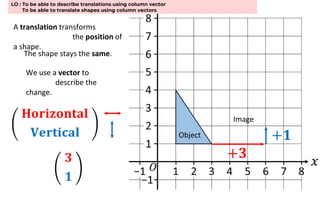
A translation transforms
the position of
a shape.
The shape stays the same.
We use a vector to
describe the
change.
Object
Image
LO : To be able to describe translations using column vector
To be able to translate shapes using column vectors
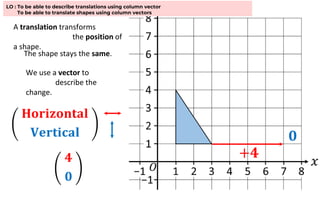
A translation transforms
the position of
a shape.
The shape stays the same.
We use a vector to
describe the
change.
LO : To be able to describe translations using column vector
To be able to translate shapes using column vectors
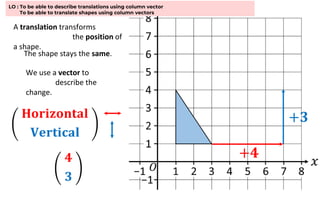
A translation transforms
the position of
a shape.
The shape stays the same.
We use a vector to
describe the
change.
LO : To be able to describe translations using column vector
To be able to translate shapes using column vectors
A translation transforms
the position of
a shape.
The shape stays the same.
We use a vector to
describe the
change.
LO : To be able to describe translations using column vector
To be able to translate shapes using column vectors
Transformations:
Translation
A translation transforms
the position of
a shape.
The shape stays the same.
We use a vector to
describe the
change.
LO : To be able to describe translations using column vector
To be able to translate shapes using column vectors
Transformations:
Translation
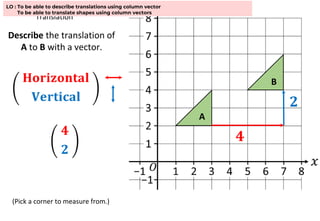
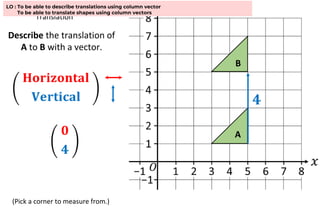
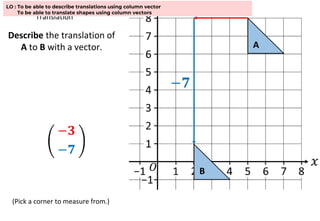
Describe the translation of
A to B with a vector.
A
B
(Pick a corner to measure from.)
LO : To be able to describe translations using column vector
To be able to translate shapes using column vectors
Transformations:
Translation
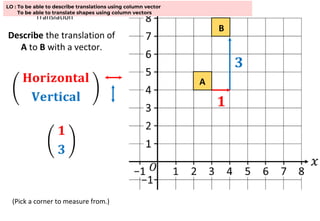
Describe the translation of
A to B with a vector.
A
B
(Pick a corner to measure from.)
LO : To be able to describe translations using column vector
To be able to translate shapes using column vectors
Transformations:
Translation
Describe the translation of
A to B with a vector.
A
B
(Pick a corner to measure from.)
LO : To be able to describe translations using column vector
To be able to translate shapes using column vectors
Transformations:
Translation
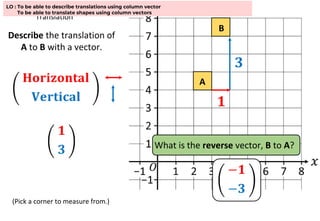
Describe the translation of
A to B with a vector.
A
B
(Pick a corner to measure from.)
What is the reverse vector, B to A?
LO : To be able to describe translations using column vector
To be able to translate shapes using column vectors
Transformations:
Translation
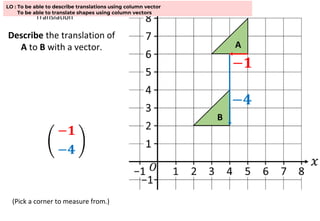
Describe the translation of
A to B with a vector.
A
B
(Pick a corner to measure from.)
LO : To be able to describe translations using column vector
To be able to translate shapes using column vectors
Transformations:
Translation
Describe the translation of
A to B with a vector.
A
B
(Pick a corner to measure from.)
LO : To be able to describe translations using column vector
To be able to translate shapes using column vectors
Transformations:
Translation
Describe the translation of
A to B with a vector.
A
B
(Pick a corner to measure from.)
LO : To be able to describe translations using column vector
To be able to translate shapes using column vectors
Transformations:
Translation
Describe the translation of
A to B with a vector. A
B
(Pick a corner to measure from.)
LO : To be able to describe translations using column vector
To be able to translate shapes using column vectors
Transformations:
Translation
Describe the translation of
A to B with a vector. A
B
(Pick a corner to measure from.)
LO : To be able to describe translations using column vector
To be able to translate shapes using column vectors
LO : To be able to describe translations using column vector
To be able to translate shapes using column vectors
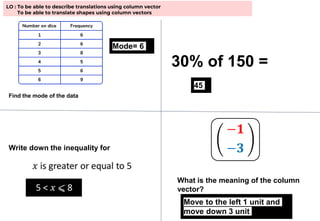
Find the mode of the data
30% of 150 =
Write down the inequality for
What is the meaning of the column
vector?
Mode= 6
Move to the left 1 unit and
move down 3 unit
45
A
LO : To be able to describe translations using column vector
To be able to translate shapes using column vectors
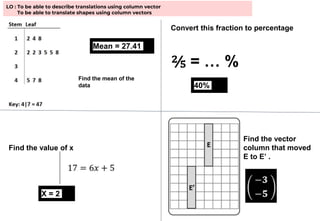
Find the mean of the
data
⅖ = … %
Find the value of x
Find the vector
column that moved
E to E’ .
Mean = 27.41
40%
Convert this fraction to percentage
X = 2
D
D’
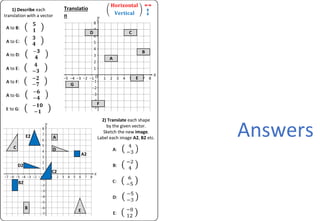
Translatio
n
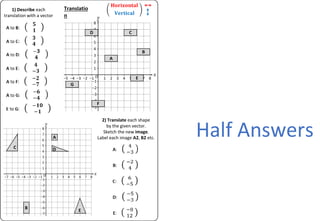
1) Describe each
translation with a vector
2) Translate each shape
by the given vector.
Sketch the new image.
Label each image A2, B2 etc.
A
C
B
D
E
G
F
A
B
C D
E
Half Answers
Translatio
n
1) Describe each
translation with a vector
2) Translate each shape
by the given vector.
Sketch the new image.
Label each image A2, B2 etc.
A
C
B
D
E
G
F
A
B
C D
E
A2
B2
C2
D2
E2 Answers
LO : To be able to describe rotations
To be able to rotate shapes when given a direction, angle and centre of rotation
Find the mean of the
data
⅖ = … %
Find the value of x
Find the vector
column that moved
E to E’ .
Mean = 27.41
40%
Convert this fraction to percentage
X = 2
Questions?
Comments?
Suggestions?
…or have you found a mistake!?
Any feedback would be appreciated ☺.
Please feel free to email:
tom@goteachmaths.co.uk

Fix Translation-Demonstration-2.pptx

  • 1.
    LO : Tobe able to describe translations using column vector To be able to translate shapes using column vectors
  • 2.
    LO : Tobe able to describe translations using column vector To be able to translate shapes using column vectors
  • 3.
    The robot moveshorizontally and vertically along the lines, one unit at a time. How can it get to the portal? How can we describe this? +6 horizontal +4 vertical
  • 4.
    The robot moveshorizontally and vertically along the lines, one unit at a time. Describe the movement to the portal. +6 horizontal −2 vertical
  • 5.
    A translation transforms theposition of a shape. The shape stays the same. We use a vector to describe the change. Object Image LO : To be able to describe translations using column vector To be able to translate shapes using column vectors
  • 6.
    A translation transforms theposition of a shape. The shape stays the same. We use a vector to describe the change. LO : To be able to describe translations using column vector To be able to translate shapes using column vectors
  • 7.
    A translation transforms theposition of a shape. The shape stays the same. We use a vector to describe the change. LO : To be able to describe translations using column vector To be able to translate shapes using column vectors
  • 8.
    A translation transforms theposition of a shape. The shape stays the same. We use a vector to describe the change. LO : To be able to describe translations using column vector To be able to translate shapes using column vectors
  • 9.
    Transformations: Translation A translation transforms theposition of a shape. The shape stays the same. We use a vector to describe the change. LO : To be able to describe translations using column vector To be able to translate shapes using column vectors
  • 10.
    Transformations: Translation Describe the translationof A to B with a vector. A B (Pick a corner to measure from.) LO : To be able to describe translations using column vector To be able to translate shapes using column vectors
  • 11.
    Transformations: Translation Describe the translationof A to B with a vector. A B (Pick a corner to measure from.) LO : To be able to describe translations using column vector To be able to translate shapes using column vectors
  • 12.
    Transformations: Translation Describe the translationof A to B with a vector. A B (Pick a corner to measure from.) LO : To be able to describe translations using column vector To be able to translate shapes using column vectors
  • 13.
    Transformations: Translation Describe the translationof A to B with a vector. A B (Pick a corner to measure from.) What is the reverse vector, B to A? LO : To be able to describe translations using column vector To be able to translate shapes using column vectors
  • 14.
    Transformations: Translation Describe the translationof A to B with a vector. A B (Pick a corner to measure from.) LO : To be able to describe translations using column vector To be able to translate shapes using column vectors
  • 15.
    Transformations: Translation Describe the translationof A to B with a vector. A B (Pick a corner to measure from.) LO : To be able to describe translations using column vector To be able to translate shapes using column vectors
  • 16.
    Transformations: Translation Describe the translationof A to B with a vector. A B (Pick a corner to measure from.) LO : To be able to describe translations using column vector To be able to translate shapes using column vectors
  • 17.
    Transformations: Translation Describe the translationof A to B with a vector. A B (Pick a corner to measure from.) LO : To be able to describe translations using column vector To be able to translate shapes using column vectors
  • 18.
    Transformations: Translation Describe the translationof A to B with a vector. A B (Pick a corner to measure from.) LO : To be able to describe translations using column vector To be able to translate shapes using column vectors
  • 20.
    LO : Tobe able to describe translations using column vector To be able to translate shapes using column vectors Find the mode of the data 30% of 150 = Write down the inequality for What is the meaning of the column vector? Mode= 6 Move to the left 1 unit and move down 3 unit 45
  • 21.
  • 25.
    LO : Tobe able to describe translations using column vector To be able to translate shapes using column vectors Find the mean of the data ⅖ = … % Find the value of x Find the vector column that moved E to E’ . Mean = 27.41 40% Convert this fraction to percentage X = 2
  • 26.
  • 28.
    Translatio n 1) Describe each translationwith a vector 2) Translate each shape by the given vector. Sketch the new image. Label each image A2, B2 etc. A C B D E G F A B C D E Half Answers
  • 29.
    Translatio n 1) Describe each translationwith a vector 2) Translate each shape by the given vector. Sketch the new image. Label each image A2, B2 etc. A C B D E G F A B C D E A2 B2 C2 D2 E2 Answers
  • 30.
    LO : Tobe able to describe rotations To be able to rotate shapes when given a direction, angle and centre of rotation Find the mean of the data ⅖ = … % Find the value of x Find the vector column that moved E to E’ . Mean = 27.41 40% Convert this fraction to percentage X = 2
  • 31.
    Questions? Comments? Suggestions? …or have youfound a mistake!? Any feedback would be appreciated ☺. Please feel free to email: tom@goteachmaths.co.uk