Bible Basics for the Family
The Doctrine of
Creation
Five (5) Major Views of Creation
1. Atheistic Evolution
2. Theistic Evolution
3. Progressive Creation (Day-Age
Theory)
4. Gap Theory
5. Six-Day Creation
(1) Atheistic Evolution
Statement of the View:
“Everything in the universe has come into
existence and has evolved into its present
form as a result of natural processes
unaided by any supernatural power.”
Positive Aspects of the Atheistic
Evolution from its Advocates
1. It appears to explain the origin of
everything.
2. It offers a single explanation for
everything that exists: “It evolved.”
3. It offers the only real alternative to
creation by God.
4. It eliminates God and exalts man. It is
thoroughly humanistic.
Problems with Atheistic Evolution
1. It rests on a hypothesis that cannot be
proved to be true; it is essentially a faith
position (just like creationist positions).
2. It is supported by little historical
(geological) evidence (only the fossil
record) which has many gaps in it and is
open to subjective interpretation
Problems with Atheistic Evolution
3. It relies on mutations as a mechanism for
change, but mutations have not produced
new species, and are almost always
harmful and destructive.
4. It is extremely improbable statistically.
5. It repudiates special revelation (Scripture)
concerning creation.
(2) Theistic Evolution
Statement of the View:
“Everything in the universe has come into
existence and has evolved into its present
form as a result of natural processes
guided by the God of the Bible.”
Positive Aspects of Theistic
Evolution from its Advocates
1. It unites truth known by special revelation
in the Bible with truth known by general
revelation in nature and discovered by
science.
2. God seems to work according to this
pattern in history interrupting and
intervening the course of events only
rarely.
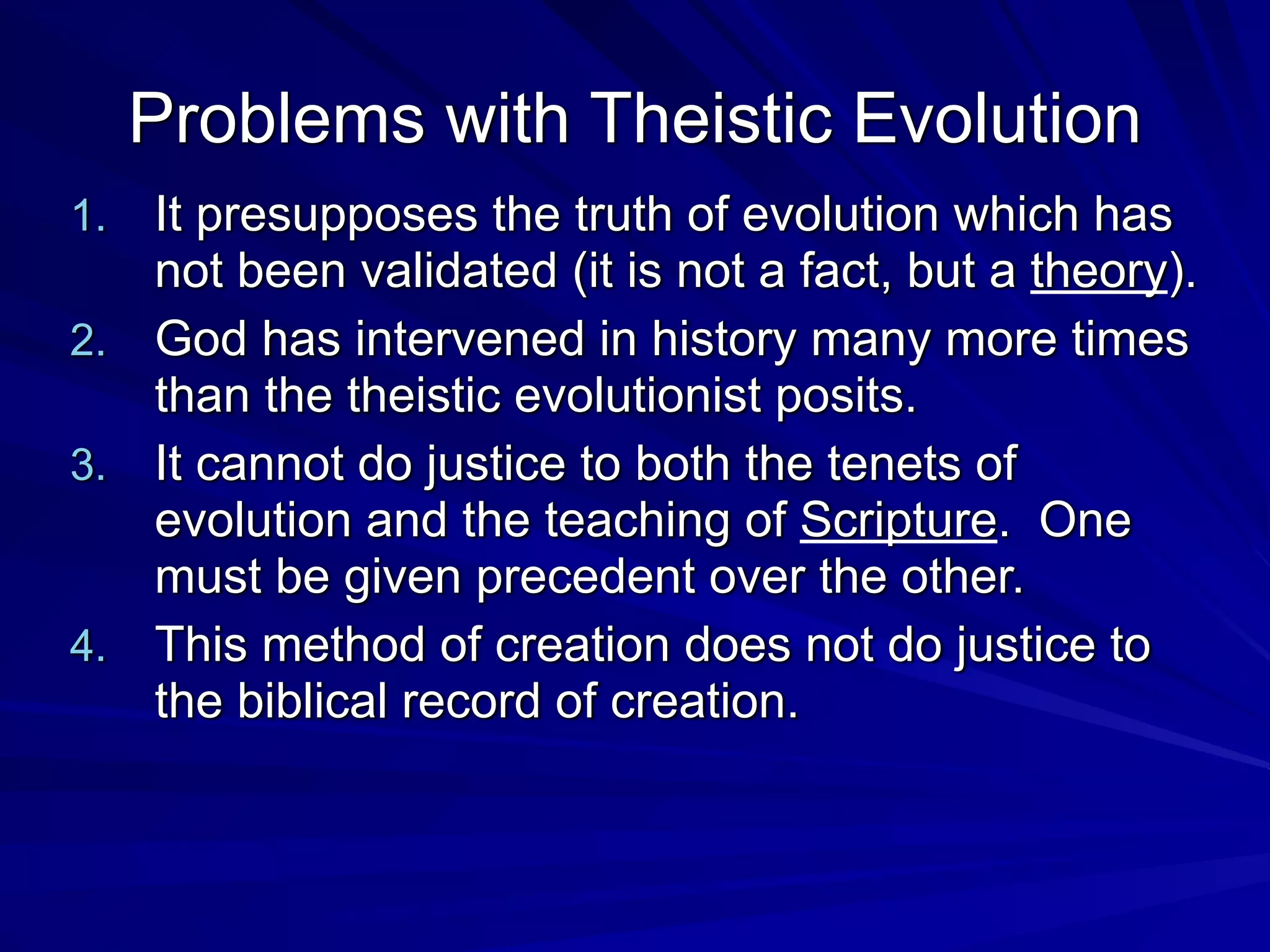
Problems with Theistic Evolution
1. It presupposes the truth of evolution which has
not been validated (it is not a fact, but a theory).
2. God has intervened in history many more times
than the theistic evolutionist posits.
3. It cannot do justice to both the tenets of
evolution and the teaching of Scripture. One
must be given precedent over the other.
4. This method of creation does not do justice to
the biblical record of creation.
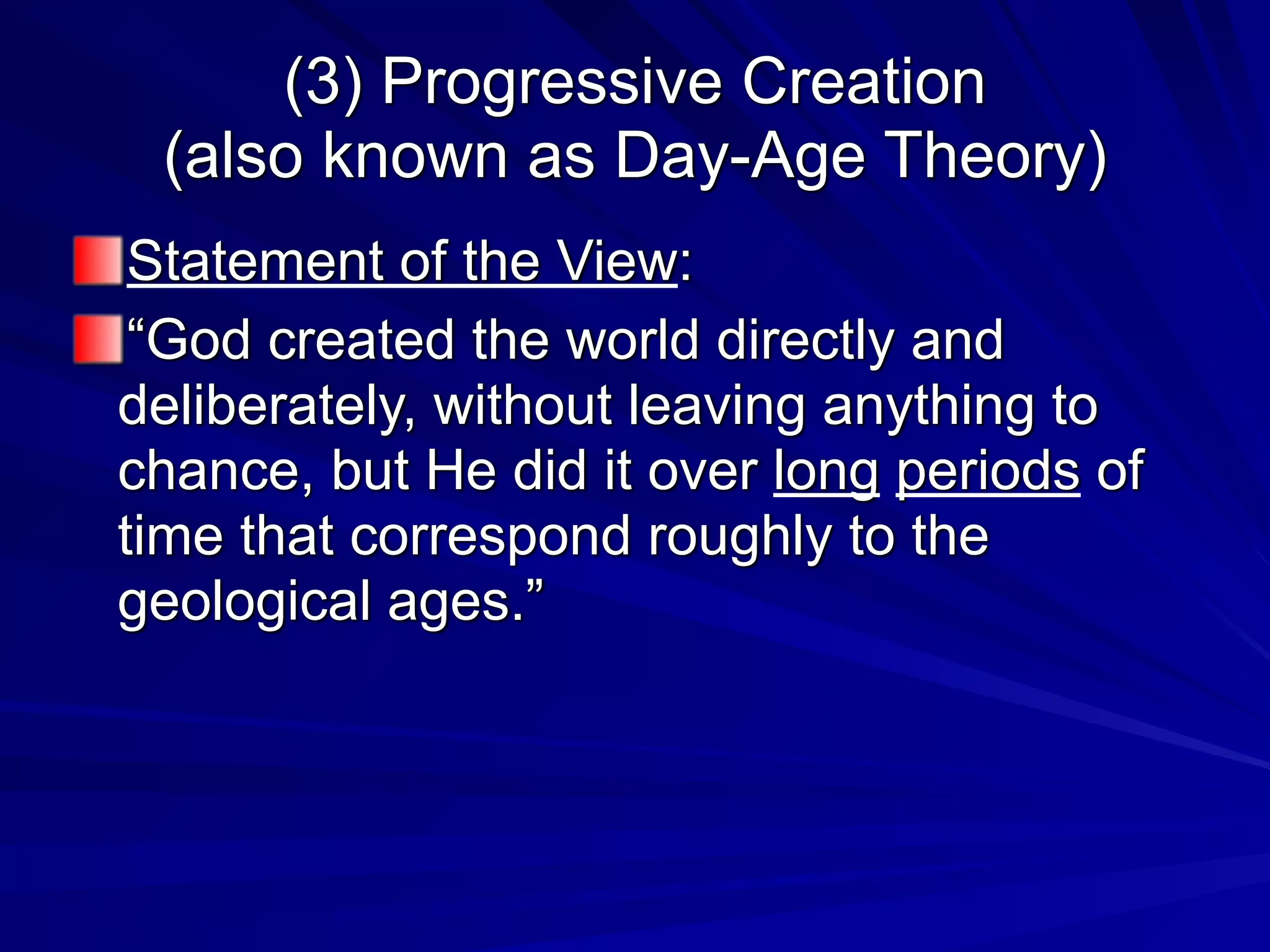
(3) Progressive Creation
(also known as Day-Age Theory)
Statement of the View:
“God created the world directly and
deliberately, without leaving anything to
chance, but He did it over long periods of
time that correspond roughly to the
geological ages.”
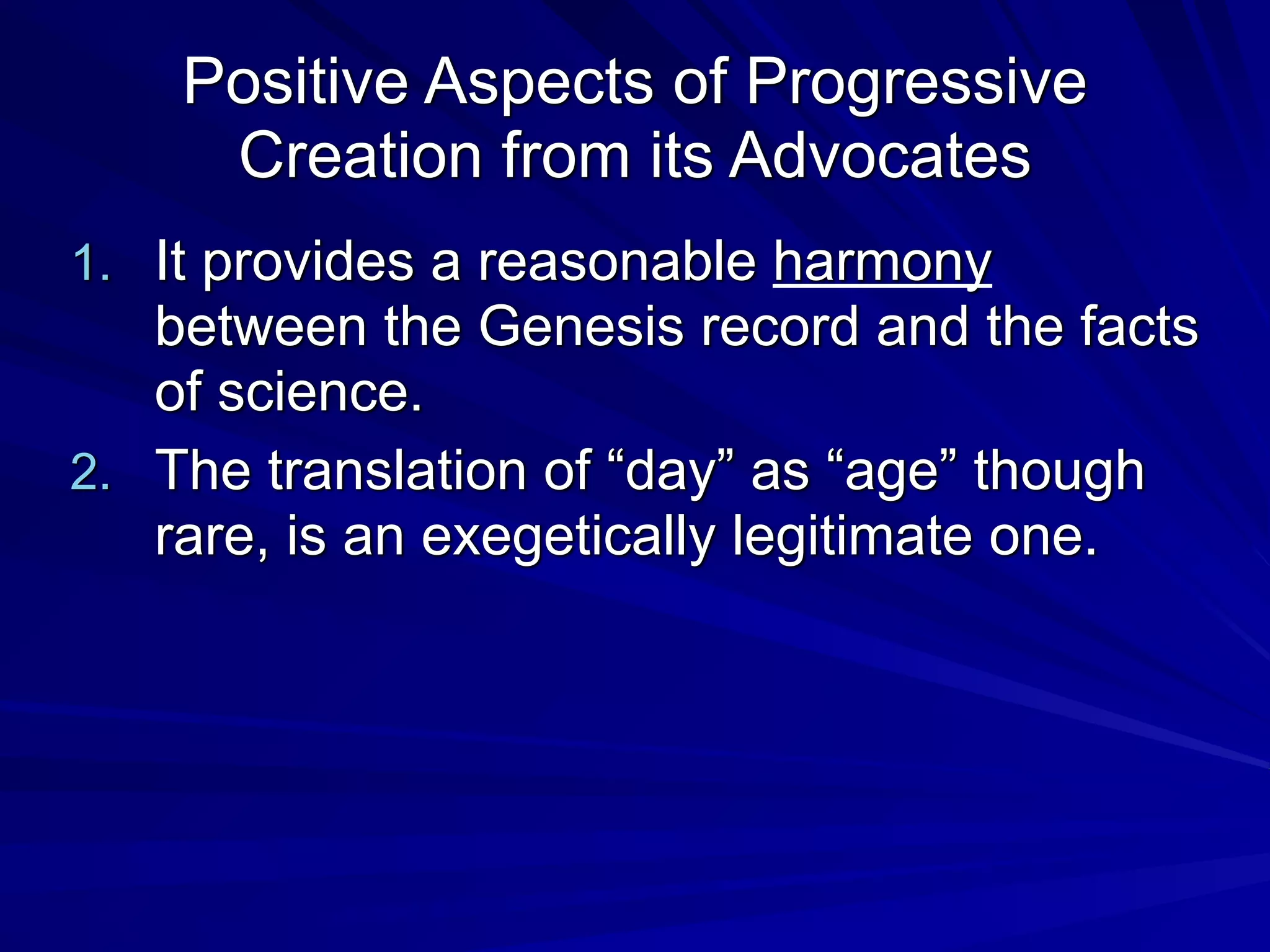
Positive Aspects of Progressive
Creation from its Advocates
1. It provides a reasonable harmony
between the Genesis record and the facts
of science.
2. The translation of “day” as “age” though
rare, is an exegetically legitimate one.
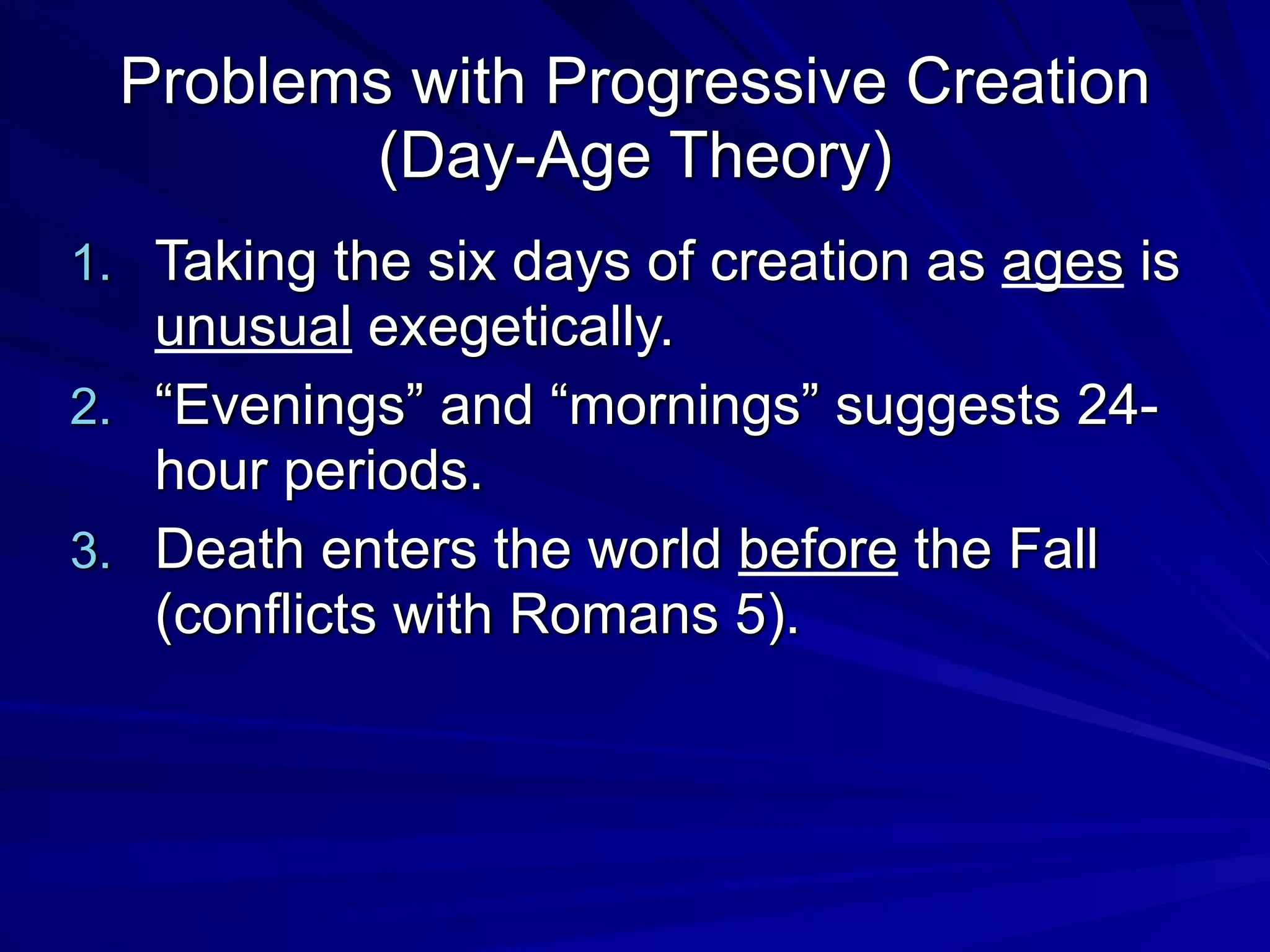
Problems with Progressive Creation
(Day-Age Theory)
1. Taking the six days of creation as ages is
unusual exegetically.
2. “Evenings” and “mornings” suggests 24-
hour periods.
3. Death enters the world before the Fall
(conflicts with Romans 5).
(4) The Gap Theory
Statement of the View:
“Between Genesis 1:1 and 1:2 there was a
long, indeterminate period in which the
destruction of an original world and the
unfolding of the geological ages can be
located. God then recreated the cosmos.”
Positive Aspects of the Gap Theory
according to its Advocates
1. It rests on an exegetical, biblical base.
2. It is consistent with the structure of the
creation account itself.
3. It is possible to translate the Hebrew verb
“to be” in verse 2 as “became.”
Problems with the Gap Theory
1. It is an unnatural explanation since the
text implies an original creation in
Genesis 1:2ff (cf. Exodus 20:11).
2. While the view builds on a high view of
Scripture, several of the interpretations
for it are based on improbable exegesis.
In this light some have proposed moving
the gap to between John 1:1 and Genesis
1:1.
(5) Six Day Creation
Statement of the View:
“Genesis 1 describes one creative process
that took place in six consecutive 24-hour
periods of time, not more than 6-20
thousand years ago (many would allow for
an older earth and creation date).”
Positive Aspects of Six-Day Creation
by its Advocates
1. It regards biblical teaching as
determinative.
2. It rests on a strong exegetical base.
3. It is the clearest meaning of the text.
4. It is consistent with the laws of
thermodynamics . . .
Laws of Thermodynamics
1. 1st Law of Thermodynamics: although
energy can be changed in form, it is not
now being created (Genesis 2:1-3;
Hebrews 4:4,10).
2. 2nd Law of Thermodynamics: all physical
systems, if left to themselves, tend
toward atrophy and become disordered
(Hebrews 1:10-12; Romans 8:20-22).
Problems with Six-Day Creation
1. Data from various scientific disciplines
indicates the earth is about 5 billion years
old.
2. Creation with the appearance of age
casts doubt on the credibility of God.
3. While the view is based on the best
exegesis of the text, it contradicts the
present conclusions of several branches
of science.
Creationists Who founded
Modern Science
Kepler—Astronomy
Pascal—Hydrostatics
Boyle—Chemistry
Newton—Physics
Kelvin—Thermodynamics
Johann Kepler (1571-1630):
At the end of his life his prayer was,
“I give you thanks, Creator and God,
that you have given me this joy in thy
creation, and I rejoice in the works of
your hands. See I have now completed
the work to which I was called. In it I
have used all the talents you have lent
to my spirit.”
Five (5) Major Views of Creation

Five (5) Major Views of Creation

  • 1.
    Bible Basics forthe Family The Doctrine of Creation
  • 2.
    Five (5) MajorViews of Creation 1. Atheistic Evolution 2. Theistic Evolution 3. Progressive Creation (Day-Age Theory) 4. Gap Theory 5. Six-Day Creation
  • 3.
    (1) Atheistic Evolution Statementof the View: “Everything in the universe has come into existence and has evolved into its present form as a result of natural processes unaided by any supernatural power.”
  • 4.
    Positive Aspects ofthe Atheistic Evolution from its Advocates 1. It appears to explain the origin of everything. 2. It offers a single explanation for everything that exists: “It evolved.” 3. It offers the only real alternative to creation by God. 4. It eliminates God and exalts man. It is thoroughly humanistic.
  • 5.
    Problems with AtheisticEvolution 1. It rests on a hypothesis that cannot be proved to be true; it is essentially a faith position (just like creationist positions). 2. It is supported by little historical (geological) evidence (only the fossil record) which has many gaps in it and is open to subjective interpretation
  • 6.
    Problems with AtheisticEvolution 3. It relies on mutations as a mechanism for change, but mutations have not produced new species, and are almost always harmful and destructive. 4. It is extremely improbable statistically. 5. It repudiates special revelation (Scripture) concerning creation.
  • 7.
    (2) Theistic Evolution Statementof the View: “Everything in the universe has come into existence and has evolved into its present form as a result of natural processes guided by the God of the Bible.”
  • 8.
    Positive Aspects ofTheistic Evolution from its Advocates 1. It unites truth known by special revelation in the Bible with truth known by general revelation in nature and discovered by science. 2. God seems to work according to this pattern in history interrupting and intervening the course of events only rarely.
  • 9.
    Problems with TheisticEvolution 1. It presupposes the truth of evolution which has not been validated (it is not a fact, but a theory). 2. God has intervened in history many more times than the theistic evolutionist posits. 3. It cannot do justice to both the tenets of evolution and the teaching of Scripture. One must be given precedent over the other. 4. This method of creation does not do justice to the biblical record of creation.
  • 10.
    (3) Progressive Creation (alsoknown as Day-Age Theory) Statement of the View: “God created the world directly and deliberately, without leaving anything to chance, but He did it over long periods of time that correspond roughly to the geological ages.”
  • 11.
    Positive Aspects ofProgressive Creation from its Advocates 1. It provides a reasonable harmony between the Genesis record and the facts of science. 2. The translation of “day” as “age” though rare, is an exegetically legitimate one.
  • 12.
    Problems with ProgressiveCreation (Day-Age Theory) 1. Taking the six days of creation as ages is unusual exegetically. 2. “Evenings” and “mornings” suggests 24- hour periods. 3. Death enters the world before the Fall (conflicts with Romans 5).
  • 13.
    (4) The GapTheory Statement of the View: “Between Genesis 1:1 and 1:2 there was a long, indeterminate period in which the destruction of an original world and the unfolding of the geological ages can be located. God then recreated the cosmos.”
  • 14.
    Positive Aspects ofthe Gap Theory according to its Advocates 1. It rests on an exegetical, biblical base. 2. It is consistent with the structure of the creation account itself. 3. It is possible to translate the Hebrew verb “to be” in verse 2 as “became.”
  • 15.
    Problems with theGap Theory 1. It is an unnatural explanation since the text implies an original creation in Genesis 1:2ff (cf. Exodus 20:11). 2. While the view builds on a high view of Scripture, several of the interpretations for it are based on improbable exegesis. In this light some have proposed moving the gap to between John 1:1 and Genesis 1:1.
  • 16.
    (5) Six DayCreation Statement of the View: “Genesis 1 describes one creative process that took place in six consecutive 24-hour periods of time, not more than 6-20 thousand years ago (many would allow for an older earth and creation date).”
  • 17.
    Positive Aspects ofSix-Day Creation by its Advocates 1. It regards biblical teaching as determinative. 2. It rests on a strong exegetical base. 3. It is the clearest meaning of the text. 4. It is consistent with the laws of thermodynamics . . .
  • 18.
    Laws of Thermodynamics 1.1st Law of Thermodynamics: although energy can be changed in form, it is not now being created (Genesis 2:1-3; Hebrews 4:4,10). 2. 2nd Law of Thermodynamics: all physical systems, if left to themselves, tend toward atrophy and become disordered (Hebrews 1:10-12; Romans 8:20-22).
  • 19.
    Problems with Six-DayCreation 1. Data from various scientific disciplines indicates the earth is about 5 billion years old. 2. Creation with the appearance of age casts doubt on the credibility of God. 3. While the view is based on the best exegesis of the text, it contradicts the present conclusions of several branches of science.
  • 20.
    Creationists Who founded ModernScience Kepler—Astronomy Pascal—Hydrostatics Boyle—Chemistry Newton—Physics Kelvin—Thermodynamics
  • 21.
    Johann Kepler (1571-1630): Atthe end of his life his prayer was, “I give you thanks, Creator and God, that you have given me this joy in thy creation, and I rejoice in the works of your hands. See I have now completed the work to which I was called. In it I have used all the talents you have lent to my spirit.”