This document provides information about FitNesse, a software collaboration and testing tool. It discusses acceptance testing and different types. It then describes what FitNesse is, how it works as a wiki and with different programming languages. The document outlines FitNesse's architecture using wiki pages, a testing engine, test fixtures, and the system under test. It also discusses the FIT and Slim testing engines and how fixtures interface between FitNesse tables and the system being tested.
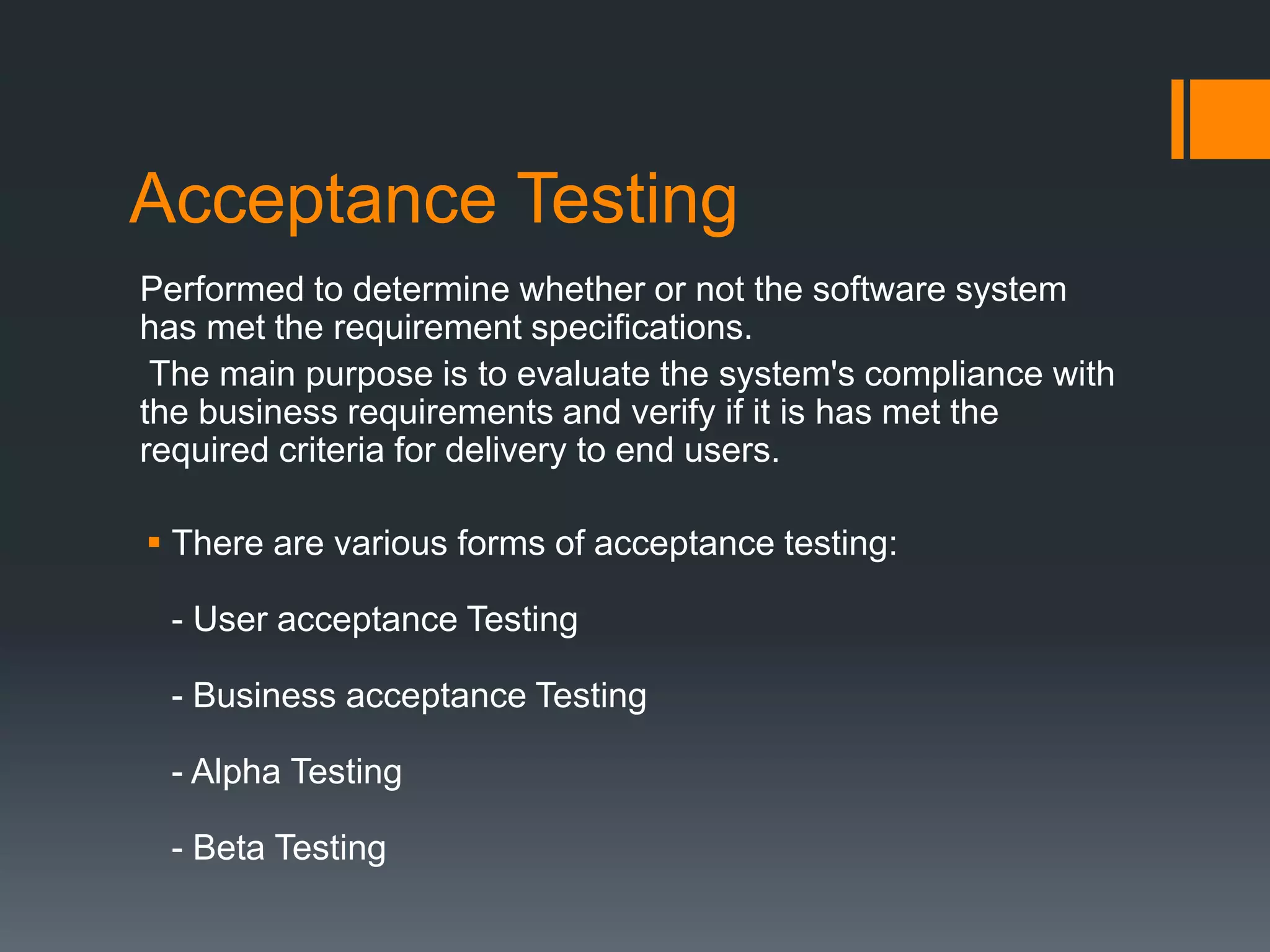
Acceptance Testing
Performed todetermine whether or not the software system
has met the requirement specifications.
The main purpose is to evaluate the system's compliance with
the business requirements and verify if it is has met the
required criteria for delivery to end users.
There are various forms of acceptance testing:
- User acceptance Testing
- Business acceptance Testing
- Alpha Testing
- Beta Testing
3.
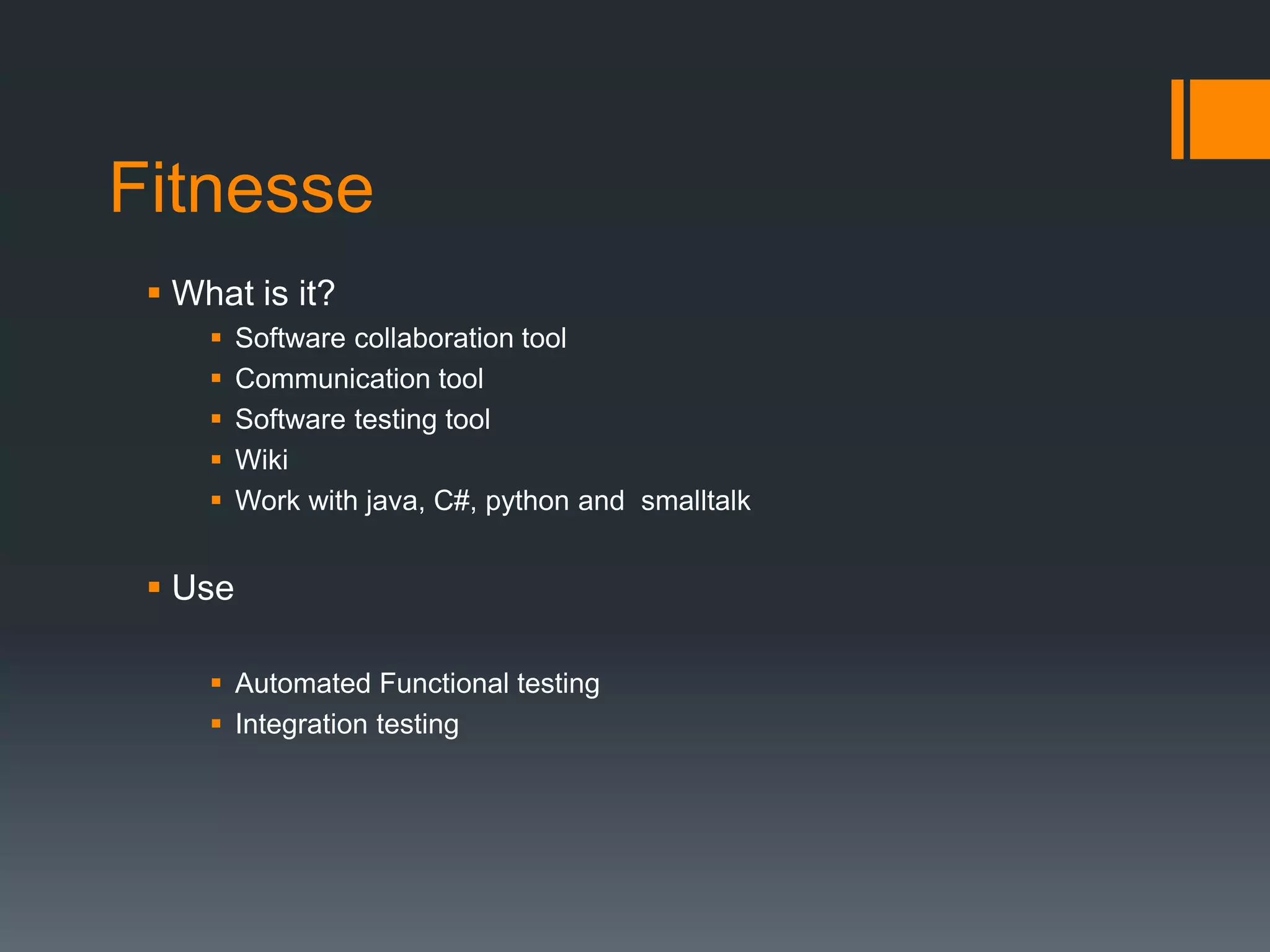
Fitnesse
What isit?
Software collaboration tool
Communication tool
Software testing tool
Wiki
Work with java, C#, python and smalltalk
Use
Automated Functional testing
Integration testing
Comparison
Tests arewritten before the code, so this approach
supports TDD i.e Test Driven Development
Open source
Execution of the tests can be automated.
Test are deterministic.
Increase the business value.
6.
Architecture
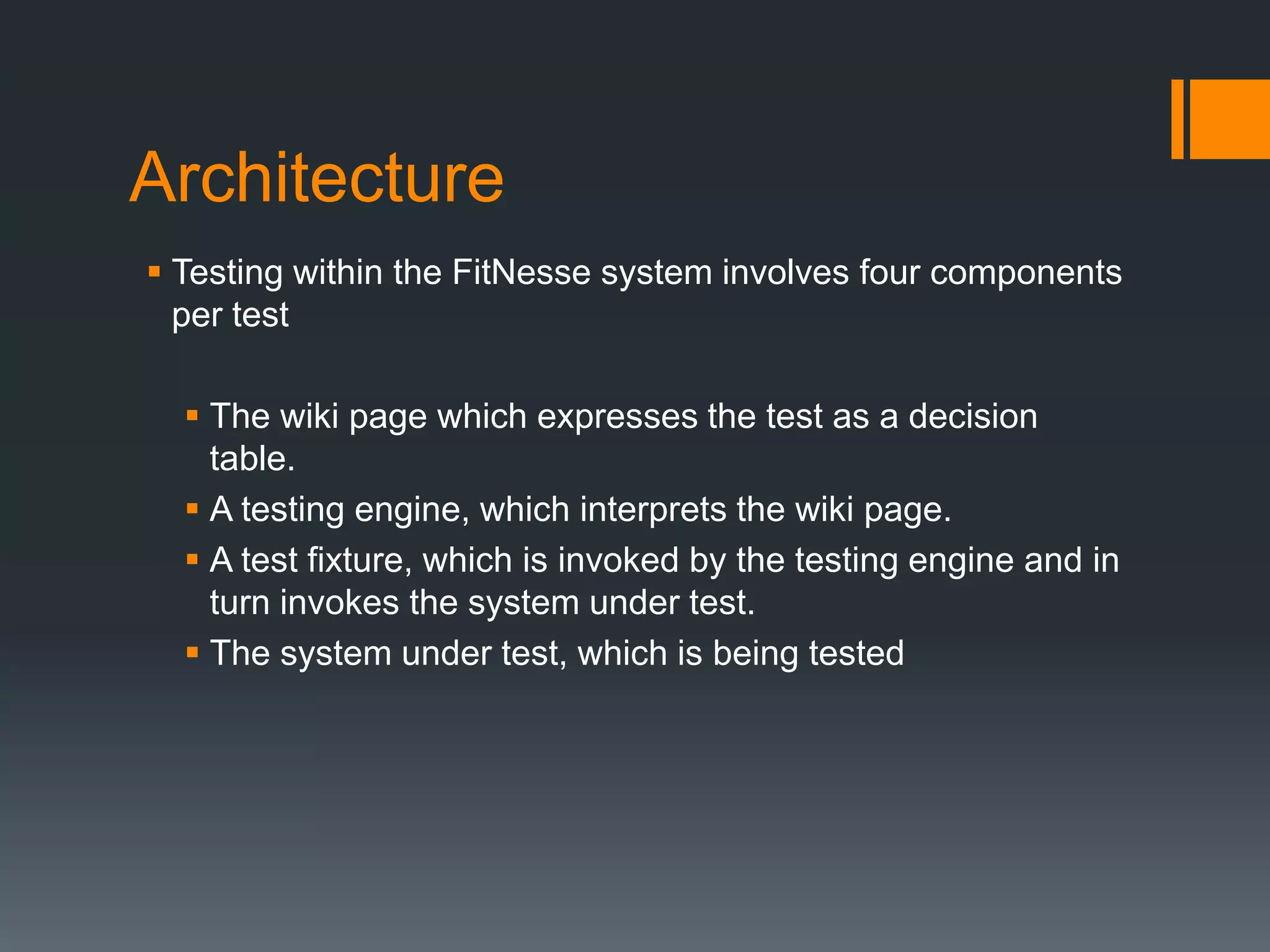
Testing withinthe FitNesse system involves four components
per test
The wiki page which expresses the test as a decision
table.
A testing engine, which interprets the wiki page.
A test fixture, which is invoked by the testing engine and in
turn invokes the system under test.
The system under test, which is being tested
7.
Testing engines
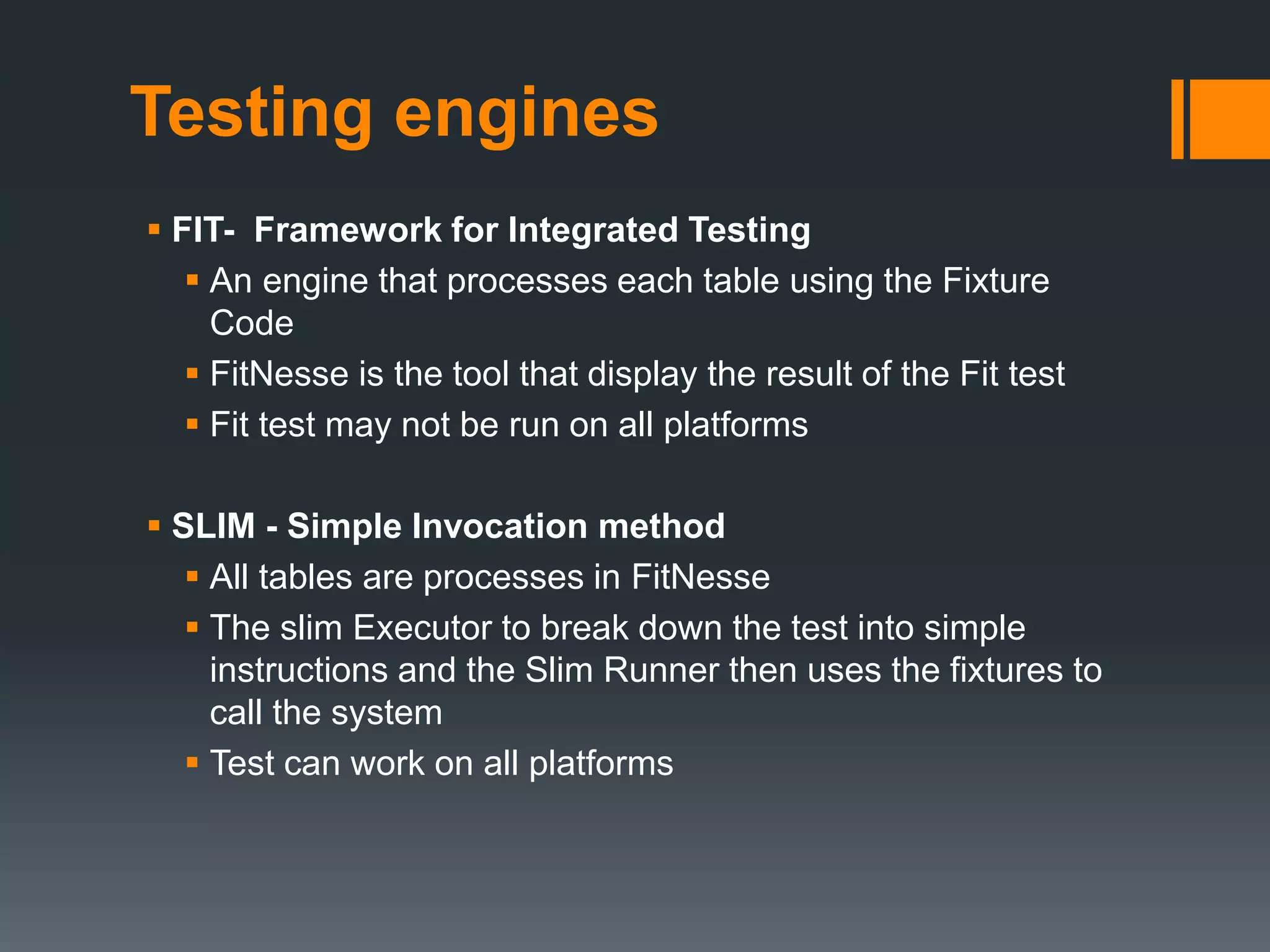
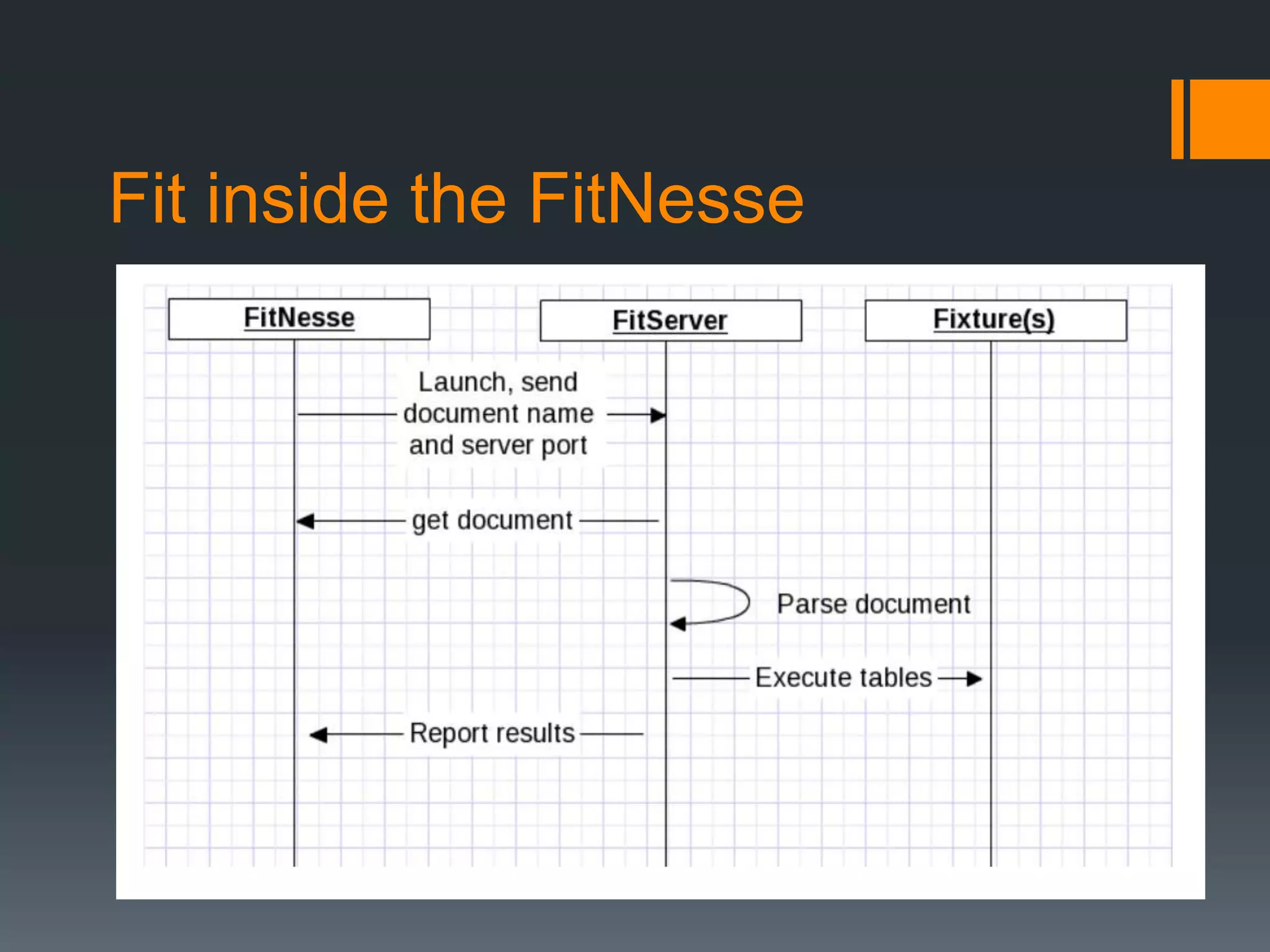
FIT-Framework for Integrated Testing
An engine that processes each table using the Fixture
Code
FitNesse is the tool that display the result of the Fit test
Fit test may not be run on all platforms
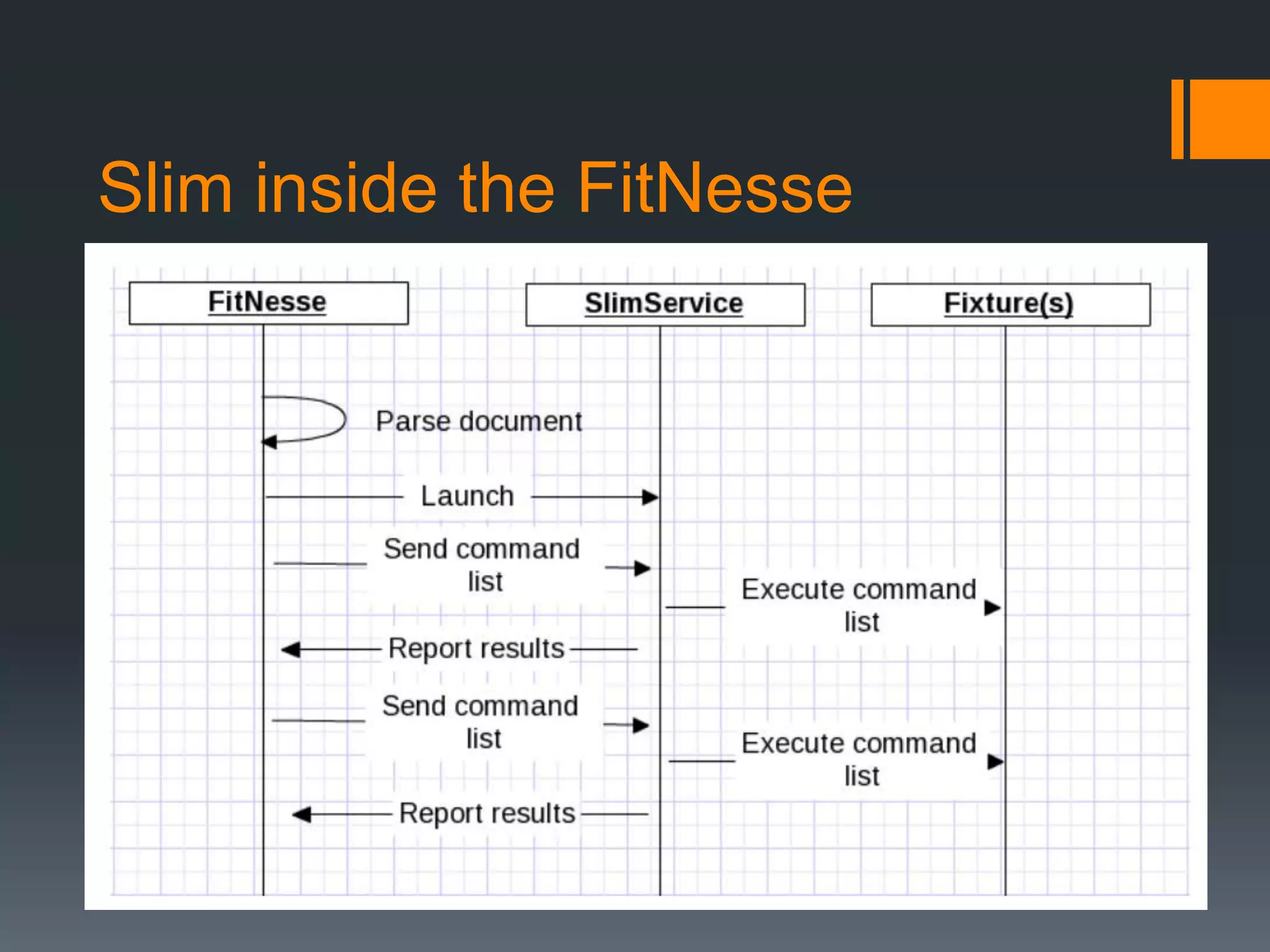
SLIM - Simple Invocation method
All tables are processes in FitNesse
The slim Executor to break down the test into simple
instructions and the Slim Runner then uses the fixtures to
call the system
Test can work on all platforms
Fixture, What?
Fit(Nesse) andFixtures
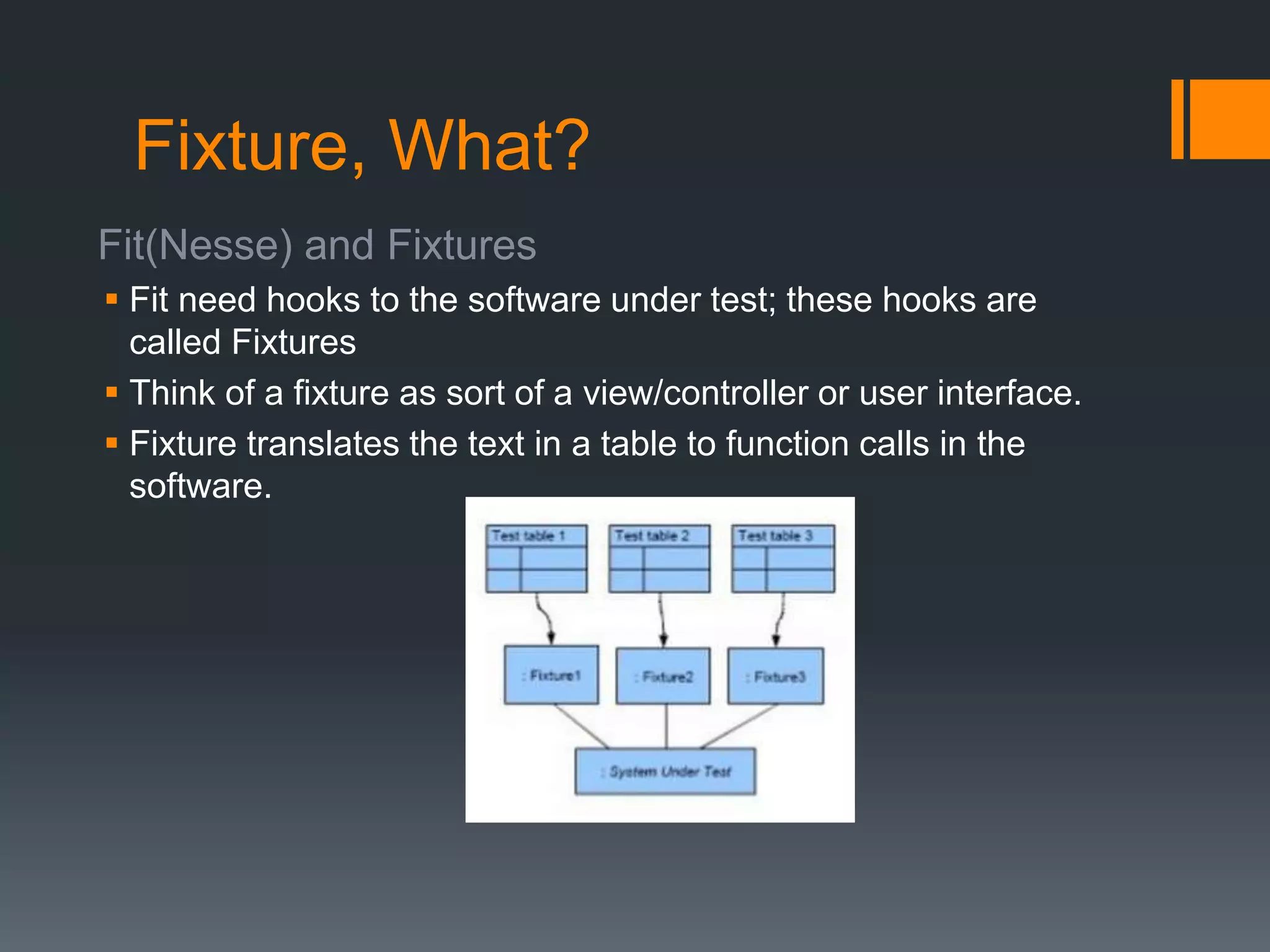
Fit need hooks to the software under test; these hooks are
called Fixtures
Think of a fixture as sort of a view/controller or user interface.
Fixture translates the text in a table to function calls in the
software.
12.
How does itwork
• Download fitnesse.jar and fitNesselibrary.jar
http://fitnesse.org/FitNesseDownload
Configuration
Java –jar fitnesse.jar –p 8080
#3 High level view of what the sys produces. vErify the s/w has met requirement specifications
Feedback loop btwn custmrs , testers n developers.
#4 FitNesse is a web server, a wiki, and an automated testing tool for software.
FitNesse is a tool for enhancing collaboration in software development.
FitNesse enables customers, testers, and programmers to learn what their software should do, and to automatically compare that to what it actually does do. It compares customers' expectations to actual results.
FitNesse is a software testing tool.
From another perspective, FitNesse is a lightweight, open-source framework that makes it easy for software teams to:
Collaboratively define AcceptanceTests -- web pages containing simple tables of inputs and expected outputs.
Run those tests and see the results.
FitNesse is a wiki.
You can easily create and edit pages.
FitNesse is a web server.
It requires no configuration or setup.
Just run it and then direct your browser to the machine where it is running.
#6 -provide feed back early in the projects
-lightweight, inexpensive
-Easy to test anyone can run these test as many time as they want
-turn red test passes and turn green if not. More green text shows that the sytem very close to better abd valuable one. More to meet the stakeholders requirments.