

Enabling Transparency
in Meat Supply Chains

one tracking & tracing system
to serve
supply chain partners,
consumers and
authorities

Huub Scholten1, Tim Bartram2, Ayalew
Kassahun1, Sabine Kläser2, Ralph Tröger2, Rob
Hartog1, Angela Schillings-Schmitz2, Sandra
3
Meier2, Robert Netherlands
1 Wageningen University, Reiche
2

GS1 Germany, Cologne, Germany
3 Euro Pool System, Bornheim, Germany
Topics
•
•
•
•
•

Problems to be solved
Transparency system to be developed
Functionalities and apps
Business cases for end-users
Business case for you?
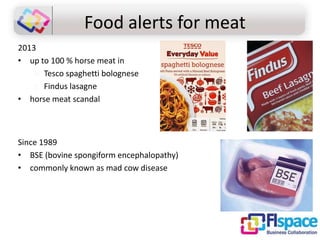
Food alerts for meat
2013
• up to 100 % horse meat in
o Tesco spaghetti bolognese
o Findus lasagne
• horse meat scandal

Since 1989
• BSE (bovine spongiform encephalopathy)
• commonly known as mad cow disease
Rationale
• Consumer’s interest in origin, animal welfare, food safety and not only price
• Authorities, consumers and meat supply chain partners require provenance
data in case of a meat related food safety alert
• Beef: because of BSE
• Other types of meat: EU regulation 1169/2011 now beef, in 2014 other meat
• Real time and all the time information and not only retrospective in case of
food safety alerts and also to quality issues
• All information wanted by consumers and other parties should be provided
by supply chain partners and transported along the supply chain.
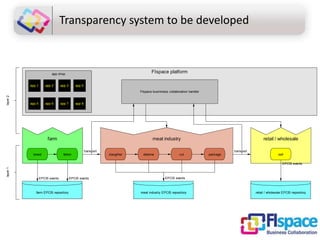
Transparency system to be developed

FIspace platform

app shop

app 1

app 2

app 3

app 4

layer 2

FIspace busininess collaboration handler

app 5

app 6

app 7

app 8

farm

meat industry

retail / wholesale

transport
breed

fatten

transport
slaugther

debone

cut

package

sell

layer 1

EPCIS events

EPCIS events

farm EPCIS repository

EPCIS events

EPCIS events

meat industry EPCIS repository

retail / wholesale EPCIS repository
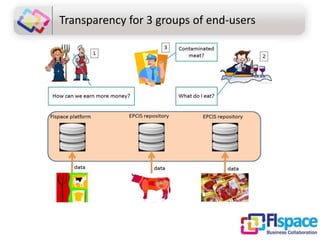
Transparency for 3 groups of end-users
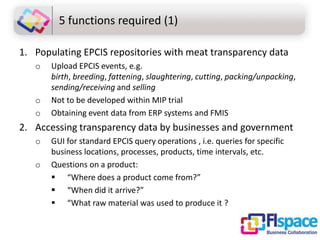
5 functions required (1)
1. Populating EPCIS repositories with meat transparency data
o

o
o

Upload EPCIS events, e.g.
birth, breeding, fattening, slaughtering, cutting, packing/unpacking,
sending/receiving and selling
Not to be developed within MIP trial
Obtaining event data from ERP systems and FMIS

2. Accessing transparency data by businesses and government
o
o

GUI for standard EPCIS query operations , i.e. queries for specific
business locations, processes, products, time intervals, etc.
Questions on a product:
 “Where does a product come from?”
 “When did it arrive?”
 “What raw material was used to produce it ?
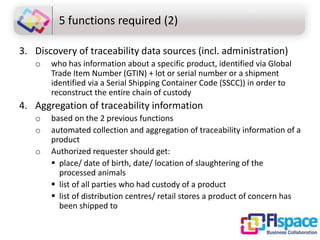
5 functions required (2)
3. Discovery of traceability data sources (incl. administration)
o

who has information about a specific product, identified via Global
Trade Item Number (GTIN) + lot or serial number or a shipment
identified via a Serial Shipping Container Code (SSCC)) in order to
reconstruct the entire chain of custody

4. Aggregation of traceability information
o
o
o

based on the 2 previous functions
automated collection and aggregation of traceability information of a
product
Authorized requester should get:
 place/ date of birth, date/ location of slaughtering of the
processed animals
 list of all parties who had custody of a product
 list of distribution centres/ retail stores a product of concern has
been shipped to
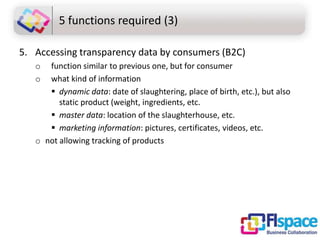
5 functions required (3)
5. Accessing transparency data by consumers (B2C)
o
o

function similar to previous one, but for consumer
what kind of information
 dynamic data: date of slaughtering, place of birth, etc.), but also
static product (weight, ingredients, etc.
 master data: location of the slaughterhouse, etc.
 marketing information: pictures, certificates, videos, etc.
o not allowing tracking of products
From requirements to apps
• Requirement 1: to be developed as generic app, relevant for
more trials
• Requirement 5: to be developed together with the trial on
Tailored Information for Consumers

• Requirement 2, 3 and 4 should be developed by new partners
entering FIspace’s MIP trial through the open call
Business cases for consumers
Consumers
• Be informed by smartphone/website on
– dynamic data: date of slaughtering, place of birth, etc.), but also static
product (weight, ingredients, etc.
– master data: location of the slaughterhouse, etc.
– marketing information: pictures, certificates, videos, recipes, etc.
• Meat related information will be filtered cf. interests

Retailers
• Can provide an enhanced consumer experience with
– Proven history of the meat item
– Brand-like name and approval stamp
Business cases for meat supply chain partners
Farmers
– direct link to consumers
• facilitating differentiation of products from those of other farms
• Investments on e.g. animal welfare or sustainable production can be
communicated to consumers

Farmers, slaughterhouses and meat processor
– products can be better based on requirements of consumers and meat
supply chain partners
– it will facilitate optimising every partner’s business process and
improve investment decisions.
Business cases for regulators/authorities
Authorities
• In case of meat alerts:
–
–
–
–

Easier control and regulation enforcement
New system enables a fast, effective, surgical response
with less critique by the media and the general public
resulting in more confidence and trust in the responsible authorities.

Society as a whole
• The new system makes investing in sustainable production
and animal welfare more lucrative.
• Moreover, no general alarms are required in case of meat
alerts.
Why should you join the team?
• Large impact on society
• Funded app development is seed for many more projects, i.e.
– Develop apps funded by EC
– Roll-out after end of FIspace

• A proposal for a FI-PPP phase 3 project is under construction:
– Transparency Fresh Food supply chains
– More types of fresh food (several meat types, fruits & vegetables,
bakery, etc.)
– More fresh food supply chains (> 1000 supermarket chains in Europe)
Questions?
Huub Scholten – Wageningen University – huub.scholten@wur.nl
Tim Bartram – GS1 G - Bartram@gs1-germany.de
www.FIspace.eu

FIspace Meat Information Provenance Trial Open Call

  • 1.
    Enabling Transparency in MeatSupply Chains one tracking & tracing system to serve supply chain partners, consumers and authorities Huub Scholten1, Tim Bartram2, Ayalew Kassahun1, Sabine Kläser2, Ralph Tröger2, Rob Hartog1, Angela Schillings-Schmitz2, Sandra 3 Meier2, Robert Netherlands 1 Wageningen University, Reiche 2 GS1 Germany, Cologne, Germany 3 Euro Pool System, Bornheim, Germany
  • 2.
    Topics • • • • • Problems to besolved Transparency system to be developed Functionalities and apps Business cases for end-users Business case for you?
  • 3.
    Food alerts formeat 2013 • up to 100 % horse meat in o Tesco spaghetti bolognese o Findus lasagne • horse meat scandal Since 1989 • BSE (bovine spongiform encephalopathy) • commonly known as mad cow disease
  • 4.
    Rationale • Consumer’s interestin origin, animal welfare, food safety and not only price • Authorities, consumers and meat supply chain partners require provenance data in case of a meat related food safety alert • Beef: because of BSE • Other types of meat: EU regulation 1169/2011 now beef, in 2014 other meat • Real time and all the time information and not only retrospective in case of food safety alerts and also to quality issues • All information wanted by consumers and other parties should be provided by supply chain partners and transported along the supply chain.
  • 5.
    Transparency system tobe developed FIspace platform app shop app 1 app 2 app 3 app 4 layer 2 FIspace busininess collaboration handler app 5 app 6 app 7 app 8 farm meat industry retail / wholesale transport breed fatten transport slaugther debone cut package sell layer 1 EPCIS events EPCIS events farm EPCIS repository EPCIS events EPCIS events meat industry EPCIS repository retail / wholesale EPCIS repository
  • 6.
    Transparency for 3groups of end-users
  • 7.
    5 functions required(1) 1. Populating EPCIS repositories with meat transparency data o o o Upload EPCIS events, e.g. birth, breeding, fattening, slaughtering, cutting, packing/unpacking, sending/receiving and selling Not to be developed within MIP trial Obtaining event data from ERP systems and FMIS 2. Accessing transparency data by businesses and government o o GUI for standard EPCIS query operations , i.e. queries for specific business locations, processes, products, time intervals, etc. Questions on a product:  “Where does a product come from?”  “When did it arrive?”  “What raw material was used to produce it ?
  • 8.
    5 functions required(2) 3. Discovery of traceability data sources (incl. administration) o who has information about a specific product, identified via Global Trade Item Number (GTIN) + lot or serial number or a shipment identified via a Serial Shipping Container Code (SSCC)) in order to reconstruct the entire chain of custody 4. Aggregation of traceability information o o o based on the 2 previous functions automated collection and aggregation of traceability information of a product Authorized requester should get:  place/ date of birth, date/ location of slaughtering of the processed animals  list of all parties who had custody of a product  list of distribution centres/ retail stores a product of concern has been shipped to
  • 9.
    5 functions required(3) 5. Accessing transparency data by consumers (B2C) o o function similar to previous one, but for consumer what kind of information  dynamic data: date of slaughtering, place of birth, etc.), but also static product (weight, ingredients, etc.  master data: location of the slaughterhouse, etc.  marketing information: pictures, certificates, videos, etc. o not allowing tracking of products
  • 10.
    From requirements toapps • Requirement 1: to be developed as generic app, relevant for more trials • Requirement 5: to be developed together with the trial on Tailored Information for Consumers • Requirement 2, 3 and 4 should be developed by new partners entering FIspace’s MIP trial through the open call
  • 11.
    Business cases forconsumers Consumers • Be informed by smartphone/website on – dynamic data: date of slaughtering, place of birth, etc.), but also static product (weight, ingredients, etc. – master data: location of the slaughterhouse, etc. – marketing information: pictures, certificates, videos, recipes, etc. • Meat related information will be filtered cf. interests Retailers • Can provide an enhanced consumer experience with – Proven history of the meat item – Brand-like name and approval stamp
  • 12.
    Business cases formeat supply chain partners Farmers – direct link to consumers • facilitating differentiation of products from those of other farms • Investments on e.g. animal welfare or sustainable production can be communicated to consumers Farmers, slaughterhouses and meat processor – products can be better based on requirements of consumers and meat supply chain partners – it will facilitate optimising every partner’s business process and improve investment decisions.
  • 13.
    Business cases forregulators/authorities Authorities • In case of meat alerts: – – – – Easier control and regulation enforcement New system enables a fast, effective, surgical response with less critique by the media and the general public resulting in more confidence and trust in the responsible authorities. Society as a whole • The new system makes investing in sustainable production and animal welfare more lucrative. • Moreover, no general alarms are required in case of meat alerts.
  • 14.
    Why should youjoin the team? • Large impact on society • Funded app development is seed for many more projects, i.e. – Develop apps funded by EC – Roll-out after end of FIspace • A proposal for a FI-PPP phase 3 project is under construction: – Transparency Fresh Food supply chains – More types of fresh food (several meat types, fruits & vegetables, bakery, etc.) – More fresh food supply chains (> 1000 supermarket chains in Europe)
  • 15.
    Questions? Huub Scholten –Wageningen University – huub.scholten@wur.nl Tim Bartram – GS1 G - Bartram@gs1-germany.de www.FIspace.eu