Fisika Dasar I Umiatin, M.Si Jurusan Fisika Fakultas Matematika dan Ilmu Pengetahuan Alam
OSILASI Pertemuan ke-18 11/03/11 ©  2010 Universitas Negeri Jakarta  |  www.unj.ac.id  |
Outline Object attached to a spring Simple harmonic motion Energy of a simple harmonic oscillator Simple harmonic motion and circular motion The pendulum Damped Oscillation 11/03/11 ©  2010 Universitas Negeri Jakarta  |  www.unj.ac.id  |
1. An Object Attached to a Spring When acceleration is  proportional to  and in the  opposite direction  of the displacement from equilibrium, the object moves with  Simple Harmonic  Motion . 11/03/11 ©  2010 Universitas Negeri Jakarta  |  www.unj.ac.id  |
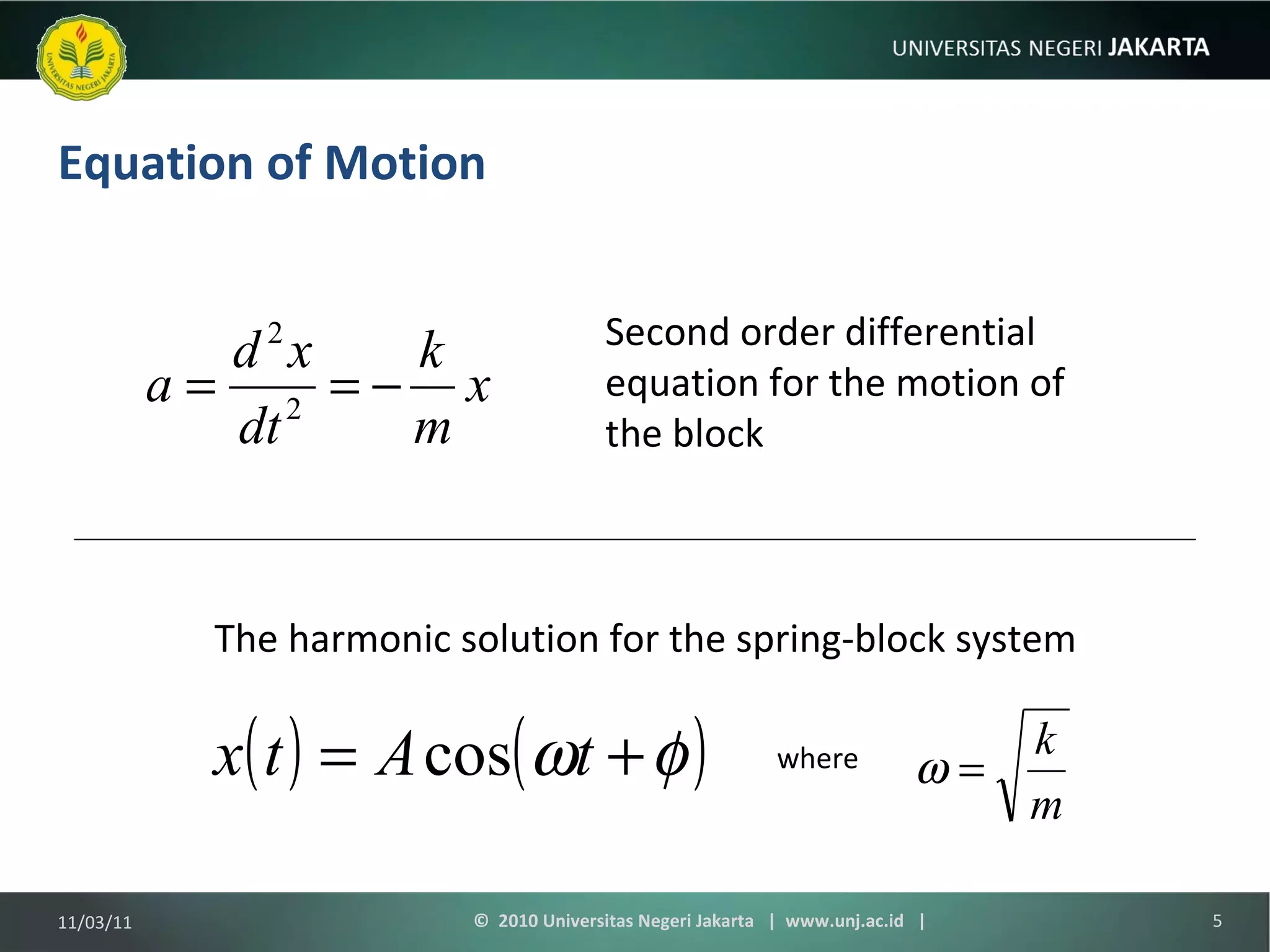
Equation of Motion Second order differential equation for the motion of the block The harmonic solution for the spring-block system where 11/03/11 ©  2010 Universitas Negeri Jakarta  |  www.unj.ac.id  |
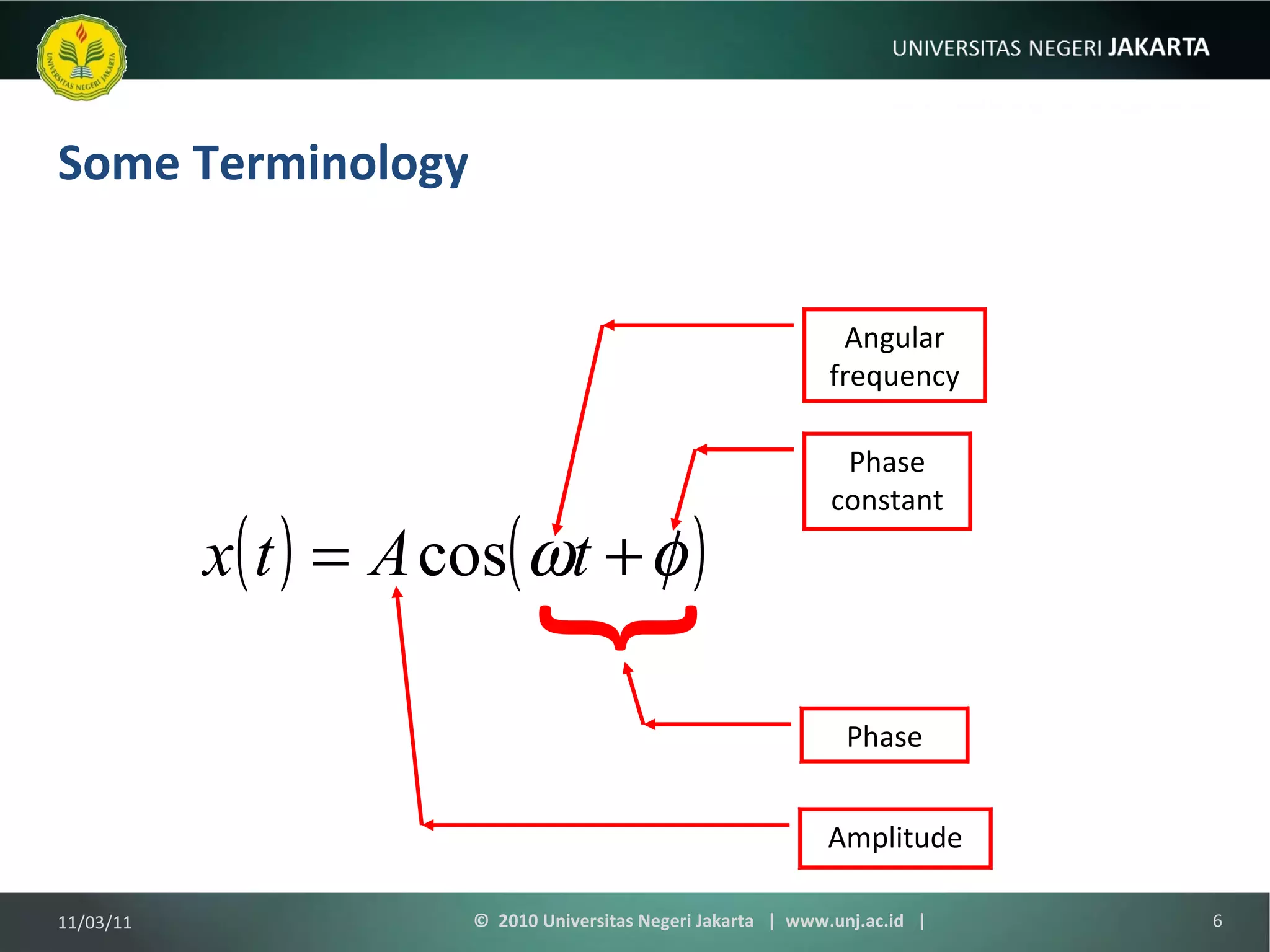
Some Terminology Amplitude Angular frequency Phase constant Phase } 11/03/11 ©  2010 Universitas Negeri Jakarta  |  www.unj.ac.id  |
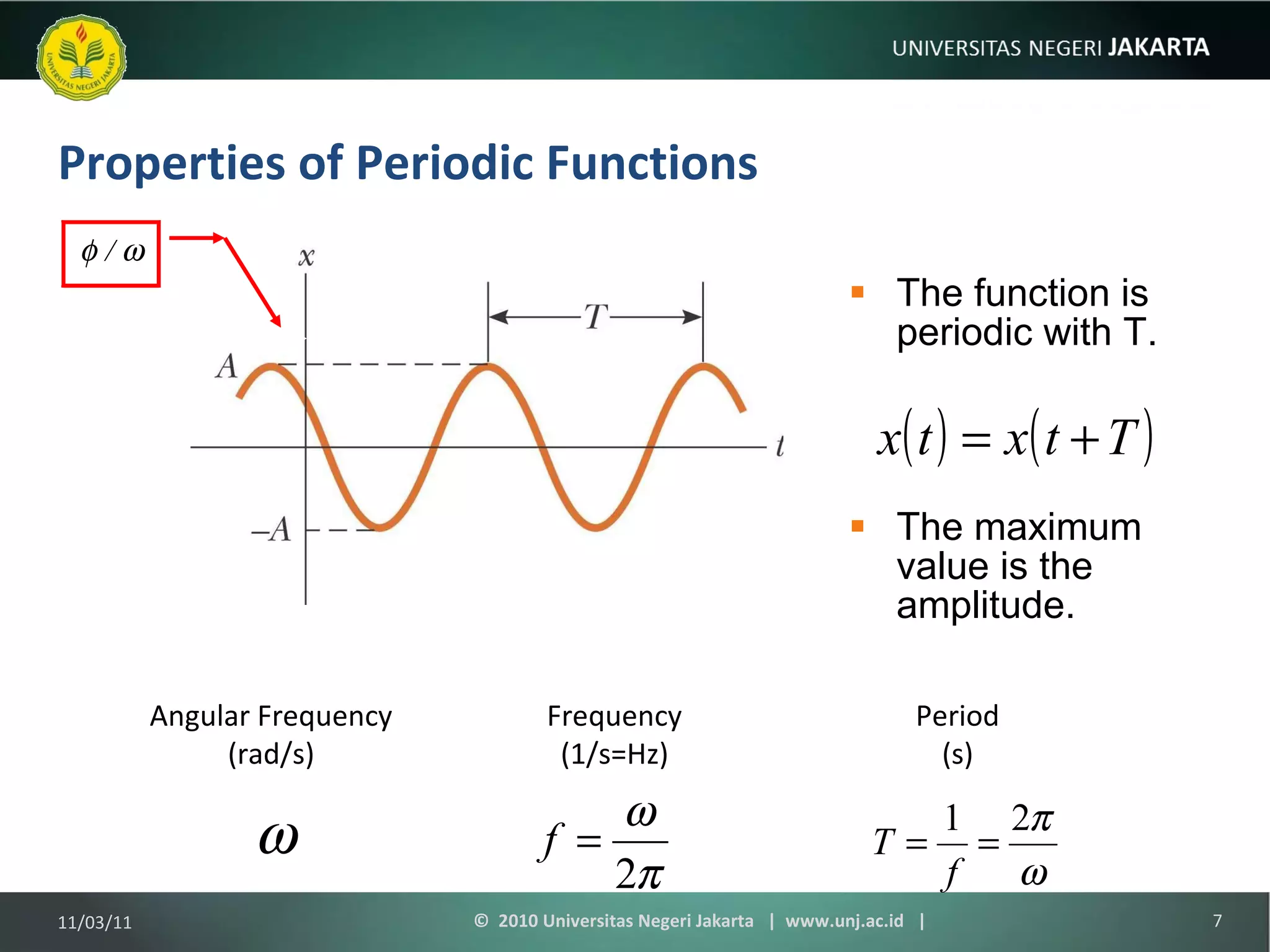
Properties of Periodic Functions The function is periodic with T. The maximum value is the amplitude. Angular Frequency (rad/s) Period (s) Frequency (1/s=Hz)  11/03/11 ©  2010 Universitas Negeri Jakarta  |  www.unj.ac.id  |
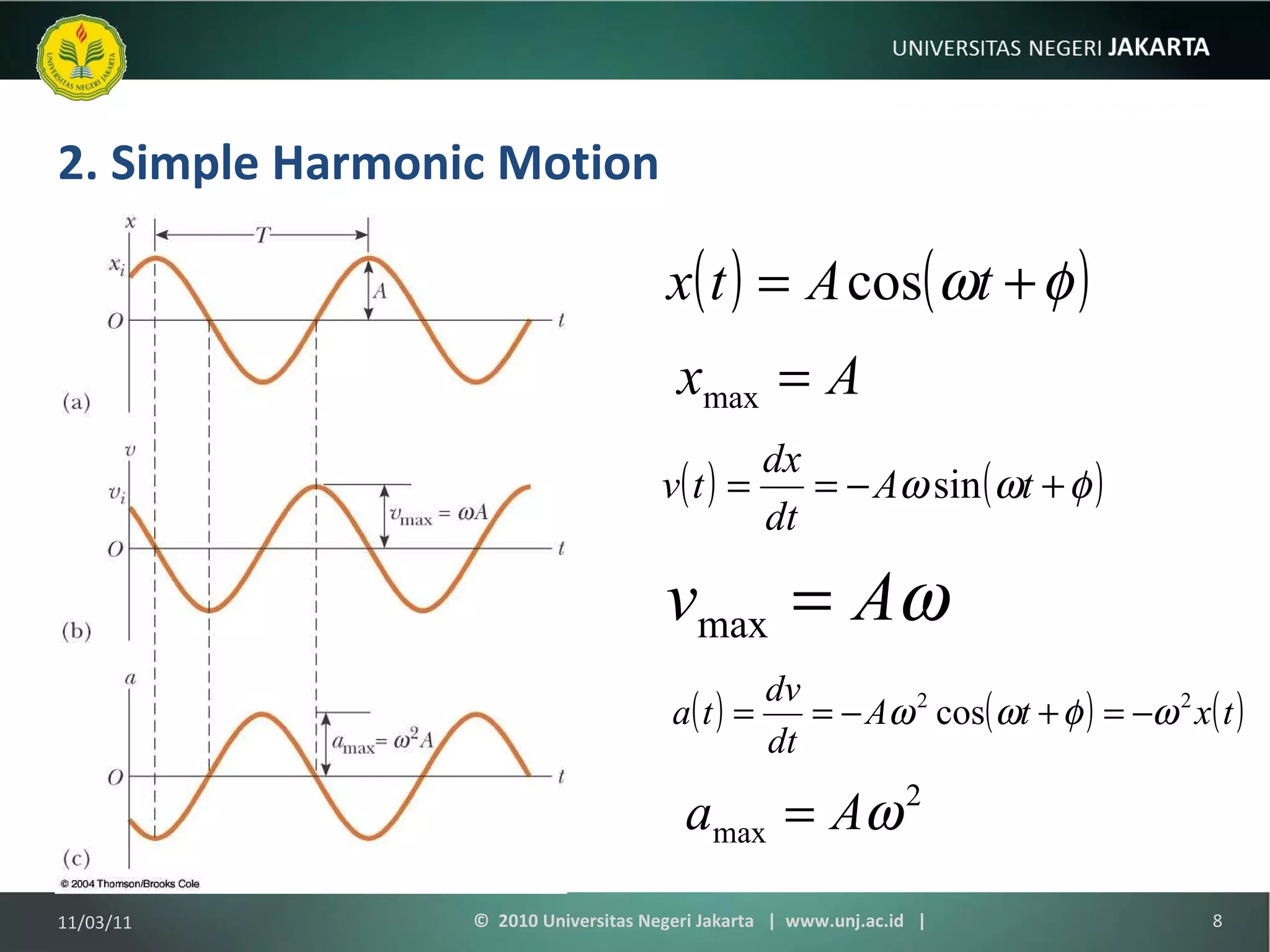
2. Simple Harmonic Motion 11/03/11 ©  2010 Universitas Negeri Jakarta  |  www.unj.ac.id  |
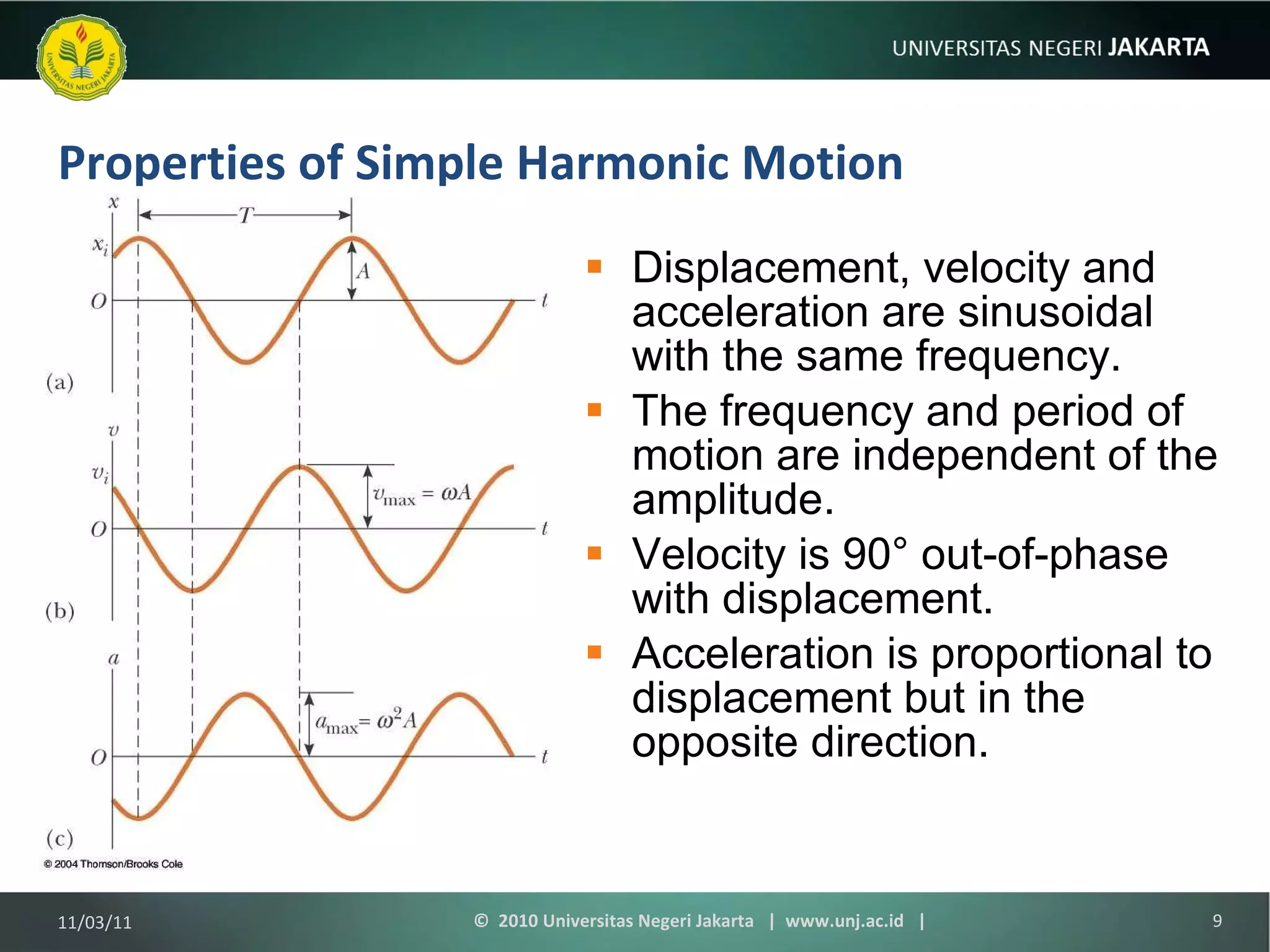
Properties of Simple Harmonic Motion Displacement, velocity and acceleration are sinusoidal with the same frequency. The frequency and period of motion are independent of the amplitude. Velocity is 90° out-of-phase with displacement. Acceleration is proportional to displacement but in the opposite direction. 11/03/11 ©  2010 Universitas Negeri Jakarta  |  www.unj.ac.id  |
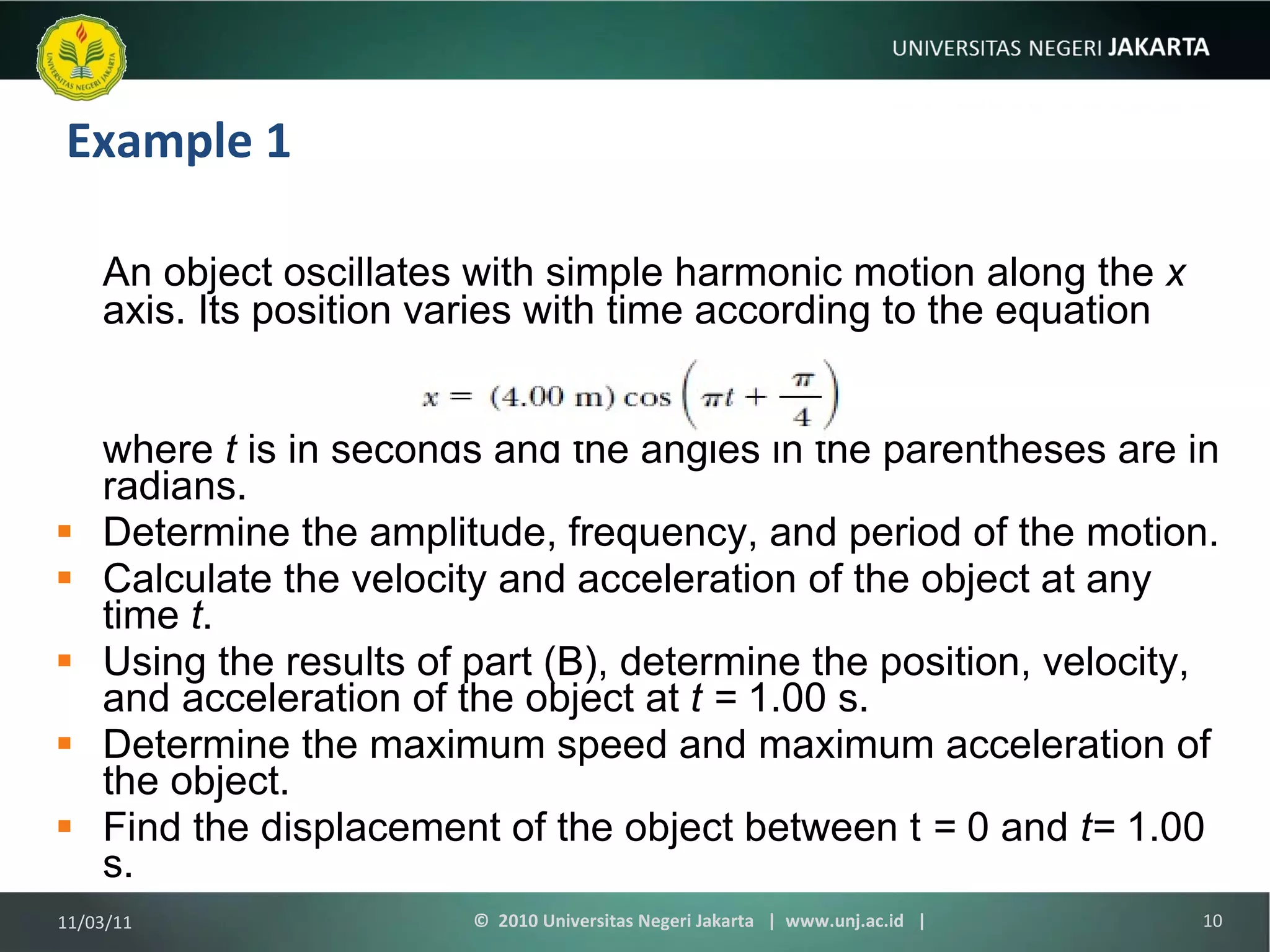
Example 1 An object oscillates with simple harmonic motion along the  x  axis. Its position varies with time according to the equation where  t  is in seconds and the angles in the parentheses are in radians. Determine the amplitude, frequency, and period of the motion. Calculate the velocity and acceleration of the object at any time  t . Using the results of part (B), determine the position, velocity, and acceleration of the object at  t =  1.00 s. Determine the maximum speed and maximum acceleration of the object. Find the displacement of the object between t  =  0 and  t=  1.00 s. 11/03/11 ©  2010 Universitas Negeri Jakarta  |  www.unj.ac.id  |
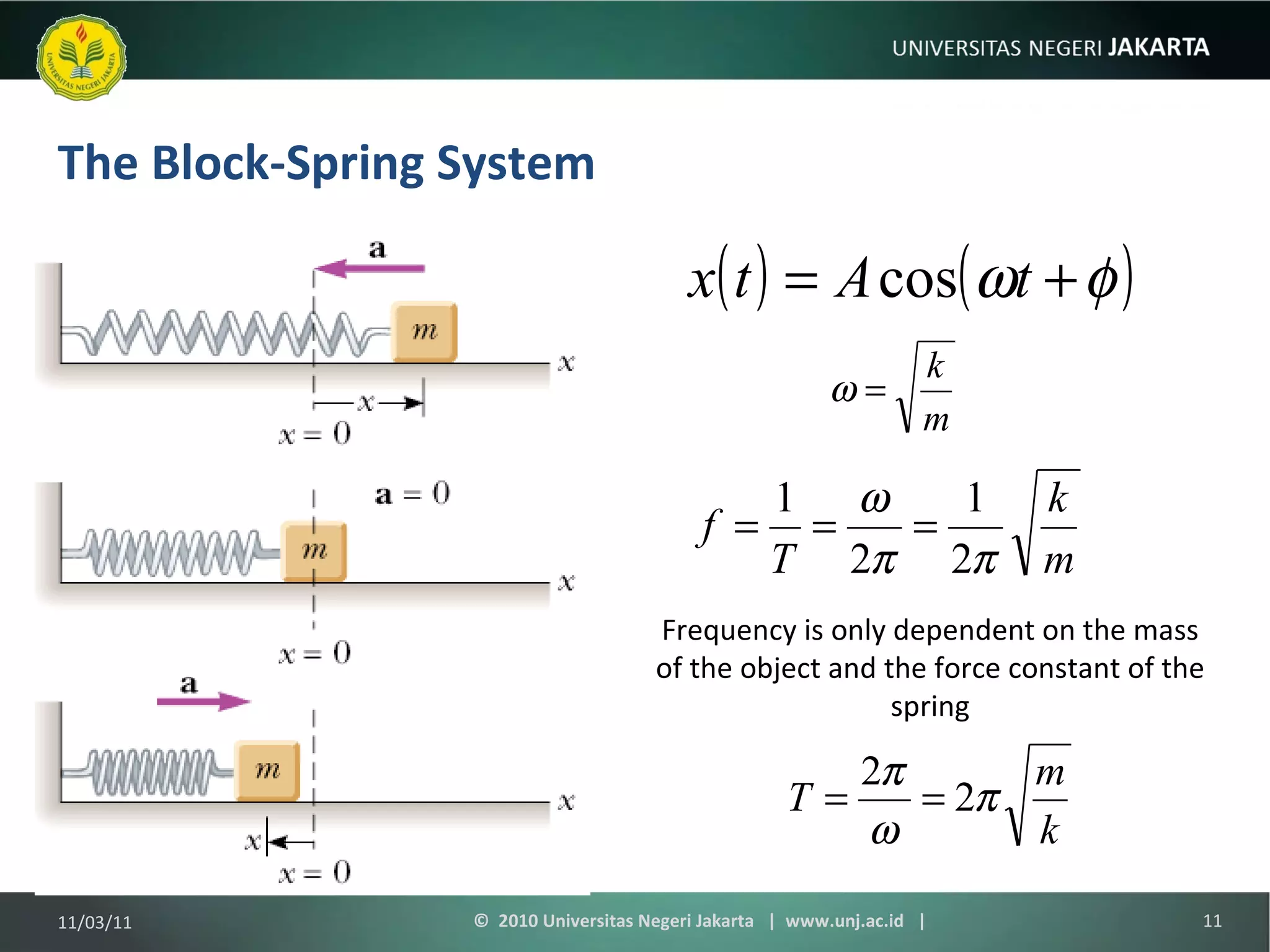
The Block-Spring System Frequency is only dependent on the mass of the object and the force constant of the spring 11/03/11 ©  2010 Universitas Negeri Jakarta  |  www.unj.ac.id  |
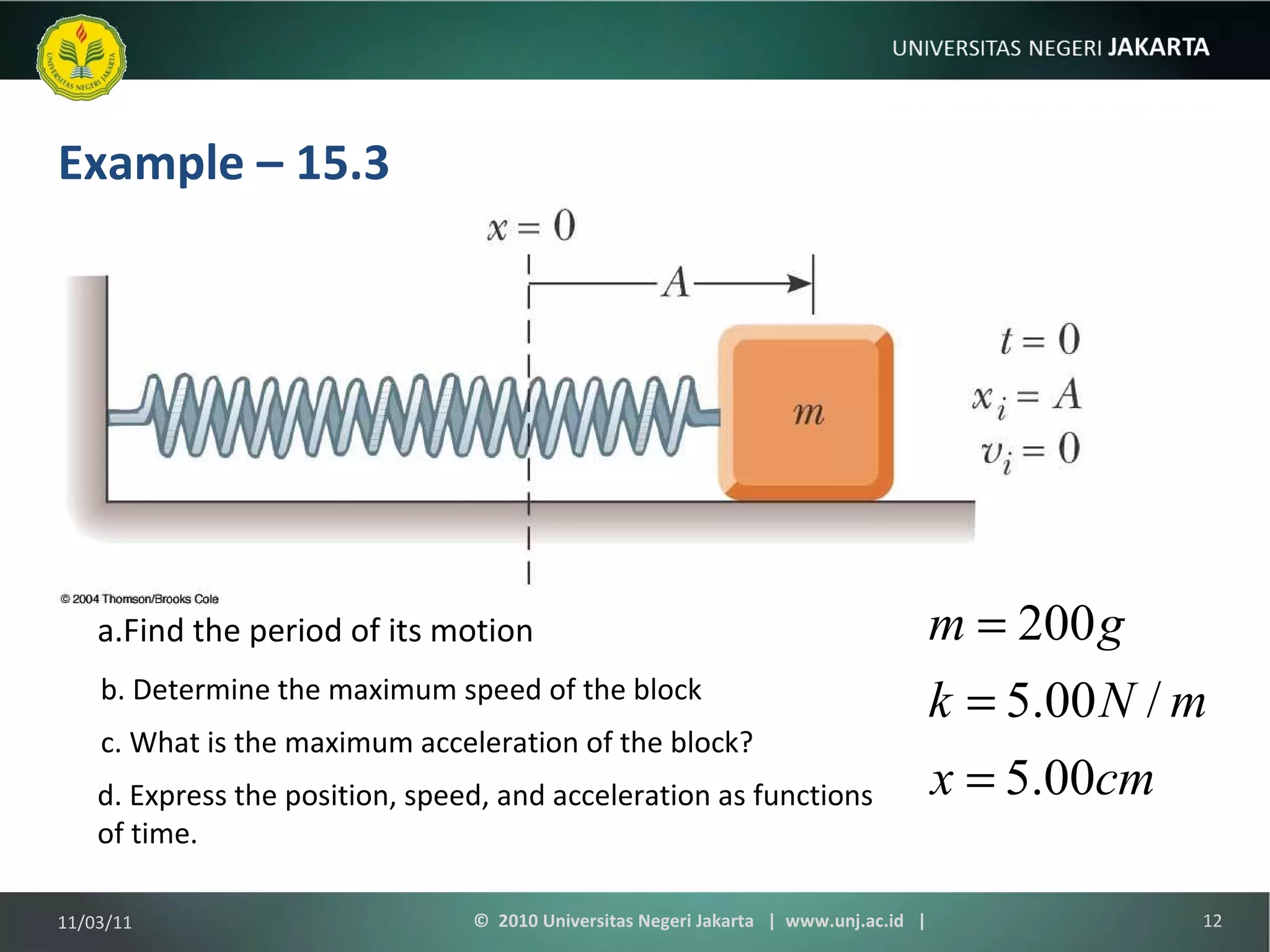
Example – 15.3 a.Find the period of its motion b. Determine the maximum speed of the block c. What is the maximum acceleration of the block? d. Express the position, speed, and acceleration as functions of time. 11/03/11 ©  2010 Universitas Negeri Jakarta  |  www.unj.ac.id  |
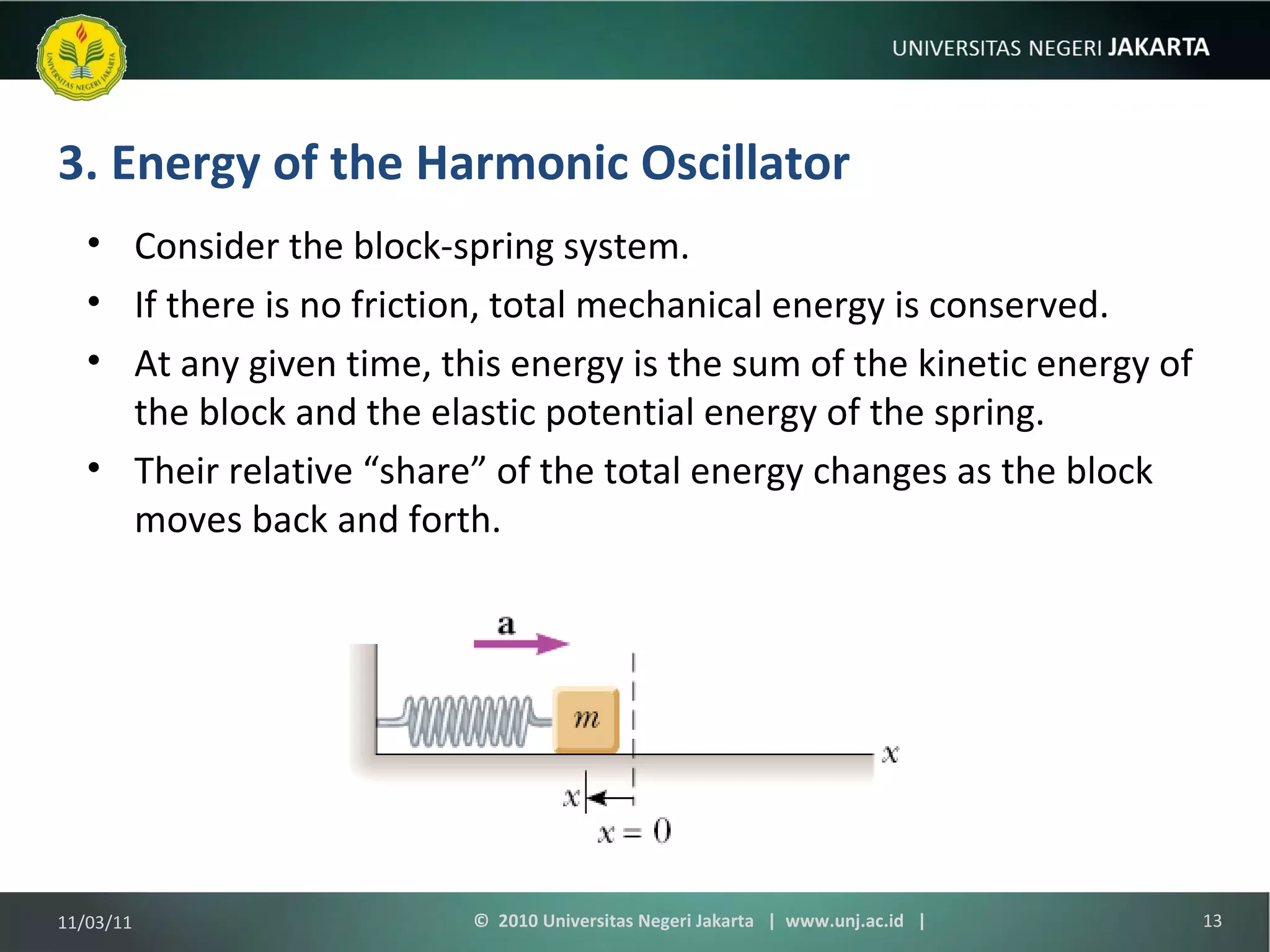
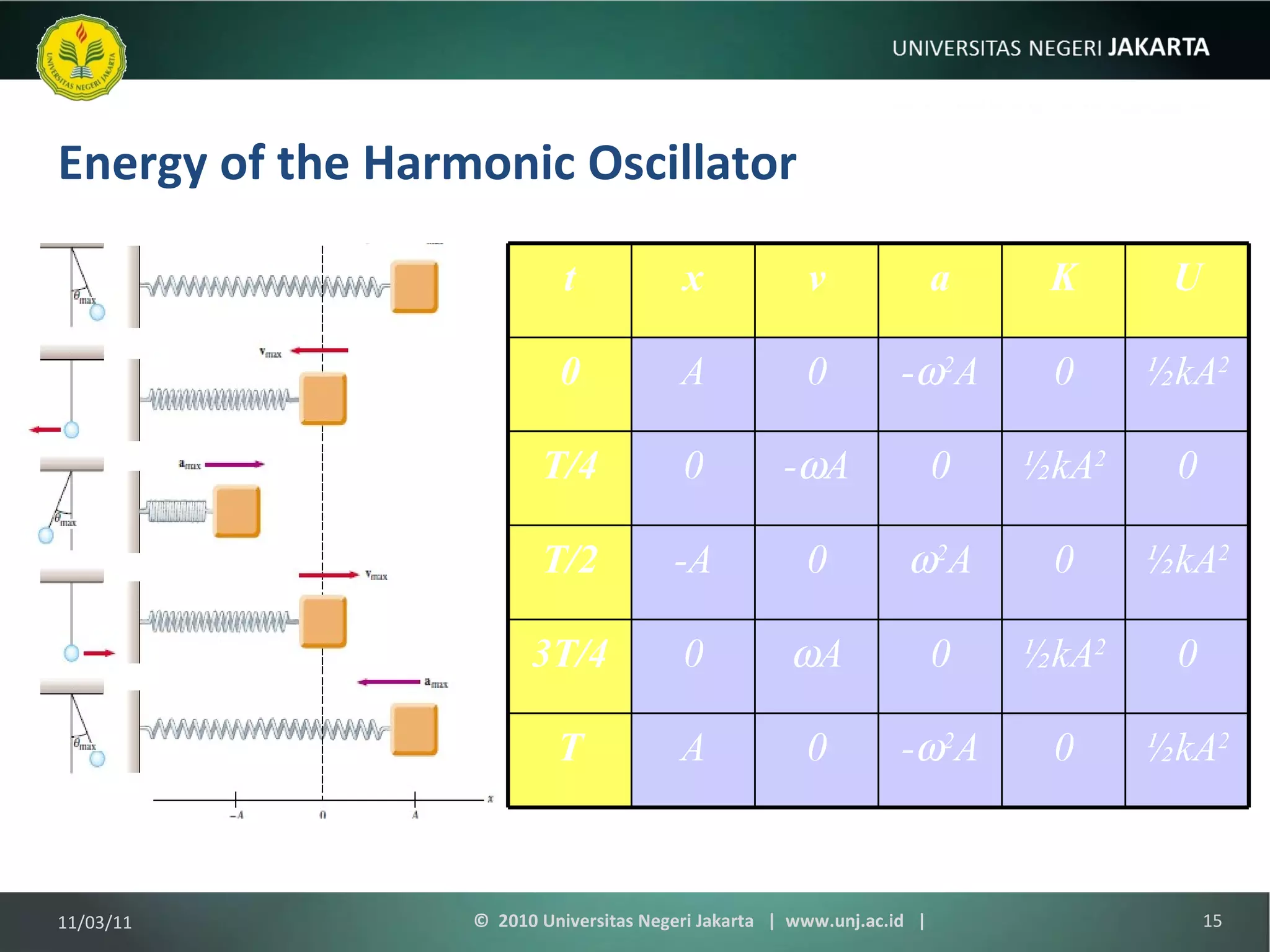
3. Energy of the Harmonic Oscillator Consider the block-spring system. If there is no friction, total mechanical energy is conserved.  At any given time, this energy is the sum of the kinetic energy of the block and the elastic potential energy of the spring. Their relative “share” of the total energy changes as the block moves back and forth. 11/03/11 ©  2010 Universitas Negeri Jakarta  |  www.unj.ac.id  |
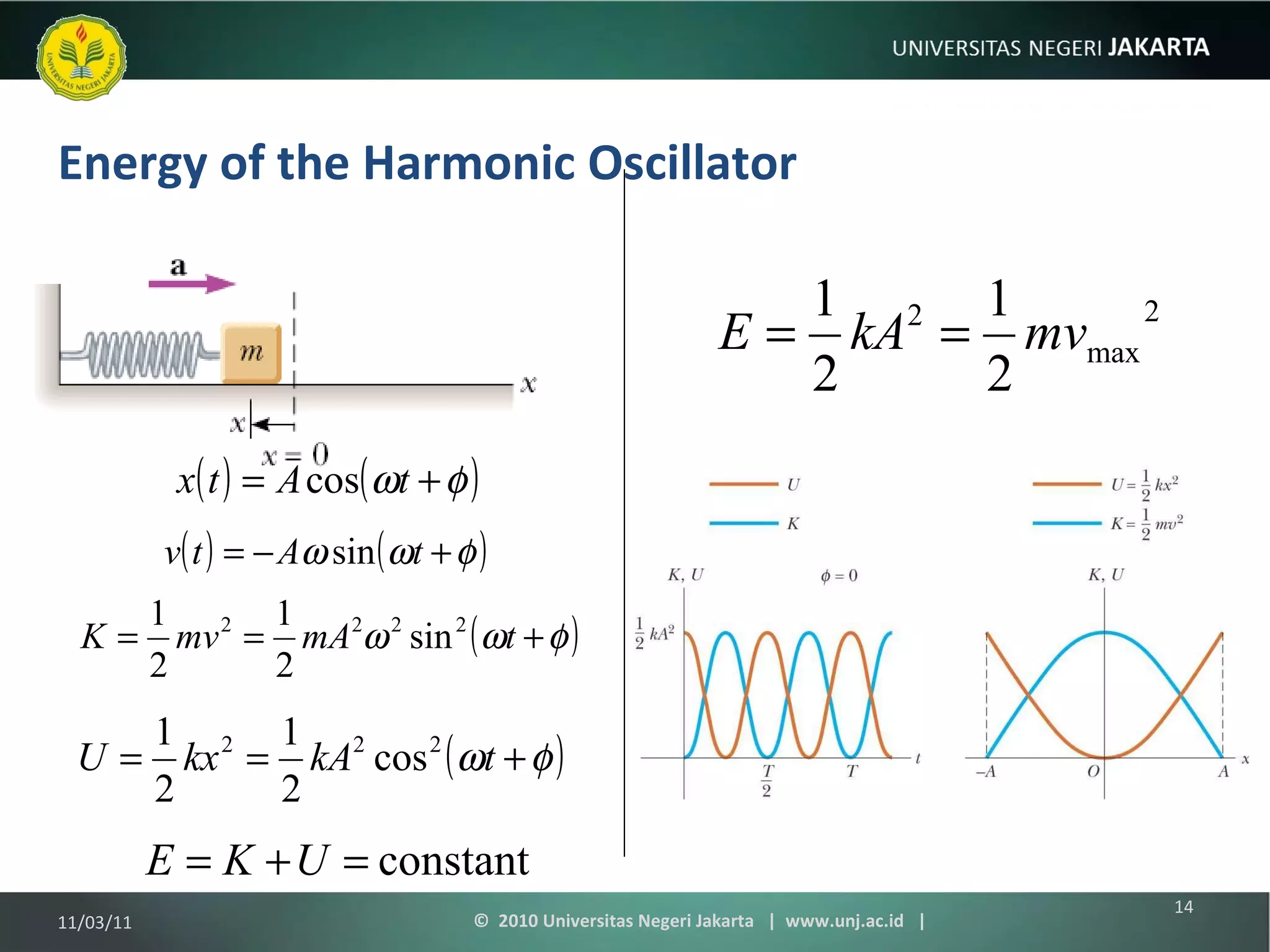
Energy of the Harmonic Oscillator 11/03/11 ©  2010 Universitas Negeri Jakarta  |  www.unj.ac.id  |
Energy of the Harmonic Oscillator 11/03/11 ©  2010 Universitas Negeri Jakarta  |  www.unj.ac.id  | t x v a K U 0 A 0 -  2 A 0 ½kA 2 T/4 0 -  A 0 ½kA 2 0 T/2 -A 0  2 A 0 ½kA 2 3T/4 0  A 0 ½kA 2 0 T A 0 -  2 A 0 ½kA 2
Example – P15.18 A block-spring system oscillates with an amplitude of 3.70 cm. The spring constant is 250 N/m and the mass of the block is 0.700 kg.  Determine the mechanical energy of the system.  Determine the frequency of oscillation. If the system starts oscillating at a point of maximum potential energy, when will it have maximum kinetic energy? When is the next time it will have maximum potential energy? 11/03/11 ©  2010 Universitas Negeri Jakarta  |  www.unj.ac.id  |
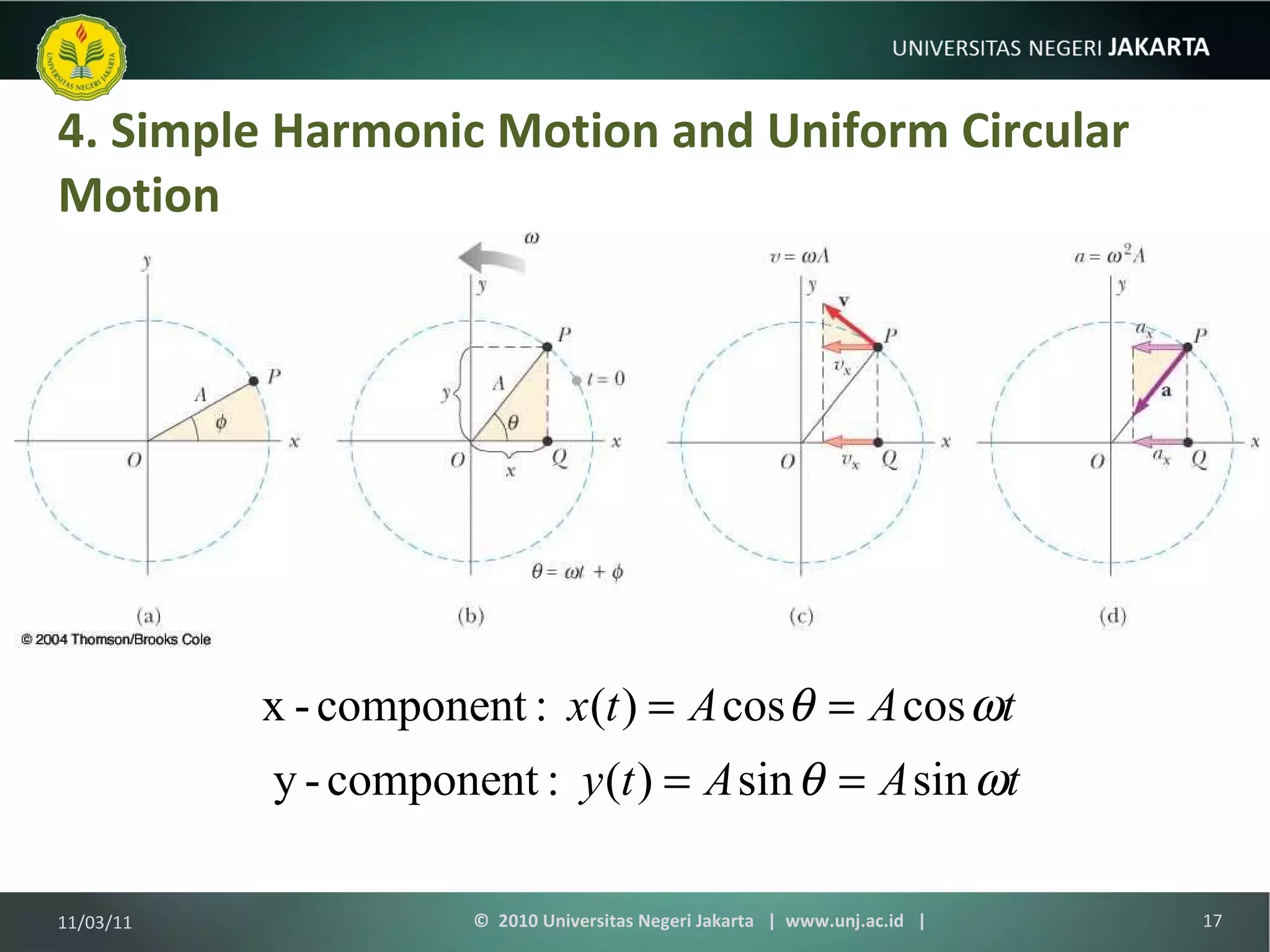
4. Simple Harmonic Motion and Uniform Circular Motion 11/03/11 ©  2010 Universitas Negeri Jakarta  |  www.unj.ac.id  |
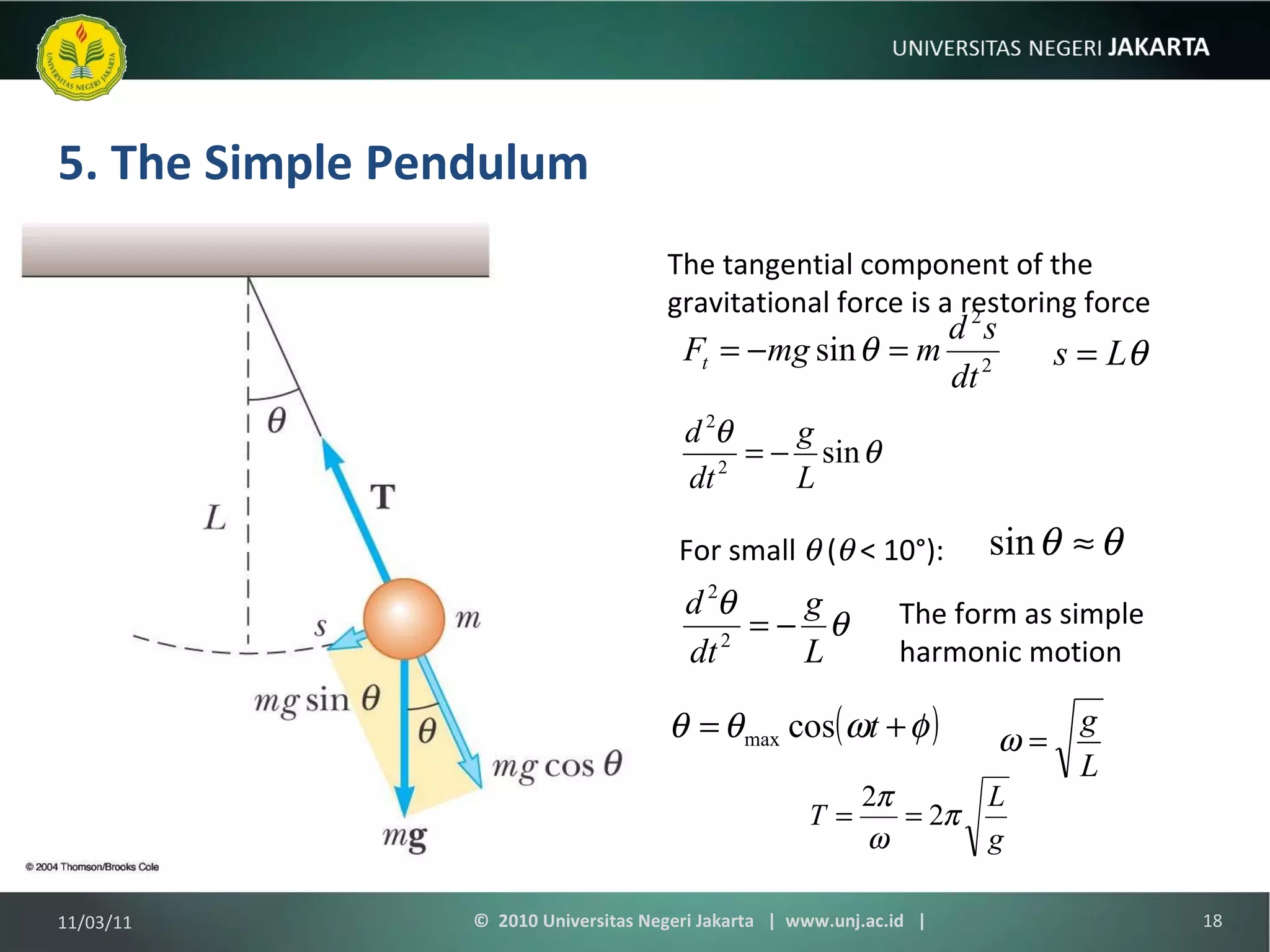
5. The Simple Pendulum The tangential component of the gravitational force is a restoring force For small    (   < 10°): The form as simple harmonic motion 11/03/11 ©  2010 Universitas Negeri Jakarta  |  www.unj.ac.id  |
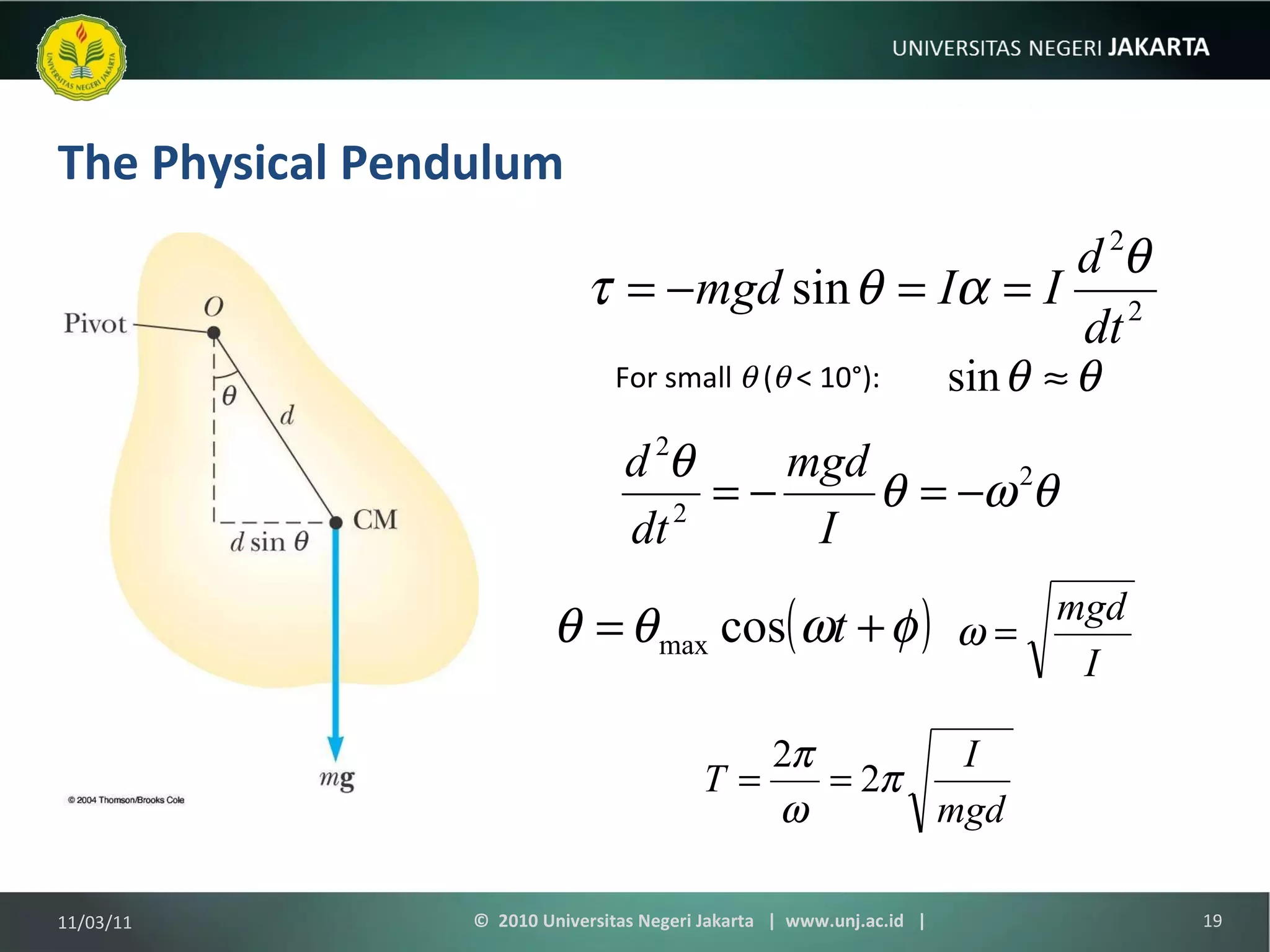
The Physical Pendulum For small    (   < 10°): 11/03/11 ©  2010 Universitas Negeri Jakarta  |  www.unj.ac.id  |
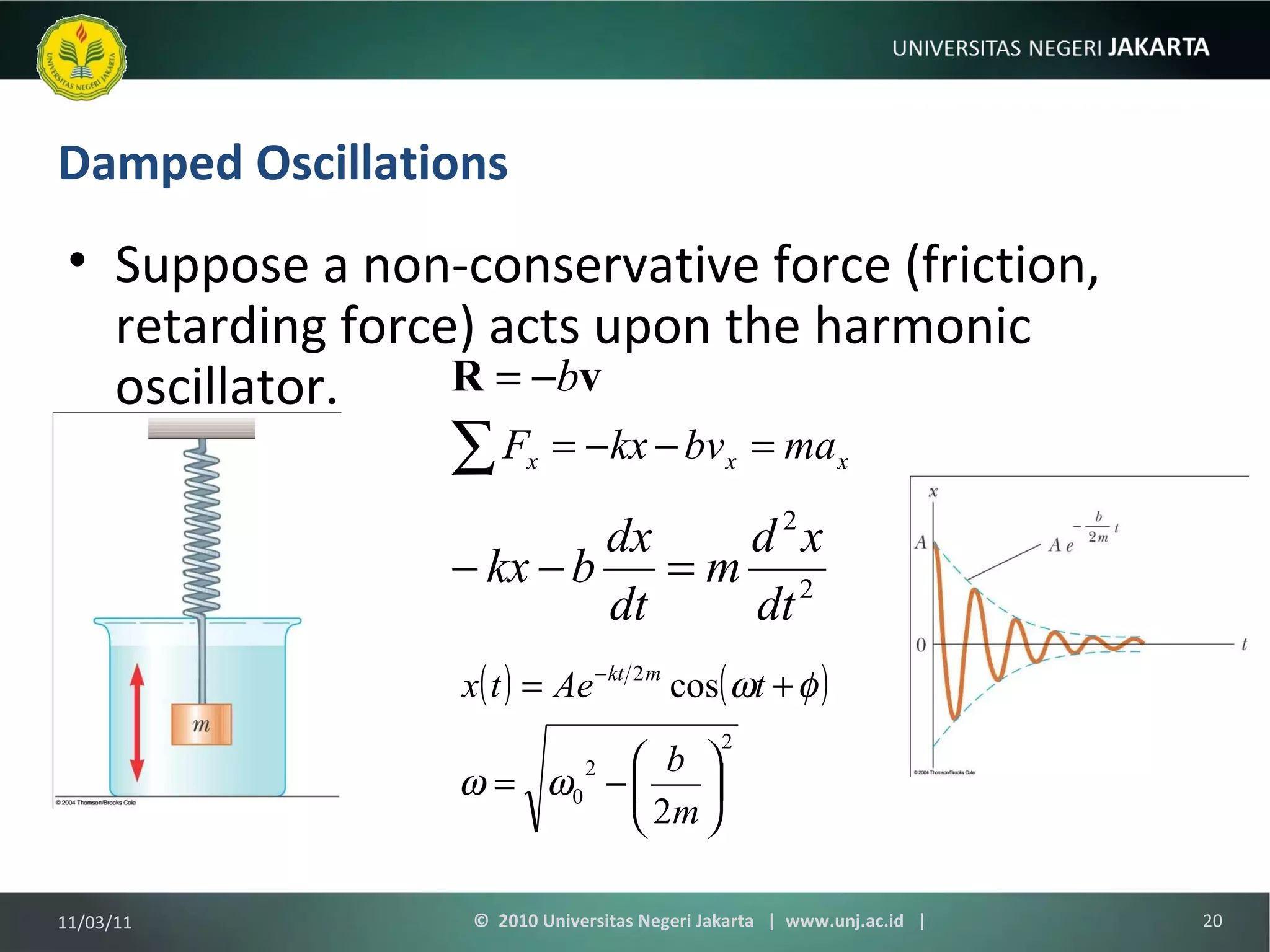
Damped Oscillations Suppose a non-conservative force (friction, retarding force) acts upon the harmonic oscillator. 11/03/11 ©  2010 Universitas Negeri Jakarta  |  www.unj.ac.id  |
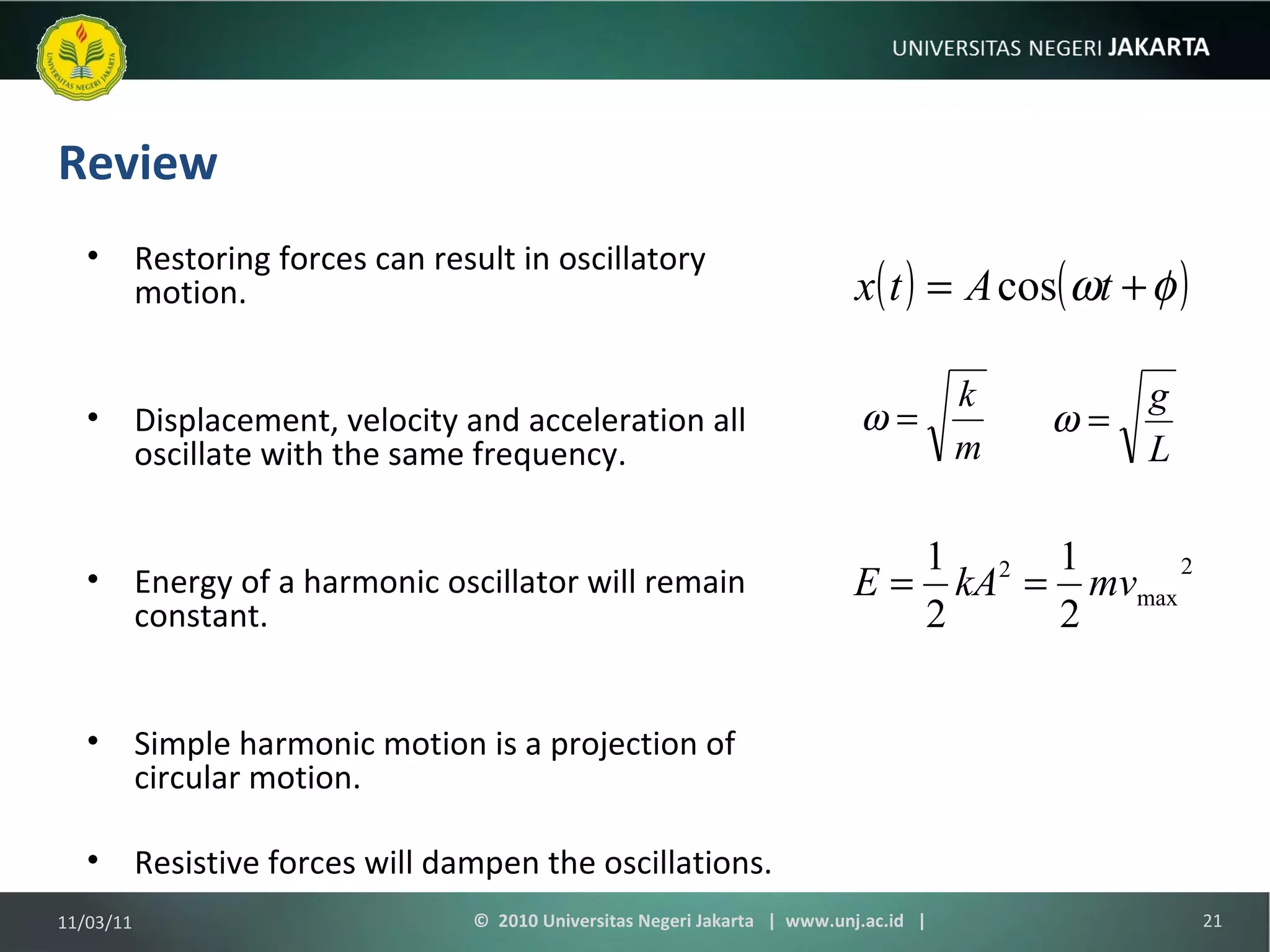
Review Restoring forces can result in oscillatory motion. Displacement, velocity and acceleration all oscillate with the same frequency. Energy of a harmonic oscillator will remain constant. Simple harmonic motion is a projection of circular motion. Resistive forces will dampen the oscillations. 11/03/11 ©  2010 Universitas Negeri Jakarta  |  www.unj.ac.id  |
REFFERENCE Many sources 11/03/11 ©  2010 Universitas Negeri Jakarta  |  www.unj.ac.id  |
TERIMA KASIH 11/03/11 ©  2010 Universitas Negeri Jakarta  |  www.unj.ac.id  |

Fisika Dasar I Per.18

  • 1.
    Fisika Dasar IUmiatin, M.Si Jurusan Fisika Fakultas Matematika dan Ilmu Pengetahuan Alam
  • 2.
    OSILASI Pertemuan ke-1811/03/11 © 2010 Universitas Negeri Jakarta | www.unj.ac.id |
  • 3.
    Outline Object attachedto a spring Simple harmonic motion Energy of a simple harmonic oscillator Simple harmonic motion and circular motion The pendulum Damped Oscillation 11/03/11 © 2010 Universitas Negeri Jakarta | www.unj.ac.id |
  • 4.
    1. An ObjectAttached to a Spring When acceleration is proportional to and in the opposite direction of the displacement from equilibrium, the object moves with Simple Harmonic Motion . 11/03/11 © 2010 Universitas Negeri Jakarta | www.unj.ac.id |
  • 5.
    Equation of MotionSecond order differential equation for the motion of the block The harmonic solution for the spring-block system where 11/03/11 © 2010 Universitas Negeri Jakarta | www.unj.ac.id |
  • 6.
    Some Terminology AmplitudeAngular frequency Phase constant Phase } 11/03/11 © 2010 Universitas Negeri Jakarta | www.unj.ac.id |
  • 7.
    Properties of PeriodicFunctions The function is periodic with T. The maximum value is the amplitude. Angular Frequency (rad/s) Period (s) Frequency (1/s=Hz)  11/03/11 © 2010 Universitas Negeri Jakarta | www.unj.ac.id |
  • 8.
    2. Simple HarmonicMotion 11/03/11 © 2010 Universitas Negeri Jakarta | www.unj.ac.id |
  • 9.
    Properties of SimpleHarmonic Motion Displacement, velocity and acceleration are sinusoidal with the same frequency. The frequency and period of motion are independent of the amplitude. Velocity is 90° out-of-phase with displacement. Acceleration is proportional to displacement but in the opposite direction. 11/03/11 © 2010 Universitas Negeri Jakarta | www.unj.ac.id |
  • 10.
    Example 1 Anobject oscillates with simple harmonic motion along the x axis. Its position varies with time according to the equation where t is in seconds and the angles in the parentheses are in radians. Determine the amplitude, frequency, and period of the motion. Calculate the velocity and acceleration of the object at any time t . Using the results of part (B), determine the position, velocity, and acceleration of the object at t = 1.00 s. Determine the maximum speed and maximum acceleration of the object. Find the displacement of the object between t = 0 and t= 1.00 s. 11/03/11 © 2010 Universitas Negeri Jakarta | www.unj.ac.id |
  • 11.
    The Block-Spring SystemFrequency is only dependent on the mass of the object and the force constant of the spring 11/03/11 © 2010 Universitas Negeri Jakarta | www.unj.ac.id |
  • 12.
    Example – 15.3a.Find the period of its motion b. Determine the maximum speed of the block c. What is the maximum acceleration of the block? d. Express the position, speed, and acceleration as functions of time. 11/03/11 © 2010 Universitas Negeri Jakarta | www.unj.ac.id |
  • 13.
    3. Energy ofthe Harmonic Oscillator Consider the block-spring system. If there is no friction, total mechanical energy is conserved. At any given time, this energy is the sum of the kinetic energy of the block and the elastic potential energy of the spring. Their relative “share” of the total energy changes as the block moves back and forth. 11/03/11 © 2010 Universitas Negeri Jakarta | www.unj.ac.id |
  • 14.
    Energy of theHarmonic Oscillator 11/03/11 © 2010 Universitas Negeri Jakarta | www.unj.ac.id |
  • 15.
    Energy of theHarmonic Oscillator 11/03/11 © 2010 Universitas Negeri Jakarta | www.unj.ac.id | t x v a K U 0 A 0 -  2 A 0 ½kA 2 T/4 0 -  A 0 ½kA 2 0 T/2 -A 0  2 A 0 ½kA 2 3T/4 0  A 0 ½kA 2 0 T A 0 -  2 A 0 ½kA 2
  • 16.
    Example – P15.18A block-spring system oscillates with an amplitude of 3.70 cm. The spring constant is 250 N/m and the mass of the block is 0.700 kg. Determine the mechanical energy of the system. Determine the frequency of oscillation. If the system starts oscillating at a point of maximum potential energy, when will it have maximum kinetic energy? When is the next time it will have maximum potential energy? 11/03/11 © 2010 Universitas Negeri Jakarta | www.unj.ac.id |
  • 17.
    4. Simple HarmonicMotion and Uniform Circular Motion 11/03/11 © 2010 Universitas Negeri Jakarta | www.unj.ac.id |
  • 18.
    5. The SimplePendulum The tangential component of the gravitational force is a restoring force For small  (  < 10°): The form as simple harmonic motion 11/03/11 © 2010 Universitas Negeri Jakarta | www.unj.ac.id |
  • 19.
    The Physical PendulumFor small  (  < 10°): 11/03/11 © 2010 Universitas Negeri Jakarta | www.unj.ac.id |
  • 20.
    Damped Oscillations Supposea non-conservative force (friction, retarding force) acts upon the harmonic oscillator. 11/03/11 © 2010 Universitas Negeri Jakarta | www.unj.ac.id |
  • 21.
    Review Restoring forcescan result in oscillatory motion. Displacement, velocity and acceleration all oscillate with the same frequency. Energy of a harmonic oscillator will remain constant. Simple harmonic motion is a projection of circular motion. Resistive forces will dampen the oscillations. 11/03/11 © 2010 Universitas Negeri Jakarta | www.unj.ac.id |
  • 22.
    REFFERENCE Many sources11/03/11 © 2010 Universitas Negeri Jakarta | www.unj.ac.id |
  • 23.
    TERIMA KASIH 11/03/11© 2010 Universitas Negeri Jakarta | www.unj.ac.id |