From Co-op to  Career Development “ Reforming the First-Year Engineering Experience” University of Notre Dame August 2-4, 2009 Helen Oloroso, Assistant Dean McCormick Office of Career Development
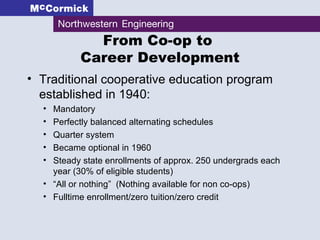
Traditional cooperative education program established in 1940: Mandatory Perfectly balanced alternating schedules Quarter system Became optional in 1960 Steady state enrollments of approx. 250 undergrads each year (30% of eligible students) “All or nothing”  (Nothing available for non co-ops) Fulltime enrollment/zero tuition/zero credit From Co-op to  Career Development
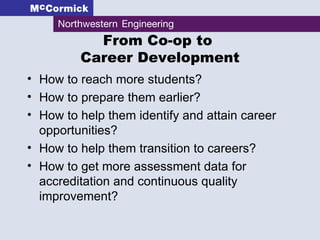
From Co-op to  Career Development How to reach more students? How to prepare them earlier? How to help them identify and attain career opportunities? How to help them transition to careers? How to get more assessment data for accreditation and continuous quality improvement?
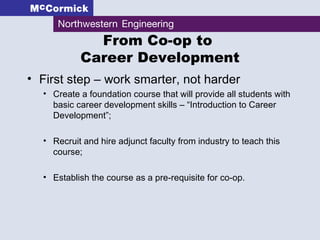
From Co-op to  Career Development First step – work smarter, not harder Create a foundation course that will provide all students with basic career development skills – “Introduction to Career Development”; Recruit and hire adjunct faculty from industry to teach this course; Establish the course as a pre-requisite for co-op.
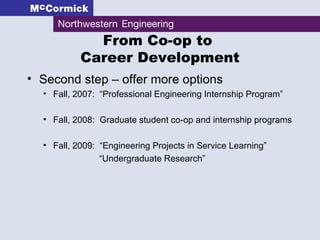
From Co-op to  Career Development Second step – offer more options Fall, 2007:  “Professional Engineering Internship Program” Fall, 2008:  Graduate student co-op and internship programs Fall, 2009:  “Engineering Projects in Service Learning” “Undergraduate Research”
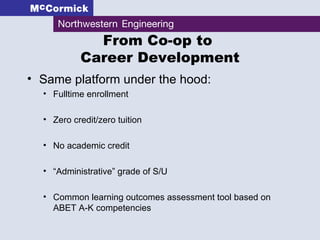
From Co-op to  Career Development Same platform under the hood: Fulltime enrollment Zero credit/zero tuition No academic credit “Administrative” grade of S/U Common learning outcomes assessment tool based on ABET A-K competencies
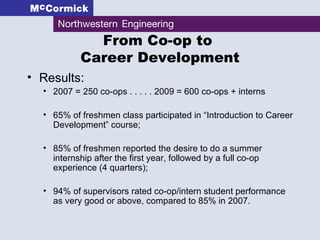
From Co-op to  Career Development Results: 2007 = 250 co-ops . . . . . 2009 = 600 co-ops + interns 65% of freshmen class participated in “Introduction to Career Development” course; 85% of freshmen reported the desire to do a summer internship after the first year, followed by a full co-op experience (4 quarters); 94% of supervisors rated co-op/intern student performance as very good or above, compared to 85% in 2007.
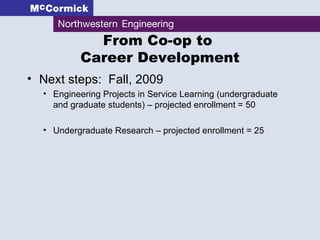
From Co-op to  Career Development Next steps:  Fall, 2009 Engineering Projects in Service Learning (undergraduate and graduate students) – projected enrollment = 50 Undergraduate Research – projected enrollment = 25

First Year Engineering Experience, Notre Dame, August 2009

  • 1.
    From Co-op to Career Development “ Reforming the First-Year Engineering Experience” University of Notre Dame August 2-4, 2009 Helen Oloroso, Assistant Dean McCormick Office of Career Development
  • 2.
    Traditional cooperative educationprogram established in 1940: Mandatory Perfectly balanced alternating schedules Quarter system Became optional in 1960 Steady state enrollments of approx. 250 undergrads each year (30% of eligible students) “All or nothing” (Nothing available for non co-ops) Fulltime enrollment/zero tuition/zero credit From Co-op to Career Development
  • 3.
    From Co-op to Career Development How to reach more students? How to prepare them earlier? How to help them identify and attain career opportunities? How to help them transition to careers? How to get more assessment data for accreditation and continuous quality improvement?
  • 4.
    From Co-op to Career Development First step – work smarter, not harder Create a foundation course that will provide all students with basic career development skills – “Introduction to Career Development”; Recruit and hire adjunct faculty from industry to teach this course; Establish the course as a pre-requisite for co-op.
  • 5.
    From Co-op to Career Development Second step – offer more options Fall, 2007: “Professional Engineering Internship Program” Fall, 2008: Graduate student co-op and internship programs Fall, 2009: “Engineering Projects in Service Learning” “Undergraduate Research”
  • 6.
    From Co-op to Career Development Same platform under the hood: Fulltime enrollment Zero credit/zero tuition No academic credit “Administrative” grade of S/U Common learning outcomes assessment tool based on ABET A-K competencies
  • 7.
    From Co-op to Career Development Results: 2007 = 250 co-ops . . . . . 2009 = 600 co-ops + interns 65% of freshmen class participated in “Introduction to Career Development” course; 85% of freshmen reported the desire to do a summer internship after the first year, followed by a full co-op experience (4 quarters); 94% of supervisors rated co-op/intern student performance as very good or above, compared to 85% in 2007.
  • 8.
    From Co-op to Career Development Next steps: Fall, 2009 Engineering Projects in Service Learning (undergraduate and graduate students) – projected enrollment = 50 Undergraduate Research – projected enrollment = 25