Meta-analysis

Adrian V. Hernandez, M.D., Ph.D.
     Assistant Professor of Medicine
      Quantitative Health Sciences


           October 21, 2010
OUTLINE


FIRST PART (40 minutes)


 Introduction, objectives, types of meta-analysis, definition
 of research question, getting information,
 inclusion/exclusion criteria


                     Break 10 minutes


                                          Meta-analysis l
                                          October 10, 2012 l
OUTLINE (2)

SECOND PART: 50 MINUTES
• Analysis (models, methods, heterogeneity, publication
 bias, quality, subgroup analysis)
• Reporting of meta-analysis (PRISMA, MOOSE guidelines)


                                         Meta-analysis l
                                         October 10, 2012 l
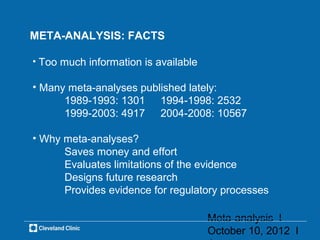
META-ANALYSIS: FACTS

• Too much information is available

• Many meta-analyses published lately:
      1989-1993: 1301 1994-1998: 2532
      1999-2003: 4917 2004-2008: 10567

• Why meta-analyses?
      Saves money and effort
      Evaluates limitations of the evidence
      Designs future research
      Provides evidence for regulatory processes

                                      Meta-analysis l
                                      October 10, 2012 l
OBJECTIVES


    • Summarize and integrate results of studies
    • Analyze differences among studies
    • Overcome small sample sizes
    • Increase precision of effects
    • Evaluate effects in subsets of patients
    • Generate new hypotheses


                                      Meta-analysis l
                                      October 10, 2012 l
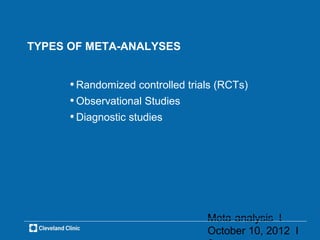
TYPES OF META-ANALYSES


      • Randomized controlled trials (RCTs)
      • Observational Studies
      • Diagnostic studies


                                  Meta-analysis l
                                  October 10, 2012 l
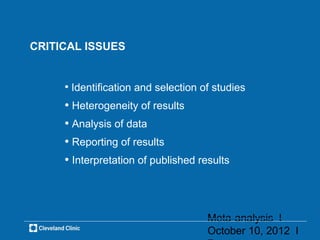
CRITICAL ISSUES


     • Identification and selection of studies
     • Heterogeneity of results
     • Analysis of data
     • Reporting of results
     • Interpretation of published results


                                     Meta-analysis l
                                     October 10, 2012 l
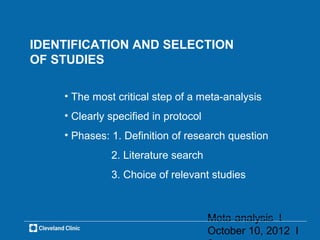
IDENTIFICATION AND SELECTION
OF STUDIES

    • The most critical step of a meta-analysis
    • Clearly specified in protocol
    • Phases: 1. Definition of research question
              2. Literature search
              3. Choice of relevant studies


                                      Meta-analysis l
                                      October 10, 2012 l
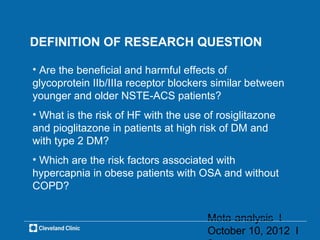
DEFINITION OF RESEARCH QUESTION

• Are the beneficial and harmful effects of
glycoprotein IIb/IIIa receptor blockers similar between
younger and older NSTE-ACS patients?
• What is the risk of HF with the use of rosiglitazone
and pioglitazone in patients at high risk of DM and
with type 2 DM?
• Which are the risk factors associated with
hypercapnia in obese patients with OSA and without
COPD?


                                      Meta-analysis l
                                      October 10, 2012 l
LITERATURE SEARCH

    • Pubmed-Medline (www.pubmed.gov)
    • Embase (www.embase.com)
    • Ovid-Medline (www.ovid.com)
    • The Web of Science (isiknowledge.com)
    • Cochrane Library (www.cochrane.org)
    • Scopus (www.scopus.com)
    • Google Scholar (scholar.google.com)
                  More on: Steinbrook R. NEJM 2006; 354:4-7.

                                       Meta-analysis l
                                       October 10, 2012 l
LITERATURE SEARCH - BIASES


    • Publication bias
    • Search bias
    • Selection bias


                         Meta-analysis l
                         October 10, 2012 l
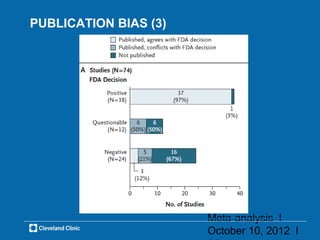
PUBLICATION BIAS

Positive results are more likely to be published than
negative results


                                      Meta-analysis l
                                      October 10, 2012 l
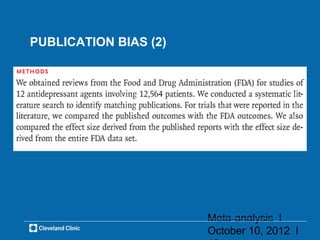
PUBLICATION BIAS (2)


                       Meta-analysis l
                       October 10, 2012 l
PUBLICATION BIAS (3)


                       Meta-analysis l
                       October 10, 2012 l
PUBLICATION BIAS (4)

How to avoid/diminish?


• Identify unpublished studies (e.g. Nissen SE et al. NEJM 2007)
• Search registries (e.g. NIH’s http://clinicaltrials.gov)
• Do not discard studies in other languages (e.g. German,
        French, Spanish)


                                               Meta-analysis l
                                               October 10, 2012 l
SEARCH BIAS

How happens? Limited number of search engines
               Inappropriate keywords


How to avoid/diminish?
   • At least 3 search engines
   • Use relevant keywords and show them (e.g. for RCTs:
   see Dickersin K et al. BMJ 1994; 309: 1286-91)

   • Two or more researchers

                                    Meta-analysis l
                                    October 10, 2012 l
SELECTION BIAS

How happens? Long list of potential articles
                Selection necessary (similarity, -replication)


How to avoid/diminish?
   • Define clear list of inclusion and exclusion criteria
   • Two or more researchers


                                        Meta-analysis l
                                        October 10, 2012 l
INCLUSION/EXCLUSION CRITERIA
     • Objective
     • Population studied
     • Study design-Quality of data
     • Sample size
     • Treatment/Intervention
     • Controls
     • Duration of study
     • Calendar time
                                 Meta-analysis l
                                 October 10, 2012 l
J Gastrointest Surg (2009) 13:649–656
                                  DOI 10.1007/s11605-008-0756-8


Inclusion: phase III RCTs, Gum chewing vs. control
(active/placebo) on time to flatus/LOS, elective colorectal
surgery for localized disease (cancer or not), open or
laparoscopic, >15 years, English, 1960-2008.
Exclusion: Non-randomized studies, surgery beyond
colorectal, prior colonic surgery, emergency surgery.

                                         Meta-analysis l
                                         October 10, 2012 l
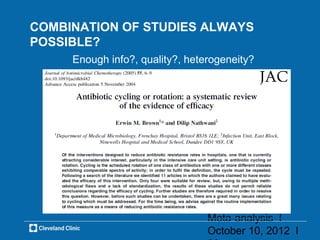
COMBINATION OF STUDIES ALWAYS
POSSIBLE?
     Enough info?, quality?, heterogeneity?


                                 Meta-analysis l
                                 October 10, 2012 l
AVAILABILITY OF INFORMATION

Summary effects only (OR, RR, HR, mean [SD]). Most of
the cases → Limited analyses.


      What to do? Contact authors, Patient level data


                                     Meta-analysis l
                                     October 10, 2012 l
ALL STUDIES CAN BE COMBINED?

  Only reasonably well conducted RCTs?
  Observational studies also?


  Similar results between RCTs and observational?

  Similar results overtime?


                                  Meta-analysis l
                                  October 10, 2012 l
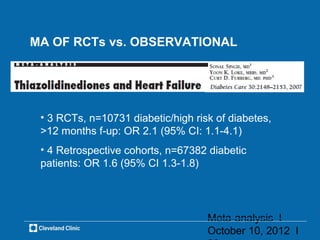
MA OF RCTs vs. OBSERVATIONAL


 • 3 RCTs, n=10731 diabetic/high risk of diabetes,
 >12 months f-up: OR 2.1 (95% CI: 1.1-4.1)
 • 4 Retrospective cohorts, n=67382 diabetic
 patients: OR 1.6 (95% CI 1.3-1.8)


                                    Meta-analysis l
                                    October 10, 2012 l
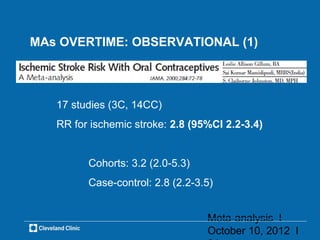
MAs OVERTIME: OBSERVATIONAL (1)


   17 studies (3C, 14CC)
   RR for ischemic stroke: 2.8 (95%CI 2.2-3.4)


         Cohorts: 3.2 (2.0-5.3)
         Case-control: 2.8 (2.2-3.5)


                                  Meta-analysis l
                                  October 10, 2012 l
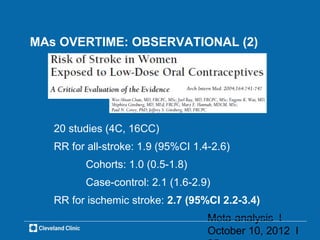
MAs OVERTIME: OBSERVATIONAL (2)


   20 studies (4C, 16CC)
   RR for all-stroke: 1.9 (95%CI 1.4-2.6)
         Cohorts: 1.0 (0.5-1.8)
         Case-control: 2.1 (1.6-2.9)
   RR for ischemic stroke: 2.7 (95%CI 2.2-3.4)
                                    Meta-analysis l
                                    October 10, 2012 l

First Part.MA.Oct202010

  • 1.
    Meta-analysis Adrian V. Hernandez,M.D., Ph.D. Assistant Professor of Medicine Quantitative Health Sciences October 21, 2010
  • 2.
    OUTLINE FIRST PART (40minutes) Introduction, objectives, types of meta-analysis, definition of research question, getting information, inclusion/exclusion criteria Break 10 minutes Meta-analysis l October 10, 2012 l
  • 3.
    OUTLINE (2) SECOND PART:50 MINUTES • Analysis (models, methods, heterogeneity, publication bias, quality, subgroup analysis) • Reporting of meta-analysis (PRISMA, MOOSE guidelines) Meta-analysis l October 10, 2012 l
  • 4.
    META-ANALYSIS: FACTS • Toomuch information is available • Many meta-analyses published lately: 1989-1993: 1301 1994-1998: 2532 1999-2003: 4917 2004-2008: 10567 • Why meta-analyses? Saves money and effort Evaluates limitations of the evidence Designs future research Provides evidence for regulatory processes Meta-analysis l October 10, 2012 l
  • 5.
    OBJECTIVES • Summarize and integrate results of studies • Analyze differences among studies • Overcome small sample sizes • Increase precision of effects • Evaluate effects in subsets of patients • Generate new hypotheses Meta-analysis l October 10, 2012 l
  • 6.
    TYPES OF META-ANALYSES • Randomized controlled trials (RCTs) • Observational Studies • Diagnostic studies Meta-analysis l October 10, 2012 l
  • 7.
    CRITICAL ISSUES • Identification and selection of studies • Heterogeneity of results • Analysis of data • Reporting of results • Interpretation of published results Meta-analysis l October 10, 2012 l
  • 8.
    IDENTIFICATION AND SELECTION OFSTUDIES • The most critical step of a meta-analysis • Clearly specified in protocol • Phases: 1. Definition of research question 2. Literature search 3. Choice of relevant studies Meta-analysis l October 10, 2012 l
  • 9.
    DEFINITION OF RESEARCHQUESTION • Are the beneficial and harmful effects of glycoprotein IIb/IIIa receptor blockers similar between younger and older NSTE-ACS patients? • What is the risk of HF with the use of rosiglitazone and pioglitazone in patients at high risk of DM and with type 2 DM? • Which are the risk factors associated with hypercapnia in obese patients with OSA and without COPD? Meta-analysis l October 10, 2012 l
  • 10.
    LITERATURE SEARCH • Pubmed-Medline (www.pubmed.gov) • Embase (www.embase.com) • Ovid-Medline (www.ovid.com) • The Web of Science (isiknowledge.com) • Cochrane Library (www.cochrane.org) • Scopus (www.scopus.com) • Google Scholar (scholar.google.com) More on: Steinbrook R. NEJM 2006; 354:4-7. Meta-analysis l October 10, 2012 l
  • 11.
    LITERATURE SEARCH -BIASES • Publication bias • Search bias • Selection bias Meta-analysis l October 10, 2012 l
  • 12.
    PUBLICATION BIAS Positive resultsare more likely to be published than negative results Meta-analysis l October 10, 2012 l
  • 13.
    PUBLICATION BIAS (2) Meta-analysis l October 10, 2012 l
  • 14.
    PUBLICATION BIAS (3) Meta-analysis l October 10, 2012 l
  • 15.
    PUBLICATION BIAS (4) Howto avoid/diminish? • Identify unpublished studies (e.g. Nissen SE et al. NEJM 2007) • Search registries (e.g. NIH’s http://clinicaltrials.gov) • Do not discard studies in other languages (e.g. German, French, Spanish) Meta-analysis l October 10, 2012 l
  • 16.
    SEARCH BIAS How happens?Limited number of search engines Inappropriate keywords How to avoid/diminish? • At least 3 search engines • Use relevant keywords and show them (e.g. for RCTs: see Dickersin K et al. BMJ 1994; 309: 1286-91) • Two or more researchers Meta-analysis l October 10, 2012 l
  • 17.
    SELECTION BIAS How happens?Long list of potential articles Selection necessary (similarity, -replication) How to avoid/diminish? • Define clear list of inclusion and exclusion criteria • Two or more researchers Meta-analysis l October 10, 2012 l
  • 18.
    INCLUSION/EXCLUSION CRITERIA • Objective • Population studied • Study design-Quality of data • Sample size • Treatment/Intervention • Controls • Duration of study • Calendar time Meta-analysis l October 10, 2012 l
  • 19.
    J Gastrointest Surg(2009) 13:649–656 DOI 10.1007/s11605-008-0756-8 Inclusion: phase III RCTs, Gum chewing vs. control (active/placebo) on time to flatus/LOS, elective colorectal surgery for localized disease (cancer or not), open or laparoscopic, >15 years, English, 1960-2008. Exclusion: Non-randomized studies, surgery beyond colorectal, prior colonic surgery, emergency surgery. Meta-analysis l October 10, 2012 l
  • 20.
    COMBINATION OF STUDIESALWAYS POSSIBLE? Enough info?, quality?, heterogeneity? Meta-analysis l October 10, 2012 l
  • 21.
    AVAILABILITY OF INFORMATION Summaryeffects only (OR, RR, HR, mean [SD]). Most of the cases → Limited analyses. What to do? Contact authors, Patient level data Meta-analysis l October 10, 2012 l
  • 22.
    ALL STUDIES CANBE COMBINED? Only reasonably well conducted RCTs? Observational studies also? Similar results between RCTs and observational? Similar results overtime? Meta-analysis l October 10, 2012 l
  • 23.
    MA OF RCTsvs. OBSERVATIONAL • 3 RCTs, n=10731 diabetic/high risk of diabetes, >12 months f-up: OR 2.1 (95% CI: 1.1-4.1) • 4 Retrospective cohorts, n=67382 diabetic patients: OR 1.6 (95% CI 1.3-1.8) Meta-analysis l October 10, 2012 l
  • 24.
    MAs OVERTIME: OBSERVATIONAL(1) 17 studies (3C, 14CC) RR for ischemic stroke: 2.8 (95%CI 2.2-3.4) Cohorts: 3.2 (2.0-5.3) Case-control: 2.8 (2.2-3.5) Meta-analysis l October 10, 2012 l
  • 25.
    MAs OVERTIME: OBSERVATIONAL(2) 20 studies (4C, 16CC) RR for all-stroke: 1.9 (95%CI 1.4-2.6) Cohorts: 1.0 (0.5-1.8) Case-control: 2.1 (1.6-2.9) RR for ischemic stroke: 2.7 (95%CI 2.2-3.4) Meta-analysis l October 10, 2012 l