Meta-analysis II

Adrian V. Hernandez, M.D., Ph.D.
     Assistant Professor of Medicine
      Quantitative Health Sciences


           October 21, 2010
OUTLINE SECOND PART

SECOND PART: 50 MINUTES
• Analysis (models, methods, heterogeneity, publication
 bias, quality, subgroup analysis)
• Reporting of meta-analysis (PRISMA, MOOSE guidelines)


                                         Meta-analysis II l
                                         October 10, 2012 l
MODELS

 • Fixed effects
        -Assumption: Effect is the same across
              studies and differences due to chance
        -Common effect unknown
        -Objective: Estimation of common effect with
              more precision
        -Pool studies using weights ↔ sample size


                                    Meta-analysis II l
                                    October 10, 2012 l
MODELS (2)

 • Random effects
       -Assumption: Effect is different across
             studies and there is an average effect
       -Average effect unknown
       -Objective: Estimation of average effect of
             studies
       -Pool studies using similar weights


                                    Meta-analysis II l
                                    October 10, 2012 l
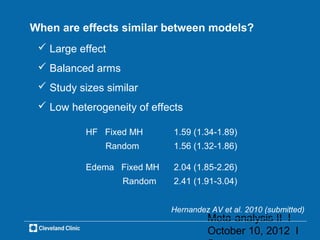
When are effects similar between models?
  Large effect
  Balanced arms
  Study sizes similar
  Low heterogeneity of effects

           HF Fixed MH       1.59 (1.34-1.89)
               Random        1.56 (1.32-1.86)

           Edema Fixed MH    2.04 (1.85-2.26)
                   Random    2.41 (1.91-3.04)


                            Hernandez AV et al. 2010 (submitted)
                                     Meta-analysis II l
                                     October 10, 2012 l
METHODS TO COMBINE STUDY EFFECTS

 • Inverse Variance (IV)
       Common, flexible
       Binary/continuous data
       Log OR, Log RR, log HR, standardized ratios


                                  Meta-analysis II l
                                  October 10, 2012 l
METHODS TO COMBINE STUDY EFFECTS (2)

 • Mantel-Haenzel (MH)
       Binary outcomes only
       Special cases: sparse outcomes, unbalanced
              arms
       Correction for zeros in arms
       Other situations: Effects similar to IV


                                      Meta-analysis II l
                                      October 10, 2012 l
METHODS TO COMBINE STUDY EFFECTS (3)

 • Peto
          Binary outcomes only, a few outcomes
          Small effect
          Balanced arms
          No correction for zeros in arms

                            HF Fixed MH     1.59 (1.34-1.89)
                                Peto        1.59 (1.34-1.88)


                                       Meta-analysis II l
                                       October 10, 2012 l
Meta-analysis II l
October 10, 2012 l
Meta-analysis II l
October 10, 2012 l
Meta-analysis II l
October 10, 2012 l
METHODS TO COMBINE STUDY EFFECTS (4)

 • DerSimonian and Laird
       Any type of effect measures
       Random model
       Larger CI of the pooled effect
       More weight to smaller studies


                                        Meta-analysis II l
                                        October 10, 2012 l
HETEROGENEITY

• Degree of dissimilarity in effects of individual studies
• Why?
       Participants
       Interventions
       Co-interventions
       Outcomes
       Biases of studies (according to hierarchy), etc.

                                        Meta-analysis II l
                                        October 10, 2012 l
Meta-analysis II l
October 10, 2012 l
HETEROGENEITY: Pseudo-tests

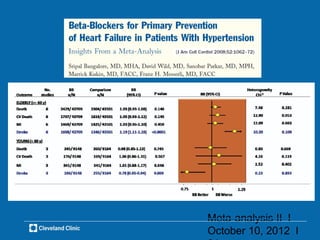
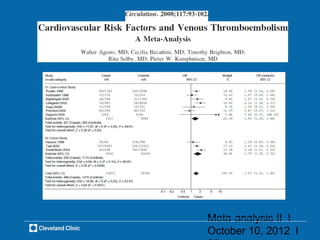
    • Eyeballing forest plots
    • Point estimates
    • Significance level
    • Confidence intervals


                                Meta-analysis II l
                                October 10, 2012 l
HETEROGENEITY: Test it!
• Cochrane Q test (Х2, p)
      AND
• I2: Amount of heterogeneity (0-100%)
    It needs 95% CI (<25% Low; 25-50% Mod; >50 High)
                       (Ioannidis JP. J Eval Clin Pract 2008:14:951-7)


 Bad news for both: Low power
 Bad news for I2: No software for CIs

                                         Meta-analysis II l
                                         October 10, 2012 l
Meta-analysis II l
October 10, 2012 l
HETEROGENEITY: Address it!
    • Check data again
    • Do not perform a meta-analysis
    • Explore vs. ignore
    • Use random-effects models
    • Change effect measure (e.g. MD →SMD)
    • Exclude studies


                                  Meta-analysis II l
                                  October 10, 2012 l
EXPLORING HETEROGENEITY

• Subgroup analysis
    Exploratory only
    Low power to detect significant effects
    Better pre-specify in protocol
    Generates hypotheses


   → Editors and reviewers like subgroup analysis

                                      Meta-analysis II l
                                      October 10, 2012 l
EXPLORING HETEROGENEITY (2)


• How to perform subgroup analysis?
   → By baseline characteristics (e.g. age, gender)
   → By quality
   → By sample size
   → By follow-up time


                                    Meta-analysis II l
                                    October 10, 2012 l
Meta-analysis II l
October 10, 2012 l
Meta-analysis II l
October 10, 2012 l
Use of thiazolidinediones and risk of heart failure and
     peripheral edema in patients at high risk of diabetes and
                         type 2 diabetes:
        A systematic review and meta-analysis of placebo-
                   controlled randomized trials

Follow-up                             OR (95% CI)          RR (95% CI)
     ≥12 months
              MH                     1.57 [1.31-1.87]    1.50 [1.28-1.76]
              Random                 1.67 [1.16-2.40]    1.66 [1.10-2.50]
     <12 months
              MH                     2.71 [0.94-7.79]    2.68 [0.93-7.67]
              Random                 2.56 [0.88-7.44]    2.52 [0.88-7.25]

                                     Hernandez AV et al. 2010 (Submitted)


                                              Meta-analysis II l
                                              October 10, 2012 l
EXPLORING HETEROGENEITY (3)


• Meta-regression
   →Evaluates factors that explain heterogeneity of


        effects


   →Bad news: Low power
                  Lack of data

                                   Meta-analysis II l
                                   October 10, 2012 l
Meta-analysis II l
October 10, 2012 l
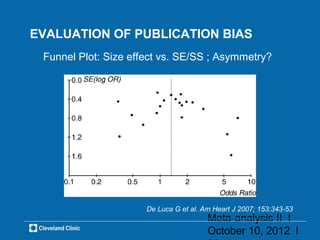
EVALUATION OF PUBLICATION BIAS
 Funnel Plot: Size effect vs. SE/SS ; Asymmetry?


                      De Luca G et al. Am Heart J 2007; 153:343-53
                                        Meta-analysis II l
                                        October 10, 2012 l
EVALUATION OF PUBLICATION BIAS (2)

 Asymmetrical: Only due to publication bias?


                    Dentali F et al. Ann Intern Med 2007; 146: 278-88
                                          Meta-analysis II l
                                          October 10, 2012 l
EVALUATION OF PUBLICATION BIAS (3)

 Pseudo-test: Visual inspection of funnel plot


 Test!: Begg-Mazumdar test
       Asymmetry regression test
       Kendall test, etc
       → Bad news: All have low power


                                    Meta-analysis II l
                                    October 10, 2012 l
EVALUATION OF PUBLICATION BIAS (4)


 In 95% of MAs, the use of asymmetry regression
 tests is inappropriate:
       → Highly heterogeneous (I2 > 50%)
       → <10 studies


                                 Meta-analysis II l
                                 October 10, 2012 l
QUALITY OF STUDIES: Observational

    • Design: Prospective cohort
              Retrospective cohort
              Case-control
    • Quality of measurement of factors
    • Patient enrollment (consecutive vs no)


                                     Meta-analysis II l
                                     October 10, 2012 l
QUALITY OF STUDIES: RCTs
    • Difficult to define
           Design/conduct/analysis?
           Clinical relevance?
           Reporting?


    • Several scales: 39
    Egger M et al. Systematic reviews in health care. Meta-analysis in
                    context. 2nd Edition, BMJ London 2001. pp87-108.


                                                   Meta-analysis II l
                                                   October 10, 2012 l
QUALITY OF STUDIES: RCTs (2)

 TC Chalmers et al. Control Clin Trials 1981; 2: 31-49
    30 items, complex
       - Internal validity (R, Blinding, Attrition,
               stat analysis)
       - External validity
       - Data presentation/Organizational aspects


 → Low weight to internal validity

                                        Meta-analysis II l
                                        October 10, 2012 l
QUALITY OF STUDIES: RCTs (3)
 AR Jadad et al. Control Clin Trials 1996; 17: 1-12
  5 items, 5 points, ≥3 high quality
    - Randomization: Description of method? 1
                      Appropriate? 1
    - Double blinding: Description of method? 1
                       Appropriate? 1
    - Description of withdrawal/dropouts? 1


 → More weight to reporting than methodology
                                  Meta-analysis II l
                                  October 10, 2012 l
REPORTING


• RCTs: PRISMA (Preferred Reporting Items for
       Systematic reviews and Meta-Analyses)
• Observational: MOOSE (Meta-analysis Of
       Observational Studies in Epidemiology)


                                  Meta-analysis II l
                                  October 10, 2012 l
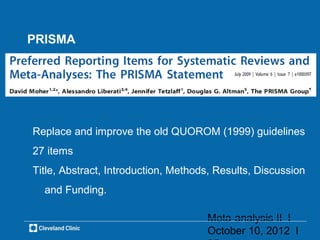
PRISMA


Replace and improve the old QUOROM (1999) guidelines
27 items
Title, Abstract, Introduction, Methods, Results, Discussion
  and Funding.

                                     Meta-analysis II l
                                     October 10, 2012 l
PRISMA flow chart


                    Meta-analysis II l
                    October 10, 2012 l
PRISMA guidelines: Improvements

    • Clear description of objective (PICOS)
    • Improve description of selection of studies
    (search strategy). Publish at least one.
    • Improve evaluation of risk of bias within studies
    (quality)
    • Improve description and evaluation of
    publication bias.
    • Suggest publishing the protocol of the MA


                                        Meta-analysis II l
                                        October 10, 2012 l
MOOSE


35 items, 1 point to each
Background, Search Strategy, Methods, Results,
      Discussion & Conclusion


                                  Meta-analysis II l
                                  October 10, 2012 l
Meta-analysis II l
October 10, 2012 l

Second Part.MA.Oct202010

  • 1.
    Meta-analysis II Adrian V.Hernandez, M.D., Ph.D. Assistant Professor of Medicine Quantitative Health Sciences October 21, 2010
  • 2.
    OUTLINE SECOND PART SECONDPART: 50 MINUTES • Analysis (models, methods, heterogeneity, publication bias, quality, subgroup analysis) • Reporting of meta-analysis (PRISMA, MOOSE guidelines) Meta-analysis II l October 10, 2012 l
  • 3.
    MODELS • Fixedeffects -Assumption: Effect is the same across studies and differences due to chance -Common effect unknown -Objective: Estimation of common effect with more precision -Pool studies using weights ↔ sample size Meta-analysis II l October 10, 2012 l
  • 4.
    MODELS (2) •Random effects -Assumption: Effect is different across studies and there is an average effect -Average effect unknown -Objective: Estimation of average effect of studies -Pool studies using similar weights Meta-analysis II l October 10, 2012 l
  • 5.
    When are effectssimilar between models?  Large effect  Balanced arms  Study sizes similar  Low heterogeneity of effects HF Fixed MH 1.59 (1.34-1.89) Random 1.56 (1.32-1.86) Edema Fixed MH 2.04 (1.85-2.26) Random 2.41 (1.91-3.04) Hernandez AV et al. 2010 (submitted) Meta-analysis II l October 10, 2012 l
  • 6.
    METHODS TO COMBINESTUDY EFFECTS • Inverse Variance (IV) Common, flexible Binary/continuous data Log OR, Log RR, log HR, standardized ratios Meta-analysis II l October 10, 2012 l
  • 7.
    METHODS TO COMBINESTUDY EFFECTS (2) • Mantel-Haenzel (MH) Binary outcomes only Special cases: sparse outcomes, unbalanced arms Correction for zeros in arms Other situations: Effects similar to IV Meta-analysis II l October 10, 2012 l
  • 8.
    METHODS TO COMBINESTUDY EFFECTS (3) • Peto Binary outcomes only, a few outcomes Small effect Balanced arms No correction for zeros in arms HF Fixed MH 1.59 (1.34-1.89) Peto 1.59 (1.34-1.88) Meta-analysis II l October 10, 2012 l
  • 9.
  • 10.
  • 11.
  • 12.
    METHODS TO COMBINESTUDY EFFECTS (4) • DerSimonian and Laird Any type of effect measures Random model Larger CI of the pooled effect More weight to smaller studies Meta-analysis II l October 10, 2012 l
  • 13.
    HETEROGENEITY • Degree ofdissimilarity in effects of individual studies • Why? Participants Interventions Co-interventions Outcomes Biases of studies (according to hierarchy), etc. Meta-analysis II l October 10, 2012 l
  • 14.
  • 15.
    HETEROGENEITY: Pseudo-tests • Eyeballing forest plots • Point estimates • Significance level • Confidence intervals Meta-analysis II l October 10, 2012 l
  • 16.
    HETEROGENEITY: Test it! •Cochrane Q test (Х2, p) AND • I2: Amount of heterogeneity (0-100%) It needs 95% CI (<25% Low; 25-50% Mod; >50 High) (Ioannidis JP. J Eval Clin Pract 2008:14:951-7)  Bad news for both: Low power  Bad news for I2: No software for CIs Meta-analysis II l October 10, 2012 l
  • 17.
  • 18.
    HETEROGENEITY: Address it! • Check data again • Do not perform a meta-analysis • Explore vs. ignore • Use random-effects models • Change effect measure (e.g. MD →SMD) • Exclude studies Meta-analysis II l October 10, 2012 l
  • 19.
    EXPLORING HETEROGENEITY • Subgroupanalysis  Exploratory only  Low power to detect significant effects  Better pre-specify in protocol  Generates hypotheses → Editors and reviewers like subgroup analysis Meta-analysis II l October 10, 2012 l
  • 20.
    EXPLORING HETEROGENEITY (2) •How to perform subgroup analysis? → By baseline characteristics (e.g. age, gender) → By quality → By sample size → By follow-up time Meta-analysis II l October 10, 2012 l
  • 21.
  • 22.
  • 23.
    Use of thiazolidinedionesand risk of heart failure and peripheral edema in patients at high risk of diabetes and type 2 diabetes: A systematic review and meta-analysis of placebo- controlled randomized trials Follow-up OR (95% CI) RR (95% CI) ≥12 months MH 1.57 [1.31-1.87] 1.50 [1.28-1.76] Random 1.67 [1.16-2.40] 1.66 [1.10-2.50] <12 months MH 2.71 [0.94-7.79] 2.68 [0.93-7.67] Random 2.56 [0.88-7.44] 2.52 [0.88-7.25] Hernandez AV et al. 2010 (Submitted) Meta-analysis II l October 10, 2012 l
  • 24.
    EXPLORING HETEROGENEITY (3) •Meta-regression →Evaluates factors that explain heterogeneity of effects →Bad news: Low power Lack of data Meta-analysis II l October 10, 2012 l
  • 25.
  • 26.
    EVALUATION OF PUBLICATIONBIAS Funnel Plot: Size effect vs. SE/SS ; Asymmetry? De Luca G et al. Am Heart J 2007; 153:343-53 Meta-analysis II l October 10, 2012 l
  • 27.
    EVALUATION OF PUBLICATIONBIAS (2) Asymmetrical: Only due to publication bias? Dentali F et al. Ann Intern Med 2007; 146: 278-88 Meta-analysis II l October 10, 2012 l
  • 28.
    EVALUATION OF PUBLICATIONBIAS (3) Pseudo-test: Visual inspection of funnel plot Test!: Begg-Mazumdar test Asymmetry regression test Kendall test, etc → Bad news: All have low power Meta-analysis II l October 10, 2012 l
  • 29.
    EVALUATION OF PUBLICATIONBIAS (4) In 95% of MAs, the use of asymmetry regression tests is inappropriate: → Highly heterogeneous (I2 > 50%) → <10 studies Meta-analysis II l October 10, 2012 l
  • 30.
    QUALITY OF STUDIES:Observational • Design: Prospective cohort Retrospective cohort Case-control • Quality of measurement of factors • Patient enrollment (consecutive vs no) Meta-analysis II l October 10, 2012 l
  • 31.
    QUALITY OF STUDIES:RCTs • Difficult to define Design/conduct/analysis? Clinical relevance? Reporting? • Several scales: 39 Egger M et al. Systematic reviews in health care. Meta-analysis in context. 2nd Edition, BMJ London 2001. pp87-108. Meta-analysis II l October 10, 2012 l
  • 32.
    QUALITY OF STUDIES:RCTs (2) TC Chalmers et al. Control Clin Trials 1981; 2: 31-49 30 items, complex - Internal validity (R, Blinding, Attrition, stat analysis) - External validity - Data presentation/Organizational aspects → Low weight to internal validity Meta-analysis II l October 10, 2012 l
  • 33.
    QUALITY OF STUDIES:RCTs (3) AR Jadad et al. Control Clin Trials 1996; 17: 1-12 5 items, 5 points, ≥3 high quality - Randomization: Description of method? 1 Appropriate? 1 - Double blinding: Description of method? 1 Appropriate? 1 - Description of withdrawal/dropouts? 1 → More weight to reporting than methodology Meta-analysis II l October 10, 2012 l
  • 34.
    REPORTING • RCTs: PRISMA(Preferred Reporting Items for Systematic reviews and Meta-Analyses) • Observational: MOOSE (Meta-analysis Of Observational Studies in Epidemiology) Meta-analysis II l October 10, 2012 l
  • 35.
    PRISMA Replace and improvethe old QUOROM (1999) guidelines 27 items Title, Abstract, Introduction, Methods, Results, Discussion and Funding. Meta-analysis II l October 10, 2012 l
  • 36.
    PRISMA flow chart Meta-analysis II l October 10, 2012 l
  • 37.
    PRISMA guidelines: Improvements • Clear description of objective (PICOS) • Improve description of selection of studies (search strategy). Publish at least one. • Improve evaluation of risk of bias within studies (quality) • Improve description and evaluation of publication bias. • Suggest publishing the protocol of the MA Meta-analysis II l October 10, 2012 l
  • 38.
    MOOSE 35 items, 1point to each Background, Search Strategy, Methods, Results, Discussion & Conclusion Meta-analysis II l October 10, 2012 l
  • 39.