The Most  Trusted Name  in HSA Administration
First HSA Incorporated as First MSA, Inc. in 1999 Recognized Leader in Industry Charter Member of MSA/HSA Coalition  Assist Treasury with HSA Rules and Regulations Changed Name to First HSA July 2005
Health Savings Accounts (HSAs) Part of the Medicare Reform Bill  Permanent  federal law effective January 1, 2004  Signed into law by President Bush on December  8, 2003
What is a HSA? Allows individuals to put away tax-free dollars that are used to pay for qualified medical expenses Must be combined with a “High Deductible” Health plan (HDHP)
Health Savings Account Qualified High Deductible Health Plan Custodial/Trust Savings Account What is a Health Savings Account?
High Deductible Health Plan (HDHP) HSA  Deductible/OOP (In Network) Individual- $1,150-$5,800 Family- $2,300-$11,600 HSA Deductible/OOP (Out of Network) Individual- $1,150- Unlimited   Family- $2,300- Unlimited 2009:  Adjusted by COL
Typical “HDHP’s” No office visit co-pays 100%, 90/10, 80/20 Co-insurance Some Preventive services covered not subject to deductible Prescription drugs included in deductible then subject to co-insurance or a co-pay
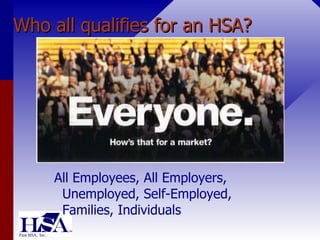
Who all qualifies for an HSA? All Employees, All Employers, Unemployed, Self-Employed, Families, Individuals
Who doesn’t qualify for an HSA? Anyone claimed as a dependent on a tax return  Those age 65 and above who are enrolled in Medicare.  Anyone covered under a lower deductible plan.
Who can make contributions to an HSA ? Any combination of individuals, family members and employers may make contributions. Contributions made by an individual and family member are tax-deductible (for the account beneficiary) even if the account beneficiary does not itemize.  Employer contributions are made on a pre-tax basis and are not taxable to the employee.  Employers are allowed to offer HSAs as part of a cafeteria plan.
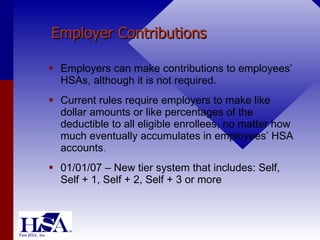
Employer Contributions Employers can make contributions to employees’ HSAs, although it is not required. Current rules require employers to make like dollar amounts or like percentages of the deductible to all eligible enrollees, no matter how much eventually accumulates in employees’ HSA accounts . 01/01/07 – New tier system that includes: Self, Self + 1, Self + 2, Self + 3 or more
What is the maximum contributions for 2009? Individuals: $3,000 Regardless of Deductible Family: $5,950 Regardless of Deductible Contributions are  NOT  pro-rated by the amount of months your HDHP was effective. No limits on growth of an HSA.
‘ Catch up’ contributions Allowed for individuals age 55 to Medicare age (65) Additional amount of $900 per individual in 2008.  $1000 per individual 2009. Contribution is pro-rated in the year insurance plan is terminated based on termination date of Insurance plan, not DOB. Increases $100 per year until it reaches $1,000 in 2009 Catch up Contributions
The Health Savings Account Tax Benefits Contributions are  tax-deductible going in Interest income grows  tax-free  Qualified withdrawals are  tax-free coming out
Qualified Medical Expenses HSA distributions are tax-free if they are used to pay for qualified medical expenses, such as: Amounts paid for the diagnosis, cure, treatment or prevention of disease Prescription drugs Qualified long-term care services and long-term care insurance  Continuation coverage required by Federal Law (i.e., COBRA)  Health insurance for the unemployed Medicare Expenses (but not Medigap) Retiree Health expenses for individuals age 65 and older
Can Individuals use the account  to pay for anything else? HSAs can be used to pay for medical expenses not covered by the employee’s health plan.  Typical expenses include vision, dental and over-the-counter medications.  Employees must keep a copy of all receipts for IRS reporting.
Distributions made for any non-qualified medical expense are subject to income tax and 10% penalty. The 10% penalty is waived in the case of death or disability or once the individual reaches age 65. Non-Qualified Medical Expenses
How do I pay for a typical Office Visit? Your plan utilizes a PPO network.  Therefore, unless your Provider knows their negotiated fee schedule you shouldn’t pay anything at the time of service.  You will be billed by the provider at a later date.  Outside of the network you will be asked to pay at the time of service.
How are prescriptions paid? Prescriptions are paid at the time of service.  Pharmacy discounts are applied at purchase, therefore payment will be required.  Pharmacy expenses will be added toward deductible and paid subject to co-pays after deductible has been satisfied.
What happens if I use a Non-Network Provider? Expenses incurred using a non-network provider will be paid at the time of service.  No discounts are awarded, unless, individually negotiated. Expenses incurred will count toward your non-network deductible.
What happens to money left  at the end of the year? The money in the HSA belongs to the employee. HSA funds rollover from year to year, earning interest tax-free and continue to accumulate for future years. These funds may be used to pay for future medical expenses tax free or can be used to supplement income at age 65 tax-deferred.
What happens to the money if the employee changes employment? Funds remaining in the account are  employee owned .  Funds can be used to pay for future medical expenses or used to supplement income at retirement. Account will remain open until funds are exhausted and account is closed.  Additional contributions may be made as long as the accountholder has obtained the necessary HDHP.
HSA Ownership Upon Death   Upon death, HSA ownership may transfer to a spouse on a tax-free basis. All other transfers result in a taxable event.
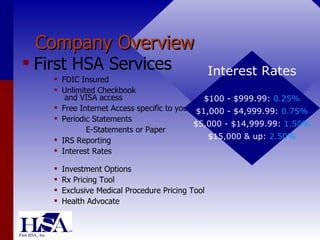
Company Overview First HSA Services FDIC Insured Unlimited Checkbook  and VISA access Free Internet Access specific to your HSA Periodic Statements E-Statements or Paper IRS Reporting Interest Rates  Investment Options Rx Pricing Tool Exclusive Medical Procedure Pricing Tool Health Advocate Interest Rates $100 - $999.99:  0.25% $1,000 - $4,999.99:  0.75% $5,000 - $14,999.99:  1.50% $15,000 & up:  2.50%
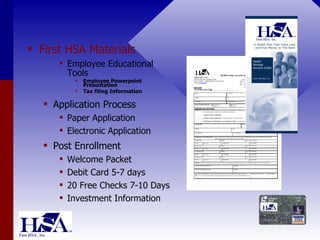
First HSA Materials Employee Educational Tools Employee Powerpoint Presentation   Tax filing Information Application Process Paper Application Electronic Application Post Enrollment Welcome Packet Debit Card 5-7 days 20 Free Checks 7-10 Days Investment Information
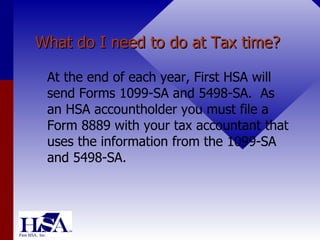
What do I need to do at Tax time? At the end of each year, First HSA will send Forms 1099-SA and 5498-SA.  As an HSA accountholder you must file a Form 8889 with your tax accountant that uses the information from the 1099-SA and 5498-SA.
How does my FSA work? Your FSA can still be used for expenses not covered under your HDHP i.e. Dental, Vision and Childcare.  It is now a “Limited FSA”.  Once your deductible has been satisfied, FSA funds may be used to pay for expenses incurred under the medical plan.
Customer Service Customer Service Representatives Highly qualified, trained individuals Phones answered by live person Hours of Customer Service 8:30 AM to 6 PM EST Toll-free customer  service numbers 24-hour automated  telephone banking Website:  www.1hsa.com
Contact Information Contact First HSA at: First HSA 2561 Bernville Road, Reading, PA  19605 Phone: 610-678-6000 or  toll free at 888-769-8696  Fax: (610) 678-6818

HSA (Health Savings Account)Presentation

  • 1.
    The Most Trusted Name in HSA Administration
  • 2.
    First HSA Incorporatedas First MSA, Inc. in 1999 Recognized Leader in Industry Charter Member of MSA/HSA Coalition Assist Treasury with HSA Rules and Regulations Changed Name to First HSA July 2005
  • 3.
    Health Savings Accounts(HSAs) Part of the Medicare Reform Bill Permanent federal law effective January 1, 2004 Signed into law by President Bush on December 8, 2003
  • 4.
    What is aHSA? Allows individuals to put away tax-free dollars that are used to pay for qualified medical expenses Must be combined with a “High Deductible” Health plan (HDHP)
  • 5.
    Health Savings AccountQualified High Deductible Health Plan Custodial/Trust Savings Account What is a Health Savings Account?
  • 6.
    High Deductible HealthPlan (HDHP) HSA Deductible/OOP (In Network) Individual- $1,150-$5,800 Family- $2,300-$11,600 HSA Deductible/OOP (Out of Network) Individual- $1,150- Unlimited Family- $2,300- Unlimited 2009: Adjusted by COL
  • 7.
    Typical “HDHP’s” Nooffice visit co-pays 100%, 90/10, 80/20 Co-insurance Some Preventive services covered not subject to deductible Prescription drugs included in deductible then subject to co-insurance or a co-pay
  • 8.
    Who all qualifiesfor an HSA? All Employees, All Employers, Unemployed, Self-Employed, Families, Individuals
  • 9.
    Who doesn’t qualifyfor an HSA? Anyone claimed as a dependent on a tax return Those age 65 and above who are enrolled in Medicare. Anyone covered under a lower deductible plan.
  • 10.
    Who can makecontributions to an HSA ? Any combination of individuals, family members and employers may make contributions. Contributions made by an individual and family member are tax-deductible (for the account beneficiary) even if the account beneficiary does not itemize. Employer contributions are made on a pre-tax basis and are not taxable to the employee. Employers are allowed to offer HSAs as part of a cafeteria plan.
  • 11.
    Employer Contributions Employerscan make contributions to employees’ HSAs, although it is not required. Current rules require employers to make like dollar amounts or like percentages of the deductible to all eligible enrollees, no matter how much eventually accumulates in employees’ HSA accounts . 01/01/07 – New tier system that includes: Self, Self + 1, Self + 2, Self + 3 or more
  • 12.
    What is themaximum contributions for 2009? Individuals: $3,000 Regardless of Deductible Family: $5,950 Regardless of Deductible Contributions are NOT pro-rated by the amount of months your HDHP was effective. No limits on growth of an HSA.
  • 13.
    ‘ Catch up’contributions Allowed for individuals age 55 to Medicare age (65) Additional amount of $900 per individual in 2008. $1000 per individual 2009. Contribution is pro-rated in the year insurance plan is terminated based on termination date of Insurance plan, not DOB. Increases $100 per year until it reaches $1,000 in 2009 Catch up Contributions
  • 14.
    The Health SavingsAccount Tax Benefits Contributions are tax-deductible going in Interest income grows tax-free Qualified withdrawals are tax-free coming out
  • 15.
    Qualified Medical ExpensesHSA distributions are tax-free if they are used to pay for qualified medical expenses, such as: Amounts paid for the diagnosis, cure, treatment or prevention of disease Prescription drugs Qualified long-term care services and long-term care insurance Continuation coverage required by Federal Law (i.e., COBRA) Health insurance for the unemployed Medicare Expenses (but not Medigap) Retiree Health expenses for individuals age 65 and older
  • 16.
    Can Individuals usethe account to pay for anything else? HSAs can be used to pay for medical expenses not covered by the employee’s health plan. Typical expenses include vision, dental and over-the-counter medications. Employees must keep a copy of all receipts for IRS reporting.
  • 17.
    Distributions made forany non-qualified medical expense are subject to income tax and 10% penalty. The 10% penalty is waived in the case of death or disability or once the individual reaches age 65. Non-Qualified Medical Expenses
  • 18.
    How do Ipay for a typical Office Visit? Your plan utilizes a PPO network. Therefore, unless your Provider knows their negotiated fee schedule you shouldn’t pay anything at the time of service. You will be billed by the provider at a later date. Outside of the network you will be asked to pay at the time of service.
  • 19.
    How are prescriptionspaid? Prescriptions are paid at the time of service. Pharmacy discounts are applied at purchase, therefore payment will be required. Pharmacy expenses will be added toward deductible and paid subject to co-pays after deductible has been satisfied.
  • 20.
    What happens ifI use a Non-Network Provider? Expenses incurred using a non-network provider will be paid at the time of service. No discounts are awarded, unless, individually negotiated. Expenses incurred will count toward your non-network deductible.
  • 21.
    What happens tomoney left at the end of the year? The money in the HSA belongs to the employee. HSA funds rollover from year to year, earning interest tax-free and continue to accumulate for future years. These funds may be used to pay for future medical expenses tax free or can be used to supplement income at age 65 tax-deferred.
  • 22.
    What happens tothe money if the employee changes employment? Funds remaining in the account are employee owned . Funds can be used to pay for future medical expenses or used to supplement income at retirement. Account will remain open until funds are exhausted and account is closed. Additional contributions may be made as long as the accountholder has obtained the necessary HDHP.
  • 23.
    HSA Ownership UponDeath Upon death, HSA ownership may transfer to a spouse on a tax-free basis. All other transfers result in a taxable event.
  • 24.
    Company Overview FirstHSA Services FDIC Insured Unlimited Checkbook and VISA access Free Internet Access specific to your HSA Periodic Statements E-Statements or Paper IRS Reporting Interest Rates Investment Options Rx Pricing Tool Exclusive Medical Procedure Pricing Tool Health Advocate Interest Rates $100 - $999.99: 0.25% $1,000 - $4,999.99: 0.75% $5,000 - $14,999.99: 1.50% $15,000 & up: 2.50%
  • 25.
    First HSA MaterialsEmployee Educational Tools Employee Powerpoint Presentation Tax filing Information Application Process Paper Application Electronic Application Post Enrollment Welcome Packet Debit Card 5-7 days 20 Free Checks 7-10 Days Investment Information
  • 26.
    What do Ineed to do at Tax time? At the end of each year, First HSA will send Forms 1099-SA and 5498-SA. As an HSA accountholder you must file a Form 8889 with your tax accountant that uses the information from the 1099-SA and 5498-SA.
  • 27.
    How does myFSA work? Your FSA can still be used for expenses not covered under your HDHP i.e. Dental, Vision and Childcare. It is now a “Limited FSA”. Once your deductible has been satisfied, FSA funds may be used to pay for expenses incurred under the medical plan.
  • 28.
    Customer Service CustomerService Representatives Highly qualified, trained individuals Phones answered by live person Hours of Customer Service 8:30 AM to 6 PM EST Toll-free customer service numbers 24-hour automated telephone banking Website: www.1hsa.com
  • 29.
    Contact Information ContactFirst HSA at: First HSA 2561 Bernville Road, Reading, PA 19605 Phone: 610-678-6000 or toll free at 888-769-8696 Fax: (610) 678-6818