Considering a Health Savings Account?
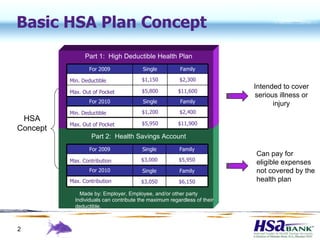
Basic HSA Plan Concept Part 1:  High Deductible Health Plan Part 2:  Health Savings Account Made by: Employer, Employee, and/or other party HSA Concept Intended to cover serious illness or injury Can pay for eligible expenses not covered by the health plan Individuals can contribute the maximum regardless of their deductible. For 2009 Single Family Min. Deductible $1,150 $2,300 Max. Out of Pocket $5,800 $11,600 For 2010 Single Family Min. Deductible $1,200 $2,400 Max. Out of Pocket $5,950 $11,900 For 2009 Single Family Max. Contribution $3,000 $5,950 For 2010 Single Family Max. Contribution $3,050 $6,150
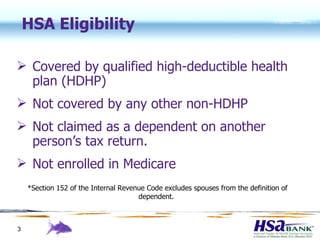
HSA Eligibility Covered by qualified high-deductible health plan (HDHP) Not covered by any other non-HDHP  Not claimed as a dependent on another person’s tax return.  Not enrolled in Medicare *Section 152 of the Internal Revenue Code excludes spouses from the definition of dependent.
What is the catch-up contribution? Accountholders who are age 55 or older and not enrolled in Medicare can make catch-up contributions.   Note: Spouses of accountholders who are 55 or older and meet the IRS eligibility requirements can open their own HSA and make a catch-up contribution.  Year Catch-up Amt. 2009+ $1,000
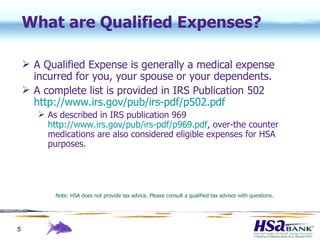
What are Qualified Expenses? A Qualified Expense is generally a medical expense incurred for you, your spouse or your dependents. A complete list is provided in IRS Publication 502  http://www.irs.gov/pub/irs-pdf/p502.pdf   As described in IRS publication 969  http://www.irs.gov/pub/irs-pdf/p969.pdf , over-the counter medications are also considered eligible expenses for HSA purposes.  Note: HSA does not provide tax advice. Please consult a qualified tax advisor with questions.
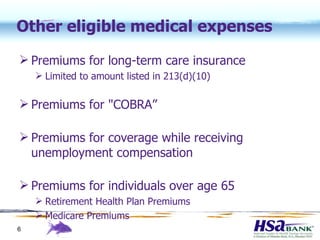
Other eligible medical expenses Premiums for long-term care insurance Limited to amount listed in 213(d)(10) Premiums for "COBRA” Premiums for coverage while receiving unemployment compensation Premiums for individuals over age 65  Retirement Health Plan Premiums Medicare Premiums
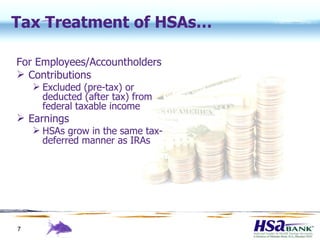
Tax Treatment of HSAs… For Employees/Accountholders Contributions Excluded (pre-tax) or deducted (after tax) from federal taxable income Earnings HSAs grow in the same tax-deferred manner as IRAs
Tax Treatment of HSAs  (Continued) For Employees/Accountholders Distributions Withdrawals for qualified medical expenses are always tax-free. After age 65, funds may be withdrawn for any reason without penalty, subject to regular income tax. Upon death of accountholder If the spouse is the beneficiary, the HSA may transfer to the spouse’s name and remain a tax-favored account If the beneficiary is not the spouse, the funds are paid to the beneficiary as a taxable transaction If the HSA does not have a beneficiary, the funds are paid to the estate of the accountholder
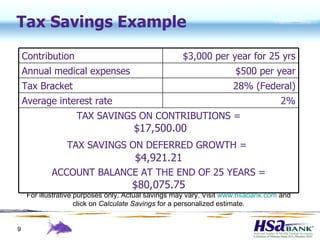
Tax Savings Example For illustrative purposes only. Actual savings may vary. Visit  www.hsabank.com  and click on  Calculate Savings  for a personalized estimate. Contribution $3,000 per year for 25 yrs Annual medical expenses $500 per year Tax Bracket 28% (Federal) Average interest rate  2% TAX SAVINGS ON CONTRIBUTIONS =  $17,500.00 TAX SAVINGS ON DEFERRED GROWTH =   $4,921.21 ACCOUNT BALANCE AT THE END OF 25 YEARS = $80,075.75
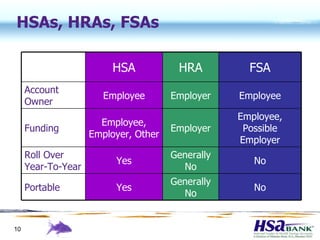
HSAs, HRAs, FSAs HSA HRA FSA Account Owner Employee Employer Employee Funding Employee, Employer, Other Employer Employee, Possible Employer Roll Over Year-To-Year Yes Generally No No Portable Yes Generally No No
Advantages of an HSA For an Employee Funds roll over year to year No need to “use it or lose it” Tax benefits on the contributions, earnings, and distributions Potential for increased take-home pay  Long-term investment opportunity
Savings Account Option Interest bearing “bank” account Accounts are opened as an FDIC-insured bank account through Webster Bank, N.A. Current interest rate and annual percentage yield information is available on our website,  www.hsabank.com  or by calling (800) 357-6246. Interest Rate and APY are subject to change, at our discretion, at any time. Fees may reduce earnings.
Self-Directed Investment Option TD Ameritrade Corporate Services Access to stocks, bonds and over 11,000 mutual funds Trades are made online or over the phone Transfer funds from your HSA to your investment account: Online through Internet Banking By calling the Client Assistance Center Investment products are  not  FDIC insured, are not a deposit or other obligation of or guaranteed by the bank, and are subject to investment risks including possible loss of the principal amount invested.
Mutual Fund Selection Devenir Investment Advisors Selection Options Employer can offer our standard selection of historically top-performing mutual funds For an additional fee, employers can select mutual funds similar to their 401(k) offering Trades are completed online through HSA Bank’s Internet Banking system Investment products are  not  FDIC insured, are not a deposit or other obligation of or guaranteed by the bank, and are subject to investment risks including possible loss of the principal amount invested.
Accountholder Communication  and Reporting  Account statements Periodic account inserts with valuable legislative  information, account features, and more IRS reporting Year-end status report 1099-SA (distributions) 5498-SA (contributions) Online Account Access through Internet Banking Account balance and transaction history  (Up to 18 mo. for convenient tax reporting) View cancelled checks  Year-to-date information  (Including a breakdown of contributions by source.) Ability to download transaction history to Quicken or Money Email confirmation of account opening and ongoing activity Online address changes Access to Online Contributions
Calculation Tools Is an HSA Right for Me Allows you to compare a traditional health plan and an HSA qualified plan to determine potential savings  http://hsabank.com/HSABank/Education/HSA_Right_For_Me.aspx   Future Value Calculator Calculates tax savings on contributions and tax-deferred growth as well as the future value of your Health Savings Account  http://hsabank.com/HSABank/Education/futurevalue   HSAFORM
Account Support Toll-free Bankline 24-hour account access via  touchtone phone (800)-565-3512   Toll-free Client Assistance Center   (800) 357-6246   7 a.m. – 9 p.m., Central Time, Monday – Friday Toll-free Spanish Language Assistance Line   (866) 357-6232   7 a.m. – 9 p.m., Central Time, Monday – Friday
Thank You for Considering…

Hsa Employee Overview

  • 1.
    Considering a HealthSavings Account?
  • 2.
    Basic HSA PlanConcept Part 1: High Deductible Health Plan Part 2: Health Savings Account Made by: Employer, Employee, and/or other party HSA Concept Intended to cover serious illness or injury Can pay for eligible expenses not covered by the health plan Individuals can contribute the maximum regardless of their deductible. For 2009 Single Family Min. Deductible $1,150 $2,300 Max. Out of Pocket $5,800 $11,600 For 2010 Single Family Min. Deductible $1,200 $2,400 Max. Out of Pocket $5,950 $11,900 For 2009 Single Family Max. Contribution $3,000 $5,950 For 2010 Single Family Max. Contribution $3,050 $6,150
  • 3.
    HSA Eligibility Coveredby qualified high-deductible health plan (HDHP) Not covered by any other non-HDHP Not claimed as a dependent on another person’s tax return. Not enrolled in Medicare *Section 152 of the Internal Revenue Code excludes spouses from the definition of dependent.
  • 4.
    What is thecatch-up contribution? Accountholders who are age 55 or older and not enrolled in Medicare can make catch-up contributions. Note: Spouses of accountholders who are 55 or older and meet the IRS eligibility requirements can open their own HSA and make a catch-up contribution. Year Catch-up Amt. 2009+ $1,000
  • 5.
    What are QualifiedExpenses? A Qualified Expense is generally a medical expense incurred for you, your spouse or your dependents. A complete list is provided in IRS Publication 502 http://www.irs.gov/pub/irs-pdf/p502.pdf As described in IRS publication 969 http://www.irs.gov/pub/irs-pdf/p969.pdf , over-the counter medications are also considered eligible expenses for HSA purposes. Note: HSA does not provide tax advice. Please consult a qualified tax advisor with questions.
  • 6.
    Other eligible medicalexpenses Premiums for long-term care insurance Limited to amount listed in 213(d)(10) Premiums for "COBRA” Premiums for coverage while receiving unemployment compensation Premiums for individuals over age 65 Retirement Health Plan Premiums Medicare Premiums
  • 7.
    Tax Treatment ofHSAs… For Employees/Accountholders Contributions Excluded (pre-tax) or deducted (after tax) from federal taxable income Earnings HSAs grow in the same tax-deferred manner as IRAs
  • 8.
    Tax Treatment ofHSAs (Continued) For Employees/Accountholders Distributions Withdrawals for qualified medical expenses are always tax-free. After age 65, funds may be withdrawn for any reason without penalty, subject to regular income tax. Upon death of accountholder If the spouse is the beneficiary, the HSA may transfer to the spouse’s name and remain a tax-favored account If the beneficiary is not the spouse, the funds are paid to the beneficiary as a taxable transaction If the HSA does not have a beneficiary, the funds are paid to the estate of the accountholder
  • 9.
    Tax Savings ExampleFor illustrative purposes only. Actual savings may vary. Visit www.hsabank.com and click on Calculate Savings for a personalized estimate. Contribution $3,000 per year for 25 yrs Annual medical expenses $500 per year Tax Bracket 28% (Federal) Average interest rate 2% TAX SAVINGS ON CONTRIBUTIONS = $17,500.00 TAX SAVINGS ON DEFERRED GROWTH = $4,921.21 ACCOUNT BALANCE AT THE END OF 25 YEARS = $80,075.75
  • 10.
    HSAs, HRAs, FSAsHSA HRA FSA Account Owner Employee Employer Employee Funding Employee, Employer, Other Employer Employee, Possible Employer Roll Over Year-To-Year Yes Generally No No Portable Yes Generally No No
  • 11.
    Advantages of anHSA For an Employee Funds roll over year to year No need to “use it or lose it” Tax benefits on the contributions, earnings, and distributions Potential for increased take-home pay Long-term investment opportunity
  • 12.
    Savings Account OptionInterest bearing “bank” account Accounts are opened as an FDIC-insured bank account through Webster Bank, N.A. Current interest rate and annual percentage yield information is available on our website, www.hsabank.com or by calling (800) 357-6246. Interest Rate and APY are subject to change, at our discretion, at any time. Fees may reduce earnings.
  • 13.
    Self-Directed Investment OptionTD Ameritrade Corporate Services Access to stocks, bonds and over 11,000 mutual funds Trades are made online or over the phone Transfer funds from your HSA to your investment account: Online through Internet Banking By calling the Client Assistance Center Investment products are not FDIC insured, are not a deposit or other obligation of or guaranteed by the bank, and are subject to investment risks including possible loss of the principal amount invested.
  • 14.
    Mutual Fund SelectionDevenir Investment Advisors Selection Options Employer can offer our standard selection of historically top-performing mutual funds For an additional fee, employers can select mutual funds similar to their 401(k) offering Trades are completed online through HSA Bank’s Internet Banking system Investment products are not FDIC insured, are not a deposit or other obligation of or guaranteed by the bank, and are subject to investment risks including possible loss of the principal amount invested.
  • 15.
    Accountholder Communication and Reporting Account statements Periodic account inserts with valuable legislative information, account features, and more IRS reporting Year-end status report 1099-SA (distributions) 5498-SA (contributions) Online Account Access through Internet Banking Account balance and transaction history (Up to 18 mo. for convenient tax reporting) View cancelled checks Year-to-date information (Including a breakdown of contributions by source.) Ability to download transaction history to Quicken or Money Email confirmation of account opening and ongoing activity Online address changes Access to Online Contributions
  • 16.
    Calculation Tools Isan HSA Right for Me Allows you to compare a traditional health plan and an HSA qualified plan to determine potential savings http://hsabank.com/HSABank/Education/HSA_Right_For_Me.aspx Future Value Calculator Calculates tax savings on contributions and tax-deferred growth as well as the future value of your Health Savings Account http://hsabank.com/HSABank/Education/futurevalue HSAFORM
  • 17.
    Account Support Toll-freeBankline 24-hour account access via touchtone phone (800)-565-3512 Toll-free Client Assistance Center (800) 357-6246 7 a.m. – 9 p.m., Central Time, Monday – Friday Toll-free Spanish Language Assistance Line (866) 357-6232 7 a.m. – 9 p.m., Central Time, Monday – Friday
  • 18.
    Thank You forConsidering…