Insider secrets-how an HSA plan can save you taxes & premiums This presentation is adopted from a presentation made in an advanced tax planning class as part of the curriculum for my Master’s in Tax & Financial Planning at San Diego State University.  Although it highlights many of the HSA basic concepts, it is actually designed to focus on a little known “secret” behind the HSA plan—the ability to by-pass the 7.5% AGI limitation required before most people can ever deduct any of their medical expenses.  I hope you enjoy! C. Dean Richard, JD, MSBA Needless to say, all contents ©2008, all rights reserved.
Health Savings Account Plans By now, almost everyone knows that an HSA plan allows you to use TAX-FREE money to pay most medical expenses But did you also know . . .
An HSA also allows you to: By-pass the 7.5% AGI Limitation and deduct (almost) all of your medical expenses …. BEFORE  they are incurred!
What is an HSA? A tax-sheltered savings account designed specifically for medical expenses Predecessor: Medical Savings Accounts (MSA), born in the Kennedy-Kassalbaum Bill of 1996 (also known as “HIPAA”) Revitalized in 2004 as part of the Medicare Reform Act of 2003
Tax-Advantages—the Basics 100% of your annual contribution to your savings account is deductible “above the line” Earnings accumulate tax-deferred (can invest in almost anything) Withdrawals are TAX-FREE (if used for qualified medical expenses
Similar to an IRA Sounds like an IRA? YES!! (“it’s a medical IRA”)
Who is eligible? Almost everyone, including: Self-Employed (sole proprietors, partners, sub-S stockholders) Employees with a company sponsored HSA qualified insurance plan in place Anyone with enough earned income to at least equal the HSA contribution
What is the Catch? You must first purchase a special health insurance policy:  “HDHP” (High Deductible Health Plan)
HSA Insurance Policy (“HDHP”) Specified Deductible and Out-of-Pocket ranges *For 2008 Tax year Type of Coverage Minimum Deductible Maximum Deductible Maximum Annual Out-of-Pocket SINGLE 1,100 5,600 5,600 FAMILY 2,250 11,200 11,200
What is the Catch? (con’t...) Only after you become insured with an HSA-qualified health plan can you then open and fund the actual HSA savings account.    POINT:  The savings account is totally separate from the high deductible insurance policy required to establish eligibility for the savings account. So, yes, you must pay premiums an an insurance policy in addition to making any contributions to the savings account.
Why would anyone want an HSA? Basic concept:  Pay a much smaller premium on your insurance policy—because of the higher deductible—and take the difference and set it aside in a special savings account, basically to cover the “small” medical bills yourself—and let the insurance policy pay just the “big” bills. POINT:  In theory, this is usually a more efficient way to fund your own health care, especially if you have to fund it yourself.  This argument loses ground if someone else provides your coverage at little or no cost, or if you have pre-existing health conditions that require costly upkeep.
Government “encouragement”   Tax deduction for merely saving money   100% tax deductible contributions!  Tax-free withdrawals!  (for qualified expenses)
AGI “By-Pass” Compare an HSA to the “other way” you can get a deduction for medical expenses—you have to spend money.   Schedule A—Itemized Deduction for medical expenses.  Limited to 7.5% of AGI.   Key term:  Expenses.  Ordinarily, you have to spend money, i.e., incur expenses in order to get a tax deduction.    Which would you rather have:  A deduction for  expenses  incurred or for money contributed to a  savings  account?
Example: Bill & Susan, both age 44, with 2 kids Bill is self-employed contractor AGI:  $77,000 Medical “expenses” for the year: $1,600  (by law, does not include insurance premiums paid!)   Amount of deduction:  ZERO Why?: 7.5% threshold is not reached until $5,775 in expenses are incurred
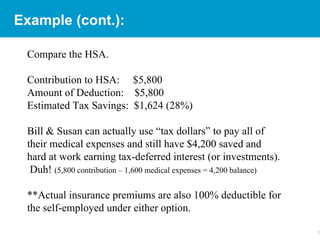
Example (cont.): Compare the HSA.   Contribution to HSA:  $5,800 Amount of Deduction:  $5,800 Estimated Tax Savings:  $1,624 (28%)   Bill & Susan can actually use “tax dollars” to pay all of their medical expenses and still have $4,200 saved and hard at work earning tax-deferred interest (or investments).  Duh!  (5,800 contribution – 1,600 medical expenses = 4,200 balance)   **Actual insurance premiums are also 100% deductible for the self-employed under either option.
Limitations on Annual Deduction Lesser of: Earned income, or Maximum allowable annual contribution $5,800families $2,900 single person plans Additional contribution up to $900 allowed as “catch-up” provision for individuals 55+.
Other Important Factors-Penalties  15% tax penalty for withdrawing money not used for eligible medical expenses prior to age 65  (after 65, basically used as IRA—no penalty for “early” withdrawal, but is includable in gross income, unless used to pay qualifying medical expenses) Ordinary income if withdrawn for ineligible expenses  (at any age) 6% excise tax for contributing more than allowable amount each year
Eligible Expenses:  Withdrawals are tax-free and penalty-free at any age if made to pay any of the eligible expenses: NOTE:  This is the same list used by the IRS to determine if medical expenses you claim qualify for the 7.5% AGI deduction!   •  ambulance  • gum treatment  • prescription medicines •  anesthetist  • gynecologist  • psychiatrist  •  eyeglasses • pediatrician • physician •  blood tests  • hospital bills  • psychoanalyst  •  arch supports  • healing services • psychologist •  lab tests  • hearing aids  • neurologist
Deadlines? If a qualifying health insurance policy is in place by Dec. 1, a taxpayer is eligible for the full contribution for the entire tax year. Contributions may be made up until April 15.

Hsa Power Point

  • 1.
    Insider secrets-how anHSA plan can save you taxes & premiums This presentation is adopted from a presentation made in an advanced tax planning class as part of the curriculum for my Master’s in Tax & Financial Planning at San Diego State University. Although it highlights many of the HSA basic concepts, it is actually designed to focus on a little known “secret” behind the HSA plan—the ability to by-pass the 7.5% AGI limitation required before most people can ever deduct any of their medical expenses. I hope you enjoy! C. Dean Richard, JD, MSBA Needless to say, all contents ©2008, all rights reserved.
  • 2.
    Health Savings AccountPlans By now, almost everyone knows that an HSA plan allows you to use TAX-FREE money to pay most medical expenses But did you also know . . .
  • 3.
    An HSA alsoallows you to: By-pass the 7.5% AGI Limitation and deduct (almost) all of your medical expenses …. BEFORE they are incurred!
  • 4.
    What is anHSA? A tax-sheltered savings account designed specifically for medical expenses Predecessor: Medical Savings Accounts (MSA), born in the Kennedy-Kassalbaum Bill of 1996 (also known as “HIPAA”) Revitalized in 2004 as part of the Medicare Reform Act of 2003
  • 5.
    Tax-Advantages—the Basics 100%of your annual contribution to your savings account is deductible “above the line” Earnings accumulate tax-deferred (can invest in almost anything) Withdrawals are TAX-FREE (if used for qualified medical expenses
  • 6.
    Similar to anIRA Sounds like an IRA? YES!! (“it’s a medical IRA”)
  • 7.
    Who is eligible?Almost everyone, including: Self-Employed (sole proprietors, partners, sub-S stockholders) Employees with a company sponsored HSA qualified insurance plan in place Anyone with enough earned income to at least equal the HSA contribution
  • 8.
    What is theCatch? You must first purchase a special health insurance policy: “HDHP” (High Deductible Health Plan)
  • 9.
    HSA Insurance Policy(“HDHP”) Specified Deductible and Out-of-Pocket ranges *For 2008 Tax year Type of Coverage Minimum Deductible Maximum Deductible Maximum Annual Out-of-Pocket SINGLE 1,100 5,600 5,600 FAMILY 2,250 11,200 11,200
  • 10.
    What is theCatch? (con’t...) Only after you become insured with an HSA-qualified health plan can you then open and fund the actual HSA savings account.   POINT: The savings account is totally separate from the high deductible insurance policy required to establish eligibility for the savings account. So, yes, you must pay premiums an an insurance policy in addition to making any contributions to the savings account.
  • 11.
    Why would anyonewant an HSA? Basic concept: Pay a much smaller premium on your insurance policy—because of the higher deductible—and take the difference and set it aside in a special savings account, basically to cover the “small” medical bills yourself—and let the insurance policy pay just the “big” bills. POINT: In theory, this is usually a more efficient way to fund your own health care, especially if you have to fund it yourself. This argument loses ground if someone else provides your coverage at little or no cost, or if you have pre-existing health conditions that require costly upkeep.
  • 12.
    Government “encouragement” Tax deduction for merely saving money 100% tax deductible contributions! Tax-free withdrawals! (for qualified expenses)
  • 13.
    AGI “By-Pass” Comparean HSA to the “other way” you can get a deduction for medical expenses—you have to spend money.   Schedule A—Itemized Deduction for medical expenses. Limited to 7.5% of AGI.   Key term: Expenses. Ordinarily, you have to spend money, i.e., incur expenses in order to get a tax deduction.   Which would you rather have: A deduction for expenses incurred or for money contributed to a savings account?
  • 14.
    Example: Bill &Susan, both age 44, with 2 kids Bill is self-employed contractor AGI: $77,000 Medical “expenses” for the year: $1,600 (by law, does not include insurance premiums paid!)   Amount of deduction: ZERO Why?: 7.5% threshold is not reached until $5,775 in expenses are incurred
  • 15.
    Example (cont.): Comparethe HSA.   Contribution to HSA: $5,800 Amount of Deduction: $5,800 Estimated Tax Savings: $1,624 (28%)   Bill & Susan can actually use “tax dollars” to pay all of their medical expenses and still have $4,200 saved and hard at work earning tax-deferred interest (or investments). Duh! (5,800 contribution – 1,600 medical expenses = 4,200 balance)   **Actual insurance premiums are also 100% deductible for the self-employed under either option.
  • 16.
    Limitations on AnnualDeduction Lesser of: Earned income, or Maximum allowable annual contribution $5,800families $2,900 single person plans Additional contribution up to $900 allowed as “catch-up” provision for individuals 55+.
  • 17.
    Other Important Factors-Penalties 15% tax penalty for withdrawing money not used for eligible medical expenses prior to age 65 (after 65, basically used as IRA—no penalty for “early” withdrawal, but is includable in gross income, unless used to pay qualifying medical expenses) Ordinary income if withdrawn for ineligible expenses (at any age) 6% excise tax for contributing more than allowable amount each year
  • 18.
    Eligible Expenses: Withdrawals are tax-free and penalty-free at any age if made to pay any of the eligible expenses: NOTE: This is the same list used by the IRS to determine if medical expenses you claim qualify for the 7.5% AGI deduction! • ambulance • gum treatment • prescription medicines • anesthetist • gynecologist • psychiatrist • eyeglasses • pediatrician • physician • blood tests • hospital bills • psychoanalyst • arch supports • healing services • psychologist • lab tests • hearing aids • neurologist
  • 19.
    Deadlines? If aqualifying health insurance policy is in place by Dec. 1, a taxpayer is eligible for the full contribution for the entire tax year. Contributions may be made up until April 15.

Editor's Notes

  • #5 Imagine that 30% of the calls you receive on your cell phone are from telemarketers – you would consider the value of the cellular system to be far less than you do today -- you’d find it as much of a source of annoyance as you would a useful tool. And as you had to pay for each call you received it would reduce the cost effectiveness considerably. E-mail is, after the wired telephone, the most valuable communications resource business has and spam does to e-mail what unrestrained telemarketing would do to the cell phone system – it decreases value and increases costs.
  • #6 Imagine that 30% of the calls you receive on your cell phone are from telemarketers – you would consider the value of the cellular system to be far less than you do today -- you’d find it as much of a source of annoyance as you would a useful tool. And as you had to pay for each call you received it would reduce the cost effectiveness considerably. E-mail is, after the wired telephone, the most valuable communications resource business has and spam does to e-mail what unrestrained telemarketing would do to the cell phone system – it decreases value and increases costs.
  • #7 Imagine that 30% of the calls you receive on your cell phone are from telemarketers – you would consider the value of the cellular system to be far less than you do today -- you’d find it as much of a source of annoyance as you would a useful tool. And as you had to pay for each call you received it would reduce the cost effectiveness considerably. E-mail is, after the wired telephone, the most valuable communications resource business has and spam does to e-mail what unrestrained telemarketing would do to the cell phone system – it decreases value and increases costs.
  • #8 Imagine that 30% of the calls you receive on your cell phone are from telemarketers – you would consider the value of the cellular system to be far less than you do today -- you’d find it as much of a source of annoyance as you would a useful tool. And as you had to pay for each call you received it would reduce the cost effectiveness considerably. E-mail is, after the wired telephone, the most valuable communications resource business has and spam does to e-mail what unrestrained telemarketing would do to the cell phone system – it decreases value and increases costs.
  • #9 Imagine that 30% of the calls you receive on your cell phone are from telemarketers – you would consider the value of the cellular system to be far less than you do today -- you’d find it as much of a source of annoyance as you would a useful tool. And as you had to pay for each call you received it would reduce the cost effectiveness considerably. E-mail is, after the wired telephone, the most valuable communications resource business has and spam does to e-mail what unrestrained telemarketing would do to the cell phone system – it decreases value and increases costs.
  • #10 Imagine that 30% of the calls you receive on your cell phone are from telemarketers – you would consider the value of the cellular system to be far less than you do today -- you’d find it as much of a source of annoyance as you would a useful tool. And as you had to pay for each call you received it would reduce the cost effectiveness considerably. E-mail is, after the wired telephone, the most valuable communications resource business has and spam does to e-mail what unrestrained telemarketing would do to the cell phone system – it decreases value and increases costs.
  • #11 Imagine that 30% of the calls you receive on your cell phone are from telemarketers – you would consider the value of the cellular system to be far less than you do today -- you’d find it as much of a source of annoyance as you would a useful tool. And as you had to pay for each call you received it would reduce the cost effectiveness considerably. E-mail is, after the wired telephone, the most valuable communications resource business has and spam does to e-mail what unrestrained telemarketing would do to the cell phone system – it decreases value and increases costs.
  • #12 Imagine that 30% of the calls you receive on your cell phone are from telemarketers – you would consider the value of the cellular system to be far less than you do today -- you’d find it as much of a source of annoyance as you would a useful tool. And as you had to pay for each call you received it would reduce the cost effectiveness considerably. E-mail is, after the wired telephone, the most valuable communications resource business has and spam does to e-mail what unrestrained telemarketing would do to the cell phone system – it decreases value and increases costs.
  • #13 Imagine that 30% of the calls you receive on your cell phone are from telemarketers – you would consider the value of the cellular system to be far less than you do today -- you’d find it as much of a source of annoyance as you would a useful tool. And as you had to pay for each call you received it would reduce the cost effectiveness considerably. E-mail is, after the wired telephone, the most valuable communications resource business has and spam does to e-mail what unrestrained telemarketing would do to the cell phone system – it decreases value and increases costs.
  • #14 Imagine that 30% of the calls you receive on your cell phone are from telemarketers – you would consider the value of the cellular system to be far less than you do today -- you’d find it as much of a source of annoyance as you would a useful tool. And as you had to pay for each call you received it would reduce the cost effectiveness considerably. E-mail is, after the wired telephone, the most valuable communications resource business has and spam does to e-mail what unrestrained telemarketing would do to the cell phone system – it decreases value and increases costs.
  • #15 Imagine that 30% of the calls you receive on your cell phone are from telemarketers – you would consider the value of the cellular system to be far less than you do today -- you’d find it as much of a source of annoyance as you would a useful tool. And as you had to pay for each call you received it would reduce the cost effectiveness considerably. E-mail is, after the wired telephone, the most valuable communications resource business has and spam does to e-mail what unrestrained telemarketing would do to the cell phone system – it decreases value and increases costs.
  • #16 Imagine that 30% of the calls you receive on your cell phone are from telemarketers – you would consider the value of the cellular system to be far less than you do today -- you’d find it as much of a source of annoyance as you would a useful tool. And as you had to pay for each call you received it would reduce the cost effectiveness considerably. E-mail is, after the wired telephone, the most valuable communications resource business has and spam does to e-mail what unrestrained telemarketing would do to the cell phone system – it decreases value and increases costs.
  • #17 Imagine that 30% of the calls you receive on your cell phone are from telemarketers – you would consider the value of the cellular system to be far less than you do today -- you’d find it as much of a source of annoyance as you would a useful tool. And as you had to pay for each call you received it would reduce the cost effectiveness considerably. E-mail is, after the wired telephone, the most valuable communications resource business has and spam does to e-mail what unrestrained telemarketing would do to the cell phone system – it decreases value and increases costs.
  • #18 Imagine that 30% of the calls you receive on your cell phone are from telemarketers – you would consider the value of the cellular system to be far less than you do today -- you’d find it as much of a source of annoyance as you would a useful tool. And as you had to pay for each call you received it would reduce the cost effectiveness considerably. E-mail is, after the wired telephone, the most valuable communications resource business has and spam does to e-mail what unrestrained telemarketing would do to the cell phone system – it decreases value and increases costs.
  • #19 Imagine that 30% of the calls you receive on your cell phone are from telemarketers – you would consider the value of the cellular system to be far less than you do today -- you’d find it as much of a source of annoyance as you would a useful tool. And as you had to pay for each call you received it would reduce the cost effectiveness considerably. E-mail is, after the wired telephone, the most valuable communications resource business has and spam does to e-mail what unrestrained telemarketing would do to the cell phone system – it decreases value and increases costs.
  • #20 Imagine that 30% of the calls you receive on your cell phone are from telemarketers – you would consider the value of the cellular system to be far less than you do today -- you’d find it as much of a source of annoyance as you would a useful tool. And as you had to pay for each call you received it would reduce the cost effectiveness considerably. E-mail is, after the wired telephone, the most valuable communications resource business has and spam does to e-mail what unrestrained telemarketing would do to the cell phone system – it decreases value and increases costs.