First aid
First aid
Fix it crew
Fix it crew
1 Khadija Afzal 2 Khansa zahir
3 Aman Irshad 4 Namra Mughal
5 Noor Fatima
5 Noor Fatima
Introduction of first aid
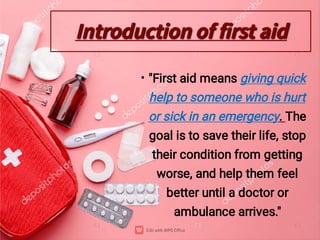
• "First aid means giving quick
help to someone who is hurt
or sick in an emergency. The
goal is to save their life, stop
their condition from getting
worse, and help them feel
better until a doctor or
ambulance arrives."
According to famous authors
•
•
According to Merriam Webster
"Emergency care or treatment given to an ill or
injured person before regular medical aid can be
obtained."
According to Red Cross:
"This is immediate help provided
to a sick or injured person
until professional help arrives ."
Founder of first aid
•
•
•
•
•
•
•
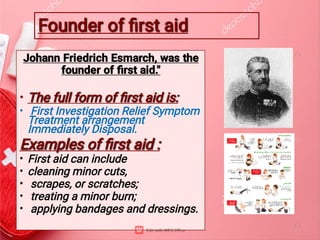
Johann Friedrich Esmarch, was the
founder of first aid."
The full form of first aid is:
First Investigation Relief Symptom
Treatment arrangement
Immediately Disposal.
Examples of first aid :
First aid can include
cleaning minor cuts,
scrapes, or scratches;
treating a minor burn;
applying bandages and dressings.
Importance of first aid
•
•
•
•
•
•
•
•
•
•
1. Helping in Emergencies
First aid helps people to take action
during emergencies.
For example,
For example, if someone:
Swallows something harmful
Has a heart attack
Gets hurt in a natural disaster
2. Doing the Right Thing at the
Right Time
2. Doing the Right Thing at the
Right Time
In an emergency, knowing what to
do is very important.
For example:
For example:
The brain can start dying in just 6
minutes without oxygen.
Importance of first aid
3. Useful for Yourself and
Others
3. Useful for Yourself and
Others
First aid is not just for helping others
— it helps you too.
If something happens to you or
someone you care about at home,
school, or work, you will know what
to do.
4. Prevents Conditions from
Getting Worse
4. Prevents Conditions from
Getting Worse
A small injury can turn into a big
problem if not treated quickly.
First aid stops bleeding, prevents
infections, and reduces pain.
Who is first aider
Who is first aider
A *first aider* is a person who is trained to
give *immediate help* to someone who is
*injured or suddenly sick*, before
professional medical help arrives.
*Definitions by Famous Sources:*
*1. St. Andrew’s First Aid:*
*“A first aider is someone who has been
trained to give immediate help to an ill or
injured person until professional medical
help arrives.”*
*2. British Red Cross:*
*“A first aider is a person with basic
medical training who provides initial care
during an emergency situation.”*
Qualities of first aider









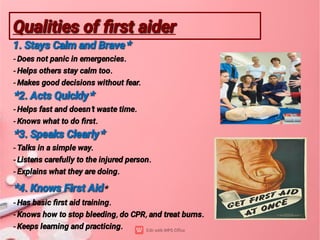
A good first aider is calm, quick,
trained, kind, and strong. These
qualities help save lives in
emergencies.
- Calm and confident
- Quick decision-making
- Good communication
- Basic first aid knowledge
- Observant and alert
- Kind and caring
- Responsible and trustworthy
- Physically fit
- Teamwork skills
Qualities of first aider
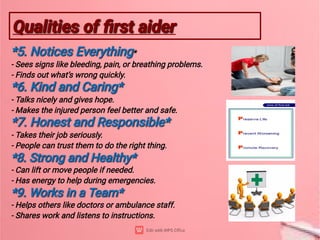
1. Stays Calm and Brave*
- Does not panic in emergencies.
- Helps others stay calm too.
- Makes good decisions without fear.
*2. Acts Quickly*
*2. Acts Quickly*
- Helps fast and doesn’t waste time.
- Knows what to do first.
*3. Speaks Clearly*
*3. Speaks Clearly*
- Talks in a simple way.
- Listens carefully to the injured person.
- Explains what they are doing.
*4. Knows First Aid
*4. Knows First Aid*
- Has basic first aid training.
- Knows how to stop bleeding, do CPR, and treat burns.
- Keeps learning and practicing.
*5. Notices Everything
*5. Notices Everything*
- Sees signs like bleeding, pain, or breathing problems.
- Finds out what’s wrong quickly.
*6. Kind and Caring*
- Talks nicely and gives hope.
- Makes the injured person feel better and safe.
*7. Honest and Responsible*
- Takes their job seriously.
- People can trust them to do the right thing.
*8. Strong and Healthy*
- Can lift or move people if needed.
- Has energy to help during emergencies.
*9. Works in a Team*
- Helps others like doctors or ambulance staff.
- Shares work and listens to instructions.
Qualities of first aider
First aid box
First aid box
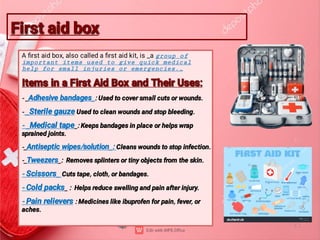
A first aid box, also called a first aid kit, is _a group of
important items used to give quick medical
help for small injuries or emergencies._
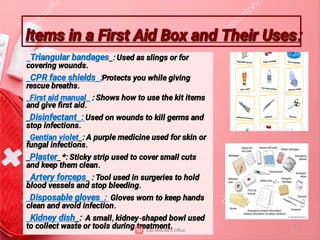
Items in a First Aid Box and Their Uses:
- _Adhesive bandages_: Used to cover small cuts or wounds.
- _Sterile gauze Used to clean wounds and stop bleeding.
- _Medical tape_: Keeps bandages in place or helps wrap
sprained joints.
-_Antiseptic wipes/solution_: Cleans wounds to stop infection.
-_Tweezers_: Removes splinters or tiny objects from the skin.
- Scissors_ Cuts tape, cloth, or bandages.
- Cold packs_ : Helps reduce swelling and pain after injury.
- Pain relievers : Medicines like ibuprofen for pain, fever, or
aches.
ltems in a First Aid Box and Their Uses:
_Triangular bandages_: Used as slings or for
covering wounds.
_CPR face shields_:Protects you while giving
rescue breaths.
_First aid manual_ : Shows how to use the kit items
and give first aid.
_Disinfectant_: Used on wounds to kill germs and
stop infections.
_Gentian violet_: A purple medicine used for skin or
fungal infections.
_Plaster_*: Sticky strip used to cover small cuts
and keep them clean.
_Artery forceps_ : Tool used in surgeries to hold
blood vessels and stop bleeding.
_Disposable gloves_: Gloves worn to keep hands
clean and avoid infection.
_Kidney dish_: A small, kidney-shaped bowl used
to collect waste or tools during treatment.
First aid in sports injuries
•
•
•
•
Sprain
Sprain:
This happens when you stretch or
tear the strong bands (ligaments)
around a joint like your ankle or
wrist by moving it too much.
- *First Aid:* Rest the hurt part,
lift it up (elevate), and get
medical help if needed.
Strain
Strain:
This is a torn or overstretched
muscle fiber, often from trying to
do too much or moving suddenly.
- *First Aid:* Rest the muscle,
support the hurt area, and put ice
or a cold pack on it.
Cramp
Cramp:
Sudden muscle tightness.
- *First Aid:* Stretch,
massage,drink salted water.
Dislocation:
Dislocation:
A bone moves out of its
normal position.
- *First Aid:* Keep still,
support,get medical help.
Fracture (Broken Bone):
Fracture (Broken Bone):_
Break in a bone.
- *First Aid:* Keep still,apply
ice,see a doctor quickly.
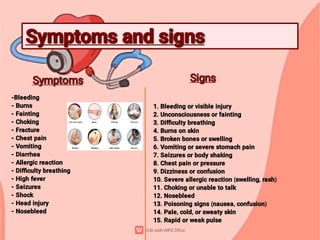
Symptoms and signs
Symptoms and signs
Symptoms
Symptoms
-Bleeding
- Burns
- Fainting
- Choking
- Fracture
- Chest pain
- Vomiting
- Diarrhea
- Allergic reaction
- Difficulty breathing
- High fever
- Seizures
- Shock
- Head injury
- Nosebleed
Signs
Signs
1. Bleeding or visible injury
2. Unconsciousness or fainting
3. Difficulty breathing
4. Burns on skin
5. Broken bones or swelling
6. Vomiting or severe stomach pain
7. Seizures or body shaking
8. Chest pain or pressure
9. Dizziness or confusion
10. Severe allergic reaction (swelling, rash)
11. Choking or unable to talk
12. Nosebleed
13. Poisoning signs (nausea, confusion)
14. Pale, cold, or sweaty skin
15. Rapid or weak pulse
Bleeding:
Bleeding:
*What is Bleeding?*
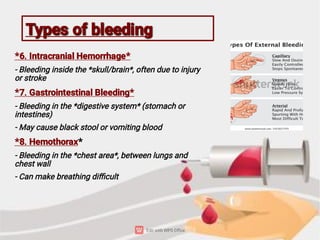
- *Bleeding (Hemorrhage)* means *loss of blood* from the body.
- It can be *external* (blood visible outside) or *internal* (inside body,
not seen).
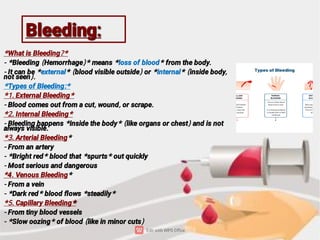
*Types of Bleeding:*
*1. External Bleeding*
- Blood comes out from a cut, wound, or scrape.
*2. Internal Bleeding*
- Bleeding happens *inside the body* (like organs or chest) and is not
always visible.
*3. Arterial Bleeding*
- From an artery
- *Bright red* blood that *spurts* out quickly
- Most serious and dangerous
*4. Venous Bleeding*
- From a vein
- *Dark red* blood flows *steadily*
*
*5. Capillary Bleeding*
- From tiny blood vessels
- *Slow oozing* of blood (like in minor cuts)
Types of bleeding
Types of bleeding
*6. Intracranial Hemorrhage*
- Bleeding inside the *skull/brain*, often due to injury
or stroke
*7. Gastrointestinal Bleeding*
- Bleeding in the *digestive system* (stomach or
intestines)
- May cause black stool or vomiting blood
*8. Hemothorax*
- Bleeding in the *chest area*, between lungs and
chest wall
- Can make breathing difficult
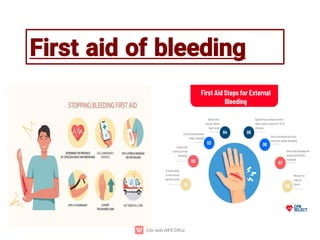
First aid of bleeding
Fracture
•
•
•
•
•
•
•
•
•
•
•
•
•
•
•
•
•
•
*What is a Fracture?*
A *fracture* means a *crack or break in a bone*. It can be minor (like a
hairline) or major (like a shattered bone).
---
*1. Open vs. Closed Fracture*
*Closed (Simple) Fracture*
- Bone is broken but *skin is not damaged*.
- No visible wound.
*Open (Compound) Fracture*
- Broken bone *comes out through the skin* or skin is torn.
- Risk of *infection and heavy bleeding*.
*2. Complete vs. Incomplete Fracture*
*Complete Fracture*
- Bone is *fully broken* into two or more parts.
*Incomplete Fracture*
- Bone has a *crack*, but is not completely broken.
- *Types include:*
- *Greenstick Fracture*: Common in children; bone bends and cracks.
- *Hairline Fracture*: A thin crack in the bone.
Types of fracture
Types of fracture
•
•
•
•
•
•
•
•
•
•
•
•
•
•
•
•
*3. Other Types of Fractures*
*Stress Fracture*
- Small cracks caused by *repeated pressure* (common in
athletes).
*Comminuted Fracture*
- Bone is *shattered into many pieces*.
- Happens in major accidents.
*Avulsion Fracture*
- A piece of bone is pulled off by a *tendon or ligament*.
*Compression Fracture*
- Bone is *pressed down* or crushed (common in spine).
*Oblique Fracture*
- The bone breaks *at an angle*.
*Transverse Fracture*
- The break is *straight across* the bone.
*Segmental Fracture*
*two or more places*,
- Bone is broken in *two or more places*, leaving a free
bone segment in between.
Fracture first aid
Fracture first aid
•
•
•
1. *Immobilize* – Don’t
move the broken bone;
keep it still.
2. *Support* – Use a
splint or cloth to
support the injured part.
3. *Apply Ice* – Use
ice wrapped in cloth to
reduce swelling.
4. *Control Bleeding*
– If there’s bleeding,
cover with a clean cloth.
•
•
•
5. *Avoid
Movement* – Don’t
try to straighten the
bone.
6. *Comfort* –
Keep the person
calm and still.
7. * *Seek Medical
Help* – Call
emergency services
or go to hospita
Wound
Wound
A
.
A wound is an injury that happens when the skin or
body tissue is damaged.
Types of wound:
*Open Wound:*
- The skin is broken.
- Blood may come out.
- Germs can enter the body.
*Examples:* Cuts, scrapes, punctures.
*Closed Wound:*
- The skin is not broken.
- Injury happens under the skin.
- May cause swelling or bruising.
*Examples:* Bruise, bump, internal bleeding.
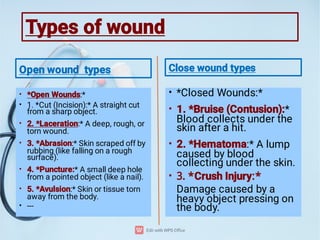
Types of wound
Open wound types
•
•
•
•
•
•
•
*Open Wounds:*
1. *Cut (Incision):* A straight cut
from a sharp object.
2. *Laceration:* A deep, rough, or
torn wound.
3. *Abrasion:* Skin scraped off by
rubbing (like falling on a rough
surface).
4. *Puncture:* A small deep hole
from a pointed object (like a nail).
5. *Avulsion:* Skin or tissue torn
away from the body.
---
Close wound types
•
•
•
•
*Closed Wounds:*
1. *Bruise (Contusion):*
Blood collects under the
skin after a hit.
2. *Hematoma:* A lump
caused by blood
collecting under the skin.
3. *Crush Injury:*
Damage caused by a
heavy object pressing on
the body.
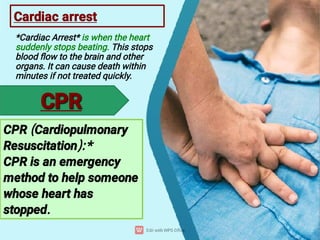
Cardiac arrest
*Cardiac Arrest* is when the heart
suddenly stops beating. This stops
blood flow to the brain and other
organs. It can cause death within
minutes if not treated quickly.
CPR (Cardiopulmonary
Resuscitation):*
CPR is an emergency
method to help someone
whose heart has
stopped.
CPR
CPR
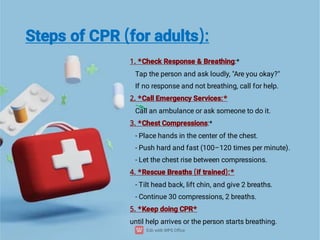
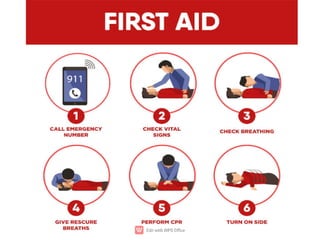
Steps of CPR (for adults):
1. *Check Response & Breathing:*
Tap the person and ask loudly, "Are you okay?"
If no response and not breathing, call for help.
2. *Call Emergency Services:*
Call an ambulance or ask someone to do it.
3. *Chest Compressions:*
- Place hands in the center of the chest.
- Push hard and fast (100–120 times per minute).
- Let the chest rise between compressions.
4. *Rescue Breaths (if trained):*
- Tilt head back, lift chin, and give 2 breaths.
- Continue 30 compressions, 2 breaths.
5. *Keep doing CPR*
until help arrives or the person starts breathing.
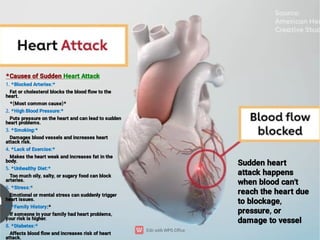
Sudden heart
attack happens
when blood can’t
reach the heart due
to blockage,
pressure, or
damage to vessel
*Causes of Sudden Heart Attack
1. *Blocked Arteries:*
Fat or cholesterol blocks the blood flow to the
heart.
*(Most common cause)*
2. *High Blood Pressure:*
Puts pressure on the heart and can lead to sudden
heart problems.
3. *Smoking:*
Damages blood vessels and increases heart
attack risk.
4. *Lack of Exercise:*
Makes the heart weak and increases fat in the
body.
5. *Unhealthy Diet:*
Too much oily, salty, or sugary food can block
arteries.
6. *Stress:*
Emotional or mental stress can suddenly trigger
heart issues.
7. *Family History:*
If someone in your family had heart problems,
your risk is higher.
8. *Diabetes:*
Affects blood flow and increases risk of heart
attack.
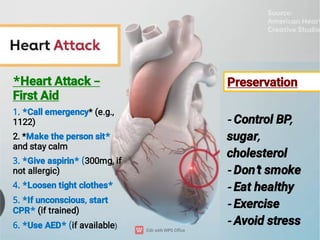
*Heart Attack –
First Aid
1. *Call emergency* (e.g.,
1122)
2. *Make the person sit*
and stay calm
3. *Give aspirin* (300mg, if
not allergic)
4. *Loosen tight clothes*
5. *If unconscious, start
CPR* (if trained)
6. *Use AED* (if available)
Preservation
- Control BP,
sugar,
cholesterol
- Don’t smoke
- Eat healthy
- Exercise
- Avoid stress
Thank you

First aid definition and importance and first aid kit

  • 1.
  • 2.
    Fix it crew Fixit crew 1 Khadija Afzal 2 Khansa zahir 1 Khadija Afzal 2 Khansa zahir 3 Aman Irshad 4 Namra Mughal 3 Aman Irshad 4 Namra Mughal 5 Noor Fatima 5 Noor Fatima
  • 3.
    Introduction of firstaid Introduction of first aid • "First aid means giving quick help to someone who is hurt or sick in an emergency. The goal is to save their life, stop their condition from getting worse, and help them feel better until a doctor or ambulance arrives."
  • 4.
    According to famousauthors According to famous authors • • According to Merriam Webster According to Merriam Webster "Emergency care or treatment given to an ill or injured person before regular medical aid can be obtained." According to Red Cross: According to Red Cross: "This is immediate help provided to a sick or injured person until professional help arrives ."
  • 5.
    Founder of firstaid Founder of first aid • • • • • • • Johann Friedrich Esmarch, was the founder of first aid." The full form of first aid is: The full form of first aid is: First Investigation Relief Symptom Treatment arrangement Immediately Disposal. Examples of first aid : Examples of first aid : First aid can include cleaning minor cuts, scrapes, or scratches; treating a minor burn; applying bandages and dressings.
  • 6.
    Importance of firstaid Importance of first aid • • • • • • • • • • 1. Helping in Emergencies 1. Helping in Emergencies First aid helps people to take action during emergencies. For example, For example, if someone: Swallows something harmful Has a heart attack Gets hurt in a natural disaster 2. Doing the Right Thing at the Right Time 2. Doing the Right Thing at the Right Time In an emergency, knowing what to do is very important. For example: For example: The brain can start dying in just 6 minutes without oxygen.
  • 7.
    Importance of firstaid Importance of first aid 3. Useful for Yourself and Others 3. Useful for Yourself and Others First aid is not just for helping others — it helps you too. If something happens to you or someone you care about at home, school, or work, you will know what to do. 4. Prevents Conditions from Getting Worse 4. Prevents Conditions from Getting Worse A small injury can turn into a big problem if not treated quickly. First aid stops bleeding, prevents infections, and reduces pain.
  • 8.
    Who is firstaider Who is first aider A *first aider* is a person who is trained to give *immediate help* to someone who is *injured or suddenly sick*, before professional medical help arrives. *Definitions by Famous Sources:* *Definitions by Famous Sources:* *1. St. Andrew’s First Aid:* *1. St. Andrew’s First Aid:* *“A first aider is someone who has been trained to give immediate help to an ill or injured person until professional medical help arrives.”* *2. British Red Cross:* *2. British Red Cross:* *“A first aider is a person with basic medical training who provides initial care during an emergency situation.”*
  • 9.
    Qualities of firstaider Qualities of first aider          A good first aider is calm, quick, trained, kind, and strong. These qualities help save lives in emergencies. - Calm and confident - Quick decision-making - Good communication - Basic first aid knowledge - Observant and alert - Kind and caring - Responsible and trustworthy - Physically fit - Teamwork skills
  • 10.
    Qualities of firstaider Qualities of first aider 1. Stays Calm and Brave* 1. Stays Calm and Brave* - Does not panic in emergencies. - Helps others stay calm too. - Makes good decisions without fear. *2. Acts Quickly* *2. Acts Quickly* - Helps fast and doesn’t waste time. - Knows what to do first. *3. Speaks Clearly* *3. Speaks Clearly* - Talks in a simple way. - Listens carefully to the injured person. - Explains what they are doing. *4. Knows First Aid *4. Knows First Aid* - Has basic first aid training. - Knows how to stop bleeding, do CPR, and treat burns. - Keeps learning and practicing.
  • 11.
    *5. Notices Everything *5.Notices Everything* - Sees signs like bleeding, pain, or breathing problems. - Finds out what’s wrong quickly. *6. Kind and Caring* *6. Kind and Caring* - Talks nicely and gives hope. - Makes the injured person feel better and safe. *7. Honest and Responsible* *7. Honest and Responsible* - Takes their job seriously. - People can trust them to do the right thing. *8. Strong and Healthy* *8. Strong and Healthy* - Can lift or move people if needed. - Has energy to help during emergencies. *9. Works in a Team* *9. Works in a Team* - Helps others like doctors or ambulance staff. - Shares work and listens to instructions. Qualities of first aider Qualities of first aider
  • 12.
    First aid box Firstaid box A first aid box, also called a first aid kit, is _a group of important items used to give quick medical help for small injuries or emergencies._ Items in a First Aid Box and Their Uses: Items in a First Aid Box and Their Uses: - _Adhesive bandages_: Used to cover small cuts or wounds. - _Sterile gauze Used to clean wounds and stop bleeding. - _Medical tape_: Keeps bandages in place or helps wrap sprained joints. -_Antiseptic wipes/solution_: Cleans wounds to stop infection. -_Tweezers_: Removes splinters or tiny objects from the skin. - Scissors_ Cuts tape, cloth, or bandages. - Cold packs_ : Helps reduce swelling and pain after injury. - Pain relievers : Medicines like ibuprofen for pain, fever, or aches.
  • 13.
    ltems in aFirst Aid Box and Their Uses: ltems in a First Aid Box and Their Uses: _Triangular bandages_: Used as slings or for covering wounds. _CPR face shields_:Protects you while giving rescue breaths. _First aid manual_ : Shows how to use the kit items and give first aid. _Disinfectant_: Used on wounds to kill germs and stop infections. _Gentian violet_: A purple medicine used for skin or fungal infections. _Plaster_*: Sticky strip used to cover small cuts and keep them clean. _Artery forceps_ : Tool used in surgeries to hold blood vessels and stop bleeding. _Disposable gloves_: Gloves worn to keep hands clean and avoid infection. _Kidney dish_: A small, kidney-shaped bowl used to collect waste or tools during treatment.
  • 14.
    First aid insports injuries First aid in sports injuries • • • • Sprain Sprain: This happens when you stretch or tear the strong bands (ligaments) around a joint like your ankle or wrist by moving it too much. - *First Aid:* Rest the hurt part, lift it up (elevate), and get medical help if needed. Strain Strain: This is a torn or overstretched muscle fiber, often from trying to do too much or moving suddenly. - *First Aid:* Rest the muscle, support the hurt area, and put ice or a cold pack on it. Cramp Cramp: Sudden muscle tightness. - *First Aid:* Stretch, massage,drink salted water. Dislocation: Dislocation: A bone moves out of its normal position. - *First Aid:* Keep still, support,get medical help. Fracture (Broken Bone): Fracture (Broken Bone):_ Break in a bone. - *First Aid:* Keep still,apply ice,see a doctor quickly.
  • 15.
    Symptoms and signs Symptomsand signs Symptoms Symptoms -Bleeding - Burns - Fainting - Choking - Fracture - Chest pain - Vomiting - Diarrhea - Allergic reaction - Difficulty breathing - High fever - Seizures - Shock - Head injury - Nosebleed Signs Signs 1. Bleeding or visible injury 2. Unconsciousness or fainting 3. Difficulty breathing 4. Burns on skin 5. Broken bones or swelling 6. Vomiting or severe stomach pain 7. Seizures or body shaking 8. Chest pain or pressure 9. Dizziness or confusion 10. Severe allergic reaction (swelling, rash) 11. Choking or unable to talk 12. Nosebleed 13. Poisoning signs (nausea, confusion) 14. Pale, cold, or sweaty skin 15. Rapid or weak pulse
  • 16.
    Bleeding: Bleeding: *What is Bleeding?* -*Bleeding (Hemorrhage)* means *loss of blood* from the body. - It can be *external* (blood visible outside) or *internal* (inside body, not seen). *Types of Bleeding:* *1. External Bleeding* - Blood comes out from a cut, wound, or scrape. *2. Internal Bleeding* - Bleeding happens *inside the body* (like organs or chest) and is not always visible. *3. Arterial Bleeding* - From an artery - *Bright red* blood that *spurts* out quickly - Most serious and dangerous *4. Venous Bleeding* - From a vein - *Dark red* blood flows *steadily* * *5. Capillary Bleeding* - From tiny blood vessels - *Slow oozing* of blood (like in minor cuts)
  • 17.
    Types of bleeding Typesof bleeding *6. Intracranial Hemorrhage* - Bleeding inside the *skull/brain*, often due to injury or stroke *7. Gastrointestinal Bleeding* - Bleeding in the *digestive system* (stomach or intestines) - May cause black stool or vomiting blood *8. Hemothorax* - Bleeding in the *chest area*, between lungs and chest wall - Can make breathing difficult
  • 18.
    First aid ofbleeding
  • 19.
    Fracture • • • • • • • • • • • • • • • • • • *What is aFracture?* A *fracture* means a *crack or break in a bone*. It can be minor (like a hairline) or major (like a shattered bone). --- *1. Open vs. Closed Fracture* *Closed (Simple) Fracture* - Bone is broken but *skin is not damaged*. - No visible wound. *Open (Compound) Fracture* - Broken bone *comes out through the skin* or skin is torn. - Risk of *infection and heavy bleeding*. *2. Complete vs. Incomplete Fracture* *Complete Fracture* - Bone is *fully broken* into two or more parts. *Incomplete Fracture* - Bone has a *crack*, but is not completely broken. - *Types include:* - *Greenstick Fracture*: Common in children; bone bends and cracks. - *Hairline Fracture*: A thin crack in the bone.
  • 20.
    Types of fracture Typesof fracture • • • • • • • • • • • • • • • • *3. Other Types of Fractures* *Stress Fracture* - Small cracks caused by *repeated pressure* (common in athletes). *Comminuted Fracture* - Bone is *shattered into many pieces*. - Happens in major accidents. *Avulsion Fracture* - A piece of bone is pulled off by a *tendon or ligament*. *Compression Fracture* - Bone is *pressed down* or crushed (common in spine). *Oblique Fracture* - The bone breaks *at an angle*. *Transverse Fracture* - The break is *straight across* the bone. *Segmental Fracture* *two or more places*, - Bone is broken in *two or more places*, leaving a free bone segment in between.
  • 21.
    Fracture first aid Fracturefirst aid • • • 1. *Immobilize* – Don’t move the broken bone; keep it still. 2. *Support* – Use a splint or cloth to support the injured part. 3. *Apply Ice* – Use ice wrapped in cloth to reduce swelling. 4. *Control Bleeding* – If there’s bleeding, cover with a clean cloth. • • • 5. *Avoid Movement* – Don’t try to straighten the bone. 6. *Comfort* – Keep the person calm and still. 7. * *Seek Medical Help* – Call emergency services or go to hospita
  • 22.
    Wound Wound A . A wound isan injury that happens when the skin or body tissue is damaged. Types of wound: *Open Wound:* - The skin is broken. - Blood may come out. - Germs can enter the body. *Examples:* Cuts, scrapes, punctures. *Closed Wound:* - The skin is not broken. - Injury happens under the skin. - May cause swelling or bruising. *Examples:* Bruise, bump, internal bleeding.
  • 23.
    Types of wound Openwound types • • • • • • • *Open Wounds:* 1. *Cut (Incision):* A straight cut from a sharp object. 2. *Laceration:* A deep, rough, or torn wound. 3. *Abrasion:* Skin scraped off by rubbing (like falling on a rough surface). 4. *Puncture:* A small deep hole from a pointed object (like a nail). 5. *Avulsion:* Skin or tissue torn away from the body. --- Close wound types • • • • *Closed Wounds:* 1. *Bruise (Contusion):* Blood collects under the skin after a hit. 2. *Hematoma:* A lump caused by blood collecting under the skin. 3. *Crush Injury:* Damage caused by a heavy object pressing on the body.
  • 25.
    Cardiac arrest *Cardiac Arrest*is when the heart suddenly stops beating. This stops blood flow to the brain and other organs. It can cause death within minutes if not treated quickly. CPR (Cardiopulmonary Resuscitation):* CPR is an emergency method to help someone whose heart has stopped. CPR CPR
  • 26.
    Steps of CPR(for adults): 1. *Check Response & Breathing:* Tap the person and ask loudly, "Are you okay?" If no response and not breathing, call for help. 2. *Call Emergency Services:* Call an ambulance or ask someone to do it. 3. *Chest Compressions:* - Place hands in the center of the chest. - Push hard and fast (100–120 times per minute). - Let the chest rise between compressions. 4. *Rescue Breaths (if trained):* - Tilt head back, lift chin, and give 2 breaths. - Continue 30 compressions, 2 breaths. 5. *Keep doing CPR* until help arrives or the person starts breathing.
  • 28.
    Sudden heart attack happens whenblood can’t reach the heart due to blockage, pressure, or damage to vessel *Causes of Sudden Heart Attack 1. *Blocked Arteries:* Fat or cholesterol blocks the blood flow to the heart. *(Most common cause)* 2. *High Blood Pressure:* Puts pressure on the heart and can lead to sudden heart problems. 3. *Smoking:* Damages blood vessels and increases heart attack risk. 4. *Lack of Exercise:* Makes the heart weak and increases fat in the body. 5. *Unhealthy Diet:* Too much oily, salty, or sugary food can block arteries. 6. *Stress:* Emotional or mental stress can suddenly trigger heart issues. 7. *Family History:* If someone in your family had heart problems, your risk is higher. 8. *Diabetes:* Affects blood flow and increases risk of heart attack.
  • 29.
    *Heart Attack – FirstAid 1. *Call emergency* (e.g., 1122) 2. *Make the person sit* and stay calm 3. *Give aspirin* (300mg, if not allergic) 4. *Loosen tight clothes* 5. *If unconscious, start CPR* (if trained) 6. *Use AED* (if available) Preservation - Control BP, sugar, cholesterol - Don’t smoke - Eat healthy - Exercise - Avoid stress
  • 30.