

1.4

Sets of Outcomes and Trees
Random Experiment
and Sample Space
   A random experiment is an experiment with
    multiple possible outcomes.
    Ex: Rolling a die, flipping a coin

   A “sample space” is the set of collection of all
    those outcomes.
    Ex: For experiment of “rolling a dice”,
    SS = {1, 2, 3, 4, 5, 6}
Tree Diagram
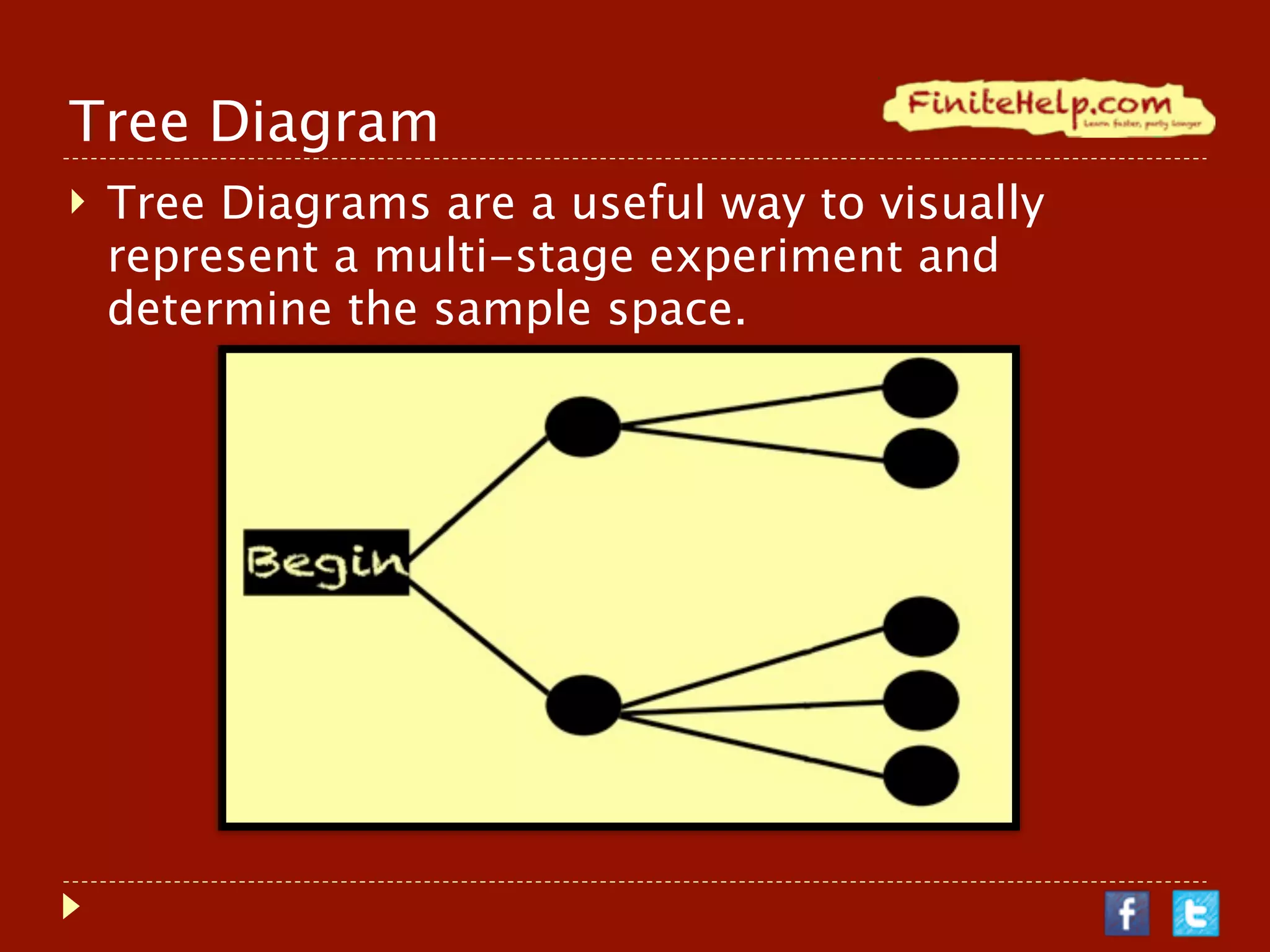
   Tree Diagrams are a useful way to visually
    represent a multi-stage experiment and
    determine the sample space.
How to
make a Tree Diagram
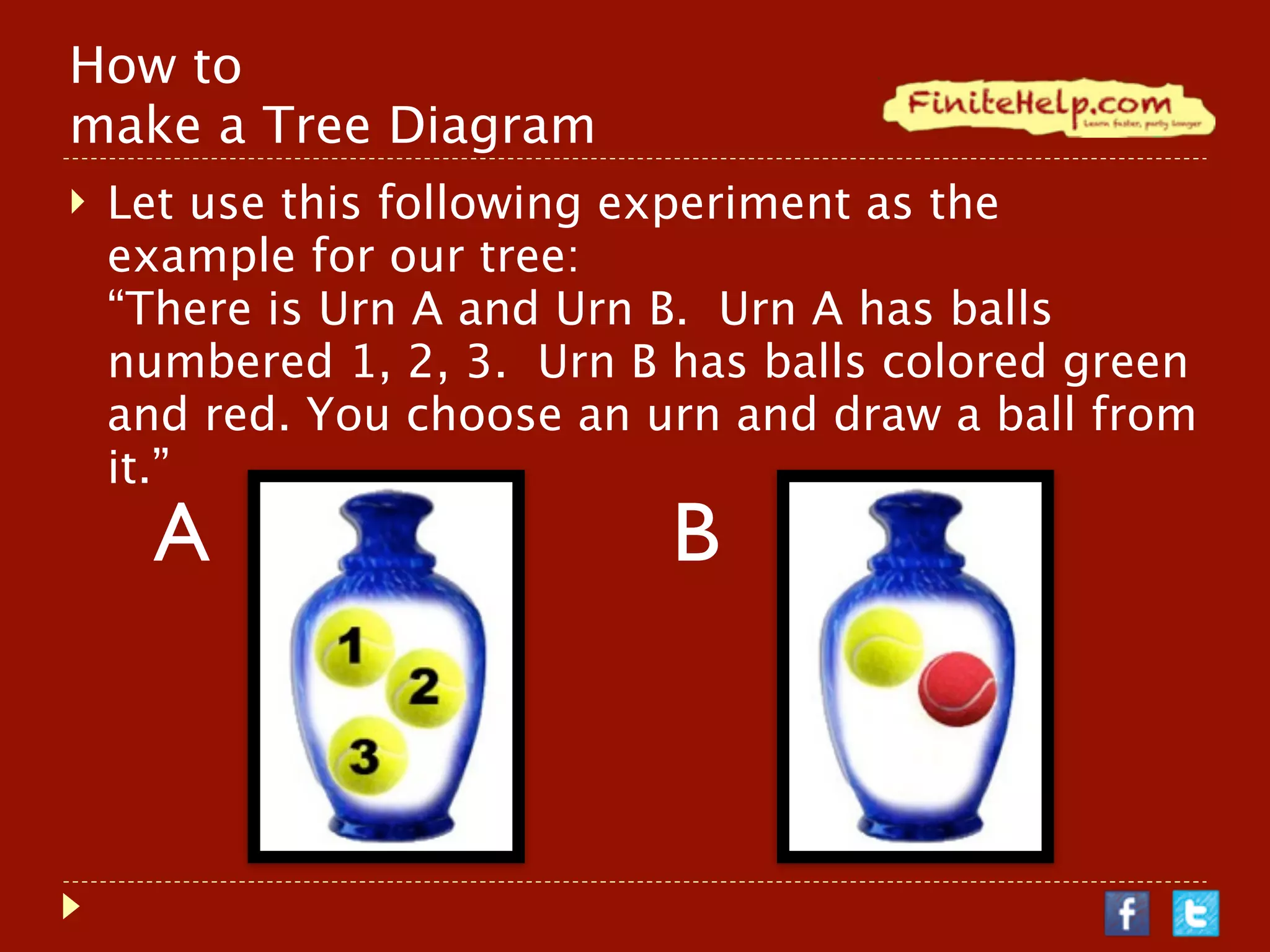
   Let use this following experiment as the example for
    our tree:
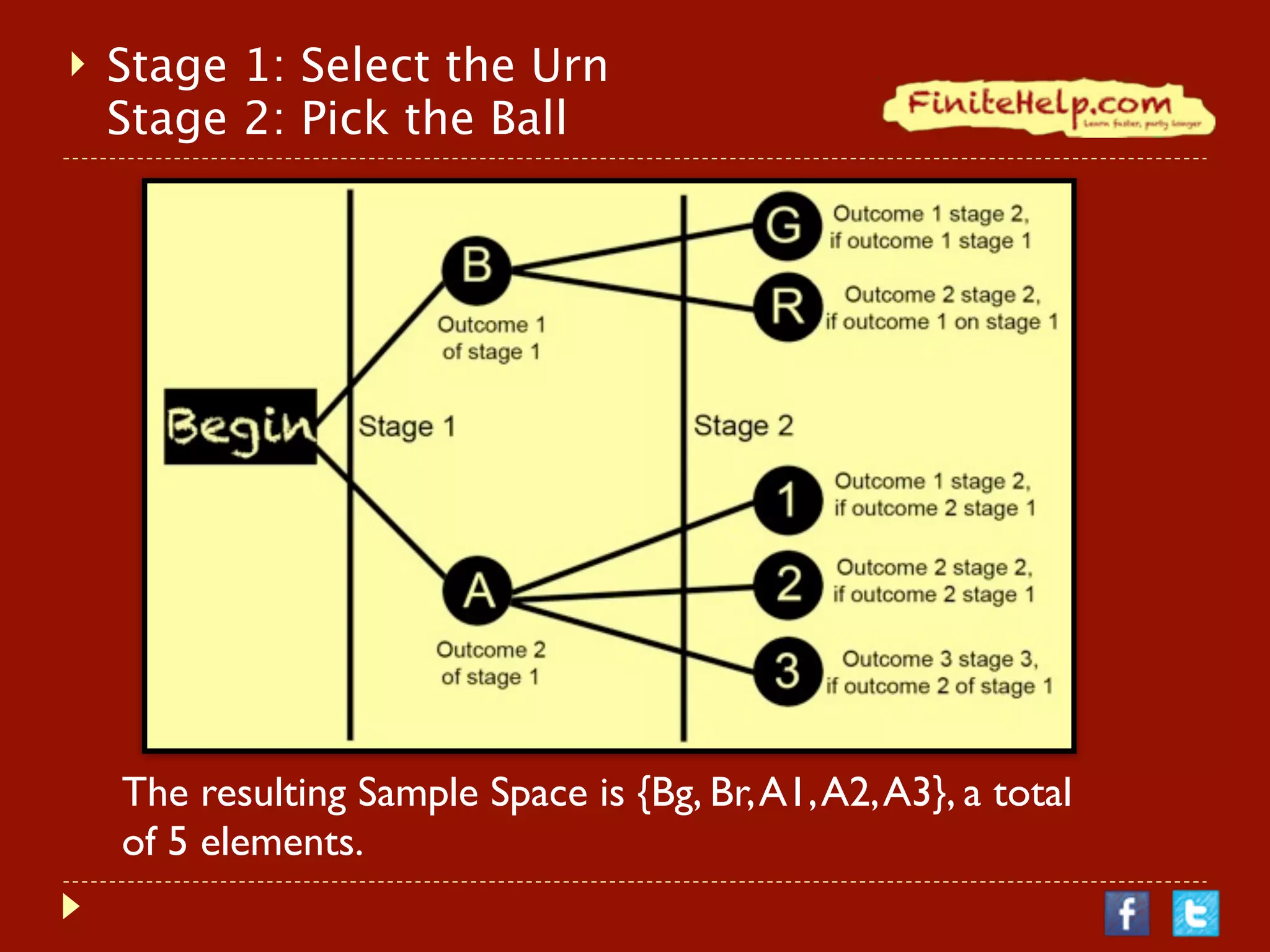
    “There is Urn A and Urn B. Urn A has balls
    numbered 1, 2, 3. Urn B has balls colored green and
    red. You choose an urn and draw a ball from it.”


      A                       B
Tree Diagram
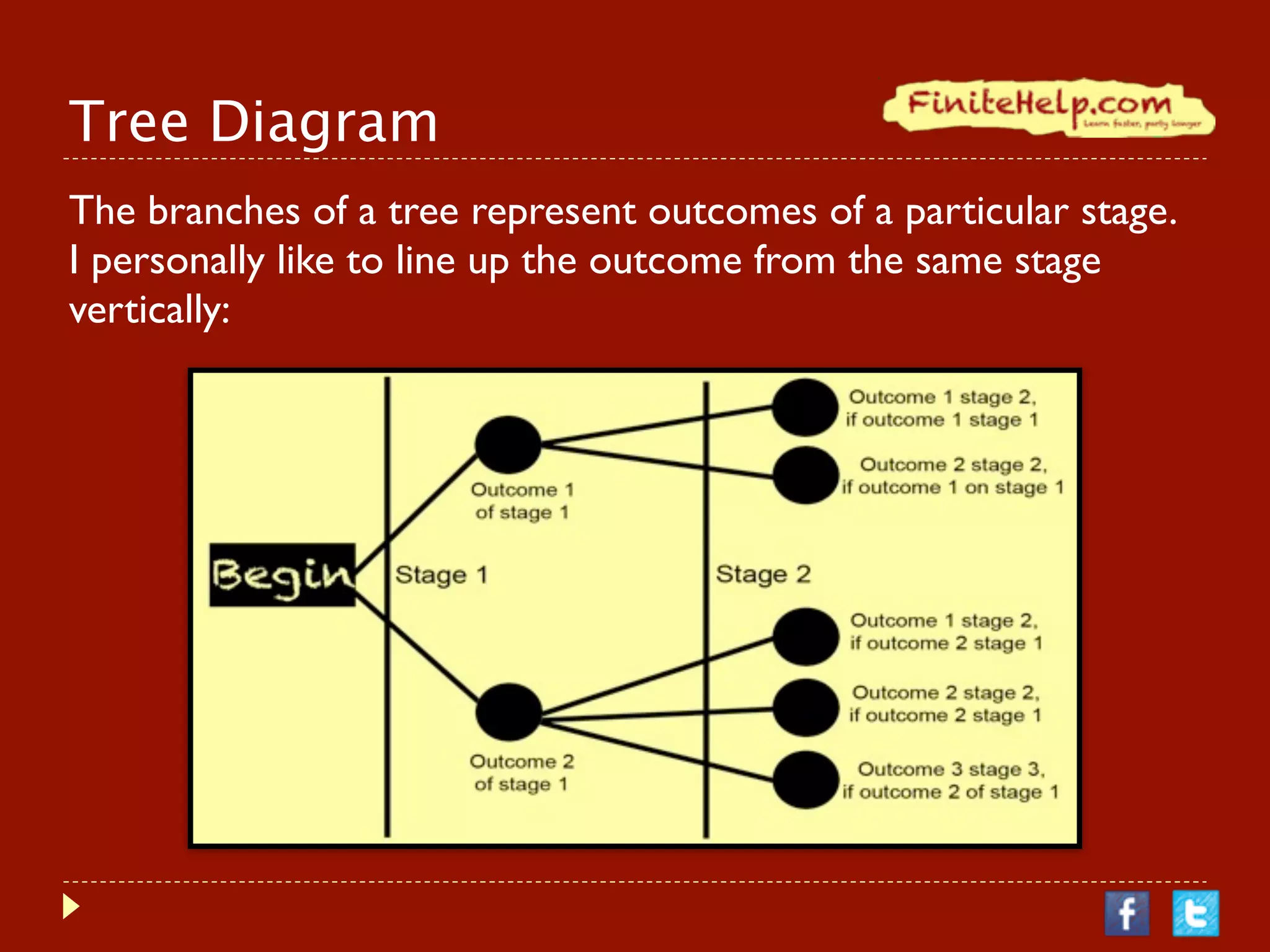
The branches of a tree represent outcomes of a particular stage.
I personally like to line up the outcome from the same stage
vertically:
   Stage 1: Select the Urn
    Stage 2: Pick the Ball


      The resulting Sample Space is {Bg, Br, A1, A2, A3}, a total of 5 elements.
Representing an outcome twice
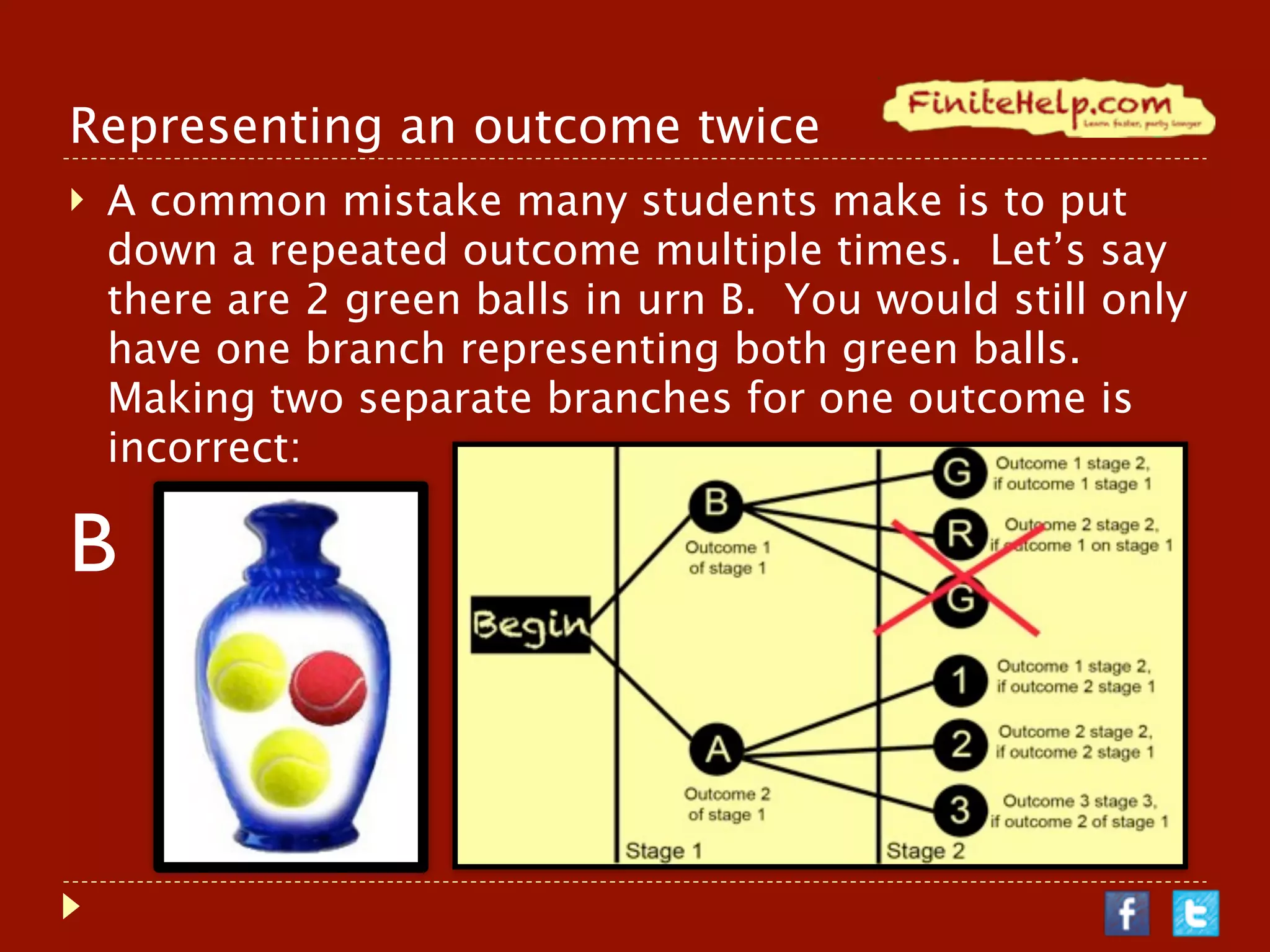
   A common mistake many students make is to put
    down a repeated outcome multiple times. Let’s say
    there are 2 green balls in urn B. You would still only
    have one branch representing both green balls.
    Making two separate branches for one outcome is
    incorrect:

B
Quiz 1.4.1
Quiz 1.4.1
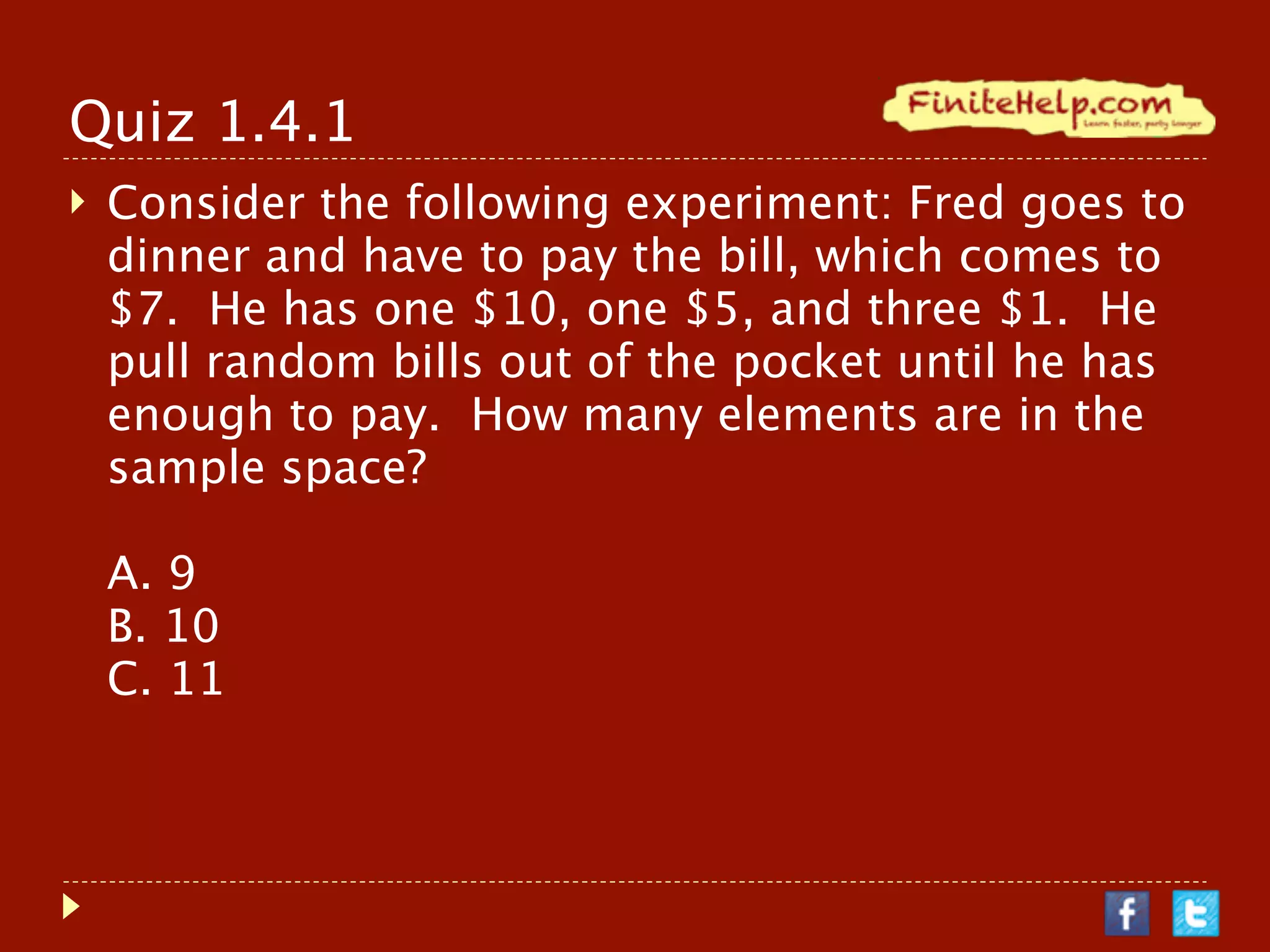
   Consider the following experiment: Fred goes to
    dinner and have to pay the bill, which comes to
    $7. He has one $10, one $5, and three $1. He
    pull random bills out of the pocket until he has
    enough to pay. How many elements are in the
    sample space?

    A. 9
    B. 10
    C. 11
Quiz 1.4.1
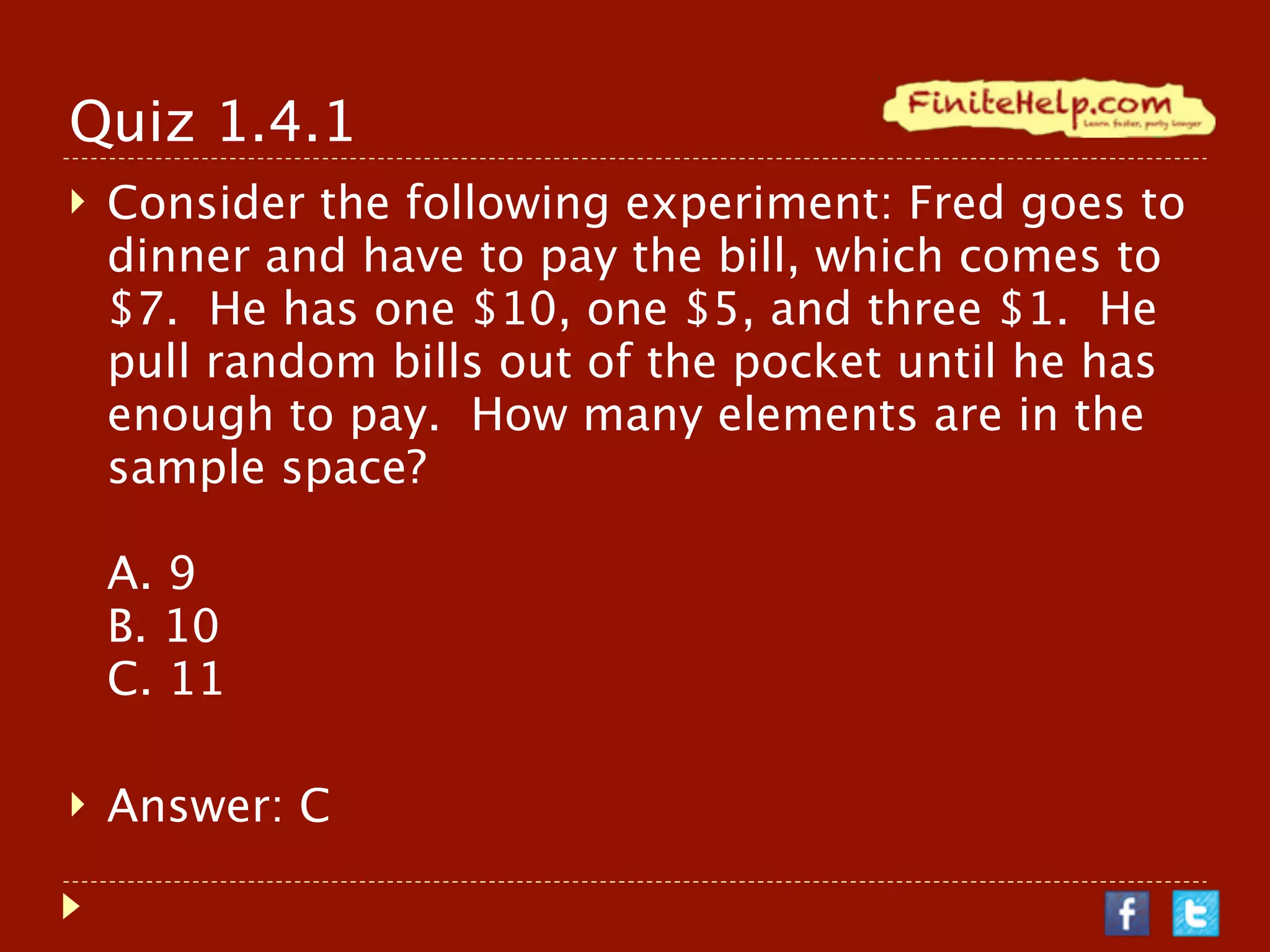
   Consider the following experiment: Fred goes to
    dinner and have to pay the bill, which comes to
    $7. He has one $10, one $5, and three $1. He
    pull random bills out of the pocket until he has
    enough to pay. How many elements are in the
    sample space?

    A. 9
    B. 10
    C. 11
Quiz 1.4.1
   Consider the following experiment: Fred goes to
    dinner and have to pay the bill, which comes to
    $7. He has one $10, one $5, and three $1. He
    pull random bills out of the pocket until he has
    enough to pay. How many elements are in the
    sample space?

    A. 9
    B. 10
    C. 11

   Answer: C
Multiplication principle
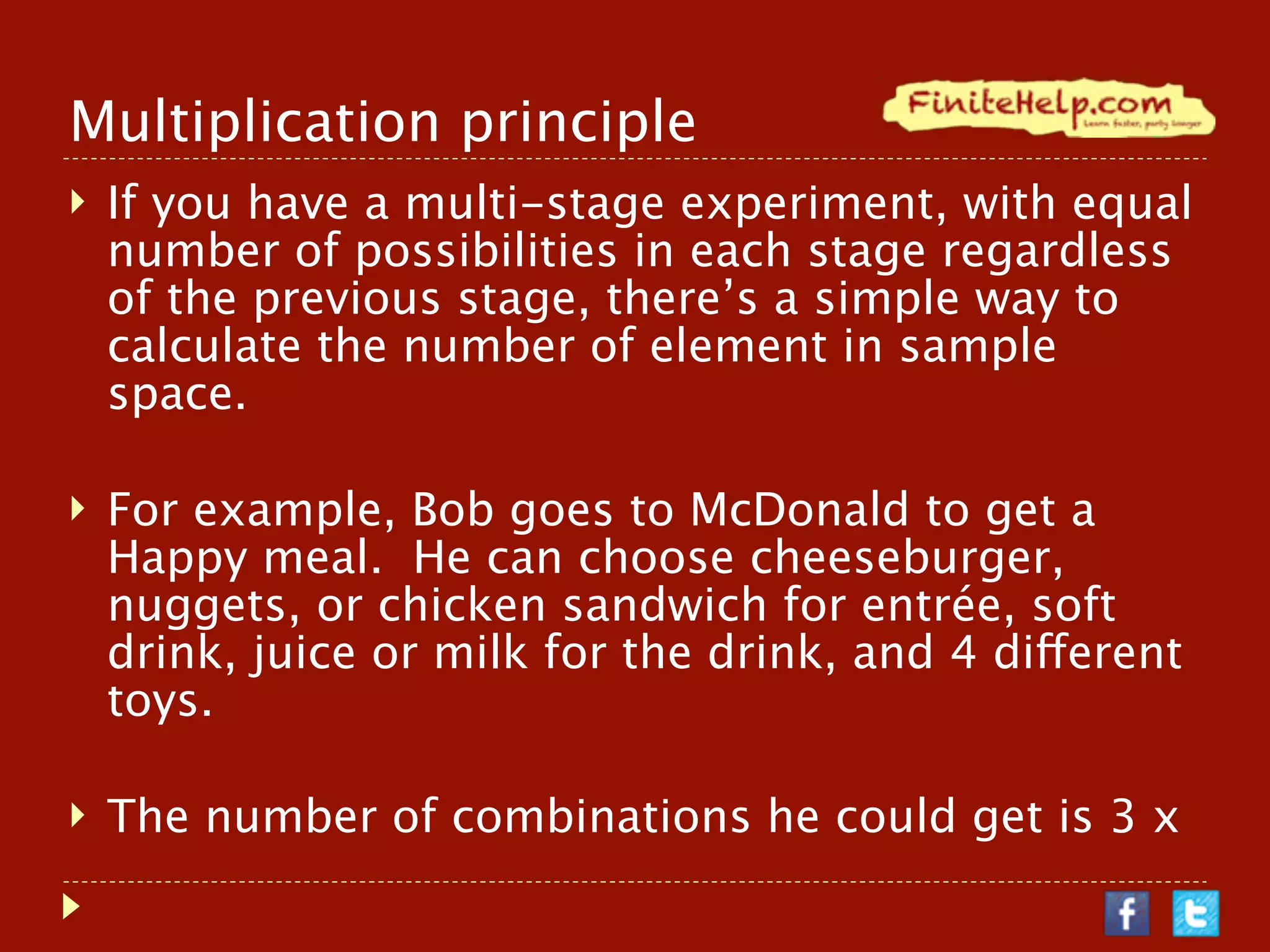
   If you have a multi-stage experiment, with equal number of
    possibilities in each stage regardless of the previous stage,
    there’s a simple way to calculate the number of element in
    sample space.

   For example, Bob goes to McDonald to get a Happy meal. He
    can choose cheeseburger, nuggets, or chicken sandwich for
    entrée, soft drink, juice or milk for the drink, and 4 different
    toys.

   The number of combinations he could get is 3 x 3 x 4 = 36.
    (3 entrée, 3 drinks, 4 toys)
Quiz 1.4.2
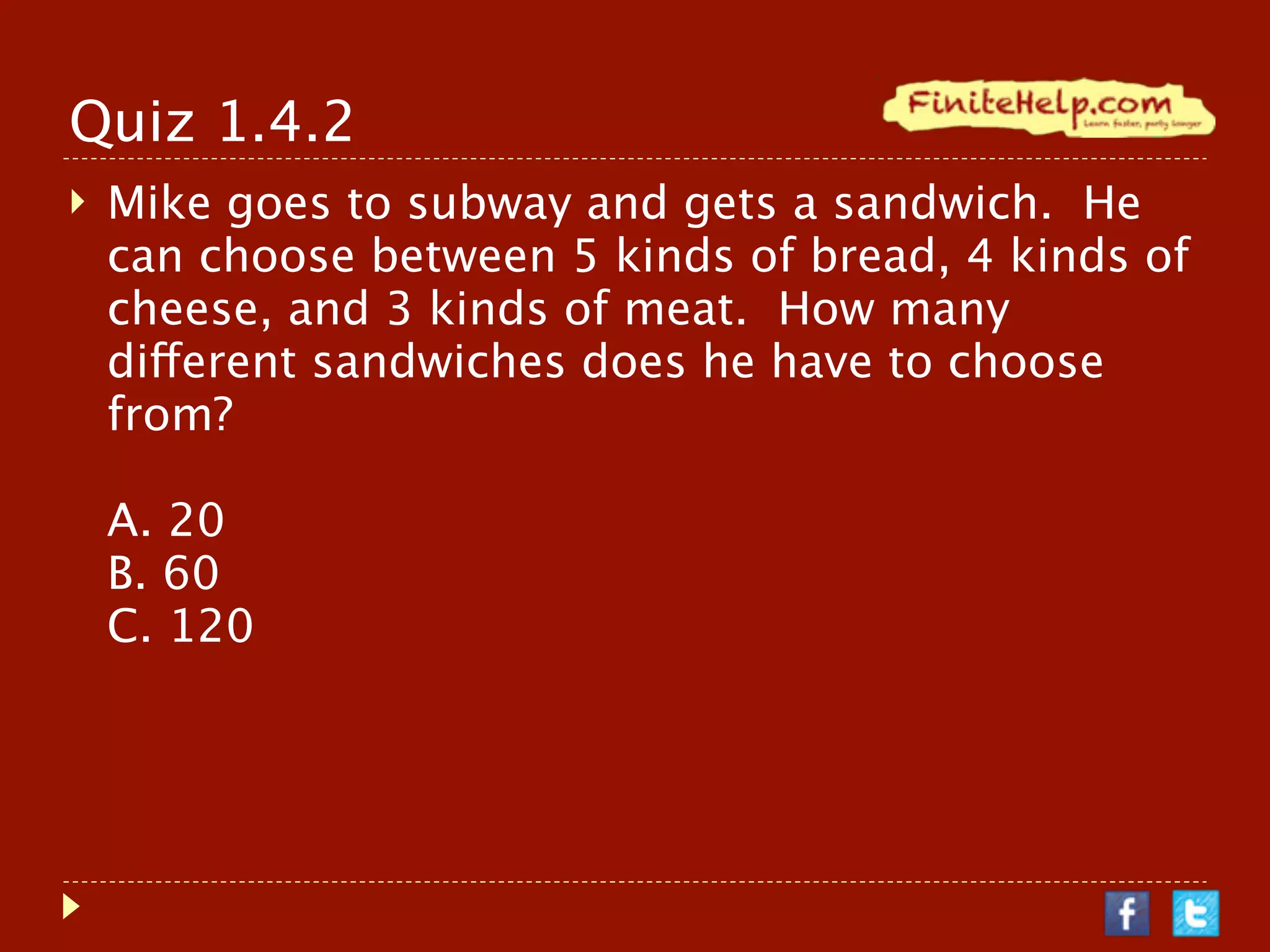
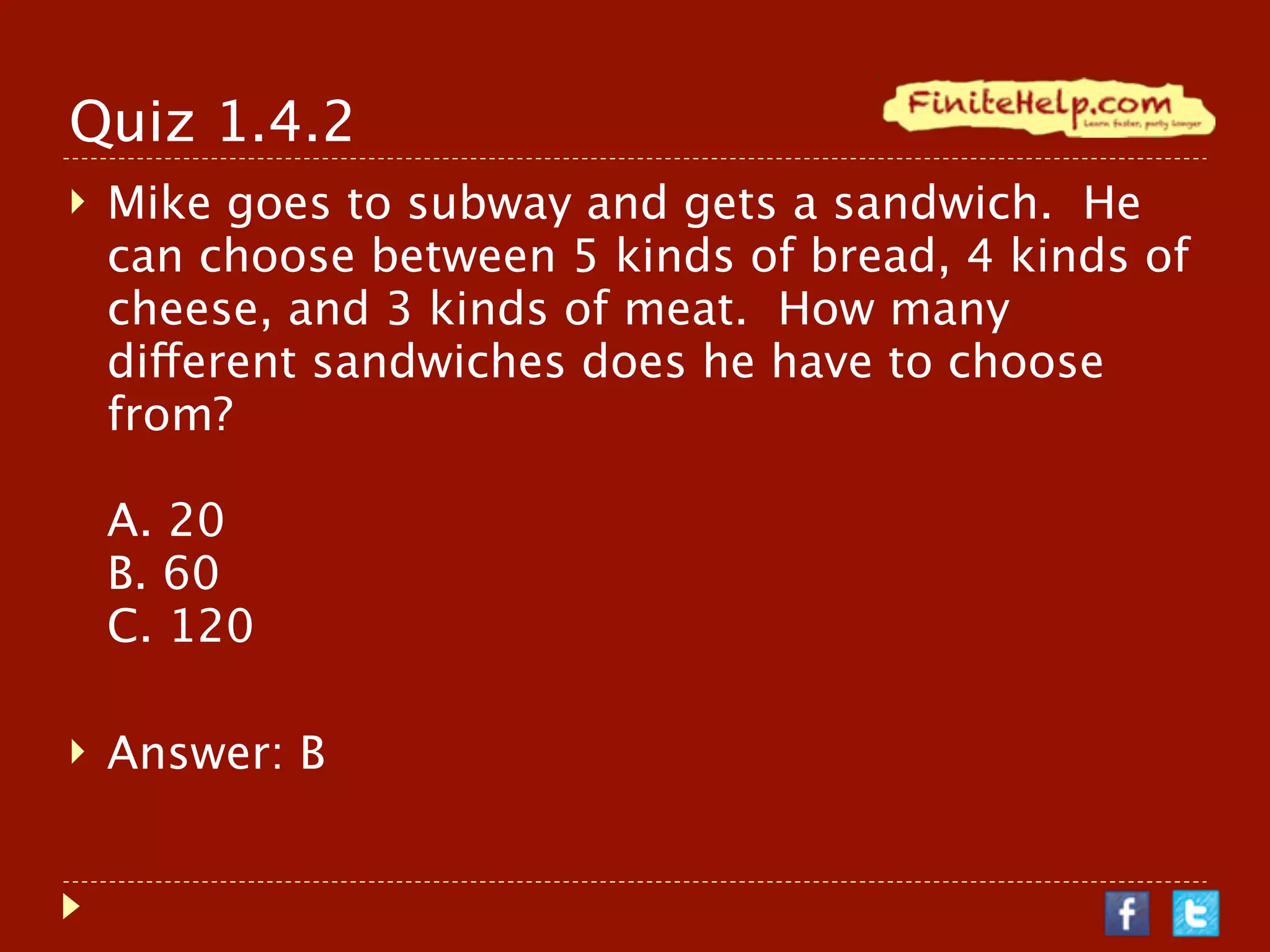
   Mike goes to subway and gets a sandwich. He
    can choose between 5 kinds of bread, 4 kinds of
    cheese, and 3 kinds of meat. How many
    different sandwiches does he have to choose
    from?

    A. 20
    B. 60
    C. 120
Quiz 1.4.2
   Mike goes to subway and gets a sandwich. He
    can choose between 5 kinds of bread, 4 kinds of
    cheese, and 3 kinds of meat. How many
    different sandwiches does he have to choose
    from?

    A. 20
    B. 60
    C. 120

   Answer: B
Summary
   Definition:
       Random experiment
       Sample space

   How to make a Tree Diagram
       determine sample space

   Multiplication Principle
   Features
        27 Recorded Lectures
        Over 116 practice problems with recorded solutions
        Discussion boards/homework help
        Visit finitehelp.com to find out more

     For special offers and additional content...
Follow us on twitter @finitehelp        Become a fan on Facebook

Finite Math - Sets of Outcomes and Trees

  • 1.
  • 2.
    Random Experiment and SampleSpace  A random experiment is an experiment with multiple possible outcomes. Ex: Rolling a die, flipping a coin  A “sample space” is the set of collection of all those outcomes. Ex: For experiment of “rolling a dice”, SS = {1, 2, 3, 4, 5, 6}
  • 3.
    Tree Diagram  Tree Diagrams are a useful way to visually represent a multi-stage experiment and determine the sample space.
  • 4.
    How to make aTree Diagram  Let use this following experiment as the example for our tree: “There is Urn A and Urn B. Urn A has balls numbered 1, 2, 3. Urn B has balls colored green and red. You choose an urn and draw a ball from it.” A B
  • 5.
    Tree Diagram The branchesof a tree represent outcomes of a particular stage. I personally like to line up the outcome from the same stage vertically:
  • 6.
    Stage 1: Select the Urn Stage 2: Pick the Ball The resulting Sample Space is {Bg, Br, A1, A2, A3}, a total of 5 elements.
  • 7.
    Representing an outcometwice  A common mistake many students make is to put down a repeated outcome multiple times. Let’s say there are 2 green balls in urn B. You would still only have one branch representing both green balls. Making two separate branches for one outcome is incorrect: B
  • 8.
  • 9.
    Quiz 1.4.1  Consider the following experiment: Fred goes to dinner and have to pay the bill, which comes to $7. He has one $10, one $5, and three $1. He pull random bills out of the pocket until he has enough to pay. How many elements are in the sample space? A. 9 B. 10 C. 11
  • 10.
    Quiz 1.4.1  Consider the following experiment: Fred goes to dinner and have to pay the bill, which comes to $7. He has one $10, one $5, and three $1. He pull random bills out of the pocket until he has enough to pay. How many elements are in the sample space? A. 9 B. 10 C. 11
  • 11.
    Quiz 1.4.1  Consider the following experiment: Fred goes to dinner and have to pay the bill, which comes to $7. He has one $10, one $5, and three $1. He pull random bills out of the pocket until he has enough to pay. How many elements are in the sample space? A. 9 B. 10 C. 11  Answer: C
  • 12.
    Multiplication principle  If you have a multi-stage experiment, with equal number of possibilities in each stage regardless of the previous stage, there’s a simple way to calculate the number of element in sample space.  For example, Bob goes to McDonald to get a Happy meal. He can choose cheeseburger, nuggets, or chicken sandwich for entrée, soft drink, juice or milk for the drink, and 4 different toys.  The number of combinations he could get is 3 x 3 x 4 = 36. (3 entrée, 3 drinks, 4 toys)
  • 13.
    Quiz 1.4.2  Mike goes to subway and gets a sandwich. He can choose between 5 kinds of bread, 4 kinds of cheese, and 3 kinds of meat. How many different sandwiches does he have to choose from? A. 20 B. 60 C. 120
  • 14.
    Quiz 1.4.2  Mike goes to subway and gets a sandwich. He can choose between 5 kinds of bread, 4 kinds of cheese, and 3 kinds of meat. How many different sandwiches does he have to choose from? A. 20 B. 60 C. 120  Answer: B
  • 15.
    Summary  Definition:  Random experiment  Sample space  How to make a Tree Diagram  determine sample space  Multiplication Principle
  • 16.
    Features  27 Recorded Lectures  Over 116 practice problems with recorded solutions  Discussion boards/homework help  Visit finitehelp.com to find out more For special offers and additional content... Follow us on twitter @finitehelp Become a fan on Facebook