2.3

Counting Partitions: Combinations
Combination
   Combination is just like permutation – you are
    counting the number of ways to pick from a set
    without repetition of elements.

   The difference is that, for combination, order
    does not matter.

   Slot method can only be used when order
    matters; therefore, you cannot use slots for a
    combination problem.
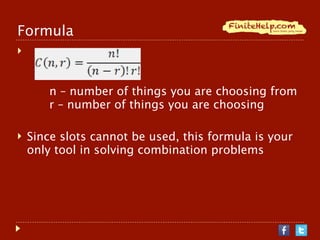
Formula



   n – number of things you are choosing from
    
   r – number of things you are choosing

   Since slots cannot be used, this formula is your
    only tool in solving combination problems
   Let’s do an example combination problem. You
    order Mother Bear’s Pizza with a friend late at night.
    There is a special on a 3-topping pizza so you
    decide to go with that. There are 8 toppings to
    choose from. How many different pizzas can
    possibly be made?

   Simply apply the formula here.
   n = 8 (8 toppings to choose from)
   r = 3 (3 toppings being chosen to put on the pizza):


   Which comes to 56.
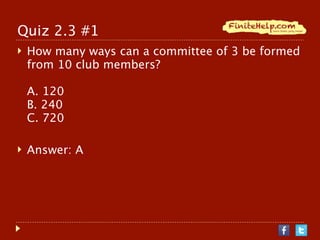
Quiz 2.3 #1
   How many ways can a committee of 3 be formed
    from 10 club members?

    A. 120
    B. 240
    C. 720
Quiz 2.3 #1
   How many ways can a committee of 3 be formed
    from 10 club members?

    A. 120
    B. 240
    C. 720

   Answer: A
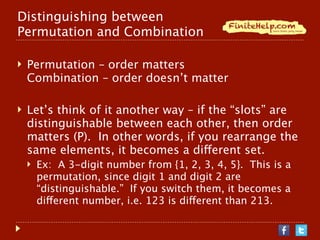
Distinguishing between
Permutation and Combination
   Permutation – order matters
    Combination – order doesn’t matter

   Let’s think of it another way – if the “slots” are
    distinguishable between each other, then order
    matters (P). In other words, if you rearrange the
    same elements, it becomes a different set.
       Ex: A 3-digit number from {1, 2, 3, 4, 5}. This is a
        permutation, since digit 1 and digit 2 are
        “distinguishable.” If you switch them, it becomes a
        different number, i.e. 123 is different than 213.
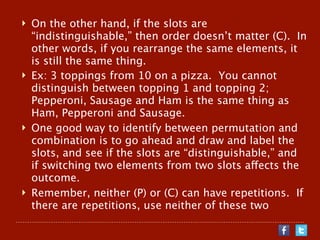
   On the other hand, if the slots are
    “indistinguishable,” then order doesn’t matter (C). In
    other words, if you rearrange the same elements, it
    is still the same thing.
   Ex: 3 toppings from 10 on a pizza. You cannot
    distinguish between topping 1 and topping 2;
    Pepperoni, Sausage and Ham is the same thing as
    Ham, Pepperoni and Sausage.
   One good way to identify between permutation and
    combination is to go ahead and draw and label the
    slots, and see if the slots are “distinguishable,” and
    if switching two elements from two slots affects the
    outcome.
   Remember, neither (P) or (C) can have repetitions. If
    there are repetitions, use neither of these two
   Quiz 2.3 #2: Identify whether each
    problem is permutation, combination, or neither:
   Quiz 2.3 #2: Identify whether each
    problem is permutation, combination, or neither:

   1. Number of ways to form a committee of president,
    VP, and treasurer from 10 students.
   Quiz 2.3 #2: Identify whether each
    problem is permutation, combination, or neither:

   1. Number of ways to form a committee of president,
    VP, and treasurer from 10 students.
   Permutation
   Quiz 2.3 #2: Identify whether each
    problem is permutation, combination, or neither:

   1. Number of ways to form a committee of president,
    VP, and treasurer from 10 students.
   Permutation

   2. Number of ways to select 5 distinct roles for a play
    out of 10 potential actors
   Quiz 2.3 #2: Identify whether each
    problem is permutation, combination, or neither:

   1. Number of ways to form a committee of president,
    VP, and treasurer from 10 students.
   Permutation

   2. Number of ways to select 5 distinct roles for a play
    out of 10 potential actors
   Permutation
   Quiz 2.3 #2: Identify whether each
    problem is permutation, combination, or neither:

   1. Number of ways to form a committee of president,
    VP, and treasurer from 10 students.
   Permutation

   2. Number of ways to select 5 distinct roles for a play
    out of 10 potential actors
   Permutation

   3. Number of ways to pick a hand of 5 cards from a
    deck of cards
   Quiz 2.3 #2: Identify whether each
    problem is permutation, combination, or neither:

   1. Number of ways to form a committee of president,
    VP, and treasurer from 10 students.
   Permutation

   2. Number of ways to select 5 distinct roles for a play
    out of 10 potential actors
   Permutation

   3. Number of ways to pick a hand of 5 cards from a
    deck of cards
   Combination
Choosing
from Multiple Pools
   There are 4 Democrats and 3 Republicans forming a
    committee with 2 Democrats and 2 Republicans.
    How many different committees can be formed?

   We have to treat the Democrats and Republicans
    separately. This is a combination problem. So we
    have C(4,2) for Democrats, and C(3,2) for
    Republicans. You multiply the two:


          C(4,2) x C(3,2) = 6 x 3 = 18


                  2 Dem out of 4   2 Rep out of 3
Choosing
with Multi-Scenarios
   A group of 6 friends are thinking about a Spring break trip to
    Florida. At least 4 of them have to go in order to get the group
    discount flight. How many groups can be formed such that
    they can get the discount?

   This is also a combination problem. For this problem, at least
    4 of them have to go, meaning the qualifying events are when
    4 or 5 or 6 of them can go. You have to treat each scenario
    separately. So we have C(6,4) if 4 of them go, C(6,5) if five go,
    and C(6,6) if six go. This time, you add them:

    
     C(6,4) + C(6,5) + C(6,6) = 15 + 6 + 1 = 22


        Group of 4 Group of 5 Group of 6
Golden Rule of Finite
   Here it is:

         AND you multiply, OR you add.
   Let’s take the previous two examples.
   When we need 2 Democrats AND 2
    Republicans, we multiplied C(4,2) x C(3,2).
   When we need a group of 4 OR 5 OR 6, we
    added
    C(6,4) + C(6,5) + C(6,6).
Quiz 2.3 #3
   I have 5 dimes and 2 quarters in my pocket. I
    reach in and pick 3 coins at random. How many
    ways can the 3 coins be selected?

    A. 35
    B. 70
    C. 115
Quiz 2.3 #3
   I have 5 dimes and 2 quarters in my pocket. I
    reach in and pick 3 coins at random. How many
    ways can the 3 coins be selected?

    A. 35
    B. 70
    C. 115

   Answer: A
Multiple Pools AND Scenarios
   Brad and Angie have 6 children, 3 boys and 3 girls.
    Three of them have to do dishes tonight. How many
    ways can the three be selected so that there is at least
    one boy and at least one girl?

   First, we’ll draw out a table representing the spectrum of
    events, ranging from all from one pool to all from the
    other:

             0boy      1boy      2boys     3boys

             3girls    2girls    1girl     0girl


   Checks represents qualifying events, crosses represents
    non-qualifying events
Multiple Pools AND Scenarios
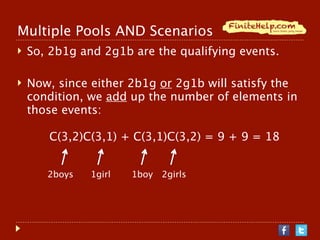
   So, 2b1g and 2g1b are the qualifying events.

   Now, since either 2b1g or 2g1b will satisfy the
    condition, we add up the number of elements in
    those events:

    
   C(3,2)C(3,1) + C(3,1)C(3,2) = 9 + 9 = 18


        2boys   1girl   1boy   2girls
Complementary Selection
   Sometimes there are more checks than crosses. In
    that case, it will be quicker to take advantage of this
    equation:
    # elements qualify = Total # elements in SS - # elements not quality


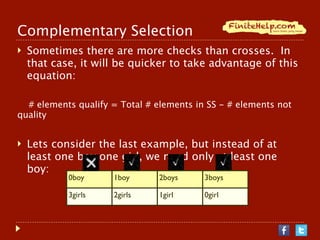
   Lets consider the last example, but instead of at
    least one boy one girl, we need only at least one
    boy:

              0boy       1boy      2boys     3boys

              3girls     2girls    1girl     0girl
Complementary Selection
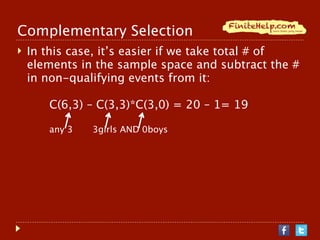
   In this case, it’s easier if we take total # of
    elements in the sample space and subtract the #
    in non-qualifying events from it:

           C(6,3) – C(3,3)*C(3,0) = 20 – 1= 19

          any 3   3girls AND 0boys
Quiz 2.3 #4
   I have 6 regular and 4 diet coke in my cooler. I
    pick 5 at random. What’s the number of ways I
    pick at least 1 diet?

    A. 66
    B. 246
    C. 846
Quiz 2.3 #4
   I have 6 regular and 4 diet coke in my cooler. I
    pick 5 at random. What’s the number of ways I
    pick at least 1 diet?

    A. 66
    B. 246
    C. 846

   Answer: B
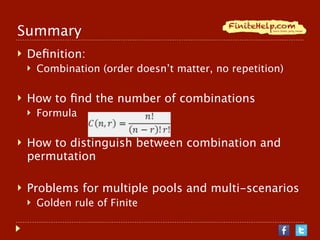
Summary
   Definition:
       Combination (order doesn’t matter, no repetition)

   How to find the number of combinations
       Formula

   How to distinguish between combination and
    permutation

   Problems for multiple pools and multi-scenarios
       Golden rule of Finite
   Features
        27 Recorded Lectures
        Over 116 practice problems with recorded solutions
        Discussion boards/homework help
        Visit finitehelp.com to find out more

     For special offers and additional content...
Follow us on twitter @finitehelp        Become a fan on Facebook

Counting Partitions: Combinations - Finite Math

  • 1.
  • 2.
    Combination  Combination is just like permutation – you are counting the number of ways to pick from a set without repetition of elements.  The difference is that, for combination, order does not matter.  Slot method can only be used when order matters; therefore, you cannot use slots for a combination problem.
  • 3.
    Formula  n – number of things you are choosing from r – number of things you are choosing  Since slots cannot be used, this formula is your only tool in solving combination problems
  • 4.
    Let’s do an example combination problem. You order Mother Bear’s Pizza with a friend late at night. There is a special on a 3-topping pizza so you decide to go with that. There are 8 toppings to choose from. How many different pizzas can possibly be made?  Simply apply the formula here.  n = 8 (8 toppings to choose from)  r = 3 (3 toppings being chosen to put on the pizza):  Which comes to 56.
  • 5.
    Quiz 2.3 #1  How many ways can a committee of 3 be formed from 10 club members? A. 120 B. 240 C. 720
  • 6.
    Quiz 2.3 #1  How many ways can a committee of 3 be formed from 10 club members? A. 120 B. 240 C. 720  Answer: A
  • 7.
    Distinguishing between Permutation andCombination  Permutation – order matters Combination – order doesn’t matter  Let’s think of it another way – if the “slots” are distinguishable between each other, then order matters (P). In other words, if you rearrange the same elements, it becomes a different set.  Ex: A 3-digit number from {1, 2, 3, 4, 5}. This is a permutation, since digit 1 and digit 2 are “distinguishable.” If you switch them, it becomes a different number, i.e. 123 is different than 213.
  • 8.
    On the other hand, if the slots are “indistinguishable,” then order doesn’t matter (C). In other words, if you rearrange the same elements, it is still the same thing.  Ex: 3 toppings from 10 on a pizza. You cannot distinguish between topping 1 and topping 2; Pepperoni, Sausage and Ham is the same thing as Ham, Pepperoni and Sausage.  One good way to identify between permutation and combination is to go ahead and draw and label the slots, and see if the slots are “distinguishable,” and if switching two elements from two slots affects the outcome.  Remember, neither (P) or (C) can have repetitions. If there are repetitions, use neither of these two
  • 10.
    Quiz 2.3 #2: Identify whether each problem is permutation, combination, or neither:
  • 11.
    Quiz 2.3 #2: Identify whether each problem is permutation, combination, or neither:  1. Number of ways to form a committee of president, VP, and treasurer from 10 students.
  • 12.
    Quiz 2.3 #2: Identify whether each problem is permutation, combination, or neither:  1. Number of ways to form a committee of president, VP, and treasurer from 10 students.  Permutation
  • 13.
    Quiz 2.3 #2: Identify whether each problem is permutation, combination, or neither:  1. Number of ways to form a committee of president, VP, and treasurer from 10 students.  Permutation  2. Number of ways to select 5 distinct roles for a play out of 10 potential actors
  • 14.
    Quiz 2.3 #2: Identify whether each problem is permutation, combination, or neither:  1. Number of ways to form a committee of president, VP, and treasurer from 10 students.  Permutation  2. Number of ways to select 5 distinct roles for a play out of 10 potential actors  Permutation
  • 15.
    Quiz 2.3 #2: Identify whether each problem is permutation, combination, or neither:  1. Number of ways to form a committee of president, VP, and treasurer from 10 students.  Permutation  2. Number of ways to select 5 distinct roles for a play out of 10 potential actors  Permutation  3. Number of ways to pick a hand of 5 cards from a deck of cards
  • 16.
    Quiz 2.3 #2: Identify whether each problem is permutation, combination, or neither:  1. Number of ways to form a committee of president, VP, and treasurer from 10 students.  Permutation  2. Number of ways to select 5 distinct roles for a play out of 10 potential actors  Permutation  3. Number of ways to pick a hand of 5 cards from a deck of cards  Combination
  • 17.
    Choosing from Multiple Pools  There are 4 Democrats and 3 Republicans forming a committee with 2 Democrats and 2 Republicans. How many different committees can be formed?  We have to treat the Democrats and Republicans separately. This is a combination problem. So we have C(4,2) for Democrats, and C(3,2) for Republicans. You multiply the two: C(4,2) x C(3,2) = 6 x 3 = 18 2 Dem out of 4 2 Rep out of 3
  • 18.
    Choosing with Multi-Scenarios  A group of 6 friends are thinking about a Spring break trip to Florida. At least 4 of them have to go in order to get the group discount flight. How many groups can be formed such that they can get the discount?  This is also a combination problem. For this problem, at least 4 of them have to go, meaning the qualifying events are when 4 or 5 or 6 of them can go. You have to treat each scenario separately. So we have C(6,4) if 4 of them go, C(6,5) if five go, and C(6,6) if six go. This time, you add them: C(6,4) + C(6,5) + C(6,6) = 15 + 6 + 1 = 22 Group of 4 Group of 5 Group of 6
  • 19.
    Golden Rule ofFinite  Here it is: AND you multiply, OR you add.  Let’s take the previous two examples.  When we need 2 Democrats AND 2 Republicans, we multiplied C(4,2) x C(3,2).  When we need a group of 4 OR 5 OR 6, we added C(6,4) + C(6,5) + C(6,6).
  • 20.
    Quiz 2.3 #3  I have 5 dimes and 2 quarters in my pocket. I reach in and pick 3 coins at random. How many ways can the 3 coins be selected? A. 35 B. 70 C. 115
  • 21.
    Quiz 2.3 #3  I have 5 dimes and 2 quarters in my pocket. I reach in and pick 3 coins at random. How many ways can the 3 coins be selected? A. 35 B. 70 C. 115  Answer: A
  • 22.
    Multiple Pools ANDScenarios  Brad and Angie have 6 children, 3 boys and 3 girls. Three of them have to do dishes tonight. How many ways can the three be selected so that there is at least one boy and at least one girl?  First, we’ll draw out a table representing the spectrum of events, ranging from all from one pool to all from the other: 0boy 1boy 2boys 3boys 3girls 2girls 1girl 0girl  Checks represents qualifying events, crosses represents non-qualifying events
  • 23.
    Multiple Pools ANDScenarios  So, 2b1g and 2g1b are the qualifying events.  Now, since either 2b1g or 2g1b will satisfy the condition, we add up the number of elements in those events: C(3,2)C(3,1) + C(3,1)C(3,2) = 9 + 9 = 18 2boys 1girl 1boy 2girls
  • 24.
    Complementary Selection  Sometimes there are more checks than crosses. In that case, it will be quicker to take advantage of this equation: # elements qualify = Total # elements in SS - # elements not quality  Lets consider the last example, but instead of at least one boy one girl, we need only at least one boy: 0boy 1boy 2boys 3boys 3girls 2girls 1girl 0girl
  • 25.
    Complementary Selection  In this case, it’s easier if we take total # of elements in the sample space and subtract the # in non-qualifying events from it: C(6,3) – C(3,3)*C(3,0) = 20 – 1= 19 any 3 3girls AND 0boys
  • 26.
    Quiz 2.3 #4  I have 6 regular and 4 diet coke in my cooler. I pick 5 at random. What’s the number of ways I pick at least 1 diet? A. 66 B. 246 C. 846
  • 27.
    Quiz 2.3 #4  I have 6 regular and 4 diet coke in my cooler. I pick 5 at random. What’s the number of ways I pick at least 1 diet? A. 66 B. 246 C. 846  Answer: B
  • 28.
    Summary  Definition:  Combination (order doesn’t matter, no repetition)  How to find the number of combinations  Formula  How to distinguish between combination and permutation  Problems for multiple pools and multi-scenarios  Golden rule of Finite
  • 29.
    Features  27 Recorded Lectures  Over 116 practice problems with recorded solutions  Discussion boards/homework help  Visit finitehelp.com to find out more For special offers and additional content... Follow us on twitter @finitehelp Become a fan on Facebook