Financial & Managerial
Accounting
Lecture 02: Financial Statements &
Accounting Transactions
Masud Jahan
Department of Science and Humanities
Military Institute of Science and Technology
Chapter
1
2/43
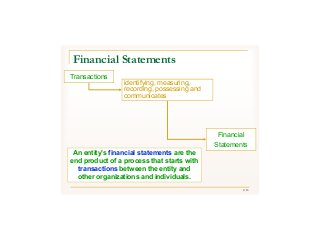
An entity’s financial statements are the
end product of a process that starts with
transactions between the entity and
other organizations and individuals.
Transactions
identifying, measuring,
recording, possessing and
communicates
Financial
Statements
Financial Statements
3/43
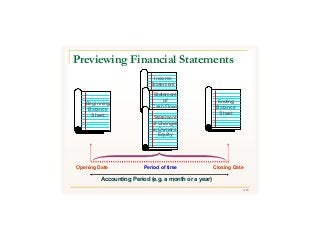
Opening Date Closing DatePeriod of time
Income
Statement
Statement
of
Cash Flows
Statement
of Changes
in Owner’s
Equity
Beginning
Balance
Sheet
Ending
Balance
Sheet
Accounting Period (e.g. a month or a year)
Previewing Financial Statements
4/43
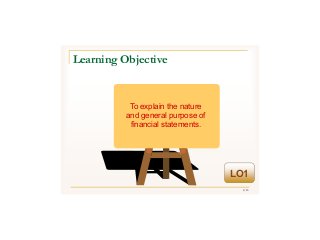
Learning Objective
LO1
To explain the nature
and general purpose of
financial statements.
5/43
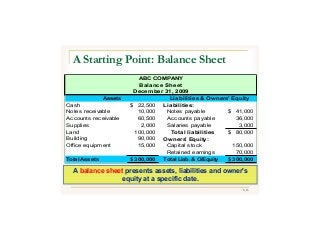
ABC COMPANY
Balance Sheet
December 31, 2009
Assets Liabilities & Owners' Equity
Cash 22,500$ Liabilities:
Notes receivable 10,000 Notes payable 41,000$
Accounts receivable 60,500 Accounts payable 36,000
Supplies 2,000 Salaries payable 3,000
Land 100,000 Total liabilities 80,000$
Building 90,000 Owners' Equity:
Office equipment 15,000 Capital stock 150,000
Retained earnings 70,000
Total Assets 300,000$ Total Liab. & O/Equity 300,000$
A balance sheet presents assets, liabilities and owner's
equity at a specific date.
A Starting Point: Balance Sheet
6/43
ABC COMPANY
Balance Sheet
December 31, 2009
Assets Liabilities & Owners' Equity
Cash 22,500$ Liabilities:
Notes receivable 10,000 Notes payable 41,000$
Accounts receivable 60,500 Accounts payable 36,000
Supplies 2,000 Salaries payable 3,000
Land 100,000 Total liabilities 80,000$
Building 90,000 Owners' Equity:
Office equipment 15,000 Capital stock 150,000
Retained earnings 70,000
Total 300,000$ Total 300,000$
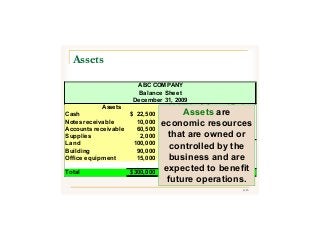
Assets are
economic resources
that are owned or
controlled by the
business and are
expected to benefit
future operations.
Assets
7/43
ABC COMPANY
Balance Sheet
December 31, 2009
Assets Liabilities & Owners' Equity
Cash 22,500$ Liabilities:
Notes receivable 10,000 Notes payable 41,000$
Accounts receivable 60,500 Accounts payable 36,000
Supplies 2,000 Salaries payable 3,000
Land 100,000 Total liabilities 80,000$
Building 90,000 Owners' Equity:
Office equipment 15,000 Capital stock 150,000
Retained earnings 70,000
Total 300,000$ Total 300,000$
Liabilities
Liabilities are
debts owed to
creditors that
represent negative
future cash flows
for the business.
8/43
ABC COMPANY
Balance Sheet
December 31, 2009
Assets Liabilities & Owners' Equity
Cash 22,500$ Liabilities:
Notes receivable 10,000 Notes payable 41,000$
Accounts receivable 60,500 Accounts payable 36,000
Supplies 2,000 Salaries payable 3,000
Land 100,000 Total liabilities 80,000$
Building 90,000 Owners' Equity:
Office equipment 15,000 Capital stock 150,000
Retained earnings 70,000
Total 300,000$ Total 300,000$
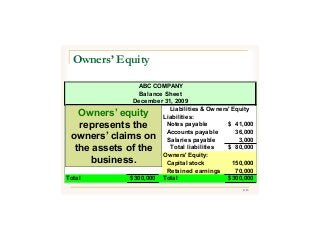
Owners’ Equity
Owners’ equity
represents the
owners’ claims on
the assets of the
business.
9/43
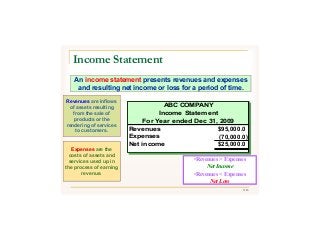
Income Statement
Revenues are inflows
of assets resulting
from the sale of
products or the
rendering of services
to customers.
Expenses are the
costs of assets and
services used up in
the process of earning
revenue.
An income statement presents revenues and expenses
and resulting net income or loss for a period of time.
ABC COMPANY
Income Statement
For Year ended Dec 31, 2009
Revenues 95,000.0$
Expenses (70,000.0)
Net income 25,000.0$
•Revenues > Expenses
Net Income
•Revenues < Expenses
Net Loss
10/43
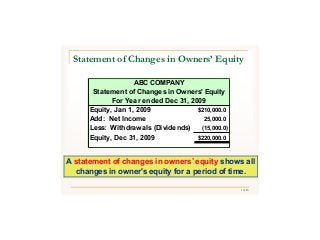
ABC COMPANY
Statement of Changes in Owners' Equity
For Year ended Dec 31, 2009
Equity, Jan 1, 2009 210,000.0$
Add: Net Income 25,000.0
Less: Withdrawals (Dividends) (15,000.0)
Equity, Dec 31, 2009 220,000.0$
A statement of changes in owners’ equity shows all
changes in owner's equity for a period of time.
Statement of Changes in Owners’ Equity
11/43
Owners’ Equity
Changes in Owners’
Equity
•Owners’
Investments
•Net Income
•Withdrawals
by Owners
•Net Loss
12/43
Learning Objective
LO2
To analysis business
transactions
13/43
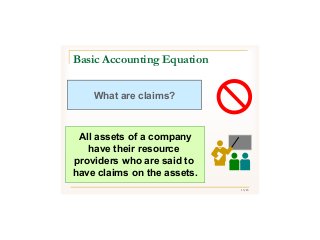
What are claims?
All assets of a company
have their resource
providers who are said to
have claims on the assets.
Basic Accounting Equation
14/43
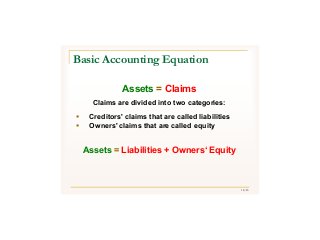
Assets = Claims
Claims are divided into two categories:
 Creditors' claims that are called liabilities
 Owners' claims that are called equity
Assets = Liabilities + Owners‘ Equity
Basic Accounting Equation
15/43
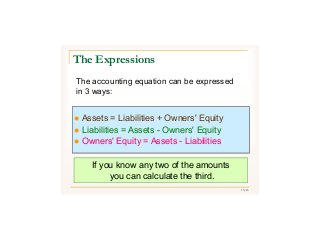
The accounting equation can be expressed
in 3 ways:
If you know any two of the amounts you
can calculate the third.
 Assets = Liabilities + Owners' Equity
 Liabilities = Assets - Owners' Equity
 Owners' Equity = Assets - Liabilities
If you know any two of the amounts
you can calculate the third.
The Expressions
16/43
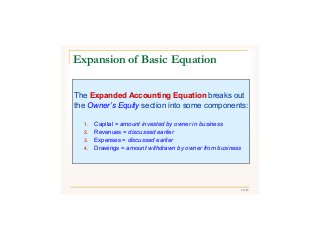
Expansion of Basic Equation
The Expanded Accounting Equation breaks out
the Owner’s Equity section into some components:
1. Capital = amount invested by owner in business
2. Revenues = discussed earlier
3. Expenses = discussed earlier
4. Drawings = amount withdrawn by owner from business
17/43
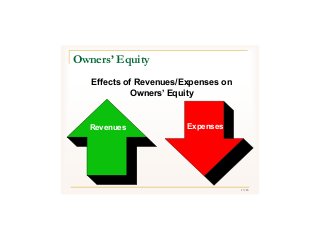
Owners’ Equity
Effects of Revenues/Expenses on
Owners’ Equity
Revenues Expenses
18/43
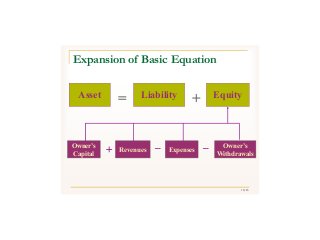
Liability EquityAsset = +
Owner’s
Capital
Revenues Expenses
Owner’s
Withdrawals+ – –
Expansion of Basic Equation
19/43
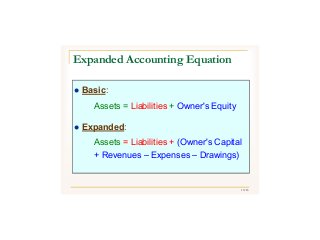
 Basic:
Assets = Liabilities + Owner's Equity
 Expanded:
Assets = Liabilities + (Owner's Capital
+ Revenues – Expenses – Drawings)
Expanded Accounting Equation
20/43
A business transaction is an economic event that
directly changes financial condition of a business
or directly affects its results of operations.
What is a business transaction?
21/43
Effects of Business Transactions
Business transactions result in changes to
the three elements of the basic accounting
equation in either of 3 ways.
1. A transaction that increases total
assets must also increase total
liabilities or owner's equity.
22/43
Effects of Business Transactions
Business transactions result in changes to
the three elements of the basic accounting
equation in either of 3 ways.
2. A transaction that decreases total
assets must also decrease total
liabilities or owner's equity.
23/43
Effects of Business Transactions
Business transactions result in changes to
the three elements of the basic accounting
equation in either of 3 ways.
3. Some transactions may increase one
account and decrease another on the
same side of the equation i.e. one
asset increases and another
decreases.
24/43
Transaction Analysis is the process of
reconciling the differences made to each
side of the equation with each business
transaction occurs.
Let’s look at some sample transactions
to get a better understanding of how the
analysis and equation work.
Transaction Analysis
25/43
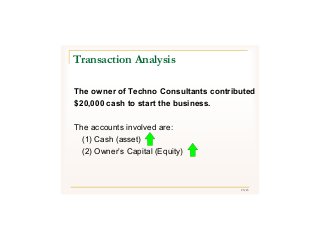
The owner of Techno Consultants contributed
$20,000 cash to start the business.
The accounts involved are:
(1) Cash (asset)
(2) Owner’s Capital (Equity)
Transaction Analysis
26/43
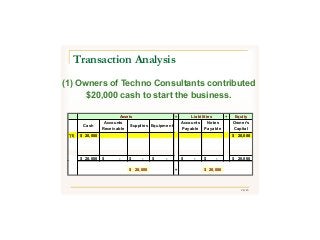
(1) Owners of Techno Consultants contributed
$20,000 cash to start the business.
Transaction Analysis
Assets = Liabilities + Equity
Cash
Accounts
Receivable
Supplies Equipment
Accounts
Payable
Notes
Payable
Owner's
Capital
'(1) 20,000$ 20,000$
20,000$ -$ -$ -$ -$ -$ 20,000$
20,000$ = 20,000$
27/43
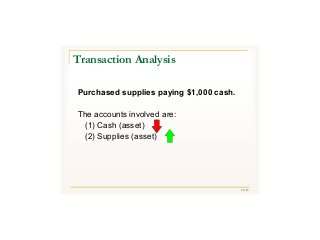
Purchased supplies paying $1,000 cash.
The accounts involved are:
(1) Cash (asset)
(2) Supplies (asset)
Transaction Analysis
28/43
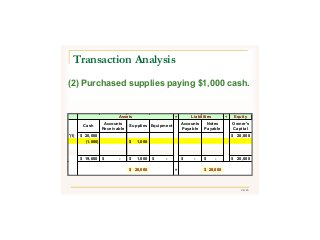
(2) Purchased supplies paying $1,000 cash.
Transaction Analysis
Assets = Liabilities + Equity
Cash
Accounts
Receivable
Supplies Equipment
Accounts
Payable
Notes
Payable
Owner's
Capital
'(1) 20,000$ 20,000$
(1,000) 1,000$
19,000$ -$ 1,000$ -$ -$ -$ 20,000$
20,000$ = 20,000$
29/43
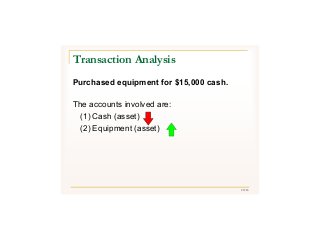
Purchased equipment for $15,000 cash.
The accounts involved are:
(1) Cash (asset)
(2) Equipment (asset)
Transaction Analysis
30/43
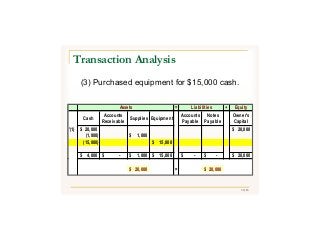
(3) Purchased equipment for $15,000 cash.
Transaction Analysis
Assets = Liabilities + Equity
Cash
Accounts
Receivable
Supplies Equipment
Accounts
Payable
Notes
Payable
Owner's
Capital
'(1) 20,000$ 20,000$
(1,000) 1,000$
(15,000) 15,000$
4,000$ -$ 1,000$ 15,000$ -$ -$ 20,000$
20,000$ = 20,000$
31/43
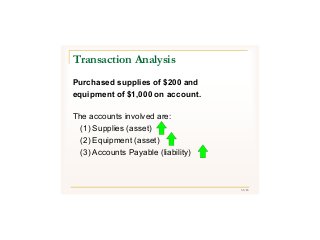
Purchased supplies of $200 and
equipment of $1,000 on account.
The accounts involved are:
(1) Supplies (asset)
(2) Equipment (asset)
(3) Accounts Payable (liability)
Transaction Analysis
32/43
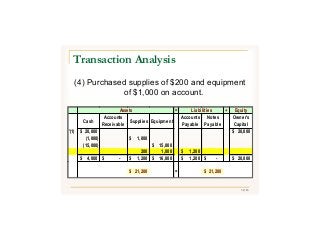
Transaction Analysis
(4) Purchased supplies of $200 and equipment
of $1,000 on account.
Assets = Liabilities + Equity
Cash
Accounts
Receivable
Supplies Equipment
Accounts
Payable
Notes
Payable
Owner's
Capital
'(1) 20,000$ 20,000$
(1,000) 1,000$
(15,000) 15,000$
200 1,000 1,200$
4,000$ -$ 1,200$ 16,000$ 1,200$ -$ 20,000$
21,200$ = 21,200$
33/43
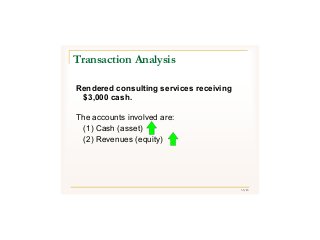
Rendered consulting services receiving
$3,000 cash.
The accounts involved are:
(1) Cash (asset)
(2) Revenues (equity)
Transaction Analysis
34/43
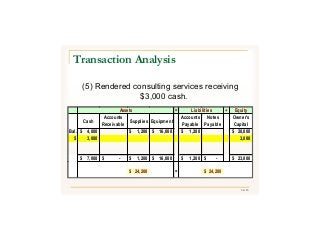
(5) Rendered consulting services receiving
$3,000 cash.
Transaction Analysis
Assets = Liabilities + Equity
Cash
Accounts
Receivable
Supplies Equipment
Accounts
Payable
Notes
Payable
Owner's
Capital
Bal. 4,000$ 1,200$ 16,000$ 1,200$ 20,000$
5 3,000 3,000
7,000$ -$ 1,200$ 16,000$ 1,200$ -$ 23,000$
24,200$ = 24,200$
35/43
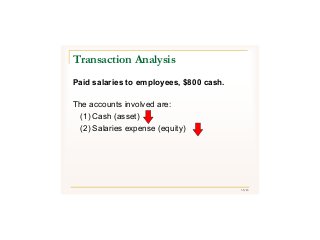
Paid salaries to employees, $800 cash.
The accounts involved are:
(1) Cash (asset)
(2) Salaries expense (equity)
Transaction Analysis
36/43
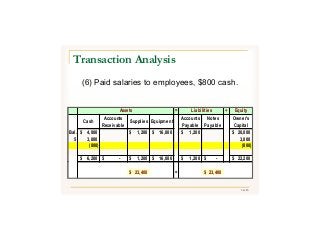
Transaction Analysis
(6) Paid salaries to employees, $800 cash.
Assets = Liabilities + Equity
Cash
Accounts
Receivable
Supplies Equipment
Accounts
Payable
Notes
Payable
Owner's
Capital
Bal. 4,000$ 1,200$ 16,000$ 1,200$ 20,000$
5 3,000 3,000
(800) (800)
6,200$ -$ 1,200$ 16,000$ 1,200$ -$ 22,200$
23,400$ = 23,400$
37/43
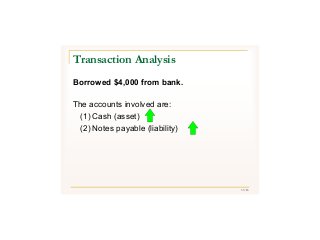
Borrowed $4,000 from bank.
The accounts involved are:
(1) Cash (asset)
(2) Notes payable (liability)
Transaction Analysis
38/43
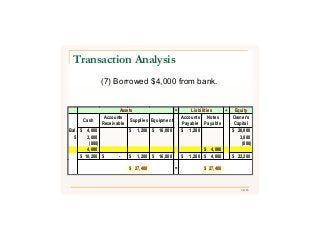
(7) Borrowed $4,000 from bank.
Transaction Analysis
Assets = Liabilities + Equity
Cash
Accounts
Receivable
Supplies Equipment
Accounts
Payable
Notes
Payable
Owner's
Capital
Bal. 4,000$ 1,200$ 16,000$ 1,200$ 20,000$
5 3,000 3,000
(800) (800)
4,000 4,000$
10,200$ -$ 1,200$ 16,000$ 1,200$ 4,000$ 22,200$
27,400$ = 27,400$
39/43
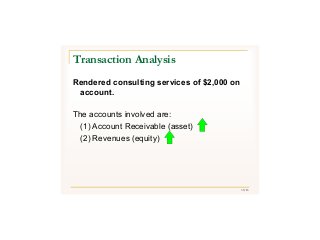
Rendered consulting services of $2,000 on
account.
The accounts involved are:
(1) Account Receivable (asset)
(2) Revenues (equity)
Transaction Analysis
40/43
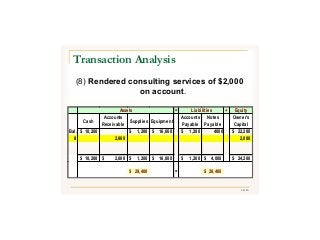
(8) Rendered consulting services of $2,000
on account.
Transaction Analysis
Assets = Liabilities + Equity
Cash
Accounts
Receivable
Supplies Equipment
Accounts
Payable
Notes
Payable
Owner's
Capital
Bal. 10,200$ 1,200$ 16,000$ 1,200$ 4000 22,200$
8 2,000 2,000
10,200$ 2,000$ 1,200$ 16,000$ 1,200$ 4,000$ 24,200$
29,400$ = 29,400$
41/43
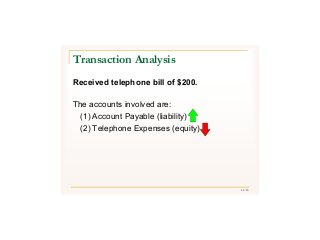
Received telephone bill of $200.
The accounts involved are:
(1) Account Payable (liability)
(2) Telephone Expenses (equity)
Transaction Analysis
42/43
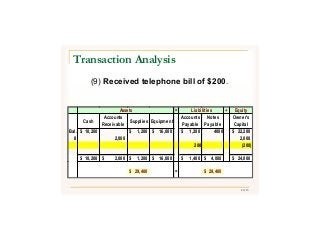
(9) Received telephone bill of $200.
Transaction Analysis
Assets = Liabilities + Equity
Cash
Accounts
Receivable
Supplies Equipment
Accounts
Payable
Notes
Payable
Owner's
Capital
Bal. 10,200$ 1,200$ 16,000$ 1,200$ 4000 22,200$
8 2,000 2,000
200 (200)
10,200$ 2,000$ 1,200$ 16,000$ 1,400$ 4,000$ 24,000$
29,400$ = 29,400$
End of Lecture 02
Thank you all …

Financial Statements & Accounting Transactions

  • 1.
    Financial & Managerial Accounting Lecture02: Financial Statements & Accounting Transactions Masud Jahan Department of Science and Humanities Military Institute of Science and Technology Chapter 1
  • 2.
    2/43 An entity’s financialstatements are the end product of a process that starts with transactions between the entity and other organizations and individuals. Transactions identifying, measuring, recording, possessing and communicates Financial Statements Financial Statements
  • 3.
    3/43 Opening Date ClosingDatePeriod of time Income Statement Statement of Cash Flows Statement of Changes in Owner’s Equity Beginning Balance Sheet Ending Balance Sheet Accounting Period (e.g. a month or a year) Previewing Financial Statements
  • 4.
    4/43 Learning Objective LO1 To explainthe nature and general purpose of financial statements.
  • 5.
    5/43 ABC COMPANY Balance Sheet December31, 2009 Assets Liabilities & Owners' Equity Cash 22,500$ Liabilities: Notes receivable 10,000 Notes payable 41,000$ Accounts receivable 60,500 Accounts payable 36,000 Supplies 2,000 Salaries payable 3,000 Land 100,000 Total liabilities 80,000$ Building 90,000 Owners' Equity: Office equipment 15,000 Capital stock 150,000 Retained earnings 70,000 Total Assets 300,000$ Total Liab. & O/Equity 300,000$ A balance sheet presents assets, liabilities and owner's equity at a specific date. A Starting Point: Balance Sheet
  • 6.
    6/43 ABC COMPANY Balance Sheet December31, 2009 Assets Liabilities & Owners' Equity Cash 22,500$ Liabilities: Notes receivable 10,000 Notes payable 41,000$ Accounts receivable 60,500 Accounts payable 36,000 Supplies 2,000 Salaries payable 3,000 Land 100,000 Total liabilities 80,000$ Building 90,000 Owners' Equity: Office equipment 15,000 Capital stock 150,000 Retained earnings 70,000 Total 300,000$ Total 300,000$ Assets are economic resources that are owned or controlled by the business and are expected to benefit future operations. Assets
  • 7.
    7/43 ABC COMPANY Balance Sheet December31, 2009 Assets Liabilities & Owners' Equity Cash 22,500$ Liabilities: Notes receivable 10,000 Notes payable 41,000$ Accounts receivable 60,500 Accounts payable 36,000 Supplies 2,000 Salaries payable 3,000 Land 100,000 Total liabilities 80,000$ Building 90,000 Owners' Equity: Office equipment 15,000 Capital stock 150,000 Retained earnings 70,000 Total 300,000$ Total 300,000$ Liabilities Liabilities are debts owed to creditors that represent negative future cash flows for the business.
  • 8.
    8/43 ABC COMPANY Balance Sheet December31, 2009 Assets Liabilities & Owners' Equity Cash 22,500$ Liabilities: Notes receivable 10,000 Notes payable 41,000$ Accounts receivable 60,500 Accounts payable 36,000 Supplies 2,000 Salaries payable 3,000 Land 100,000 Total liabilities 80,000$ Building 90,000 Owners' Equity: Office equipment 15,000 Capital stock 150,000 Retained earnings 70,000 Total 300,000$ Total 300,000$ Owners’ Equity Owners’ equity represents the owners’ claims on the assets of the business.
  • 9.
    9/43 Income Statement Revenues areinflows of assets resulting from the sale of products or the rendering of services to customers. Expenses are the costs of assets and services used up in the process of earning revenue. An income statement presents revenues and expenses and resulting net income or loss for a period of time. ABC COMPANY Income Statement For Year ended Dec 31, 2009 Revenues 95,000.0$ Expenses (70,000.0) Net income 25,000.0$ •Revenues > Expenses Net Income •Revenues < Expenses Net Loss
  • 10.
    10/43 ABC COMPANY Statement ofChanges in Owners' Equity For Year ended Dec 31, 2009 Equity, Jan 1, 2009 210,000.0$ Add: Net Income 25,000.0 Less: Withdrawals (Dividends) (15,000.0) Equity, Dec 31, 2009 220,000.0$ A statement of changes in owners’ equity shows all changes in owner's equity for a period of time. Statement of Changes in Owners’ Equity
  • 11.
    11/43 Owners’ Equity Changes inOwners’ Equity •Owners’ Investments •Net Income •Withdrawals by Owners •Net Loss
  • 12.
  • 13.
    13/43 What are claims? Allassets of a company have their resource providers who are said to have claims on the assets. Basic Accounting Equation
  • 14.
    14/43 Assets = Claims Claimsare divided into two categories:  Creditors' claims that are called liabilities  Owners' claims that are called equity Assets = Liabilities + Owners‘ Equity Basic Accounting Equation
  • 15.
    15/43 The accounting equationcan be expressed in 3 ways: If you know any two of the amounts you can calculate the third.  Assets = Liabilities + Owners' Equity  Liabilities = Assets - Owners' Equity  Owners' Equity = Assets - Liabilities If you know any two of the amounts you can calculate the third. The Expressions
  • 16.
    16/43 Expansion of BasicEquation The Expanded Accounting Equation breaks out the Owner’s Equity section into some components: 1. Capital = amount invested by owner in business 2. Revenues = discussed earlier 3. Expenses = discussed earlier 4. Drawings = amount withdrawn by owner from business
  • 17.
    17/43 Owners’ Equity Effects ofRevenues/Expenses on Owners’ Equity Revenues Expenses
  • 18.
    18/43 Liability EquityAsset =+ Owner’s Capital Revenues Expenses Owner’s Withdrawals+ – – Expansion of Basic Equation
  • 19.
    19/43  Basic: Assets =Liabilities + Owner's Equity  Expanded: Assets = Liabilities + (Owner's Capital + Revenues – Expenses – Drawings) Expanded Accounting Equation
  • 20.
    20/43 A business transactionis an economic event that directly changes financial condition of a business or directly affects its results of operations. What is a business transaction?
  • 21.
    21/43 Effects of BusinessTransactions Business transactions result in changes to the three elements of the basic accounting equation in either of 3 ways. 1. A transaction that increases total assets must also increase total liabilities or owner's equity.
  • 22.
    22/43 Effects of BusinessTransactions Business transactions result in changes to the three elements of the basic accounting equation in either of 3 ways. 2. A transaction that decreases total assets must also decrease total liabilities or owner's equity.
  • 23.
    23/43 Effects of BusinessTransactions Business transactions result in changes to the three elements of the basic accounting equation in either of 3 ways. 3. Some transactions may increase one account and decrease another on the same side of the equation i.e. one asset increases and another decreases.
  • 24.
    24/43 Transaction Analysis isthe process of reconciling the differences made to each side of the equation with each business transaction occurs. Let’s look at some sample transactions to get a better understanding of how the analysis and equation work. Transaction Analysis
  • 25.
    25/43 The owner ofTechno Consultants contributed $20,000 cash to start the business. The accounts involved are: (1) Cash (asset) (2) Owner’s Capital (Equity) Transaction Analysis
  • 26.
    26/43 (1) Owners ofTechno Consultants contributed $20,000 cash to start the business. Transaction Analysis Assets = Liabilities + Equity Cash Accounts Receivable Supplies Equipment Accounts Payable Notes Payable Owner's Capital '(1) 20,000$ 20,000$ 20,000$ -$ -$ -$ -$ -$ 20,000$ 20,000$ = 20,000$
  • 27.
    27/43 Purchased supplies paying$1,000 cash. The accounts involved are: (1) Cash (asset) (2) Supplies (asset) Transaction Analysis
  • 28.
    28/43 (2) Purchased suppliespaying $1,000 cash. Transaction Analysis Assets = Liabilities + Equity Cash Accounts Receivable Supplies Equipment Accounts Payable Notes Payable Owner's Capital '(1) 20,000$ 20,000$ (1,000) 1,000$ 19,000$ -$ 1,000$ -$ -$ -$ 20,000$ 20,000$ = 20,000$
  • 29.
    29/43 Purchased equipment for$15,000 cash. The accounts involved are: (1) Cash (asset) (2) Equipment (asset) Transaction Analysis
  • 30.
    30/43 (3) Purchased equipmentfor $15,000 cash. Transaction Analysis Assets = Liabilities + Equity Cash Accounts Receivable Supplies Equipment Accounts Payable Notes Payable Owner's Capital '(1) 20,000$ 20,000$ (1,000) 1,000$ (15,000) 15,000$ 4,000$ -$ 1,000$ 15,000$ -$ -$ 20,000$ 20,000$ = 20,000$
  • 31.
    31/43 Purchased supplies of$200 and equipment of $1,000 on account. The accounts involved are: (1) Supplies (asset) (2) Equipment (asset) (3) Accounts Payable (liability) Transaction Analysis
  • 32.
    32/43 Transaction Analysis (4) Purchasedsupplies of $200 and equipment of $1,000 on account. Assets = Liabilities + Equity Cash Accounts Receivable Supplies Equipment Accounts Payable Notes Payable Owner's Capital '(1) 20,000$ 20,000$ (1,000) 1,000$ (15,000) 15,000$ 200 1,000 1,200$ 4,000$ -$ 1,200$ 16,000$ 1,200$ -$ 20,000$ 21,200$ = 21,200$
  • 33.
    33/43 Rendered consulting servicesreceiving $3,000 cash. The accounts involved are: (1) Cash (asset) (2) Revenues (equity) Transaction Analysis
  • 34.
    34/43 (5) Rendered consultingservices receiving $3,000 cash. Transaction Analysis Assets = Liabilities + Equity Cash Accounts Receivable Supplies Equipment Accounts Payable Notes Payable Owner's Capital Bal. 4,000$ 1,200$ 16,000$ 1,200$ 20,000$ 5 3,000 3,000 7,000$ -$ 1,200$ 16,000$ 1,200$ -$ 23,000$ 24,200$ = 24,200$
  • 35.
    35/43 Paid salaries toemployees, $800 cash. The accounts involved are: (1) Cash (asset) (2) Salaries expense (equity) Transaction Analysis
  • 36.
    36/43 Transaction Analysis (6) Paidsalaries to employees, $800 cash. Assets = Liabilities + Equity Cash Accounts Receivable Supplies Equipment Accounts Payable Notes Payable Owner's Capital Bal. 4,000$ 1,200$ 16,000$ 1,200$ 20,000$ 5 3,000 3,000 (800) (800) 6,200$ -$ 1,200$ 16,000$ 1,200$ -$ 22,200$ 23,400$ = 23,400$
  • 37.
    37/43 Borrowed $4,000 frombank. The accounts involved are: (1) Cash (asset) (2) Notes payable (liability) Transaction Analysis
  • 38.
    38/43 (7) Borrowed $4,000from bank. Transaction Analysis Assets = Liabilities + Equity Cash Accounts Receivable Supplies Equipment Accounts Payable Notes Payable Owner's Capital Bal. 4,000$ 1,200$ 16,000$ 1,200$ 20,000$ 5 3,000 3,000 (800) (800) 4,000 4,000$ 10,200$ -$ 1,200$ 16,000$ 1,200$ 4,000$ 22,200$ 27,400$ = 27,400$
  • 39.
    39/43 Rendered consulting servicesof $2,000 on account. The accounts involved are: (1) Account Receivable (asset) (2) Revenues (equity) Transaction Analysis
  • 40.
    40/43 (8) Rendered consultingservices of $2,000 on account. Transaction Analysis Assets = Liabilities + Equity Cash Accounts Receivable Supplies Equipment Accounts Payable Notes Payable Owner's Capital Bal. 10,200$ 1,200$ 16,000$ 1,200$ 4000 22,200$ 8 2,000 2,000 10,200$ 2,000$ 1,200$ 16,000$ 1,200$ 4,000$ 24,200$ 29,400$ = 29,400$
  • 41.
    41/43 Received telephone billof $200. The accounts involved are: (1) Account Payable (liability) (2) Telephone Expenses (equity) Transaction Analysis
  • 42.
    42/43 (9) Received telephonebill of $200. Transaction Analysis Assets = Liabilities + Equity Cash Accounts Receivable Supplies Equipment Accounts Payable Notes Payable Owner's Capital Bal. 10,200$ 1,200$ 16,000$ 1,200$ 4000 22,200$ 8 2,000 2,000 200 (200) 10,200$ 2,000$ 1,200$ 16,000$ 1,400$ 4,000$ 24,000$ 29,400$ = 29,400$
  • 43.
    End of Lecture02 Thank you all …