PEPSI-COLA
HISTORY
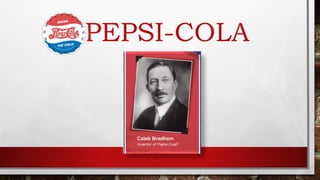
• Created in the late 1893’s by Caleb
Bradham, a New Bern, N.C.
Pharmacist.
• Fun fact: Its roots was from the
word dyspepsia meaning
“indigestion.”
• On august 28, 1898, Bradham
renamed his drink “Pepsi-cola."
• On June 16, 1903, “Pepsi-cola"
became an official trademark.
• Pepsico, Inc., was established
through the merger of Pepsi-cola &
Frito-lay, Inc., in 1961.
GOAL
• To continue build new capabilities, and
to meet the demands of customers and
consumers.
• To focused on increasing the e-
commerce presence and capabilities.
• To continue to invest in research and
development and design to foster
breakthrough innovations.
• To enhance consumer experiences
across the global business.
MISSION
• Help people lead healthier lives in
three important ways:
 Product choices offered.
 Information provided in the products.
 Way their market the products.
By providing customers with:
Delicious, affordable, convenient and
complementary foods and beverages
from wholesome breakfasts to healthy
and fun daytime snacks and beverages
to evening treats.
Strengths Weaknesses
 It has continuously increased its dividend
payout every year.
 Debt and credit issues, and currency
fluctuations in countries of operations.
 Investing is reliable in dividend stocks.
 Its ability to generate strong cash flow.
 Restrictive exchange control regulations and
reduced access to dollars.
 Has paid a dividend every year since 1952.
“Investing is reliable in dividend stocks.”
 Lack of exchangeability between the currency in
certain countries and the dollar.
 Exceptional returns in previous years  Limited abilities to import certain raw materials.
 It has increased its payout for the past 42
consecutive years.
 Can result in full impairment charges of billions
of dollars and millions related to the
reclassification of cumulative losses.
Opportunities: Threats:
 Ongoing productivity.  Uncertainties in countries in which the products
are operated and sold.
 Effective implementation of meaningful cost
saving opportunities and efficiencies, including
the use of derivatives.
 Challenging environment, experiencing unstable
economic, political and social conditions.
 Global purchasing programs with fixed-price
contracts, purchase orders, and pricing
agreements.
 Civil unrest in some territories of operations.
 To continue to monitor the economic, operating
and political environment in the markets closely.
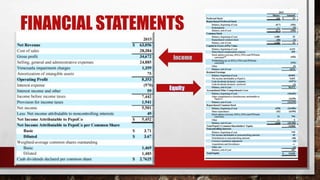
FINANCIAL STATEMENTS
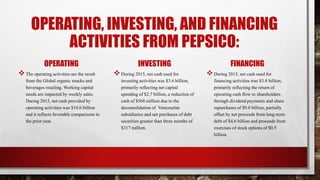
OPERATING, INVESTING, AND FINANCING
ACTIVITIES FROM PEPSICO:
OPERATING
The operating activities are the result
from the Global organic snacks and
beverages retailing. Working capital
needs are impacted by weekly sales.
During 2015, net cash provided by
operating activities was $10.6 billion
and it reflects favorable comparisons to
the prior year.
INVESTING
During 2015, net cash used for
investing activities was $3.6 billion,
primarily reflecting net capital
spending of $2.7 billion, a reduction of
cash of $568 million due to the
deconsolidation of Venezuelan
subsidiaries and net purchases of debt
securities greater than three months of
$317 million.
FINANCING
During 2015, net cash used for
financing activities was $3.8 billion,
primarily reflecting the return of
operating cash flow to shareholders
through dividend payments and share
repurchases of $9.0 billion, partially
offset by net proceeds from long-term
debt of $4.6 billion and proceeds from
exercises of stock options of $0.5
billion.
Current Ratio= dollar to cover Liability
Accounts Receivable Turnover= times
cash is collected
Debt To Equity= how much a
company is leveraged by debts and
shareholders
Return on Equity= return
shareholders get from the business
Price-to-Earnings = TO 1 per share
earning
Current Ratio= 1.24 dollar to cover Liability
Accounts Receivable Turnover= 10.54
times cash is collected
Debt To Equity= 2.49 how much a
company is leveraged by debts and
shareholders
Return on Equity= 14% return shareholders
get from the business
Price-to-Earnings = 26 to 1 per share
earning
Current Ratio= 1.31 dollar to cover Liability
Accounts Receivable Turnover= 9.64 times
cash is collected
Debt To Equity= 4.79 how much a company
is leveraged by debts and shareholders
Return on Equity= 30% return shareholders
get from the business
Price-to-Earnings = 28 to 1 per share
earning
CONCLUSION:
 PepsiCo is worth owning for its growing dividend and rich history of
creating shareholder value through payouts and share repurchases. Last
year, Pepsi rewarded shareholders by providing attractive cash returns to
shareholders with a total of $9 billion in dividends in 2015, raising its
annual dividend by 7.3% In addition, the core net return on invested capital
stands at 19.6% at the end of 2015 . It means that PepsiCo has
continuously increased its dividend payout every year for at least the past
25-years giving peace of mind to shareholders.

Financial Statement Pepsi-Cola

  • 1.
  • 2.
    HISTORY • Created inthe late 1893’s by Caleb Bradham, a New Bern, N.C. Pharmacist. • Fun fact: Its roots was from the word dyspepsia meaning “indigestion.” • On august 28, 1898, Bradham renamed his drink “Pepsi-cola." • On June 16, 1903, “Pepsi-cola" became an official trademark. • Pepsico, Inc., was established through the merger of Pepsi-cola & Frito-lay, Inc., in 1961. GOAL • To continue build new capabilities, and to meet the demands of customers and consumers. • To focused on increasing the e- commerce presence and capabilities. • To continue to invest in research and development and design to foster breakthrough innovations. • To enhance consumer experiences across the global business. MISSION • Help people lead healthier lives in three important ways:  Product choices offered.  Information provided in the products.  Way their market the products. By providing customers with: Delicious, affordable, convenient and complementary foods and beverages from wholesome breakfasts to healthy and fun daytime snacks and beverages to evening treats.
  • 3.
    Strengths Weaknesses  Ithas continuously increased its dividend payout every year.  Debt and credit issues, and currency fluctuations in countries of operations.  Investing is reliable in dividend stocks.  Its ability to generate strong cash flow.  Restrictive exchange control regulations and reduced access to dollars.  Has paid a dividend every year since 1952. “Investing is reliable in dividend stocks.”  Lack of exchangeability between the currency in certain countries and the dollar.  Exceptional returns in previous years  Limited abilities to import certain raw materials.  It has increased its payout for the past 42 consecutive years.  Can result in full impairment charges of billions of dollars and millions related to the reclassification of cumulative losses. Opportunities: Threats:  Ongoing productivity.  Uncertainties in countries in which the products are operated and sold.  Effective implementation of meaningful cost saving opportunities and efficiencies, including the use of derivatives.  Challenging environment, experiencing unstable economic, political and social conditions.  Global purchasing programs with fixed-price contracts, purchase orders, and pricing agreements.  Civil unrest in some territories of operations.  To continue to monitor the economic, operating and political environment in the markets closely.
  • 4.
  • 5.
  • 6.
    OPERATING, INVESTING, ANDFINANCING ACTIVITIES FROM PEPSICO: OPERATING The operating activities are the result from the Global organic snacks and beverages retailing. Working capital needs are impacted by weekly sales. During 2015, net cash provided by operating activities was $10.6 billion and it reflects favorable comparisons to the prior year. INVESTING During 2015, net cash used for investing activities was $3.6 billion, primarily reflecting net capital spending of $2.7 billion, a reduction of cash of $568 million due to the deconsolidation of Venezuelan subsidiaries and net purchases of debt securities greater than three months of $317 million. FINANCING During 2015, net cash used for financing activities was $3.8 billion, primarily reflecting the return of operating cash flow to shareholders through dividend payments and share repurchases of $9.0 billion, partially offset by net proceeds from long-term debt of $4.6 billion and proceeds from exercises of stock options of $0.5 billion.
  • 7.
    Current Ratio= dollarto cover Liability Accounts Receivable Turnover= times cash is collected Debt To Equity= how much a company is leveraged by debts and shareholders Return on Equity= return shareholders get from the business Price-to-Earnings = TO 1 per share earning Current Ratio= 1.24 dollar to cover Liability Accounts Receivable Turnover= 10.54 times cash is collected Debt To Equity= 2.49 how much a company is leveraged by debts and shareholders Return on Equity= 14% return shareholders get from the business Price-to-Earnings = 26 to 1 per share earning Current Ratio= 1.31 dollar to cover Liability Accounts Receivable Turnover= 9.64 times cash is collected Debt To Equity= 4.79 how much a company is leveraged by debts and shareholders Return on Equity= 30% return shareholders get from the business Price-to-Earnings = 28 to 1 per share earning
  • 8.
    CONCLUSION:  PepsiCo isworth owning for its growing dividend and rich history of creating shareholder value through payouts and share repurchases. Last year, Pepsi rewarded shareholders by providing attractive cash returns to shareholders with a total of $9 billion in dividends in 2015, raising its annual dividend by 7.3% In addition, the core net return on invested capital stands at 19.6% at the end of 2015 . It means that PepsiCo has continuously increased its dividend payout every year for at least the past 25-years giving peace of mind to shareholders.