Ipsos Financial Security Monitor
•Each month we ask citizens of 24 countries about their financial situation 
• We ask three questions covering: 
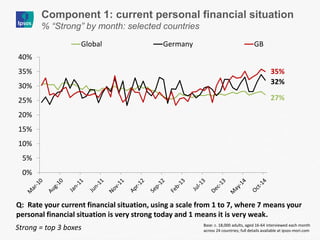
–The present: Their current financial situation 
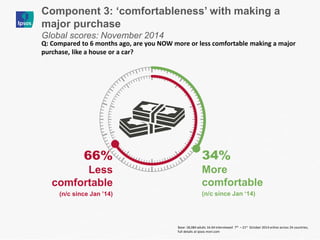
–Direction of travel: How comfortable people feel making a major purchase compared with six months ago 
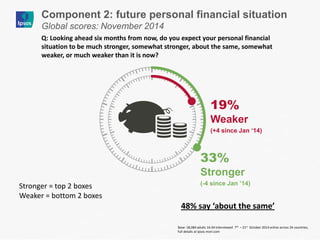
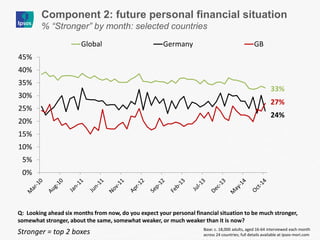
–The future: Their expectations for their financial situation 6 months from now 
•The Ipsos Financial Security Monitor is a simple average of: 
–% saying current financial situation is strong 
–% feeling more comfortable making a major purchase 
–% who saying their future financial situation will be stronger 6 months from now 
The Ipsos Financial Security Monitor
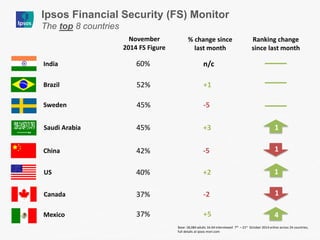
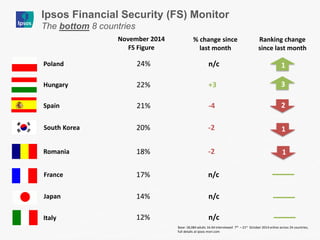
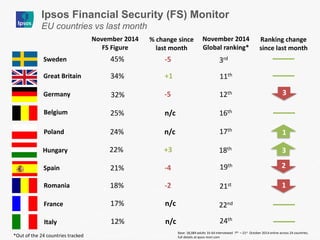
•Europeans continue to feel relatively insecure financially - six out of the eight bottom countries in our FS Monitor are EU member states. 
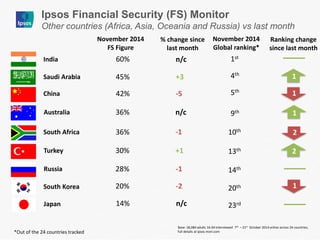
•After last month’s slight rebound, China’s figure has slipped back (perhaps reflecting the recent slowing in GDP) with the Chinese feeling noticeably less confident in their current financial situation and less comfortable about making a major purchase. The country’s FS Monitor figure is down five points this month and has moved closer to its longer term average. 
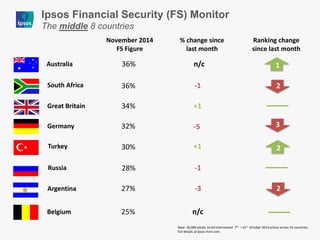
•Germany’s Monitor figure is down five points this month: recent mixed economic data seems to be feeding into Germans’ feelings of financial security. As a result, the country has slipped three places in the rankings (from 9th to 12th overall). 
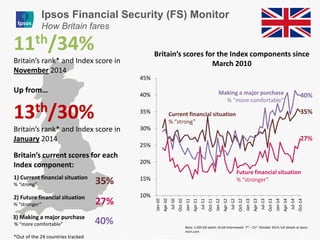
•Great Britain’s Monitor figure is holding steady at 34% (up one point from October). This is a slow improvement since January 2014 (GB’s figure is up four points from 30% since then). Due to the slippage in Germany’s figure, it is now 2nd out of the EU countries we track. Of the EU countries, only Sweden now records a higher number. Britain is now 11th overall. 
Ipsos Financial Security Monitor (FS Monitor) 
Key findings this month
The Ipsos Financial Security Monitor - the top, middle and bottom eight countries
Ipsos Financial Security (FS) Monitor 
The top 8 countries 
% change since last month 
November 2014 FS Figure 
India 
60% 
n/c 
Brazil 
52% 
+1 
Sweden 
45% 
-5 
Saudi Arabia 
45% 
+3 
China 
42% 
-5 
US 
40% 
+2 
Canada 
37% 
-2 
Mexico 
37% 
+5 
Ranking change since last month 
1 
1 
4 
1 
1 
Base: 18,084 adults 16-64 interviewed 7th – 21st October 2014 online across 24 countries; full details at ipsos-mori.com
Ranking change since last month 
% change since last month 
November 2014 
FS Figure 
Ipsos Financial Security (FS) Monitor 
The middle 8 countries 
Base: 18,084 adults 16-64 interviewed 7th – 21st October 2014 online across 24 countries; full details at ipsos-mori.com 
Australia 
36% 
n/c 
1 
South Africa 
36% 
-1 
2 
Great Britain 
34% 
+1 
Germany 
32% 
-5 
3 
Turkey 
30% 
+1 
2 
Russia 
28% 
-1 
Argentina 
27% 
-3 
2 
Belgium 
25% 
n/c
Ranking change since last month 
% change since last month 
November 2014 
FS Figure 
2 
Hungary 
22% 
+3 
Spain 
21% 
-4 
South Korea 
20% 
-2 
Romania 
18% 
-2 
France 
17% 
n/c 
Japan 
14% 
n/c 
Italy 
12% 
n/c 
3 
Poland 
24% 
n/c 
Ipsos Financial Security (FS) Monitor 
The bottom 8 countries 
1 
1 
1 
Base: 18,084 adults 16-64 interviewed 7th – 21st October 2014 online across 24 countries; full details at ipsos-mori.com
The Ipsos Financial Security Monitor - how Britain fares
11th/34% 
Britain’s rank* and Index score in November 2014 
Up from… 
13th/30% 
Britain’s rank* and Index score in January 2014 
Britain’s current scores for each Index component: 
35% 
27% 
40% 
1) Current financial situation 
% “strong” 
2) Future financial situation 
% “stronger” 
3) Making a major purchase 
% “more comfortable” 
Base: 1,005 GB adults 16-64 interviewed 7th – 21st October 2014; full details at ipsos- mori.com 
Ipsos Financial Security (FS) Monitor 
How Britain fares 
Britain’s scores for the Index components since March 2010 
10% 
15% 
20% 
25% 
30% 
35% 
40% 
45% 
Jan-10 
Apr-10 
Jul-10 
Oct-10 
Jan-11 
Apr-11 
Jul-11 
Oct-11 
Jan-12 
Apr-12 
Jul-12 
Oct-12 
Jan-13 
Apr-13 
Jul-13 
Oct-13 
Jan-14 
Apr-14 
Jul-14 
Oct-14 
*Out of the 24 countries tracked 
Current financial situation % “strong” 
Making a major purchase 
% “more comfortable” 
Future financial situation 
% “stronger” 
27% 
35% 
40%
The Ipsos Financial Security Index - by country/ continental groupings
Ranking change since last month 
% change since last month 
November 2014 
FS Figure 
Germany 
Great Britain 
Belgium 
Spain 
Poland 
Romania 
Hungary 
Sweden 
France 
Italy 
November 2014 
Global ranking* 
45% 
-5 
3rd 
25% 
n/c 
16th 
34% 
+1 
11th 
32% 
-5 
12th 
21% 
-4 
19th 
24% 
n/c 
1 
17th 
18% 
-2 
21st 
22% 
+3 
18th 
17% 
n/c 
22nd 
12% 
n/c 
24th 
Ipsos Financial Security (FS) Monitor 
EU countries vs last month 
*Out of the 24 countries tracked 
3 
2 
3 
1 
Base: 18,084 adults 16-64 interviewed 7th – 21st October 2014 online across 24 countries; full details at ipsos-mori.com
Ranking change since last month 
% change since last month 
November 2014 
FS Figure 
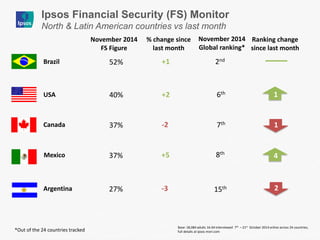
Canada 
Brazil 
Mexico 
Argentina 
USA 
November 2014 
Global ranking* 
52% 
+1 
2nd 
40% 
+2 
6th 
37% 
-2 
7th 
37% 
+5 
8th 
27% 
-3 
15th 
Ipsos Financial Security (FS) Monitor 
North & Latin American countries vs last month 
*Out of the 24 countries tracked 
1 
1 
4 
2 
Base: 18,084 adults 16-64 interviewed 7th – 21st October 2014 online across 24 countries; full details at ipsos-mori.com
Ranking change since last month 
% change since last month 
November 2014 
FS Figure 
1 
Saudi Arabia 
45% 
+3 
China 
42% 
-5 
Australia 
36% 
n/c 
South Africa 
36% 
-1 
Turkey 
30% 
+1 
Russia 
28% 
-1 
South Korea 
20% 
-2 
1 
India 
60% 
n/c 
Japan 
14% 
n/c 
2 
1 
1 
November 2014 
Global ranking* 
1st 
4th 
5th 
9th 
23rd 
20th 
14th 
13th 
10th 
Ipsos Financial Security (FS) Monitor 
Other countries (Africa, Asia, Oceania and Russia) vs last month 
*Out of the 24 countries tracked 
2 
Base: 18,084 adults 16-64 interviewed 7th – 21st October 2014 online across 24 countries; full details at ipsos-mori.com
The Ipsos Financial Security Monitor - components of the Monitor by key country groupings
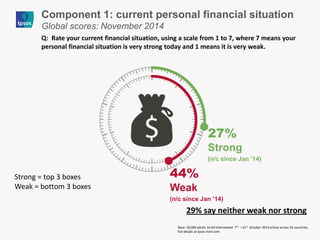
27% Strong 
(n/c since Jan ’14) 
44% 
Weak 
(n/c since Jan ’14) 
Q: Rate your current financial situation, using a scale from 1 to 7, where 7 means your personal financial situation is very strong today and 1 means it is very weak. 
29% say neither weak nor strong 
Component 1: current personal financial situation 
Global scores: November 2014 
Strong = top 3 boxes 
Weak = bottom 3 boxes 
Base: 18,084 adults 16-64 interviewed 7th – 21st October 2014 online across 24 countries; full details at ipsos-mori.com
0% 
5% 
10% 
15% 
20% 
25% 
30% 
35% 
40% 
Global 
Germany 
GB 
35% 
32% 
27% 
Q: Rate your current financial situation, using a scale from 1 to 7, where 7 means your personal financial situation is very strong today and 1 means it is very weak. 
Base: c. 18,000 adults, aged 16-64 interviewed each month across 24 countries; full details available at ipsos-mori.com 
Strong = top 3 boxes 
Component 1: current personal financial situation 
% “Strong” by month: selected countries
Q: Looking ahead six months from now, do you expect your personal financial situation to be much stronger, somewhat stronger, about the same, somewhat weaker, or much weaker than it is now? 
48% say ‘about the same’ 
Component 2: future personal financial situation 
Global scores: November 2014 
33% Stronger 
(-4 since Jan ’14) 
19% Weaker 
(+4 since Jan ‘14) 
Stronger = top 2 boxes 
Weaker = bottom 2 boxes 
Base: 18,084 adults 16-64 interviewed 7th – 21st October 2014 online across 24 countries; full details at ipsos-mori.com
Q: Looking ahead six months from now, do you expect your personal financial situation to be much stronger, somewhat stronger, about the same, somewhat weaker, or much weaker than it is now? 
Base: c. 18,000 adults, aged 16-64 interviewed each month across 24 countries; full details available at ipsos-mori.com 
Component 2: future personal financial situation 
% “Stronger” by month: selected countries 
Stronger = top 2 boxes 
0% 
5% 
10% 
15% 
20% 
25% 
30% 
35% 
40% 
45% 
Global 
Germany 
GB 
33% 
24% 
27%
34% More comfortable 
(n/c since Jan ‘14) 
66% Less comfortable 
(n/c since Jan ’14) 
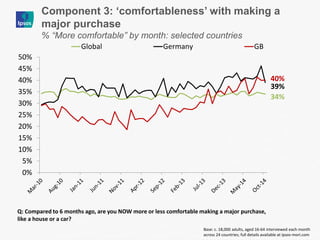
Component 3: ‘comfortableness’ with making a major purchase 
Global scores: November 2014 
Q: Compared to 6 months ago, are you NOW more or less comfortable making a major purchase, like a house or a car? 
Base: 18,084 adults 16-64 interviewed 7th – 21st October 2014 online across 24 countries; full details at ipsos-mori.com
Q: Compared to 6 months ago, are you NOW more or less comfortable making a major purchase, like a house or a car? 
Base: c. 18,000 adults, aged 16-64 interviewed each month across 24 countries; full details available at ipsos-mori.com 
Component 3: ‘comfortableness’ with making a major purchase 
% “More comfortable” by month: selected countries 
0% 
5% 
10% 
15% 
20% 
25% 
30% 
35% 
40% 
45% 
50% 
Global 
Germany 
GB 
34% 
39% 
40%
The bigger picture - how citizens feel about their country’s overall current economic situation
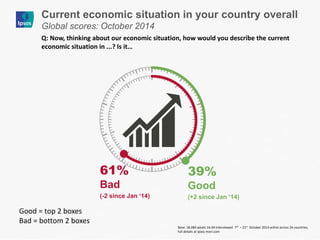
39% Good 
(+2 since Jan ‘14) 
61% Bad 
(-2 since Jan ‘14) 
Current economic situation in your country overall 
Global scores: October 2014 
Q: Now, thinking about our economic situation, how would you describe the current economic situation in ...? Is it… 
Good = top 2 boxes 
Bad = bottom 2 boxes 
Base: 18,084 adults 16-64 interviewed 7th – 21st October 2014 online across 24 countries; full details at ipsos-mori.com
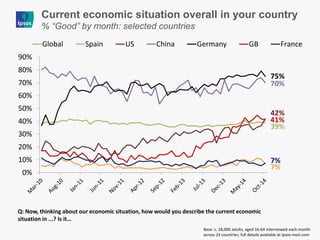
Q: Now, thinking about our economic situation, how would you describe the current economic situation in ...? Is it… 
Current economic situation overall in your country 
% “Good” by month: selected countries 
0% 
10% 
20% 
30% 
40% 
50% 
60% 
70% 
80% 
90% 
Global 
Spain 
US 
China 
Germany 
GB 
France 
7% 
39% 
75% 
42% 
70% 
41% 
Base: c. 18,000 adults, aged 16-64 interviewed each month across 24 countries; full details available at ipsos-mori.com 
7%
ES 
MX 
0% 
10% 
20% 
30% 
40% 
50% 
60% 
70% 
0% 
10% 
20% 
30% 
40% 
50% 
60% 
70% 
80% 
90% 
100% 
Argentina (AR) 
Australia (AUS) 
Belgium (BE) 
Brazil (BR) 
Canada (CA) 
China (CH) 
France (FR) 
Germany (DE) 
Hungary (HU) 
India (ID) 
Italy (IT) 
Japan (JP) 
Mexico (MX) 
Poland (PL) 
Russia (RUS) 
South Korea (KOR) 
Spain (ES) 
Sweden (SW) 
Saudi Arabia (KSA) 
South Africa (SA) 
Great Britain (GB) 
USA (US) 
Turkey (TU) 
Romania (RO) 
Global 
SA 
PL 
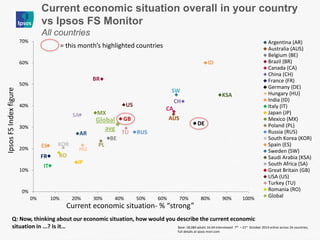
Q: Now, thinking about our economic situation, how would you describe the current economic situation in ...? Is it… 
Current economic situation overall in your country vs Ipsos FS Monitor 
All countries 
Global avg 
GB 
US 
DE 
CH 
JP 
Current economic situation- % “strong” 
Ipsos FS Index figure 
BR 
ID 
SW 
KSA 
AUS 
RUS 
TU 
BE 
AR 
KOR 
RO 
FR 
IT 
= this month’s highlighted countries 
CA 
HU 
Base: 18,084 adults 16-64 interviewed 7th – 21st October 2014 online across 24 countries; full details at ipsos-mori.com
Ipsos Financial Security Monitor- Technical note 
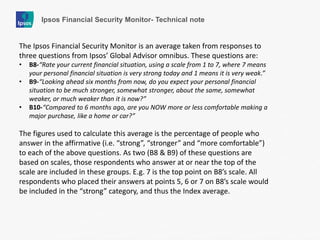
The Ipsos Financial Security Monitor is an average taken from responses to three questions from Ipsos’ Global Advisor omnibus. These questions are: 
•B8-“Rate your current financial situation, using a scale from 1 to 7, where 7 means your personal financial situation is very strong today and 1 means it is very weak.” 
•B9-“Looking ahead six months from now, do you expect your personal financial situation to be much stronger, somewhat stronger, about the same, somewhat weaker, or much weaker than it is now?” 
•B10-“Compared to 6 months ago, are you NOW more or less comfortable making a major purchase, like a home or car?” The figures used to calculate this average is the percentage of people who answer in the affirmative (i.e. “strong”, “stronger” and “more comfortable”) to each of the above questions. As two (B8 & B9) of these questions are based on scales, those respondents who answer at or near the top of the scale are included in these groups. E.g. 7 is the top point on B8’s scale. All respondents who placed their answers at points 5, 6 or 7 on B8’s scale would be included in the “strong” category, and thus the Index average.
Ipsos Global Advisor- Technical note 
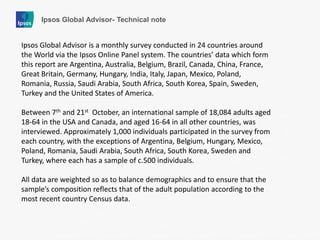
Ipsos Global Advisor is a monthly survey conducted in 24 countries around the World via the Ipsos Online Panel system. The countries’ data which form this report are Argentina, Australia, Belgium, Brazil, Canada, China, France, Great Britain, Germany, Hungary, India, Italy, Japan, Mexico, Poland, Romania, Russia, Saudi Arabia, South Africa, South Korea, Spain, Sweden, Turkey and the United States of America. 
Between 7th and 21st October, an international sample of 18,084 adults aged 18-64 in the USA and Canada, and aged 16-64 in all other countries, was interviewed. Approximately 1,000 individuals participated in the survey from each country, with the exceptions of Argentina, Belgium, Hungary, Mexico, Poland, Romania, Saudi Arabia, South Africa, South Korea, Sweden and Turkey, where each has a sample of c.500 individuals. 
All data are weighted so as to balance demographics and to ensure that the sample’s composition reflects that of the adult population according to the most recent country Census data.

Ipsos Financial Security Monitor

  • 1.
  • 2.
    •Each month weask citizens of 24 countries about their financial situation • We ask three questions covering: –The present: Their current financial situation –Direction of travel: How comfortable people feel making a major purchase compared with six months ago –The future: Their expectations for their financial situation 6 months from now •The Ipsos Financial Security Monitor is a simple average of: –% saying current financial situation is strong –% feeling more comfortable making a major purchase –% who saying their future financial situation will be stronger 6 months from now The Ipsos Financial Security Monitor
  • 3.
    •Europeans continue tofeel relatively insecure financially - six out of the eight bottom countries in our FS Monitor are EU member states. •After last month’s slight rebound, China’s figure has slipped back (perhaps reflecting the recent slowing in GDP) with the Chinese feeling noticeably less confident in their current financial situation and less comfortable about making a major purchase. The country’s FS Monitor figure is down five points this month and has moved closer to its longer term average. •Germany’s Monitor figure is down five points this month: recent mixed economic data seems to be feeding into Germans’ feelings of financial security. As a result, the country has slipped three places in the rankings (from 9th to 12th overall). •Great Britain’s Monitor figure is holding steady at 34% (up one point from October). This is a slow improvement since January 2014 (GB’s figure is up four points from 30% since then). Due to the slippage in Germany’s figure, it is now 2nd out of the EU countries we track. Of the EU countries, only Sweden now records a higher number. Britain is now 11th overall. Ipsos Financial Security Monitor (FS Monitor) Key findings this month
  • 4.
    The Ipsos FinancialSecurity Monitor - the top, middle and bottom eight countries
  • 5.
    Ipsos Financial Security(FS) Monitor The top 8 countries % change since last month November 2014 FS Figure India 60% n/c Brazil 52% +1 Sweden 45% -5 Saudi Arabia 45% +3 China 42% -5 US 40% +2 Canada 37% -2 Mexico 37% +5 Ranking change since last month 1 1 4 1 1 Base: 18,084 adults 16-64 interviewed 7th – 21st October 2014 online across 24 countries; full details at ipsos-mori.com
  • 6.
    Ranking change sincelast month % change since last month November 2014 FS Figure Ipsos Financial Security (FS) Monitor The middle 8 countries Base: 18,084 adults 16-64 interviewed 7th – 21st October 2014 online across 24 countries; full details at ipsos-mori.com Australia 36% n/c 1 South Africa 36% -1 2 Great Britain 34% +1 Germany 32% -5 3 Turkey 30% +1 2 Russia 28% -1 Argentina 27% -3 2 Belgium 25% n/c
  • 7.
    Ranking change sincelast month % change since last month November 2014 FS Figure 2 Hungary 22% +3 Spain 21% -4 South Korea 20% -2 Romania 18% -2 France 17% n/c Japan 14% n/c Italy 12% n/c 3 Poland 24% n/c Ipsos Financial Security (FS) Monitor The bottom 8 countries 1 1 1 Base: 18,084 adults 16-64 interviewed 7th – 21st October 2014 online across 24 countries; full details at ipsos-mori.com
  • 8.
    The Ipsos FinancialSecurity Monitor - how Britain fares
  • 9.
    11th/34% Britain’s rank*and Index score in November 2014 Up from… 13th/30% Britain’s rank* and Index score in January 2014 Britain’s current scores for each Index component: 35% 27% 40% 1) Current financial situation % “strong” 2) Future financial situation % “stronger” 3) Making a major purchase % “more comfortable” Base: 1,005 GB adults 16-64 interviewed 7th – 21st October 2014; full details at ipsos- mori.com Ipsos Financial Security (FS) Monitor How Britain fares Britain’s scores for the Index components since March 2010 10% 15% 20% 25% 30% 35% 40% 45% Jan-10 Apr-10 Jul-10 Oct-10 Jan-11 Apr-11 Jul-11 Oct-11 Jan-12 Apr-12 Jul-12 Oct-12 Jan-13 Apr-13 Jul-13 Oct-13 Jan-14 Apr-14 Jul-14 Oct-14 *Out of the 24 countries tracked Current financial situation % “strong” Making a major purchase % “more comfortable” Future financial situation % “stronger” 27% 35% 40%
  • 10.
    The Ipsos FinancialSecurity Index - by country/ continental groupings
  • 11.
    Ranking change sincelast month % change since last month November 2014 FS Figure Germany Great Britain Belgium Spain Poland Romania Hungary Sweden France Italy November 2014 Global ranking* 45% -5 3rd 25% n/c 16th 34% +1 11th 32% -5 12th 21% -4 19th 24% n/c 1 17th 18% -2 21st 22% +3 18th 17% n/c 22nd 12% n/c 24th Ipsos Financial Security (FS) Monitor EU countries vs last month *Out of the 24 countries tracked 3 2 3 1 Base: 18,084 adults 16-64 interviewed 7th – 21st October 2014 online across 24 countries; full details at ipsos-mori.com
  • 12.
    Ranking change sincelast month % change since last month November 2014 FS Figure Canada Brazil Mexico Argentina USA November 2014 Global ranking* 52% +1 2nd 40% +2 6th 37% -2 7th 37% +5 8th 27% -3 15th Ipsos Financial Security (FS) Monitor North & Latin American countries vs last month *Out of the 24 countries tracked 1 1 4 2 Base: 18,084 adults 16-64 interviewed 7th – 21st October 2014 online across 24 countries; full details at ipsos-mori.com
  • 13.
    Ranking change sincelast month % change since last month November 2014 FS Figure 1 Saudi Arabia 45% +3 China 42% -5 Australia 36% n/c South Africa 36% -1 Turkey 30% +1 Russia 28% -1 South Korea 20% -2 1 India 60% n/c Japan 14% n/c 2 1 1 November 2014 Global ranking* 1st 4th 5th 9th 23rd 20th 14th 13th 10th Ipsos Financial Security (FS) Monitor Other countries (Africa, Asia, Oceania and Russia) vs last month *Out of the 24 countries tracked 2 Base: 18,084 adults 16-64 interviewed 7th – 21st October 2014 online across 24 countries; full details at ipsos-mori.com
  • 14.
    The Ipsos FinancialSecurity Monitor - components of the Monitor by key country groupings
  • 15.
    27% Strong (n/csince Jan ’14) 44% Weak (n/c since Jan ’14) Q: Rate your current financial situation, using a scale from 1 to 7, where 7 means your personal financial situation is very strong today and 1 means it is very weak. 29% say neither weak nor strong Component 1: current personal financial situation Global scores: November 2014 Strong = top 3 boxes Weak = bottom 3 boxes Base: 18,084 adults 16-64 interviewed 7th – 21st October 2014 online across 24 countries; full details at ipsos-mori.com
  • 16.
    0% 5% 10% 15% 20% 25% 30% 35% 40% Global Germany GB 35% 32% 27% Q: Rate your current financial situation, using a scale from 1 to 7, where 7 means your personal financial situation is very strong today and 1 means it is very weak. Base: c. 18,000 adults, aged 16-64 interviewed each month across 24 countries; full details available at ipsos-mori.com Strong = top 3 boxes Component 1: current personal financial situation % “Strong” by month: selected countries
  • 17.
    Q: Looking aheadsix months from now, do you expect your personal financial situation to be much stronger, somewhat stronger, about the same, somewhat weaker, or much weaker than it is now? 48% say ‘about the same’ Component 2: future personal financial situation Global scores: November 2014 33% Stronger (-4 since Jan ’14) 19% Weaker (+4 since Jan ‘14) Stronger = top 2 boxes Weaker = bottom 2 boxes Base: 18,084 adults 16-64 interviewed 7th – 21st October 2014 online across 24 countries; full details at ipsos-mori.com
  • 18.
    Q: Looking aheadsix months from now, do you expect your personal financial situation to be much stronger, somewhat stronger, about the same, somewhat weaker, or much weaker than it is now? Base: c. 18,000 adults, aged 16-64 interviewed each month across 24 countries; full details available at ipsos-mori.com Component 2: future personal financial situation % “Stronger” by month: selected countries Stronger = top 2 boxes 0% 5% 10% 15% 20% 25% 30% 35% 40% 45% Global Germany GB 33% 24% 27%
  • 19.
    34% More comfortable (n/c since Jan ‘14) 66% Less comfortable (n/c since Jan ’14) Component 3: ‘comfortableness’ with making a major purchase Global scores: November 2014 Q: Compared to 6 months ago, are you NOW more or less comfortable making a major purchase, like a house or a car? Base: 18,084 adults 16-64 interviewed 7th – 21st October 2014 online across 24 countries; full details at ipsos-mori.com
  • 20.
    Q: Compared to6 months ago, are you NOW more or less comfortable making a major purchase, like a house or a car? Base: c. 18,000 adults, aged 16-64 interviewed each month across 24 countries; full details available at ipsos-mori.com Component 3: ‘comfortableness’ with making a major purchase % “More comfortable” by month: selected countries 0% 5% 10% 15% 20% 25% 30% 35% 40% 45% 50% Global Germany GB 34% 39% 40%
  • 21.
    The bigger picture- how citizens feel about their country’s overall current economic situation
  • 22.
    39% Good (+2since Jan ‘14) 61% Bad (-2 since Jan ‘14) Current economic situation in your country overall Global scores: October 2014 Q: Now, thinking about our economic situation, how would you describe the current economic situation in ...? Is it… Good = top 2 boxes Bad = bottom 2 boxes Base: 18,084 adults 16-64 interviewed 7th – 21st October 2014 online across 24 countries; full details at ipsos-mori.com
  • 23.
    Q: Now, thinkingabout our economic situation, how would you describe the current economic situation in ...? Is it… Current economic situation overall in your country % “Good” by month: selected countries 0% 10% 20% 30% 40% 50% 60% 70% 80% 90% Global Spain US China Germany GB France 7% 39% 75% 42% 70% 41% Base: c. 18,000 adults, aged 16-64 interviewed each month across 24 countries; full details available at ipsos-mori.com 7%
  • 24.
    ES MX 0% 10% 20% 30% 40% 50% 60% 70% 0% 10% 20% 30% 40% 50% 60% 70% 80% 90% 100% Argentina (AR) Australia (AUS) Belgium (BE) Brazil (BR) Canada (CA) China (CH) France (FR) Germany (DE) Hungary (HU) India (ID) Italy (IT) Japan (JP) Mexico (MX) Poland (PL) Russia (RUS) South Korea (KOR) Spain (ES) Sweden (SW) Saudi Arabia (KSA) South Africa (SA) Great Britain (GB) USA (US) Turkey (TU) Romania (RO) Global SA PL Q: Now, thinking about our economic situation, how would you describe the current economic situation in ...? Is it… Current economic situation overall in your country vs Ipsos FS Monitor All countries Global avg GB US DE CH JP Current economic situation- % “strong” Ipsos FS Index figure BR ID SW KSA AUS RUS TU BE AR KOR RO FR IT = this month’s highlighted countries CA HU Base: 18,084 adults 16-64 interviewed 7th – 21st October 2014 online across 24 countries; full details at ipsos-mori.com
  • 25.
    Ipsos Financial SecurityMonitor- Technical note The Ipsos Financial Security Monitor is an average taken from responses to three questions from Ipsos’ Global Advisor omnibus. These questions are: •B8-“Rate your current financial situation, using a scale from 1 to 7, where 7 means your personal financial situation is very strong today and 1 means it is very weak.” •B9-“Looking ahead six months from now, do you expect your personal financial situation to be much stronger, somewhat stronger, about the same, somewhat weaker, or much weaker than it is now?” •B10-“Compared to 6 months ago, are you NOW more or less comfortable making a major purchase, like a home or car?” The figures used to calculate this average is the percentage of people who answer in the affirmative (i.e. “strong”, “stronger” and “more comfortable”) to each of the above questions. As two (B8 & B9) of these questions are based on scales, those respondents who answer at or near the top of the scale are included in these groups. E.g. 7 is the top point on B8’s scale. All respondents who placed their answers at points 5, 6 or 7 on B8’s scale would be included in the “strong” category, and thus the Index average.
  • 26.
    Ipsos Global Advisor-Technical note Ipsos Global Advisor is a monthly survey conducted in 24 countries around the World via the Ipsos Online Panel system. The countries’ data which form this report are Argentina, Australia, Belgium, Brazil, Canada, China, France, Great Britain, Germany, Hungary, India, Italy, Japan, Mexico, Poland, Romania, Russia, Saudi Arabia, South Africa, South Korea, Spain, Sweden, Turkey and the United States of America. Between 7th and 21st October, an international sample of 18,084 adults aged 18-64 in the USA and Canada, and aged 16-64 in all other countries, was interviewed. Approximately 1,000 individuals participated in the survey from each country, with the exceptions of Argentina, Belgium, Hungary, Mexico, Poland, Romania, Saudi Arabia, South Africa, South Korea, Sweden and Turkey, where each has a sample of c.500 individuals. All data are weighted so as to balance demographics and to ensure that the sample’s composition reflects that of the adult population according to the most recent country Census data.