FINANCIAL
LITERACY
JOHNINA S. BAYBAYAN
What is Financial Literacy?
According to National Endowment for Financial Education, Financial
Literacy define as; the ability to use knowledge and skills to manage one’s
financial resources effectively for lifetime financial security.
Hastings et al refers to Financial Literacy as:
Knowledge of financial products
Knowledge of financial concepts
Mathematical skills or numeracy necessary for effective financial
decision making
Engaged in certain activities such as financial planning
Standards and Key Concepts:
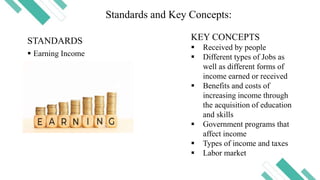
STANDARDS
 Earning Income
KEY CONCEPTS
 Received by people
 Different types of Jobs as
well as different forms of
income earned or received
 Benefits and costs of
increasing income through
the acquisition of education
and skills
 Government programs that
affect income
 Types of income and taxes
 Labor market
STANDARDS
 Buying goods and services
KEY CONCEPTS
 Scarcity, choice, and
opportunity cost
 Factors that influence
spending choices, such as
advertising, peer pressure,
and spending choices of
others
 Comparing the cost and
benefits of spending
decision
 Basics of budgeting and
planning
STANDARDS
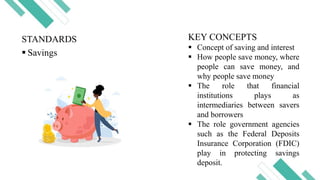
 Savings
KEY CONCEPTS
 Concept of saving and interest
 How people save money, where
people can save money, and
why people save money
 The role that financial
institutions plays as
intermediaries between savers
and borrowers
 The role government agencies
such as the Federal Deposits
Insurance Corporation (FDIC)
play in protecting savings
deposit.
STANDARDS
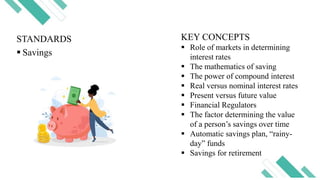
 Savings
KEY CONCEPTS
 Role of markets in determining
interest rates
 The mathematics of saving
 The power of compound interest
 Real versus nominal interest rates
 Present versus future value
 Financial Regulators
 The factor determining the value
of a person’s savings over time
 Automatic savings plan, “rainy-
day” funds
 Savings for retirement
STANDARDS
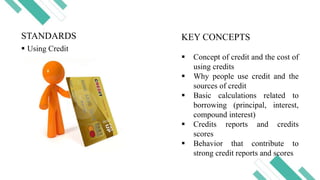
 Using Credit
KEY CONCEPTS
 Concept of credit and the cost of
using credits
 Why people use credit and the
sources of credit
 Basic calculations related to
borrowing (principal, interest,
compound interest)
 Credits reports and credits
scores
 Behavior that contribute to
strong credit reports and scores
STANDARDS
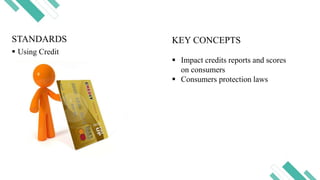
 Using Credit
KEY CONCEPTS
 Impact credits reports and scores
on consumers
 Consumers protection laws
STANDARDS
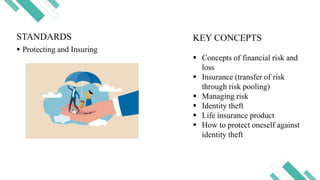
 Protecting and Insuring
KEY CONCEPTS
 Concepts of financial risk and
loss
 Insurance (transfer of risk
through risk pooling)
 Managing risk
 Identity theft
 Life insurance product
 How to protect oneself against
identity theft
STANDARDS
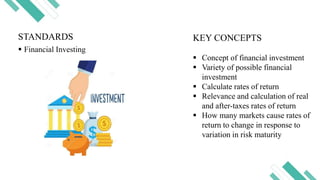
 Financial Investing
KEY CONCEPTS
 Concept of financial investment
 Variety of possible financial
investment
 Calculate rates of return
 Relevance and calculation of real
and after-taxes rates of return
 How many markets cause rates of
return to change in response to
variation in risk maturity
STANDARDS
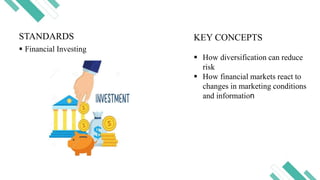
 Financial Investing
KEY CONCEPTS
 How diversification can reduce
risk
 How financial markets react to
changes in marketing conditions
and information
Benifits of Financial Literacy:
 It enables people to understand and apply knowledge and skills to
achieve a lifestyle that is financially balanced, sustainable, ethical and
responsible.
Financial Literacy in the Philippines:
 World bank study in 2014 estimated 20 million Filipinos saved money but only
half had a bank account;
 Asian development(ADB) study in 2015 revealed that Philippines does not
have a national strategy for financial education and literacy;
 In 2016, Bangko Sentral ng Pilipinas(BSP) released the national strategy for
financial inclusion, stating that while institutions strive to broaden financial
services, financial literacy should also complement such initiatives;
Financial Literacy in the Philippines:
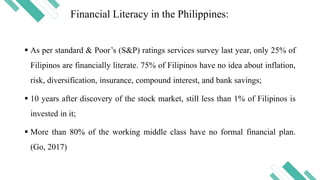
 As per standard & Poor’s (S&P) ratings services survey last year, only 25% of
Filipinos are financially literate. 75% of Filipinos have no idea about inflation,
risk, diversification, insurance, compound interest, and bank savings;
 10 years after discovery of the stock market, still less than 1% of Filipinos is
invested in it;
 More than 80% of the working middle class have no formal financial plan.
(Go, 2017)
Financial Literacy in the Philippines:
• BSP organized the very first Financial Education stakeholders Expo
last November 27-28, 2018.
• The expo supports RA No. 10922;
• Also aligned with the objectives of the Philippine national Strategy for
Financial inclusion.
Six types on how people view money:
PLEASURE
FRUGAL
STATUS INDIFFERENCE
SELF-
WORTH
POWERFUL
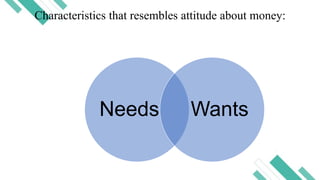
Characteristics that resembles attitude about money:
Spending
Patterns
Habitual Spending Impulsive Spending
Keywords
Keywords Keywords
Characteristics that resembles attitude about money:
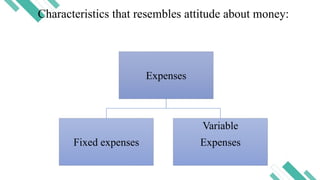
Expenses
Fixed expenses
Variable
Expenses
Characteristics that resembles attitude about money:
Needs Wants
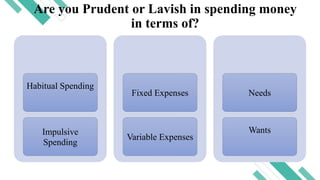
Are you Prudent or Lavish in spending money
in terms of?
Habitual Spending
Impulsive
Spending
Fixed Expenses
Variable Expenses
Needs
Wants
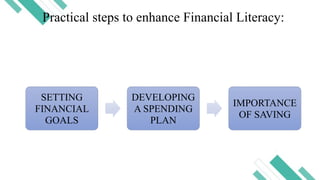
Practical steps to enhance Financial Literacy:
SETTING
FINANCIAL
GOALS
DEVELOPING
A SPENDING
PLAN
IMPORTANCE
OF SAVING

Financial Literacy

  • 1.
  • 2.
    What is FinancialLiteracy? According to National Endowment for Financial Education, Financial Literacy define as; the ability to use knowledge and skills to manage one’s financial resources effectively for lifetime financial security.
  • 3.
    Hastings et alrefers to Financial Literacy as: Knowledge of financial products Knowledge of financial concepts Mathematical skills or numeracy necessary for effective financial decision making Engaged in certain activities such as financial planning
  • 4.
    Standards and KeyConcepts: STANDARDS  Earning Income KEY CONCEPTS  Received by people  Different types of Jobs as well as different forms of income earned or received  Benefits and costs of increasing income through the acquisition of education and skills  Government programs that affect income  Types of income and taxes  Labor market
  • 5.
    STANDARDS  Buying goodsand services KEY CONCEPTS  Scarcity, choice, and opportunity cost  Factors that influence spending choices, such as advertising, peer pressure, and spending choices of others  Comparing the cost and benefits of spending decision  Basics of budgeting and planning
  • 6.
    STANDARDS  Savings KEY CONCEPTS Concept of saving and interest  How people save money, where people can save money, and why people save money  The role that financial institutions plays as intermediaries between savers and borrowers  The role government agencies such as the Federal Deposits Insurance Corporation (FDIC) play in protecting savings deposit.
  • 7.
    STANDARDS  Savings KEY CONCEPTS Role of markets in determining interest rates  The mathematics of saving  The power of compound interest  Real versus nominal interest rates  Present versus future value  Financial Regulators  The factor determining the value of a person’s savings over time  Automatic savings plan, “rainy- day” funds  Savings for retirement
  • 8.
    STANDARDS  Using Credit KEYCONCEPTS  Concept of credit and the cost of using credits  Why people use credit and the sources of credit  Basic calculations related to borrowing (principal, interest, compound interest)  Credits reports and credits scores  Behavior that contribute to strong credit reports and scores
  • 9.
    STANDARDS  Using Credit KEYCONCEPTS  Impact credits reports and scores on consumers  Consumers protection laws
  • 10.
    STANDARDS  Protecting andInsuring KEY CONCEPTS  Concepts of financial risk and loss  Insurance (transfer of risk through risk pooling)  Managing risk  Identity theft  Life insurance product  How to protect oneself against identity theft
  • 11.
    STANDARDS  Financial Investing KEYCONCEPTS  Concept of financial investment  Variety of possible financial investment  Calculate rates of return  Relevance and calculation of real and after-taxes rates of return  How many markets cause rates of return to change in response to variation in risk maturity
  • 12.
    STANDARDS  Financial Investing KEYCONCEPTS  How diversification can reduce risk  How financial markets react to changes in marketing conditions and information
  • 13.
    Benifits of FinancialLiteracy:  It enables people to understand and apply knowledge and skills to achieve a lifestyle that is financially balanced, sustainable, ethical and responsible.
  • 14.
    Financial Literacy inthe Philippines:  World bank study in 2014 estimated 20 million Filipinos saved money but only half had a bank account;  Asian development(ADB) study in 2015 revealed that Philippines does not have a national strategy for financial education and literacy;  In 2016, Bangko Sentral ng Pilipinas(BSP) released the national strategy for financial inclusion, stating that while institutions strive to broaden financial services, financial literacy should also complement such initiatives;
  • 15.
    Financial Literacy inthe Philippines:  As per standard & Poor’s (S&P) ratings services survey last year, only 25% of Filipinos are financially literate. 75% of Filipinos have no idea about inflation, risk, diversification, insurance, compound interest, and bank savings;  10 years after discovery of the stock market, still less than 1% of Filipinos is invested in it;  More than 80% of the working middle class have no formal financial plan. (Go, 2017)
  • 16.
    Financial Literacy inthe Philippines: • BSP organized the very first Financial Education stakeholders Expo last November 27-28, 2018. • The expo supports RA No. 10922; • Also aligned with the objectives of the Philippine national Strategy for Financial inclusion.
  • 17.
    Six types onhow people view money: PLEASURE FRUGAL STATUS INDIFFERENCE SELF- WORTH POWERFUL
  • 18.
    Characteristics that resemblesattitude about money: Spending Patterns Habitual Spending Impulsive Spending
  • 19.
    Keywords Keywords Keywords Characteristics thatresembles attitude about money: Expenses Fixed expenses Variable Expenses
  • 20.
    Characteristics that resemblesattitude about money: Needs Wants
  • 21.
    Are you Prudentor Lavish in spending money in terms of? Habitual Spending Impulsive Spending Fixed Expenses Variable Expenses Needs Wants
  • 22.
    Practical steps toenhance Financial Literacy: SETTING FINANCIAL GOALS DEVELOPING A SPENDING PLAN IMPORTANCE OF SAVING