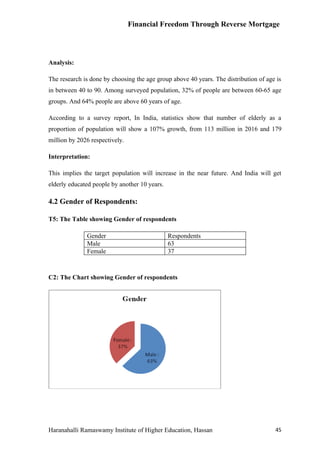
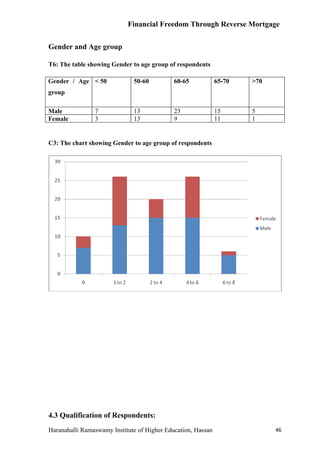
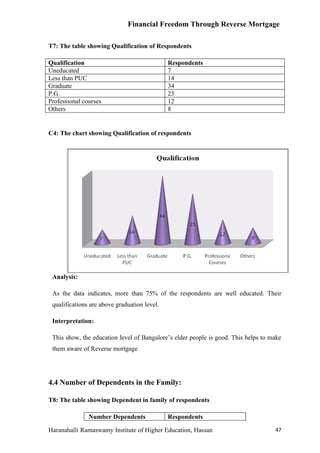
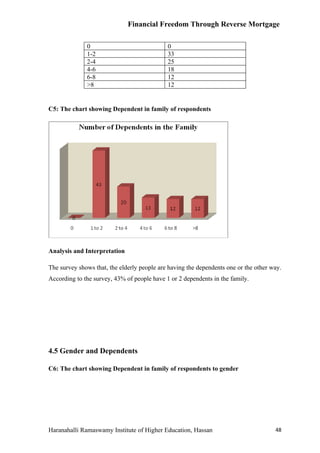
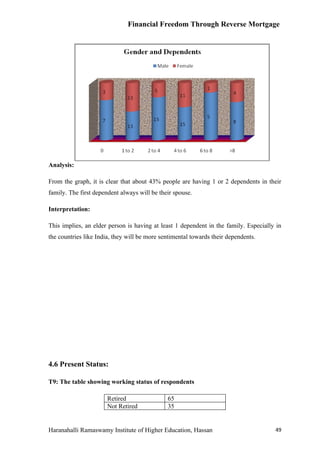
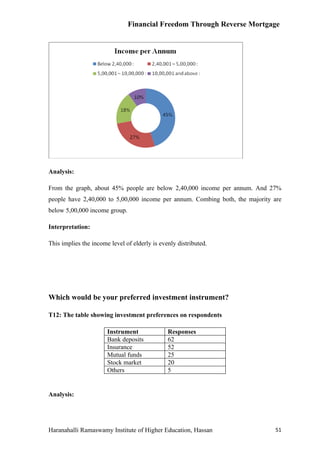
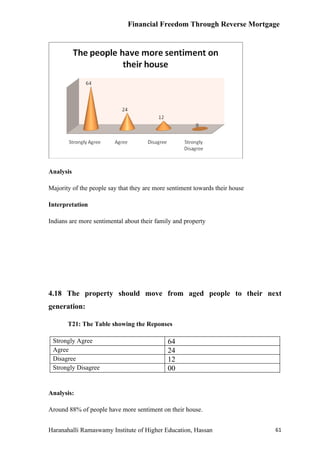
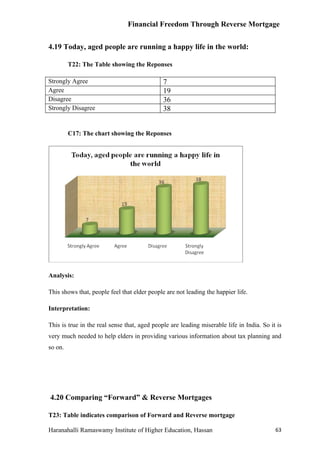
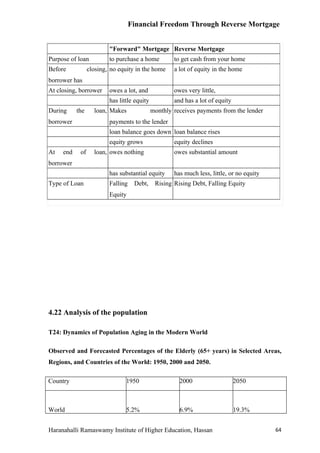
Financial Freedom Through Reverse Mortgage


                                    Introduction

1.1 Introduction to Reverse Mortgage

The world population structure shows that population worldwide is ageing due to
increased longevity of older people and decreased birth rates in developed and most
developing countries.

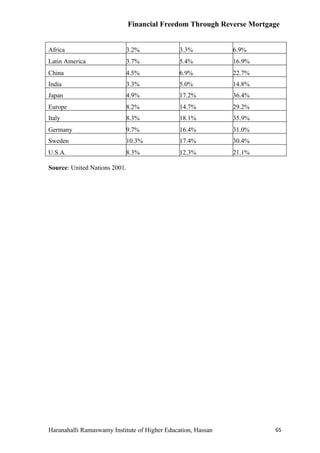
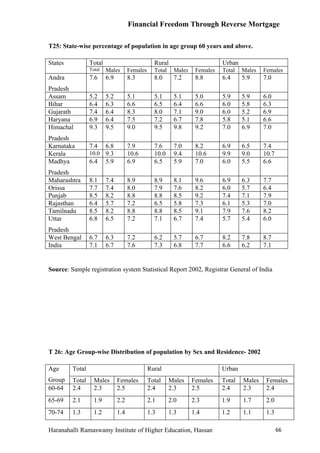
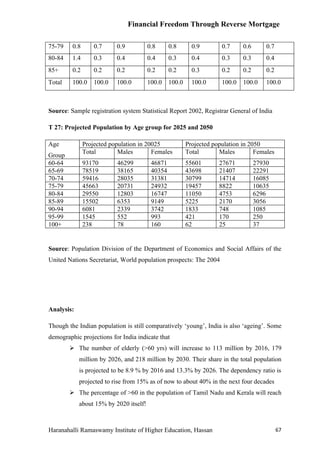
In India alone, statistics show that number of elderly as a proportion of population will
show a 107% growth, from 113 million in 2016 and 179 million by 2026 respectively.

Combined with growing health care costs, changes in the joint-family system and
increased longevity- the average life expectancy of men is 75, and that of women is 79, at
age 60- there is a pressing need for tangible alternative to the pension schemes, so that
aged people can lived in a lifestyle they are accustomed to.

Currently, the mandated coverage in govt and private pension schemes are available to
around 11% of population. The rest of the population have to plan their financial security
independently without recourse to any of the existing govt pension plans.

Again, many of the senior citizens are living on fixed incomes, fixed pensions, or on the
proceeds of investments that do not meet their financial needs. Some require additional
sources of income to cover day to day expenses. This will not be taken care of by the
pension schemes exist currently in the market.

To address this issue of old-age financial solvency, it is necessary to first address the
various instruments of saving that are available in the financial sector. Asset ownership
structure in India suggests that housing wealth constitutes major portion of the non-
pension wealth of the elderly. The problem that many house owners face is on how to tap
into this housing wealth for consumption without selling the house and moving. The
reverse mortgage is one such instrument that allows a house owner to borrow against the
equity accumulated in the home without having to pay back the proceeds of such loan
during the lifetime of the reverse mortgage.

Old age comes with its own share of problems. As a person grows older, and his regular
source of income dries up, his dependency on others can increase significantly. With
health care expenses on the rise and little social security, living the golden years
respectfully can be quite a challenge for senior citizens. In such a scenario, a regular
Haranahalli Ramaswamy Institute of Higher Education, Hassan                             1
Financial Freedom Through Reverse Mortgage

income stream that can help them meet their financial needs and maintain their current
living standards becomes important.

One typical feature with most senior citizens is that their residential property accounts for
a significant portion of their total asset pie. And, given its illiquid nature, property fails to
aid senior citizens on the liquidity front.

In the Union Budget 2007-08, a proposal to introduce 'Reverse Mortgages' was put forth.
In a regular mortgage, a borrower mortgages his new/existing house with the lender in
return for the loan amount (which in turn he uses to finance the property); the same is
charged at a particular interest rate and runs over a predetermined tenure. The borrower
then has to repay the loan amount in the form of EMIs (equated monthly instalments),
which comprise of both principal and interest amounts. The property is utilized as a
security to cover the risk of default on the borrower's part.

In the reverse mortgage, senior citizens (borrowers), who own a house property, but do
not have regular income, can mortgage the same with the lender (a scheduled bank or a
housing finance company-HFC). In return, the lender makes periodic payment to the
borrowers during their lifetime. In spite of mortgaging the house property, the borrower
can continue to stay in it during his entire life span and continue to receive regular flows
of income from the lender as well. Also, since the borrower doesn't have to service the
loan, he need not bother about repaying the 'borrowed amount' to the lender.


1.2 Basis for Reverse Mortgage

Haranahalli Ramaswamy Institute of Higher Education, Hassan                                    2
Financial Freedom Through Reverse Mortgage

Housing wealth is one of the non monetary wealth of senior citizens in India. Given its
essential illiquid nature, it is not possible for elderly house owners to tap into home equity
for financing day to day activity/expenses without either disposing off the property.

Reverse mortgages were initially introduced in the USA, as a means of accessing equity
locked up in residence, especially after the owner has retired.

1.3 Reverse mortgage- A tool to Financial Freedom

A reverse mortgage is described as an annuity payment to the homeowner for the length
of time that he/she remains in the house. No repayments have to be made on the loan as
long as the homeowner is alive and still living in the house affected by the reverse
mortgage, or till the spouse of the homeowner is alive and still living in the said property.
This is better than conventional types of mortgage where the homeowner has to either
move out or sell her property, or has to undertake to make regular annuity payments on a
loan.

A lot of elderly homeowners also want to “age in place” at a known surrounding and
donor want to dispose-off the house property for various reasons both economic and
psychological. For this category of people, a reverse mortgage is a potent tools to encash
their housing equity to meet day to day living expenses.

Reverse mortgage, as a product is currently present in USA, part of Europe and Australia,
and New Zealand. The US experience has been mixed. While the market was stagnant for
nearly half a decade, there is a huge growth both in terms of products sold in terms of the
value of assets mortgaged this way since 2000. There were a lot of legislative changes
that were required before the product could be introduced in the US. The Australian
experience has also been similar.


1.4 Concept of Reverse mortgage

Haranahalli Ramaswamy Institute of Higher Education, Hassan                                 3
Financial Freedom Through Reverse Mortgage

Most reverse mortgage lenders in USA require primary lien position. The security for the
loan is the property itself; the loan is nonrecourse. If the borrower meets all the conditions
of the loan, when the owner moves or dies, the owner or heir is responsible for repaying
the loan obligation either through the sale of the property or other assets. If the loan
obligation is less than the sale price, the owner or estate keeps whatever amount is left
over. If the home is worth less than the amount due, the owner and heirs are not obligated
for any shortfall.

Reverse mortgage lenders can accelerate repayment at any time if the borrower defaults
through failure to pay property taxes , failure to maintain a valid hazard insurance policy
abandonment of the home, renting the home to someone else, or adding a new owner to
the title.

The various reverse mortgage products have similar structural features. When a home
owner meets the appropriate qualification, there is the offer of a loan that can be taken as
a lump sum, as an income stream, or as a line of credit, with various degrees of flexibility
permitted between methods of borrowing. The income stream can be taken either for a
fixed term, or as an annuity. The amount of money that can be borrowed depends on the
age of the borrower, the value of the house, and some interest rate variables.

1.5 Legal aspects of reverse mortgage

In Para No 89 of the Union Budget Speech 2007-08, Finance Minister proposed that
'National Housing Bank' (NHB) will shortly introduce a novel financial product for senior
citizens: a 'reverse mortgage' under which a senior citizen who is the owner of a house
can avail of a monthly stream of income against the mortgage of his/her house, while
remaining the owner and occupying the house throughout his/ her lifetime, without
repayment or servicing of loan. The NHB has come up with draft operational guidelines
for the same to banks in March 2007.


1.6 Valuation of a reverse mortgage

Haranahalli Ramaswamy Institute of Higher Education, Hassan                                 4
Financial Freedom Through Reverse Mortgage

In order to qualify for a reverse mortgage, the household head must be age 62 or above,
and either own the home free and clear, or at least be able to pay off all remaining debt
with the proceeds of the loan. There are additional requirements that are related to the
condition of the property at the time of purchase. Once the household qualifies, an initial
“principal limit factor” is set determining the maximum loan available to the borrower.
As time passes, the limit factor grows according to a formula based on interest rates and
certain ongoing insurance costs.

The principal limit factor on a new loan is determined by a fixed function that depends
only on the age of the youngest borrower, “adjusted property value” or maximum, claim
amount, which is the minimum of the appraised value of the house less the maximum
loan, and the “expected average mortgage interest rate”, premium over the risk free rate
for mortgage products.

No matter what the payment plan, the amount of the loan principal is based on the amount
of equity in the house, expected appreciation in the property’s value, market interest rates,
and the youngest borrower’s age and life expectancy. The larger the equity and greater
the appreciation expected, the lower the risk that the loan principal and accrued interest
will exceed the market value of the property when the loan becomes due. Higher interest
rates mean more interest will accrue, increasing the risk that the loan obligation will
exceed collateral value. The longer the owner lives, the greater the loan obligation
whether the barrower chooses the annuity or lump sum with accrued interest option.


1.7 Risk factors in a reverse mortgage


Haranahalli Ramaswamy Institute of Higher Education, Hassan                                5
Financial Freedom Through Reverse Mortgage

Given the nature of the product, the long-term impact of interest rates and appreciation in
real-estate prices, there are a lot of risk factors that are associated with a product like
reverse mortgage.

Risk factors in reverse mortgage for Lenders

    Longevity

    Interest rates and

    Future property values

The uncertainty of borrower longevity and tenure makes it difficult to estimate the
timings of repayment and, therefore, the return the loan will yield.

The more serious risk that the reverse mortgage provider bears concerns with the growth
in the principal limit factor over a period of time. There is “crossover risk”, which is
realized when the principal limit factor exceeds around 90 percent of the house value.
From this point on, the lender is unable to recover the full amount owed.

To avoid crossover risk, the loan amount must be set low enough to ensure the collateral
will retain sufficient value to cover the lien as the property ages over this uncertain
period.

Longevity risk is a diversifiable risk that can be effectively managed through the pooling
of a large numbers of loans. Then the lender or insurer can rely on mortality tables to
estimate future loan terminations. Although one might expect an adverse selection
problem, experience has shown that many borrowers are attracted to reverse mortgage
program especially because they are ill.

The moral hazards problems exists as the home owner has little financial incentive to
make expenditures for improvements or maintenances that would help maintain the value
of the property and may be physically unable to do so. Over time, the equity level is
diluted there may be gradual decrease in the overall maintenance conducted by the home
owners. This leads to gradual deterioration of the neighbourhood, resulting in lower rental
values.

Also, the secondary market for reverse mortgage houses does not exist. Moral hazard of
the problem can compound this by introducing a ‘lemon’s problem where all the reverse

Haranahalli Ramaswamy Institute of Higher Education, Hassan                              6
Financial Freedom Through Reverse Mortgage

mortgage houses have lower overall house values. Risk can act as a deterrent to suppliers
of the product who wish to enter the market.

For purposes of financial reporting, the lender records the outstanding dollars of the
reverse mortgage as an asset. However, future payments to which the lender is committed
are not shown on its financial statements, resulting in off-balance sheet liabilities. Both
the interest and any shared appreciation component added to the loan balance are taxable
as current income, even though the lender has not received any payments from the
borrowers.

Risk factors in reverse mortgage for home owners

The risk faced by borrowers in reverse mortgage is also substantial. Borrowers don’t have
the same capacity to diversify that lenders have. For a home owner, there is a trade-off
between using housing wealth as a hedge against lump sums cash outflows such as
medical expenses vs. using housing wealth to append to existing sources of income. The
trade-off is important in the decision to go for reverse mortgage. Elderly homeowners put
off the decision of reverse mortgage since there is no external motive, which force them
to a decision.

The risk faced by the borrowers on a reverse mortgage includes the ability to predict
definitively their cash requirements at various times.

The second important factor is the bequest motive. Elderly homeowner prefers to live
their homes as a bequest to their heirs. This works as a social security for the family,
especially in countries in the less-developed world. If the elderly home owner begins to
draw down on their home-equity, there is incentive for heirs to provide for their needs,
financially, or emotionally. The choice of drawing down on home equity can therefore
reduce the social security available from the family.


1.8 Research Design

    Statement of the problem

Asset ownership structure in India suggests that housing wealth constitutes major portion
of the non-pension wealth of the elderly. The problem that many house owners face is on

Haranahalli Ramaswamy Institute of Higher Education, Hassan                              7
Financial Freedom Through Reverse Mortgage

how to tap into this housing wealth for consumption without selling the house and
moving. The best way to tap into house wealth is Reverse Mortgage. Some preliminary
analyses are also provided to document how a large segment of elderly citizens will
benefit from such a program.

The Study is focused on analyzing the process of reverse mortgage and its awareness
level in the minds of senior citizens. And also to study the merits and demerits of reverse
mortgage. To study the various issues like taxation, legal formalities of reverse mortgage.

    Objective of the study

The present study has been undertaken to meet the following specific objectives,

     To study the awareness of reverse mortgage in the minds of senior citizens in
        Bangalore

     To analyze Pros and cons of Reverse mortgage for senior citizens.

     To study the reverse mortgage process

     To find out the reason for it has been failed in initial stage in India

     To study the various benefits/facilities available in Reverse mortgage to senior
        citizens in India.

     To arrive at the reasonable conclusion by analyzing the process of reverse
        mortgage.


Haranahalli Ramaswamy Institute of Higher Education, Hassan                               8
Financial Freedom Through Reverse Mortgage


    Scope of Study

This project report analyses the potential for reverse mortgage products in India by
identifying segments of the population that are most likely to utilise such a product. The
characteristics that determines the segments are

   a. The lack of state-sponsored pension program and

   b. The ownership of defined type of house asset (with high home equity) on which
       the reverse mortgage can be availed.

The study is aimed at establishing that a potential demand for reverse mortgage exists in
India and it will increase liquity in the market. It would also increase the market
efficiency by providing appropriate risk adjusted return on home property. Calculations
from census of India 2001, and other related national and international sources are
considered to show that over 10% of Indian workforce will be potential market for
reverse mortgage.

    Research Methodology

This project is Descriptive as well as analytical in nature

    Sampling Technique

Population: Senior citizens in Bangalore city

Sample Size: 100

Sampling type: Convenience Sampling

Souses of data: Primary data from Questionnaire and secondary data from magazines,
published Reports, journals ,websites, audio visual media etc.,

    Tools for Data analysis

Pie chart, Bar chart, Column chart by using Ms-Excel and SPSS software.


    Method of Analysis:
Haranahalli Ramaswamy Institute of Higher Education, Hassan                             9
Financial Freedom Through Reverse Mortgage

The primary data collected through structured questionnaire. The analysis of data is done
by using percentages and pie charts and bar charts whenever it is required.

    Limitations of the Study

           1. The study covers only the awareness level of elder people on reverse
               mortgage.

           2. The research covers the opinion of only the senior citizens of Bangalore.

           3. Time is the main constraint in this project for collecting questionnaire
               samples. Only 100 samples are collected due to time limits which may not
               generalise the population.

    Layout of Chapters

   1. Introduction

   2. Profile of Industry

   3. Research methodology

   4. Data analysis and interpretation

   5. Findings ,suggestions and Conclusion


                              Review of Literature


Haranahalli Ramaswamy Institute of Higher Education, Hassan                               10
Financial Freedom Through Reverse Mortgage


About Reverse Mortgage

    Reverse Mortgage is a mortgage loan for senior citizens who are not eligible for
      any form of mortgage loan.

    Eligible borrower should be a senior citizen of India above 60 years of age.

    The lender makes periodic payments (including lump sum payments) to the
      borrower i.e. the payment stream is “reversed”, as compared to a conventional
      mortgage.

    Maximum period of the loan – 15 years.

    The loan is not required to be serviced i.e. payment of instalment or interest, as
      long as the borrower is alive and in occupation of the property.

    On the borrower’s death or on the borrower leaving the house property
      permanently, the loan is repaid along with accumulated interest, through sale of
      the house property. The borrower’s heir can also repay the loan with accumulated
      interest and have the mortgage released without resorting to sale of the property.

    After adjusting the principal amount of the loan and accumulated interest, surplus,
      if any, will go to the estate of the deceased.

    The borrower will also have the option of prepaying the loan at any time during
      the loan tenor or later (NHB has advised lenders not to levy any prepayment
      charge).

    Periodicity: The loan will be extended as regular monthly, quarterly, half-yearly,
      annual periodic cash advances or as a line of credit to be drawn in time of need or
      in lump sum.

    Married couples will be eligible as joint borrowers for financial assistance. In
      such a case, the age criteria for the couple would be at the discretion of the
      Primary Lending Institutions (PLI), subject to at least one of them being above 60
      years of age.


Haranahalli Ramaswamy Institute of Higher Education, Hassan                            11
Financial Freedom Through Reverse Mortgage

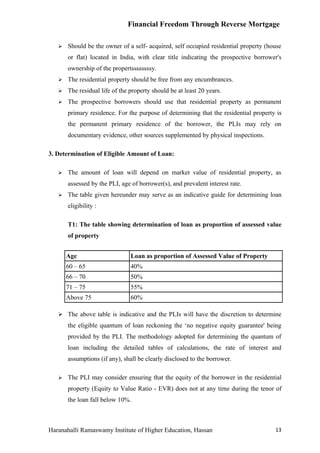
    The person should be the owner of a self-acquired, self occupied residential
       property (house or flat) located in India, with clear title indicating the prospective
       borrower’s ownership of the property. The residential property should be free
       from any encumbrances.

    The residual life of the property should be at least 20 years.

    The prospective borrowers should use that residential property as permanent
       primary residence. For the purpose of determining that the residential property is
       the permanent primary residence of the borrower, the PLIs may rely on
       documentary evidence, other sources supplemented by physical inspections.

    With a Reverse Mortgage, the borrower remains the owner of the property. In the
       absence of social security, Reverse Mortgage Loan serves as a partial substitute
       for senior citizens.


Reverse Mortgage in India

The concept of reverse mortgage, although new in India, is very popular in countries like
the United States. Recently, National Housing Bank (NHB), a subsidiary of the Reserve
Bank of India (RBI), released draft norms of reverse mortgage (the final guidelines are
awaited). Following are some of the key features of the scheme from the draft norms.

1. Reverse Mortgage Loans (RMLs) are to be extended by Primary Lending Institutions
(PLIs) viz. Scheduled Banks and Housing Finance Companies (HFCs) registered with
NHB. The PLIs reserve their discretion to offer Reverse Mortgage Loans. Prospective
borrowers are advised to consult PLIs regarding the detailed terms of Reverse Mortgage
Loan as may be applicable to them.

2. Eligible Borrowers:

      Should be Senior Citizen of India above 60 years of age.
      Married couples will be eligible as joint borrowers for financial assistance. In such
       a case, the age criteria for the couple would be at the discretion of the PLI, subject
       to at least one of them being above 60 years of age. PLIs may put in place suitable
       safeguards keeping into view the inherent longevity risk.


Haranahalli Ramaswamy Institute of Higher Education, Hassan                               12
Financial Freedom Through Reverse Mortgage

      Should be the owner of a self- acquired, self occupied residential property (house
       or flat) located in India, with clear title indicating the prospective borrower's
       ownership of the propertssssssssy.
      The residential property should be free from any encumbrances.
      The residual life of the property should be at least 20 years.
      The prospective borrowers should use that residential property as permanent
       primary residence. For the purpose of determining that the residential property is
       the permanent primary residence of the borrower, the PLIs may rely on
       documentary evidence, other sources supplemented by physical inspections.

3. Determination of Eligible Amount of Loan:

      The amount of loan will depend on market value of residential property, as
       assessed by the PLI, age of borrower(s), and prevalent interest rate.
      The table given hereunder may serve as an indicative guide for determining loan
       eligibility :

       T1: The table showing determination of loan as proportion of assessed value
       of property


       Age                      Loan as proportion of Assessed Value of Property
       60 – 65                  40%
       66 – 70                  50%
       71 – 75                  55%
       Above 75                 60%

    The above table is indicative and the PLIs will have the discretion to determine
       the eligible quantum of loan reckoning the ‘no negative equity guarantee' being
       provided by the PLI. The methodology adopted for determining the quantum of
       loan including the detailed tables of calculations, the rate of interest and
       assumptions (if any), shall be clearly disclosed to the borrower.

      The PLI may consider ensuring that the equity of the borrower in the residential
       property (Equity to Value Ratio - EVR) does not at any time during the tenor of
       the loan fall below 10%.


Haranahalli Ramaswamy Institute of Higher Education, Hassan                           13
Financial Freedom Through Reverse Mortgage


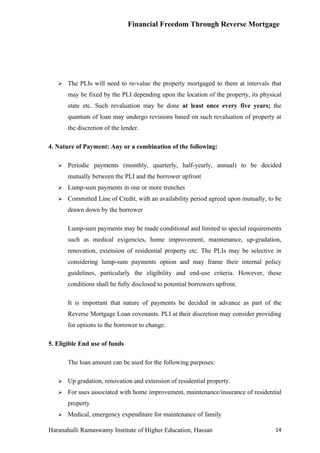
      The PLIs will need to re-value the property mortgaged to them at intervals that
       may be fixed by the PLI depending upon the location of the property, its physical
       state etc. Such revaluation may be done at least once every five years; the
       quantum of loan may undergo revisions based on such revaluation of property at
       the discretion of the lender.

4. Nature of Payment: Any or a combination of the following:

      Periodic payments (monthly, quarterly, half-yearly, annual) to be decided
       mutually between the PLI and the borrower upfront
      Lump-sum payments in one or more trenches
      Committed Line of Credit, with an availability period agreed upon mutually, to be
       drawn down by the borrower

       Lump-sum payments may be made conditional and limited to special requirements
       such as medical exigencies, home improvement, maintenance, up-gradation,
       renovation, extension of residential property etc. The PLIs may be selective in
       considering lump-sum payments option and may frame their internal policy
       guidelines, particularly the eligibility and end-use criteria. However, these
       conditions shall be fully disclosed to potential borrowers upfront.

       It is important that nature of payments be decided in advance as part of the
       Reverse Mortgage Loan covenants. PLI at their discretion may consider providing
       for options to the borrower to change.

5. Eligible End use of funds

       The loan amount can be used for the following purposes:

      Up gradation, renovation and extension of residential property.
      For uses associated with home improvement, maintenance/insurance of residential
       property
      Medical, emergency expenditure for maintenance of family

Haranahalli Ramaswamy Institute of Higher Education, Hassan                          14
Financial Freedom Through Reverse Mortgage

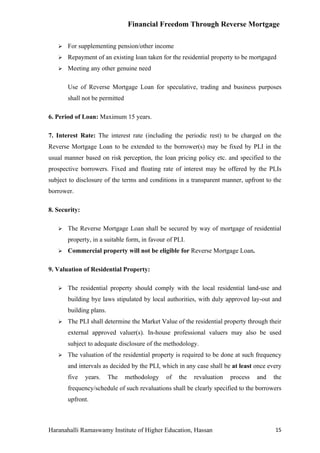
      For supplementing pension/other income
      Repayment of an existing loan taken for the residential property to be mortgaged
      Meeting any other genuine need

       Use of Reverse Mortgage Loan for speculative, trading and business purposes
       shall not be permitted

6. Period of Loan: Maximum 15 years.

7. Interest Rate: The interest rate (including the periodic rest) to be charged on the
Reverse Mortgage Loan to be extended to the borrower(s) may be fixed by PLI in the
usual manner based on risk perception, the loan pricing policy etc. and specified to the
prospective borrowers. Fixed and floating rate of interest may be offered by the PLIs
subject to disclosure of the terms and conditions in a transparent manner, upfront to the
borrower.

8. Security:

      The Reverse Mortgage Loan shall be secured by way of mortgage of residential
       property, in a suitable form, in favour of PLI.
      Commercial property will not be eligible for Reverse Mortgage Loan.

9. Valuation of Residential Property:

      The residential property should comply with the local residential land-use and
       building bye laws stipulated by local authorities, with duly approved lay-out and
       building plans.
      The PLI shall determine the Market Value of the residential property through their
       external approved valuer(s). In-house professional valuers may also be used
       subject to adequate disclosure of the methodology.
      The valuation of the residential property is required to be done at such frequency
       and intervals as decided by the PLI, which in any case shall be at least once every
       five    years.    The    methodology   of   the   revaluation   process   and   the
       frequency/schedule of such revaluations shall be clearly specified to the borrowers
       upfront.


Haranahalli Ramaswamy Institute of Higher Education, Hassan                            15
Financial Freedom Through Reverse Mortgage


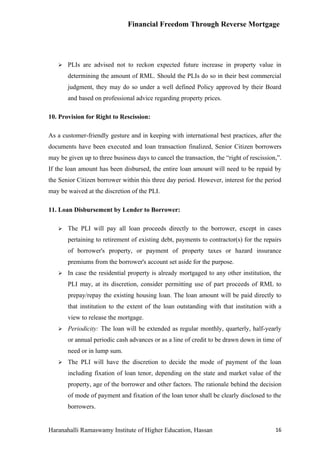
      PLIs are advised not to reckon expected future increase in property value in
       determining the amount of RML. Should the PLIs do so in their best commercial
       judgment, they may do so under a well defined Policy approved by their Board
       and based on professional advice regarding property prices.

10. Provision for Right to Rescission:

As a customer-friendly gesture and in keeping with international best practices, after the
documents have been executed and loan transaction finalized, Senior Citizen borrowers
may be given up to three business days to cancel the transaction, the “right of rescission,”.
If the loan amount has been disbursed, the entire loan amount will need to be repaid by
the Senior Citizen borrower within this three day period. However, interest for the period
may be waived at the discretion of the PLI.

11. Loan Disbursement by Lender to Borrower:

      The PLI will pay all loan proceeds directly to the borrower, except in cases
       pertaining to retirement of existing debt, payments to contractor(s) for the repairs
       of borrower's property, or payment of property taxes or hazard insurance
       premiums from the borrower's account set aside for the purpose.
      In case the residential property is already mortgaged to any other institution, the
       PLI may, at its discretion, consider permitting use of part proceeds of RML to
       prepay/repay the existing housing loan. The loan amount will be paid directly to
       that institution to the extent of the loan outstanding with that institution with a
       view to release the mortgage.
      Periodicity: The loan will be extended as regular monthly, quarterly, half-yearly
       or annual periodic cash advances or as a line of credit to be drawn down in time of
       need or in lump sum.
      The PLI will have the discretion to decide the mode of payment of the loan
       including fixation of loan tenor, depending on the state and market value of the
       property, age of the borrower and other factors. The rationale behind the decision
       of mode of payment and fixation of the loan tenor shall be clearly disclosed to the
       borrowers.


Haranahalli Ramaswamy Institute of Higher Education, Hassan                               16
Financial Freedom Through Reverse Mortgage


12. Closing:

The PLIs will provide in writing, a fair and complete package of reverse mortgage loan
material and specimen documents, covering inter-alia, the benefits and obligations of the
product. They may also consider making available a tool kit to illustrate the potential
effect of future house values, interest rates and the capitalization of interest on the loan.

The closing costs may include the customary and reasonable fees and charges that may be
collected by the PLIs from the borrower. The cost for any item charged to the borrower
shall not normally exceed the cost paid by the lender or charged to the lender by the
provider of such service(s). Such items may include:

      Origination, Appraisal and Inspection Fees. The borrower may be charged pro-
       rata origination, appraisal and inspection fees by the PLI /appraiser.
      Verification Charges of external firms
      Title Examination Fees
      Legal Charges/ Fees
      Stamp Duty and Registration Charges
      Property Survey and Valuation charges

A detailed schedule of all such costs will clearly be specified and provided to the
prospective borrowers upfront by the PLIs.


13. Settlement of Loan

      The loan shall become due and payable only when the last surviving borrower
       dies or would like to sell the home, or permanently moves out of the home for
       aged care to an institution or to relatives. Typically, a "permanent move" may
       generally mean that neither the borrower nor any other co-borrower has lived in
       the house continuously for one year or do not intend to live continuously. PLIs
       may obtain such documentary evidence as may be deemed appropriate for the
       purpose.


Haranahalli Ramaswamy Institute of Higher Education, Hassan                                     17
Financial Freedom Through Reverse Mortgage

      Settlement of loan along with accumulated interest is to be met by the proceeds
       received out of Sale of Residential Property.
      The borrower(s) or his/her/their estate shall be provided with the first right to
       settle the loan along with accumulated interest, without sale of property.
      A reasonable amount of time, say up to 2 months may be provided when Reverse
       Mortgage Loan repayment is triggered, for house to be sold.
      The balance surplus (if any) remaining after settlement of the loan with accrued
       interest shall be passed on to the estate of the borrower.

14. Prepayment of Loan by Borrower(s)

      The borrower(s) will have option to prepay the loan at any time during the loan
       tenor.
      There will not be any prepayment levy/penalty/charge for such prepayments.

15. Loan Covenants:

      The borrower(s) will continue to use the residential property as his/her/their
       primary residence till he/she/they is/are alive, or permanently move out of the
       property, or cease to use the property as permanent primary residence.
      Non-Recourse Guarantee: The PLIs shall ensure that all reverse mortgage loan
       products carry a clear and transparent ‘no negative equity' or ‘non-recourse'
       guarantee. That is, the Borrower(s) will never owe more than the net realizable
       value of their property, provided the terms and conditions of the loan have been
       met.
      Loan Agreement: The PLIs shall enter into a detailed loan agreement setting out
       there in the salient features of the loan mortgage security and other terms and
       conditions, including disbursement and repayment of the loan, in addition to the
       usual provisions, which are ordinarily incorporated in a mortgage loan document.
      The loan agreement may also include a provision that the borrower shall not make
       any testamentary disposition of the property to be mortgaged and even if it does
       so, it would be subject to the mortgage created in favour of the lending institution.
       In such a case, the borrower shall make a testamentary disposition of the
       mortgaged property in favour of any of his/her relatives, subject to the discharge
       of the mortgage debt by such legatee and a statement that the heirs shall not be


Haranahalli Ramaswamy Institute of Higher Education, Hassan                              18
Financial Freedom Through Reverse Mortgage

       entitled to challenge the validity of the mortgage as also the right of the mortgagee
       to enforce the mortgage in the event of death of the borrower unless the legal
       representative is willing to undertake the responsibility for discharging in full the
       amount of loan and accrued interest thereof.
      In addition, the PLI may also consider obtaining a Registered Will from the
       borrower stating, inter-alia, that he/she has availed of Reverse Mortgage Loan
       from the PLI on security by way of mortgage of the residential property in favour
       of the PLI, meaning thereby that in the event of death of the borrower (and co-
       borrower, if any), the mortgagee is entitled to enforce the mortgage and recover
       the loan from the sale proceeds on enforcement of security of the mortgage. The
       surplus, if any, has to be returned to the heirs of the deceased borrower(s).
      The PLIs may consider taking an undertaking from the prospective borrower that
       the “Registered Will” given to the PLI is the last “Will”, prepared by him/her at
       the time of availment of Reverse Mortgage Loan facility as per which the property
       will vest in his/her spouse name after his/her demise. The borrower will also
       undertake not to make any other ‘Will' during the currency of the loan which shall
       have any adverse impact on the rights created by the borrower in the PLI's favour
       by way of creation of mortgage on the immoveable property mentioned under the
       loan documentation for covering loan to be allowed to his/her spouse and interest
       thereon, even after the borrower's death.
      The PLI will ensure that the borrower(s) has insured the property against fire,
       earthquake, and other calamities.
      The PLI will ensure that borrower(s) pay all taxes, electricity charges, water
       charges and statutory payments.
      The PLIs will ensure that borrower(s) are maintaining the residential property in
       good and saleable condition.
      The PLI may reserve the option to pay for insurance premium, taxes or repairs by
       reducing the homeowner loan advances and using the difference to meet the
       obligations/expenditures.
      The PLI reserves the right to inspect the residential property/premises or arrange
       to have the residential property/premises inspected by its representatives any time
       before the loan is repaid and borrower(s) shall render his/her/their cooperation in
       respect of such inspections.


Haranahalli Ramaswamy Institute of Higher Education, Hassan                              19
Financial Freedom Through Reverse Mortgage

16. Title Indemnity/Insurance

      The PLI shall obtain legal opinion for ensuring clarity on the title of the residential
       property.
      The PLI shall also endeavour to obtain indemnity on title related risks, as and
       when such indemnity products are available in India.

17. Foreclosure:

The loan shall be liable for foreclosure due to occurrence of the following events of
default.

            If the borrower has not stayed in the property for a continuous period of 1
              year
            If the borrower(s) fail(s) to pay property taxes or maintain and repair the
              residential property or fail(s) to keep the home insured, the PLI reserves
              the right to insist on repayment of loan by bringing the residential property
              to sale and utilizing the sale proceeds to meet the outstanding balance of
              principal and interest.
            If borrower(s) declare himself/herself/themselves bankrupt.
            If the residential property so mortgaged to the PLI is donated or abandoned
              by the borrower(s).
            If the borrower(s) effect changes in the residential property that affect the
              security of the loan for the lender. For example: renting out part or all of
              the house; adding a new owner to the house's title; changing the house's
              zoning classification; or creating further encumbrance on the property
              either by way taking out new debt against the residential property or
              alienating the interest by way of a gift or will.
            Due to perpetration of fraud or misrepresentation by the borrower(s).
            If the government under statutory provisions, seeks to acquiring the
              residential property for public use.
            If the government condemns the residential property (for example, for
              health or safety reasons).


Haranahalli Ramaswamy Institute of Higher Education, Hassan                                20
Financial Freedom Through Reverse Mortgage

18. Option for PLI to Adjust Payments:

      The PLI shall have the option to revise the periodic/lump-sum amount at such
       frequency or intervals based on revaluation of property, which in any case shall be
       at least once every five years.
      Borrower shall be provided with an option to accept such revised terms and
       conditions for furtherance of the loan.
      If the Borrower does not accept the revised terms, no further payments will be
       effected by the Lender. Interest at the rate agreed before the review will continue
       to accrue on the outstanding amount of the loan. The accumulated principal and
       interest shall become due and payable.

19. Counseling and Information to Borrowers:

      The PLIs will observe and maintain high standards of conduct in dealing with the
       Senior Citizens and their families and treat them with special care.
      The PLIs shall clearly and accurately disclose the terms of the Reverse Mortgage
       Loan without any ambiguity.


      The PLIs should clearly explain to the prospective borrowers the terms and
       conditions of Reverse Mortgage Loan, the methodology followed for valuation of
       the residential property, the method of determination of eligible quantum of loan,
       the frequency of revaluation and review of terms and all related aspects of the
       Reverse Mortgage Loan.
      The PLIs may suggest to the Senior Citizens to nominate their ‘personal
       representatives' usually a close relative who the PLI can contact in the event of
       any potentialities.
      The PLIs may counsel the prospective borrowers about the possible impacts to the
       borrowers due to adverse movements in interest rates and property price
       fluctuations.
      The PLIs shall clearly specify all the costs to the Borrower(s) that are associated
       with the transaction.


Haranahalli Ramaswamy Institute of Higher Education, Hassan                            21
Financial Freedom Through Reverse Mortgage

      The PLIs shall in no way assert or imply to the borrower(s) that the borrower(s) is/
       are obligated to purchase any other product or service offered by the PLI or any
       other associated institution in order to obtain a reverse mortgage loan.
      Take reasonable steps to check out the background and procedures of third parties
       before accepting referrals of business from them, and refuse to accept referrals
       from those that are found unacceptable. Members shall disclose to clients any
       third party with a financial interest in the reverse mortgage transaction.
      Overall, the PLIs shall treat the Senior Citizen borrower fairly.

As the old saying goes, “there are no free lunches in life”. In case of reverse mortgage,
there exist a few guidelines, which may not 'appeal' to the house property owner i.e. the
borrower.

1. As per the guidelines, the maximum loan tenure can be 15 years. So, if the borrower
outlives the loan tenure, he can continue to stay in the house. However he will no longer
be eligible for any payments from the bank/HFC.

2. The bank/HFC shall have the option to revise the periodic/lump sum amount at such
frequency or intervals based on revaluation of property, or at least once every 5 years.
The borrower will be provided the option to accept the revised terms and conditions to
continue the loan. However, if he refuses to accept the revised terms and conditions, no
further payments shall be made by the bank/HFC. Interest at the rate agreed before the
review will continue to accrue on the outstanding loan amount.

3. Since the reverse mortgage can be either at fixed or floating rates, it will be prone to
the interest rate movements.

4. Under the reverse mortgage, the legal heirs of the owner are not entitled to take control
over the mortgaged property up to the extent of the outstanding loan. They are required to
first repay the outstanding loan amount along with the interest to stake a claim on the
property.

5. The banks/HFCs at their discretion may levy penalty or other charges on the
prepayment of loan. So, if the borrower or his heirs wish to prepay the loan amount, they
may have to bear an additional cost.


Haranahalli Ramaswamy Institute of Higher Education, Hassan                              22
Financial Freedom Through Reverse Mortgage

The most important advantage offered by the reverse mortgage scheme is that despite
mortgaging the house, the house owner retains its ownership, is entitled to live in the
same throughout his lifetime and also has access to a regular income stream, which can
help meet his day-to-day needs. From the banks/HFC's perspective, the mortgage on the
property in its favor ensures that there is no scope for default.

Individuals who wish to opt for the reverse mortgage scheme would do well to acquaint
themselves with the nitty-gritty’s of the guidelines.

    Affordable Housing for Older People by ‘Aged and community services’ in
       2008:

       This report has highlighted a range of affordable housing issues as well as the
       growing importance of reverse mortgage in today’s world. As an individual we
       need to consider and determine how we address these issues and ensure we are
       providing the best care and services to the senior citizens. There are some possible
       actions we can take to begin addressing this issue.

    Reverse mortgage loan scheme for the senior citizens of Delhi By Delhi
       research organization in 2009:

       The report covered that level of awareness of reverse mortgage in the minds of
       senior citizens of New Delhi and also covered the eligibility criteria to avail
       reverse mortgage service.


    ‘Emergence of Reverse mortgage in India’ by Dewan corporation in 2009:

       The report covered the legal aspect and tax aspects of reverse mortgage.


    Reverse Mortgage: Option for senior citizens by Kavita Sriram in 2009
       (Times of India dated Oct 11 2009)

       The report covered the process of Reverse mortgage.


Haranahalli Ramaswamy Institute of Higher Education, Hassan                             23
Financial Freedom Through Reverse Mortgage


     Reverse Mortgage: A failure in India?(Rediff.com dated March 03, 2008)

This article says-The finance minister's budget proposals last year included the
introduction of the reverse mortgage facility for senior citizens in India


Recent reports seem to indicate that less than 150 people have taken advantage of the
facility since its inception and it is, therefore, likely to be considered a failure. This is
unfortunate because the facility simply has not been adequately explained. It was also
unattractively packaged.

The reverse mortgage facility allows senior citizens to unlock the value of their most
valuable asset, their home, by mortgaging it and enjoying the use of the money in their
lifetime while continuing to live in it until their deaths.

It is a well-entrenched idea in many developed countries in the West where its terms are
such that only home-owners above a given age (typically 60-65 years) may apply.

The bank makes an evaluation of the current value of the home, decides the likely
lifespan of the applicant home-owner (and his/her spouse), and, decides what percentage
of the current value they are willing to loan them. The bank also fixes the interest rate it
wishes to apply.

Typically, the loan amount seldom is lower than 60-70 per cent of the market value of the
property. The applicants have the option of taking the loan principal in a single lump-sum
amount or by a fixed monthly amount instead.

From time to time, the value of the property is re-visited by both parties. If the valuation
has increased, the applicants are given the option of increasing the quantum of the loan,
and should they do so, are given the incremental amount in lump-sum.


If they have opted for the monthly payment scheme, this amount is appropriately
increased. The principal plus interest charges accrue at the bank while the applicants live
on in the home for the lengths of their lives - or until they decide to sell the home,
whichever comes earlier.


Haranahalli Ramaswamy Institute of Higher Education, Hassan                               24
Financial Freedom Through Reverse Mortgage

If they choose to sell it, they have to pay the bank all the accrued amounts. On the death
of the second of the two spouses, the heirs to the property decide either to redeem the loan
and keep the property, or sell the property and take the residual amount that may accrue
from        the        sale     after       settling      with       the       bank.


Should the sale proceeds be lower than the accrued principal plus interest amount, the
bank takes the loss. (This could happen if the real estate market has not moved up in the
manner the bank had estimated originally. However experience of the past indicates that
the banks seldom lose, as they factor this likelihood in setting the percentage of the
current value they loan the applicants.)

The Indian banking industry must not complicate the scheme as it has done. The
industry's offer caps the available loan amount at Rs 50 lakh, instead of providing for an
equitable percentage of the property's value, and limits the loan period to tenure of 15
years.

It is possible that most Indians will not sell the family home, and would prefer passing it
on to the next generation, even if they have to live in relative penury during their waning
years because of the small income. However, many Indian traditions and values have
changed in the last 15 years. This is like many other things.

For example, we hated debt and dreaded living on borrowed funds. The Diners Club
credit card was introduced in India in the 1960s. It never ever took off. But today's new
generation has upturned that.

More credit cards are issued in India per month than in most countries in the world, and
cards have changed the way life is lived. The increasing GNP and the surge of the
manufacturing and service sectors owe much to the great surge in consumer purchasing,
including of expensive aspirational goods and real estate.

The urge for a better life NOW is almost fundamental to the way the younger generation
perceives its goals.

Another example has to do with the tradition that parents moved in with one or the other
of their children when they grew old. That too is changing.

Work opportunities are moving young people away to new cities, even new countries,
where their parents cannot or will not follow them. And even in the same cities, many
"modern" parents prefer to live on their own.
Haranahalli Ramaswamy Institute of Higher Education, Hassan                              25
Financial Freedom Through Reverse Mortgage

Further, in many cases, the children do not want to inherit the parents' home. Should they
do so, they sell it anyway because they have moved on to bigger and better things. There
are also old folk without children, and old folk out of luck with their children. In both
cases, they are short of the cash to even pay essential bills.

So while the reverse mortgage idea may not take off in India as it has in the West, where
social and parent-child behaviour usually dictates that the old folk live off their very last
penny before they die, there are sufficient demographic and psychographic data to
indicate that in India there are takers in the millions who, for one reason or another, are
likely candidates for the reverse mortgage idea.

In any event, the proposal should be given the opportunity to fail for the right reasons.
And that means it should be packaged and marketed in a way that makes sense to the
likely customer.


Haranahalli Ramaswamy Institute of Higher Education, Hassan                               26
Financial Freedom Through Reverse Mortgage


                              Profile of the Industry

3.1 Introduction: Banking sector

The Indian Banking industry governed by the Banking Regulation Act of India, 1949,
falling into two broad classifications, non-scheduled banks and scheduled banks. Within
the commercial banks there are nationalized banks, the State Bank of India and its group
banks, regional rural banks and private sector banks.

With the economic growth picking up pace and the investment cycle on the way to
recovery, the banking sector has witnessed a transformation in its vital role of
intermediating between the demand and supply of funds. The revived credit off take (both
from the food and non food segments) and structural reforms have paved the way for a
change in the dynamics of the sector itself. Besides gearing up for the compliance with
Basel accord, the sector is also looking forward to consolidation and investments on the
FDI front.

Retail lending (especially mortgage financing) has been grabbing a major share of the
market in the last 3 years. With better penetration in the semi urban and rural areas the
banks garnered a higher proportion of low cost deposits thereby economizing on the cost
of funds.

Apart from streamlining their processes through technology initiatives such as ATMs,
telephone banking, online banking and web based products, banks have also resorted to
cross selling of financial products such as credit cards, mutual funds and insurance
policies to augment their fee based income.

RBI's soft interest rate policy has helped increase the liquidity in the market, and banks
have been liquidating their gilt portfolios partially to free resources for lending. Credit off
take is expected to be reasonably good both on retail and corporate sides. Following the
advice of the government banks have increased lending to agricultural sector, while
ensuring good quality lending by informed customer analysis.

Currently the banking sector in the country is strongly fragmented and hence with further
policy changes taking place in the sector, consolidation is likely to take place at a faster
rate. However this is subject to the removal of the ceiling on voting rights will ensure that
private sector and foreign banks will be in a much better position to carry out acquisitions

Haranahalli Ramaswamy Institute of Higher Education, Hassan                                 27
Financial Freedom Through Reverse Mortgage

in the banking sector. A hike in FDI capital limits in the sector would further go a long
way in the process of consolidation. In terms of credit growth, going forward, India's core
sector is witnessing a revival of sorts. The manufacturing sector has shown significant
improvement in FY05. Hence as corporate growth picks up lending too is likely to see an
uptick. Retail credit off-take is expected to remain strong going forward with the housing
finance industry, the main contributor to credit off-take from this segment, expected to
grow between 20%-25% in the next 3-4 years.

Indian banks have to be encouraged to expand fast, both through organic growth and
through consolidation, in order to fuel the growth of large firms and to strengthen their
risk assessment systems, for catering to the requirements of smaller firms. Various policy
measures are in process to help this transition along. However, when we look at the
global scenario, only 22 Indian banks figure in the list of top 1000 banks and there are
only 5 Indian banks in the list of top 500 banks. The biggest Indian bank, State Bank of
India, has a market capitalization of under US$ 10 billion compared to the market
capitalization of US$ 243 billion of Citigroup. Indian banking sector has a long way to go
before we can say that Indian banks are relatively significant players. Having said that,
there are sufficient reasons to believe that the Indian Banking sector is poised for
tremendous growth and with proper policy framework in place, it would be very soon,
matching their global counterparts on most of the relevant banking indicators/ parameters
(except size for some time to come).


3.2 Indian Banking System:

Haranahalli Ramaswamy Institute of Higher Education, Hassan                             28
Financial Freedom Through Reverse Mortgage

For the past three decades India's banking system has several outstanding achievements to
its credit. The government's regular policy for Indian bank since 1969 has paid rich
dividends with the nationalization of 14 major private banks of India. The first bank in
India, though conservative, was established in 1786. From 1786 till today, the journey of
Indian Banking System can be segregated into three distinct phases. They are as
mentioned below:

            Nationalisation of Indian Banks and up to 1991 prior to Indian banking
              sector Reforms.

            New phase of Indian Banking System with the advent of Indian Financial &
              Banking Sector Reforms after 1991.

Phase I

During the first phase the growth was very slow and banks also experienced periodic
failures between 1913 and 1948. There were approximately 1100 banks, mostly small. To
streamline the functioning and activities of commercial banks, the Government of India
came up with The Banking Companies Act, 1949 which was later changed to Banking
Regulation Act 1949 as per amending Act of 1965 (Act No. 23 of 1965). Reserve Bank of
India was vested with extensive powers for the supervision of banking in India as the
Central Banking Authority.

Phase II

The following are the steps taken by the Government of India to Regulate Banking
Institutions in the Country:

                 1949: Enactment of Banking Regulation Act.

                 1955: Nationalisation of State Bank of India.

                 1959: Nationalisation of SBI subsidiaries.

                 1961: Insurance cover extended to deposits.

                 1969: Nationalisation of 14 major banks.

                 1971: Creation of credit guarantee corporation.

                 1975: Creation of regional rural banks.

Haranahalli Ramaswamy Institute of Higher Education, Hassan                           29
Financial Freedom Through Reverse Mortgage

                1980: Nationalisation of seven banks with deposits over 200 crores.

Phase III

In 1991, under the chairmanship of M Narasimham, a committee was set up by his name
which worked for the liberalisation of banking practices. The country is flooded with
foreign banks and their ATM stations. Efforts are being put to give a satisfactory service
to customers. Phone banking and net banking is introduced. The entire system became
more convenient and swift. Time is given more importance than money.

3.3 Current Scenario:

The Indian Banking industry has been undergoing rapid changes reflecting a number of
underlying changes. Liberalization and deregulation witnessed in the Indian markets in
the 1990s have resulted in a spurt in banking activity in India. Significant advances in
communication have enabled banks to expand their reach, both in terms of geography
covered as well as new products introduced. With increased competition in wholesale
banking due to the entry of foreign banks and new private sector banks, the sector has
witnessed a squeeze in margins. This has led to banks increasing their focus on retail
banking so as to obtain access to low cost funds and to expand into relatively untapped,
potential growth areas. Banks and financial institutions are thus continuously exploring
new avenues for increasing their footprint and safeguarding their margins.

Competition from multinational banks and entry of new private sector banks has rewritten
the rules of the retail lending business in India. Slow growth in corporate lending,
pressure on corporate spreads due to competition and concerns over asset quality have
induced public sector banks to follow the private sector banks in placing emphasis on
growth through expansion of retail portfolio.


Haranahalli Ramaswamy Institute of Higher Education, Hassan                            30
Financial Freedom Through Reverse Mortgage


Different reverse mortgage offerings in India

3.4 State Bank of India

The State Bank of India (SBI) started offering reverse mortgage products for senior
citizen on October 12, 2007. Joint loans are given if the spouse is alive and is over 58
years of age.

The loan is offered by all branches of SBI from October 12, 2007. The loan is offered at
an interest rate of 10.75% pa and is subject to change at the end of every five years along
with revaluation of security. Every five years, bank may even re-adjust the loan
installments, if it is needed, depending on market conditions and loan status.

The Chief General Manager for Personal Banking (SBI), Mr. Sangeet Shukla told that
there is no upper limit of amount of loan. Also, the maximum period for availing this
benefit is 15 years.

Under this loan, borrowers can be avail payment against the security of their houses on
monthly or quarter installments or either he/she can go for as a lump sum payment at the
beginning.

During their lifetime, the borrower does not have to pay the loan and will continue to stay
in their house. Thereafter, either the legal heirs can repay the loan and redeem the
property but if this option is not exercised, bank will sell the property and liquidate the
loan. Surplus, if any, will be passed on to the legal heirs.

T2: Table showing details of SBI Reverse Mortgage Loan

No.     Parameter                 Details

(1)     Objective      of    the To provide a source of additional income for senior citizens of
        scheme                    India who own self-acquired and self-occupied house property
                                  in India.


Haranahalli Ramaswamy Institute of Higher Education, Hassan                             31
Financial Freedom Through Reverse Mortgage

(2)    Eligibility

       a. No. of borrowers          Single or jointly with spouse in case of a living spouse.

       b.     Age     of     first Above 60 years
       borrower

       c. No. of surviving Should not be more than one. Borrowers will have to give an
            spouses on the date undertaking that they will not remarry during the currency of
            of sanction of loan     the loan. If the borrowers choose to remarry, the loan will be
                                    foreclosed.

       d. Age of spouse             Above 58 years

       e. Residence                     Borrower should be staying at self-acquired and self
                                            owned house /flat against which loan is being raised,
                                            as his permanent primary residence.

                                        Mobile/Telephone/Credit Card bills/ Certificate from
                                            the Housing Society where the borrower is staying /
                                            Affidavit made before the Executive Magistrate may
                                            be accepted as proof of residence.

                                        Borrowers will be required to inform the Bank when
                                            they cease to use this residence as their permanent
                                            residence.

       f. Title of the Property         Borrowers should have a clear and transferable title in
                                            their names.

                                        Title verification and search report for a period of 30
                                            years will be required to be obtained from the Bank’s
                                            empanelled advocate at borrowers’ cost.

       g. Title of the property Case– Title in single name and loan availed jointly with
            and     number    of spouse.
            borrowers.
                                    Title holder should make a Will in favour of the other spouse.
                                    The Will should confirm that this is the last Will and that it
                                    super cedes all earlier Wills, if any. The borrower to undertake
                                    that no fresh Will shall be made during the currency of the
                                    loan.

Haranahalli Ramaswamy Institute of Higher Education, Hassan                                 32
Financial Freedom Through Reverse Mortgage

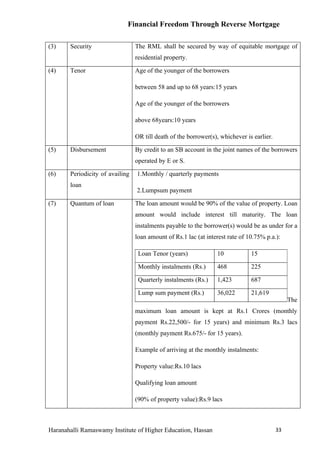
(3)    Security                  The RML shall be secured by way of equitable mortgage of
                                 residential property.

(4)    Tenor                     Age of the younger of the borrowers

                                 between 58 and up to 68 years:15 years

                                 Age of the younger of the borrowers

                                 above 68years:10 years

                                 OR till death of the borrower(s), whichever is earlier.

(5)    Disbursement              By credit to an SB account in the joint names of the borrowers
                                 operated by E or S.

(6)    Periodicity of availing   1.Monthly / quarterly payments
       loan
                                 2.Lumpsum payment

(7)    Quantum of loan           The loan amount would be 90% of the value of property. Loan
                                 amount would include interest till maturity. The loan
                                 instalments payable to the borrower(s) would be as under for a
                                 loan amount of Rs.1 lac (at interest rate of 10.75% p.a.):

                                  Loan Tenor (years)             10            15

                                  Monthly instalments (Rs.)      468           225

                                  Quarterly instalments (Rs.)    1,423         687

                                  Lump sum payment (Rs.)         36,022        21,619
                                                                                                The
                                 maximum loan amount is kept at Rs.1 Crores (monthly
                                 payment Rs.22,500/- for 15 years) and minimum Rs.3 lacs
                                 (monthly payment Rs.675/- for 15 years).

                                 Example of arriving at the monthly instalments:

                                 Property value:Rs.10 lacs

                                 Qualifying loan amount

                                 (90% of property value):Rs.9 lacs


Haranahalli Ramaswamy Institute of Higher Education, Hassan                                33
Financial Freedom Through Reverse Mortgage

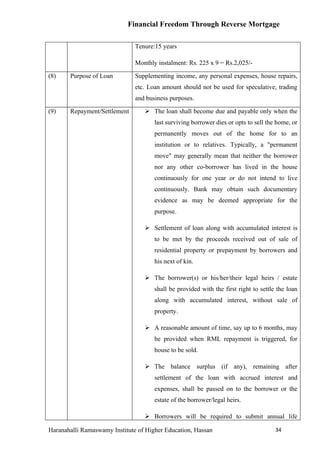
                               Tenure:15 years

                               Monthly instalment: Rs. 225 x 9 = Rs.2,025/-

(8)    Purpose of Loan         Supplementing income, any personal expenses, house repairs,
                               etc. Loan amount should not be used for speculative, trading
                               and business purposes.

(9)    Repayment/Settlement        The loan shall become due and payable only when the
                                      last surviving borrower dies or opts to sell the home, or
                                      permanently moves out of the home for to an
                                      institution or to relatives. Typically, a "permanent
                                      move" may generally mean that neither the borrower
                                      nor any other co-borrower has lived in the house
                                      continuously for one year or do not intend to live
                                      continuously. Bank may obtain such documentary
                                      evidence as may be deemed appropriate for the
                                      purpose.

                                   Settlement of loan along with accumulated interest is
                                      to be met by the proceeds received out of sale of
                                      residential property or prepayment by borrowers and
                                      his next of kin.

                                   The borrower(s) or his/her/their legal heirs / estate
                                      shall be provided with the first right to settle the loan
                                      along with accumulated interest, without sale of
                                      property.

                                   A reasonable amount of time, say up to 6 months, may
                                      be provided when RML repayment is triggered, for
                                      house to be sold.

                                   The balance surplus (if any), remaining after
                                      settlement of the loan with accrued interest and
                                      expenses, shall be passed on to the borrower or the
                                      estate of the borrower/legal heirs.

                                   Borrowers will be required to submit annual life

Haranahalli Ramaswamy Institute of Higher Education, Hassan                           34
Financial Freedom Through Reverse Mortgage

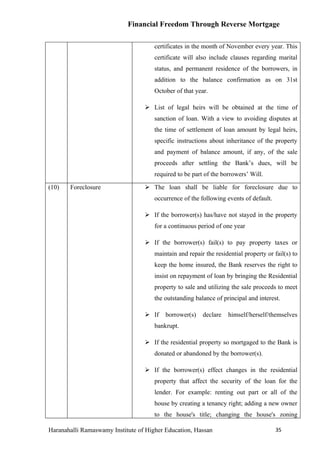
                                      certificates in the month of November every year. This
                                      certificate will also include clauses regarding marital
                                      status, and permanent residence of the borrowers, in
                                      addition to the balance confirmation as on 31st
                                      October of that year.

                                   List of legal heirs will be obtained at the time of
                                      sanction of loan. With a view to avoiding disputes at
                                      the time of settlement of loan amount by legal heirs,
                                      specific instructions about inheritance of the property
                                      and payment of balance amount, if any, of the sale
                                      proceeds after settling the Bank’s dues, will be
                                      required to be part of the borrowers’ Will.

(10)   Foreclosure                 The loan shall be liable for foreclosure due to
                                      occurrence of the following events of default.

                                   If the borrower(s) has/have not stayed in the property
                                      for a continuous period of one year

                                   If the borrower(s) fail(s) to pay property taxes or
                                      maintain and repair the residential property or fail(s) to
                                      keep the home insured, the Bank reserves the right to
                                      insist on repayment of loan by bringing the Residential
                                      property to sale and utilizing the sale proceeds to meet
                                      the outstanding balance of principal and interest.

                                   If    borrower(s)    declare   himself/herself/themselves
                                      bankrupt.

                                   If the residential property so mortgaged to the Bank is
                                      donated or abandoned by the borrower(s).

                                   If the borrower(s) effect changes in the residential
                                      property that affect the security of the loan for the
                                      lender. For example: renting out part or all of the
                                      house by creating a tenancy right; adding a new owner
                                      to the house's title; changing the house's zoning

Haranahalli Ramaswamy Institute of Higher Education, Hassan                            35
Financial Freedom Through Reverse Mortgage

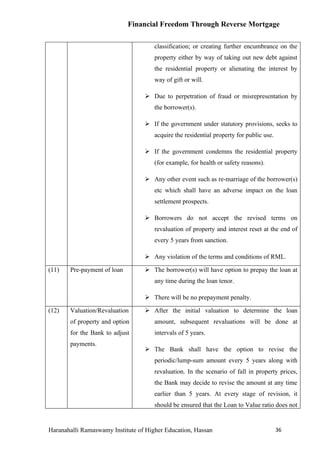
                                      classification; or creating further encumbrance on the
                                      property either by way of taking out new debt against
                                      the residential property or alienating the interest by
                                      way of gift or will.

                                   Due to perpetration of fraud or misrepresentation by
                                      the borrower(s).

                                   If the government under statutory provisions, seeks to
                                      acquire the residential property for public use.

                                   If the government condemns the residential property
                                      (for example, for health or safety reasons).

                                   Any other event such as re-marriage of the borrower(s)
                                      etc which shall have an adverse impact on the loan
                                      settlement prospects.

                                   Borrowers do not accept the revised terms on
                                      revaluation of property and interest reset at the end of
                                      every 5 years from sanction.

                                   Any violation of the terms and conditions of RML.

(11)   Pre-payment of loan         The borrower(s) will have option to prepay the loan at
                                      any time during the loan tenor.

                                   There will be no prepayment penalty.

(12)   Valuation/Revaluation       After the initial valuation to determine the loan
       of property and option         amount, subsequent revaluations will be done at
       for the Bank to adjust         intervals of 5 years.
       payments.
                                   The Bank shall have the option to revise the
                                      periodic/lump-sum amount every 5 years along with
                                      revaluation. In the scenario of fall in property prices,
                                      the Bank may decide to revise the amount at any time
                                      earlier than 5 years. At every stage of revision, it
                                      should be ensured that the Loan to Value ratio does not


Haranahalli Ramaswamy Institute of Higher Education, Hassan                              36
Financial Freedom Through Reverse Mortgage

                                      exceed 90% at maturity.

                                   If the Borrower does not accept the revised terms, no
                                      further payments will be affected by the Bank. Interest
                                      at the rate agreed before the review will continue to
                                      accrue on the outstanding amount of the loan. The
                                      accumulated principal and interest shall become due
                                      and payable as mentioned in clauses 9 and 10.

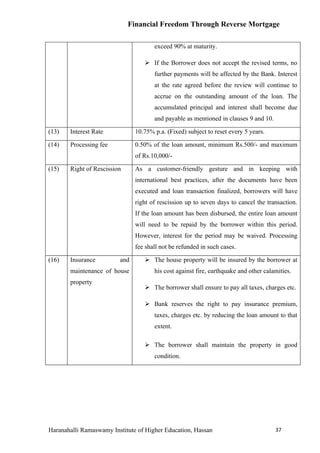
(13)   Interest Rate           10.75% p.a. (Fixed) subject to reset every 5 years.

(14)   Processing fee          0.50% of the loan amount, minimum Rs.500/- and maximum
                               of Rs.10,000/-

(15)   Right of Rescission     As a customer-friendly gesture and in keeping with
                               international best practices, after the documents have been
                               executed and loan transaction finalized, borrowers will have
                               right of rescission up to seven days to cancel the transaction.
                               If the loan amount has been disbursed, the entire loan amount
                               will need to be repaid by the borrower within this period.
                               However, interest for the period may be waived. Processing
                               fee shall not be refunded in such cases.

(16)   Insurance         and       The house property will be insured by the borrower at
       maintenance of house           his cost against fire, earthquake and other calamities.
       property
                                   The borrower shall ensure to pay all taxes, charges etc.

                                   Bank reserves the right to pay insurance premium,
                                      taxes, charges etc. by reducing the loan amount to that
                                      extent.

                                   The borrower shall maintain the property in good
                                      condition.


Haranahalli Ramaswamy Institute of Higher Education, Hassan                           37
Financial Freedom Through Reverse Mortgage

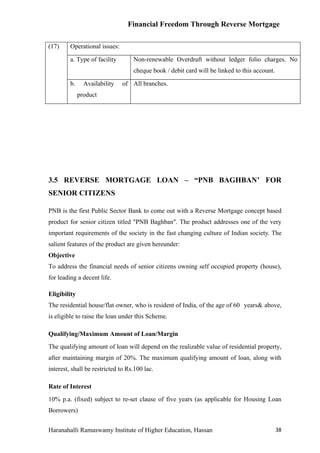
(17)     Operational issues:

         a. Type of facility       Non-renewable Overdraft without ledger folio charges. No
                                   cheque book / debit card will be linked to this account.

         b.     Availability   of All branches.
              product


3.5 REVERSE MORTGAGE LOAN – “PNB BAGHBAN’ FOR
SENIOR CITIZENS

PNB is the first Public Sector Bank to come out with a Reverse Mortgage concept based
product for senior citizen titled "PNB Baghban". The product addresses one of the very
important requirements of the society in the fast changing culture of Indian society. The
salient features of the product are given hereunder:
Objective
To address the financial needs of senior citizens owning self occupied property (house),
for leading a decent life.

Eligibility
The residential house/flat owner, who is resident of India, of the age of 60 years& above,
is eligible to raise the loan under this Scheme.

Qualifying/Maximum Amount of Loan/Margin
The qualifying amount of loan will depend on the realizable value of residential property,
after maintaining margin of 20%. The maximum qualifying amount of loan, along with
interest, shall be restricted to Rs.100 lac.

Rate of Interest
10% p.a. (fixed) subject to re-set clause of five years (as applicable for Housing Loan
Borrowers)


Haranahalli Ramaswamy Institute of Higher Education, Hassan                                   38
Financial Freedom Through Reverse Mortgage

Disbursement/tenor of loan
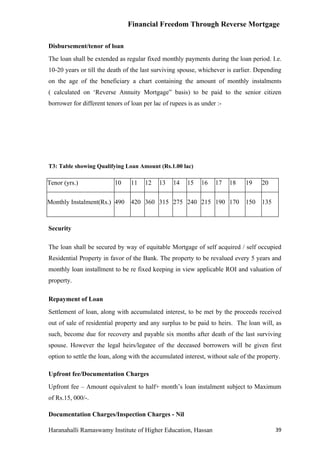
The loan shall be extended as regular fixed monthly payments during the loan period. I.e.
10-20 years or till the death of the last surviving spouse, whichever is earlier. Depending
on the age of the beneficiary a chart containing the amount of monthly instalments
( calculated on ‘Reverse Annuity Mortgage” basis) to be paid to the senior citizen
borrower for different tenors of loan per lac of rupees is as under :-


T3: Table showing Qualifying Loan Amount (Rs.1.00 lac)

Tenor (yrs.)              10     11    12   13    14    15   16    17    18    19    20

Monthly Instalment(Rs.) 490      420 360 315 275 240 215 190 170               150   135


Security

The loan shall be secured by way of equitable Mortgage of self acquired / self occupied
Residential Property in favor of the Bank. The property to be revalued every 5 years and
monthly loan installment to be re fixed keeping in view applicable ROI and valuation of
property.

Repayment of Loan
Settlement of loan, along with accumulated interest, to be met by the proceeds received
out of sale of residential property and any surplus to be paid to heirs. The loan will, as
such, become due for recovery and payable six months after death of the last surviving
spouse. However the legal heirs/legatee of the deceased borrowers will be given first
option to settle the loan, along with the accumulated interest, without sale of the property.

Upfront fee/Documentation Charges
Upfront fee – Amount equivalent to half+ month’s loan instalment subject to Maximum
of Rs.15, 000/-.

Documentation Charges/Inspection Charges - Nil

Haranahalli Ramaswamy Institute of Higher Education, Hassan                                39
Financial Freedom Through Reverse Mortgage

Right of Rescission

After the loan is sanctioned senior citizen borrower(s) shall be given up to 10 days time to
relook into his requirements and if he so wishes to cancel the transaction for any reason
whatsoever.


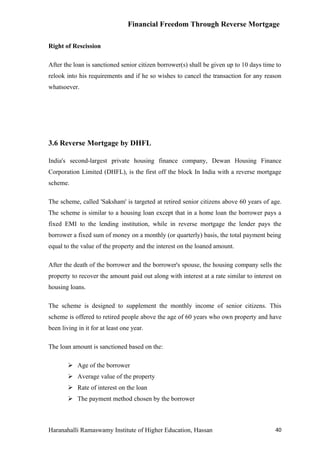
3.6 Reverse Mortgage by DHFL

India's second-largest private housing finance company, Dewan Housing Finance
Corporation Limited (DHFL), is the first off the block In India with a reverse mortgage
scheme.

The scheme, called 'Saksham' is targeted at retired senior citizens above 60 years of age.
The scheme is similar to a housing loan except that in a home loan the borrower pays a
fixed EMI to the lending institution, while in reverse mortgage the lender pays the
borrower a fixed sum of money on a monthly (or quarterly) basis, the total payment being
equal to the value of the property and the interest on the loaned amount.

After the death of the borrower and the borrower's spouse, the housing company sells the
property to recover the amount paid out along with interest at a rate similar to interest on
housing loans.

The scheme is designed to supplement the monthly income of senior citizens. This
scheme is offered to retired people above the age of 60 years who own property and have
been living in it for at least one year.

The loan amount is sanctioned based on the:

         Age of the borrower
         Average value of the property
         Rate of interest on the loan
         The payment method chosen by the borrower


Haranahalli Ramaswamy Institute of Higher Education, Hassan                              40
Financial Freedom Through Reverse Mortgage

The eligibility for a reverse mortgage loan is simple. The borrower should be 60 years of
age, living in self-owned property, which is free of any other encumbrances, and is an
approved construction. The amount loaned would depend on the estimated value of the
property (minus the interest cost) its condition and life. The loan does not apply to
ancestral property.


Saksham allows customers and their spouses to live in the property as long as they are
alive, without the fear of eviction even after the tenure expires. The surplus amount is
then paid to the legal heirs of the borrower. The legal heirs also have the option to re-
possess the property after the demise of both customers and their spouses.

According to Shivkumar Mani, head, marketing, DHFL, "As per the guidelines laid down
by NHB, DHFL is the first company to launch this scheme in India. This unique scheme
is designed to help senior citizens to sustain their lifestyle and also help them maintain
their monthly expenditure without being dependent on anyone. It is a social security
scheme designed to benefit the senior citizens post retirement."

DHFL will first launch Saksham in Mumbai and its adjoining areas before making it
available nationally.


Haranahalli Ramaswamy Institute of Higher Education, Hassan                            41
Financial Freedom Through Reverse Mortgage


3.7 Reverse Mortgage by Union Bank
Union Bank of India on 4 April, 2008 launched its "Union Reverse Mortgage Scheme", a
loan product designed exclusively for the benefit of senior citizens. The bank is the fourth
in the country to launch the scheme through which the loan seeker need not worry about
re-payment and be assured of monthly income; the Bank's Bangalore Zone Field General
Manager LNVRao.

The loan will be available to homeowners who are 60 years of age or more and can be
availed jointly with the spouse, provided he or she is more than 55 years old. Unlike other
loan products, there are no income criteria to be met for availing loan. On the demise of
the last surviving owner, the legal heirs have the right to repay. If they do not wish to do
so, the bank will sell the property, set off the loan outstanding the surplus, if any, will be
given to legal heirs. The minimum loan amount that can be availed is Rs one lac and
maximum Rs 50 lac.

Seventy per cent of the assessed value of the building would be the loan amount. The
maximum tenor of a loan under this scheme is 15 years. The loan carries a fixed interest
of 10 per cent per annum. Typically, for a loan of Rs 10 lac, the monthly pay off to the
owner on ten year loan will be Rs 4880 and on a 15 year loan, it will be Rs 2410. The
property is revalued every five years and adjustments will be made to the monthly
payments accordingly. The borrower has to comply with certain conditions which include
that he bears the cost of property insured against fire, earthquake and other calamities. If
the borrower ceases to stay in the house which has been mortgaged, the loan will be
cancelled.


Haranahalli Ramaswamy Institute of Higher Education, Hassan                                42
Financial Freedom Through Reverse Mortgage


3.8 LIC Housing to combine reverse mortgage with insurance plan

LIC Housing Finance is looking to combine its reverse mortgage plan with a whole-life
annuity provided by a life insurer. This will allow home owners to use their property to
generate income for life as against for only 15 years as provided under the present reverse
mortgage schemes. The housing finance arm of the Life Insurance Corporation on
Thursday announced the launch of its reverse mortgage scheme. This product is available
across the country for senior citizens above 60 years. The loan can be availed of either
singly or jointly with a spouse, if the spouse is also above 60. The shortcoming of most
reverse mortgage schemes is that it is available only for 15 years. With the increased life
expectancy, most borrowers are expected to outlive the term of their reverse mortgage.
Under present schemes while income from the reverse mortgage dries up after 15 years,
the borrowers end up with the lender having a lien on their property. LIC Housing
Finance chief executive SK Mitter told ET that the company was in talks with insurance
companies to work out a scheme where home equity could be used to buy an annuity that
provides income for the entire life span of the borrower. The reverse mortgage loan by
LICHF will be offered at a fixed interest rate, subject to reset every five years. Under the
scheme, senior citizens can avail of the loan either on a monthly payment or on a lump
sum payment or a combination of both. The property evaluated for the loan should have
at least 20 years of residual life. The maximum loan balance shall be 90% of the value of
the property and the loan balance will include interest till maturity. The amount of the
loan will take into consideration the property value, age of the borrower, and the rate of
interest. The loan will become due and payable only when the last surviving borrower
dies or opts to sell the home, or permanently moves out of the home.


Haranahalli Ramaswamy Institute of Higher Education, Hassan                              43
Financial Freedom Through Reverse Mortgage


                      Data Analysis and Interpretation

Profile of the Respondents

4.1 Age of the Respondents:

The survey is done for all age groups. But 32% respondents are the age group of 60-65.
The eligible age group for reverse mortgage is above 60.

T4: The Table showing Number of respondents in different age group.

              Age                            Respondents
              < 50                           10
              50-60                          26
              60-65                          32
              65-70                          26
              > 70                           6


C1: The chart showing number of respondents for age group


Haranahalli Ramaswamy Institute of Higher Education, Hassan                        44
Financial Freedom Through Reverse Mortgage


Analysis:

The research is done by choosing the age group above 40 years. The distribution of age is
in between 40 to 90. Among surveyed population, 32% of people are between 60-65 age
groups. And 64% people are above 60 years of age.

According to a survey report, In India, statistics show that number of elderly as a
proportion of population will show a 107% growth, from 113 million in 2016 and 179
million by 2026 respectively.

Interpretation:

This implies the target population will increase in the near future. And India will get
elderly educated people by another 10 years.

4.2 Gender of Respondents:

T5: The Table showing Gender of respondents

              Gender                           Respondents
              Male                             63
              Female                           37


C2: The Chart showing Gender of respondents


Haranahalli Ramaswamy Institute of Higher Education, Hassan                           45
Financial Freedom Through Reverse Mortgage


Gender and Age group

T6: The table showing Gender to age group of respondents

Gender / Age < 50             50-60          60-65            65-70   >70
group

Male            7             13             23               15      5
Female          3             13             9                11      1


C3: The chart showing Gender to age group of respondents


4.3 Qualification of Respondents:
Haranahalli Ramaswamy Institute of Higher Education, Hassan                 46
Financial Freedom Through Reverse Mortgage

T7: The table showing Qualification of Respondents

Qualification                                 Respondents
Uneducated                                    7
Less than PUC                                 14
Graduate                                      34
P.G.                                          25
Professional courses                          12
Others                                        8


C4: The chart showing Qualification of respondents


 Analysis:

 As the data indicates, more than 75% of the respondents are well educated. Their
 qualifications are above graduation level.

 Interpretation:

 This show, the education level of Bangalore’s elder people is good. This helps to make
 them aware of Reverse mortgage


4.4 Number of Dependents in the Family:

T8: The table showing Dependent in family of respondents

               Number Dependents              Respondents

Haranahalli Ramaswamy Institute of Higher Education, Hassan                         47
Financial Freedom Through Reverse Mortgage

              0                              0
              1-2                            33
              2-4                            25
              4-6                            18
              6-8                            12
              >8                             12


C5: The chart showing Dependent in family of respondents


Analysis and Interpretation

The survey shows that, the elderly people are having the dependents one or the other way.
According to the survey, 43% of people have 1 or 2 dependents in the family.


4.5 Gender and Dependents

C6: The chart showing Dependent in family of respondents to gender


Haranahalli Ramaswamy Institute of Higher Education, Hassan                           48
Financial Freedom Through Reverse Mortgage


Analysis:

From the graph, it is clear that about 43% people are having 1 or 2 dependents in their
family. The first dependent always will be their spouse.

Interpretation:

This implies, an elder person is having at least 1 dependent in the family. Especially in
the countries like India, they will be more sentimental towards their dependents.


4.6 Present Status:

T9: The table showing working status of respondents

                       Retired                65
                       Not Retired            35


Haranahalli Ramaswamy Institute of Higher Education, Hassan                           49
Financial Freedom Through Reverse Mortgage


4.7 Occupation:

T10: The table showing occupation of respondents

             Occupation                    Respondents
             Business                      12
             Govt Employee                 20
             Pvt. Company Employee         13
             Self-employed                 5
             Profession                    15
             House wife                    16
             Unemployed                    4
             Retired                       10
             Others                        5


4.8 Income per annum:

T11: Table showing Income level of Respondents

                     Income per annum           Respondents
                     Below 2,40,000        45
                     2,40,001 – 5,00,000   27
                     5,00,001– 10,00,000   18
                     10,00,001 and above   10


C7: Chart showing Income distribution of respondents


Haranahalli Ramaswamy Institute of Higher Education, Hassan         50
Financial Freedom Through Reverse Mortgage


Analysis:

From the graph, about 45% people are below 2,40,000 income per annum. And 27%
people have 2,40,000 to 5,00,000 income per annum. Combing both, the majority are
below 5,00,000 income group.

Interpretation:

This implies the income level of elderly is evenly distributed.


Which would be your preferred investment instrument?

T12: The table showing investment preferences on respondents

                       Instrument              Responses
                       Bank deposits           62
                       Insurance               52
                       Mutual funds            25
                       Stock market            20
                       Others                  5


Analysis:


Haranahalli Ramaswamy Institute of Higher Education, Hassan                   51
Financial Freedom Through Reverse Mortgage

Majority of the aged people want to invest in either Bank deposits or Insurance because
of Security on their investments.

Interpretation:

This shows, aged people are risk averse persons. They do not want to take high risk. As
reverse mortgage has low risk, this financial service will be widely accepted.


4.9 Do you own House/Houses?

T13: The table showing number of respondents having at least one house

               Options                                  Responses
               Yes                            79
               No                             21


C8: The chart showing number of respondents having at least one house


Haranahalli Ramaswamy Institute of Higher Education, Hassan                         52
Financial Freedom Through Reverse Mortgage


Analysis:

About 84% people have their own house. Among them most of them are having more
than one houses.

This shows most of the elderly people are house owner.

Interpretation:

As the target clients for reverse mortgage are elderly house owners, this data clearly give
the idea that reverse mortgage has potential market in India.


4.10 Are you using Reverse Mortgage facility?

T14: The table showing users and non-users of Reverse mortgage

               Options                         Responses
               Yes                             6
               No                              94


C9: The chart showing users and non-users of Reverse mortgage


Haranahalli Ramaswamy Institute of Higher Education, Hassan                             53
Financial Freedom Through Reverse Mortgage


Analysis:

Out of 100, around 94 people are not using Reverse mortgage product. Only 6 people are
using the service from various institutions like Dewan Corporation, State Bank of India,
Punjab national bank, Canara bank.

Interpretation:

This chart shows that, the reverse mortgage market is an untapped area. There is a huge
opportunity for financial institutional to offer this service.


4.11 Are you aware of the fact that, Reverse Mortgage gives the
Financial support in your Second Innings of life?

T15: The table showing awareness level on Reverse Mortgage

                Options                          Responses
                Yes                              34
                No                               66


C10: The chart showing awareness level on Reverse Mortgage


Haranahalli Ramaswamy Institute of Higher Education, Hassan                          54
Financial Freedom Through Reverse Mortgage


Analysis:

The data clearly indicates, only 34 members are aware of reverse mortgage service.
Majority of them are unaware of the services. Among 34 members, only 6 members are
using the service.

Interpretation:

From this, we can interpret that the elderly people are not much aware of reverse
mortgage service. If the financial institutions make them aware, the elderly can avail the
service.


4.12 Do you think financial advice is needed in the old age?

C11: The chart showing financial advice requirement


Haranahalli Ramaswamy Institute of Higher Education, Hassan                            55
Financial Freedom Through Reverse Mortgage


Analysis:

About 88% people feel there is a need of financial advice at their old age.

Interpretation:

Financial advice should be given to the elder people at their old age about the various
services which helps them.


4.13 Parents spend money on their children; think it as an Investment
for future:           T16:The table showing responses

Strongly Agree                               35
Agree                                        25

Haranahalli Ramaswamy Institute of Higher Education, Hassan                         56
Financial Freedom Through Reverse Mortgage

Disagree                                      22
Strongly Disagree                             18


C12: The chart showing Responses for questions


Analysis:

This data indicates, Parents spend money on their children; do not think it as an
investment for future.

Interpretation:

This implies people are very sentimental towards their children. They do not expect return
on their spending to their children. This proves that people saves for their children.


4.14 The aged people feel insecure about their future:

T17: The table showing responses for questions

Strongly Agree                                52
Agree                                         28
Disagree                                      12
Strongly Disagree                             8

Haranahalli Ramaswamy Institute of Higher Education, Hassan                              57
Financial Freedom Through Reverse Mortgage


C13: The Chart showing the responses


Analysis:

Most elderly people feel insecure about their future.

Interpretation:

As, everybody knows, future is uncertain. But for elderly people, future is uncertainty of
insecurity. So they are very careful in taking any decision about their future.


4.15 The aged people want to live with their children in their old age:

T18: The table showing Reponses for question:

Strongly Agree                                49
Agree                                         30
Disagree                                      18
Strongly Disagree                             3


Haranahalli Ramaswamy Institute of Higher Education, Hassan                            58
Financial Freedom Through Reverse Mortgage


C14: The chart showing the responses


Analysis:

It is true in reality that, aged people want to live with their children in their old age.

Interpretation:

People are very much depending on their children. This shows that, people never want to
give their home to financial institutions; they want to give it to their children.


4.16 The young people want to keep their aged parents with them
throughout the life:

T19: The table showing responses

Strongly Agree                                 29
Agree                                          22
Disagree                                       30
Strongly Disagree                              19


C15: The chart showing the number of responses


Haranahalli Ramaswamy Institute of Higher Education, Hassan                                  59
Financial Freedom Through Reverse Mortgage


Analysis:

Most of the people feel that young people do not want to keep their aged parents with
them.

Interpretation:

This indicates there is a possibility of growth in reverse mortgage in India.


4.17 The people have more sentiment on their house:

T20: The table showing Reponses

Strongly Agree                               64
Agree                                        24
Disagree                                     12
Strongly Disagree                            00


C16: The chart showing the Reponses


Haranahalli Ramaswamy Institute of Higher Education, Hassan                       60
Financial Freedom Through Reverse Mortgage


Analysis

Majority of the people say that they are more sentiment towards their house

Interpretation

Indians are more sentimental about their family and property


4.18 The property should move from aged people to their next
generation:

       T21: The Table showing the Reponses

 Strongly Agree                              64
 Agree                                       24
 Disagree                                    12
 Strongly Disagree                           00


Analysis:

Around 88% of people have more sentiment on their house.


Haranahalli Ramaswamy Institute of Higher Education, Hassan                   61
Financial Freedom Through Reverse Mortgage

Interpretation:

People in India are very much sentimental towards their homes. This shows that, they
need their homes to be transferred from the parents to their children.


Haranahalli Ramaswamy Institute of Higher Education, Hassan                      62
Financial Freedom Through Reverse Mortgage


4.19 Today, aged people are running a happy life in the world:

         T22: The Table showing the Reponses

Strongly Agree                                7
Agree                                         19
Disagree                                      36
Strongly Disagree                             38


         C17: The chart showing the Reponses


Analysis:

This shows that, people feel that elder people are not leading the happier life.

Interpretation:

This is true in the real sense that, aged people are leading miserable life in India. So it is
very much needed to help elders in providing various information about tax planning and
so on.


4.20 Comparing “Forward” & Reverse Mortgages

T23: Table indicates comparison of Forward and Reverse mortgage

Haranahalli Ramaswamy Institute of Higher Education, Hassan                                63
Financial Freedom Through Reverse Mortgage


                         "Forward" Mortgage Reverse Mortgage
Purpose of loan          to purchase a home          to get cash from your home
Before           closing, no equity in the home      a lot of equity in the home
borrower has
At closing, borrower     owes a lot, and             owes very little,
                         has little equity           and has a lot of equity
During     the     loan, Makes               monthly receives payments from the lender
borrower                 payments to the lender
                         loan balance goes down loan balance rises
                         equity grows                equity declines
At   end    of     loan, owes nothing                owes substantial amount
borrower
                         has substantial equity      has much less, little, or no equity
Type of Loan             Falling    Debt,     Rising Rising Debt, Falling Equity
                         Equity


4.22 Analysis of the population

T24: Dynamics of Population Aging in the Modern World

Observed and Forecasted Percentages of the Elderly (65+ years) in Selected Areas,
Regions, and Countries of the World: 1950, 2000 and 2050.

Country                         1950                   2000                    2050


World                           5.2%                   6.9%                    19.3%


Haranahalli Ramaswamy Institute of Higher Education, Hassan                                64
Financial Freedom Through Reverse Mortgage


Africa                     3.2%                3.3%           6.9%
Latin America              3.7%                5.4%           16.9%
China                      4.5%                6.9%           22.7%
India                      3.3%                5.0%           14.8%
Japan                      4.9%                17.2%          36.4%
Europe                     8.2%                14.7%          29.2%
Italy                      8.3%                18.1%          35.9%
Germany                    9.7%                16.4%          31.0%
Sweden                     10.3%               17.4%          30.4%
U.S.A.                     8.3%                12.3%          21.1%

Source: United Nations 2001.


Haranahalli Ramaswamy Institute of Higher Education, Hassan            65
Financial Freedom Through Reverse Mortgage

T25: State-wise percentage of population in age group 60 years and above.

States           Total                           Rural                       Urban
                 Total   Males       Females     Total    Males    Females   Total   Males   Females
Andra            7.6     6.9         8.3         8.0      7.2      8.8       6.4     5.9     7.0
Pradesh
Assam            5.2     5.2         5.1         5.1      5.1      5.0       5.9     5.9     6.0
Bihar            6.4     6.3         6.6         6.5      6.4      6.6       6.0     5.8     6.3
Gujarath         7.4     6.4         8.3         8.0      7.1      9.0       6.0     5.2     6.9
Haryana          6.9     6.4         7.5         7.2      6.7      7.8       5.8     5.1     6.6
Himachal         9.3     9.5         9.0         9.5      9.8      9.2       7.0     6.9     7.0
Pradesh
Karnataka        7.4  6.8            7.9         7.6      7.0      8.2       6.9     6.5     7.4
Kerala           10.0 9.3            10.6        10.0     9.4      10.6      9.9     9.0     10.7
Madhya           6.4 5.9             6.9         6.5      5.9      7.0       6.0     5.5     6.6
Pradesh
Maharashtra      8.1     7.4         8.9         8.9      8.1      9.6       6.9     6.3     7.7
Orissa           7.7     7.4         8.0         7.9      7.6      8.2       6.0     5.7     6.4
Punjab           8.5     8.2         8.8         8.8      8.5      9.2       7.4     7.1     7.9
Rajasthan        6.4     5.7         7.2         6.5      5.8      7.3       6.1     5.3     7.0
Tamilnadu        8.5     8.2         8.8         8.8      8.5      9.1       7.9     7.6     8.2
Uttar            6.8     6.5         7.2         7.1      6.7      7.4       5.7     5.4     6.0
Pradesh
West Bengal      6.7     6.3         7.2         6.2      5.7      6.7       8.2     7.8     8.7
India            7.1     6.7         7.6         7.3      6.8      7.7       6.6     6.2     7.1


Source: Sample registration system Statistical Report 2002, Registrar General of India


T 26: Age Group-wise Distribution of population by Sex and Residence- 2002

Age      Total                                 Rural                         Urban
Group    Total     Males       Females         Total     Males    Females    Total   Males    Females
60-64    2.4       2.3         2.5             2.4       2.3      2.5        2.4     2.3      2.4
65-69    2.1       1.9         2.2             2.1       2.0      2.3        1.9     1.7      2.0
70-74    1.3       1.2         1.4             1.3       1.3      1.4        1.2     1.1      1.3

Haranahalli Ramaswamy Institute of Higher Education, Hassan                                         66
Financial Freedom Through Reverse Mortgage

75-79    0.8       0.7     0.9          0.8      0.8       0.9        0.7     0.6       0.7
80-84    1.4       0.3     0.4          0.4      0.3       0.4        0.3     0.3       0.4
85+      0.2       0.2     0.2          0.2      0.2       0.3        0.2     0.2       0.2
Total    100.0     100.0   100.0        100.0    100.0     100.0      100.0   100.0     100.0


Source: Sample registration system Statistical Report 2002, Registrar General of India

T 27: Projected Population by Age group for 2025 and 2050

Age            Projected population in 20025             Projected population in 2050
               Total        Males        Females         Total       Males         Females
Group
60-64          93170       46299         46871           55601       27671          27930
65-69          78519       38165         40354           43698       21407          22291
70-74          59416       28035         31381           30799       14714          16085
75-79          45663       20731         24932           19457       8822           10635
80-84          29550       12803         16747           11050       4753           6296
85-89          15502       6353          9149            5225        2170           3056
90-94          6081        2339          3742            1833        748            1085
95-99          1545        552           993             421         170            250
100+           238         78            160             62          25             37


Source: Population Division of the Department of Economics and Social Affairs of the
United Nations Secretariat, World population prospects: The 2004


Analysis:

Though the Indian population is still comparatively ‘young’, India is also ‘ageing’. Some
demographic projections for India indicate that
         The number of elderly (>60 yrs) will increase to 113 million by 2016, 179
            million by 2026, and 218 million by 2030. Their share in the total population
            is projected to be 8.9 % by 2016 and 13.3% by 2026. The dependency ratio is
            projected to rise from 15% as of now to about 40% in the next four decades
         The percentage of >60 in the population of Tamil Nadu and Kerala will reach
            about 15% by 2020 itself!


Haranahalli Ramaswamy Institute of Higher Education, Hassan                                   67
Financial Freedom Through Reverse Mortgage

         Life expectancy at age 60, which is around 17 yrs now, will increase to
            around 20 by 2020
As per a survey of the National Sample Survey Organization (NSSO) in 1994, less than
4% of the elderly lived alone. A 1995-96 National Sample Survey of the elderly reported
that about 5% of them lived alone, another 10% lived with their spouses only and another
5% lived with relatives/ non-relatives, other than their own children. In other words, co-
residence with children and other relatives is predominant.

However, the following aspects are worrisome:

    The extent and adequacy of support, especially for widows
    Vulnerability of such support to shocks to family income
    As incomes and life expectancy rose in the now developed countries,
       simultaneously there was a decline in co-residence rates and intergenerational
       support. It may happen in India too
    Strains due to demographic trends seem inevitable: fewer children must support
       parents for longer periods of time. In a recent survey covering 30 cities, 70% of
       the respondents did not expect their children to take care of them after retirement.
    Job related migration of youth within the country and emigration.


             Findings, Suggestions and Recommendations
Findings

As of February, 2008 as many as 150 reverse mortgage loans were availed of by the
senior citizens of the country. This information was furnished by the NHB or the National
Housing Bank. A reverse mortgage loan program is more widely practiced in the Western
countries. However, studies and reports reveal that reverse mortgage in India has still not
been able to struck roots. The main reason for the failure may be attributed to the fact that
there had been a lot of confusion regarding the concept of taxation related to reverse
mortgage in India.


Haranahalli Ramaswamy Institute of Higher Education, Hassan                               68
Financial Freedom Through Reverse Mortgage


5.1 Indian Market Potential
India-specific Characteristics of Relevance to Reverse Mortgage
        There are no universal old age social security related benefits. Only about
           10% of the active working population are covered by formal schemes. This
           would substantially enlarge the potential target market for reverse mortgage:
           ‘house-rich, cash-poor’.
        A much lower proportion of urban households, and by implication, less scope
           for reverse mortgage.
        A much larger proportion of elders co-living with their family members of
           subsequent generations and hence less scope for Reverse mortgage
        A possibly stronger bequeath motive, reducing the scope for Reverse
           mortgage.
        A possibly higher real rate of appreciation of real estate and housing prices,
           making Reverse mortgage more attractive to the lender.
        Widespread under valuation of real estate properties to accommodate
           transactions involving unaccounted money and evasion of taxes on property
           and real estate transactions
        Complexity, variety and location specific variations in types of home
           ownership.


           a. Benami holdings/ ‘Irrevocable power of attorney’
           b. Leasehold/ freehold
           c. Land use conversion regulations
           d. Floor space regulations
           e. Rent/ tenancy controls
           f. Disposal of ancestral property
    Absence of competitive suppliers for immediate life annuity products. This, in
       turn, is a consequence of
          •   Lack of data on old age mortality rates
          •   Lack of long-term treasury securities for managing interest rate risks of
              annuity providers


Haranahalli Ramaswamy Institute of Higher Education, Hassan                          69
Financial Freedom Through Reverse Mortgage

     The fledgling nature of the secondary markets for mortgage and securitization of
        mortgage loans
     India specific legal and taxation issues
            •   License/ Permission required under insurance/ banking regulation for
                offering Reverse mortgage
            •   Income tax treatment for Reverse mortgage lender and borrower
            •   Capital gains on property
            •   Reporting and provisioning by the lender as per banking/ insurance
                regulation
            •   Seniority of Reverse mortgage claims vis-à-vis other secured lenders
            •   Status of Reverse mortgage loan in case of insolvency

5.2 Potential Market Segments
Age Group
Above 58 years, assuming 58 is the typical retirement age. Older the individual, more attractive
will be Reverse mortgage. Additional considerations will include the minimum age specified for
preferential treatment as ‘senior citizens’ in matters such as income tax or the recently introduced
Varishta Bima Yojana.


Haranahalli Ramaswamy Institute of Higher Education, Hassan                                      70
Financial Freedom Through Reverse Mortgage

Long Tenure at Current Home

Reverse mortgage is attractive to a borrower especially when he values continued stay in
his current residence and plans to do so for a long term into the future. This is likely when
he has already stayed in his current home for a relatively longer period- say a minimum of
10 years. Additional indicators for such a desire could be a person currently resident in
one’s home town/ state.

Low Current Incomes Relative to Desired Standard of Living

Amongst such households, we are looking for those whose current levels of income are
insufficient to afford their desired standard of living. The salary replacement rates
suggested in the literature, for maintaining the same standard of living after retirement as
before, is around 60%. This implies a pre-retirement take home salary or income (after-
tax) of around Rs 9000-10000 a month. A potential Reverse mortgage borrower would be
one who had such a pre-retirement income but no substantial pension benefits. Therefore,
he would have been employed in the private sector or self-employed

Lack of Other Supports

If such an individual is living alone, as in the case of a widower or widow, Reverse
mortgage can make a substantial contribution to his/ her standard of living. Alternatively,
the next generation may be living far away, either in India or abroad.

No Significant Bequeath Motive
Literature suggests that there is a basic conflict between taking an Reverse mortgage loan
and a desire to bequeath property to one’s heirs. If an elderly homeowner has no
children, this question may not arise. Otherwise, we need to look for attributes indicating
a weak bequeath motive. For example, in the Indian context, it could mean ‘no sons’. Or
it could be that the entire next generation of the family has migrated to another metro or
abroad with no intention of coming back. They may be much better off than the older
generation and may not value bequests, if any.


Haranahalli Ramaswamy Institute of Higher Education, Hassan                               71
Financial Freedom Through Reverse Mortgage

Independence and Quality of Life

A potential Reverse mortgage borrower must be an elderly person who values his financial
independence. He must be interested in maintaining his desired quality of life rather than
curtailing consumption for lack of current cash income. This implies he must be mentally
prepared to consider borrowing in old age, let alone through innovative financial products like
Reverse mortgage. This implies certain minimum education and exposure to financial savings/
assets/ markets.

5.3 Sources of Indian Data Relevant to Reverse mortgage

It is very obvious that the target segment for reverse mortgage is very atypical- ‘the
generation past’ rather than the much discussed ‘generation next’. Therefore it is not
surprising not much data of specific relevance to reverse mortgage is available. Basically
we need information on the following: characteristics of households primarily of the
elderly- age profile, current market value of the house, current monthly incomes and
expenditures (including health care), other financial assets and sources of support, desires
for bequests and so on. We also need reliable projections on mortality rates among the
elderly, appreciation rates in property values in the long run, long-term interest rates etc.

5.4 Housing Stock Owned and Occupied by the Elderly
The Census of 2001 has published a lot of data on housing conditions.

No valuation of house property has been attempted. Houses have been classified as
‘Good’, ‘Liveable’ or ‘Dilapidated’; ‘owned’ or ‘rented’; size in terms of number of
rooms; urban/ rural etc.

     Even though data on the age of the head of the household has been reportedly
        collected, such tables have not been published yet.
There are many other recent surveys, namely the National Family Health Survey
(NFHS-2) conducted in 1998-99, involving a large national sample of almost 92000
households. This survey’s focus was on the family health status, especially of women and
children. However, according to this survey,

         The age of the head of the household was 60+ in 19.2% (22.4%) of the urban
            (rural) households.
         About 12% of men and 43% of women above 50 were widowed.


Haranahalli Ramaswamy Institute of Higher Education, Hassan                                 72
Financial Freedom Through Reverse Mortgage

Unfortunately, this survey does not provide any information on type of home ownership,
value of houses etc.

The latest published study on the elderly in India is by researchers from the Centre for
Development Studies.

        Projections in this study, based on census data till 1991, indicate that urban
           areas in the states of Kerala, Tamil Nadu, Goa and the union territory of
           Chandigarh may provide the maximum immediate potential for Reverse
           mortgage. This is based on proportion of elderly and literacy levels.
        This study also projects the population of ‘old-old’, i.e., above 70 yrs, the
           prime target for a Reverse mortgage loan.
        As reported in this study, the findings of an all India survey of the elderly
           conducted by the NSSO in 1986-87 amongst 50000 households are as follows:
            a. Amongst the elderly, about 9.52% (12.43%) males and 0.8% (1.43%)
               females in urban (rural) areas lived alone.
            b. Amongst the elderly, only about 0.70% (0.82%) males and 0.48%
               (0.63%) females in urban (rural) areas owned any property.
               As a part of this study, a special “Ageing Survey” was conducted amongst
               2253 persons above 60, in the four states of Kerala, Tamil Nadu,
               Karnataka and Orissa. The reported findings of relevance to Reverse
               mortgage are as follows:
            c. There is a striking difference in widowhood across elderly males and
               females: 14% amongst males and 68% in females.
            d. About 14% of the elderly live in single member or two-member
               households.
            e. Amongst the elderly, around 90% of the males and 37% of females, were
               ‘designated’ as head of the household
            f. Amongst the elderly designated as heads of households, about 70% of
               males and 50% of females actually had ownership of the house.
            g. The findings on health status are as follows:
                    As per self assessment, 8.7% of males and 10.6% of females said
                       they are ‘unhealthy’
                    About 35% of both males and females reported some ‘perennial’
                       health problem. As many as 50% of males and 59% of females

Haranahalli Ramaswamy Institute of Higher Education, Hassan                          73
Financial Freedom Through Reverse Mortgage

                         reported to have been bed-ridden at least once during the last one
                         year.
                      About 34% reported vision related, 11% hearing related and 17%
                         walking related disabilities.
According to a report, appropriate housing for the elderly in India has a high-growth
potential. This report says, “A study conducted by the Technical Committee on
Population, Planning Commission shows that 52 per cent of elderly people in urban areas
are living alone. There is a large segment of active old population who are living alone
and are on the lookout for relaxed lifestyle”.

5.5 Old Age Mortality

Reliable data on mortality rates at various ages, especially amongst those above 60 is
absolutely crucial for designing any Reverse mortgage product. Unfortunately, the only
published data available is the one on annuitant lives published by LIC. This is based on
the experience of LIC in their Group annuity schemes with ‘return of capital on death’
option, during the period 1996-98. This table covered male lives only as data on female
lives was inadequate.

As this table does not cover experience on individual life annuities and female lives, this
is not a reliable basis for designing a Reverse mortgage product involving significant
mortality risks. More importantly, this cannot be compensated by any study in the near
future. This is also one of the reasons behind the reluctance of private insurance
companies in India to offer immediate life annuity products.

Long term Interest Rates
As discussed earlier, the loan limit or the annuity amount under a Reverse mortgage has
to be decided on the basis of expected long-term interest rates. This represents a
commitment by the lender, even though interest accumulates on a floating rate basis.
Therefore, any Reverse mortgage lender should have access to reliable models for
projecting long-term interest rates. The zero-coupon yield curve released by the NSE on a
daily basis is the most widely available set of rates.


Real Estate/ Housing Appreciation Rates
Unlike interest rates, projections/ assumptions have to be made for specific cities/ localities/ types
of housing etc. Though credit rating agencies have recently begun rating real estate developers, no
Haranahalli Ramaswamy Institute of Higher Education, Hassan                                        74
Financial Freedom Through Reverse Mortgage

published geography specific inflation indices of property values are currently available, to the
best of our knowledge.

Legal, Regulatory, Taxation and Transaction Cost Related Issues

The specific product features and required supply-side alliances to offer Reverse mortgage loans
have to be designed with a thorough understanding of the following:

     Entry restrictions under banking and insurance laws
     Capital adequacy, reporting and provisioning by lenders as required by banking/
        insurance regulation
     Legal protection for the Reverse mortgage lender against claims from other secured
        creditors and under insolvency laws
     Tax treatment of interest and capital gains in the hands of borrower and lender.
     Protection to the lender to ensure ‘arm’s length’ pricing at the time of disposal of property
     Location specific real estate related laws and transaction costs, including title search,
        property valuation, stamp duties etc.
     Counselling services to potential borrowers, by independent agencies to protect adverse
        publicity from legal suits.
     Absence of secondary markets, mortgage backed securitization or insurance for Reverse
        mortgage loans


5.6 Analysis of Risks to reverse mortgage


Haranahalli Ramaswamy Institute of Higher Education, Hassan                                     75
Financial Freedom Through Reverse Mortgage

Mortality Risks
This is the risk that a reverse mortgage borrower lives longer than anticipated. The lender might
get hit both ways: he has to make annuity payments for a longer period; and the eventual value
realized might decline. However, this risk is usually ‘diversifiable’, if the Reverse mortgage
lender has a large pool of such borrowers. Possibility of adverse selection (of predominance of
relatively healthier borrowers) is counterbalanced by the possibility that even borrowers with poor
health may be attracted by Reverse mortgage’s credit line or lump sum options.

However, there is no literature on one possible source of systematic risk. Since Reverse
mortgage is projected to substantially improve the monthly income and/ or liquid funds of
the Reverse mortgage borrowers, would it not itself result in a systematically higher life
expectancy amongst them than otherwise? Perhaps this lacuna is due to the relatively
short experience with Reverse mortgage so far.

Interest Rate Risks
Given that the typical Reverse mortgage borrower is elderly and is looking for predictable sources
of income/ liquidity, Reverse mortgage loans promise a fixed monthly payment / lump sum /
credit line entitlement. However, for the lender, this is a long-term commitment with significant
interest rate risks.

While fixing the above, the lender has to account for a risk premium and thus can offer
only a conservative deal to the borrower. This interest rate risk is not fully diversifiable
within the Reverse mortgage portfolio.

Most of the RM loans accumulate interest on a floating rate basis to minimize interest rate
risks to the lender. However, since there are no actual periodic interest payments from the
borrower, these can be realized only at the time of disposal of the house, if at all.

Property Market Risk
This risk may be partly diversifiable by geographical diversification of RM loans.
However, property values may be a non-stationary time series.


Other points in the aspects of these risks:


Haranahalli Ramaswamy Institute of Higher Education, Hassan                                     76
Financial Freedom Through Reverse Mortgage

   •   Reverse mortgage can be considered as a package loan with a ‘crossover’ put
       option to the borrower to sell his house at the accumulated value of the RM loan at
       the (uncertain) time of repayment. If this option can be valued, it can be suitably
       priced and sold in the market. However, unlike in the case of forward mortgages,
       markets for resale, securitization and derivatives based on RMs are non-existent or
       non-competitive. Small market size and predominance of government backed RM
       insurance may dissuade potential entrants. This impedes the flow of funds to
       finance reverse mortgage loans.
   •   For the lender, both the interest and any shared appreciation component added to
       the loan balance are taxable as current income even though there is no cash
       inflow.
   •   Reverse mortgage loans found takers amongst lenders only after the availability of
       default insurance under the HECM programme. Even then, in most of the RM
       loans, interest accumulates at a floating rate linked to one-year treasury rates.
       Boehm and Ehrhardt illustrate why. Basically they demonstrate that
           A fixed interest rate Reverse mortgage carries an interest rate risk several
                 orders of magnitude higher than a conventional coupon bond or regular
                 mortgage. It could be especially high at origination (as many as 100 times)
                 and continues to be higher throughout.
           The small initial investment under a Reverse mortgage is very deceptive.
                 RM creates very large off-balance sheet liabilities, if market rates rise
                 above the rate assumed under RM.
           If interest rate risk is also incorporated into capital adequacy norms, this
                 will mean disproportionate (to current asset value) additional capital
                 commitments to support RM lending
           This is because the typically small Reverse mortgage loan value at
                 origination is essentially the difference between the value of a relatively
                 long duration asset (loan repayment) and a relatively shorter duration
                 annuity liability.


           Compared to a fixed interest Reverse mortgage that is non-callable by the
                 borrower, a callable Reverse mortgage carries very high risks for the
                 lender. The fact that most of the RMs accumulate at floating rates and that

Haranahalli Ramaswamy Institute of Higher Education, Hassan                              77
Financial Freedom Through Reverse Mortgage

                fresh RM loans involve significant upfront costs mitigate this risk
                considerably.
Moral Hazard Risk
Once a Reverse mortgage loan is taken, the homeowners may have no incentive to
maintain the house so as to preserve or enhance market value. This might be especially
true when the loan balance is more or less sure to cross the sale value. Since the benefit
would accrue mainly to the lenders and the cost borne by the homeowner, it is perhaps
not sensible to assume otherwise. Miceli and Sirmans model this risk. They conclude that
in a competitive market, the lenders will respond by either reducing the loan amount or by
charging a risk premium in interest or both. However this fear of moral hazard in
maintenance does not square with the findings of Leviton discussed earlier, on the
intensity of the attachment of the elderly to their homes.

The more important point is that some time during the tenure of a Reverse mortgage, an
elderly borrower may simply be physically incapable of maintaining the home as per loan
requirements. Though the Reverse mortgage loan contract provides for foreclosure under
such conditions, this seems to be impractical and sure to result in litigation and bad
publicity for the lender. These problems have begun to crop up already.

Liquidity Risks

In Reverse mortgage loans where the borrower draws down on his loan through a credit line, there
is a risk of sudden withdrawals.

Lender Perspective
The major concern is with respect to the risks of mortality (longevity), interest rates and
property appreciation rates. There is no simple way to explore these except through
financial modelling. Some alternatives for limiting risks in the learning phase have been
suggested:

         Purchasing a life annuity through an insurance tie-up so that a part of the
             mortality risk is transferred to the insurer with the necessary core competence.
             Their expertise may also be used to decide on the lump sum RM loan.
         Based on the U.S experience so far, it seems better for the lender to assume
             responsibility for property maintenance/ taxes against deduction from RM
             loan limits/ annuity payments.


Haranahalli Ramaswamy Institute of Higher Education, Hassan                                  78
Financial Freedom Through Reverse Mortgage

        Though insurance against default risk is unlikely in India, an RM lender has to
           charge an equivalent additional interest spread of 2-2.5%, if not more, as a
           default risk premium
        It seems worthwhile to explore and lobby for concessional refinance for RM
           loans from agencies like the National Housing Bank and for lower RM related
           transaction taxes.
        Given the requirement of property market related expertise at the micro-level,
           it might be worthwhile to focus on only one or two cities in the initial phase.
        There might be a need for tie-ups with agencies for various services- property
           valuation, title search, property maintenance and so on.


5.7 Reasons for Failure of Reverse Mortgage in India

Till now, less than 500 applicants have availed this loan in India since its inception in
2007, a senior bank official from Canara Bank, who did not wish to be identified, said.

The reasons for the model not taking off in India are manifold. From an emotional
attachment with one’s house to real estate price correction; from an absence of clear
guidance against legal complications to inadequate marketing, the plan has been unable to
meet the expectations of financial institutions.

Dewan Housing, which is one of the largest housing finance companies, has been able to
sell only 4-5 reverse mortgage loans during the last two years. Two large financial
institutions, HDFC, which incidentally is one of the largest home loan lenders in the
country, and Kotak Mahindra do not have reverse mortgage in their portfolios.

There are some very basic reasons that have worked against this product which has taken
off rather well in international markets. The mentality of Indians does not make them
comfortable with the idea of selling their home.

The tradition of passing down one’s property over generations is an age-old one and is
unlikely to change soon. Inheritance of property too is a problem.

The model like this may not work in our country due to its very nature. One’s shelter is
not meant to be sold. This view is expressed by most of the respondents while survey.


Haranahalli Ramaswamy Institute of Higher Education, Hassan                                  79
Financial Freedom Through Reverse Mortgage

Which 60-year-old couple would wish to put themselves in a position to have to redeem
the principal plus interest amount when they are 75 or more, at which age they are
unlikely to have the stamina to sell out and move to a new home, which would inevitably
be their only option? Inadequate clarity and inappropriate terms have led the reverse
mortgage loan facility in India to have limited takers.


5.8 Tax Treatment of Reverse Mortgage Loan

Though the receipts of the Reverse Mortgage Loan in various countries are tax free, the
treatment of the same in India is still under consideration along with the concept itself.


Haranahalli Ramaswamy Institute of Higher Education, Hassan                            80
Financial Freedom Through Reverse Mortgage

Although a handful of Financial Institutions have initiated the facility of Reverse
Mortgage in India, the National Housing Bank is endeavouring towards crystallizing its
concept and scheme. Reverse Mortgage was introduced for the first time by the Hon’ble
Finance Minister while presenting Budget for 2007-08. The modalities in relation to
taxability of the payments to be received under the Reverse Mortgage are yet to be
considered and have to be worked upon. However, the thrust of the considerations and
deliberations shall focus on imposing no burden of tax on the borrower(s) as the nature of
the Reverse Mortgage Loan is on the lines of a welfare loan for the Senior Citizens.

A Reverse Mortgage is an excellent financial planning tool for older homeowners to
supplement their retirement income, pay for healthcare costs, make home improvements,
buy a second home, and/or establish an emergency fund, while staying in their home. The
Reverse Mortgage Loan may be used anyway the borrower(s) wishes as it is his money
and his house. So modern wisdom rightfully says, one can have the cake and eat it too.


Haranahalli Ramaswamy Institute of Higher Education, Hassan                              81
Financial Freedom Through Reverse Mortgage


Suggestions

1. Reverse mortgage, if available, offers an attractive option to the elderly to finance their
consumption needs on their own, without the necessity of moving out or worrying about
indebtedness or repayment.

2. If designed properly and offered by an empathetic lender, RM might turn out to be the
vanguard product to build up brand equity for the lender in this niche segment.
Demographic projections indicate that this segment is the fastest growing segment all
over the world.

3. Reverse mortgage, if widely available, might in fact encourage more people in the
working population to increase the proportion of their savings invested in housing.

4. This segment is likely to attract increasingly favourable public policy attention, given
the projected importance of this segment in the electoral politics of all democratic
countries.

5. However, the actual size of the Reverse mortgage markets is nowhere near its
estimated potential, for a variety of reasons from the demand, supply and regulatory
considerations.

6. Any interested Reverse mortgage lender in the Indian market must proceed with
caution.

7. The necessary steps before a pilot Reverse mortgage product seem to be the following:

a. Assessment of potential demand in a limited geographical area through

    i.       A scientific market survey amongst the specified target segment

    ii.      Qualitative research to explore borrower concerns and expectations

b. Precise assessment of legal, taxation and regulatory issues related to RM

c. Exploratory financial modelling to assess lender risk and options for managing it.


Haranahalli Ramaswamy Institute of Higher Education, Hassan                                82
Financial Freedom Through Reverse Mortgage


Recommendation

Following steps may be taken to make the facility of reverse mortgage workable:

End use of loan should be monitored. An explicit clause preventing use of loan to support
wards’ personal requirements or businesses to be introduced.

Interest paid on reverse mortgage should be explicitly allowed under ‘income from house
property’ to give tax advantage to the borrower.

Insurance of credit default such as in the US should be made mandatory. A small part of
the loan amount may be parked in unit linked insurance schemes so that the premier paid
will keep appreciating and at the same time in the eventuality of death, the sum assured
will likely make any good deficit.

Instead of merely capping loan amount as a percentage of value, total outstanding
including interest should be capped if the borrowers survive the term of loan. The
borrower must undertake to pay the difference from his other sources.

A pool account may be operated by NHB or any agency promoted for this purpose which
will meet short recoveries either due to outstanding overtaking the value of property or,
due to value of property falling. Counselling to be mandatory could be free as in the US
and should be done by advisors carrying NHB certificates.

The Indian banking industry must not complicate the scheme as it has done. The
industry's offer caps the available loan amount at Rs 50 lakh, instead of providing for an
equitable percentage of the property's value, and limits the loan period to tenure of 15
years.

Advice for senior citizens would be “don't just look at the interest rate, look at all the costs
involved.''

Indeed, the most significant drawback to reverse mortgages is that the costs of obtaining the
loan are included in the outstanding balance from the day the loan is made. As a result, the
longer the mortgage is kept, the less expensive it becomes. ''So if you're only going to be
staying in the house for a short period of time,’’ ‘‘a reverse mortgage is probably not your
best bet.''


Haranahalli Ramaswamy Institute of Higher Education, Hassan                                  83
Financial Freedom Through Reverse Mortgage

One way for homeowners to assess the potential cost of a loan is to study the Total Annual
Loan Cost Rate Disclosure form that lenders must provide to all applicants. The form
provides an estimate of a specific loan's total annual cost expressed as an interest rate. And
since the effective cost of a reverse mortgage decreases the longer it is held, she said, the
form reflects different costs for different time periods.

The lending institutes should educate the senior citizens about the advantages of the scheme.


Haranahalli Ramaswamy Institute of Higher Education, Hassan                                84
Financial Freedom Through Reverse Mortgage


Conclusions

It has been demonstrated that reverse mortgages can potentially be a great benefit to an
aging population, but it is important that the products are structured to meet the needs of
this group and the lenders who will provide the loans. The aging population in India has
been presented with many of the issues that have also confronted their American
counterparts, and accordingly many of the advantages associated with reverse mortgages
can be readily appreciated. Unfortunately, many elderly Indians are not able to foresee
today’s spiralling costs that have to be paid on a regular basis, and in many instance are
adequately prepared with low income streams.

It is envisaged that not all elderly people would seriously consider undertaking a reverse
mortgage, with many perceiving that there would be too many negative aspects. For ex, in
older population group the status of home ownership was not as easily achieve as it is
today. Even though a large proportion of households are now dual income with fewer
children, and can often afford multiple investment properties, elderly people usually
viewed their primary place of residence as their entire investment portfolio. The proposal
that this investment portfolio may now be diluted, especially with no possibility of
replacing this equity, would appear to be inconceivable to many.

Exactly the same argument works in its favour. The earning capacity of their children has
been substantially increase, with decreasing importance placed on the value of inheritance
being passed down. The value of a single dwelling through an inheritance, especially
when divide amongst multiple children and grand children following the deducting of
expenses, would not be a substantially as it used to be. Often many elderly parents are
encouraging to enjoy their savings whilst alive and reverses mortgage can expand this
concept and reduce reliance on relatives to help meet on-going experiences.

From broader prospective, allowing elderly households to access to illiquid housing funds
would increase the level of spending and have widespread implication for the economy.
This money could be spent on holiday and cars for example, and help to keep the
economy from falling in to a recession.

In summary, reverse mortgage appear to have a lot to offer a limited number of elderly
households. It offers a means of accessing hard earned equity and raising the quality of
life style in later years. The reverse mortgage industry in India, when it starts, can benefit
from the experience of overseas housing markets, especially in the USA, and tailor a
Haranahalli Ramaswamy Institute of Higher Education, Hassan                                85
Financial Freedom Through Reverse Mortgage

product that will suit the elderly household, the financier, and society at large. With
rapidly growing superannuation and insurance funds, this appears to be an ideal
opportunity to tap into the security of a residential mortgage whilst increasing the overall
standard of living.

According to demographic projections, reverse mortgage loan products could be a hit
among the metros and also in areas like Kerala, Tamil Nadu, Goa and Chandigarh in
India. With hardly any old age social security schemes and financial helplines, reverse
mortgages have a potential market. Loans are available in the form of reverse mortgage
without any income criteria at an age where normal loans are not available. Reverse
mortgage for senior citizens is a social assurance post-retirement


Haranahalli Ramaswamy Institute of Higher Education, Hassan                              86

Financial freedom through reverse mortgage

  • 1.
    Financial Freedom ThroughReverse Mortgage Introduction 1.1 Introduction to Reverse Mortgage The world population structure shows that population worldwide is ageing due to increased longevity of older people and decreased birth rates in developed and most developing countries. In India alone, statistics show that number of elderly as a proportion of population will show a 107% growth, from 113 million in 2016 and 179 million by 2026 respectively. Combined with growing health care costs, changes in the joint-family system and increased longevity- the average life expectancy of men is 75, and that of women is 79, at age 60- there is a pressing need for tangible alternative to the pension schemes, so that aged people can lived in a lifestyle they are accustomed to. Currently, the mandated coverage in govt and private pension schemes are available to around 11% of population. The rest of the population have to plan their financial security independently without recourse to any of the existing govt pension plans. Again, many of the senior citizens are living on fixed incomes, fixed pensions, or on the proceeds of investments that do not meet their financial needs. Some require additional sources of income to cover day to day expenses. This will not be taken care of by the pension schemes exist currently in the market. To address this issue of old-age financial solvency, it is necessary to first address the various instruments of saving that are available in the financial sector. Asset ownership structure in India suggests that housing wealth constitutes major portion of the non- pension wealth of the elderly. The problem that many house owners face is on how to tap into this housing wealth for consumption without selling the house and moving. The reverse mortgage is one such instrument that allows a house owner to borrow against the equity accumulated in the home without having to pay back the proceeds of such loan during the lifetime of the reverse mortgage. Old age comes with its own share of problems. As a person grows older, and his regular source of income dries up, his dependency on others can increase significantly. With health care expenses on the rise and little social security, living the golden years respectfully can be quite a challenge for senior citizens. In such a scenario, a regular Haranahalli Ramaswamy Institute of Higher Education, Hassan 1
  • 2.
    Financial Freedom ThroughReverse Mortgage income stream that can help them meet their financial needs and maintain their current living standards becomes important. One typical feature with most senior citizens is that their residential property accounts for a significant portion of their total asset pie. And, given its illiquid nature, property fails to aid senior citizens on the liquidity front. In the Union Budget 2007-08, a proposal to introduce 'Reverse Mortgages' was put forth. In a regular mortgage, a borrower mortgages his new/existing house with the lender in return for the loan amount (which in turn he uses to finance the property); the same is charged at a particular interest rate and runs over a predetermined tenure. The borrower then has to repay the loan amount in the form of EMIs (equated monthly instalments), which comprise of both principal and interest amounts. The property is utilized as a security to cover the risk of default on the borrower's part. In the reverse mortgage, senior citizens (borrowers), who own a house property, but do not have regular income, can mortgage the same with the lender (a scheduled bank or a housing finance company-HFC). In return, the lender makes periodic payment to the borrowers during their lifetime. In spite of mortgaging the house property, the borrower can continue to stay in it during his entire life span and continue to receive regular flows of income from the lender as well. Also, since the borrower doesn't have to service the loan, he need not bother about repaying the 'borrowed amount' to the lender. 1.2 Basis for Reverse Mortgage Haranahalli Ramaswamy Institute of Higher Education, Hassan 2
  • 3.
    Financial Freedom ThroughReverse Mortgage Housing wealth is one of the non monetary wealth of senior citizens in India. Given its essential illiquid nature, it is not possible for elderly house owners to tap into home equity for financing day to day activity/expenses without either disposing off the property. Reverse mortgages were initially introduced in the USA, as a means of accessing equity locked up in residence, especially after the owner has retired. 1.3 Reverse mortgage- A tool to Financial Freedom A reverse mortgage is described as an annuity payment to the homeowner for the length of time that he/she remains in the house. No repayments have to be made on the loan as long as the homeowner is alive and still living in the house affected by the reverse mortgage, or till the spouse of the homeowner is alive and still living in the said property. This is better than conventional types of mortgage where the homeowner has to either move out or sell her property, or has to undertake to make regular annuity payments on a loan. A lot of elderly homeowners also want to “age in place” at a known surrounding and donor want to dispose-off the house property for various reasons both economic and psychological. For this category of people, a reverse mortgage is a potent tools to encash their housing equity to meet day to day living expenses. Reverse mortgage, as a product is currently present in USA, part of Europe and Australia, and New Zealand. The US experience has been mixed. While the market was stagnant for nearly half a decade, there is a huge growth both in terms of products sold in terms of the value of assets mortgaged this way since 2000. There were a lot of legislative changes that were required before the product could be introduced in the US. The Australian experience has also been similar. 1.4 Concept of Reverse mortgage Haranahalli Ramaswamy Institute of Higher Education, Hassan 3
  • 4.
    Financial Freedom ThroughReverse Mortgage Most reverse mortgage lenders in USA require primary lien position. The security for the loan is the property itself; the loan is nonrecourse. If the borrower meets all the conditions of the loan, when the owner moves or dies, the owner or heir is responsible for repaying the loan obligation either through the sale of the property or other assets. If the loan obligation is less than the sale price, the owner or estate keeps whatever amount is left over. If the home is worth less than the amount due, the owner and heirs are not obligated for any shortfall. Reverse mortgage lenders can accelerate repayment at any time if the borrower defaults through failure to pay property taxes , failure to maintain a valid hazard insurance policy abandonment of the home, renting the home to someone else, or adding a new owner to the title. The various reverse mortgage products have similar structural features. When a home owner meets the appropriate qualification, there is the offer of a loan that can be taken as a lump sum, as an income stream, or as a line of credit, with various degrees of flexibility permitted between methods of borrowing. The income stream can be taken either for a fixed term, or as an annuity. The amount of money that can be borrowed depends on the age of the borrower, the value of the house, and some interest rate variables. 1.5 Legal aspects of reverse mortgage In Para No 89 of the Union Budget Speech 2007-08, Finance Minister proposed that 'National Housing Bank' (NHB) will shortly introduce a novel financial product for senior citizens: a 'reverse mortgage' under which a senior citizen who is the owner of a house can avail of a monthly stream of income against the mortgage of his/her house, while remaining the owner and occupying the house throughout his/ her lifetime, without repayment or servicing of loan. The NHB has come up with draft operational guidelines for the same to banks in March 2007. 1.6 Valuation of a reverse mortgage Haranahalli Ramaswamy Institute of Higher Education, Hassan 4
  • 5.
    Financial Freedom ThroughReverse Mortgage In order to qualify for a reverse mortgage, the household head must be age 62 or above, and either own the home free and clear, or at least be able to pay off all remaining debt with the proceeds of the loan. There are additional requirements that are related to the condition of the property at the time of purchase. Once the household qualifies, an initial “principal limit factor” is set determining the maximum loan available to the borrower. As time passes, the limit factor grows according to a formula based on interest rates and certain ongoing insurance costs. The principal limit factor on a new loan is determined by a fixed function that depends only on the age of the youngest borrower, “adjusted property value” or maximum, claim amount, which is the minimum of the appraised value of the house less the maximum loan, and the “expected average mortgage interest rate”, premium over the risk free rate for mortgage products. No matter what the payment plan, the amount of the loan principal is based on the amount of equity in the house, expected appreciation in the property’s value, market interest rates, and the youngest borrower’s age and life expectancy. The larger the equity and greater the appreciation expected, the lower the risk that the loan principal and accrued interest will exceed the market value of the property when the loan becomes due. Higher interest rates mean more interest will accrue, increasing the risk that the loan obligation will exceed collateral value. The longer the owner lives, the greater the loan obligation whether the barrower chooses the annuity or lump sum with accrued interest option. 1.7 Risk factors in a reverse mortgage Haranahalli Ramaswamy Institute of Higher Education, Hassan 5
  • 6.
    Financial Freedom ThroughReverse Mortgage Given the nature of the product, the long-term impact of interest rates and appreciation in real-estate prices, there are a lot of risk factors that are associated with a product like reverse mortgage. Risk factors in reverse mortgage for Lenders  Longevity  Interest rates and  Future property values The uncertainty of borrower longevity and tenure makes it difficult to estimate the timings of repayment and, therefore, the return the loan will yield. The more serious risk that the reverse mortgage provider bears concerns with the growth in the principal limit factor over a period of time. There is “crossover risk”, which is realized when the principal limit factor exceeds around 90 percent of the house value. From this point on, the lender is unable to recover the full amount owed. To avoid crossover risk, the loan amount must be set low enough to ensure the collateral will retain sufficient value to cover the lien as the property ages over this uncertain period. Longevity risk is a diversifiable risk that can be effectively managed through the pooling of a large numbers of loans. Then the lender or insurer can rely on mortality tables to estimate future loan terminations. Although one might expect an adverse selection problem, experience has shown that many borrowers are attracted to reverse mortgage program especially because they are ill. The moral hazards problems exists as the home owner has little financial incentive to make expenditures for improvements or maintenances that would help maintain the value of the property and may be physically unable to do so. Over time, the equity level is diluted there may be gradual decrease in the overall maintenance conducted by the home owners. This leads to gradual deterioration of the neighbourhood, resulting in lower rental values. Also, the secondary market for reverse mortgage houses does not exist. Moral hazard of the problem can compound this by introducing a ‘lemon’s problem where all the reverse Haranahalli Ramaswamy Institute of Higher Education, Hassan 6
  • 7.
    Financial Freedom ThroughReverse Mortgage mortgage houses have lower overall house values. Risk can act as a deterrent to suppliers of the product who wish to enter the market. For purposes of financial reporting, the lender records the outstanding dollars of the reverse mortgage as an asset. However, future payments to which the lender is committed are not shown on its financial statements, resulting in off-balance sheet liabilities. Both the interest and any shared appreciation component added to the loan balance are taxable as current income, even though the lender has not received any payments from the borrowers. Risk factors in reverse mortgage for home owners The risk faced by borrowers in reverse mortgage is also substantial. Borrowers don’t have the same capacity to diversify that lenders have. For a home owner, there is a trade-off between using housing wealth as a hedge against lump sums cash outflows such as medical expenses vs. using housing wealth to append to existing sources of income. The trade-off is important in the decision to go for reverse mortgage. Elderly homeowners put off the decision of reverse mortgage since there is no external motive, which force them to a decision. The risk faced by the borrowers on a reverse mortgage includes the ability to predict definitively their cash requirements at various times. The second important factor is the bequest motive. Elderly homeowner prefers to live their homes as a bequest to their heirs. This works as a social security for the family, especially in countries in the less-developed world. If the elderly home owner begins to draw down on their home-equity, there is incentive for heirs to provide for their needs, financially, or emotionally. The choice of drawing down on home equity can therefore reduce the social security available from the family. 1.8 Research Design  Statement of the problem Asset ownership structure in India suggests that housing wealth constitutes major portion of the non-pension wealth of the elderly. The problem that many house owners face is on Haranahalli Ramaswamy Institute of Higher Education, Hassan 7
  • 8.
    Financial Freedom ThroughReverse Mortgage how to tap into this housing wealth for consumption without selling the house and moving. The best way to tap into house wealth is Reverse Mortgage. Some preliminary analyses are also provided to document how a large segment of elderly citizens will benefit from such a program. The Study is focused on analyzing the process of reverse mortgage and its awareness level in the minds of senior citizens. And also to study the merits and demerits of reverse mortgage. To study the various issues like taxation, legal formalities of reverse mortgage.  Objective of the study The present study has been undertaken to meet the following specific objectives,  To study the awareness of reverse mortgage in the minds of senior citizens in Bangalore  To analyze Pros and cons of Reverse mortgage for senior citizens.  To study the reverse mortgage process  To find out the reason for it has been failed in initial stage in India  To study the various benefits/facilities available in Reverse mortgage to senior citizens in India.  To arrive at the reasonable conclusion by analyzing the process of reverse mortgage. Haranahalli Ramaswamy Institute of Higher Education, Hassan 8
  • 9.
    Financial Freedom ThroughReverse Mortgage  Scope of Study This project report analyses the potential for reverse mortgage products in India by identifying segments of the population that are most likely to utilise such a product. The characteristics that determines the segments are a. The lack of state-sponsored pension program and b. The ownership of defined type of house asset (with high home equity) on which the reverse mortgage can be availed. The study is aimed at establishing that a potential demand for reverse mortgage exists in India and it will increase liquity in the market. It would also increase the market efficiency by providing appropriate risk adjusted return on home property. Calculations from census of India 2001, and other related national and international sources are considered to show that over 10% of Indian workforce will be potential market for reverse mortgage.  Research Methodology This project is Descriptive as well as analytical in nature  Sampling Technique Population: Senior citizens in Bangalore city Sample Size: 100 Sampling type: Convenience Sampling Souses of data: Primary data from Questionnaire and secondary data from magazines, published Reports, journals ,websites, audio visual media etc.,  Tools for Data analysis Pie chart, Bar chart, Column chart by using Ms-Excel and SPSS software.  Method of Analysis: Haranahalli Ramaswamy Institute of Higher Education, Hassan 9
  • 10.
    Financial Freedom ThroughReverse Mortgage The primary data collected through structured questionnaire. The analysis of data is done by using percentages and pie charts and bar charts whenever it is required.  Limitations of the Study 1. The study covers only the awareness level of elder people on reverse mortgage. 2. The research covers the opinion of only the senior citizens of Bangalore. 3. Time is the main constraint in this project for collecting questionnaire samples. Only 100 samples are collected due to time limits which may not generalise the population.  Layout of Chapters 1. Introduction 2. Profile of Industry 3. Research methodology 4. Data analysis and interpretation 5. Findings ,suggestions and Conclusion Review of Literature Haranahalli Ramaswamy Institute of Higher Education, Hassan 10
  • 11.
    Financial Freedom ThroughReverse Mortgage About Reverse Mortgage  Reverse Mortgage is a mortgage loan for senior citizens who are not eligible for any form of mortgage loan.  Eligible borrower should be a senior citizen of India above 60 years of age.  The lender makes periodic payments (including lump sum payments) to the borrower i.e. the payment stream is “reversed”, as compared to a conventional mortgage.  Maximum period of the loan – 15 years.  The loan is not required to be serviced i.e. payment of instalment or interest, as long as the borrower is alive and in occupation of the property.  On the borrower’s death or on the borrower leaving the house property permanently, the loan is repaid along with accumulated interest, through sale of the house property. The borrower’s heir can also repay the loan with accumulated interest and have the mortgage released without resorting to sale of the property.  After adjusting the principal amount of the loan and accumulated interest, surplus, if any, will go to the estate of the deceased.  The borrower will also have the option of prepaying the loan at any time during the loan tenor or later (NHB has advised lenders not to levy any prepayment charge).  Periodicity: The loan will be extended as regular monthly, quarterly, half-yearly, annual periodic cash advances or as a line of credit to be drawn in time of need or in lump sum.  Married couples will be eligible as joint borrowers for financial assistance. In such a case, the age criteria for the couple would be at the discretion of the Primary Lending Institutions (PLI), subject to at least one of them being above 60 years of age. Haranahalli Ramaswamy Institute of Higher Education, Hassan 11
  • 12.
    Financial Freedom ThroughReverse Mortgage  The person should be the owner of a self-acquired, self occupied residential property (house or flat) located in India, with clear title indicating the prospective borrower’s ownership of the property. The residential property should be free from any encumbrances.  The residual life of the property should be at least 20 years.  The prospective borrowers should use that residential property as permanent primary residence. For the purpose of determining that the residential property is the permanent primary residence of the borrower, the PLIs may rely on documentary evidence, other sources supplemented by physical inspections.  With a Reverse Mortgage, the borrower remains the owner of the property. In the absence of social security, Reverse Mortgage Loan serves as a partial substitute for senior citizens. Reverse Mortgage in India The concept of reverse mortgage, although new in India, is very popular in countries like the United States. Recently, National Housing Bank (NHB), a subsidiary of the Reserve Bank of India (RBI), released draft norms of reverse mortgage (the final guidelines are awaited). Following are some of the key features of the scheme from the draft norms. 1. Reverse Mortgage Loans (RMLs) are to be extended by Primary Lending Institutions (PLIs) viz. Scheduled Banks and Housing Finance Companies (HFCs) registered with NHB. The PLIs reserve their discretion to offer Reverse Mortgage Loans. Prospective borrowers are advised to consult PLIs regarding the detailed terms of Reverse Mortgage Loan as may be applicable to them. 2. Eligible Borrowers:  Should be Senior Citizen of India above 60 years of age.  Married couples will be eligible as joint borrowers for financial assistance. In such a case, the age criteria for the couple would be at the discretion of the PLI, subject to at least one of them being above 60 years of age. PLIs may put in place suitable safeguards keeping into view the inherent longevity risk. Haranahalli Ramaswamy Institute of Higher Education, Hassan 12
  • 13.
    Financial Freedom ThroughReverse Mortgage  Should be the owner of a self- acquired, self occupied residential property (house or flat) located in India, with clear title indicating the prospective borrower's ownership of the propertssssssssy.  The residential property should be free from any encumbrances.  The residual life of the property should be at least 20 years.  The prospective borrowers should use that residential property as permanent primary residence. For the purpose of determining that the residential property is the permanent primary residence of the borrower, the PLIs may rely on documentary evidence, other sources supplemented by physical inspections. 3. Determination of Eligible Amount of Loan:  The amount of loan will depend on market value of residential property, as assessed by the PLI, age of borrower(s), and prevalent interest rate.  The table given hereunder may serve as an indicative guide for determining loan eligibility : T1: The table showing determination of loan as proportion of assessed value of property Age Loan as proportion of Assessed Value of Property 60 – 65 40% 66 – 70 50% 71 – 75 55% Above 75 60%  The above table is indicative and the PLIs will have the discretion to determine the eligible quantum of loan reckoning the ‘no negative equity guarantee' being provided by the PLI. The methodology adopted for determining the quantum of loan including the detailed tables of calculations, the rate of interest and assumptions (if any), shall be clearly disclosed to the borrower.  The PLI may consider ensuring that the equity of the borrower in the residential property (Equity to Value Ratio - EVR) does not at any time during the tenor of the loan fall below 10%. Haranahalli Ramaswamy Institute of Higher Education, Hassan 13
  • 14.
    Financial Freedom ThroughReverse Mortgage  The PLIs will need to re-value the property mortgaged to them at intervals that may be fixed by the PLI depending upon the location of the property, its physical state etc. Such revaluation may be done at least once every five years; the quantum of loan may undergo revisions based on such revaluation of property at the discretion of the lender. 4. Nature of Payment: Any or a combination of the following:  Periodic payments (monthly, quarterly, half-yearly, annual) to be decided mutually between the PLI and the borrower upfront  Lump-sum payments in one or more trenches  Committed Line of Credit, with an availability period agreed upon mutually, to be drawn down by the borrower Lump-sum payments may be made conditional and limited to special requirements such as medical exigencies, home improvement, maintenance, up-gradation, renovation, extension of residential property etc. The PLIs may be selective in considering lump-sum payments option and may frame their internal policy guidelines, particularly the eligibility and end-use criteria. However, these conditions shall be fully disclosed to potential borrowers upfront. It is important that nature of payments be decided in advance as part of the Reverse Mortgage Loan covenants. PLI at their discretion may consider providing for options to the borrower to change. 5. Eligible End use of funds The loan amount can be used for the following purposes:  Up gradation, renovation and extension of residential property.  For uses associated with home improvement, maintenance/insurance of residential property  Medical, emergency expenditure for maintenance of family Haranahalli Ramaswamy Institute of Higher Education, Hassan 14
  • 15.
    Financial Freedom ThroughReverse Mortgage  For supplementing pension/other income  Repayment of an existing loan taken for the residential property to be mortgaged  Meeting any other genuine need Use of Reverse Mortgage Loan for speculative, trading and business purposes shall not be permitted 6. Period of Loan: Maximum 15 years. 7. Interest Rate: The interest rate (including the periodic rest) to be charged on the Reverse Mortgage Loan to be extended to the borrower(s) may be fixed by PLI in the usual manner based on risk perception, the loan pricing policy etc. and specified to the prospective borrowers. Fixed and floating rate of interest may be offered by the PLIs subject to disclosure of the terms and conditions in a transparent manner, upfront to the borrower. 8. Security:  The Reverse Mortgage Loan shall be secured by way of mortgage of residential property, in a suitable form, in favour of PLI.  Commercial property will not be eligible for Reverse Mortgage Loan. 9. Valuation of Residential Property:  The residential property should comply with the local residential land-use and building bye laws stipulated by local authorities, with duly approved lay-out and building plans.  The PLI shall determine the Market Value of the residential property through their external approved valuer(s). In-house professional valuers may also be used subject to adequate disclosure of the methodology.  The valuation of the residential property is required to be done at such frequency and intervals as decided by the PLI, which in any case shall be at least once every five years. The methodology of the revaluation process and the frequency/schedule of such revaluations shall be clearly specified to the borrowers upfront. Haranahalli Ramaswamy Institute of Higher Education, Hassan 15
  • 16.
    Financial Freedom ThroughReverse Mortgage  PLIs are advised not to reckon expected future increase in property value in determining the amount of RML. Should the PLIs do so in their best commercial judgment, they may do so under a well defined Policy approved by their Board and based on professional advice regarding property prices. 10. Provision for Right to Rescission: As a customer-friendly gesture and in keeping with international best practices, after the documents have been executed and loan transaction finalized, Senior Citizen borrowers may be given up to three business days to cancel the transaction, the “right of rescission,”. If the loan amount has been disbursed, the entire loan amount will need to be repaid by the Senior Citizen borrower within this three day period. However, interest for the period may be waived at the discretion of the PLI. 11. Loan Disbursement by Lender to Borrower:  The PLI will pay all loan proceeds directly to the borrower, except in cases pertaining to retirement of existing debt, payments to contractor(s) for the repairs of borrower's property, or payment of property taxes or hazard insurance premiums from the borrower's account set aside for the purpose.  In case the residential property is already mortgaged to any other institution, the PLI may, at its discretion, consider permitting use of part proceeds of RML to prepay/repay the existing housing loan. The loan amount will be paid directly to that institution to the extent of the loan outstanding with that institution with a view to release the mortgage.  Periodicity: The loan will be extended as regular monthly, quarterly, half-yearly or annual periodic cash advances or as a line of credit to be drawn down in time of need or in lump sum.  The PLI will have the discretion to decide the mode of payment of the loan including fixation of loan tenor, depending on the state and market value of the property, age of the borrower and other factors. The rationale behind the decision of mode of payment and fixation of the loan tenor shall be clearly disclosed to the borrowers. Haranahalli Ramaswamy Institute of Higher Education, Hassan 16
  • 17.
    Financial Freedom ThroughReverse Mortgage 12. Closing: The PLIs will provide in writing, a fair and complete package of reverse mortgage loan material and specimen documents, covering inter-alia, the benefits and obligations of the product. They may also consider making available a tool kit to illustrate the potential effect of future house values, interest rates and the capitalization of interest on the loan. The closing costs may include the customary and reasonable fees and charges that may be collected by the PLIs from the borrower. The cost for any item charged to the borrower shall not normally exceed the cost paid by the lender or charged to the lender by the provider of such service(s). Such items may include:  Origination, Appraisal and Inspection Fees. The borrower may be charged pro- rata origination, appraisal and inspection fees by the PLI /appraiser.  Verification Charges of external firms  Title Examination Fees  Legal Charges/ Fees  Stamp Duty and Registration Charges  Property Survey and Valuation charges A detailed schedule of all such costs will clearly be specified and provided to the prospective borrowers upfront by the PLIs. 13. Settlement of Loan  The loan shall become due and payable only when the last surviving borrower dies or would like to sell the home, or permanently moves out of the home for aged care to an institution or to relatives. Typically, a "permanent move" may generally mean that neither the borrower nor any other co-borrower has lived in the house continuously for one year or do not intend to live continuously. PLIs may obtain such documentary evidence as may be deemed appropriate for the purpose. Haranahalli Ramaswamy Institute of Higher Education, Hassan 17
  • 18.
    Financial Freedom ThroughReverse Mortgage  Settlement of loan along with accumulated interest is to be met by the proceeds received out of Sale of Residential Property.  The borrower(s) or his/her/their estate shall be provided with the first right to settle the loan along with accumulated interest, without sale of property.  A reasonable amount of time, say up to 2 months may be provided when Reverse Mortgage Loan repayment is triggered, for house to be sold.  The balance surplus (if any) remaining after settlement of the loan with accrued interest shall be passed on to the estate of the borrower. 14. Prepayment of Loan by Borrower(s)  The borrower(s) will have option to prepay the loan at any time during the loan tenor.  There will not be any prepayment levy/penalty/charge for such prepayments. 15. Loan Covenants:  The borrower(s) will continue to use the residential property as his/her/their primary residence till he/she/they is/are alive, or permanently move out of the property, or cease to use the property as permanent primary residence.  Non-Recourse Guarantee: The PLIs shall ensure that all reverse mortgage loan products carry a clear and transparent ‘no negative equity' or ‘non-recourse' guarantee. That is, the Borrower(s) will never owe more than the net realizable value of their property, provided the terms and conditions of the loan have been met.  Loan Agreement: The PLIs shall enter into a detailed loan agreement setting out there in the salient features of the loan mortgage security and other terms and conditions, including disbursement and repayment of the loan, in addition to the usual provisions, which are ordinarily incorporated in a mortgage loan document.  The loan agreement may also include a provision that the borrower shall not make any testamentary disposition of the property to be mortgaged and even if it does so, it would be subject to the mortgage created in favour of the lending institution. In such a case, the borrower shall make a testamentary disposition of the mortgaged property in favour of any of his/her relatives, subject to the discharge of the mortgage debt by such legatee and a statement that the heirs shall not be Haranahalli Ramaswamy Institute of Higher Education, Hassan 18
  • 19.
    Financial Freedom ThroughReverse Mortgage entitled to challenge the validity of the mortgage as also the right of the mortgagee to enforce the mortgage in the event of death of the borrower unless the legal representative is willing to undertake the responsibility for discharging in full the amount of loan and accrued interest thereof.  In addition, the PLI may also consider obtaining a Registered Will from the borrower stating, inter-alia, that he/she has availed of Reverse Mortgage Loan from the PLI on security by way of mortgage of the residential property in favour of the PLI, meaning thereby that in the event of death of the borrower (and co- borrower, if any), the mortgagee is entitled to enforce the mortgage and recover the loan from the sale proceeds on enforcement of security of the mortgage. The surplus, if any, has to be returned to the heirs of the deceased borrower(s).  The PLIs may consider taking an undertaking from the prospective borrower that the “Registered Will” given to the PLI is the last “Will”, prepared by him/her at the time of availment of Reverse Mortgage Loan facility as per which the property will vest in his/her spouse name after his/her demise. The borrower will also undertake not to make any other ‘Will' during the currency of the loan which shall have any adverse impact on the rights created by the borrower in the PLI's favour by way of creation of mortgage on the immoveable property mentioned under the loan documentation for covering loan to be allowed to his/her spouse and interest thereon, even after the borrower's death.  The PLI will ensure that the borrower(s) has insured the property against fire, earthquake, and other calamities.  The PLI will ensure that borrower(s) pay all taxes, electricity charges, water charges and statutory payments.  The PLIs will ensure that borrower(s) are maintaining the residential property in good and saleable condition.  The PLI may reserve the option to pay for insurance premium, taxes or repairs by reducing the homeowner loan advances and using the difference to meet the obligations/expenditures.  The PLI reserves the right to inspect the residential property/premises or arrange to have the residential property/premises inspected by its representatives any time before the loan is repaid and borrower(s) shall render his/her/their cooperation in respect of such inspections. Haranahalli Ramaswamy Institute of Higher Education, Hassan 19
  • 20.
    Financial Freedom ThroughReverse Mortgage 16. Title Indemnity/Insurance  The PLI shall obtain legal opinion for ensuring clarity on the title of the residential property.  The PLI shall also endeavour to obtain indemnity on title related risks, as and when such indemnity products are available in India. 17. Foreclosure: The loan shall be liable for foreclosure due to occurrence of the following events of default.  If the borrower has not stayed in the property for a continuous period of 1 year  If the borrower(s) fail(s) to pay property taxes or maintain and repair the residential property or fail(s) to keep the home insured, the PLI reserves the right to insist on repayment of loan by bringing the residential property to sale and utilizing the sale proceeds to meet the outstanding balance of principal and interest.  If borrower(s) declare himself/herself/themselves bankrupt.  If the residential property so mortgaged to the PLI is donated or abandoned by the borrower(s).  If the borrower(s) effect changes in the residential property that affect the security of the loan for the lender. For example: renting out part or all of the house; adding a new owner to the house's title; changing the house's zoning classification; or creating further encumbrance on the property either by way taking out new debt against the residential property or alienating the interest by way of a gift or will.  Due to perpetration of fraud or misrepresentation by the borrower(s).  If the government under statutory provisions, seeks to acquiring the residential property for public use.  If the government condemns the residential property (for example, for health or safety reasons). Haranahalli Ramaswamy Institute of Higher Education, Hassan 20
  • 21.
    Financial Freedom ThroughReverse Mortgage 18. Option for PLI to Adjust Payments:  The PLI shall have the option to revise the periodic/lump-sum amount at such frequency or intervals based on revaluation of property, which in any case shall be at least once every five years.  Borrower shall be provided with an option to accept such revised terms and conditions for furtherance of the loan.  If the Borrower does not accept the revised terms, no further payments will be effected by the Lender. Interest at the rate agreed before the review will continue to accrue on the outstanding amount of the loan. The accumulated principal and interest shall become due and payable. 19. Counseling and Information to Borrowers:  The PLIs will observe and maintain high standards of conduct in dealing with the Senior Citizens and their families and treat them with special care.  The PLIs shall clearly and accurately disclose the terms of the Reverse Mortgage Loan without any ambiguity.  The PLIs should clearly explain to the prospective borrowers the terms and conditions of Reverse Mortgage Loan, the methodology followed for valuation of the residential property, the method of determination of eligible quantum of loan, the frequency of revaluation and review of terms and all related aspects of the Reverse Mortgage Loan.  The PLIs may suggest to the Senior Citizens to nominate their ‘personal representatives' usually a close relative who the PLI can contact in the event of any potentialities.  The PLIs may counsel the prospective borrowers about the possible impacts to the borrowers due to adverse movements in interest rates and property price fluctuations.  The PLIs shall clearly specify all the costs to the Borrower(s) that are associated with the transaction. Haranahalli Ramaswamy Institute of Higher Education, Hassan 21
  • 22.
    Financial Freedom ThroughReverse Mortgage  The PLIs shall in no way assert or imply to the borrower(s) that the borrower(s) is/ are obligated to purchase any other product or service offered by the PLI or any other associated institution in order to obtain a reverse mortgage loan.  Take reasonable steps to check out the background and procedures of third parties before accepting referrals of business from them, and refuse to accept referrals from those that are found unacceptable. Members shall disclose to clients any third party with a financial interest in the reverse mortgage transaction.  Overall, the PLIs shall treat the Senior Citizen borrower fairly. As the old saying goes, “there are no free lunches in life”. In case of reverse mortgage, there exist a few guidelines, which may not 'appeal' to the house property owner i.e. the borrower. 1. As per the guidelines, the maximum loan tenure can be 15 years. So, if the borrower outlives the loan tenure, he can continue to stay in the house. However he will no longer be eligible for any payments from the bank/HFC. 2. The bank/HFC shall have the option to revise the periodic/lump sum amount at such frequency or intervals based on revaluation of property, or at least once every 5 years. The borrower will be provided the option to accept the revised terms and conditions to continue the loan. However, if he refuses to accept the revised terms and conditions, no further payments shall be made by the bank/HFC. Interest at the rate agreed before the review will continue to accrue on the outstanding loan amount. 3. Since the reverse mortgage can be either at fixed or floating rates, it will be prone to the interest rate movements. 4. Under the reverse mortgage, the legal heirs of the owner are not entitled to take control over the mortgaged property up to the extent of the outstanding loan. They are required to first repay the outstanding loan amount along with the interest to stake a claim on the property. 5. The banks/HFCs at their discretion may levy penalty or other charges on the prepayment of loan. So, if the borrower or his heirs wish to prepay the loan amount, they may have to bear an additional cost. Haranahalli Ramaswamy Institute of Higher Education, Hassan 22
  • 23.
    Financial Freedom ThroughReverse Mortgage The most important advantage offered by the reverse mortgage scheme is that despite mortgaging the house, the house owner retains its ownership, is entitled to live in the same throughout his lifetime and also has access to a regular income stream, which can help meet his day-to-day needs. From the banks/HFC's perspective, the mortgage on the property in its favor ensures that there is no scope for default. Individuals who wish to opt for the reverse mortgage scheme would do well to acquaint themselves with the nitty-gritty’s of the guidelines.  Affordable Housing for Older People by ‘Aged and community services’ in 2008: This report has highlighted a range of affordable housing issues as well as the growing importance of reverse mortgage in today’s world. As an individual we need to consider and determine how we address these issues and ensure we are providing the best care and services to the senior citizens. There are some possible actions we can take to begin addressing this issue.  Reverse mortgage loan scheme for the senior citizens of Delhi By Delhi research organization in 2009: The report covered that level of awareness of reverse mortgage in the minds of senior citizens of New Delhi and also covered the eligibility criteria to avail reverse mortgage service.  ‘Emergence of Reverse mortgage in India’ by Dewan corporation in 2009: The report covered the legal aspect and tax aspects of reverse mortgage.  Reverse Mortgage: Option for senior citizens by Kavita Sriram in 2009 (Times of India dated Oct 11 2009) The report covered the process of Reverse mortgage. Haranahalli Ramaswamy Institute of Higher Education, Hassan 23
  • 24.
    Financial Freedom ThroughReverse Mortgage  Reverse Mortgage: A failure in India?(Rediff.com dated March 03, 2008) This article says-The finance minister's budget proposals last year included the introduction of the reverse mortgage facility for senior citizens in India Recent reports seem to indicate that less than 150 people have taken advantage of the facility since its inception and it is, therefore, likely to be considered a failure. This is unfortunate because the facility simply has not been adequately explained. It was also unattractively packaged. The reverse mortgage facility allows senior citizens to unlock the value of their most valuable asset, their home, by mortgaging it and enjoying the use of the money in their lifetime while continuing to live in it until their deaths. It is a well-entrenched idea in many developed countries in the West where its terms are such that only home-owners above a given age (typically 60-65 years) may apply. The bank makes an evaluation of the current value of the home, decides the likely lifespan of the applicant home-owner (and his/her spouse), and, decides what percentage of the current value they are willing to loan them. The bank also fixes the interest rate it wishes to apply. Typically, the loan amount seldom is lower than 60-70 per cent of the market value of the property. The applicants have the option of taking the loan principal in a single lump-sum amount or by a fixed monthly amount instead. From time to time, the value of the property is re-visited by both parties. If the valuation has increased, the applicants are given the option of increasing the quantum of the loan, and should they do so, are given the incremental amount in lump-sum. If they have opted for the monthly payment scheme, this amount is appropriately increased. The principal plus interest charges accrue at the bank while the applicants live on in the home for the lengths of their lives - or until they decide to sell the home, whichever comes earlier. Haranahalli Ramaswamy Institute of Higher Education, Hassan 24
  • 25.
    Financial Freedom ThroughReverse Mortgage If they choose to sell it, they have to pay the bank all the accrued amounts. On the death of the second of the two spouses, the heirs to the property decide either to redeem the loan and keep the property, or sell the property and take the residual amount that may accrue from the sale after settling with the bank. Should the sale proceeds be lower than the accrued principal plus interest amount, the bank takes the loss. (This could happen if the real estate market has not moved up in the manner the bank had estimated originally. However experience of the past indicates that the banks seldom lose, as they factor this likelihood in setting the percentage of the current value they loan the applicants.) The Indian banking industry must not complicate the scheme as it has done. The industry's offer caps the available loan amount at Rs 50 lakh, instead of providing for an equitable percentage of the property's value, and limits the loan period to tenure of 15 years. It is possible that most Indians will not sell the family home, and would prefer passing it on to the next generation, even if they have to live in relative penury during their waning years because of the small income. However, many Indian traditions and values have changed in the last 15 years. This is like many other things. For example, we hated debt and dreaded living on borrowed funds. The Diners Club credit card was introduced in India in the 1960s. It never ever took off. But today's new generation has upturned that. More credit cards are issued in India per month than in most countries in the world, and cards have changed the way life is lived. The increasing GNP and the surge of the manufacturing and service sectors owe much to the great surge in consumer purchasing, including of expensive aspirational goods and real estate. The urge for a better life NOW is almost fundamental to the way the younger generation perceives its goals. Another example has to do with the tradition that parents moved in with one or the other of their children when they grew old. That too is changing. Work opportunities are moving young people away to new cities, even new countries, where their parents cannot or will not follow them. And even in the same cities, many "modern" parents prefer to live on their own. Haranahalli Ramaswamy Institute of Higher Education, Hassan 25
  • 26.
    Financial Freedom ThroughReverse Mortgage Further, in many cases, the children do not want to inherit the parents' home. Should they do so, they sell it anyway because they have moved on to bigger and better things. There are also old folk without children, and old folk out of luck with their children. In both cases, they are short of the cash to even pay essential bills. So while the reverse mortgage idea may not take off in India as it has in the West, where social and parent-child behaviour usually dictates that the old folk live off their very last penny before they die, there are sufficient demographic and psychographic data to indicate that in India there are takers in the millions who, for one reason or another, are likely candidates for the reverse mortgage idea. In any event, the proposal should be given the opportunity to fail for the right reasons. And that means it should be packaged and marketed in a way that makes sense to the likely customer. Haranahalli Ramaswamy Institute of Higher Education, Hassan 26
  • 27.
    Financial Freedom ThroughReverse Mortgage Profile of the Industry 3.1 Introduction: Banking sector The Indian Banking industry governed by the Banking Regulation Act of India, 1949, falling into two broad classifications, non-scheduled banks and scheduled banks. Within the commercial banks there are nationalized banks, the State Bank of India and its group banks, regional rural banks and private sector banks. With the economic growth picking up pace and the investment cycle on the way to recovery, the banking sector has witnessed a transformation in its vital role of intermediating between the demand and supply of funds. The revived credit off take (both from the food and non food segments) and structural reforms have paved the way for a change in the dynamics of the sector itself. Besides gearing up for the compliance with Basel accord, the sector is also looking forward to consolidation and investments on the FDI front. Retail lending (especially mortgage financing) has been grabbing a major share of the market in the last 3 years. With better penetration in the semi urban and rural areas the banks garnered a higher proportion of low cost deposits thereby economizing on the cost of funds. Apart from streamlining their processes through technology initiatives such as ATMs, telephone banking, online banking and web based products, banks have also resorted to cross selling of financial products such as credit cards, mutual funds and insurance policies to augment their fee based income. RBI's soft interest rate policy has helped increase the liquidity in the market, and banks have been liquidating their gilt portfolios partially to free resources for lending. Credit off take is expected to be reasonably good both on retail and corporate sides. Following the advice of the government banks have increased lending to agricultural sector, while ensuring good quality lending by informed customer analysis. Currently the banking sector in the country is strongly fragmented and hence with further policy changes taking place in the sector, consolidation is likely to take place at a faster rate. However this is subject to the removal of the ceiling on voting rights will ensure that private sector and foreign banks will be in a much better position to carry out acquisitions Haranahalli Ramaswamy Institute of Higher Education, Hassan 27
  • 28.
    Financial Freedom ThroughReverse Mortgage in the banking sector. A hike in FDI capital limits in the sector would further go a long way in the process of consolidation. In terms of credit growth, going forward, India's core sector is witnessing a revival of sorts. The manufacturing sector has shown significant improvement in FY05. Hence as corporate growth picks up lending too is likely to see an uptick. Retail credit off-take is expected to remain strong going forward with the housing finance industry, the main contributor to credit off-take from this segment, expected to grow between 20%-25% in the next 3-4 years. Indian banks have to be encouraged to expand fast, both through organic growth and through consolidation, in order to fuel the growth of large firms and to strengthen their risk assessment systems, for catering to the requirements of smaller firms. Various policy measures are in process to help this transition along. However, when we look at the global scenario, only 22 Indian banks figure in the list of top 1000 banks and there are only 5 Indian banks in the list of top 500 banks. The biggest Indian bank, State Bank of India, has a market capitalization of under US$ 10 billion compared to the market capitalization of US$ 243 billion of Citigroup. Indian banking sector has a long way to go before we can say that Indian banks are relatively significant players. Having said that, there are sufficient reasons to believe that the Indian Banking sector is poised for tremendous growth and with proper policy framework in place, it would be very soon, matching their global counterparts on most of the relevant banking indicators/ parameters (except size for some time to come). 3.2 Indian Banking System: Haranahalli Ramaswamy Institute of Higher Education, Hassan 28
  • 29.
    Financial Freedom ThroughReverse Mortgage For the past three decades India's banking system has several outstanding achievements to its credit. The government's regular policy for Indian bank since 1969 has paid rich dividends with the nationalization of 14 major private banks of India. The first bank in India, though conservative, was established in 1786. From 1786 till today, the journey of Indian Banking System can be segregated into three distinct phases. They are as mentioned below:  Nationalisation of Indian Banks and up to 1991 prior to Indian banking sector Reforms.  New phase of Indian Banking System with the advent of Indian Financial & Banking Sector Reforms after 1991. Phase I During the first phase the growth was very slow and banks also experienced periodic failures between 1913 and 1948. There were approximately 1100 banks, mostly small. To streamline the functioning and activities of commercial banks, the Government of India came up with The Banking Companies Act, 1949 which was later changed to Banking Regulation Act 1949 as per amending Act of 1965 (Act No. 23 of 1965). Reserve Bank of India was vested with extensive powers for the supervision of banking in India as the Central Banking Authority. Phase II The following are the steps taken by the Government of India to Regulate Banking Institutions in the Country:  1949: Enactment of Banking Regulation Act.  1955: Nationalisation of State Bank of India.  1959: Nationalisation of SBI subsidiaries.  1961: Insurance cover extended to deposits.  1969: Nationalisation of 14 major banks.  1971: Creation of credit guarantee corporation.  1975: Creation of regional rural banks. Haranahalli Ramaswamy Institute of Higher Education, Hassan 29
  • 30.
    Financial Freedom ThroughReverse Mortgage  1980: Nationalisation of seven banks with deposits over 200 crores. Phase III In 1991, under the chairmanship of M Narasimham, a committee was set up by his name which worked for the liberalisation of banking practices. The country is flooded with foreign banks and their ATM stations. Efforts are being put to give a satisfactory service to customers. Phone banking and net banking is introduced. The entire system became more convenient and swift. Time is given more importance than money. 3.3 Current Scenario: The Indian Banking industry has been undergoing rapid changes reflecting a number of underlying changes. Liberalization and deregulation witnessed in the Indian markets in the 1990s have resulted in a spurt in banking activity in India. Significant advances in communication have enabled banks to expand their reach, both in terms of geography covered as well as new products introduced. With increased competition in wholesale banking due to the entry of foreign banks and new private sector banks, the sector has witnessed a squeeze in margins. This has led to banks increasing their focus on retail banking so as to obtain access to low cost funds and to expand into relatively untapped, potential growth areas. Banks and financial institutions are thus continuously exploring new avenues for increasing their footprint and safeguarding their margins. Competition from multinational banks and entry of new private sector banks has rewritten the rules of the retail lending business in India. Slow growth in corporate lending, pressure on corporate spreads due to competition and concerns over asset quality have induced public sector banks to follow the private sector banks in placing emphasis on growth through expansion of retail portfolio. Haranahalli Ramaswamy Institute of Higher Education, Hassan 30
  • 31.
    Financial Freedom ThroughReverse Mortgage Different reverse mortgage offerings in India 3.4 State Bank of India The State Bank of India (SBI) started offering reverse mortgage products for senior citizen on October 12, 2007. Joint loans are given if the spouse is alive and is over 58 years of age. The loan is offered by all branches of SBI from October 12, 2007. The loan is offered at an interest rate of 10.75% pa and is subject to change at the end of every five years along with revaluation of security. Every five years, bank may even re-adjust the loan installments, if it is needed, depending on market conditions and loan status. The Chief General Manager for Personal Banking (SBI), Mr. Sangeet Shukla told that there is no upper limit of amount of loan. Also, the maximum period for availing this benefit is 15 years. Under this loan, borrowers can be avail payment against the security of their houses on monthly or quarter installments or either he/she can go for as a lump sum payment at the beginning. During their lifetime, the borrower does not have to pay the loan and will continue to stay in their house. Thereafter, either the legal heirs can repay the loan and redeem the property but if this option is not exercised, bank will sell the property and liquidate the loan. Surplus, if any, will be passed on to the legal heirs. T2: Table showing details of SBI Reverse Mortgage Loan No. Parameter Details (1) Objective of the To provide a source of additional income for senior citizens of scheme India who own self-acquired and self-occupied house property in India. Haranahalli Ramaswamy Institute of Higher Education, Hassan 31
  • 32.
    Financial Freedom ThroughReverse Mortgage (2) Eligibility a. No. of borrowers Single or jointly with spouse in case of a living spouse. b. Age of first Above 60 years borrower c. No. of surviving Should not be more than one. Borrowers will have to give an spouses on the date undertaking that they will not remarry during the currency of of sanction of loan the loan. If the borrowers choose to remarry, the loan will be foreclosed. d. Age of spouse Above 58 years e. Residence  Borrower should be staying at self-acquired and self owned house /flat against which loan is being raised, as his permanent primary residence.  Mobile/Telephone/Credit Card bills/ Certificate from the Housing Society where the borrower is staying / Affidavit made before the Executive Magistrate may be accepted as proof of residence.  Borrowers will be required to inform the Bank when they cease to use this residence as their permanent residence. f. Title of the Property  Borrowers should have a clear and transferable title in their names.  Title verification and search report for a period of 30 years will be required to be obtained from the Bank’s empanelled advocate at borrowers’ cost. g. Title of the property Case– Title in single name and loan availed jointly with and number of spouse. borrowers. Title holder should make a Will in favour of the other spouse. The Will should confirm that this is the last Will and that it super cedes all earlier Wills, if any. The borrower to undertake that no fresh Will shall be made during the currency of the loan. Haranahalli Ramaswamy Institute of Higher Education, Hassan 32
  • 33.
    Financial Freedom ThroughReverse Mortgage (3) Security The RML shall be secured by way of equitable mortgage of residential property. (4) Tenor Age of the younger of the borrowers between 58 and up to 68 years:15 years Age of the younger of the borrowers above 68years:10 years OR till death of the borrower(s), whichever is earlier. (5) Disbursement By credit to an SB account in the joint names of the borrowers operated by E or S. (6) Periodicity of availing 1.Monthly / quarterly payments loan 2.Lumpsum payment (7) Quantum of loan The loan amount would be 90% of the value of property. Loan amount would include interest till maturity. The loan instalments payable to the borrower(s) would be as under for a loan amount of Rs.1 lac (at interest rate of 10.75% p.a.): Loan Tenor (years) 10 15 Monthly instalments (Rs.) 468 225 Quarterly instalments (Rs.) 1,423 687 Lump sum payment (Rs.) 36,022 21,619 The maximum loan amount is kept at Rs.1 Crores (monthly payment Rs.22,500/- for 15 years) and minimum Rs.3 lacs (monthly payment Rs.675/- for 15 years). Example of arriving at the monthly instalments: Property value:Rs.10 lacs Qualifying loan amount (90% of property value):Rs.9 lacs Haranahalli Ramaswamy Institute of Higher Education, Hassan 33
  • 34.
    Financial Freedom ThroughReverse Mortgage Tenure:15 years Monthly instalment: Rs. 225 x 9 = Rs.2,025/- (8) Purpose of Loan Supplementing income, any personal expenses, house repairs, etc. Loan amount should not be used for speculative, trading and business purposes. (9) Repayment/Settlement  The loan shall become due and payable only when the last surviving borrower dies or opts to sell the home, or permanently moves out of the home for to an institution or to relatives. Typically, a "permanent move" may generally mean that neither the borrower nor any other co-borrower has lived in the house continuously for one year or do not intend to live continuously. Bank may obtain such documentary evidence as may be deemed appropriate for the purpose.  Settlement of loan along with accumulated interest is to be met by the proceeds received out of sale of residential property or prepayment by borrowers and his next of kin.  The borrower(s) or his/her/their legal heirs / estate shall be provided with the first right to settle the loan along with accumulated interest, without sale of property.  A reasonable amount of time, say up to 6 months, may be provided when RML repayment is triggered, for house to be sold.  The balance surplus (if any), remaining after settlement of the loan with accrued interest and expenses, shall be passed on to the borrower or the estate of the borrower/legal heirs.  Borrowers will be required to submit annual life Haranahalli Ramaswamy Institute of Higher Education, Hassan 34
  • 35.
    Financial Freedom ThroughReverse Mortgage certificates in the month of November every year. This certificate will also include clauses regarding marital status, and permanent residence of the borrowers, in addition to the balance confirmation as on 31st October of that year.  List of legal heirs will be obtained at the time of sanction of loan. With a view to avoiding disputes at the time of settlement of loan amount by legal heirs, specific instructions about inheritance of the property and payment of balance amount, if any, of the sale proceeds after settling the Bank’s dues, will be required to be part of the borrowers’ Will. (10) Foreclosure  The loan shall be liable for foreclosure due to occurrence of the following events of default.  If the borrower(s) has/have not stayed in the property for a continuous period of one year  If the borrower(s) fail(s) to pay property taxes or maintain and repair the residential property or fail(s) to keep the home insured, the Bank reserves the right to insist on repayment of loan by bringing the Residential property to sale and utilizing the sale proceeds to meet the outstanding balance of principal and interest.  If borrower(s) declare himself/herself/themselves bankrupt.  If the residential property so mortgaged to the Bank is donated or abandoned by the borrower(s).  If the borrower(s) effect changes in the residential property that affect the security of the loan for the lender. For example: renting out part or all of the house by creating a tenancy right; adding a new owner to the house's title; changing the house's zoning Haranahalli Ramaswamy Institute of Higher Education, Hassan 35
  • 36.
    Financial Freedom ThroughReverse Mortgage classification; or creating further encumbrance on the property either by way of taking out new debt against the residential property or alienating the interest by way of gift or will.  Due to perpetration of fraud or misrepresentation by the borrower(s).  If the government under statutory provisions, seeks to acquire the residential property for public use.  If the government condemns the residential property (for example, for health or safety reasons).  Any other event such as re-marriage of the borrower(s) etc which shall have an adverse impact on the loan settlement prospects.  Borrowers do not accept the revised terms on revaluation of property and interest reset at the end of every 5 years from sanction.  Any violation of the terms and conditions of RML. (11) Pre-payment of loan  The borrower(s) will have option to prepay the loan at any time during the loan tenor.  There will be no prepayment penalty. (12) Valuation/Revaluation  After the initial valuation to determine the loan of property and option amount, subsequent revaluations will be done at for the Bank to adjust intervals of 5 years. payments.  The Bank shall have the option to revise the periodic/lump-sum amount every 5 years along with revaluation. In the scenario of fall in property prices, the Bank may decide to revise the amount at any time earlier than 5 years. At every stage of revision, it should be ensured that the Loan to Value ratio does not Haranahalli Ramaswamy Institute of Higher Education, Hassan 36
  • 37.
    Financial Freedom ThroughReverse Mortgage exceed 90% at maturity.  If the Borrower does not accept the revised terms, no further payments will be affected by the Bank. Interest at the rate agreed before the review will continue to accrue on the outstanding amount of the loan. The accumulated principal and interest shall become due and payable as mentioned in clauses 9 and 10. (13) Interest Rate 10.75% p.a. (Fixed) subject to reset every 5 years. (14) Processing fee 0.50% of the loan amount, minimum Rs.500/- and maximum of Rs.10,000/- (15) Right of Rescission As a customer-friendly gesture and in keeping with international best practices, after the documents have been executed and loan transaction finalized, borrowers will have right of rescission up to seven days to cancel the transaction. If the loan amount has been disbursed, the entire loan amount will need to be repaid by the borrower within this period. However, interest for the period may be waived. Processing fee shall not be refunded in such cases. (16) Insurance and  The house property will be insured by the borrower at maintenance of house his cost against fire, earthquake and other calamities. property  The borrower shall ensure to pay all taxes, charges etc.  Bank reserves the right to pay insurance premium, taxes, charges etc. by reducing the loan amount to that extent.  The borrower shall maintain the property in good condition. Haranahalli Ramaswamy Institute of Higher Education, Hassan 37
  • 38.
    Financial Freedom ThroughReverse Mortgage (17) Operational issues: a. Type of facility Non-renewable Overdraft without ledger folio charges. No cheque book / debit card will be linked to this account. b. Availability of All branches. product 3.5 REVERSE MORTGAGE LOAN – “PNB BAGHBAN’ FOR SENIOR CITIZENS PNB is the first Public Sector Bank to come out with a Reverse Mortgage concept based product for senior citizen titled "PNB Baghban". The product addresses one of the very important requirements of the society in the fast changing culture of Indian society. The salient features of the product are given hereunder: Objective To address the financial needs of senior citizens owning self occupied property (house), for leading a decent life. Eligibility The residential house/flat owner, who is resident of India, of the age of 60 years& above, is eligible to raise the loan under this Scheme. Qualifying/Maximum Amount of Loan/Margin The qualifying amount of loan will depend on the realizable value of residential property, after maintaining margin of 20%. The maximum qualifying amount of loan, along with interest, shall be restricted to Rs.100 lac. Rate of Interest 10% p.a. (fixed) subject to re-set clause of five years (as applicable for Housing Loan Borrowers) Haranahalli Ramaswamy Institute of Higher Education, Hassan 38
  • 39.
    Financial Freedom ThroughReverse Mortgage Disbursement/tenor of loan The loan shall be extended as regular fixed monthly payments during the loan period. I.e. 10-20 years or till the death of the last surviving spouse, whichever is earlier. Depending on the age of the beneficiary a chart containing the amount of monthly instalments ( calculated on ‘Reverse Annuity Mortgage” basis) to be paid to the senior citizen borrower for different tenors of loan per lac of rupees is as under :- T3: Table showing Qualifying Loan Amount (Rs.1.00 lac) Tenor (yrs.) 10 11 12 13 14 15 16 17 18 19 20 Monthly Instalment(Rs.) 490 420 360 315 275 240 215 190 170 150 135 Security The loan shall be secured by way of equitable Mortgage of self acquired / self occupied Residential Property in favor of the Bank. The property to be revalued every 5 years and monthly loan installment to be re fixed keeping in view applicable ROI and valuation of property. Repayment of Loan Settlement of loan, along with accumulated interest, to be met by the proceeds received out of sale of residential property and any surplus to be paid to heirs. The loan will, as such, become due for recovery and payable six months after death of the last surviving spouse. However the legal heirs/legatee of the deceased borrowers will be given first option to settle the loan, along with the accumulated interest, without sale of the property. Upfront fee/Documentation Charges Upfront fee – Amount equivalent to half+ month’s loan instalment subject to Maximum of Rs.15, 000/-. Documentation Charges/Inspection Charges - Nil Haranahalli Ramaswamy Institute of Higher Education, Hassan 39
  • 40.
    Financial Freedom ThroughReverse Mortgage Right of Rescission After the loan is sanctioned senior citizen borrower(s) shall be given up to 10 days time to relook into his requirements and if he so wishes to cancel the transaction for any reason whatsoever. 3.6 Reverse Mortgage by DHFL India's second-largest private housing finance company, Dewan Housing Finance Corporation Limited (DHFL), is the first off the block In India with a reverse mortgage scheme. The scheme, called 'Saksham' is targeted at retired senior citizens above 60 years of age. The scheme is similar to a housing loan except that in a home loan the borrower pays a fixed EMI to the lending institution, while in reverse mortgage the lender pays the borrower a fixed sum of money on a monthly (or quarterly) basis, the total payment being equal to the value of the property and the interest on the loaned amount. After the death of the borrower and the borrower's spouse, the housing company sells the property to recover the amount paid out along with interest at a rate similar to interest on housing loans. The scheme is designed to supplement the monthly income of senior citizens. This scheme is offered to retired people above the age of 60 years who own property and have been living in it for at least one year. The loan amount is sanctioned based on the:  Age of the borrower  Average value of the property  Rate of interest on the loan  The payment method chosen by the borrower Haranahalli Ramaswamy Institute of Higher Education, Hassan 40
  • 41.
    Financial Freedom ThroughReverse Mortgage The eligibility for a reverse mortgage loan is simple. The borrower should be 60 years of age, living in self-owned property, which is free of any other encumbrances, and is an approved construction. The amount loaned would depend on the estimated value of the property (minus the interest cost) its condition and life. The loan does not apply to ancestral property. Saksham allows customers and their spouses to live in the property as long as they are alive, without the fear of eviction even after the tenure expires. The surplus amount is then paid to the legal heirs of the borrower. The legal heirs also have the option to re- possess the property after the demise of both customers and their spouses. According to Shivkumar Mani, head, marketing, DHFL, "As per the guidelines laid down by NHB, DHFL is the first company to launch this scheme in India. This unique scheme is designed to help senior citizens to sustain their lifestyle and also help them maintain their monthly expenditure without being dependent on anyone. It is a social security scheme designed to benefit the senior citizens post retirement." DHFL will first launch Saksham in Mumbai and its adjoining areas before making it available nationally. Haranahalli Ramaswamy Institute of Higher Education, Hassan 41
  • 42.
    Financial Freedom ThroughReverse Mortgage 3.7 Reverse Mortgage by Union Bank Union Bank of India on 4 April, 2008 launched its "Union Reverse Mortgage Scheme", a loan product designed exclusively for the benefit of senior citizens. The bank is the fourth in the country to launch the scheme through which the loan seeker need not worry about re-payment and be assured of monthly income; the Bank's Bangalore Zone Field General Manager LNVRao. The loan will be available to homeowners who are 60 years of age or more and can be availed jointly with the spouse, provided he or she is more than 55 years old. Unlike other loan products, there are no income criteria to be met for availing loan. On the demise of the last surviving owner, the legal heirs have the right to repay. If they do not wish to do so, the bank will sell the property, set off the loan outstanding the surplus, if any, will be given to legal heirs. The minimum loan amount that can be availed is Rs one lac and maximum Rs 50 lac. Seventy per cent of the assessed value of the building would be the loan amount. The maximum tenor of a loan under this scheme is 15 years. The loan carries a fixed interest of 10 per cent per annum. Typically, for a loan of Rs 10 lac, the monthly pay off to the owner on ten year loan will be Rs 4880 and on a 15 year loan, it will be Rs 2410. The property is revalued every five years and adjustments will be made to the monthly payments accordingly. The borrower has to comply with certain conditions which include that he bears the cost of property insured against fire, earthquake and other calamities. If the borrower ceases to stay in the house which has been mortgaged, the loan will be cancelled. Haranahalli Ramaswamy Institute of Higher Education, Hassan 42
  • 43.
    Financial Freedom ThroughReverse Mortgage 3.8 LIC Housing to combine reverse mortgage with insurance plan LIC Housing Finance is looking to combine its reverse mortgage plan with a whole-life annuity provided by a life insurer. This will allow home owners to use their property to generate income for life as against for only 15 years as provided under the present reverse mortgage schemes. The housing finance arm of the Life Insurance Corporation on Thursday announced the launch of its reverse mortgage scheme. This product is available across the country for senior citizens above 60 years. The loan can be availed of either singly or jointly with a spouse, if the spouse is also above 60. The shortcoming of most reverse mortgage schemes is that it is available only for 15 years. With the increased life expectancy, most borrowers are expected to outlive the term of their reverse mortgage. Under present schemes while income from the reverse mortgage dries up after 15 years, the borrowers end up with the lender having a lien on their property. LIC Housing Finance chief executive SK Mitter told ET that the company was in talks with insurance companies to work out a scheme where home equity could be used to buy an annuity that provides income for the entire life span of the borrower. The reverse mortgage loan by LICHF will be offered at a fixed interest rate, subject to reset every five years. Under the scheme, senior citizens can avail of the loan either on a monthly payment or on a lump sum payment or a combination of both. The property evaluated for the loan should have at least 20 years of residual life. The maximum loan balance shall be 90% of the value of the property and the loan balance will include interest till maturity. The amount of the loan will take into consideration the property value, age of the borrower, and the rate of interest. The loan will become due and payable only when the last surviving borrower dies or opts to sell the home, or permanently moves out of the home. Haranahalli Ramaswamy Institute of Higher Education, Hassan 43
  • 44.
    Financial Freedom ThroughReverse Mortgage Data Analysis and Interpretation Profile of the Respondents 4.1 Age of the Respondents: The survey is done for all age groups. But 32% respondents are the age group of 60-65. The eligible age group for reverse mortgage is above 60. T4: The Table showing Number of respondents in different age group. Age Respondents < 50 10 50-60 26 60-65 32 65-70 26 > 70 6 C1: The chart showing number of respondents for age group Haranahalli Ramaswamy Institute of Higher Education, Hassan 44
  • 45.
    Financial Freedom ThroughReverse Mortgage Analysis: The research is done by choosing the age group above 40 years. The distribution of age is in between 40 to 90. Among surveyed population, 32% of people are between 60-65 age groups. And 64% people are above 60 years of age. According to a survey report, In India, statistics show that number of elderly as a proportion of population will show a 107% growth, from 113 million in 2016 and 179 million by 2026 respectively. Interpretation: This implies the target population will increase in the near future. And India will get elderly educated people by another 10 years. 4.2 Gender of Respondents: T5: The Table showing Gender of respondents Gender Respondents Male 63 Female 37 C2: The Chart showing Gender of respondents Haranahalli Ramaswamy Institute of Higher Education, Hassan 45
  • 46.
    Financial Freedom ThroughReverse Mortgage Gender and Age group T6: The table showing Gender to age group of respondents Gender / Age < 50 50-60 60-65 65-70 >70 group Male 7 13 23 15 5 Female 3 13 9 11 1 C3: The chart showing Gender to age group of respondents 4.3 Qualification of Respondents: Haranahalli Ramaswamy Institute of Higher Education, Hassan 46
  • 47.
    Financial Freedom ThroughReverse Mortgage T7: The table showing Qualification of Respondents Qualification Respondents Uneducated 7 Less than PUC 14 Graduate 34 P.G. 25 Professional courses 12 Others 8 C4: The chart showing Qualification of respondents Analysis: As the data indicates, more than 75% of the respondents are well educated. Their qualifications are above graduation level. Interpretation: This show, the education level of Bangalore’s elder people is good. This helps to make them aware of Reverse mortgage 4.4 Number of Dependents in the Family: T8: The table showing Dependent in family of respondents Number Dependents Respondents Haranahalli Ramaswamy Institute of Higher Education, Hassan 47
  • 48.
    Financial Freedom ThroughReverse Mortgage 0 0 1-2 33 2-4 25 4-6 18 6-8 12 >8 12 C5: The chart showing Dependent in family of respondents Analysis and Interpretation The survey shows that, the elderly people are having the dependents one or the other way. According to the survey, 43% of people have 1 or 2 dependents in the family. 4.5 Gender and Dependents C6: The chart showing Dependent in family of respondents to gender Haranahalli Ramaswamy Institute of Higher Education, Hassan 48
  • 49.
    Financial Freedom ThroughReverse Mortgage Analysis: From the graph, it is clear that about 43% people are having 1 or 2 dependents in their family. The first dependent always will be their spouse. Interpretation: This implies, an elder person is having at least 1 dependent in the family. Especially in the countries like India, they will be more sentimental towards their dependents. 4.6 Present Status: T9: The table showing working status of respondents Retired 65 Not Retired 35 Haranahalli Ramaswamy Institute of Higher Education, Hassan 49
  • 50.
    Financial Freedom ThroughReverse Mortgage 4.7 Occupation: T10: The table showing occupation of respondents Occupation Respondents Business 12 Govt Employee 20 Pvt. Company Employee 13 Self-employed 5 Profession 15 House wife 16 Unemployed 4 Retired 10 Others 5 4.8 Income per annum: T11: Table showing Income level of Respondents Income per annum Respondents Below 2,40,000 45 2,40,001 – 5,00,000 27 5,00,001– 10,00,000 18 10,00,001 and above 10 C7: Chart showing Income distribution of respondents Haranahalli Ramaswamy Institute of Higher Education, Hassan 50
  • 51.
    Financial Freedom ThroughReverse Mortgage Analysis: From the graph, about 45% people are below 2,40,000 income per annum. And 27% people have 2,40,000 to 5,00,000 income per annum. Combing both, the majority are below 5,00,000 income group. Interpretation: This implies the income level of elderly is evenly distributed. Which would be your preferred investment instrument? T12: The table showing investment preferences on respondents Instrument Responses Bank deposits 62 Insurance 52 Mutual funds 25 Stock market 20 Others 5 Analysis: Haranahalli Ramaswamy Institute of Higher Education, Hassan 51
  • 52.
    Financial Freedom ThroughReverse Mortgage Majority of the aged people want to invest in either Bank deposits or Insurance because of Security on their investments. Interpretation: This shows, aged people are risk averse persons. They do not want to take high risk. As reverse mortgage has low risk, this financial service will be widely accepted. 4.9 Do you own House/Houses? T13: The table showing number of respondents having at least one house Options Responses Yes 79 No 21 C8: The chart showing number of respondents having at least one house Haranahalli Ramaswamy Institute of Higher Education, Hassan 52
  • 53.
    Financial Freedom ThroughReverse Mortgage Analysis: About 84% people have their own house. Among them most of them are having more than one houses. This shows most of the elderly people are house owner. Interpretation: As the target clients for reverse mortgage are elderly house owners, this data clearly give the idea that reverse mortgage has potential market in India. 4.10 Are you using Reverse Mortgage facility? T14: The table showing users and non-users of Reverse mortgage Options Responses Yes 6 No 94 C9: The chart showing users and non-users of Reverse mortgage Haranahalli Ramaswamy Institute of Higher Education, Hassan 53
  • 54.
    Financial Freedom ThroughReverse Mortgage Analysis: Out of 100, around 94 people are not using Reverse mortgage product. Only 6 people are using the service from various institutions like Dewan Corporation, State Bank of India, Punjab national bank, Canara bank. Interpretation: This chart shows that, the reverse mortgage market is an untapped area. There is a huge opportunity for financial institutional to offer this service. 4.11 Are you aware of the fact that, Reverse Mortgage gives the Financial support in your Second Innings of life? T15: The table showing awareness level on Reverse Mortgage Options Responses Yes 34 No 66 C10: The chart showing awareness level on Reverse Mortgage Haranahalli Ramaswamy Institute of Higher Education, Hassan 54
  • 55.
    Financial Freedom ThroughReverse Mortgage Analysis: The data clearly indicates, only 34 members are aware of reverse mortgage service. Majority of them are unaware of the services. Among 34 members, only 6 members are using the service. Interpretation: From this, we can interpret that the elderly people are not much aware of reverse mortgage service. If the financial institutions make them aware, the elderly can avail the service. 4.12 Do you think financial advice is needed in the old age? C11: The chart showing financial advice requirement Haranahalli Ramaswamy Institute of Higher Education, Hassan 55
  • 56.
    Financial Freedom ThroughReverse Mortgage Analysis: About 88% people feel there is a need of financial advice at their old age. Interpretation: Financial advice should be given to the elder people at their old age about the various services which helps them. 4.13 Parents spend money on their children; think it as an Investment for future: T16:The table showing responses Strongly Agree 35 Agree 25 Haranahalli Ramaswamy Institute of Higher Education, Hassan 56
  • 57.
    Financial Freedom ThroughReverse Mortgage Disagree 22 Strongly Disagree 18 C12: The chart showing Responses for questions Analysis: This data indicates, Parents spend money on their children; do not think it as an investment for future. Interpretation: This implies people are very sentimental towards their children. They do not expect return on their spending to their children. This proves that people saves for their children. 4.14 The aged people feel insecure about their future: T17: The table showing responses for questions Strongly Agree 52 Agree 28 Disagree 12 Strongly Disagree 8 Haranahalli Ramaswamy Institute of Higher Education, Hassan 57
  • 58.
    Financial Freedom ThroughReverse Mortgage C13: The Chart showing the responses Analysis: Most elderly people feel insecure about their future. Interpretation: As, everybody knows, future is uncertain. But for elderly people, future is uncertainty of insecurity. So they are very careful in taking any decision about their future. 4.15 The aged people want to live with their children in their old age: T18: The table showing Reponses for question: Strongly Agree 49 Agree 30 Disagree 18 Strongly Disagree 3 Haranahalli Ramaswamy Institute of Higher Education, Hassan 58
  • 59.
    Financial Freedom ThroughReverse Mortgage C14: The chart showing the responses Analysis: It is true in reality that, aged people want to live with their children in their old age. Interpretation: People are very much depending on their children. This shows that, people never want to give their home to financial institutions; they want to give it to their children. 4.16 The young people want to keep their aged parents with them throughout the life: T19: The table showing responses Strongly Agree 29 Agree 22 Disagree 30 Strongly Disagree 19 C15: The chart showing the number of responses Haranahalli Ramaswamy Institute of Higher Education, Hassan 59
  • 60.
    Financial Freedom ThroughReverse Mortgage Analysis: Most of the people feel that young people do not want to keep their aged parents with them. Interpretation: This indicates there is a possibility of growth in reverse mortgage in India. 4.17 The people have more sentiment on their house: T20: The table showing Reponses Strongly Agree 64 Agree 24 Disagree 12 Strongly Disagree 00 C16: The chart showing the Reponses Haranahalli Ramaswamy Institute of Higher Education, Hassan 60
  • 61.
    Financial Freedom ThroughReverse Mortgage Analysis Majority of the people say that they are more sentiment towards their house Interpretation Indians are more sentimental about their family and property 4.18 The property should move from aged people to their next generation: T21: The Table showing the Reponses Strongly Agree 64 Agree 24 Disagree 12 Strongly Disagree 00 Analysis: Around 88% of people have more sentiment on their house. Haranahalli Ramaswamy Institute of Higher Education, Hassan 61
  • 62.
    Financial Freedom ThroughReverse Mortgage Interpretation: People in India are very much sentimental towards their homes. This shows that, they need their homes to be transferred from the parents to their children. Haranahalli Ramaswamy Institute of Higher Education, Hassan 62
  • 63.
    Financial Freedom ThroughReverse Mortgage 4.19 Today, aged people are running a happy life in the world: T22: The Table showing the Reponses Strongly Agree 7 Agree 19 Disagree 36 Strongly Disagree 38 C17: The chart showing the Reponses Analysis: This shows that, people feel that elder people are not leading the happier life. Interpretation: This is true in the real sense that, aged people are leading miserable life in India. So it is very much needed to help elders in providing various information about tax planning and so on. 4.20 Comparing “Forward” & Reverse Mortgages T23: Table indicates comparison of Forward and Reverse mortgage Haranahalli Ramaswamy Institute of Higher Education, Hassan 63
  • 64.
    Financial Freedom ThroughReverse Mortgage "Forward" Mortgage Reverse Mortgage Purpose of loan to purchase a home to get cash from your home Before closing, no equity in the home a lot of equity in the home borrower has At closing, borrower owes a lot, and owes very little, has little equity and has a lot of equity During the loan, Makes monthly receives payments from the lender borrower payments to the lender loan balance goes down loan balance rises equity grows equity declines At end of loan, owes nothing owes substantial amount borrower has substantial equity has much less, little, or no equity Type of Loan Falling Debt, Rising Rising Debt, Falling Equity Equity 4.22 Analysis of the population T24: Dynamics of Population Aging in the Modern World Observed and Forecasted Percentages of the Elderly (65+ years) in Selected Areas, Regions, and Countries of the World: 1950, 2000 and 2050. Country 1950 2000 2050 World 5.2% 6.9% 19.3% Haranahalli Ramaswamy Institute of Higher Education, Hassan 64
  • 65.
    Financial Freedom ThroughReverse Mortgage Africa 3.2% 3.3% 6.9% Latin America 3.7% 5.4% 16.9% China 4.5% 6.9% 22.7% India 3.3% 5.0% 14.8% Japan 4.9% 17.2% 36.4% Europe 8.2% 14.7% 29.2% Italy 8.3% 18.1% 35.9% Germany 9.7% 16.4% 31.0% Sweden 10.3% 17.4% 30.4% U.S.A. 8.3% 12.3% 21.1% Source: United Nations 2001. Haranahalli Ramaswamy Institute of Higher Education, Hassan 65
  • 66.
    Financial Freedom ThroughReverse Mortgage T25: State-wise percentage of population in age group 60 years and above. States Total Rural Urban Total Males Females Total Males Females Total Males Females Andra 7.6 6.9 8.3 8.0 7.2 8.8 6.4 5.9 7.0 Pradesh Assam 5.2 5.2 5.1 5.1 5.1 5.0 5.9 5.9 6.0 Bihar 6.4 6.3 6.6 6.5 6.4 6.6 6.0 5.8 6.3 Gujarath 7.4 6.4 8.3 8.0 7.1 9.0 6.0 5.2 6.9 Haryana 6.9 6.4 7.5 7.2 6.7 7.8 5.8 5.1 6.6 Himachal 9.3 9.5 9.0 9.5 9.8 9.2 7.0 6.9 7.0 Pradesh Karnataka 7.4 6.8 7.9 7.6 7.0 8.2 6.9 6.5 7.4 Kerala 10.0 9.3 10.6 10.0 9.4 10.6 9.9 9.0 10.7 Madhya 6.4 5.9 6.9 6.5 5.9 7.0 6.0 5.5 6.6 Pradesh Maharashtra 8.1 7.4 8.9 8.9 8.1 9.6 6.9 6.3 7.7 Orissa 7.7 7.4 8.0 7.9 7.6 8.2 6.0 5.7 6.4 Punjab 8.5 8.2 8.8 8.8 8.5 9.2 7.4 7.1 7.9 Rajasthan 6.4 5.7 7.2 6.5 5.8 7.3 6.1 5.3 7.0 Tamilnadu 8.5 8.2 8.8 8.8 8.5 9.1 7.9 7.6 8.2 Uttar 6.8 6.5 7.2 7.1 6.7 7.4 5.7 5.4 6.0 Pradesh West Bengal 6.7 6.3 7.2 6.2 5.7 6.7 8.2 7.8 8.7 India 7.1 6.7 7.6 7.3 6.8 7.7 6.6 6.2 7.1 Source: Sample registration system Statistical Report 2002, Registrar General of India T 26: Age Group-wise Distribution of population by Sex and Residence- 2002 Age Total Rural Urban Group Total Males Females Total Males Females Total Males Females 60-64 2.4 2.3 2.5 2.4 2.3 2.5 2.4 2.3 2.4 65-69 2.1 1.9 2.2 2.1 2.0 2.3 1.9 1.7 2.0 70-74 1.3 1.2 1.4 1.3 1.3 1.4 1.2 1.1 1.3 Haranahalli Ramaswamy Institute of Higher Education, Hassan 66
  • 67.
    Financial Freedom ThroughReverse Mortgage 75-79 0.8 0.7 0.9 0.8 0.8 0.9 0.7 0.6 0.7 80-84 1.4 0.3 0.4 0.4 0.3 0.4 0.3 0.3 0.4 85+ 0.2 0.2 0.2 0.2 0.2 0.3 0.2 0.2 0.2 Total 100.0 100.0 100.0 100.0 100.0 100.0 100.0 100.0 100.0 Source: Sample registration system Statistical Report 2002, Registrar General of India T 27: Projected Population by Age group for 2025 and 2050 Age Projected population in 20025 Projected population in 2050 Total Males Females Total Males Females Group 60-64 93170 46299 46871 55601 27671 27930 65-69 78519 38165 40354 43698 21407 22291 70-74 59416 28035 31381 30799 14714 16085 75-79 45663 20731 24932 19457 8822 10635 80-84 29550 12803 16747 11050 4753 6296 85-89 15502 6353 9149 5225 2170 3056 90-94 6081 2339 3742 1833 748 1085 95-99 1545 552 993 421 170 250 100+ 238 78 160 62 25 37 Source: Population Division of the Department of Economics and Social Affairs of the United Nations Secretariat, World population prospects: The 2004 Analysis: Though the Indian population is still comparatively ‘young’, India is also ‘ageing’. Some demographic projections for India indicate that  The number of elderly (>60 yrs) will increase to 113 million by 2016, 179 million by 2026, and 218 million by 2030. Their share in the total population is projected to be 8.9 % by 2016 and 13.3% by 2026. The dependency ratio is projected to rise from 15% as of now to about 40% in the next four decades  The percentage of >60 in the population of Tamil Nadu and Kerala will reach about 15% by 2020 itself! Haranahalli Ramaswamy Institute of Higher Education, Hassan 67
  • 68.
    Financial Freedom ThroughReverse Mortgage  Life expectancy at age 60, which is around 17 yrs now, will increase to around 20 by 2020 As per a survey of the National Sample Survey Organization (NSSO) in 1994, less than 4% of the elderly lived alone. A 1995-96 National Sample Survey of the elderly reported that about 5% of them lived alone, another 10% lived with their spouses only and another 5% lived with relatives/ non-relatives, other than their own children. In other words, co- residence with children and other relatives is predominant. However, the following aspects are worrisome:  The extent and adequacy of support, especially for widows  Vulnerability of such support to shocks to family income  As incomes and life expectancy rose in the now developed countries, simultaneously there was a decline in co-residence rates and intergenerational support. It may happen in India too  Strains due to demographic trends seem inevitable: fewer children must support parents for longer periods of time. In a recent survey covering 30 cities, 70% of the respondents did not expect their children to take care of them after retirement.  Job related migration of youth within the country and emigration. Findings, Suggestions and Recommendations Findings As of February, 2008 as many as 150 reverse mortgage loans were availed of by the senior citizens of the country. This information was furnished by the NHB or the National Housing Bank. A reverse mortgage loan program is more widely practiced in the Western countries. However, studies and reports reveal that reverse mortgage in India has still not been able to struck roots. The main reason for the failure may be attributed to the fact that there had been a lot of confusion regarding the concept of taxation related to reverse mortgage in India. Haranahalli Ramaswamy Institute of Higher Education, Hassan 68
  • 69.
    Financial Freedom ThroughReverse Mortgage 5.1 Indian Market Potential India-specific Characteristics of Relevance to Reverse Mortgage  There are no universal old age social security related benefits. Only about 10% of the active working population are covered by formal schemes. This would substantially enlarge the potential target market for reverse mortgage: ‘house-rich, cash-poor’.  A much lower proportion of urban households, and by implication, less scope for reverse mortgage.  A much larger proportion of elders co-living with their family members of subsequent generations and hence less scope for Reverse mortgage  A possibly stronger bequeath motive, reducing the scope for Reverse mortgage.  A possibly higher real rate of appreciation of real estate and housing prices, making Reverse mortgage more attractive to the lender.  Widespread under valuation of real estate properties to accommodate transactions involving unaccounted money and evasion of taxes on property and real estate transactions  Complexity, variety and location specific variations in types of home ownership. a. Benami holdings/ ‘Irrevocable power of attorney’ b. Leasehold/ freehold c. Land use conversion regulations d. Floor space regulations e. Rent/ tenancy controls f. Disposal of ancestral property  Absence of competitive suppliers for immediate life annuity products. This, in turn, is a consequence of • Lack of data on old age mortality rates • Lack of long-term treasury securities for managing interest rate risks of annuity providers Haranahalli Ramaswamy Institute of Higher Education, Hassan 69
  • 70.
    Financial Freedom ThroughReverse Mortgage  The fledgling nature of the secondary markets for mortgage and securitization of mortgage loans  India specific legal and taxation issues • License/ Permission required under insurance/ banking regulation for offering Reverse mortgage • Income tax treatment for Reverse mortgage lender and borrower • Capital gains on property • Reporting and provisioning by the lender as per banking/ insurance regulation • Seniority of Reverse mortgage claims vis-à-vis other secured lenders • Status of Reverse mortgage loan in case of insolvency 5.2 Potential Market Segments Age Group Above 58 years, assuming 58 is the typical retirement age. Older the individual, more attractive will be Reverse mortgage. Additional considerations will include the minimum age specified for preferential treatment as ‘senior citizens’ in matters such as income tax or the recently introduced Varishta Bima Yojana. Haranahalli Ramaswamy Institute of Higher Education, Hassan 70
  • 71.
    Financial Freedom ThroughReverse Mortgage Long Tenure at Current Home Reverse mortgage is attractive to a borrower especially when he values continued stay in his current residence and plans to do so for a long term into the future. This is likely when he has already stayed in his current home for a relatively longer period- say a minimum of 10 years. Additional indicators for such a desire could be a person currently resident in one’s home town/ state. Low Current Incomes Relative to Desired Standard of Living Amongst such households, we are looking for those whose current levels of income are insufficient to afford their desired standard of living. The salary replacement rates suggested in the literature, for maintaining the same standard of living after retirement as before, is around 60%. This implies a pre-retirement take home salary or income (after- tax) of around Rs 9000-10000 a month. A potential Reverse mortgage borrower would be one who had such a pre-retirement income but no substantial pension benefits. Therefore, he would have been employed in the private sector or self-employed Lack of Other Supports If such an individual is living alone, as in the case of a widower or widow, Reverse mortgage can make a substantial contribution to his/ her standard of living. Alternatively, the next generation may be living far away, either in India or abroad. No Significant Bequeath Motive Literature suggests that there is a basic conflict between taking an Reverse mortgage loan and a desire to bequeath property to one’s heirs. If an elderly homeowner has no children, this question may not arise. Otherwise, we need to look for attributes indicating a weak bequeath motive. For example, in the Indian context, it could mean ‘no sons’. Or it could be that the entire next generation of the family has migrated to another metro or abroad with no intention of coming back. They may be much better off than the older generation and may not value bequests, if any. Haranahalli Ramaswamy Institute of Higher Education, Hassan 71
  • 72.
    Financial Freedom ThroughReverse Mortgage Independence and Quality of Life A potential Reverse mortgage borrower must be an elderly person who values his financial independence. He must be interested in maintaining his desired quality of life rather than curtailing consumption for lack of current cash income. This implies he must be mentally prepared to consider borrowing in old age, let alone through innovative financial products like Reverse mortgage. This implies certain minimum education and exposure to financial savings/ assets/ markets. 5.3 Sources of Indian Data Relevant to Reverse mortgage It is very obvious that the target segment for reverse mortgage is very atypical- ‘the generation past’ rather than the much discussed ‘generation next’. Therefore it is not surprising not much data of specific relevance to reverse mortgage is available. Basically we need information on the following: characteristics of households primarily of the elderly- age profile, current market value of the house, current monthly incomes and expenditures (including health care), other financial assets and sources of support, desires for bequests and so on. We also need reliable projections on mortality rates among the elderly, appreciation rates in property values in the long run, long-term interest rates etc. 5.4 Housing Stock Owned and Occupied by the Elderly The Census of 2001 has published a lot of data on housing conditions. No valuation of house property has been attempted. Houses have been classified as ‘Good’, ‘Liveable’ or ‘Dilapidated’; ‘owned’ or ‘rented’; size in terms of number of rooms; urban/ rural etc.  Even though data on the age of the head of the household has been reportedly collected, such tables have not been published yet. There are many other recent surveys, namely the National Family Health Survey (NFHS-2) conducted in 1998-99, involving a large national sample of almost 92000 households. This survey’s focus was on the family health status, especially of women and children. However, according to this survey,  The age of the head of the household was 60+ in 19.2% (22.4%) of the urban (rural) households.  About 12% of men and 43% of women above 50 were widowed. Haranahalli Ramaswamy Institute of Higher Education, Hassan 72
  • 73.
    Financial Freedom ThroughReverse Mortgage Unfortunately, this survey does not provide any information on type of home ownership, value of houses etc. The latest published study on the elderly in India is by researchers from the Centre for Development Studies.  Projections in this study, based on census data till 1991, indicate that urban areas in the states of Kerala, Tamil Nadu, Goa and the union territory of Chandigarh may provide the maximum immediate potential for Reverse mortgage. This is based on proportion of elderly and literacy levels.  This study also projects the population of ‘old-old’, i.e., above 70 yrs, the prime target for a Reverse mortgage loan.  As reported in this study, the findings of an all India survey of the elderly conducted by the NSSO in 1986-87 amongst 50000 households are as follows: a. Amongst the elderly, about 9.52% (12.43%) males and 0.8% (1.43%) females in urban (rural) areas lived alone. b. Amongst the elderly, only about 0.70% (0.82%) males and 0.48% (0.63%) females in urban (rural) areas owned any property. As a part of this study, a special “Ageing Survey” was conducted amongst 2253 persons above 60, in the four states of Kerala, Tamil Nadu, Karnataka and Orissa. The reported findings of relevance to Reverse mortgage are as follows: c. There is a striking difference in widowhood across elderly males and females: 14% amongst males and 68% in females. d. About 14% of the elderly live in single member or two-member households. e. Amongst the elderly, around 90% of the males and 37% of females, were ‘designated’ as head of the household f. Amongst the elderly designated as heads of households, about 70% of males and 50% of females actually had ownership of the house. g. The findings on health status are as follows:  As per self assessment, 8.7% of males and 10.6% of females said they are ‘unhealthy’  About 35% of both males and females reported some ‘perennial’ health problem. As many as 50% of males and 59% of females Haranahalli Ramaswamy Institute of Higher Education, Hassan 73
  • 74.
    Financial Freedom ThroughReverse Mortgage reported to have been bed-ridden at least once during the last one year.  About 34% reported vision related, 11% hearing related and 17% walking related disabilities. According to a report, appropriate housing for the elderly in India has a high-growth potential. This report says, “A study conducted by the Technical Committee on Population, Planning Commission shows that 52 per cent of elderly people in urban areas are living alone. There is a large segment of active old population who are living alone and are on the lookout for relaxed lifestyle”. 5.5 Old Age Mortality Reliable data on mortality rates at various ages, especially amongst those above 60 is absolutely crucial for designing any Reverse mortgage product. Unfortunately, the only published data available is the one on annuitant lives published by LIC. This is based on the experience of LIC in their Group annuity schemes with ‘return of capital on death’ option, during the period 1996-98. This table covered male lives only as data on female lives was inadequate. As this table does not cover experience on individual life annuities and female lives, this is not a reliable basis for designing a Reverse mortgage product involving significant mortality risks. More importantly, this cannot be compensated by any study in the near future. This is also one of the reasons behind the reluctance of private insurance companies in India to offer immediate life annuity products. Long term Interest Rates As discussed earlier, the loan limit or the annuity amount under a Reverse mortgage has to be decided on the basis of expected long-term interest rates. This represents a commitment by the lender, even though interest accumulates on a floating rate basis. Therefore, any Reverse mortgage lender should have access to reliable models for projecting long-term interest rates. The zero-coupon yield curve released by the NSE on a daily basis is the most widely available set of rates. Real Estate/ Housing Appreciation Rates Unlike interest rates, projections/ assumptions have to be made for specific cities/ localities/ types of housing etc. Though credit rating agencies have recently begun rating real estate developers, no Haranahalli Ramaswamy Institute of Higher Education, Hassan 74
  • 75.
    Financial Freedom ThroughReverse Mortgage published geography specific inflation indices of property values are currently available, to the best of our knowledge. Legal, Regulatory, Taxation and Transaction Cost Related Issues The specific product features and required supply-side alliances to offer Reverse mortgage loans have to be designed with a thorough understanding of the following:  Entry restrictions under banking and insurance laws  Capital adequacy, reporting and provisioning by lenders as required by banking/ insurance regulation  Legal protection for the Reverse mortgage lender against claims from other secured creditors and under insolvency laws  Tax treatment of interest and capital gains in the hands of borrower and lender.  Protection to the lender to ensure ‘arm’s length’ pricing at the time of disposal of property  Location specific real estate related laws and transaction costs, including title search, property valuation, stamp duties etc.  Counselling services to potential borrowers, by independent agencies to protect adverse publicity from legal suits.  Absence of secondary markets, mortgage backed securitization or insurance for Reverse mortgage loans 5.6 Analysis of Risks to reverse mortgage Haranahalli Ramaswamy Institute of Higher Education, Hassan 75
  • 76.
    Financial Freedom ThroughReverse Mortgage Mortality Risks This is the risk that a reverse mortgage borrower lives longer than anticipated. The lender might get hit both ways: he has to make annuity payments for a longer period; and the eventual value realized might decline. However, this risk is usually ‘diversifiable’, if the Reverse mortgage lender has a large pool of such borrowers. Possibility of adverse selection (of predominance of relatively healthier borrowers) is counterbalanced by the possibility that even borrowers with poor health may be attracted by Reverse mortgage’s credit line or lump sum options. However, there is no literature on one possible source of systematic risk. Since Reverse mortgage is projected to substantially improve the monthly income and/ or liquid funds of the Reverse mortgage borrowers, would it not itself result in a systematically higher life expectancy amongst them than otherwise? Perhaps this lacuna is due to the relatively short experience with Reverse mortgage so far. Interest Rate Risks Given that the typical Reverse mortgage borrower is elderly and is looking for predictable sources of income/ liquidity, Reverse mortgage loans promise a fixed monthly payment / lump sum / credit line entitlement. However, for the lender, this is a long-term commitment with significant interest rate risks. While fixing the above, the lender has to account for a risk premium and thus can offer only a conservative deal to the borrower. This interest rate risk is not fully diversifiable within the Reverse mortgage portfolio. Most of the RM loans accumulate interest on a floating rate basis to minimize interest rate risks to the lender. However, since there are no actual periodic interest payments from the borrower, these can be realized only at the time of disposal of the house, if at all. Property Market Risk This risk may be partly diversifiable by geographical diversification of RM loans. However, property values may be a non-stationary time series. Other points in the aspects of these risks: Haranahalli Ramaswamy Institute of Higher Education, Hassan 76
  • 77.
    Financial Freedom ThroughReverse Mortgage • Reverse mortgage can be considered as a package loan with a ‘crossover’ put option to the borrower to sell his house at the accumulated value of the RM loan at the (uncertain) time of repayment. If this option can be valued, it can be suitably priced and sold in the market. However, unlike in the case of forward mortgages, markets for resale, securitization and derivatives based on RMs are non-existent or non-competitive. Small market size and predominance of government backed RM insurance may dissuade potential entrants. This impedes the flow of funds to finance reverse mortgage loans. • For the lender, both the interest and any shared appreciation component added to the loan balance are taxable as current income even though there is no cash inflow. • Reverse mortgage loans found takers amongst lenders only after the availability of default insurance under the HECM programme. Even then, in most of the RM loans, interest accumulates at a floating rate linked to one-year treasury rates. Boehm and Ehrhardt illustrate why. Basically they demonstrate that  A fixed interest rate Reverse mortgage carries an interest rate risk several orders of magnitude higher than a conventional coupon bond or regular mortgage. It could be especially high at origination (as many as 100 times) and continues to be higher throughout.  The small initial investment under a Reverse mortgage is very deceptive. RM creates very large off-balance sheet liabilities, if market rates rise above the rate assumed under RM.  If interest rate risk is also incorporated into capital adequacy norms, this will mean disproportionate (to current asset value) additional capital commitments to support RM lending  This is because the typically small Reverse mortgage loan value at origination is essentially the difference between the value of a relatively long duration asset (loan repayment) and a relatively shorter duration annuity liability.  Compared to a fixed interest Reverse mortgage that is non-callable by the borrower, a callable Reverse mortgage carries very high risks for the lender. The fact that most of the RMs accumulate at floating rates and that Haranahalli Ramaswamy Institute of Higher Education, Hassan 77
  • 78.
    Financial Freedom ThroughReverse Mortgage fresh RM loans involve significant upfront costs mitigate this risk considerably. Moral Hazard Risk Once a Reverse mortgage loan is taken, the homeowners may have no incentive to maintain the house so as to preserve or enhance market value. This might be especially true when the loan balance is more or less sure to cross the sale value. Since the benefit would accrue mainly to the lenders and the cost borne by the homeowner, it is perhaps not sensible to assume otherwise. Miceli and Sirmans model this risk. They conclude that in a competitive market, the lenders will respond by either reducing the loan amount or by charging a risk premium in interest or both. However this fear of moral hazard in maintenance does not square with the findings of Leviton discussed earlier, on the intensity of the attachment of the elderly to their homes. The more important point is that some time during the tenure of a Reverse mortgage, an elderly borrower may simply be physically incapable of maintaining the home as per loan requirements. Though the Reverse mortgage loan contract provides for foreclosure under such conditions, this seems to be impractical and sure to result in litigation and bad publicity for the lender. These problems have begun to crop up already. Liquidity Risks In Reverse mortgage loans where the borrower draws down on his loan through a credit line, there is a risk of sudden withdrawals. Lender Perspective The major concern is with respect to the risks of mortality (longevity), interest rates and property appreciation rates. There is no simple way to explore these except through financial modelling. Some alternatives for limiting risks in the learning phase have been suggested:  Purchasing a life annuity through an insurance tie-up so that a part of the mortality risk is transferred to the insurer with the necessary core competence. Their expertise may also be used to decide on the lump sum RM loan.  Based on the U.S experience so far, it seems better for the lender to assume responsibility for property maintenance/ taxes against deduction from RM loan limits/ annuity payments. Haranahalli Ramaswamy Institute of Higher Education, Hassan 78
  • 79.
    Financial Freedom ThroughReverse Mortgage  Though insurance against default risk is unlikely in India, an RM lender has to charge an equivalent additional interest spread of 2-2.5%, if not more, as a default risk premium  It seems worthwhile to explore and lobby for concessional refinance for RM loans from agencies like the National Housing Bank and for lower RM related transaction taxes.  Given the requirement of property market related expertise at the micro-level, it might be worthwhile to focus on only one or two cities in the initial phase.  There might be a need for tie-ups with agencies for various services- property valuation, title search, property maintenance and so on. 5.7 Reasons for Failure of Reverse Mortgage in India Till now, less than 500 applicants have availed this loan in India since its inception in 2007, a senior bank official from Canara Bank, who did not wish to be identified, said. The reasons for the model not taking off in India are manifold. From an emotional attachment with one’s house to real estate price correction; from an absence of clear guidance against legal complications to inadequate marketing, the plan has been unable to meet the expectations of financial institutions. Dewan Housing, which is one of the largest housing finance companies, has been able to sell only 4-5 reverse mortgage loans during the last two years. Two large financial institutions, HDFC, which incidentally is one of the largest home loan lenders in the country, and Kotak Mahindra do not have reverse mortgage in their portfolios. There are some very basic reasons that have worked against this product which has taken off rather well in international markets. The mentality of Indians does not make them comfortable with the idea of selling their home. The tradition of passing down one’s property over generations is an age-old one and is unlikely to change soon. Inheritance of property too is a problem. The model like this may not work in our country due to its very nature. One’s shelter is not meant to be sold. This view is expressed by most of the respondents while survey. Haranahalli Ramaswamy Institute of Higher Education, Hassan 79
  • 80.
    Financial Freedom ThroughReverse Mortgage Which 60-year-old couple would wish to put themselves in a position to have to redeem the principal plus interest amount when they are 75 or more, at which age they are unlikely to have the stamina to sell out and move to a new home, which would inevitably be their only option? Inadequate clarity and inappropriate terms have led the reverse mortgage loan facility in India to have limited takers. 5.8 Tax Treatment of Reverse Mortgage Loan Though the receipts of the Reverse Mortgage Loan in various countries are tax free, the treatment of the same in India is still under consideration along with the concept itself. Haranahalli Ramaswamy Institute of Higher Education, Hassan 80
  • 81.
    Financial Freedom ThroughReverse Mortgage Although a handful of Financial Institutions have initiated the facility of Reverse Mortgage in India, the National Housing Bank is endeavouring towards crystallizing its concept and scheme. Reverse Mortgage was introduced for the first time by the Hon’ble Finance Minister while presenting Budget for 2007-08. The modalities in relation to taxability of the payments to be received under the Reverse Mortgage are yet to be considered and have to be worked upon. However, the thrust of the considerations and deliberations shall focus on imposing no burden of tax on the borrower(s) as the nature of the Reverse Mortgage Loan is on the lines of a welfare loan for the Senior Citizens. A Reverse Mortgage is an excellent financial planning tool for older homeowners to supplement their retirement income, pay for healthcare costs, make home improvements, buy a second home, and/or establish an emergency fund, while staying in their home. The Reverse Mortgage Loan may be used anyway the borrower(s) wishes as it is his money and his house. So modern wisdom rightfully says, one can have the cake and eat it too. Haranahalli Ramaswamy Institute of Higher Education, Hassan 81
  • 82.
    Financial Freedom ThroughReverse Mortgage Suggestions 1. Reverse mortgage, if available, offers an attractive option to the elderly to finance their consumption needs on their own, without the necessity of moving out or worrying about indebtedness or repayment. 2. If designed properly and offered by an empathetic lender, RM might turn out to be the vanguard product to build up brand equity for the lender in this niche segment. Demographic projections indicate that this segment is the fastest growing segment all over the world. 3. Reverse mortgage, if widely available, might in fact encourage more people in the working population to increase the proportion of their savings invested in housing. 4. This segment is likely to attract increasingly favourable public policy attention, given the projected importance of this segment in the electoral politics of all democratic countries. 5. However, the actual size of the Reverse mortgage markets is nowhere near its estimated potential, for a variety of reasons from the demand, supply and regulatory considerations. 6. Any interested Reverse mortgage lender in the Indian market must proceed with caution. 7. The necessary steps before a pilot Reverse mortgage product seem to be the following: a. Assessment of potential demand in a limited geographical area through i. A scientific market survey amongst the specified target segment ii. Qualitative research to explore borrower concerns and expectations b. Precise assessment of legal, taxation and regulatory issues related to RM c. Exploratory financial modelling to assess lender risk and options for managing it. Haranahalli Ramaswamy Institute of Higher Education, Hassan 82
  • 83.
    Financial Freedom ThroughReverse Mortgage Recommendation Following steps may be taken to make the facility of reverse mortgage workable: End use of loan should be monitored. An explicit clause preventing use of loan to support wards’ personal requirements or businesses to be introduced. Interest paid on reverse mortgage should be explicitly allowed under ‘income from house property’ to give tax advantage to the borrower. Insurance of credit default such as in the US should be made mandatory. A small part of the loan amount may be parked in unit linked insurance schemes so that the premier paid will keep appreciating and at the same time in the eventuality of death, the sum assured will likely make any good deficit. Instead of merely capping loan amount as a percentage of value, total outstanding including interest should be capped if the borrowers survive the term of loan. The borrower must undertake to pay the difference from his other sources. A pool account may be operated by NHB or any agency promoted for this purpose which will meet short recoveries either due to outstanding overtaking the value of property or, due to value of property falling. Counselling to be mandatory could be free as in the US and should be done by advisors carrying NHB certificates. The Indian banking industry must not complicate the scheme as it has done. The industry's offer caps the available loan amount at Rs 50 lakh, instead of providing for an equitable percentage of the property's value, and limits the loan period to tenure of 15 years. Advice for senior citizens would be “don't just look at the interest rate, look at all the costs involved.'' Indeed, the most significant drawback to reverse mortgages is that the costs of obtaining the loan are included in the outstanding balance from the day the loan is made. As a result, the longer the mortgage is kept, the less expensive it becomes. ''So if you're only going to be staying in the house for a short period of time,’’ ‘‘a reverse mortgage is probably not your best bet.'' Haranahalli Ramaswamy Institute of Higher Education, Hassan 83
  • 84.
    Financial Freedom ThroughReverse Mortgage One way for homeowners to assess the potential cost of a loan is to study the Total Annual Loan Cost Rate Disclosure form that lenders must provide to all applicants. The form provides an estimate of a specific loan's total annual cost expressed as an interest rate. And since the effective cost of a reverse mortgage decreases the longer it is held, she said, the form reflects different costs for different time periods. The lending institutes should educate the senior citizens about the advantages of the scheme. Haranahalli Ramaswamy Institute of Higher Education, Hassan 84
  • 85.
    Financial Freedom ThroughReverse Mortgage Conclusions It has been demonstrated that reverse mortgages can potentially be a great benefit to an aging population, but it is important that the products are structured to meet the needs of this group and the lenders who will provide the loans. The aging population in India has been presented with many of the issues that have also confronted their American counterparts, and accordingly many of the advantages associated with reverse mortgages can be readily appreciated. Unfortunately, many elderly Indians are not able to foresee today’s spiralling costs that have to be paid on a regular basis, and in many instance are adequately prepared with low income streams. It is envisaged that not all elderly people would seriously consider undertaking a reverse mortgage, with many perceiving that there would be too many negative aspects. For ex, in older population group the status of home ownership was not as easily achieve as it is today. Even though a large proportion of households are now dual income with fewer children, and can often afford multiple investment properties, elderly people usually viewed their primary place of residence as their entire investment portfolio. The proposal that this investment portfolio may now be diluted, especially with no possibility of replacing this equity, would appear to be inconceivable to many. Exactly the same argument works in its favour. The earning capacity of their children has been substantially increase, with decreasing importance placed on the value of inheritance being passed down. The value of a single dwelling through an inheritance, especially when divide amongst multiple children and grand children following the deducting of expenses, would not be a substantially as it used to be. Often many elderly parents are encouraging to enjoy their savings whilst alive and reverses mortgage can expand this concept and reduce reliance on relatives to help meet on-going experiences. From broader prospective, allowing elderly households to access to illiquid housing funds would increase the level of spending and have widespread implication for the economy. This money could be spent on holiday and cars for example, and help to keep the economy from falling in to a recession. In summary, reverse mortgage appear to have a lot to offer a limited number of elderly households. It offers a means of accessing hard earned equity and raising the quality of life style in later years. The reverse mortgage industry in India, when it starts, can benefit from the experience of overseas housing markets, especially in the USA, and tailor a Haranahalli Ramaswamy Institute of Higher Education, Hassan 85
  • 86.
    Financial Freedom ThroughReverse Mortgage product that will suit the elderly household, the financier, and society at large. With rapidly growing superannuation and insurance funds, this appears to be an ideal opportunity to tap into the security of a residential mortgage whilst increasing the overall standard of living. According to demographic projections, reverse mortgage loan products could be a hit among the metros and also in areas like Kerala, Tamil Nadu, Goa and Chandigarh in India. With hardly any old age social security schemes and financial helplines, reverse mortgages have a potential market. Loans are available in the form of reverse mortgage without any income criteria at an age where normal loans are not available. Reverse mortgage for senior citizens is a social assurance post-retirement Haranahalli Ramaswamy Institute of Higher Education, Hassan 86