ADKINS CAPITAL MANAGEMENT
A COMPREHENSIVE REVIEW OF HECM
REVERSE MORTGAGES IN THE UNITED STATES
2
0
1
9
Presentation Contents
• Introduction to Reverse Mortgage Loans
• Overview of Reverse Mortgage Loans
• History of Reverse Mortgage Loans
• Criteria for Obtaining a Reverse Mortgage Loan
• Reverse Mortgage Loan Features
• Legal Provisions of Reverse Mortgage Loans
• Dissemination of Reverse Mortgage Loan Proceeds
• Amount of Money that can be Borrowed via a Reverse Mortgage Loan
• Principal Limit Factor Provisions
• Excerpt of Principal Limit Factors
• Cost Analysis
• Cost Implications of Reverse Mortgage Loans
• Types of Reverse Mortgage Loan Expenditures
• Reverse Mortgage Loan: Cost Analysis Assumptions
• Reverse Mortgage Loan: One-Time Costs
• Reverse Mortgage Loan: Ongoing Costs and Cumulative Balance
• Reverse Mortgage Loan: Analytical Conclusions
• Empirical Results
• Reverse Mortgage Loan Complaints
• Reverse Mortgage Loan Defaults
• Market Volume of Reverse Mortgage Loans
• Final Remarks
• All Things Considered about Reverse Mortgage Loans
• Alternatives to Reverse Mortgage Loans: “Things To Reconsider”
• Reverse Mortgage Loans: “Things For Investors To Consider”
i
Adkins Capital Management LLC. HECM Reverse Mortgage Analysis
INTROUDCTION TO
REVERSE MORTGAGE
LOANS
Adkins Capital Management LLC. HECM Reverse Mortgage Analysis
1
Overview of Reverse Mortgage
Loans
• A reverse mortgage loan is a special type of loan that is used by older
Americans to convert the equity in their homes into cash.
• Reverse mortgage loans are designed to help homeowners who are house-
rich but cash-poor stay in their homes and still meet their financial obligations.
• A reverse mortgage loan is aptly named because the payment stream is
“reversed.” Instead of making monthly payments to a lender, as with a regular
mortgage, a lender makes a single payment or a series of payments to the
borrower.
• A reverse mortgage loan must be repaid to the lender when the borrower dies,
sells his home, or no longer lives in his home as his principal residence.
• A reverse mortgage loan does not require a loan repayment for as long as the
home owner lives in his home.
• Eligible property types for a reverse mortgage loan includes single-family
homes, manufactured homes (built after June 1976), qualified condominiums,
and townhouses.
Adkins Capital Management LLC. HECM Reverse Mortgage Analysis
2
History of Reverse Mortgage Loans
• In 1989, the Reverse Mortgage loan became a tool for Senior Americans
when the United States Congress authorized the Department of Housing
and Urban Development (HUD) through the Federal Housing
Administration (FHA) to create the Home Equity Conversion Mortgage
(HECM) program.
• In 1996, an additional type of Reverse Mortgage loan became available
when the Federal National Mortgage Association (Fannie Mae) created
the Home Keeper Reverse Mortgage.
• In 2017, 55,332 reverse mortgage loans were obtained by home owners
across the U.S., with approximately $10.6 billion in financing provided
through an average principal loan limit amount of $191,793, and an
average loan interest rate of 4.585%.
• As of 2019, according to both the Government Accountability Office
(GAO) and the HUD, the vast majority of reverse mortgage loans are
insured by FHA under the HECM program.
Adkins Capital Management LLC. HECM Reverse Mortgage Analysis
3
Criteria for Obtaining a Reverse
Mortgage Loan
• The home owner must own his home, and generally all of the home
owners must be at least 62 years old.
• The home must be the home owner’s “principal residence.”
• The home owner must live in the home for more than one-half of
the year.
• For the federally-insured “Home Equity Conversion Mortgage”
(HECM) program, the home must be a single-family property, a 2-4
unit building, or a federally-approved condominium or planned unit
development (PUD).
• For Fannie Mae's “HomeKeeper” mortgage, the home must be a
single family home, PUD, or condominium.
• Reverse mortgage loan programs generally do not lend on
cooperative apartments or mobile homes, although some
"manufactured" homes may qualify if they are built on a permanent
foundation, classed and taxed as real estate, and meet other
requirements.
Adkins Capital Management LLC. HECM Reverse Mortgage Analysis
4
REVERSE MORTGAGE
LOAN FEATURES
Adkins Capital Management LLC. HECM Reverse Mortgage Analysis
5
• Reverse mortgage loan lenders require home owners to pay off any
debt against their homes before obtaining a reverse mortgage loan.
• Home owners can use an immediate cash advance from the
reverse mortgage loan to pay off any outstanding mortgage debt.
• Reverse mortgage loans are not taxable, and generally do not affect
Social Security or Medicare benefits.
• Reverse mortgage loans allow home owners to retain the title to their
homes.
• Reverse mortgage loans must be repaid when the last surviving
borrower dies, sells their home, or no longer lives in the home as a
principal residence.
• In the HECM reverse mortgage loan program, borrowers can live in a
nursing home or other medical facility for up to 12 months before the
reverse mortgage loan becomes due and payable.
Legal Provisions of Reverse
Mortgage Loans
Adkins Capital Management LLC. HECM Reverse Mortgage Analysis
6
• Reverse mortgage loan proceeds are distributed in a number of ways,
including:
• “Single” disbursement – fixed interest rate. Lump sum distribution.
• “Term” disbursement – adjustable interest rate. Fixed monthly cash
advances for a specific time.
• “Tenure” disbursement – adjustable interest rate. Fixed monthly cash
advances for as long as the home owner lives in the home.
• “Line-of-Credit” – adjustable interest rate. A line of credit that lets the
home owner draw down the loan proceeds at any time, in amounts
the home owner chooses, until the home owner has used up the line-
of-credit.
• “Modified Term” – adjustable interest rate. A combination of a Term
disbursement and a Line-of-Credit; or
• “Modified Tenure” – adjustable interest rate. A combination of a
Tenure disbursement and a Line-of-Credit.
Dissemination Options for Reverse
Mortgage Loan Proceeds
Adkins Capital Management LLC. HECM Reverse Mortgage Analysis
7
• The amount of money that can be borrowed via an HECM reverse mortgage
loan (i.e., principal limit) depends on three factors:
• First, the age of the youngest borrower or eligible non-borrowing spouse.
• A non-borrowing spouse is defined as the spouse, as determined by
the law of the state in which the borrower and spouse reside or the
state of celebration, at the time of closing and who is not listed on the
mortgage as a borrower.
• Second, the lesser of the appraised value of the home or the FHA
mortgage limit as of the date of loan closing (for calendar year 2019,
$726,525).
• In the case of an “HECM for Purchase” loan, the principal limit is
based on the lesser of the appraised value of the home or the sale
price of the property being purchased.
• The “HECM for Purchase” program allows seniors to use an HECM to
buy a new home. Unlike a traditional HECM, an “HECM for Purchase”
loan is made against the value of the home to be purchased, rather
than against the value of a home the borrower already owns.
• Third, the expected average interest rate.
Amount of Money that can be
Borrowed via a Reverse Mortgage
Loan
Adkins Capital Management LLC. HECM Reverse Mortgage Analysis
8
Principal Limit Factor Provisions
Adkins Capital Management LLC. HECM Reverse Mortgage Analysis
9
• The amount of money that is available to prospective home owners via a reverse
mortgage loan is dependent upon the principal limit factors established by the HUD.
• HUD has established HECM Principal Limit Factors (PLFs) in order to provide
the percent of Maximum Claim Amount (MCA) allowable in total cash draws,
given the age of the borrower(s) and the "expected" interest rate of the loan.
• On October 2, 2017, HUD established new PLF factor tables. Principal Limit Factor
(PLFs) tables can be found on the HUD.gov website.
• The PLFs vary by age and interest rate across the full ranges of ages (18 – 99) and
interest rates (3% - 18%) covered by the tables.
• Additional rates may be published as market conditions change.
• For HECM reverse mortgage loans with a fixed-interest rate loan provision, the
expected interest rate that determines the PLF is the actual note (coupon) rate on
the mortgage loan.
• For HECM reverse mortgage loans with an adjustable-interest rate loan provision,
the expected interest rate is calculated as the sum of an underlying index rate (10-
year LIBOR or Constant-Maturity Treasury yield) and the lender's index margin.
• For calculation of interest accruals on HECM loans, the lender's index margin is
added to the actual interest rate index used for loan funding (1-month or 1-year,
LIBOR or Constant-Maturity Treasury).
• The type of index used for PLF determination (i.e., LIBOR or Treasury) must match
that used in the loan documents and for interest accruals.
Excerpt of Principal Limit Factors
Adkins Capital Management LLC. HECM Reverse Mortgage Analysis
10
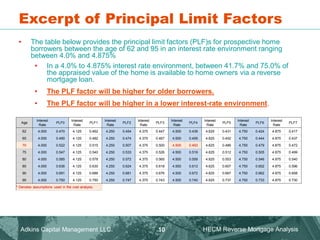
• The table below provides the principal limit factors (PLF)s for prospective home
borrowers between the age of 62 and 95 in an interest rate environment ranging
between 4.0% and 4.875%
• In a 4.0% to 4.875% interest rate environment, between 41.7% and 75.0% of
the appraised value of the home is available to home owners via a reverse
mortgage loan.
• The PLF factor will be higher for older borrowers.
• The PLF factor will be higher in a lower interest-rate environment.
Age
Interest
Rate
PLF0
Interest
Rate
PLF1
Interest
Rate
PLF2
Interest
Rate
PLF3
Interest
Rate
PLF4
Interest
Rate
PLF5
Interest
Rate
PLF6
Interest
Rate
PLF7
62 4.000 0.470 4.125 0.462 4.250 0.454 4.375 0.447 4.500 0.439 4.625 0.431 4.750 0.424 4.875 0.417
65 4.000 0.490 4.125 0.482 4.250 0.474 4.375 0.467 4.500 0.459 4.625 0.452 4.750 0.444 4.875 0.437
70 4.000 0.522 4.125 0.515 4.250 0.507 4.375 0.500 4.500 0.493 4.625 0.486 4.750 0.479 4.875 0.472
75 4.000 0.547 4.125 0.540 4.250 0.533 4.375 0.526 4.500 0.519 4.625 0.512 4.750 0.505 4.875 0.499
80 4.000 0.585 4.125 0.578 4.250 0.572 4.375 0.565 4.500 0.559 4.625 0.553 4.750 0.546 4.875 0.540
85 4.000 0.636 4.125 0.630 4.250 0.624 4.375 0.618 4.500 0.613 4.625 0.607 4.750 0.602 4.875 0.596
90 4.000 0.691 4.125 0.686 4.250 0.681 4.375 0.676 4.500 0.672 4.625 0.667 4.750 0.662 4.875 0.658
95 4.000 0.750 4.125 0.750 4.250 0.747 4.375 0.743 4.500 0.740 4.625 0.737 4.750 0.733 4.875 0.730
* Denotes assumptions used in the cost analysis.
COST ANALYSIS
Adkins Capital Management LLC. HECM Reverse Mortgage Analysis
11
• Lenders generally charge origination fees and other closing costs for a reverse
mortgage loan. Lenders also may charge servicing fees during the term of the
mortgage. The lender generally sets these fees and costs.
• The amount that a home owner will owe on a reverse mortgage loan generally grows
over time. Interest expense is charged on the outstanding balance and is added to
the amount owed each month. The home owner’s total debt increases over time as
loan funds are advanced to him and interest accrues on the loan.
• Reverse mortgage loans may have fixed or variable interest rates. Most reverse
mortgage loans have variable interest rates that are tied to a financial index and will
likely change according to market conditions.
• Reverse mortgage loans can use up all or some of the equity in the home owner’s
home, leaving fewer assets for him and his heirs.
• A “nonrecourse” clause, found in most reverse mortgage loans, prevents either
the home owner or his estate from owing more than the value of his home when
the loan is repaid.
• The home owner retains the title to his home after obtaining a reverse mortgage
loan. As a result, the home owner remains responsible for property taxes, insurance,
utilities, fuel, maintenance, and other expenses.
• If the home owner does not pay these expenses, he risks the reverse mortgage
loan becoming due and payable to the lender.
• Interest expense on a reverse mortgage loan is not deductible on income tax returns
until the loan is paid off in part or in whole.
Cost Implications of Reverse
Mortgage Loans
Adkins Capital Management LLC. HECM Reverse Mortgage Analysis
12
Types of Reverse Mortgage Loan
Expenditures
Here is a breakdown of HECM reverse mortgage loan fees and charges, according to
the Housing and Urban Development (HUD):
HECM Costs
• The homeowner can pay for most of the costs of an HECM reverse mortgage loan
by financing them and having them paid from the proceeds of the loan.
• Financing the costs of the loan means that the home owner does not have to
pay for the costs out of his pocket. Financing the costs reduces the net loan
amount available to the home owner.
• The HECM reverse mortgage loan includes several types of fees and charges,
which includes:
• 1) Origination fee
• 2) Mortgage insurance premiums (initial premium and annual premiums)
• 3) Third party charges
• 4) Interest expense
• 5) Servicing fees.
• The reverse mortgage lender will discuss which fees and charges are mandatory.
Adkins Capital Management LLC. HECM Reverse Mortgage Analysis
13
Types of Reverse Mortgage Loan
Expenditures
Origination Fee
• The home owner will pay an origination fee to compensate the reverse
mortgage lender for processing the HECM loan. A lender can charge the
greater of $2,500 or 2% of the first $200,000 of the home's value, plus 1% of
the amount over $200,000. HECM origination fees are capped at $6,000.
Mortgage Insurance Premium
• The home owner will be charged an initial mortgage insurance premium (MIP)
at closing of the loan. The initial MIP will be 2%, based on the maximum
lending limit of $726,525, or the home’s appraised value, whichever is less.
• Over the life of the loan, the home owner will be charged an annual MIP that
equals 0.5% of the outstanding mortgage loan balance.
• The home owner will incur a cost for FHA mortgage insurance. The mortgage
insurance guarantees that the home owner will receive expected loan
advances. The home owner can finance the MIP as part of his loan.
Third Party Charges
• Closing costs from third parties can include a home appraisal, title search and
insurance, surveys, inspections, recording fees, mortgage taxes, credit checks
and other fees.
Adkins Capital Management LLC. HECM Reverse Mortgage Analysis
14
Types of Reverse Mortgage Loan
Expenditures
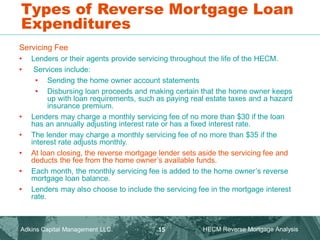
Servicing Fee
• Lenders or their agents provide servicing throughout the life of the HECM.
• Services include:
• Sending the home owner account statements
• Disbursing loan proceeds and making certain that the home owner keeps
up with loan requirements, such as paying real estate taxes and a hazard
insurance premium.
• Lenders may charge a monthly servicing fee of no more than $30 if the loan
has an annually adjusting interest rate or has a fixed interest rate.
• The lender may charge a monthly servicing fee of no more than $35 if the
interest rate adjusts monthly.
• At loan closing, the reverse mortgage lender sets aside the servicing fee and
deducts the fee from the home owner’s available funds.
• Each month, the monthly servicing fee is added to the home owner’s reverse
mortgage loan balance.
• Lenders may also choose to include the servicing fee in the mortgage interest
rate.
Adkins Capital Management LLC. HECM Reverse Mortgage Analysis
15
Reverse Mortgage Loan: Cost
Analysis Assumptions
Adkins Capital Management LLC. HECM Reverse Mortgage Analysis
16
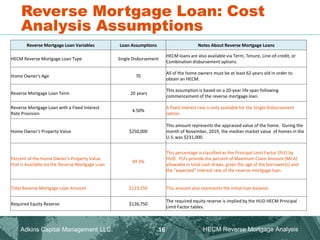
Reverse Mortgage Loan Variables Loan Assumptions Notes About Reverse Mortgage Loans
HECM Reverse Mortgage Loan Type Single Disbursement
HECM loans are also available via Term, Tenure, Line-of-credit, or
Combination disbursement options.
Home Owner's Age 70
All of the home owners must be at least 62 years old in order to
obtain an HECM.
Reverse Mortgage Loan Term 20 years
This assumption is based on a 20-year life span following
commencement of the reverse mortgage loan.
Reverse Mortgage Loan with a Fixed Interest
Rate Provision
4.50%
A fixed interest rate is only available for the Single Disbursement
option.
Home Owner's Property Value $250,000
This amount represents the appraised value of the home. During the
month of November, 2019, the median market value of homes in the
U.S. was $231,000.
Percent of the Home Owner's Property Value
that is Available via the Reverse Mortgage Loan
49.3%
This percentage is classified as the Principal Limit Factor (PLF) by
HUD. PLFs provide the percent of Maximum Claim Amount (MCA)
allowable in total cash draws, given the age of the borrower(s) and
the "expected" interest rate of the reverse mortgage loan.
Total Reverse Mortgage Loan Amount $123,250 This amount also represents the initial loan balance.
Required Equity Reserve $126,750
The required equity reserve is implied by the HUD HECM Principal
Limit Factor tables.
Reverse Mortgage Loan: One-
Time Costs
Adkins Capital Management LLC. HECM Reverse Mortgage Analysis
17
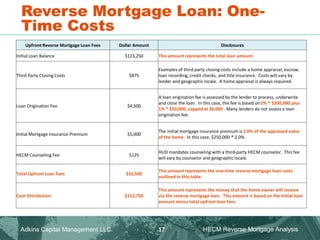
Upfront Reverse Mortgage Loan Fees Dollar Amount Disclosures
Initial Loan Balance $123,250 This amount represents the total loan amount.
Third Party Closing Costs $875
Examples of third party closing costs include a home appraisal, escrow,
loan recording, credit checks, and title insurance. Costs will vary by
lender and geographic locale. A home appraisal is always required.
Loan Origination Fee $4,500
A loan origination fee is assessed by the lender to process, underwrite
and close the loan. In this case, the fee is based on2% * $200,000 plus
1% * $50,000, capped at $6,000 . Many lenders do not assess a loan
origination fee.
Initial Mortgage Insurance Premium $5,000
The initial mortgage insurance premium is2.0% of the appraised value
of the home. In this case, $250,000 * 2.0%.
HECM Counseling Fee $125
HUD mandates counseling with a third-party HECM counselor. This fee
will vary by counselor and geographic locale.
Total Upfront Loan Fees $10,500
This amount represents the one-time reverse mortgage loan costs
outlined in this table.
Cash Distribution $112,750
This amount represents the money that the home owner will receive
via the reverse mortgage loan. This amount is based on the Initial loan
amount minus total upfront loan fees.
Reverse Mortgage Loan: Ongoing
Costs and Cumulative Balance
Adkins Capital Management LLC. HECM Reverse Mortgage Analysis
18
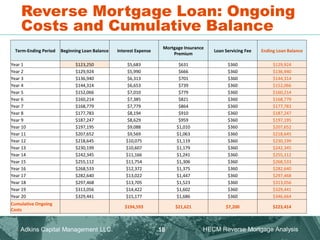
Term-Ending Period Beginning Loan Balance Interest Expense
Mortgage Insurance
Premium
Loan Servicing Fee Ending Loan Balance
Year 1 $123,250 $5,683 $631 $360 $129,924
Year 2 $129,924 $5,990 $666 $360 $136,940
Year 3 $136,940 $6,313 $701 $360 $144,314
Year 4 $144,314 $6,653 $739 $360 $152,066
Year 5 $152,066 $7,010 $779 $360 $160,214
Year 6 $160,214 $7,385 $821 $360 $168,779
Year 7 $168,779 $7,779 $864 $360 $177,783
Year 8 $177,783 $8,194 $910 $360 $187,247
Year 9 $187,247 $8,629 $959 $360 $197,195
Year 10 $197,195 $9,088 $1,010 $360 $207,652
Year 11 $207,652 $9,569 $1,063 $360 $218,645
Year 12 $218,645 $10,075 $1,119 $360 $230,199
Year 13 $230,199 $10,607 $1,179 $360 $242,345
Year 14 $242,345 $11,166 $1,241 $360 $255,112
Year 15 $255,112 $11,754 $1,306 $360 $268,533
Year 16 $268,533 $12,372 $1,375 $360 $282,640
Year 17 $282,640 $13,022 $1,447 $360 $297,468
Year 18 $297,468 $13,705 $1,523 $360 $313,056
Year 19 $313,056 $14,422 $1,602 $360 $329,441
Year 20 $329,441 $15,177 $1,686 $360 $346,664
Cumulative Ongoing
Costs
$194,593 $21,621 $7,200 $223,414
Reverse Mortgage Loan:
Analytical Conclusions
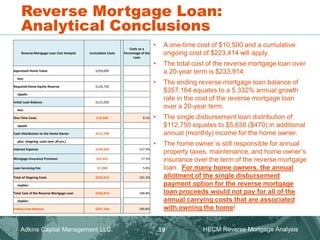
• A one-time cost of $10,500 and a cumulative
ongoing cost of $223,414 will apply.
• The total cost of the reverse mortgage loan over
a 20-year term is $233,914.
• The ending reverse mortgage loan balance of
$357,164 equates to a 5.332% annual growth
rate in the cost of the reverse mortgage loan
over a 20-year term.
• The single disbursement loan distribution of
$112,750 equates to $5,638 ($470) in additional
annual (monthly) income for the home owner.
• The home owner is still responsible for annual
property taxes, maintenance, and home owner’s
insurance over the term of the reverse mortgage
loan. For many home owners, the annual
allotment of the single disbursement
payment option for the reverse mortgage
loan proceeds would not pay for all of the
annual carrying costs that are associated
with owning the home!
Adkins Capital Management LLC. HECM Reverse Mortgage Analysis
19
Reverse Mortgage Loan Cost Analysis Cumulative Costs
Costs as a
Percentage of the
Loan
Appraised Home Value $250,000
less:
Required Home Equity Reserve $126,750
equals:
Initial Loan Balance $123,250
less:
One-Time Costs $10,500 8.5%
equals:
Cash Distribution to the Home Owner $112,750
plus: (ongoing costs over 20 yrs.)
Interest Expense $194,593 157.9%
Mortgage Insurance Premium $21,621 17.5%
Loan Servicing Fee $7,200 5.8%
Total of Ongoing Costs $223,414 181.3%
implies:
Total Cost of the Reverse Mortgage Loan $233,914 189.8%
implies:
Ending Loan Balance $357,164 289.8%
EMPIRICAL RESULTS
Adkins Capital Management LLC. HECM Reverse Mortgage Analysis
20
Reverse Mortgage Loan Complaints
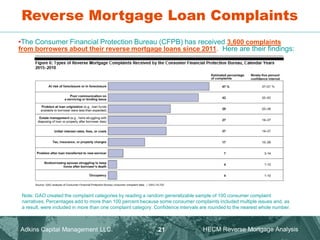
•The Consumer Financial Protection Bureau (CFPB) has received 3,600 complaints
from borrowers about their reverse mortgage loans since 2011. Here are their findings:
Note: GAO created the complaint categories by reading a random generalizable sample of 100 consumer complaint
narratives. Percentages add to more than 100 percent because some consumer complaints included multiple issues and, as
a result, were included in more than one complaint category. Confidence intervals are rounded to the nearest whole number.
Adkins Capital Management LLC. HECM Reverse Mortgage Analysis
21
Reverse Mortgage Loan Defaults
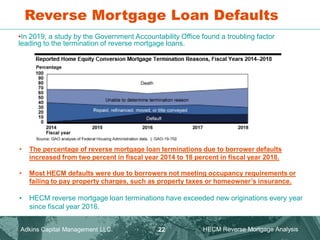
• The percentage of reverse mortgage loan terminations due to borrower defaults
increased from two percent in fiscal year 2014 to 18 percent in fiscal year 2018.
• Most HECM defaults were due to borrowers not meeting occupancy requirements or
failing to pay property charges, such as property taxes or homeowner’s insurance.
• HECM reverse mortgage loan terminations have exceeded new originations every year
since fiscal year 2016.
•In 2019, a study by the Government Accountability Office found a troubling factor
leading to the termination of reverse mortgage loans.
Adkins Capital Management LLC. HECM Reverse Mortgage Analysis
22
Market Volume of Reverse Mortgage
Loans
• Since 2000, the HECM reverse mortgage loan originations take-up rate
has been limited.
• The take-up rate is the ratio of HECM loan originations to eligible
senior homeowners.
• The take-up rate, which provides an indication of how popular HECMs
are among the population of senior homeowners, has not reached one
percent and has fallen in recent years.
• According to the GAO, since calendar year 2010, the volume of HECM
originations has declined and is about one-half of what the
originations had been at their peak.
• In calendar years 2007–2009, more than 100,000 new HECMs were
originated each year, compared with roughly 42,000 in calendar year
2018.
Adkins Capital Management LLC. HECM Reverse Mortgage Analysis
23
FINAL REMARKS
Adkins Capital Management LLC. HECM Reverse Mortgage Analysis
24
All Things Considered about
Reverse Mortgage Loans
• HECM reverse mortgage loans have thousands of dissatisfied borrowers, almost one in
five borrowers have defaulted on their loan, the HECM loan originations take-up rate is
less than one percent, and the current HECM loan volume is only about one-half the
amount that it was in 2010.
• Bank of America and Wells Fargo have exited the reverse mortgage loan business,
ostensibly because they feared the risk of damage to their respective banking
reputations if they foreclosed on seniors who defaulted on their HECM reverse mortgage
loans.
• Reverse mortgage loans are expensive because they have high upfront costs and
high ongoing costs.
• Most reverse mortgage loans have variable interest rates that are tied to a financial
index. This in turn makes it very difficult to estimate the total cost of reverse
mortgage loans, particularly in a rising interest rate environment.
• Each month, interest expense is calculated not only on the principal amount
received by the borrower but on the interest previously assessed to the reverse
mortgage loan.
• The only reverse mortgage loan payment plan that has a fixed interest rate provision is
the single disbursement lump sum option.
• For many home owners, the annual allotment of the single disbursement
payment option for the reverse mortgage loan proceeds will not pay for all of
the annual carrying costs that are associated with owning the home.
Adkins Capital Management LLC. HECM Reverse Mortgage Analysis
25
All Things Considered about
Reverse Mortgage Loans
• The Consumer Financial Protection Bureau (CFPB) has identified the lump-sum
distribution option as potentially risky for younger borrowers with longer lifespans
because such loans place these borrowers at risk of using up their home equity early in
their retirement.
• Reverse mortgage loans reduce the amount of financial assets that will be available to
bequeath to the home owner’s heirs.
• Homeowners that are put in nursing homes for more than one year may violate the
provisions of the reverse mortgage loan contract and therefore be forced to sell their
homes.
• The GAO has determined that the FHA needs to improve the monitoring and
oversight of reverse mortgage loan outcomes and servicing.
• The terms and conditions for reverse mortgage loans are complex and comprehensive
and take a significant amount of time and effort for home owners to understand.
• Most people have neither the financial education nor the time and interest to learn about
all of the intricacies associated with reverse mortgage loans. This problem is
compounded as people age and start to lose their mental capacities.
Adkins Capital Management LLC. HECM Reverse Mortgage Analysis
26
Alternatives to Reverse Mortgage
Loans: “Things To Reconsider”
• This review of HECM reverse mortgage loans provides a comprehensive and objective
evaluation of the issues that are associated with these types of complex financial products.
• Based on this review, there are more than a dozen material issues that should
dissuade most home owners from obtaining a reverse mortgage loan.
• Home owners that need to increase the amount of income at their disposal should
consider:
• Selling their home, downsizing to a less expensive home to live in during the
remaining portion of their lives, and using the residual capital to meet their financial
obligations;
• Selling their home, renting a less expensive home, apartment, or condominium to
live in during the remaining portion of their lives, and using the residual capital to
meet their financial obligations;
• Staying in their home, allowing a friend to move into their home as a paying tenant,
and using the income received from the friend to meet their financial obligations; or
• Staying in their home, selling their home to their children, paying rent to their
children as a tenant, and having their children serve as a landlord investor.
• Notwithstanding the overall theme of this presentation, for home owners that are
facing financial peril, a reverse mortgage loan may serve as a feasible “last-ditch
effort” to monetize a portion of the appraised value of their home in order to bolster
their monthly income during their elder years.
Adkins Capital Management LLC. HECM Reverse Mortgage Analysis
27
Reverse Mortgage Loans: “Things
For Investors To Consider”
• For home owners that are financially stable and are financially astute, a reverse mortgage loan
may serve as a valuable financial tool.
• Reverse mortgage loan proceeds have a moderate hurdle rate that can be greatly exceeded
by investing the loan proceeds in the global capital markets.
• In this presentation, the cost of the reverse mortgage loan only increased by 5.332%
each year over the 20-year term of the loan.
• In comparison, the year-to-date return on the S&P 500 Index is approximately
26.5%.
• In this presentation, the appraised value of the home would only have to increase each year
by 1.793% in order to offset the costs of the reverse mortgage loan.
• Assuming that the market value of the home exceeds its appraised value, the annual
required increase in the market value of the home is a very attractive cost for
investment capital.
• Reverse mortgage loans provide astute home owners with the opportunity to utilize financial
leverage in order to bolster their net worth.
• The nonrecourse clause in HECM reverse mortgage loans gives home owners a built in “put
option derivative” feature that is tied to the value of their homes.
• Home owners will never owe more on their reverse mortgage loans than the value of
their homes. This “put” option provision limits the downside risk of reverse mortgage
loans and would serve as a valuable feature if there is another housing crisis.
• Reverse mortgage loans exhibit both tangible benefits (i.e. a place to live) and intangible
benefits (investment capital).
• Nevertheless, HECM reverse mortgage loans were not created in order to help investors
bolster their net worth. Therefore, reverse mortgage loans should not be evaluated from
this perspective.
Adkins Capital Management LLC. HECM Reverse Mortgage Analysis
28
Adkins Capital Management
residentialrealestateanalysis.com
New York City, NY, U.S.A.
Contents of this report are the property of Adkins Capital Management. No part of this report may be reproduced,
redistributed, displayed, or transmitted without the written consent from representatives of Adkins Capital Management.
IMPORTANT DISCLOSURES
• This comprehensive analysis is based on information and data provided in the Government
Accountability Office report titled: “REVERSE MORTGAGES FHA Needs to Improve Monitoring and
Oversight of Loan Outcomes and Servicing” that was submitted to Congressional Requestors in
September, 2019.
• Comprehensive information about the Home Equity Conversion Mortgage (HECM) loan program,
including HECM Principal Limit Factors (PLF) tables, can be found on the HUD.gov website.
• The National Council on Aging has published a free guide for seniors who are considering a reverse
mortgage loan. The title of the guide is: “Use Your Home to Stay at Home.”
• The contents of this presentation were researched, analyzed, written, edited, narrated, produced, and
published by Troy Adkins.
“Helping prospective home buyers make a prudent home purchase decision”
Adkins Capital Management LLC. HECM Reverse Mortgage Analysis
29

Reverse Mortgage Loan Analysis

  • 1.
    ADKINS CAPITAL MANAGEMENT ACOMPREHENSIVE REVIEW OF HECM REVERSE MORTGAGES IN THE UNITED STATES 2 0 1 9
  • 2.
    Presentation Contents • Introductionto Reverse Mortgage Loans • Overview of Reverse Mortgage Loans • History of Reverse Mortgage Loans • Criteria for Obtaining a Reverse Mortgage Loan • Reverse Mortgage Loan Features • Legal Provisions of Reverse Mortgage Loans • Dissemination of Reverse Mortgage Loan Proceeds • Amount of Money that can be Borrowed via a Reverse Mortgage Loan • Principal Limit Factor Provisions • Excerpt of Principal Limit Factors • Cost Analysis • Cost Implications of Reverse Mortgage Loans • Types of Reverse Mortgage Loan Expenditures • Reverse Mortgage Loan: Cost Analysis Assumptions • Reverse Mortgage Loan: One-Time Costs • Reverse Mortgage Loan: Ongoing Costs and Cumulative Balance • Reverse Mortgage Loan: Analytical Conclusions • Empirical Results • Reverse Mortgage Loan Complaints • Reverse Mortgage Loan Defaults • Market Volume of Reverse Mortgage Loans • Final Remarks • All Things Considered about Reverse Mortgage Loans • Alternatives to Reverse Mortgage Loans: “Things To Reconsider” • Reverse Mortgage Loans: “Things For Investors To Consider” i Adkins Capital Management LLC. HECM Reverse Mortgage Analysis
  • 3.
    INTROUDCTION TO REVERSE MORTGAGE LOANS AdkinsCapital Management LLC. HECM Reverse Mortgage Analysis 1
  • 4.
    Overview of ReverseMortgage Loans • A reverse mortgage loan is a special type of loan that is used by older Americans to convert the equity in their homes into cash. • Reverse mortgage loans are designed to help homeowners who are house- rich but cash-poor stay in their homes and still meet their financial obligations. • A reverse mortgage loan is aptly named because the payment stream is “reversed.” Instead of making monthly payments to a lender, as with a regular mortgage, a lender makes a single payment or a series of payments to the borrower. • A reverse mortgage loan must be repaid to the lender when the borrower dies, sells his home, or no longer lives in his home as his principal residence. • A reverse mortgage loan does not require a loan repayment for as long as the home owner lives in his home. • Eligible property types for a reverse mortgage loan includes single-family homes, manufactured homes (built after June 1976), qualified condominiums, and townhouses. Adkins Capital Management LLC. HECM Reverse Mortgage Analysis 2
  • 5.
    History of ReverseMortgage Loans • In 1989, the Reverse Mortgage loan became a tool for Senior Americans when the United States Congress authorized the Department of Housing and Urban Development (HUD) through the Federal Housing Administration (FHA) to create the Home Equity Conversion Mortgage (HECM) program. • In 1996, an additional type of Reverse Mortgage loan became available when the Federal National Mortgage Association (Fannie Mae) created the Home Keeper Reverse Mortgage. • In 2017, 55,332 reverse mortgage loans were obtained by home owners across the U.S., with approximately $10.6 billion in financing provided through an average principal loan limit amount of $191,793, and an average loan interest rate of 4.585%. • As of 2019, according to both the Government Accountability Office (GAO) and the HUD, the vast majority of reverse mortgage loans are insured by FHA under the HECM program. Adkins Capital Management LLC. HECM Reverse Mortgage Analysis 3
  • 6.
    Criteria for Obtaininga Reverse Mortgage Loan • The home owner must own his home, and generally all of the home owners must be at least 62 years old. • The home must be the home owner’s “principal residence.” • The home owner must live in the home for more than one-half of the year. • For the federally-insured “Home Equity Conversion Mortgage” (HECM) program, the home must be a single-family property, a 2-4 unit building, or a federally-approved condominium or planned unit development (PUD). • For Fannie Mae's “HomeKeeper” mortgage, the home must be a single family home, PUD, or condominium. • Reverse mortgage loan programs generally do not lend on cooperative apartments or mobile homes, although some "manufactured" homes may qualify if they are built on a permanent foundation, classed and taxed as real estate, and meet other requirements. Adkins Capital Management LLC. HECM Reverse Mortgage Analysis 4
  • 7.
    REVERSE MORTGAGE LOAN FEATURES AdkinsCapital Management LLC. HECM Reverse Mortgage Analysis 5
  • 8.
    • Reverse mortgageloan lenders require home owners to pay off any debt against their homes before obtaining a reverse mortgage loan. • Home owners can use an immediate cash advance from the reverse mortgage loan to pay off any outstanding mortgage debt. • Reverse mortgage loans are not taxable, and generally do not affect Social Security or Medicare benefits. • Reverse mortgage loans allow home owners to retain the title to their homes. • Reverse mortgage loans must be repaid when the last surviving borrower dies, sells their home, or no longer lives in the home as a principal residence. • In the HECM reverse mortgage loan program, borrowers can live in a nursing home or other medical facility for up to 12 months before the reverse mortgage loan becomes due and payable. Legal Provisions of Reverse Mortgage Loans Adkins Capital Management LLC. HECM Reverse Mortgage Analysis 6
  • 9.
    • Reverse mortgageloan proceeds are distributed in a number of ways, including: • “Single” disbursement – fixed interest rate. Lump sum distribution. • “Term” disbursement – adjustable interest rate. Fixed monthly cash advances for a specific time. • “Tenure” disbursement – adjustable interest rate. Fixed monthly cash advances for as long as the home owner lives in the home. • “Line-of-Credit” – adjustable interest rate. A line of credit that lets the home owner draw down the loan proceeds at any time, in amounts the home owner chooses, until the home owner has used up the line- of-credit. • “Modified Term” – adjustable interest rate. A combination of a Term disbursement and a Line-of-Credit; or • “Modified Tenure” – adjustable interest rate. A combination of a Tenure disbursement and a Line-of-Credit. Dissemination Options for Reverse Mortgage Loan Proceeds Adkins Capital Management LLC. HECM Reverse Mortgage Analysis 7
  • 10.
    • The amountof money that can be borrowed via an HECM reverse mortgage loan (i.e., principal limit) depends on three factors: • First, the age of the youngest borrower or eligible non-borrowing spouse. • A non-borrowing spouse is defined as the spouse, as determined by the law of the state in which the borrower and spouse reside or the state of celebration, at the time of closing and who is not listed on the mortgage as a borrower. • Second, the lesser of the appraised value of the home or the FHA mortgage limit as of the date of loan closing (for calendar year 2019, $726,525). • In the case of an “HECM for Purchase” loan, the principal limit is based on the lesser of the appraised value of the home or the sale price of the property being purchased. • The “HECM for Purchase” program allows seniors to use an HECM to buy a new home. Unlike a traditional HECM, an “HECM for Purchase” loan is made against the value of the home to be purchased, rather than against the value of a home the borrower already owns. • Third, the expected average interest rate. Amount of Money that can be Borrowed via a Reverse Mortgage Loan Adkins Capital Management LLC. HECM Reverse Mortgage Analysis 8
  • 11.
    Principal Limit FactorProvisions Adkins Capital Management LLC. HECM Reverse Mortgage Analysis 9 • The amount of money that is available to prospective home owners via a reverse mortgage loan is dependent upon the principal limit factors established by the HUD. • HUD has established HECM Principal Limit Factors (PLFs) in order to provide the percent of Maximum Claim Amount (MCA) allowable in total cash draws, given the age of the borrower(s) and the "expected" interest rate of the loan. • On October 2, 2017, HUD established new PLF factor tables. Principal Limit Factor (PLFs) tables can be found on the HUD.gov website. • The PLFs vary by age and interest rate across the full ranges of ages (18 – 99) and interest rates (3% - 18%) covered by the tables. • Additional rates may be published as market conditions change. • For HECM reverse mortgage loans with a fixed-interest rate loan provision, the expected interest rate that determines the PLF is the actual note (coupon) rate on the mortgage loan. • For HECM reverse mortgage loans with an adjustable-interest rate loan provision, the expected interest rate is calculated as the sum of an underlying index rate (10- year LIBOR or Constant-Maturity Treasury yield) and the lender's index margin. • For calculation of interest accruals on HECM loans, the lender's index margin is added to the actual interest rate index used for loan funding (1-month or 1-year, LIBOR or Constant-Maturity Treasury). • The type of index used for PLF determination (i.e., LIBOR or Treasury) must match that used in the loan documents and for interest accruals.
  • 12.
    Excerpt of PrincipalLimit Factors Adkins Capital Management LLC. HECM Reverse Mortgage Analysis 10 • The table below provides the principal limit factors (PLF)s for prospective home borrowers between the age of 62 and 95 in an interest rate environment ranging between 4.0% and 4.875% • In a 4.0% to 4.875% interest rate environment, between 41.7% and 75.0% of the appraised value of the home is available to home owners via a reverse mortgage loan. • The PLF factor will be higher for older borrowers. • The PLF factor will be higher in a lower interest-rate environment. Age Interest Rate PLF0 Interest Rate PLF1 Interest Rate PLF2 Interest Rate PLF3 Interest Rate PLF4 Interest Rate PLF5 Interest Rate PLF6 Interest Rate PLF7 62 4.000 0.470 4.125 0.462 4.250 0.454 4.375 0.447 4.500 0.439 4.625 0.431 4.750 0.424 4.875 0.417 65 4.000 0.490 4.125 0.482 4.250 0.474 4.375 0.467 4.500 0.459 4.625 0.452 4.750 0.444 4.875 0.437 70 4.000 0.522 4.125 0.515 4.250 0.507 4.375 0.500 4.500 0.493 4.625 0.486 4.750 0.479 4.875 0.472 75 4.000 0.547 4.125 0.540 4.250 0.533 4.375 0.526 4.500 0.519 4.625 0.512 4.750 0.505 4.875 0.499 80 4.000 0.585 4.125 0.578 4.250 0.572 4.375 0.565 4.500 0.559 4.625 0.553 4.750 0.546 4.875 0.540 85 4.000 0.636 4.125 0.630 4.250 0.624 4.375 0.618 4.500 0.613 4.625 0.607 4.750 0.602 4.875 0.596 90 4.000 0.691 4.125 0.686 4.250 0.681 4.375 0.676 4.500 0.672 4.625 0.667 4.750 0.662 4.875 0.658 95 4.000 0.750 4.125 0.750 4.250 0.747 4.375 0.743 4.500 0.740 4.625 0.737 4.750 0.733 4.875 0.730 * Denotes assumptions used in the cost analysis.
  • 13.
    COST ANALYSIS Adkins CapitalManagement LLC. HECM Reverse Mortgage Analysis 11
  • 14.
    • Lenders generallycharge origination fees and other closing costs for a reverse mortgage loan. Lenders also may charge servicing fees during the term of the mortgage. The lender generally sets these fees and costs. • The amount that a home owner will owe on a reverse mortgage loan generally grows over time. Interest expense is charged on the outstanding balance and is added to the amount owed each month. The home owner’s total debt increases over time as loan funds are advanced to him and interest accrues on the loan. • Reverse mortgage loans may have fixed or variable interest rates. Most reverse mortgage loans have variable interest rates that are tied to a financial index and will likely change according to market conditions. • Reverse mortgage loans can use up all or some of the equity in the home owner’s home, leaving fewer assets for him and his heirs. • A “nonrecourse” clause, found in most reverse mortgage loans, prevents either the home owner or his estate from owing more than the value of his home when the loan is repaid. • The home owner retains the title to his home after obtaining a reverse mortgage loan. As a result, the home owner remains responsible for property taxes, insurance, utilities, fuel, maintenance, and other expenses. • If the home owner does not pay these expenses, he risks the reverse mortgage loan becoming due and payable to the lender. • Interest expense on a reverse mortgage loan is not deductible on income tax returns until the loan is paid off in part or in whole. Cost Implications of Reverse Mortgage Loans Adkins Capital Management LLC. HECM Reverse Mortgage Analysis 12
  • 15.
    Types of ReverseMortgage Loan Expenditures Here is a breakdown of HECM reverse mortgage loan fees and charges, according to the Housing and Urban Development (HUD): HECM Costs • The homeowner can pay for most of the costs of an HECM reverse mortgage loan by financing them and having them paid from the proceeds of the loan. • Financing the costs of the loan means that the home owner does not have to pay for the costs out of his pocket. Financing the costs reduces the net loan amount available to the home owner. • The HECM reverse mortgage loan includes several types of fees and charges, which includes: • 1) Origination fee • 2) Mortgage insurance premiums (initial premium and annual premiums) • 3) Third party charges • 4) Interest expense • 5) Servicing fees. • The reverse mortgage lender will discuss which fees and charges are mandatory. Adkins Capital Management LLC. HECM Reverse Mortgage Analysis 13
  • 16.
    Types of ReverseMortgage Loan Expenditures Origination Fee • The home owner will pay an origination fee to compensate the reverse mortgage lender for processing the HECM loan. A lender can charge the greater of $2,500 or 2% of the first $200,000 of the home's value, plus 1% of the amount over $200,000. HECM origination fees are capped at $6,000. Mortgage Insurance Premium • The home owner will be charged an initial mortgage insurance premium (MIP) at closing of the loan. The initial MIP will be 2%, based on the maximum lending limit of $726,525, or the home’s appraised value, whichever is less. • Over the life of the loan, the home owner will be charged an annual MIP that equals 0.5% of the outstanding mortgage loan balance. • The home owner will incur a cost for FHA mortgage insurance. The mortgage insurance guarantees that the home owner will receive expected loan advances. The home owner can finance the MIP as part of his loan. Third Party Charges • Closing costs from third parties can include a home appraisal, title search and insurance, surveys, inspections, recording fees, mortgage taxes, credit checks and other fees. Adkins Capital Management LLC. HECM Reverse Mortgage Analysis 14
  • 17.
    Types of ReverseMortgage Loan Expenditures Servicing Fee • Lenders or their agents provide servicing throughout the life of the HECM. • Services include: • Sending the home owner account statements • Disbursing loan proceeds and making certain that the home owner keeps up with loan requirements, such as paying real estate taxes and a hazard insurance premium. • Lenders may charge a monthly servicing fee of no more than $30 if the loan has an annually adjusting interest rate or has a fixed interest rate. • The lender may charge a monthly servicing fee of no more than $35 if the interest rate adjusts monthly. • At loan closing, the reverse mortgage lender sets aside the servicing fee and deducts the fee from the home owner’s available funds. • Each month, the monthly servicing fee is added to the home owner’s reverse mortgage loan balance. • Lenders may also choose to include the servicing fee in the mortgage interest rate. Adkins Capital Management LLC. HECM Reverse Mortgage Analysis 15
  • 18.
    Reverse Mortgage Loan:Cost Analysis Assumptions Adkins Capital Management LLC. HECM Reverse Mortgage Analysis 16 Reverse Mortgage Loan Variables Loan Assumptions Notes About Reverse Mortgage Loans HECM Reverse Mortgage Loan Type Single Disbursement HECM loans are also available via Term, Tenure, Line-of-credit, or Combination disbursement options. Home Owner's Age 70 All of the home owners must be at least 62 years old in order to obtain an HECM. Reverse Mortgage Loan Term 20 years This assumption is based on a 20-year life span following commencement of the reverse mortgage loan. Reverse Mortgage Loan with a Fixed Interest Rate Provision 4.50% A fixed interest rate is only available for the Single Disbursement option. Home Owner's Property Value $250,000 This amount represents the appraised value of the home. During the month of November, 2019, the median market value of homes in the U.S. was $231,000. Percent of the Home Owner's Property Value that is Available via the Reverse Mortgage Loan 49.3% This percentage is classified as the Principal Limit Factor (PLF) by HUD. PLFs provide the percent of Maximum Claim Amount (MCA) allowable in total cash draws, given the age of the borrower(s) and the "expected" interest rate of the reverse mortgage loan. Total Reverse Mortgage Loan Amount $123,250 This amount also represents the initial loan balance. Required Equity Reserve $126,750 The required equity reserve is implied by the HUD HECM Principal Limit Factor tables.
  • 19.
    Reverse Mortgage Loan:One- Time Costs Adkins Capital Management LLC. HECM Reverse Mortgage Analysis 17 Upfront Reverse Mortgage Loan Fees Dollar Amount Disclosures Initial Loan Balance $123,250 This amount represents the total loan amount. Third Party Closing Costs $875 Examples of third party closing costs include a home appraisal, escrow, loan recording, credit checks, and title insurance. Costs will vary by lender and geographic locale. A home appraisal is always required. Loan Origination Fee $4,500 A loan origination fee is assessed by the lender to process, underwrite and close the loan. In this case, the fee is based on2% * $200,000 plus 1% * $50,000, capped at $6,000 . Many lenders do not assess a loan origination fee. Initial Mortgage Insurance Premium $5,000 The initial mortgage insurance premium is2.0% of the appraised value of the home. In this case, $250,000 * 2.0%. HECM Counseling Fee $125 HUD mandates counseling with a third-party HECM counselor. This fee will vary by counselor and geographic locale. Total Upfront Loan Fees $10,500 This amount represents the one-time reverse mortgage loan costs outlined in this table. Cash Distribution $112,750 This amount represents the money that the home owner will receive via the reverse mortgage loan. This amount is based on the Initial loan amount minus total upfront loan fees.
  • 20.
    Reverse Mortgage Loan:Ongoing Costs and Cumulative Balance Adkins Capital Management LLC. HECM Reverse Mortgage Analysis 18 Term-Ending Period Beginning Loan Balance Interest Expense Mortgage Insurance Premium Loan Servicing Fee Ending Loan Balance Year 1 $123,250 $5,683 $631 $360 $129,924 Year 2 $129,924 $5,990 $666 $360 $136,940 Year 3 $136,940 $6,313 $701 $360 $144,314 Year 4 $144,314 $6,653 $739 $360 $152,066 Year 5 $152,066 $7,010 $779 $360 $160,214 Year 6 $160,214 $7,385 $821 $360 $168,779 Year 7 $168,779 $7,779 $864 $360 $177,783 Year 8 $177,783 $8,194 $910 $360 $187,247 Year 9 $187,247 $8,629 $959 $360 $197,195 Year 10 $197,195 $9,088 $1,010 $360 $207,652 Year 11 $207,652 $9,569 $1,063 $360 $218,645 Year 12 $218,645 $10,075 $1,119 $360 $230,199 Year 13 $230,199 $10,607 $1,179 $360 $242,345 Year 14 $242,345 $11,166 $1,241 $360 $255,112 Year 15 $255,112 $11,754 $1,306 $360 $268,533 Year 16 $268,533 $12,372 $1,375 $360 $282,640 Year 17 $282,640 $13,022 $1,447 $360 $297,468 Year 18 $297,468 $13,705 $1,523 $360 $313,056 Year 19 $313,056 $14,422 $1,602 $360 $329,441 Year 20 $329,441 $15,177 $1,686 $360 $346,664 Cumulative Ongoing Costs $194,593 $21,621 $7,200 $223,414
  • 21.
    Reverse Mortgage Loan: AnalyticalConclusions • A one-time cost of $10,500 and a cumulative ongoing cost of $223,414 will apply. • The total cost of the reverse mortgage loan over a 20-year term is $233,914. • The ending reverse mortgage loan balance of $357,164 equates to a 5.332% annual growth rate in the cost of the reverse mortgage loan over a 20-year term. • The single disbursement loan distribution of $112,750 equates to $5,638 ($470) in additional annual (monthly) income for the home owner. • The home owner is still responsible for annual property taxes, maintenance, and home owner’s insurance over the term of the reverse mortgage loan. For many home owners, the annual allotment of the single disbursement payment option for the reverse mortgage loan proceeds would not pay for all of the annual carrying costs that are associated with owning the home! Adkins Capital Management LLC. HECM Reverse Mortgage Analysis 19 Reverse Mortgage Loan Cost Analysis Cumulative Costs Costs as a Percentage of the Loan Appraised Home Value $250,000 less: Required Home Equity Reserve $126,750 equals: Initial Loan Balance $123,250 less: One-Time Costs $10,500 8.5% equals: Cash Distribution to the Home Owner $112,750 plus: (ongoing costs over 20 yrs.) Interest Expense $194,593 157.9% Mortgage Insurance Premium $21,621 17.5% Loan Servicing Fee $7,200 5.8% Total of Ongoing Costs $223,414 181.3% implies: Total Cost of the Reverse Mortgage Loan $233,914 189.8% implies: Ending Loan Balance $357,164 289.8%
  • 22.
    EMPIRICAL RESULTS Adkins CapitalManagement LLC. HECM Reverse Mortgage Analysis 20
  • 23.
    Reverse Mortgage LoanComplaints •The Consumer Financial Protection Bureau (CFPB) has received 3,600 complaints from borrowers about their reverse mortgage loans since 2011. Here are their findings: Note: GAO created the complaint categories by reading a random generalizable sample of 100 consumer complaint narratives. Percentages add to more than 100 percent because some consumer complaints included multiple issues and, as a result, were included in more than one complaint category. Confidence intervals are rounded to the nearest whole number. Adkins Capital Management LLC. HECM Reverse Mortgage Analysis 21
  • 24.
    Reverse Mortgage LoanDefaults • The percentage of reverse mortgage loan terminations due to borrower defaults increased from two percent in fiscal year 2014 to 18 percent in fiscal year 2018. • Most HECM defaults were due to borrowers not meeting occupancy requirements or failing to pay property charges, such as property taxes or homeowner’s insurance. • HECM reverse mortgage loan terminations have exceeded new originations every year since fiscal year 2016. •In 2019, a study by the Government Accountability Office found a troubling factor leading to the termination of reverse mortgage loans. Adkins Capital Management LLC. HECM Reverse Mortgage Analysis 22
  • 25.
    Market Volume ofReverse Mortgage Loans • Since 2000, the HECM reverse mortgage loan originations take-up rate has been limited. • The take-up rate is the ratio of HECM loan originations to eligible senior homeowners. • The take-up rate, which provides an indication of how popular HECMs are among the population of senior homeowners, has not reached one percent and has fallen in recent years. • According to the GAO, since calendar year 2010, the volume of HECM originations has declined and is about one-half of what the originations had been at their peak. • In calendar years 2007–2009, more than 100,000 new HECMs were originated each year, compared with roughly 42,000 in calendar year 2018. Adkins Capital Management LLC. HECM Reverse Mortgage Analysis 23
  • 26.
    FINAL REMARKS Adkins CapitalManagement LLC. HECM Reverse Mortgage Analysis 24
  • 27.
    All Things Consideredabout Reverse Mortgage Loans • HECM reverse mortgage loans have thousands of dissatisfied borrowers, almost one in five borrowers have defaulted on their loan, the HECM loan originations take-up rate is less than one percent, and the current HECM loan volume is only about one-half the amount that it was in 2010. • Bank of America and Wells Fargo have exited the reverse mortgage loan business, ostensibly because they feared the risk of damage to their respective banking reputations if they foreclosed on seniors who defaulted on their HECM reverse mortgage loans. • Reverse mortgage loans are expensive because they have high upfront costs and high ongoing costs. • Most reverse mortgage loans have variable interest rates that are tied to a financial index. This in turn makes it very difficult to estimate the total cost of reverse mortgage loans, particularly in a rising interest rate environment. • Each month, interest expense is calculated not only on the principal amount received by the borrower but on the interest previously assessed to the reverse mortgage loan. • The only reverse mortgage loan payment plan that has a fixed interest rate provision is the single disbursement lump sum option. • For many home owners, the annual allotment of the single disbursement payment option for the reverse mortgage loan proceeds will not pay for all of the annual carrying costs that are associated with owning the home. Adkins Capital Management LLC. HECM Reverse Mortgage Analysis 25
  • 28.
    All Things Consideredabout Reverse Mortgage Loans • The Consumer Financial Protection Bureau (CFPB) has identified the lump-sum distribution option as potentially risky for younger borrowers with longer lifespans because such loans place these borrowers at risk of using up their home equity early in their retirement. • Reverse mortgage loans reduce the amount of financial assets that will be available to bequeath to the home owner’s heirs. • Homeowners that are put in nursing homes for more than one year may violate the provisions of the reverse mortgage loan contract and therefore be forced to sell their homes. • The GAO has determined that the FHA needs to improve the monitoring and oversight of reverse mortgage loan outcomes and servicing. • The terms and conditions for reverse mortgage loans are complex and comprehensive and take a significant amount of time and effort for home owners to understand. • Most people have neither the financial education nor the time and interest to learn about all of the intricacies associated with reverse mortgage loans. This problem is compounded as people age and start to lose their mental capacities. Adkins Capital Management LLC. HECM Reverse Mortgage Analysis 26
  • 29.
    Alternatives to ReverseMortgage Loans: “Things To Reconsider” • This review of HECM reverse mortgage loans provides a comprehensive and objective evaluation of the issues that are associated with these types of complex financial products. • Based on this review, there are more than a dozen material issues that should dissuade most home owners from obtaining a reverse mortgage loan. • Home owners that need to increase the amount of income at their disposal should consider: • Selling their home, downsizing to a less expensive home to live in during the remaining portion of their lives, and using the residual capital to meet their financial obligations; • Selling their home, renting a less expensive home, apartment, or condominium to live in during the remaining portion of their lives, and using the residual capital to meet their financial obligations; • Staying in their home, allowing a friend to move into their home as a paying tenant, and using the income received from the friend to meet their financial obligations; or • Staying in their home, selling their home to their children, paying rent to their children as a tenant, and having their children serve as a landlord investor. • Notwithstanding the overall theme of this presentation, for home owners that are facing financial peril, a reverse mortgage loan may serve as a feasible “last-ditch effort” to monetize a portion of the appraised value of their home in order to bolster their monthly income during their elder years. Adkins Capital Management LLC. HECM Reverse Mortgage Analysis 27
  • 30.
    Reverse Mortgage Loans:“Things For Investors To Consider” • For home owners that are financially stable and are financially astute, a reverse mortgage loan may serve as a valuable financial tool. • Reverse mortgage loan proceeds have a moderate hurdle rate that can be greatly exceeded by investing the loan proceeds in the global capital markets. • In this presentation, the cost of the reverse mortgage loan only increased by 5.332% each year over the 20-year term of the loan. • In comparison, the year-to-date return on the S&P 500 Index is approximately 26.5%. • In this presentation, the appraised value of the home would only have to increase each year by 1.793% in order to offset the costs of the reverse mortgage loan. • Assuming that the market value of the home exceeds its appraised value, the annual required increase in the market value of the home is a very attractive cost for investment capital. • Reverse mortgage loans provide astute home owners with the opportunity to utilize financial leverage in order to bolster their net worth. • The nonrecourse clause in HECM reverse mortgage loans gives home owners a built in “put option derivative” feature that is tied to the value of their homes. • Home owners will never owe more on their reverse mortgage loans than the value of their homes. This “put” option provision limits the downside risk of reverse mortgage loans and would serve as a valuable feature if there is another housing crisis. • Reverse mortgage loans exhibit both tangible benefits (i.e. a place to live) and intangible benefits (investment capital). • Nevertheless, HECM reverse mortgage loans were not created in order to help investors bolster their net worth. Therefore, reverse mortgage loans should not be evaluated from this perspective. Adkins Capital Management LLC. HECM Reverse Mortgage Analysis 28
  • 31.
    Adkins Capital Management residentialrealestateanalysis.com NewYork City, NY, U.S.A. Contents of this report are the property of Adkins Capital Management. No part of this report may be reproduced, redistributed, displayed, or transmitted without the written consent from representatives of Adkins Capital Management. IMPORTANT DISCLOSURES • This comprehensive analysis is based on information and data provided in the Government Accountability Office report titled: “REVERSE MORTGAGES FHA Needs to Improve Monitoring and Oversight of Loan Outcomes and Servicing” that was submitted to Congressional Requestors in September, 2019. • Comprehensive information about the Home Equity Conversion Mortgage (HECM) loan program, including HECM Principal Limit Factors (PLF) tables, can be found on the HUD.gov website. • The National Council on Aging has published a free guide for seniors who are considering a reverse mortgage loan. The title of the guide is: “Use Your Home to Stay at Home.” • The contents of this presentation were researched, analyzed, written, edited, narrated, produced, and published by Troy Adkins. “Helping prospective home buyers make a prudent home purchase decision” Adkins Capital Management LLC. HECM Reverse Mortgage Analysis 29