Household Financial Fragility:
Evidence and Implications
Prof. Annamaria Lusardi
The George Washington University School of Business
Academic Director, Global Financial Literacy Excellence Center (GFLEC)
20 April 2016
Global economic scenario
• Many economies are recovering from the financial crisis
and Great Recession
• Data show that large segments of the population
continue to face financial difficulties
• Several years after the Recession, many people feel they
are not financially secure
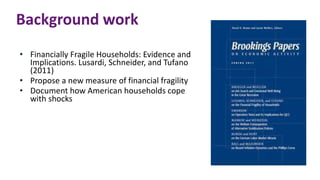
Background work
• Financially Fragile Households: Evidence and
Implications. Lusardi, Schneider, and Tufano
(2011)
• Propose a new measure of financial fragility
• Document how American households cope
with shocks
Our measure of financial fragility
• How confident are you that you could come up with $2,000 if
an unexpected need arose within the next month?
– I am certain I could come up with the full $2,000.
– I could probably come up with $2,000.
– I could probably not come up with $2,000.
– I am certain I could not come up with $2,000.
– Don’t know.
– Prefer not to say.
Why this measure?
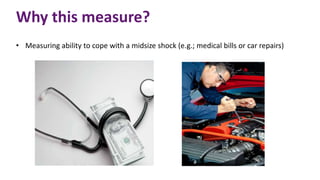
• Measuring ability to cope with a midsize shock (e.g.; medical bills or car repairs)
Why this measure?
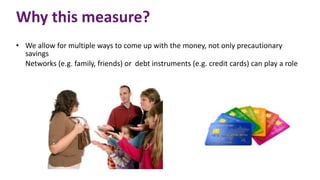
• We allow for multiple ways to come up with the money, not only precautionary
savings
Networks (e.g. family, friends) or debt instruments (e.g. credit cards) can play a role
Our measure of financial fragility
• How confident are you that you could come up with $2,000 if
an unexpected need arose within the next month?
– I am certain I could come up with the full $2,000.
– I could probably come up with $2,000.
– I could probably not come up with $2,000.
– I am certain I could not come up with $2,000.
– Don’t know.
– Prefer not to say.
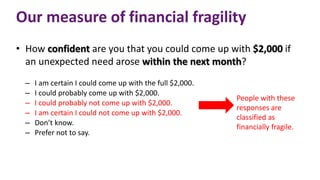
People with these
responses are
classified as
financially fragile.
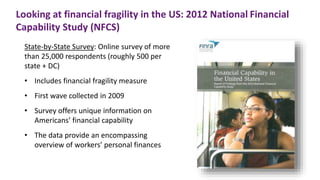
Looking at financial fragility in the US: 2012 National Financial
Capability Study (NFCS)
State-by-State Survey: Online survey of more
than 25,000 respondents (roughly 500 per
state + DC)
• Includes financial fragility measure
• First wave collected in 2009
• Survey offers unique information on
Americans’ financial capability
• The data provide an encompassing
overview of workers’ personal finances
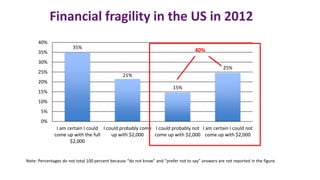
Financial fragility in the US in 2012
Note: Percentages do not total 100 percent because “do not know” and “prefer not to say” answers are not reported in the figure.
35%
21%
15%
25%
0%
5%
10%
15%
20%
25%
30%
35%
40%
I am certain I could
come up with the full
$2,000
I could probably come
up with $2,000
I could probably not
come up with $2,000
I am certain I could not
come up with $2,000
40%
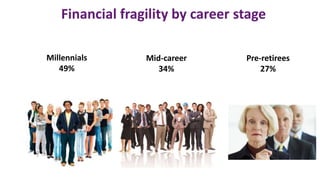
Financial fragility by career stage
Millennials
49%
Mid-career
34%
Pre-retirees
27%
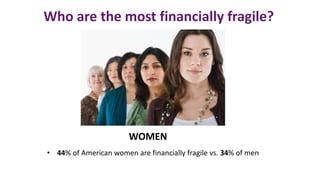
Who are the most financially fragile?
• 44% of American women are financially fragile vs. 34% of men
WOMEN
Who are the most financially fragile?
• 72% of the unbanked are financially fragile
UNBANKED
...but also
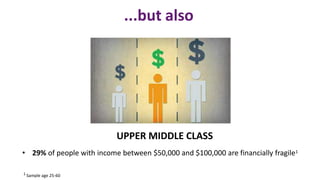
• 29% of people with income between $50,000 and $100,000 are financially fragile1
UPPER MIDDLE CLASS
1 Sample age 25-60
...but also
• 25% of college graduates age 25-60 are financially fragile2
COLLEGE GRADUATES
2 Sample age 25-60
...but also
• 31% of fully employed people are financially fragile3
FULLY EMPLOYED
3 Sample age 25-60
What we find
• Women are more fragile
• Those with low income and low educational attainment and
the unbanked are financially fragile
• Even the middle class and upper middle class feel fragile
• Having a full time job is no guarantee for financial security
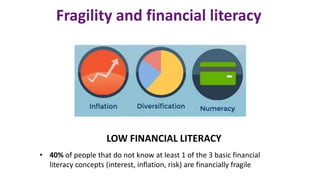
Fragility and financial literacy
• 40% of people that do not know at least 1 of the 3 basic financial
literacy concepts (interest, inflation, risk) are financially fragile
LOW FINANCIAL LITERACY
How do people cope?
• Our study using data from the US in 2009 shows that people use many
methods of coping
• While many indicating saving, one in three indicate relying on family and
friends
• Credit and borrowing is also mentioned by many, though credit is not a
good way to insure against shocks
• Some are living on financial edge: more than 25% of Americans in 2009
could cope by selling home, pawn possession, rely on payday loans
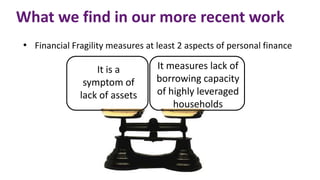
What we find in our more recent work
• Financial Fragility measures at least 2 aspects of personal finance
It measures lack of
borrowing capacity
of highly leveraged
households
It is a
symptom of
lack of assets
Financial fragility and financial satisfaction
• Financial fragility goes beyond looking at one individual behavior, for
example saving or borrowing
• Moving toward measuring well-being: the measure also correlates
strongly with financial satisfaction
• Financial fragility is consequential for self-assessed financial wellbeing
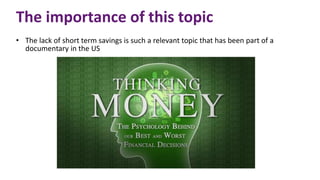
The importance of this topic
• The lack of short term savings is such a relevant topic that has been part of a
documentary in the US
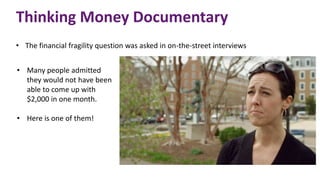
Thinking Money Documentary
• The financial fragility question was asked in on-the-street interviews
• Many people admitted
they would not have been
able to come up with
$2,000 in one month.
• Here is one of them!
Implications for financial education
• Financial fragility is pervasive
Need robust interventions
• People use many methods of coping
Need to move away from targeting one behavior
• Some of the methods people use are very expensive and do
not provide insurance
• Credit becomes expensive when most needed
• Do not underestimate the power of family, friends, people
around us. After all, we insure by pooling resources!
Implications for financial education (cont)
• Importance of targeting women
Multiplier effect
• Importance of equipping the young with the skills to
succeed in today’s complex financial markets
Importance of financial education in school
More implications
• Implications for policy
Incentives for short term savings
Stress test for households’ financial capability
• Implications for research
Financial fragility question could be used in many
surveys
• Implications for pension design (people do not have
enough liquidity)
• Extension to study gender effect
Final remarks
• Life often looks like a series of bad draws
• Macro conditions are important and recessions and low growth
can take a toll on the personal finance of individuals
• Levels of financial literacy around the world are very low in
comparison to the choices people have to make

Keynote: Preparing for the unexpected, avoiding financial vulnerability - Annamariá Lusardi

  • 1.
    Household Financial Fragility: Evidenceand Implications Prof. Annamaria Lusardi The George Washington University School of Business Academic Director, Global Financial Literacy Excellence Center (GFLEC) 20 April 2016
  • 2.
    Global economic scenario •Many economies are recovering from the financial crisis and Great Recession • Data show that large segments of the population continue to face financial difficulties • Several years after the Recession, many people feel they are not financially secure
  • 3.
    Background work • FinanciallyFragile Households: Evidence and Implications. Lusardi, Schneider, and Tufano (2011) • Propose a new measure of financial fragility • Document how American households cope with shocks
  • 4.
    Our measure offinancial fragility • How confident are you that you could come up with $2,000 if an unexpected need arose within the next month? – I am certain I could come up with the full $2,000. – I could probably come up with $2,000. – I could probably not come up with $2,000. – I am certain I could not come up with $2,000. – Don’t know. – Prefer not to say.
  • 5.
    Why this measure? •Measuring ability to cope with a midsize shock (e.g.; medical bills or car repairs)
  • 6.
    Why this measure? •We allow for multiple ways to come up with the money, not only precautionary savings Networks (e.g. family, friends) or debt instruments (e.g. credit cards) can play a role
  • 7.
    Our measure offinancial fragility • How confident are you that you could come up with $2,000 if an unexpected need arose within the next month? – I am certain I could come up with the full $2,000. – I could probably come up with $2,000. – I could probably not come up with $2,000. – I am certain I could not come up with $2,000. – Don’t know. – Prefer not to say. People with these responses are classified as financially fragile.
  • 8.
    Looking at financialfragility in the US: 2012 National Financial Capability Study (NFCS) State-by-State Survey: Online survey of more than 25,000 respondents (roughly 500 per state + DC) • Includes financial fragility measure • First wave collected in 2009 • Survey offers unique information on Americans’ financial capability • The data provide an encompassing overview of workers’ personal finances
  • 9.
    Financial fragility inthe US in 2012 Note: Percentages do not total 100 percent because “do not know” and “prefer not to say” answers are not reported in the figure. 35% 21% 15% 25% 0% 5% 10% 15% 20% 25% 30% 35% 40% I am certain I could come up with the full $2,000 I could probably come up with $2,000 I could probably not come up with $2,000 I am certain I could not come up with $2,000 40%
  • 10.
    Financial fragility bycareer stage Millennials 49% Mid-career 34% Pre-retirees 27%
  • 11.
    Who are themost financially fragile? • 44% of American women are financially fragile vs. 34% of men WOMEN
  • 12.
    Who are themost financially fragile? • 72% of the unbanked are financially fragile UNBANKED
  • 13.
    ...but also • 29%of people with income between $50,000 and $100,000 are financially fragile1 UPPER MIDDLE CLASS 1 Sample age 25-60
  • 14.
    ...but also • 25%of college graduates age 25-60 are financially fragile2 COLLEGE GRADUATES 2 Sample age 25-60
  • 15.
    ...but also • 31%of fully employed people are financially fragile3 FULLY EMPLOYED 3 Sample age 25-60
  • 16.
    What we find •Women are more fragile • Those with low income and low educational attainment and the unbanked are financially fragile • Even the middle class and upper middle class feel fragile • Having a full time job is no guarantee for financial security
  • 17.
    Fragility and financialliteracy • 40% of people that do not know at least 1 of the 3 basic financial literacy concepts (interest, inflation, risk) are financially fragile LOW FINANCIAL LITERACY
  • 18.
    How do peoplecope? • Our study using data from the US in 2009 shows that people use many methods of coping • While many indicating saving, one in three indicate relying on family and friends • Credit and borrowing is also mentioned by many, though credit is not a good way to insure against shocks • Some are living on financial edge: more than 25% of Americans in 2009 could cope by selling home, pawn possession, rely on payday loans
  • 19.
    What we findin our more recent work • Financial Fragility measures at least 2 aspects of personal finance It measures lack of borrowing capacity of highly leveraged households It is a symptom of lack of assets
  • 20.
    Financial fragility andfinancial satisfaction • Financial fragility goes beyond looking at one individual behavior, for example saving or borrowing • Moving toward measuring well-being: the measure also correlates strongly with financial satisfaction • Financial fragility is consequential for self-assessed financial wellbeing
  • 21.
    The importance ofthis topic • The lack of short term savings is such a relevant topic that has been part of a documentary in the US
  • 22.
    Thinking Money Documentary •The financial fragility question was asked in on-the-street interviews • Many people admitted they would not have been able to come up with $2,000 in one month. • Here is one of them!
  • 23.
    Implications for financialeducation • Financial fragility is pervasive Need robust interventions • People use many methods of coping Need to move away from targeting one behavior • Some of the methods people use are very expensive and do not provide insurance • Credit becomes expensive when most needed • Do not underestimate the power of family, friends, people around us. After all, we insure by pooling resources!
  • 24.
    Implications for financialeducation (cont) • Importance of targeting women Multiplier effect • Importance of equipping the young with the skills to succeed in today’s complex financial markets Importance of financial education in school
  • 25.
    More implications • Implicationsfor policy Incentives for short term savings Stress test for households’ financial capability • Implications for research Financial fragility question could be used in many surveys • Implications for pension design (people do not have enough liquidity) • Extension to study gender effect
  • 26.
    Final remarks • Lifeoften looks like a series of bad draws • Macro conditions are important and recessions and low growth can take a toll on the personal finance of individuals • Levels of financial literacy around the world are very low in comparison to the choices people have to make