Finance 101 (for Canadians!)
Farhan Thawar
April 2013!
Agenda
Saving
Spending
Debt
Investing
Insurance
Retirement
2
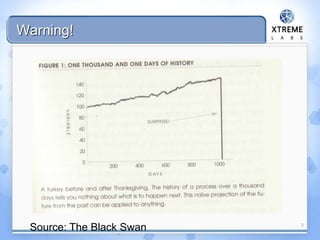
Warning!
3
Source: The Black Swan
Financial Planners
“The Stock market is the only game in town where the guys
who drive Rolls Royce’s take advice from those who take
the subway”
- Warren Buffet
• Most financial planners make money via
• Transaction fees
• MER
• Kick-back on certain investment choices
* If you do use one, make sure it’s a fee for service
4
Saving
How much should you save?
Saving strategies that work
1 Pay yourself first (automatic)
2 Credit/debit cards (leave at home)
• Create barriers (wait a day before you buy anything)
3 Jar method
Emergency fund (6-12 months)
– Cash or LOC
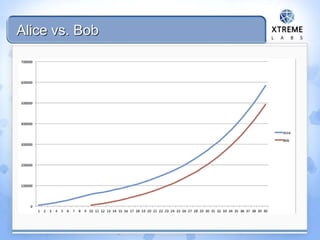
Alice vs. Bob
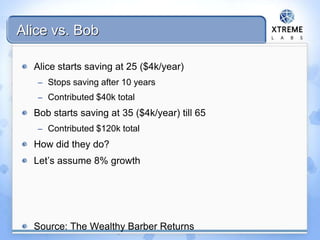
Alice starts saving at 25 ($4k/year)
– Stops saving after 10 years
– Contributed $40k total
Bob starts saving at 35 ($4k/year) till 65
– Contributed $120k total
How did they do?
Let’s assume 8% growth
Source: The Wealthy Barber Returns
Compound Interest
Einstein called this
– the 8th wonder of the world
– the greatest force in the universe
– Greatest invention of mankind
If you put 1 penny on the first square on a chessboard and
2 on the second square, and continued on doubling, how
many pennies would be on the last square?
Alice vs. Bob
Spending
“It is preoccupation with possesions, more than anything
else, that prevents us from living freely and nobly” –
Bertrand Russell
“I can resist everything but temptation” – Oscar Wilde
– Stop going 
Experiences vs. stuff: [NYTimes] Will it make you happy? -
http://bit.ly/cQu4ui
Spending
Spending Summaries
Finding deals (RFD): www.redflagdeals.com
If you have to use credit cards
– Credit card rewards
Spending
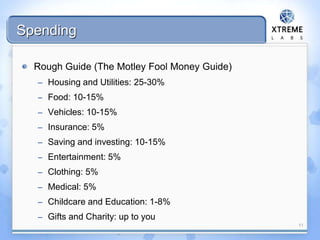
Rough Guide (The Motley Fool Money Guide)
– Housing and Utilities: 25-30%
– Food: 10-15%
– Vehicles: 10-15%
– Insurance: 5%
– Saving and investing: 10-15%
– Entertainment: 5%
– Clothing: 5%
– Medical: 5%
– Childcare and Education: 1-8%
– Gifts and Charity: up to you
11
Spending
“Never keep up with the Joneses. Drag them down to your
level. It’s cheaper”
– Quentin Crisp
Teachers are pretty happy (because they hang out with
other teachers)
12
Debt?
Good vs. bad debt
Who has credit card debt?
– Re-finance!
– Clear LOC method ($7k)
Good Debt
Money borrowed to buy an appreciating asset where the
cost of servicing the loan doesn’t affect your abilty to save
to the appropriate level and where the principal will be fully
repaid before your retirement.
Cashtration
The act of buying a home, which renders the subject
financially impotent for an indefinite period of time.
Reminder: Mortgage means “death pledge”
Investing
1 “First rule of investing, don’t lose money
2 Second rule of investing, see rule #1.”
Warren Buffet
Investing
Do you have a mortgage?
– Easy strategy 
Should I open an RRSP/TFSA?
– If you don’t have a mortgage, than yes!
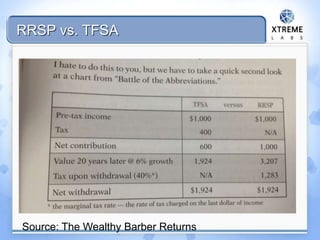
RRSP vs. TFSA
Source: The Wealthy Barber Returns
Investing
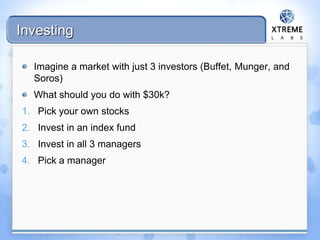
Imagine a market with just 3 investors (Buffet, Munger, and
Soros)
What should you do with $30k?
1. Pick your own stocks
2. Invest in an index fund
3. Invest in all 3 managers
4. Pick a manager
Investing
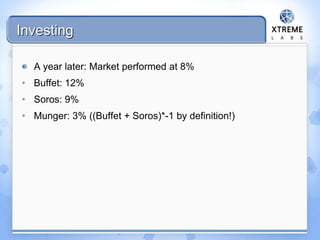
A year later: Market performed at 8%
• Buffet: 12%
• Soros: 9%
• Munger: 3% ((Buffet + Soros)*-1 by definition!)
Results
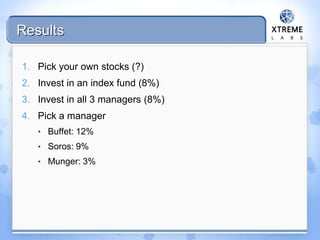
1. Pick your own stocks (?)
2. Invest in an index fund (8%)
3. Invest in all 3 managers (8%)
4. Pick a manager
• Buffet: 12%
• Soros: 9%
• Munger: 3%
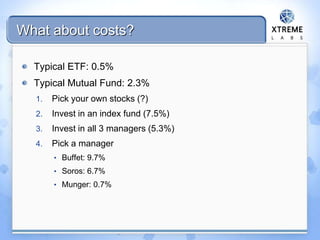
What about costs?
Typical ETF: 0.5%
Typical Mutual Fund: 2.3%
1. Pick your own stocks (?)
2. Invest in an index fund (7.5%)
3. Invest in all 3 managers (5.3%)
4. Pick a manager
• Buffet: 9.7%
• Soros: 6.7%
• Munger: 0.7%
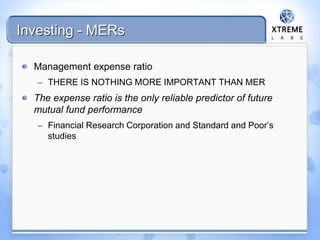
Investing - MERs
Management expense ratio
– THERE IS NOTHING MORE IMPORTANT THAN MER
The expense ratio is the only reliable predictor of future
mutual fund performance
– Financial Research Corporation and Standard and Poor’s
studies
Investing – Active vs. Passive
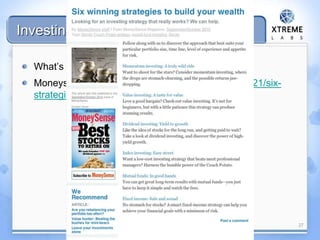
What’s the difference?
Moneysense: http://www.moneysense.ca/2010/10/21/six-
strategies-to-build-your-wealth/
24
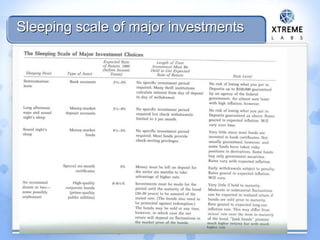
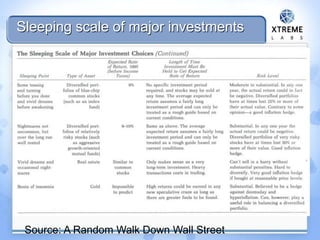
Sleeping scale of major investments
Source: A Random Walk Down Wall Street
Investing – Active vs. Passive
What’s the difference?
Moneysense: http://www.moneysense.ca/2010/10/21/six-
strategies-to-build-your-wealth/
27
Investing – Active vs. Passive
28
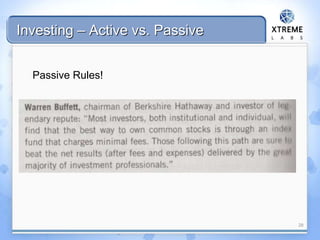
Passive Rules!
Investing – Active vs. Passive
Couch Potato strategy
– It pays to be lazy
Canadian Shareowner
– Limited stock selection
Mutual fund vs. ETF
– ETFs get efficient past $20k or so
29
Investing – Couch Potato
Sample portfolio
– %Age in bonds
– 1/3 of rest in CA equities
– 1/3 of rest in US equities
– 1/3 of rest in INTL equities
So Boris (if he’s 25):
– ~25% in bonds basket
– ~25% in CA equities basket
– ~25% in US equities basket
– ~25% in INTL equities basket
Rebalance once per year (15 minutes!)
30
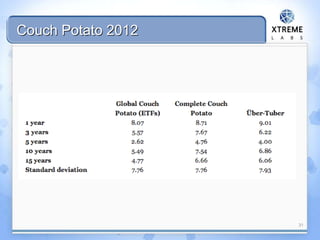
Couch Potato 2012
31
Investing – Passive
Why it works:
– No sales commissions (if you use Mutual funds)
– Low operating expenses (MER!)
– Tax efficiency
– No need to hire a financial advisor
– Higher diversification, lower risk
Source: The Boglehead’s Guide to Investing
32
Investing – Passive
“The conclusions [supporting trying to beat the market] can
only be justified by assuming that the laws of arithmetic
have been suspended for the convenience of those who
choose to pursue careers as active managers”
– William F. Sharpe (Nobel Laureate in Economic Sciences”
33
Investing - Barbell
Nasim Taleb’s strategy (The Black Swan)
Made 99% of his money in one day (Oct. 1987)
Made $150MM in fall of 2008
Portfolio
– 80-90% in bonds (or other fixed income)
– 10-20% in ultra-risky investments
34
Investing - Dividend
What’s a dividend?
Derek Foster’s strategy
Buy stocks that will pay dividends
Make money with your money
When you hear: “How do you make your money work for
you?”
35
Investing – DIY – no strategy
Really hard
Likely impossible to beat the Russian Phds
Hard to exploit market inefficiencies
36
Health Insurance
Do you have dependents?
If yes:
– Term life insurance
Other types:
– Critical illness
– Disability
Retirement
Models
1 Make money for a while, then start spending it (Traditional)
2 Make less money all the time (4HWW)
38
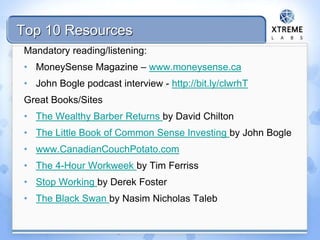
Top 10 Resources
Mandatory reading/listening:
• MoneySense Magazine – www.moneysense.ca
• John Bogle podcast interview - http://bit.ly/clwrhT
Great Books/Sites
• The Wealthy Barber Returns by David Chilton
• The Little Book of Common Sense Investing by John Bogle
• www.CanadianCouchPotato.com
• The 4-Hour Workweek by Tim Ferriss
• Stop Working by Derek Foster
• The Black Swan by Nasim Nicholas Taleb
How to start!
40

Finance101

  • 1.
    Finance 101 (forCanadians!) Farhan Thawar April 2013!
  • 2.
  • 3.
  • 4.
    Financial Planners “The Stockmarket is the only game in town where the guys who drive Rolls Royce’s take advice from those who take the subway” - Warren Buffet • Most financial planners make money via • Transaction fees • MER • Kick-back on certain investment choices * If you do use one, make sure it’s a fee for service 4
  • 5.
    Saving How much shouldyou save? Saving strategies that work 1 Pay yourself first (automatic) 2 Credit/debit cards (leave at home) • Create barriers (wait a day before you buy anything) 3 Jar method Emergency fund (6-12 months) – Cash or LOC
  • 6.
    Alice vs. Bob Alicestarts saving at 25 ($4k/year) – Stops saving after 10 years – Contributed $40k total Bob starts saving at 35 ($4k/year) till 65 – Contributed $120k total How did they do? Let’s assume 8% growth Source: The Wealthy Barber Returns
  • 7.
    Compound Interest Einstein calledthis – the 8th wonder of the world – the greatest force in the universe – Greatest invention of mankind If you put 1 penny on the first square on a chessboard and 2 on the second square, and continued on doubling, how many pennies would be on the last square?
  • 8.
  • 9.
    Spending “It is preoccupationwith possesions, more than anything else, that prevents us from living freely and nobly” – Bertrand Russell “I can resist everything but temptation” – Oscar Wilde – Stop going  Experiences vs. stuff: [NYTimes] Will it make you happy? - http://bit.ly/cQu4ui
  • 10.
    Spending Spending Summaries Finding deals(RFD): www.redflagdeals.com If you have to use credit cards – Credit card rewards
  • 11.
    Spending Rough Guide (TheMotley Fool Money Guide) – Housing and Utilities: 25-30% – Food: 10-15% – Vehicles: 10-15% – Insurance: 5% – Saving and investing: 10-15% – Entertainment: 5% – Clothing: 5% – Medical: 5% – Childcare and Education: 1-8% – Gifts and Charity: up to you 11
  • 12.
    Spending “Never keep upwith the Joneses. Drag them down to your level. It’s cheaper” – Quentin Crisp Teachers are pretty happy (because they hang out with other teachers) 12
  • 13.
    Debt? Good vs. baddebt Who has credit card debt? – Re-finance! – Clear LOC method ($7k)
  • 14.
    Good Debt Money borrowedto buy an appreciating asset where the cost of servicing the loan doesn’t affect your abilty to save to the appropriate level and where the principal will be fully repaid before your retirement.
  • 15.
    Cashtration The act ofbuying a home, which renders the subject financially impotent for an indefinite period of time. Reminder: Mortgage means “death pledge”
  • 16.
    Investing 1 “First ruleof investing, don’t lose money 2 Second rule of investing, see rule #1.” Warren Buffet
  • 17.
    Investing Do you havea mortgage? – Easy strategy  Should I open an RRSP/TFSA? – If you don’t have a mortgage, than yes!
  • 18.
    RRSP vs. TFSA Source:The Wealthy Barber Returns
  • 19.
    Investing Imagine a marketwith just 3 investors (Buffet, Munger, and Soros) What should you do with $30k? 1. Pick your own stocks 2. Invest in an index fund 3. Invest in all 3 managers 4. Pick a manager
  • 20.
    Investing A year later:Market performed at 8% • Buffet: 12% • Soros: 9% • Munger: 3% ((Buffet + Soros)*-1 by definition!)
  • 21.
    Results 1. Pick yourown stocks (?) 2. Invest in an index fund (8%) 3. Invest in all 3 managers (8%) 4. Pick a manager • Buffet: 12% • Soros: 9% • Munger: 3%
  • 22.
    What about costs? TypicalETF: 0.5% Typical Mutual Fund: 2.3% 1. Pick your own stocks (?) 2. Invest in an index fund (7.5%) 3. Invest in all 3 managers (5.3%) 4. Pick a manager • Buffet: 9.7% • Soros: 6.7% • Munger: 0.7%
  • 23.
    Investing - MERs Managementexpense ratio – THERE IS NOTHING MORE IMPORTANT THAN MER The expense ratio is the only reliable predictor of future mutual fund performance – Financial Research Corporation and Standard and Poor’s studies
  • 24.
    Investing – Activevs. Passive What’s the difference? Moneysense: http://www.moneysense.ca/2010/10/21/six- strategies-to-build-your-wealth/ 24
  • 25.
    Sleeping scale ofmajor investments
  • 26.
    Sleeping scale ofmajor investments Source: A Random Walk Down Wall Street
  • 27.
    Investing – Activevs. Passive What’s the difference? Moneysense: http://www.moneysense.ca/2010/10/21/six- strategies-to-build-your-wealth/ 27
  • 28.
    Investing – Activevs. Passive 28 Passive Rules!
  • 29.
    Investing – Activevs. Passive Couch Potato strategy – It pays to be lazy Canadian Shareowner – Limited stock selection Mutual fund vs. ETF – ETFs get efficient past $20k or so 29
  • 30.
    Investing – CouchPotato Sample portfolio – %Age in bonds – 1/3 of rest in CA equities – 1/3 of rest in US equities – 1/3 of rest in INTL equities So Boris (if he’s 25): – ~25% in bonds basket – ~25% in CA equities basket – ~25% in US equities basket – ~25% in INTL equities basket Rebalance once per year (15 minutes!) 30
  • 31.
  • 32.
    Investing – Passive Whyit works: – No sales commissions (if you use Mutual funds) – Low operating expenses (MER!) – Tax efficiency – No need to hire a financial advisor – Higher diversification, lower risk Source: The Boglehead’s Guide to Investing 32
  • 33.
    Investing – Passive “Theconclusions [supporting trying to beat the market] can only be justified by assuming that the laws of arithmetic have been suspended for the convenience of those who choose to pursue careers as active managers” – William F. Sharpe (Nobel Laureate in Economic Sciences” 33
  • 34.
    Investing - Barbell NasimTaleb’s strategy (The Black Swan) Made 99% of his money in one day (Oct. 1987) Made $150MM in fall of 2008 Portfolio – 80-90% in bonds (or other fixed income) – 10-20% in ultra-risky investments 34
  • 35.
    Investing - Dividend What’sa dividend? Derek Foster’s strategy Buy stocks that will pay dividends Make money with your money When you hear: “How do you make your money work for you?” 35
  • 36.
    Investing – DIY– no strategy Really hard Likely impossible to beat the Russian Phds Hard to exploit market inefficiencies 36
  • 37.
    Health Insurance Do youhave dependents? If yes: – Term life insurance Other types: – Critical illness – Disability
  • 38.
    Retirement Models 1 Make moneyfor a while, then start spending it (Traditional) 2 Make less money all the time (4HWW) 38
  • 39.
    Top 10 Resources Mandatoryreading/listening: • MoneySense Magazine – www.moneysense.ca • John Bogle podcast interview - http://bit.ly/clwrhT Great Books/Sites • The Wealthy Barber Returns by David Chilton • The Little Book of Common Sense Investing by John Bogle • www.CanadianCouchPotato.com • The 4-Hour Workweek by Tim Ferriss • Stop Working by Derek Foster • The Black Swan by Nasim Nicholas Taleb
  • 40.

Editor's Notes

  • #3 Some propaganda, but no much
  • #5 Some propaganda, but no much
  • #8 92 Quadrillion dollars
  • #14 Good debt (mortgage, investments, education, business)
  • #15 Good debt (mortgage, investments, education, business)
  • #16 Good debt (mortgage, investments, education, business)