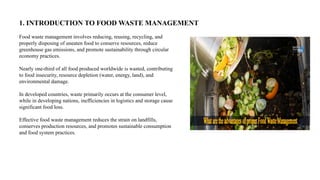
Food waste management involves reducing, reusing, recycling, and properly disposing of uneaten food to conserve resources, reduce greenhouse gas emissions, and promote sustainability through circular economy practices.
Presentation on
FOOD WASTEMANAGEMENT
DEPARTMENT OF MECHANICAL ENGINEERING
NATIONAL INSTITUTE OF TECHNOLOGY PATNA
19 NOVEMBER 2024
MASTER OF TECHNOLOGY
IN
DESIGN ENGINEERING
BY
ADITYA KUMAR SINGH
UNDER THE SUPERVISION OF
A.K.Srivastava
2.
TABLE OF CONTENT
1Introduction
1.1 The Importance of reducing food waste
1.2 Understanding the Food Waste
2. Literature Review
3. Case Study
3.1 The Scope of the Problem
4. Objective of the Project
5. Methodology
5.1 Strategies for reducing food waste
5.2 Food Waste Management in Hostel
5.3 Causes of Food Waste in Hostel
5.4 Calculation of Food Waste in Hostels
5.5 Cost Implications and Savings
6 Innovative idea to reduce food waste
6.1 Reusing food waste
6.2 Recycling food waste
6.3 The role of technology
6.4 Legislation and Policy
6.5 Corporate Responsibility
6.6 Role of Consumers
6.7 Community Initiatives
6.8 Challenges in food waste management
6.9 Education and awareness
7. Result and Discussion
8. Conclusion
9. The future of food waste management
10. References
3.
1. INTRODUCTION TOFOOD WASTE MANAGEMENT
Food waste management involves reducing, reusing, recycling, and
properly disposing of uneaten food to conserve resources, reduce
greenhouse gas emissions, and promote sustainability through circular
economy practices.
Nearly one-third of all food produced worldwide is wasted, contributing
to food insecurity, resource depletion (water, energy, land), and
environmental damage.
In developed countries, waste primarily occurs at the consumer level,
while in developing nations, inefficiencies in logistics and storage cause
significant food loss.
Effective food waste management reduces the strain on landfills,
conserves production resources, and promotes sustainable consumption
and food system practices.
4.
1.1 The Importanceof Reducing Food Waste
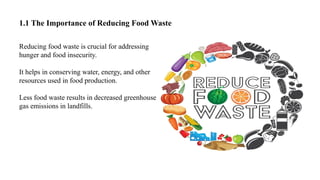
Reducing food waste is crucial for addressing
hunger and food insecurity.
It helps in conserving water, energy, and other
resources used in food production.
Less food waste results in decreased greenhouse
gas emissions in landfills.
5.
1.2 Understanding FoodWaste
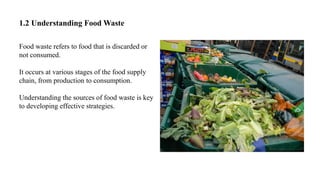
Food waste refers to food that is discarded or
not consumed.
It occurs at various stages of the food supply
chain, from production to consumption.
Understanding the sources of food waste is key
to developing effective strategies.
6.
2. LITERATURE REVIEW
Foodwaste management has become a critical global issue due to its environmental, social, and economic impacts. The Food and
Agriculture Organization (FAO) estimates that one-third of all food produced globally is wasted each year, amounting to about 1.3
billion tons. Effective food waste management systems are essential to reduce this loss and optimize resource usage.
Research and Trends in Food Waste Management
1 Global Initiatives and Frameworks
The UN's Sustainable Development Goal (SDG) 12.3 aims to halve food waste at the retail and consumer levels and reduce food
losses along production and supply chains by 2030. Several countries have implemented frameworks like the EPA's Food Recovery
Hierarchy in the U.S., which prioritizes waste prevention, donation, and recycling over disposal.
2 Community-Based Approaches
Community-driven models, like those studied by Lipinski et al. (2013), emphasize the role of local partnerships in tackling food
waste. Initiatives such as food banks and redistribution systems have proven to be highly effective.
3 Economic and Environmental Impacts
- Economic Costs: According to the World Resources Institute, the annual cost of food waste globally is approximately $940
billion. Addressing food waste can save businesses money while promoting sustainability.
- Environmental Benefits: Reducing food waste also reduces greenhouse gas emissions. FAO research suggests that food waste
accounts for 8–10% of global emissions.
7.
3. CASE STUDY
A.Too Good To Go – Europe
Objective: Combat food waste in the hospitality and retail sectors.
Implementation:
Too Good To Go is an app-based platform launched in Denmark that connects consumers with restaurants, bakeries, and supermarkets offering surplus food at discounted
prices.
Outcome:
Operating in 17 countries, saving over 100 million meals from going to waste as of 2023.
Promotes consumer awareness about food wastage.
Key Lessons:
Digital platforms can scale globally and effectively reduce waste while being profitable
B. India Food Banking Network – India
Objective: Bridge the gap between food surplus and hunger.
Implementation:
Collaboration between businesses, NGOs, and the government to collect surplus food from various sources, including manufacturers and retail stores, and
redistribute it to underserved communities.
Outcome:
Operates in 14 states, providing millions of meals annually.
Reduced the burden on local landfill systems.
Key Lessons:
Public-private partnerships are critical in regions with limited resources.
8.
3.1 The Scopeof the Problem
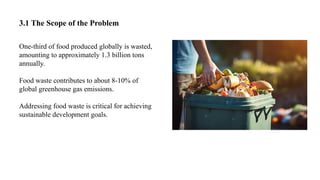
One-third of food produced globally is wasted,
amounting to approximately 1.3 billion tons
annually.
Food waste contributes to about 8-10% of
global greenhouse gas emissions.
Addressing food waste is critical for achieving
sustainable development goals.
9.
The primary objectiveof my project on food waste management is to explore and implement practical strategies that can effectively reduce
food waste across various stages of the food supply chain, from production to consumption. Specifically, the project aims to:
Identify Key Sources: Analyze contributors to food waste across production, retail, and consumer levels, addressing root causes like poor
planning and inefficient logistics
Raise Awareness: Educate communities, businesses, and individuals about food waste's environmental, social, and economic impacts,
providing practical reduction tips
Support Recovery Initiatives: Advocate for programs that rescue surplus food for redistribution or repurpose it into products like compost
or animal feed.
Evaluate Technologies: Explore sustainable innovations like waste-to-energy solutions, composting, and upcycling food waste into biofuels
or fertilizers.
Policy Recommendations: Provide actionable guidance for businesses, policymakers, and consumers to adopt effective food waste
management practices, promoting sustainability
Promote Reduction Strategies: Encourage inventory management, proper food storage, portion control, and creative use of food scraps to
minimize waste
4. OBJECTIVES OF THE PROJECT
10.
5. METHODOLOGY
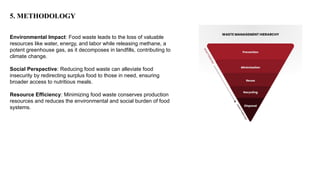
Environmental Impact:Food waste leads to the loss of valuable
resources like water, energy, and labor while releasing methane, a
potent greenhouse gas, as it decomposes in landfills, contributing to
climate change.
Social Perspective: Reducing food waste can alleviate food
insecurity by redirecting surplus food to those in need, ensuring
broader access to nutritious meals.
Resource Efficiency: Minimizing food waste conserves production
resources and reduces the environmental and social burden of food
systems.
11.
5.1 Strategies forReducing Food Waste
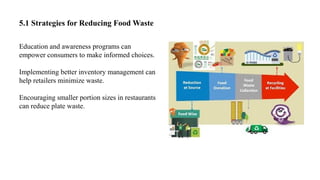
Education and awareness programs can
empower consumers to make informed choices.
Implementing better inventory management can
help retailers minimize waste.
Encouraging smaller portion sizes in restaurants
can reduce plate waste.
12.
5.2 FOOD WASTEMANAGEMENT IN HOSTEL
Hostels, especially in educational institutions and other large-scale residential facilities, are prone to significant food waste. This waste
arises from several factors, including over-preparation, unappetizing meals, improper storage, and student habits like leaving food
unfinished. Managing food waste is crucial not only for environmental sustainability but also for reducing costs and promoting
responsible consumption.
5.3 Causes of Food Waste in Hostels
Several factors contribute to food waste in hostels:
- Overproduction: Large-scale cooking often leads to preparing more food than needed.
- - Portion sizes: Meals are often served in large portions that students cannot finish.
- Poor menu planning: Lack of variation or appealing meals can lead to food being left untouched.- Improper storage: Food leftovers may
spoil due to improper storage or inadequate refrigeration.
- Student behaviour: Some students may waste food intentionally or unknowingly (e.g., serving more than they can eat, food left on plates,
etc.).
13.
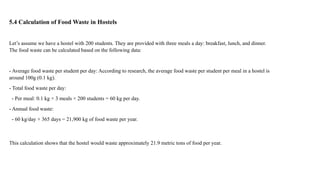
5.4 Calculation ofFood Waste in Hostels
Let’s assume we have a hostel with 200 students. They are provided with three meals a day: breakfast, lunch, and dinner.
The food waste can be calculated based on the following data:
- Average food waste per student per day: According to research, the average food waste per student per meal in a hostel is
around 100g (0.1 kg).
- Total food waste per day:
- Per meal: 0.1 kg × 3 meals × 200 students = 60 kg per day.
- Annual food waste:
- 60 kg/day × 365 days = 21,900 kg of food waste per year.
This calculation shows that the hostel would waste approximately 21.9 metric tons of food per year.
14.
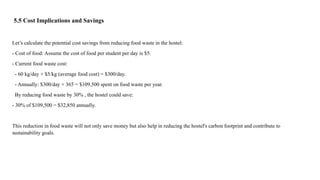
5.5 Cost Implicationsand Savings
Let’s calculate the potential cost savings from reducing food waste in the hostel:
- Cost of food: Assume the cost of food per student per day is $5.
- Current food waste cost:
- 60 kg/day × $5/kg (average food cost) = $300/day.
- Annually: $300/day × 365 = $109,500 spent on food waste per year.
By reducing food waste by 30% , the hostel could save:
- 30% of $109,500 = $32,850 annually.
This reduction in food waste will not only save money but also help in reducing the hostel's carbon footprint and contribute to
sustainability goals.
15.
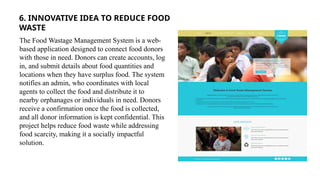
6. INNOVATIVE IDEATO REDUCE FOOD
WASTE
The Food Wastage Management System is a web-
based application designed to connect food donors
with those in need. Donors can create accounts, log
in, and submit details about food quantities and
locations when they have surplus food. The system
notifies an admin, who coordinates with local
agents to collect the food and distribute it to
nearby orphanages or individuals in need. Donors
receive a confirmation once the food is collected,
and all donor information is kept confidential. This
project helps reduce food waste while addressing
food scarcity, making it a socially impactful
solution.
16.
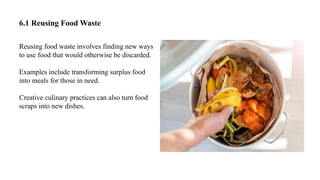
6.1 Reusing FoodWaste
Reusing food waste involves finding new ways
to use food that would otherwise be discarded.
Examples include transforming surplus food
into meals for those in need.
Creative culinary practices can also turn food
scraps into new dishes.
17.
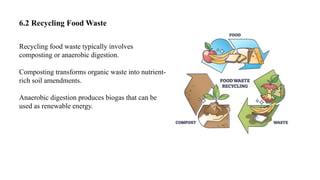
6.2 Recycling FoodWaste
Recycling food waste typically involves
composting or anaerobic digestion.
Composting transforms organic waste into nutrient-
rich soil amendments.
Anaerobic digestion produces biogas that can be
used as renewable energy.
18.
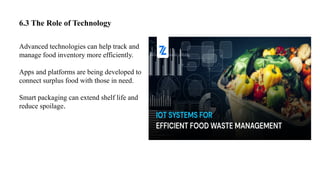
6.3 The Roleof Technology
Advanced technologies can help track and
manage food inventory more efficiently.
Apps and platforms are being developed to
connect surplus food with those in need.
Smart packaging can extend shelf life and
reduce spoilage.
19.
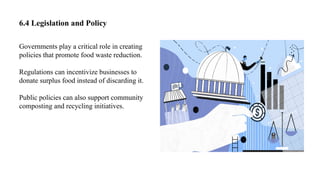
6.4 Legislation andPolicy
Governments play a critical role in creating
policies that promote food waste reduction.
Regulations can incentivize businesses to
donate surplus food instead of discarding it.
Public policies can also support community
composting and recycling initiatives.
20.
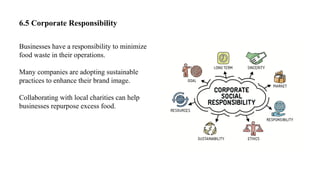
6.5 Corporate Responsibility
Businesseshave a responsibility to minimize
food waste in their operations.
Many companies are adopting sustainable
practices to enhance their brand image.
Collaborating with local charities can help
businesses repurpose excess food.
21.
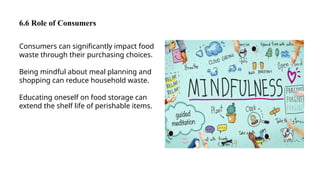
6.6 Role ofConsumers
Consumers can significantly impact food
waste through their purchasing choices.
Being mindful about meal planning and
shopping can reduce household waste.
Educating oneself on food storage can
extend the shelf life of perishable items.
22.
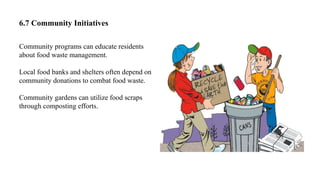
6.7 Community Initiatives
Communityprograms can educate residents
about food waste management.
Local food banks and shelters often depend on
community donations to combat food waste.
Community gardens can utilize food scraps
through composting efforts.
23.
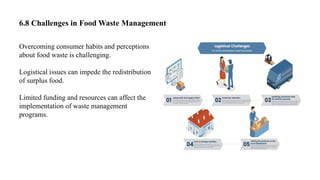
6.8 Challenges inFood Waste Management
Overcoming consumer habits and perceptions
about food waste is challenging.
Logistical issues can impede the redistribution
of surplus food.
Limited funding and resources can affect the
implementation of waste management
programs.
24.
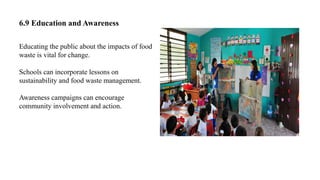
6.9 Education andAwareness
Educating the public about the impacts of food
waste is vital for change.
Schools can incorporate lessons on
sustainability and food waste management.
Awareness campaigns can encourage
community involvement and action.
25.
7. RESULT ANDDISCUSSION
Reduction in Food Waste: Automated surplus food management significantly decreased waste by
redirecting leftovers to charities or recycling, especially during large events.
User Engagement: Features like tracking saved food and eco-impact reports raised awareness and
motivated users, leading to reduced food wastage in offices and events.
Economic & Environmental Impact: Reduced food disposal costs and lower methane emissions
contributed to economic savings and sustainability goals.
Future Enhancements: Predictive algorithms for surplus forecasting and user incentives were
suggested to increase the application’s effectiveness and adoption.
Challenges: Persistent issues like real-time collection delays and coordination gaps highlighted the
need for enhanced logistics and volunteer support
26.
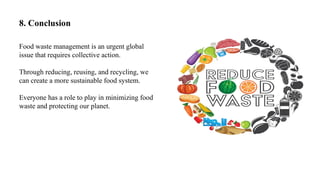
8. Conclusion
Food wastemanagement is an urgent global
issue that requires collective action.
Through reducing, reusing, and recycling, we
can create a more sustainable food system.
Everyone has a role to play in minimizing food
waste and protecting our planet.
27.
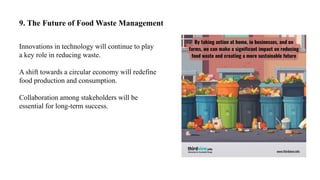
9. The Futureof Food Waste Management
Innovations in technology will continue to play
a key role in reducing waste.
A shift towards a circular economy will redefine
food production and consumption.
Collaboration among stakeholders will be
essential for long-term success.
28.
Referenc
es
1. Kibler, K.M., Reinhart, D., Hawkins, C., Motlagh, A. M., & Wright, J. (2018). Food Waste and the Food-Energy-Water Nexus:
A Review of Food Waste Management Alternatives.
2. Charlebois, S., Creedy, A., & von Massow, M. (2015)."Back of House"–Focused Food Waste Reduction: The Case of University
Food Services._Journal of Foodservice Business Research
3.Papargyropoulou, E., Lozano, R., Steinberger, J. K., Wright, N., & Ujang, Z. B. (2014). The Food Waste Hierarchy as a
Framework for the Management of Food Surplus and Waste. _Journal of Cleaner Production
4. Wen, Z., Xie, Y., Chen, M., & Poon, C. S. (2021). An Overview of Organic Waste in China: Opportunities for Utilization.
_Resources, Conservation, and Recycling_, 168, 105243.
5. Silvennoinen, K., Heikkilä, L., Katajajuuri, J. M., & Reinikainen, A. (2015).Food Waste Volume and Composition in the Finnish
Supply Chain: Special Focus on Food Service Sector. _Resources, Conservation, and Recycling_, 95, 175-185.
6. FAO (2020). The State of Food and Agriculture 2020: Overcoming Water Challenges in Agriculture. Food and Agriculture
Organization of the United Nations.
7. Buchner, B., Fischbeck, M., & Mohareb, A. (2019). A Digital Platform for Food Waste Recovery and Redistribution:
Opportunities and Challenges._Sustainability_, 11(6), 1757.
8. Food and Agriculture Organization. (2011). *Global Food Losses and Food Waste – Extent, Causes and Prevention.* FAO.
9. Lipinski, B., et al. (2013). *Reducing Food Loss and Waste.* World Resources Institute.
10. Roe, B. E., et al. (2021). "The economics of food waste management: A review." Agricultural and Resource Economics
Review.