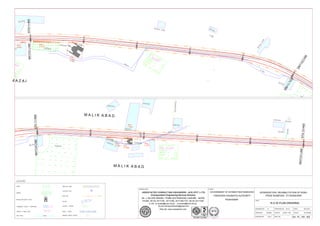
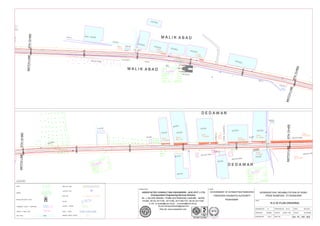
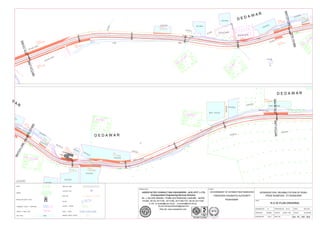
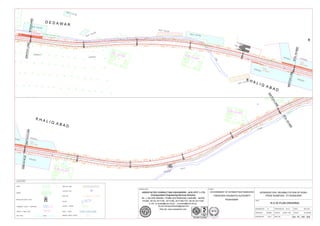
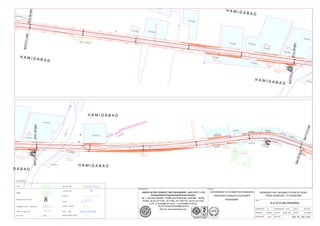
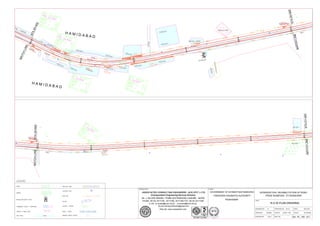
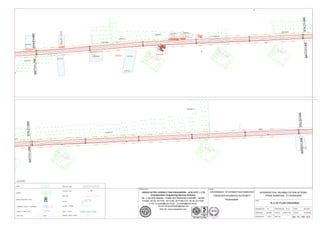
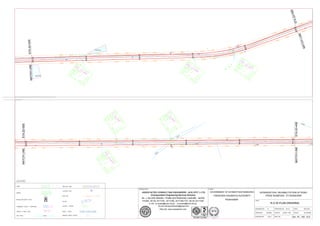
JB063–T–RB
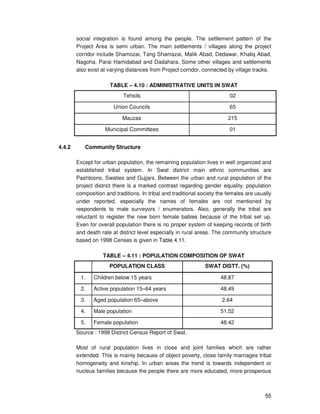
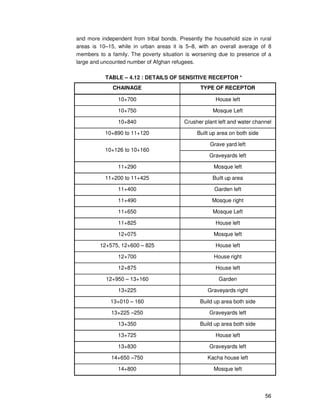
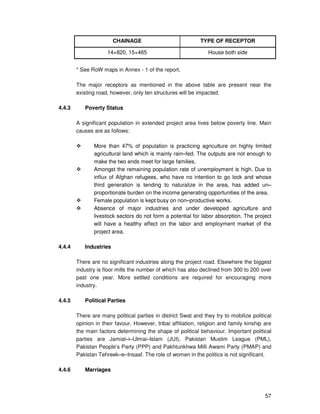
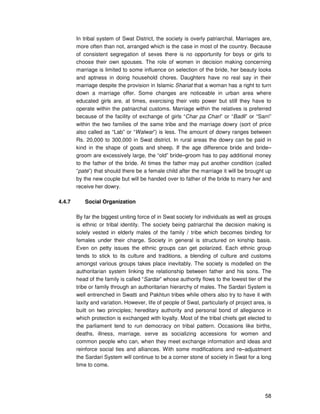
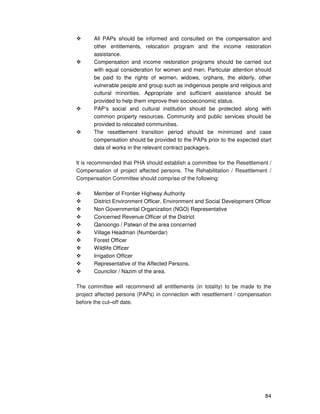
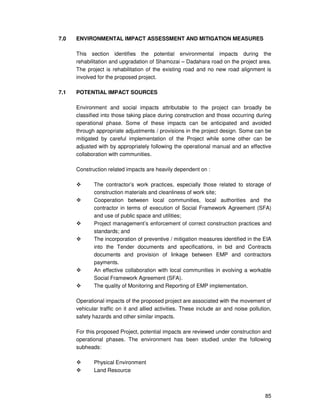
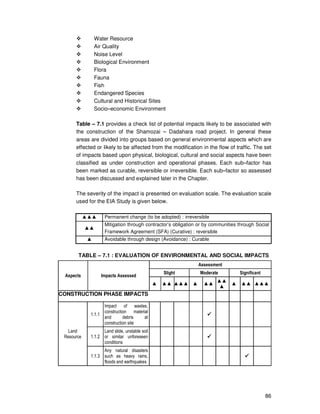
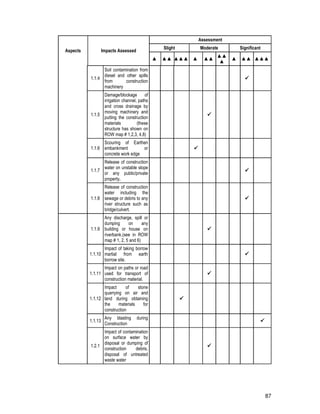
GOVERNMENT OF KHYBER PAKHTUNKHWA
PAKHTUNKHWA HIGHWAYS AUTHORITY
PESHAWAR
UPGRADATION / REHABILITATION OF ROAD FROM SHAMOZAI
TO DADAHARA ON THE RIGHT BANK OF RIVER SWAT UNDER
KHYBER PAKHTUNKHWA EMERGENCY ROAD RECOVERY
PROJECT (KP-ERRP)
FROM KM 10+700 TO KM 24+850 (LENGTH: 14.15
KM)
ENVIRONMENTAL
IMPACT ASSESSMENT
DECEMBER 2013
JB063–T–RB
GOVERNMENT OF KHYBER PAKHTUNKHWA
PAKHTUNKHWA HIGHWAYS AUTHORITY
PESHAWAR
UPGRADATION / REHABILITATION OF ROAD FROM SHAMOZAI
TO DADAHARA ON THE RIGHT BANK OF RIVER SWAT UNDER
KHYBER PAKHTUNKHWA EMERGENCY ROAD RECOVERY
PROJECT (KP-ERRP)
FROM KM 10+700 TO KM 24+850 (LENGTH: 14.15
KM)
ENVIRONMENTAL
IMPACT ASSESSMENT
DECEMBER 2013
iii
TABLE OF CONTENTS
LIST OF ACRONYMS.........................................................................................................x
EXECUTIVE SUMMARY ................................................................................................ xii
1.0 INTRODUCTION.....................................................................................................1
1.1 Project Overview .........................................................................................1
1.2 Environmental and Social Screening and Assessment Framework ..........5
1.3 Basic Features of the Proposed Project .....................................................5
1.4 The Study Objectives ..................................................................................6
1.5 Study Methodology......................................................................................6
1.5.1 Environmental Assessment Process ..............................................6
1.5.2 Field Surveys...................................................................................8
1.5.3 Women Consultations .....................................................................9
1.6 Project Classification...................................................................................9
1.7 The Report Structure...................................................................................9
2.0 INTERNATIONAL AND NATIONAL ENVIRONMENTAL POLICY, LEGAL
AND ADMINISTRATIVE FRAMEWORK ..............................................................11
2.1 Applicable International Environmental Laws and Regulations ...............11
2.1.1 International Framework................................................................11
2.1.2 The World Bank Operational Policies ...........................................11
2.1.3 Environmental Assessment (OP 4.01)..........................................11
2.2 National Environmental Regulatory / Legal Requirements.......................16
2.2.1 Institutional Arrangements ............................................................16
2.2.2 National Conservation Strategy (NGS) – Pakistan.......................16
2.2.3 Pakistan Environmental Protection Act, 1997 ..............................17
2.2.4 Regulations for Environmental Assessment.................................18
2.2.5 Guidelines for Public Consultations ..............................................18
2.2.6 National Environmental Quality Standards for Ambient Air
– November, 2010.........................................................................19
2.2.7 National Standards for Drinking Water Quality –
November, 2010............................................................................20
2.2.8 National Environmental Quality Standards for Noise –
November, 2010............................................................................23
2.3 International Federation of Consulting Engineers (FIDIC) Clauses.........26
2.4 Guidelines for Sensitive and Critical Areas...............................................27
2.5 Forest Act, 1927 ........................................................................................27
2.6 The Khyber Pakhtunkhwa Wildlife Act, 1974............................................27
2.7 The Antiquities Act, 1975 ..........................................................................27
3.0 DESCRIPTION OF THE PROJECT .....................................................................28
3.1 Location .....................................................................................................28
3.2 Road Length..............................................................................................28
iv
3.3 Existing Road Dimensions ........................................................................28
3.4 Drainage Structures ..................................................................................29
3.5 Scope of work............................................................................................29
3.6 Existing Road Condition............................................................................29
3.7 Design Criteria...........................................................................................31
3.8 Work and Material .....................................................................................31
3.8.1 Estimated Work / Major Work Items .............................................31
3.9 Raw Material Availability ...........................................................................31
3.10 Machinery to be Used ...............................................................................32
3.11 Equipment and Installations......................................................................33
3.12 Construction Schedule ..............................................................................33
3.13 Construction Logistics ...............................................................................34
3.13.1 Work Base.....................................................................................34
3.13.2 Labor Supply .................................................................................34
3.13.3 Labor Camps.................................................................................34
3.13.4 Machinery Maintenance and Equipment Yards............................34
3.13.5 Material Depots .............................................................................35
3.13.6 Approach to Work Bases ..............................................................35
3.13.7 Camp Offices.................................................................................35
3.13.8 Security Arrangements..................................................................35
3.13.9 Healthcare .....................................................................................35
3.13.10 Labor Reporting Office...............................................................35
3.13.11 Labor Transport..........................................................................35
3.13.12 Work Uniform and Health Safety Equipment.............................36
3.13.13 Signage and Diversion Roads ...................................................36
3.13.14 Lighting and Illumination ............................................................36
3.14 Safe Design Criteria ..................................................................................36
4.0 BASELINE STUDY OF PROJECT AREA ............................................................38
4.1 The Project Area of Impact .......................................................................38
4.2 Physical Environment................................................................................38
4.2.1 Geography.....................................................................................38
4.2.2 Geology .........................................................................................39
4.2.3 Seismicity.......................................................................................39
4.2.1 Land Use .......................................................................................39
4.2.2 Water Resources...........................................................................41
4.2.3 Climate...........................................................................................44
4.2.4 Natural Event History ....................................................................49
4.2.5 Cultural Heritage and Archaeology...............................................49
4.3 Biological Environment..............................................................................49
4.3.1 Fauna.............................................................................................49
4.3.2 Mammals .......................................................................................49
4.3.3 Flora...............................................................................................51
v
4.3.4 Fish................................................................................................53
4.3.5 Rangelands ...................................................................................53
4.3.6 Protected Areas.............................................................................53
4.3.7 Endangered Species.....................................................................54
4.3.8 Forest.............................................................................................54
4.4 Social Environment ...................................................................................54
4.4.1 Population......................................................................................54
4.4.2 Community Structure.....................................................................55
4.4.3 Poverty Status ...............................................................................57
4.4.4 Industries .......................................................................................57
4.4.5 Political Parties..............................................................................57
4.4.6 Marriages.......................................................................................57
4.4.7 Social Organization .......................................................................58
4.4.8 Custom of Cooperation .................................................................59
4.4.9 Religious Beliefs............................................................................59
4.4.10 Conflict Resolution ........................................................................60
4.4.11 Custom of Carrying Fire Arms.......................................................60
4.4.12 Role, Position and Status of Women............................................60
4.4.13 Child Labor and Apprenticeship....................................................61
4.4.14 Services and Amenities Available in the Area..............................61
5.0 ANALYSIS OF ALTERNATIVES ..........................................................................64
5.1 Road Alternatives ......................................................................................64
5.1.1 No Project Option / Worst Scenario Option ..................................64
5.1.2 Project Road to Follow Exactly the Existing Route with No
Alteration........................................................................................65
5.1.3 For the Double Carriageway Altogether a New Route is
Surveyed on another Site..............................................................66
5.1.4 Project is Restricted to a Single Carriageway as Before..............66
5.1.5 Project as Proposed in Feasibility, Double Lane Road with
Alterations where Necessary ........................................................67
5.2 Logistic Sites .............................................................................................68
5.2.1 Sitting of Contractor’s Facilities on State Land.............................68
5.2.2 Sitting of Contractor’s Facilities on Private Lands ........................69
5.2.3 Sitting the Contractor’s Facilities at Appropriate Site, Be it
Public Land or Private Land..........................................................70
5.3 Labor..........................................................................................................70
5.3.1 All Labor Local...............................................................................70
5.3.2 All Labor from Outside...................................................................71
5.3.3 An Admixture of Local and Outside Labor as per Skill
Required ........................................................................................72
5.4 Design Alternatives ...................................................................................72
5.4.1 Change Number of Sections Onwards to Route
Alternatives....................................................................................72
vi
5.4.2 Alignment Alternatives and Construction Material........................72
5.4.3 Alternatives for Public Amenities ..................................................73
5.4.4 Alternative Transport Options .......................................................73
5.4.5 Conclusion.....................................................................................73
6.0 STAKEHOLDER CONSULTATION......................................................................74
6.1 General......................................................................................................74
6.1.1 Consultation Process ....................................................................74
6.1.2 Points Discussed...........................................................................75
6.1.3 Stakeholder Consultation Technique............................................75
6.1.4 Government Representatives .......................................................77
6.2 Outcome of Stakeholders Consultation ....................................................79
6.2.1 Highway Design.............................................................................79
6.2.2 Highway Construction ...................................................................80
6.2.3 Highway Operation........................................................................80
6.3 Land Acquisition and Resettlement–Related Concerns...........................80
6.4 Redress of Stakeholders Concerns ..........................................................81
6.5 Resettlement Action Plan (RAP)...............................................................82
6.5.1 Resettlement Principles and Objectives .......................................83
7.0 ENVIRONMENTAL IMPACT ASSESSMENT AND MITIGATION
MEASURES ..........................................................................................................85
7.1 Potential Impact Sources ..........................................................................85
7.2 details of Impacts.......................................................................................91
7.2.1 Impact of Construction Material and Debris..................................91
7.2.2 Landslides, Unstable Soil or Similar Unforeseen Conditions.......91
7.2.3 Location of Labor Camps and Equipment Yards..........................92
7.2.4 Natural Disasters such as Heavy Rains, Floods and
Earthquakes ..................................................................................92
7.2.5 Contamination from Diesel and Other Oil Spills from
Construction Machinery.................................................................93
7.2.6 Damage to Roads, Cross Drainages ............................................94
7.2.7 Earthen Embankments or Concrete Work, Edge Scouring..........94
7.2.8 Release of Construction Water and Dumping of Soil...................94
7.2.9 Any Discharge, Spill or Dumping in Graveyards ..........................95
7.2.10 Impact of Taking Borrow Material from Earth Borrow Site ...........95
7.2.11 Impact on Roads / Infrastructure Used for Transport of
Construction Materials...................................................................96
7.2.12 Physical Loss of Agricultural Land................................................96
7.2.13 Soil Compaction due to Labor Camps and Machinery
Yards .............................................................................................97
7.2.14 Traffic Impact.................................................................................97
7.2.15 Impact of Sourcing of Construction Water....................................97
7.2.16 Impacts on Surface Water.............................................................97
vii
7.2.17 Impacts on Drinking Water Sources .............................................98
7.2.18 Obstruction of the Flow of Water for Stream Crossing the
Road ..............................................................................................98
7.2.19 Effect on Surface Flow Conditions................................................98
7.2.20 Dust and Smoke and Other Pollutants from Construction
Machinery ......................................................................................99
7.2.21 Dust / Pollutions from Stored Material and Spoil Keeps...............99
7.2.22 Smoke from Burning of Waste Material or Burning
Firewood........................................................................................99
7.2.23 Noise from Construction Works ....................................................99
7.2.24 Damage to Biological Resources Flora, Fauna..........................100
7.2.25 Damage to Fish ...........................................................................100
7.2.26 Impact on Physical Cultural Resources......................................100
7.3 Social Negative Impacts..........................................................................101
7.3.1 Project Affected Persons.............................................................101
7.3.2 Impact on Income / Livelihood ....................................................101
7.3.3 Relocation Due to Impact on Structures.....................................102
7.4 Operational and Management Phase.....................................................102
7.4.1 Positive Socio–Economic Impacts on the Overall Project
Area .............................................................................................102
7.4.2 Increase in Trade Opportunities..................................................102
7.4.3 Economic Boost...........................................................................102
7.4.4 Tourism development..................................................................103
7.4.5 Employment Generation .............................................................103
7.4.6 Health Awareness .......................................................................103
7.4.7 Improvement in Livelihood ..........................................................103
8.0 ENVIRONMENTAL MANAGEMENT PLAN........................................................104
8.1 General....................................................................................................104
8.2 Mitigation through Avoidance of Adverse Impacts by Suitable
Design......................................................................................................104
8.3 Tender and Construction Phase .............................................................104
8.3.1 Impact Reduction Measures .......................................................104
8.3.2 Pre–Tender Conference..............................................................105
8.3.3 Pre–Construction Coordination Meeting.....................................105
8.4 Operational Phase – Management of Operational Impact.....................105
8.5 Management of Social Impacts...............................................................106
8.6 Environmental Mitigation and Monitoring Plan (EMMP).........................106
8.6.1 Visits / Inspection Authorization ..................................................107
8.7 Roles and Responsibilities......................................................................108
8.7.1 EMP Implementation Responsibility ...........................................108
8.8 Checklists for Environmental Monitoring ................................................111
8.8.1 Campsite Checklist......................................................................111
viii
8.8.2 Borrow Area Quarries Checklist (for each site) ..........................111
8.8.3 Waste Material Disposal..............................................................111
8.8.4 Construction Site Checklist .........................................................111
8.8.5 Water Extraction Point Checklist.................................................112
8.8.6 Road Checklist ............................................................................112
8.8.7 Operational Checklist ..................................................................112
8.9 Environmental Mitigation and Monitoring Plan (EMMP).........................113
8.10 Archaeological Change Find Procedure.................................................126
8.11 Environmental Monitoring .......................................................................127
8.11.1 Effects Monitoring........................................................................127
8.11.2 Compliance Monitoring................................................................131
8.11.3 Training Need..............................................................................131
8.12 EMP Budget ............................................................................................131
8.12.1 Social Frame Work Agreement...................................................133
8.12.2 Operational Manual.....................................................................135
Annex 1: Right of Way (ROW) Maps
Annex 2: Details of the Persons Interviewed
Annex 3. WBG Environment, Health, and Safety Guidelines
LIST OF TABLES
Table – 1.1 : Environmental and Social Assessment Process...........................................7
Table – 2.1 : National Environmental Quality Standards for Ambient Air ........................19
Table – 2.2 : National Standards for Drinking Water Quality ...........................................21
Table – 2.3 : National Environmental Quality Standards for Noise..................................23
Table – 2.4 : Selected NEQs for Waste Effluents.............................................................23
Table – 2.5 : NEQs for Motor Vehicles Exhaust and Noise .............................................25
Table – 3.1 : Key Project Features / Structures................................................................29
Table – 3.2 : Design Criteria .............................................................................................31
Table – 3.3 : estimated Work ............................................................................................31
Table – 3.4 : Raw Material Availability..............................................................................32
Table – 3.5 : Machinery Requirement...............................................................................32
Table – 3.6 : Equipment and Installation ..........................................................................33
Table – 3.7 : Illustrative Distribution of Labor ...................................................................34
Table – 4.1 : Land Utilization Statistics of Swat, 2007 – 2008 .........................................40
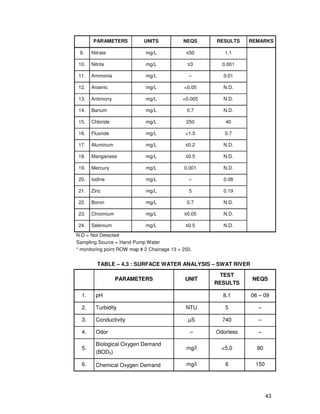
Table – 4.2 : Laboratory Analysis of Ground Water Sample* ..........................................42
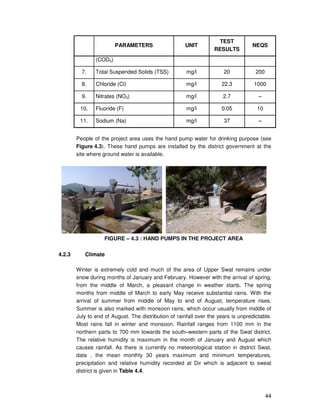
Table – 4.3 : Surface Water Analysis – Swat River..........................................................43
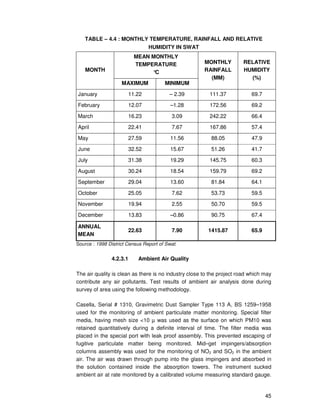
Table – 4.4 : Monthly Temperature, Rainfall and Relative Humidity in Swat...................45
ix
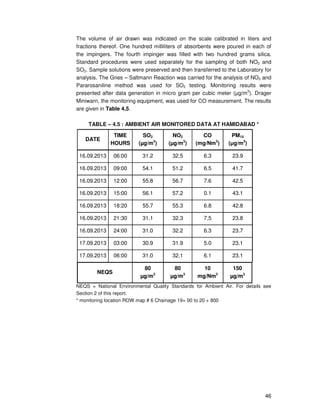
Table – 4.5 : Ambient Air Monitored Data at Hamidabad * ..............................................46
Table – 4.6 : Noise Levels Monitored at Hamidabad * (Residential Area).......................47
Table – 4.7 : Noise Levels Monitored at Dadawar * (Residential Area)..........................47
Table – 4.8 : Mammals in SWAT ......................................................................................49
Table – 4.9 : Flora in the Project Area..............................................................................51
Table – 4.10 : Administrative Units in Swat ......................................................................55
Table – 4.11 : Population Composition of Swat................................................................55
Table – 4.12 : Details of Sensitive Receptor *..................................................................56
Table – 6.1 : Summary of Public Consultations................................................................76
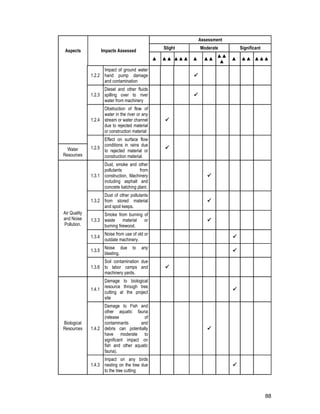
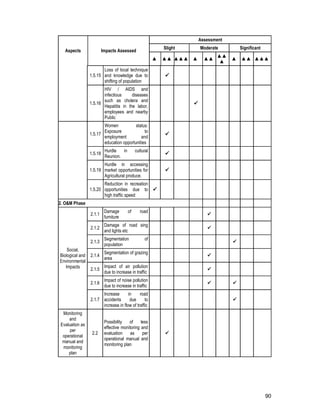
Table – 7.1 : Evaluation of Environmental and Social Impacts........................................86
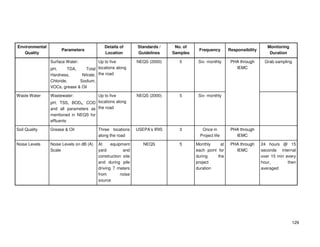
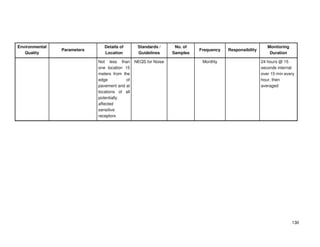
Table – 8.1 : Monitoring Plan ..........................................................................................107
Table – 8.2 : Summary of Finance..................................................................................110
Table – 8.3 : Environmental Mitigation & Monitoring Plan..............................................113
Table – 8.4 : Operational Phase .....................................................................................125
Table – 8.5 : Effects / Environmental Effects Monitoring Plan for the Construction
and the Operation Stages .......................................................................128
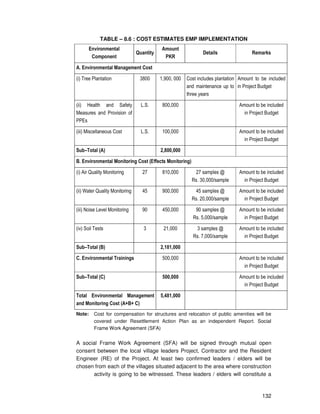
Table – 8.6 : Cost Estimates EMP Implementation........................................................132
LIST OF FIGURES
Figure – 1.1 : Location of Pakistan .....................................................................................2
Figure – 1.2 : Project Area Location ...................................................................................3
Figure – 1.3 : Project Location Map....................................................................................4
Figure – 3.1: Project Location ..........................................................................................28
Figure – 3.2 : Different Views of the Proposed Road.......................................................31
Figure – 4.1 : Pakistan Earthquake Zoning Map ..............................................................40
Figure – 4.2 : Water Channel in the Project Area.............................................................42
Figure – 4.3 : Hand Pumps in the Project Area................................................................44
Figure – 4.4 : Air Quality Monitoring of the Project Area..................................................47
Figure – 4.5 : Traffic Count Chart .....................................................................................48
Figure – 4.6 : Flora in Project Area...................................................................................53
Figure – 4.7 : Flora along the Road Side..........................................................................53
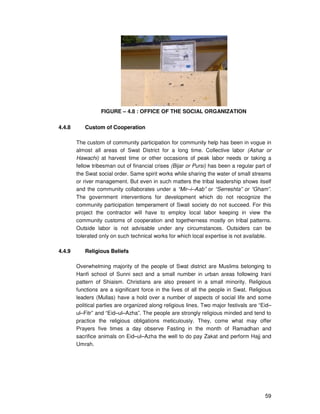
Figure – 4.8 : Office of the Social Organization................................................................59
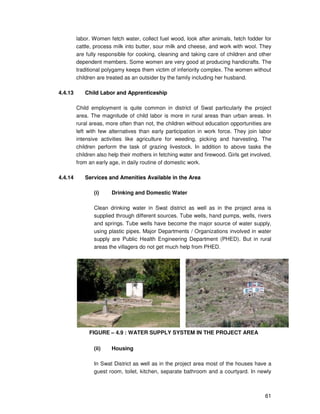
Figure – 4.9 : Water Supply System in the Project Area..................................................61
Figure – 6.1 : Stakeholders Consultations........................................................................77
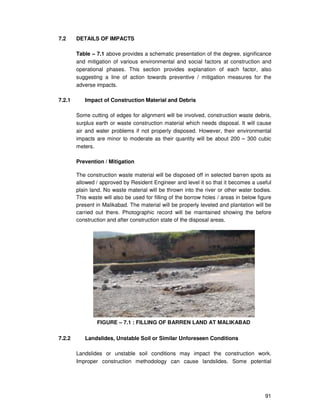
Figure – 7.1 : Filling of Barren Land at Malikabad............................................................91
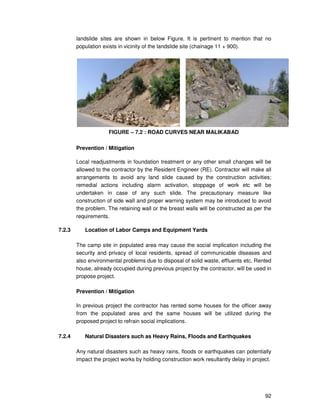
Figure – 7.2 : Road Curves Near Malikabad ....................................................................92
x
LIST OF ACRONYMS
AASHTO American Association of State Highway and Transportation Officials
ACE Associated Consulting Engineers
ACI American Concrete Institute
ADB Asian Development Bank
AIDS Acquired Immunodeficiency Syndrome
ASTM American Society for Testing and Material
BHU Basic Health Unit
BOD Biochemical Oxygen Demand
BOQ Bill of Quantities
COD Chemical Oxygen Demand
COI Corridor of Impact
DDE Deputy Director Environment
DEMM Donors Environmental Monitoring Mission
EA Environmental Assessment
EIA Environmental Impact Assessment
EIRR Economic Internal Rate of Return
EMMP Environment Mitigation and Monitoring Plan
EMP Management Plan
EPC Environmental Protection Council
ESC Engineering and Supervision Consultant
FIDIC Fédération Internationale Des Ingénieurs-Conseils
(International Federation of Consulting Engineers)
GoKP Government of Khyber Pakhtunkhwa
GoP Government of Pakistan
GRM Grievance redress mechanism
HIV Human Immunodeficiency Virus
HSE Health Safety Equipment
IEE Initial Environmental Examination
IEM Independent External Monitor
IEMC Independent Environmental Monitoring Consultants
ISMZ Indus Suture Melange Zone
JUI Jamiat–i–Ulmai–Islam
KP Khyber Pakhtunkhwa
KP-EPA Khyber Pakhtunkhwa Environmental Protection Agency
M&E Monitoring and Evaluation
MBT Main Boundary Thrust
MDTF Multi Donor Trust Fund
MMT Main Mantle Thrust
NCS National Conservation Strategy
NDIR Non Dispersive Infra Red
NEQs National Environment Quality Standards
NGOs Non–Government Organizations
NHA National Highway Authority
NOC No Objection Certificate
NWFP North West Frontier Province (Now KP)
xi
O&M Operation and Maintenance
OP Operational Policy
Pak–EPA Pakistan Environment Protection Agency
PCO Public Call Offices
PEPA Pakistan Environmental Protection Agency
PEPC Pakistan Environment Protection Council
PHED Public Health Engineering Department
PKR Pak Rupees
PHA Pakhtunkhwa Highway Authority
PM Project Manager
PMAP Pakhtunkhwa Milli Awami Party
PML Pakistan Muslim League
PPC Pakistan Penal Code
PPE Personal Protective Equipment
PSDP Public Sector Development Project
PSQCA Pakistan Standards Quality Control Authority
PTCL Pakistan Telecommunication Limited
PTV Pakistan Television
RE Resident Engineer
RoW Right of Way
SFA Social Framework Agreement
SHE Health Safety Equipment
SPM Suspended Particulate Matter
UBC Uniform Building Code
US$ US Dollar
VOC Volatile Organic Compounds
WAPDA Water and Power Development Authority
WB World Bank
WHO World Health Organization
XEN Executive Engineer
xii
EXECUTIVE SUMMARY
The road from Chakdara to Madyan was completely destroyed over a length of 95 km
due to activities of insurgents and counter actions by the Pakistan Army. The World
Bank (WB) agreed to finance reconstruction and rehabilitation of about 10 km long
segment of this road from Sharifabad to Kanju (km 30+424 to 40+924) under the Khyber
Pakhtunkhwa Emergency Road Recovery Project (KP-ERRP). Due to savings in project
cost, an additional five km long stretch of the same road from Dadahara to Sharifabad
was also reconstructed and rehabilitated under the same project. The reconstruction and
rehabilitation of Dadahara to Kanju section (15.50 km) of the road has been successfully
completed under the KP-ERRP. The road is operational and all the contractual
requirements of the project have been duly completed.
The additional financing of KP-ERRP is now being provided by the World Bank for
reconstruction and rehabilitation of another 14.15 km long segment of the same road,
from Shamozai to Dadahara (km 10+700 to 24+850).
The Chakdara to Madyan road runs on the right bank of River Swat and the immediate
beneficiaries of this road will be the towns of Sharifabad, Dadahara, Hamidabad,
Nagoha, Zarhhela Shamozai, Khaliqabad, Dedawar, Malikabad and Tarang Shamozai,
having numerous settlements of varying sizes. The proposed rehabilitation and
reconstruction of the road will provide relief and safe travelling opportunities to a large
part of the war affected communities.
The design, execution and supervision of this project have been entrusted to the
Pakhtunkhwa Highways Authority (PHA) who has engaged the Associated Consulting
Engineers (ACE) as their design and engineering consultants. This project will be
completed in about twenty months with the estimated cost of 9.1 Million US$ which is
equivalent to about PKR 982.8 Million.
The present EIA has been conducted in response to the national environmental
protection laws and the WB environmental safeguard policies.
As a part of this EIA study, primary as well as secondary data have been collected
through field surveys, public consultations and library research. Consultations have also
been carried out with the communities and related government departments. Screening
and scoping of the study has been carried out before preparing the Environment
Management Plan (EMP). Women consultations have also been carried out through
elderly village leaders or women to create a gender balance.
The project area is a linear corridor through which the Shamozai – Dadahara road
passes on the right bank of the River Swat, tehsil Kabbal. The existing road traverses
through small towns and cultivated lands. The existing road is in a very poor condition
and quite narrow especially in urban areas. However, the Right of Way (ROW) of the
xiii
road is 15 m, according to the land records available with the government. Presently,
this road section carries little passenger and freight traffic.
The potential environmental impacts of the proposed project include air and water
contamination, noise generation, traffic congestion, and health and safety risks for the
communities as well as construction workforce –mostly to be encountered during the
construction phase. The project is likely to affect 10 structures along the road and to
address this impact, a resettlement action plan (RAP) has been prepared. The RAP is
presented under a separate cover.
This EIA has shown that potentially negative impacts associated with the proposed
project are mostly moderate and reversible in nature, and can be easily addressed with
the help of appropriately designed and effectively implemented mitigation measures
proposed in this report.
A comprehensive EMP has been prepared accompanied by an effective Environment
Management Monitoring Plan (EMMP) and supported by an institutional arrangement. It
is mandatory that EMP and EMMP are made an integral part of the contract documents.
A system of contractor’s non–compliances / violations has been prescribed and linked
with contractor’s bill payments.
For the implementation of EMP at work site the contractor will engage a full time
environment specialist. The Engineering Supervision Consultants (ESC) will also have
on their team a full time environmental expert placed at the construction site to provide
professional guidance and supervision for the EMP implementation including
environmental monitoring. In PHA there is an Environmentalist, who will be overall
responsible for the EMP implementation throughout the project and ensure application of
environmental measures during the detailed design, bidding and construction stages.
The process and outcome of the EMP implementation activities will be included in the
progress reports prepared by the PHA. The EMP implementation cost has been
estimated as PKR 5,481,000.
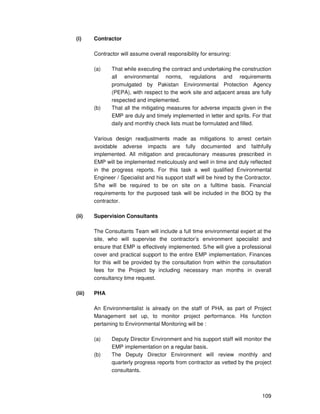
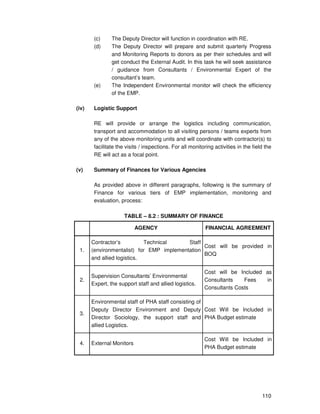
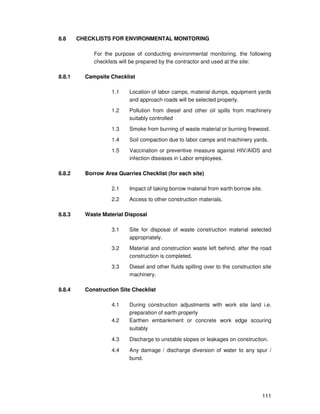
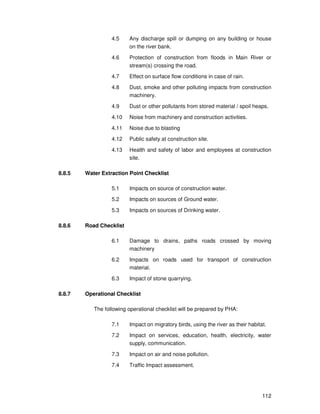
1
1.0 INTRODUCTION
This document presents the Environmental Impact Assessment (EIA) of
rehabilitation and reconstruction of 14.15 km long segment of Shamozai –
Dadhahara road, which runs almost the parallel to River Swat on its right bank, in
District Swat of Khyber Pakhtunkhwa (KP) Province of Pakistan.
1.1 PROJECT OVERVIEW
The road from Chakdara to Madyan was completely destroyed over a length of
95 km due to activities of insurgents and counter actions by Pakistan Army. The
World Bank agreed to finance the upgradation and rehabilitation of about 10.5
km long segment of this road, from Sharifabad to Kanju (km 30 + 424 to 40 +
924) under the Khyber Pakhtunkhwa Emergency Road Recovery Project (KP-
ERRP). Due to cost savings, an additional five km stretch of the same road from
Dadahara to Sharif Abad was also included in the project. The construction and
rehabilitation of Dadahara to Kanju Section (15.50 km) has been successfully
completed under the KP-ERRP. The contractual requirements of the project have
been completed and the road is now fully functional.
The additional financing of KP-ERRP is now being provided by the World Bank
for reconstruction and rehabilitation of another 14.15 km long segment of the
same road, from Shamozai (km 10+700) to Dadahara (km 24+850). The design,
execution and supervision of this road have been entrusted to the Pakhtunkhwa
Highways Authority (PHA) who have engaged Associated Consulting Engineers
(ACE) as their design and engineering consultants. This road would run on the
right bank of River Swat and the immediate beneficiaries of this road will be the
towns of Sharifabad, Dadahara, Hamidabad, Nagoha, Zarhhela Shamozai,
Khaliqabad, Dedawar, Malikabad and Tarang Shamozai, having numerous
settlements of varying sizes. This will provide relief and safe travelling
opportunities to a large part of the war affected communities (see location maps
in Figures 1.1, 1.2 and 1.3).
The proposed project focuses on early recovery priorities agreed between the
Government of Khyber Pakhtunkhwa (GoKP) and the World Bank to be funded
under Multi Donor Trust Fund (MDTF). The World Bank is the Administrator of
this MDTF. The Project Development Objective (PDO) is to enable the population
along the project corridor to benefit from year round improved access and
mobility through reconstruction of priority damaged roads and bridges in the
conflict hit areas. The expected outcome is improved traffic flow resulting in
reduced vehicle operating costs and travel time for beneficiaries using the road.
2
FIGURE – 1.1 : LOCATION OF PAKISTAN
PAKISTAN
FIGURE – 1.2 : PROJECT AREA LOCATION
Tribal
Area
SWAT
VALLEY
Renamed as
Khyber Pakhtunkhwa Province
in recent past
4
FIGURE – 1.3 : PROJECT LOCATION MAP
MADYAN
CHAKDARA SHAMOZAI
KANJU
SHARIFABAD
MDTF Sponsored
Section
DADAHARA
5
The Multi Donor Trust Fund (MDTF) is one of the key instruments to support the
reconstruction, rehabilitation, reforms and other interventions needed to build
peace and create the conditions for sustainable development in Khyber
Pakhtunkhwa in the aftermath of the 2009 crisis. The MDTF is governed by: (a)
Administration Agreements between the World Bank and Donors; and (b) Grant
Agreements between the Bank and Grant Recipients.
1.2 ENVIRONMENTAL AND SOCIAL SCREENING AND ASSESSMENT
FRAMEWORK
The Bank has prepared an Environmental and Social Screening and Assessment
Framework (ESSAF), in accordance with the OP 8.0 for emergency operations–
applicable to all interventions under the KP/FATA/Balochistan MDTF. It specifies
the environmental and social assessment requirements that the implementing
agency(ies) will need to fulfill before any Project component under the MDTF can
be implemented. The Framework also describes the generic
environmental/social monitoring and reporting requirements to be fulfilled during
Project implementation, in addition to defining the broad institutional
arrangements required for environmental and social safeguard aspects
associated with the individual projects under the MDTF. Procedures for
screening of all possible environmental and social impacts will be described in
detail in the project ESMP. The ESSAF has been shared with the FATA
Secretariat and disclosed locally by the FATA Secretariat on its website on 15
December 2010. The present EIA has been carried out in pursuance of the
environmental and social assessment requirements defined in the ESSAF.
1.3 BASIC FEATURES OF THE PROPOSED PROJECT
The scope of Shamozai – Dadhahara Road Upgradation / Rehabilitation Project
has the following major features:
Road reconstruction / rehabilitation over a length of 14.15 km
Side drain on hill side along the alignment
Side Drain in Built–Up area
Guardrail for embankments higher than 3 meters
Appropriate signs and road guidelines
Pedestrian and bridal paths to be accommodated
Infrastructure of a highway e.g. drainage, crossing stream culverts or
causeways and other facilities will be rehabilitated.
6
1.4 THE STUDY OBJECTIVES
The ultimate objective of the study is to make the project environmentally
sustainable and socially acceptable. The specific objectives of this study can be
identified as follows:
To carryout environmental and social assessment including the
supporting administrative and legal framework of the proposed highway.
To identify the potential environmental issues pertaining to the proposed
highway.
To evaluate the site’s social acceptance and environmental soundness.
To collect the baseline data on physical biological and socio–economic
conditions of the project area.
To identify preventive / remedial measures of the potential environmental
impacts.
To propose institutional responsibilities and methods of monitoring the
preventive measures and monitoring procedures.
Development of well resourced environmental management and
monitoring plans to identify preventive strategies targeted towards
avoidance, minimization and rehabilitation of the impacts.
1.5 STUDY METHODOLOGY
As a part of EIA Study, primary and secondary data were collected through field
surveys, public consultations and library research. Consulted were the PHA
Sources, the World Bank Literature, Meteorological Department, Soil Survey of
Pakistan, Integrated Environment Laboratory, Statistical Survey of Pakistan,
Departments of Forestry, Wildlife and Fisheries and Communication and Works
Department of GoKP. Major data which became available from these sources
were land use, soil and physiographic, traffic and noise level, surface and ground
water quality, and biodiversity. Above all the data on social and economic factors
prevailing in Swat in general and in the project area in particular were available
from Pakistan Statistical Year Book, District Gazetteer and Economic Survey of
Pakistan.
For social data of nearby communities, a structured survey was conducted. For
Rapid Rural Survey of the area another questionnaire was used. For information
on any resettlement issues, a separate stand alone study will be carried out and
as and when data becomes available, it can be incorporated in social baseline.
1.5.1 Environmental Assessment Process
The methodology adopted to carry out the EIA Study of the proposed project was
as follows:
7
Orientation
Planning of Data Collection
Data Collection
Site Reconnaissance
Analysis of Maps
Literature Review
Desk Top Research
Public Consultations
Field Studies
Laboratory Analysis
Evaluation of Impacts and their analysis
Categorization of impacts based on their potential environmental
significance and prescription of preventive / mitigation measures
In addition to the evaluation and review of the available records, data and the
facts for the previous project, detailed discussions were held with the concerned
members of the project management as well as other project stakeholders.
Notes and proposals for measures to be taken to mitigate and compensate for
any determined / detrimental environmental impacts are contained in the
Environmental Management Plan (EMP) as well as a Monitoring Plan, including
all parameters that need to be measured, and the frequency of monitoring
actions. A comprehensive qualitative and quantitative methodology was adopted
to conduct this study inter–alia in due compliance with the EIA requirements. The
study included collection of both primary and secondary data regarding
environmental status and other relevant factors. This EIA report has been
accomplished after carrying out thorough visit to the proposed site and detailed
investigation to identify the following environmental areas of concern:
To achieve the desired environmental compliance standards; as per the
World Bank and national requirements; as applicable to the project.
Plans and activities to prevent / mitigate any potential impacts and the
gaps that could probably remain after implementation.
Any other points / steps to be taken which could be beneficial to mitigate
environmental adverse impacts that may accrue both during construction
and regular operation of the project.
The methodology for environmental assessment is given in Table – 1.1 below.
TABLE – 1.1 : ENVIRONMENTAL AND SOCIAL ASSESSMENT PROCESS
PHASE ACTIVITIES STATUS RESPONSIBILITY
Screening and
Scoping
Reconnaissance and initial
site visit and consultations,
Carried out
during the
Project
Management (PM)
8
PHASE ACTIVITIES STATUS RESPONSIBILITY
identification of
environmental and social
issues & applicable
safeguard policy,
categorization and working
out an action plan.
present EIA Consultants
Impact
Assessment
Identification of potential
environmental and social
impacts through site visits,
stakeholders consultations,
review of drawings,
alternatives etc
during the
present EIA
PM Consultants
Impact
categorization
The significant potential
impacts were tabulated and
mitigation / preventive
measures were prescribed
during the
present EIA
PM Consultants
EMP
Preparation
Women consultation Carried out
during /
prepared as part
of the present
EIA
PM Consultants
Draft EMP
Draft Social Framework
Agreement (SFA)
Disclosure and
Consultant SFA
Agreement
Disclosure of Draft EMP and
SFA
Pending till final
approval of
project. Draft
SFA ready
PHA and
communities
assisted by PM
Disclosure and
Consultant
Signing of SFA
Pending till the
commencement
of the project.
PHA and
communities
assisted by PM
Consultant
Final EMP
Final version of EMP
produced
Included in the
present EIA.
PM Consultants
1.5.2 Field Surveys
A well trained team including environmentalist, sociologist, and ecologist carried
out field survey. They undertook two–fold consultation / survey program.
9
Phase – I: This phase comprised of the meetings and discussions with the
official. Meetings with officials facilitated achieving multiple and diverse
objectives such as:
To evaluate the site suitability in view of social acceptance and
environmental soundness.
To provide the maximum information to stakeholders about the significant
environmental impacts and the implication of the proposed project.
Confirmation of the suitability of initial list of communities selected for
consultation.
Phase – II: This phase involved the discussion with the local communities in the
project area of influence. The program included both community discussion and
discussion with women only by women organization.
1.5.3 Women Consultations
The rural society in Swat District is highly conservative where direct access to
women for social surveys, even with a female sociologist, is not possible. The
community elders and aged women in selected localities hesitated to get their
names recorded during the women consultation process which was carried out
according to “Gender Issue Study”, commissioned by Environmental Protection
Agency (EPA) and Asian Development Bank (ADB) and is considered to be an
essential part of project preparation. The ADB studies certainly overlap those
required out of the current study, which also include the “Gender Impact
Assessment”. Accordingly, seven meetings were held with women in different
parts of the project, four through village elders and three through women
teachers and a non–governmental organization.
1.6 PROJECT CLASSIFICATION
The project involves up gradation and rehabilitation of an existing road over a
length of 14.15 km with no changes in the road alignment nor any changes in the
ROW of road, in an area with little environmental and / or social sensitivity.
Moreover, none of the potential impacts of the project are likely to be large scale,
unprecedented and / or irreversible. Therefore, the project falls in Category “B”
according to the World Bank’s Operational Policies.
1.7 THE REPORT STRUCTURE
This EIA document is structured as follows:
Chapter – 1: Introduction: Containing general information about the project and
process of carrying out the study.
10
Chapter – 2: International and National Environmental Policy, Legal And
Administrative Framework: Describes the international and national policy,
laws and regulations governing this EIA.
Chapter – 3: The Project Description: Describes an overall detail of the works
to be done.
Chapter–4: The Baseline Study: Gives information on Physical, Biological and
Social conditions collected through survey of the Project Area.
Chapter – 5: Analysis of Alternatives: Describes and analyses various
alternatives to establish the feasibility of the modernization and construction of
road.
Chapter – 6: Stakeholders Consultation and Disclosure: Explains the
process of public consultation and disclosure of the report at District Council
Office as well as important public library(s). It makes this document a legal public
document.
Chapter – 7: Environmental Impact Assessment: Identifies various
environmental impacts and their preventive actions. This makes the basis of the
Environment Management Plan.
Chapter – 8: Environment Management Plan (EMP): Contains comprehensive
prescriptions regarding environmental impacts and their mitigation measures.
This also includes institutional arrangements and Environmental Management &
Monitoring Plan.
11
2.0 INTERNATIONAL AND NATIONAL ENVIRONMENTAL POLICY, LEGAL AND
ADMINISTRATIVE FRAMEWORK
This chapter provides an overview of the policy framework, national legislation
and international protocols applicable to the project. The project is required to
comply with the national legislation relating to environment in Pakistan and to
obtain all regulatory clearances in accordance to the environmental law. The
project at the same time is required to conform to the operational manuals of the
donor agency i.e., the World Bank and the environmental safeguards provided
therein.
2.1 APPLICABLE INTERNATIONAL ENVIRONMENTAL LAWS AND
REGULATIONS
2.1.1 International Framework
For the assessment of the environmental impacts of the proposed project on air,
water and noise according to the international legal framework, this report has
also incorporated the requirements of the “Pollution Prevention and Abatement
Handbook” by the World Bank Group – effective July, 1998.
2.1.2 The World Bank Operational Policies
The World Bank is the donor for this project. Therefore, it is obligatory for
Pakhtunkhwa Highway Authority (PHA) to abide by the World Bank safeguard
policies for environment, which are discussed below:
2.1.3 Environmental Assessment (OP 4.01)
The World Bank requires Environmental Assessment (EA) of projects proposed
for Bank financing to ensure that they are environmentally sound and
sustainable, and thus to improve decision making.1 The OP defines the EA
process and various types of the EA instruments to satisfy the assessment
process.
2.1.3.1 Category of the Project
The proposed project consists of activities which have environmental and social
impacts, including:
(a) Deterioration of air quality,
(b) Water contamination and consumption,
1. Excerpt from WB OP 4.12, WB Operational Manual, January 1999.
12
(c) Damage to top soil, land erosion,
(d) Safety hazard
(e) Short time social flux
Since none of the potential impacts of the project are likely to be large scale,
unprecedented and / or irreversible, the project has been classified as Category
B, in accordance with OP 4.01.
The present environmental assessment has been carried out in accordance with
this OP, to identify the extent and consequences of these impacts, and to
develop an EMP for their mitigation.
2.1.3.2 Involuntary Resettlement (OP 4.12)
The WB’s experience indicates that involuntary resettlement under development
projects, if unmitigated, often give rise to severe economic, social, and
environmental risks: production systems are dismantled; people face
impoverishment when their productive assets or income sources are lost; people
are relocated to environments where their productive skills may be less
applicable and the competition for resources greater; community institutions and
social networks are weakened; kin groups are dispersed; and cultural identity,
traditional authority, and the potential for mutual help are diminished or lost. This
policy includes safeguards to address and mitigate this impoverishment risks.2
The overall objectives of the Policy are given below:
Involuntary resettlement should be avoided where feasible, or minimized,
exploring all viable alternative project designs.
Where it is not feasible to avoid resettlement, resettlement activities
should be conceived and executed as sustainable development
programs, providing sufficient investment resources to enable the
persons displaced by the project to share in project benefits. Displaced
persons should be meaningfully consulted and should have opportunities
to participate in planning and implementing resettlement programs.
Displaced persons should be assisted in their efforts to improve their
livelihoods and standards of living or at least to restore them, in real
terms, to pre–displacement levels or to levels prevailing prior to the
beginning of project implementation, whichever is higher.
2. Excerpt from WB OP 4.12, WB Operational Manual, December 2001.
13
A total of ten structures (two shops, two boundary walls of house, and six
houses) along the road will be impacted. Along the road alignment 760 trees will
be removed. A Resettlement Action Plan has been recommended to address all
the issues in accordance to OP 4.12.
2.1.3.3 Forestry (OP 4.36)
The objective of this Policy is to assist the WB’s borrowers to harness the
potential of forests to reduce poverty in a sustainable manner, integrate forests
effectively into sustainable economic development, and protect the vital local and
global environmental services and values of forests.
None of the project components would be located inside any forested areas and
no project activity will have any impact on the forest. Hence the OP 4.36 is not
applicable.
2.1.3.4 Natural Habitat (OP 4.04)
The conservation of natural habitats, like other measures that protect and
enhance the environment, is essential for long–term sustainable development.
The Bank therefore supports the protection, maintenance, and rehabilitation of
natural habitats and their functions.3
All of the proposed project components would be located in areas where the
natural habitat has already been significantly modified, as a result of road
construction and associated activities. Therefore the OP 4.04 is not triggered.
2.1.3.5 Pest Management (OP 4.09)
Through this OP, the WB supports a strategy that promotes the use of biological
or environmental control methods and reduces reliance on synthetic chemical
pesticides. This OP is not relevant since the Project does not involve purchase
or use of pesticides or fertilizers.
2.1.3.6 Safety of Dams (OP 4.37)
The Policy seeks to ensure that appropriate measures are taken and sufficient
resources provided for the safety of dams the WB finances. However this OP is
not relevant since the proposed project does not involve construction of dams.
3. Excerpt from WB OP 4.04, WB Operational Manual, June 2001.
14
2.1.3.7 Projects on International Waterways (OP 7.50)
This OP defines the procedure to be followed for the WB financed projects that
are located on any water body that forms a boundary between, or flows through
two or more states. However, no project components will be located on any such
waterways; hence, this OP is not triggered.
2.1.3.8 Cultural Property (OP 4.11)
The World Bank’s general policy regarding cultural properties is to assist in their
preservation and to seek to avoid their elimination.
The specific aspects of the Policy are given below :4
The Bank normally declines to finance projects that will significantly
damage nonreplicable cultural property and will assist only those projects
that are sited or designed so as to prevent such damage.
The Bank will assist in the protection and enhancement of cultural
properties encountered in Bank–financed projects, rather than leaving
that protection to chance. In some cases, the project is best relocated in
order that sites and structures can be preserved, studied, and restored
intact in situ. In other cases, structures can be relocated, preserved,
studied, and restored on alternate sites. Often, scientific study, selective
salvage, and museum preservation before destruction is all that is
necessary. Most such projects should include the training and
strengthening of institutions entrusted with safeguarding a nation’s
cultural patrimony.
Such activities should be directly included in the scope of the project,
rather than being postponed for some possible future action, and the
costs are to be internalized in computing overall project costs.
Deviations from this policy may be justified only where expected project
benefits are great and the loss of or damage to cultural property is judged
by competent authorities to be unavoidable, minor, or otherwise
acceptable. Specific details of the justification should be discussed in
project documents.
This policy pertains to any project in which the Bank is involved,
irrespective of whether the Bank is itself financing the part of the project
that may affect cultural property.
Since the project activities will be carried out along an existing road, it is unlikely
that any sites of cultural, archeological, historical, or religious significance will be
4. Excerpt from WB OP 11.03, WB Operational Manual, September 1986.
15
affected. However, in case of discovery of any such sites or artifacts during the
project implementation, the work will be stopped at that site. The provisions of
this Policy will be followed. Additionally, the provincial and federal archeological
departments will be notified immediately, and their advice sought before
resumption of the construction activities at such sites.
2.1.3.9 Indigenous People (OP 4.10)
For purposes of this policy, the term “Indigenous Peoples” is used in a generic
sense to refer to a distinct, vulnerable, social and cultural group possessing the
following characteristics in varying degrees :5
self–identification as members of a distinct indigenous cultural group and
recognition of this identity by others;
collective attachment to geographically distinct habitats or ancestral
territories in the project area and to the natural resources in these
habitats and territories;
customary cultural, economic, social, or political institutions that are
separate from those of the dominant society and culture; and
an indigenous language, often different from the official language of the
country or region.
The OP defines the process to be followed if the project affects the indigenous
people.
No indigenous people – with a social and cultural identity distinct from the
dominant society that makes them vulnerable to being disadvantaged in the
development process are known to exist in the District. Therefore this OP is not
triggered.
2.1.3.10 Projects in Disputed Areas (OP 7.60)
Projects in disputed areas may raise a number of delicate problems affecting
relations not only between the Bank and its member countries, but also between
the borrower and one or more neighboring countries. In order not to prejudice the
position of either the Bank or the countries concerned, any dispute over an area
in which a proposed project is located is dealt with at the earliest possible stage.
The Bank may proceed with a project in a disputed area if the governments
concerned agree that, pending the settlement of the dispute, the project
5. Excerpt from WB OP 4.04, WB Operational Manual, June 2001.
16
proposed for country A should go forward without prejudice to the claims of
country B.6
This OP is not triggered since no part of the Project Province is located in any
disputed territory.
2.2 NATIONAL ENVIRONMENTAL REGULATORY / LEGAL REQUIREMENTS
After the 18th
Amendment to the Constitution of The Islamic Republic of Pakistan
– 1973, the Regulation & Management of Environment has largely been
delegated to the provinces. The Federal Ministry of Environment has been
abolished and instead the Climate Change Division has been created and the
Environmental Protection Agency is working as a wing of this division.
The Pakistan Environmental Protection Act 1997 (PEPA–1997) and the rules,
regulations, standards made there under have been adopted as such by all the
provincial Environmental Protection Agencies (EPAs). Every provincial EPA is
working now with the same law, rules, regulations and standards that were
promulgated by the Federal Environmental Protection Agency (Federal EPA)
before 18th
amendment. Now every EPA is independent and responsible for
prevention of pollution and to formulate the rules, regulations related with
environmental protection and sustainable development.
Each EPA is now working with the same powers as Federal EPA had governed
before the 18th
amendment. These EPAs are now in process to publish their
sectoral regulations, rules, standards. Their governing approach and method is
the same as it was with the Federal EPA.
2.2.1 Institutional Arrangements
The Khyber Pakhtunkhwa Environmental Protection Agency (KP-EPA) is the
provincial agency responsible for the environmental protection and pollution
control in the province of Khyber Pakhtunkhwa. Accordingly, the proposed
project of rehabilitation and upgradation of Shamozai – Dadahara road falls
under the jurisdiction of KP-EPA.
2.2.2 National Conservation Strategy (NGS) – Pakistan
The National Conservation Strategy (NCS) – Pakistan, as approved by the
Federal Cabinet in March 1992 is the guiding document on the environmental
issues in the country (Ref. EUAD / IUCN, 1992). The NCS outlines the country’s
primary approach towards encouraging sustainable development, conserving
6. Excerpt from WB OP 7.60, WB Operational Manual, November 1994.
17
natural resources, and improving efficiency in the use and management of
resources.
The NCS has 68 specific programs in 14 core areas in which policy intervention
is considered crucial for the preservation of Pakistan’s natural and physical
environment. The core areas that are relevant in the context of the envisaged
project are pollution prevention and abatement, restoration of supporting forestry
and plantations, and preservation of cultural heritage.
2.2.3 Pakistan Environmental Protection Act, 1997
The promulgation of the Environmental Protection Ordinance, 1983 was the first
codifying legislation to the issue of environmental protection. Later, the
Government passed the Pakistan Environmental Protection Act (PEPA), 1997
(amended 2012), which is the basis of IEE/EIA studies carried out for the projects
in Pakistan.
PEPA, 1997 (and its subsequent amendments) is a fairly comprehensive
legislation and provides protection, conservation, rehabilitation and improvement
of the environment. It contains concrete action plans and programs for the
prevention of pollution and promotes sustainable development. The salient
features of the law are:
It covers the air, water, soil, marine and noise pollution including pollution
caused by motor vehicles.
The Act provides National Environmental Quality Standards (NEQS) for
wastewater, air emissions and noise.
Law provides clear cut guidelines for IEE / EIA for various projects as per
their magnitude and anticipated impacts.
Law also empowers Federal Government to issue notices and to enforce
them for the protection of the environment.
For the effective implementation of the provisions of PEPA, 1997, Pakistan
Environmental Protection Agency, headed by a Director General was constituted.
On the same pattern, Provincial Environmental Protection Agencies (EPA’s) were
created in all the provinces.
Environmental Tribunals were also constituted according to PEPA, 1997.
Environmental Protection Agency (EPA) of each province of Pakistan is now
required to ensure compliance with the National Environmental Quality
Standards (NEQS) and to establish monitoring and evaluation systems. They are
also responsible for identifying the legislation needs, as well as initiating the
legislation, whenever necessary after the 18th
Amendments in the Constitution.
18
As described above each EPA is working as autonomous body with the same
powers as governed by the Federal EPA (Pak-EPA) and is responsible for
prevention of pollution and to formulate the rules, regulations related with
environmental protection and sustainable development. The provincial EPAs are
in process to announce the amendments in the adopted act i.e. PEPA–1997. As
like, the Punjab EPA, by taking the lead, has officially announced the formulation
of Environmental Protection Council, and the amendments in the adopted act.
Now the adopted act is known in Punjab as Punjab Environmental Protection Act
2012 (amended act). Similarly, the KPk-EPA has formulated the amended act
and has presented it in the provincial assembly for its official announcement.
2.2.4 Regulations for Environmental Assessment
Under Section 12 (and subsequent amendments) of Environmental Protection
Act 1997, a project falling under any category specified in Schedule I (SRO 339,
10/2000) requires proponent to file an Initial Environment Examination (IEE)
report with concerned provincial or federal agency (Pak–EPA). Projects falling
under any category specified in schedule the proponent will submit an EIA with
the Provincial Agency. Within 10 working days of IEE or EIA having been
deposited, the empowered agency will confirm that the document submitted is
complete for the purpose of review. During this time should the empowered
agency require the proponent for revision, clearly citing those aspects that need
further discussion the proponent will carry out necessary revision. Subsequently,
the federal agency will make every effort to complete process for an IEE review
within 40 days and an EIA within 90 days of filing. Pak – EPA regulation (SRO
339(1)/2000) states that an IEE is required for federal or provincial projects
(except in case of maintenance, rebuilding or reconstruction case) with a total
cost of less than 45 million. An EIA on the other hand is required for federal or
provincial project (except in the cases of maintenance, rebuilding or
reconstruction) with a total cost of 50 million or more. EIAs are also required
where projects are to be implemented in environmentally sensitive areas, or are
likely to cause adverse environmental effects.
2.2.5 Guidelines for Public Consultations
These guidelines deal with possible approaches to public consultation (PC) and
techniques for designing an effective program of consultation that reaches out to
all major stakeholders and ensures the incorporation of their legitimate concerns
in any impact assessment study. These guidelines cover:
Consultation, involvement and participation of Stakeholders
Techniques for public consultation (principles, levels of involvements,
tools, building trust)
19
Effective public consultation (planning, stages of EIA where consultation
is appropriate)
Consensus building and dispute resolution
Facilitation involvement (including the poor, women, building community
and NGO capacity
2.2.6 National Environmental Quality Standards for Ambient Air – November,
2010
The Ministry of Environment, Government of Pakistan vide its Notification,
Islamabad, the 18th
October, 2010 under S.R.O. 102 (1)/2010 established
standards which provide the maximum allowable limits, in the ambient air, of
Sulphur Dioxide (SO2), Oxides of Nitrogen as (NOx) and as (NO), Suspended
Particulate Matter–(SPM), Respirable Particulate Matter–PM10, Repairable
Particulate Matter–PM2.5, Lead and Carbon Monoxide (CO). Full text of the
standards is available at Pak.EPA web site
(http://www.environment.gov.pk/NEQS/SRO-2010-NEQS%20Air-Water-
Noise.pdf).
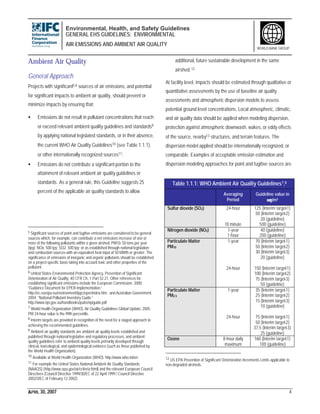
TABLE – 2.1 : NATIONAL ENVIRONMENTAL QUALITY STANDARDS FOR
AMBIENT AIR
Pollutants
Time–
Weighted
Average
Concentration in Ambient Air
Method of
Measurement
Effective
from 1st
July
2010
Effective from
1st
January
2013
Sulfur Dioxide
(SO2)
Annual
Average*
80 µg/m3
80 µg/m3
Ultraviolet
Fluorescence
24 hours** 120 µg/m3
120 µg/m3
Oxides of
Nitrogen as
(NO)
Annual
Average*
40 µg/m3
40 µg/m3
Gas Phase
Chemiluminescence
24 hours** 40 µg/m3
40 µg/m3
Oxides of
Nitrogen as
(NO2)
Annual
Average*
40 µg/m3
40 µg/m3
Gas Phase
Chemiluminescence
24 hours** 80 µg/m3
80 µg/m3
Ozone (O3) 1 hour 180 µg/m3
130 µg/m3 Non dispersive UV
absorption
Suspended
Particulate
Annual
Average*
400 µg/m3
360 µg/m3 High Volume
Sampling, (Average
20
Pollutants
Time–
Weighted
Average
Concentration in Ambient Air
Method of
Measurement
Effective
from 1st
July
2010
Effective from
1st
January
2013
Matter (SPM)
24 hours** 550 µg/m3
500 µg/m3
flow rate not less
than 1.1m3/minute).
Respirable
Particulate
Matter. PM10
Annual
Average*
200 µg/m3
120 µg/m3
βRay absorption
24 hours** 250 µg/m3
150 µg/m3
Respirable
Particulate
Matter.PM 2.5
Annual
Average*
25 µg/m3
15 µg/m3
βRay absorption
24 hours** 40 µg/m3
35 µg/m3
25 µg/m3
15 µg/m3
Lead (Pb)
Annual
Average*
1.5 µg/m3
1.0 µg/m3 ASS Method after
sampling using EPM
2000 or equivalent
Filter paper24 hours** 2.0 µg/m3
1.5 µg/m3
Carbon
Monoxide (CO)
8 hour 5 µg/m3
5 µg/m3
Non Dispersive Infra
Red (NDIR)1 hour 10 µg/m3
10 µg/m3
* Annual arithmetic mean of minimum 104 measurements in a year taken twice
a week 24 hourly at uniform interval.
** 24 hourly /8 hourly values should be met 98% of the in a year. 2% of the time,
it may exceed but not on two consecutive days.
2.2.7 National Standards for Drinking Water Quality – November, 2010
The Ministry of Climate Change, Government of Pakistan vide its Notification,
Islamabad, the 18th
October, 2010 under S.R.O. 102(1)/2010 established
standards for Drinking Water Quality. The major quality parameters fixed depend
upon Bacterial, Physical and Chemical ones. Full text of the standards is
available at Pak.EPA web site (http://www.environment.gov.pk/NEQS/SRO-
2010-NEQS%20Air-Water-Noise.pdf).
21
TABLE – 2.2 : NATIONAL STANDARDS FOR DRINKING WATER QUALITY
Properties / Parameters Standard Values for Pakistan
All water intended for drinking (E.Coli or
Thermo tolerant Coliform bacteria)
Must not be detectable in any 100 ml
samples
Treated water entering the distribution
system (E.Coli or thermotolerant coliform
and total coliform bacteria)
Must not be detectable in any 100 ml
samples
Treated water in the distribution system
(E.Coli or thermo tolerant coliform and
total coliform bacteria)
Must not be detectable in any 100 ml
samples In case of large supplies,
where sufficient samples are
examined, must not be present in
95% of the samples taken throughout
any 12– month period.
Physical
Color Non objectionable / Acceptable
Taste Non objectionable / Acceptable
Odor Non objectionable / Accept able
Turbidity < 5 NTU
Total hardness as CaCO3 < 500 mg/l
TDS < 1000
pH 6.5 – 8.5
Chemical
Essential Inorganic mg/Litre
Aluminum (Al) ≤0.2
Antimony (Sb) ≤0.005 (P)
Arsenic (As) ≤0.05 (P)
Barium (Ba) 0.7
Boron (B) 0.3
Cadmium (Cd) 0.01
22
Properties / Parameters Standard Values for Pakistan
Chloride (Cl) <250
Chromium (Cr) ≤0.05
Copper (Cu) 2
Toxic Inorganic mg/Litre
Fluoride (F)* ≤1.5
Lead (Pb) ≤0.05
Manganese (Mn) ≤0.5
Mercury (Hg) ≤0.001
Nickel (Ni) ≤0.02
Nitrate (NO3)* ≤50
Nitrite (NO2)* ≤3 (P)
Selenium (Se) 0.01 (P)
Residual chlorine 0.2–0.5 at consumer end; 0.5–1.5 at
source
Zinc (Zn) 5.0
Organic
Pesticides mg/l PSQCA No. 4639–2004, Page No. 4
Table No. 3 Sr. No. 20 – 58 may be
consulted.
Phenolic compound (as phenols) mg/l WHO standards: ≤0.002
Polynuclear Aromatic hydrocarbon
(as PAH) g/L
WHO standards: ≤0.01v
(by GC/MS method)
Radioactive
Alpha Emitters bq/L or pCi 0.1
Beta Emitters 1
23
2.2.8 National Environmental Quality Standards for Noise – November, 2010
The Ministry of Climate Change, Government of Pakistan vide its Notification,
Islamabad, and the 18th
October, 2010 under SRO 102(1)/2010 established
standards for Noise. These standards are based on Category / zone i.e.,
Residential area, Commercial area, Industrial area and Silence zone. The limiting
values for day and night have also been fixed for all categories / zones. Full text
of the standards is available at Pak.EPA web site
(http://www.environment.gov.pk/NEQS/SRO-2010-NEQS%20Air-Water-
Noise.pdf).
TABLE – 2.3 : NATIONAL ENVIRONMENTAL QUALITY STANDARDS FOR
NOISE
CATEGORY OF
AREA / ZONE
EFFECTIVE FROM 1ST
JULY 2012
DAY TIME NIGHT TIME
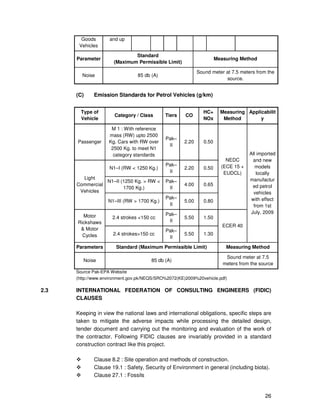
Residential Area 55 45
Commercial Area 65 55
Industrial Area 75 65
Silence Zone 50 45
Limit in dB(A) Leq*
Notes :
1. Day time hours: 6:00 a.m. to 10:00 p.m.
2. Night time hours: 10:00 p.m. to 6:00 a.m.
3. Silence zone::Zones that are declared as such by the competent authority. An area
comprising not less than 100 m around the hospitals, educational institutions and
courts.
4. Mixed categories of areas may be declared as one of the four above–listed
categories by the competent authority.
* dB(A) Leq: Time weighted average of the level of sound in decibels on Scale A which
is relatable to human hearing.
TABLE – 2.4 : SELECTED NEQS FOR WASTE EFFLUENTS
PARAMETER PARAMETER
Maximum Allowable
Limit
Temperature Increase °C < 3
pH value (acidity / basicity) pH 6 – 9
5–day biochemical oxygen demand
(BOD) at 20°C
mg/l 80
Chemical Oxygen Demand (COD) mg/l 150
24
PARAMETER PARAMETER
Maximum Allowable
Limit
Total suspended solids mg/l 200
Total dissolved solids mg/l 3,500
Grease and oil mg/l 10
Phenolic compounds (as phenol) mg/l 0.1
Chloride (as Cl) mg/l 1,000
Fluoride (as F) mg/l 10
Sulfate (SO4) mg/l 600
Sulfide (S) mg/l 1.0
Ammonia (NH3) mg/l 40
Cadmium mg/l 0.1
Chromium
(trivalent and hexavalent)
mg/l 0.1
Copper mg/l 1.0
Lead mg/l 0.5
Mercury mg/l 0.01
Selenium mg/l 0.5
Nickel mg/l 1.0
Silver mg/l 1.0
Total toxic metals mg/l 2.0
Zinc mg/l 5
Arsenic mg/l 1.0
Barium mg/l 1.5
Iron mg/l 8.0
Manganese mg/l 1.5
Boron mg/l 6.0
Chlorine mg/l 1.0
Source Pak-EPA Website (http://www.environment.gov.pk/NEQS/SRO549%20I2000-NEQS.pdf
25
TABLE – 2.5 : NEQS FOR MOTOR VEHICLES EXHAUST AND NOISE
(A) For In–Use Vehicles
For Passenger Cars and Light Commercial Vehicles (g/km)
Type of
Vehicle
Category / Class Tiers CO
HC
NOx
PM
Measuring
Method
Applicability
Passenger
Cars
M 1 : with reference
mass (RW) upto
2500 Kg. Cars with
RW over 2500 Kg. to
meet NI category
standards.
Pak–II
IDI
1.00 0.70 0.08
NEDC
(ECE 15+
EUDCL)
(i) All imported
and local
manufactured
diesel vehicles
with effect from
01.07.2012
Pak–II
IDI
1.00 0.90 0.10
Light
Commercial
Vehicles
NI–I (RW < 1250 Kg.)
Pak–II
IDI
1.00 0.70 0.08
Pak–II
IDI
1.00 0.90 0.10
NI–II (1250 Kg. < RW
< 1700 Kg.)
Pak–II
IDI
1.25 1.00 0.12
Pak–II
IDI
1.25 1.30 0.14
NI–III (RW > 1700
Kg.)
Pak–II
IDI
1.50 1.20 0.17
Pak–II
IDI
1.50 1.60 0.20
Parameter Standard (maximum permissible limit) Measuring Method
Noise 85 db (A)
Sound meter at 7.5 meters from the
Source.
(B) For Heavy Duty Diesel Engines and Large Goods Vehicles (g/Kwh)
Type of
Vehicle
Category /
Class
Tiers CO HC NOx PM
Measuring
Method
Applicability
Heavy
Duty
Diesel
Engines
Trucks and
Buses
Pak–II 4.0 1.1 7.0 0.15 ECE–R–49
All Imported and
local
manufactured
diesel vehicles
with the effect
01.07.2012
Large N2 (2000 Pak–II 4.0 7.0 1.10 0.15 EDC
26
Goods
Vehicles
and up
Parameter
Standard
(Maximum Permissible Limit)
Measuring Method
Noise 85 db (A)
Sound meter at 7.5 meters from the
source.
(C) Emission Standards for Petrol Vehicles (g/km)
Type of
Vehicle
Category / Class Tiers CO
HC+
NOx
Measuring
Method
Applicabilit
y
Passenger
M 1 : With reference
mass (RW) upto 2500
Kg. Cars with RW over
2500 Kg. to meet N1
category standards
Pak–
II
2.20 0.50
NEDC
(ECE 15 +
EUDCL)
All imported
and new
models
locally
manufactur
ed petrol
vehicles
with effect
from 1st
July, 2009
Light
Commercial
Vehicles
N1–I (RW < 1250 Kg.)
Pak–
II
2.20 0.50
N1–II (1250 Kg. > RW <
1700 Kg.)
Pak–
II
4.00 0.65
N1–III (RW > 1700 Kg.)
Pak–
II
5.00 0.80
Motor
Rickshaws
& Motor
Cycles
2.4 strokes <150 cc
Pak–
II
5.50 1.50
ECER 40
2.4 strokes>150 cc
Pak–
II
5.50 1.30
Parameters Standard (Maximum Permissible Limit) Measuring Method
Noise 85 db (A)
Sound meter at 7.5
meters from the source
Source Pak-EPA Website
(http://www.environment.gov.pk/NEQS/SRO%2072(KE)2009%20vehicle.pdf)
2.3 INTERNATIONAL FEDERATION OF CONSULTING ENGINEERS (FIDIC)
CLAUSES
Keeping in view the national laws and international obligations, specific steps are
taken to mitigate the adverse impacts while processing the detailed design,
tender document and carrying out the monitoring and evaluation of the work of
the contractor. Following FIDIC clauses are invariably provided in a standard
construction contract like this project.
Clause 8.2 : Site operation and methods of construction.
Clause 19.1 : Safety, Security of Environment in general (including biota).
Clause 27.1 : Fossils
27
Clause 42.1 : Possession of site and access thereto (for life forms)
Clause 42.3 : Right of ways and facilities in the project area
The PHA will ensure that the above FIDIC clauses are appropriately reflected in
the Tender Document(s), Bid Documents and the Contract Document(s).
2.4 GUIDELINES FOR SENSITIVE AND CRITICAL AREAS
These guidelines identify sensitive and critical areas in Pakistan, in relation both
to the natural environment and the cultural aspects.
2.5 FOREST ACT, 1927
All India Forest Act, 1927 was adopted by the Government of Pakistan, which
was subsequently implemented by the respective provinces. Basically, the law
was enacted to conserve and protect the forest resources of the country for
sustainable development. It lays down Rules and Regulations for exploitation of
various categories of forests such as reserved, protected or unclassified. Further,
the Act spells out the licensing method for timber cutting, grazing, hunting etc. It
also gives the details of magisterial powers of Forest Department officers and
penalties for offences committed with regard to forest resources and products.
2.6 THE KHYBER PAKHTUNKHWA WILDLIFE ACT, 1974
This law was enacted to protect the province’s wildlife resources directly and
other natural resources indirectly. It classifies wildlife by degree of protection, i.e.,
animals that may be hunted on a permit or special license, and species that are
protected and cannot be hunted under any circumstances. The Act specifies
restrictions on hunting and trade in animals, trophies, or meat. The Act also
defines various categories of wildlife protected areas, i.e., national parks, wildlife
Sanctuaries, and Game Reserve. The project activities will have to be carried out
in accordance with this Act. In particular, no activities will be carried out inside
any protected areas defined under the Act.
2.7 THE ANTIQUITIES ACT, 1975
The Antiquities Act, 1975, protects the country’s national and cultural heritage.
The Act defines ‘antiquities’ as ancient products of human activity, historical site,
or site of anthropological or cultural interest, national monuments etc. The Act
was formulated to protect such antiquities from destruction, theft, negligence,
unlawful excavation, trade and export. It prohibits new construction in proximity of
a protected antiquity and excavation in any area that may contain articles of
archaeological significance. The Act restrains activity within sixty–one meters or
two hundred feet of a protected antiquity.
28
3.0 DESCRIPTION OF THE PROJECT
3.1 LOCATION
The proposed road is located on the right bank of the River Swat, tehsil Kabbal in
the Swat district of KP, province of Pakistan (see maps in Figures 1.1, 1.2 and
1.3 and also in Figure 3.1). The project is located at a distance of 15.5 km from
the Kanju chowk and 5.1 km from Sharifabad town in Swat district. The existing
road traverses through small towns and cultivated lands on the right bank of river
Swat. The project road feeds numerous settlements / villages of varying sizes
namely Shamozai, Tang Shamozai, Malikaabad, Dedawar, Khaliqabad, Nagoha,
Hamidabad and Dadahara.
Figure – 3.1: Project Location (Source Google Maps)
3.2 ROAD LENGTH
The section of road covered under the proposed project is 14.15 km long, from
Shamozai (km 10+700) to Dadahara (km 24+850).
3.3 EXISTING ROAD DIMENSIONS
The existing width of the first 5 km of the road is about 4.0 – 4.5 m whereas in
the next section it is as narrow as 3.5 m or less. In consideration of proposed
widening of the road and envisaged protection works both for hillside and valley
29
side slopes, the road width has been proposed to be extended up to 10 – 12 m.
However, to minimize the resettlement issues, the proposed road width will be
reduced up to the available space and even at ribbon development areas, the
road may be accommodated within the available space.
3.4 DRAINAGE STRUCTURES
Key structures included in the project are given in Table 3.1:
TABLE – 3.1 : KEY PROJECT FEATURES / STRUCTURES
FEATURE / STRUCTURE NO / DESCRIPTION
1. Total No. of Bridges 09
2.
No. of Bridges to be
Reconstructed
03
3. No. of Culverts 52
4. Covered Side Drain On both sides of road in built up area
5. Foot Path Side Drain will be used as foot path
3.5 SCOPE OF WORK
The scope of work and proposed improvements of the selected reach under the
rehabilitation / upgradation of Shamozai – Dadahara road is described below.
Reconstruction and widening of about 14.15 km road from Shamozai (km
10+700) to Dadhara (km 24+850)
A longitudinal drain has been proposed throughout the length of the
section on hill side.
Provision of culverts at suitable locations will be made in the design to
carry the load of the hill side drain for their outfalls at the valley side.
A guard rail will be provided for embankment heights greater than 3 m.
Road furniture and signage.
Intersection of earthen / paved tracks will be improved.
3.6 EXISTING ROAD CONDITION
The existing road traverses through small towns, cultivated lands through plain
and rolling terrain on the right bank of River Swat. The existing road is narrow
and in poor condition especially from Shamozai – Dadahara. This section is
about 14.15 km in length and carries a little passenger and freight traffic. Overall
condition of the road is very poor to fair. Major distress includes: raveling,
cracking and patching. Width of road is about 2 – 2.5 m at most locations. This
30
section is single lane and in poor condition therefore recommended for
reconstruction. See site photographs below.
31
FIGURE – 3.2 : DIFFERENT VIEWS OF THE PROPOSED ROAD
3.7 DESIGN CRITERIA
Design Criteria for horizontal and vertical alignment of project is given in Table
3.2.
TABLE – 3.2 : DESIGN CRITERIA
Element / Design
Parameter
Unit
For Plain &
Rolling
Terrain
For Hilly
Terrain
For
Mountainous
Terrain
Design Speed km/h 80 55 40
Width of Travel Way M 7.3. 7.3. 7.3.
Out Shoulder Width M 2.0 2.0 2.0
Inner Shoulder Width M 2.0 2.0 2.0
Cross–Slop Carriageway % 2 2 2
Cross–Slope Shoulders % 4 4 4
Maximum Gradient % 4 7 9
Super-elevation Run–off M 43 33 30
3.8 WORK AND MATERIAL
3.8.1 Estimated Work / Major Work Items
Estimated quantum of work involved in project is given in Table 3.3.
TABLE – 3.3 : ESTIMATED WORK
WORKS QUANTITY / VALUE
1. Road Length 15
2. Average Embankment Height 1.5
3. Culverts 52
4. Bridges 09
3.9 RAW MATERIAL AVAILABILITY
Sources of different raw materials required for construction are given in Table –
3.4.
32
TABLE – 3.4 : RAW MATERIAL AVAILABILITY
RAW MATERIAL AVAILABILITY
APPROXIMATE
QUANTITY
1. Borrow material
Along the Road (see
ROW map # 2)
52,000 cubic meter
2.
Stones for retaining
walls and rip rap.
At Chainage 31+000 31,000 cubic meter
3.
Stone for sub–base,
aggregate base
course, asphalt
courses
River Pit Run Gravel for
sub–base, Dayar Shah
Crushing plant located
near 36+000 for
aggregate base courses
and asphalt courses
29,000 cubic meter
4. Bitumen
Refineries in Karachi or
Rawalpindi
800 cubic meter
5. Asphalt
Refineries in Karachi or
Rawalpindi
16,000 cubic meter
6. Sand
Sand of River Swat flood
plain
12,000 cubic meter
7.
Other water for
compaction and
sprinkling.
Seasonal nullahs crossing
the road
8. Reinforcement Steel Nearby Market 31,000 cubic meter
9.
Galvanized Iron
Pipes
Nearby Market 29,000 cubic meter
10. Cement Nearby Market 800 cubic meter
3.10 MACHINERY TO BE USED
An estimate of machinery of different types like graders, batching plants, asphalt
mixing plants and others is given in Table - 3.5.
TABLE – 3.5 : MACHINERY REQUIREMENT
DESCRIPTION QUANTITY
33
DESCRIPTION QUANTITY
1 Graders 1
2 Tractors 5
3 Vibratory Rollers 3
4 Asphalt Mixing Plants 1
5 Stone Crushers 1
6 Batching Plants 1
7 Water Browsers 2
8 Oil Tankers 2
9 Water Sprinkling Water Carcass 5
10 Haulage Trucks 5
11 Excavators / Loaders 3
12 Small Vehicles 4
13 Dozer D–9, D–10 01+01 1 + 1
14 Shift Roller 4
15 Asphalt Machine 2
3.11 EQUIPMENT AND INSTALLATIONS
The No. of equipment and installation required for project is given in Table – 3.6.
TABLE – 3.6 : EQUIPMENT AND INSTALLATION
EQUIPMENT / INSTALLATION Quantity
1 Fire Extinguishing Equipment 4
2 Electricity Generator 4
3 Water Pumping Equipment 2
4 Telephone System 4
3.12 CONSTRUCTION SCHEDULE
The construction / upgradation / rehabilitation of Shamozai–Dadahara is planned
to be completed in twenty months.
34
3.13 CONSTRUCTION LOGISTICS
3.13.1 Work Base
Since it is linear work, the ideal would be to set up the work base somewhere in
the middle. But a good spot is available near village Malikabad which has low
population density and ample space is available for all contractor facility including
the work base. The length of load being on 14.15 km the work base at the
proposed site would be suitable.
3.13.2 Labor Supply
The contractor will be contractually bound to employ maximum local people
except for those jobs where the local expertise is not available. Table 3.7 gives
an illustrative picture of the labor employment.
TABLE – 3.7 : ILLUSTRATIVE DISTRIBUTION OF LABOR
TYPE OF LABOR LOCAL NON–LOCAL
1 Skilled 40 60
2 Semiskilled 50 50
3 Unskilled 100 0
By and large the daily wage rates fixed by the local commissioner will be in
vogue.
3.13.3 Labor Camps
The existing camp site present at km 31+000 to km 33+000 and used for the
previous project will be utilized. The camp site is a rented building and is away
from the population. As majority of the labor force comes from local sources, they
will get picked up and dropped by contractor transport. About 110 personnel will
be accommodated in the camp.
3.13.4 Machinery Maintenance and Equipment Yards
Next to the camp site an expired petrol pump has been used as machinery and
equipment yard in the previous project. The same area will be used for the
proposed project. The area has enough storage and haulage space with ample
moving and working space. The area has been walled and has a gate provided
with ample security staff.
35
3.13.5 Material Depots
As stated in previous paragraph the yard area has ample space and been used
for material depot. The same area will be used as material depots.
3.13.6 Approach to Work Bases
Since, the work base is to be established close to the road under construction, so
already existing road can provide easy access to the work base. Ample land is
available on either side for the project road at different locations which can be
used for work base (see RoW maps in Annex 1).
3.13.7 Camp Offices
The existing camp site will be used for camp office already occupied by the
contractor and has been used for the previous project.
3.13.8 Security Arrangements
Given the prevailing condition in the area where project is to be implemented,
necessary security staff is necessary. Enough security will be required at Work
Base, Labor Camp, Material Store, Equipment Yards and location of the work in
progress on the work site. Coordination will be necessary with nearby Police,
Army and Levy Units.
3.13.9 Healthcare
With a large number of labor and employees working in the project of road
construction, small accidents are expected to take place on all construction sites.
A first aid treatment facility will be set by the contractor at the work site assisted
by a doctor. For major cases the patients will be shifted to nearest District
Hospital under a pre–coordinated arrangement.
3.13.10 Labor Reporting Office
Along the road and in work bases special areas will be marked where the labor
can gather at the time of pick and drop, emergency or briefing and places will be
clearly marked and kept open and clean and as per requirement equipped with
public address system.
3.13.11 Labor Transport
Almost entire lot of the unskilled labor will be employed from local sources.
Contractor will provide vehicle/s, preferably a bus to pick and drop local labor
36
every day. That will help them to spend nights of their households and render
some services at home. This will also keep the camps less pressurized and
manageable.
3.13.12 Work Uniform and Health Safety Equipment
Road construction is a special job and the labor working on such work requires
special protective uniforms and special Health, Safety and Environment (HSE)
measures. It will be ensured that the labor engaged in breaking of stones,
handling bricks, mixing concrete or mixing and laying asphalt will have long
safety boots, overall dresses, goggles and safety helmets. As an overall HSE
measure anyone going into the construction area will also wear safety hat and
safety boots. The training on basic First Aid will be provided to the workers in
order to help the onsite injuries. Work safety measures and good workmanship
practices are to be followed by the contractor to ensure no health risks for
laborers. Personal Protective Equipment (PPE) will be provided to the workers
operating in the vicinity of high risk area. The contractor will ensure the use of
these protective clothing/equipment during construction activities. The contractor
will also be responsible for the provision of adequate sanitation, washing,
cooking and dormitory facilities including light up to satisfaction.
3.13.13 Signage and Diversion Roads
During construction on construction site in particular and on the entire road
length in general, suitable signboards and traffic signs will be displayed at all
along the length of the project road. This will help in forestalling any possible
accidents. During the construction or where the construction will under process
the diversion paths will also be provided, if required, for continuous flow of the
traffic.
3.13.14 Lighting and Illumination
Suitable lighting arrangement will be made by the contractor over all work basis,
work sites, camp sites machinery yard and material depots. This can help the
contractor for extended working hours as well as security. If electric supply is not
available, electricity generators will have to be arranged on all spots where
lighting is required.
3.14 SAFE DESIGN CRITERIA
To meet international standards envisaged by the World Bank, the following
design criteria have been adopted in the project:
Geometric Design : American Association of State
Highway and Transportation Officials (AASHTO)
37
Material Testing : American Society for Testing and
Materials (ASTM)
Structure : American Concrete Institute (ACI)
Structure Loads : Class A – AA as per PHA approval
Seismic Design : UBC 97 and Sarhad Interim Seismic
Building Code : Base on Seismic Study Zone Maps
Curve Widening : 0.6 to 1.6 depending upon length
38
4.0 BASELINE STUDY OF PROJECT AREA
4.1 THE PROJECT AREA OF IMPACT
The project area is a linear corridor through which Shamozai – Dadahara Road
passes. This corridor of impact consists of the roadway over a length of 14.15 km
section of main Chakdara – Madyan Road. Immediate area of influence for the
purpose of this study includes the width of the ROW, old and the new, a corridor
of 500 m width on either side. The extended area of influence of the project road
would extend over entire district of Swat. This base line study includes physical,
biological and socioeconomic environment of the project. For the purpose of
physical and biological baseline study, a 500–m corridor of impact on either side
has been taken as the Project Area. For socio–cultural study, essentially the
entire district of Swat has been included.
The Swat district lies at 34°–40′ to 35°–55′ North Latitude and 72°–08′ to 74°–6′
East Longitude bounded on the north by Chitral district and Ghizer district of
northern areas, on the east by Kohistan and Shangla districts, on the south by
Buner district and on the west by Lower Dir and Upper Dir districts. The total area
of the district is 5,337 square kilometers. The district is part of the Malakand
division. The twin cities of Mingora and Saidu Sharif are the district as well as the
divisional headquarters.
4.2 PHYSICAL ENVIRONMENT
4.2.1 Geography
Topographically, Swat is a mountainous region, located among the foothills of the
Hindukush mountain range. The area can be divided into two regions i.e., Swat–
Kohistan and Swat Proper. Swat–Kohistan is the mountain country on the upper
reaches of the Swat River up to Ain in the south. The whole area south of Ain is
Swat proper which can be further subdivided into bar (upper Swat) and kuz
(lower Swat). The elevation of Swat river valley, at the southern boundaries of
the district, is over 600 m and rises rapidly towards the north. There are several
mountain peaks ranging from 4500 to over 6000 m above sea level. The Swat
region, containing the meandering Swat River, is also home to lush green
valleys, snow–covered glaciers, forests, meadows and plains.7
The project site is located at 5 km from the Kanju Chowk and 15 km from the
Sharifabad. Chakdara Road Interchange at Shamozai the start of the project site
(see project location map in Figure 1.3 and Annex 1 for RoW maps).
7. Topographical Survey of Pakistan.
39
4.2.2 Geology
The Project Area lies in Peshawar Basin which is wide basin located between
Main Boundary Thrust (MBT) and Main Mantle Thrust (MMT). The sediments of
Peshawar Basin are predominantly lacustrine silt with interbedded fluvial sand
and gravel containing the clasts of Kohistan, including deposition by the ancestral
Kabul and Indus rivers. The Project corridor navigates through the uneven
mountains, rolling lands and few flat lands. The present topography is due to
fluvial tectonic activities.
The geology of the Project Area is mainly comprises granitic gneiss, schist and
alluvium (unconsolidated material). Gneisses are the product of high grade
regional metamorphism. Schists are mainly composed of quartz as granular
aggregates, muscovite (appearing) as colourless to light green and where
associated with biotite tone produce schistose texture. The alluvial deposits are
composed of slightly reworked and weathered material with silt clay / clayey silt,
gravels and boulders occur at some places and are covered with vegetation. The
group of rocks consists of Indus Suture Melange Zone (ISMZ). Swat Granite,
Mangalore Crystalline Schists, and quaternary deposits.8
4.2.3 Seismicity
The project area is located in the seismic zone “A” as per maps drawn by
Geological Survey of Pakistan (see Figure 4.1) because it is located close to
fault line between Indian and Eurasian Tectonic Plates.
4.2.1 Land Use
The total land area of district Swat is 5,337 Square Kilometers (sq. km) (2,060.6
Square Miles or 1,251,653 Acres). This total area is divided in two Tehsils,
namely Matta and Kabal, having areas of 683 Sq. km and 4654 Sq. km,
respectively (see Table 4.1).
The main agricultural crops are maize, wheat, vegetables, fodder and orchards.
Another major land use is grazing. Residential units also cover a small fraction of
the area. Cultivated land is mainly found in the south–lying regions of Mingora,
Barikot, Matta, Kabal, Kanju and Khwazakhela, as the northern part of the district
is mostly mountainous terrain. The Swat River is the main source of irrigation,
funneling water to most regions through community and government–built
channels.
8. Geological Survey Report of Pakistan.
Source : Google Maps
FIGURE –
TABLE – 4.1 : LAND UTILIZATION S
DESCRIPTION
Reported Area
Cultivated Area
Net Sown Area
Current Fallow Area
Irrigated Area
Total Cropped Area
Area Sown Repeatedly
Un–cultivated
Cultivable Waste
Forest Area
Unavailable for Cultivation
Source : Land Utilization Statistics, NWFP, 2007
– 4.1 : PAKISTAN EARTHQUAKE ZONING MAP
: LAND UTILIZATION STATISTICS OF SWAT, 2007
DESCRIPTION AREA (in Acres) AREA (in Hectares)
Reported Area 1,251,653 506,528
Cultivated Area 242,296 98,054
Net Sown Area 232,046 93,906
Current Fallow Area 10,250 4,148
Irrigated Area 227,336 92,000
Total Cropped Area 467,153 189,051
Area Sown Repeatedly 160,976 65,145
cultivated 1,009,357 408,474
Cultivable Waste 208,862 84,524
337,804 136,705
Unavailable for Cultivation 462,690 187,245
Land Utilization Statistics, NWFP, 2007–2008.
ZONING MAP
007 – 2008
AREA (in Hectares)
506,528
98,054
93,906
4,148
92,000
189,051
65,145
408,474
84,524
136,705
187,245
41
4.2.2 Water Resources
The project is located in the catchment area of the Swat River. There are many
hill torrents and streams which collect the rain water run–off or seepage water in
the form of springs that ultimately drain into the Swat River, which flows almost
all along the project corridor and ultimately meets the Kabul River.
Main source of surface water is the Swat River which flows along entire length of
the selected section and finally joins Indus River. The Swat River rises from the
Shandur or Mashabar Range bordering Swat district with Chitral in the north and
flows south and south–west approximately dividing the district into two halves.
The other prominent rivers are Harnoi Khwar, Deolai Khwar and Daral Khwar. In
addition to this, some small channels also originate from hills and joins Swat
River. Village communities have designed irrigation channels and the river water
is diverted to these channels for irrigation purposes. The following water
channels exist along the project site.
Malikabad and Dedawar = see RoW map in Annex 1 at chainage 12
+700 and 13 +200
Nagoha = see RoW map 5 in Annex 1 at chainage
17 + 200
Parai and Gombatoon = see RoW map in Annex 1 at chainage 20
+ 00 and chainage 23 + 200
These water resources are being used for the irrigation purpose.
Main ground water recharge takes place through infiltration during rains. At
places the ground water finds its way out in the form of springs and big villages
have tapped the spring for a water supply to the village household. The quality of
ground water all over the Project Area is generally good, potable and sweet as
reported by locals. Water quality in the project area was tested by taking water
samples from various sites. The results have established that overall quality of
water is good and within the permissible limit for human consumption as given in
Tables 4.2 and 4.3. The river water is suitable for use of cement concrete,
bitumen concrete and other construction purposes.
42
FIGURE – 4.2 : WATER CHANNEL IN THE PROJECT AREA
TABLE – 4.2 : LABORATORY ANALYSIS OF GROUND WATER SAMPLE*
PARAMETERS UNITS NEQS RESULTS REMARKS
1. pH – 6.5–8.5 7.6
In–
Compliance
2. Taste & Odor –
Non
Objectionable
Non
Objectionable
3. Color TCU <15 1
4. Turbidity NTU <5 1
5. Total Coliform Number/100 mL
0 Number/100
mL
0
6. E–Coli
Number /
100 mL
0 Number /
100 mL
0
7.
Total Dissolved
Solids (TDS)
mg/L <1000 240
8. Total Hardness mg/L <500 70
43
PARAMETERS UNITS NEQS RESULTS REMARKS
9. Nitrate mg/L ≤50 1.1
10. Nitrite mg/L ≤3 0.001
11. Ammonia mg/L – 0.01
12. Arsenic mg/L <0.05 N.D.
13. Antimony mg/L <0.005 N.D.
14. Barium mg/L 0.7 N.D.
15. Chloride mg/L 250 40
16. Fluoride mg/L <1.5 0.7
17. Aluminum mg/L ≤0.2 N.D.
18. Manganese mg/L ≤0.5 N.D.
19. Mercury mg/L 0.001 N.D.
20. Iodine mg/L – 0.08
21. Zinc mg/L 5 0.19
22. Boron mg/L 0.7 N.D.
23. Chromium mg/L ≤0.05 N.D.
24. Selenium mg/L ≤0.5 N.D.
N.D = Not Detected
Sampling Source = Hand Pump Water
* monitoring point ROW map # 2 Chainage 13 + 250.
TABLE – 4.3 : SURFACE WATER ANALYSIS – SWAT RIVER
PARAMETERS UNIT
TEST
RESULTS
NEQS
1. pH 8.1 06 – 09
2. Turbidity NTU 5 –
3. Conductivity µS 740 –
4. Odor – Odorless –
5.
Biological Oxygen Demand
(BOD5)
mg/l <5.0 80
6. Chemical Oxygen Demand mg/l 6 150
44
PARAMETERS UNIT
TEST
RESULTS
NEQS
(COD5)
7. Total Suspended Solids (TSS) mg/l 20 200
8. Chloride (Cl) mg/l 22.3 1000
9. Nitrates (NO3) mg/l 2.7 –
10. Fluoride (F) mg/l 0.05 10
11. Sodium (Na) mg/l 37 –
People of the project area uses the hand pump water for drinking purpose (see
Figure 4.3). These hand pumps are installed by the district government at the
site where ground water is available.
FIGURE – 4.3 : HAND PUMPS IN THE PROJECT AREA
4.2.3 Climate
Winter is extremely cold and much of the area of Upper Swat remains under
snow during months of January and February. However with the arrival of spring,
from the middle of March, a pleasant change in weather starts. The spring
months from middle of March to early May receive substantial rains. With the
arrival of summer from middle of May to end of August, temperature rises.
Summer is also marked with monsoon rains, which occur usually from middle of
July to end of August. The distribution of rainfall over the years is unpredictable.
Most rains fall in winter and monsoon. Rainfall ranges from 1100 mm in the
northern parts to 700 mm towards the south–western parts of the Swat district.
The relative humidity is maximum in the month of January and August which
causes rainfall. As there is currently no meteorological station in district Swat,
data , the mean monthly 30 years maximum and minimum temperatures,
precipitation and relative humidity recorded at Dir which is adjacent to sweat
district is given in Table 4.4.
45
TABLE – 4.4 : MONTHLY TEMPERATURE, RAINFALL AND RELATIVE
HUMIDITY IN SWAT
MONTH
MEAN MONTHLY
TEMPERATURE
°C
MONTHLY
RAINFALL
(MM)
RELATIVE
HUMIDITY
(%)
MAXIMUM MINIMUM
January 11.22 – 2.39 111.37 69.7
February 12.07 –1.28 172.56 69.2
March 16.23 3.09 242.22 66.4
April 22.41 7.67 167.86 57.4
May 27.59 11.56 88.05 47.9
June 32.52 15.67 51.26 41.7
July 31.38 19.29 145.75 60.3
August 30.24 18.54 159.79 69.2
September 29.04 13.60 81.84 64.1
October 25.05 7.62 53.73 59.5
November 19.94 2.55 50.70 59.5
December 13.83 –0.86 90.75 67.4
ANNUAL
MEAN
22.63 7.90 1415.87 65.9
Source : 1998 District Census Report of Swat.
4.2.3.1 Ambient Air Quality
The air quality is clean as there is no industry close to the project road which may
contribute any air pollutants. Test results of ambient air analysis done during
survey of area using the following methodology.
Casella, Serial # 1310, Gravimetric Dust Sampler Type 113 A, BS 1259–1958
used for the monitoring of ambient particulate matter monitoring. Special filter
media, having mesh size <10 µ was used as the surface on which PM10 was
retained quantitatively during a definite interval of time. The filter media was
placed in the special port with leak proof assembly. This prevented escaping of
fugitive particulate matter being monitored. Mid–get impingers/absorption
columns assembly was used for the monitoring of NO2 and SO2 in the ambient
air. The air was drawn through pump into the glass impingers and absorbed in
the solution contained inside the absorption towers. The instrument sucked
ambient air at rate monitored by a calibrated volume measuring standard gauge.
46
The volume of air drawn was indicated on the scale calibrated in liters and
fractions thereof. One hundred milliliters of absorbents were poured in each of
the impingers. The fourth impinger was filled with two hundred grams silica.
Standard procedures were used separately for the sampling of both NO2 and
SO2. Sample solutions were preserved and then transferred to the Laboratory for
analysis. The Gries – Saltmann Reaction was carried for the analysis of NO2 and
Pararosaniline method was used for SO2 testing. Monitoring results were
presented after data generation in micro gram per cubic meter (µg/m3
). Drager
Miniwarn, the monitoring equipment, was used for CO measurement. The results
are given in Table 4.5.
TABLE – 4.5 : AMBIENT AIR MONITORED DATA AT HAMIDABAD *
DATE
TIME
HOURS
SO2
(µg/m3
)
NO2
(µg/m3
)
CO
(mg/Nm3
)
PM10
(µg/m3
)
16.09.2013 06:00 31.2 32.5 6.3 23.9
16.09.2013 09:00 54.1 51.2 6.5 41.7
16.09.2013 12:00 55.8 56.7 7.6 42.5
16.09.2013 15:00 56.1 57.2 0.1 43.1
16.09.2013 18:20 55.7 55.3 6.8 42.8
16.09.2013 21:30 31.1 32.3 7.5 23.8
16.09.2013 24:00 31.0 32.2 6.3 23.7
17.09.2013 03:00 30.9 31.9 5.0 23.1
17.09.2013 06:00 31.0 32.1 6.1 23.1
NEQS
80
µg/m3
80
µg/m3
10
mg/Nm3
150
µg/m3
NEQS = National Environmental Quality Standards for Ambient Air. For details see
Section 2 of this report.
* monitoring location ROW map # 6 Chainage 19+ 00 to 20 + 800
47
FIGURE – 4.4 : AIR QUALITY MONITORING OF THE PROJECT AREA
4.2.3.2 Noise Level
Noise levels have been monitored at two locations along the project road using
the digital sound level meter and results are given in Table 4.6 and Table 4.7.
TABLE – 4.6 : NOISE LEVELS MONITORED AT HAMIDABAD *
(RESIDENTIAL AREA)
DATE TIME DB(A)
LEQ /
AVERAGE
16.09.2013 06:00 45 46 46 46 47 45 47 47 45 46.0
16.09.2013 09:00 61 63 63 62 68 70 70 61 66 64.88
16.09.2013 12:00 70 68 68 68 61 59 59 60 61 63.77
16.09.2013 15:00 62 69 72 62 60 61 60 59 60 62.77
16.09.2013 18:20 64 63 63 62 68 73 74 61 63 65.66
16.09.2013 21:30 45 46 49 49 48 45 41 42 42 45.22
16.09.2013 24:00 35 36 36 36 37 35 37 37 35 36.0
17.09.2013 03:00 34 33 31 31 31 32 33 31 32 32.0
17.09.2013 06:00 45 46 46 46 47 45 47 47 45 46.0
* monitoring location ROW map # 6 Chainage 19+ 00 to 20 + 800.
TABLE – 4.7 : NOISE LEVELS MONITORED AT DADAWAR *
(RESIDENTIAL AREA)
DATE TIME DB(A)
LEQ /
AVERAGE
17.09.2013 05:00 44 46 46 43 41 42 41 43 45 43.44
17.09.2013 08:00 60 63 62 64 66 69 70 62 61 64.11
DATE TIME
17.09.2013 11:00
17.09.2013 14:00
17.09.2013 17:20
17.09.2013 20:40
17.09.2013 24:00
18.09.2013 03:00
18.09.2013 06:00
* monitoring point ROW map # 2 Chainage 13 + 25
As can be seen from the above tables, the existing noise levels in the project
area exceed the limits defined by the NEQS for ambient noise in residential area
(55 dBA during day and 45 dBA during night)
vehicular traffic along
4.2.3.3
Along the project road the traffic count was carried to ascertain the traffic
(see Figure 4.5). This will help to manage the diversion and signage pattern
during the construction phase
FIGURE
4.2.3.4
Although Swat District is well known for emerald mines but there is no mineral
mine worth the name along project road.
TIME DB(A)
LEQ /
AVERAGE
11:00 71 68 68 68 61 59 59 60 61 63.88
14:00 64 70 71 70 66 66 67 69 70 68.11
17:20 62 61 63 64 67 70 72 64 63 65.11
20:40 45 46 49 49 48 45 41 42 42 45.11
24:00 34 33 31 31 31 32 33 31 32 45.22
03:00 32 33 32 32 33 32 34 32 32 32.0
06:00 45 46 46 46 47 45 47 47 45 46.0
ROW map # 2 Chainage 13 + 250
As can be seen from the above tables, the existing noise levels in the project
area exceed the limits defined by the NEQS for ambient noise in residential area
(55 dBA during day and 45 dBA during night) (please see Table 2.3
vehicular traffic along the road is the main source of noise in the area.
3 Traffic Count
Along the project road the traffic count was carried to ascertain the traffic
. This will help to manage the diversion and signage pattern
during the construction phase.
FIGURE – 4.5 : TRAFFIC COUNT CHART
4 Minerals
Although Swat District is well known for emerald mines but there is no mineral
mine worth the name along project road.
LEQ /
AVERAGE
63.88
68.11
65.11
45.11
45.22
32.0
46.0
As can be seen from the above tables, the existing noise levels in the project
area exceed the limits defined by the NEQS for ambient noise in residential area
Table 2.3). The
the road is the main source of noise in the area.
Along the project road the traffic count was carried to ascertain the traffic volume
. This will help to manage the diversion and signage pattern
Although Swat District is well known for emerald mines but there is no mineral
49
4.2.4 Natural Event History
Swat River is perennial tributary of Kabul River. Its normal flow gives it a
character of bluish water body. Less hydrological trends are known of the river
however, the flood of July 2010 devastated vast area of district Swat including
the destruction of houses, road bridges and erosion of vegetation in the flood
plain. But during season it experiences flash floods. The flood causes damage to
life, property, roads, bridges, culverts and causeways. It is therefore necessary
that volume, velocity and timing of such flash flood may incorporate in the
hydrological design of the project. The control and mitigation may include
watershed management techniques, water storage at appropriate spots and
providing good drainage system in the project road design.
4.2.5 Cultural Heritage and Archaeology
During survey no site of physical cultural heritage could be seen along the route
of the project road. But in case there is a chance find during excavation for road
construction, the chance find procedure, as defined at Serial 8.9 of Chapter 8 of
the EIA report that may apply to handle the find(s).
4.3 BIOLOGICAL ENVIRONMENT
4.3.1 Fauna
The area is endowed with a rich variety of mammalian, avian and reptilian fauna.
No endangered species are reported in the selected reach of the section. No
game reserves and wildlife sanctuaries exist in the vicinity of Project Area. The
following fauna exists in the project area:
4.3.2 Mammals
The mammals found in the district as well as in the project area are Asiatic Ibex
(Capra Ibex Sibrica), Red Fox (Vulpus Vulpus), Marmot (Marmota Caurdata) and
Mouse hare (Ochotona Sp). Other mammals known to be found in the study are
listed in the following Table:
TABLE – 4.8 : MAMMALS IN SWAT
English Name Local Name Urdu Name Scientific Name
Red fox Wah Lombrei Vulpes vulpes
Lyns Soglo Seaa gosh Felis lynx
Wolf
1. Spiangko
2. Shanko
Bharia or Bahdia Canis lupus
50
Maramot Phia
1. Barfani choha
2. Tershoon (ter–
shoon)
Mara mota Candata
Flying squirrel or wooly flying
squirrel
Rhatong Gilhari Eupetaurus cinercus
Alpine weasel
1. Manthong
2. Marpho Api
Gilhari Mustela altacia
Musk rat Pock pock Chachondar Mustela altacra
Source = District Wild Life Department of Swat
4.3.2.1 Reptiles and Amphibians
Rana Tigrana (Rain Frog), Uromastix Hardwiki (Jungli Kirla) and Stripped Lizard
have been reported in the project area by the district wild life department.
4.3.2.2 Insects, Butterflies and Vectors
Insect population includes Cabbage semilooper, Chromatomyia horticola,
Caterpillars, Painted Bug, Bagrada Cruciferarum, Pieris brassicae, Leafminer,
and Plusia orichalcea (Noctuidae).
There are many varieties of butterflies in the project area; particularly during the
summer and spring months, in addition to praying mantis, bugs, cicadas, beetles,
spiders, scorpions, glow–worms, centipedes, millipedes, snails, slugs and arrow
worms.
4.3.2.3 Birds and Fowl (Avifauna)
The avifauna of the Swat valley and its vicinity included, Ferruginous Duck,
Aythya nyroca ; Lemmergeier or Bearded Vulture; Gyapeius barbatus; Hen
Harrier, Circus cyaneus; Pallid Harrier, Circus Maccrourus; Aquila chrysaetus;
Sparrow Hawk, Accipter nisus; Kestrel, Falco tinnunculus, Lesses Kestrel; Falco
naumanni; Chukar, Alectoris chukar; Black–Winged stilt, Himantopus
himantopus; Little–ringed Plover, Charadrius dubius; Solitary Snipe, Gallinago
solitaria; Redshank, Tringa tetanus; Common sndpiper, Actitis hypoleucos; Rock
Pigeon, Columbia livia; Oriental Turtle Dove, Streptopelia orientalis; Eurasian
cuckoo, Cuculus canorus; Northern eagl Owl, Bubo bubo; Tawny Owl, Strix
aluco; European Nightjar, Capromulgus europeus; Common Swift, Apus upus;
Kashmir Roller, Caracias garrulous; Hoopoe, Upapa epops, Picidae; Eurasian
wryneck, Jynx torquilla; Small Skylark, Alauda gulgula; Northern Crag Martin,
Ptyonoprogne rupestris; Tree Pipit, Anthus trivialis; Yellow–headed or Citrine
wagtail, Motacilla citreola; Yellow–headed Wagtail, Motacilla flava leucocephala;
51
Grey Wagtail, Motacilla cinerea ; White wagtail, Motacilla alba alboides; Long–
tailed Minivet, Pericrocotus ethologus; Whit–cheeked Bulbul, Pycnonotus
leucogenys leucogenys; Brown Dipper, Cinclus pallasii; Alpine Accentor, Prunella
collaris; Blue Throat, Luscinia svecica; Bloack–breated Rubythroat, Luscinia
pectoralis ; Orange–flanked Bush Robin, Tarseiger cyanurus; Blue –headed
Redstart, Phoenicurus caeruleocephalus; Black Redstart, Phoenicurus ochruros;
Guldenstad’s Redstart, Phoenicurus erythrogaster; Plumbeous Redstart,
Rhyaccornis fuliginosus; Stonechat, Saxicola torquata; Pied Wheatear, Oenathe
pleschanka; White–capped Redstart, Chaimarrornia leucocephalus; Blue Rock
Thrush, Monticola soliatarius; Little Forktail, Enicurus scoulrej; Large–billed Bush
Warbler, Bradypterus major; Wester or Large–crowned Leaf, Warbler,
Phylloscopus occipitalis; Tytler’s or Slender–billed Leaf, Warbler, Phylloscopus
tytleri’s; Brook’s Leaf Warbler, Phylloscopus subviridis; Yellow–browed Leaf
Warbler, Phylloscopus inornatus; Tickel’s Leaf Warbler, Phylloscopus affinis;
Mountain Chiffchaff, Phylloscopus sindianus; Golcrest , Regulus regulus; White–
browed Tit Warbler, Leptopoecile sophiae; Sooty or Dark–sided Flycatcher,
Muscicapa sibirica; Kashmir Flycatcher, Ficedula subrubura; Spotted flycatcher,
Muscicapa striata; Black Crested Tit, Parus rufonuchalis; White–cheeked
Nuthatch, Sitta leucopsis; Common Tree creeper, Certhia familaris; Golden
Oriole, Oriolus oriolus; Magpie, Pica pica; Nutcracker, Nucifraga caryocatactes;
Red–billed Chough, Pyrrhocorax pyrrhocorax; Jungle Crow, Corvus
macrorhynchos intermedius; Migratory House Sparrow, Passer Domesticus ;
acterianus; Eurasian Goldfinch, Carduelis carduelis; Mongolian Finch, Bucanetes
mongolicus ; Common Rosefinch or Scarlet, Grosbeak, Carpodacus crythrinus;
Red Poll, Carduelis flammea and Rock Bunting, Emberiza cia.
4.3.3 Flora
Vegetation of the project area falls under humid–temperate latifoliate forest.
Dominate tree species consists of Chir. Shisham, Mulberry, Bakain, Eucalyptus,
Rubinea and Kao are the other varieties found in the project area. Fruit trees in
Project Area include Apple, Pear, Peaches, Walnut and Guava. Grasses consist
of Nari, Lavindar, Deela, Trakla. Rich ground flora of many herbs including
vibrunum, lonicera. A number of medicinal plants are found in the area including
Tarkha (Artemizia species), Unab (Zizyphus Sativa), Althea (Althaca Officinalis),
Banafsha (Viola serpens), Mushki Bala (Valeriana species) and Sufed (Aspargus
species). No endangered floral species were reported in the Project Area.9
TABLE – 4.9 : FLORA IN THE PROJECT AREA
COMMON NAME LOCAL NAME LOCAL USE
1. Pine Cheer Bark is used for the curing of the
injury at the local level. Firewood
9. District Forest Department, Swat.
52
COMMON NAME LOCAL NAME LOCAL USE
basically.
2. Willow 1 (Red) Ratta Beesa Firewood
3. Willow 2 (White) Chitto Beesa Firewood
4. Willow 3 (Blue) Nillo Beesa Firewood
5. Spruce Kail Firewood, and bark is used for the
roofs and good for furniture
8. Bughnoo It is not good for burning and is not of
any good use for commercial
purposes
9. Phoot I its bark is used as medicine
10. Timirin Its fruit is used as essence, also used
with rice and then taken as food,
people in the pastures uses this way
when the wood is burned then oil is
produced which is later used as
medicine for infections and injuries
Source = District Forest Department Swat
53
FIGURE – 4.6 : FLORA IN PROJECT AREA
FIGURE – 4.7 : FLORA ALONG THE ROAD SIDE
4.3.4 Fish
Recreational fishing was observed along the project corridor during the site
survey. The common fish in the Swat River include Trout, Mahasheer, Lus and
Chirak. Swat River is endowed with Brown Trout Fish which is allowed to be
caught by angling under license from Fisheries Department of Swat.
4.3.5 Rangelands
Swat is generally a forest and grazing land. The flocks consist of goats, sheep,
donkeys and mules. All area is overgrazed much beyond their carrying capacity.
Since the grazers keep shifting from place to place, it is not possible to introduce
a grazing control and proper range management in the area.
4.3.6 Protected Areas
Fizaghat pheasantry was established in 1997 over an area of 2 kanal. It is
situated at a distance of about 5 km from Mingora city and 27 Km from the
project site. The pheasantry plays an important role in promoting education,
awareness, recreation, and captive breeding of important wildlife birds. The
pheasantry houses 11 species including pheasants and partridge. Because of its
location and easy accessibility, the pheasantry is visited by large number of
visitors including students and general public for recreation and awareness.
54
There are no protected areas, as per list of protected area defined in National
Conservation Strategy in the Swat. In particular, no protected area is located
along the right of way of the proposed project.
4.3.7 Endangered Species
Aythya nyroca, Falco naumanni, Bradypterus major, Phylloscopus tytleri are the
reported endangered species of avian fauna in the upper Swat and Kohistan
valleys. However, the project corridor and the trees along it do not provide
suitable nesting areas for these species particularly because of the human
presence and high ambient noise in the area (see Tables 4.6 and 4.7 for ambient
noise levels in the area).
4.3.8 Forest
Forests cover about 27% of the total area of Swat District. According to data
provided by the Forests officer, total forest cover in Swat was 136705 hectares
as of 2007–2008, comprising mostly of pine varieties such as kail, fir, spruce and
chir. This area is divided into resumed land (spread out over 92864 ha), private
plantations (43746 ha) and miscellaneous categories (96 ha). Forestry is the
major source of income of the area. An area, which is difficult to cultivate for
agriculture, is normally under use of forests. These forests not only a source to
reduce soil erosion and land sliding, but also a major source of income by
producing timber and firewood. Swat hills and villages are generally green. But
there is no Government or State reserved or protected forest along or near the
project road. However, private people have their wood lots in their lands which
add alternative aesthetics to the upper side of the road.
4.4 SOCIAL ENVIRONMENT
4.4.1 Population
Population of the villages falling in the project corridor stood roughly as 65,000.
As per the 1998 census, the total number of housing units in the project corridor
was 4500. Of these, 46% were pacca10 units, 14% semi–pacca and remaining
40% were kacha units. The number of total housing units in 2012 stood as 7864,
with pacca, semi–pacca and kacha units as 6099, 360 and 2806, respectively. In
rural areas, people generally live in kacha houses made of mud. However, in
urban settlements, a mix of kacha and pacca houses is found. A high level of
10. The structures types are explained as under :
Pacca House or building constructed with concrete or brick.
Semi–Pacca House or building constructed with burnt bricks and mud.
Kacha House constructed with un–burnt bricks and mud, or temporary wooden
poles, etc.
55
social integration is found among the people. The settlement pattern of the
Project Area is semi urban. The main settlements / villages along the project
corridor include Shamozai, Tang Shamazai, Malik Abad, Dedawar, Khaliq Abad,
Nagoha, Parai Hamidabad and Dadahara. Some other villages and settlements
also exist at varying distances from Project corridor, connected by village tracks.
TABLE – 4.10 : ADMINISTRATIVE UNITS IN SWAT
Tehsils 02
Union Councils 65
Mauzas 215
Municipal Committees 01
4.4.2 Community Structure
Except for urban population, the remaining population lives in well organized and
established tribal system. In Swat district main ethnic communities are
Pashtoons, Swaties and Gujjars. Between the urban and rural population of the
project district there is a marked contrast regarding gender equality, population
composition and traditions. In tribal and traditional society the females are usually
under reported, especially the names of females are not mentioned by
respondents to male surveyors / enumerators. Also, generally the tribal are
reluctant to register the new born female babies because of the tribal set up.
Even for overall population there is no proper system of keeping records of birth
and death rate at district level especially in rural areas. The community structure
based on 1998 Censes is given in Table 4.11.
TABLE – 4.11 : POPULATION COMPOSITION OF SWAT
POPULATION CLASS SWAT DISTT. (%)
1. Children below 15 years 48.87
2. Active population 15–64 years 48.49
3. Aged population 65–above 2.64
4. Male population 51.52
5. Female population 48.42
Source : 1998 District Census Report of Swat.
Most of rural population lives in close and joint families which are rather
extended. This is mainly because of object poverty, close family marriages tribal
homogeneity and kinship. In urban areas the trend is towards independent or
nucleus families because the people there are more educated, more prosperous
56
and more independent from tribal bonds. Presently the household size in rural
areas is 10–15, while in urban areas it is 5–8, with an overall average of 8
members to a family. The poverty situation is worsening due to presence of a
large and uncounted number of Afghan refugees.
TABLE – 4.12 : DETAILS OF SENSITIVE RECEPTOR *
CHAINAGE TYPE OF RECEPTOR
10+700 House left
10+750 Mosque Left
10+840 Crusher plant left and water channel
10+890 to 11+120 Built up area on both side
10+126 to 10+160
Grave yard left
Graveyards left
11+290 Mosque left
11+200 to 11+425 Built up area
11+400 Garden left
11+490 Mosque right
11+650 Mosque Left
11+825 House left
12+075 Mosque left
12+575, 12+600 – 825 House left
12+700 House right
12+875 House left
12+950 – 13+160 Garden
13+225 Graveyards right
13+010 – 160 Build up area both side
13+225 –250 Graveyards left
13+350 Build up area both side
13+725 House left
13+830 Graveyards left
14+650 –750 Kacha house left
14+800 Mosque left
57
CHAINAGE TYPE OF RECEPTOR
14+820, 15+465 House both side
* See RoW maps in Annex - 1 of the report.
The major receptors as mentioned in the above table are present near the
existing road, however, only ten structures will be impacted.
4.4.3 Poverty Status
A significant population in extended project area lives below poverty line. Main
causes are as follows:
More than 47% of population is practicing agriculture on highly limited
agricultural land which is mainly rain–fed. The outputs are not enough to
make the two ends meet for large families.
Amongst the remaining population rate of unemployment is high. Due to
influx of Afghan refugees, who have no intention to go lock and whose
third generation is tending to naturalize in the area, has added un–
proportionate burden on the income generating opportunities of the area.
Female population is kept busy on non–productive works.
Absence of major industries and under developed agriculture and
livestock sectors do not form a potential for labor absorption. The project
will have a healthy effect on the labor and employment market of the
project area.
4.4.4 Industries
There are no significant industries along the project road. Elsewhere the biggest
industry is floor mills the number of which has also declined from 300 to 200 over
past one year. More settled conditions are required for encouraging more
industry.
4.4.5 Political Parties
There are many political parties in district Swat and they try to mobilize political
opinion in their favour. However, tribal affiliation, religion and family kinship are
the main factors determining the shape of political behaviour. Important political
parties are Jamiat–i–Ulmai–Islam (JUI), Pakistan Muslim League (PML),
Pakistan People’s Party (PPP) and Pakhtunkhwa Milli Awami Party (PMAP) and
Pakistan Tehreek–e–Insaaf. The role of women in the politics is not significant.
4.4.6 Marriages
58
In tribal system of Swat District, the society is overly patriarchal. Marriages are,
more often than not, arranged which is the case in most of the country. Because
of consistent segregation of sexes there is no opportunity for boys or girls to
choose their own spouses. The role of women in decision making concerning
marriage is limited to some influence on selection of the bride, her beauty looks
and aptness in doing household chores. Daughters have no real say in their
marriage despite the provision in Islamic Shariat that a woman has a right to turn
down a marriage offer. Some changes are noticeable in urban area where
educated girls are, at times, exercising their veto power but still they have to
operate within the patriarchal customs. Marriage within the relatives is preferred
because of the facility of exchange of girls “Char pa Chari” or “Badli” or “Sarri”
within the two families of the same tribe and the marriage dowry (sort of price
also called as “Lab” or “Walwar”) is less. The amount of dowry ranges between
Rs. 20,000 to 300,000 in Swat district. In rural areas the dowry can be paid in
kind in the shape of goats and sheep. If the age difference bride and bride–
groom are excessively large, the “old” bride–groom has to pay additional money
to the father of the bride. At times the father may put another condition (called
“pate”) that should there be a female child after the marriage it will be brought up
by the new couple but will be handed over to father of the bride to marry her and
receive her dowry.
4.4.7 Social Organization
By far the biggest uniting force of in Swat society for individuals as well as groups
is ethnic or tribal identity. The society being patriarchal the decision making is
solely vested in elderly males of the family / tribe which becomes binding for
females under their charge. Society in general is structured on kinship basis.
Even on petty issues the ethnic groups can get polarized. Each ethnic group
tends to stick to its culture and traditions, a blending of culture and customs
amongst various groups takes place inevitably. The society is modelled on the
authoritarian system linking the relationship between father and his sons. The
head of the family is called “Sardar” whose authority flows to the lowest tier of the
tribe or family through an authoritarian hierarchy of males. The Sardari System is
well entrenched in Swatti and Pakhtun tribes while others also try to have it with
laxity and variation. However, life of people of Swat, particularly of project area, is
built on two principles; hereditary authority and personal bond of allegiance in
which protection is exchanged with loyalty. Most of the tribal chiefs get elected to
the parliament tend to run democracy on tribal pattern. Occasions like births,
deaths, illness, marriage, serve as socializing accessions for women and
common people who can, when they meet exchange information and ideas and
reinforce social ties and alliances. With some modifications and re–adjustment
the Sardari System will continue to be a corner stone of society in Swat for a long
time to come.
59
FIGURE – 4.8 : OFFICE OF THE SOCIAL ORGANIZATION
4.4.8 Custom of Cooperation
The custom of community participation for community help has been in vogue in
almost all areas of Swat District for a long time. Collective labor (Ashar or
Hawachi) at harvest time or other occasions of peak labor needs or taking a
fellow tribesman out of financial crises (Bijar or Pursi) has been a regular part of
the Swat social order. Same spirit works while sharing the water of small streams
or river management. But even in such matters the tribal leadership shows itself
and the community collaborates under a “Mir–i–Aab” or “Serreshta” or “Gham”.
The government interventions for development which do not recognize the
community participation temperament of Swati society do not succeed. For this
project the contractor will have to employ local labor keeping in view the
community customs of cooperation and togetherness mostly on tribal patterns.
Outside labor is not advisable under any circumstances. Outsiders can be
tolerated only on such technical works for which local expertise is not available.
4.4.9 Religious Beliefs
Overwhelming majority of the people of Swat district are Muslims belonging to
Hanfi school of Sunni sect and a small number in urban areas following Irani
pattern of Shiaism. Christians are also present in a small minority. Religious
functions are a significant force in the lives of all the people in Swat. Religious
leaders (Mullas) have a hold over a number of aspects of social life and some
political parties are organized along religious lines. Two major festivals are “Eid–
ul–Fitr” and “Eid–ul–Azha”. The people are strongly religious minded and tend to
practice the religious obligations meticulously. They, come what may offer
Prayers five times a day observe Fasting in the month of Ramadhan and
sacrifice animals on Eid–ul–Azha the well to do pay Zakat and perform Hajj and
Umrah.
60
4.4.10 Conflict Resolution
The people in the project area have two options available for conflict resolution.
First is the government judiciary system and second is tribal Jirga (Council) of
Tribal elders) system. The people of Swat district is believed to be peaceful but
sometimes a dispute between two individuals, from two tribes, may generate
tribal vendetta. Usually in such cases the Jirga system is considered more useful.
On government side the highest Judicial Officer in each district is the District
Judge. Usually the individuals go to government Judiciary system if they are not
satisfied with their Jirga award. Ordinarily, whenever there is a dispute between
two persons / parties, the notables of one side go for reconciliation to the other
party and sit together to resolve the issue. Sometimes the dispute is resolved
through imposition of penalties in the form of cash, land, kind or by marrying
women to the inflicted side. For some time the Islamic Sharia Courts have also
been functional in the area.
4.4.11 Custom of Carrying Fire Arms
Although Swat district are inherently peaceful areas, yet it is customary among
the people to carry arms as a fashion or sign of prestige for Sardars or notables.
Advanced and automatic weapons like Kalashnikov are preferred. The other
reason for displaying arms is illiteracy and tribal enmity. Some people consider
weapons as ornaments of men. Because of war in Afghanistan and influx of
Afghan refugees into Swat district, all sorts of weapons are smuggled into the
extended project area and are available at cheap prices.
4.4.12 Role, Position and Status of Women
Women in Swat society for centuries have been victim of patriarchy, male
chauvinism, social discrimination, resource deprivation and denial of human
rights. Despite constitutional and legislative provisions, the customary law often
prevails making it difficult for women even to claim their legal rights which are
supposedly guaranteed. Although Islamic laws of inheritance provide a share to
daughter in father’s property but the custom does not allow it. However, a person
can bestow gift to his daughter, sister or wife in his life time, again treating a
woman with no rights to the property. In most of the social grouping men hold a
monopoly of power in the public arena. In the political arena, local level chiefs
and tribal are always men, so are the members of the local council of elders or
Jirga. Religious leaders in authority are all males and local codes of value are set
by men. This includes denial of basic human rights as well as the Muslim
inheritance rights to women.
The economic participation of women is different from that of men. Women
participate in both indoors and outdoors duties which are considered to be a free
61
labor. Women fetch water, collect fuel wood, look after animals, fetch fodder for
cattle, process milk into butter, sour milk and cheese, and work with wool. They
are fully responsible for cooking, cleaning and taking care of children and other
dependent members. Some women are very good at producing handicrafts. The
traditional polygamy keeps them victim of inferiority complex. The women without
children are treated as an outsider by the family including her husband.
4.4.13 Child Labor and Apprenticeship
Child employment is quite common in district of Swat particularly the project
area. The magnitude of child labor is more in rural areas than urban areas. In
rural areas, more often than not, the children without education opportunities are
left with few alternatives than early participation in work force. They join labor
intensive activities like agriculture for weeding, picking and harvesting. The
children perform the task of grazing livestock. In addition to above tasks the
children also help their mothers in fetching water and firewood. Girls get involved,
from an early age, in daily routine of domestic work.
4.4.14 Services and Amenities Available in the Area
(i) Drinking and Domestic Water
Clean drinking water in Swat district as well as in the project area is
supplied through different sources. Tube wells, hand pumps, wells, rivers
and springs. Tube wells have become the major source of water supply,
using plastic pipes. Major Departments / Organizations involved in water
supply are Public Health Engineering Department (PHED). But in rural
areas the villagers do not get much help from PHED.
FIGURE – 4.9 : WATER SUPPLY SYSTEM IN THE PROJECT AREA
(ii) Housing
In Swat District as well as in the project area most of the houses have a
guest room, toilet, kitchen, separate bathroom and a courtyard. In newly
62
constructed houses attached bathroom with flush is an important feature.
In rural area the guest room is more spacious (called Hujra) and
courtyards are very spacious. Toilets are located at the other end of the
courtyard and are usually without any flush system. Many people of rural
area still use fields as open latrines.
(iii) Energy Supply
Major sources of energy for light purposes are Electricity and Kerosene
Oil. In general about 76% people use electricity while 24% use Kerosene
Oil. In rural areas animal dung, brushwood and fuel wood is still in
popular use.
(iv) Telecommunication
In Swat district, there is a good network of telecommunication. There is a
large number of private and government owned Public Call Offices
(PCOs). Number of PTCL telephone in the district connections exceeds
50,000 of which 80% are private (based on survey carried out as part of
present EIA). Mobile phone service is being used by almost every
working individual.
(v) Radio and Television
Government Radio Station Peshawar is the main radio station. The
advent of FM wave length district–wise services are also available. Radio
Pakistan country–wide services are available through Peshawar station
Pakistan Television Station at Peshawar is linked with country–wide PTV
network. A number of private channels have also started relaying their
programs.
(vi) Transport and Accessibility
District Swat has 634 km of road out of which 582 km are high type
whereas 52 km are low type. Construction of project under consideration
will add more length to the road network. The road from Sharifabad –
Kanju has been completed making the site more accessible. (Source:
Khyber Pakhtunkhwa Development Statistic 2010)
(vii) Sanitation
The hygienic and sanitation conditions prevalent in the rural area of the
project are not satisfactory, except in part of some big towns. In project
area only 7% people have covered pit or flush latrines. Most people in
63
rural areas use open fields for defecation. Women use open surface
latrines within the domestic compound; Younger children are formally
allowed to defecate in the courtyard. The presence of animals within the
household compound often adds to the unhealthy living conditions.
64
5.0 ANALYSIS OF ALTERNATIVES
The alternatives for the proposed project and their relative potential impacts on
the environment were considered to evaluate the best project option. The
following alternatives were considered for the project:
(A) ROAD ALTERNATIVES
(i) No project option / worst scenario option.
(ii) Project road to follow exactly the existing route with no alteration.
(iii) Altogether a new route is surveyed on another site.
(iv) Project is restricted to a single lane as before.
(v) Project with double lane and suitable straightening of curves
where necessary.
(B) LOGISTIC SITES
(i) Siting of Contractor’s facilities e.g. labor camp site, machinery
yard and on state land.
(ii) Siting the Contractor’s facilities on private lands.
(iii) Siting Contractor’s facilities at most appropriate site be in public
land or private land.
(C) LABOR OPTIONS
(i) All labor local
(ii) All labor from outside.
(iii) An admixture of local and outside labor as per skill required.
Details of analysis of all above alternatives are as follows:
5.1 ROAD ALTERNATIVES
5.1.1 No Project Option / Worst Scenario Option
5.1.1.1 Analysis
Strengths and Opportunities
If the project is not taken up at all then all the funds, efforts and
inconvenience will be saved and these will become available for diversion
to other projects. No more land will be required and no disturbance will be
caused to people through resettlement or land acquisition process.
Further the recurring cost of the maintenance of the new and expanded
65
road along with enhanced operational cost will be saved. No disturbance
will be caused to any physical, biological and social part of the
environment. The people benefiting out of a status quo will continue
benefiting.
Weaknesses and Threats
Not taking up the project would mean withholding the development of the
entire area along the extended area of the project in whole of District
Swat. This would also mean restricting the trade opportunities between
areas connected by road. Existing road does not meet the international
standards and by keeping it as such means declining to open the whole
district of Swat for better social uplift through education and poverty
alleviation. The project would provide greater job opportunities to people
during construction as well as the operational phase. Not taking up the
project would mean depriving the local people from a blessing of whole lot
of new opportunities.
5.1.1.2 Conclusion
The “No project option” reveals the withholding of development activities in entire
area, trade limitations and degradation of economic activities, therefore, this
option is not recommended.
5.1.2 Project Road to Follow Exactly the Existing Route with No Alteration
5.1.2.1 Analysis
Strengths and Opportunities
All costs on new survey and design of alterations will be saved. No
additional land away from existing route will have to be acquired. No
additional area will be impacted initially by construction and later by traffic
during operational stage.
Weaknesses and Threats
Route of the road will not improve. Existing limitations regarding distance,
velocity and geotech faults will continue to exist. Environmental impacts
will be caused by construction of the second carriageway without yielding
any advantage. At places the length of the double lane road may prove
counterproductive.
66
5.1.2.2 Conclusion
Construction of new double lane road on exactly the previous alignment is not a
sound engineering proposal nor it is worthwhile environmentally. Therefore, this
option cannot be supported.
5.1.3 For the Double Carriageway Altogether a New Route is Surveyed on
another Site
5.1.3.1 Analysis
Strengths and Opportunities
In addition to the existing highway, another double lane road with become
available. The capacity to handle inter–district traffic will enhance
manifolds. The new alignment will also give an opportunity to modify and
improve existing design of road as well as the drainage.
Weaknesses and Threats
A very expensive new exercise will be undertaken without a real
necessity. The expected volume of current inter–district as well as the
international traffic is not adequate to provide justification for an
altogether a new double lane road somewhere else. By opening up a new
area new problems; physical, biological, environmental and social
problems will arise which may not keep the new effort positively
productive at this point in time. The new alignment may take the new
double lane road close to or pass through any of the protected areas
causing the ecological problem. Under prevailing security problems in
Swat area, it may be difficult to survey and construct a new carriageway
along an altogether a new route.
5.1.3.2 Conclusion
Because of prohibitive cost, high environmental impacts and social problems, this
option of a new highway on an altogether a new site is not recommendable.
5.1.4 Project is Restricted to a Single Carriageway as Before
5.1.4.1 Analysis
Strengths and Opportunities
The functional efficiency of the existing highway can be increased by
carrying out repairs and improving its maintenance and signology. Funds
67
will be saved to almost 50%. No new environmental or social hazards will
be triggered and no extra environmental or resettlement costs will be
incurred.
Weaknesses and Threats
With little alteration, this option is like no project option. By restricting the
project to repair and maintenance of existing carriageway will restrict the
socio– economic development and international trafficability of the route.
An opportunity of having a double lane road in modern terms will be lost.
Single carriageway is proved to accident as of now. This status will
continue if second carriageway is not constructed and the system of
double lane traffic is not introduced. Since the highway will be handling
inter district trade, therefore highway of international standard should be
provided. Not doing so will be counterproductive.
5.1.4.2 Conclusion
Despite saving in immediate terms, the option is not useful on long term basis.
Therefore this option is not recommended.
5.1.5 Project as Proposed in Feasibility, Double Lane Road with Alterations
where Necessary
5.1.5.1 Analysis
Strengths and Opportunities
As per well considered feasibility the project responds to the need of the
time. By proving double lane road, it induces trafficability, safety, speed,
efficiency and thus better trade on inter–district level. All along the
proposed project, during construction and after construction there will be
ample job opportunities for local population. Opening up of the area will
result in better education, health and social welfare opportunities. The
project area will experience definite poverty alleviation especially after the
sufferings of the people during the war against terrorism. Alterations in
parts will help to straighten all sharp curves, avoid congested points,
negotiate slopes at easier gradients and build stronger road foundation.
New construction will help absorb latest technology on hill roads. At
number of places side / link roads will help even the extended project
area to open. In the long run, the project is financially viable, socially
acceptable, environmentally preventable, generally neutral and poverty
68
alleviation. The reversible construction and social impacts during
construction are manageable.
5.1.5.2 Conclusion
The opportunity of building a double lane road from Shamozai – Dadahahara is
recommendable and it should be availed for larger benefit of all stakeholders.
5.2 LOGISTIC SITES
5.2.1 Sitting of Contractor’s Facilities on State Land
5.2.1.1 Analysis
Strengths and Opportunities
The contractor will get land free of cost for the camping site and the
equipment and material yard. This cost will not be reflected in BOQ and
this will reduce the overall cost of the contract and thus the project. There
will be very little possibility of local disturbance or manipulation from local
communities and the contractor will have a free hand to manage his labor
and works.
The contractor will not be encouraged to hire private agricultural land and
therefore productive agricultural land will be saved. The activities and
logistics of the contractor will be under full control of the project
management and any adverse environmental or social spill over to
outside territories will be eliminated.
Weaknesses and Threats
Best suitable sites of required size and descriptions may not be available
within ROW and the standard. By refusing to contractor the option to go
to adjacent private land, the management may be compromising with best
site selection and other logistics and therefore overall efficiency of the
execution of the contract. By way of leasing their land to contractor,
communities may feel their participation in implementation of the project.
For creating enough space for contractor at places, situation may arise
where resettlement cases with heavy payment may arise.
69
5.2.1.2 Conclusion
In presence of adequate and encumbrance Free State land, the contractor may
be given the option of using it for his labor camp, machinery yard and work
bases. This is an acceptable option and is recommended.
5.2.2 Sitting of Contractor’s Facilities on Private Lands
5.2.2.1 Analysis
Strengths and Opportunities
The contractor will enjoy the freedom of choosing the best sites for his
camps, machinery yards and work bases. By way of payment of base
money to the land owner, his participation and ownership of the project
will be achieved. No additional government land will have to be set aside
for camping. No obligations will fall upon sponsor. No environmental
challenge will come up at any stage.
Weaknesses and Threats
The contractor will be free to hire comparatively flat agricultural lands and
will put productive land to non–productive use. The contractor will include
the cost of leasing land in his BOQ included in the bid. This will increase
the cost of the bids and thus project expenditure. Outside the direct
control of the proponents, the contractor may indulge in unplanned
environmental social or physical activities which may not be acceptable
within the meanings of the project EIA.
5.2.2.2 Conclusion
In presence of adequate state land along the proposed highway taking the
project to private land is not advisable. The weakness and threats of this
proposal outweigh strengths and opportunities. The proposal of sitting
contractor’s facilities on private lands is therefore not supported. If the contractor
chooses to establish his facilities and labor camp on hired private land then PHA
will bear no responsibility for his costs and commitments.
70
5.2.3 Sitting the Contractor’s Facilities at Appropriate Site, Be it Public Land
or Private Land
5.2.3.1 Analysis
Strengths and Opportunities
The option will create an operationally adjustable opportunity wherein the
best site will be chosen by the contractor. Of course, all sites will be
approved by the Resident Engineer.
The contractor will not be bound to remain restricted to the sites proposed
by the PHA Resident Engineer and can plan his operations according his
operational convenience and availability of facilities and services. Where
enough state land is not available, and private land is available
adjacently, the contractor can make necessary adjustments without
changing the site.
Weaknesses and Threats
To the extent that the contractor moves out of state lands, establishment
of camps, yards and facilities close to villages can cause social problems.
Adverse effects may be caused on freedom of women to work in fields.
Possibilities of spread of AIDS and other infectious diseases will get
greater chances of spread.
5.2.3.2 Conclusion
As a second best option (after settling the contractor on state land) this is the 2nd
best option. But for contractors activities on private lands PHA holds no
responsibility for contractor’s cost and commitments.
5.3 LABOR
5.3.1 All Labor Local
5.3.1.1 Analysis
Strengths and Opportunities
All labor will be local and their employment will fulfill a major social
requirement of the contract. Local economy will benefit and poverty
alleviation will take place. The project will become socially acceptable. A
big advantage of local labor will be that most of them will come from and
go to their homes daily and there will be very little pressure on labor
camps.
71
Weaknesses and Threats
Three types of labor will be required; unskilled, semiskilled and skilled. All
types of labor cannot be available locally. So binding contractor to employ
all labor locally can put limitation on contractor.
5.3.1.2 Conclusion
It is not possible to rely entirely on local labor for all trades. So this option is not
acceptable. However, all unskilled labor openings must be given to locals.
5.3.2 All Labor from Outside
5.3.2.1 Analysis
Strengths and Opportunities
Labor from outside will be preselected and ergonomically sound. More
efficient more dependable and well trained man power will be available.
The labor will not be able to erect undue pressure on the contractor or the
project. The outside labor will set model for untrained labor which may
improve. Spending by outside labor will bring additional benefit, to local
economy.
Weaknesses and Threats
Bringing outside labor will take away economic benefits of employment
from the local communities and they will not develop a sense of
ownership for the project. The project objective of poverty alleviation,
social uplift and capacity building will be defeated. A social problem will
be created.
5.3.2.2 Conclusion
In case the labor is brought from outside, the social losses will be much higher
than the economic gains. However, the ergonomic limitations may necessitate
bringing in a small percentage of outside manpower especially at skilled level.
But as far as possible the local human resource will have to be preferred.
72
5.3.3 An Admixture of Local and Outside Labor as per Skill Required
5.3.3.1 Analysis
Strengths and Opportunities
Unskilled labor can be locally 100%. Semiskilled can be local as per their
skill wise availability, may be upto 50% of the total. Most of the senior
technicians and skilled workers will have to be brought from outside the
district of Swat. This flexibility will be possible only under the option of
admixture of labor.
Weaknesses and Threats
Because of the presence of the outsiders there are likely to be social
losses. Income of local communities will reduce.
5.3.3.2 Conclusion
From project implementation point of view, this option presents the best
combination of local and outside labor. This option also presents an opportunity
of transfer of skills from outside technicians to local workers.
5.4 DESIGN ALTERNATIVES
Design–related alternatives considered include the route, alignment, cross–
section, and public amenities. These are discussed below :
5.4.1 Change Number of Sections Onwards to Route Alternatives
The existing project route has its importance not only from socioeconomic point
of view for the people residing in the remotest areas of the Swat Valley but also
strategically for the reason that it provides a link with district headquarters on the
right bank of Swat River. As mentioned above, demarcating an alternative route
would require vast amounts of land acquisition, disruption of rural communities
and presently established natural and agro–ecosystems resulting in further
environmental and social degradation.
5.4.2 Alignment Alternatives and Construction Material
The horizontal and vertical alignment of the road will be improved as part of the
rehabilitation and widening works. The objectives will be to improve sight
distance, eliminate sharp corners and reduce steep grades, thereby improving
road safety and transport efficiency. The road improvements will minimize the
adverse effects on existing properties. The existing or already available borrow
73
holes will be used for construction material, thus, minimizing the further
environmental impacts.
5.4.3 Alternatives for Public Amenities
Public transport amenities, such as crossing ramps, passenger sheds and
signboards have been incorporated in the design where required especially near
main settlements.
5.4.4 Alternative Transport Options
In Swat Valley, roads are the only mode of transportation. Due to very rugged
and high mountainous topography of the area with narrow valleys, development
of railway tracks is very difficult and uneconomical. So there is no railway system
exists in Swat. The nearest air links are Islamabad and Peshawar which are at
about 4–6 hours drive from the project area. Similarly, although river Swat runs
along the entire project route, but narrow width of the river at places, steep
slopes and consequently high velocity of flows, rocky outcrops in the river bed
hinder the development of navigational facilities.
5.4.5 Conclusion
In the light of above discussions in respect of other means of transportation like
railway, air and navigation, it is concluded that improvement / rehabilitation of the
existing road rout is the only viable option from socioeconomic considerations.
The project will be accommodating within the available COI at built up areas.
74
6.0 STAKEHOLDER CONSULTATION
6.1 GENERAL
Stakeholder participation in planning and managing the social and environmental
issues helps to reduce the fears of stakeholders regarding the development
program and gives opportunity to them to participate in key decisions that will
affect their lives. The consultation process was carried out during the previous
EIA of Sharifabad – Kanju section. All the concerns of the stakeholders
pertaining to environmental, social, and issues regarding the rehabilitation and
compensation were solved with due obligation. During the construction the
people were also involved to make the decisions for construction timing and the
traffic diversion methodology, compensations, rehabilitation and construction
related activities. The unskilled and skilled local labor was employed during the
whole construction tenure. It was revealed that the affected people were fully
informed about the project and their compensation were paid within due dates.
The people were found satisfied with their involvement and road construction.
For Shamozai–Dadhahara road section of 14.15 km the consultation with the
stakeholders also carried out. This consultation was conducted in accordance to
the requirements of the World Bank and Government of Pakistan on stakeholder
consultation which generally require that affected people should be fully informed
and closely consulted on environmental and social impacts of the proposed
project. The objectives of this process were to :
(i) Share information with stakeholders on proposed improvement works and
expected impact on the physical, biological, and socioeconomic
environment of the project corridor.
(ii) Understand stakeholder concerns regarding various aspects of the
project, including the existing condition of the highways, upgrade
requirements and the likely impact of construction–related activities and
operation of the improved highway.
6.1.1 Consultation Process
Primary stakeholders were consulted during informal and formal meetings held in
the project site and area as well. The consultation process was carried out in the
Urdu language followed by the translation in Pashto language where required by
a local person engaged especially for this purpose. During these meetings a
simple, non–technical, description of the project was given, with an overview of
the project’s likely human and environmental impacts. This was followed by an
open discussion allowing participants to voice their concerns and opinions. In
addition to providing communities with information on the proposed project, their
75
feedback was noted during the primary stakeholder consultation. The issues and
suggestions raised were recorded in field notes for analysis, and interpretation.
By reaching out to a wider segment of the population and using various
communication tools such as participatory needs assessment, community
consultation meetings, focus group discussions, in–depth interviews, and
participatory rural appraisal EIA involved the community in active decision–
making. This process will continue even after this EIA has been submitted, as
well as during future EIAs in which similar tools will be used to create consensus
among stakeholders on specific environmental and social issues.
Secondary stakeholder consultations were more formal as they involved
government representatives and local welfare organizations, NGO’s consulted
during face–to–face meetings and through telephonic conversations. They were
briefed on the EIA process, the project design, and the potential negative and
positive impact of the project on the area’s environment and communities. It was
important not to raise community expectations unnecessarily or unrealistically
during the stakeholder consultation meetings in order to avoid undue conflict with
community’s leaders or local administrators.
6.1.2 Points Discussed
Following points were discussed during the public consultations:
Project components, its activities and impacts.
Needs, priorities and reactions of the population regarding the proposed
project.
Entitlement for the affectees of the project
Role of the affectees in implementation of the project
Basis for determining the rates of the land, houses, and other
infrastructures.
6.1.3 Stakeholder Consultation Technique
In recognition of the diversity of views within any community, it is very important
to obtain a clear understanding of the different stakeholders and to analyze their
capacity and willingness to be involved in some or all of the project and its
planning process. It is important to be aware of how different power relations can
distort participation. It is also important to examine how community skills,
resources, and ‘local knowledge’ can be applied to improve project design and
implementation. All of this can be achieved by careful use of the various tools of
stakeholder consultation. Therefore, the following participatory techniques were
employed during stakeholder consultations:
Informal meetings with communities.
76
Focus Groups with women participants in communities.
In the consultation processes following key stakeholders were consulted :
Local communities,
Men
Women and
Community’s elders attended meetings.
Meetings with stakeholders consisted of community consultation meetings, focus
group discussions, and in–depth interviews with men and limited focus–group
discussions with women.
Table – 6.1 provides a summary of the meetings held with respect to date, venue
and stakeholder participation. A details of the persons interviewed is appended
as Annex – 2 of the report.
TABLE – 6.1 : SUMMARY OF PUBLIC CONSULTATIONS
DATE
VENUE / VILLAGE’
NAME
NO. OF PARTICIPANTS
MEN WOMEN
15.09.2013 Dadahara 12 5
16.09.2013 Hamidabad 16 7
16.09.2013 Nagoha 19 3
17.09.2013 Zarhela Shamozai 13 10
17.09.2013 Khaliqabad 18 8
22.09.2013 Dedawar 24 11
22.09.2013 Malikabad 21 7
23.09.2013 Shamozai 18 9
TOTAL 141 60
77
FIGURE – 6.1 : STAKEHOLDERS CONSULTATIONS
6.1.4 Government Representatives
The consultations were carried out with the local government officials and
officials of the following departments:
78
Environmental Protection Agency (EPA)
Forestry
Fisheries
Irrigation
Highway
Wild Life
The officials of Environmental Protection agency, Wildlife and Forest department
perceived that the employment opportunities and business development would
be the positive impacts on the community and people during the construction
phase of the proposed project. Among the perceived negative impacts during
construction phase of the project include especially road blockage, dust
emissions, noise and nuisance due to heavy traffic. All officials of project study
area were in favor of the project. They expect many positive, conducive and
constructive impacts on socio-economic life of local community regarding jobs,
business opportunity and social structure development. They were in opinion that
project would improve area development through development of existing
infrastructure etc. The project will also raise their level of awareness, initiate
cultural diffusion, activate social mobility and bring social change regarding
various aspects of their life.
The officials of Pakhtunkhwa Highway Authority revealed the project as a sign of
relief in deteriorated road infrastructure due to activities of insurgents and counter
actions by Pakistan Army with terrorist. They were committed for perfection and
sustainable development.
The officials from Fisheries and Irrigation departments appreciated the proposed
activity. They also expressed that the jobs and business opportunities for the
local community will be increased due to project activities and that the
infrastructure will developed that automatically lead to the development of the
project area. They also expressed the concern that most of the unskilled and skill
jobs should be provided for the local communities.
TABLE – 6.2: SUMMARY OF CONSULTATIONS WITH GOVERNMENT
OFFICIAL
DATE DEPARTMENT NAME DESIGNATION OF PARTICIPANT
15.09.2013 PHA Peshawar Deputy Director Environment (PHA)
16.09.2013
District office Fishery
Department, Swat
District Inspector, Swat
16.09.2013
District office Wildlife
Department
District Inspector, Swat
79
DATE DEPARTMENT NAME DESIGNATION OF PARTICIPANT
23.09.2013
Environment Protection
Agency, Peshawar
Assistant Director (EIA)
23.09.2013
District office Irrigation
Department
District Inspector, Swat
6.2 OUTCOME OF STAKEHOLDERS CONSULTATION
Generally, people were found to be aware of the need to rehabilitate/upgrade the
highway, and expressed their support for the PHA. The proposed improvement of
the additional carriageway was welcomed by the people since it will reduce traffic
congestion and other road hazards near settlements along the project corridor.
Local communities demanded that they should be the part of a continuous
consultation process with other stakeholders at different stages of the project
including the design, construction, and operation periods. The concerns raised by
the stakeholders / communities are described as follows:
6.2.1 Highway Design
Improve general standards of construction.
Blasting, if required, should not be carried out in the project area.
The business of the people should not be affected due to project
activities.
PAPs should be compensated according to the market rates.
Properly compensate owners of demolished structures.
Protection walls should be constructed where needed.
The waste material should not be dumped in to the river.
The road shoulders should be concreted.
Avoid constructing sharp road curves and grades.
Provide streams outlets to help drain away runoff from the highway into
the river.
Build bus bays, passenger shelters, and parking areas where required.
Plant trees along the highway that could be entrusted to the care of local
communities.
Avoid shifting graves that may fall within the ROW.
Avoid relocating/dismantling mosques and other permanent structures.
Provide drainage on both sides of the road.
80
6.2.2 Highway Construction
Avoid undue delays in road construction and ensure that project works
are carried out in one stretch rather than piecemeal.
Ensure that contractors do not use private land for parking construction
machinery.
Avoid dumping construction material along the highway and median.
Adopt measures to minimize dust, smoke, and noise pollution, and to
control spillages from construction machinery.
Provide proper diversions for traffic during construction to avoid traffic
congestion, related hazards, and dust emissions.
Carry out construction activities preferably at night to avoid traffic jams /
hazards.
Proper traffic management plan should be provided during construction
activities.
Job opportunities should be provided to the locals during construction
activities.
Safety of local residents along the road should be ensured particularly
due to land sliding and stones rolling.
6.2.3 Highway Operation
Provide medical aid centers along the highway to treat road accident
emergencies.
Erect cautionary and information signs.
Control over–speeding, overloading, traffic disorders and violations of
traffic regulations; construct speed breakers where required.
Prohibit commercial vendors and squatters from encroaching on the
ROW.
Increase tree plantation along the highway.
Ensure that cross–drainage pipes and culverts are regularly cleaned.
Regularly remove accumulated piles of rubbish from the ROW.
6.3 LAND ACQUISITION AND RESETTLEMENT–RELATED CONCERNS
In addition to compensation for the structures removed, additional financial
assistance is required to erect structures at new locations.
Compensation should be fair, paid promptly, and subject to transparency.
The acquisition of private land should be avoided. Where necessary,
acquisition should be carried out in accordance with the law and at
existing market rates.
The acquired land should be possessed only once the compensation
payment is made.
81
Avoid acquiring the cultivated land as there is already shortage of
availability of cultivated land.
Stakeholder’s consultation should be an integral part of the land acquisition
process.
6.4 REDRESS OF STAKEHOLDERS CONCERNS
The most of the concerns raised by stakeholders have been incorporated into the
project’s environmental and social assessment as described below :
SUGGESTIONS /
CONCERNS OF
STAKEHOLDERS
PREVENTION METHODS
HIGHWAY DESIGN In response to stakeholders’ concerns, the design at
locations of social disruption may be revised by the Design
Consultants and minimum or; if avoidable; no residential
and commercial entity will be affected by the Project. In
addition.
No graves will be shifted for the road reconstruction and
associated activities. Similarly no mosque will be
demolished/dismantled for the road reconstruction and
associated activities.
HIGHWAY SAFETY Highway safety audits and improved road
markings/signage and demarcation of accident–prone
junctions will be made in order to improve the horizontal
and vertical geometry, and reduce conflicting movement
during operation, particularly along inhabited stretches of
road.
Improved intersections on side roads and village tracks will
be provided in order to eliminate bottlenecks
Roadside furniture and traffic control devices, including
information and cautionary signs, signals, traffic diversion
and flow markings, to ensure pedestrian safety during
construction and operation.
A drain will be designed to cater for the road drainage
HIGHWAY
CONSTRUCTION
Project facilities will be located at a minimum distance of
250 m from existing settlements and built–up areas in
order to avoid restricting the mobility of local women
82
SUGGESTIONS /
CONCERNS OF
STAKEHOLDERS
PREVENTION METHODS
Construction vehicles will remain confined within their
designated areas of movement.
Sensitivity towards local customs and traditions will be
encouraged to minimize social friction; good relations with
local communities will be promoted by encouraging
contractors to provide opportunities for skilled and
unskilled employment to locals, as well as on–the–job
training in construction for young people
Land sliding will be minimized by constructing retaining
walls
The loss of privately owned land or built–up property will
be compensated on a replacement–cost basis
Solid waste generated during construction and at
campsites will be properly treated and safely disposed of
only in demarcated waste disposal sites approved by the
supervision consultant
Contractors will be required to instruct and train their
workforce in the storage and handling of materials and
chemicals that can potentially cause soil contamination.
All necessary measures will be taken to ensure the safety
of traffic during construction, including barricades
(including signs, pavement markings, flags, and lights)
erected as required by the PHA. All such barricades will be
set up as per local regulations.
HIGHWAY
OPERATION
High way operation plan has been provided in the EIA
Report for proper operation and maintenance of road and
to ensure quick rescue operations during land sliding and
snow falling.
6.5 RESETTLEMENT ACTION PLAN (RAP)
This Resettlement Action Plan (RAP) has been prepared and incorporated in the
EIA report for providing a framework for addressing the resettlement issues, if
resettlement is unavoidable.
The Resettlement Action Plan (RAP) for the road construction and
rehabilitation Project provides a framework for addressing and reviewing
83
compliance with the agreed roles, responsibilities and activities related to
resettlement.
This RAP applies the draft Pakistan National Resettlement Policy’s
definition of resettlement whereby the term refers to all measures taken to
mitigate any and all adverse impacts resulting from the execution of the
road construction and rehabilitation on the livelihood of Project Affected
Persons (PAPs) and their property, including compensation, relocation
and rehabilitation.
Rehabilitation refers to restoration of income, living standards and quality
of life. This resettlement definition reflects the World Bank terminology
whereby resettlement covers all direct economic and social losses
resulting from land taking and restriction of access by the project. The
underlying assumption for the RAP is that efforts will be made to improve
the livelihoods and standards of living for all projects affected persons or
at least to restore them to pre–project levels.
6.5.1 Resettlement Principles and Objectives
The main involuntary resettlement principles and procedures that are applicable
to the Project are the following :
Resettlement and land acquisition will be minimized as much as possible.
Where land acquisition is unavoidable, the project should be designed to
minimize adverse impacts on the poorest.
Project Affected Persons (PAPs) should be compensated or at least
restored to pre–project levels. All the PAPs residing in, or cultivating land,
or having rights over resources within the project area as of the data of
the census survey should be entitled to compensation. All previous claims
and unresolved issues related to resettlement or compensation in the
area of each contract package, including outstanding claims arising,
should be resolved in accordance with applicable Pakistan Laws and
regulation, prior to initiating any new land acquisition measures on the
respective contract package. In all cases, the World Bank’s Operational
Directive 4.12 will supersede national laws in resolving issues relating to
compensation.
Lack of formal legal land title is not a bar to compensation or rehabilitation
assistance under the Projects.
Land for Land is an option for compensation in the case of loss of land. In
the absence of replacement land, cash compensation for the property
acquired will be paid at its replacement value in addition to any
transaction costs.
Each PAP is entitled to receive assistance to restore income and
livelihood to a pre–project standard, and all vulnerable affected persons
are entitled to assistance to improve their income and livelihood.
84
All PAPs should be informed and consulted on the compensation and
other entitlements, relocation program and the income restoration
assistance.
Compensation and income restoration programs should be carried out
with equal consideration for women and men. Particular attention should
be paid to the rights of women, widows, orphans, the elderly, other
vulnerable people and group such as indigenous people and religious and
cultural minorities. Appropriate and sufficient assistance should be
provided to help them improve their socioeconomic status.
PAP’s social and cultural institution should be protected along with
common property resources. Community and public services should be
provided to relocated communities.
The resettlement transition period should be minimized and case
compensation should be provided to the PAPs prior to the expected start
data of works in the relevant contract package/s.
It is recommended that PHA should establish a committee for the Resettlement /
Compensation of project affected persons. The Rehabilitation / Resettlement /
Compensation Committee should comprise of the following:
Member of Frontier Highway Authority
District Environment Officer, Environment and Social Development Officer
Non Governmental Organization (NGO) Representative
Concerned Revenue Officer of the District
Qanoongo / Patwari of the area concerned
Village Headman (Numberdar)
Forest Officer
Wildlife Officer
Irrigation Officer
Representative of the Affected Persons.
Councilor / Nazim of the area.
The committee will recommend all entitlements (in totality) to be made to the
project affected persons (PAPs) in connection with resettlement / compensation
before the cut–off date.
85
7.0 ENVIRONMENTAL IMPACT ASSESSMENT AND MITIGATION MEASURES
This section identifies the potential environmental impacts during the
rehabilitation and upgradation of Shamozai – Dadahara road on the project area.
The project is rehabilitation of the existing road and no new road alignment is
involved for the proposed project.
7.1 POTENTIAL IMPACT SOURCES
Environment and social impacts attributable to the project can broadly be
classified into those taking place during construction and those occurring during
operational phase. Some of these impacts can be anticipated and avoided
through appropriate adjustments / provisions in the project design. Some can be
mitigated by careful implementation of the Project while some other can be
adjusted with by appropriately following the operational manual and an effective
collaboration with communities.
Construction related impacts are heavily dependent on :
The contractor’s work practices, especially those related to storage of
construction materials and cleanliness of work site;
Cooperation between local communities, local authorities and the
contractor in terms of execution of Social Framework Agreement (SFA)
and use of public space and utilities;
Project management’s enforcement of correct construction practices and
standards; and
The incorporation of preventive / mitigation measures identified in the EIA
into the Tender documents and specifications, in bid and Contracts
documents and provision of linkage between EMP and contractors
payments.
An effective collaboration with local communities in evolving a workable
Social Framework Agreement (SFA).
The quality of Monitoring and Reporting of EMP implementation.
Operational impacts of the proposed project are associated with the movement of
vehicular traffic on it and allied activities. These include air and noise pollution,
safety hazards and other similar impacts.
For this proposed Project, potential impacts are reviewed under construction and
operational phases. The environment has been studied under the following
subheads:
Physical Environment
Land Resource
86
Water Resource
Air Quality
Noise Level
Biological Environment
Flora
Fauna
Fish
Endangered Species
Cultural and Historical Sites
Socio–economic Environment
Table – 7.1 provides a check list of potential impacts likely to be associated with
the construction of the Shamozai – Dadahara road project. In general these
areas are divided into groups based on general environmental aspects which are
effected or likely to be affected from the modification in the flow of traffic. The set
of impacts based upon physical, biological, cultural and social aspects have been
classified as under construction and operational phases. Each sub–factor has
been marked as curable, reversible or irreversible. Each sub–factor so assessed
has been discussed and explained later in the Chapter.
The severity of the impact is presented on evaluation scale. The evaluation scale
used for the EIA Study is given below.
▲▲▲ Permanent change (to be adopted) : irreversible
▲▲
Mitigation through contractor’s obligation or by communities through Social
Framework Agreement (SFA) (Curative) : reversible
▲ Avoidable through design (Avoidance) : Curable
TABLE – 7.1 : EVALUATION OF ENVIRONMENTAL AND SOCIAL IMPACTS
Aspects Impacts Assessed
Assessment
Slight Moderate Significant
▲ ▲▲ ▲▲▲ ▲ ▲▲
▲▲
▲
▲ ▲▲ ▲▲▲
CONSTRUCTION PHASE IMPACTS
Land
Resource
1.1.1
Impact of wastes,
construction material
and debris at
construction site
1.1.2
Land slide, unstable soil
or similar unforeseen
conditions
1.1.3
Any natural disasters
such as heavy rains,
floods and earthquakes
87
Aspects Impacts Assessed
Assessment
Slight Moderate Significant
▲ ▲▲ ▲▲▲ ▲ ▲▲
▲▲
▲
▲ ▲▲ ▲▲▲
1.1.4
Soil contamination from
diesel and other spills
from construction
machinery
1.1.5
Damage/blockage of
irrigation channel, paths
and cross drainage by
moving machinery and
putting the construction
materials (these
structure has shown on
ROW map # 1,2,3, 4,8)
1.1.6
Scouring of Earthen
embankment or
concrete work edge
1.1.7
Release of construction
water on unstable slope
or any public/private
property.
1.1.8
Release of construction
water including the
sewage or debris to any
river structure such as
bridge/culvert.
1.1.9
Any discharge, spill or
dumping on any
building or house on
riverbank.(see in ROW
map # 1, 2, 5 and 6)
1.1.10
Impact of taking borrow
martial from earth
borrow site.
1.1.11
Impact on paths or road
used for transport of
construction material.
1.1.12
Impact of stone
quarrying on air and
land during obtaining
the materials for
construction
1.1.13
Any blasting during
Construction
1.2.1
Impact of contamination
on surface water by
disposal or dumping of
construction debris,
disposal of untreated
waste water
88
Aspects Impacts Assessed
Assessment
Slight Moderate Significant
▲ ▲▲ ▲▲▲ ▲ ▲▲
▲▲
▲
▲ ▲▲ ▲▲▲
1.2.2
Impact of ground water
hand pump damage
and contamination
1.2.3
Diesel and other fluids
spilling over to river
water from machinery
1.2.4
Obstruction of flow of
water in the river or any
stream or water channel
due to rejected material
or construction material
1.2.5
Effect on surface flow
conditions in rains due
to rejected material or
construction material.
Water
Resources
Air Quality
and Noise
Pollution.
1.3.1
Dust, smoke and other
pollutants from
construction, Machinery
including asphalt and
concrete batching plant.
1.3.2
Dust of other pollutants
from stored material
and spoil keeps.
1.3.3
Smoke from burning of
waste material or
burning firewood.
1.3.4
Noise from use of old or
outdate machinery.
1.3.5
Noise due to any
blasting.
1.3.6
Soil contamination due
to labor camps and
machinery yards.
Biological
Resources
1.4.1
Damage to biological
resource through tree
cutting at the project
site
1.4.2
Damage to Fish and
other aquatic fauna
(release of
contaminants and
debris can potentially
have moderate to
significant impact on
fish and other aquatic
fauna).
1.4.3
Impact on any birds
nesting on the tree due
to the tree cutting
89
Aspects Impacts Assessed
Assessment
Slight Moderate Significant
▲ ▲▲ ▲▲▲ ▲ ▲▲
▲▲
▲
▲ ▲▲ ▲▲▲
Social/
Economic
Cultural and
Archeological
Issues.
1.5.1
Existing services like
education, health,
electricity, water supply
communication
1.5.2
Impact on (adjacent)
open land for
agricultural (see in
ROW map # 1 to 8)
1.5.3
Impact of damage on
irrigation channel close
to the road.
1.5.4
Impact on local
ethnicity, Tribal
Tensions, communal
rivalries
1.5.5
Impact on area under
crops (see in ROW map
1,2 and 5)
1.5.6
Land ownership / Land
tenure system
1.5.7
Transportation of
construction material
1.5.8
Adverse effect on
cultural and
archaeological heritage
if found during the
construction
1.5.9
Graveyards if affected
during construction
(see in RoW maps in
Annex 1)
1.5.10
Public safety at
construction site.
1.5.11
Health and safety of
labor and employees on
construction site
1.5.12
Resettlement of
Affectee land
inhabitants of houses
which will in ROW (see
in RoW maps in Annex
1).
1.5.13
Loss of cultural ties and
family lands due to
involuntary shifting of
population.
1.5.14
Loss of livelihood due to
loss of land and
ancestral villages.
90
Aspects Impacts Assessed
Assessment
Slight Moderate Significant
▲ ▲▲ ▲▲▲ ▲ ▲▲
▲▲
▲
▲ ▲▲ ▲▲▲
1.5.15
Loss of local technique
and knowledge due to
shifting of population
1.5.16
HIV / AIDS and
infectious diseases
such as cholera and
Hepatitis in the labor,
employees and nearby
Public
1.5.17
Women status:
Exposure to
employment and
education opportunities
1.5.18
Hurdle in cultural
Reunion.
1.5.19
Hurdle in accessing
market opportunities for
Agricultural produce.
1.5.20
Reduction in recreation
opportunities due to
high traffic speed
2. O&M Phase
Social,
Biological and
Environmental
Impacts
2.1.1
Damage of road
furniture
2.1.2
Damage of road sing
and lights etc
2.1.3
Segmentation of
population
2.1.4
Segmentation of grazing
area
2.1.5
Impact of air pollution
due to increase in traffic
2.1.6
Impact of noise pollution
due to increase in traffic
2.1.7
Increase in road
accidents due to
increase in flow of traffic
Monitoring
and
Evaluation as
per
operational
manual and
monitoring
plan
2.2
Possibility of less
effective monitoring and
evaluation as per
operational manual and
monitoring plan
91
7.2 DETAILS OF IMPACTS
Table – 7.1 above provides a schematic presentation of the degree, significance
and mitigation of various environmental and social factors at construction and
operational phases. This section provides explanation of each factor, also
suggesting a line of action towards preventive / mitigation measures for the
adverse impacts.
7.2.1 Impact of Construction Material and Debris
Some cutting of edges for alignment will be involved, construction waste debris,
surplus earth or waste construction material which needs disposal. It will cause
air and water problems if not properly disposed. However, their environmental
impacts are minor to moderate as their quantity will be about 200 – 300 cubic
meters.
Prevention / Mitigation
The construction waste material will be disposed off in selected barren spots as
allowed / approved by Resident Engineer and level it so that it becomes a useful
plain land. No waste material will be thrown into the river or other water bodies.
This waste will also be used for filling of the borrow holes / areas in below figure
present in Malikabad. The material will be properly leveled and plantation will be
carried out there. Photographic record will be maintained showing the before
construction and after construction state of the disposal areas.
FIGURE – 7.1 : FILLING OF BARREN LAND AT MALIKABAD
7.2.2 Landslides, Unstable Soil or Similar Unforeseen Conditions
Landslides or unstable soil conditions may impact the construction work.
Improper construction methodology can cause landslides. Some potential
92
landslide sites are shown in below Figure. It is pertinent to mention that no
population exists in vicinity of the landslide site (chainage 11 + 900).
FIGURE – 7.2 : ROAD CURVES NEAR MALIKABAD
Prevention / Mitigation
Local readjustments in foundation treatment or any other small changes will be
allowed to the contractor by the Resident Engineer (RE). Contractor will make all
arrangements to avoid any land slide caused by the construction activities;
remedial actions including alarm activation, stoppage of work etc will be
undertaken in case of any such slide. The precautionary measure like
construction of side wall and proper warning system may be introduced to avoid
the problem. The retaining wall or the breast walls will be constructed as per the
requirements.
7.2.3 Location of Labor Camps and Equipment Yards
The camp site in populated area may cause the social implication including the
security and privacy of local residents, spread of communicable diseases and
also environmental problems due to disposal of solid waste, effluents etc. Rented
house, already occupied during previous project by the contractor, will be used in
propose project.
Prevention / Mitigation
In previous project the contractor has rented some houses for the officer away
from the populated area and the same houses will be utilized during the
proposed project to refrain social implications.
7.2.4 Natural Disasters such as Heavy Rains, Floods and Earthquakes
Any natural disasters such as heavy rains, floods or earthquakes can potentially
impact the project works by holding construction work resultantly delay in project.
93
Prevention / Mitigation
Contractor in consultation with RE and local community will prepare an
Emergency Response plan resolve the issues. This plan will be updated
according to the site requirement.
7.2.5 Contamination from Diesel and Other Oil Spills from Construction
Machinery
Any leakage or spillage of diesel, oil or any other chemical will contaminate the
soil which may in turn impact the water sources, nearby community or productive
land (see RoW maps in Annex 1).
Prevention / Mitigation
Contractor will apply strict rules on his workers and labor to ensure that no spill or
leakages are caused. All fuels, oils and bitumen will be stored appropriately, with
concrete padding and bunding for containment in case of leakage. If the spills or
leakages do take place, it must be followed by the treatment prescribed below as
per the degree of spill or leakages. The contractor will employ the general criteria
for oil and leakage at construction sites, as per standards set forth by “Guidelines
for Oil Spill Waste Minimization and Management” issued by International
Petroleum Industry Environmental Conservation Associate which are as follows:
(Source: International Petroleum Industry Environmental Conservation Associate
(IPIECA) Report Series, Volume–12, “Guidelines for Oil Spill Waste Minimization
and Management”).
Minor Spill / Leakage: Soil contaminated by minor spills / leakages (defined as
leaks from vehicles, machinery, equipment or storage containers such t hat the
area and depth of soil contaminated is less than 10 sq ft and 3 inches
respectively) is to be scraped and burnt in a burn pit, away from population.
Moderate Spills are defined as spills of volume less than or equal to 200 liters is
to be contained and controlled using shovels, sands and native soil. These
equipments and materials are to be made available at camp sites during the
operation. The contaminated soil is to be excavated and stored in a burn area
lined with an impermeable base. Depending on the volume, the contaminated
soil is either disposed off by burning in the burn pit or by specialized treatment
such as bioremediation.
Major Spills (defined as spills of volume much greater than 200 liters) requires
initiation of Emergency Response Procedures and Oil Spill Contingency Plan.
These spills are to be handled and controlled according to the Plan and require
special treatment such as bioremediation.
94
Grievance redress mechanism (GRM) will be put in place to address community
grievances related to the above concerns
7.2.6 Damage to Roads, Cross Drainages
Damage to roads, cross drainages can arise through carelessness of the heavy
machinery drivers or operators. Such carelessness can cause considerable
damage to paths, roads and drainages if the drivers / operators are not made
aware, trained and bound to be careful.
Prevention / Mitigation
Contractor will prepare standard operating procedures and impose strict control
over operators and drivers of all types of vehicles to minimize any damage to
roads or structures. If any damage takes place, the contractor will carry out
repairs immediately. Photographic record before and after construction will be
maintained.
7.2.7 Earthen Embankments or Concrete Work, Edge Scouring
Poor design and inappropriate construction procedures can potentially damage
the embankments, concrete works or road edges already exist in good condition.
The impact is moderately significant but can easily be mitigated.
Prevention / Mitigation
Edge scouring of earthen embankments or concrete work must first be dealt at
design stage. Wherever such a situation is anticipated, aprons should be
provided to secure edges and specifications must be kept of high standards.
During the construction phase this aspect should be addressed through
appropriate construction methodology and employing appropriate techniques
such as protection walls and rip rap. Contractor will repair all damages to the
earthen embankments, concrete works, or pavement edges caused by the
construction works. During the operation phase appropriate measures need to be
incorporated in the Operational Manual.
7.2.8 Release of Construction Water and Dumping of Soil
Uncontrolled release of construction water or dumping of excess soil / rubbles
can destroy / damage; to the nearby irrigation channels along the ROW (see
ROW map 1,2,5,6) slopes, and private property like shops etc; potentially leading
to significant impact of blockage of channel, damage to structure and water
contamination. If such a situation does appear, it becomes highly significant
though it can be mitigated.
95
Prevention / Mitigation
The contractor will make adequate arrangements to avoid such leakages,
uncontrolled releases, and dumping of soil / rubbles. Should such leakage
develop, the contractor must remain fully prepared to immediately control the
discharge. The contractor will be liable to pay for or repair such damages. GRM
will be put in place to address community grievances in this regard.
7.2.9 Any Discharge, Spill or Dumping in Graveyards
Any uncontrolled discharge of effluents or dumping of soil can potentially impact
the religiously significant places such as graveyards at chainage 11+100 and 13
+800 (see ROW map # 1 and 3).
Prevention / Mitigation
The contractor will take all precautionary measures to forestall any uncontrolled
release of effluents or dumping of soil / rubbles into any graveyards or near
mosque at Chainage 11+100 and 13 +800 (see ROW map # 1 and 3). The
contractor will be liable to repair and / or compensate any damage to such places
caused by the construction activities. However, it is suggested that community
consultations may be carried out during the works and cordoning off such places
may prevent the impacts. GRM will be put in place to address community
grievances in this regard.
7.2.10 Impact of Taking Borrow Material from Earth Borrow Site
A large quantity of earth will be removed from borrow pits located within the river
land. The existing river land borrow pits will be employed for this purpose. About
52,000 cubic meter of the borrow material is required for the project. (see Row
map # 2).
Prevention / Mitigation
The contractor will ensure that the borrowing does not cause uneven terrain and
altered river flow pattern. Wherever possible / necessary, these places will be
leveled using appropriate technology / methodology. The community
consultations and the written consents of the owner will be taken. Photographic
record of the situation will be maintained before and after situations.
96
7.2.11 Impact on Roads / Infrastructure Used for Transport of Construction
Materials
Transport of construction machinery, construction material and construction
workers will cause additional wear and tear of the roads / infrastructure (refer
Table 4.12). This impact will be a moderately significant and can be adequately
mitigated.
Prevention / Mitigation
The contractor will be responsible to repair any damage caused to the local
infrastructure private property may be separate by the construction activities.
Water sprinkling will be carried out where necessary to minimize dust emissions.
7.2.12 Physical Loss of Agricultural Land
About 36-kanal of land which is cultivated by the community will be impacted by
the Project activities. The same may be consulted from RoW maps in Annex 1.
Prevention / Mitigation
The affectees will be duly compensated for any loss of crops or land. The below
table defines the types of loss and their compensation estimations.
Type of Loss Number
Extent of Impact Estimated
Compensation
Minor Significant Severe
1. Shops 2 2 0 0
PKR 363,8232. Houses 6 6 0 0
3. Boundary Walls of
houses
2 2 0 0
Loss of Encroached
Cropped Area and tree
36 Kanal 36 Kanal
Kanal is one-eighth of an acre.
The details have been provided in the Resettlement Action Plan (RAP) of Social
Impact Assessment (SIA). An independent RAP of this project has been
prepared for this proposed project and all the details have been duly described in
RAP in Chapter 9 of the SIA report. GRM will be put in place to address
community grievances in this regard.
97
7.2.13 Soil Compaction due to Labor Camps and Machinery Yards
The human and mechanical activity normally compacts the soil and turns the
area as impervious and non productive for plant production after the project
completion.
Prevention / Mitigation
The contractor will restore the area under his temporary use by cropping or if so
required through plantation. Photographs taken at the time of establishment of
these facilities will be used for this purpose.
7.2.14 Traffic Impact
It is anticipated that an overall increase and traffic hindrance would occur as a
consequence of the proposed construction. An increase in traffic will occur to and
from the project site subsequent to construction.
Prevention / Mitigation
Construction traffic hindrance should be avoided by providing proper diversion
and signage. Also, traffic management plan will be prepared by the contractor
after consultation with RE for its implementation. GRM will be put in place to
address community grievances in this regard.
7.2.15 Impact of Sourcing of Construction Water
The contractor will obtain water for the construction sites and construction camps
from the nearby surface and / or groundwater sources. This however can
potentially affect water resources and the other water users of the area.
Prevention / Mitigation
The contractor will procure water from a source approved by the RE, and if
relevant, after obtaining the community consent. It will be ensured that this
procurement of water does not negatively affect the communities or other water
users. The Grievance Redressal Mechanism (GRM) will also be put in place.
7.2.16 Impacts on Surface Water
Inappropriate waste disposal from camp site and construction activities can
potentially contaminate the water bodies like irrigation channels and hand water
pumps in turn affecting the local communities (Table – 4.12 and RoW maps in
Annex 1) and aquatic biodiversity.
98
Prevention / Mitigation
No untreated effluents will be released to the environment. For the toilet waste,
the contractor will establish / install appropriate waste treatment system (such as
septic tanks and soaking pits – appropriately sized and located) at the site
facilities (offices, camps, others). The waste water from kitchen and toilets can be
released in soaking pits or used for plantation/water sprinkling. Oily water must
be passed through a settling tank. The contractor will prepare a waste
management plan and have it approved by the RE.
7.2.17 Impacts on Drinking Water Sources
The construction activities can potentially damage / affect the drinking water
sources (see RoW maps in Annex 1) of the communities.
Prevention / Mitigation
It will be ensured that the drinking water sources of the communities are not
affected. The contractor will repair / replace / compensate for any damages
caused by the construction activities.
7.2.18 Obstruction of the Flow of Water for Stream Crossing the Road
At number of points, perennial streams and irrigation channels cross the road
(please see RoW maps in Annex 1). The construction works can obstruct their
normal flow.
Prevention / Mitigation
The road includes adequately designed bridges and culverts at the appropriate
locations (see table 3.1 in chapter 3). The contractor will ensure that these water
bodies / water courses are not blocked during the construction phase.
7.2.19 Effect on Surface Flow Conditions
The road can potentially affect and disrupt the drainage pattern (Table–4.12,
RoW maps in Annex 1) of the area.
Prevention / Mitigation
Design Engineer has ensured the provision of appropriately sized side drains, to
avoid negative impacts on the local drainage pattern. Contractor will follow the
design specifications meticulously. During the construction phase, the contractor
will make temporary drains and embankments where necessary to channel the
runoff appropriately.
99
7.2.20 Dust and Smoke and Other Pollutants from Construction Machinery
The construction activities and operation of vehicles and machinery will release
exhaust gaseous emission(s) and also raise dust (Table – 4.12 and RoW maps
in Annex 1).
Prevention / Mitigation
The contractor will ensure that its vehicles, machinery, and generators are
properly designed and maintained, and comply with the applicable NEQS. The
asphalt plant will not be operated without properly functioning dust control system
such as wet scrubber. Water will be sprinkled where necessary to control the
dust emissions. GRM will be put in place to address community grievances
related to dust and smoke emissions.
7.2.21 Dust / Pollutions from Stored Material and Spoil Keeps
The material stock piles and material transportation can cause dust emissions,
having a negative impact on the nearby communities and natural vegetation (see
RoW maps in Annex 1).
Prevention / Mitigation
The material being transported or stored at the stockpiles will be kept covered
where necessary to avoid dust emissions. GRM will be put in place to address
community grievances related to dust and smoke emissions.
7.2.22 Smoke from Burning of Waste Material or Burning Firewood
A large number of big and small fires in the labor camp and burning of waste can
produce smoke and smog which can reduce visibility and cause suffocation
along with causing diseases of the respiratory tract including cancer.
Prevention / Mitigation
Cutting and burning trees / shrubs for fuel will be prohibited. Instead gas
cylinders should be used in the labor camp for cooking purposes. Similarly waste
burning will not be allowed. The contractor will prepare waste management plan
and have it approved by the RE. The proper training will be delivered to the
workers.
7.2.23 Noise from Construction Works
The construction activities will generate noise, which can potentially affect the
communities, wildlife, and also the construction workers (see also RoW maps in
Annex 1).
100
Prevention / Mitigation
The contractor will strictly follow the NEQS for ambient noise. All necessary
measures to control the noise such as proper tuning of vehicles and provision of
mufflers/silencers particularly near the communities will be provided during
construction. The personal protective equipment (PPE) will be provided to the
construction workers and its usage will be made mandatory by the contractor.
GRM will be put in place to address community grievances related to noise.
7.2.24 Damage to Biological Resources Flora, Fauna
The project activities cause some disturbance to the wild species of the area and
will pose a significant impact. A total of 760 trees will need to be removed for the
road construction (see RoW maps in Annex 1).
Prevention / Mitigation
Compensation will be paid for tree cutting to be removed due to construction of
road. Compensatory tree plantation will be carried out and for each tree
removed, five saplings will be planted. The Project will ensure appropriate care
and monitoring of this plantation. Camps and other temporary facilities will be
established in a manner that minimizes loss of natural vegetation including trees.
No hunting, fishing, trapping of the wild animals/fish will be allowed at the site.
7.2.25 Damage to Fish
Inappropriate waste disposal in the river water can affect the aquatic fauna.
Prevention / Mitigation
No untreated waste, excess soil or garbage will be dumped in the river. River and
streams will not be blocked by the construction activities. No hunting, trapping, or
fishing by the construction workers will be allowed.
7.2.26 Impact on Physical Cultural Resources
No sites of religious, cultural, historical, or archeological significance are known
to exist in the area, except some graves and mosques (see RoW maps in Annex
1). The contractor will be required to ensure that the construction activities do not
cause any damage to these graves and mosques.
A chance find procedure has been included in Chapter 8 for the protection of
cultural resources discovered during the construction phase.
101
7.3 SOCIAL NEGATIVE IMPACTS
7.3.1 Project Affected Persons
According to revenue record; the PHA owns 50 feet wide RoW of this road, 25
feet both sides from centre line of existing road. There is sufficient space to
accommodate the proposed road development works; hence no land acquisition
is involved. The survey has indicated that over time, the people have encroached
the RoW by extending their business and residential structures in the RoW, and
farmers for cropping and trees. Affected households (AHHs) come to eighty four
(among them two have shared/joint ownership of structures and twenty four have
shared/joint ownership of crops and trees. six HHs have multiple impacts on
structures, crops and trees and sixteen HHs have multiple impacts on crops and
trees, But none of them will significantly or severely impacted due to loss of
assets or income. The major professions of affected households are farming,
business and services, skilled and unskilled labor. The impact on income /
livelihood due to damages to the business structures, loss of cropping area and
trees will have minor impacts on the household income. Both of the affected
micro business shops are under minor impacts. All the six affected houses and
two boundary walls come under the minor category of impacts also stated above.
Prevention / Mitigation
An independent RAP of this project has been prepared for this proposed project
and all the details have been duly described in RAP Chapter 9 of the SIA report.
The compensation plan for livelihood has also been described in Social Impact
Assessment (SIA) as independent report. GRM will be put in place to address
community grievances in this regard.
7.3.2 Impact on Income / Livelihood
The project will have minor negative impact on the source of livelihood of 2 micro
business shops at semi-urban areas of Parai Hamidabad during the construction
period.
Prevention / Mitigation
The owners of the shops will be provided livelihood allowance for the business
interruption period. The compensation plan for livelihood has been described in
detail in Social Impact Assessment (SIA) as independent report.
102
7.3.3 Relocation Due to Impact on Structures
As stated above, a total of ten structures will be partially damaged and will not
require relocation as the owners of these structures own sufficient adjacent land
to rebuild their structures. For this purpose, they will be provided compensation
against the affected structures at replacement cost.
7.4 OPERATIONAL AND MANAGEMENT PHASE
At operational phase the Project Manager will develop a comprehensive
operational and Management Manual of the Highway and an effective monitoring
plan. Mistakes at operational level or handling of operations by untrained staff
can prove very risky and costly. Important points to be attended at operational
stage are as follows:
♦ Signs and lighting installation
♦ Public awareness pertaining to the road crossing and road accidents
♦ Air pollution control through implementation of national vehicular emission
standards
♦ Annual Environmental Audit based upon tri–base assessment.
♦ Regular maintenance of engineering works
7.4.1 Positive Socio–Economic Impacts on the Overall Project Area
In ultimate analysis the impacts of project on social and economic activities in the
project area will be mostly positive. The economic analysis shows very high
economic benefits compared to the cost. Salient economic benefits of the project
are discussed below.
7.4.2 Increase in Trade Opportunities
Boosting of trade through ensured and enhanced capacity to take additional
traffic will take place after the rehabilitation and upgradation of this road which
now is in suspended condition.
7.4.3 Economic Boost
Increased economic activity with improved transport will ensure easy marketing
of agriculture and livestock produce. With improved economy, there will be
further improvement in services in the area and opportunities for employment,
education, healthcare, especially for women and children, will improve.
103
7.4.4 Tourism development
Possible stimulus to other diversified economic development, such as Tourism
development programmers, will be generated through improved road
infrastructure.
7.4.5 Employment Generation
Employment during construction phase will take up and train a large number of
unemployed youth. They will receive a life time benefit through skill training,
capacity building and poverty alleviation. A large number of semi and unskilled
workers in the project area will be hired.
7.4.6 Health Awareness
Greater awareness about Health care including HIV/AIDS and infectious
diseases amongst the labor and the close by community will be created.
7.4.7 Improvement in Livelihood
At micro–level the hustle and bustle and increase in economic activities may
bring the cost of living down by making essential commodities available at
cheaper rates. This combined with higher incidence of employments will bring the
poverty line and crime rate much lower.
104
8.0 ENVIRONMENTAL MANAGEMENT PLAN
8.1 GENERAL
This Chapter contains the Environmental Management Plan (EMP) for the
proposed road project. It has the following components:
♦ Preventive / Mitigation Plan
♦ Monitoring Program
♦ Social Framework Agreement
Most of the preventive / mitigation activities proposed in EMP will be included
under provisions in the construction contract, engineering supervision contract
and necessary agreement with the communities.
8.2 MITIGATION THROUGH AVOIDANCE OF ADVERSE IMPACTS BY
SUITABLE DESIGN
The adverse negative impacts can take place because of an unsound design and
most negative factors can be avoided (eliminated) through the use of improved
and environmentally sound technical design. Usually, the engineers find a
compromise somewhere in between to adjust with the available finances. The
road has however, been designed on modern lines, in fact a state of the art
model. Lessons can be learnt from the other motorway built and made functional
in the country. A number of defects can be avoided by following good design
practices on other road project models. Record of such models is available within
PHA.
8.3 TENDER AND CONSTRUCTION PHASE
8.3.1 Impact Reduction Measures
The specific preventive / mitigation measures have been incorporated in the EMP
to reduce the potential impacts of physical works and the monitoring plan has
also been proposed to ascertain the environmental and social compliance during
construction and operation phases.
The contract document will contain requirements for:
♦ Preparation and implementation of HSE Plan, addressing occupational
health, safety, and environmental aspects
♦ Preparation of traffic management plan, addressing movement of vehicles
for material / construction manpower transportation, full / partial road
105
closure during road construction, warning signs, and other necessary
measures.
♦ Preparation of an emergency response plan.
♦ Preparation and maintenance of documentation record of any road
accidents or site accidents. Provision of insurance coverage to the
construction workers.
♦ Proper management of construction waste and preparation of waste
management plan
♦ Reduction of oil / lubricants, spill or leakage, noise and dust level.
♦ Rehabilitation of areas used for construction detours and sites used to
temporarily store construction materials.
♦ Use and proper maintenance of equipment with appropriate noise and
smoke abatement.
♦ Restoration of borrow areas or stone quarry areas.
♦ Other requirements as obligation of the contractor, emanating from the
Mitigation Plan and the EMP.
♦ Vaccination or preventive actions against HIV / AIDS and group
insurances will take place to minimize accidents and avoid fatalities
during the construction process.
8.3.2 Pre–Tender Conference
To ensure full understanding of above clauses by prospective contractors, all
prequalified contractors will attend a pre–tender conference, where they will be
briefed on their responsibilities with regard to environmental, social, health and
safety issues. These briefings will review specific provisions of the construction
tender documents and contracts.
8.3.3 Pre–Construction Coordination Meeting
Once the contract is awarded the contractor will be required to regularly attend
coordination meeting(s) with project authorities and the local communities. At
these meetings, the Project Manager (PM) and the Resident Engineer (RE) will
further explain the Terms and Conditions of the Contract, especially those
narrated above, if possible.
8.4 OPERATIONAL PHASE – MANAGEMENT OF OPERATIONAL IMPACT
PHA will also address future maintenance impacts. These will be implemented
through specially requested financial support from PHA and the Government of
Khyber Pakhtunkhwa as Recurring Budget to avoid any deterioration in the
functioning of the rehabilitated road and to guard against any possible
hydrological problems. Maintenance agency / contractor will be required to follow
procedures similar to those for the construction contractor concerning proper
106
disposal of construction waste, control measures, for waste fuel, oil and
lubricants and adoption of health and safety measures for personnel.
8.5 MANAGEMENT OF SOCIAL IMPACTS
Social impacts will be managed primarily through Social Framework Agreement
(SFA) amongst RE as representative of the PHA, the Contractor and the
Communities living in the vicinity of the project area. The SFA will be drafted and
signed when the project is finally approved and the implementation commences.
A draft illustrative agreement has been provided later in the chapter which may
be updated, if necessary.
8.6 ENVIRONMENTAL MITIGATION AND MONITORING PLAN (EMMP)
Main tool of recognition of the environmental impact is the Environment
Management Plan (EMP) of which Environmental Management and Monitoring
Plan (EMMP) is a component. Implementation of the EMP will be the contractual
obligation of the Contractor. For the implementation of EMP at work site the
Contractor will engage a full time environment specialist as contractual
obligations under the contract document. The Engineering Supervision
Consultants (ESC) will have on their team a full time professional level
Environmental Expert to provide an overall professional guidance to the
implementation of EMP and environmental monitoring process and the
procedures. He will also guide to make required environmental reports and point
out any gaps in the implementation of the mitigation measures or enforcement of
the EMP. In PHA there is an Environmentalist, who will monitor application of
environmental measures at detailed design, bidding and construction stages. The
result of the monitoring activities will be included as routine element of reports
prepared by the Project Manager for PHA.
The monitoring program will comprise site inspection designed to determine
contractor’s compliance or otherwise with EMP and applicable regulations and
standards. Monitoring program designed to provide quality assessments of the
environmental parameters for all project conditions. It is however to be noted that
project impacts will be mitigated by site inspections and in discussion with site
incharge(s) RE and local communities.
The proposed site inspections by the Consultants Environmentalist and the PHA
will be carried out on regular basis as per their own time schedules, but not
necessarily as minimum level of monitoring activities by each monitoring agency
the program outlined in Table – 8.1 below should be observed.
107
TABLE – 8.1 : MONITORING PLAN
PROJECT PHASE PROJECT MINIMUM MONITORING PLAN
1. Pre–Construction • One visit to main project site, Borrow site,
camp site, material depot site, proposed
machinery yard and other proposed sites by
the Environmentalist of PHA and the
Supervision Consultant.
2. Construction • Contractor’s Environmentalist will remain at
site and will report on daily basis.
• Supervision Consultant’s Environment
Specialist will remain at site and will report on
monthly and quarterly basis
• Visits to main project site at 20%, 50%, 75%
and 100% completion stage by the
Environmentalist of PHA. At least one visit
per month.
• One visit to other project sites every quarter
by the Environmentalist of PHA and the
Supervision Consultant.
• Two visits per quarter in response to
complaints by the Environmentalist of PHA
3. Post Construction • Two visits to each component site 6 – 12
months after the completion of the highway
by the Environmentalist of PHA.
• Two visits per quarter on response to any
complaints the Environmentalist of PHA.
It is also anticipated that additional inspection will be required in response to any
complaints by local communities. So another two visits per quarter may be
budgeted for monitoring personnel. All officers concerned with M&E will prepare
their own M&E Implementation Plans for information of all concerned. All M&E
personnel will be given optimal mobility and flexibility to implement their M&E
implementation plans.
8.6.1 Visits / Inspection Authorization
For the inspection process to function, access to the project and other related
sites must be guaranteed. Accordingly, the contract documents and operating
documents will incorporate a phrase with similar intent to that outlined below.
108
Any officer authorized in writing by Project Manager / PHA, Environmental
Protection Agency (EPA) or Environmentalist of Supervisory Consultant,
may at any time enter any premises whether prescribed or otherwise, and
may:
Examine and inspect equipment, control equipment, monitoring
equipment or plant. Take samples of any Environmental Parameter/
pollutants that are emitted, discharged or deposited, or are likely to be or
are of a class or kind that are usually emitted, discharged or deposited
from such premises.
Examine any books, records or documents relating to the performance or
use of such equipment, control equipment, monitoring equipment or plant
or relating to the emission, discharge or deposit from such premises.
Photograph such premises as he/she considers necessary or make
copies of any book, records or documents seen in the course of such
examination
8.7 ROLES AND RESPONSIBILITIES
8.7.1 EMP Implementation Responsibility
Responsibility for environmental management during the construction phase of
the Project will rest with various agencies under the umbrella of PHA.
Contractor The contractor will be responsible to implement the
mitigation measures and other aspects of the EMMP
as applicable. The contractor through his fulltime
environmentalist will provide training in implementation
of EMP to his qualified and technical staff.
Supervision
Consultants
The Consultant through a fulltime environmental
expert will give a professional supervision to entire
exercises of the contractor in implementation of EMP.
They will ensure effective implementation of ESMP in
the field
PHA Deputy Director Environment as part of PHA will
maintain top supervision to ensure effective the
compliance of the EMP and SFA
General Assistance to
all above agencies in
their respective tasks
Resident Engineer of the Project will facilitate
communications, logistics and data collection as and
when required to the monitoring team
External Monitoring An external independent monitor for Effects Monitoring
109
(i) Contractor
Contractor will assume overall responsibility for ensuring:
(a) That while executing the contract and undertaking the construction
all environmental norms, regulations and requirements
promulgated by Pakistan Environmental Protection Agency
(PEPA), with respect to the work site and adjacent areas are fully
respected and implemented.
(b) That all the mitigating measures for adverse impacts given in the
EMP are duly and timely implemented in letter and sprits. For that
daily and monthly check lists must be formulated and filled.
Various design readjustments made as mitigations to arrest certain
avoidable adverse impacts are fully documented and faithfully
implemented. All mitigation and precautionary measures prescribed in
EMP will be implemented meticulously and well in time and duly reflected
in the progress reports. For this task a well qualified Environmental
Engineer / Specialist and his support staff will be hired by the Contractor.
S/he will be required to be on site on a fulltime basis. Financial
requirements for the purposed task will be included in the BOQ by the
contractor.
(ii) Supervision Consultants
The Consultants Team will include a full time environmental expert at the
site, who will supervise the contractor’s environment specialist and
ensure that EMP is effectively implemented. S/he will give a professional
cover and practical support to the entire EMP implementation. Finances
for this will be provided by the consultation from within the consultation
fees for the Project by including necessary man months in overall
consultancy time request.
(iii) PHA
An Environmentalist is already on the staff of PHA, as part of Project
Management set up, to monitor project performance. His function
pertaining to Environmental Monitoring will be :
(a) Deputy Director Environment and his support staff will monitor the
EMP implementation on a regular basis.
(b) The Deputy Director Environment will review monthly and
quarterly progress reports from contractor as vetted by the project
consultants.
110
(c) The Deputy Director will function in coordination with RE.
(d) The Deputy Director will prepare and submit quarterly Progress
and Monitoring Reports to donors as per their schedules and will
get conduct the External Audit. In this task he will seek assistance
/ guidance from Consultants / Environmental Expert of the
consultant’s team.
(e) The Independent Environmental monitor will check the efficiency
of the EMP.
(iv) Logistic Support
RE will provide or arrange the logistics including communication,
transport and accommodation to all visiting persons / teams experts from
any of the above monitoring units and will coordinate with contractor(s) to
facilitate the visits / inspections. For all monitoring activities in the field the
RE will act as a focal point.
(v) Summary of Finances for Various Agencies
As provided above in different paragraphs, following is the summary of
Finance for various tiers of EMP implementation, monitoring and
evaluation, process:
TABLE – 8.2 : SUMMARY OF FINANCE
AGENCY FINANCIAL AGREEMENT
1.
Contractor’s Technical Staff
(environmentalist) for EMP implementation
and allied logistics.
Cost will be provided in
BOQ
2.
Supervision Consultants’ Environmental
Expert, the support staff and allied logistics.
Cost will be Included as
Consultants Fees in
Consultants Costs
3.
Environmental staff of PHA staff consisting of
Deputy Director Environment and Deputy
Director Sociology, the support staff and
allied Logistics.
Cost Will be Included in
PHA Budget estimate
4. External Monitors
Cost Will be Included in
PHA Budget estimate
111
8.8 CHECKLISTS FOR ENVIRONMENTAL MONITORING
For the purpose of conducting environmental monitoring, the following
checklists will be prepared by the contractor and used at the site:
8.8.1 Campsite Checklist
1.1 Location of labor camps, material dumps, equipment yards
and approach roads will be selected properly.
1.2 Pollution from diesel and other oil spills from machinery
suitably controlled
1.3 Smoke from burning of waste material or burning firewood.
1.4 Soil compaction due to labor camps and machinery yards.
1.5 Vaccination or preventive measure against HIV/AIDS and
infection diseases in Labor employees.
8.8.2 Borrow Area Quarries Checklist (for each site)
2.1 Impact of taking borrow material from earth borrow site.
2.2 Access to other construction materials.
8.8.3 Waste Material Disposal
3.1 Site for disposal of waste construction material selected
appropriately.
3.2 Material and construction waste left behind, after the road
construction is completed.
3.3 Diesel and other fluids spilling over to the construction site
machinery.
8.8.4 Construction Site Checklist
4.1 During construction adjustments with work site land i.e.
preparation of earth properly
4.2 Earthen embankment or concrete work edge scouring
suitably
4.3 Discharge to unstable slopes or leakages on construction.
4.4 Any damage / discharge diversion of water to any spur /
bund.
112
4.5 Any discharge spill or dumping on any building or house
on the river bank.
4.6 Protection of construction from floods in Main River or
stream(s) crossing the road.
4.7 Effect on surface flow conditions in case of rain.
4.8 Dust, smoke and other polluting impacts from construction
machinery.
4.9 Dust or other pollutants from stored material / spoil heaps.
4.10 Noise from machinery and construction activities.
4.11 Noise due to blasting
4.12 Public safety at construction site.
4.13 Health and safety of labor and employees at construction
site.
8.8.5 Water Extraction Point Checklist
5.1 Impacts on source of construction water.
5.2 Impacts on sources of Ground water.
5.3 Impacts on sources of Drinking water.
8.8.6 Road Checklist
6.1 Damage to drains, paths roads crossed by moving
machinery
6.2 Impacts on roads used for transport of construction
material.
6.3 Impact of stone quarrying.
8.8.7 Operational Checklist
The following operational checklist will be prepared by PHA:
7.1 Impact on migratory birds, using the river as their habitat.
7.2 Impact on services, education, health, electricity, water
supply, communication.
7.3 Impact on air and noise pollution.
7.4 Traffic Impact assessment.
113
7.5 Annual Environmental Audit.
8.9 ENVIRONMENTAL MITIGATION AND MONITORING PLAN (EMMP)
TABLE – 8.3 : ENVIRONMENTAL MITIGATION & MONITORING PLAN
Impact
Mitigation Responsibility
Mitigation Measure
Contract and
Social
Framework
Agreement (SFA)
Clauses
Implementation Supervision Monitoring
Land Resource
1.1 Impact of
disposal of
waste /
construction
material and
debris
Controlled disposal
of the waste
construction
material on agreed
site per agreed
method. The area to
be leveled and
contoured after
disposing excess
material. No waste
or debris will be
thrown in the river or
other water bodies.
Contractor’s
obligation as
defined in the
Tender and
Contract
Documents
Contractor Engineering
Supervision
Consultants
(ESC) (daily)
(i) Deputy
Director
Environment
(DDE)
(monthly)
(ii)
independent
External
Monitor (IEM)
1.2 Impacts
due to
Landslides, or
unstable soil
Local readjustments
in foundation
treatment or any
other small changes
will be allowed to
the contractor with
the consultation of
Resident Engineer
(RE). Alarm
activation, stoppage
of work etc will be
undertaken in case
of any such slide.
The precautionary
measure like
construction of side
wall and proper
warning system may
Contractor’s
obligation as
defined in contract
and the Tender
document
Contractor ESC (i) DDE of PHA
(monthly)
(ii) IEM
114
Impact
Mitigation Responsibility
Mitigation Measure
Contract and
Social
Framework
Agreement (SFA)
Clauses
Implementation Supervision Monitoring
be introduced to
avoid the problem.
1.3 Impacts
due to the
Location of
camps,
materials,
equipment and
special
approach
routes and
roads
The contractor has
occupied some
rented houses in the
previous project;
that will be
employed during the
present project.
However, the
conditions of the site
(houses) will be
monitor on regular
basis to refrain any
social conflict during
construction phase.
Contractor’s
obligations to
locate these sites
in agreement with
RE as per
contract and
community
obligation as per
SFA
Contractor ESC (daily) (i) DDE of PHA
(monthly)
(ii) IEM
1.4 Impacts
due to any
natural
disasters such
as heavy rains,
floods and
earthquakes
An Emergency
response plan will
be prepared by the
Contractor in
consultation with RE
and local community
Contactor’s
obligation defined
in the Tender and
contract data and
SFA with
community
Contractor ESC (daily) (i) DDE of PHA
(monthly)
(ii) IEM
1.5 Stabilization
of slopes on
earth fill works
Appropriate design
for protection and
minimizing effects of
cross flow of
streams. Contractor
to take all necessary
measures for
stabilization of
slopes during
construction.
Preferably whole
of problem ought
to be mitigated
through design
For any further
eventuality, it is
contractor’s
obligation to
minimize the
impact
Contractor ESC (daily) (i) DDE of PHA
(monthly)
(ii) IEM
1.6 Impact due
to agriculture
land destruction
Cuts, fills, digging
and borrow
operations to be
controlled. Disposal
Contractor’s
obligations refrain
from entering into
unauthorized
Contractor ESC (daily) (i) DDE of PHA
(monthly)
(ii) IEM
115
Impact
Mitigation Responsibility
Mitigation Measure
Contract and
Social
Framework
Agreement (SFA)
Clauses
Implementation Supervision Monitoring
of waste material in
the water channel to
be controlled.
Damage to the
agriculture land and
/ or crops to be
compensated.
agricultural land to
be defined in the
contract
document clearly.
Also clause in
SFA
1.7
Contamination
from diesel and
other spills from
construction
machinery
Contractor will apply
strict rules on his
workers and labor to
ensure that no spill
or leakages are
caused. All fuels,
oils and bitumen will
be stored
appropriately, with
concrete padding
and bunding for
containment in case
of leakage. The
contractor will
employ the general
criteria for oil and
leakage at
construction sites,
as per standards set
forth by “Guide
Lines for Oil Spill
Waste Minimization
and Management”
issued by
International
Petroleum Industry
Environmental
Conservation
Associate
Contractor’s
obligation defined
in the Tender and
contract data
Contractor ESC (daily) (i) DDE of PHA
(monthly)
(ii) IEM
1.8 Impact due
to damage of
Contractor will
prepare standard
Contract
document and
Contractor ESC (daily) (i) DDE of PHA
116
Impact
Mitigation Responsibility
Mitigation Measure
Contract and
Social
Framework
Agreement (SFA)
Clauses
Implementation Supervision Monitoring
Cross
Drainages/
Irrigation
Channels
operating
procedures and
impose strict control
over operators and
drivers of all types of
vehicles to minimize
any damage to
roads or structures.
Should any damage
take place, the
contractor will carry
out repairs
immediately. An
effective sings and a
good traffic plan can
reinforce the
instructions to
drivers.
drawings to
clearly spot such
points and
contract
document may
make it
contractor’s
obligations to
make temporary
arrangements.
(monthly)
(ii) IEM
1.9 Release of
Construction
Water and
Dumping of Soil
The contractor will
make adequate
arrangements to
avoid such
leakages,
uncontrolled
releases, and
dumping of soil /
rubbles. Should
such leakage
develop, the
contractor must
remain fully
prepared to
immediately control
the discharge. The
contractor will be
liable to pay for or
repair such
damages.
Provision in the
Tender and
contract
documents and
drawings
Contractor ESC (daily) (i) DDE of PHA
(monthly) (ii)
IEM
117
Impact
Mitigation Responsibility
Mitigation Measure
Contract and
Social
Framework
Agreement (SFA)
Clauses
Implementation Supervision Monitoring
1.10 Impact
due to
discharge spill
or dumping
onto any
building or
house on the
bank of the
road
It must be protected
by a wall, retaining
walls or rip–rap
works as the case
may be.
Contract
document and
drawing
Contractor ESC (daily) (i) DDE of PHA
(monthly)
(ii) IEM
1.11. Impact on
Roads /
Infrastructure
like water
channel etc
The contractor will
be responsible to
repair any damage
caused to the local
infrastructure by the
construction
activities. Water
sprinkling will be
carried out where
necessary to
minimize dust
emissions.
Contract
document and
drawing
Contractor ESC (daily) (i) DDE of PHA
(monthly)
(ii) IEM
2. WATER RESOURCES
2.1 Impact of
Sourcing of
Construction
Water
The contractor will
procure water from
a source approved
by the RE, and if
necessary, after
obtaining the
community consent.
It will be ensured
that this
procurement of
water does not
negatively affect the
communities or
other water users.
Contract
Documents and
Contractor’s
obligations
Contractor ESC (daily) (i) DDE of PHA
(monthly)
(ii) IEM
118
Impact
Mitigation Responsibility
Mitigation Measure
Contract and
Social
Framework
Agreement (SFA)
Clauses
Implementation Supervision Monitoring
2.2 Diesel and
other fluids
spilling over to
water channel
from
construction
machinery
The contractor will
make all necessary
arrangement to
avoid any leakages
or spills of fuels, oils
and chemicals. In
case of any
accidental leakages,
the procedures
presented in Section
7.2.5 will be applied
Contractor’s
obligations to be
clearly defined in
contract
document
Contractor ESC (daily) (i) DDE of PHA
(monthly)
(ii) IEM
2.3 Obstruction
of flow of water
across road
The contractor will
ensure that these
water bodies / water
courses are not
blocked during the
construction phase
Contractor’s
obligation and
coordination.
Provisions in SFA
to prepare
communities.
Contract ESC (daily) (i) DDE of PHA
(monthly)
(ii) IEM
2.4. Impacts on
Surface Water
No untreated
effluents will be
released to the
environment. For
the toilet waste, the
contractor will
establish / install
appropriate waste
treatment system
(such as septic
tanks and soaking
pits–appropriately
sized and located)
at the site facilities
(offices, camps,
others). The waste
water from kitchen
and toilets can be
released in soaking
pits or used for
Contractor’s
obligations to be
clearly defined in
contract
document
Contractor ESC (daily) (i) DDE of PHA
(monthly)
(ii) IEM
119
Impact
Mitigation Responsibility
Mitigation Measure
Contract and
Social
Framework
Agreement (SFA)
Clauses
Implementation Supervision Monitoring
plantation / water
sprinkling. Oily
water must be
passed through a
settling tank. The
contractor will
prepare a waste
management plan
and have it
approved by the RE.
The waste water
should comply the
NEQS.
2.5.Impact on
Source of
Drinking Water
It will be ensured
that the drinking
water sources of the
communities are not
affected. The
contractor will repair
/ replace /
compensate for any
damages caused by
the Construction
activities to the
drinking water
source/s.
Contractor’s
obligations to be
clearly defined in
contract
document
Contractor ESC (daily) (i) DDE of PHA
(monthly)
(ii) IEM
2.6 Effect on
Surface Flow
Conditions
Design Engineer will
ensure provision of
appropriately sized
side drains, to avoid
negative impacts on
the local drainage
pattern. Contractor
will follow the design
specifications
meticulously. During
the construction
phase, the
Contractor’s
obligations to be
clearly defined in
contract
document
Design Engineer ESC (daily) (i) DDE of PHA
(monthly)
(ii) IEM
120
Impact
Mitigation Responsibility
Mitigation Measure
Contract and
Social
Framework
Agreement (SFA)
Clauses
Implementation Supervision Monitoring
contractor will make
temporary drains
and embankments
where necessary to
channel the runoff
appropriately.
3. AIR QUALITY AND NOISE POLLUTION
3.1 Impacts
due to dust and
smoke and
other potential
pollutants from
construction
machinery
The contractor will
ensure that its
vehicles, machinery,
and generators are
properly maintained,
and comply with the
applicable NEQS.
The asphalt plant
will not be operated
without properly
functioning dust
control system such
as wet scrubber.
Water will be
sprinkled where
necessary to control
the dust emissions.
Contractor’s
obligation defined
in the Tender and
contract
documents
Contractor ESC (daily) (i) DDE of PHA
(monthly)
(ii) IEM
3.2 Dust or
other pollutants
from stored
materials and
spoil heaps
The material being
transported or
stored at the
stockpiles will be
kept covered where
necessary to avoid
dust emissions.
Contractor’s
obligation defined
in the Tender and
contract
documents
Contractor ESC (daily) (i) DDE of PHA
(monthly)
(ii) IEM
3.3 Smoke
from burning of
waste materials
or burning of
firewood in the
The contractor will
use clean and
smoke free fuel in
the labor camp.
Cutting and burning
trees / shrubs for
Contractor’s
obligation defined
in contract and
Tender
documents to
refrain from
Contractor ESC (daily) (i) DDE of PHA
(monthly)
(ii) IEM
121
Impact
Mitigation Responsibility
Mitigation Measure
Contract and
Social
Framework
Agreement (SFA)
Clauses
Implementation Supervision Monitoring
labor camp. fuel will be
prohibited. Instead
gas cylinders should
be used in the labor
camp for cooking
purposes. Similarly
waste burning will
not be allowed. The
contractor will
prepare waste
management plan
and have it
approved by the RE.
burning waste
material and fuel
wood and to
provide substitute
for fuel wood e.g.
gas cylinders
3.4 Noise
control from
use of old or
outdated
machinery
The contractor will
strictly follow the
NEQS for ambient
noise. All necessary
measures (such as
noise barriers) will
be taken to reduce
the noise particularly
near the
communities. The
personal protective
equipment (PPE)
will be provided to
the construction
workers and its
usage will be made
mandatory. Proper
tuning of the
vehicles will also be
take place.
Contractor’s
obligation defined
in the Tender and
contract
documents
Contractor ESC (daily) (i) DDE of PHA
(monthly)
(ii) IEM
4. Biological Resources
4.1 Damage to
Biological
resources
No killing, hunting,
or trapping of wild
animal will be
Contractor’s
obligation in the
contract to
Contractor ESC (daily) (i) DDE of PHA
(monthly)
(ii) IEM
122
Impact
Mitigation Responsibility
Mitigation Measure
Contract and
Social
Framework
Agreement (SFA)
Clauses
Implementation Supervision Monitoring
during
construction
allowed. Vegetation
clearing will be
minimized.
Compensation will
be paid for any tree
cutting on the
private land.
Compensatory tree
plantation will be
carried out and for
each tree removed,
five saplings will be
planted. The Project
will ensure
appropriate care
and monitoring of
this plantation.
Camps and other
temporary facilities
will be established in
a manner that
minimizes loss of
natural vegetation
including trees.
Borrow material will
be obtained without
causing any
damage to the
natural Vegetation.
respect wildlife,
Forest and
Fisheries Laws. A
special clause
incorporated in
the contract
documents to
respect and
conserve
biodiversity and
conserve its
terrestrial as well
as aquatic habitat.
To provide
necessary Sign
Boards to make
labor, visitors and
all concerned
aware of their
obligations
towards Biota.
5. Socio–economic and cultural issues
5.1 Socio–
economic and
cultural issues,
e.g., existing
service facilities
like education
health,
electricity,
Social consultation
was done and all
impacts influencing
the communities
were defined, and
all those factors
were added into and
incorporated in the
Contractor’s
obligation defined
in contract data
and community
obligation in
Social Framework
Agreement (SFA)
Contractor, ESC (daily)
and
Community
(i) DDE of PHA
(monthly)
(ii) IEM
123
Impact
Mitigation Responsibility
Mitigation Measure
Contract and
Social
Framework
Agreement (SFA)
Clauses
Implementation Supervision Monitoring
drinking water
supply, public
gathering,
religious
congregation.
contract document
of the contractor and
SFA of the
communities
5.2 Impact on
known
archaeological
Site/s and
Chance Finds
No significant site,
of historical
/archaeological
importance exists on
the road alignment
which is to be
protected during the
construction.
However,
Archeological
chance find
procedure and
Community SFA is
mentioned at Serial
8.9 and 8.12
respectively to deal
these resources
encountered during
project construction
Contract
Document and
SFA
Contractor ESC (daily) (i) DDE of PHA
(monthly)
(ii) IEM
5.3 Public
Safety at
Construction
Sites
Proper temporary
signs and marking
and manual
regulations of traffic
and public
movement
Defined in the
Tender and
Contract
Documents and
SFA with
Communities
Access to
Dispensary
should be made
available to local
residents too
Contractor, ESC (daily) (i) DDE of PHA
(monthly)
(ii) IEM
5.4 Health and
Safety on
Use of proper
equipment, proper
Contractor’s
obligation defined
Contractor ESC (daily) (i) DDE of PHA
(monthly)
124
Impact
Mitigation Responsibility
Mitigation Measure
Contract and
Social
Framework
Agreement (SFA)
Clauses
Implementation Supervision Monitoring
Construction
Sites
operation of
equipment,
minimizing risks to
all parties e.g.
helmets, masks
overall and
presence of First
Aid.
WBG Environment,
Health, and Safety
Guidelines will be
implemented
(Annex C)
in the Tender and
contract data, and
community
obligations in SFA
(ii) IEM
5.5
Employment
During construction
the employment will
be generated and
local labor will be
preferred, for
whichever skill
available
As far as possible,
the local labor
especially
unskilled should
be employed as
specified in SFA
Contractor, ESC (daily) (i) DDE of PHA
(monthly)
(ii) IEM
6. Impacts Related with Design
Road Design The road design will
include adequately
designed bridges
and culverts at the
appropriate
Locations. The
design engineer will
ensure also the
provision of
appropriately sized
side drains. All
streams running
across the road will
have culverts or
causeways.
Design Consultant Design
Consultant
ESC (daily) (i) DDE of PHA
(monthly)
(ii) IEM
125
Impact
Mitigation Responsibility
Mitigation Measure
Contract and
Social
Framework
Agreement (SFA)
Clauses
Implementation Supervision Monitoring
7.Workers Health & Safety
During
Construction
possibility of
any work site
accident
/impact on
worker’s health
Personnel
Protective
Equipments as per
the requirements will
be provided to
worker at the work
site. A first aid box
shall be provided at
work site to provide
the emergency
treatment
Contract
Document
Contractor ESC (daily) (i) DDE of PHA
(monthly)
(ii) IEM
TABLE – 8.4 : OPERATIONAL PHASE
At operational stage effective monitoring and evaluation plan is as under.
EFFECTIVE PARAMETER RESPONSIBILITY RESPONSIBLE ORGANIZATION
1. Strict application of
prescribed Monitoring &
Engineering plan
Resident Engineer / XEN
Incharge of Highway
Officer(s), authorized by PHA and
Government of Khyber
Pakhtunkhwa
2. Monitoring of environmental
parameters for ambient air
and noise
Resident Engineer / XEN
Incharge of the dual Highway
(quarterly)
PHA or Government of Khyber
Pakhtunkhwa
3. Continuous evaluation of
design efficiency
Resident Engineer / XEN
Incharge of the dual Highway
(quarterly)
PHA or Government of Khyber
Pakhtunkhwa
4. Environmental Annual Audit Resident Engineer / XEN
Incharge of the dual Highway
Semi-annually)
PHA or Government of Khyber
Pakhtunkhwa whichever is i/c of
the road
5. Regular Maintenance Resident Engineer / XEN
Incharge dual Highway with
the assistance of maintenance
PHA or Government of Khyber
Pakhtunkhwa whosever is i/c of
the road
126
EFFECTIVE PARAMETER RESPONSIBILITY RESPONSIBLE ORGANIZATION
6. Staff welfare Resident Engineer / XEN
Incharge with the assistance
of contractor
PHA or Government of Khyber
Pakhtunkhwa whosever takes
over as i/c of the road
7. Continued Public
Consultant
Resident Engineer / XEN
Incharge of the Highway with
the assistance of contractor
PHA or Government of Khyber
Pakhtunkhwa whosever is i/c of
the road
8.10 ARCHAEOLOGICAL CHANGE FIND PROCEDURE
Chance find procedure is a project–specific procedure that outlines what will
happen if previously unknown physical resources are encountered during project
construction or operation. The procedure includes record keeping and expert
verification procedures, chain of custody instructions for movable finds, and clear
criteria for potential temporary work stoppages that could be required for rapid
disposition of issues related to the finds.
Developments that involve excavation, movement, or disturbance of soils have
the potential to impact archaeological materials, if present. Activities such as
road construction, land clearing, trenching and excavation are all examples of
activities that may adversely affect archaeological deposits.
The objectives of this procedure are to promote preservation of archaeological
data while minimizing disruption of construction scheduling. The following
procedure is to be followed in the event that archaeological materials or a site is
discovered:
1. All construction activity in the vicinity of the remains will cease
immediately to ensure that no additional artifacts would be affected.
2. The find location will be recorded and all remains will be left in place.
Each site where new discoveries are made is to be marked to prevent
disturbances.
3. The Client and the Archaeology Branch / Department will be contacted so
that an archeologist is dispatched immediately to confirm the discovery.
4. Potential significance of the remains will be assessed and preventive
options will be identified.
5. If the significance of the remains is judged to be sufficient to warrant
further action and they cannot be avoided, then the archaeologist in
consultation with the Client and representative of local community will
determine the appropriate course of action.
6. In the case of human remains, a coroner and/or physical anthropologist
may be involved, if necessary. If the remains are not recent, then the
127
Archaeology Department will be consulted to determine how to handle
them. Options could include avoidance or respectful removal and reburial.
7. The archaeologist will complete the Chance Find Report Form and inform
the Client of when work may recommence in the area.
It is recommended that all on site personnel and Contractors be informed of the
Archaeological Chance Find Recovery Procedure and have access to a copy
while on site.
8.11 ENVIRONMENTAL MONITORING
8.11.1 Effects Monitoring
PHA will engage a competent consultant to conduct effects monitoring on a
periodic basis. The effects monitoring plan is provided in the Table – 8.5. The
overall objective of the effects monitoring is to ensure that the key environmental
parameters in the project area remain within the acceptable limits specified by
the National Environmental Quality Standards (NEQS) and the World Bank
throughout the project execution. For this purpose, the Independent
Environmental Monitoring Consultants (IEMC) will carry out the baseline
monitoring before the commencement of construction works and then periodic
sampling, monitoring, and analysis of the key environmental parameters
specified in the EMP and provide their results to the PHA.
128
TABLE – 8.5 : EFFECTS / ENVIRONMENTAL EFFECTS MONITORING PLAN FOR THE CONSTRUCTION
AND THE OPERATION STAGES (BASELINE MONITORING TO BE CARRIED OUT BEFORE THE START OF THE WORKS)
Environmental
Quality
Parameters
Details of
Location
Standards /
Guidelines
No. of
Samples
Frequency Responsibility
Monitoring
Duration
(A) CONSTRUCTION STAGE
Air Quality PM10, Hydrocarbons &
all stacks (exhausts)
emissions of
vehicles/equipments
used for construction
(CO, NOx, SOx Smoke)
Three locations
along the road
USEPA, WHO,
NAAQS
3 Six- monthly PHA through
Independent
Environmental
Monitoring
Consultants
(IEMC)
Continuous for 24
hours or one full
working day
PM10 all parameters as
mentioned in NEQS for
air
Three locations
along the road
USEPA, WHO,
NAAQS
3 Six- monthly Continuous for 24
hours or over one
full working day
Water Quality Drinking /Ground Water:
Total Coliforms, Fecal
Coliform, Total Colonial
count, Fecal
Enterococci, pH, TDS,
Total Hardness, Nitrate,
Chloride, Sodium) and
all parameters as
mentioned in NEQS for
drinking water quality
Up to five
locations along
the road
National Drinking
Water Quality
Standards
5 Six- monthly PHA through
IEMC
Grab sampling
129
Environmental
Quality
Parameters
Details of
Location
Standards /
Guidelines
No. of
Samples
Frequency Responsibility
Monitoring
Duration
Surface Water:
pH, TDA, Total
Hardness, Nitrate,
Chloride, Sodium,
VOCs, grease & Oil
Up to five
locations along
the road
NEQS (2000) 5 Six- monthly PHA through
IEMC
Grab sampling
Waste Water Wastewater:
pH, TSS, BOD5, COD
and all parameters as
mentioned in NEQS for
effluents
Up to five
locations along
the road
NEQS (2000) 5 Six- monthly
Soil Quality Grease & Oil Three locations
along the road
USEPA’s IRIS 3 Once in
Project life
PHA through
IEMC
Noise Levels Noise Levels on dB (A)
Scale
At equipment
yard and
construction site
and during pile
driving 7 meters
from noise
source
NEQS 5 Monthly at
each point for
during the
project
duration
PHA through
IEMC
24 hours @ 15
seconds internal
over 15 min every
hour, then
averaged
130
Environmental
Quality
Parameters
Details of
Location
Standards /
Guidelines
No. of
Samples
Frequency Responsibility
Monitoring
Duration
Not less than
one location 15
meters from the
edge of
pavement and at
locations of all
potentially
affected
sensitive
receptors
NEQS for Noise Monthly 24 hours @ 15
seconds internal
over 15 min every
hour, then
averaged
131
8.11.2 Compliance Monitoring
The environmental monitoring will be carried out with the help of checklists
prepared on the basis of the EMMP table given earlier. These checklists will be
filled by the contractor’s environment specialist on a regular basis, and provided
to the Supervision Consultants. All non compliances recorded in the filled
checklists will be followed up for remediation. The summary of the filled
checklists, non–compliances and remedial actions will be included in the
progress reports. The Environment Specialist of Supervision Consultants will also
fill such checklist on a regular basis.
8.11.3 Training Need
In order to effectively operate the EMP all the staff to be engaged in this activity
should be trained extensively. All the environment management staff to be
engaged for constructions should be duly trained. The training will include:
General promotion of environmental awareness;
Specific training for staff working in sensitive areas;
Updating staff on changes to environmental standards; and
Reporting to staff on the station’s environmental performance.
The person to monitor gaseous emissions, PM and noise levels should be
extensively trained to handle his job capably. Training program should include
use of monitoring instruments, data generation, processing, interpretation,
recording and presentation.
8.12 EMP BUDGET
The environmental management cost includes tree plantation program and
health & safety measures. The environmental monitoring cost has been worked
out on the basis of Effects Monitoring Plan is given in Table – 8.5. As the project
is schedules to be completed in twenty months, therefore, environmental
monitoring cost has been worked out for this period. The staff responsible for
operation of the project road will be trained to implement environmental
safeguard in post construction period and respective cost has been worked out.
The environmental Management, Monitoring Plan and Training Cost is estimated
as Rs. 5.6125 Million, detail is given in Table – 8.6.
132
TABLE – 8.6 : COST ESTIMATES EMP IMPLEMENTATION
Environmental
Component
Quantity
Amount
PKR
Details Remarks
A. Environmental Management Cost
(i) Tree Plantation 3800 1,900, 000 Cost includes plantation
and maintenance up to
three years
Amount to be included
in Project Budget
(ii) Health and Safety
Measures and Provision of
PPEs
L.S. 800,000 Amount to be included
in Project Budget
(iii) Miscellaneous Cost L.S. 100,000 Amount to be included
in Project Budget
Sub–Total (A) 2,800,000
B. Environmental Monitoring Cost (Effects Monitoring)
(i) Air Quality Monitoring 27 810,000 27 samples @
Rs. 30,000/sample
Amount to be included
in Project Budget
(ii) Water Quality Monitoring 45 900,000 45 samples @
Rs. 20,000/sample
Amount to be included
in Project Budget
(iii) Noise Level Monitoring 90 450,000 90 samples @
Rs. 5,000/sample
Amount to be included
in Project Budget
(iv) Soil Tests 3 21,000 3 samples @
Rs. 7,000/sample
Amount to be included
in Project Budget
Sub–Total (B) 2,181,000
C. Environmental Trainings 500,000 Amount to be included
in Project Budget
Sub–Total (C) 500,000 Amount to be included
in Project Budget
Total Environmental Management
and Monitoring Cost (A+B+ C)
5,481,000
Note: Cost for compensation for structures and relocation of public amenities will be
covered under Resettlement Action Plan as an independent Report. Social
Frame Work Agreement (SFA)
A social Frame Work Agreement (SFA) will be signed through mutual open
consent between the local village leaders Project, Contractor and the Resident
Engineer (RE) of the Project. At least two confirmed leaders / elders will be
chosen from each of the villages situated adjacent to the area where construction
activity is going to be witnessed. These leaders / elders will constitute a
133
villagers committee and they will choose a Chairman from among themselves.
The SFA will be signed by the RE, the Contractor and by the Chairman of
villager’s committee from the village’s side. SFA will be drafted on the lines of
legal agreements signed amongst three parties and should preferably be on a
stamped paper to be provided by the RE at the project cost. All the
mitigation measures where reference to SFA has been made in the EMP will be
included in the SFA. The PHA obligations through RE, village’s social obligations
and Contractor’s obligations will be listed separately. Copies of SFA will be kept
by RE, the villagers chairman and Ex–En i/c of the area and the Contractor. The
SFA will be considered as a natural follow up of the public consultation and
public hearing and an indication that PHA and the local people are
mutually facilitating the construction of new the highway Following draft SFA is
suggested.
8.12.1 Social Frame Work Agreement
1. This is a sample Social Frame Work Agreement between Resident
Engineer (RE) and the villagers committee of the project area.
SR.
NO.
VILLAGE NAME FATHER’S NAME
2. We the committee of village leader / elders of the project area have
agreed unanimously to nominate _______________________ S/o
________________ as our chairman ant authorize him to enter into an
SFA with RE the Project on our behalf and on his own behalf. We
understand and pledge that this SFA will be a binding us and the RE
134
throughout the currency of the construction work as well as the
operational phase.
Signatures or LTI of the Chairman and the Members of the Villagers Committee.
SR. NO. NAME SIGNATURE / LTI
3. By mutual consent it is agreed the PHA, their Consultants and
Contractors:
(a) Will not occupy any agricultural land or acquire any other land
during the construction of this project.
(b) Will not cause any damage or reduction in the water supply in the
stream flowing in the area through any of actions to the projects.
(c) Will not cause any disturbance to Forest Wildlife, any public
archeological heritage or a place of worship.
(d) Will not interfere in the social political or tribal balance of the area.
(e) Will / wherever possible, facilitate better services and supplies to
the area e.g. schooling, health, and awareness on epidemic
diseases, HIV/AIDS, electricity and road/rail communication.
(More commitments can be added if require).
Also, by mutual consent it is agreed that all the villagers residing in the
area influencing project (names of villages listed in para I above,
collectively and severally :
(a) Will not interfere in the location of labor camps, material depots,
equipment yards and all the approach roads to be used during
project construction phase, all of which will be located on the state
land.
(b) Will not interfere if the PHA decides to shift the construction to on
a more suitable site as long as the activity remains on state land.
135
(c) Will not receive any discharge of water slurry or oil spills to any
graveyard or archaeological site.
(d) Will not cause any damage to wildlife, or fisheries forest resources
of the area. No villagers will be involved in killing, poaching or
hunting of animals.
(e) Will not allow reduction or official interference in our existing
services and facilities e.g. education, health, electricity, drinking
water supply, religious and social congregations.
(f) Will not allow any interference in our tribal, commercial or social
norms, and we understand that no land acquisition is involved
under the project.
(g) Agree that in case the contractor wishes to obtain some material
from the private lands or wishes to make use of any piece of land
outside the state land that would invoke a new agreement
between the villagers and the contractor and PHA or Govt of
Khyber Pakhtunkhwa will not be involved in that in any way.
(h) Agree to respect and observe the cautions on the sign boards
displayed by project authorities and will not remove or cause to be
removed any signboards or installations put up by the Resident
Engineer.
8.12.2 Operational Manual
However perfect the design may be and however meticulous the construction the
highway often fail to achieve their full objectives if there is no operation manual or
the provisions of the operation manual are not faithfully implemented. For post
construction phase of the project, it is recommended, that a broad based team of
experts is tasked to develop a comprehensive operation manual for the Highway.
The manual should also include a provision of continuous training of the staff
who have to be put on operational or maintenance duties. An effective monitoring
and evaluation (M&E) system should make an integral part of the operation
manual by way of providing a check list for every operational and maintenance
stage. As provided in the EMP, following points must be included in the operation
manual :
(a) Strict application of the prescribed M&E plan.
(b) Continuous evaluation of design efficiency.
(c) Training sessions for understanding and operating the manual.
(d) Annual audit of environment (comparison of what is happening viz–a–viz
set standards) to be conducted by an independent party.
(e) Regular maintenance.
(f) Staff welfare.
(g) Continuous public consultation and Public Relations (PR).
136
(h) Continue gender issues and women consultation.
(i) Refresher courses for the operational staff are recommended to train and
equip them for efficient implementation of the Operation Manual.
137
Annex A: RoW MAPS
Please see the following pages for the RoW maps.
OWROWROWROWROWROWROWROWROWROWROWROWROWROWROWROWROWROW
ROW ROW
OWROWROWROWROWROWROWROWROWROWROWROWROWROWROWROWROWROW
ROW ROW
Area 15.7956
Area
69.1853
Area 37.2106
ea
0464
S H A M A Z A I
S H A M A Z A I
10+400
10+500
10+600
10+700
10+800
10+900
ROW
ROW
ROW
ROW
ROW
ROW
ROW
ROW
ROW
ROW
ROW
ROW ROW
ROW
ROW
ROW
ROW
ROW
ROW
ROW
ROW
ROW
ROW
ROW
ROW
ROW
ROW
ROW
ROW
ROW
ROW ROW
ROW
ROW
ROW
ROW
ROW
ROW
Area
75.4737
Area
8.9576
Area
20.4340
Area
19.0567
Area
11.5181
Area
107.8721
Area
2.5860
Area
11.7274
Area
4.0138
Area
47.2719
Area
39.9641
T A R A N G S H A M A Z A I
10+900
11+000
11+100
11+200
11+300
11+400
TITLE:
DRG. NO.
APPROVED BY:
JOB NO. JB-063 -T-RB
CHECKED BY: M.ALI
DESIGNED BY: A.I
SCALE: AS SHOWN
M.A.K.
CLIENT:CONSULTANT:
UPGRADATION / REHABILITATION OF ROAD
FROM SHAMOZAI TO DADAHARA
GOVERNMENT OF KHYBER PAKHTUNKHHWA
FRONTIER HIGHWAYS AUTHORTY
PESHAWAR
45 - L BLOCK MODEL TOWN (EXTENSION) LAHORE - 54700
ASSOCIATED CONSULTING ENGINEERS - ACE (PVT.) LTD.
PHONE: (92-42) 35171081, 35171082, 35171083 FAX: (92-42) 35171084
(iii) ace.transportationdiv@gmail.com.
Web site: www.acepakistan.com
E-mill : (i) acetes@brain.net.pk (ii) tesace@brain.net.pk
CM - PL - RD - 001
R.O.W PLAN DRAWING
DRAWN BY: RIZWAN
DATE. NOV,2013
(Transportation Engineering Services Division)
MATCHLINESTA.10+900
START POINT
MATCHLINE
STA10+900
MATCHLINE
STA.11+400
ROWROW
ROWROW
ROWROW
ROWROW
ROWROW
ROWROW
ROWROW
ROWROW
ROWROW
ROWROW
ROW
ROWROW
ROWROW
ROWROW
ROWROW
ROWROW
ROWROW
ROWROW
ROWROW
ROWROW
ROWROW
ROW
Area
3.3757Area
27.6986
Area
34.1921
Area
7.3938
M A L I K A B A D
M A L I K A B A D
11+900
12+000
12+100
12+200
12+300
12+400
ROW
ROW
ROW
ROW
ROW
ROW
ROW
ROW
ROW
ROW
ROW
ROW
ROW
ROW
ROWROWROWROWROW
ROW
ROW
ROW
ROW
ROW
ROW
ROW
ROW
ROW
ROW
ROW
ROW
ROW
ROW
ROWROWROWROWROW
Area
11.0833
Area
75.4737Area
8.9576
M A Z A I
11+400
11+500
11+600
11+700
11+800
11+900
TITLE:
DRG. NO.
APPROVED BY:
JOB NO. JB-063 -T-RB
CHECKED BY: M.ALI
DESIGNED BY: A.I
SCALE: AS SHOWN
M.A.K.
CLIENT:CONSULTANT:
GOVERNMENT OF KHYBER PAKHTUNKHHWA
FRONTIER HIGHWAYS AUTHORTY
PESHAWAR
45 - L BLOCK MODEL TOWN (EXTENSION) LAHORE - 54700
ASSOCIATED CONSULTING ENGINEERS - ACE (PVT.) LTD.
PHONE: (92-42) 35171081, 35171082, 35171083 FAX: (92-42) 35171084
(iii) ace.transportationdiv@gmail.com.
Web site: www.acepakistan.com
E-mill : (i) acetes@brain.net.pk (ii) tesace@brain.net.pk
CM - PL - RD - 002
R.O.W PLAN DRAWING
(Transportation Engineering Services Division)
MATCHLINESTA11+400
MATCH
LINE
STA.11+900
MATCHLINESTA.11+900
MATCHLINESTA.12+400
UPGRADATION / REHABILITATION OF ROAD
FROM SHAMOZAI TO DADAHARA
DRAWN BY: RIZWAN
DATE. NOV,2013
ROW
ROW
ROW
ROW
ROW
ROW
ROW
ROW
ROW
ROW
ROW
ROW
ROW
ROW
ROW
ROW
ROW
ROW
ROW
ROW
ROW
ROW
ROW
ROW
ROW
ROW
ROW
ROW
ROW
ROW
ROW
ROW
ROW
ROW
ROW
ROW
ROW
ROW
ROW
ROW
ROW
ROW
ROW
ROW
ROW
ROWROW
ROWROWROWROWROWROWROWROWROWROWROWROWROWROWROWROWROWROWROWROWROWROWROWROWROWROW
ROW
ROW
ROW
ROW
ROW
ROW
ROW
ROW
ROW
ROW
ROW
ROW
ROW
ROW
ROW
ROW
ROW
ROW
ROW
ROW
ROW
ROW
ROW
ROW
ROW
ROW
ROW
ROW
ROW
ROW
ROW
ROW
ROW
ROW
ROW
ROW
ROW
ROW
ROW
ROW
ROW
ROW
ROW
ROW
ROWROW
ROWROW
ROWROWROWROWROWROWROWROWROWROWROWROWROWROWROWROWROWROWROWROWROWROWROWROWROWROW
M A L I K A B A D
M A L I K A B A D
12+400
12+500
12+600
12+700
12+800
12+900
ROWROWROWROWROWROWROWROWROWROWROWROWROWROWROWROWROWROWROWROWROWROWROWROWROWROWROWROWROWROWROWROWROWROWROWROWROWROWROWROWROWROWROWROWROWROWROWROWROWROWROWROWROWROWROWROWROWROWROWROWROWROWROWROW
ROWROWROWROW
ROWROW
ROW
ROW
ROW
ROW
ROWROWROWROWROWROWROWROWROWROWROWROWROWROWROWROWROWROWROWROWROWROWROWROWROWROWROWROWROWROWROWROWROWROWROWROWROWROWROWROWROWROWROWROWROWROWROWROWROWROWROWROWROWROWROWROWROWROWROWROWROWROWROWROW
ROWROWROWROW
ROWROW
ROW
ROW
ROW
ROW
D E D A W A R
D E D A W A R
12+900
13+000
13+100
13+200
13+300
13+400
TITLE:
DRG. NO.
APPROVED BY:
JOB NO. JB-063 -T-RB
CHECKED BY: M.ALI
DESIGNED BY: A.I
SCALE: AS SHOWN
M.A.K.
CLIENT:CONSULTANT:
GOVERNMENT OF KHYBER PAKHTUNKHHWA
FRONTIER HIGHWAYS AUTHORTY
PESHAWAR
45 - L BLOCK MODEL TOWN (EXTENSION) LAHORE - 54700
ASSOCIATED CONSULTING ENGINEERS - ACE (PVT.) LTD.
PHONE: (92-42) 35171081, 35171082, 35171083 FAX: (92-42) 35171084
(iii) ace.transportationdiv@gmail.com.
Web site: www.acepakistan.com
E-mill : (i) acetes@brain.net.pk (ii) tesace@brain.net.pk
CM - PL - RD - 003
R.O.W PLAN DRAWING
(Transportation Engineering Services Division)
UPGRADATION / REHABILITATION OF ROAD
FROM SHAMOZAI TO DADAHARA
DRAWN BY: RIZWAN
DATE. NOV,2013
MATCHLINESTA.12+400
MATCHLINE
STA.12+900
MATCHLINESTA.12+900
MATCHLINESTA.13+400
ROW ROW
ROWROWROWROWROWROWROWROW
ROWROW
ROW
ROW
ROW
ROW
ROW
ROW
ROW
ROW
ROW
ROW
RO
W
RO
W
RO
W
RO
W
RO
W
RO
W
RO
W
RO
W
RO
W
RO
W
RO
W
RO
W
RO
W
RO
W
RO
W
RO
W
RO
W
RO
W
RO
W
RO
W
ROW ROW
ROW
ROW
ROW
ROW
ROW
ROW
ROWROWROWROW
ROW
RO
W
RO
W
ROW
ROW
ROW
ROW
ROW
ROW
ROW
ROW
ROW
ROW ROWROWROWROWROWROWROWROWROW
ROWROW
ROW
ROW
ROW
ROW
ROW
ROW
ROW
ROW
ROW
ROW
ROW
RO
W
RO
W
RO
W
RO
W
RO
W
RO
W
RO
W
RO
W
RO
W
RO
W
RO
W
RO
W
RO
W
RO
W
RO
W
RO
W
RO
W
RO
W
RO
W
ROW ROW ROW
ROW
ROW
ROW
ROW
ROW
ROWROWROWROW
ROW
ROW
RO
W
ROW
ROW
ROW
ROW
ROW
ROW
ROW
ROW
ROW
ROW
ROW
A
W
A
R
D E D A W A R
D E D A W A R
13+900
14+000
14+100
14+200
14+300
14+400
ROW
ROW
ROW
ROW
ROW
ROW
ROW
ROW
ROW
ROW
ROW
ROW
ROW ROW ROW ROW
ROW
ROW
ROW
ROW
ROW
ROW
ROW
ROW
ROW
ROW
ROW
ROW
ROW
ROW
ROW
ROW
ROWROWROWROWROWROWROWROWROWROWROWROWROWROWROWROWROW
ROW
ROW
ROW
ROW
ROW
ROW
ROW
RO
W
RO
W
RO
W
RO
W
RO
W
RO
W
RO
W
RO
W
RO
W
RO
W
RO
W
RO
W
RO
W
RO
W
ROW
ROW
ROW
ROW
ROW
ROW
ROW
ROW
ROW
ROW
ROW
ROW
ROW ROW ROW ROW
ROW
ROW
ROW
ROW
ROW
ROW
ROW
ROW
ROW
ROW
ROW
ROW
ROW
ROW
ROWROWROWROWROWROWROWROWROWROWROWROWROWROW
ROWROW
ROW
ROW
ROW
ROW
ROW
ROW
ROW
ROW
RO
W
RO
W
RO
W
RO
W
RO
W
RO
W
RO
W
RO
W
RO
W
RO
W
RO
W
RO
W
RO
W
D E D A W A R
13+400
13+500
13+600
13+700
13+800
13+900
TITLE:
DRG. NO.
APPROVED BY:
JOB NO. JB-063 -T-RB
CHECKED BY: M.ALI
DESIGNED BY: A.I
SCALE: AS SHOWN
M.A.K.
CLIENT:CONSULTANT:
GOVERNMENT OF KHYBER PAKHTUNKHHWA
FRONTIER HIGHWAYS AUTHORTY
PESHAWAR
45 - L BLOCK MODEL TOWN (EXTENSION) LAHORE - 54700
ASSOCIATED CONSULTING ENGINEERS - ACE (PVT.) LTD.
PHONE: (92-42) 35171081, 35171082, 35171083 FAX: (92-42) 35171084
(iii) ace.transportationdiv@gmail.com.
Web site: www.acepakistan.com
E-mill : (i) acetes@brain.net.pk (ii) tesace@brain.net.pk
CM - PL - RD - 004
R.O.W PLAN DRAWING
(Transportation Engineering Services Division)
UPGRADATION / REHABILITATION OF ROAD
FROM SHAMOZAI TO DADAHARA
DRAWN BY: RIZWAN
DATE. NOV,2013
MATCHLINE
STA.13+400
MATCHLINE
STA.13+900
MATCHLINE
STA.13+900
MATCHLINESTA.14+400
ROW
ROW
ROW
ROW
ROW
ROW
ROW ROW ROW ROW
ROW
ROW
ROW
ROW
ROW
ROW
ROW
ROW
ROW
ROW
ROW
ROW
ROW
ROW
ROW
ROW
ROW ROW ROW
ROW
ROW
ROW
ROW
ROW
ROW
ROW
ROW
ROW
ROW
K H A L I Q A B A D
14+900
15+000
15+100
15+200
15+300
15+400
ROW
ROW
ROW
ROW
ROW
ROW
ROW
ROW
ROWROWROWROW
ROW ROW
ROW
ROW
ROW
ROW
ROW
ROW
ROW
ROW
ROW
ROW
ROW
ROWROWROWROW
ROW ROW
ROW
ROW
ROW
D E D A W A R
K H A L
K H A L I Q A B A D
14+400
14+500
14+600
14+700
14+800
14+900
TITLE:
DRG. NO.
APPROVED BY:
JOB NO. JB-063 -T-RB
CHECKED BY: M.ALI
DESIGNED BY: A.I
SCALE: AS SHOWN
M.A.K.
CLIENT:CONSULTANT:
GOVERNMENT OF KHYBER PAKHTUNKHHWA
FRONTIER HIGHWAYS AUTHORTY
PESHAWAR
45 - L BLOCK MODEL TOWN (EXTENSION) LAHORE - 54700
ASSOCIATED CONSULTING ENGINEERS - ACE (PVT.) LTD.
PHONE: (92-42) 35171081, 35171082, 35171083 FAX: (92-42) 35171084
(iii) ace.transportationdiv@gmail.com.
Web site: www.acepakistan.com
E-mill : (i) acetes@brain.net.pk (ii) tesace@brain.net.pk
CM - PL - RD - 005
R.O.W PLAN DRAWING
(Transportation Engineering Services Division)
MATCHLINE
STA14+400
MATCHLINE
STA.14+900
MATCHLINE
STA14+900
MATCH
LINE
STA.15+400
UPGRADATION / REHABILITATION OF ROAD
FROM SHAMOZAI TO DADAHARA
DRAWN BY: RIZWAN
DATE. NOV,2013
ROWROW
ROWROW
ROWROW
ROWROW
ROWROW
ROWROW
ROW ROW
ROW
ROW
ROWROW
ROW
ROWROW
ROWROW
ROWROW
ROWROW
ROWROW
ROWROW
ROW ROW
ROW
ROW
ROWROW
ROW
ZARHHELA SHAMZAI
15+400
15+500
15+600
15+700
15+800
15+900
ROW ROW
ROWROW
ROWROW
ROWROW
ROW
ROW
ROW
ROW
ROW
ROW
ROW
ROW
ROW
ROW
ROW ROW
ROWROW
ROWROW
ROWROW
ROW
ROW
ROW
ROW
ROW
ROW
ROW
ROW
ROW
ROW
15+900
16+000
16+100
16+200
16+300
16+400
TITLE:
DRG. NO.
APPROVED BY:
JOB NO. JB-063 -T-RB
CHECKED BY: M.ALI
DESIGNED BY: A.I
SCALE: AS SHOWN
M.A.K.
CLIENT:CONSULTANT:
GOVERNMENT OF KHYBER PAKHTUNKHHWA
FRONTIER HIGHWAYS AUTHORTY
PESHAWAR
45 - L BLOCK MODEL TOWN (EXTENSION) LAHORE - 54700
ASSOCIATED CONSULTING ENGINEERS - ACE (PVT.) LTD.
PHONE: (92-42) 35171081, 35171082, 35171083 FAX: (92-42) 35171084
(iii) ace.transportationdiv@gmail.com.
Web site: www.acepakistan.com
E-mill : (i) acetes@brain.net.pk (ii) tesace@brain.net.pk
CM - PL - RD - 006
R.O.W PLAN DRAWING
(Transportation Engineering Services Division)
MATCHLINESTA15+400
MATCHLINESTA.15+900
UPGRADATION / REHABILITATION OF ROAD
FROM SHAMOZAI TO DADAHARA
DRAWN BY: RIZWAN
DATE. NOV,2013
MATCHLINE
STA15+900
MATCHLINESTA.16+400
ROW ROWROWROWROWROWROWROWROWROWROWROW
ROW
ROW
ROW
ROW
ROW ROW
ROWROWROWROWROWROWROWROWROWROWROW
ROW
ROW
ROW
ROW
ROW ROW
16+400
16+500
16+600
16+700
16+800
16+900
ROW
ROW
ROW
ROW
ROW
ROW
ROW
ROW
ROW
ROW
ROW
ROW
ROW
ROW
ROW ROW ROW
ROW
ROW
ROW
ROW
ROW
ROW
ROW
ROW
ROW
ROW
ROW
ROW
ROW
ROW
ROW ROW ROW
N A G O
16+900
17+000
17+100
17+200
17+300
17+400
TITLE:
DRG. NO.
APPROVED BY:
JOB NO. JB-063 -T-RB
CHECKED BY: M.ALI
DESIGNED BY: A.I
SCALE: AS SHOWN
M.A.K.
CLIENT:CONSULTANT:
GOVERNMENT OF KHYBER PAKHTUNKHHWA
FRONTIER HIGHWAYS AUTHORTY
PESHAWAR
45 - L BLOCK MODEL TOWN (EXTENSION) LAHORE - 54700
ASSOCIATED CONSULTING ENGINEERS - ACE (PVT.) LTD.
PHONE: (92-42) 35171081, 35171082, 35171083 FAX: (92-42) 35171084
(iii) ace.transportationdiv@gmail.com.
Web site: www.acepakistan.com
E-mill : (i) acetes@brain.net.pk (ii) tesace@brain.net.pk
CM - PL - RD - 007
R.O.W PLAN DRAWING
(Transportation Engineering Services Division)
MATCHLINESTA16+400
MATCHLINESTA.16+900
UPGRADATION / REHABILITATION OF ROAD
FROM SHAMOZAI TO DADAHARA
DRAWN BY: RIZWAN
DATE. NOV,2013
MATCHLINE
STA16+900
MATCHLINE
STA.17+400
ROW
ROW
ROW
ROW
ROWROWROW
ROW
ROW
ROW
ROW
ROW
ROW
ROW
ROW
ROW
ROW
ROW
ROW
ROW
ROW
ROWROWROW
ROW
ROW
ROW
ROW
ROW
ROW
ROW
ROW
ROW
ROW
ROW
ROW
N A G O H A
17+900
18+000
18+100
18+200
18+300
18+400
ROW
ROW
ROW
ROW
ROW
ROW
ROW
ROW ROW
ROW
ROW
ROW
ROW
ROW
ROW
ROW
ROW
ROW
ROW
ROW
ROW
ROW
ROW
ROW
ROW
ROW ROW
ROW
ROW
ROW
ROW
ROW
ROW
ROW
ROW
ROW
N A G O H A
17+900
18+000
18+100
18+200
18+300
18+400
TITLE:
DRG. NO.
APPROVED BY:
JOB NO. JB-063 -T-RB
CHECKED BY: M.ALI
DESIGNED BY: A.I
SCALE: AS SHOWN
M.A.K.
CLIENT:CONSULTANT:
GOVERNMENT OF KHYBER PAKHTUNKHHWA
FRONTIER HIGHWAYS AUTHORTY
PESHAWAR
45 - L BLOCK MODEL TOWN (EXTENSION) LAHORE - 54700
ASSOCIATED CONSULTING ENGINEERS - ACE (PVT.) LTD.
PHONE: (92-42) 35171081, 35171082, 35171083 FAX: (92-42) 35171084
(iii) ace.transportationdiv@gmail.com.
Web site: www.acepakistan.com
E-mill : (i) acetes@brain.net.pk (ii) tesace@brain.net.pk
CM - PL - RD - 008
R.O.W PLAN DRAWING
(Transportation Engineering Services Division)
UPGRADATION / REHABILITATION OF ROAD
FROM SHAMOZAI TO DADAHARA
DRAWN BY: RIZWAN
DATE. NOV,2013
MATCHLINE
STA.17+900
MATCHLINE
STA.18+400
MATCHLINE
STA.17+900
MATCHLINE
STA.18+400
ROWROW
ROWROW
ROWROW
ROWROW
ROWROW
ROWROW
ROWROW
ROWROW
ROWROW
ROWROW
ROWROW
ROWROW
ROWROW
ROWROW
ROWROW
ROWROW
ROWROW
ROWROW
ROWROW
ROWROW
ROWROW
ROWROW
H A
18+400
18+500
18+600
18+700
18+800
18+900
ROWROW
ROWROW
ROWROW
ROWROW
ROWROW
ROWROW
ROWROW
ROWROW
ROWROW
ROWROW
ROW
ROWROW
ROWROW
ROWROW
ROWROW
ROWROW
ROWROW
ROWROW
ROWROW
ROWROW
ROWROW
ROW
H A M I D A B A D
H A M I D
H A M I D A
18+900
19+000
19+100
19+200
19+300
19+400
TITLE:
DRG. NO.
APPROVED BY:
JOB NO. JB-063 -T-RB
CHECKED BY: M.ALI
DESIGNED BY: A.I
SCALE: AS SHOWN
M.A.K.
CLIENT:CONSULTANT:
GOVERNMENT OF KHYBER PAKHTUNKHHWA
FRONTIER HIGHWAYS AUTHORTY
PESHAWAR
45 - L BLOCK MODEL TOWN (EXTENSION) LAHORE - 54700
ASSOCIATED CONSULTING ENGINEERS - ACE (PVT.) LTD.
PHONE: (92-42) 35171081, 35171082, 35171083 FAX: (92-42) 35171084
(iii) ace.transportationdiv@gmail.com.
Web site: www.acepakistan.com
E-mill : (i) acetes@brain.net.pk (ii) tesace@brain.net.pk
CM - PL - RD - 009
R.O.W PLAN DRAWING
(Transportation Engineering Services Division)
UPGRADATION / REHABILITATION OF ROAD
FROM SHAMOZAI TO DADAHARA
DRAWN BY: RIZWAN
DATE. NOV,2013
MATCHLINESTA.18+400
MATCHLINESTA.18+900
MATCHLINESTA.18+900
MATCHLINESTA.19+400
ROW
ROW
ROW
ROW
ROW
ROW
ROW
ROW
ROW ROW
ROW ROWROWROWROWROWROWROWROW
ROW
ROW
ROW
ROW
ROW
ROW
ROW
ROW
ROW ROW ROW ROWROWROWROWROWROWROWROW
D A B A D
H A M I D A B A D
H A M I D A B A D
19+900
20+000
20+100
20+200
20+300
20+400
ROW
ROW
ROW
ROW
ROW
ROW
ROW
ROW
ROW
ROW
ROW
ROW
ROW
ROW
ROW
ROW
ROW
ROW
ROW
ROW
ROW
ROW
ROW
ROW
ROW
ROW
ROW
ROW
ROW
ROW
ROW
ROW
ROW
ROW
ROW
ROW
ROW
ROW
ROW
ROW
ROW
ROW
ROW
ROW
H A M I D A B A D
H A M I D A B A D
H A M I D A B A D
19+400
19+500
19+600
19+700
19+800
19+900
TITLE:
DRG. NO.
APPROVED BY:
JOB NO. JB-063 -T-RB
CHECKED BY: M.ALI
DESIGNED BY: A.I
SCALE: AS SHOWN
M.A.K.
CLIENT:CONSULTANT:
GOVERNMENT OF KHYBER PAKHTUNKHHWA
FRONTIER HIGHWAYS AUTHORTY
PESHAWAR
45 - L BLOCK MODEL TOWN (EXTENSION) LAHORE - 54700
ASSOCIATED CONSULTING ENGINEERS - ACE (PVT.) LTD.
PHONE: (92-42) 35171081, 35171082, 35171083 FAX: (92-42) 35171084
(iii) ace.transportationdiv@gmail.com.
Web site: www.acepakistan.com
E-mill : (i) acetes@brain.net.pk (ii) tesace@brain.net.pk
CM - PL - RD - 010
R.O.W PLAN DRAWING
(Transportation Engineering Services Division)
UPGRADATION / REHABILITATION OF ROAD
FROM SHAMOZAI TO DADAHARA
DRAWN BY: RIZWAN
DATE. NOV,2013
MATCHLINE
STA.19+400
MATCHLINE
STA.19+900
MATCHLINESTA.19+900
MATCHLINE
STA.20+400
ROW ROW
ROWROW
ROWROW
ROWROW
ROWROW
ROWROW
ROWROW
ROW ROW ROW ROW
ROWROW
ROW ROW
ROWROW
ROWROW
ROWROW
ROWROW
ROWROW
ROWROW
ROW ROW ROW ROW
ROWROW
20+900
21+000
21+100
21+200
21+300
21+400
ROW
ROW
ROW
ROW
ROW
ROW
ROW
ROW
ROW
ROW
ROW
ROW
ROW
ROW
ROW
ROW
ROW
ROW
ROW ROW
ROW
ROW
ROW
ROW
ROW
ROW
ROW
ROW
ROW
ROW
ROW
ROW
ROW
ROW
ROW
ROWROW
ROW
ROW ROW
ROW
ROW
H A M I D A B A D
H A M I D A B A D
20+400
20+500
20+600
20+700
20+800
20+900
TITLE:
DRG. NO.
APPROVED BY:
JOB NO. JB-063 -T-RB
CHECKED BY: M.ALI
DESIGNED BY: A.I
SCALE: AS SHOWN
M.A.K.
CLIENT:CONSULTANT:
GOVERNMENT OF KHYBER PAKHTUNKHHWA
FRONTIER HIGHWAYS AUTHORTY
PESHAWAR
45 - L BLOCK MODEL TOWN (EXTENSION) LAHORE - 54700
ASSOCIATED CONSULTING ENGINEERS - ACE (PVT.) LTD.
PHONE: (92-42) 35171081, 35171082, 35171083 FAX: (92-42) 35171084
(iii) ace.transportationdiv@gmail.com.
Web site: www.acepakistan.com
E-mill : (i) acetes@brain.net.pk (ii) tesace@brain.net.pk
CM - PL - RD - 011
R.O.W PLAN DRAWING
(Transportation Engineering Services Division)
UPGRADATION / REHABILITATION OF ROAD
FROM SHAMOZAI TO DADAHARA
DRAWN BY: RIZWAN
DATE. NOV,2013
MATCHLINE
STA.20+400
MATCHLINE
STA.20+900
MATCHLINESTA.20+900
MATCHLINESTA.21+400
ROW
ROWROW
ROWROW
ROWROW
ROWROW
ROWROW
ROWROW
ROW ROW
ROW ROW
ROW
ROWROW
ROWROW
ROWROW
ROWROW
ROWROW
ROWROW
ROW ROW
ROW ROW
21+400
21+500
21+600
21+700
21+800
21+900
ROWROW
ROWROW
ROWROW
ROWROW
ROWROW
ROWROW
ROWROW
ROWROW
ROWROW
ROW
ROWROW
ROWROW
ROWROW
ROWROW
ROWROW
ROWROW
ROWROW
ROWROW
ROWROW
ROW
21+900
22+000
22+100
22+200
22+300
22+400
TITLE:
DRG. NO.
APPROVED BY:
JOB NO. JB-063 -T-RB
CHECKED BY: M.ALI
DESIGNED BY: A.I
SCALE: AS SHOWN
M.A.K.
CLIENT:CONSULTANT:
GOVERNMENT OF KHYBER PAKHTUNKHHWA
FRONTIER HIGHWAYS AUTHORTY
PESHAWAR
45 - L BLOCK MODEL TOWN (EXTENSION) LAHORE - 54700
ASSOCIATED CONSULTING ENGINEERS - ACE (PVT.) LTD.
PHONE: (92-42) 35171081, 35171082, 35171083 FAX: (92-42) 35171084
(iii) ace.transportationdiv@gmail.com.
Web site: www.acepakistan.com
E-mill : (i) acetes@brain.net.pk (ii) tesace@brain.net.pk
CM - PL - RD - 012
R.O.W PLAN DRAWING
(Transportation Engineering Services Division)
UPGRADATION / REHABILITATION OF ROAD
FROM SHAMOZAI TO DADAHARA
DRAWN BY: RIZWAN
DATE. NOV,2013
MATCHLINESTA.21+400
MATCHLINESTA.21+900
MATCHLINESTA.21+900
MATCHLINESTA.22+400
ROW
ROW
ROW
ROW
ROW ROW
ROW
ROW
ROWROWROWROWROWROWROWROWROWROW
ROW
ROW
ROW
ROW
ROW ROW
ROW
ROW
ROWROWROWROWROWROWROWROWROWROW
22+400
22+500
22+600
22+700
22+800
22+900
ROWROWROWROWROWROWROWROWROWROWROWROWROWROWROWROWROWROWROWROWROWROW
22+900
23+000
23+100
23+200
23+300
23+400
TITLE:
DRG. NO.
APPROVED BY:
JOB NO. JB-063 -T-RB
CHECKED BY: M.ALI
DESIGNED BY: A.I
SCALE: AS SHOWN
M.A.K.
CLIENT:CONSULTANT:
GOVERNMENT OF KHYBER PAKHTUNKHHWA
FRONTIER HIGHWAYS AUTHORTY
PESHAWAR
45 - L BLOCK MODEL TOWN (EXTENSION) LAHORE - 54700
ASSOCIATED CONSULTING ENGINEERS - ACE (PVT.) LTD.
PHONE: (92-42) 35171081, 35171082, 35171083 FAX: (92-42) 35171084
(iii) ace.transportationdiv@gmail.com.
Web site: www.acepakistan.com
E-mill : (i) acetes@brain.net.pk (ii) tesace@brain.net.pk
CM - PL - RD - 013
R.O.W PLAN DRAWING
(Transportation Engineering Services Division)
UPGRADATION / REHABILITATION OF ROAD
FROM SHAMOZAI TO DADAHARA
DRAWN BY: RIZWAN
DATE. NOV,2013
MATCHLINESTA.22+400
MATCHLINE
STA.22+900
MATCHLINESTA.22+900
MATCHLINESTA.23+400
ROW ROWROWROWROWROWROWROWROWROWROWROWROWROWROWROWROWROWROWROW
23+400
23+500
23+600
23+700
23+800
23+900
ROW
ROW
ROW
ROW
ROW
ROW ROW ROW ROW
ROW
ROW
ROW
ROW
ROW
ROW
ROW
ROW
ROW
ROW
ROW
ROW
ROW
ROW
ROW
ROW
ROW
ROW ROW
ROW
ROW
ROW
ROW
ROW
ROW
ROW
ROW
ROW
ROW
ROW
23+900
24+000
24+100
24+200
24+300
24+400
TITLE:
DRG. NO.
APPROVED BY:
JOB NO. JB-063 -T-RB
CHECKED BY: M.ALI
DESIGNED BY: A.I
SCALE: AS SHOWN
M.A.K.
CLIENT:CONSULTANT:
GOVERNMENT OF KHYBER PAKHTUNKHHWA
FRONTIER HIGHWAYS AUTHORTY
PESHAWAR
45 - L BLOCK MODEL TOWN (EXTENSION) LAHORE - 54700
ASSOCIATED CONSULTING ENGINEERS - ACE (PVT.) LTD.
PHONE: (92-42) 35171081, 35171082, 35171083 FAX: (92-42) 35171084
(iii) ace.transportationdiv@gmail.com.
Web site: www.acepakistan.com
E-mill : (i) acetes@brain.net.pk (ii) tesace@brain.net.pk
CM - PL - RD - 014
R.O.W PLAN DRAWING
(Transportation Engineering Services Division)
UPGRADATION / REHABILITATION OF ROAD
FROM SHAMOZAI TO DADAHARA
DRAWN BY: RIZWAN
DATE. NOV,2013
MATCHLINESTA.23+400
MATCHLINESTA.23+900
MATCHLINE
STA.23+900
MATCHLINE
STA.24+400
152
Annex 2: DETAILS OF THE PERSONS CONSULTED DURING THE
STAKEHOLDERS CONSULTATION
NAME OF THE PERSON CNIC #
Ali Hazrat s/o Samur Khan 15602–0375709–5
Ali Ahmed s/o Zaibullah Khan –
Anwar Khan, s/o Nazir Khan
Ameer Sultan s/o Ameer Nawaz –
Ameer Khan s/o Jamal Bakht –
Aamir Khan s/ o Gulbaz kahan –
Allahdad Khan s/o Mujeeb Khan –
Aleem Ullah s/o Mir Bukhtawar Shah –
Akhlaq Ahmad Khan s/o Ahmad Ullah Niazi –
Ameel Dost Khans/o Bawar Khan 15602–1419263–9
Akbar Khan s/o Baraz Khan 03324338609
Aziz Khan s/o Dery Khan –
Altaf Muhammad s/o Naik Muhammad 15602–0329978–9
Afreen Khan s/o Dost Muhammad 15602–0522650–1
Abdul Kamal s/o Minaj Khan 15602–9823887–7
Amjad Khan s/o Khursheed Aalam –
Ajmal Khan s/o Thory Khan 15602–3660636–1
Aslam Khan s/o Karamat Ullah
Abu Walind Khan s/o Walind Khan
Ameer Zaib s/o Karimullah 15602–0439027–3
Bacha Hayaht Khan s/o Sharif Khan –
Buzdar Khan s/o Rafiq Ullah –
Badshah Rehman khan s/o Behrooz Khan 15602–0480577–7
Bakhat Bydars/o Bunery Khan –
Dalat Khan s/o Bewar Khan
Delawar Khan Achakzai, s/o Mir Khan Achakzai
Ejaz ul Allah s/o Abdul Hanan 15602–0308236–9
153
NAME OF THE PERSON CNIC #
Fareed Ullah s/o Janaz Khan –
Fazal Raaziq s/o Fazal Ahmed 15602–1260547–5
Faramosh Khan s/o Sardarullah 15602–0273740–9
Fahim Khan s/o Fida Hussain khan –
Fayyaz Khan s/o Abdur Rasheed –
Fazal Raziq s/o Fazal Ahmed 15602–1260547–5
Faramosh Khan s/o
Fareed –ullah s/o Janaz Khan
Faramosh Khan s/o Sardarullah Khan 15602–0273740–9
Habib Khan s/o Bari Khan –
Habib Hazrat s/o Yousaf Khan 15603–0342918–5
Hamyun Khan s/o Shahabaz 15602–0406569–7
Hakeem Khan s/o Waseer –
Hagi Muneeb Khan s/o Bashrat Khan
Jahanzaib Shah s/o Husaain Shah
Jan Alam s/o Shah Mulk Khan –
Jaan Alam s/o Wazir Khan –
Jamil Anwar Shah s/o Barak Shah
Syed Jundullah , s/o
Kahram Muhammad Khan s/o Saeed Kamran 15602–5426521–1
Manjawar Khan s/o Dost Ahmad Khan –
Touqeer khan s/o Allah Dita –
Nosheeb Ullah s/o Umer Draz Khan –
Mutabar Khan s/ o Musa Khan 15602–5569625–3
Miraj Din s/o Tuta Khan –
Muhammad Nijat s/o Firdon Khan –
Noor Muhammad s/o Karam daad –
Naki Malik s/o Gulail Shah –
Pir Muhammad Khan s/o ghlam Muhammad –
154
NAME OF THE PERSON CNIC #
Qasim Kohati s/o Fazli Rahim –
Rehmatullah Khan s/o Shehroz Khan 15602–0473532–3
Raza Muhammad s/o Mehmood Khan 15602–4646152–5
Rizwan ullah s/o Faqir Mohammad –
Shahzada Khan s/o Bahrez Khan 15602–0419208–9
Sajjad Khan s/o Hamid Khan 15602–0278512–9
Syed Shahiroom Khan s/o Syed Khan 15602–0280953–7
Saleem Khan s/o Habibullah Khan 15602–0358279–1
Syed Imtiaz Sherazi, s/o Subhan Shah –
Sajjad Ali s/o M. Khan Dost 15602–0522047–9
Shafique Khan s/o Mizada Khan 15602–0492053–5
Wali Khan s/o Bowir Khan 15602–6239538–3
Syed Zahir Shah s/o Syed Habibullah Khan 15602–0289501–3
Zahoor Ahmed s/o Faridoon Khan 15602–2427484–1
Zamurd Khan s/o Ashraf Ullah –
Zulfiqar Shah s/o Syed –
Zahir Shah s/o Habibullah 15602–0289501–3
Zameer Shah s/o M. Boter Shah –
Mr. Farukh Ullah Shah, (Wild Life Department,
SWAT)
–
Dr. Amjad, (EPA, KP) –
Syed Zubair Ahmad (Department of Fishery) –
Mr. Yasir Gul Khan (Irrigation Department, SWAT) –
Mr. Ismail Khan (RE, PHA) –
Mr. Shahzad Khan (DDE, PHA) –
Mr. Riaz Khaliq (Forest Department, SWAT) –
155
Annex 3: WBG Environment, Health, and Safety Guidelines
Please see the following pages for the Guidelines.
Environmental, Health, and Safety (EHS) Guidelines
GENERAL EHS GUIDELINES: INTRODUCTION
APRIL 30, 2007 1
WORLD BANK GROUP
Environmental, Health, and Safety
General Guidelines
Introduction
The Environmental, Health, and Safety (EHS) Guidelines are
technical reference documents with general and industry-specific
examples of Good International Industry Practice (GIIP)1. When
one or more members of the World Bank Group are involved in a
project, these EHS Guidelines are applied as required by their
respective policies and standards. These General EHS Guidelines
are designed to be used together with the relevant Industry Sector
EHS Guidelines which provide guidance to users on EHS issues in
specific industry sectors. For complex projects, use of multiple
industry-sector guidelines may be necessary. A complete list of
industry-sector guidelines can be found at:
www.ifc.org/ifcext/enviro.nsf/Content/EnvironmentalGuidelines
The EHS Guidelines contain the performance levels and measures
that are generally considered to be achievable in new facilities by
existing technology at reasonable costs. Application of the EHS
Guidelines to existing facilities may involve the establishment of
site-specific targets, with an appropriate timetable for achieving
them. The applicability of the EHS Guidelines should be tailored to
the hazards and risks established for each project on the basis of
the results of an environmental assessment2 in which site-specific
variables, such as host country context, assimilative capacity of the
environment, and other project factors, are taken into account. The
applicability of specific technical recommendations should be
1 Defined as the exercise of professional skill, diligence, prudence and foresight that
would be reasonably expected from skilled and experienced professionals engaged
in the same type of undertaking under the same or similar circumstances globally.
The circumstances that skilled and experienced professionals may find when
evaluating the range of pollution prevention and control techniques available to a
project may include, but are not limited to, varying levels of environmental
degradation and environmental assimilative capacity as well as varying levels of
financial and technical feasibility.
2 For IFC, such assessment is carried out consistent with Performance Standard 1,
and for the World Bank, with Operational Policy 4.01.
based on the professional opinion of qualified and experienced
persons. When host country regulations differ from the levels and
measures presented in the EHS Guidelines, projects are expected
to achieve whichever is more stringent. If less stringent levels or
measures than those provided in these EHS Guidelines are
appropriate, in view of specific project circumstances, a full and
detailed justification for any proposed alternatives is needed as part
of the site-specific environmental assessment. This justification
should demonstrate that the choice for any alternate performance
levels is protective of human health and the environment.
The General EHS Guidelines are organized as follows:
1. Environmental 3
1.1 Air Emissions and Ambient Air Quality 3
1.2 Energy Conservation 17
1.3 Wastewater and Ambient Water Quality 24
1.4 Water Conservation 32
1.5 Hazardous Materials Management 35
1.6 Waste Management 45
1.7 Noise 51
1.8 Contaminated Land 53
2. Occupational Health and Safety 59
2.1 General Facility Design and Operation 60
2.2 Communication and Training 62
2.3 Physical Hazards 64
2.4 Chemical Hazards 68
2.5 Biological Hazards 70
2.6 Radiological Hazards 72
2.7 Personal Protective Equipment (PPE) 72
2.8 Special Hazard Environments 73
2.9 Monitoring 74
3. Community Health and Safety 77
3.1 Water Quality and Availability 77
3.2 Structural Safety of Project Infrastructure 78
3.3 Life and Fire Safety (L&FS) 79
3.4 Traffic Safety 82
3.5 Transport of Hazardous Materials 82
3.6 Disease Prevention 85
3.7 Emergency Preparedness and Response 86
4. Construction and Decommissioning 89
4.1 Environment 89
4.2 Occupational Health & Safety 92
4.3 Community Health & Safety 94
References and Additional Sources* 96
Environmental, Health, and Safety Guidelines
GENERAL EHS GUIDELINES: INTRODUCTION
APRIL 30, 2007 2
WORLD BANK GROUP
General Approach to the Management
of EHS Issues at the Facility or Project
Level
Effective management of environmental, health, and safety (EHS)
issues entails the inclusion of EHS considerations into corporate-
and facility-level business processes in an organized, hierarchical
approach that includes the following steps:
• Identifying EHS project hazards3 and associated risks4 as
early as possible in the facility development or project cycle,
including the incorporation of EHS considerations into the site
selection process, product design process, engineering
planning process for capital requests, engineering work
orders, facility modification authorizations, or layout and
process change plans.
• Involving EHS professionals, who have the experience,
competence, and training necessary to assess and manage
EHS impacts and risks, and carry out specialized
environmental management functions including the
preparation of project or activity-specific plans and procedures
that incorporate the technical recommendations presented in
this document that are relevant to the project.
• Understanding the likelihood and magnitude of EHS risks,
based on:
o The nature of the project activities, such as whether the
project will generate significant quantities of emissions or
effluents, or involve hazardous materials or processes;
o The potential consequences to workers, communities, or
the environment if hazards are not adequately managed,
which may depend on the proximity of project activities to
3 Defined as “threats to humans and what they value” (Kates, et al., 1985).
4 Defined as “quantitative measures of hazard consequences, usually expressed as
conditional probabilities of experiencing harm” (Kates, et. al., 1985)
people or to the environmental resources on which they
depend.
• Prioritizing risk management strategies with the objective of
achieving an overall reduction of risk to human health and the
environment, focusing on the prevention of irreversible and / or
significant impacts.
• Favoring strategies that eliminate the cause of the hazard at
its source, for example, by selecting less hazardous materials
or processes that avoid the need for EHS controls.
• When impact avoidance is not feasible, incorporating
engineering and management controls to reduce or minimize
the possibility and magnitude of undesired consequences, for
example, with the application of pollution controls to reduce
the levels of emitted contaminants to workers or environments.
• Preparing workers and nearby communities to respond to
accidents, including providing technical and financial
resources to effectively and safely control such events, and
restoring workplace and community environments to a safe
and healthy condition.
• Improving EHS performance through a combination of ongoing
monitoring of facility performance and effective accountability.
Environmental, Health, and Safety Guidelines
GENERAL EHS GUIDELINES: ENVIRONMENTAL
AIR EMISSIONS AND AMBIENT AIR QUALITY
APRIL 30, 2007 3
WORLD BANK GROUP
1.0 Environmental
1.1 Air Emissions and Ambient Air Quality
Applicability and Approach ...............................................3
Ambient Air Quality ..........................................................4
General Approach....................................................4
Projects Located in Degraded Airsheds or Ecologically
Sensitive Areas........................................................5
Point Sources ..................................................................5
Stack Height.............................................................5
Small Combustion Facilities Emissions Guidelines....6
Fugitive Sources..............................................................8
Volatile Organic Compounds (VOCs)........................8
Particulate Matter (PM).............................................8
Ozone Depleting Substances (ODS).........................9
Mobile Sources – Land-based..........................................9
Greenhouse Gases (GHGs).............................................9
Monitoring......................................................................10
Monitoring of Small Combustion Plants Emissions...11
Applicability and Approach
This guideline applies to facilities or projects that generate
emissions to air at any stage of the project life-cycle. It
complements the industry-specific emissions guidance presented
in the Industry Sector Environmental, Health, and Safety (EHS)
Guidelines by providing information about common techniques for
emissions management that may be applied to a range of industry
sectors. This guideline provides an approach to the management
of significant sources of emissions, including specific guidance for
assessment and monitoring of impacts. It is also intended to
provide additional information on approaches to emissions
management in projects located in areas of poor air quality, where
it may be necessary to establish project-specific emissions
standards.
Emissions of air pollutants can occur from a wide variety of
activities during the construction, operation, and decommissioning
phases of a project. These activities can be categorized based on
the spatial characteristic of the source including point sources,
fugitive sources, and mobile sources and, further, by process,
such as combustion, materials storage, or other industry sector-
specific processes.
Where possible, facilities and projects should avoid, minimize, and
control adverse impacts to human health, safety, and the
environment from emissions to air. Where this is not possible, the
generation and release of emissions of any type should be
managed through a combination of:
• Energy use efficiency
• Process modification
• Selection of fuels or other materials, the processing of which
may result in less polluting emissions
• Application of emissions control techniques
The selected prevention and control techniques may include one
or more methods of treatment depending on:
• Regulatory requirements
• Significance of the source
• Location of the emitting facility relative to other sources
• Location of sensitive receptors
• Existing ambient air quality, and potential for degradation of
the airshed from a proposed project
• Technical feasibility and cost effectiveness of the available
options for prevention, control, and release of emissions
Environmental, Health, and Safety Guidelines
GENERAL EHS GUIDELINES: ENVIRONMENTAL
AIR EMISSIONS AND AMBIENT AIR QUALITY
APRIL 30, 2007 4
WORLD BANK GROUP
Ambient Air Quality
General Approach
Projects with significant5,6 sources of air emissions, and potential
for significant impacts to ambient air quality, should prevent or
minimize impacts by ensuring that:
• Emissions do not result in pollutant concentrations that reach
or exceed relevant ambient quality guidelines and standards9
by applying national legislated standards, or in their absence,
the current WHO Air Quality Guidelines10 (see Table 1.1.1),
or other internationally recognized sources11;
• Emissions do not contribute a significant portion to the
attainment of relevant ambient air quality guidelines or
standards. As a general rule, this Guideline suggests 25
percent of the applicable air quality standards to allow
5 Significant sources of point and fugitive emissions are considered to be general
sources which, for example, can contribute a net emissions increase of one or
more of the following pollutants within a given airshed: PM10: 50 tons per year
(tpy); NOx: 500 tpy; SO2: 500 tpy; or as established through national legislation;
and combustion sources with an equivalent heat input of 50 MWth or greater. The
significance of emissions of inorganic and organic pollutants should be established
on a project-specific basis taking into account toxic and other properties of the
pollutant.
6 United States Environmental Protection Agency, Prevention of Significant
Deterioration of Air Quality, 40 CFR Ch. 1 Part 52.21. Other references for
establishing significant emissions include the European Commission. 2000.
“Guidance Document for EPER implementation.”
http://ec.europa.eu/environment/ippc/eper/index.htm ; and Australian Government.
2004. “National Pollutant Inventory Guide.”
http://www.npi.gov.au/handbooks/pubs/npiguide.pdf
7 World Health Organization (WHO). Air Quality Guidelines Global Update, 2005.
PM 24-hour value is the 99th percentile.
8 Interim targets are provided in recognition of the need for a staged approach to
achieving the recommended guidelines.
9 Ambient air quality standards are ambient air quality levels established and
published through national legislative and regulatory processes, and ambient
quality guidelines refer to ambient quality levels primarily developed through
clinical, toxicological, and epidemiological evidence (such as those published by
the World Health Organization).
10 Available at World Health Organization (WHO). http://www.who.int/en
11 For example the United States National Ambient Air Quality Standards
(NAAQS) (http://www.epa.gov/air/criteria.html) and the relevant European Council
Directives (Council Directive 1999/30/EC of 22 April 1999 / Council Directive
2002/3/EC of February 12 2002).
additional, future sustainable development in the same
airshed.12
At facility level, impacts should be estimated through qualitative or
quantitative assessments by the use of baseline air quality
assessments and atmospheric dispersion models to assess
potential ground level concentrations. Local atmospheric, climatic,
and air quality data should be applied when modeling dispersion,
protection against atmospheric downwash, wakes, or eddy effects
of the source, nearby13 structures, and terrain features. The
dispersion model applied should be internationally recognized, or
comparable. Examples of acceptable emission estimation and
dispersion modeling approaches for point and fugitive sources are
12 US EPA Prevention of Significant Deterioration Increments Limits applicable to
non-degraded airsheds.
Table 1.1.1: WHO Ambient Air Quality Guidelines7,8
Averaging
Period
Guideline value in
µg/m3
Sulfur dioxide (SO2) 24-hour
10 minute
125 (Interim target-1)
50 (Interim target-2)
20 (guideline)
500 (guideline)
Nitrogen dioxide (NO2) 1-year
1-hour
40 (guideline)
200 (guideline)
Particulate Matter
PM10
1-year
24-hour
70 (Interim target-1)
50 (Interim target-2)
30 (Interim target-3)
20 (guideline)
150 (Interim target-1)
100 (Interim target-2)
75 (Interim target-3)
50 (guideline)
Particulate Matter
PM2.5
1-year
24-hour
35 (Interim target-1)
25 (Interim target-2)
15 (Interim target-3)
10 (guideline)
75 (Interim target-1)
50 (Interim target-2)
37.5 (Interim target-3)
25 (guideline)
Ozone 8-hour daily
maximum
160 (Interim target-1)
100 (guideline)
Environmental, Health, and Safety Guidelines
GENERAL EHS GUIDELINES: ENVIRONMENTAL
AIR EMISSIONS AND AMBIENT AIR QUALITY
APRIL 30, 2007 5
WORLD BANK GROUP
included in Annex 1.1.1. These approaches include screening
models for single source evaluations (SCREEN3 or AIRSCREEN),
as well as more complex and refined models (AERMOD OR
ADMS). Model selection is dependent on the complexity and geo-
morphology of the project site (e.g. mountainous terrain, urban or
rural area).
Projects Located in Degraded Airsheds or
Ecologically Sensitive Areas
Facilities or projects located within poor quality airsheds14, and
within or next to areas established as ecologically sensitive (e.g.
national parks), should ensure that any increase in pollution levels
is as small as feasible, and amounts to a fraction of the applicable
short-term and annual average air quality guidelines or standards
as established in the project-specific environmental assessment.
Suitable mitigation measures may also include the relocation of
significant sources of emissions outside the airshed in question,
use of cleaner fuels or technologies, application of comprehensive
pollution control measures, offset activities at installations
controlled by the project sponsor or other facilities within the same
airshed, and buy-down of emissions within the same airshed.
Specific provisions for minimizing emissions and their impacts in
poor air quality or ecologically sensitive airsheds should be
established on a project-by-project or industry-specific basis.
Offset provisions outside the immediate control of the project
sponsor or buy-downs should be monitored and enforced by the
local agency responsible for granting and monitoring emission
permits. Such provisions should be in place prior to final
commissioning of the facility / project.
13 “Nearby” generally considers an area within a radius of up to 20 times the stack
height.
14 An airshed should be considered as having poor air quality if nationally
legislated air quality standards or WHO Air Quality Guidelines are exceeded
significantly.
Point Sources
Point sources are discrete, stationary, identifiable sources of
emissions that release pollutants to the atmosphere. They are
typically located in manufacturing or production plants. Within a
given point source, there may be several individual ‘emission
points’ that comprise the point source.15
Point sources are characterized by the release of air pollutants
typically associated with the combustion of fossil fuels, such as
nitrogen oxides (NOx), sulfur dioxide (SO2), carbon monoxide
(CO), and particulate matter (PM), as well as other air pollutants
including certain volatile organic compounds (VOCs) and metals
that may also be associated with a wide range of industrial
activities.
Emissions from point sources should be avoided and controlled
according to good international industry practice (GIIP) applicable
to the relevant industry sector, depending on ambient conditions,
through the combined application of process modifications and
emissions controls, examples of which are provided in Annex
1.1.2. Additional recommendations regarding stack height and
emissions from small combustion facilities are provided below.
Stack Height
The stack height for all point sources of emissions, whether
‘significant’ or not, should be designed according to GIIP (see
Annex 1.1.3) to avoid excessive ground level concentrations due
to downwash, wakes, and eddy effects, and to ensure reasonable
diffusion to minimize impacts. For projects where there are
multiple sources of emissions, stack heights should be established
with due consideration to emissions from all other project sources,
both point and fugitive. Non-significant sources of emissions,
15 Emission points refer to a specific stack, vent, or other discrete point of pollution
release. This term should not be confused with point source, which is a regulatory
distinction from area and mobile sources. The characterization of point sources
into multiple emissions points is useful for allowing more detailed reporting of
emissions information.
Environmental, Health, and Safety Guidelines
GENERAL EHS GUIDELINES: ENVIRONMENTAL
AIR EMISSIONS AND AMBIENT AIR QUALITY
APRIL 30, 2007 6
WORLD BANK GROUP
including small combustion sources,16 should also use GIIP in
stack design.
Small Combustion Facilities Emissions Guidelines
Small combustion processes are systems designed to deliver
electrical or mechanical power, steam, heat, or any combination of
these, regardless of the fuel type, with a total, rated heat input
capacity of between three Megawatt thermal (MWth) and 50
MWth.
The emissions guidelines in Table 1.1.2 are applicable to small
combustion process installations operating more than 500 hours
per year, and those with an annual capacity utilization of more
than 30 percent. Plants firing a mixture of fuels should compare
emissions performance with these guidelines based on the sum of
the relative contribution of each applied fuel17. Lower emission
values may apply if the proposed facility is located in an
ecologically sensitive airshed, or airshed with poor air quality, in
order to address potential cumulative impacts from the installation
of more than one small combustion plant as part of a distributed
generation project.
16 Small combustion sources are those with a total rated heat input capacity of
50MWth or less.
17 The contribution of a fuel is the percentage of heat input (LHV) provided by this
fuel multiplied by its limit value.
Environmental, Health, and Safety Guidelines
GENERAL EHS GUIDELINES: ENVIRONMENTAL
AIR EMISSIONS AND AMBIENT AIR QUALITY
APRIL 30, 2007 7
WORLD BANK GROUP
Table 1.1.2 - Small Combustion Facilities Emissions Guidelines (3MWth – 50MWth) – (in mg/Nm3 or as indicated)
Combustion Technology /
Fuel
Particulate Matter (PM) Sulfur Dioxide (SO2) Nitrogen Oxides (NOx)
Dry Gas, Excess
O2 Content (%)
Engine
Gas N/A N/A
200 (Spark Ignition)
400 (Dual Fuel)
1,600 (Compression Ignition)
15
Liquid
50 or up to 100 if justified by project specific
considerations (e.g. Economic feasibility of
using lower ash content fuel, or adding
secondary treatment to meet 50, and
available environmental capacity of the site)
1.5 percent Sulfur or up to 3.0 percent Sulfur if
justified by project specific considerations (e.g.
Economic feasibility of using lower S content fuel,
or adding secondary treatment to meet levels of
using 1.5 percent Sulfur, and available
environmental capacity of the site)
If bore size diameter [mm] < 400: 1460
(or up to 1,600 if justified to maintain high
energy efficiency.)
If bore size diameter [mm] > or = 400: 1,850
15
Turbine
Natural Gas
=3MWth to < 15MWth
N/A N/A
42 ppm (Electric generation)
100 ppm (Mechanical drive)
15
Natural Gas
=15MWth to < 50MWth
N/A N/A 25 ppm 15
Fuels other than Natural Gas
=3MWth to < 15MWth
N/A
0.5 percent Sulfur or lower percentSulfur (e.g. 0.2
percent Sulfur) if commercially available without
significant excess fuel cost
96 ppm (Electric generation)
150 ppm (Mechanical drive)
15
Fuels other than Natural Gas
=15MWth to < 50MWth
N/A
0.5% S or lower % S (0.2%S) if commercially
available without significant excess fuel cost
74 ppm 15
Boiler
Gas N/A N/A 320 3
Liquid
50 or up to 150 if justified by environmental
assessment
2000 460 3
Solid
50 or up to 150 if justified by environmental
assessment
2000 650 6
Notes: -N/A/ - no emissions guideline;Higher performance levels than these in the Table should be applicable to facilities located in urban / industrial areas with degraded airsheds or close to ecologically sensitive areas where more
stringent emissions controls may be needed.; MWth is heat input on HHV basis; Solid fuels include biomass; Nm3 is at one atmosphere pressure, 0°C.; MWth category is to apply to the entire facility consisting of multiple units that are
reasonably considered to be emitted from a common stack except for NOx and PM limits for turbines and boilers. Guidelines values apply to facilities operating more than 500 hours per year with an annual capacity utilization factor of
more than 30 percent.
Environmental, Health, and Safety Guidelines
GENERAL EHS GUIDELINES: ENVIRONMENTAL
AIR EMISSIONS AND AMBIENT AIR QUALITY
APRIL 30, 2007 8
WORLD BANK GROUP
Fugitive Sources
Fugitive source air emissions refer to emissions that are
distributed spatially over a wide area and not confined to a specific
discharge point. They originate in operations where exhausts are
not captured and passed through a stack. Fugitive emissions have
the potential for much greater ground-level impacts per unit than
stationary source emissions, since they are discharged and
dispersed close to the ground. The two main types of fugitive
emissions are Volatile Organic Compounds (VOCs) and
particulate matter (PM). Other contaminants (NOx, SO2 and CO)
are mainly associated with combustion processes, as described
above. Projects with potentially significant fugitive sources of
emissions should establish the need for ambient quality
assessment and monitoring practices.
Open burning of solid wastes, whether hazardous or non-
hazardous, is not considered good practice and should be
avoided, as the generation of polluting emissions from this type of
source cannot be controlled effectively.
Volatile Organic Compounds (VOCs)
The most common sources of fugitive VOC emissions are
associated with industrial activities that produce, store, and use
VOC-containing liquids or gases where the material is under
pressure, exposed to a lower vapor pressure, or displaced from an
enclosed space. Typical sources include equipment leaks, open
vats and mixing tanks, storage tanks, unit operations in
wastewater treatment systems, and accidental releases.
Equipment leaks include valves, fittings, and elbows which are
subject to leaks under pressure. The recommended prevention
and control techniques for VOC emissions associated with
equipment leaks include:
• Equipment modifications, examples of which are presented in
Annex 1.1.4;
• Implementing a leak detection and repair (LDAR) program
that controls fugitive emissions by regularly monitoring to
detect leaks, and implementing repairs within a predefined
time period.18
For VOC emissions associated with handling of chemicals in open
vats and mixing processes, the recommended prevention and
control techniques include:
• Substitution of less volatile substances, such as aqueous
solvents;
• Collection of vapors through air extractors and subsequent
treatment of gas stream by removing VOCs with control
devices such as condensers or activated carbon absorption;
• Collection of vapors through air extractors and subsequent
treatment with destructive control devices such as:
o Catalytic Incinerators: Used to reduce VOCs from
process exhaust gases exiting paint spray booths,
ovens, and other process operations
o Thermal Incinerators: Used to control VOC levels in a
gas stream by passing the stream through a combustion
chamber where the VOCs are burned in air at
temperatures between 700º C to 1,300º C
o Enclosed Oxidizing Flares: Used to convert VOCs into
CO2 and H2O by way of direct combustion
• Use of floating roofs on storage tanks to reduce the
opportunity for volatilization by eliminating the headspace
present in conventional storage tanks.
Particulate Matter (PM)
The most common pollutant involved in fugitive emissions is dust
or particulate matter (PM). This is released during certain
operations, such as transport and open storage of solid materials,
and from exposed soil surfaces, including unpaved roads.
18 For more information, see Leak Detection and Repair Program (LDAR), at:
http://www.ldar.net
Environmental, Health, and Safety Guidelines
GENERAL EHS GUIDELINES: ENVIRONMENTAL
AIR EMISSIONS AND AMBIENT AIR QUALITY
APRIL 30, 2007 9
WORLD BANK GROUP
Recommended prevention and control of these emissions sources
include:
• Use of dust control methods, such as covers, water
suppression, or increased moisture content for open
materials storage piles, or controls, including air extraction
and treatment through a baghouse or cyclone for material
handling sources, such as conveyors and bins;
• Use of water suppression for control of loose materials on
paved or unpaved road surfaces. Oil and oil by-products is
not a recommended method to control road dust. Examples
of additional control options for unpaved roads include those
summarized in Annex 1.1.5.
Ozone Depleting Substances (ODS)
Several chemicals are classified as ozone depleting substances
(ODSs) and are scheduled for phase-out under the Montreal
Protocol on Substances that Deplete the Ozone Layer.19 No new
systems or processes should be installed using CFCs, halons,
1,1,1-trichloroethane, carbon tetrachloride, methyl bromide or
HBFCs. HCFCs should only be considered as interim / bridging
alternatives as determined by the host country commitments and
regulations.20
Mobile Sources – Land-based
Similar to other combustion processes, emissions from vehicles
include CO, NOx, SO2, PM and VOCs. Emissions from on-road
and off-road vehicles should comply with national or regional
19 Examples include: chlorofluorocarbons (CFCs); halons; 1,1,1-trichloroethane
(methyl chloroform); carbon tetrachloride; hydrochlorofluorocarbons (HCFCs);
hydrobromofluorocarbons (HBFCs); and methyl bromide.They are currently used
in a variety of applications including: domestic, commercial, and process
refrigeration (CFCs and HCFCs); domestic, commercial, and motor vehicle air
conditioning (CFCs and HCFCs); for manufacturing foam products (CFCs); for
solvent cleaning applications (CFCs, HCFCs, methyl chloroform, and carbon
tetrachloride); as aerosol propellants (CFCs); in fire protection systems (halons
and HBFCs); and as crop fumigants (methyl bromide).
20 Additional information is available through the Montreal Protocol Secretariat
web site available at: http://ozone.unep.org/
programs. In the absence of these, the following approach should
be considered:
• Regardless of the size or type of vehicle, fleet owners /
operators should implement the manufacturer recommended
engine maintenance programs;
• Drivers should be instructed on the benefits of driving
practices that reduce both the risk of accidents and fuel
consumption, including measured acceleration and driving
within safe speed limits;
• Operators with fleets of 120 or more units of heavy duty
vehicles (buses and trucks), or 540 or more light duty
vehicles21 (cars and light trucks) within an airshed should
consider additional ways to reduce potential impacts
including:
o Replacing older vehicles with newer, more fuel efficient
alternatives
o Converting high-use vehicles to cleaner fuels, where
feasible
o Installing and maintaining emissions control devices,
such as catalytic converters
o Implementing a regular vehicle maintenance and repair
program
Greenhouse Gases (GHGs)
Sectors that may have potentially significant emissions of
greenhouse gases (GHGs)22 include energy, transport, heavy
industry (e.g. cement production, iron / steel manufacturing,
aluminum smelting, petrochemical industries, petroleum refining,
fertilizer manufacturing), agriculture, forestry and waste
management. GHGs may be generated from direct emissions
21 The selected fleet size thresholds are assumed to represent potentially
significant sources of emissions based on individual vehicles traveling 100,000 km
/ yr using average emission factors.
22 The six greenhouse gases that form part of the Kyoto Protocol to the United
Nations Framework Convention on Climate Change include carbon dioxide (C02);
methane (CH4); nitrous oxide (N2O); hydrofluorocarbons (HFCs); perfluorocarbons
(PFCs); and sulfur hexafluoride (SF6).
Environmental, Health, and Safety Guidelines
GENERAL EHS GUIDELINES: ENVIRONMENTAL
AIR EMISSIONS AND AMBIENT AIR QUALITY
APRIL 30, 2007 10
WORLD BANK GROUP
from facilities within the physical project boundary and indirect
emissions associated with the off-site production of power used by
the project.
Recommendations for reduction and control of greenhouse gases
include:
• Carbon financing;23
• Enhancement of energy efficiency (see section on
‘Energy Conservation’);
• Protection and enhancement of sinks and reservoirs of
greenhouse gases;
• Promotion of sustainable forms of agriculture and
forestry;
• Promotion, development and increased use of
renewable forms of energy;
• Carbon capture and storage technologies;24
• Limitation and / or reduction of methane emissions
through recovery and use in waste management, as well
as in the production, transport and distribution of energy
(coal, oil, and gas).
Monitoring
Emissions and air quality monitoring programs provide information
that can be used to assess the effectiveness of emissions
management strategies. A systematic planning process is
recommended to ensure that the data collected are adequate for
their intended purposes (and to avoid collecting unnecessary
data). This process, sometimes referred to as a data quality
objectives process, defines the purpose of collecting the data, the
23 Carbon financing as a carbon emissions reduction strategy may include the host
government-endorsed Clean Development Mechanism or Joint Implementation of
the United Nations Framework Convention on Climate Change.
24 Carbon dioxide capture and storage (CCS) is a process consisting of the
separation of CO2 from industrial and energy-related sources; transport to a
storage location; and long-term isolation from the atmosphere, for example in
geological formations, in the ocean, or in mineral carbonates (reaction of CO2 with
metal oxides in silicate minerals to produce stable carbonates). It is the object of
intensive research worldwide (Intergovernmental Panel on Climate Change
(IPCC), Special Report, Carbon Dioxide Capture and Storage (2006).
decisions to be made based on the data and the consequences of
making an incorrect decision, the time and geographic
boundaries, and the quality of data needed to make a correct
decision.25 The air quality monitoring program should consider
the following elements:
• Monitoring parameters: The monitoring parameters selected
should reflect the pollutants of concern associated with
project processes. For combustion processes, indicator
parameters typically include the quality of inputs, such as the
sulfur content of fuel.
• Baseline calculations: Before a project is developed, baseline
air quality monitoring at and in the vicinity of the site should
be undertaken to assess background levels of key pollutants,
in order to differentiate between existing ambient conditions
and project-related impacts.
• Monitoring type and frequency: Data on emissions and
ambient air quality generated through the monitoring program
should be representative of the emissions discharged by the
project over time. Examples of time-dependent variations in
the manufacturing process include batch process
manufacturing and seasonal process variations. Emissions
from highly variable processes may need to be sampled
more frequently or through composite methods. Emissions
monitoring frequency and duration may also range from
continuous for some combustion process operating
parameters or inputs (e.g. the quality of fuel) to less frequent,
monthly, quarterly or yearly stack tests.
• Monitoring locations: Ambient air quality monitoring may
consists of off-site or fence line monitoring either by the
project sponsor, the competent government agency, or by
collaboration between both. The location of ambient air
25 See, for example, United States Environmental Protection Agency, Guidance on
Systematic Planning Using the Data Quality Objectives Process EPA QA/G-4,
EPA/240/B-06/001 February 2006.
Environmental, Health, and Safety Guidelines
GENERAL EHS GUIDELINES: ENVIRONMENTAL
AIR EMISSIONS AND AMBIENT AIR QUALITY
APRIL 30, 2007 11
WORLD BANK GROUP
quality monitoring stations should be established based on
the results of scientific methods and mathematical models to
estimate potential impact to the receiving airshed from an
emissions source taking into consideration such aspects as
the location of potentially affected communities and
prevailing wind directions.
• Sampling and analysis methods: Monitoring programs should
apply national or international methods for sample collection
and analysis, such as those published by the International
Organization for Standardization,26 the European Committee
for Standardization,27 or the U.S. Environmental Protection
Agency.28 Sampling should be conducted by, or under, the
supervision of trained individuals. Analysis should be
conducted by entities permitted or certified for this purpose.
Sampling and analysis Quality Assurance / Quality Control
(QA/QC) plans should be applied and documented to ensure
that data quality is adequate for the intended data use (e.g.,
method detection limits are below levels of concern).
Monitoring reports should include QA/QC documentation.
Monitoring of Small Combustion Plants Emissions
• Additional recommended monitoring approaches for boilers:
Boilers with capacities between =3 MWth and < 20 MWth:
o Annual Stack Emission Testing: SO2, NOx and PM. For
gaseous fuel-fired boilers, only NOx. SO2 can be
calculated based on fuel quality certification if no SO2
control equipment is used.
26 An on-line catalogue of ISO standards relating to the environment, health
protection, and safety is available at:
http://www.iso.org/iso/en/CatalogueListPage.CatalogueList?ICS1=13&ICS2=&ICS
3=&scopelist=
27 An on-line catalogue of European Standards is available at:
http://www.cen.eu/catweb/cwen.htm .
28 The National Environmental Methods Index provides a searchable
clearinghouse of U.S. methods and procedures for both regulatory and non-
regulatory monitoring purposes for water, sediment, air and tissues, and is
available at http://www.nemi.gov/.
o If Annual Stack Emission Testing demonstrates results
consistently and significantly better than the required
levels, frequency of Annual Stack Emission Testing can
be reduced from annual to every two or three years.
o Emission Monitoring: None
Boilers with capacities between =20 MWth and < 50 MWth
o Annual Stack Emission Testing: SO2, NOx and PM. For
gaseous fuel-fired boilers, only NOx. SO2 can be
calculated based on fuel quality certification (if no SO2
control equipment is used)
o Emission Monitoring: SO2. Plants with SO2 control
equipment: Continuous. NOx: Continuous monitoring of
either NOx emissions or indicative NOx emissions using
combustion parameters. PM: Continuous monitoring of
either PM emissions, opacity, or indicative PM
emissions using combustion parameters / visual
monitoring.
• Additional recommended monitoring approaches for
turbines:
o Annual Stack Emission Testing: NOx and SO2 (NOx
only for gaseous fuel-fired turbines).
o If Annual Stack Emission Testing results show
constantly (3 consecutive years) and significantly (e.g.
less than 75 percent) better than the required levels,
frequency of Annual Stack Emission Testing can be
reduced from annual to every two or three years.
o Emission Monitoring: NOx: Continuous monitoring of
either NOx emissions or indicative NOx emissions using
combustion parameters.SO2: Continuous monitoring if
SO2 control equipment is used.
• Additional recommended monitoring approaches for
engines:
o Annual Stack Emission Testing: NOx ,SO2 and PM (NOx
only for gaseous fuel-fired diesel engines).
Environmental, Health, and Safety Guidelines
GENERAL EHS GUIDELINES: ENVIRONMENTAL
AIR EMISSIONS AND AMBIENT AIR QUALITY
APRIL 30, 2007 12
WORLD BANK GROUP
o If Annual Stack Emission Testing results show
constantly (3 consecutive years) and significantly (e.g.
less than 75 percent) better than the required levels,
frequency of Annual Stack Emission Testing can be
reduced from annual to every two or three years.
o Emission Monitoring: NOx: Continuous monitoring of
either NOx emissions or indicative NOx emissions using
combustion parameters. SO2: Continuous monitoring if
SO2 control equipment is used. PM: Continuous
monitoring of either PM emissions or indicative PM
emissions using operating parameters.
Environmental, Health, and Safety Guidelines
GENERAL EHS GUIDELINES: ENVIRONMENTAL
AIR EMISSIONS AND AMBIENT AIR QUALITY
APRIL 30, 2007 13
WORLD BANK GROUP
Annex 1.1.1 – Air Emissions Estimation and Dispersion
Modeling Methods
The following is a partial list of documents to aid in the estimation
of air emissions from various processes and air dispersion
models:
Australian Emission Estimation Technique Manuals
http://www.npi.gov.au/handbooks/
Atmospheric Emission Inventory Guidebook, UN / ECE / EMEP
and the European Environment Agency
http://www.aeat.co.uk/netcen/airqual/TFEI/unece.htm
Emission factors and emission estimation methods, US EPA
Office of Air Quality Planning & Standards
http://www.epa.gov/ttn/chief
Guidelines on Air Quality Models (Revised), US Environmental
Protection Agency (EPA), 2005
http://www.epa.gov/scram001/guidance/guide/appw_05.pdf
Frequently Asked Questions, Air Quality Modeling and
Assessment Unit (AQMAU), UK Environment Agency
http://www.environment-
agency.gov.uk/subjects/airquality/236092/?version=1&lang=_e
OECD Database on Use and Release of Industrial Chemicals
http://www.olis.oecd.org/ehs/urchem.nsf/
Environmental, Health, and Safety Guidelines
GENERAL EHS GUIDELINES: ENVIRONMENTAL
AIR EMISSIONS AND AMBIENT AIR QUALITY
APRIL 30, 2007 14
WORLD BANK GROUP
Annex 1.1.2 – Illustrative Point Source Air Emissions Prevention and Control Technologies
Principal Sources and Issues General Prevention / Process
Modification Approach
Control Options
Reduction
Efficiency (%)
Gas
Condition
Comments
Particulate Matter (PM)
Fabric Filters 99 - 99.7% Dry gas, temp
<400F
Applicability depends on flue gas properties including temperature, chemical
properties, abrasion and load. Typical air to cloth ratio range of 2.0 to 3.5 cfm/ft2
Achievable outlet concentrations of 23 mg/Nm3
Electrostatic
Precipitator (ESP)
97 – 99% Varies
depending of
particle type
Precondition gas to remove large particles. Efficiency dependent on resistivity of
particle. Achievable outlet concentration of 23 mg/Nm3
Cyclone 74 – 95% None Most efficient for large particles. Achievable outlet concentrations of 30 - 40
mg/Nm3
Main sources are the combustion of fossil
fuels and numerous manufacturing processes
that collect PM through air extraction and
ventilation systems. Volcanoes, ocean spray,
forest fires and blowing dust (most prevalent
in dry and semiarid climates) contribute to
background levels.
Fuel switching (e.g. selection of lower sulfur
fuels) or reducing the amount of fine
particulates added to a process.
Wet Scrubber 93 – 95% None Wet sludge may be a disposal problem depending on local infrastructure.
Achievable outlet concentrations of 30- 40 mg/Nm3
Sulfur Dioxide (SO2)
Fuel Switching >90% Alternate fuels may include low sulfur coal, light diesel or natural gas with
consequent reduction in particulate emissions related to sulfur in the fuel. Fuel
cleaning or beneficiation of fuels prior to combustion is another viable option but
may have economic consequences.
Sorbent Injection 30% - 70% Calcium or lime is injected into the flue gas and the SO2 is adsorbed onto the
sorbent
Dry Flue Gas
Desulfurization
70%-90% Can be regenerable or throwaway.
Mainly produced by the combustion of fuels
such as oil and coal and as a by-product from
some chemical production or wastewater
treatment processes.
Control system selection is heavily
dependent on the inlet concentration. For
SO2 concentrations in excess of 10%, the
stream is passed through an acid plant not
only to lower the SO2 emissions but also to
generate high grade sulfur for sale. Levels
below 10% are not rich enough for this
process and should therefore utilize
absorption or ‘scrubbing,’ where SO2
molecules are captured into a liquid phase
or adsorption, where SO2 molecules are
captured on the surface of a solid
adsorbent.
Wet Flue Gas
Desulfurization
>90% Produces gypsum as a by-product
Environmental, Health, and Safety Guidelines
GENERAL EHS GUIDELINES: ENVIRONMENTAL
AIR EMISSIONS AND AMBIENT AIR QUALITY
APRIL 30, 2007 15
WORLD BANK GROUP
Annex 1.1.2: Illustrative Point Source Air Emissions Prevention and Control Technologies (continued)
Oxides of Nitrogen (NOx) Percent Reduction by Fuel Type Comments
Combustion modification
(Illustrative of boilers)
Coal Oil Gas
Low-excess-air firing 10–30 10–30 10–30
Staged Combustion 20–50 20–50 20–50
Flue Gas Recirculation N/A 20–50 20–50
Water/Steam Injection N/A 10–50 N/A.
Low-NOx Burners 30–40 30–40 30–40
These modifications are capable of reducing NOx emissions by 50
to 95%. The method of combustion control used depends on the
type of boiler and the method of firing fuel.
Flue Gas Treatment Coal Oil Gas
Selective Catalytic Reduction (SCR) 60–90 60–90 60–90
Associated with combustion of fuel.
May occur in several forms of nitrogen
oxide; namely nitric oxide (NO),
nitrogen dioxide (NO2) and nitrous
oxide (N2O), which is also a
greenhouse gas. The term NOx
serves as a composite between NO
and NO2 and emissions are usually
reported as NOx. Here the NO is
multiplied by the ratio of molecular
weights of NO2 to NO and added to
the NO2 emissions.
Means of reducing NOx emissions are
based on the modification of operating
conditions such as minimizing the
resident time at peak temperatures,
reducing the peak temperatures by
increasing heat transfer rates or
minimizing the availability of oxygen.
Selective Non-Catalytic Reduction
(SNCR)
N/A 30–70 30–70
Flue gas treatment is more effective in reducing NOx emissions
than are combustion controls. Techniques can be classified as
SCR, SNCR, and adsorption. SCR involves the injection of
ammonia as a reducing agent to convert NOx to nitrogen in the
presence of a catalyst in a converter upstream of the air heater.
Generally, some ammonia slips through and is part of the
emissions. SNCR also involves the injection of ammonia or urea
based products without the presence of a catalyst.
Note: Compiled by IFC based on inputs from technical experts.
Environmental, Health, and Safety Guidelines
GENERAL EHS GUIDELINES: ENVIRONMENTAL
AIR EMISSIONS AND AMBIENT AIR QUALITY
APRIL 30, 2007 16
WORLD BANK GROUP
Annex 1.1.3 - Good International Industry Practice (GIIP)
Stack Height
(Based on United States 40 CFR, part 51.100 (ii)).
HG = H + 1.5L; where
HG = GEP stack height measured from the ground level
elevation at the base of the stack
H = Height of nearby structure(s) above the base of the
stack.
L = Lesser dimension, height (h) or width (w), of nearby
structures
“Nearby structures” = Structures within/touching a radius
of 5L but less than 800 m.
Annex 1.1.4 - Examples of VOC Emissions Controls
29 Seal-less equipment can be a large source of emissions in the event of
equipment failure.
30 Actual efficiency of a closed-vent system depends on percentage of vapors
collected and efficiency of control device to which the vapors are routed.
31 Control efficiency of closed vent-systems installed on a pressure relief
device may be lower than other closed-vent systems.
Equipment Type Modification
Approximate
Control
Efficiency
(%)
Seal-less design 10029
Closed-vent system 9030
Pumps
Dual mechanical seal
with barrier fluid
maintained at a higher
pressure than the
pumped fluid
100
Closed-vent system 90
Compressors
Dual mechanical seal
with barrier fluid
maintained at a higher
pressure than the
compressed gas
100
Closed-vent system Variable31
Pressure Relief Devices
Rupture disk assembly 100
Valves Seal-less design 100
Connectors Weld together 100
Open-ended Lines
Blind, cap, plug, or
second valve
100
Sampling Connections Closed-loop sampling 100
Note: Examples of technologies are provided for illustrative purposes.
The availability and applicability of any particular technology will vary
depending on manufacturer specifications.
Stack
1.5*L
HG
h
H
Projectedwidth(w)
Maximum 5*L
Environmental, Health, and Safety Guidelines
GENERAL EHS GUIDELINES: ENVIRONMENTAL
AIR EMISSIONS AND AMBIENT AIR QUALITY
APRIL 30, 2007 17
WORLD BANK GROUP
Annex 1.1.5 - Fugitive PM Emissions Controls
Control Type
Control
Efficiency
Chemical Stabilization 0% - 98%
Hygroscopic salts
Bitumens/adhesives
60% - 96%
Surfactants 0% - 68%
Wet Suppression – Watering 12% - 98%
Speed Reduction 0% - 80%
Traffic Reduction Not quantified
Paving (Asphalt / Concrete) 85% - 99%
Covering with Gravel, Slag, or "Road
Carpet"
30% - 50%
Vacuum Sweeping 0% - 58%
Water Flushing/Broom Sweeping 0% - 96%
Environmental, Health, and Safety (EHS) Guidelines
GENERAL EHS GUIDELINES: ENVIRONMENTAL
ENERGY CONSERVATION
APRIL 30, 2007 18
WORLD BANK GROUP
1.2 Energy Conservation
Applicability and Approach .............................................18
Energy Management Programs...............................18
Energy Efficiency....................................................18
Process Heating.............................................................19
Heating Load Reduction .........................................19
Heat Distribution Systems.......................................19
Energy Conversion System Efficiency Improvements20
Process Cooling.............................................................20
Load Reduction......................................................21
Energy Conversion.................................................21
Refrigerant Compression Efficiency........................23
Refrigeration System Auxiliaries..............................23
Compressed Air Systems...............................................24
Load reduction .......................................................24
Distribution.............................................................24
Applicability and Approach
This guideline applies to facilities or projects that consume
energy in process heating and cooling; process and auxiliary
systems, such as motors, pumps, and fans; compressed air
systems and heating, ventilation and air conditioning systems
(HVAC); and lighting systems. It complements the industry-
specific emissions guidance presented in the Industry Sector
Environmental, Health, and Safety (EHS) Guidelines by
providing information about common techniques for energy
conservation that may be applied to a range of industry sectors.
Energy management at the facility level should be viewed in the
context of overall consumption patterns, including those
associated with production processes and supporting utilities, as
well as overall impacts associated with emissions from power
sources. The following section provides guidance on energy
management with a focus on common utility systems often
representing technical and financially feasible opportunities for
improvement in energy conservation. However, operations
should also evaluate energy conservation opportunities arising
from manufacturing process modifications.
Energy Management Programs
Energy management programs should include the following
elements:
• Identification, and regular measurement and reporting of
principal energy flows within a facility at unit process level
• Preparation of mass and energy balance;
• Definition and regular review of energy performance
targets, which are adjusted to account for changes in major
influencing factors on energy use
• Regular comparison and monitoring of energy flows with
performance targets to identify where action should be
taken to reduce energy use
• Regular review of targets, which may include comparison
with benchmark data, to confirm that targets are set at
appropriate levels
Energy Efficiency
For any energy-using system, a systematic analysis of energy
efficiency improvements and cost reduction opportunities should
include a hierarchical examination of opportunities to:
• Demand/Load Side Management by reducing loads on the
energy system
• Supply Side Management by:
o Reduce losses in energy distribution
o Improve energy conversion efficiency
o Exploit energy purchasing opportunities
o Use lower-carbon fuels
Environmental, Health, and Safety (EHS) Guidelines
GENERAL EHS GUIDELINES: ENVIRONMENTAL
ENERGY CONSERVATION
APRIL 30, 2007 19
WORLD BANK GROUP
Common opportunities in each of these areas are summarized
below.32
Process Heating
Process heating is vital to many manufacturing processes,
including heating for fluids, calcining, drying, heat treating, metal
heating, melting, melting agglomeration, curing, and forming33.
In process heating systems, a system heat and mass balance
will show how much of the system’s energy input provides true
process heating, and quantify fuel used to satisfy energy losses
caused by excessive parasitic loads, distribution, or conversion
losses. Examination of savings opportunities should be directed
by the results of the heat and mass balance, though the
following techniques are often valuable and cost-effective.
Heating Load Reduction
• Ensure adequate insulation to reduce heat losses through
furnace/oven etc. structure
• Recover heat from hot process or exhaust streams to
reduce system loads
• In intermittently-heated systems, consider use of low
thermal mass insulation to reduce energy required to heat
the system structure to operating temperature
• Control process temperature and other parameters
accurately to avoid, for example, overheating or overdrying
• Examine opportunities to use low weight and/or low
thermal mass product carriers, such as heated shapers,
kiln cars etc.
32 Additional guidance on energy efficiency is available from sources such as
Natural Resources Canada (NRCAN
http://oee.nrcan.gc.ca/commercial/financial-assistance/new-
buildings/mnecb.cfm?attr=20); the European Union (EUROPA.
http://europa.eu.int/scadplus/leg/en/s15004.htm ), and United States Department
of Energy (US DOE,
http://www.eere.energy.gov/consumer/industry/process.html).
33 US DOE. http://www.eere.energy.gov/consumer/industry/process.html
• Review opportunities to schedule work flow to limit the
need for process reheating between stages
• Operate furnaces/ovens at slight positive pressure, and
maintain air seals to reduce air in-leakage into the heated
system, thereby reducing the energy required to heat
unnecessary air to system operating temperature
• Reduce radiant heat losses by sealing structural openings
and keep viewing ports closed when not in use
• Where possible, use the system for long runs close to or at
operating capacity
• Consider use of high emissivity coatings of high
temperature insulation, and consequent reduction in
process temperature
• Near net weight and shape heat designs
• Robust Quality assurance on input material
• Robust Scheduled maintenance programs
Heat Distribution Systems
Heat distribution in process heating applications typically takes
place through steam, hot water, or thermal fluid systems.
Losses can be reduced through the following actions:
• Promptly repair distribution system leaks
• Avoid steam leaks despite a perceived need to get steam
through the turbine. Electricity purchase is usually cheaper
overall, especially when the cost to treat turbine-quality
boiler feed water is included. If the heat-power ratio of the
distribution process is less than that of power systems,
opportunities should be considered to increase the ratio; for
example, by using low-pressure steam to drive absorption
cooling systems rather than using electrically-driven vapor-
compression systems.
• Regularly verify correct operation of steam traps in steam
systems, and ensure that traps are not bypassed. Since
Environmental, Health, and Safety (EHS) Guidelines
GENERAL EHS GUIDELINES: ENVIRONMENTAL
ENERGY CONSERVATION
APRIL 30, 2007 20
WORLD BANK GROUP
steam traps typically last approximately 5 years, 20%
should be replaced or repaired annually
• Insulate distribution system vessels, such as hot wells and
de-aerators, in steam systems and thermal fluid or hot
water storage tanks
• Insulate all steam, condensate, hot water and thermal fluid
distribution pipework, down to and including 1” (25 mm)
diameter pipe, in addition to insulating all hot valves and
flanges
• In steam systems, return condensate to the boiler house
for re-use, since condensate is expensive boiler-quality
water and valuable beyond its heat content alone
• Use flash steam recovery systems to reduce losses due to
evaporation of high-pressure condensate
• Consider steam expansion through a back-pressure turbine
rather than reducing valve stations
• Eliminate distribution system losses by adopting point-of-
use heating systems
Energy Conversion System Efficiency
Improvements
The following efficiency opportunities should be examined for
process furnaces or ovens, and utility systems, such as boilers
and fluid heaters:
• Regularly monitor CO, oxygen or CO2 content of flue
gases to verify that combustion systems are using the
minimum practical excess air volumes
• Consider combustion automation using oxygen-trim
controls
• Minimize the number of boilers or heaters used to meet
loads. It is typically more efficient to run one boiler at 90%
of capacity than two at 45%. Minimize the number of
boilers kept at hot–standby
• Use flue dampers to eliminate ventilation losses from hot
boilers held at standby
• Maintain clean heat transfer surfaces; in steam boilers, flue
gases should be no more than 20 K above steam
temperature)
• In steam boiler systems, use economizers to recover heat
from flue gases to pre-heat boiler feed water or combustion
air
• Consider reverse osmosis or electrodialysis feed water
treatment to minimize the requirement for boiler blowdown
• Adopt automatic (continuous) boiler blowdown
• Recover heat from blowdown systems through flash steam
recovery or feed-water preheat
• Do not supply excessive quantities of steam to the de-
aerator
• With fired heaters, consider opportunities to recover heat to
combustion air through the use of recuperative or
regenerative burner systems
• For systems operating for extended periods (> 6000
hours/year), cogeneration of electrical power, heat and /or
cooling can be cost effective
• Oxy Fuel burners
• Oxygen enrichment/injection
• Use of turbolators in boilers
• Sizing design and use of multiple boilers for different load
configurations
• Fuel quality control/fuel blending
Process Cooling
The general methodology outlined above should be applied to
process cooling systems. Commonly used and cost-effective
measures to improve process cooling efficiency are described
below.
Environmental, Health, and Safety (EHS) Guidelines
GENERAL EHS GUIDELINES: ENVIRONMENTAL
ENERGY CONSERVATION
APRIL 30, 2007 21
WORLD BANK GROUP
Load Reduction
• Ensure adequate insulation to reduce heat gains through
cooling system structure and to below-ambient temperature
refrigerant pipes and vessels
• Control process temperature accurately to avoid
overcooling
• Operate cooling tunnels at slight positive pressure and
maintain air seals to reduce air in-leakage into the cooled
system, thus reducing the energy required to cool this
unnecessary air to system operating temperature
• Examine opportunities to pre-cool using heat recovery to a
process stream requiring heating, or by using a higher
temperature cooling utility
• In cold and chill stores, minimize heat gains to the cooled
space by use of air curtains, entrance vestibules, or rapidly
opening/closing doors. Where conveyors carry products
into chilled areas, minimize the area of transfer openings,
for example, by using strip curtains
• Quantify and minimize “incidental” cooling loads, for
example, those due to evaporator fans, other machinery,
defrost systems and lighting in cooled spaces, circulation
fans in cooling tunnels, or secondary refrigerant pumps
(e.g. chilled water, brines, glycols)
• Do not use refrigeration for auxiliary cooling duties, such as
compressor cylinder head or oil cooling
• While not a thermal load, ensure there is no gas bypass of
the expansion valve since this imposes compressor load
while providing little effective cooling
• In the case of air conditioning applications, energy
efficiency techniques include:
o Placing air intakes and air-conditioning units in cool,
shaded locations
o Improving building insulation including seals, vents,
windows, and doors
o Planting trees as thermal shields around buildings
o Installing timers and/or thermostats and/or
enthalpy-based control systems
o Installing ventilation heat recovery systems34
Energy Conversion
The efficiency of refrigeration service provision is normally
discussed in terms of Coefficient of Performance (“COP”), which
is the ratio of cooling duty divided by input power. COP is
maximized by effective refrigeration system design and
increased refrigerant compression efficiency, as well as
minimization of the temperature difference through which the
system works and of auxiliary loads (i.e. those in addition to
compressor power demand) used to operate the refrigeration
system.
System Design
• If process temperatures are above ambient for all, or part,
of the year, use of ambient cooling systems, such as
provided by cooling towers or dry air coolers, may be
appropriate, perhaps supplemented by refrigeration in
summer conditions.
• Most refrigeration systems are electric-motor driven vapor
compression systems using positive displacement or
centrifugal compressors. The remainder of this guideline
relates primarily to vapor-compression systems. However,
when a cheap or free heat source is available (e.g. waste
heat from an engine-driven generator—low-pressure steam
34 More information on HVAC energy efficiency can be found at the British
Columbia Building Corporation (Woolliams, 2002.
http://www.greenbuildingsbc.com/new_buildings/pdf_files/greenbuild_strategi
es_guide.pdf), NRCAN’s EnerGuide
(http://oee.nrcan.gc.ca/equipment/english/index.cfm?PrintView=N&Text=N)
and NRCAN’s Energy Star Programs
(http://oee.nrcan.gc.ca/energystar/english/consumers/heating.cfm?text=N&pri
ntview=N#AC ), and the US Energy Star Program
(http://www.energystar.gov/index.cfm?c=guidelines.download_guidelines).
Environmental, Health, and Safety (EHS) Guidelines
GENERAL EHS GUIDELINES: ENVIRONMENTAL
ENERGY CONSERVATION
APRIL 30, 2007 22
WORLD BANK GROUP
that has passed through a back-pressure turbine),
absorption refrigeration may be appropriate.
• Exploit high cooling temperature range: precooling by
ambient and/or ‘high temperature’ refrigeration before final
cooling can reduce refrigeration capital and running costs.
High cooling temperature range also provides an
opportunity for countercurrent (cascade) cooling, which
reduces refrigerant flow needs.
• Keep ‘hot’ and ‘cold’ fluids separate, for example, do not
mix water leaving the chiller with water returning from
cooling circuits.
• In low-temperature systems where high temperature
differences are inevitable, consider two-stage or compound
compression, or economized screw compressors, rather
than single-stage compression.
Minimizing Temperature Differences
A vapor-compression refrigeration system raises the
temperature of the refrigerant from somewhat below the lowest
process temperature (the evaporating temperature) to provide
process cooling, to a higher temperature (the condensing
temperature), somewhat above ambient, to facilitate heat
rejection to the air or cooling water systems. Increasing
evaporating temperature typically increases compressor cooling
capacity without greatly affecting power consumption. Reducing
condensing temperature increases evaporator cooling capacity
and substantially reduces compressor power consumption.
Elevating Evaporating Temperature
• Select a large evaporator to permit relatively low
temperature differences between process and evaporating
temperatures. Ensure that energy use of auxiliaries (e.g.
evaporator fans) does not outweigh compression savings.
In air-cooling applications, a design temperature difference
of 6-10 K between leaving air temperature and evaporating
temperature is indicative of an appropriately sized
evaporator. When cooling liquids, 2K between leaving
liquid and evaporating temperatures can be achieved,
though a 4K difference is generally indicative of a
generously-sized evaporator.
• Keep the evaporator clean. When cooling air, ensure
correct defrost operation. In liquid cooling, monitor
refrigerant/process temperature differences and compare
with design expectations to be alert to heat exchanger
contamination by scale or oil.
• Ensure oil is regularly removed from the evaporator, and
that oil additions and removals balance.
• Avoid the use of back-pressure valves.
• Adjust expansion valves to minimize suction superheat
consistent with avoidance of liquid carry-over to
compressors.
• Ensure that an appropriate refrigerant charge volume is
present.
Reducing Condensing Temperature
• Consider whether to use air-cooled or evaporation-based
cooling (e.g. evaporative or water cooled condensers and
cooling towers). Air-cooled evaporators usually have
higher condensing temperatures, hence higher compressor
energy use, and auxiliary power consumption, especially in
low humidity climates. If a wet system is used, ensure
adequate treatment to prevent growth of legionella
bacteria.
• Whichever basic system is chosen, select a relatively large
condenser to minimize differences between condensing
and the heat sink temperatures. Condensing temperatures
with air cooled or evaporative condensers should not be
more than 10K above design ambient condition, and a 4K
approach in a liquid-cooled condenser is possible.
Environmental, Health, and Safety (EHS) Guidelines
GENERAL EHS GUIDELINES: ENVIRONMENTAL
ENERGY CONSERVATION
APRIL 30, 2007 23
WORLD BANK GROUP
• Avoid accumulation of non-condensable gases in the
condenser system. Consider the installation of refrigerated
non-condensable purgers, particularly for systems
operating below atmospheric pressure.
• Keep condensers clean and free from scale. Monitor
refrigerant/ambient temperature differences and compare
with design expectations to be alert to heat exchanger
contamination.
• Avoid liquid backup, which restricts heat transfer area in
condensers. This can be caused by installation errors such
as concentric reducers in horizontal liquid refrigerant pipes,
or “up and over” liquid lines leading from condensers.
• In multiple condenser applications, refrigerant liquid lines
should be connected via drop-leg traps to the main liquid
refrigerant line to ensure that hot gases flow to all
condensers.
• Avoid head pressure control to the extent possible. Head
pressure control maintains condensing temperature at, or
near, design levels. It therefore prevents reduction in
compressor power consumption, which accompanies
reduced condensing temperature, by restricting condenser
capacity (usually by switching off the condenser, or cooling
tower fans, or restricting cooling water flow) under
conditions of less severe than design load or ambient
temperature conditions. Head pressure is often kept higher
than necessary to facilitate hot gas defrost or adequate
liquid refrigerant circulation. Use of electronic rather than
thermostatic expansion valves, and liquid refrigerant
pumps can permit effective refrigerant circulation at much
reduced condensing temperatures.
• Site condensers and cooling towers with adequate spacing
so as to prevent recirculation of hot air into the tower.
Refrigerant Compression Efficiency
• Some refrigerant compressors and chillers are more
efficient than others offered for the same duty. Before
purchase, identify the operating conditions under which the
compressor or chiller is likely to operate for substantial
parts of its annual cycle. Check operating efficiency under
these conditions, and ask for estimates of annual running
cost. Note that refrigeration and HVAC systems rarely run
for extended periods at design conditions, which are
deliberately extreme. Operational efficiency under the most
commonly occurring off-design conditions is likely to be
most important.
• Compressors lose efficiency when unloaded. Avoid
operation of multiple compressors at part-load conditions.
Note that package chillers can gain coefficient of
performance (COP) when slightly unloaded, as loss of
compressor efficiency can be outweighed by the benefits of
reduced condensing and elevated evaporating
temperature. However, it is unlikely to be energy efficient
to operate a single compressor-chiller at less than 50% of
capacity.
• Consider turndown efficiency when specifying chillers.
Variable speed control or multiple compressor chillers can
be highly efficient at part loads.
• Use of thermal storage systems (e.g., ice storage) can
avoid the need for close load-tracking and, hence, can
avoid part-loaded compressor operation.
Refrigeration System Auxiliaries
Many refrigeration system auxiliaries (e.g. evaporator fans and
chilled water pumps) contribute to refrigeration system load, so
reductions in their energy use have a double benefit. General
energy saving techniques for pumps and fans, listed in the next
section of these guidelines, should be applied to refrigeration
auxiliaries.
Environmental, Health, and Safety (EHS) Guidelines
GENERAL EHS GUIDELINES: ENVIRONMENTAL
ENERGY CONSERVATION
APRIL 30, 2007 24
WORLD BANK GROUP
Additionally, auxiliary use can be reduced by avoidance of part-
load operation and in plant selection (e.g. axial fan evaporative
condensers generally use less energy than equivalent
centrifugal fan towers).
Under extreme off-design conditions, reduction in duty of cooling
system fans and pumps can be worthwhile, usually when the
lowest possible condensing pressure has been achieved.
Compressed Air Systems
Compressed air is the most commonly found utility service in
industry, yet in many compressed air systems, the energy
contained in compressed air delivered to the user is often 10%
or less of energy used in air compression. Savings are often
possible through the following techniques:
Load reduction
• Examine each true user of compressed air to identify the
air volume needed and the pressure at which this should
be delivered.
• Do not mix high volume low pressure and low volume high
pressure loads. Decentralize low volume high-pressure
applications or provide dedicated low-pressure utilities, for
example, by using fans rather than compressed air.
• Review air use reduction opportunities, for example:
o Use air amplifier nozzles rather than simple open-pipe
compressed air jets
o Consider whether compressed air is needed at all
o Where air jets are required intermittently (e.g. to
propel product), consider operating the jet via a
process-related solenoid valve, which opens only
when air is required
o Use manual or automatically operated valves to
isolate air supply to individual machines or zones that
are not in continuous use
o Implement systems for systematic identification and
repair of leaks
o All condensate drain points should be trapped. Do not
leave drain valves continuously ‘cracked open’
o Train workers never to direct compressed air against
their bodies or clothing to dust or cool themselves
down.
Distribution
• Monitor pressure losses in filters and replace as
appropriate
• Use adequately sized distribution pipework designed to
minimize pressure losses
Environmental, Health, and Safety (EHS) Guidelines
GENERAL EHS GUIDELINES: ENVIRONMENTAL
WASTEWATER AND AMBIENT WATER QUALITY
APRIL 30, 2007 25
WORLD BANK GROUP
1.3 Wastewater and Ambient Water Quality
Applicability and Approach......................................25
General Liquid Effluent Quality.......................................26
Discharge to Surface Water....................................26
Discharge to Sanitary Sewer Systems.....................26
Land Application of Treated Effluent........................27
Septic Systems ......................................................27
Wastewater Management...............................................27
Industrial Wastewater.............................................27
Sanitary Wastewater..............................................29
Emissions from Wastewater Treatment Operations.30
Residuals from Wastewater Treatment Operations..30
Occupational Health and Safety Issues in Wastewater
Treatment Operations.............................................30
Monitoring......................................................................30
Applicability and Approach
This guideline applies to projects that have either direct or indirect
discharge of process wastewater, wastewater from utility
operations or stormwater to the environment. These guidelines
are also applicable to industrial discharges to sanitary sewers that
discharge to the environment without any treatment. Process
wastewater may include contaminated wastewater from utility
operations, stormwater, and sanitary sewage. It provides
information on common techniques for wastewater management,
water conservation, and reuse that can be applied to a wide range
of industry sectors. This guideline is meant to be complemented
by the industry-specific effluent guidelines presented in the
Industry Sector Environmental, Health, and Safety (EHS)
Guidelines. Projects with the potential to generate process
wastewater, sanitary (domestic) sewage, or stormwater should
incorporate the necessary precautions to avoid, minimize, and
control adverse impacts to human health, safety, or the
environment.
In the context of their overall ESHS management system, facilities
should:
• Understand the quality, quantity, frequency and sources of
liquid effluents in its installations. This includes knowledge
about the locations, routes and integrity of internal drainage
systems and discharge points
• Plan and implement the segregation of liquid effluents
principally along industrial, utility, sanitary, and stormwater
categories, in order to limit the volume of water requiring
specialized treatment. Characteristics of individual streams
may also be used for source segregation.
• Identify opportunities to prevent or reduce wastewater
pollution through such measures as recycle/reuse within their
facility, input substitution, or process modification (e.g.
change of technology or operating conditions/modes).
• Assess compliance of their wastewater discharges with the
applicable: (i) discharge standard (if the wastewater is
discharged to a surface water or sewer), and (ii) water quality
standard for a specific reuse (e.g. if the wastewater is reused
for irrigation).
Additionally, the generation and discharge of wastewater of any
type should be managed through a combination of:
• Water use efficiency to reduce the amount of wastewater
generation
• Process modification, including waste minimization, and
reducing the use of hazardous materials to reduce the load of
pollutants requiring treatment
• If needed, application of wastewater treatment techniques to
further reduce the load of contaminants prior to discharge,
taking into consideration potential impacts of cross-media
transfer of contaminants during treatment (e.g., from water to
air or land)
Environmental, Health, and Safety (EHS) Guidelines
GENERAL EHS GUIDELINES: ENVIRONMENTAL
WASTEWATER AND AMBIENT WATER QUALITY
APRIL 30, 2007 26
WORLD BANK GROUP
When wastewater treatment is required prior to discharge, the
level of treatment should be based on:
• Whether wastewater is being discharged to a sanitary sewer
system, or to surface waters
• National and local standards as reflected in permit
requirements and sewer system capacity to convey and treat
wastewater if discharge is to sanitary sewer
• Assimilative capacity of the receiving water for the load of
contaminant being discharged wastewater if discharge is to
surface water
• Intended use of the receiving water body (e.g. as a source of
drinking water, recreation, irrigation, navigation, or other)
• Presence of sensitive receptors (e.g., endangered species)
or habitats
• Good International Industry Practice (GIIP) for the relevant
industry sector
General Liquid Effluent Quality
Discharge to Surface Water
Discharges of process wastewater, sanitary wastewater,
wastewater from utility operations or stormwater to surface water
should not result in contaminant concentrations in excess of local
ambient water quality criteria or, in the absence of local criteria,
other sources of ambient water quality.35 Receiving water use36
and assimilative capacity37, taking other sources of discharges to
35 An example is the US EPA National Recommended Water Quality Criteria
http://www.epa.gov/waterscience/criteria/wqcriteria.html
36 Examples of receiving water uses as may be designated by local authorities
include: drinking water (with some level of treatment), recreation, aquaculture,
irrigation, general aquatic life, ornamental, and navigation. Examples of health-
based guideline values for receiving waters include World Health Organization
(WHO) guidelines for recreational use
(http://www.who.int/water_sanitation_health/dwq/guidelines/en/index.html)
37 The assimilative capacity of the receiving water body depends on numerous
factors including, but not limited to, the total volume of water, flow rate, flushing
rate of the water body and the loading of pollutants from other effluent sources in
the receiving water into consideration, should also influence the
acceptable pollution loadings and effluent discharge quality.
Additional considerations that should be included in the setting of
project-specific performance levels for wastewater effluents
include:
• Process wastewater treatment standards consistent with
applicable Industry Sector EHS Guidelines. Projects for
which there are no industry-specific guidelines should
reference the effluent quality guidelines of an industry sector
with suitably analogous processes and effluents;
• Compliance with national or local standards for sanitary
wastewater discharges or, in their absence, the indicative
guideline values applicable to sanitary wastewater
discharges shown in Table 1.3.1 below;
• Temperature of wastewater prior to discharge does not result
in an increase greater than 3°C of ambient temperature at
the edge of a scientifically established mixing zone which
takes into account ambient water quality, receiving water use
and assimilative capacity among other considerations.
Discharge to Sanitary Sewer Systems
Discharges of industrial wastewater, sanitary wastewater,
wastewater from utility operations or stormwater into public or
private wastewater treatment systems should:
• Meet the pretreatment and monitoring requirements of the
sewer treatment system into which it discharges.
• Not interfere, directly or indirectly, with the operation and
maintenance of the collection and treatment systems, or
pose a risk to worker health and safety, or adversely impact
the area or region. A seasonally representative baseline assessment of ambient
water quality may be required for use with established scientific methods and
mathematical models to estimate potential impact to the receiving water from an
effluent source.
Environmental, Health, and Safety (EHS) Guidelines
GENERAL EHS GUIDELINES: ENVIRONMENTAL
WASTEWATER AND AMBIENT WATER QUALITY
APRIL 30, 2007 27
WORLD BANK GROUP
characteristics of residuals from wastewater treatment
operations.
• Be discharged into municipal or centralized wastewater
treatment systems that have adequate capacity to meet local
regulatory requirements for treatment of wastewater
generated from the project. Pretreatment of wastewater to
meet regulatory requirements before discharge from the
project site is required if the municipal or centralized
wastewater treatment system receiving wastewater from the
project does not have adequate capacity to maintain
regulatory compliance.
Land Application of Treated Effluent
The quality of treated process wastewater, wastewater from utility
operations or stormwater discharged on land, including wetlands,
should be established based on local regulatory requirements. .
Where land is used as part of the treatment system and the
ultimate receptor is surface water, water quality guidelines for
surface water discharges specific to the industry sector process
should apply.38 Potential impact on soil, groundwater, and surface
water, in the context of protection, conservation and long term
sustainability of water and land resources should be assessed
when land is used as part of any wastewater treatment system.
Septic Systems
Septic systems are commonly used for treatment and disposal of
domestic sanitary sewage in areas with no sewerage collection
networks, Septic systems should only be used for treatment of
sanitary sewage, and unsuitable for industrial wastewater
treatment. When septic systems are the selected form of
wastewater disposal and treatment, they should be:
38 Additional guidance on water quality considerations for land application is
available in the WHO Guidelines for the Safe Use of Wastewater, Excreta and
Greywater. Volume 2: Wastewater Use in Agriculture
http://www.who.int/water_sanitation_health/wastewater/gsuweg2/en/index.html
• Properly designed and installed in accordance with local
regulations and guidance to prevent any hazard to public
health or contamination of land, surface or groundwater.
• Well maintained to allow effective operation.
• Installed in areas with sufficient soil percolation for the design
wastewater loading rate.
• Installed in areas of stable soils that are nearly level, well
drained, and permeable, with enough separation between the
drain field and the groundwater table or other receiving
waters.
Wastewater Management
Wastewater management includes water conservation,
wastewater treatment, stormwater management, and wastewater
and water quality monitoring.
Industrial Wastewater
Industrial wastewater generated from industrial operations
includes process wastewater, wastewater from utility operations,,
runoff from process and materials staging areas, and
miscellaneous activities including wastewater from laboratories,
equipment maintenance shops, etc.. The pollutants in an industrial
wastewater may include acids or bases (exhibited as low or high
pH), soluble organic chemicals causing depletion of dissolved
oxygen, suspended solids, nutrients (phosphorus, nitrogen),
heavy metals (e.g. cadmium, chromium, copper, lead, mercury,
nickel, zinc), cyanide, toxic organic chemicals, oily materials, and
volatile materials. , as well as from thermal characteristics of the
discharge (e.g., elevated temperature). Transfer of pollutants to
another phase, such as air, soil, or the sub-surface, should be
minimized through process and engineering controls.
Process Wastewater – – Examples of treatment approaches
typically used in the treatment of industrial wastewater are
summarized in Annex 1.3.1. While the choice of treatment
Environmental, Health, and Safety (EHS) Guidelines
GENERAL EHS GUIDELINES: ENVIRONMENTAL
WASTEWATER AND AMBIENT WATER QUALITY
APRIL 30, 2007 28
WORLD BANK GROUP
technology is driven by wastewater characteristics, the actual
performance of this technology depends largely on the adequacy
of its design, equipment selection, as well as operation and
maintenance of its installed facilities. Adequate resources are
required for proper operation and maintenance of a treatment
facility, and performance is strongly dependent on the technical
ability and training of its operational staff. One or more treatment
technologies may be used to achieve the desired discharge
quality and to maintain consistent compliance with regulatory
requirements. The design and operation of the selected
wastewater treatment technologies should avoid uncontrolled air
emissions of volatile chemicals from wastewaters. Residuals from
industrial wastewater treatment operations should be disposed in
compliance with local regulatory requirements, in the absence of
which disposal has to be consistent with protection of public health
and safety, and conservation and long term sustainability of water
and land resources.
Wastewater from Utilities Operations - Utility operations such
as cooling towers and demineralization systems may result in high
rates of water consumption, as well as the potential release of
high temperature water containing high dissolved solids, residues
of biocides, residues of other cooling system anti-fouling agents,
etc. Recommended water management strategies for utility
operations include:
• Adoption of water conservation opportunities for facility
cooling systems as provided in the Water Conservation
section below;
• Use of heat recovery methods (also energy efficiency
improvements) or other cooling methods to reduce the
temperature of heated water prior to discharge to ensure the
discharge water temperature does not result in an increase
greater than 3°C of ambient temperature at the edge of a
scientifically established mixing zone which takes into
account ambient water quality, receiving water use, potential
receptors and assimilative capacity among other
considerations;
• Minimizing use of antifouling and corrosion inhibiting
chemicals by ensuring appropriate depth of water intake and
use of screens. Least hazardous alternatives should be used
with regards to toxicity, biodegradability, bioavailability, and
bioaccumulation potential. Dose applied should accord with
local regulatory requirements and manufacturer
recommendations;
• Testing for residual biocides and other pollutants of concern
should be conducted to determine the need for dose
adjustments or treatment of cooling water prior to discharge.
Stormwater Management - Stormwater includes any surface
runoff and flows resulting from precipitation, drainage or other
sources. Typically stormwater runoff contains suspended
sediments, metals, petroleum hydrocarbons, Polycyclic Aromatic
Hydrocarbons (PAHs), coliform, etc. Rapid runoff, even of
uncontaminated stormwater, also degrades the quality of the
receiving water by eroding stream beds and banks. In order to
reduce the need for stormwater treatment, the following principles
should be applied:
• Stormwater should be separated from process and sanitary
wastewater streams in order to reduce the volume of
wastewater to be treated prior to discharge
• Surface runoff from process areas or potential sources of
contamination should be prevented
• Where this approach is not practical, runoff from process and
storage areas should be segregated from potentially less
contaminated runoff
• Runoff from areas without potential sources of contamination
should be minimized (e.g. by minimizing the area of
impermeable surfaces) and the peak discharge rate should
Environmental, Health, and Safety (EHS) Guidelines
GENERAL EHS GUIDELINES: ENVIRONMENTAL
WASTEWATER AND AMBIENT WATER QUALITY
APRIL 30, 2007 29
WORLD BANK GROUP
be reduced (e.g. by using vegetated swales and retention
ponds);
• Where stormwater treatment is deemed necessary to protect
the quality of receiving water bodies, priority should be given
to managing and treating the first flush of stormwater runoff
where the majority of potential contaminants tend to be
present;
• When water quality criteria allow, stormwater should be
managed as a resource, either for groundwater recharge or
for meeting water needs at the facility;
• Oil water separators and grease traps should be installed
and maintained as appropriate at refueling facilities,
workshops, parking areas, fuel storage and containment
areas.
• Sludge from stormwater catchments or collection and
treatment systems may contain elevated levels of pollutants
and should be disposed in compliance with local regulatory
requirements, in the absence of which disposal has to be
consistent with protection of public health and safety, and
conservation and long term sustainability of water and land
resources.
Sanitary Wastewater
Sanitary wastewater from industrial facilities may include effluents
from domestic sewage, food service, and laundry facilities serving
site employees. Miscellaneous wastewater from laboratories,
medical infirmaries, water softening etc. may also be discharged
to the sanitary wastewater treatment system. Recommended
sanitary wastewater management strategies include:
• Segregation of wastewater streams to ensure compatibility
with selected treatment option (e.g. septic system which can
only accept domestic sewage);
• Segregation and pretreatment of oil and grease containing
effluents (e.g. use of a grease trap) prior to discharge into
sewer systems;
• If sewage from the industrial facility is to be discharged to
surface water, treatment to meet national or local standards
for sanitary wastewater discharges or, in their absence, the
indicative guideline values applicable to sanitary wastewater
discharges shown in Table 1.3.1;
• If sewage from the industrial facility is to be discharged to
either a septic system, or where land is used as part of the
treatment system, treatment to meet applicable national or
local standards for sanitary wastewater discharges is
required.
• Sludge from sanitary wastewater treatment systems should
be disposed in compliance with local regulatory
requirements, in the absence of which disposal has to be
consistent with protection of public health and safety, and
conservation and long term sustainability of water and land
resources.
Environmental, Health, and Safety (EHS) Guidelines
GENERAL EHS GUIDELINES: ENVIRONMENTAL
WASTEWATER AND AMBIENT WATER QUALITY
APRIL 30, 2007 30
WORLD BANK GROUP
Emissions from Wastewater Treatment Operations
Air emissions from wastewater treatment operations may include
hydrogen sulfide, methane, ozone (in the case of ozone
disinfection), volatile organic compounds (e.g., chloroform
generated from chlorination activities and other volatile organic
compounds (VOCs) from industrial wastewater), gaseous or
volatile chemicals used for disinfection processes (e.g., chlorine
and ammonia), and bioaerosols. Odors from treatment facilities
can also be a nuisance to workers and the surrounding
community. Recommendations for the management of emissions
are presented in the Air Emissions and Ambient Air Quality
section of this document and in the EHS Guidelines for Water and
Sanitation.
Residuals from Wastewater Treatment Operations
Sludge from a waste treatment plant needs to be evaluated on a
case-by-case basis to establish whether it constitutes a hazardous
or a non-hazardous waste and managed accordingly as described
in the Waste Management section of this document.
Occupational Health and Safety Issues in
Wastewater Treatment Operations
Wastewater treatment facility operators may be exposed to
physical, chemical, and biological hazards depending on the
design of the facilities and the types of wastewater effluents
managed. Examples of these hazards include the potential for
trips and falls into tanks, confined space entries for maintenance
operations, and inhalation of VOCs, bioaerosols, and methane,
contact with pathogens and vectors, and use of potentially
hazardous chemicals, including chlorine, sodium and calcium
hypochlorite, and ammonia. Detailed recommendations for the
management of occupational health and safety issues are
presented in the relevant section of this document. Additional
guidance specifically applicable to wastewater treatment systems
is provided in the EHS Guidelines for Water and Sanitation.
Monitoring
A wastewater and water quality monitoring program with adequate
resources and management oversight should be developed and
implemented to meet the objective(s) of the monitoring program.
The wastewater and water quality monitoring program should
consider the following elements:
• Monitoring parameters: The parameters selected for
monitoring should be indicative of the pollutants of concern
from the process, and should include parameters that are
regulated under compliance requirements;
• Monitoring type and frequency: Wastewater monitoring
should take into consideration the discharge characteristics
from the process over time. Monitoring of discharges from
processes with batch manufacturing or seasonal process
variations should take into consideration of time-dependent
Table 1.3.1 Indicative Values for Treated
Sanitary Sewage Dischargesa
Pollutants Units Guideline Value
pH pH 6 – 9
BOD mg/l 30
COD mg/l 125
Total nitrogen mg/l 10
Total phosphorus mg/l 2
Oil and grease mg/l 10
Total suspended solids mg/l 50
Total coliform bacteria MPNb / 100 ml 400a
Notes:
a Not applicable to centralized, municipal, wastewater treatment systems
which are included in EHS Guidelines for Water and Sanitation.
b MPN = Most Probable Number
Environmental, Health, and Safety (EHS) Guidelines
GENERAL EHS GUIDELINES: ENVIRONMENTAL
WASTEWATER AND AMBIENT WATER QUALITY
APRIL 30, 2007 31
WORLD BANK GROUP
variations in discharges and, therefore, is more complex than
monitoring of continuous discharges. Effluents from highly
variable processes may need to be sampled more frequently
or through composite methods. Grab samples or, if
automated equipment permits, composite samples may offer
more insight on average concentrations of pollutants over a
24-hour period. Composite samplers may not be appropriate
where analytes of concern are short-lived (e.g., quickly
degraded or volatile).
• Monitoring locations: The monitoring location should be
selected with the objective of providing representative
monitoring data. Effluent sampling stations may be located
at the final discharge, as well as at strategic upstream points
prior to merging of different discharges. Process discharges
should not be diluted prior or after treatment with the
objective of meeting the discharge or ambient water quality
standards.
• Data quality: Monitoring programs should apply
internationally approved methods for sample collection,
preservation and analysis. Sampling should be conducted by
or under the supervision of trained individuals. Analysis
should be conducted by entities permitted or certified for this
purpose. Sampling and Analysis Quality Assurance/Quality
Control (QA/QC) plans should be prepared and,
implemented. QA/QC documentation should be included in
monitoring reports.
Environmental, Health, and Safety (EHS) Guidelines
GENERAL EHS GUIDELINES: ENVIRONMENTAL
WASTEWATER AND AMBIENT WATER QUALITY
APRIL 30, 2007 32
WORLD BANK GROUP
Annex 1.3.1 - Examples of Industrial Wastewater Treatment Approaches
Pollutant/Parameter Control Options / Principle Common End of Pipe Control Technology
pH Chemical, Equalization Acid/Base addition, Flow equalization
Oil and Grease / TPH Phase separation Dissolved Air Floatation, oil water separator, grease trap
TSS - Settleable Settling, Size Exclusion Sedimentation basin, clarifier, centrifuge, screens
TSS - Non-Settleable
Floatation, Filtration - traditional and
tangential
Dissolved air floatation, Multimedia filter, sand filter, fabric filter,
ultrafiltration, microfiltration
Hi - BOD (> 2 Kg/m3) Biological - Anaerobic Suspended growth, attached growth, hybrid
Lo - BOD (< 2 Kg/m3) Biological - Aerobic, Facultative Suspended growth, attached growth, hybrid
COD - Non-Biodegradable
Oxidation, Adsorption, Size
Exclusion
Chemical oxidation, Thermal oxidation, Activated Carbon, Membranes
Metals - Particulate and
Soluble
Coagulation, flocculation,
precipitation, size exclusion
Flash mix with settling, filtration - traditional and tangential
Inorganics / Non-metals
Coagulation, flocculation,
precipitation, size exclusion,
Oxidation, Adsorption
Flash mix with settling, filtration - traditional and tangential, Chemical
oxidation, Thermal oxidation, Activated Carbon, Reverse Osmosis,
Evaporation
Organics - VOCs and SVOCs
Biological - Aerobic, Anaerobic,
Facultative; Adsorption, Oxidation
Biological : Suspended growth, attached growth, hybrid; Chemical
oxidation, Thermal oxidation, Activated Carbon
Emissions – Odors and
VOCs
Capture – Active or Passive;
Biological; Adsorption, Oxidation
Biological : Attached growth; Chemical oxidation, Thermal oxidation,
Activated Carbon
Nutrients
Biological Nutrient Removal,
Chemical, Physical, Adsorption
Aerobic/Anoxic biological treatment, chemical hydrolysis and air
stripping, chlorination, ion exchange
Color
Biological - Aerobic, Anaerobic,
Facultative; Adsorption, Oxidation
Biological Aerobic, Chemical oxidation, Activated Carbon
Temperature Evaporative Cooling Surface Aerators, Flow Equalization
TDS Concentration, Size Exclusion Evaporation, crystallization, Reverse Osmosis
Active Ingredients/Emerging
Contaminants
Adsorption, Oxidation, Size
Exclusion, Concentration
Chemical oxidation, Thermal oxidation, Activated Carbon, Ion
Exchange, Reverse Osmosis, Evaporation, Crystallization
Radionuclides
Adsorption,Size Exclusion,
Concentration
Ion Exchange, Reverse Osmosis, Evaporation, Crystallization
Pathogens Disinfection, Sterilization Chlorine, Ozone, Peroxide, UV, Thermal
Toxicity
Adsorption, Oxidation, Size
Exclusion, Concentration
Chemical oxidation, Thermal oxidation, Activated Carbon, Evaporation,
crystallization, Reverse Osmosis
Environmental, Health, and Safety (EHS) Guidelines
GENERAL EHS GUIDELINES: ENVIRONMENTAL
WATER CONSERVATION
APRIL 30, 2007 33
WORLD BANK GROUP
1.4 Water Conservation
Applicability and Approach .............................................33
Water Monitoring and Management................................33
Process Water Reuse and Recycling..............................33
Building Facility Operations............................................34
Cooling Systems............................................................34
Heating Systems............................................................34
Applicability and Approach
Water conservation programs should be implemented
commensurate with the magnitude and cost of water use.
These programs should promote the continuous reduction in
water consumption and achieve savings in the water
pumping, treatment and disposal costs. Water conservation
measures may include water monitoring/management
techniques; process and cooling/heating water recycling,
reuse, and other techniques; and sanitary water conservation
techniques.
General recommendations include:
• Storm/Rainwater harvesting and use
• Zero discharge design/Use of treated waste water to be
included in project design processes
• Use of localized recirculation systems in
plant/facility/shops (as opposed to centralized
recirculation system), with provision only for makeup
water
• Use of dry process technologies e.g. dry quenching
• Process water system pressure management
• Project design to have measures for adequate water
collection, spill control and leakage control system
Water Monitoring and Management
The essential elements of a water management program
involve:
• Identification, regular measurement, and recording of
principal flows within a facility;
• Definition and regular review of performance targets, which
are adjusted to account for changes in major factors
affecting water use (e.g. industrial production rate);
• Regular comparison of water flows with performance
targets to identify where action should be taken to reduce
water use.
Water measurement (metering) should emphasize areas of
greatest water use. Based on review of metering data,
‘unaccounted’ use–indicating major leaks at industrial facilities–
could be identified.
Process Water Reuse and Recycling
Opportunities for water savings in industrial processes are
highly industry-specific. However, the following techniques have
all been used successfully, and should be considered in
conjunction with the development of the metering system
described above.
• Washing Machines: Many washing machines use large
quantities of hot water. Use can increase as nozzles
become enlarged due to repeated cleaning and /or wear.
Monitor machine water use, compare with specification,
and replace nozzles when water and heat use reaches
levels warranting such work.
• Water reuse: Common water reuse applications include
countercurrent rinsing, for example in multi-stage washing
Environmental, Health, and Safety (EHS) Guidelines
GENERAL EHS GUIDELINES: ENVIRONMENTAL
WATER CONSERVATION
APRIL 30, 2007 34
WORLD BANK GROUP
and rinsing processes, or reusing waste water from one
process for another with less exacting water
requirements. For example, using bleaching rinse water
for textile washing, or bottle-washer rinse water for
bottle crate washing, or even washing the floor. More
sophisticated reuse projects requiring treatment of water
before reuse are also sometimes practical.
• Water jets/sprays: If processes use water jets or sprays
(e.g. to keep conveyors clean or to cool product) review
the accuracy of the spray pattern to prevent
unnecessary water loss.
• Flow control optimization: Industrial processes
sometimes require the use of tanks, which are refilled to
control losses. It is often possible to reduce the rate of
water supply to such tanks, and sometimes to reduce
tank levels to reduce spillage. If the process uses water
cooling sprays, it may be possible to reduce flow while
maintaining cooling performance. Testing can
determine the optimum balance.
o If hoses are used in cleaning, use flow controls to
restrict wasteful water flow
o Consider the use of high pressure, low volume
cleaning systems rather than using large volumes
of water sprayed from hosepipes
o Using flow timers and limit switches to control
water use
o Using ‘clean-up’ practices rather than hosing down
Building Facility Operations
Consumption of building and sanitary water is typically less
than that used in industrial processes. However, savings can
readily be identified, as outlined below:
• Compare daily water use per employee to existing
benchmarks taking into consideration the primary use at
the facility, whether sanitary or including other activities
such as showering or catering
• Regularly maintain plumbing, and identify and repair leaks
• Shut off water to unused areas
• Install self-closing taps, automatic shut-off valves, spray
nozzles, pressure reducing valves, and water conserving
fixtures (e.g. low flow shower heads, faucets, toilets,
urinals; and spring loaded or sensored faucets)
• Operate dishwashers and laundries on full loads, and only
when needed
• Install water-saving equipment in lavatories, such as low-
flow toilets
Cooling Systems
Water conservation opportunities in cooling systems include:
• Use of closed circuit cooling systems with cooling
towers rather than once-through cooling systems
• Limiting condenser or cooling tower blowdown to the
minimum required to prevent unacceptable
accumulation of dissolved solids
• Use of air cooling rather than evaporative cooling,
although this may increase electricity use in the
cooling system
• Use of treated waste water for cooling towers
• Reusing/recycling cooling tower blowdown
Heating Systems
Heating systems based on the circulation of low or medium
pressure hot water (which do not consume water) should be
closed. If they do consume water, regular maintenance should
be conducted to check for leaks. However, large quantities of
water may be used by steam systems, and this can be reduced
by the following measures:
Environmental, Health, and Safety (EHS) Guidelines
GENERAL EHS GUIDELINES: ENVIRONMENTAL
WATER CONSERVATION
APRIL 30, 2007 35
WORLD BANK GROUP
• Repair of steam and condensate leaks, and repair
of all failed steam traps
• Return of condensate to the boilerhouse, and use
of heat exchangers (with condensate return) rather
than direct steam injection where process permits
• Flash steam recovery
• Minimizing boiler blowdown consistent with
maintaining acceptably low dissolved solids in
boiler water. Use of reverse osmosis boiler feed
water treatment substantially reduces the need for
boiler blowdown
• Minimizing deaerator heating
Environmental, Health, and Safety (EHS) Guidelines
GENERAL EHS GUIDELINES: ENVIRONMENTAL
HAZARDOUS MATERIALS MANAGEMENT
APRIL 30, 2007 36
WORLD BANK GROUP
1.5 Hazardous Materials Management
Applicability and Approach .............................................36
General Hazardous Materials Management....................37
Hazard Assessment...............................................37
Management Actions..............................................37
Release Prevention and Control Planning............38
Occupational Health and Safety...........................38
Process Knowledge and Documentation..............39
Preventive Measures..............................................39
Hazardous Materials Transfer..............................39
Overfill Protection................................................39
Reaction, Fire, and Explosion Prevention.............40
Control Measures...................................................40
Secondary Containment (Liquids)........................40
Storage Tank and Piping Leak Detection..............41
Underground Storage Tanks (USTs) ....................41
Management of Major Hazards.......................................42
Management Actions..............................................42
Preventive Measures..............................................43
Emergency Preparedness and Response...............44
Community Involvement and Awareness.................44
Applicability and Approach
These guidelines apply to projects that use, store, or handle any
quantity of hazardous materials (Hazmats), defined as materials
that represent a risk to human health, property, or the environment
due to their physical or chemical characteristics. Hazmats can be
classified according to the hazard as explosives; compressed
gases, including toxic or flammable gases; flammable liquids;
flammable solids; oxidizing substances; toxic materials;
radioactive material; and corrosive substances. Guidance on the
transport of hazardous materials is covered in Section 3 of this
document.
When a hazardous material is no longer usable for its original
purpose and is intended for disposal, but still has hazardous
properties, it is considered a hazardous waste (see Section 1.4).
This guidance is intended to be applied in conjunction with
traditional occupational health and safety and emergency
preparedness programs which are included in Section 2.0 on
Occupational Health and Safety Management, and Section 3.7 on
Emergency Preparedness and Response. Guidance on the
Transport of Hazardous Materials is provided in Section 3.5.
This section is divided into two main subsections:
General Hazardous Materials Management: Guidance applicable
to all projects or facilities that handle or store any quantity of
hazardous materials.
Management of Major Hazards: Additional guidance for projects or
facilities that store or handle hazardous materials at, or above,
threshold quantities39, and thus require special treatment to
prevent accidents such as fire, explosions, leaks or spills, and to
prepare and respond to emergencies.
The overall objective of hazardous materials management is to
avoid or, when avoidance is not feasible, minimize uncontrolled
releases of hazardous materials or accidents (including explosion
and fire) during their production, handling, storage and use. This
objective can be achieved by:
39 For examples, threshold quantities should be those established for emergency
planning purposes such as provided in the US Environmental Protection Agency.
Protection of Environment (Title Threshold quantities are provided in the US
Environmental Protection Agency. Protection of Environment (Title 40 CFR Parts
68, 112, and 355).
Environmental, Health, and Safety (EHS) Guidelines
GENERAL EHS GUIDELINES: ENVIRONMENTAL
HAZARDOUS MATERIALS MANAGEMENT
APRIL 30, 2007 37
WORLD BANK GROUP
• Establishing hazardous materials management priorities
based on hazard analysis of risky operations identified
through Social and Environmental Assessment;
• Where practicable, avoiding or minimizing the use of
hazardous materials. For example, non-hazardous materials
have been found to substitute asbestos in building materials,
PCBs in electrical equipment, persistent organic pollutants
(POPs) in pesticides formulations, and ozone depleting
substances in refrigeration systems;
• Preventing uncontrolled releases of hazardous materials to
the environment or uncontrolled reactions that might result in
fire or explosion;
• Using engineering controls (containment, automatic alarms,
and shut-off systems) commensurate with the nature of
hazard;
• Implementing management controls (procedures,
inspections, communications, training, and drills) to address
residual risks that have not been prevented or controlled
through engineering measures.
General Hazardous Materials Management
Projects which manufacture, handle, use, or store hazardous
materials should establish management programs that are
commensurate with the potential risks present. The main
objectives of projects involving hazardous materials should be the
protection of the workforce and the prevention and control of
releases and accidents. These objectives should be addressed
by integrating prevention and control measures, management
actions, and procedures into day-to-day business activities.
Potentially applicable elements of a management program include
the following:
Hazard Assessment
The level of risk should be established through an on-going
assessment process based on:
• The types and amounts of hazardous materials present in the
project. This information should be recorded and should
include a summary table with the following information:
o Name and description (e.g. composition of a mixture) of
the Hazmat
o Classification (e.g. code, class or division) of the
Hazmat
o Internationally accepted regulatory reporting threshold
quantity or national equivalent40 of the Hazmat
o Quantity of Hazmat used per month
o Characteristic(s) that make(s) the Hazmat hazardous
(e.g. flammability, toxicity)
• Analysis of potential spill and release scenarios using
available industry statistics on spills and accidents where
available
• Analysis of the potential for uncontrolled reactions such as
fire and explosions
• Analysis of potential consequences based on the physical-
geographical characteristics of the project site, including
aspects such as its distance to settlements, water resources,
and other environmentally sensitive areas
Hazard assessment should be performed by specialized
professionals using internationally-accepted methodologies such
as Hazardous Operations Analysis (HAZOP), Failure Mode and
Effects Analysis (FMEA), and Hazard Identification (HAZID).
Management Actions
The management actions to be included in a Hazardous Materials
Management Plan should be commensurate with the level of
40 Threshold quantities are provided in the US Environmental Protection Agency.
Protection of Environment (Title 40 CFR Parts 68, 112, and 355).
Environmental, Health, and Safety (EHS) Guidelines
GENERAL EHS GUIDELINES: ENVIRONMENTAL
HAZARDOUS MATERIALS MANAGEMENT
APRIL 30, 2007 38
WORLD BANK GROUP
potential risks associated with the production, handling, storage,
and use of hazardous materials.
Release Prevention and Control Planning
Where there is risk of a spill of uncontrolled hazardous materials,
facilities should prepare a spill control, prevention, and
countermeasure plan as a specific component of their Emergency
Preparedness and Response Plan (described in more detail in
Section 3.7). The plan should be tailored to the hazards
associated with the project, and include:
• Training of operators on release prevention, including drills
specific to hazardous materials as part of emergency
preparedness response training
• Implementation of inspection programs to maintain the
mechanical integrity and operability of pressure vessels,
tanks, piping systems, relief and vent valve systems,
containment infrastructure, emergency shutdown systems,
controls and pumps, and associated process equipment
• Preparation of written Standard Operating Procedures
(SOPs) for filling USTs, ASTs or other containers or
equipment as well as for transfer operations by personnel
trained in the safe transfer and filling of the hazardous
material, and in spill prevention and response
• SOPs for the management of secondary containment
structures, specifically the removal of any accumulated fluid,
such as rainfall, to ensure that the intent of the system is not
accidentally or willfully defeated
• Identification of locations of hazardous materials and
associated activities on an emergency plan site map
• Documentation of availability of specific personal protective
equipment and training needed to respond to an emergency
• Documentation of availability of spill response equipment
sufficient to handle at least initial stages of a spill and a list of
external resources for equipment and personnel, if
necessary, to supplement internal resources
• Description of response activities in the event of a spill,
release, or other chemical emergency including:
o Internal and external notification procedures
o Specific responsibilities of individuals or groups
o Decision process for assessing severity of the release,
and determining appropriate actions
o Facility evacuation routes
o Post-event activities such as clean-up and disposal,
incident investigation, employee re-entry, and
restoration of spill response equipment.
Occupational Health and Safety
The Hazardous Materials Management Plan should address
applicable, essential elements of occupational health and safety
management as described in Section 2.0 on Occupational Health
and Safety, including:
• Job safety analysis to identify specific potential occupational
hazards and industrial hygiene surveys, as appropriate, to
monitor and verify chemical exposure levels, and compare
with applicable occupational exposure standards41
• Hazard communication and training programs to prepare
workers to recognize and respond to workplace chemical
hazards. Programs should include aspects of hazard
identification, safe operating and materials handling
procedures, safe work practices, basic emergency
procedures, and special hazards unique to their jobs.
41 Including: Threshold Limit Value (TLV®) occupational exposure guidelines and
Biological Exposure Indices (BEIs®), American Conference of Governmental
Industrial Hygienists (ACGIH), http://www.acgih.org/TLV/; U.S. National Institute
for Occupational Health and Safety (NIOSH), http://www.cdc.gov/niosh/npg/;
Permissible Exposure Limits (PELs), U.S. Occupational Safety and Health
Administration (OSHA),
http://www.osha.gov/pls/oshaweb/owadisp.show_document?p_table=STANDARD
S&p_id=9992; Indicative Occupational Exposure Limit Values, European Union,
http://europe.osha.eu.int/good_practice/risks/ds/oel/; and other similar sources.
Environmental, Health, and Safety (EHS) Guidelines
GENERAL EHS GUIDELINES: ENVIRONMENTAL
HAZARDOUS MATERIALS MANAGEMENT
APRIL 30, 2007 39
WORLD BANK GROUP
Training should incorporate information from Material Safety
Data Sheets42 (MSDSs) for hazardous materials being
handled. MSDSs should be readily accessible to employees
in their local language.
• Definition and implementation of permitted maintenance
activities, such as hot work or confined space entries
• Provision of suitable personal protection equipment (PPE)
(footwear, masks, protective clothing and goggles in
appropriate areas), emergency eyewash and shower
stations, ventilation systems, and sanitary facilities
• Monitoring and record-keeping activities, including audit
procedures designed to verify and record the effectiveness of
prevention and control of exposure to occupational hazards,
and maintaining accident and incident investigation reports
on file for a period of at least five years
Process Knowledge and Documentation
The Hazardous Materials Management Plan should be
incorporated into, and consistent with, the other elements of the
facility ES/OHS MS and include:
• Written process safety parameters (i.e., hazards of the
chemical substances, safety equipment specifications, safe
operation ranges for temperature, pressure, and other
applicable parameters, evaluation of the consequences of
deviations, etc.)
• Written operating procedures
• Compliance audit procedures
42 MSDSs are produced by the manufacturer, but might not be prepared for
chemical intermediates that are not distributed in commerce. In these cases,
employers still need to provide workers with equivalent information.
Preventive Measures
Hazardous Materials Transfer
Uncontrolled releases of hazardous materials may result from
small cumulative events, or from more significant equipment
failure associated with events such as manual or mechanical
transfer between storage systems or process equipment.
Recommended practices to prevent hazardous material releases
from processes include:
• Use of dedicated fittings, pipes, and hoses specific to
materials in tanks (e.g., all acids use one type of connection,
all caustics use another), and maintaining procedures to
prevent addition of hazardous materials to incorrect tanks
• Use of transfer equipment that is compatible and suitable for
the characteristics of the materials transferred and designed
to ensure safe transfer
• Regular inspection, maintenance and repair of fittings, pipes
and hoses
• Provision of secondary containment, drip trays or other
overflow and drip containment measures, for hazardous
materials containers at connection points or other possible
overflow points.
Overfill Protection
Overfills of vessels and tanks should be prevented as they are
among the most common causes of spills resulting in soil and
water contamination, and among the easiest to prevent.
Recommended overfill protection measures include:
• Prepare written procedures for transfer operations that
includes a checklist of measures to follow during filling
operations and the use of filling operators trained in these
procedures
• Installation of gauges on tanks to measure volume inside
• Use of dripless hose connections for vehicle tank and fixed
connections with storage tanks
Environmental, Health, and Safety (EHS) Guidelines
GENERAL EHS GUIDELINES: ENVIRONMENTAL
HAZARDOUS MATERIALS MANAGEMENT
APRIL 30, 2007 40
WORLD BANK GROUP
• Provision of automatic fill shutoff valves on storage tanks to
prevent overfilling
• Use of a catch basin around the fill pipe to collect spills
• Use of piping connections with automatic overfill protection
(float valve)
• Pumping less volume than available capacity into the tank or
vessel by ordering less material than its available capacity
• Provision of overfill or over pressure vents that allow
controlled release to a capture point
Reaction, Fire, and Explosion Prevention
Reactive, flammable, and explosive materials should also be
managed to avoid uncontrolled reactions or conditions resulting in
fire or explosion. Recommended prevention practices include:
• Storage of incompatible materials (acids, bases, flammables,
oxidizers, reactive chemicals) in separate areas, and with
containment facilities separating material storage areas
• Provision of material-specific storage for extremely
hazardous or reactive materials
• Use of flame arresting devices on vents from flammable
storage containers
• Provision of grounding and lightning protection for tank
farms, transfer stations, and other equipment that handles
flammable materials
• Selection of materials of construction compatible with
products stored for all parts of storage and delivery systems,
and avoiding reuse of tanks for different products without
checking material compatibility
• Storage of hazardous materials in an area of the facility
separated from the main production works. Where proximity
is unavoidable, physical separation should be provided using
structures designed to prevent fire, explosion, spill, and other
emergency situations from affecting facility operations
• Prohibition of all sources of ignition from areas near
flammable storage tanks
Control Measures
Secondary Containment (Liquids)
A critical aspect for controlling accidental releases of liquid
hazardous materials during storage and transfer is the provision of
secondary containment. It is not necessary for secondary
containment methods to meet long term material compatibility as
with primary storage and piping, but their design and construction
should hold released materials effectively until they can be
detected and safely recovered. Appropriate secondary
containment structures consist of berms, dikes, or walls capable of
containing the larger of 110 percent of the largest tank or 25%
percent of the combined tank volumes in areas with above-ground
tanks with a total storage volume equal or greater than 1,000 liters
and will be made of impervious, chemically resistant material.
Secondary containment design should also consider means to
prevent contact between incompatible materials in the event of a
release.
Other secondary containment measures that should be applied
depending on site-specific conditions include:
• Transfer of hazardous materials from vehicle tanks to storage
in areas with surfaces sufficiently impervious to avoid loss to
the environment and sloped to a collection or a containment
structure not connected to municipal wastewater/stormwater
collection system
• Where it is not practical to provide permanent, dedicated
containment structures for transfer operations, one or more
alternative forms of spill containment should be provided,
such as portable drain covers (which can be deployed for the
duration of the operations), automatic shut-off valves on
storm water basins, or shut off valves in drainage or sewer
facilities, combined with oil-water separators
Environmental, Health, and Safety (EHS) Guidelines
GENERAL EHS GUIDELINES: ENVIRONMENTAL
HAZARDOUS MATERIALS MANAGEMENT
APRIL 30, 2007 41
WORLD BANK GROUP
• Storage of drummed hazardous materials with a total volume
equal or greater than 1,000 liters in areas with impervious
surfaces that are sloped or bermed to contain a minimum of
25 percent of the total storage volume
• Provision of secondary containment for components (tanks,
pipes) of the hazardous material storage system, to the
extent feasible
• Conducting periodic (e.g. daily or weekly) reconciliation of
tank contents, and inspection of visible portions of tanks and
piping for leaks;
• Use of double-walled, composite, or specially coated storage
and piping systems particularly in the use of underground
storage tanks (USTs) and underground piping. If double-
walled systems are used, they should provide a means of
detecting leaks between the two walls.
Storage Tank and Piping Leak Detection
Leak detection may be used in conjunction with secondary
containment, particularly in high-risk locations43. Leak detection is
especially important in situations where secondary containment is
not feasible or practicable, such as in long pipe runs. Acceptable
leak detection methods include:
• Use of automatic pressure loss detectors on pressurized or
long distance piping
• Use of approved or certified integrity testing methods on
piping or tank systems, at regular intervals
• Considering the use of SCADA44 if financially feasible
43 High-risk locations are places where the release of product from the storage
system could result in the contamination of drinking water source or those located
in water resource protection areas as designated by local authorities.
44 Supervisory Control and Data Acquisition
Underground Storage Tanks (USTs)45
Although there are many environmental and safety advantages of
underground storage of hazardous materials, including reduced
risk of fire or explosion, and lower vapor losses into the
atmosphere, leaks of hazardous materials can go undetected for
long periods of time with potential for soil and groundwater
contamination. Examples of techniques to manage these risks
include:
• Avoiding use of USTs for storage of highly soluble organic
materials
• Assessing local soil corrosion potential, and installing and
maintaining cathodic protection (or equivalent rust protection)
for steel tanks
• For new installations, installing impermeable liners or
structures (e.g., concrete vaults) under and around tanks and
lines that direct any leaked product to monitoring ports at the
lowest point of the liner or structure
• Monitoring the surface above any tank for indications of soil
movement
• Reconciling tank contents by measuring the volume in store
with the expected volume, given the stored quantity at last
stocking, and deliveries to and withdrawals fromthe store
• Testing integrity by volumetric, vacuum, acoustic, tracers, or
other means on all tanks at regular intervals
• Considering the monitoring groundwater of quality down
gradient of locations where multiple USTs are in use
• Evaluating the risk of existing UST in newly acquired facilities
to determine if upgrades are required for USTs that will be
continued to be used, including replacement with new
systems or permanent closure of abandoned USTs.
Ensuring that new USTs are sited away from wells,
45 Additional details on the management of USTs is provided in the EHS
Guidelines for Retail Petroleum Stations.
Environmental, Health, and Safety (EHS) Guidelines
GENERAL EHS GUIDELINES: ENVIRONMENTAL
HAZARDOUS MATERIALS MANAGEMENT
APRIL 30, 2007 42
WORLD BANK GROUP
reservoirs and other source water protection areas and
floodplains, and maintained so as to prevent corrosion.
Management of Major Hazards
In addition to the application of the above-referenced guidance on
prevention and control of releases of hazardous materials,
projects involving production, handling, and storage of hazardous
materials at or above threshold limits46 should prepare a
Hazardous Materials Risk Management Plan, in the context of its
overall ES/OHS MS, containing all of the elements presented
below.47 The objective of this guidance is the prevention and
control of catastrophic releases of toxic, reactive, flammable, or
explosive chemicals that may result in toxic, fire, or explosion
hazards.48
Management Actions
• Management of Change: These procedures should address:
o The technical basis for changes in processes and
operations
o The impact of changes on health and safety
o Modification to operating procedures
o Authorization requirements
o Employees affected
o Training needs
• Compliance Audit: A compliance audit is a way to evaluate
compliance with the prevention program requirements for
each process. A compliance audit covering each element of
46 Threshold quantities should be those established for emergency planning
purposes such as provided in the US Environmental Protection Agency. Protection
of Environment (Title 40 CFR Parts 300-399 and 700 to 789).
47 For further information and guidance, please refer to International Finance
Corporation (IFC) Hazardous Materials Risk Management Manual. Washington,
D.C. December 2000.
48 The approach to the management of major hazards is largely based on an
approach to Process Safety Management developed by the American Institute of
Chemical Engineers.
the prevention measures (see below) should be conducted at
least every three years and should include:
o Preparation of a report of the findings
o Determination and documentation of the appropriate
response to each finding
o Documentation that any deficiency has been corrected
• Incident Investigation: Incidents can provide valuable
information about site hazards and the steps needed to
prevent accidental releases. An incident investigation
mechanism should include procedures for:
o Initiation of the investigation promptly
o Summarizing the investigation in a report
o Addressing the report findings and recommendations
o A review of the report with staff and contractors
• Employee Participation: A written plan of action should
describe an active employee participation program for the
prevention of accidents.
• Contractors: There should be a mechanism for contractor
control which should include a requirement for them to
develop hazard materials management procedures that meet
the requirements of the hazardous materials management
plan. Their procedures should be consistent with those of
the contracting company and the contractor workforce should
undergo the same training. Additionally, procedures should
require that contractors are:
o Provided with safety performance procedures and safety
and hazard information
o Observe safety practices
o Act responsibly
o Have access to appropriate training for their employees
o Ensure that their employees know process hazards and
applicable emergency actions
Environmental, Health, and Safety (EHS) Guidelines
GENERAL EHS GUIDELINES: ENVIRONMENTAL
HAZARDOUS MATERIALS MANAGEMENT
APRIL 30, 2007 43
WORLD BANK GROUP
o Prepare and submit training records for their employees
to the contracting company
o Inform their employees about the hazards presented by
their work
o Assess trends of repeated similar incidents
o Develop and implement procedures to manage repeated
similar incidents
• Training: Project employees should be provided training on
Hazmat management. The training program should include:
o A list of employees to be trained
o Specific training objectives
o Mechanisms to achieve the objectives (i.e., hands-on
workshops, videos, etc.)
o The means to determine whether the training program is
effective
o Training procedures for new hires and refresher courses
for existing employees
Preventive Measures
The purpose of preventive measures is to ensure that safety-
related aspects of the process and equipment are considered,
limits to be placed on the operations are well known, and
accepted standards and codes are adopted, where they apply.
• Process Safety Information: Procedures should be prepared
for each hazardous materials and include:
o Compilation of Material Safety Data Sheets (MSDS)
o Identification of maximum intended inventories and safe
upper/lower parameters
o Documentation of equipment specifications and of
codes and standards used to design, build and operate
the process
• Operating Procedures: SOPs should be prepared for each
step of all processes or operations within the project (e.g.
initial startup, normal operations, temporary operations,
emergency shutdown, emergency operations, normal
shutdown, and start-up following a normal or emergency
shutdown or major change). These SOPs should include
special considerations for Mazmats used in the process or
operations (e.g. temperature control to prevent emissions of
a volatile hazardous chemical; diversion of gaseous
discharges of hazardous pollutants from the process to a
temporary storage tank in case of emergency).
Other procedures to be developed include impacts of
deviations, steps to avoid deviations, prevention of chemical
exposure, exposure control measures, and equipment
inspections.
Mechanical Integrity of process equipment, piping and
instrumentation: Inspection and maintenance procedures
should be developed and documented to ensure mechanical
integrity of equipment, piping, and instrumentation and
prevent uncontrolled releases of hazardous materials from
the project. These procedures should be included as part of
the project SOPs. The specific process components of major
interest include pressure vessels and storage tanks, piping
systems, relief and vent systems and devices, emergency
shutdown systems, controls, and pumps. Recommended
aspects of the inspection and maintenance program include:
o Developing inspection and maintenance procedures
o Establishing a quality assurance plan for equipment,
maintenance materials, and spare parts
o Conducting employee training on the inspection and
maintenance procedures
o Conducting equipment, piping, and instrumentation
inspections and maintenance
o Identifying and correcting identified deficiencies
Environmental, Health, and Safety (EHS) Guidelines
GENERAL EHS GUIDELINES: ENVIRONMENTAL
HAZARDOUS MATERIALS MANAGEMENT
APRIL 30, 2007 44
WORLD BANK GROUP
o Evaluating the inspection and maintenance results and,
if necessary, updating the inspection and maintenance
procedures
o Reporting the results to management.
• Hot Work Permit: Hot work operations – such as brazing,
torch-cutting, grinding, soldering, and welding – are
associated with potential health, safety, and property hazards
resulting from the fumes, gases, sparks, and hot metal and
radiant energy produced during hot work. Hot work permit is
required for any operation involving open flames or producing
heat and/or sparks. The section of SOPs on hot work should
include the responsibility for hot work permitting, personal
protection equipment (PPE), hot work procedures, personnel
training, and recordkeeping.
• Pre-Start Review: Procedures should be prepared to carry
out pre-start reviews when a modification is significant
enough to require a change in safety information under the
management of change procedure. The procedures should:
o Confirm that the new or modified construction and/or
equipment meet design specifications
o Ensure that procedures for safety, operation,
maintenance, and emergency are adequate
o Include a process hazard assessment, and resolve or
implement recommendations for new process
o Ensure that training for all affected employees is being
conducted
Emergency Preparedness and Response
When handling hazardous materials, procedures and practices
should be developed allowing for quick and efficient responses to
accidents that could result in human injury or damage to the
environment. An Emergency Preparedness and Response Plan,
incorporated into and consistent with, the facility’s overall ES/OHS
MS, should be prepared to cover the following:49
• Planning Coordination: Procedures should be prepared for:
o Informing the public and emergency response agencies
o Documenting first aid and emergency medical treatment
o Taking emergency response actions
o Reviewing and updating the emergency response plan
to reflect changes, and ensuring that employees are
informed of such changes
• Emergency Equipment: Procedures should be prepared for
using, inspecting, testing, and maintaining the emergency
response equipment.
• Training: Employees and contractors should be trained on
emergency response procedures.
Community Involvement and Awareness
When hazardous materials are in use above threshold quantities,
the management plan should include a system for community
awareness, notification and involvement that should be
commensurate with the potential risks identified for the project
during the hazard assessment studies. This should include
mechanisms for sharing the results of hazard and risk assessment
studies in a timely, understandable and culturally sensitive manner
with potentially affected communities that provides a means for
public feedback. Community involvement activities should include:
• Availability of general information to the potentially affected
community on the nature and extent of project operations,
and the prevention and control measures in place to ensure
no effects to human health
49 For a comprehensive treatment of the development of emergency response
plans in conjunction with communities refer to the Awareness and Preparedness
for Emergencies at Local Level (APELL) Guidelines available at:
http://www.uneptie.org/pc/apell/publications/handbooks.html
Environmental, Health, and Safety (EHS) Guidelines
GENERAL EHS GUIDELINES: ENVIRONMENTAL
HAZARDOUS MATERIALS MANAGEMENT
APRIL 30, 2007 45
WORLD BANK GROUP
• The potential for off-site effects to human health or the
environment following an accident at planned or existing
hazardous installations
• Specific and timely information on appropriate behavior and
safety measures to be adopted in the event of an accident
including practice drills in locations with higher risks
• Access to information necessary to understand the nature of
the possible effect of an accident and an opportunity to
contribute effectively, as appropriate, to decisions concerning
hazardous installations and the development of community
emergency preparedness plans.
Environmental, Health, and Safety (EHS) Guidelines
GENERAL EHS GUIDELINES: ENVIRONMENTAL
WASTE MANAGEMENT
APRIL 30, 2007 46
WORLD BANK GROUP
1.6 Waste Management
Applicability and Approach .............................................46
General Waste Management..........................................47
Waste Management Planning.................................47
Waste Prevention...................................................47
Recycling and Reuse..............................................48
Treatment and Disposal..........................................48
Hazardous Waste Management......................................48
Waste Storage .......................................................48
Transportation........................................................49
Treatment and Disposal..........................................49
Commercial or Government Waste Contractors....49
Small Quantities of Hazardous Waste ..................50
Monitoring..............................................................50
Applicability and Approach
These guidelines apply to projects that generate, store, or
handle any quantity of waste across a range of industry
sectors. It is not intended to apply to projects or facilities
where the primary business is the collection, transportation,
treatment, or disposal of wastes. Specific guidance for these
types of facilities is presented in the Environmental Health
and Safety (EHS) Guidelines for Waste Management
Facilities.
A waste is any solid, liquid, or contained gaseous material
that is being discarded by disposal, recycling, burning or
incineration. It can be byproduct of a manufacturing process
or an obsolete commercial product that can no longer be
used for intended purpose and requires disposal.
Solid (non-hazardous) wastes generally include any garbage,
refuse. Examples of such waste include domestic trash and
garbage; inert construction / demolition materials; refuse,
such as metal scrap and empty containers (except those
previously used to contain hazardous materials which should,
in principle, be managed as a hazardous waste); and
residual waste from industrial operations, such as boiler slag,
clinker, and fly ash.
Hazardous waste shares the properties of a hazardous
material (e.g. ignitability, corrosivity, reactivity, or toxicity), or
other physical, chemical, or biological characteristics that
may pose a potential risk to human health or the environment
if improperly managed. Wastes may also be defined as
“hazardous” by local regulations or international conventions,
based on the origin of the waste and its inclusion on
hazardous waste lists, or based on its characteristics.
Sludge from a waste treatment plant, water supply treatment
plant, or air pollution control facility, and other discarded
material, including solid, liquid, semisolid, or contained
gaseous material resulting from industrial operations needs
to be evaluated on a case-by-case basis to establish whether
it constitutes a hazardous or a non-hazardous waste.
Facilities that generate and store wastes should practice the
following:
• Establishing waste management priorities at the outset
of activities based on an understanding of potential
Environmental, Health, and Safety (EHS) risks and
impacts and considering waste generation and its
consequences
• Establishing a waste management hierarchy that
considers prevention, reduction, reuse, recovery,
recycling, removal and finally disposal of wastes.
• Avoiding or minimizing the generation waste materials,
as far as practicable
• Where waste generation cannot be avoided but has
been minimized, recovering and reusing waste
Environmental, Health, and Safety (EHS) Guidelines
GENERAL EHS GUIDELINES: ENVIRONMENTAL
WASTE MANAGEMENT
APRIL 30, 2007 47
WORLD BANK GROUP
• Where waste can not be recovered or reused, treating,
destroying, and disposing of it in an environmentally
sound manner
General Waste Management
The following guidance applies to the management of non-
hazardous and hazardous waste. Additional guidance
specifically applicable to hazardous wastes is presented
below. Waste management should be addressed through a
Waste management system that addresses issues linked to
waste minimization, generation, transport, disposal, and
monitoring.
Waste Management Planning
Facilities that generate waste should characterize their waste
according to composition, source, types of wastes produced,
generation rates, or according to local regulatory
requirements. Effective planning and implementation of
waste management strategies should include:
• Review of new waste sources during planning, siting,
and design activities, including during equipment
modifications and process alterations, to identify
expected waste generation, pollution prevention
opportunities, and necessary treatment, storage, and
disposal infrastructure
• Collection of data and information about the process
and waste streams in existing facilities, including
characterization of waste streams by type, quantities,
and potential use/disposition
• Establishment of priorities based on a risk analysis that
takes into account the potential EHS risks during the
waste cycle and the availability of infrastructure to
manage the waste in an environmentally sound manner
• Definition of opportunities for source reduction, as well
as reuse and recycling
• Definition of procedures and operational controls for on-
site storage
• Definition of options / procedures / operational controls
for treatment and final disposal
Waste Prevention
Processes should be designed and operated to prevent, or
minimize, the quantities of wastes generated and hazards
associated with the wastes generated in accordance with the
following strategy:
• Substituting raw materials or inputs with less hazardous
or toxic materials, or with those where processing
generates lower waste volumes
• Applying manufacturing process that convert materials
efficiently, providing higher product output yields,
including modification of design of the production
process, operating conditions, and process controls50
• Instituting good housekeeping and operating practices,
including inventory control to reduce the amount of
waste resulting from materials that are out-of-date, off-
specification, contaminated, damaged, or excess to
plant needs
• Instituting procurement measures that recognize
opportunities to return usable materials such as
containers and which prevents the over ordering of
materials
• Minimizing hazardous waste generation by
implementing stringent waste segregation to prevent the
commingling of non-hazardous and hazardous waste to
be managed
50 Examples of waste prevention strategies include the concept of Lean
Manufacturing found at
http://www.epa.gov/epaoswer/hazwaste/minimize/lean.htm
Environmental, Health, and Safety (EHS) Guidelines
GENERAL EHS GUIDELINES: ENVIRONMENTAL
WASTE MANAGEMENT
APRIL 30, 2007 48
WORLD BANK GROUP
Recycling and Reuse
In addition to the implementation of waste prevention
strategies, the total amount of waste may be significantly
reduced through the implementation of recycling plans, which
should consider the following elements:
• Evaluation of waste production processes and
identification of potentially recyclable materials
• Identification and recycling of products that can be
reintroduced into the manufacturing process or industry
activity at the site
• Investigation of external markets for recycling by other
industrial processing operations located in the
neighborhood or region of the facility (e.g., waste
exchange)
• Establishing recycling objectives and formal tracking of
waste generation and recycling rates
• Providing training and incentives to employees in order
to meet objectives
Treatment and Disposal
If waste materials are still generated after the implementation
of feasible waste prevention, reduction, reuse, recovery and
recycling measures, waste materials should be treated and
disposed of and all measures should be taken to avoid
potential impacts to human health and the environment.
Selected management approaches should be consistent with
the characteristics of the waste and local regulations, and
may include one or more of the following:
• On-site or off-site biological, chemical, or physical
treatment of the waste material to render it non-
hazardous prior to final disposal
• Treatment or disposal at permitted facilities specially
designed to receive the waste. Examples include:
composting operations for organic non-hazardous
wastes; properly designed, permitted and operated
landfills or incinerators designed for the respective type
of waste; or other methods known to be effective in the
safe, final disposal of waste materials such as
bioremediation.
Hazardous Waste Management
Hazardous wastes should always be segregated from non-
hazardous wastes. If generation of hazardous waste can not
be prevented through the implementation of the above
general waste management practices, its management
should focus on the prevention of harm to health, safety, and
the environment, according to the following additional
principles:
• Understanding potential impacts and risks associated
with the management of any generated hazardous
waste during its complete life cycle
• Ensuring that contractors handling, treating, and
disposing of hazardous waste are reputable and
legitimate enterprises, licensed by the relevant
regulatory agencies and following good international
industry practice for the waste being handled
• Ensuring compliance with applicable local and
international regulations51
Waste Storage
Hazardous waste should be stored so as to prevent or
control accidental releases to air, soil, and water resources in
area location where:
51 International requirements may include host-country commitments
under the Basel Convention on the Control of Transboundary Movements of
Hazardous Waste and their disposal (http://www.basel.int/) and Rotterdam
Convention on the prior Inform Consent Procedure for Certain Hazardous
Chemicals and Pesticides in International Trade (http://www.pic.int/)
Environmental, Health, and Safety (EHS) Guidelines
GENERAL EHS GUIDELINES: ENVIRONMENTAL
WASTE MANAGEMENT
APRIL 30, 2007 49
WORLD BANK GROUP
• Waste is stored in a manner that prevents the
commingling or contact between incompatible wastes,
and allows for inspection between containers to monitor
leaks or spills. Examples include sufficient space
between incompatibles or physical separation such as
walls or containment curbs
• Store in closed containers away from direct sunlight,
wind and rain
• Secondary containment systems should be constructed
with materials appropriate for the wastes being
contained and adequate to prevent loss to the
environment
• Secondary containment is included wherever liquid
wastes are stored in volumes greater than 220 liters.
The available volume of secondary containment should
be at least 110 percent of the largest storage container,
or 25 percent of the total storage capacity (whichever is
greater), in that specific location
• Provide adequate ventilation where volatile wastes are
stored.
Hazardous waste storage activities should also be subject to
special management actions, conducted by employees who
have received specific training in handling and storage of
hazardous wastes:
• Provision of readily available information on chemical
compatibility to employees, including labeling each
container to identify its contents
• Limiting access to hazardous waste storage areas to
employees who have received proper training
• Clearly identifying (label) and demarcating the area,
including documentation of its location on a facility map
or site plan
• Conducting periodic inspections of waste storage areas
and documenting the findings
• Preparing and implementing spill response and
emergency plans to address their accidental release
(additional information on Emergency Plans in provided
in Section 3 of this document)
• Avoiding underground storage tanks and underground
piping of hazardous waste
Transportation
On-site and Off-site transportation of waste should be
conducted so as to prevent or minimize spills, releases, and
exposures to employees and the public. All waste
containers designated for off-site shipment should be
secured and labeled with the contents and associated
hazards, be properly loaded on the transport vehicles before
leaving the site, and be accompanied by a shipping paper
(i.e., manifest) that describes the load and its associated
hazards, consistent with the guidance provided in Section 3.4
on the Transport of Hazardous Materials.
Treatment and Disposal
In addition to the recommendations for treatment and
disposal applicable to general wastes, the following issues
specific to hazardous wastes should be considered:
Commercial or Government Waste Contractors
In the absence of qualified commercial or government-owned
waste vendors (taking into consideration proximity and
transportation requirements), facilities generating waste
should consider using:
• Have the technical capability to manage the waste in a
manner that reduces immediate and future impact to the
environment
• Have all required permits, certifications, and approvals,
of applicable government authorities
Environmental, Health, and Safety (EHS) Guidelines
GENERAL EHS GUIDELINES: ENVIRONMENTAL
WASTE MANAGEMENT
APRIL 30, 2007 50
WORLD BANK GROUP
• Have been secured through the use of formal
procurement agreements
In the absence of qualified commercial or government-owned
waste disposal operators (taking into consideration proximity
and transportation requirements), project sponsors should
consider using:
• Installing on-site waste treatment or recycling
processes
• As a final option, constructing facilities that will provide
for the environmental sound long-term storage of
wastes on-site (as described elsewhere in the General
EHS Guidelines) or at an alternative appropriate
location up until external commercial options become
available
Small Quantities of Hazardous Waste
Hazardous waste materials are frequently generated in small
quantities by many projects through a variety of activities
such as equipment and building maintenance activities.
Examples of these types of wastes include: spent solvents
and oily rags, empty paint cans, chemical containers; used
lubricating oil; used batteries (such as nickel-cadmium or
lead acid); and lighting equipment, such as lamps or lamp
ballasts. These wastes should be managed following the
guidance provided in the above sections.
Monitoring
Monitoring activities associated with the management of
hazardous and non-hazardous waste should include:
• Regular visual inspection of all waste storage collection
and storage areas for evidence of accidental releases
and to verify that wastes are properly labeled and
stored. When significant quantities of hazardous wastes
are generated and stored on site, monitoring activities
should include:
o Inspection of vessels for leaks, drips or other
indications of loss
o Identification of cracks, corrosion, or damage to
tanks, protective equipment, or floors
o Verification of locks, emergency valves, and other
safety devices for easy operation (lubricating if
required and employing the practice of keeping
locks and safety equipment in standby position
when the area is not occupied)
o Checking the operability of emergency systems
o Documenting results of testing for integrity,
emissions, or monitoring stations (air, soil vapor, or
groundwater)
o Documenting any changes to the storage facility,
and any significant changes in the quantity of
materials in storage
• Regular audits of waste segregation and collection
practices
• Tracking of waste generation trends by type and amount
of waste generated, preferably by facility departments
• Characterizing waste at the beginning of generation of a
new waste stream, and periodically documenting the
characteristics and proper management of the waste,
especially hazardous wastes
• Keeping manifests or other records that document the
amount of waste generated and its destination
• Periodic auditing of third party treatment, and disposal
services including re-use and recycling facilities when
significant quantities of hazardous wastes are managed
by third parties. Whenever possible, audits should
include site visits to the treatment storage and disposal
location
Environmental, Health, and Safety (EHS) Guidelines
GENERAL EHS GUIDELINES: ENVIRONMENTAL
WASTE MANAGEMENT
APRIL 30, 2007 51
WORLD BANK GROUP
• Regular monitoring of groundwater quality in cases of
Hazardous Waste on site storage and/or pretreatment
and disposal
• Monitoring records for hazardous waste collected,
stored, or shipped should include:
o Name and identification number of the material(s)
composing the hazardous waste
o Physical state (i.e., solid, liquid, gaseous or a
combination of one, or more, of these)
o Quantity (e.g., kilograms or liters, number of
containers)
o Waste shipment tracking documentation to include,
quantity and type, date dispatched, date
transported and date received, record of the
originator, the receiver and the transporter
o Method and date of storing, repacking, treating, or
disposing at the facility, cross-referenced to
specific manifest document numbers applicable to
the hazardous waste
o Location of each hazardous waste within the
facility, and the quantity at each location
Environmental, Health, and Safety (EHS) Guidelines
GENERAL EHS GUIDELINES: ENVIRONMENTAL
NOISE MANAGEMENT
APRIL 30, 2007 52
WORLD BANK GROUP
1.7 Noise
Applicability
This section addresses impacts of noise beyond the property
boundary of the facilities. Worker exposure to noise is
covered in Section 2.0 on Occupational Health and Safety.
Prevention and Control
Noise prevention and mitigation measures should be applied
where predicted or measured noise impacts from a project
facility or operations exceed the applicable noise level
guideline at the most sensitive point of reception.52 The
preferred method for controlling noise from stationary
sources is to implement noise control measures at source.53
Methods for prevention and control of sources of noise
emissions depend on the source and proximity of receptors.
Noise reduction options that should be considered include:
• Selecting equipment with lower sound power levels
• Installing silencers for fans
• Installing suitable mufflers on engine exhausts and
compressor components
• Installing acoustic enclosures for equipment casing
radiating noise
• Improving the acoustic performance of constructed
buildings, apply sound insulation
• Installing acoustic barriers without gaps and with a
continuous minimum surface density of 10 kg/m2 in
order to minimize the transmission of sound through the
52 A point of reception or receptor may be defined as any point on the
premises occupied by persons where extraneous noise and/or vibration are
received. Examples of receptor locations may include: permanent or
seasonal residences; hotels / motels; schools and daycares; hospitals and
nursing homes; places of worship; and parks and campgrounds.
53 At the design stage of a project, equipment manufacturers should provide
design or construction specifications in the form of “Insertion Loss
Performance” for silencers and mufflers, and “Transmission Loss
Performance” for acoustic enclosures and upgraded building construction.
barrier. Barriers should be located as close to the
source or to the receptor location to be effective
• Installing vibration isolation for mechanical equipment
• Limiting the hours of operation for specific pieces of
equipment or operations, especially mobile sources
operating through community areas
• Re-locating noise sources to less sensitive areas to take
advantage of distance and shielding
• Siting permanent facilities away from community areas if
possible
• Taking advantage of the natural topography as a noise
buffer during facility design
• Reducing project traffic routing through community
areas wherever possible
• Planning flight routes, timing and altitude for aircraft
(airplane and helicopter) flying over community areas
• Developing a mechanism to record and respond to
complaints
Noise Level Guidelines
Noise impacts should not exceed the levels presented in
Table 1.7.1, or result in a maximum increase in background
levels of 3 dBat the nearest receptor location off-site.
Environmental, Health, and Safety (EHS) Guidelines
GENERAL EHS GUIDELINES: ENVIRONMENTAL
NOISE MANAGEMENT
APRIL 30, 2007 53
WORLD BANK GROUP
Highly intrusive noises, such as noise from aircraft flyovers
and passing trains, should not be included when establishing
background noise levels.
Monitoring
Noise monitoring56 may be carried out for the purposes of
establishing the existing ambient noise levels in the area of
the proposed or existing facility, or for verifying operational
phase noise levels.
Noise monitoring programs should be designed and
conducted by trained specialists. Typical monitoring periods
should be sufficient for statistical analysis and may last 48
hours with the use of noise monitors that should be capable
of logging data continuously over this time period, or hourly,
or more frequently, as appropriate (or else cover differing
time periods within several days, including weekday and
weekend workdays). The type of acoustic indices recorded
depends on the type of noise being monitored, as
established by a noise expert. Monitors should be located
approximately 1.5 m above the ground and no closer than 3
54 Guidelines values are for noise levels measured out of doors. Source:
Guidelines for Community Noise, World Health Organization (WHO), 1999.
55 For acceptable indoor noise levels for residential, institutional, and
educational settings refer to WHO (1999).
56 Noise monitoring should be carried out using a Type 1 or 2 sound level
meter meeting all appropriate IEC standards.
m to any reflecting surface (e.g., wall). In general, the noise
level limit is represented by the background or ambient noise
levels that would be present in the absence of the facility or
noise source(s) under investigation.
Table 1.7.1- Noise Level Guidelines54
One Hour LAeq (dBA)
Receptor Daytime
07:00 - 22:00
Nighttime
22:00 - 07:00
Residential; institutional;
educational55
55 45
Industrial; commercial 70 70
Environmental, Health, and Safety (EHS) Guidelines
GENERAL EHS GUIDELINES: ENVIRONMENTAL
CONTAMINATED LAND
APRIL 30, 2007 54
WORLD BANK GROUP
1.8 Contaminated Land
Applicability and Approach
This section provides a summary of management
approaches for land contamination due to anthropogenic
releases of hazardous materials, wastes, or oil, including
naturally occurring substances. Releases of these materials
may be the result of historic or current site activities,
including, but not limited to, accidents during their handling
and storage, or due to their poor management or disposal.
Land is considered contaminated when it contains hazardous
materials or oil concentrations above background or naturally
occurring levels.
Contaminated lands may involve surficial soils or subsurface
soils that, through leaching and transport, may affect
groundwater, surface water, and adjacent sites. Where
subsurface contaminant sources include volatile substances,
soil vapor may also become a transport and exposure
medium, and create potential for contaminant infiltration of
indoor air spaces of buildings.
Contaminated land is a concern because of:
• The potential risks to human health and ecology (e.g.
risk of cancer or other human health effects, loss of
ecology);
• The liability that it may pose to the polluter/business
owners (e.g., cost of remediation, damage of business
reputation and/or business-community relations) or
affected parties (e.g. workers at the site, nearby property
owners).
Contamination of land should be avoided by preventing or
controlling the release of hazardous materials, hazardous
wastes, or oil to the environment. When contamination of land is
suspected or confirmed during any project phase, the cause of
the uncontrolled release should be identified and corrected to
avoid further releases and associated adverse impacts.
Contaminated lands should be managed to avoid the risk to
human health and ecological receptors. The preferred strategy
for land decontamination is to reduce the level of contamination
at the site while preventing the human exposure to
contamination.
To determine whether risk management actions are warranted,
the following assessment approach should be applied to
establish whether the three risk factors of ‘Contaminants’,
‘Receptors’, and ‘Exposure Pathways’ co-exist, or are likely to
co-exist, at the project site under current or possible future land
use:
• Contaminant(s): Presence of hazardous materials, waste,
or oil in any environmental media at potentially hazardous
concentrations
• Receptor(s): Actual or likely contact of humans, wildlife,
plants, and other living organisms with the contaminants of
concern
• Exposure pathway(s): A combination of the route of
migration of the contaminant from its point of release (e.g.,
leaching into potable groundwater) and exposure routes
Applicability and Approach.............................................54
Risk Screening..............................................................55
Interim Risk Management..............................................56
Detailed Risk Assessment..............................................56
Permanent Risk Reduction Measures.............................57
Occupational Health and Safety Considerations..............59
Environmental, Health, and Safety (EHS) Guidelines
GENERAL EHS GUIDELINES: ENVIRONMENTAL
CONTAMINATED LAND
APRIL 30, 2007 55
WORLD BANK GROUP
(e.g., ingestion, transdermal absorption), which would
allow receptor(s) to come into actual contact with
contaminants
FIGURE 1.8.1: Inter-Relationship of Contaminant
Risk Factors
When the three risk factors are considered to be present (in
spite of limited data) under current or foreseeable future
conditions, the following steps should be followed (as
described in the remaining parts of this section):
1) Risk screening;
2) Interim risk management;
3) Detailed quantitative risk assessment; and
4) Permanent risk reduction measures.
Risk Screening
This step is also known as “problem formulation” for
environmental risk assessment. Where there is potential
evidence of contamination at a site, the following steps are
recommended:
• Identification of the location of suspected highest level of
contamination through a combination of visual and
historical operational information;
• Sampling and testing of the contaminated media (soils or
water) according to established technical methods
applicable to suspected type of contaminant57,58;
• Evaluation of the analytical results against the local and
national contaminated sites regulations. In the absence of
such regulations or environmental standards, other sources
of risk-based standards or guidelines should be consulted
to obtain comprehensive criteria for screening soil
concentrations of pollutants.59
• Verification of the potential human and/or ecological
receptors and exposure pathways relevant to the site in
question
The outcome of risk-screening may reveal that there is no
overlap between the three risk-factors as the contaminant levels
identified are below those considered to pose a risk to human
health or the environment. Alternatively, interim or permanent
57 BC MOE. http://www.env.gov.bc.ca/epd/epdpa/contam_sites/guidance
58 Massachusetts Department of Environment.
http://www.mass.gov/dep/cleanup
59 These may include the USEPA Region 3 Risk-Based Concentrations (RBCs).
http://www.epa.gov/reg3hwmd/risk/human/index.htm. These RBCs are
considered acceptable for specific land use and contaminant exposure
scenarios as they have been developed by governments using risk assessment
techniques for use as general targets in the site remediation. Separate PRGs
have been developed or adopted for soil, sediment or groundwater, and often a
distinction is made between land uses (as noted earlier) because of the need for
more stringent guidelines for residential and agricultural versus
commercial/industrial landuse. The RBC Tables contains Reference Doses
(RfDs) and Cancer Slope Factors (CSFs) for about 400 chemicals. These
toxicity factors have been combined with “standard” exposure scenarios to
calculate RBCs--chemical concentrations corresponding to fixed levels of risk
(i.e., a Hazard Quotient (HQ) of 1, or lifetime cancer risk of 1E-6, whichever
occurs at a lower concentration) in water, air, fish tissue, and soil for individual
chemical substances. The primary use of RBCs is for chemical screening during
baseline risk assessment (see EPA Regional Guidance EPA/903/R-93-001,
“Selecting Exposure Routes and Contaminants of Concern by Risk-Based
Screening”). Additional useful soil quality guidelines can also be obtained from
Lijzen et al. 2001.
Environmental, Health, and Safety (EHS) Guidelines
GENERAL EHS GUIDELINES: ENVIRONMENTAL
CONTAMINATED LAND
APRIL 30, 2007 56
WORLD BANK GROUP
risk reduction measures may need to be taken with, or
without, more detailed risk assessment activities, as
described below.
Interim Risk Management
Interim risk management actions should be implemented at
any phase of the project life cycle if the presence of land
contamination poses an “imminent hazard”, i.e., representing
an immediate risk to human health and the environment if
contamination were allowed to continue, even a short period
of time. Examples of situations considered to involve
imminent hazards include, but are not restricted to:
• Presence of an explosive atmosphere caused by
contaminated land
• Accessible and excessive contamination for which short-
term exposure and potency of contaminants could result
in acute toxicity, irreversible long term effects,
sensitization, or accumulation of persistent
biocumulative and toxic substances
• Concentrations of pollutants at concentrations above the
Risk Based Concentrations (RBCs60) or drinking water
standards in potable water at the point of abstraction
Appropriate risk reduction should be implemented as soon as
practicable to remove the condition posing the imminent
hazard.
Detailed Risk Assessment
As an alternative to complying with numerical standards or
preliminary remediation goals, and depending on local
regulatory requirements, a detailed site-specific,
environmental risk assessment may be used to develop
60 For example, USEPA Region 3 Risk-Based Concentrations (RBCs).
http://www.epa.gov/reg3hwmd/risk/human/index.htm.
strategies that yield acceptable health risks, while achieving low
level contamination on-site. An assessment of contaminant
risks needs to be considered in the context of current and future
land use, and development scenarios (e.g., residential,
commercial, industrial, and urban parkland or wilderness use).
A detailed quantitative risk assessment builds on risk screening
(problem formulation). It involves first, a detailed site
investigation to identify the scope of contamination.61 Site
investigation programs should apply quality assurance/quality
control (QA/QC) measures to ensure that data quality is
adequate for the intended data use (e.g., method detection
limits are below levels of concern). The site investigation in turn
should be used to develop a conceptual site model of how and
where contaminants exist, how they are transported, and where
routes of exposure occur to organisms and humans. The risk
factors and conceptual site model provide a framework for
assessing contaminant risks.
Human or ecological risk assessments facilitate risk
management decisions at contaminated sites. Specific risk
assessment objectives include:
• Identifying relevant human and ecological receptors
(e.g., children, adults, fish, wildlife)
• Determining if contaminants are present at levels that pose
potential human health and/or ecological concerns (e.g.,
levels above applicable regulatory criteria based on health
or environmental risk considerations)
• Determining how human or ecological receptors are
exposed to the contaminants (e.g., ingestions of soil,
dermal contact, inhalation of dust)
61 Examples include processes defined by the American Society of Testing and
Materials (ASTM) Phase II ESA Process; the British Columbia Ministry of
Environment Canada (BC MOE)
http://www.env.gov.bc.ca/epd/epdpa/contam_sites/guidance); and the
Massachusetts Department of Environment http://www.mass.gov/dep/cleanup.
Environmental, Health, and Safety (EHS) Guidelines
GENERAL EHS GUIDELINES: ENVIRONMENTAL
CONTAMINATED LAND
APRIL 30, 2007 57
WORLD BANK GROUP
• Identifying the types of adverse effects that might result
from exposure to the contaminants (e.g., effect on target
organ, cancer, impaired growth or reproduction) in the
absence of regulatory standards
• Quantifying the magnitude of health risks to human and
ecological receptors based on a quantitative analysis of
contaminant exposure and toxicity (e.g. calculate
lifetime cancer risk or ratios of estimated exposure rates
compared to safe exposure rates)
• Determining how current and proposed future land use
influence the predicted risks (e.g. change of land use
from industrial to residential with more sensitive
receptors such as children)
• Quantifying the potential environmental and/or human
health risks from off-site contaminant migration (e.g.,
consider if leaching and groundwater transport, or
surface water transport results in exposure at adjacent
lands/receptors)
• Determining if the risk is likely to remain stable,
increase, or decrease with time in the absence of any
remediation (e.g., consider if the contaminant is
reasonably degradable and likely to remain in place, or
be transported to other media)62
Addressing these objectives provides a basis to develop and
implement risk reduction measures (e.g., clean-up, on-site
controls) at the site. If such a need exists, the following
additional objectives become relevant:
• Determining where, and in what conceptual manner, risk
reduction measures should be implemented
62 An example of a simplified quantitative risk assessment method is the
ASTM E1739-95(2002) Standard Guide for Risk-Based Corrective Action
Applied at Petroleum Release Sites and the ASTM E2081-00(2004)e1
Standard Guide for Risk-Based Corrective Action (at chemical release sites).
• Identifying the preferred technologies (including
engineering controls) needed to implement the conceptual
risk reduction measures
• Developing a monitoring plan to ascertain whether risk
reduction measures are effective
• Considering the need and appropriateness for institutional
controls (e.g. deed restriction, land use restrictions) as part
of a comprehensive approach
Permanent Risk Reduction Measures
The risk factors and conceptual site model within the
contaminant risk approach described also provide a basis to
manage and mitigate environmental contaminant health risks.
The underlying principle is to reduce, eliminate, or control any or
all of the three risk factors illustrated in Figure 1.8.1. A short list
of examples of risk mitigation strategies is provided below,
although actual strategies should be developed based on site-
specific conditions, and the practicality of prevailing factors and
site constraints. Regardless of the management options
selected, the action plan should include, whenever possible,
contaminant source reduction (i.e., net improvement of the site)
as part of the overall strategy towards managing health risks at
contaminated sites, as this alone provides for improved
environmental quality.
Figure 1.8.2 presents a schematic of the inter-relationship of risk
factors and example strategies to mitigate contaminant health
risk by modifying the conditions of one or more risk factors to
ultimately reduce contaminant exposure to the receptor. The
selected approach should take into consideration the technical
and financial feasibility (e.g. operability of a selected technology
given the local availability of technical expertise and equipment
and its associated costs).
Example risk mitigation strategies for contaminant source and
exposure concentrations include:
Environmental, Health, and Safety (EHS) Guidelines
GENERAL EHS GUIDELINES: ENVIRONMENTAL
CONTAMINATED LAND
APRIL 30, 2007 58
WORLD BANK GROUP
• Soil, sediment, and sludge:
o In situ biological treatment (aerobic or anaerobic)
o In situ physical/chemical treatment (e.g., soil vapor
extraction with off-gas treatment, chemical
oxidation)
o In situ thermal treatment (e.g., steam injection, 6-
phase heating)
o Ex situ biological treatment (e.g., excavation and
composting)
o Ex situ physical/chemical treatment (e.g.,
excavation and stabilization)
o Ex situ thermal treatment (e.g., excavation and
thermal desorption or incineration)
o Containment (e.g. landfill)
o Natural attenuation
o Other treatment processes
• Groundwater, surface water, and leachate:
o In situ biological treatment (aerobic and/or aerobic)
o In situ physical/chemical treatment (e.g., air
sparging, zero-valent iron permeable reactive
barrier)
o Ex situ biological, physical, and or chemical
treatment (i.e., groundwater extraction and
treatment)
o Containment (e.g., slurry wall or sheet pile barrier)
o Natural attenuation
o Other treatment processes
• Soil vapor intrusion:
o Soil vapor extraction to reduce VOC contaminant
source in soil
o Installation of a sub-slab depressurization system
to prevent migration of soil vapor into the building
o Creating a positive pressure condition in buildings
o Installation (during building construction) of an
impermeable barrier below the building and/or an
alternative flow pathway for soil vapor beneath
building foundations (e.g., porous media and
ventilation to shunt vapors away from building)
Example risk mitigation strategies for receptors include:
• Limiting or preventing access to contaminant by receptors
(actions targeted at the receptor may include signage with
instructions, fencing, or site security)
• Imposing health advisory or prohibiting certain practices
leading to exposure such as fishing, crab trapping, shellfish
collection
• Educating receptors (people) to modify behavior in order to
reduce exposure (e.g., improved work practices, and use of
protective clothing and equipment)
Example risk mitigation strategies for exposure pathways
include:
• Providing an alternative water supply to replace, for
example, a contaminated groundwater supply well
• Capping contaminated soil with at least 1m of clean soil to
prevent human contact, as well as plant root or small
mammal penetration into contaminated soils
• Paving over contaminated soil as an interim measure to
negate the pathway of direct contact or dust generation
and inhalation
• Using an interception trench and pump, and treat
technologies to prevent contaminated groundwater from
discharging into fish streams
The above-reference containment measures should also be
considered for immediate implementation in situations where
source reduction measures are expected to take time.
Environmental, Health, and Safety (EHS) Guidelines
GENERAL EHS GUIDELINES: ENVIRONMENTAL
CONTAMINATED LAND
APRIL 30, 2007 59
WORLD BANK GROUP
Occupational Health and Safety
Considerations
Investigation and remediation of contaminated lands requires
that workers be mindful of the occupational exposures that
could arise from working in close contact with contaminated
soil or other environmental media (e.g., groundwater,
wastewater, sediments, and soil vapor). Occupational health
and safety precautions should be exercised to minimize
exposure, as described in Section 2 on Occupational Health
and Safety. In addition, workers on contaminated sites
should receive special health and safety training specific to
contaminated site investigation and remediation activities.63
FIGURE 1.8.2: Inter-Relationship of Risk Factors
and Management Options
63 For example, US Occupational Safety and Health Agency (OSHA)
regulations found at 40 CFR 1910.120.
http://www.osha.gov/pls/oshaweb/owadisp.show_document?p_table=STAN
DARDS&p_id=9765
Environmental, Health, and Safety (EHS) Guidelines
GENERAL EHS GUIDELINES: OCCUPATIONAL HEALTH AND SAFETY
APRIL 30, 2007 60
WORLD BANK GROUP
2.0 Occupational Health and Safety
Applicability and Approach......................................60
2.1 General Facility Design and Operation......................61
Integrity of Workplace Structures..........................61
Severe Weather and Facility Shutdown................61
Workspace and Exit.............................................61
Fire Precautions ..................................................62
Lavatories and Showers.......................................62
Potable Water Supply..........................................62
Clean Eating Area...............................................62
Lighting...............................................................62
Safe Access........................................................62
First Aid...............................................................63
Air Supply............................................................63
Work Environment Temperature...........................63
2.2 Communication and Training....................................63
OHS Training......................................................63
Visitor Orientation................................................63
New Task Employee and Contractor Training.......63
Basic OHS Training.............................................64
Area Signage......................................................64
Labeling of Equipment.........................................64
Communicate Hazard Codes ...............................64
2.3 Physical Hazards.....................................................64
Rotating and Moving Equipment...........................65
Noise ..................................................................65
Vibration..............................................................65
Electrical .............................................................66
Eye Hazards........................................................67
Welding / Hot Work..............................................67
Industrial Vehicle Driving and Site Traffic..............67
Working Environment Temperature......................68
Ergonomics, Repetitive Motion, Manual Handling.68
Working at Heights ..............................................68
Illumination..........................................................69
2.4 Chemical Hazards....................................................69
Air Quality...........................................................70
Fire and Explosions.............................................70
Corrosive, oxidizing, and reactive chemicals.........71
Asbestos Containing Materials (ACM)..................71
2.5 Biological Hazards....................................................71
2.6 Radiological Hazards................................................73
2.7 Personal Protective Equipment (PPE).......................73
2.8 Special Hazard Environments...................................74
Confined Space...................................................74
Lone and Isolated Workers ..................................75
2.9 Monitoring................................................................75
Accidents and Diseases monitoring......................76
Applicability and Approach
Employers and supervisors are obliged to implement all
reasonable precautions to protect the health and safety of
workers. This section provides guidance and examples of
reasonable precautions to implement in managing principal risks
to occupational health and safety. Although the focus is placed on
the operational phase of projects, much of the guidance also
applies to construction and decommissioning activities.
Companies should hire contractors that have the technical
capability to manage the occupational health and safety issues of
their employees, extending the application of the hazard
management activities through formal procurement agreements.
Preventive and protective measures should be introduced
according to the following order of priority:
• Eliminating the hazard by removing the activity from the work
process. Examples include substitution with less hazardous
chemicals, using different manufacturing processes, etc;
• Controlling the hazard at its source through use of
engineering controls. Examples include local exhaust
ventilation, isolation rooms, machine guarding, acoustic
insulating, etc;
• Minimizing the hazard through design of safe work systems
and administrative or institutional control measures.
Examples include job rotation, training safe work procedures,
lock-out and tag-out, workplace monitoring, limiting exposure
or work duration, etc.
• Providing appropriate personal protective equipment (PPE) in
conjunction with training, use, and maintenance of the PPE.
The application of prevention and control measures to
occupational hazards should be based on comprehensive job
Environmental, Health, and Safety (EHS) Guidelines
GENERAL EHS GUIDELINES: OCCUPATIONAL HEALTH AND SAFETY
APRIL 30, 2007 61
WORLD BANK GROUP
safety or job hazard analyses. The results of these analyses
should be prioritized as part of an action plan based on the
likelihood and severity of the consequence of exposure to the
identified hazards. An example of a qualitative risk ranking or
analysis matrix to help identify priorities is described in Table
2.1.1.
2.1 General Facility Design and
Operation
Integrity of Workplace Structures
Permanent and recurrent places of work should be designed and
equipped to protect OHS:
• Surfaces, structures and installations should be easy to clean
and maintain, and not allow for accumulation of hazardous
compounds.
• Buildings should be structurally safe, provide appropriate
protection against the climate, and have acceptable light and
noise conditions.
• Fire resistant, noise-absorbing materials should, to the extent
feasible, be used for cladding on ceilings and walls.
• Floors should be level, even, and non-skid.
• Heavy oscillating, rotating or alternating equipment should be
located in dedicated buildings or structurally isolated
sections.
Severe Weather and Facility Shutdown
• Work place structures should be designed and constructed to
withstand the expected elements for the region and have an
area designated for safe refuge, if appropriate.
• Standard Operating Procedures (SOPs) should be developed
for project or process shut-down, including an evacuation
plan. Drills to practice the procedure and plan should also be
undertaken annually.
Workspace and Exit
• The space provided for each worker, and in total, should be
adequate for safe execution of all activities, including
transport and interim storage of materials and products.
• Passages to emergency exits should be unobstructed at all
times. Exits should be clearly marked to be visible in total
darkness. The number and capacity of emergency exits
should be sufficient for safe and orderly evacuation of the
greatest number of people present at any time, and there
should be a minimum two exits from any work area.
Table 2.1.1. Risk Ranking Table to Classify Worker
Scenarios Based on Likelihood and Consequence
Consequences
Likelihood
Insignificant
1
Minor
2
Moderate
3
Major
4
Catas-
trophic
5
A. Almost
certain L M E E E
B. Likely
L M H E E
C.
Moderate L M H E E
D. Unlikely
L L M H E
E. Rare
L L M H H
Legend
E: extreme risk; immediate action required
H: high risk; senior management attention needed
M: moderate risk; management responsibility should be specified
L: low risk; manage by routine procedures
Environmental, Health, and Safety (EHS) Guidelines
GENERAL EHS GUIDELINES: OCCUPATIONAL HEALTH AND SAFETY
APRIL 30, 2007 62
WORLD BANK GROUP
• Facilities also should be designed and built taking into
account the needs of disabled persons.
Fire Precautions
The workplace should be designed to prevent the start of fires
through the implementation of fire codes applicable to industrial
settings. Other essential measures include:
• Equipping facilities with fire detectors, alarm systems, and
fire-fighting equipment. The equipment should be maintained
in good working order and be readily accessible. It should be
adequate for the dimensions and use of the premises,
equipment installed, physical and chemical properties of
substances present, and the maximum number of people
present.
• Provision of manual firefighting equipment that is easily
accessible and simple to use
• Fire and emergency alarm systems that are both audible and
visible
The IFC Life and Fire Safety Guideline should apply to buildings
accessible to the public (See Section 3.3).
Lavatories and Showers
• Adequate lavatory facilities (toilets and washing areas)
should be provided for the number of people expected to
work in the facility and allowances made for segregated
facilities, or for indicating whether the toilet facility is “In Use”
or “Vacant”. Toilet facilities should also be provided with
adequate supplies of hot and cold running water, soap, and
hand drying devices.
• Where workers may be exposed to substances poisonous by
ingestion and skin contamination may occur, facilities for
showering and changing into and out of street and work
clothes should be provided.
Potable Water Supply
• Adequate supplies of potable drinking water should be
provided from a fountain with an upward jet or with a sanitary
means of collecting the water for the purposes of drinking
• Water supplied to areas of food preparation or for the
purpose of personal hygiene (washing or bathing) should
meet drinking water quality standards
Clean Eating Area
• Where there is potential for exposure to substances
poisonous by ingestion, suitable arrangements are to be
made for provision of clean eating areas where workers are
not exposed to the hazardous or noxious substances
Lighting
• Workplaces should, to the degree feasible, receive natural
light and be supplemented with sufficient artificial illumination
to promote workers’ safety and health, and enable safe
equipment operation. Supplemental ‘task lighting’ may be
required where specific visual acuity requirements should be
met.
• Emergency lighting of adequate intensity should be installed
and automatically activated upon failure of the principal
artificial light source to ensure safe shut-down, evacuation,
etc.
Safe Access
• Passageways for pedestrians and vehicles within and outside
buildings should be segregated and provide for easy, safe,
and appropriate access
• Equipment and installations requiring servicing, inspection,
and/or cleaning should have unobstructed, unrestricted, and
ready access
• Hand, knee and foot railings should be installed on stairs,
fixed ladders, platforms, permanent and interim floor
openings, loading bays, ramps, etc.
Environmental, Health, and Safety (EHS) Guidelines
GENERAL EHS GUIDELINES: OCCUPATIONAL HEALTH AND SAFETY
APRIL 30, 2007 63
WORLD BANK GROUP
• Openings should be sealed by gates or removable chains
• Covers should, if feasible, be installed to protect against
falling items
• Measures to prevent unauthorized access to dangerous
areas should be in place
First Aid
• The employer should ensure that qualified first-aid can be
provided at all times. Appropriately equipped first-aid stations
should be easily accessible throughout the place of work
• Eye-wash stations and/or emergency showers should be
provided close to all workstations where immediate flushing
with water is the recommended first-aid response
• Where the scale of work or the type of activity being carried
out so requires, dedicated and appropriately equipped first-
aid room(s) should be provided. First aid stations and rooms
should be equipped with gloves, gowns, and masks for
protection against direct contact with blood and other body
fluids
• Remote sites should have written emergency procedures in
place for dealing with cases of trauma or serious illness up to
the point at which patient care can be transferred to an
appropriate medical facility.
Air Supply
• Sufficient fresh air should be supplied for indoor and confined
work spaces. Factors to be considered in ventilation design
include physical activity, substances in use, and process-
related emissions. Air distribution systems should be
designed so as not to expose workers to draughts
• Mechanical ventilation systems should be maintained in good
working order. Point-source exhaust systems required for
maintaining a safe ambient environment should have local
indicators of correct functioning.
• Re-circulation of contaminated air is not acceptable. Air inlet
filters should be kept clean and free of dust and
microorganisms. Heating, ventilation and air conditioning
(HVAC) and industrial evaporative cooling systems should be
equipped, maintained and operated so as to prevent growth
and spreading of disease agents (e.g. Legionnella
pneumophilia) or breeding of vectors (e.g. mosquitoes and
flies) of public health concern.
Work Environment Temperature
• The temperature in work, rest room and other welfare
facilities should, during service hours, be maintained at a
level appropriate for the purpose of the facility.
2.2 Communication and Training
OHS Training
• Provisions should be made to provide OHS orientation
training to all new employees to ensure they are apprised of
the basic site rules of work at / on the site and of personal
protection and preventing injury to fellow employees.
• Training should consist of basic hazard awareness, site-
specific hazards, safe work practices, and emergency
procedures for fire, evacuation, and natural disaster, as
appropriate. Any site-specific hazard or color coding in use
should be thoroughly reviewed as part of orientation training.
Visitor Orientation
• If visitors to the site can gain access to areas where
hazardous conditions or substances may be present, a visitor
orientation and control program should be established to
ensure visitors do not enter hazard areas unescorted.
New Task Employee and Contractor Training
• The employer should ensure that workers and contractors,
prior to commencement of new assignments, have received
adequate training and information enabling them to
Environmental, Health, and Safety (EHS) Guidelines
GENERAL EHS GUIDELINES: OCCUPATIONAL HEALTH AND SAFETY
APRIL 30, 2007 64
WORLD BANK GROUP
understand work hazards and to protect their health from
hazardous ambient factors that may be present.
The training should adequately cover:
o Knowledge of materials, equipment, and tools
o Known hazards in the operations and how they are
controlled
o Potential risks to health
o Precautions to prevent exposure
o Hygiene requirements
o Wearing and use of protective equipment and clothing
o Appropriate response to operation extremes, incidents
and accidents
Basic OHS Training
• A basic occupational training program and specialty courses
should be provided, as needed, to ensure that workers are
oriented to the specific hazards of individual work
assignments. Training should generally be provided to
management, supervisors, workers, and occasional visitors
to areas of risks and hazards.
• Workers with rescue and first-aid duties should receive
dedicated training so as not to inadvertently aggravate
exposures and health hazards to themselves or their co-
workers. Training would include the risks of becoming
infected with blood–borne pathogens through contact with
bodily fluids and tissue.
• Through appropriate contract specifications and monitoring,
the employer should ensure that service providers, as well as
contracted and subcontracted labor, are trained adequately
before assignments begin.
Area Signage
• Hazardous areas (electrical rooms, compressor rooms, etc),
installations, materials, safety measures, and emergency
exits, etc. should be marked appropriately.
• Signage should be in accordance with international
standards and be well known to, and easily understood by
workers, visitors and the general public as appropriate.
Labeling of Equipment
• All vessels that may contain substances that are hazardous
as a result of chemical or toxicological properties, or
temperature or pressure, should be labeled as to the
contents and hazard, or appropriately color coded.
• Similarly, piping systems that contain hazardous substances
should be labeled with the direction of flow and contents of
the pipe, or color coded whenever the pipe passing through a
wall or floor is interrupted by a valve or junction device.
Communicate Hazard Codes
• Copies of the hazard coding system should be posted
outside the facility at emergency entrance doors and fire
emergency connection systems where they are likely to
come to the attention of emergency services personnel.
• Information regarding the types of hazardous materials
stored, handled or used at the facility, including typical
maximum inventories and storage locations, should be
shared proactively with emergency services and security
personnel to expedite emergency response when needed.
• Representatives of local emergency and security services
should be invited to participate in periodic (annual)
orientation tours and site inspections to ensure familiarity
with potential hazards present.
2.3 Physical Hazards
Physical hazards represent potential for accident or injury or
illness due to repetitive exposure to mechanical action or work
activity. Single exposure to physical hazards may result in a wide
range of injuries, from minor and medical aid only, to disabling,
catastrophic, and/or fatal. Multiple exposures over prolonged
Environmental, Health, and Safety (EHS) Guidelines
GENERAL EHS GUIDELINES: OCCUPATIONAL HEALTH AND SAFETY
APRIL 30, 2007 65
WORLD BANK GROUP
periods can result in disabling injuries of comparable significance
and consequence.
Rotating and Moving Equipment
Injury or death can occur from being trapped, entangled, or struck
by machinery parts due to unexpected starting of equipment or
unobvious movement during operations. Recommended
protective measures include:
• Designing machines to eliminate trap hazards and ensuring
that extremities are kept out of harm’s way under normal
operating conditions. Examples of proper design
considerations include two-hand operated machines to
prevent amputations or the availability of emergency stops
dedicated to the machine and placed in strategic locations.
Where a machine or equipment has an exposed moving part
or exposed pinch point that may endanger the safety of any
worker, the machine or equipment should be equipped with,
and protected by, a guard or other device that prevents
access to the moving part or pinch point. Guards should be
designed and installed in conformance with appropriate
machine safety standards.64
• Turning off, disconnecting, isolating, and de-energizing
(Locked Out and Tagged Out) machinery with exposed or
guarded moving parts, or in which energy can be stored (e.g.
compressed air, electrical components) during servicing or
maintenance, in conformance with a standard such as CSA
Z460 Lockout or equivalent ISO or ANSI standard
• Designing and installing equipment, where feasible, to enable
routine service, such as lubrication, without removal of the
guarding devices or mechanisms
64 For example: CSA Z432.04 Safe Guarding of Machinery, CSA Z434 Robot
Safety, ISO 11161 Safety of Machinery – Integrated Manufacturing Systems or
ISO 14121 Safety of Machinery – Principals of Risk Management or equivalent
ANSI standard.
Noise
Noise limits for different working environments are provided in
Table 2.3.1.
• No employee should be exposed to a noise level greater than
85 dB(A) for a duration of more than 8 hours per day without
hearing protection. In addition, no unprotected ear should be
exposed to a peak sound pressure level (instantaneous) of
more than 140 dB(C).
• The use of hearing protection should be enforced actively
when the equivalent sound level over 8 hours reaches 85
dB(A), the peak sound levels reach 140 dB(C), or the
average maximum sound level reaches 110dB(A). Hearing
protective devices provided should be capable of reducing
sound levels at the ear to at least 85 dB(A).
• Although hearing protection is preferred for any period of
noise exposure in excess of 85 dB(A), an equivalent level of
protection can be obtained, but less easily managed, by
limiting the duration of noise exposure. For every 3 dB(A)
increase in sound levels, the ‘allowed’ exposure period or
duration should be reduced by 50 percent.65
• Prior to the issuance of hearing protective devices as the
final control mechanism, use of acoustic insulating materials,
isolation of the noise source, and other engineering controls
should be investigated and implemented, where feasible
• Periodic medical hearing checks should be performed on
workers exposed to high noise levels
Vibration
Exposure to hand-arm vibration from equipment such as hand and
power tools, or whole-body vibrations from surfaces on which the
worker stands or sits, should be controlled through choice of
equipment, installation of vibration dampening pads or devices,
and limiting the duration of exposure. Limits for vibration and
65 The American Conference of Governmental Industrial Hygienists (ACGIH), 2006
Environmental, Health, and Safety (EHS) Guidelines
GENERAL EHS GUIDELINES: OCCUPATIONAL HEALTH AND SAFETY
APRIL 30, 2007 66
WORLD BANK GROUP
action values, (i.e. the level of exposure at which remediation
should be initiated) are provided by the ACGIH66. Exposure levels
should be checked on the basis of daily exposure time and data
provided by equipment manufacturers.
Electrical
Exposed or faulty electrical devices, such as circuit breakers,
panels, cables, cords and hand tools, can pose a serious risk to
workers. Overhead wires can be struck by metal devices, such as
poles or ladders, and by vehicles with metal booms. Vehicles or
grounded metal objects brought into close proximity with overhead
wires can result in arcing between the wires and the object,
without actual contact. Recommended actions include:
66 ACGIH, 2005
• Marking all energized electrical devices and lines with
warning signs
• Locking out (de-charging and leaving open with a controlled
locking device) and tagging-out (warning sign placed on the
lock) devices during service or maintenance
• Checking all electrical cords, cables, and hand power tools
for frayed or exposed cords and following manufacturer
recommendations for maximum permitted operating voltage
of the portable hand tools
• Double insulating / grounding all electrical equipment used in
environments that are, or may become, wet; using equipment
with ground fault interrupter (GFI) protected circuits
• Protecting power cords and extension cords against damage
from traffic by shielding or suspending above traffic areas
• Appropriate labeling of service rooms housing high voltage
equipment (‘electrical hazard’) and where entry is controlled
or prohibited (see also Section 3 on Planning, Siting, and
Design);
• Establishing “No Approach” zones around or under high
voltage power lines in conformance with Table 2.3.2
• Rubber tired construction or other vehicles that come into
direct contact with, or arcing between, high voltage wires
may need to be taken out of service for periods of 48 hours
and have the tires replaced to prevent catastrophic tire and
wheel assembly failure, potentially causing serious injury or
death;
• Conducting detailed identification and marking of all buried
electrical wiring prior to any excavation work
Table 2.3.1. Noise Limits for Various Working
Environments
Location
/activity
Equivalent level
LAeq,8h
Maximum
LAmax,fast
Heavy Industry (no
demand for oral
communication)
85 dB(A) 110 dB(A)
Light industry
(decreasing
demand for oral
communication)
50-65 dB(A) 110 dB(A)
Open offices,
control rooms,
service counters or
similar
45-50 dB(A) -
Individual offices
(no disturbing
noise)
40-45 dB(A) -
Classrooms,
lecture halls 35-40 dB(A) -
Hospitals 30-35 dB(A) 40 dB(A)
Environmental, Health, and Safety (EHS) Guidelines
GENERAL EHS GUIDELINES: OCCUPATIONAL HEALTH AND SAFETY
APRIL 30, 2007 67
WORLD BANK GROUP
Eye Hazards
Solid particles from a wide variety of industrial operations, and / or
a liquid chemical spray may strike a worker in the eye causing an
eye injury or permanent blindness. Recommended measures
include:
• Use of machine guards or splash shields and/or face and eye
protection devices, such as safety glasses with side shields,
goggles, and/or a full face shield. Specific Safe Operating
Procedures (SOPs) may be required for use of sanding and
grinding tools and/or when working around liquid chemicals.
Frequent checks of these types of equipment prior to use to
ensure mechanical integrity is also good practice. Machine
and equipment guarding should conform to standards
published by organizations such as CSA, ANSI and ISO (see
also Section 2.3 on Rotating and Moving Equipment and 2.7
on Personal Protective Equipment).
• Moving areas where the discharge of solid fragments, liquid,
or gaseous emissions can reasonably be predicted (e.g.
discharge of sparks from a metal cutting station, pressure
relief valve discharge) away from places expected to be
occupied or transited by workers or visitors. Where machine
or work fragments could present a hazard to transient
workers or passers-by, extra area guarding or proximity
restricting systems should be implemented, or PPE required
for transients and visitors.
• Provisions should be made for persons who have to wear
prescription glasses either through the use overglasses or
prescription hardened glasses.
Welding / Hot Work
Welding creates an extremely bright and intense light that may
seriously injur a worker’s eyesight. In extreme cases, blindness
may result. Additionally, welding may produce noxious fumes to
which prolonged exposure can cause serious chronic diseases.
Recommended measures include:
• Provision of proper eye protection such as welder goggles
and/or a full-face eye shield for all personnel involved in, or
assisting, welding operations. Additional methods may
include the use of welding barrier screens around the specific
work station (a solid piece of light metal, canvas, or plywood
designed to block welding light from others). Devices to
extract and remove noxious fumes at the source may also be
required.
• Special hot work and fire prevention precautions and
Standard Operating Procedures (SOPs) should be
implemented if welding or hot cutting is undertaken outside
established welding work stations, including ‘Hot Work
Permits, stand-by fire extinguishers, stand-by fire watch, and
maintaining the fire watch for up to one hour after welding or
hot cutting has terminated. Special procedures are required
for hotwork on tanks or vessels that have contained
flammable materials.
Industrial Vehicle Driving and Site Traffic
Poorly trained or inexperienced industrial vehicle drivers have
increased risk of accident with other vehicles, pedestrians, and
equipment. Industrial vehicles and delivery vehicles, as well as
private vehicles on-site, also represent potential collision
scenarios. Industrial vehicle driving and site traffic safety
practices include:
Table 2.3.2. No Approach Zones for
High Voltage Power Lines
Nominal phase-to-phase voltage rating
Minimum
distance
750 or more volts, but no more than 150,000 volts 3 meters
More than 150,000 volts, but no more than 250,000
volts
4.5 meters
More than 250,000 volts 6 meters
Environmental, Health, and Safety (EHS) Guidelines
GENERAL EHS GUIDELINES: OCCUPATIONAL HEALTH AND SAFETY
APRIL 30, 2007 68
WORLD BANK GROUP
• Training and licensing industrial vehicle operators in the safe
operation of specialized vehicles such as forklifts, including
safe loading/unloading, load limits
• Ensuring drivers undergo medical surveillance
• Ensuring moving equipment with restricted rear visibility is
outfitted with audible back-up alarms
• Establishing rights-of-way, site speed limits, vehicle
inspection requirements, operating rules and procedures
(e.g. prohibiting operation of forklifts with forks in down
position), and control of traffic patterns or direction
• Restricting the circulation of delivery and private vehicles to
defined routes and areas, giving preference to ‘one-way’
circulation, where appropriate
Working Environment Temperature
Exposure to hot or cold working conditions in indoor or outdoor
environments can result temperature stress-related injury or
death. Use of personal protective equipment (PPE) to protect
against other occupational hazards can accentuate and aggravate
heat-related illnesses. Extreme temperatures in permanent work
environments should be avoided through implementation of
engineering controls and ventilation. Where this is not possible,
such as during short-term outdoor work, temperature-related
stress management procedures should be implemented which
include:
• Monitoring weather forecasts for outdoor work to provide
advance warning of extreme weather and scheduling work
accordingly
• Adjustment of work and rest periods according to
temperature stress management procedures provided by
ACGIH67, depending on the temperature and workloads
• Providing temporary shelters to protect against the elements
during working activities or for use as rest areas
67 ACGIH, 2005
• Use of protective clothing
• Providing easy access to adequate hydration such as
drinking water or electrolyte drinks, and avoiding
consumption of alcoholic beverages
Ergonomics, Repetitive Motion, Manual Handling
Injuries due to ergonomic factors, such as repetitive motion, over-
exertion, and manual handling, take prolonged and repeated
exposures to develop, and typically require periods of weeks to
months for recovery. These OHS problems should be minimized
or eliminated to maintain a productive workplace. Controls may
include:
• Facility and workstation design with 5th to 95th percentile
operational and maintenance workers in mind
• Use of mechanical assists to eliminate or reduce exertions
required to lift materials, hold tools and work objects, and
requiring multi-person lifts if weights exceed thresholds
• Selecting and designing tools that reduce force requirements
and holding times, and improve postures
• Providing user adjustable work stations
• Incorporating rest and stretch breaks into work processes,
and conducting job rotation
• Implementing quality control and maintenance programs that
reduce unnecessary forces and exertions
• Taking into consideration additional special conditions such
as left handed persons
Working at Heights
Fall prevention and protection measures should be implemented
whenever a worker is exposed to the hazard of falling more than
two meters; into operating machinery; into water or other liquid;
into hazardous substances; or through an opening in a work
surface. Fall prevention / protection measures may also be
warranted on a case-specific basis when there are risks of falling
from lesser heights. Fall prevention may include:
Environmental, Health, and Safety (EHS) Guidelines
GENERAL EHS GUIDELINES: OCCUPATIONAL HEALTH AND SAFETY
APRIL 30, 2007 69
WORLD BANK GROUP
• Installation of guardrails with mid-rails and toe boards at the
edge of any fall hazard area
• Proper use of ladders and scaffolds by trained employees
• Use of fall prevention devices, including safety belt and
lanyard travel limiting devices to prevent access to fall hazard
area, or fall protection devices such as full body harnesses
used in conjunction with shock absorbing lanyards or self-
retracting inertial fall arrest devices attached to fixed anchor
point or horizontal life-lines
• Appropriate training in use, serviceability, and integrity of the
necessary PPE
• Inclusion of rescue and/or recovery plans, and equipment to
respond to workers after an arrested fall
Illumination
Work area light intensity should be adequate for the general
purpose of the location and type of activity, and should be
supplemented with dedicated work station illumination, as needed.
The minimum limits for illumination intensity for a range of
locations/activities appear in Table 2.3.3.
Controls should include:
• Use of energy efficient light sources with minimum heat
emission
• Undertaking measures to eliminate glare / reflections and
flickering of lights
• Taking precautions to minimize and control optical radiation
including direct sunlight. Exposure to high intensity UV and
IR radiation and high intensity visible light should also be
controlled
• Controlling laser hazards in accordance with equipment
specifications, certifications, and recognized safety
standards. The lowest feasible class Laser should be applied
to minimize risks.
2.4 Chemical Hazards
Chemical hazards represent potential for illness or injury due to
single acute exposure or chronic repetitive exposure to toxic,
corrosive, sensitizing or oxidative substances. They also
represent a risk of uncontrolled reaction, including the risk of fire
and explosion, if incompatible chemicals are inadvertently mixed.
Chemical hazards can most effectively be prevented through a
hierarchical approach that includes:
• Replacement of the hazardous substance with a less
hazardous substitute
• Implementation of engineering and administrative control
measures to avoid or minimize the release of hazardous
substances into the work environment keeping the level of
exposure below internationally established or recognized
limits
• Keeping the number of employees exposed, or likely to
become exposed, to a minimum
Table 2.3.3. Minimum Limits For Workplace
Illumination Intensity
Location / Activity Light Intensity
Emergency light 10 lux
Outdoor non working areas 20 lux
Simple orientation and temporary visits (machine
storage, garage, warehouse)
50 lux
Workspace with occasional visual tasks only
(corridors, stairways, lobby, elevator, auditorium, etc.)
100 lux
Medium precision work (simple assembly, rough
machine works, welding, packing, etc.)
200 lux
Precision work (reading, moderately difficult
assembly, sorting, checking, medium bench and
machine works, etc.), offices.
500 lux
High precision work (difficult assembly, sewing, color
inspection, fine sorting etc.)
1,000 – 3,000
lux
Environmental, Health, and Safety (EHS) Guidelines
GENERAL EHS GUIDELINES: OCCUPATIONAL HEALTH AND SAFETY
APRIL 30, 2007 70
WORLD BANK GROUP
• Communicating chemical hazards to workers through
labeling and marking according to national and internationally
recognized requirements and standards, including the
International Chemical Safety Cards (ICSC), Materials Safety
Data Sheets (MSDS), or equivalent. Any means of written
communication should be in an easily understood language
and be readily available to exposed workers and first-aid
personnel
• Training workers in the use of the available information (such
as MSDSs), safe work practices, and appropriate use of PPE
Air Quality
Poor air quality due to the release of contaminants into the work
place can result in possible respiratory irritation, discomfort, or
illness to workers. Employers should take appropriate measures
to maintain air quality in the work area. These include:
• Maintaining levels of contaminant dusts, vapors and gases in
the work environment at concentrations below those
recommended by the ACGIH68 as TWA-TLV’s (threshold limit
value)—concentrations to which most workers can be
exposed repeatedly (8 hours/day, 40 hrs/week, week-after-
week), without sustaining adverse health effects.
• Developing and implementing work practices to minimize
release of contaminants into the work environment including:
o Direct piping of liquid and gaseous materials
o Minimized handling of dry powdered materials;
o Enclosed operations
o Local exhaust ventilation at emission / release points
o Vacuum transfer of dry material rather than mechanical
or pneumatic conveyance
o Indoor secure storage, and sealed containers rather
than loose storage
68 ACGIH, 2005
• Where ambient air contains several materials that have
similar effects on the same body organs (additive effects),
taking into account combined exposures using calculations
recommended by the ACGIH69
• Where work shifts extend beyond eight (8) hours, calculating
adjusted workplace exposure criteria recommended by the
ACGIH70
Fire and Explosions
Fires and or explosions resulting from ignition of flammable
materials or gases can lead to loss of property as well as possible
injury or fatalities to project workers. Prevention and control
strategies include:
• Storing flammables away from ignition sources and oxidizing
materials. Further, flammables storage area should be:
o Remote from entry and exit points into buildings
o Away from facility ventilation intakes or vents
o Have natural or passive floor and ceiling level ventilation
and explosion venting
o Use spark-proof fixtures
o Be equipped with fire extinguishing devices and self-
closing doors, and constructed of materials made to
withstand flame impingement for a moderate period of
time
• Providing bonding and grounding of, and between,
containers and additional mechanical floor level ventilation if
materials are being, or could be, dispensed in the storage
area
• Where the flammable material is mainly comprised of dust,
providing electrical grounding, spark detection, and, if
needed, quenching systems
69 ACGIH, 2005.
70 ACGIH, 2005.
Environmental, Health, and Safety (EHS) Guidelines
GENERAL EHS GUIDELINES: OCCUPATIONAL HEALTH AND SAFETY
APRIL 30, 2007 71
WORLD BANK GROUP
• Defining and labeling fire hazards areas to warn of special
rules (e.g. prohibition in use of smoking materials, cellular
phones, or other potential spark generating equipment)
• Providing specific worker training in handling of flammable
materials, and in fire prevention or suppression
Corrosive, oxidizing, and reactive chemicals
Corrosive, oxidizing, and reactive chemicals present similar
hazards and require similar control measures as flammable
materials. However, the added hazard of these chemicals is that
inadvertent mixing or intermixing may cause serious adverse
reactions. This can lead to the release of flammable or toxic
materials and gases, and may lead directly to fires and
explosions. These types of substances have the additional hazard
of causing significant personal injury upon direct contact,
regardless of any intermixing issues. The following controls
should be observed in the work environment when handling such
chemicals:
• Corrosive, oxidizing and reactive chemicals should be
segregated from flammable materials and from other
chemicals of incompatible class (acids vs. bases, oxidizers
vs. reducers, water sensitive vs. water based, etc.), stored in
ventilated areas and in containers with appropriate
secondary containment to minimize intermixing during spills
• Workers who are required to handle corrosive, oxidizing, or
reactive chemicals should be provided with specialized
training and provided with, and wear, appropriate PPE
(gloves, apron, splash suits, face shield or goggles, etc).
• Where corrosive, oxidizing, or reactive chemicals are used,
handled, or stored, qualified first-aid should be ensured at all
times. Appropriately equipped first-aid stations should be
easily accessible throughout the place of work, and eye-wash
stations and/or emergency showers should be provided close
to all workstations where the recommended first-aid
response is immediate flushing with water
Asbestos Containing Materials (ACM)
The use of asbestos containing materials (ACM) should be
avoided in new buildings or as a new material in remodeling or
renovation activities. Existing facilities with ACM should develop
an asbestos management plan which clearly identifies the
locations where the ACM is present, its condition (e.g. whether it
is in friable form with the potential to release fibers), procedures
for monitoring its condition, procedures to access the locations
where ACM is present to avoid damage, and training of staff who
can potentially come into contact with the material to avoid
damage and prevent exposure. The plan should be made
available to all persons involved in operations and maintenance
activities. Repair or removal and disposal of existing ACM in
buildings should only be performed by specially trained
personnel71 following host country requirements, or in their
absence, internationally recognized procedures.72
2.5 Biological Hazards
Biological agents represent potential for illness or injury due to
single acute exposure or chronic repetitive exposure. Biological
hazards can be prevented most effectively by implementing the
following measures:
• If the nature of the activity permits, use of any harmful
biological agents should be avoided and replaced with an
agent that, under normal conditions of use, is not dangerous
or less dangerous to workers. If use of harmful agents can
not be avoided, precautions should be taken to keep the risk
of exposure as low as possible and maintained below
internationally established and recognized exposure limits.
71 Training of specialized personnel and the maintenance and removal methods
applied should be equivalent to those required under applicable regulations in the
United States and Europe (examples of North American training standards are
available at: http://www.osha.gov/SLTC/asbestos/training.html)
72 Examples include the American Society for Testing and Materials (ASTM) E
1368 - Standard Practice for Visual Inspection of Asbestos Abatement Projects; E
2356 - Standard Practice for Comprehensive Building Asbestos Surveys; and E
2394 - Standard Practice for Maintenance, Renovation and Repair of Installed
Asbestos Cement Products.
Environmental, Health, and Safety (EHS) Guidelines
GENERAL EHS GUIDELINES: OCCUPATIONAL HEALTH AND SAFETY
APRIL 30, 2007 72
WORLD BANK GROUP
• Work processes, engineering, and administrative controls
should be designed, maintained, and operated to avoid or
minimize release of biological agents into the working
environment. The number of employees exposed or likely to
become exposed should be kept at a minimum.
• The employer should review and assess known and
suspected presence of biological agents at the place of work
and implement appropriate safety measures, monitoring,
training, and training verification programs.
• Measures to eliminate and control hazards from known and
suspected biological agents at the place of work should be
designed, implemented and maintained in close co-operation
with the local health authorities and according to recognized
international standards.
Biological agents should be classified into four groups73:
• Group 1: Biological agents unlikely to cause human disease,
and consequently only require controls similar to those
required for hazardous or reactive chemical substances;
• Group 2: Biological agents that can cause human disease
and are thereby likely to require additional controls, but are
unlikely to spread to the community;
• Group 3: Biological agents that can cause severe human
disease, present a serious hazard to workers, and may
present a risk of spreading to the community, for which there
usually is effective prophylaxis or treatment available and are
thereby likely to require extensive additional controls;
• Group 4: Biological agents that can cause severe human
disease, are a serious hazard to workers, and present a high
risk of spreading to the community, for which there is usually
no effective prophylaxis or treatment available and are
thereby likely to require very extensive additional controls.
73 World Health Organization (WHO) Classification of Infective Microorganisms by
Risk Group (2004).
The employer should at all times encourage and enforce the
highest level of hygiene and personal protection, especially for
activities employing biological agents of Groups 3 and 4 above.
Work involving agents in Groups 3 and 4 should be restricted only
to those persons who have received specific verifiable training in
working with and controlling such materials.
Areas used for the handling of Groups 3 and 4 biological agents
should be designed to enable their full segregation and isolation in
emergency circumstances, include independent ventilation
systems, and be subject to SOPs requiring routine disinfection
and sterilization of the work surfaces.
HVAC systems serving areas handling Groups 3 and 4 biological
agents should be equipped with High Efficiency Particulate Air
(HEPA) filtration systems. Equipment should readily enable their
disinfection and sterilization, and maintained and operated so as
to prevent growth and spreading of disease agents, amplification
of the biological agents, or breeding of vectors e.g. mosquitoes
and flies of public health concern.
Environmental, Health, and Safety (EHS) Guidelines
GENERAL EHS GUIDELINES: OCCUPATIONAL HEALTH AND SAFETY
APRIL 30, 2007 73
WORLD BANK GROUP
2.6 Radiological Hazards
Radiation exposure can lead to potential discomfort, injury or
serious illness to workers. Prevention and control strategies
include:
• Places of work involving occupational and/or natural
exposure to ionizing radiation should be established and
operated in accordance with recognized international safety
standards and guidelines.74 The acceptable effective dose
limits appear Table 2.6.1.
• Exposure to non-ionizing radiation (including static magnetic
fields; sub-radio frequency magnetic fields; static electric
fields; radio frequency and microwave radiation; light and
near-infrared radiation; and ultraviolet radiation) should be
controlled to internationally recommended limits75.
74 International Basic Safety Standard for protection against Ionizing Radiation and
for the Safety of Radiation Sources and its three interrelated Safety Guides.
IAEA. http://www-ns.iaea.org/standards/documents/default.asp?sub=160
75 For example ACGIH (2005) and International Commission for Non-Ionizing
Radiation (ICNIRP).
• In the case of both ionizing and non-ionizing radiation, the
preferred method for controlling exposure is shielding and
limiting the radiation source. Personal protective equipment
is supplemental only or for emergency use. Personal
protective equipment for near-infrared, visible and ultraviolet
range radiation can include appropriate sun block creams,
with or without appropriate screening clothing.
2.7 Personal Protective Equipment
(PPE)
Personal Protective Equipment (PPE) provides additional
protection to workers exposed to workplace hazards in
conjunction with other facility controls and safety systems.
PPE is considered to be a last resort that is above and beyond the
other facility controls and provides the worker with an extra level
of personal protection. Table 2.7.1 presents general examples of
occupational hazards and types of PPE available for different
purposes. Recommended measures for use of PPE in the
workplace include:
• Active use of PPE if alternative technologies, work plans or
procedures cannot eliminate, or sufficiently reduce, a hazard
or exposure
• Identification and provision of appropriate PPE that offers
adequate protection to the worker, co-workers, and
occasional visitors, without incurring unnecessary
inconvenience to the individual
• Proper maintenance of PPE, including cleaning when dirty
and replacement when damaged or worn out. Proper use of
PPE should be part of the recurrent training programs for
employees
Table 2.6.1. Acceptable Effective Dose Limits for
Workplace Radiological Hazards
Exposure
Workers
(min.19 years of
age)
Apprentices
and
students
(16-18 years
of age)
Five consecutive year average
– effective dose
20 mSv/year
Single year exposure
– effective dose
50 mSv/year 6 mSv/year
Equivalent dose to the lens of
the eye
150 mSv/year 50 mSv/year
Equivalent dose to the
extremities (hands, feet) or the
skin
500 mSv/year
150
mSv/year
Environmental, Health, and Safety (EHS) Guidelines
GENERAL EHS GUIDELINES: OCCUPATIONAL HEALTH AND SAFETY
APRIL 30, 2007 74
WORLD BANK GROUP
• Selection of PPE should be based on the hazard and risk
ranking described earlier in this section, and selected
according to criteria on performance and testing established
by recognized organizations76.
2.8 Special Hazard Environments
Special hazard environments are work situations where all of the
previously described hazards may exist under unique or especially
hazardous circumstances. Accordingly, extra precautions or rigor
in application of precautions is required.
Confined Space
A confined space is defined as a wholly or partially enclosed
space not designed or intended for human occupancy and in
which a hazardous atmosphere could develop as a result of the
contents, location or construction of the confined space or due to
work done in or around the confined space. A “permit-required”
confined space is one that also contains physical or atmospheric
hazards that could trap or engulf the person.77
Confined spaces can occur in enclosed or open structures or
locations. Serious injury or fatality can result from inadequate
preparation to enter a confined space or in attempting a rescue
from a confined space. Recommended management approaches
include:
• Engineering measures should be implemented to eliminate,
to the degree feasible, the existence and adverse character
of confined spaces.
• Permit-required confined spaces should be provided with
permanent safety measures for venting, monitoring, and
rescue operations, to the extent possible. The area adjoining
an access to a confined space should provide ample room
for emergency and rescue operations.
76 Examples include the American National Standards Institute (ANSI),
http://www.ansi.org/; National Institute for Occupational Safety and Health76
(NIOSH), http://www.cdc.gov/niosh/homepage.html; Canadian Standards
Association76 (CSA), http://www.csa.ca/Default.asp?language=english; Mine
Safety and Health Administration76 (MSHA), http://www.msha.gov.
77 US OSHA CFR 1910.146
Table 2.7.1. Summary of Recommended Personal
Protective Equipment
According to Hazard
Objective Workplace Hazards Suggested PPE
Eye and
face
protection
Flying particles, molten
metal, liquid chemicals,
gases or vapors, light
radiation.
Safety Glasses with side-shields,
protective shades, etc.
Head
protection
Falling objects, inadequate
height clearance, and
overhead power cords.
Plastic Helmets with top and side
impact protection.
Hearing
protection
Noise, ultra-sound. Hearing protectors (ear plugs or
ear muffs).
Foot
protection
Falling or rolling objects,
pointed objects. Corrosive
or hot liquids.
Safety shoes and boots for
protection against moving &
falling objects, liquids and
chemicals.
Hand
protection
Hazardous materials, cuts
or lacerations, vibrations,
extreme temperatures.
Gloves made of rubber or
synthetic materials (Neoprene),
leather, steel, insulating
materials, etc.
Dust, fogs, fumes, mists,
gases, smokes, vapors.
Facemasks with appropriate
filters for dust removal and air
purification (chemicals, mists,
vapors and gases). Single or
multi-gas personal monitors, if
available.
Respiratory
protection
Oxygen deficiency Portable or supplied air (fixed
lines).
On-site rescue equipment.
Body/leg
protection
Extreme temperatures,
hazardous materials,
biological agents, cutting
and laceration.
Insulating clothing, body suits,
aprons etc. of appropriate
materials.
Environmental, Health, and Safety (EHS) Guidelines
GENERAL EHS GUIDELINES: OCCUPATIONAL HEALTH AND SAFETY
APRIL 30, 2007 75
WORLD BANK GROUP
• Access hatches should accommodate 90% of the worker
population with adjustments for tools and protective clothing.
The most current ISO and EN standards should be consulted
for design specifications;
• Prior to entry into a permit-required confined space:
o Process or feed lines into the space should be
disconnected or drained, and blanked and locked-out.
o Mechanical equipment in the space should be
disconnected, de-energized, locked-out, and braced, as
appropriate.
o The atmosphere within the confined space should be
tested to assure the oxygen content is between 19.5
percent and 23 percent, and that the presence of any
flammable gas or vapor does not exceed 25 percent of
its respective Lower Explosive Limit (LEL).
o If the atmospheric conditions are not met, the confined
space should be ventilated until the target safe
atmosphere is achieved, or entry is only to be
undertaken with appropriate and additional PPE.
• Safety precautions should include Self Contained Breathing
Apparatus (SCBA), life lines, and safety watch workers
stationed outside the confined space, with rescue and first
aid equipment readily available.
• Before workers are required to enter a permit-required
confined space, adequate and appropriate training in
confined space hazard control, atmospheric testing, use of
the necessary PPE, as well as the serviceability and integrity
of the PPE should be verified. Further, adequate and
appropriate rescue and / or recovery plans and equipment
should be in place before the worker enters the confined
space.
Lone and Isolated Workers
A lone and isolated worker is a worker out of verbal and line of
sight communication with a supervisor, other workers, or other
persons capable of providing aid and assistance, for continuous
periods exceeding one hour. The worker is therefore at increased
risk should an accident or injury occur.
• Where workers may be required to perform work under lone
or isolated circumstances, Standard Operating Procedures
(SOPs) should be developed and implemented to ensure all
PPE and safety measures are in place before the worker
starts work. SOPs should establish, at a minimum, verbal
contact with the worker at least once every hour, and ensure
the worker has a capability for summoning emergency aid.
• If the worker is potentially exposed to highly toxic or corrosive
chemicals, emergency eye-wash and shower facilities should
be equipped with audible and visible alarms to summon aid
whenever the eye-wash or shower is activated by the worker
and without intervention by the worker.
2.9 Monitoring
Occupational health and safety monitoring programs should verify
the effectiveness of prevention and control strategies. The
selected indicators should be representative of the most
significant occupational, health, and safety hazards, and the
implementation of prevention and control strategies. The
occupational health and safety monitoring program should include:
• Safety inspection, testing and calibration: This should include
regular inspection and testing of all safety features and
hazard control measures focusing on engineering and
personal protective features, work procedures, places of
work, installations, equipment, and tools used. The
inspection should verify that issued PPE continues to provide
adequate protection and is being worn as required. All
instruments installed or used for monitoring and recording of
working environment parameters should be regularly tested
and calibrated, and the respective records maintained.
• Surveillance of the working environment: Employers should
document compliance using an appropriate combination of
Environmental, Health, and Safety (EHS) Guidelines
GENERAL EHS GUIDELINES: OCCUPATIONAL HEALTH AND SAFETY
APRIL 30, 2007 76
WORLD BANK GROUP
portable and stationary sampling and monitoring instruments.
Monitoring and analyses should be conducted according to
internationally recognized methods and standards.
Monitoring methodology, locations, frequencies, and
parameters should be established individually for each
project following a review of the hazards. Generally,
monitoring should be performed during commissioning of
facilities or equipment and at the end of the defect and
liability period, and otherwise repeated according to the
monitoring plan.
• Surveillance of workers health: When extraordinary
protective measures are required (for example, against
biological agents Groups 3 and 4, and/or hazardous
compounds), workers should be provided appropriate and
relevant health surveillance prior to first exposure, and at
regular intervals thereafter. The surveillance should, if
deemed necessary, be continued after termination of the
employment.
• Training: Training activities for employees and visitors should
be adequately monitored and documented (curriculum,
duration, and participants). Emergency exercises, including
fire drills, should be documented adequately. Service
providers and contractors should be contractually required to
submit to the employer adequate training documentation
before start of their assignment.
Accidents and Diseases monitoring
• The employer should establish procedures and systems for
reporting and recording:
o Occupational accidents and diseases
o Dangerous occurrences and incidents
These systems should enable workers to report immediately
to their immediate supervisor any situation they believe
presents a serious danger to life or health.
• The systems and the employer should further enable and
encourage workers to report to management all:
o Occupational injuries and near misses
o Suspected cases of occupational disease
o Dangerous occurrences and incidents
• All reported occupational accidents, occupational diseases,
dangerous occurrences, and incidents together with near
misses should be investigated with the assistance of a
person knowledgeable/competent in occupational safety. The
investigation should:
o Establish what happened
o Determine the cause of what happened
o Identify measures necessary to prevent a recurrence
• Occupational accidents and diseases should, at a minimum,
be classified according to Table 2.10.1. Distinction is made
between fatal and non-fatal injuries. The two main categories
are divided into three sub-categories according to time of
death or duration of the incapacity to work. The total work
hours during the specified reporting period should be
reported to the appropriate regulatory agency.
78 The day on which an incident occurs is not included in b.2 and b.3.
Table 2.9.1. Occupational Accident Reporting
a. Fatalities
(number)
b. Non-fatal
injuries
(number) 78
c. Total time lost
non-fatal injuries
(days)
a.1 Immediate
b.1 Less than one
day
a.2 Within a month b.2 Up to 3 days c.1 Category b.2
a.3 Within a year
b.3 More than 3
days
c.2 Category b.3
Environmental, Health, and Safety (EHS) Guidelines
GENERAL EHS GUIDELINES: COMMUNITY HEALTH AND SAFETY
APRIL 30, 2007 77
WORLD BANK GROUP
3.0 Community Health and Safety
3.1 Water Quality and Availability...................................77
Water Quality.........................................................77
Water Availability....................................................77
3.2 Structural Safety of Project Infrastructure..................78
3.3 Life and Fire Safety (L&FS) ......................................79
Applicability and Approach......................................79
Specific Requirements for New Buildings................79
L&FS Master Plan Review and Approval.................80
Specific Requirements for Existing Buildings...........81
Other Hazards........................................................81
3.4 Traffic Safety............................................................81
3.5 Transport of Hazardous Materials.............................82
General Hazardous Materials Transport..................82
Major Transportation Hazards.................................83
3.6 Disease Prevention..................................................85
Communicable Diseases........................................85
Vector-Borne Diseases...........................................85
3.7 Emergency Preparedness and Response .................86
Communication Systems........................................86
Emergency Resources...........................................87
Training and Updating ............................................87
Business Continuity and Contingency .....................88
Applicability and Approach......................................89
This section complements the guidance provided in the preceding
environmental and occupational health and safety sections,
specifically addressing some aspects of project activities taking
place outside of the traditional project boundaries, but nonetheless
related to the project operations, as may be applicable on a
project basis. These issues may arise at any stage of a project life
cycle and can have an impact beyond the life of the project.
3.1 Water Quality and Availability
Groundwater and surface water represent essential sources of
drinking and irrigation water in developing countries, particularly in
rural areas where piped water supply may be limited or
unavailable and where available resources are collected by the
consumer with little or no treatment. Project activities involving
wastewater discharges, water extraction, diversion or
impoundment should prevent adverse impacts to the quality and
availability of groundwater and surface water resources.
Water Quality
Drinking water sources, whether public or private, should at all
times be protected so that they meet or exceed applicable national
acceptability standards or in their absence the current edition of
WHO Guidelines for Drinking-Water Quality. Air emissions,
wastewater effluents, oil and hazardous materials, and wastes
should be managed according to the guidance provided in the
respective sections of the General EHS Guidelines with the
objective of protecting soil and water resources.
Where the project includes the delivery of water to the community
or to users of facility infrastructure (such as hotel hosts and
hospital patients), where water may be used for drinking, cooking,
washing, and bathing, water quality should comply with national
acceptability standards or in their absence the current edition of
with WHO Drinking Water Guidelines. Water quality for more
sensitive well-being-related demands such as water used in health
care facilities or food production may require more stringent,
industry-specific guidelines or standards, as applicable. Any
dependency factors associated with the deliver of water to the
local community should be planned for and managed to ensure
the sustainability of the water supply by involving the community in
its management to minimize the dependency in the long-term.
Water Availability
The potential effect of groundwater or surface water abstraction
for project activities should be properly assessed through a
combination of field testing and modeling techniques, accounting
for seasonal variability and projected changes in demand in the
project area.
Environmental, Health, and Safety (EHS) Guidelines
GENERAL EHS GUIDELINES: COMMUNITY HEALTH AND SAFETY
APRIL 30, 2007 78
WORLD BANK GROUP
Project activities should not compromise the availability of water
for personal hygiene needs and should take account of potential
future increases in demand. The overall target should be the
availability of 100 liters per person per day although lower levels
may be used to meet basic health requirements.79 Water volume
requirements for well-being-related demands such as water use in
health care facilities may need to be higher.
3.2 Structural Safety of Project
Infrastructure
Hazards posed to the public while accessing project facilities may
include:
• Physical trauma associated with failure of building structures
• Burns and smoke inhalation from fires
• Injuries suffered as a consequence of falls or contact with
heavy equipment
• Respiratory distress from dust, fumes, or noxious odors
• Exposure to hazardous materials
Reduction of potential hazards is best accomplished during the
design phase when the structural design, layout and site
modifications can be adapted more easily. The following issues
should be considered and incorporated as appropriate into the
planning, siting, and design phases of a project:
• Inclusion of buffer strips or other methods of physical
separation around project sites to protect the public from
major hazards associated with hazardous materials incidents
or process failure, as well as nuisance issues related to
noise, odors, or other emissions
• Incorporation of siting and safety engineering criteria to
prevent failures due to natural risks posed by earthquakes,
tsunamis, wind, flooding, landslides and fire. To this end, all
79 World Health Organization (WHO) defines 100 liters/capita/day as the amount
required to meet all consumption and hygiene needs. Additional information on
lower service levels and potential impacts on health are described in “Domestic
Water Quantity, Service Level and Health” 2003.
http://www.who.int/water_sanitation_health/diseases/wsh0302/en/index.html
project structures should be designed in accordance with
engineering and design criteria mandated by site-specific
risks, including but not limited to seismic activity, slope
stability, wind loading, and other dynamic loads
• Application of locally regulated or internationally recognized
building codes80 to ensure structures are designed and
constructed in accordance with sound architectural and
engineering practice, including aspects of fire prevention and
response
• Engineers and architects responsible for designing and
constructing facilities, building, plants and other structures
should certify the applicability and appropriateness of the
structural criteria employed.
International codes, such as those compiled by the International
Code Council (ICC)81, are intended to regulate the design,
construction, and maintenance of a built environment and contain
detailed guidance on all aspects of building safety, encompassing
methodology, best practices, and documenting compliance.
Depending on the nature of a project, guidance provided in the
ICC or comparable codes should be followed, as appropriate, with
respect to:
• Existing structures
• Soils and foundations
• Site grading
• Structural design
• Specific requirements based on intended use and occupancy
• Accessibility and means of egress
• Types of construction
• Roof design and construction
• Fire-resistant construction
• Flood-resistant construction
80 ILO-OSH, 2001. http://www.ilo.org/public/english/protection/
safework/cops/english/download/e000013.pdf
81 ICC, 2006.
Environmental, Health, and Safety (EHS) Guidelines
GENERAL EHS GUIDELINES: COMMUNITY HEALTH AND SAFETY
APRIL 30, 2007 79
WORLD BANK GROUP
• Construction materials
• Interior environment
• Mechanical, plumbing and electrical systems
• Elevators and conveying systems
• Fire safety systems
• Safeguards during construction
• Encroachments into public right-of-way
Although major design changes may not be feasible during the
operation phase of a project, hazard analysis can be undertaken
to identify opportunities to reduce the consequences of a failure or
accident. Illustrative management actions, applicable to
hazardous materials storage and use, include:
• Reducing inventories of hazardous materials through
inventory management and process changes to greatly
reduce or eliminate the potential off-site consequences of a
release
• Modifying process or storage conditions to reduce the
potential consequences of an accidental off-site release
• Improving shut-down and secondary containment to reduce
the amount of material escaping from containment and to
reduce the release duration
• Reducing the probability that releases will occur through
improved site operations and control, and through
improvements in maintenance and inspection
• Reducing off-site impacts of releases through measures
intended to contain explosions and fires, alert the public,
provide for evacuation of surrounding areas, establish safety
zones around a site, and ensure the provision of emergency
medical services to the public
3.3 Life and Fire Safety (L&FS)
Applicability and Approach
All new buildings accessible to the public should be designed,
constructed, and operated in full compliance with local building
codes, local fire department regulations, local legal/insurance
requirements, and in accordance with an internationally accepted
life and fire safety (L&FS) standard. The Life Safety Code82, which
provides extensive documentation on life and fire safety
provisions, is one example of an internationally accepted standard
and may be used to document compliance with the Life and Fire
Safety objectives outlined in these guidelines. With regard to
these objectives:
• Project sponsors’ architects and professional consulting
engineers should demonstrate that affected buildings meet
these life and fire safety objectives.
• Life and fire safety systems and equipment should be
designed and installed using appropriate prescriptive
standards and/or performance based design, and sound
engineering practices.
• Life and fire safety design criteria for all existing buildings
should incorporate all local building codes and fire
department regulations.
These guidelines apply to buildings that are accessible to the
public. Examples of such buildings include:
• Health and education facilities
• Hotels, convention centers, and leisure facilities
• Retail and commercial facilities
• Airports, other public transport terminals, transfer facilities
Specific Requirements for New Buildings
The nature and extent of life and fire safety systems required will
depend on the building type, structure, construction, occupancy,
and exposures. Sponsors should prepare a Life and Fire Safety
Master Plan identifying major fire risks, applicable codes,
standards and regulations, and mitigation measures. The Master
82 US NFPA.
http://www.nfpa.org/catalog/product.asp?category%5Fname=&pid=10106&target%
5Fpid=10106&src%5Fpid=&link%5Ftype=search
Environmental, Health, and Safety (EHS) Guidelines
GENERAL EHS GUIDELINES: COMMUNITY HEALTH AND SAFETY
APRIL 30, 2007 80
WORLD BANK GROUP
Plan should be prepared by a suitably qualified professional, and
adequately cover, but not be limited to, the issues addressed
briefly in the following points. The suitably qualified professional
selected to prepare the Master Plan is responsible for a detailed
treatment of the following illustrative, and all other required,
issues.
Fire Prevention
Fire prevention addresses the identification of fire risks and
ignition sources, and measures needed to limit fast fire and smoke
development. These issues include:
• Fuel load and control of combustibles
• Ignition sources
• Interior finish flame spread characteristics
• Interior finish smoke production characteristics
• Human acts, and housekeeping and maintenance
Means of Egress
Means of Egress includes all design measures that facilitate a
safe evacuation by residents and/or occupants in case of fire or
other emergency, such as:
• Clear, unimpeded escape routes
• Accessibility to the impaired/handicapped
• Marking and signing
• Emergency lighting
Detection and Alarm Systems
These systems encompass all measures, including
communication and public address systems needed to detect a
fire and alert:
• Building staff
• Emergency response teams
• Occupants
• Civil defense
Compartmentation
Compartmentation involves all measures to prevent or slow the
spread of fire and smoke, including:
• Separations
• Fire walls
• Floors
• Doors
• Dampers
• Smoke control systems
Fire Suppression and Control
Fire suppression and control includes all automatic and manual
fire protection installations, such as:
• Automatic sprinkler systems
• Manual portable extinguishers
• Fire hose reels
Emergency Response Plan
An Emergency Response Plan is a set of scenario–based
procedures to assist staff and emergency response teams during
real life emergency and training exercises. This chapter of the Fire
and Life Safety Master Plan should include an assessment of local
fire prevention and suppression capabilities.
Operation and Maintenance
Operation and Maintenance involves preparing schedules for
mandatory regular maintenance and testing of life and fire safety
features to ensure that mechanical, electrical, and civil structures
and systems are at all times in conformance with life and fire
safety design criteria and required operational readiness.
L&FS Master Plan Review and Approval
• A suitably qualified professional prepares and submits a Life
and Fire Safety (L&FS) Master Plan, including preliminary
drawings and specifications, and certifies that the design
Environmental, Health, and Safety (EHS) Guidelines
GENERAL EHS GUIDELINES: COMMUNITY HEALTH AND SAFETY
APRIL 30, 2007 81
WORLD BANK GROUP
meets the requirements of these L&FS guidelines. The
findings and recommendations of the review are then used to
establish the conditions of a Corrective Action Plan and a
time frame for implementing the changes.
• The suitably qualified professional conducts a review as part
of the project completion test at the time of life and fire safety
systems testing and commissioning, and certifies that
construction of these systems has been carried out in
accordance with the accepted design. The findings and
recommendations of the review are used as the basis for
establishing project completion or to establish the conditions
of a Pre-Completion Corrective Action Plan and a time frame
for implementing the changes.
Specific Requirements for Existing
Buildings
• All life and fire safety guideline requirements for new
buildings apply to existing buildings programmed for
renovation. A suitably qualified professional conducts a
complete life and fire safety review of existing buildings
slated for renovation. The findings and recommendations of
the review are used as the basis to establish the scope of
work of a Corrective Action Plan and a time frame for
implementing the changes.
• If it becomes apparent that life and fire safety conditions are
deficient in an existing building that is not part of the project
or that has not been programmed for renovation, a life and
fire safety review of the building may be conducted by a
suitably qualified professional. The findings and
recommendations of the review are used as the basis to
establish the scope of work of a Corrective Action Plan and a
time frame for implementing the changes.
Other Hazards
• Facilities, buildings, plants, and structures should be situated
to minimize potential risks from forces of nature (e.g.
earthquakes, tsunamis, floods, windstorms, and fires from
surrounding areas).
• All such structures should be designed in accordance with
the criteria mandated by situation-, climatic-, and geology-
specific location risks (e.g. seismic activity, wind loading, and
other dynamic loads).
• Structural engineers and architects responsible for facilities,
buildings, plants and structures should certify the applicability
and appropriateness of the design criteria employed.
• National or regional building regulations typically contain fire
safety codes and standards83 or these standards are found in
separate Fire Codes.84,85 Generally, such codes and
regulations incorporate further compliance requirements with
respect to methodology, practice, testing, and other codes
and standards86. Such nationally referenced material
constitutes the acceptable fire life safety code.
3.4 Traffic Safety
Traffic accidents have become one of the most significant causes
of injuries and fatalities among members of the public worldwide.
Traffic safety should be promoted by all project personnel during
displacement to and from the workplace, and during operation of
project equipment on private or public roads. Prevention and
control of traffic related injuries and fatalities should include the
adoption of safety measures that are protective of project workers
and of road users, including those who are most vulnerable to
road traffic accidents87. Road safety initiatives proportional to the
scope and nature of project activities should include:
83 For example, Australia, Canada, South Africa, United Kingdom
84 Réglementation Incendie [des ERP]
85 USA NFPA, 2006.
86 Prepared by National Institutes and Authorities such as American Society for
Testing and Materials (ASTM), British Standards (BS), German Institute of
Standardization (DIN), and French Standards (NF)
87 Additional information on vulnerable users of public roads in developing
countries is provided by Peden et al., 2004.
Environmental, Health, and Safety (EHS) Guidelines
GENERAL EHS GUIDELINES: COMMUNITY HEALTH AND SAFETY
APRIL 30, 2007 82
WORLD BANK GROUP
• Adoption of best transport safety practices across all aspects
of project operations with the goal of preventing traffic
accidents and minimizing injuries suffered by project
personnel and the public. Measures should include:
o Emphasizing safety aspects among drivers
o Improving driving skills and requiring licensing of drivers
o Adopting limits for trip duration and arranging driver
rosters to avoid overtiredness
o Avoiding dangerous routes and times of day to reduce
the risk of accidents
o Use of speed control devices (governors) on trucks, and
remote monitoring of driver actions
• Regular maintenance of vehicles and use of manufacturer
approved parts to minimize potentially serious accidents
caused by equipment malfunction or premature failure.
Where the project may contribute to a significant increase in traffic
along existing roads, or where road transport is a significant
component of a project, recommended measures include:
• Minimizing pedestrian interaction with construction vehicles
• Collaboration with local communities and responsible
authorities to improve signage, visibility and overall safety of
roads, particularly along stretches located near schools or
other locations where children may be present. Collaborating
with local communities on education about traffic and
pedestrian safety (e.g. school education campaigns)88
• Coordination with emergency responders to ensure that
appropriate first aid is provided in the event of accidents
• Using locally sourced materials, whenever possible, to
minimize transport distances. Locating associated facilities
such as worker camps close to project sites and arranging
worker bus transport to minimizing external traffic
88Additional sources of information for implementation of road safety measures is
available at WHO, 1989, Ross et al., 1991, Tsunokawa and Hoban, 1997, and
OECD, 1999
• Employing safe traffic control measures, including road signs
and flag persons to warn of dangerous conditions
3.5 Transport of Hazardous Materials
General Hazardous Materials Transport
• Projects should have procedures in place that ensure
compliance with local laws and international requirements
applicable to the transport of hazardous materials, including:
o IATA requirements89 for air transport
o IMDG Code90 sea transport
o UN Model Regulations91 of other international standards
as well as local requirements for land transport
o Host-country commitments under the Basel Convention
on the Control of Transboundary Movements of
Hazardous Waste and their disposal and Rotterdam
Convention on the prior Inform Consent Procedure for
Certain Hazardous Chemicals and Pesticides in
International Trade, if applicable to the project activities
• The procedures for transportation of hazardous materials
(Hazmats) should include:
o Proper labeling of containers, including the identify and
quantity of the contents, hazards, and shipper contact
information
o Providing a shipping document (e.g. shipping manifest)
that describes the contents of the load and its
associated hazards in addition to the labeling of the
containers. The shipping document should establish a
chain-of-custody using multiple signed copies to show
that the waste was properly shipped, transported and
received by the recycling or treatment/disposal facility
89 IATA, 2005. www.iata.org
90 IMO. www.imo.org/safety
91 United Nations. Transport of Dangerous Goods - Model Regulations. 14th
Revised Edition. Geneva 2005.
http://www.unece.org/trans/danger/publi/unrec/rev14/14files_e.html
Environmental, Health, and Safety (EHS) Guidelines
GENERAL EHS GUIDELINES: COMMUNITY HEALTH AND SAFETY
APRIL 30, 2007 83
WORLD BANK GROUP
o Ensuring that the volume, nature, integrity and
protection of packaging and containers used for
transport are appropriate for the type and quantity of
hazardous material and modes of transport involved
o Ensuring adequate transport vehicle specifications
o Training employees involved in the transportation of
hazardous materials regarding proper shipping
procedures and emergency procedures
o Using labeling and placarding (external signs on
transport vehicles), as required
o Providing the necessary means for emergency response
on call 24 hours/day
Major Transportation Hazards
Guidance related to major transportation hazards should be
implemented in addition to measures presented in the preceding
section for preventing or minimizing the consequences of
catastrophic releases of hazardous materials, which may result in
toxic, fire, explosion, or other hazards during transportation.
In addition to these aforementioned procedures, projects which
transport hazardous materials at or above the threshold
quantities92 should prepare a Hazardous Materials Transportation
Plan containing all of the elements presented below93.
Hazard Assessment
The hazard assessment should identify the potential hazard
involved in the transportation of hazardous materials by reviewing:
• The hazard characteristics of the substances identified during
the screening stage
• The history of accidents, both by the company and its
contractors, involving hazardous materials transportation
92 Threshold quantities for the transport of hazardous materials are found in the UN
– Transport of Dangerous Goods – Model Regulations cited above.
93 For further information and guidance, please refer to International Finance
Corporation (IFC) Hazardous Materials Transportation Manual. Washington,
D.C. December 2000.
• The existing criteria for the safe transportation of hazardous
materials, including environmental management systems
used by the company and its contractors
This review should cover the management actions, preventive
measures and emergency response procedures described below.
The hazard assessment helps to determine what additional
measures may be required to complete the plan.
Management Actions
• Management of Change: These procedures should address:
o The technical basis for changes in hazardous materials
offered for transportation, routes and/or procedures
o The potential impact of changes on health and safety
o Modification required to operating procedures
o Authorization requirements
o Employees affected
o Training needs
• Compliance Audit: A compliance audit evaluates compliance
with prevention requirements for each transportation route or
for each hazardous material, as appropriate. A compliance
audit covering each element of the prevention measures (see
below) should be conducted at least every three years. The
audit program should include:
o Preparation of a report of the findings
o Determination and documentation of the appropriate
response to each finding
o Documentation that any deficiency has been corrected.
• Incident Investigation: Incidents can provide valuable
information about transportation hazards and the steps
needed to prevent accidental releases. The implementation
of incident investigation procedures should ensure that:
o Investigations are initiated promptly
o Summaries of investigations are included in a report
o Report findings and recommendations are addressed
Environmental, Health, and Safety (EHS) Guidelines
GENERAL EHS GUIDELINES: COMMUNITY HEALTH AND SAFETY
APRIL 30, 2007 84
WORLD BANK GROUP
o Reports are reviewed with staff and contractors
• Employee Participation: There should be a written plan of
action regarding the implementation of active employee
participation in the prevention of accidents.
• Contractors: The plan should include procedures to ensure
that:
o The contractor is provided with safety performance
procedures and safety and hazard information
o Contractors observe safety practices
o Verify that the contractor acts responsibly
The plan should also include additional procedures to ensure
the contractors will:
o Ensure appropriate training for their employees
o Ensure their employees know process hazards and
applicable emergency actions
o Prepare and submit training records
o Inform employees about the hazards presented by their
work
• Training: Good training programs on operating procedures
will provide the employees with the necessary information to
understand how to operate safely and why safe operations
are needed. The training program should include:
o The list of employees to be trained
o Specific training objectives
o Mechanisms to achieve objectives (i.e. hands-on
workshops, videos, etc.)
o Means to determine the effectiveness of the training
program
o Training procedures for new hires and refresher
programs
Preventive Measures
The plan should include procedures to implement preventive
measures specific to each hazardous material offered for
transportation, including:
• Classification and segregation of hazardous materials in
warehouses and transport units
• Packaging and packaging testing
• Marking and labeling of packages containing hazardous
materials
• Handling and securing packages containing hazardous
materials in transport units
• Marking and placarding of transport units
• Documentation (e.g. bills of lading)
• Application of special provisions, as appropriate
Emergency Preparedness and Response
It is important to develop procedures and practices for the
handling of hazardous materials that allow for quick and efficient
responses to accidents that may result in injury or environmental
damage. The sponsor should prepare an Emergency
Preparedness and Response Plan that should cover:
• Planning Coordination: This should include procedures for:
o Informing the public and emergency response agencies
o Documenting first aid and emergency medical treatment
o Taking emergency response actions
o Reviewing and updating the emergency response plan
to reflect changes and ensuring that the employees are
informed of such changes
• Emergency Equipment: The plan should include procedures
for using, inspecting, testing, and maintaining emergency
response equipment.
• Training: Employees should be trained in any relevant
procedures
Environmental, Health, and Safety (EHS) Guidelines
GENERAL EHS GUIDELINES: COMMUNITY HEALTH AND SAFETY
APRIL 30, 2007 85
WORLD BANK GROUP
3.6 Disease Prevention
Communicable Diseases
Communicable diseases pose a significant public health threat
worldwide. Health hazards typically associated with large
development projects are those relating to poor sanitation and
living conditions, sexual transmission and vector-borne infections.
Communicable diseases of most concern during the construction
phase due to labor mobility are sexually-transmitted diseases
(STDs), such as HIV/AIDS. Recognizing that no single measure
is likely to be effective in the long term, successful initiatives
typically involve a combination of behavioral and environmental
modifications.
Recommended interventions at the project level include94:
• Providing surveillance and active screening and treatment of
workers
• Preventing illness among workers in local communities by:
o Undertaking health awareness and education initiatives,
for example, by implementing an information strategy to
reinforce person-to-person counseling addressing
systemic factors that can influence individual behavior
as well as promoting individual protection, and
protecting others from infection, by encouraging condom
use
o Training health workers in disease treatment
o Conducting immunization programs for workers in local
communities to improve health and guard against
infection
o Providing health services
• Providing treatment through standard case management in
on-site or community health care facilities. Ensuring ready
94 Additional sources of information on disease prevention include IFC, 2006;
UNDP, 2000, 2003; Walley et al., 2000; Kindhauser, 2003; Heymann, 2004.
access to medical treatment, confidentiality and appropriate
care, particularly with respect to migrant workers
• Promoting collaboration with local authorities to enhance
access of workers families and the community to public
health services and promote immunization
Vector-Borne Diseases
Reducing the impact of vector-borne disease on the long-term
health of workers is best accomplished through implementation of
diverse interventions aimed at eliminating the factors that lead to
disease. Project sponsors, in close collaboration with community
health authorities, can implement an integrated control strategy for
mosquito and other arthropod-borne diseases that might involve:
• Prevention of larval and adult propagation through sanitary
improvements and elimination of breeding habitats close to
human settlements
• Elimination of unusable impounded water
• Increase in water velocity in natural and artificial channels
• Considering the application of residual insecticide to
dormitory walls
• Implementation of integrated vector control programs
• Promoting use of repellents, clothing, netting, and other
barriers to prevent insect bites
• Use of chemoprophylaxis drugs by non-immune workers and
collaborating with public health officials to help eradicate
disease reservoirs
• Monitoring and treatment of circulating and migrating
populations to prevent disease reservoir spread
• Collaboration and exchange of in-kind services with other
control programs in the project area to maximize beneficial
effects
• Educating project personnel and area residents on risks,
prevention, and available treatment
• Monitoring communities during high-risk seasons to detect
and treat cases
Environmental, Health, and Safety (EHS) Guidelines
GENERAL EHS GUIDELINES: COMMUNITY HEALTH AND SAFETY
APRIL 30, 2007 86
WORLD BANK GROUP
• Distributing appropriate education materials
• Following safety guidelines for the storage, transport, and
distribution of pesticides to minimize the potential for misuse,
spills, and accidental human exposure
3.7 Emergency Preparedness and
Response
An emergency is an unplanned event when a project operation
loses control, or could lose control, of a situation that may result in
risks to human health, property, or the environment, either within
the facility or in the local community. Emergencies do not
normally include safe work practices for frequent upsets or events
that are covered by occupational health and safety.
All projects should have an Emergency Preparedness and
Response Plan that is commensurate with the risks of the facility
and that includes the following basic elements:
• Administration (policy, purpose, distribution, definitions, etc)
• Organization of emergency areas (command centers,
medical stations, etc)
• Roles and responsibilities
• Communication systems
• Emergency response procedures
• Emergency resources
• Training and updating
• Checklists (role and action list and equipment checklist)
• Business Continuity and Contingency
Additional information is provided for key components of the
emergency plan, as follows below.
Communication Systems
Worker notification and communication
Alarm bells, visual alarms, or other forms of communication
should be used to reliably alert workers to an emergency. Related
measures include:
• Testing warning systems at least annually (fire alarms
monthly), and more frequently if required by local regulations,
equipment, or other considerations
• Installing a back-up system for communications on-site with
off-site resources, such as fire departments, in the event that
normal communication methods may be inoperable during an
emergency
Community Notification
If a local community may be at risk from a potential emergency
arising at the facility, the company should implement
communication measures to alert the community, such as:
• Audible alarms, such as fire bells or sirens
• Fan out telephone call lists
• Vehicle mounted speakers
• Communicating details of the nature of the emergency
• Communicating protection options (evacuation, quarantine)
• Providing advise on selecting an appropriate protection
option
Media and Agency Relations
Emergency information should be communicated to the media
through:
• A trained, local spokesperson able to interact with relevant
stakeholders, and offer guidance to the company for
speaking to the media, government, and other agencies
• Written press releases with accurate information, appropriate
level of detail for the emergency, and for which accuracy can
be guaranteed
Environmental, Health, and Safety (EHS) Guidelines
GENERAL EHS GUIDELINES: COMMUNITY HEALTH AND SAFETY
APRIL 30, 2007 87
WORLD BANK GROUP
Emergency Resources
Finance and Emergency Funds
• A mechanism should be provided for funding emergency
activities.
Fire Services
• The company should consider the level of local fire fighting
capacity and whether equipment is available for use at the
facility in the event of a major emergency or natural disaster.
If insufficient capacity is available, fire fighting capacity
should be acquired that may include pumps, water supplies,
trucks, and training for personnel.
Medical Services
• The company should provide first aid attendants for the
facility as well as medical equipment suitable for the
personnel, type of operation, and the degree of treatment
likely to be required prior to transportation to hospital.
Availability of Resources
Appropriate measures for managing the availability of resources in
case of an emergency include:
• Maintaining a list of external equipment, personnel, facilities,
funding, expert knowledge, and materials that may be
required to respond to emergencies. The list should include
personnel with specialized expertise for spill clean-up, flood
control, engineering, water treatment, environmental science,
etc., or any of the functions required to adequately respond
to the identified emergency
• Providing personnel who can readily call up resources, as
required
• Tracking and managing the costs associated with emergency
resources
• Considering the quantity, response time, capability,
limitations, and cost of these resources, for both site-specific
emergencies, and community or regional emergencies
• Considering if external resources are unable to provide
sufficient capacity during a regional emergency and whether
additional resources may need to be maintained on-site
Mutual Aid
Mutual aid agreements decrease administrative confusion and
provide a clear basis for response by mutual aid providers.
• Where appropriate, mutual aid agreements should be
maintained with other organizations to allow for sharing of
personnel and specialized equipment.
Contact List
• The company should develop a list of contact information for
all internal and external resources and personnel. The list
should include the name, description, location, and contact
details (telephone, email) for each of the resources, and be
maintained annually.
Training and Updating
The emergency preparedness facilities and emergency response
plans require maintenance, review, and updating to account for
changes in equipment, personnel, and facilities. Training
programs and practice exercises provide for testing systems to
ensure an adequate level of emergency preparedness. Programs
should:
• Identify training needs based on the roles and
responsibilities, capabilities and requirements of personnel
in an emergency
• Develop a training plan to address needs, particularly for fire
fighting, spill response, and evacuation
Environmental, Health, and Safety (EHS) Guidelines
GENERAL EHS GUIDELINES: COMMUNITY HEALTH AND SAFETY
APRIL 30, 2007 88
WORLD BANK GROUP
• Conduct annual training, at least, and perhaps more frequent
training when the response includes specialized equipment,
procedures, or hazards, or when otherwise mandated
• Provide training exercises to allow personnel the opportunity
to test emergency preparedness, including:
o Desk top exercises with only a few personnel, where the
contact lists are tested and the facilities and
communication assessed
o Response exercises, typically involving drills that allow
for testing of equipment and logistics
o Debrief upon completion of a training exercise to assess
what worked well and what aspects require improvement
o Update the plan, as required, after each exercise. Elements
of the plan subject to significant change (such as contact
lists) should be replaced
o Record training activities and the outcomes of the training
Business Continuity and Contingency
Measures to address business continuity and contingency include:
• Identifying replacement supplies or facilities to allow business
continuity following an emergency. For example, alternate
sources of water, electricity, and fuel are commonly sought.
• Using redundant or duplicate supply systems as part of
facility operations to increase the likelihood of business
continuity.
• Maintaining back-ups of critical information in a secure
location to expedite the return to normal operations following
an emergency.
Environmental, Health, and Safety (EHS) Guidelines
GENERAL EHS GUIDELINES: CONSTRUCTION AND DECOMMISSIONING
APRIL 30, 2007 89
WORLD BANK GROUP
4.0 Construction and Decommissioning
4.1 Environment.............................................................89
Noise and Vibration................................................89
Soil Erosion............................................................89
Air Quality..............................................................90
Solid Waste............................................................90
Hazardous Materials...............................................91
Wastewater Discharges..........................................91
Contaminated Land................................................91
4.2 Occupational Health and Safety................................92
4.3 Community Health and Safety..................................94
General Site Hazards .............................................94
Disease Prevention ................................................94
Traffic Safety..........................................................95
Applicability and Approach
This section provides additional, specific guidance on prevention
and control of community health and safety impacts that may
occur during new project development, at the end of the project
life-cycle, or due to expansion or modification of existing project
facilities. Cross referencing is made to various other sections of
the General EHS Guidelines.
4.1 Environment{ TC "4.1
Environment" f C l "2" }
Noise and Vibration
During construction and decommissioning activities, noise and
vibration may be caused by the operation of pile drivers, earth
moving and excavation equipment, concrete mixers, cranes and
the transportation of equipment, materials and people. Some
recommended noise reduction and control strategies to consider
in areas close to community areas include:
• Planning activities in consultation with local communities so
that activities with the greatest potential to generate noise are
planned during periods of the day that will result in least
disturbance
• Using noise control devices, such as temporary noise
barriers and deflectors for impact and blasting activities, and
exhaust muffling devices for combustion engines.
• Avoiding or minimizing project transportation through
community areas
Soil Erosion
Soil erosion may be caused by exposure of soil surfaces to rain
and wind during site clearing, earth moving, and excavation
activities. The mobilization and transport of soil particles may, in
turn, result in sedimentation of surface drainage networks, which
may result in impacts to the quality of natural water systems and
ultimately the biological systems that use these waters.
Recommended soil erosion and water system management
approaches include:
Sediment mobilization and transport
• Reducing or preventing erosion by:
o Scheduling to avoid heavy rainfall periods (i.e., during
the dry season) to the extent practical
o Contouring and minimizing length and steepness of
slopes
o Mulching to stabilize exposed areas
o Re-vegetating areas promptly
o Designing channels and ditches for post-construction
flows
o Lining steep channel and slopes (e.g. use jute matting)
• Reducing or preventing off-site sediment transport through
use of settlement ponds, silt fences, and water treatment,
and modifying or suspending activities during extreme rainfall
and high winds to the extent practical.
Environmental, Health, and Safety (EHS) Guidelines
GENERAL EHS GUIDELINES: CONSTRUCTION AND DECOMMISSIONING
APRIL 30, 2007 90
WORLD BANK GROUP
Clean runoff management
• Segregating or diverting clean water runoff to prevent it
mixing with water containing a high solids content, to
minimize the volume of water to be treated prior to release
Road design
• Limiting access road gradients to reduce runoff-induced
erosion
• Providing adequate road drainage based on road width,
surface material, compaction, and maintenance
Disturbance to water bodies
• Depending on the potential for adverse impacts, installing
free-spanning structures (e.g., single span bridges) for road
watercourse crossings
• Restricting the duration and timing of in-stream activities to
lower low periods, and avoiding periods critical to biological
cycles of valued flora and fauna (e.g., migration, spawning,
etc.)
• For in-stream works, using isolation techniques such as
berming or diversion during construction to limit the exposure
of disturbed sediments to moving water
• Consider using trenchless technology for pipeline crossings
(e.g., suspended crossings) or installation by directional
drilling
Structural (slope) stability
• Providing effective short term measures for slope
stabilization, sediment control and subsidence control until
long term measures for the operational phase can be
implemented
• Providing adequate drainage systems to minimize and
control infiltration
Air Quality
Construction and decommissioning activities may generate
emission of fugitive dust caused by a combination of on-site
excavation and movement of earth materials, contact of
construction machinery with bare soil, and exposure of bare soil
and soil piles to wind. A secondary source of emissions may
include exhaust from diesel engines of earth moving equipment,
as well as from open burning of solid waste on-site. Techniques to
consider for the reduction and control of air emissions from
construction and decommissioning sites include:
• Minimizing dust from material handling sources, such as
conveyors and bins, by using covers and/or control
equipment (water suppression, bag house, or cyclone)
• Minimizing dust from open area sources, including storage
piles, by using control measures such as installing
enclosures and covers, and increasing the moisture content
• Dust suppression techniques should be implemented, such
as applying water or non-toxic chemicals to minimize dust
from vehicle movements
• Selectively removing potential hazardous air pollutants, such
as asbestos, from existing infrastructure prior to demolition
• Managing emissions from mobile sources according to
Section 1.1
• Avoiding open burning of solid (refer to solid waste
management guidance in Section 1.6)
Solid Waste
Non-hazardous solid waste generated at construction and
decommissioning sites includes excess fill materials from grading
and excavation activities, scrap wood and metals, and small
concrete spills. Other non-hazardous solid wastes include office,
kitchen, and dormitory wastes when these types of operations are
part of construction project activities. Hazardous solid waste
includes contaminated soils, which could potentially be
encountered on-site due to previous land use activities, or small
Environmental, Health, and Safety (EHS) Guidelines
GENERAL EHS GUIDELINES: CONSTRUCTION AND DECOMMISSIONING
APRIL 30, 2007 91
WORLD BANK GROUP
amounts of machinery maintenance materials, such as oily rags,
used oil filters, and used oil, as well as spill cleanup materials from
oil and fuel spills. Techniques for preventing and controlling non-
hazardous and hazardous construction site solid waste include
those already discussed in Section 1.6.
Hazardous Materials
Construction and decommissioning activities may pose the
potential for release of petroleum based products, such as
lubricants, hydraulic fluids, or fuels during their storage, transfer,
or use in equipment. These materials may also be encountered
during decommissioning activities in building components or
industrial process equipment. Techniques for prevention,
minimization, and control of these impacts include:
• Providing adequate secondary containment for fuel storage
tanks and for the temporary storage of other fluids such as
lubricating oils and hydraulic fluids,
• Using impervious surfaces for refueling areas and other fluid
transfer areas
• Training workers on the correct transfer and handling of fuels
and chemicals and the response to spills
• Providing portable spill containment and cleanup equipment
on site and training in the equipment deployment
• Assessing the contents of hazardous materials and
petroleum-based products in building systems (e.g. PCB
containing electrical equipment, asbestos-containing building
materials) and process equipment and removing them prior
to initiation of decommissioning activities, and managing their
treatment and disposal according to Sections 1.5 and 1.6 on
Hazardous Materials and Hazardous Waste Management,
respectively
• Assessing the presence of hazardous substances in or on
building materials (e.g., polychlorinated biphenyls, asbestos-
containing flooring or insulation) and decontaminating or
properly managing contaminated building materials
Wastewater Discharges
Construction and decommissioning activities may include the
generation of sanitary wastewater discharges in varying quantities
depending on the number of workers involved. Adequate portable
or permanent sanitation facilities serving all workers should be
provided at all construction sites. Sanitary wastewater in
construction and other sites should be managed as described in
Section 1.3.
Contaminated Land
Land contamination may be encountered in sites under
construction or decommissioning due to known or unknown
historical releases of hazardous materials or oil, or due to the
presence of abandoned infrastructure formerly used to store or
handle these materials, including underground storage tanks.
Actions necessary to manage the risk from contaminated land will
depend on factors such as the level and location of contamination,
the type and risks of the contaminated media, and the intended
land use. However, a basic management strategy should include:
• Managing contaminated media with the objective of
protecting the safety and health of occupants of the site, the
surrounding community, and the environment post
construction or post decommissioning
• Understanding the historical use of the land with regard to
the potential presence of hazardous materials or oil prior to
initiation of construction or decommissioning activities
• Preparing plans and procedures to respond to the discovery
of contaminated media to minimize or reduce the risk to
health, safety, and the environment consistent with the
approach for Contaminated Land in Section 1.6
• Preparation of a management plan to manage obsolete,
abandoned, hazardous materials or oil consistent with the
approach to hazardous waste management described in
Section 1.6.
Environmental, Health, and Safety (EHS) Guidelines
GENERAL EHS GUIDELINES: CONSTRUCTION AND DECOMMISSIONING
APRIL 30, 2007 92
WORLD BANK GROUP
Successful implementation of any management strategy may
require identification and cooperation with whoever is responsible
and liable for the contamination.
4.2 Occupational Health and Safety{
TC "4.2 Occupational Health and
Safety" f C l "2" }
Over-exertion
Over-exertion, and ergonomic injuries and illnesses, such as
repetitive motion, over-exertion, and manual handling, are among
the most common causes of injuries in construction and
decommissioning sites. Recommendations for their prevention
and control include:
• Training of workers in lifting and materials handling
techniques in construction and decommissioning projects,
including the placement of weight limits above which
mechanical assists or two-person lifts are necessary
• Planning work site layout to minimize the need for manual
transfer of heavy loads
• Selecting tools and designing work stations that reduce force
requirements and holding times, and which promote
improved postures, including, where applicable, user
adjustable work stations
• Implementing administrative controls into work processes,
such as job rotations and rest or stretch breaks
Slips and Falls
Slips and falls on the same elevation associated with poor
housekeeping, such as excessive waste debris, loose construction
materials, liquid spills, and uncontrolled use of electrical cords and
ropes on the ground, are also among the most frequent cause of
lost time accidents at construction and decommissioning sites.
Recommended methods for the prevention of slips and falls from,
or on, the same elevation include:
• Implementing good house-keeping practices, such as the
sorting and placing loose construction materials or demolition
debris in established areas away from foot paths
• Cleaning up excessive waste debris and liquid spills regularly
• Locating electrical cords and ropes in common areas and
marked corridors
• Use of slip retardant footwear
Work in Heights
Falls from elevation associated with working with ladders,
scaffolding, and partially built or demolished structures are among
the most common cause of fatal or permanent disabling injury at
construction or decommissioning sites. If fall hazards exist, a fall
protection plan should be in place which includes one or more of
the following aspects, depending on the nature of the fall hazard95:
• Training and use of temporary fall prevention devices, such
as rails or other barriers able to support a weight of 200
pounds, when working at heights equal or greater than two
meters or at any height if the risk includes falling into
operating machinery, into water or other liquid, into
hazardous substances, or through an opening in a work
surface
• Training and use of personal fall arrest systems, such as full
body harnesses and energy absorbing lanyards able to
support 5000 pounds (also described in this section in
Working at Heights above), as well as fall rescue procedures
to deal with workers whose fall has been successfully
arrested. The tie in point of the fall arresting system should
also be able to support 5000 pounds
• Use of control zones and safety monitoring systems to warn
workers of their proximity to fall hazard zones, as well as
95 Additional information on identification of fall hazards and design of protection
systems can be found in the United States Occupational Health and Safety
Administration’s (US OSHA) web site:
http://www.osha.gov/SLTC/fallprotection/index.html
Environmental, Health, and Safety (EHS) Guidelines
GENERAL EHS GUIDELINES: CONSTRUCTION AND DECOMMISSIONING
APRIL 30, 2007 93
WORLD BANK GROUP
securing, marking, and labeling covers for openings in floors,
roofs, or walking surfaces
Struck By Objects
Construction and demolition activities may pose significant
hazards related to the potential fall of materials or tools, as well as
ejection of solid particles from abrasive or other types of power
tools which can result in injury to the head, eyes, and extremities.
Techniques for the prevention and control of these hazards
include:
• Using a designated and restricted waste drop or discharge
zones, and/or a chute for safe movement of wastes from
upper to lower levels
• Conducting sawing, cutting, grinding, sanding, chipping or
chiseling with proper guards and anchoring as applicable
• Maintaining clear traffic ways to avoid driving of heavy
equipment over loose scrap
• Use of temporary fall protection measures in scaffolds and
out edges of elevated work surfaces, such as hand rails and
toe boards to prevent materials from being dislodged
• Evacuating work areas during blasting operations, and using
blast mats or other means of deflection to minimize fly rock or
ejection of demolition debris if work is conducted in proximity
to people or structures
• Wearing appropriate PPE, such as safety glasses with side
shields, face shields, hard hats, and safety shoes
Moving Machinery
Vehicle traffic and use of lifting equipment in the movement of
machinery and materials on a construction site may pose
temporary hazards, such as physical contact, spills, dust,
emissions, and noise. Heavy equipment operators have limited
fields of view close to their equipment and may not see
pedestrians close to the vehicle. Center-articulated vehicles create
a significant impact or crush hazard zone on the outboard side of
a turn while moving. Techniques for the prevention and control of
these impacts include:
• Planning and segregating the location of vehicle traffic,
machine operation, and walking areas, and controlling
vehicle traffic through the use of one-way traffic routes,
establishment of speed limits, and on-site trained flag-people
wearing high-visibility vests or outer clothing covering to
direct traffic
• Ensuring the visibility of personnel through their use of high
visibility vests when working in or walking through heavy
equipment operating areas, and training of workers to verify
eye contact with equipment operators before approaching the
operating vehicle
• Ensuring moving equipment is outfitted with audible back-up
alarms
• Using inspected and well-maintained lifting devices that are
appropriate for the load, such as cranes, and securing loads
when lifting them to higher job-site elevations.
Dust
• Dust suppression techniques should be implemented, such
as applying water or non-toxic chemicals to minimize dust
from vehicle movements
• PPE, such as dusk masks, should be used where dust levels
are excessive
Confined Spaces and Excavations
Examples of confined spaces that may be present in construction
or demolition sites include: silos, vats, hoppers, utility vaults,
tanks, sewers, pipes, and access shafts. Ditches and trenches
may also be considered a confined space when access or egress
is limited. In addition to the guidance provided in Section 2.8 the
occupational hazards associated with confined spaces and
excavations in construction and decommissioning sites should be
prevented according to the following recommendations:
Environmental, Health, and Safety (EHS) Guidelines
GENERAL EHS GUIDELINES: CONSTRUCTION AND DECOMMISSIONING
APRIL 30, 2007 94
WORLD BANK GROUP
• Controlling site-specific factors which may contribute to
excavation slope instability including, for example, the use of
excavation dewatering, side-walls support, and slope
gradient adjustments that eliminate or minimize the risk of
collapse, entrapment, or drowning
• Providing safe means of access and egress from
excavations, such as graded slopes, graded access route, or
stairs and ladders
• Avoiding the operation of combustion equipment for
prolonged periods inside excavations areas where other
workers are required to enter unless the area is actively
ventilated
Other Site Hazards
Construction and decommissioning sites may pose a risk of
exposure to dust, chemicals, hazardous or flammable materials,
and wastes in a combination of liquid, solid, or gaseous forms,
which should be prevented through the implementation of project-
specific plans and other applicable management practices,
including:
• Use of specially trained personnel to identify and remove
waste materials from tanks, vessels, processing equipment
or contaminated land as a first step in decommissioning
activities to allow for safe excavation, construction,
dismantling or demolition
• Use of specially trained personnel to identify and selectively
remove potentially hazardous materials in building elements
prior to dismantling or demolition including, for example,
insulation or structural elements containing asbestos and
Polychlorinated Biphenyls (PCBs), electrical components
containing mercury96
• Use of waste-specific PPE based on the results of an
occupational health and safety assessment, including
96 Additional information on the management and removal of asbestos containing
building materials can be found in ASTM Standard E2356 and E1368
respirators, clothing/protective suits, gloves and eye
protection
4.3 Community Health and Safety{ TC
"4.3 Community Health and Safety" f
C l "2" }
General Site Hazards
Projects should implement risk management strategies to protect
the community from physical, chemical, or other hazards
associated with sites under construction and decommissioning.
Risks may arise from inadvertent or intentional trespassing,
including potential contact with hazardous materials, contaminated
soils and other environmental media, buildings that are vacant or
under construction, or excavations and structures which may pose
falling and entrapment hazards. Risk management strategies may
include:
• Restricting access to the site, through a combination of
institutional and administrative controls, with a focus on high
risk structures or areas depending on site-specific situations,
including fencing, signage, and communication of risks to the
local community
• Removing hazardous conditions on construction sites that
cannot be controlled affectively with site access restrictions,
such as covering openings to small confined spaces,
ensuring means of escape for larger openings such as
trenches or excavations, or locked storage of hazardous
materials
Disease Prevention
Increased incidence of communicable and vector-borne diseases
attributable to construction activities represents a potentially
serious health threat to project personnel and residents of local
communities. Recommendations for the prevention and control of
communicable and vector-borne diseases also applicable to
Environmental, Health, and Safety (EHS) Guidelines
GENERAL EHS GUIDELINES: CONSTRUCTION AND DECOMMISSIONING
APRIL 30, 2007 95
WORLD BANK GROUP
construction phase activities are provided in Section 3.6 (Disease
Prevention).
Traffic Safety
Construction activities may result in a significant increase in
movement of heavy vehicles for the transport of construction
materials and equipment increasing the risk of traffic-related
accidents and injuries to workers and local communities. The
incidence of road accidents involving project vehicles during
construction should be minimized through a combination of
education and awareness-raising, and the adoption of procedures
described in Section 3.4 (Traffic Safety).
Environmental, Health, and Safety (EHS) Guidelines
GENERAL EHS GUIDELINES: REFERENCES AND ADDITIONAL SOURCES
APRIL 30, 2007 96
WORLD BANK GROUP
References and Additional Sources
ATSDR (Agency for Toxic Substance and Disease Registry). Quick Reference
Pocket Guide for Toxicological Profiles. http://www.atsdr.cdc.gov/toxguides/
(accessed May 19, 2006).
ATSDR. 2005. Top 20 Hazardous Substances 2005.
http://www.atsdr.cdc.gov/cxcx3.html (accessed May 19, 2006).
Air and Waste Management Association (AWMA). 2000. Air Pollution Engineering
Manual, Second Edition. John Wiley & Sons, Inc.. New York, NY.
ACGIH (American Conference of Governmental Industrial Hygienists). 2005.
Threshold Limit Values for Chemical Substances in the Work Environment.
Cincinnati:ACGIH.
ANSI (American National Standards Institute). Homepage. http://www.ansi.org/
(accessed May 19, 2006).
ADB. 2003. Road Safety Audit for Road Projects: An Operational Tool. Asian
Development Bank, Manila.
American Petroleum Institute, Management of Process Hazards (R.P. 750).
Assum, T. 1998. Road Safety in Africa: Appraisal of Road Safety Initiatives in
Five African Countries. Working Paper No. 33. The World Bank and United
Nations Economic Commission for Africa.
American Society for Testing and Materials (ASTM) E1739-95(2002) Standard
Guide for Risk-Based Corrective Action Applied at Petroleum Release Sites
ASTM E2081-00(2004)e1 Standard Guide for Risk-Based Corrective Action (at
chemical release sites).
ASTM E 1368 - Standard Practice for Visual Inspection of Asbestos Abatement
Projects
ASTM E 2356 - Standard Practice for Comprehensive Building Asbestos Surveys
ASTM E 2394 - Standard Practice for Maintenance, Renovation and Repair of
Installed Asbestos Cement Products.
Australian Government. NPI Industry Reporting. Department of the Environment
and Heritage.http://www.npi.gov.au/handbooks/
Australian Government. 2004. “National Pollutant Inventory Guide.” Department
Of Environment and Heritage. http://www.npi.gov.au/handbooks/pubs/npiguide.pdf
Awareness and Preparedness for Emergencies at Local Level (APELL) Guidelines
available at: http://www.uneptie.org/pc/apell/publications/handbooks.html
Bringezu, Stefan and Helmut Schutz. 2001. “Material use indicators for the
European Union, 1980-1997 – Economy-side material flow accounts and balances
and derived indicators of resource use.” European Commission.
http://www.belspo.be/platformisd/Library/Material%20use%20Bringezu.PDF
BC MOE (BC Ministry of Environment). Guidance on Contaminated Sites.
http://www.env.gov.bc.ca/epd/epdpa/contam_sites/guidance/ (accessed May 18,
2006)
CIWMB (California Integrated Waste Management Board). “Sustainable Materials”.
State Training Manual.
http://www.ciwmb.ca.gov/GreenBuilding/Training/StateManual/Materials.doc
(accessed May 18, 2006)
CCPS (Center for Chemical Process Safety). Homepage. American Institute of
Chemical Engineers. www.aiche.org/ccps (accessed May 18, 2006)
CCPS. 1992. Guidelines for Hazard Evaluation Procedures. American Institute of
Chemical Engineers.
Chavasse, D.C. and H.H. Yap, eds. 1997. Chemical Methods for the Control of
Vectors and Pests of Public Health Importance. Geneva, Switzerland: World
Health Organization.
Dockrill, Paul and Frank Friedrich. 2001. “Boilers and Heaters: Improving Energy
Efficiency.” NRCAN.
http://oee.nrcan.gc.ca/publications/infosource/pub/cipec/boilersheaters.pdf
Environment Canada, 2005. Hazardous Waste.
http://www.atl.ec.gc.ca/pollution/hazardouswaste.html (accessed May 19, 2006).
European Commission. 2000. “Guidance Document for EPER implementation.”
Directorate-General for Environment.
http://ec.europa.eu/environment/ippc/eper/index.htm
European Council Directive 91/271 of 21 May 1991 concerning urban wastewater
treatment (http://ec.europa.eu/environment/water/water-
urbanwaste/info/docs_en.htm)
EPER (European Pollutant Emission Register). Homepage.
http://www.eper.cec.eu.int/eper/default.asp (accessed May 19, 2006).
EREC (European Renewable Energy Council). 2006. Renewable Energy Sources.
http://www.erec-renewables.org/sources/default.htm (accessed April 24, 2006).
EUROPA. Summaries of Legislation: Air Pollution.
http://europa.eu.int/scadplus/leg/en/s15004.htm (accessed March 25, 2006)
Fairman, Robyn, Carl D.Mead, and W. Peter Williams. 1999. “Environmental Risk
Assessment - Approaches, Experiences and Information Sources”. London:
Monitoring and Assessment Research Centre, King's College,.
http://reports.eea.eu.int/GH-07-97-595-EN-C2/en
FAO (Food and Agriculture Organization). 1995. “Guidelines on Good Labeling
Practices for Pesticides.” Rome: FAO.
http://ecoport.org/Resources/Refs/Pesticid/Guides/guides.htm
FAO. 1985. “Guidelines for the Packaging and Storage of Pesticides.” Rome:
FAO http://www.fao.org/ag/AGP/AGPP/Pesticid/Code/Download/pacstor.doc
Francey, R., J. Pickford and R. Reed. 1992. “A Guide to the Development of On-
site Sanitation.” Geneva: World Health Organization.
http://www.who.int/water_sanitation_health/hygiene/envsan/onsitesan/en/print.html
GVRD (Greater Vancouver Regional District). 1999. Caring for our Waterways:
Liquid Waste Management Plan Stage 2, Discussion Document. 136 pp.
GVRD. 2001. “Liquid Waste Management Plan.” Greater Vancouver: Stormwater
Management Technical Advisory Task Group.
http://www.gvrd.bc.ca/sewerage/lwmp_feb2001/lwmp_plan_feb2001.pdf
IESNA (Illuminating Engineering Society of North America). Homepage.
http://www.iesna.org/ (accessed May 18, 2006)
Industry Canada. Eco-efficiency. http://strategis.ic.gc.ca/epic/internet/inee-
ee.nsf/en/Home (accessed May 18, 2006)
IPCC (Intergovernmental Panel on Climate Change). National Greenhouse Gas
Inventories Program. http://www.ipcc-nggip.iges.or.jp/ (accessed May 18, 2006)
ILO-OSH (International Labour Organization – Occupational Safety and Health).
2001. “Guidelines on Occupational Safety & Health Management Systems”.
Geneva: International Labour
Office. http://www.ilo.org/public/english/protection/safework/cops/english/download
/e000013.pdf
ICC (International Code Council). 2006. “International Building Code”. Falls
Church, Virginia: ICC.
Environmental, Health, and Safety (EHS) Guidelines
GENERAL EHS GUIDELINES: REFERENCES AND ADDITIONAL SOURCES
APRIL 30, 2007 97
WORLD BANK GROUP
IATA (International Air Transport Association). 2005. “Dangerous Goods
Regulations Manual.” Geneva: IATA. http://www.iata.org/ps/publications/9065.htm
(accessed May 18, 2006)
IAEA (International Atomic Energy Agency). International Basic Safety Standard
for protection against Ionizing Radiation and for the Safety of Radiation Sources
http://www-ns.iaea.org/standards/documents/default.asp?sub=160 (accessed May
19, 2006).
IHS 1996. ISO 9613 – Acoustics – Attenuation of sound during propagation
outdoors – Part 2: General method of calculation.
http://engineers.ihs.com/document/abstract/XVNLCAAAAAAAAAAA (accessed
May 19, 2006).
IMO (International Maritime Organization). International Maritime Dangerous
Goods Code. http://www.imo.org/Safety/mainframe.asp?topic_id=158 (accessed
May 18, 2006)
ISO (International Organization for Standardization). Quality and Environmental
Management. http://www.iso.org/iso/en/iso9000-14000/index.html (accessed May
18, 2006)
IOMC (Inter-Organization Programme for the Sound Management of Chemicals.
2001. “The WHO Recommended Classification of Pesticides by Hazard and
Guidelines to Classification 2000-2002.” International Program on Chemical
Safety. http://whqlibdoc.who.int/hq/2002/a76526.pdf
Kates, R., Hohenemser, C., and J. Kasperson, Editors. 1985. Perilous Progress:
Management the Hazards of Technology. Westview Press, London.
Knowlton, R. Ellis. 1992. A Manual of Hazard & Operability Studies. Chemetics
International.
LDAR (Leak Detection and Repair Professionals). http://www.ldar.net/ (accessed
May 18, 2006).
Lijzen, J.P.A., A.J. Baars, P.F. Otte, M.G.J. Rikken, F.A. Swartjes, E.M.J.
Verbruggen and A.P. van Wezel. 2001. Technical evaluation of the Intervention
Values for Soil/sediment and Groundwater - Human and ecotoxicological risk
assessment and derivation of risk limits for soil, aquatic sediment and
groundwater. RIVM report 711701 023. Netherlands National Institute of Public
Health and the Environment.
http://www.rivm.nl/bibliotheek/rapporten/711701023.pdf
Massachusetts Department of Environment. Cleanup Sites and Spills.
http://www.mass.gov/dep/cleanup (accessed May 19, 2006).
MSHA (Mine Safety and Health Administration). Homepage. http://www.msha.gov/
(accessed May 19, 2006).
NIOSH (National Institute for Occupational Safety and Health). Center for Disease
Control and Prevention – Department of Health and Human Services.
http://www.cdc.gov/niosh/homepage.html (accessed May 18, 2006)
National Research Council of Canada, 2005. Building Codes. http://www.nrc-
cnrc.gc.ca/doingbusiness/codes_e.html (accessed May 18, 2006).
NRCAN (Natural Resources Canada). Electric Motors – Factsheet 6. Office of
Energy Efficiency.
http://oee.nrcan.gc.ca/regulations/html/Factsheet6.cfm?text=N&printview=N
(accessed May 18, 2006)
NRCAN. Energy-Efficient Motor Systems Assessment Guide. Office of Energy
Efficiency.
http://oee.nrcan.gc.ca/cipec/ieep/newscentre/motor_system/introduction.cfm?text=
N&printview=N (accessed May 18, 2006)
NRCAN (Natural Resources Canada). EnerGuide Program. Office of Energy
Efficiency.
http://oee.nrcan.gc.ca/equipment/english/index.cfm?PrintView=N&Text=N
(accessed March 24, 2006)
NRCAN. 2004. “EnerGuide for Industry: Your guide to selecting energy-efficient
industrial equipment”. Office of Energy Efficiency.
http://oee.nrcan.gc.ca/publications/infosource/pub/Energuide-industry/EGI-
brochure-e.cfm
NRCAN. Energy Star® - Heating, Cooling and Ventilation. Office of Energy
Efficiency.
http://oee.nrcan.gc.ca/energystar/english/consumers/heating.cfm?text=N&printvie
w=N#AC (accessed April 9, 2006)
NRCAN. Technical Factsheet CanMOST – Canadian Motor Selection Tool. Office
of Energy Efficiency.
http://oee.nrcan.gc.ca/publications/infosource/pub/cipec/canadian-motor/index.cfm
(accessed May 18, 2006)
NRCAN. 2005a. “Team up for Energy Savings - Compressed Air.” Office of Energy
Efficiency. http://oee.nrcan.gc.ca/publications/industrial/cipec/compressed-air.pdf
NRCAN. 2005b. Team up for Energy Savings – Lighting.” Office of Energy
Efficiency. http://oee.nrcan.gc.ca/publications/industrial/cipec/light.pdf
NRCAN. 2006a. Model National Energy Code for Buildings (MNECB) for the
Commercial Building Incentive Program.
http://oee.nrcan.gc.ca/commercial/financial-assistance/new-
buildings/mnecb.cfm?attr=20 (accessed March 24, 2006)
NRCAN. 2006b. Office of Energy Efficiency General Database.
http://oee.nrcan.gc.ca/infosource/PDFs (accessed March 24, 2006)
NRCAN. 2006c. Office of Energy Efficiency – Industry Projects Database.
http://oee.nrcan.gc.ca/publications/infosource/home/index.cfm?act=category&cate
gory=07&PrintView=N&Text=N (accessed March 24, 2006)
NRCAN. 2006d. Energy Efficiency Regulations and Standards for Industry –
Canada’s Energy Efficiency Regulations.
http://oee.nrcan.gc.ca/industrial/regulations-standards/index.cfm?attr=24
(accessed April 24, 2006)
New Zealand Ministry of the Environment. 2004. “Contaminated Land
Management Guidelines No.5: Site Investigation and Analysis of Soils.” Federal
Government of New Zealand.
http://www.mfe.govt.nz/publications/hazardous/contaminated-land-mgmt-
guidelines-no5/index.html
North American Energy Working Group. “North American Energy Efficiency
Standards and Labeling.”
Organization for Economic Cooperation and Development (OECD). Database on
Use and Release of Industrial Chemicals. http://appli1.oecd.org/ehs/urchem.nsf
OECD. 1999. Safety Strategies for Rural Roads. Organization for Economic
Cooperation and Development, Paris. www.oecd.org/dataoecd/59/2/2351720.pdf
OHSAS. 2000. OHSAS 18002:2000. Occupational Health and Safety
Management Systems - Guidelines for the Implementation of OHSAS 18001.
OSHA (Occupational Safety and Health Administration). Emergency Standards.
http://www.osha.gov/SLTC/etools/evacuation/standards_card.html (accessed May
18, 2006)
OSHA. Safety and Health Topics- Toxic Metals.
http://www.osha.gov/SLTC/metalsheavy/ (accessed May 19, 2006)
Peden, Margie, David Sleet, Adnan Hyder and Colin Mathers, eds. 2004. “World
Report on Road Traffic Injury Prevention.” Geneva: World Health Organization.
http://www.who.int/world-health-day/2004/infomaterials/world_report/en/
PDEP (Pennsylvania Department of Environment Protection). Official Recycled
Product Guide. http://www.dep.state.pa.us/wm_apps/recycledproducts/ (accessed
May 18, 2006)
Environmental, Health, and Safety (EHS) Guidelines
GENERAL EHS GUIDELINES: REFERENCES AND ADDITIONAL SOURCES
APRIL 30, 2007 98
WORLD BANK GROUP
PTCL (Physical and Theoretical Chemistry Lab). Safety (MSDS) data for
benzo(a)pyrene. http://www.physchem.ox.ac.uk/MSDS/BE/benzo(a)pyrene.html
(accessed May 18, 2006)
Prokop, Gundula. 2002. “Second Technical Workshop on Contaminated Sites -
Workshop Proceedings and Follow-up.” European Environment Agency.
http://reports.eea.europa.eu/technical_report_2002_76/en/Tech76.pdf
Ritter, L., K.R. Solomon, J. Forget, M. Stemeroff and C.O’Leary. “An Assessment
Report on: DDT-Aldrin-Dieldrin-Endrin-Chlordane, Heptachlor-Hexachlorobenzene,
Mirex-Toxaphene, Polychlorinated Biphenyls, Dioxins and Furans.” International
Programme on Chemical Safety.
http://www.pops.int/documents/background/assessreport/en/ritteren.pdf (accessed
May 18, 2006)
Ross A, Baguley C, Hills B, McDonald M, Solcock D.1991. “Towards Safer Roads
in Developing Countries: A Guide for Planners and Engineers.” Berkshire:
Transport and Road Research Laboratory.
Rushbrook, P. and M. Pugh. 1998. “Solid Waste Landfills in Middle- and Lower-
Income Countries: A Technical Guide to Planning, Design, and Operation.” World
Bank. http://www-
wds.worldbank.org/external/default/WDSContentServer/IW3P/IB/2002/12/06/0000
94946_02112104104987/Rendered/PDF/multi0page.pdf
SCPOP (Stockholm Convention on POPs). Guidance Documents.
http://www.pops.int/documents/guidance/ (accessed May 19, 2006)
Tsunokawa, Koji and Christopher Hoban, eds. 1997. “Roads and the
Environment: A Handbook.” Washington, D.C.: World Bank.
http://www.worldbank.org/transport/publicat/reh/toc.htm
UK Department of Environment, Food and Rural Affairs. http://www.defra.gov.uk/
(accessed May 18, 2006)
UK Environment Agency. Contaminated Land Exposure Assessment (CLEA).
http://www.environment-
agency.gov.uk/subjects/landquality/113813/672771/?version=1&lang=_e
(accessed May 18, 2006)
UN/ECE (United Nations/Economic Commission for Europe). United Nations
Recommendations on the Transport of Dangerous Goods Model Regulations.
http://www.unece.org/trans/ (accessed May 18, 2006)
UN/ECE. The Atmospheric Emission Inventory Guidebook.
http://www.aeat.co.uk/netcen/airqual/TFEI/unece.htm (accessed May 18, 2006).
UNEP (United Nation Environment Program). Secretariat of the Basel Convention
on Hazardous Waste Management. http://www.basel.int/index.html (accessed
May 18, 2006)
UNEP. Persistant Organic Pollutants. http://www.chem.unep.ch/pops/ (accessed
May 18, 2006)
UNEP. Country contributions: Information on the regulatory status of POPs; bans,
restrictions, and/or other legal permitted uses.
http://www.chem.unep.ch/pops/POPs_Inc/INC_3/inf-english/inf3-9/sect5.pdf
(accessed May 18, 2006).
UNEP. 1993. Cleaner Production Worldwide Volume 1.
http://www.uneptie.org/PC/cp/library/catalogue/regional_reports.htm .
UNEP. 1997. The Environmental Management of Industrial Estates. Industry and
Environment, United Nations Environment Programme.
US DOE. Building Toolbox – Boilers. Building Technologies Program.
http://www.eere.energy.gov/buildings/info/components/hvac/boilers.html
(accessed April 30, 2006)
US DOE. 2002. Heating and Cooling Equipment Selection. Office of Building
Technology, State and Community Programs – Energy Efficiency and Renewable
Energy. http://www.eere.energy.gov/buildings/info/documents/pdfs/26459.pdf
(US DOE). Industry Plant Managers and Engineers – Combustion.
http://www.eere.energy.gov/consumer/industry/combustion.html#opp1 (accessed
April 30, 2006).
US DOE (US Department of Energy). Industry Plant Managers and Engineers –
Process Heating Systems.
http://www.eere.energy.gov/consumer/industry/process.html (accessed April 30,
2006).
US DOE. Industry Plant Managers and Engineers – Steam Boilers.
http://www.eere.energy.gov/consumer/industry/steam.html (accessed April 30,
2006).
US DOE. Industrial Technologies Program– Best Practices.
http://www1.eere.energy.gov/industry/bestpractices/ (accessed April 30, 2006)
US DOE. “The Big Picture on Process Heating”. Industrial Technologies Program –
Best Practices.
http://eereweb.ee.doe.gov/industry/bestpractices/pdfs/em_proheat_bigpict.pdf
(accessed April 30, 2006).
US DOE. 2005. “Improve Motor System Efficiency for a Broader Range of Motors
with MotorMaster+ International.” Industrial Technologies Program.
http://eereweb.ee.doe.gov/industry/bestpractices/pdfs/mmplus_international.pdf
US DOT (US Department of Transportation). HAZMATS Regulations.
http://hazmat.dot.gov/ (accessed May 18, 2006)
US Energy Star Program. Guidelines for Energy Management.
http://www.energystar.gov/index.cfm?c=guidelines.download_guidelines (accessed
April 24, 2006)
US Energy Star Program. Tools and Resources.
http://www.energystar.gov/index.cfm?c=tools_resources.bus_energy_management
_tools_resources (accessed April 9, 2006)
US EPA (US Environmental Protection Agency). Air Compliance Advisor.
http://www.epa.gov/ttn/ecas/ACA.htm (accessed May 18, 2006)
US EPA. Ambient Air Monitoring QA Program.
http://www.epa.gov/airprogm/oar/oaqps/qa/index.html#guidance (accessed May
19, 2006).
US EPA. Comprehensive Procurement Guidelines – Product Fact Sheets.
http://www.epa.gov/cpg/factshts.htm (accessed May 18, 2006)
US EPA. EPA Guidance. Environmentally Preferable Purchasing.
http://www.epa.gov/oppt/epp/pubs/guidance/guidancepage.htm (accessed May
18, 2006)
US EPA. Hazardous Waste. http://www.epa.gov/epaoswer/osw/hazwaste.htm
(accessed May 19, 2006).
US EPA. Hazardous Waste Identification.
http://www.epa.gov/epaoswer/hazwaste/id/id.htm#id (accessed May 19, 2006).
US EPA. Major Environmental Laws. Laws and Regulations.
http://www.epa.gov/epahome/laws.htm (accessed May 18, 2006)
US EPA. Performance Track Assistance. National Environmental Performance
Track. http://www.epa.gov/performancetrack/ptrackassist.htm (accessed May 18,
2006)
US EPA 40 CFR Part 133, Secondary Treatment Regulation
(http://www.access.gpo.gov/nara/cfr/waisidx_02/40cfr133_02.html)
US EPA. Persistant Organic Pollutants (POPs).
http://www.epa.gov/oppfead1/international/pops.htm (accessed May 19, 2006)
US EPA. Pollution Prevention Highlights. http://www.epa.gov/p2/ (accessed May
18, 2006)
Environmental, Health, and Safety (EHS) Guidelines
GENERAL EHS GUIDELINES: REFERENCES AND ADDITIONAL SOURCES
APRIL 30, 2007 99
WORLD BANK GROUP
US EPA. Region 9 Preliminary Remediation Goals.
http://www.epa.gov/region9/waste/sfund/prg/ (accessed May 19, 2006).
US EPA. Technology Transfer Network Clearinghouse for Inventories and
Emissions Factors. http://www.epa.gov/ttn/chief/
US EPA. Waste Minimization. http://www.epa.gov/wastemin/ (accessed May 19,
2006).
US EPA. 1991. Technical support document for water quality-based toxic control.
Washington, DC.: Office of Water Enforcement and Permits, Office of Water
Regulations and Standards.
US EPA. 2004. National Recommended Water Quality Criteria. Washington. DC:
United States Office of Water. Environmental Protection Agency Office of Science
and Technology (4304T).
US EPA. 2005. Chromated Copper Arsenate (CCA). Pesticides Re-registration.
http://www.epa.gov/oppad001/reregistration/cca/ (accessed May 18, 2006)
US EPA. 2006. 40CFR Chapter 1, Subchapter J, section 302.4, Designation of
Hazardous Substances. http://ecfr.gpoaccess.gov/cgi/t/text/text-
idx?c=ecfr&sid=a1d39cb9632558b450b2d09e45b5ca78&rgn=div8&view=text&nod
e=40:27.0.1.1.2.0.1.4&idno=40
USGS (US Geological Survey). 2000. Recycled Aggregates—Profitable Resource
Conservation. USGS Fact Sheet FS–181–99. http://pubs.usgs.gov/fs/fs-0181-
99/fs-0181-99so.pdf
US NFPA (US National Fire Protection Association). 2006. 101- Life Safety Code
Handbook.
http://www.nfpa.org/catalog/product.asp?category%5Fname=&pid=10106&target%
5Fpid=10106&src%5Fpid=&link%5Ftype=search (accessed May 19, 2006).
US Occupational Safety and Health Administration (OSHA) 29 CFR 1910.119 App
A, Threshold Quantities.
US Occupational Safety and Health Administration (OSHA) 29CFR Part 1910.120,
Hazardous Waste Operations and Emergency Response Standard.
US Occupational Safety and Health Administration (OSHA) 29 CFR Part 1910.119.
WHO. 1987. Technology for Water Supply and Sanitation in Developing
Countries. Technical Report Series No. 742. World Health Organization, Geneva.
WHO. 1989. New Approaches to Improve Road Safety. Technical Report 781b.
World Health Organization, Geneva.
WHO. 1993. Guidelines for Drinking Water Quality. Volume 1:
Recommendations. 2nd Edition. World Health Organization, Geneva.
WHO. 1994. Operation and Maintenance of Urban Water Supply and Sanitation
Systems: A Guide for Managers. World Health Organization, Geneva.
WHO. 1996. Guidelines for Drinking Water Quality. Volume 2: Health Criteria and
Other Supporting Information. World Health Organization, Geneva.
WHO. 1997. Guidelines for Drinking Water Quality. Volume 3: Surveillance and
Control of Community Supplies. World Health Organization, Geneva.
http://www.who.int/water_sanitation_health/dwq/gdwq2v1/en/index2.html
(accessed May 18, 2006)
WHO. 1999. Draft Specifications for Bacterial Larvicides for Public Health Use.
WHO/CDS/CPC/WHOPES/99.2. Communicable Diseases Prevention and
Control, WHO Pesticide Evaluation Scheme, World Health Organization.
WHO. 1999. Prevention and Control of Dengue and Dengue Haemorrhagic
Fever: Comprehensive Guidelines. WHO Regional Publication, SEARO No. 29.
Regional Office for South-East Asia, World Health Organization, New Delhi.
WHO. 1999. Safety of Pyrethroid-Treated Mosquito Nets.
WHO/CDS/CPE/WHOPES/99.5. World Health Organization, Geneva.
WHO. 2000a. Guidelines for the Purchase of Public Health Pesticides.
WHO/CDS/WHOPES/2000.1. Communicable Disease Control, Prevention and
Eradication, World Health Organization.
WHO. 2000b. Air Quality Guidelines for Europe. Geneva:WHO.
http://www.euro.who.int/document/e71922.pdf
WHO. 2000. Towards an Assessment of the Socioeconomic Impact of Arsenic
Poisoning in Bangladesh. WHO/SDE/WSH/00.4. World Health Organization.
WHO. 2001. Chemistry and Specifications of Pesticides. Technical Report Series
899. Geneva: WHO.
WHO. 2003. “Draft Guidelines for the Management of Public Health Pesticides.”
Communicable Disease Control, Prevention and Eradication, World Health
Organization. http://whqlibdoc.who.int/hq/2003/WHO_CDS_WHOPES_2003.7.pdf
WHO. 2004. Guidelines for Drinking-water Quality - Volume 1 Recommendations.
Geneva: WHO.
http://www.who.int/water_sanitation_health/dwq/GDWQ2004web.pdf
WHO Guidelines for the Safe Use of Wastewater, Excreta and Greywater. Volume
2: Wastewater Use in Agriculture
http://www.who.int/water_sanitation_health/wastewater/gsuweg2/en/index.html
WHO. 2005. Guidelines for drinking-water quality.
http://www.who.int/water_sanitation_health/dwq/gdwq3/en/ (accessed May 18,
2006)
Woolliams, J. 2002. “Planning, Design and Construction Strategies for Green
Buildings.” Eco-City Planning Company.
http://www.greenbuildingsbc.com/new_buildings/pdf_files/greenbuild_strategies_g
uide.pdf
Yassi, A. et al. 1998. Basic Environmental Health. WHO/EHG/98.19. Office of
Global and Integrated Environmental Health, World Health Organization, Geneva.
Zaim, M. 2002. Global Insecticide Use for Vector-Borne Disease Control.
WHO/CDS/WHOPES/GCDPP/2002.2. Communicable Disease Control,
Prevention and Eradication, World Health Organization.

Finalized eia (shamozai dadahara) 12.12.2013

  • 1.
    JB063–T–RB GOVERNMENT OF KHYBERPAKHTUNKHWA PAKHTUNKHWA HIGHWAYS AUTHORITY PESHAWAR UPGRADATION / REHABILITATION OF ROAD FROM SHAMOZAI TO DADAHARA ON THE RIGHT BANK OF RIVER SWAT UNDER KHYBER PAKHTUNKHWA EMERGENCY ROAD RECOVERY PROJECT (KP-ERRP) FROM KM 10+700 TO KM 24+850 (LENGTH: 14.15 KM) ENVIRONMENTAL IMPACT ASSESSMENT DECEMBER 2013
  • 2.
    JB063–T–RB GOVERNMENT OF KHYBERPAKHTUNKHWA PAKHTUNKHWA HIGHWAYS AUTHORITY PESHAWAR UPGRADATION / REHABILITATION OF ROAD FROM SHAMOZAI TO DADAHARA ON THE RIGHT BANK OF RIVER SWAT UNDER KHYBER PAKHTUNKHWA EMERGENCY ROAD RECOVERY PROJECT (KP-ERRP) FROM KM 10+700 TO KM 24+850 (LENGTH: 14.15 KM) ENVIRONMENTAL IMPACT ASSESSMENT DECEMBER 2013
  • 3.
    iii TABLE OF CONTENTS LISTOF ACRONYMS.........................................................................................................x EXECUTIVE SUMMARY ................................................................................................ xii 1.0 INTRODUCTION.....................................................................................................1 1.1 Project Overview .........................................................................................1 1.2 Environmental and Social Screening and Assessment Framework ..........5 1.3 Basic Features of the Proposed Project .....................................................5 1.4 The Study Objectives ..................................................................................6 1.5 Study Methodology......................................................................................6 1.5.1 Environmental Assessment Process ..............................................6 1.5.2 Field Surveys...................................................................................8 1.5.3 Women Consultations .....................................................................9 1.6 Project Classification...................................................................................9 1.7 The Report Structure...................................................................................9 2.0 INTERNATIONAL AND NATIONAL ENVIRONMENTAL POLICY, LEGAL AND ADMINISTRATIVE FRAMEWORK ..............................................................11 2.1 Applicable International Environmental Laws and Regulations ...............11 2.1.1 International Framework................................................................11 2.1.2 The World Bank Operational Policies ...........................................11 2.1.3 Environmental Assessment (OP 4.01)..........................................11 2.2 National Environmental Regulatory / Legal Requirements.......................16 2.2.1 Institutional Arrangements ............................................................16 2.2.2 National Conservation Strategy (NGS) – Pakistan.......................16 2.2.3 Pakistan Environmental Protection Act, 1997 ..............................17 2.2.4 Regulations for Environmental Assessment.................................18 2.2.5 Guidelines for Public Consultations ..............................................18 2.2.6 National Environmental Quality Standards for Ambient Air – November, 2010.........................................................................19 2.2.7 National Standards for Drinking Water Quality – November, 2010............................................................................20 2.2.8 National Environmental Quality Standards for Noise – November, 2010............................................................................23 2.3 International Federation of Consulting Engineers (FIDIC) Clauses.........26 2.4 Guidelines for Sensitive and Critical Areas...............................................27 2.5 Forest Act, 1927 ........................................................................................27 2.6 The Khyber Pakhtunkhwa Wildlife Act, 1974............................................27 2.7 The Antiquities Act, 1975 ..........................................................................27 3.0 DESCRIPTION OF THE PROJECT .....................................................................28 3.1 Location .....................................................................................................28 3.2 Road Length..............................................................................................28
  • 4.
    iv 3.3 Existing RoadDimensions ........................................................................28 3.4 Drainage Structures ..................................................................................29 3.5 Scope of work............................................................................................29 3.6 Existing Road Condition............................................................................29 3.7 Design Criteria...........................................................................................31 3.8 Work and Material .....................................................................................31 3.8.1 Estimated Work / Major Work Items .............................................31 3.9 Raw Material Availability ...........................................................................31 3.10 Machinery to be Used ...............................................................................32 3.11 Equipment and Installations......................................................................33 3.12 Construction Schedule ..............................................................................33 3.13 Construction Logistics ...............................................................................34 3.13.1 Work Base.....................................................................................34 3.13.2 Labor Supply .................................................................................34 3.13.3 Labor Camps.................................................................................34 3.13.4 Machinery Maintenance and Equipment Yards............................34 3.13.5 Material Depots .............................................................................35 3.13.6 Approach to Work Bases ..............................................................35 3.13.7 Camp Offices.................................................................................35 3.13.8 Security Arrangements..................................................................35 3.13.9 Healthcare .....................................................................................35 3.13.10 Labor Reporting Office...............................................................35 3.13.11 Labor Transport..........................................................................35 3.13.12 Work Uniform and Health Safety Equipment.............................36 3.13.13 Signage and Diversion Roads ...................................................36 3.13.14 Lighting and Illumination ............................................................36 3.14 Safe Design Criteria ..................................................................................36 4.0 BASELINE STUDY OF PROJECT AREA ............................................................38 4.1 The Project Area of Impact .......................................................................38 4.2 Physical Environment................................................................................38 4.2.1 Geography.....................................................................................38 4.2.2 Geology .........................................................................................39 4.2.3 Seismicity.......................................................................................39 4.2.1 Land Use .......................................................................................39 4.2.2 Water Resources...........................................................................41 4.2.3 Climate...........................................................................................44 4.2.4 Natural Event History ....................................................................49 4.2.5 Cultural Heritage and Archaeology...............................................49 4.3 Biological Environment..............................................................................49 4.3.1 Fauna.............................................................................................49 4.3.2 Mammals .......................................................................................49 4.3.3 Flora...............................................................................................51
  • 5.
    v 4.3.4 Fish................................................................................................53 4.3.5 Rangelands...................................................................................53 4.3.6 Protected Areas.............................................................................53 4.3.7 Endangered Species.....................................................................54 4.3.8 Forest.............................................................................................54 4.4 Social Environment ...................................................................................54 4.4.1 Population......................................................................................54 4.4.2 Community Structure.....................................................................55 4.4.3 Poverty Status ...............................................................................57 4.4.4 Industries .......................................................................................57 4.4.5 Political Parties..............................................................................57 4.4.6 Marriages.......................................................................................57 4.4.7 Social Organization .......................................................................58 4.4.8 Custom of Cooperation .................................................................59 4.4.9 Religious Beliefs............................................................................59 4.4.10 Conflict Resolution ........................................................................60 4.4.11 Custom of Carrying Fire Arms.......................................................60 4.4.12 Role, Position and Status of Women............................................60 4.4.13 Child Labor and Apprenticeship....................................................61 4.4.14 Services and Amenities Available in the Area..............................61 5.0 ANALYSIS OF ALTERNATIVES ..........................................................................64 5.1 Road Alternatives ......................................................................................64 5.1.1 No Project Option / Worst Scenario Option ..................................64 5.1.2 Project Road to Follow Exactly the Existing Route with No Alteration........................................................................................65 5.1.3 For the Double Carriageway Altogether a New Route is Surveyed on another Site..............................................................66 5.1.4 Project is Restricted to a Single Carriageway as Before..............66 5.1.5 Project as Proposed in Feasibility, Double Lane Road with Alterations where Necessary ........................................................67 5.2 Logistic Sites .............................................................................................68 5.2.1 Sitting of Contractor’s Facilities on State Land.............................68 5.2.2 Sitting of Contractor’s Facilities on Private Lands ........................69 5.2.3 Sitting the Contractor’s Facilities at Appropriate Site, Be it Public Land or Private Land..........................................................70 5.3 Labor..........................................................................................................70 5.3.1 All Labor Local...............................................................................70 5.3.2 All Labor from Outside...................................................................71 5.3.3 An Admixture of Local and Outside Labor as per Skill Required ........................................................................................72 5.4 Design Alternatives ...................................................................................72 5.4.1 Change Number of Sections Onwards to Route Alternatives....................................................................................72
  • 6.
    vi 5.4.2 Alignment Alternativesand Construction Material........................72 5.4.3 Alternatives for Public Amenities ..................................................73 5.4.4 Alternative Transport Options .......................................................73 5.4.5 Conclusion.....................................................................................73 6.0 STAKEHOLDER CONSULTATION......................................................................74 6.1 General......................................................................................................74 6.1.1 Consultation Process ....................................................................74 6.1.2 Points Discussed...........................................................................75 6.1.3 Stakeholder Consultation Technique............................................75 6.1.4 Government Representatives .......................................................77 6.2 Outcome of Stakeholders Consultation ....................................................79 6.2.1 Highway Design.............................................................................79 6.2.2 Highway Construction ...................................................................80 6.2.3 Highway Operation........................................................................80 6.3 Land Acquisition and Resettlement–Related Concerns...........................80 6.4 Redress of Stakeholders Concerns ..........................................................81 6.5 Resettlement Action Plan (RAP)...............................................................82 6.5.1 Resettlement Principles and Objectives .......................................83 7.0 ENVIRONMENTAL IMPACT ASSESSMENT AND MITIGATION MEASURES ..........................................................................................................85 7.1 Potential Impact Sources ..........................................................................85 7.2 details of Impacts.......................................................................................91 7.2.1 Impact of Construction Material and Debris..................................91 7.2.2 Landslides, Unstable Soil or Similar Unforeseen Conditions.......91 7.2.3 Location of Labor Camps and Equipment Yards..........................92 7.2.4 Natural Disasters such as Heavy Rains, Floods and Earthquakes ..................................................................................92 7.2.5 Contamination from Diesel and Other Oil Spills from Construction Machinery.................................................................93 7.2.6 Damage to Roads, Cross Drainages ............................................94 7.2.7 Earthen Embankments or Concrete Work, Edge Scouring..........94 7.2.8 Release of Construction Water and Dumping of Soil...................94 7.2.9 Any Discharge, Spill or Dumping in Graveyards ..........................95 7.2.10 Impact of Taking Borrow Material from Earth Borrow Site ...........95 7.2.11 Impact on Roads / Infrastructure Used for Transport of Construction Materials...................................................................96 7.2.12 Physical Loss of Agricultural Land................................................96 7.2.13 Soil Compaction due to Labor Camps and Machinery Yards .............................................................................................97 7.2.14 Traffic Impact.................................................................................97 7.2.15 Impact of Sourcing of Construction Water....................................97 7.2.16 Impacts on Surface Water.............................................................97
  • 7.
    vii 7.2.17 Impacts onDrinking Water Sources .............................................98 7.2.18 Obstruction of the Flow of Water for Stream Crossing the Road ..............................................................................................98 7.2.19 Effect on Surface Flow Conditions................................................98 7.2.20 Dust and Smoke and Other Pollutants from Construction Machinery ......................................................................................99 7.2.21 Dust / Pollutions from Stored Material and Spoil Keeps...............99 7.2.22 Smoke from Burning of Waste Material or Burning Firewood........................................................................................99 7.2.23 Noise from Construction Works ....................................................99 7.2.24 Damage to Biological Resources Flora, Fauna..........................100 7.2.25 Damage to Fish ...........................................................................100 7.2.26 Impact on Physical Cultural Resources......................................100 7.3 Social Negative Impacts..........................................................................101 7.3.1 Project Affected Persons.............................................................101 7.3.2 Impact on Income / Livelihood ....................................................101 7.3.3 Relocation Due to Impact on Structures.....................................102 7.4 Operational and Management Phase.....................................................102 7.4.1 Positive Socio–Economic Impacts on the Overall Project Area .............................................................................................102 7.4.2 Increase in Trade Opportunities..................................................102 7.4.3 Economic Boost...........................................................................102 7.4.4 Tourism development..................................................................103 7.4.5 Employment Generation .............................................................103 7.4.6 Health Awareness .......................................................................103 7.4.7 Improvement in Livelihood ..........................................................103 8.0 ENVIRONMENTAL MANAGEMENT PLAN........................................................104 8.1 General....................................................................................................104 8.2 Mitigation through Avoidance of Adverse Impacts by Suitable Design......................................................................................................104 8.3 Tender and Construction Phase .............................................................104 8.3.1 Impact Reduction Measures .......................................................104 8.3.2 Pre–Tender Conference..............................................................105 8.3.3 Pre–Construction Coordination Meeting.....................................105 8.4 Operational Phase – Management of Operational Impact.....................105 8.5 Management of Social Impacts...............................................................106 8.6 Environmental Mitigation and Monitoring Plan (EMMP).........................106 8.6.1 Visits / Inspection Authorization ..................................................107 8.7 Roles and Responsibilities......................................................................108 8.7.1 EMP Implementation Responsibility ...........................................108 8.8 Checklists for Environmental Monitoring ................................................111 8.8.1 Campsite Checklist......................................................................111
  • 8.
    viii 8.8.2 Borrow AreaQuarries Checklist (for each site) ..........................111 8.8.3 Waste Material Disposal..............................................................111 8.8.4 Construction Site Checklist .........................................................111 8.8.5 Water Extraction Point Checklist.................................................112 8.8.6 Road Checklist ............................................................................112 8.8.7 Operational Checklist ..................................................................112 8.9 Environmental Mitigation and Monitoring Plan (EMMP).........................113 8.10 Archaeological Change Find Procedure.................................................126 8.11 Environmental Monitoring .......................................................................127 8.11.1 Effects Monitoring........................................................................127 8.11.2 Compliance Monitoring................................................................131 8.11.3 Training Need..............................................................................131 8.12 EMP Budget ............................................................................................131 8.12.1 Social Frame Work Agreement...................................................133 8.12.2 Operational Manual.....................................................................135 Annex 1: Right of Way (ROW) Maps Annex 2: Details of the Persons Interviewed Annex 3. WBG Environment, Health, and Safety Guidelines LIST OF TABLES Table – 1.1 : Environmental and Social Assessment Process...........................................7 Table – 2.1 : National Environmental Quality Standards for Ambient Air ........................19 Table – 2.2 : National Standards for Drinking Water Quality ...........................................21 Table – 2.3 : National Environmental Quality Standards for Noise..................................23 Table – 2.4 : Selected NEQs for Waste Effluents.............................................................23 Table – 2.5 : NEQs for Motor Vehicles Exhaust and Noise .............................................25 Table – 3.1 : Key Project Features / Structures................................................................29 Table – 3.2 : Design Criteria .............................................................................................31 Table – 3.3 : estimated Work ............................................................................................31 Table – 3.4 : Raw Material Availability..............................................................................32 Table – 3.5 : Machinery Requirement...............................................................................32 Table – 3.6 : Equipment and Installation ..........................................................................33 Table – 3.7 : Illustrative Distribution of Labor ...................................................................34 Table – 4.1 : Land Utilization Statistics of Swat, 2007 – 2008 .........................................40 Table – 4.2 : Laboratory Analysis of Ground Water Sample* ..........................................42 Table – 4.3 : Surface Water Analysis – Swat River..........................................................43 Table – 4.4 : Monthly Temperature, Rainfall and Relative Humidity in Swat...................45
  • 9.
    ix Table – 4.5: Ambient Air Monitored Data at Hamidabad * ..............................................46 Table – 4.6 : Noise Levels Monitored at Hamidabad * (Residential Area).......................47 Table – 4.7 : Noise Levels Monitored at Dadawar * (Residential Area)..........................47 Table – 4.8 : Mammals in SWAT ......................................................................................49 Table – 4.9 : Flora in the Project Area..............................................................................51 Table – 4.10 : Administrative Units in Swat ......................................................................55 Table – 4.11 : Population Composition of Swat................................................................55 Table – 4.12 : Details of Sensitive Receptor *..................................................................56 Table – 6.1 : Summary of Public Consultations................................................................76 Table – 7.1 : Evaluation of Environmental and Social Impacts........................................86 Table – 8.1 : Monitoring Plan ..........................................................................................107 Table – 8.2 : Summary of Finance..................................................................................110 Table – 8.3 : Environmental Mitigation & Monitoring Plan..............................................113 Table – 8.4 : Operational Phase .....................................................................................125 Table – 8.5 : Effects / Environmental Effects Monitoring Plan for the Construction and the Operation Stages .......................................................................128 Table – 8.6 : Cost Estimates EMP Implementation........................................................132 LIST OF FIGURES Figure – 1.1 : Location of Pakistan .....................................................................................2 Figure – 1.2 : Project Area Location ...................................................................................3 Figure – 1.3 : Project Location Map....................................................................................4 Figure – 3.1: Project Location ..........................................................................................28 Figure – 3.2 : Different Views of the Proposed Road.......................................................31 Figure – 4.1 : Pakistan Earthquake Zoning Map ..............................................................40 Figure – 4.2 : Water Channel in the Project Area.............................................................42 Figure – 4.3 : Hand Pumps in the Project Area................................................................44 Figure – 4.4 : Air Quality Monitoring of the Project Area..................................................47 Figure – 4.5 : Traffic Count Chart .....................................................................................48 Figure – 4.6 : Flora in Project Area...................................................................................53 Figure – 4.7 : Flora along the Road Side..........................................................................53 Figure – 4.8 : Office of the Social Organization................................................................59 Figure – 4.9 : Water Supply System in the Project Area..................................................61 Figure – 6.1 : Stakeholders Consultations........................................................................77 Figure – 7.1 : Filling of Barren Land at Malikabad............................................................91 Figure – 7.2 : Road Curves Near Malikabad ....................................................................92
  • 10.
    x LIST OF ACRONYMS AASHTOAmerican Association of State Highway and Transportation Officials ACE Associated Consulting Engineers ACI American Concrete Institute ADB Asian Development Bank AIDS Acquired Immunodeficiency Syndrome ASTM American Society for Testing and Material BHU Basic Health Unit BOD Biochemical Oxygen Demand BOQ Bill of Quantities COD Chemical Oxygen Demand COI Corridor of Impact DDE Deputy Director Environment DEMM Donors Environmental Monitoring Mission EA Environmental Assessment EIA Environmental Impact Assessment EIRR Economic Internal Rate of Return EMMP Environment Mitigation and Monitoring Plan EMP Management Plan EPC Environmental Protection Council ESC Engineering and Supervision Consultant FIDIC Fédération Internationale Des Ingénieurs-Conseils (International Federation of Consulting Engineers) GoKP Government of Khyber Pakhtunkhwa GoP Government of Pakistan GRM Grievance redress mechanism HIV Human Immunodeficiency Virus HSE Health Safety Equipment IEE Initial Environmental Examination IEM Independent External Monitor IEMC Independent Environmental Monitoring Consultants ISMZ Indus Suture Melange Zone JUI Jamiat–i–Ulmai–Islam KP Khyber Pakhtunkhwa KP-EPA Khyber Pakhtunkhwa Environmental Protection Agency M&E Monitoring and Evaluation MBT Main Boundary Thrust MDTF Multi Donor Trust Fund MMT Main Mantle Thrust NCS National Conservation Strategy NDIR Non Dispersive Infra Red NEQs National Environment Quality Standards NGOs Non–Government Organizations NHA National Highway Authority NOC No Objection Certificate NWFP North West Frontier Province (Now KP)
  • 11.
    xi O&M Operation andMaintenance OP Operational Policy Pak–EPA Pakistan Environment Protection Agency PCO Public Call Offices PEPA Pakistan Environmental Protection Agency PEPC Pakistan Environment Protection Council PHED Public Health Engineering Department PKR Pak Rupees PHA Pakhtunkhwa Highway Authority PM Project Manager PMAP Pakhtunkhwa Milli Awami Party PML Pakistan Muslim League PPC Pakistan Penal Code PPE Personal Protective Equipment PSDP Public Sector Development Project PSQCA Pakistan Standards Quality Control Authority PTCL Pakistan Telecommunication Limited PTV Pakistan Television RE Resident Engineer RoW Right of Way SFA Social Framework Agreement SHE Health Safety Equipment SPM Suspended Particulate Matter UBC Uniform Building Code US$ US Dollar VOC Volatile Organic Compounds WAPDA Water and Power Development Authority WB World Bank WHO World Health Organization XEN Executive Engineer
  • 12.
    xii EXECUTIVE SUMMARY The roadfrom Chakdara to Madyan was completely destroyed over a length of 95 km due to activities of insurgents and counter actions by the Pakistan Army. The World Bank (WB) agreed to finance reconstruction and rehabilitation of about 10 km long segment of this road from Sharifabad to Kanju (km 30+424 to 40+924) under the Khyber Pakhtunkhwa Emergency Road Recovery Project (KP-ERRP). Due to savings in project cost, an additional five km long stretch of the same road from Dadahara to Sharifabad was also reconstructed and rehabilitated under the same project. The reconstruction and rehabilitation of Dadahara to Kanju section (15.50 km) of the road has been successfully completed under the KP-ERRP. The road is operational and all the contractual requirements of the project have been duly completed. The additional financing of KP-ERRP is now being provided by the World Bank for reconstruction and rehabilitation of another 14.15 km long segment of the same road, from Shamozai to Dadahara (km 10+700 to 24+850). The Chakdara to Madyan road runs on the right bank of River Swat and the immediate beneficiaries of this road will be the towns of Sharifabad, Dadahara, Hamidabad, Nagoha, Zarhhela Shamozai, Khaliqabad, Dedawar, Malikabad and Tarang Shamozai, having numerous settlements of varying sizes. The proposed rehabilitation and reconstruction of the road will provide relief and safe travelling opportunities to a large part of the war affected communities. The design, execution and supervision of this project have been entrusted to the Pakhtunkhwa Highways Authority (PHA) who has engaged the Associated Consulting Engineers (ACE) as their design and engineering consultants. This project will be completed in about twenty months with the estimated cost of 9.1 Million US$ which is equivalent to about PKR 982.8 Million. The present EIA has been conducted in response to the national environmental protection laws and the WB environmental safeguard policies. As a part of this EIA study, primary as well as secondary data have been collected through field surveys, public consultations and library research. Consultations have also been carried out with the communities and related government departments. Screening and scoping of the study has been carried out before preparing the Environment Management Plan (EMP). Women consultations have also been carried out through elderly village leaders or women to create a gender balance. The project area is a linear corridor through which the Shamozai – Dadahara road passes on the right bank of the River Swat, tehsil Kabbal. The existing road traverses through small towns and cultivated lands. The existing road is in a very poor condition and quite narrow especially in urban areas. However, the Right of Way (ROW) of the
  • 13.
    xiii road is 15m, according to the land records available with the government. Presently, this road section carries little passenger and freight traffic. The potential environmental impacts of the proposed project include air and water contamination, noise generation, traffic congestion, and health and safety risks for the communities as well as construction workforce –mostly to be encountered during the construction phase. The project is likely to affect 10 structures along the road and to address this impact, a resettlement action plan (RAP) has been prepared. The RAP is presented under a separate cover. This EIA has shown that potentially negative impacts associated with the proposed project are mostly moderate and reversible in nature, and can be easily addressed with the help of appropriately designed and effectively implemented mitigation measures proposed in this report. A comprehensive EMP has been prepared accompanied by an effective Environment Management Monitoring Plan (EMMP) and supported by an institutional arrangement. It is mandatory that EMP and EMMP are made an integral part of the contract documents. A system of contractor’s non–compliances / violations has been prescribed and linked with contractor’s bill payments. For the implementation of EMP at work site the contractor will engage a full time environment specialist. The Engineering Supervision Consultants (ESC) will also have on their team a full time environmental expert placed at the construction site to provide professional guidance and supervision for the EMP implementation including environmental monitoring. In PHA there is an Environmentalist, who will be overall responsible for the EMP implementation throughout the project and ensure application of environmental measures during the detailed design, bidding and construction stages. The process and outcome of the EMP implementation activities will be included in the progress reports prepared by the PHA. The EMP implementation cost has been estimated as PKR 5,481,000.
  • 14.
    1 1.0 INTRODUCTION This documentpresents the Environmental Impact Assessment (EIA) of rehabilitation and reconstruction of 14.15 km long segment of Shamozai – Dadhahara road, which runs almost the parallel to River Swat on its right bank, in District Swat of Khyber Pakhtunkhwa (KP) Province of Pakistan. 1.1 PROJECT OVERVIEW The road from Chakdara to Madyan was completely destroyed over a length of 95 km due to activities of insurgents and counter actions by Pakistan Army. The World Bank agreed to finance the upgradation and rehabilitation of about 10.5 km long segment of this road, from Sharifabad to Kanju (km 30 + 424 to 40 + 924) under the Khyber Pakhtunkhwa Emergency Road Recovery Project (KP- ERRP). Due to cost savings, an additional five km stretch of the same road from Dadahara to Sharif Abad was also included in the project. The construction and rehabilitation of Dadahara to Kanju Section (15.50 km) has been successfully completed under the KP-ERRP. The contractual requirements of the project have been completed and the road is now fully functional. The additional financing of KP-ERRP is now being provided by the World Bank for reconstruction and rehabilitation of another 14.15 km long segment of the same road, from Shamozai (km 10+700) to Dadahara (km 24+850). The design, execution and supervision of this road have been entrusted to the Pakhtunkhwa Highways Authority (PHA) who have engaged Associated Consulting Engineers (ACE) as their design and engineering consultants. This road would run on the right bank of River Swat and the immediate beneficiaries of this road will be the towns of Sharifabad, Dadahara, Hamidabad, Nagoha, Zarhhela Shamozai, Khaliqabad, Dedawar, Malikabad and Tarang Shamozai, having numerous settlements of varying sizes. This will provide relief and safe travelling opportunities to a large part of the war affected communities (see location maps in Figures 1.1, 1.2 and 1.3). The proposed project focuses on early recovery priorities agreed between the Government of Khyber Pakhtunkhwa (GoKP) and the World Bank to be funded under Multi Donor Trust Fund (MDTF). The World Bank is the Administrator of this MDTF. The Project Development Objective (PDO) is to enable the population along the project corridor to benefit from year round improved access and mobility through reconstruction of priority damaged roads and bridges in the conflict hit areas. The expected outcome is improved traffic flow resulting in reduced vehicle operating costs and travel time for beneficiaries using the road.
  • 15.
    2 FIGURE – 1.1: LOCATION OF PAKISTAN PAKISTAN
  • 16.
    FIGURE – 1.2: PROJECT AREA LOCATION Tribal Area SWAT VALLEY Renamed as Khyber Pakhtunkhwa Province in recent past
  • 17.
    4 FIGURE – 1.3: PROJECT LOCATION MAP MADYAN CHAKDARA SHAMOZAI KANJU SHARIFABAD MDTF Sponsored Section DADAHARA
  • 18.
    5 The Multi DonorTrust Fund (MDTF) is one of the key instruments to support the reconstruction, rehabilitation, reforms and other interventions needed to build peace and create the conditions for sustainable development in Khyber Pakhtunkhwa in the aftermath of the 2009 crisis. The MDTF is governed by: (a) Administration Agreements between the World Bank and Donors; and (b) Grant Agreements between the Bank and Grant Recipients. 1.2 ENVIRONMENTAL AND SOCIAL SCREENING AND ASSESSMENT FRAMEWORK The Bank has prepared an Environmental and Social Screening and Assessment Framework (ESSAF), in accordance with the OP 8.0 for emergency operations– applicable to all interventions under the KP/FATA/Balochistan MDTF. It specifies the environmental and social assessment requirements that the implementing agency(ies) will need to fulfill before any Project component under the MDTF can be implemented. The Framework also describes the generic environmental/social monitoring and reporting requirements to be fulfilled during Project implementation, in addition to defining the broad institutional arrangements required for environmental and social safeguard aspects associated with the individual projects under the MDTF. Procedures for screening of all possible environmental and social impacts will be described in detail in the project ESMP. The ESSAF has been shared with the FATA Secretariat and disclosed locally by the FATA Secretariat on its website on 15 December 2010. The present EIA has been carried out in pursuance of the environmental and social assessment requirements defined in the ESSAF. 1.3 BASIC FEATURES OF THE PROPOSED PROJECT The scope of Shamozai – Dadhahara Road Upgradation / Rehabilitation Project has the following major features: Road reconstruction / rehabilitation over a length of 14.15 km Side drain on hill side along the alignment Side Drain in Built–Up area Guardrail for embankments higher than 3 meters Appropriate signs and road guidelines Pedestrian and bridal paths to be accommodated Infrastructure of a highway e.g. drainage, crossing stream culverts or causeways and other facilities will be rehabilitated.
  • 19.
    6 1.4 THE STUDYOBJECTIVES The ultimate objective of the study is to make the project environmentally sustainable and socially acceptable. The specific objectives of this study can be identified as follows: To carryout environmental and social assessment including the supporting administrative and legal framework of the proposed highway. To identify the potential environmental issues pertaining to the proposed highway. To evaluate the site’s social acceptance and environmental soundness. To collect the baseline data on physical biological and socio–economic conditions of the project area. To identify preventive / remedial measures of the potential environmental impacts. To propose institutional responsibilities and methods of monitoring the preventive measures and monitoring procedures. Development of well resourced environmental management and monitoring plans to identify preventive strategies targeted towards avoidance, minimization and rehabilitation of the impacts. 1.5 STUDY METHODOLOGY As a part of EIA Study, primary and secondary data were collected through field surveys, public consultations and library research. Consulted were the PHA Sources, the World Bank Literature, Meteorological Department, Soil Survey of Pakistan, Integrated Environment Laboratory, Statistical Survey of Pakistan, Departments of Forestry, Wildlife and Fisheries and Communication and Works Department of GoKP. Major data which became available from these sources were land use, soil and physiographic, traffic and noise level, surface and ground water quality, and biodiversity. Above all the data on social and economic factors prevailing in Swat in general and in the project area in particular were available from Pakistan Statistical Year Book, District Gazetteer and Economic Survey of Pakistan. For social data of nearby communities, a structured survey was conducted. For Rapid Rural Survey of the area another questionnaire was used. For information on any resettlement issues, a separate stand alone study will be carried out and as and when data becomes available, it can be incorporated in social baseline. 1.5.1 Environmental Assessment Process The methodology adopted to carry out the EIA Study of the proposed project was as follows:
  • 20.
    7 Orientation Planning of DataCollection Data Collection Site Reconnaissance Analysis of Maps Literature Review Desk Top Research Public Consultations Field Studies Laboratory Analysis Evaluation of Impacts and their analysis Categorization of impacts based on their potential environmental significance and prescription of preventive / mitigation measures In addition to the evaluation and review of the available records, data and the facts for the previous project, detailed discussions were held with the concerned members of the project management as well as other project stakeholders. Notes and proposals for measures to be taken to mitigate and compensate for any determined / detrimental environmental impacts are contained in the Environmental Management Plan (EMP) as well as a Monitoring Plan, including all parameters that need to be measured, and the frequency of monitoring actions. A comprehensive qualitative and quantitative methodology was adopted to conduct this study inter–alia in due compliance with the EIA requirements. The study included collection of both primary and secondary data regarding environmental status and other relevant factors. This EIA report has been accomplished after carrying out thorough visit to the proposed site and detailed investigation to identify the following environmental areas of concern: To achieve the desired environmental compliance standards; as per the World Bank and national requirements; as applicable to the project. Plans and activities to prevent / mitigate any potential impacts and the gaps that could probably remain after implementation. Any other points / steps to be taken which could be beneficial to mitigate environmental adverse impacts that may accrue both during construction and regular operation of the project. The methodology for environmental assessment is given in Table – 1.1 below. TABLE – 1.1 : ENVIRONMENTAL AND SOCIAL ASSESSMENT PROCESS PHASE ACTIVITIES STATUS RESPONSIBILITY Screening and Scoping Reconnaissance and initial site visit and consultations, Carried out during the Project Management (PM)
  • 21.
    8 PHASE ACTIVITIES STATUSRESPONSIBILITY identification of environmental and social issues & applicable safeguard policy, categorization and working out an action plan. present EIA Consultants Impact Assessment Identification of potential environmental and social impacts through site visits, stakeholders consultations, review of drawings, alternatives etc during the present EIA PM Consultants Impact categorization The significant potential impacts were tabulated and mitigation / preventive measures were prescribed during the present EIA PM Consultants EMP Preparation Women consultation Carried out during / prepared as part of the present EIA PM Consultants Draft EMP Draft Social Framework Agreement (SFA) Disclosure and Consultant SFA Agreement Disclosure of Draft EMP and SFA Pending till final approval of project. Draft SFA ready PHA and communities assisted by PM Disclosure and Consultant Signing of SFA Pending till the commencement of the project. PHA and communities assisted by PM Consultant Final EMP Final version of EMP produced Included in the present EIA. PM Consultants 1.5.2 Field Surveys A well trained team including environmentalist, sociologist, and ecologist carried out field survey. They undertook two–fold consultation / survey program.
  • 22.
    9 Phase – I:This phase comprised of the meetings and discussions with the official. Meetings with officials facilitated achieving multiple and diverse objectives such as: To evaluate the site suitability in view of social acceptance and environmental soundness. To provide the maximum information to stakeholders about the significant environmental impacts and the implication of the proposed project. Confirmation of the suitability of initial list of communities selected for consultation. Phase – II: This phase involved the discussion with the local communities in the project area of influence. The program included both community discussion and discussion with women only by women organization. 1.5.3 Women Consultations The rural society in Swat District is highly conservative where direct access to women for social surveys, even with a female sociologist, is not possible. The community elders and aged women in selected localities hesitated to get their names recorded during the women consultation process which was carried out according to “Gender Issue Study”, commissioned by Environmental Protection Agency (EPA) and Asian Development Bank (ADB) and is considered to be an essential part of project preparation. The ADB studies certainly overlap those required out of the current study, which also include the “Gender Impact Assessment”. Accordingly, seven meetings were held with women in different parts of the project, four through village elders and three through women teachers and a non–governmental organization. 1.6 PROJECT CLASSIFICATION The project involves up gradation and rehabilitation of an existing road over a length of 14.15 km with no changes in the road alignment nor any changes in the ROW of road, in an area with little environmental and / or social sensitivity. Moreover, none of the potential impacts of the project are likely to be large scale, unprecedented and / or irreversible. Therefore, the project falls in Category “B” according to the World Bank’s Operational Policies. 1.7 THE REPORT STRUCTURE This EIA document is structured as follows: Chapter – 1: Introduction: Containing general information about the project and process of carrying out the study.
  • 23.
    10 Chapter – 2:International and National Environmental Policy, Legal And Administrative Framework: Describes the international and national policy, laws and regulations governing this EIA. Chapter – 3: The Project Description: Describes an overall detail of the works to be done. Chapter–4: The Baseline Study: Gives information on Physical, Biological and Social conditions collected through survey of the Project Area. Chapter – 5: Analysis of Alternatives: Describes and analyses various alternatives to establish the feasibility of the modernization and construction of road. Chapter – 6: Stakeholders Consultation and Disclosure: Explains the process of public consultation and disclosure of the report at District Council Office as well as important public library(s). It makes this document a legal public document. Chapter – 7: Environmental Impact Assessment: Identifies various environmental impacts and their preventive actions. This makes the basis of the Environment Management Plan. Chapter – 8: Environment Management Plan (EMP): Contains comprehensive prescriptions regarding environmental impacts and their mitigation measures. This also includes institutional arrangements and Environmental Management & Monitoring Plan.
  • 24.
    11 2.0 INTERNATIONAL ANDNATIONAL ENVIRONMENTAL POLICY, LEGAL AND ADMINISTRATIVE FRAMEWORK This chapter provides an overview of the policy framework, national legislation and international protocols applicable to the project. The project is required to comply with the national legislation relating to environment in Pakistan and to obtain all regulatory clearances in accordance to the environmental law. The project at the same time is required to conform to the operational manuals of the donor agency i.e., the World Bank and the environmental safeguards provided therein. 2.1 APPLICABLE INTERNATIONAL ENVIRONMENTAL LAWS AND REGULATIONS 2.1.1 International Framework For the assessment of the environmental impacts of the proposed project on air, water and noise according to the international legal framework, this report has also incorporated the requirements of the “Pollution Prevention and Abatement Handbook” by the World Bank Group – effective July, 1998. 2.1.2 The World Bank Operational Policies The World Bank is the donor for this project. Therefore, it is obligatory for Pakhtunkhwa Highway Authority (PHA) to abide by the World Bank safeguard policies for environment, which are discussed below: 2.1.3 Environmental Assessment (OP 4.01) The World Bank requires Environmental Assessment (EA) of projects proposed for Bank financing to ensure that they are environmentally sound and sustainable, and thus to improve decision making.1 The OP defines the EA process and various types of the EA instruments to satisfy the assessment process. 2.1.3.1 Category of the Project The proposed project consists of activities which have environmental and social impacts, including: (a) Deterioration of air quality, (b) Water contamination and consumption, 1. Excerpt from WB OP 4.12, WB Operational Manual, January 1999.
  • 25.
    12 (c) Damage totop soil, land erosion, (d) Safety hazard (e) Short time social flux Since none of the potential impacts of the project are likely to be large scale, unprecedented and / or irreversible, the project has been classified as Category B, in accordance with OP 4.01. The present environmental assessment has been carried out in accordance with this OP, to identify the extent and consequences of these impacts, and to develop an EMP for their mitigation. 2.1.3.2 Involuntary Resettlement (OP 4.12) The WB’s experience indicates that involuntary resettlement under development projects, if unmitigated, often give rise to severe economic, social, and environmental risks: production systems are dismantled; people face impoverishment when their productive assets or income sources are lost; people are relocated to environments where their productive skills may be less applicable and the competition for resources greater; community institutions and social networks are weakened; kin groups are dispersed; and cultural identity, traditional authority, and the potential for mutual help are diminished or lost. This policy includes safeguards to address and mitigate this impoverishment risks.2 The overall objectives of the Policy are given below: Involuntary resettlement should be avoided where feasible, or minimized, exploring all viable alternative project designs. Where it is not feasible to avoid resettlement, resettlement activities should be conceived and executed as sustainable development programs, providing sufficient investment resources to enable the persons displaced by the project to share in project benefits. Displaced persons should be meaningfully consulted and should have opportunities to participate in planning and implementing resettlement programs. Displaced persons should be assisted in their efforts to improve their livelihoods and standards of living or at least to restore them, in real terms, to pre–displacement levels or to levels prevailing prior to the beginning of project implementation, whichever is higher. 2. Excerpt from WB OP 4.12, WB Operational Manual, December 2001.
  • 26.
    13 A total often structures (two shops, two boundary walls of house, and six houses) along the road will be impacted. Along the road alignment 760 trees will be removed. A Resettlement Action Plan has been recommended to address all the issues in accordance to OP 4.12. 2.1.3.3 Forestry (OP 4.36) The objective of this Policy is to assist the WB’s borrowers to harness the potential of forests to reduce poverty in a sustainable manner, integrate forests effectively into sustainable economic development, and protect the vital local and global environmental services and values of forests. None of the project components would be located inside any forested areas and no project activity will have any impact on the forest. Hence the OP 4.36 is not applicable. 2.1.3.4 Natural Habitat (OP 4.04) The conservation of natural habitats, like other measures that protect and enhance the environment, is essential for long–term sustainable development. The Bank therefore supports the protection, maintenance, and rehabilitation of natural habitats and their functions.3 All of the proposed project components would be located in areas where the natural habitat has already been significantly modified, as a result of road construction and associated activities. Therefore the OP 4.04 is not triggered. 2.1.3.5 Pest Management (OP 4.09) Through this OP, the WB supports a strategy that promotes the use of biological or environmental control methods and reduces reliance on synthetic chemical pesticides. This OP is not relevant since the Project does not involve purchase or use of pesticides or fertilizers. 2.1.3.6 Safety of Dams (OP 4.37) The Policy seeks to ensure that appropriate measures are taken and sufficient resources provided for the safety of dams the WB finances. However this OP is not relevant since the proposed project does not involve construction of dams. 3. Excerpt from WB OP 4.04, WB Operational Manual, June 2001.
  • 27.
    14 2.1.3.7 Projects onInternational Waterways (OP 7.50) This OP defines the procedure to be followed for the WB financed projects that are located on any water body that forms a boundary between, or flows through two or more states. However, no project components will be located on any such waterways; hence, this OP is not triggered. 2.1.3.8 Cultural Property (OP 4.11) The World Bank’s general policy regarding cultural properties is to assist in their preservation and to seek to avoid their elimination. The specific aspects of the Policy are given below :4 The Bank normally declines to finance projects that will significantly damage nonreplicable cultural property and will assist only those projects that are sited or designed so as to prevent such damage. The Bank will assist in the protection and enhancement of cultural properties encountered in Bank–financed projects, rather than leaving that protection to chance. In some cases, the project is best relocated in order that sites and structures can be preserved, studied, and restored intact in situ. In other cases, structures can be relocated, preserved, studied, and restored on alternate sites. Often, scientific study, selective salvage, and museum preservation before destruction is all that is necessary. Most such projects should include the training and strengthening of institutions entrusted with safeguarding a nation’s cultural patrimony. Such activities should be directly included in the scope of the project, rather than being postponed for some possible future action, and the costs are to be internalized in computing overall project costs. Deviations from this policy may be justified only where expected project benefits are great and the loss of or damage to cultural property is judged by competent authorities to be unavoidable, minor, or otherwise acceptable. Specific details of the justification should be discussed in project documents. This policy pertains to any project in which the Bank is involved, irrespective of whether the Bank is itself financing the part of the project that may affect cultural property. Since the project activities will be carried out along an existing road, it is unlikely that any sites of cultural, archeological, historical, or religious significance will be 4. Excerpt from WB OP 11.03, WB Operational Manual, September 1986.
  • 28.
    15 affected. However, incase of discovery of any such sites or artifacts during the project implementation, the work will be stopped at that site. The provisions of this Policy will be followed. Additionally, the provincial and federal archeological departments will be notified immediately, and their advice sought before resumption of the construction activities at such sites. 2.1.3.9 Indigenous People (OP 4.10) For purposes of this policy, the term “Indigenous Peoples” is used in a generic sense to refer to a distinct, vulnerable, social and cultural group possessing the following characteristics in varying degrees :5 self–identification as members of a distinct indigenous cultural group and recognition of this identity by others; collective attachment to geographically distinct habitats or ancestral territories in the project area and to the natural resources in these habitats and territories; customary cultural, economic, social, or political institutions that are separate from those of the dominant society and culture; and an indigenous language, often different from the official language of the country or region. The OP defines the process to be followed if the project affects the indigenous people. No indigenous people – with a social and cultural identity distinct from the dominant society that makes them vulnerable to being disadvantaged in the development process are known to exist in the District. Therefore this OP is not triggered. 2.1.3.10 Projects in Disputed Areas (OP 7.60) Projects in disputed areas may raise a number of delicate problems affecting relations not only between the Bank and its member countries, but also between the borrower and one or more neighboring countries. In order not to prejudice the position of either the Bank or the countries concerned, any dispute over an area in which a proposed project is located is dealt with at the earliest possible stage. The Bank may proceed with a project in a disputed area if the governments concerned agree that, pending the settlement of the dispute, the project 5. Excerpt from WB OP 4.04, WB Operational Manual, June 2001.
  • 29.
    16 proposed for countryA should go forward without prejudice to the claims of country B.6 This OP is not triggered since no part of the Project Province is located in any disputed territory. 2.2 NATIONAL ENVIRONMENTAL REGULATORY / LEGAL REQUIREMENTS After the 18th Amendment to the Constitution of The Islamic Republic of Pakistan – 1973, the Regulation & Management of Environment has largely been delegated to the provinces. The Federal Ministry of Environment has been abolished and instead the Climate Change Division has been created and the Environmental Protection Agency is working as a wing of this division. The Pakistan Environmental Protection Act 1997 (PEPA–1997) and the rules, regulations, standards made there under have been adopted as such by all the provincial Environmental Protection Agencies (EPAs). Every provincial EPA is working now with the same law, rules, regulations and standards that were promulgated by the Federal Environmental Protection Agency (Federal EPA) before 18th amendment. Now every EPA is independent and responsible for prevention of pollution and to formulate the rules, regulations related with environmental protection and sustainable development. Each EPA is now working with the same powers as Federal EPA had governed before the 18th amendment. These EPAs are now in process to publish their sectoral regulations, rules, standards. Their governing approach and method is the same as it was with the Federal EPA. 2.2.1 Institutional Arrangements The Khyber Pakhtunkhwa Environmental Protection Agency (KP-EPA) is the provincial agency responsible for the environmental protection and pollution control in the province of Khyber Pakhtunkhwa. Accordingly, the proposed project of rehabilitation and upgradation of Shamozai – Dadahara road falls under the jurisdiction of KP-EPA. 2.2.2 National Conservation Strategy (NGS) – Pakistan The National Conservation Strategy (NCS) – Pakistan, as approved by the Federal Cabinet in March 1992 is the guiding document on the environmental issues in the country (Ref. EUAD / IUCN, 1992). The NCS outlines the country’s primary approach towards encouraging sustainable development, conserving 6. Excerpt from WB OP 7.60, WB Operational Manual, November 1994.
  • 30.
    17 natural resources, andimproving efficiency in the use and management of resources. The NCS has 68 specific programs in 14 core areas in which policy intervention is considered crucial for the preservation of Pakistan’s natural and physical environment. The core areas that are relevant in the context of the envisaged project are pollution prevention and abatement, restoration of supporting forestry and plantations, and preservation of cultural heritage. 2.2.3 Pakistan Environmental Protection Act, 1997 The promulgation of the Environmental Protection Ordinance, 1983 was the first codifying legislation to the issue of environmental protection. Later, the Government passed the Pakistan Environmental Protection Act (PEPA), 1997 (amended 2012), which is the basis of IEE/EIA studies carried out for the projects in Pakistan. PEPA, 1997 (and its subsequent amendments) is a fairly comprehensive legislation and provides protection, conservation, rehabilitation and improvement of the environment. It contains concrete action plans and programs for the prevention of pollution and promotes sustainable development. The salient features of the law are: It covers the air, water, soil, marine and noise pollution including pollution caused by motor vehicles. The Act provides National Environmental Quality Standards (NEQS) for wastewater, air emissions and noise. Law provides clear cut guidelines for IEE / EIA for various projects as per their magnitude and anticipated impacts. Law also empowers Federal Government to issue notices and to enforce them for the protection of the environment. For the effective implementation of the provisions of PEPA, 1997, Pakistan Environmental Protection Agency, headed by a Director General was constituted. On the same pattern, Provincial Environmental Protection Agencies (EPA’s) were created in all the provinces. Environmental Tribunals were also constituted according to PEPA, 1997. Environmental Protection Agency (EPA) of each province of Pakistan is now required to ensure compliance with the National Environmental Quality Standards (NEQS) and to establish monitoring and evaluation systems. They are also responsible for identifying the legislation needs, as well as initiating the legislation, whenever necessary after the 18th Amendments in the Constitution.
  • 31.
    18 As described aboveeach EPA is working as autonomous body with the same powers as governed by the Federal EPA (Pak-EPA) and is responsible for prevention of pollution and to formulate the rules, regulations related with environmental protection and sustainable development. The provincial EPAs are in process to announce the amendments in the adopted act i.e. PEPA–1997. As like, the Punjab EPA, by taking the lead, has officially announced the formulation of Environmental Protection Council, and the amendments in the adopted act. Now the adopted act is known in Punjab as Punjab Environmental Protection Act 2012 (amended act). Similarly, the KPk-EPA has formulated the amended act and has presented it in the provincial assembly for its official announcement. 2.2.4 Regulations for Environmental Assessment Under Section 12 (and subsequent amendments) of Environmental Protection Act 1997, a project falling under any category specified in Schedule I (SRO 339, 10/2000) requires proponent to file an Initial Environment Examination (IEE) report with concerned provincial or federal agency (Pak–EPA). Projects falling under any category specified in schedule the proponent will submit an EIA with the Provincial Agency. Within 10 working days of IEE or EIA having been deposited, the empowered agency will confirm that the document submitted is complete for the purpose of review. During this time should the empowered agency require the proponent for revision, clearly citing those aspects that need further discussion the proponent will carry out necessary revision. Subsequently, the federal agency will make every effort to complete process for an IEE review within 40 days and an EIA within 90 days of filing. Pak – EPA regulation (SRO 339(1)/2000) states that an IEE is required for federal or provincial projects (except in case of maintenance, rebuilding or reconstruction case) with a total cost of less than 45 million. An EIA on the other hand is required for federal or provincial project (except in the cases of maintenance, rebuilding or reconstruction) with a total cost of 50 million or more. EIAs are also required where projects are to be implemented in environmentally sensitive areas, or are likely to cause adverse environmental effects. 2.2.5 Guidelines for Public Consultations These guidelines deal with possible approaches to public consultation (PC) and techniques for designing an effective program of consultation that reaches out to all major stakeholders and ensures the incorporation of their legitimate concerns in any impact assessment study. These guidelines cover: Consultation, involvement and participation of Stakeholders Techniques for public consultation (principles, levels of involvements, tools, building trust)
  • 32.
    19 Effective public consultation(planning, stages of EIA where consultation is appropriate) Consensus building and dispute resolution Facilitation involvement (including the poor, women, building community and NGO capacity 2.2.6 National Environmental Quality Standards for Ambient Air – November, 2010 The Ministry of Environment, Government of Pakistan vide its Notification, Islamabad, the 18th October, 2010 under S.R.O. 102 (1)/2010 established standards which provide the maximum allowable limits, in the ambient air, of Sulphur Dioxide (SO2), Oxides of Nitrogen as (NOx) and as (NO), Suspended Particulate Matter–(SPM), Respirable Particulate Matter–PM10, Repairable Particulate Matter–PM2.5, Lead and Carbon Monoxide (CO). Full text of the standards is available at Pak.EPA web site (http://www.environment.gov.pk/NEQS/SRO-2010-NEQS%20Air-Water- Noise.pdf). TABLE – 2.1 : NATIONAL ENVIRONMENTAL QUALITY STANDARDS FOR AMBIENT AIR Pollutants Time– Weighted Average Concentration in Ambient Air Method of Measurement Effective from 1st July 2010 Effective from 1st January 2013 Sulfur Dioxide (SO2) Annual Average* 80 µg/m3 80 µg/m3 Ultraviolet Fluorescence 24 hours** 120 µg/m3 120 µg/m3 Oxides of Nitrogen as (NO) Annual Average* 40 µg/m3 40 µg/m3 Gas Phase Chemiluminescence 24 hours** 40 µg/m3 40 µg/m3 Oxides of Nitrogen as (NO2) Annual Average* 40 µg/m3 40 µg/m3 Gas Phase Chemiluminescence 24 hours** 80 µg/m3 80 µg/m3 Ozone (O3) 1 hour 180 µg/m3 130 µg/m3 Non dispersive UV absorption Suspended Particulate Annual Average* 400 µg/m3 360 µg/m3 High Volume Sampling, (Average
  • 33.
    20 Pollutants Time– Weighted Average Concentration in AmbientAir Method of Measurement Effective from 1st July 2010 Effective from 1st January 2013 Matter (SPM) 24 hours** 550 µg/m3 500 µg/m3 flow rate not less than 1.1m3/minute). Respirable Particulate Matter. PM10 Annual Average* 200 µg/m3 120 µg/m3 βRay absorption 24 hours** 250 µg/m3 150 µg/m3 Respirable Particulate Matter.PM 2.5 Annual Average* 25 µg/m3 15 µg/m3 βRay absorption 24 hours** 40 µg/m3 35 µg/m3 25 µg/m3 15 µg/m3 Lead (Pb) Annual Average* 1.5 µg/m3 1.0 µg/m3 ASS Method after sampling using EPM 2000 or equivalent Filter paper24 hours** 2.0 µg/m3 1.5 µg/m3 Carbon Monoxide (CO) 8 hour 5 µg/m3 5 µg/m3 Non Dispersive Infra Red (NDIR)1 hour 10 µg/m3 10 µg/m3 * Annual arithmetic mean of minimum 104 measurements in a year taken twice a week 24 hourly at uniform interval. ** 24 hourly /8 hourly values should be met 98% of the in a year. 2% of the time, it may exceed but not on two consecutive days. 2.2.7 National Standards for Drinking Water Quality – November, 2010 The Ministry of Climate Change, Government of Pakistan vide its Notification, Islamabad, the 18th October, 2010 under S.R.O. 102(1)/2010 established standards for Drinking Water Quality. The major quality parameters fixed depend upon Bacterial, Physical and Chemical ones. Full text of the standards is available at Pak.EPA web site (http://www.environment.gov.pk/NEQS/SRO- 2010-NEQS%20Air-Water-Noise.pdf).
  • 34.
    21 TABLE – 2.2: NATIONAL STANDARDS FOR DRINKING WATER QUALITY Properties / Parameters Standard Values for Pakistan All water intended for drinking (E.Coli or Thermo tolerant Coliform bacteria) Must not be detectable in any 100 ml samples Treated water entering the distribution system (E.Coli or thermotolerant coliform and total coliform bacteria) Must not be detectable in any 100 ml samples Treated water in the distribution system (E.Coli or thermo tolerant coliform and total coliform bacteria) Must not be detectable in any 100 ml samples In case of large supplies, where sufficient samples are examined, must not be present in 95% of the samples taken throughout any 12– month period. Physical Color Non objectionable / Acceptable Taste Non objectionable / Acceptable Odor Non objectionable / Accept able Turbidity < 5 NTU Total hardness as CaCO3 < 500 mg/l TDS < 1000 pH 6.5 – 8.5 Chemical Essential Inorganic mg/Litre Aluminum (Al) ≤0.2 Antimony (Sb) ≤0.005 (P) Arsenic (As) ≤0.05 (P) Barium (Ba) 0.7 Boron (B) 0.3 Cadmium (Cd) 0.01
  • 35.
    22 Properties / ParametersStandard Values for Pakistan Chloride (Cl) <250 Chromium (Cr) ≤0.05 Copper (Cu) 2 Toxic Inorganic mg/Litre Fluoride (F)* ≤1.5 Lead (Pb) ≤0.05 Manganese (Mn) ≤0.5 Mercury (Hg) ≤0.001 Nickel (Ni) ≤0.02 Nitrate (NO3)* ≤50 Nitrite (NO2)* ≤3 (P) Selenium (Se) 0.01 (P) Residual chlorine 0.2–0.5 at consumer end; 0.5–1.5 at source Zinc (Zn) 5.0 Organic Pesticides mg/l PSQCA No. 4639–2004, Page No. 4 Table No. 3 Sr. No. 20 – 58 may be consulted. Phenolic compound (as phenols) mg/l WHO standards: ≤0.002 Polynuclear Aromatic hydrocarbon (as PAH) g/L WHO standards: ≤0.01v (by GC/MS method) Radioactive Alpha Emitters bq/L or pCi 0.1 Beta Emitters 1
  • 36.
    23 2.2.8 National EnvironmentalQuality Standards for Noise – November, 2010 The Ministry of Climate Change, Government of Pakistan vide its Notification, Islamabad, and the 18th October, 2010 under SRO 102(1)/2010 established standards for Noise. These standards are based on Category / zone i.e., Residential area, Commercial area, Industrial area and Silence zone. The limiting values for day and night have also been fixed for all categories / zones. Full text of the standards is available at Pak.EPA web site (http://www.environment.gov.pk/NEQS/SRO-2010-NEQS%20Air-Water- Noise.pdf). TABLE – 2.3 : NATIONAL ENVIRONMENTAL QUALITY STANDARDS FOR NOISE CATEGORY OF AREA / ZONE EFFECTIVE FROM 1ST JULY 2012 DAY TIME NIGHT TIME Residential Area 55 45 Commercial Area 65 55 Industrial Area 75 65 Silence Zone 50 45 Limit in dB(A) Leq* Notes : 1. Day time hours: 6:00 a.m. to 10:00 p.m. 2. Night time hours: 10:00 p.m. to 6:00 a.m. 3. Silence zone::Zones that are declared as such by the competent authority. An area comprising not less than 100 m around the hospitals, educational institutions and courts. 4. Mixed categories of areas may be declared as one of the four above–listed categories by the competent authority. * dB(A) Leq: Time weighted average of the level of sound in decibels on Scale A which is relatable to human hearing. TABLE – 2.4 : SELECTED NEQS FOR WASTE EFFLUENTS PARAMETER PARAMETER Maximum Allowable Limit Temperature Increase °C < 3 pH value (acidity / basicity) pH 6 – 9 5–day biochemical oxygen demand (BOD) at 20°C mg/l 80 Chemical Oxygen Demand (COD) mg/l 150
  • 37.
    24 PARAMETER PARAMETER Maximum Allowable Limit Totalsuspended solids mg/l 200 Total dissolved solids mg/l 3,500 Grease and oil mg/l 10 Phenolic compounds (as phenol) mg/l 0.1 Chloride (as Cl) mg/l 1,000 Fluoride (as F) mg/l 10 Sulfate (SO4) mg/l 600 Sulfide (S) mg/l 1.0 Ammonia (NH3) mg/l 40 Cadmium mg/l 0.1 Chromium (trivalent and hexavalent) mg/l 0.1 Copper mg/l 1.0 Lead mg/l 0.5 Mercury mg/l 0.01 Selenium mg/l 0.5 Nickel mg/l 1.0 Silver mg/l 1.0 Total toxic metals mg/l 2.0 Zinc mg/l 5 Arsenic mg/l 1.0 Barium mg/l 1.5 Iron mg/l 8.0 Manganese mg/l 1.5 Boron mg/l 6.0 Chlorine mg/l 1.0 Source Pak-EPA Website (http://www.environment.gov.pk/NEQS/SRO549%20I2000-NEQS.pdf
  • 38.
    25 TABLE – 2.5: NEQS FOR MOTOR VEHICLES EXHAUST AND NOISE (A) For In–Use Vehicles For Passenger Cars and Light Commercial Vehicles (g/km) Type of Vehicle Category / Class Tiers CO HC NOx PM Measuring Method Applicability Passenger Cars M 1 : with reference mass (RW) upto 2500 Kg. Cars with RW over 2500 Kg. to meet NI category standards. Pak–II IDI 1.00 0.70 0.08 NEDC (ECE 15+ EUDCL) (i) All imported and local manufactured diesel vehicles with effect from 01.07.2012 Pak–II IDI 1.00 0.90 0.10 Light Commercial Vehicles NI–I (RW < 1250 Kg.) Pak–II IDI 1.00 0.70 0.08 Pak–II IDI 1.00 0.90 0.10 NI–II (1250 Kg. < RW < 1700 Kg.) Pak–II IDI 1.25 1.00 0.12 Pak–II IDI 1.25 1.30 0.14 NI–III (RW > 1700 Kg.) Pak–II IDI 1.50 1.20 0.17 Pak–II IDI 1.50 1.60 0.20 Parameter Standard (maximum permissible limit) Measuring Method Noise 85 db (A) Sound meter at 7.5 meters from the Source. (B) For Heavy Duty Diesel Engines and Large Goods Vehicles (g/Kwh) Type of Vehicle Category / Class Tiers CO HC NOx PM Measuring Method Applicability Heavy Duty Diesel Engines Trucks and Buses Pak–II 4.0 1.1 7.0 0.15 ECE–R–49 All Imported and local manufactured diesel vehicles with the effect 01.07.2012 Large N2 (2000 Pak–II 4.0 7.0 1.10 0.15 EDC
  • 39.
    26 Goods Vehicles and up Parameter Standard (Maximum PermissibleLimit) Measuring Method Noise 85 db (A) Sound meter at 7.5 meters from the source. (C) Emission Standards for Petrol Vehicles (g/km) Type of Vehicle Category / Class Tiers CO HC+ NOx Measuring Method Applicabilit y Passenger M 1 : With reference mass (RW) upto 2500 Kg. Cars with RW over 2500 Kg. to meet N1 category standards Pak– II 2.20 0.50 NEDC (ECE 15 + EUDCL) All imported and new models locally manufactur ed petrol vehicles with effect from 1st July, 2009 Light Commercial Vehicles N1–I (RW < 1250 Kg.) Pak– II 2.20 0.50 N1–II (1250 Kg. > RW < 1700 Kg.) Pak– II 4.00 0.65 N1–III (RW > 1700 Kg.) Pak– II 5.00 0.80 Motor Rickshaws & Motor Cycles 2.4 strokes <150 cc Pak– II 5.50 1.50 ECER 40 2.4 strokes>150 cc Pak– II 5.50 1.30 Parameters Standard (Maximum Permissible Limit) Measuring Method Noise 85 db (A) Sound meter at 7.5 meters from the source Source Pak-EPA Website (http://www.environment.gov.pk/NEQS/SRO%2072(KE)2009%20vehicle.pdf) 2.3 INTERNATIONAL FEDERATION OF CONSULTING ENGINEERS (FIDIC) CLAUSES Keeping in view the national laws and international obligations, specific steps are taken to mitigate the adverse impacts while processing the detailed design, tender document and carrying out the monitoring and evaluation of the work of the contractor. Following FIDIC clauses are invariably provided in a standard construction contract like this project. Clause 8.2 : Site operation and methods of construction. Clause 19.1 : Safety, Security of Environment in general (including biota). Clause 27.1 : Fossils
  • 40.
    27 Clause 42.1 :Possession of site and access thereto (for life forms) Clause 42.3 : Right of ways and facilities in the project area The PHA will ensure that the above FIDIC clauses are appropriately reflected in the Tender Document(s), Bid Documents and the Contract Document(s). 2.4 GUIDELINES FOR SENSITIVE AND CRITICAL AREAS These guidelines identify sensitive and critical areas in Pakistan, in relation both to the natural environment and the cultural aspects. 2.5 FOREST ACT, 1927 All India Forest Act, 1927 was adopted by the Government of Pakistan, which was subsequently implemented by the respective provinces. Basically, the law was enacted to conserve and protect the forest resources of the country for sustainable development. It lays down Rules and Regulations for exploitation of various categories of forests such as reserved, protected or unclassified. Further, the Act spells out the licensing method for timber cutting, grazing, hunting etc. It also gives the details of magisterial powers of Forest Department officers and penalties for offences committed with regard to forest resources and products. 2.6 THE KHYBER PAKHTUNKHWA WILDLIFE ACT, 1974 This law was enacted to protect the province’s wildlife resources directly and other natural resources indirectly. It classifies wildlife by degree of protection, i.e., animals that may be hunted on a permit or special license, and species that are protected and cannot be hunted under any circumstances. The Act specifies restrictions on hunting and trade in animals, trophies, or meat. The Act also defines various categories of wildlife protected areas, i.e., national parks, wildlife Sanctuaries, and Game Reserve. The project activities will have to be carried out in accordance with this Act. In particular, no activities will be carried out inside any protected areas defined under the Act. 2.7 THE ANTIQUITIES ACT, 1975 The Antiquities Act, 1975, protects the country’s national and cultural heritage. The Act defines ‘antiquities’ as ancient products of human activity, historical site, or site of anthropological or cultural interest, national monuments etc. The Act was formulated to protect such antiquities from destruction, theft, negligence, unlawful excavation, trade and export. It prohibits new construction in proximity of a protected antiquity and excavation in any area that may contain articles of archaeological significance. The Act restrains activity within sixty–one meters or two hundred feet of a protected antiquity.
  • 41.
    28 3.0 DESCRIPTION OFTHE PROJECT 3.1 LOCATION The proposed road is located on the right bank of the River Swat, tehsil Kabbal in the Swat district of KP, province of Pakistan (see maps in Figures 1.1, 1.2 and 1.3 and also in Figure 3.1). The project is located at a distance of 15.5 km from the Kanju chowk and 5.1 km from Sharifabad town in Swat district. The existing road traverses through small towns and cultivated lands on the right bank of river Swat. The project road feeds numerous settlements / villages of varying sizes namely Shamozai, Tang Shamozai, Malikaabad, Dedawar, Khaliqabad, Nagoha, Hamidabad and Dadahara. Figure – 3.1: Project Location (Source Google Maps) 3.2 ROAD LENGTH The section of road covered under the proposed project is 14.15 km long, from Shamozai (km 10+700) to Dadahara (km 24+850). 3.3 EXISTING ROAD DIMENSIONS The existing width of the first 5 km of the road is about 4.0 – 4.5 m whereas in the next section it is as narrow as 3.5 m or less. In consideration of proposed widening of the road and envisaged protection works both for hillside and valley
  • 42.
    29 side slopes, theroad width has been proposed to be extended up to 10 – 12 m. However, to minimize the resettlement issues, the proposed road width will be reduced up to the available space and even at ribbon development areas, the road may be accommodated within the available space. 3.4 DRAINAGE STRUCTURES Key structures included in the project are given in Table 3.1: TABLE – 3.1 : KEY PROJECT FEATURES / STRUCTURES FEATURE / STRUCTURE NO / DESCRIPTION 1. Total No. of Bridges 09 2. No. of Bridges to be Reconstructed 03 3. No. of Culverts 52 4. Covered Side Drain On both sides of road in built up area 5. Foot Path Side Drain will be used as foot path 3.5 SCOPE OF WORK The scope of work and proposed improvements of the selected reach under the rehabilitation / upgradation of Shamozai – Dadahara road is described below. Reconstruction and widening of about 14.15 km road from Shamozai (km 10+700) to Dadhara (km 24+850) A longitudinal drain has been proposed throughout the length of the section on hill side. Provision of culverts at suitable locations will be made in the design to carry the load of the hill side drain for their outfalls at the valley side. A guard rail will be provided for embankment heights greater than 3 m. Road furniture and signage. Intersection of earthen / paved tracks will be improved. 3.6 EXISTING ROAD CONDITION The existing road traverses through small towns, cultivated lands through plain and rolling terrain on the right bank of River Swat. The existing road is narrow and in poor condition especially from Shamozai – Dadahara. This section is about 14.15 km in length and carries a little passenger and freight traffic. Overall condition of the road is very poor to fair. Major distress includes: raveling, cracking and patching. Width of road is about 2 – 2.5 m at most locations. This
  • 43.
    30 section is singlelane and in poor condition therefore recommended for reconstruction. See site photographs below.
  • 44.
    31 FIGURE – 3.2: DIFFERENT VIEWS OF THE PROPOSED ROAD 3.7 DESIGN CRITERIA Design Criteria for horizontal and vertical alignment of project is given in Table 3.2. TABLE – 3.2 : DESIGN CRITERIA Element / Design Parameter Unit For Plain & Rolling Terrain For Hilly Terrain For Mountainous Terrain Design Speed km/h 80 55 40 Width of Travel Way M 7.3. 7.3. 7.3. Out Shoulder Width M 2.0 2.0 2.0 Inner Shoulder Width M 2.0 2.0 2.0 Cross–Slop Carriageway % 2 2 2 Cross–Slope Shoulders % 4 4 4 Maximum Gradient % 4 7 9 Super-elevation Run–off M 43 33 30 3.8 WORK AND MATERIAL 3.8.1 Estimated Work / Major Work Items Estimated quantum of work involved in project is given in Table 3.3. TABLE – 3.3 : ESTIMATED WORK WORKS QUANTITY / VALUE 1. Road Length 15 2. Average Embankment Height 1.5 3. Culverts 52 4. Bridges 09 3.9 RAW MATERIAL AVAILABILITY Sources of different raw materials required for construction are given in Table – 3.4.
  • 45.
    32 TABLE – 3.4: RAW MATERIAL AVAILABILITY RAW MATERIAL AVAILABILITY APPROXIMATE QUANTITY 1. Borrow material Along the Road (see ROW map # 2) 52,000 cubic meter 2. Stones for retaining walls and rip rap. At Chainage 31+000 31,000 cubic meter 3. Stone for sub–base, aggregate base course, asphalt courses River Pit Run Gravel for sub–base, Dayar Shah Crushing plant located near 36+000 for aggregate base courses and asphalt courses 29,000 cubic meter 4. Bitumen Refineries in Karachi or Rawalpindi 800 cubic meter 5. Asphalt Refineries in Karachi or Rawalpindi 16,000 cubic meter 6. Sand Sand of River Swat flood plain 12,000 cubic meter 7. Other water for compaction and sprinkling. Seasonal nullahs crossing the road 8. Reinforcement Steel Nearby Market 31,000 cubic meter 9. Galvanized Iron Pipes Nearby Market 29,000 cubic meter 10. Cement Nearby Market 800 cubic meter 3.10 MACHINERY TO BE USED An estimate of machinery of different types like graders, batching plants, asphalt mixing plants and others is given in Table - 3.5. TABLE – 3.5 : MACHINERY REQUIREMENT DESCRIPTION QUANTITY
  • 46.
    33 DESCRIPTION QUANTITY 1 Graders1 2 Tractors 5 3 Vibratory Rollers 3 4 Asphalt Mixing Plants 1 5 Stone Crushers 1 6 Batching Plants 1 7 Water Browsers 2 8 Oil Tankers 2 9 Water Sprinkling Water Carcass 5 10 Haulage Trucks 5 11 Excavators / Loaders 3 12 Small Vehicles 4 13 Dozer D–9, D–10 01+01 1 + 1 14 Shift Roller 4 15 Asphalt Machine 2 3.11 EQUIPMENT AND INSTALLATIONS The No. of equipment and installation required for project is given in Table – 3.6. TABLE – 3.6 : EQUIPMENT AND INSTALLATION EQUIPMENT / INSTALLATION Quantity 1 Fire Extinguishing Equipment 4 2 Electricity Generator 4 3 Water Pumping Equipment 2 4 Telephone System 4 3.12 CONSTRUCTION SCHEDULE The construction / upgradation / rehabilitation of Shamozai–Dadahara is planned to be completed in twenty months.
  • 47.
    34 3.13 CONSTRUCTION LOGISTICS 3.13.1Work Base Since it is linear work, the ideal would be to set up the work base somewhere in the middle. But a good spot is available near village Malikabad which has low population density and ample space is available for all contractor facility including the work base. The length of load being on 14.15 km the work base at the proposed site would be suitable. 3.13.2 Labor Supply The contractor will be contractually bound to employ maximum local people except for those jobs where the local expertise is not available. Table 3.7 gives an illustrative picture of the labor employment. TABLE – 3.7 : ILLUSTRATIVE DISTRIBUTION OF LABOR TYPE OF LABOR LOCAL NON–LOCAL 1 Skilled 40 60 2 Semiskilled 50 50 3 Unskilled 100 0 By and large the daily wage rates fixed by the local commissioner will be in vogue. 3.13.3 Labor Camps The existing camp site present at km 31+000 to km 33+000 and used for the previous project will be utilized. The camp site is a rented building and is away from the population. As majority of the labor force comes from local sources, they will get picked up and dropped by contractor transport. About 110 personnel will be accommodated in the camp. 3.13.4 Machinery Maintenance and Equipment Yards Next to the camp site an expired petrol pump has been used as machinery and equipment yard in the previous project. The same area will be used for the proposed project. The area has enough storage and haulage space with ample moving and working space. The area has been walled and has a gate provided with ample security staff.
  • 48.
    35 3.13.5 Material Depots Asstated in previous paragraph the yard area has ample space and been used for material depot. The same area will be used as material depots. 3.13.6 Approach to Work Bases Since, the work base is to be established close to the road under construction, so already existing road can provide easy access to the work base. Ample land is available on either side for the project road at different locations which can be used for work base (see RoW maps in Annex 1). 3.13.7 Camp Offices The existing camp site will be used for camp office already occupied by the contractor and has been used for the previous project. 3.13.8 Security Arrangements Given the prevailing condition in the area where project is to be implemented, necessary security staff is necessary. Enough security will be required at Work Base, Labor Camp, Material Store, Equipment Yards and location of the work in progress on the work site. Coordination will be necessary with nearby Police, Army and Levy Units. 3.13.9 Healthcare With a large number of labor and employees working in the project of road construction, small accidents are expected to take place on all construction sites. A first aid treatment facility will be set by the contractor at the work site assisted by a doctor. For major cases the patients will be shifted to nearest District Hospital under a pre–coordinated arrangement. 3.13.10 Labor Reporting Office Along the road and in work bases special areas will be marked where the labor can gather at the time of pick and drop, emergency or briefing and places will be clearly marked and kept open and clean and as per requirement equipped with public address system. 3.13.11 Labor Transport Almost entire lot of the unskilled labor will be employed from local sources. Contractor will provide vehicle/s, preferably a bus to pick and drop local labor
  • 49.
    36 every day. Thatwill help them to spend nights of their households and render some services at home. This will also keep the camps less pressurized and manageable. 3.13.12 Work Uniform and Health Safety Equipment Road construction is a special job and the labor working on such work requires special protective uniforms and special Health, Safety and Environment (HSE) measures. It will be ensured that the labor engaged in breaking of stones, handling bricks, mixing concrete or mixing and laying asphalt will have long safety boots, overall dresses, goggles and safety helmets. As an overall HSE measure anyone going into the construction area will also wear safety hat and safety boots. The training on basic First Aid will be provided to the workers in order to help the onsite injuries. Work safety measures and good workmanship practices are to be followed by the contractor to ensure no health risks for laborers. Personal Protective Equipment (PPE) will be provided to the workers operating in the vicinity of high risk area. The contractor will ensure the use of these protective clothing/equipment during construction activities. The contractor will also be responsible for the provision of adequate sanitation, washing, cooking and dormitory facilities including light up to satisfaction. 3.13.13 Signage and Diversion Roads During construction on construction site in particular and on the entire road length in general, suitable signboards and traffic signs will be displayed at all along the length of the project road. This will help in forestalling any possible accidents. During the construction or where the construction will under process the diversion paths will also be provided, if required, for continuous flow of the traffic. 3.13.14 Lighting and Illumination Suitable lighting arrangement will be made by the contractor over all work basis, work sites, camp sites machinery yard and material depots. This can help the contractor for extended working hours as well as security. If electric supply is not available, electricity generators will have to be arranged on all spots where lighting is required. 3.14 SAFE DESIGN CRITERIA To meet international standards envisaged by the World Bank, the following design criteria have been adopted in the project: Geometric Design : American Association of State Highway and Transportation Officials (AASHTO)
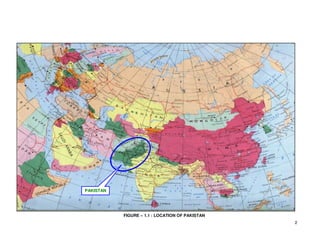
  • 50.
    37 Material Testing :American Society for Testing and Materials (ASTM) Structure : American Concrete Institute (ACI) Structure Loads : Class A – AA as per PHA approval Seismic Design : UBC 97 and Sarhad Interim Seismic Building Code : Base on Seismic Study Zone Maps Curve Widening : 0.6 to 1.6 depending upon length
  • 51.
    38 4.0 BASELINE STUDYOF PROJECT AREA 4.1 THE PROJECT AREA OF IMPACT The project area is a linear corridor through which Shamozai – Dadahara Road passes. This corridor of impact consists of the roadway over a length of 14.15 km section of main Chakdara – Madyan Road. Immediate area of influence for the purpose of this study includes the width of the ROW, old and the new, a corridor of 500 m width on either side. The extended area of influence of the project road would extend over entire district of Swat. This base line study includes physical, biological and socioeconomic environment of the project. For the purpose of physical and biological baseline study, a 500–m corridor of impact on either side has been taken as the Project Area. For socio–cultural study, essentially the entire district of Swat has been included. The Swat district lies at 34°–40′ to 35°–55′ North Latitude and 72°–08′ to 74°–6′ East Longitude bounded on the north by Chitral district and Ghizer district of northern areas, on the east by Kohistan and Shangla districts, on the south by Buner district and on the west by Lower Dir and Upper Dir districts. The total area of the district is 5,337 square kilometers. The district is part of the Malakand division. The twin cities of Mingora and Saidu Sharif are the district as well as the divisional headquarters. 4.2 PHYSICAL ENVIRONMENT 4.2.1 Geography Topographically, Swat is a mountainous region, located among the foothills of the Hindukush mountain range. The area can be divided into two regions i.e., Swat– Kohistan and Swat Proper. Swat–Kohistan is the mountain country on the upper reaches of the Swat River up to Ain in the south. The whole area south of Ain is Swat proper which can be further subdivided into bar (upper Swat) and kuz (lower Swat). The elevation of Swat river valley, at the southern boundaries of the district, is over 600 m and rises rapidly towards the north. There are several mountain peaks ranging from 4500 to over 6000 m above sea level. The Swat region, containing the meandering Swat River, is also home to lush green valleys, snow–covered glaciers, forests, meadows and plains.7 The project site is located at 5 km from the Kanju Chowk and 15 km from the Sharifabad. Chakdara Road Interchange at Shamozai the start of the project site (see project location map in Figure 1.3 and Annex 1 for RoW maps). 7. Topographical Survey of Pakistan.
  • 52.
    39 4.2.2 Geology The ProjectArea lies in Peshawar Basin which is wide basin located between Main Boundary Thrust (MBT) and Main Mantle Thrust (MMT). The sediments of Peshawar Basin are predominantly lacustrine silt with interbedded fluvial sand and gravel containing the clasts of Kohistan, including deposition by the ancestral Kabul and Indus rivers. The Project corridor navigates through the uneven mountains, rolling lands and few flat lands. The present topography is due to fluvial tectonic activities. The geology of the Project Area is mainly comprises granitic gneiss, schist and alluvium (unconsolidated material). Gneisses are the product of high grade regional metamorphism. Schists are mainly composed of quartz as granular aggregates, muscovite (appearing) as colourless to light green and where associated with biotite tone produce schistose texture. The alluvial deposits are composed of slightly reworked and weathered material with silt clay / clayey silt, gravels and boulders occur at some places and are covered with vegetation. The group of rocks consists of Indus Suture Melange Zone (ISMZ). Swat Granite, Mangalore Crystalline Schists, and quaternary deposits.8 4.2.3 Seismicity The project area is located in the seismic zone “A” as per maps drawn by Geological Survey of Pakistan (see Figure 4.1) because it is located close to fault line between Indian and Eurasian Tectonic Plates. 4.2.1 Land Use The total land area of district Swat is 5,337 Square Kilometers (sq. km) (2,060.6 Square Miles or 1,251,653 Acres). This total area is divided in two Tehsils, namely Matta and Kabal, having areas of 683 Sq. km and 4654 Sq. km, respectively (see Table 4.1). The main agricultural crops are maize, wheat, vegetables, fodder and orchards. Another major land use is grazing. Residential units also cover a small fraction of the area. Cultivated land is mainly found in the south–lying regions of Mingora, Barikot, Matta, Kabal, Kanju and Khwazakhela, as the northern part of the district is mostly mountainous terrain. The Swat River is the main source of irrigation, funneling water to most regions through community and government–built channels. 8. Geological Survey Report of Pakistan.
  • 53.
    Source : GoogleMaps FIGURE – TABLE – 4.1 : LAND UTILIZATION S DESCRIPTION Reported Area Cultivated Area Net Sown Area Current Fallow Area Irrigated Area Total Cropped Area Area Sown Repeatedly Un–cultivated Cultivable Waste Forest Area Unavailable for Cultivation Source : Land Utilization Statistics, NWFP, 2007 – 4.1 : PAKISTAN EARTHQUAKE ZONING MAP : LAND UTILIZATION STATISTICS OF SWAT, 2007 DESCRIPTION AREA (in Acres) AREA (in Hectares) Reported Area 1,251,653 506,528 Cultivated Area 242,296 98,054 Net Sown Area 232,046 93,906 Current Fallow Area 10,250 4,148 Irrigated Area 227,336 92,000 Total Cropped Area 467,153 189,051 Area Sown Repeatedly 160,976 65,145 cultivated 1,009,357 408,474 Cultivable Waste 208,862 84,524 337,804 136,705 Unavailable for Cultivation 462,690 187,245 Land Utilization Statistics, NWFP, 2007–2008. ZONING MAP 007 – 2008 AREA (in Hectares) 506,528 98,054 93,906 4,148 92,000 189,051 65,145 408,474 84,524 136,705 187,245
  • 54.
    41 4.2.2 Water Resources Theproject is located in the catchment area of the Swat River. There are many hill torrents and streams which collect the rain water run–off or seepage water in the form of springs that ultimately drain into the Swat River, which flows almost all along the project corridor and ultimately meets the Kabul River. Main source of surface water is the Swat River which flows along entire length of the selected section and finally joins Indus River. The Swat River rises from the Shandur or Mashabar Range bordering Swat district with Chitral in the north and flows south and south–west approximately dividing the district into two halves. The other prominent rivers are Harnoi Khwar, Deolai Khwar and Daral Khwar. In addition to this, some small channels also originate from hills and joins Swat River. Village communities have designed irrigation channels and the river water is diverted to these channels for irrigation purposes. The following water channels exist along the project site. Malikabad and Dedawar = see RoW map in Annex 1 at chainage 12 +700 and 13 +200 Nagoha = see RoW map 5 in Annex 1 at chainage 17 + 200 Parai and Gombatoon = see RoW map in Annex 1 at chainage 20 + 00 and chainage 23 + 200 These water resources are being used for the irrigation purpose. Main ground water recharge takes place through infiltration during rains. At places the ground water finds its way out in the form of springs and big villages have tapped the spring for a water supply to the village household. The quality of ground water all over the Project Area is generally good, potable and sweet as reported by locals. Water quality in the project area was tested by taking water samples from various sites. The results have established that overall quality of water is good and within the permissible limit for human consumption as given in Tables 4.2 and 4.3. The river water is suitable for use of cement concrete, bitumen concrete and other construction purposes.
  • 55.
    42 FIGURE – 4.2: WATER CHANNEL IN THE PROJECT AREA TABLE – 4.2 : LABORATORY ANALYSIS OF GROUND WATER SAMPLE* PARAMETERS UNITS NEQS RESULTS REMARKS 1. pH – 6.5–8.5 7.6 In– Compliance 2. Taste & Odor – Non Objectionable Non Objectionable 3. Color TCU <15 1 4. Turbidity NTU <5 1 5. Total Coliform Number/100 mL 0 Number/100 mL 0 6. E–Coli Number / 100 mL 0 Number / 100 mL 0 7. Total Dissolved Solids (TDS) mg/L <1000 240 8. Total Hardness mg/L <500 70
  • 56.
    43 PARAMETERS UNITS NEQSRESULTS REMARKS 9. Nitrate mg/L ≤50 1.1 10. Nitrite mg/L ≤3 0.001 11. Ammonia mg/L – 0.01 12. Arsenic mg/L <0.05 N.D. 13. Antimony mg/L <0.005 N.D. 14. Barium mg/L 0.7 N.D. 15. Chloride mg/L 250 40 16. Fluoride mg/L <1.5 0.7 17. Aluminum mg/L ≤0.2 N.D. 18. Manganese mg/L ≤0.5 N.D. 19. Mercury mg/L 0.001 N.D. 20. Iodine mg/L – 0.08 21. Zinc mg/L 5 0.19 22. Boron mg/L 0.7 N.D. 23. Chromium mg/L ≤0.05 N.D. 24. Selenium mg/L ≤0.5 N.D. N.D = Not Detected Sampling Source = Hand Pump Water * monitoring point ROW map # 2 Chainage 13 + 250. TABLE – 4.3 : SURFACE WATER ANALYSIS – SWAT RIVER PARAMETERS UNIT TEST RESULTS NEQS 1. pH 8.1 06 – 09 2. Turbidity NTU 5 – 3. Conductivity µS 740 – 4. Odor – Odorless – 5. Biological Oxygen Demand (BOD5) mg/l <5.0 80 6. Chemical Oxygen Demand mg/l 6 150
  • 57.
    44 PARAMETERS UNIT TEST RESULTS NEQS (COD5) 7. TotalSuspended Solids (TSS) mg/l 20 200 8. Chloride (Cl) mg/l 22.3 1000 9. Nitrates (NO3) mg/l 2.7 – 10. Fluoride (F) mg/l 0.05 10 11. Sodium (Na) mg/l 37 – People of the project area uses the hand pump water for drinking purpose (see Figure 4.3). These hand pumps are installed by the district government at the site where ground water is available. FIGURE – 4.3 : HAND PUMPS IN THE PROJECT AREA 4.2.3 Climate Winter is extremely cold and much of the area of Upper Swat remains under snow during months of January and February. However with the arrival of spring, from the middle of March, a pleasant change in weather starts. The spring months from middle of March to early May receive substantial rains. With the arrival of summer from middle of May to end of August, temperature rises. Summer is also marked with monsoon rains, which occur usually from middle of July to end of August. The distribution of rainfall over the years is unpredictable. Most rains fall in winter and monsoon. Rainfall ranges from 1100 mm in the northern parts to 700 mm towards the south–western parts of the Swat district. The relative humidity is maximum in the month of January and August which causes rainfall. As there is currently no meteorological station in district Swat, data , the mean monthly 30 years maximum and minimum temperatures, precipitation and relative humidity recorded at Dir which is adjacent to sweat district is given in Table 4.4.
  • 58.
    45 TABLE – 4.4: MONTHLY TEMPERATURE, RAINFALL AND RELATIVE HUMIDITY IN SWAT MONTH MEAN MONTHLY TEMPERATURE °C MONTHLY RAINFALL (MM) RELATIVE HUMIDITY (%) MAXIMUM MINIMUM January 11.22 – 2.39 111.37 69.7 February 12.07 –1.28 172.56 69.2 March 16.23 3.09 242.22 66.4 April 22.41 7.67 167.86 57.4 May 27.59 11.56 88.05 47.9 June 32.52 15.67 51.26 41.7 July 31.38 19.29 145.75 60.3 August 30.24 18.54 159.79 69.2 September 29.04 13.60 81.84 64.1 October 25.05 7.62 53.73 59.5 November 19.94 2.55 50.70 59.5 December 13.83 –0.86 90.75 67.4 ANNUAL MEAN 22.63 7.90 1415.87 65.9 Source : 1998 District Census Report of Swat. 4.2.3.1 Ambient Air Quality The air quality is clean as there is no industry close to the project road which may contribute any air pollutants. Test results of ambient air analysis done during survey of area using the following methodology. Casella, Serial # 1310, Gravimetric Dust Sampler Type 113 A, BS 1259–1958 used for the monitoring of ambient particulate matter monitoring. Special filter media, having mesh size <10 µ was used as the surface on which PM10 was retained quantitatively during a definite interval of time. The filter media was placed in the special port with leak proof assembly. This prevented escaping of fugitive particulate matter being monitored. Mid–get impingers/absorption columns assembly was used for the monitoring of NO2 and SO2 in the ambient air. The air was drawn through pump into the glass impingers and absorbed in the solution contained inside the absorption towers. The instrument sucked ambient air at rate monitored by a calibrated volume measuring standard gauge.
  • 59.
    46 The volume ofair drawn was indicated on the scale calibrated in liters and fractions thereof. One hundred milliliters of absorbents were poured in each of the impingers. The fourth impinger was filled with two hundred grams silica. Standard procedures were used separately for the sampling of both NO2 and SO2. Sample solutions were preserved and then transferred to the Laboratory for analysis. The Gries – Saltmann Reaction was carried for the analysis of NO2 and Pararosaniline method was used for SO2 testing. Monitoring results were presented after data generation in micro gram per cubic meter (µg/m3 ). Drager Miniwarn, the monitoring equipment, was used for CO measurement. The results are given in Table 4.5. TABLE – 4.5 : AMBIENT AIR MONITORED DATA AT HAMIDABAD * DATE TIME HOURS SO2 (µg/m3 ) NO2 (µg/m3 ) CO (mg/Nm3 ) PM10 (µg/m3 ) 16.09.2013 06:00 31.2 32.5 6.3 23.9 16.09.2013 09:00 54.1 51.2 6.5 41.7 16.09.2013 12:00 55.8 56.7 7.6 42.5 16.09.2013 15:00 56.1 57.2 0.1 43.1 16.09.2013 18:20 55.7 55.3 6.8 42.8 16.09.2013 21:30 31.1 32.3 7.5 23.8 16.09.2013 24:00 31.0 32.2 6.3 23.7 17.09.2013 03:00 30.9 31.9 5.0 23.1 17.09.2013 06:00 31.0 32.1 6.1 23.1 NEQS 80 µg/m3 80 µg/m3 10 mg/Nm3 150 µg/m3 NEQS = National Environmental Quality Standards for Ambient Air. For details see Section 2 of this report. * monitoring location ROW map # 6 Chainage 19+ 00 to 20 + 800
  • 60.
    47 FIGURE – 4.4: AIR QUALITY MONITORING OF THE PROJECT AREA 4.2.3.2 Noise Level Noise levels have been monitored at two locations along the project road using the digital sound level meter and results are given in Table 4.6 and Table 4.7. TABLE – 4.6 : NOISE LEVELS MONITORED AT HAMIDABAD * (RESIDENTIAL AREA) DATE TIME DB(A) LEQ / AVERAGE 16.09.2013 06:00 45 46 46 46 47 45 47 47 45 46.0 16.09.2013 09:00 61 63 63 62 68 70 70 61 66 64.88 16.09.2013 12:00 70 68 68 68 61 59 59 60 61 63.77 16.09.2013 15:00 62 69 72 62 60 61 60 59 60 62.77 16.09.2013 18:20 64 63 63 62 68 73 74 61 63 65.66 16.09.2013 21:30 45 46 49 49 48 45 41 42 42 45.22 16.09.2013 24:00 35 36 36 36 37 35 37 37 35 36.0 17.09.2013 03:00 34 33 31 31 31 32 33 31 32 32.0 17.09.2013 06:00 45 46 46 46 47 45 47 47 45 46.0 * monitoring location ROW map # 6 Chainage 19+ 00 to 20 + 800. TABLE – 4.7 : NOISE LEVELS MONITORED AT DADAWAR * (RESIDENTIAL AREA) DATE TIME DB(A) LEQ / AVERAGE 17.09.2013 05:00 44 46 46 43 41 42 41 43 45 43.44 17.09.2013 08:00 60 63 62 64 66 69 70 62 61 64.11
  • 61.
    DATE TIME 17.09.2013 11:00 17.09.201314:00 17.09.2013 17:20 17.09.2013 20:40 17.09.2013 24:00 18.09.2013 03:00 18.09.2013 06:00 * monitoring point ROW map # 2 Chainage 13 + 25 As can be seen from the above tables, the existing noise levels in the project area exceed the limits defined by the NEQS for ambient noise in residential area (55 dBA during day and 45 dBA during night) vehicular traffic along 4.2.3.3 Along the project road the traffic count was carried to ascertain the traffic (see Figure 4.5). This will help to manage the diversion and signage pattern during the construction phase FIGURE 4.2.3.4 Although Swat District is well known for emerald mines but there is no mineral mine worth the name along project road. TIME DB(A) LEQ / AVERAGE 11:00 71 68 68 68 61 59 59 60 61 63.88 14:00 64 70 71 70 66 66 67 69 70 68.11 17:20 62 61 63 64 67 70 72 64 63 65.11 20:40 45 46 49 49 48 45 41 42 42 45.11 24:00 34 33 31 31 31 32 33 31 32 45.22 03:00 32 33 32 32 33 32 34 32 32 32.0 06:00 45 46 46 46 47 45 47 47 45 46.0 ROW map # 2 Chainage 13 + 250 As can be seen from the above tables, the existing noise levels in the project area exceed the limits defined by the NEQS for ambient noise in residential area (55 dBA during day and 45 dBA during night) (please see Table 2.3 vehicular traffic along the road is the main source of noise in the area. 3 Traffic Count Along the project road the traffic count was carried to ascertain the traffic . This will help to manage the diversion and signage pattern during the construction phase. FIGURE – 4.5 : TRAFFIC COUNT CHART 4 Minerals Although Swat District is well known for emerald mines but there is no mineral mine worth the name along project road. LEQ / AVERAGE 63.88 68.11 65.11 45.11 45.22 32.0 46.0 As can be seen from the above tables, the existing noise levels in the project area exceed the limits defined by the NEQS for ambient noise in residential area Table 2.3). The the road is the main source of noise in the area. Along the project road the traffic count was carried to ascertain the traffic volume . This will help to manage the diversion and signage pattern Although Swat District is well known for emerald mines but there is no mineral
  • 62.
    49 4.2.4 Natural EventHistory Swat River is perennial tributary of Kabul River. Its normal flow gives it a character of bluish water body. Less hydrological trends are known of the river however, the flood of July 2010 devastated vast area of district Swat including the destruction of houses, road bridges and erosion of vegetation in the flood plain. But during season it experiences flash floods. The flood causes damage to life, property, roads, bridges, culverts and causeways. It is therefore necessary that volume, velocity and timing of such flash flood may incorporate in the hydrological design of the project. The control and mitigation may include watershed management techniques, water storage at appropriate spots and providing good drainage system in the project road design. 4.2.5 Cultural Heritage and Archaeology During survey no site of physical cultural heritage could be seen along the route of the project road. But in case there is a chance find during excavation for road construction, the chance find procedure, as defined at Serial 8.9 of Chapter 8 of the EIA report that may apply to handle the find(s). 4.3 BIOLOGICAL ENVIRONMENT 4.3.1 Fauna The area is endowed with a rich variety of mammalian, avian and reptilian fauna. No endangered species are reported in the selected reach of the section. No game reserves and wildlife sanctuaries exist in the vicinity of Project Area. The following fauna exists in the project area: 4.3.2 Mammals The mammals found in the district as well as in the project area are Asiatic Ibex (Capra Ibex Sibrica), Red Fox (Vulpus Vulpus), Marmot (Marmota Caurdata) and Mouse hare (Ochotona Sp). Other mammals known to be found in the study are listed in the following Table: TABLE – 4.8 : MAMMALS IN SWAT English Name Local Name Urdu Name Scientific Name Red fox Wah Lombrei Vulpes vulpes Lyns Soglo Seaa gosh Felis lynx Wolf 1. Spiangko 2. Shanko Bharia or Bahdia Canis lupus
  • 63.
    50 Maramot Phia 1. Barfanichoha 2. Tershoon (ter– shoon) Mara mota Candata Flying squirrel or wooly flying squirrel Rhatong Gilhari Eupetaurus cinercus Alpine weasel 1. Manthong 2. Marpho Api Gilhari Mustela altacia Musk rat Pock pock Chachondar Mustela altacra Source = District Wild Life Department of Swat 4.3.2.1 Reptiles and Amphibians Rana Tigrana (Rain Frog), Uromastix Hardwiki (Jungli Kirla) and Stripped Lizard have been reported in the project area by the district wild life department. 4.3.2.2 Insects, Butterflies and Vectors Insect population includes Cabbage semilooper, Chromatomyia horticola, Caterpillars, Painted Bug, Bagrada Cruciferarum, Pieris brassicae, Leafminer, and Plusia orichalcea (Noctuidae). There are many varieties of butterflies in the project area; particularly during the summer and spring months, in addition to praying mantis, bugs, cicadas, beetles, spiders, scorpions, glow–worms, centipedes, millipedes, snails, slugs and arrow worms. 4.3.2.3 Birds and Fowl (Avifauna) The avifauna of the Swat valley and its vicinity included, Ferruginous Duck, Aythya nyroca ; Lemmergeier or Bearded Vulture; Gyapeius barbatus; Hen Harrier, Circus cyaneus; Pallid Harrier, Circus Maccrourus; Aquila chrysaetus; Sparrow Hawk, Accipter nisus; Kestrel, Falco tinnunculus, Lesses Kestrel; Falco naumanni; Chukar, Alectoris chukar; Black–Winged stilt, Himantopus himantopus; Little–ringed Plover, Charadrius dubius; Solitary Snipe, Gallinago solitaria; Redshank, Tringa tetanus; Common sndpiper, Actitis hypoleucos; Rock Pigeon, Columbia livia; Oriental Turtle Dove, Streptopelia orientalis; Eurasian cuckoo, Cuculus canorus; Northern eagl Owl, Bubo bubo; Tawny Owl, Strix aluco; European Nightjar, Capromulgus europeus; Common Swift, Apus upus; Kashmir Roller, Caracias garrulous; Hoopoe, Upapa epops, Picidae; Eurasian wryneck, Jynx torquilla; Small Skylark, Alauda gulgula; Northern Crag Martin, Ptyonoprogne rupestris; Tree Pipit, Anthus trivialis; Yellow–headed or Citrine wagtail, Motacilla citreola; Yellow–headed Wagtail, Motacilla flava leucocephala;
  • 64.
    51 Grey Wagtail, Motacillacinerea ; White wagtail, Motacilla alba alboides; Long– tailed Minivet, Pericrocotus ethologus; Whit–cheeked Bulbul, Pycnonotus leucogenys leucogenys; Brown Dipper, Cinclus pallasii; Alpine Accentor, Prunella collaris; Blue Throat, Luscinia svecica; Bloack–breated Rubythroat, Luscinia pectoralis ; Orange–flanked Bush Robin, Tarseiger cyanurus; Blue –headed Redstart, Phoenicurus caeruleocephalus; Black Redstart, Phoenicurus ochruros; Guldenstad’s Redstart, Phoenicurus erythrogaster; Plumbeous Redstart, Rhyaccornis fuliginosus; Stonechat, Saxicola torquata; Pied Wheatear, Oenathe pleschanka; White–capped Redstart, Chaimarrornia leucocephalus; Blue Rock Thrush, Monticola soliatarius; Little Forktail, Enicurus scoulrej; Large–billed Bush Warbler, Bradypterus major; Wester or Large–crowned Leaf, Warbler, Phylloscopus occipitalis; Tytler’s or Slender–billed Leaf, Warbler, Phylloscopus tytleri’s; Brook’s Leaf Warbler, Phylloscopus subviridis; Yellow–browed Leaf Warbler, Phylloscopus inornatus; Tickel’s Leaf Warbler, Phylloscopus affinis; Mountain Chiffchaff, Phylloscopus sindianus; Golcrest , Regulus regulus; White– browed Tit Warbler, Leptopoecile sophiae; Sooty or Dark–sided Flycatcher, Muscicapa sibirica; Kashmir Flycatcher, Ficedula subrubura; Spotted flycatcher, Muscicapa striata; Black Crested Tit, Parus rufonuchalis; White–cheeked Nuthatch, Sitta leucopsis; Common Tree creeper, Certhia familaris; Golden Oriole, Oriolus oriolus; Magpie, Pica pica; Nutcracker, Nucifraga caryocatactes; Red–billed Chough, Pyrrhocorax pyrrhocorax; Jungle Crow, Corvus macrorhynchos intermedius; Migratory House Sparrow, Passer Domesticus ; acterianus; Eurasian Goldfinch, Carduelis carduelis; Mongolian Finch, Bucanetes mongolicus ; Common Rosefinch or Scarlet, Grosbeak, Carpodacus crythrinus; Red Poll, Carduelis flammea and Rock Bunting, Emberiza cia. 4.3.3 Flora Vegetation of the project area falls under humid–temperate latifoliate forest. Dominate tree species consists of Chir. Shisham, Mulberry, Bakain, Eucalyptus, Rubinea and Kao are the other varieties found in the project area. Fruit trees in Project Area include Apple, Pear, Peaches, Walnut and Guava. Grasses consist of Nari, Lavindar, Deela, Trakla. Rich ground flora of many herbs including vibrunum, lonicera. A number of medicinal plants are found in the area including Tarkha (Artemizia species), Unab (Zizyphus Sativa), Althea (Althaca Officinalis), Banafsha (Viola serpens), Mushki Bala (Valeriana species) and Sufed (Aspargus species). No endangered floral species were reported in the Project Area.9 TABLE – 4.9 : FLORA IN THE PROJECT AREA COMMON NAME LOCAL NAME LOCAL USE 1. Pine Cheer Bark is used for the curing of the injury at the local level. Firewood 9. District Forest Department, Swat.
  • 65.
    52 COMMON NAME LOCALNAME LOCAL USE basically. 2. Willow 1 (Red) Ratta Beesa Firewood 3. Willow 2 (White) Chitto Beesa Firewood 4. Willow 3 (Blue) Nillo Beesa Firewood 5. Spruce Kail Firewood, and bark is used for the roofs and good for furniture 8. Bughnoo It is not good for burning and is not of any good use for commercial purposes 9. Phoot I its bark is used as medicine 10. Timirin Its fruit is used as essence, also used with rice and then taken as food, people in the pastures uses this way when the wood is burned then oil is produced which is later used as medicine for infections and injuries Source = District Forest Department Swat
  • 66.
    53 FIGURE – 4.6: FLORA IN PROJECT AREA FIGURE – 4.7 : FLORA ALONG THE ROAD SIDE 4.3.4 Fish Recreational fishing was observed along the project corridor during the site survey. The common fish in the Swat River include Trout, Mahasheer, Lus and Chirak. Swat River is endowed with Brown Trout Fish which is allowed to be caught by angling under license from Fisheries Department of Swat. 4.3.5 Rangelands Swat is generally a forest and grazing land. The flocks consist of goats, sheep, donkeys and mules. All area is overgrazed much beyond their carrying capacity. Since the grazers keep shifting from place to place, it is not possible to introduce a grazing control and proper range management in the area. 4.3.6 Protected Areas Fizaghat pheasantry was established in 1997 over an area of 2 kanal. It is situated at a distance of about 5 km from Mingora city and 27 Km from the project site. The pheasantry plays an important role in promoting education, awareness, recreation, and captive breeding of important wildlife birds. The pheasantry houses 11 species including pheasants and partridge. Because of its location and easy accessibility, the pheasantry is visited by large number of visitors including students and general public for recreation and awareness.
  • 67.
    54 There are noprotected areas, as per list of protected area defined in National Conservation Strategy in the Swat. In particular, no protected area is located along the right of way of the proposed project. 4.3.7 Endangered Species Aythya nyroca, Falco naumanni, Bradypterus major, Phylloscopus tytleri are the reported endangered species of avian fauna in the upper Swat and Kohistan valleys. However, the project corridor and the trees along it do not provide suitable nesting areas for these species particularly because of the human presence and high ambient noise in the area (see Tables 4.6 and 4.7 for ambient noise levels in the area). 4.3.8 Forest Forests cover about 27% of the total area of Swat District. According to data provided by the Forests officer, total forest cover in Swat was 136705 hectares as of 2007–2008, comprising mostly of pine varieties such as kail, fir, spruce and chir. This area is divided into resumed land (spread out over 92864 ha), private plantations (43746 ha) and miscellaneous categories (96 ha). Forestry is the major source of income of the area. An area, which is difficult to cultivate for agriculture, is normally under use of forests. These forests not only a source to reduce soil erosion and land sliding, but also a major source of income by producing timber and firewood. Swat hills and villages are generally green. But there is no Government or State reserved or protected forest along or near the project road. However, private people have their wood lots in their lands which add alternative aesthetics to the upper side of the road. 4.4 SOCIAL ENVIRONMENT 4.4.1 Population Population of the villages falling in the project corridor stood roughly as 65,000. As per the 1998 census, the total number of housing units in the project corridor was 4500. Of these, 46% were pacca10 units, 14% semi–pacca and remaining 40% were kacha units. The number of total housing units in 2012 stood as 7864, with pacca, semi–pacca and kacha units as 6099, 360 and 2806, respectively. In rural areas, people generally live in kacha houses made of mud. However, in urban settlements, a mix of kacha and pacca houses is found. A high level of 10. The structures types are explained as under : Pacca House or building constructed with concrete or brick. Semi–Pacca House or building constructed with burnt bricks and mud. Kacha House constructed with un–burnt bricks and mud, or temporary wooden poles, etc.
  • 68.
    55 social integration isfound among the people. The settlement pattern of the Project Area is semi urban. The main settlements / villages along the project corridor include Shamozai, Tang Shamazai, Malik Abad, Dedawar, Khaliq Abad, Nagoha, Parai Hamidabad and Dadahara. Some other villages and settlements also exist at varying distances from Project corridor, connected by village tracks. TABLE – 4.10 : ADMINISTRATIVE UNITS IN SWAT Tehsils 02 Union Councils 65 Mauzas 215 Municipal Committees 01 4.4.2 Community Structure Except for urban population, the remaining population lives in well organized and established tribal system. In Swat district main ethnic communities are Pashtoons, Swaties and Gujjars. Between the urban and rural population of the project district there is a marked contrast regarding gender equality, population composition and traditions. In tribal and traditional society the females are usually under reported, especially the names of females are not mentioned by respondents to male surveyors / enumerators. Also, generally the tribal are reluctant to register the new born female babies because of the tribal set up. Even for overall population there is no proper system of keeping records of birth and death rate at district level especially in rural areas. The community structure based on 1998 Censes is given in Table 4.11. TABLE – 4.11 : POPULATION COMPOSITION OF SWAT POPULATION CLASS SWAT DISTT. (%) 1. Children below 15 years 48.87 2. Active population 15–64 years 48.49 3. Aged population 65–above 2.64 4. Male population 51.52 5. Female population 48.42 Source : 1998 District Census Report of Swat. Most of rural population lives in close and joint families which are rather extended. This is mainly because of object poverty, close family marriages tribal homogeneity and kinship. In urban areas the trend is towards independent or nucleus families because the people there are more educated, more prosperous
  • 69.
    56 and more independentfrom tribal bonds. Presently the household size in rural areas is 10–15, while in urban areas it is 5–8, with an overall average of 8 members to a family. The poverty situation is worsening due to presence of a large and uncounted number of Afghan refugees. TABLE – 4.12 : DETAILS OF SENSITIVE RECEPTOR * CHAINAGE TYPE OF RECEPTOR 10+700 House left 10+750 Mosque Left 10+840 Crusher plant left and water channel 10+890 to 11+120 Built up area on both side 10+126 to 10+160 Grave yard left Graveyards left 11+290 Mosque left 11+200 to 11+425 Built up area 11+400 Garden left 11+490 Mosque right 11+650 Mosque Left 11+825 House left 12+075 Mosque left 12+575, 12+600 – 825 House left 12+700 House right 12+875 House left 12+950 – 13+160 Garden 13+225 Graveyards right 13+010 – 160 Build up area both side 13+225 –250 Graveyards left 13+350 Build up area both side 13+725 House left 13+830 Graveyards left 14+650 –750 Kacha house left 14+800 Mosque left
  • 70.
    57 CHAINAGE TYPE OFRECEPTOR 14+820, 15+465 House both side * See RoW maps in Annex - 1 of the report. The major receptors as mentioned in the above table are present near the existing road, however, only ten structures will be impacted. 4.4.3 Poverty Status A significant population in extended project area lives below poverty line. Main causes are as follows: More than 47% of population is practicing agriculture on highly limited agricultural land which is mainly rain–fed. The outputs are not enough to make the two ends meet for large families. Amongst the remaining population rate of unemployment is high. Due to influx of Afghan refugees, who have no intention to go lock and whose third generation is tending to naturalize in the area, has added un– proportionate burden on the income generating opportunities of the area. Female population is kept busy on non–productive works. Absence of major industries and under developed agriculture and livestock sectors do not form a potential for labor absorption. The project will have a healthy effect on the labor and employment market of the project area. 4.4.4 Industries There are no significant industries along the project road. Elsewhere the biggest industry is floor mills the number of which has also declined from 300 to 200 over past one year. More settled conditions are required for encouraging more industry. 4.4.5 Political Parties There are many political parties in district Swat and they try to mobilize political opinion in their favour. However, tribal affiliation, religion and family kinship are the main factors determining the shape of political behaviour. Important political parties are Jamiat–i–Ulmai–Islam (JUI), Pakistan Muslim League (PML), Pakistan People’s Party (PPP) and Pakhtunkhwa Milli Awami Party (PMAP) and Pakistan Tehreek–e–Insaaf. The role of women in the politics is not significant. 4.4.6 Marriages
  • 71.
    58 In tribal systemof Swat District, the society is overly patriarchal. Marriages are, more often than not, arranged which is the case in most of the country. Because of consistent segregation of sexes there is no opportunity for boys or girls to choose their own spouses. The role of women in decision making concerning marriage is limited to some influence on selection of the bride, her beauty looks and aptness in doing household chores. Daughters have no real say in their marriage despite the provision in Islamic Shariat that a woman has a right to turn down a marriage offer. Some changes are noticeable in urban area where educated girls are, at times, exercising their veto power but still they have to operate within the patriarchal customs. Marriage within the relatives is preferred because of the facility of exchange of girls “Char pa Chari” or “Badli” or “Sarri” within the two families of the same tribe and the marriage dowry (sort of price also called as “Lab” or “Walwar”) is less. The amount of dowry ranges between Rs. 20,000 to 300,000 in Swat district. In rural areas the dowry can be paid in kind in the shape of goats and sheep. If the age difference bride and bride– groom are excessively large, the “old” bride–groom has to pay additional money to the father of the bride. At times the father may put another condition (called “pate”) that should there be a female child after the marriage it will be brought up by the new couple but will be handed over to father of the bride to marry her and receive her dowry. 4.4.7 Social Organization By far the biggest uniting force of in Swat society for individuals as well as groups is ethnic or tribal identity. The society being patriarchal the decision making is solely vested in elderly males of the family / tribe which becomes binding for females under their charge. Society in general is structured on kinship basis. Even on petty issues the ethnic groups can get polarized. Each ethnic group tends to stick to its culture and traditions, a blending of culture and customs amongst various groups takes place inevitably. The society is modelled on the authoritarian system linking the relationship between father and his sons. The head of the family is called “Sardar” whose authority flows to the lowest tier of the tribe or family through an authoritarian hierarchy of males. The Sardari System is well entrenched in Swatti and Pakhtun tribes while others also try to have it with laxity and variation. However, life of people of Swat, particularly of project area, is built on two principles; hereditary authority and personal bond of allegiance in which protection is exchanged with loyalty. Most of the tribal chiefs get elected to the parliament tend to run democracy on tribal pattern. Occasions like births, deaths, illness, marriage, serve as socializing accessions for women and common people who can, when they meet exchange information and ideas and reinforce social ties and alliances. With some modifications and re–adjustment the Sardari System will continue to be a corner stone of society in Swat for a long time to come.
  • 72.
    59 FIGURE – 4.8: OFFICE OF THE SOCIAL ORGANIZATION 4.4.8 Custom of Cooperation The custom of community participation for community help has been in vogue in almost all areas of Swat District for a long time. Collective labor (Ashar or Hawachi) at harvest time or other occasions of peak labor needs or taking a fellow tribesman out of financial crises (Bijar or Pursi) has been a regular part of the Swat social order. Same spirit works while sharing the water of small streams or river management. But even in such matters the tribal leadership shows itself and the community collaborates under a “Mir–i–Aab” or “Serreshta” or “Gham”. The government interventions for development which do not recognize the community participation temperament of Swati society do not succeed. For this project the contractor will have to employ local labor keeping in view the community customs of cooperation and togetherness mostly on tribal patterns. Outside labor is not advisable under any circumstances. Outsiders can be tolerated only on such technical works for which local expertise is not available. 4.4.9 Religious Beliefs Overwhelming majority of the people of Swat district are Muslims belonging to Hanfi school of Sunni sect and a small number in urban areas following Irani pattern of Shiaism. Christians are also present in a small minority. Religious functions are a significant force in the lives of all the people in Swat. Religious leaders (Mullas) have a hold over a number of aspects of social life and some political parties are organized along religious lines. Two major festivals are “Eid– ul–Fitr” and “Eid–ul–Azha”. The people are strongly religious minded and tend to practice the religious obligations meticulously. They, come what may offer Prayers five times a day observe Fasting in the month of Ramadhan and sacrifice animals on Eid–ul–Azha the well to do pay Zakat and perform Hajj and Umrah.
  • 73.
    60 4.4.10 Conflict Resolution Thepeople in the project area have two options available for conflict resolution. First is the government judiciary system and second is tribal Jirga (Council) of Tribal elders) system. The people of Swat district is believed to be peaceful but sometimes a dispute between two individuals, from two tribes, may generate tribal vendetta. Usually in such cases the Jirga system is considered more useful. On government side the highest Judicial Officer in each district is the District Judge. Usually the individuals go to government Judiciary system if they are not satisfied with their Jirga award. Ordinarily, whenever there is a dispute between two persons / parties, the notables of one side go for reconciliation to the other party and sit together to resolve the issue. Sometimes the dispute is resolved through imposition of penalties in the form of cash, land, kind or by marrying women to the inflicted side. For some time the Islamic Sharia Courts have also been functional in the area. 4.4.11 Custom of Carrying Fire Arms Although Swat district are inherently peaceful areas, yet it is customary among the people to carry arms as a fashion or sign of prestige for Sardars or notables. Advanced and automatic weapons like Kalashnikov are preferred. The other reason for displaying arms is illiteracy and tribal enmity. Some people consider weapons as ornaments of men. Because of war in Afghanistan and influx of Afghan refugees into Swat district, all sorts of weapons are smuggled into the extended project area and are available at cheap prices. 4.4.12 Role, Position and Status of Women Women in Swat society for centuries have been victim of patriarchy, male chauvinism, social discrimination, resource deprivation and denial of human rights. Despite constitutional and legislative provisions, the customary law often prevails making it difficult for women even to claim their legal rights which are supposedly guaranteed. Although Islamic laws of inheritance provide a share to daughter in father’s property but the custom does not allow it. However, a person can bestow gift to his daughter, sister or wife in his life time, again treating a woman with no rights to the property. In most of the social grouping men hold a monopoly of power in the public arena. In the political arena, local level chiefs and tribal are always men, so are the members of the local council of elders or Jirga. Religious leaders in authority are all males and local codes of value are set by men. This includes denial of basic human rights as well as the Muslim inheritance rights to women. The economic participation of women is different from that of men. Women participate in both indoors and outdoors duties which are considered to be a free
  • 74.
    61 labor. Women fetchwater, collect fuel wood, look after animals, fetch fodder for cattle, process milk into butter, sour milk and cheese, and work with wool. They are fully responsible for cooking, cleaning and taking care of children and other dependent members. Some women are very good at producing handicrafts. The traditional polygamy keeps them victim of inferiority complex. The women without children are treated as an outsider by the family including her husband. 4.4.13 Child Labor and Apprenticeship Child employment is quite common in district of Swat particularly the project area. The magnitude of child labor is more in rural areas than urban areas. In rural areas, more often than not, the children without education opportunities are left with few alternatives than early participation in work force. They join labor intensive activities like agriculture for weeding, picking and harvesting. The children perform the task of grazing livestock. In addition to above tasks the children also help their mothers in fetching water and firewood. Girls get involved, from an early age, in daily routine of domestic work. 4.4.14 Services and Amenities Available in the Area (i) Drinking and Domestic Water Clean drinking water in Swat district as well as in the project area is supplied through different sources. Tube wells, hand pumps, wells, rivers and springs. Tube wells have become the major source of water supply, using plastic pipes. Major Departments / Organizations involved in water supply are Public Health Engineering Department (PHED). But in rural areas the villagers do not get much help from PHED. FIGURE – 4.9 : WATER SUPPLY SYSTEM IN THE PROJECT AREA (ii) Housing In Swat District as well as in the project area most of the houses have a guest room, toilet, kitchen, separate bathroom and a courtyard. In newly
  • 75.
    62 constructed houses attachedbathroom with flush is an important feature. In rural area the guest room is more spacious (called Hujra) and courtyards are very spacious. Toilets are located at the other end of the courtyard and are usually without any flush system. Many people of rural area still use fields as open latrines. (iii) Energy Supply Major sources of energy for light purposes are Electricity and Kerosene Oil. In general about 76% people use electricity while 24% use Kerosene Oil. In rural areas animal dung, brushwood and fuel wood is still in popular use. (iv) Telecommunication In Swat district, there is a good network of telecommunication. There is a large number of private and government owned Public Call Offices (PCOs). Number of PTCL telephone in the district connections exceeds 50,000 of which 80% are private (based on survey carried out as part of present EIA). Mobile phone service is being used by almost every working individual. (v) Radio and Television Government Radio Station Peshawar is the main radio station. The advent of FM wave length district–wise services are also available. Radio Pakistan country–wide services are available through Peshawar station Pakistan Television Station at Peshawar is linked with country–wide PTV network. A number of private channels have also started relaying their programs. (vi) Transport and Accessibility District Swat has 634 km of road out of which 582 km are high type whereas 52 km are low type. Construction of project under consideration will add more length to the road network. The road from Sharifabad – Kanju has been completed making the site more accessible. (Source: Khyber Pakhtunkhwa Development Statistic 2010) (vii) Sanitation The hygienic and sanitation conditions prevalent in the rural area of the project are not satisfactory, except in part of some big towns. In project area only 7% people have covered pit or flush latrines. Most people in
  • 76.
    63 rural areas useopen fields for defecation. Women use open surface latrines within the domestic compound; Younger children are formally allowed to defecate in the courtyard. The presence of animals within the household compound often adds to the unhealthy living conditions.
  • 77.
    64 5.0 ANALYSIS OFALTERNATIVES The alternatives for the proposed project and their relative potential impacts on the environment were considered to evaluate the best project option. The following alternatives were considered for the project: (A) ROAD ALTERNATIVES (i) No project option / worst scenario option. (ii) Project road to follow exactly the existing route with no alteration. (iii) Altogether a new route is surveyed on another site. (iv) Project is restricted to a single lane as before. (v) Project with double lane and suitable straightening of curves where necessary. (B) LOGISTIC SITES (i) Siting of Contractor’s facilities e.g. labor camp site, machinery yard and on state land. (ii) Siting the Contractor’s facilities on private lands. (iii) Siting Contractor’s facilities at most appropriate site be in public land or private land. (C) LABOR OPTIONS (i) All labor local (ii) All labor from outside. (iii) An admixture of local and outside labor as per skill required. Details of analysis of all above alternatives are as follows: 5.1 ROAD ALTERNATIVES 5.1.1 No Project Option / Worst Scenario Option 5.1.1.1 Analysis Strengths and Opportunities If the project is not taken up at all then all the funds, efforts and inconvenience will be saved and these will become available for diversion to other projects. No more land will be required and no disturbance will be caused to people through resettlement or land acquisition process. Further the recurring cost of the maintenance of the new and expanded
  • 78.
    65 road along withenhanced operational cost will be saved. No disturbance will be caused to any physical, biological and social part of the environment. The people benefiting out of a status quo will continue benefiting. Weaknesses and Threats Not taking up the project would mean withholding the development of the entire area along the extended area of the project in whole of District Swat. This would also mean restricting the trade opportunities between areas connected by road. Existing road does not meet the international standards and by keeping it as such means declining to open the whole district of Swat for better social uplift through education and poverty alleviation. The project would provide greater job opportunities to people during construction as well as the operational phase. Not taking up the project would mean depriving the local people from a blessing of whole lot of new opportunities. 5.1.1.2 Conclusion The “No project option” reveals the withholding of development activities in entire area, trade limitations and degradation of economic activities, therefore, this option is not recommended. 5.1.2 Project Road to Follow Exactly the Existing Route with No Alteration 5.1.2.1 Analysis Strengths and Opportunities All costs on new survey and design of alterations will be saved. No additional land away from existing route will have to be acquired. No additional area will be impacted initially by construction and later by traffic during operational stage. Weaknesses and Threats Route of the road will not improve. Existing limitations regarding distance, velocity and geotech faults will continue to exist. Environmental impacts will be caused by construction of the second carriageway without yielding any advantage. At places the length of the double lane road may prove counterproductive.
  • 79.
    66 5.1.2.2 Conclusion Construction ofnew double lane road on exactly the previous alignment is not a sound engineering proposal nor it is worthwhile environmentally. Therefore, this option cannot be supported. 5.1.3 For the Double Carriageway Altogether a New Route is Surveyed on another Site 5.1.3.1 Analysis Strengths and Opportunities In addition to the existing highway, another double lane road with become available. The capacity to handle inter–district traffic will enhance manifolds. The new alignment will also give an opportunity to modify and improve existing design of road as well as the drainage. Weaknesses and Threats A very expensive new exercise will be undertaken without a real necessity. The expected volume of current inter–district as well as the international traffic is not adequate to provide justification for an altogether a new double lane road somewhere else. By opening up a new area new problems; physical, biological, environmental and social problems will arise which may not keep the new effort positively productive at this point in time. The new alignment may take the new double lane road close to or pass through any of the protected areas causing the ecological problem. Under prevailing security problems in Swat area, it may be difficult to survey and construct a new carriageway along an altogether a new route. 5.1.3.2 Conclusion Because of prohibitive cost, high environmental impacts and social problems, this option of a new highway on an altogether a new site is not recommendable. 5.1.4 Project is Restricted to a Single Carriageway as Before 5.1.4.1 Analysis Strengths and Opportunities The functional efficiency of the existing highway can be increased by carrying out repairs and improving its maintenance and signology. Funds
  • 80.
    67 will be savedto almost 50%. No new environmental or social hazards will be triggered and no extra environmental or resettlement costs will be incurred. Weaknesses and Threats With little alteration, this option is like no project option. By restricting the project to repair and maintenance of existing carriageway will restrict the socio– economic development and international trafficability of the route. An opportunity of having a double lane road in modern terms will be lost. Single carriageway is proved to accident as of now. This status will continue if second carriageway is not constructed and the system of double lane traffic is not introduced. Since the highway will be handling inter district trade, therefore highway of international standard should be provided. Not doing so will be counterproductive. 5.1.4.2 Conclusion Despite saving in immediate terms, the option is not useful on long term basis. Therefore this option is not recommended. 5.1.5 Project as Proposed in Feasibility, Double Lane Road with Alterations where Necessary 5.1.5.1 Analysis Strengths and Opportunities As per well considered feasibility the project responds to the need of the time. By proving double lane road, it induces trafficability, safety, speed, efficiency and thus better trade on inter–district level. All along the proposed project, during construction and after construction there will be ample job opportunities for local population. Opening up of the area will result in better education, health and social welfare opportunities. The project area will experience definite poverty alleviation especially after the sufferings of the people during the war against terrorism. Alterations in parts will help to straighten all sharp curves, avoid congested points, negotiate slopes at easier gradients and build stronger road foundation. New construction will help absorb latest technology on hill roads. At number of places side / link roads will help even the extended project area to open. In the long run, the project is financially viable, socially acceptable, environmentally preventable, generally neutral and poverty
  • 81.
    68 alleviation. The reversibleconstruction and social impacts during construction are manageable. 5.1.5.2 Conclusion The opportunity of building a double lane road from Shamozai – Dadahahara is recommendable and it should be availed for larger benefit of all stakeholders. 5.2 LOGISTIC SITES 5.2.1 Sitting of Contractor’s Facilities on State Land 5.2.1.1 Analysis Strengths and Opportunities The contractor will get land free of cost for the camping site and the equipment and material yard. This cost will not be reflected in BOQ and this will reduce the overall cost of the contract and thus the project. There will be very little possibility of local disturbance or manipulation from local communities and the contractor will have a free hand to manage his labor and works. The contractor will not be encouraged to hire private agricultural land and therefore productive agricultural land will be saved. The activities and logistics of the contractor will be under full control of the project management and any adverse environmental or social spill over to outside territories will be eliminated. Weaknesses and Threats Best suitable sites of required size and descriptions may not be available within ROW and the standard. By refusing to contractor the option to go to adjacent private land, the management may be compromising with best site selection and other logistics and therefore overall efficiency of the execution of the contract. By way of leasing their land to contractor, communities may feel their participation in implementation of the project. For creating enough space for contractor at places, situation may arise where resettlement cases with heavy payment may arise.
  • 82.
    69 5.2.1.2 Conclusion In presenceof adequate and encumbrance Free State land, the contractor may be given the option of using it for his labor camp, machinery yard and work bases. This is an acceptable option and is recommended. 5.2.2 Sitting of Contractor’s Facilities on Private Lands 5.2.2.1 Analysis Strengths and Opportunities The contractor will enjoy the freedom of choosing the best sites for his camps, machinery yards and work bases. By way of payment of base money to the land owner, his participation and ownership of the project will be achieved. No additional government land will have to be set aside for camping. No obligations will fall upon sponsor. No environmental challenge will come up at any stage. Weaknesses and Threats The contractor will be free to hire comparatively flat agricultural lands and will put productive land to non–productive use. The contractor will include the cost of leasing land in his BOQ included in the bid. This will increase the cost of the bids and thus project expenditure. Outside the direct control of the proponents, the contractor may indulge in unplanned environmental social or physical activities which may not be acceptable within the meanings of the project EIA. 5.2.2.2 Conclusion In presence of adequate state land along the proposed highway taking the project to private land is not advisable. The weakness and threats of this proposal outweigh strengths and opportunities. The proposal of sitting contractor’s facilities on private lands is therefore not supported. If the contractor chooses to establish his facilities and labor camp on hired private land then PHA will bear no responsibility for his costs and commitments.
  • 83.
    70 5.2.3 Sitting theContractor’s Facilities at Appropriate Site, Be it Public Land or Private Land 5.2.3.1 Analysis Strengths and Opportunities The option will create an operationally adjustable opportunity wherein the best site will be chosen by the contractor. Of course, all sites will be approved by the Resident Engineer. The contractor will not be bound to remain restricted to the sites proposed by the PHA Resident Engineer and can plan his operations according his operational convenience and availability of facilities and services. Where enough state land is not available, and private land is available adjacently, the contractor can make necessary adjustments without changing the site. Weaknesses and Threats To the extent that the contractor moves out of state lands, establishment of camps, yards and facilities close to villages can cause social problems. Adverse effects may be caused on freedom of women to work in fields. Possibilities of spread of AIDS and other infectious diseases will get greater chances of spread. 5.2.3.2 Conclusion As a second best option (after settling the contractor on state land) this is the 2nd best option. But for contractors activities on private lands PHA holds no responsibility for contractor’s cost and commitments. 5.3 LABOR 5.3.1 All Labor Local 5.3.1.1 Analysis Strengths and Opportunities All labor will be local and their employment will fulfill a major social requirement of the contract. Local economy will benefit and poverty alleviation will take place. The project will become socially acceptable. A big advantage of local labor will be that most of them will come from and go to their homes daily and there will be very little pressure on labor camps.
  • 84.
    71 Weaknesses and Threats Threetypes of labor will be required; unskilled, semiskilled and skilled. All types of labor cannot be available locally. So binding contractor to employ all labor locally can put limitation on contractor. 5.3.1.2 Conclusion It is not possible to rely entirely on local labor for all trades. So this option is not acceptable. However, all unskilled labor openings must be given to locals. 5.3.2 All Labor from Outside 5.3.2.1 Analysis Strengths and Opportunities Labor from outside will be preselected and ergonomically sound. More efficient more dependable and well trained man power will be available. The labor will not be able to erect undue pressure on the contractor or the project. The outside labor will set model for untrained labor which may improve. Spending by outside labor will bring additional benefit, to local economy. Weaknesses and Threats Bringing outside labor will take away economic benefits of employment from the local communities and they will not develop a sense of ownership for the project. The project objective of poverty alleviation, social uplift and capacity building will be defeated. A social problem will be created. 5.3.2.2 Conclusion In case the labor is brought from outside, the social losses will be much higher than the economic gains. However, the ergonomic limitations may necessitate bringing in a small percentage of outside manpower especially at skilled level. But as far as possible the local human resource will have to be preferred.
  • 85.
    72 5.3.3 An Admixtureof Local and Outside Labor as per Skill Required 5.3.3.1 Analysis Strengths and Opportunities Unskilled labor can be locally 100%. Semiskilled can be local as per their skill wise availability, may be upto 50% of the total. Most of the senior technicians and skilled workers will have to be brought from outside the district of Swat. This flexibility will be possible only under the option of admixture of labor. Weaknesses and Threats Because of the presence of the outsiders there are likely to be social losses. Income of local communities will reduce. 5.3.3.2 Conclusion From project implementation point of view, this option presents the best combination of local and outside labor. This option also presents an opportunity of transfer of skills from outside technicians to local workers. 5.4 DESIGN ALTERNATIVES Design–related alternatives considered include the route, alignment, cross– section, and public amenities. These are discussed below : 5.4.1 Change Number of Sections Onwards to Route Alternatives The existing project route has its importance not only from socioeconomic point of view for the people residing in the remotest areas of the Swat Valley but also strategically for the reason that it provides a link with district headquarters on the right bank of Swat River. As mentioned above, demarcating an alternative route would require vast amounts of land acquisition, disruption of rural communities and presently established natural and agro–ecosystems resulting in further environmental and social degradation. 5.4.2 Alignment Alternatives and Construction Material The horizontal and vertical alignment of the road will be improved as part of the rehabilitation and widening works. The objectives will be to improve sight distance, eliminate sharp corners and reduce steep grades, thereby improving road safety and transport efficiency. The road improvements will minimize the adverse effects on existing properties. The existing or already available borrow
  • 86.
    73 holes will beused for construction material, thus, minimizing the further environmental impacts. 5.4.3 Alternatives for Public Amenities Public transport amenities, such as crossing ramps, passenger sheds and signboards have been incorporated in the design where required especially near main settlements. 5.4.4 Alternative Transport Options In Swat Valley, roads are the only mode of transportation. Due to very rugged and high mountainous topography of the area with narrow valleys, development of railway tracks is very difficult and uneconomical. So there is no railway system exists in Swat. The nearest air links are Islamabad and Peshawar which are at about 4–6 hours drive from the project area. Similarly, although river Swat runs along the entire project route, but narrow width of the river at places, steep slopes and consequently high velocity of flows, rocky outcrops in the river bed hinder the development of navigational facilities. 5.4.5 Conclusion In the light of above discussions in respect of other means of transportation like railway, air and navigation, it is concluded that improvement / rehabilitation of the existing road rout is the only viable option from socioeconomic considerations. The project will be accommodating within the available COI at built up areas.
  • 87.
    74 6.0 STAKEHOLDER CONSULTATION 6.1GENERAL Stakeholder participation in planning and managing the social and environmental issues helps to reduce the fears of stakeholders regarding the development program and gives opportunity to them to participate in key decisions that will affect their lives. The consultation process was carried out during the previous EIA of Sharifabad – Kanju section. All the concerns of the stakeholders pertaining to environmental, social, and issues regarding the rehabilitation and compensation were solved with due obligation. During the construction the people were also involved to make the decisions for construction timing and the traffic diversion methodology, compensations, rehabilitation and construction related activities. The unskilled and skilled local labor was employed during the whole construction tenure. It was revealed that the affected people were fully informed about the project and their compensation were paid within due dates. The people were found satisfied with their involvement and road construction. For Shamozai–Dadhahara road section of 14.15 km the consultation with the stakeholders also carried out. This consultation was conducted in accordance to the requirements of the World Bank and Government of Pakistan on stakeholder consultation which generally require that affected people should be fully informed and closely consulted on environmental and social impacts of the proposed project. The objectives of this process were to : (i) Share information with stakeholders on proposed improvement works and expected impact on the physical, biological, and socioeconomic environment of the project corridor. (ii) Understand stakeholder concerns regarding various aspects of the project, including the existing condition of the highways, upgrade requirements and the likely impact of construction–related activities and operation of the improved highway. 6.1.1 Consultation Process Primary stakeholders were consulted during informal and formal meetings held in the project site and area as well. The consultation process was carried out in the Urdu language followed by the translation in Pashto language where required by a local person engaged especially for this purpose. During these meetings a simple, non–technical, description of the project was given, with an overview of the project’s likely human and environmental impacts. This was followed by an open discussion allowing participants to voice their concerns and opinions. In addition to providing communities with information on the proposed project, their
  • 88.
    75 feedback was notedduring the primary stakeholder consultation. The issues and suggestions raised were recorded in field notes for analysis, and interpretation. By reaching out to a wider segment of the population and using various communication tools such as participatory needs assessment, community consultation meetings, focus group discussions, in–depth interviews, and participatory rural appraisal EIA involved the community in active decision– making. This process will continue even after this EIA has been submitted, as well as during future EIAs in which similar tools will be used to create consensus among stakeholders on specific environmental and social issues. Secondary stakeholder consultations were more formal as they involved government representatives and local welfare organizations, NGO’s consulted during face–to–face meetings and through telephonic conversations. They were briefed on the EIA process, the project design, and the potential negative and positive impact of the project on the area’s environment and communities. It was important not to raise community expectations unnecessarily or unrealistically during the stakeholder consultation meetings in order to avoid undue conflict with community’s leaders or local administrators. 6.1.2 Points Discussed Following points were discussed during the public consultations: Project components, its activities and impacts. Needs, priorities and reactions of the population regarding the proposed project. Entitlement for the affectees of the project Role of the affectees in implementation of the project Basis for determining the rates of the land, houses, and other infrastructures. 6.1.3 Stakeholder Consultation Technique In recognition of the diversity of views within any community, it is very important to obtain a clear understanding of the different stakeholders and to analyze their capacity and willingness to be involved in some or all of the project and its planning process. It is important to be aware of how different power relations can distort participation. It is also important to examine how community skills, resources, and ‘local knowledge’ can be applied to improve project design and implementation. All of this can be achieved by careful use of the various tools of stakeholder consultation. Therefore, the following participatory techniques were employed during stakeholder consultations: Informal meetings with communities.
  • 89.
    76 Focus Groups withwomen participants in communities. In the consultation processes following key stakeholders were consulted : Local communities, Men Women and Community’s elders attended meetings. Meetings with stakeholders consisted of community consultation meetings, focus group discussions, and in–depth interviews with men and limited focus–group discussions with women. Table – 6.1 provides a summary of the meetings held with respect to date, venue and stakeholder participation. A details of the persons interviewed is appended as Annex – 2 of the report. TABLE – 6.1 : SUMMARY OF PUBLIC CONSULTATIONS DATE VENUE / VILLAGE’ NAME NO. OF PARTICIPANTS MEN WOMEN 15.09.2013 Dadahara 12 5 16.09.2013 Hamidabad 16 7 16.09.2013 Nagoha 19 3 17.09.2013 Zarhela Shamozai 13 10 17.09.2013 Khaliqabad 18 8 22.09.2013 Dedawar 24 11 22.09.2013 Malikabad 21 7 23.09.2013 Shamozai 18 9 TOTAL 141 60
  • 90.
    77 FIGURE – 6.1: STAKEHOLDERS CONSULTATIONS 6.1.4 Government Representatives The consultations were carried out with the local government officials and officials of the following departments:
  • 91.
    78 Environmental Protection Agency(EPA) Forestry Fisheries Irrigation Highway Wild Life The officials of Environmental Protection agency, Wildlife and Forest department perceived that the employment opportunities and business development would be the positive impacts on the community and people during the construction phase of the proposed project. Among the perceived negative impacts during construction phase of the project include especially road blockage, dust emissions, noise and nuisance due to heavy traffic. All officials of project study area were in favor of the project. They expect many positive, conducive and constructive impacts on socio-economic life of local community regarding jobs, business opportunity and social structure development. They were in opinion that project would improve area development through development of existing infrastructure etc. The project will also raise their level of awareness, initiate cultural diffusion, activate social mobility and bring social change regarding various aspects of their life. The officials of Pakhtunkhwa Highway Authority revealed the project as a sign of relief in deteriorated road infrastructure due to activities of insurgents and counter actions by Pakistan Army with terrorist. They were committed for perfection and sustainable development. The officials from Fisheries and Irrigation departments appreciated the proposed activity. They also expressed that the jobs and business opportunities for the local community will be increased due to project activities and that the infrastructure will developed that automatically lead to the development of the project area. They also expressed the concern that most of the unskilled and skill jobs should be provided for the local communities. TABLE – 6.2: SUMMARY OF CONSULTATIONS WITH GOVERNMENT OFFICIAL DATE DEPARTMENT NAME DESIGNATION OF PARTICIPANT 15.09.2013 PHA Peshawar Deputy Director Environment (PHA) 16.09.2013 District office Fishery Department, Swat District Inspector, Swat 16.09.2013 District office Wildlife Department District Inspector, Swat
  • 92.
    79 DATE DEPARTMENT NAMEDESIGNATION OF PARTICIPANT 23.09.2013 Environment Protection Agency, Peshawar Assistant Director (EIA) 23.09.2013 District office Irrigation Department District Inspector, Swat 6.2 OUTCOME OF STAKEHOLDERS CONSULTATION Generally, people were found to be aware of the need to rehabilitate/upgrade the highway, and expressed their support for the PHA. The proposed improvement of the additional carriageway was welcomed by the people since it will reduce traffic congestion and other road hazards near settlements along the project corridor. Local communities demanded that they should be the part of a continuous consultation process with other stakeholders at different stages of the project including the design, construction, and operation periods. The concerns raised by the stakeholders / communities are described as follows: 6.2.1 Highway Design Improve general standards of construction. Blasting, if required, should not be carried out in the project area. The business of the people should not be affected due to project activities. PAPs should be compensated according to the market rates. Properly compensate owners of demolished structures. Protection walls should be constructed where needed. The waste material should not be dumped in to the river. The road shoulders should be concreted. Avoid constructing sharp road curves and grades. Provide streams outlets to help drain away runoff from the highway into the river. Build bus bays, passenger shelters, and parking areas where required. Plant trees along the highway that could be entrusted to the care of local communities. Avoid shifting graves that may fall within the ROW. Avoid relocating/dismantling mosques and other permanent structures. Provide drainage on both sides of the road.
  • 93.
    80 6.2.2 Highway Construction Avoidundue delays in road construction and ensure that project works are carried out in one stretch rather than piecemeal. Ensure that contractors do not use private land for parking construction machinery. Avoid dumping construction material along the highway and median. Adopt measures to minimize dust, smoke, and noise pollution, and to control spillages from construction machinery. Provide proper diversions for traffic during construction to avoid traffic congestion, related hazards, and dust emissions. Carry out construction activities preferably at night to avoid traffic jams / hazards. Proper traffic management plan should be provided during construction activities. Job opportunities should be provided to the locals during construction activities. Safety of local residents along the road should be ensured particularly due to land sliding and stones rolling. 6.2.3 Highway Operation Provide medical aid centers along the highway to treat road accident emergencies. Erect cautionary and information signs. Control over–speeding, overloading, traffic disorders and violations of traffic regulations; construct speed breakers where required. Prohibit commercial vendors and squatters from encroaching on the ROW. Increase tree plantation along the highway. Ensure that cross–drainage pipes and culverts are regularly cleaned. Regularly remove accumulated piles of rubbish from the ROW. 6.3 LAND ACQUISITION AND RESETTLEMENT–RELATED CONCERNS In addition to compensation for the structures removed, additional financial assistance is required to erect structures at new locations. Compensation should be fair, paid promptly, and subject to transparency. The acquisition of private land should be avoided. Where necessary, acquisition should be carried out in accordance with the law and at existing market rates. The acquired land should be possessed only once the compensation payment is made.
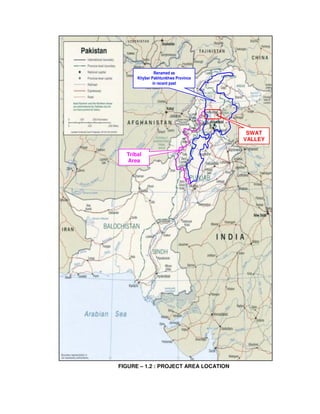
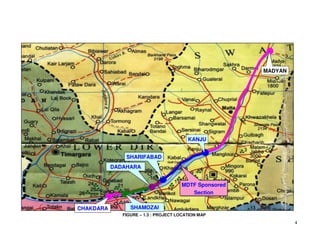
  • 94.
    81 Avoid acquiring thecultivated land as there is already shortage of availability of cultivated land. Stakeholder’s consultation should be an integral part of the land acquisition process. 6.4 REDRESS OF STAKEHOLDERS CONCERNS The most of the concerns raised by stakeholders have been incorporated into the project’s environmental and social assessment as described below : SUGGESTIONS / CONCERNS OF STAKEHOLDERS PREVENTION METHODS HIGHWAY DESIGN In response to stakeholders’ concerns, the design at locations of social disruption may be revised by the Design Consultants and minimum or; if avoidable; no residential and commercial entity will be affected by the Project. In addition. No graves will be shifted for the road reconstruction and associated activities. Similarly no mosque will be demolished/dismantled for the road reconstruction and associated activities. HIGHWAY SAFETY Highway safety audits and improved road markings/signage and demarcation of accident–prone junctions will be made in order to improve the horizontal and vertical geometry, and reduce conflicting movement during operation, particularly along inhabited stretches of road. Improved intersections on side roads and village tracks will be provided in order to eliminate bottlenecks Roadside furniture and traffic control devices, including information and cautionary signs, signals, traffic diversion and flow markings, to ensure pedestrian safety during construction and operation. A drain will be designed to cater for the road drainage HIGHWAY CONSTRUCTION Project facilities will be located at a minimum distance of 250 m from existing settlements and built–up areas in order to avoid restricting the mobility of local women
  • 95.
    82 SUGGESTIONS / CONCERNS OF STAKEHOLDERS PREVENTIONMETHODS Construction vehicles will remain confined within their designated areas of movement. Sensitivity towards local customs and traditions will be encouraged to minimize social friction; good relations with local communities will be promoted by encouraging contractors to provide opportunities for skilled and unskilled employment to locals, as well as on–the–job training in construction for young people Land sliding will be minimized by constructing retaining walls The loss of privately owned land or built–up property will be compensated on a replacement–cost basis Solid waste generated during construction and at campsites will be properly treated and safely disposed of only in demarcated waste disposal sites approved by the supervision consultant Contractors will be required to instruct and train their workforce in the storage and handling of materials and chemicals that can potentially cause soil contamination. All necessary measures will be taken to ensure the safety of traffic during construction, including barricades (including signs, pavement markings, flags, and lights) erected as required by the PHA. All such barricades will be set up as per local regulations. HIGHWAY OPERATION High way operation plan has been provided in the EIA Report for proper operation and maintenance of road and to ensure quick rescue operations during land sliding and snow falling. 6.5 RESETTLEMENT ACTION PLAN (RAP) This Resettlement Action Plan (RAP) has been prepared and incorporated in the EIA report for providing a framework for addressing the resettlement issues, if resettlement is unavoidable. The Resettlement Action Plan (RAP) for the road construction and rehabilitation Project provides a framework for addressing and reviewing
  • 96.
    83 compliance with theagreed roles, responsibilities and activities related to resettlement. This RAP applies the draft Pakistan National Resettlement Policy’s definition of resettlement whereby the term refers to all measures taken to mitigate any and all adverse impacts resulting from the execution of the road construction and rehabilitation on the livelihood of Project Affected Persons (PAPs) and their property, including compensation, relocation and rehabilitation. Rehabilitation refers to restoration of income, living standards and quality of life. This resettlement definition reflects the World Bank terminology whereby resettlement covers all direct economic and social losses resulting from land taking and restriction of access by the project. The underlying assumption for the RAP is that efforts will be made to improve the livelihoods and standards of living for all projects affected persons or at least to restore them to pre–project levels. 6.5.1 Resettlement Principles and Objectives The main involuntary resettlement principles and procedures that are applicable to the Project are the following : Resettlement and land acquisition will be minimized as much as possible. Where land acquisition is unavoidable, the project should be designed to minimize adverse impacts on the poorest. Project Affected Persons (PAPs) should be compensated or at least restored to pre–project levels. All the PAPs residing in, or cultivating land, or having rights over resources within the project area as of the data of the census survey should be entitled to compensation. All previous claims and unresolved issues related to resettlement or compensation in the area of each contract package, including outstanding claims arising, should be resolved in accordance with applicable Pakistan Laws and regulation, prior to initiating any new land acquisition measures on the respective contract package. In all cases, the World Bank’s Operational Directive 4.12 will supersede national laws in resolving issues relating to compensation. Lack of formal legal land title is not a bar to compensation or rehabilitation assistance under the Projects. Land for Land is an option for compensation in the case of loss of land. In the absence of replacement land, cash compensation for the property acquired will be paid at its replacement value in addition to any transaction costs. Each PAP is entitled to receive assistance to restore income and livelihood to a pre–project standard, and all vulnerable affected persons are entitled to assistance to improve their income and livelihood.
  • 97.
    84 All PAPs shouldbe informed and consulted on the compensation and other entitlements, relocation program and the income restoration assistance. Compensation and income restoration programs should be carried out with equal consideration for women and men. Particular attention should be paid to the rights of women, widows, orphans, the elderly, other vulnerable people and group such as indigenous people and religious and cultural minorities. Appropriate and sufficient assistance should be provided to help them improve their socioeconomic status. PAP’s social and cultural institution should be protected along with common property resources. Community and public services should be provided to relocated communities. The resettlement transition period should be minimized and case compensation should be provided to the PAPs prior to the expected start data of works in the relevant contract package/s. It is recommended that PHA should establish a committee for the Resettlement / Compensation of project affected persons. The Rehabilitation / Resettlement / Compensation Committee should comprise of the following: Member of Frontier Highway Authority District Environment Officer, Environment and Social Development Officer Non Governmental Organization (NGO) Representative Concerned Revenue Officer of the District Qanoongo / Patwari of the area concerned Village Headman (Numberdar) Forest Officer Wildlife Officer Irrigation Officer Representative of the Affected Persons. Councilor / Nazim of the area. The committee will recommend all entitlements (in totality) to be made to the project affected persons (PAPs) in connection with resettlement / compensation before the cut–off date.
  • 98.
    85 7.0 ENVIRONMENTAL IMPACTASSESSMENT AND MITIGATION MEASURES This section identifies the potential environmental impacts during the rehabilitation and upgradation of Shamozai – Dadahara road on the project area. The project is rehabilitation of the existing road and no new road alignment is involved for the proposed project. 7.1 POTENTIAL IMPACT SOURCES Environment and social impacts attributable to the project can broadly be classified into those taking place during construction and those occurring during operational phase. Some of these impacts can be anticipated and avoided through appropriate adjustments / provisions in the project design. Some can be mitigated by careful implementation of the Project while some other can be adjusted with by appropriately following the operational manual and an effective collaboration with communities. Construction related impacts are heavily dependent on : The contractor’s work practices, especially those related to storage of construction materials and cleanliness of work site; Cooperation between local communities, local authorities and the contractor in terms of execution of Social Framework Agreement (SFA) and use of public space and utilities; Project management’s enforcement of correct construction practices and standards; and The incorporation of preventive / mitigation measures identified in the EIA into the Tender documents and specifications, in bid and Contracts documents and provision of linkage between EMP and contractors payments. An effective collaboration with local communities in evolving a workable Social Framework Agreement (SFA). The quality of Monitoring and Reporting of EMP implementation. Operational impacts of the proposed project are associated with the movement of vehicular traffic on it and allied activities. These include air and noise pollution, safety hazards and other similar impacts. For this proposed Project, potential impacts are reviewed under construction and operational phases. The environment has been studied under the following subheads: Physical Environment Land Resource
  • 99.
    86 Water Resource Air Quality NoiseLevel Biological Environment Flora Fauna Fish Endangered Species Cultural and Historical Sites Socio–economic Environment Table – 7.1 provides a check list of potential impacts likely to be associated with the construction of the Shamozai – Dadahara road project. In general these areas are divided into groups based on general environmental aspects which are effected or likely to be affected from the modification in the flow of traffic. The set of impacts based upon physical, biological, cultural and social aspects have been classified as under construction and operational phases. Each sub–factor has been marked as curable, reversible or irreversible. Each sub–factor so assessed has been discussed and explained later in the Chapter. The severity of the impact is presented on evaluation scale. The evaluation scale used for the EIA Study is given below. ▲▲▲ Permanent change (to be adopted) : irreversible ▲▲ Mitigation through contractor’s obligation or by communities through Social Framework Agreement (SFA) (Curative) : reversible ▲ Avoidable through design (Avoidance) : Curable TABLE – 7.1 : EVALUATION OF ENVIRONMENTAL AND SOCIAL IMPACTS Aspects Impacts Assessed Assessment Slight Moderate Significant ▲ ▲▲ ▲▲▲ ▲ ▲▲ ▲▲ ▲ ▲ ▲▲ ▲▲▲ CONSTRUCTION PHASE IMPACTS Land Resource 1.1.1 Impact of wastes, construction material and debris at construction site 1.1.2 Land slide, unstable soil or similar unforeseen conditions 1.1.3 Any natural disasters such as heavy rains, floods and earthquakes
  • 100.
    87 Aspects Impacts Assessed Assessment SlightModerate Significant ▲ ▲▲ ▲▲▲ ▲ ▲▲ ▲▲ ▲ ▲ ▲▲ ▲▲▲ 1.1.4 Soil contamination from diesel and other spills from construction machinery 1.1.5 Damage/blockage of irrigation channel, paths and cross drainage by moving machinery and putting the construction materials (these structure has shown on ROW map # 1,2,3, 4,8) 1.1.6 Scouring of Earthen embankment or concrete work edge 1.1.7 Release of construction water on unstable slope or any public/private property. 1.1.8 Release of construction water including the sewage or debris to any river structure such as bridge/culvert. 1.1.9 Any discharge, spill or dumping on any building or house on riverbank.(see in ROW map # 1, 2, 5 and 6) 1.1.10 Impact of taking borrow martial from earth borrow site. 1.1.11 Impact on paths or road used for transport of construction material. 1.1.12 Impact of stone quarrying on air and land during obtaining the materials for construction 1.1.13 Any blasting during Construction 1.2.1 Impact of contamination on surface water by disposal or dumping of construction debris, disposal of untreated waste water
  • 101.
    88 Aspects Impacts Assessed Assessment SlightModerate Significant ▲ ▲▲ ▲▲▲ ▲ ▲▲ ▲▲ ▲ ▲ ▲▲ ▲▲▲ 1.2.2 Impact of ground water hand pump damage and contamination 1.2.3 Diesel and other fluids spilling over to river water from machinery 1.2.4 Obstruction of flow of water in the river or any stream or water channel due to rejected material or construction material 1.2.5 Effect on surface flow conditions in rains due to rejected material or construction material. Water Resources Air Quality and Noise Pollution. 1.3.1 Dust, smoke and other pollutants from construction, Machinery including asphalt and concrete batching plant. 1.3.2 Dust of other pollutants from stored material and spoil keeps. 1.3.3 Smoke from burning of waste material or burning firewood. 1.3.4 Noise from use of old or outdate machinery. 1.3.5 Noise due to any blasting. 1.3.6 Soil contamination due to labor camps and machinery yards. Biological Resources 1.4.1 Damage to biological resource through tree cutting at the project site 1.4.2 Damage to Fish and other aquatic fauna (release of contaminants and debris can potentially have moderate to significant impact on fish and other aquatic fauna). 1.4.3 Impact on any birds nesting on the tree due to the tree cutting
  • 102.
    89 Aspects Impacts Assessed Assessment SlightModerate Significant ▲ ▲▲ ▲▲▲ ▲ ▲▲ ▲▲ ▲ ▲ ▲▲ ▲▲▲ Social/ Economic Cultural and Archeological Issues. 1.5.1 Existing services like education, health, electricity, water supply communication 1.5.2 Impact on (adjacent) open land for agricultural (see in ROW map # 1 to 8) 1.5.3 Impact of damage on irrigation channel close to the road. 1.5.4 Impact on local ethnicity, Tribal Tensions, communal rivalries 1.5.5 Impact on area under crops (see in ROW map 1,2 and 5) 1.5.6 Land ownership / Land tenure system 1.5.7 Transportation of construction material 1.5.8 Adverse effect on cultural and archaeological heritage if found during the construction 1.5.9 Graveyards if affected during construction (see in RoW maps in Annex 1) 1.5.10 Public safety at construction site. 1.5.11 Health and safety of labor and employees on construction site 1.5.12 Resettlement of Affectee land inhabitants of houses which will in ROW (see in RoW maps in Annex 1). 1.5.13 Loss of cultural ties and family lands due to involuntary shifting of population. 1.5.14 Loss of livelihood due to loss of land and ancestral villages.
  • 103.
    90 Aspects Impacts Assessed Assessment SlightModerate Significant ▲ ▲▲ ▲▲▲ ▲ ▲▲ ▲▲ ▲ ▲ ▲▲ ▲▲▲ 1.5.15 Loss of local technique and knowledge due to shifting of population 1.5.16 HIV / AIDS and infectious diseases such as cholera and Hepatitis in the labor, employees and nearby Public 1.5.17 Women status: Exposure to employment and education opportunities 1.5.18 Hurdle in cultural Reunion. 1.5.19 Hurdle in accessing market opportunities for Agricultural produce. 1.5.20 Reduction in recreation opportunities due to high traffic speed 2. O&M Phase Social, Biological and Environmental Impacts 2.1.1 Damage of road furniture 2.1.2 Damage of road sing and lights etc 2.1.3 Segmentation of population 2.1.4 Segmentation of grazing area 2.1.5 Impact of air pollution due to increase in traffic 2.1.6 Impact of noise pollution due to increase in traffic 2.1.7 Increase in road accidents due to increase in flow of traffic Monitoring and Evaluation as per operational manual and monitoring plan 2.2 Possibility of less effective monitoring and evaluation as per operational manual and monitoring plan
  • 104.
    91 7.2 DETAILS OFIMPACTS Table – 7.1 above provides a schematic presentation of the degree, significance and mitigation of various environmental and social factors at construction and operational phases. This section provides explanation of each factor, also suggesting a line of action towards preventive / mitigation measures for the adverse impacts. 7.2.1 Impact of Construction Material and Debris Some cutting of edges for alignment will be involved, construction waste debris, surplus earth or waste construction material which needs disposal. It will cause air and water problems if not properly disposed. However, their environmental impacts are minor to moderate as their quantity will be about 200 – 300 cubic meters. Prevention / Mitigation The construction waste material will be disposed off in selected barren spots as allowed / approved by Resident Engineer and level it so that it becomes a useful plain land. No waste material will be thrown into the river or other water bodies. This waste will also be used for filling of the borrow holes / areas in below figure present in Malikabad. The material will be properly leveled and plantation will be carried out there. Photographic record will be maintained showing the before construction and after construction state of the disposal areas. FIGURE – 7.1 : FILLING OF BARREN LAND AT MALIKABAD 7.2.2 Landslides, Unstable Soil or Similar Unforeseen Conditions Landslides or unstable soil conditions may impact the construction work. Improper construction methodology can cause landslides. Some potential
  • 105.
    92 landslide sites areshown in below Figure. It is pertinent to mention that no population exists in vicinity of the landslide site (chainage 11 + 900). FIGURE – 7.2 : ROAD CURVES NEAR MALIKABAD Prevention / Mitigation Local readjustments in foundation treatment or any other small changes will be allowed to the contractor by the Resident Engineer (RE). Contractor will make all arrangements to avoid any land slide caused by the construction activities; remedial actions including alarm activation, stoppage of work etc will be undertaken in case of any such slide. The precautionary measure like construction of side wall and proper warning system may be introduced to avoid the problem. The retaining wall or the breast walls will be constructed as per the requirements. 7.2.3 Location of Labor Camps and Equipment Yards The camp site in populated area may cause the social implication including the security and privacy of local residents, spread of communicable diseases and also environmental problems due to disposal of solid waste, effluents etc. Rented house, already occupied during previous project by the contractor, will be used in propose project. Prevention / Mitigation In previous project the contractor has rented some houses for the officer away from the populated area and the same houses will be utilized during the proposed project to refrain social implications. 7.2.4 Natural Disasters such as Heavy Rains, Floods and Earthquakes Any natural disasters such as heavy rains, floods or earthquakes can potentially impact the project works by holding construction work resultantly delay in project.
  • 106.
    93 Prevention / Mitigation Contractorin consultation with RE and local community will prepare an Emergency Response plan resolve the issues. This plan will be updated according to the site requirement. 7.2.5 Contamination from Diesel and Other Oil Spills from Construction Machinery Any leakage or spillage of diesel, oil or any other chemical will contaminate the soil which may in turn impact the water sources, nearby community or productive land (see RoW maps in Annex 1). Prevention / Mitigation Contractor will apply strict rules on his workers and labor to ensure that no spill or leakages are caused. All fuels, oils and bitumen will be stored appropriately, with concrete padding and bunding for containment in case of leakage. If the spills or leakages do take place, it must be followed by the treatment prescribed below as per the degree of spill or leakages. The contractor will employ the general criteria for oil and leakage at construction sites, as per standards set forth by “Guidelines for Oil Spill Waste Minimization and Management” issued by International Petroleum Industry Environmental Conservation Associate which are as follows: (Source: International Petroleum Industry Environmental Conservation Associate (IPIECA) Report Series, Volume–12, “Guidelines for Oil Spill Waste Minimization and Management”). Minor Spill / Leakage: Soil contaminated by minor spills / leakages (defined as leaks from vehicles, machinery, equipment or storage containers such t hat the area and depth of soil contaminated is less than 10 sq ft and 3 inches respectively) is to be scraped and burnt in a burn pit, away from population. Moderate Spills are defined as spills of volume less than or equal to 200 liters is to be contained and controlled using shovels, sands and native soil. These equipments and materials are to be made available at camp sites during the operation. The contaminated soil is to be excavated and stored in a burn area lined with an impermeable base. Depending on the volume, the contaminated soil is either disposed off by burning in the burn pit or by specialized treatment such as bioremediation. Major Spills (defined as spills of volume much greater than 200 liters) requires initiation of Emergency Response Procedures and Oil Spill Contingency Plan. These spills are to be handled and controlled according to the Plan and require special treatment such as bioremediation.
  • 107.
    94 Grievance redress mechanism(GRM) will be put in place to address community grievances related to the above concerns 7.2.6 Damage to Roads, Cross Drainages Damage to roads, cross drainages can arise through carelessness of the heavy machinery drivers or operators. Such carelessness can cause considerable damage to paths, roads and drainages if the drivers / operators are not made aware, trained and bound to be careful. Prevention / Mitigation Contractor will prepare standard operating procedures and impose strict control over operators and drivers of all types of vehicles to minimize any damage to roads or structures. If any damage takes place, the contractor will carry out repairs immediately. Photographic record before and after construction will be maintained. 7.2.7 Earthen Embankments or Concrete Work, Edge Scouring Poor design and inappropriate construction procedures can potentially damage the embankments, concrete works or road edges already exist in good condition. The impact is moderately significant but can easily be mitigated. Prevention / Mitigation Edge scouring of earthen embankments or concrete work must first be dealt at design stage. Wherever such a situation is anticipated, aprons should be provided to secure edges and specifications must be kept of high standards. During the construction phase this aspect should be addressed through appropriate construction methodology and employing appropriate techniques such as protection walls and rip rap. Contractor will repair all damages to the earthen embankments, concrete works, or pavement edges caused by the construction works. During the operation phase appropriate measures need to be incorporated in the Operational Manual. 7.2.8 Release of Construction Water and Dumping of Soil Uncontrolled release of construction water or dumping of excess soil / rubbles can destroy / damage; to the nearby irrigation channels along the ROW (see ROW map 1,2,5,6) slopes, and private property like shops etc; potentially leading to significant impact of blockage of channel, damage to structure and water contamination. If such a situation does appear, it becomes highly significant though it can be mitigated.
  • 108.
    95 Prevention / Mitigation Thecontractor will make adequate arrangements to avoid such leakages, uncontrolled releases, and dumping of soil / rubbles. Should such leakage develop, the contractor must remain fully prepared to immediately control the discharge. The contractor will be liable to pay for or repair such damages. GRM will be put in place to address community grievances in this regard. 7.2.9 Any Discharge, Spill or Dumping in Graveyards Any uncontrolled discharge of effluents or dumping of soil can potentially impact the religiously significant places such as graveyards at chainage 11+100 and 13 +800 (see ROW map # 1 and 3). Prevention / Mitigation The contractor will take all precautionary measures to forestall any uncontrolled release of effluents or dumping of soil / rubbles into any graveyards or near mosque at Chainage 11+100 and 13 +800 (see ROW map # 1 and 3). The contractor will be liable to repair and / or compensate any damage to such places caused by the construction activities. However, it is suggested that community consultations may be carried out during the works and cordoning off such places may prevent the impacts. GRM will be put in place to address community grievances in this regard. 7.2.10 Impact of Taking Borrow Material from Earth Borrow Site A large quantity of earth will be removed from borrow pits located within the river land. The existing river land borrow pits will be employed for this purpose. About 52,000 cubic meter of the borrow material is required for the project. (see Row map # 2). Prevention / Mitigation The contractor will ensure that the borrowing does not cause uneven terrain and altered river flow pattern. Wherever possible / necessary, these places will be leveled using appropriate technology / methodology. The community consultations and the written consents of the owner will be taken. Photographic record of the situation will be maintained before and after situations.
  • 109.
    96 7.2.11 Impact onRoads / Infrastructure Used for Transport of Construction Materials Transport of construction machinery, construction material and construction workers will cause additional wear and tear of the roads / infrastructure (refer Table 4.12). This impact will be a moderately significant and can be adequately mitigated. Prevention / Mitigation The contractor will be responsible to repair any damage caused to the local infrastructure private property may be separate by the construction activities. Water sprinkling will be carried out where necessary to minimize dust emissions. 7.2.12 Physical Loss of Agricultural Land About 36-kanal of land which is cultivated by the community will be impacted by the Project activities. The same may be consulted from RoW maps in Annex 1. Prevention / Mitigation The affectees will be duly compensated for any loss of crops or land. The below table defines the types of loss and their compensation estimations. Type of Loss Number Extent of Impact Estimated Compensation Minor Significant Severe 1. Shops 2 2 0 0 PKR 363,8232. Houses 6 6 0 0 3. Boundary Walls of houses 2 2 0 0 Loss of Encroached Cropped Area and tree 36 Kanal 36 Kanal Kanal is one-eighth of an acre. The details have been provided in the Resettlement Action Plan (RAP) of Social Impact Assessment (SIA). An independent RAP of this project has been prepared for this proposed project and all the details have been duly described in RAP in Chapter 9 of the SIA report. GRM will be put in place to address community grievances in this regard.
  • 110.
    97 7.2.13 Soil Compactiondue to Labor Camps and Machinery Yards The human and mechanical activity normally compacts the soil and turns the area as impervious and non productive for plant production after the project completion. Prevention / Mitigation The contractor will restore the area under his temporary use by cropping or if so required through plantation. Photographs taken at the time of establishment of these facilities will be used for this purpose. 7.2.14 Traffic Impact It is anticipated that an overall increase and traffic hindrance would occur as a consequence of the proposed construction. An increase in traffic will occur to and from the project site subsequent to construction. Prevention / Mitigation Construction traffic hindrance should be avoided by providing proper diversion and signage. Also, traffic management plan will be prepared by the contractor after consultation with RE for its implementation. GRM will be put in place to address community grievances in this regard. 7.2.15 Impact of Sourcing of Construction Water The contractor will obtain water for the construction sites and construction camps from the nearby surface and / or groundwater sources. This however can potentially affect water resources and the other water users of the area. Prevention / Mitigation The contractor will procure water from a source approved by the RE, and if relevant, after obtaining the community consent. It will be ensured that this procurement of water does not negatively affect the communities or other water users. The Grievance Redressal Mechanism (GRM) will also be put in place. 7.2.16 Impacts on Surface Water Inappropriate waste disposal from camp site and construction activities can potentially contaminate the water bodies like irrigation channels and hand water pumps in turn affecting the local communities (Table – 4.12 and RoW maps in Annex 1) and aquatic biodiversity.
  • 111.
    98 Prevention / Mitigation Nountreated effluents will be released to the environment. For the toilet waste, the contractor will establish / install appropriate waste treatment system (such as septic tanks and soaking pits – appropriately sized and located) at the site facilities (offices, camps, others). The waste water from kitchen and toilets can be released in soaking pits or used for plantation/water sprinkling. Oily water must be passed through a settling tank. The contractor will prepare a waste management plan and have it approved by the RE. 7.2.17 Impacts on Drinking Water Sources The construction activities can potentially damage / affect the drinking water sources (see RoW maps in Annex 1) of the communities. Prevention / Mitigation It will be ensured that the drinking water sources of the communities are not affected. The contractor will repair / replace / compensate for any damages caused by the construction activities. 7.2.18 Obstruction of the Flow of Water for Stream Crossing the Road At number of points, perennial streams and irrigation channels cross the road (please see RoW maps in Annex 1). The construction works can obstruct their normal flow. Prevention / Mitigation The road includes adequately designed bridges and culverts at the appropriate locations (see table 3.1 in chapter 3). The contractor will ensure that these water bodies / water courses are not blocked during the construction phase. 7.2.19 Effect on Surface Flow Conditions The road can potentially affect and disrupt the drainage pattern (Table–4.12, RoW maps in Annex 1) of the area. Prevention / Mitigation Design Engineer has ensured the provision of appropriately sized side drains, to avoid negative impacts on the local drainage pattern. Contractor will follow the design specifications meticulously. During the construction phase, the contractor will make temporary drains and embankments where necessary to channel the runoff appropriately.
  • 112.
    99 7.2.20 Dust andSmoke and Other Pollutants from Construction Machinery The construction activities and operation of vehicles and machinery will release exhaust gaseous emission(s) and also raise dust (Table – 4.12 and RoW maps in Annex 1). Prevention / Mitigation The contractor will ensure that its vehicles, machinery, and generators are properly designed and maintained, and comply with the applicable NEQS. The asphalt plant will not be operated without properly functioning dust control system such as wet scrubber. Water will be sprinkled where necessary to control the dust emissions. GRM will be put in place to address community grievances related to dust and smoke emissions. 7.2.21 Dust / Pollutions from Stored Material and Spoil Keeps The material stock piles and material transportation can cause dust emissions, having a negative impact on the nearby communities and natural vegetation (see RoW maps in Annex 1). Prevention / Mitigation The material being transported or stored at the stockpiles will be kept covered where necessary to avoid dust emissions. GRM will be put in place to address community grievances related to dust and smoke emissions. 7.2.22 Smoke from Burning of Waste Material or Burning Firewood A large number of big and small fires in the labor camp and burning of waste can produce smoke and smog which can reduce visibility and cause suffocation along with causing diseases of the respiratory tract including cancer. Prevention / Mitigation Cutting and burning trees / shrubs for fuel will be prohibited. Instead gas cylinders should be used in the labor camp for cooking purposes. Similarly waste burning will not be allowed. The contractor will prepare waste management plan and have it approved by the RE. The proper training will be delivered to the workers. 7.2.23 Noise from Construction Works The construction activities will generate noise, which can potentially affect the communities, wildlife, and also the construction workers (see also RoW maps in Annex 1).
  • 113.
    100 Prevention / Mitigation Thecontractor will strictly follow the NEQS for ambient noise. All necessary measures to control the noise such as proper tuning of vehicles and provision of mufflers/silencers particularly near the communities will be provided during construction. The personal protective equipment (PPE) will be provided to the construction workers and its usage will be made mandatory by the contractor. GRM will be put in place to address community grievances related to noise. 7.2.24 Damage to Biological Resources Flora, Fauna The project activities cause some disturbance to the wild species of the area and will pose a significant impact. A total of 760 trees will need to be removed for the road construction (see RoW maps in Annex 1). Prevention / Mitigation Compensation will be paid for tree cutting to be removed due to construction of road. Compensatory tree plantation will be carried out and for each tree removed, five saplings will be planted. The Project will ensure appropriate care and monitoring of this plantation. Camps and other temporary facilities will be established in a manner that minimizes loss of natural vegetation including trees. No hunting, fishing, trapping of the wild animals/fish will be allowed at the site. 7.2.25 Damage to Fish Inappropriate waste disposal in the river water can affect the aquatic fauna. Prevention / Mitigation No untreated waste, excess soil or garbage will be dumped in the river. River and streams will not be blocked by the construction activities. No hunting, trapping, or fishing by the construction workers will be allowed. 7.2.26 Impact on Physical Cultural Resources No sites of religious, cultural, historical, or archeological significance are known to exist in the area, except some graves and mosques (see RoW maps in Annex 1). The contractor will be required to ensure that the construction activities do not cause any damage to these graves and mosques. A chance find procedure has been included in Chapter 8 for the protection of cultural resources discovered during the construction phase.
  • 114.
    101 7.3 SOCIAL NEGATIVEIMPACTS 7.3.1 Project Affected Persons According to revenue record; the PHA owns 50 feet wide RoW of this road, 25 feet both sides from centre line of existing road. There is sufficient space to accommodate the proposed road development works; hence no land acquisition is involved. The survey has indicated that over time, the people have encroached the RoW by extending their business and residential structures in the RoW, and farmers for cropping and trees. Affected households (AHHs) come to eighty four (among them two have shared/joint ownership of structures and twenty four have shared/joint ownership of crops and trees. six HHs have multiple impacts on structures, crops and trees and sixteen HHs have multiple impacts on crops and trees, But none of them will significantly or severely impacted due to loss of assets or income. The major professions of affected households are farming, business and services, skilled and unskilled labor. The impact on income / livelihood due to damages to the business structures, loss of cropping area and trees will have minor impacts on the household income. Both of the affected micro business shops are under minor impacts. All the six affected houses and two boundary walls come under the minor category of impacts also stated above. Prevention / Mitigation An independent RAP of this project has been prepared for this proposed project and all the details have been duly described in RAP Chapter 9 of the SIA report. The compensation plan for livelihood has also been described in Social Impact Assessment (SIA) as independent report. GRM will be put in place to address community grievances in this regard. 7.3.2 Impact on Income / Livelihood The project will have minor negative impact on the source of livelihood of 2 micro business shops at semi-urban areas of Parai Hamidabad during the construction period. Prevention / Mitigation The owners of the shops will be provided livelihood allowance for the business interruption period. The compensation plan for livelihood has been described in detail in Social Impact Assessment (SIA) as independent report.
  • 115.
    102 7.3.3 Relocation Dueto Impact on Structures As stated above, a total of ten structures will be partially damaged and will not require relocation as the owners of these structures own sufficient adjacent land to rebuild their structures. For this purpose, they will be provided compensation against the affected structures at replacement cost. 7.4 OPERATIONAL AND MANAGEMENT PHASE At operational phase the Project Manager will develop a comprehensive operational and Management Manual of the Highway and an effective monitoring plan. Mistakes at operational level or handling of operations by untrained staff can prove very risky and costly. Important points to be attended at operational stage are as follows: ♦ Signs and lighting installation ♦ Public awareness pertaining to the road crossing and road accidents ♦ Air pollution control through implementation of national vehicular emission standards ♦ Annual Environmental Audit based upon tri–base assessment. ♦ Regular maintenance of engineering works 7.4.1 Positive Socio–Economic Impacts on the Overall Project Area In ultimate analysis the impacts of project on social and economic activities in the project area will be mostly positive. The economic analysis shows very high economic benefits compared to the cost. Salient economic benefits of the project are discussed below. 7.4.2 Increase in Trade Opportunities Boosting of trade through ensured and enhanced capacity to take additional traffic will take place after the rehabilitation and upgradation of this road which now is in suspended condition. 7.4.3 Economic Boost Increased economic activity with improved transport will ensure easy marketing of agriculture and livestock produce. With improved economy, there will be further improvement in services in the area and opportunities for employment, education, healthcare, especially for women and children, will improve.
  • 116.
    103 7.4.4 Tourism development Possiblestimulus to other diversified economic development, such as Tourism development programmers, will be generated through improved road infrastructure. 7.4.5 Employment Generation Employment during construction phase will take up and train a large number of unemployed youth. They will receive a life time benefit through skill training, capacity building and poverty alleviation. A large number of semi and unskilled workers in the project area will be hired. 7.4.6 Health Awareness Greater awareness about Health care including HIV/AIDS and infectious diseases amongst the labor and the close by community will be created. 7.4.7 Improvement in Livelihood At micro–level the hustle and bustle and increase in economic activities may bring the cost of living down by making essential commodities available at cheaper rates. This combined with higher incidence of employments will bring the poverty line and crime rate much lower.
  • 117.
    104 8.0 ENVIRONMENTAL MANAGEMENTPLAN 8.1 GENERAL This Chapter contains the Environmental Management Plan (EMP) for the proposed road project. It has the following components: ♦ Preventive / Mitigation Plan ♦ Monitoring Program ♦ Social Framework Agreement Most of the preventive / mitigation activities proposed in EMP will be included under provisions in the construction contract, engineering supervision contract and necessary agreement with the communities. 8.2 MITIGATION THROUGH AVOIDANCE OF ADVERSE IMPACTS BY SUITABLE DESIGN The adverse negative impacts can take place because of an unsound design and most negative factors can be avoided (eliminated) through the use of improved and environmentally sound technical design. Usually, the engineers find a compromise somewhere in between to adjust with the available finances. The road has however, been designed on modern lines, in fact a state of the art model. Lessons can be learnt from the other motorway built and made functional in the country. A number of defects can be avoided by following good design practices on other road project models. Record of such models is available within PHA. 8.3 TENDER AND CONSTRUCTION PHASE 8.3.1 Impact Reduction Measures The specific preventive / mitigation measures have been incorporated in the EMP to reduce the potential impacts of physical works and the monitoring plan has also been proposed to ascertain the environmental and social compliance during construction and operation phases. The contract document will contain requirements for: ♦ Preparation and implementation of HSE Plan, addressing occupational health, safety, and environmental aspects ♦ Preparation of traffic management plan, addressing movement of vehicles for material / construction manpower transportation, full / partial road
  • 118.
    105 closure during roadconstruction, warning signs, and other necessary measures. ♦ Preparation of an emergency response plan. ♦ Preparation and maintenance of documentation record of any road accidents or site accidents. Provision of insurance coverage to the construction workers. ♦ Proper management of construction waste and preparation of waste management plan ♦ Reduction of oil / lubricants, spill or leakage, noise and dust level. ♦ Rehabilitation of areas used for construction detours and sites used to temporarily store construction materials. ♦ Use and proper maintenance of equipment with appropriate noise and smoke abatement. ♦ Restoration of borrow areas or stone quarry areas. ♦ Other requirements as obligation of the contractor, emanating from the Mitigation Plan and the EMP. ♦ Vaccination or preventive actions against HIV / AIDS and group insurances will take place to minimize accidents and avoid fatalities during the construction process. 8.3.2 Pre–Tender Conference To ensure full understanding of above clauses by prospective contractors, all prequalified contractors will attend a pre–tender conference, where they will be briefed on their responsibilities with regard to environmental, social, health and safety issues. These briefings will review specific provisions of the construction tender documents and contracts. 8.3.3 Pre–Construction Coordination Meeting Once the contract is awarded the contractor will be required to regularly attend coordination meeting(s) with project authorities and the local communities. At these meetings, the Project Manager (PM) and the Resident Engineer (RE) will further explain the Terms and Conditions of the Contract, especially those narrated above, if possible. 8.4 OPERATIONAL PHASE – MANAGEMENT OF OPERATIONAL IMPACT PHA will also address future maintenance impacts. These will be implemented through specially requested financial support from PHA and the Government of Khyber Pakhtunkhwa as Recurring Budget to avoid any deterioration in the functioning of the rehabilitated road and to guard against any possible hydrological problems. Maintenance agency / contractor will be required to follow procedures similar to those for the construction contractor concerning proper
  • 119.
    106 disposal of constructionwaste, control measures, for waste fuel, oil and lubricants and adoption of health and safety measures for personnel. 8.5 MANAGEMENT OF SOCIAL IMPACTS Social impacts will be managed primarily through Social Framework Agreement (SFA) amongst RE as representative of the PHA, the Contractor and the Communities living in the vicinity of the project area. The SFA will be drafted and signed when the project is finally approved and the implementation commences. A draft illustrative agreement has been provided later in the chapter which may be updated, if necessary. 8.6 ENVIRONMENTAL MITIGATION AND MONITORING PLAN (EMMP) Main tool of recognition of the environmental impact is the Environment Management Plan (EMP) of which Environmental Management and Monitoring Plan (EMMP) is a component. Implementation of the EMP will be the contractual obligation of the Contractor. For the implementation of EMP at work site the Contractor will engage a full time environment specialist as contractual obligations under the contract document. The Engineering Supervision Consultants (ESC) will have on their team a full time professional level Environmental Expert to provide an overall professional guidance to the implementation of EMP and environmental monitoring process and the procedures. He will also guide to make required environmental reports and point out any gaps in the implementation of the mitigation measures or enforcement of the EMP. In PHA there is an Environmentalist, who will monitor application of environmental measures at detailed design, bidding and construction stages. The result of the monitoring activities will be included as routine element of reports prepared by the Project Manager for PHA. The monitoring program will comprise site inspection designed to determine contractor’s compliance or otherwise with EMP and applicable regulations and standards. Monitoring program designed to provide quality assessments of the environmental parameters for all project conditions. It is however to be noted that project impacts will be mitigated by site inspections and in discussion with site incharge(s) RE and local communities. The proposed site inspections by the Consultants Environmentalist and the PHA will be carried out on regular basis as per their own time schedules, but not necessarily as minimum level of monitoring activities by each monitoring agency the program outlined in Table – 8.1 below should be observed.
  • 120.
    107 TABLE – 8.1: MONITORING PLAN PROJECT PHASE PROJECT MINIMUM MONITORING PLAN 1. Pre–Construction • One visit to main project site, Borrow site, camp site, material depot site, proposed machinery yard and other proposed sites by the Environmentalist of PHA and the Supervision Consultant. 2. Construction • Contractor’s Environmentalist will remain at site and will report on daily basis. • Supervision Consultant’s Environment Specialist will remain at site and will report on monthly and quarterly basis • Visits to main project site at 20%, 50%, 75% and 100% completion stage by the Environmentalist of PHA. At least one visit per month. • One visit to other project sites every quarter by the Environmentalist of PHA and the Supervision Consultant. • Two visits per quarter in response to complaints by the Environmentalist of PHA 3. Post Construction • Two visits to each component site 6 – 12 months after the completion of the highway by the Environmentalist of PHA. • Two visits per quarter on response to any complaints the Environmentalist of PHA. It is also anticipated that additional inspection will be required in response to any complaints by local communities. So another two visits per quarter may be budgeted for monitoring personnel. All officers concerned with M&E will prepare their own M&E Implementation Plans for information of all concerned. All M&E personnel will be given optimal mobility and flexibility to implement their M&E implementation plans. 8.6.1 Visits / Inspection Authorization For the inspection process to function, access to the project and other related sites must be guaranteed. Accordingly, the contract documents and operating documents will incorporate a phrase with similar intent to that outlined below.
  • 121.
    108 Any officer authorizedin writing by Project Manager / PHA, Environmental Protection Agency (EPA) or Environmentalist of Supervisory Consultant, may at any time enter any premises whether prescribed or otherwise, and may: Examine and inspect equipment, control equipment, monitoring equipment or plant. Take samples of any Environmental Parameter/ pollutants that are emitted, discharged or deposited, or are likely to be or are of a class or kind that are usually emitted, discharged or deposited from such premises. Examine any books, records or documents relating to the performance or use of such equipment, control equipment, monitoring equipment or plant or relating to the emission, discharge or deposit from such premises. Photograph such premises as he/she considers necessary or make copies of any book, records or documents seen in the course of such examination 8.7 ROLES AND RESPONSIBILITIES 8.7.1 EMP Implementation Responsibility Responsibility for environmental management during the construction phase of the Project will rest with various agencies under the umbrella of PHA. Contractor The contractor will be responsible to implement the mitigation measures and other aspects of the EMMP as applicable. The contractor through his fulltime environmentalist will provide training in implementation of EMP to his qualified and technical staff. Supervision Consultants The Consultant through a fulltime environmental expert will give a professional supervision to entire exercises of the contractor in implementation of EMP. They will ensure effective implementation of ESMP in the field PHA Deputy Director Environment as part of PHA will maintain top supervision to ensure effective the compliance of the EMP and SFA General Assistance to all above agencies in their respective tasks Resident Engineer of the Project will facilitate communications, logistics and data collection as and when required to the monitoring team External Monitoring An external independent monitor for Effects Monitoring
  • 122.
    109 (i) Contractor Contractor willassume overall responsibility for ensuring: (a) That while executing the contract and undertaking the construction all environmental norms, regulations and requirements promulgated by Pakistan Environmental Protection Agency (PEPA), with respect to the work site and adjacent areas are fully respected and implemented. (b) That all the mitigating measures for adverse impacts given in the EMP are duly and timely implemented in letter and sprits. For that daily and monthly check lists must be formulated and filled. Various design readjustments made as mitigations to arrest certain avoidable adverse impacts are fully documented and faithfully implemented. All mitigation and precautionary measures prescribed in EMP will be implemented meticulously and well in time and duly reflected in the progress reports. For this task a well qualified Environmental Engineer / Specialist and his support staff will be hired by the Contractor. S/he will be required to be on site on a fulltime basis. Financial requirements for the purposed task will be included in the BOQ by the contractor. (ii) Supervision Consultants The Consultants Team will include a full time environmental expert at the site, who will supervise the contractor’s environment specialist and ensure that EMP is effectively implemented. S/he will give a professional cover and practical support to the entire EMP implementation. Finances for this will be provided by the consultation from within the consultation fees for the Project by including necessary man months in overall consultancy time request. (iii) PHA An Environmentalist is already on the staff of PHA, as part of Project Management set up, to monitor project performance. His function pertaining to Environmental Monitoring will be : (a) Deputy Director Environment and his support staff will monitor the EMP implementation on a regular basis. (b) The Deputy Director Environment will review monthly and quarterly progress reports from contractor as vetted by the project consultants.
  • 123.
    110 (c) The DeputyDirector will function in coordination with RE. (d) The Deputy Director will prepare and submit quarterly Progress and Monitoring Reports to donors as per their schedules and will get conduct the External Audit. In this task he will seek assistance / guidance from Consultants / Environmental Expert of the consultant’s team. (e) The Independent Environmental monitor will check the efficiency of the EMP. (iv) Logistic Support RE will provide or arrange the logistics including communication, transport and accommodation to all visiting persons / teams experts from any of the above monitoring units and will coordinate with contractor(s) to facilitate the visits / inspections. For all monitoring activities in the field the RE will act as a focal point. (v) Summary of Finances for Various Agencies As provided above in different paragraphs, following is the summary of Finance for various tiers of EMP implementation, monitoring and evaluation, process: TABLE – 8.2 : SUMMARY OF FINANCE AGENCY FINANCIAL AGREEMENT 1. Contractor’s Technical Staff (environmentalist) for EMP implementation and allied logistics. Cost will be provided in BOQ 2. Supervision Consultants’ Environmental Expert, the support staff and allied logistics. Cost will be Included as Consultants Fees in Consultants Costs 3. Environmental staff of PHA staff consisting of Deputy Director Environment and Deputy Director Sociology, the support staff and allied Logistics. Cost Will be Included in PHA Budget estimate 4. External Monitors Cost Will be Included in PHA Budget estimate
  • 124.
    111 8.8 CHECKLISTS FORENVIRONMENTAL MONITORING For the purpose of conducting environmental monitoring, the following checklists will be prepared by the contractor and used at the site: 8.8.1 Campsite Checklist 1.1 Location of labor camps, material dumps, equipment yards and approach roads will be selected properly. 1.2 Pollution from diesel and other oil spills from machinery suitably controlled 1.3 Smoke from burning of waste material or burning firewood. 1.4 Soil compaction due to labor camps and machinery yards. 1.5 Vaccination or preventive measure against HIV/AIDS and infection diseases in Labor employees. 8.8.2 Borrow Area Quarries Checklist (for each site) 2.1 Impact of taking borrow material from earth borrow site. 2.2 Access to other construction materials. 8.8.3 Waste Material Disposal 3.1 Site for disposal of waste construction material selected appropriately. 3.2 Material and construction waste left behind, after the road construction is completed. 3.3 Diesel and other fluids spilling over to the construction site machinery. 8.8.4 Construction Site Checklist 4.1 During construction adjustments with work site land i.e. preparation of earth properly 4.2 Earthen embankment or concrete work edge scouring suitably 4.3 Discharge to unstable slopes or leakages on construction. 4.4 Any damage / discharge diversion of water to any spur / bund.
  • 125.
    112 4.5 Any dischargespill or dumping on any building or house on the river bank. 4.6 Protection of construction from floods in Main River or stream(s) crossing the road. 4.7 Effect on surface flow conditions in case of rain. 4.8 Dust, smoke and other polluting impacts from construction machinery. 4.9 Dust or other pollutants from stored material / spoil heaps. 4.10 Noise from machinery and construction activities. 4.11 Noise due to blasting 4.12 Public safety at construction site. 4.13 Health and safety of labor and employees at construction site. 8.8.5 Water Extraction Point Checklist 5.1 Impacts on source of construction water. 5.2 Impacts on sources of Ground water. 5.3 Impacts on sources of Drinking water. 8.8.6 Road Checklist 6.1 Damage to drains, paths roads crossed by moving machinery 6.2 Impacts on roads used for transport of construction material. 6.3 Impact of stone quarrying. 8.8.7 Operational Checklist The following operational checklist will be prepared by PHA: 7.1 Impact on migratory birds, using the river as their habitat. 7.2 Impact on services, education, health, electricity, water supply, communication. 7.3 Impact on air and noise pollution. 7.4 Traffic Impact assessment.
  • 126.
    113 7.5 Annual EnvironmentalAudit. 8.9 ENVIRONMENTAL MITIGATION AND MONITORING PLAN (EMMP) TABLE – 8.3 : ENVIRONMENTAL MITIGATION & MONITORING PLAN Impact Mitigation Responsibility Mitigation Measure Contract and Social Framework Agreement (SFA) Clauses Implementation Supervision Monitoring Land Resource 1.1 Impact of disposal of waste / construction material and debris Controlled disposal of the waste construction material on agreed site per agreed method. The area to be leveled and contoured after disposing excess material. No waste or debris will be thrown in the river or other water bodies. Contractor’s obligation as defined in the Tender and Contract Documents Contractor Engineering Supervision Consultants (ESC) (daily) (i) Deputy Director Environment (DDE) (monthly) (ii) independent External Monitor (IEM) 1.2 Impacts due to Landslides, or unstable soil Local readjustments in foundation treatment or any other small changes will be allowed to the contractor with the consultation of Resident Engineer (RE). Alarm activation, stoppage of work etc will be undertaken in case of any such slide. The precautionary measure like construction of side wall and proper warning system may Contractor’s obligation as defined in contract and the Tender document Contractor ESC (i) DDE of PHA (monthly) (ii) IEM
  • 127.
    114 Impact Mitigation Responsibility Mitigation Measure Contractand Social Framework Agreement (SFA) Clauses Implementation Supervision Monitoring be introduced to avoid the problem. 1.3 Impacts due to the Location of camps, materials, equipment and special approach routes and roads The contractor has occupied some rented houses in the previous project; that will be employed during the present project. However, the conditions of the site (houses) will be monitor on regular basis to refrain any social conflict during construction phase. Contractor’s obligations to locate these sites in agreement with RE as per contract and community obligation as per SFA Contractor ESC (daily) (i) DDE of PHA (monthly) (ii) IEM 1.4 Impacts due to any natural disasters such as heavy rains, floods and earthquakes An Emergency response plan will be prepared by the Contractor in consultation with RE and local community Contactor’s obligation defined in the Tender and contract data and SFA with community Contractor ESC (daily) (i) DDE of PHA (monthly) (ii) IEM 1.5 Stabilization of slopes on earth fill works Appropriate design for protection and minimizing effects of cross flow of streams. Contractor to take all necessary measures for stabilization of slopes during construction. Preferably whole of problem ought to be mitigated through design For any further eventuality, it is contractor’s obligation to minimize the impact Contractor ESC (daily) (i) DDE of PHA (monthly) (ii) IEM 1.6 Impact due to agriculture land destruction Cuts, fills, digging and borrow operations to be controlled. Disposal Contractor’s obligations refrain from entering into unauthorized Contractor ESC (daily) (i) DDE of PHA (monthly) (ii) IEM
  • 128.
    115 Impact Mitigation Responsibility Mitigation Measure Contractand Social Framework Agreement (SFA) Clauses Implementation Supervision Monitoring of waste material in the water channel to be controlled. Damage to the agriculture land and / or crops to be compensated. agricultural land to be defined in the contract document clearly. Also clause in SFA 1.7 Contamination from diesel and other spills from construction machinery Contractor will apply strict rules on his workers and labor to ensure that no spill or leakages are caused. All fuels, oils and bitumen will be stored appropriately, with concrete padding and bunding for containment in case of leakage. The contractor will employ the general criteria for oil and leakage at construction sites, as per standards set forth by “Guide Lines for Oil Spill Waste Minimization and Management” issued by International Petroleum Industry Environmental Conservation Associate Contractor’s obligation defined in the Tender and contract data Contractor ESC (daily) (i) DDE of PHA (monthly) (ii) IEM 1.8 Impact due to damage of Contractor will prepare standard Contract document and Contractor ESC (daily) (i) DDE of PHA
  • 129.
    116 Impact Mitigation Responsibility Mitigation Measure Contractand Social Framework Agreement (SFA) Clauses Implementation Supervision Monitoring Cross Drainages/ Irrigation Channels operating procedures and impose strict control over operators and drivers of all types of vehicles to minimize any damage to roads or structures. Should any damage take place, the contractor will carry out repairs immediately. An effective sings and a good traffic plan can reinforce the instructions to drivers. drawings to clearly spot such points and contract document may make it contractor’s obligations to make temporary arrangements. (monthly) (ii) IEM 1.9 Release of Construction Water and Dumping of Soil The contractor will make adequate arrangements to avoid such leakages, uncontrolled releases, and dumping of soil / rubbles. Should such leakage develop, the contractor must remain fully prepared to immediately control the discharge. The contractor will be liable to pay for or repair such damages. Provision in the Tender and contract documents and drawings Contractor ESC (daily) (i) DDE of PHA (monthly) (ii) IEM
  • 130.
    117 Impact Mitigation Responsibility Mitigation Measure Contractand Social Framework Agreement (SFA) Clauses Implementation Supervision Monitoring 1.10 Impact due to discharge spill or dumping onto any building or house on the bank of the road It must be protected by a wall, retaining walls or rip–rap works as the case may be. Contract document and drawing Contractor ESC (daily) (i) DDE of PHA (monthly) (ii) IEM 1.11. Impact on Roads / Infrastructure like water channel etc The contractor will be responsible to repair any damage caused to the local infrastructure by the construction activities. Water sprinkling will be carried out where necessary to minimize dust emissions. Contract document and drawing Contractor ESC (daily) (i) DDE of PHA (monthly) (ii) IEM 2. WATER RESOURCES 2.1 Impact of Sourcing of Construction Water The contractor will procure water from a source approved by the RE, and if necessary, after obtaining the community consent. It will be ensured that this procurement of water does not negatively affect the communities or other water users. Contract Documents and Contractor’s obligations Contractor ESC (daily) (i) DDE of PHA (monthly) (ii) IEM
  • 131.
    118 Impact Mitigation Responsibility Mitigation Measure Contractand Social Framework Agreement (SFA) Clauses Implementation Supervision Monitoring 2.2 Diesel and other fluids spilling over to water channel from construction machinery The contractor will make all necessary arrangement to avoid any leakages or spills of fuels, oils and chemicals. In case of any accidental leakages, the procedures presented in Section 7.2.5 will be applied Contractor’s obligations to be clearly defined in contract document Contractor ESC (daily) (i) DDE of PHA (monthly) (ii) IEM 2.3 Obstruction of flow of water across road The contractor will ensure that these water bodies / water courses are not blocked during the construction phase Contractor’s obligation and coordination. Provisions in SFA to prepare communities. Contract ESC (daily) (i) DDE of PHA (monthly) (ii) IEM 2.4. Impacts on Surface Water No untreated effluents will be released to the environment. For the toilet waste, the contractor will establish / install appropriate waste treatment system (such as septic tanks and soaking pits–appropriately sized and located) at the site facilities (offices, camps, others). The waste water from kitchen and toilets can be released in soaking pits or used for Contractor’s obligations to be clearly defined in contract document Contractor ESC (daily) (i) DDE of PHA (monthly) (ii) IEM
  • 132.
    119 Impact Mitigation Responsibility Mitigation Measure Contractand Social Framework Agreement (SFA) Clauses Implementation Supervision Monitoring plantation / water sprinkling. Oily water must be passed through a settling tank. The contractor will prepare a waste management plan and have it approved by the RE. The waste water should comply the NEQS. 2.5.Impact on Source of Drinking Water It will be ensured that the drinking water sources of the communities are not affected. The contractor will repair / replace / compensate for any damages caused by the Construction activities to the drinking water source/s. Contractor’s obligations to be clearly defined in contract document Contractor ESC (daily) (i) DDE of PHA (monthly) (ii) IEM 2.6 Effect on Surface Flow Conditions Design Engineer will ensure provision of appropriately sized side drains, to avoid negative impacts on the local drainage pattern. Contractor will follow the design specifications meticulously. During the construction phase, the Contractor’s obligations to be clearly defined in contract document Design Engineer ESC (daily) (i) DDE of PHA (monthly) (ii) IEM
  • 133.
    120 Impact Mitigation Responsibility Mitigation Measure Contractand Social Framework Agreement (SFA) Clauses Implementation Supervision Monitoring contractor will make temporary drains and embankments where necessary to channel the runoff appropriately. 3. AIR QUALITY AND NOISE POLLUTION 3.1 Impacts due to dust and smoke and other potential pollutants from construction machinery The contractor will ensure that its vehicles, machinery, and generators are properly maintained, and comply with the applicable NEQS. The asphalt plant will not be operated without properly functioning dust control system such as wet scrubber. Water will be sprinkled where necessary to control the dust emissions. Contractor’s obligation defined in the Tender and contract documents Contractor ESC (daily) (i) DDE of PHA (monthly) (ii) IEM 3.2 Dust or other pollutants from stored materials and spoil heaps The material being transported or stored at the stockpiles will be kept covered where necessary to avoid dust emissions. Contractor’s obligation defined in the Tender and contract documents Contractor ESC (daily) (i) DDE of PHA (monthly) (ii) IEM 3.3 Smoke from burning of waste materials or burning of firewood in the The contractor will use clean and smoke free fuel in the labor camp. Cutting and burning trees / shrubs for Contractor’s obligation defined in contract and Tender documents to refrain from Contractor ESC (daily) (i) DDE of PHA (monthly) (ii) IEM
  • 134.
    121 Impact Mitigation Responsibility Mitigation Measure Contractand Social Framework Agreement (SFA) Clauses Implementation Supervision Monitoring labor camp. fuel will be prohibited. Instead gas cylinders should be used in the labor camp for cooking purposes. Similarly waste burning will not be allowed. The contractor will prepare waste management plan and have it approved by the RE. burning waste material and fuel wood and to provide substitute for fuel wood e.g. gas cylinders 3.4 Noise control from use of old or outdated machinery The contractor will strictly follow the NEQS for ambient noise. All necessary measures (such as noise barriers) will be taken to reduce the noise particularly near the communities. The personal protective equipment (PPE) will be provided to the construction workers and its usage will be made mandatory. Proper tuning of the vehicles will also be take place. Contractor’s obligation defined in the Tender and contract documents Contractor ESC (daily) (i) DDE of PHA (monthly) (ii) IEM 4. Biological Resources 4.1 Damage to Biological resources No killing, hunting, or trapping of wild animal will be Contractor’s obligation in the contract to Contractor ESC (daily) (i) DDE of PHA (monthly) (ii) IEM
  • 135.
    122 Impact Mitigation Responsibility Mitigation Measure Contractand Social Framework Agreement (SFA) Clauses Implementation Supervision Monitoring during construction allowed. Vegetation clearing will be minimized. Compensation will be paid for any tree cutting on the private land. Compensatory tree plantation will be carried out and for each tree removed, five saplings will be planted. The Project will ensure appropriate care and monitoring of this plantation. Camps and other temporary facilities will be established in a manner that minimizes loss of natural vegetation including trees. Borrow material will be obtained without causing any damage to the natural Vegetation. respect wildlife, Forest and Fisheries Laws. A special clause incorporated in the contract documents to respect and conserve biodiversity and conserve its terrestrial as well as aquatic habitat. To provide necessary Sign Boards to make labor, visitors and all concerned aware of their obligations towards Biota. 5. Socio–economic and cultural issues 5.1 Socio– economic and cultural issues, e.g., existing service facilities like education health, electricity, Social consultation was done and all impacts influencing the communities were defined, and all those factors were added into and incorporated in the Contractor’s obligation defined in contract data and community obligation in Social Framework Agreement (SFA) Contractor, ESC (daily) and Community (i) DDE of PHA (monthly) (ii) IEM
  • 136.
    123 Impact Mitigation Responsibility Mitigation Measure Contractand Social Framework Agreement (SFA) Clauses Implementation Supervision Monitoring drinking water supply, public gathering, religious congregation. contract document of the contractor and SFA of the communities 5.2 Impact on known archaeological Site/s and Chance Finds No significant site, of historical /archaeological importance exists on the road alignment which is to be protected during the construction. However, Archeological chance find procedure and Community SFA is mentioned at Serial 8.9 and 8.12 respectively to deal these resources encountered during project construction Contract Document and SFA Contractor ESC (daily) (i) DDE of PHA (monthly) (ii) IEM 5.3 Public Safety at Construction Sites Proper temporary signs and marking and manual regulations of traffic and public movement Defined in the Tender and Contract Documents and SFA with Communities Access to Dispensary should be made available to local residents too Contractor, ESC (daily) (i) DDE of PHA (monthly) (ii) IEM 5.4 Health and Safety on Use of proper equipment, proper Contractor’s obligation defined Contractor ESC (daily) (i) DDE of PHA (monthly)
  • 137.
    124 Impact Mitigation Responsibility Mitigation Measure Contractand Social Framework Agreement (SFA) Clauses Implementation Supervision Monitoring Construction Sites operation of equipment, minimizing risks to all parties e.g. helmets, masks overall and presence of First Aid. WBG Environment, Health, and Safety Guidelines will be implemented (Annex C) in the Tender and contract data, and community obligations in SFA (ii) IEM 5.5 Employment During construction the employment will be generated and local labor will be preferred, for whichever skill available As far as possible, the local labor especially unskilled should be employed as specified in SFA Contractor, ESC (daily) (i) DDE of PHA (monthly) (ii) IEM 6. Impacts Related with Design Road Design The road design will include adequately designed bridges and culverts at the appropriate Locations. The design engineer will ensure also the provision of appropriately sized side drains. All streams running across the road will have culverts or causeways. Design Consultant Design Consultant ESC (daily) (i) DDE of PHA (monthly) (ii) IEM
  • 138.
    125 Impact Mitigation Responsibility Mitigation Measure Contractand Social Framework Agreement (SFA) Clauses Implementation Supervision Monitoring 7.Workers Health & Safety During Construction possibility of any work site accident /impact on worker’s health Personnel Protective Equipments as per the requirements will be provided to worker at the work site. A first aid box shall be provided at work site to provide the emergency treatment Contract Document Contractor ESC (daily) (i) DDE of PHA (monthly) (ii) IEM TABLE – 8.4 : OPERATIONAL PHASE At operational stage effective monitoring and evaluation plan is as under. EFFECTIVE PARAMETER RESPONSIBILITY RESPONSIBLE ORGANIZATION 1. Strict application of prescribed Monitoring & Engineering plan Resident Engineer / XEN Incharge of Highway Officer(s), authorized by PHA and Government of Khyber Pakhtunkhwa 2. Monitoring of environmental parameters for ambient air and noise Resident Engineer / XEN Incharge of the dual Highway (quarterly) PHA or Government of Khyber Pakhtunkhwa 3. Continuous evaluation of design efficiency Resident Engineer / XEN Incharge of the dual Highway (quarterly) PHA or Government of Khyber Pakhtunkhwa 4. Environmental Annual Audit Resident Engineer / XEN Incharge of the dual Highway Semi-annually) PHA or Government of Khyber Pakhtunkhwa whichever is i/c of the road 5. Regular Maintenance Resident Engineer / XEN Incharge dual Highway with the assistance of maintenance PHA or Government of Khyber Pakhtunkhwa whosever is i/c of the road
  • 139.
    126 EFFECTIVE PARAMETER RESPONSIBILITYRESPONSIBLE ORGANIZATION 6. Staff welfare Resident Engineer / XEN Incharge with the assistance of contractor PHA or Government of Khyber Pakhtunkhwa whosever takes over as i/c of the road 7. Continued Public Consultant Resident Engineer / XEN Incharge of the Highway with the assistance of contractor PHA or Government of Khyber Pakhtunkhwa whosever is i/c of the road 8.10 ARCHAEOLOGICAL CHANGE FIND PROCEDURE Chance find procedure is a project–specific procedure that outlines what will happen if previously unknown physical resources are encountered during project construction or operation. The procedure includes record keeping and expert verification procedures, chain of custody instructions for movable finds, and clear criteria for potential temporary work stoppages that could be required for rapid disposition of issues related to the finds. Developments that involve excavation, movement, or disturbance of soils have the potential to impact archaeological materials, if present. Activities such as road construction, land clearing, trenching and excavation are all examples of activities that may adversely affect archaeological deposits. The objectives of this procedure are to promote preservation of archaeological data while minimizing disruption of construction scheduling. The following procedure is to be followed in the event that archaeological materials or a site is discovered: 1. All construction activity in the vicinity of the remains will cease immediately to ensure that no additional artifacts would be affected. 2. The find location will be recorded and all remains will be left in place. Each site where new discoveries are made is to be marked to prevent disturbances. 3. The Client and the Archaeology Branch / Department will be contacted so that an archeologist is dispatched immediately to confirm the discovery. 4. Potential significance of the remains will be assessed and preventive options will be identified. 5. If the significance of the remains is judged to be sufficient to warrant further action and they cannot be avoided, then the archaeologist in consultation with the Client and representative of local community will determine the appropriate course of action. 6. In the case of human remains, a coroner and/or physical anthropologist may be involved, if necessary. If the remains are not recent, then the
  • 140.
    127 Archaeology Department willbe consulted to determine how to handle them. Options could include avoidance or respectful removal and reburial. 7. The archaeologist will complete the Chance Find Report Form and inform the Client of when work may recommence in the area. It is recommended that all on site personnel and Contractors be informed of the Archaeological Chance Find Recovery Procedure and have access to a copy while on site. 8.11 ENVIRONMENTAL MONITORING 8.11.1 Effects Monitoring PHA will engage a competent consultant to conduct effects monitoring on a periodic basis. The effects monitoring plan is provided in the Table – 8.5. The overall objective of the effects monitoring is to ensure that the key environmental parameters in the project area remain within the acceptable limits specified by the National Environmental Quality Standards (NEQS) and the World Bank throughout the project execution. For this purpose, the Independent Environmental Monitoring Consultants (IEMC) will carry out the baseline monitoring before the commencement of construction works and then periodic sampling, monitoring, and analysis of the key environmental parameters specified in the EMP and provide their results to the PHA.
  • 141.
    128 TABLE – 8.5: EFFECTS / ENVIRONMENTAL EFFECTS MONITORING PLAN FOR THE CONSTRUCTION AND THE OPERATION STAGES (BASELINE MONITORING TO BE CARRIED OUT BEFORE THE START OF THE WORKS) Environmental Quality Parameters Details of Location Standards / Guidelines No. of Samples Frequency Responsibility Monitoring Duration (A) CONSTRUCTION STAGE Air Quality PM10, Hydrocarbons & all stacks (exhausts) emissions of vehicles/equipments used for construction (CO, NOx, SOx Smoke) Three locations along the road USEPA, WHO, NAAQS 3 Six- monthly PHA through Independent Environmental Monitoring Consultants (IEMC) Continuous for 24 hours or one full working day PM10 all parameters as mentioned in NEQS for air Three locations along the road USEPA, WHO, NAAQS 3 Six- monthly Continuous for 24 hours or over one full working day Water Quality Drinking /Ground Water: Total Coliforms, Fecal Coliform, Total Colonial count, Fecal Enterococci, pH, TDS, Total Hardness, Nitrate, Chloride, Sodium) and all parameters as mentioned in NEQS for drinking water quality Up to five locations along the road National Drinking Water Quality Standards 5 Six- monthly PHA through IEMC Grab sampling
  • 142.
    129 Environmental Quality Parameters Details of Location Standards / Guidelines No.of Samples Frequency Responsibility Monitoring Duration Surface Water: pH, TDA, Total Hardness, Nitrate, Chloride, Sodium, VOCs, grease & Oil Up to five locations along the road NEQS (2000) 5 Six- monthly PHA through IEMC Grab sampling Waste Water Wastewater: pH, TSS, BOD5, COD and all parameters as mentioned in NEQS for effluents Up to five locations along the road NEQS (2000) 5 Six- monthly Soil Quality Grease & Oil Three locations along the road USEPA’s IRIS 3 Once in Project life PHA through IEMC Noise Levels Noise Levels on dB (A) Scale At equipment yard and construction site and during pile driving 7 meters from noise source NEQS 5 Monthly at each point for during the project duration PHA through IEMC 24 hours @ 15 seconds internal over 15 min every hour, then averaged
  • 143.
    130 Environmental Quality Parameters Details of Location Standards / Guidelines No.of Samples Frequency Responsibility Monitoring Duration Not less than one location 15 meters from the edge of pavement and at locations of all potentially affected sensitive receptors NEQS for Noise Monthly 24 hours @ 15 seconds internal over 15 min every hour, then averaged
  • 144.
    131 8.11.2 Compliance Monitoring Theenvironmental monitoring will be carried out with the help of checklists prepared on the basis of the EMMP table given earlier. These checklists will be filled by the contractor’s environment specialist on a regular basis, and provided to the Supervision Consultants. All non compliances recorded in the filled checklists will be followed up for remediation. The summary of the filled checklists, non–compliances and remedial actions will be included in the progress reports. The Environment Specialist of Supervision Consultants will also fill such checklist on a regular basis. 8.11.3 Training Need In order to effectively operate the EMP all the staff to be engaged in this activity should be trained extensively. All the environment management staff to be engaged for constructions should be duly trained. The training will include: General promotion of environmental awareness; Specific training for staff working in sensitive areas; Updating staff on changes to environmental standards; and Reporting to staff on the station’s environmental performance. The person to monitor gaseous emissions, PM and noise levels should be extensively trained to handle his job capably. Training program should include use of monitoring instruments, data generation, processing, interpretation, recording and presentation. 8.12 EMP BUDGET The environmental management cost includes tree plantation program and health & safety measures. The environmental monitoring cost has been worked out on the basis of Effects Monitoring Plan is given in Table – 8.5. As the project is schedules to be completed in twenty months, therefore, environmental monitoring cost has been worked out for this period. The staff responsible for operation of the project road will be trained to implement environmental safeguard in post construction period and respective cost has been worked out. The environmental Management, Monitoring Plan and Training Cost is estimated as Rs. 5.6125 Million, detail is given in Table – 8.6.
  • 145.
    132 TABLE – 8.6: COST ESTIMATES EMP IMPLEMENTATION Environmental Component Quantity Amount PKR Details Remarks A. Environmental Management Cost (i) Tree Plantation 3800 1,900, 000 Cost includes plantation and maintenance up to three years Amount to be included in Project Budget (ii) Health and Safety Measures and Provision of PPEs L.S. 800,000 Amount to be included in Project Budget (iii) Miscellaneous Cost L.S. 100,000 Amount to be included in Project Budget Sub–Total (A) 2,800,000 B. Environmental Monitoring Cost (Effects Monitoring) (i) Air Quality Monitoring 27 810,000 27 samples @ Rs. 30,000/sample Amount to be included in Project Budget (ii) Water Quality Monitoring 45 900,000 45 samples @ Rs. 20,000/sample Amount to be included in Project Budget (iii) Noise Level Monitoring 90 450,000 90 samples @ Rs. 5,000/sample Amount to be included in Project Budget (iv) Soil Tests 3 21,000 3 samples @ Rs. 7,000/sample Amount to be included in Project Budget Sub–Total (B) 2,181,000 C. Environmental Trainings 500,000 Amount to be included in Project Budget Sub–Total (C) 500,000 Amount to be included in Project Budget Total Environmental Management and Monitoring Cost (A+B+ C) 5,481,000 Note: Cost for compensation for structures and relocation of public amenities will be covered under Resettlement Action Plan as an independent Report. Social Frame Work Agreement (SFA) A social Frame Work Agreement (SFA) will be signed through mutual open consent between the local village leaders Project, Contractor and the Resident Engineer (RE) of the Project. At least two confirmed leaders / elders will be chosen from each of the villages situated adjacent to the area where construction activity is going to be witnessed. These leaders / elders will constitute a
  • 146.
    133 villagers committee andthey will choose a Chairman from among themselves. The SFA will be signed by the RE, the Contractor and by the Chairman of villager’s committee from the village’s side. SFA will be drafted on the lines of legal agreements signed amongst three parties and should preferably be on a stamped paper to be provided by the RE at the project cost. All the mitigation measures where reference to SFA has been made in the EMP will be included in the SFA. The PHA obligations through RE, village’s social obligations and Contractor’s obligations will be listed separately. Copies of SFA will be kept by RE, the villagers chairman and Ex–En i/c of the area and the Contractor. The SFA will be considered as a natural follow up of the public consultation and public hearing and an indication that PHA and the local people are mutually facilitating the construction of new the highway Following draft SFA is suggested. 8.12.1 Social Frame Work Agreement 1. This is a sample Social Frame Work Agreement between Resident Engineer (RE) and the villagers committee of the project area. SR. NO. VILLAGE NAME FATHER’S NAME 2. We the committee of village leader / elders of the project area have agreed unanimously to nominate _______________________ S/o ________________ as our chairman ant authorize him to enter into an SFA with RE the Project on our behalf and on his own behalf. We understand and pledge that this SFA will be a binding us and the RE
  • 147.
    134 throughout the currencyof the construction work as well as the operational phase. Signatures or LTI of the Chairman and the Members of the Villagers Committee. SR. NO. NAME SIGNATURE / LTI 3. By mutual consent it is agreed the PHA, their Consultants and Contractors: (a) Will not occupy any agricultural land or acquire any other land during the construction of this project. (b) Will not cause any damage or reduction in the water supply in the stream flowing in the area through any of actions to the projects. (c) Will not cause any disturbance to Forest Wildlife, any public archeological heritage or a place of worship. (d) Will not interfere in the social political or tribal balance of the area. (e) Will / wherever possible, facilitate better services and supplies to the area e.g. schooling, health, and awareness on epidemic diseases, HIV/AIDS, electricity and road/rail communication. (More commitments can be added if require). Also, by mutual consent it is agreed that all the villagers residing in the area influencing project (names of villages listed in para I above, collectively and severally : (a) Will not interfere in the location of labor camps, material depots, equipment yards and all the approach roads to be used during project construction phase, all of which will be located on the state land. (b) Will not interfere if the PHA decides to shift the construction to on a more suitable site as long as the activity remains on state land.
  • 148.
    135 (c) Will notreceive any discharge of water slurry or oil spills to any graveyard or archaeological site. (d) Will not cause any damage to wildlife, or fisheries forest resources of the area. No villagers will be involved in killing, poaching or hunting of animals. (e) Will not allow reduction or official interference in our existing services and facilities e.g. education, health, electricity, drinking water supply, religious and social congregations. (f) Will not allow any interference in our tribal, commercial or social norms, and we understand that no land acquisition is involved under the project. (g) Agree that in case the contractor wishes to obtain some material from the private lands or wishes to make use of any piece of land outside the state land that would invoke a new agreement between the villagers and the contractor and PHA or Govt of Khyber Pakhtunkhwa will not be involved in that in any way. (h) Agree to respect and observe the cautions on the sign boards displayed by project authorities and will not remove or cause to be removed any signboards or installations put up by the Resident Engineer. 8.12.2 Operational Manual However perfect the design may be and however meticulous the construction the highway often fail to achieve their full objectives if there is no operation manual or the provisions of the operation manual are not faithfully implemented. For post construction phase of the project, it is recommended, that a broad based team of experts is tasked to develop a comprehensive operation manual for the Highway. The manual should also include a provision of continuous training of the staff who have to be put on operational or maintenance duties. An effective monitoring and evaluation (M&E) system should make an integral part of the operation manual by way of providing a check list for every operational and maintenance stage. As provided in the EMP, following points must be included in the operation manual : (a) Strict application of the prescribed M&E plan. (b) Continuous evaluation of design efficiency. (c) Training sessions for understanding and operating the manual. (d) Annual audit of environment (comparison of what is happening viz–a–viz set standards) to be conducted by an independent party. (e) Regular maintenance. (f) Staff welfare. (g) Continuous public consultation and Public Relations (PR).
  • 149.
    136 (h) Continue genderissues and women consultation. (i) Refresher courses for the operational staff are recommended to train and equip them for efficient implementation of the Operation Manual.
  • 150.
    137 Annex A: RoWMAPS Please see the following pages for the RoW maps.
  • 151.
    OWROWROWROWROWROWROWROWROWROWROWROWROWROWROWROWROWROW ROW ROW OWROWROWROWROWROWROWROWROWROWROWROWROWROWROWROWROWROW ROW ROW Area15.7956 Area 69.1853 Area 37.2106 ea 0464 S H A M A Z A I S H A M A Z A I 10+400 10+500 10+600 10+700 10+800 10+900 ROW ROW ROW ROW ROW ROW ROW ROW ROW ROW ROW ROW ROW ROW ROW ROW ROW ROW ROW ROW ROW ROW ROW ROW ROW ROW ROW ROW ROW ROW ROW ROW ROW ROW ROW ROW ROW ROW Area 75.4737 Area 8.9576 Area 20.4340 Area 19.0567 Area 11.5181 Area 107.8721 Area 2.5860 Area 11.7274 Area 4.0138 Area 47.2719 Area 39.9641 T A R A N G S H A M A Z A I T A R A N G S H A M A Z A I T A R A N G S H A M A Z A I T A R A N G S H A M A Z A I 10+900 11+000 11+100 11+200 11+300 11+400 TITLE: DRG. NO. APPROVED BY: JOB NO. JB-063 -T-RB CHECKED BY: M.ALI DESIGNED BY: A.I SCALE: AS SHOWN M.A.K. CLIENT:CONSULTANT: UPGRADATION / REHABILITATION OF ROAD FROM SHAMOZAI TO DADAHARA GOVERNMENT OF KHYBER PAKHTUNKHHWA FRONTIER HIGHWAYS AUTHORTY PESHAWAR 45 - L BLOCK MODEL TOWN (EXTENSION) LAHORE - 54700 ASSOCIATED CONSULTING ENGINEERS - ACE (PVT.) LTD. PHONE: (92-42) 35171081, 35171082, 35171083 FAX: (92-42) 35171084 (iii) ace.transportationdiv@gmail.com. Web site: www.acepakistan.com E-mill : (i) acetes@brain.net.pk (ii) tesace@brain.net.pk CM - PL - RD - 001 R.O.W PLAN DRAWING DRAWN BY: RIZWAN DATE. NOV,2013 (Transportation Engineering Services Division) MATCHLINESTA.10+900 START POINT MATCHLINE STA10+900 MATCHLINE STA.11+400
  • 152.
    ROWROW ROWROW ROWROW ROWROW ROWROW ROWROW ROWROW ROWROW ROWROW ROWROW ROW ROWROW ROWROW ROWROW ROWROW ROWROW ROWROW ROWROW ROWROW ROWROW ROWROW ROW Area 3.3757Area 27.6986 Area 34.1921 Area 7.3938 M A LI K A B A D M A L I K A B A D 11+900 12+000 12+100 12+200 12+300 12+400 ROW ROW ROW ROW ROW ROW ROW ROW ROW ROW ROW ROW ROW ROW ROWROWROWROWROW ROW ROW ROW ROW ROW ROW ROW ROW ROW ROW ROW ROW ROW ROW ROWROWROWROWROW Area 11.0833 Area 75.4737Area 8.9576 M A Z A I 11+400 11+500 11+600 11+700 11+800 11+900 TITLE: DRG. NO. APPROVED BY: JOB NO. JB-063 -T-RB CHECKED BY: M.ALI DESIGNED BY: A.I SCALE: AS SHOWN M.A.K. CLIENT:CONSULTANT: GOVERNMENT OF KHYBER PAKHTUNKHHWA FRONTIER HIGHWAYS AUTHORTY PESHAWAR 45 - L BLOCK MODEL TOWN (EXTENSION) LAHORE - 54700 ASSOCIATED CONSULTING ENGINEERS - ACE (PVT.) LTD. PHONE: (92-42) 35171081, 35171082, 35171083 FAX: (92-42) 35171084 (iii) ace.transportationdiv@gmail.com. Web site: www.acepakistan.com E-mill : (i) acetes@brain.net.pk (ii) tesace@brain.net.pk CM - PL - RD - 002 R.O.W PLAN DRAWING (Transportation Engineering Services Division) MATCHLINESTA11+400 MATCH LINE STA.11+900 MATCHLINESTA.11+900 MATCHLINESTA.12+400 UPGRADATION / REHABILITATION OF ROAD FROM SHAMOZAI TO DADAHARA DRAWN BY: RIZWAN DATE. NOV,2013
  • 153.
    ROW ROW ROW ROW ROW ROW ROW ROW ROW ROW ROW ROW ROW ROW ROW ROW ROW ROW ROW ROW ROW ROW ROW ROW ROW ROW ROW ROW ROW ROW ROW ROW ROW ROW ROW ROW ROW ROW ROW ROW ROW ROW ROW ROW ROW ROWROW ROWROWROWROWROWROWROWROWROWROWROWROWROWROWROWROWROWROWROWROWROWROWROWROWROWROW ROW ROW ROW ROW ROW ROW ROW ROW ROW ROW ROW ROW ROW ROW ROW ROW ROW ROW ROW ROW ROW ROW ROW ROW ROW ROW ROW ROW ROW ROW ROW ROW ROW ROW ROW ROW ROW ROW ROW ROW ROW ROW ROW ROW ROWROW ROWROW ROWROWROWROWROWROWROWROWROWROWROWROWROWROWROWROWROWROWROWROWROWROWROWROWROWROW M A LI K A B A D M A L I K A B A D 12+400 12+500 12+600 12+700 12+800 12+900 ROWROWROWROWROWROWROWROWROWROWROWROWROWROWROWROWROWROWROWROWROWROWROWROWROWROWROWROWROWROWROWROWROWROWROWROWROWROWROWROWROWROWROWROWROWROWROWROWROWROWROWROWROWROWROWROWROWROWROWROWROWROWROWROW ROWROWROWROW ROWROW ROW ROW ROW ROW ROWROWROWROWROWROWROWROWROWROWROWROWROWROWROWROWROWROWROWROWROWROWROWROWROWROWROWROWROWROWROWROWROWROWROWROWROWROWROWROWROWROWROWROWROWROWROWROWROWROWROWROWROWROWROWROWROWROWROWROWROWROWROWROW ROWROWROWROW ROWROW ROW ROW ROW ROW D E D A W A R D E D A W A R 12+900 13+000 13+100 13+200 13+300 13+400 TITLE: DRG. NO. APPROVED BY: JOB NO. JB-063 -T-RB CHECKED BY: M.ALI DESIGNED BY: A.I SCALE: AS SHOWN M.A.K. CLIENT:CONSULTANT: GOVERNMENT OF KHYBER PAKHTUNKHHWA FRONTIER HIGHWAYS AUTHORTY PESHAWAR 45 - L BLOCK MODEL TOWN (EXTENSION) LAHORE - 54700 ASSOCIATED CONSULTING ENGINEERS - ACE (PVT.) LTD. PHONE: (92-42) 35171081, 35171082, 35171083 FAX: (92-42) 35171084 (iii) ace.transportationdiv@gmail.com. Web site: www.acepakistan.com E-mill : (i) acetes@brain.net.pk (ii) tesace@brain.net.pk CM - PL - RD - 003 R.O.W PLAN DRAWING (Transportation Engineering Services Division) UPGRADATION / REHABILITATION OF ROAD FROM SHAMOZAI TO DADAHARA DRAWN BY: RIZWAN DATE. NOV,2013 MATCHLINESTA.12+400 MATCHLINE STA.12+900 MATCHLINESTA.12+900 MATCHLINESTA.13+400
  • 154.
    ROW ROW ROWROWROWROWROWROWROWROW ROWROW ROW ROW ROW ROW ROW ROW ROW ROW ROW ROW RO W RO W RO W RO W RO W RO W RO W RO W RO W RO W RO W RO W RO W RO W RO W RO W RO W RO W RO W RO W ROW ROW ROW ROW ROW ROW ROW ROW ROWROWROWROW ROW RO W RO W ROW ROW ROW ROW ROW ROW ROW ROW ROW ROWROWROWROWROWROWROWROWROWROW ROWROW ROW ROW ROW ROW ROW ROW ROW ROW ROW ROW ROW RO W RO W RO W RO W RO W RO W RO W RO W RO W RO W RO W RO W RO W RO W RO W RO W RO W RO W RO W ROW ROW ROW ROW ROW ROW ROW ROW ROWROWROWROW ROW ROW RO W ROW ROW ROW ROW ROW ROW ROW ROW ROW ROW ROW A W A R D E D A W A R D E D A W A R 13+900 14+000 14+100 14+200 14+300 14+400 ROW ROW ROW ROW ROW ROW ROW ROW ROW ROW ROW ROW ROW ROW ROW ROW ROW ROW ROW ROW ROW ROW ROW ROW ROW ROW ROW ROW ROW ROW ROW ROW ROWROWROWROWROWROWROWROWROWROWROWROWROWROWROWROWROW ROW ROW ROW ROW ROW ROW ROW RO W RO W RO W RO W RO W RO W RO W RO W RO W RO W RO W RO W RO W RO W ROW ROW ROW ROW ROW ROW ROW ROW ROW ROW ROW ROW ROW ROW ROW ROW ROW ROW ROW ROW ROW ROW ROW ROW ROW ROW ROW ROW ROW ROW ROWROWROWROWROWROWROWROWROWROWROWROWROWROW ROWROW ROW ROW ROW ROW ROW ROW ROW ROW RO W RO W RO W RO W RO W RO W RO W RO W RO W RO W RO W RO W RO W D E D A W A R 13+400 13+500 13+600 13+700 13+800 13+900 TITLE: DRG. NO. APPROVED BY: JOB NO. JB-063 -T-RB CHECKED BY: M.ALI DESIGNED BY: A.I SCALE: AS SHOWN M.A.K. CLIENT:CONSULTANT: GOVERNMENT OF KHYBER PAKHTUNKHHWA FRONTIER HIGHWAYS AUTHORTY PESHAWAR 45 - L BLOCK MODEL TOWN (EXTENSION) LAHORE - 54700 ASSOCIATED CONSULTING ENGINEERS - ACE (PVT.) LTD. PHONE: (92-42) 35171081, 35171082, 35171083 FAX: (92-42) 35171084 (iii) ace.transportationdiv@gmail.com. Web site: www.acepakistan.com E-mill : (i) acetes@brain.net.pk (ii) tesace@brain.net.pk CM - PL - RD - 004 R.O.W PLAN DRAWING (Transportation Engineering Services Division) UPGRADATION / REHABILITATION OF ROAD FROM SHAMOZAI TO DADAHARA DRAWN BY: RIZWAN DATE. NOV,2013 MATCHLINE STA.13+400 MATCHLINE STA.13+900 MATCHLINE STA.13+900 MATCHLINESTA.14+400
  • 155.
    ROW ROW ROW ROW ROW ROW ROW ROW ROWROW ROW ROW ROW ROW ROW ROW ROW ROW ROW ROW ROW ROW ROW ROW ROW ROW ROW ROW ROW ROW ROW ROW ROW ROW ROW ROW ROW ROW ROW K H A L I Q A B A D 14+900 15+000 15+100 15+200 15+300 15+400 ROW ROW ROW ROW ROW ROW ROW ROW ROWROWROWROW ROW ROW ROW ROW ROW ROW ROW ROW ROW ROW ROW ROW ROW ROWROWROWROW ROW ROW ROW ROW ROW D E D A W A R K H A L K H A L I Q A B A D 14+400 14+500 14+600 14+700 14+800 14+900 TITLE: DRG. NO. APPROVED BY: JOB NO. JB-063 -T-RB CHECKED BY: M.ALI DESIGNED BY: A.I SCALE: AS SHOWN M.A.K. CLIENT:CONSULTANT: GOVERNMENT OF KHYBER PAKHTUNKHHWA FRONTIER HIGHWAYS AUTHORTY PESHAWAR 45 - L BLOCK MODEL TOWN (EXTENSION) LAHORE - 54700 ASSOCIATED CONSULTING ENGINEERS - ACE (PVT.) LTD. PHONE: (92-42) 35171081, 35171082, 35171083 FAX: (92-42) 35171084 (iii) ace.transportationdiv@gmail.com. Web site: www.acepakistan.com E-mill : (i) acetes@brain.net.pk (ii) tesace@brain.net.pk CM - PL - RD - 005 R.O.W PLAN DRAWING (Transportation Engineering Services Division) MATCHLINE STA14+400 MATCHLINE STA.14+900 MATCHLINE STA14+900 MATCH LINE STA.15+400 UPGRADATION / REHABILITATION OF ROAD FROM SHAMOZAI TO DADAHARA DRAWN BY: RIZWAN DATE. NOV,2013
  • 156.
    ROWROW ROWROW ROWROW ROWROW ROWROW ROWROW ROW ROW ROW ROW ROWROW ROW ROWROW ROWROW ROWROW ROWROW ROWROW ROWROW ROW ROW ROW ROW ROWROW ROW ZARHHELASHAMZAI 15+400 15+500 15+600 15+700 15+800 15+900 ROW ROW ROWROW ROWROW ROWROW ROW ROW ROW ROW ROW ROW ROW ROW ROW ROW ROW ROW ROWROW ROWROW ROWROW ROW ROW ROW ROW ROW ROW ROW ROW ROW ROW 15+900 16+000 16+100 16+200 16+300 16+400 TITLE: DRG. NO. APPROVED BY: JOB NO. JB-063 -T-RB CHECKED BY: M.ALI DESIGNED BY: A.I SCALE: AS SHOWN M.A.K. CLIENT:CONSULTANT: GOVERNMENT OF KHYBER PAKHTUNKHHWA FRONTIER HIGHWAYS AUTHORTY PESHAWAR 45 - L BLOCK MODEL TOWN (EXTENSION) LAHORE - 54700 ASSOCIATED CONSULTING ENGINEERS - ACE (PVT.) LTD. PHONE: (92-42) 35171081, 35171082, 35171083 FAX: (92-42) 35171084 (iii) ace.transportationdiv@gmail.com. Web site: www.acepakistan.com E-mill : (i) acetes@brain.net.pk (ii) tesace@brain.net.pk CM - PL - RD - 006 R.O.W PLAN DRAWING (Transportation Engineering Services Division) MATCHLINESTA15+400 MATCHLINESTA.15+900 UPGRADATION / REHABILITATION OF ROAD FROM SHAMOZAI TO DADAHARA DRAWN BY: RIZWAN DATE. NOV,2013 MATCHLINE STA15+900 MATCHLINESTA.16+400
  • 157.
    ROW ROWROWROWROWROWROWROWROWROWROWROW ROW ROW ROW ROW ROW ROW ROWROWROWROWROWROWROWROWROWROWROW ROW ROW ROW ROW ROWROW 16+400 16+500 16+600 16+700 16+800 16+900 ROW ROW ROW ROW ROW ROW ROW ROW ROW ROW ROW ROW ROW ROW ROW ROW ROW ROW ROW ROW ROW ROW ROW ROW ROW ROW ROW ROW ROW ROW ROW ROW ROW ROW N A G O 16+900 17+000 17+100 17+200 17+300 17+400 TITLE: DRG. NO. APPROVED BY: JOB NO. JB-063 -T-RB CHECKED BY: M.ALI DESIGNED BY: A.I SCALE: AS SHOWN M.A.K. CLIENT:CONSULTANT: GOVERNMENT OF KHYBER PAKHTUNKHHWA FRONTIER HIGHWAYS AUTHORTY PESHAWAR 45 - L BLOCK MODEL TOWN (EXTENSION) LAHORE - 54700 ASSOCIATED CONSULTING ENGINEERS - ACE (PVT.) LTD. PHONE: (92-42) 35171081, 35171082, 35171083 FAX: (92-42) 35171084 (iii) ace.transportationdiv@gmail.com. Web site: www.acepakistan.com E-mill : (i) acetes@brain.net.pk (ii) tesace@brain.net.pk CM - PL - RD - 007 R.O.W PLAN DRAWING (Transportation Engineering Services Division) MATCHLINESTA16+400 MATCHLINESTA.16+900 UPGRADATION / REHABILITATION OF ROAD FROM SHAMOZAI TO DADAHARA DRAWN BY: RIZWAN DATE. NOV,2013 MATCHLINE STA16+900 MATCHLINE STA.17+400
  • 158.
    ROW ROW ROW ROW ROWROWROW ROW ROW ROW ROW ROW ROW ROW ROW ROW ROW ROW ROW ROW ROW ROWROWROW ROW ROW ROW ROW ROW ROW ROW ROW ROW ROW ROW ROW N A GO H A 17+900 18+000 18+100 18+200 18+300 18+400 ROW ROW ROW ROW ROW ROW ROW ROW ROW ROW ROW ROW ROW ROW ROW ROW ROW ROW ROW ROW ROW ROW ROW ROW ROW ROW ROW ROW ROW ROW ROW ROW ROW ROW ROW ROW N A G O H A 17+900 18+000 18+100 18+200 18+300 18+400 TITLE: DRG. NO. APPROVED BY: JOB NO. JB-063 -T-RB CHECKED BY: M.ALI DESIGNED BY: A.I SCALE: AS SHOWN M.A.K. CLIENT:CONSULTANT: GOVERNMENT OF KHYBER PAKHTUNKHHWA FRONTIER HIGHWAYS AUTHORTY PESHAWAR 45 - L BLOCK MODEL TOWN (EXTENSION) LAHORE - 54700 ASSOCIATED CONSULTING ENGINEERS - ACE (PVT.) LTD. PHONE: (92-42) 35171081, 35171082, 35171083 FAX: (92-42) 35171084 (iii) ace.transportationdiv@gmail.com. Web site: www.acepakistan.com E-mill : (i) acetes@brain.net.pk (ii) tesace@brain.net.pk CM - PL - RD - 008 R.O.W PLAN DRAWING (Transportation Engineering Services Division) UPGRADATION / REHABILITATION OF ROAD FROM SHAMOZAI TO DADAHARA DRAWN BY: RIZWAN DATE. NOV,2013 MATCHLINE STA.17+900 MATCHLINE STA.18+400 MATCHLINE STA.17+900 MATCHLINE STA.18+400
  • 159.
    ROWROW ROWROW ROWROW ROWROW ROWROW ROWROW ROWROW ROWROW ROWROW ROWROW ROWROW ROWROW ROWROW ROWROW ROWROW ROWROW ROWROW ROWROW ROWROW ROWROW ROWROW ROWROW H A 18+400 18+500 18+600 18+700 18+800 18+900 ROWROW ROWROW ROWROW ROWROW ROWROW ROWROW ROWROW ROWROW ROWROW ROWROW ROW ROWROW ROWROW ROWROW ROWROW ROWROW ROWROW ROWROW ROWROW ROWROW ROWROW ROW H AM I D A B A D H A M I D H A M I D A 18+900 19+000 19+100 19+200 19+300 19+400 TITLE: DRG. NO. APPROVED BY: JOB NO. JB-063 -T-RB CHECKED BY: M.ALI DESIGNED BY: A.I SCALE: AS SHOWN M.A.K. CLIENT:CONSULTANT: GOVERNMENT OF KHYBER PAKHTUNKHHWA FRONTIER HIGHWAYS AUTHORTY PESHAWAR 45 - L BLOCK MODEL TOWN (EXTENSION) LAHORE - 54700 ASSOCIATED CONSULTING ENGINEERS - ACE (PVT.) LTD. PHONE: (92-42) 35171081, 35171082, 35171083 FAX: (92-42) 35171084 (iii) ace.transportationdiv@gmail.com. Web site: www.acepakistan.com E-mill : (i) acetes@brain.net.pk (ii) tesace@brain.net.pk CM - PL - RD - 009 R.O.W PLAN DRAWING (Transportation Engineering Services Division) UPGRADATION / REHABILITATION OF ROAD FROM SHAMOZAI TO DADAHARA DRAWN BY: RIZWAN DATE. NOV,2013 MATCHLINESTA.18+400 MATCHLINESTA.18+900 MATCHLINESTA.18+900 MATCHLINESTA.19+400
  • 160.
    ROW ROW ROW ROW ROW ROW ROW ROW ROW ROW ROW ROWROWROWROWROWROWROWROW ROW ROW ROW ROW ROW ROW ROW ROW ROWROW ROW ROWROWROWROWROWROWROWROW D A B A D H A M I D A B A D H A M I D A B A D 19+900 20+000 20+100 20+200 20+300 20+400 ROW ROW ROW ROW ROW ROW ROW ROW ROW ROW ROW ROW ROW ROW ROW ROW ROW ROW ROW ROW ROW ROW ROW ROW ROW ROW ROW ROW ROW ROW ROW ROW ROW ROW ROW ROW ROW ROW ROW ROW ROW ROW ROW ROW H A M I D A B A D H A M I D A B A D H A M I D A B A D 19+400 19+500 19+600 19+700 19+800 19+900 TITLE: DRG. NO. APPROVED BY: JOB NO. JB-063 -T-RB CHECKED BY: M.ALI DESIGNED BY: A.I SCALE: AS SHOWN M.A.K. CLIENT:CONSULTANT: GOVERNMENT OF KHYBER PAKHTUNKHHWA FRONTIER HIGHWAYS AUTHORTY PESHAWAR 45 - L BLOCK MODEL TOWN (EXTENSION) LAHORE - 54700 ASSOCIATED CONSULTING ENGINEERS - ACE (PVT.) LTD. PHONE: (92-42) 35171081, 35171082, 35171083 FAX: (92-42) 35171084 (iii) ace.transportationdiv@gmail.com. Web site: www.acepakistan.com E-mill : (i) acetes@brain.net.pk (ii) tesace@brain.net.pk CM - PL - RD - 010 R.O.W PLAN DRAWING (Transportation Engineering Services Division) UPGRADATION / REHABILITATION OF ROAD FROM SHAMOZAI TO DADAHARA DRAWN BY: RIZWAN DATE. NOV,2013 MATCHLINE STA.19+400 MATCHLINE STA.19+900 MATCHLINESTA.19+900 MATCHLINE STA.20+400
  • 161.
    ROW ROW ROWROW ROWROW ROWROW ROWROW ROWROW ROWROW ROW ROWROW ROW ROWROW ROW ROW ROWROW ROWROW ROWROW ROWROW ROWROW ROWROW ROW ROW ROW ROW ROWROW 20+900 21+000 21+100 21+200 21+300 21+400 ROW ROW ROW ROW ROW ROW ROW ROW ROW ROW ROW ROW ROW ROW ROW ROW ROW ROW ROW ROW ROW ROW ROW ROW ROW ROW ROW ROW ROW ROW ROW ROW ROW ROW ROW ROWROW ROW ROW ROW ROW ROW H A M I D A B A D H A M I D A B A D 20+400 20+500 20+600 20+700 20+800 20+900 TITLE: DRG. NO. APPROVED BY: JOB NO. JB-063 -T-RB CHECKED BY: M.ALI DESIGNED BY: A.I SCALE: AS SHOWN M.A.K. CLIENT:CONSULTANT: GOVERNMENT OF KHYBER PAKHTUNKHHWA FRONTIER HIGHWAYS AUTHORTY PESHAWAR 45 - L BLOCK MODEL TOWN (EXTENSION) LAHORE - 54700 ASSOCIATED CONSULTING ENGINEERS - ACE (PVT.) LTD. PHONE: (92-42) 35171081, 35171082, 35171083 FAX: (92-42) 35171084 (iii) ace.transportationdiv@gmail.com. Web site: www.acepakistan.com E-mill : (i) acetes@brain.net.pk (ii) tesace@brain.net.pk CM - PL - RD - 011 R.O.W PLAN DRAWING (Transportation Engineering Services Division) UPGRADATION / REHABILITATION OF ROAD FROM SHAMOZAI TO DADAHARA DRAWN BY: RIZWAN DATE. NOV,2013 MATCHLINE STA.20+400 MATCHLINE STA.20+900 MATCHLINESTA.20+900 MATCHLINESTA.21+400
  • 162.
    ROW ROWROW ROWROW ROWROW ROWROW ROWROW ROWROW ROW ROW ROW ROW ROW ROWROW ROWROW ROWROW ROWROW ROWROW ROWROW ROWROW ROW ROW 21+400 21+500 21+600 21+700 21+800 21+900 ROWROW ROWROW ROWROW ROWROW ROWROW ROWROW ROWROW ROWROW ROWROW ROW ROWROW ROWROW ROWROW ROWROW ROWROW ROWROW ROWROW ROWROW ROWROW ROW 21+900 22+000 22+100 22+200 22+300 22+400 TITLE: DRG. NO. APPROVED BY: JOB NO. JB-063 -T-RB CHECKED BY: M.ALI DESIGNED BY: A.I SCALE: AS SHOWN M.A.K. CLIENT:CONSULTANT: GOVERNMENT OF KHYBER PAKHTUNKHHWA FRONTIER HIGHWAYS AUTHORTY PESHAWAR 45 - L BLOCK MODEL TOWN (EXTENSION) LAHORE - 54700 ASSOCIATED CONSULTING ENGINEERS - ACE (PVT.) LTD. PHONE: (92-42) 35171081, 35171082, 35171083 FAX: (92-42) 35171084 (iii) ace.transportationdiv@gmail.com. Web site: www.acepakistan.com E-mill : (i) acetes@brain.net.pk (ii) tesace@brain.net.pk CM - PL - RD - 012 R.O.W PLAN DRAWING (Transportation Engineering Services Division) UPGRADATION / REHABILITATION OF ROAD FROM SHAMOZAI TO DADAHARA DRAWN BY: RIZWAN DATE. NOV,2013 MATCHLINESTA.21+400 MATCHLINESTA.21+900 MATCHLINESTA.21+900 MATCHLINESTA.22+400
  • 163.
    ROW ROW ROW ROW ROW ROW ROW ROW ROWROWROWROWROWROWROWROWROWROW ROW ROW ROW ROW ROW ROW ROW ROW ROWROWROWROWROWROWROWROWROWROW 22+400 22+500 22+600 22+700 22+800 22+900 ROWROWROWROWROWROWROWROWROWROWROWROWROWROWROWROWROWROWROWROWROWROW ROWROWROWROWROWROWROWROWROWROWROWROWROWROWROWROWROWROWROWROWROWROW 22+900 23+000 23+100 23+200 23+300 23+400 TITLE: DRG.NO. APPROVED BY: JOB NO. JB-063 -T-RB CHECKED BY: M.ALI DESIGNED BY: A.I SCALE: AS SHOWN M.A.K. CLIENT:CONSULTANT: GOVERNMENT OF KHYBER PAKHTUNKHHWA FRONTIER HIGHWAYS AUTHORTY PESHAWAR 45 - L BLOCK MODEL TOWN (EXTENSION) LAHORE - 54700 ASSOCIATED CONSULTING ENGINEERS - ACE (PVT.) LTD. PHONE: (92-42) 35171081, 35171082, 35171083 FAX: (92-42) 35171084 (iii) ace.transportationdiv@gmail.com. Web site: www.acepakistan.com E-mill : (i) acetes@brain.net.pk (ii) tesace@brain.net.pk CM - PL - RD - 013 R.O.W PLAN DRAWING (Transportation Engineering Services Division) UPGRADATION / REHABILITATION OF ROAD FROM SHAMOZAI TO DADAHARA DRAWN BY: RIZWAN DATE. NOV,2013 MATCHLINESTA.22+400 MATCHLINE STA.22+900 MATCHLINESTA.22+900 MATCHLINESTA.23+400
  • 164.
    ROW ROWROWROWROWROWROWROWROWROWROWROWROWROWROWROWROWROWROWROW ROW ROWROWROWROWROWROWROWROWROWROWROWROWROWROWROWROWROWROWROW 23+400 23+500 23+600 23+700 23+800 23+900 ROW ROW ROW ROW ROW ROWROW ROW ROW ROW ROW ROW ROW ROW ROW ROW ROW ROW ROW ROW ROW ROW ROW ROW ROW ROW ROW ROW ROW ROW ROW ROW ROW ROW ROW ROW ROW ROW ROW 23+900 24+000 24+100 24+200 24+300 24+400 TITLE: DRG. NO. APPROVED BY: JOB NO. JB-063 -T-RB CHECKED BY: M.ALI DESIGNED BY: A.I SCALE: AS SHOWN M.A.K. CLIENT:CONSULTANT: GOVERNMENT OF KHYBER PAKHTUNKHHWA FRONTIER HIGHWAYS AUTHORTY PESHAWAR 45 - L BLOCK MODEL TOWN (EXTENSION) LAHORE - 54700 ASSOCIATED CONSULTING ENGINEERS - ACE (PVT.) LTD. PHONE: (92-42) 35171081, 35171082, 35171083 FAX: (92-42) 35171084 (iii) ace.transportationdiv@gmail.com. Web site: www.acepakistan.com E-mill : (i) acetes@brain.net.pk (ii) tesace@brain.net.pk CM - PL - RD - 014 R.O.W PLAN DRAWING (Transportation Engineering Services Division) UPGRADATION / REHABILITATION OF ROAD FROM SHAMOZAI TO DADAHARA DRAWN BY: RIZWAN DATE. NOV,2013 MATCHLINESTA.23+400 MATCHLINESTA.23+900 MATCHLINE STA.23+900 MATCHLINE STA.24+400
  • 165.
    152 Annex 2: DETAILSOF THE PERSONS CONSULTED DURING THE STAKEHOLDERS CONSULTATION NAME OF THE PERSON CNIC # Ali Hazrat s/o Samur Khan 15602–0375709–5 Ali Ahmed s/o Zaibullah Khan – Anwar Khan, s/o Nazir Khan Ameer Sultan s/o Ameer Nawaz – Ameer Khan s/o Jamal Bakht – Aamir Khan s/ o Gulbaz kahan – Allahdad Khan s/o Mujeeb Khan – Aleem Ullah s/o Mir Bukhtawar Shah – Akhlaq Ahmad Khan s/o Ahmad Ullah Niazi – Ameel Dost Khans/o Bawar Khan 15602–1419263–9 Akbar Khan s/o Baraz Khan 03324338609 Aziz Khan s/o Dery Khan – Altaf Muhammad s/o Naik Muhammad 15602–0329978–9 Afreen Khan s/o Dost Muhammad 15602–0522650–1 Abdul Kamal s/o Minaj Khan 15602–9823887–7 Amjad Khan s/o Khursheed Aalam – Ajmal Khan s/o Thory Khan 15602–3660636–1 Aslam Khan s/o Karamat Ullah Abu Walind Khan s/o Walind Khan Ameer Zaib s/o Karimullah 15602–0439027–3 Bacha Hayaht Khan s/o Sharif Khan – Buzdar Khan s/o Rafiq Ullah – Badshah Rehman khan s/o Behrooz Khan 15602–0480577–7 Bakhat Bydars/o Bunery Khan – Dalat Khan s/o Bewar Khan Delawar Khan Achakzai, s/o Mir Khan Achakzai Ejaz ul Allah s/o Abdul Hanan 15602–0308236–9
  • 166.
    153 NAME OF THEPERSON CNIC # Fareed Ullah s/o Janaz Khan – Fazal Raaziq s/o Fazal Ahmed 15602–1260547–5 Faramosh Khan s/o Sardarullah 15602–0273740–9 Fahim Khan s/o Fida Hussain khan – Fayyaz Khan s/o Abdur Rasheed – Fazal Raziq s/o Fazal Ahmed 15602–1260547–5 Faramosh Khan s/o Fareed –ullah s/o Janaz Khan Faramosh Khan s/o Sardarullah Khan 15602–0273740–9 Habib Khan s/o Bari Khan – Habib Hazrat s/o Yousaf Khan 15603–0342918–5 Hamyun Khan s/o Shahabaz 15602–0406569–7 Hakeem Khan s/o Waseer – Hagi Muneeb Khan s/o Bashrat Khan Jahanzaib Shah s/o Husaain Shah Jan Alam s/o Shah Mulk Khan – Jaan Alam s/o Wazir Khan – Jamil Anwar Shah s/o Barak Shah Syed Jundullah , s/o Kahram Muhammad Khan s/o Saeed Kamran 15602–5426521–1 Manjawar Khan s/o Dost Ahmad Khan – Touqeer khan s/o Allah Dita – Nosheeb Ullah s/o Umer Draz Khan – Mutabar Khan s/ o Musa Khan 15602–5569625–3 Miraj Din s/o Tuta Khan – Muhammad Nijat s/o Firdon Khan – Noor Muhammad s/o Karam daad – Naki Malik s/o Gulail Shah – Pir Muhammad Khan s/o ghlam Muhammad –
  • 167.
    154 NAME OF THEPERSON CNIC # Qasim Kohati s/o Fazli Rahim – Rehmatullah Khan s/o Shehroz Khan 15602–0473532–3 Raza Muhammad s/o Mehmood Khan 15602–4646152–5 Rizwan ullah s/o Faqir Mohammad – Shahzada Khan s/o Bahrez Khan 15602–0419208–9 Sajjad Khan s/o Hamid Khan 15602–0278512–9 Syed Shahiroom Khan s/o Syed Khan 15602–0280953–7 Saleem Khan s/o Habibullah Khan 15602–0358279–1 Syed Imtiaz Sherazi, s/o Subhan Shah – Sajjad Ali s/o M. Khan Dost 15602–0522047–9 Shafique Khan s/o Mizada Khan 15602–0492053–5 Wali Khan s/o Bowir Khan 15602–6239538–3 Syed Zahir Shah s/o Syed Habibullah Khan 15602–0289501–3 Zahoor Ahmed s/o Faridoon Khan 15602–2427484–1 Zamurd Khan s/o Ashraf Ullah – Zulfiqar Shah s/o Syed – Zahir Shah s/o Habibullah 15602–0289501–3 Zameer Shah s/o M. Boter Shah – Mr. Farukh Ullah Shah, (Wild Life Department, SWAT) – Dr. Amjad, (EPA, KP) – Syed Zubair Ahmad (Department of Fishery) – Mr. Yasir Gul Khan (Irrigation Department, SWAT) – Mr. Ismail Khan (RE, PHA) – Mr. Shahzad Khan (DDE, PHA) – Mr. Riaz Khaliq (Forest Department, SWAT) –
  • 168.
    155 Annex 3: WBGEnvironment, Health, and Safety Guidelines Please see the following pages for the Guidelines.
  • 169.
    Environmental, Health, andSafety (EHS) Guidelines GENERAL EHS GUIDELINES: INTRODUCTION APRIL 30, 2007 1 WORLD BANK GROUP Environmental, Health, and Safety General Guidelines Introduction The Environmental, Health, and Safety (EHS) Guidelines are technical reference documents with general and industry-specific examples of Good International Industry Practice (GIIP)1. When one or more members of the World Bank Group are involved in a project, these EHS Guidelines are applied as required by their respective policies and standards. These General EHS Guidelines are designed to be used together with the relevant Industry Sector EHS Guidelines which provide guidance to users on EHS issues in specific industry sectors. For complex projects, use of multiple industry-sector guidelines may be necessary. A complete list of industry-sector guidelines can be found at: www.ifc.org/ifcext/enviro.nsf/Content/EnvironmentalGuidelines The EHS Guidelines contain the performance levels and measures that are generally considered to be achievable in new facilities by existing technology at reasonable costs. Application of the EHS Guidelines to existing facilities may involve the establishment of site-specific targets, with an appropriate timetable for achieving them. The applicability of the EHS Guidelines should be tailored to the hazards and risks established for each project on the basis of the results of an environmental assessment2 in which site-specific variables, such as host country context, assimilative capacity of the environment, and other project factors, are taken into account. The applicability of specific technical recommendations should be 1 Defined as the exercise of professional skill, diligence, prudence and foresight that would be reasonably expected from skilled and experienced professionals engaged in the same type of undertaking under the same or similar circumstances globally. The circumstances that skilled and experienced professionals may find when evaluating the range of pollution prevention and control techniques available to a project may include, but are not limited to, varying levels of environmental degradation and environmental assimilative capacity as well as varying levels of financial and technical feasibility. 2 For IFC, such assessment is carried out consistent with Performance Standard 1, and for the World Bank, with Operational Policy 4.01. based on the professional opinion of qualified and experienced persons. When host country regulations differ from the levels and measures presented in the EHS Guidelines, projects are expected to achieve whichever is more stringent. If less stringent levels or measures than those provided in these EHS Guidelines are appropriate, in view of specific project circumstances, a full and detailed justification for any proposed alternatives is needed as part of the site-specific environmental assessment. This justification should demonstrate that the choice for any alternate performance levels is protective of human health and the environment. The General EHS Guidelines are organized as follows: 1. Environmental 3 1.1 Air Emissions and Ambient Air Quality 3 1.2 Energy Conservation 17 1.3 Wastewater and Ambient Water Quality 24 1.4 Water Conservation 32 1.5 Hazardous Materials Management 35 1.6 Waste Management 45 1.7 Noise 51 1.8 Contaminated Land 53 2. Occupational Health and Safety 59 2.1 General Facility Design and Operation 60 2.2 Communication and Training 62 2.3 Physical Hazards 64 2.4 Chemical Hazards 68 2.5 Biological Hazards 70 2.6 Radiological Hazards 72 2.7 Personal Protective Equipment (PPE) 72 2.8 Special Hazard Environments 73 2.9 Monitoring 74 3. Community Health and Safety 77 3.1 Water Quality and Availability 77 3.2 Structural Safety of Project Infrastructure 78 3.3 Life and Fire Safety (L&FS) 79 3.4 Traffic Safety 82 3.5 Transport of Hazardous Materials 82 3.6 Disease Prevention 85 3.7 Emergency Preparedness and Response 86 4. Construction and Decommissioning 89 4.1 Environment 89 4.2 Occupational Health & Safety 92 4.3 Community Health & Safety 94 References and Additional Sources* 96
  • 170.
    Environmental, Health, andSafety Guidelines GENERAL EHS GUIDELINES: INTRODUCTION APRIL 30, 2007 2 WORLD BANK GROUP General Approach to the Management of EHS Issues at the Facility or Project Level Effective management of environmental, health, and safety (EHS) issues entails the inclusion of EHS considerations into corporate- and facility-level business processes in an organized, hierarchical approach that includes the following steps: • Identifying EHS project hazards3 and associated risks4 as early as possible in the facility development or project cycle, including the incorporation of EHS considerations into the site selection process, product design process, engineering planning process for capital requests, engineering work orders, facility modification authorizations, or layout and process change plans. • Involving EHS professionals, who have the experience, competence, and training necessary to assess and manage EHS impacts and risks, and carry out specialized environmental management functions including the preparation of project or activity-specific plans and procedures that incorporate the technical recommendations presented in this document that are relevant to the project. • Understanding the likelihood and magnitude of EHS risks, based on: o The nature of the project activities, such as whether the project will generate significant quantities of emissions or effluents, or involve hazardous materials or processes; o The potential consequences to workers, communities, or the environment if hazards are not adequately managed, which may depend on the proximity of project activities to 3 Defined as “threats to humans and what they value” (Kates, et al., 1985). 4 Defined as “quantitative measures of hazard consequences, usually expressed as conditional probabilities of experiencing harm” (Kates, et. al., 1985) people or to the environmental resources on which they depend. • Prioritizing risk management strategies with the objective of achieving an overall reduction of risk to human health and the environment, focusing on the prevention of irreversible and / or significant impacts. • Favoring strategies that eliminate the cause of the hazard at its source, for example, by selecting less hazardous materials or processes that avoid the need for EHS controls. • When impact avoidance is not feasible, incorporating engineering and management controls to reduce or minimize the possibility and magnitude of undesired consequences, for example, with the application of pollution controls to reduce the levels of emitted contaminants to workers or environments. • Preparing workers and nearby communities to respond to accidents, including providing technical and financial resources to effectively and safely control such events, and restoring workplace and community environments to a safe and healthy condition. • Improving EHS performance through a combination of ongoing monitoring of facility performance and effective accountability.
  • 171.
    Environmental, Health, andSafety Guidelines GENERAL EHS GUIDELINES: ENVIRONMENTAL AIR EMISSIONS AND AMBIENT AIR QUALITY APRIL 30, 2007 3 WORLD BANK GROUP 1.0 Environmental 1.1 Air Emissions and Ambient Air Quality Applicability and Approach ...............................................3 Ambient Air Quality ..........................................................4 General Approach....................................................4 Projects Located in Degraded Airsheds or Ecologically Sensitive Areas........................................................5 Point Sources ..................................................................5 Stack Height.............................................................5 Small Combustion Facilities Emissions Guidelines....6 Fugitive Sources..............................................................8 Volatile Organic Compounds (VOCs)........................8 Particulate Matter (PM).............................................8 Ozone Depleting Substances (ODS).........................9 Mobile Sources – Land-based..........................................9 Greenhouse Gases (GHGs).............................................9 Monitoring......................................................................10 Monitoring of Small Combustion Plants Emissions...11 Applicability and Approach This guideline applies to facilities or projects that generate emissions to air at any stage of the project life-cycle. It complements the industry-specific emissions guidance presented in the Industry Sector Environmental, Health, and Safety (EHS) Guidelines by providing information about common techniques for emissions management that may be applied to a range of industry sectors. This guideline provides an approach to the management of significant sources of emissions, including specific guidance for assessment and monitoring of impacts. It is also intended to provide additional information on approaches to emissions management in projects located in areas of poor air quality, where it may be necessary to establish project-specific emissions standards. Emissions of air pollutants can occur from a wide variety of activities during the construction, operation, and decommissioning phases of a project. These activities can be categorized based on the spatial characteristic of the source including point sources, fugitive sources, and mobile sources and, further, by process, such as combustion, materials storage, or other industry sector- specific processes. Where possible, facilities and projects should avoid, minimize, and control adverse impacts to human health, safety, and the environment from emissions to air. Where this is not possible, the generation and release of emissions of any type should be managed through a combination of: • Energy use efficiency • Process modification • Selection of fuels or other materials, the processing of which may result in less polluting emissions • Application of emissions control techniques The selected prevention and control techniques may include one or more methods of treatment depending on: • Regulatory requirements • Significance of the source • Location of the emitting facility relative to other sources • Location of sensitive receptors • Existing ambient air quality, and potential for degradation of the airshed from a proposed project • Technical feasibility and cost effectiveness of the available options for prevention, control, and release of emissions
  • 172.
    Environmental, Health, andSafety Guidelines GENERAL EHS GUIDELINES: ENVIRONMENTAL AIR EMISSIONS AND AMBIENT AIR QUALITY APRIL 30, 2007 4 WORLD BANK GROUP Ambient Air Quality General Approach Projects with significant5,6 sources of air emissions, and potential for significant impacts to ambient air quality, should prevent or minimize impacts by ensuring that: • Emissions do not result in pollutant concentrations that reach or exceed relevant ambient quality guidelines and standards9 by applying national legislated standards, or in their absence, the current WHO Air Quality Guidelines10 (see Table 1.1.1), or other internationally recognized sources11; • Emissions do not contribute a significant portion to the attainment of relevant ambient air quality guidelines or standards. As a general rule, this Guideline suggests 25 percent of the applicable air quality standards to allow 5 Significant sources of point and fugitive emissions are considered to be general sources which, for example, can contribute a net emissions increase of one or more of the following pollutants within a given airshed: PM10: 50 tons per year (tpy); NOx: 500 tpy; SO2: 500 tpy; or as established through national legislation; and combustion sources with an equivalent heat input of 50 MWth or greater. The significance of emissions of inorganic and organic pollutants should be established on a project-specific basis taking into account toxic and other properties of the pollutant. 6 United States Environmental Protection Agency, Prevention of Significant Deterioration of Air Quality, 40 CFR Ch. 1 Part 52.21. Other references for establishing significant emissions include the European Commission. 2000. “Guidance Document for EPER implementation.” http://ec.europa.eu/environment/ippc/eper/index.htm ; and Australian Government. 2004. “National Pollutant Inventory Guide.” http://www.npi.gov.au/handbooks/pubs/npiguide.pdf 7 World Health Organization (WHO). Air Quality Guidelines Global Update, 2005. PM 24-hour value is the 99th percentile. 8 Interim targets are provided in recognition of the need for a staged approach to achieving the recommended guidelines. 9 Ambient air quality standards are ambient air quality levels established and published through national legislative and regulatory processes, and ambient quality guidelines refer to ambient quality levels primarily developed through clinical, toxicological, and epidemiological evidence (such as those published by the World Health Organization). 10 Available at World Health Organization (WHO). http://www.who.int/en 11 For example the United States National Ambient Air Quality Standards (NAAQS) (http://www.epa.gov/air/criteria.html) and the relevant European Council Directives (Council Directive 1999/30/EC of 22 April 1999 / Council Directive 2002/3/EC of February 12 2002). additional, future sustainable development in the same airshed.12 At facility level, impacts should be estimated through qualitative or quantitative assessments by the use of baseline air quality assessments and atmospheric dispersion models to assess potential ground level concentrations. Local atmospheric, climatic, and air quality data should be applied when modeling dispersion, protection against atmospheric downwash, wakes, or eddy effects of the source, nearby13 structures, and terrain features. The dispersion model applied should be internationally recognized, or comparable. Examples of acceptable emission estimation and dispersion modeling approaches for point and fugitive sources are 12 US EPA Prevention of Significant Deterioration Increments Limits applicable to non-degraded airsheds. Table 1.1.1: WHO Ambient Air Quality Guidelines7,8 Averaging Period Guideline value in µg/m3 Sulfur dioxide (SO2) 24-hour 10 minute 125 (Interim target-1) 50 (Interim target-2) 20 (guideline) 500 (guideline) Nitrogen dioxide (NO2) 1-year 1-hour 40 (guideline) 200 (guideline) Particulate Matter PM10 1-year 24-hour 70 (Interim target-1) 50 (Interim target-2) 30 (Interim target-3) 20 (guideline) 150 (Interim target-1) 100 (Interim target-2) 75 (Interim target-3) 50 (guideline) Particulate Matter PM2.5 1-year 24-hour 35 (Interim target-1) 25 (Interim target-2) 15 (Interim target-3) 10 (guideline) 75 (Interim target-1) 50 (Interim target-2) 37.5 (Interim target-3) 25 (guideline) Ozone 8-hour daily maximum 160 (Interim target-1) 100 (guideline)
  • 173.
    Environmental, Health, andSafety Guidelines GENERAL EHS GUIDELINES: ENVIRONMENTAL AIR EMISSIONS AND AMBIENT AIR QUALITY APRIL 30, 2007 5 WORLD BANK GROUP included in Annex 1.1.1. These approaches include screening models for single source evaluations (SCREEN3 or AIRSCREEN), as well as more complex and refined models (AERMOD OR ADMS). Model selection is dependent on the complexity and geo- morphology of the project site (e.g. mountainous terrain, urban or rural area). Projects Located in Degraded Airsheds or Ecologically Sensitive Areas Facilities or projects located within poor quality airsheds14, and within or next to areas established as ecologically sensitive (e.g. national parks), should ensure that any increase in pollution levels is as small as feasible, and amounts to a fraction of the applicable short-term and annual average air quality guidelines or standards as established in the project-specific environmental assessment. Suitable mitigation measures may also include the relocation of significant sources of emissions outside the airshed in question, use of cleaner fuels or technologies, application of comprehensive pollution control measures, offset activities at installations controlled by the project sponsor or other facilities within the same airshed, and buy-down of emissions within the same airshed. Specific provisions for minimizing emissions and their impacts in poor air quality or ecologically sensitive airsheds should be established on a project-by-project or industry-specific basis. Offset provisions outside the immediate control of the project sponsor or buy-downs should be monitored and enforced by the local agency responsible for granting and monitoring emission permits. Such provisions should be in place prior to final commissioning of the facility / project. 13 “Nearby” generally considers an area within a radius of up to 20 times the stack height. 14 An airshed should be considered as having poor air quality if nationally legislated air quality standards or WHO Air Quality Guidelines are exceeded significantly. Point Sources Point sources are discrete, stationary, identifiable sources of emissions that release pollutants to the atmosphere. They are typically located in manufacturing or production plants. Within a given point source, there may be several individual ‘emission points’ that comprise the point source.15 Point sources are characterized by the release of air pollutants typically associated with the combustion of fossil fuels, such as nitrogen oxides (NOx), sulfur dioxide (SO2), carbon monoxide (CO), and particulate matter (PM), as well as other air pollutants including certain volatile organic compounds (VOCs) and metals that may also be associated with a wide range of industrial activities. Emissions from point sources should be avoided and controlled according to good international industry practice (GIIP) applicable to the relevant industry sector, depending on ambient conditions, through the combined application of process modifications and emissions controls, examples of which are provided in Annex 1.1.2. Additional recommendations regarding stack height and emissions from small combustion facilities are provided below. Stack Height The stack height for all point sources of emissions, whether ‘significant’ or not, should be designed according to GIIP (see Annex 1.1.3) to avoid excessive ground level concentrations due to downwash, wakes, and eddy effects, and to ensure reasonable diffusion to minimize impacts. For projects where there are multiple sources of emissions, stack heights should be established with due consideration to emissions from all other project sources, both point and fugitive. Non-significant sources of emissions, 15 Emission points refer to a specific stack, vent, or other discrete point of pollution release. This term should not be confused with point source, which is a regulatory distinction from area and mobile sources. The characterization of point sources into multiple emissions points is useful for allowing more detailed reporting of emissions information.
  • 174.
    Environmental, Health, andSafety Guidelines GENERAL EHS GUIDELINES: ENVIRONMENTAL AIR EMISSIONS AND AMBIENT AIR QUALITY APRIL 30, 2007 6 WORLD BANK GROUP including small combustion sources,16 should also use GIIP in stack design. Small Combustion Facilities Emissions Guidelines Small combustion processes are systems designed to deliver electrical or mechanical power, steam, heat, or any combination of these, regardless of the fuel type, with a total, rated heat input capacity of between three Megawatt thermal (MWth) and 50 MWth. The emissions guidelines in Table 1.1.2 are applicable to small combustion process installations operating more than 500 hours per year, and those with an annual capacity utilization of more than 30 percent. Plants firing a mixture of fuels should compare emissions performance with these guidelines based on the sum of the relative contribution of each applied fuel17. Lower emission values may apply if the proposed facility is located in an ecologically sensitive airshed, or airshed with poor air quality, in order to address potential cumulative impacts from the installation of more than one small combustion plant as part of a distributed generation project. 16 Small combustion sources are those with a total rated heat input capacity of 50MWth or less. 17 The contribution of a fuel is the percentage of heat input (LHV) provided by this fuel multiplied by its limit value.
  • 175.
    Environmental, Health, andSafety Guidelines GENERAL EHS GUIDELINES: ENVIRONMENTAL AIR EMISSIONS AND AMBIENT AIR QUALITY APRIL 30, 2007 7 WORLD BANK GROUP Table 1.1.2 - Small Combustion Facilities Emissions Guidelines (3MWth – 50MWth) – (in mg/Nm3 or as indicated) Combustion Technology / Fuel Particulate Matter (PM) Sulfur Dioxide (SO2) Nitrogen Oxides (NOx) Dry Gas, Excess O2 Content (%) Engine Gas N/A N/A 200 (Spark Ignition) 400 (Dual Fuel) 1,600 (Compression Ignition) 15 Liquid 50 or up to 100 if justified by project specific considerations (e.g. Economic feasibility of using lower ash content fuel, or adding secondary treatment to meet 50, and available environmental capacity of the site) 1.5 percent Sulfur or up to 3.0 percent Sulfur if justified by project specific considerations (e.g. Economic feasibility of using lower S content fuel, or adding secondary treatment to meet levels of using 1.5 percent Sulfur, and available environmental capacity of the site) If bore size diameter [mm] < 400: 1460 (or up to 1,600 if justified to maintain high energy efficiency.) If bore size diameter [mm] > or = 400: 1,850 15 Turbine Natural Gas =3MWth to < 15MWth N/A N/A 42 ppm (Electric generation) 100 ppm (Mechanical drive) 15 Natural Gas =15MWth to < 50MWth N/A N/A 25 ppm 15 Fuels other than Natural Gas =3MWth to < 15MWth N/A 0.5 percent Sulfur or lower percentSulfur (e.g. 0.2 percent Sulfur) if commercially available without significant excess fuel cost 96 ppm (Electric generation) 150 ppm (Mechanical drive) 15 Fuels other than Natural Gas =15MWth to < 50MWth N/A 0.5% S or lower % S (0.2%S) if commercially available without significant excess fuel cost 74 ppm 15 Boiler Gas N/A N/A 320 3 Liquid 50 or up to 150 if justified by environmental assessment 2000 460 3 Solid 50 or up to 150 if justified by environmental assessment 2000 650 6 Notes: -N/A/ - no emissions guideline;Higher performance levels than these in the Table should be applicable to facilities located in urban / industrial areas with degraded airsheds or close to ecologically sensitive areas where more stringent emissions controls may be needed.; MWth is heat input on HHV basis; Solid fuels include biomass; Nm3 is at one atmosphere pressure, 0°C.; MWth category is to apply to the entire facility consisting of multiple units that are reasonably considered to be emitted from a common stack except for NOx and PM limits for turbines and boilers. Guidelines values apply to facilities operating more than 500 hours per year with an annual capacity utilization factor of more than 30 percent.
  • 176.
    Environmental, Health, andSafety Guidelines GENERAL EHS GUIDELINES: ENVIRONMENTAL AIR EMISSIONS AND AMBIENT AIR QUALITY APRIL 30, 2007 8 WORLD BANK GROUP Fugitive Sources Fugitive source air emissions refer to emissions that are distributed spatially over a wide area and not confined to a specific discharge point. They originate in operations where exhausts are not captured and passed through a stack. Fugitive emissions have the potential for much greater ground-level impacts per unit than stationary source emissions, since they are discharged and dispersed close to the ground. The two main types of fugitive emissions are Volatile Organic Compounds (VOCs) and particulate matter (PM). Other contaminants (NOx, SO2 and CO) are mainly associated with combustion processes, as described above. Projects with potentially significant fugitive sources of emissions should establish the need for ambient quality assessment and monitoring practices. Open burning of solid wastes, whether hazardous or non- hazardous, is not considered good practice and should be avoided, as the generation of polluting emissions from this type of source cannot be controlled effectively. Volatile Organic Compounds (VOCs) The most common sources of fugitive VOC emissions are associated with industrial activities that produce, store, and use VOC-containing liquids or gases where the material is under pressure, exposed to a lower vapor pressure, or displaced from an enclosed space. Typical sources include equipment leaks, open vats and mixing tanks, storage tanks, unit operations in wastewater treatment systems, and accidental releases. Equipment leaks include valves, fittings, and elbows which are subject to leaks under pressure. The recommended prevention and control techniques for VOC emissions associated with equipment leaks include: • Equipment modifications, examples of which are presented in Annex 1.1.4; • Implementing a leak detection and repair (LDAR) program that controls fugitive emissions by regularly monitoring to detect leaks, and implementing repairs within a predefined time period.18 For VOC emissions associated with handling of chemicals in open vats and mixing processes, the recommended prevention and control techniques include: • Substitution of less volatile substances, such as aqueous solvents; • Collection of vapors through air extractors and subsequent treatment of gas stream by removing VOCs with control devices such as condensers or activated carbon absorption; • Collection of vapors through air extractors and subsequent treatment with destructive control devices such as: o Catalytic Incinerators: Used to reduce VOCs from process exhaust gases exiting paint spray booths, ovens, and other process operations o Thermal Incinerators: Used to control VOC levels in a gas stream by passing the stream through a combustion chamber where the VOCs are burned in air at temperatures between 700º C to 1,300º C o Enclosed Oxidizing Flares: Used to convert VOCs into CO2 and H2O by way of direct combustion • Use of floating roofs on storage tanks to reduce the opportunity for volatilization by eliminating the headspace present in conventional storage tanks. Particulate Matter (PM) The most common pollutant involved in fugitive emissions is dust or particulate matter (PM). This is released during certain operations, such as transport and open storage of solid materials, and from exposed soil surfaces, including unpaved roads. 18 For more information, see Leak Detection and Repair Program (LDAR), at: http://www.ldar.net
  • 177.
    Environmental, Health, andSafety Guidelines GENERAL EHS GUIDELINES: ENVIRONMENTAL AIR EMISSIONS AND AMBIENT AIR QUALITY APRIL 30, 2007 9 WORLD BANK GROUP Recommended prevention and control of these emissions sources include: • Use of dust control methods, such as covers, water suppression, or increased moisture content for open materials storage piles, or controls, including air extraction and treatment through a baghouse or cyclone for material handling sources, such as conveyors and bins; • Use of water suppression for control of loose materials on paved or unpaved road surfaces. Oil and oil by-products is not a recommended method to control road dust. Examples of additional control options for unpaved roads include those summarized in Annex 1.1.5. Ozone Depleting Substances (ODS) Several chemicals are classified as ozone depleting substances (ODSs) and are scheduled for phase-out under the Montreal Protocol on Substances that Deplete the Ozone Layer.19 No new systems or processes should be installed using CFCs, halons, 1,1,1-trichloroethane, carbon tetrachloride, methyl bromide or HBFCs. HCFCs should only be considered as interim / bridging alternatives as determined by the host country commitments and regulations.20 Mobile Sources – Land-based Similar to other combustion processes, emissions from vehicles include CO, NOx, SO2, PM and VOCs. Emissions from on-road and off-road vehicles should comply with national or regional 19 Examples include: chlorofluorocarbons (CFCs); halons; 1,1,1-trichloroethane (methyl chloroform); carbon tetrachloride; hydrochlorofluorocarbons (HCFCs); hydrobromofluorocarbons (HBFCs); and methyl bromide.They are currently used in a variety of applications including: domestic, commercial, and process refrigeration (CFCs and HCFCs); domestic, commercial, and motor vehicle air conditioning (CFCs and HCFCs); for manufacturing foam products (CFCs); for solvent cleaning applications (CFCs, HCFCs, methyl chloroform, and carbon tetrachloride); as aerosol propellants (CFCs); in fire protection systems (halons and HBFCs); and as crop fumigants (methyl bromide). 20 Additional information is available through the Montreal Protocol Secretariat web site available at: http://ozone.unep.org/ programs. In the absence of these, the following approach should be considered: • Regardless of the size or type of vehicle, fleet owners / operators should implement the manufacturer recommended engine maintenance programs; • Drivers should be instructed on the benefits of driving practices that reduce both the risk of accidents and fuel consumption, including measured acceleration and driving within safe speed limits; • Operators with fleets of 120 or more units of heavy duty vehicles (buses and trucks), or 540 or more light duty vehicles21 (cars and light trucks) within an airshed should consider additional ways to reduce potential impacts including: o Replacing older vehicles with newer, more fuel efficient alternatives o Converting high-use vehicles to cleaner fuels, where feasible o Installing and maintaining emissions control devices, such as catalytic converters o Implementing a regular vehicle maintenance and repair program Greenhouse Gases (GHGs) Sectors that may have potentially significant emissions of greenhouse gases (GHGs)22 include energy, transport, heavy industry (e.g. cement production, iron / steel manufacturing, aluminum smelting, petrochemical industries, petroleum refining, fertilizer manufacturing), agriculture, forestry and waste management. GHGs may be generated from direct emissions 21 The selected fleet size thresholds are assumed to represent potentially significant sources of emissions based on individual vehicles traveling 100,000 km / yr using average emission factors. 22 The six greenhouse gases that form part of the Kyoto Protocol to the United Nations Framework Convention on Climate Change include carbon dioxide (C02); methane (CH4); nitrous oxide (N2O); hydrofluorocarbons (HFCs); perfluorocarbons (PFCs); and sulfur hexafluoride (SF6).
  • 178.
    Environmental, Health, andSafety Guidelines GENERAL EHS GUIDELINES: ENVIRONMENTAL AIR EMISSIONS AND AMBIENT AIR QUALITY APRIL 30, 2007 10 WORLD BANK GROUP from facilities within the physical project boundary and indirect emissions associated with the off-site production of power used by the project. Recommendations for reduction and control of greenhouse gases include: • Carbon financing;23 • Enhancement of energy efficiency (see section on ‘Energy Conservation’); • Protection and enhancement of sinks and reservoirs of greenhouse gases; • Promotion of sustainable forms of agriculture and forestry; • Promotion, development and increased use of renewable forms of energy; • Carbon capture and storage technologies;24 • Limitation and / or reduction of methane emissions through recovery and use in waste management, as well as in the production, transport and distribution of energy (coal, oil, and gas). Monitoring Emissions and air quality monitoring programs provide information that can be used to assess the effectiveness of emissions management strategies. A systematic planning process is recommended to ensure that the data collected are adequate for their intended purposes (and to avoid collecting unnecessary data). This process, sometimes referred to as a data quality objectives process, defines the purpose of collecting the data, the 23 Carbon financing as a carbon emissions reduction strategy may include the host government-endorsed Clean Development Mechanism or Joint Implementation of the United Nations Framework Convention on Climate Change. 24 Carbon dioxide capture and storage (CCS) is a process consisting of the separation of CO2 from industrial and energy-related sources; transport to a storage location; and long-term isolation from the atmosphere, for example in geological formations, in the ocean, or in mineral carbonates (reaction of CO2 with metal oxides in silicate minerals to produce stable carbonates). It is the object of intensive research worldwide (Intergovernmental Panel on Climate Change (IPCC), Special Report, Carbon Dioxide Capture and Storage (2006). decisions to be made based on the data and the consequences of making an incorrect decision, the time and geographic boundaries, and the quality of data needed to make a correct decision.25 The air quality monitoring program should consider the following elements: • Monitoring parameters: The monitoring parameters selected should reflect the pollutants of concern associated with project processes. For combustion processes, indicator parameters typically include the quality of inputs, such as the sulfur content of fuel. • Baseline calculations: Before a project is developed, baseline air quality monitoring at and in the vicinity of the site should be undertaken to assess background levels of key pollutants, in order to differentiate between existing ambient conditions and project-related impacts. • Monitoring type and frequency: Data on emissions and ambient air quality generated through the monitoring program should be representative of the emissions discharged by the project over time. Examples of time-dependent variations in the manufacturing process include batch process manufacturing and seasonal process variations. Emissions from highly variable processes may need to be sampled more frequently or through composite methods. Emissions monitoring frequency and duration may also range from continuous for some combustion process operating parameters or inputs (e.g. the quality of fuel) to less frequent, monthly, quarterly or yearly stack tests. • Monitoring locations: Ambient air quality monitoring may consists of off-site or fence line monitoring either by the project sponsor, the competent government agency, or by collaboration between both. The location of ambient air 25 See, for example, United States Environmental Protection Agency, Guidance on Systematic Planning Using the Data Quality Objectives Process EPA QA/G-4, EPA/240/B-06/001 February 2006.
  • 179.
    Environmental, Health, andSafety Guidelines GENERAL EHS GUIDELINES: ENVIRONMENTAL AIR EMISSIONS AND AMBIENT AIR QUALITY APRIL 30, 2007 11 WORLD BANK GROUP quality monitoring stations should be established based on the results of scientific methods and mathematical models to estimate potential impact to the receiving airshed from an emissions source taking into consideration such aspects as the location of potentially affected communities and prevailing wind directions. • Sampling and analysis methods: Monitoring programs should apply national or international methods for sample collection and analysis, such as those published by the International Organization for Standardization,26 the European Committee for Standardization,27 or the U.S. Environmental Protection Agency.28 Sampling should be conducted by, or under, the supervision of trained individuals. Analysis should be conducted by entities permitted or certified for this purpose. Sampling and analysis Quality Assurance / Quality Control (QA/QC) plans should be applied and documented to ensure that data quality is adequate for the intended data use (e.g., method detection limits are below levels of concern). Monitoring reports should include QA/QC documentation. Monitoring of Small Combustion Plants Emissions • Additional recommended monitoring approaches for boilers: Boilers with capacities between =3 MWth and < 20 MWth: o Annual Stack Emission Testing: SO2, NOx and PM. For gaseous fuel-fired boilers, only NOx. SO2 can be calculated based on fuel quality certification if no SO2 control equipment is used. 26 An on-line catalogue of ISO standards relating to the environment, health protection, and safety is available at: http://www.iso.org/iso/en/CatalogueListPage.CatalogueList?ICS1=13&ICS2=&ICS 3=&scopelist= 27 An on-line catalogue of European Standards is available at: http://www.cen.eu/catweb/cwen.htm . 28 The National Environmental Methods Index provides a searchable clearinghouse of U.S. methods and procedures for both regulatory and non- regulatory monitoring purposes for water, sediment, air and tissues, and is available at http://www.nemi.gov/. o If Annual Stack Emission Testing demonstrates results consistently and significantly better than the required levels, frequency of Annual Stack Emission Testing can be reduced from annual to every two or three years. o Emission Monitoring: None Boilers with capacities between =20 MWth and < 50 MWth o Annual Stack Emission Testing: SO2, NOx and PM. For gaseous fuel-fired boilers, only NOx. SO2 can be calculated based on fuel quality certification (if no SO2 control equipment is used) o Emission Monitoring: SO2. Plants with SO2 control equipment: Continuous. NOx: Continuous monitoring of either NOx emissions or indicative NOx emissions using combustion parameters. PM: Continuous monitoring of either PM emissions, opacity, or indicative PM emissions using combustion parameters / visual monitoring. • Additional recommended monitoring approaches for turbines: o Annual Stack Emission Testing: NOx and SO2 (NOx only for gaseous fuel-fired turbines). o If Annual Stack Emission Testing results show constantly (3 consecutive years) and significantly (e.g. less than 75 percent) better than the required levels, frequency of Annual Stack Emission Testing can be reduced from annual to every two or three years. o Emission Monitoring: NOx: Continuous monitoring of either NOx emissions or indicative NOx emissions using combustion parameters.SO2: Continuous monitoring if SO2 control equipment is used. • Additional recommended monitoring approaches for engines: o Annual Stack Emission Testing: NOx ,SO2 and PM (NOx only for gaseous fuel-fired diesel engines).
  • 180.
    Environmental, Health, andSafety Guidelines GENERAL EHS GUIDELINES: ENVIRONMENTAL AIR EMISSIONS AND AMBIENT AIR QUALITY APRIL 30, 2007 12 WORLD BANK GROUP o If Annual Stack Emission Testing results show constantly (3 consecutive years) and significantly (e.g. less than 75 percent) better than the required levels, frequency of Annual Stack Emission Testing can be reduced from annual to every two or three years. o Emission Monitoring: NOx: Continuous monitoring of either NOx emissions or indicative NOx emissions using combustion parameters. SO2: Continuous monitoring if SO2 control equipment is used. PM: Continuous monitoring of either PM emissions or indicative PM emissions using operating parameters.
  • 181.
    Environmental, Health, andSafety Guidelines GENERAL EHS GUIDELINES: ENVIRONMENTAL AIR EMISSIONS AND AMBIENT AIR QUALITY APRIL 30, 2007 13 WORLD BANK GROUP Annex 1.1.1 – Air Emissions Estimation and Dispersion Modeling Methods The following is a partial list of documents to aid in the estimation of air emissions from various processes and air dispersion models: Australian Emission Estimation Technique Manuals http://www.npi.gov.au/handbooks/ Atmospheric Emission Inventory Guidebook, UN / ECE / EMEP and the European Environment Agency http://www.aeat.co.uk/netcen/airqual/TFEI/unece.htm Emission factors and emission estimation methods, US EPA Office of Air Quality Planning & Standards http://www.epa.gov/ttn/chief Guidelines on Air Quality Models (Revised), US Environmental Protection Agency (EPA), 2005 http://www.epa.gov/scram001/guidance/guide/appw_05.pdf Frequently Asked Questions, Air Quality Modeling and Assessment Unit (AQMAU), UK Environment Agency http://www.environment- agency.gov.uk/subjects/airquality/236092/?version=1&lang=_e OECD Database on Use and Release of Industrial Chemicals http://www.olis.oecd.org/ehs/urchem.nsf/
  • 182.
    Environmental, Health, andSafety Guidelines GENERAL EHS GUIDELINES: ENVIRONMENTAL AIR EMISSIONS AND AMBIENT AIR QUALITY APRIL 30, 2007 14 WORLD BANK GROUP Annex 1.1.2 – Illustrative Point Source Air Emissions Prevention and Control Technologies Principal Sources and Issues General Prevention / Process Modification Approach Control Options Reduction Efficiency (%) Gas Condition Comments Particulate Matter (PM) Fabric Filters 99 - 99.7% Dry gas, temp <400F Applicability depends on flue gas properties including temperature, chemical properties, abrasion and load. Typical air to cloth ratio range of 2.0 to 3.5 cfm/ft2 Achievable outlet concentrations of 23 mg/Nm3 Electrostatic Precipitator (ESP) 97 – 99% Varies depending of particle type Precondition gas to remove large particles. Efficiency dependent on resistivity of particle. Achievable outlet concentration of 23 mg/Nm3 Cyclone 74 – 95% None Most efficient for large particles. Achievable outlet concentrations of 30 - 40 mg/Nm3 Main sources are the combustion of fossil fuels and numerous manufacturing processes that collect PM through air extraction and ventilation systems. Volcanoes, ocean spray, forest fires and blowing dust (most prevalent in dry and semiarid climates) contribute to background levels. Fuel switching (e.g. selection of lower sulfur fuels) or reducing the amount of fine particulates added to a process. Wet Scrubber 93 – 95% None Wet sludge may be a disposal problem depending on local infrastructure. Achievable outlet concentrations of 30- 40 mg/Nm3 Sulfur Dioxide (SO2) Fuel Switching >90% Alternate fuels may include low sulfur coal, light diesel or natural gas with consequent reduction in particulate emissions related to sulfur in the fuel. Fuel cleaning or beneficiation of fuels prior to combustion is another viable option but may have economic consequences. Sorbent Injection 30% - 70% Calcium or lime is injected into the flue gas and the SO2 is adsorbed onto the sorbent Dry Flue Gas Desulfurization 70%-90% Can be regenerable or throwaway. Mainly produced by the combustion of fuels such as oil and coal and as a by-product from some chemical production or wastewater treatment processes. Control system selection is heavily dependent on the inlet concentration. For SO2 concentrations in excess of 10%, the stream is passed through an acid plant not only to lower the SO2 emissions but also to generate high grade sulfur for sale. Levels below 10% are not rich enough for this process and should therefore utilize absorption or ‘scrubbing,’ where SO2 molecules are captured into a liquid phase or adsorption, where SO2 molecules are captured on the surface of a solid adsorbent. Wet Flue Gas Desulfurization >90% Produces gypsum as a by-product
  • 183.
    Environmental, Health, andSafety Guidelines GENERAL EHS GUIDELINES: ENVIRONMENTAL AIR EMISSIONS AND AMBIENT AIR QUALITY APRIL 30, 2007 15 WORLD BANK GROUP Annex 1.1.2: Illustrative Point Source Air Emissions Prevention and Control Technologies (continued) Oxides of Nitrogen (NOx) Percent Reduction by Fuel Type Comments Combustion modification (Illustrative of boilers) Coal Oil Gas Low-excess-air firing 10–30 10–30 10–30 Staged Combustion 20–50 20–50 20–50 Flue Gas Recirculation N/A 20–50 20–50 Water/Steam Injection N/A 10–50 N/A. Low-NOx Burners 30–40 30–40 30–40 These modifications are capable of reducing NOx emissions by 50 to 95%. The method of combustion control used depends on the type of boiler and the method of firing fuel. Flue Gas Treatment Coal Oil Gas Selective Catalytic Reduction (SCR) 60–90 60–90 60–90 Associated with combustion of fuel. May occur in several forms of nitrogen oxide; namely nitric oxide (NO), nitrogen dioxide (NO2) and nitrous oxide (N2O), which is also a greenhouse gas. The term NOx serves as a composite between NO and NO2 and emissions are usually reported as NOx. Here the NO is multiplied by the ratio of molecular weights of NO2 to NO and added to the NO2 emissions. Means of reducing NOx emissions are based on the modification of operating conditions such as minimizing the resident time at peak temperatures, reducing the peak temperatures by increasing heat transfer rates or minimizing the availability of oxygen. Selective Non-Catalytic Reduction (SNCR) N/A 30–70 30–70 Flue gas treatment is more effective in reducing NOx emissions than are combustion controls. Techniques can be classified as SCR, SNCR, and adsorption. SCR involves the injection of ammonia as a reducing agent to convert NOx to nitrogen in the presence of a catalyst in a converter upstream of the air heater. Generally, some ammonia slips through and is part of the emissions. SNCR also involves the injection of ammonia or urea based products without the presence of a catalyst. Note: Compiled by IFC based on inputs from technical experts.
  • 184.
    Environmental, Health, andSafety Guidelines GENERAL EHS GUIDELINES: ENVIRONMENTAL AIR EMISSIONS AND AMBIENT AIR QUALITY APRIL 30, 2007 16 WORLD BANK GROUP Annex 1.1.3 - Good International Industry Practice (GIIP) Stack Height (Based on United States 40 CFR, part 51.100 (ii)). HG = H + 1.5L; where HG = GEP stack height measured from the ground level elevation at the base of the stack H = Height of nearby structure(s) above the base of the stack. L = Lesser dimension, height (h) or width (w), of nearby structures “Nearby structures” = Structures within/touching a radius of 5L but less than 800 m. Annex 1.1.4 - Examples of VOC Emissions Controls 29 Seal-less equipment can be a large source of emissions in the event of equipment failure. 30 Actual efficiency of a closed-vent system depends on percentage of vapors collected and efficiency of control device to which the vapors are routed. 31 Control efficiency of closed vent-systems installed on a pressure relief device may be lower than other closed-vent systems. Equipment Type Modification Approximate Control Efficiency (%) Seal-less design 10029 Closed-vent system 9030 Pumps Dual mechanical seal with barrier fluid maintained at a higher pressure than the pumped fluid 100 Closed-vent system 90 Compressors Dual mechanical seal with barrier fluid maintained at a higher pressure than the compressed gas 100 Closed-vent system Variable31 Pressure Relief Devices Rupture disk assembly 100 Valves Seal-less design 100 Connectors Weld together 100 Open-ended Lines Blind, cap, plug, or second valve 100 Sampling Connections Closed-loop sampling 100 Note: Examples of technologies are provided for illustrative purposes. The availability and applicability of any particular technology will vary depending on manufacturer specifications. Stack 1.5*L HG h H Projectedwidth(w) Maximum 5*L
  • 185.
    Environmental, Health, andSafety Guidelines GENERAL EHS GUIDELINES: ENVIRONMENTAL AIR EMISSIONS AND AMBIENT AIR QUALITY APRIL 30, 2007 17 WORLD BANK GROUP Annex 1.1.5 - Fugitive PM Emissions Controls Control Type Control Efficiency Chemical Stabilization 0% - 98% Hygroscopic salts Bitumens/adhesives 60% - 96% Surfactants 0% - 68% Wet Suppression – Watering 12% - 98% Speed Reduction 0% - 80% Traffic Reduction Not quantified Paving (Asphalt / Concrete) 85% - 99% Covering with Gravel, Slag, or "Road Carpet" 30% - 50% Vacuum Sweeping 0% - 58% Water Flushing/Broom Sweeping 0% - 96%
  • 186.
    Environmental, Health, andSafety (EHS) Guidelines GENERAL EHS GUIDELINES: ENVIRONMENTAL ENERGY CONSERVATION APRIL 30, 2007 18 WORLD BANK GROUP 1.2 Energy Conservation Applicability and Approach .............................................18 Energy Management Programs...............................18 Energy Efficiency....................................................18 Process Heating.............................................................19 Heating Load Reduction .........................................19 Heat Distribution Systems.......................................19 Energy Conversion System Efficiency Improvements20 Process Cooling.............................................................20 Load Reduction......................................................21 Energy Conversion.................................................21 Refrigerant Compression Efficiency........................23 Refrigeration System Auxiliaries..............................23 Compressed Air Systems...............................................24 Load reduction .......................................................24 Distribution.............................................................24 Applicability and Approach This guideline applies to facilities or projects that consume energy in process heating and cooling; process and auxiliary systems, such as motors, pumps, and fans; compressed air systems and heating, ventilation and air conditioning systems (HVAC); and lighting systems. It complements the industry- specific emissions guidance presented in the Industry Sector Environmental, Health, and Safety (EHS) Guidelines by providing information about common techniques for energy conservation that may be applied to a range of industry sectors. Energy management at the facility level should be viewed in the context of overall consumption patterns, including those associated with production processes and supporting utilities, as well as overall impacts associated with emissions from power sources. The following section provides guidance on energy management with a focus on common utility systems often representing technical and financially feasible opportunities for improvement in energy conservation. However, operations should also evaluate energy conservation opportunities arising from manufacturing process modifications. Energy Management Programs Energy management programs should include the following elements: • Identification, and regular measurement and reporting of principal energy flows within a facility at unit process level • Preparation of mass and energy balance; • Definition and regular review of energy performance targets, which are adjusted to account for changes in major influencing factors on energy use • Regular comparison and monitoring of energy flows with performance targets to identify where action should be taken to reduce energy use • Regular review of targets, which may include comparison with benchmark data, to confirm that targets are set at appropriate levels Energy Efficiency For any energy-using system, a systematic analysis of energy efficiency improvements and cost reduction opportunities should include a hierarchical examination of opportunities to: • Demand/Load Side Management by reducing loads on the energy system • Supply Side Management by: o Reduce losses in energy distribution o Improve energy conversion efficiency o Exploit energy purchasing opportunities o Use lower-carbon fuels
  • 187.
    Environmental, Health, andSafety (EHS) Guidelines GENERAL EHS GUIDELINES: ENVIRONMENTAL ENERGY CONSERVATION APRIL 30, 2007 19 WORLD BANK GROUP Common opportunities in each of these areas are summarized below.32 Process Heating Process heating is vital to many manufacturing processes, including heating for fluids, calcining, drying, heat treating, metal heating, melting, melting agglomeration, curing, and forming33. In process heating systems, a system heat and mass balance will show how much of the system’s energy input provides true process heating, and quantify fuel used to satisfy energy losses caused by excessive parasitic loads, distribution, or conversion losses. Examination of savings opportunities should be directed by the results of the heat and mass balance, though the following techniques are often valuable and cost-effective. Heating Load Reduction • Ensure adequate insulation to reduce heat losses through furnace/oven etc. structure • Recover heat from hot process or exhaust streams to reduce system loads • In intermittently-heated systems, consider use of low thermal mass insulation to reduce energy required to heat the system structure to operating temperature • Control process temperature and other parameters accurately to avoid, for example, overheating or overdrying • Examine opportunities to use low weight and/or low thermal mass product carriers, such as heated shapers, kiln cars etc. 32 Additional guidance on energy efficiency is available from sources such as Natural Resources Canada (NRCAN http://oee.nrcan.gc.ca/commercial/financial-assistance/new- buildings/mnecb.cfm?attr=20); the European Union (EUROPA. http://europa.eu.int/scadplus/leg/en/s15004.htm ), and United States Department of Energy (US DOE, http://www.eere.energy.gov/consumer/industry/process.html). 33 US DOE. http://www.eere.energy.gov/consumer/industry/process.html • Review opportunities to schedule work flow to limit the need for process reheating between stages • Operate furnaces/ovens at slight positive pressure, and maintain air seals to reduce air in-leakage into the heated system, thereby reducing the energy required to heat unnecessary air to system operating temperature • Reduce radiant heat losses by sealing structural openings and keep viewing ports closed when not in use • Where possible, use the system for long runs close to or at operating capacity • Consider use of high emissivity coatings of high temperature insulation, and consequent reduction in process temperature • Near net weight and shape heat designs • Robust Quality assurance on input material • Robust Scheduled maintenance programs Heat Distribution Systems Heat distribution in process heating applications typically takes place through steam, hot water, or thermal fluid systems. Losses can be reduced through the following actions: • Promptly repair distribution system leaks • Avoid steam leaks despite a perceived need to get steam through the turbine. Electricity purchase is usually cheaper overall, especially when the cost to treat turbine-quality boiler feed water is included. If the heat-power ratio of the distribution process is less than that of power systems, opportunities should be considered to increase the ratio; for example, by using low-pressure steam to drive absorption cooling systems rather than using electrically-driven vapor- compression systems. • Regularly verify correct operation of steam traps in steam systems, and ensure that traps are not bypassed. Since
  • 188.
    Environmental, Health, andSafety (EHS) Guidelines GENERAL EHS GUIDELINES: ENVIRONMENTAL ENERGY CONSERVATION APRIL 30, 2007 20 WORLD BANK GROUP steam traps typically last approximately 5 years, 20% should be replaced or repaired annually • Insulate distribution system vessels, such as hot wells and de-aerators, in steam systems and thermal fluid or hot water storage tanks • Insulate all steam, condensate, hot water and thermal fluid distribution pipework, down to and including 1” (25 mm) diameter pipe, in addition to insulating all hot valves and flanges • In steam systems, return condensate to the boiler house for re-use, since condensate is expensive boiler-quality water and valuable beyond its heat content alone • Use flash steam recovery systems to reduce losses due to evaporation of high-pressure condensate • Consider steam expansion through a back-pressure turbine rather than reducing valve stations • Eliminate distribution system losses by adopting point-of- use heating systems Energy Conversion System Efficiency Improvements The following efficiency opportunities should be examined for process furnaces or ovens, and utility systems, such as boilers and fluid heaters: • Regularly monitor CO, oxygen or CO2 content of flue gases to verify that combustion systems are using the minimum practical excess air volumes • Consider combustion automation using oxygen-trim controls • Minimize the number of boilers or heaters used to meet loads. It is typically more efficient to run one boiler at 90% of capacity than two at 45%. Minimize the number of boilers kept at hot–standby • Use flue dampers to eliminate ventilation losses from hot boilers held at standby • Maintain clean heat transfer surfaces; in steam boilers, flue gases should be no more than 20 K above steam temperature) • In steam boiler systems, use economizers to recover heat from flue gases to pre-heat boiler feed water or combustion air • Consider reverse osmosis or electrodialysis feed water treatment to minimize the requirement for boiler blowdown • Adopt automatic (continuous) boiler blowdown • Recover heat from blowdown systems through flash steam recovery or feed-water preheat • Do not supply excessive quantities of steam to the de- aerator • With fired heaters, consider opportunities to recover heat to combustion air through the use of recuperative or regenerative burner systems • For systems operating for extended periods (> 6000 hours/year), cogeneration of electrical power, heat and /or cooling can be cost effective • Oxy Fuel burners • Oxygen enrichment/injection • Use of turbolators in boilers • Sizing design and use of multiple boilers for different load configurations • Fuel quality control/fuel blending Process Cooling The general methodology outlined above should be applied to process cooling systems. Commonly used and cost-effective measures to improve process cooling efficiency are described below.
  • 189.
    Environmental, Health, andSafety (EHS) Guidelines GENERAL EHS GUIDELINES: ENVIRONMENTAL ENERGY CONSERVATION APRIL 30, 2007 21 WORLD BANK GROUP Load Reduction • Ensure adequate insulation to reduce heat gains through cooling system structure and to below-ambient temperature refrigerant pipes and vessels • Control process temperature accurately to avoid overcooling • Operate cooling tunnels at slight positive pressure and maintain air seals to reduce air in-leakage into the cooled system, thus reducing the energy required to cool this unnecessary air to system operating temperature • Examine opportunities to pre-cool using heat recovery to a process stream requiring heating, or by using a higher temperature cooling utility • In cold and chill stores, minimize heat gains to the cooled space by use of air curtains, entrance vestibules, or rapidly opening/closing doors. Where conveyors carry products into chilled areas, minimize the area of transfer openings, for example, by using strip curtains • Quantify and minimize “incidental” cooling loads, for example, those due to evaporator fans, other machinery, defrost systems and lighting in cooled spaces, circulation fans in cooling tunnels, or secondary refrigerant pumps (e.g. chilled water, brines, glycols) • Do not use refrigeration for auxiliary cooling duties, such as compressor cylinder head or oil cooling • While not a thermal load, ensure there is no gas bypass of the expansion valve since this imposes compressor load while providing little effective cooling • In the case of air conditioning applications, energy efficiency techniques include: o Placing air intakes and air-conditioning units in cool, shaded locations o Improving building insulation including seals, vents, windows, and doors o Planting trees as thermal shields around buildings o Installing timers and/or thermostats and/or enthalpy-based control systems o Installing ventilation heat recovery systems34 Energy Conversion The efficiency of refrigeration service provision is normally discussed in terms of Coefficient of Performance (“COP”), which is the ratio of cooling duty divided by input power. COP is maximized by effective refrigeration system design and increased refrigerant compression efficiency, as well as minimization of the temperature difference through which the system works and of auxiliary loads (i.e. those in addition to compressor power demand) used to operate the refrigeration system. System Design • If process temperatures are above ambient for all, or part, of the year, use of ambient cooling systems, such as provided by cooling towers or dry air coolers, may be appropriate, perhaps supplemented by refrigeration in summer conditions. • Most refrigeration systems are electric-motor driven vapor compression systems using positive displacement or centrifugal compressors. The remainder of this guideline relates primarily to vapor-compression systems. However, when a cheap or free heat source is available (e.g. waste heat from an engine-driven generator—low-pressure steam 34 More information on HVAC energy efficiency can be found at the British Columbia Building Corporation (Woolliams, 2002. http://www.greenbuildingsbc.com/new_buildings/pdf_files/greenbuild_strategi es_guide.pdf), NRCAN’s EnerGuide (http://oee.nrcan.gc.ca/equipment/english/index.cfm?PrintView=N&Text=N) and NRCAN’s Energy Star Programs (http://oee.nrcan.gc.ca/energystar/english/consumers/heating.cfm?text=N&pri ntview=N#AC ), and the US Energy Star Program (http://www.energystar.gov/index.cfm?c=guidelines.download_guidelines).
  • 190.
    Environmental, Health, andSafety (EHS) Guidelines GENERAL EHS GUIDELINES: ENVIRONMENTAL ENERGY CONSERVATION APRIL 30, 2007 22 WORLD BANK GROUP that has passed through a back-pressure turbine), absorption refrigeration may be appropriate. • Exploit high cooling temperature range: precooling by ambient and/or ‘high temperature’ refrigeration before final cooling can reduce refrigeration capital and running costs. High cooling temperature range also provides an opportunity for countercurrent (cascade) cooling, which reduces refrigerant flow needs. • Keep ‘hot’ and ‘cold’ fluids separate, for example, do not mix water leaving the chiller with water returning from cooling circuits. • In low-temperature systems where high temperature differences are inevitable, consider two-stage or compound compression, or economized screw compressors, rather than single-stage compression. Minimizing Temperature Differences A vapor-compression refrigeration system raises the temperature of the refrigerant from somewhat below the lowest process temperature (the evaporating temperature) to provide process cooling, to a higher temperature (the condensing temperature), somewhat above ambient, to facilitate heat rejection to the air or cooling water systems. Increasing evaporating temperature typically increases compressor cooling capacity without greatly affecting power consumption. Reducing condensing temperature increases evaporator cooling capacity and substantially reduces compressor power consumption. Elevating Evaporating Temperature • Select a large evaporator to permit relatively low temperature differences between process and evaporating temperatures. Ensure that energy use of auxiliaries (e.g. evaporator fans) does not outweigh compression savings. In air-cooling applications, a design temperature difference of 6-10 K between leaving air temperature and evaporating temperature is indicative of an appropriately sized evaporator. When cooling liquids, 2K between leaving liquid and evaporating temperatures can be achieved, though a 4K difference is generally indicative of a generously-sized evaporator. • Keep the evaporator clean. When cooling air, ensure correct defrost operation. In liquid cooling, monitor refrigerant/process temperature differences and compare with design expectations to be alert to heat exchanger contamination by scale or oil. • Ensure oil is regularly removed from the evaporator, and that oil additions and removals balance. • Avoid the use of back-pressure valves. • Adjust expansion valves to minimize suction superheat consistent with avoidance of liquid carry-over to compressors. • Ensure that an appropriate refrigerant charge volume is present. Reducing Condensing Temperature • Consider whether to use air-cooled or evaporation-based cooling (e.g. evaporative or water cooled condensers and cooling towers). Air-cooled evaporators usually have higher condensing temperatures, hence higher compressor energy use, and auxiliary power consumption, especially in low humidity climates. If a wet system is used, ensure adequate treatment to prevent growth of legionella bacteria. • Whichever basic system is chosen, select a relatively large condenser to minimize differences between condensing and the heat sink temperatures. Condensing temperatures with air cooled or evaporative condensers should not be more than 10K above design ambient condition, and a 4K approach in a liquid-cooled condenser is possible.
  • 191.
    Environmental, Health, andSafety (EHS) Guidelines GENERAL EHS GUIDELINES: ENVIRONMENTAL ENERGY CONSERVATION APRIL 30, 2007 23 WORLD BANK GROUP • Avoid accumulation of non-condensable gases in the condenser system. Consider the installation of refrigerated non-condensable purgers, particularly for systems operating below atmospheric pressure. • Keep condensers clean and free from scale. Monitor refrigerant/ambient temperature differences and compare with design expectations to be alert to heat exchanger contamination. • Avoid liquid backup, which restricts heat transfer area in condensers. This can be caused by installation errors such as concentric reducers in horizontal liquid refrigerant pipes, or “up and over” liquid lines leading from condensers. • In multiple condenser applications, refrigerant liquid lines should be connected via drop-leg traps to the main liquid refrigerant line to ensure that hot gases flow to all condensers. • Avoid head pressure control to the extent possible. Head pressure control maintains condensing temperature at, or near, design levels. It therefore prevents reduction in compressor power consumption, which accompanies reduced condensing temperature, by restricting condenser capacity (usually by switching off the condenser, or cooling tower fans, or restricting cooling water flow) under conditions of less severe than design load or ambient temperature conditions. Head pressure is often kept higher than necessary to facilitate hot gas defrost or adequate liquid refrigerant circulation. Use of electronic rather than thermostatic expansion valves, and liquid refrigerant pumps can permit effective refrigerant circulation at much reduced condensing temperatures. • Site condensers and cooling towers with adequate spacing so as to prevent recirculation of hot air into the tower. Refrigerant Compression Efficiency • Some refrigerant compressors and chillers are more efficient than others offered for the same duty. Before purchase, identify the operating conditions under which the compressor or chiller is likely to operate for substantial parts of its annual cycle. Check operating efficiency under these conditions, and ask for estimates of annual running cost. Note that refrigeration and HVAC systems rarely run for extended periods at design conditions, which are deliberately extreme. Operational efficiency under the most commonly occurring off-design conditions is likely to be most important. • Compressors lose efficiency when unloaded. Avoid operation of multiple compressors at part-load conditions. Note that package chillers can gain coefficient of performance (COP) when slightly unloaded, as loss of compressor efficiency can be outweighed by the benefits of reduced condensing and elevated evaporating temperature. However, it is unlikely to be energy efficient to operate a single compressor-chiller at less than 50% of capacity. • Consider turndown efficiency when specifying chillers. Variable speed control or multiple compressor chillers can be highly efficient at part loads. • Use of thermal storage systems (e.g., ice storage) can avoid the need for close load-tracking and, hence, can avoid part-loaded compressor operation. Refrigeration System Auxiliaries Many refrigeration system auxiliaries (e.g. evaporator fans and chilled water pumps) contribute to refrigeration system load, so reductions in their energy use have a double benefit. General energy saving techniques for pumps and fans, listed in the next section of these guidelines, should be applied to refrigeration auxiliaries.
  • 192.
    Environmental, Health, andSafety (EHS) Guidelines GENERAL EHS GUIDELINES: ENVIRONMENTAL ENERGY CONSERVATION APRIL 30, 2007 24 WORLD BANK GROUP Additionally, auxiliary use can be reduced by avoidance of part- load operation and in plant selection (e.g. axial fan evaporative condensers generally use less energy than equivalent centrifugal fan towers). Under extreme off-design conditions, reduction in duty of cooling system fans and pumps can be worthwhile, usually when the lowest possible condensing pressure has been achieved. Compressed Air Systems Compressed air is the most commonly found utility service in industry, yet in many compressed air systems, the energy contained in compressed air delivered to the user is often 10% or less of energy used in air compression. Savings are often possible through the following techniques: Load reduction • Examine each true user of compressed air to identify the air volume needed and the pressure at which this should be delivered. • Do not mix high volume low pressure and low volume high pressure loads. Decentralize low volume high-pressure applications or provide dedicated low-pressure utilities, for example, by using fans rather than compressed air. • Review air use reduction opportunities, for example: o Use air amplifier nozzles rather than simple open-pipe compressed air jets o Consider whether compressed air is needed at all o Where air jets are required intermittently (e.g. to propel product), consider operating the jet via a process-related solenoid valve, which opens only when air is required o Use manual or automatically operated valves to isolate air supply to individual machines or zones that are not in continuous use o Implement systems for systematic identification and repair of leaks o All condensate drain points should be trapped. Do not leave drain valves continuously ‘cracked open’ o Train workers never to direct compressed air against their bodies or clothing to dust or cool themselves down. Distribution • Monitor pressure losses in filters and replace as appropriate • Use adequately sized distribution pipework designed to minimize pressure losses
  • 193.
    Environmental, Health, andSafety (EHS) Guidelines GENERAL EHS GUIDELINES: ENVIRONMENTAL WASTEWATER AND AMBIENT WATER QUALITY APRIL 30, 2007 25 WORLD BANK GROUP 1.3 Wastewater and Ambient Water Quality Applicability and Approach......................................25 General Liquid Effluent Quality.......................................26 Discharge to Surface Water....................................26 Discharge to Sanitary Sewer Systems.....................26 Land Application of Treated Effluent........................27 Septic Systems ......................................................27 Wastewater Management...............................................27 Industrial Wastewater.............................................27 Sanitary Wastewater..............................................29 Emissions from Wastewater Treatment Operations.30 Residuals from Wastewater Treatment Operations..30 Occupational Health and Safety Issues in Wastewater Treatment Operations.............................................30 Monitoring......................................................................30 Applicability and Approach This guideline applies to projects that have either direct or indirect discharge of process wastewater, wastewater from utility operations or stormwater to the environment. These guidelines are also applicable to industrial discharges to sanitary sewers that discharge to the environment without any treatment. Process wastewater may include contaminated wastewater from utility operations, stormwater, and sanitary sewage. It provides information on common techniques for wastewater management, water conservation, and reuse that can be applied to a wide range of industry sectors. This guideline is meant to be complemented by the industry-specific effluent guidelines presented in the Industry Sector Environmental, Health, and Safety (EHS) Guidelines. Projects with the potential to generate process wastewater, sanitary (domestic) sewage, or stormwater should incorporate the necessary precautions to avoid, minimize, and control adverse impacts to human health, safety, or the environment. In the context of their overall ESHS management system, facilities should: • Understand the quality, quantity, frequency and sources of liquid effluents in its installations. This includes knowledge about the locations, routes and integrity of internal drainage systems and discharge points • Plan and implement the segregation of liquid effluents principally along industrial, utility, sanitary, and stormwater categories, in order to limit the volume of water requiring specialized treatment. Characteristics of individual streams may also be used for source segregation. • Identify opportunities to prevent or reduce wastewater pollution through such measures as recycle/reuse within their facility, input substitution, or process modification (e.g. change of technology or operating conditions/modes). • Assess compliance of their wastewater discharges with the applicable: (i) discharge standard (if the wastewater is discharged to a surface water or sewer), and (ii) water quality standard for a specific reuse (e.g. if the wastewater is reused for irrigation). Additionally, the generation and discharge of wastewater of any type should be managed through a combination of: • Water use efficiency to reduce the amount of wastewater generation • Process modification, including waste minimization, and reducing the use of hazardous materials to reduce the load of pollutants requiring treatment • If needed, application of wastewater treatment techniques to further reduce the load of contaminants prior to discharge, taking into consideration potential impacts of cross-media transfer of contaminants during treatment (e.g., from water to air or land)
  • 194.
    Environmental, Health, andSafety (EHS) Guidelines GENERAL EHS GUIDELINES: ENVIRONMENTAL WASTEWATER AND AMBIENT WATER QUALITY APRIL 30, 2007 26 WORLD BANK GROUP When wastewater treatment is required prior to discharge, the level of treatment should be based on: • Whether wastewater is being discharged to a sanitary sewer system, or to surface waters • National and local standards as reflected in permit requirements and sewer system capacity to convey and treat wastewater if discharge is to sanitary sewer • Assimilative capacity of the receiving water for the load of contaminant being discharged wastewater if discharge is to surface water • Intended use of the receiving water body (e.g. as a source of drinking water, recreation, irrigation, navigation, or other) • Presence of sensitive receptors (e.g., endangered species) or habitats • Good International Industry Practice (GIIP) for the relevant industry sector General Liquid Effluent Quality Discharge to Surface Water Discharges of process wastewater, sanitary wastewater, wastewater from utility operations or stormwater to surface water should not result in contaminant concentrations in excess of local ambient water quality criteria or, in the absence of local criteria, other sources of ambient water quality.35 Receiving water use36 and assimilative capacity37, taking other sources of discharges to 35 An example is the US EPA National Recommended Water Quality Criteria http://www.epa.gov/waterscience/criteria/wqcriteria.html 36 Examples of receiving water uses as may be designated by local authorities include: drinking water (with some level of treatment), recreation, aquaculture, irrigation, general aquatic life, ornamental, and navigation. Examples of health- based guideline values for receiving waters include World Health Organization (WHO) guidelines for recreational use (http://www.who.int/water_sanitation_health/dwq/guidelines/en/index.html) 37 The assimilative capacity of the receiving water body depends on numerous factors including, but not limited to, the total volume of water, flow rate, flushing rate of the water body and the loading of pollutants from other effluent sources in the receiving water into consideration, should also influence the acceptable pollution loadings and effluent discharge quality. Additional considerations that should be included in the setting of project-specific performance levels for wastewater effluents include: • Process wastewater treatment standards consistent with applicable Industry Sector EHS Guidelines. Projects for which there are no industry-specific guidelines should reference the effluent quality guidelines of an industry sector with suitably analogous processes and effluents; • Compliance with national or local standards for sanitary wastewater discharges or, in their absence, the indicative guideline values applicable to sanitary wastewater discharges shown in Table 1.3.1 below; • Temperature of wastewater prior to discharge does not result in an increase greater than 3°C of ambient temperature at the edge of a scientifically established mixing zone which takes into account ambient water quality, receiving water use and assimilative capacity among other considerations. Discharge to Sanitary Sewer Systems Discharges of industrial wastewater, sanitary wastewater, wastewater from utility operations or stormwater into public or private wastewater treatment systems should: • Meet the pretreatment and monitoring requirements of the sewer treatment system into which it discharges. • Not interfere, directly or indirectly, with the operation and maintenance of the collection and treatment systems, or pose a risk to worker health and safety, or adversely impact the area or region. A seasonally representative baseline assessment of ambient water quality may be required for use with established scientific methods and mathematical models to estimate potential impact to the receiving water from an effluent source.
  • 195.
    Environmental, Health, andSafety (EHS) Guidelines GENERAL EHS GUIDELINES: ENVIRONMENTAL WASTEWATER AND AMBIENT WATER QUALITY APRIL 30, 2007 27 WORLD BANK GROUP characteristics of residuals from wastewater treatment operations. • Be discharged into municipal or centralized wastewater treatment systems that have adequate capacity to meet local regulatory requirements for treatment of wastewater generated from the project. Pretreatment of wastewater to meet regulatory requirements before discharge from the project site is required if the municipal or centralized wastewater treatment system receiving wastewater from the project does not have adequate capacity to maintain regulatory compliance. Land Application of Treated Effluent The quality of treated process wastewater, wastewater from utility operations or stormwater discharged on land, including wetlands, should be established based on local regulatory requirements. . Where land is used as part of the treatment system and the ultimate receptor is surface water, water quality guidelines for surface water discharges specific to the industry sector process should apply.38 Potential impact on soil, groundwater, and surface water, in the context of protection, conservation and long term sustainability of water and land resources should be assessed when land is used as part of any wastewater treatment system. Septic Systems Septic systems are commonly used for treatment and disposal of domestic sanitary sewage in areas with no sewerage collection networks, Septic systems should only be used for treatment of sanitary sewage, and unsuitable for industrial wastewater treatment. When septic systems are the selected form of wastewater disposal and treatment, they should be: 38 Additional guidance on water quality considerations for land application is available in the WHO Guidelines for the Safe Use of Wastewater, Excreta and Greywater. Volume 2: Wastewater Use in Agriculture http://www.who.int/water_sanitation_health/wastewater/gsuweg2/en/index.html • Properly designed and installed in accordance with local regulations and guidance to prevent any hazard to public health or contamination of land, surface or groundwater. • Well maintained to allow effective operation. • Installed in areas with sufficient soil percolation for the design wastewater loading rate. • Installed in areas of stable soils that are nearly level, well drained, and permeable, with enough separation between the drain field and the groundwater table or other receiving waters. Wastewater Management Wastewater management includes water conservation, wastewater treatment, stormwater management, and wastewater and water quality monitoring. Industrial Wastewater Industrial wastewater generated from industrial operations includes process wastewater, wastewater from utility operations,, runoff from process and materials staging areas, and miscellaneous activities including wastewater from laboratories, equipment maintenance shops, etc.. The pollutants in an industrial wastewater may include acids or bases (exhibited as low or high pH), soluble organic chemicals causing depletion of dissolved oxygen, suspended solids, nutrients (phosphorus, nitrogen), heavy metals (e.g. cadmium, chromium, copper, lead, mercury, nickel, zinc), cyanide, toxic organic chemicals, oily materials, and volatile materials. , as well as from thermal characteristics of the discharge (e.g., elevated temperature). Transfer of pollutants to another phase, such as air, soil, or the sub-surface, should be minimized through process and engineering controls. Process Wastewater – – Examples of treatment approaches typically used in the treatment of industrial wastewater are summarized in Annex 1.3.1. While the choice of treatment
  • 196.
    Environmental, Health, andSafety (EHS) Guidelines GENERAL EHS GUIDELINES: ENVIRONMENTAL WASTEWATER AND AMBIENT WATER QUALITY APRIL 30, 2007 28 WORLD BANK GROUP technology is driven by wastewater characteristics, the actual performance of this technology depends largely on the adequacy of its design, equipment selection, as well as operation and maintenance of its installed facilities. Adequate resources are required for proper operation and maintenance of a treatment facility, and performance is strongly dependent on the technical ability and training of its operational staff. One or more treatment technologies may be used to achieve the desired discharge quality and to maintain consistent compliance with regulatory requirements. The design and operation of the selected wastewater treatment technologies should avoid uncontrolled air emissions of volatile chemicals from wastewaters. Residuals from industrial wastewater treatment operations should be disposed in compliance with local regulatory requirements, in the absence of which disposal has to be consistent with protection of public health and safety, and conservation and long term sustainability of water and land resources. Wastewater from Utilities Operations - Utility operations such as cooling towers and demineralization systems may result in high rates of water consumption, as well as the potential release of high temperature water containing high dissolved solids, residues of biocides, residues of other cooling system anti-fouling agents, etc. Recommended water management strategies for utility operations include: • Adoption of water conservation opportunities for facility cooling systems as provided in the Water Conservation section below; • Use of heat recovery methods (also energy efficiency improvements) or other cooling methods to reduce the temperature of heated water prior to discharge to ensure the discharge water temperature does not result in an increase greater than 3°C of ambient temperature at the edge of a scientifically established mixing zone which takes into account ambient water quality, receiving water use, potential receptors and assimilative capacity among other considerations; • Minimizing use of antifouling and corrosion inhibiting chemicals by ensuring appropriate depth of water intake and use of screens. Least hazardous alternatives should be used with regards to toxicity, biodegradability, bioavailability, and bioaccumulation potential. Dose applied should accord with local regulatory requirements and manufacturer recommendations; • Testing for residual biocides and other pollutants of concern should be conducted to determine the need for dose adjustments or treatment of cooling water prior to discharge. Stormwater Management - Stormwater includes any surface runoff and flows resulting from precipitation, drainage or other sources. Typically stormwater runoff contains suspended sediments, metals, petroleum hydrocarbons, Polycyclic Aromatic Hydrocarbons (PAHs), coliform, etc. Rapid runoff, even of uncontaminated stormwater, also degrades the quality of the receiving water by eroding stream beds and banks. In order to reduce the need for stormwater treatment, the following principles should be applied: • Stormwater should be separated from process and sanitary wastewater streams in order to reduce the volume of wastewater to be treated prior to discharge • Surface runoff from process areas or potential sources of contamination should be prevented • Where this approach is not practical, runoff from process and storage areas should be segregated from potentially less contaminated runoff • Runoff from areas without potential sources of contamination should be minimized (e.g. by minimizing the area of impermeable surfaces) and the peak discharge rate should
  • 197.
    Environmental, Health, andSafety (EHS) Guidelines GENERAL EHS GUIDELINES: ENVIRONMENTAL WASTEWATER AND AMBIENT WATER QUALITY APRIL 30, 2007 29 WORLD BANK GROUP be reduced (e.g. by using vegetated swales and retention ponds); • Where stormwater treatment is deemed necessary to protect the quality of receiving water bodies, priority should be given to managing and treating the first flush of stormwater runoff where the majority of potential contaminants tend to be present; • When water quality criteria allow, stormwater should be managed as a resource, either for groundwater recharge or for meeting water needs at the facility; • Oil water separators and grease traps should be installed and maintained as appropriate at refueling facilities, workshops, parking areas, fuel storage and containment areas. • Sludge from stormwater catchments or collection and treatment systems may contain elevated levels of pollutants and should be disposed in compliance with local regulatory requirements, in the absence of which disposal has to be consistent with protection of public health and safety, and conservation and long term sustainability of water and land resources. Sanitary Wastewater Sanitary wastewater from industrial facilities may include effluents from domestic sewage, food service, and laundry facilities serving site employees. Miscellaneous wastewater from laboratories, medical infirmaries, water softening etc. may also be discharged to the sanitary wastewater treatment system. Recommended sanitary wastewater management strategies include: • Segregation of wastewater streams to ensure compatibility with selected treatment option (e.g. septic system which can only accept domestic sewage); • Segregation and pretreatment of oil and grease containing effluents (e.g. use of a grease trap) prior to discharge into sewer systems; • If sewage from the industrial facility is to be discharged to surface water, treatment to meet national or local standards for sanitary wastewater discharges or, in their absence, the indicative guideline values applicable to sanitary wastewater discharges shown in Table 1.3.1; • If sewage from the industrial facility is to be discharged to either a septic system, or where land is used as part of the treatment system, treatment to meet applicable national or local standards for sanitary wastewater discharges is required. • Sludge from sanitary wastewater treatment systems should be disposed in compliance with local regulatory requirements, in the absence of which disposal has to be consistent with protection of public health and safety, and conservation and long term sustainability of water and land resources.
  • 198.
    Environmental, Health, andSafety (EHS) Guidelines GENERAL EHS GUIDELINES: ENVIRONMENTAL WASTEWATER AND AMBIENT WATER QUALITY APRIL 30, 2007 30 WORLD BANK GROUP Emissions from Wastewater Treatment Operations Air emissions from wastewater treatment operations may include hydrogen sulfide, methane, ozone (in the case of ozone disinfection), volatile organic compounds (e.g., chloroform generated from chlorination activities and other volatile organic compounds (VOCs) from industrial wastewater), gaseous or volatile chemicals used for disinfection processes (e.g., chlorine and ammonia), and bioaerosols. Odors from treatment facilities can also be a nuisance to workers and the surrounding community. Recommendations for the management of emissions are presented in the Air Emissions and Ambient Air Quality section of this document and in the EHS Guidelines for Water and Sanitation. Residuals from Wastewater Treatment Operations Sludge from a waste treatment plant needs to be evaluated on a case-by-case basis to establish whether it constitutes a hazardous or a non-hazardous waste and managed accordingly as described in the Waste Management section of this document. Occupational Health and Safety Issues in Wastewater Treatment Operations Wastewater treatment facility operators may be exposed to physical, chemical, and biological hazards depending on the design of the facilities and the types of wastewater effluents managed. Examples of these hazards include the potential for trips and falls into tanks, confined space entries for maintenance operations, and inhalation of VOCs, bioaerosols, and methane, contact with pathogens and vectors, and use of potentially hazardous chemicals, including chlorine, sodium and calcium hypochlorite, and ammonia. Detailed recommendations for the management of occupational health and safety issues are presented in the relevant section of this document. Additional guidance specifically applicable to wastewater treatment systems is provided in the EHS Guidelines for Water and Sanitation. Monitoring A wastewater and water quality monitoring program with adequate resources and management oversight should be developed and implemented to meet the objective(s) of the monitoring program. The wastewater and water quality monitoring program should consider the following elements: • Monitoring parameters: The parameters selected for monitoring should be indicative of the pollutants of concern from the process, and should include parameters that are regulated under compliance requirements; • Monitoring type and frequency: Wastewater monitoring should take into consideration the discharge characteristics from the process over time. Monitoring of discharges from processes with batch manufacturing or seasonal process variations should take into consideration of time-dependent Table 1.3.1 Indicative Values for Treated Sanitary Sewage Dischargesa Pollutants Units Guideline Value pH pH 6 – 9 BOD mg/l 30 COD mg/l 125 Total nitrogen mg/l 10 Total phosphorus mg/l 2 Oil and grease mg/l 10 Total suspended solids mg/l 50 Total coliform bacteria MPNb / 100 ml 400a Notes: a Not applicable to centralized, municipal, wastewater treatment systems which are included in EHS Guidelines for Water and Sanitation. b MPN = Most Probable Number
  • 199.
    Environmental, Health, andSafety (EHS) Guidelines GENERAL EHS GUIDELINES: ENVIRONMENTAL WASTEWATER AND AMBIENT WATER QUALITY APRIL 30, 2007 31 WORLD BANK GROUP variations in discharges and, therefore, is more complex than monitoring of continuous discharges. Effluents from highly variable processes may need to be sampled more frequently or through composite methods. Grab samples or, if automated equipment permits, composite samples may offer more insight on average concentrations of pollutants over a 24-hour period. Composite samplers may not be appropriate where analytes of concern are short-lived (e.g., quickly degraded or volatile). • Monitoring locations: The monitoring location should be selected with the objective of providing representative monitoring data. Effluent sampling stations may be located at the final discharge, as well as at strategic upstream points prior to merging of different discharges. Process discharges should not be diluted prior or after treatment with the objective of meeting the discharge or ambient water quality standards. • Data quality: Monitoring programs should apply internationally approved methods for sample collection, preservation and analysis. Sampling should be conducted by or under the supervision of trained individuals. Analysis should be conducted by entities permitted or certified for this purpose. Sampling and Analysis Quality Assurance/Quality Control (QA/QC) plans should be prepared and, implemented. QA/QC documentation should be included in monitoring reports.
  • 200.
    Environmental, Health, andSafety (EHS) Guidelines GENERAL EHS GUIDELINES: ENVIRONMENTAL WASTEWATER AND AMBIENT WATER QUALITY APRIL 30, 2007 32 WORLD BANK GROUP Annex 1.3.1 - Examples of Industrial Wastewater Treatment Approaches Pollutant/Parameter Control Options / Principle Common End of Pipe Control Technology pH Chemical, Equalization Acid/Base addition, Flow equalization Oil and Grease / TPH Phase separation Dissolved Air Floatation, oil water separator, grease trap TSS - Settleable Settling, Size Exclusion Sedimentation basin, clarifier, centrifuge, screens TSS - Non-Settleable Floatation, Filtration - traditional and tangential Dissolved air floatation, Multimedia filter, sand filter, fabric filter, ultrafiltration, microfiltration Hi - BOD (> 2 Kg/m3) Biological - Anaerobic Suspended growth, attached growth, hybrid Lo - BOD (< 2 Kg/m3) Biological - Aerobic, Facultative Suspended growth, attached growth, hybrid COD - Non-Biodegradable Oxidation, Adsorption, Size Exclusion Chemical oxidation, Thermal oxidation, Activated Carbon, Membranes Metals - Particulate and Soluble Coagulation, flocculation, precipitation, size exclusion Flash mix with settling, filtration - traditional and tangential Inorganics / Non-metals Coagulation, flocculation, precipitation, size exclusion, Oxidation, Adsorption Flash mix with settling, filtration - traditional and tangential, Chemical oxidation, Thermal oxidation, Activated Carbon, Reverse Osmosis, Evaporation Organics - VOCs and SVOCs Biological - Aerobic, Anaerobic, Facultative; Adsorption, Oxidation Biological : Suspended growth, attached growth, hybrid; Chemical oxidation, Thermal oxidation, Activated Carbon Emissions – Odors and VOCs Capture – Active or Passive; Biological; Adsorption, Oxidation Biological : Attached growth; Chemical oxidation, Thermal oxidation, Activated Carbon Nutrients Biological Nutrient Removal, Chemical, Physical, Adsorption Aerobic/Anoxic biological treatment, chemical hydrolysis and air stripping, chlorination, ion exchange Color Biological - Aerobic, Anaerobic, Facultative; Adsorption, Oxidation Biological Aerobic, Chemical oxidation, Activated Carbon Temperature Evaporative Cooling Surface Aerators, Flow Equalization TDS Concentration, Size Exclusion Evaporation, crystallization, Reverse Osmosis Active Ingredients/Emerging Contaminants Adsorption, Oxidation, Size Exclusion, Concentration Chemical oxidation, Thermal oxidation, Activated Carbon, Ion Exchange, Reverse Osmosis, Evaporation, Crystallization Radionuclides Adsorption,Size Exclusion, Concentration Ion Exchange, Reverse Osmosis, Evaporation, Crystallization Pathogens Disinfection, Sterilization Chlorine, Ozone, Peroxide, UV, Thermal Toxicity Adsorption, Oxidation, Size Exclusion, Concentration Chemical oxidation, Thermal oxidation, Activated Carbon, Evaporation, crystallization, Reverse Osmosis
  • 201.
    Environmental, Health, andSafety (EHS) Guidelines GENERAL EHS GUIDELINES: ENVIRONMENTAL WATER CONSERVATION APRIL 30, 2007 33 WORLD BANK GROUP 1.4 Water Conservation Applicability and Approach .............................................33 Water Monitoring and Management................................33 Process Water Reuse and Recycling..............................33 Building Facility Operations............................................34 Cooling Systems............................................................34 Heating Systems............................................................34 Applicability and Approach Water conservation programs should be implemented commensurate with the magnitude and cost of water use. These programs should promote the continuous reduction in water consumption and achieve savings in the water pumping, treatment and disposal costs. Water conservation measures may include water monitoring/management techniques; process and cooling/heating water recycling, reuse, and other techniques; and sanitary water conservation techniques. General recommendations include: • Storm/Rainwater harvesting and use • Zero discharge design/Use of treated waste water to be included in project design processes • Use of localized recirculation systems in plant/facility/shops (as opposed to centralized recirculation system), with provision only for makeup water • Use of dry process technologies e.g. dry quenching • Process water system pressure management • Project design to have measures for adequate water collection, spill control and leakage control system Water Monitoring and Management The essential elements of a water management program involve: • Identification, regular measurement, and recording of principal flows within a facility; • Definition and regular review of performance targets, which are adjusted to account for changes in major factors affecting water use (e.g. industrial production rate); • Regular comparison of water flows with performance targets to identify where action should be taken to reduce water use. Water measurement (metering) should emphasize areas of greatest water use. Based on review of metering data, ‘unaccounted’ use–indicating major leaks at industrial facilities– could be identified. Process Water Reuse and Recycling Opportunities for water savings in industrial processes are highly industry-specific. However, the following techniques have all been used successfully, and should be considered in conjunction with the development of the metering system described above. • Washing Machines: Many washing machines use large quantities of hot water. Use can increase as nozzles become enlarged due to repeated cleaning and /or wear. Monitor machine water use, compare with specification, and replace nozzles when water and heat use reaches levels warranting such work. • Water reuse: Common water reuse applications include countercurrent rinsing, for example in multi-stage washing
  • 202.
    Environmental, Health, andSafety (EHS) Guidelines GENERAL EHS GUIDELINES: ENVIRONMENTAL WATER CONSERVATION APRIL 30, 2007 34 WORLD BANK GROUP and rinsing processes, or reusing waste water from one process for another with less exacting water requirements. For example, using bleaching rinse water for textile washing, or bottle-washer rinse water for bottle crate washing, or even washing the floor. More sophisticated reuse projects requiring treatment of water before reuse are also sometimes practical. • Water jets/sprays: If processes use water jets or sprays (e.g. to keep conveyors clean or to cool product) review the accuracy of the spray pattern to prevent unnecessary water loss. • Flow control optimization: Industrial processes sometimes require the use of tanks, which are refilled to control losses. It is often possible to reduce the rate of water supply to such tanks, and sometimes to reduce tank levels to reduce spillage. If the process uses water cooling sprays, it may be possible to reduce flow while maintaining cooling performance. Testing can determine the optimum balance. o If hoses are used in cleaning, use flow controls to restrict wasteful water flow o Consider the use of high pressure, low volume cleaning systems rather than using large volumes of water sprayed from hosepipes o Using flow timers and limit switches to control water use o Using ‘clean-up’ practices rather than hosing down Building Facility Operations Consumption of building and sanitary water is typically less than that used in industrial processes. However, savings can readily be identified, as outlined below: • Compare daily water use per employee to existing benchmarks taking into consideration the primary use at the facility, whether sanitary or including other activities such as showering or catering • Regularly maintain plumbing, and identify and repair leaks • Shut off water to unused areas • Install self-closing taps, automatic shut-off valves, spray nozzles, pressure reducing valves, and water conserving fixtures (e.g. low flow shower heads, faucets, toilets, urinals; and spring loaded or sensored faucets) • Operate dishwashers and laundries on full loads, and only when needed • Install water-saving equipment in lavatories, such as low- flow toilets Cooling Systems Water conservation opportunities in cooling systems include: • Use of closed circuit cooling systems with cooling towers rather than once-through cooling systems • Limiting condenser or cooling tower blowdown to the minimum required to prevent unacceptable accumulation of dissolved solids • Use of air cooling rather than evaporative cooling, although this may increase electricity use in the cooling system • Use of treated waste water for cooling towers • Reusing/recycling cooling tower blowdown Heating Systems Heating systems based on the circulation of low or medium pressure hot water (which do not consume water) should be closed. If they do consume water, regular maintenance should be conducted to check for leaks. However, large quantities of water may be used by steam systems, and this can be reduced by the following measures:
  • 203.
    Environmental, Health, andSafety (EHS) Guidelines GENERAL EHS GUIDELINES: ENVIRONMENTAL WATER CONSERVATION APRIL 30, 2007 35 WORLD BANK GROUP • Repair of steam and condensate leaks, and repair of all failed steam traps • Return of condensate to the boilerhouse, and use of heat exchangers (with condensate return) rather than direct steam injection where process permits • Flash steam recovery • Minimizing boiler blowdown consistent with maintaining acceptably low dissolved solids in boiler water. Use of reverse osmosis boiler feed water treatment substantially reduces the need for boiler blowdown • Minimizing deaerator heating
  • 204.
    Environmental, Health, andSafety (EHS) Guidelines GENERAL EHS GUIDELINES: ENVIRONMENTAL HAZARDOUS MATERIALS MANAGEMENT APRIL 30, 2007 36 WORLD BANK GROUP 1.5 Hazardous Materials Management Applicability and Approach .............................................36 General Hazardous Materials Management....................37 Hazard Assessment...............................................37 Management Actions..............................................37 Release Prevention and Control Planning............38 Occupational Health and Safety...........................38 Process Knowledge and Documentation..............39 Preventive Measures..............................................39 Hazardous Materials Transfer..............................39 Overfill Protection................................................39 Reaction, Fire, and Explosion Prevention.............40 Control Measures...................................................40 Secondary Containment (Liquids)........................40 Storage Tank and Piping Leak Detection..............41 Underground Storage Tanks (USTs) ....................41 Management of Major Hazards.......................................42 Management Actions..............................................42 Preventive Measures..............................................43 Emergency Preparedness and Response...............44 Community Involvement and Awareness.................44 Applicability and Approach These guidelines apply to projects that use, store, or handle any quantity of hazardous materials (Hazmats), defined as materials that represent a risk to human health, property, or the environment due to their physical or chemical characteristics. Hazmats can be classified according to the hazard as explosives; compressed gases, including toxic or flammable gases; flammable liquids; flammable solids; oxidizing substances; toxic materials; radioactive material; and corrosive substances. Guidance on the transport of hazardous materials is covered in Section 3 of this document. When a hazardous material is no longer usable for its original purpose and is intended for disposal, but still has hazardous properties, it is considered a hazardous waste (see Section 1.4). This guidance is intended to be applied in conjunction with traditional occupational health and safety and emergency preparedness programs which are included in Section 2.0 on Occupational Health and Safety Management, and Section 3.7 on Emergency Preparedness and Response. Guidance on the Transport of Hazardous Materials is provided in Section 3.5. This section is divided into two main subsections: General Hazardous Materials Management: Guidance applicable to all projects or facilities that handle or store any quantity of hazardous materials. Management of Major Hazards: Additional guidance for projects or facilities that store or handle hazardous materials at, or above, threshold quantities39, and thus require special treatment to prevent accidents such as fire, explosions, leaks or spills, and to prepare and respond to emergencies. The overall objective of hazardous materials management is to avoid or, when avoidance is not feasible, minimize uncontrolled releases of hazardous materials or accidents (including explosion and fire) during their production, handling, storage and use. This objective can be achieved by: 39 For examples, threshold quantities should be those established for emergency planning purposes such as provided in the US Environmental Protection Agency. Protection of Environment (Title Threshold quantities are provided in the US Environmental Protection Agency. Protection of Environment (Title 40 CFR Parts 68, 112, and 355).
  • 205.
    Environmental, Health, andSafety (EHS) Guidelines GENERAL EHS GUIDELINES: ENVIRONMENTAL HAZARDOUS MATERIALS MANAGEMENT APRIL 30, 2007 37 WORLD BANK GROUP • Establishing hazardous materials management priorities based on hazard analysis of risky operations identified through Social and Environmental Assessment; • Where practicable, avoiding or minimizing the use of hazardous materials. For example, non-hazardous materials have been found to substitute asbestos in building materials, PCBs in electrical equipment, persistent organic pollutants (POPs) in pesticides formulations, and ozone depleting substances in refrigeration systems; • Preventing uncontrolled releases of hazardous materials to the environment or uncontrolled reactions that might result in fire or explosion; • Using engineering controls (containment, automatic alarms, and shut-off systems) commensurate with the nature of hazard; • Implementing management controls (procedures, inspections, communications, training, and drills) to address residual risks that have not been prevented or controlled through engineering measures. General Hazardous Materials Management Projects which manufacture, handle, use, or store hazardous materials should establish management programs that are commensurate with the potential risks present. The main objectives of projects involving hazardous materials should be the protection of the workforce and the prevention and control of releases and accidents. These objectives should be addressed by integrating prevention and control measures, management actions, and procedures into day-to-day business activities. Potentially applicable elements of a management program include the following: Hazard Assessment The level of risk should be established through an on-going assessment process based on: • The types and amounts of hazardous materials present in the project. This information should be recorded and should include a summary table with the following information: o Name and description (e.g. composition of a mixture) of the Hazmat o Classification (e.g. code, class or division) of the Hazmat o Internationally accepted regulatory reporting threshold quantity or national equivalent40 of the Hazmat o Quantity of Hazmat used per month o Characteristic(s) that make(s) the Hazmat hazardous (e.g. flammability, toxicity) • Analysis of potential spill and release scenarios using available industry statistics on spills and accidents where available • Analysis of the potential for uncontrolled reactions such as fire and explosions • Analysis of potential consequences based on the physical- geographical characteristics of the project site, including aspects such as its distance to settlements, water resources, and other environmentally sensitive areas Hazard assessment should be performed by specialized professionals using internationally-accepted methodologies such as Hazardous Operations Analysis (HAZOP), Failure Mode and Effects Analysis (FMEA), and Hazard Identification (HAZID). Management Actions The management actions to be included in a Hazardous Materials Management Plan should be commensurate with the level of 40 Threshold quantities are provided in the US Environmental Protection Agency. Protection of Environment (Title 40 CFR Parts 68, 112, and 355).
  • 206.
    Environmental, Health, andSafety (EHS) Guidelines GENERAL EHS GUIDELINES: ENVIRONMENTAL HAZARDOUS MATERIALS MANAGEMENT APRIL 30, 2007 38 WORLD BANK GROUP potential risks associated with the production, handling, storage, and use of hazardous materials. Release Prevention and Control Planning Where there is risk of a spill of uncontrolled hazardous materials, facilities should prepare a spill control, prevention, and countermeasure plan as a specific component of their Emergency Preparedness and Response Plan (described in more detail in Section 3.7). The plan should be tailored to the hazards associated with the project, and include: • Training of operators on release prevention, including drills specific to hazardous materials as part of emergency preparedness response training • Implementation of inspection programs to maintain the mechanical integrity and operability of pressure vessels, tanks, piping systems, relief and vent valve systems, containment infrastructure, emergency shutdown systems, controls and pumps, and associated process equipment • Preparation of written Standard Operating Procedures (SOPs) for filling USTs, ASTs or other containers or equipment as well as for transfer operations by personnel trained in the safe transfer and filling of the hazardous material, and in spill prevention and response • SOPs for the management of secondary containment structures, specifically the removal of any accumulated fluid, such as rainfall, to ensure that the intent of the system is not accidentally or willfully defeated • Identification of locations of hazardous materials and associated activities on an emergency plan site map • Documentation of availability of specific personal protective equipment and training needed to respond to an emergency • Documentation of availability of spill response equipment sufficient to handle at least initial stages of a spill and a list of external resources for equipment and personnel, if necessary, to supplement internal resources • Description of response activities in the event of a spill, release, or other chemical emergency including: o Internal and external notification procedures o Specific responsibilities of individuals or groups o Decision process for assessing severity of the release, and determining appropriate actions o Facility evacuation routes o Post-event activities such as clean-up and disposal, incident investigation, employee re-entry, and restoration of spill response equipment. Occupational Health and Safety The Hazardous Materials Management Plan should address applicable, essential elements of occupational health and safety management as described in Section 2.0 on Occupational Health and Safety, including: • Job safety analysis to identify specific potential occupational hazards and industrial hygiene surveys, as appropriate, to monitor and verify chemical exposure levels, and compare with applicable occupational exposure standards41 • Hazard communication and training programs to prepare workers to recognize and respond to workplace chemical hazards. Programs should include aspects of hazard identification, safe operating and materials handling procedures, safe work practices, basic emergency procedures, and special hazards unique to their jobs. 41 Including: Threshold Limit Value (TLV®) occupational exposure guidelines and Biological Exposure Indices (BEIs®), American Conference of Governmental Industrial Hygienists (ACGIH), http://www.acgih.org/TLV/; U.S. National Institute for Occupational Health and Safety (NIOSH), http://www.cdc.gov/niosh/npg/; Permissible Exposure Limits (PELs), U.S. Occupational Safety and Health Administration (OSHA), http://www.osha.gov/pls/oshaweb/owadisp.show_document?p_table=STANDARD S&p_id=9992; Indicative Occupational Exposure Limit Values, European Union, http://europe.osha.eu.int/good_practice/risks/ds/oel/; and other similar sources.
  • 207.
    Environmental, Health, andSafety (EHS) Guidelines GENERAL EHS GUIDELINES: ENVIRONMENTAL HAZARDOUS MATERIALS MANAGEMENT APRIL 30, 2007 39 WORLD BANK GROUP Training should incorporate information from Material Safety Data Sheets42 (MSDSs) for hazardous materials being handled. MSDSs should be readily accessible to employees in their local language. • Definition and implementation of permitted maintenance activities, such as hot work or confined space entries • Provision of suitable personal protection equipment (PPE) (footwear, masks, protective clothing and goggles in appropriate areas), emergency eyewash and shower stations, ventilation systems, and sanitary facilities • Monitoring and record-keeping activities, including audit procedures designed to verify and record the effectiveness of prevention and control of exposure to occupational hazards, and maintaining accident and incident investigation reports on file for a period of at least five years Process Knowledge and Documentation The Hazardous Materials Management Plan should be incorporated into, and consistent with, the other elements of the facility ES/OHS MS and include: • Written process safety parameters (i.e., hazards of the chemical substances, safety equipment specifications, safe operation ranges for temperature, pressure, and other applicable parameters, evaluation of the consequences of deviations, etc.) • Written operating procedures • Compliance audit procedures 42 MSDSs are produced by the manufacturer, but might not be prepared for chemical intermediates that are not distributed in commerce. In these cases, employers still need to provide workers with equivalent information. Preventive Measures Hazardous Materials Transfer Uncontrolled releases of hazardous materials may result from small cumulative events, or from more significant equipment failure associated with events such as manual or mechanical transfer between storage systems or process equipment. Recommended practices to prevent hazardous material releases from processes include: • Use of dedicated fittings, pipes, and hoses specific to materials in tanks (e.g., all acids use one type of connection, all caustics use another), and maintaining procedures to prevent addition of hazardous materials to incorrect tanks • Use of transfer equipment that is compatible and suitable for the characteristics of the materials transferred and designed to ensure safe transfer • Regular inspection, maintenance and repair of fittings, pipes and hoses • Provision of secondary containment, drip trays or other overflow and drip containment measures, for hazardous materials containers at connection points or other possible overflow points. Overfill Protection Overfills of vessels and tanks should be prevented as they are among the most common causes of spills resulting in soil and water contamination, and among the easiest to prevent. Recommended overfill protection measures include: • Prepare written procedures for transfer operations that includes a checklist of measures to follow during filling operations and the use of filling operators trained in these procedures • Installation of gauges on tanks to measure volume inside • Use of dripless hose connections for vehicle tank and fixed connections with storage tanks
  • 208.
    Environmental, Health, andSafety (EHS) Guidelines GENERAL EHS GUIDELINES: ENVIRONMENTAL HAZARDOUS MATERIALS MANAGEMENT APRIL 30, 2007 40 WORLD BANK GROUP • Provision of automatic fill shutoff valves on storage tanks to prevent overfilling • Use of a catch basin around the fill pipe to collect spills • Use of piping connections with automatic overfill protection (float valve) • Pumping less volume than available capacity into the tank or vessel by ordering less material than its available capacity • Provision of overfill or over pressure vents that allow controlled release to a capture point Reaction, Fire, and Explosion Prevention Reactive, flammable, and explosive materials should also be managed to avoid uncontrolled reactions or conditions resulting in fire or explosion. Recommended prevention practices include: • Storage of incompatible materials (acids, bases, flammables, oxidizers, reactive chemicals) in separate areas, and with containment facilities separating material storage areas • Provision of material-specific storage for extremely hazardous or reactive materials • Use of flame arresting devices on vents from flammable storage containers • Provision of grounding and lightning protection for tank farms, transfer stations, and other equipment that handles flammable materials • Selection of materials of construction compatible with products stored for all parts of storage and delivery systems, and avoiding reuse of tanks for different products without checking material compatibility • Storage of hazardous materials in an area of the facility separated from the main production works. Where proximity is unavoidable, physical separation should be provided using structures designed to prevent fire, explosion, spill, and other emergency situations from affecting facility operations • Prohibition of all sources of ignition from areas near flammable storage tanks Control Measures Secondary Containment (Liquids) A critical aspect for controlling accidental releases of liquid hazardous materials during storage and transfer is the provision of secondary containment. It is not necessary for secondary containment methods to meet long term material compatibility as with primary storage and piping, but their design and construction should hold released materials effectively until they can be detected and safely recovered. Appropriate secondary containment structures consist of berms, dikes, or walls capable of containing the larger of 110 percent of the largest tank or 25% percent of the combined tank volumes in areas with above-ground tanks with a total storage volume equal or greater than 1,000 liters and will be made of impervious, chemically resistant material. Secondary containment design should also consider means to prevent contact between incompatible materials in the event of a release. Other secondary containment measures that should be applied depending on site-specific conditions include: • Transfer of hazardous materials from vehicle tanks to storage in areas with surfaces sufficiently impervious to avoid loss to the environment and sloped to a collection or a containment structure not connected to municipal wastewater/stormwater collection system • Where it is not practical to provide permanent, dedicated containment structures for transfer operations, one or more alternative forms of spill containment should be provided, such as portable drain covers (which can be deployed for the duration of the operations), automatic shut-off valves on storm water basins, or shut off valves in drainage or sewer facilities, combined with oil-water separators
  • 209.
    Environmental, Health, andSafety (EHS) Guidelines GENERAL EHS GUIDELINES: ENVIRONMENTAL HAZARDOUS MATERIALS MANAGEMENT APRIL 30, 2007 41 WORLD BANK GROUP • Storage of drummed hazardous materials with a total volume equal or greater than 1,000 liters in areas with impervious surfaces that are sloped or bermed to contain a minimum of 25 percent of the total storage volume • Provision of secondary containment for components (tanks, pipes) of the hazardous material storage system, to the extent feasible • Conducting periodic (e.g. daily or weekly) reconciliation of tank contents, and inspection of visible portions of tanks and piping for leaks; • Use of double-walled, composite, or specially coated storage and piping systems particularly in the use of underground storage tanks (USTs) and underground piping. If double- walled systems are used, they should provide a means of detecting leaks between the two walls. Storage Tank and Piping Leak Detection Leak detection may be used in conjunction with secondary containment, particularly in high-risk locations43. Leak detection is especially important in situations where secondary containment is not feasible or practicable, such as in long pipe runs. Acceptable leak detection methods include: • Use of automatic pressure loss detectors on pressurized or long distance piping • Use of approved or certified integrity testing methods on piping or tank systems, at regular intervals • Considering the use of SCADA44 if financially feasible 43 High-risk locations are places where the release of product from the storage system could result in the contamination of drinking water source or those located in water resource protection areas as designated by local authorities. 44 Supervisory Control and Data Acquisition Underground Storage Tanks (USTs)45 Although there are many environmental and safety advantages of underground storage of hazardous materials, including reduced risk of fire or explosion, and lower vapor losses into the atmosphere, leaks of hazardous materials can go undetected for long periods of time with potential for soil and groundwater contamination. Examples of techniques to manage these risks include: • Avoiding use of USTs for storage of highly soluble organic materials • Assessing local soil corrosion potential, and installing and maintaining cathodic protection (or equivalent rust protection) for steel tanks • For new installations, installing impermeable liners or structures (e.g., concrete vaults) under and around tanks and lines that direct any leaked product to monitoring ports at the lowest point of the liner or structure • Monitoring the surface above any tank for indications of soil movement • Reconciling tank contents by measuring the volume in store with the expected volume, given the stored quantity at last stocking, and deliveries to and withdrawals fromthe store • Testing integrity by volumetric, vacuum, acoustic, tracers, or other means on all tanks at regular intervals • Considering the monitoring groundwater of quality down gradient of locations where multiple USTs are in use • Evaluating the risk of existing UST in newly acquired facilities to determine if upgrades are required for USTs that will be continued to be used, including replacement with new systems or permanent closure of abandoned USTs. Ensuring that new USTs are sited away from wells, 45 Additional details on the management of USTs is provided in the EHS Guidelines for Retail Petroleum Stations.
  • 210.
    Environmental, Health, andSafety (EHS) Guidelines GENERAL EHS GUIDELINES: ENVIRONMENTAL HAZARDOUS MATERIALS MANAGEMENT APRIL 30, 2007 42 WORLD BANK GROUP reservoirs and other source water protection areas and floodplains, and maintained so as to prevent corrosion. Management of Major Hazards In addition to the application of the above-referenced guidance on prevention and control of releases of hazardous materials, projects involving production, handling, and storage of hazardous materials at or above threshold limits46 should prepare a Hazardous Materials Risk Management Plan, in the context of its overall ES/OHS MS, containing all of the elements presented below.47 The objective of this guidance is the prevention and control of catastrophic releases of toxic, reactive, flammable, or explosive chemicals that may result in toxic, fire, or explosion hazards.48 Management Actions • Management of Change: These procedures should address: o The technical basis for changes in processes and operations o The impact of changes on health and safety o Modification to operating procedures o Authorization requirements o Employees affected o Training needs • Compliance Audit: A compliance audit is a way to evaluate compliance with the prevention program requirements for each process. A compliance audit covering each element of 46 Threshold quantities should be those established for emergency planning purposes such as provided in the US Environmental Protection Agency. Protection of Environment (Title 40 CFR Parts 300-399 and 700 to 789). 47 For further information and guidance, please refer to International Finance Corporation (IFC) Hazardous Materials Risk Management Manual. Washington, D.C. December 2000. 48 The approach to the management of major hazards is largely based on an approach to Process Safety Management developed by the American Institute of Chemical Engineers. the prevention measures (see below) should be conducted at least every three years and should include: o Preparation of a report of the findings o Determination and documentation of the appropriate response to each finding o Documentation that any deficiency has been corrected • Incident Investigation: Incidents can provide valuable information about site hazards and the steps needed to prevent accidental releases. An incident investigation mechanism should include procedures for: o Initiation of the investigation promptly o Summarizing the investigation in a report o Addressing the report findings and recommendations o A review of the report with staff and contractors • Employee Participation: A written plan of action should describe an active employee participation program for the prevention of accidents. • Contractors: There should be a mechanism for contractor control which should include a requirement for them to develop hazard materials management procedures that meet the requirements of the hazardous materials management plan. Their procedures should be consistent with those of the contracting company and the contractor workforce should undergo the same training. Additionally, procedures should require that contractors are: o Provided with safety performance procedures and safety and hazard information o Observe safety practices o Act responsibly o Have access to appropriate training for their employees o Ensure that their employees know process hazards and applicable emergency actions
  • 211.
    Environmental, Health, andSafety (EHS) Guidelines GENERAL EHS GUIDELINES: ENVIRONMENTAL HAZARDOUS MATERIALS MANAGEMENT APRIL 30, 2007 43 WORLD BANK GROUP o Prepare and submit training records for their employees to the contracting company o Inform their employees about the hazards presented by their work o Assess trends of repeated similar incidents o Develop and implement procedures to manage repeated similar incidents • Training: Project employees should be provided training on Hazmat management. The training program should include: o A list of employees to be trained o Specific training objectives o Mechanisms to achieve the objectives (i.e., hands-on workshops, videos, etc.) o The means to determine whether the training program is effective o Training procedures for new hires and refresher courses for existing employees Preventive Measures The purpose of preventive measures is to ensure that safety- related aspects of the process and equipment are considered, limits to be placed on the operations are well known, and accepted standards and codes are adopted, where they apply. • Process Safety Information: Procedures should be prepared for each hazardous materials and include: o Compilation of Material Safety Data Sheets (MSDS) o Identification of maximum intended inventories and safe upper/lower parameters o Documentation of equipment specifications and of codes and standards used to design, build and operate the process • Operating Procedures: SOPs should be prepared for each step of all processes or operations within the project (e.g. initial startup, normal operations, temporary operations, emergency shutdown, emergency operations, normal shutdown, and start-up following a normal or emergency shutdown or major change). These SOPs should include special considerations for Mazmats used in the process or operations (e.g. temperature control to prevent emissions of a volatile hazardous chemical; diversion of gaseous discharges of hazardous pollutants from the process to a temporary storage tank in case of emergency). Other procedures to be developed include impacts of deviations, steps to avoid deviations, prevention of chemical exposure, exposure control measures, and equipment inspections. Mechanical Integrity of process equipment, piping and instrumentation: Inspection and maintenance procedures should be developed and documented to ensure mechanical integrity of equipment, piping, and instrumentation and prevent uncontrolled releases of hazardous materials from the project. These procedures should be included as part of the project SOPs. The specific process components of major interest include pressure vessels and storage tanks, piping systems, relief and vent systems and devices, emergency shutdown systems, controls, and pumps. Recommended aspects of the inspection and maintenance program include: o Developing inspection and maintenance procedures o Establishing a quality assurance plan for equipment, maintenance materials, and spare parts o Conducting employee training on the inspection and maintenance procedures o Conducting equipment, piping, and instrumentation inspections and maintenance o Identifying and correcting identified deficiencies
  • 212.
    Environmental, Health, andSafety (EHS) Guidelines GENERAL EHS GUIDELINES: ENVIRONMENTAL HAZARDOUS MATERIALS MANAGEMENT APRIL 30, 2007 44 WORLD BANK GROUP o Evaluating the inspection and maintenance results and, if necessary, updating the inspection and maintenance procedures o Reporting the results to management. • Hot Work Permit: Hot work operations – such as brazing, torch-cutting, grinding, soldering, and welding – are associated with potential health, safety, and property hazards resulting from the fumes, gases, sparks, and hot metal and radiant energy produced during hot work. Hot work permit is required for any operation involving open flames or producing heat and/or sparks. The section of SOPs on hot work should include the responsibility for hot work permitting, personal protection equipment (PPE), hot work procedures, personnel training, and recordkeeping. • Pre-Start Review: Procedures should be prepared to carry out pre-start reviews when a modification is significant enough to require a change in safety information under the management of change procedure. The procedures should: o Confirm that the new or modified construction and/or equipment meet design specifications o Ensure that procedures for safety, operation, maintenance, and emergency are adequate o Include a process hazard assessment, and resolve or implement recommendations for new process o Ensure that training for all affected employees is being conducted Emergency Preparedness and Response When handling hazardous materials, procedures and practices should be developed allowing for quick and efficient responses to accidents that could result in human injury or damage to the environment. An Emergency Preparedness and Response Plan, incorporated into and consistent with, the facility’s overall ES/OHS MS, should be prepared to cover the following:49 • Planning Coordination: Procedures should be prepared for: o Informing the public and emergency response agencies o Documenting first aid and emergency medical treatment o Taking emergency response actions o Reviewing and updating the emergency response plan to reflect changes, and ensuring that employees are informed of such changes • Emergency Equipment: Procedures should be prepared for using, inspecting, testing, and maintaining the emergency response equipment. • Training: Employees and contractors should be trained on emergency response procedures. Community Involvement and Awareness When hazardous materials are in use above threshold quantities, the management plan should include a system for community awareness, notification and involvement that should be commensurate with the potential risks identified for the project during the hazard assessment studies. This should include mechanisms for sharing the results of hazard and risk assessment studies in a timely, understandable and culturally sensitive manner with potentially affected communities that provides a means for public feedback. Community involvement activities should include: • Availability of general information to the potentially affected community on the nature and extent of project operations, and the prevention and control measures in place to ensure no effects to human health 49 For a comprehensive treatment of the development of emergency response plans in conjunction with communities refer to the Awareness and Preparedness for Emergencies at Local Level (APELL) Guidelines available at: http://www.uneptie.org/pc/apell/publications/handbooks.html
  • 213.
    Environmental, Health, andSafety (EHS) Guidelines GENERAL EHS GUIDELINES: ENVIRONMENTAL HAZARDOUS MATERIALS MANAGEMENT APRIL 30, 2007 45 WORLD BANK GROUP • The potential for off-site effects to human health or the environment following an accident at planned or existing hazardous installations • Specific and timely information on appropriate behavior and safety measures to be adopted in the event of an accident including practice drills in locations with higher risks • Access to information necessary to understand the nature of the possible effect of an accident and an opportunity to contribute effectively, as appropriate, to decisions concerning hazardous installations and the development of community emergency preparedness plans.
  • 214.
    Environmental, Health, andSafety (EHS) Guidelines GENERAL EHS GUIDELINES: ENVIRONMENTAL WASTE MANAGEMENT APRIL 30, 2007 46 WORLD BANK GROUP 1.6 Waste Management Applicability and Approach .............................................46 General Waste Management..........................................47 Waste Management Planning.................................47 Waste Prevention...................................................47 Recycling and Reuse..............................................48 Treatment and Disposal..........................................48 Hazardous Waste Management......................................48 Waste Storage .......................................................48 Transportation........................................................49 Treatment and Disposal..........................................49 Commercial or Government Waste Contractors....49 Small Quantities of Hazardous Waste ..................50 Monitoring..............................................................50 Applicability and Approach These guidelines apply to projects that generate, store, or handle any quantity of waste across a range of industry sectors. It is not intended to apply to projects or facilities where the primary business is the collection, transportation, treatment, or disposal of wastes. Specific guidance for these types of facilities is presented in the Environmental Health and Safety (EHS) Guidelines for Waste Management Facilities. A waste is any solid, liquid, or contained gaseous material that is being discarded by disposal, recycling, burning or incineration. It can be byproduct of a manufacturing process or an obsolete commercial product that can no longer be used for intended purpose and requires disposal. Solid (non-hazardous) wastes generally include any garbage, refuse. Examples of such waste include domestic trash and garbage; inert construction / demolition materials; refuse, such as metal scrap and empty containers (except those previously used to contain hazardous materials which should, in principle, be managed as a hazardous waste); and residual waste from industrial operations, such as boiler slag, clinker, and fly ash. Hazardous waste shares the properties of a hazardous material (e.g. ignitability, corrosivity, reactivity, or toxicity), or other physical, chemical, or biological characteristics that may pose a potential risk to human health or the environment if improperly managed. Wastes may also be defined as “hazardous” by local regulations or international conventions, based on the origin of the waste and its inclusion on hazardous waste lists, or based on its characteristics. Sludge from a waste treatment plant, water supply treatment plant, or air pollution control facility, and other discarded material, including solid, liquid, semisolid, or contained gaseous material resulting from industrial operations needs to be evaluated on a case-by-case basis to establish whether it constitutes a hazardous or a non-hazardous waste. Facilities that generate and store wastes should practice the following: • Establishing waste management priorities at the outset of activities based on an understanding of potential Environmental, Health, and Safety (EHS) risks and impacts and considering waste generation and its consequences • Establishing a waste management hierarchy that considers prevention, reduction, reuse, recovery, recycling, removal and finally disposal of wastes. • Avoiding or minimizing the generation waste materials, as far as practicable • Where waste generation cannot be avoided but has been minimized, recovering and reusing waste
  • 215.
    Environmental, Health, andSafety (EHS) Guidelines GENERAL EHS GUIDELINES: ENVIRONMENTAL WASTE MANAGEMENT APRIL 30, 2007 47 WORLD BANK GROUP • Where waste can not be recovered or reused, treating, destroying, and disposing of it in an environmentally sound manner General Waste Management The following guidance applies to the management of non- hazardous and hazardous waste. Additional guidance specifically applicable to hazardous wastes is presented below. Waste management should be addressed through a Waste management system that addresses issues linked to waste minimization, generation, transport, disposal, and monitoring. Waste Management Planning Facilities that generate waste should characterize their waste according to composition, source, types of wastes produced, generation rates, or according to local regulatory requirements. Effective planning and implementation of waste management strategies should include: • Review of new waste sources during planning, siting, and design activities, including during equipment modifications and process alterations, to identify expected waste generation, pollution prevention opportunities, and necessary treatment, storage, and disposal infrastructure • Collection of data and information about the process and waste streams in existing facilities, including characterization of waste streams by type, quantities, and potential use/disposition • Establishment of priorities based on a risk analysis that takes into account the potential EHS risks during the waste cycle and the availability of infrastructure to manage the waste in an environmentally sound manner • Definition of opportunities for source reduction, as well as reuse and recycling • Definition of procedures and operational controls for on- site storage • Definition of options / procedures / operational controls for treatment and final disposal Waste Prevention Processes should be designed and operated to prevent, or minimize, the quantities of wastes generated and hazards associated with the wastes generated in accordance with the following strategy: • Substituting raw materials or inputs with less hazardous or toxic materials, or with those where processing generates lower waste volumes • Applying manufacturing process that convert materials efficiently, providing higher product output yields, including modification of design of the production process, operating conditions, and process controls50 • Instituting good housekeeping and operating practices, including inventory control to reduce the amount of waste resulting from materials that are out-of-date, off- specification, contaminated, damaged, or excess to plant needs • Instituting procurement measures that recognize opportunities to return usable materials such as containers and which prevents the over ordering of materials • Minimizing hazardous waste generation by implementing stringent waste segregation to prevent the commingling of non-hazardous and hazardous waste to be managed 50 Examples of waste prevention strategies include the concept of Lean Manufacturing found at http://www.epa.gov/epaoswer/hazwaste/minimize/lean.htm
  • 216.
    Environmental, Health, andSafety (EHS) Guidelines GENERAL EHS GUIDELINES: ENVIRONMENTAL WASTE MANAGEMENT APRIL 30, 2007 48 WORLD BANK GROUP Recycling and Reuse In addition to the implementation of waste prevention strategies, the total amount of waste may be significantly reduced through the implementation of recycling plans, which should consider the following elements: • Evaluation of waste production processes and identification of potentially recyclable materials • Identification and recycling of products that can be reintroduced into the manufacturing process or industry activity at the site • Investigation of external markets for recycling by other industrial processing operations located in the neighborhood or region of the facility (e.g., waste exchange) • Establishing recycling objectives and formal tracking of waste generation and recycling rates • Providing training and incentives to employees in order to meet objectives Treatment and Disposal If waste materials are still generated after the implementation of feasible waste prevention, reduction, reuse, recovery and recycling measures, waste materials should be treated and disposed of and all measures should be taken to avoid potential impacts to human health and the environment. Selected management approaches should be consistent with the characteristics of the waste and local regulations, and may include one or more of the following: • On-site or off-site biological, chemical, or physical treatment of the waste material to render it non- hazardous prior to final disposal • Treatment or disposal at permitted facilities specially designed to receive the waste. Examples include: composting operations for organic non-hazardous wastes; properly designed, permitted and operated landfills or incinerators designed for the respective type of waste; or other methods known to be effective in the safe, final disposal of waste materials such as bioremediation. Hazardous Waste Management Hazardous wastes should always be segregated from non- hazardous wastes. If generation of hazardous waste can not be prevented through the implementation of the above general waste management practices, its management should focus on the prevention of harm to health, safety, and the environment, according to the following additional principles: • Understanding potential impacts and risks associated with the management of any generated hazardous waste during its complete life cycle • Ensuring that contractors handling, treating, and disposing of hazardous waste are reputable and legitimate enterprises, licensed by the relevant regulatory agencies and following good international industry practice for the waste being handled • Ensuring compliance with applicable local and international regulations51 Waste Storage Hazardous waste should be stored so as to prevent or control accidental releases to air, soil, and water resources in area location where: 51 International requirements may include host-country commitments under the Basel Convention on the Control of Transboundary Movements of Hazardous Waste and their disposal (http://www.basel.int/) and Rotterdam Convention on the prior Inform Consent Procedure for Certain Hazardous Chemicals and Pesticides in International Trade (http://www.pic.int/)
  • 217.
    Environmental, Health, andSafety (EHS) Guidelines GENERAL EHS GUIDELINES: ENVIRONMENTAL WASTE MANAGEMENT APRIL 30, 2007 49 WORLD BANK GROUP • Waste is stored in a manner that prevents the commingling or contact between incompatible wastes, and allows for inspection between containers to monitor leaks or spills. Examples include sufficient space between incompatibles or physical separation such as walls or containment curbs • Store in closed containers away from direct sunlight, wind and rain • Secondary containment systems should be constructed with materials appropriate for the wastes being contained and adequate to prevent loss to the environment • Secondary containment is included wherever liquid wastes are stored in volumes greater than 220 liters. The available volume of secondary containment should be at least 110 percent of the largest storage container, or 25 percent of the total storage capacity (whichever is greater), in that specific location • Provide adequate ventilation where volatile wastes are stored. Hazardous waste storage activities should also be subject to special management actions, conducted by employees who have received specific training in handling and storage of hazardous wastes: • Provision of readily available information on chemical compatibility to employees, including labeling each container to identify its contents • Limiting access to hazardous waste storage areas to employees who have received proper training • Clearly identifying (label) and demarcating the area, including documentation of its location on a facility map or site plan • Conducting periodic inspections of waste storage areas and documenting the findings • Preparing and implementing spill response and emergency plans to address their accidental release (additional information on Emergency Plans in provided in Section 3 of this document) • Avoiding underground storage tanks and underground piping of hazardous waste Transportation On-site and Off-site transportation of waste should be conducted so as to prevent or minimize spills, releases, and exposures to employees and the public. All waste containers designated for off-site shipment should be secured and labeled with the contents and associated hazards, be properly loaded on the transport vehicles before leaving the site, and be accompanied by a shipping paper (i.e., manifest) that describes the load and its associated hazards, consistent with the guidance provided in Section 3.4 on the Transport of Hazardous Materials. Treatment and Disposal In addition to the recommendations for treatment and disposal applicable to general wastes, the following issues specific to hazardous wastes should be considered: Commercial or Government Waste Contractors In the absence of qualified commercial or government-owned waste vendors (taking into consideration proximity and transportation requirements), facilities generating waste should consider using: • Have the technical capability to manage the waste in a manner that reduces immediate and future impact to the environment • Have all required permits, certifications, and approvals, of applicable government authorities
  • 218.
    Environmental, Health, andSafety (EHS) Guidelines GENERAL EHS GUIDELINES: ENVIRONMENTAL WASTE MANAGEMENT APRIL 30, 2007 50 WORLD BANK GROUP • Have been secured through the use of formal procurement agreements In the absence of qualified commercial or government-owned waste disposal operators (taking into consideration proximity and transportation requirements), project sponsors should consider using: • Installing on-site waste treatment or recycling processes • As a final option, constructing facilities that will provide for the environmental sound long-term storage of wastes on-site (as described elsewhere in the General EHS Guidelines) or at an alternative appropriate location up until external commercial options become available Small Quantities of Hazardous Waste Hazardous waste materials are frequently generated in small quantities by many projects through a variety of activities such as equipment and building maintenance activities. Examples of these types of wastes include: spent solvents and oily rags, empty paint cans, chemical containers; used lubricating oil; used batteries (such as nickel-cadmium or lead acid); and lighting equipment, such as lamps or lamp ballasts. These wastes should be managed following the guidance provided in the above sections. Monitoring Monitoring activities associated with the management of hazardous and non-hazardous waste should include: • Regular visual inspection of all waste storage collection and storage areas for evidence of accidental releases and to verify that wastes are properly labeled and stored. When significant quantities of hazardous wastes are generated and stored on site, monitoring activities should include: o Inspection of vessels for leaks, drips or other indications of loss o Identification of cracks, corrosion, or damage to tanks, protective equipment, or floors o Verification of locks, emergency valves, and other safety devices for easy operation (lubricating if required and employing the practice of keeping locks and safety equipment in standby position when the area is not occupied) o Checking the operability of emergency systems o Documenting results of testing for integrity, emissions, or monitoring stations (air, soil vapor, or groundwater) o Documenting any changes to the storage facility, and any significant changes in the quantity of materials in storage • Regular audits of waste segregation and collection practices • Tracking of waste generation trends by type and amount of waste generated, preferably by facility departments • Characterizing waste at the beginning of generation of a new waste stream, and periodically documenting the characteristics and proper management of the waste, especially hazardous wastes • Keeping manifests or other records that document the amount of waste generated and its destination • Periodic auditing of third party treatment, and disposal services including re-use and recycling facilities when significant quantities of hazardous wastes are managed by third parties. Whenever possible, audits should include site visits to the treatment storage and disposal location
  • 219.
    Environmental, Health, andSafety (EHS) Guidelines GENERAL EHS GUIDELINES: ENVIRONMENTAL WASTE MANAGEMENT APRIL 30, 2007 51 WORLD BANK GROUP • Regular monitoring of groundwater quality in cases of Hazardous Waste on site storage and/or pretreatment and disposal • Monitoring records for hazardous waste collected, stored, or shipped should include: o Name and identification number of the material(s) composing the hazardous waste o Physical state (i.e., solid, liquid, gaseous or a combination of one, or more, of these) o Quantity (e.g., kilograms or liters, number of containers) o Waste shipment tracking documentation to include, quantity and type, date dispatched, date transported and date received, record of the originator, the receiver and the transporter o Method and date of storing, repacking, treating, or disposing at the facility, cross-referenced to specific manifest document numbers applicable to the hazardous waste o Location of each hazardous waste within the facility, and the quantity at each location
  • 220.
    Environmental, Health, andSafety (EHS) Guidelines GENERAL EHS GUIDELINES: ENVIRONMENTAL NOISE MANAGEMENT APRIL 30, 2007 52 WORLD BANK GROUP 1.7 Noise Applicability This section addresses impacts of noise beyond the property boundary of the facilities. Worker exposure to noise is covered in Section 2.0 on Occupational Health and Safety. Prevention and Control Noise prevention and mitigation measures should be applied where predicted or measured noise impacts from a project facility or operations exceed the applicable noise level guideline at the most sensitive point of reception.52 The preferred method for controlling noise from stationary sources is to implement noise control measures at source.53 Methods for prevention and control of sources of noise emissions depend on the source and proximity of receptors. Noise reduction options that should be considered include: • Selecting equipment with lower sound power levels • Installing silencers for fans • Installing suitable mufflers on engine exhausts and compressor components • Installing acoustic enclosures for equipment casing radiating noise • Improving the acoustic performance of constructed buildings, apply sound insulation • Installing acoustic barriers without gaps and with a continuous minimum surface density of 10 kg/m2 in order to minimize the transmission of sound through the 52 A point of reception or receptor may be defined as any point on the premises occupied by persons where extraneous noise and/or vibration are received. Examples of receptor locations may include: permanent or seasonal residences; hotels / motels; schools and daycares; hospitals and nursing homes; places of worship; and parks and campgrounds. 53 At the design stage of a project, equipment manufacturers should provide design or construction specifications in the form of “Insertion Loss Performance” for silencers and mufflers, and “Transmission Loss Performance” for acoustic enclosures and upgraded building construction. barrier. Barriers should be located as close to the source or to the receptor location to be effective • Installing vibration isolation for mechanical equipment • Limiting the hours of operation for specific pieces of equipment or operations, especially mobile sources operating through community areas • Re-locating noise sources to less sensitive areas to take advantage of distance and shielding • Siting permanent facilities away from community areas if possible • Taking advantage of the natural topography as a noise buffer during facility design • Reducing project traffic routing through community areas wherever possible • Planning flight routes, timing and altitude for aircraft (airplane and helicopter) flying over community areas • Developing a mechanism to record and respond to complaints Noise Level Guidelines Noise impacts should not exceed the levels presented in Table 1.7.1, or result in a maximum increase in background levels of 3 dBat the nearest receptor location off-site.
  • 221.
    Environmental, Health, andSafety (EHS) Guidelines GENERAL EHS GUIDELINES: ENVIRONMENTAL NOISE MANAGEMENT APRIL 30, 2007 53 WORLD BANK GROUP Highly intrusive noises, such as noise from aircraft flyovers and passing trains, should not be included when establishing background noise levels. Monitoring Noise monitoring56 may be carried out for the purposes of establishing the existing ambient noise levels in the area of the proposed or existing facility, or for verifying operational phase noise levels. Noise monitoring programs should be designed and conducted by trained specialists. Typical monitoring periods should be sufficient for statistical analysis and may last 48 hours with the use of noise monitors that should be capable of logging data continuously over this time period, or hourly, or more frequently, as appropriate (or else cover differing time periods within several days, including weekday and weekend workdays). The type of acoustic indices recorded depends on the type of noise being monitored, as established by a noise expert. Monitors should be located approximately 1.5 m above the ground and no closer than 3 54 Guidelines values are for noise levels measured out of doors. Source: Guidelines for Community Noise, World Health Organization (WHO), 1999. 55 For acceptable indoor noise levels for residential, institutional, and educational settings refer to WHO (1999). 56 Noise monitoring should be carried out using a Type 1 or 2 sound level meter meeting all appropriate IEC standards. m to any reflecting surface (e.g., wall). In general, the noise level limit is represented by the background or ambient noise levels that would be present in the absence of the facility or noise source(s) under investigation. Table 1.7.1- Noise Level Guidelines54 One Hour LAeq (dBA) Receptor Daytime 07:00 - 22:00 Nighttime 22:00 - 07:00 Residential; institutional; educational55 55 45 Industrial; commercial 70 70
  • 222.
    Environmental, Health, andSafety (EHS) Guidelines GENERAL EHS GUIDELINES: ENVIRONMENTAL CONTAMINATED LAND APRIL 30, 2007 54 WORLD BANK GROUP 1.8 Contaminated Land Applicability and Approach This section provides a summary of management approaches for land contamination due to anthropogenic releases of hazardous materials, wastes, or oil, including naturally occurring substances. Releases of these materials may be the result of historic or current site activities, including, but not limited to, accidents during their handling and storage, or due to their poor management or disposal. Land is considered contaminated when it contains hazardous materials or oil concentrations above background or naturally occurring levels. Contaminated lands may involve surficial soils or subsurface soils that, through leaching and transport, may affect groundwater, surface water, and adjacent sites. Where subsurface contaminant sources include volatile substances, soil vapor may also become a transport and exposure medium, and create potential for contaminant infiltration of indoor air spaces of buildings. Contaminated land is a concern because of: • The potential risks to human health and ecology (e.g. risk of cancer or other human health effects, loss of ecology); • The liability that it may pose to the polluter/business owners (e.g., cost of remediation, damage of business reputation and/or business-community relations) or affected parties (e.g. workers at the site, nearby property owners). Contamination of land should be avoided by preventing or controlling the release of hazardous materials, hazardous wastes, or oil to the environment. When contamination of land is suspected or confirmed during any project phase, the cause of the uncontrolled release should be identified and corrected to avoid further releases and associated adverse impacts. Contaminated lands should be managed to avoid the risk to human health and ecological receptors. The preferred strategy for land decontamination is to reduce the level of contamination at the site while preventing the human exposure to contamination. To determine whether risk management actions are warranted, the following assessment approach should be applied to establish whether the three risk factors of ‘Contaminants’, ‘Receptors’, and ‘Exposure Pathways’ co-exist, or are likely to co-exist, at the project site under current or possible future land use: • Contaminant(s): Presence of hazardous materials, waste, or oil in any environmental media at potentially hazardous concentrations • Receptor(s): Actual or likely contact of humans, wildlife, plants, and other living organisms with the contaminants of concern • Exposure pathway(s): A combination of the route of migration of the contaminant from its point of release (e.g., leaching into potable groundwater) and exposure routes Applicability and Approach.............................................54 Risk Screening..............................................................55 Interim Risk Management..............................................56 Detailed Risk Assessment..............................................56 Permanent Risk Reduction Measures.............................57 Occupational Health and Safety Considerations..............59
  • 223.
    Environmental, Health, andSafety (EHS) Guidelines GENERAL EHS GUIDELINES: ENVIRONMENTAL CONTAMINATED LAND APRIL 30, 2007 55 WORLD BANK GROUP (e.g., ingestion, transdermal absorption), which would allow receptor(s) to come into actual contact with contaminants FIGURE 1.8.1: Inter-Relationship of Contaminant Risk Factors When the three risk factors are considered to be present (in spite of limited data) under current or foreseeable future conditions, the following steps should be followed (as described in the remaining parts of this section): 1) Risk screening; 2) Interim risk management; 3) Detailed quantitative risk assessment; and 4) Permanent risk reduction measures. Risk Screening This step is also known as “problem formulation” for environmental risk assessment. Where there is potential evidence of contamination at a site, the following steps are recommended: • Identification of the location of suspected highest level of contamination through a combination of visual and historical operational information; • Sampling and testing of the contaminated media (soils or water) according to established technical methods applicable to suspected type of contaminant57,58; • Evaluation of the analytical results against the local and national contaminated sites regulations. In the absence of such regulations or environmental standards, other sources of risk-based standards or guidelines should be consulted to obtain comprehensive criteria for screening soil concentrations of pollutants.59 • Verification of the potential human and/or ecological receptors and exposure pathways relevant to the site in question The outcome of risk-screening may reveal that there is no overlap between the three risk-factors as the contaminant levels identified are below those considered to pose a risk to human health or the environment. Alternatively, interim or permanent 57 BC MOE. http://www.env.gov.bc.ca/epd/epdpa/contam_sites/guidance 58 Massachusetts Department of Environment. http://www.mass.gov/dep/cleanup 59 These may include the USEPA Region 3 Risk-Based Concentrations (RBCs). http://www.epa.gov/reg3hwmd/risk/human/index.htm. These RBCs are considered acceptable for specific land use and contaminant exposure scenarios as they have been developed by governments using risk assessment techniques for use as general targets in the site remediation. Separate PRGs have been developed or adopted for soil, sediment or groundwater, and often a distinction is made between land uses (as noted earlier) because of the need for more stringent guidelines for residential and agricultural versus commercial/industrial landuse. The RBC Tables contains Reference Doses (RfDs) and Cancer Slope Factors (CSFs) for about 400 chemicals. These toxicity factors have been combined with “standard” exposure scenarios to calculate RBCs--chemical concentrations corresponding to fixed levels of risk (i.e., a Hazard Quotient (HQ) of 1, or lifetime cancer risk of 1E-6, whichever occurs at a lower concentration) in water, air, fish tissue, and soil for individual chemical substances. The primary use of RBCs is for chemical screening during baseline risk assessment (see EPA Regional Guidance EPA/903/R-93-001, “Selecting Exposure Routes and Contaminants of Concern by Risk-Based Screening”). Additional useful soil quality guidelines can also be obtained from Lijzen et al. 2001.
  • 224.
    Environmental, Health, andSafety (EHS) Guidelines GENERAL EHS GUIDELINES: ENVIRONMENTAL CONTAMINATED LAND APRIL 30, 2007 56 WORLD BANK GROUP risk reduction measures may need to be taken with, or without, more detailed risk assessment activities, as described below. Interim Risk Management Interim risk management actions should be implemented at any phase of the project life cycle if the presence of land contamination poses an “imminent hazard”, i.e., representing an immediate risk to human health and the environment if contamination were allowed to continue, even a short period of time. Examples of situations considered to involve imminent hazards include, but are not restricted to: • Presence of an explosive atmosphere caused by contaminated land • Accessible and excessive contamination for which short- term exposure and potency of contaminants could result in acute toxicity, irreversible long term effects, sensitization, or accumulation of persistent biocumulative and toxic substances • Concentrations of pollutants at concentrations above the Risk Based Concentrations (RBCs60) or drinking water standards in potable water at the point of abstraction Appropriate risk reduction should be implemented as soon as practicable to remove the condition posing the imminent hazard. Detailed Risk Assessment As an alternative to complying with numerical standards or preliminary remediation goals, and depending on local regulatory requirements, a detailed site-specific, environmental risk assessment may be used to develop 60 For example, USEPA Region 3 Risk-Based Concentrations (RBCs). http://www.epa.gov/reg3hwmd/risk/human/index.htm. strategies that yield acceptable health risks, while achieving low level contamination on-site. An assessment of contaminant risks needs to be considered in the context of current and future land use, and development scenarios (e.g., residential, commercial, industrial, and urban parkland or wilderness use). A detailed quantitative risk assessment builds on risk screening (problem formulation). It involves first, a detailed site investigation to identify the scope of contamination.61 Site investigation programs should apply quality assurance/quality control (QA/QC) measures to ensure that data quality is adequate for the intended data use (e.g., method detection limits are below levels of concern). The site investigation in turn should be used to develop a conceptual site model of how and where contaminants exist, how they are transported, and where routes of exposure occur to organisms and humans. The risk factors and conceptual site model provide a framework for assessing contaminant risks. Human or ecological risk assessments facilitate risk management decisions at contaminated sites. Specific risk assessment objectives include: • Identifying relevant human and ecological receptors (e.g., children, adults, fish, wildlife) • Determining if contaminants are present at levels that pose potential human health and/or ecological concerns (e.g., levels above applicable regulatory criteria based on health or environmental risk considerations) • Determining how human or ecological receptors are exposed to the contaminants (e.g., ingestions of soil, dermal contact, inhalation of dust) 61 Examples include processes defined by the American Society of Testing and Materials (ASTM) Phase II ESA Process; the British Columbia Ministry of Environment Canada (BC MOE) http://www.env.gov.bc.ca/epd/epdpa/contam_sites/guidance); and the Massachusetts Department of Environment http://www.mass.gov/dep/cleanup.
  • 225.
    Environmental, Health, andSafety (EHS) Guidelines GENERAL EHS GUIDELINES: ENVIRONMENTAL CONTAMINATED LAND APRIL 30, 2007 57 WORLD BANK GROUP • Identifying the types of adverse effects that might result from exposure to the contaminants (e.g., effect on target organ, cancer, impaired growth or reproduction) in the absence of regulatory standards • Quantifying the magnitude of health risks to human and ecological receptors based on a quantitative analysis of contaminant exposure and toxicity (e.g. calculate lifetime cancer risk or ratios of estimated exposure rates compared to safe exposure rates) • Determining how current and proposed future land use influence the predicted risks (e.g. change of land use from industrial to residential with more sensitive receptors such as children) • Quantifying the potential environmental and/or human health risks from off-site contaminant migration (e.g., consider if leaching and groundwater transport, or surface water transport results in exposure at adjacent lands/receptors) • Determining if the risk is likely to remain stable, increase, or decrease with time in the absence of any remediation (e.g., consider if the contaminant is reasonably degradable and likely to remain in place, or be transported to other media)62 Addressing these objectives provides a basis to develop and implement risk reduction measures (e.g., clean-up, on-site controls) at the site. If such a need exists, the following additional objectives become relevant: • Determining where, and in what conceptual manner, risk reduction measures should be implemented 62 An example of a simplified quantitative risk assessment method is the ASTM E1739-95(2002) Standard Guide for Risk-Based Corrective Action Applied at Petroleum Release Sites and the ASTM E2081-00(2004)e1 Standard Guide for Risk-Based Corrective Action (at chemical release sites). • Identifying the preferred technologies (including engineering controls) needed to implement the conceptual risk reduction measures • Developing a monitoring plan to ascertain whether risk reduction measures are effective • Considering the need and appropriateness for institutional controls (e.g. deed restriction, land use restrictions) as part of a comprehensive approach Permanent Risk Reduction Measures The risk factors and conceptual site model within the contaminant risk approach described also provide a basis to manage and mitigate environmental contaminant health risks. The underlying principle is to reduce, eliminate, or control any or all of the three risk factors illustrated in Figure 1.8.1. A short list of examples of risk mitigation strategies is provided below, although actual strategies should be developed based on site- specific conditions, and the practicality of prevailing factors and site constraints. Regardless of the management options selected, the action plan should include, whenever possible, contaminant source reduction (i.e., net improvement of the site) as part of the overall strategy towards managing health risks at contaminated sites, as this alone provides for improved environmental quality. Figure 1.8.2 presents a schematic of the inter-relationship of risk factors and example strategies to mitigate contaminant health risk by modifying the conditions of one or more risk factors to ultimately reduce contaminant exposure to the receptor. The selected approach should take into consideration the technical and financial feasibility (e.g. operability of a selected technology given the local availability of technical expertise and equipment and its associated costs). Example risk mitigation strategies for contaminant source and exposure concentrations include:
  • 226.
    Environmental, Health, andSafety (EHS) Guidelines GENERAL EHS GUIDELINES: ENVIRONMENTAL CONTAMINATED LAND APRIL 30, 2007 58 WORLD BANK GROUP • Soil, sediment, and sludge: o In situ biological treatment (aerobic or anaerobic) o In situ physical/chemical treatment (e.g., soil vapor extraction with off-gas treatment, chemical oxidation) o In situ thermal treatment (e.g., steam injection, 6- phase heating) o Ex situ biological treatment (e.g., excavation and composting) o Ex situ physical/chemical treatment (e.g., excavation and stabilization) o Ex situ thermal treatment (e.g., excavation and thermal desorption or incineration) o Containment (e.g. landfill) o Natural attenuation o Other treatment processes • Groundwater, surface water, and leachate: o In situ biological treatment (aerobic and/or aerobic) o In situ physical/chemical treatment (e.g., air sparging, zero-valent iron permeable reactive barrier) o Ex situ biological, physical, and or chemical treatment (i.e., groundwater extraction and treatment) o Containment (e.g., slurry wall or sheet pile barrier) o Natural attenuation o Other treatment processes • Soil vapor intrusion: o Soil vapor extraction to reduce VOC contaminant source in soil o Installation of a sub-slab depressurization system to prevent migration of soil vapor into the building o Creating a positive pressure condition in buildings o Installation (during building construction) of an impermeable barrier below the building and/or an alternative flow pathway for soil vapor beneath building foundations (e.g., porous media and ventilation to shunt vapors away from building) Example risk mitigation strategies for receptors include: • Limiting or preventing access to contaminant by receptors (actions targeted at the receptor may include signage with instructions, fencing, or site security) • Imposing health advisory or prohibiting certain practices leading to exposure such as fishing, crab trapping, shellfish collection • Educating receptors (people) to modify behavior in order to reduce exposure (e.g., improved work practices, and use of protective clothing and equipment) Example risk mitigation strategies for exposure pathways include: • Providing an alternative water supply to replace, for example, a contaminated groundwater supply well • Capping contaminated soil with at least 1m of clean soil to prevent human contact, as well as plant root or small mammal penetration into contaminated soils • Paving over contaminated soil as an interim measure to negate the pathway of direct contact or dust generation and inhalation • Using an interception trench and pump, and treat technologies to prevent contaminated groundwater from discharging into fish streams The above-reference containment measures should also be considered for immediate implementation in situations where source reduction measures are expected to take time.
  • 227.
    Environmental, Health, andSafety (EHS) Guidelines GENERAL EHS GUIDELINES: ENVIRONMENTAL CONTAMINATED LAND APRIL 30, 2007 59 WORLD BANK GROUP Occupational Health and Safety Considerations Investigation and remediation of contaminated lands requires that workers be mindful of the occupational exposures that could arise from working in close contact with contaminated soil or other environmental media (e.g., groundwater, wastewater, sediments, and soil vapor). Occupational health and safety precautions should be exercised to minimize exposure, as described in Section 2 on Occupational Health and Safety. In addition, workers on contaminated sites should receive special health and safety training specific to contaminated site investigation and remediation activities.63 FIGURE 1.8.2: Inter-Relationship of Risk Factors and Management Options 63 For example, US Occupational Safety and Health Agency (OSHA) regulations found at 40 CFR 1910.120. http://www.osha.gov/pls/oshaweb/owadisp.show_document?p_table=STAN DARDS&p_id=9765
  • 228.
    Environmental, Health, andSafety (EHS) Guidelines GENERAL EHS GUIDELINES: OCCUPATIONAL HEALTH AND SAFETY APRIL 30, 2007 60 WORLD BANK GROUP 2.0 Occupational Health and Safety Applicability and Approach......................................60 2.1 General Facility Design and Operation......................61 Integrity of Workplace Structures..........................61 Severe Weather and Facility Shutdown................61 Workspace and Exit.............................................61 Fire Precautions ..................................................62 Lavatories and Showers.......................................62 Potable Water Supply..........................................62 Clean Eating Area...............................................62 Lighting...............................................................62 Safe Access........................................................62 First Aid...............................................................63 Air Supply............................................................63 Work Environment Temperature...........................63 2.2 Communication and Training....................................63 OHS Training......................................................63 Visitor Orientation................................................63 New Task Employee and Contractor Training.......63 Basic OHS Training.............................................64 Area Signage......................................................64 Labeling of Equipment.........................................64 Communicate Hazard Codes ...............................64 2.3 Physical Hazards.....................................................64 Rotating and Moving Equipment...........................65 Noise ..................................................................65 Vibration..............................................................65 Electrical .............................................................66 Eye Hazards........................................................67 Welding / Hot Work..............................................67 Industrial Vehicle Driving and Site Traffic..............67 Working Environment Temperature......................68 Ergonomics, Repetitive Motion, Manual Handling.68 Working at Heights ..............................................68 Illumination..........................................................69 2.4 Chemical Hazards....................................................69 Air Quality...........................................................70 Fire and Explosions.............................................70 Corrosive, oxidizing, and reactive chemicals.........71 Asbestos Containing Materials (ACM)..................71 2.5 Biological Hazards....................................................71 2.6 Radiological Hazards................................................73 2.7 Personal Protective Equipment (PPE).......................73 2.8 Special Hazard Environments...................................74 Confined Space...................................................74 Lone and Isolated Workers ..................................75 2.9 Monitoring................................................................75 Accidents and Diseases monitoring......................76 Applicability and Approach Employers and supervisors are obliged to implement all reasonable precautions to protect the health and safety of workers. This section provides guidance and examples of reasonable precautions to implement in managing principal risks to occupational health and safety. Although the focus is placed on the operational phase of projects, much of the guidance also applies to construction and decommissioning activities. Companies should hire contractors that have the technical capability to manage the occupational health and safety issues of their employees, extending the application of the hazard management activities through formal procurement agreements. Preventive and protective measures should be introduced according to the following order of priority: • Eliminating the hazard by removing the activity from the work process. Examples include substitution with less hazardous chemicals, using different manufacturing processes, etc; • Controlling the hazard at its source through use of engineering controls. Examples include local exhaust ventilation, isolation rooms, machine guarding, acoustic insulating, etc; • Minimizing the hazard through design of safe work systems and administrative or institutional control measures. Examples include job rotation, training safe work procedures, lock-out and tag-out, workplace monitoring, limiting exposure or work duration, etc. • Providing appropriate personal protective equipment (PPE) in conjunction with training, use, and maintenance of the PPE. The application of prevention and control measures to occupational hazards should be based on comprehensive job
  • 229.
    Environmental, Health, andSafety (EHS) Guidelines GENERAL EHS GUIDELINES: OCCUPATIONAL HEALTH AND SAFETY APRIL 30, 2007 61 WORLD BANK GROUP safety or job hazard analyses. The results of these analyses should be prioritized as part of an action plan based on the likelihood and severity of the consequence of exposure to the identified hazards. An example of a qualitative risk ranking or analysis matrix to help identify priorities is described in Table 2.1.1. 2.1 General Facility Design and Operation Integrity of Workplace Structures Permanent and recurrent places of work should be designed and equipped to protect OHS: • Surfaces, structures and installations should be easy to clean and maintain, and not allow for accumulation of hazardous compounds. • Buildings should be structurally safe, provide appropriate protection against the climate, and have acceptable light and noise conditions. • Fire resistant, noise-absorbing materials should, to the extent feasible, be used for cladding on ceilings and walls. • Floors should be level, even, and non-skid. • Heavy oscillating, rotating or alternating equipment should be located in dedicated buildings or structurally isolated sections. Severe Weather and Facility Shutdown • Work place structures should be designed and constructed to withstand the expected elements for the region and have an area designated for safe refuge, if appropriate. • Standard Operating Procedures (SOPs) should be developed for project or process shut-down, including an evacuation plan. Drills to practice the procedure and plan should also be undertaken annually. Workspace and Exit • The space provided for each worker, and in total, should be adequate for safe execution of all activities, including transport and interim storage of materials and products. • Passages to emergency exits should be unobstructed at all times. Exits should be clearly marked to be visible in total darkness. The number and capacity of emergency exits should be sufficient for safe and orderly evacuation of the greatest number of people present at any time, and there should be a minimum two exits from any work area. Table 2.1.1. Risk Ranking Table to Classify Worker Scenarios Based on Likelihood and Consequence Consequences Likelihood Insignificant 1 Minor 2 Moderate 3 Major 4 Catas- trophic 5 A. Almost certain L M E E E B. Likely L M H E E C. Moderate L M H E E D. Unlikely L L M H E E. Rare L L M H H Legend E: extreme risk; immediate action required H: high risk; senior management attention needed M: moderate risk; management responsibility should be specified L: low risk; manage by routine procedures
  • 230.
    Environmental, Health, andSafety (EHS) Guidelines GENERAL EHS GUIDELINES: OCCUPATIONAL HEALTH AND SAFETY APRIL 30, 2007 62 WORLD BANK GROUP • Facilities also should be designed and built taking into account the needs of disabled persons. Fire Precautions The workplace should be designed to prevent the start of fires through the implementation of fire codes applicable to industrial settings. Other essential measures include: • Equipping facilities with fire detectors, alarm systems, and fire-fighting equipment. The equipment should be maintained in good working order and be readily accessible. It should be adequate for the dimensions and use of the premises, equipment installed, physical and chemical properties of substances present, and the maximum number of people present. • Provision of manual firefighting equipment that is easily accessible and simple to use • Fire and emergency alarm systems that are both audible and visible The IFC Life and Fire Safety Guideline should apply to buildings accessible to the public (See Section 3.3). Lavatories and Showers • Adequate lavatory facilities (toilets and washing areas) should be provided for the number of people expected to work in the facility and allowances made for segregated facilities, or for indicating whether the toilet facility is “In Use” or “Vacant”. Toilet facilities should also be provided with adequate supplies of hot and cold running water, soap, and hand drying devices. • Where workers may be exposed to substances poisonous by ingestion and skin contamination may occur, facilities for showering and changing into and out of street and work clothes should be provided. Potable Water Supply • Adequate supplies of potable drinking water should be provided from a fountain with an upward jet or with a sanitary means of collecting the water for the purposes of drinking • Water supplied to areas of food preparation or for the purpose of personal hygiene (washing or bathing) should meet drinking water quality standards Clean Eating Area • Where there is potential for exposure to substances poisonous by ingestion, suitable arrangements are to be made for provision of clean eating areas where workers are not exposed to the hazardous or noxious substances Lighting • Workplaces should, to the degree feasible, receive natural light and be supplemented with sufficient artificial illumination to promote workers’ safety and health, and enable safe equipment operation. Supplemental ‘task lighting’ may be required where specific visual acuity requirements should be met. • Emergency lighting of adequate intensity should be installed and automatically activated upon failure of the principal artificial light source to ensure safe shut-down, evacuation, etc. Safe Access • Passageways for pedestrians and vehicles within and outside buildings should be segregated and provide for easy, safe, and appropriate access • Equipment and installations requiring servicing, inspection, and/or cleaning should have unobstructed, unrestricted, and ready access • Hand, knee and foot railings should be installed on stairs, fixed ladders, platforms, permanent and interim floor openings, loading bays, ramps, etc.
  • 231.
    Environmental, Health, andSafety (EHS) Guidelines GENERAL EHS GUIDELINES: OCCUPATIONAL HEALTH AND SAFETY APRIL 30, 2007 63 WORLD BANK GROUP • Openings should be sealed by gates or removable chains • Covers should, if feasible, be installed to protect against falling items • Measures to prevent unauthorized access to dangerous areas should be in place First Aid • The employer should ensure that qualified first-aid can be provided at all times. Appropriately equipped first-aid stations should be easily accessible throughout the place of work • Eye-wash stations and/or emergency showers should be provided close to all workstations where immediate flushing with water is the recommended first-aid response • Where the scale of work or the type of activity being carried out so requires, dedicated and appropriately equipped first- aid room(s) should be provided. First aid stations and rooms should be equipped with gloves, gowns, and masks for protection against direct contact with blood and other body fluids • Remote sites should have written emergency procedures in place for dealing with cases of trauma or serious illness up to the point at which patient care can be transferred to an appropriate medical facility. Air Supply • Sufficient fresh air should be supplied for indoor and confined work spaces. Factors to be considered in ventilation design include physical activity, substances in use, and process- related emissions. Air distribution systems should be designed so as not to expose workers to draughts • Mechanical ventilation systems should be maintained in good working order. Point-source exhaust systems required for maintaining a safe ambient environment should have local indicators of correct functioning. • Re-circulation of contaminated air is not acceptable. Air inlet filters should be kept clean and free of dust and microorganisms. Heating, ventilation and air conditioning (HVAC) and industrial evaporative cooling systems should be equipped, maintained and operated so as to prevent growth and spreading of disease agents (e.g. Legionnella pneumophilia) or breeding of vectors (e.g. mosquitoes and flies) of public health concern. Work Environment Temperature • The temperature in work, rest room and other welfare facilities should, during service hours, be maintained at a level appropriate for the purpose of the facility. 2.2 Communication and Training OHS Training • Provisions should be made to provide OHS orientation training to all new employees to ensure they are apprised of the basic site rules of work at / on the site and of personal protection and preventing injury to fellow employees. • Training should consist of basic hazard awareness, site- specific hazards, safe work practices, and emergency procedures for fire, evacuation, and natural disaster, as appropriate. Any site-specific hazard or color coding in use should be thoroughly reviewed as part of orientation training. Visitor Orientation • If visitors to the site can gain access to areas where hazardous conditions or substances may be present, a visitor orientation and control program should be established to ensure visitors do not enter hazard areas unescorted. New Task Employee and Contractor Training • The employer should ensure that workers and contractors, prior to commencement of new assignments, have received adequate training and information enabling them to
  • 232.
    Environmental, Health, andSafety (EHS) Guidelines GENERAL EHS GUIDELINES: OCCUPATIONAL HEALTH AND SAFETY APRIL 30, 2007 64 WORLD BANK GROUP understand work hazards and to protect their health from hazardous ambient factors that may be present. The training should adequately cover: o Knowledge of materials, equipment, and tools o Known hazards in the operations and how they are controlled o Potential risks to health o Precautions to prevent exposure o Hygiene requirements o Wearing and use of protective equipment and clothing o Appropriate response to operation extremes, incidents and accidents Basic OHS Training • A basic occupational training program and specialty courses should be provided, as needed, to ensure that workers are oriented to the specific hazards of individual work assignments. Training should generally be provided to management, supervisors, workers, and occasional visitors to areas of risks and hazards. • Workers with rescue and first-aid duties should receive dedicated training so as not to inadvertently aggravate exposures and health hazards to themselves or their co- workers. Training would include the risks of becoming infected with blood–borne pathogens through contact with bodily fluids and tissue. • Through appropriate contract specifications and monitoring, the employer should ensure that service providers, as well as contracted and subcontracted labor, are trained adequately before assignments begin. Area Signage • Hazardous areas (electrical rooms, compressor rooms, etc), installations, materials, safety measures, and emergency exits, etc. should be marked appropriately. • Signage should be in accordance with international standards and be well known to, and easily understood by workers, visitors and the general public as appropriate. Labeling of Equipment • All vessels that may contain substances that are hazardous as a result of chemical or toxicological properties, or temperature or pressure, should be labeled as to the contents and hazard, or appropriately color coded. • Similarly, piping systems that contain hazardous substances should be labeled with the direction of flow and contents of the pipe, or color coded whenever the pipe passing through a wall or floor is interrupted by a valve or junction device. Communicate Hazard Codes • Copies of the hazard coding system should be posted outside the facility at emergency entrance doors and fire emergency connection systems where they are likely to come to the attention of emergency services personnel. • Information regarding the types of hazardous materials stored, handled or used at the facility, including typical maximum inventories and storage locations, should be shared proactively with emergency services and security personnel to expedite emergency response when needed. • Representatives of local emergency and security services should be invited to participate in periodic (annual) orientation tours and site inspections to ensure familiarity with potential hazards present. 2.3 Physical Hazards Physical hazards represent potential for accident or injury or illness due to repetitive exposure to mechanical action or work activity. Single exposure to physical hazards may result in a wide range of injuries, from minor and medical aid only, to disabling, catastrophic, and/or fatal. Multiple exposures over prolonged
  • 233.
    Environmental, Health, andSafety (EHS) Guidelines GENERAL EHS GUIDELINES: OCCUPATIONAL HEALTH AND SAFETY APRIL 30, 2007 65 WORLD BANK GROUP periods can result in disabling injuries of comparable significance and consequence. Rotating and Moving Equipment Injury or death can occur from being trapped, entangled, or struck by machinery parts due to unexpected starting of equipment or unobvious movement during operations. Recommended protective measures include: • Designing machines to eliminate trap hazards and ensuring that extremities are kept out of harm’s way under normal operating conditions. Examples of proper design considerations include two-hand operated machines to prevent amputations or the availability of emergency stops dedicated to the machine and placed in strategic locations. Where a machine or equipment has an exposed moving part or exposed pinch point that may endanger the safety of any worker, the machine or equipment should be equipped with, and protected by, a guard or other device that prevents access to the moving part or pinch point. Guards should be designed and installed in conformance with appropriate machine safety standards.64 • Turning off, disconnecting, isolating, and de-energizing (Locked Out and Tagged Out) machinery with exposed or guarded moving parts, or in which energy can be stored (e.g. compressed air, electrical components) during servicing or maintenance, in conformance with a standard such as CSA Z460 Lockout or equivalent ISO or ANSI standard • Designing and installing equipment, where feasible, to enable routine service, such as lubrication, without removal of the guarding devices or mechanisms 64 For example: CSA Z432.04 Safe Guarding of Machinery, CSA Z434 Robot Safety, ISO 11161 Safety of Machinery – Integrated Manufacturing Systems or ISO 14121 Safety of Machinery – Principals of Risk Management or equivalent ANSI standard. Noise Noise limits for different working environments are provided in Table 2.3.1. • No employee should be exposed to a noise level greater than 85 dB(A) for a duration of more than 8 hours per day without hearing protection. In addition, no unprotected ear should be exposed to a peak sound pressure level (instantaneous) of more than 140 dB(C). • The use of hearing protection should be enforced actively when the equivalent sound level over 8 hours reaches 85 dB(A), the peak sound levels reach 140 dB(C), or the average maximum sound level reaches 110dB(A). Hearing protective devices provided should be capable of reducing sound levels at the ear to at least 85 dB(A). • Although hearing protection is preferred for any period of noise exposure in excess of 85 dB(A), an equivalent level of protection can be obtained, but less easily managed, by limiting the duration of noise exposure. For every 3 dB(A) increase in sound levels, the ‘allowed’ exposure period or duration should be reduced by 50 percent.65 • Prior to the issuance of hearing protective devices as the final control mechanism, use of acoustic insulating materials, isolation of the noise source, and other engineering controls should be investigated and implemented, where feasible • Periodic medical hearing checks should be performed on workers exposed to high noise levels Vibration Exposure to hand-arm vibration from equipment such as hand and power tools, or whole-body vibrations from surfaces on which the worker stands or sits, should be controlled through choice of equipment, installation of vibration dampening pads or devices, and limiting the duration of exposure. Limits for vibration and 65 The American Conference of Governmental Industrial Hygienists (ACGIH), 2006
  • 234.
    Environmental, Health, andSafety (EHS) Guidelines GENERAL EHS GUIDELINES: OCCUPATIONAL HEALTH AND SAFETY APRIL 30, 2007 66 WORLD BANK GROUP action values, (i.e. the level of exposure at which remediation should be initiated) are provided by the ACGIH66. Exposure levels should be checked on the basis of daily exposure time and data provided by equipment manufacturers. Electrical Exposed or faulty electrical devices, such as circuit breakers, panels, cables, cords and hand tools, can pose a serious risk to workers. Overhead wires can be struck by metal devices, such as poles or ladders, and by vehicles with metal booms. Vehicles or grounded metal objects brought into close proximity with overhead wires can result in arcing between the wires and the object, without actual contact. Recommended actions include: 66 ACGIH, 2005 • Marking all energized electrical devices and lines with warning signs • Locking out (de-charging and leaving open with a controlled locking device) and tagging-out (warning sign placed on the lock) devices during service or maintenance • Checking all electrical cords, cables, and hand power tools for frayed or exposed cords and following manufacturer recommendations for maximum permitted operating voltage of the portable hand tools • Double insulating / grounding all electrical equipment used in environments that are, or may become, wet; using equipment with ground fault interrupter (GFI) protected circuits • Protecting power cords and extension cords against damage from traffic by shielding or suspending above traffic areas • Appropriate labeling of service rooms housing high voltage equipment (‘electrical hazard’) and where entry is controlled or prohibited (see also Section 3 on Planning, Siting, and Design); • Establishing “No Approach” zones around or under high voltage power lines in conformance with Table 2.3.2 • Rubber tired construction or other vehicles that come into direct contact with, or arcing between, high voltage wires may need to be taken out of service for periods of 48 hours and have the tires replaced to prevent catastrophic tire and wheel assembly failure, potentially causing serious injury or death; • Conducting detailed identification and marking of all buried electrical wiring prior to any excavation work Table 2.3.1. Noise Limits for Various Working Environments Location /activity Equivalent level LAeq,8h Maximum LAmax,fast Heavy Industry (no demand for oral communication) 85 dB(A) 110 dB(A) Light industry (decreasing demand for oral communication) 50-65 dB(A) 110 dB(A) Open offices, control rooms, service counters or similar 45-50 dB(A) - Individual offices (no disturbing noise) 40-45 dB(A) - Classrooms, lecture halls 35-40 dB(A) - Hospitals 30-35 dB(A) 40 dB(A)
  • 235.
    Environmental, Health, andSafety (EHS) Guidelines GENERAL EHS GUIDELINES: OCCUPATIONAL HEALTH AND SAFETY APRIL 30, 2007 67 WORLD BANK GROUP Eye Hazards Solid particles from a wide variety of industrial operations, and / or a liquid chemical spray may strike a worker in the eye causing an eye injury or permanent blindness. Recommended measures include: • Use of machine guards or splash shields and/or face and eye protection devices, such as safety glasses with side shields, goggles, and/or a full face shield. Specific Safe Operating Procedures (SOPs) may be required for use of sanding and grinding tools and/or when working around liquid chemicals. Frequent checks of these types of equipment prior to use to ensure mechanical integrity is also good practice. Machine and equipment guarding should conform to standards published by organizations such as CSA, ANSI and ISO (see also Section 2.3 on Rotating and Moving Equipment and 2.7 on Personal Protective Equipment). • Moving areas where the discharge of solid fragments, liquid, or gaseous emissions can reasonably be predicted (e.g. discharge of sparks from a metal cutting station, pressure relief valve discharge) away from places expected to be occupied or transited by workers or visitors. Where machine or work fragments could present a hazard to transient workers or passers-by, extra area guarding or proximity restricting systems should be implemented, or PPE required for transients and visitors. • Provisions should be made for persons who have to wear prescription glasses either through the use overglasses or prescription hardened glasses. Welding / Hot Work Welding creates an extremely bright and intense light that may seriously injur a worker’s eyesight. In extreme cases, blindness may result. Additionally, welding may produce noxious fumes to which prolonged exposure can cause serious chronic diseases. Recommended measures include: • Provision of proper eye protection such as welder goggles and/or a full-face eye shield for all personnel involved in, or assisting, welding operations. Additional methods may include the use of welding barrier screens around the specific work station (a solid piece of light metal, canvas, or plywood designed to block welding light from others). Devices to extract and remove noxious fumes at the source may also be required. • Special hot work and fire prevention precautions and Standard Operating Procedures (SOPs) should be implemented if welding or hot cutting is undertaken outside established welding work stations, including ‘Hot Work Permits, stand-by fire extinguishers, stand-by fire watch, and maintaining the fire watch for up to one hour after welding or hot cutting has terminated. Special procedures are required for hotwork on tanks or vessels that have contained flammable materials. Industrial Vehicle Driving and Site Traffic Poorly trained or inexperienced industrial vehicle drivers have increased risk of accident with other vehicles, pedestrians, and equipment. Industrial vehicles and delivery vehicles, as well as private vehicles on-site, also represent potential collision scenarios. Industrial vehicle driving and site traffic safety practices include: Table 2.3.2. No Approach Zones for High Voltage Power Lines Nominal phase-to-phase voltage rating Minimum distance 750 or more volts, but no more than 150,000 volts 3 meters More than 150,000 volts, but no more than 250,000 volts 4.5 meters More than 250,000 volts 6 meters
  • 236.
    Environmental, Health, andSafety (EHS) Guidelines GENERAL EHS GUIDELINES: OCCUPATIONAL HEALTH AND SAFETY APRIL 30, 2007 68 WORLD BANK GROUP • Training and licensing industrial vehicle operators in the safe operation of specialized vehicles such as forklifts, including safe loading/unloading, load limits • Ensuring drivers undergo medical surveillance • Ensuring moving equipment with restricted rear visibility is outfitted with audible back-up alarms • Establishing rights-of-way, site speed limits, vehicle inspection requirements, operating rules and procedures (e.g. prohibiting operation of forklifts with forks in down position), and control of traffic patterns or direction • Restricting the circulation of delivery and private vehicles to defined routes and areas, giving preference to ‘one-way’ circulation, where appropriate Working Environment Temperature Exposure to hot or cold working conditions in indoor or outdoor environments can result temperature stress-related injury or death. Use of personal protective equipment (PPE) to protect against other occupational hazards can accentuate and aggravate heat-related illnesses. Extreme temperatures in permanent work environments should be avoided through implementation of engineering controls and ventilation. Where this is not possible, such as during short-term outdoor work, temperature-related stress management procedures should be implemented which include: • Monitoring weather forecasts for outdoor work to provide advance warning of extreme weather and scheduling work accordingly • Adjustment of work and rest periods according to temperature stress management procedures provided by ACGIH67, depending on the temperature and workloads • Providing temporary shelters to protect against the elements during working activities or for use as rest areas 67 ACGIH, 2005 • Use of protective clothing • Providing easy access to adequate hydration such as drinking water or electrolyte drinks, and avoiding consumption of alcoholic beverages Ergonomics, Repetitive Motion, Manual Handling Injuries due to ergonomic factors, such as repetitive motion, over- exertion, and manual handling, take prolonged and repeated exposures to develop, and typically require periods of weeks to months for recovery. These OHS problems should be minimized or eliminated to maintain a productive workplace. Controls may include: • Facility and workstation design with 5th to 95th percentile operational and maintenance workers in mind • Use of mechanical assists to eliminate or reduce exertions required to lift materials, hold tools and work objects, and requiring multi-person lifts if weights exceed thresholds • Selecting and designing tools that reduce force requirements and holding times, and improve postures • Providing user adjustable work stations • Incorporating rest and stretch breaks into work processes, and conducting job rotation • Implementing quality control and maintenance programs that reduce unnecessary forces and exertions • Taking into consideration additional special conditions such as left handed persons Working at Heights Fall prevention and protection measures should be implemented whenever a worker is exposed to the hazard of falling more than two meters; into operating machinery; into water or other liquid; into hazardous substances; or through an opening in a work surface. Fall prevention / protection measures may also be warranted on a case-specific basis when there are risks of falling from lesser heights. Fall prevention may include:
  • 237.
    Environmental, Health, andSafety (EHS) Guidelines GENERAL EHS GUIDELINES: OCCUPATIONAL HEALTH AND SAFETY APRIL 30, 2007 69 WORLD BANK GROUP • Installation of guardrails with mid-rails and toe boards at the edge of any fall hazard area • Proper use of ladders and scaffolds by trained employees • Use of fall prevention devices, including safety belt and lanyard travel limiting devices to prevent access to fall hazard area, or fall protection devices such as full body harnesses used in conjunction with shock absorbing lanyards or self- retracting inertial fall arrest devices attached to fixed anchor point or horizontal life-lines • Appropriate training in use, serviceability, and integrity of the necessary PPE • Inclusion of rescue and/or recovery plans, and equipment to respond to workers after an arrested fall Illumination Work area light intensity should be adequate for the general purpose of the location and type of activity, and should be supplemented with dedicated work station illumination, as needed. The minimum limits for illumination intensity for a range of locations/activities appear in Table 2.3.3. Controls should include: • Use of energy efficient light sources with minimum heat emission • Undertaking measures to eliminate glare / reflections and flickering of lights • Taking precautions to minimize and control optical radiation including direct sunlight. Exposure to high intensity UV and IR radiation and high intensity visible light should also be controlled • Controlling laser hazards in accordance with equipment specifications, certifications, and recognized safety standards. The lowest feasible class Laser should be applied to minimize risks. 2.4 Chemical Hazards Chemical hazards represent potential for illness or injury due to single acute exposure or chronic repetitive exposure to toxic, corrosive, sensitizing or oxidative substances. They also represent a risk of uncontrolled reaction, including the risk of fire and explosion, if incompatible chemicals are inadvertently mixed. Chemical hazards can most effectively be prevented through a hierarchical approach that includes: • Replacement of the hazardous substance with a less hazardous substitute • Implementation of engineering and administrative control measures to avoid or minimize the release of hazardous substances into the work environment keeping the level of exposure below internationally established or recognized limits • Keeping the number of employees exposed, or likely to become exposed, to a minimum Table 2.3.3. Minimum Limits For Workplace Illumination Intensity Location / Activity Light Intensity Emergency light 10 lux Outdoor non working areas 20 lux Simple orientation and temporary visits (machine storage, garage, warehouse) 50 lux Workspace with occasional visual tasks only (corridors, stairways, lobby, elevator, auditorium, etc.) 100 lux Medium precision work (simple assembly, rough machine works, welding, packing, etc.) 200 lux Precision work (reading, moderately difficult assembly, sorting, checking, medium bench and machine works, etc.), offices. 500 lux High precision work (difficult assembly, sewing, color inspection, fine sorting etc.) 1,000 – 3,000 lux
  • 238.
    Environmental, Health, andSafety (EHS) Guidelines GENERAL EHS GUIDELINES: OCCUPATIONAL HEALTH AND SAFETY APRIL 30, 2007 70 WORLD BANK GROUP • Communicating chemical hazards to workers through labeling and marking according to national and internationally recognized requirements and standards, including the International Chemical Safety Cards (ICSC), Materials Safety Data Sheets (MSDS), or equivalent. Any means of written communication should be in an easily understood language and be readily available to exposed workers and first-aid personnel • Training workers in the use of the available information (such as MSDSs), safe work practices, and appropriate use of PPE Air Quality Poor air quality due to the release of contaminants into the work place can result in possible respiratory irritation, discomfort, or illness to workers. Employers should take appropriate measures to maintain air quality in the work area. These include: • Maintaining levels of contaminant dusts, vapors and gases in the work environment at concentrations below those recommended by the ACGIH68 as TWA-TLV’s (threshold limit value)—concentrations to which most workers can be exposed repeatedly (8 hours/day, 40 hrs/week, week-after- week), without sustaining adverse health effects. • Developing and implementing work practices to minimize release of contaminants into the work environment including: o Direct piping of liquid and gaseous materials o Minimized handling of dry powdered materials; o Enclosed operations o Local exhaust ventilation at emission / release points o Vacuum transfer of dry material rather than mechanical or pneumatic conveyance o Indoor secure storage, and sealed containers rather than loose storage 68 ACGIH, 2005 • Where ambient air contains several materials that have similar effects on the same body organs (additive effects), taking into account combined exposures using calculations recommended by the ACGIH69 • Where work shifts extend beyond eight (8) hours, calculating adjusted workplace exposure criteria recommended by the ACGIH70 Fire and Explosions Fires and or explosions resulting from ignition of flammable materials or gases can lead to loss of property as well as possible injury or fatalities to project workers. Prevention and control strategies include: • Storing flammables away from ignition sources and oxidizing materials. Further, flammables storage area should be: o Remote from entry and exit points into buildings o Away from facility ventilation intakes or vents o Have natural or passive floor and ceiling level ventilation and explosion venting o Use spark-proof fixtures o Be equipped with fire extinguishing devices and self- closing doors, and constructed of materials made to withstand flame impingement for a moderate period of time • Providing bonding and grounding of, and between, containers and additional mechanical floor level ventilation if materials are being, or could be, dispensed in the storage area • Where the flammable material is mainly comprised of dust, providing electrical grounding, spark detection, and, if needed, quenching systems 69 ACGIH, 2005. 70 ACGIH, 2005.
  • 239.
    Environmental, Health, andSafety (EHS) Guidelines GENERAL EHS GUIDELINES: OCCUPATIONAL HEALTH AND SAFETY APRIL 30, 2007 71 WORLD BANK GROUP • Defining and labeling fire hazards areas to warn of special rules (e.g. prohibition in use of smoking materials, cellular phones, or other potential spark generating equipment) • Providing specific worker training in handling of flammable materials, and in fire prevention or suppression Corrosive, oxidizing, and reactive chemicals Corrosive, oxidizing, and reactive chemicals present similar hazards and require similar control measures as flammable materials. However, the added hazard of these chemicals is that inadvertent mixing or intermixing may cause serious adverse reactions. This can lead to the release of flammable or toxic materials and gases, and may lead directly to fires and explosions. These types of substances have the additional hazard of causing significant personal injury upon direct contact, regardless of any intermixing issues. The following controls should be observed in the work environment when handling such chemicals: • Corrosive, oxidizing and reactive chemicals should be segregated from flammable materials and from other chemicals of incompatible class (acids vs. bases, oxidizers vs. reducers, water sensitive vs. water based, etc.), stored in ventilated areas and in containers with appropriate secondary containment to minimize intermixing during spills • Workers who are required to handle corrosive, oxidizing, or reactive chemicals should be provided with specialized training and provided with, and wear, appropriate PPE (gloves, apron, splash suits, face shield or goggles, etc). • Where corrosive, oxidizing, or reactive chemicals are used, handled, or stored, qualified first-aid should be ensured at all times. Appropriately equipped first-aid stations should be easily accessible throughout the place of work, and eye-wash stations and/or emergency showers should be provided close to all workstations where the recommended first-aid response is immediate flushing with water Asbestos Containing Materials (ACM) The use of asbestos containing materials (ACM) should be avoided in new buildings or as a new material in remodeling or renovation activities. Existing facilities with ACM should develop an asbestos management plan which clearly identifies the locations where the ACM is present, its condition (e.g. whether it is in friable form with the potential to release fibers), procedures for monitoring its condition, procedures to access the locations where ACM is present to avoid damage, and training of staff who can potentially come into contact with the material to avoid damage and prevent exposure. The plan should be made available to all persons involved in operations and maintenance activities. Repair or removal and disposal of existing ACM in buildings should only be performed by specially trained personnel71 following host country requirements, or in their absence, internationally recognized procedures.72 2.5 Biological Hazards Biological agents represent potential for illness or injury due to single acute exposure or chronic repetitive exposure. Biological hazards can be prevented most effectively by implementing the following measures: • If the nature of the activity permits, use of any harmful biological agents should be avoided and replaced with an agent that, under normal conditions of use, is not dangerous or less dangerous to workers. If use of harmful agents can not be avoided, precautions should be taken to keep the risk of exposure as low as possible and maintained below internationally established and recognized exposure limits. 71 Training of specialized personnel and the maintenance and removal methods applied should be equivalent to those required under applicable regulations in the United States and Europe (examples of North American training standards are available at: http://www.osha.gov/SLTC/asbestos/training.html) 72 Examples include the American Society for Testing and Materials (ASTM) E 1368 - Standard Practice for Visual Inspection of Asbestos Abatement Projects; E 2356 - Standard Practice for Comprehensive Building Asbestos Surveys; and E 2394 - Standard Practice for Maintenance, Renovation and Repair of Installed Asbestos Cement Products.
  • 240.
    Environmental, Health, andSafety (EHS) Guidelines GENERAL EHS GUIDELINES: OCCUPATIONAL HEALTH AND SAFETY APRIL 30, 2007 72 WORLD BANK GROUP • Work processes, engineering, and administrative controls should be designed, maintained, and operated to avoid or minimize release of biological agents into the working environment. The number of employees exposed or likely to become exposed should be kept at a minimum. • The employer should review and assess known and suspected presence of biological agents at the place of work and implement appropriate safety measures, monitoring, training, and training verification programs. • Measures to eliminate and control hazards from known and suspected biological agents at the place of work should be designed, implemented and maintained in close co-operation with the local health authorities and according to recognized international standards. Biological agents should be classified into four groups73: • Group 1: Biological agents unlikely to cause human disease, and consequently only require controls similar to those required for hazardous or reactive chemical substances; • Group 2: Biological agents that can cause human disease and are thereby likely to require additional controls, but are unlikely to spread to the community; • Group 3: Biological agents that can cause severe human disease, present a serious hazard to workers, and may present a risk of spreading to the community, for which there usually is effective prophylaxis or treatment available and are thereby likely to require extensive additional controls; • Group 4: Biological agents that can cause severe human disease, are a serious hazard to workers, and present a high risk of spreading to the community, for which there is usually no effective prophylaxis or treatment available and are thereby likely to require very extensive additional controls. 73 World Health Organization (WHO) Classification of Infective Microorganisms by Risk Group (2004). The employer should at all times encourage and enforce the highest level of hygiene and personal protection, especially for activities employing biological agents of Groups 3 and 4 above. Work involving agents in Groups 3 and 4 should be restricted only to those persons who have received specific verifiable training in working with and controlling such materials. Areas used for the handling of Groups 3 and 4 biological agents should be designed to enable their full segregation and isolation in emergency circumstances, include independent ventilation systems, and be subject to SOPs requiring routine disinfection and sterilization of the work surfaces. HVAC systems serving areas handling Groups 3 and 4 biological agents should be equipped with High Efficiency Particulate Air (HEPA) filtration systems. Equipment should readily enable their disinfection and sterilization, and maintained and operated so as to prevent growth and spreading of disease agents, amplification of the biological agents, or breeding of vectors e.g. mosquitoes and flies of public health concern.
  • 241.
    Environmental, Health, andSafety (EHS) Guidelines GENERAL EHS GUIDELINES: OCCUPATIONAL HEALTH AND SAFETY APRIL 30, 2007 73 WORLD BANK GROUP 2.6 Radiological Hazards Radiation exposure can lead to potential discomfort, injury or serious illness to workers. Prevention and control strategies include: • Places of work involving occupational and/or natural exposure to ionizing radiation should be established and operated in accordance with recognized international safety standards and guidelines.74 The acceptable effective dose limits appear Table 2.6.1. • Exposure to non-ionizing radiation (including static magnetic fields; sub-radio frequency magnetic fields; static electric fields; radio frequency and microwave radiation; light and near-infrared radiation; and ultraviolet radiation) should be controlled to internationally recommended limits75. 74 International Basic Safety Standard for protection against Ionizing Radiation and for the Safety of Radiation Sources and its three interrelated Safety Guides. IAEA. http://www-ns.iaea.org/standards/documents/default.asp?sub=160 75 For example ACGIH (2005) and International Commission for Non-Ionizing Radiation (ICNIRP). • In the case of both ionizing and non-ionizing radiation, the preferred method for controlling exposure is shielding and limiting the radiation source. Personal protective equipment is supplemental only or for emergency use. Personal protective equipment for near-infrared, visible and ultraviolet range radiation can include appropriate sun block creams, with or without appropriate screening clothing. 2.7 Personal Protective Equipment (PPE) Personal Protective Equipment (PPE) provides additional protection to workers exposed to workplace hazards in conjunction with other facility controls and safety systems. PPE is considered to be a last resort that is above and beyond the other facility controls and provides the worker with an extra level of personal protection. Table 2.7.1 presents general examples of occupational hazards and types of PPE available for different purposes. Recommended measures for use of PPE in the workplace include: • Active use of PPE if alternative technologies, work plans or procedures cannot eliminate, or sufficiently reduce, a hazard or exposure • Identification and provision of appropriate PPE that offers adequate protection to the worker, co-workers, and occasional visitors, without incurring unnecessary inconvenience to the individual • Proper maintenance of PPE, including cleaning when dirty and replacement when damaged or worn out. Proper use of PPE should be part of the recurrent training programs for employees Table 2.6.1. Acceptable Effective Dose Limits for Workplace Radiological Hazards Exposure Workers (min.19 years of age) Apprentices and students (16-18 years of age) Five consecutive year average – effective dose 20 mSv/year Single year exposure – effective dose 50 mSv/year 6 mSv/year Equivalent dose to the lens of the eye 150 mSv/year 50 mSv/year Equivalent dose to the extremities (hands, feet) or the skin 500 mSv/year 150 mSv/year
  • 242.
    Environmental, Health, andSafety (EHS) Guidelines GENERAL EHS GUIDELINES: OCCUPATIONAL HEALTH AND SAFETY APRIL 30, 2007 74 WORLD BANK GROUP • Selection of PPE should be based on the hazard and risk ranking described earlier in this section, and selected according to criteria on performance and testing established by recognized organizations76. 2.8 Special Hazard Environments Special hazard environments are work situations where all of the previously described hazards may exist under unique or especially hazardous circumstances. Accordingly, extra precautions or rigor in application of precautions is required. Confined Space A confined space is defined as a wholly or partially enclosed space not designed or intended for human occupancy and in which a hazardous atmosphere could develop as a result of the contents, location or construction of the confined space or due to work done in or around the confined space. A “permit-required” confined space is one that also contains physical or atmospheric hazards that could trap or engulf the person.77 Confined spaces can occur in enclosed or open structures or locations. Serious injury or fatality can result from inadequate preparation to enter a confined space or in attempting a rescue from a confined space. Recommended management approaches include: • Engineering measures should be implemented to eliminate, to the degree feasible, the existence and adverse character of confined spaces. • Permit-required confined spaces should be provided with permanent safety measures for venting, monitoring, and rescue operations, to the extent possible. The area adjoining an access to a confined space should provide ample room for emergency and rescue operations. 76 Examples include the American National Standards Institute (ANSI), http://www.ansi.org/; National Institute for Occupational Safety and Health76 (NIOSH), http://www.cdc.gov/niosh/homepage.html; Canadian Standards Association76 (CSA), http://www.csa.ca/Default.asp?language=english; Mine Safety and Health Administration76 (MSHA), http://www.msha.gov. 77 US OSHA CFR 1910.146 Table 2.7.1. Summary of Recommended Personal Protective Equipment According to Hazard Objective Workplace Hazards Suggested PPE Eye and face protection Flying particles, molten metal, liquid chemicals, gases or vapors, light radiation. Safety Glasses with side-shields, protective shades, etc. Head protection Falling objects, inadequate height clearance, and overhead power cords. Plastic Helmets with top and side impact protection. Hearing protection Noise, ultra-sound. Hearing protectors (ear plugs or ear muffs). Foot protection Falling or rolling objects, pointed objects. Corrosive or hot liquids. Safety shoes and boots for protection against moving & falling objects, liquids and chemicals. Hand protection Hazardous materials, cuts or lacerations, vibrations, extreme temperatures. Gloves made of rubber or synthetic materials (Neoprene), leather, steel, insulating materials, etc. Dust, fogs, fumes, mists, gases, smokes, vapors. Facemasks with appropriate filters for dust removal and air purification (chemicals, mists, vapors and gases). Single or multi-gas personal monitors, if available. Respiratory protection Oxygen deficiency Portable or supplied air (fixed lines). On-site rescue equipment. Body/leg protection Extreme temperatures, hazardous materials, biological agents, cutting and laceration. Insulating clothing, body suits, aprons etc. of appropriate materials.
  • 243.
    Environmental, Health, andSafety (EHS) Guidelines GENERAL EHS GUIDELINES: OCCUPATIONAL HEALTH AND SAFETY APRIL 30, 2007 75 WORLD BANK GROUP • Access hatches should accommodate 90% of the worker population with adjustments for tools and protective clothing. The most current ISO and EN standards should be consulted for design specifications; • Prior to entry into a permit-required confined space: o Process or feed lines into the space should be disconnected or drained, and blanked and locked-out. o Mechanical equipment in the space should be disconnected, de-energized, locked-out, and braced, as appropriate. o The atmosphere within the confined space should be tested to assure the oxygen content is between 19.5 percent and 23 percent, and that the presence of any flammable gas or vapor does not exceed 25 percent of its respective Lower Explosive Limit (LEL). o If the atmospheric conditions are not met, the confined space should be ventilated until the target safe atmosphere is achieved, or entry is only to be undertaken with appropriate and additional PPE. • Safety precautions should include Self Contained Breathing Apparatus (SCBA), life lines, and safety watch workers stationed outside the confined space, with rescue and first aid equipment readily available. • Before workers are required to enter a permit-required confined space, adequate and appropriate training in confined space hazard control, atmospheric testing, use of the necessary PPE, as well as the serviceability and integrity of the PPE should be verified. Further, adequate and appropriate rescue and / or recovery plans and equipment should be in place before the worker enters the confined space. Lone and Isolated Workers A lone and isolated worker is a worker out of verbal and line of sight communication with a supervisor, other workers, or other persons capable of providing aid and assistance, for continuous periods exceeding one hour. The worker is therefore at increased risk should an accident or injury occur. • Where workers may be required to perform work under lone or isolated circumstances, Standard Operating Procedures (SOPs) should be developed and implemented to ensure all PPE and safety measures are in place before the worker starts work. SOPs should establish, at a minimum, verbal contact with the worker at least once every hour, and ensure the worker has a capability for summoning emergency aid. • If the worker is potentially exposed to highly toxic or corrosive chemicals, emergency eye-wash and shower facilities should be equipped with audible and visible alarms to summon aid whenever the eye-wash or shower is activated by the worker and without intervention by the worker. 2.9 Monitoring Occupational health and safety monitoring programs should verify the effectiveness of prevention and control strategies. The selected indicators should be representative of the most significant occupational, health, and safety hazards, and the implementation of prevention and control strategies. The occupational health and safety monitoring program should include: • Safety inspection, testing and calibration: This should include regular inspection and testing of all safety features and hazard control measures focusing on engineering and personal protective features, work procedures, places of work, installations, equipment, and tools used. The inspection should verify that issued PPE continues to provide adequate protection and is being worn as required. All instruments installed or used for monitoring and recording of working environment parameters should be regularly tested and calibrated, and the respective records maintained. • Surveillance of the working environment: Employers should document compliance using an appropriate combination of
  • 244.
    Environmental, Health, andSafety (EHS) Guidelines GENERAL EHS GUIDELINES: OCCUPATIONAL HEALTH AND SAFETY APRIL 30, 2007 76 WORLD BANK GROUP portable and stationary sampling and monitoring instruments. Monitoring and analyses should be conducted according to internationally recognized methods and standards. Monitoring methodology, locations, frequencies, and parameters should be established individually for each project following a review of the hazards. Generally, monitoring should be performed during commissioning of facilities or equipment and at the end of the defect and liability period, and otherwise repeated according to the monitoring plan. • Surveillance of workers health: When extraordinary protective measures are required (for example, against biological agents Groups 3 and 4, and/or hazardous compounds), workers should be provided appropriate and relevant health surveillance prior to first exposure, and at regular intervals thereafter. The surveillance should, if deemed necessary, be continued after termination of the employment. • Training: Training activities for employees and visitors should be adequately monitored and documented (curriculum, duration, and participants). Emergency exercises, including fire drills, should be documented adequately. Service providers and contractors should be contractually required to submit to the employer adequate training documentation before start of their assignment. Accidents and Diseases monitoring • The employer should establish procedures and systems for reporting and recording: o Occupational accidents and diseases o Dangerous occurrences and incidents These systems should enable workers to report immediately to their immediate supervisor any situation they believe presents a serious danger to life or health. • The systems and the employer should further enable and encourage workers to report to management all: o Occupational injuries and near misses o Suspected cases of occupational disease o Dangerous occurrences and incidents • All reported occupational accidents, occupational diseases, dangerous occurrences, and incidents together with near misses should be investigated with the assistance of a person knowledgeable/competent in occupational safety. The investigation should: o Establish what happened o Determine the cause of what happened o Identify measures necessary to prevent a recurrence • Occupational accidents and diseases should, at a minimum, be classified according to Table 2.10.1. Distinction is made between fatal and non-fatal injuries. The two main categories are divided into three sub-categories according to time of death or duration of the incapacity to work. The total work hours during the specified reporting period should be reported to the appropriate regulatory agency. 78 The day on which an incident occurs is not included in b.2 and b.3. Table 2.9.1. Occupational Accident Reporting a. Fatalities (number) b. Non-fatal injuries (number) 78 c. Total time lost non-fatal injuries (days) a.1 Immediate b.1 Less than one day a.2 Within a month b.2 Up to 3 days c.1 Category b.2 a.3 Within a year b.3 More than 3 days c.2 Category b.3
  • 245.
    Environmental, Health, andSafety (EHS) Guidelines GENERAL EHS GUIDELINES: COMMUNITY HEALTH AND SAFETY APRIL 30, 2007 77 WORLD BANK GROUP 3.0 Community Health and Safety 3.1 Water Quality and Availability...................................77 Water Quality.........................................................77 Water Availability....................................................77 3.2 Structural Safety of Project Infrastructure..................78 3.3 Life and Fire Safety (L&FS) ......................................79 Applicability and Approach......................................79 Specific Requirements for New Buildings................79 L&FS Master Plan Review and Approval.................80 Specific Requirements for Existing Buildings...........81 Other Hazards........................................................81 3.4 Traffic Safety............................................................81 3.5 Transport of Hazardous Materials.............................82 General Hazardous Materials Transport..................82 Major Transportation Hazards.................................83 3.6 Disease Prevention..................................................85 Communicable Diseases........................................85 Vector-Borne Diseases...........................................85 3.7 Emergency Preparedness and Response .................86 Communication Systems........................................86 Emergency Resources...........................................87 Training and Updating ............................................87 Business Continuity and Contingency .....................88 Applicability and Approach......................................89 This section complements the guidance provided in the preceding environmental and occupational health and safety sections, specifically addressing some aspects of project activities taking place outside of the traditional project boundaries, but nonetheless related to the project operations, as may be applicable on a project basis. These issues may arise at any stage of a project life cycle and can have an impact beyond the life of the project. 3.1 Water Quality and Availability Groundwater and surface water represent essential sources of drinking and irrigation water in developing countries, particularly in rural areas where piped water supply may be limited or unavailable and where available resources are collected by the consumer with little or no treatment. Project activities involving wastewater discharges, water extraction, diversion or impoundment should prevent adverse impacts to the quality and availability of groundwater and surface water resources. Water Quality Drinking water sources, whether public or private, should at all times be protected so that they meet or exceed applicable national acceptability standards or in their absence the current edition of WHO Guidelines for Drinking-Water Quality. Air emissions, wastewater effluents, oil and hazardous materials, and wastes should be managed according to the guidance provided in the respective sections of the General EHS Guidelines with the objective of protecting soil and water resources. Where the project includes the delivery of water to the community or to users of facility infrastructure (such as hotel hosts and hospital patients), where water may be used for drinking, cooking, washing, and bathing, water quality should comply with national acceptability standards or in their absence the current edition of with WHO Drinking Water Guidelines. Water quality for more sensitive well-being-related demands such as water used in health care facilities or food production may require more stringent, industry-specific guidelines or standards, as applicable. Any dependency factors associated with the deliver of water to the local community should be planned for and managed to ensure the sustainability of the water supply by involving the community in its management to minimize the dependency in the long-term. Water Availability The potential effect of groundwater or surface water abstraction for project activities should be properly assessed through a combination of field testing and modeling techniques, accounting for seasonal variability and projected changes in demand in the project area.
  • 246.
    Environmental, Health, andSafety (EHS) Guidelines GENERAL EHS GUIDELINES: COMMUNITY HEALTH AND SAFETY APRIL 30, 2007 78 WORLD BANK GROUP Project activities should not compromise the availability of water for personal hygiene needs and should take account of potential future increases in demand. The overall target should be the availability of 100 liters per person per day although lower levels may be used to meet basic health requirements.79 Water volume requirements for well-being-related demands such as water use in health care facilities may need to be higher. 3.2 Structural Safety of Project Infrastructure Hazards posed to the public while accessing project facilities may include: • Physical trauma associated with failure of building structures • Burns and smoke inhalation from fires • Injuries suffered as a consequence of falls or contact with heavy equipment • Respiratory distress from dust, fumes, or noxious odors • Exposure to hazardous materials Reduction of potential hazards is best accomplished during the design phase when the structural design, layout and site modifications can be adapted more easily. The following issues should be considered and incorporated as appropriate into the planning, siting, and design phases of a project: • Inclusion of buffer strips or other methods of physical separation around project sites to protect the public from major hazards associated with hazardous materials incidents or process failure, as well as nuisance issues related to noise, odors, or other emissions • Incorporation of siting and safety engineering criteria to prevent failures due to natural risks posed by earthquakes, tsunamis, wind, flooding, landslides and fire. To this end, all 79 World Health Organization (WHO) defines 100 liters/capita/day as the amount required to meet all consumption and hygiene needs. Additional information on lower service levels and potential impacts on health are described in “Domestic Water Quantity, Service Level and Health” 2003. http://www.who.int/water_sanitation_health/diseases/wsh0302/en/index.html project structures should be designed in accordance with engineering and design criteria mandated by site-specific risks, including but not limited to seismic activity, slope stability, wind loading, and other dynamic loads • Application of locally regulated or internationally recognized building codes80 to ensure structures are designed and constructed in accordance with sound architectural and engineering practice, including aspects of fire prevention and response • Engineers and architects responsible for designing and constructing facilities, building, plants and other structures should certify the applicability and appropriateness of the structural criteria employed. International codes, such as those compiled by the International Code Council (ICC)81, are intended to regulate the design, construction, and maintenance of a built environment and contain detailed guidance on all aspects of building safety, encompassing methodology, best practices, and documenting compliance. Depending on the nature of a project, guidance provided in the ICC or comparable codes should be followed, as appropriate, with respect to: • Existing structures • Soils and foundations • Site grading • Structural design • Specific requirements based on intended use and occupancy • Accessibility and means of egress • Types of construction • Roof design and construction • Fire-resistant construction • Flood-resistant construction 80 ILO-OSH, 2001. http://www.ilo.org/public/english/protection/ safework/cops/english/download/e000013.pdf 81 ICC, 2006.
  • 247.
    Environmental, Health, andSafety (EHS) Guidelines GENERAL EHS GUIDELINES: COMMUNITY HEALTH AND SAFETY APRIL 30, 2007 79 WORLD BANK GROUP • Construction materials • Interior environment • Mechanical, plumbing and electrical systems • Elevators and conveying systems • Fire safety systems • Safeguards during construction • Encroachments into public right-of-way Although major design changes may not be feasible during the operation phase of a project, hazard analysis can be undertaken to identify opportunities to reduce the consequences of a failure or accident. Illustrative management actions, applicable to hazardous materials storage and use, include: • Reducing inventories of hazardous materials through inventory management and process changes to greatly reduce or eliminate the potential off-site consequences of a release • Modifying process or storage conditions to reduce the potential consequences of an accidental off-site release • Improving shut-down and secondary containment to reduce the amount of material escaping from containment and to reduce the release duration • Reducing the probability that releases will occur through improved site operations and control, and through improvements in maintenance and inspection • Reducing off-site impacts of releases through measures intended to contain explosions and fires, alert the public, provide for evacuation of surrounding areas, establish safety zones around a site, and ensure the provision of emergency medical services to the public 3.3 Life and Fire Safety (L&FS) Applicability and Approach All new buildings accessible to the public should be designed, constructed, and operated in full compliance with local building codes, local fire department regulations, local legal/insurance requirements, and in accordance with an internationally accepted life and fire safety (L&FS) standard. The Life Safety Code82, which provides extensive documentation on life and fire safety provisions, is one example of an internationally accepted standard and may be used to document compliance with the Life and Fire Safety objectives outlined in these guidelines. With regard to these objectives: • Project sponsors’ architects and professional consulting engineers should demonstrate that affected buildings meet these life and fire safety objectives. • Life and fire safety systems and equipment should be designed and installed using appropriate prescriptive standards and/or performance based design, and sound engineering practices. • Life and fire safety design criteria for all existing buildings should incorporate all local building codes and fire department regulations. These guidelines apply to buildings that are accessible to the public. Examples of such buildings include: • Health and education facilities • Hotels, convention centers, and leisure facilities • Retail and commercial facilities • Airports, other public transport terminals, transfer facilities Specific Requirements for New Buildings The nature and extent of life and fire safety systems required will depend on the building type, structure, construction, occupancy, and exposures. Sponsors should prepare a Life and Fire Safety Master Plan identifying major fire risks, applicable codes, standards and regulations, and mitigation measures. The Master 82 US NFPA. http://www.nfpa.org/catalog/product.asp?category%5Fname=&pid=10106&target% 5Fpid=10106&src%5Fpid=&link%5Ftype=search
  • 248.
    Environmental, Health, andSafety (EHS) Guidelines GENERAL EHS GUIDELINES: COMMUNITY HEALTH AND SAFETY APRIL 30, 2007 80 WORLD BANK GROUP Plan should be prepared by a suitably qualified professional, and adequately cover, but not be limited to, the issues addressed briefly in the following points. The suitably qualified professional selected to prepare the Master Plan is responsible for a detailed treatment of the following illustrative, and all other required, issues. Fire Prevention Fire prevention addresses the identification of fire risks and ignition sources, and measures needed to limit fast fire and smoke development. These issues include: • Fuel load and control of combustibles • Ignition sources • Interior finish flame spread characteristics • Interior finish smoke production characteristics • Human acts, and housekeeping and maintenance Means of Egress Means of Egress includes all design measures that facilitate a safe evacuation by residents and/or occupants in case of fire or other emergency, such as: • Clear, unimpeded escape routes • Accessibility to the impaired/handicapped • Marking and signing • Emergency lighting Detection and Alarm Systems These systems encompass all measures, including communication and public address systems needed to detect a fire and alert: • Building staff • Emergency response teams • Occupants • Civil defense Compartmentation Compartmentation involves all measures to prevent or slow the spread of fire and smoke, including: • Separations • Fire walls • Floors • Doors • Dampers • Smoke control systems Fire Suppression and Control Fire suppression and control includes all automatic and manual fire protection installations, such as: • Automatic sprinkler systems • Manual portable extinguishers • Fire hose reels Emergency Response Plan An Emergency Response Plan is a set of scenario–based procedures to assist staff and emergency response teams during real life emergency and training exercises. This chapter of the Fire and Life Safety Master Plan should include an assessment of local fire prevention and suppression capabilities. Operation and Maintenance Operation and Maintenance involves preparing schedules for mandatory regular maintenance and testing of life and fire safety features to ensure that mechanical, electrical, and civil structures and systems are at all times in conformance with life and fire safety design criteria and required operational readiness. L&FS Master Plan Review and Approval • A suitably qualified professional prepares and submits a Life and Fire Safety (L&FS) Master Plan, including preliminary drawings and specifications, and certifies that the design
  • 249.
    Environmental, Health, andSafety (EHS) Guidelines GENERAL EHS GUIDELINES: COMMUNITY HEALTH AND SAFETY APRIL 30, 2007 81 WORLD BANK GROUP meets the requirements of these L&FS guidelines. The findings and recommendations of the review are then used to establish the conditions of a Corrective Action Plan and a time frame for implementing the changes. • The suitably qualified professional conducts a review as part of the project completion test at the time of life and fire safety systems testing and commissioning, and certifies that construction of these systems has been carried out in accordance with the accepted design. The findings and recommendations of the review are used as the basis for establishing project completion or to establish the conditions of a Pre-Completion Corrective Action Plan and a time frame for implementing the changes. Specific Requirements for Existing Buildings • All life and fire safety guideline requirements for new buildings apply to existing buildings programmed for renovation. A suitably qualified professional conducts a complete life and fire safety review of existing buildings slated for renovation. The findings and recommendations of the review are used as the basis to establish the scope of work of a Corrective Action Plan and a time frame for implementing the changes. • If it becomes apparent that life and fire safety conditions are deficient in an existing building that is not part of the project or that has not been programmed for renovation, a life and fire safety review of the building may be conducted by a suitably qualified professional. The findings and recommendations of the review are used as the basis to establish the scope of work of a Corrective Action Plan and a time frame for implementing the changes. Other Hazards • Facilities, buildings, plants, and structures should be situated to minimize potential risks from forces of nature (e.g. earthquakes, tsunamis, floods, windstorms, and fires from surrounding areas). • All such structures should be designed in accordance with the criteria mandated by situation-, climatic-, and geology- specific location risks (e.g. seismic activity, wind loading, and other dynamic loads). • Structural engineers and architects responsible for facilities, buildings, plants and structures should certify the applicability and appropriateness of the design criteria employed. • National or regional building regulations typically contain fire safety codes and standards83 or these standards are found in separate Fire Codes.84,85 Generally, such codes and regulations incorporate further compliance requirements with respect to methodology, practice, testing, and other codes and standards86. Such nationally referenced material constitutes the acceptable fire life safety code. 3.4 Traffic Safety Traffic accidents have become one of the most significant causes of injuries and fatalities among members of the public worldwide. Traffic safety should be promoted by all project personnel during displacement to and from the workplace, and during operation of project equipment on private or public roads. Prevention and control of traffic related injuries and fatalities should include the adoption of safety measures that are protective of project workers and of road users, including those who are most vulnerable to road traffic accidents87. Road safety initiatives proportional to the scope and nature of project activities should include: 83 For example, Australia, Canada, South Africa, United Kingdom 84 Réglementation Incendie [des ERP] 85 USA NFPA, 2006. 86 Prepared by National Institutes and Authorities such as American Society for Testing and Materials (ASTM), British Standards (BS), German Institute of Standardization (DIN), and French Standards (NF) 87 Additional information on vulnerable users of public roads in developing countries is provided by Peden et al., 2004.
  • 250.
    Environmental, Health, andSafety (EHS) Guidelines GENERAL EHS GUIDELINES: COMMUNITY HEALTH AND SAFETY APRIL 30, 2007 82 WORLD BANK GROUP • Adoption of best transport safety practices across all aspects of project operations with the goal of preventing traffic accidents and minimizing injuries suffered by project personnel and the public. Measures should include: o Emphasizing safety aspects among drivers o Improving driving skills and requiring licensing of drivers o Adopting limits for trip duration and arranging driver rosters to avoid overtiredness o Avoiding dangerous routes and times of day to reduce the risk of accidents o Use of speed control devices (governors) on trucks, and remote monitoring of driver actions • Regular maintenance of vehicles and use of manufacturer approved parts to minimize potentially serious accidents caused by equipment malfunction or premature failure. Where the project may contribute to a significant increase in traffic along existing roads, or where road transport is a significant component of a project, recommended measures include: • Minimizing pedestrian interaction with construction vehicles • Collaboration with local communities and responsible authorities to improve signage, visibility and overall safety of roads, particularly along stretches located near schools or other locations where children may be present. Collaborating with local communities on education about traffic and pedestrian safety (e.g. school education campaigns)88 • Coordination with emergency responders to ensure that appropriate first aid is provided in the event of accidents • Using locally sourced materials, whenever possible, to minimize transport distances. Locating associated facilities such as worker camps close to project sites and arranging worker bus transport to minimizing external traffic 88Additional sources of information for implementation of road safety measures is available at WHO, 1989, Ross et al., 1991, Tsunokawa and Hoban, 1997, and OECD, 1999 • Employing safe traffic control measures, including road signs and flag persons to warn of dangerous conditions 3.5 Transport of Hazardous Materials General Hazardous Materials Transport • Projects should have procedures in place that ensure compliance with local laws and international requirements applicable to the transport of hazardous materials, including: o IATA requirements89 for air transport o IMDG Code90 sea transport o UN Model Regulations91 of other international standards as well as local requirements for land transport o Host-country commitments under the Basel Convention on the Control of Transboundary Movements of Hazardous Waste and their disposal and Rotterdam Convention on the prior Inform Consent Procedure for Certain Hazardous Chemicals and Pesticides in International Trade, if applicable to the project activities • The procedures for transportation of hazardous materials (Hazmats) should include: o Proper labeling of containers, including the identify and quantity of the contents, hazards, and shipper contact information o Providing a shipping document (e.g. shipping manifest) that describes the contents of the load and its associated hazards in addition to the labeling of the containers. The shipping document should establish a chain-of-custody using multiple signed copies to show that the waste was properly shipped, transported and received by the recycling or treatment/disposal facility 89 IATA, 2005. www.iata.org 90 IMO. www.imo.org/safety 91 United Nations. Transport of Dangerous Goods - Model Regulations. 14th Revised Edition. Geneva 2005. http://www.unece.org/trans/danger/publi/unrec/rev14/14files_e.html
  • 251.
    Environmental, Health, andSafety (EHS) Guidelines GENERAL EHS GUIDELINES: COMMUNITY HEALTH AND SAFETY APRIL 30, 2007 83 WORLD BANK GROUP o Ensuring that the volume, nature, integrity and protection of packaging and containers used for transport are appropriate for the type and quantity of hazardous material and modes of transport involved o Ensuring adequate transport vehicle specifications o Training employees involved in the transportation of hazardous materials regarding proper shipping procedures and emergency procedures o Using labeling and placarding (external signs on transport vehicles), as required o Providing the necessary means for emergency response on call 24 hours/day Major Transportation Hazards Guidance related to major transportation hazards should be implemented in addition to measures presented in the preceding section for preventing or minimizing the consequences of catastrophic releases of hazardous materials, which may result in toxic, fire, explosion, or other hazards during transportation. In addition to these aforementioned procedures, projects which transport hazardous materials at or above the threshold quantities92 should prepare a Hazardous Materials Transportation Plan containing all of the elements presented below93. Hazard Assessment The hazard assessment should identify the potential hazard involved in the transportation of hazardous materials by reviewing: • The hazard characteristics of the substances identified during the screening stage • The history of accidents, both by the company and its contractors, involving hazardous materials transportation 92 Threshold quantities for the transport of hazardous materials are found in the UN – Transport of Dangerous Goods – Model Regulations cited above. 93 For further information and guidance, please refer to International Finance Corporation (IFC) Hazardous Materials Transportation Manual. Washington, D.C. December 2000. • The existing criteria for the safe transportation of hazardous materials, including environmental management systems used by the company and its contractors This review should cover the management actions, preventive measures and emergency response procedures described below. The hazard assessment helps to determine what additional measures may be required to complete the plan. Management Actions • Management of Change: These procedures should address: o The technical basis for changes in hazardous materials offered for transportation, routes and/or procedures o The potential impact of changes on health and safety o Modification required to operating procedures o Authorization requirements o Employees affected o Training needs • Compliance Audit: A compliance audit evaluates compliance with prevention requirements for each transportation route or for each hazardous material, as appropriate. A compliance audit covering each element of the prevention measures (see below) should be conducted at least every three years. The audit program should include: o Preparation of a report of the findings o Determination and documentation of the appropriate response to each finding o Documentation that any deficiency has been corrected. • Incident Investigation: Incidents can provide valuable information about transportation hazards and the steps needed to prevent accidental releases. The implementation of incident investigation procedures should ensure that: o Investigations are initiated promptly o Summaries of investigations are included in a report o Report findings and recommendations are addressed
  • 252.
    Environmental, Health, andSafety (EHS) Guidelines GENERAL EHS GUIDELINES: COMMUNITY HEALTH AND SAFETY APRIL 30, 2007 84 WORLD BANK GROUP o Reports are reviewed with staff and contractors • Employee Participation: There should be a written plan of action regarding the implementation of active employee participation in the prevention of accidents. • Contractors: The plan should include procedures to ensure that: o The contractor is provided with safety performance procedures and safety and hazard information o Contractors observe safety practices o Verify that the contractor acts responsibly The plan should also include additional procedures to ensure the contractors will: o Ensure appropriate training for their employees o Ensure their employees know process hazards and applicable emergency actions o Prepare and submit training records o Inform employees about the hazards presented by their work • Training: Good training programs on operating procedures will provide the employees with the necessary information to understand how to operate safely and why safe operations are needed. The training program should include: o The list of employees to be trained o Specific training objectives o Mechanisms to achieve objectives (i.e. hands-on workshops, videos, etc.) o Means to determine the effectiveness of the training program o Training procedures for new hires and refresher programs Preventive Measures The plan should include procedures to implement preventive measures specific to each hazardous material offered for transportation, including: • Classification and segregation of hazardous materials in warehouses and transport units • Packaging and packaging testing • Marking and labeling of packages containing hazardous materials • Handling and securing packages containing hazardous materials in transport units • Marking and placarding of transport units • Documentation (e.g. bills of lading) • Application of special provisions, as appropriate Emergency Preparedness and Response It is important to develop procedures and practices for the handling of hazardous materials that allow for quick and efficient responses to accidents that may result in injury or environmental damage. The sponsor should prepare an Emergency Preparedness and Response Plan that should cover: • Planning Coordination: This should include procedures for: o Informing the public and emergency response agencies o Documenting first aid and emergency medical treatment o Taking emergency response actions o Reviewing and updating the emergency response plan to reflect changes and ensuring that the employees are informed of such changes • Emergency Equipment: The plan should include procedures for using, inspecting, testing, and maintaining emergency response equipment. • Training: Employees should be trained in any relevant procedures
  • 253.
    Environmental, Health, andSafety (EHS) Guidelines GENERAL EHS GUIDELINES: COMMUNITY HEALTH AND SAFETY APRIL 30, 2007 85 WORLD BANK GROUP 3.6 Disease Prevention Communicable Diseases Communicable diseases pose a significant public health threat worldwide. Health hazards typically associated with large development projects are those relating to poor sanitation and living conditions, sexual transmission and vector-borne infections. Communicable diseases of most concern during the construction phase due to labor mobility are sexually-transmitted diseases (STDs), such as HIV/AIDS. Recognizing that no single measure is likely to be effective in the long term, successful initiatives typically involve a combination of behavioral and environmental modifications. Recommended interventions at the project level include94: • Providing surveillance and active screening and treatment of workers • Preventing illness among workers in local communities by: o Undertaking health awareness and education initiatives, for example, by implementing an information strategy to reinforce person-to-person counseling addressing systemic factors that can influence individual behavior as well as promoting individual protection, and protecting others from infection, by encouraging condom use o Training health workers in disease treatment o Conducting immunization programs for workers in local communities to improve health and guard against infection o Providing health services • Providing treatment through standard case management in on-site or community health care facilities. Ensuring ready 94 Additional sources of information on disease prevention include IFC, 2006; UNDP, 2000, 2003; Walley et al., 2000; Kindhauser, 2003; Heymann, 2004. access to medical treatment, confidentiality and appropriate care, particularly with respect to migrant workers • Promoting collaboration with local authorities to enhance access of workers families and the community to public health services and promote immunization Vector-Borne Diseases Reducing the impact of vector-borne disease on the long-term health of workers is best accomplished through implementation of diverse interventions aimed at eliminating the factors that lead to disease. Project sponsors, in close collaboration with community health authorities, can implement an integrated control strategy for mosquito and other arthropod-borne diseases that might involve: • Prevention of larval and adult propagation through sanitary improvements and elimination of breeding habitats close to human settlements • Elimination of unusable impounded water • Increase in water velocity in natural and artificial channels • Considering the application of residual insecticide to dormitory walls • Implementation of integrated vector control programs • Promoting use of repellents, clothing, netting, and other barriers to prevent insect bites • Use of chemoprophylaxis drugs by non-immune workers and collaborating with public health officials to help eradicate disease reservoirs • Monitoring and treatment of circulating and migrating populations to prevent disease reservoir spread • Collaboration and exchange of in-kind services with other control programs in the project area to maximize beneficial effects • Educating project personnel and area residents on risks, prevention, and available treatment • Monitoring communities during high-risk seasons to detect and treat cases
  • 254.
    Environmental, Health, andSafety (EHS) Guidelines GENERAL EHS GUIDELINES: COMMUNITY HEALTH AND SAFETY APRIL 30, 2007 86 WORLD BANK GROUP • Distributing appropriate education materials • Following safety guidelines for the storage, transport, and distribution of pesticides to minimize the potential for misuse, spills, and accidental human exposure 3.7 Emergency Preparedness and Response An emergency is an unplanned event when a project operation loses control, or could lose control, of a situation that may result in risks to human health, property, or the environment, either within the facility or in the local community. Emergencies do not normally include safe work practices for frequent upsets or events that are covered by occupational health and safety. All projects should have an Emergency Preparedness and Response Plan that is commensurate with the risks of the facility and that includes the following basic elements: • Administration (policy, purpose, distribution, definitions, etc) • Organization of emergency areas (command centers, medical stations, etc) • Roles and responsibilities • Communication systems • Emergency response procedures • Emergency resources • Training and updating • Checklists (role and action list and equipment checklist) • Business Continuity and Contingency Additional information is provided for key components of the emergency plan, as follows below. Communication Systems Worker notification and communication Alarm bells, visual alarms, or other forms of communication should be used to reliably alert workers to an emergency. Related measures include: • Testing warning systems at least annually (fire alarms monthly), and more frequently if required by local regulations, equipment, or other considerations • Installing a back-up system for communications on-site with off-site resources, such as fire departments, in the event that normal communication methods may be inoperable during an emergency Community Notification If a local community may be at risk from a potential emergency arising at the facility, the company should implement communication measures to alert the community, such as: • Audible alarms, such as fire bells or sirens • Fan out telephone call lists • Vehicle mounted speakers • Communicating details of the nature of the emergency • Communicating protection options (evacuation, quarantine) • Providing advise on selecting an appropriate protection option Media and Agency Relations Emergency information should be communicated to the media through: • A trained, local spokesperson able to interact with relevant stakeholders, and offer guidance to the company for speaking to the media, government, and other agencies • Written press releases with accurate information, appropriate level of detail for the emergency, and for which accuracy can be guaranteed
  • 255.
    Environmental, Health, andSafety (EHS) Guidelines GENERAL EHS GUIDELINES: COMMUNITY HEALTH AND SAFETY APRIL 30, 2007 87 WORLD BANK GROUP Emergency Resources Finance and Emergency Funds • A mechanism should be provided for funding emergency activities. Fire Services • The company should consider the level of local fire fighting capacity and whether equipment is available for use at the facility in the event of a major emergency or natural disaster. If insufficient capacity is available, fire fighting capacity should be acquired that may include pumps, water supplies, trucks, and training for personnel. Medical Services • The company should provide first aid attendants for the facility as well as medical equipment suitable for the personnel, type of operation, and the degree of treatment likely to be required prior to transportation to hospital. Availability of Resources Appropriate measures for managing the availability of resources in case of an emergency include: • Maintaining a list of external equipment, personnel, facilities, funding, expert knowledge, and materials that may be required to respond to emergencies. The list should include personnel with specialized expertise for spill clean-up, flood control, engineering, water treatment, environmental science, etc., or any of the functions required to adequately respond to the identified emergency • Providing personnel who can readily call up resources, as required • Tracking and managing the costs associated with emergency resources • Considering the quantity, response time, capability, limitations, and cost of these resources, for both site-specific emergencies, and community or regional emergencies • Considering if external resources are unable to provide sufficient capacity during a regional emergency and whether additional resources may need to be maintained on-site Mutual Aid Mutual aid agreements decrease administrative confusion and provide a clear basis for response by mutual aid providers. • Where appropriate, mutual aid agreements should be maintained with other organizations to allow for sharing of personnel and specialized equipment. Contact List • The company should develop a list of contact information for all internal and external resources and personnel. The list should include the name, description, location, and contact details (telephone, email) for each of the resources, and be maintained annually. Training and Updating The emergency preparedness facilities and emergency response plans require maintenance, review, and updating to account for changes in equipment, personnel, and facilities. Training programs and practice exercises provide for testing systems to ensure an adequate level of emergency preparedness. Programs should: • Identify training needs based on the roles and responsibilities, capabilities and requirements of personnel in an emergency • Develop a training plan to address needs, particularly for fire fighting, spill response, and evacuation
  • 256.
    Environmental, Health, andSafety (EHS) Guidelines GENERAL EHS GUIDELINES: COMMUNITY HEALTH AND SAFETY APRIL 30, 2007 88 WORLD BANK GROUP • Conduct annual training, at least, and perhaps more frequent training when the response includes specialized equipment, procedures, or hazards, or when otherwise mandated • Provide training exercises to allow personnel the opportunity to test emergency preparedness, including: o Desk top exercises with only a few personnel, where the contact lists are tested and the facilities and communication assessed o Response exercises, typically involving drills that allow for testing of equipment and logistics o Debrief upon completion of a training exercise to assess what worked well and what aspects require improvement o Update the plan, as required, after each exercise. Elements of the plan subject to significant change (such as contact lists) should be replaced o Record training activities and the outcomes of the training Business Continuity and Contingency Measures to address business continuity and contingency include: • Identifying replacement supplies or facilities to allow business continuity following an emergency. For example, alternate sources of water, electricity, and fuel are commonly sought. • Using redundant or duplicate supply systems as part of facility operations to increase the likelihood of business continuity. • Maintaining back-ups of critical information in a secure location to expedite the return to normal operations following an emergency.
  • 257.
    Environmental, Health, andSafety (EHS) Guidelines GENERAL EHS GUIDELINES: CONSTRUCTION AND DECOMMISSIONING APRIL 30, 2007 89 WORLD BANK GROUP 4.0 Construction and Decommissioning 4.1 Environment.............................................................89 Noise and Vibration................................................89 Soil Erosion............................................................89 Air Quality..............................................................90 Solid Waste............................................................90 Hazardous Materials...............................................91 Wastewater Discharges..........................................91 Contaminated Land................................................91 4.2 Occupational Health and Safety................................92 4.3 Community Health and Safety..................................94 General Site Hazards .............................................94 Disease Prevention ................................................94 Traffic Safety..........................................................95 Applicability and Approach This section provides additional, specific guidance on prevention and control of community health and safety impacts that may occur during new project development, at the end of the project life-cycle, or due to expansion or modification of existing project facilities. Cross referencing is made to various other sections of the General EHS Guidelines. 4.1 Environment{ TC "4.1 Environment" f C l "2" } Noise and Vibration During construction and decommissioning activities, noise and vibration may be caused by the operation of pile drivers, earth moving and excavation equipment, concrete mixers, cranes and the transportation of equipment, materials and people. Some recommended noise reduction and control strategies to consider in areas close to community areas include: • Planning activities in consultation with local communities so that activities with the greatest potential to generate noise are planned during periods of the day that will result in least disturbance • Using noise control devices, such as temporary noise barriers and deflectors for impact and blasting activities, and exhaust muffling devices for combustion engines. • Avoiding or minimizing project transportation through community areas Soil Erosion Soil erosion may be caused by exposure of soil surfaces to rain and wind during site clearing, earth moving, and excavation activities. The mobilization and transport of soil particles may, in turn, result in sedimentation of surface drainage networks, which may result in impacts to the quality of natural water systems and ultimately the biological systems that use these waters. Recommended soil erosion and water system management approaches include: Sediment mobilization and transport • Reducing or preventing erosion by: o Scheduling to avoid heavy rainfall periods (i.e., during the dry season) to the extent practical o Contouring and minimizing length and steepness of slopes o Mulching to stabilize exposed areas o Re-vegetating areas promptly o Designing channels and ditches for post-construction flows o Lining steep channel and slopes (e.g. use jute matting) • Reducing or preventing off-site sediment transport through use of settlement ponds, silt fences, and water treatment, and modifying or suspending activities during extreme rainfall and high winds to the extent practical.
  • 258.
    Environmental, Health, andSafety (EHS) Guidelines GENERAL EHS GUIDELINES: CONSTRUCTION AND DECOMMISSIONING APRIL 30, 2007 90 WORLD BANK GROUP Clean runoff management • Segregating or diverting clean water runoff to prevent it mixing with water containing a high solids content, to minimize the volume of water to be treated prior to release Road design • Limiting access road gradients to reduce runoff-induced erosion • Providing adequate road drainage based on road width, surface material, compaction, and maintenance Disturbance to water bodies • Depending on the potential for adverse impacts, installing free-spanning structures (e.g., single span bridges) for road watercourse crossings • Restricting the duration and timing of in-stream activities to lower low periods, and avoiding periods critical to biological cycles of valued flora and fauna (e.g., migration, spawning, etc.) • For in-stream works, using isolation techniques such as berming or diversion during construction to limit the exposure of disturbed sediments to moving water • Consider using trenchless technology for pipeline crossings (e.g., suspended crossings) or installation by directional drilling Structural (slope) stability • Providing effective short term measures for slope stabilization, sediment control and subsidence control until long term measures for the operational phase can be implemented • Providing adequate drainage systems to minimize and control infiltration Air Quality Construction and decommissioning activities may generate emission of fugitive dust caused by a combination of on-site excavation and movement of earth materials, contact of construction machinery with bare soil, and exposure of bare soil and soil piles to wind. A secondary source of emissions may include exhaust from diesel engines of earth moving equipment, as well as from open burning of solid waste on-site. Techniques to consider for the reduction and control of air emissions from construction and decommissioning sites include: • Minimizing dust from material handling sources, such as conveyors and bins, by using covers and/or control equipment (water suppression, bag house, or cyclone) • Minimizing dust from open area sources, including storage piles, by using control measures such as installing enclosures and covers, and increasing the moisture content • Dust suppression techniques should be implemented, such as applying water or non-toxic chemicals to minimize dust from vehicle movements • Selectively removing potential hazardous air pollutants, such as asbestos, from existing infrastructure prior to demolition • Managing emissions from mobile sources according to Section 1.1 • Avoiding open burning of solid (refer to solid waste management guidance in Section 1.6) Solid Waste Non-hazardous solid waste generated at construction and decommissioning sites includes excess fill materials from grading and excavation activities, scrap wood and metals, and small concrete spills. Other non-hazardous solid wastes include office, kitchen, and dormitory wastes when these types of operations are part of construction project activities. Hazardous solid waste includes contaminated soils, which could potentially be encountered on-site due to previous land use activities, or small
  • 259.
    Environmental, Health, andSafety (EHS) Guidelines GENERAL EHS GUIDELINES: CONSTRUCTION AND DECOMMISSIONING APRIL 30, 2007 91 WORLD BANK GROUP amounts of machinery maintenance materials, such as oily rags, used oil filters, and used oil, as well as spill cleanup materials from oil and fuel spills. Techniques for preventing and controlling non- hazardous and hazardous construction site solid waste include those already discussed in Section 1.6. Hazardous Materials Construction and decommissioning activities may pose the potential for release of petroleum based products, such as lubricants, hydraulic fluids, or fuels during their storage, transfer, or use in equipment. These materials may also be encountered during decommissioning activities in building components or industrial process equipment. Techniques for prevention, minimization, and control of these impacts include: • Providing adequate secondary containment for fuel storage tanks and for the temporary storage of other fluids such as lubricating oils and hydraulic fluids, • Using impervious surfaces for refueling areas and other fluid transfer areas • Training workers on the correct transfer and handling of fuels and chemicals and the response to spills • Providing portable spill containment and cleanup equipment on site and training in the equipment deployment • Assessing the contents of hazardous materials and petroleum-based products in building systems (e.g. PCB containing electrical equipment, asbestos-containing building materials) and process equipment and removing them prior to initiation of decommissioning activities, and managing their treatment and disposal according to Sections 1.5 and 1.6 on Hazardous Materials and Hazardous Waste Management, respectively • Assessing the presence of hazardous substances in or on building materials (e.g., polychlorinated biphenyls, asbestos- containing flooring or insulation) and decontaminating or properly managing contaminated building materials Wastewater Discharges Construction and decommissioning activities may include the generation of sanitary wastewater discharges in varying quantities depending on the number of workers involved. Adequate portable or permanent sanitation facilities serving all workers should be provided at all construction sites. Sanitary wastewater in construction and other sites should be managed as described in Section 1.3. Contaminated Land Land contamination may be encountered in sites under construction or decommissioning due to known or unknown historical releases of hazardous materials or oil, or due to the presence of abandoned infrastructure formerly used to store or handle these materials, including underground storage tanks. Actions necessary to manage the risk from contaminated land will depend on factors such as the level and location of contamination, the type and risks of the contaminated media, and the intended land use. However, a basic management strategy should include: • Managing contaminated media with the objective of protecting the safety and health of occupants of the site, the surrounding community, and the environment post construction or post decommissioning • Understanding the historical use of the land with regard to the potential presence of hazardous materials or oil prior to initiation of construction or decommissioning activities • Preparing plans and procedures to respond to the discovery of contaminated media to minimize or reduce the risk to health, safety, and the environment consistent with the approach for Contaminated Land in Section 1.6 • Preparation of a management plan to manage obsolete, abandoned, hazardous materials or oil consistent with the approach to hazardous waste management described in Section 1.6.
  • 260.
    Environmental, Health, andSafety (EHS) Guidelines GENERAL EHS GUIDELINES: CONSTRUCTION AND DECOMMISSIONING APRIL 30, 2007 92 WORLD BANK GROUP Successful implementation of any management strategy may require identification and cooperation with whoever is responsible and liable for the contamination. 4.2 Occupational Health and Safety{ TC "4.2 Occupational Health and Safety" f C l "2" } Over-exertion Over-exertion, and ergonomic injuries and illnesses, such as repetitive motion, over-exertion, and manual handling, are among the most common causes of injuries in construction and decommissioning sites. Recommendations for their prevention and control include: • Training of workers in lifting and materials handling techniques in construction and decommissioning projects, including the placement of weight limits above which mechanical assists or two-person lifts are necessary • Planning work site layout to minimize the need for manual transfer of heavy loads • Selecting tools and designing work stations that reduce force requirements and holding times, and which promote improved postures, including, where applicable, user adjustable work stations • Implementing administrative controls into work processes, such as job rotations and rest or stretch breaks Slips and Falls Slips and falls on the same elevation associated with poor housekeeping, such as excessive waste debris, loose construction materials, liquid spills, and uncontrolled use of electrical cords and ropes on the ground, are also among the most frequent cause of lost time accidents at construction and decommissioning sites. Recommended methods for the prevention of slips and falls from, or on, the same elevation include: • Implementing good house-keeping practices, such as the sorting and placing loose construction materials or demolition debris in established areas away from foot paths • Cleaning up excessive waste debris and liquid spills regularly • Locating electrical cords and ropes in common areas and marked corridors • Use of slip retardant footwear Work in Heights Falls from elevation associated with working with ladders, scaffolding, and partially built or demolished structures are among the most common cause of fatal or permanent disabling injury at construction or decommissioning sites. If fall hazards exist, a fall protection plan should be in place which includes one or more of the following aspects, depending on the nature of the fall hazard95: • Training and use of temporary fall prevention devices, such as rails or other barriers able to support a weight of 200 pounds, when working at heights equal or greater than two meters or at any height if the risk includes falling into operating machinery, into water or other liquid, into hazardous substances, or through an opening in a work surface • Training and use of personal fall arrest systems, such as full body harnesses and energy absorbing lanyards able to support 5000 pounds (also described in this section in Working at Heights above), as well as fall rescue procedures to deal with workers whose fall has been successfully arrested. The tie in point of the fall arresting system should also be able to support 5000 pounds • Use of control zones and safety monitoring systems to warn workers of their proximity to fall hazard zones, as well as 95 Additional information on identification of fall hazards and design of protection systems can be found in the United States Occupational Health and Safety Administration’s (US OSHA) web site: http://www.osha.gov/SLTC/fallprotection/index.html
  • 261.
    Environmental, Health, andSafety (EHS) Guidelines GENERAL EHS GUIDELINES: CONSTRUCTION AND DECOMMISSIONING APRIL 30, 2007 93 WORLD BANK GROUP securing, marking, and labeling covers for openings in floors, roofs, or walking surfaces Struck By Objects Construction and demolition activities may pose significant hazards related to the potential fall of materials or tools, as well as ejection of solid particles from abrasive or other types of power tools which can result in injury to the head, eyes, and extremities. Techniques for the prevention and control of these hazards include: • Using a designated and restricted waste drop or discharge zones, and/or a chute for safe movement of wastes from upper to lower levels • Conducting sawing, cutting, grinding, sanding, chipping or chiseling with proper guards and anchoring as applicable • Maintaining clear traffic ways to avoid driving of heavy equipment over loose scrap • Use of temporary fall protection measures in scaffolds and out edges of elevated work surfaces, such as hand rails and toe boards to prevent materials from being dislodged • Evacuating work areas during blasting operations, and using blast mats or other means of deflection to minimize fly rock or ejection of demolition debris if work is conducted in proximity to people or structures • Wearing appropriate PPE, such as safety glasses with side shields, face shields, hard hats, and safety shoes Moving Machinery Vehicle traffic and use of lifting equipment in the movement of machinery and materials on a construction site may pose temporary hazards, such as physical contact, spills, dust, emissions, and noise. Heavy equipment operators have limited fields of view close to their equipment and may not see pedestrians close to the vehicle. Center-articulated vehicles create a significant impact or crush hazard zone on the outboard side of a turn while moving. Techniques for the prevention and control of these impacts include: • Planning and segregating the location of vehicle traffic, machine operation, and walking areas, and controlling vehicle traffic through the use of one-way traffic routes, establishment of speed limits, and on-site trained flag-people wearing high-visibility vests or outer clothing covering to direct traffic • Ensuring the visibility of personnel through their use of high visibility vests when working in or walking through heavy equipment operating areas, and training of workers to verify eye contact with equipment operators before approaching the operating vehicle • Ensuring moving equipment is outfitted with audible back-up alarms • Using inspected and well-maintained lifting devices that are appropriate for the load, such as cranes, and securing loads when lifting them to higher job-site elevations. Dust • Dust suppression techniques should be implemented, such as applying water or non-toxic chemicals to minimize dust from vehicle movements • PPE, such as dusk masks, should be used where dust levels are excessive Confined Spaces and Excavations Examples of confined spaces that may be present in construction or demolition sites include: silos, vats, hoppers, utility vaults, tanks, sewers, pipes, and access shafts. Ditches and trenches may also be considered a confined space when access or egress is limited. In addition to the guidance provided in Section 2.8 the occupational hazards associated with confined spaces and excavations in construction and decommissioning sites should be prevented according to the following recommendations:
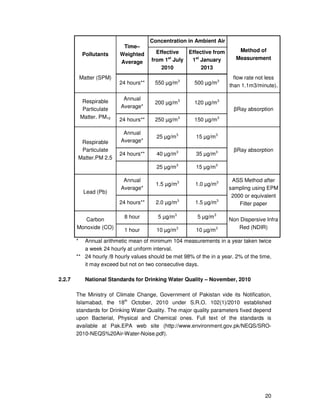
  • 262.
    Environmental, Health, andSafety (EHS) Guidelines GENERAL EHS GUIDELINES: CONSTRUCTION AND DECOMMISSIONING APRIL 30, 2007 94 WORLD BANK GROUP • Controlling site-specific factors which may contribute to excavation slope instability including, for example, the use of excavation dewatering, side-walls support, and slope gradient adjustments that eliminate or minimize the risk of collapse, entrapment, or drowning • Providing safe means of access and egress from excavations, such as graded slopes, graded access route, or stairs and ladders • Avoiding the operation of combustion equipment for prolonged periods inside excavations areas where other workers are required to enter unless the area is actively ventilated Other Site Hazards Construction and decommissioning sites may pose a risk of exposure to dust, chemicals, hazardous or flammable materials, and wastes in a combination of liquid, solid, or gaseous forms, which should be prevented through the implementation of project- specific plans and other applicable management practices, including: • Use of specially trained personnel to identify and remove waste materials from tanks, vessels, processing equipment or contaminated land as a first step in decommissioning activities to allow for safe excavation, construction, dismantling or demolition • Use of specially trained personnel to identify and selectively remove potentially hazardous materials in building elements prior to dismantling or demolition including, for example, insulation or structural elements containing asbestos and Polychlorinated Biphenyls (PCBs), electrical components containing mercury96 • Use of waste-specific PPE based on the results of an occupational health and safety assessment, including 96 Additional information on the management and removal of asbestos containing building materials can be found in ASTM Standard E2356 and E1368 respirators, clothing/protective suits, gloves and eye protection 4.3 Community Health and Safety{ TC "4.3 Community Health and Safety" f C l "2" } General Site Hazards Projects should implement risk management strategies to protect the community from physical, chemical, or other hazards associated with sites under construction and decommissioning. Risks may arise from inadvertent or intentional trespassing, including potential contact with hazardous materials, contaminated soils and other environmental media, buildings that are vacant or under construction, or excavations and structures which may pose falling and entrapment hazards. Risk management strategies may include: • Restricting access to the site, through a combination of institutional and administrative controls, with a focus on high risk structures or areas depending on site-specific situations, including fencing, signage, and communication of risks to the local community • Removing hazardous conditions on construction sites that cannot be controlled affectively with site access restrictions, such as covering openings to small confined spaces, ensuring means of escape for larger openings such as trenches or excavations, or locked storage of hazardous materials Disease Prevention Increased incidence of communicable and vector-borne diseases attributable to construction activities represents a potentially serious health threat to project personnel and residents of local communities. Recommendations for the prevention and control of communicable and vector-borne diseases also applicable to
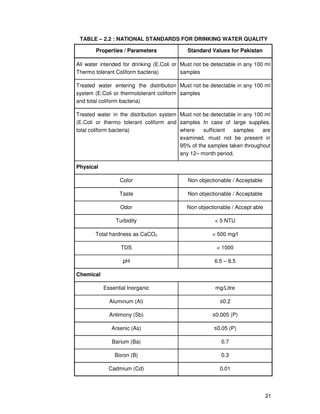
  • 263.
    Environmental, Health, andSafety (EHS) Guidelines GENERAL EHS GUIDELINES: CONSTRUCTION AND DECOMMISSIONING APRIL 30, 2007 95 WORLD BANK GROUP construction phase activities are provided in Section 3.6 (Disease Prevention). Traffic Safety Construction activities may result in a significant increase in movement of heavy vehicles for the transport of construction materials and equipment increasing the risk of traffic-related accidents and injuries to workers and local communities. The incidence of road accidents involving project vehicles during construction should be minimized through a combination of education and awareness-raising, and the adoption of procedures described in Section 3.4 (Traffic Safety).
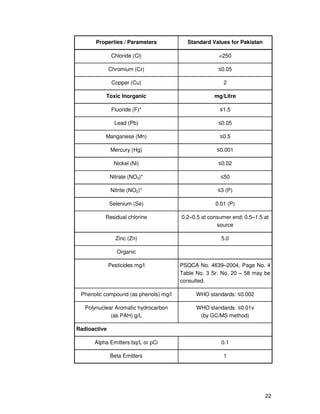
  • 264.
    Environmental, Health, andSafety (EHS) Guidelines GENERAL EHS GUIDELINES: REFERENCES AND ADDITIONAL SOURCES APRIL 30, 2007 96 WORLD BANK GROUP References and Additional Sources ATSDR (Agency for Toxic Substance and Disease Registry). Quick Reference Pocket Guide for Toxicological Profiles. http://www.atsdr.cdc.gov/toxguides/ (accessed May 19, 2006). ATSDR. 2005. Top 20 Hazardous Substances 2005. http://www.atsdr.cdc.gov/cxcx3.html (accessed May 19, 2006). Air and Waste Management Association (AWMA). 2000. Air Pollution Engineering Manual, Second Edition. John Wiley & Sons, Inc.. New York, NY. ACGIH (American Conference of Governmental Industrial Hygienists). 2005. Threshold Limit Values for Chemical Substances in the Work Environment. Cincinnati:ACGIH. ANSI (American National Standards Institute). Homepage. http://www.ansi.org/ (accessed May 19, 2006). ADB. 2003. Road Safety Audit for Road Projects: An Operational Tool. Asian Development Bank, Manila. American Petroleum Institute, Management of Process Hazards (R.P. 750). Assum, T. 1998. Road Safety in Africa: Appraisal of Road Safety Initiatives in Five African Countries. Working Paper No. 33. The World Bank and United Nations Economic Commission for Africa. American Society for Testing and Materials (ASTM) E1739-95(2002) Standard Guide for Risk-Based Corrective Action Applied at Petroleum Release Sites ASTM E2081-00(2004)e1 Standard Guide for Risk-Based Corrective Action (at chemical release sites). ASTM E 1368 - Standard Practice for Visual Inspection of Asbestos Abatement Projects ASTM E 2356 - Standard Practice for Comprehensive Building Asbestos Surveys ASTM E 2394 - Standard Practice for Maintenance, Renovation and Repair of Installed Asbestos Cement Products. Australian Government. NPI Industry Reporting. Department of the Environment and Heritage.http://www.npi.gov.au/handbooks/ Australian Government. 2004. “National Pollutant Inventory Guide.” Department Of Environment and Heritage. http://www.npi.gov.au/handbooks/pubs/npiguide.pdf Awareness and Preparedness for Emergencies at Local Level (APELL) Guidelines available at: http://www.uneptie.org/pc/apell/publications/handbooks.html Bringezu, Stefan and Helmut Schutz. 2001. “Material use indicators for the European Union, 1980-1997 – Economy-side material flow accounts and balances and derived indicators of resource use.” European Commission. http://www.belspo.be/platformisd/Library/Material%20use%20Bringezu.PDF BC MOE (BC Ministry of Environment). Guidance on Contaminated Sites. http://www.env.gov.bc.ca/epd/epdpa/contam_sites/guidance/ (accessed May 18, 2006) CIWMB (California Integrated Waste Management Board). “Sustainable Materials”. State Training Manual. http://www.ciwmb.ca.gov/GreenBuilding/Training/StateManual/Materials.doc (accessed May 18, 2006) CCPS (Center for Chemical Process Safety). Homepage. American Institute of Chemical Engineers. www.aiche.org/ccps (accessed May 18, 2006) CCPS. 1992. Guidelines for Hazard Evaluation Procedures. American Institute of Chemical Engineers. Chavasse, D.C. and H.H. Yap, eds. 1997. Chemical Methods for the Control of Vectors and Pests of Public Health Importance. Geneva, Switzerland: World Health Organization. Dockrill, Paul and Frank Friedrich. 2001. “Boilers and Heaters: Improving Energy Efficiency.” NRCAN. http://oee.nrcan.gc.ca/publications/infosource/pub/cipec/boilersheaters.pdf Environment Canada, 2005. Hazardous Waste. http://www.atl.ec.gc.ca/pollution/hazardouswaste.html (accessed May 19, 2006). European Commission. 2000. “Guidance Document for EPER implementation.” Directorate-General for Environment. http://ec.europa.eu/environment/ippc/eper/index.htm European Council Directive 91/271 of 21 May 1991 concerning urban wastewater treatment (http://ec.europa.eu/environment/water/water- urbanwaste/info/docs_en.htm) EPER (European Pollutant Emission Register). Homepage. http://www.eper.cec.eu.int/eper/default.asp (accessed May 19, 2006). EREC (European Renewable Energy Council). 2006. Renewable Energy Sources. http://www.erec-renewables.org/sources/default.htm (accessed April 24, 2006). EUROPA. Summaries of Legislation: Air Pollution. http://europa.eu.int/scadplus/leg/en/s15004.htm (accessed March 25, 2006) Fairman, Robyn, Carl D.Mead, and W. Peter Williams. 1999. “Environmental Risk Assessment - Approaches, Experiences and Information Sources”. London: Monitoring and Assessment Research Centre, King's College,. http://reports.eea.eu.int/GH-07-97-595-EN-C2/en FAO (Food and Agriculture Organization). 1995. “Guidelines on Good Labeling Practices for Pesticides.” Rome: FAO. http://ecoport.org/Resources/Refs/Pesticid/Guides/guides.htm FAO. 1985. “Guidelines for the Packaging and Storage of Pesticides.” Rome: FAO http://www.fao.org/ag/AGP/AGPP/Pesticid/Code/Download/pacstor.doc Francey, R., J. Pickford and R. Reed. 1992. “A Guide to the Development of On- site Sanitation.” Geneva: World Health Organization. http://www.who.int/water_sanitation_health/hygiene/envsan/onsitesan/en/print.html GVRD (Greater Vancouver Regional District). 1999. Caring for our Waterways: Liquid Waste Management Plan Stage 2, Discussion Document. 136 pp. GVRD. 2001. “Liquid Waste Management Plan.” Greater Vancouver: Stormwater Management Technical Advisory Task Group. http://www.gvrd.bc.ca/sewerage/lwmp_feb2001/lwmp_plan_feb2001.pdf IESNA (Illuminating Engineering Society of North America). Homepage. http://www.iesna.org/ (accessed May 18, 2006) Industry Canada. Eco-efficiency. http://strategis.ic.gc.ca/epic/internet/inee- ee.nsf/en/Home (accessed May 18, 2006) IPCC (Intergovernmental Panel on Climate Change). National Greenhouse Gas Inventories Program. http://www.ipcc-nggip.iges.or.jp/ (accessed May 18, 2006) ILO-OSH (International Labour Organization – Occupational Safety and Health). 2001. “Guidelines on Occupational Safety & Health Management Systems”. Geneva: International Labour Office. http://www.ilo.org/public/english/protection/safework/cops/english/download /e000013.pdf ICC (International Code Council). 2006. “International Building Code”. Falls Church, Virginia: ICC.
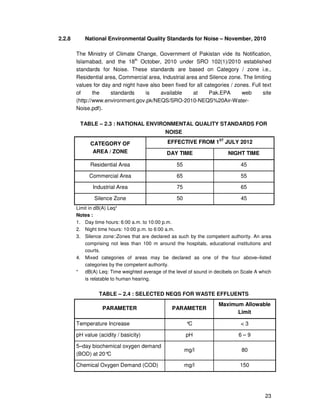
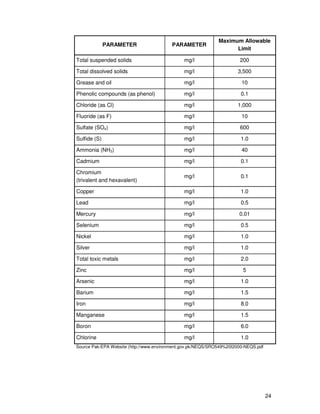
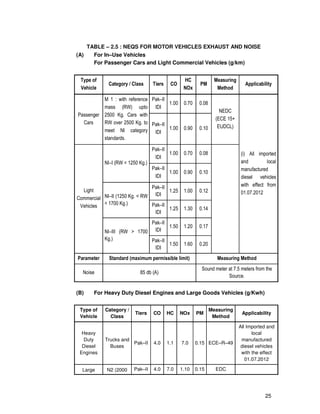
  • 265.
    Environmental, Health, andSafety (EHS) Guidelines GENERAL EHS GUIDELINES: REFERENCES AND ADDITIONAL SOURCES APRIL 30, 2007 97 WORLD BANK GROUP IATA (International Air Transport Association). 2005. “Dangerous Goods Regulations Manual.” Geneva: IATA. http://www.iata.org/ps/publications/9065.htm (accessed May 18, 2006) IAEA (International Atomic Energy Agency). International Basic Safety Standard for protection against Ionizing Radiation and for the Safety of Radiation Sources http://www-ns.iaea.org/standards/documents/default.asp?sub=160 (accessed May 19, 2006). IHS 1996. ISO 9613 – Acoustics – Attenuation of sound during propagation outdoors – Part 2: General method of calculation. http://engineers.ihs.com/document/abstract/XVNLCAAAAAAAAAAA (accessed May 19, 2006). IMO (International Maritime Organization). International Maritime Dangerous Goods Code. http://www.imo.org/Safety/mainframe.asp?topic_id=158 (accessed May 18, 2006) ISO (International Organization for Standardization). Quality and Environmental Management. http://www.iso.org/iso/en/iso9000-14000/index.html (accessed May 18, 2006) IOMC (Inter-Organization Programme for the Sound Management of Chemicals. 2001. “The WHO Recommended Classification of Pesticides by Hazard and Guidelines to Classification 2000-2002.” International Program on Chemical Safety. http://whqlibdoc.who.int/hq/2002/a76526.pdf Kates, R., Hohenemser, C., and J. Kasperson, Editors. 1985. Perilous Progress: Management the Hazards of Technology. Westview Press, London. Knowlton, R. Ellis. 1992. A Manual of Hazard & Operability Studies. Chemetics International. LDAR (Leak Detection and Repair Professionals). http://www.ldar.net/ (accessed May 18, 2006). Lijzen, J.P.A., A.J. Baars, P.F. Otte, M.G.J. Rikken, F.A. Swartjes, E.M.J. Verbruggen and A.P. van Wezel. 2001. Technical evaluation of the Intervention Values for Soil/sediment and Groundwater - Human and ecotoxicological risk assessment and derivation of risk limits for soil, aquatic sediment and groundwater. RIVM report 711701 023. Netherlands National Institute of Public Health and the Environment. http://www.rivm.nl/bibliotheek/rapporten/711701023.pdf Massachusetts Department of Environment. Cleanup Sites and Spills. http://www.mass.gov/dep/cleanup (accessed May 19, 2006). MSHA (Mine Safety and Health Administration). Homepage. http://www.msha.gov/ (accessed May 19, 2006). NIOSH (National Institute for Occupational Safety and Health). Center for Disease Control and Prevention – Department of Health and Human Services. http://www.cdc.gov/niosh/homepage.html (accessed May 18, 2006) National Research Council of Canada, 2005. Building Codes. http://www.nrc- cnrc.gc.ca/doingbusiness/codes_e.html (accessed May 18, 2006). NRCAN (Natural Resources Canada). Electric Motors – Factsheet 6. Office of Energy Efficiency. http://oee.nrcan.gc.ca/regulations/html/Factsheet6.cfm?text=N&printview=N (accessed May 18, 2006) NRCAN. Energy-Efficient Motor Systems Assessment Guide. Office of Energy Efficiency. http://oee.nrcan.gc.ca/cipec/ieep/newscentre/motor_system/introduction.cfm?text= N&printview=N (accessed May 18, 2006) NRCAN (Natural Resources Canada). EnerGuide Program. Office of Energy Efficiency. http://oee.nrcan.gc.ca/equipment/english/index.cfm?PrintView=N&Text=N (accessed March 24, 2006) NRCAN. 2004. “EnerGuide for Industry: Your guide to selecting energy-efficient industrial equipment”. Office of Energy Efficiency. http://oee.nrcan.gc.ca/publications/infosource/pub/Energuide-industry/EGI- brochure-e.cfm NRCAN. Energy Star® - Heating, Cooling and Ventilation. Office of Energy Efficiency. http://oee.nrcan.gc.ca/energystar/english/consumers/heating.cfm?text=N&printvie w=N#AC (accessed April 9, 2006) NRCAN. Technical Factsheet CanMOST – Canadian Motor Selection Tool. Office of Energy Efficiency. http://oee.nrcan.gc.ca/publications/infosource/pub/cipec/canadian-motor/index.cfm (accessed May 18, 2006) NRCAN. 2005a. “Team up for Energy Savings - Compressed Air.” Office of Energy Efficiency. http://oee.nrcan.gc.ca/publications/industrial/cipec/compressed-air.pdf NRCAN. 2005b. Team up for Energy Savings – Lighting.” Office of Energy Efficiency. http://oee.nrcan.gc.ca/publications/industrial/cipec/light.pdf NRCAN. 2006a. Model National Energy Code for Buildings (MNECB) for the Commercial Building Incentive Program. http://oee.nrcan.gc.ca/commercial/financial-assistance/new- buildings/mnecb.cfm?attr=20 (accessed March 24, 2006) NRCAN. 2006b. Office of Energy Efficiency General Database. http://oee.nrcan.gc.ca/infosource/PDFs (accessed March 24, 2006) NRCAN. 2006c. Office of Energy Efficiency – Industry Projects Database. http://oee.nrcan.gc.ca/publications/infosource/home/index.cfm?act=category&cate gory=07&PrintView=N&Text=N (accessed March 24, 2006) NRCAN. 2006d. Energy Efficiency Regulations and Standards for Industry – Canada’s Energy Efficiency Regulations. http://oee.nrcan.gc.ca/industrial/regulations-standards/index.cfm?attr=24 (accessed April 24, 2006) New Zealand Ministry of the Environment. 2004. “Contaminated Land Management Guidelines No.5: Site Investigation and Analysis of Soils.” Federal Government of New Zealand. http://www.mfe.govt.nz/publications/hazardous/contaminated-land-mgmt- guidelines-no5/index.html North American Energy Working Group. “North American Energy Efficiency Standards and Labeling.” Organization for Economic Cooperation and Development (OECD). Database on Use and Release of Industrial Chemicals. http://appli1.oecd.org/ehs/urchem.nsf OECD. 1999. Safety Strategies for Rural Roads. Organization for Economic Cooperation and Development, Paris. www.oecd.org/dataoecd/59/2/2351720.pdf OHSAS. 2000. OHSAS 18002:2000. Occupational Health and Safety Management Systems - Guidelines for the Implementation of OHSAS 18001. OSHA (Occupational Safety and Health Administration). Emergency Standards. http://www.osha.gov/SLTC/etools/evacuation/standards_card.html (accessed May 18, 2006) OSHA. Safety and Health Topics- Toxic Metals. http://www.osha.gov/SLTC/metalsheavy/ (accessed May 19, 2006) Peden, Margie, David Sleet, Adnan Hyder and Colin Mathers, eds. 2004. “World Report on Road Traffic Injury Prevention.” Geneva: World Health Organization. http://www.who.int/world-health-day/2004/infomaterials/world_report/en/ PDEP (Pennsylvania Department of Environment Protection). Official Recycled Product Guide. http://www.dep.state.pa.us/wm_apps/recycledproducts/ (accessed May 18, 2006)
  • 266.
    Environmental, Health, andSafety (EHS) Guidelines GENERAL EHS GUIDELINES: REFERENCES AND ADDITIONAL SOURCES APRIL 30, 2007 98 WORLD BANK GROUP PTCL (Physical and Theoretical Chemistry Lab). Safety (MSDS) data for benzo(a)pyrene. http://www.physchem.ox.ac.uk/MSDS/BE/benzo(a)pyrene.html (accessed May 18, 2006) Prokop, Gundula. 2002. “Second Technical Workshop on Contaminated Sites - Workshop Proceedings and Follow-up.” European Environment Agency. http://reports.eea.europa.eu/technical_report_2002_76/en/Tech76.pdf Ritter, L., K.R. Solomon, J. Forget, M. Stemeroff and C.O’Leary. “An Assessment Report on: DDT-Aldrin-Dieldrin-Endrin-Chlordane, Heptachlor-Hexachlorobenzene, Mirex-Toxaphene, Polychlorinated Biphenyls, Dioxins and Furans.” International Programme on Chemical Safety. http://www.pops.int/documents/background/assessreport/en/ritteren.pdf (accessed May 18, 2006) Ross A, Baguley C, Hills B, McDonald M, Solcock D.1991. “Towards Safer Roads in Developing Countries: A Guide for Planners and Engineers.” Berkshire: Transport and Road Research Laboratory. Rushbrook, P. and M. Pugh. 1998. “Solid Waste Landfills in Middle- and Lower- Income Countries: A Technical Guide to Planning, Design, and Operation.” World Bank. http://www- wds.worldbank.org/external/default/WDSContentServer/IW3P/IB/2002/12/06/0000 94946_02112104104987/Rendered/PDF/multi0page.pdf SCPOP (Stockholm Convention on POPs). Guidance Documents. http://www.pops.int/documents/guidance/ (accessed May 19, 2006) Tsunokawa, Koji and Christopher Hoban, eds. 1997. “Roads and the Environment: A Handbook.” Washington, D.C.: World Bank. http://www.worldbank.org/transport/publicat/reh/toc.htm UK Department of Environment, Food and Rural Affairs. http://www.defra.gov.uk/ (accessed May 18, 2006) UK Environment Agency. Contaminated Land Exposure Assessment (CLEA). http://www.environment- agency.gov.uk/subjects/landquality/113813/672771/?version=1&lang=_e (accessed May 18, 2006) UN/ECE (United Nations/Economic Commission for Europe). United Nations Recommendations on the Transport of Dangerous Goods Model Regulations. http://www.unece.org/trans/ (accessed May 18, 2006) UN/ECE. The Atmospheric Emission Inventory Guidebook. http://www.aeat.co.uk/netcen/airqual/TFEI/unece.htm (accessed May 18, 2006). UNEP (United Nation Environment Program). Secretariat of the Basel Convention on Hazardous Waste Management. http://www.basel.int/index.html (accessed May 18, 2006) UNEP. Persistant Organic Pollutants. http://www.chem.unep.ch/pops/ (accessed May 18, 2006) UNEP. Country contributions: Information on the regulatory status of POPs; bans, restrictions, and/or other legal permitted uses. http://www.chem.unep.ch/pops/POPs_Inc/INC_3/inf-english/inf3-9/sect5.pdf (accessed May 18, 2006). UNEP. 1993. Cleaner Production Worldwide Volume 1. http://www.uneptie.org/PC/cp/library/catalogue/regional_reports.htm . UNEP. 1997. The Environmental Management of Industrial Estates. Industry and Environment, United Nations Environment Programme. US DOE. Building Toolbox – Boilers. Building Technologies Program. http://www.eere.energy.gov/buildings/info/components/hvac/boilers.html (accessed April 30, 2006) US DOE. 2002. Heating and Cooling Equipment Selection. Office of Building Technology, State and Community Programs – Energy Efficiency and Renewable Energy. http://www.eere.energy.gov/buildings/info/documents/pdfs/26459.pdf (US DOE). Industry Plant Managers and Engineers – Combustion. http://www.eere.energy.gov/consumer/industry/combustion.html#opp1 (accessed April 30, 2006). US DOE (US Department of Energy). Industry Plant Managers and Engineers – Process Heating Systems. http://www.eere.energy.gov/consumer/industry/process.html (accessed April 30, 2006). US DOE. Industry Plant Managers and Engineers – Steam Boilers. http://www.eere.energy.gov/consumer/industry/steam.html (accessed April 30, 2006). US DOE. Industrial Technologies Program– Best Practices. http://www1.eere.energy.gov/industry/bestpractices/ (accessed April 30, 2006) US DOE. “The Big Picture on Process Heating”. Industrial Technologies Program – Best Practices. http://eereweb.ee.doe.gov/industry/bestpractices/pdfs/em_proheat_bigpict.pdf (accessed April 30, 2006). US DOE. 2005. “Improve Motor System Efficiency for a Broader Range of Motors with MotorMaster+ International.” Industrial Technologies Program. http://eereweb.ee.doe.gov/industry/bestpractices/pdfs/mmplus_international.pdf US DOT (US Department of Transportation). HAZMATS Regulations. http://hazmat.dot.gov/ (accessed May 18, 2006) US Energy Star Program. Guidelines for Energy Management. http://www.energystar.gov/index.cfm?c=guidelines.download_guidelines (accessed April 24, 2006) US Energy Star Program. Tools and Resources. http://www.energystar.gov/index.cfm?c=tools_resources.bus_energy_management _tools_resources (accessed April 9, 2006) US EPA (US Environmental Protection Agency). Air Compliance Advisor. http://www.epa.gov/ttn/ecas/ACA.htm (accessed May 18, 2006) US EPA. Ambient Air Monitoring QA Program. http://www.epa.gov/airprogm/oar/oaqps/qa/index.html#guidance (accessed May 19, 2006). US EPA. Comprehensive Procurement Guidelines – Product Fact Sheets. http://www.epa.gov/cpg/factshts.htm (accessed May 18, 2006) US EPA. EPA Guidance. Environmentally Preferable Purchasing. http://www.epa.gov/oppt/epp/pubs/guidance/guidancepage.htm (accessed May 18, 2006) US EPA. Hazardous Waste. http://www.epa.gov/epaoswer/osw/hazwaste.htm (accessed May 19, 2006). US EPA. Hazardous Waste Identification. http://www.epa.gov/epaoswer/hazwaste/id/id.htm#id (accessed May 19, 2006). US EPA. Major Environmental Laws. Laws and Regulations. http://www.epa.gov/epahome/laws.htm (accessed May 18, 2006) US EPA. Performance Track Assistance. National Environmental Performance Track. http://www.epa.gov/performancetrack/ptrackassist.htm (accessed May 18, 2006) US EPA 40 CFR Part 133, Secondary Treatment Regulation (http://www.access.gpo.gov/nara/cfr/waisidx_02/40cfr133_02.html) US EPA. Persistant Organic Pollutants (POPs). http://www.epa.gov/oppfead1/international/pops.htm (accessed May 19, 2006) US EPA. Pollution Prevention Highlights. http://www.epa.gov/p2/ (accessed May 18, 2006)
  • 267.
    Environmental, Health, andSafety (EHS) Guidelines GENERAL EHS GUIDELINES: REFERENCES AND ADDITIONAL SOURCES APRIL 30, 2007 99 WORLD BANK GROUP US EPA. Region 9 Preliminary Remediation Goals. http://www.epa.gov/region9/waste/sfund/prg/ (accessed May 19, 2006). US EPA. Technology Transfer Network Clearinghouse for Inventories and Emissions Factors. http://www.epa.gov/ttn/chief/ US EPA. Waste Minimization. http://www.epa.gov/wastemin/ (accessed May 19, 2006). US EPA. 1991. Technical support document for water quality-based toxic control. Washington, DC.: Office of Water Enforcement and Permits, Office of Water Regulations and Standards. US EPA. 2004. National Recommended Water Quality Criteria. Washington. DC: United States Office of Water. Environmental Protection Agency Office of Science and Technology (4304T). US EPA. 2005. Chromated Copper Arsenate (CCA). Pesticides Re-registration. http://www.epa.gov/oppad001/reregistration/cca/ (accessed May 18, 2006) US EPA. 2006. 40CFR Chapter 1, Subchapter J, section 302.4, Designation of Hazardous Substances. http://ecfr.gpoaccess.gov/cgi/t/text/text- idx?c=ecfr&sid=a1d39cb9632558b450b2d09e45b5ca78&rgn=div8&view=text&nod e=40:27.0.1.1.2.0.1.4&idno=40 USGS (US Geological Survey). 2000. Recycled Aggregates—Profitable Resource Conservation. USGS Fact Sheet FS–181–99. http://pubs.usgs.gov/fs/fs-0181- 99/fs-0181-99so.pdf US NFPA (US National Fire Protection Association). 2006. 101- Life Safety Code Handbook. http://www.nfpa.org/catalog/product.asp?category%5Fname=&pid=10106&target% 5Fpid=10106&src%5Fpid=&link%5Ftype=search (accessed May 19, 2006). US Occupational Safety and Health Administration (OSHA) 29 CFR 1910.119 App A, Threshold Quantities. US Occupational Safety and Health Administration (OSHA) 29CFR Part 1910.120, Hazardous Waste Operations and Emergency Response Standard. US Occupational Safety and Health Administration (OSHA) 29 CFR Part 1910.119. WHO. 1987. Technology for Water Supply and Sanitation in Developing Countries. Technical Report Series No. 742. World Health Organization, Geneva. WHO. 1989. New Approaches to Improve Road Safety. Technical Report 781b. World Health Organization, Geneva. WHO. 1993. Guidelines for Drinking Water Quality. Volume 1: Recommendations. 2nd Edition. World Health Organization, Geneva. WHO. 1994. Operation and Maintenance of Urban Water Supply and Sanitation Systems: A Guide for Managers. World Health Organization, Geneva. WHO. 1996. Guidelines for Drinking Water Quality. Volume 2: Health Criteria and Other Supporting Information. World Health Organization, Geneva. WHO. 1997. Guidelines for Drinking Water Quality. Volume 3: Surveillance and Control of Community Supplies. World Health Organization, Geneva. http://www.who.int/water_sanitation_health/dwq/gdwq2v1/en/index2.html (accessed May 18, 2006) WHO. 1999. Draft Specifications for Bacterial Larvicides for Public Health Use. WHO/CDS/CPC/WHOPES/99.2. Communicable Diseases Prevention and Control, WHO Pesticide Evaluation Scheme, World Health Organization. WHO. 1999. Prevention and Control of Dengue and Dengue Haemorrhagic Fever: Comprehensive Guidelines. WHO Regional Publication, SEARO No. 29. Regional Office for South-East Asia, World Health Organization, New Delhi. WHO. 1999. Safety of Pyrethroid-Treated Mosquito Nets. WHO/CDS/CPE/WHOPES/99.5. World Health Organization, Geneva. WHO. 2000a. Guidelines for the Purchase of Public Health Pesticides. WHO/CDS/WHOPES/2000.1. Communicable Disease Control, Prevention and Eradication, World Health Organization. WHO. 2000b. Air Quality Guidelines for Europe. Geneva:WHO. http://www.euro.who.int/document/e71922.pdf WHO. 2000. Towards an Assessment of the Socioeconomic Impact of Arsenic Poisoning in Bangladesh. WHO/SDE/WSH/00.4. World Health Organization. WHO. 2001. Chemistry and Specifications of Pesticides. Technical Report Series 899. Geneva: WHO. WHO. 2003. “Draft Guidelines for the Management of Public Health Pesticides.” Communicable Disease Control, Prevention and Eradication, World Health Organization. http://whqlibdoc.who.int/hq/2003/WHO_CDS_WHOPES_2003.7.pdf WHO. 2004. Guidelines for Drinking-water Quality - Volume 1 Recommendations. Geneva: WHO. http://www.who.int/water_sanitation_health/dwq/GDWQ2004web.pdf WHO Guidelines for the Safe Use of Wastewater, Excreta and Greywater. Volume 2: Wastewater Use in Agriculture http://www.who.int/water_sanitation_health/wastewater/gsuweg2/en/index.html WHO. 2005. Guidelines for drinking-water quality. http://www.who.int/water_sanitation_health/dwq/gdwq3/en/ (accessed May 18, 2006) Woolliams, J. 2002. “Planning, Design and Construction Strategies for Green Buildings.” Eco-City Planning Company. http://www.greenbuildingsbc.com/new_buildings/pdf_files/greenbuild_strategies_g uide.pdf Yassi, A. et al. 1998. Basic Environmental Health. WHO/EHG/98.19. Office of Global and Integrated Environmental Health, World Health Organization, Geneva. Zaim, M. 2002. Global Insecticide Use for Vector-Borne Disease Control. WHO/CDS/WHOPES/GCDPP/2002.2. Communicable Disease Control, Prevention and Eradication, World Health Organization.