Final Year Project By: JIIT,NOIDA
Aarshi Taneja (10104666)
Divya Gautam(10104673)
Nupur(10104676)
LEAF RECOGNITION
Leaf
 A leaf is an organ of a vascular plant, and is the
principal appendage of the vascular plant stem.[1]
The leaves and stem together form the shoot.
 Typically a leaf is a thin, dorsiventrally flattened
organ, borne above ground and specialized for
photosynthesis. Most leaves have distinctive
upper (adaxial) and lower (abaxial) surfaces that
differ in colour, hairiness, the number of stomata
and other features.
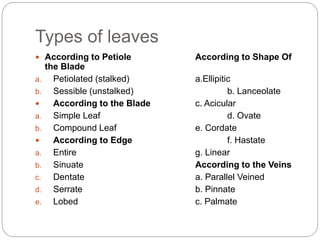
Types of leaves
 According to Petiole According to Shape Of
the Blade
a. Petiolated (stalked) a.Ellipitic
b. Sessible (unstalked) b. Lanceolate
 According to the Blade c. Acicular
a. Simple Leaf d. Ovate
b. Compound Leaf e. Cordate
 According to Edge f. Hastate
a. Entire g. Linear
b. Sinuate According to the Veins
c. Dentate a. Parallel Veined
d. Serrate b. Pinnate
e. Lobed c. Palmate
Problem Statement
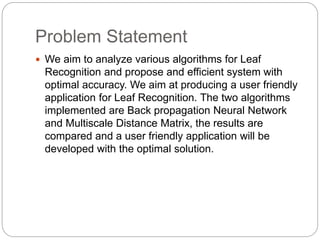
 We aim to analyze various algorithms for Leaf
Recognition and propose and efficient system with
optimal accuracy. We aim at producing a user friendly
application for Leaf Recognition. The two algorithms
implemented are Back propagation Neural Network
and Multiscale Distance Matrix, the results are
compared and a user friendly application will be
developed with the optimal solution.
Multi Scale Distance Matrix
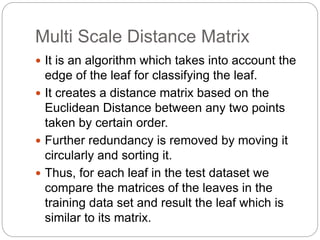
 It is an algorithm which takes into account the
edge of the leaf for classifying the leaf.
 It creates a distance matrix based on the
Euclidean Distance between any two points
taken by certain order.
 Further redundancy is removed by moving it
circularly and sorting it.
 Thus, for each leaf in the test dataset we
compare the matrices of the leaves in the
training data set and result the leaf which is
similar to its matrix.
Neural Network
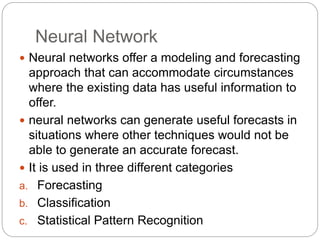
 Neural networks offer a modeling and forecasting
approach that can accommodate circumstances
where the existing data has useful information to
offer.
 neural networks can generate useful forecasts in
situations where other techniques would not be
able to generate an accurate forecast.
 It is used in three different categories
a. Forecasting
b. Classification
c. Statistical Pattern Recognition
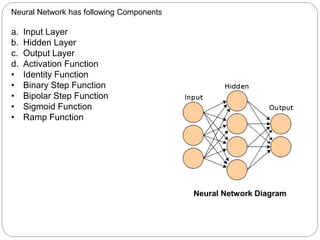
Neural Network Diagram
Neural Network has following Components
a. Input Layer
b. Hidden Layer
c. Output Layer
d. Activation Function
• Identity Function
• Binary Step Function
• Bipolar Step Function
• Sigmoid Function
• Ramp Function
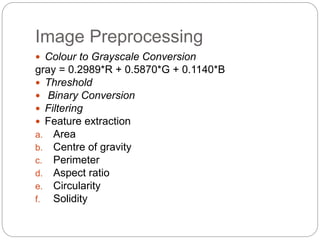
Image Preprocessing
 Colour to Grayscale Conversion
gray = 0.2989*R + 0.5870*G + 0.1140*B
 Threshold
 Binary Conversion
 Filtering
 Feature extraction
a. Area
b. Centre of gravity
c. Perimeter
d. Aspect ratio
e. Circularity
f. Solidity
Leaf Recognition Web Application
User application
 User friendly Leaf recognition Application where
user can upload any leaf image and the system
will process the image and compare it with leaves
in the training data set and output the leaf image
that correctly matches the image uploaded by the
user.
 If the image doesn’t match with any image in the
training data set , then the user is notified with a
failure message that image cannot be
recognized.

final year project_leaf recognition

  • 1.
    Final Year ProjectBy: JIIT,NOIDA Aarshi Taneja (10104666) Divya Gautam(10104673) Nupur(10104676) LEAF RECOGNITION
  • 2.
    Leaf  A leafis an organ of a vascular plant, and is the principal appendage of the vascular plant stem.[1] The leaves and stem together form the shoot.  Typically a leaf is a thin, dorsiventrally flattened organ, borne above ground and specialized for photosynthesis. Most leaves have distinctive upper (adaxial) and lower (abaxial) surfaces that differ in colour, hairiness, the number of stomata and other features.
  • 3.
    Types of leaves According to Petiole According to Shape Of the Blade a. Petiolated (stalked) a.Ellipitic b. Sessible (unstalked) b. Lanceolate  According to the Blade c. Acicular a. Simple Leaf d. Ovate b. Compound Leaf e. Cordate  According to Edge f. Hastate a. Entire g. Linear b. Sinuate According to the Veins c. Dentate a. Parallel Veined d. Serrate b. Pinnate e. Lobed c. Palmate
  • 4.
    Problem Statement  Weaim to analyze various algorithms for Leaf Recognition and propose and efficient system with optimal accuracy. We aim at producing a user friendly application for Leaf Recognition. The two algorithms implemented are Back propagation Neural Network and Multiscale Distance Matrix, the results are compared and a user friendly application will be developed with the optimal solution.
  • 5.
    Multi Scale DistanceMatrix  It is an algorithm which takes into account the edge of the leaf for classifying the leaf.  It creates a distance matrix based on the Euclidean Distance between any two points taken by certain order.  Further redundancy is removed by moving it circularly and sorting it.  Thus, for each leaf in the test dataset we compare the matrices of the leaves in the training data set and result the leaf which is similar to its matrix.
  • 6.
    Neural Network  Neuralnetworks offer a modeling and forecasting approach that can accommodate circumstances where the existing data has useful information to offer.  neural networks can generate useful forecasts in situations where other techniques would not be able to generate an accurate forecast.  It is used in three different categories a. Forecasting b. Classification c. Statistical Pattern Recognition
  • 7.
    Neural Network Diagram NeuralNetwork has following Components a. Input Layer b. Hidden Layer c. Output Layer d. Activation Function • Identity Function • Binary Step Function • Bipolar Step Function • Sigmoid Function • Ramp Function
  • 8.
    Image Preprocessing  Colourto Grayscale Conversion gray = 0.2989*R + 0.5870*G + 0.1140*B  Threshold  Binary Conversion  Filtering  Feature extraction a. Area b. Centre of gravity c. Perimeter d. Aspect ratio e. Circularity f. Solidity
  • 9.
  • 10.
    User application  Userfriendly Leaf recognition Application where user can upload any leaf image and the system will process the image and compare it with leaves in the training data set and output the leaf image that correctly matches the image uploaded by the user.  If the image doesn’t match with any image in the training data set , then the user is notified with a failure message that image cannot be recognized.