BANKURA UNNAYANI INSTITUTE OF ENGINEERING BANKURA – 722146, WEST BENGAL, INDIA
BACHELOR OF TECHNOLOGY IN MECHANICAL ENGINEERING
REPORT SUBMITTED ON MANUAL RICE PLANTING MACHINE
SUBMITTED BY
1.MANISH KUMAR ME/12/2015-19
2.AAYUSH ME/13/2015-19
3.JATIN KUMAR MAHATO ME/10/2015-19
4.SHAHID PARWEZ ME/18/2015-19
5.MD SOHAIL ME/23/2015-19
6.ASHISH KUMR SINGH ME/17/2015-19
7.RITESH KUMAR MAHATO ME/08/2015-19
8.VISHAL SRIVASTAVA ME/21/2015-19
9.RAHUL KUMAR MANDAL ME/22/2015-19
IN THE SUPERVISION OF
Mr. SOUMEN PAUL
(Asst. professor)
ABSTRAC
T
The aim of agriculture or farming in India is not only limited to growing of crops
but is also associated with the economic growth of farmers and labours.
Hence to overcome issues there is a need of mechanization in the field of rice
cultivation by using manual rice planting machine as major tool in this process.
There is also need for designing and developing an economical and user-friendly
rice transplanter for small scale farmers in order to increase the production as well
as the quality of rice.
Literature Review
For initializing this project, we searched different types of information regarding of
transplanting field with literature review of different research paper. Our literature
review is divided into different field of analysis like Ergo-Economical analysis of
different paddy transplanting operation.
1. Mehta et al., (1990). In India rice is mainly cultivated during the Kharif session. In
traditional transplantation of rice.
2. Martin and Chaffin (1972), Ayoub and McDaniel (1974), and Chaffin et al. (1983)
found that heights at which push-pull forces are applied are the most important
variable which hugely affects the force output.
3. Rampuram Jayapal reddy & Dr. N. Sandhya Shenoy (2013) conducted an economic
analysis of Traditional SRI rice cultivation practices in Mahbubnagar district of
AndraPradesh.
Rice Cultivation
Rice cultivation is a complex activity that requires a series of processes to
achieve the finished product.
The basic stages of cultivation include;
∙ Seed selection
∙ Land preparation
∙ Water management
∙ Nutrient management
∙ Crop health management
∙ Harvesting
∙ Post-harvest
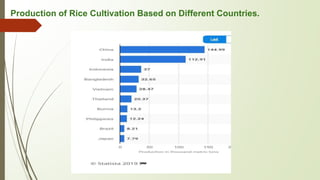
Production of Rice Cultivation Based on Different Countries.
Aim of our Project
The aim of our project is mainly focus in developing a working
prototype of manual rice planting machine, which works on only
mechanical form of energy, easy to assemble, easy handling, cost
friendly and eco friendly machine in the field of agriculture, which
will benefits our farmer to produce more with less work and cost.
PLAN OF EXPERIMENTAL WORK ON MANUAL RICE PLANTING
MACHINE
we have started our project in following parts of plan.
1. Study and Collect Knowledge
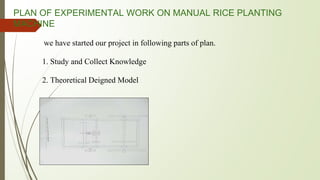
2. Theoretical Deigned Model
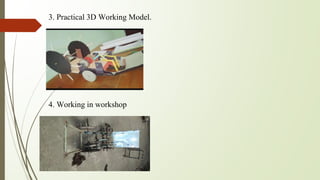
3. Practical 3D Working Model.
4. Working in workshop
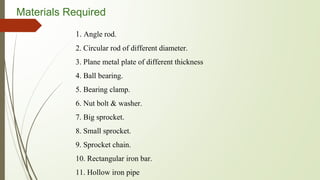
Materials Required
1. Angle rod.
2. Circular rod of different diameter.
3. Plane metal plate of different thickness
4. Ball bearing.
5. Bearing clamp.
6. Nut bolt & washer.
7. Big sprocket.
8. Small sprocket.
9. Sprocket chain.
10. Rectangular iron bar.
11. Hollow iron pipe
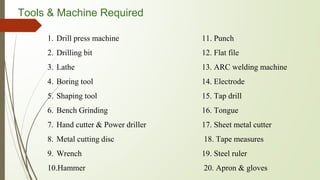
Tools & Machine Required
1. Drill press machine
2. Drilling bit
3. Lathe
4. Boring tool
5. Shaping tool
6. Bench Grinding
7. Hand cutter & Power driller
8. Metal cutting disc
9. Wrench
10.Hammer
11. Punch
12. Flat file
13. ARC welding machine
14. Electrode
15. Tap drill
16. Tongue
17. Sheet metal cutter
18. Tape measures
19. Steel ruler
20. Apron & gloves
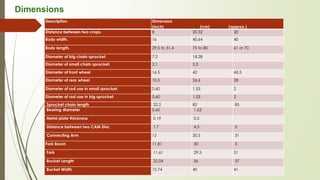
Description Dimension
(inch) (cm) (approx.)
Distance between two crops. 8 20.32 20
Body width. 16 40.64 40
Body length. 29.5 to 31.4 75 to 80 61 or 70
Diameter of big chain sprocket. 7.2 18.28
Diameter of small chain sprocket. 2.1 5.5
Diameter of front wheel 16.5 42 43.5
Diameter of rear wheel 10.5 26.6 28
Diameter of rod use in small sprocket. 0.60 1.53 2
Diameter of rod use in big sprocket. 0.60 1.53 2
Sprocket chain length 32.2 82 85
Bearing diameter 0.60 1.53
Metal plate thickness 0.19 0.5
Distance between two CAM Disc 1.7 4.5 5
Connecting Arm 12 30.5 31
Fork Boom 11.81 30 3
Fork 11.61 29.5 31
Bucket Length 22.04 56 57
Bucket Width 15.74 40 41
Dimensions
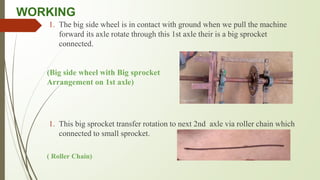
WORKING
1. The big side wheel is in contact with ground when we pull the machine
forward its axle rotate through this 1st axle their is a big sprocket
connected.
(Big side wheel with Big sprocket
Arrangement on 1st axle)
1. This big sprocket transfer rotation to next 2nd axle via roller chain which
connected to small sprocket.
( Roller Chain)
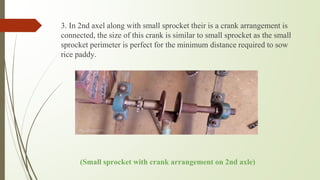
3. In 2nd axel along with small sprocket their is a crank arrangement is
connected, the size of this crank is similar to small sprocket as the small
sprocket perimeter is perfect for the minimum distance required to sow
rice paddy.
(Small sprocket with crank arrangement on 2nd axle)
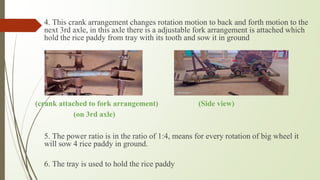
4. This crank arrangement changes rotation motion to back and forth motion to the
next 3rd axle, in this axle there is a adjustable fork arrangement is attached which
hold the rice paddy from tray with its tooth and sow it in ground
(crank attached to fork arrangement) (Side view)
(on 3rd axle)
5. The power ratio is in the ratio of 1:4, means for every rotation of big wheel it
will sow 4 rice paddy in ground.
6. The tray is used to hold the rice paddy
Advantages of Manual Rice Planting machine
1. Uniform spacing and optimum plant density.
2. Higher productivity compared to traditional methods where plant
spacing, and density may not always be consistent.
3. Lower stress, drudgery and health risks for farm labourers.
4. Better employment opportunities for rural youth through the
development of custom service business.
5. Addresses the problem of labour scarcity.
6. Increases farmers' net income.
LIMITATIONS
1. Proper land preparation, land levelling and water management should be
there.
2. Fields should be accessible for a smooth entry, exit, and tour of
machines.
3. Problems in poorly prepared and levelled land, or with poorly designed
machines.
4. Need of training on machine operations makes it time consuming and
expensive
5. Transplanting machines and its maintenance are expensive; so poor
farmers cannot afford them .
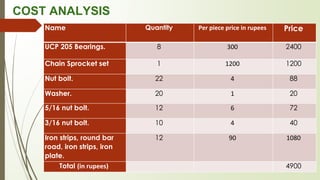
COST ANALYSIS
Name Quantity Per piece price in rupees Price
UCP 205 Bearings. 8 300 2400
Chain Sprocket set 1 1200 1200
Nut bolt. 22 4 88
Washer. 20 1 20
5/16 nut bolt. 12 6 72
3/16 nut bolt. 10 4 40
Iron strips, round bar
road, iron strips, iron
plate.
12 90 1080
Total (in rupees) 4900
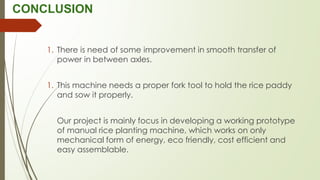
CONCLUSION
1. There is need of some improvement in smooth transfer of
power in between axles.
1. This machine needs a proper fork tool to hold the rice paddy
and sow it properly.
Our project is mainly focus in developing a working prototype
of manual rice planting machine, which works on only
mechanical form of energy, eco friendly, cost efficient and
easy assemblable.
References
1. .http://nipunarice.com/rice-o-pedia/major-rice -producing- nations/
1. https://www.worldatlas.com/articles/the-countries-producing-the-most-rice-
in-the-world.html
1. http://www.economicsdiscussion.net/agriculture/development/agricultural-
development-in-india /12865
1. https://en.m.wikipedia.org/wiki/Agriculture in India
1. https://www.statista.com/statistics/255945/top-countries-of-destination-for-us-
rice-exports -2011/
THANK YOU

Final year project presentation

  • 1.
    BANKURA UNNAYANI INSTITUTEOF ENGINEERING BANKURA – 722146, WEST BENGAL, INDIA BACHELOR OF TECHNOLOGY IN MECHANICAL ENGINEERING REPORT SUBMITTED ON MANUAL RICE PLANTING MACHINE SUBMITTED BY 1.MANISH KUMAR ME/12/2015-19 2.AAYUSH ME/13/2015-19 3.JATIN KUMAR MAHATO ME/10/2015-19 4.SHAHID PARWEZ ME/18/2015-19 5.MD SOHAIL ME/23/2015-19 6.ASHISH KUMR SINGH ME/17/2015-19 7.RITESH KUMAR MAHATO ME/08/2015-19 8.VISHAL SRIVASTAVA ME/21/2015-19 9.RAHUL KUMAR MANDAL ME/22/2015-19 IN THE SUPERVISION OF Mr. SOUMEN PAUL (Asst. professor)
  • 2.
    ABSTRAC T The aim ofagriculture or farming in India is not only limited to growing of crops but is also associated with the economic growth of farmers and labours. Hence to overcome issues there is a need of mechanization in the field of rice cultivation by using manual rice planting machine as major tool in this process. There is also need for designing and developing an economical and user-friendly rice transplanter for small scale farmers in order to increase the production as well as the quality of rice.
  • 3.
    Literature Review For initializingthis project, we searched different types of information regarding of transplanting field with literature review of different research paper. Our literature review is divided into different field of analysis like Ergo-Economical analysis of different paddy transplanting operation. 1. Mehta et al., (1990). In India rice is mainly cultivated during the Kharif session. In traditional transplantation of rice. 2. Martin and Chaffin (1972), Ayoub and McDaniel (1974), and Chaffin et al. (1983) found that heights at which push-pull forces are applied are the most important variable which hugely affects the force output. 3. Rampuram Jayapal reddy & Dr. N. Sandhya Shenoy (2013) conducted an economic analysis of Traditional SRI rice cultivation practices in Mahbubnagar district of AndraPradesh.
  • 4.
    Rice Cultivation Rice cultivationis a complex activity that requires a series of processes to achieve the finished product. The basic stages of cultivation include; ∙ Seed selection ∙ Land preparation ∙ Water management ∙ Nutrient management ∙ Crop health management ∙ Harvesting ∙ Post-harvest
  • 5.
    Production of RiceCultivation Based on Different Countries.
  • 6.
    Aim of ourProject The aim of our project is mainly focus in developing a working prototype of manual rice planting machine, which works on only mechanical form of energy, easy to assemble, easy handling, cost friendly and eco friendly machine in the field of agriculture, which will benefits our farmer to produce more with less work and cost.
  • 7.
    PLAN OF EXPERIMENTALWORK ON MANUAL RICE PLANTING MACHINE we have started our project in following parts of plan. 1. Study and Collect Knowledge 2. Theoretical Deigned Model
  • 8.
    3. Practical 3DWorking Model. 4. Working in workshop
  • 9.
    Materials Required 1. Anglerod. 2. Circular rod of different diameter. 3. Plane metal plate of different thickness 4. Ball bearing. 5. Bearing clamp. 6. Nut bolt & washer. 7. Big sprocket. 8. Small sprocket. 9. Sprocket chain. 10. Rectangular iron bar. 11. Hollow iron pipe
  • 10.
    Tools & MachineRequired 1. Drill press machine 2. Drilling bit 3. Lathe 4. Boring tool 5. Shaping tool 6. Bench Grinding 7. Hand cutter & Power driller 8. Metal cutting disc 9. Wrench 10.Hammer 11. Punch 12. Flat file 13. ARC welding machine 14. Electrode 15. Tap drill 16. Tongue 17. Sheet metal cutter 18. Tape measures 19. Steel ruler 20. Apron & gloves
  • 11.
    Description Dimension (inch) (cm)(approx.) Distance between two crops. 8 20.32 20 Body width. 16 40.64 40 Body length. 29.5 to 31.4 75 to 80 61 or 70 Diameter of big chain sprocket. 7.2 18.28 Diameter of small chain sprocket. 2.1 5.5 Diameter of front wheel 16.5 42 43.5 Diameter of rear wheel 10.5 26.6 28 Diameter of rod use in small sprocket. 0.60 1.53 2 Diameter of rod use in big sprocket. 0.60 1.53 2 Sprocket chain length 32.2 82 85 Bearing diameter 0.60 1.53 Metal plate thickness 0.19 0.5 Distance between two CAM Disc 1.7 4.5 5 Connecting Arm 12 30.5 31 Fork Boom 11.81 30 3 Fork 11.61 29.5 31 Bucket Length 22.04 56 57 Bucket Width 15.74 40 41 Dimensions
  • 12.
    WORKING 1. The bigside wheel is in contact with ground when we pull the machine forward its axle rotate through this 1st axle their is a big sprocket connected. (Big side wheel with Big sprocket Arrangement on 1st axle) 1. This big sprocket transfer rotation to next 2nd axle via roller chain which connected to small sprocket. ( Roller Chain)
  • 13.
    3. In 2ndaxel along with small sprocket their is a crank arrangement is connected, the size of this crank is similar to small sprocket as the small sprocket perimeter is perfect for the minimum distance required to sow rice paddy. (Small sprocket with crank arrangement on 2nd axle)
  • 14.
    4. This crankarrangement changes rotation motion to back and forth motion to the next 3rd axle, in this axle there is a adjustable fork arrangement is attached which hold the rice paddy from tray with its tooth and sow it in ground (crank attached to fork arrangement) (Side view) (on 3rd axle) 5. The power ratio is in the ratio of 1:4, means for every rotation of big wheel it will sow 4 rice paddy in ground. 6. The tray is used to hold the rice paddy
  • 15.
    Advantages of ManualRice Planting machine 1. Uniform spacing and optimum plant density. 2. Higher productivity compared to traditional methods where plant spacing, and density may not always be consistent. 3. Lower stress, drudgery and health risks for farm labourers. 4. Better employment opportunities for rural youth through the development of custom service business. 5. Addresses the problem of labour scarcity. 6. Increases farmers' net income.
  • 16.
    LIMITATIONS 1. Proper landpreparation, land levelling and water management should be there. 2. Fields should be accessible for a smooth entry, exit, and tour of machines. 3. Problems in poorly prepared and levelled land, or with poorly designed machines. 4. Need of training on machine operations makes it time consuming and expensive 5. Transplanting machines and its maintenance are expensive; so poor farmers cannot afford them .
  • 17.
    COST ANALYSIS Name QuantityPer piece price in rupees Price UCP 205 Bearings. 8 300 2400 Chain Sprocket set 1 1200 1200 Nut bolt. 22 4 88 Washer. 20 1 20 5/16 nut bolt. 12 6 72 3/16 nut bolt. 10 4 40 Iron strips, round bar road, iron strips, iron plate. 12 90 1080 Total (in rupees) 4900
  • 18.
    CONCLUSION 1. There isneed of some improvement in smooth transfer of power in between axles. 1. This machine needs a proper fork tool to hold the rice paddy and sow it properly. Our project is mainly focus in developing a working prototype of manual rice planting machine, which works on only mechanical form of energy, eco friendly, cost efficient and easy assemblable.
  • 19.
    References 1. .http://nipunarice.com/rice-o-pedia/major-rice -producing-nations/ 1. https://www.worldatlas.com/articles/the-countries-producing-the-most-rice- in-the-world.html 1. http://www.economicsdiscussion.net/agriculture/development/agricultural- development-in-india /12865 1. https://en.m.wikipedia.org/wiki/Agriculture in India 1. https://www.statista.com/statistics/255945/top-countries-of-destination-for-us- rice-exports -2011/
  • 20.