Green Ocean  Competitive Strategies  Susan Sheehan June 10, 2010
“  There is no end to the amount of money to be made by doing the right thing.” Bill Clinton, 2007
Companies do ‘sustainability’ for competitive advantage Blue Ocean Strategy….Green Ocean 2 Green Ocean examples today
CEOs and sustainability  Improve Brand (54%)  Differentiate Products (50%) Not compliance, risk or cost Top two reasons for sustainability strategy AT Kearny &  Institute for Supply Chain Management
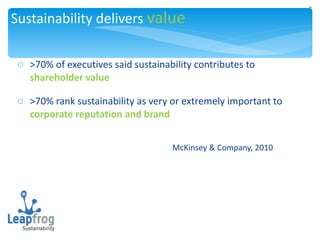
>70% of executives said sustainability contributes to  shareholder value  >70% rank sustainability as very or extremely important to  corporate reputation and brand McKinsey & Company, 2010 Sustainability delivers  value
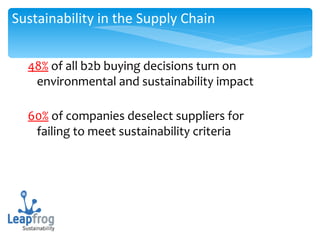
Sustainability in the Supply Chain 48%   of all b2b buying decisions turn on environmental and sustainability impact 60%   of companies deselect suppliers for  failing to meet sustainability criteria
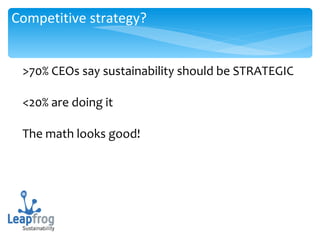
Competitive strategy? >70% CEOs say sustainability should be STRATEGIC <20% are doing it The math looks good!
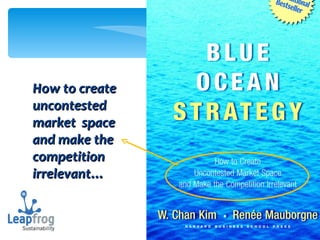
How to create uncontested market  space and make the competition irrelevant…
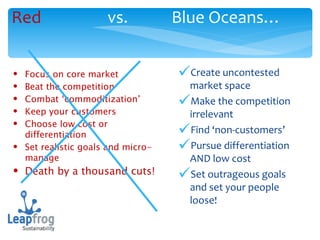
Create uncontested market space  Make the competition irrelevant Find ‘non-customers’ Pursue differentiation AND low cost Set outrageous goals and set your people loose! Red   vs.  Blue Oceans… Focus on core market Beat the competition Combat ‘commoditization’ Keep your customers Choose low cost or differentiation Set realistic goals and micro-manage Death by a thousand cuts!
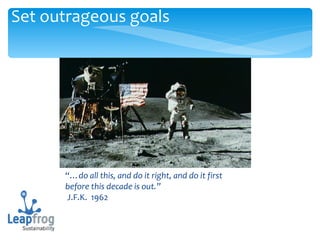
“… do all this, and do it right, and do it first before this decade is out.”   J.F.K.  1962 Set outrageous goals
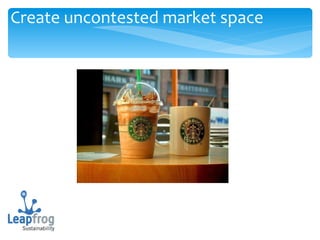
Create uncontested market space
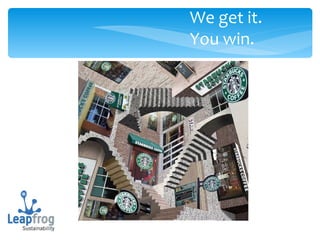
06/16/11 We get it. You win.
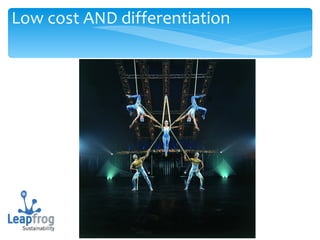
Low cost AND differentiation
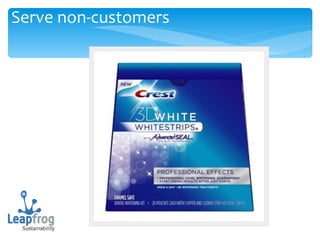
Serve non-customers
 
 
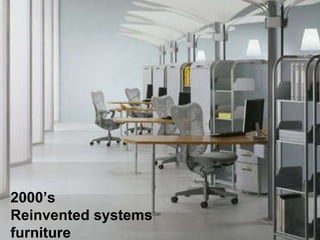
2000’s  Reinvented systems furniture
“ be a good corporate neighbor by being a good steward of the environment”
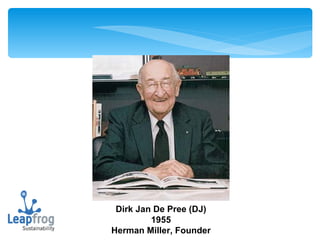
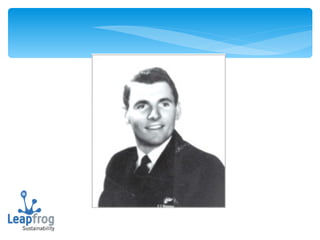
Dirk Jan De Pree (DJ) 1955 Herman Miller, Founder
2020 Commitment – crazy goals  ZERO  Minimum LEED Silver  100% green energy landfill hazardous waste generation air emissions water emissions
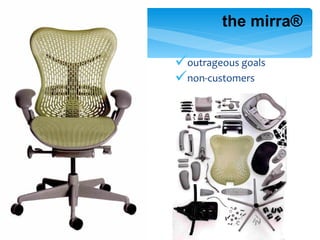
the mirra® outrageous goals non-customers
In the past year….  23 rd  year  most admired company  in its industry Fortune Magazine poll of industry executives and analysts  One of world’s  50 Most Innovative Companies  F ast Company One of  50 Best Manufacturing Companies  Industry Week &quot; SAM Sector Leader &quot; and &quot; SAM Sector Mover ” SAM Social Investing global ranking  Herman Miller a Green Ocean Winner?
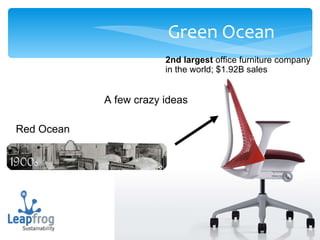
Green Ocean Red Ocean  A few crazy ideas 2nd largest  office furniture company in the world; $1.92B sales
 
“ Serve our communities as a committed corporate citizen.”
 
Cut energy 20% in 5 years Empower branch managers Chairman’s Task Force on Sustainability -2008
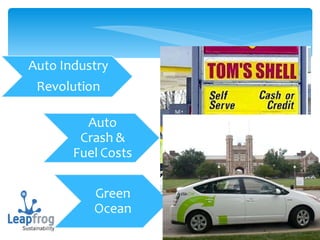
World’s largest fleet of fuel efficient vehicles Thousands of hybrids and electric vehicles Fleet as 'petri dish' for fuel and engine technology Fleet Alternatives
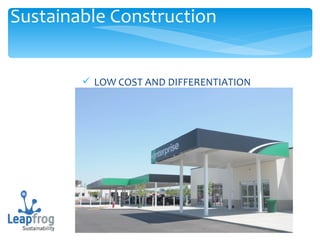
Sustainable Construction LOW COST AND DIFFERENTIATION
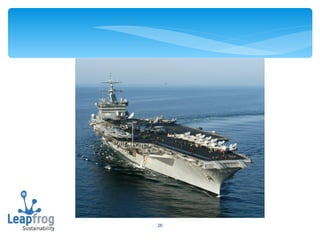
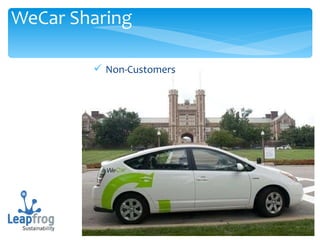
WeCar Sharing Non-Customers
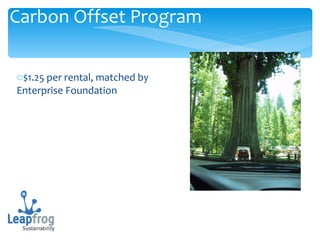
$1.25 per rental, m atched by Enterprise Foundation Carbon Offset Program
50 million, 5 year Tree Pledge
$100 M fund Algae biofuels PHDs Goal – large scale supply of biofuel Enterprise Institute for Renewable Fuels
Last 12 months Business Traveler Innovation Award  for outstanding and original environmental efforts in the travel industry;  National Business Travel Ass./Wall Street Journal  Readers’ Choice Award as their favourite rental car brand Budget Travel Magazine Green Ocean ahead?
 
Irrational, right brain thinking unachievable goals non-customers create uncontested  green  ocean  markets Think Green Ocean
Susan Sheehan Leapfrog Sustainability Hub 416-598-7585 [email_address]

Final susansheehan-greenocean-oceta - pdf

  • 1.
    Green Ocean Competitive Strategies Susan Sheehan June 10, 2010
  • 2.
    “ Thereis no end to the amount of money to be made by doing the right thing.” Bill Clinton, 2007
  • 3.
    Companies do ‘sustainability’for competitive advantage Blue Ocean Strategy….Green Ocean 2 Green Ocean examples today
  • 4.
    CEOs and sustainability Improve Brand (54%) Differentiate Products (50%) Not compliance, risk or cost Top two reasons for sustainability strategy AT Kearny & Institute for Supply Chain Management
  • 5.
    >70% of executivessaid sustainability contributes to shareholder value >70% rank sustainability as very or extremely important to corporate reputation and brand McKinsey & Company, 2010 Sustainability delivers value
  • 6.
    Sustainability in theSupply Chain 48% of all b2b buying decisions turn on environmental and sustainability impact 60% of companies deselect suppliers for failing to meet sustainability criteria
  • 7.
    Competitive strategy? >70%CEOs say sustainability should be STRATEGIC <20% are doing it The math looks good!
  • 8.
    How to createuncontested market space and make the competition irrelevant…
  • 9.
    Create uncontested marketspace Make the competition irrelevant Find ‘non-customers’ Pursue differentiation AND low cost Set outrageous goals and set your people loose! Red vs. Blue Oceans… Focus on core market Beat the competition Combat ‘commoditization’ Keep your customers Choose low cost or differentiation Set realistic goals and micro-manage Death by a thousand cuts!
  • 10.
    “… do allthis, and do it right, and do it first before this decade is out.” J.F.K. 1962 Set outrageous goals
  • 11.
  • 12.
    06/16/11 We getit. You win.
  • 13.
    Low cost ANDdifferentiation
  • 14.
  • 15.
  • 16.
  • 17.
    2000’s Reinventedsystems furniture
  • 18.
    “ be agood corporate neighbor by being a good steward of the environment”
  • 19.
    Dirk Jan DePree (DJ) 1955 Herman Miller, Founder
  • 20.
    2020 Commitment –crazy goals ZERO Minimum LEED Silver 100% green energy landfill hazardous waste generation air emissions water emissions
  • 21.
    the mirra® outrageousgoals non-customers
  • 22.
    In the pastyear…. 23 rd year most admired company in its industry Fortune Magazine poll of industry executives and analysts One of world’s 50 Most Innovative Companies F ast Company One of 50 Best Manufacturing Companies Industry Week &quot; SAM Sector Leader &quot; and &quot; SAM Sector Mover ” SAM Social Investing global ranking Herman Miller a Green Ocean Winner?
  • 23.
    Green Ocean RedOcean A few crazy ideas 2nd largest office furniture company in the world; $1.92B sales
  • 24.
  • 25.
    “ Serve ourcommunities as a committed corporate citizen.”
  • 27.
  • 28.
    Cut energy 20%in 5 years Empower branch managers Chairman’s Task Force on Sustainability -2008
  • 29.
    World’s largest fleetof fuel efficient vehicles Thousands of hybrids and electric vehicles Fleet as 'petri dish' for fuel and engine technology Fleet Alternatives
  • 30.
    Sustainable Construction LOWCOST AND DIFFERENTIATION
  • 31.
  • 32.
    $1.25 per rental,m atched by Enterprise Foundation Carbon Offset Program
  • 33.
    50 million, 5year Tree Pledge
  • 34.
    $100 M fundAlgae biofuels PHDs Goal – large scale supply of biofuel Enterprise Institute for Renewable Fuels
  • 35.
    Last 12 monthsBusiness Traveler Innovation Award for outstanding and original environmental efforts in the travel industry; National Business Travel Ass./Wall Street Journal Readers’ Choice Award as their favourite rental car brand Budget Travel Magazine Green Ocean ahead?
  • 36.
  • 37.
    Irrational, right brainthinking unachievable goals non-customers create uncontested green ocean markets Think Green Ocean
  • 38.
    Susan Sheehan LeapfrogSustainability Hub 416-598-7585 [email_address]

Editor's Notes

  • #3 In November of 2007 Bill Clinton challenged the building and construction industry with these words “Prove to the world that the climate problem is the biggest opportunity for economic and social mobilization since World War Two.” If he were here he would put the same challenge to you, but he’s not, and I am here instead! In China, the word for Problem also means Opportunity.
  • #5 AT Kearney and Institute for Supply Management 2007 surveyed CEOs and boards of directors of 25 North American Companies, 24 with between $100 Million to over $30 Billion. They said:….. Sustainability is their “top line” opportunity to enhance brand promise and to differentiate product. Compliance, risk, efficiency, cost etc. came after that.
  • #6 “ How companies manage sustainability”, Feb. 2010 global survey of 1,946 non-energ y execs
  • #7 What percent of b2b purchasing turns on sustainability in 2007? (48%) What percent of companies deselect suppliers, based on failure to meet sustainability criteria? 60% Guess what that number was in 2002 short years ago – 17%. What will it be in the near future? 70, 80 90 95%? Source: AT Kearney and Institute for Supply Chain Management, 2007
  • #8 Chinese word for crisis is also opportunity This is a good time to talk about Blue Ocean strategy – how to leverage the gap.
  • #9 Green Ocean is really a word play on a well known concept called Blue Ocean Strategy. It’s an approach to strategic planning that was developed by Chan Kim and Renee Mauborgne, two professors at INSEAD in strategy and planning, as well as affiliates at Boston Consulting and other globally recognized institutions. Blue Ocean Strategy is all about challenging conventional wisdom — questioning taken-for-granted industry assumptions, and overstepping industry boundaries to create new markets and products. This book is translated in something like 27 languages.
  • #10 An example of Uncontested Market Space: Starbucks The Third Tier or Non-Customers: They are the farthest away from an industry’s existing customers. Typically, these unexplored noncustomers are not targeted or considered potential customers by any industry player. Why? Their needs and the business opportunities associated with them have always been assumed to belong to other markets. Value Innovation: Drive costs down, Drive value up = leap in value Example: Cirque de Soleil Here’s a simple example: at-home tooth whitening products Red Oceans: Price-driven competition Traditional market boundaries and industry standards Incremental market share growth Limited, short-term view of innovation
  • #11 An example of Uncontested Market Space: Starbucks
  • #12 An example of Uncontested Market Space: Starbucks
  • #14 An example of Uncontested Market Space: Starbucks
  • #15 The Third Tier or Non-Customers: They are the farthest away from an industry’s existing customers. Typically, these unexplored noncustomers are not targeted or considered potential customers by any industry player. Why? Their needs and the business opportunities associated with them have always been assumed to belong to other markets. Value Innovation: Drive costs down, Drive value up = leap in value Example: Cirque de Soleil Here’s a simple example: at-home tooth whitening products Red Oceans: Price-driven competition Traditional market boundaries and industry standards Incremental market share growth Limited, short-term view of innovation
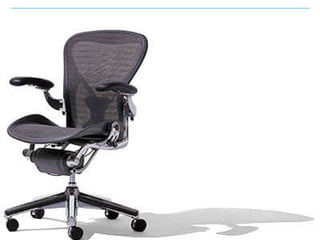
  • #16 Aeron Chair, Herman Miller
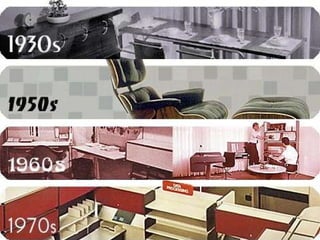
  • #17 Began 1923 in traditional residential furniture Leader in modern furniture in the 1930 and 40s Industrial designers in the 50s Transformed offices with first panel system furniture in 60s Invented ergonomic work seating 70s, 80s ,90s
  • #18 Reinvented systems furniture in 2000s Second largest office furniture company in the world 2000’s Reinvented systems furniture
  • #20 Company founder’s statement of corporate values in 1955 Dirk Jan De Pree (DJ) Back then it meant: 50% of any corporate site was set aside as green space Windows in all plants for natural light
  • #21 Then, several years ago, they released their commitment for the year 2020 and it added up to a big fat ZERO. And what’s happening as a result of this zero commitment?
  • #22 The first chair designed from its earliest stages according to Herman Miller’s design for the environment protocol And in using this design protocol – they’ve created a chair that automatically shapes itself to each user, while a few simple adjustments fine-tune the fit and feel.
  • #23 The company was nominated for making substantial gains in reducing its CO2 footprint, while maintaining a strong financial performance over the past year. It significantly outperformed other nominees in its category—Operations: Best Sustainability Performance—to guarantee it an award, bypassing the shortlist stage. Herman Miller wins prestigious Just Means Social Innovation Award in Operations: Best Sustainability Performance category. 2011
  • #24 On DJSWI since its introduction in 1999. Triple bottom line of economic, social and environmental criteria
  • #25 Jack Taylor – 60 years ago founded the company Vehicle replacement for cars in service Then airport rental “ Serve our communities as a committed corporate citizen.”
  • #26 1908 – first Model T 1950s – post war mobility 1957? – Enterprise founded Automobile ubiquity ECONOMIC CYCLES 2008 – meltdown and US auto industry meltdown 2009 – gasoline prices 2009 –20/20 vision 2010 – 2010 - LEED 2011 - &gt;&gt;&gt;&gt;&gt;&gt;&gt; Privately held $12.6 Billion Enterprise Holdings Largest car rental fleet company in the world – 1 million cars More than 1/3 of all airport rental business in US and Canada 68,000 highly loyal employees Ranked No. 17 on the Forbes &apos; &amp;quot;500 Largest Private Companies in America&amp;quot; list

  • #29 Enterprise Institute for Renewable Fuels Partnered with 20 plus PHD’s scientists – biofuel Leed certified – Hybrid, electric cars 50 million tree pledge to Arbor Foundation Enterprise Foundation – largest owner of passenger vehicles in the world Start today to get a return in 3,4,5,6 years – like a forest – plant em now so the forest can grow 5-10-15 years from now Aims to be a beacon of sustainability in NA and the world Who would have thought that a mid-west company, rental car, privately,
  • #30 Enterprise believes that the marketplace itself offers the best means of driving innovation and finding practical, sustainable solutions.  So we are embracing new, clean fuel and engine technologies as they become commercially viable. What&apos;s more, we&apos;re committed to using our fleet as a sort of &amp;quot;petri dish&amp;quot; to help promising new alternatives prove their viability in the marketplace.
  • #31 Jan 26, 2011 Over the next five years, Enterprise will invest more than $150 million in sustainable construction through the use of a newly established set of guidelines called the Enterprise Sustainable Construction Protocol (ESCP). In addition to improving the sustainability profile of Enterprise rental locations, the ESCP is expected to generate significant energy and water utility savings – estimated up to 35 percent – through improved efficiencies and other measures. Opened in 2010, it&apos;s the car rental industry&apos;s first LEED Silver-certified independent rental facility and our company&apos;s third LEED-certified facility. sustainable features — which have reduced the facility&apos;s water use by 22 percent and energy use by 15 percent — include: A &amp;quot;green&amp;quot; roof system that provides a habitat for native plants Storm water detention/retention systems to reduce discharge into downstream watercourses Energy-efficient lighting A system for recycling car wash waste water “ The ESCP advances our commitment to environmental stewardship and smart business by exceeding our customers’ expectations for what it means to be a sustainable company, providing a healthy workplace for our employees, and ultimately providing a long-term cost savings for our business,” said Lee Broughton, head of corporate sustainability for Enterprise Holdings, the parent company of Enterprise Rent-A-Car. “This is one more example of our company setting measurable goals to drive the sustainable growth of our business. And, as the car rental industry leader, we are also setting the standard for others to follow.”  working to ensure that all newly constructed and retrofitted rental locations are efficient and sustainable. Over the next five years, Enterprise will invest more than $150 million in sustainable construction, and incorporate newly established guidelines called the Enterprise Sustainable Construction Protocol (ESCP). The ESCP is comprised of sustainable features for all construction projects, and ensures that new and retrofitted facilities are designed, built and managed sustainably.
  • #32 First major rental company to offer car-sharing across US Supported by over 5,000 neighbourhood locations – flexible In 2008, Enterprise Rent-A-Car launched WeCar to deliver car-sharing technology&apos;s speed, efficiency and economy to businesses, universities, and government offices nationwide.  Among our first locations, Enterprise&apos;s headquarters city of St. Louis, and at Washington University in St. Louis.  The program enabled users, including university students and faculty, employees, or downtown dwellers and residents who carpool, or who use mass transit to rent a hybrid or fuel efficient car by the hour, for everything from personal errands to family emergencies. first major car rental company to offer a car-sharing program across the United States, with a focus on corporate campuses, government offices and colleges and universities. In addition to its environmental benefits, Hourly rental: Enterprise Rent-A-Car offers the environmentally friendly transportation option of hourly vehicle rentals in several major metropolitan areas. It&apos;s a solution that appeals to many urban residents who want to limit vehicle ownership, reduce congestion, and address other environmental concerns about driving in densely populated areas such as Chicago, New York, Seattle, and Washington, DC.
  • #33 In the carbon offset program&apos;s first year, approximately 175,000 customers opted to participate, generating $220,000 for certified offset projects. Coupled with the equal match by Enterprise&apos;s charitable arm, the effort has generated nearly $440,000 that will be directed to offset projects. The overall impact: 42,000 metric tons of carbon have been offset, which based on U.S. Environmental Protection Agency (EPA) standards, is equivalent to saving 4.8 million gallons of gasoline and 98,000 barrels of oil.
  • #34 2010 – 5 million tree benchmark Working with the Arbor Day Foundation and the U.S. Forest Service, the Enterprise Foundation is underwriting the planting of 50 million trees over 50 years in National Forests around the country. These included two forests in California, where 50 percent of the water supply originates in the state&apos;s national forests. The plantings will help improve the health of watersheds, which are important to the drainage of rainfall into streams, ponds, rivers and lakes.
  • #35 Our business depends o n availability of vehicles and fuel – and both must be acceptable to society
  • #37 http://www.youtube.com/watch?v=MGCELiX0bWk start from 1:37.