Final Report
The Effects of
Neighborhood
Change on New
York City Housing
Authority Residents
February 18, 2015
Prepared for:
NYC Center for Economic
Opportunity
Office of the Mayor
City of New York
253 Broadway, 14th
Fl
New York, NY 10007
Submitted by:
Abt Associates
4550 Montgomery Avenue
Suite 800 North
Bethesda, MD 20814
In Partnership with:
The NYU Furman Center
for Real Estate and Urban
Policy
139 MacDougal Street, 2nd
Floor
New York, NY 10012
Authored by:
Samuel Dastrup
Ingrid Ellen
Anna Jefferson
Max Weselcouch
Deena Schwartz
Karen Cuenca
Foreword
The Center for Economic Opportunity (CEO), working closely with the New York City Housing
Authority’s Department of Research and Management Analysis (NYCHA), contracted with Abt
Associates to produce research that would shed light on how changing New York City neighborhoods
affect NYCHA residents and point to opportunities to improve outcomes for NYCHA residents. Abt
has worked closely with the Furman Center for Real Estate and Urban Policy at NYU to conduct this
research and produce this report. Three community partners (BronxWorks, Hudson Guild, and Urban
Upbound) and their NYCHA resident employees partnered with Abt and the Furman Center to
conduct the study’s rapid ethnographic assessments (REA).
Ingrid Ellen from the Furman Center is the Principal Investigator for this report. The report is jointly
authored by Samuel Dastrup, Anna Jefferson, Deena Schwartz, and Karen Cuenca from Abt and Dr.
Ellen and Max Weselcouch at the Furman Center. Alvaro Cortez at Abt served as the Project Quality
Advisor for the study. The report includes analysis by Amy Ellen Schwartz and Meryle Weinstein,
researchers at NYU’s Institute for Education and Social Policy. Abt staff Tom McCall and Furman
Center research assistants Colin Bottles, Razi Shaban, Robert Collison, Mariana Oliver, and Jonathan
Bigelow also contributed to the research. We are grateful to Mary Patillo, who assisted with the REAs
and gave expert advice to the entire project during her year visiting NYU from Northwestern
University.
The rapid ethnographic assessments described in this report would not have been possible without the
assistance of our community partners, their community ethnographer employees, and residents and
community stakeholders in neighborhoods selected for the REAs. We are especially grateful for
support at BronxWorks from Brian McCullough and John Weed; at Hudson Guild from Ken Jockers,
Miguel Pedraza-Cumba, and LeeAnn Scaduto; and at Urban Upbound from Veronica Momjian. This
project would not have been possible without our community ethnographers: Jamie Berrios, Kiera
Diaz, Nicole Gomez, Tracie Middleton, Juwan Stone, and Lily Rosenthal.
This report greatly benefitted from input from the staff of CEO and NYCHA. Tamara Dumanovsky
from NYCHA introduced us to NYCHA administrative data, made introductions to NYCHA staff in
the REA neighborhoods, and provided helpful insight throughout the research project. We also
acknowledge helpful input from Anne-Marie Flatley of NYCHA. Finally, Jean-Marie Callan and
Carson Hicks of CEO provided insights and guidance throughout the research project.
CEO RESPONSE TO ABT ASSOCIATES EVALUATION
ON THE EFFECTS OF NEIGHBORHOOD CHANGE FOR NYCHA RESIDENTS
May 2015
In his second State of the City address on February 3, 2015, Mayor Bill de Blasio made affordable and mixed
income housing the center of his agenda, promising to build and preserve 200,000 affordable homes which
will house over a half million New Yorkers in the coming decade.1 The plan includes building 80,000 new
affordable housing units and preserving the affordability and quality of 120,000 existing housing units. An
emphasis of the plan is to foster diverse, equitable, and livable neighborhoods. 2
Subsidized housing has been an important poverty-alleviation tool in neighborhoods across the city for
decades. However, the landscape around public housing has shifted dramatically. Most New York City
Housing Authority (NYCHA) housing was built in what were low‐income neighborhoods, but today an
increasing number of these NYCHA developments are located in gentrified or rapidly changing
neighborhoods. The Center for Economic Opportunity (CEO) recognized that the implications of such
change are complex – with potential concerns for residents but also potential benefits – and wanted to learn
how neighborhood change is affecting the lives of low-income New Yorkers.
CEO is the City of New York’s anti-poverty innovation unit. Working in conjunction with City Agencies and
other partners, CEO develops, manages and evaluates program and policy initiatives to help the City improve
its systems and identify effective responses to poverty and its related challenges. Part of the Mayor’s Office
of Operations, CEO supports the administration on issues of equity and equality. CEO also produces the
annual Poverty Measure Report which provides detailed insights into the scope of poverty and impact of
public policy across New York City. The report has consistently shown that the poverty rate for New York
City Housing Authority (NYCHA) families would approximately double without this housing subsidy.3
In this study, CEO sought to answer a stand-alone research question (rather than evaluating a specific
programmatic intervention) and contracted Abt Associates to evaluate how neighborhood change, or
gentrification, affects the lives of NYCHA residents. To do this research, Abt partnered closely with New
York University’s Furman Center for Real Estate and Urban Policy, three community-based partners
(BronxWorks, Hudson Guild, and Urban Upbound), and NYCHA residents to learn about experiences of
neighborhood change in New York City. CEO worked closely with NYCHA’s Department of Research and
Management Analysis on the project.
The research team examined effects of neighborhood change for NYCHA residents by classifying
neighborhoods containing public housing as persistently low-income, increasing income, or high-income and
then identifying indicators with the potential to vary across categories. The evaluators conducted both a
citywide quantitative analysis and in-depth qualitative case studies of developments in three illustrative
neighborhoods selected to correspond with these three neighborhood classifications – Sedgwick Houses in
Morris Heights, Queensbridge Houses in Long Island City, and Elliot-Chelsea Houses in Chelsea. The
qualitative case-studies drew on community-based participatory research – leveraging the perspectives of
community members, particularly NYCHA residents, and engaging them as core research partners. The field
research for this study was conducted from April to August 2014.
1
NYC Office of the Mayor. State of the City: Mayor de Blasio Puts Affordable Housing at Center of 2015 Agenda. [Press Release] 3 Feb. 2015.
2 See NYC Office of the Mayor. Mayor de Blasio Unveils ‘Housing New York’: A Five-Borough, 10-Year Housing Plan to Protect and Expand
Affordability. [Press Release] 5 May 2014, and read the full report: Housing New York: A Five Borough, Ten Year Plan.
3 See The CEO Poverty Measure, 2005-2013, Appendix C.
Prior research has resulted in mixed findings on the effects of neighborhood change for low-income
individuals.4 The touchstone for much of this research is the U.S. Department of Housing and Urban
Development’s Moving to Opportunity (MTO) demonstration project, which used random assignment of
housing vouchers in the 1990s to measure neighborhood effects. Until recently, evaluations of this project
had found some positive effects of neighborhood change on mental and physical health, but no effects on
socioeconomic or educational outcomes.5 However, a follow-up evaluation released in May 2015 found
differences in outcomes related to the age at which children move to higher-income neighborhoods, with
impacts on college attendance and earnings for children who moved before age 13.6
In this study, Abt finds statistically significant differences in earnings for NYCHA residents living in different
neighborhood types. Annual household earnings average $4,500 higher for public housing residents in high-
income neighborhoods as compared to persistently low-income neighborhoods. Earnings are $3,000 higher
for those in increasing income neighborhoods. Further research is needed to determine the mechanisms that
create differences in earnings for public housing residents across neighborhood types, but the evaluators find
little evidence that differences are driven by sorting (self-selection into specific developments) or observable
differences in the populations.
The case studies presented in this report complement the quantitative analysis by describing residents’
personal experiences of neighborhood change, highlighting some of the ways this observed difference in
incomes may be offset by higher costs for NYCHA residents in high income neighborhoods. Affordability is
described as a growing concern for residents as neighborhood incomes increase. Another key theme from
these case studies is that income inequality gets mirrored in reported experiences of available resources and
opportunities for public housing residents living in neighborhoods with higher incomes. In these
neighborhoods, NYCHA residents report feeling that private market housing residents are the impetus for
and primary beneficiaries of neighborhood improvements. In all three types of neighborhoods, residents
expressed a need for more enrichment, skill-building, and employment opportunities, of the sort offered by
CEO and NYC Young Men’s Initiative (YMI) programs.7 This need was particularly emphasized for youth.
Residents of all three neighborhood types also reported improvements in safety over time, though crime
remains a pressing concern for many residents and particularly for residents of Queensbridge Houses.
Notably, residents expressed appreciation for the Mayor’s Action Plan (MAP) for Neighborhood Safety,
newly launched at the end of fieldwork for the study in July 2014. MAP for Neighborhood Safety is a
collaborative effort between 10 city agencies led by the Mayor’s Office of Criminal Justice to make New York
4 See for example: Ellen, Ingrid and Margery Austin Turner. “Does Neighborhood Matter? Assessing Recent Evidence.” Housing
Policy Debate. 8.4 (1997); Ellen, Ingrid and Kathy O’Regan. “How Low Income Neighborhoods Change: Entry, Exit and
Enhancement.” New York University Furman Center for Real Estate and Urban Policy. (2010); Kasarda, John D. “Inner-City
Concentrated Poverty and Neighborhood Distress: 1970 to 1990.” Housing Policy Debate. 4.3 (1993); Leventhal, Tama and Jean
Brooks-Gunn. “The Neighborhoods They Live in: The Effects of Neighborhood Residence on Child and Adolescent Outcomes.”
Psychological Bulletin. 126.2 (2000); Sampson, Robert J, Jeffrey D. Morenoff, and Thomas Gannon-Rowley. “Assessing
‘Neighborhood Effects’: Social Processes and New Directions in Research.” Annual Review of Sociology 28 (2002).
5 There have been numerous studies conducted on Moving to Opportunity. For a summary of this research and analysis of long-term
impacts see Sanbonmatsu et al.’s National Bureau of Economic Research 2011 Moving to Opportunity for Fair Housing
Demonstration Program: Final Impacts Evaluation.
6 Chetty, Raj, Nathaniel Hendren, and Lawrence F. Katz. “The Effects of Exposure to Better Neighborhoods on Children: New
Evidence from the Moving to Opportunity Experiment.” The Equality of Opportunity Project, Harvard University (May 2015).
http://www.equality-of-opportunity.org/images/mto_paper.pdf
7 For full descriptions of the CEO portfolio, including YMI-funded initiatives, please see nyc.gov/ceo.
City’s neighborhoods and housing developments safer, with a specific focus on the fifteen housing
developments – including Queensbridge – that account for almost 20 percent of violent crime in NYCHA.8
Since the fieldwork for this study was completed, a number of additional initiatives related to findings from
the report have also been launched. For example, in fall 2014 the NYC Department of Housing Preservation
and Development’s Office of Neighborhood Strategies9 was created, and the City has implemented major
place-based initiatives in both East New York and Brownsville.10 Additionally, Mayor de Blasio has launched
a number of citywide initiatives that touch on themes raised within this report, including a major expansion of
after-school programming for middle school youth (SONYC), universal pre-kindergarten (Pre-K for All), and
a plan to significantly shift workforce development services in the city to better train New Yorkers for good-
paying careers (Career Pathways).11
NYCHA launched NextGeneration NYCHA in fall 2014 to actively engage communities in a collaborative
effort to develop plans that support the long-term sustainability of public housing. The process is bringing
together NYCHA residents, staff, community partners, and neighbors from three developments: Mill Brook
Houses in Mott Haven, Ingersoll in Fort Greene, and Van Dyke in Brownsville. As in this study, NextGen
NYCHA recognizes the central role residents have to play in identifying community needs and strategies to
address these needs.
CEO will continue to pursue research and evaluation to inform a variety of citywide initiatives and is
committed to the implementation and evaluation of strategies to meet the needs of NYCHA residents.
Evaluations of Jobs-Plus, a place-based employment program for NYCHA residents, are currently
forthcoming.12 Further research will broaden understanding in the field of the best ways to support strong
communities with opportunities for public housing residents and other low-income New Yorkers.
Jean-Marie Callan
Senior Program & Policy Advisor
David Berman
Director of Programs and Evaluation
8 NYC Office of the Mayor. Making New York City’s Neighborhoods and Housing Developments Safer. [Press Release] 8 July 2014.
9
The Office of Neighborhood Strategies works closely with communities to plan for new affordable housing and preserve existing
homes in a way that strengthens their surrounding neighborhoods.
10
NYC Department of City Planning. DeBlasio Administration and Council Member Garodnick Announce Two-Track Planning Strategy for East
Midtown to Foster Growth, Create Jobs, and Drive Critical Up-Front Infrastructure Investments. [Press Release] 30 May 2014; New York City
Department of Housing Preservation and Development. City, State, Federal Agencies, Community Partners and Developers Launch
Comprehensive Initiative to Jump Start Positive Change and Cooperation in Brownsville Community. [Press Release] 28 October 2014.
11 SONYC and Pre-K for All were launched by the Department of Youth and Community Development and Department of
Education in fall 2014. See NYC Office of the Mayor. New York City Launch ‘SONYC,’ Largest After-School Expansion for Middle School in
City’s History. [Press Release] 12 September 2014, and NYC Office of the Mayor. New York City Launches Historic Expansion of Pre-K to
More than 51,000 Children. [Press Release] 4 September 2014. In fall of 2014 the administration also announced Career Pathways, which
is being led by the Mayor’s Office of Workforce Development. See NYC Office of the Mayor. De Blasio Administration Announces
Overhaul of Workforce Development to Focus on Good-Paying Jobs, Skill-Building, and Strengthening New York City’s Economy. [Press Release] 21
November 2014, and read the full report: Career Pathways: One City Working Together.
12 CEO oversees Jobs-Plus sites across the City in partnership with the Mayor’s Fund to Advance New York City, the Young Men’s
Initiative, NYCHA, the Human Resources Administration, and the Department of Consumer Affairs’ Office of Financial
Empowerment. For more information see nyc.gov/ceo
CONTENTS
Abt Associates Final Report (Revised Draft) ▌pg. i
Foreword...............................................................................................................................................ii
Executive Summary ............................................................................................................................iii
Glossary of key terms and concepts...................................................................................................xi
1. Introduction ............................................................................................................................. 1
2. Citywide Quantitative Analysis Research Findings ............................................................. 6
2.1 Surrounding Neighborhood Indicators by Income Classification ................................... 8
2.2 Neighborhood Context, Services, and Amenities Available to NYCHA Residents...... 11
2.3 Outcomes of NYCHA Residents or Population in the NYCHA Core .......................... 15
2.4 Characteristics of NYCHA Residents or Population in the NYCHA Core................... 24
3. Rapid Ethnographic Assessment Research Findings in Three Neighborhoods............... 28
3.1 Morris Heights Case Study–Persistently Low-Income Neighborhood.......................... 30
3.2 Long Island City Case Study–Increasing-Income Neighborhood ................................. 46
3.3 Chelsea Case Study–High-Income Surrounding Neighborhood ................................... 61
3.4 Conclusions from REAs ................................................................................................ 77
4. Summary of Findings and Opportunities for New York City and NYCHA.................... 79
5. References .............................................................................................................................. 84
Appendix A: Study Design................................................................................................................. 86
Appendix B: Citywide Quantitative Analysis Supporting Tables................................................ 101
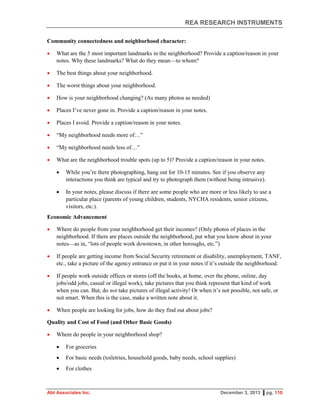
Appendix C: Research Instruments Used in Rapid Ethnographic Assessments........................ 109
EXHIBITS
Abt Associates Final Report (Revised Draft) ▌pg. i
Exhibit Glossary-1: Illustration of NYCHA core and surrounding neighborhood definition using
map of Ravenswood development.....................................................................xi
Exhibit 2-1: Map of NYCHA developments in citywide quantitative analysis by
surrounding neighborhood classification ...........................................................6
Exhibit 2-2: Number of classified developments, block groups, and NYCHA units,
residents and households....................................................................................7
Exhibit 2-3: Average Income in surrounding neighborhoods by classification type..............7
Exhibit 2-4: Characteristics of the residents and housing stock of neighborhoods
surrounding NYCHA developments ..................................................................9
Exhibit 2-5 Neighborhood context, services, and amenities available to NYCHA residents13
Exhibit 2-6: NYCHA resident economic outcomes by surrounding neighborhood income
classification.....................................................................................................15
Exhibit 2-7: Household years in NYCHA............................................................................17
Exhibit 2-8: NYCHA residents in data in 2008 but no longer observed in development by
2013..................................................................................................................18
Exhibit 2-9: Surrounding neighborhood classification of destination NYCHA development
for individuals moving out of first observed NYCHA development ...............19
Exhibit 2-10: Adult education attainment in NYCHA core block groups..............................20
Exhibit 2-11: Mean differences in standardized grade 3-8 math and reading scores between
NYCHA students in different neighborhoods ..................................................23
Exhibit 2-12: NYCHA resident demographic characteristics by surrounding neighborhood
income classification ........................................................................................25
Exhibit 2-13: Gender mix (percent male) by age by surrounding neighborhood income
classification.....................................................................................................27
Exhibit 3-1: Rapid ethnographic assessment neighborhoods ...............................................29
Exhibit 3-2: Rapid ethnographic assessments data collection activities...............................30
Exhibit 3-3: Neighborhood indicators for surrounding neighborhood–Morris Heights.......31
Exhibit 3-4: University Avenue streetscape .........................................................................32
Exhibit 3-5: Map of Morris Heights with Sedgwick Houses................................................33
Exhibit 3-6: NYCHA core statistics–Sedgwick Houses.......................................................34
Exhibit 3-7: Sedgwick Houses and common green space....................................................35
Exhibit 3-8: Grocery store nearest Sedgwick Houses ..........................................................41
Exhibit 3-9: Produce stand in Morris Heights ......................................................................41
Exhibit 3-10: Map of Long Island City showing NYCHA developments .............................47
Exhibit 3-11: Neighborhood indicators for surrounding neighborhood–Long Island City
(Queensbridge North and South)......................................................................49
Exhibit 3-12: NYCHA core statistics–Queensbridge North and South..................................50
Exhibit 3-13: Long Island City streetscape ............................................................................55
Exhibit 3-14: View of East River and Manhattan from Queensbridge Park ..........................58
Exhibit 3-15: Neighborhood indicators for surrounding neighborhood–Chelsea (Elliott-
Chelsea Houses) ...............................................................................................62
Exhibit 3-16: Map of Chelsea showing NYCHA developments............................................63
Exhibit 3-17: NYCHA core statistics–Elliott-Chelsea Houses...............................................64
Exhibit 3-18: Affordable mom-and-pop store in Chelsea ......................................................66
Exhibit 3-19: View of the High Line from outside Elliott-Chelsea Houses...........................76
EXHIBITS
Abt Associates Final Report (Revised Draft) ▌pg. ii
Exhibit A-1: NYCHA core and surrounding neighborhood example—Ravenswood Houses,
Queens..............................................................................................................89
Exhibit A-2: Classification based on neighborhood average income....................................90
Exhibit A-3: Neighborhood indicators—Surrounding Neighborhood ..................................90
Exhibit A-4: Neighborhood context, services, and amenities available to NYCHA residents91
Exhibit A-5: Characteristics and outcomes of NYCHA residents or population in the
NYCHA core....................................................................................................92
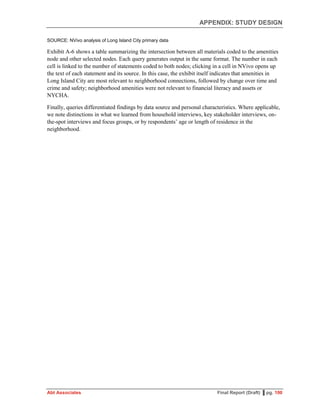
Exhibit A-6: Summary of Selected NVivo Query.................................................................99
Exhibit B-1: Income-based classification of surrounding neighborhood for NYCHA
developments in the quantitative analysis ......................................................101
Exhibit B-2: Developments not classified in quantitative analysis.....................................102
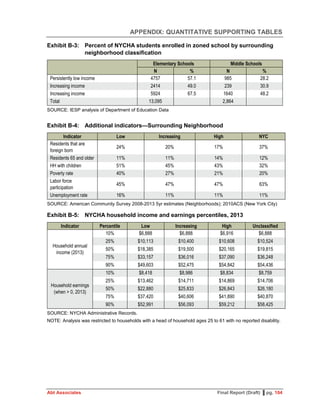
Exhibit B-3: Percent of NYCHA students enrolled in zoned school by surrounding
neighborhood classification............................................................................104
Exhibit B-4: Additional indicators—Surrounding Neighborhood ......................................104
Exhibit B-5: NYCHA household income and earnings percentiles ....................................104
Exhibit B-6: Regression results—NYCHA resident household average income................105
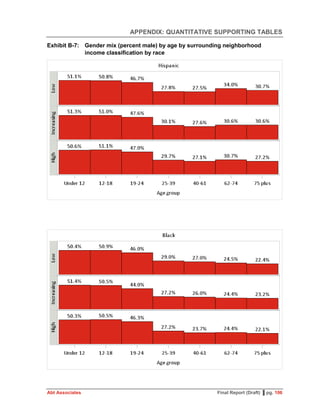
Exhibit B-7: Gender mix (percent male) by age by surrounding neighborhood income
classification by race ......................................................................................106
Exhibit B-8: Household member with reported disability ..................................................107
Exhibit B-9: Years in NYCHA by household type examples.............................................108
Exhibit C-1: Map of Morris Heights for Neighborhood Inventory.....................................112
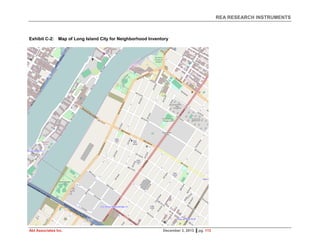
Exhibit C-2: Map of Long Island City for Neighborhood Inventory ..................................113
Exhibit C-3: Map of Chelsea for Neighborhood Inventory.................................................114
EXECUTIVE SUMMARY
Abt Associates Final Report (Revised Draft) ▌pg. iii
Executive Summary
New York City Housing Authority (NYCHA) public housing apartments make up more than 5
percent of New York City’s housing units, and provide over a quarter of rental housing affordable to
New Yorkers with low and moderate incomes. Most New York City Housing Authority (NYCHA)
public housing was built between 1950 and 1970 in what were, at the time, low-income
neighborhoods.1
In the intervening decades, many of these neighborhoods have seen considerable
demographic changes. While many public housing authorities in cities across the United States have
been tearing down and replacing traditional public housing developments with mixed-income
communities, New York City and NYCHA have maintained the traditional public housing model of
100 percent low-income developments. Nonetheless, many residents of traditional public housing in
New York City may experience mixed-income environments, as the neighborhoods around their
public housing campuses have seen increases in average income.
This report presents findings of a study by Abt Associates, the NYU Furman Center for Real Estate
and Urban Policy, and partners in New York City neighborhoods (referred to as the Abt team) on how
the socioeconomic makeup of and change in neighborhoods surrounding NYCHA developments
affect residents of those developments. We also explore some policies and programs that could help
residents take greater advantage of changes and opportunities in their surrounding neighborhoods.
Study Design and Key Findings
This study addresses the overarching research question: How do the socioeconomic makeup of
neighborhoods surrounding NYCHA developments and recent changes in that makeup affect public
housing residents?
This report addresses this question by drawing on two research efforts conducted in parallel. First, we
conduct a quantitative analysis across all of New York City to examine the association between the
income and characteristics of the neighborhoods surrounding public housing developments and
outcomes for individual residents living in those developments. Second, to complement the citywide
quantitative analysis, we conducted rapid ethnographic assessments to understand the experience of
residents in three illustrative neighborhoods. The rapid ethnographic assessments bring a sample of
public housing residents’ and other local stakeholders’ voices into the research to describe how they
experience their neighborhoods and changes that have occurred over recent decades. These day-to-
day experiences suggest aspects of neighborhood change that are positive from NYCHA residents’
perspectives and some difficulties associated with neighborhood socioeconomic change. This report
concludes by identifying opportunities for the city and for NYCHA to improve resident outcomes that
follow from both the citywide quantitative and local qualitative analyses.
Citywide Quantitative Analysis
We begin by classifying NYCHA core census block groups (made up of at least 70 percent NYCHA
units) as being surrounded by persistently low-, increasing-, or persistently high-income
1
About two-thirds of NYCHA’s housing stock (about 120K units) was built between 1950 and 1970.
EXECUTIVE SUMMARY
Abt Associates Final Report (Revised Draft) ▌pg. iv
neighborhoods. We define these categories by comparing average incomes in the census block groups
surrounding NYCHA developments to the benchmark of citywide median income in the last three
decades.2
Key Finding: Two-thirds of NYCHA residents live in public housing developments surrounded by
census blocks with an average income that is greater than the NYC median ($51,865).
Two-thirds of NYCHA residents live in public housing developments surrounded by census blocks
that we classify as having increasing or persistently high incomes, with an average income in the
2008-2012 American Community Survey (ACS) that is greater than the New York City-wide median
income of $51,865. As compared to surrounding neighborhoods with persistently low incomes,
surrounding neighborhoods with persistently high and increasing incomes house more educated
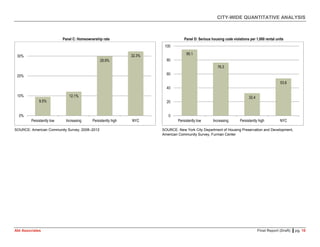
residents, fewer minorities, and more homeowners. In addition, housing code violations are less
prevalent.3
Key Finding: Developments surrounded by persistently high-income neighborhoods have lower
violent crime rates and are zoned for public elementary schools with higher standardized test
scores than developments surrounded by persistently low-income neighborhoods.
The violent crime rate in the area encompassing NYCHA developments and the surrounding census
block groups is lower when the surrounding neighborhood is persistently high income, averaging 5.7
incidents per 1,000 residents per year, as compared to rates of 8.3 and 7.7 incidents per 1,000
residents per year when the surrounding neighborhood has persistently low or increasing incomes,
respectively. Additionally, developments surrounded by increasing- or persistently high-income
surrounding neighborhoods are zoned for public elementary and middle schools that have higher
average proficiency rates on standardized tests than the public schools for which developments
surrounded by persistently low-income neighborhoods are zoned.
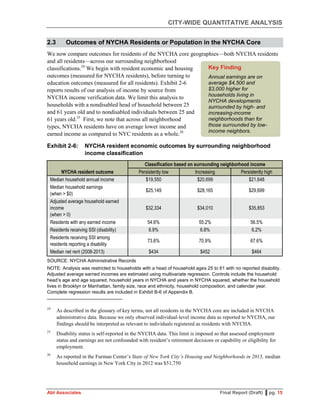
Key Finding: Annual household earnings average $4,500 and $3,000 higher, respectively, for
NYCHA residents in developments surrounded by persistently high- and increasing-income
neighborhoods.
Outcomes for individual NYCHA residents also differ across surrounding neighborhood types. We
find that the average annual earnings of NYCHA residents—both at the individual and household
level—vary with the income of the surrounding neighborhood type. Households with positive
earnings living in developments surrounded by high- and increasing-income neighbors have average
annual earnings that are $4,500 and $3,000 higher, respectively, than households living in
developments surrounded by neighborhoods with persistently low incomes. In addition to this
earnings disparity, a greater share of residents has positive earnings in developments surrounded by
persistently high- and increasing-income neighborhoods.
2
A glossary of key terms which thoroughly defines our classification approach appears after this executive
summary.
3
Neighborhood housing code violation rates are calculated using NYC Department of Housing Preservation
and Development (HPD) and Furman Center data, as described in Appendix A, which provides additional
details on the study design.
EXECUTIVE SUMMARY
Abt Associates Final Report (Revised Draft) ▌pg. v
Key Finding: Among public elementary and middle school students living in NYCHA housing,
those living in developments surrounded by persistently high- and increasing-income
neighborhoods score higher on standardized math and reading tests.
We also find gaps in educational outcomes for children across different surrounding neighborhood
types. Among public elementary and middle school students living in NYCHA housing, those living
in developments surrounded by persistently high- and increasing-income neighborhoods perform
better on standardized math and reading test scores than those living in developments surrounded by
persistently low-income neighborhoods.
Key Finding: NYCHA resident racial and ethnic composition, household composition, and resident
age are on average similar across surrounding neighborhood income classifications.
Further research is needed to determine the mechanisms that are resulting in the differences in
resident outcomes that we document. One hypothesis that has been presented in literature on
neighborhoods is that families and children living in higher-income neighborhoods may have access
to a richer set of institutions (such as day care centers and schools) and social networks that help them
connect to opportunities for advancement (Ellen and Turner 1997). We find mixed evidence about
increased opportunities in our qualitative research and additional differences may still exist. It is also
possible that these differences are driven by sorting—with more educated residents who are more
able to secure higher-paying employment finding their way into developments surrounded by higher-
income neighbors and higher-performing public schools. However, we find only limited evidence of
any differences in characteristics like race and ethnicity, household composition, and age across the
populations living in developments with different surrounding neighborhood types,4
suggesting that
sorting is unlikely to be a primary driver of our results. Household demographics and mobility
patterns differ only slightly across developments surrounded by neighborhoods of different incomes.
Rapid Ethnographic Assessments
We conducted rapid ethnographic assessments (REAs)5
that drew on community-based participatory
research in three neighborhoods with NYCHA developments. We selected one neighborhood with
persistently low incomes, Morris Heights in the Bronx (Sedgwick Houses), one with rapidly
increasing incomes, Long Island City in Queens (Queensbridge North and South Houses), and one
with persistently high incomes, Chelsea in Manhattan (Elliott-Chelsea and Fulton Houses). We
selected REA neighborhoods based on two criteria. First, we aimed to find one development that fit
into each of the three neighborhood income categories defined in our quantitative analysis:
persistently low-, increasing-, and persistently high-income. Second, in each neighborhood, we
needed to partner with a community-based organization (CBO) with a strong presence in the
neighborhood that could help hire NYCHA residents to be community ethnographers and introduce
the team to NYCHA residents and other key stakeholders.
4
We find a slightly higher share of Hispanic residents in developments surrounded by persistently low-
income neighborhoods. Other characteristics with similar population shares across neighborhood type that
are reported in Appendix B include gender mix, reported disability status, and years in NYCHA.
5
Please see the Glossary of key concepts and terms and the research design sections in chapter 1 and
Appendix A for an overview of the REA methodology.
EXECUTIVE SUMMARY
Abt Associates Final Report (Revised Draft) ▌pg. vi
Community-based, participatory research involves community members as research partners—in this
case NYCHA residents—whose needs and perspectives help shape the research throughout the
project. In each neighborhood the Abt team partnered with a high-performing community-based
organization located on or within a block of the NYCHA campus under study and offering a variety
of services and programs that serve NYCHA residents. Each CBO hired and supervised two
community ethnographers who lived in or were familiar with the NYCHA developments under study.
We partnered with BronxWorks in Morris Heights, Urban Upbound in Long Island City, and Hudson
Guild in Chelsea. By drawing on the knowledge and networks of our community partners, the Abt
team was able to collect unique data unavailable to researchers from outside the community while
promoting community involvement, especially by NYCHA residents, and research capacity in the
neighborhoods.
The REAs included a walking tour of each neighborhood led by our CBO and community
ethnographer partners, photo-based neighborhood amenities inventories by seven community
ethnographers, 42 instances of public space observation and on-the-spot interviews, 23 NYCHA
household interviews, 10 key stakeholder interviews, and six focus groups of NYCHA residents and
other community members. Fieldwork was conducted from April to August 2014.
Morris Heights/Sedgwick Houses–Persistently Low Income
Unlike the two other neighborhoods we studied and many neighborhoods across New York City,
average incomes in Morris Heights have not risen significantly in recent decades. In other ways,
however, it is a neighborhood in flux. After devastating struggles in the 1970s and with the effects of
crack in the 1980s, changes to the crime rate, rehabilitation of housing, and increases in retail and
amenities are improving residents’ experiences in their neighborhood. Landlords have been working
to renovate affordable housing complexes in the neighborhood since the late 1980s. Residents seem to
appreciate these improvements, though the neighborhood still lacks access to mainstream financial
services and, in spite of increasing options, quality groceries that are also affordable. Several residents
said they think this disinvestment is because the neighborhood is heavily minority. Residents do
expect the changes they are seeing to accelerate and that their neighborhood will be the next to
gentrify.
Key Finding: Sedgwick residents are demographically similar to other Morris Heights residents in
terms of their racial and ethnic backgrounds, educational attainment, and incomes.
Nearly two-thirds of residents in Morris Heights identify as Hispanic, and one-third identify as Black.
Only 3 percent of residents are White, Asian, or of other races. Sedgwick residents are also majority
Hispanic (56 percent), over one-third Black (38 percent), and have a small share of residents of
White, Asian, or other races (6 percent). Sedgwick residents appear to be older than other residents on
average: one-fifth of Sedgwick residents (22 percent) in NYCHA data are seniors, compared to only 6
percent of all neighborhood residents (based on ACS data).
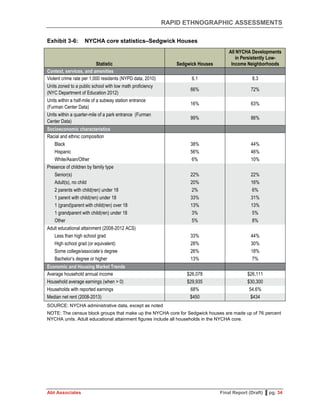
Average household income in the surrounding Morris Heights neighborhood is $39,827, almost
exactly at the midpoint of average incomes for all low-income surrounding neighborhoods in the
quantitative analysis. Among Sedgwick residents, average annual earnings are somewhat lower for
the more than two-thirds of households with positive earnings, at just under $30,000. Sedgwick
residents have similar levels of educational attainment than their non-NYCHA neighbors in Morris
Heights, at rates lower than the city average. Thirteen percent of Sedgwick residents have at least a
bachelor’s degree while 8 percent of Morris Heights residents do (compared to one-third of New
EXECUTIVE SUMMARY
Abt Associates Final Report (Revised Draft) ▌pg. vii
Yorkers overall). The rate of having attended some college is the same for both groups, at 26 percent.
Approximately one-third of Sedgwick and Morris Heights residents have less than a high school
diploma or equivalent.
Key Finding: Improvements in public safety are the most remarkable changes in the
neighborhood. Sedgwick Houses are by and large “quiet” and “comfortable” for residents.
Sedgwick residents reported that they generally felt safe in the development. Violent crime statistics
show that crime in Morris Heights (6.1 per 1,000 residents) is lower than in other persistently low-
income neighborhoods (8.3 per 1,000 residents) and is similar to Chelsea (5.8 per 1,000 residents),
the persistently high-income neighborhood selected for a rapid ethnographic assessment.
Key Finding: Sedgwick residents reported challenges based on a lack of community programs or
retail, which some blamed on disinvestment in the community. Residents and stakeholders
expressed a strong need for community organizations and improved retail but were pessimistic that
resources will be available for them.
Sedgwick residents continue to struggle with unemployment (20 percent for Morris Heights), few job
opportunities, and relatively few strong community-based organizations to help them advocate for
their needs. Residents reported that many programs have been defunded, such as the Sedgwick day
care center, some Sedgwick community center services, and some youth development, drug
diversion, and education programs. NYCHA residents express frustration over the depth of need for
community programs and that, while there is substantial community support for such programs, they
do not expect them to materialize.
Long Island City/Queensbridge North and South Houses–Increasing Income
Key Finding: While some NYCHA residents appreciate recent improvements to the neighborhood’s
parks, transit, and grocery options, they feel that condo residents—and not NYCHA residents—are
the impetus for and primary beneficiaries of the changes.
Long Island City has experienced recent and sizeable influxes of new businesses and new residents,
and increases in average incomes (to just over $80,000 in the last ACS). These changes appear to be
touching NYCHA residents’ lives in peripheral ways: Many residents appreciate improvements to the
neighborhood’s waterfront parks, increased bus service, and the availability of higher-quality and
organic groceries in the “trendier” parts of the neighborhood. NYCHA residents we interviewed,
however, felt that these improvements were meant to benefit new condo owners, often called the
“runners and bikers” in the neighborhood, rather than NYCHA residents. Residents especially noted
disparities between NYCHA housing, with scaffolding around unfinished exterior work, and new
condos being built, as well as between the quality of the groceries available near the development and
those available further south.
Key Finding: Compared to residents in the surrounding neighborhood, Queensbridge residents
have on average lived in the neighborhood longer, are less likely to have college degrees, and earn
significantly less money.
Four-fifths (79 percent) of Long Island City residents have lived in the neighborhood less than 10
years. By contrast, the residential turnover rate is very low in Queensbridge. In our fieldwork, it was
common for residents and others we interviewed to discuss multiple generations of families living in
Queensbridge, sometimes back to the developments’ early days in the 1940s. Socially, this is leading
EXECUTIVE SUMMARY
Abt Associates Final Report (Revised Draft) ▌pg. viii
to a situation where newcomers are perceived to feel they are “discovering” an area where, in fact,
NYCHA families have lived for generations.
In the neighborhood surrounding Queensbridge, it is most common (at 51 percent) for residents to
have a bachelor’s degree or higher. The most common level of education among Queensbridge
residents, by contrast, is to have less than a high school diploma (38 percent), with only 11 percent of
residents holding a bachelor’s degree.
Residents and staff at job placement agencies did not feel that the changes to the neighborhood’s
economic landscape, such as new hotels and corporate headquarters, have translated into increased
local opportunities for NYCHA residents. Thus while the average income in Queensbridge ($27,355)
is higher than the average for NYCHA residents in persistently low-income neighborhoods, our
qualitative work suggests that the earnings difference may not be driven by employment opportunities
in the immediate neighborhood. Further research is needed to understand earnings differences and
NYCHA resident job search experiences.
Key Finding: With a crime rate twice the city average, crime is a pressing concern in the
developments. Residents appreciate the mayor’s new initiative to reduce violence in NYCHA
developments including Queensbridge North and South.
The violent crime rate in Queensbridge is 10.1 per 1,000 residents, approximately twice the citywide
average of 5.7. Police presence had been reported to be low in the area, except for responses to
crimes, and community relationships with the police are reportedly uneven. Residents took positive
notice of the Mayor’s Action Plan (MAP) for Neighborhood Safety launched in July 2014 to focus on
improving safety in the 15 NYCHA developments, including Queensbridge, that account for 20
percent of violent crimes on NYCHA campuses. Although residents noted significant issues for the
Queensbridge community—especially violence and children being drawn to drug dealing—they also
noted a strong willingness to support one another during difficult times.
Chelsea/Elliott-Chelsea and Fulton Houses–Persistently High Income
Chelsea has undergone tremendous changes in the last few decades. The neighborhood has seen
dramatically rising incomes and NYCHA residents perceive it has become more of a destination for
outsiders than a place that caters to their needs. Many local establishments, like laundromats and
corner delis, that made the neighborhood feel affordable to and comfortable for NYCHA residents
have closed; even new affordable housing is out of reach to residents we interviewed, making
NYCHA housing the only viable option for them in the area. Many NYCHA residents appreciate
some of the changes but do not feel fully integrated into the changing community; for example, they
sometimes feel disturbed by crowds of tourists or uncertain with respect to patronizing new
establishments.
Key Finding: NYCHA residents in Chelsea earn significantly less money than the average Chelsea
resident and are almost half as likely to have a college degree.
Average income in the Chelsea neighborhood was just over $129,000 as measured by the 2008-2012
ACS. By contrast, NYCHA residents of Elliott-Chelsea who were working earned an average of just
over $34,000, making a large gap between the incomes of NYCHA residents and their neighbors,
especially those who do not live in Penn South’s middle-income housing. In terms of educational
attainment, about as many Elliott-Chelsea residents have earned a bachelor’s degree as New Yorkers
overall (35 and 34 percent, respectively). Within their neighborhood, however, Elliott-Chelsea
EXECUTIVE SUMMARY
Abt Associates Final Report (Revised Draft) ▌pg. ix
residents are only about half as likely to have a bachelor’s degree as their neighbors. Two-thirds of
Chelsea residents (65 percent) overall hold a bachelor’s degree or higher.
Key Finding: While NYCHA residents appreciate many of Chelsea’s amenities, there is an
undercurrent of fear of being displaced. Even if their rents remain affordable, rising costs of
everything around them can feel like pressure to leave the neighborhood.
NYCHA residents do not feel they are benefitting economically from the neighborhood’s increasing
development, and are very concerned about affordability. There are well-organized efforts by Hudson
Guild, the tenants’ associations, and long-term residents to petition for community benefit agreements
and concessions from developers to keep the neighborhood more affordable. Despite these efforts,
there are no mechanisms to help mom-and-pop establishments where NYCHA residents used to shop
and services they use (like laundromats) stay in business, and few jobs at the new retail
establishments seem to materialize for NYCHA residents.
Opportunities for New York City and NYCHA
This research was conducted at a time of significant change for New York City overall—at the
beginning of Mayor Bill de Blasio’s term after 12 years of the Bloomberg administration. Mayor de
Blasio has announced several initiatives that are highly relevant to this research but that were just
beginning in the neighborhoods we studied. The following opportunities are among those we identify
in a synthesis of our key findings.
 Programs providing enrichment, skill-building, direct work opportunities, or connections to
employers serve a high priority need for residents, particularly youth. City government
initiatives, especially those implemented with local CBO support, to provide youth services
are an important tool, particularly in developments with fewer resources available from
surrounding neighborhoods.
 Further research is needed to understand why incomes are higher for NYCHA residents in
developments surrounded by higher-income neighborhoods and whether higher incomes are
offset by higher costs of living in these neighborhoods.
 NYCHA and the city could help facilitate connections between NYCHA residents and their
neighbors, particularly in developments in neighborhoods with increasing and relatively high
incomes. For example, the city, NYCHA, local businesses, or cultural institutions could
sponsor ongoing forums co-chaired by NYCHA residents and local business owners and
community institutions around a shared neighborhood vision.
 Training and support for NYCHA site staff about appropriate ways to engage with
community organizations could be a key linkage in making such collaborative efforts
succeed. The process for our team to successfully engage NYCHA site staff varied by site but
benefited from the support of NYCHA’s administration. To encourage more nimble and
effective neighborhood collaborations, NYCHA might consider clear policies to empower
staff at the development level to collaborate with community partners.
 Community safety efforts, such as the Mayor’s Action Plan (MAP) for Neighborhood Safety
initiative to reduce crime in the 15 NYCHA developments that account for almost 20 percent
of violent crime in NYCHA citywide, address a pressing need for improved public safety in
EXECUTIVE SUMMARY
Abt Associates Final Report (Revised Draft) ▌pg. x
communities containing public housing. Such initiatives should be coordinated with efforts in
surrounding neighborhoods to reduce crime, as the safety of developments is shaped by the
safety of the surrounding neighborhood and vice versa. Further research could focus on
which initiatives are most successful in improving public safety.
 The success of this community-based participatory research (admittedly on a small scale)
provides supporting evidence for efforts to expand the scope of public housing residents’
involvement in co-facilitating projects and initiatives with the City and NYCHA. Residents
should be considered a major asset for collaboratively carrying out research, needs
assessment, program design, and program implementation. Those efforts can produce
tremendous insight as well as a sense of community ownership.
KEY TERMS
Abt Associates Final Report (Draft) ▌pg. xi
Glossary of key terms and concepts
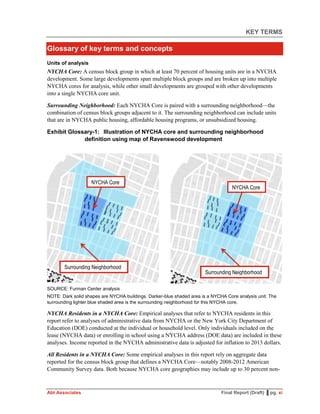
Units of analysis
NYCHA Core: A census block group in which at least 70 percent of housing units are in a NYCHA
development. Some large developments span multiple block groups and are broken up into multiple
NYCHA cores for analysis, while other small developments are grouped with other developments
into a single NYCHA core unit.
Surrounding Neighborhood: Each NYCHA Core is paired with a surrounding neighborhood—the
combination of census block groups adjacent to it. The surrounding neighborhood can include units
that are in NYCHA public housing, affordable housing programs, or unsubsidized housing.
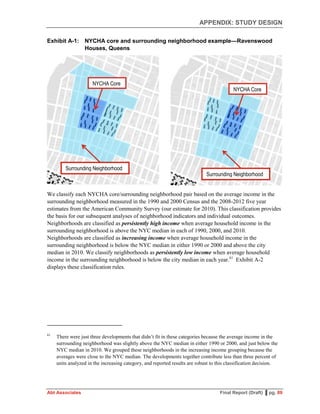
Exhibit Glossary-1: Illustration of NYCHA core and surrounding neighborhood
definition using map of Ravenswood development
SOURCE: Furman Center analysis
NOTE: Dark solid shapes are NYCHA buildings. Darker-blue shaded area is a NYCHA Core analysis unit. The
surrounding lighter blue shaded area is the surrounding neighborhood for this NYCHA core.
NYCHA Residents in a NYCHA Core: Empirical analyses that refer to NYCHA residents in this
report refer to analyses of administrative data from NYCHA or the New York City Department of
Education (DOE) conducted at the individual or household level. Only individuals included on the
lease (NYCHA data) or enrolling in school using a NYCHA address (DOE data) are included in these
analyses. Income reported in the NYCHA administrative data is adjusted for inflation to 2013 dollars.
All Residents in a NYCHA Core: Some empirical analyses in this report rely on aggregate data
reported for the census block group that defines a NYCHA Core—notably 2008-2012 American
Community Survey data. Both because NYCHA core geographies may include up to 30 percent non-
NYCHA Core
Surrounding Neighborhood
NYCHA Core
Surrounding Neighborhood
KEY TERMS
Abt Associates Final Report (Draft) ▌pg. xii
NYCHA units, and because some household members residing in NYCHA units may not be listed on
the NYCHA lease and thus captured by the administrative data, these analyses may include additional
residents in the geography beyond the NYCHA residents captured by administrative data.
Surrounding Neighborhood Classifications
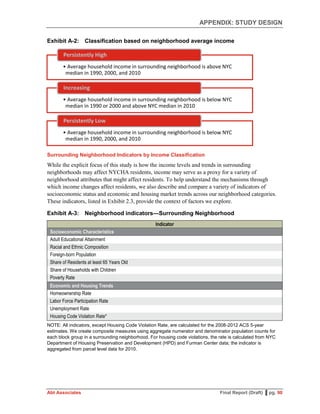
This report classifies surrounding neighborhoods into three categories based on neighborhood average
income:
 Persistently high-income neighborhoods are those with average household income above the
NYC median in each of 1990, 2000, and 2010.
 Increasing income neighborhoods are those with average household income below the NYC
median in either 1990 or 2000 but above the city median in 2010.
 Persistently low-income neighborhoods are those with average household income below the
city median in each of 1990, 2000, and 2010.
We use average incomes for the classifications because the surrounding neighborhood average can be
calculated by combining data from the multiple census block groups that constitute a surrounding
neighborhood.6
The NYC-wide median income is used for comparison as an intuitive reference
amount that results in comparably sized groups of surrounding neighborhood types. Average incomes
for 1990 and 2000 are taken from the respective Decennial Censuses. We have to use the 2008-2012
American Community Survey (ACS) to generate income estimates for 2010 because of the Census
Bureau’s transition from using the long-form decennial survey to using the ACS to estimate incomes.
The NYC median income (in 2012 dollars) is $51,898, $52,427, and $50,256 in 1990, 2000, and
2010, respectively.
Neighborhood Indicators
Public School Attendance Zone: The New York City DOE assigns every building in New York City
to a public school attendance zone for elementary school. Generally, each elementary school
attendance zone has one elementary school that most public school students in the neighborhood
attend. Students can also apply to attend elementary schools in different school attendance zones, but
admission preference is given to students living in the zone. Additionally, students may not attend
their zoned public school because they attend a private or charter school. In Section 2.2 of this report,
we analyze the proficiency rates for all students attending the public schools that students living in
NYCHA properties are zoned to attend. In Section 2.3 we analyze the performance of students living
in NYCHA properties without regard to whether or not they are attending the locally zoned public
school.
6
We do not have sufficient data to calculate the median income of the surrounding neighborhood. As would
be expected, the difference between mean and median income in census block groups that make up
persistently high-income surrounding neighborhoods is on average greater (about $6,700) than the
difference between mean and median income in block groups that make up increasing income (about
$3,500) and persistently low-income surrounding neighborhoods (about -$400).
KEY TERMS
Abt Associates Final Report (Draft) ▌pg. xiii
Rapid Ethnographic Assessments
Rapid Ethnographic Assessment (REA): An approach to qualitative research designed to identify
key social and cultural issues in a short time frame (a few days to a few months), using multiple data
sources and a collaborative research team with different backgrounds.
Community-Based Participatory Research: This paradigm involves community members as research
partners whose perspectives and concerns help shape the research in order to foster collaborative
social change that empowers community members.
Community Ethnographer (CE): NYCHA and CBO staff who were hired for this project as
researchers and data collectors. Five out of seven CEs who worked on the project were NYCHA
residents.
INTRODUCTION
Abt Associates Final Report (Draft) ▌pg. 1
1. Introduction
Most NYCHA public housing was built in what were, at the time, low-income neighborhoods.7
In the
intervening decades, many of these neighborhoods have seen considerable demographic changes.
Some neighborhoods surrounding NYCHA developments transitioned from low income to high
income several decades ago. Others have seen a more recent influx of higher-income residents. Still
other neighborhoods surrounding developments have remained persistently low income.8
The purpose
of this research project is to understand how these neighborhood differences affect services and
outcomes for public housing residents. This report presents findings of a study by Abt Associates, the
NYU Furman Center for Real Estate and Urban Policy, and partners in New York City
neighborhoods (referred to as the Abt team) on how the socioeconomic makeup of and change in
neighborhoods surrounding NYCHA developments affect residents of those developments. We also
introduce opportunities for New York City, NYCHA, and other stakeholders suggested by the
findings that could help residents benefit more from changes and resources in their surrounding
neighborhoods.
Background
Over the past two decades, public housing authorities in cities around the United States have been
tearing down traditional public housing developments to replace them with mixed-income
communities, often with support from the federal HOPE VI and Choice Neighborhoods programs.9
New York City, by contrast, has maintained the traditional public housing model of 100 percent low-
income developments. Nonetheless, many residents of traditional public housing in New York may
experience mixed-income environments, as the neighborhoods around their public housing campuses
have changed. The socioeconomic makeup of the surrounding neighborhood could affect residents of
NYCHA developments through a variety of channels (Ellen and Turner 1997; Ellen and O’Regan
2010, 2011a). First, residents living in a relatively higher-income neighborhood may have access to
social networks that can provide information about and connections to job opportunities and other
resources. Second, increased neighborhood incomes may also attract greater private investment,
which could lead to increased employment opportunities and improved local retail options. Third, on
average, crime rates tend to be lower in higher income neighborhoods (Ellen and O’Regan 2009).
Finally, increased neighborhood affluence may also mean improved public services and amenities, as
higher-income residents may be more politically engaged and connected. Most critically, perhaps, the
7
About two-thirds of NYCHA’s housing stock (about 120,000 units) was built between 1950 and 1970.
8
Exhibit B-1 in Appendix B provides a list of NYCHA developments in our analysis and how they are
categorized based on surrounding neighborhood incomes.
9
More information on these programs that support distressed public housing developments and
neighborhoods that contain them is available at
http://portal.hud.gov/hudportal/HUD?src=/program_offices/public_indian_housing/programs/ph/cn and
http://portal.hud.gov/hudportal/HUD?src=/program_offices/public_indian_housing/programs/ph/hope6/abo
ut.
INTRODUCTION
Abt Associates Final Report (Draft) ▌pg. 2
local schools might improve as neighborhood incomes rise (Kasarda 1993; Ainsworth 2002; Schwartz
et al. 2010).10
Yet, the mere presence of institutions in a neighborhood does not reveal how public housing residents
actually use them (Sampson, Morenoff, and Gannon-Rowley 2002). NYCHA residents could be
priced out of new private amenities and new, higher-income neighbors may not contribute to
accessible community resources. For example, they may opt to send their children to private schools
and support new grocery stores that may include only expensive fare, out of the financial reach of
NYCHA residents. As disparities between NYCHA residents and their neighbors increase, NYCHA
residents could become stigmatized or isolated from the surrounding neighborhood.
Meanwhile, researchers continue to disentangle how neighborhood characteristics affect low-income
households. Prominent among this research is the Moving to Opportunity experiment (MTO), which
randomly assigned some public-housing families vouchers that they were required to use in low-
poverty neighborhoods. Ludwig et al. (2013) reviews the long-term follow-up findings for MTO in
the context of the historical literature that documents an association (but not causal influence)
between neighborhood environments and long-term life chances. Long-term follow-up has found that
this offer changed the type of neighborhood that MTO treatment families lived in over the subsequent
decade and improved adult physical health and mental health, but had no detectable effect on adult
economic outcomes, youth schooling, and youth physical health. Researchers and policy makers
continue to debate the findings but virtually all agree that families and children probably suffered
some disruption from the requirement that families move to new and unfamiliar communities. In
contrast to MTO, where variation in household’s exposure to different neighborhood characteristics
was driven by household mobility, this study examines variation in income levels and trends
occurring over time in neighborhoods surrounding existing NYCHA developments.11
Given the complex possible effects of neighborhood change, this project seeks (1) to document how
public housing residents living in socioeconomically different kinds of neighborhoods engage with
surrounding institutions and opportunities and (2) to measure differences in resident outcomes across
the different kinds of neighborhoods.
Study Overview
This study addresses the overarching research question: How do the current socioeconomic makeup of
neighborhoods surrounding NYCHA developments and changes in that makeup affect public housing
residents? To address this question, we conducted two research efforts in parallel: a quantitative
analysis using administrative and other data available for all New York City neighborhoods; and
10
A post at EdLabs, the Education Innovation Laboratory at Harvard University provides an overview of the
unresolved question of the respective role of neighborhoods and schools in determining school
performance, http://edlabs.harvard.edu/neighborhoods-or-schools. In addition, the Schott Foundation’s
2012 report, The Rotting Apple, showed that schools in higher-poverty community school districts in New
York have less experienced teachers, less stable teaching staffs, and lower-performing schools.
http://www.schottfoundation.org/publications-reports/education-redlining.
11
For an example of and introduction to related literature, see Ellen and O’Regan (2011b) “How Low Income
Neighborhoods Change: Entry, Exit, and Enhancement.”
INTRODUCTION
Abt Associates Final Report (Draft) ▌pg. 3
qualitative rapid ethnographic assessments (REA) in three selected neighborhoods. (Appendix A
provides a detailed review of the study methodology.)
Citywide Quantitative Analysis
For the quantitative analysis, we assess neighborhood demographic conditions and change in
neighborhoods surrounding NYCHA developments throughout the city. The assessment of
neighborhood conditions and change uses groupings of census block groups around NYCHA
developments to construct two key geographies: the NYCHA core and the surrounding neighborhood.
The NYCHA core refers to a block group containing a development where at least 70 percent of
housing units are in the NYCHA development. Each NYCHA core block group is paired with its
surrounding neighborhood, defined as the block groups bordering the NYCHA core.12
We classify each NYCHA core/surrounding neighborhood pair based on the average income in the
surrounding neighborhood measured in the 1990 and 2000 Census and the 2008-2012 five-year
estimates from the American Community Survey (ACS) (our estimate for 2010). This approach
provides the basis for the analyses of neighborhood indicators and individual outcomes, allowing
comparisons across three types of neighborhoods:
 Persistently high-income neighborhoods are those with average household income above the
NYC median in each of 1990, 2000, and 2010.13
 Increasing-income neighborhoods are those with average household income below the NYC
median in either 1990 or 2000 and above the city median in 2010.
 Persistently low-income neighborhoods are those with average household income below the
city median in 1990, 2000, and 2010.14
To help understand the mechanisms through which income changes affect residents, we describe and
compare a variety of indicators of socioeconomic status and economic and housing market trends
across our neighborhood categories. We also examine a selected set of measures that describe key
features of the neighborhood context, services, and amenities available to NYCHA residents.
We compare three types of outcomes for NYCHA residents across the three income-based
surrounding neighborhood types:
 Employment and earnings. Are there differences in employment rates or income levels?
12
See the glossary of key terms and concepts for a sample map that illustrates how these geographies are
defined.
13
NYC median household income (in 2012 dollars) was $51,898, $52,427, and $50,256 in the 1990 and 2000
Census and the 2010 ACS, respectively.
14
There were just three developments that didn’t fit in these categories because the average income in the
surrounding neighborhood was slightly above the NYC median in either 1990 or 2000, and just below the
NYC median in 2010. We grouped these neighborhoods in the increasing income grouping because the
averages were close to or well below the NYC median in either 1990 or 2000 and close to the NYC median
in 2010.
INTRODUCTION
Abt Associates Final Report (Draft) ▌pg. 4
 Individual mobility. Are there differences in the rates of individuals leaving NYCHA? Are
individuals living in different neighborhood types more likely to move within NYCHA, and to
developments with a different type of surrounding neighborhood?
 Adult educational attainment and child academic performance. Do adults achieve higher levels
of education?15
Does the academic performance of children from NYCHA developments differ?
Rapid Ethnographic Assessments
To complement the citywide quantitative analysis, we used an ethnographic approach to understand
the experience of residents in three neighborhoods illustrating the three income trends defined above.
The REAs describe how NYCHA and other neighborhood residents connect with their neighborhood
and how those connections have changed over time. The REAs add perspective to the quantitative
analysis by describing how residents and other stakeholders experience their neighborhoods and
changes that have occurred over recent decades. These daily experiences and reflections on change
identify residents’ perceptions of neighborhood change—both positive and negative—that are not
observable in the quantitative analysis, such as changes in the prices and types of goods in local
shops.
The REAs focused on six dimensions of resident life:
 Neighborhood connections. How do NYCHA residents in developments surrounded by
persistently low-, increasing-, and persistently high-income neighborhoods engage with their
neighbors, institutions, and social and cultural resources in their neighborhoods?
 Quality of local schools. How do public housing residents feel about their local schools? What is
their perception of how schools in the neighborhoods have changed?
 Economic well-being. What changes (if any) have occurred in different types of neighborhoods’
retail and service sectors? Have job opportunities and earnings changed? Are residents accessing
financial support and benefits for which they are eligible? How do NYCHA residents manage
their money and use mainstream or other financial services?
 Quality and cost of food in local stores. Many low‐income neighborhoods are underserved by
retail outlets that offer quality food at reasonable prices. Does the availability of healthy or lower-
cost food differ by neighborhood type? Are there more affordable grocery options in high-income
neighborhoods, or do prices of groceries increase with income in the neighborhood?
 Quality and use of neighborhood amenities such as parks. Have public amenities (e,g, parks,
recreation centers, community centers) improved with neighborhood change or did the new
residents rely on private amenities, such as health clubs? If public amenities improved in higher
income neighborhoods, do NYCHA residents make greater use of them?
15
Our outcome measures for education and earnings do not apply to older residents who are not in the labor
force and unlikely to pursue additional education. An important topic for future research efforts is to
identify appropriate measures to assess the relative well-being of older adults in developments in different
surrounding neighborhood types.
INTRODUCTION
Abt Associates Final Report (Draft) ▌pg. 5
 Crime and safety in the neighborhood. Does crime in the neighborhood decrease in increasing-
income neighborhoods? Does increased public safety encourage NYCHA residents to make
greater use of amenities in their neighborhoods?
The qualitative insights presented in three case studies in Chapter 3 can be read as descriptions of
several aspects of neighborhood change listed above. The REAs present data on neighborhood life in
ways that are more nuanced than what can be captured by quantitative data and official records. We
largely present data from resident and stakeholders’ perspectives, with modest quantitative context, to
reflect how residents understand and interact with their neighborhoods. Contradictions between
resident perceptions and other measures of neighborhood conditions present important opportunities
for additional research and community outreach efforts.
Of course, each neighborhood in New York City has a unique history and characteristics, and the
REAs should not be read as a representative sample. Through careful selection of neighborhoods
according to quantitative criteria, however, we present the REAs as examples of opportunities,
barriers, frustrations, hopes, and needs NYCHA residents may face when their surrounding
neighborhood changes. Throughout the research process we sought to identify opportunities that
would create conditions where NYCHA residents might be able to connect to local resources. By
taking account of citywide quantitative and localized qualitative data, this report concludes with a
discussion of some future opportunities to help improve residents’ objective measures of well-being
and quality of life in their neighborhoods (Chapter 4).
As research sites for the REAs, we selected one neighborhood with persistently low incomes,
Sedgwick Houses in the Morris Heights section of the Bronx; one with rapidly increasing incomes,
Queensbridge Houses North and South in the Long Island City section of the Queens; and one with
persistently high incomes, Elliott-Chelsea and Fulton Houses in the Chelsea section of Manhattan.
Our research approach was rapid ethnographic assessments (REAs) that drew on community-based,
participatory research. This paradigm involves community members as research partners—not only
research respondents—throughout the project. In each neighborhood we partnered with a community-
based organization and two community ethnographers who lived in, or were familiar with, the
developments under study. By drawing on the knowledge and networks of our community partners,
our methods allowed the research team to collect unique data unavailable to researchers from outside
the community while promoting community involvement and research capacity in the neighborhoods.
We used multiple methods—including neighborhood tours, an inventory of neighborhood amenities,
focus groups, public space observation, and interviews—to collect information. This data collection
approach provided triangulation across sources, increasing the validity and reliability of the data. We
staged the methods to allow for an iterative process, retooling research questions and data collection
strategies as new information became available. Fieldwork was conducted from April to August
2014.16
For more details on REA methods, see Appendix A.
16
We note that NYCHA resident interviews began just after two children were stabbed in an elevator at
Boulevard Houses where funds had been earmarked for security cameras that had not been installed.
CITYWIDE QUANTITATIVE ANALYSIS
Abt Associates Final Report (Draft) ▌pg. 6
2. Citywide Quantitative Analysis Research Findings
We begin our citywide quantitative analysis by describing the outcome of our income-based
classification of neighborhoods. Exhibit 2-1 presents a map of New York City showing where
NYCHA core block groups in our analysis are located. While a high proportion of NYCHA core
block groups surrounded by low-income neighborhoods are in
the Bronx, some are also located in Manhattan and Brooklyn.
NYCHA core block groups surrounded by increasing income
neighborhoods are spread through Brooklyn and Manhattan,
with a few located in the Bronx. NYCHA cores with
surrounding neighborhoods with persistently high incomes are
spread through all five boroughs. Perhaps because the
surrounding neighborhoods are fairly small, there are some
places where low-, increasing-, and high-income
neighborhoods are located in close proximity to one another.17
Exhibit 2-1: Map of NYCHA developments in citywide quantitative analysis by
surrounding neighborhood classification
SOURCE: Furman Center analysis
17
For reference, 71 percent of all block groups in New York City had average incomes higher than the New
York City median in 2010.
Key Finding
Two-thirds of NYCHA
residents live in census
block groups where
average income in the
surrounding neighborhood
is greater than the overall
NYC median income
benchmark.
CITYWIDE QUANTITATIVE ANALYSIS
Abt Associates Final Report (Draft) ▌pg. 7
Exhibit 2-2: Number of classified developments, block groups, and NYCHA units,
residents and households
Count
Classification based on surrounding neighborhood income
Persistently low Increasing Persistently high
NYCHA Core Areas 49 34 54
Block Groups 84 63 102
NYCHA Residents (2013) 97,010 76,724 118,254
NYCHA Households (2013) 40,879 32,999 52,027
SOURCE: Furman Center analysis; NYCHA administrative data
The number of classified developments, block groups, and NYCHA units in each category and
quartiles of average income in these geographies are shown in Exhibit 2-2 and Exhibit 2-3.18
A full
list of developments and surrounding neighborhood income classifications is included in Exhibit B-1
in Appendix B. This income classification system produced relatively evenly sized groups. Forty-nine
NYCHA core areas were classified as being surrounded by low-income neighborhoods. The median
of our average household income measure for these low-income surrounding neighborhoods was just
under $39,500 in 2010. Thirty-four NYCHA core areas were classified as being surrounded by
increasing-income neighborhoods. The median of average household income in these increasing-
income surrounding neighborhoods was just over of $58,000 in 2010. Fifty-four NYCHA core areas
were classified as being surrounded by high-income neighborhoods. The median of average
household income in these surrounding neighborhoods was just under $75,500 in 2010.
Exhibit 2-3: Average Income in surrounding neighborhoods by classification type
Income in surrounding
neighborhoods in 2010
Classification based on surrounding neighborhood income
Persistently low Increasing Persistently high
25th percentile $34,370 $52,114 $62,068
Median $39,452 $58,153 $75,465
75th percentile $43,830 $66,778 $92,272
SOURCE: Calculated from 2008-2012 ACS
18
222 developments (or parts of developments) located in 401 block groups were not classified because
NYCHA units made up fewer than 70 percent of the units in those block groups. Based on NYCHA
administrative records for 2013, 110,997 individuals in 49,682 households lived in these unclassified
developments. We assessed that in these developments, average incomes and other descriptors of the
surrounding neighborhoods could not adequately be empirically distinguished from NYCHA resident
outcomes. These developments are on average smaller than those in our analysis. Future research is
necessary to understand how the share of public housing units in an area would relate to the findings of our
report. We anticipate that our findings carry over to developments that remain large enough to constitute a
recognizable and distinct campus.
CITYWIDE QUANTITATIVE ANALYSIS
Abt Associates Final Report (Draft) ▌pg. 8
2.1 Surrounding Neighborhood Indicators by Income Classification
To gain a richer understanding of the other neighborhood changes that typically accompany changes
in neighborhood income, we compared several additional indicators averaged for each surrounding
neighborhood type.
Exhibit 2-4 reports four measures of the residents and housing stock in the neighborhoods
surrounding NYCHA developments. Panel A shows the educational attainment of adults living in the
neighborhoods surrounding the NYCHA core by income classification. Educational attainment is
greatest for adults living in surrounding neighborhoods classified as persistently high income: 36
percent of adults living in persistently high-income neighborhoods have a bachelor’s degree,
compared to 28 percent of those adults living in neighborhoods with increasing income and just 12
percent of adults living in persistently low-income neighborhoods surrounding NYCHA
developments. Panel B shows the racial and ethnic composition of the residents of neighborhoods
surrounding NYCHA developments by income classification. Persistently low-income surrounding
neighborhoods have a greater share of black and Hispanic residents (40 percent and 45 percent,
respectively) than persistently high-income neighborhoods (30 percent and 31 percent). As shown in
Panel C, about 30 percent of the housing units are owner-occupied in persistently high-income
neighborhoods, while in low-income neighborhoods just 10 percent are owner-occupied. Finally, low-
income neighborhoods had a serious housing code violation rate nearly three times as high as the rate
in high-income neighborhoods, 95.1 serious housing code violations per 1,000 rental units compared
to 32.5 per 1,000 rental units. Overall, high-income neighborhoods in this study have characteristics
very similar to citywide averages.19
They are generally not the highest income and most privileged
neighborhoods in the city, but they are clearly advantaged communities and have significantly more
educated and higher-income residents as well as a better maintained housing stock than the other
neighborhoods surrounding public housing.
Additional surrounding neighborhood indicators are presented in Appendix B: share of residents that
are foreign-born, share of residents 65 and older, households with children, federal poverty rate, labor
force participation, and unemployment rate.20
These additional measures underscore the differences
across our three types of communities. In brief, we find that our persistently low-income block groups
also have higher poverty rates, larger shares of foreign-born residents, and worse labor market
outcomes.
19
One exception is that the persistently high-income neighborhoods surrounding public housing have lower
than average homeownership rates because there are very few NYCHA units in the areas of the city with
the highest homeownership rates. For example, the South Shore of Staten Island has the highest
homeownership rates in the city (78.5 percent) and no public housing units. See the Furman Center’s State
of New York City’s Housing and Neighborhoods in 2013 for more details.
20
CEO has developed an alternative measure of poverty to the federal poverty rate that includes impacts of
public policy. Unlike the federal rate, the CEO measure accounts for both income and non-cash
government benefits and measures them against the city’s cost of living. CEO produces this poverty
measure annually for New York City, and at the borough and the community district levels. Because the
analysis for this report was carried out at the census block level, the CEO Poverty Measure is not reported
here with the official federal poverty rate.
CITY-WIDE QUANTITATIVE ANALYSIS
Abt Associates Final Report (Draft) ▌pg. 9
Exhibit 2-4: Characteristics of the residents and housing stock of neighborhoods surrounding NYCHA developments
Panel A: Adult educational attainment Panel B: Racial and ethnic composition
SOURCE: American Community Survey, 2008–2012 SOURCE: American Community Survey, 2008–2012
37.8%
28.7%
20.7% 20.6%
29.1%
23.8%
23.2% 24.6%
15.5%
14.2%
14.9% 14.7%
5.6%
5.6%
5.8% 6.1%
11.9%
27.8%
35.5% 34.0%
0%
25%
50%
75%
100%
Persistently
low
Increasing Persistently
high
NYC
Bachelor's Degree or Higher
Associate's Degree
Some College
High School Diploma
No High School Diploma
7.3%
15.8%
26.4%
33.3%
39.7%
33.3%
30.4%
22.9%
44.6% 40.6%
30.6% 28.6%
6.9% 8.1% 9.9% 12.8%
1.6% 2.3% 2.6% 2.5%
0%
25%
50%
75%
100%
Persistently
low
Increasing Persistently
high
NYC
Other
Asian
Hispanic
Black
White
CITY-WIDE QUANTITATIVE ANALYSIS
Abt Associates Final Report (Draft) ▌pg. 10
Panel C: Homeownership rate Panel D: Serious housing code violations per 1,000 rental units
SOURCE: American Community Survey, 2008–2012 SOURCE: New York City Department of Housing Preservation and Development,
American Community Survey, Furman Center
9.5%
12.1%
29.9%
32.3%
0%
10%
20%
30%
Persistently low Increasing Persistently high NYC
95.1
76.3
32.4
53.6
0
20
40
60
80
100
Persistently low Increasing Persistently high NYC
CITY-WIDE QUANTITATIVE ANALYSIS
Abt Associates Final Report (Draft) ▌pg. 11
2.2 Neighborhood Context, Services, and Amenities Available to NYCHA
Residents
NYCHA resident outcomes may also be shaped by the services and amenities available to the
residents. Exhibit 2-5 shows how these services and amenities differ across the different
neighborhood types.
In New York City as a whole in 2012, 65.7 percent of fourth grade students performed at grade level
or higher on standardized tests in mathematics. In the bottom
quartile of public schools as measured by fourth-grade math
proficiency, fewer than 52.6 percent of students performed at
grade level.21
Panel A measures the share of NYCHA units
whose residents are zoned to attend a public school in the
bottom quartile of math proficiency, as classified by the income
level of the surrounding neighborhood. Seventy-two percent of
households in NYCHA developments surrounded by low-
income neighborhoods are zoned to attend public schools in the
bottom quartile of proficiency. Households in increasing- and
high-income neighborhoods have access to schools with higher
proficiency rates.
To capture the level of violence to which NYCHA residents are exposed, we measured the violent
crime rate in NYCHA core neighborhoods and their surrounding neighborhoods together, as we
expect this covers the area NYCHA residents are most likely to navigate on a given day. Panel B
shows the number of violent crimes reports in 2010 per 1,000 residents.22
Residents living in
developments in all three income classifications faced a higher average violent crime rate than New
York City as a whole. However, the violent crime rate for developments with surrounding low-
income neighborhoods (8.3 violent crimes per 1,000 residents) was substantially higher than the rate
for developments in high-income surrounding neighborhoods (5.7 violent crimes per 1,000 residents).
Finally, we looked at the proximity of units in NYCHA buildings to the nearest subway station
entrance and park. Panel C shows that more units in NYCHA developments surrounded by
persistently low-income neighborhoods are within a half-mile of a subway station entrance (about a
10 minute walk) than units in high-income neighborhoods. This echoes a pattern across the city as a
whole where many lower-income neighborhoods have better access to subway stations than higher-
income neighborhoods. Seven of the ten community districts with the best access to subway transit
had median incomes below the city’s in 2010 and eight of the ten community districts with the least
access to subway transit had median incomes higher than the city’s in 2010.23
While close proximity
to transit is a desirable feature in contemporary city planning, this was not always the case and may
be one reason why a higher share of NYCHA units in persistently low-income neighborhoods are
close to subway station entrances. Changing preferences for transit-oriented development may be one
21
Furman Center analysis of NYC Department of Education Data on the New York State Mathematics Test.
22
Both NYCHA residents and residents of the surrounding neighborhood.
23
See the Furman Center’s State of New York City’s Housing and Neighborhoods 2011
Key Finding
Developments surrounded
by persistently low-income
neighborhoods have higher
violent crime rates and are
zoned to schools with
lower standardized test
scores than developments
with increasing- and
persistently high-income
surrounding neighborhoods
CITY-WIDE QUANTITATIVE ANALYSIS
Abt Associates Final Report (Draft) ▌pg. 12
of many reasons neighborhood income patterns change over time. Similarly, Panel D shows that more
units in NYCHA developments surrounded by persistently low-income neighborhoods are within a
quarter-mile of a park (about a five minute walk) than those in persistently high-income
neighborhoods. This finding is consistent with the overall pattern of parks access throughout the city:
half of neighborhoods in the top quartile of parks access are in the bottom quartile of the income
distribution (Been et al 2012). Of course these statistics reveal nothing about the relative quality of
the parks accessible to residents in different types of neighborhoods.
CITY-WIDE QUANTITATIVE ANALYSIS
Abt Associates Final Report (Draft) ▌pg. 13
Exhibit 2-5 Neighborhood context, services, and amenities available to NYCHA residents
Panel A: Share of NYCHA units zoned for attendance at a public school with low math
proficiency
Panel B: Violent Crime Rate per 1,000 Residents, NYCHA Campus and Surrounding
Neighborhood
SOURCE: New York City Department of Education, New York City Housing Authority,
Furman Center
SOURCE: New York City Police Department, American Community Survey 2008- 2012,
Furman Center
72%
35%
41%
25%
0%
25%
50%
75%
100%
Persistently
low
Increasing Persistently
high
NYC
8.3
7.7
5.7
4.7
0
2
4
6
8
10
Persistently
low
Increasing Persistently
high
NYC
CITY-WIDE QUANTITATIVE ANALYSIS
Abt Associates Final Report (Draft) ▌pg. 14
Panel C: Share of NYCHA Units Within a Half-Mile of a Subway Station Entrance Panel D: Share of NYCHA Units within a Quarter-Mile of a Park
SOURCE: New York City Department of Transportation, New York City Housing
Authority, New York City Department of City Planning, Furman Center
NOTE: NYC includes all residential units
SOURCE: New York City Department of Parks and Recreation, New York City Housing
Authority, Furman Center
NOTE: NYC includes all residential units
63%
54% 56%
71%
0%
25%
50%
75%
100%
Persistently
low
Increasing Persistently
high
NYC
86%
63% 63%
88%
0%
25%
50%
75%
100%
Persistently
low
Increasing Persistently
high
NYC
CITY-WIDE QUANTITATIVE ANALYSIS
Abt Associates Final Report (Draft) ▌pg. 15
2.3 Outcomes of NYCHA Residents or Population in the NYCHA Core
We now compare outcomes for residents of the NYCHA core geographies—both NYCHA residents
and all residents—across our surrounding neighborhood
classifications.24
We begin with resident economic and housing
outcomes (measured for NYCHA residents), before turning to
education outcomes (measured for all residents). Exhibit 2-6
reports results of our analysis of income by source from
NYCHA income verification data. We limit this analysis to
households with a nondisabled head of household between 25
and 61 years old and to nondisabled individuals between 25 and
61 years old.25
First, we note that across all neighborhood
types, NYCHA residents have on average lower income and
earned income as compared to NYC residents as a whole.26
Exhibit 2-6: NYCHA resident economic outcomes by surrounding neighborhood
income classification
NYCHA resident outcome
Classification based on surrounding neighborhood income
Persistently low Increasing Persistently high
Median household annual income $19,550 $20,699 $21,648
Median household earnings
(when > $0)
$25,149 $28,165 $29,699
Adjusted average household earned
income
(when > 0)
$32,334 $34,010 $35,853
Residents with any earned income 54.6% 55.2% 56.5%
Residents receiving SSI (disability) 6.9% 6.8% 6.2%
Residents receiving SSI among
residents reporting a disability
73.6% 70.9% 67.6%
Median net rent (2008-2013) $434 $452 $464
SOURCE: NYCHA Administrative Records
NOTE: Analysis was restricted to households with a head of household ages 25 to 61 with no reported disability.
Adjusted average earned incomes are estimated using multivariate regression. Controls include the household
head’s age and age squared, household years in NYCHA and years in NYCHA squared, whether the household
lives in Brooklyn or Manhattan, family size, race and ethnicity, household composition, and calendar year.
Complete regression results are included in Exhibit B-6 of Appendix B.
24
As described in the glossary of key terms, not all residents in the NYCHA core are included in NYCHA
administrative data. Because we only observed individual-level income data as reported to NYCHA, our
findings should be interpreted as relevant to individuals registered as residents with NYCHA.
25
Disability status is self-reported in the NYCHA data. This limit is imposed so that assessed employment
status and earnings are not confounded with resident’s retirement decisions or capability or eligibility for
employment.
26
As reported in the Furman Center’s State of New York City’s Housing and Neighborhoods in 2013, median
household earnings in New York City in 2012 was $51,750
Key Finding
Annual earnings are on
average $4,500 and
$3,000 higher for
households living in
NYCHA developments
surrounded by high- and
increasing-income
neighborhoods than for
those surrounded by low-
income neighbors.
CITY-WIDE QUANTITATIVE ANALYSIS
Abt Associates Final Report (Draft) ▌pg. 16
But we find substantial differences in employment outcomes among NYCHA residents based on
surrounding neighborhood type. Median household income in developments surrounded by
persistently high-income neighborhoods is $2,100 higher (nearly 11 percent) than in developments
surrounded by persistently low-income neighborhoods, and $950 higher (nearly 5 percent) than in
developments surrounded by increasing-income neighborhoods.27
When limiting the comparison to
earned income (employment, self-employment, and business earnings), the disparity increases, with a
$4,550 difference (18 percent) in median earnings among households in developments surrounded by
high- and low-income neighborhoods. In addition to having higher earnings, a greater percentage of
nondisabled working age adults have any earnings in developments surrounded by increasing- and
high-income neighborhoods.
These findings on differences in earnings and income are consistent whether the analysis is done at
the household or individual level.28
The differences are also robust to controlling for observable
resident and household characteristics. Exhibit 2-6 includes results from a multivariate regression
predicting earned income for households with positive earned income. The resulting regression
coefficients imply the adjusted means by neighborhood type, and are listed as “adjusted average
earned income” in the exhibit. After controlling for a broad range of demographic characteristics, our
model indicates that annual earnings are on average $3,500 higher for residents in developments
surrounded by high-income neighborhoods than for those surrounded by low-income neighborhoods.
In short, both the regression results and the relatively small differences reported below in
demographic attributes across neighborhood types indicate that the differences in earnings and
income are not the result of underlying differences in resident demographics. Tenure and residency
decisions do not appear to explain the employment outcome gaps either.29
Exhibit 2-7 breaks out the
number of years households have lived in NYCHA by surrounding neighborhood type. The small
differences in the length of tenure profiles do not suggest that differential turnover has resulted in
populations with differing skills or employability.
27
Total income reported to NYCHA during annual income reviews is comprehensive. Income from
employment, self-employment, owned businesses, unemployment, public assistance, social security,
supplemental security income (SSI), veterans assistance, pensions, child support, or other sources.
28
These income and earnings gaps are not unique to the medians by neighborhood type. Exhibit B-5 in
Appendix B reports distribution percentiles by each neighborhood type that show that this finding is robust,
particularly above the 10th percentile.
29
Our measure of tenure is based on the date listed in NYCHA administrative records that the household
moved into public housing. Household composition changes after this date as new household members are
observed or prior members are no longer observed.
CITY-WIDE QUANTITATIVE ANALYSIS
Abt Associates Final Report (Draft) ▌pg. 17
Exhibit 2-7: Household years in NYCHA
SOURCE: NYCHA administrative data.
NOTE: Based on the move-in date variable in NYCHA administrative data, which refers to the date that the
household first moved in to public housing.
12.5% 12.6% 12.4%
12.7% 12.5% 13.4%
16.4% 16.3% 15.9%
25.2% 24.3% 24.2%
11.7% 11.4% 12.8%
21.5% 22.9% 21.3%
0%
10%
20%
30%
40%
50%
60%
70%
80%
90%
100%
Persistently low Increasing Persistently high
More than 30 years
21 to 30 years
11 to 20 years
6 to 10 years
3 to 5 years
Less than 3 years
CITY-WIDE QUANTITATIVE ANALYSIS
Abt Associates Final Report (Draft) ▌pg. 18
Exhibit 2-8: NYCHA residents in data in 2008 but no longer observed in development by 2013
Panel A: By resident age and gender Panel B: For selected ages by surrounding neighborhood income classification
SOURCE: NYCHA administrative data. SOURCE: NYCHA Administrative Records
NOTE: The patterns observed here are robust to controlling for ethnicity, headship,
household years in NYCHA, residence in Manhattan or Brooklyn, and household income
in 2008.
31
50
31
17
22
41
31
48
40
24
28
46
0
10
20
30
40
50
60
12-18 19-24 25-39 40-61 62-74 75 plus
Percentofindividualsnotobserved
Age group
Female
Male
54
51
36
43
40
46
50
48
35
40
42
46
53
50
36
42 43
47
0
10
20
30
40
50
60
Female Male Female Male Female Male
19-24 25-39 75 plus
Percentofindividualsnotobserved
Age group
Persistently low
Increasing
Persistently high
CITY-WIDE QUANTITATIVE ANALYSIS
Abt Associates Final Report (Draft) ▌pg. 19
Exhibit 2-9: Surrounding neighborhood classification of destination NYCHA
development for individuals moving out of first observed NYCHA
development
SOURCE: NYCHA Administrative Records
NOTE: Bars do not sum to 100 percent because the dominant category “No longer observed in NYCHA data” is
omitted for clarity. Moves within NYCHA are determined by tracking unique individual identifiers over multiple
years of administrative data.
Because households can remain in NYCHA while members of the household change over time,
Exhibit 2-8 provides an individual-level measure of resident tenure, capturing the share of
individuals present in the 2008 income review who are no longer living in the same development by
2013 (determined by either observing the individual living elsewhere in NYCHA or by no longer
observing the individual in the data). The first fact evident from Panel A of the exhibit is that resident
turnover within a household in NYCHA varies greatly with age and gender. Between 17 percent (for
women age 40-61) and 50 percent (for women age 19-24) of individuals are no longer observed living
in their 2008 development by 2013. Young adults ages 19-24 are less likely to remain in the data than
residents of other ages, and beginning at age 25, men are substantially less likely to remain in the
starting development than are women.
Panel B of Exhibit 2-8 breaks out rates of departure from the initial 2008 development by surrounding
neighborhood type for key age groups, including those with the greatest disparities across type. For
individuals in the 19-24 and 25-39 year old age categories, a slightly lower proportion (on the order
of three percentage points) leave the developments surrounded by increasing-income neighborhoods
as compared to developments surrounded by both high- and low-income neighborhoods. These
differences could eventually lead to larger differences in household composition and household
tenure, but do not appear large enough to explain the observed income differences. Moreover, the
share of individuals leaving is nearly identical for the developments surrounded by high- and low-
5 5 5
2
8
2
6
3
3
3
3
1
4
1
3
2
0
5
10
15
20
25
Female Male Female Male Female Male Female Male
12-18 19-24 25-39 40-61
Percentofmovingresidents
Age group
Unclassified
Persistently Low
Increasing
Persistently High
CITY-WIDE QUANTITATIVE ANALYSIS
Abt Associates Final Report (Draft) ▌pg. 20
Exhibit 2-10: Adult education attainment in NYCHA core block groups
SOURCE: 2008-2012 ACS, Adults aged 25 years and older
income neighborhoods, so they clearly cannot explain the large differences we find between
outcomes for residents living in developments in those neighborhoods.
While we do not observe much difference in individuals departure patterns based on the surrounding
neighborhood type of their starting neighborhood, we do observe a difference in the surrounding
neighborhoods of developments to which individuals move. Exhibit 2-9 reports the surrounding
neighborhood type of destination developments for residents who are observed over multiple years of
data moving from one development to another. (The percentages do not add up to 100% because most
residents leave public housing altogether when they move from a development.)30
The exhibit shows,
first, that adult women who move are substantially more likely to move to another NYCHA
development than adult men, who are much more likely to leave public housing altogether, or at least
not be recorded officially on a lease. Second, across all age groups, the proportion of residents
moving to developments surrounded by persistently high-income neighborhoods is between one and a
half to two times higher than the proportion moving to developments surrounded by persistently low-
income neighborhoods. Mobile individuals more often move to developments surrounded by
neighborhoods with higher incomes. The number of residents moving within NYCHA is small, with
just under five percent of NYCHA residents observed in the data in 2008 subsequently observed
30
As noted above, we conclude that an individual has moved out of a development if they are no longer
observed in NYCHA administrative records or are observed living in a different development. Note that the
largest category (not shown directly in the exhibit) of individuals who move move out of NYCHA housing
all together, so the height of the bars in Exhibit 2-9 shows the proportion of individual NYCHA residents
who leave their original development who move to a different NYCHA development.
44.0% 42.0%
37.1%
20.6%
30.4%
28.4%
30.9%
24.6%
13.3%
14.7% 17.5%
14.7%
4.9% 5.8% 5.1%
6.1%
7.4% 9.1% 9.3%
34.0%
0%
25%
50%
75%
100%
Persistently
Low
Increasing Persistently
High
NYC
Bachelor's Degree or Higher
Associate's Degree
Some College
High School Diploma
No High School Diploma
CITY-WIDE QUANTITATIVE ANALYSIS
Abt Associates Final Report (Draft) ▌pg. 21
living in a different development. Still, these patterns suggest there may be some sorting of
individuals and households into developments surrounded by higher-income neighborhoods, which
may account for some of the observed outcome differences.31
We also observe differences in educational attainment and outcomes that may provide additional
insight into the observed average income differences. Exhibit 2-10 shows the distribution of
educational attainment for adult residents living in census block groups composed entirely of
NYCHA residents,32
averaged for each surrounding neighborhood type. Adult educational attainment
is greater for NYCHA residents surrounded by high- and increasing-income neighbors. Whereas 32
and 30 percent of residents in high and increasing surrounding income types respectively have
completed some education beyond high school, only 26 percent of adults have completed any
education beyond high school in developments surrounded by low-income neighborhoods. These
differences in educational attainment are likely the result of a variety of factors, including differential
availability of educational opportunities, investment, and access in persistently low-income
neighborhoods. Another possible mechanism is increased sorting – with residents more apt to pursue
education finding their way into developments surrounded by higher-income neighbors.33
Gaps in educational outcomes across surrounding neighborhood types are also evident for elementary
and middle school aged children. Exhibit 2-11 reports the percentile rank of the mean standardized
test scores for third to eighth grade students by surrounding neighborhood type, both with and without
regression controls. While NYCHA students in all types of neighborhoods have relatively low test
scores, students in persistently low-income neighborhoods have particularly low achievement in
reading and math. In reading, NYCHA students in persistently low-income neighborhoods have an
average test score at approximately the 34th percentile of New York City students. Students in
increasing-income neighborhoods and persistently high-income neighborhoods have average scores at
the 39th and 38th percentiles of all New York City students. For math, the average standardized test
score for students in NYCHA developments surrounded by persistently low-income neighborhoods
lies at the 33rd percentile; average scores for students in developments surrounded by increasing-
31
The official process for a household to transfer from one development to another requires a documented
need for a transfer, but often allows a specific development to be requested. Individuals may also transfer
developments informally by leaving one household and joining another. Additional aspects of the NYCHA
application and tenant selection process may also result in some initial sorting based on tenant
unobservable characteristics. Notably, applicants accepted based on “working family” criteria have
somewhat more choice in selecting a development—they select a development from a list of developments
projected to have available units—than do applicants accepted based on emergency need who receive the
next available unit in the borough the applicant selected. Further research on applicant selections during the
apartment placement process and transfer requests is needed to determine the extent to which these
processes might result in the outcome differences observed in the data. Details on the application and
transfer process are described at http://www.nyc.gov/html/nycha/downloads/pdf/TSAPlan.pdf.
32
We included all census block groups with at least 70 percent NYCHA share of units in our analysis. This
figure is limited to census block groups with 100 percent NYCHA share. Results are similar, but with more
pronounced differences (greater share with higher education in developments with increasing and
persistently high-income ), when the analysis includes NYCHA core geographies which include up to 30
percent non-NYCHA housing units.
33
See moving statistics and descriptions of application and transfer process above.
CITY-WIDE QUANTITATIVE ANALYSIS
Abt Associates Final Report (Draft) ▌pg. 22
income neighborhoods and high-income neighborhoods fall at the 37th and 36th percentile,
respectively.
To further explore the differences in NYCHA students’ test scores by neighborhood type, we estimate
regression models that allow us to control for student and school factors. Results indicate that once
we control for student and school characteristics (gender, race/ethnicity, eligibility for free or reduced
price lunch, English language learners, special education), NYCHA students living in increasing-
income neighborhoods have average test scores at a higher percentile rank in reading (47th percentile)
and math (39th percentile) compared to students in either low-income or high-income neighborhoods.
These regression-adjusted percentile ranks are reported on the right of Panels A and B of Exhibit
2-11.
Among students living in NYCHA housing, those living in developments surrounded by persistently
low-income neighborhoods appear to be worse off in terms of student/school characteristics and
academic outcomes. When controlling for demographic and educational programs, students in
developments surrounded by increasing-income neighborhoods do better than students in
developments surrounded by persistently low-income neighborhoods, and slightly better than students
in developments surrounded by persistently high-income neighborhoods.34
34
The observed differences in test scores could result from a variety of factors that would be of interest for
future research. These include whether students in NYCHA and the surrounding neighborhood attend their
zoned school, the availability of charter schools (for which we do not have outcome data) across
surrounding neighborhood types, and the demographic makeup of peers.
CITY-WIDE QUANTITATIVE ANALYSIS
Abt Associates Final Report (Draft) ▌pg. 23
Exhibit 2-11: Mean differences in standardized grade 3-8 math and reading scores between NYCHA students in different neighborhoods
Panel A: Reading Panel B: Math
SOURCE: IESP researcher’s analysis of NYC Department of Education Data
34
39 38
43
47 45
0
10
20
30
40
50
60
Low Increasing High Low Increasing High
No Controls With Regression Controls
Percentile
33
37 36
43
46
44
0
10
20
30
40
50
60
Low Increasing High Low Increasing High
No Controls With Regression Controls
Percentile
CITY-WIDE QUANTITATIVE ANALYSIS
Abt Associates Final Report (Draft) ▌pg. 24
2.4 Characteristics of NYCHA Residents or Population in the NYCHA Core
We now turn to presenting demographic characteristics of NYCHA residents. In the prior sections,
we have shown that employment and academic outcomes are better for residents living in
developments surrounded by persistently high-income neighborhoods. We also showed that
individual residents moving from one NYCHA development to another more often move into
developments surrounded by higher-income neighborhoods (Exhibit 2–9). In this section, we examine
whether there are differences in public housing resident demographics across surrounding
neighborhood types that might contribute to some of the differences in outcomes that we observe. We
conclude that there is little evidence that particular types of residents are finding their way to
developments in higher-income neighborhoods.35
Exhibit 2-12 reports four demographic measures for all NYCHA residents in our analysis drawn from
NYCHA resident administrative records.36
Panel A shows reported race and ethnicity shares of
NYCHA residents. The share of Hispanic residents is lower at 41 percent in developments with high-
income surrounding neighborhood type, as compared to 45 and 46 percent in increasing-income and
low-income neighborhood types. The share of Black and White/
Asian/ Other residents are correspondingly higher in the high-
income types. Panel B reports household composition averages by
surrounding neighborhood types. The most common household
type, at 30 or 31 percent in all three types, is a single parent with a
minor child. While there are few evident differences in household
composition across surrounding neighborhood types, senior(s)
only households make up 22 percent of developments surrounded
by low-income neighborhoods while adult(s) with no children households make up 16 percent of
these developments. In developments surrounded by increasing- and high-income neighborhoods,
seniors make up 19 percent of households, while adults with no children make up 18 percent of
households. Panel C reports the resident age makeup across the neighborhood types. We observe no
substantive differences across neighborhood types. Exhibit 2-13 reports the gender mix of NYCHA
residents by age across the three neighborhood types. The drop in percent male from around 51
percent for residents under 18 to approximately 30 percent for residents age 25 and over is consistent
across neighborhood types. Appendix A includes additional exhibits showing that the percent of
residents reporting a disability and the gender mix of residents by age broken out by race and
ethnicity is also consistent across neighborhood types. We again find few differences across
neighborhood types, and none that could explain the outcome differences described above.
35
There is a difference of 5.5 percentage points in the share of Hispanic residents between developments
surrounded by persistently low- and persistently high-income neighborhoods. The extent to which this
difference contributes to the outcome differences we find is a potential starting point for further research.
36
Our analysis includes the over 70 percent of NYCHA households living in census block groups composed
of over 70 percent NYCHA households. We find no substantive differences in demographic characteristics
for the households not in our analysis.
Key Finding
NYCHA resident
demographics are on
average similar across
surrounding
neighborhood income
classifications.
CITY-WIDE QUANTITATIVE ANALYSIS
Abt Associates Final Report (Draft) ▌pg. 25
Exhibit 2-12: NYCHA resident demographic characteristics by surrounding neighborhood income classification
Panel A: Racial and ethnic composition Panel B: Household composition
SOURCE: NYCHA Administrative Records
NOTE: Calculated for all public housing residents or households in classified NYCHA core geographies.
46.2% 44.9% 40.7%
44.1% 45.7%
47.8%
9.7% 9.4% 11.4%
0%
20%
40%
60%
80%
100%
Persistently low Increasing Persistently high
Hispanic Black White/Asian/Other
21.7% 19.0% 19.3%
15.8% 18.0% 17.9%
5.7% 5.4% 4.9%
31.0% 30.1% 30.8%
13.3% 14.5% 14.6%
4.6% 5.2% 4.4%
7.9% 7.9% 8.1%
0%
20%
40%
60%
80%
100%
Persistently low Increasing Persistently high
Senior(s) Adult(s), no child 2 parents, child(+) <18
1 parent, child(+) <18 1 (g)parent, child(+) >=18 1 gparent, child(+) <18
Other
CITY-WIDE QUANTITATIVE ANALYSIS
Abt Associates Final Report (Draft) ▌pg. 26
Panel C: Resident age
SOURCE: NYCHA Administrative Records
NOTE: Calculated for all residents or households in classified NYCHA core geographies.
23.3% 22.5% 22.1%
15.6% 15.0% 14.9%
10.4% 10.3% 10.3%
14.5% 14.9% 15.1%
21.4% 23.0% 23.4%
9.4% 9.1% 9.1%
5.3% 5.1% 5.1%
0%
20%
40%
60%
80%
100%
Persistently low Increasing Persistently high
75 plus
62-74
40-61
25-39
19-24
12-18
Under 12
RAPID ETHNOGRAPHIC ASSESSMENTS
Abt Associates Final Report (Draft) ▌pg. 27
Exhibit 2-13: Gender mix (percent male) by age by surrounding neighborhood
income classification
SOURCE: NYCHA Administrative Records
NOTE: Appendix A includes versions of this exhibit separately for Hispanic, Black, and White/Asian/Other race
and ethnicity categories. The observed gender disparities are lower among White/Asian/Other residents.
RAPID ETHNOGRAPHIC ASSESSMENTS
Abt Associates Final Report (Draft) ▌pg. 28
3. Rapid Ethnographic Assessment Research Findings in Three
Neighborhoods
This chapter presents findings from REAs in Morris Heights, a persistently low-income
neighborhood; Long Island City, an increasing-income neighborhood; and Chelsea, a persistently
high-income neighborhood. Each neighborhood houses one or more NYCHA developments that are
the focus of case studies for the surrounding neighborhood.
Our approach to the research drew on community-based, participatory research. This paradigm
involves community members as research partners—not only research respondents—throughout the
project. Participatory research “centers on collaborative relationships and taking action to make social
change by building the capacity of local communities to participate in the research and debates that
inform programs and policy decisions that affect their lives” (Lambert-Pennington 2010, 144). This
school of methods is designed to foster community empowerment, ownership of the research, self-
reliance, and positive social change (Fetterman 2005).
For this project, community-based participatory research meant partnering with a community-based
organization (CBO) in each neighborhood that is located on or within a block of the NYCHA campus
that serves NYCHA residents, and hiring NYCHA residents as researchers. Our three CBO partners
each hired two community ethnographers (CEs) to be the primary researchers collecting data in their
respective neighborhoods. Five of the CEs were NYCHA residents.37
While the CEs did not have
prior experience with this particular kind of research, all had an interest in the study and an aptitude
for community outreach and engaging residents in discussions. CEs also brought their personal
histories with and understanding of the neighborhood, as well as their family and friend networks, to
the research. These connections facilitated their ability to engage residents in informal interviews, to
recruit for household interviews and focus groups, and to gain additional perspectives for their
neighborhood inventories. CEs’ insights also improved how the Abt team members understood and
interpreted interactions in the neighborhood, alerting us, for example, to subtle cues and language on
issues from banking to drug traffic.
The case studies are based on a walking tour of each neighborhood led by our CBO and community
ethnographer partners, photo-based neighborhood amenities inventories by seven community
ethnographers, 42 instances of public space observation and on-the-spot interviews, 23 NYCHA
household interviews, 10 key stakeholder interviews, and six focus groups of NYCHA residents and
other community members. Exhibit 3–1 shows the breakdown of data by each site. Fieldwork was
conducted from April to August 2014. Photos in the case studies below are selections from
37
Five of our seven community ethnographers were NYCHA residents. One CE in Morris Heights, who was
not a NYCHA resident, had to leave the research team and was replaced by another non-NYCHA resident.
The three CEs who worked in that neighborhood either lived in other NYCHA housing or had experience
with community outreach in similar neighborhoods but were not personally familiar with the Sedgwick
Houses. This difference mattered during data collection: we experienced more challenges and required
more time in the field to identify residents to participate in household interviews and focus groups. This
experience underscores the importance of local NYCHA residents to the success of community-based
projects.
RAPID ETHNOGRAPHIC ASSESSMENTS
Abt Associates Final Report (Draft) ▌pg. 29
community ethnographers’ neighborhood inventories. Data come from NYCHA residents; other
neighborhood stakeholders, including non-NYCHA residents; community service providers,
entrepreneurs; and public officials. Data collection and our analysis were also informed by the
expertise of our CBO partners and community ethnographers. These multiple data sources and
perspectives allow us to compare data gathered in each setting to understand how different
individuals and groups experience the neighborhood and how the neighborhood is discussed privately
and publicly.
Exhibit 3-1: Rapid ethnographic assessment neighborhoods
Each of the case studies below begins with an overview of the neighborhood’s characteristics
followed by an “Overview of Resident Experiences in the Neighborhood.” The REAs found that
residents define their neighborhoods at various scales for different purposes. Consistently across the
three neighborhoods, the NYCHA campus itself was residents’ first point of reference when we asked
about their neighborhood and community. The overview sections begin with a discussion of
conditions on the NYCHA campus, then broaden to discuss social and cultural resources in the
surrounding neighborhood. Residents emphasized issues on the NYCHA campuses, including
maintenance for multiple reasons. First, residents likely perceived the research as an opportunity to
provide feedback to NYCHA. Second, these issues are the most salient neighborhood needs NYCHA
residents perceive. Third, although unspoken, we suggest that these issues relate to how residents
perceive respect for them and their home spaces—a concern present in each neighborhood type but
perhaps put in higher relief when conditions in the adjacent neighborhood notably improve. Residents
also offered broader definitions of their neighborhoods and highlighted the study’s areas of focus:
local economic conditions and residents’ economic well-being, the quality of local schools, the
quality and cost of groceries and retail, neighborhood amenities including parks, and crime and public
RAPID ETHNOGRAPHIC ASSESSMENTS
Abt Associates Final Report (Draft) ▌pg. 30
safety. Each of these is discussed in turn below. The chapter concludes with a synthesis of findings
from across the three neighborhoods.
Exhibit 3-2: Rapid ethnographic assessments data collection activities
Activity Morris Heights Long Island City Chelsea
Walking tour with CBO and CEs 1 1 1
Photo inventory of assets, needs, and
neighborhood conditions
3 2 2
Public space observation including on-the-spot
interviews
12 18 12
NYCHA household interviews 8 7 8
Key stakeholder interviews 4 2 4
Focus groups 2 2 2
3.1 Morris Heights Case Study–Persistently Low-Income Neighborhood
Morris Heights is a neighborhood in the West Bronx, across the Harlem River from Washington
Heights, Manhattan.38
Long-term residents described the neighborhood and the Sedgwick
development as very peaceful and well-maintained in the 1950s and 1960s. The neighborhood,
however, was heavily impacted by the turmoil in the Bronx in the 1970s with large numbers of
buildings burnt out and abandoned, including a large New York City Housing Preservation and
Development apartment complex on a main thoroughfare. At that time, the neighborhood was also a
hot spot in the dawning of hip-hop, with among the first house parties with hip-hop being hosted on
Sedgwick Avenue. The neighborhood was also destabilized by the crack epidemic in the 1980s—a
painful period that still resonates in the neighborhood’s reputation and long-term residents’ memories.
Long-term residents discussed watching families be pulled apart and reconfigured if one or both
parents suffered from addiction or imprisonment. Efforts to revitalize abandoned buildings began in
the late 1980s with subsidies to provide affordable housing. Today, the neighborhood remains low
income and has a housing code violation rate of 142 per 1,000 rental units, more than two and a half
times higher than the city average of 54. Despite these challenges, residents and stakeholders agreed
that the neighborhood has become safer and more stable, and many expect the neighborhood to
gentrify “like Harlem” because of the commanding views of, and easy access to, Manhattan.
Morris Heights is classified as a persistently low-income neighborhood in the quantitative analysis
portion of the study. Based on the 2008-2012 ACS survey the average household income in the
surrounding neighborhood is $39,827—almost exactly the average of all low-income New York City
neighborhoods compared to a citywide median of just over $50,000 (Exhibit 3-3). There is a low level
of attainment of four-year college degrees—8 percent compared to one-third of New Yorkers overall.
Nearly two-thirds of residents identify as Hispanic, and one-third identify as Black. In our fieldwork,
38
This section presents findings from a neighborhood tour, three photo inventories, eight household
interviews with Sedgwick Houses residents, four key stakeholder interviews, 12 on-the-spot interviews
with field notes, two focus groups (with a total of 19 Sedgwick residents and five stakeholders who work
for community service organizations; four of the Sedgwick residents also work in community
organizations).
RAPID ETHNOGRAPHIC ASSESSMENTS
Abt Associates Final Report (Draft) ▌pg. 31
we learned that there is a strong Dominican presence in the neighborhood. Only 3 percent of residents
are White, Asian, or of other races.
Exhibit 3-3: Neighborhood indicators for surrounding neighborhood–Morris Heights
Neighborhood indicator: Surrounding Neighborhood Morris Heights All Persistently Low-
Income Neighborhoods
Socioeconomic Characteristics
Average income
1990 Census $27,677 $34,455
2000 Census $39,219 $41,436
2008-2012 ACS $39,827 $39,452
Adult educational attainment
Less than high school grad 33% 38%
High school grad (or equivalent) 33% 29%
Some college/associate’s degree 26% 21%
Bachelor’s degree or higher 8% 12%
Racial and ethnic composition
Black 33% 40%
Hispanic 64% 45%
White/Asian/Other 3% 14%
Share of residents at least 65 years old 6% 11%
Economic and Housing Trends
Federal poverty rate 35% 40%
Residential tenure/turnover
Less than 10 years 63% 47%
10 to 19 years 25% 22%
Greater than 20 years 12% 31%
Unemployment rate 20% 16%
Housing code violations per 1,000 rental units (HPD/ Furman
Center data, 2010)
142 95
SOURCE: 2008-2012 ACS, except as noted
NOTE: Income figures reported in the third column are the median of surrounding neighborhood average income
of all persistently low-income neighborhoods.
RAPID ETHNOGRAPHIC ASSESSMENTS
Abt Associates Final Report (Draft) ▌pg. 32
On a hill in the western corner of the neighborhood lie the
Sedgwick Houses, consisting of seven 14-story buildings with
784 apartments (Exhibit 3-5 shows a map of the Morris Heights
neighborhood, as defined by the walking tour with the study
team). Bordered by the Cross-Bronx Expressway to the south
and the steep drop-off to Undercliff Avenue to the west, the
Sedgwick Houses are the only construction on this hill.
Undercliff is the farthest westernmost portion of this part of Morris Heights. At the back of the
Sedgwick Houses, the cliff drops off steeply and one can only access Undercliff Avenue by any of a
number of sets of long stone stairs. The houses can be entered either from 174th Street or University
Avenue but are physically separated from other parts of the neighborhood. This geography means that
passersby do not come through the development on their way elsewhere but that one must
intentionally go to the Sedgwick campus. There is a general understanding that the development’s
neighborhood starts around 174th Street and ends around 179th Street. University Avenue is on the
easternmost side of the Sedgwick houses and is a busy street. For those who live in the Sedgwick
Houses and employees that work in the area, a main draw of the neighborhood is its accessibility. It is
easy to get into Manhattan and the rest of the Bronx by bus lines including Bx11, Bx36, Bx13, and
Bx35. It is also possible to access the development by walking further to the D or 4 trains; as noted in
Exhibit 3-6, only 16 percent of Sedgwick units are within a half-mile of a subway stop.
Exhibit 3-4: University Avenue streetscape
SOURCE: REA neighborhood inventory
NOTE: A main thoroughfare in Morris Heights has low-density retail spaces and a renovated affordable housing
apartment building.
Key Finding
Sedgwick residents are
demographically similar to
other Morris Heights
residents.
RAPID ETHNOGRAPHIC ASSESSMENTS
Abt Associates Final Report (Draft) ▌pg. 33
Exhibit 3-5: Map of Morris Heights with Sedgwick Houses
NOTE: Map created with MapBox software. A more detailed map of the area that was used in data collection for
the neighborhood inventory is included in Appendix C.
By race and ethnicity, the Sedgwick Houses are similar to the broader Morris Heights neighborhood,
though with slightly higher shares of Black, White, Asian, or other race residents. Sedgwick residents
also appear to be older than other residents on average: one-fifth of Sedgwick residents (22 percent)
in NYCHA data are seniors, compared to only 6 percent of all neighborhood residents (based on ACS
data). This is consistent with feedback from stakeholders and BronxWorks that seniors are a large and
important segment of the population in Sedgwick both because of their relative size and length of
tenure. Average annual earnings for the more than two-thirds of households with positive earnings in
the development are just under $30,000.
Many residents enjoy living in the Sedgwick Houses because they perceive it to be calmer and safer
than other NYCHA developments and it is relatively convenient to Manhattan and other parts of the
Bronx. Residents do wish the neighborhood had more resources, both in terms of shops and
restaurants and in terms of community programs promoting youth development and economic
opportunity. Though the neighborhood has not seen a significant change in income, many
neighborhood residents and stakeholders feel that it may be “next,” in terms of gentrification, and that
they may be priced out.
RAPID ETHNOGRAPHIC ASSESSMENTS
Abt Associates Final Report (Draft) ▌pg. 34
Exhibit 3-6: NYCHA core statistics–Sedgwick Houses
Statistic Sedgwick Houses
All NYCHA Developments
in Persistently Low-
Income Neighborhoods
Context, services, and amenities
Violent crime rate per 1,000 residents (NYPD data, 2010) 6.1 8.3
Units zoned to a public school with low math proficiency
(NYC Department of Education 2012)
66% 72%
Units within a half-mile of a subway station entrance
(Furman Center Data)
16% 63%
Units within a quarter-mile of a park entrance (Furman
Center Data)
99% 86%
Socioeconomic characteristics
Racial and ethnic composition
Black 38% 44%
Hispanic 56% 46%
White/Asian/Other 6% 10%
Presence of children by family type
Senior(s) 22% 22%
Adult(s), no child 20% 16%
2 parents with child(ren) under 18 2% 6%
1 parent with child(ren) under 18 33% 31%
1 (grand)parent with child(ren) over 18 13% 13%
1 grandparent with child(ren) under 18 3% 5%
Other 5% 8%
Adult educational attainment (2008-2012 ACS)
Less than high school grad 33% 44%
High school grad (or equivalent) 28% 30%
Some college/associate’s degree 26% 18%
Bachelor’s degree or higher 13% 7%
Economic and Housing Market Trends
Average household annual income $26,078 $26,111
Household average earnings (when > 0) $29,935 $30,300
Households with reported earnings 68% 54.6%
Median net rent (2008-2013) $450 $434
SOURCE: NYCHA administrative data, except as noted
NOTE: The census block groups that make up the NYCHA core for Sedgwick houses are made up of 76 percent
NYCHA units. Adult educational attainment figures include all households in the NYCHA core.
RAPID ETHNOGRAPHIC ASSESSMENTS
Abt Associates Final Report (Draft) ▌pg. 35
Resident Experiences in the Neighborhood
With seven buildings and 784 apartments, the Sedgwick development is comparatively small among
the NYCHA developments in our REA neighborhoods. In interviews and focus groups, most
residents described the development as fairly self-contained. We found two primary tendencies in the
ways Sedgwick residents described the development: some felt that neighbors all knew each other
while others disagreed and reported keeping to themselves. There also were suggestions of isolation
between racial and ethnic groups, which may be due to language barriers or perceived preferences to
associate within one’s own ethnic group. Whatever the scale of these differences, they exist within a
NYCHA campus community that was viewed as offering opportunities for neighborly connections to
those who sought them out.
Exhibit 3-7: Sedgwick Houses and common green space
SOURCE: REA neighborhood inventory
When members of the research team visited the Sedgwick development in the afternoons and
evenings during the summer, it was clear that many of the people spending time on development
property were familiar with each other as they chatted together in the central courtyard. Residents
generally felt safe and comfortable in the development, which two of our respondents attributed
specifically to its small size:
Lifelong Sedgwick resident: “The community is just so one. We don't really consider
each other a community in these projects—as long as I've been here, it's always been
like a small family. Like, this is just our family, you've got seven buildings, 14 floors
in each one…. But it's so small compared to other projects, everybody know
everybody. Everybody want everybody to grow up. Everybody had the same
babysitters, and ate at the same tables, and took baths together—you understand what
I'm saying? This is how we grew up, like one big, happy family.”
Sedgwick resident of six years: “I told you I consider it very safe. I feel very
comfortable. I feel very, very comfortable and it's probably from where I came from.
I came from just crazy, crazy—crazy…. Twenty-two buildings. So you know you got
people everywhere going crazy. So this is very—very comfortable to me, very
RAPID ETHNOGRAPHIC ASSESSMENTS
Abt Associates Final Report (Draft) ▌pg. 36
comfortable…. I didn't feel that way in Brooklyn in my other housing. I didn't feel
like that. And that was NYCHA too.”
While the NYCHA campus environment was not an explicit
focus of our research, it became clear that it was one of the
most salient issues to NYCHA residents when asked about their
neighborhood or community. Many residents commented about
changes in the Sedgwick House campus, and the effect that had
on the community. Though the grounds were generally clean
and we saw site staff picking up garbage and cleaning common
outdoor areas during most observations and site visits, most
long-term residents felt that maintenance has changed for the worse over their tenures. They
complained about long waits for repairs inside apartments and about issues in building common areas,
such as nonworking elevators or intercoms. While a few residents praised NYCHA for the speed of
repairs, others thought NYCHA should be more accountable and faster with repairs. Some residents
attributed this to management being more lax about rules while others blamed their neighbors for
some of the maintenance issues.
Along with the sense that people know one another, many residents described a lack of community
involvement. Shorter-term residents described keeping to themselves, and longer-term residents
described declining involvement in things like tenant patrols, community meetings, and the
development’s Family Day picnic and social activities. Among a number of those we spoke to there
was a feeling that the development’s residents are “stuck.” One young adult we spoke to felt that a lot
of the people in the neighborhood “stay the same and hold you back,” and another said he thought it
was sad, but that “there are a lot of people who don’t leave these projects.” Although he did not
elaborate, the implication is that young people are both hanging around in the projects day-to-day and
not leaving NYCHA or the neighborhood for other housing.
There also seemed to be some tensions in how neighborhood NYCHA residents perceive one another.
Some (mostly older) Sedgwick residents felt that there were too many young people hanging out in
front of buildings and in lobbies, and that this contributed to
crime in the development. Many young people felt that this
unfairly blamed young people for problems in the
neighborhood. Many older and long-term residents mentioned
that parents of teenagers don’t participate in community
meetings. One long-term resident believed that these parents
don’t want to attend tenant association meetings because they
might hear about problems that their children caused in the
development. There was also some division along racial or
ethnic lines. Development residents are primarily African
American and Dominican, with many residents saying that the
Dominicans had moved to the development more recently.
Residents did not describe disputes but some did say that the
two groups kept to themselves, and some residents felt that
Key Finding
Few residents we
interviewed used
mainstream financial
services—and none of
them were in the
immediate neighborhood.
Key Finding
Residents and key
stakeholders reported that
many community service
and enrichment programs
have been defunded.
Residents and
stakeholders expressed a
strong need for community
organizations but
pessimism that resources
will be available for them.
RAPID ETHNOGRAPHIC ASSESSMENTS
Abt Associates Final Report (Draft) ▌pg. 37
local stores would not hire African Americans. Some of this separation may be due to language
barriers, as it seemed a large share of Hispanic residents were monolingual Spanish speakers.39
One
African American resident explained that she would like the neighborhood to be better integrated and
more diverse overall: “We need to have more of a variety of people…I think that would be—that
would just be beautiful.”
A community center on the Sedgwick campus offers programs for school-aged children, teenagers,
and senior citizens. The community center, now operated by Catholic Charities, is a strong locus of
activity with close ties to residents.40
Except for the community center, community groups and
resources did not seem to have a strong presence in the area. Some seniors attend other senior centers,
including one run by BronxWorks, several blocks away. The day care center that had been active on
the development campus closed several years ago; the space remains empty and it is not clear to
residents if and how it will eventually be used. One interviewee noted:
Sedgwick resident: “They used to have a nursery in the back they closed down. A
couple of people was trying to sign a petition, too, to keep it open because a lot of us
went there. I went there when I was younger. And it kind of sucks that they just let it
just fold up and be nothing and let it sit there and collect dust. Let rats and mice run
all through it.”
Another resident noted a concern that, regarding the day care center, “the people in the community
have ideas, but that doesn't mean they're going to be heard, or if they're going to take it into
consideration.”
One stakeholder commented that local nonprofits do not have much power, and that Morris Heights
in general does not have the same small community-based advocacy organizations that it used to. He
added that such organizations are very much needed, because many programs have been defunded.
One decades-old youth program in the area we visited had lost its primary source of funding, but the
director continued operating with reduced staff and a smaller pool of funds they were able to raise.
The lack of community groups with a strong presence at Sedgwick may also have hampered
residents’ ability to advocate for neighborhood needs. For example, numerous residents mentioned
problems with crime associated with a bar across the street from the development. Several said they
had made complaints, and one resident we spoke to said he had circulated a petition about the club.
Many of his neighbors signed it, but they did not seem to know how to get it into the hands of the
right people, and the effort lost steam.
Our partner BronxWorks’ mission is to help individuals and families in the Bronx improve their
economic and social well-being. BronxWorks serves this mission by working on access to public
benefits, children and youth programs, family programs, senior services, housing stability (eviction
39
Readers should keep in mind that this research was conducted in English. The research design required data
collection by pairs of CEs from both inside and outside the neighborhood and supervision and review of all
work by CBO and Abt staff. Because of staffing and resource constraints, data could not be collected in
Spanish by all required members of the team or translated.
40
Once the research team made connections at the community center who introduced us to residents, it
became easier for our community ethnographers, who did not live in Sedgwick, to build rapport with
residents.
RAPID ETHNOGRAPHIC ASSESSMENTS
Abt Associates Final Report (Draft) ▌pg. 38
prevention and homelessness), immigrant services, chronic illness, and workforce development. In
Morris Heights, BronxWorks operates a senior center that serves about 300 people, a child care center
serving 55 children, a homeless shelter serving 150 families, and a weekly farmers’ market.
BronxWorks also operates its broad-based outreach programs in Morris Heights to enroll people in
food stamps and health insurance, and to work on immigration issues.
Economic Well-Being
Neighborhood unemployment registers at 20 percent and there were perceived to be few job
opportunities in Morris Heights. The area is predominantly residential with smaller stores such as
clothing outlets, bodegas, delis, pharmacies, and check cashing outlets. There is no major employer in
the immediate area and several residents felt that stores that were in the neighborhood were reluctant
to hire African Americans.41
Most of the working people we spoke to commuted to Manhattan—some said that in addition to there
being more jobs, the pay is better than in Morris Heights. Some residents did use the connections they
had within Sedgwick to find jobs in other neighborhoods. One young resident who worked at a
restaurant in Manhattan described finding a job there through someone he knew at Sedgwick who was
a manager. He went on to refer others from the neighborhood: “But I put a couple of people—because
like I said, we're like a family. I worked there for about a year and a half. And about 20 to 25 people
from here either work[ed] there and got fired or some of them still work there.”
Several residents felt that unemployment was due to a number of potential issues both coming from
and impacting residents. One young adult in a focus group felt that although it is challenging to find
jobs, some people in the community are choosing not to work. An 18-year-old criticized the
neighborhood environment as encouraging his peers to “sit around” rather than pursue opportunities
that do exist in the neighborhood: “There's opportunities to get jobs in the neighborhood, but then it's,
like, the neighborhood holds people back. You wake up and all you're going to do is sit around. That's
why I be, like, you got to get up out of here.” Older residents, by contrast, felt that the neighborhood
had fewer “job training programs [and] learning opportunities” than had been available in the past.
For older residents who had witnessed this change, it was more a lack of structured opportunities than
a lack of motivation that held back some young people.
Affordability was a concern for many Sedgwick residents since they believed that many of their
neighbors had limited incomes, either because they were retired or were on public assistance. In fact,
Sedgwick residents’ incomes on average are somewhat lower than their neighbors’ ($26,078 versus
$39,827) and there are notably more senior citizens living in NYCHA housing than surrounding
affordable and market-rate units (see Exhibit 3-3 and Exhibit 3-6).42
Several residents said that their
rents keep going up and that, while the development is supposed to be low-income housing, they see
41
Some stores in the neighborhood cater to Spanish-speaking clients but this issue was not confined to those
establishments.
42
In spite of these perceptions, having 8 percent of residents on public assistance in Sedgwick is lower than
the overall NYCHA average of 11 percent and the Bronx-wide average of 12 percent. As noted in the
introduction, how neighborhood change affects and depends on the share of older residents is an important
topic for future research.
RAPID ETHNOGRAPHIC ASSESSMENTS
Abt Associates Final Report (Draft) ▌pg. 39
it as middle-high income housing.43
Some connected these rising costs to larger economic conditions
in the country. One resident put it as, “the U.S. has lost touch with its own people. It’s too busy trying
to be high-class. If you ain’t got no money you are lost to the sauce.”
There are no banks in the area directly adjacent to the Sedgwick Houses, though there are some in the
neighborhood about a 10 minute walk away. One stakeholder noted that there is a credit union nearby
but the residents we spoke to were not familiar with it. Most residents reported using check-cashing
places or banks in other neighborhoods; some also stored their money at home. The residents who use
check-cashing places said they did so because they are more convenient than mainstream banks—one
resident said there are five in the neighborhood. Furthermore, you don’t need to set up a bank account
to use one, and as one participant put it, “when you’re on public assistance the bank will take all your
money,” presumably in account fees.
Most of our interviewees learned about managing money from other family members. Primarily, the
lessons they described from their parents were in the vein of “how to manage the value of a dollar,”
how to prioritize bill-paying, and to do so without help from others. One of our participants, a 24-
year-old mother who grew up in Sedgwick, described in detail how her mother modeled frugal
financial habits:
Sedgwick resident: “[M]y mother really made sure we held onto our money and made
sure we had—like if we had ten dollars, we had two dollars a day…. So her
managing our money, it showed us like that, we got to stretch this. I got to make sure
I have this for this day and this for this day, and if I need [inaudible] first, and
whatever bills you got you pay that first, and then you can play with your money. So
I guess my mother being strict about my money and [inaudible] and giving me
money when she felt like it—it helps. It definitely helped…. But now we got the
money to play with, but bills first. I definitely learned that. Saving money was
something I needed to learn.”
Finally, residents also discussed high unemployment as part of larger systemic issues. One young
person we interviewed said “with less jobs, people are more aggravated. Everybody will be outside
and that's when people bump heads. That's when crime comes. More jobs make everything better.”
Others felt that economic conditions in the neighborhood reflected a lack of investment in their
community. One interviewee discussed hoping that NYCHA could fundraise so the community could
have better playgrounds and after-school centers. As noted above, many residents were disappointed
by the closing of the child care center and hoped that it could be put to use, but were skeptical that
there would be resources available.
Quality of Local Schools
There are ten pre-kindergarten programs, eight public elementary schools including one charter, five
middle schools, and one high school in the Morris Heights area. Education appears to be a
43
NYCHA rents are set at 30% of a household’s gross income or the Flat Rent, which affects 30% of
residents who earn the highest incomes in NYCHA. Those rents are being adjusted upwards over five years
to bring those residents’ rents up to the 30% threshold. See
http://www.nyc.gov/html/nycha/html/residents/res_new_flat_rent.shtml.
RAPID ETHNOGRAPHIC ASSESSMENTS
Abt Associates Final Report (Draft) ▌pg. 40
particularly strong need in Morris Heights: average adult educational achievement is low compared to
the rest of the city and most children in Sedgwick Houses are zoned to a school with low math
proficiency. Specifically, one-third of adults have less than a high school degree as their highest level
of education; another third have a high school diploma. One-quarter of neighborhood residents (26
percent) have some college education, up to and including associate’s degrees. The remaining 8
percent hold a bachelor’s degree or higher.
Just over one-third of Sedgwick residents (36 percent) are children. Two-thirds of them are zoned to a
public school with low math proficiency (Exhibit 3-6). Perceptions of the quality of local schools
varied but tended to be negative. Often those we spoke to discussed changes in schools more
generally, either because they did not currently have school aged-children in their household, or their
children went to schools elsewhere in the city. Several seniors felt that the schools had declined since
their children had attended and that teachers did not care about educating anymore. They felt this was
true throughout the Bronx, “you can’t say anything to the kids and the teachers are just there for the
paycheck.” Another resident noted that if you sent your kids to the local school, you needed to be on
top of them regarding their school work. Her grandchildren all attend school in Manhattan because it
is more convenient and they are perceived to be of better quality. The reputation of the schools, plus
her fear of negative peer influences, were motives for one mother of young children to try to move
out of the neighborhood. This was a contrast from one of the parents who currently has a four-year
old. She felt the schools would be able to teach her son everything he needed to know.
Several residents mentioned the community center as a positive presence in addition to the local
schools. A number of young adults mentioned that they had gone there to do homework and spend
time after school. One said “It was good. They had a teen program. They had TVs. They had pool
tables. They give you food. They let you do your homework. Depends whatever you—you're coming
from—they had dance practice. So a lot of stuff to keep you out there.”
Quality and Cost of Food in Local Stores
There are a number of options to buy food in the area
surrounding Sedgwick: supermarkets including Foodtown, C-
Town, and Fine Fare, and several bodegas. One woman who
moved into the development during the upheaval of the 1970s
described how limited the options were at that time: “Now,
when I first came here, we had a few stores. We didn't have
many. A lot of our stores had been burned down or shut down.”
By contrast, one resident in an interview made a point to
explain that if there is a fire at a store today, repairs are made quickly so the store can reopen.
Residents, however, rated their grocery options poorly, even “a disgrace.” Many said they went to
other parts of the Bronx or to Manhattan to buy groceries because they felt the prices in the
neighborhood were too high and the quality too low. It was important, one resident commented, to
check the expiration dates on goods in the neighborhood since stores sometimes sell expired foods.
Residents noted that the meat especially was of low quality, and several long-term residents
mentioned that there used to be a meat market in the neighborhood, which they missed.
Key Finding
Grocery and other retail
options are improving but
still felt to be far from
adequate: prices are too
high and the quality is too
low.
RAPID ETHNOGRAPHIC ASSESSMENTS
Abt Associates Final Report (Draft) ▌pg. 41
Exhibit 3-8: Grocery store nearest Sedgwick Houses
SOURCE: REA neighborhood inventory
NOTE: Grocery stores and bodegas in the neighborhood prominently advertise accepting food assistance, like
this one, or not accepting food assistance.
There have been recent efforts to bring fresh fruits and vegetables to the area. During our fieldwork, a
small fruit and vegetable stand, a NYC Green Cart, frequently was parked right outside one of the
entrances to the development and our community partner BronxWorks runs a farmers’ market nearby
on Thursdays during the summer and fall. A few residents mentioned making use of pantries;
however, most did not mention using them regularly.
Residents felt that options in the neighborhood for eating out were limited. There are a few Chinese
restaurants, a pizzeria, and a fried chicken restaurant. Several pointed to the fact that there wasn’t
even a McDonald’s in the neighborhood as a way to describe their paltry dining options. When asked
if they went anywhere in the neighborhood to celebrate a special occasion, several interviewees raised
their eyebrows or laughed, and said they went to other parts of the Bronx or Manhattan to eat out.
Exhibit 3-9: Produce stand in Morris Heights
SOURCE: REA neighborhood inventory
RAPID ETHNOGRAPHIC ASSESSMENTS
Abt Associates Final Report (Draft) ▌pg. 42
For some residents, the availability of quality food and other retail was linked to other social and
economic issues facing the neighborhood. A public official reflected that in the past “businesses…felt
unsafe making deliveries here due to the high level of crime.” The official said: “Delivery people
would often get robbed or assaulted. But this has really changed, and the levels of crime have greatly
gone down.” Overall, the retail landscape was felt to be improving around Morris Heights compared
to the 1970s, 1980s, and 1990s.
Sedgwick resident: “The Gateway Mall is new: they have Burlington [Coat Factory];
Bed, Bath and Beyond; Toys 'R Us; Raymour & Flanigan; BJs…people in the Bronx
feel it's a blessing to have it, because now we don't have to travel down to 35th
Street. We don't have to travel up to White Plains, up to the Westchester mall on
Central Avenue, or go further up.”
The mall, formally the Bronx Terminal Market at Gateway Center, opened in a former wholesale
produce market next to Yankee Stadium. From Sedgwick Houses, it is about a half-hour walk or ride
by bus or train compared to closer to an hour to the alternatives this resident mentioned.
In spite of these incremental changes in the broader area, participants in this research pointed out
continuing systemic problems in the neighborhood. One woman, for example, believed the quality of
the food was poor because the area was heavily minority and retailers systematically do not prioritize
serving minority communities. In addition to systemic issues, there were more localized issues around
race and retail in the neighborhood: another resident mentioned that she did not like to shop at one
local supermarket because they “didn’t hire any black people when they came here.” More generally,
there was agreement, including from a staff member of a job placement agency, that local stores do
not employ neighborhood residents.
Quality and Use of Neighborhood Amenities Such as Parks
There are four playgrounds, handball courts, and basketball courts on the development grounds; these
facilities are captured in our statistical measure that shows 99 percent of Sedgwick Houses being
within one-quarter mile of a park. Within the last year, residents had also planted community garden
plots in one of the common areas. The largest park in the area, about three-quarters of a mile from
Sedgwick, is Roberto Clemente State Park, with facilities that include a pool, riverfront park, picnic
areas, and sports fields. Another park in the area was a just-completed (but not yet open) “mosaic
park” created by the DreamYard arts education organization. Residents appreciated many of the
amenities in the parks, such as the pool at Roberto Clemente State Park. The neighborhood consensus
however, was that park quality and recreation opportunities are lacking around the Sedgwick Houses.
One public official explained that the community district in which Sedgwick is located (Bronx
Community District 5) has among the fewest parks and green spaces of all community districts.
Residents rated the quality of their parks fairly highly but also noted that they had various drawbacks
and sometimes posed dangers.
The central courtyard at the Sedgwick Houses is flanked by benches on two sides and houses a
playground similar in size and equipment variety to those on other NYCHA campuses. The research
team rarely saw children playing on the equipment, which all had some chipped and peeling paint.
Some days a single man would be doing pull-ups on the bars adjacent to the playground. More often
the team observed children playing in the apparently newer parks at the back of the NYCHA campus
complex and this was the only park where our community partner takes the children who attend its
nearby day care. This park has newer-style structures made of hollow pipes painted red, yellow, and
RAPID ETHNOGRAPHIC ASSESSMENTS
Abt Associates Final Report (Draft) ▌pg. 43
blue. The floor of this park was also soft black tar providing extra protection for the children who
play in it, as well as a tall fence. Right next to the park there were handball and basketball courts,
which young adults use frequently. Regarding other facilities, residents generally agreed that parks
need updating and improvement.
Residents varied in the ways they use the parks, largely based on whether they felt safe or perceived
themselves as having other options. In the daytime, site staff and residents gathered on the benches in
the courtyard to rest or socialize. In the afternoons and evenings, teenagers and young adults hang out
in this park. They felt that it was becoming harder for them to hang out in the park because of the rule
that adults must accompany a child—and because they knew people who got in trouble for hanging
out in the park—but that there was “nowhere [else] to go.”44
Several residents, both senior citizens
and parents of young children, felt strongly about avoiding the parks. These residents did not feel that
the parks were safe; in particular, one parent was very concerned about taking her child there because
people sometimes use drugs in the park. It was important to many parents to keep their children out of
the parks so they would not end up using or selling drugs.
About a five-minute walk away, a new park was finishing
construction during our fieldwork. Through the efforts of the
DreamYard project, Hayden Lord Park was in the final stages
of installing tile mosaics on nearly every surface—entrance
columns, sidewalk, and the long wall flanking the block-long
playground. Located on property owned by an affordable
housing developer, the park is gated but open to the public
during specific hours. Stakeholders and our community partner were very excited about this project
but residents did not seem aware of it, possibly since it was not yet open.
Stakeholders we interviewed agreed that Roberto Clemente State Park has many desirable amenities,
including a pool that “everyone” uses in the summer. It is also, however, a dangerous trouble spot for
young people from Sedgwick to visit. Myriad people, including stakeholders and our community
partner staff, explained that there are relatively frequent shootings in the summer in Roberto
Clemente Park because of drug dealing and turf wars among gangs. One stakeholder explained that
the turf wars in the larger area prevent young people from taking full advantage of the recreational
opportunities in the neighborhood because there is “no safe passage” from the east to the west sides of
the neighborhood. Interestingly, no residents described problems in this park.
Crime and Safety
One of the most remarkable changes in the neighborhood, according to our respondents, is the
improvement in public safety over the last quarter century. During one of the research team’s
neighborhood walks, a local business owner gave us a tongue-in-cheek “history lesson” on how the
neighborhood had changed: “You’re not wearing a bulletproof vest!” This story is not meant to be a
substitute for historical facts about crime levels but rather to illustrate the powerful and prevalent
storytelling about the neighborhood’s reputation. One six-year resident, who considered herself a
44
A sign listing park rules was posted on a playground fence but residents also described knowing the rule
through word of mouth and past experience. Young adults were often in the park during fieldwork.
Key Finding
Morris Heights was
reported to be remarkably
safer than 25 years ago.
Certain places and times of
day feel less safe, but
Sedgwick is generally felt
to be a quiet development.
RAPID ETHNOGRAPHIC ASSESSMENTS
Abt Associates Final Report (Draft) ▌pg. 44
newcomer to the neighborhood, explained how the development’s history still impacts everyday life
in the development:
Sedgwick resident: “Yeah, the police will come in here first—if something out[side
the development] happens, they'll come in here first. So that must mean that this
place used to be bad. But I just can't say oh yeah, I know it was bad because I wasn't
living here then. And so far, in this little six years that I have been here, it's not been
bad. It's not been bad.”
To the degree this reputation of Sedgwick Houses being dangerous persists, residents felt that it is
unwarranted. They felt that the neighborhood is fairly quiet and low crime, especially compared to the
past and to a state-run middle-income development (a Mitchell-Lama property) called River Park
Towers. This area was universally reputed to be “very bad.” In one of our focus groups, the River
Park Towers came up and everyone responded in unison, “You don’t go there!” These two points of
comparison, neighborhood history and other low-income housing, are what residents point to when
they explain that the neighborhood has gotten “more subtle” and is “not bad” today.
Crime statistics bear out residents’ assessment: the violent crime rate in the Sedgwick neighborhood
is 6 per 1,000 (Exhibit 3-6). This rate is notably lower than the average of 9 per 1,000 that is typical
of low-income neighborhoods citywide. The crime rate around Sedgwick is, in fact, in line with the
rate observed for high-income neighborhoods in the city.
Residents generally felt safe within the grounds of Sedgwick and most agreed that as long as you
know some people in the community, the community is safe and people are looking out for one
another. Most were under the impression that if they kept to themselves, no one bothered them. Most
also believed that if something were to happen, their friends and neighbors would come to help right
away. One NYCHA staff member felt the reason crime was low in Sedgwick was because, “there are
no other NYCHA houses around here,” meaning there were no “turf issues” to start altercations.
There were caveats about how safe residents felt the neighborhood to be. In particular, respondents
noted that although the area is quiet during the day, it gets “rowdier” in the evenings and several
people cautioned the research team to leave the neighborhood before dark. Some residents we
interviewed said they didn’t leave their apartments after a certain time, or thought that more
vulnerable members of their families (senior citizens, children) should stay inside after a certain time.
Residents also described parts of the development that felt unsafe, particularly the basketball courts in
the back of the development. Residents complained that the lights there were never on, and that
without the lights on, “someone will get mugged over there.”
Tenant patrols, in which residents sit in lobbies to deter and report illegal activity, were one tool that
long-term residents felt had kept the community safe in the past, even though they were most active
when the neighborhood was less safe overall. Older residents felt that there was less trouble within
the development when tenant patrols were active. Some residents attributed current issues in the
neighborhood to the lack of foot patrols and fewer “verticals” where two police officers ride the
elevators to the top of the building, then take separate stairways all the way down to the ground floor.
They attributed these changes to reforms made under Mayor Giuliani that combined the NYCHA
police with the NYPD. Although many of those residents had acknowledged that crime had decreased
(which may be why the patrols were no longer active), they felt that the decrease of tenant patrols
RAPID ETHNOGRAPHIC ASSESSMENTS
Abt Associates Final Report (Draft) ▌pg. 45
represented less of an effort to look out for one another. On the other hand, some young adults felt
that the tenant patrols were bothersome to young people who had not been doing anything wrong.
A bar located across the street from Sedgwick on University Avenue was almost universally cited as a
problem for the development. According to residents, the club is largely patronized by people who
live outside the neighborhood, and fights from inside the club spill out onto the street and sometimes
onto development property at night. One man explained what he felt was the misperception of
conflating the club outside the development with what goes on inside:
Sedgwick resident: “There's no shootings every day [in Sedgwick]. There's no
robberies like that. Most of that stuff happens outside. It's usually right there where
the club is...certain tenants [are] trying to protest to get them to close the club down
or move it because it's bringing trouble here. I lost a friend last September from that
club. A guy came out that club and shot at the [inaudible]. Shot him in the leg, hit an
artery, and killed him.”
This man was not the only participant to describe violence originating at the club. Despite the
intensity of problems residents blamed on the club and the efforts some have made to get it shut
down, they felt that “we have no one backing us up” and “we try to call in citizens’ arrests but the
cops never come.”
Conclusions
Morris Heights has not changed significantly in terms of income; however, in other ways it is a
neighborhood in flux. After devastating struggles in the 1970s and with the effects of crack in the
1980s, changes to the crime rate, rehabilitation of housing, and increases in retail and amenities are
improving residents’ experiences in their neighborhood. Sedgwick residents generally felt safe in the
development and violent crime in the neighborhood is lower than in other persistently low-income
neighborhoods. Landlords have been working to renovate affordable housing complexes in the
neighborhood since the late 1980s. Though residents seem to appreciate these improvements, the
neighborhood still lacks access to mainstream financial services and, in spite of increasing options, it
also still lacks quality groceries that are also affordable and healthy restaurants. Several residents said
they think these gaps in neighborhood services are because the neighborhood is heavily minority.
Neighborhood residents continue to struggle with unemployment, few job opportunities, and
relatively few strong community-based organizations to help them advocate for their needs. Many
programs were reported to have been defunded, such as the Sedgwick day care center, some
Sedgwick community center services, and other youth development and education programs.
Residents are frustrated that, despite the strong need for and community support of organizations and
programs, they do not expect them to materialize.
Several community members from the NYCHA campus and surrounding neighborhood expressed an
expectation that the changes they are seeing will accelerate and their neighborhood will be the next to
gentrify. Those who expressed this sentiment seemed to feel it was an inevitable development but,
aside from a couple of mentions of fear of displacement, did not express specific ideas about how
such a change would affect them.
RAPID ETHNOGRAPHIC ASSESSMENTS
Abt Associates Final Report (Draft) ▌pg. 46
3.2 Long Island City Case Study–Increasing-Income Neighborhood
Long Island City is situated at the western edge of Queens just across the Ed Koch Queensboro
Bridge from Manhattan.45
Long Island City is home to Queensbridge Houses, the largest and among
the oldest public housing developments in the country. Built in 1936, Queensbridge’s 96 six-story
buildings occupy six square blocks between Vernon Boulevard and 21st
Street, and 40th
Avenue and
41st
Road. Our research originally focused on Queensbridge Houses, which is home to almost 7,000
residents in over 3,000 units. Our community partner, Urban Upbound, serves two neighboring
developments as well: Astoria Houses and Ravenswood Houses. Urban Upbound staff and our
community ethnographers encouraged the research team to consider all three developments as they
saw them as part of the same community and felt that residents in all three developments were facing
similar issues. Ravenswood is located several blocks north of Queensbridge, between 36th Avenue
and 33rd Road, and 12th Street and Crescent Street, and houses 4,500 residents in over 2,000
apartments. Astoria Houses are further north and located in a part of Queens that juts out onto the
East River. Astoria’s isolated and difficult to access location came up frequently, and residents spoke
of challenges with accessing neighborhood resources and amenities.46
Historically, the area surrounding Queensbridge had been largely occupied by factories, as well as a
number of automotive businesses. “Big Allis,” a large ConEdison electric power generator, sits across
from the northwest corner of the Queensbridge Houses, along the East River; its smokestacks tower
over the central courtyard at Queensbridge and some residents blamed it for a high incidence of
asthma in the community. There was a time, according to a longtime community activist, when
people from Queensbridge could “walk down the street and find a job.” Many of the former
employers have gone out of business or moved; many of those sites have been the locus for new
developments in the area. The former Silvercup Bakery, for example, was converted to Silvercup
Studios in 1983.
45
This section presents findings from a neighborhood tour, two photo inventories, seven household
interviews with Queensbridge Houses residents, three key stakeholder interviews, 18 on-the-spot interviews
with field notes, and two focus groups (with five Queensbridge and Astoria residents and eight community
service providers, most of whom also live in the neighborhood).
46
Our data were primarily gathered with and about Queensbridge and its residents, however we draw on
connections and comparisons to other developments where possible.
RAPID ETHNOGRAPHIC ASSESSMENTS
Abt Associates Final Report (Draft) ▌pg. 47
Exhibit 3-10: Map of Long Island City showing NYCHA developments
NOTE: Map created with MapBox software. A more detailed map of the area that was used in data collection for
the neighborhood inventory is included in Appendix C.
Several residents commented that the neighborhood was always in transition. In recent years, the
neighborhood’s changes have been a rapid socioeconomic transformation. In 1990, Citigroup opened
the tallest building in New York City outside of Manhattan at One Court Square in Long Island City.
JetBlue located its headquarters in the neighborhood in 2012. The neighborhood has also become
home to numerous art galleries and museums. A large majority of residents are relatively newcomers,
with four out of five (79 percent) having lived in the neighborhood fewer than 10 years (Exhibit
3-11). NYCHA residents and community stakeholders noted the presences of many large new
condominium developments in the area, mostly to the south of Queensbridge Houses. In the
aggregate, these newcomers are bringing higher incomes with them. From the 2000 Census to the
2008–2012 American Community Survey (ACS), average income in Long Island City increased more
than 50 percent (Exhibit 3-11). The neighborhood as a whole has high levels of educational
attainment—half of residents hold a bachelor’s degree or higher—and is racially diverse except for
having a small African American population (4 percent). Just over half of neighborhood residents
were born outside the United States. At least a half-dozen new hotels attract visitors to the
neighborhood with their lower prices and easy access to Manhattan via the 7, F, N, R, or Q trains.
RAPID ETHNOGRAPHIC ASSESSMENTS
Abt Associates Final Report (Draft) ▌pg. 48
The area immediately surrounding Queensbridge has seen some
changes—Queensbridge Park, across the street from the
development, has seen some upgrades, including garden plots
recently installed by “Friends of Queensbridge Park” who live
in the development. By some accounts, the park is now being
more heavily used by newcomers to the neighborhood, who use
it for such activities as jogging and biking on the park trails.
The retail landscape around Queensbridge, however, does not
seem to have changed in response to new developments to the
south.
On average, Queensbridge residents have different characteristics than the Long Island City
neighborhood as a whole. Half of residents are African American, four-fifths were born in the United
States, and a higher share are senior citizens (19 percent in Queensbridge versus 7 percent in Long
Island City). Differences between Queensbridge residents and Long Island City are most pronounced
regarding length of residence, educational achievement, and average income. Whereas a large share
of neighborhood residents are newcomers, it was common for residents and others we interviewed to
discuss multiple generations of families living in Queensbridge, sometimes back to the 1940s; several
households we spoke with were themselves second-generation residents. According to American
Community Survey data, it is most common for Queensbridge residents to have less than a high
school diploma (38 percent) and least common to hold a college degree (11 percent). In surrounding
Long Island City neighborhoods, it was most common for residents to hold a bachelor’s degree or
higher (51 percent) and least common to have a high school diploma or equivalent (13 percent).
While average income in the broader neighborhood is $80,908, average earnings for Queensbridge
residents with earnings greater than zero were less than half that amount at $33,096.47
Queensbridge is well-known as the largest public housing development in the country and as the
home of many hip-hop artists. The developments also have a reputation for being crime-ridden and
dangerous.48
Residents reported that the development has become safer in the past few decades, but
they still see a lot of issues regarding crime, poverty, and a lack of resources.
NYCHA residents and social service providers we interviewed were acutely aware of gentrification in
Long Island City, though they commented that the “trendy parts” of the neighborhood are located
several blocks south of the Queensbridge Houses. Residents have mixed but largely negative feelings
about the ongoing and anticipated changes. Many residents were fearful of gentrification driving up
the cost of housing and leading to NYCHA housing in the area being privatized. By contrast, some
residents appreciated what they saw as the effects of gentrification—improved bus service and
improvements to Queensbridge Park, for example—but generally residents did not seem to feel that
they were part of, or the impetus for, the neighborhood changes.
47
Note that average income in the surrounding neighborhood is calculated from the ACS for the census block
groups surrounding Queensbridge, while average earnings are calculated from NYCHA administrative
data.
48
See, for example http://newsone.com/1555245/most-infamous-public-housing-projects/ and
http://www.vibe.com/article/ny-state-mind-queensbridge-still-concrete-jungle.
Key Finding
Compared to Long Island
City overall, Queensbridge
residents have on average
lived in the neighborhood
longer, earn significantly
less money, and are less
likely to have college
degrees.
RAPID ETHNOGRAPHIC ASSESSMENTS
Abt Associates Final Report (Draft) ▌pg. 49
Exhibit 3-11: Neighborhood indicators for surrounding neighborhood–Long Island
City (Queensbridge North and South)
Neighborhood indicator–Surrounding Neighborhood Long Island City
All Increasing-Income
Neighborhoods
Socioeconomic characteristics
Average income
1990 Census $63,931 $42,299
2000 Census $52,245 $52,399
2008-2012 ACS $80,908 $58,153
Adult educational attainment
Less than high school grad 21% 29%
High school grad (or equivalent) 13% 24%
Some college/associate’s degree 16% 20%
Bachelor’s degree or higher 51% 28%
Racial and ethnic composition
Black 4% 33%
Hispanic 36% 41%
White 32% 16%
Asian 26% 8%
Share of residents at least 65 years old 7% 11%
Economic and housing trends
Federal poverty rate 20% 27%
Residential tenure/turnover
Less than 10 years 79% 46%
10 to 19 years 17% 22%
Greater than 20 years 4% 33%
Unemployment rate 9% 11%
Housing code violations per 1,000 rental units (HPD/Furman
Center data, 2010)
15 73
SOURCE: 2008-2012 ACS, except as noted
NOTE: Income figures reported in the third column are the median of surrounding neighborhood average income
of all increasing-income neighborhoods.
RAPID ETHNOGRAPHIC ASSESSMENTS
Abt Associates Final Report (Draft) ▌pg. 50
Exhibit 3-12: NYCHA core statistics–Queensbridge North and South
Statistic
Queensbridge North and
South
All NYCHA Developments
in Increasing-Income
Neighborhoods
Context, services, and amenities
Violent crime rate per 1,000 residents (NYPD Data) 10.1 7.7
Units zoned to a public school with low math proficiency
(NYC Department of Education 2012)
25% 35%
Units within a half-mile of a subway station entrance (Furman
Center Data)
100% 54%
Units within a quarter-mile of a park entrance (Furman
Center Data)
100% 63%
Socioeconomic characteristics
Racial and Ethnic Composition
Black 49% 46%
Hispanic 36% 45%
White/Asian/Other 15% 9%
Presence of Children by Family Type
Senior(s) 19% 19%
Adult(s), no child 24% 18%
2 parents with child(ren) under 18 5% 5%
1 parent with child(ren) under 18 32% 30%
1 (grand)parent with child(ren) over 18 11% 15%
1 grandparent with child(ren) under 18 3% 5%
Other 6% 8%
Adult educational attainment (2008-2012 ACS)
Less than high school grad 38% 42%
High school grad (or equivalent) 26% 28%
Some college/associate’s degree 26% 21%
Bachelor’s degree or higher 11% 9%
Economic and housing market trends
Average household annual income $27,355 $27,549
Household average earnings (when > 0) $33,096 $32,495
Households with reported earnings 65% 55.2%
Median net rent (2008-2013) $450 $452
SOURCE: NYCHA administrative data, except as noted
NOTE: The census block groups that make up the NYCHA core for Queensbridge North and South are made up
of 100 percent NYCHA units. Adult educational attainment figures include all households in the NYCHA core.
Resident Experiences in the Neighborhood
As in our other REA neighborhoods, NYCHA campuses were a primary point of reference for many
residents when thinking about their communities. This may be even more true in Queensbridge than
in other developments because of its size—six square blocks—and location abutting Queensbridge
Park and the East River on the west. Astoria Houses were noted by residents and community
RAPID ETHNOGRAPHIC ASSESSMENTS
Abt Associates Final Report (Draft) ▌pg. 51
organizations to be geographically somewhat isolated, making that campus also a distinct
environment.
Queensbridge residents we interviewed shared a host of issues about maintenance of the development
that negatively impact their quality of life. These issues were top of mind for most residents when we
asked about life in the neighborhood, reflecting again the profound effect, both positive and negative,
the NYCHA campus has on how residents think about their neighborhoods. Residents were
unanimously unhappy about the scaffolding around their development, which one of our community
ethnographers noted had been around the buildings for more than 10 years. A couple of residents felt
that the scaffolding compromised personal safety.
Additional issues related to the physical quality of the campus emerged frequently in interviews with
residents. A number of residents also said that the developments had a rat problem, especially during
the summer. According to one resident, residents call NYCHA “all the time” about the rat problem
but he felt like their solution to the problem, filling holes with wood chips, was ineffective. Residents
also reported lengthy waiting periods for indoor maintenance, both regarding common spaces and
within apartments. Residents felt there used to be fairly quick responses, but now they describe waits
of up to multiple years to get something like a sink fixed. At times, residents felt they had to take
maintenance matters in their own hands. For example, residents mentioned that residents have fixed
the basketball rim countless times, and they fixed a door damaged in a police raid. A couple of
residents felt that the grounds were maintained but that the insides of the buildings were dirty,
including elevators.
The research found evidence of a sense of community among residents in the Queensbridge Houses.
Several residents spoke about “sticking together” if “something
happened” in the neighborhood. A 17-year resident said
“everybody stands together here…it’s like one whole unit.” He
explained that even if residents did not see or interact with each
other, people would “lend a helping hand” if “something was to
go down,” whether they knew each other or not. Even though
residents don’t know everyone in the large development, they
are familiar with the faces of residents they see on a daily basis.
A young 12-year resident described the community as “very
family oriented,” explaining that families in the developments
support each other “when they’re down.” She added that she
only knew about the area that she lived in because Queensbridge is “a large place.” A lifelong
resident said that generally, people are familiar with the youth in their buildings and they make efforts
to reach out to them if there are any issues.
Queensbridge resident: “Everybody is—I'll tell you, everybody you look [at] in the
building are familiar with your kid, they make sure they're safe. They see any kid
fighting outside; they come out and stop it. They don't fight. They sit down and talk
to him, because every day—you see each other's face every day.”
Although these residents did not describe how the NYCHA community “stuck together” in great
detail, a couple of examples shed light on how the community residents support each other. A
resident said that the Queensbridge community takes care of its seniors and children. She described
how the community came together during the last blackout to “take care of each other,” with residents
Key Finding
While some NYCHA
residents appreciate recent
improvements to the
neighborhood’s parks,
transit, and grocery
options, they feel that
condo residents—and not
NYCHA residents—are the
impetus for the changes.
RAPID ETHNOGRAPHIC ASSESSMENTS
Abt Associates Final Report (Draft) ▌pg. 52
congregating in the street for an impromptu gathering to share food and look after the children in the
development. A second-generation resident said that people in her Queensbridge building “look[ed]
out for each other,” informing neighbors about events for children or the wider community, such as
City Harvest events.
An Astoria resident commented on the Queensbridge Houses, saying that she sees a “difference” in
the Queensbridge Houses because they have “a lot of unity, love for each other.” She said she has
observed this aspect of the community growing up in the neighborhood and going to “Queensbridge
schools.” According to the resident, the residents of the Queensbridge Houses are vocal about needs
in their community. She felt that Astoria residents did not rally together to reopen the development’s
community center and thinks it was a “shame” that efforts were spearheaded by an outside
organization rather than the community.
Astoria resident: “Queensbridge speaks up more. [They’re] not afraid to say, ‘We
want this.’ That’s why they have laundromats, community centers, [and a] credit
union. Our community center was closed down…now [a nonprofit] took it over….
The community organization serves [the] Astoria Houses, do things for children [and
provides] summer services for free. Shame that people couldn’t stand up for it, so
someone else had to.”
Reflecting these statements about a vocal, organized community, Queensbridge residents spoke
highly of the development’s tenant association. A second-generation resident said, for example, that
the Queensbridge tenant association president was “very fervent about unity and getting the
community back to where it was—safe [and] clean [with] opportunities for youth.”
Residents also felt that some aspects of their community lacked community connectedness. The
lifelong resident who spoke about adults defusing fights among youth noted that residents generally
“don’t want to get involved” with incidents in the neighborhood, especially if they involve conflict
between neighbors or physical danger:
Queensbridge resident: “Somebody gets shot, or get hurt, it's like they don’t want to
get involved, because they're trying to stay out of it, because they don’t want
anybody to say, oh, you snitched.”
Those who talked the most about intervening, such as breaking up fights or drug activity, or even
rallying kids for basketball, were men who had lived in Queensbridge their whole lives. It seems that
both the length of their tenure and gender gave them a greater sense of safety and ability to intervene
in what they perceive as negative activity in the NYCHA community.
Other residents felt that, despite coming together in emergencies, residents were not unified enough
on an everyday basis. Although a 28-year resident felt that people in the community supported each
other “when something happens,” he said that he didn’t feel there was “enough unity in the
community” because “everyone still fights each other.” Another resident disagreed with a comment
about the “unity” among the Queensbridge Houses residents. Although she felt that she would help
out her neighbors in a time of need, she has observed that disagreements exist between pockets of the
development. A 42-year resident directly challenged the notion that the community stands together on
issues. Although he says that the community frequently complains about issues, he feels that no one
stands up to initiate change. He said “people knock down those who speak up because of personal
vendettas.” He also found it frustrating that in the cases where people have stood up on issues of
RAPID ETHNOGRAPHIC ASSESSMENTS
Abt Associates Final Report (Draft) ▌pg. 53
widespread concern, “there’s no follow [through]” and he hasn’t seen any results. In particular, this
resident cited a lack of action to remove the scaffolding around the buildings, ineffective policing that
harassed innocent people but missed criminal activity, and politicians he believed come to
Queensbridge “for a photo op and then we don’t see them [again].”
Another negative aspect of the community has to do with youth getting involved with drugs and other
street activity. According to a lifelong resident, youth in the community see adults “showing off” by
selling drugs and they try to emulate their behavior to “make a couple dollars.” One resident told us
that he took a year off from college, but when he hung out in the neighborhood he “had to look at
drug dealers and stuff like that to let me know I don’t belong here.” That motivated him to recommit
to his studies. One young woman felt that the development can “stunt growth” and that residents often
“get stuck in this area.”
Residents of Queensbridge spoke often about the lack of social programs in the neighborhood,
especially for children and teenagers, and how they believe these resources have decreased over time.
Several long term residents mentioned that in the past they had gotten to know each other through
programs located in the development—one woman mentioned getting to know people when her son
attended day care in the development. A young adult we spoke to mentioned that going to the
community center growing up was how she got to know most of the people in the neighborhoods. She
added, “when you build around [activities] like kids would enjoy doing, like dancing or the arts or
just the sports, if you build around that in the neighborhood, I feel like it would be a better
neighborhood.” This young woman specifically mentioned a positive experience doing a dance
program at a community center that is no longer active. During our fieldwork, residents described
how options like these had greatly dwindled and the negative impact it had on the development. The
woman who danced at the community center described the type discussion that generally occurs
among neighbors about enrichment programs for children:
Queensbridge resident: “I honestly believe that they've cut a lot of programs out of
the Housing Authority…. When I speak to the neighbors and some of the neighbors
who have kids and I ask them what happened to this program and what happened to
that program, they all tell me that they're not around—budget cuts or some issue
where they have cut a lot of the kids’ programs…just activities that they can be
involved in instead of being in the street or at home watching TV or just watching the
wrong things.”
Although she noted that there still is an after-school program, she was among several who reported
believing there had been significant cuts to NYCHA programs and felt the development would be
improved with better programming. In her view, it is vital to have cultural and recreational options
like these in the neighborhood because she believes parents in the developments struggle to pay for
the kinds of activities and lessons they want to give their children; they might even struggle to pay the
$2.50 fare each way for a child to ride the subway to an institution in Manhattan for such a program.
One lifelong resident described there being nothing around for kids now—kids just come home and
play on the basketball courts because there are few organized activities. He and several other “big
brothers” encourage kids to play in informal basketball games. One man recalled that there was a
short-lived basketball program run by an NBA player who grew up in Queensbridge, and he
wondered why it stopped running. While residents did not always specify the exact structure of
programs they were referring to, there was an implication that many of the programs (though not the
RAPID ETHNOGRAPHIC ASSESSMENTS
Abt Associates Final Report (Draft) ▌pg. 54
basketball tournament) were publicly funded, including those run with NYCHA funding. These were
programs such as youth activities and community events that had had a positive impact on them as
youth and no longer existed.
In spite of perceived cuts to programs, there are still multiple active community development and
social service agencies in the neighborhood.49
Among the most important is the Jacob Riis Settlement
House located in the heart of the Queensbridge Houses. Through its Riis Academy, the settlement
house offers a diverse array of programs to children and youth, such as tutoring and homework help,
college preparation, field trips, life skills development, and programming for adolescent boys and
girls about healthy relationship choices. The settlement house has active programs for senior citizens,
including a well-attended lunch every weekday in an airy cafeteria that overlooks new community
garden plots. It also offers classes in English for Speakers of Other Languages (ESOL) that are open
to those outside the Queensbridge community, and it supports voter turnout initiatives. Health
services, such as the Floating Hospital, are also located on the Queensbridge campus.
Our community research partner, Urban Upbound, has a service model based on the Jobs-Plus
program and emphasizes empowering residents with more competitive job skills, access to higher
education, and access to sound financial services.50
Founded in 2004, Urban Upbound’s specific
services include operating a Workforce1 Career Center on behalf of NYC’s Small Business Services,
a Jobs-Plus program,51
a college access program, a federally insured credit union, and financial
counseling, and the Long Island City merchants association
convened by the organization. It is a vital part of the
organization’s identity to be seen as a grassroots effort emerging
from the local community and serving local residents, 4,500 of
whom it serves per year.
Economic Well-Being
According to a longtime community member, Long Island City
has long had a “light manufacturing” identity. There was a time
when people could walk down the street and find a job. Now,
the landscape of employment is changing with the development
of hotels and new businesses but, according to residents and
stakeholders, this has not translated to expanded employment
opportunities for NYCHA residents. Although the average
income in the surrounding neighborhood was $80,908 in the
49
It was beyond the scope of this project to compare historic program offerings and funding levels to current
offerings. This section reports residents’ assessments of the changing service and program landscape.
50
Jobs-Plus was designed by the U.S. Department of Housing and Urban Development, MDRC, and private
funders. It is an initiative of the Center for Economic Opportunity (CEO) that was launched in East Harlem
and expanded through the NYC Young Men’s Initiative (YMI) to seven additional sites, including Urban
Upbound’s Jobs-Plus program for Astoria Houses. Through a federal Social Innovation Fund grant, CEO
has also replicated Jobs-Plus at two additional sites in the Bronx and in San Antonio, Texas.
51
The Jobs-Plus site at Astoria Houses is part of the seven sites funded by New York City’s Young Men’s
Initiative and overseen by CEO, HRA, NYCHA, and the Office of Financial Empowerment.
Key Findings
Neither existing
businesses nor the many
new ones coming to Long
Island City are seen as
likely to employ NYCHA
residents.
There is increasing
awareness of financial
literacy and savings due to
Urban Upbound’s credit
union. Check-cashing
centers remain common
financial centers for
NYCHA residents.
RAPID ETHNOGRAPHIC ASSESSMENTS
Abt Associates Final Report (Draft) ▌pg. 55
2008-2012 ACS, in the developments, the average household annual income was just $27,355 and the
average household earnings was $33,096.
Instead, residents and social service providers felt that NYCHA residents are experiencing a
narrowing of employment opportunities due to a number of factors. As mentioned in the previous
section, some residents believed that local businesses do not hire local residents due to racial
discrimination. A few residents also believed the hotels and local businesses prefer to hire family
members or friends, although commitments were made to hire a certain percentage of staff from the
community. While there were rumored to be “a few” people from the community who work in the
hotels in Long Island City, a social service provider who participated in a focus group believed the
commitment used to be to have approximately half the employees be local residents. Although the
local businesses advertise open positions, community members involved in job development in the
neighborhood note that their clients receive passive rejections, meaning residents are not offered the
job or they are not contacted when they apply and send in their resumes. Despite the frequent
struggles residents discussed with finding local jobs, a few employers in the area, such as FreshDirect
and Citi Field, were perceived to reliably hire from the neighborhood. A resident also pointed out that
Urban Upbound has a good relationship with Yankee Stadium, which has resulted in “good jobs,”
albeit seasonal, for the neighborhood.
Exhibit 3-13: Long Island City streetscape
SOURCE: REA neighborhood inventory
NOTE: An intersection in Long Island City shows established automotive businesses in the foreground; new
hotels and a high-rise are visible in the background.
The presence of Urban Upbound is seen not only as a useful resource in the community for a variety
of reasons but also as a positive development in the neighborhood that indicates a higher level of
investment and support. According to one resident, the neighborhood “didn’t really have as much
things that can like help people better their futures and stuff” when he was growing up there. Even an
outside community member who has visited friends in the area for the past five years felt like the
Workforce1 program was an improvement for the neighborhood. One Astoria Houses resident who
lost her job has been working with Urban Upbound to connect with employers in the area. She
“became an activist in the community” by helping the organization “advertise what they’re about” in
RAPID ETHNOGRAPHIC ASSESSMENTS
Abt Associates Final Report (Draft) ▌pg. 56
the community. However, this resident also described feeling that the organization needs to be “more
effective” at helping people find jobs. She feels discouraged because she’s been unable to find a job.
The informal employment market, including selling drugs, cigarettes, and food and performing odd
jobs, plays a role in sustaining residents through economically strained times but also contributes to
the negative influences in the neighborhood. One resident summed it up, "Some work, some sell
drugs. Some sell cigarettes. Some sell food." One lifelong resident said that some residents turn to
selling drugs to pay their rent. He said, “They're having a hard time because they can't pay their rent.
They're out here doing drugs to get by and pay their rent.” Another resident identified drugs as one of
the main issues in the community saying that “everybody’s selling drugs on top of each other.”
Check cashing stores are prevalent in the neighborhood and residents use them either because they are
accustomed to this type of financial management or they are constrained by bad credit and other
marks on their financial records. The check cashing stores are acting as “financial centers” in the
neighborhood, although they do not provide residents with a way to save.
During a resident focus group, at least three residents indicated that they used a check cashing place
before opening an account with a credit union in the neighborhood. One resident said that she liked
her credit union because it was a “one stop” resource where she could pay rent, save money, or join a
Christmas club. However another resident who first opened an account with a credit union closed it
because she found it tiresome to go to the credit union to pay her bills, and didn’t like how there was
no option to use a debit card. Several residents said this was because the credit union was
encouraging people to save. Financial literacy resources are available, and several residents
mentioned making use of them, but many residents feel they’re underutilized. A lifelong
neighborhood resident said that Urban Upbound offers financial literacy resources and Queens
Library offers financial webinars, but people do not attend because they have other priorities, like
finding jobs.52
We were not able to collect much information about residents’ incomes through the REAs. The
community ethnographers felt that these questions were intrusive, and that many residents were
reluctant to share details. Rather than giving her income level, one resident said that she was
“comfortable.” Another resident who was not working and doing odd jobs to get by simply said his
income is “low.” Two residents shared that they had a hard time paying their rent in the past and both
reached out to family members for help.
Quality of Local Schools
There are three pre-kindergarten programs, five elementary schools, two middle schools, and four
high schools in Long Island City. Only one-quarter (25 percent) of Queensbridge North and South
units are zoned to low math proficiency schools—a lower rate than other increasing-income
neighborhoods (35 percent). Similar to elsewhere in the city, many Queensbridge residents we spoke
to send their children to schools outside the neighborhood. Many did send their children to local
schools, though, with P.S. 76 being mentioned most frequently. Some community members
mentioned an “explosion of charter schools” in the neighborhood, but only a few residents said that
52
Over 2,000 individuals attended Urban Upbound financial literacy courses in FY2014, including at least
433 NYCHA residents.
RAPID ETHNOGRAPHIC ASSESSMENTS
Abt Associates Final Report (Draft) ▌pg. 57
their children or family members attended a charter school in
the area. One resident observed that the “runners and bikers,”
usually meaning higher-income and white residents who use
the park, send their children to charter schools. Residents had
mixed perceptions about the quality of local schools, but many
felt they had improved. A lifelong resident said that when her
parents attended Long Island City High School, they did not have half-day programs that are
available today to allow students to have jobs and internships. A resident of 42 years said that his
former middle school, IS 204, did not have a sports team when he was student. In addition to sports
teams, the school has added academic support via Saturday school, an extra day for students to come
to school for extra help. One of the CEs also said that she heard that the school was “getting better.”
Attending a school in the neighborhood seems to be particularly important in building community ties
among youth. Several residents we interviewed described how they felt they were less a part of the
neighborhood because they had not attended the local schools. In response to an interviewee sharing
that his mother did not send him to schools in the area, one of our community ethnographers said,
“That means you're from the neighborhood, but you're not from the neighborhood.” The resident
agreed with this statement and said that this was the reason he was never involved in community
activities and did not make friends in the area until he was almost out of high school.
Several residents felt that additional educational programs were needed for children in the
community. These programs were proposed as a way either to keep children safe and engaged or to
emphasize the importance of school.
Quality and Cost of Food in Local Stores
Many residents felt the quality of food in their immediate neighborhood is poor and overpriced. In
particular, a few residents pointed out that they never bought
meat at the Associated Supermarket near the Queensbridge
Houses because it was close to rotten. Most residents tend to
venture outside of their immediate neighborhood to buy
groceries. Residents either walk or take the bus or subway for
their grocery shopping. Proximity to a well-connected transit
system allows residents to travel outside of their immediate
neighborhood to find better-quality groceries at a lower cost.
Queensbridge resident: “You got to go a little bit, get on a bus…jump in cab because
we have the availability or the comfortability of the access to the buses, trains…cabs.
So you got to go out of the community to get fresher or better produce.”
In a focus group, several residents noted that it’s more difficult for Astoria Houses residents,
particularly elderly residents, compared to Queensbridge and Ravenswood residents to access quality
groceries because of the lack of transit options. The residents perceive some disparity between the
quality and type of groceries that are immediately available to them versus what is available to the
“runners and bikers” of the neighborhood. An 18-year resident felt that produce was better at the
Associated Supermarket “down 21st
Street” versus the one located near the Queensbridge Houses
“because that Associated is near a lot of those condo buildings and it’s not [near] a lot of us [from
NYCHA].” Additionally, healthier fare and organic produce are available outside of the immediate
neighborhood.
Key Finding
Residents have trouble
finding good-quality
groceries, and notice that
the quality is higher in new
stores catering to new
residents buying condos.
Key Finding
Attending a school in the
neighborhood is important
for building community ties
among youth.
RAPID ETHNOGRAPHIC ASSESSMENTS
Abt Associates Final Report (Draft) ▌pg. 58
An organization called City Harvest provides fresh food and nutrition classes to Queensbridge Houses
residents. A few residents knew about the organization but only two residents in the resident focus
group indicated that they signed up to receive produce through the program. Others were interested
but had a lot of questions about how to go about receiving produce. One resident said that she always
wondered “how they get a ticket,” when the organization dropped off produce in the developments.
Her neighbors have offered her extra produce on occasion.
A few residents indicated that they use the food pantries in the area. One resident who used the Center
of Hope pantry, a Catholic charity pantry, and a Star Way pantry said that she was “very familiar”
with the pantries in the area. Two residents in the resident focus group said that they went to the
pantry in their neighborhood. One noted that the food at the pantries was high quality and came from
grocery stores like Trader Joe’s; sometimes they carried food like wild salmon.
Quality and Use of Neighborhood Amenities Such as Parks
Residents have access to several parks in the neighborhood along the waterfront: Queensbridge Park,
Rainey Park, Socrates Sculpture Park, Gantry Plaza State Park, and Astoria Park. The waterfront
itself is also an amenity in the neighborhood and used to be a popular site for fishing until it was
fenced off because of a collapsing seawall. Residents and community members see the proximity of
the neighborhood to the parks and the waterfront as a strength of the neighborhood. Most residents
described using Queensbridge Park for barbeques, holiday celebrations, jogging, or hanging out. The
parks also offer activities in the summer, including movie nights, Family Fun days, and concerts.
Exhibit 3-14: View of East River and Manhattan from Queensbridge Park
SOURCE: REA neighborhood inventory
NOTE: Upgrades to the seawall at Queensbridge Park were completed in summer 2014.
Queensbridge Park is directly across the street from Queensbridge Houses and has undergone changes
in recent years. According to one longtime neighborhood activist, the park is increasingly being used
by newcomers to the neighborhood who live further south. He also noted that parts of the park have
often been closed behind a locked gate for years, but recently they have been opened up. A local
politician is working on developing a master plan for a bike path all the way up and down along the
river through a connected series of parks. A local community member connected this to the
development happening in the area: “One might say it’s because of all the gentrification happening a
half-mile down.” Many residents of Queensbridge mention using the park as well, though there are
RAPID ETHNOGRAPHIC ASSESSMENTS
Abt Associates Final Report (Draft) ▌pg. 59
mixed feelings about several aspects of the park. One resident noted that there’s “a little controversy”
about the lights being turned off at 8:30 pm. After the lights turn off, she said, “the cops roll past and
it just makes you more intimidated.” Recently, the seawall in Queensbridge Park has been rebuilt. In a
focus group with stakeholders from community groups in the neighborhood, this was contrasted
unfavorably to the more extensive improvements to parks further south in the neighborhood.
However, in the focus group of NYCHA residents, most were excited about this improvement to the
park.
There is some tension regarding the amenities in the area and the development in the neighborhood. A
longtime Astoria resident said that there is a disparity between new neighborhood residents who feel
like they have “discovered” places where people have been living for generations. She thinks this is
particularly exacerbated in Hunter’s Point across Queens Boulevard from the developments. The
resident has met people in Queensbridge Houses who think the waterfront is private.
A few residents and community members mentioned the involvement of Queensbridge residents in
the green spaces, flower beds, vegetable gardens, and tree planting areas around the immediate
neighborhood. A community member who volunteers with nonprofits in the area described her
interest in how they could get NYCHA residents involved in boating, such as through the Long Island
City Community Boathouse and Green Shores NYCE, but was finding it hard to get them involved or
to reach out to them.
Queensbridge residents also take advantage of green space and playgrounds within the development.
A few residents mentioned being involved in flower beds, vegetable gardens and tree planting around
the development. Basketball courts in the development are widely used and sometimes crowded.
Many residents note that there should be more activities for youth than just basketball.
Crime and Safety
Queensbridge has long had a reputation as a dangerous place.
At present, its violent crime rate of 10 violent crimes per
10,000 people is twice the city average; it is also higher than
other increasing-income neighborhoods and low-income
neighborhoods (Exhibit 3-12).
The neighborhood was hit hard by the crack epidemic in the
1980s. As one 42-year resident remembered, “Crack is what
really destroyed this place for a long time.” The drug impacted
both the friends and family members of the residents and
escalated violence in the neighborhood. Another resident whose
family has lived in the Queensbridge Houses for more than 25
years also said that the neighborhood changed due to the drug use and activity. Another resident said
that these illegal activities persist in the neighborhood.
The 42-year resident felt that the neighborhood has “improved” and although there are occasional
instances of gunfire, it is not as frequent. Compared to past conditions, the resident feels that “Now,
it's starting to balance out. It's starting to calm down.” A lifelong resident active in community
organizations felt that the neighborhood started changing for the better in 2007 when there was a
more active tenant patrol in the community. Although the resident feels that crime is going down, he
says that crime is “pretty bad, off and on.” A recent gun incident prompted the tenant patrol group to
Key Findings
With a crime rate twice the
city average, crime is a
pressing concern in the
developments.
Residents appreciated the
mayor’s new initiative to
reduce violence in NYCHA
developments including
Queensbridge.
RAPID ETHNOGRAPHIC ASSESSMENTS
Abt Associates Final Report (Draft) ▌pg. 60
increase patrolling, especially at night. Overall most residents feel that crime, violence, and drugs still
“goes on” in the neighborhood but “it’s not as much as it was back then in that time period.” While
the neighborhood is no longer defined by drugs and crime as it was in the 1980s, the issues do persist.
Public safety concerns can impact the quality of life of residents in less obvious ways as well. A 12-
year resident said that grocery stores in the community are not open later because of the “behavior of
the community.” Her explanation for the store hours is that after a certain time, “everyone’s drunk”
and “it’s just not safe for them and their business, so they shut down.”
Residents also discussed the role of police presence in the development. Early in our fieldwork, which
began in April 2014, several noted the lack of foot patrols in the neighborhood, and cited this as a
reason for mistrust between NYCHA residents and police officers who were unfamiliar with the
community. At a focus group exchange between five residents from the Queensbridge and Astoria
developments in July, NYCHA residents noted that they had seen increased police presence in the
neighborhood, which they largely favored. One resident noted that she saw a police officer playing
basketball in the development, which she thought was a positive sign of the police getting to know the
community better. This timing coincided with the mayor’s office announcement of a new initiative,
the Mayor’s Action Plan (MAP) for Neighborhood Safety, to cut crime at some of the NYCHA
developments with the highest crime rates, including Queensbridge.
Conclusion
Long Island City has experienced recent and sizeable influxes of new businesses, new residents, and
higher average incomes. These changes appear to be touching NYCHA residents’ lives in peripheral
ways. Many residents appreciate improvements to the neighborhood’s waterfront parks, increased bus
service, and the availability of higher-quality and organic groceries in the “trendier” parts of the
neighborhood. NYCHA residents we interviewed, however, felt that new condo owners in the
neighborhood, often called the “runners and bikers,” are the target of these efforts while NYCHA
residents are not. Residents especially noted disparities between NYCHA housing, with scaffolding
around unfinished exterior work, and new condos being built, as well as between groceries around the
development and those available further south.
Changes to the neighborhood’s economic landscape, such as new hotels and corporate headquarters,
did not seem to have translated into increased opportunities for NYCHA residents. Community
benefit agreements and efforts by job search organizations that work with NYCHA residents appeared
to have created only a small number of placements. NYCHA residents also found few job
opportunities at small establishments in the neighborhood; one resident noted unhappily that
businesses are mostly owned by people from outside the community.
Although residents noted significant issues for the Queensbridge community—especially violence
and children being drawn to drug dealing—they also noted a strong willingness to support one
another during difficult times. Police presence had been low and community relationships with the
police uneven. Residents took positive notice of the mayor’s new initiative to focus on improving
safety in NYCHA developments, including Queensbridge.
RAPID ETHNOGRAPHIC ASSESSMENTS
Abt Associates Final Report (Draft) ▌pg. 61
3.3 Chelsea Case Study–High-Income Surrounding Neighborhood
Chelsea is a neighborhood in Manhattan, defined roughly as west of 6th Avenue between 14th and
34th streets, though NYCHA residents offered varying (usually smaller) definitions of the
neighborhood.53
Chelsea houses three NYCHA developments: Fulton Houses, bound by West 16th
and West 19th Streets and 9th and 10th Avenues, which includes 945 apartments; the Elliott-Chelsea
Houses, bounded by West 25th and West 27th Streets and 9th and 10th Avenues, which includes
1,015 apartments; and the Chelsea Annex (adjacent
to the Elliott Houses above Hudson Guild), which
includes 96 apartments for senior citizens. The
Elliott Houses are named after John Lovejoy
Elliott, the founder of our community partner,
Hudson Guild, which is located on the grounds of
the Elliott-Chelsea development and operates a
community center at the Fulton Houses. Another
major housing development is the Penn South
cooperative of middle-income housing, founded in
the late 1950s. Chelsea is served by the C and E
subway lines and the M10 and M11 buses.
Famous for its economic diversity, arts scene, and gay community, Chelsea has undergone rapid
transformation since the 1970s. Art galleries arrived in the 1990s and then came high-end stores such
as the Apple store and the specialty food and gift stores in Chelsea Market. Major landmarks in
Chelsea’s transformation include the High Line—the elevated park on the former train line—adjacent
to the Elliott-Chelsea Houses, the first section of which opened in 2009 and the last section of which
opened in September 2014 as this research was concluding. Chelsea Market on 9th Avenue is situated
just half a block from the Fulton Houses. Along the Hudson River is the Chelsea Piers sports complex
that opened in 1995 after the industrial site had been abandoned since the late 1960s.
Although by statistical measures, Chelsea was classified as a neighborhood that had already
transitioned to high incomes by the 1990s, the continuing growth of luxury residences, art galleries,
corporate headquarters, and high-end retail amount to what some participants in the research referred
to as “hyper-gentrification.” As the research team encountered the term, it seemed to mean not only
an influx of extraordinary wealth but also an accelerating pace of change. As of the 2008-2012
American Community Survey (ACS), average income for Chelsea registered at $129,264—nearly
four times the average earnings of NYCHA households ($34,116). Current examples of burgeoning
development included the expansion of Chelsea Market, recent opening of Avenues: The World
School, and redevelopment of Hudson Yards. At the northern edge of the neighborhood, the
renovated Hudson Yards will create up to 5,000 luxury residences, designer retail outlets, public
recreation space, a public school, and a luxury hotel.
53
This section presents findings from a neighborhood tour, two photo inventories, eight household interviews
with Elliott-Chelsea and Fulton Houses residents, four key stakeholder interviews, 12 on-the-spot
interviews with fieldnotes, and two focus groups (with a total of 11 Elliott-Chelsea, Chelsea Annex, and
Fulton residents, two long-time non-NYCHA Chelsea residents, and an employee of a cultural institution;
several NYCHA residents also worked in community services).
Key Finding
Chelsea is perceived by NYCHA
residents and key stakeholders to be
undergoing “hyper-gentrification,”
meaning that extraordinary wealth is
coming to the neighborhood and that
changes are happening very rapidly.
Residents and stakeholders describe
the neighborhood as a global
destination rather than a neighborhood
primarily for locals.
RAPID ETHNOGRAPHIC ASSESSMENTS
Abt Associates Final Report (Draft) ▌pg. 62
Exhibit 3-15: Neighborhood indicators for surrounding neighborhood–Chelsea
(Elliott-Chelsea Houses)
Neighborhood indicator–Surrounding Neighborhood Chelsea
All Persistently High-
Income Neighborhoods
Socioeconomic characteristics
Average income
1990 Census $76,768 $68,747
2000 Census $105,394 $73,625
2008-2012 ACS $129,264 $75,465
Adult educational attainment
Less than high school grad 7% 21%
High school grad (or equivalent) 12% 23%
Some college/associate’s degree 17% 21%
Bachelor’s degree or higher 65% 36%
Racial and ethnic composition
Black 8% 30%
Hispanic 18% 31%
White 62% 26%
Asian 10% 10%
Share of residents at least 65 years old 21% 14%
Economic and housing trends
Federal poverty rate 11% 21%
Residential tenure/turnover
Less than 10 years 58% 48%
10 to 19 years 19% 21%
Greater than 20 years 23% 31%
Unemployment rate 10% 11%
Housing code violations per 1,000 rental units (HPD/Furman
Center data, 2010)
7 32
SOURCE: 2008-2012 ACS, except as noted
NOTE: Due to how census block group boundaries are drawn, the Fulton Houses were not included in the
quantitative analysis. Income figures reported in the third column are the median of surrounding neighborhood
average income of all persistently high-income neighborhoods.
RAPID ETHNOGRAPHIC ASSESSMENTS
Abt Associates Final Report (Draft) ▌pg. 63
Exhibit 3-16: Map of Chelsea showing NYCHA developments
Note: Map created with MapBox software. A more detailed map of the area that was used in data collection for
the neighborhood inventory is included in Appendix C.
RAPID ETHNOGRAPHIC ASSESSMENTS
Abt Associates Final Report (Draft) ▌pg. 64
Exhibit 3-17: NYCHA core statistics–Elliott-Chelsea Houses
Statistic Elliott-Chelsea Houses
All NYCHA Developments
in Persistently High-
Income Neighborhoods
Context, services, and amenities
Violent crime rate per 1,000 residents (NYPD Data) 5.8 5.7
Units zoned to a public school with low math proficiency
(NYC Department of Education 2012)
24% 41%
Units within a half-mile of a subway station entrance (Furman
Center Data)
100%
56%
Units within a quarter-mile of a park entrance (Furman
Center Data)
100%
63%
Socioeconomic characteristics
Racial and ethnic composition
Black 26% 48%
Hispanic 48% 41%
White/Asian/Other 26% 11%
Presence of children by family type
Senior(s) 27% 19%
Adult(s), no child 19% 18%
2 parents with child(ren) under 18 6% 5%
1 parent with child(ren) under 18 20% 31%
1 (grand)parent with child(ren) over 18 14% 15%
1 grandparent with child(ren) under 18 4% 4%
Other 10% 8%
Adult educational attainment (2008-2012 ACS)
Less than high school grad 23% 37%
High school grad (or equivalent) 11% 31%
Some college/associate’s degree 30% 23%
Bachelor’s degree or higher 35% 9%
Economic and housing market trends
Average household annual income $30,337 28,821
Household Average earnings (when > 0) $34,116 $34,010
Households with reported earnings 67% 57%
Net rent $481 $461
SOURCE: NYCHA Administrative Data, except as noted.
NOTE: Due to how census block group boundaries are drawn, the Fulton Houses were not included in the
quantitative analysis. The census block groups that make up the NYCHA core for the Chelsea and Elliott Houses
are made up of 76 percent NYCHA units. Adult educational attainment figures include all households in the
NYCHA core.
The NYCHA developments look very different from the wider neighborhood in terms of residents’
education levels and racial and ethnic composition. In the surrounding area, 65 percent have a
bachelor’s degree and in the Elliott-Chelsea Houses, 35 percent have obtained that level of education.
The racial and ethnic composition of the neighborhood is 62 percent white, 8 percent black, 18
percent Hispanic (predominantly Puerto Rican), and 10 percent Asian. In the Elliott-Chelsea Houses,
RAPID ETHNOGRAPHIC ASSESSMENTS
Abt Associates Final Report (Draft) ▌pg. 65
48 percent of residents are Hispanic; 26 percent are black; and 26 percent white, Asian, or other
races.54
Long-term residents (both NYCHA and non-NYCHA) perceive that Chelsea is losing its historic
character of economic diversity, its local identity, and its political activism. Their perception is that it
is becoming more of a global neighborhood and less of a local one. This means that new
developments cater to tourists and new wealthy residents; residents acutely feel the loss of mom-and-
pop shops that had been touchstones of the neighborhood for years and sometimes decades. These
dynamics create a sense for NYCHA residents of being in their neighborhood but also being
separated from it. At the same time, most residents love living in Chelsea because of their immediate
community, the amenities like the High Line, some cultural and recreational opportunities that do not
exist elsewhere (especially through Hudson Guild), and its centrality in the city. However, there is an
undercurrent of fear of displacement—many NYCHA residents, as well as others in the community,
expressed concern that long-term and lower-income residents would feel pushed or squeezed out as
everything around them becomes less affordable.
Resident Experiences in the Neighborhood
NYCHA residents seemed to think of their neighborhood in terms of their specific development.
Some spoke of an “imaginary line” between the Fulton and Elliott-Chelsea Houses at 23rd
Street due
to historical disputes, possibly related to gangs and drugs, between teenagers and young adults from
the two developments. Some residents felt this may lead to fewer opportunities for Fulton Houses
residents because many services are located at Elliott-Chelsea. This “imaginary line” did not ring true
for many other residents, though, and is more a historical artifact. One resident who was critical of the
“imaginary line” felt that it “was drawn by their parents; kids don't cross it, they don't dare cross it. So
you're carrying the beef from generation to generation to generation. That's ludicrous and it keeps
them from doing a lot of things that they should be able to do.”
Conditions of the NYCHA buildings and grounds themselves were one of the primary points of
dissatisfaction among Chelsea residents. When first asked to tell us about what it was like to live in
the neighborhood, many residents spoke at length about problems with elevators, garbage and
littering, and safety concerns about cameras and locked doors. While maintenance issues were major
concerns in the other two neighborhoods we studied, the feeling in Chelsea that NYCHA residents’
homes have been neglected in terms of maintenance was more explicitly linked to NYCHA residents’
perceptions that they are not as valued as other neighborhood residents. One resident expressed this
when describing her frustrations about a chronically clogged sink, highlighting that NYCHA residents
sometimes experience—and interpret how they are treated—as both socioeconomic and racial
discrimination.
Elliott-Chelsea resident: “I mean, it seems to me that little stuff like that does not get
done and you would have you say to yourself, well, I wonder why. I wonder why
not? And then you say, you look around and you see who lives here and then you say,
oh, we're all Black and Latino. That's why. That's why.”
54
NYCHA administrative data report white, Asian, and other races in a single measure.
RAPID ETHNOGRAPHIC ASSESSMENTS
Abt Associates Final Report (Draft) ▌pg. 66
Residents spoke of connection within the developments, and
frequently noted “the people” in the community as one of its
strengths. Several noted that community connectedness felt
stronger when they first moved to the neighborhood, even as
recently as 2000, saying that, “everybody was looking out for
everybody.” Others, including some who moved in less than 10
years ago, felt that this sense of community remained and that
neighbors are friendly.
The consensus among NYCHA residents was that they feel
very positive about their neighborhood, its amenities, and
usually about their ties to their neighbors. One long-term
resident encapsulated many people’s sentiments about living in the neighborhood.
Exhibit 3-18: Affordable mom-and-pop store in Chelsea
SOURCE: REA neighborhood inventory
NOTE: A popular store for Elliott-Chelsea residents identified by one community ethnographer as “a comforting
environment” where residents call the store by the name of the original owner and his son. NYCHA residents and
neighborhood activists cite affordable stores like this one as being endangered by the real estate boom in
Chelsea.
Elliott-Chelsea resident: “We have Whole Foods, Trader Joe’s as well. I grew up in
uptown. It’s a totally different environment [there]. I feel very safe walking [here] at
every hour…transportation is good…. People go bonkers [when I tell them I live in
Chelsea]…they just love Chelsea…you’re in the middle of everything…. I would
never move out of here.”
The downsides for NYCHA residents in Chelsea, however, are decreasing affordability and the
inconveniences of living in a neighborhood with “too many attractions” for tourists and visitors from
other neighborhoods. Throughout our research, we found a tension between residents’ excitement
about the range of cultural and enrichment opportunities in the neighborhood—especially the High
Key Finding
While NYCHA residents
appreciate many of
Chelsea’s amenities, there
is an undercurrent of fear
of being displaced. Even if
their rents remain
affordable, rising costs of
everything around them
can feel like pressure to
leave the neighborhood.
RAPID ETHNOGRAPHIC ASSESSMENTS
Abt Associates Final Report (Draft) ▌pg. 67
Line, discussed below—and a sense of displacement within their own neighborhood as it is rapidly
changing to serve tourists and very wealthy new residents. In addition to tensions felt by NYCHA
residents, stakeholders spoke of the important role of the Penn South cooperative and its residents as
standing up for the need to keep Chelsea affordable for moderate-income New Yorkers.
NYCHA residents spoke very differently about the “neighborhood” within the development and the
larger surrounding neighborhood. As the neighborhood has undergone significant changes in recent
decades, this division seemed to have become sharper. Many NYCHA residents noted that with the
increasing new development in the neighborhood, the physical landscape has changed, and the new
businesses are not seen as being places for local residents. In particular, the closure of mom-and-pop
establishments that catered to NYCHA residents—such as laundromats, Chinese restaurants, and
delis—due to rising commercial rents and their replacement with art galleries was a major theme in
how residents experienced the turnover in the neighborhood’s character.
As one eight-year Fulton resident put it, “with them removing a lot of the familiar businesses…and
putting in these new high-end stores…and these useless art galleries, a lot of people in our community
feel like there’s less options around them as far as being able to go out,” and “interact with other
people in the community that are outside our development.” In part, this may be due to trepidation
and misinformation about galleries. One resident of nearly 20 years had only gone into a
neighborhood art gallery for the first time the week we interviewed her because “my daughter needed
to do like a photography project from the school. We need to pay, I’m afraid. [Inaudible] $50. But no.
We went in and it was for free. And I said, they should let us know that it's free so we get to come
more.”
Some residents clarified that they do not generally oppose art galleries; however, the sentiment that
galleries are “useless” points out that they are replacing businesses that served everyday needs. One
resident in a focus group voiced her feeling this way: “There’s a gallery on every block of
Chelsea…they’re everywhere…. It’s nice art and we get it but why like 25…. Let’s put things in that
the community needs. We don’t need galleries. There used to be a deli…. The people who used to
make it affordable for us.” Our CEs and partners also pointed out on neighborhood tours one
shuttered laundromat and another one that had lost half its machines to allow a restaurant next door to
expand.
Instead of stores that serve locals’ needs, residents felt that establishments in the neighborhood are
geared toward outsiders. One 14-year resident of Fulton Houses described her frustration with the
influx of tourists.
Fulton resident: “Chelsea Market, they [are] taking over the world so they got people
come from all over the world and when they come, they get off these big buses that
emit all kinds of just ugliness up in our windows…. And they just stumble off the bus
and bump right into you. They don't see you especially if you're black. They really
don't see you and they just walking along into you and they'll stop dead in front of
you and they start back. Oh, my goodness, I'm like, ‘let me in my house, please.’”
As the growth of tourist-attracting developments in Chelsea continue “taking over the world,” this
resident and others who contributed to our research feel increasingly isolated from their neighborhood
even as they appreciate some new aspects of it. Many described the growth of the art and luxury
markets in Chelsea as irrelevant to their lives. Or, as one resident put it in a focus group, “I’m not a
part of [the changes in the neighborhood]…because of my income, I’m not.” NYCHA residents and
RAPID ETHNOGRAPHIC ASSESSMENTS
Abt Associates Final Report (Draft) ▌pg. 68
other stakeholders believe that the increased development and economic changes in the neighborhood
are threatening affordability, and may be causing long-term and lower-income residents to be pushed
out. Several neighborhood stakeholders involved with Hudson Guild and other community
organizations spoke of concerns about affordability and “trying to keep what’s left of Chelsea” by, for
example, protesting in 2008 to “save” the “last ungentrified block in Chelsea” on 9th
Avenue that
housed businesses serving NYCHA residents. They perceive it as an uphill struggle: although the
protest was well-attended, it did not persuade the landlord to renew the lease held by a local business.
NYCHA residents are aware of broader political debates and media discussions about how NYCHA-
owned property should be used. One resident spoke of reading online that people think the
developments, especially those in high-value real estate areas in Manhattan (like Chelsea) should be
destroyed, and of her feeling that “we deserve to be living where we’re living just as much as
anybody else does.” One stakeholder noted that among wealthier neighborhood residents, there is
resentment about affordability subsidies but that these residents were not necessarily open about their
feelings. Many residents also felt that wealthier neighborhood residents and public perceptions
generally negatively stereotype children who grow up in the projects.
Many residents and stakeholders described pockets of activism, both regarding broad changes to the
neighborhood or issues directly relevant to NYCHA residents. Still, there was a sense among
NYCHA residents who participated in this project that other NYCHA residents are not particularly
motivated or inspired to take action. Several residents spoke in interviews and focus groups about
how important they feel it is to participate in initiatives like this research, and they may have been
using the research as a platform to air their frustration with their neighbors and galvanize them to
participate in future efforts. One resident described being frustrated about neighbors not picking up
after their dogs. She launched a one-person campaign to put up flyers reminding people to pick up
after their pets and felt that it did make a difference, but she (and others) felt that in general NYCHA
residents are not responsive to neighborhood issues. One active resident described seeing himself as
the only strong advocate for his development and that it was a challenge to get others involved. This
is in contrast to the feeling (described above) that residents are generally friendly and look out for one
another. This seems to be in part due to not knowing how to take concrete steps to make changes.
Our community partner in Chelsea, Hudson Guild, is a community center that has been providing
services in Chelsea for over 118 years. Founded in the settlement house tradition, Hudson Guild
serves 14,000 Chelsea residents per year through five main service areas: adult services, arts, early
childhood education, youth development and education; mental health services; and community
building. Hudson Guild is located on the campus of the Elliott Houses and operates a community
center at the Fulton Houses. Hudson Guild has deep connections in the NYCHA developments and
was able to easily recruit residents for participations in interviews and focus groups. Many residents
sent their children to Hudson Guild or attended day care there themselves as children. Some long-
term residents noted that they had been involved with Hudson Guild their entire lives.
Hudson Guild also serves Chelsea more broadly and is a key broker between the NYCHA community
and other stakeholders in the neighborhood and city. Hudson Guild participates in discussions with
local employers about creating job opportunities through community benefit agreements and
scholarship opportunities for students in the NYCHA houses. NYCHA and other neighborhood
residents participate in neighborhood committees at Hudson Guild. The community center houses an
art gallery showing works by neighborhood artists and is a venue for concerts co-sponsored by
presenters such as Carnegie Hall. Many residents mentioned finding jobs through connections at
RAPID ETHNOGRAPHIC ASSESSMENTS
Abt Associates Final Report (Draft) ▌pg. 69
Hudson Guild. Members of the research team and residents who
had moved from other areas contrasted the wealth of Hudson
Guild’s programs—such as its after school program, black box
theater, art gallery, network of successful program alumni, and
connections to local employers—to less robust options in other
neighborhoods where they had previously lived.
Economic Well-Being
Affordability in the neighborhood is a primary concern for many
residents, and NYCHA residents and stakeholders generally do
not feel that economic opportunity has increased as the
neighborhood has become more developed and expensive.
Residents have seen costs for basic needs such as rent and food
go up, and these costs are not matched by an equivalent increase in income or public assistance.
Although housing costs remain fixed as a portion of their income, some residents experienced the
other price increases as a pressure to move out. One senior citizen we interviewed was struggling to
get by on the public assistance she receives because the costs of everything around her have risen.
She reported that the public assistance office denied her an increase because she lives in a “high-
income bracket area,” which to her feels like they were effectively telling her to “get out of here” and
“move.” After describing how laundry costs have increased due to higher rent and utility costs for the
Laundry, one interviewee reflected, “It’s just so weird how people have minimum wage jobs, making
eight dollars an hour but everything else goes up but not the amount of money that you have to live
off of.” Residents have also observed that small business owners have moved out in the past due to
higher rents and other costs. Several spoke about the fact that the neighborhood is changing so fast
that it is hard for them to keep up financially.
The strong economic contrast between NYCHA residents (and some other long-term Chelsea
residents) and their higher-income neighbors came up frequently in our research. On average, a non-
NYCHA resident earns nearly four times as much as an average NYCHA household with income.
Residents often reported feeling that “they” are trying to push lower income residents out, so that the
neighborhood would reach a point where it’s only wealthier residents. Who “they” is varied in
residents and stakeholders’ comments—sometimes residents were referring to NYCHA policies and
the possibility of NYCHA selling or repurposing development land. “They” was used in contrast to
the “we” of the NYCHA resident community. This fear of displacement arose, for example, in an
animated focus group exchange when residents from Fulton and Elliott-Chelsea Houses described a
proposal to “build small apartments in a parking lot and where the dumpster is” that they connected to
“real estate people” who “probably want to break [Fulton Houses] down and privatize it.”
Even with the construction of designated affordable housing in Chelsea, several NYCHA residents
felt excluded from those developments because their incomes are not high enough to meet the
minimum threshold for affordable incomes, especially if they work in minimum wage jobs or if they
have negative events on their credit history.55
Overall, residents were well-informed about the
55
The proposed Chelsea and Fulton Houses infill projects were designed to be middle-income housing, not to
serve low-income tenants. However, its location on the site of the NYCHA developments may have raised
Key Finding
NYCHA residents feel
they do not have other
housing options in the
neighborhood.
Designated affordable
housing in Chelsea was
out of reach because
their incomes were not
high enough to meet the
minimum threshold or
high credit history
standards were a barrier.
RAPID ETHNOGRAPHIC ASSESSMENTS
Abt Associates Final Report (Draft) ▌pg. 70
requirements and application process but felt they were too restrictive. Among those residents was a
mother of three who worked full-time for $11 an hour. She described how the tensions between her
housing needs, her income, and the qualification standards for low-income housing disqualified her
from private housing options in the neighborhood. A community ethnographer asked if the woman
had considered applying for a low-income studio apartment, since she would have the best chance of
qualifying for it financially.
Fulton Houses resident: “[I] can't [apply for a studio] because I have to put my kids
on it…I might qualify for a three bedroom…. My income still doesn't meet what they
want for somebody with—the number amount of people that's going to be in an
apartment for that size of an apartment for the income that they want in between the
brackets. The income the brackets they have, I still don't even qualify.
Community ethnographer: “Also, because I think there has to be some apartments
out there.”
Fulton Houses resident: “Yeah. But then I don't want to move all the way to the
Bronx. I know nothing about the Bronx…. And another bad thing on my issue is that
my credit is bad. I don't have…evictions or nothing like that, but I had a couple of
credit cards that I didn't pay off. And I think that's another thing, too. You have to
have decent credit. So I guess that messes up—I messed up myself for that. But then
I think about it, too. Just because I didn't pay a credit card, why am I not going to pay
my rent? I don't want to be homeless. So if you mess up a couple of credit cards
when you was 18…you're really telling me I can't live here?”
Although some NYCHA residents were interested in the affordable units in the area and well-
informed about the process, they encountered multiple barriers, including the lottery application and
the income restrictions. Residents who were interested in moving felt that their only options were to
win the lottery for an affordable unit in the neighborhood if they met the narrow criteria, or to move
to outer boroughs with lower rents; neither option seemed appealing to those who discussed them.
While many residents did speak about the challenge of affordability in the neighborhood, and some
were stressed by rent increases, others felt that rent was proportional to what they earn and
appreciated that rent was scaled to their incomes. One mother we interviewed represents this
viewpoint.
Elliott-Chelsea resident: “The fact that [NYCHA] only charges me 30 percent of my
income for rent, that is a big thing. That's a huge thing because that's, like I said
earlier, a lot of people don't have that opportunity. A lot of people aren't pocket to
mouth. It's not—they…don't have that little window where they could put some
money away and save up for not even just a rainy day, but God forbid a death in the
family or something. They have that. People can't save up for those things easy. Not
regular working people.”
hopes and expectations. Residents also discussed the development of 80/20 buildings in Chelsea where 20
percent of units are designated as affordable and assigned by lottery.
RAPID ETHNOGRAPHIC ASSESSMENTS
Abt Associates Final Report (Draft) ▌pg. 71
Community leaders, including neighborhood activists and elected officials’ staff, frequently cited the
economic well-being of NYCHA residents as a priority, with job opportunities in the neighborhood
being of particular concern. While two-thirds of Elliott-Chelsea residents reported having earnings,
there was a strong consensus that few NYCHA residents work in the neighborhood. As large retail,
commercial, and luxury residential developments have come to the neighborhood, stakeholders,
including Hudson Guild, have been in frequent discussions about how to create job opportunities for
local residents. In some instances, when developers were in disputes with groups concerned about
neighborhood preservation, community institutions and leaders have supported new development in
the hopes that the community benefit agreements signed with developers would lead to more job
opportunities for NYCHA residents. Despite their involvement and commitments to create local jobs,
many NYCHA residents and stakeholders expressed frustration that the jobs do not seem to appear in
the numbers promised. One young adult summarized his take on the local jobs situation this way.
Elliott-Chelsea resident: “Actually, you know, the people that work in Chelsea live
in other places like Queens and Brooklyn. And it’s kind of a sad thing because this is
our neighborhood but we don’t even, we’re not even employed by our neighborhood.
The monies that’s coming out of our neighborhood, all these great things aren’t even
giving back.”
Jobs that do open up to local residents seemed to happen in small numbers and with specific
employers. One strong relationship the researchers observed was between Hudson Guild and the High
Line, which recruits young adults for summer employment and, more generally, has done extensive
outreach to NYCHA residents to encourage them to feel that “this is our park” as one resident
reflected. Despite the specific partnerships we learned about, most residents do not feel that there are
significant opportunities open to NYCHA residents. People we spoke with were divided on why this
was the case. Some blamed it on barriers by the employers themselves, such as “intimidating”
applications and not doing outreach or following up. One representative of a local employer discussed
the challenges young people face code switching from their neighborhood demeanor to a professional
setting, noting that the employer’s success in working with young adults from NYCHA was to mentor
them on building skills for professional demeanor. Another community leader felt that residents are
not proactive enough in pursuing opportunities created by local benefit agreements.
Overall, among the two-thirds of households with earnings, average income was $34,611 (Exhibit
3-17). Our interviews asked residents about their approximate household income, who they turn to for
information about finances, and where they keep their money and conduct financial transactions—for
example, keeping cash at home using banks and credit unions, and/or check cashing places.
Responses to these questions were mixed and sometimes vague, possibly because residents prefer to
keep this information private. For example, despite the range of services our community partner
offers, financial literacy is little discussed because money is something that one staff member felt
“people never, ever talk about.”
Many residents noted the prevalence of banks moving into the neighborhood, but at the same time
many NYCHA residents noted that they did not have bank accounts and instead prefer to keep their
money in their homes. Several felt that they did not have enough money to use traditional banks, and
others mentioned getting hit with fees in the past. One resident mentioned that the check cashing
businesses she used to use have closed, but when she approached new banks in the area she was told
that she does not have enough money to open an account. Another noted that trouble with credit cards
in the past prevented him/her from being able to apply for one of the affordable units in the
RAPID ETHNOGRAPHIC ASSESSMENTS
Abt Associates Final Report (Draft) ▌pg. 72
neighborhood. Though a few residents and stakeholders acknowledged that there are financial literacy
resources in the neighborhood, residents do not seem to be taking advantage of those resources or
even aware of their availability. A Hudson Guild staffer reflected on this situation, saying that while
the organization had offered financial literacy in the past “for most people it’s not a concern” because
“they’re trying to get above zero.” Another community leader spoke about how Community Board 4
has offered courses to improve credit standing in response to the affordable housing development in
the neighborhood.
Many residents and stakeholders feel there are job opportunities for NYCHA residents in the
neighborhood but that much more could be done. Hudson Guild is frequently seen as a place to look
for jobs—either to work there or to learn about other positions. Many people we spoke to mentioned
that they think opportunities exist within NYCHA itself—such as the large backlog of repairs and
maintenance requests—or more opportunities could be made, for example if NYCHA resumed
operating community centers directly. One resident spoke very positively about NYCHA’s resources
for connecting residents to jobs: she had noticed a recent uptick in the number of job opportunities
NYCHA sent her via email and had learned that NYCHA “can help you open up own business…you
would never get that kind of service in a private development.” While some residents were aware of
NYCHA giving employment preference to NYCHA residents, it seemed that others weren’t aware, or
felt that there should be more opportunities available.
Regarding ways to improve economic opportunities for NYCHA residents, some cited the need for
services ranging from community development to day care and job training, and programs that help
young people “develop productive life skills.”
One local resident leader suggested incorporating retail spaces on development property as a way to
provide affordable rents to small businesses, which would in turn provide job and internship
opportunities.
Quality of Local Schools
Local parents send their children to a number of different elementary and middle schools in the
Chelsea neighborhood, including zoned public schools (P.S. 11 and P.S. 33), charter schools, and
private schools. Of the units in Elliott-Chelsea Houses, only 24 percent are zoned to a low math
proficiency school, which compares favorably to the 41 percent of all NYCHA units in high-income
neighborhoods zoned to low-performing schools. Many parents also send their children to schools in
other neighborhoods. Perceptions of the quality of the local schools came from residents’ experiences
with particular neighborhood schools and feelings about the school system in general. Feelings were
by and large positive, though residents saw a contrast between the schools NYCHA and other low- to
moderate-income parents are able to send their children to, and schools attended by the children of
wealthier residents.
We interviewed several parents with preschool-aged children who spoke of the need for more
affordable day care and preschool options in the community. Many NYCHA residents use day care at
Hudson Guild, but other than that it is difficult to find affordable options.
The two zoned elementary schools for the neighborhood are P.S. 11, which children in Fulton Houses
attend, and P.S. 33, which is next door to and serves children in the Elliott-Chelsea Houses. Both
schools are generally well regarded and some long-term residents commented on how they have
improved in recent decades (since they or their children attended). P.S. 33, in particular, was seen by
RAPID ETHNOGRAPHIC ASSESSMENTS
Abt Associates Final Report (Draft) ▌pg. 73
some neighborhood residents to have “turned around,” in part because of the influx of higher income
families in the neighborhood. Specifically, the school has more of a “mix” of students now and
stricter academic policies.
Some residents commented that they appreciated the schools’ diversity, but others felt that staff
favored higher-income neighborhood residents. Some residents both within and outside of NYCHA
have expressed concern that with increasing numbers of families moving to the area, there is a need
for more schools.
The neighborhood also has several middle schools located nearby that serve students from across the
city. One is the NYC Lab School for Collaborative Studies, which is a screened school, meaning that
students have to meet admissions criteria based on the school’s focus and academic standards. It is
well regarded by some parents in the community, but not many students from the neighborhood
attend the school. The other is the Museum School, which is seen as getting better in recent years. A
stakeholder active in local politics explained that the middle and high schools are less connected to
the neighborhood than elementary schools because they are usually not based within the
neighborhood. Due to this, the stakeholder has observed that middle school students may attend
schools all over the city for which they compete for spots. This stakeholder feels, therefore, that both
the dispersion and competition undermine the sense of community between middle school students
and parents. Few other participants had reflections to share about secondary schools in the
neighborhood, which echoes the feeling that middle schools are less neighborhood-based. An
employee of one of the middle schools explained that she works to encourage more parents of color
and parents living in NYCHA to apply to help the school live up to its commitment to diversity. She
reported having to combat the discouragement that parents had experienced when applying to other
schools.
School employee: “A lot of your schools tell them not to apply. That’s an issue too.
Parents tell me that. I tell them, ‘I don’t care what your school told you, apply for the
school regardless. You have a right to apply no matter what your school tells you.’”
Moderator: “What do the schools tell them?”
School employee: “Some of the schools tell them that your child’s not, that you
shouldn’t apply for that school ‘cause your child will probably not get in. You don’t
tell anyone that, that’s your right as a parent. You can apply for any school you’d like
as long as you’re within this district…. I don’t think we have that many kids in
Chelsea [Houses] that go to [our school]. We have a few. We have some kids that
come from P.S. 11 and P.S. 33. And I’m ecstatic when I see them. Cause I know
what I’m going to be receiving. I want the school to look like New York City.”
Avenues: The World School, a private school that opened in 2012 across from the Elliott-Chelsea
Houses has garnered a lot of attention in the NYCHA community. The school’s mission is to create
an integrated “learning community” of 20 campuses in major cities around the world. Nearly
everyone interviewed was familiar with the school and its tuition, almost universally reported to be
over $40,000 per year. That tuition seemed especially stark to some residents because the school
abuts the Elliott-Chelsea complex across 10th Avenue. One resident also noted that the school brings
a lot of “different…richer” people to the neighborhood in the morning. Several key stakeholders
described conversations with Avenues officials, whom they felt were very good about trying to
RAPID ETHNOGRAPHIC ASSESSMENTS
Abt Associates Final Report (Draft) ▌pg. 74
engage P.S. 33 located in the next block as well in trying to make scholarships available for
academically qualified NYCHA students living in the neighborhood. Multiple residents we
interviewed expressed admiration for the school’s curriculum, mission, and assets but were highly
discouraged they could not afford to send their children there.
Several noted that despite the school’s promise to make
scholarships available, they know of no students who live in
NYCHA housing and attend the school.
Quality and Cost of Food in Local Stores
There are several options for groceries in the neighborhood,
including Gristedes, Western Beef, and Ideal. NYCHA
residents generally were unsatisfied with the quality and costs
and often reported shopping outside of the neighborhood for
groceries. Gristedes is the most convenient, but many felt that
the prices there are high and the quality is not very good, and they shop there mostly when they are in
a hurry and need something quickly. Some residents, particularly those who live nearby, shop at
Western Beef, a store that has been open in the neighborhood for a long time and is perceived to be
“our store” in terms of providing affordable food and employment opportunities. A few residents in
the Elliott-Chelsea Houses said they shop at Ideal. Many residents said they take the subway to other
parts of the city, or buses to New Jersey to shop at Walmart or Costco. Several residents noted that
local delis they used to rely on have closed and been replaced by high-end stores and art galleries.
Residents also expressed concern that food prices in the neighborhood will continue to increase.
One woman who works for a gourmet grocer in another neighborhood reflected on how she could not
afford groceries there even with her employee discount. Her experience was a sharp contrast to that of
the customers she saw every day.
Elliott-Chelsea resident: “Let me tell you something. Thank God I get food stamps.
People spend $300 at my job. They have nothing in the cart but fruits and vegetables.
My kids can't eat fruits and vegetables every day. A family pack of chicken is $12
that last one day. Thank God I get SNAP. My kids, we would have to really—no.
Sorry. You can only eat one piece of chicken. Thank God for SNAP. That's not
something they need to cut, especially for working moms that are out there working
that do have kids that need the extra money to help them. They need that.”
Quality and Use of Neighborhood Amenities Such as Parks
There are several small parks, playgrounds, and sports facilities in the neighborhood, including
playground equipment outside many of the NYCHA development buildings and at Hudson Guild, a
playground outside the Penn South middle-income co-ops, several sports fields and a playground in
Chelsea Park just north of the Elliott-Chelsea Houses, basketball courts on 26th Street, and Hudson
River Park. Hudson Guild also has a gymnasium in its Elliott Center on 26th Street where it operates
after school sports and exercise classes.
The majority of residents and stakeholders we spoke with felt that the neighborhood needs more and
updated parks, more green spaces, and more recreational opportunities (a minority felt that there are
plenty of parks to choose from). Residents were divided on the quality of the parks in the
neighborhood. One 27-year resident noted that a playground where he takes his children had recently
Key Finding
NYCHA residents were
excited about the cultural
and recreational
opportunities in the
neighborhood but
frustrated with the crowds
of tourists and that many
are inaccessible because
they are too expensive.
RAPID ETHNOGRAPHIC ASSESSMENTS
Abt Associates Final Report (Draft) ▌pg. 75
been renovated. More often, residents felt that the local public parks were in average condition but in
need of updating, often using phrases like “I wouldn’t say that park was clean but it wasn’t
necessarily dirty either” or “It's a regular city park. It's not anything fancy, but it's not run down and
dilapidated.” Parents of young children, in particular, mentioned the need for safety updates—for
example, removing concrete and putting in padding under play equipment. Several residents
mentioned that they are afraid a basketball court used by teens will be taken away “to turn it into a
parking lot for the new condominiums they're putting up” as part of the larger push against low-
income residents in the neighborhood.
Most residents we interviewed reported making extensive use of the parks, especially the parents of
young and school-aged children. A mother of a four-year old described how important the park
outside her building is not only for her daughter but also for her to get to know her neighbors.
Fulton resident: “Well, on a regular day after school, I bring her home. She'll usually
play in the park by her building. Yesterday, we were behind the park that they want
to rip out and we were there yesterday. And they were running around and we just
hung out. I was talking to my friends. Well, another one of the children that goes to
her classroom”
Community ethnographer: “Parents?”
Fulton resident: Yeah. “Parents. We were hanging out and talking and the kids were
playing. It was a nice day and that's what we did yesterday.”
One parent, however, felt uncomfortable taking her children to the parks because she feels that is
where “grown people [are] not doing what they’re supposed to do in front of the housing
development. No. And I think maybe a year ago, a boy got killed right in front of there.”
As noted, Chelsea Piers is located a short walk from the Fulton and Elliott-Chelsea Houses. The
complex offers a wide range of facilities, including a driving range, ice skating rink, field house,
bowling, and gymnastics. Two long-term non-NYCHA residents pinpointed the start of the
neighborhood’s change to an affluent area with the redevelopment of Chelsea Piers complex in the
mid-1990s. NYCHA residents we interviewed had mixed feelings about Chelsea Piers. Several talked
about using the facilities at Chelsea Piers but almost as often noted that the area is expensive. One
mother’s description captures well the conflicting feelings of truly enjoying the facilities but finding it
difficult that they are expensive.
Elliott-Chelsea resident: “I wish they had some kind of discount—‘you live in
NYCHA, you only pay 50 percent’ or something. Chelsea Pier, oh my goodness. I
tried years ago for ice skating for my youngest daughter when she was, I think, 14.
Five hundred dollars like for three months. That would be fantastic…. And summer
camp, it's like $500 too [inaudible] when my daughters were younger. So we had all
of these nice places, but we cannot send our kids.”
For these parents, whose experiences were echoed in more general comments by others, there is a
tension between excitement about all the opportunities that exist in Chelsea but are not necessarily
accessible and affordable to NYCHA residents. One 14-year resident believed that the Police Athletic
League (PAL) has stopped operating in Chelsea, limiting the number of free sports opportunities in
the neighborhood.
RAPID ETHNOGRAPHIC ASSESSMENTS
Abt Associates Final Report (Draft) ▌pg. 76
Exhibit 3-19: View of the High Line from outside Elliott-Chelsea Houses
SOURCE: REA neighborhood inventory
The High Line was frequently cited as one of the most notable neighborhood amenities. Trains
stopped running on the track in 1980 and it was acquired by the city for use as a public park in 2005,
with the first section opening in 2009. More than 5 million people a year visit the High Line, about 2
million New Yorkers and 3.7 million from elsewhere. The High Line spans from the Meatpacking
District through Chelsea. Some saw the High Line as the catalyst for more development in the area,
but others felt the High Line was more a part of development that’s been ongoing. Several residents
mentioned that the High Line made a strong effort to reach out to NYCHA residents, and some
residents report that they visit the High Line frequently.
Others, however, had mixed feelings about the High Line, noting that it was more of a “tourist
attraction” than a public park. Some felt that the High Line was responsible for the neighborhood
becoming more crowded, and for real estate becoming more expensive. One stakeholder contrasted
the High Line with the playgrounds and parks adjacent to and close to the developments. Several
residents said they appreciated the High Line, but did not use it very often, favoring the nearby parks
and playgrounds.
Crime and Safety in the Neighborhood
Perceptions of crime and safety in the neighborhood varied widely. Many long-term residents felt that
the neighborhood had been very safe a long time ago—in the range of 50 years ago—but several
decades ago they saw more crime because of increased drug activity in the area. Most felt that since
around the 1990s, the neighborhood has gotten safer. Others said that crime, particularly related to
drugs, persists. Some residents described seeing drug activity in their buildings late at night or early
in the morning.
The violent crime rate in the Chelsea NYCHA core neighborhood was an average of six violent
crimes per 1,000 residents. The average for NYC overall is 5, so violence in Chelsea is slightly above
the citywide average of violent crimes per 1,000 residents. Most residents said that they felt safe, but
mentioned avoiding particularly dark areas or using certain doors to enter their buildings. Others
brought up the “imaginary line” between the Fulton Houses and Elliott-Chelsea Houses at 23rd Street
and 9th Avenue, and described how there had been disputes between teenage and young adult
RAPID ETHNOGRAPHIC ASSESSMENTS
Abt Associates Final Report (Draft) ▌pg. 77
residents of the two houses, and that some residents did not feel comfortable venturing into the other
development’s territory. Some of those we spoke to said that this “line” was less of an issue now, and
that they felt comfortable throughout both developments, but others say that this division persists.
Several residents said they felt safe in the developments because no one bothers them if they mind
their own business. At the same time, some local leaders attribute the development’s relatively low
crime rate to the fact that it is a close-knit community, and that when there is an occasional shooting
residents are engaged and well-organized in their response.
Some NYCHA residents tied the decrease in crime to the neighborhood’s gentrification. One five-
year resident said that she had heard Chelsea had more problems with crime in the past “and it’s
getting better because I guess the condos and co-ops they’re building around. So I guess that has a
different impact, too, on the community because it’s new people moving in. They [are] trying to
better, I guess, the community.” A few residents noted that when some mom-and-pop stores across
from the Fulton Houses closed, crime related to loitering decreased. However, other neighborhood
residents felt that in the context of the surrounding higher-income neighborhoods, the developments
were unfairly blamed for crime, which they said often originated at nearby nightclubs.
Conclusions
Chelsea has undergone tremendous changes in the last few decades. In addition to incomes rising
dramatically, the type of development in the neighborhood has made it more of a destination than a
place NYCHA residents perceive as catering to their needs. Many local establishments like
laundromats and corner delis that made the neighborhood affordable to NYCHA residents have
closed; even new affordable housing is out of reach to residents we interviewed making NYCHA
housing the only viable option for them in the area. Many NYCHA residents appreciate some of the
changes but do not feel fully integrated into the changing community, for example, disturbed by
crowds of tourists or unsure about visiting new establishments.
NYCHA residents do not feel they are benefitting economically from the neighborhood’s increasing
development, and are very concerned about affordability. There are well-organized efforts by Hudson
Guild, the tenants’ associations, and long-term residents to petition for community benefit agreements
and concessions from developers to keep the neighborhood more affordable. Despite these efforts,
there are no mechanisms to help affordable mom-and-pop establishments stay in business and few
jobs seem to materialize for residents in new establishments.
3.4 Conclusions from REAs
This section has presented findings from REAs in neighborhoods that illustrate the income trends
described in Chapter 2 of this report. Morris Heights, Long Island City, and Chelsea each have their
own unique history; however, we note similarities across the REA neighborhoods and trends
observable across the different settings. We also suggest that, given the careful selection of
neighborhoods for the REAs, these dynamics would be similar in other neighborhoods with similar
characteristics.
While the REAs sought to understand how NYCHA residents engage with their neighborhoods,
including areas surrounding the NYCHA development, in all three neighborhoods, the NYCHA
campus itself is residents’ primary reference point when asked about what their “community” is.
Researchers’ frequent need to ask residents about both “the neighborhood” (i.e., the development)
RAPID ETHNOGRAPHIC ASSESSMENTS
Abt Associates Final Report (Draft) ▌pg. 78
and “the area around here” indicate how central the developments are for residents’ experiences of the
neighborhood. The implications of a development-based view of neighborhoods are both potentially
positive—for strong NYCHA communities—and negative—for NYCHA communities isolated from
other neighbors and neighborhood resources. The common refrains of wanting improved maintenance
and more community services through NYCHA are among the most important quality of life
considerations for residents. Residents in each neighborhood also reported feeling unfairly blamed for
crimes and disturbances they feel originate outside it. All neighborhoods, however, were reported to
have improved regarding crime and public safety. A lack of opportunities for young people was a
theme in all three neighborhoods, though more pronounced in Morris Heights and Long Island City.
In particular, residents there felt that their communities had lost after-school, enrichment, and skill-
building programs for youth. In Chelsea, residents expressed specific desires for more free or
affordable sports options for children or a general desire for more programs; many residents were also
making use of the extensive youth programs at Hudson Guild.
As incomes in surrounding neighborhoods increased, so did the kinds of disparities NYCHA residents
reported feeling in their neighborhoods. In Morris Heights, residents noted overall assessments and
needs in the neighborhood, for example, that grocery options in general are limited and inadequate. In
Long Island City and Chelsea, there were more disparities between residents and their neighbors and
a stronger sense that neighborhood changes were not primarily serving NYCHA residents. With the
increasing incomes in Long Island City, residents were noticing an expansion of charter schools in the
neighborhood, while in Chelsea a new, elite private school commanded the most attention.
Distinctions in shopping options, especially groceries, are becoming more evident in Long Island
City. In Chelsea, basic goods seem out of reach to NYCHA residents, except for an occasional last-
minute need, as established affordable stores shut down. The whole retail landscape is becoming
increasingly unmoored from residents’ daily lives as establishments focus more on serving tourists
and wealthy New Yorkers.
Community-based organizations can play a critical role in improving residents’ lives and building
connections to the broader neighborhood. Those that work directly on NYCHA campuses appear to
have stronger ties to residents than those working off-site, even in close proximity, as our experience
with BronxWorks and the Sedgwick Community Center indicated. Resources and capacity among
community-based organizations also seem to vary by neighborhood with apparently denser resources
available in higher-income communities. Recruiting partners for the study was more difficult in
developments with lower-income surroundings (we pursued several partnerships in different
persistently low-income neighborhoods). It seemed that fewer organizations, with fewer resources,
are located in these communities. To the degree that city and NYCHA services are channeled through
community organizations, these differences between neighborhoods could mean that the
disadvantages to low-income neighborhoods compound.
The REAs for this study were conducted with small and purposive samples of residents and
stakeholders in large communities. Namely, our respondents had some existing ties to our community
partner organizations. The residents we interviewed, in particular, may be among the best connected
and most engaged members of their communities.
FINDINGS AND OPPORTUNITIES
Abt Associates Final Report (Draft) ▌pg. 79
4. Summary of Findings and Opportunities for New York City and
NYCHA
This final chapter of the report revisits key findings from the citywide quantitative analysis and REAs
to suggest opportunities for New York City and NYCHA that emerge from this project. This research
was conducted at a time of significant change for New York City overall—at the beginning of Mayor
Bill de Blasio’s term after 12 years of the Bloomberg administration. Mayor de Blasio has announced
several initiatives that are highly relevant to this research and were just beginning in the
neighborhoods we studied. Two initiatives in particular have the potential to address some of the
concerns identified in this research: the mayor’s plan to build or preserve 200,000 units of affordable
housing in New York and the appointment of a new housing team to carry it out, including Shola
Olatoye as chair of NYCHA, and the Mayor’s Action Plan (MAP) for Neighborhood Safety to
improve public safety on 15 NYCHA campuses, including Queensbridge, that account for
disproportionate shares of violent crime.56
NYCHA Resident Income and Employment
Key Findings
 Two thirds of NYCHA residents live in public housing developments surrounded by census
blocks with an average income that is greater than the NYC median. The presence of these
permanently affordable NYCHA properties has fostered a level of income integration in these
neighborhoods that would not likely otherwise exist.
 Annual household earnings average $4,500 and $3,000 higher, respectively, in developments
surrounded by persistently high- and increasing-income neighborhoods. The somewhat
higher incomes for NYCHA residents in developments surrounded by increasing- and
persistently high-income neighborhoods remain low relative to the city median, with a
relatively wider gap between NYCHA residents and other neighbors. In the REAs, residents
in all three neighborhoods struggled with job opportunities and the costs or quality of basic
goods in their neighborhoods.
 Residents in all neighborhoods reported need for more job opportunities, skill development
programs, and youth enrichment programs for job training, enrichment, and academics.
56
The Mayor's Action Plan (MAP) for Neighborhood Safety was launched in July 2014 and is a coordinated
effort among ten city agencies, community organizations, and public housing residents to reduce violent
crime and build safer communities with a specific focus on the fifteen housing developments that account
for almost 20% of violent crime in NYCHA citywide. The initiative includes more targeted law
enforcement efforts for these highest-risk developments, physical improvements such as new light towers
and security cameras, community engagement and outreach, and the expansion of work and education
programs.
FINDINGS AND OPPORTUNITIES
Abt Associates Final Report (Draft) ▌pg. 80
Related Opportunities
 Efforts to strengthen and improve NYCHA housing are a vital tool for preserving
socioeconomic diversity as New York City neighborhoods continue to change. New York
City has lost tens of thousands of privately owned, subsidized affordable units over the past
few years as owners have converted them to market rate apartments. By contrast, public
housing units are permanently affordable and as such provide a vital source of both
affordable housing and long-term economic diversity in many neighborhoods.
 Further research is needed to understand why incomes are higher for NYCHA residents in
developments surrounded by higher-income neighborhoods and whether higher incomes are
offset by higher costs of living in these neighborhoods.
 Programs providing enrichment, skill-building, direct work opportunities, or connections to
employers serve a high-priority need for residents, particularly youth. City government
initiatives, particularly implemented with local community-based-organization support
(further discussed below) to provide youth services are an important tool, particularly in
developments with fewer resources available from surrounding neighborhoods.
 Supporting the affordability of commercial, recreational, and cultural opportunities can
enable NYCHA residents to access existing opportunities. Such initiatives can work to
counteract NYCHA residents’ perceptions and experiences of isolation from new
establishments.
Building Bridges between NYCHA Residents and Surrounding Communities
Key Findings
 In citywide quantitative analysis, we find that NYCHA resident demographics are on average
similar across surrounding neighborhood income classifications, but are different from those
in surrounding neighborhoods, particularly as incomes increase. In REAs, we find that, as
incomes in the surrounding neighborhood increased, the greater demographic differences and
socioeconomic disparities between NYCHA residents and their surrounding neighborhood
were reflected in NYCHA residents’ perceptions and experiences.
 Community-based organizations can play a critical role in improving resident’s lives and
building connections to the broader neighborhood. Outreach that is specifically targeted to
NYCHA residents and sustained over time appears to be a major contributing factor. In
Chelsea, the collaboration between the High Line and Hudson Guild led to summer youth
employment opportunities and made residents feel that the High Line is a welcoming space.
 Recruiting partners for the REA study was more difficult in persistently low-income
neighborhoods. It seemed that fewer CBOs, with fewer resources, are located in these
communities (particularly around smaller developments; larger developments may be better
served). CBOs that work in persistently low-income neighborhoods may be less connected to
citywide resources, such as funding and professional networks. CBOs that work directly on
NYCHA campuses appear to have stronger ties to residents than those working off-site, even
in close proximity.
FINDINGS AND OPPORTUNITIES
Abt Associates Final Report (Draft) ▌pg. 81
 The ease with which our team was able to successfully engage NYCHA site staff varied by
site but benefited from the support of NYCHA’s administration. Site staff members were
sometimes unsure if they could participate or how they could participate in the REA project.
Some of this difficulty may simply be due to the demands of their jobs. Another barrier
seemed to be obtaining permission from NYCHA’s administration; the process for doing so
did not always appear clear to them.
Related Opportunities
 NYCHA and the city could help facilitate connections between NYCHA residents and their
neighbors, particularly in developments in neighborhoods with increasing and relatively high
incomes. For example, NYCHA, other city agencies, local businesses, or cultural institutions
could sponsor ongoing forums co-chaired by NYCHA residents and local business owners
and community institutions around a shared neighborhood vision.
 Fostering collaborations between CBOs located off NYCHA campuses and those that are on-
site could leverage the organizations’ resources in ways that serve NYCHA residents better
and encourage more fluidity—for residents and organizations—between the campus and
surrounding neighborhood. (One specific example suggested by the research would be
collaboration between our partner, BronxWorks, and the Sedgwick Community Center.) To
the extent that there is a lower density of community-based organizations in less well-off
neighborhoods, the need for such programs is likely greater in persistently low-income
neighborhoods.
 Training and support for NYCHA site staff about appropriate ways to engage with and
encourage outreach by community organizations could be a key linkage in making such
efforts succeed. To encourage more nimble and effective neighborhood collaborations,
NYCHA might consider clear policies to empower staff at the development level to engage
with partners.
Resident Experiences in the Neighborhood
Key Findings
 Developments surrounded by persistently low-income neighborhoods have higher violent
crime rates and are zoned to attend schools with lower standardized test scores than
developments with increasing- and persistently high-income surrounding neighborhoods.
 NYCHA campuses are the touchstone for how NYCHA residents experience their
neighborhoods. Conditions on the campus were at least as prevalent a concern for residents as
the changes in their surrounding neighborhoods. Maintenance issues were a major concern
for residents in all three REA neighborhoods.
FINDINGS AND OPPORTUNITIES
Abt Associates Final Report (Draft) ▌pg. 82
 REAs found that security on NYCHA campuses is a major concern for NYCHA residents. In
particular, residents mentioned wanting security cameras and better lighting; some were also
concerned about non-residents hanging around on site.57
 A lack of opportunities for young people was a theme especially in Morris Heights and Long
Island City. In particular, residents felt that their communities had lost after-school,
enrichment, and skill-building programs for youth, and offered few opportunities for youth
employment. In Chelsea, residents expressed specific desires for more free or affordable
sports options for children or a general desire for more programs; many residents were also
making use of the extensive youth programs at Hudson Guild.
Related Opportunities
 Improving maintenance response time and addressing needed repairs would be a significant
quality-of-life improvement for NYCHA residents. Addressing these issues would improve
residents’ satisfaction with the core of their home neighborhoods and may allow them to feel
more valued as residents of the neighborhood. Improvements to common areas and outdoor
spaces in particular may help NYCHA campuses be better integrated with surrounding
neighbors and institutions.
 Community safety efforts, such as the Mayor’s Action Plan (MAP) for Neighborhood Safety
to reduce crime, particularly in the 15 NYCHA developments, including Queensbridge, that
account for almost 20 percent of violent crime in NYCHA citywide, address a pressing need
for improved public safety in communities containing public housing. Such initiatives should
include efforts in surrounding neighborhoods in strategies to reduce crime. Further research
could focus on which initiatives are most successful in improving public safety in
neighborhoods including NYCHA developments.
 Residents reported feeling that there are fewer resources available for social programs than in
the past. Where resources have actually decreased, this is an opportunity to direct resources
that would meet a priority need in the community. Where there is a discrepancy between
residents’ perceptions about programs and their actual availability there is an opportunity for
more outreach and dialogue between program sponsors and residents.
NYCHA Residents as a Resource
Key Findings
 The NYCHA residents hired as community ethnographers for this project were essential to its
success. They were able to tap into resident networks and local knowledge the Abt
researchers did not have. They also demonstrated significant growth in research skills over
57
We remind readers that our interviews with resident began shortly after two children were stabbed in an
elevator at Boulevard Houses where funds had been earmarked for security cameras that had not been
installed.
FINDINGS AND OPPORTUNITIES
Abt Associates Final Report (Draft) ▌pg. 83
the course of the project, demonstrating that NYCHA residents can be major assets for and
play substantial roles in community initiatives.
 Community ethnographers and some residents we interviewed and spoke to in focus groups
discussed their desires to give back to their communities. Several offered specific examples
of wanting to mentor youth but not having resources to provide services and programs.
Related Opportunities
 This community-based participatory research was successful (admittedly on a small scale) in
generating actionable research findings and providing training and experience in interviewing
and data collection to NYCHA residents. This success provides supporting evidence for
efforts to expand the scope of residents’ involvement in co-facilitating projects and initiatives
with the city and NYCHA. NYCHA residents should be considered a major asset for
collaboratively carrying out research, needs assessment, program design, and program
implementation. Those efforts can produce tremendous insight and community ownership of
projects that are based on what the city learns from NYCHA residents.
REFERENCES
Abt Associates Final Report (Draft) ▌pg. 84
5. References
Ainsworth, James W. 2002. "Why does it take a village? The mediation of neighborhood effects on
educational achievement." Social Forces (81)1, 117-152.
Been, Vicki, Samuel Dastrup, Ingrid Gould Ellen, Ben Gross, Andrew Hayashi, Susan Latham,
Meghan Lewit, Josiah Madar, Vincent Reina, Mary Weselcouch, and Michael Williams. 2012. State
of New York City’s Housing and Neighborhoods 2011. New York: NYU Furman Center for Real
Estate and Urban Policy.
Brooks-Gunn, Jeanne, Greg J. Duncan, Pamela Kato Klebanov, and Naomi Sealand. 1993. “Do
neighborhoods influence child and adolescent development?” American Journal of Sociology 2, 353-
395.
Capperis, Sean, Jorge De la Roca, Kevin Findlan, Ingrid Gould Ellen, Josiah Madar, Shannon
Moriarty, Justin Steil, Max Weselcouch, and Mark Willis. 2014. State of New York City’s Housing
and Neighborhoods in 2013. New York: NYU Furman Center for Real Estate and Urban Policy.
EdLabs, the Education Innovation Laboratory at Harvard University. “Neighborhoods or Schools.”
Accessed December 29, 2014. http://edlabs.harvard.edu/neighborhoods-or-schools.
Ellen, Ingrid Gould, and Katherine O'Regan. 2009. “Crime and US cities: Recent patterns and
implications.” The Annals of the American Academy of Political and Social Science (626)1, 22-38.
Ellen, Ingrid Gould, and Katherine O'Regan. 2010. “Welcome to the neighborhood: How can regional
science contribute to the study of neighborhoods?” Journal of Regional Science (50)1, 363-379.
Ellen, Ingrid Gould, and Katherine O'Regan. 2011a. “Gentrification: Perspectives of Economists and
Planners.” In Nancy Brooks, Kieran Donaghy, and Gerrit Knaap, Eds., Handbook of Urban
Economics and Planning. Oxford: Oxford University Press.
Ellen, Ingrid Gould, and Katherine M. O'Regan. 2011b. "How low income neighborhoods change:
entry, exit, and enhancement." Regional Science and Urban Economics (41)2, 89-97.
Ellen, Ingrid Gould, and Margery Austin Turner. 1997. “Does neighborhood matter? Assessing recent
evidence.” Housing Policy Debate (8)4, 833-866.
Fetterman, David. 2005. “Empowerment and Ethnographic Evaluation: Hewlett-Packard’s $15
Million Digital Divide Project (A Case Example).” NAPA Bulletin (24), 71-78.
Kasarda, John D. 1993. "Inner‐city concentrated poverty and neighborhood distress: 1970 to 1990."
Housing Policy Debate (4)3, 253-302.
Lambert-Pennington, Katherine. 2010. “Practicing What We Preach: The Possibilities of Participatory
Action Research With Faith-Based Organizations.” NAPA Bulletin (33), 143-160.
Low, Setha M., Dana H. Taplin, and Mike Lamb. 2005. “Battery Park City An Ethnographic Field
Study of the Community Impact of 9/11.” Urban Affairs Review (40)5, 655-682.
REFERENCES
Abt Associates Final Report (Draft) ▌pg. 85
Ludwig, Jens, Greg J. Duncan, Lisa A. Gennetian, Lawrence F. Katz, Ronald C. Kessler, Jeffrey R.
Kling, and Lisa Sanbonmatsu. 2013. “Long-Term Neighborhood Effects on Low-Income Families:
Evidence from Moving to Opportunity.” The American Economic Review (103)3, 226-231.
Sampson, Robert J., Jeffrey D. Morenoff, and Thomas Gannon-Rowley. 2002. “Assessing
‘Neighborhood Effects’: Social Processes and New Directions in Research.” Annual Review of
Sociology (28), 443-478.
Schwartz, Amy Ellen, Brian J. McCabe, Ingrid Gould Ellen, and Colin C. Chellman. 2010. "Public
schools, public housing: The education of children living in public housing." Urban Affairs Review
(46)1, 68-89.
Sharkey, Patrick, Amy Ellen Schwartz, Ingrid Gould Ellen, and Johanna Lacoe. 2014. "High stakes in
the classroom, high stakes on the street: The effects of community violence on students’ standardized
test performance." Sociological Science 1, 199-220.
APPENDIX: STUDY DESIGN
Abt Associates Final Report (Draft) ▌pg. 86
Appendix A: Study Design
This study addresses the overarching research question: How do the current socioeconomic makeup of
neighborhoods surrounding NYCHA developments and changes in that makeup affect public housing
residents?
There are reasons to expect that the socioeconomic makeup—whether in flux or stable—of
neighborhoods surrounding public housing developments may influence public housing residents’
well-being and economic and education outcomes. We compare neighborhoods and NYCHA resident
outcomes across three types of neighborhoods. We classify neighborhood types, based on
neighborhood income levels over recent decades as persistently high income, increasing income, or
persistently low income.58
Living in a high-income, increasing-income, or persistently low-income neighborhood may affect a
variety of resident outcomes. In the quantitative analysis section of this report, we compare three
types of outcomes for NYCHA residents across our three income-based surrounding neighborhood
types:
 Economic advancement and employment opportunities. Are there any changes or differences in
the employment patterns or income sources and amounts of NYCHA residents by surrounding
neighborhood type?
 Individual mobility. Are there differences across neighborhood type in the rates of individuals
leaving NYCHA? Are individuals living in different neighborhood types more likely to move
within NYCHA, and to what type of surrounding neighborhood?
 Adult educational attainment and child academic performance. Do adults achieve higher levels of
education when surrounded by neighbors with higher incomes? Does the performance of children
from NYCHA developments improve with changes in the surrounding neighborhood?
We also examine characteristics of the surrounding neighborhoods and the neighborhood experiences
of local residents, using both quantitative indicators describing neighborhoods and through our in-
depth case studies. Many neighborhood characteristics other than income are potentially important to
resident wellbeing and may change over time in multiple and significant ways. We view changes in
these characteristics and associated neighborhood experiences as mechanisms that produce resident
outcomes. To try to better understand such potential mechanisms that may affect public housing
residents, we examine coincident shifts with neighborhood income of some of the following factors in
our quantitative analysis, while others represent topics for our qualitative assessment:
 Community connectedness. Are NYCHA residents in high- and increasing- income
neighborhoods more, or less, engaged with the surrounding neighborhood than residents in
persistently low-income neighborhoods?
58
We note that, while other residents’ experiences with neighborhood socioeconomic conditions and changes
may be interesting or represent opportunities for the City to improve New Yorker’s lives, public housing
residents are the focus of this study.
APPENDIX: STUDY DESIGN
Abt Associates Final Report (Draft) ▌pg. 87
 Quality of local schools. How do public housing residents feel about their local schools? How do
they perceive schools in the neighborhoods to have changed?
 Economic well-being. What changes (if any) have occurred in different types of neighborhoods’
retail and service sectors? Have job opportunities and earnings changed? Are residents accessing
financial support and benefits for which they are eligible? Is neighborhood type associated with
differences (among NYCHA residents) in money management strategies and use of mainstream
financial services?
 Quality and cost of food in local stores. Many low-income neighborhoods are underserved by
retail outlets that offer quality food at reasonable prices. Does the availability of healthy or
lower-cost food differ by neighborhood type? Are there more affordable grocery options in high-
income neighborhoods, or do prices of groceries increase with income in the neighborhood?
 Quality and use of neighborhood amenities such as parks. Have public amenities (parks,
recreation centers, community centers, etc.) improved with neighborhood change or did the new
residents rely on private amenities (such as health clubs)? If public amenities improved in
higher-amenity neighborhoods, do NYCHA residents make greater use of them?
 Crime and safety in the neighborhood. Did crime in the neighborhood decrease in increasing-
income neighborhoods? Did increase public safety encourage NYCHA residents to make greater
use of amenities in their neighborhoods?
This report presents analysis based on two research efforts conducted in parallel: a quantitative
analysis using administrative and other data available for all New York City neighborhoods; and
qualitative REAs, which explore each of these priority topics from the perspective of residents’ daily
lives.
Research Design: City-wide Quantitative Analysis
Our citywide quantitative analysis first assesses neighborhood demographic conditions and change
for neighborhoods surrounding NYCHA developments throughout New York City. We first introduce
our framework for classifying neighborhoods immediately surrounding NYCHA developments as
high income, increasing income, or persistently low income. Then we review indicators of resident
and neighborhood wellbeing that we compare across these surrounding neighborhoods based on this
classification. To conclude this section, we review the measures that we use to examine how resident
outcomes differ based on surrounding neighborhood incomes.
Empirical Neighborhood Definition and Income-Based Neighborhood Classification
In order to assess neighborhood demographic conditions and change, we must first define the
neighborhood for each NYCHA development. Of course, the concept of a neighborhood does not
have a precise and consistent geographical definition. For this empirical analysis, we base definitions
APPENDIX: STUDY DESIGN
Abt Associates Final Report (Draft) ▌pg. 88
on groupings of census block groups around NYCHA developments.59
This neighborhood definition
process produces a pairing of the block group(s) containing a development, which we refer to as the
NYCHA core with a set of surrounding block groups, which we refer to as the surrounding
neighborhood for each block group in the city in which at least 70 percent of housing units are in a
NYCHA development.60
These NYCHA core/surrounding neighborhood pairs are the unit of analysis
for our neighborhood classification and assessment. Exhibit A-1 shows an example—for the
Ravenswood development in Queens—of how our process defines neighborhoods. The buildings that
make up the Ravenswood development are shown in black. The dark blue shaded block show that the
development is divided into two block groups, each a NYCHA core area. The light blue shaded
blocks show the surrounding neighborhood for each of these NYCHA core areas. Note that the
NYCHA buildings that make up the NYCHA core on the left are part of the surrounding
neighborhood on the right and vice versa.
59
We use GIS methods to define a neighborhood for each NYCHA development based on census block
groups. Specifically, we located each NYCHA development in the census block group (the smallest census
geography for which American Community Survey data is available) or block groups which contain it. As
described by census documentation, http://www.census.gov/geo/reference/pdfs/GARM/Ch11GARM.pdf,
“census blocks, the smallest geographic area for which the Bureau of the Census collects and tabulates
decennial census data, are formed by streets, roads, railroads, streams and other bodies of water, other
visible physical and cultural features, and the legal boundaries shown on Census Bureau maps. Block
groups are the next level above census blocks in the geographic hierarchy. A block group is a combination
of census blocks that is a subdivision of a census tract.” Block groups are the smallest geography for which
the data necessary to construct our neighborhood metrics is available.
60
Seventy-five percent of all NYCHA units are located in block groups in which at least 70 percent of the
housing units are in a NYCHA development.
APPENDIX: STUDY DESIGN
Abt Associates Final Report (Draft) ▌pg. 89
Exhibit A-1: NYCHA core and surrounding neighborhood example—Ravenswood
Houses, Queens
We classify each NYCHA core/surrounding neighborhood pair based on the average income in the
surrounding neighborhood measured in the 1990 and 2000 Census and the 2008-2012 five year
estimates from the American Community Survey (our estimate for 2010). This classification provides
the basis for our subsequent analyses of neighborhood indicators and individual outcomes.
Neighborhoods are classified as persistently high income when average household income in the
surrounding neighborhood is above the NYC median in each of 1990, 2000, and 2010.
Neighborhoods are classified as increasing income when average household income in the
surrounding neighborhood is below the NYC median in either 1990 or 2000 and above the city
median in 2010. We classify neighborhoods as persistently low income when average household
income in the surrounding neighborhood is below the city median in each year.61
Exhibit A-2
displays these classification rules.
61
There were just three developments that didn’t fit in these categories because the average income in the
surrounding neighborhood was slightly above the NYC median in either 1990 or 2000, and just below the
NYC median in 2010. We grouped these neighborhoods in the increasing income grouping because the
averages were close to the NYC median. The developments together contribute less than three percent of
units analyzed in the increasing category, and reported results are robust to this classification decision.
NYCHA Core
Surrounding Neighborhood
NYCHA Core
Surrounding Neighborhood
APPENDIX: STUDY DESIGN
Abt Associates Final Report (Draft) ▌pg. 90
Exhibit A-2: Classification based on neighborhood average income
Surrounding Neighborhood Indicators by Income Classification
While the explicit focus of this study is how the income levels and trends in surrounding
neighborhoods may affect NYCHA residents, income may serve as a proxy for a variety of
neighborhood attributes that might affect residents. To help understand the mechanisms through
which income changes affect residents, we also describe and compare a variety of indicators of
socioeconomic status and economic and housing market trends across our neighborhood categories.
These indicators, listed in Exhibit 2.3, provide the context of factors we explore.
Exhibit A-3: Neighborhood indicators—Surrounding Neighborhood
Indicator
Socioeconomic Characteristics
Adult Educational Attainment
Racial and Ethnic Composition
Foreign-born Population
Share of Residents at least 65 Years Old
Share of Households with Children
Poverty Rate
Economic and Housing Trends
Homeownership Rate
Labor Force Participation Rate
Unemployment Rate
Housing Code Violation Rate*
NOTE: All indicators, except Housing Code Violation Rate, are calculated for the 2008-2012 ACS 5-year
estimates. We create composite measures using aggregate numerator and denominator population counts for
each block group in a surrounding neighborhood. For housing code violations, the rate is calculated from NYC
Department of Housing Preservation and Development (HPD) and Furman Center data; the indicator is
aggregated from parcel level data for 2010.
• Average household income in surrounding neighborhood is above NYC
median in 1990, 2000, and 2010
Persistently High
• Average household income in surrounding neighborhood is below NYC
median in 1990 or 2000 and above NYC median in 2010
Increasing
• Average household income in surrounding neighborhood is below NYC
median in 1990, 2000, and 2010
Persistently Low
APPENDIX: STUDY DESIGN
Abt Associates Final Report (Draft) ▌pg. 91
In some cases, we are able to capture neighborhood services that are specifically available to NYCHA
residents, which is of course what we care about most. We have selected a set of measures that
describe key features of the neighborhood context, services, and amenities available to NYCHA
residents that can be reliably measured for NYCHA core geographies. Most critically, perhaps, we
describe the performance of the schools for which NYCHA children are zoned and the violent crime
rate within the neighborhood.62
There is growing evidence that exposure to violent crime is highly
damaging to children’s cognitive functioning and performance in school (Sharkey et al, 2014). Error!
Not a valid bookmark self-reference. lists the indicators we use to provide this descriptive context
for resident outcomes.
Exhibit A-4: Neighborhood context, services, and amenities available to NYCHA
residents
Indicator
Share of units zoned for attendance at a public school with low math proficiency (NYC DOE 2012)
Violent crime rate in NYCHA core and surrounding neighborhood (NYPD 2010)
Share of units within ½ mile of subway station entrance (Furman Center)
Share of housing units within ¼ mile of a park entrance (Furman Center)
NOTE: Indicators are aggregated calculated from point-specific (crime) or parcel-level data.
NYCHA Resident Indicators and Outcomes
After reviewing the surrounding neighborhood environment and the neighborhood context, services,
and amenities available to NYCHA residents, we turn to describing resident outcomes and
characteristics. Exhibit A-5 lists the outcomes and characteristics we present in this report. Our first
set of outcomes is drawn from NYCHA administrative data. This dataset provides individual-level
data from the NYCHA tenant data system for all residents included on the unit’s lease. The records
are updated annually in the context of income certification (which is required to determine rent and
maintain residency). For this study, we analyze data from 2008 to 2013.
Our outcome measures for adults include income and employment. NYCHA residents undergo annual
income reviews which provide comprehensive snapshots of reported household income by source.
We observe income amounts for a variety of income types, which we use to classify earnings as the
sum of wage and self-employment income as a subset of total income, which is the sum of income
from all sources. This earnings measure allows us to calculate our employment measure—the share of
households with any earned income. Increased neighborhood resources, a potential increase in the
quantity and quality of employment opportunities, and associated increases in aspirations and
expectations all might work to influence resident’s employment and income. Increased neighborhood
resources may also result in increased services provided to residents by community organizations.
These services may influence both income and employment levels, and also the relative importance of
different income sources. For example, residents in relatively well served neighborhoods might take
62
To capture the level of violence to which NYCHA residents are exposed, we measured the violent crime
rate in NYCHA core neighborhoods and their surrounding neighborhoods together, as we expect this
covers the area NYCHA residents are most likely to navigate on a given day.
APPENDIX: STUDY DESIGN
Abt Associates Final Report (Draft) ▌pg. 92
greater advantage of public assistance and other benefits for which they are eligible. Income is used to
determine rent, which we report in this group of measures. We report and compare each measure by
Exhibit A-5: Characteristics and outcomes of NYCHA residents or population in the
NYCHA core
Characteristic or Outcome
Economic and Housing Outcomes
Median household annual income
Household median earnings (when > 0)
Share of individuals with any earned income
Adjusted average earned income (when > 0)
Share of residents receiving SSI (disability)
Share of residents receiving SSI among residents reporting a disability
Median gross rent
Household years in NYCHA
Share in data in 2008 but no longer observed in 2013
Education Outcomes
Adult educational attainment (ACS)
Elementary math and reading test scores (Dept. of Ed)
Demographic Characteristics
Racial and Ethnic Composition
Household Composition
Population by age
Gender mix by age
SOURCE: NYCHA Administrative Data except as noted.
neighborhood type for households with a nondisabled household head between ages 25 and 61 or for
nondisabled individuals ages 25 to 61.
Our key outcome for children is how they perform in school. Specifically, we provided our list of
NYCHA core neighborhoods together with their surrounding neighborhood income type to our
education researchers, Meryle Weinstein and Amy Ellen Schwartz. They used our neighborhood
classifications to compare performance on standardized math and reading tests of students living in
NYCHA developments surrounded by different types of neighborhoods.
The report uses student-level data drawn from NYC Department of Education administrative data that
is housed at the NYU Institute of Education and Social Policy. In this data, student addresses have
been coded to indicate whether they live in NYCHA, and, for this project, to indicate whether the
student lives in a development surrounded by a persistently high-, increasing-, or persistently low-
income neighborhood. This data is used to calculate average standardized test scores in both reading
and math by surrounding neighborhood type for students in grades three through eight. In addition to
the raw averages, multivariate regression is used to control for a variety of student characteristics and
produce adjusted averages for each neighborhood type. We report both the averages and adjusted
averages. The data also allow us to examine whether students attend their zoned schools. We report
and discuss the fraction of students attending their zoned school for each neighborhood type.
APPENDIX: STUDY DESIGN
Abt Associates Final Report (Draft) ▌pg. 93
It is of course possible that differences in outcomes across neighborhood types result from sorting of
residents across NYCHA campuses, due either to resident decisions on whether to remain in a
particular public housing development or past NYCHA practices of assigning applicants to available
units. For example, higher-income, employed residents may find their way to developments in higher-
opportunity neighborhoods. While we cannot rule out this possibility entirely, we are able to provide
some evidence that resident turnover and demographic differences between residents across
neighborhood types are not sufficient to generate the differences in outcomes we observe.
First, we report measures of household and individual resident turnover to test whether surrounding
neighborhood conditions affect the decisions that residents make about whether to continue to live in
a development. We compare categories for the number of years since households moved into
NYCHA across surrounding neighborhood type. Because a household can remain in a NYCHA unit
while individual members move out, we also include an individual analysis of individual tenure using
the longitudinal structure of the administrative data used for this project. We report, by age group and
gender, whether NYCHA residents observed in the data (listed on the lease) in 2008 remain in the
data (on the lease) in 2013. We break out this measure of tenure for residents that are 19-24, 25-39,
and 75 plus years old, age groups for which we might expect some differences in residential choice
behavior.
Next, we use multivariate regression to add controls for observable characteristics and to statistically
test for differences in earned income.63
Our controls are also drawn from NYCHA administrative
records, which include information on household make-up, including household size and gender and
ages of all household members that are registered on the lease. In addition to neighborhood type, our
variable of interest, we control for age, age squared, years in NYCHA, years in NYCHA squared, and
indicator of whether family size is greater than four, race or ethnicity categories, household
composition categories, whether the household resides in Manhattan or Brooklyn, and calendar year.
Finally, we report a variety of demographic characteristics available in the resident data, listed in
Exhibit A-5 above. These demographic characteristics both describe the population of NYCHA
residents and document the extent of observable differences in demographic composition across
surrounding neighborhood type.
Research Design: Rapid Ethnographic Assessments
To complement the citywide quantitative analysis, we used an ethnographic approach to understand
the experience of residents in three representative neighborhoods. We selected one with persistently
low incomes, Morris Heights, one with rapidly increasing incomes, Long Island City, and one with
persistently high incomes, Chelsea. Our approach was REAs that drew on community-based,
participatory research. This paradigm involves community members as research partners—not only
research respondents—throughout the project. Participatory research “centers on collaborative
relationships and taking action to make social change by building the capacity of local communities
to participate in the research and debates that inform programs and policy decisions that affect their
lives” (Lambert-Pennington 2010:144). This school of methods is designed to foster community
63
We replicated our regression model for other income and employment measures. We do not include the
results in this report because they closely reflect those for earning income.
APPENDIX: STUDY DESIGN
Abt Associates Final Report (Draft) ▌pg. 94
empowerment, ownership of the research, self-reliance, and positive social change (Fetterman 2005).
As described below, in each neighborhood the Abt team partnered with a community-based
organization and two community ethnographers who lived in or were familiar with the developments
under study. By drawing on the knowledge and networks of our community partners, our methods
allowed the Abt team to collect unique data unavailable to researchers from outside the community
while promoting community involvement and research capacity in the neighborhoods.
The REAs describe how NYCHA and other neighborhood residents connect with their neighborhood
and how those connections have changed over time, report on how other neighborhood stakeholders
view neighborhood changes, and how the changes have affected residents personally. We learned
about the extent and types of interactions NYCHA residents have with surrounding neighbors and
institutions. For example, we explored the processes through which residents connect to employment
opportunities and any barriers they encounter when seeking local jobs. Throughout the research
process we sought to identify opportunities to better connect NYCHA residents to local resources.
The REAs collected fine-grained data to complement the citywide quantitative analysis of all
NYCHA developments. We used multiple methods—including focus groups, public space
observation, and interviews—to collect information. This approach provided triangulation across
sources, increasing the validity and reliability of the data. We staged the methods to allow for an
iterative process, retooling research questions and data collection strategies as new information came
in (see Low, Talpin, and Lamb 2005). The data illustrate personal experiences and social patterns in
the neighborhood, some of which will be captured in aggregate form in the quantitative data, others of
which are not suited to quantitative analysis.
Selection of Neighborhoods and Community Partners
The Abt team identified three neighborhoods in which to conduct REAs using two criteria. First, the
neighborhood needed to fit the income criteria for high, increasing, and persistently low income.
Second, the Abt team identified a CBO with a strong presence in the NYCHA development and
neighborhood. Each CBO partnered with Abt researchers to facilitate connections to NYCHA
residents and other neighborhood stakeholders and assist in data collection. In each neighborhood,
local community partners filled a valuable role in providing context as we refined our plans for data
collection and analysis, assistance with data collection, and access to individuals for interviews and
focus groups. Local partners will also assist in disseminating research findings to residents who
participated in and responded to the research activities.
CBO partners helped the research team identify key stakeholders, connect with residents, and hire and
assist in supervising data collection by NYCHA resident CEs. Each CBO hired two CEs who live in
or are familiar with (such as having grown up in and moved out of) the developments under study.
In Morris Heights, we worked with BronxWorks to conduct the REA in the neighborhood around the
Sedgwick Houses development. BronxWorks began its service work in 1972 in the tradition of the
British Citizens Advice Bureau model and joined the settlement house network in 1991.
BronxWorks’ mission is to help individuals and families in the Bronx improve their economic and
social well-being. BronxWorks serves this mission by working on access to public benefits, children
and youth programs, family programs, senior services, housing stability (eviction prevention and
homelessness), immigrant services, chronic illness, and workforce development. Across its diverse
programs, BronxWorks serves 35,000 borough residents per year.
APPENDIX: STUDY DESIGN
Abt Associates Final Report (Draft) ▌pg. 95
In Chelsea, we worked with Hudson Guild to conduct the REA in the Elliott-Chelsea and Fulton
Houses and surrounding neighborhood. Hudson Guild is a community center that has been providing
services in Chelsea for over 118 years. Founded in the settlement house tradition, Hudson Guild
serves 14,000 Chelsea residents per year through five main service areas: adult services, arts, children
and youth services; mental health services; and community building. Hudson Guild has a strong
presence in the Fulton, Elliott and Chelsea Houses and is located on the campus of the Elliott Houses.
Urban Upbound (formerly East River Development Alliance) filled the community partner role in
Long Island City and Queensbridge Houses. The mission of Urban Upbound, a nonprofit organization
founded in 2003, is to improve public housing neighborhoods in New York City. Urban Upbound
works in Woodside, Ravenswood, Astoria and Queensbridge Houses and serves over 4,500 people
per year through four programs: employment services, financial empowerment services, college
access and youth development, and community economic revitalization.
Participatory Research and the Role of Community Ethnographers
Community-based participatory research carries significant benefits but also requires additional
training for community researchers and effective coordination among research partners. In addition to
producing data for this project on neighborhood change, REAs were skill-building experiences for the
CEs, most of whom had no prior formal training in social science research. In this section, we
describe CEs’ roles, our training and teamwork activities to build capacity and foster team cohesion,
and data collection experiences.
The community partners each hired two CEs to work in each neighborhood as the primary researchers
conducting data collection. Community partners recruited CEs through advertisements, prior
involvement with the CBO, or referrals from the CBO’s job placement division. CEs were generally
residents of the NYCHA development selected for the case study, had previously lived in the
development, or lived in a nearby development. Ultimately, five of seven CEs hired were NYCHA
residents.64
While the CEs did not have prior experience with this particular kind of research, all had an interest in
the study and an aptitude for community outreach and engaging residents in discussions. Three of the
CEs had taken social science classes at a college level and three had done a field research project
before. Several of them had been extensively involved in neighborhood outreach initiatives in the
past. CEs also brought their personal histories with and understanding of the neighborhood, as well as
their family and friend networks, to the research. These connections facilitated their ability to engage
residents in informal interviews, to recruit for household interviews and focus groups, and to gain
additional perspectives for their neighborhood inventories. CEs’ insights also improved how the Abt
64
This model drawing on local residents worked as planned in Chelsea and Long Island City. We experienced
more difficulty recruiting community ethnographers in the Morris Heights community. The three CEs who
worked in that neighborhood either lived in other NYCHA housing or had experience with community
outreach in similar neighborhoods but were not personally familiar with the Sedgwick Houses. This
difference mattered during data collection: we experienced more challenges and required more time in the
field to identify residents to participate in household interviews and focus groups. This experience
underscores again the importance of local NYCHA residents to the success of community-based projects.
APPENDIX: STUDY DESIGN
Abt Associates Final Report (Draft) ▌pg. 96
team members understood and interpreted interactions in the neighborhood, alerting us, for example,
to subtle cues and language on issues from banking to drug traffic.
At the end of the field period, CEs and Abt researchers led a briefing for members of the CEO and
NYCHA research department. This briefing allowed CEs to share the prevalent themes they identified
through neighborhood observation, household interviews, and focus groups, as well as to reflect on
the research process itself.
Rapid Ethnographic Assessment Data Collection Activities
The REAs included a number of different components, which are described below.
Neighborhood tours
In each neighborhood, the CEs and at least one staff person from the partner organization who had a
deep understanding of the history and the current status of the neighborhood gave the Abt researchers
a tour that identified the geography of the “neighborhood” and “community” from their perspectives.
As part of the tour, the CEs and partner staff gave an oral history of the neighborhood, its residents,
and socioeconomic and demographic changes. The CEs each participated in tours in their home
neighborhoods. This exercise introduced Abt researchers to the neighborhood as a starting point for
subsequent research activities and build team cohesion and allowed Abt staff and CEs to begin
informal “on the spot” interviews (see below) with residents and workers in the neighborhood. The
tours were conducted during the day on weekdays in April 2014.
Neighborhood amenities inventory
In this activity, CEs photographed landmarks and resources in their neighborhoods (using boundaries
defined in the first neighborhood tour) using a checklist generated by the research team and senior
CBO staff. CEs drew on their personal experience and knowledge of the wider community to
document places in the following categories:
 Most important landmarks in the neighborhood
 The best things about your neighborhood
 The worst things about your neighborhood
 “Places I’ve never gone in”
 “Places I avoid”
 “My neighborhood needs more of…”
 “My neighborhood needs less of…”
 Neighborhood trouble spots
 Places NYCHA residents not usually go
 Places where NYCHA and non-NYCHA residents interact with each other
Seven CEs compiled photo inventories (2 in Chelsea, 2 in Long Island City, and 3 in Morris Heights
where there was turnover of one CE). CEs’ photo inventories overlapped on many categories, for
example, community institutions like Hudson Guild that were agreed to be landmarks and a bar in
Morris Heights agreed on as a trouble spot. Places were also listed in multiple categories as
APPENDIX: STUDY DESIGN
Abt Associates Final Report (Draft) ▌pg. 97
applicable, such as a topless bar listed in one inventory as both a “place I avoid” and something “my
neighborhood needs less of.”
Public space observation and on-the spot-interviews
During both the neighborhood tours and neighborhood amenities inventory, as well as at other points
throughout the data collection period, CEs observed the public spaces on the inventory list using
observation protocols developed by the Abt researchers (see Appendix B). CEs also engaged a total
of 42 people in the public spaces in on-the-spot interviews using a short guide. Neighborhood
residents were asked what area they consider to be their neighborhood, how long they had lived in the
area and how it had changed in that time, what institutions they use in the neighborhood (such as
schools, parks, banks, and community centers), the community’s strengths and weaknesses, and basic
demographics. Non-residents were asked what brought them to the neighborhood that day, how long
they had been coming to the neighborhood and how it had changed in that time, how they would
describe the neighborhood to others who do not live there, and basic demographic questions.
Respondents to the on-the-spot interviews were hesitant to provide some demographic information,
usually about their approximate income and their household structure; these were also questions CEs
were less comfortable with and informed us were less appropriate to ask in their community. These
issues were also present to a lesser degree in household interviews.
Household interviews
Community ethnographers and Abt staff interviewed 23 residents from the target developments—8 in
Morris Heights, 7 in Long Island City, and 8 in Chelsea—about their experiences with neighborhood
over time. Residents lived in households with a variety of compositions including single- and dual
parent-headed, intergenerational, seniors, and young adults. All households were recruited
purposively through the connections of our CBO partners and CEs. We sought to interview household
with school-aged children, but this was not always possible. Residents ranged in their tenure in in the
specific development under study, from less than one year to over 40 years, giving us a varied and
deep view of neighborhood changes over time. Some had moved into their current neighborhood from
other NYCHA developments and were able to contrast their experiences from the old to the new
neighborhood, providing valuable perspectives on the specific role of the neighborhood in
individuals’ experiences and opportunities. Residents came from a variety of racial and ethnic
backgrounds, however all interviews were conducted in English due to the qualifications of the
research team, possibly limiting the representation of non-English speaking populations.
The interviews focused on the tenants’ connections to the community; work history and options for
economic advancement; and perceptions of the local schools, public and recreational spaces, food
outlets, and public safety. Questions included, for example:
 “Tell me about when you moved into [House Name]. What was the neighborhood like?”
 “How has [Neighborhood] changed since you moved in?”
 “Tell me about jobs you’ve had since you’ve lived here.”
 “Talk to me about crime in the neighborhood since you’ve lived here.”
 “Where do you spend most of your time?”
The full interview protocol is included in Appendix D.
APPENDIX: STUDY DESIGN
Abt Associates Final Report (Draft) ▌pg. 98
Interviews were conducted at CBOs’ offices or outdoor common areas on the NYCHA development
campuses (we attempted to conduct interviews in residents’ homes but no one wanted to have
researchers come to their apartments). All interviews were conducted by CEs, with one CE serving as
a lead interviewer and the other serving as a note-taker. Before the household interviews began, the
Abt field staff held a refresher training with each pair of CEs to review the interview guide, principles
of semi-structured interviewing and note-taking, model a practice interview, and answer questions. At
least the first two interviews conducted by each CE pair (8 in total) were conducted by the CEs in
conjunction with Abt researchers. In these first interviews, each CE led an interview with Abt staff
members present who took notes and asked follow-up questions at the end of the interview. After the
interview, the team debriefed on the interview content and CEs’ performance, noting particular
strengths and areas for improvement such as how to ask more neutral follow-up questions and missed
opportunities to probe for further detail.
CEs were responsible for conducting the remaining interviews in each neighborhood in pairs.
Generally, in each of the interview teams, one CE was from the same neighborhood, the other from a
different neighborhood, though this was not always the case because of scheduling difficulties. We
theorized that resident interviewers may have an easier time building rapport with respondents
because of shared neighborhood experiences. However, it may also mean that a neighborhood insider
might not ask follow-up questions to have a respondent clarify some knowledge or concept that is an
implicit understanding in the community. For this reason, the second interviewer was from outside
the neighborhood when possible, and able to help identify taken-for-granted concepts and probe for
explicit details.
All interviews were audio recorded and professionally transcribed. Interviews lasted from forty
minutes to two hours each. Households who participated were compensated with a $25 money order
in acknowledgement of their time and contribution to the research.
Key stakeholder interviews
The Abt team conducted a total of 10 key stakeholder interviews in the study neighborhoods. Key
stakeholders were selected primarily based on input from community partners. Key stakeholders had
broad (e.g., community or group) perspective rather than individual experience alone. Topics
included the neighborhood’s history, interaction among neighbors (including NYCHA and other
residents) and institutions, pressing local issues, and neighborhood strengths. Key stakeholders
included NYCHA site staff, NYCHA residents active in the community, and community figures such
as public officials, neighborhood organization members, and business owners. Abt staff conducted
these interviews with the assistance of Furman Center graduate students.
Focus groups
Toward the end of the data collection, Abt staff conducted two focus groups in each neighborhood
with the assistance of the community partners and CEs. Each lasted approximately two hours. In each
neighborhood, one focus group was comprised of NYCHA residents, while the other group was a mix
of NYCHA residents and others who lived or worked in the community. Participants in the groups
were recruited through targeted outreach by community organizations and CEs and, as needed, flyers
in the developments and community centers or posts to local websites. The focus groups assessed
how residents use neighborhood amenities and spaces—through discussion prompts and photo
elicitation—and explored issues of financial literacy, quality and cost of food, safety, and options for
economic advancement and civic engagement. The group discussion format allowed residents and
APPENDIX: STUDY DESIGN
Abt Associates Final Report (Draft) ▌pg. 99
other participants to remind one another of issues that were not top-of-mind for them so that the focus
groups surfaced issues that had not been as prominent in other data sources and allowed researchers
to better understand the community dialogue about these topics. For example, in one neighborhood
where a Tenant Association (TA) member and non-involved residents attended, it became evident
that not all residents were aware of TA activities—residents expressed both pleasant surprise about
the kinds of advocacy the TA conducted but dissatisfaction with not regularly receiving information
about their activities.
The research team held weekly team meetings to debrief on data collection and emerging findings.
These discussions not only helped us revise questions and data collection plans, they also helped us
continuously identify key issues that informed the analysis process. The Abt team organized and
analyzed all notes from the inventory, observations, interviews and focus groups using NVivo 10.0, a
software package designed for the management and analysis of qualitative data. This software
facilitates efficient data organization, and systematic, reliable, and replicable analyses. Within NVivo,
each set of photos and notes was organized according to neighborhood and data source (e.g.
household interview, focus group, etc.).
We began coding notes according to the seven research priorities: neighborhood connections,
economic advancement, quality of local schools, financial literacy and assets, quality and cost of
food, quality and use of amenities, and crime and safety. We also coded for perceptions of change
over time, major issues facing the neighborhood, and potential opportunities for CEO or NYCHA.
Qualitative coding means that each source is closely read and statements are flagged according to the
topics or themes (called nodes in the software) contained in them. Three analysts coded two of the
interviews as a training exercise to ensure we applied codes consistently. After confirming that coders
were applying codes consistently and clearly understood the definition of each code, the remaining
materials were coded using the established codebook. Once all data were coded, we queried our
qualitative data to identify patterns the commonalities and ranges of experiences on each topic, both
by neighborhood and across neighborhoods. Queries organize all data coded to a single topic, as well
as where topics overlap. For example, queries for material about “economic opportunity” and “change
over time” showed relevant statements about how residents or stakeholders understood opportunities
to have changed over a period of time; the process was similar for identifying change over time on
every issue. Queries also found relationships between issues like amenities and crime, such as when
especially dark areas of parks and common areas are perceived as dangerous trouble spots.
Exhibit A-6: Summary of Selected NVivo Query
Amenities
Change over time 17
Neighborhood connections 38
Crime & safety 12
Economic advancement 3
Financial literacy & assets 2
Neighborhood conditions 6
Neighborhood needs 7
Problems 5
NYCHA 0
Maintenance 0
APPENDIX: STUDY DESIGN
Abt Associates Final Report (Draft) ▌pg. 100
SOURCE: NVivo analysis of Long Island City primary data
Exhibit A-6 shows a table summarizing the intersection between all materials coded to the amenities
node and other selected nodes. Each query generates output in the same format. The number in each
cell is linked to the number of statements coded to both nodes; clicking in a cell in NVivo opens up
the text of each statement and its source. In this case, the exhibit itself indicates that amenities in
Long Island City are most relevant to neighborhood connections, followed by change over time and
crime and safety; neighborhood amenities were not relevant to financial literacy and assets or
NYCHA.
Finally, queries differentiated findings by data source and personal characteristics. Where applicable,
we note distinctions in what we learned from household interviews, key stakeholder interviews, on-
the-spot interviews and focus groups, or by respondents’ age or length of residence in the
neighborhood.
APPENDIX: QUANTITATIVE SUPPORTING TABLES
Abt Associates Final Report (Draft) ▌pg. 101
Appendix B: Citywide Quantitative Analysis Supporting Tables
Exhibit B-1: Income-based classification of surrounding neighborhood for NYCHA
developments in the quantitative analysis
Persistently Low Income Increasing Income Persistently High Income
Adams 45 Allen Street Amsterdam
Brownsville Albany, Albany II Bay View
Butler Astoria Boston Secor
Coney Island (1) Borinquen Plaza II Boulevard
Cypress Hills Brevoort Breukelen
Drew-Hamilton Bronx River Castle Hill
Dyckman Bushwick, Hylan Cooper Park
Forest Carver (1) Douglass I, II
Gravesend Garvey (Group A) Eastchester Gardens
Haber Gompers Edenwald
Highbridge Gardens Gun Hill Elliott, Chelsea
Independence Harlem River Farragut
Jackson Jefferson Glenwood
La Guardia Johnson Gowanus
Long Island Baptist Houses King Towers Grant
Manhattanville Kingsborough Ingersoll
Marcy Lafayette Isaacs, Holmes Towers
McKinley Lincoln Lavanburg, Baruch
Melrose Queensbridge North, South Lehman Village
Millbrook Red Hook West, Red Hook East Lexington
Mitchel Riis, Riis II Linden
Moore Saint Nicholas Marble Hill
Morris Sotomayor (1) Mariner's Harbor
Morrisania Air Rights Taft Marlboro
Mott Haven Tompkins Monroe
Murphy Wagner (2) Nostrand
O'Dwyer Gardens Wald Ocean Bay Apartments
Parkside Washington Pomonok
Patterson Weeksville Gardens Randall Ave Placeholder
Pink Williams Plaza Ravenswood
Rangel, Polo Grounds Williamsburg Redfern
Rutgers Wilson, East River Riis
Saint Mary's Park Sack Wern Sheepshead Bay
Saratoga Village Square Sotomayor (2)
Sedgwick Soundview Clason Point
Smith South Jamaica
Stuyvesant Gardens I, II Throggs Neck
Sumner Todt Hill
Surfside Gardens Vladeck I, II
Tilden West Brighton I, II
Unity Plaza Whitman and Ingersoll
Van Dyke I Woodside
Wagner (1) Wyckoff Gardens
Webster
Woodson
SOURCE: Furman Center Analysis
APPENDIX: QUANTITATIVE SUPPORTING TABLES
Abt Associates Final Report (Draft) ▌pg. 102
Exhibit B-2: Developments not classified in quantitative analysis
Unclassified
1010 East 178th Street Robinson Marble Hill
104-14 Tapscott Street Roosevelt I, II Marcy Avenue-Greene Avenue
Site A, B
1162-1176 Washington Avenue Rutland Towers Marshall Plaza
131 Saint Nicholas Avenue Sack Wern Mckinley
1471 Watson Avenue Saint Mary'S Park Meltzer Tower
154 West 84th Street Samuel Metro North Plaza
303 Vernon Avenue Saratoga Square Middletown Plaza
335 East 111th Street Saratoga Village Milbank-Frawley
344 East 28th Street Seward Park Extension Mill Brook
572 Warren Street Shelton House Monroe
830 Amsterdam Avenue South Beach Morris Park Senior Citizens
Home
Amsterdam South Bronx Area (Site 402) Morrisania
Amsterdam Addition South Jamaica Ii Morrisania Air Rights
Armstrong I & II Stanton Street Mott Haven
Atlantic Terminal Site 4B Stapleton New Lane Area
Audubon Stebbins Avenue-Hewitt Place Ocean Bay Apartments
(Oceanside)
Bailey Avenue-West 193rd
Street
Sterling Place Rehabs (Saint
Johns-Sterling)
Ocean Hill Apartments
Baisley Park Sterling Place Rehabs (Sterling-
Buffalo)
Ocean Hill-Brownsville
Baychester East 173rd Street-Vyse Avenue Palmetto Gardens
Bedford-Stuyvesant Rehab East 180th Street-Monterey
Avenue
Park Avenue-East 122nd, 123rd
Streets
Belmont-Sutter Area East 4th Street Rehab Park Rock Rehab
Berry East New York City Line Parkside
Berry Street-South 9th Street Fenimore-Lefferts Pelham Parkway
Betances I-VI FHA Repossessed Houses Pennsylvania Avenue-Wortman
Avenue
Bethune Gardens Fiorentino Plaza PSS Grandparent Family
Apartments
Bland First Houses Public School 139 (Conversion)
Borinquen Plaza I Forest Hills Coop Ralph Avenue Rehab
Boston Road Plaza Fort Independence Street-
Heath Avenue
Randolph
Boston Secor Fort Washington Avenue Rehab Reid Apartments
Boynton Avenue Rehab Franklin Avenue I-III Richmond Terrace
Bracetti Plaza Fulton Robbins Plaza
Bronx River Addition Glebe Avenue-Westchester
Avenue
Straus
Bronxchester Glenmore Plaza Stuyvesant Gardens I
Brown Grampion Sutter Avenue-Union Street
Bryant Avenue-East 174th
Street
Hammel Tapscott Street Rehab
Bushwick II Harborview Terrace Teller Avenue-East 166th Street
Campos Plaza I, II Harlem River I, II Thomas Apartments
Carey Gardens Harrison Avenue Rehab Throggs Neck
Carleton Manor Hernandez Twin Parks
Carver (2) Highbridge Gardens Union Avenue-East 163rd Str
APPENDIX: QUANTITATIVE SUPPORTING TABLES
Abt Associates Final Report (Draft) ▌pg. 103
Unclassified
Cassidy-Lafayette Highbridge Rehabs Union Avenue-East 166th St
Claremont Parkway-Franklin
Avenue
Hoe Avenue-East 173rd Street Unity Plaza (Sites 17,24,25A)
Claremont Rehab Holmes Towers University Avenue Rehab
Clason Point Gardens Hope Gardens Upaca (Site 5)
Clinton Howard Avenue Upaca (Site 6)
College Avenue-East 165th
Street
Howard Avenue-Park Place Vandalia Avenue
Coney Island (2) Hunts Point Avenue Rehab Washington
Conlon Lihfe Tower International Tower Washington Heights Rehab
(Groups 1&2)
Corsi Houses Kingsborough West Farms Road Rehab
Crown Heights Latimer Gardens West Farms Square
Conventional
Davidson Leavitt Street-34th Avenue West Tremont Avenue-
Sedgwick Avenue Area
De Hostos Apartments Lenox Road-Rockaway
Parkway
White
Douglass Addition Lincoln Wise Towers
Drew-Hamilton Long Island Baptist Houses WSUR (Brownstones)
Eagle Avenue-East 163rd
Street
Longfellow Avenue Rehab WSUR 120 West 94th Street
East 120th Street Rehab Low Houses WSUR 74 West 92nd Street
East 152nd Street-Courtlandt
Avenue
Lower East Side I Infill, II, III, V WSUR 589 Amsterdam Avenue
East 165th Street-Bryant Ave Manhattanville Rehab
SOURCE: Furman Center Analysis
APPENDIX: QUANTITATIVE SUPPORTING TABLES
Abt Associates Final Report (Draft) ▌pg. 104
Exhibit B-3: Percent of NYCHA students enrolled in zoned school by surrounding
neighborhood classification
Elementary Schools Middle Schools
N % N %
Persistently low income 4757 57.1 985 28.2
Increasing income 2414 49.0 239 30.9
Increasing income 5924 67.5 1640 48.2
Total 13,095 2,864
SOURCE: IESP analysis of Department of Education Data
Exhibit B-4: Additional indicators—Surrounding Neighborhood
Indicator Low Increasing High NYC
Residents that are
foreign born
24% 20% 17% 37%
Residents 65 and older 11% 11% 14% 12%
HH with children 51% 45% 43% 32%
Poverty rate 40% 27% 21% 20%
Labor force
participation
45% 47% 47% 63%
Unemployment rate 16% 11% 11% 11%
SOURCE: American Community Survey 2008-2013 5yr estimates (Neighborhoods); 2010ACS (New York City)
Exhibit B-5: NYCHA household income and earnings percentiles, 2013
Indicator Percentile Low Increasing High Unclassified
Household annual
income (2013)
10% $6,888 $6,888 $6,916 $6,888
25% $10,113 $10,400 $10,608 $10,524
50% $18,385 $19,500 $20,165 $19,815
75% $33,157 $36,016 $37,090 $36,248
90% $49,603 $52,475 $54,842 $54,436
Household earnings
(when > 0, 2013)
10% $8,418 $8,986 $8,834 $8,759
25% $13,462 $14,711 $14,869 $14,706
50% $22,880 $25,833 $26,843 $26,180
75% $37,420 $40,606 $41,890 $40,870
90% $52,991 $56,093 $59,212 $58,425
SOURCE: NYCHA Administrative Records.
NOTE: Analysis was restricted to households with a head of household ages 25 to 61 with no reported disability.
APPENDIX: QUANTITATIVE SUPPORTING TABLES
Abt Associates Final Report (Draft) ▌pg. 105
Exhibit B-6: Regression results—NYCHA resident household average income
Regression controls for outcome
positive household average income
Model
No controls
Borough and year
controls
Full HH controls
Coeff Std Err Coeff Std Err Coeff Std Err
Surrounding neighborhood type
Persistently low income - - - - - -
Increasing income 2,194** 115 1,657** 119 1,676** 114
Persistently high income 3,709** 105 3,610** 105 3,520** 100
Demographics
Age 1,319** 40
Age2 -14** 0.47
HH yrs in NYCHA 449** 12
HH yrs in NYCHA2 -3.9** 0.25
HH size > 4 48 160
Hispanic - -
Black 3,915** 92
White -5,569** 159
Household composition indicators Included
Bronx/Queens/Staten Island -1,772** 95 -1,055** 91
Year indicators Included Included
Constant 30,304** 76 32,709 137 -8,167** 820
N 264,474 264,474 264,474
R2 0.005 0.010 0.11
SOURCE: NYCHA Administrative Records.
NOTE: Analysis was restricted to households with a head of household ages 25 to 61 with no reported disability.
Persistently low income and Hispanic are reference categories.** p<0.01, * p<0.05
APPENDIX: QUANTITATIVE SUPPORTING TABLES
Abt Associates Final Report (Draft) ▌pg. 106
Exhibit B-7: Gender mix (percent male) by age by surrounding neighborhood
income classification by race
APPENDIX: QUANTITATIVE SUPPORTING TABLES
Abt Associates Final Report (Draft) ▌pg. 107
SOURCE: NYCHA Administrative Records
Exhibit B-8: Household member with reported disability
SOURCE: NYCHA Administrative Records
13.4% 13.8% 14.1%
0%
2%
4%
6%
8%
10%
12%
14%
16%
Persistently low Increasing Persistently high
APPENDIX: QUANTITATIVE SUPPORTING TABLES
Abt Associates Final Report (Draft) ▌pg. 108
Exhibit B-9: Years in NYCHA by household type examples
Panel A: Seniors Panel B: Single parents
SOURCE: NYCHA Administrative Records
6.7% 5.3% 5.1%
6.5% 4.7% 5.4%
10.7%
8.6% 8.4%
21.8%
19.7% 19.7%
13.7%
13.4% 15.2%
40.7%
48.3% 46.2%
0%
10%
20%
30%
40%
50%
60%
70%
80%
90%
100%
Persistenlty low Increasing Persistently high
More than 30 years
21 to 30 years
11 to 20 years
6 to 10 years
3 to 5 years
Less than 3 years
19.1% 19.2% 19.9%
20.5% 20.3% 21.7%
23.2% 23.8% 22.6%
25.8% 24.5% 24.2%
5.7% 6.2% 6.4%
5.7% 6.1% 5.1%
0%
10%
20%
30%
40%
50%
60%
70%
80%
90%
100%
Persistenlty low Increasing Persistently high
> 30 years
21 to 30 years
11 to 20 years
6 to 10 years
3 to 5 years
< 3 years
REA RESEARCH INSTRUMENTS
Abt Associates Inc. December 3, 2013 ▌pg. 109
Appendix C: Research Instruments Used in Rapid Ethnographic
Assessments
 Neighborhood Amenities Inventory On-the-Spot Interview Guide
 Neighborhood Maps Used for REA Data Collection
 Key Stakeholder Interview Guide
 Household Interview Guide
 Focus Group Discussion Guide
Neighborhood Amenities Inventory
Instructions to community ethnographers:
Spend up to 10 hours taking photos, writing notes, and uploading to the FTP site. Cover as many
categories as you can before you add additional photos in a category—for example, we prefer to have
2 photos in each category rather than 10 photos in one or two categories.
Please use the map of your neighborhood with the boundaries marked as your point of reference. For
all categories, take photos when it’s practical to do so. For each place photographed, mark it off on
the checklist and the map with a number. Write a brief note, description, or explanation about the
photo either while you’re out or after you get back. When you can’t photograph a place, please write
a note about it—what and where is the place and why you can’t photograph it.
Other Tips for Notes and Observations
In general terms, who is present in the public spaces (race/ethnicity/nationality, age, language, how
long people have lived there [if you know])? Who are they with? Do people seem to already know
each other? What activities are people doing? In general terms or with key phrases, what issues are
discussed? Who is not there?
When there are people in your pictures,
a) Try to get general scenes where the individuals aren’t easily identifiable. For example, avoid
taking pictures of people’s faces and other distinguishing features. (This protects their
privacy, even when they are in a public space.) OR
b) Get someone’s permission to take their photo for the study. (Some people may want to pose
for photos, or show you “the best thing about the neighborhood” or other things on your list.)
When you do this, tell the person what the study is, give them a Study Information Slip, tell
them it might be used in a focus group or a report, and get their permission to take the
picture. Show them the photo on your camera screen before leaving.
As appropriate, strike up conversations with people about what they’re doing and the neighborhood.
Use the guide below for on-the-spot interviews.
With any questions, problems, or need to talk about the process, contact Deena or Anna any time.
REA RESEARCH INSTRUMENTS
Abt Associates Inc. December 3, 2013 ▌pg. 110
Community connectedness and neighborhood character:
 What are the 5 most important landmarks in the neighborhood? Provide a caption/reason in your
notes. Why these landmarks? What do they mean—to whom?
 The best things about your neighborhood.
 The worst things about your neighborhood.
 How is your neighborhood changing? (As many photos as needed)
 Places I’ve never gone in. Provide a caption/reason in your notes.
 Places I avoid. Provide a caption/reason in your notes.
 “My neighborhood needs more of…”
 “My neighborhood needs less of…”
 What are the neighborhood trouble spots (up to 5)? Provide a caption/reason in your notes.
 While you’re there photographing, hang out for 10-15 minutes. See if you observe any
interactions you think are typical and try to photograph them (without being intrusive).
 In your notes, please discuss if there are some people who are more or less likely to use a
particular place (parents of young children, students, NYCHA residents, senior citizens,
visitors, etc.).
Economic Advancement
 Where do people from your neighborhood get their incomes? (Only photos of places in the
neighborhood. If there are places outside the neighborhood, put what you know about in your
notes—as in, “lots of people work downtown, in other boroughs, etc.”)
 If people are getting income from Social Security retirement or disability, unemployment, TANF,
etc., take a picture of the agency entrance or put it in your notes if it’s outside the neighborhood.
 If people work outside offices or stores (off the books, at home, over the phone, online, day
jobs/odd jobs, casual or illegal work), take pictures that you think represent that kind of work
when you can. But, do not take pictures of illegal activity! Or when it’s not possible, not safe, or
not smart. When this is the case, make a written note about it.
 When people are looking for jobs, how do they find out about jobs?
Quality and Cost of Food (and Other Basic Goods)
 Where do people in your neighborhood shop?
 For groceries
 For basic needs (toiletries, household goods, baby needs, school supplies)
 For clothes
REA RESEARCH INSTRUMENTS
Abt Associates Inc. December 3, 2013 ▌pg. 111
 Other popular stores. Provide a caption/reason in your notes.
 When there are differences between NYCHA and other residents, include that in your notes.
Talk about whether and how these places are different from one another. How is the physical
space different; its proximity to different landmarks? How are services, prices, clientele
different?
Quality and Use of Amenities, Public Spaces, and Leisure Time:
 Where do people in your neighborhood hang out (up to 10 places)?
 Parks
 Community centers
 Local shops
 When there are differences between NYCHA and other residents, include that in your notes.
Talk about whether and how these places are different from one another. How is the physical
space different; its proximity to different landmarks? How are services, prices, clientele
different?
 Best place to hang out in the neighborhood
 Worst place to hang out in the neighborhood
Financial Literacy and Assets:
 Where do people in your neighborhood keep their money?
 What do people do when they need to borrow money? Where do they go?
 If a person in your neighborhood doesn’t have enough money, where do they go for help?
 When there are differences between NYCHA and other residents, include that in your notes.
REA RESEARCH INSTRUMENTS
Abt Associates Inc. December 3, 2013 ▌pg. 112
Exhibit C-1: Map of Morris Heights for Neighborhood Inventory
REA RESEARCH INSTRUMENTS
Abt Associates Inc. December 3, 2013 ▌pg. 113
Exhibit C-2: Map of Long Island City for Neighborhood Inventory
REA RESEARCH INSTRUMENTS
Abt Associates Inc. December 3, 2013 ▌pg. 114
Exhibit C-3: Map of Chelsea for Neighborhood Inventory
REA RESEARCH INSTRUMENTS
Abt Associates Inc. December 3, 2013 ▌pg. 115
On-the-Spot Interviews During Neighborhood Inventory
Note: this protocol is adapted from Low, Taplin, and Lamb (2005) to fit this project’s research
objectives.
Intro: Do you live in this neighborhood?
Explain Project: I’m working on a research project for the City’s Center for Economic Opportunity
about how people use their neighborhoods. Can I ask you a few questions? It should take less than 5
minutes. Your answers can help the City understand the experiences of residents in
[NEIGHBORHOOD/DEVELOPMENT] and identify ways to serve the community. Your
information will stay private as we will not collect your name or identifying information about you.
And you don’t have to answer any question you don’t want to.
If no: alright; take care.
If yes:
Great—thanks! Here’s a sheet that explains our project and tells you who you can call if you have
any questions.
I’m working with [Hudson Guild/Urban Upbound/BronxWorks] and a research company called
Abt Associates to find out how this neighborhood has changed over time, how people use the
neighborhood, and how that affects life for residents, both those who live in public housing and in
other parts of the neighborhood. We’ll submit a report of our findings to the Center for Economic
Opportunity and NYCHA/New York City Housing Authority and on the neighborhood’s issues
and the experiences of residents.
If no, don’t live in the neighborhood:
1. What brings you to the neighborhood?
2. How long have you been coming to this neighborhood? Has it changed since you
started coming? If yes, ask how.
3. How would you describe this community to someone who doesn’t live here?
a. What are this community’s strengths and weaknesses?
b. What are the main issues facing this community?
c. Are there particular issues for residents of public housing?
4. Demographics:
a. Male or female?
b. How old are you?
c. How many people live in your household? Any children in the house?
REA RESEARCH INSTRUMENTS
Abt Associates Inc. December 3, 2013 ▌pg. 116
d. What’s your approximate household income?
e. What do you do for work?
f. What’s the highest level of education you’ve finished?
g. How do you identify yourself racially, ethnically, religiously or otherwise?
If yes, do live in the neighborhood:
1. What do you consider the boundaries of the neighborhood?
a. What part of the neighborhood do you live in? (Just the general vicinity; do NOT get
their actual address)
2. How long have you lived here?
3. Do you think the neighborhood has changed since you moved in?
a. If yes, ask how.
4. Besides living here, what else do you do in the neighborhood?
a. Do you work here?
b. Do you have kids who go to school here?
c. Are you involved in any community group or religious organization?
d. Do you buy groceries here?
e. Do you bank here?
f. What do you do for fun here? (Go to park/playground, take walks, go to shops or
galleries, visit friends, etc.)
g. What do you think of the options there are in the neighborhood for shopping, hanging
out, and working?
5. How would you describe this community to someone who doesn’t live here?
a. What are this community’s strengths and weaknesses?
b. What are the main issues facing this community?
c. Are there particular issues for residents of public housing?
5. Demographics:
a. Male or female?
b. How old are you?
REA RESEARCH INSTRUMENTS
Abt Associates Inc. December 3, 2013 ▌pg. 117
c. How many people live in your household? Any children in the house?
d. What’s your approximate household income?
e. What do you do for work?
f. What’s the highest level of education you’ve finished?
g. How do you identify yourself racially, ethnically, religiously or otherwise?
REA RESEARCH INSTRUMENTS
Abt Associates Inc. December 3, 2013 ▌pg. 118
Key Stakeholder Interview Guides
Thank you and explain project: Thank you again for agreeing to participate in this interview. We are
studying the effect of neighborhood change on New York City Housing Authority residents for the
City’s Center for Economic Opportunity. We are studying have changed over time, how people use
the neighborhood, and how that affects life for public housing residents. We are looking at
neighborhoods where incomes have increased a lot, are currently increasing, or have remained low.
Based on your experience as [INSERT JOB TITLE OR RELEVANT EXPERIENCE] we would like to ask
you about the history of [house name] and [neighborhood]. We will be using this interview to inform
our research on the neighborhood’s history and services that are available to neighborhood residents.
This interview will last 30 to 90 minutes. We will be asking you about how the neighborhood has
changed over time, especially regarding economic opportunities, financial assets, local schools, public
parks, grocery stores, and public safety. Participation involves no significant risks to you. You can
choose not to answer a question at any time. You may also stop an interview at any time.
Your participation is voluntary. If you decide not to participate, it will have no effect on your
relationship with CEO, NYCHA, or any other organizations, including with BronxWorks, Urban
Upbound, or Hudson Guild. We will not share any information about you with anyone outside the
research team. The main risk in participating in this study is the accidental release of personally
identifiable information. However, the risk is small and the study will be taking precautions to
prevent this from occurring.
The information you provide in the interview will be kept confidential. With your permission, we will
take notes and audio record our conversation. Only members of the research team will hear the audio
recording, which will be used to supplement our notes. Your name will not appear in any internal or
published reports from the study. However, we would like to be able to quote you using under a
pseudonym. Would that be acceptable to you? Do you have a preferred pseudonym? If you would like
to be named (or have your experience/organization described), we ask you to sign an informed
consent form that gives us permission to name you.
There is no compensation for this interview and there are no immediate benefits to you. We expect
the results will help design better programs to help people access opportunities and resources in their
neighborhoods.
Would you like to continue with the interview? Great, thanks!
Here’s a sheet that explains our project and tells you who you can call if you have any questions.
REA RESEARCH INSTRUMENTS
Abt Associates Inc. December 3, 2013 ▌pg. 119
Background
1. Please tell me about your experience in this neighborhood. When did you first live and/or
work here?
2. Tell me about the jobs or community roles you’ve held in this neighborhood.
3. What do you think the boundaries of the neighborhood are?
Neighborhood History
4. Can you tell me a bit about the history of [neighborhood]?
a. What do you think are some of the key events in this neighborhood’s history?
b. In [House Name’s] history?
5. What have been the most important community groups or institutions over the years?
c. Here’s a list of non-profits working in this area that we were able to obtain from
NYCHA. Which of these organizations do you recognize? Are there any important
organizations missing from this list?
d. Can you tell us approximately when the most important organizations started
working here, and what’s changed in the last few years?
6. How has this neighborhood changed in the past 10-20 years?
e. How are new residents different than long-time residents?
7. How does [House Name] fit into the history of the neighborhood?
Neighborhood Strengths
8. What are the best things about [neighborhood]?
9. Why do people choose to live in [neighborhood]? Is this different for people living in
NYCHA housing and other housing?
10. What do you think [neighborhood] will be like in 5-10 years?
Local Issues
11. What are the most pressing issues facing [neighborhood] residents today?
12. What are the most pressing issues facing residents of [house name] today?
13. Are there any issues that have been particularly divisive in the neighborhood?
14. Are there any issues in which [house name] residents tend to feel differently than other
neighborhood residents?
15. How are the local schools?
REA RESEARCH INSTRUMENTS
Abt Associates Inc. December 3, 2013 ▌pg. 120
a. Do residents in the neighborhood tend to send their kids to the public schools? If not,
where do they send them to school? Do you think this is the same for both NYCHA
residents and other residents of the neighborhood?
b. When new people move to the neighborhood, are they generally sending their
children to public schools?
c. Based on your observations, how have the schools changed in the last 10-20 years? Is
there more/less parent involvement? More/less community outreach by the schools?
d. How closely do the schools work with NYCHA and [NAME] Houses? Are there
programs for NYCHA students or more general community programs, such as
tutoring and enrichment?
e. What about relationships between the schools and private groups that provide
enrichment for neighborhood kids?
16. How have crime and safety changed?
f. What do you attribute any changes to—and why? For example, increased policing,
neighborhood watch/resident complaints, better employment options in the
neighborhood, falling crime in general?
17. How have the retail options changed?
g. Who do new retail outlets cater to?
h. How do these changes affect public housing residents?
i. In particular, how have options for groceries, basic necessities, and banking changed?
Neighborhood Dynamics
18. Trying to generalize about the neighborhood, what are people’s relationships like with their
neighbors in [Chelsea/Long Island City/Morris Heights]? What about with the local
businesses, community groups, religious and other organizations?
a. Are any of these things more true for certain residents, like public housing residents,
other residents, parents of public school children, seniors, and so forth?
19. Is there anything in the neighborhood that really helps people form ties to each other or to the
neighborhood? Please tell me about that. (It could be anything, like people meeting to play
games in the park, a parents’ group, a local shop where people can hang out, a farmer’s
market, a festival—whatever helps bring people together.)
b. Now I want to know about the opposite: Is there anything in this neighborhood that
you think gets in the way of people forming ties to each other or to the
neighborhood? (It can be anything, from transit/traffic issues to having a lot of
tourists instead of residents, to bad stereotypes, not enough places to hang out, or
people’s work schedules—whatever makes it harder to build community here.)
REA RESEARCH INSTRUMENTS
Abt Associates Inc. December 3, 2013 ▌pg. 121
20. Can explain to me what the general “common sense” is about this neighborhood? This might
be stereotypes, myths, stories, or other things people generally believe are true about who
lives here, how they use the space, what kinds of work they do, how much money they make,
and so forth.
c. Based on your experience, what pieces of this common sense are real, and what
are myths?
d. In the time you’ve known this neighborhood, have these stories changed? How?
e. Are there particular ideas—right or wrong—that people have about the public
housing/public housing residents? What about other people in the neighborhood?
And again, which of these ideas in your experience are true and which one’s aren’t?
How do the ones that aren’t true keep getting told?
21. Are there community institutions (stores, schools, religious institutions) that cater specifically
to NYCHA residents? Any that in your experience somehow discourage NYCHA residents,
or vice versa?
f. Can you think of any places that overcame a perception problem like this? How did
they do it?
22. Based on your experience, are there opportunities that exist here that residents aren’t
accessing (e.g., cultural institutions/events, employment, community groups)? What are the
barriers, real or perceived?
g. Are there particular types of residents that are more or less likely to miss out on these
opportunities? Why? Have these patterns changed as the neighborhood has changed?
h. What do you think would help NYCHA residents get the most out of a neighborhood
that’s gentrifying?
i. What do you think would help new residents get the most out of living in a
neighborhood with a NYCHA development?
The Effect of Neighborhood Change on New York City Housing Authority
Residents Evaluation Plan
Abt Associates Inc. December 3, 2013 ▌pg. 122
Household Interview Guide
Thank you again for agreeing to participate in this interview. We are studying the effect of
neighborhood change on New York City Housing Authority residents for the City’s Center for
Economic Opportunity. We are studying have changed over time, how people use the neighborhood,
and how that affects life for public housing residents. We are looking at neighborhoods where
incomes have increased a lot, are currently increasing, or have remained low.
We will be using this interview to document the experiences of residents in [NEIGHBORHOOD] and
[DEVELOPMENT]. You were chosen for this study because you live in a NYCHA apartment in one
of these three types of neighborhood. We would like to ask about how you and other members of your
household use your neighborhood and what you think of any changes in your neighborhood since
you’ve lived here.
This interview may last up to 2 hours. This interview will be one-on-one / conducted with the
individuals that you have chosen to be present (family members, neighbors, etc.). We will be asking
you about your experiences with the neighborhood over time, especially economic opportunities,
financial assets, local schools, public parks, grocery stores, and public safety.
Your participation is voluntary. If you decide not to participate, it will have no effect on your
NYCHA apartment, your relationship with NYCHA, or any other programs and services you
participate in, including with BronxWorks, Urban Upbound, or Hudson Guild. We will not share any
information about you, including your name and address, with anyone outside the research team.
Participation involves no significant risks to you. The main risk in participating in this study is the
accidental release of personally identifiable information. However, the risk is small and the study will
be taking precautions to prevent this from occurring.
You can choose not to answer a question at any time. You may also stop an interview at any time.
The information you provide in the interview will be kept confidential. With your permission, we will
take notes and audio record our conversation to transcribe. Only members of the research team and
the person doing the transcription will hear the audio recording. Your name will be replaced with a
pseudonym in the transcript. Do you have a pseudonym you’d like us to use for you?
Although your name will not appear in any internal or published reports from the study, we would
like to be able to quote you using under a pseudonym. If you agree to allow us to quote you in
publications, please initial the consent form in the appropriate place.
The compensation for this interview is $25.
Would you like to continue with the interview?
Great, thanks!
Here’s a sheet that explains our project and tells you who you can call if you have any questions after
this interview. [Include a copy of the consent form for stakeholders with name of project director,
principal investigator, Abt IRB contact]
The Effect of Neighborhood Change on New York City Housing Authority
Residents Evaluation Plan
Abt Associates Inc. December 3, 2013 ▌pg. 123
Thank you and explain project: Thank you again for agreeing to participate in this interview and
signing the consent form. As we mentioned, we’re working on a research project for the City’s Center
for Economic Opportunity about changes in the neighborhoods around public housing and how
people use their neighborhoods We would like to ask about how you and other members of your
household use your neighborhood and what you think of any changes in your neighborhood since
you’ve lived here.
General/Background Questions
1. I’d like to start by having you tell me about when you moved into [House Name].
a. How long have you lived in this apartment? What was [House Name] like when you
moved in?
b. Has the project changed since you moved in? How?
c. Have these changes had an effect on your life? What kind?
d. What do you think of [House Name]? Do you like living here?
2. In this project we’re really interested in learning about the neighborhoods around NYCHA
housing. What do you think of as your neighborhood? (What are the streets or landmarks that
define the boundaries of your neighborhood?)
a. What do you think of [neighborhood]? Do you like living here?
3. One of the things we’re interested in for this project is “neighborhood change.” Do you think
your neighborhood has changed or is changing? How?
a. What was the neighborhood like when you first moved here?
b. Do you feel like any of these changes has affected your life? How?
c. What do you know about this neighborhood’s history?
Community connection
4. What are this community’s strengths and weaknesses?
5. What are the main issues facing this community?
6. Are there particular issues for residents of public housing?
7. Are you aware of any community groups that are especially important in this neighborhood?
Which ones and why?
8. Are you personally involved in any community groups or religious organizations? This could
include being part of a community center program; attending Bingo or meal service at
community centers; doing sports, theater, gardening, or volunteer projects; attending worship
services at a church, mosque, or temple; and more.
The Effect of Neighborhood Change on New York City Housing Authority
Residents Evaluation Plan
Abt Associates Inc. December 3, 2013 ▌pg. 124
a. If yes, what are they? Tell me about how you got involved and what you do with
them.
b. If no, why not?
c. Has your involvement with community groups changed over time? If so, why?
Economic advancement
9. Tell me about what you’ve done to make money since you’ve lived here. I want to hear about
official jobs and other things you’ve done to make money.
a. If you haven’t had a job, where have you looked for work? What happened?
i. Have you ever looked for a job in this neighborhood? What happened?
b. What do other people in the neighborhood do to make money?
i. What kind of work can people do inside the neighborhood?
10. Do you feel like work opportunities have changed since you lived here? Did any changes in
the neighborhood affect your opportunities?
a. How has your financial situation changed since you moved into [house name]?
b. Have you ever had a hard time paying your rent on this apartment?
i. When was the last time? What did you do, or how did you get caught up?
11. Where do you get most of your information or advice about financial issues or how to handle
your money?
12. What do you think of the options you have for storing and borrowing money in your
neighborhood? We’re thinking of things like keeping money in a bank, at home or a friend or
family member’s house, a check cashing or pawn shop, or other place.
13. If you’re comfortable telling us, where do you keep your money?
a. Do you keep your money in a local bank?
b. Do you use check-cashing services?
c. Keep at home—yours or someone else’s?
14. Are you saving money now? If not, why not? What keeps you from saving money?
15. What do you do if you come up short to pay your bills one month? Tell me what you did last
time that happened.
16. Since you’ve lived in [House Name], have you changed anything about how you learn about
financial issues or store or borrow money? When and why?
The Effect of Neighborhood Change on New York City Housing Authority
Residents Evaluation Plan
Abt Associates Inc. December 3, 2013 ▌pg. 125
Quality of local school [If children live in the household]
17. What school do your children go to? How do you feel about their school?
18. What do you think of the schools in this neighborhood?
19. How have the schools changed since you moved here? What caused any changes in the local
schools?
20. In your opinion, what are the strengths and weaknesses of the schools?
21. Are there particular things that kids living in NYCHA houses need to support them in school?
Quality and cost of food in local stores
22. Tell me about options for food in your neighborhood.
a. Have these changed since you’ve lived here? When they changed, did you change
what you do?
23. Where do you usually get groceries? Why?
a. Where do most people who live in [House Name] get groceries? Is that the same
place or different place than people who don’t live in [House Name]?
b. What are the options for people with food stamps/SNAP?
c. If you didn’t have enough money for groceries, what would you do?
24. What do you think of the quality of grocery stores in this area?
25. What restaurants/fast-food places do you go to? Why? Where else do you go to eat?
26. What grocery stores/restaurants/fast food places don’t you go to? Why?
Quality and use of neighborhood amenities
27. Where do you like to spend free time in your neighborhood? Why?
28. Do you, or your kids, go to parks in this neighborhood? What do you think of them?
29. Do you, or your kids, go to any recreation or community centers? What do you think
of them?
30. Where else do you like to sit, hang out, or go with your family and friends?
31. Please tell me if these have changed while you’ve lived here, and how.
Crime and safety in the neighborhood
32. Now we want to talk about crime and safety in the neighborhood.
33. Do you generally feel safe around here?
34. Are there parts of the neighborhood where you feel more or less safe?
The Effect of Neighborhood Change on New York City Housing Authority
Residents Evaluation Plan
Abt Associates Inc. December 3, 2013 ▌pg. 126
35. Are there parts of the neighborhood where you feel more or less comfortable for
other reasons?
36. How has the neighborhood changed from a crime and safety perspective since you’ve lived
here? How have these changes affected your life?
a. Have you or someone in your family been a victim of a crime? Did the crime affect
how you felt about or acted in the neighborhood? (If someone in your family was a
victim, you don’t have to tell me who it was, just that you know someone—we
respect their privacy but we are also interested in learning about what has happened
to people.)
Neighborhood Change
Now that we’ve talked about how the neighborhood has changed and your life while you’ve lived
here, I want to talk a little bit about the future.
37. Do you have ideas about anything NYCHA could do to help [Neighborhood]?
38. What about ideas especially to help [House Name] residents get the most out of their
neighborhoods?
39. What could other groups do to support NYCHA residents?
40. What do you think [neighborhood] will be like in 5-10 years?
a. What do you think would happen if a lot of people with more money moved into this
neighborhood? Are there things helpful things you think NYCHA could do for
[House Name] if that happens?
b. What do you think would happen if a lot of people who are struggling financially
moved into this neighborhood? Are there things helpful things you think NYCHA
could do for [House Name] if that happens?
Demographics
The last thing I want to do in the interview is get some general information about who lives here.
41. How many people live in your household?
a. How many adults? What ages?
b. Any children in the house? If so, what are their ages?
42. Are you male, female, or other sex?
43. What’s your approximate household income?
44. What do you do for work?
45. What’s the highest level of education you’ve finished?
46. How do you identify yourself racially, ethnically, religiously or otherwise?
The Effect of Neighborhood Change on New York City Housing Authority
Residents Evaluation Plan
Abt Associates Inc. December 3, 2013 ▌pg. 127
At the end of the interview: Thank you again for participating in this interview. Remember that if you
have questions about the project, you can contact anyone listed on the informed consent sheet. This is
a list of agencies that can help you if you are facing any of the issues listed on the document. Here’s
$25 to thank you for your time participating in this interview.
The Effect of Neighborhood Change on New York City Housing Authority
Residents Evaluation Plan
Abt Associates Inc. December 3, 2013 ▌pg. 128
Focus Group Discussion Guide
The Effect of Neighborhood Change on NYCHA Residents
Introduction
Hello, my name is [NAME] and I work for a company called Abt Associates. I am facilitating this
group today as part of a research project for New York City government’s Center for Economic
Opportunity about how socioeconomic change in neighborhoods affects public housing residents.
Thank you for your time today. We want to hear from everyone about your experiences with this
neighborhood, and your thoughts on improving opportunities in it. What you have to say is very
important and will be used to help all kinds of neighborhood residents and institutions connect with
resources in the community.
We are planning on conducting as many as 9 focus groups in 3 boroughs, with up to 100 people. The
information we get from all the discussions will help inform potential citywide and neighborhood-
specific initiatives.
My role as facilitator is to find out your views on some issues and to move the conversation forward
from time to time. As you can see, I have two colleagues here from [PARTNER ORGANIZATION]
to help with note-taking and keeping the discussion flowing. We will also be audio recording this
session and sharing the information with our research partners at NYU. However, none of our internal
or published reports will identify anyone by name. Your name cards have first names only and I will
only know you and refer to you by your first names. Please do not use anyone’s last name in our
discussions if you happen to know them. When we write our report, we will replace your name with a
pseudonym. (If you have a pseudonym you would like to use, you can suggest it to me at the end of
the discussion.)
Your participation in this discussion is voluntary. You do not have to answer any questions you
would prefer not to answer. You can also decide to leave the group at any time if you do not want
to continue.
Also, please know your participation in this group will not affect any benefits you may be receiving
now or will in the future receive from the Center for Economic Opportunity, NYCHA, [PARTNER
ORGANIZATION], or any other agency. In the coming months we will use the information from
today and other focus groups to prepare a report for CEO that will distributed to the public.
Remember, no reports will identify you by name.
The consent form you signed earlier (and were given a copy of) provides contact information for the
study director should you have any questions about the study after leaving today. The consent form
also includes contact information Abt Associates’ Institutional Review Board should you have any
questions about your rights as a study participant.
 Does anyone have any questions about today’s focus group?
 Does anyone have any questions about this study?
Before we start, we’d like to remind everyone that everything shared in this focus group is
confidential. Please respect the privacy of your fellow participants and do not repeat what you hear
The Effect of Neighborhood Change on New York City Housing Authority
Residents Evaluation Plan
Abt Associates Inc. December 3, 2013 ▌pg. 129
today outside of the group. Now, we would like everyone to you introduce themselves, tell us how
long you’ve lived in this neighborhood, and give a sentence or two about why you decided to come to
this focus group.
Neighborhood Change
The big theme we’re interested in for this project is “neighborhood change.” Do you think your
neighborhood has changed or is changing? How? Again, we want to hear from you about what you
think is important. Probes:
1. How has this neighborhood changed in the past 10-20 years?
2. Can you tell me a bit about the history of [neighborhood]? What do you think are some of the
key events in this neighborhood’s history? In [house name’s] history?
3. How have the schools changed?
4. How has crime and safety changed?
5. How have the retail options changed?
6. What have been the most important community groups or institutions over the years? How
has that changed?
7. What do you think [neighborhood] will be like in 5-10 years?
Community connection
1. What are this community’s strengths?
2. What are the main issues facing this community?
3. Are there particular issues for residents of public housing?
4. Are there any issues in which [house name] residents tend to feel differently than other
neighborhood residents?
5. Speaking generally, tell me people’s relationships with their neighbors in this neighborhood.
Economic advancement and employment opportunities
1. What are the options for work in this neighborhood?
2. How well or poorly do those meet the needs of NYCHA residents?
3. What options do you see, as a community, for NYCHA residents to improve their economic
situations?
4. Use photo prompts from Neighborhood Inventory to generate discussion, use
captions/descriptions from community ethnographers. E.g.: “A member of our team said that
lots of people in this neighborhood work at [X]. Is that your sense, too?”
The Effect of Neighborhood Change on New York City Housing Authority
Residents Evaluation Plan
Abt Associates Inc. December 3, 2013 ▌pg. 130
Quality of local schools
1. What are the schooling options for children in this neighborhood?
2. What do you think of the schools in this neighborhood?
3. How well or poorly do they meet the needs of NYCHA residents?
4. Have the schools changed in ways that are related to neighborhood change—that is, not
related to city budgets or larger reforms?
Financial literacy and assets
1. Where do people in this neighborhood learn about managing their money?
2. What tools and institutions do people use—bank or credit union branches, check-cashing,
informal lending in the community?
3. What are the barriers for NYCHA residents to get access to the kind of financial services they
need?
Quality and cost of food in local stores
1. Tell me about options for food in your neighborhood.
2. Where do people usually buy groceries? What are the options for people using food
stamps/SNAP?
3. What do you think of the quality of grocery stores in this area?
4. What differences, if any, are there between residents of NYCHA housing and other housing?
a. What do you think accounts for any differences—money, selection, access,
attitudes, etc.?
Quality and use of neighborhood amenities
1. Use photos from Neighborhood Inventory, e.g., “A member of our research team reported
these [show pictures] as the main place to hang out in the neighborhood.
2. Do you go to parks in this neighborhood? What do you think of them?
3. Do you go to any recreation or community centers? What do you think of them?
4. Are there other places you like to sit or do things with your friends/family?
Crime and safety in the neighborhood
1. Talk to me about crime in the neighborhood since you’ve lived here.
2. Do you generally feel safe around here?
3. Are there parts of the neighborhood where you feel more or less safe?
The Effect of Neighborhood Change on New York City Housing Authority
Residents Evaluation Plan
Abt Associates Inc. December 3, 2013 ▌pg. 131
4. Are there parts of the neighborhood where you feel more or less comfortable for other
reasons?

The Effects of Neighborhood Change on New York City Housing Authority Residents

  • 1.
    Final Report The Effectsof Neighborhood Change on New York City Housing Authority Residents February 18, 2015 Prepared for: NYC Center for Economic Opportunity Office of the Mayor City of New York 253 Broadway, 14th Fl New York, NY 10007 Submitted by: Abt Associates 4550 Montgomery Avenue Suite 800 North Bethesda, MD 20814 In Partnership with: The NYU Furman Center for Real Estate and Urban Policy 139 MacDougal Street, 2nd Floor New York, NY 10012 Authored by: Samuel Dastrup Ingrid Ellen Anna Jefferson Max Weselcouch Deena Schwartz Karen Cuenca
  • 2.
    Foreword The Center forEconomic Opportunity (CEO), working closely with the New York City Housing Authority’s Department of Research and Management Analysis (NYCHA), contracted with Abt Associates to produce research that would shed light on how changing New York City neighborhoods affect NYCHA residents and point to opportunities to improve outcomes for NYCHA residents. Abt has worked closely with the Furman Center for Real Estate and Urban Policy at NYU to conduct this research and produce this report. Three community partners (BronxWorks, Hudson Guild, and Urban Upbound) and their NYCHA resident employees partnered with Abt and the Furman Center to conduct the study’s rapid ethnographic assessments (REA). Ingrid Ellen from the Furman Center is the Principal Investigator for this report. The report is jointly authored by Samuel Dastrup, Anna Jefferson, Deena Schwartz, and Karen Cuenca from Abt and Dr. Ellen and Max Weselcouch at the Furman Center. Alvaro Cortez at Abt served as the Project Quality Advisor for the study. The report includes analysis by Amy Ellen Schwartz and Meryle Weinstein, researchers at NYU’s Institute for Education and Social Policy. Abt staff Tom McCall and Furman Center research assistants Colin Bottles, Razi Shaban, Robert Collison, Mariana Oliver, and Jonathan Bigelow also contributed to the research. We are grateful to Mary Patillo, who assisted with the REAs and gave expert advice to the entire project during her year visiting NYU from Northwestern University. The rapid ethnographic assessments described in this report would not have been possible without the assistance of our community partners, their community ethnographer employees, and residents and community stakeholders in neighborhoods selected for the REAs. We are especially grateful for support at BronxWorks from Brian McCullough and John Weed; at Hudson Guild from Ken Jockers, Miguel Pedraza-Cumba, and LeeAnn Scaduto; and at Urban Upbound from Veronica Momjian. This project would not have been possible without our community ethnographers: Jamie Berrios, Kiera Diaz, Nicole Gomez, Tracie Middleton, Juwan Stone, and Lily Rosenthal. This report greatly benefitted from input from the staff of CEO and NYCHA. Tamara Dumanovsky from NYCHA introduced us to NYCHA administrative data, made introductions to NYCHA staff in the REA neighborhoods, and provided helpful insight throughout the research project. We also acknowledge helpful input from Anne-Marie Flatley of NYCHA. Finally, Jean-Marie Callan and Carson Hicks of CEO provided insights and guidance throughout the research project.
  • 3.
    CEO RESPONSE TOABT ASSOCIATES EVALUATION ON THE EFFECTS OF NEIGHBORHOOD CHANGE FOR NYCHA RESIDENTS May 2015 In his second State of the City address on February 3, 2015, Mayor Bill de Blasio made affordable and mixed income housing the center of his agenda, promising to build and preserve 200,000 affordable homes which will house over a half million New Yorkers in the coming decade.1 The plan includes building 80,000 new affordable housing units and preserving the affordability and quality of 120,000 existing housing units. An emphasis of the plan is to foster diverse, equitable, and livable neighborhoods. 2 Subsidized housing has been an important poverty-alleviation tool in neighborhoods across the city for decades. However, the landscape around public housing has shifted dramatically. Most New York City Housing Authority (NYCHA) housing was built in what were low‐income neighborhoods, but today an increasing number of these NYCHA developments are located in gentrified or rapidly changing neighborhoods. The Center for Economic Opportunity (CEO) recognized that the implications of such change are complex – with potential concerns for residents but also potential benefits – and wanted to learn how neighborhood change is affecting the lives of low-income New Yorkers. CEO is the City of New York’s anti-poverty innovation unit. Working in conjunction with City Agencies and other partners, CEO develops, manages and evaluates program and policy initiatives to help the City improve its systems and identify effective responses to poverty and its related challenges. Part of the Mayor’s Office of Operations, CEO supports the administration on issues of equity and equality. CEO also produces the annual Poverty Measure Report which provides detailed insights into the scope of poverty and impact of public policy across New York City. The report has consistently shown that the poverty rate for New York City Housing Authority (NYCHA) families would approximately double without this housing subsidy.3 In this study, CEO sought to answer a stand-alone research question (rather than evaluating a specific programmatic intervention) and contracted Abt Associates to evaluate how neighborhood change, or gentrification, affects the lives of NYCHA residents. To do this research, Abt partnered closely with New York University’s Furman Center for Real Estate and Urban Policy, three community-based partners (BronxWorks, Hudson Guild, and Urban Upbound), and NYCHA residents to learn about experiences of neighborhood change in New York City. CEO worked closely with NYCHA’s Department of Research and Management Analysis on the project. The research team examined effects of neighborhood change for NYCHA residents by classifying neighborhoods containing public housing as persistently low-income, increasing income, or high-income and then identifying indicators with the potential to vary across categories. The evaluators conducted both a citywide quantitative analysis and in-depth qualitative case studies of developments in three illustrative neighborhoods selected to correspond with these three neighborhood classifications – Sedgwick Houses in Morris Heights, Queensbridge Houses in Long Island City, and Elliot-Chelsea Houses in Chelsea. The qualitative case-studies drew on community-based participatory research – leveraging the perspectives of community members, particularly NYCHA residents, and engaging them as core research partners. The field research for this study was conducted from April to August 2014. 1 NYC Office of the Mayor. State of the City: Mayor de Blasio Puts Affordable Housing at Center of 2015 Agenda. [Press Release] 3 Feb. 2015. 2 See NYC Office of the Mayor. Mayor de Blasio Unveils ‘Housing New York’: A Five-Borough, 10-Year Housing Plan to Protect and Expand Affordability. [Press Release] 5 May 2014, and read the full report: Housing New York: A Five Borough, Ten Year Plan. 3 See The CEO Poverty Measure, 2005-2013, Appendix C.
  • 4.
    Prior research hasresulted in mixed findings on the effects of neighborhood change for low-income individuals.4 The touchstone for much of this research is the U.S. Department of Housing and Urban Development’s Moving to Opportunity (MTO) demonstration project, which used random assignment of housing vouchers in the 1990s to measure neighborhood effects. Until recently, evaluations of this project had found some positive effects of neighborhood change on mental and physical health, but no effects on socioeconomic or educational outcomes.5 However, a follow-up evaluation released in May 2015 found differences in outcomes related to the age at which children move to higher-income neighborhoods, with impacts on college attendance and earnings for children who moved before age 13.6 In this study, Abt finds statistically significant differences in earnings for NYCHA residents living in different neighborhood types. Annual household earnings average $4,500 higher for public housing residents in high- income neighborhoods as compared to persistently low-income neighborhoods. Earnings are $3,000 higher for those in increasing income neighborhoods. Further research is needed to determine the mechanisms that create differences in earnings for public housing residents across neighborhood types, but the evaluators find little evidence that differences are driven by sorting (self-selection into specific developments) or observable differences in the populations. The case studies presented in this report complement the quantitative analysis by describing residents’ personal experiences of neighborhood change, highlighting some of the ways this observed difference in incomes may be offset by higher costs for NYCHA residents in high income neighborhoods. Affordability is described as a growing concern for residents as neighborhood incomes increase. Another key theme from these case studies is that income inequality gets mirrored in reported experiences of available resources and opportunities for public housing residents living in neighborhoods with higher incomes. In these neighborhoods, NYCHA residents report feeling that private market housing residents are the impetus for and primary beneficiaries of neighborhood improvements. In all three types of neighborhoods, residents expressed a need for more enrichment, skill-building, and employment opportunities, of the sort offered by CEO and NYC Young Men’s Initiative (YMI) programs.7 This need was particularly emphasized for youth. Residents of all three neighborhood types also reported improvements in safety over time, though crime remains a pressing concern for many residents and particularly for residents of Queensbridge Houses. Notably, residents expressed appreciation for the Mayor’s Action Plan (MAP) for Neighborhood Safety, newly launched at the end of fieldwork for the study in July 2014. MAP for Neighborhood Safety is a collaborative effort between 10 city agencies led by the Mayor’s Office of Criminal Justice to make New York 4 See for example: Ellen, Ingrid and Margery Austin Turner. “Does Neighborhood Matter? Assessing Recent Evidence.” Housing Policy Debate. 8.4 (1997); Ellen, Ingrid and Kathy O’Regan. “How Low Income Neighborhoods Change: Entry, Exit and Enhancement.” New York University Furman Center for Real Estate and Urban Policy. (2010); Kasarda, John D. “Inner-City Concentrated Poverty and Neighborhood Distress: 1970 to 1990.” Housing Policy Debate. 4.3 (1993); Leventhal, Tama and Jean Brooks-Gunn. “The Neighborhoods They Live in: The Effects of Neighborhood Residence on Child and Adolescent Outcomes.” Psychological Bulletin. 126.2 (2000); Sampson, Robert J, Jeffrey D. Morenoff, and Thomas Gannon-Rowley. “Assessing ‘Neighborhood Effects’: Social Processes and New Directions in Research.” Annual Review of Sociology 28 (2002). 5 There have been numerous studies conducted on Moving to Opportunity. For a summary of this research and analysis of long-term impacts see Sanbonmatsu et al.’s National Bureau of Economic Research 2011 Moving to Opportunity for Fair Housing Demonstration Program: Final Impacts Evaluation. 6 Chetty, Raj, Nathaniel Hendren, and Lawrence F. Katz. “The Effects of Exposure to Better Neighborhoods on Children: New Evidence from the Moving to Opportunity Experiment.” The Equality of Opportunity Project, Harvard University (May 2015). http://www.equality-of-opportunity.org/images/mto_paper.pdf 7 For full descriptions of the CEO portfolio, including YMI-funded initiatives, please see nyc.gov/ceo.
  • 5.
    City’s neighborhoods andhousing developments safer, with a specific focus on the fifteen housing developments – including Queensbridge – that account for almost 20 percent of violent crime in NYCHA.8 Since the fieldwork for this study was completed, a number of additional initiatives related to findings from the report have also been launched. For example, in fall 2014 the NYC Department of Housing Preservation and Development’s Office of Neighborhood Strategies9 was created, and the City has implemented major place-based initiatives in both East New York and Brownsville.10 Additionally, Mayor de Blasio has launched a number of citywide initiatives that touch on themes raised within this report, including a major expansion of after-school programming for middle school youth (SONYC), universal pre-kindergarten (Pre-K for All), and a plan to significantly shift workforce development services in the city to better train New Yorkers for good- paying careers (Career Pathways).11 NYCHA launched NextGeneration NYCHA in fall 2014 to actively engage communities in a collaborative effort to develop plans that support the long-term sustainability of public housing. The process is bringing together NYCHA residents, staff, community partners, and neighbors from three developments: Mill Brook Houses in Mott Haven, Ingersoll in Fort Greene, and Van Dyke in Brownsville. As in this study, NextGen NYCHA recognizes the central role residents have to play in identifying community needs and strategies to address these needs. CEO will continue to pursue research and evaluation to inform a variety of citywide initiatives and is committed to the implementation and evaluation of strategies to meet the needs of NYCHA residents. Evaluations of Jobs-Plus, a place-based employment program for NYCHA residents, are currently forthcoming.12 Further research will broaden understanding in the field of the best ways to support strong communities with opportunities for public housing residents and other low-income New Yorkers. Jean-Marie Callan Senior Program & Policy Advisor David Berman Director of Programs and Evaluation 8 NYC Office of the Mayor. Making New York City’s Neighborhoods and Housing Developments Safer. [Press Release] 8 July 2014. 9 The Office of Neighborhood Strategies works closely with communities to plan for new affordable housing and preserve existing homes in a way that strengthens their surrounding neighborhoods. 10 NYC Department of City Planning. DeBlasio Administration and Council Member Garodnick Announce Two-Track Planning Strategy for East Midtown to Foster Growth, Create Jobs, and Drive Critical Up-Front Infrastructure Investments. [Press Release] 30 May 2014; New York City Department of Housing Preservation and Development. City, State, Federal Agencies, Community Partners and Developers Launch Comprehensive Initiative to Jump Start Positive Change and Cooperation in Brownsville Community. [Press Release] 28 October 2014. 11 SONYC and Pre-K for All were launched by the Department of Youth and Community Development and Department of Education in fall 2014. See NYC Office of the Mayor. New York City Launch ‘SONYC,’ Largest After-School Expansion for Middle School in City’s History. [Press Release] 12 September 2014, and NYC Office of the Mayor. New York City Launches Historic Expansion of Pre-K to More than 51,000 Children. [Press Release] 4 September 2014. In fall of 2014 the administration also announced Career Pathways, which is being led by the Mayor’s Office of Workforce Development. See NYC Office of the Mayor. De Blasio Administration Announces Overhaul of Workforce Development to Focus on Good-Paying Jobs, Skill-Building, and Strengthening New York City’s Economy. [Press Release] 21 November 2014, and read the full report: Career Pathways: One City Working Together. 12 CEO oversees Jobs-Plus sites across the City in partnership with the Mayor’s Fund to Advance New York City, the Young Men’s Initiative, NYCHA, the Human Resources Administration, and the Department of Consumer Affairs’ Office of Financial Empowerment. For more information see nyc.gov/ceo
  • 6.
    CONTENTS Abt Associates FinalReport (Revised Draft) ▌pg. i Foreword...............................................................................................................................................ii Executive Summary ............................................................................................................................iii Glossary of key terms and concepts...................................................................................................xi 1. Introduction ............................................................................................................................. 1 2. Citywide Quantitative Analysis Research Findings ............................................................. 6 2.1 Surrounding Neighborhood Indicators by Income Classification ................................... 8 2.2 Neighborhood Context, Services, and Amenities Available to NYCHA Residents...... 11 2.3 Outcomes of NYCHA Residents or Population in the NYCHA Core .......................... 15 2.4 Characteristics of NYCHA Residents or Population in the NYCHA Core................... 24 3. Rapid Ethnographic Assessment Research Findings in Three Neighborhoods............... 28 3.1 Morris Heights Case Study–Persistently Low-Income Neighborhood.......................... 30 3.2 Long Island City Case Study–Increasing-Income Neighborhood ................................. 46 3.3 Chelsea Case Study–High-Income Surrounding Neighborhood ................................... 61 3.4 Conclusions from REAs ................................................................................................ 77 4. Summary of Findings and Opportunities for New York City and NYCHA.................... 79 5. References .............................................................................................................................. 84 Appendix A: Study Design................................................................................................................. 86 Appendix B: Citywide Quantitative Analysis Supporting Tables................................................ 101 Appendix C: Research Instruments Used in Rapid Ethnographic Assessments........................ 109
  • 7.
    EXHIBITS Abt Associates FinalReport (Revised Draft) ▌pg. i Exhibit Glossary-1: Illustration of NYCHA core and surrounding neighborhood definition using map of Ravenswood development.....................................................................xi Exhibit 2-1: Map of NYCHA developments in citywide quantitative analysis by surrounding neighborhood classification ...........................................................6 Exhibit 2-2: Number of classified developments, block groups, and NYCHA units, residents and households....................................................................................7 Exhibit 2-3: Average Income in surrounding neighborhoods by classification type..............7 Exhibit 2-4: Characteristics of the residents and housing stock of neighborhoods surrounding NYCHA developments ..................................................................9 Exhibit 2-5 Neighborhood context, services, and amenities available to NYCHA residents13 Exhibit 2-6: NYCHA resident economic outcomes by surrounding neighborhood income classification.....................................................................................................15 Exhibit 2-7: Household years in NYCHA............................................................................17 Exhibit 2-8: NYCHA residents in data in 2008 but no longer observed in development by 2013..................................................................................................................18 Exhibit 2-9: Surrounding neighborhood classification of destination NYCHA development for individuals moving out of first observed NYCHA development ...............19 Exhibit 2-10: Adult education attainment in NYCHA core block groups..............................20 Exhibit 2-11: Mean differences in standardized grade 3-8 math and reading scores between NYCHA students in different neighborhoods ..................................................23 Exhibit 2-12: NYCHA resident demographic characteristics by surrounding neighborhood income classification ........................................................................................25 Exhibit 2-13: Gender mix (percent male) by age by surrounding neighborhood income classification.....................................................................................................27 Exhibit 3-1: Rapid ethnographic assessment neighborhoods ...............................................29 Exhibit 3-2: Rapid ethnographic assessments data collection activities...............................30 Exhibit 3-3: Neighborhood indicators for surrounding neighborhood–Morris Heights.......31 Exhibit 3-4: University Avenue streetscape .........................................................................32 Exhibit 3-5: Map of Morris Heights with Sedgwick Houses................................................33 Exhibit 3-6: NYCHA core statistics–Sedgwick Houses.......................................................34 Exhibit 3-7: Sedgwick Houses and common green space....................................................35 Exhibit 3-8: Grocery store nearest Sedgwick Houses ..........................................................41 Exhibit 3-9: Produce stand in Morris Heights ......................................................................41 Exhibit 3-10: Map of Long Island City showing NYCHA developments .............................47 Exhibit 3-11: Neighborhood indicators for surrounding neighborhood–Long Island City (Queensbridge North and South)......................................................................49 Exhibit 3-12: NYCHA core statistics–Queensbridge North and South..................................50 Exhibit 3-13: Long Island City streetscape ............................................................................55 Exhibit 3-14: View of East River and Manhattan from Queensbridge Park ..........................58 Exhibit 3-15: Neighborhood indicators for surrounding neighborhood–Chelsea (Elliott- Chelsea Houses) ...............................................................................................62 Exhibit 3-16: Map of Chelsea showing NYCHA developments............................................63 Exhibit 3-17: NYCHA core statistics–Elliott-Chelsea Houses...............................................64 Exhibit 3-18: Affordable mom-and-pop store in Chelsea ......................................................66 Exhibit 3-19: View of the High Line from outside Elliott-Chelsea Houses...........................76
  • 8.
    EXHIBITS Abt Associates FinalReport (Revised Draft) ▌pg. ii Exhibit A-1: NYCHA core and surrounding neighborhood example—Ravenswood Houses, Queens..............................................................................................................89 Exhibit A-2: Classification based on neighborhood average income....................................90 Exhibit A-3: Neighborhood indicators—Surrounding Neighborhood ..................................90 Exhibit A-4: Neighborhood context, services, and amenities available to NYCHA residents91 Exhibit A-5: Characteristics and outcomes of NYCHA residents or population in the NYCHA core....................................................................................................92 Exhibit A-6: Summary of Selected NVivo Query.................................................................99 Exhibit B-1: Income-based classification of surrounding neighborhood for NYCHA developments in the quantitative analysis ......................................................101 Exhibit B-2: Developments not classified in quantitative analysis.....................................102 Exhibit B-3: Percent of NYCHA students enrolled in zoned school by surrounding neighborhood classification............................................................................104 Exhibit B-4: Additional indicators—Surrounding Neighborhood ......................................104 Exhibit B-5: NYCHA household income and earnings percentiles ....................................104 Exhibit B-6: Regression results—NYCHA resident household average income................105 Exhibit B-7: Gender mix (percent male) by age by surrounding neighborhood income classification by race ......................................................................................106 Exhibit B-8: Household member with reported disability ..................................................107 Exhibit B-9: Years in NYCHA by household type examples.............................................108 Exhibit C-1: Map of Morris Heights for Neighborhood Inventory.....................................112 Exhibit C-2: Map of Long Island City for Neighborhood Inventory ..................................113 Exhibit C-3: Map of Chelsea for Neighborhood Inventory.................................................114
  • 9.
    EXECUTIVE SUMMARY Abt AssociatesFinal Report (Revised Draft) ▌pg. iii Executive Summary New York City Housing Authority (NYCHA) public housing apartments make up more than 5 percent of New York City’s housing units, and provide over a quarter of rental housing affordable to New Yorkers with low and moderate incomes. Most New York City Housing Authority (NYCHA) public housing was built between 1950 and 1970 in what were, at the time, low-income neighborhoods.1 In the intervening decades, many of these neighborhoods have seen considerable demographic changes. While many public housing authorities in cities across the United States have been tearing down and replacing traditional public housing developments with mixed-income communities, New York City and NYCHA have maintained the traditional public housing model of 100 percent low-income developments. Nonetheless, many residents of traditional public housing in New York City may experience mixed-income environments, as the neighborhoods around their public housing campuses have seen increases in average income. This report presents findings of a study by Abt Associates, the NYU Furman Center for Real Estate and Urban Policy, and partners in New York City neighborhoods (referred to as the Abt team) on how the socioeconomic makeup of and change in neighborhoods surrounding NYCHA developments affect residents of those developments. We also explore some policies and programs that could help residents take greater advantage of changes and opportunities in their surrounding neighborhoods. Study Design and Key Findings This study addresses the overarching research question: How do the socioeconomic makeup of neighborhoods surrounding NYCHA developments and recent changes in that makeup affect public housing residents? This report addresses this question by drawing on two research efforts conducted in parallel. First, we conduct a quantitative analysis across all of New York City to examine the association between the income and characteristics of the neighborhoods surrounding public housing developments and outcomes for individual residents living in those developments. Second, to complement the citywide quantitative analysis, we conducted rapid ethnographic assessments to understand the experience of residents in three illustrative neighborhoods. The rapid ethnographic assessments bring a sample of public housing residents’ and other local stakeholders’ voices into the research to describe how they experience their neighborhoods and changes that have occurred over recent decades. These day-to- day experiences suggest aspects of neighborhood change that are positive from NYCHA residents’ perspectives and some difficulties associated with neighborhood socioeconomic change. This report concludes by identifying opportunities for the city and for NYCHA to improve resident outcomes that follow from both the citywide quantitative and local qualitative analyses. Citywide Quantitative Analysis We begin by classifying NYCHA core census block groups (made up of at least 70 percent NYCHA units) as being surrounded by persistently low-, increasing-, or persistently high-income 1 About two-thirds of NYCHA’s housing stock (about 120K units) was built between 1950 and 1970.
  • 10.
    EXECUTIVE SUMMARY Abt AssociatesFinal Report (Revised Draft) ▌pg. iv neighborhoods. We define these categories by comparing average incomes in the census block groups surrounding NYCHA developments to the benchmark of citywide median income in the last three decades.2 Key Finding: Two-thirds of NYCHA residents live in public housing developments surrounded by census blocks with an average income that is greater than the NYC median ($51,865). Two-thirds of NYCHA residents live in public housing developments surrounded by census blocks that we classify as having increasing or persistently high incomes, with an average income in the 2008-2012 American Community Survey (ACS) that is greater than the New York City-wide median income of $51,865. As compared to surrounding neighborhoods with persistently low incomes, surrounding neighborhoods with persistently high and increasing incomes house more educated residents, fewer minorities, and more homeowners. In addition, housing code violations are less prevalent.3 Key Finding: Developments surrounded by persistently high-income neighborhoods have lower violent crime rates and are zoned for public elementary schools with higher standardized test scores than developments surrounded by persistently low-income neighborhoods. The violent crime rate in the area encompassing NYCHA developments and the surrounding census block groups is lower when the surrounding neighborhood is persistently high income, averaging 5.7 incidents per 1,000 residents per year, as compared to rates of 8.3 and 7.7 incidents per 1,000 residents per year when the surrounding neighborhood has persistently low or increasing incomes, respectively. Additionally, developments surrounded by increasing- or persistently high-income surrounding neighborhoods are zoned for public elementary and middle schools that have higher average proficiency rates on standardized tests than the public schools for which developments surrounded by persistently low-income neighborhoods are zoned. Key Finding: Annual household earnings average $4,500 and $3,000 higher, respectively, for NYCHA residents in developments surrounded by persistently high- and increasing-income neighborhoods. Outcomes for individual NYCHA residents also differ across surrounding neighborhood types. We find that the average annual earnings of NYCHA residents—both at the individual and household level—vary with the income of the surrounding neighborhood type. Households with positive earnings living in developments surrounded by high- and increasing-income neighbors have average annual earnings that are $4,500 and $3,000 higher, respectively, than households living in developments surrounded by neighborhoods with persistently low incomes. In addition to this earnings disparity, a greater share of residents has positive earnings in developments surrounded by persistently high- and increasing-income neighborhoods. 2 A glossary of key terms which thoroughly defines our classification approach appears after this executive summary. 3 Neighborhood housing code violation rates are calculated using NYC Department of Housing Preservation and Development (HPD) and Furman Center data, as described in Appendix A, which provides additional details on the study design.
  • 11.
    EXECUTIVE SUMMARY Abt AssociatesFinal Report (Revised Draft) ▌pg. v Key Finding: Among public elementary and middle school students living in NYCHA housing, those living in developments surrounded by persistently high- and increasing-income neighborhoods score higher on standardized math and reading tests. We also find gaps in educational outcomes for children across different surrounding neighborhood types. Among public elementary and middle school students living in NYCHA housing, those living in developments surrounded by persistently high- and increasing-income neighborhoods perform better on standardized math and reading test scores than those living in developments surrounded by persistently low-income neighborhoods. Key Finding: NYCHA resident racial and ethnic composition, household composition, and resident age are on average similar across surrounding neighborhood income classifications. Further research is needed to determine the mechanisms that are resulting in the differences in resident outcomes that we document. One hypothesis that has been presented in literature on neighborhoods is that families and children living in higher-income neighborhoods may have access to a richer set of institutions (such as day care centers and schools) and social networks that help them connect to opportunities for advancement (Ellen and Turner 1997). We find mixed evidence about increased opportunities in our qualitative research and additional differences may still exist. It is also possible that these differences are driven by sorting—with more educated residents who are more able to secure higher-paying employment finding their way into developments surrounded by higher- income neighbors and higher-performing public schools. However, we find only limited evidence of any differences in characteristics like race and ethnicity, household composition, and age across the populations living in developments with different surrounding neighborhood types,4 suggesting that sorting is unlikely to be a primary driver of our results. Household demographics and mobility patterns differ only slightly across developments surrounded by neighborhoods of different incomes. Rapid Ethnographic Assessments We conducted rapid ethnographic assessments (REAs)5 that drew on community-based participatory research in three neighborhoods with NYCHA developments. We selected one neighborhood with persistently low incomes, Morris Heights in the Bronx (Sedgwick Houses), one with rapidly increasing incomes, Long Island City in Queens (Queensbridge North and South Houses), and one with persistently high incomes, Chelsea in Manhattan (Elliott-Chelsea and Fulton Houses). We selected REA neighborhoods based on two criteria. First, we aimed to find one development that fit into each of the three neighborhood income categories defined in our quantitative analysis: persistently low-, increasing-, and persistently high-income. Second, in each neighborhood, we needed to partner with a community-based organization (CBO) with a strong presence in the neighborhood that could help hire NYCHA residents to be community ethnographers and introduce the team to NYCHA residents and other key stakeholders. 4 We find a slightly higher share of Hispanic residents in developments surrounded by persistently low- income neighborhoods. Other characteristics with similar population shares across neighborhood type that are reported in Appendix B include gender mix, reported disability status, and years in NYCHA. 5 Please see the Glossary of key concepts and terms and the research design sections in chapter 1 and Appendix A for an overview of the REA methodology.
  • 12.
    EXECUTIVE SUMMARY Abt AssociatesFinal Report (Revised Draft) ▌pg. vi Community-based, participatory research involves community members as research partners—in this case NYCHA residents—whose needs and perspectives help shape the research throughout the project. In each neighborhood the Abt team partnered with a high-performing community-based organization located on or within a block of the NYCHA campus under study and offering a variety of services and programs that serve NYCHA residents. Each CBO hired and supervised two community ethnographers who lived in or were familiar with the NYCHA developments under study. We partnered with BronxWorks in Morris Heights, Urban Upbound in Long Island City, and Hudson Guild in Chelsea. By drawing on the knowledge and networks of our community partners, the Abt team was able to collect unique data unavailable to researchers from outside the community while promoting community involvement, especially by NYCHA residents, and research capacity in the neighborhoods. The REAs included a walking tour of each neighborhood led by our CBO and community ethnographer partners, photo-based neighborhood amenities inventories by seven community ethnographers, 42 instances of public space observation and on-the-spot interviews, 23 NYCHA household interviews, 10 key stakeholder interviews, and six focus groups of NYCHA residents and other community members. Fieldwork was conducted from April to August 2014. Morris Heights/Sedgwick Houses–Persistently Low Income Unlike the two other neighborhoods we studied and many neighborhoods across New York City, average incomes in Morris Heights have not risen significantly in recent decades. In other ways, however, it is a neighborhood in flux. After devastating struggles in the 1970s and with the effects of crack in the 1980s, changes to the crime rate, rehabilitation of housing, and increases in retail and amenities are improving residents’ experiences in their neighborhood. Landlords have been working to renovate affordable housing complexes in the neighborhood since the late 1980s. Residents seem to appreciate these improvements, though the neighborhood still lacks access to mainstream financial services and, in spite of increasing options, quality groceries that are also affordable. Several residents said they think this disinvestment is because the neighborhood is heavily minority. Residents do expect the changes they are seeing to accelerate and that their neighborhood will be the next to gentrify. Key Finding: Sedgwick residents are demographically similar to other Morris Heights residents in terms of their racial and ethnic backgrounds, educational attainment, and incomes. Nearly two-thirds of residents in Morris Heights identify as Hispanic, and one-third identify as Black. Only 3 percent of residents are White, Asian, or of other races. Sedgwick residents are also majority Hispanic (56 percent), over one-third Black (38 percent), and have a small share of residents of White, Asian, or other races (6 percent). Sedgwick residents appear to be older than other residents on average: one-fifth of Sedgwick residents (22 percent) in NYCHA data are seniors, compared to only 6 percent of all neighborhood residents (based on ACS data). Average household income in the surrounding Morris Heights neighborhood is $39,827, almost exactly at the midpoint of average incomes for all low-income surrounding neighborhoods in the quantitative analysis. Among Sedgwick residents, average annual earnings are somewhat lower for the more than two-thirds of households with positive earnings, at just under $30,000. Sedgwick residents have similar levels of educational attainment than their non-NYCHA neighbors in Morris Heights, at rates lower than the city average. Thirteen percent of Sedgwick residents have at least a bachelor’s degree while 8 percent of Morris Heights residents do (compared to one-third of New
  • 13.
    EXECUTIVE SUMMARY Abt AssociatesFinal Report (Revised Draft) ▌pg. vii Yorkers overall). The rate of having attended some college is the same for both groups, at 26 percent. Approximately one-third of Sedgwick and Morris Heights residents have less than a high school diploma or equivalent. Key Finding: Improvements in public safety are the most remarkable changes in the neighborhood. Sedgwick Houses are by and large “quiet” and “comfortable” for residents. Sedgwick residents reported that they generally felt safe in the development. Violent crime statistics show that crime in Morris Heights (6.1 per 1,000 residents) is lower than in other persistently low- income neighborhoods (8.3 per 1,000 residents) and is similar to Chelsea (5.8 per 1,000 residents), the persistently high-income neighborhood selected for a rapid ethnographic assessment. Key Finding: Sedgwick residents reported challenges based on a lack of community programs or retail, which some blamed on disinvestment in the community. Residents and stakeholders expressed a strong need for community organizations and improved retail but were pessimistic that resources will be available for them. Sedgwick residents continue to struggle with unemployment (20 percent for Morris Heights), few job opportunities, and relatively few strong community-based organizations to help them advocate for their needs. Residents reported that many programs have been defunded, such as the Sedgwick day care center, some Sedgwick community center services, and some youth development, drug diversion, and education programs. NYCHA residents express frustration over the depth of need for community programs and that, while there is substantial community support for such programs, they do not expect them to materialize. Long Island City/Queensbridge North and South Houses–Increasing Income Key Finding: While some NYCHA residents appreciate recent improvements to the neighborhood’s parks, transit, and grocery options, they feel that condo residents—and not NYCHA residents—are the impetus for and primary beneficiaries of the changes. Long Island City has experienced recent and sizeable influxes of new businesses and new residents, and increases in average incomes (to just over $80,000 in the last ACS). These changes appear to be touching NYCHA residents’ lives in peripheral ways: Many residents appreciate improvements to the neighborhood’s waterfront parks, increased bus service, and the availability of higher-quality and organic groceries in the “trendier” parts of the neighborhood. NYCHA residents we interviewed, however, felt that these improvements were meant to benefit new condo owners, often called the “runners and bikers” in the neighborhood, rather than NYCHA residents. Residents especially noted disparities between NYCHA housing, with scaffolding around unfinished exterior work, and new condos being built, as well as between the quality of the groceries available near the development and those available further south. Key Finding: Compared to residents in the surrounding neighborhood, Queensbridge residents have on average lived in the neighborhood longer, are less likely to have college degrees, and earn significantly less money. Four-fifths (79 percent) of Long Island City residents have lived in the neighborhood less than 10 years. By contrast, the residential turnover rate is very low in Queensbridge. In our fieldwork, it was common for residents and others we interviewed to discuss multiple generations of families living in Queensbridge, sometimes back to the developments’ early days in the 1940s. Socially, this is leading
  • 14.
    EXECUTIVE SUMMARY Abt AssociatesFinal Report (Revised Draft) ▌pg. viii to a situation where newcomers are perceived to feel they are “discovering” an area where, in fact, NYCHA families have lived for generations. In the neighborhood surrounding Queensbridge, it is most common (at 51 percent) for residents to have a bachelor’s degree or higher. The most common level of education among Queensbridge residents, by contrast, is to have less than a high school diploma (38 percent), with only 11 percent of residents holding a bachelor’s degree. Residents and staff at job placement agencies did not feel that the changes to the neighborhood’s economic landscape, such as new hotels and corporate headquarters, have translated into increased local opportunities for NYCHA residents. Thus while the average income in Queensbridge ($27,355) is higher than the average for NYCHA residents in persistently low-income neighborhoods, our qualitative work suggests that the earnings difference may not be driven by employment opportunities in the immediate neighborhood. Further research is needed to understand earnings differences and NYCHA resident job search experiences. Key Finding: With a crime rate twice the city average, crime is a pressing concern in the developments. Residents appreciate the mayor’s new initiative to reduce violence in NYCHA developments including Queensbridge North and South. The violent crime rate in Queensbridge is 10.1 per 1,000 residents, approximately twice the citywide average of 5.7. Police presence had been reported to be low in the area, except for responses to crimes, and community relationships with the police are reportedly uneven. Residents took positive notice of the Mayor’s Action Plan (MAP) for Neighborhood Safety launched in July 2014 to focus on improving safety in the 15 NYCHA developments, including Queensbridge, that account for 20 percent of violent crimes on NYCHA campuses. Although residents noted significant issues for the Queensbridge community—especially violence and children being drawn to drug dealing—they also noted a strong willingness to support one another during difficult times. Chelsea/Elliott-Chelsea and Fulton Houses–Persistently High Income Chelsea has undergone tremendous changes in the last few decades. The neighborhood has seen dramatically rising incomes and NYCHA residents perceive it has become more of a destination for outsiders than a place that caters to their needs. Many local establishments, like laundromats and corner delis, that made the neighborhood feel affordable to and comfortable for NYCHA residents have closed; even new affordable housing is out of reach to residents we interviewed, making NYCHA housing the only viable option for them in the area. Many NYCHA residents appreciate some of the changes but do not feel fully integrated into the changing community; for example, they sometimes feel disturbed by crowds of tourists or uncertain with respect to patronizing new establishments. Key Finding: NYCHA residents in Chelsea earn significantly less money than the average Chelsea resident and are almost half as likely to have a college degree. Average income in the Chelsea neighborhood was just over $129,000 as measured by the 2008-2012 ACS. By contrast, NYCHA residents of Elliott-Chelsea who were working earned an average of just over $34,000, making a large gap between the incomes of NYCHA residents and their neighbors, especially those who do not live in Penn South’s middle-income housing. In terms of educational attainment, about as many Elliott-Chelsea residents have earned a bachelor’s degree as New Yorkers overall (35 and 34 percent, respectively). Within their neighborhood, however, Elliott-Chelsea
  • 15.
    EXECUTIVE SUMMARY Abt AssociatesFinal Report (Revised Draft) ▌pg. ix residents are only about half as likely to have a bachelor’s degree as their neighbors. Two-thirds of Chelsea residents (65 percent) overall hold a bachelor’s degree or higher. Key Finding: While NYCHA residents appreciate many of Chelsea’s amenities, there is an undercurrent of fear of being displaced. Even if their rents remain affordable, rising costs of everything around them can feel like pressure to leave the neighborhood. NYCHA residents do not feel they are benefitting economically from the neighborhood’s increasing development, and are very concerned about affordability. There are well-organized efforts by Hudson Guild, the tenants’ associations, and long-term residents to petition for community benefit agreements and concessions from developers to keep the neighborhood more affordable. Despite these efforts, there are no mechanisms to help mom-and-pop establishments where NYCHA residents used to shop and services they use (like laundromats) stay in business, and few jobs at the new retail establishments seem to materialize for NYCHA residents. Opportunities for New York City and NYCHA This research was conducted at a time of significant change for New York City overall—at the beginning of Mayor Bill de Blasio’s term after 12 years of the Bloomberg administration. Mayor de Blasio has announced several initiatives that are highly relevant to this research but that were just beginning in the neighborhoods we studied. The following opportunities are among those we identify in a synthesis of our key findings.  Programs providing enrichment, skill-building, direct work opportunities, or connections to employers serve a high priority need for residents, particularly youth. City government initiatives, especially those implemented with local CBO support, to provide youth services are an important tool, particularly in developments with fewer resources available from surrounding neighborhoods.  Further research is needed to understand why incomes are higher for NYCHA residents in developments surrounded by higher-income neighborhoods and whether higher incomes are offset by higher costs of living in these neighborhoods.  NYCHA and the city could help facilitate connections between NYCHA residents and their neighbors, particularly in developments in neighborhoods with increasing and relatively high incomes. For example, the city, NYCHA, local businesses, or cultural institutions could sponsor ongoing forums co-chaired by NYCHA residents and local business owners and community institutions around a shared neighborhood vision.  Training and support for NYCHA site staff about appropriate ways to engage with community organizations could be a key linkage in making such collaborative efforts succeed. The process for our team to successfully engage NYCHA site staff varied by site but benefited from the support of NYCHA’s administration. To encourage more nimble and effective neighborhood collaborations, NYCHA might consider clear policies to empower staff at the development level to collaborate with community partners.  Community safety efforts, such as the Mayor’s Action Plan (MAP) for Neighborhood Safety initiative to reduce crime in the 15 NYCHA developments that account for almost 20 percent of violent crime in NYCHA citywide, address a pressing need for improved public safety in
  • 16.
    EXECUTIVE SUMMARY Abt AssociatesFinal Report (Revised Draft) ▌pg. x communities containing public housing. Such initiatives should be coordinated with efforts in surrounding neighborhoods to reduce crime, as the safety of developments is shaped by the safety of the surrounding neighborhood and vice versa. Further research could focus on which initiatives are most successful in improving public safety.  The success of this community-based participatory research (admittedly on a small scale) provides supporting evidence for efforts to expand the scope of public housing residents’ involvement in co-facilitating projects and initiatives with the City and NYCHA. Residents should be considered a major asset for collaboratively carrying out research, needs assessment, program design, and program implementation. Those efforts can produce tremendous insight as well as a sense of community ownership.
  • 17.
    KEY TERMS Abt AssociatesFinal Report (Draft) ▌pg. xi Glossary of key terms and concepts Units of analysis NYCHA Core: A census block group in which at least 70 percent of housing units are in a NYCHA development. Some large developments span multiple block groups and are broken up into multiple NYCHA cores for analysis, while other small developments are grouped with other developments into a single NYCHA core unit. Surrounding Neighborhood: Each NYCHA Core is paired with a surrounding neighborhood—the combination of census block groups adjacent to it. The surrounding neighborhood can include units that are in NYCHA public housing, affordable housing programs, or unsubsidized housing. Exhibit Glossary-1: Illustration of NYCHA core and surrounding neighborhood definition using map of Ravenswood development SOURCE: Furman Center analysis NOTE: Dark solid shapes are NYCHA buildings. Darker-blue shaded area is a NYCHA Core analysis unit. The surrounding lighter blue shaded area is the surrounding neighborhood for this NYCHA core. NYCHA Residents in a NYCHA Core: Empirical analyses that refer to NYCHA residents in this report refer to analyses of administrative data from NYCHA or the New York City Department of Education (DOE) conducted at the individual or household level. Only individuals included on the lease (NYCHA data) or enrolling in school using a NYCHA address (DOE data) are included in these analyses. Income reported in the NYCHA administrative data is adjusted for inflation to 2013 dollars. All Residents in a NYCHA Core: Some empirical analyses in this report rely on aggregate data reported for the census block group that defines a NYCHA Core—notably 2008-2012 American Community Survey data. Both because NYCHA core geographies may include up to 30 percent non- NYCHA Core Surrounding Neighborhood NYCHA Core Surrounding Neighborhood
  • 18.
    KEY TERMS Abt AssociatesFinal Report (Draft) ▌pg. xii NYCHA units, and because some household members residing in NYCHA units may not be listed on the NYCHA lease and thus captured by the administrative data, these analyses may include additional residents in the geography beyond the NYCHA residents captured by administrative data. Surrounding Neighborhood Classifications This report classifies surrounding neighborhoods into three categories based on neighborhood average income:  Persistently high-income neighborhoods are those with average household income above the NYC median in each of 1990, 2000, and 2010.  Increasing income neighborhoods are those with average household income below the NYC median in either 1990 or 2000 but above the city median in 2010.  Persistently low-income neighborhoods are those with average household income below the city median in each of 1990, 2000, and 2010. We use average incomes for the classifications because the surrounding neighborhood average can be calculated by combining data from the multiple census block groups that constitute a surrounding neighborhood.6 The NYC-wide median income is used for comparison as an intuitive reference amount that results in comparably sized groups of surrounding neighborhood types. Average incomes for 1990 and 2000 are taken from the respective Decennial Censuses. We have to use the 2008-2012 American Community Survey (ACS) to generate income estimates for 2010 because of the Census Bureau’s transition from using the long-form decennial survey to using the ACS to estimate incomes. The NYC median income (in 2012 dollars) is $51,898, $52,427, and $50,256 in 1990, 2000, and 2010, respectively. Neighborhood Indicators Public School Attendance Zone: The New York City DOE assigns every building in New York City to a public school attendance zone for elementary school. Generally, each elementary school attendance zone has one elementary school that most public school students in the neighborhood attend. Students can also apply to attend elementary schools in different school attendance zones, but admission preference is given to students living in the zone. Additionally, students may not attend their zoned public school because they attend a private or charter school. In Section 2.2 of this report, we analyze the proficiency rates for all students attending the public schools that students living in NYCHA properties are zoned to attend. In Section 2.3 we analyze the performance of students living in NYCHA properties without regard to whether or not they are attending the locally zoned public school. 6 We do not have sufficient data to calculate the median income of the surrounding neighborhood. As would be expected, the difference between mean and median income in census block groups that make up persistently high-income surrounding neighborhoods is on average greater (about $6,700) than the difference between mean and median income in block groups that make up increasing income (about $3,500) and persistently low-income surrounding neighborhoods (about -$400).
  • 19.
    KEY TERMS Abt AssociatesFinal Report (Draft) ▌pg. xiii Rapid Ethnographic Assessments Rapid Ethnographic Assessment (REA): An approach to qualitative research designed to identify key social and cultural issues in a short time frame (a few days to a few months), using multiple data sources and a collaborative research team with different backgrounds. Community-Based Participatory Research: This paradigm involves community members as research partners whose perspectives and concerns help shape the research in order to foster collaborative social change that empowers community members. Community Ethnographer (CE): NYCHA and CBO staff who were hired for this project as researchers and data collectors. Five out of seven CEs who worked on the project were NYCHA residents.
  • 20.
    INTRODUCTION Abt Associates FinalReport (Draft) ▌pg. 1 1. Introduction Most NYCHA public housing was built in what were, at the time, low-income neighborhoods.7 In the intervening decades, many of these neighborhoods have seen considerable demographic changes. Some neighborhoods surrounding NYCHA developments transitioned from low income to high income several decades ago. Others have seen a more recent influx of higher-income residents. Still other neighborhoods surrounding developments have remained persistently low income.8 The purpose of this research project is to understand how these neighborhood differences affect services and outcomes for public housing residents. This report presents findings of a study by Abt Associates, the NYU Furman Center for Real Estate and Urban Policy, and partners in New York City neighborhoods (referred to as the Abt team) on how the socioeconomic makeup of and change in neighborhoods surrounding NYCHA developments affect residents of those developments. We also introduce opportunities for New York City, NYCHA, and other stakeholders suggested by the findings that could help residents benefit more from changes and resources in their surrounding neighborhoods. Background Over the past two decades, public housing authorities in cities around the United States have been tearing down traditional public housing developments to replace them with mixed-income communities, often with support from the federal HOPE VI and Choice Neighborhoods programs.9 New York City, by contrast, has maintained the traditional public housing model of 100 percent low- income developments. Nonetheless, many residents of traditional public housing in New York may experience mixed-income environments, as the neighborhoods around their public housing campuses have changed. The socioeconomic makeup of the surrounding neighborhood could affect residents of NYCHA developments through a variety of channels (Ellen and Turner 1997; Ellen and O’Regan 2010, 2011a). First, residents living in a relatively higher-income neighborhood may have access to social networks that can provide information about and connections to job opportunities and other resources. Second, increased neighborhood incomes may also attract greater private investment, which could lead to increased employment opportunities and improved local retail options. Third, on average, crime rates tend to be lower in higher income neighborhoods (Ellen and O’Regan 2009). Finally, increased neighborhood affluence may also mean improved public services and amenities, as higher-income residents may be more politically engaged and connected. Most critically, perhaps, the 7 About two-thirds of NYCHA’s housing stock (about 120,000 units) was built between 1950 and 1970. 8 Exhibit B-1 in Appendix B provides a list of NYCHA developments in our analysis and how they are categorized based on surrounding neighborhood incomes. 9 More information on these programs that support distressed public housing developments and neighborhoods that contain them is available at http://portal.hud.gov/hudportal/HUD?src=/program_offices/public_indian_housing/programs/ph/cn and http://portal.hud.gov/hudportal/HUD?src=/program_offices/public_indian_housing/programs/ph/hope6/abo ut.
  • 21.
    INTRODUCTION Abt Associates FinalReport (Draft) ▌pg. 2 local schools might improve as neighborhood incomes rise (Kasarda 1993; Ainsworth 2002; Schwartz et al. 2010).10 Yet, the mere presence of institutions in a neighborhood does not reveal how public housing residents actually use them (Sampson, Morenoff, and Gannon-Rowley 2002). NYCHA residents could be priced out of new private amenities and new, higher-income neighbors may not contribute to accessible community resources. For example, they may opt to send their children to private schools and support new grocery stores that may include only expensive fare, out of the financial reach of NYCHA residents. As disparities between NYCHA residents and their neighbors increase, NYCHA residents could become stigmatized or isolated from the surrounding neighborhood. Meanwhile, researchers continue to disentangle how neighborhood characteristics affect low-income households. Prominent among this research is the Moving to Opportunity experiment (MTO), which randomly assigned some public-housing families vouchers that they were required to use in low- poverty neighborhoods. Ludwig et al. (2013) reviews the long-term follow-up findings for MTO in the context of the historical literature that documents an association (but not causal influence) between neighborhood environments and long-term life chances. Long-term follow-up has found that this offer changed the type of neighborhood that MTO treatment families lived in over the subsequent decade and improved adult physical health and mental health, but had no detectable effect on adult economic outcomes, youth schooling, and youth physical health. Researchers and policy makers continue to debate the findings but virtually all agree that families and children probably suffered some disruption from the requirement that families move to new and unfamiliar communities. In contrast to MTO, where variation in household’s exposure to different neighborhood characteristics was driven by household mobility, this study examines variation in income levels and trends occurring over time in neighborhoods surrounding existing NYCHA developments.11 Given the complex possible effects of neighborhood change, this project seeks (1) to document how public housing residents living in socioeconomically different kinds of neighborhoods engage with surrounding institutions and opportunities and (2) to measure differences in resident outcomes across the different kinds of neighborhoods. Study Overview This study addresses the overarching research question: How do the current socioeconomic makeup of neighborhoods surrounding NYCHA developments and changes in that makeup affect public housing residents? To address this question, we conducted two research efforts in parallel: a quantitative analysis using administrative and other data available for all New York City neighborhoods; and 10 A post at EdLabs, the Education Innovation Laboratory at Harvard University provides an overview of the unresolved question of the respective role of neighborhoods and schools in determining school performance, http://edlabs.harvard.edu/neighborhoods-or-schools. In addition, the Schott Foundation’s 2012 report, The Rotting Apple, showed that schools in higher-poverty community school districts in New York have less experienced teachers, less stable teaching staffs, and lower-performing schools. http://www.schottfoundation.org/publications-reports/education-redlining. 11 For an example of and introduction to related literature, see Ellen and O’Regan (2011b) “How Low Income Neighborhoods Change: Entry, Exit, and Enhancement.”
  • 22.
    INTRODUCTION Abt Associates FinalReport (Draft) ▌pg. 3 qualitative rapid ethnographic assessments (REA) in three selected neighborhoods. (Appendix A provides a detailed review of the study methodology.) Citywide Quantitative Analysis For the quantitative analysis, we assess neighborhood demographic conditions and change in neighborhoods surrounding NYCHA developments throughout the city. The assessment of neighborhood conditions and change uses groupings of census block groups around NYCHA developments to construct two key geographies: the NYCHA core and the surrounding neighborhood. The NYCHA core refers to a block group containing a development where at least 70 percent of housing units are in the NYCHA development. Each NYCHA core block group is paired with its surrounding neighborhood, defined as the block groups bordering the NYCHA core.12 We classify each NYCHA core/surrounding neighborhood pair based on the average income in the surrounding neighborhood measured in the 1990 and 2000 Census and the 2008-2012 five-year estimates from the American Community Survey (ACS) (our estimate for 2010). This approach provides the basis for the analyses of neighborhood indicators and individual outcomes, allowing comparisons across three types of neighborhoods:  Persistently high-income neighborhoods are those with average household income above the NYC median in each of 1990, 2000, and 2010.13  Increasing-income neighborhoods are those with average household income below the NYC median in either 1990 or 2000 and above the city median in 2010.  Persistently low-income neighborhoods are those with average household income below the city median in 1990, 2000, and 2010.14 To help understand the mechanisms through which income changes affect residents, we describe and compare a variety of indicators of socioeconomic status and economic and housing market trends across our neighborhood categories. We also examine a selected set of measures that describe key features of the neighborhood context, services, and amenities available to NYCHA residents. We compare three types of outcomes for NYCHA residents across the three income-based surrounding neighborhood types:  Employment and earnings. Are there differences in employment rates or income levels? 12 See the glossary of key terms and concepts for a sample map that illustrates how these geographies are defined. 13 NYC median household income (in 2012 dollars) was $51,898, $52,427, and $50,256 in the 1990 and 2000 Census and the 2010 ACS, respectively. 14 There were just three developments that didn’t fit in these categories because the average income in the surrounding neighborhood was slightly above the NYC median in either 1990 or 2000, and just below the NYC median in 2010. We grouped these neighborhoods in the increasing income grouping because the averages were close to or well below the NYC median in either 1990 or 2000 and close to the NYC median in 2010.
  • 23.
    INTRODUCTION Abt Associates FinalReport (Draft) ▌pg. 4  Individual mobility. Are there differences in the rates of individuals leaving NYCHA? Are individuals living in different neighborhood types more likely to move within NYCHA, and to developments with a different type of surrounding neighborhood?  Adult educational attainment and child academic performance. Do adults achieve higher levels of education?15 Does the academic performance of children from NYCHA developments differ? Rapid Ethnographic Assessments To complement the citywide quantitative analysis, we used an ethnographic approach to understand the experience of residents in three neighborhoods illustrating the three income trends defined above. The REAs describe how NYCHA and other neighborhood residents connect with their neighborhood and how those connections have changed over time. The REAs add perspective to the quantitative analysis by describing how residents and other stakeholders experience their neighborhoods and changes that have occurred over recent decades. These daily experiences and reflections on change identify residents’ perceptions of neighborhood change—both positive and negative—that are not observable in the quantitative analysis, such as changes in the prices and types of goods in local shops. The REAs focused on six dimensions of resident life:  Neighborhood connections. How do NYCHA residents in developments surrounded by persistently low-, increasing-, and persistently high-income neighborhoods engage with their neighbors, institutions, and social and cultural resources in their neighborhoods?  Quality of local schools. How do public housing residents feel about their local schools? What is their perception of how schools in the neighborhoods have changed?  Economic well-being. What changes (if any) have occurred in different types of neighborhoods’ retail and service sectors? Have job opportunities and earnings changed? Are residents accessing financial support and benefits for which they are eligible? How do NYCHA residents manage their money and use mainstream or other financial services?  Quality and cost of food in local stores. Many low‐income neighborhoods are underserved by retail outlets that offer quality food at reasonable prices. Does the availability of healthy or lower- cost food differ by neighborhood type? Are there more affordable grocery options in high-income neighborhoods, or do prices of groceries increase with income in the neighborhood?  Quality and use of neighborhood amenities such as parks. Have public amenities (e,g, parks, recreation centers, community centers) improved with neighborhood change or did the new residents rely on private amenities, such as health clubs? If public amenities improved in higher income neighborhoods, do NYCHA residents make greater use of them? 15 Our outcome measures for education and earnings do not apply to older residents who are not in the labor force and unlikely to pursue additional education. An important topic for future research efforts is to identify appropriate measures to assess the relative well-being of older adults in developments in different surrounding neighborhood types.
  • 24.
    INTRODUCTION Abt Associates FinalReport (Draft) ▌pg. 5  Crime and safety in the neighborhood. Does crime in the neighborhood decrease in increasing- income neighborhoods? Does increased public safety encourage NYCHA residents to make greater use of amenities in their neighborhoods? The qualitative insights presented in three case studies in Chapter 3 can be read as descriptions of several aspects of neighborhood change listed above. The REAs present data on neighborhood life in ways that are more nuanced than what can be captured by quantitative data and official records. We largely present data from resident and stakeholders’ perspectives, with modest quantitative context, to reflect how residents understand and interact with their neighborhoods. Contradictions between resident perceptions and other measures of neighborhood conditions present important opportunities for additional research and community outreach efforts. Of course, each neighborhood in New York City has a unique history and characteristics, and the REAs should not be read as a representative sample. Through careful selection of neighborhoods according to quantitative criteria, however, we present the REAs as examples of opportunities, barriers, frustrations, hopes, and needs NYCHA residents may face when their surrounding neighborhood changes. Throughout the research process we sought to identify opportunities that would create conditions where NYCHA residents might be able to connect to local resources. By taking account of citywide quantitative and localized qualitative data, this report concludes with a discussion of some future opportunities to help improve residents’ objective measures of well-being and quality of life in their neighborhoods (Chapter 4). As research sites for the REAs, we selected one neighborhood with persistently low incomes, Sedgwick Houses in the Morris Heights section of the Bronx; one with rapidly increasing incomes, Queensbridge Houses North and South in the Long Island City section of the Queens; and one with persistently high incomes, Elliott-Chelsea and Fulton Houses in the Chelsea section of Manhattan. Our research approach was rapid ethnographic assessments (REAs) that drew on community-based, participatory research. This paradigm involves community members as research partners—not only research respondents—throughout the project. In each neighborhood we partnered with a community- based organization and two community ethnographers who lived in, or were familiar with, the developments under study. By drawing on the knowledge and networks of our community partners, our methods allowed the research team to collect unique data unavailable to researchers from outside the community while promoting community involvement and research capacity in the neighborhoods. We used multiple methods—including neighborhood tours, an inventory of neighborhood amenities, focus groups, public space observation, and interviews—to collect information. This data collection approach provided triangulation across sources, increasing the validity and reliability of the data. We staged the methods to allow for an iterative process, retooling research questions and data collection strategies as new information became available. Fieldwork was conducted from April to August 2014.16 For more details on REA methods, see Appendix A. 16 We note that NYCHA resident interviews began just after two children were stabbed in an elevator at Boulevard Houses where funds had been earmarked for security cameras that had not been installed.
  • 25.
    CITYWIDE QUANTITATIVE ANALYSIS AbtAssociates Final Report (Draft) ▌pg. 6 2. Citywide Quantitative Analysis Research Findings We begin our citywide quantitative analysis by describing the outcome of our income-based classification of neighborhoods. Exhibit 2-1 presents a map of New York City showing where NYCHA core block groups in our analysis are located. While a high proportion of NYCHA core block groups surrounded by low-income neighborhoods are in the Bronx, some are also located in Manhattan and Brooklyn. NYCHA core block groups surrounded by increasing income neighborhoods are spread through Brooklyn and Manhattan, with a few located in the Bronx. NYCHA cores with surrounding neighborhoods with persistently high incomes are spread through all five boroughs. Perhaps because the surrounding neighborhoods are fairly small, there are some places where low-, increasing-, and high-income neighborhoods are located in close proximity to one another.17 Exhibit 2-1: Map of NYCHA developments in citywide quantitative analysis by surrounding neighborhood classification SOURCE: Furman Center analysis 17 For reference, 71 percent of all block groups in New York City had average incomes higher than the New York City median in 2010. Key Finding Two-thirds of NYCHA residents live in census block groups where average income in the surrounding neighborhood is greater than the overall NYC median income benchmark.
  • 26.
    CITYWIDE QUANTITATIVE ANALYSIS AbtAssociates Final Report (Draft) ▌pg. 7 Exhibit 2-2: Number of classified developments, block groups, and NYCHA units, residents and households Count Classification based on surrounding neighborhood income Persistently low Increasing Persistently high NYCHA Core Areas 49 34 54 Block Groups 84 63 102 NYCHA Residents (2013) 97,010 76,724 118,254 NYCHA Households (2013) 40,879 32,999 52,027 SOURCE: Furman Center analysis; NYCHA administrative data The number of classified developments, block groups, and NYCHA units in each category and quartiles of average income in these geographies are shown in Exhibit 2-2 and Exhibit 2-3.18 A full list of developments and surrounding neighborhood income classifications is included in Exhibit B-1 in Appendix B. This income classification system produced relatively evenly sized groups. Forty-nine NYCHA core areas were classified as being surrounded by low-income neighborhoods. The median of our average household income measure for these low-income surrounding neighborhoods was just under $39,500 in 2010. Thirty-four NYCHA core areas were classified as being surrounded by increasing-income neighborhoods. The median of average household income in these increasing- income surrounding neighborhoods was just over of $58,000 in 2010. Fifty-four NYCHA core areas were classified as being surrounded by high-income neighborhoods. The median of average household income in these surrounding neighborhoods was just under $75,500 in 2010. Exhibit 2-3: Average Income in surrounding neighborhoods by classification type Income in surrounding neighborhoods in 2010 Classification based on surrounding neighborhood income Persistently low Increasing Persistently high 25th percentile $34,370 $52,114 $62,068 Median $39,452 $58,153 $75,465 75th percentile $43,830 $66,778 $92,272 SOURCE: Calculated from 2008-2012 ACS 18 222 developments (or parts of developments) located in 401 block groups were not classified because NYCHA units made up fewer than 70 percent of the units in those block groups. Based on NYCHA administrative records for 2013, 110,997 individuals in 49,682 households lived in these unclassified developments. We assessed that in these developments, average incomes and other descriptors of the surrounding neighborhoods could not adequately be empirically distinguished from NYCHA resident outcomes. These developments are on average smaller than those in our analysis. Future research is necessary to understand how the share of public housing units in an area would relate to the findings of our report. We anticipate that our findings carry over to developments that remain large enough to constitute a recognizable and distinct campus.
  • 27.
    CITYWIDE QUANTITATIVE ANALYSIS AbtAssociates Final Report (Draft) ▌pg. 8 2.1 Surrounding Neighborhood Indicators by Income Classification To gain a richer understanding of the other neighborhood changes that typically accompany changes in neighborhood income, we compared several additional indicators averaged for each surrounding neighborhood type. Exhibit 2-4 reports four measures of the residents and housing stock in the neighborhoods surrounding NYCHA developments. Panel A shows the educational attainment of adults living in the neighborhoods surrounding the NYCHA core by income classification. Educational attainment is greatest for adults living in surrounding neighborhoods classified as persistently high income: 36 percent of adults living in persistently high-income neighborhoods have a bachelor’s degree, compared to 28 percent of those adults living in neighborhoods with increasing income and just 12 percent of adults living in persistently low-income neighborhoods surrounding NYCHA developments. Panel B shows the racial and ethnic composition of the residents of neighborhoods surrounding NYCHA developments by income classification. Persistently low-income surrounding neighborhoods have a greater share of black and Hispanic residents (40 percent and 45 percent, respectively) than persistently high-income neighborhoods (30 percent and 31 percent). As shown in Panel C, about 30 percent of the housing units are owner-occupied in persistently high-income neighborhoods, while in low-income neighborhoods just 10 percent are owner-occupied. Finally, low- income neighborhoods had a serious housing code violation rate nearly three times as high as the rate in high-income neighborhoods, 95.1 serious housing code violations per 1,000 rental units compared to 32.5 per 1,000 rental units. Overall, high-income neighborhoods in this study have characteristics very similar to citywide averages.19 They are generally not the highest income and most privileged neighborhoods in the city, but they are clearly advantaged communities and have significantly more educated and higher-income residents as well as a better maintained housing stock than the other neighborhoods surrounding public housing. Additional surrounding neighborhood indicators are presented in Appendix B: share of residents that are foreign-born, share of residents 65 and older, households with children, federal poverty rate, labor force participation, and unemployment rate.20 These additional measures underscore the differences across our three types of communities. In brief, we find that our persistently low-income block groups also have higher poverty rates, larger shares of foreign-born residents, and worse labor market outcomes. 19 One exception is that the persistently high-income neighborhoods surrounding public housing have lower than average homeownership rates because there are very few NYCHA units in the areas of the city with the highest homeownership rates. For example, the South Shore of Staten Island has the highest homeownership rates in the city (78.5 percent) and no public housing units. See the Furman Center’s State of New York City’s Housing and Neighborhoods in 2013 for more details. 20 CEO has developed an alternative measure of poverty to the federal poverty rate that includes impacts of public policy. Unlike the federal rate, the CEO measure accounts for both income and non-cash government benefits and measures them against the city’s cost of living. CEO produces this poverty measure annually for New York City, and at the borough and the community district levels. Because the analysis for this report was carried out at the census block level, the CEO Poverty Measure is not reported here with the official federal poverty rate.
  • 28.
    CITY-WIDE QUANTITATIVE ANALYSIS AbtAssociates Final Report (Draft) ▌pg. 9 Exhibit 2-4: Characteristics of the residents and housing stock of neighborhoods surrounding NYCHA developments Panel A: Adult educational attainment Panel B: Racial and ethnic composition SOURCE: American Community Survey, 2008–2012 SOURCE: American Community Survey, 2008–2012 37.8% 28.7% 20.7% 20.6% 29.1% 23.8% 23.2% 24.6% 15.5% 14.2% 14.9% 14.7% 5.6% 5.6% 5.8% 6.1% 11.9% 27.8% 35.5% 34.0% 0% 25% 50% 75% 100% Persistently low Increasing Persistently high NYC Bachelor's Degree or Higher Associate's Degree Some College High School Diploma No High School Diploma 7.3% 15.8% 26.4% 33.3% 39.7% 33.3% 30.4% 22.9% 44.6% 40.6% 30.6% 28.6% 6.9% 8.1% 9.9% 12.8% 1.6% 2.3% 2.6% 2.5% 0% 25% 50% 75% 100% Persistently low Increasing Persistently high NYC Other Asian Hispanic Black White
  • 29.
    CITY-WIDE QUANTITATIVE ANALYSIS AbtAssociates Final Report (Draft) ▌pg. 10 Panel C: Homeownership rate Panel D: Serious housing code violations per 1,000 rental units SOURCE: American Community Survey, 2008–2012 SOURCE: New York City Department of Housing Preservation and Development, American Community Survey, Furman Center 9.5% 12.1% 29.9% 32.3% 0% 10% 20% 30% Persistently low Increasing Persistently high NYC 95.1 76.3 32.4 53.6 0 20 40 60 80 100 Persistently low Increasing Persistently high NYC
  • 30.
    CITY-WIDE QUANTITATIVE ANALYSIS AbtAssociates Final Report (Draft) ▌pg. 11 2.2 Neighborhood Context, Services, and Amenities Available to NYCHA Residents NYCHA resident outcomes may also be shaped by the services and amenities available to the residents. Exhibit 2-5 shows how these services and amenities differ across the different neighborhood types. In New York City as a whole in 2012, 65.7 percent of fourth grade students performed at grade level or higher on standardized tests in mathematics. In the bottom quartile of public schools as measured by fourth-grade math proficiency, fewer than 52.6 percent of students performed at grade level.21 Panel A measures the share of NYCHA units whose residents are zoned to attend a public school in the bottom quartile of math proficiency, as classified by the income level of the surrounding neighborhood. Seventy-two percent of households in NYCHA developments surrounded by low- income neighborhoods are zoned to attend public schools in the bottom quartile of proficiency. Households in increasing- and high-income neighborhoods have access to schools with higher proficiency rates. To capture the level of violence to which NYCHA residents are exposed, we measured the violent crime rate in NYCHA core neighborhoods and their surrounding neighborhoods together, as we expect this covers the area NYCHA residents are most likely to navigate on a given day. Panel B shows the number of violent crimes reports in 2010 per 1,000 residents.22 Residents living in developments in all three income classifications faced a higher average violent crime rate than New York City as a whole. However, the violent crime rate for developments with surrounding low- income neighborhoods (8.3 violent crimes per 1,000 residents) was substantially higher than the rate for developments in high-income surrounding neighborhoods (5.7 violent crimes per 1,000 residents). Finally, we looked at the proximity of units in NYCHA buildings to the nearest subway station entrance and park. Panel C shows that more units in NYCHA developments surrounded by persistently low-income neighborhoods are within a half-mile of a subway station entrance (about a 10 minute walk) than units in high-income neighborhoods. This echoes a pattern across the city as a whole where many lower-income neighborhoods have better access to subway stations than higher- income neighborhoods. Seven of the ten community districts with the best access to subway transit had median incomes below the city’s in 2010 and eight of the ten community districts with the least access to subway transit had median incomes higher than the city’s in 2010.23 While close proximity to transit is a desirable feature in contemporary city planning, this was not always the case and may be one reason why a higher share of NYCHA units in persistently low-income neighborhoods are close to subway station entrances. Changing preferences for transit-oriented development may be one 21 Furman Center analysis of NYC Department of Education Data on the New York State Mathematics Test. 22 Both NYCHA residents and residents of the surrounding neighborhood. 23 See the Furman Center’s State of New York City’s Housing and Neighborhoods 2011 Key Finding Developments surrounded by persistently low-income neighborhoods have higher violent crime rates and are zoned to schools with lower standardized test scores than developments with increasing- and persistently high-income surrounding neighborhoods
  • 31.
    CITY-WIDE QUANTITATIVE ANALYSIS AbtAssociates Final Report (Draft) ▌pg. 12 of many reasons neighborhood income patterns change over time. Similarly, Panel D shows that more units in NYCHA developments surrounded by persistently low-income neighborhoods are within a quarter-mile of a park (about a five minute walk) than those in persistently high-income neighborhoods. This finding is consistent with the overall pattern of parks access throughout the city: half of neighborhoods in the top quartile of parks access are in the bottom quartile of the income distribution (Been et al 2012). Of course these statistics reveal nothing about the relative quality of the parks accessible to residents in different types of neighborhoods.
  • 32.
    CITY-WIDE QUANTITATIVE ANALYSIS AbtAssociates Final Report (Draft) ▌pg. 13 Exhibit 2-5 Neighborhood context, services, and amenities available to NYCHA residents Panel A: Share of NYCHA units zoned for attendance at a public school with low math proficiency Panel B: Violent Crime Rate per 1,000 Residents, NYCHA Campus and Surrounding Neighborhood SOURCE: New York City Department of Education, New York City Housing Authority, Furman Center SOURCE: New York City Police Department, American Community Survey 2008- 2012, Furman Center 72% 35% 41% 25% 0% 25% 50% 75% 100% Persistently low Increasing Persistently high NYC 8.3 7.7 5.7 4.7 0 2 4 6 8 10 Persistently low Increasing Persistently high NYC
  • 33.
    CITY-WIDE QUANTITATIVE ANALYSIS AbtAssociates Final Report (Draft) ▌pg. 14 Panel C: Share of NYCHA Units Within a Half-Mile of a Subway Station Entrance Panel D: Share of NYCHA Units within a Quarter-Mile of a Park SOURCE: New York City Department of Transportation, New York City Housing Authority, New York City Department of City Planning, Furman Center NOTE: NYC includes all residential units SOURCE: New York City Department of Parks and Recreation, New York City Housing Authority, Furman Center NOTE: NYC includes all residential units 63% 54% 56% 71% 0% 25% 50% 75% 100% Persistently low Increasing Persistently high NYC 86% 63% 63% 88% 0% 25% 50% 75% 100% Persistently low Increasing Persistently high NYC
  • 34.
    CITY-WIDE QUANTITATIVE ANALYSIS AbtAssociates Final Report (Draft) ▌pg. 15 2.3 Outcomes of NYCHA Residents or Population in the NYCHA Core We now compare outcomes for residents of the NYCHA core geographies—both NYCHA residents and all residents—across our surrounding neighborhood classifications.24 We begin with resident economic and housing outcomes (measured for NYCHA residents), before turning to education outcomes (measured for all residents). Exhibit 2-6 reports results of our analysis of income by source from NYCHA income verification data. We limit this analysis to households with a nondisabled head of household between 25 and 61 years old and to nondisabled individuals between 25 and 61 years old.25 First, we note that across all neighborhood types, NYCHA residents have on average lower income and earned income as compared to NYC residents as a whole.26 Exhibit 2-6: NYCHA resident economic outcomes by surrounding neighborhood income classification NYCHA resident outcome Classification based on surrounding neighborhood income Persistently low Increasing Persistently high Median household annual income $19,550 $20,699 $21,648 Median household earnings (when > $0) $25,149 $28,165 $29,699 Adjusted average household earned income (when > 0) $32,334 $34,010 $35,853 Residents with any earned income 54.6% 55.2% 56.5% Residents receiving SSI (disability) 6.9% 6.8% 6.2% Residents receiving SSI among residents reporting a disability 73.6% 70.9% 67.6% Median net rent (2008-2013) $434 $452 $464 SOURCE: NYCHA Administrative Records NOTE: Analysis was restricted to households with a head of household ages 25 to 61 with no reported disability. Adjusted average earned incomes are estimated using multivariate regression. Controls include the household head’s age and age squared, household years in NYCHA and years in NYCHA squared, whether the household lives in Brooklyn or Manhattan, family size, race and ethnicity, household composition, and calendar year. Complete regression results are included in Exhibit B-6 of Appendix B. 24 As described in the glossary of key terms, not all residents in the NYCHA core are included in NYCHA administrative data. Because we only observed individual-level income data as reported to NYCHA, our findings should be interpreted as relevant to individuals registered as residents with NYCHA. 25 Disability status is self-reported in the NYCHA data. This limit is imposed so that assessed employment status and earnings are not confounded with resident’s retirement decisions or capability or eligibility for employment. 26 As reported in the Furman Center’s State of New York City’s Housing and Neighborhoods in 2013, median household earnings in New York City in 2012 was $51,750 Key Finding Annual earnings are on average $4,500 and $3,000 higher for households living in NYCHA developments surrounded by high- and increasing-income neighborhoods than for those surrounded by low- income neighbors.
  • 35.
    CITY-WIDE QUANTITATIVE ANALYSIS AbtAssociates Final Report (Draft) ▌pg. 16 But we find substantial differences in employment outcomes among NYCHA residents based on surrounding neighborhood type. Median household income in developments surrounded by persistently high-income neighborhoods is $2,100 higher (nearly 11 percent) than in developments surrounded by persistently low-income neighborhoods, and $950 higher (nearly 5 percent) than in developments surrounded by increasing-income neighborhoods.27 When limiting the comparison to earned income (employment, self-employment, and business earnings), the disparity increases, with a $4,550 difference (18 percent) in median earnings among households in developments surrounded by high- and low-income neighborhoods. In addition to having higher earnings, a greater percentage of nondisabled working age adults have any earnings in developments surrounded by increasing- and high-income neighborhoods. These findings on differences in earnings and income are consistent whether the analysis is done at the household or individual level.28 The differences are also robust to controlling for observable resident and household characteristics. Exhibit 2-6 includes results from a multivariate regression predicting earned income for households with positive earned income. The resulting regression coefficients imply the adjusted means by neighborhood type, and are listed as “adjusted average earned income” in the exhibit. After controlling for a broad range of demographic characteristics, our model indicates that annual earnings are on average $3,500 higher for residents in developments surrounded by high-income neighborhoods than for those surrounded by low-income neighborhoods. In short, both the regression results and the relatively small differences reported below in demographic attributes across neighborhood types indicate that the differences in earnings and income are not the result of underlying differences in resident demographics. Tenure and residency decisions do not appear to explain the employment outcome gaps either.29 Exhibit 2-7 breaks out the number of years households have lived in NYCHA by surrounding neighborhood type. The small differences in the length of tenure profiles do not suggest that differential turnover has resulted in populations with differing skills or employability. 27 Total income reported to NYCHA during annual income reviews is comprehensive. Income from employment, self-employment, owned businesses, unemployment, public assistance, social security, supplemental security income (SSI), veterans assistance, pensions, child support, or other sources. 28 These income and earnings gaps are not unique to the medians by neighborhood type. Exhibit B-5 in Appendix B reports distribution percentiles by each neighborhood type that show that this finding is robust, particularly above the 10th percentile. 29 Our measure of tenure is based on the date listed in NYCHA administrative records that the household moved into public housing. Household composition changes after this date as new household members are observed or prior members are no longer observed.
  • 36.
    CITY-WIDE QUANTITATIVE ANALYSIS AbtAssociates Final Report (Draft) ▌pg. 17 Exhibit 2-7: Household years in NYCHA SOURCE: NYCHA administrative data. NOTE: Based on the move-in date variable in NYCHA administrative data, which refers to the date that the household first moved in to public housing. 12.5% 12.6% 12.4% 12.7% 12.5% 13.4% 16.4% 16.3% 15.9% 25.2% 24.3% 24.2% 11.7% 11.4% 12.8% 21.5% 22.9% 21.3% 0% 10% 20% 30% 40% 50% 60% 70% 80% 90% 100% Persistently low Increasing Persistently high More than 30 years 21 to 30 years 11 to 20 years 6 to 10 years 3 to 5 years Less than 3 years
  • 37.
    CITY-WIDE QUANTITATIVE ANALYSIS AbtAssociates Final Report (Draft) ▌pg. 18 Exhibit 2-8: NYCHA residents in data in 2008 but no longer observed in development by 2013 Panel A: By resident age and gender Panel B: For selected ages by surrounding neighborhood income classification SOURCE: NYCHA administrative data. SOURCE: NYCHA Administrative Records NOTE: The patterns observed here are robust to controlling for ethnicity, headship, household years in NYCHA, residence in Manhattan or Brooklyn, and household income in 2008. 31 50 31 17 22 41 31 48 40 24 28 46 0 10 20 30 40 50 60 12-18 19-24 25-39 40-61 62-74 75 plus Percentofindividualsnotobserved Age group Female Male 54 51 36 43 40 46 50 48 35 40 42 46 53 50 36 42 43 47 0 10 20 30 40 50 60 Female Male Female Male Female Male 19-24 25-39 75 plus Percentofindividualsnotobserved Age group Persistently low Increasing Persistently high
  • 38.
    CITY-WIDE QUANTITATIVE ANALYSIS AbtAssociates Final Report (Draft) ▌pg. 19 Exhibit 2-9: Surrounding neighborhood classification of destination NYCHA development for individuals moving out of first observed NYCHA development SOURCE: NYCHA Administrative Records NOTE: Bars do not sum to 100 percent because the dominant category “No longer observed in NYCHA data” is omitted for clarity. Moves within NYCHA are determined by tracking unique individual identifiers over multiple years of administrative data. Because households can remain in NYCHA while members of the household change over time, Exhibit 2-8 provides an individual-level measure of resident tenure, capturing the share of individuals present in the 2008 income review who are no longer living in the same development by 2013 (determined by either observing the individual living elsewhere in NYCHA or by no longer observing the individual in the data). The first fact evident from Panel A of the exhibit is that resident turnover within a household in NYCHA varies greatly with age and gender. Between 17 percent (for women age 40-61) and 50 percent (for women age 19-24) of individuals are no longer observed living in their 2008 development by 2013. Young adults ages 19-24 are less likely to remain in the data than residents of other ages, and beginning at age 25, men are substantially less likely to remain in the starting development than are women. Panel B of Exhibit 2-8 breaks out rates of departure from the initial 2008 development by surrounding neighborhood type for key age groups, including those with the greatest disparities across type. For individuals in the 19-24 and 25-39 year old age categories, a slightly lower proportion (on the order of three percentage points) leave the developments surrounded by increasing-income neighborhoods as compared to developments surrounded by both high- and low-income neighborhoods. These differences could eventually lead to larger differences in household composition and household tenure, but do not appear large enough to explain the observed income differences. Moreover, the share of individuals leaving is nearly identical for the developments surrounded by high- and low- 5 5 5 2 8 2 6 3 3 3 3 1 4 1 3 2 0 5 10 15 20 25 Female Male Female Male Female Male Female Male 12-18 19-24 25-39 40-61 Percentofmovingresidents Age group Unclassified Persistently Low Increasing Persistently High
  • 39.
    CITY-WIDE QUANTITATIVE ANALYSIS AbtAssociates Final Report (Draft) ▌pg. 20 Exhibit 2-10: Adult education attainment in NYCHA core block groups SOURCE: 2008-2012 ACS, Adults aged 25 years and older income neighborhoods, so they clearly cannot explain the large differences we find between outcomes for residents living in developments in those neighborhoods. While we do not observe much difference in individuals departure patterns based on the surrounding neighborhood type of their starting neighborhood, we do observe a difference in the surrounding neighborhoods of developments to which individuals move. Exhibit 2-9 reports the surrounding neighborhood type of destination developments for residents who are observed over multiple years of data moving from one development to another. (The percentages do not add up to 100% because most residents leave public housing altogether when they move from a development.)30 The exhibit shows, first, that adult women who move are substantially more likely to move to another NYCHA development than adult men, who are much more likely to leave public housing altogether, or at least not be recorded officially on a lease. Second, across all age groups, the proportion of residents moving to developments surrounded by persistently high-income neighborhoods is between one and a half to two times higher than the proportion moving to developments surrounded by persistently low- income neighborhoods. Mobile individuals more often move to developments surrounded by neighborhoods with higher incomes. The number of residents moving within NYCHA is small, with just under five percent of NYCHA residents observed in the data in 2008 subsequently observed 30 As noted above, we conclude that an individual has moved out of a development if they are no longer observed in NYCHA administrative records or are observed living in a different development. Note that the largest category (not shown directly in the exhibit) of individuals who move move out of NYCHA housing all together, so the height of the bars in Exhibit 2-9 shows the proportion of individual NYCHA residents who leave their original development who move to a different NYCHA development. 44.0% 42.0% 37.1% 20.6% 30.4% 28.4% 30.9% 24.6% 13.3% 14.7% 17.5% 14.7% 4.9% 5.8% 5.1% 6.1% 7.4% 9.1% 9.3% 34.0% 0% 25% 50% 75% 100% Persistently Low Increasing Persistently High NYC Bachelor's Degree or Higher Associate's Degree Some College High School Diploma No High School Diploma
  • 40.
    CITY-WIDE QUANTITATIVE ANALYSIS AbtAssociates Final Report (Draft) ▌pg. 21 living in a different development. Still, these patterns suggest there may be some sorting of individuals and households into developments surrounded by higher-income neighborhoods, which may account for some of the observed outcome differences.31 We also observe differences in educational attainment and outcomes that may provide additional insight into the observed average income differences. Exhibit 2-10 shows the distribution of educational attainment for adult residents living in census block groups composed entirely of NYCHA residents,32 averaged for each surrounding neighborhood type. Adult educational attainment is greater for NYCHA residents surrounded by high- and increasing-income neighbors. Whereas 32 and 30 percent of residents in high and increasing surrounding income types respectively have completed some education beyond high school, only 26 percent of adults have completed any education beyond high school in developments surrounded by low-income neighborhoods. These differences in educational attainment are likely the result of a variety of factors, including differential availability of educational opportunities, investment, and access in persistently low-income neighborhoods. Another possible mechanism is increased sorting – with residents more apt to pursue education finding their way into developments surrounded by higher-income neighbors.33 Gaps in educational outcomes across surrounding neighborhood types are also evident for elementary and middle school aged children. Exhibit 2-11 reports the percentile rank of the mean standardized test scores for third to eighth grade students by surrounding neighborhood type, both with and without regression controls. While NYCHA students in all types of neighborhoods have relatively low test scores, students in persistently low-income neighborhoods have particularly low achievement in reading and math. In reading, NYCHA students in persistently low-income neighborhoods have an average test score at approximately the 34th percentile of New York City students. Students in increasing-income neighborhoods and persistently high-income neighborhoods have average scores at the 39th and 38th percentiles of all New York City students. For math, the average standardized test score for students in NYCHA developments surrounded by persistently low-income neighborhoods lies at the 33rd percentile; average scores for students in developments surrounded by increasing- 31 The official process for a household to transfer from one development to another requires a documented need for a transfer, but often allows a specific development to be requested. Individuals may also transfer developments informally by leaving one household and joining another. Additional aspects of the NYCHA application and tenant selection process may also result in some initial sorting based on tenant unobservable characteristics. Notably, applicants accepted based on “working family” criteria have somewhat more choice in selecting a development—they select a development from a list of developments projected to have available units—than do applicants accepted based on emergency need who receive the next available unit in the borough the applicant selected. Further research on applicant selections during the apartment placement process and transfer requests is needed to determine the extent to which these processes might result in the outcome differences observed in the data. Details on the application and transfer process are described at http://www.nyc.gov/html/nycha/downloads/pdf/TSAPlan.pdf. 32 We included all census block groups with at least 70 percent NYCHA share of units in our analysis. This figure is limited to census block groups with 100 percent NYCHA share. Results are similar, but with more pronounced differences (greater share with higher education in developments with increasing and persistently high-income ), when the analysis includes NYCHA core geographies which include up to 30 percent non-NYCHA housing units. 33 See moving statistics and descriptions of application and transfer process above.
  • 41.
    CITY-WIDE QUANTITATIVE ANALYSIS AbtAssociates Final Report (Draft) ▌pg. 22 income neighborhoods and high-income neighborhoods fall at the 37th and 36th percentile, respectively. To further explore the differences in NYCHA students’ test scores by neighborhood type, we estimate regression models that allow us to control for student and school factors. Results indicate that once we control for student and school characteristics (gender, race/ethnicity, eligibility for free or reduced price lunch, English language learners, special education), NYCHA students living in increasing- income neighborhoods have average test scores at a higher percentile rank in reading (47th percentile) and math (39th percentile) compared to students in either low-income or high-income neighborhoods. These regression-adjusted percentile ranks are reported on the right of Panels A and B of Exhibit 2-11. Among students living in NYCHA housing, those living in developments surrounded by persistently low-income neighborhoods appear to be worse off in terms of student/school characteristics and academic outcomes. When controlling for demographic and educational programs, students in developments surrounded by increasing-income neighborhoods do better than students in developments surrounded by persistently low-income neighborhoods, and slightly better than students in developments surrounded by persistently high-income neighborhoods.34 34 The observed differences in test scores could result from a variety of factors that would be of interest for future research. These include whether students in NYCHA and the surrounding neighborhood attend their zoned school, the availability of charter schools (for which we do not have outcome data) across surrounding neighborhood types, and the demographic makeup of peers.
  • 42.
    CITY-WIDE QUANTITATIVE ANALYSIS AbtAssociates Final Report (Draft) ▌pg. 23 Exhibit 2-11: Mean differences in standardized grade 3-8 math and reading scores between NYCHA students in different neighborhoods Panel A: Reading Panel B: Math SOURCE: IESP researcher’s analysis of NYC Department of Education Data 34 39 38 43 47 45 0 10 20 30 40 50 60 Low Increasing High Low Increasing High No Controls With Regression Controls Percentile 33 37 36 43 46 44 0 10 20 30 40 50 60 Low Increasing High Low Increasing High No Controls With Regression Controls Percentile
  • 43.
    CITY-WIDE QUANTITATIVE ANALYSIS AbtAssociates Final Report (Draft) ▌pg. 24 2.4 Characteristics of NYCHA Residents or Population in the NYCHA Core We now turn to presenting demographic characteristics of NYCHA residents. In the prior sections, we have shown that employment and academic outcomes are better for residents living in developments surrounded by persistently high-income neighborhoods. We also showed that individual residents moving from one NYCHA development to another more often move into developments surrounded by higher-income neighborhoods (Exhibit 2–9). In this section, we examine whether there are differences in public housing resident demographics across surrounding neighborhood types that might contribute to some of the differences in outcomes that we observe. We conclude that there is little evidence that particular types of residents are finding their way to developments in higher-income neighborhoods.35 Exhibit 2-12 reports four demographic measures for all NYCHA residents in our analysis drawn from NYCHA resident administrative records.36 Panel A shows reported race and ethnicity shares of NYCHA residents. The share of Hispanic residents is lower at 41 percent in developments with high- income surrounding neighborhood type, as compared to 45 and 46 percent in increasing-income and low-income neighborhood types. The share of Black and White/ Asian/ Other residents are correspondingly higher in the high- income types. Panel B reports household composition averages by surrounding neighborhood types. The most common household type, at 30 or 31 percent in all three types, is a single parent with a minor child. While there are few evident differences in household composition across surrounding neighborhood types, senior(s) only households make up 22 percent of developments surrounded by low-income neighborhoods while adult(s) with no children households make up 16 percent of these developments. In developments surrounded by increasing- and high-income neighborhoods, seniors make up 19 percent of households, while adults with no children make up 18 percent of households. Panel C reports the resident age makeup across the neighborhood types. We observe no substantive differences across neighborhood types. Exhibit 2-13 reports the gender mix of NYCHA residents by age across the three neighborhood types. The drop in percent male from around 51 percent for residents under 18 to approximately 30 percent for residents age 25 and over is consistent across neighborhood types. Appendix A includes additional exhibits showing that the percent of residents reporting a disability and the gender mix of residents by age broken out by race and ethnicity is also consistent across neighborhood types. We again find few differences across neighborhood types, and none that could explain the outcome differences described above. 35 There is a difference of 5.5 percentage points in the share of Hispanic residents between developments surrounded by persistently low- and persistently high-income neighborhoods. The extent to which this difference contributes to the outcome differences we find is a potential starting point for further research. 36 Our analysis includes the over 70 percent of NYCHA households living in census block groups composed of over 70 percent NYCHA households. We find no substantive differences in demographic characteristics for the households not in our analysis. Key Finding NYCHA resident demographics are on average similar across surrounding neighborhood income classifications.
  • 44.
    CITY-WIDE QUANTITATIVE ANALYSIS AbtAssociates Final Report (Draft) ▌pg. 25 Exhibit 2-12: NYCHA resident demographic characteristics by surrounding neighborhood income classification Panel A: Racial and ethnic composition Panel B: Household composition SOURCE: NYCHA Administrative Records NOTE: Calculated for all public housing residents or households in classified NYCHA core geographies. 46.2% 44.9% 40.7% 44.1% 45.7% 47.8% 9.7% 9.4% 11.4% 0% 20% 40% 60% 80% 100% Persistently low Increasing Persistently high Hispanic Black White/Asian/Other 21.7% 19.0% 19.3% 15.8% 18.0% 17.9% 5.7% 5.4% 4.9% 31.0% 30.1% 30.8% 13.3% 14.5% 14.6% 4.6% 5.2% 4.4% 7.9% 7.9% 8.1% 0% 20% 40% 60% 80% 100% Persistently low Increasing Persistently high Senior(s) Adult(s), no child 2 parents, child(+) <18 1 parent, child(+) <18 1 (g)parent, child(+) >=18 1 gparent, child(+) <18 Other
  • 45.
    CITY-WIDE QUANTITATIVE ANALYSIS AbtAssociates Final Report (Draft) ▌pg. 26 Panel C: Resident age SOURCE: NYCHA Administrative Records NOTE: Calculated for all residents or households in classified NYCHA core geographies. 23.3% 22.5% 22.1% 15.6% 15.0% 14.9% 10.4% 10.3% 10.3% 14.5% 14.9% 15.1% 21.4% 23.0% 23.4% 9.4% 9.1% 9.1% 5.3% 5.1% 5.1% 0% 20% 40% 60% 80% 100% Persistently low Increasing Persistently high 75 plus 62-74 40-61 25-39 19-24 12-18 Under 12
  • 46.
    RAPID ETHNOGRAPHIC ASSESSMENTS AbtAssociates Final Report (Draft) ▌pg. 27 Exhibit 2-13: Gender mix (percent male) by age by surrounding neighborhood income classification SOURCE: NYCHA Administrative Records NOTE: Appendix A includes versions of this exhibit separately for Hispanic, Black, and White/Asian/Other race and ethnicity categories. The observed gender disparities are lower among White/Asian/Other residents.
  • 47.
    RAPID ETHNOGRAPHIC ASSESSMENTS AbtAssociates Final Report (Draft) ▌pg. 28 3. Rapid Ethnographic Assessment Research Findings in Three Neighborhoods This chapter presents findings from REAs in Morris Heights, a persistently low-income neighborhood; Long Island City, an increasing-income neighborhood; and Chelsea, a persistently high-income neighborhood. Each neighborhood houses one or more NYCHA developments that are the focus of case studies for the surrounding neighborhood. Our approach to the research drew on community-based, participatory research. This paradigm involves community members as research partners—not only research respondents—throughout the project. Participatory research “centers on collaborative relationships and taking action to make social change by building the capacity of local communities to participate in the research and debates that inform programs and policy decisions that affect their lives” (Lambert-Pennington 2010, 144). This school of methods is designed to foster community empowerment, ownership of the research, self- reliance, and positive social change (Fetterman 2005). For this project, community-based participatory research meant partnering with a community-based organization (CBO) in each neighborhood that is located on or within a block of the NYCHA campus that serves NYCHA residents, and hiring NYCHA residents as researchers. Our three CBO partners each hired two community ethnographers (CEs) to be the primary researchers collecting data in their respective neighborhoods. Five of the CEs were NYCHA residents.37 While the CEs did not have prior experience with this particular kind of research, all had an interest in the study and an aptitude for community outreach and engaging residents in discussions. CEs also brought their personal histories with and understanding of the neighborhood, as well as their family and friend networks, to the research. These connections facilitated their ability to engage residents in informal interviews, to recruit for household interviews and focus groups, and to gain additional perspectives for their neighborhood inventories. CEs’ insights also improved how the Abt team members understood and interpreted interactions in the neighborhood, alerting us, for example, to subtle cues and language on issues from banking to drug traffic. The case studies are based on a walking tour of each neighborhood led by our CBO and community ethnographer partners, photo-based neighborhood amenities inventories by seven community ethnographers, 42 instances of public space observation and on-the-spot interviews, 23 NYCHA household interviews, 10 key stakeholder interviews, and six focus groups of NYCHA residents and other community members. Exhibit 3–1 shows the breakdown of data by each site. Fieldwork was conducted from April to August 2014. Photos in the case studies below are selections from 37 Five of our seven community ethnographers were NYCHA residents. One CE in Morris Heights, who was not a NYCHA resident, had to leave the research team and was replaced by another non-NYCHA resident. The three CEs who worked in that neighborhood either lived in other NYCHA housing or had experience with community outreach in similar neighborhoods but were not personally familiar with the Sedgwick Houses. This difference mattered during data collection: we experienced more challenges and required more time in the field to identify residents to participate in household interviews and focus groups. This experience underscores the importance of local NYCHA residents to the success of community-based projects.
  • 48.
    RAPID ETHNOGRAPHIC ASSESSMENTS AbtAssociates Final Report (Draft) ▌pg. 29 community ethnographers’ neighborhood inventories. Data come from NYCHA residents; other neighborhood stakeholders, including non-NYCHA residents; community service providers, entrepreneurs; and public officials. Data collection and our analysis were also informed by the expertise of our CBO partners and community ethnographers. These multiple data sources and perspectives allow us to compare data gathered in each setting to understand how different individuals and groups experience the neighborhood and how the neighborhood is discussed privately and publicly. Exhibit 3-1: Rapid ethnographic assessment neighborhoods Each of the case studies below begins with an overview of the neighborhood’s characteristics followed by an “Overview of Resident Experiences in the Neighborhood.” The REAs found that residents define their neighborhoods at various scales for different purposes. Consistently across the three neighborhoods, the NYCHA campus itself was residents’ first point of reference when we asked about their neighborhood and community. The overview sections begin with a discussion of conditions on the NYCHA campus, then broaden to discuss social and cultural resources in the surrounding neighborhood. Residents emphasized issues on the NYCHA campuses, including maintenance for multiple reasons. First, residents likely perceived the research as an opportunity to provide feedback to NYCHA. Second, these issues are the most salient neighborhood needs NYCHA residents perceive. Third, although unspoken, we suggest that these issues relate to how residents perceive respect for them and their home spaces—a concern present in each neighborhood type but perhaps put in higher relief when conditions in the adjacent neighborhood notably improve. Residents also offered broader definitions of their neighborhoods and highlighted the study’s areas of focus: local economic conditions and residents’ economic well-being, the quality of local schools, the quality and cost of groceries and retail, neighborhood amenities including parks, and crime and public
  • 49.
    RAPID ETHNOGRAPHIC ASSESSMENTS AbtAssociates Final Report (Draft) ▌pg. 30 safety. Each of these is discussed in turn below. The chapter concludes with a synthesis of findings from across the three neighborhoods. Exhibit 3-2: Rapid ethnographic assessments data collection activities Activity Morris Heights Long Island City Chelsea Walking tour with CBO and CEs 1 1 1 Photo inventory of assets, needs, and neighborhood conditions 3 2 2 Public space observation including on-the-spot interviews 12 18 12 NYCHA household interviews 8 7 8 Key stakeholder interviews 4 2 4 Focus groups 2 2 2 3.1 Morris Heights Case Study–Persistently Low-Income Neighborhood Morris Heights is a neighborhood in the West Bronx, across the Harlem River from Washington Heights, Manhattan.38 Long-term residents described the neighborhood and the Sedgwick development as very peaceful and well-maintained in the 1950s and 1960s. The neighborhood, however, was heavily impacted by the turmoil in the Bronx in the 1970s with large numbers of buildings burnt out and abandoned, including a large New York City Housing Preservation and Development apartment complex on a main thoroughfare. At that time, the neighborhood was also a hot spot in the dawning of hip-hop, with among the first house parties with hip-hop being hosted on Sedgwick Avenue. The neighborhood was also destabilized by the crack epidemic in the 1980s—a painful period that still resonates in the neighborhood’s reputation and long-term residents’ memories. Long-term residents discussed watching families be pulled apart and reconfigured if one or both parents suffered from addiction or imprisonment. Efforts to revitalize abandoned buildings began in the late 1980s with subsidies to provide affordable housing. Today, the neighborhood remains low income and has a housing code violation rate of 142 per 1,000 rental units, more than two and a half times higher than the city average of 54. Despite these challenges, residents and stakeholders agreed that the neighborhood has become safer and more stable, and many expect the neighborhood to gentrify “like Harlem” because of the commanding views of, and easy access to, Manhattan. Morris Heights is classified as a persistently low-income neighborhood in the quantitative analysis portion of the study. Based on the 2008-2012 ACS survey the average household income in the surrounding neighborhood is $39,827—almost exactly the average of all low-income New York City neighborhoods compared to a citywide median of just over $50,000 (Exhibit 3-3). There is a low level of attainment of four-year college degrees—8 percent compared to one-third of New Yorkers overall. Nearly two-thirds of residents identify as Hispanic, and one-third identify as Black. In our fieldwork, 38 This section presents findings from a neighborhood tour, three photo inventories, eight household interviews with Sedgwick Houses residents, four key stakeholder interviews, 12 on-the-spot interviews with field notes, two focus groups (with a total of 19 Sedgwick residents and five stakeholders who work for community service organizations; four of the Sedgwick residents also work in community organizations).
  • 50.
    RAPID ETHNOGRAPHIC ASSESSMENTS AbtAssociates Final Report (Draft) ▌pg. 31 we learned that there is a strong Dominican presence in the neighborhood. Only 3 percent of residents are White, Asian, or of other races. Exhibit 3-3: Neighborhood indicators for surrounding neighborhood–Morris Heights Neighborhood indicator: Surrounding Neighborhood Morris Heights All Persistently Low- Income Neighborhoods Socioeconomic Characteristics Average income 1990 Census $27,677 $34,455 2000 Census $39,219 $41,436 2008-2012 ACS $39,827 $39,452 Adult educational attainment Less than high school grad 33% 38% High school grad (or equivalent) 33% 29% Some college/associate’s degree 26% 21% Bachelor’s degree or higher 8% 12% Racial and ethnic composition Black 33% 40% Hispanic 64% 45% White/Asian/Other 3% 14% Share of residents at least 65 years old 6% 11% Economic and Housing Trends Federal poverty rate 35% 40% Residential tenure/turnover Less than 10 years 63% 47% 10 to 19 years 25% 22% Greater than 20 years 12% 31% Unemployment rate 20% 16% Housing code violations per 1,000 rental units (HPD/ Furman Center data, 2010) 142 95 SOURCE: 2008-2012 ACS, except as noted NOTE: Income figures reported in the third column are the median of surrounding neighborhood average income of all persistently low-income neighborhoods.
  • 51.
    RAPID ETHNOGRAPHIC ASSESSMENTS AbtAssociates Final Report (Draft) ▌pg. 32 On a hill in the western corner of the neighborhood lie the Sedgwick Houses, consisting of seven 14-story buildings with 784 apartments (Exhibit 3-5 shows a map of the Morris Heights neighborhood, as defined by the walking tour with the study team). Bordered by the Cross-Bronx Expressway to the south and the steep drop-off to Undercliff Avenue to the west, the Sedgwick Houses are the only construction on this hill. Undercliff is the farthest westernmost portion of this part of Morris Heights. At the back of the Sedgwick Houses, the cliff drops off steeply and one can only access Undercliff Avenue by any of a number of sets of long stone stairs. The houses can be entered either from 174th Street or University Avenue but are physically separated from other parts of the neighborhood. This geography means that passersby do not come through the development on their way elsewhere but that one must intentionally go to the Sedgwick campus. There is a general understanding that the development’s neighborhood starts around 174th Street and ends around 179th Street. University Avenue is on the easternmost side of the Sedgwick houses and is a busy street. For those who live in the Sedgwick Houses and employees that work in the area, a main draw of the neighborhood is its accessibility. It is easy to get into Manhattan and the rest of the Bronx by bus lines including Bx11, Bx36, Bx13, and Bx35. It is also possible to access the development by walking further to the D or 4 trains; as noted in Exhibit 3-6, only 16 percent of Sedgwick units are within a half-mile of a subway stop. Exhibit 3-4: University Avenue streetscape SOURCE: REA neighborhood inventory NOTE: A main thoroughfare in Morris Heights has low-density retail spaces and a renovated affordable housing apartment building. Key Finding Sedgwick residents are demographically similar to other Morris Heights residents.
  • 52.
    RAPID ETHNOGRAPHIC ASSESSMENTS AbtAssociates Final Report (Draft) ▌pg. 33 Exhibit 3-5: Map of Morris Heights with Sedgwick Houses NOTE: Map created with MapBox software. A more detailed map of the area that was used in data collection for the neighborhood inventory is included in Appendix C. By race and ethnicity, the Sedgwick Houses are similar to the broader Morris Heights neighborhood, though with slightly higher shares of Black, White, Asian, or other race residents. Sedgwick residents also appear to be older than other residents on average: one-fifth of Sedgwick residents (22 percent) in NYCHA data are seniors, compared to only 6 percent of all neighborhood residents (based on ACS data). This is consistent with feedback from stakeholders and BronxWorks that seniors are a large and important segment of the population in Sedgwick both because of their relative size and length of tenure. Average annual earnings for the more than two-thirds of households with positive earnings in the development are just under $30,000. Many residents enjoy living in the Sedgwick Houses because they perceive it to be calmer and safer than other NYCHA developments and it is relatively convenient to Manhattan and other parts of the Bronx. Residents do wish the neighborhood had more resources, both in terms of shops and restaurants and in terms of community programs promoting youth development and economic opportunity. Though the neighborhood has not seen a significant change in income, many neighborhood residents and stakeholders feel that it may be “next,” in terms of gentrification, and that they may be priced out.
  • 53.
    RAPID ETHNOGRAPHIC ASSESSMENTS AbtAssociates Final Report (Draft) ▌pg. 34 Exhibit 3-6: NYCHA core statistics–Sedgwick Houses Statistic Sedgwick Houses All NYCHA Developments in Persistently Low- Income Neighborhoods Context, services, and amenities Violent crime rate per 1,000 residents (NYPD data, 2010) 6.1 8.3 Units zoned to a public school with low math proficiency (NYC Department of Education 2012) 66% 72% Units within a half-mile of a subway station entrance (Furman Center Data) 16% 63% Units within a quarter-mile of a park entrance (Furman Center Data) 99% 86% Socioeconomic characteristics Racial and ethnic composition Black 38% 44% Hispanic 56% 46% White/Asian/Other 6% 10% Presence of children by family type Senior(s) 22% 22% Adult(s), no child 20% 16% 2 parents with child(ren) under 18 2% 6% 1 parent with child(ren) under 18 33% 31% 1 (grand)parent with child(ren) over 18 13% 13% 1 grandparent with child(ren) under 18 3% 5% Other 5% 8% Adult educational attainment (2008-2012 ACS) Less than high school grad 33% 44% High school grad (or equivalent) 28% 30% Some college/associate’s degree 26% 18% Bachelor’s degree or higher 13% 7% Economic and Housing Market Trends Average household annual income $26,078 $26,111 Household average earnings (when > 0) $29,935 $30,300 Households with reported earnings 68% 54.6% Median net rent (2008-2013) $450 $434 SOURCE: NYCHA administrative data, except as noted NOTE: The census block groups that make up the NYCHA core for Sedgwick houses are made up of 76 percent NYCHA units. Adult educational attainment figures include all households in the NYCHA core.
  • 54.
    RAPID ETHNOGRAPHIC ASSESSMENTS AbtAssociates Final Report (Draft) ▌pg. 35 Resident Experiences in the Neighborhood With seven buildings and 784 apartments, the Sedgwick development is comparatively small among the NYCHA developments in our REA neighborhoods. In interviews and focus groups, most residents described the development as fairly self-contained. We found two primary tendencies in the ways Sedgwick residents described the development: some felt that neighbors all knew each other while others disagreed and reported keeping to themselves. There also were suggestions of isolation between racial and ethnic groups, which may be due to language barriers or perceived preferences to associate within one’s own ethnic group. Whatever the scale of these differences, they exist within a NYCHA campus community that was viewed as offering opportunities for neighborly connections to those who sought them out. Exhibit 3-7: Sedgwick Houses and common green space SOURCE: REA neighborhood inventory When members of the research team visited the Sedgwick development in the afternoons and evenings during the summer, it was clear that many of the people spending time on development property were familiar with each other as they chatted together in the central courtyard. Residents generally felt safe and comfortable in the development, which two of our respondents attributed specifically to its small size: Lifelong Sedgwick resident: “The community is just so one. We don't really consider each other a community in these projects—as long as I've been here, it's always been like a small family. Like, this is just our family, you've got seven buildings, 14 floors in each one…. But it's so small compared to other projects, everybody know everybody. Everybody want everybody to grow up. Everybody had the same babysitters, and ate at the same tables, and took baths together—you understand what I'm saying? This is how we grew up, like one big, happy family.” Sedgwick resident of six years: “I told you I consider it very safe. I feel very comfortable. I feel very, very comfortable and it's probably from where I came from. I came from just crazy, crazy—crazy…. Twenty-two buildings. So you know you got people everywhere going crazy. So this is very—very comfortable to me, very
  • 55.
    RAPID ETHNOGRAPHIC ASSESSMENTS AbtAssociates Final Report (Draft) ▌pg. 36 comfortable…. I didn't feel that way in Brooklyn in my other housing. I didn't feel like that. And that was NYCHA too.” While the NYCHA campus environment was not an explicit focus of our research, it became clear that it was one of the most salient issues to NYCHA residents when asked about their neighborhood or community. Many residents commented about changes in the Sedgwick House campus, and the effect that had on the community. Though the grounds were generally clean and we saw site staff picking up garbage and cleaning common outdoor areas during most observations and site visits, most long-term residents felt that maintenance has changed for the worse over their tenures. They complained about long waits for repairs inside apartments and about issues in building common areas, such as nonworking elevators or intercoms. While a few residents praised NYCHA for the speed of repairs, others thought NYCHA should be more accountable and faster with repairs. Some residents attributed this to management being more lax about rules while others blamed their neighbors for some of the maintenance issues. Along with the sense that people know one another, many residents described a lack of community involvement. Shorter-term residents described keeping to themselves, and longer-term residents described declining involvement in things like tenant patrols, community meetings, and the development’s Family Day picnic and social activities. Among a number of those we spoke to there was a feeling that the development’s residents are “stuck.” One young adult we spoke to felt that a lot of the people in the neighborhood “stay the same and hold you back,” and another said he thought it was sad, but that “there are a lot of people who don’t leave these projects.” Although he did not elaborate, the implication is that young people are both hanging around in the projects day-to-day and not leaving NYCHA or the neighborhood for other housing. There also seemed to be some tensions in how neighborhood NYCHA residents perceive one another. Some (mostly older) Sedgwick residents felt that there were too many young people hanging out in front of buildings and in lobbies, and that this contributed to crime in the development. Many young people felt that this unfairly blamed young people for problems in the neighborhood. Many older and long-term residents mentioned that parents of teenagers don’t participate in community meetings. One long-term resident believed that these parents don’t want to attend tenant association meetings because they might hear about problems that their children caused in the development. There was also some division along racial or ethnic lines. Development residents are primarily African American and Dominican, with many residents saying that the Dominicans had moved to the development more recently. Residents did not describe disputes but some did say that the two groups kept to themselves, and some residents felt that Key Finding Few residents we interviewed used mainstream financial services—and none of them were in the immediate neighborhood. Key Finding Residents and key stakeholders reported that many community service and enrichment programs have been defunded. Residents and stakeholders expressed a strong need for community organizations but pessimism that resources will be available for them.
  • 56.
    RAPID ETHNOGRAPHIC ASSESSMENTS AbtAssociates Final Report (Draft) ▌pg. 37 local stores would not hire African Americans. Some of this separation may be due to language barriers, as it seemed a large share of Hispanic residents were monolingual Spanish speakers.39 One African American resident explained that she would like the neighborhood to be better integrated and more diverse overall: “We need to have more of a variety of people…I think that would be—that would just be beautiful.” A community center on the Sedgwick campus offers programs for school-aged children, teenagers, and senior citizens. The community center, now operated by Catholic Charities, is a strong locus of activity with close ties to residents.40 Except for the community center, community groups and resources did not seem to have a strong presence in the area. Some seniors attend other senior centers, including one run by BronxWorks, several blocks away. The day care center that had been active on the development campus closed several years ago; the space remains empty and it is not clear to residents if and how it will eventually be used. One interviewee noted: Sedgwick resident: “They used to have a nursery in the back they closed down. A couple of people was trying to sign a petition, too, to keep it open because a lot of us went there. I went there when I was younger. And it kind of sucks that they just let it just fold up and be nothing and let it sit there and collect dust. Let rats and mice run all through it.” Another resident noted a concern that, regarding the day care center, “the people in the community have ideas, but that doesn't mean they're going to be heard, or if they're going to take it into consideration.” One stakeholder commented that local nonprofits do not have much power, and that Morris Heights in general does not have the same small community-based advocacy organizations that it used to. He added that such organizations are very much needed, because many programs have been defunded. One decades-old youth program in the area we visited had lost its primary source of funding, but the director continued operating with reduced staff and a smaller pool of funds they were able to raise. The lack of community groups with a strong presence at Sedgwick may also have hampered residents’ ability to advocate for neighborhood needs. For example, numerous residents mentioned problems with crime associated with a bar across the street from the development. Several said they had made complaints, and one resident we spoke to said he had circulated a petition about the club. Many of his neighbors signed it, but they did not seem to know how to get it into the hands of the right people, and the effort lost steam. Our partner BronxWorks’ mission is to help individuals and families in the Bronx improve their economic and social well-being. BronxWorks serves this mission by working on access to public benefits, children and youth programs, family programs, senior services, housing stability (eviction 39 Readers should keep in mind that this research was conducted in English. The research design required data collection by pairs of CEs from both inside and outside the neighborhood and supervision and review of all work by CBO and Abt staff. Because of staffing and resource constraints, data could not be collected in Spanish by all required members of the team or translated. 40 Once the research team made connections at the community center who introduced us to residents, it became easier for our community ethnographers, who did not live in Sedgwick, to build rapport with residents.
  • 57.
    RAPID ETHNOGRAPHIC ASSESSMENTS AbtAssociates Final Report (Draft) ▌pg. 38 prevention and homelessness), immigrant services, chronic illness, and workforce development. In Morris Heights, BronxWorks operates a senior center that serves about 300 people, a child care center serving 55 children, a homeless shelter serving 150 families, and a weekly farmers’ market. BronxWorks also operates its broad-based outreach programs in Morris Heights to enroll people in food stamps and health insurance, and to work on immigration issues. Economic Well-Being Neighborhood unemployment registers at 20 percent and there were perceived to be few job opportunities in Morris Heights. The area is predominantly residential with smaller stores such as clothing outlets, bodegas, delis, pharmacies, and check cashing outlets. There is no major employer in the immediate area and several residents felt that stores that were in the neighborhood were reluctant to hire African Americans.41 Most of the working people we spoke to commuted to Manhattan—some said that in addition to there being more jobs, the pay is better than in Morris Heights. Some residents did use the connections they had within Sedgwick to find jobs in other neighborhoods. One young resident who worked at a restaurant in Manhattan described finding a job there through someone he knew at Sedgwick who was a manager. He went on to refer others from the neighborhood: “But I put a couple of people—because like I said, we're like a family. I worked there for about a year and a half. And about 20 to 25 people from here either work[ed] there and got fired or some of them still work there.” Several residents felt that unemployment was due to a number of potential issues both coming from and impacting residents. One young adult in a focus group felt that although it is challenging to find jobs, some people in the community are choosing not to work. An 18-year-old criticized the neighborhood environment as encouraging his peers to “sit around” rather than pursue opportunities that do exist in the neighborhood: “There's opportunities to get jobs in the neighborhood, but then it's, like, the neighborhood holds people back. You wake up and all you're going to do is sit around. That's why I be, like, you got to get up out of here.” Older residents, by contrast, felt that the neighborhood had fewer “job training programs [and] learning opportunities” than had been available in the past. For older residents who had witnessed this change, it was more a lack of structured opportunities than a lack of motivation that held back some young people. Affordability was a concern for many Sedgwick residents since they believed that many of their neighbors had limited incomes, either because they were retired or were on public assistance. In fact, Sedgwick residents’ incomes on average are somewhat lower than their neighbors’ ($26,078 versus $39,827) and there are notably more senior citizens living in NYCHA housing than surrounding affordable and market-rate units (see Exhibit 3-3 and Exhibit 3-6).42 Several residents said that their rents keep going up and that, while the development is supposed to be low-income housing, they see 41 Some stores in the neighborhood cater to Spanish-speaking clients but this issue was not confined to those establishments. 42 In spite of these perceptions, having 8 percent of residents on public assistance in Sedgwick is lower than the overall NYCHA average of 11 percent and the Bronx-wide average of 12 percent. As noted in the introduction, how neighborhood change affects and depends on the share of older residents is an important topic for future research.
  • 58.
    RAPID ETHNOGRAPHIC ASSESSMENTS AbtAssociates Final Report (Draft) ▌pg. 39 it as middle-high income housing.43 Some connected these rising costs to larger economic conditions in the country. One resident put it as, “the U.S. has lost touch with its own people. It’s too busy trying to be high-class. If you ain’t got no money you are lost to the sauce.” There are no banks in the area directly adjacent to the Sedgwick Houses, though there are some in the neighborhood about a 10 minute walk away. One stakeholder noted that there is a credit union nearby but the residents we spoke to were not familiar with it. Most residents reported using check-cashing places or banks in other neighborhoods; some also stored their money at home. The residents who use check-cashing places said they did so because they are more convenient than mainstream banks—one resident said there are five in the neighborhood. Furthermore, you don’t need to set up a bank account to use one, and as one participant put it, “when you’re on public assistance the bank will take all your money,” presumably in account fees. Most of our interviewees learned about managing money from other family members. Primarily, the lessons they described from their parents were in the vein of “how to manage the value of a dollar,” how to prioritize bill-paying, and to do so without help from others. One of our participants, a 24- year-old mother who grew up in Sedgwick, described in detail how her mother modeled frugal financial habits: Sedgwick resident: “[M]y mother really made sure we held onto our money and made sure we had—like if we had ten dollars, we had two dollars a day…. So her managing our money, it showed us like that, we got to stretch this. I got to make sure I have this for this day and this for this day, and if I need [inaudible] first, and whatever bills you got you pay that first, and then you can play with your money. So I guess my mother being strict about my money and [inaudible] and giving me money when she felt like it—it helps. It definitely helped…. But now we got the money to play with, but bills first. I definitely learned that. Saving money was something I needed to learn.” Finally, residents also discussed high unemployment as part of larger systemic issues. One young person we interviewed said “with less jobs, people are more aggravated. Everybody will be outside and that's when people bump heads. That's when crime comes. More jobs make everything better.” Others felt that economic conditions in the neighborhood reflected a lack of investment in their community. One interviewee discussed hoping that NYCHA could fundraise so the community could have better playgrounds and after-school centers. As noted above, many residents were disappointed by the closing of the child care center and hoped that it could be put to use, but were skeptical that there would be resources available. Quality of Local Schools There are ten pre-kindergarten programs, eight public elementary schools including one charter, five middle schools, and one high school in the Morris Heights area. Education appears to be a 43 NYCHA rents are set at 30% of a household’s gross income or the Flat Rent, which affects 30% of residents who earn the highest incomes in NYCHA. Those rents are being adjusted upwards over five years to bring those residents’ rents up to the 30% threshold. See http://www.nyc.gov/html/nycha/html/residents/res_new_flat_rent.shtml.
  • 59.
    RAPID ETHNOGRAPHIC ASSESSMENTS AbtAssociates Final Report (Draft) ▌pg. 40 particularly strong need in Morris Heights: average adult educational achievement is low compared to the rest of the city and most children in Sedgwick Houses are zoned to a school with low math proficiency. Specifically, one-third of adults have less than a high school degree as their highest level of education; another third have a high school diploma. One-quarter of neighborhood residents (26 percent) have some college education, up to and including associate’s degrees. The remaining 8 percent hold a bachelor’s degree or higher. Just over one-third of Sedgwick residents (36 percent) are children. Two-thirds of them are zoned to a public school with low math proficiency (Exhibit 3-6). Perceptions of the quality of local schools varied but tended to be negative. Often those we spoke to discussed changes in schools more generally, either because they did not currently have school aged-children in their household, or their children went to schools elsewhere in the city. Several seniors felt that the schools had declined since their children had attended and that teachers did not care about educating anymore. They felt this was true throughout the Bronx, “you can’t say anything to the kids and the teachers are just there for the paycheck.” Another resident noted that if you sent your kids to the local school, you needed to be on top of them regarding their school work. Her grandchildren all attend school in Manhattan because it is more convenient and they are perceived to be of better quality. The reputation of the schools, plus her fear of negative peer influences, were motives for one mother of young children to try to move out of the neighborhood. This was a contrast from one of the parents who currently has a four-year old. She felt the schools would be able to teach her son everything he needed to know. Several residents mentioned the community center as a positive presence in addition to the local schools. A number of young adults mentioned that they had gone there to do homework and spend time after school. One said “It was good. They had a teen program. They had TVs. They had pool tables. They give you food. They let you do your homework. Depends whatever you—you're coming from—they had dance practice. So a lot of stuff to keep you out there.” Quality and Cost of Food in Local Stores There are a number of options to buy food in the area surrounding Sedgwick: supermarkets including Foodtown, C- Town, and Fine Fare, and several bodegas. One woman who moved into the development during the upheaval of the 1970s described how limited the options were at that time: “Now, when I first came here, we had a few stores. We didn't have many. A lot of our stores had been burned down or shut down.” By contrast, one resident in an interview made a point to explain that if there is a fire at a store today, repairs are made quickly so the store can reopen. Residents, however, rated their grocery options poorly, even “a disgrace.” Many said they went to other parts of the Bronx or to Manhattan to buy groceries because they felt the prices in the neighborhood were too high and the quality too low. It was important, one resident commented, to check the expiration dates on goods in the neighborhood since stores sometimes sell expired foods. Residents noted that the meat especially was of low quality, and several long-term residents mentioned that there used to be a meat market in the neighborhood, which they missed. Key Finding Grocery and other retail options are improving but still felt to be far from adequate: prices are too high and the quality is too low.
  • 60.
    RAPID ETHNOGRAPHIC ASSESSMENTS AbtAssociates Final Report (Draft) ▌pg. 41 Exhibit 3-8: Grocery store nearest Sedgwick Houses SOURCE: REA neighborhood inventory NOTE: Grocery stores and bodegas in the neighborhood prominently advertise accepting food assistance, like this one, or not accepting food assistance. There have been recent efforts to bring fresh fruits and vegetables to the area. During our fieldwork, a small fruit and vegetable stand, a NYC Green Cart, frequently was parked right outside one of the entrances to the development and our community partner BronxWorks runs a farmers’ market nearby on Thursdays during the summer and fall. A few residents mentioned making use of pantries; however, most did not mention using them regularly. Residents felt that options in the neighborhood for eating out were limited. There are a few Chinese restaurants, a pizzeria, and a fried chicken restaurant. Several pointed to the fact that there wasn’t even a McDonald’s in the neighborhood as a way to describe their paltry dining options. When asked if they went anywhere in the neighborhood to celebrate a special occasion, several interviewees raised their eyebrows or laughed, and said they went to other parts of the Bronx or Manhattan to eat out. Exhibit 3-9: Produce stand in Morris Heights SOURCE: REA neighborhood inventory
  • 61.
    RAPID ETHNOGRAPHIC ASSESSMENTS AbtAssociates Final Report (Draft) ▌pg. 42 For some residents, the availability of quality food and other retail was linked to other social and economic issues facing the neighborhood. A public official reflected that in the past “businesses…felt unsafe making deliveries here due to the high level of crime.” The official said: “Delivery people would often get robbed or assaulted. But this has really changed, and the levels of crime have greatly gone down.” Overall, the retail landscape was felt to be improving around Morris Heights compared to the 1970s, 1980s, and 1990s. Sedgwick resident: “The Gateway Mall is new: they have Burlington [Coat Factory]; Bed, Bath and Beyond; Toys 'R Us; Raymour & Flanigan; BJs…people in the Bronx feel it's a blessing to have it, because now we don't have to travel down to 35th Street. We don't have to travel up to White Plains, up to the Westchester mall on Central Avenue, or go further up.” The mall, formally the Bronx Terminal Market at Gateway Center, opened in a former wholesale produce market next to Yankee Stadium. From Sedgwick Houses, it is about a half-hour walk or ride by bus or train compared to closer to an hour to the alternatives this resident mentioned. In spite of these incremental changes in the broader area, participants in this research pointed out continuing systemic problems in the neighborhood. One woman, for example, believed the quality of the food was poor because the area was heavily minority and retailers systematically do not prioritize serving minority communities. In addition to systemic issues, there were more localized issues around race and retail in the neighborhood: another resident mentioned that she did not like to shop at one local supermarket because they “didn’t hire any black people when they came here.” More generally, there was agreement, including from a staff member of a job placement agency, that local stores do not employ neighborhood residents. Quality and Use of Neighborhood Amenities Such as Parks There are four playgrounds, handball courts, and basketball courts on the development grounds; these facilities are captured in our statistical measure that shows 99 percent of Sedgwick Houses being within one-quarter mile of a park. Within the last year, residents had also planted community garden plots in one of the common areas. The largest park in the area, about three-quarters of a mile from Sedgwick, is Roberto Clemente State Park, with facilities that include a pool, riverfront park, picnic areas, and sports fields. Another park in the area was a just-completed (but not yet open) “mosaic park” created by the DreamYard arts education organization. Residents appreciated many of the amenities in the parks, such as the pool at Roberto Clemente State Park. The neighborhood consensus however, was that park quality and recreation opportunities are lacking around the Sedgwick Houses. One public official explained that the community district in which Sedgwick is located (Bronx Community District 5) has among the fewest parks and green spaces of all community districts. Residents rated the quality of their parks fairly highly but also noted that they had various drawbacks and sometimes posed dangers. The central courtyard at the Sedgwick Houses is flanked by benches on two sides and houses a playground similar in size and equipment variety to those on other NYCHA campuses. The research team rarely saw children playing on the equipment, which all had some chipped and peeling paint. Some days a single man would be doing pull-ups on the bars adjacent to the playground. More often the team observed children playing in the apparently newer parks at the back of the NYCHA campus complex and this was the only park where our community partner takes the children who attend its nearby day care. This park has newer-style structures made of hollow pipes painted red, yellow, and
  • 62.
    RAPID ETHNOGRAPHIC ASSESSMENTS AbtAssociates Final Report (Draft) ▌pg. 43 blue. The floor of this park was also soft black tar providing extra protection for the children who play in it, as well as a tall fence. Right next to the park there were handball and basketball courts, which young adults use frequently. Regarding other facilities, residents generally agreed that parks need updating and improvement. Residents varied in the ways they use the parks, largely based on whether they felt safe or perceived themselves as having other options. In the daytime, site staff and residents gathered on the benches in the courtyard to rest or socialize. In the afternoons and evenings, teenagers and young adults hang out in this park. They felt that it was becoming harder for them to hang out in the park because of the rule that adults must accompany a child—and because they knew people who got in trouble for hanging out in the park—but that there was “nowhere [else] to go.”44 Several residents, both senior citizens and parents of young children, felt strongly about avoiding the parks. These residents did not feel that the parks were safe; in particular, one parent was very concerned about taking her child there because people sometimes use drugs in the park. It was important to many parents to keep their children out of the parks so they would not end up using or selling drugs. About a five-minute walk away, a new park was finishing construction during our fieldwork. Through the efforts of the DreamYard project, Hayden Lord Park was in the final stages of installing tile mosaics on nearly every surface—entrance columns, sidewalk, and the long wall flanking the block-long playground. Located on property owned by an affordable housing developer, the park is gated but open to the public during specific hours. Stakeholders and our community partner were very excited about this project but residents did not seem aware of it, possibly since it was not yet open. Stakeholders we interviewed agreed that Roberto Clemente State Park has many desirable amenities, including a pool that “everyone” uses in the summer. It is also, however, a dangerous trouble spot for young people from Sedgwick to visit. Myriad people, including stakeholders and our community partner staff, explained that there are relatively frequent shootings in the summer in Roberto Clemente Park because of drug dealing and turf wars among gangs. One stakeholder explained that the turf wars in the larger area prevent young people from taking full advantage of the recreational opportunities in the neighborhood because there is “no safe passage” from the east to the west sides of the neighborhood. Interestingly, no residents described problems in this park. Crime and Safety One of the most remarkable changes in the neighborhood, according to our respondents, is the improvement in public safety over the last quarter century. During one of the research team’s neighborhood walks, a local business owner gave us a tongue-in-cheek “history lesson” on how the neighborhood had changed: “You’re not wearing a bulletproof vest!” This story is not meant to be a substitute for historical facts about crime levels but rather to illustrate the powerful and prevalent storytelling about the neighborhood’s reputation. One six-year resident, who considered herself a 44 A sign listing park rules was posted on a playground fence but residents also described knowing the rule through word of mouth and past experience. Young adults were often in the park during fieldwork. Key Finding Morris Heights was reported to be remarkably safer than 25 years ago. Certain places and times of day feel less safe, but Sedgwick is generally felt to be a quiet development.
  • 63.
    RAPID ETHNOGRAPHIC ASSESSMENTS AbtAssociates Final Report (Draft) ▌pg. 44 newcomer to the neighborhood, explained how the development’s history still impacts everyday life in the development: Sedgwick resident: “Yeah, the police will come in here first—if something out[side the development] happens, they'll come in here first. So that must mean that this place used to be bad. But I just can't say oh yeah, I know it was bad because I wasn't living here then. And so far, in this little six years that I have been here, it's not been bad. It's not been bad.” To the degree this reputation of Sedgwick Houses being dangerous persists, residents felt that it is unwarranted. They felt that the neighborhood is fairly quiet and low crime, especially compared to the past and to a state-run middle-income development (a Mitchell-Lama property) called River Park Towers. This area was universally reputed to be “very bad.” In one of our focus groups, the River Park Towers came up and everyone responded in unison, “You don’t go there!” These two points of comparison, neighborhood history and other low-income housing, are what residents point to when they explain that the neighborhood has gotten “more subtle” and is “not bad” today. Crime statistics bear out residents’ assessment: the violent crime rate in the Sedgwick neighborhood is 6 per 1,000 (Exhibit 3-6). This rate is notably lower than the average of 9 per 1,000 that is typical of low-income neighborhoods citywide. The crime rate around Sedgwick is, in fact, in line with the rate observed for high-income neighborhoods in the city. Residents generally felt safe within the grounds of Sedgwick and most agreed that as long as you know some people in the community, the community is safe and people are looking out for one another. Most were under the impression that if they kept to themselves, no one bothered them. Most also believed that if something were to happen, their friends and neighbors would come to help right away. One NYCHA staff member felt the reason crime was low in Sedgwick was because, “there are no other NYCHA houses around here,” meaning there were no “turf issues” to start altercations. There were caveats about how safe residents felt the neighborhood to be. In particular, respondents noted that although the area is quiet during the day, it gets “rowdier” in the evenings and several people cautioned the research team to leave the neighborhood before dark. Some residents we interviewed said they didn’t leave their apartments after a certain time, or thought that more vulnerable members of their families (senior citizens, children) should stay inside after a certain time. Residents also described parts of the development that felt unsafe, particularly the basketball courts in the back of the development. Residents complained that the lights there were never on, and that without the lights on, “someone will get mugged over there.” Tenant patrols, in which residents sit in lobbies to deter and report illegal activity, were one tool that long-term residents felt had kept the community safe in the past, even though they were most active when the neighborhood was less safe overall. Older residents felt that there was less trouble within the development when tenant patrols were active. Some residents attributed current issues in the neighborhood to the lack of foot patrols and fewer “verticals” where two police officers ride the elevators to the top of the building, then take separate stairways all the way down to the ground floor. They attributed these changes to reforms made under Mayor Giuliani that combined the NYCHA police with the NYPD. Although many of those residents had acknowledged that crime had decreased (which may be why the patrols were no longer active), they felt that the decrease of tenant patrols
  • 64.
    RAPID ETHNOGRAPHIC ASSESSMENTS AbtAssociates Final Report (Draft) ▌pg. 45 represented less of an effort to look out for one another. On the other hand, some young adults felt that the tenant patrols were bothersome to young people who had not been doing anything wrong. A bar located across the street from Sedgwick on University Avenue was almost universally cited as a problem for the development. According to residents, the club is largely patronized by people who live outside the neighborhood, and fights from inside the club spill out onto the street and sometimes onto development property at night. One man explained what he felt was the misperception of conflating the club outside the development with what goes on inside: Sedgwick resident: “There's no shootings every day [in Sedgwick]. There's no robberies like that. Most of that stuff happens outside. It's usually right there where the club is...certain tenants [are] trying to protest to get them to close the club down or move it because it's bringing trouble here. I lost a friend last September from that club. A guy came out that club and shot at the [inaudible]. Shot him in the leg, hit an artery, and killed him.” This man was not the only participant to describe violence originating at the club. Despite the intensity of problems residents blamed on the club and the efforts some have made to get it shut down, they felt that “we have no one backing us up” and “we try to call in citizens’ arrests but the cops never come.” Conclusions Morris Heights has not changed significantly in terms of income; however, in other ways it is a neighborhood in flux. After devastating struggles in the 1970s and with the effects of crack in the 1980s, changes to the crime rate, rehabilitation of housing, and increases in retail and amenities are improving residents’ experiences in their neighborhood. Sedgwick residents generally felt safe in the development and violent crime in the neighborhood is lower than in other persistently low-income neighborhoods. Landlords have been working to renovate affordable housing complexes in the neighborhood since the late 1980s. Though residents seem to appreciate these improvements, the neighborhood still lacks access to mainstream financial services and, in spite of increasing options, it also still lacks quality groceries that are also affordable and healthy restaurants. Several residents said they think these gaps in neighborhood services are because the neighborhood is heavily minority. Neighborhood residents continue to struggle with unemployment, few job opportunities, and relatively few strong community-based organizations to help them advocate for their needs. Many programs were reported to have been defunded, such as the Sedgwick day care center, some Sedgwick community center services, and other youth development and education programs. Residents are frustrated that, despite the strong need for and community support of organizations and programs, they do not expect them to materialize. Several community members from the NYCHA campus and surrounding neighborhood expressed an expectation that the changes they are seeing will accelerate and their neighborhood will be the next to gentrify. Those who expressed this sentiment seemed to feel it was an inevitable development but, aside from a couple of mentions of fear of displacement, did not express specific ideas about how such a change would affect them.
  • 65.
    RAPID ETHNOGRAPHIC ASSESSMENTS AbtAssociates Final Report (Draft) ▌pg. 46 3.2 Long Island City Case Study–Increasing-Income Neighborhood Long Island City is situated at the western edge of Queens just across the Ed Koch Queensboro Bridge from Manhattan.45 Long Island City is home to Queensbridge Houses, the largest and among the oldest public housing developments in the country. Built in 1936, Queensbridge’s 96 six-story buildings occupy six square blocks between Vernon Boulevard and 21st Street, and 40th Avenue and 41st Road. Our research originally focused on Queensbridge Houses, which is home to almost 7,000 residents in over 3,000 units. Our community partner, Urban Upbound, serves two neighboring developments as well: Astoria Houses and Ravenswood Houses. Urban Upbound staff and our community ethnographers encouraged the research team to consider all three developments as they saw them as part of the same community and felt that residents in all three developments were facing similar issues. Ravenswood is located several blocks north of Queensbridge, between 36th Avenue and 33rd Road, and 12th Street and Crescent Street, and houses 4,500 residents in over 2,000 apartments. Astoria Houses are further north and located in a part of Queens that juts out onto the East River. Astoria’s isolated and difficult to access location came up frequently, and residents spoke of challenges with accessing neighborhood resources and amenities.46 Historically, the area surrounding Queensbridge had been largely occupied by factories, as well as a number of automotive businesses. “Big Allis,” a large ConEdison electric power generator, sits across from the northwest corner of the Queensbridge Houses, along the East River; its smokestacks tower over the central courtyard at Queensbridge and some residents blamed it for a high incidence of asthma in the community. There was a time, according to a longtime community activist, when people from Queensbridge could “walk down the street and find a job.” Many of the former employers have gone out of business or moved; many of those sites have been the locus for new developments in the area. The former Silvercup Bakery, for example, was converted to Silvercup Studios in 1983. 45 This section presents findings from a neighborhood tour, two photo inventories, seven household interviews with Queensbridge Houses residents, three key stakeholder interviews, 18 on-the-spot interviews with field notes, and two focus groups (with five Queensbridge and Astoria residents and eight community service providers, most of whom also live in the neighborhood). 46 Our data were primarily gathered with and about Queensbridge and its residents, however we draw on connections and comparisons to other developments where possible.
  • 66.
    RAPID ETHNOGRAPHIC ASSESSMENTS AbtAssociates Final Report (Draft) ▌pg. 47 Exhibit 3-10: Map of Long Island City showing NYCHA developments NOTE: Map created with MapBox software. A more detailed map of the area that was used in data collection for the neighborhood inventory is included in Appendix C. Several residents commented that the neighborhood was always in transition. In recent years, the neighborhood’s changes have been a rapid socioeconomic transformation. In 1990, Citigroup opened the tallest building in New York City outside of Manhattan at One Court Square in Long Island City. JetBlue located its headquarters in the neighborhood in 2012. The neighborhood has also become home to numerous art galleries and museums. A large majority of residents are relatively newcomers, with four out of five (79 percent) having lived in the neighborhood fewer than 10 years (Exhibit 3-11). NYCHA residents and community stakeholders noted the presences of many large new condominium developments in the area, mostly to the south of Queensbridge Houses. In the aggregate, these newcomers are bringing higher incomes with them. From the 2000 Census to the 2008–2012 American Community Survey (ACS), average income in Long Island City increased more than 50 percent (Exhibit 3-11). The neighborhood as a whole has high levels of educational attainment—half of residents hold a bachelor’s degree or higher—and is racially diverse except for having a small African American population (4 percent). Just over half of neighborhood residents were born outside the United States. At least a half-dozen new hotels attract visitors to the neighborhood with their lower prices and easy access to Manhattan via the 7, F, N, R, or Q trains.
  • 67.
    RAPID ETHNOGRAPHIC ASSESSMENTS AbtAssociates Final Report (Draft) ▌pg. 48 The area immediately surrounding Queensbridge has seen some changes—Queensbridge Park, across the street from the development, has seen some upgrades, including garden plots recently installed by “Friends of Queensbridge Park” who live in the development. By some accounts, the park is now being more heavily used by newcomers to the neighborhood, who use it for such activities as jogging and biking on the park trails. The retail landscape around Queensbridge, however, does not seem to have changed in response to new developments to the south. On average, Queensbridge residents have different characteristics than the Long Island City neighborhood as a whole. Half of residents are African American, four-fifths were born in the United States, and a higher share are senior citizens (19 percent in Queensbridge versus 7 percent in Long Island City). Differences between Queensbridge residents and Long Island City are most pronounced regarding length of residence, educational achievement, and average income. Whereas a large share of neighborhood residents are newcomers, it was common for residents and others we interviewed to discuss multiple generations of families living in Queensbridge, sometimes back to the 1940s; several households we spoke with were themselves second-generation residents. According to American Community Survey data, it is most common for Queensbridge residents to have less than a high school diploma (38 percent) and least common to hold a college degree (11 percent). In surrounding Long Island City neighborhoods, it was most common for residents to hold a bachelor’s degree or higher (51 percent) and least common to have a high school diploma or equivalent (13 percent). While average income in the broader neighborhood is $80,908, average earnings for Queensbridge residents with earnings greater than zero were less than half that amount at $33,096.47 Queensbridge is well-known as the largest public housing development in the country and as the home of many hip-hop artists. The developments also have a reputation for being crime-ridden and dangerous.48 Residents reported that the development has become safer in the past few decades, but they still see a lot of issues regarding crime, poverty, and a lack of resources. NYCHA residents and social service providers we interviewed were acutely aware of gentrification in Long Island City, though they commented that the “trendy parts” of the neighborhood are located several blocks south of the Queensbridge Houses. Residents have mixed but largely negative feelings about the ongoing and anticipated changes. Many residents were fearful of gentrification driving up the cost of housing and leading to NYCHA housing in the area being privatized. By contrast, some residents appreciated what they saw as the effects of gentrification—improved bus service and improvements to Queensbridge Park, for example—but generally residents did not seem to feel that they were part of, or the impetus for, the neighborhood changes. 47 Note that average income in the surrounding neighborhood is calculated from the ACS for the census block groups surrounding Queensbridge, while average earnings are calculated from NYCHA administrative data. 48 See, for example http://newsone.com/1555245/most-infamous-public-housing-projects/ and http://www.vibe.com/article/ny-state-mind-queensbridge-still-concrete-jungle. Key Finding Compared to Long Island City overall, Queensbridge residents have on average lived in the neighborhood longer, earn significantly less money, and are less likely to have college degrees.
  • 68.
    RAPID ETHNOGRAPHIC ASSESSMENTS AbtAssociates Final Report (Draft) ▌pg. 49 Exhibit 3-11: Neighborhood indicators for surrounding neighborhood–Long Island City (Queensbridge North and South) Neighborhood indicator–Surrounding Neighborhood Long Island City All Increasing-Income Neighborhoods Socioeconomic characteristics Average income 1990 Census $63,931 $42,299 2000 Census $52,245 $52,399 2008-2012 ACS $80,908 $58,153 Adult educational attainment Less than high school grad 21% 29% High school grad (or equivalent) 13% 24% Some college/associate’s degree 16% 20% Bachelor’s degree or higher 51% 28% Racial and ethnic composition Black 4% 33% Hispanic 36% 41% White 32% 16% Asian 26% 8% Share of residents at least 65 years old 7% 11% Economic and housing trends Federal poverty rate 20% 27% Residential tenure/turnover Less than 10 years 79% 46% 10 to 19 years 17% 22% Greater than 20 years 4% 33% Unemployment rate 9% 11% Housing code violations per 1,000 rental units (HPD/Furman Center data, 2010) 15 73 SOURCE: 2008-2012 ACS, except as noted NOTE: Income figures reported in the third column are the median of surrounding neighborhood average income of all increasing-income neighborhoods.
  • 69.
    RAPID ETHNOGRAPHIC ASSESSMENTS AbtAssociates Final Report (Draft) ▌pg. 50 Exhibit 3-12: NYCHA core statistics–Queensbridge North and South Statistic Queensbridge North and South All NYCHA Developments in Increasing-Income Neighborhoods Context, services, and amenities Violent crime rate per 1,000 residents (NYPD Data) 10.1 7.7 Units zoned to a public school with low math proficiency (NYC Department of Education 2012) 25% 35% Units within a half-mile of a subway station entrance (Furman Center Data) 100% 54% Units within a quarter-mile of a park entrance (Furman Center Data) 100% 63% Socioeconomic characteristics Racial and Ethnic Composition Black 49% 46% Hispanic 36% 45% White/Asian/Other 15% 9% Presence of Children by Family Type Senior(s) 19% 19% Adult(s), no child 24% 18% 2 parents with child(ren) under 18 5% 5% 1 parent with child(ren) under 18 32% 30% 1 (grand)parent with child(ren) over 18 11% 15% 1 grandparent with child(ren) under 18 3% 5% Other 6% 8% Adult educational attainment (2008-2012 ACS) Less than high school grad 38% 42% High school grad (or equivalent) 26% 28% Some college/associate’s degree 26% 21% Bachelor’s degree or higher 11% 9% Economic and housing market trends Average household annual income $27,355 $27,549 Household average earnings (when > 0) $33,096 $32,495 Households with reported earnings 65% 55.2% Median net rent (2008-2013) $450 $452 SOURCE: NYCHA administrative data, except as noted NOTE: The census block groups that make up the NYCHA core for Queensbridge North and South are made up of 100 percent NYCHA units. Adult educational attainment figures include all households in the NYCHA core. Resident Experiences in the Neighborhood As in our other REA neighborhoods, NYCHA campuses were a primary point of reference for many residents when thinking about their communities. This may be even more true in Queensbridge than in other developments because of its size—six square blocks—and location abutting Queensbridge Park and the East River on the west. Astoria Houses were noted by residents and community
  • 70.
    RAPID ETHNOGRAPHIC ASSESSMENTS AbtAssociates Final Report (Draft) ▌pg. 51 organizations to be geographically somewhat isolated, making that campus also a distinct environment. Queensbridge residents we interviewed shared a host of issues about maintenance of the development that negatively impact their quality of life. These issues were top of mind for most residents when we asked about life in the neighborhood, reflecting again the profound effect, both positive and negative, the NYCHA campus has on how residents think about their neighborhoods. Residents were unanimously unhappy about the scaffolding around their development, which one of our community ethnographers noted had been around the buildings for more than 10 years. A couple of residents felt that the scaffolding compromised personal safety. Additional issues related to the physical quality of the campus emerged frequently in interviews with residents. A number of residents also said that the developments had a rat problem, especially during the summer. According to one resident, residents call NYCHA “all the time” about the rat problem but he felt like their solution to the problem, filling holes with wood chips, was ineffective. Residents also reported lengthy waiting periods for indoor maintenance, both regarding common spaces and within apartments. Residents felt there used to be fairly quick responses, but now they describe waits of up to multiple years to get something like a sink fixed. At times, residents felt they had to take maintenance matters in their own hands. For example, residents mentioned that residents have fixed the basketball rim countless times, and they fixed a door damaged in a police raid. A couple of residents felt that the grounds were maintained but that the insides of the buildings were dirty, including elevators. The research found evidence of a sense of community among residents in the Queensbridge Houses. Several residents spoke about “sticking together” if “something happened” in the neighborhood. A 17-year resident said “everybody stands together here…it’s like one whole unit.” He explained that even if residents did not see or interact with each other, people would “lend a helping hand” if “something was to go down,” whether they knew each other or not. Even though residents don’t know everyone in the large development, they are familiar with the faces of residents they see on a daily basis. A young 12-year resident described the community as “very family oriented,” explaining that families in the developments support each other “when they’re down.” She added that she only knew about the area that she lived in because Queensbridge is “a large place.” A lifelong resident said that generally, people are familiar with the youth in their buildings and they make efforts to reach out to them if there are any issues. Queensbridge resident: “Everybody is—I'll tell you, everybody you look [at] in the building are familiar with your kid, they make sure they're safe. They see any kid fighting outside; they come out and stop it. They don't fight. They sit down and talk to him, because every day—you see each other's face every day.” Although these residents did not describe how the NYCHA community “stuck together” in great detail, a couple of examples shed light on how the community residents support each other. A resident said that the Queensbridge community takes care of its seniors and children. She described how the community came together during the last blackout to “take care of each other,” with residents Key Finding While some NYCHA residents appreciate recent improvements to the neighborhood’s parks, transit, and grocery options, they feel that condo residents—and not NYCHA residents—are the impetus for the changes.
  • 71.
    RAPID ETHNOGRAPHIC ASSESSMENTS AbtAssociates Final Report (Draft) ▌pg. 52 congregating in the street for an impromptu gathering to share food and look after the children in the development. A second-generation resident said that people in her Queensbridge building “look[ed] out for each other,” informing neighbors about events for children or the wider community, such as City Harvest events. An Astoria resident commented on the Queensbridge Houses, saying that she sees a “difference” in the Queensbridge Houses because they have “a lot of unity, love for each other.” She said she has observed this aspect of the community growing up in the neighborhood and going to “Queensbridge schools.” According to the resident, the residents of the Queensbridge Houses are vocal about needs in their community. She felt that Astoria residents did not rally together to reopen the development’s community center and thinks it was a “shame” that efforts were spearheaded by an outside organization rather than the community. Astoria resident: “Queensbridge speaks up more. [They’re] not afraid to say, ‘We want this.’ That’s why they have laundromats, community centers, [and a] credit union. Our community center was closed down…now [a nonprofit] took it over…. The community organization serves [the] Astoria Houses, do things for children [and provides] summer services for free. Shame that people couldn’t stand up for it, so someone else had to.” Reflecting these statements about a vocal, organized community, Queensbridge residents spoke highly of the development’s tenant association. A second-generation resident said, for example, that the Queensbridge tenant association president was “very fervent about unity and getting the community back to where it was—safe [and] clean [with] opportunities for youth.” Residents also felt that some aspects of their community lacked community connectedness. The lifelong resident who spoke about adults defusing fights among youth noted that residents generally “don’t want to get involved” with incidents in the neighborhood, especially if they involve conflict between neighbors or physical danger: Queensbridge resident: “Somebody gets shot, or get hurt, it's like they don’t want to get involved, because they're trying to stay out of it, because they don’t want anybody to say, oh, you snitched.” Those who talked the most about intervening, such as breaking up fights or drug activity, or even rallying kids for basketball, were men who had lived in Queensbridge their whole lives. It seems that both the length of their tenure and gender gave them a greater sense of safety and ability to intervene in what they perceive as negative activity in the NYCHA community. Other residents felt that, despite coming together in emergencies, residents were not unified enough on an everyday basis. Although a 28-year resident felt that people in the community supported each other “when something happens,” he said that he didn’t feel there was “enough unity in the community” because “everyone still fights each other.” Another resident disagreed with a comment about the “unity” among the Queensbridge Houses residents. Although she felt that she would help out her neighbors in a time of need, she has observed that disagreements exist between pockets of the development. A 42-year resident directly challenged the notion that the community stands together on issues. Although he says that the community frequently complains about issues, he feels that no one stands up to initiate change. He said “people knock down those who speak up because of personal vendettas.” He also found it frustrating that in the cases where people have stood up on issues of
  • 72.
    RAPID ETHNOGRAPHIC ASSESSMENTS AbtAssociates Final Report (Draft) ▌pg. 53 widespread concern, “there’s no follow [through]” and he hasn’t seen any results. In particular, this resident cited a lack of action to remove the scaffolding around the buildings, ineffective policing that harassed innocent people but missed criminal activity, and politicians he believed come to Queensbridge “for a photo op and then we don’t see them [again].” Another negative aspect of the community has to do with youth getting involved with drugs and other street activity. According to a lifelong resident, youth in the community see adults “showing off” by selling drugs and they try to emulate their behavior to “make a couple dollars.” One resident told us that he took a year off from college, but when he hung out in the neighborhood he “had to look at drug dealers and stuff like that to let me know I don’t belong here.” That motivated him to recommit to his studies. One young woman felt that the development can “stunt growth” and that residents often “get stuck in this area.” Residents of Queensbridge spoke often about the lack of social programs in the neighborhood, especially for children and teenagers, and how they believe these resources have decreased over time. Several long term residents mentioned that in the past they had gotten to know each other through programs located in the development—one woman mentioned getting to know people when her son attended day care in the development. A young adult we spoke to mentioned that going to the community center growing up was how she got to know most of the people in the neighborhoods. She added, “when you build around [activities] like kids would enjoy doing, like dancing or the arts or just the sports, if you build around that in the neighborhood, I feel like it would be a better neighborhood.” This young woman specifically mentioned a positive experience doing a dance program at a community center that is no longer active. During our fieldwork, residents described how options like these had greatly dwindled and the negative impact it had on the development. The woman who danced at the community center described the type discussion that generally occurs among neighbors about enrichment programs for children: Queensbridge resident: “I honestly believe that they've cut a lot of programs out of the Housing Authority…. When I speak to the neighbors and some of the neighbors who have kids and I ask them what happened to this program and what happened to that program, they all tell me that they're not around—budget cuts or some issue where they have cut a lot of the kids’ programs…just activities that they can be involved in instead of being in the street or at home watching TV or just watching the wrong things.” Although she noted that there still is an after-school program, she was among several who reported believing there had been significant cuts to NYCHA programs and felt the development would be improved with better programming. In her view, it is vital to have cultural and recreational options like these in the neighborhood because she believes parents in the developments struggle to pay for the kinds of activities and lessons they want to give their children; they might even struggle to pay the $2.50 fare each way for a child to ride the subway to an institution in Manhattan for such a program. One lifelong resident described there being nothing around for kids now—kids just come home and play on the basketball courts because there are few organized activities. He and several other “big brothers” encourage kids to play in informal basketball games. One man recalled that there was a short-lived basketball program run by an NBA player who grew up in Queensbridge, and he wondered why it stopped running. While residents did not always specify the exact structure of programs they were referring to, there was an implication that many of the programs (though not the
  • 73.
    RAPID ETHNOGRAPHIC ASSESSMENTS AbtAssociates Final Report (Draft) ▌pg. 54 basketball tournament) were publicly funded, including those run with NYCHA funding. These were programs such as youth activities and community events that had had a positive impact on them as youth and no longer existed. In spite of perceived cuts to programs, there are still multiple active community development and social service agencies in the neighborhood.49 Among the most important is the Jacob Riis Settlement House located in the heart of the Queensbridge Houses. Through its Riis Academy, the settlement house offers a diverse array of programs to children and youth, such as tutoring and homework help, college preparation, field trips, life skills development, and programming for adolescent boys and girls about healthy relationship choices. The settlement house has active programs for senior citizens, including a well-attended lunch every weekday in an airy cafeteria that overlooks new community garden plots. It also offers classes in English for Speakers of Other Languages (ESOL) that are open to those outside the Queensbridge community, and it supports voter turnout initiatives. Health services, such as the Floating Hospital, are also located on the Queensbridge campus. Our community research partner, Urban Upbound, has a service model based on the Jobs-Plus program and emphasizes empowering residents with more competitive job skills, access to higher education, and access to sound financial services.50 Founded in 2004, Urban Upbound’s specific services include operating a Workforce1 Career Center on behalf of NYC’s Small Business Services, a Jobs-Plus program,51 a college access program, a federally insured credit union, and financial counseling, and the Long Island City merchants association convened by the organization. It is a vital part of the organization’s identity to be seen as a grassroots effort emerging from the local community and serving local residents, 4,500 of whom it serves per year. Economic Well-Being According to a longtime community member, Long Island City has long had a “light manufacturing” identity. There was a time when people could walk down the street and find a job. Now, the landscape of employment is changing with the development of hotels and new businesses but, according to residents and stakeholders, this has not translated to expanded employment opportunities for NYCHA residents. Although the average income in the surrounding neighborhood was $80,908 in the 49 It was beyond the scope of this project to compare historic program offerings and funding levels to current offerings. This section reports residents’ assessments of the changing service and program landscape. 50 Jobs-Plus was designed by the U.S. Department of Housing and Urban Development, MDRC, and private funders. It is an initiative of the Center for Economic Opportunity (CEO) that was launched in East Harlem and expanded through the NYC Young Men’s Initiative (YMI) to seven additional sites, including Urban Upbound’s Jobs-Plus program for Astoria Houses. Through a federal Social Innovation Fund grant, CEO has also replicated Jobs-Plus at two additional sites in the Bronx and in San Antonio, Texas. 51 The Jobs-Plus site at Astoria Houses is part of the seven sites funded by New York City’s Young Men’s Initiative and overseen by CEO, HRA, NYCHA, and the Office of Financial Empowerment. Key Findings Neither existing businesses nor the many new ones coming to Long Island City are seen as likely to employ NYCHA residents. There is increasing awareness of financial literacy and savings due to Urban Upbound’s credit union. Check-cashing centers remain common financial centers for NYCHA residents.
  • 74.
    RAPID ETHNOGRAPHIC ASSESSMENTS AbtAssociates Final Report (Draft) ▌pg. 55 2008-2012 ACS, in the developments, the average household annual income was just $27,355 and the average household earnings was $33,096. Instead, residents and social service providers felt that NYCHA residents are experiencing a narrowing of employment opportunities due to a number of factors. As mentioned in the previous section, some residents believed that local businesses do not hire local residents due to racial discrimination. A few residents also believed the hotels and local businesses prefer to hire family members or friends, although commitments were made to hire a certain percentage of staff from the community. While there were rumored to be “a few” people from the community who work in the hotels in Long Island City, a social service provider who participated in a focus group believed the commitment used to be to have approximately half the employees be local residents. Although the local businesses advertise open positions, community members involved in job development in the neighborhood note that their clients receive passive rejections, meaning residents are not offered the job or they are not contacted when they apply and send in their resumes. Despite the frequent struggles residents discussed with finding local jobs, a few employers in the area, such as FreshDirect and Citi Field, were perceived to reliably hire from the neighborhood. A resident also pointed out that Urban Upbound has a good relationship with Yankee Stadium, which has resulted in “good jobs,” albeit seasonal, for the neighborhood. Exhibit 3-13: Long Island City streetscape SOURCE: REA neighborhood inventory NOTE: An intersection in Long Island City shows established automotive businesses in the foreground; new hotels and a high-rise are visible in the background. The presence of Urban Upbound is seen not only as a useful resource in the community for a variety of reasons but also as a positive development in the neighborhood that indicates a higher level of investment and support. According to one resident, the neighborhood “didn’t really have as much things that can like help people better their futures and stuff” when he was growing up there. Even an outside community member who has visited friends in the area for the past five years felt like the Workforce1 program was an improvement for the neighborhood. One Astoria Houses resident who lost her job has been working with Urban Upbound to connect with employers in the area. She “became an activist in the community” by helping the organization “advertise what they’re about” in
  • 75.
    RAPID ETHNOGRAPHIC ASSESSMENTS AbtAssociates Final Report (Draft) ▌pg. 56 the community. However, this resident also described feeling that the organization needs to be “more effective” at helping people find jobs. She feels discouraged because she’s been unable to find a job. The informal employment market, including selling drugs, cigarettes, and food and performing odd jobs, plays a role in sustaining residents through economically strained times but also contributes to the negative influences in the neighborhood. One resident summed it up, "Some work, some sell drugs. Some sell cigarettes. Some sell food." One lifelong resident said that some residents turn to selling drugs to pay their rent. He said, “They're having a hard time because they can't pay their rent. They're out here doing drugs to get by and pay their rent.” Another resident identified drugs as one of the main issues in the community saying that “everybody’s selling drugs on top of each other.” Check cashing stores are prevalent in the neighborhood and residents use them either because they are accustomed to this type of financial management or they are constrained by bad credit and other marks on their financial records. The check cashing stores are acting as “financial centers” in the neighborhood, although they do not provide residents with a way to save. During a resident focus group, at least three residents indicated that they used a check cashing place before opening an account with a credit union in the neighborhood. One resident said that she liked her credit union because it was a “one stop” resource where she could pay rent, save money, or join a Christmas club. However another resident who first opened an account with a credit union closed it because she found it tiresome to go to the credit union to pay her bills, and didn’t like how there was no option to use a debit card. Several residents said this was because the credit union was encouraging people to save. Financial literacy resources are available, and several residents mentioned making use of them, but many residents feel they’re underutilized. A lifelong neighborhood resident said that Urban Upbound offers financial literacy resources and Queens Library offers financial webinars, but people do not attend because they have other priorities, like finding jobs.52 We were not able to collect much information about residents’ incomes through the REAs. The community ethnographers felt that these questions were intrusive, and that many residents were reluctant to share details. Rather than giving her income level, one resident said that she was “comfortable.” Another resident who was not working and doing odd jobs to get by simply said his income is “low.” Two residents shared that they had a hard time paying their rent in the past and both reached out to family members for help. Quality of Local Schools There are three pre-kindergarten programs, five elementary schools, two middle schools, and four high schools in Long Island City. Only one-quarter (25 percent) of Queensbridge North and South units are zoned to low math proficiency schools—a lower rate than other increasing-income neighborhoods (35 percent). Similar to elsewhere in the city, many Queensbridge residents we spoke to send their children to schools outside the neighborhood. Many did send their children to local schools, though, with P.S. 76 being mentioned most frequently. Some community members mentioned an “explosion of charter schools” in the neighborhood, but only a few residents said that 52 Over 2,000 individuals attended Urban Upbound financial literacy courses in FY2014, including at least 433 NYCHA residents.
  • 76.
    RAPID ETHNOGRAPHIC ASSESSMENTS AbtAssociates Final Report (Draft) ▌pg. 57 their children or family members attended a charter school in the area. One resident observed that the “runners and bikers,” usually meaning higher-income and white residents who use the park, send their children to charter schools. Residents had mixed perceptions about the quality of local schools, but many felt they had improved. A lifelong resident said that when her parents attended Long Island City High School, they did not have half-day programs that are available today to allow students to have jobs and internships. A resident of 42 years said that his former middle school, IS 204, did not have a sports team when he was student. In addition to sports teams, the school has added academic support via Saturday school, an extra day for students to come to school for extra help. One of the CEs also said that she heard that the school was “getting better.” Attending a school in the neighborhood seems to be particularly important in building community ties among youth. Several residents we interviewed described how they felt they were less a part of the neighborhood because they had not attended the local schools. In response to an interviewee sharing that his mother did not send him to schools in the area, one of our community ethnographers said, “That means you're from the neighborhood, but you're not from the neighborhood.” The resident agreed with this statement and said that this was the reason he was never involved in community activities and did not make friends in the area until he was almost out of high school. Several residents felt that additional educational programs were needed for children in the community. These programs were proposed as a way either to keep children safe and engaged or to emphasize the importance of school. Quality and Cost of Food in Local Stores Many residents felt the quality of food in their immediate neighborhood is poor and overpriced. In particular, a few residents pointed out that they never bought meat at the Associated Supermarket near the Queensbridge Houses because it was close to rotten. Most residents tend to venture outside of their immediate neighborhood to buy groceries. Residents either walk or take the bus or subway for their grocery shopping. Proximity to a well-connected transit system allows residents to travel outside of their immediate neighborhood to find better-quality groceries at a lower cost. Queensbridge resident: “You got to go a little bit, get on a bus…jump in cab because we have the availability or the comfortability of the access to the buses, trains…cabs. So you got to go out of the community to get fresher or better produce.” In a focus group, several residents noted that it’s more difficult for Astoria Houses residents, particularly elderly residents, compared to Queensbridge and Ravenswood residents to access quality groceries because of the lack of transit options. The residents perceive some disparity between the quality and type of groceries that are immediately available to them versus what is available to the “runners and bikers” of the neighborhood. An 18-year resident felt that produce was better at the Associated Supermarket “down 21st Street” versus the one located near the Queensbridge Houses “because that Associated is near a lot of those condo buildings and it’s not [near] a lot of us [from NYCHA].” Additionally, healthier fare and organic produce are available outside of the immediate neighborhood. Key Finding Residents have trouble finding good-quality groceries, and notice that the quality is higher in new stores catering to new residents buying condos. Key Finding Attending a school in the neighborhood is important for building community ties among youth.
  • 77.
    RAPID ETHNOGRAPHIC ASSESSMENTS AbtAssociates Final Report (Draft) ▌pg. 58 An organization called City Harvest provides fresh food and nutrition classes to Queensbridge Houses residents. A few residents knew about the organization but only two residents in the resident focus group indicated that they signed up to receive produce through the program. Others were interested but had a lot of questions about how to go about receiving produce. One resident said that she always wondered “how they get a ticket,” when the organization dropped off produce in the developments. Her neighbors have offered her extra produce on occasion. A few residents indicated that they use the food pantries in the area. One resident who used the Center of Hope pantry, a Catholic charity pantry, and a Star Way pantry said that she was “very familiar” with the pantries in the area. Two residents in the resident focus group said that they went to the pantry in their neighborhood. One noted that the food at the pantries was high quality and came from grocery stores like Trader Joe’s; sometimes they carried food like wild salmon. Quality and Use of Neighborhood Amenities Such as Parks Residents have access to several parks in the neighborhood along the waterfront: Queensbridge Park, Rainey Park, Socrates Sculpture Park, Gantry Plaza State Park, and Astoria Park. The waterfront itself is also an amenity in the neighborhood and used to be a popular site for fishing until it was fenced off because of a collapsing seawall. Residents and community members see the proximity of the neighborhood to the parks and the waterfront as a strength of the neighborhood. Most residents described using Queensbridge Park for barbeques, holiday celebrations, jogging, or hanging out. The parks also offer activities in the summer, including movie nights, Family Fun days, and concerts. Exhibit 3-14: View of East River and Manhattan from Queensbridge Park SOURCE: REA neighborhood inventory NOTE: Upgrades to the seawall at Queensbridge Park were completed in summer 2014. Queensbridge Park is directly across the street from Queensbridge Houses and has undergone changes in recent years. According to one longtime neighborhood activist, the park is increasingly being used by newcomers to the neighborhood who live further south. He also noted that parts of the park have often been closed behind a locked gate for years, but recently they have been opened up. A local politician is working on developing a master plan for a bike path all the way up and down along the river through a connected series of parks. A local community member connected this to the development happening in the area: “One might say it’s because of all the gentrification happening a half-mile down.” Many residents of Queensbridge mention using the park as well, though there are
  • 78.
    RAPID ETHNOGRAPHIC ASSESSMENTS AbtAssociates Final Report (Draft) ▌pg. 59 mixed feelings about several aspects of the park. One resident noted that there’s “a little controversy” about the lights being turned off at 8:30 pm. After the lights turn off, she said, “the cops roll past and it just makes you more intimidated.” Recently, the seawall in Queensbridge Park has been rebuilt. In a focus group with stakeholders from community groups in the neighborhood, this was contrasted unfavorably to the more extensive improvements to parks further south in the neighborhood. However, in the focus group of NYCHA residents, most were excited about this improvement to the park. There is some tension regarding the amenities in the area and the development in the neighborhood. A longtime Astoria resident said that there is a disparity between new neighborhood residents who feel like they have “discovered” places where people have been living for generations. She thinks this is particularly exacerbated in Hunter’s Point across Queens Boulevard from the developments. The resident has met people in Queensbridge Houses who think the waterfront is private. A few residents and community members mentioned the involvement of Queensbridge residents in the green spaces, flower beds, vegetable gardens, and tree planting areas around the immediate neighborhood. A community member who volunteers with nonprofits in the area described her interest in how they could get NYCHA residents involved in boating, such as through the Long Island City Community Boathouse and Green Shores NYCE, but was finding it hard to get them involved or to reach out to them. Queensbridge residents also take advantage of green space and playgrounds within the development. A few residents mentioned being involved in flower beds, vegetable gardens and tree planting around the development. Basketball courts in the development are widely used and sometimes crowded. Many residents note that there should be more activities for youth than just basketball. Crime and Safety Queensbridge has long had a reputation as a dangerous place. At present, its violent crime rate of 10 violent crimes per 10,000 people is twice the city average; it is also higher than other increasing-income neighborhoods and low-income neighborhoods (Exhibit 3-12). The neighborhood was hit hard by the crack epidemic in the 1980s. As one 42-year resident remembered, “Crack is what really destroyed this place for a long time.” The drug impacted both the friends and family members of the residents and escalated violence in the neighborhood. Another resident whose family has lived in the Queensbridge Houses for more than 25 years also said that the neighborhood changed due to the drug use and activity. Another resident said that these illegal activities persist in the neighborhood. The 42-year resident felt that the neighborhood has “improved” and although there are occasional instances of gunfire, it is not as frequent. Compared to past conditions, the resident feels that “Now, it's starting to balance out. It's starting to calm down.” A lifelong resident active in community organizations felt that the neighborhood started changing for the better in 2007 when there was a more active tenant patrol in the community. Although the resident feels that crime is going down, he says that crime is “pretty bad, off and on.” A recent gun incident prompted the tenant patrol group to Key Findings With a crime rate twice the city average, crime is a pressing concern in the developments. Residents appreciated the mayor’s new initiative to reduce violence in NYCHA developments including Queensbridge.
  • 79.
    RAPID ETHNOGRAPHIC ASSESSMENTS AbtAssociates Final Report (Draft) ▌pg. 60 increase patrolling, especially at night. Overall most residents feel that crime, violence, and drugs still “goes on” in the neighborhood but “it’s not as much as it was back then in that time period.” While the neighborhood is no longer defined by drugs and crime as it was in the 1980s, the issues do persist. Public safety concerns can impact the quality of life of residents in less obvious ways as well. A 12- year resident said that grocery stores in the community are not open later because of the “behavior of the community.” Her explanation for the store hours is that after a certain time, “everyone’s drunk” and “it’s just not safe for them and their business, so they shut down.” Residents also discussed the role of police presence in the development. Early in our fieldwork, which began in April 2014, several noted the lack of foot patrols in the neighborhood, and cited this as a reason for mistrust between NYCHA residents and police officers who were unfamiliar with the community. At a focus group exchange between five residents from the Queensbridge and Astoria developments in July, NYCHA residents noted that they had seen increased police presence in the neighborhood, which they largely favored. One resident noted that she saw a police officer playing basketball in the development, which she thought was a positive sign of the police getting to know the community better. This timing coincided with the mayor’s office announcement of a new initiative, the Mayor’s Action Plan (MAP) for Neighborhood Safety, to cut crime at some of the NYCHA developments with the highest crime rates, including Queensbridge. Conclusion Long Island City has experienced recent and sizeable influxes of new businesses, new residents, and higher average incomes. These changes appear to be touching NYCHA residents’ lives in peripheral ways. Many residents appreciate improvements to the neighborhood’s waterfront parks, increased bus service, and the availability of higher-quality and organic groceries in the “trendier” parts of the neighborhood. NYCHA residents we interviewed, however, felt that new condo owners in the neighborhood, often called the “runners and bikers,” are the target of these efforts while NYCHA residents are not. Residents especially noted disparities between NYCHA housing, with scaffolding around unfinished exterior work, and new condos being built, as well as between groceries around the development and those available further south. Changes to the neighborhood’s economic landscape, such as new hotels and corporate headquarters, did not seem to have translated into increased opportunities for NYCHA residents. Community benefit agreements and efforts by job search organizations that work with NYCHA residents appeared to have created only a small number of placements. NYCHA residents also found few job opportunities at small establishments in the neighborhood; one resident noted unhappily that businesses are mostly owned by people from outside the community. Although residents noted significant issues for the Queensbridge community—especially violence and children being drawn to drug dealing—they also noted a strong willingness to support one another during difficult times. Police presence had been low and community relationships with the police uneven. Residents took positive notice of the mayor’s new initiative to focus on improving safety in NYCHA developments, including Queensbridge.
  • 80.
    RAPID ETHNOGRAPHIC ASSESSMENTS AbtAssociates Final Report (Draft) ▌pg. 61 3.3 Chelsea Case Study–High-Income Surrounding Neighborhood Chelsea is a neighborhood in Manhattan, defined roughly as west of 6th Avenue between 14th and 34th streets, though NYCHA residents offered varying (usually smaller) definitions of the neighborhood.53 Chelsea houses three NYCHA developments: Fulton Houses, bound by West 16th and West 19th Streets and 9th and 10th Avenues, which includes 945 apartments; the Elliott-Chelsea Houses, bounded by West 25th and West 27th Streets and 9th and 10th Avenues, which includes 1,015 apartments; and the Chelsea Annex (adjacent to the Elliott Houses above Hudson Guild), which includes 96 apartments for senior citizens. The Elliott Houses are named after John Lovejoy Elliott, the founder of our community partner, Hudson Guild, which is located on the grounds of the Elliott-Chelsea development and operates a community center at the Fulton Houses. Another major housing development is the Penn South cooperative of middle-income housing, founded in the late 1950s. Chelsea is served by the C and E subway lines and the M10 and M11 buses. Famous for its economic diversity, arts scene, and gay community, Chelsea has undergone rapid transformation since the 1970s. Art galleries arrived in the 1990s and then came high-end stores such as the Apple store and the specialty food and gift stores in Chelsea Market. Major landmarks in Chelsea’s transformation include the High Line—the elevated park on the former train line—adjacent to the Elliott-Chelsea Houses, the first section of which opened in 2009 and the last section of which opened in September 2014 as this research was concluding. Chelsea Market on 9th Avenue is situated just half a block from the Fulton Houses. Along the Hudson River is the Chelsea Piers sports complex that opened in 1995 after the industrial site had been abandoned since the late 1960s. Although by statistical measures, Chelsea was classified as a neighborhood that had already transitioned to high incomes by the 1990s, the continuing growth of luxury residences, art galleries, corporate headquarters, and high-end retail amount to what some participants in the research referred to as “hyper-gentrification.” As the research team encountered the term, it seemed to mean not only an influx of extraordinary wealth but also an accelerating pace of change. As of the 2008-2012 American Community Survey (ACS), average income for Chelsea registered at $129,264—nearly four times the average earnings of NYCHA households ($34,116). Current examples of burgeoning development included the expansion of Chelsea Market, recent opening of Avenues: The World School, and redevelopment of Hudson Yards. At the northern edge of the neighborhood, the renovated Hudson Yards will create up to 5,000 luxury residences, designer retail outlets, public recreation space, a public school, and a luxury hotel. 53 This section presents findings from a neighborhood tour, two photo inventories, eight household interviews with Elliott-Chelsea and Fulton Houses residents, four key stakeholder interviews, 12 on-the-spot interviews with fieldnotes, and two focus groups (with a total of 11 Elliott-Chelsea, Chelsea Annex, and Fulton residents, two long-time non-NYCHA Chelsea residents, and an employee of a cultural institution; several NYCHA residents also worked in community services). Key Finding Chelsea is perceived by NYCHA residents and key stakeholders to be undergoing “hyper-gentrification,” meaning that extraordinary wealth is coming to the neighborhood and that changes are happening very rapidly. Residents and stakeholders describe the neighborhood as a global destination rather than a neighborhood primarily for locals.
  • 81.
    RAPID ETHNOGRAPHIC ASSESSMENTS AbtAssociates Final Report (Draft) ▌pg. 62 Exhibit 3-15: Neighborhood indicators for surrounding neighborhood–Chelsea (Elliott-Chelsea Houses) Neighborhood indicator–Surrounding Neighborhood Chelsea All Persistently High- Income Neighborhoods Socioeconomic characteristics Average income 1990 Census $76,768 $68,747 2000 Census $105,394 $73,625 2008-2012 ACS $129,264 $75,465 Adult educational attainment Less than high school grad 7% 21% High school grad (or equivalent) 12% 23% Some college/associate’s degree 17% 21% Bachelor’s degree or higher 65% 36% Racial and ethnic composition Black 8% 30% Hispanic 18% 31% White 62% 26% Asian 10% 10% Share of residents at least 65 years old 21% 14% Economic and housing trends Federal poverty rate 11% 21% Residential tenure/turnover Less than 10 years 58% 48% 10 to 19 years 19% 21% Greater than 20 years 23% 31% Unemployment rate 10% 11% Housing code violations per 1,000 rental units (HPD/Furman Center data, 2010) 7 32 SOURCE: 2008-2012 ACS, except as noted NOTE: Due to how census block group boundaries are drawn, the Fulton Houses were not included in the quantitative analysis. Income figures reported in the third column are the median of surrounding neighborhood average income of all persistently high-income neighborhoods.
  • 82.
    RAPID ETHNOGRAPHIC ASSESSMENTS AbtAssociates Final Report (Draft) ▌pg. 63 Exhibit 3-16: Map of Chelsea showing NYCHA developments Note: Map created with MapBox software. A more detailed map of the area that was used in data collection for the neighborhood inventory is included in Appendix C.
  • 83.
    RAPID ETHNOGRAPHIC ASSESSMENTS AbtAssociates Final Report (Draft) ▌pg. 64 Exhibit 3-17: NYCHA core statistics–Elliott-Chelsea Houses Statistic Elliott-Chelsea Houses All NYCHA Developments in Persistently High- Income Neighborhoods Context, services, and amenities Violent crime rate per 1,000 residents (NYPD Data) 5.8 5.7 Units zoned to a public school with low math proficiency (NYC Department of Education 2012) 24% 41% Units within a half-mile of a subway station entrance (Furman Center Data) 100% 56% Units within a quarter-mile of a park entrance (Furman Center Data) 100% 63% Socioeconomic characteristics Racial and ethnic composition Black 26% 48% Hispanic 48% 41% White/Asian/Other 26% 11% Presence of children by family type Senior(s) 27% 19% Adult(s), no child 19% 18% 2 parents with child(ren) under 18 6% 5% 1 parent with child(ren) under 18 20% 31% 1 (grand)parent with child(ren) over 18 14% 15% 1 grandparent with child(ren) under 18 4% 4% Other 10% 8% Adult educational attainment (2008-2012 ACS) Less than high school grad 23% 37% High school grad (or equivalent) 11% 31% Some college/associate’s degree 30% 23% Bachelor’s degree or higher 35% 9% Economic and housing market trends Average household annual income $30,337 28,821 Household Average earnings (when > 0) $34,116 $34,010 Households with reported earnings 67% 57% Net rent $481 $461 SOURCE: NYCHA Administrative Data, except as noted. NOTE: Due to how census block group boundaries are drawn, the Fulton Houses were not included in the quantitative analysis. The census block groups that make up the NYCHA core for the Chelsea and Elliott Houses are made up of 76 percent NYCHA units. Adult educational attainment figures include all households in the NYCHA core. The NYCHA developments look very different from the wider neighborhood in terms of residents’ education levels and racial and ethnic composition. In the surrounding area, 65 percent have a bachelor’s degree and in the Elliott-Chelsea Houses, 35 percent have obtained that level of education. The racial and ethnic composition of the neighborhood is 62 percent white, 8 percent black, 18 percent Hispanic (predominantly Puerto Rican), and 10 percent Asian. In the Elliott-Chelsea Houses,
  • 84.
    RAPID ETHNOGRAPHIC ASSESSMENTS AbtAssociates Final Report (Draft) ▌pg. 65 48 percent of residents are Hispanic; 26 percent are black; and 26 percent white, Asian, or other races.54 Long-term residents (both NYCHA and non-NYCHA) perceive that Chelsea is losing its historic character of economic diversity, its local identity, and its political activism. Their perception is that it is becoming more of a global neighborhood and less of a local one. This means that new developments cater to tourists and new wealthy residents; residents acutely feel the loss of mom-and- pop shops that had been touchstones of the neighborhood for years and sometimes decades. These dynamics create a sense for NYCHA residents of being in their neighborhood but also being separated from it. At the same time, most residents love living in Chelsea because of their immediate community, the amenities like the High Line, some cultural and recreational opportunities that do not exist elsewhere (especially through Hudson Guild), and its centrality in the city. However, there is an undercurrent of fear of displacement—many NYCHA residents, as well as others in the community, expressed concern that long-term and lower-income residents would feel pushed or squeezed out as everything around them becomes less affordable. Resident Experiences in the Neighborhood NYCHA residents seemed to think of their neighborhood in terms of their specific development. Some spoke of an “imaginary line” between the Fulton and Elliott-Chelsea Houses at 23rd Street due to historical disputes, possibly related to gangs and drugs, between teenagers and young adults from the two developments. Some residents felt this may lead to fewer opportunities for Fulton Houses residents because many services are located at Elliott-Chelsea. This “imaginary line” did not ring true for many other residents, though, and is more a historical artifact. One resident who was critical of the “imaginary line” felt that it “was drawn by their parents; kids don't cross it, they don't dare cross it. So you're carrying the beef from generation to generation to generation. That's ludicrous and it keeps them from doing a lot of things that they should be able to do.” Conditions of the NYCHA buildings and grounds themselves were one of the primary points of dissatisfaction among Chelsea residents. When first asked to tell us about what it was like to live in the neighborhood, many residents spoke at length about problems with elevators, garbage and littering, and safety concerns about cameras and locked doors. While maintenance issues were major concerns in the other two neighborhoods we studied, the feeling in Chelsea that NYCHA residents’ homes have been neglected in terms of maintenance was more explicitly linked to NYCHA residents’ perceptions that they are not as valued as other neighborhood residents. One resident expressed this when describing her frustrations about a chronically clogged sink, highlighting that NYCHA residents sometimes experience—and interpret how they are treated—as both socioeconomic and racial discrimination. Elliott-Chelsea resident: “I mean, it seems to me that little stuff like that does not get done and you would have you say to yourself, well, I wonder why. I wonder why not? And then you say, you look around and you see who lives here and then you say, oh, we're all Black and Latino. That's why. That's why.” 54 NYCHA administrative data report white, Asian, and other races in a single measure.
  • 85.
    RAPID ETHNOGRAPHIC ASSESSMENTS AbtAssociates Final Report (Draft) ▌pg. 66 Residents spoke of connection within the developments, and frequently noted “the people” in the community as one of its strengths. Several noted that community connectedness felt stronger when they first moved to the neighborhood, even as recently as 2000, saying that, “everybody was looking out for everybody.” Others, including some who moved in less than 10 years ago, felt that this sense of community remained and that neighbors are friendly. The consensus among NYCHA residents was that they feel very positive about their neighborhood, its amenities, and usually about their ties to their neighbors. One long-term resident encapsulated many people’s sentiments about living in the neighborhood. Exhibit 3-18: Affordable mom-and-pop store in Chelsea SOURCE: REA neighborhood inventory NOTE: A popular store for Elliott-Chelsea residents identified by one community ethnographer as “a comforting environment” where residents call the store by the name of the original owner and his son. NYCHA residents and neighborhood activists cite affordable stores like this one as being endangered by the real estate boom in Chelsea. Elliott-Chelsea resident: “We have Whole Foods, Trader Joe’s as well. I grew up in uptown. It’s a totally different environment [there]. I feel very safe walking [here] at every hour…transportation is good…. People go bonkers [when I tell them I live in Chelsea]…they just love Chelsea…you’re in the middle of everything…. I would never move out of here.” The downsides for NYCHA residents in Chelsea, however, are decreasing affordability and the inconveniences of living in a neighborhood with “too many attractions” for tourists and visitors from other neighborhoods. Throughout our research, we found a tension between residents’ excitement about the range of cultural and enrichment opportunities in the neighborhood—especially the High Key Finding While NYCHA residents appreciate many of Chelsea’s amenities, there is an undercurrent of fear of being displaced. Even if their rents remain affordable, rising costs of everything around them can feel like pressure to leave the neighborhood.
  • 86.
    RAPID ETHNOGRAPHIC ASSESSMENTS AbtAssociates Final Report (Draft) ▌pg. 67 Line, discussed below—and a sense of displacement within their own neighborhood as it is rapidly changing to serve tourists and very wealthy new residents. In addition to tensions felt by NYCHA residents, stakeholders spoke of the important role of the Penn South cooperative and its residents as standing up for the need to keep Chelsea affordable for moderate-income New Yorkers. NYCHA residents spoke very differently about the “neighborhood” within the development and the larger surrounding neighborhood. As the neighborhood has undergone significant changes in recent decades, this division seemed to have become sharper. Many NYCHA residents noted that with the increasing new development in the neighborhood, the physical landscape has changed, and the new businesses are not seen as being places for local residents. In particular, the closure of mom-and-pop establishments that catered to NYCHA residents—such as laundromats, Chinese restaurants, and delis—due to rising commercial rents and their replacement with art galleries was a major theme in how residents experienced the turnover in the neighborhood’s character. As one eight-year Fulton resident put it, “with them removing a lot of the familiar businesses…and putting in these new high-end stores…and these useless art galleries, a lot of people in our community feel like there’s less options around them as far as being able to go out,” and “interact with other people in the community that are outside our development.” In part, this may be due to trepidation and misinformation about galleries. One resident of nearly 20 years had only gone into a neighborhood art gallery for the first time the week we interviewed her because “my daughter needed to do like a photography project from the school. We need to pay, I’m afraid. [Inaudible] $50. But no. We went in and it was for free. And I said, they should let us know that it's free so we get to come more.” Some residents clarified that they do not generally oppose art galleries; however, the sentiment that galleries are “useless” points out that they are replacing businesses that served everyday needs. One resident in a focus group voiced her feeling this way: “There’s a gallery on every block of Chelsea…they’re everywhere…. It’s nice art and we get it but why like 25…. Let’s put things in that the community needs. We don’t need galleries. There used to be a deli…. The people who used to make it affordable for us.” Our CEs and partners also pointed out on neighborhood tours one shuttered laundromat and another one that had lost half its machines to allow a restaurant next door to expand. Instead of stores that serve locals’ needs, residents felt that establishments in the neighborhood are geared toward outsiders. One 14-year resident of Fulton Houses described her frustration with the influx of tourists. Fulton resident: “Chelsea Market, they [are] taking over the world so they got people come from all over the world and when they come, they get off these big buses that emit all kinds of just ugliness up in our windows…. And they just stumble off the bus and bump right into you. They don't see you especially if you're black. They really don't see you and they just walking along into you and they'll stop dead in front of you and they start back. Oh, my goodness, I'm like, ‘let me in my house, please.’” As the growth of tourist-attracting developments in Chelsea continue “taking over the world,” this resident and others who contributed to our research feel increasingly isolated from their neighborhood even as they appreciate some new aspects of it. Many described the growth of the art and luxury markets in Chelsea as irrelevant to their lives. Or, as one resident put it in a focus group, “I’m not a part of [the changes in the neighborhood]…because of my income, I’m not.” NYCHA residents and
  • 87.
    RAPID ETHNOGRAPHIC ASSESSMENTS AbtAssociates Final Report (Draft) ▌pg. 68 other stakeholders believe that the increased development and economic changes in the neighborhood are threatening affordability, and may be causing long-term and lower-income residents to be pushed out. Several neighborhood stakeholders involved with Hudson Guild and other community organizations spoke of concerns about affordability and “trying to keep what’s left of Chelsea” by, for example, protesting in 2008 to “save” the “last ungentrified block in Chelsea” on 9th Avenue that housed businesses serving NYCHA residents. They perceive it as an uphill struggle: although the protest was well-attended, it did not persuade the landlord to renew the lease held by a local business. NYCHA residents are aware of broader political debates and media discussions about how NYCHA- owned property should be used. One resident spoke of reading online that people think the developments, especially those in high-value real estate areas in Manhattan (like Chelsea) should be destroyed, and of her feeling that “we deserve to be living where we’re living just as much as anybody else does.” One stakeholder noted that among wealthier neighborhood residents, there is resentment about affordability subsidies but that these residents were not necessarily open about their feelings. Many residents also felt that wealthier neighborhood residents and public perceptions generally negatively stereotype children who grow up in the projects. Many residents and stakeholders described pockets of activism, both regarding broad changes to the neighborhood or issues directly relevant to NYCHA residents. Still, there was a sense among NYCHA residents who participated in this project that other NYCHA residents are not particularly motivated or inspired to take action. Several residents spoke in interviews and focus groups about how important they feel it is to participate in initiatives like this research, and they may have been using the research as a platform to air their frustration with their neighbors and galvanize them to participate in future efforts. One resident described being frustrated about neighbors not picking up after their dogs. She launched a one-person campaign to put up flyers reminding people to pick up after their pets and felt that it did make a difference, but she (and others) felt that in general NYCHA residents are not responsive to neighborhood issues. One active resident described seeing himself as the only strong advocate for his development and that it was a challenge to get others involved. This is in contrast to the feeling (described above) that residents are generally friendly and look out for one another. This seems to be in part due to not knowing how to take concrete steps to make changes. Our community partner in Chelsea, Hudson Guild, is a community center that has been providing services in Chelsea for over 118 years. Founded in the settlement house tradition, Hudson Guild serves 14,000 Chelsea residents per year through five main service areas: adult services, arts, early childhood education, youth development and education; mental health services; and community building. Hudson Guild is located on the campus of the Elliott Houses and operates a community center at the Fulton Houses. Hudson Guild has deep connections in the NYCHA developments and was able to easily recruit residents for participations in interviews and focus groups. Many residents sent their children to Hudson Guild or attended day care there themselves as children. Some long- term residents noted that they had been involved with Hudson Guild their entire lives. Hudson Guild also serves Chelsea more broadly and is a key broker between the NYCHA community and other stakeholders in the neighborhood and city. Hudson Guild participates in discussions with local employers about creating job opportunities through community benefit agreements and scholarship opportunities for students in the NYCHA houses. NYCHA and other neighborhood residents participate in neighborhood committees at Hudson Guild. The community center houses an art gallery showing works by neighborhood artists and is a venue for concerts co-sponsored by presenters such as Carnegie Hall. Many residents mentioned finding jobs through connections at
  • 88.
    RAPID ETHNOGRAPHIC ASSESSMENTS AbtAssociates Final Report (Draft) ▌pg. 69 Hudson Guild. Members of the research team and residents who had moved from other areas contrasted the wealth of Hudson Guild’s programs—such as its after school program, black box theater, art gallery, network of successful program alumni, and connections to local employers—to less robust options in other neighborhoods where they had previously lived. Economic Well-Being Affordability in the neighborhood is a primary concern for many residents, and NYCHA residents and stakeholders generally do not feel that economic opportunity has increased as the neighborhood has become more developed and expensive. Residents have seen costs for basic needs such as rent and food go up, and these costs are not matched by an equivalent increase in income or public assistance. Although housing costs remain fixed as a portion of their income, some residents experienced the other price increases as a pressure to move out. One senior citizen we interviewed was struggling to get by on the public assistance she receives because the costs of everything around her have risen. She reported that the public assistance office denied her an increase because she lives in a “high- income bracket area,” which to her feels like they were effectively telling her to “get out of here” and “move.” After describing how laundry costs have increased due to higher rent and utility costs for the Laundry, one interviewee reflected, “It’s just so weird how people have minimum wage jobs, making eight dollars an hour but everything else goes up but not the amount of money that you have to live off of.” Residents have also observed that small business owners have moved out in the past due to higher rents and other costs. Several spoke about the fact that the neighborhood is changing so fast that it is hard for them to keep up financially. The strong economic contrast between NYCHA residents (and some other long-term Chelsea residents) and their higher-income neighbors came up frequently in our research. On average, a non- NYCHA resident earns nearly four times as much as an average NYCHA household with income. Residents often reported feeling that “they” are trying to push lower income residents out, so that the neighborhood would reach a point where it’s only wealthier residents. Who “they” is varied in residents and stakeholders’ comments—sometimes residents were referring to NYCHA policies and the possibility of NYCHA selling or repurposing development land. “They” was used in contrast to the “we” of the NYCHA resident community. This fear of displacement arose, for example, in an animated focus group exchange when residents from Fulton and Elliott-Chelsea Houses described a proposal to “build small apartments in a parking lot and where the dumpster is” that they connected to “real estate people” who “probably want to break [Fulton Houses] down and privatize it.” Even with the construction of designated affordable housing in Chelsea, several NYCHA residents felt excluded from those developments because their incomes are not high enough to meet the minimum threshold for affordable incomes, especially if they work in minimum wage jobs or if they have negative events on their credit history.55 Overall, residents were well-informed about the 55 The proposed Chelsea and Fulton Houses infill projects were designed to be middle-income housing, not to serve low-income tenants. However, its location on the site of the NYCHA developments may have raised Key Finding NYCHA residents feel they do not have other housing options in the neighborhood. Designated affordable housing in Chelsea was out of reach because their incomes were not high enough to meet the minimum threshold or high credit history standards were a barrier.
  • 89.
    RAPID ETHNOGRAPHIC ASSESSMENTS AbtAssociates Final Report (Draft) ▌pg. 70 requirements and application process but felt they were too restrictive. Among those residents was a mother of three who worked full-time for $11 an hour. She described how the tensions between her housing needs, her income, and the qualification standards for low-income housing disqualified her from private housing options in the neighborhood. A community ethnographer asked if the woman had considered applying for a low-income studio apartment, since she would have the best chance of qualifying for it financially. Fulton Houses resident: “[I] can't [apply for a studio] because I have to put my kids on it…I might qualify for a three bedroom…. My income still doesn't meet what they want for somebody with—the number amount of people that's going to be in an apartment for that size of an apartment for the income that they want in between the brackets. The income the brackets they have, I still don't even qualify. Community ethnographer: “Also, because I think there has to be some apartments out there.” Fulton Houses resident: “Yeah. But then I don't want to move all the way to the Bronx. I know nothing about the Bronx…. And another bad thing on my issue is that my credit is bad. I don't have…evictions or nothing like that, but I had a couple of credit cards that I didn't pay off. And I think that's another thing, too. You have to have decent credit. So I guess that messes up—I messed up myself for that. But then I think about it, too. Just because I didn't pay a credit card, why am I not going to pay my rent? I don't want to be homeless. So if you mess up a couple of credit cards when you was 18…you're really telling me I can't live here?” Although some NYCHA residents were interested in the affordable units in the area and well- informed about the process, they encountered multiple barriers, including the lottery application and the income restrictions. Residents who were interested in moving felt that their only options were to win the lottery for an affordable unit in the neighborhood if they met the narrow criteria, or to move to outer boroughs with lower rents; neither option seemed appealing to those who discussed them. While many residents did speak about the challenge of affordability in the neighborhood, and some were stressed by rent increases, others felt that rent was proportional to what they earn and appreciated that rent was scaled to their incomes. One mother we interviewed represents this viewpoint. Elliott-Chelsea resident: “The fact that [NYCHA] only charges me 30 percent of my income for rent, that is a big thing. That's a huge thing because that's, like I said earlier, a lot of people don't have that opportunity. A lot of people aren't pocket to mouth. It's not—they…don't have that little window where they could put some money away and save up for not even just a rainy day, but God forbid a death in the family or something. They have that. People can't save up for those things easy. Not regular working people.” hopes and expectations. Residents also discussed the development of 80/20 buildings in Chelsea where 20 percent of units are designated as affordable and assigned by lottery.
  • 90.
    RAPID ETHNOGRAPHIC ASSESSMENTS AbtAssociates Final Report (Draft) ▌pg. 71 Community leaders, including neighborhood activists and elected officials’ staff, frequently cited the economic well-being of NYCHA residents as a priority, with job opportunities in the neighborhood being of particular concern. While two-thirds of Elliott-Chelsea residents reported having earnings, there was a strong consensus that few NYCHA residents work in the neighborhood. As large retail, commercial, and luxury residential developments have come to the neighborhood, stakeholders, including Hudson Guild, have been in frequent discussions about how to create job opportunities for local residents. In some instances, when developers were in disputes with groups concerned about neighborhood preservation, community institutions and leaders have supported new development in the hopes that the community benefit agreements signed with developers would lead to more job opportunities for NYCHA residents. Despite their involvement and commitments to create local jobs, many NYCHA residents and stakeholders expressed frustration that the jobs do not seem to appear in the numbers promised. One young adult summarized his take on the local jobs situation this way. Elliott-Chelsea resident: “Actually, you know, the people that work in Chelsea live in other places like Queens and Brooklyn. And it’s kind of a sad thing because this is our neighborhood but we don’t even, we’re not even employed by our neighborhood. The monies that’s coming out of our neighborhood, all these great things aren’t even giving back.” Jobs that do open up to local residents seemed to happen in small numbers and with specific employers. One strong relationship the researchers observed was between Hudson Guild and the High Line, which recruits young adults for summer employment and, more generally, has done extensive outreach to NYCHA residents to encourage them to feel that “this is our park” as one resident reflected. Despite the specific partnerships we learned about, most residents do not feel that there are significant opportunities open to NYCHA residents. People we spoke with were divided on why this was the case. Some blamed it on barriers by the employers themselves, such as “intimidating” applications and not doing outreach or following up. One representative of a local employer discussed the challenges young people face code switching from their neighborhood demeanor to a professional setting, noting that the employer’s success in working with young adults from NYCHA was to mentor them on building skills for professional demeanor. Another community leader felt that residents are not proactive enough in pursuing opportunities created by local benefit agreements. Overall, among the two-thirds of households with earnings, average income was $34,611 (Exhibit 3-17). Our interviews asked residents about their approximate household income, who they turn to for information about finances, and where they keep their money and conduct financial transactions—for example, keeping cash at home using banks and credit unions, and/or check cashing places. Responses to these questions were mixed and sometimes vague, possibly because residents prefer to keep this information private. For example, despite the range of services our community partner offers, financial literacy is little discussed because money is something that one staff member felt “people never, ever talk about.” Many residents noted the prevalence of banks moving into the neighborhood, but at the same time many NYCHA residents noted that they did not have bank accounts and instead prefer to keep their money in their homes. Several felt that they did not have enough money to use traditional banks, and others mentioned getting hit with fees in the past. One resident mentioned that the check cashing businesses she used to use have closed, but when she approached new banks in the area she was told that she does not have enough money to open an account. Another noted that trouble with credit cards in the past prevented him/her from being able to apply for one of the affordable units in the
  • 91.
    RAPID ETHNOGRAPHIC ASSESSMENTS AbtAssociates Final Report (Draft) ▌pg. 72 neighborhood. Though a few residents and stakeholders acknowledged that there are financial literacy resources in the neighborhood, residents do not seem to be taking advantage of those resources or even aware of their availability. A Hudson Guild staffer reflected on this situation, saying that while the organization had offered financial literacy in the past “for most people it’s not a concern” because “they’re trying to get above zero.” Another community leader spoke about how Community Board 4 has offered courses to improve credit standing in response to the affordable housing development in the neighborhood. Many residents and stakeholders feel there are job opportunities for NYCHA residents in the neighborhood but that much more could be done. Hudson Guild is frequently seen as a place to look for jobs—either to work there or to learn about other positions. Many people we spoke to mentioned that they think opportunities exist within NYCHA itself—such as the large backlog of repairs and maintenance requests—or more opportunities could be made, for example if NYCHA resumed operating community centers directly. One resident spoke very positively about NYCHA’s resources for connecting residents to jobs: she had noticed a recent uptick in the number of job opportunities NYCHA sent her via email and had learned that NYCHA “can help you open up own business…you would never get that kind of service in a private development.” While some residents were aware of NYCHA giving employment preference to NYCHA residents, it seemed that others weren’t aware, or felt that there should be more opportunities available. Regarding ways to improve economic opportunities for NYCHA residents, some cited the need for services ranging from community development to day care and job training, and programs that help young people “develop productive life skills.” One local resident leader suggested incorporating retail spaces on development property as a way to provide affordable rents to small businesses, which would in turn provide job and internship opportunities. Quality of Local Schools Local parents send their children to a number of different elementary and middle schools in the Chelsea neighborhood, including zoned public schools (P.S. 11 and P.S. 33), charter schools, and private schools. Of the units in Elliott-Chelsea Houses, only 24 percent are zoned to a low math proficiency school, which compares favorably to the 41 percent of all NYCHA units in high-income neighborhoods zoned to low-performing schools. Many parents also send their children to schools in other neighborhoods. Perceptions of the quality of the local schools came from residents’ experiences with particular neighborhood schools and feelings about the school system in general. Feelings were by and large positive, though residents saw a contrast between the schools NYCHA and other low- to moderate-income parents are able to send their children to, and schools attended by the children of wealthier residents. We interviewed several parents with preschool-aged children who spoke of the need for more affordable day care and preschool options in the community. Many NYCHA residents use day care at Hudson Guild, but other than that it is difficult to find affordable options. The two zoned elementary schools for the neighborhood are P.S. 11, which children in Fulton Houses attend, and P.S. 33, which is next door to and serves children in the Elliott-Chelsea Houses. Both schools are generally well regarded and some long-term residents commented on how they have improved in recent decades (since they or their children attended). P.S. 33, in particular, was seen by
  • 92.
    RAPID ETHNOGRAPHIC ASSESSMENTS AbtAssociates Final Report (Draft) ▌pg. 73 some neighborhood residents to have “turned around,” in part because of the influx of higher income families in the neighborhood. Specifically, the school has more of a “mix” of students now and stricter academic policies. Some residents commented that they appreciated the schools’ diversity, but others felt that staff favored higher-income neighborhood residents. Some residents both within and outside of NYCHA have expressed concern that with increasing numbers of families moving to the area, there is a need for more schools. The neighborhood also has several middle schools located nearby that serve students from across the city. One is the NYC Lab School for Collaborative Studies, which is a screened school, meaning that students have to meet admissions criteria based on the school’s focus and academic standards. It is well regarded by some parents in the community, but not many students from the neighborhood attend the school. The other is the Museum School, which is seen as getting better in recent years. A stakeholder active in local politics explained that the middle and high schools are less connected to the neighborhood than elementary schools because they are usually not based within the neighborhood. Due to this, the stakeholder has observed that middle school students may attend schools all over the city for which they compete for spots. This stakeholder feels, therefore, that both the dispersion and competition undermine the sense of community between middle school students and parents. Few other participants had reflections to share about secondary schools in the neighborhood, which echoes the feeling that middle schools are less neighborhood-based. An employee of one of the middle schools explained that she works to encourage more parents of color and parents living in NYCHA to apply to help the school live up to its commitment to diversity. She reported having to combat the discouragement that parents had experienced when applying to other schools. School employee: “A lot of your schools tell them not to apply. That’s an issue too. Parents tell me that. I tell them, ‘I don’t care what your school told you, apply for the school regardless. You have a right to apply no matter what your school tells you.’” Moderator: “What do the schools tell them?” School employee: “Some of the schools tell them that your child’s not, that you shouldn’t apply for that school ‘cause your child will probably not get in. You don’t tell anyone that, that’s your right as a parent. You can apply for any school you’d like as long as you’re within this district…. I don’t think we have that many kids in Chelsea [Houses] that go to [our school]. We have a few. We have some kids that come from P.S. 11 and P.S. 33. And I’m ecstatic when I see them. Cause I know what I’m going to be receiving. I want the school to look like New York City.” Avenues: The World School, a private school that opened in 2012 across from the Elliott-Chelsea Houses has garnered a lot of attention in the NYCHA community. The school’s mission is to create an integrated “learning community” of 20 campuses in major cities around the world. Nearly everyone interviewed was familiar with the school and its tuition, almost universally reported to be over $40,000 per year. That tuition seemed especially stark to some residents because the school abuts the Elliott-Chelsea complex across 10th Avenue. One resident also noted that the school brings a lot of “different…richer” people to the neighborhood in the morning. Several key stakeholders described conversations with Avenues officials, whom they felt were very good about trying to
  • 93.
    RAPID ETHNOGRAPHIC ASSESSMENTS AbtAssociates Final Report (Draft) ▌pg. 74 engage P.S. 33 located in the next block as well in trying to make scholarships available for academically qualified NYCHA students living in the neighborhood. Multiple residents we interviewed expressed admiration for the school’s curriculum, mission, and assets but were highly discouraged they could not afford to send their children there. Several noted that despite the school’s promise to make scholarships available, they know of no students who live in NYCHA housing and attend the school. Quality and Cost of Food in Local Stores There are several options for groceries in the neighborhood, including Gristedes, Western Beef, and Ideal. NYCHA residents generally were unsatisfied with the quality and costs and often reported shopping outside of the neighborhood for groceries. Gristedes is the most convenient, but many felt that the prices there are high and the quality is not very good, and they shop there mostly when they are in a hurry and need something quickly. Some residents, particularly those who live nearby, shop at Western Beef, a store that has been open in the neighborhood for a long time and is perceived to be “our store” in terms of providing affordable food and employment opportunities. A few residents in the Elliott-Chelsea Houses said they shop at Ideal. Many residents said they take the subway to other parts of the city, or buses to New Jersey to shop at Walmart or Costco. Several residents noted that local delis they used to rely on have closed and been replaced by high-end stores and art galleries. Residents also expressed concern that food prices in the neighborhood will continue to increase. One woman who works for a gourmet grocer in another neighborhood reflected on how she could not afford groceries there even with her employee discount. Her experience was a sharp contrast to that of the customers she saw every day. Elliott-Chelsea resident: “Let me tell you something. Thank God I get food stamps. People spend $300 at my job. They have nothing in the cart but fruits and vegetables. My kids can't eat fruits and vegetables every day. A family pack of chicken is $12 that last one day. Thank God I get SNAP. My kids, we would have to really—no. Sorry. You can only eat one piece of chicken. Thank God for SNAP. That's not something they need to cut, especially for working moms that are out there working that do have kids that need the extra money to help them. They need that.” Quality and Use of Neighborhood Amenities Such as Parks There are several small parks, playgrounds, and sports facilities in the neighborhood, including playground equipment outside many of the NYCHA development buildings and at Hudson Guild, a playground outside the Penn South middle-income co-ops, several sports fields and a playground in Chelsea Park just north of the Elliott-Chelsea Houses, basketball courts on 26th Street, and Hudson River Park. Hudson Guild also has a gymnasium in its Elliott Center on 26th Street where it operates after school sports and exercise classes. The majority of residents and stakeholders we spoke with felt that the neighborhood needs more and updated parks, more green spaces, and more recreational opportunities (a minority felt that there are plenty of parks to choose from). Residents were divided on the quality of the parks in the neighborhood. One 27-year resident noted that a playground where he takes his children had recently Key Finding NYCHA residents were excited about the cultural and recreational opportunities in the neighborhood but frustrated with the crowds of tourists and that many are inaccessible because they are too expensive.
  • 94.
    RAPID ETHNOGRAPHIC ASSESSMENTS AbtAssociates Final Report (Draft) ▌pg. 75 been renovated. More often, residents felt that the local public parks were in average condition but in need of updating, often using phrases like “I wouldn’t say that park was clean but it wasn’t necessarily dirty either” or “It's a regular city park. It's not anything fancy, but it's not run down and dilapidated.” Parents of young children, in particular, mentioned the need for safety updates—for example, removing concrete and putting in padding under play equipment. Several residents mentioned that they are afraid a basketball court used by teens will be taken away “to turn it into a parking lot for the new condominiums they're putting up” as part of the larger push against low- income residents in the neighborhood. Most residents we interviewed reported making extensive use of the parks, especially the parents of young and school-aged children. A mother of a four-year old described how important the park outside her building is not only for her daughter but also for her to get to know her neighbors. Fulton resident: “Well, on a regular day after school, I bring her home. She'll usually play in the park by her building. Yesterday, we were behind the park that they want to rip out and we were there yesterday. And they were running around and we just hung out. I was talking to my friends. Well, another one of the children that goes to her classroom” Community ethnographer: “Parents?” Fulton resident: Yeah. “Parents. We were hanging out and talking and the kids were playing. It was a nice day and that's what we did yesterday.” One parent, however, felt uncomfortable taking her children to the parks because she feels that is where “grown people [are] not doing what they’re supposed to do in front of the housing development. No. And I think maybe a year ago, a boy got killed right in front of there.” As noted, Chelsea Piers is located a short walk from the Fulton and Elliott-Chelsea Houses. The complex offers a wide range of facilities, including a driving range, ice skating rink, field house, bowling, and gymnastics. Two long-term non-NYCHA residents pinpointed the start of the neighborhood’s change to an affluent area with the redevelopment of Chelsea Piers complex in the mid-1990s. NYCHA residents we interviewed had mixed feelings about Chelsea Piers. Several talked about using the facilities at Chelsea Piers but almost as often noted that the area is expensive. One mother’s description captures well the conflicting feelings of truly enjoying the facilities but finding it difficult that they are expensive. Elliott-Chelsea resident: “I wish they had some kind of discount—‘you live in NYCHA, you only pay 50 percent’ or something. Chelsea Pier, oh my goodness. I tried years ago for ice skating for my youngest daughter when she was, I think, 14. Five hundred dollars like for three months. That would be fantastic…. And summer camp, it's like $500 too [inaudible] when my daughters were younger. So we had all of these nice places, but we cannot send our kids.” For these parents, whose experiences were echoed in more general comments by others, there is a tension between excitement about all the opportunities that exist in Chelsea but are not necessarily accessible and affordable to NYCHA residents. One 14-year resident believed that the Police Athletic League (PAL) has stopped operating in Chelsea, limiting the number of free sports opportunities in the neighborhood.
  • 95.
    RAPID ETHNOGRAPHIC ASSESSMENTS AbtAssociates Final Report (Draft) ▌pg. 76 Exhibit 3-19: View of the High Line from outside Elliott-Chelsea Houses SOURCE: REA neighborhood inventory The High Line was frequently cited as one of the most notable neighborhood amenities. Trains stopped running on the track in 1980 and it was acquired by the city for use as a public park in 2005, with the first section opening in 2009. More than 5 million people a year visit the High Line, about 2 million New Yorkers and 3.7 million from elsewhere. The High Line spans from the Meatpacking District through Chelsea. Some saw the High Line as the catalyst for more development in the area, but others felt the High Line was more a part of development that’s been ongoing. Several residents mentioned that the High Line made a strong effort to reach out to NYCHA residents, and some residents report that they visit the High Line frequently. Others, however, had mixed feelings about the High Line, noting that it was more of a “tourist attraction” than a public park. Some felt that the High Line was responsible for the neighborhood becoming more crowded, and for real estate becoming more expensive. One stakeholder contrasted the High Line with the playgrounds and parks adjacent to and close to the developments. Several residents said they appreciated the High Line, but did not use it very often, favoring the nearby parks and playgrounds. Crime and Safety in the Neighborhood Perceptions of crime and safety in the neighborhood varied widely. Many long-term residents felt that the neighborhood had been very safe a long time ago—in the range of 50 years ago—but several decades ago they saw more crime because of increased drug activity in the area. Most felt that since around the 1990s, the neighborhood has gotten safer. Others said that crime, particularly related to drugs, persists. Some residents described seeing drug activity in their buildings late at night or early in the morning. The violent crime rate in the Chelsea NYCHA core neighborhood was an average of six violent crimes per 1,000 residents. The average for NYC overall is 5, so violence in Chelsea is slightly above the citywide average of violent crimes per 1,000 residents. Most residents said that they felt safe, but mentioned avoiding particularly dark areas or using certain doors to enter their buildings. Others brought up the “imaginary line” between the Fulton Houses and Elliott-Chelsea Houses at 23rd Street and 9th Avenue, and described how there had been disputes between teenage and young adult
  • 96.
    RAPID ETHNOGRAPHIC ASSESSMENTS AbtAssociates Final Report (Draft) ▌pg. 77 residents of the two houses, and that some residents did not feel comfortable venturing into the other development’s territory. Some of those we spoke to said that this “line” was less of an issue now, and that they felt comfortable throughout both developments, but others say that this division persists. Several residents said they felt safe in the developments because no one bothers them if they mind their own business. At the same time, some local leaders attribute the development’s relatively low crime rate to the fact that it is a close-knit community, and that when there is an occasional shooting residents are engaged and well-organized in their response. Some NYCHA residents tied the decrease in crime to the neighborhood’s gentrification. One five- year resident said that she had heard Chelsea had more problems with crime in the past “and it’s getting better because I guess the condos and co-ops they’re building around. So I guess that has a different impact, too, on the community because it’s new people moving in. They [are] trying to better, I guess, the community.” A few residents noted that when some mom-and-pop stores across from the Fulton Houses closed, crime related to loitering decreased. However, other neighborhood residents felt that in the context of the surrounding higher-income neighborhoods, the developments were unfairly blamed for crime, which they said often originated at nearby nightclubs. Conclusions Chelsea has undergone tremendous changes in the last few decades. In addition to incomes rising dramatically, the type of development in the neighborhood has made it more of a destination than a place NYCHA residents perceive as catering to their needs. Many local establishments like laundromats and corner delis that made the neighborhood affordable to NYCHA residents have closed; even new affordable housing is out of reach to residents we interviewed making NYCHA housing the only viable option for them in the area. Many NYCHA residents appreciate some of the changes but do not feel fully integrated into the changing community, for example, disturbed by crowds of tourists or unsure about visiting new establishments. NYCHA residents do not feel they are benefitting economically from the neighborhood’s increasing development, and are very concerned about affordability. There are well-organized efforts by Hudson Guild, the tenants’ associations, and long-term residents to petition for community benefit agreements and concessions from developers to keep the neighborhood more affordable. Despite these efforts, there are no mechanisms to help affordable mom-and-pop establishments stay in business and few jobs seem to materialize for residents in new establishments. 3.4 Conclusions from REAs This section has presented findings from REAs in neighborhoods that illustrate the income trends described in Chapter 2 of this report. Morris Heights, Long Island City, and Chelsea each have their own unique history; however, we note similarities across the REA neighborhoods and trends observable across the different settings. We also suggest that, given the careful selection of neighborhoods for the REAs, these dynamics would be similar in other neighborhoods with similar characteristics. While the REAs sought to understand how NYCHA residents engage with their neighborhoods, including areas surrounding the NYCHA development, in all three neighborhoods, the NYCHA campus itself is residents’ primary reference point when asked about what their “community” is. Researchers’ frequent need to ask residents about both “the neighborhood” (i.e., the development)
  • 97.
    RAPID ETHNOGRAPHIC ASSESSMENTS AbtAssociates Final Report (Draft) ▌pg. 78 and “the area around here” indicate how central the developments are for residents’ experiences of the neighborhood. The implications of a development-based view of neighborhoods are both potentially positive—for strong NYCHA communities—and negative—for NYCHA communities isolated from other neighbors and neighborhood resources. The common refrains of wanting improved maintenance and more community services through NYCHA are among the most important quality of life considerations for residents. Residents in each neighborhood also reported feeling unfairly blamed for crimes and disturbances they feel originate outside it. All neighborhoods, however, were reported to have improved regarding crime and public safety. A lack of opportunities for young people was a theme in all three neighborhoods, though more pronounced in Morris Heights and Long Island City. In particular, residents there felt that their communities had lost after-school, enrichment, and skill- building programs for youth. In Chelsea, residents expressed specific desires for more free or affordable sports options for children or a general desire for more programs; many residents were also making use of the extensive youth programs at Hudson Guild. As incomes in surrounding neighborhoods increased, so did the kinds of disparities NYCHA residents reported feeling in their neighborhoods. In Morris Heights, residents noted overall assessments and needs in the neighborhood, for example, that grocery options in general are limited and inadequate. In Long Island City and Chelsea, there were more disparities between residents and their neighbors and a stronger sense that neighborhood changes were not primarily serving NYCHA residents. With the increasing incomes in Long Island City, residents were noticing an expansion of charter schools in the neighborhood, while in Chelsea a new, elite private school commanded the most attention. Distinctions in shopping options, especially groceries, are becoming more evident in Long Island City. In Chelsea, basic goods seem out of reach to NYCHA residents, except for an occasional last- minute need, as established affordable stores shut down. The whole retail landscape is becoming increasingly unmoored from residents’ daily lives as establishments focus more on serving tourists and wealthy New Yorkers. Community-based organizations can play a critical role in improving residents’ lives and building connections to the broader neighborhood. Those that work directly on NYCHA campuses appear to have stronger ties to residents than those working off-site, even in close proximity, as our experience with BronxWorks and the Sedgwick Community Center indicated. Resources and capacity among community-based organizations also seem to vary by neighborhood with apparently denser resources available in higher-income communities. Recruiting partners for the study was more difficult in developments with lower-income surroundings (we pursued several partnerships in different persistently low-income neighborhoods). It seemed that fewer organizations, with fewer resources, are located in these communities. To the degree that city and NYCHA services are channeled through community organizations, these differences between neighborhoods could mean that the disadvantages to low-income neighborhoods compound. The REAs for this study were conducted with small and purposive samples of residents and stakeholders in large communities. Namely, our respondents had some existing ties to our community partner organizations. The residents we interviewed, in particular, may be among the best connected and most engaged members of their communities.
  • 98.
    FINDINGS AND OPPORTUNITIES AbtAssociates Final Report (Draft) ▌pg. 79 4. Summary of Findings and Opportunities for New York City and NYCHA This final chapter of the report revisits key findings from the citywide quantitative analysis and REAs to suggest opportunities for New York City and NYCHA that emerge from this project. This research was conducted at a time of significant change for New York City overall—at the beginning of Mayor Bill de Blasio’s term after 12 years of the Bloomberg administration. Mayor de Blasio has announced several initiatives that are highly relevant to this research and were just beginning in the neighborhoods we studied. Two initiatives in particular have the potential to address some of the concerns identified in this research: the mayor’s plan to build or preserve 200,000 units of affordable housing in New York and the appointment of a new housing team to carry it out, including Shola Olatoye as chair of NYCHA, and the Mayor’s Action Plan (MAP) for Neighborhood Safety to improve public safety on 15 NYCHA campuses, including Queensbridge, that account for disproportionate shares of violent crime.56 NYCHA Resident Income and Employment Key Findings  Two thirds of NYCHA residents live in public housing developments surrounded by census blocks with an average income that is greater than the NYC median. The presence of these permanently affordable NYCHA properties has fostered a level of income integration in these neighborhoods that would not likely otherwise exist.  Annual household earnings average $4,500 and $3,000 higher, respectively, in developments surrounded by persistently high- and increasing-income neighborhoods. The somewhat higher incomes for NYCHA residents in developments surrounded by increasing- and persistently high-income neighborhoods remain low relative to the city median, with a relatively wider gap between NYCHA residents and other neighbors. In the REAs, residents in all three neighborhoods struggled with job opportunities and the costs or quality of basic goods in their neighborhoods.  Residents in all neighborhoods reported need for more job opportunities, skill development programs, and youth enrichment programs for job training, enrichment, and academics. 56 The Mayor's Action Plan (MAP) for Neighborhood Safety was launched in July 2014 and is a coordinated effort among ten city agencies, community organizations, and public housing residents to reduce violent crime and build safer communities with a specific focus on the fifteen housing developments that account for almost 20% of violent crime in NYCHA citywide. The initiative includes more targeted law enforcement efforts for these highest-risk developments, physical improvements such as new light towers and security cameras, community engagement and outreach, and the expansion of work and education programs.
  • 99.
    FINDINGS AND OPPORTUNITIES AbtAssociates Final Report (Draft) ▌pg. 80 Related Opportunities  Efforts to strengthen and improve NYCHA housing are a vital tool for preserving socioeconomic diversity as New York City neighborhoods continue to change. New York City has lost tens of thousands of privately owned, subsidized affordable units over the past few years as owners have converted them to market rate apartments. By contrast, public housing units are permanently affordable and as such provide a vital source of both affordable housing and long-term economic diversity in many neighborhoods.  Further research is needed to understand why incomes are higher for NYCHA residents in developments surrounded by higher-income neighborhoods and whether higher incomes are offset by higher costs of living in these neighborhoods.  Programs providing enrichment, skill-building, direct work opportunities, or connections to employers serve a high-priority need for residents, particularly youth. City government initiatives, particularly implemented with local community-based-organization support (further discussed below) to provide youth services are an important tool, particularly in developments with fewer resources available from surrounding neighborhoods.  Supporting the affordability of commercial, recreational, and cultural opportunities can enable NYCHA residents to access existing opportunities. Such initiatives can work to counteract NYCHA residents’ perceptions and experiences of isolation from new establishments. Building Bridges between NYCHA Residents and Surrounding Communities Key Findings  In citywide quantitative analysis, we find that NYCHA resident demographics are on average similar across surrounding neighborhood income classifications, but are different from those in surrounding neighborhoods, particularly as incomes increase. In REAs, we find that, as incomes in the surrounding neighborhood increased, the greater demographic differences and socioeconomic disparities between NYCHA residents and their surrounding neighborhood were reflected in NYCHA residents’ perceptions and experiences.  Community-based organizations can play a critical role in improving resident’s lives and building connections to the broader neighborhood. Outreach that is specifically targeted to NYCHA residents and sustained over time appears to be a major contributing factor. In Chelsea, the collaboration between the High Line and Hudson Guild led to summer youth employment opportunities and made residents feel that the High Line is a welcoming space.  Recruiting partners for the REA study was more difficult in persistently low-income neighborhoods. It seemed that fewer CBOs, with fewer resources, are located in these communities (particularly around smaller developments; larger developments may be better served). CBOs that work in persistently low-income neighborhoods may be less connected to citywide resources, such as funding and professional networks. CBOs that work directly on NYCHA campuses appear to have stronger ties to residents than those working off-site, even in close proximity.
  • 100.
    FINDINGS AND OPPORTUNITIES AbtAssociates Final Report (Draft) ▌pg. 81  The ease with which our team was able to successfully engage NYCHA site staff varied by site but benefited from the support of NYCHA’s administration. Site staff members were sometimes unsure if they could participate or how they could participate in the REA project. Some of this difficulty may simply be due to the demands of their jobs. Another barrier seemed to be obtaining permission from NYCHA’s administration; the process for doing so did not always appear clear to them. Related Opportunities  NYCHA and the city could help facilitate connections between NYCHA residents and their neighbors, particularly in developments in neighborhoods with increasing and relatively high incomes. For example, NYCHA, other city agencies, local businesses, or cultural institutions could sponsor ongoing forums co-chaired by NYCHA residents and local business owners and community institutions around a shared neighborhood vision.  Fostering collaborations between CBOs located off NYCHA campuses and those that are on- site could leverage the organizations’ resources in ways that serve NYCHA residents better and encourage more fluidity—for residents and organizations—between the campus and surrounding neighborhood. (One specific example suggested by the research would be collaboration between our partner, BronxWorks, and the Sedgwick Community Center.) To the extent that there is a lower density of community-based organizations in less well-off neighborhoods, the need for such programs is likely greater in persistently low-income neighborhoods.  Training and support for NYCHA site staff about appropriate ways to engage with and encourage outreach by community organizations could be a key linkage in making such efforts succeed. To encourage more nimble and effective neighborhood collaborations, NYCHA might consider clear policies to empower staff at the development level to engage with partners. Resident Experiences in the Neighborhood Key Findings  Developments surrounded by persistently low-income neighborhoods have higher violent crime rates and are zoned to attend schools with lower standardized test scores than developments with increasing- and persistently high-income surrounding neighborhoods.  NYCHA campuses are the touchstone for how NYCHA residents experience their neighborhoods. Conditions on the campus were at least as prevalent a concern for residents as the changes in their surrounding neighborhoods. Maintenance issues were a major concern for residents in all three REA neighborhoods.
  • 101.
    FINDINGS AND OPPORTUNITIES AbtAssociates Final Report (Draft) ▌pg. 82  REAs found that security on NYCHA campuses is a major concern for NYCHA residents. In particular, residents mentioned wanting security cameras and better lighting; some were also concerned about non-residents hanging around on site.57  A lack of opportunities for young people was a theme especially in Morris Heights and Long Island City. In particular, residents felt that their communities had lost after-school, enrichment, and skill-building programs for youth, and offered few opportunities for youth employment. In Chelsea, residents expressed specific desires for more free or affordable sports options for children or a general desire for more programs; many residents were also making use of the extensive youth programs at Hudson Guild. Related Opportunities  Improving maintenance response time and addressing needed repairs would be a significant quality-of-life improvement for NYCHA residents. Addressing these issues would improve residents’ satisfaction with the core of their home neighborhoods and may allow them to feel more valued as residents of the neighborhood. Improvements to common areas and outdoor spaces in particular may help NYCHA campuses be better integrated with surrounding neighbors and institutions.  Community safety efforts, such as the Mayor’s Action Plan (MAP) for Neighborhood Safety to reduce crime, particularly in the 15 NYCHA developments, including Queensbridge, that account for almost 20 percent of violent crime in NYCHA citywide, address a pressing need for improved public safety in communities containing public housing. Such initiatives should include efforts in surrounding neighborhoods in strategies to reduce crime. Further research could focus on which initiatives are most successful in improving public safety in neighborhoods including NYCHA developments.  Residents reported feeling that there are fewer resources available for social programs than in the past. Where resources have actually decreased, this is an opportunity to direct resources that would meet a priority need in the community. Where there is a discrepancy between residents’ perceptions about programs and their actual availability there is an opportunity for more outreach and dialogue between program sponsors and residents. NYCHA Residents as a Resource Key Findings  The NYCHA residents hired as community ethnographers for this project were essential to its success. They were able to tap into resident networks and local knowledge the Abt researchers did not have. They also demonstrated significant growth in research skills over 57 We remind readers that our interviews with resident began shortly after two children were stabbed in an elevator at Boulevard Houses where funds had been earmarked for security cameras that had not been installed.
  • 102.
    FINDINGS AND OPPORTUNITIES AbtAssociates Final Report (Draft) ▌pg. 83 the course of the project, demonstrating that NYCHA residents can be major assets for and play substantial roles in community initiatives.  Community ethnographers and some residents we interviewed and spoke to in focus groups discussed their desires to give back to their communities. Several offered specific examples of wanting to mentor youth but not having resources to provide services and programs. Related Opportunities  This community-based participatory research was successful (admittedly on a small scale) in generating actionable research findings and providing training and experience in interviewing and data collection to NYCHA residents. This success provides supporting evidence for efforts to expand the scope of residents’ involvement in co-facilitating projects and initiatives with the city and NYCHA. NYCHA residents should be considered a major asset for collaboratively carrying out research, needs assessment, program design, and program implementation. Those efforts can produce tremendous insight and community ownership of projects that are based on what the city learns from NYCHA residents.
  • 103.
    REFERENCES Abt Associates FinalReport (Draft) ▌pg. 84 5. References Ainsworth, James W. 2002. "Why does it take a village? The mediation of neighborhood effects on educational achievement." Social Forces (81)1, 117-152. Been, Vicki, Samuel Dastrup, Ingrid Gould Ellen, Ben Gross, Andrew Hayashi, Susan Latham, Meghan Lewit, Josiah Madar, Vincent Reina, Mary Weselcouch, and Michael Williams. 2012. State of New York City’s Housing and Neighborhoods 2011. New York: NYU Furman Center for Real Estate and Urban Policy. Brooks-Gunn, Jeanne, Greg J. Duncan, Pamela Kato Klebanov, and Naomi Sealand. 1993. “Do neighborhoods influence child and adolescent development?” American Journal of Sociology 2, 353- 395. Capperis, Sean, Jorge De la Roca, Kevin Findlan, Ingrid Gould Ellen, Josiah Madar, Shannon Moriarty, Justin Steil, Max Weselcouch, and Mark Willis. 2014. State of New York City’s Housing and Neighborhoods in 2013. New York: NYU Furman Center for Real Estate and Urban Policy. EdLabs, the Education Innovation Laboratory at Harvard University. “Neighborhoods or Schools.” Accessed December 29, 2014. http://edlabs.harvard.edu/neighborhoods-or-schools. Ellen, Ingrid Gould, and Katherine O'Regan. 2009. “Crime and US cities: Recent patterns and implications.” The Annals of the American Academy of Political and Social Science (626)1, 22-38. Ellen, Ingrid Gould, and Katherine O'Regan. 2010. “Welcome to the neighborhood: How can regional science contribute to the study of neighborhoods?” Journal of Regional Science (50)1, 363-379. Ellen, Ingrid Gould, and Katherine O'Regan. 2011a. “Gentrification: Perspectives of Economists and Planners.” In Nancy Brooks, Kieran Donaghy, and Gerrit Knaap, Eds., Handbook of Urban Economics and Planning. Oxford: Oxford University Press. Ellen, Ingrid Gould, and Katherine M. O'Regan. 2011b. "How low income neighborhoods change: entry, exit, and enhancement." Regional Science and Urban Economics (41)2, 89-97. Ellen, Ingrid Gould, and Margery Austin Turner. 1997. “Does neighborhood matter? Assessing recent evidence.” Housing Policy Debate (8)4, 833-866. Fetterman, David. 2005. “Empowerment and Ethnographic Evaluation: Hewlett-Packard’s $15 Million Digital Divide Project (A Case Example).” NAPA Bulletin (24), 71-78. Kasarda, John D. 1993. "Inner‐city concentrated poverty and neighborhood distress: 1970 to 1990." Housing Policy Debate (4)3, 253-302. Lambert-Pennington, Katherine. 2010. “Practicing What We Preach: The Possibilities of Participatory Action Research With Faith-Based Organizations.” NAPA Bulletin (33), 143-160. Low, Setha M., Dana H. Taplin, and Mike Lamb. 2005. “Battery Park City An Ethnographic Field Study of the Community Impact of 9/11.” Urban Affairs Review (40)5, 655-682.
  • 104.
    REFERENCES Abt Associates FinalReport (Draft) ▌pg. 85 Ludwig, Jens, Greg J. Duncan, Lisa A. Gennetian, Lawrence F. Katz, Ronald C. Kessler, Jeffrey R. Kling, and Lisa Sanbonmatsu. 2013. “Long-Term Neighborhood Effects on Low-Income Families: Evidence from Moving to Opportunity.” The American Economic Review (103)3, 226-231. Sampson, Robert J., Jeffrey D. Morenoff, and Thomas Gannon-Rowley. 2002. “Assessing ‘Neighborhood Effects’: Social Processes and New Directions in Research.” Annual Review of Sociology (28), 443-478. Schwartz, Amy Ellen, Brian J. McCabe, Ingrid Gould Ellen, and Colin C. Chellman. 2010. "Public schools, public housing: The education of children living in public housing." Urban Affairs Review (46)1, 68-89. Sharkey, Patrick, Amy Ellen Schwartz, Ingrid Gould Ellen, and Johanna Lacoe. 2014. "High stakes in the classroom, high stakes on the street: The effects of community violence on students’ standardized test performance." Sociological Science 1, 199-220.
  • 105.
    APPENDIX: STUDY DESIGN AbtAssociates Final Report (Draft) ▌pg. 86 Appendix A: Study Design This study addresses the overarching research question: How do the current socioeconomic makeup of neighborhoods surrounding NYCHA developments and changes in that makeup affect public housing residents? There are reasons to expect that the socioeconomic makeup—whether in flux or stable—of neighborhoods surrounding public housing developments may influence public housing residents’ well-being and economic and education outcomes. We compare neighborhoods and NYCHA resident outcomes across three types of neighborhoods. We classify neighborhood types, based on neighborhood income levels over recent decades as persistently high income, increasing income, or persistently low income.58 Living in a high-income, increasing-income, or persistently low-income neighborhood may affect a variety of resident outcomes. In the quantitative analysis section of this report, we compare three types of outcomes for NYCHA residents across our three income-based surrounding neighborhood types:  Economic advancement and employment opportunities. Are there any changes or differences in the employment patterns or income sources and amounts of NYCHA residents by surrounding neighborhood type?  Individual mobility. Are there differences across neighborhood type in the rates of individuals leaving NYCHA? Are individuals living in different neighborhood types more likely to move within NYCHA, and to what type of surrounding neighborhood?  Adult educational attainment and child academic performance. Do adults achieve higher levels of education when surrounded by neighbors with higher incomes? Does the performance of children from NYCHA developments improve with changes in the surrounding neighborhood? We also examine characteristics of the surrounding neighborhoods and the neighborhood experiences of local residents, using both quantitative indicators describing neighborhoods and through our in- depth case studies. Many neighborhood characteristics other than income are potentially important to resident wellbeing and may change over time in multiple and significant ways. We view changes in these characteristics and associated neighborhood experiences as mechanisms that produce resident outcomes. To try to better understand such potential mechanisms that may affect public housing residents, we examine coincident shifts with neighborhood income of some of the following factors in our quantitative analysis, while others represent topics for our qualitative assessment:  Community connectedness. Are NYCHA residents in high- and increasing- income neighborhoods more, or less, engaged with the surrounding neighborhood than residents in persistently low-income neighborhoods? 58 We note that, while other residents’ experiences with neighborhood socioeconomic conditions and changes may be interesting or represent opportunities for the City to improve New Yorker’s lives, public housing residents are the focus of this study.
  • 106.
    APPENDIX: STUDY DESIGN AbtAssociates Final Report (Draft) ▌pg. 87  Quality of local schools. How do public housing residents feel about their local schools? How do they perceive schools in the neighborhoods to have changed?  Economic well-being. What changes (if any) have occurred in different types of neighborhoods’ retail and service sectors? Have job opportunities and earnings changed? Are residents accessing financial support and benefits for which they are eligible? Is neighborhood type associated with differences (among NYCHA residents) in money management strategies and use of mainstream financial services?  Quality and cost of food in local stores. Many low-income neighborhoods are underserved by retail outlets that offer quality food at reasonable prices. Does the availability of healthy or lower-cost food differ by neighborhood type? Are there more affordable grocery options in high- income neighborhoods, or do prices of groceries increase with income in the neighborhood?  Quality and use of neighborhood amenities such as parks. Have public amenities (parks, recreation centers, community centers, etc.) improved with neighborhood change or did the new residents rely on private amenities (such as health clubs)? If public amenities improved in higher-amenity neighborhoods, do NYCHA residents make greater use of them?  Crime and safety in the neighborhood. Did crime in the neighborhood decrease in increasing- income neighborhoods? Did increase public safety encourage NYCHA residents to make greater use of amenities in their neighborhoods? This report presents analysis based on two research efforts conducted in parallel: a quantitative analysis using administrative and other data available for all New York City neighborhoods; and qualitative REAs, which explore each of these priority topics from the perspective of residents’ daily lives. Research Design: City-wide Quantitative Analysis Our citywide quantitative analysis first assesses neighborhood demographic conditions and change for neighborhoods surrounding NYCHA developments throughout New York City. We first introduce our framework for classifying neighborhoods immediately surrounding NYCHA developments as high income, increasing income, or persistently low income. Then we review indicators of resident and neighborhood wellbeing that we compare across these surrounding neighborhoods based on this classification. To conclude this section, we review the measures that we use to examine how resident outcomes differ based on surrounding neighborhood incomes. Empirical Neighborhood Definition and Income-Based Neighborhood Classification In order to assess neighborhood demographic conditions and change, we must first define the neighborhood for each NYCHA development. Of course, the concept of a neighborhood does not have a precise and consistent geographical definition. For this empirical analysis, we base definitions
  • 107.
    APPENDIX: STUDY DESIGN AbtAssociates Final Report (Draft) ▌pg. 88 on groupings of census block groups around NYCHA developments.59 This neighborhood definition process produces a pairing of the block group(s) containing a development, which we refer to as the NYCHA core with a set of surrounding block groups, which we refer to as the surrounding neighborhood for each block group in the city in which at least 70 percent of housing units are in a NYCHA development.60 These NYCHA core/surrounding neighborhood pairs are the unit of analysis for our neighborhood classification and assessment. Exhibit A-1 shows an example—for the Ravenswood development in Queens—of how our process defines neighborhoods. The buildings that make up the Ravenswood development are shown in black. The dark blue shaded block show that the development is divided into two block groups, each a NYCHA core area. The light blue shaded blocks show the surrounding neighborhood for each of these NYCHA core areas. Note that the NYCHA buildings that make up the NYCHA core on the left are part of the surrounding neighborhood on the right and vice versa. 59 We use GIS methods to define a neighborhood for each NYCHA development based on census block groups. Specifically, we located each NYCHA development in the census block group (the smallest census geography for which American Community Survey data is available) or block groups which contain it. As described by census documentation, http://www.census.gov/geo/reference/pdfs/GARM/Ch11GARM.pdf, “census blocks, the smallest geographic area for which the Bureau of the Census collects and tabulates decennial census data, are formed by streets, roads, railroads, streams and other bodies of water, other visible physical and cultural features, and the legal boundaries shown on Census Bureau maps. Block groups are the next level above census blocks in the geographic hierarchy. A block group is a combination of census blocks that is a subdivision of a census tract.” Block groups are the smallest geography for which the data necessary to construct our neighborhood metrics is available. 60 Seventy-five percent of all NYCHA units are located in block groups in which at least 70 percent of the housing units are in a NYCHA development.
  • 108.
    APPENDIX: STUDY DESIGN AbtAssociates Final Report (Draft) ▌pg. 89 Exhibit A-1: NYCHA core and surrounding neighborhood example—Ravenswood Houses, Queens We classify each NYCHA core/surrounding neighborhood pair based on the average income in the surrounding neighborhood measured in the 1990 and 2000 Census and the 2008-2012 five year estimates from the American Community Survey (our estimate for 2010). This classification provides the basis for our subsequent analyses of neighborhood indicators and individual outcomes. Neighborhoods are classified as persistently high income when average household income in the surrounding neighborhood is above the NYC median in each of 1990, 2000, and 2010. Neighborhoods are classified as increasing income when average household income in the surrounding neighborhood is below the NYC median in either 1990 or 2000 and above the city median in 2010. We classify neighborhoods as persistently low income when average household income in the surrounding neighborhood is below the city median in each year.61 Exhibit A-2 displays these classification rules. 61 There were just three developments that didn’t fit in these categories because the average income in the surrounding neighborhood was slightly above the NYC median in either 1990 or 2000, and just below the NYC median in 2010. We grouped these neighborhoods in the increasing income grouping because the averages were close to the NYC median. The developments together contribute less than three percent of units analyzed in the increasing category, and reported results are robust to this classification decision. NYCHA Core Surrounding Neighborhood NYCHA Core Surrounding Neighborhood
  • 109.
    APPENDIX: STUDY DESIGN AbtAssociates Final Report (Draft) ▌pg. 90 Exhibit A-2: Classification based on neighborhood average income Surrounding Neighborhood Indicators by Income Classification While the explicit focus of this study is how the income levels and trends in surrounding neighborhoods may affect NYCHA residents, income may serve as a proxy for a variety of neighborhood attributes that might affect residents. To help understand the mechanisms through which income changes affect residents, we also describe and compare a variety of indicators of socioeconomic status and economic and housing market trends across our neighborhood categories. These indicators, listed in Exhibit 2.3, provide the context of factors we explore. Exhibit A-3: Neighborhood indicators—Surrounding Neighborhood Indicator Socioeconomic Characteristics Adult Educational Attainment Racial and Ethnic Composition Foreign-born Population Share of Residents at least 65 Years Old Share of Households with Children Poverty Rate Economic and Housing Trends Homeownership Rate Labor Force Participation Rate Unemployment Rate Housing Code Violation Rate* NOTE: All indicators, except Housing Code Violation Rate, are calculated for the 2008-2012 ACS 5-year estimates. We create composite measures using aggregate numerator and denominator population counts for each block group in a surrounding neighborhood. For housing code violations, the rate is calculated from NYC Department of Housing Preservation and Development (HPD) and Furman Center data; the indicator is aggregated from parcel level data for 2010. • Average household income in surrounding neighborhood is above NYC median in 1990, 2000, and 2010 Persistently High • Average household income in surrounding neighborhood is below NYC median in 1990 or 2000 and above NYC median in 2010 Increasing • Average household income in surrounding neighborhood is below NYC median in 1990, 2000, and 2010 Persistently Low
  • 110.
    APPENDIX: STUDY DESIGN AbtAssociates Final Report (Draft) ▌pg. 91 In some cases, we are able to capture neighborhood services that are specifically available to NYCHA residents, which is of course what we care about most. We have selected a set of measures that describe key features of the neighborhood context, services, and amenities available to NYCHA residents that can be reliably measured for NYCHA core geographies. Most critically, perhaps, we describe the performance of the schools for which NYCHA children are zoned and the violent crime rate within the neighborhood.62 There is growing evidence that exposure to violent crime is highly damaging to children’s cognitive functioning and performance in school (Sharkey et al, 2014). Error! Not a valid bookmark self-reference. lists the indicators we use to provide this descriptive context for resident outcomes. Exhibit A-4: Neighborhood context, services, and amenities available to NYCHA residents Indicator Share of units zoned for attendance at a public school with low math proficiency (NYC DOE 2012) Violent crime rate in NYCHA core and surrounding neighborhood (NYPD 2010) Share of units within ½ mile of subway station entrance (Furman Center) Share of housing units within ¼ mile of a park entrance (Furman Center) NOTE: Indicators are aggregated calculated from point-specific (crime) or parcel-level data. NYCHA Resident Indicators and Outcomes After reviewing the surrounding neighborhood environment and the neighborhood context, services, and amenities available to NYCHA residents, we turn to describing resident outcomes and characteristics. Exhibit A-5 lists the outcomes and characteristics we present in this report. Our first set of outcomes is drawn from NYCHA administrative data. This dataset provides individual-level data from the NYCHA tenant data system for all residents included on the unit’s lease. The records are updated annually in the context of income certification (which is required to determine rent and maintain residency). For this study, we analyze data from 2008 to 2013. Our outcome measures for adults include income and employment. NYCHA residents undergo annual income reviews which provide comprehensive snapshots of reported household income by source. We observe income amounts for a variety of income types, which we use to classify earnings as the sum of wage and self-employment income as a subset of total income, which is the sum of income from all sources. This earnings measure allows us to calculate our employment measure—the share of households with any earned income. Increased neighborhood resources, a potential increase in the quantity and quality of employment opportunities, and associated increases in aspirations and expectations all might work to influence resident’s employment and income. Increased neighborhood resources may also result in increased services provided to residents by community organizations. These services may influence both income and employment levels, and also the relative importance of different income sources. For example, residents in relatively well served neighborhoods might take 62 To capture the level of violence to which NYCHA residents are exposed, we measured the violent crime rate in NYCHA core neighborhoods and their surrounding neighborhoods together, as we expect this covers the area NYCHA residents are most likely to navigate on a given day.
  • 111.
    APPENDIX: STUDY DESIGN AbtAssociates Final Report (Draft) ▌pg. 92 greater advantage of public assistance and other benefits for which they are eligible. Income is used to determine rent, which we report in this group of measures. We report and compare each measure by Exhibit A-5: Characteristics and outcomes of NYCHA residents or population in the NYCHA core Characteristic or Outcome Economic and Housing Outcomes Median household annual income Household median earnings (when > 0) Share of individuals with any earned income Adjusted average earned income (when > 0) Share of residents receiving SSI (disability) Share of residents receiving SSI among residents reporting a disability Median gross rent Household years in NYCHA Share in data in 2008 but no longer observed in 2013 Education Outcomes Adult educational attainment (ACS) Elementary math and reading test scores (Dept. of Ed) Demographic Characteristics Racial and Ethnic Composition Household Composition Population by age Gender mix by age SOURCE: NYCHA Administrative Data except as noted. neighborhood type for households with a nondisabled household head between ages 25 and 61 or for nondisabled individuals ages 25 to 61. Our key outcome for children is how they perform in school. Specifically, we provided our list of NYCHA core neighborhoods together with their surrounding neighborhood income type to our education researchers, Meryle Weinstein and Amy Ellen Schwartz. They used our neighborhood classifications to compare performance on standardized math and reading tests of students living in NYCHA developments surrounded by different types of neighborhoods. The report uses student-level data drawn from NYC Department of Education administrative data that is housed at the NYU Institute of Education and Social Policy. In this data, student addresses have been coded to indicate whether they live in NYCHA, and, for this project, to indicate whether the student lives in a development surrounded by a persistently high-, increasing-, or persistently low- income neighborhood. This data is used to calculate average standardized test scores in both reading and math by surrounding neighborhood type for students in grades three through eight. In addition to the raw averages, multivariate regression is used to control for a variety of student characteristics and produce adjusted averages for each neighborhood type. We report both the averages and adjusted averages. The data also allow us to examine whether students attend their zoned schools. We report and discuss the fraction of students attending their zoned school for each neighborhood type.
  • 112.
    APPENDIX: STUDY DESIGN AbtAssociates Final Report (Draft) ▌pg. 93 It is of course possible that differences in outcomes across neighborhood types result from sorting of residents across NYCHA campuses, due either to resident decisions on whether to remain in a particular public housing development or past NYCHA practices of assigning applicants to available units. For example, higher-income, employed residents may find their way to developments in higher- opportunity neighborhoods. While we cannot rule out this possibility entirely, we are able to provide some evidence that resident turnover and demographic differences between residents across neighborhood types are not sufficient to generate the differences in outcomes we observe. First, we report measures of household and individual resident turnover to test whether surrounding neighborhood conditions affect the decisions that residents make about whether to continue to live in a development. We compare categories for the number of years since households moved into NYCHA across surrounding neighborhood type. Because a household can remain in a NYCHA unit while individual members move out, we also include an individual analysis of individual tenure using the longitudinal structure of the administrative data used for this project. We report, by age group and gender, whether NYCHA residents observed in the data (listed on the lease) in 2008 remain in the data (on the lease) in 2013. We break out this measure of tenure for residents that are 19-24, 25-39, and 75 plus years old, age groups for which we might expect some differences in residential choice behavior. Next, we use multivariate regression to add controls for observable characteristics and to statistically test for differences in earned income.63 Our controls are also drawn from NYCHA administrative records, which include information on household make-up, including household size and gender and ages of all household members that are registered on the lease. In addition to neighborhood type, our variable of interest, we control for age, age squared, years in NYCHA, years in NYCHA squared, and indicator of whether family size is greater than four, race or ethnicity categories, household composition categories, whether the household resides in Manhattan or Brooklyn, and calendar year. Finally, we report a variety of demographic characteristics available in the resident data, listed in Exhibit A-5 above. These demographic characteristics both describe the population of NYCHA residents and document the extent of observable differences in demographic composition across surrounding neighborhood type. Research Design: Rapid Ethnographic Assessments To complement the citywide quantitative analysis, we used an ethnographic approach to understand the experience of residents in three representative neighborhoods. We selected one with persistently low incomes, Morris Heights, one with rapidly increasing incomes, Long Island City, and one with persistently high incomes, Chelsea. Our approach was REAs that drew on community-based, participatory research. This paradigm involves community members as research partners—not only research respondents—throughout the project. Participatory research “centers on collaborative relationships and taking action to make social change by building the capacity of local communities to participate in the research and debates that inform programs and policy decisions that affect their lives” (Lambert-Pennington 2010:144). This school of methods is designed to foster community 63 We replicated our regression model for other income and employment measures. We do not include the results in this report because they closely reflect those for earning income.
  • 113.
    APPENDIX: STUDY DESIGN AbtAssociates Final Report (Draft) ▌pg. 94 empowerment, ownership of the research, self-reliance, and positive social change (Fetterman 2005). As described below, in each neighborhood the Abt team partnered with a community-based organization and two community ethnographers who lived in or were familiar with the developments under study. By drawing on the knowledge and networks of our community partners, our methods allowed the Abt team to collect unique data unavailable to researchers from outside the community while promoting community involvement and research capacity in the neighborhoods. The REAs describe how NYCHA and other neighborhood residents connect with their neighborhood and how those connections have changed over time, report on how other neighborhood stakeholders view neighborhood changes, and how the changes have affected residents personally. We learned about the extent and types of interactions NYCHA residents have with surrounding neighbors and institutions. For example, we explored the processes through which residents connect to employment opportunities and any barriers they encounter when seeking local jobs. Throughout the research process we sought to identify opportunities to better connect NYCHA residents to local resources. The REAs collected fine-grained data to complement the citywide quantitative analysis of all NYCHA developments. We used multiple methods—including focus groups, public space observation, and interviews—to collect information. This approach provided triangulation across sources, increasing the validity and reliability of the data. We staged the methods to allow for an iterative process, retooling research questions and data collection strategies as new information came in (see Low, Talpin, and Lamb 2005). The data illustrate personal experiences and social patterns in the neighborhood, some of which will be captured in aggregate form in the quantitative data, others of which are not suited to quantitative analysis. Selection of Neighborhoods and Community Partners The Abt team identified three neighborhoods in which to conduct REAs using two criteria. First, the neighborhood needed to fit the income criteria for high, increasing, and persistently low income. Second, the Abt team identified a CBO with a strong presence in the NYCHA development and neighborhood. Each CBO partnered with Abt researchers to facilitate connections to NYCHA residents and other neighborhood stakeholders and assist in data collection. In each neighborhood, local community partners filled a valuable role in providing context as we refined our plans for data collection and analysis, assistance with data collection, and access to individuals for interviews and focus groups. Local partners will also assist in disseminating research findings to residents who participated in and responded to the research activities. CBO partners helped the research team identify key stakeholders, connect with residents, and hire and assist in supervising data collection by NYCHA resident CEs. Each CBO hired two CEs who live in or are familiar with (such as having grown up in and moved out of) the developments under study. In Morris Heights, we worked with BronxWorks to conduct the REA in the neighborhood around the Sedgwick Houses development. BronxWorks began its service work in 1972 in the tradition of the British Citizens Advice Bureau model and joined the settlement house network in 1991. BronxWorks’ mission is to help individuals and families in the Bronx improve their economic and social well-being. BronxWorks serves this mission by working on access to public benefits, children and youth programs, family programs, senior services, housing stability (eviction prevention and homelessness), immigrant services, chronic illness, and workforce development. Across its diverse programs, BronxWorks serves 35,000 borough residents per year.
  • 114.
    APPENDIX: STUDY DESIGN AbtAssociates Final Report (Draft) ▌pg. 95 In Chelsea, we worked with Hudson Guild to conduct the REA in the Elliott-Chelsea and Fulton Houses and surrounding neighborhood. Hudson Guild is a community center that has been providing services in Chelsea for over 118 years. Founded in the settlement house tradition, Hudson Guild serves 14,000 Chelsea residents per year through five main service areas: adult services, arts, children and youth services; mental health services; and community building. Hudson Guild has a strong presence in the Fulton, Elliott and Chelsea Houses and is located on the campus of the Elliott Houses. Urban Upbound (formerly East River Development Alliance) filled the community partner role in Long Island City and Queensbridge Houses. The mission of Urban Upbound, a nonprofit organization founded in 2003, is to improve public housing neighborhoods in New York City. Urban Upbound works in Woodside, Ravenswood, Astoria and Queensbridge Houses and serves over 4,500 people per year through four programs: employment services, financial empowerment services, college access and youth development, and community economic revitalization. Participatory Research and the Role of Community Ethnographers Community-based participatory research carries significant benefits but also requires additional training for community researchers and effective coordination among research partners. In addition to producing data for this project on neighborhood change, REAs were skill-building experiences for the CEs, most of whom had no prior formal training in social science research. In this section, we describe CEs’ roles, our training and teamwork activities to build capacity and foster team cohesion, and data collection experiences. The community partners each hired two CEs to work in each neighborhood as the primary researchers conducting data collection. Community partners recruited CEs through advertisements, prior involvement with the CBO, or referrals from the CBO’s job placement division. CEs were generally residents of the NYCHA development selected for the case study, had previously lived in the development, or lived in a nearby development. Ultimately, five of seven CEs hired were NYCHA residents.64 While the CEs did not have prior experience with this particular kind of research, all had an interest in the study and an aptitude for community outreach and engaging residents in discussions. Three of the CEs had taken social science classes at a college level and three had done a field research project before. Several of them had been extensively involved in neighborhood outreach initiatives in the past. CEs also brought their personal histories with and understanding of the neighborhood, as well as their family and friend networks, to the research. These connections facilitated their ability to engage residents in informal interviews, to recruit for household interviews and focus groups, and to gain additional perspectives for their neighborhood inventories. CEs’ insights also improved how the Abt 64 This model drawing on local residents worked as planned in Chelsea and Long Island City. We experienced more difficulty recruiting community ethnographers in the Morris Heights community. The three CEs who worked in that neighborhood either lived in other NYCHA housing or had experience with community outreach in similar neighborhoods but were not personally familiar with the Sedgwick Houses. This difference mattered during data collection: we experienced more challenges and required more time in the field to identify residents to participate in household interviews and focus groups. This experience underscores again the importance of local NYCHA residents to the success of community-based projects.
  • 115.
    APPENDIX: STUDY DESIGN AbtAssociates Final Report (Draft) ▌pg. 96 team members understood and interpreted interactions in the neighborhood, alerting us, for example, to subtle cues and language on issues from banking to drug traffic. At the end of the field period, CEs and Abt researchers led a briefing for members of the CEO and NYCHA research department. This briefing allowed CEs to share the prevalent themes they identified through neighborhood observation, household interviews, and focus groups, as well as to reflect on the research process itself. Rapid Ethnographic Assessment Data Collection Activities The REAs included a number of different components, which are described below. Neighborhood tours In each neighborhood, the CEs and at least one staff person from the partner organization who had a deep understanding of the history and the current status of the neighborhood gave the Abt researchers a tour that identified the geography of the “neighborhood” and “community” from their perspectives. As part of the tour, the CEs and partner staff gave an oral history of the neighborhood, its residents, and socioeconomic and demographic changes. The CEs each participated in tours in their home neighborhoods. This exercise introduced Abt researchers to the neighborhood as a starting point for subsequent research activities and build team cohesion and allowed Abt staff and CEs to begin informal “on the spot” interviews (see below) with residents and workers in the neighborhood. The tours were conducted during the day on weekdays in April 2014. Neighborhood amenities inventory In this activity, CEs photographed landmarks and resources in their neighborhoods (using boundaries defined in the first neighborhood tour) using a checklist generated by the research team and senior CBO staff. CEs drew on their personal experience and knowledge of the wider community to document places in the following categories:  Most important landmarks in the neighborhood  The best things about your neighborhood  The worst things about your neighborhood  “Places I’ve never gone in”  “Places I avoid”  “My neighborhood needs more of…”  “My neighborhood needs less of…”  Neighborhood trouble spots  Places NYCHA residents not usually go  Places where NYCHA and non-NYCHA residents interact with each other Seven CEs compiled photo inventories (2 in Chelsea, 2 in Long Island City, and 3 in Morris Heights where there was turnover of one CE). CEs’ photo inventories overlapped on many categories, for example, community institutions like Hudson Guild that were agreed to be landmarks and a bar in Morris Heights agreed on as a trouble spot. Places were also listed in multiple categories as
  • 116.
    APPENDIX: STUDY DESIGN AbtAssociates Final Report (Draft) ▌pg. 97 applicable, such as a topless bar listed in one inventory as both a “place I avoid” and something “my neighborhood needs less of.” Public space observation and on-the spot-interviews During both the neighborhood tours and neighborhood amenities inventory, as well as at other points throughout the data collection period, CEs observed the public spaces on the inventory list using observation protocols developed by the Abt researchers (see Appendix B). CEs also engaged a total of 42 people in the public spaces in on-the-spot interviews using a short guide. Neighborhood residents were asked what area they consider to be their neighborhood, how long they had lived in the area and how it had changed in that time, what institutions they use in the neighborhood (such as schools, parks, banks, and community centers), the community’s strengths and weaknesses, and basic demographics. Non-residents were asked what brought them to the neighborhood that day, how long they had been coming to the neighborhood and how it had changed in that time, how they would describe the neighborhood to others who do not live there, and basic demographic questions. Respondents to the on-the-spot interviews were hesitant to provide some demographic information, usually about their approximate income and their household structure; these were also questions CEs were less comfortable with and informed us were less appropriate to ask in their community. These issues were also present to a lesser degree in household interviews. Household interviews Community ethnographers and Abt staff interviewed 23 residents from the target developments—8 in Morris Heights, 7 in Long Island City, and 8 in Chelsea—about their experiences with neighborhood over time. Residents lived in households with a variety of compositions including single- and dual parent-headed, intergenerational, seniors, and young adults. All households were recruited purposively through the connections of our CBO partners and CEs. We sought to interview household with school-aged children, but this was not always possible. Residents ranged in their tenure in in the specific development under study, from less than one year to over 40 years, giving us a varied and deep view of neighborhood changes over time. Some had moved into their current neighborhood from other NYCHA developments and were able to contrast their experiences from the old to the new neighborhood, providing valuable perspectives on the specific role of the neighborhood in individuals’ experiences and opportunities. Residents came from a variety of racial and ethnic backgrounds, however all interviews were conducted in English due to the qualifications of the research team, possibly limiting the representation of non-English speaking populations. The interviews focused on the tenants’ connections to the community; work history and options for economic advancement; and perceptions of the local schools, public and recreational spaces, food outlets, and public safety. Questions included, for example:  “Tell me about when you moved into [House Name]. What was the neighborhood like?”  “How has [Neighborhood] changed since you moved in?”  “Tell me about jobs you’ve had since you’ve lived here.”  “Talk to me about crime in the neighborhood since you’ve lived here.”  “Where do you spend most of your time?” The full interview protocol is included in Appendix D.
  • 117.
    APPENDIX: STUDY DESIGN AbtAssociates Final Report (Draft) ▌pg. 98 Interviews were conducted at CBOs’ offices or outdoor common areas on the NYCHA development campuses (we attempted to conduct interviews in residents’ homes but no one wanted to have researchers come to their apartments). All interviews were conducted by CEs, with one CE serving as a lead interviewer and the other serving as a note-taker. Before the household interviews began, the Abt field staff held a refresher training with each pair of CEs to review the interview guide, principles of semi-structured interviewing and note-taking, model a practice interview, and answer questions. At least the first two interviews conducted by each CE pair (8 in total) were conducted by the CEs in conjunction with Abt researchers. In these first interviews, each CE led an interview with Abt staff members present who took notes and asked follow-up questions at the end of the interview. After the interview, the team debriefed on the interview content and CEs’ performance, noting particular strengths and areas for improvement such as how to ask more neutral follow-up questions and missed opportunities to probe for further detail. CEs were responsible for conducting the remaining interviews in each neighborhood in pairs. Generally, in each of the interview teams, one CE was from the same neighborhood, the other from a different neighborhood, though this was not always the case because of scheduling difficulties. We theorized that resident interviewers may have an easier time building rapport with respondents because of shared neighborhood experiences. However, it may also mean that a neighborhood insider might not ask follow-up questions to have a respondent clarify some knowledge or concept that is an implicit understanding in the community. For this reason, the second interviewer was from outside the neighborhood when possible, and able to help identify taken-for-granted concepts and probe for explicit details. All interviews were audio recorded and professionally transcribed. Interviews lasted from forty minutes to two hours each. Households who participated were compensated with a $25 money order in acknowledgement of their time and contribution to the research. Key stakeholder interviews The Abt team conducted a total of 10 key stakeholder interviews in the study neighborhoods. Key stakeholders were selected primarily based on input from community partners. Key stakeholders had broad (e.g., community or group) perspective rather than individual experience alone. Topics included the neighborhood’s history, interaction among neighbors (including NYCHA and other residents) and institutions, pressing local issues, and neighborhood strengths. Key stakeholders included NYCHA site staff, NYCHA residents active in the community, and community figures such as public officials, neighborhood organization members, and business owners. Abt staff conducted these interviews with the assistance of Furman Center graduate students. Focus groups Toward the end of the data collection, Abt staff conducted two focus groups in each neighborhood with the assistance of the community partners and CEs. Each lasted approximately two hours. In each neighborhood, one focus group was comprised of NYCHA residents, while the other group was a mix of NYCHA residents and others who lived or worked in the community. Participants in the groups were recruited through targeted outreach by community organizations and CEs and, as needed, flyers in the developments and community centers or posts to local websites. The focus groups assessed how residents use neighborhood amenities and spaces—through discussion prompts and photo elicitation—and explored issues of financial literacy, quality and cost of food, safety, and options for economic advancement and civic engagement. The group discussion format allowed residents and
  • 118.
    APPENDIX: STUDY DESIGN AbtAssociates Final Report (Draft) ▌pg. 99 other participants to remind one another of issues that were not top-of-mind for them so that the focus groups surfaced issues that had not been as prominent in other data sources and allowed researchers to better understand the community dialogue about these topics. For example, in one neighborhood where a Tenant Association (TA) member and non-involved residents attended, it became evident that not all residents were aware of TA activities—residents expressed both pleasant surprise about the kinds of advocacy the TA conducted but dissatisfaction with not regularly receiving information about their activities. The research team held weekly team meetings to debrief on data collection and emerging findings. These discussions not only helped us revise questions and data collection plans, they also helped us continuously identify key issues that informed the analysis process. The Abt team organized and analyzed all notes from the inventory, observations, interviews and focus groups using NVivo 10.0, a software package designed for the management and analysis of qualitative data. This software facilitates efficient data organization, and systematic, reliable, and replicable analyses. Within NVivo, each set of photos and notes was organized according to neighborhood and data source (e.g. household interview, focus group, etc.). We began coding notes according to the seven research priorities: neighborhood connections, economic advancement, quality of local schools, financial literacy and assets, quality and cost of food, quality and use of amenities, and crime and safety. We also coded for perceptions of change over time, major issues facing the neighborhood, and potential opportunities for CEO or NYCHA. Qualitative coding means that each source is closely read and statements are flagged according to the topics or themes (called nodes in the software) contained in them. Three analysts coded two of the interviews as a training exercise to ensure we applied codes consistently. After confirming that coders were applying codes consistently and clearly understood the definition of each code, the remaining materials were coded using the established codebook. Once all data were coded, we queried our qualitative data to identify patterns the commonalities and ranges of experiences on each topic, both by neighborhood and across neighborhoods. Queries organize all data coded to a single topic, as well as where topics overlap. For example, queries for material about “economic opportunity” and “change over time” showed relevant statements about how residents or stakeholders understood opportunities to have changed over a period of time; the process was similar for identifying change over time on every issue. Queries also found relationships between issues like amenities and crime, such as when especially dark areas of parks and common areas are perceived as dangerous trouble spots. Exhibit A-6: Summary of Selected NVivo Query Amenities Change over time 17 Neighborhood connections 38 Crime & safety 12 Economic advancement 3 Financial literacy & assets 2 Neighborhood conditions 6 Neighborhood needs 7 Problems 5 NYCHA 0 Maintenance 0
  • 119.
    APPENDIX: STUDY DESIGN AbtAssociates Final Report (Draft) ▌pg. 100 SOURCE: NVivo analysis of Long Island City primary data Exhibit A-6 shows a table summarizing the intersection between all materials coded to the amenities node and other selected nodes. Each query generates output in the same format. The number in each cell is linked to the number of statements coded to both nodes; clicking in a cell in NVivo opens up the text of each statement and its source. In this case, the exhibit itself indicates that amenities in Long Island City are most relevant to neighborhood connections, followed by change over time and crime and safety; neighborhood amenities were not relevant to financial literacy and assets or NYCHA. Finally, queries differentiated findings by data source and personal characteristics. Where applicable, we note distinctions in what we learned from household interviews, key stakeholder interviews, on- the-spot interviews and focus groups, or by respondents’ age or length of residence in the neighborhood.
  • 120.
    APPENDIX: QUANTITATIVE SUPPORTINGTABLES Abt Associates Final Report (Draft) ▌pg. 101 Appendix B: Citywide Quantitative Analysis Supporting Tables Exhibit B-1: Income-based classification of surrounding neighborhood for NYCHA developments in the quantitative analysis Persistently Low Income Increasing Income Persistently High Income Adams 45 Allen Street Amsterdam Brownsville Albany, Albany II Bay View Butler Astoria Boston Secor Coney Island (1) Borinquen Plaza II Boulevard Cypress Hills Brevoort Breukelen Drew-Hamilton Bronx River Castle Hill Dyckman Bushwick, Hylan Cooper Park Forest Carver (1) Douglass I, II Gravesend Garvey (Group A) Eastchester Gardens Haber Gompers Edenwald Highbridge Gardens Gun Hill Elliott, Chelsea Independence Harlem River Farragut Jackson Jefferson Glenwood La Guardia Johnson Gowanus Long Island Baptist Houses King Towers Grant Manhattanville Kingsborough Ingersoll Marcy Lafayette Isaacs, Holmes Towers McKinley Lincoln Lavanburg, Baruch Melrose Queensbridge North, South Lehman Village Millbrook Red Hook West, Red Hook East Lexington Mitchel Riis, Riis II Linden Moore Saint Nicholas Marble Hill Morris Sotomayor (1) Mariner's Harbor Morrisania Air Rights Taft Marlboro Mott Haven Tompkins Monroe Murphy Wagner (2) Nostrand O'Dwyer Gardens Wald Ocean Bay Apartments Parkside Washington Pomonok Patterson Weeksville Gardens Randall Ave Placeholder Pink Williams Plaza Ravenswood Rangel, Polo Grounds Williamsburg Redfern Rutgers Wilson, East River Riis Saint Mary's Park Sack Wern Sheepshead Bay Saratoga Village Square Sotomayor (2) Sedgwick Soundview Clason Point Smith South Jamaica Stuyvesant Gardens I, II Throggs Neck Sumner Todt Hill Surfside Gardens Vladeck I, II Tilden West Brighton I, II Unity Plaza Whitman and Ingersoll Van Dyke I Woodside Wagner (1) Wyckoff Gardens Webster Woodson SOURCE: Furman Center Analysis
  • 121.
    APPENDIX: QUANTITATIVE SUPPORTINGTABLES Abt Associates Final Report (Draft) ▌pg. 102 Exhibit B-2: Developments not classified in quantitative analysis Unclassified 1010 East 178th Street Robinson Marble Hill 104-14 Tapscott Street Roosevelt I, II Marcy Avenue-Greene Avenue Site A, B 1162-1176 Washington Avenue Rutland Towers Marshall Plaza 131 Saint Nicholas Avenue Sack Wern Mckinley 1471 Watson Avenue Saint Mary'S Park Meltzer Tower 154 West 84th Street Samuel Metro North Plaza 303 Vernon Avenue Saratoga Square Middletown Plaza 335 East 111th Street Saratoga Village Milbank-Frawley 344 East 28th Street Seward Park Extension Mill Brook 572 Warren Street Shelton House Monroe 830 Amsterdam Avenue South Beach Morris Park Senior Citizens Home Amsterdam South Bronx Area (Site 402) Morrisania Amsterdam Addition South Jamaica Ii Morrisania Air Rights Armstrong I & II Stanton Street Mott Haven Atlantic Terminal Site 4B Stapleton New Lane Area Audubon Stebbins Avenue-Hewitt Place Ocean Bay Apartments (Oceanside) Bailey Avenue-West 193rd Street Sterling Place Rehabs (Saint Johns-Sterling) Ocean Hill Apartments Baisley Park Sterling Place Rehabs (Sterling- Buffalo) Ocean Hill-Brownsville Baychester East 173rd Street-Vyse Avenue Palmetto Gardens Bedford-Stuyvesant Rehab East 180th Street-Monterey Avenue Park Avenue-East 122nd, 123rd Streets Belmont-Sutter Area East 4th Street Rehab Park Rock Rehab Berry East New York City Line Parkside Berry Street-South 9th Street Fenimore-Lefferts Pelham Parkway Betances I-VI FHA Repossessed Houses Pennsylvania Avenue-Wortman Avenue Bethune Gardens Fiorentino Plaza PSS Grandparent Family Apartments Bland First Houses Public School 139 (Conversion) Borinquen Plaza I Forest Hills Coop Ralph Avenue Rehab Boston Road Plaza Fort Independence Street- Heath Avenue Randolph Boston Secor Fort Washington Avenue Rehab Reid Apartments Boynton Avenue Rehab Franklin Avenue I-III Richmond Terrace Bracetti Plaza Fulton Robbins Plaza Bronx River Addition Glebe Avenue-Westchester Avenue Straus Bronxchester Glenmore Plaza Stuyvesant Gardens I Brown Grampion Sutter Avenue-Union Street Bryant Avenue-East 174th Street Hammel Tapscott Street Rehab Bushwick II Harborview Terrace Teller Avenue-East 166th Street Campos Plaza I, II Harlem River I, II Thomas Apartments Carey Gardens Harrison Avenue Rehab Throggs Neck Carleton Manor Hernandez Twin Parks Carver (2) Highbridge Gardens Union Avenue-East 163rd Str
  • 122.
    APPENDIX: QUANTITATIVE SUPPORTINGTABLES Abt Associates Final Report (Draft) ▌pg. 103 Unclassified Cassidy-Lafayette Highbridge Rehabs Union Avenue-East 166th St Claremont Parkway-Franklin Avenue Hoe Avenue-East 173rd Street Unity Plaza (Sites 17,24,25A) Claremont Rehab Holmes Towers University Avenue Rehab Clason Point Gardens Hope Gardens Upaca (Site 5) Clinton Howard Avenue Upaca (Site 6) College Avenue-East 165th Street Howard Avenue-Park Place Vandalia Avenue Coney Island (2) Hunts Point Avenue Rehab Washington Conlon Lihfe Tower International Tower Washington Heights Rehab (Groups 1&2) Corsi Houses Kingsborough West Farms Road Rehab Crown Heights Latimer Gardens West Farms Square Conventional Davidson Leavitt Street-34th Avenue West Tremont Avenue- Sedgwick Avenue Area De Hostos Apartments Lenox Road-Rockaway Parkway White Douglass Addition Lincoln Wise Towers Drew-Hamilton Long Island Baptist Houses WSUR (Brownstones) Eagle Avenue-East 163rd Street Longfellow Avenue Rehab WSUR 120 West 94th Street East 120th Street Rehab Low Houses WSUR 74 West 92nd Street East 152nd Street-Courtlandt Avenue Lower East Side I Infill, II, III, V WSUR 589 Amsterdam Avenue East 165th Street-Bryant Ave Manhattanville Rehab SOURCE: Furman Center Analysis
  • 123.
    APPENDIX: QUANTITATIVE SUPPORTINGTABLES Abt Associates Final Report (Draft) ▌pg. 104 Exhibit B-3: Percent of NYCHA students enrolled in zoned school by surrounding neighborhood classification Elementary Schools Middle Schools N % N % Persistently low income 4757 57.1 985 28.2 Increasing income 2414 49.0 239 30.9 Increasing income 5924 67.5 1640 48.2 Total 13,095 2,864 SOURCE: IESP analysis of Department of Education Data Exhibit B-4: Additional indicators—Surrounding Neighborhood Indicator Low Increasing High NYC Residents that are foreign born 24% 20% 17% 37% Residents 65 and older 11% 11% 14% 12% HH with children 51% 45% 43% 32% Poverty rate 40% 27% 21% 20% Labor force participation 45% 47% 47% 63% Unemployment rate 16% 11% 11% 11% SOURCE: American Community Survey 2008-2013 5yr estimates (Neighborhoods); 2010ACS (New York City) Exhibit B-5: NYCHA household income and earnings percentiles, 2013 Indicator Percentile Low Increasing High Unclassified Household annual income (2013) 10% $6,888 $6,888 $6,916 $6,888 25% $10,113 $10,400 $10,608 $10,524 50% $18,385 $19,500 $20,165 $19,815 75% $33,157 $36,016 $37,090 $36,248 90% $49,603 $52,475 $54,842 $54,436 Household earnings (when > 0, 2013) 10% $8,418 $8,986 $8,834 $8,759 25% $13,462 $14,711 $14,869 $14,706 50% $22,880 $25,833 $26,843 $26,180 75% $37,420 $40,606 $41,890 $40,870 90% $52,991 $56,093 $59,212 $58,425 SOURCE: NYCHA Administrative Records. NOTE: Analysis was restricted to households with a head of household ages 25 to 61 with no reported disability.
  • 124.
    APPENDIX: QUANTITATIVE SUPPORTINGTABLES Abt Associates Final Report (Draft) ▌pg. 105 Exhibit B-6: Regression results—NYCHA resident household average income Regression controls for outcome positive household average income Model No controls Borough and year controls Full HH controls Coeff Std Err Coeff Std Err Coeff Std Err Surrounding neighborhood type Persistently low income - - - - - - Increasing income 2,194** 115 1,657** 119 1,676** 114 Persistently high income 3,709** 105 3,610** 105 3,520** 100 Demographics Age 1,319** 40 Age2 -14** 0.47 HH yrs in NYCHA 449** 12 HH yrs in NYCHA2 -3.9** 0.25 HH size > 4 48 160 Hispanic - - Black 3,915** 92 White -5,569** 159 Household composition indicators Included Bronx/Queens/Staten Island -1,772** 95 -1,055** 91 Year indicators Included Included Constant 30,304** 76 32,709 137 -8,167** 820 N 264,474 264,474 264,474 R2 0.005 0.010 0.11 SOURCE: NYCHA Administrative Records. NOTE: Analysis was restricted to households with a head of household ages 25 to 61 with no reported disability. Persistently low income and Hispanic are reference categories.** p<0.01, * p<0.05
  • 125.
    APPENDIX: QUANTITATIVE SUPPORTINGTABLES Abt Associates Final Report (Draft) ▌pg. 106 Exhibit B-7: Gender mix (percent male) by age by surrounding neighborhood income classification by race
  • 126.
    APPENDIX: QUANTITATIVE SUPPORTINGTABLES Abt Associates Final Report (Draft) ▌pg. 107 SOURCE: NYCHA Administrative Records Exhibit B-8: Household member with reported disability SOURCE: NYCHA Administrative Records 13.4% 13.8% 14.1% 0% 2% 4% 6% 8% 10% 12% 14% 16% Persistently low Increasing Persistently high
  • 127.
    APPENDIX: QUANTITATIVE SUPPORTINGTABLES Abt Associates Final Report (Draft) ▌pg. 108 Exhibit B-9: Years in NYCHA by household type examples Panel A: Seniors Panel B: Single parents SOURCE: NYCHA Administrative Records 6.7% 5.3% 5.1% 6.5% 4.7% 5.4% 10.7% 8.6% 8.4% 21.8% 19.7% 19.7% 13.7% 13.4% 15.2% 40.7% 48.3% 46.2% 0% 10% 20% 30% 40% 50% 60% 70% 80% 90% 100% Persistenlty low Increasing Persistently high More than 30 years 21 to 30 years 11 to 20 years 6 to 10 years 3 to 5 years Less than 3 years 19.1% 19.2% 19.9% 20.5% 20.3% 21.7% 23.2% 23.8% 22.6% 25.8% 24.5% 24.2% 5.7% 6.2% 6.4% 5.7% 6.1% 5.1% 0% 10% 20% 30% 40% 50% 60% 70% 80% 90% 100% Persistenlty low Increasing Persistently high > 30 years 21 to 30 years 11 to 20 years 6 to 10 years 3 to 5 years < 3 years
  • 128.
    REA RESEARCH INSTRUMENTS AbtAssociates Inc. December 3, 2013 ▌pg. 109 Appendix C: Research Instruments Used in Rapid Ethnographic Assessments  Neighborhood Amenities Inventory On-the-Spot Interview Guide  Neighborhood Maps Used for REA Data Collection  Key Stakeholder Interview Guide  Household Interview Guide  Focus Group Discussion Guide Neighborhood Amenities Inventory Instructions to community ethnographers: Spend up to 10 hours taking photos, writing notes, and uploading to the FTP site. Cover as many categories as you can before you add additional photos in a category—for example, we prefer to have 2 photos in each category rather than 10 photos in one or two categories. Please use the map of your neighborhood with the boundaries marked as your point of reference. For all categories, take photos when it’s practical to do so. For each place photographed, mark it off on the checklist and the map with a number. Write a brief note, description, or explanation about the photo either while you’re out or after you get back. When you can’t photograph a place, please write a note about it—what and where is the place and why you can’t photograph it. Other Tips for Notes and Observations In general terms, who is present in the public spaces (race/ethnicity/nationality, age, language, how long people have lived there [if you know])? Who are they with? Do people seem to already know each other? What activities are people doing? In general terms or with key phrases, what issues are discussed? Who is not there? When there are people in your pictures, a) Try to get general scenes where the individuals aren’t easily identifiable. For example, avoid taking pictures of people’s faces and other distinguishing features. (This protects their privacy, even when they are in a public space.) OR b) Get someone’s permission to take their photo for the study. (Some people may want to pose for photos, or show you “the best thing about the neighborhood” or other things on your list.) When you do this, tell the person what the study is, give them a Study Information Slip, tell them it might be used in a focus group or a report, and get their permission to take the picture. Show them the photo on your camera screen before leaving. As appropriate, strike up conversations with people about what they’re doing and the neighborhood. Use the guide below for on-the-spot interviews. With any questions, problems, or need to talk about the process, contact Deena or Anna any time.
  • 129.
    REA RESEARCH INSTRUMENTS AbtAssociates Inc. December 3, 2013 ▌pg. 110 Community connectedness and neighborhood character:  What are the 5 most important landmarks in the neighborhood? Provide a caption/reason in your notes. Why these landmarks? What do they mean—to whom?  The best things about your neighborhood.  The worst things about your neighborhood.  How is your neighborhood changing? (As many photos as needed)  Places I’ve never gone in. Provide a caption/reason in your notes.  Places I avoid. Provide a caption/reason in your notes.  “My neighborhood needs more of…”  “My neighborhood needs less of…”  What are the neighborhood trouble spots (up to 5)? Provide a caption/reason in your notes.  While you’re there photographing, hang out for 10-15 minutes. See if you observe any interactions you think are typical and try to photograph them (without being intrusive).  In your notes, please discuss if there are some people who are more or less likely to use a particular place (parents of young children, students, NYCHA residents, senior citizens, visitors, etc.). Economic Advancement  Where do people from your neighborhood get their incomes? (Only photos of places in the neighborhood. If there are places outside the neighborhood, put what you know about in your notes—as in, “lots of people work downtown, in other boroughs, etc.”)  If people are getting income from Social Security retirement or disability, unemployment, TANF, etc., take a picture of the agency entrance or put it in your notes if it’s outside the neighborhood.  If people work outside offices or stores (off the books, at home, over the phone, online, day jobs/odd jobs, casual or illegal work), take pictures that you think represent that kind of work when you can. But, do not take pictures of illegal activity! Or when it’s not possible, not safe, or not smart. When this is the case, make a written note about it.  When people are looking for jobs, how do they find out about jobs? Quality and Cost of Food (and Other Basic Goods)  Where do people in your neighborhood shop?  For groceries  For basic needs (toiletries, household goods, baby needs, school supplies)  For clothes
  • 130.
    REA RESEARCH INSTRUMENTS AbtAssociates Inc. December 3, 2013 ▌pg. 111  Other popular stores. Provide a caption/reason in your notes.  When there are differences between NYCHA and other residents, include that in your notes. Talk about whether and how these places are different from one another. How is the physical space different; its proximity to different landmarks? How are services, prices, clientele different? Quality and Use of Amenities, Public Spaces, and Leisure Time:  Where do people in your neighborhood hang out (up to 10 places)?  Parks  Community centers  Local shops  When there are differences between NYCHA and other residents, include that in your notes. Talk about whether and how these places are different from one another. How is the physical space different; its proximity to different landmarks? How are services, prices, clientele different?  Best place to hang out in the neighborhood  Worst place to hang out in the neighborhood Financial Literacy and Assets:  Where do people in your neighborhood keep their money?  What do people do when they need to borrow money? Where do they go?  If a person in your neighborhood doesn’t have enough money, where do they go for help?  When there are differences between NYCHA and other residents, include that in your notes.
  • 131.
    REA RESEARCH INSTRUMENTS AbtAssociates Inc. December 3, 2013 ▌pg. 112 Exhibit C-1: Map of Morris Heights for Neighborhood Inventory
  • 132.
    REA RESEARCH INSTRUMENTS AbtAssociates Inc. December 3, 2013 ▌pg. 113 Exhibit C-2: Map of Long Island City for Neighborhood Inventory
  • 133.
    REA RESEARCH INSTRUMENTS AbtAssociates Inc. December 3, 2013 ▌pg. 114 Exhibit C-3: Map of Chelsea for Neighborhood Inventory
  • 134.
    REA RESEARCH INSTRUMENTS AbtAssociates Inc. December 3, 2013 ▌pg. 115 On-the-Spot Interviews During Neighborhood Inventory Note: this protocol is adapted from Low, Taplin, and Lamb (2005) to fit this project’s research objectives. Intro: Do you live in this neighborhood? Explain Project: I’m working on a research project for the City’s Center for Economic Opportunity about how people use their neighborhoods. Can I ask you a few questions? It should take less than 5 minutes. Your answers can help the City understand the experiences of residents in [NEIGHBORHOOD/DEVELOPMENT] and identify ways to serve the community. Your information will stay private as we will not collect your name or identifying information about you. And you don’t have to answer any question you don’t want to. If no: alright; take care. If yes: Great—thanks! Here’s a sheet that explains our project and tells you who you can call if you have any questions. I’m working with [Hudson Guild/Urban Upbound/BronxWorks] and a research company called Abt Associates to find out how this neighborhood has changed over time, how people use the neighborhood, and how that affects life for residents, both those who live in public housing and in other parts of the neighborhood. We’ll submit a report of our findings to the Center for Economic Opportunity and NYCHA/New York City Housing Authority and on the neighborhood’s issues and the experiences of residents. If no, don’t live in the neighborhood: 1. What brings you to the neighborhood? 2. How long have you been coming to this neighborhood? Has it changed since you started coming? If yes, ask how. 3. How would you describe this community to someone who doesn’t live here? a. What are this community’s strengths and weaknesses? b. What are the main issues facing this community? c. Are there particular issues for residents of public housing? 4. Demographics: a. Male or female? b. How old are you? c. How many people live in your household? Any children in the house?
  • 135.
    REA RESEARCH INSTRUMENTS AbtAssociates Inc. December 3, 2013 ▌pg. 116 d. What’s your approximate household income? e. What do you do for work? f. What’s the highest level of education you’ve finished? g. How do you identify yourself racially, ethnically, religiously or otherwise? If yes, do live in the neighborhood: 1. What do you consider the boundaries of the neighborhood? a. What part of the neighborhood do you live in? (Just the general vicinity; do NOT get their actual address) 2. How long have you lived here? 3. Do you think the neighborhood has changed since you moved in? a. If yes, ask how. 4. Besides living here, what else do you do in the neighborhood? a. Do you work here? b. Do you have kids who go to school here? c. Are you involved in any community group or religious organization? d. Do you buy groceries here? e. Do you bank here? f. What do you do for fun here? (Go to park/playground, take walks, go to shops or galleries, visit friends, etc.) g. What do you think of the options there are in the neighborhood for shopping, hanging out, and working? 5. How would you describe this community to someone who doesn’t live here? a. What are this community’s strengths and weaknesses? b. What are the main issues facing this community? c. Are there particular issues for residents of public housing? 5. Demographics: a. Male or female? b. How old are you?
  • 136.
    REA RESEARCH INSTRUMENTS AbtAssociates Inc. December 3, 2013 ▌pg. 117 c. How many people live in your household? Any children in the house? d. What’s your approximate household income? e. What do you do for work? f. What’s the highest level of education you’ve finished? g. How do you identify yourself racially, ethnically, religiously or otherwise?
  • 137.
    REA RESEARCH INSTRUMENTS AbtAssociates Inc. December 3, 2013 ▌pg. 118 Key Stakeholder Interview Guides Thank you and explain project: Thank you again for agreeing to participate in this interview. We are studying the effect of neighborhood change on New York City Housing Authority residents for the City’s Center for Economic Opportunity. We are studying have changed over time, how people use the neighborhood, and how that affects life for public housing residents. We are looking at neighborhoods where incomes have increased a lot, are currently increasing, or have remained low. Based on your experience as [INSERT JOB TITLE OR RELEVANT EXPERIENCE] we would like to ask you about the history of [house name] and [neighborhood]. We will be using this interview to inform our research on the neighborhood’s history and services that are available to neighborhood residents. This interview will last 30 to 90 minutes. We will be asking you about how the neighborhood has changed over time, especially regarding economic opportunities, financial assets, local schools, public parks, grocery stores, and public safety. Participation involves no significant risks to you. You can choose not to answer a question at any time. You may also stop an interview at any time. Your participation is voluntary. If you decide not to participate, it will have no effect on your relationship with CEO, NYCHA, or any other organizations, including with BronxWorks, Urban Upbound, or Hudson Guild. We will not share any information about you with anyone outside the research team. The main risk in participating in this study is the accidental release of personally identifiable information. However, the risk is small and the study will be taking precautions to prevent this from occurring. The information you provide in the interview will be kept confidential. With your permission, we will take notes and audio record our conversation. Only members of the research team will hear the audio recording, which will be used to supplement our notes. Your name will not appear in any internal or published reports from the study. However, we would like to be able to quote you using under a pseudonym. Would that be acceptable to you? Do you have a preferred pseudonym? If you would like to be named (or have your experience/organization described), we ask you to sign an informed consent form that gives us permission to name you. There is no compensation for this interview and there are no immediate benefits to you. We expect the results will help design better programs to help people access opportunities and resources in their neighborhoods. Would you like to continue with the interview? Great, thanks! Here’s a sheet that explains our project and tells you who you can call if you have any questions.
  • 138.
    REA RESEARCH INSTRUMENTS AbtAssociates Inc. December 3, 2013 ▌pg. 119 Background 1. Please tell me about your experience in this neighborhood. When did you first live and/or work here? 2. Tell me about the jobs or community roles you’ve held in this neighborhood. 3. What do you think the boundaries of the neighborhood are? Neighborhood History 4. Can you tell me a bit about the history of [neighborhood]? a. What do you think are some of the key events in this neighborhood’s history? b. In [House Name’s] history? 5. What have been the most important community groups or institutions over the years? c. Here’s a list of non-profits working in this area that we were able to obtain from NYCHA. Which of these organizations do you recognize? Are there any important organizations missing from this list? d. Can you tell us approximately when the most important organizations started working here, and what’s changed in the last few years? 6. How has this neighborhood changed in the past 10-20 years? e. How are new residents different than long-time residents? 7. How does [House Name] fit into the history of the neighborhood? Neighborhood Strengths 8. What are the best things about [neighborhood]? 9. Why do people choose to live in [neighborhood]? Is this different for people living in NYCHA housing and other housing? 10. What do you think [neighborhood] will be like in 5-10 years? Local Issues 11. What are the most pressing issues facing [neighborhood] residents today? 12. What are the most pressing issues facing residents of [house name] today? 13. Are there any issues that have been particularly divisive in the neighborhood? 14. Are there any issues in which [house name] residents tend to feel differently than other neighborhood residents? 15. How are the local schools?
  • 139.
    REA RESEARCH INSTRUMENTS AbtAssociates Inc. December 3, 2013 ▌pg. 120 a. Do residents in the neighborhood tend to send their kids to the public schools? If not, where do they send them to school? Do you think this is the same for both NYCHA residents and other residents of the neighborhood? b. When new people move to the neighborhood, are they generally sending their children to public schools? c. Based on your observations, how have the schools changed in the last 10-20 years? Is there more/less parent involvement? More/less community outreach by the schools? d. How closely do the schools work with NYCHA and [NAME] Houses? Are there programs for NYCHA students or more general community programs, such as tutoring and enrichment? e. What about relationships between the schools and private groups that provide enrichment for neighborhood kids? 16. How have crime and safety changed? f. What do you attribute any changes to—and why? For example, increased policing, neighborhood watch/resident complaints, better employment options in the neighborhood, falling crime in general? 17. How have the retail options changed? g. Who do new retail outlets cater to? h. How do these changes affect public housing residents? i. In particular, how have options for groceries, basic necessities, and banking changed? Neighborhood Dynamics 18. Trying to generalize about the neighborhood, what are people’s relationships like with their neighbors in [Chelsea/Long Island City/Morris Heights]? What about with the local businesses, community groups, religious and other organizations? a. Are any of these things more true for certain residents, like public housing residents, other residents, parents of public school children, seniors, and so forth? 19. Is there anything in the neighborhood that really helps people form ties to each other or to the neighborhood? Please tell me about that. (It could be anything, like people meeting to play games in the park, a parents’ group, a local shop where people can hang out, a farmer’s market, a festival—whatever helps bring people together.) b. Now I want to know about the opposite: Is there anything in this neighborhood that you think gets in the way of people forming ties to each other or to the neighborhood? (It can be anything, from transit/traffic issues to having a lot of tourists instead of residents, to bad stereotypes, not enough places to hang out, or people’s work schedules—whatever makes it harder to build community here.)
  • 140.
    REA RESEARCH INSTRUMENTS AbtAssociates Inc. December 3, 2013 ▌pg. 121 20. Can explain to me what the general “common sense” is about this neighborhood? This might be stereotypes, myths, stories, or other things people generally believe are true about who lives here, how they use the space, what kinds of work they do, how much money they make, and so forth. c. Based on your experience, what pieces of this common sense are real, and what are myths? d. In the time you’ve known this neighborhood, have these stories changed? How? e. Are there particular ideas—right or wrong—that people have about the public housing/public housing residents? What about other people in the neighborhood? And again, which of these ideas in your experience are true and which one’s aren’t? How do the ones that aren’t true keep getting told? 21. Are there community institutions (stores, schools, religious institutions) that cater specifically to NYCHA residents? Any that in your experience somehow discourage NYCHA residents, or vice versa? f. Can you think of any places that overcame a perception problem like this? How did they do it? 22. Based on your experience, are there opportunities that exist here that residents aren’t accessing (e.g., cultural institutions/events, employment, community groups)? What are the barriers, real or perceived? g. Are there particular types of residents that are more or less likely to miss out on these opportunities? Why? Have these patterns changed as the neighborhood has changed? h. What do you think would help NYCHA residents get the most out of a neighborhood that’s gentrifying? i. What do you think would help new residents get the most out of living in a neighborhood with a NYCHA development?
  • 141.
    The Effect ofNeighborhood Change on New York City Housing Authority Residents Evaluation Plan Abt Associates Inc. December 3, 2013 ▌pg. 122 Household Interview Guide Thank you again for agreeing to participate in this interview. We are studying the effect of neighborhood change on New York City Housing Authority residents for the City’s Center for Economic Opportunity. We are studying have changed over time, how people use the neighborhood, and how that affects life for public housing residents. We are looking at neighborhoods where incomes have increased a lot, are currently increasing, or have remained low. We will be using this interview to document the experiences of residents in [NEIGHBORHOOD] and [DEVELOPMENT]. You were chosen for this study because you live in a NYCHA apartment in one of these three types of neighborhood. We would like to ask about how you and other members of your household use your neighborhood and what you think of any changes in your neighborhood since you’ve lived here. This interview may last up to 2 hours. This interview will be one-on-one / conducted with the individuals that you have chosen to be present (family members, neighbors, etc.). We will be asking you about your experiences with the neighborhood over time, especially economic opportunities, financial assets, local schools, public parks, grocery stores, and public safety. Your participation is voluntary. If you decide not to participate, it will have no effect on your NYCHA apartment, your relationship with NYCHA, or any other programs and services you participate in, including with BronxWorks, Urban Upbound, or Hudson Guild. We will not share any information about you, including your name and address, with anyone outside the research team. Participation involves no significant risks to you. The main risk in participating in this study is the accidental release of personally identifiable information. However, the risk is small and the study will be taking precautions to prevent this from occurring. You can choose not to answer a question at any time. You may also stop an interview at any time. The information you provide in the interview will be kept confidential. With your permission, we will take notes and audio record our conversation to transcribe. Only members of the research team and the person doing the transcription will hear the audio recording. Your name will be replaced with a pseudonym in the transcript. Do you have a pseudonym you’d like us to use for you? Although your name will not appear in any internal or published reports from the study, we would like to be able to quote you using under a pseudonym. If you agree to allow us to quote you in publications, please initial the consent form in the appropriate place. The compensation for this interview is $25. Would you like to continue with the interview? Great, thanks! Here’s a sheet that explains our project and tells you who you can call if you have any questions after this interview. [Include a copy of the consent form for stakeholders with name of project director, principal investigator, Abt IRB contact]
  • 142.
    The Effect ofNeighborhood Change on New York City Housing Authority Residents Evaluation Plan Abt Associates Inc. December 3, 2013 ▌pg. 123 Thank you and explain project: Thank you again for agreeing to participate in this interview and signing the consent form. As we mentioned, we’re working on a research project for the City’s Center for Economic Opportunity about changes in the neighborhoods around public housing and how people use their neighborhoods We would like to ask about how you and other members of your household use your neighborhood and what you think of any changes in your neighborhood since you’ve lived here. General/Background Questions 1. I’d like to start by having you tell me about when you moved into [House Name]. a. How long have you lived in this apartment? What was [House Name] like when you moved in? b. Has the project changed since you moved in? How? c. Have these changes had an effect on your life? What kind? d. What do you think of [House Name]? Do you like living here? 2. In this project we’re really interested in learning about the neighborhoods around NYCHA housing. What do you think of as your neighborhood? (What are the streets or landmarks that define the boundaries of your neighborhood?) a. What do you think of [neighborhood]? Do you like living here? 3. One of the things we’re interested in for this project is “neighborhood change.” Do you think your neighborhood has changed or is changing? How? a. What was the neighborhood like when you first moved here? b. Do you feel like any of these changes has affected your life? How? c. What do you know about this neighborhood’s history? Community connection 4. What are this community’s strengths and weaknesses? 5. What are the main issues facing this community? 6. Are there particular issues for residents of public housing? 7. Are you aware of any community groups that are especially important in this neighborhood? Which ones and why? 8. Are you personally involved in any community groups or religious organizations? This could include being part of a community center program; attending Bingo or meal service at community centers; doing sports, theater, gardening, or volunteer projects; attending worship services at a church, mosque, or temple; and more.
  • 143.
    The Effect ofNeighborhood Change on New York City Housing Authority Residents Evaluation Plan Abt Associates Inc. December 3, 2013 ▌pg. 124 a. If yes, what are they? Tell me about how you got involved and what you do with them. b. If no, why not? c. Has your involvement with community groups changed over time? If so, why? Economic advancement 9. Tell me about what you’ve done to make money since you’ve lived here. I want to hear about official jobs and other things you’ve done to make money. a. If you haven’t had a job, where have you looked for work? What happened? i. Have you ever looked for a job in this neighborhood? What happened? b. What do other people in the neighborhood do to make money? i. What kind of work can people do inside the neighborhood? 10. Do you feel like work opportunities have changed since you lived here? Did any changes in the neighborhood affect your opportunities? a. How has your financial situation changed since you moved into [house name]? b. Have you ever had a hard time paying your rent on this apartment? i. When was the last time? What did you do, or how did you get caught up? 11. Where do you get most of your information or advice about financial issues or how to handle your money? 12. What do you think of the options you have for storing and borrowing money in your neighborhood? We’re thinking of things like keeping money in a bank, at home or a friend or family member’s house, a check cashing or pawn shop, or other place. 13. If you’re comfortable telling us, where do you keep your money? a. Do you keep your money in a local bank? b. Do you use check-cashing services? c. Keep at home—yours or someone else’s? 14. Are you saving money now? If not, why not? What keeps you from saving money? 15. What do you do if you come up short to pay your bills one month? Tell me what you did last time that happened. 16. Since you’ve lived in [House Name], have you changed anything about how you learn about financial issues or store or borrow money? When and why?
  • 144.
    The Effect ofNeighborhood Change on New York City Housing Authority Residents Evaluation Plan Abt Associates Inc. December 3, 2013 ▌pg. 125 Quality of local school [If children live in the household] 17. What school do your children go to? How do you feel about their school? 18. What do you think of the schools in this neighborhood? 19. How have the schools changed since you moved here? What caused any changes in the local schools? 20. In your opinion, what are the strengths and weaknesses of the schools? 21. Are there particular things that kids living in NYCHA houses need to support them in school? Quality and cost of food in local stores 22. Tell me about options for food in your neighborhood. a. Have these changed since you’ve lived here? When they changed, did you change what you do? 23. Where do you usually get groceries? Why? a. Where do most people who live in [House Name] get groceries? Is that the same place or different place than people who don’t live in [House Name]? b. What are the options for people with food stamps/SNAP? c. If you didn’t have enough money for groceries, what would you do? 24. What do you think of the quality of grocery stores in this area? 25. What restaurants/fast-food places do you go to? Why? Where else do you go to eat? 26. What grocery stores/restaurants/fast food places don’t you go to? Why? Quality and use of neighborhood amenities 27. Where do you like to spend free time in your neighborhood? Why? 28. Do you, or your kids, go to parks in this neighborhood? What do you think of them? 29. Do you, or your kids, go to any recreation or community centers? What do you think of them? 30. Where else do you like to sit, hang out, or go with your family and friends? 31. Please tell me if these have changed while you’ve lived here, and how. Crime and safety in the neighborhood 32. Now we want to talk about crime and safety in the neighborhood. 33. Do you generally feel safe around here? 34. Are there parts of the neighborhood where you feel more or less safe?
  • 145.
    The Effect ofNeighborhood Change on New York City Housing Authority Residents Evaluation Plan Abt Associates Inc. December 3, 2013 ▌pg. 126 35. Are there parts of the neighborhood where you feel more or less comfortable for other reasons? 36. How has the neighborhood changed from a crime and safety perspective since you’ve lived here? How have these changes affected your life? a. Have you or someone in your family been a victim of a crime? Did the crime affect how you felt about or acted in the neighborhood? (If someone in your family was a victim, you don’t have to tell me who it was, just that you know someone—we respect their privacy but we are also interested in learning about what has happened to people.) Neighborhood Change Now that we’ve talked about how the neighborhood has changed and your life while you’ve lived here, I want to talk a little bit about the future. 37. Do you have ideas about anything NYCHA could do to help [Neighborhood]? 38. What about ideas especially to help [House Name] residents get the most out of their neighborhoods? 39. What could other groups do to support NYCHA residents? 40. What do you think [neighborhood] will be like in 5-10 years? a. What do you think would happen if a lot of people with more money moved into this neighborhood? Are there things helpful things you think NYCHA could do for [House Name] if that happens? b. What do you think would happen if a lot of people who are struggling financially moved into this neighborhood? Are there things helpful things you think NYCHA could do for [House Name] if that happens? Demographics The last thing I want to do in the interview is get some general information about who lives here. 41. How many people live in your household? a. How many adults? What ages? b. Any children in the house? If so, what are their ages? 42. Are you male, female, or other sex? 43. What’s your approximate household income? 44. What do you do for work? 45. What’s the highest level of education you’ve finished? 46. How do you identify yourself racially, ethnically, religiously or otherwise?
  • 146.
    The Effect ofNeighborhood Change on New York City Housing Authority Residents Evaluation Plan Abt Associates Inc. December 3, 2013 ▌pg. 127 At the end of the interview: Thank you again for participating in this interview. Remember that if you have questions about the project, you can contact anyone listed on the informed consent sheet. This is a list of agencies that can help you if you are facing any of the issues listed on the document. Here’s $25 to thank you for your time participating in this interview.
  • 147.
    The Effect ofNeighborhood Change on New York City Housing Authority Residents Evaluation Plan Abt Associates Inc. December 3, 2013 ▌pg. 128 Focus Group Discussion Guide The Effect of Neighborhood Change on NYCHA Residents Introduction Hello, my name is [NAME] and I work for a company called Abt Associates. I am facilitating this group today as part of a research project for New York City government’s Center for Economic Opportunity about how socioeconomic change in neighborhoods affects public housing residents. Thank you for your time today. We want to hear from everyone about your experiences with this neighborhood, and your thoughts on improving opportunities in it. What you have to say is very important and will be used to help all kinds of neighborhood residents and institutions connect with resources in the community. We are planning on conducting as many as 9 focus groups in 3 boroughs, with up to 100 people. The information we get from all the discussions will help inform potential citywide and neighborhood- specific initiatives. My role as facilitator is to find out your views on some issues and to move the conversation forward from time to time. As you can see, I have two colleagues here from [PARTNER ORGANIZATION] to help with note-taking and keeping the discussion flowing. We will also be audio recording this session and sharing the information with our research partners at NYU. However, none of our internal or published reports will identify anyone by name. Your name cards have first names only and I will only know you and refer to you by your first names. Please do not use anyone’s last name in our discussions if you happen to know them. When we write our report, we will replace your name with a pseudonym. (If you have a pseudonym you would like to use, you can suggest it to me at the end of the discussion.) Your participation in this discussion is voluntary. You do not have to answer any questions you would prefer not to answer. You can also decide to leave the group at any time if you do not want to continue. Also, please know your participation in this group will not affect any benefits you may be receiving now or will in the future receive from the Center for Economic Opportunity, NYCHA, [PARTNER ORGANIZATION], or any other agency. In the coming months we will use the information from today and other focus groups to prepare a report for CEO that will distributed to the public. Remember, no reports will identify you by name. The consent form you signed earlier (and were given a copy of) provides contact information for the study director should you have any questions about the study after leaving today. The consent form also includes contact information Abt Associates’ Institutional Review Board should you have any questions about your rights as a study participant.  Does anyone have any questions about today’s focus group?  Does anyone have any questions about this study? Before we start, we’d like to remind everyone that everything shared in this focus group is confidential. Please respect the privacy of your fellow participants and do not repeat what you hear
  • 148.
    The Effect ofNeighborhood Change on New York City Housing Authority Residents Evaluation Plan Abt Associates Inc. December 3, 2013 ▌pg. 129 today outside of the group. Now, we would like everyone to you introduce themselves, tell us how long you’ve lived in this neighborhood, and give a sentence or two about why you decided to come to this focus group. Neighborhood Change The big theme we’re interested in for this project is “neighborhood change.” Do you think your neighborhood has changed or is changing? How? Again, we want to hear from you about what you think is important. Probes: 1. How has this neighborhood changed in the past 10-20 years? 2. Can you tell me a bit about the history of [neighborhood]? What do you think are some of the key events in this neighborhood’s history? In [house name’s] history? 3. How have the schools changed? 4. How has crime and safety changed? 5. How have the retail options changed? 6. What have been the most important community groups or institutions over the years? How has that changed? 7. What do you think [neighborhood] will be like in 5-10 years? Community connection 1. What are this community’s strengths? 2. What are the main issues facing this community? 3. Are there particular issues for residents of public housing? 4. Are there any issues in which [house name] residents tend to feel differently than other neighborhood residents? 5. Speaking generally, tell me people’s relationships with their neighbors in this neighborhood. Economic advancement and employment opportunities 1. What are the options for work in this neighborhood? 2. How well or poorly do those meet the needs of NYCHA residents? 3. What options do you see, as a community, for NYCHA residents to improve their economic situations? 4. Use photo prompts from Neighborhood Inventory to generate discussion, use captions/descriptions from community ethnographers. E.g.: “A member of our team said that lots of people in this neighborhood work at [X]. Is that your sense, too?”
  • 149.
    The Effect ofNeighborhood Change on New York City Housing Authority Residents Evaluation Plan Abt Associates Inc. December 3, 2013 ▌pg. 130 Quality of local schools 1. What are the schooling options for children in this neighborhood? 2. What do you think of the schools in this neighborhood? 3. How well or poorly do they meet the needs of NYCHA residents? 4. Have the schools changed in ways that are related to neighborhood change—that is, not related to city budgets or larger reforms? Financial literacy and assets 1. Where do people in this neighborhood learn about managing their money? 2. What tools and institutions do people use—bank or credit union branches, check-cashing, informal lending in the community? 3. What are the barriers for NYCHA residents to get access to the kind of financial services they need? Quality and cost of food in local stores 1. Tell me about options for food in your neighborhood. 2. Where do people usually buy groceries? What are the options for people using food stamps/SNAP? 3. What do you think of the quality of grocery stores in this area? 4. What differences, if any, are there between residents of NYCHA housing and other housing? a. What do you think accounts for any differences—money, selection, access, attitudes, etc.? Quality and use of neighborhood amenities 1. Use photos from Neighborhood Inventory, e.g., “A member of our research team reported these [show pictures] as the main place to hang out in the neighborhood. 2. Do you go to parks in this neighborhood? What do you think of them? 3. Do you go to any recreation or community centers? What do you think of them? 4. Are there other places you like to sit or do things with your friends/family? Crime and safety in the neighborhood 1. Talk to me about crime in the neighborhood since you’ve lived here. 2. Do you generally feel safe around here? 3. Are there parts of the neighborhood where you feel more or less safe?
  • 150.
    The Effect ofNeighborhood Change on New York City Housing Authority Residents Evaluation Plan Abt Associates Inc. December 3, 2013 ▌pg. 131 4. Are there parts of the neighborhood where you feel more or less comfortable for other reasons?